The Student-Teacher Relationship is One of the Most Misunderstood and Underrated Aspects of Education

thumbnail_IMG_9695


When I came back to school for the first time since the Coronavirus closed the building, there were a pile of letters waiting for me in my mailbox.


I took them to my empty classroom and read the first one:


“Hello Mr. Singer, I just thought you should know that you are the greatest teacher I’ve had since Kindergarten all the way to my freshman year of High School and probably will remain that way forever. You always helped me with my work when I was behind and gave me extra time to finish it. Your class was the class I looked forward to every day. You were always a nice and funny man. Thank you for being there for me and everyone else in your classes. I’ll be sure to visit you after school every now and then…”


I picked up another:


“You have no idea how much I miss you… I quite miss our talks after class about video games, movies and musicals. As cheesy as it sounds, I always looked forward to them; especially during the days I was having problems with other students, your wise words always helped…”


And another:


“…we had fun times in your class. There wasn’t one non-fun day that we had because if we was going to have a bad day you made it better and way more fun. You also helped us a lot even when we didn’t ask for it. When people didn’t want to do our work, you got them happy and got them to do their work. Thanks for everything and thanks for helping me be a smarter kid.”


I felt a lump forming in my throat.


My cheeks were hot.


And why was my face wet?


I hadn’t expected any of this.


After a semester of distance learning, I’d come back to school to return all the materials I had hastily marauded from my own filing cabinets and book shelves.


I had stopped in the office merely as a matter of course.


With the school year at a close, I had gathered the odds and ends in my mailbox including this bundle of correspondence.


Now as I sat at my desk smiling, laughing and crying – experiencing each letter like a warm hug on a winters day – I remembered something Ms. Williams had said in an email.


She had assigned a thank you letter to her high school business classes. Her students had to write a formal thank you to a previous teacher. But that was all that was required. Who they wrote to and what they said was entirely up to them.


She had written to me months ago to let me know these letters were coming.
It was just bad luck that the assignment was due just as the global pandemic closed everything down so I was only reading them now.


Kids usually spend about 1,000 hours with their teachers in a single year.


During that time we build strong relationships.


While just about everyone will tell you this is important, we’re often talking about different things.


Some policymakers will insist on limiting that relationship to connections that increase academic outcomes. Others advise a more holistic approach.


Both are backed by research.


A review of 46 educational studies concluded that strong student-teacher relationships are associated with positive outcomes in everything from higher student academic engagement, attendance and grades, better behavior and fewer suspensions to higher graduation rates. And this is true of both short term and long term effects and even after controlling for differences in student backgrounds.


However, many studies disregard everything but standardized test scores. That is the primary goal and arbiter of effectiveness. As such, in those cases the relationship they are looking for is much different than in those with broader aims.


A 2018 study from Arizona State University found a disparity in teacher-training programs that highlighted this difference.


Some programs prioritized an “instrumental focus” with students where teachers were encouraged to use personal information on students to get them to behave and do their work. The goal was compliance not autonomy or problem solving.


Other programs valued a more “reciprocal focus” where students and teachers exchanged information to come to a mutual understanding and shared knowledge. Here the goal was free thought, questioning, and engagement with authority figures.


Moreover, the study found that the differences in focus corresponded to where aspiring teachers were expected to get a job after the training was complete. The instrumental focused teacher prep programs invariably trained incoming educators for low-income and high-minority schools. The reciprocal approach was preferred for teachers preparing for wealthier and whiter students.


So once again the physical segregation of our children becomes “the soft bigotry of low expectations.” But while President George W. Bush used that famous phrase to demonize anyone who thought poverty and racism were barriers to achievement, it is actually a focus on test scores that is bigoted.


We expect teachers to care about their wealthy white students but merely manipulate their poor brown ones.

 
This just goes to justify my own reciprocal approach in the classroom.


Test-obsessed policy makers will tell educators to manage everything with a clipboard and a spreadsheet – for example, to increase the percentage of positive interactions vs negative ones in a given class period. But such a data-centric mindset dehumanizes both student and teacher.


The goal cannot be to maximize numbers whether they be test scores or some other metric. It has to be about the relationship, itself.


Teachers have to care about their students. All teachers. All students.


Or at least we have to try.


A little bit of empathy goes a long way. And not just to get students to jump through hoops.

You have to care about each student as a person.


The goal can never be a test score. It has to be self actualization.


Teachers have to help kids become their best selves. And the definition of what counts as your best self is largely defined by the student, his- or herself.


How telling that we implicitly understand this when it comes to high socioeconomic kids with lighter skin! How pathetic that we lower our sights when it comes to poor kids and children of color.


I teach mostly minority students in a low income school in Western Pennsylvania. Like many of my colleagues, I’ve always fought against this prescription to see student relationships as instrumental to their outcomes.


And the results are evident in what they wrote to me.


“…now that I’m no longer in your class I’ve decided it was about time that I give you a proper thank you for all you did, putting up with me and dealing with me in class… You helped me learn how to write essays. But most important of all, for two years you made school fun for me again, which was something I thought was impossible.”


***


“…Everyday I was always looking forward to having your class because I knew that having your class would be thrilling. I miss having your class because you made me laugh and in return I made you laugh a couple of times.”

***


“…Being in your class made me enjoy learning and reading more. It was almost always something I looked forward to throughout my day. We were always learning about interesting topics and I was never bored in your class… Thank you for being the greatest teacher ever and a cool dude.”


***


“…I’ll never forget you as long as I live.”


***


“You were my favorite teacher because your class was always fun and we were always doing fun things and fun projects in your class and your class was never boring. You also taught us a lot of useful things… we’ve been using them so far this year. You were also never in a bad mood and always were positive in the morning so you always brought my energy up… I never looked forward to a morning class besides your class because I knew that we were going to do something fun.”


***


“…Your class was the only class that I got excited for because we always read good stories and did fun things… I also wanted to say I’m sorry for talking and disrupting the classroom when I was carrying on. I should have been paying attention to what you had to say and what you were trying to teach me.”


***


“It was interesting to have a teacher that wrote a book because not a lot of teachers write books. It was also interesting [you had a] TED Talk…”


***


“You have had some pretty good accomplishments in your life if I may say so. Like your book “Gadfly on the Wall”, and I have to say it’s a pretty good book. I read some of it and I get what you’re saying.”


***


“…middle school was hard for me. I had difficult days with tons of IXLS piled [on from other classes] but instead of you giving them to me you actually taught me by yourself. Also we were able to joke around a lot about books and just random things in class.”


***


“…you taught me how to write and put punctuation in my sentences and in my paragraphs. Coming into your class in the beginning of 7th grade I didn’t know how to read that good or consistent… My vocabulary and speech increased in your class.”

 
***


“…You always had a way to make the class fun or easy. Also you always had a way to keep me on track and prepared… If I didn’t have you for 7th and 8th grade I don’t think I would be able to handle 9th grade… I’m glad to of had you for two years because I learned double the stuff and was double ready for 9th grade. I’m doing well [now] because of you…”

 
***


“I wanted to write to you because you’re honestly my favorite teacher and you kept my spirits up. I had your class for two years [7th and 8th grade]; the first year I wasn’t sure how I felt about you but overtime I realized you’re pretty cool. I loved Socratic Seminars . They were a way to voice your opinion and that’s always fun… You helped me find a few of my favorite books like “The Outsiders”, “To Kill a Mockingbird”, and “The Diary of Anne Frank” which my friends and I still mention to this day… I’m in the musical this year and… without you I don’t think I would have been able to build up the courage to try out… You made me the person I am today. You taught me to challenge things that are unfair and to treat people with respect.”

 
Those are just some of the highlights.


I think more than anything I could say, they prove the point.


But to put a cherry on top, I’ll add one last thing.


In my 8th grade poetry unit, we watch “Dead Poets Society.”


Last year my students threatened to reenact the ending of the film where the kids stand on their desks to honor Mr. Keating, their English teacher who taught them to think for themselves instead of being cogs in the machine.


On the last day of school, they did it, too.


I cautioned against it because I didn’t want anyone to fall and get hurt. But when the last bell rang and emotions ran high, I simply took the compliment.


A year later, they must have remembered the moment as much as I did because many, many of the letters weren’t addressed just to Mr. Singer.


They were addressed to “Oh Captain! My Captain!”


Screen Shot 2020-06-13 at 10.54.46 AM
I wrote each student a personal response and sent it to them via the US Post Office. For many this may be the first actual letter they’ve received.


Like this post?  You might want to consider becoming a Patreon subscriber. This helps me continue to keep the blog going and get on with this difficult and challenging work.

Plus you get subscriber only extras!

Just CLICK HERE.

Patreon+Circle

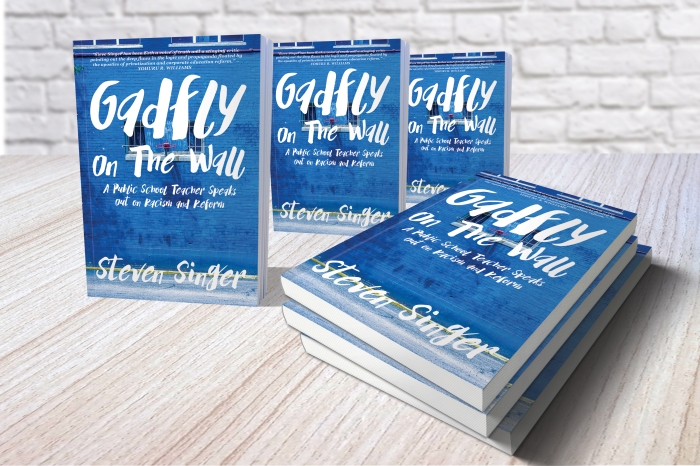
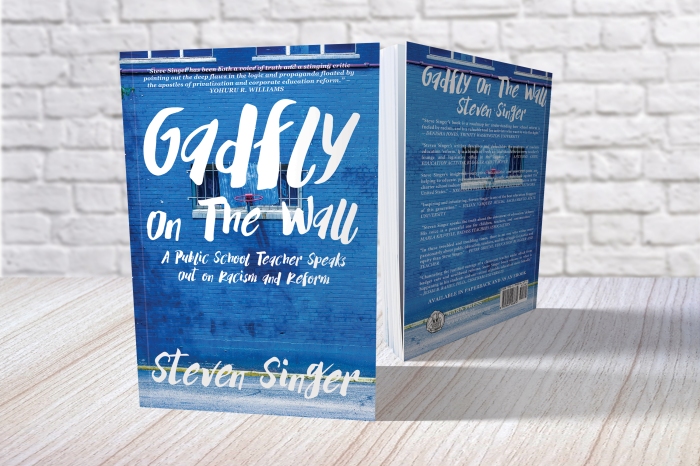
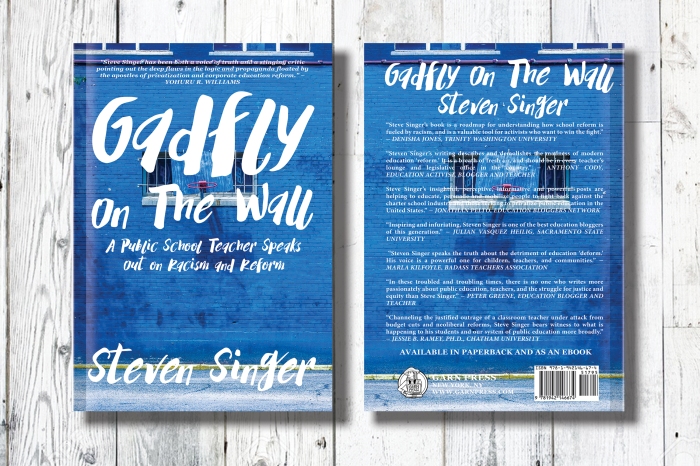
I’ve also written a book, “Gadfly on the Wall: A Public School Teacher Speaks Out on Racism and Reform,” now available from Garn Press. Ten percent of the proceeds go to the Badass Teachers Association. Check it out!
book-3


Defund the Police to Fund Public Schools

Screen Shot 2020-06-07 at 11.16.45 AM

 
Back in the pre-Coronavirus days when we still had in-person classes I used to come to school in a suit.


Every day, suit and tie.


I didn’t have to – the dress code allowed me to wear pretty much whatever I wanted and most teachers dressed much more casually.


Now let me be clear – I’m not saying my way was the only way. Each teacher has his or her own way of doing things that work in their particular cases. But as for me, I’ve always agreed with the old adage that you should come dressed for the job you want, not necessarily the job you have.


I think educators are professionals. They should be respected and taken seriously.


And on the first day of school that’s what I want to tell my students without even opening my mouth: Hey! We’re doing important work here today.


However, as time goes on I often wear whimsical ties. A saxophone, multicolored fish, Space Invaders on test days.


In fact, this year some of the kids nicknamed me “tie man” and even if they didn’t have me as their teacher they’d pop their heads into the room to see what was hanging from my neck that day.


So when I see police officers lined up at George Floyd rallies, I’m aware of what they’re saying without saying a word.

 
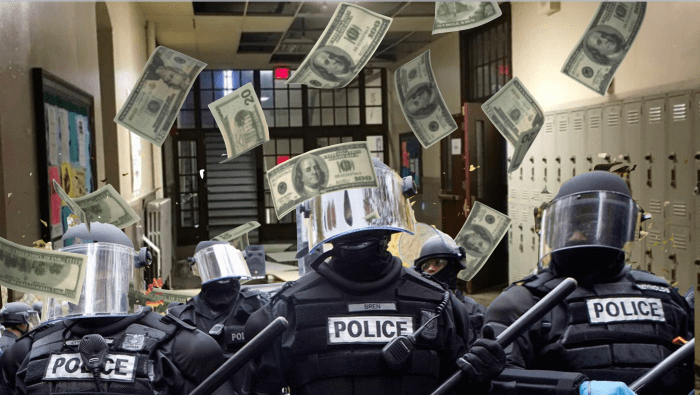
Wearing riot gear, armed with billy clubs and shields. Tear gas canisters and rubber bullets at the ready. Backed by military style tanks and helicopters flying overhead.


That all sends a message: We’re not here to protect and serve. We’re here to pacify and put down.


And like my choice of school attire, this message isn’t just for the observer. It’s for the wearer, too.


There’s no mistaking what you’re there to do with a sport jacket across your shoulders and a piece of fabric knotted around your neck. Just as I’m sure there’s no mistaking your intent when you survey the public behind a plexiglass helmet with a heavy wooden club in your gloved fist.


You’re a soldier and the protesters are your enemy.


Any individual police officer can act differently, but if they do, they’re going against the tide.


That’s why many people are saying “Defund the Police.”


To some that may sound kind of scary.


Defund the police? If we do that, who will protect us from violent criminals?


But hear me out.


Defunding the police doesn’t have to mean abolishing the police (though some would go that far).


For me, it means a radical reinvention of what it means to be a police officer and their role in our society.


Let’s not forget that policing began in this country not so much as law enforcement but as a way to catch runaway slaves and put down labor unions.


It’s not enough to suggest our law enforcers not dress like stormtroopers.


It’s not enough that we ask often progressive mayors not to use their police as thugs and bullies.


It’s not enough that we demand racists be screened out of the hiring process and for more rigorous training before officers become a permanent part of the force.


We should do all of that, but let’s not be blind to what we’ve seen the last week.


A 75-year-old man shoved to the ground and left to bleed in Buffalo, NY. A police SUV driving through a crowd of protestors in Brooklyn knocking several to the ground. A group of police in Philadelphia using a baton to hit a man on the head before pinning him to the ground. In Minneapolis police shouting “Light ‘em up” before firing paint canisters at a woman standing on her own front porch. And in many cities police using teargas, flash-bangs and rubber bullets on a peaceful protesters.


The fact that there was so much police brutality at nationwide anti-police brutality protests proves the need to radically rethink what it means to be law enforcement. And that starts with the money we put aside for this purpose.


If the police are not an occupying army, we shouldn’t fund them or outfit them like the military.


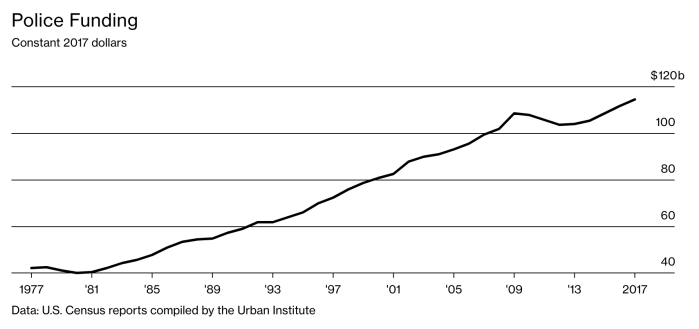
According to a recent analysis of U.S. Census Bureau data conducted by the Urban Institute, the cost of policing has tripled in the last four decades to $115 billion while violent crime has declined.


Screen Shot 2020-06-07 at 8.55.56 AM


Screen Shot 2020-06-07 at 8.56.14 AM


In most cities, the police budget is orders of magnitude greater than many other departments. For example, Los Angeles spends $1.8 billion annually on law enforcement – nearly 18% of the city’s entire budget.


From 2014-19, New York City spent $41.1 billion on police and corrections while spending $9.9 billion on homeless services and $6.8 billion on housing preservation and development. If you combined the city’s spending on homelessness and housing and quadrupled it, that would still be less than what the city spent on policing and corrections.


Screen Shot 2020-06-07 at 8.56.41 AM


Even before the Coronavirus pandemic ravaged the economy, legislators made deep cuts to other services like education, parks, libraries, housing, public transportation, youth programs, arts and culture, and many more. But police budgets have only gotten bigger or remained largely untouched.


As Joe Biden said while Vice President, “Don’t tell me what you value, show me your budget, and I’ll tell you what you value.”


If we don’t want the police to be militarized thugs that keep people in line by force, we shouldn’t give them the tools to do so. 
Officer Friendly doesn’t patrol in a tank and Barney Fife never fired a rubber bullet or tear gas canister at anyone in Mayberry.


Likewise, if we value things like social services and public schools, we should give a lot of the savings to them. A culture of life invests in future generations. The land of the brave and home of the free does not value obedience over free thought and the learning necessary to become an educated participant in our democracy.


I live in Pennsylvania.


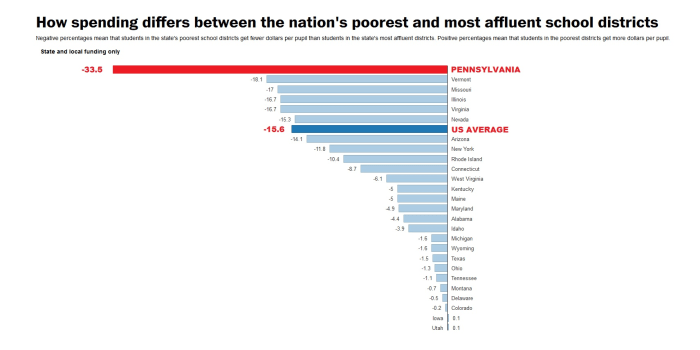
No other state in the country has a bigger gap between what it spends on rich vs. poor students, according to the U.S. Department of Education.


untitled


The state legislature has been paying less and less of public schools’ budgets over the last four decades. The Commonwealth used to contribute 54% of all public school costs in the early 1970s. Today it pays only 35% of the costs, leaving local taxpayers to take up the slack. Since districts are not equally wealthy, that increases the disparity of resources between rich and poor districts.


The difference is significant. Rich districts spend $10,000 to $20,000 on each student, while poorer districts barely pull together $5,000-$6,000.


In addition, impoverished students have greater needs than rich ones. They often don’t have books in the home or access to Pre-kindergarten. Poor students often suffer from food insecurity, malnutrition, a lack of neonatal care, worse attendance, are less well rested and have greater special needs and suffer greater traumas than wealthier students. Moreover, it is no accident that the group privileged with an abundance of funding is made up mostly of white students and those being underprivileged are mostly students of color.

 
What better way to show that black lives really do matter than to invest in black minds?


The situation isn’t limited to Pennsylvania.


Education still hasn’t recovered from the Great Recession. You see today’s public schools employ 250,000 fewer people than they did before the recession of 2008–09. Meanwhile enrollment has increased by 800,000 students.


So if we wanted today’s children to have the same quality of service kids received in this country only a decade ago, we’d need to hire almost 400,000 more teachers!


Instead, our children are packed into classes of 25, 30 even 40 students!

 
And it’s about to get worse!


Across the nation with the inevitable loss of taxes after shutting down the economy to save lives during the global Coronavirus outbreak, local districts are bracing for a 15-25% loss in revenues next fiscal year.

In Pennsylvania, districts anticipate $850 million to $1 billion in revenue shortfalls.

That could result in massive teacher layoffs and cuts to student services just as the cost to provide schooling increases with additional difficulties of life during a worldwide pandemic.


If police are there to protect people, what are they protecting us from?


The system is set up to criminalize citizens and keep them in line with brutality.


We’ve criminalized homelessness, drug addiction, even poverty, itself. And lacking a quality education increases a student’s chances of becoming part of the criminal justice system – the school-to-prison pipeline.


We need a new system that works for us.


We need a system where murdering black people – even if you’re wearing a uniform – sends you to jail, and not only after global protests.


We need a system where people feel safe, where no one has to worry about being targeted because of skin color, nationality, religion, immigration status, sexuality, gender or creed.


We need a system where mass gatherings don’t trigger a police response but a political one to redress our grievances.


And to get there we need to defund the police.


Like this post?  You might want to consider becoming a Patreon subscriber. This helps me continue to keep the blog going and get on with this difficult and challenging work.

Plus you get subscriber only extras!

Just CLICK HERE.

Patreon+Circle

I’ve also written a book, “Gadfly on the Wall: A Public School Teacher Speaks Out on Racism and Reform,” now available from Garn Press. Ten percent of the proceeds go to the Badass Teachers Association. Check it out!
book-1

Pennsylvania Wants YOU to Give Standardized Tests to Your Kids at Home

Screen Shot 2020-05-23 at 1.23.46 AM


A multi-million dollar corporation wants to make sure Pennsylvania’s children keep getting standardized tests.

 
Data Recognition Corporation (DRC) and the state Department of Education are providing the optional Classroom Diagnostic Tools (CDT) assessments for use in students’ homes.


Students are not required to take the CDT in the Commonwealth unless their district decides to give it. The test is encouraged by the state as a way of telling how students will do on the required tests.

 
With this new option, parents finally can give multiple choice standardized tests to their own children on-line.

 
Which is kind of hilarious because no one really asked for that.

 
In fact, many parents, teachers and students breathed a sigh of relief when the requirement that students take high stakes assessments was waived this year nationwide.

 
With the Coronavirus pandemic closing most school buildings and students transitioning to on-line classes created from scratch by their teachers, there hasn’t been much time for anything else.

 
But the folks at DRC, a division of CTB McGraw-Hill, have been busy, too.

 
The Minnesota-based corporation sent out an email written by Matthew Stem, Deputy Secretary of Elementary and Secondary Education at the Pennsylvania Department of Education (PDE) to district contacts from Pittsburgh to Philadelphia encouraging the use of this newly available online CDT.

 
“I am pleased to announce that PDE is providing the Classroom Diagnostic Tools (CDT) as an optional additional resource for your Continuity of Education Plan,” Stem began.

 
“We anticipate that this option will be available through the reopening of schools in 2020.”

 
So if school boards and administrators choose, districts could assign the CDT at the end of this school year, during the summer or at the start of next school year even if school buildings are not yet open due to lingering pandemic problems.

 
This is the kind of academic continuity we should be rethinking not finding new ways to force on children.

 
For some state officials and testing executives perhaps it’s comforting that no matter what happens in this crazy world, at least we’ll still be able to sort and rank kids into Below Basic, Basic, Proficient or Advanced.

 
The rest of us would prefer more authentic education and assessment.


EVERYDAY USAGE


It should be noted that the CDT is not, in itself, a high stakes test.

 
It’s an optional test districts can assign to students in reading, math and science to predict how well they’ll do on the actual high stakes tests.

 
Normally, districts are encouraged (but not required) to give the CDT to students multiple times a year to determine where they’ll struggle on DRC’s other fine products like the Pennsylvania System of School Assessment (PSSA) tests given to children in grades 3-8 and the Keystone Exams given to high schoolers.

 
Of course this data is often used to determine which classes students are placed in, so it can play a huge role in deciding which resources and opportunities kids have.

 
A child who scores well can get in the advanced courses and gain access to all the field trips, guest speakers, pizza parties and other perks. Kids who score badly are often placed in remedial courses where they forgo all the glitz for extra test prep and the abiding label that they’re inferior to their classmates in the higher academic tracks.

 
However, you don’t really need the CDT to make such placements. Just put all the kids from wealthier families in the higher courses and kids living in poverty in the lower courses and you’ll have pretty much the same distribution.

 
Because standardized testing doesn’t really measure academics. It appraises socio-economics. And race. Let’s not forget race!

 
The Coronavirus pandemic actually leveled the playing field for the first time in nearly a century. Everyone – rich and poor – had their education disrupted.

 
But at least now with the reintroduction of the CDT, we can continue to discriminate against the poor black kids while privileging the richer whiter ones.

 
In some ways, that’s just the everyday injustice of American school policy.

 
However, the method DRC and PDE are using to clear the way for this particular scheme is truly spectacular.


A DISASTER WAITING TO HAPPEN


They’re enlisting parents as test proctors.

 
Normally, as a classroom teacher when my administrator demands I give the CDT to my students, I have to block out a few days and give the tests, myself.

 
I have to pass out entry tickets with each student’s username and password so they can login to the DRC app on their iPads and take the test.

 
If there’s a problem signing in, I have to try and fix it.

 
If kids are kicked out of the testing program and can’t sign back in, I have to deal with it.

 
If there’s a problem with the Internet connection…. I think you get the idea.

 
And all of these problems are extremely common.

 
In the last five years of giving the CDT, I have never had a single day go by when I didn’t experience multiple technological snafus, disruptions or downright clusters.

 
And that’s not to say anything of the times students read a question, don’t understand what it’s asking, wave me over and I’m just as dumbfounded as they are.

 
In fact, the only positive I can imagine from such a situation is that parents will finally get to see how badly written and full of errors these tests truly are. Even the guidance materials are full of misspellings and confusing verbiage.

 
When presented with this nonsense, many kids simply zone out, clicking random answers so they can be done as soon as possible and then put their heads down for the remainder of the time.

 
This is the lions den the state wants to throw parents into.


PARENTS AS CORPORATE DEFENSE

 
Admittedly, parents won’t have a full class of 20-30 students to deal with, but complications are guaranteed.

 
However, the good folks at DRC are prepared for that.

 
They have a handy “Parent/Guardian Test Administration Guide.”

 
Here’s what it has to say on ASSESSMENT SECURITY:


“Parents/Guardians should remind their student that the CDT test content must remain secure at all times. None of the materials from the online test may be copied or recorded in any manner.”

 
That’s quite a step down from what the same company warns students on the PSSA:


“…Copying of material in any manner, including the taking of a photograph, is a violation of the federal Copyright Act. Penalties for violations of the Copyright Act may include the cost of replacing the compromised test item(s) or a fine of no less than $750 up to $30,000 for a single violation. 17 U.S.C. $ 101 et seq”

 
I guess that since the CDT questions are just the ones that prepare you for the REAL test questions, it doesn’t matter as much if their security is put at risk here. Or perhaps the risk of letting kids go without testing and having people realize how unnecessary these tests are is greater than any loss in test security or accuracy.


TECHNICAL ISSUES EXPECTED

 
The guide also cautions that the test only may be taken using a Google Chrome Internet browser. If students don’t have one installed, there is a link for parents to follow so they can install it for their kids.

 
For some parents, I’m sure this would be no problem. But many of my students’ parents have little access or knowledge of technology. They would pull out their hair at the very suggestion and come running to teachers and administrators for help.

 
Which is exactly what DRC suggests they do.

 
Here’s what the guide recommends for technical support:


“If technical issues arise during testing, parents/guardians are asked to contact the student’s teacher and/or the student’s school office for technical support. DRC customer service staff cannot directly support issues related to each home’s technology configurations.[Emphasis mine.]

 
And this is true even if the test, itself, directs parents to contact the corporation:


“If a student receives an error message during the test administration that includes instructions to contact DRC for technical support, the parent or guardian who is assisting with the test administration should contact the student’s teacher or school office for additional instructions. Parents or students should not attempt to contact DRC’s customer service directly for technical assistance.

 
Teachers and/or a school’s technology staff will have the information needed to provide parents/guardians with the level of support to resolve most technology issues. If additional support is required, a school or district representative will reach out to DRC to determine a resolution.”

 
This is certain to put quite a strain on districts since these technological problems will occur not as they normally do within school buildings but potentially miles away in students’ homes.

 
Moreover, one of the most common glitches with the CDT often occurs with the entry tickets. These are typically printed by administrators and distributed to teachers who give them to students on test day. Students use the logins and passwords to gain access to the tests.

 
Stem’s plan would have these tickets distributed digitally over Google Classroom or whatever file sharing service is being utilized.

 
So this requires yet another level of distance and technological competency from parents and students just to access the tests. And once that access is gained, these logins need to be readily available in the highly likely event that students get booted from the program and have to reenter this data.


I’m sure there will be noooooooo problems at all with this. It will run very smoothly.


PARENTS AS PRISON GUARDS

 
But let’s say parents are able to help their children login to the test and no technical problems arise.

 
Can parents let their kids simply take the test alone up in their rooms?

 
No.

 
As a test proctor, you are expected to watch your children every second they’re testing to ensure they aren’t copying any information or cheating.

 
You can let your child have scratch paper, highlighters and calculators. But no preprinted graphic organizers, cell phones, dictionaries, thesauri, grammar or spell checkers, other computers or devices.

 
One concession DRC makes is that parents are encouraged to give the shorter Diagnostic Category CDT and not the full version. I’m sure distinguishing between the two on your child’s screen will be no problem at all.

 
This would reduce the test to 35-45 minutes – about half of the full CDT. However, times may vary – my own students have taken more than 180 minutes sometimes to finish the full version.

 
Still, none of this comes close to my favorite part of this catastrophe in waiting.

 
If parents still are uncertain about how to do all this, there is a link to a series of training videos on the PDE Website.

 
These are pretty much the same videos teachers are required to watch every year before giving the CDTs.


As you can imagine, they are perhaps our favorite moments of the year. We sometimes watch them over and over again. Not because they’re so riveting but because we’re required to before we give these infernal tests!

 
Oh, parents, you are in for a treat if your district decides to take advantage of this wonderful opportunity!


AN IMPOSITION ON PARENT’S TIME


Speaking of which, I wonder when Stem thinks parents will have the time to do all this.

 
Parents are working hard just to make ends meet. They’re trying to earn enough money to support the household, cook dinner, clean house, do laundry, and a host of other things.

 
Teaching is a full-time job and most parents don’t have the privilege to set aside that kind of time nor are they disposed to do this stuff in the first place.

 
When I teach my students over ZOOM, I rarely see parents guiding their kids through the lessons.

 
If a kid falls asleep, it’s up to me to somehow prod him awake over the Internet. If a child isn’t paying attention or playing on her phone, it’s up to me to direct her back on task.

 
In class, that’s fine. It’s my job and I’m right there in front of the child.

 
On-line, I cannot do it nearly as effectively. But I do my best because I can’t realistically expect all parents to step in here.

 
Yet DRC is expecting parents to do just that by becoming test proctors.


CONCLUSIONS

 
This is a terrible idea.

 
It will lead to fabulous disasters where teachers, administrators and parents fumble to make things work as DRC pockets our tax dollars.


Over the past decade, Pennsylvania and local school districts paid more than $1.3 billion for standardized testing. In particular, the state paid DRC more than $741 million for the PSSAs, Keystone Exams and CDT tests. Two of three DRC contracts were given sole source no-bid extensions.

 
Imagine what cash-strapped districts could do with that money.

 
Yet Stem, a former assistant superintendent in Berks County and former administrator in Lancaster, thinks we should give this money to corporations and then break our own backs meeting their needs.


Even if we could give the CDTs seamlessly online at home, it would hurt our most underprivileged children by taking away opportunities and unjustly labeling them failures.

 
No, if you ask me,it is not time to try to save standardized testing with a tone deaf plan to enlist parents as test proctors while kids are chained to the Internet.

 
It’s well past time to rethink the value of these tests in the first place.

 
We don’t need them.

 
Teachers can assess learning without the help of corporate America.


Our kids and their families deserve better than this.

 
Contact your local school directors and demand they NOT give the CDT – not now, not during the Coronavirus pandemic, not when the crisis is over, not ever again.

 
And if they won’t listen, opt your children out of standardized testing including diagnostics like the CDT. Then run for school board, yourself, with other likeminded parents and community members.

 
Write letters to the editor of your local paper, make some noise.


The people still hold the power. And we’re all being tested in more ways than one.


THE FULL EMAIL:

The following communication was initially broadcast by the Pennsylvania Department of Education on May 18, 2020. DRC is forwarding the same message to the district and school contacts on file in our databases.


Screen Shot 2020-05-23 at 8.51.55 AM


May 18, 2020

 
To: Superintendents, Principals, Charter School CEOs, and IU Directors
From: Matt Stem, Deputy Secretary
Subject: Availability of the Classroom Diagnostic Tools (CDT) for use by students at home


I am pleased to announce that PDE is providing the Classroom Diagnostic Tools (CDT) as an optional additional resource for your Continuity of Education Plan. The CDT is a set of online tools designed to provide diagnostic information to guide instruction and provide support to students and teachers. It is aligned with the content assessed on the PSSA and Keystone exams. We anticipate that this option will be available through the reopening of schools in 2020.


This at-home testing option will allow students to access the CDT from a “public” browser without having it installed on their computers or being configured to their District’s Central Office Services network. The test-setup tasks that teachers/school assessment coordinators routinely complete for classroom administrations of the CDT are the same for the at-home administrations. Test tickets (login credentials) will be distributed directly to the students by school staff. Teachers will have access to all CDT data/reports from the at-home administrations as usual. An overview of the at-home testing option and a guidance document for parents/guardians can be accessed from the following links (or directly from DRC’s INSIGHT Portal under General Information >> Documents >> 2019-2020 Classroom Diagnostic Tools >> Memos/Documents).


At-Home Testing Overview: https://pa.drcedirect.com/Documents/Unsecure/Doc.aspx?id=32997b8e-13cf-42f0-9c2c-af1689d89323 
Parent/Guardian Guidance: https://pa.drcedirect.com/Documents/Unsecure/Doc.aspx?id=cc242168-e06e-44d1-9fd4-ef859a519dab 


All CDTs (Full and Diagnostic Category) are available for use. However, it is highly recommended to only have students take the Diagnostic Category CDTs at this time. Students and their parents/guardians may benefit from a much shorter testing experience using the Diagnostic Category CDTs that are aligned to current instructional content. The shorter, more focused testing will still provide teachers and administrators with the same level of reporting and resources to adjust instruction and planning during distance learning.


Thank you for all your efforts to support students during this challenging time. If you have any questions, comments, or concerns, please contact the curriculum coordinator or CDT point of contact at your local Intermediate Unit. If you are interested in using CDT for the first time, contact PDE here.


Sincerely,


Matthew Stem
Deputy Secretary, Office of Elementary and Secondary Education
Pennsylvania Department of Education


Screen Shot 2020-05-23 at 8.52.08 AM


Like this post?  You might want to consider becoming a Patreon subscriber. This helps me continue to keep the blog going and get on with this difficult and challenging work.

Plus you get subscriber only extras!

Just CLICK HERE.

Patreon+Circle

I’ve also written a book, “Gadfly on the Wall: A Public School Teacher Speaks Out on Racism and Reform,” now available from Garn Press. Ten percent of the proceeds go to the Badass Teachers Association. Check it out!

thumbnail_IMG_8249

Why High Stakes Testing Was Cancelled This Year (and Probably Will Be Next Year, Too)

Screen Shot 2020-05-16 at 10.22.26 AM

 
There are at least two silver linings to the current Coronavirus catastrophe for education.


One – with nearly all public schools closed, March was the first month since 2002 without a school shooting.


Two – districts nationwide cancelled high stakes standardized tests in April and May.


Taken together, these are two victories that no one could have predicted before November.


Gun safety restrictions remain laughably lax in the US compared to the rest of the world. And our system’s reliance on high stakes testing to hold schools and teachers accountable for economic inequalities and racially biased standards has been thoroughly criticized for nearly a century.


In short, the virus succeeded where policy did not.

 
The pandemic’s other effects have been more damaging as students, parents and teachers have struggled to move education online at home.


Teachers are seeing high absences especially among poor, underprivileged and special needs children. Not to mention worries about the quality and depth of education provided virtually and the stress it places on families.


To make matters worse, the situation seems likely to continue in some form when next school year begins in the fall.


With the COVID-19 virus likely to endure spreading unchecked due to a lack of adequate health screenings, the time it takes to make a vaccine, and an unwillingness by the government to save everyday people from the economic consequences of a nearly stopped economy, not to mention an increasing unwillingness among people to continue thorough social distancing procedures, schools may be left to solve the crisis themselves.


There’s been talk that when schools start up in August and September they may simply continue with cyber curriculum. Or they may open the physical buildings with safety protocols including half day classes of smaller size to keep students a safe distance apart.


In any case, the question of standardized testing arises again with a vengeance.


While there is some wiggle room, federal law (The Every Student Succeeds Act) requires all public school students be given standardized tests in grades 3-8 and once in high school.


The U.S. Department of Education waived that mandate this year because of the virus.


That was great news – a sound decision from a government agency known more for market solutions than rationality.


The question remains: why did the department do it?


Whether staffed by Democrats or Republicans, this doesn’t sound like them.


Why was this exception made and will it be extended again given that the circumstances may be little different in 2020-21 than they were in 2019-20?


The answer seems to be rooted in the tests, themselves, and the economic circumstances which create and sustains them.


WHY TESTS WERE CANCELLED

 
In late March, Education Secretary Betsy DeVos said that her department would streamline the paperwork for states to request a waiver allowing them not to give high stakes testing this year and that the government wouldn’t use this year’s testing data in future school accountability ratings.


DeVos said in a statement:


“Students need to be focused on staying healthy and continuing to learn. Teachers need to be able to focus on remote learning and other adaptations. Neither students nor teachers need to be focused on high-stakes tests during this difficult time.”


How did we get here?


Well, imagine a world where this didn’t happen.


Before DeVos made her statement, some states like Colorado and Texas had already eliminated testing requirements without waiting for a response from DeVos.


If the federal government hadn’t answered these requests in the affirmative, it would have had to engage in an open power struggle with the states over control of public schooling.


This would be especially damaging for a Republican administration because of the party’s stance on state’s rights.


However, even if we put aside this power dynamic, the decision was inevitable.


CORPORATIONS FIRST


All of these assessments are the property of private corporations. These include Harcourt Educational Measurement, CTB McGraw-Hill, Riverside Publishing (a Houghton Mifflin company), and NCS Pearson.


States purchase the right to use these tests but assessment material is the ideological property of the parent corporation. And so they want it guarded from theft.


That’s why nearly all high stakes testing requires proctors – people whose job it is to set up, monitor and secure the testing environment. They make sure test takers don’t cheat, but they also are responsible for ensuring no information about specific test questions leaves the assessment environment.


This is true for standardized assessments at the K-12 level as well as college and certification tests.


I know because I’ve spent every year of my teaching career employed as a proctor throughout most of April as my students take the Pennsylvania System of School Assessments (PSSA) tests. But also when I got my degree I had to go to a designated testing center where I could be monitored as I took a series of assessments necessary to get my certification.


I had to sign in, empty my pockets including giving over my cell phone, and submit to being observed by the proctors and video surveillance. I even had to sign out and back in when I needed to use the restroom.


With physical classrooms closed, there was simply no way effectively to do this.


The College Board tried anyway with an abbreviated Advanced Placement test taken online from home this month to disastrous results – glitches, server issues and a failure by the organization to take responsibility.


However, the problem isn’t essentially technological. These assessments could be given online. Many districts do exactly that, but with teachers in the room acting as proctors.


The technological infrastructure may not yet be in place for widespread virtual testing, but that’s not an insurmountable hurdle.


Test security is a much stickier issue – without real, live people policing the environment, testing information would be at risk.


Rival companies could get access to trade secrets. The value of scores could come under scrutiny due to concerns of student cheating. And the tests, themselves, would for the first time be visible to parents and the general public.


TESTING SECRECY


As a classroom teacher, I get to see these infernal tests. I get to see the questions.


They are not good. They are not well-written, well considered, developmentally appropriate or even good at evaluating student understanding of the knowledge they claim to be assessing.


But up to this point, anyone who gets to see the tests is sworn to secrecy including the students.


The kids taking these exams – regardless of age – are no longer treated as children. They are clients entering into a contract.


At the start of these tests, they are warned of the legal consequences of violating the terms of this agreement.


THE PSSAS

 
In particular,the PSSAs require students to read the following warning on the first day of the assessment:


DO NOT PHOTOGRAPH, COPY OR REPRODUCE MATERIALS FROM THIS ASSESSMENT IN ANY MANNER. All material contained in this assessment is secure and copyrighted material owned by the Pennsylvania Department of Education. Copying of material in any manner, including the taking of a photograph, is a violation of the federal Copyright Act. Penalties for violations of the Copyright Act may include the cost of replacing the compromised test item(s) or a fine of no less than $750 up to $30,000 for a single violation. 17 U.S.C. $ 101 et seq


So the first act of testing is a threat of legal consequences and possible fines.


In the commonwealth, we also force kids to abide by a specific code of conduct for test takers. They must enter a quasi-legal relationship before they are even permitted to begin.


Much of this code is common sense. Get a good night’s sleep. Fill in bubbles completely using a number two pencil.


But some of it is deeply disturbing.


For example, students are told to “report any suspected cheating to your teacher or principal.”


They have to agree to be an informer or snitch to a government agency. My students aren’t old enough to vote or even drive a car, but they are directed to collaborate with the government against their classmates.


In addition, they are told NOT to:


-talk with others about questions on the test during or after the test.


-take notes about the test to share with others.


Students are compelled into a legalistic vow that they won’t break this code. On the test, itself, we make them fill in a bubble next to the following statement:


By marking this bubble I verify that I understand the “Code of Conduct for Test Takers” that my Test Administrator went over with me.


As a test administrator, I am not allowed to move on until all students have filled in that bubble.


Technically, we are not making them promise TO ABIDE by the code of test takers. Perhaps we lack that legal authority. We are, however, making them swear they understand it. Thus we remove ignorance as an excuse for noncompliance.


As a proctor, I have to sign a similar statement that I understand the “Ethical Standards of Test Administration.” Again, much of this is common sense, but it includes such statements as:


DO NOT:

 
-Discuss, disseminate or otherwise reveal contents of the test to anyone.


-Assist in, direct, aid, counsel, encourage, or fail to report any of the actions prohibited in this section.


So even teachers technically are not allowed to discuss the test and should report students or colleagues seen doing so.


And according to the “Pennsylvania System of School Assessment Directions for Administration Manuel”:


Those individuals who divulge test questions, falsify student scores, or compromise the integrity of the state assessment system in any manner will be subject to professional disciplinary action under the Professional Educator Discipline Act, 24 P.S. $ 2070. 1a et seq, including a private reprimand, a public reprimand, a suspension of their teaching certificate(s), a revocation of their teaching certificate(s), and/or a suspension or prohibition from being employed by a charter school. [emphasis added]


CORPORATE VULNERABILITY


If students were allowed to take these tests unsupervised at home, all of this legal protection would disappear.


The corporations would be much more exposed and defenseless.


THAT’S why the tests were cancelled this year.


It wasn’t because anyone rethought the value of high stakes tests – though they should have. It wasn’t because anyone had considered standardized testing’s history in the eugenics movement – which they should have. It wasn’t because anyone was worried that giving these tests would take away precious academic time – though they should have.


It was to protect the business interests that would be at risk otherwise.


THE DYSTOPIAN TESTING FUTURE


The need for proctors is a problem that the testing companies know about and are working to eliminate.


In fact, they’ve been trying to line things up in their favor for years.


Their answer is something called Competency Based Education (CBE) or Proficiency Based Education (PBE). But don’t let these names fool you. It has nothing to do with making children competent or proficient in anything except taking computer-based tests.


Paradoxically, it’s sold as a reduction in testing, but really it’s about changing the paradigm.

 
It’s a scheme that ed tech corporations privately call stealth assessments. Students take high stakes tests without even knowing they are doing it. They’re asked the same kinds of multiple-choice nonsense you’d find on state mandated standardized assessments but programmers make it look like a game.


This safeguards the tests because kids aren’t aware of being tested. Constant micro-assessments blend in with test prep curriculum until there is little to no difference between the two. Academics gets dumbed down to the level of multiple choice and critical thinking is redefined as asking “What does the questioner want me to think?”


Yet the results could still be used to label schools “failing” regardless of how under-resourced they are or how students are suffering the effects of poverty. Mountains of data will still be collected on your children and sold to commercial interests to better market their products.


But that’s just how it is used in schools today.


The potential is to make this a replacement for physical schools.


It’s a disaster capitalism reform tailor made for the Coronavirus age, but not yet ready for large scale implementation.


Imagine a world where there are no schools – just free range children plopped in front of a computer or an iPad and told to go learn something.


No schools, no teachers, just gangs of students walking the streets, stopping along the way to thumb messages to each other on social media, play a video game or take an on-line test.


That’s the world many ed tech entrepreneurs are trying to build.


One thing they need is a pet policy of DeVos and the Trump administration – Education Savings Accounts (ESAs).


Normally, the federal, state and local government collect taxes to fund an individual child’s education, which is then spent at a public or charter school.


However, ESAs would allow that money to go elsewhere. It could go to funding the tuition at a private or parochial school like a traditional school voucher.


Or it could be used for discrete education services provided by the ed tech industry.


It’s almost like homeschooling – without a parent or guardian in charge.


The idea is often called a learning ecosystem.


But it’s just a single person cyber school with little to no guiding principles, management or oversight.


Education is reduced to a series of badges students can earn by completing certain tasks.

 
Reading a book or an article gives you a badge. Answering a series of multiple-choice questions on a reading earns you more badges. And if you’ve completed a certain task satisfactorily, you can even earn a badge by teaching that same material to others.


It’s the low wage gig economy applied to education. Children would bounce from a few hours of Khan Academy videos here to a software package there and Voila! “Modern” education!


And as an added benefit, the badge structure creates a market where investors can bet and profit off of who gains badges and to what degree on the model of crypto-currencies like Bitcoin!


Make no mistake, it’s not about improving the quality of education. It’s about providing the cheapest possible alternative and selling it to the rubes as innovation.


It’s school without the school or teachers.


CONCLUSIONS


This is where the testing industry is going.


This is where we would be today if the legal framework were in place and the technology were widespread, adequate and capable of safeguarding corporate intellectual property without the need for test proctors.


In the short term, this is good news.


As long as the pandemic keeps school buildings closed or keeps them running at less than capacity, the chances of mandating high stakes testing during the crisis goes down.


On the flip side that’s detrimental to student learning in the here and now, but it does offer hope for the future. It at least opens the door to cancelling high stakes testing in 2020-21 like we did this year. And the longer we keep those tests at bay, the greater likelihood they will go away for good.


However, the people at the testing corporations are far from stupid. They know that each year we forgo the tests proves how unnecessary they are.


A coalition of six neoliberal organizations warned against cancelling the tests nationwide in March.


“As the coronavirus pandemic evolves on a daily basis, it would be premature to issue blanket national waivers from core components of the law. Thus, case-by-case consideration of each state’s needs is, at this time, most appropriate,” said a letter signed by testing industry lobbyists including John King, the former secretary of education and head of the Education Trust.

 
They have the future mapped out – a future with immense earnings for their companies and shareholders.


We must be fully aware of what is happening and why if we are to have any chance of opposing the next disaster and coming out of the current crisis with better school policy than we went in.


If we are to safeguard an authentic education for our children, we must learn these lessons, ourselves, now.


Like this post?  You might want to consider becoming a Patreon subscriber. This helps me continue to keep the blog going and get on with this difficult and challenging work.

Plus you get subscriber only extras!

Just CLICK HERE.

Patreon+Circle

I’ve also written a book, “Gadfly on the Wall: A Public School Teacher Speaks Out on Racism and Reform,” now available from Garn Press. Ten percent of the proceeds go to the Badass Teachers Association. Check it out!

book-1

Save Our Schools From Coronavirus Budget Cuts


Screen Shot 2020-05-02 at 4.36.09 PM


America is one dumbass country.


We don’t do the metric system.


We don’t do universal healthcare.


And during a global pandemic, we don’t demand the government pay us to stay home and stop the spread of the disease.


Instead, we demand the government let us go out and get sick.


It should come as no surprise, then, that we deeply under-fund our public schools.


There’s always money for a new war or to subsidize fossil fuels or give billionaires another tax cut, but when it comes to teaching kids how to think critically about their world – time to take out the scissors and slash some budgets.


And now with the inevitable loss of taxes after shutting down the economy to save lives during the global Coronavirus outbreak, experts are expecting the deepest budget cuts to schools – well, ever.


Sixty two district superintendents from urban districts wrote to Congress in April warning of a 15-25% loss in revenues next fiscal year.


The school leaders from cities like New York City, Los Angeles, Chicago and Miami, say that a 20% loss in both state and local taxes, alone, would result in laying off about 275,000 teachers.


And this would come after students had already suffered significant academic losses during the current (2019-20) school year because of school closings and distance learning initiatives that could not possibly meet the needs of students as well as in-person learning.


Screen Shot 2020-05-02 at 10.14.42 AM


They ask legislators to enact a plan devised by the Albert Shanker Institute – a policy organization aligned with the American Federation for Teachers (AFT) – in which the federal government would give billions of dollars to districts in several phases to keep schools open. Then states would increase funding to levels before the Great Recession (2009-13), build up budget reserves and more equitably distribute capital.


How much money would be necessary?


It’s hard to say at this point.


Most districts get about 90% of their funding from state and local taxes and these haven’t been tallied yet for March, when social distancing began.


Some experts expect to have a better picture of the damage by the end of the first or second week of May.


There has been no mass evictions (though that may eventually happen), so property taxes are probably stable at this point. But it’s unclear how much shuttered storefronts and skyrocketing unemployment will affect the picture.


Screen Shot 2020-05-02 at 10.14.14 AM


The National Governors Association and non-partisan Center on Budget and Policy Priorities, though, are expecting the worst.


They estimate a possible $500 billion state shortfall mostly concentrated in the 2020-21 fiscal year.


Screen Shot 2020-05-02 at 10.12.29 AM


That’s less than three months away.


Even if you subtract fiscal aide already provided by Congress and state rainy day funds (if present), legislatures would still be at least $360 billion short.


The National Association of Teachers (NEA) is calling for an additional $175 billion just to stabilize the country’s schools.


“The seniors graduating this spring started kindergarten in the fall of 2007,” says Bruce Baker, professor at the Graduate School of Education at Rutgers University and co-author of the Shanker Institute report.


“Most of these students have spent almost their entire K-12 careers in schools with less funding than there was when they started. If this happens again, it will be because we let it happen.”


And that’s just it.


This Coronavirus crisis is a wake-up call for all of us about the elements of our society that had to fail for us to get to this point.


Everything from how we deal with climate change, to infrastructure, to healthcare, to economic inequality needs to be reconsidered if we are to survive.


Education is an essential piece of that puzzle.


We cannot continue to consume resources like there is no tomorrow – or there will be none.


We cannot continue to treat billionaires like the most vital part of our society when they are really nothing but parasites on it.


And we cannot continue to undercut our public education system and expect our next generation to be in a better position than we are today. In fact, doing so ensures that it won’t be.


Not only do we have to pay for our kids to be educated, we have to pay for ALL kids – black, white, brown, girls, boys, Christians, Jews, Muslims, immigrants, native born — all of them.


We have to integrate, educate and eliminate the school-to-prison pipeline.


And we have to stop wasting the money we do allocate on pointless profit-making endeavors for corporations that give little to nothing back to the children they are meant to be serving. That means no more privatized schools, no more high stakes standardized testing, no more shady ed tech, corporate written academic standards and union busting initiatives.


We have to ask ourselves – will we continue to support a culture of death where war and inequality are prioritized over nurturing and care? Or will we finally engage in a culture of life, where education and equity are the driving forces of society?


We can continue to be the laughing stocks of the world with our guns and superstitions, or we can get off our asses and start working toward a better world for all.


The old ways will not work in this new millennium.


It is entirely unclear whether we will heed the call from this crisis or hide our heads in the sand.


But the future of our nation and the well-being of our children are being decided right here, right now, this very minute.


Time to invest.


Email your members of Congress and tell them to keep students learning and educators working.


Like this post?  You might want to consider becoming a Patreon subscriber. This helps me continue to keep the blog going and get on with this difficult and challenging work.

Plus you get subscriber only extras!

Just CLICK HERE.

Patreon+Circle

I’ve also written a book, “Gadfly on the Wall: A Public School Teacher Speaks Out on Racism and Reform,” now available from Garn Press. Ten percent of the proceeds go to the Badass Teachers Association. Check it out!
book-2

HBO’s “Bad Education” Aims at Public School Theft While Ignoring More Frequent Fraud at Charter Schools & Testing Companies

BADED_29OCT18_0125.RAF

 
“Bad Education” is a frustrating movie to watch as a public school teacher.


It does a fine job telling the true story of a wealthy New York district where administrators stole millions of dollars for themselves.


But it ignores the far more frequent waste and malfeasance caused by school privatization, high stakes testing and runaway ed tech.


Maybe I’m being too sensitive, but there is no subject more political than public schools.


During the current Coronavirus pandemic, teachers and schools are finally getting some respect from people who are trying to “home school” their own kids while the nation’s classrooms are shuttered.


But education budgets are still routinely slashed, and every policymaker from Betsy DeVos to Barack Obama still thinks there is nothing better than closing public schools and replacing them with charter and/or voucher schools.


Pundits continually decry low test scores while applauding every means to increase racial and economic segregation. They push every policy to increase the school to prison pipeline for black and brown students.


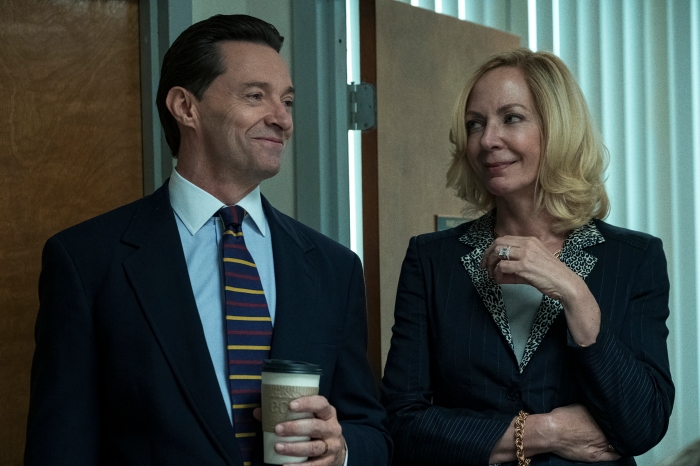
And now HBO drops this movie about Rosalyn School District Superintendent Frank Tassone (Hugh Jackman) who embezzled $11 million from taxpayers.
What happened in Rosalyn was scandalous. But it’s an outlier.


Such misappropriation and outright theft rarely happens at public schools. After all, the records are all public. It just takes someone to check up.


For REAL theft you have to go to charter and voucher schools where the law literally allows them to spend our money without most of that public oversight.


Viewers like me from Pennsylvania still remember Nick Trombetta. The founder and former CEO of the Pennsylvania Cyber Charter School stole a similar sum (at least $8 million), and got much less prison time (20 months vs. Tassone who served 3 years). Trombetta used taxpayer dollars to buy a$300,000 private jet for goodness sake! He bought a $933,000 condo in Florida! He bought $180,000 houses for his girlfriend and mother in Ohio. He did all this and more – and his lawyers got the charges down to tax evasion! Why is there no movie about THAT?


Or how about June Brown?


As the head of Agora Cyber Charter School, which was part of the K12 Inc. charter empire, she was indicted for stealing $6.5 million from taxpayers. She and her executives were indicted on 62 counts of wire fraud, obstruction of justice and witness tampering. She had a reputation for claiming large salaries and filing suits against parents who questioned her.


Where’s that movie?
The history of charter schools reads like a who’s who of hucksters and thieves!


Electronic Classroom of Tomorrow (ECOT) the largest charter school in Ohio was forced to shut down and auction off all its taxpayer funded property because administrators  grossly inflated its students body of 12,000 online students to the state.


New Jersey charter schools spent as much as $800 million of taxpayer dollars to buy property that they then charged taxpayers additional money to rent from the charter schools, according to an IRS investigation.


The Network for Public Education published a report in 2019 detailing more than $1 billion in federal dollars misappropriated by charters – including hundreds of millions spent on charters that never even opened or that closed soon after opening.


I think those would make good movies. Don’t you?


But let’s not forget the other vulture industries that prey on our public school system without providing much of value in return.


If you want REAL fraud, you have to go to the standardized testing and ed tech industry sucking away billions or taxpayer dollars while providing services that are either unnecessary or downright destructive.


Why do we give every public school child high stakes tests in grades 3 through 8 and once in high school? Because the federal government says so.


These tests don’t tell us how well students are doing in school. We have at least 180 days of classroom grades that tell us that.


These tests taken over a period of a few days tell us what the corporation making them thinks is important. And they nearly always show that richer kids are doing better than poorer kids, and that whiter kids are somehow “smarter” than blacker kids.


And for this prized data we pay billions of dollars to big businesses every year.
It’s one of the largest captive markets in existence. That’s some 50.4 million children forced to take standardized assessments. The largest such corporation, Pearson, boasts profits of $9 billion annually. It’s largest competitor, CBT/ McGraw-Hill, makes $2 billion annually. Others include Education Testing Services and Riverside Publishing better known through its parent company Houghton Mifflin Harcourt.


If many of these companies sound like book publishers, that’s because they are or their parent companies are. And that’s no coincidence. It’s another way they bolster their own market.


Not only do many of these testing corporations make, provide and score standardized assessments, they make and provide the remedial resources used to help students pass.


So if your students are having difficulty passing the state test, often the same company has a series of workbooks or a software package to help remediate them. It’s a good business model. Cash in before kids take the test. Cash in when they take it. And if kids fail, cash in again to remediate them.


Ever wonder why our test scores are so low? Because it’s profitable! The money is all on the side of failure, not success. In fact, from an economic point of view, there is a disincentive to succeed. Not for teachers and students, but for the people who make and grade the tests.

 
In fact, when I sat down to watch “Bad Education” I thought it was going to be about high stakes testing cheating scandals. I thought it was going to be about how the pressure to have students score well on the tests have in some cases resulted in teachers and/or administrators changing answers to inflate the scores.


But no. That’s not mentioned at all. There’s talk about test scores but their value is never questioned for one second.


Hugh Jackman’s superintendent dreams of leading his schools from getting the 4th highest test scores to having the 1st highest. But nowhere does anyone mention how these tests were literally developed by Nazi eugenicists or how they have been challenged countless times for violating children’s civil rights or even the sizable parent-led opt out movement in the same New York suburbs where the film takes place.


Okay.  Maybe I AM being too sensitive.


The film does seem to have a theme about how we expect everything from schools and teachers and don’t reward them well enough. But this is undercut by the obvious villainy of people who use that discrepancy to take advantage of the trust the public has placed in them.


Public schools rarely act this way.


I fear that many people will miss that point.


Instead it will be more fuel to the fire that public schools are bad and must be replaced.


There’s even a parting shot about Jackman’s character’s pension.


I’m all for drama.
But when filmmakers bend over backward to ignore the elephant in the room, I tend to lose my appetite for popcorn.


Like this post?  You might want to consider becoming a Patreon subscriber. This helps me continue to keep the blog going and get on with this difficult and challenging work.

Plus you get subscriber only extras!

Just CLICK HERE.

Patreon+Circle

I’ve also written a book, “Gadfly on the Wall: A Public School Teacher Speaks Out on Racism and Reform,” now available from Garn Press. Ten percent of the proceeds go to the Badass Teachers Association. Check it out!
book-4

Adventures in Online Teaching: Reinventing the Wheel for a Handful of Students

Screen Shot 2020-04-24 at 8.28.00 PM

 
Today in our ZOOM meeting, one of my students tried to get one over on me.


I sat at the bureau in my guest bedroom, surveying a gallery of 7th grade faces lined up in little boxes on my laptop like the opening scene of the Brady Bunch.


Lilly was lying on her bed face up, almost definitely scrolling on her cell phone.


Pha’rrel was eating a cookie as he tried to fit his overgrown curls under a gray hoodie.


And Jimmy was smiling at me with the cheesiest close up you ever saw in your life.


The smile was so wide. The eyes were so glassy. The face was so still.


“Jimmy, did you put up a picture of yourself on your camera!?” I asked.


Somewhere miles away he laughed, apologized and took it down.


If we were back in the classroom, I probably would have come down on him.


He used to sit in the back of the room, face buried in his iPad, ear buds plugged into his brain and his work done in the most careless but high-speed fashion possible.


About once a week I had to take away some device just so his Internet-rattled mind could pay attention.


What am I to do now? Those apps and devices are the only thing connecting him to even the most rudimentary schooling.


He still wants to appear to be paying attention, appear to be done with whatever useless crap I am having him do so he can play Fortnite, watch YouTube videos or text – all behind a digital mask of innocent concentration.


So I moved on.


We read a passage together and I noticed Melanie had her eyes closed.


Not just that. She was in her comfy sweats, cuddled under the covers with a kitten curled under her elbow purring away.


“Melanie?” I say.


No response.


“Melanie, did you hear what we just read?”


Nothing.


She’d do that in class sometimes, too. She’d be zonked out, her head plastered to the desk in a puddle of quickly congealing drool. Sometimes it was pretty hard to wake her.


I remember conferencing with her and her mom trying to find out if there was anything wrong – but, no, she was simply misusing the privilege of picking her own bedtime.


How was I to keep her awake online? I couldn’t shake the desk, rattle her papers or even let my voice naturally get louder as it gained proximity.


I had to let her sleep.


Oh and what’s this? Was that Teddy finally joining the ZOOM Meeting 20 minutes in?


I clicked to let him join and immediately it was clear that he was missing something important.


“Teddy? Is that you?” I said.


“Yeah, hey, Mr. Singer.”


“Ted, you forget something?”


“Wha?”


“Ted, your shirt?”


He looks down at his naked torso.


“Oh, I haven’t gotten dressed yet.”


“Uh, we can see that, Buddy. Why don’t you turn your iPad around and put on a shirt and pants? Okay?”


These are just some of the hurdles you face as an online teacher.


Ever since the Coronavirus pandemic shuttered schools across the country, teachers like me have been asked to finish up the year with students via the Internet.


It’s not been exactly a smooth transition.


Getting kids attention is not an easy task under the best of circumstances. Online it’s nearly a Herculean labor.


Strangely the episodes related above aren’t even close to the worst of it.


More than students’ attempts to message each other through the lesson or the constant screaming in the background at some kids homes or the vacant stares of the child with ADHD whose IEP calls for teacher proximity and eye contact, but how do you do that from across town? – more than all of that is the silence.


The empty, deafening silence of the majority of kids who don’t even show up.


I’ve been doing this for three weeks now and I average about 40% participation.


Some days a class might be almost full. Another day there might be two kids.


I know it’s not necessarily the children or the parents’ fault.


We’re in the middle of a global catastrophe. Family members are sick, kids are scared, and many don’t have experience with Internet, the devices or certainly the learning platforms we’re using.


Districts can give out iPads and mobile hot spots, but not familiarity with technology, not a quiet place to work, not a safe and secure learning environment.


When a parent tells me her child is having trouble with something, I excuse him. I get it.


When a student tells me she doesn’t understand how to do something, I don’t penalize her. I try to fix the problem and ask her to give it another shot.


But when you’ve been tasked with creating almost entirely new curriculum on the fly for several different classes– and you do – it’s anticlimactic that so few kids show up to see it.


I almost don’t mind it when someone’s cat swaggers in front of the screen and flaunts its butthole for all to see.


That’s just life in the age of distance learning.


But when I design all these assignments and teach all these classes, I wish more students showed up.


My district doesn’t require me to do all this.


I could have just thrown a few worksheets up on Google Classroom and called it a day.


That’s kind of what administrators want, I think. Just review previously taught skills. Make it look like we’re doing something. And we’ll close the academic gaps next year.


But when the world shut down, my 8th graders were getting ready to read “The Diary of Anne Frank” and “To Kill a Mockingbird.” You don’t really expect me to skip over that, do you?


My 7th graders were getting ready to read a gripping mystery story, “Silent to the Bone” by E.L. Konigsburg. You don’t really think I’m going to substitute that with grammar and vocabulary worksheets? Huh?


So I narrowed it all down to essentials.


I could have assigned my students to read the texts on their own and then made them write reader response journals. But I don’t think any but my most self-motivated students would have done it and even they would have lost a lot without being able to discuss it.


So I put a few assignments on Google Classroom, but most are through live ZOOM Meetings where the students and I talk through the texts together.


The 8th graders read the play version of “Anne Frank” together with me, and it’s actually going pretty well.


I’m able to display the text on the screen and move the cursor under what they’re reading.


I’ve even seen some reluctant readers improve right before my eyes.


I’ve always suggested that students put their index fingers under the words as they read, but few do it. Using ZOOM like this forces them to follow my advice.


Of course, the class is a tiny fraction of what it would be in person.


If we were still in the school building, I’m positive they’d be learning more. We’d be able to discuss more. I’d have a better read of the room. They would be less capable of hiding behind the technology.


But there is real life-long learning taking place.


It’s my most successful group.


My 7th graders are a different story.


They are the kind of class you have to explode a stick of dynamite under to get them to notice what’s right before their eyes.


And more of them actually show up. Yet much of what we’re reading seems lost on them.


They are much more dedicated to being present in body if not in spirit – and barring an exorcism, I’m unsure how to reach many of them through fiber optic cables.


Then we have my Creative Writing class – basically a journaling course taught to a different group of students every few weeks.


It’s particularly challenging because I’ve met very few of them in person before the school closed.


However the course also lends itself best to this distance learning format.


Back in the school building, I used to give students a prompt every day, explain it and then have them write. I’d go from desk-to-desk as they worked and give feedback. Once they were all done, we’d share the writings aloud.


Now online, I just give the prompts via Google Classroom, provide instruction or attach video links and leave them to it. Then I comment on what they produce.


The problem is it’s my least attended class. I have a handful of students who do all the work, but most have done nothing. And this is a traditional work-at-your-own-pace cyber class.


I’ve had much more difficulty planning the other courses. Everything had to be reinvented. You want to read along with students, you need (1) a platform where you can all talk (2) an online text, (3) a way students can catch up, (4) a way to hand in written work, (5) a way to give tests without allowing students to cheat or do the work together.


It’s been challenging especially because sometimes one online solution will simply disappear.


For example, the e-text I was using for 7th grade was taken down overnight. One day it was available. The next it was gone. So I had to scramble to find a way to make it work.


That kind of thing happens all the time.


And speaking of time, when I’m not in a ZOOM Meeting with students or programming next week’s lessons, I have to wait for assignments to come in. Back in the classroom, they used to be handed in mostly all at the same time. I could grade them and move on.


In cyber-land, they trickle in piecemeal. I’m NEVER done teaching. It could be 1 am and my phone dings that an assignment, comment or question was turned in. I could wait until later, but usually I trudge over to the computer and see what needs my attention.


Which brings me to the final challenge – managing my home and teacher-life.


I’m not just an educator. I’m a parent.


I don’t teach my daughter. I don’t assign her lessons or work. But I have to oversee what her teacher wants her to do and make sure it gets done – and done correctly.


I’ll tell her to go in the dinning room and do three BrainPop assignments, or sign on to Edmentum and finish this diagnostic test, etc.


She’s generally pretty good about things, but if I don’t watch her, she’ll play Mario Party on her Nintendo all day long.


With the wife working from home, too, I usually give her the living room, my daughter is someplace else or her room, and I’m in the office.


On the one hand, it’s nice to be busy, and the good moments where I connect with students are just as magical as in person.


But most of the time, I feel lost at sea, depressed about the news and unable to concentrate or sleep the night through.


I’ve resigned myself to this life for the next six weeks when school will end for the academic year.


Perhaps the summer will be better. Maybe we’ll be able to go out and life will get somewhat back to normal.


However, I am not blind to the possibility that I’ll have to pick up again online in August and September.


School could start up with distance learning in 2020-21. Or we could have to quickly rush back to the Internet after a second wave of COVID-19 crashes upon us.


I keep thinking of the opening of Charles Dickens’ “A Tale of Two Cities”:


“It was the best of times, it was the worst of times, it was the age of wisdom, it was the age of foolishness, it was the epoch of belief, it was the epoch of incredulity, it was the season of light, it was the season of darkness, it was the spring of hope, it was the winter of despair.”

 
The fact that life and schooling will be different after this crisis ends is both encouraging and terrifying.


There’s so much we could fix and finally get right.


But from what I see us doing as the crisis unfolds, my hope dwindles with each passing day.


Stay safe and stay optimistic.


But let’s not stay cyber.


Like this post?  You might want to consider becoming a Patreon subscriber. This helps me continue to keep the blog going and get on with this difficult and challenging work.

Plus you get subscriber only extras!

Just CLICK HERE.

Patreon+Circle

I’ve also written a book, “Gadfly on the Wall: A Public School Teacher Speaks Out on Racism and Reform,” now available from Garn Press. Ten percent of the proceeds go to the Badass Teachers Association. Check it out!
thumbnail_IMG_8249

You Can’t Have My Students’ Lives to Restart Your Economy


Screen Shot 2020-04-18 at 6.36.25 PM


It’s okay if a few children die to start up the economy.


That is literally the opinion being offered by media influencers and policymakers as Coronavirus social distancing efforts continue passed the 30-day mark.


In the midst of a global pandemic, we’ve closed down all nonessential businesses while people self quarantine at home waiting for the curve of infection to plateau and then drop off. Medical experts tell us this is the only way to ensure there are enough ventilators and hospital beds for those who get sick.


As it is, more than 700,000 Americans have tested positive for COVID-19 and 38,000 have died – more than the wars in Iraq and Afghanistan, the September 11 terrorist attacks, Hurricane Katrina and the Oklahoma City bombing – combined. In fact, the United States has the highest number of Coronavirus deaths in the world.


Screen Shot 2020-04-18 at 4.11.10 PM


Yet there is a concerted effort by the Trump Administration and plutocrats everywhere to get business back up and running. And to do that, they need the schools to reopen so parents can return to work.


They literally want to reopen schools as soon as possible – even if it isn’t 100% safe.


And if that means students, teachers and parents die, at least their sacrifices will have been worth it.


“Schools are a very appetizing opportunity,” said Dr. Mehmet Oz as a guest on Fox News’ Sean Hannity show.

 
“I just saw a nice piece in [British medical journal] The Lancet arguing the opening of schools may only cost us 2 to 3%, in terms of total mortality. Any, you know, any life is a life lost, but … that might be a tradeoff some folks would consider.”

 
Dr. Oz walked back the comment after popular backlash, but I believed him the first time. Many people would find that acceptable.


Dr. Phil McGraw (who unlike Dr. Oz is not a licensed doctor) said the following on Fox News’ The Ingraham Angle:


“The fact of the matter is, the longer this lockdown goes on, the more vulnerable people get. And it’s like there’s a tipping point. There’s a point at which people start having enough problems in lockdown that it will actually create more destruction and actually more deaths across time than the actual virus will itself.”


He then compared coronavirus deaths to deaths from smoking, swimming pools and car crashes – which critics pointed out result from mostly voluntary behavior.


Once again, Dr. Phil walked back his comments after public outrage. And once again, I saw where he was coming from – because it’s clear where these celebrity talking heads are getting their information.


You find the same opinion tucked into many otherwise informative articles about the virus and education.


Education Next published a piece by Walton Family Foundation advisor and American Enterprise Institute fellow John Bailey with this precious little nugget tucked in its middle:


“Currently, the public health benefits of school closures and home quarantining outweigh the costs. But at what point does that equation flip? When do the economic, societal, and educational costs outweigh the public health benefits of these aggressive social distancing actions?”


The rich need the poor to get back to work. And they’re willing to put our lives on the line to do it.


What’s worse, they’re willing to put our children’s lives on the line.


I don’t know about you, but I’m not willing to risk my daughter’s life so that the stock market can open back up.


As a public school teacher, I’m not willing to bet my students lives so that the airlines and cruise industry can get back in the green.


Nor am I willing to gamble with my own life even if it means the NBA, NFL and MLB can start playing games and Hollywood can start premiering first run movies again.


There’s still so much we don’t know about COVID-19.


Initial reports concluded that older people were more susceptible to it, but as infections have played out worldwide, we’ve seen that 40% of patients are between 20-50 years of age. Children seem mostly asymptomatic. However, many immunologists suspect they are acting as carriers spreading the virus to the older people with whom they come into contact.

 
Children have a more difficult time with the constant hand washing and separating themselves at least 6 feet apart recommended by health experts. This is one of the justifications for closing schools in the first place. If we reopen schools too quickly, it could jumpstart another wave of infections.


In fact, that’s exactly what the Imperial College of London found in its own modeling study on likely U.S. and U.K. outcomes.


School closures can be effective to help suppress the transmission rates and flatten the curve, the report concluded, IF CONTINUED OVER FIVE MONTHS.


That’s a long time. But it gets worse.


In the absences of mass vaccinations – which may be as much as two years away – the study found the virus is likely to rebound for a second and third wave.


Screen Shot 2020-04-17 at 11.56.34 PM


So when would it be safe to reopen schools?


Honestly, no one really knows.

 
Former US Food and Drug Administration Commissioner Scott Gottlieb released a more optimistic answer in the “National Coronavirus Response: Roadmap to Reopening.”


The report maintains the need to continue social distancing including school closures until cases peak and we see sustained declines in new cases for 14 days.


That seems to be a fair minimum standard.


However, we are not there yet. The death toll continues to rise in the US and may continue to do so for some time yet.


Despite the science, every state has a different date in mind for when schools will reopen.


Since the beginning of April,a total of 21 state departments of education (including Pennsylvania’s) have decided to keep schools closed for the remainder of the academic year until at least August or September. Six states plus Washington, D.C., still have plans to reopen their schools before the end of the month.


Screen Shot 2020-04-17 at 11.53.43 PM


Beyond the question of WHEN to reopen schools is the even more complicated one of HOW or IF.


President and chief executive of the National Association of State Boards of Education Robert Hull said administrators across the country are asking not how – but if – schools will reopen in the fall.


“Everybody says we hope we return to normal,” Hull said. “It’s not going to return to normal anytime soon because the new normal is going to be different.”


Multiple possibilities are being considered.


A major factor will be how well districts can test incoming students for infection.


The best solution would be quick and cheap Coronavirus screenings. If we could mass produce such tests and distribute them to schools or have the results be a precondition to coming to school, things might be able to run pretty much as normal.


If US schools all had digital thermometers (as they do in Singapore), students temperatures could be taken before letting them in to the building. Anyone running a fever could be sent home.


Some policymakers are even considering spot checking students throughout the day with thermometers and using video cameras to trace the path of any students running a temperature to tell who they may have come into contact with before being identified. However, this seems pretty disruptive to me and – especially in the younger grades – might terrify students and make them conversely feel less safe in school because of the very efforts done to ensure their safety.


In all likelihood, policymakers see to think schools will probably have to run while engaging in some sort of social distancing. And that’s not easy. Nearly everything from the way the academic day is organized to the maturity level of most students goes against this need.


One thought provoking proposal is reducing class size to no more than 10 students.


This would also have educational benefits allowing teachers the ability to give more one-on-one instruction. However, most classes are double or triple this size now. Few school buildings are large enough to double or triple the number of classrooms needed at the same time.


One solution to this is that children could attend on alternate days or on a half day basis – one group in the morning, another in the afternoon. The drawback is that this would reduce the hours students are in class. Lessons would either have to be cut down to essentials or some part of assignments may have to go online.


This might also narrow the curriculum so that the arts, music, and other subjects would be eliminated. Gym classes would probably have to be cancelled and lunches might have to be in the classroom, itself, instead of allowing large groups of students to congregate in the cafeteria.


Just ensuring that students aren’t all in the hallway at the same time would be a challenge. Class dismissals might be staggered or perhaps the teachers would move from room-to-room while the students stay put.


Moreover, the simple act of busing students to-and-from school is likewise complicated. If students sit further apart on the bus, that means each district needs either more buses at the same time or double the time to transport students at arrival and dismissal.


None of this would be cheap. It could necessitate more money on transportation, support staff and teachers. In a country where education budgets haven’t yet recovered from the Great Recession of George W. Bush, reopening schools safely would require an influx of cash.


But without it, the economy cannot get back under way.


When schools closed in March, many districts switched to some kind of distance learning. Teachers put assignments on-line and even teach through Internet meeting sites like ZOOM. Continuing this in some form – for part or all of the day – is also being considered. However, it causes as many problems as it solves.


Parents need to be able to get back to work. Many can’t stay at home taking care of their children indefinitely. And they can’t leave their kids to their own devices while trying to learn via computer, device or app.


Moreover, these cyber schooling efforts come with educational drawbacks. Just about every educational expert acknowledges that learning in-person is preferable. Students with special needs are particularly at risk because many of their individual education plans (IEPs) cannot be met remotely. And even though efforts have been made to help impoverished students gain access to the necessary technology and Internet access, the problem has by no means been universally solved. Not to mention privacy concerns with student data being pirated by unscrupulous ed tech companies.


Another issue is high stakes standardized testing.


With the Coronavirus crisis, the tests were cancelled this year – and no one has really missed them.


If lessons have to be cut to essentials, standardized testing and the need for endless test prep should be the first things to go. In fact, students, educators, parents and college professors will tell you how useless these assessments are. They reflect basic economic inequalities and enforce them by tying education funding to the test scores.


Poor kids score badly and rich kids score well, so the funding becomes a reward for the privileged and a punishment for the underprivileged.


That’s why it’s laughable when Hull laments “issues of equity” including how to measure what students are learning and how to help those who have fallen behind.


Equity is a matter of funding and opportunities – not test scores. Regardless of the problems with reopening schools, we could solve a long standing issue by erasing high stakes testing from the academic map.


But that’s been the elephant in the classroom for a long time.


Economic interests have trumped academic ones for decades.


Will we continue to value money over children? Will we pave the post-Coronavirus future over the bodies of sick children and adults?


Like any crisis, COVID-19 is another opportunity to get things right.


Here’s hoping we have our priorities straight this time.


Here’s hoping schools stay closed until we’re certain reopening them won’t endanger students, teachers and the community.


Like this post?  You might want to consider becoming a Patreon subscriber. This helps me continue to keep the blog going and get on with this difficult and challenging work.

Plus you get subscriber only extras!

Just CLICK HERE.

Patreon+Circle

I’ve also written a book, “Gadfly on the Wall: A Public School Teacher Speaks Out on Racism and Reform,” now available from Garn Press. Ten percent of the proceeds go to the Badass Teachers Association. Check it out!

book-4

Don’t Extend Kids’ School Day; Shorten Parents’ Work Week

86696511_623051901813150_4570864634906542080_n

 
It’s rough being the parent of an American school student.

 
You often leave for work before your kids have even made it to school yet – and you get home long after they’ve returned.

 
When exactly are you supposed to parent?


Your kids have to get themselves to school. They have to get themselves home. And helping with homework, talking about their days, even setting a good example are all luxuries you have to pay dearly for with an ever-shrinking amount of time.


So what’s the solution?


For those of the think tank persuasion, the answer is more school.

 
Parents and kids schedules aren’t aligned? Well, align them then. Have kids in class from 9 to 5 just like their parents.

 
Not only will that make it easier for adults to take them to-and-from school, but it will prepare kids for the rigors of the adult world.


The neoliberal Center for American Progress, for instance, suggests that synching the school and workday would better allow parents to meet their obligations to their children.


This is especially true, they say, for kids in low-income communities where competitive grant programs could fund the initiative while also holding the money hostage unless their schools engage in more test prep as part of their curriculums.


It’s a terrible idea proposed by terrible individuals working for billionaire philanthrocapitalists.


The think tank is run by John Podesta who was chief of staff for President Bill Clinton and manager of President Barack Obama’s transition team – which tells you a lot about Democratic politics of the last several decades.


However, it does hold a kernel of truth.


The school and workday ARE out of step with each other.


This DOES cause problems.


Something SHOULD be done.


But the solution isn’t to lengthen the time kids are required to spend in the classroom. It is solved by reducing the amount of time their parents have to stay at work.


Think about it.


A LONGER SCHOOL DAY WOULD BE HARMFUL TO STUDENTS


Currently, most children attend school for six to seven hours a day.


If school started earlier or was in session later, we’d be forcing many kids to put in as much as 12-hour days – especially when you factor in transportation and after-school activities.


Students in rural areas or those who live the farthest from school would be the most impacted. Many kids get to school early for breakfast. So if classes began at 9 am, many kids would need to get to school by 8:30 am at the latest – that could mean leaving home by 7:30 am. If the school day ended at 5 pm, these same kids wouldn’t get home until 6 to 7 pm or later.


This would not lead to better academic performance or well adjusted kids. It would result in exhausted and burned out students. Some – perhaps many – would probably cut out after-school activities which would hurt their social, emotional and physical development.


Moreover, kids need time – free time – to discover who they are. They need time to spend with friends, build relationships and enjoy themselves.


They shouldn’t be forced to be adults before they are developmentally ready to do so.


And it’s not just me who says so. Youth advocate Vicki Abeles is sounding the alarm against the idea of a longer school day, too. Abeles, who authored Beyond Measure: Rescuing an Overscheduled, Overtested, and Underestimated Generation, wrote in The New York Times:


“Many of our children are already stretched to unhealthy breaking points, loaded down with excessive homework, extracurricular activities and outside tutoring because they’re led to believe high test scores, a slew of Advanced Placement classes and a packed résumé are their ticket to college and success. This has led to an epidemic of anxious, unhealthy, sleep-deprived, burned-out, disengaged, unprepared children — and overwhelmed and discouraged teachers. The key is creating a healthier, more balanced, more engaging and effective school day, not a longer one.”


Moreover, this is not what other high achieving nations do to succeed. Countries like Finland, Singapore, and China have SHORTER school days – not longer ones. They just try to make the most of the class time they have.


In fact, U.S. teachers already spend more time in the classroom with students than their peers in practically every other developed nation, according to the Organization for Economic Cooperation and Development.


Maybe instead of listening to think tank fools like Podesta, we should pay attention to educators around the world.


And this is to say nothing of cost.


Nine years ago, it took $10 million to lengthen the day at 50 Chicago schools. Each school got $150,000 just to pay for additional salary to compensate teachers for the extra time. The district projected that it would have cost $84 million to increase the program to all its schools.


But that doesn’t include the cost for additional electricity, maintenance and other utilities which is more difficult to estimate.


Who’s going to pay this extra money? We don’t even adequately fund the time kids spend in class NOW! We’re going to stretch tax revenue even further to increase those hours!?


This is the definition of doing more with less. More time, less quality.


SHORTENING THE ADULT WORK WEEK


It would make far more sense to cut parents’ time at work than to increase children’s time at school.


Adults already work too many hours as it is.


In fact, doing so actually makes adults better at their jobs.


That’s not just conjecture or wish fulfillment. It’s been tried and proven correct.


In 2019, Microsoft conducted an experiment at its offices in Japan where employees had to take every Friday off as a paid vacation day. The result was a boost in productivity of 40 percent.


In 2018, Perpetual Guardian, a New Zealand trustee services firm, did almost the same thing on a trial basis. It had employees work four eight-hour days a week but paid them for five. Once again this resulted in an increase in productivity, but also lower stress levels and higher job satisfaction.


The idea of a 32-hour workweek (instead of the traditional 40) is gaining support. After all, much of our time on the job is wasted.


The average number of truly productive hours in an eight-hour day is two hours and 53 minutes, according to a survey of U.K. office workers. Human beings aren’t robots. We can’t just sit at our desks and work. We have all these pointless meetings, frivolous emails and phone calls, co-worker discussions, disruptions and distractions. Imagine if we didn’t have to waste so much time and could focus on other endeavors after putting in a few effective hours at the office. We could get things done and still have time to live our lives.


The five-day, 40-hour workweek is a relatively new invention. A century ago, it was not uncommon for people to work six ten-hour days with only Sundays off for religious worship. Then Henry Ford started giving his autoworkers more time off to create leisure time – so they might have reason to actually buy the cars they were making. It became common practice throughout the country in 1938 when Congress passed the Fair Labor Standards Act. The law was meant to improve conditions and pay for manufacturing workers – and it did that. However, that doesn’t mean it was the be all, end all. We should continue the trend to shorten the workweek even further.


In fact, this is what people expected would happen – that work hours would continue to shrink over time.


In 1930, the economist John Maynard Keynes predicted that the working week eventually would be cut to 15 hours. He figured that by 2030, people would have far more leisure time as their material needs were met.


However, the trend changed in the 1970s as Americans started spending more – not less – time at their jobs. This also coincided with the weakening of labor unions, corporate downsizing and demanding more from employees for decreasing wages and benefits.


Now the US and Korea lead the developed world in long workdays. Americans average 1,786 work hours a year, which is 423 more hours than workers in Germany and over 100 hours more than workers in Japan, according to the Organization for Economic Cooperation and Development (OECD).


CONCLUSION

 
These long hours take a toll on our health and well-being.


It’s telling that instead of realizing that adults need fewer hours on the job, policy wonks try to convince us to make our children shoulder the same burden.


It reminds me of Max Weber’s thesis in his seminal “The Protestant Ethic and the Spirit of Capitalism.” In the book, the sociologist and economist argues that underneath our economic values lies an abiding belief in a Puritan work ethic. The value of work is given a religious and ethical fervor far beyond what it gains us monetarily.


Perhaps we need to take a step back from these unconscious and toxic values to see what is really in the best interests of individuals and families.


It is far past time to shorten the workweek for adults.


That would give us the time we need to be better parents to our children, allow us to be more present and available for them.


It would be far better for families to spend more time together learning and growing than to throw that time down an endless bin of empty industry.


Like this post? I’ve written a book, “Gadfly on the Wall: A Public School Teacher Speaks Out on Racism and Reform,” now available from Garn Press. Ten percent of the proceeds go to the Badass Teachers Association. Check it out!
book-4

There Are No Bernie Bros, Just Diverse Supporters Being Made Into What They’re Not

bernie_sanders_36

 
It’s time to call the whole “Bernie Bros” phenomenon exactly what it is – racist, sexist, homophobic propaganda.


I don’t mean that Bernie Sanders’ supporters are any of those things.


I mean that the term used to lump us all together is.


There is no monolithic group of angry straight men backing the Vermont Senator’s bid for the Democratic nomination for President in 2020. Nor was there in 2016.


A substantial portion of Sanders’ supporters are female, racially diverse and/or LGBTQ.


Women under 45 make up a larger share of Sanders’ base than do men of the same age, according to February findings from The Economist.


Moreover, women have given more money to his campaign than to any other candidate.


In November, Sanders raised about $17.1 million in itemized contributions, or 40% of his total funds from women, according to Nicole Goodkind of Fortune.


In particular, that’s more than $13 million in small donations from nearly 280,000 suburban women. And he took in more than $2 million more from suburban women in large donations.


Women support him just as much as men do, “if not more,” according to a Vox analysis of polling between November 2018 and March 2019.


But he’s also extremely popular with people of color.


In fact, the same Vox analysis found that Sanders is more popular among people of color than among white people.


Heck! Sanders’ polling numbers with black voters were double that of Sen. Kamala Harris (D-CA) who was also seeking the nomination before dropping out in December, according to a March Morning Consult poll – and Harris actually is a person of color.


Both The Economist’s latest numbers and Univision Noticias poll found Sanders was the second choice of Latino and Hispanic voters after former front runner Joe Biden. Moreover, 39% of Latinos in California said they prefer Sanders, compared to 21% for Biden and 5% for Warren, according to the Public Policy Institute of California.


Meanwhile, he also has strong support in the LGBTQ community.


Sanders is the first-choice for 34 percent of Democratic primary voters who identify as LGBTQ, according to the latest Morning Consult poll. That’s more than Elizabeth Warren at 19%, Joe Biden at 18%, Michael Bloomberg at 7%, even Pete Buttigieg at 12% – and Buttigieg is openly gay.


Sanders has a long record of supporting gay rights. In the 1980s as Burlington mayor, he proclaimed a Gay Pride Day, while during his tenure in the House, he opposed both the Defense of Marriage Act and Don’t Ask, Don’t Tell – a law that barred gay and lesbian military service members from proclaiming their sexual orientation. And in 2009, Sanders endorsed marriage rights for gay couples — three years before then-Vice President Biden did the same.


If that’s not enough, the Sanders campaign has women and people of color in prominent leadership positions.


Two women of color, Ohio state Sen. Nina Turner and San Juan, Puerto Rico Mayor Carmen Yulín Cruz, are co-chairs of the campaign, along with Indian-American Rep. Ro Khanna (D-CA) and Ben & Jerry’s co-founder Ben Cohen. Sanders’ campaign manager is longtime progressive activist Faiz Shakir.


Are all these women and minorities really Bernie Bros?


The term was coined four years ago by Atlantic writer Robinson Meyer to characterize those backing the Vermont Senator as mansplaining internet trolls – a sexist mob who refused to support Hillary Clinton because of her gender and not her neoliberal policies and anti-progressive history.


And that’s really the crux of it.


The Bernie Bros phenomenon is an attempt to use identity politics to minimize the beliefs of people – to paste over their actual identities as real, live women and men, to erase the opinions of diverse people – to create a fake picture of who these people are.


But don’t take my word for it. Take that of Barbara Smith, the black feminist author who coined the term “identity politics” and has thrown her support behind Sanders in 2016 and 2020:


“It was absolutely meaningful for Bernie Sanders or for anyone else to say, ‘No, I’m going to step away from that white-skin privilege, I’m going to interrogate what is going on here around race. And then I’m going to do what most people never do: I’m going to actually put my body on the line and take a stand and work with those whose oppression we are committed to ending,’ That’s what Bernie Sanders did.”


Bernie’s opponents are trying to weaponize the language of civil rights activism against that very same movement.


To dismiss his supporters as “Bernie Bros” is just not true.


It is merely tone policing – an attempt to silence passionate political advocacy because it is too loud, too enthusiastic and – frankly – too nonwhite, lower class and ideologically progressive.


To be sure there are some belligerent Bernie supporters out there – just as there are for every candidate running.


But to suggest that Bernie’s supporters are somehow more ill-tempered, rude or unwilling to compromise is to display your own prejudices.


Clinton is not even running for anything in 2020, yet she misses no opportunity to attack Sanders as unliked and has even said she would not support him if he won the nomination. She repeatedly criticizes him as unsupportive once she locked up the party’s nomination in 2016, yet Sanders relentlessly campaigned for her in the last two months before the election – appearing at 39 rallies in 13 states on her behalf.


In fact, her supporters tried a similar bit of propaganda back in 2008 when she was running against Barack Obama where Clinton supporter Rebecca Traister ran an article in Salon entitled, “Hey, Obama boys: Back off already!”


thumbnail_IMG_9317


This is just more establishment propaganda meant to divide progressive voters who actually care about social justice issues so that the big money candidates can more easily get the party’s nomination.


It is insinuation, libel and slander. It is racist, sexist and anti-LGBTQ.


And though most of the remaining Democratic candidates are white, Bernie is also a minority. He’s Jewish.


Their carping on his irritating voice and mannerisms border on the anti-Semitic.


But no one talks about that – least of all Bernie who is too busy talking about policies that would benefit us alloften in a Jewish Brooklyn accent.


Moderates complain that regardless of the primary, in the general election we must vote blue no matter who. It is imperative we end the Trump presidency in any way possible.


Erasing the voices of the most energetic and committed constituency in the election is not the way to accomplish this.


A significant share of Sanders supporters — myself included — consider Warren their second choice, and if she wins the party’s nomination, would cast a ballot for her with little to no hesitation. And this despite her own foray into bogus accusations of sexism against Sanders that backfired actually increasing his support among women and minorities.


Sanders’ supporters willingness to consider other nominees besides their top choice will probably depend to a large degree on the fairness with which the primary is conducted.


As we saw in Iowa, the Democratic Party has not committed itself to ensuring this goal.


If anything is likely to derail a Democratic victory in 2020, it is that partisanship and incompetence.


If we want any chance at uniting behind a common candidate – Sanders or otherwise – we need to stop deleting our strongest allies under such a false characterization.


Let the people decide who they want to represent them against Trump.


And when they support Sanders, respect that decision without degrading them behind a prejudicial and politically convenient lie.


Screen Shot 2020-02-08 at 12.42.51 AM


Like this post? I’ve written a book, “Gadfly on the Wall: A Public School Teacher Speaks Out on Racism and Reform,” now available from Garn Press. Ten percent of the proceeds go to the Badass Teachers Association. Check it out!
book-3