Top 7 Ways Technology Stifles Student Learning in My Classroom

Screen Shot 2019-07-30 at 9.25.31 PM

 
As a middle school teacher, I have real concerns about the ways technology is used in the classroom and the effects it’s having on students.


That does not make me a technophobe.


The fact that you are reading this article on a blog – a regularly updated Website containing personal writings or a weBLOG – should prove that point.


I use technology in my everyday life and in many ways find it indispensable.


However, that does not mean I embrace all uses of technology just as criticizing some forms does not mean I think we should get rid of them all.


But after 17 years of teaching, I have legitimate concerns about what all this technology is doing to our students and our schools.


I have seen technologies come and go. Some – like a computerized grade book – have been extremely helpful, and I would not want to have to do my job without them.


Others have fallen by the wayside, been discontinued or proven a waste of time or even worse – they’ve become impediments rather than assistants to student learning.


In general, I think we have become too reliant on technology in schools. We’ve welcomed and incorporated it without testing it, or even reflecting upon whether it promises to offer better pathways toward student comprehension and discovery or whether it merely offers flash and novelty devoid of substance. And perhaps even more frightening, we have not investigated the ways in which using these technologies actually puts student privacy and intellectual growth at risk.
So, without further ado, here are the top 7 ways technology stifles student learning in my classroom:


1) It Stops Kids from Reading


I’m a language arts teacher. I want my students to read.


I could simply assign readings and hope students do them, but that’s not practical in today’s fast-paced world. When kids are bombarded by untold promises of instant gratification, a ream of paper bordered by cardboard doesn’t hold much of a claim on their attentions.


So like many teachers, I bring reading into the classroom, itself. I usually set aside class time every other day for students to read self-selected books for about 15 minutes. Students have access to the school library and a classroom library filled with books usually popular with kids their age or popular with my previous students. They can pick something from outside these boundaries, but if they haven’t already done so, I have them covered.


In the days before every student had an iPad, this worked fairly well. Students often had books with them they wanted to read or would quickly select one from my collection and give it a try.


Sometimes when there was down time in class, when they had finished assignments or tests early, they would even pick up their self-selected books and read a little.


What a different world it was!


Now that every student has an omnipresent technological device, this has become increasingly impossible. I still set aside 15 minutes, but students often waste the time looking for an eBook on-line and end up reading just the first chapter or two since they’re free. Others read nothing but the digital equivalent of magazine articles or look up disparate facts. And still others try to hide that they’re not reading at all but playing video games or watching YouTube videos.


Even under the best of circumstances, the act of reading on a device is different than reading a printed page.


The act of reading traditional books is slower, closer and more linear. It’s the way teachers really want kids to read and which will most increase comprehension.


Reading on a screen is a product of social media. We scroll or scan through, seeking specific information and clicking on hyperlinks.


The old style of reading was transformative, absorbing and a much deeper and richer experience. The newer style is more superficial, mechanical and extrinsic. (And, Yes, I’m aware of which style of reading you’re engaged in now!)


To be fair, some students actually prefer reading eBooks on devices and may even experience the richness of the original style. But they are few and far between. Usually students use the devices to escape from the deeper kind of reading because they’ve never really done it before and don’t understand what it really is. And when they have this choice, they may never find out.


2) It’s a Distraction


As a teacher, I want my students to be able to focus on one thing at a time. There are situations and assignments that call for multitasking, but usually we need students to be able to look at text closely, examine an argument, identify figurative language or write creatively, etc. They can’t do that if they’re constantly checking their devices.


We have to admit that iPads, laptops, social media, etc. are addictive. If given the chance, many teenagers will spend hours there. Heck, many adults will, too. It’s common for students to rush through assignments to get back to watching videos about the latest on-line gaming trend Fortnite, or listen to music with earbuds, or others such things.


Technology is usually associated in their minds with entertainment, not education. I’m not saying that technologies don’t have their place. If you want to look up information quickly, devices are great. But the most common words I tell my students on any given day are “Apples up.” In others words, turn your iPads face down and focus on the lesson at hand.


3) It’s Unhealthy


For most students, technology is not a novelty. It is something with which they already have a lot of experience. Many studies find that kids between the ages of 13-18 spend up to 18 hours a day in front of a screen.


Why are we adding to that in the classroom?


Children need face-to-face interactions. They need to learn social skills, how to communicate with people, not screen avatars. They need time outdoors, time to get up and move around and interact with the world. Heck! They need unstructured time where they actually experience boredom and have to find ways to cope.


We’re robbing them of these skills by giving in to the electronic nanny. And it’s creating children who are less able to survive without that technological crutch.


As technology has become more widespread in my classes, I’ve noticed attention spans decreasing. So has self control, mindfulness and an ability for critical thinking.


4) It Costs Too Much


Public schools are already grossly underfunded. We have to pick and choose the most effective tools to help kids learn. Technology is often very expensive and takes away valuable money and resources that could be better spent elsewhere.


And the way these technologies are marketed is often reminiscent of the drug trade. The first uses are free. But if you want to expand, it will cost.


Even those that don’t demand briefcasefulls of cash often recoup their costs by collecting and selling student data.


In the school system, we are privy to an enormous amount of information about the children in our care – information that we are tasked with keeping safe. Ed tech software and technologies also routinely collect data on students. But they are not as constrained or legally responsible for it in the way schools and teachers are.


Some of the data technologies collect is indeed necessary for whatever task they perform – tabulating which questions students get correct and incorrect, etc. However, much of it is unnecessary for those tasks – information about student preferences or marketing information.

 
We have no guarantee that this data is secure. The FBI has warned schools, parents and students of information breaches at these ed tech companies. And the contracts these companies have with schools and/or users are shady at best. They don’t guarantee your data will be secure, don’t accept liability and even when they do, they routinely warn that their policies can change at any time without warning – especially if they go bankrupt.


These are costs too expensive to pay.


5) It Has Never Been Proven to Help Kids Learn

Educational technologies’ claims about student learning outcomes are based on faith not facts. There are few (if any) long-term, large scale, peer reviewed studies showing that most technologies are effective educational tools.

 
This is partially because they’re too new to have been around long enough to be adequately tested. Moreover, the field is flooded with “studies” payed for by the same companies or organizations being studied – which is like having McDonald’s tell you the McRib is nutritious. Some small-scale peer reviewed studies have been done, but the results have been inconclusive.


We are literally unleashing these devices and software applications on children without knowing their full effects.


Ed tech is a market-based solution to an academic problem. It is the triumph of big business over pedagogy.


Our children deserve better than this.


6) It Perpetuates Bad Pedagogy and Assessment

Ed tech is almost always organized around standardized testing. It takes the multiple choice test as the ultimate form of assessment and arranges itself around that paradigm.


Software basically teaches to the test. It shows users the kinds of questions that will be asked, how to solve them and then gauges their success by giving them test-based questions.


It’s ironic because the marketing departments of these corporations usually sell this junk as “personalized learning,” “individualized learning,” or “competency” or “proficiency based education.” They want you to think that the program is tailor made to the user when it’s actually just a prepackaged mess. If you can’t answer a question of type A, you don’t get to move on to a question of type B. That’s all.


This can be an effective method for increasing test scores – if students aren’t so tuned out by the experience that they don’t engage with what they’re being presented – which is what I often find with my students when I’ve been forced to subject them to this nonsense.


However, learning how to take a multiple choice test on reading is not the same as learning how to read and understand. It is not the same as interacting with, comprehending and forming an opinion about that reading.


This is not the best way to teach just as having students fill out endless worksheets is not, nor is even having a flesh-and-blood teacher do endless test prep.


It is brainwashing – teaching kids to think like the designers of a test when we should be teaching them how to think for themselves and like themselves.


7) It Undermines Public Schools and Teachers


Ed tech companies are not philanthropies. They are in this business to turn a profit. And the best way to do that is to displace and disrupt the public education system.


There is an entire testing and school privatization industrial complex out there trying to prove that traditional public schools are bad and need replaced with business solutions.


These aren’t just charter schools or private and parochial schools cashing in on vouchers siphoning tax money away from children and into their private pockets. These are ed tech companies, too.


The ultimate goal is to get rid of the very concept of school, itself, and to replace it with on-line cyber schooling that can be accessed anywhere without the need for any living, breathing teachers in the mix. Or at best, they want to reduce the teacher to a mere facilitator. It is the device and the software that teach. It is only the human being’s job to make sure the student is engaging with the technology.


This is not in the best interest of students. It is in the best interests of companies and corporations.


When we give away our responsibilities, our autonomy, and our humanity to these businesses, we are selling out our children.


I’m not saying that all technology is bad or even that it should never be used in the classroom.


But we must approach it with caution and intelligence. We should always know why we’re using it, what end we expect it to have and fully comprehend the consequences.


Otherwise our children will be left to pay for our own shortsightedness.


Like this post? I’ve written a book, “Gadfly on the Wall: A Public School Teacher Speaks Out on Racism and Reform,” now available from Garn Press. Ten percent of the proceeds go to the Badass Teachers Association. Check it out!


ebook-2 (1)

eBackpack Bankruptcy May Put Student & Teacher Data in Peril

kelly-sikkema-266805-660x400@2x

 
Teachers put their assignments into an on-line data base.


Students access them on their computers, iPads or other devices and then submit their work via the Internet.


What could go wrong?


Plenty. Especially when the company that provides this service goes bankrupt.


And that’s exactly what’s happened with Texas-based educational technology company eBackpack.


All those teacher assignments and student works are still there in computer servers somewhere. And now that eBackpack has filed Chapter 7 bankruptcy, all of it has become assets the company could decide to sell off to pay its debts.

 
The company explicitly reserves the right to do so according to its own Privacy Statement:


“The information we collect is used to improve the content of our Web pages and the quality of our service, and is not shared with or sold to other organizations for commercial purposes, except to provide products or services you’ve requested, when we have your permission, or under the following circumstances:


-We transfer information about you if eBackpack or part of it is acquired by or merged with another company. In this event, eBackpack will notify you before information about you is transferred and becomes subject to a different privacy policy.” [Emphasis mine]


Well that’s comforting. I wonder how a company that will no longer exist will have staff to notify former customers about what’s happening to the mountains of data we put in its hands.


Even under the best of circumstances, who will it notify? Teachers? Students? Parents? Or just the administrators or school boards who managed the over all accounts for individual districts?


eBackpack’s Terms of Service Agreement contains several red flags that someone should have noticed before students’ privacy was jeopardized:

 
“-eBackpack may assign its rights and obligations under these Terms to a third party without your consent.


“-You agree to use the Service at your own risk, without any liability whatsoever to eBackpack.


-1.1. Your use of the Service is at your sole risk. The Service is provided on an “as is,” “as available” and “with all faults” basis. The Service is owned and copyrighted by eBackpack and offered through a subscription, not sold, to you.


-10.1. eBackpack reserves the right at any time and from time to time to modify or discontinue, temporarily or permanently, the Service (or any part thereof) with or without notice.


-By submitting Content to eBackpack, you grant eBackpack a perpetual, worldwide, non-exclusive, royalty-free right to copy, display, modify, transmit, make derivative works of, and distribute your Content for the purpose of providing or developing the Service.


-14.2. You consent to eBackpack’s use and/or references to your name, directly or indirectly, in eBackpack’s marketing and training materials. You consent to eBackpack’s use of your communication with eBackpack for marketing and training materials. You may not use eBackpack’s name or trademark without eBackpack’s prior written consent.”

 
It’s not like schools weren’t warned.

 
Less than a year ago, the Federal Bureau of Investigations (FBI) issued a strong statement cautioning consumers that edtech companies put student data at risk.


The bureau advised parents, teachers and administrators to take several steps to safeguard children’s privacy. The organization also pushed for the federal government to revise privacy laws to better protect kids from this industry.


In addition, commonsense.org – a nonprofit studying education issues – conducted a three-year review of 100 edtech companies. It concluded that 74% of these businesses hold the right to transfer any personal information they collect if the company is acquired, merged, or files for bankruptcy.


The authors wrote that there is “a widespread lack of transparency, as well as inconsistent privacy and security practices” in how student information is collected, used, and disclosed.


Why would any company want such student data?


It helps market products and, itself, can be a very marketable product.


For instance, imagine how much more effective the hiring process would be if businesses had access to applicants school attendance records. Imagine if businesses had an applicant’s entire academic record.


Employers could buy vast amounts of data and use algorithms to sort through it looking for red flags without fully comprehending what was being compiled. Imagine an applicant being turned down for a job because of low middle school attendance but not being able to explain that this was due to a legitimate illness.


There are reasons we protect people’s privacy. You shouldn’t have to explain your score on a 3rd grade spelling test the rest of your life or have the need for special education services become a liability on your credit record.


Yet all of these things are possible when student data is up for grabs as it may be in this instance.

 
This is personal to me.


My district uses eBackpack.


Yet it was for these exact reasons that I never jumped on the bandwagon with my own students in my classroom.


I experimented somewhat with the platform, myself, to see what it offered and to weigh whether the advantages canceled out the disadvantages.


If I had decided to move forward, I would have asked parent permission first, but in the end, I decided it wasn’t worth the risk – and boy am I glad!


Yet having interacted with the platform at all, I received the following email from the company yesterday:


“Dear User,


We regret to inform you that this 2018-2019 school year is the last year eBackpack will be operating.  We will not be accepting any renewals going forward and we will not be providing any services past July 31, 2019. All services will be terminated on that date. Please download and save to your own devices any data prior to July 31, 2019. Once the services for eBackpack are turned off, your files and data will no longer be accessible, and we will not have staff available to respond to any customer inquiries. We appreciate your support over the past years and we will truly miss working with you all!

 
If you have any questions or concerns, please feel free to send an email to edison@ebackpack.com or billing@ebackpck.com.
Again, we appreciate your time with us and all of your support.

 
Thank you,
 eBackpack Team”


I haven’t tried to contact the company, but I’m seeing on Reddit that others have been unable to do so.


One customer wrote:


“We use eBackpack and we are unable to pay our bill as no one answers their number or responds to emails. A quick Google search shows recent bankruptcy procedure. Anyone know anything? Am I the only one still using them?”


EBACKPACK, LLC did in fact file a chapter 7 bankruptcy case on Feb 8, according to docket information on-line.

 
Chapter 7 is sometimes called straight bankruptcy or liquidation bankruptcy. In general, the court appoints a trustee to oversee the case, take the company’s assets, sell them and distribute the money to the creditors who file claims. However, the trustee doesn’t take every last bit of company property. Owners are allowed to keep enough  “exempt” property to get a “fresh start.”


This is big business. Venture capitalists have invested more than $1.8 billion in the edtech industry in 2015, alone.

 
At this time, it is still unclear exactly how many students and teachers have been put at risk.


I can’t find information anywhere about how many student or teacher accounts are in jeopardy or how many districts used the platform.

 
Hopefully this will be a wakeup call that the edtech industry needs to be more closely monitored and regulated.

 
We cannot continue to put convenience and profit ahead of student and teacher safety.


Like this post? I’ve written a book, “Gadfly on the Wall: A Public School Teacher Speaks Out on Racism and Reform,” now available from Garn Press. Ten percent of the proceeds go to the Badass Teachers Association. Check it out!

thumbnail_IMG_8249

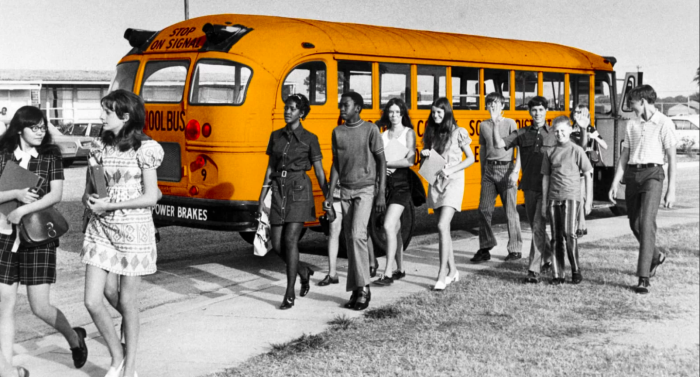
Busing and School Segregation Used for Politics not Policy

Screen Shot 2019-07-08 at 1.15.57 AM

 
If children of all races went to the same schools with each other, it would be harder to treat them unequally.


Moreover, it would be harder for them to grow up prejudiced because they would have learned what it’s like to have classmates who are different from them.


And though most people agree with these premises in principle, our laws still refuse to make them a reality in fact.


Perhaps that’s why it was so astounding when Kamala Harris brought up the issue of school segregation and busing at the first Democratic debates.

 
If you’re anything like me, for the first time these debates made Harris look like a viable contender for the party’s Presidential nomination to face Republican incumbent Donald Trump in 2020.


But then she immediately contradicted herself when people actually started to take her seriously.


During the debates, Harris called out front runner and former vice president Joe Biden for opposing court-ordered busing in the 1970s as a way of combating school segregation.


The California Democrat and former federal prosecutor rightly said that 40 years ago there was a “failure of states to integrate public schools in America,” so “that’s where the federal government must step in.”


But her star-making moment was when she made the whole matter extremely personal.


“There was a little girl in California who was part of the second class to integrate her public schools and she was bused to school every day,” Harris said. “That little girl was me.”

 
The tactic was so successful that Biden has been fumbling to apologize and explain away a history of obstructing desegregation ever since.


A Reuters/Ipsos poll conducted after the debate showed Biden had lost half of his support among black voters since earlier in June.


Meanwhile, the Harris campaign was quick to cash in on the political capital she earned by selling t-shirts with a picture of herself when she was in school with the emblem “That Little Girl Was Me.”


It could almost be a masterclass in how to make a political point to both boost your own campaign and change the narrative to improve national policy.


That is if Harris actually backed up her rhetoric with action.

 
Unfortunately, she has been tripping all over herself to keep this a criticism of Biden and not let it become a policy prescription for today.

 
While perfectly happy to support busing as a measure to stop segregation in the past, she seems much less comfortable using it to stop our current school segregation problems.


Because even though the landmark Supreme 
Court decision that found racial segregation to be unconstitutional – Brown v. Board of Education – is more than 60 years old, our nation’s schools are in many places even more segregated now than they were when this ruling was handed down.


So the question remains: in some areas should we bus kids from black neighborhoods to schools located in white ones and vice versa to ensure that our classrooms are integrated?


Since the debates, Harris has waffled saying busing should be “considered” by school districts but she would not support mandating it.


In subsequent comments, she said she’d support a federal mandate for busing in certain situations where other integration efforts have not been effective or when the courts have stepped in to provide the federal government that power. However, she does not believe that either of these conditions have been met.


Frankly, it sounds a whole lot more like someone desperately making things up as she goes along than someone with a true plan to fix a deep problem in our public education system.


She rightly attacked Biden on his record but then came up short trying to prove that she would be much different, herself, if elected.


However, that doesn’t mean all Democratic candidates are so unprepared. A handful have detailed integration policy proposals.


The most obvious is Bernie Sanders.


In fact, it is a cornerstone of his “Thurgood Marshall Plan for Education.” Not only would he repeal the existing ban on using federal transportation funding to promote school integration, he would put aside $1 billion to support magnet schools to entice more diverse students. However, the most ambitious part of his desegregation effort goes beyond legislation. Sanders promises to “execute and enforce desegregation orders and appoint federal judges who will enforce the 1964 Civil Rights Act in school systems.”


Sanders understands that the courts have largely sabotaged most desegregation efforts in the last 40 years.


At least two Supreme Court rulings have taken away the federal government’s power to enforce Brown v. Board. The first was 1974’s Milliken v. Bradley ruling which established that federal courts could not order desegregation busing across school district lines. They could only do so inside districts. So in big cities like Detroit – where the case originated – you have largely black city schools surrounded by mostly white suburban ones. The ruling forbids busing from city to suburban districts and vice-versa thereby destroying any kind of authentic desegregation efforts.


More recently, in 2007, the Supreme Court’s Parent’s Involved decision put even more constraints on voluntary busing programs.


Sanders is acknowledging these problems and promising to select judges to the bench who would work to overturn these wrongheaded decisions.


To my knowledge, no one has yet offered a more comprehensive plan.


However, former Housing and Urban Development Secretary and San Antonio Mayor Julián Castro comes in at a close second.


As you might expect, his school integration plan focuses on real estate and housing issues. According to his Website, Castro’s plan includes:


“Fulfill the promise of Brown v Board of Education through a progressive housing policy that includes affirmatively furthering fair housing, implementing zoning reform, and expanding affordable housing in high opportunity areas. These efforts will reduce racial segregation in classrooms.”


In other words, Castro hopes to work around the courts by incentivizing integration in neighborhoods which would also increase it in our schools.


It’s a good plan – though perhaps not enough in itself.


Unfortunately, there are reasons to doubt Castro’s sincerity here. Unlike Sanders’ plan, Castro’s education policy statement is littered with jargon right out of the school privatization, edtech and high stakes testing playbook. These are, after all, the same people who have worked to increase segregation with the promotion of charter and voucher schools.


For instance, the second point of his plan is called “Reimagining High School” – a monicker stolen from the XQ Superschools program, a philanthrocapitalist scheme to rebrand school privatization funded by Laurene Powell Jobs, the widow of Steve Jobs.


This shouldn’t be surprising coming from 
Castro. In 2013, the mayor went on a tour of cities sponsored by Education Reform Now – an arm of Democrats for Education Reform, a school privatization lobbying network. In the same year, he was also a featured guest at a ribbon cutting ceremony for IDEA charter schools. In 2010, he admitted he had no problem taking money with strings attached – a reference to the Obama administration’s chief education initiative of offering education grants if states increased reliance on high stakes testing and charter schools. In particular, Castro said: “I would have taken the Race to the Top money if I was mayor, dogcatcher, or whatever.”


And speaking of standardized testing and edtech, there are other telling hints that he’s on the neoliberal bandwagon in his current education plan:


“Provide educators and public schools flexibility in defining success, including competency-based assessments and support for transitions away from seat-time requirements. Provide maximum flexibility for school leaders, teachers, and students to work together to develop rigorous, competency-based pathways to a diploma and industry recognized credentials,” [Emphasis mine].


These terms “competency-based” and “rigorous” have strong associations with the privatization industry. “Competency-based” education programs usually mean making kids do daily mini-standardized tests on iPads or other devices and other untested cyber education programs. “Rigorous” has been associated with topdown academic standards like the Common Core that provide students with few resources or even taking them away and then blaming kids for not being able to meet arbitrary and developmentally inappropriate benchmarks.


Castro has some good ideas, but his troubling associations and language give any person familiar with these issues reason to pause.


Of course, Castro has not yet made a real mark among those Democrats seeking their party’s nomination.


Perhaps more important is the relative silence of a more popular candidate, Sen. Elizabeth Warren.


She hasn’t spoken much about integration efforts on the campaign trail. Along with Sanders, she is a co-sponsor of the Strength in Diversity Act, the leading congressional vehicle for school integration. However, that legislation is deeply flawed because it not only increases grant money for desegregation but also gives a big chunk of change away to charter schools.


In the past, Warren has supported a kind of school voucher program to separate where a student is enrolled in school from where they live entirely, but you can add it to the list of education issues she has not seen the need to clarify as yet.


It’s no surprise that so few Democratic hopefuls want to address the issue of desegregation – especially doing so through busing.


White middle class and wealthy people generally don’t support it.


They simply don’t want their kids going to schools with large numbers of black and brown students.


And this is a real moral weakness in white culture.


I went to an integrated school from Kindergarten to high school. My daughter goes to the same district. I teach at another integrated school.


The benefits of attending such a school far outweigh any negatives.


If students have to spend more time getting to and from school via buses to reach this goal, it wouldn’t matter if we valued the outcome.


In fact, many white parents don’t mind putting their kids on buses or driving them to get away from minority children.


Certainly we should try to minimize the time it takes to get to and from school but that shouldn’t be the only consideration.


They say we get the leaders we deserve.


If white people really want to defeat Trump, they may have to start by defeating the bigot inside themselves first.


Like this post? I’ve written a book, “Gadfly on the Wall: A Public School Teacher Speaks Out on Racism and Reform,” now available from Garn Press. Ten percent of the proceeds go to the Badass Teachers Association. Check it out!
thumbnail_IMG_8249

Top 10 Reasons Bernie Sanders’ Education Policies Are Light Years Ahead of Everyone Else’s

Screen Shot 2019-06-18 at 11.07.04 AM


For most of my life, the United States has been neglecting its public school children – especially the black and brown ones.


Since the mid 1970s, instead of integrating our schools, we’ve been slowly resegregating them on the basis of race and social class.


Since the 1980s, instead of measuring academic success by the satisfaction of an individuals curiosity and authentic learning, we’ve been slowly redefining it to mean nothing but achievement on standardized tests.


And since the 1990s, instead of making sure our schools meet the needs of all students, we’ve been slowly allowing charter schools to infect our system of authentic public education so that business interests are education’s organizing principle.


But now, for the first time in at least 60 years, a mainstream political candidate running for President has had the courage to go another way.


And that person is Bernie Sanders.


We didn’t see this with Barack Obama. We didn’t see it with Bill Clinton. We certainly didn’t see it with any Republican Presidents from Reagan to the Bushes to Trump.


Only Sanders in his 2020 campaign. Even among his Democratic rivals for the party’s nomination – Warren, Biden, Harris, Booker and a host of others – he stands apart and unique. Heck! He’s even more progressive today on this issue than he was when he ran in 2015.


It doesn’t take a deep dive into the mass media to find this out. You don’t have to parse disparate comments he made at this rally or in that interview. If you want to know what Bernie thinks about education policy, you can just go on his campaign Website and read all about it.


The other candidates barely address these issues at all. They may be open about one or even two of them, but to understand where they stand on education in total – especially K-12 schooling – you have to read the tea leaves of who they’ve selected as an education advisor or what they wrote in decades old books or what offhand comments they made in interviews.


In almost every regard, only Sanders has the guts to tell you straight out exactly what he thinks. And that’s clear right from the name of his proposal.


He calls it “A Thurgood Marshall Plan for Public Education.”


Why name his agenda after the first black Supreme Court justice? Because prior to accepting a nomination to the highest court in the land, Marshall argued several cases before that court including the landmark Brown v. Board of Education. He also founded the NAACP Legal Defense and Education Fund. Not only did Marshall successfully argue that school segregation violated the equal protection clause of the U.S. Constitution, but he spent his life fighting for civil rights.


Sanders is the only candidate out there today brave enough to connect those dots. The fight against segregation, high stakes testing and school privatization is a fight for civil rights.


That is clear in nearly every aspect of his plan.


I’m not saying it’s perfect. He doesn’t go as far as he might in some areas – especially against high stakes testing. But his plan is so far advanced of anything anyone else has even considered, it deserves recognition and strong consideration.


So without further ado, I give you the top 10 reasons Bernie Sanders’ education platform is the most progressive in modern American history:


1) He Proposes Fighting School Segregation and Racial Discrimination


Sanders understands that many of our public schools today are more segregated than they were 65 years ago when Brown v. Board was decided. Only 20 percent of our teachers are nonwhite – even in schools that serve a majority of black and brown children. Implicit racial bias puts these students at risk of higher suspensions, unfair discipline policies and an early introduction into the criminal justice system through the school-to-prison pipeline.


Bernie proposes we increase funding to integrate schools, enforce desegregation orders and appoint federal judges who will support these measures. He wants to triple Title I funding for schools serving poor and minority children and increase funding for English as a Second Language programs. He even suggests racial sensitivity training for teachers and better review of civil rights complaints and discipline policies.


This could have an amazingly positive impact on our schools. Imagine a school system where people of all different races, nationalities, sexualities and creeds could meet and get to know one another. It’s harder to be racist and prejudiced adults when as children you learned not to consider people different than you as an other. It’s also harder to withhold funding and opportunities to minority populations when you mix all children together in the same schools.


2) He Would Ban For-Profit Charter Schools


This is a case of Bernie just listening to what educators, school directors and civil rights organizations like the NAACP are already saying. Charter schools are publicly funded but privately operated. Though this differs somewhat from state to state, in general it means that charters don’t have to abide by the same rules as the authentic public schools in the same neighborhoods. They can run without an elected school board, have selective enrollment, don’t have to provide the same services for students especially those requiring special education, and they can even cut services for children and pocket the savings as profit.


Moreover, charters increase segregation – 17 percent of charter schools are 99 percent minority, compared to 4 percent of traditional public schools.
To reverse this trend, Bernie would ban for-profit charter schools and impose a moratorium on federal dollars for charter expansion until a national audit was conducted. That means no more federal funds for new charter schools.


Moving forward, charter schools would have to be more accountable for their actions. They would have to comply with the same rules as authentic public schools, open their records about what happens at these schools, have the same employment practices as at the neighborhood authentic public school, and abide by local union contracts.


I know. I know. I might have gone a bit further regulating charter schools, myself, especially since the real difference between a for-profit charter school and a non-profit one is often just its tax status. But let’s pause a moment here to consider what he’s actually proposing.


If all charter schools had to actually abide by all these rules, they would almost be the same as authentic public schools. This is almost tantamount to eliminating charter schools unless they can meet the same standards as authentic public schools.


I think we would find very few that could meet this standard – but those that did could – with financial help – be integrated into the community school system as a productive part of it and not – as too many are now – as parasites.


Could Bernie as President actually do all of this? Probably not considering that much of charter school law is controlled by the states. But holding the bully pulpit and (with the help of an ascendant Democratic legislature?) the federal purse strings, he could have a transformative impact on the industry. It would at least change the narrative and the direction these policies have been going. It would provide activists the impetus to make real change in their state legislatures supporting local politicians who likewise back the President’s agenda.


3) He’d Push for Equitable School Funding


Bernie understands that our public school funding system is a mess. Most schools rely on local property taxes to make up the majority of their funding. State legislatures and the federal government shoulder very little of the financial burden. As a result, schools in rich neighborhoods are well-funded and schools in poor neighborhoods go wanting. This means more opportunities for the already privileged and less for the needy.


Bernie proposes rethinking this ubiquitous connection between property taxes and education, establishing a nationwide minimum that must be allocated for every student, funding initiatives to decrease class size, and supporting the arts, foreign language acquisition and music education.


Once again, this isn’t something the President can do alone. He needs the support of Congress and state legislatures. But he could have tremendous influence from the Oval Office and even putting this issue on the map would be powerful. We can’t solve problems we don’t talk about – and no one else is really talking much about this. Imagine if the President was talking about it every day on the news.


4) He’d Provide More Funding for Special Education Students

Students with special needs cost more to educate than those without them. More than four decades ago, the federal government made a promise to school districts around the country to fund 40 percent of the cost of special education. It’s never happened. This chronic lack of funding translates to a shortage of special education teachers and physical and speech therapists. Moreover, the turnover rate for these specialists is incredibly high.


Bernie wants to not only fulfill the age old promise of special education funding but to go beyond it. He proposes the federal government meet half the cost for each special needs student. That, alone, would go a long way to providing financial help to districts and ensuring these children get the extra help they need.

5) He Wants to Give Teachers a Raise


Teachers are flooding out of the classroom because they often can’t survive on the salaries they’re being paid. Moreover, considering the amount of responsibilities heaped on their shoulders, such undervaluing is not only economically untenable, it is psychologically demoralizing and morally unfair. As a result, 20 percent of teachers leave the profession within five years – 40 percent more than the historical average.


Bernie suggests working with states to ensure a minimum starting salary of $60,000 tied to cost of living, years of service, etc. He also wants to protect and expand collective bargaining and tenure, allow teachers to write off at least $500 of expenses for supplies they buy for their classrooms, and end gender and racial discrepancies in teacher salaries.


It’s an ambitious project. I criticized Kamala Harris for proposing a more modest teacher pay raise because it wasn’t connected to a broad progressive education platform like Sanders. In short, we’ve heard neoliberal candidates make good suggestions in the past that quickly morphed into faustian bargains like merit pay programs – an initiative that would be entirely out of place among Sanders initiatives.


In Harris’ case, the devil is in the details. In Sanders, it’s a matter of the totality of the proposal.

6) He Wants to Expand Summer School and After School Programs


It’s no secret that while on summer break students forget some of what they’ve learned during the year and that summer programs can help reduce this learning loss. Moreover, after school programs provide a similar function throughout the year and help kids not just academically but socially. Children with a safe place to go before parents get home from work avoid risky behaviors and the temptations of the streets. Plus they tend to have better school attendance, better relationships with peers, better social and emotional skills, etc.


Under the guidance of Betsy Devos, the Trump administration has proposed cutting such programs by $2 billion. Bernie is suggesting to increase them by $5 billion. It’s as simple as that. Sanders wants to more than double our current investment in summer and after school programs. It’s emblematic of humane and rational treatment of children.


7) He Wants to Provide Free Meals for All Students Year-Round


One in six children go hungry in America today. Instead of shaming them with lunch debts and wondering why they have difficulty learning on an empty stomach, Bernie wants to feed them free breakfast, lunch and even snacks. In addition, he doesn’t want to shame them by having the needy be the only ones eligible for these free meals. This program would be open to every child, regardless of parental wealth.


It’s an initiative that already exists at many Title I schools like the one where I teach and the one where my daughter goes to school. I can say from experience that it is incredibly successful. This goes in the opposite direction of boot strapped conservatives like Paul Ryan who suggested a free meal gives kids an empty soul. Instead, it creates a community of children who know that their society cares about them and will ensure they don’t go hungry.


That may seem like a small thing to some, but to a hungry child it can make all the difference.


8) He Wants to Transform all Schools into Community Schools


This is a beautiful model of exactly what public education should be.


Schools shouldn’t be businesses run to make a profit for investors. They should be the beating heart of the communities they serve. Bernie thinks all schools should be made in this image and provide medical care, dental services, mental health resources, and substance abuse prevention. They should furnish programs for adults as well as students including job training, continuing education, art spaces, English language classes and places to get your GED.
Many schools already do this. Instead of eliminating funding for these types of schools as the Trump administration has suggested, Bernie proposes providing an additional $5 billion in annual funding for them.


9) He Would Fix Crumbling Schools


America’s schools, just like her roads and bridges, are falling into disrepair. A 2014 study found that at least 53 percent of the nation’s schools need immediate repair. At least 2.3 million students, mostly in rural communities, attend schools without high-speed internet access. Heating and cooling systems don’t work. 
Some schools have leaks in their roofs. This is just not acceptable.


Bernie wants to fix these infrastructure issues while modernizing and making our schools green and welcoming.


10) He Wants to Ensure All Students are Safe and Included


Our LGBTQ students are at increased risk of bullying, self harm and suicide. We need schools where everyone can be safe and accepted for who they are.


Bernie wants to pass legislation that would explicitly protect the rights of LGBTQ students and protect them from harassment, discrimination and violence. He is also calling for protection of immigrant students to ensure that they are not put under surveillance or harassed due to their immigration status. Finally, this project includes gun violence prevention to make school shootings increasingly unlikely.


There are a lot of issues that fall under this umbrella, but they are each essential to a 21st Century school. Solutions here are not easy, but it is telling that the Sanders campaign includes them as part of his platform.
So there you have it – a truly progressive series of policy proposals for our schools.
Not since Lyndon Johnson envisioned the Elementary and Secondary Education Act (ESEA) has there been a more far reaching and progressive set of education initiatives.


What About High Stakes Testing?


Unfortunately, that also highlights Sanders biggest weakness.


Johnson’s signature legislation which had been focused on addressing funding disparities in 1965 became under George W. Bush in the 2000s a way of punishing poor schools for low standardized test scores.


The glaring omission from Sanders plan is anything substantive to do with high stakes testing.


The Thurgood Marshall plan hardly mentions it at all. In fact, the only place you’ll find testing is in the introduction to illustrate how far American education has fallen behind other countries and in this somewhat vague condemnation:


“We must put an end to high-stakes testing and “teaching to the test” so that our students have a more fulfilling educational life and our teachers are afforded professional respect.”


However, it’s troubling that for once Bernie doesn’t tie a political position with a specific policy. If he wants to “end high-stakes testing,” what exactly is his plan to do so? Where does it fit within his education platform? And why wasn’t it a specific part of the overall plan?


Thankfully, it is addressed in more detail on FeelTheBern.org – a Website not officially affiliated with Sanders but created by volunteers to spread his policy positions.


After giving a fairly good explanation of the problems with high stakes testing, it references this quote from Sanders:


“I voted against No Child Left Behind in 2001, and continue to oppose the bill’s reliance on high-stakes standardized testing to direct draconian interventions. In my view, No Child Left Behind ignores several important factors in a student’s academic performance, specifically the impact of poverty, access to adequate health care, mental health, nutrition, and a wide variety of supports that children in poverty should have access to. By placing so much emphasis on standardized testing, No Child Left Behind ignores many of the skills and qualities that are vitally important in our 21st century economy, like problem solving, critical thinking, and teamwork, in favor of test preparation that provides no benefit to students after they leave school.”


The site suggests that Bernie supports more flexibility in how we determine academic success. It references Sanders 2015 vote for the Every Child Achieves Act which allows for states to create their own accountability systems to assess student performance.


However, the full impact of this bill has not been as far reaching as advocates claimed it would be. In retrospect, it seems to represent a missed opportunity to curtail high stakes testing more than a workaround of its faults.


In addition, the site notes the problems with Common Core and while citing Sanders reticence with certain aspects of the project admits that he voted in early 2015 against an anti-Common Core amendment thereby indicating opposition to its repeal.


I’ll admit this is disappointing. And perplexing in light of the rest of his education platform.


It’s like watching a vegan buy all of his veggies at Whole Foods and then start crunching on a slice of bacon, or like a gay rights activist who takes a lunch break at Chick-fil-a.


My guess is that Sanders hasn’t quite got up to speed on the issue of standardized testing yet. However, I can’t imagine him supporting it because, frankly, it doesn’t fit in with his platform at all.


One wonders what the purpose of high stakes testing could possibly be in a world where all of his other education goals were fulfilled.


If it were up to me, I’d scrap high stakes testing as a waste of education spending that did next to nothing to show how students or schools were doing. Real accountability would come from looking at the resources actually provided to schools and what schools did with them. It would result from observing teachers and principals to see what education they actually provided – not some second hand guessing game based on the whims of corporations making money on the tests, the grading of the tests and the subsequent remediation materials when students failed.


For me, the omission of high stakes testing from Sanders platform is acceptable only because of the degree of detail he has already provided in nearly every other aspect. There are few areas of uncertainty here. Unlike any other candidate, we know pretty well where Sanders is going.


It is way more likely that advocates could get Sanders to take a more progressive and substantial policy stand on this issue than that he would suddenly become a standardized testing champion while opposing everything else in the school privatization handbook.


Conclusion


So there it is.


Bernie Sanders has put forth the most progressive education plan in more than half a century.


It’s not perfect, but it’s orders of magnitude better than the plans of even his closest rival.


This isn’t to say that other candidates might not improve their education projects before the primary election. I hope that happens. Sanders has a knack for moving the conversation further left.


However, he is so far ahead, I seriously doubt that anyone else will be able to catch him here.


Who knows what the future will bring, but education advocates have a clear first choice in this race – Bernie Sanders.


He is the only one offering us a real future we can believe in.


Like this post? I’ve written a book, “Gadfly on the Wall: A Public School Teacher Speaks Out on Racism and Reform,” now available from Garn Press. Ten percent of the proceeds go to the Badass Teachers Association. Check it out!

book-4

Classroom Teachers are the Real Scholastic Experts – Not Education Journalists

Screen Shot 2019-05-06 at 4.29.19 PM


When you want an expert on health, you go to a doctor.


When you want an expert on law, you go to a lawyer.


So why is it that when the news media wants an expert on education they go to… themselves!?


That’s right. Education journalists are talking up a storm about schools and learning.


You’ll find them writing policy briefs, editorials and news articles. You’ll find them being interviewed about topics like class size, funding and standardized tests.


But they aren’t primary sources. They are distinctly secondary.


So why don’t we go right to the source and ask those most in the know – classroom teachers!?


According to a Media Matters analysis of education coverage on weeknight cable news programs in 2014, only 9 percent of guests on MSNBC, CNN and Fox News were educators.


This data is a bit out of date, but I couldn’t find a more recent analysis. Moreover, it seems pretty much consistent with what I, myself, have seen in the media.


Take Wyatt Cenac’s “Problem Areas,” a comedy journalism program on HBO. The second season focuses entirely on education issues. Though Cynac interviews numerous people in the first episode (the only one I saw), he put together a panel of experts to talk about the issues that he would presumably return to throughout the season. Unfortunately, only two of these experts were classroom teachers.


There were more students (3), policy writers (3) and education journalists (3). There were just as many college professors (2), civil rights leaders (2), and politicians (2). Plus there was one historian (Diane Ravitch).


I’m not saying Cynac shouldn’t have talked to these other people. From what I’ve seen, his show is a pretty good faith attempt to talk about the issues, but in under representing classroom teachers, we’re left with a false consensus. It’s like having one climate denier debate one scientist. They aren’t equal and should not be equally represented.


And that’s as good as it gets!


Turn to most discussions of education or scholastic policy in the news and the discourse is bound to be dominated by people who are not now and have never been responsible for a class full of K-12 students.


Allowing journalists who cover education to rebrand themselves as “experts” is just not good enough.


Take it from me. Before I became a classroom teacher, I was a newspaperman, myself. Yet it’s only now that I know all that I didn’t know then.


If anyone values good, fact-based reporting, it’s me. But let’s not confuse an investigator with a practitioner. They both have important jobs. We just need to be clear about which job is being practiced when.


Reporters are not experts on the issues they cover. Certainly they know more than the average person or some political flunkey simply towing the party line. But someone who merely observes the work is not as knowledgeable as someone who does it and has done it for decades, someone with an advanced degree, dedication and a vocation in it.


Moreover, there is a chasm between education reporting and the schools, themselves, that is not present between journalists and most fields of endeavor. In the halls of academia, even the most fair-minded outsiders often are barred from direct observation of the very thing they’re trying to describe. We rarely let reporters in to our nation’s classrooms to see what’s happening for themselves. All they can do most of the time is uncritically report back what they’ve been told.


It’s almost as if sportswriters never got to see athletes play or political reporters never got to attended campaign rallies. How could their ideas about these subjects be of the same value as the practitioners in these fields!?


It couldn’t.


Think about it. Journalists are rarely permitted inside our schools to see the day-to-day classroom experience. Legal issues about which students may be photographed, filmed or interviewed, the difficulty of getting parental permissions and the possibility of embarrassment to principals and administrators usually keeps the school doors closed to them.


In many districts, teachers aren’t even allowed to speak on the record to the media or doing so can make them a political target. So reporters often have great difficulty just disclosing the opinions of those most knowledgeable about what is going on.


At best, our nation’s education reporters are like aliens from another galaxy trying to write about human behavior without actually having seen it. It’s like a bad science fiction movie where some alien with plastic ears asks, “What is this thing you call love?”


Sorry. These are not experts. And if we pretend that they are, we are being incredibly dishonest.


Some of this obfuscation is by design.


Education reporting is incredibly biased in favor of market-based solutions to academic problems.


Why? The corporations that own the shrinking number of newspapers, news stations and media outlets are increasingly the same huge conglomerates making money off of these same policies. The line between news and advertising has faded into invisibility in too many places.


Huge corporations make hundreds of millions of dollars off of the failing schools narrative. They sell new standardized tests, new test prep materials, new Common Core books, trainings for teachers, materials, etc. If they can’t demonstrate that our schools are failing, their market shrinks.


Even when they don’t put editorial pressure on journalists to write what the company wants, they hire like-minded people from the get go.


Too many education journalists aren’t out for the truth. They’re out to promote the corporate line.


This is why it’s so important to center any education discussion on classroom teachers. They are the only people with the knowledge and experience to tell us what’s really going on.


And – surprise! – it’s not the same narrative you’re getting from corporate news.


Schools are being defunded and dismantled by the testing and privatization industry. Corporate special interests are allowed to feed off our schools like vultures off road kill. And all the while, it is our children who suffer the results.


High stakes standardized testing must end. Charter and voucher schools must end. Parasitic education technologies must be controlled, made accountable and in many cases barred from our schools altogether.


But that’s a truth you can only find by talking to the real experts – classroom teachers.


Until we prize their voices above all others, we will never know the whole truth.


Like this post? I’ve written a book, “Gadfly on the Wall: A Public School Teacher Speaks Out on Racism and Reform,” now available from Garn Press. Ten percent of the proceeds go to the Badass Teachers Association. Check it out!

book-1

I Assign my Students Homework Despite Scant Research It Does Any Good

thumbnail_Homework_debate-e1445976586714

In academic circles the debate over homework rages on.

Does it actually help students learn or does it just cause undue stress and frustration for children and parents?

As a teacher and a parent, I see both sides of the issue.

In class, I assign my students homework every week – Monday through Thursday. Never on the weekends.

My daughter’s teacher does the same. So at home, I’m on the receiving end, spending hours with my little munchkin helping her get through mountains of assignments for her classes the next day.

Perhaps this is what they mean by the proverb – you reap what you sow. Except my daughter isn’t doing the homework I assigned. She isn’t in my class and we don’t even live in the district where I teach.

But it sometimes does feel like payback plodding through seemingly endless elementary worksheets, spelling words and vocabulary.

After a while, even I begin to question whether any of this junk does any good.

As a teacher, I know the research on the subject provides slim support at best.

In fact, the closest we have ever come to an answer is a reformulation of the question.

It really comes down to a matter of causality – a chicken and the egg conundrum with a side of sharpened pencil and crumpled paper.

If we look really hard, we can find a correlation between students who do their homework and those who get good grades.

The problem is we can’t PROVE it’s the homework that’s causing the grades.

It could just be that kids who excel academically also happen to do their homework. If we removed the homework, these kids might still get good grades.

So which comes first – the homework or the grades?

There has been surprisingly little research that goes this deep. And almost all of it is anecdotal.

Even the investigations that found a correlation did so in tight parameters – only in secondary grades and usually just for math.

Some wealthy districts have even reduced the amount of homework without seeing a subsequent drop in learning.

But nothing has been tested across socioeconomic divides or with any consistency and very little has been proven definitively.

This doesn’t mean that there’s no consensus on the matter.

Both the National Education Association (NEA) and the National Parent Teacher Association (NPTA) suggest educators assign no more than a standard of “10 minutes of homework per grade level” per night.

In other words, a first grader should have no more than 10 minutes of homework on a given evening, a second grader no more than 20 minutes, etc.

However, it appears that students – especially in the primary grades – are getting more work than these recommended maximums.

A 2015 study published in The American Journal of Family Therapy surveyed more than 1,100 Rhode Island parents with school age children.

Researchers found that first and second graders received 28 and 29 minutes of homework per night – almost double the recommended maximums. Even more shocking, Kindergarteners – who according to the guideline should receive no homework at all – actually were assigned an average of 25 minutes per night.

That’s a lot of extra time sitting and slogging through practice problems instead of spending time with friends or family.

Though I live in western Pennsylvania, this study is certainly consistent with what I see in my own home. My daughter is in 4th grade but has been assigned between 30 minutes and two hours of homework almost every weekday since she was in Kindergarten.

It’s one of the reasons I try to abide by the guidelines religiously in my own classroom. I give about an hours worth of homework every week – 15 minutes per day for four days. If you add in cumulative assignments like book reports, that number may go up slightly but not beyond the recommended maximums.

I teach 8th graders, so they should not be receiving more than 80 minutes of homework a night. If the teachers in the other three core classes give the same amount of homework as I do, we’d still be below the maximum.

I’m well aware that the consequences of giving too much homework can be severe.

A 2014 Stanford study published in the Journal of Experimental Education found that giving too much homework can have extremely damaging effects on children.

Still this isn’t exactly hard science.

The researchers used survey data to examine perceptions about homework, student well-being and behavioral engagement in a sample of 4,317 students from 10 high-performing high schools in upper-middle-class California neighborhoods. They also used open-ended answers to gauge the students’ views on homework.

They concluded that too much homework was associated with greater stress, reductions in health, and less quality time with friends and family.

So where does that leave us?

We have anecdotal evidence that excessive homework is harmful. And limited evidence that homework may increase academic outcomes in the higher grades in math.

Frankly, if that was all I had to go on, I would never assign another piece of homework ever again.

But I’m a classroom teacher. I don’t have to rely solely on psychological and sociological studies. Everyday in school is an opportunity for action research.

My classroom is a laboratory. I am a scientist. Nearly every decision I make is based on empiricism, hypothesis and testing the results.

Maybe X will help students understand Y – that sort of thing.

This applies to homework, too.

I’ve had more than 15 years to test what works with my students. I’m not saying my results would necessarily be reproducible everywhere, but they’re at least as scientific as the body of research we have on homework. In fact, within these parameters they’re even more rigorous.

So why do I give homework?

For several reasons:

1)  It prepares students for the higher grades.

Most of my career has been spent in the middle school teaching 7th and 8th grade. In my district, high school teachers give a lot of homework. I need my students to get used to that rhythm – homework being assigned and handed in – so that they’ll have a chance at being successful in the upper secondary grades. Too many students go no further academically than 9th grade. Giving homework is my way to help provide the skills necessary to avoid that pitfall.

However, this isn’t a sufficient reason to give homework all by itself. If high school teachers stopped assigning it – and maybe they should if we have no further reason to do so – then I’d have no reason to assign it either.

2)  It makes kids responsible.

There’s something to be said for getting kids used to deadlines. You need to know what work you’re responsible for turning in, getting it done on your own and then handing it in on time. This is an important skill that I won’t apologize for reinforcing. I’m well aware that some students have extended support systems at home that can help them get their assignments done and done correctly, but I design the work so that even if they aren’t so privileged, it should be easily accessible on an individual level. Plus I’m available, myself, as a resource if necessary.

3)  It’s good practice.

In school, we learn. At home, we practice. That pattern is necessary to reinforce almost any skill acquisition. I know it’s trendy to flip the classroom a la Khan Academy with learning done through videos watched on-line at home and practice done in school. But when Internet access in not guaranteed, and home environments often are the least stable places in my students’ lives, it makes little sense to try to move the most essential part of the lesson outside of the classroom. After all, it’s easier to find a place to do some low tech practice than it is to find space, silence and infrastructure for high tech learning.

Don’t get me wrong. We practice in school, too. But there’s only so many hours in the school day. I use homework in my language arts classes for a few select things: increased vocabulary, word manipulation, grammar, self-selected reading and the ability to do work on your own. I think it’s important for my students to increase their vocabularies. Having kids read a self-selected book (both inside and outside of class) helps do that. It’s also a benefit to be able to play with words and language, find words in a puzzle, recognize synonyms and antonyms, etc. Grammar may not be essential, but a rough knowledge of it is certainly useful to increase recognition of context clues and better writing skills. Finally, some students benefit from the simple opportunity to do an assignment by themselves without an adult or even a peer looking over their shoulder.

That being said, I think it is important that the homework I give be seen as something students can achieve.

I’ve had numerous co-workers tell me they don’t assign homework for the simple reason that their students won’t do it.

This isn’t a big problem in my class. Almost all of my students do the homework. Why? Because we go over it and they know it’s something they can do without too much difficulty.

I scaffold assignments building the difficulty progressively as we proceed through the year (or years). I make myself available for extra help. I accept late work (with a penalty).

And most of all – I stress that I’m not expecting anyone to be a genius. I’m looking for hard work.

I tell my students explicitly that anyone who puts in their best effort will pass my class – probably with a B or an A. And that’s exactly what happens.

Homework is a part of that equation. It demonstrates effort. And effort is the first step (the key, in fact) to accomplishment.

Do students complain about the homework?

Sure! They’re children!

I’d probably complain, too, if I were them. No one really wants to be given extra work to do. But it’s all part of the pattern of my classroom.

Students know what to expect and how to meet those expectations.

None of this makes me a super teacher. It certainly doesn’t put me on anyone’s cutting edge.

I’m just doing what educators have done for decades. I’m attempting to use best practices in my classroom with a full knowledge of the academic research and the pitfalls ahead.

I may assign homework, but I made sure to do my own before coming to that decision.


Still can’t get enough Gadfly? I’ve written a book, “Gadfly on the Wall: A Public School Teacher Speaks Out on Racism and Reform,” now available from Garn Press. Ten percent of the proceeds go to the Badass Teachers Association. Check it out!

book-3

Ten of 15 Cyber Charter Schools in PA Are Operating Without a Charter – Close Them All

thumbnail_screen shot 2019-01-29 at 1.38.10 pm


Cyber charter schools are an experiment that failed.


It’s time to pull the plug and recoup our losses.


First, let’s get straight exactly what we’re talking about here.


Like all charter schools, these are contracted institutions. In fact, that’s what charter means – they’re independent businesses that sign a deal with the state to teach kids.


So they’re publicly financed but privately run. And in the case of cyber charters, they agree to educate children online without the benefit of a physical building.


Students access lessons via computer or other device, submit work electronically, get virtual feedback and assessment.


At best, these institutions are the grade school equivalent of the University of Phoenix – good only for independent, self-motivated learners. At worst, they’re the kiddie version of Trump University – a total scam.


In Pennsylvania, 10 of the state’s 15 cyber charter schools are operating with expired charters, according to a report by the Philadelphia Inquirer.


That’s incredibly significant – especially for an industry that enrolls about 35,000 students across the state.


These are charter schools operating without a charter. They only get the right to operate because a local school district or the state has signed a contract allowing them to do so.


If you hire a plumber to fix your toilet, you give him the right to enter your house and do what needs to be done. That doesn’t mean the plumber can walk in anytime he feels like it. There is a limited term of service. Once that term is up, the plumber needs to get out.


In the case of these cyber charters, the authorizer is the Pennsylvania Department of Education (PDE).


Charters are initially issued for three to five years. They are an essential contract between the schools and the supervisory body. The school details how it will operate, what curriculum and education strategies will be used, etc.


The state has the option to revoke the charter if the school violates its agreement or fails to meet requirements for student performance or fiscal management.


After the initial period, charters must be renewed every five years in the state.


Yet for the majority of the Keystone state’s cyber charter schools, this has not happened. The charter agreements have been left to lapse without any decision being made by state officials to renew or cancel them.


Some of the reluctance to decide may stem from the fact that the state Charter Appeal Board – the body which decides on appeals of charter applications – are all serving out expired terms, themselves.  They were all appointed by the previous governor, Republican Tom Corbett, a notable privatization ideologue.


The current Governor Tom Wolf, a Democrat now elected to his second term of office, still hasn’t gotten around to appointing new ones.


Another issue gumming up the works could be staffing issues at PDE that make it impossible to handle the reviews in a timely manner. It could be because the cyber charter schools have not provided all the data required of them by the state for the review to be completed on time. Or it could be because state officials are struggling with a fair and adequate metric with which to assess these schools.


CYBER CHARTER’S DISMAL ACADEMIC RECORD


To be frank, the latter option has to weigh heavily on state auditors. After all, it’s no secret that these schools are an educational disaster. On-line schools in Ohio, Georgia, Indiana, Nevada and New Mexico are all being closed by their respective states.


Study after study consistently shows that cyber charters are much less effective than traditional public schools – heck! They’re even less effective than brick and mortar charter schools!


A recent nationwide study by Stanford University found that cyber charters provide 180 days less of math instruction and 72 days less of reading instruction than traditional public schools.


Keep in mind that there are only 180 days in an average school year. So cyber charters provide less math instruction than not going to school at all.


The same study found that 88 percent of cyber charter schools have weaker academic growth than similar brick and mortar schools.


Student-to-teacher ratios average about 30:1 in online charters, compared to 20:1 for brick and mortar charters and 17:1 for traditional public schools.


Researchers concluded that these schools have an “overwhelming negative impact” on students.


And these results were duplicated almost exactly by subsequent studies from Penn State University in 2016 (enrolling a student in a Pennsylvania cyber charter school is equal to “roughly 90 fewer days of learning in reading and nearly 180 fewer days of learning in math”) and the National Education Policy Center in 2017 (cyber charters “performed significantly worse than feeder schools in both reading and math”).


Even the state’s own data shows lower graduation rates and standardized test scores at cyber charters than at traditional public schools.


According to a 2015-16 state PDE report, about 86 percent of public school students across the Commonwealth finished high school in four years. During the same time, only about 48 percent of cyber charter school students graduated in four-years.

CYBER CHARTER’S COST TOO MUCH


But providing such a poor service to Pennsylvania students is only one reason these schools are problematic. They’re also ruinously expensive.


They cost taxpayers more than $463 million in 2016-17 alone.


The state charter law grants these schools as much money per pupil as brick and mortar schools, yet their costs are much less having forgone a physical building and all that goes with it.


So cyber charters get whatever the local per-pupil expenditure is. It doesn’t matter if a district spends $8,000 on each student or $20,000. Whatever the amount, that goes to the cyber charter.


However, the cost of educating kids is drastically reduced online. Their programs are bare bones compared with what you get at a traditional public school. Most online charters don’t have tutors or teacher aides. They don’t offer band, chorus or extra-curricular activities. You don’t have to pay for any building costs, grounds, upkeep, large staff, etc. But the funding formula ignores this completely. Cyber charters get to keep the difference – whatever it is. In fact, they have an incentive to keep as much as possible because they can do almost whatever they want with it. That includes putting it into operators’ pockets as profit!


And when it comes to special education funding, it gets worse. In Pennsylvania, our funding formula is so out of whack that charters schools of all stripes including cyber charters often end up with more funding for students with special needs than traditional public schools get. However, because of this loophole in the Commonwealth, Pennsylvania online charters have been increasing the number of special education students they enroll and even working to label as many of their students as possible as needing special services on the flimsiest of pretexts.


According to a report by the Pennsylvania Association of School Administrators (PASA), tuition for special education students is often twice as much at cyber charter schools than at traditional public schools.


CYBER CHARTER FRAUD


Unsurprisingly, these conditions have lead to rampant fraud and malfeasance.


Just this past year (2018) the head of the largest cyber charter chain in the state was sentenced to jail for siphoning $8 million from his school into his own pockets.


PA Cyber Charter founder Nicholas Trombetta was found guilty of tax fraud in relation to the theft of public funds. He used that money to buy an airplane, a $900,000 condo, houses for his girlfriend and mother, and nearly $1 million in groceries and personal expenses, according to the grand jury. Trombetta allegedly set up numerous for-profit and nonprofit businesses to provide goods and services to the cyber charter. Federal investigators filed 11 fraud and tax conspiracy charges against him and indicted others in the case.


Another cyber charter founder, June Brown, was also indicted for theft of $6.5 million. Brown ran the Agora Cyber Charter School, which was part of the K12 Inc. empire of virtual charters. She and her executives were indicted on 62 counts of wire fraud, obstruction of justice and witness tampering. She was well known for student test scores and had a reputation for claiming large salaries and filing suits against parents who questioned her, the Philadelphia Inquirer reports.


WHAT TO DO ABOUT IT


It’s no wonder the state has been tardy renewing these schools’ charters!


Frankly, there is no good reason to continue lavishing taxpayer dollars on a system of education that provides  subpar services at an exorbitant expense and is subject to runaway fraud.


But lawmakers have always been reluctant to do the right thing.


After all, there are a slew of wealthy investors who want to make sure the money train of taxpayer dollars keeps flowing to their shady businesses. And lawmakers who enable them are assured hefty campaign contributions.


The only chance we have of saving our children from this monstrous abuse of power and saving our wallets from this shameful waste of funding is if voters make their intentions known.


The people of Pennsylvania need to stand up and demand an end to the cyber charter school experiment.


We need lawmakers with the guts to stand up to big money and rewrite the state’s charter school law.


And that’s part of the problem. The law is a joke.


It’s more than 20 years old and was only amended once in 2002 to allow cyber charters.


Subsequent attempts at requiring more accountability have resulted in horrible compromise bills that would have made the situation much worse and – ultimately – no vote.


With Ohio and California, Pennsylvania was in the “big three” cyber-charter states in 2016, accounting for half of cyber charter enrollment nationally, according to the industry’s authorizers’ association. While 35 states and the District of Columbia allow full-time cyber charter schools, eight do not, including neighboring New Jersey.


The right course is clear.


We just need a people-powered movement to force our lawmakers to do it.


Either that or replace them with those who will.


Still can’t get enough Gadfly? I’ve written a book, “Gadfly on the Wall: A Public School Teacher Speaks Out on Racism and Reform,” now available from Garn Press. Ten percent of the proceeds go to the Badass Teachers Association. Check it out!

cropped-book-1.jpg

How Many Decisions Do Teachers Make Every Day?

94b755b2-ad1400b671f8ad28440f6a7067004614


Teaching is an exhausting job.


If you’re a parent, you know how tiring it is with just one or two kids.


Imagine having a room full of them — Twenty to thirty children, each demanding your attention, each requiring your urgent help – every minute, every day, for hours at a time.


Back in the late 1980s, before education became totally absorbed by standardized testing and school privatization, we used to wonder about the effects of such need on a single individual.


We used to wonder how much was really being asked of our teachers.


Today no one outside of the classroom really gives it much thought. We think of educators as part of a vast machine that is required to give us and our children a service.


We’re stakeholders. They’re service providers. And the students are a national resource.


None of us are people.


Perhaps it’s this dehumanizing economic framework that’s helped the edtech industry and testing corporations make so much headway trying to replace educators with apps and iPads.


We no longer give the teacher an apple. We displace her with a Mac.


But back in the days before George W. Bush’s No Child Left Behind or Barrack Obama’s copycat Race to the Top, or Donald Trump’s blatant Destroy Public Education, we wondered about teacher psychology and how to best help our human workforce meet the needs of our human children.


That’s when researchers observed elementary school teachers and noted that, on average, they made at least 1,500 decisions a day.


That comes out to about 4 decisions a minute given six hours of class time.


In the decades since, this figure has come to be associated with elementary and secondary teachers. In fact, it’s become so ubiquitous that I wondered where it originated.


The first reference I can find to it comes from C.M. Clark & P.L. Peterson’s article “Teachers’ Thought Processes” published in the Handbook of Research on Teaching from 1986. (3rd ed., pp. 255–296). New York: macmillan.


Though subsequent studies came up with slightly different numbers, the basic argument holds.


Researchers Hilda Borko, Carol Livingston and Richard Shavelson mark the low end of the scale. In their 1990 article “Teachers’ Thinking About Instruction,” they summarize studies that reported .7 decisions per minute during interactive teaching or 42 judgements per hour, 252 a day.


On the upper end of the scale is Philip Jackson who wrote in his 1990 book “Life in Classrooms” that elementary teachers have 200 to 300 of these determination generating exchanges with students every hour (between 1,200-1,800 a day). Most of these are unplanned and unpredictable calling for teachers to make what they term shallower decisions or deeper judgments (p. 149).


So because teaching involves waiting for the right opportunities for learning, neither student nor teacher can say with confidence what exactly will happen next. It requires “spontaneity and immediacy” (Jackson, p. 166, 152).


As a classroom teacher with more than 15 years of experience, none of this is surprising to me.


Just imagine the various tasks teachers are required to do every hour. We take attendance, review homework, help with seat-work, ask questions, etc. And that doesn’t even take into account all the times we’re unpredictably interrupted by the unexpected – upset students, administrative announcements over the PA, student questions, equipment breakdowns, etc. Each one of these requires us to make spontaneous, unplanned calls before the lesson can continue.


It just goes to show some of the various roles teachers are expected to fill in the lives of their students. They are expected to be information providers, disciplinarians, assess student learning, administrate school policies, facilitate student inquiry, act as role models and even be foster parents.


In any given lesson, we have to make decisions based on our plans AND decisions based on things that just happen to crop up unexpectedly – multiple times each day.


In fact, it seems to me that the research fails to account for innumerable situations that also require determination and deliberation as part of an educator’s everyday routine.


What about curriculum and instruction design? Grading? Written and verbal feedback to students? Reflection and revision of lesson plans?


When you think of all that, 1,500 decisions a day seems like a conservative estimate indeed.


Perhaps the most troubling thing about this is where it impacts teacher quality.


And when I say that, I don’t mean the basterdized modern meaning of that term – that teachers are responsible for maximizing student test scores on standardized assessments. I mean the quality of authentic instruction teachers are able to give their classes.


When we expect educators to turn on a dime more than a thousand times a day, doesn’t that impact the depth with which we can accomplish the job?


Busyteacher.org certainly thinks so. I’m not sure where the Website got its statistics, but they are sobering.


In a fascinating infographic, the site claims that multitasking leads to a 40% drop in productivity. It causes a 10% drop in IQ. It causes people to make 50% more mistakes than concentrating on one task at a time.


thumbnail_multitasking-teachers-infographic-620x1783


I don’t know if these statistics are accurate, but the general principle is sound. When we’re forced to “do more with less” we actually end up producing more with less quality.


Focusing on fewer things increases ones accuracy. Therefore, teachers who have to make fewer decisions in a day would probably be able to do their jobs more effectively.


And there are plenty of ways to accomplish this.


We could reduce class size. If educators can concentrate on the needs of fewer children, they would be more effectively able to meet those needs.


We could reduce the amount of time teachers have to be in the classroom in a given day. I’ve often thought teaching was analogous to being an actor up on the stage – but we’re also responsible for writing the script, operating the lighting, etc. And we have to interact with the audience many of whom would rather be elsewhere, and we have to do multiple shows each day.


In some countries, teachers spend a significant part of their days planning and grading and less in the classroom. They don’t have to do all that behind the scenes stuff on their own time without any additional pay.


In Finland, for example, teachers are paid 13% more than the Organization for Economic Cooperation and Development (OECD) average but spend 100 hours less in the classroom. And class size is between 9-14 students, the lowest in OECD countries. No wonder their children are near the top of the scale in international comparisons!


Wouldn’t it be amazing if we lived in a society that valued education and didn’t try to turn everything into economic quantities for corporations?


We could actually focus on the real phenomena of educating children and not have to fight warped education policies more concerned with turning it all into dollars and cents.


Perhaps teachers wouldn’t have to make so many thousands of decisions if our lawmakers could just make this one.


Still can’t get enough Gadfly? I’ve written a book, “Gadfly on the Wall: A Public School Teacher Speaks Out on Racism and Reform,” now available from Garn Press. Ten percent of the proceeds go to the Badass Teachers Association. Check it out!

book-3

Dear Lawmakers, Please Hire Teachers as Education Aides – Not TFA Alumni

thumbnail_IMG_8375


Dear freshmen lawmakers,


We did it!


After a fiercely contested election, we have finally begun to turn the tide back toward progressive politics.


Midterms usually are sparsely attended, but this year we had an unprecedented turnout.  A total of 23 states had double-digit percentage-point increases compared with their 1982-2014 midterm election averages.


And the result is one of the largest and most diverse groups of freshman Congresspeople ever!


We got rid of a ton of incumbents – 104 lawmakers won’t be returning to Washington, DC, in January, making this the third-highest turnover since 1974.


And those taking their place will be largely female. Out of 256 women who ran for U.S. House or Senate seats, 114 have won so far (Some races are still too close to call), according to the Center for American Women and Politics at Rutgers University. That makes the 116th Congress the largest class of female lawmakers ever.


Moreover, this incoming group will be incredibly diverse.


We have Jahana Hayes, a nationally-recognized teacher, who will be the first Black Congresswoman from Connecticut. Ayanna Presley, the first black Congresswoman from Massachusetts.


Angie Craig will be the first out LGBTQ Congresswoman from Minnesota. Chris Pappas, the first openly gay Congressman from New Hampshire.


Sharice Davids and Deb Haaland from Kansas and New Mexico will be the first Native American women elected to Congress – ever. And Davids will also be the first openly LGBTQ Congresswoman from the Sunflower State.


Ilhan Omar and Rashida Tlaib will be the first-ever Muslim women in Congress. Omar, a former refugee, will also be the first Somali-American and Tlaib will be the first Palestinian-American woman in Congress. This is especially noteworthy because there have only been two other Muslims to serve in the legislative branch, both men: Rep. Keith Ellison and Rep. André Carson.


And let’s not forget New York’s Alexandria Ocasio-Cortez. Not only is she a Democratic Socialist, but the 29-year-old will be the youngest woman ever elected to Congress!


With so many new faces and so much more representation, is it too much to ask for a change in the way things are done in Washington?


Many progressives are hoping not.


After all, it was people power that propelled these new lawmakers into government.


We marched in the rain, licked envelopes, made phone calls, wrote letters, and knocked on doors. We went to rallies and bake sales and stood by the polls with our little signs and fliers.


And we did it, because we wanted a change.


So, incoming lawmakers, that’s why I’m writing to you.


As a public school teacher, a father of a school-age child, an education activist and a concerned citizen, it really matters to me what happens to our schools.


Yet so many politicians – Republicans and Democrats – have turned a blind eye to our concerns for years.


No matter their party affiliation, they’ve pushed for increasing school privatization – charter and voucher schools. They’ve hammered us with biased and unscientific standardized tests and used the results to justify any number of atrocities including school closures, withholding funding and even stealing the democratic process from taxpayers. Instead of listening to the concerns of teachers and parents, they’ve followed the caprice of every bored billionaire who thinks they know how to better our schools with halfcocked schemes that cost us billions in taxpayer dollars while wasting children’s time and depriving them of an authentic education.


They’ve chased every new technological fad without regard to how it affects students or their privacy. They’ve let our schools become increasingly more segregated and made deals with private prison companies and unscrupulous security and business interests that made our schools a gateway to incarceration as much as they are to college or careers. They’ve actively engaged or silently stood by as classroom teachers lost autonomy, rights and professionalism. And finally, though many of them talk a good game, they haven’t done nearly enough to ensure that every student gets the same opportunities, resources and equitable funding.


Why?


Often the answer is ignorance.


They don’t properly understand the issues facing our schools. They don’t hear from parents, teachers and students – the rank and file. They only hear from the wealthy businesses and philanthrocapitalists preying on our schools like vultures over road kill.


In many cases this is because of the poor quality of education aides on Capital Hill.


Several years ago, I went to DC with other education advocates to ask our representatives to change course. Though we made reservations to speak with our duly-elected lawmakers months in advance, very few of them had the guts to see us face-to-face. We were almost always sent to education aides – well meaning and fresh faced kids only a few years out of college – who wrote down our concerns and sent us on our way with rarely any follow up from the people we’d come to see.


And more often than not, these eager young go-getters were Teach for America (TFA) alumni.


I’m not sure if you know what that means.


TFA is a nefarious neoliberal organization more interested in busting unions and influencing policy than helping kids learn.


They recruit people in college who didn’t major in education to become teachers for a few years before moving on to bigger and better things.


Often these rookies have only a few weeks training and just hours of experience before taking over their own classrooms. And unlike education majors, they only need to commit to the job for two years.


This not only does our children a disservice, it does very little to make these former teaching temps into education experts.


But that’s how they’re treated on Capital Hill.


Through programs like TFA’s Capitol Hill Fellows Program, alumni are placed in full-time, paid staff positions with legislators so they can “gain insights into the legislative process by working in a Congressional office” and work “on projects that impact education and opportunities for youth.”


Why do so many lawmakers hire them? Because they don’t cost anything.


Their salaries are paid in full by TFA through a fund established by Arthur Rock, a California tech billionaire who hands the organization bags of cash to pay these educational aides’ salaries. From 2006 to 2008, alone, Rock – who also sits on TFA’s board – contributed $16.5 million for this purpose.


This isn’t about helping lawmakers understand the issues. It’s about framing the issues to meet the policy initiatives of the elite and wealthy donors.


It’s about selling school privatization, high stakes testing and ed-tech solutions.


As Ocasio-Cortez said on a recent call with Justice Democrats, “I don’t think people who are taking money from pharmaceutical companies should be drafting health care legislation. I don’t think people who are taking money from oil and gas companies should be drafting our climate legislation.”


I’d like to add the following: people taking money from the testing and school privatization industry shouldn’t be drafting education policy. People who worked as temps in order to give themselves a veneer of credibility should not be treated the same as bona fide experts who dedicate their lives to kids in the classroom.


But that’s what many lawmakers of both parties have been enabling.


It’s not hard to find authentic experts on education.


There are 3.2 million public school teachers working in this country.


There are still 116,000 fewer public education jobs than there were before the recession of 2007, according to a report by the Economic Policy Institute, a progressive nonprofit think tank.


If we add the number of teaching jobs needed to keep up with growing enrollment, we’re missing 389,000 educators.


So that’s hundreds of thousands of laid off and retired teachers out there – a huge brain trust, a plethora of professionals who know – really know – what goes on in our schools, what they need to succeed and what policies could fix them.


THAT’S where you should go to find your educational aides – not TFA.


And these experts are not hard to find. You can contact the teachers unions – the National Education Association and American Federation of Teachers. Or, better yet, contact the various education activist groups focused on policy – the Badass Teachers Association or the Network for Public Education. And if you want experts at the crossroads of education and equity, you can contact civil rights groups who focus on our schools like Journey for Justice, a nationwide collective of more than 38 organizations of Black and Brown parents and students in several cities.


Or you can give education bloggers (many of whom are teachers or former teachers) a call – people like Peter Greene, Mercedes Schneider, Nancy Flanagan, Jose Luis Vilson, Julian Vasquez-Helig, and others.


Heck! You can give me a shout out.


We’re here.


We want to help.


So congratulations on your election victories. Let’s work together to transform them into intelligent policies for all our children everywhere.


Like this post? I’ve written a book, “Gadfly on the Wall: A Public School Teacher Speaks Out on Racism and Reform,” now available from Garn Press. Ten percent of the proceeds go to the Badass Teachers Association. Check it out!

book-3

The Six Biggest Problems with Data-Driven Instruction

0


“On the dangers of being data-driven: Imagine driving from A to B ignoring the road, the weather, the traffic around you… only staring at the gauges on the dashboard.”

 – Educator Dan McConnell


“Make your instruction data-driven.”


If you’re a public school teacher, you’ve probably heard this a hundred times.


In the last week.


Principals and administrators use that word – “data-driven” – as if it were inscribed over the front doors of the schoolhouse in stone.


The idea goes like this: All lessons should be based on test scores.


Students take the federally mandated standardized test. Your job is to make sure they get the best possible score. Your class is nothing but a way station between standardized tests.


Pretest your students and then instruct them in such a way that when they take the test again, they’ll get the best possible score.


It’s total nonsense. And it doesn’t take much to see why.


No teacher should ever be data-driven. Every teacher should be student-driven.


You should base your instruction around what’s best for your students – what motivates them, inspires them, gets them ready and interested in learning.


To be sure, you should be data-informed – you should know what their test scores are and that should factor into your lessons in one way or another – but test scores should not be the driving force behind your instruction, especially since standardized test scores are incredibly poor indicators of student knowledge.


No one really believes that the Be All and End All of student knowledge is children’s ability to choose the “correct” answer on a multiple-choice test. No one sits back in awe at Albert Einstein’s test scores – it’s what he was able to do with the knowledge he had. Indeed, his understanding of the universe could not be adequately captured in a simple choice between four possible answers.


As I see it, there are at least six major problems with this dependence on student data at the heart of the data-driven movement.


So without further ado, here is a sextet of major flaws in the theory of data-driven instruction:


  1. The Data is Unscientific

    When we talk about student data, we’re talking about statistics. We’re talking about a quantity computed from a sample or a random variable.

    As such, it needs to be a measure of something specific, something clearly defined and agreed upon.

    For instance, you could measure the brightness of a star or its position in space.

    However, when dealing with student knowledge, we leave the hard sciences and enter the realm of psychology. The focus of study is not and cannot be as clearly defined. What, after all, are we measuring when we give a standardized test? What are the units we’re using to measure it?

    We find ourselves in the same sticky situation as those trying to measure intelligence. What is this thing we’re trying to quantify and how exactly do we go about quantifying it?

    The result is intensely subjective. Sure we throw numbers up there to represent our assumptions, but – make no mistake – these are not the same numbers that measure distances on the globe or the density of an atomic nucleus.

    These are approximations made up by human beings to justify deeply subjective assumptions about human nature.

    It looks like statistics. It looks like math. But it is neither of these things.

    We just get tricked by the numbers. We see them and mistake what we’re seeing for the hard sciences. We fall victim to the cult of numerology. That’s what data-driven instruction really is – the deepest type of mysticism passed off as science.

    The idea that high stakes test scores are the best way to assess learning and that instruction should center around them is essentially a faith based initiative.

    Before we can go any further, we must understand that.

  2. It Has Never Been Proven Effective

    Administrators and principals want teachers to base their instruction around test scores.

    Has that ever been proven an effective strategy for teachers planning lessons or the allocation of resources? Can we prove a direct line from data to better instruction to better test scores?

    The answer is an unequivocal NO.

    In a 2007 study from Gina Schuyler Ikemoto and Julie A. Marsh published in the Yearbook for the National Society for the Study of Education, data driven instruction actually was found to have harmful effects on educator planning and, ultimately, student learning.

    Researchers looked at 36 instances of data use in two districts, where 15 teachers used annual tests to target weaknesses in professional development or to schedule double periods of language arts for English language learners. The result was fewer instances of collective, sustained, and deeper inquiry by groups of teachers and administrators using multiple data sources – test scores, district surveys, and interviews – to reallocate funds for reading specialists or start an overhaul of district high schools.

    Teachers found the data less useful if it was not timely – standardized test scores are usually a year old by the time they get to educators. Moreover, the data was of less value if it did not come with district support and if instructors did not already buy into its essential worth.

    In short, researchers admitted they could not connect student achievement to the 36 instances of basic to complex data-driven decisions in these two districts.

    But that’s just one study.

    In 2009, the federal government published a report (IES Expert Panel) examining 490 studies where schools used data to make instructional decisions.

    Of these studies, the report could only find 64 that used experimental or quasi-experimental designs. Of these it could find only six – yes, six – that met the Institute of Education Sciences standard for making causal claims about data-driven decisions to improve student achievement.

    And when examining these six studies, the panel found “low evidence” to support data-driven instruction. They concluded that the theory that data-driven instructional decisions improve student test scores has not been proven in any way, shape or form.

  3. It’s Harmful – The Stereotype Threat and Motivation

    Data-driven instruction essentially involves grouping students based on their performance on standardized tests.

    You put the low scorers HERE, the students on the bubble who almost reached the next level HERE, and the advanced students HERE. That way you can easily differentiate instruction and help meet their needs.

    However, there is a mountain of psychological research showing that this practice is harmful to student learning. Even if you don’t put students with different test scores in different classes, simply informing them that they belong to one group or another has intense cognitive effects.

    Simply being told that you are in a group with lower test scores depresses your academic outcomes. This is known as the stereotype threat.

    When you focus on test scores and inform students of where they fall on the continuum down to the percentile – of how far below average they are – you can trigger this threat. Simply tracking students in this way can actually make their scores worse.

    It can create negative feelings about school, threatening students’ sense of belonging, which is key to academic motivation.

    But it’s not just the low scorers who are harmed. Even the so-called “advanced” students can come to depend on their privileged status. They define themselves by their achievement, collecting prizes, virtual badges and stickers. These extrinsic rewards then transform their motivation from being driven by the learning and the satisfaction of their curiosity to depending on what high achievement gets them, researchers have found.

    In short, organizing all academics around tests scores is a sure way to lower them.

  4. The Data Doesn’t Capture Important Factors

    Data-driven instruction is only as good as the data being used. But no data system can be all inclusive.

    When we put blinders on and say only these sorts of factors count, we exclude important information.

    For instance, two students do the same long-term project and receive the same grade. However, one student overcame her natural tendency to procrastinate and learned more than in past projects. The other did not put forth his best effort and achieved lower than his usual.

    If we only look at the data, both appear the same. However, good teachers can see the difference.

    Almost every year I have a few students who are chronically tardy to class. A good teacher finds out why – if this is because they aren’t making the best use of the class interval or if they have a greater distance to travel than other students. However, if we judge solely on the data, we’re supposed to penalize students without considering mitigating factors. That’s being data-driven – a poor way to be a fair teacher.

    It has been demonstrated repeatedly that student test scores are highly correlated with parental income. Students from wealthier parents score well and those from more impoverished families score badly. That does not mean one group is smarter or even more motivated than the other. Living in poverty comes with its own challenges. Students who have to take care of their siblings at home, for instance, have less time for homework than those who have nothing but free time.

    A focus solely on the data ignores these factors. When we’re admonished to focus on the data, we’re actually being told to ignore the totality of our students.

  5. It’s Dehumanizing

    No one wants to be reduced to a number or a series of statistics.

    It is extremely insulting to insist that the best way for teachers to behave is to treat their students as anything other than human beings.

    They are people with unique needs, characteristics, and qualities, and should be treated accordingly.

    When one of my students does an amazing job on an assignment or project, my first impulse is not to reduce what they’ve done to a letter grade or a number. I speak my approbation aloud. I write extensive comments on their papers or conference with them about what they’ve done.

    Certainly, I have to assign them a grade, but that is merely one thing educators do. To reduce the relationship to that – and only that – is extremely reductive. If all you do is grade the learner, you jeopardize the learning.

    Every good teacher knows the importance of relationships. Data-driven instruction asks us to ignore these lessons in favor of a mechanistic approach.

    I’m sorry. My students are not widgets and I refuse to treat them as such.

    I am so sick of going to conferences or faculty meetings where we focus exclusively on how to get better grades or test scores from our students. We should, instead, focus on how to see the genius that is already there! We should find ways to help students self-actualize, not turn them into what we think they should be.

    At this point, someone inevitably says that life isn’t fair. Our students will have to deal with standardized tests and data-driven initiatives when they get older. We have to prepare them for it.

    What baloney!

    If the real world is unfair, I don’t want my students to adjust to that. I want to make it better for them.

    Imagine telling a rape victim that that’s just the way the world is. Imagine telling a person brutalized by the police that the world is unfair and you just have to get used to it.

    This is a complete abdication not just of our job as teachers but our position as ethical human beings.

    Schools are nothing without students. We should do everything we can to meet their needs. Period.

  6. It’s Contradictory – It’s Not How We Determine Value in Other Areas

    Finally, there is an inherent contradiction that all instruction must be justified by data.

    We don’t require this same standard for so many aspects of schooling.

    Look around any school and ask yourself if everything you see is necessarily based on statistics.

    Does the athletic program exist because it increases student test scores? Does each student lunch correlate with optimum grades? Do you have computers and iPads because they have a measureable impact on achievement?

    Some administrators and principals DO try to justify these sorts of things by reference to test scores. But it’s a retroactive process.

    They are trying to connect data with things they already do. And it’s completely bogus.

    They don’t suddenly believe in football because they think it will make the team get advanced scores. They don’t abruptly support technology in the classroom because they think it will make the school achieve adequate yearly progress.

    They already have good reasons to think athletics helps students learn. They’ve seen participation in sports help students remain focused and motivated – sometimes by reference to their own lives. Likewise, they’ve seen the value of technology in the classroom. They’ve seen how some students turn on like someone flipped a switch when a lesson has a technological component.

    These aren’t necessarily quantifiable. They don’t count as data but they are based on evidence.

    We come to education with certain beliefs already in place about what a school should do and others are formed based on the empiricism of being there, day-in, day-out. “Data” rarely comes into the decision making process as anything but a justification after the fact.


    And so we can firmly put the insistence on data-driven instruction in the trash bin of bad ideas.

    It is unscientific, unproven, harmful, reductive, dehumanizing and contradictory.

    The next time you hear an administrator or principal pull out this chestnut, take out one of these counterarguments and roast it on an open fire.

    No more data-driven instruction.

    Focus instead on student-driven learning.


Don’t let them co-opt you into the cult of numerology. Remain a difference-maker. Remain a teacher.


Like this post? I’ve written a book, “Gadfly on the Wall: A Public School Teacher Speaks Out on Racism and Reform,” now available from Garn Press. Ten percent of the proceeds go to the Badass Teachers Association. Check it out!

WANT A SIGNED COPY?

Click here to order one directly from me to your door!

book-3