Nurses don’t want to strike. But going to the hospital and being cared for by an overworked, underpaid, unsupported nurse is not going to improve your health.
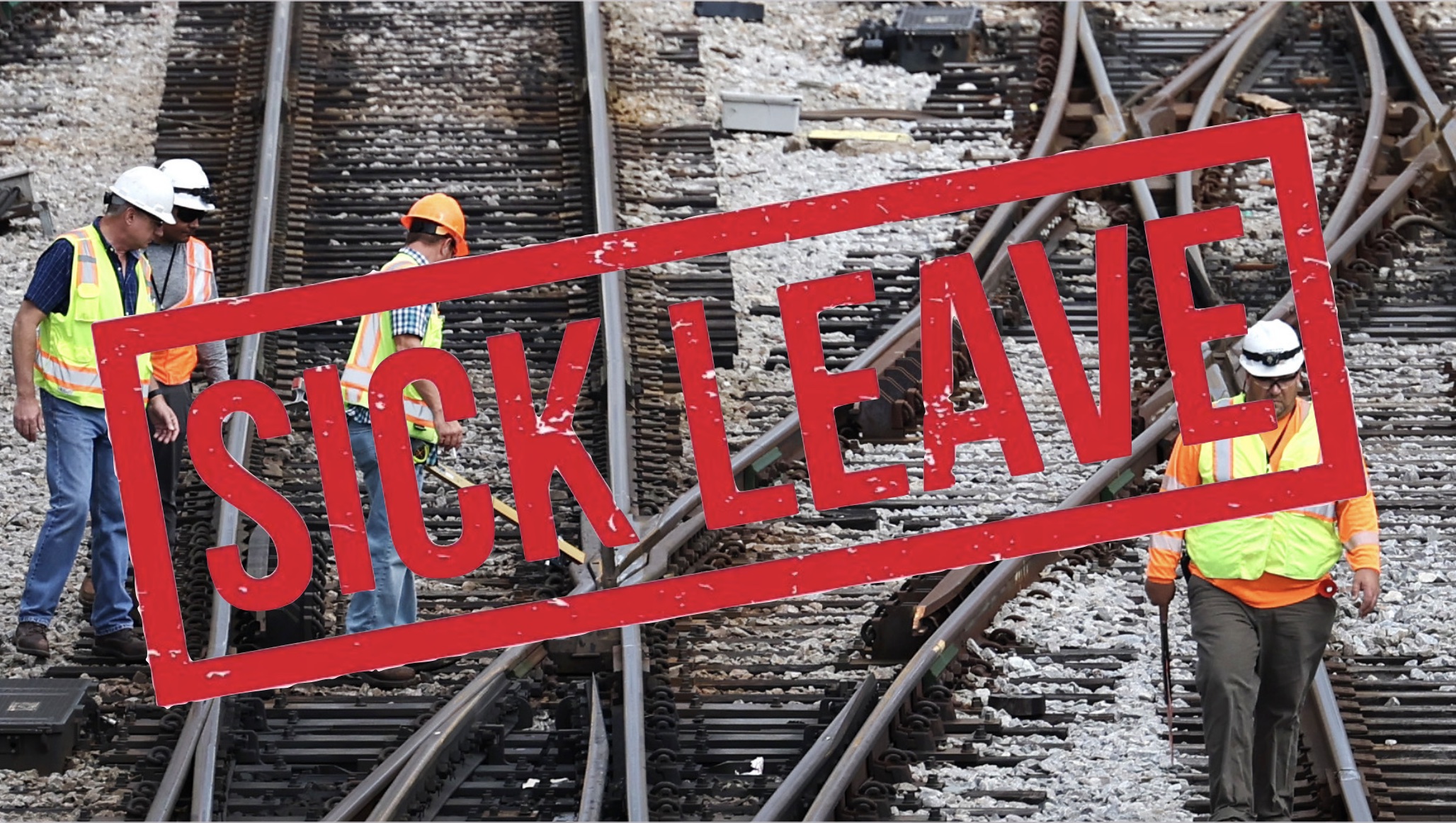
Railway workers would certainly rather get on with their jobs than contend with the bosses or Congress. But having no paid sick leave and a lack of adequate pay will not help move goods across the country any better, either.
Instead, we are at the mercy of employers to step up and do so. And when it comes to the poorest but most important workers – the ones without which our country would grind to a stop – employers are often extremely reluctant to do so.
Roughly a quarter of the private workforce — more than 33 million people — have no paid sick days so they can take care of themselves if they get ill. Even worse, more than 80 percent of private sector workers have no access to paid leave so they can care for a family member.
And it’s indisputably a racial and class phenomenon.
Higher-paid, professional workers almost universally have paid sick and family leave. But, of course, most of these workers don’t just lack pigment on their collars, they lack it on their faces, too. Among the lowest-paid quarter of the workforce, the majority of whom are Black and Latinx workers, only half of them have any paid sick days, and just 7 percent have paid family leave.
So workers of color, the poor, and disproportionately women are much more likely to lack sick and family leave than those who are paid more, have white skin and are male.
And before you explode with indignation, let it be known that this could be rectified any day our government sees fit.
Our representatives could stop holding water for groups like the railway companies that pulled in $20 billion in profits last year alone. Our government could represent us, the people, instead of businesses that could afford to do better but don’t because we aren’t holding them accountable and our Congress and the President refuse to stop them or even let us force them to do right by subjecting them to a strike.
It is past time for our government to begin respecting the rights of workers to organize and collectively bargain for better treatment.
We just suffered through a pandemic where these so-called essential workers had to put themselves in the most danger just to keep society running while the rest of us stayed home and were unequally protected.
If these workers are truly essential, they at least deserve sick and family leave. Otherwise, it is all too obvious how bogus the term is.
The U.S. can no longer run on the unrespected work of an underclass of the poor and people of color.
Like this post? You might want to consider becoming a Patreon subscriber. This helps me continue to keep the blog going and get on with this difficult and challenging work.
This almost always concludes with two types of plan.
First, there is the serious venture made up of things like increasing spending to meet student need, wraparound services, early intervention, reducing class size, redistributive justice and cultural competence – a plan that looks the reality in the face and makes bold attempts to come to terms with it.
Then there is the cheap knockoff proposition – a buzzword-laden scheme where someone is trying to convince you their half hearted proposal is actually a solution to the very real problem of educational inequality.
And the number one thing you can use to tell the difference between the two is this – standardized test scores.
The first plan that is centered around actually fixing disparities makes no mention of test scores – or at least relegates them to obstacles. The second is built all around them – as an essential component of the overall scheme.
This is because the second feel-good-accomplish-nothing plan is essentially performative.
Therefore, it is constructed around standardized test scores as a metric of success.
Planners think: We’re going to do A, B and C to make our schools more equitable. And how will we know we’re doing it right? We’ll use our standardized test scores!
And anyone who understands the history of these types of assessments and how they still work will know that this mirage is built at the cost of genuine equity.
So constructing your plan to fix this problem around one of its root causes is like claiming you can fix a sinking ship by drilling more holes in its hull.
At best, it’s naive. At worst, it’s self-defeating and disingenuous.
Both types of assessment are supposed to measure what students have learned. But not all learning is equal.
For example, a beginning chef needs to know how to use the stove, have good knife skills and how to chop an onion. But if you give her a standardized test, it instead might focus on how to make foie gras – something that would only come in handy at a high end French restaurant.
The fact of the matter is that standardized tests do NOT necessarily focus on the most important aspects of a given task. They focus on obscurities – things that most students don’t know.
This is implicit in the design of these exams and is very different from the kinds of tests designed by classroom teachers.
When a teacher makes a test for her students, she’s focused on the individuals in her classes. She asks primarily about the most essential aspects of the subject and in such a way that her students will best understand. There may be a few obscure questions, but the focus is on whether the test takers have learned the material or not.
When psychometricians design a standardized test, on the other hand, they aren’t centered on the student. They aren’t trying to find out if the test taker knows the most important facts or has the most essential skills in each field. Instead, there is a tendency to eliminate the most important test questions so that the test – not the student – will be better equipped to make comparisons between students based on a small set of questions. After all, a standardize test isn’t designed for a few classes – it is one size fits all.
New questions are field tested. They are placed randomly on an active test but don’t count toward the final score. Test takers aren’t told which questions they’ll be graded on and which are just practice questions being tried out on students for the first time. So students presumably give their best effort to both types. Then when the test is scored, the results of the field test questions determine if they’ll be used again as graded questions on a subsequent test.
If 40 to 60 percent of test takers answer the question correctly, it might make it onto the test. But questions that are answered correctly by 80 percent or more of test takers are usually jettisoned.
“As a consequence of the quest for score variance in a standardized achievement test, items on which students perform well are often excluded. However, items on which students perform well often cover the content that, because of its importance, teachers stress. Thus, the better the job that teachers do in teaching important knowledge and/or skills, the less likely it is that there will be items on a standardized achievement test measuring such knowledge and/or skills.”
If we are guided in large part by standardized test scores, we aren’t guided by authentic learning. We’re guided by a false picture of learning. Therefore, the most effective way – perhaps the only practical way – of raising test scores is to teach directly to a specific test. And not only the test, but the specific version of the test being given that year.
So if we do somehow manage to raise test scores, we haven’t improved academics at all but a mere semblance of it. And thus the equity we might celebrate in such a situation would be just as false.
You got a good score on the MAP test. Hurrah! But that doesn’t mean you know anything of real value except how to take this particular MAP test which, itself, will change after the next round of questions are field tested.
And if we insist on evaluating the equity of our schools on these test scores, we will only make things that much worse.
We end up chasing the psychometricians. We try to guess which aspects of a subject they think most students don’t know and then we teach our students that to the exclusion of more important information. And since what students don’t know changes, we end up having to change our instructional focus every few years based on the few bread crumbs surreptitiously left for us by the state and the testing corporations.
That is not a good way to teach someone anything. It’s like teaching your child how to ride a bike based on what the neighbor kid doesn’t know.
It’s an endless game of catch up that only benefits the testing industry because they cash in at every level. They get paid to give the tests, to grade the tests and when students fail, they get paid to sell us this year’s remediation material before kids take the test again, and – you guessed it – the testing companies get another check!
It’s a dangerous feedback loop, a cycle that promotes artificially prized snippets of knowledge over constructive wholes.
But we can no longer continue feeding that beast and pretending that we can somehow provide equity to our underserved children, too.
We have to choose – equity or testing. Fairness or unrestrained capitalism.
Do not believe anyone who tells you to support a plan built on both.
It does not exist.
Like this post? You might want to consider becoming a Patreon subscriber. This helps me continue to keep the blog going and get on with this difficult and challenging work.
Honestly, I don’t know how we’d cram all the desks in the room. I can barely fit 15 in there now.
Where would we put the books, computers and cabinets? The students, alone, would be wall-to-wall.
Just imagine that many middle school kids stuffed into the room arguing about who’s touching who and which classmate stole their pencil or book. Not to mention the children striving to get my attention to solve disputes, get help with classwork, ask permission to use the bathroom – and a thousand other issues!
For example, there’s no way we could afford a school nurse at each building like we have today. We’d be lucky to have one nurse for all four buildings in the district – elementary schools, middle schools and the high school. If a student feels sick, there’s not much I could do except send the child to the office to try to call home and get a parent or guardian to pick the kid up early. And if the parents can’t make it, just let the kid put his or her head down?
What if the issue’s more psychological? There might be a school counselor somewhere in the district so a student can talk out an issue he or she is having – perhaps conflict resolution with a former friend, discuss peer pressure to try drugs or maybe deal with suicidal thoughts. But there’s probably a long waiting list to see this mythical counselor. Hopefully, the problem is not too urgent.
I feel especially bad for the special education students. Aides would be almost non-existent so many kids with special needs would have to struggle through issues with which we’d normally help them. All the individual Education Plans (IEPs) would have to be rewritten to take this new normal into account.
Even lunch would be disrupted. After all, there would be fewer cafeteria workers so it would be harder just to cook a hot meal and make sure it gets onto a tray in time for students to eat it.
There’s no doubt about it.
My classroom would be very different if Mastriano wins the gubernatorial election in November.
At my district of Steel Valley in Munhall on the western side of the Commonwealth, the situation probably would be much like I described.
I can’t imagine how any teacher could adequately tend to double the students, but I might not have to imagine it.
I’d probably be laid off.
More than half of Steel Valley’s staff would be out of a job – 92 of our current 172 school nurses, counselors, aides, cafeteria workers and teachers would be looking for work.
And that’s just where I’m employed.
Things would be even worse for my daughter where she attends McKeesport Area School District.
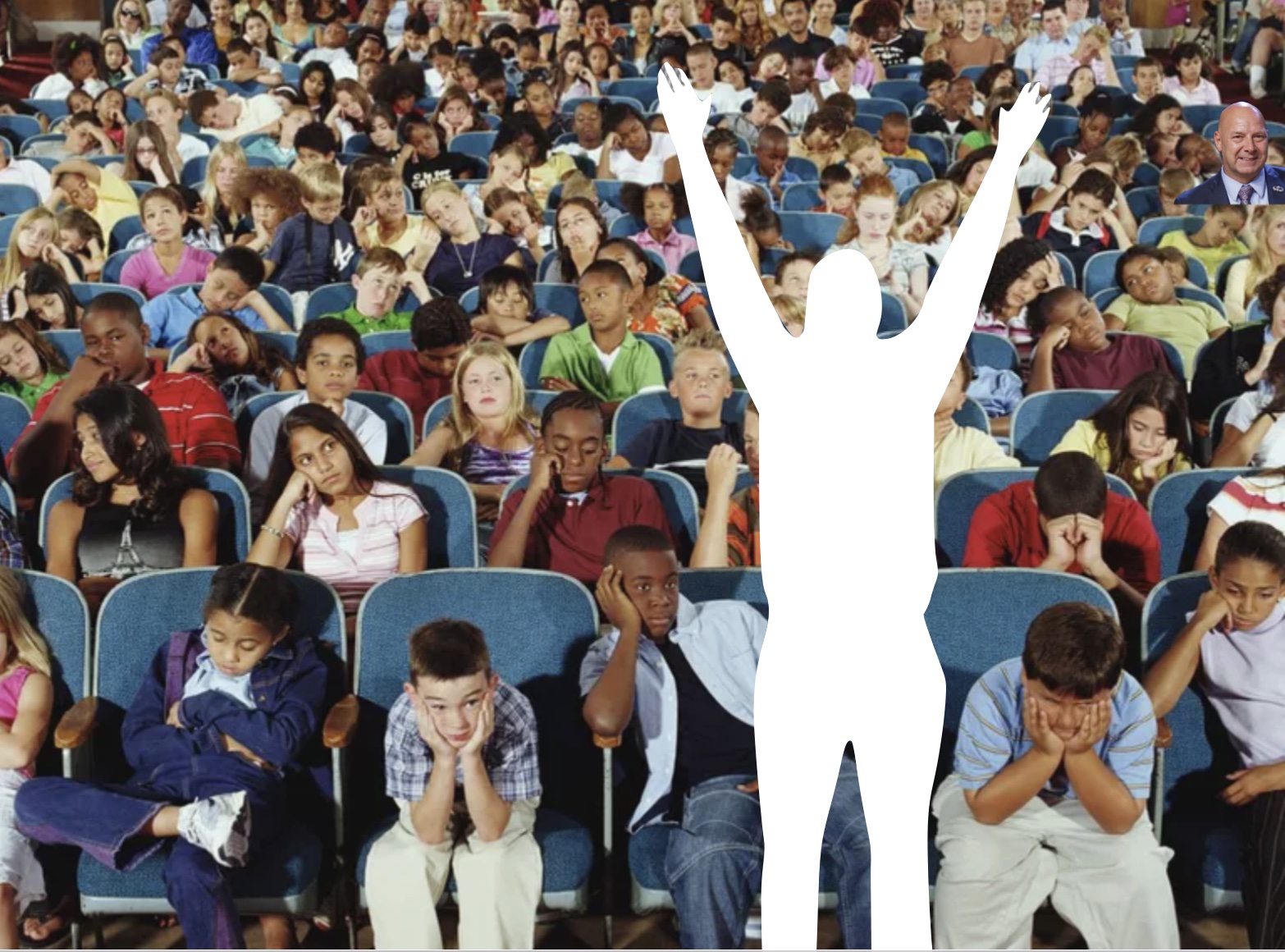
According to PSEA estimates, the nearby McKeesport district would lose 281 of 521 staff – a 54% reduction. Classes would go from an average of 17 students to an average of 46. That’s an increase of 29 students per class!
How can she learn in that kind of environment!? She isn’t in college yet. She isn’t in some University of Pittsburgh survey class that meets in an auditorium. She’s in middle school!
But it would be pretty similar at public schools, charter schools, career and technical centers and intermediate units across the state.
From one side of the Commonwealth to the other, we’d go from 239,902 staff to 121,198. Class size would go from an average of 16 students per class to 33. That’s an increase of 17 students per class or 109%.
Like so many wannabe big time policymakers, he is very light on the details of how we would educate the state’s 1.7 million students. This whole proposal was just something he blurted out during a March 2022 WRTA radio interview.
It’s his plan to completely eliminate local school property taxes. Funding would be provided directly to parents via “Education Opportunity Accounts,” and families could then decide whether they want a public, private, charter or home school option.
To go from a statewide average funding level of $19,000 a student to $9,000 a student requires a cut of $17.6 billion, or 53%.
But if the remainder isn’t being paid by property taxes, that’s a roughly $15.3 billion a year expenditure by the state that used to be paid by local property taxes. Where is he getting that money from? And if the state can afford to pay that much, why not just pay the full $19,000 per student and make none of these unnecessary cuts? Or why not just pay half and reduce property taxes by that much? Mastriano is not exactly forthcoming on any of this.
PSEA admits that to come up with its own estimates of the damage the organization filled in a few details. The union assumes the state would fully fund the $9,000-per-student voucher and leave other local non-property taxes and federal revenues untouched.
That might not happen. We could be looking at an even more draconian situation.
The biggest question the PSEA is sidestepping is the impact of allowing taxpayer dollars to fund so many different types of schooling.
Even under Mastriano’s plan, nontraditional educational providers like charter schools would suffer because like traditional public schools they would be receiving less funding from the state than they do now. And parents using their vouchers to pay for private schools for their children would still have to make up a pretty big gap between the amount of the voucher and the cost of private school tuition.
However, since traditional public schools serve the overwhelming majority of the state’s students, they would take the biggest hit financially. If more parents use their voucher to pay for private, charter or home schools, that’s less funding for our public school system. That means even greater cuts to student services and more staff layoffs.
Moreover, what if parents use the voucher for a fly-by-night educational option that doesn’t meet it’s obligations?
And when it comes to charter schools that took federal funding, 12% never even opened. They just gobbled up the cash with nothing to show for it.
What will happen to students whose parents lose their vouchers in schools like these? Who will pay for these kids to be educated? Or will they have to go without?
The books are riddled with counter factual claims and political bias in every subject imaginable such as abortion, gay rights and the Endangered Species Act, which one labels a “radical social agenda.” They disparage religions other than Protestant Christianity and cultures other than those descended from White Europeans.
If someone wants to pay for such an education out of their own pocket, that’s one thing. But to ask taxpayers to fund such propaganda is something else entirely!
Thankfully, Pennsylvania voters don’t have to accept this. Not yet anyway.
There are still more than three months before the election. Voters can choose the Democratic gubernatorial candidate Josh Shapiro. He has promised to INCREASE education funding and not just blow up the whole system.
To see an interactive map of how Mastriano’s education cuts would affect your school district, click here.
For now this is only a bad dream. We still have time to wake up and vote accordingly.
Students should not have to submerge themselves in a sea of classmates and hope the teacher will have time to educate them.
We should invest in education, not sell off our future for a fast buck today.
Like this post? You might want to consider becoming a Patreon subscriber. This helps me continue to keep the blog going and get on with this difficult and challenging work.
So Pennsylvania has unveiled a new plan to stop the exodus with the help of an organization pushing the same policies that made teaching undesirable in the first place.
How can an organization dedicated to the same ideas that prompted the exodus turn around and stop the evacuation!?
That’s like hiring a pyromaniac as a fire fighter!
“Pennsylvania’s educator shortage is the biggest threat facing not only our educational system but our future prosperity as a commonwealth,” Boyce said at the press conference.
“If schools are engines of educational and economic opportunity, then educators are the conductors who keep the train moving forward. Teach Plus teachers have been sounding the alarm about this crisis and are eager to partner with the Department to enact ambitious and transformational changes to better recruit and retain educators in Pennsylvania.”
However, she’s already getting things wrong.
The importance of education is NOT as the “engine of economic opportunity.” Its importance is to help students become their best selves. It is creating critical thinkers who can navigate our modern world, become well-informed participants in our democratic system and live good lives.
Given the track record of Teach Plus, any well-informed individual should be wary of the how “eager [the organization is] to partner with the Department to enact ambitious and transformational changes.”
1) Meeting the educator staffing needs of rural, suburban, and urban areas;
2) Building a diverse workforce representative of the students we serve;
3) Operating a rigorous, streamlined, and customer service-oriented certification process;
4) Ensuring high-quality preparation experiences for aspiring educators; and
5) Ensuring educator access to high-quality and relevant professional growth and leadership development opportunities.
As you can see, it is full of corporate education reform buzzwords like ‘rigorous” and “high quality” that neoliberals have used as code for their policies for decades.
There are 50 steps outlined in the report. While many seem important and well-intentioned, they lack any kind of urgency, and though organized under these five areas, still seem kind of scattershot.
They can’t buy a home or even rent an apartment in most metropolitan areas. They can’t afford to marry, raise children, or eke out a middle class existence.
Yet increasing teacher salary is only briefly mentioned in step 13 of the first focus group as follows:
“13. Based on the resources that PDE develops on competitive compensation and incentives, advocate for and secure funding from the General Assembly that enables hiring entities to compete more effectively in the regional labor market.”
Talk about anemic language!
Imagine being on a sinking ship and someone only mentioning plugging the leak in such terms – if we can, based on our resources, yada, yada, yada.
Another point that jumped out to me was recruitment of new teachers.
Under focus two, the plan calls for:
“6. Partner with nonprofit organizations working to develop recruitment, training, and mentoring programs for middle and high school students from diverse backgrounds to identify and recruit future educators.”
Getting more people to become teachers sounds great, but why are we partnering with “nonprofit organizations” and which ones in particular do you have in mind?
Then there’s the emphasis on building a diverse workforce.
In itself, that’s an excellent and necessary goal. However, if you aren’t going to make the profession more attractive, you aren’t going to increase diversity. Right now one of the major reasons our schools are full of mostly white, middle class teachers is because white, middle class people are the only ones who can afford to take the job.
This is what Teach Plus does. It advocates for neoliberal disruptions in school management.
In the past, Teach Plus has insisted older more experienced educators be fired while shielding “promising young teachers” from the brunt of these firings. There is a great deal of evidence that teacher effectiveness, on a wide range of indicators – not just test scores – increases as teachers gain experience. However, new teachers are easier to brainwash into corporate education reform – to be driven by standardized test scores and data instead of the needs of the living, human beings in front of them in the classroom.
So this proposed teacher preparation and professional development is of what kind exactly? I’ll bet it’s mostly reeducation to accept corporate education reform. I’ll bet it’s focused on ways to increase student test scores which will then be used to evaluate teacher effectiveness – a program that has been roundly disproven for decades.
So where does that leave us?
A decades ago roughly 20,000 new teachers entered the workforce each year, while last year only 6,000 did so, according to PDE.
Like this post? You might want to consider becoming a Patreon subscriber. This helps me continue to keep the blog going and get on with this difficult and challenging work.
To answer that question, we have to understand how we got here in the first place – where these kinds of assessments came from in the US and how they became the guiding policy of our public schools.
From the very start, it had serious consequences for public policy. The results were used to rationalize the forced sterilization of 60,000 to 70,000 people from groups with low test scores, thus preventing them from “polluting” the gene pool.
However, Brigham’s greatest claim to fame was the creation of the Scholastic Assessment Test (SAT) to keep such undesirables out of higher education. These tests were not central to school curriculum and mainly used as gatekeepers with the SAT in particular still in wide use today.
The problem then – as now – is that standardized tests aren’t very good assessments. They work okay for really simple things like rudimentary math. However, the more complex a skill you’re assessing, the more inadequate the tests. For example, imagine just trying to have a conversation with someone where your only choices of reply were limited to four canned responses. That’s a multiple-choice assessment. The result is a testing system that selects against the poor and minorities. At best, it reproduces the economic and racial disparities of society. At worst, it ensures those disparities will continue into the next generation.
That isn’t to say the system went unchallenged. By the 1960s, the junk science and leaps of logic behind standardized testing were obvious and people began fighting back in court. Black plaintiffs began winning innumerable lawsuits against the testing industry.
Perhaps the most famous case is Hobson v. Hansen in 1967, which was filed on behalf of a group of Black students in Washington, DC. The court ruled that the policy of using tests to assign students to tracks was racially biased because the tests were standardized to a White, middleclass group.
So in the 1980s, the Reagan administration published “A Nation at Risk,” a campfire tale about how America’s public schools were failing. Thus, the authors argued we needed standardized testing to make American children competitive in a global marketplace.
For instance, it concluded that average student test scores had decreased but didn’t take into account that scores had actually increased in every demographic group. It compared two decades worth of test scores, but failed to mention that more students took the test at the end of that period than at the beginning, and many of the newer students were disadvantaged. In other words, it compared test scores between an unrepresentative group at the beginning of the comparison with a more representative group at the end and concluded that these oranges were nothing like the apples they started with. Well, duh.
Most people weren’t convinced by the disaster capitalism at work here, but the report marks a significant moment in the standardization movement. In fact, this is really where our modern era began.
It took an additional two decades, until 2001, for President George W. Bush’s No Child Left Behind (NCLB) legislation to require standardized testing in ALL public schools.
With bipartisan support, Bush tied federal funding of schools to standardized test performance and annual academic progress. And from then on, the die was cast. This policy has been upheld through both Republican and Democratic regimes.
From the 1980s to 2022 we’ve had wide scale standardized testing in our schools. That’s roughly 40 years where the entirety of what is done in public school has been organized around these assessments. They drive the curriculum and are the ultimate benchmark by which success or failure is judged. If this policy was ever going to work, it would have done so by now.
However, it has achieved NONE of its stated goals.
NCLB specifically stated that all children would be proficient in reading and math by 2014. That has not happened. Despite spending billions of dollars on remediation and completely reorganizing our schools around the assessments, test scores have remained mostly static or even decreased.
NCLB also championed the idea that competing for test scores would result in better teachers. However, that didn’t happen either. Instead, educators were forced to narrow the curriculum to cover mostly what was assessed, reduce creativity and critical thinking, and teachers who served poor and minority students were even punished for doing so.
If the purpose of standardized testing was all the things the law purported, then it was a decades long failure. It is the policy equivalent of slamming your head into a wall repeatedly and wondering why you aren’t moving forward. (And where did this headache come from?)
If, however, the purpose of standardized testing was to fulfill Friedman’s privatization dreams, then it was a resounding success. Public schools still persist, but they have been drained, weakened and in many ways subverted.
Look at the evidence.
Standardized testing has grown from a $423 million industry before 2001 to a multi-billion dollar one today. If we add in test prep, new text books, software, and consultancy, that figure easily tops the trillion dollar mark.
Huge corporations make the tests, grade the tests and then sell remediation materials when students fail. It’s a huge scam.
But that’s not the only business created by this policy. Test and punish opened entirely new markets that hadn’t existed before. The emphasis on test scores and the “failing schools” narrative stoked unwarranted distrust in the public school system and a demand for more privatized alternatives.
Chief among these was charter schools.
The first charter school law was passed in 1991 in Minnesota. It allowed for the creation of new schools that would have special agreements (or charters) with states or districts to run without having to abide by all the usual regulations. Thus, the school could go without an elected board, pocket public money as private profit, etc. The bill was quickly copied and spread to legislatures across the country by the American Legislative Exchange Council (ALEC).
However, charter schools are rife with fraud and malfeasance. For instance, more than a quarter of charter schools close within 5 years of opening. By year 15, roughly 50% of charter schools close. That’s not a stable model of public education. It’s a get rich quick scheme. And since these types of schools are free from the kinds of regulations, democratic governance and/or transparency that keeps authentic public schools in check, another charter school scandal pops up almost every day.
But let’s not forget school vouchers. Before high stakes testing, the idea of using public money to pay for private or parochial schools was widely considered unconstitutional. Now about 4% of US students go to private and parochial schools some of which are funded with school vouchers. This is an option in 32 states and the District of Columbia, and more than 600,000 students participated in a voucher, scholarship tax credit or education savings account program last school year, according to EdChoice, a pro-voucher and school choice group.
In short, they’re subsidies for wealthier kids at the expense of the middle class and disadvantaged.
Without standardized testing, it is impossible to imagine such an increase in privatization.
High stakes testing is a Trojan horse. It is a way to secretly undermine and weaken public schools so that testing corporations, charter schools and voucher schools can thrive.
Judged by its own metrics of success, standardized testing is an abject failure. Judged by the metric of business and school privatization it is a rousing success.
And that’s why it has been so hard to discontinue.
This is corporate welfare at its finest, and the people getting rich off our tax dollars won’t allow us to turn off the flow of funding without a fight.
On the right, policymakers are often boldly honest about their goals to bolster privatization over public schools. On the left, policymakers still cling to the failed measures of success testing has not been able to meet time-and-again.
However, both groups support the same system. They only give different reasons.
It is past time to wake up and smell the flowers.
If we want to ensure education dollars go to education and not profiteers, we need to end standardized testing.
If we want to help students learn to the best of their abilities, we need to stop gaslighting them with faulty measures of success or failure.
If we want to allow teachers to do the best for their students, we need to stop holding them back with antiquated eugenicist shackles.
And if we truly want to save our public school system, we have to stop propping up privatization.
In short, we need to end standardized testing.
The sooner, the better.
Like this post? You might want to consider becoming a Patreon subscriber. This helps me continue to keep the blog going and get on with this difficult and challenging work.
“The General Assembly shall provide for the maintenance and support of a thorough and efficient system of public education to serve the needs of the Commonwealth.”
“Thorough and efficient.”
Not lavish. Not extravagant. Just complete and productive.
One has brand new facilities, marble columns, and wood paneling scrubbed to a shine with a bustling staff moving to-and-fro.
The other has badly maintained structures, exposed insulation, dusty corners, leaky ceilings and animal droppings while a skeleton crew of adults try their all to do the impossible without the tools to get it done.
The Pennsylvania legislature has been paying less and less of public schools’ budgets over the last four decades. The state used to contribute 54% of all public school costs in the early 1970s. Today it pays just 38% of the cost. Only five states cover a smaller share with the national average at 47%. This leaves local taxpayers to take up the slack. Since districts are not equally wealthy, that increases the disparity of resources between rich and poor districts.
During the trial, the state had tried to argue that money doesn’t matter. Yet poor schools can spend $4,800 less per student than wealthy districts. What’s worse, impoverished students have greater needs than rich ones. They often don’t have books in the home or access to Pre-kindergarten. Poor students often suffer from food insecurity, malnutrition, a lack of neonatal care, worse attendance, are less well rested and have greater special needs and suffer greater traumas than wealthier students. Yet we provide them with fewer resources!?
“What use would a carpenter have for biology? […] What use would someone on the McDonald’s career track have for Algebra 1? […] The question in my mind is, thorough and efficient to what end? To serve the needs of the Commonwealth. Lest we forget, the Commonwealth has many needs. There’s a need for retail workers, for people who know how to flip a pizza crust.”
So the Commonwealth actually argued that inequitable funding is okay because all kids don’t need a thorough education. Some just need the bare minimum to do whatever menial jobs they’re destined to have while the elite kids need more for the high skilled jobs they’re going to get.
I wonder which kids Krill and his defendants in the legislature think deserve less funding. I’ll bet it’s the black and brown kids already suffering most from this disparity.
Luckily, the school districts asking the courts to intervene feel differently.
Six school districts – William Penn, Lancaster, Panther Valley, Greater Johnstown, Shenandoah Valley, and Wilkes Barre Area – filed the suit along with the Pennsylvania Association of Rural and Small Schools, the NAACP PA State Conference, and families whose children attend under-resourced schools.
Essentially, they are asking for two things.
First, for the court to declare the current funding system unconstitutional.
Second, for the court to order the legislature to create and maintain a fair funding system.
You might say, wait. Didn’t the legislature adopt a new Basic Education Funding formula in 2016 that already provides a fairer way to allocate money based on need?
He suggests a $1.75 billion down payment to schools on the $4.6 billion gap.
The state has the money to do this. It just needs to cut wasteful spending elsewhere and close tax loopholes.
For example, the state throws away $240 million a year to The Race Horse Development Fund. These are taxpayer funded subsidies to wealthy horse racing enthusiasts and hobbyists. Since 2004, the legislature has lavished $3 billion on the horse racing industry. Shouldn’t we prioritize school children over cash prizes and inflated pensions for wealthy horse owners, breeders, and trainers? Aren’t kids more important than paying to drug test horses and for racetrack marketing?
If the state was doing its job and looking after kids instead of giving handouts to wealthy oligarchs, you and I wouldn’t feel as much pain in our wallets.
Both parties in the case will file a series of post-trial briefs saying what they believe they proved during the testimony, the “conclusions of law” they are asking the judge to reach, and their analysis of the legal questions presented—such as the meaning of the state Constitution’s “thorough and efficient” education clause.
The final post-trial brief is due on July 6. Then — after oral argument on legal issues at a later date — the court will make its final decision weeks or months later.
In the meantime, the budget is supposed to have been approved by the legislature (one way or another) and signed by the Governor by June 30. If not, funding for some state programs may be delayed. But you never know. The legislature has been late on this before.
So what am I learning from all of this?
The value of hope?
The evil of lawmakers who want to continue shortchanging our children?
The bravery of public school districts that challenge the state to follow its own darn rules?
All of the above.
Like this post? You might want to consider becoming a Patreon subscriber. This helps me continue to keep the blog going and get on with this difficult and challenging work.
People often ask me what I’d change about education if I could change just one thing.
But they don’t seem to realize that our schools are kind of like Jenga – if you change one thing, you might set off a chain reaction and it all comes tumbling down.
Change one thing – the RIGHT thing – and you may change all of them.
Maybe even for the better!
Why worry about that now?
Monday is my birthday. I’ll be 48.
Old enough to know that birthday wishes don’t come true. Unless maybe you wish for cake and ice cream.
But I can still see myself staring into the candles as friends and family sing the obligatory tune.
The orange flames wave back and forth atop tiny wax fingers threatening to burn down the whole chocolatey confection.
But before they do, I just might give in and make a wish – a birthday wish – and….
No more assessments where a multiplicity of nonacademic factors like parental income, childhood trauma and corporate bias are hidden behind a numeric label.
Educators would no longer be seen as overpaid babysitters but trusted pillars of the community.
They’d be respected – their opinions sought after in educational issues like diamonds.
And the pay! No longer would any teacher need to work more than one job! They’d be compensated like professional athletes. Maybe there’d even be a draft in each state where the most promising prospects out of college would be fought over by schools with children who they think would best be served by their hire.
Imagine a country like that! One that put children first by putting education first!
Imagine how it would change the landscape. Adults who grew up in such a system would be pretty hard to fool because they’d be critical thinkers.
No political charlatan could come in and bamboozle them with nonsense and charisma. No corporation could trick them into pyramid schemes and tax evasion.
No lack of social services, public healthcare, public goods!
Ah! It would be a much better world I think if my wish came true.
But…
Oh…
Sigh!
I don’t see it happening.
No even a little of it.
After two decades in the classroom, the wind always seems to be blowing against such things.
But then again, I have a chance to change the wind come Monday.
We all do.
If you’ll help me blow out the candles.
Like this post? You might want to consider becoming a Patreon subscriber. This helps me continue to keep the blog going and get on with this difficult and challenging work.
I just can’t believe that in light of such a flame dancing ever more quickly down an ever-shorter fuse that people aren’t interested in reading about how to stomp it out.
Mass media is not particularly kind to educators like me.
Even when journalists are writing about schools and learning, they rarely ask classroom teachers their opinions. Instead, the media often turns to self-appointed experts, think tank flunkies, billionaire philanthropists or politicians.
It’s like they can’t even conceive of the fact that someone with a masters degree or higher in education who devotes her whole life to the practice of the discipline has anything worthwhile to say.
So many of us have taken to the blogosphere to circumvent the regular media channels.
And so people like Joe Rogan make millions on their podcasts spreading science denial, vaccine disinformation and racist dog whistles.
A guy like me just trying to make the world a better place?
I get silenced.
I guess when money is speech, poverty is the real cancel culture.
Like this post? You might want to consider becoming a Patreon subscriber. This helps me continue to keep the blog going and get on with this difficult and challenging work.
Players from Steel Valley School District contend that during a November playoff game at their home field, rivals South Side Area School District called them the N-word and “monkeys” as well as purposefully incapacitated their star player.
WPIAL Executive Director Amy Scheuneman said her organization is refusing to take sides and students, coaches and administrators for both districts will have to undergo racial sensitivity training.
It is absurd. Imagine making a gunman and the person he shot go through firearms training.
Talk about false equivalency!
“We don’t want to walk away saying you’re right and you’re wrong, but we need to learn from this,” Scheuneman said. “We need to all work together to make that happen.”
Calls for unity are great but justice needs to come first. It’s nearly impossible for everyone to just get along when you don’t hold wrongdoers accountable for their actions – especially when the victims are mostly black and the perpetrators are mostly white.
Though Steel Valley went on to win the game, their star senior running back and linebacker Nijhay Burt suffered a season ending ankle injury which his family alleges was caused by South Side Players on purpose.
Burt’s mother Shunta Parms says, “…The two players that tackled him, they were pushing off his ankle. They were twisting it as they got up. After they got up they cheered in his face and said ‘Yeah! We got you now!’”
WPIAL board of directors and Diversity and Inclusion Council heard testimony for more than four hours on Wednesday.
The meeting was closed to the public at the request of the South Side District from Beaver County, and WPIAL officials have refused to give specific details of what was said behind closed doors.
However, Scheuneman was adamant that the board did not find any evidence the official used racial taunts.
“…The board did not find that to be accurate,” Scheuneman said.
I would love to know what evidence there was to so unequivocally clear the referee.
Especially since she noted the other allegations came down to a matter of he said-she said.
There were “conflicting reports” about what happened and “direct testimony against” the claims of Burt and the Steel Valley School District, Scheuneman said.
“Based on what we heard, I would say that, while there may be tendencies to lean one way or another, it was inconclusive, specifically, one way, as opposed to another.”
Ma’am, isn’t it your job to lean one way or another?
You need to be impartial at first but then you listen to the evidence and decide who was at fault.
Either South Side Beaver players used hate speech against Steel Valley players or not. Either they intentionally injured Steel Valley’s star player or not.
And if they did not, that means Steel Valley players made the whole thing up.
Do you really find that possibility credible?
“There was testimony on both sides, and there were missed opportunities by adults from both schools, so we do feel that it’s important for everybody to learn from the events that happened and take something positive from it,” Scheuneman said.
And Steel Valley’s coach did not report his player’s accusations to the head referee.
Therefore, they’re both to blame!?
What the heck are you smoking!?
Steel Valley Superintendent Ed Wehrer issued a statement that shed some light on the previous incident at South Side Beaver:
“The testimony by South Side Area confirmed that a month prior to the playoff game at issue a member of their team had behaved the same way in a game against Carlynton High School, as witnessed by the Athletic Director at Carlynton. Combined with our statements, that admission established a pattern of racist behavior by our opponent, which should have reinforced the trustworthiness of our complaint.”
The only specific mention of wrongdoing on Steel Valley’s part is neglecting to alert the head referee. But the district’s actions make perfect sense in context. Why would the district go to the referees after allegations that one of them was also guilty of making racial taunts!? Isn’t it logical that Steel Valley and Burt waited to file a report against the Beaver County District!?
South Side Beaver district is 96% white. There are so few black students, 2019 Census data puts the number at 0%.
Meanwhile, Steel Valley is 72% white and 23% black with a higher percentage of children of color on the football team than in the district as a whole.
Are you telling me it’s likely that a mostly black team who is already crushing their rivals (they won 20-12) would make up being the target of racism? Are you saying Burt would make up how his leg was manhandled by the opposing team?
And then we have the issue of socioeconomics.
South Side Beaver is a wealthier district than Steel Valley.
Median household income at the South Side district is $69,905. At Steel Valley it’s $42,661.
At the South Side, 7.7% of residents live below the poverty line. At Steel Valley it’s 17.4%.
These make a difference.
More privileged students are way more likely to think they deserve to win just because of who they are. Underprivileged kids have to work for everything they have.
And officials are way more likely to ignore poorer black kids in favor of richer white ones.
Scheuneman said, “Regardless if one side was more wrong than the other, it takes both parties to mend that bridge and get through anything. So we want those schools to work together in moving forward in cultural competency.”
This is a bad idea.
It won’t do anything to stem the increasing tide of racism from whiter, wealthier districts directed at poorer blacker ones.
These sorts of trainings are not in themselves enough to stop hate speech.
It’s true that having South Side Beaver and Steel Valley go through racial sensitivity training won’t hurt anyone.
Steel Valley students won’t suffer being forced to undergo this measure.
But the fact that they HAVE TO do this will underscore the injustice of the systems they have to live under.
They were the victims, and they got the same punishment as the oppressor.
And at South Side Beaver we can HOPE the training will do some good.
But let’s be honest – this sort of thing is only effective when those attending the training are receptive to its message.
The fact that South Side got away with this will poison everything being taught.
WPIAL is supposed to be about fair play.
They got it really wrong here.
If anyone needs this training, it’s them.
Steel Valley’s Statement:
Like this post? You might want to consider becoming a Patreon subscriber. This helps me continue to keep the blog going and get on with this difficult and challenging work.
For one, all this focus on equity has made it harder to support standardized testing.
That’s a big problem for these folks.
They think that if being against discrimination means also turning against something as obviously innocuous as fill-in-the-bubble tests, maybe it’s today’s brand of anti-racism that has to go.
However, most of us probably don’t see this as a difficult choice.
And today the scores still routinely fail Black and Brown people while passing whites thus barring many people of color from graduation or college entrance.
However, describing such a state of affairs as “racist” has been criticized by a self-described anti-woke backlash.
People as diverse as Fox News correspondents, old school neoliberals and contrarian progressive academicians have taken arms together to fight against what they see as an overstatement of the degree of racism present in modern America and an attack on free speech.
“…an old-school Black progressive who doesn’t hide his disdain for white liberals and what he considers their Black enablers in academia and the culture. He argues that the anti-racism movement of the “elected” is more performative than intellectually serious and that the white allies who provide the shock troops at universities and street rallies are just as gross as white supremacists because their virtue signaling hides their condescension.”
Ultimately Norman concludes, “I agreed with so much of what the writer had to say about specific hypocrisies of white saviors while disagreeing with much of its premise.”
As a white person, I make no judgment on McWhorter’s overall thesis because I don’t feel qualified to do so.
However, as a classroom educator with more than two decades experience teaching mostly poor and minority students, I feel qualified to address the issue of testing.
After all, I have proctored hundreds of these assessments, seen their impact, studied the history and spoken with hundreds of people of color who oppose the tests and a few like McWhorter who defend them.
The linguist’s main argument can be summed up as follows.
Excusing people of color from the tests because they generally score lower is mere pity. People of color don’t need your pity. Give them the tools necessary to pass the tests like everyone else.
“Is it the moral thing to exempt black and Latino kids from the serious competition we consider a normal part of life for all other children, instead of making an effort to prepare them for it?”
First of all, testing should not be about competition. It should be about assessment – telling who knows what, not judging who is worthy of what social and economic position later in life.
Second, it’s not just Black and Brown children who are hurt by the testing. It is ALL children.
The very term “standardized test” means an assessment based around a standard. It privileges the kinds of questions white students are more likely to get correct. After all, that’s how test questions are chosen – not based on the quality of the question but on whether the majority (i.e. white people) get the questions right and the minority (i.e. people of color and others) consistently get it wrong.
It’s not just about knowing math. It’s about knowing the cultural terms, shared experiences and assumptions the math question is embedded in.
McWhorter sees nothing wrong in this. He thinks people of color simply need the tools necessary to pass the tests even if that means being taught to respond as a white person would and to make the same linguistic assumptions and have the same cultural knowledge as privileged white people.
I think it’s kind of sad that in McWhorter’s view Black people would have to engage in such a radical and complete double consciousness or more likely give up their own uniqueness and assimilate as much as possible just to be considered the equal of a white person.
However, another thing he doesn’t seem to understand is that even if he got his wish and the playing field were level giving all children the same chances on the tests, it wouldn’t change a thing.
These exams are made up of multiple choice questions. This is not the best way to determine whether learning has taken place on complex topics. How a linguist could ever suppose even the most rudimentary subtleties of meaning could be captured by a simple A, B, C and D is beyond me.
Wittgenstein, Jakobson, Chomsky… all just so you could choose between a narrow set of prewritten answers!?
“And yet it is considered beyond the pale to discuss getting the kids up to speed: Instead we are to change the standards—the current idea is to bring GPA, performance on a state test, and even attendance into the equation as well. What an honor to black kids to have attendance treated as a measure of excellence. What’s next, rhythm?”
However, it’s not a matter of adding ridiculous or insulting data to the mix to make Black kids look better. It’s about adding enough data to give a clear enough picture of a student’s learning.
At best a standardized test is a snapshot of a student’s learning. It shows what a student answers on a single day or even two or three. By contrast, grade point average (GPA) is made up of student assessments (informal, formal, formative and summative) over the course of 360 some days.
Whether you take other things into account like attendance, poverty level, per pupil spending at the school, etc. – that would just give more information.
In fact, if I were using a metric to accurately assess student learning, I would not include standardized testing at all. I would look at many of these other measures like GPA instead.
These tests are not just immoral because they’re racist, but they’re bad at the act of fairly assessing.
And part of the reason for that is their embedded prejudice.
An assessment that unfairly singles out certain groups not because of their lack of knowledge of the subject being tested but their different enculturation and lack of similar opportunities as the dominant culture can never be a good assessment.
But even if they didn’t do that, they would be like using a pencil to eat soup.
The systems of our society matter. Using the right tool matters.
Whether we call an appreciation of these facts being “woke,” “antiracist” or anything else does not.
Like this post? You might want to consider becoming a Patreon subscriber. This helps me continue to keep the blog going and get on with this difficult and challenging work.







 gadflyonthewallblog