Charter Schools Were Never a Good Idea. They Were a Corporate Plot All Along

Screen Shot 2019-09-14 at 6.02.02 PM


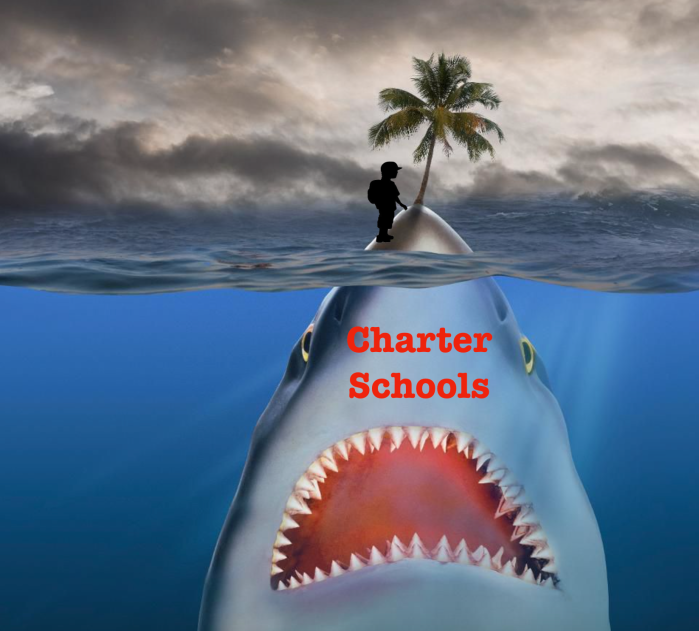
America has been fooled by the charter school industry for too long.


The popular myth that charter schools were invented by unions to empower teachers and communities so that students would have better options is as phony as a three dollar bill.


The concept always was about privatizing schools to make money.


It has always been about stealing control of public education, enacting corporate welfare, engaging in union busting, and an abiding belief that the free hand of the market can do no wrong.


Charter schools are, after all, institutions run privately but paid for with tax dollars. So operators can make all decisions behind closed doors without public input or accountability. They can cut student services and pocket the difference. And they can enroll whoever the heck they want without providing the same level of education or programs you routinely get at your neighborhood public school.


In essence, charter schools are a scheme to eliminate the public from public education paid for at public expense.


But whenever anyone brings up these facts, they are confronted by the bedtime story of Albert Shanker and his alleged advocacy of the industry.

 
So grab your teddy bear and put on your jammies, because here’s how it goes:

 
Once upon a time, hero president of the American Federation of Teachers (AFT) Al Shanker had an idea. He wanted to make laboratory schools where educators would be freed of regulations so they could experiment and find new pedagogies that worked. Then these innovations could spread to the rest of the school system.


One day in 1988, he gave a speech at the National Press Club and subsequently published a column in the New York Times advancing this idea.


And he called it – Dum, Dum, DUM! – charter schools!
The second act of the story opens in the mid-1990s when Shanker had largely turned against the idea after it had been co-opted by business interests.


He dreamed of places where unionized teachers would work with union representatives on charter authorizing boards, and all charter proposals would include plans for “faculty decision-making.” But instead he got for-profit monstrosities that didn’t empower workers but busted their unions.


If only we’d stuck with Shanker’s bold dream!


Or at least, that’s how the story goes.


Unfortunately it’s just a story.


It’s not true. Hardly a word of it.


Shanker did not come up with the idea of charter schools. He wasn’t part of the plan to popularize them. He didn’t even come up with the term “charter school.”


If anything, he was a useful patsy in this stratagem who worked tirelessly to give teachers unions a seat at the table where he then discovered they were also on the menu.


The real origin of charter schools goes back decades to at least the 1950s and the far right push for deregulation.


When the afterglow of the atomic bomb and the allied victory in Europe had faded, there was political backlash at home to roll back the amazing economic successes of the New Deal. Social security, strong banking regulations, deposit insurance, a minimum wage, job programs that put millions of people to work – all of that had to go in favor of right wing ideology.


A cabal of mostly wealthy, privileged elites wanted to do away with these policies in the name of the prosperity it would bring to themselves and their kind. They claimed it would be for the good of everyone but it was really just about enriching the already rich who felt entitled to all economic goods and that everyone else should have to fight over the crumbs.


Never mind that it was just such thinking that burst economic bubbles causing calamities like the Great Depression in the first place and made the conditions ripe for two world wars.


Show me the money!


However, this really didn’t go anywhere until it was combined with that most American of institutions – racism.


Even before the Supreme Court’s 1954 Brown vs. Board decision struck down school segregation, many white people said they’d never allow their children to go to school with black children.


In the South, several districts tried “freedom of choice” plans to allow white kids to transfer out of desegregated schools.


In 1952 and ’57, governments in two states – Georgia and Virginia – tried out what became known as the “private school plan.” Georgia Gov. Herman Talmadge and community leaders in Prince Edward County, Virginia, tried to privatize public schools to avoid any federal desegregation requirements. Each student would be given a voucher to go to whatever school would enroll them – segregated by race.
The plan was never implemented in Georgia and struck down by the federal government in Virginia after only one year as a misuse of taxpayer funds.


But these failed plans got the attention of one of the leading deregulation champions, economist Milton Friedman.


He sided with the segregationists citing their prejudice and racism as merely “market forces.”


In his seminal 1955 tract, “The Role of Government in Education,” he wrote:


“So long as the schools are publicly operated, the only choice is between forced nonsegregation and forced segregation; and if I must choose between these evils, I would choose the former as the lesser. Privately conducted schools can resolve the dilemma … Under such a system, there can develop exclusively white schools, exclusively colored schools, and mixed schools.”


Throughout the 1970s, school voucher proposals were widely understood as a means to preserve school segregation, according to education historian Diane Ravitch. But they couldn’t gain any traction until privatizers came up with a new wrinkle in the formula – the charter school.


Charter schools are really just school vouchers with more money and regulations.


In the case of vouchers, we use tax dollars to pay for a portion of student enrollment at private and parochial schools. In the case of charters, we use tax dollars to pay for all of a student’s enrollment at a school that is privately managed. The only difference is how much taxpayer money we give to these privatized schools and how much leeway we give them in terms of pedagogy.


Charter schools can do almost whatever they want but they can’t blatantly teach religion. Voucher schools can.


Other than that, they’re almost the same thing.


In order to get the public to support school privatization, Friedman thought we’d need to convince them that they didn’t need the burden of self-government. This was especially true of minorities.


In his 1981 book Free to Choose, Friedman and his wife Rose suggested the necessity of convincing black voters that they didn’t need Democracy. School privatization could be pitched as a system that would “free the black man from dominion by his own political leaders.”


The opportune moment came in 1983 with the publication of the Reagan administration’s propaganda piece A Nation at Risk. Using bogus statistics and outright lies, the report painted our public school system as a failure and set up the false urgency that school deregulationists needed.


From this point forward, a series of supply side lawmakers, policy wonks, economists, billionaires and CEOs came out of the woodwork to push for school privatization which culminated in the first charter school law in 1991 in Minnesota.


In the middle of all this tumult came Shanker’s National Press Club speech in 1988.


Ronald Reagan was still in office and it’s hard to overstate the threat he posed to unions having infamously fired more than 11,000 striking air traffic controllers.


Shanker was trying to ride the tide of public opinion in favor of deregulation and privatization. He accepted the bogus criticisms of schools in A Nation At Risk and offered to restructure schools to fix the problem. Like so many union leaders after him, Shanker gave away much of the power of his people-driven movement so as not to come across as obstructionist. He didn’t think teachers unions could oppose the rising tide of privatization without offering innovations of their own.


It’s true that he called these reforms “charter schools” but he didn’t invent the term. He borrowed it from a little-known Massachusetts educator, Ray Budde, who meant by it something very different from what it has become. Budde thought school boards could offer “charters” directly to teachers allowing them to create new programs or departments.


Shanker’s proposal wasn’t nearly the first time a public figure had suggested restructuring public schools.


In the late 1960s after helping provide justification for school desegregation, sociologist Kenneth Clark advocated for alternative school systems that could be run by groups as diverse as universities to the Department of Defense.


Shanker’s contribution was not nearly as powerful as subsequent apologists have claimed. He was one voice among many. Though his comments were useful to the deregulators, they ignored everything of substance he had said beyond the myth that he supported their efforts at school privatization.


According to journalist Rachel Cohen, the true architect of the charter school concept as it appears today wasn’t Shanker, Budde or Clark. It was Minnesota “policy entrepreneur” Ted Kolderie.


He was at the heart of the issue pushing for school privatization from the 1970s through the 1990s.


Throughout the 1970s, Kolderie lobbied for a plethora of ways for private industry to provide government services – including education – through an initiative known as Public Service Options (PSO). By 1981, the focus narrowed almost exclusively to education.


In several reports, he blamed the bogus failure of public schools on the democracy of the school boards. Though he didn’t use the term “charter school,” his conception was essentially the same as the modern charter school: independent schools accountable only through market forces and a set of contractual obligations. He thought they could be run by almost anyone – universities, corporations, nonprofits— even public school districts – if state law could be amended to allow it.


That’s pretty much a charter school – a privately run learning institution that’s publicly financed.


Why doesn’t Kolderie get the credit? Why the emphasis on Shanker who had very little to do with what ultimately became law?


Because Kolderie and others wanted to hide behind the union. They wanted their policy to have a friendlier public image than that of a shadowy puppet master.


Shanker walked right into their trap.


He even agreed to give another speech in favor of charter schools in October 1988 at the Minneapolis Foundation’s annual Itasca Seminar for political and business leaders.


With continued lobbying from the corporate sector and right wing ideologues, three years later the state was the first to pass a charter school law.


And the die was cast.


Sure charter school cheerleaders like to give Shanker the credit today, but the legislation that was eventually passed and funneled to other states through the American Legislative Exchange Council (ALEC) had little resemblance to anything Shanker said.


It was the deregulation and privatization model first conceived in the 1950s, funneled through Friedman and now Kolderie.


And make no mistake – the overall plot wasn’t simply to enact charter schools. That was merely the foothold that enabled subsequent school voucher bills and tax scholarship plans (vouchers lite). The end game was made clear by Friedman time and again – the complete destruction of public schools.


While speaking to rightwing lawmakers at a 2006 ALEC meeting, Friedman explained that school privatization was always about “abolishing the public school system.”


Here is an excerpt from Friedman’s ALEC speech:


“How do we get from where we are to where we want to be—to a system in which parents control the education of their children? Of course, the ideal way would be to abolish the public school system and eliminate all the taxes that pay for it. Then parents would have enough money to pay for private schools, but you’re not gonna do that. So you have to ask, what are politically feasible ways of solving the problem. The answer, in my opinion, is choice…”

When Minnesota proposed the first charter school law, the state teachers union fought against it. But tellingly Shanker refused to speak out during legislative debates.


And this was due in part to the rise of the neoliberals.


School privatization was the brainchild of the far right. But as the ‘80s gave way to the ‘90s, so dawned a new type of political figure – the social progressive with distinctly right wing economic views.


In 1989 when the Democratic Leadership Council (DLC) named Bill Clinton as chairman, it also founded its own think tank—the Progressive Policy Institute. Kolderie worked closely with the DLC and even wrote its first policy paper on school privatization.


Clinton was an immediate convert, embracing Kolderie’s proposals as he traveled around the country making speeches even though he knew it was unpopular with teachers unions. Clinton ruffled so many feathers that Shanker, himself, commented, “It is almost impossible for us to get President Clinton to stop endorsing [charters] in all his speeches.”


Though the first charter school law came a year later, in 1990 Wisconsin passed the first school voucher program. Since it was pushed through with mostly Republican support, this provided cover for neoliberal charter supporters. Though there was little difference between the two policies, neoliberals could distinguish themselves by criticizing school vouchers while endorsing their ideological cousins the charter schools.


So we had the two major political parties both supporting different flavors of the same school privatization.


It allowed Democrats to stop supporting more funding for social programs and schools while weakening the main driver of such policies – labor unions. This allowed the neoliberals to be economically as conservative as their “adversaries” across the aisle while publicly pretending to support progressivism.


Today, there are charter schools in 43 states and the District of Columbia educating nearly three million students.


This does not now – and never did – represent any ideal offered by Shanker or unions.


His dream of teacher-run schools as laboratories of innovation may or may not have merit, but not at the expense of making different rules for different schools. Where regulation is important, it is important for all schools. Where it is too restrictive, all schools should be freed from its requirements. All teachers should be allowed to innovate and take a leadership role in their schools.


When Shanker spoke about “charter schools,” he was not a visionary. He was leading us down a dead end. He was foolishly offering an olive branch to an inferno. That doesn’t mean he started the blaze or even that it was his idea.


Yet even now you can read propaganda that says otherwise on the AFT’s own Website – “Restoring Shanker’s Vision for Charter Schools” by Richard D. Kahlenberg and Halley Potter. It’s funny how Potter, a former charter school teacher, and Kahlenberg, a senior fellow at the Century Foundation – which loves charter schools – both want to keep the happy face on an ugly idea. And sad that one of the largest teachers unions can’t face up to one of its heroes biggest mistakes.


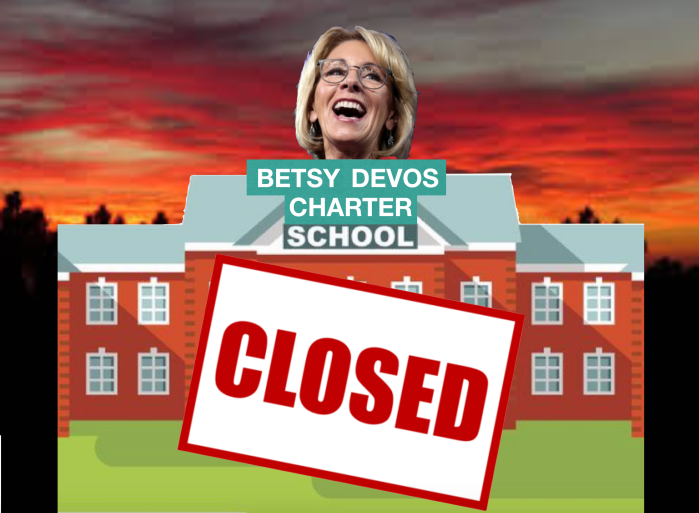
If charter schools have a face, it should be Kolderie’s or Friedman’s – or perhaps it should be the industry’s most famous modern champion Betsy Devos.
Charter schools are no progressive dream.


They are the corporate paradise of spending tax dollars with zero accountability, zero transparency and as much deregulation as possible. They are the continued destabilization of public education in the knowledge that the edifice cannot stand without support indefinitely.


Public education will crumble and fall just as the architects of school privatization always knew it would.


Unless we take a stand and take back our power.


To do that we need to understand where charter and voucher schools came from and who is responsible.


Charter schools do NOT represent a good idea that was perverted by the corporate world. It is an essentially bad policy that should be abolished immediately.


NOTE: This article owes a debt to the reporting of Rachel Cohen.


Like this post? I’ve written a book, “Gadfly on the Wall: A Public School Teacher Speaks Out on Racism and Reform,” now available from Garn Press. Ten percent of the proceeds go to the Badass Teachers Association. Check it out!

thumbnail_IMG_8249

Every Charter School Must Be Closed Down – Every. Single. One.

Screen Shot 2019-09-07 at 11.17.21 PM

 
The problem with charter schools isn’t that they have been implemented badly.


Nor is it that some are for-profit and others are not.


The problem is the concept, itself.


Put simply: charter schools are a bad idea. They always were a bad idea. And it is high time we put an end to them.


I am overjoyed that lawmakers on both sides of the aisle are starting to hear the criticisms leveled against the charter school industry in the face of the naked greed and bias of the Trump administration and its high priestess of privatization, Betsy DeVos. However, I am also disappointed in the lack of courage displayed by many of these same lawmakers when proposing solutions.


Charter schools enroll only 6 percent of students nationwide yet they gobble up billions of dollars in funding. In my home state of Pennsylvania, they cost Commonwealth taxpayers more than $1.8 billion a year and take more than 25 percent of the state’s basic education funding. That’s for merely 180 schools with 135,000 students!


Charter schools are privately run but publicly financed. They are what happens when the public abrogates its responsibility to run a school and signs that right away (in a charter agreement) with another entity, usually a business or corporation.
As such, these schools are not held to the same standards as authentic public schools. Unlike your neighborhood school, charters are not required to be run by elected boards, to have public meetings, to have open records, or to spend all their money in the service of their students. Nor do they have to provide the same standard of services for students – even children with special needs. Nor do they have to accept all students within their coverage area who enroll. And that’s to say nothing of how they increase racial segregation, are susceptible to fraud and malfeasance, often produce much worse academic results, close without notice, hire many uncertified teachers, trample workers rights and destabilize the authentic neighborhood public schools.


These are not problems that can be solved by fiddling around the edges.


We cannot simply constrain them from stealing AS MUCH from authentic public schools and consider it a victory.


We need to address the issue head on – and that issue is the very concept of charter schools.


Why would the public give up its schools to a private entity? Why allow someone else to take our money and do whatever they want with it behind closed doors? Why allow anyone to give our children less of an education than we’re already providing at our own schools?


We must end this failed experiment. Nothing less will do. It will only provide more breathing room so  that this unjust situation can drag on for another generation.


In Pennsylvania, Gov. Tom Wolf has proposed sweeping reforms via executive order that would make real progress toward holding charter schools accountable. He has asked that the state senate and house take the next step with legislation to finish the job.


Just this past week, Wolf visited Twin Rivers Elementary School in McKeesport along with state Senator Jim Brewster and state Reps Austin Davis and Jake Wheatley to listen to resident and teachers’ concerns and propose solutions.


Such a move is unprecedented and represents a seismic shift in the political landscape. However, I am concerned that lawmakers are too timid to fix the real problem here.


No one has the bravery to come out and say what I’ve said here.


Consider this statement from Brewster, my state Senator:


I have legislation to address some of these issues, but it’s not an indictment on charter school teachers. It’s not an indictment on the charter school concept. It’s an indictment on the process that was put in place 20 some years ago that has put in a playing field that’s not level. Together I believe if we get the charter school folks to the table we can iron this out, we can fix several things that need to be fixed – the funding formula, the capacity, the cap and those sort of things – and when we do that, then the mission statements of the charter schools and the public schools are the same – educate our children, bring their skill sets out, help them achieve their dreams.”


I am deeply grateful for Brewster’s support and willingness to take on the charter industry. And he is right about many things. But not all of them.


He is right, for example, about the financial impact of charter schools on authentic neighborhood public schools.


At the same meeting, McKeesport superintendent Mark Holtzman said, “Charter schools are depleting our resources with no accountability or without being financially responsible. Taxpayer money is being used to flood the media with commercials and billboards right before the start of school so that they can take our students.”


There are roughly 500 students living in the McKeesport district enrolled in brick-and-mortar charter schools and 100 students enrolled in cyber charters. The district spends about $7 million — or 10% of its budget — on charter school payments, according to Holtzman.


It’s roughly the same at other districts in the Mon-Valley. Steel Valley Schools, where I work as a middle school teacher, has budgeted a $6 million payment to charter schools this year – 16% of our spending plan.


Again, I am extremely grateful that Wolf and other state Democrats recognize this fact and are willing to take measures to make matters more fair. I hope many Republicans will join them in this.


However, fixing the way charters are funded alone will not correct the problem.


Charter schools are a parallel service to authentic public schools. If you’re suggesting we fund them both, you’re asking taxpayers to pay for two complete and separate school systems.


Why should we do that? Why should we waste our money on it? I don’t think the people of Pennsylvania – or any state of the union – have money to spare on a pointless duplication of services.


It is a politically impossible position that has zero justification – especially when you consider all the inequitable practices charter schools are allowed to get away with.


In his executive orders, Wolf proposes putting a stop to some of this.


For example, he wants to require charter schools to stop turning away students based on race, ethnicity, gender, disability, intellectual deficits, or other factors. He wants to make charter schools as transparent as authentic public schools. He wants to stop conflicts of interests for charter school board members and operating companies so that they can’t make decisions on behalf of the school that would enrich themselves, their families and/or friends.


These are excellent suggestions and I hope he is able to make them a reality.


However, these “fixes” are all things that authentic public schools already do. They don’t discriminate in enrollment. They are financially accountable and transparent. They aren’t allowed to engage in conflicts of interest.


Why bother making charter schools act like authentic public schools when we already have authentic public schools? That’s like genetically engineering your cat to have a longer snout and say “woof.” Why bother when you already have a dog?


The same could be said about for-profit and non-profit charter schools.


Apologists want to pretend that the former is the “bad” type of charter and the latter is the “good” type.


Wrong.


As Jeff Bryant, an editor at Education Opportunity Network, puts it, this is a “Distinction without a difference.”


These terms only define an organization’s tax status – not whether it is engaged in gathering large sums of money for investors.


With a knowledgeable accountant or hedge fund manager, almost anyone can claim nonprofit status while still enriching yourself. It happens all the time.


For instance, take the use of management companies.


A for-profit charter school can simply cut services to students and pocket the savings as profit.

A nonprofit charter school can do the same thing after engaging in one additional step.

All they have to do is start a “nonprofit” charter school and then hire a for-profit management company to run it. Then the management company can cut services and pocket the profits!


Yet we call such a school “nonprofit.” It’s meaningless.


It doesn’t even matter who owns the for-profit management company. It could even be the same people who own the nonprofit charter school.


The law actually allows you to wear one hat saying you’re nonprofit and then put on a different hat and rake in the cash! The only difference is what hat you’re wearing at the time! You get to claim to be a nonprofit while enjoying all the advantages of being for-profit.


You can even buy things with public tax dollars through your for-profit management company and then if your “nonprofit” school goes bankrupt, you get to keep everything you bought! Or your management company does.


So the public takes all the risk and you reap all the reward. And you’re still called a “nonprofit.”


But let’s not forget real estate shenanigans.


If I own property X, I can sell it to my own charter school and pay myself whatever I want. And I can do the same thing with a nonprofit charter school, I just need to sell it to my for-profit management company which will still buy my property for whatever I decide to pay myself.


Face it – charter schools are a scam.


They are a failed policy initiative.


It’s time they were ended.


But don’t get me wrong. I’m not suggesting we simply throw away the people who work there or the students who are enrolled there.


We need to look at each charter on a case-by-case basis and decide how best to transition them to an authentic public school system.


In some cases, it may make sense to rehabilitate charters into fully public schools with all the transparency and regulations that means. However, in most cases it will mean eventually closing them.


If there are any charters that actually provide valuable services for students and their families wish to keep children enrolled there, we should allow these students to finish their academic careers there. But let the present classes be the last.


In schools that do not offer better outcomes than the neighborhood public school (i.e. the overwhelming majority) students should be transitioned back to the neighborhood schools.


If there are any charters that do not wish to abide by such changes, they should have the opportunity to become what they already are except in name – private schools. The only difference is that taxpayers will no longer take up the tab.


And when it comes to charter school teachers, they should not be punished for having worked in the industry. In fact, we should find ways to bring them into the authentic public schools.


Our public schools need more teachers. Charter teachers who are fully certified should be given first chance to fill some of those vacancies. And charter teachers who are not certified should be given the opportunity to go back to school and complete their education degrees.


Any sane solution to the charter school mess would include these measures with the ultimate goal of ending school privatization in all its forms financed at public expense.


We don’t want privatized prisons. We don’t want privatized mercenary armies like Blackwater. We don’t want privatized schools.


Tax dollars should go to our authentic neighborhood public schools so that we can make them even better than they already are.


Our students deserve the best we can give them – and we can’t give them the best when we’re needlessly paying for two separate school systems and passing legislation with more of an eye on private investors than the welfare of the next generation.


It is my sincere hope that this push for real charter school reform becomes an effort to solve this problem once and for all.


Are we brave enough to do it?


Do we have the courage and conviction to take that on?


Like this post? I’ve written a book, “Gadfly on the Wall: A Public School Teacher Speaks Out on Racism and Reform,” now available from Garn Press. Ten percent of the proceeds go to the Badass Teachers Association. Check it out!

cropped-book-1.jpg

Inside Bill Gates’ Hubris: Propaganda to Make America Neoliberal Again

Screen Shot 2019-08-31 at 11.16.53 PM

 
Once upon a time, the world was run by rich men.


And all was good.


But then the world was conquered by other rich men.


And that is something the first group of rich men could not allow.


That is the reason behind Netflix’s new film “Inside Bill’s Brain: Decoding Bill Gates.”


The three-part documentary goes live on Sept. 20. But the film’s aims are clear from the trailer.


It’s a vanity project about Bill Gates, the second richest man in the world.
By examining his mind and motivations, director and executive producer Davis Guggenheim will show us how Gates deserves his billionaire status and that we should allow him to use his philanthrocapitalist ventures to rule the world.


After all, shouldn’t the best and richest among us make all the decisions?


It’s a cry for oligarchy in an age of idiocracy, a love letter to neoliberalism in a time of neofascism.


The pity is that Donald Trump and the “Make America Great Again” crowd have goose stepped all over their new world order.


But instead of showing the world why we need to return to democratic principles, strengthen the common good and empower the people to govern themselves, some would rather continue the same plutocracy just with a different set of plutocrats at the wheel.


In the days of Obama, the Bushes and Clinton, it wasn’t membership in the same political party that defined the ruling class. It was holding the same ideology.


It’s not that neoliberals were so much wiser, ethical or empathetic than Trump. They just kept their greed a secret or tried to make it seem a virtue. They told better lies and didn’t incite as much violence on our shores, and they were better at manipulating markets to make themselves richer while keeping the rest of us relatively poorer.


The MAGA insurgents are also rich men, but their greed is transparent. They lie and no one expects them to tell the truth. They can freely dismantle the social safety net because they stoke our prejudices and keep us fighting over race, gender and abortion so much we forget they’re robbing us blind. And when the market crashes, they don’t have to care because they’ve stolen everything of value and can weather the economic depression that will destroy the nation.


Neofacism is certainly worse – but it’s only a difference of degree, not of kind.


It’s no wonder then that the neoliberals want to make us nostalgic for their brand of simmering destruction instead of Trump’s rapid boil disasters.


And Gates is the perfect poster child for old style neoliberalism.


He’s the former CEO of Microsoft and – together with his wife – the founder of the Bill and Melinda Gates Foundation.
In the trailer, Gates confides that his deepest fear is that one day his brain will “stop working.”


Gates is a “multiprocessor” says his wife Melinda. “He will be reading something else but then processing at the same time. It’s chaos!”


Gates “thrives on complexity,” Melinda says. “He makes a framework in his mind, then he starts slotting in the information. If something doesn’t line up, he gets really frustrated.”


“It’s scary,” says Melinda. “But when Bill stills himself, he can pull ideas together that other people can’t see.”


Thus we gain a picture of a brilliant man striding over a world populated by intellectual inferiors. How foolish we would be to question his authority!


And since his intelligence has enabled him to hoard more money than almost anyone else in the world, why shouldn’t we let him use this economic power to change it for our benefit?


It’s truly one of the most patronizing, paternal and insulting pieces of propaganda I’ve ever seen in my life. And that includes Guggenheim’s previous movies.


Guggenheim is, after all, the man behind the most notorious propaganda film of modern times, “Waiting for Superman.” Back in 2010, he popularized the school privatization of Bill Clinton, George W. Bush and Barack Obama. He made charter schools cool until Betsy DeVos came along and made them uncool again.

 
Though I can’t imagine what could possibly be cool about for-profit schools run by appointed bureaucrats that can discriminate against students in enrollment, skimp on special education services and cut academic programs for students while pocketing the savings! All while gobbling up funding for the public schools that try to educate everyone!

 
More recently, he tried to pull the same sleight of hand for education technology firms in 2013 with the film “Teach,” but by then no one was really paying attention to him.


And for all that time his ventures have been backed by the richest neoliberals out there – Netflix CEO Reed Hasgtings, Amazon founder and CEO Jeff Bezos, eBay founder Jeff Skoll, and Salman Khan of Khan Academy.


Sure these folks are usually identified as Democrats, but their philosophy is completely in line with The Walton Family Foundation, Charles Koch, Walden Media (run by creationist Philip Anschutz), and lobbying groups such as the Lumina Foundation, the New American Foundation, and others.


Oh! And let’s not forget Bill Gates, himself, who has bankrolled a number of Guggenheim’s projects including “Waiting for Superman.”


It’s no wonder Guggenheim is making a fawning tribute to Gates. He owes the man!


It’s time to pay back his sugar daddy with what he does best – agitprop public relations.


Yes, Gates is a very intelligent person.


But he is also a very stupid one.


When it comes to computers, few people can beat him. But like so many overprivileged people, he takes excellence in one area to mean excellence in all areas.


And that’s just not how things work.


The ancient Greek philosopher Socrates famously bragged that he was the wisest person in Athens – not because he knew so much more than everyone else but because he was the only person who knew that he didn’t know anything.


Gates could have learned something from that humility, because it’s the trait he is most lacking.


Take public education.


No one has had a greater negative impact on public schools than Gates. With his so-called philanthropic contributions, he has steered the course of education policy away from research-based pedagogy to a business-minded approach favored by corporate raiders.

 
He didn’t come up with Common Core State Standards, but he did bankroll them. He bribed the state and federal government to force their schools to adopt the same or similar academic standards for all students. Not good standards. Not standards developed by classroom teachers, psychologists or experts. But standards created by the standardized testing industry.


The result has been more high stakes standardized tests, narrowing the curriculum, shrinking education budgets for the poor and minorities, and an increase in developmentally inappropriate approaches to education. Nearly every parent with a school age child will tell you horror stories of attempting to do homework with their children and having to relearn basic math and English skills just to untwist the needlessly complex knot that children are expected to unsnarl in order to grasp the bare basics of academia.


Gates poured billions of dollars into that failed initiative, spent hundreds of millions of dollars for development and promotion and influenced trillions of taxpayer dollars to be flushed down the drain on it. All to no avail.


But it’s not his only education policy failure.


Gates now admits that the approximate $2 billion he spent pushing us to break up large high schools into smaller schools was a bust.

 
Then he spent $100 million on inBloom, a corporation he financed that would quietly steal student data and sell it to the corporate world. However, that blew up when parents found out and demanded their children be protected.


He also quietly admits that the $80 million he spent pushing for teachers to be evaluated on student test scores was a mistake. However, state, federal and local governments often still insist on enacting it despite all the evidence against it. Teachers have literally committed suicide over these unfair evaluations, but it hasn’t stopped Gates from continuing to experiment on the rest of humanity with his money.


And he’s still at it.


His new plan has been to spend $1.7 billion over five years to develop new curriculums and networks of schools, use data to drive continuous improvement, and give out grants to high needs schools to do whatever he says.


There’s nothing wrong with someone wanting to help improve public schools. But the best way to do that is to listen to the people most knowledgeable and invested and then give them the tools they need to succeed.


But Gates doesn’t play that way. He reads up on a subject and then comes up with his own harebrained schemes.


“It would be great if our education stuff worked, but that we won’t know for probably a decade,” he said during a speech at Harvard in 2014.


Lots of people know, Bill. Teachers, students, parents, psychologists, professors. You just won’t listen to us.


You just insist the rest of us listen to you despite the fact that you have no idea what you’re talking about.


You’re rich and you think that makes you better than us.


And Guggenheim’s documentary purports to support this position by reference to Gates’ incredible brain.

He is a smart guy. No one would really contradict it.


He was a National Merit Scholar who scored a 1590 out of 1600 on his SATs. But he also comes from a very privileged upbringing.


He didn’t grow up on the mean streets of urban America while attending a neighborhood public school. He went to an elite preparatory school since he was 13.


At Harvard he wasn’t a polymath. He excelled in subjects he cared about, but neglected others that weren’t immediately interesting. According to a college friend:


“Gates was a typical freshman in many ways, thrown off pace by the new requirements and a higher level of competition. He skipped classes, spent days on end in the computer lab working on his own projects, played poker all night, and slept in a bed without sheets when he did go
 to bed. Other students recall that he often went without sleep for 18 to 36 hours.”


Gates was no genius. He earned good grades in the subjects he liked and significantly less so in classes he didn’t. Nor was his heart in his studies. Gates joined few college activities unless someone dragged him off to a party.


School was of little interest to him. He dropped out of Harvard before getting a degree to start his computer software company.


Imagine how privileged you have to be to feel empowered to do that!


Nothing much was at stake for him at school so he could do whatever he liked with little to no real life consequences.


You want to decode Bill’s brain? Look at his family’s wealth. Look at his upbringing. Look at his medical records.


But the moral of the story of Bill Gates is not that rich elites should rule the world.


It is that everyone – EVERYONE – should practice humility and not deign to think they have all the answers.


It is a paean to the need for collaboration to solve problems, the need to listen to all voices and decide the best course together.


And more than anything it is a desperate cry for democracy and social goods – not to defeat Trump through Gates’ example – but to lead to real human flourishing by smashing through the fallacies supporting Trump and Gates together.


Like this post? I’ve written a book, “Gadfly on the Wall: A Public School Teacher Speaks Out on Racism and Reform,” now available from Garn Press. Ten percent of the proceeds go to the Badass Teachers Association. Check it out!

book-2

Gov. Wolf Tries to Stop Charter Schools Gorging on Public School Funding

Screen Shot 2019-08-21 at 8.10.09 PM


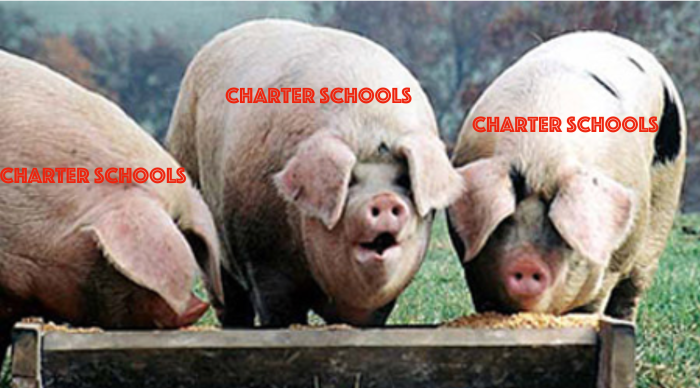
Sooey! Here Pig Pig Pig!


No one minds that healthy call at the hog farm when it’s time to feed the sows.


But taxpayers do take issue with it when it’s the call of the state legislature gathering a different kind of swine around public tax dollars.


Pennsylvania’s 180 charter schools gobbled up $1.8 billion last year from the Commonwealth’s public schools.


And Gov. Tom Wolf is refusing to let them continue to gorge on public funding meant to nourish everyone.

 
Last week, he took executive action to hold these schools accountable and force them to be more transparent – even if the legislature won’t.

 
Charter schools are publicly financed but privately run. Unlike authentic public schools, charters are often administered by appointed boards. They don’t have to provide the same level of services for children, don’t have to accept all students, can make a profit and don’t even have to be transparent about how they spend their money.


Yet that money comes from taxpayers.


For years fiscal watchdogs have complained that the state’s 22-year-old charter school law needs revising. However, after lining lawmakers pockets with charter school cash, the legislature continually refuses to do anything about it.


A few Democrats have offered plans that would increase accountability, but they’ve gotten no traction. And Republican plans have almost exclusively offered to make matters worse by dumping more money in the trough and putting up a thicker curtain so we don’t see the school privatizers eat.


So finally Gov. Wolf, a Democrat, took action on his own.


He has directed his Department of Education to circumvent the legislature to develop regulations that he says,  “will level the playing field for all taxpayer-funded public schools, strengthen the accountability and transparency of charter and cyber charter schools and better serve all students.”


His plan would:

 
•Allow districts to limit student enrollment in charter schools where students aren’t making academic gains.


•Require charter schools to stop turning away students based on race, ethnicity, gender, disability, intellectual deficits, lack of athletics or other student characteristics.

 
•Make charter schools as transparent as authentic public schools.


•Stop conflicts of interests for charter school board members and operating companies so that they can’t make decisions on behalf of the school that would enrich themselves, their families and/or friends.

 
•Make charters submit to financial audits to state regulators, make them publicly bid contracts for supplies and services and use fair contracting practices.

 
•Provide greater oversight of charter school management companies so they can’t profit off of the students enrolled in the schools they’re managing.

 
•Seek more information about how prospective charters will be run in a new model state application to be used when charters seek to open up shop or renew existing charters.


•Require charters to accurately document their costs.

 
•Prevent charters from overcharging for services they provide to students.


•Make charters pay to cover the state’s costs for implementing the charter school law.


•Recoup money from charter schools for the time and services the state provides when it reviews applications, distributes payments and provides legal and administrative support to them.

 
It’s a bold step for a governor, but apparently Wolf is tired of waiting on a dysfunctional legislature to actually legislate.


The problem is Wolf has to be more than a governor. He has to be a goalie.


The state House and state Senate are deeply gerrymandered and controlled by Republicans.

 
Every year, lawmakers pass mostly crap bills written by Koch Brothers proxies only to be vetoed by Wolf.


Occasionally, the GOP convinces enough right-leaning Democrats to go with them and Wolf can’t or won’t veto the bills.

 
And that’s pretty much how things work in Harrisburg.


However, this time Wolf wasn’t content to just guard the net. He actually took the puck down the ice, himself, and made a slap shot on the opposing team.


Can he do this? Is he still operating within the law?


Time will tell – though I’d argue that in the absence of legislative action, he is within his job description.


Moreover, this is only a first step.


Wolf, himself, has said that more needs to be done by the legislature. Even after his executive actions, much needs to be done to make charter schools function properly in the Commonwealth.


Specifically, Wolf asked the legislature to pass a moratorium on new cyber charter schools, cap enrollment in low-performing charter schools until they improve, subject charter management companies to the same transparency rules that districts must follow, and create a fair, predictable and equitable charter school funding formula.


I’d like them to go even further.


Frankly, I’d like to see charter schools ended as educational institutions.
Why should the public pay for schools that aren’t locally controlled? Why pay for privatized schools at all?


I suppose if there are some that are functioning well for students, they can be grandfathered in, but they should be funded separately. When two districts have to compete for the same funding, the students lose.


At least, we should not be opening up new charters. The public should not be in the business of funding privatized schools.


I am grateful to Gov. Wolf for finally having the guts to stand up to this powerful industry.


The state exists to further the public good – not enrich private corporations like those running many charter schools.


It’s time we admitted that charter schools are a failed experiment and shut them down.


It’s time to block these pigs from chowing down on public funding without public oversight.


See how much each charter school gets of Commonwealth tax dollars.


Like this post? I’ve written a book, “Gadfly on the Wall: A Public School Teacher Speaks Out on Racism and Reform,” now available from Garn Press. Ten percent of the proceeds go to the Badass Teachers Association. Check it out!

book-3

Who’s Trading Public School Funding for a Tax Credit?

Screen Shot 2019-08-18 at 1.52.43 PM


Ever wonder why our roads and public school buildings are crumbling?


Ever wonder why schools can’t afford books, buses and nurses?


Ever wonder why classroom teachers are forced to buy paper, pencils and supplies for their students out of pocket?


Because businesses like Giant Eagle, American Eagle Outfitters, and Eat’n Park aren’t paying their fair share.


It’s a simple concept – you belong to a society, you should help pay for the roads, bridges, schools, etc. that everyone needs to keep that society healthy.


After all, as a stockholder, CEO or business owner, you directly benefit from that society. If it didn’t exist, you wouldn’t have nearly as many customers – if any.


Many of us learned this kind of stuff in kindergarten or grade school.

 
But ironically programs that allow businesses to avoid paying their fair share are being used to short change many of those same kindergarten and grade schools.


In Pennsylvania, one such program is called the Educational Improvement Tax Credit (EITC), and everyone from local banks to Duquesne Light to UPMC healthcare providers are using it to lower their taxes while stealing from the public school cookie jar.

 
Here’s how it works.

 
If you expect a tax bill of $X at the end of the year, you can donate that same amount to the state for the purpose of helping parents pay off enrollment at a private or religious school for their children. Then you get between 75-90% of that donation back.


So if your tax bill is $100 and you donate $100, you can get back $90 – reducing your total tax bill to a mere 10 bucks.


Heck! Since this money is classified as a “donation” you can even claim it on your taxes and get an additional refund – even to the point where you end up making money on the deal! Pennsylvania even allows a “triple dip” – so you get the EITC tax credit, a reduction in your taxable income, and a reduction in your federal taxable income. We actually pay you to shortchange us on your taxes!


Now I’m oversimplifying a bit since you can only use the EITC for up to $750,000 a year, but it’s still a sweet deal for businesses. It just really hurts nearly everyone else because it reduces the state’s general fund – by $124 million last year, alone.


When we give away hundreds of millions of dollars every year to religious and parochial schools, we have less money to spend on public schools, roads and all other services that benefit the majority of our citizens – especially the poor who rely more heavily on these services.

 
So why doesn’t the state just budget this amount of money directly to religious and private schools instead of ransacking the general fund after businesses donate it to the tax incentive program?


Because it’s illegal to give taxpayer dollars to religious and private schools. The establishment clause of the First Amendment forbids it.


The founders of our country didn’t want a state religion with schools teaching theological propaganda like we had in Great Britain. Moreover, they demanded tax dollars be spent with accountability to the whole public – something you cannot do in a private or religious school which isn’t set up for everyone but only those who choose and can afford to go there.


However, some smart ass thought of an alleged loophole. He said that if tax money is turned into a tax credit, it’s no longer tax money and it doesn’t violate the rules to spend it on religious and private schools.


So this is a fiscal sleight of hand meant to give businesses a tax break while boosting private schools.

 
Who’s guilty of hiding behind this loophole to bolster their bottom line while short changing ours?


Probably a lot of businesses you know.


Thankfully, their donations to the EITC Program are a matter of public record as is how much money returned to them as savings.


You can find a handy database of state businesses right HERE searchable by county compiled by Pennsylvania Capital-Star.


I happen to live in Allegheny County in the Pittsburgh region – the second highest area of the Commonwealth for these tax dodge…. I mean credits.


Across the county in 2017-18 (the most recent year for which data is available), Allegheny County businesses donated $15,741,544. They got back $14,180,261 in tax credits.

 
A quick search came up with these noteworthy businesses:

 
Fatheads – the Southside sports bar along Carson Street in Pittsburgh
Contribution: $ 10,000
Tax Credit: $ 9,000

 
AEO Management, Co. 
(American Eagle Outfitters Corporate Office in the South Side, Pittsburgh)
Contribution: $ 350,000
Tax Credit: $ 315,000

 
Apex Diamonds, Inc. (A Pittsburgh jeweler)
Contribution: $ 149,000
Tax Credit: $ 134,100

 
Cochran Motors, Inc. (car dealership in Monroeville)
Donation: $ 100,000
Tax Credit: $ 90,000

 
Deer Leasing Co. (freight and cargo business) THREE ENTRIES:
Donation: $ 444,444
Tax Credit: $ 400,000


Deer Leasing Co.
Donation: $ 221,111
Tax Credit: $ 200,000


Deer Leasing Co.
Donation: $ 388,888
Tax Credit: $ 349,999

 
-Dollar BankTWO ENTRIES
Donation: $ 225,000
Tax Credit: $ 202,500


Dollar Bank
Donation: $ 400,000
Tax Credit: $ 360,000

 
Duquesne Light CompanyTHREE ENTRIES
Donation: $ 10,000
Tax Credit $ 10,000
(So 100% return on investment!?)


Duquesne Light Company
Donation: $ 50,000
Tax Credit: $ 45,000


Duquesne Light Company
Donation: $ 240,000
Tax Credit: $ 216,000


-Eat’n Park Hospitality Group, Inc. (Corporate headquarters in Homestead)
Donation: $ 25,000
Tax Credit: $ 23,500


-Federated Advisory Services Company (Asset management company) – THREE ENTRIES
Donation: $ 111,111
Tax Credit: $ 100,000


Federated Investment Counseling
Donation: $ 111,111
Tax Credit: $ 100,000


Federated Investment Counseling
Donation: $ 222,222
Tax Credit: $ 200,000

 
Giant Eagle, Inc.TWO ENTRIES
Donation: $ 833,333
Tax Credit: $ 750,000


Giant Eagle, Inc.
Donation: $ 221,111
Tax Credit: $ 200,000

 
Glimcher Brokerage, Inc. (Real estate company) – TWO ENTRIES
Donation: $ 380,000
Tax Credit: $ 342,000


Glimcher Group, Inc.
Donation: $ 300,000
Tax Credit: $ 270,000

 
HM Health Insurance Company (Camp Hill, Pa) – THREE ENTRIES
Donation: $ 50,000
Tax Credit: $ 45,000


HM Health Insurance Company
Donation: $ 243,333
Tax Credit: $ 219,000


HM Health Insurance Company
Donation: $ 165,556
Tax Credit: $ 150,000

 
PNC Bank, N.A. – TWO ENTRIES
Donation: $ 685,000
Tax Credit: $ 616,500


PNC Bank, N.A.
Donation: $ 148,303
Tax Credit: $ 133,500

 
Rohrich Imports, Inc. (Luxury Pittsburgh Car Dealership)
Donation: $ 60,000
Tax Credit: $ 54,000

 
The Buncher Company (property management company) – THREE ENTRIES
Donation: $ 416,667
Tax Credit: $ 375,000


The Buncher Company
Donation: $ 416,667
Tax Credit: $ 375,000


The Buncher Company
Donation: $ 221,111
Tax Credit: $ 200,000


The Huntington National BankTWO ENTRIES
Donation: $ 549,556
Tax Credit: $ 494,600


The Huntington National Bank
Donation: $ 111,111
Tax Credit: $ 100,000

 
UnitedHealthcare of Pennsylvania, Inc.
Donation: $ 200,000
Tax Credit: $ 180,000


-UPMC Diversified Services, Inc. (Healthcare provider) – SIX ENTRIES
Donation: $ 200,000
Tax Credit: $ 180,000

 
UPMC Diversified Services, Inc.
Donation: $ 200,000
Tax Credit: $ 181,000


UPMC Diversified Services, Inc.
Donation: $ 190,000
Tax Credit: $ 171,000


UPMC Health Benefits, Inc.
Donation: $ 200,000
Tax Credit: $ 180,000


UPMC Health Benefits, Inc.
Donation: $ 200,000
Tax Credit: $ 181,000


UPMC Health Benefits, Inc.
Donation: $ 200,000
Tax Credit: $ 180,000


But this leaves out the largest and shadiest group donating to the EITC Program – Limited Liability Corporations (LLCs).


These “special purpose entities” are set up to represent individual donors so they can more easily divert tax dollars to private and parochial schools.


LLCs represent hundreds of individuals who allow the LLC to donate on their behalf and then they get the tax credits passed back to them. It’s a way to encourage the wealthy to get the tax cut and support school privatization without all the hassle of doing the paperwork themselves.


And most (if not all) of these LLCs are set up by religious organizations to boost their own parochial schools.


For instance, Business Leadership Organized for Catholic Schools is perhaps the largest LLC receiving EITC funds.


Across the state, these organization made $15.6 million in donations and claimed $14 million in tax credits.


In Allegheny County, the largest are CASTA-SOS LLC and Pittsburgh Jewish Scholarship LLC.


CASTA was set up by the Catholic Diocese of Pittsburgh. Pittsburgh Jewish Scholarship benefits Jewish schools in the city.


Here’s how much they took from the state general fund last year:


CASTA-SOS I LLC
Donation: $ 509,500
Tax Credit: $ 458,550


CASTA-SOS II LLC
Donation: $ 460,890
Tax Credit: $ 414,801

 
Pittsburgh Jewish Scholarship I LLC
Donation: $ 675,250
Tax Credit: $ 607,725


Pittsburgh Jewish Scholarship II LLC
Donation: $ 750,000
Tax Credit: $ 675,000


EITC money went to almost 1,170 different organizations across the state. A fraction were YMCA’s, the Salvation Army and preschools. But the vast majority were private and religious schools.


Defenders of the project claim this money goes to fund “scholarships” for poor children to help defray the costs of enrollment at these schools.


However, a family making as much as $100,608 per year can qualify for an EITC scholarship for their child. A family with two children could make up to $116,216 and still qualify.


Consider this: one of the largest single recipients of this money in Allegheny County was the exclusive Shady Side Academy in Pittsburgh. The private secular school took in almost $1 million last year so that its wealthy students didn’t have to spend as much on enrollment.


Why are we subsidizing the rich?


Why are we robbing the poor to do so?


Why are we using public money to fund the teaching of climate denial, creationism, indoctrination in religious and political ideologies?


The short answer – our politicians are spineless and indebted to the people this benefits.


Just this summer, the Pennsylvania legislature AGAIN increased the limit for the program by an additional $25 million.


That’s the pattern. Every year, the Republican-controlled (and heavily gerrymandered) legislature can’t get their regressive policies passed Democratic Gov. Tom Wolf. They need some Democrats to support their spending priorities. So they entice right-leaning Democrats with increases to these tax incentive programs in order to reach compromises.


The result – every year we allow more tax dollars to fly away to private and religious schools while further undermining funding for public schools.


But it could have been worse. Earlier in the year, the legislature passed a measure to increase the EITC Program by $100 million. Thankfully it was vetoed by Gov. Wolf. Unfortunately, he let the $25 million increase get through.


This is a problem that is not going away.


We need to let our lawmakers know in no uncertain terms that we do NOT support these programs. And this isn’t just Republican lawmakers. We especially need to pressure Democrats and even run challengers to those who are not progressive enough in the primaries.


And we need to let businesses who partake of the smorgasbord of tax credits that doing so will lose them our business.


If we want to stop theft disguised as “tax credits,” we have to start hitting these businesses where it hurts – in the pocketbook.


Because they certainly don’t feel it in their hearts.


Like this post? I’ve written a book, “Gadfly on the Wall: A Public School Teacher Speaks Out on Racism and Reform,” now available from Garn Press. Ten percent of the proceeds go to the Badass Teachers Association. Check it out!
thumbnail_IMG_8249

Top 7 Ways Technology Stifles Student Learning in My Classroom

Screen Shot 2019-07-30 at 9.25.31 PM

 
As a middle school teacher, I have real concerns about the ways technology is used in the classroom and the effects it’s having on students.


That does not make me a technophobe.


The fact that you are reading this article on a blog – a regularly updated Website containing personal writings or a weBLOG – should prove that point.


I use technology in my everyday life and in many ways find it indispensable.


However, that does not mean I embrace all uses of technology just as criticizing some forms does not mean I think we should get rid of them all.


But after 17 years of teaching, I have legitimate concerns about what all this technology is doing to our students and our schools.


I have seen technologies come and go. Some – like a computerized grade book – have been extremely helpful, and I would not want to have to do my job without them.


Others have fallen by the wayside, been discontinued or proven a waste of time or even worse – they’ve become impediments rather than assistants to student learning.


In general, I think we have become too reliant on technology in schools. We’ve welcomed and incorporated it without testing it, or even reflecting upon whether it promises to offer better pathways toward student comprehension and discovery or whether it merely offers flash and novelty devoid of substance. And perhaps even more frightening, we have not investigated the ways in which using these technologies actually puts student privacy and intellectual growth at risk.
So, without further ado, here are the top 7 ways technology stifles student learning in my classroom:


1) It Stops Kids from Reading


I’m a language arts teacher. I want my students to read.


I could simply assign readings and hope students do them, but that’s not practical in today’s fast-paced world. When kids are bombarded by untold promises of instant gratification, a ream of paper bordered by cardboard doesn’t hold much of a claim on their attentions.


So like many teachers, I bring reading into the classroom, itself. I usually set aside class time every other day for students to read self-selected books for about 15 minutes. Students have access to the school library and a classroom library filled with books usually popular with kids their age or popular with my previous students. They can pick something from outside these boundaries, but if they haven’t already done so, I have them covered.


In the days before every student had an iPad, this worked fairly well. Students often had books with them they wanted to read or would quickly select one from my collection and give it a try.


Sometimes when there was down time in class, when they had finished assignments or tests early, they would even pick up their self-selected books and read a little.


What a different world it was!


Now that every student has an omnipresent technological device, this has become increasingly impossible. I still set aside 15 minutes, but students often waste the time looking for an eBook on-line and end up reading just the first chapter or two since they’re free. Others read nothing but the digital equivalent of magazine articles or look up disparate facts. And still others try to hide that they’re not reading at all but playing video games or watching YouTube videos.


Even under the best of circumstances, the act of reading on a device is different than reading a printed page.


The act of reading traditional books is slower, closer and more linear. It’s the way teachers really want kids to read and which will most increase comprehension.


Reading on a screen is a product of social media. We scroll or scan through, seeking specific information and clicking on hyperlinks.


The old style of reading was transformative, absorbing and a much deeper and richer experience. The newer style is more superficial, mechanical and extrinsic. (And, Yes, I’m aware of which style of reading you’re engaged in now!)


To be fair, some students actually prefer reading eBooks on devices and may even experience the richness of the original style. But they are few and far between. Usually students use the devices to escape from the deeper kind of reading because they’ve never really done it before and don’t understand what it really is. And when they have this choice, they may never find out.


2) It’s a Distraction


As a teacher, I want my students to be able to focus on one thing at a time. There are situations and assignments that call for multitasking, but usually we need students to be able to look at text closely, examine an argument, identify figurative language or write creatively, etc. They can’t do that if they’re constantly checking their devices.


We have to admit that iPads, laptops, social media, etc. are addictive. If given the chance, many teenagers will spend hours there. Heck, many adults will, too. It’s common for students to rush through assignments to get back to watching videos about the latest on-line gaming trend Fortnite, or listen to music with earbuds, or others such things.


Technology is usually associated in their minds with entertainment, not education. I’m not saying that technologies don’t have their place. If you want to look up information quickly, devices are great. But the most common words I tell my students on any given day are “Apples up.” In others words, turn your iPads face down and focus on the lesson at hand.


3) It’s Unhealthy


For most students, technology is not a novelty. It is something with which they already have a lot of experience. Many studies find that kids between the ages of 13-18 spend up to 18 hours a day in front of a screen.


Why are we adding to that in the classroom?


Children need face-to-face interactions. They need to learn social skills, how to communicate with people, not screen avatars. They need time outdoors, time to get up and move around and interact with the world. Heck! They need unstructured time where they actually experience boredom and have to find ways to cope.


We’re robbing them of these skills by giving in to the electronic nanny. And it’s creating children who are less able to survive without that technological crutch.


As technology has become more widespread in my classes, I’ve noticed attention spans decreasing. So has self control, mindfulness and an ability for critical thinking.


4) It Costs Too Much


Public schools are already grossly underfunded. We have to pick and choose the most effective tools to help kids learn. Technology is often very expensive and takes away valuable money and resources that could be better spent elsewhere.


And the way these technologies are marketed is often reminiscent of the drug trade. The first uses are free. But if you want to expand, it will cost.


Even those that don’t demand briefcasefulls of cash often recoup their costs by collecting and selling student data.


In the school system, we are privy to an enormous amount of information about the children in our care – information that we are tasked with keeping safe. Ed tech software and technologies also routinely collect data on students. But they are not as constrained or legally responsible for it in the way schools and teachers are.


Some of the data technologies collect is indeed necessary for whatever task they perform – tabulating which questions students get correct and incorrect, etc. However, much of it is unnecessary for those tasks – information about student preferences or marketing information.

 
We have no guarantee that this data is secure. The FBI has warned schools, parents and students of information breaches at these ed tech companies. And the contracts these companies have with schools and/or users are shady at best. They don’t guarantee your data will be secure, don’t accept liability and even when they do, they routinely warn that their policies can change at any time without warning – especially if they go bankrupt.


These are costs too expensive to pay.


5) It Has Never Been Proven to Help Kids Learn

Educational technologies’ claims about student learning outcomes are based on faith not facts. There are few (if any) long-term, large scale, peer reviewed studies showing that most technologies are effective educational tools.

 
This is partially because they’re too new to have been around long enough to be adequately tested. Moreover, the field is flooded with “studies” payed for by the same companies or organizations being studied – which is like having McDonald’s tell you the McRib is nutritious. Some small-scale peer reviewed studies have been done, but the results have been inconclusive.


We are literally unleashing these devices and software applications on children without knowing their full effects.


Ed tech is a market-based solution to an academic problem. It is the triumph of big business over pedagogy.


Our children deserve better than this.


6) It Perpetuates Bad Pedagogy and Assessment

Ed tech is almost always organized around standardized testing. It takes the multiple choice test as the ultimate form of assessment and arranges itself around that paradigm.


Software basically teaches to the test. It shows users the kinds of questions that will be asked, how to solve them and then gauges their success by giving them test-based questions.


It’s ironic because the marketing departments of these corporations usually sell this junk as “personalized learning,” “individualized learning,” or “competency” or “proficiency based education.” They want you to think that the program is tailor made to the user when it’s actually just a prepackaged mess. If you can’t answer a question of type A, you don’t get to move on to a question of type B. That’s all.


This can be an effective method for increasing test scores – if students aren’t so tuned out by the experience that they don’t engage with what they’re being presented – which is what I often find with my students when I’ve been forced to subject them to this nonsense.


However, learning how to take a multiple choice test on reading is not the same as learning how to read and understand. It is not the same as interacting with, comprehending and forming an opinion about that reading.


This is not the best way to teach just as having students fill out endless worksheets is not, nor is even having a flesh-and-blood teacher do endless test prep.


It is brainwashing – teaching kids to think like the designers of a test when we should be teaching them how to think for themselves and like themselves.


7) It Undermines Public Schools and Teachers


Ed tech companies are not philanthropies. They are in this business to turn a profit. And the best way to do that is to displace and disrupt the public education system.


There is an entire testing and school privatization industrial complex out there trying to prove that traditional public schools are bad and need replaced with business solutions.


These aren’t just charter schools or private and parochial schools cashing in on vouchers siphoning tax money away from children and into their private pockets. These are ed tech companies, too.


The ultimate goal is to get rid of the very concept of school, itself, and to replace it with on-line cyber schooling that can be accessed anywhere without the need for any living, breathing teachers in the mix. Or at best, they want to reduce the teacher to a mere facilitator. It is the device and the software that teach. It is only the human being’s job to make sure the student is engaging with the technology.


This is not in the best interest of students. It is in the best interests of companies and corporations.


When we give away our responsibilities, our autonomy, and our humanity to these businesses, we are selling out our children.


I’m not saying that all technology is bad or even that it should never be used in the classroom.


But we must approach it with caution and intelligence. We should always know why we’re using it, what end we expect it to have and fully comprehend the consequences.


Otherwise our children will be left to pay for our own shortsightedness.


Like this post? I’ve written a book, “Gadfly on the Wall: A Public School Teacher Speaks Out on Racism and Reform,” now available from Garn Press. Ten percent of the proceeds go to the Badass Teachers Association. Check it out!

ebook-2 (1)

Busing and School Segregation Used for Politics not Policy

Screen Shot 2019-07-08 at 1.15.57 AM

 
If children of all races went to the same schools with each other, it would be harder to treat them unequally.


Moreover, it would be harder for them to grow up prejudiced because they would have learned what it’s like to have classmates who are different from them.


And though most people agree with these premises in principle, our laws still refuse to make them a reality in fact.


Perhaps that’s why it was so astounding when Kamala Harris brought up the issue of school segregation and busing at the first Democratic debates.

 
If you’re anything like me, for the first time these debates made Harris look like a viable contender for the party’s Presidential nomination to face Republican incumbent Donald Trump in 2020.


But then she immediately contradicted herself when people actually started to take her seriously.


During the debates, Harris called out front runner and former vice president Joe Biden for opposing court-ordered busing in the 1970s as a way of combating school segregation.


The California Democrat and former federal prosecutor rightly said that 40 years ago there was a “failure of states to integrate public schools in America,” so “that’s where the federal government must step in.”


But her star-making moment was when she made the whole matter extremely personal.


“There was a little girl in California who was part of the second class to integrate her public schools and she was bused to school every day,” Harris said. “That little girl was me.”

 
The tactic was so successful that Biden has been fumbling to apologize and explain away a history of obstructing desegregation ever since.


A Reuters/Ipsos poll conducted after the debate showed Biden had lost half of his support among black voters since earlier in June.


Meanwhile, the Harris campaign was quick to cash in on the political capital she earned by selling t-shirts with a picture of herself when she was in school with the emblem “That Little Girl Was Me.”


It could almost be a masterclass in how to make a political point to both boost your own campaign and change the narrative to improve national policy.


That is if Harris actually backed up her rhetoric with action.

 
Unfortunately, she has been tripping all over herself to keep this a criticism of Biden and not let it become a policy prescription for today.

 
While perfectly happy to support busing as a measure to stop segregation in the past, she seems much less comfortable using it to stop our current school segregation problems.


Because even though the landmark Supreme 
Court decision that found racial segregation to be unconstitutional – Brown v. Board of Education – is more than 60 years old, our nation’s schools are in many places even more segregated now than they were when this ruling was handed down.


So the question remains: in some areas should we bus kids from black neighborhoods to schools located in white ones and vice versa to ensure that our classrooms are integrated?


Since the debates, Harris has waffled saying busing should be “considered” by school districts but she would not support mandating it.


In subsequent comments, she said she’d support a federal mandate for busing in certain situations where other integration efforts have not been effective or when the courts have stepped in to provide the federal government that power. However, she does not believe that either of these conditions have been met.


Frankly, it sounds a whole lot more like someone desperately making things up as she goes along than someone with a true plan to fix a deep problem in our public education system.


She rightly attacked Biden on his record but then came up short trying to prove that she would be much different, herself, if elected.


However, that doesn’t mean all Democratic candidates are so unprepared. A handful have detailed integration policy proposals.


The most obvious is Bernie Sanders.


In fact, it is a cornerstone of his “Thurgood Marshall Plan for Education.” Not only would he repeal the existing ban on using federal transportation funding to promote school integration, he would put aside $1 billion to support magnet schools to entice more diverse students. However, the most ambitious part of his desegregation effort goes beyond legislation. Sanders promises to “execute and enforce desegregation orders and appoint federal judges who will enforce the 1964 Civil Rights Act in school systems.”


Sanders understands that the courts have largely sabotaged most desegregation efforts in the last 40 years.


At least two Supreme Court rulings have taken away the federal government’s power to enforce Brown v. Board. The first was 1974’s Milliken v. Bradley ruling which established that federal courts could not order desegregation busing across school district lines. They could only do so inside districts. So in big cities like Detroit – where the case originated – you have largely black city schools surrounded by mostly white suburban ones. The ruling forbids busing from city to suburban districts and vice-versa thereby destroying any kind of authentic desegregation efforts.


More recently, in 2007, the Supreme Court’s Parent’s Involved decision put even more constraints on voluntary busing programs.


Sanders is acknowledging these problems and promising to select judges to the bench who would work to overturn these wrongheaded decisions.


To my knowledge, no one has yet offered a more comprehensive plan.


However, former Housing and Urban Development Secretary and San Antonio Mayor Julián Castro comes in at a close second.


As you might expect, his school integration plan focuses on real estate and housing issues. According to his Website, Castro’s plan includes:


“Fulfill the promise of Brown v Board of Education through a progressive housing policy that includes affirmatively furthering fair housing, implementing zoning reform, and expanding affordable housing in high opportunity areas. These efforts will reduce racial segregation in classrooms.”


In other words, Castro hopes to work around the courts by incentivizing integration in neighborhoods which would also increase it in our schools.


It’s a good plan – though perhaps not enough in itself.


Unfortunately, there are reasons to doubt Castro’s sincerity here. Unlike Sanders’ plan, Castro’s education policy statement is littered with jargon right out of the school privatization, edtech and high stakes testing playbook. These are, after all, the same people who have worked to increase segregation with the promotion of charter and voucher schools.


For instance, the second point of his plan is called “Reimagining High School” – a monicker stolen from the XQ Superschools program, a philanthrocapitalist scheme to rebrand school privatization funded by Laurene Powell Jobs, the widow of Steve Jobs.


This shouldn’t be surprising coming from 
Castro. In 2013, the mayor went on a tour of cities sponsored by Education Reform Now – an arm of Democrats for Education Reform, a school privatization lobbying network. In the same year, he was also a featured guest at a ribbon cutting ceremony for IDEA charter schools. In 2010, he admitted he had no problem taking money with strings attached – a reference to the Obama administration’s chief education initiative of offering education grants if states increased reliance on high stakes testing and charter schools. In particular, Castro said: “I would have taken the Race to the Top money if I was mayor, dogcatcher, or whatever.”


And speaking of standardized testing and edtech, there are other telling hints that he’s on the neoliberal bandwagon in his current education plan:


“Provide educators and public schools flexibility in defining success, including competency-based assessments and support for transitions away from seat-time requirements. Provide maximum flexibility for school leaders, teachers, and students to work together to develop rigorous, competency-based pathways to a diploma and industry recognized credentials,” [Emphasis mine].


These terms “competency-based” and “rigorous” have strong associations with the privatization industry. “Competency-based” education programs usually mean making kids do daily mini-standardized tests on iPads or other devices and other untested cyber education programs. “Rigorous” has been associated with topdown academic standards like the Common Core that provide students with few resources or even taking them away and then blaming kids for not being able to meet arbitrary and developmentally inappropriate benchmarks.


Castro has some good ideas, but his troubling associations and language give any person familiar with these issues reason to pause.


Of course, Castro has not yet made a real mark among those Democrats seeking their party’s nomination.


Perhaps more important is the relative silence of a more popular candidate, Sen. Elizabeth Warren.


She hasn’t spoken much about integration efforts on the campaign trail. Along with Sanders, she is a co-sponsor of the Strength in Diversity Act, the leading congressional vehicle for school integration. However, that legislation is deeply flawed because it not only increases grant money for desegregation but also gives a big chunk of change away to charter schools.


In the past, Warren has supported a kind of school voucher program to separate where a student is enrolled in school from where they live entirely, but you can add it to the list of education issues she has not seen the need to clarify as yet.


It’s no surprise that so few Democratic hopefuls want to address the issue of desegregation – especially doing so through busing.


White middle class and wealthy people generally don’t support it.


They simply don’t want their kids going to schools with large numbers of black and brown students.


And this is a real moral weakness in white culture.


I went to an integrated school from Kindergarten to high school. My daughter goes to the same district. I teach at another integrated school.


The benefits of attending such a school far outweigh any negatives.


If students have to spend more time getting to and from school via buses to reach this goal, it wouldn’t matter if we valued the outcome.


In fact, many white parents don’t mind putting their kids on buses or driving them to get away from minority children.


Certainly we should try to minimize the time it takes to get to and from school but that shouldn’t be the only consideration.


They say we get the leaders we deserve.


If white people really want to defeat Trump, they may have to start by defeating the bigot inside themselves first.


Like this post? I’ve written a book, “Gadfly on the Wall: A Public School Teacher Speaks Out on Racism and Reform,” now available from Garn Press. Ten percent of the proceeds go to the Badass Teachers Association. Check it out!
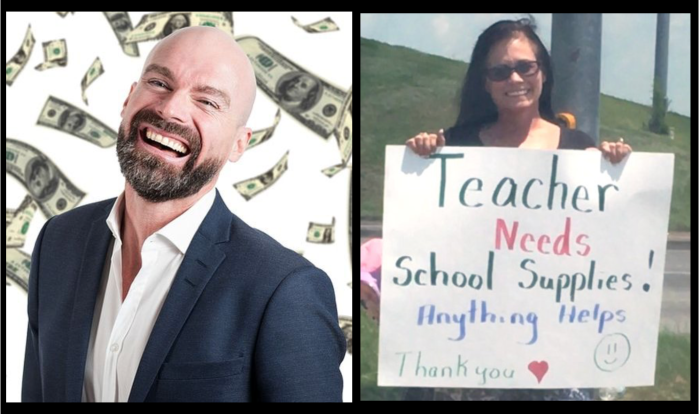
thumbnail_IMG_8249

Top 10 Reasons Bernie Sanders’ Education Policies Are Light Years Ahead of Everyone Else’s

Screen Shot 2019-06-18 at 11.07.04 AM


For most of my life, the United States has been neglecting its public school children – especially the black and brown ones.


Since the mid 1970s, instead of integrating our schools, we’ve been slowly resegregating them on the basis of race and social class.


Since the 1980s, instead of measuring academic success by the satisfaction of an individuals curiosity and authentic learning, we’ve been slowly redefining it to mean nothing but achievement on standardized tests.


And since the 1990s, instead of making sure our schools meet the needs of all students, we’ve been slowly allowing charter schools to infect our system of authentic public education so that business interests are education’s organizing principle.


But now, for the first time in at least 60 years, a mainstream political candidate running for President has had the courage to go another way.


And that person is Bernie Sanders.


We didn’t see this with Barack Obama. We didn’t see it with Bill Clinton. We certainly didn’t see it with any Republican Presidents from Reagan to the Bushes to Trump.


Only Sanders in his 2020 campaign. Even among his Democratic rivals for the party’s nomination – Warren, Biden, Harris, Booker and a host of others – he stands apart and unique. Heck! He’s even more progressive today on this issue than he was when he ran in 2015.


It doesn’t take a deep dive into the mass media to find this out. You don’t have to parse disparate comments he made at this rally or in that interview. If you want to know what Bernie thinks about education policy, you can just go on his campaign Website and read all about it.


The other candidates barely address these issues at all. They may be open about one or even two of them, but to understand where they stand on education in total – especially K-12 schooling – you have to read the tea leaves of who they’ve selected as an education advisor or what they wrote in decades old books or what offhand comments they made in interviews.


In almost every regard, only Sanders has the guts to tell you straight out exactly what he thinks. And that’s clear right from the name of his proposal.


He calls it “A Thurgood Marshall Plan for Public Education.”


Why name his agenda after the first black Supreme Court justice? Because prior to accepting a nomination to the highest court in the land, Marshall argued several cases before that court including the landmark Brown v. Board of Education. He also founded the NAACP Legal Defense and Education Fund. Not only did Marshall successfully argue that school segregation violated the equal protection clause of the U.S. Constitution, but he spent his life fighting for civil rights.


Sanders is the only candidate out there today brave enough to connect those dots. The fight against segregation, high stakes testing and school privatization is a fight for civil rights.


That is clear in nearly every aspect of his plan.


I’m not saying it’s perfect. He doesn’t go as far as he might in some areas – especially against high stakes testing. But his plan is so far advanced of anything anyone else has even considered, it deserves recognition and strong consideration.


So without further ado, I give you the top 10 reasons Bernie Sanders’ education platform is the most progressive in modern American history:


1) He Proposes Fighting School Segregation and Racial Discrimination


Sanders understands that many of our public schools today are more segregated than they were 65 years ago when Brown v. Board was decided. Only 20 percent of our teachers are nonwhite – even in schools that serve a majority of black and brown children. Implicit racial bias puts these students at risk of higher suspensions, unfair discipline policies and an early introduction into the criminal justice system through the school-to-prison pipeline.


Bernie proposes we increase funding to integrate schools, enforce desegregation orders and appoint federal judges who will support these measures. He wants to triple Title I funding for schools serving poor and minority children and increase funding for English as a Second Language programs. He even suggests racial sensitivity training for teachers and better review of civil rights complaints and discipline policies.


This could have an amazingly positive impact on our schools. Imagine a school system where people of all different races, nationalities, sexualities and creeds could meet and get to know one another. It’s harder to be racist and prejudiced adults when as children you learned not to consider people different than you as an other. It’s also harder to withhold funding and opportunities to minority populations when you mix all children together in the same schools.


2) He Would Ban For-Profit Charter Schools


This is a case of Bernie just listening to what educators, school directors and civil rights organizations like the NAACP are already saying. Charter schools are publicly funded but privately operated. Though this differs somewhat from state to state, in general it means that charters don’t have to abide by the same rules as the authentic public schools in the same neighborhoods. They can run without an elected school board, have selective enrollment, don’t have to provide the same services for students especially those requiring special education, and they can even cut services for children and pocket the savings as profit.


Moreover, charters increase segregation – 17 percent of charter schools are 99 percent minority, compared to 4 percent of traditional public schools.
To reverse this trend, Bernie would ban for-profit charter schools and impose a moratorium on federal dollars for charter expansion until a national audit was conducted. That means no more federal funds for new charter schools.


Moving forward, charter schools would have to be more accountable for their actions. They would have to comply with the same rules as authentic public schools, open their records about what happens at these schools, have the same employment practices as at the neighborhood authentic public school, and abide by local union contracts.


I know. I know. I might have gone a bit further regulating charter schools, myself, especially since the real difference between a for-profit charter school and a non-profit one is often just its tax status. But let’s pause a moment here to consider what he’s actually proposing.


If all charter schools had to actually abide by all these rules, they would almost be the same as authentic public schools. This is almost tantamount to eliminating charter schools unless they can meet the same standards as authentic public schools.


I think we would find very few that could meet this standard – but those that did could – with financial help – be integrated into the community school system as a productive part of it and not – as too many are now – as parasites.


Could Bernie as President actually do all of this? Probably not considering that much of charter school law is controlled by the states. But holding the bully pulpit and (with the help of an ascendant Democratic legislature?) the federal purse strings, he could have a transformative impact on the industry. It would at least change the narrative and the direction these policies have been going. It would provide activists the impetus to make real change in their state legislatures supporting local politicians who likewise back the President’s agenda.


3) He’d Push for Equitable School Funding


Bernie understands that our public school funding system is a mess. Most schools rely on local property taxes to make up the majority of their funding. State legislatures and the federal government shoulder very little of the financial burden. As a result, schools in rich neighborhoods are well-funded and schools in poor neighborhoods go wanting. This means more opportunities for the already privileged and less for the needy.


Bernie proposes rethinking this ubiquitous connection between property taxes and education, establishing a nationwide minimum that must be allocated for every student, funding initiatives to decrease class size, and supporting the arts, foreign language acquisition and music education.


Once again, this isn’t something the President can do alone. He needs the support of Congress and state legislatures. But he could have tremendous influence from the Oval Office and even putting this issue on the map would be powerful. We can’t solve problems we don’t talk about – and no one else is really talking much about this. Imagine if the President was talking about it every day on the news.


4) He’d Provide More Funding for Special Education Students

Students with special needs cost more to educate than those without them. More than four decades ago, the federal government made a promise to school districts around the country to fund 40 percent of the cost of special education. It’s never happened. This chronic lack of funding translates to a shortage of special education teachers and physical and speech therapists. Moreover, the turnover rate for these specialists is incredibly high.


Bernie wants to not only fulfill the age old promise of special education funding but to go beyond it. He proposes the federal government meet half the cost for each special needs student. That, alone, would go a long way to providing financial help to districts and ensuring these children get the extra help they need.

5) He Wants to Give Teachers a Raise


Teachers are flooding out of the classroom because they often can’t survive on the salaries they’re being paid. Moreover, considering the amount of responsibilities heaped on their shoulders, such undervaluing is not only economically untenable, it is psychologically demoralizing and morally unfair. As a result, 20 percent of teachers leave the profession within five years – 40 percent more than the historical average.


Bernie suggests working with states to ensure a minimum starting salary of $60,000 tied to cost of living, years of service, etc. He also wants to protect and expand collective bargaining and tenure, allow teachers to write off at least $500 of expenses for supplies they buy for their classrooms, and end gender and racial discrepancies in teacher salaries.


It’s an ambitious project. I criticized Kamala Harris for proposing a more modest teacher pay raise because it wasn’t connected to a broad progressive education platform like Sanders. In short, we’ve heard neoliberal candidates make good suggestions in the past that quickly morphed into faustian bargains like merit pay programs – an initiative that would be entirely out of place among Sanders initiatives.


In Harris’ case, the devil is in the details. In Sanders, it’s a matter of the totality of the proposal.

6) He Wants to Expand Summer School and After School Programs


It’s no secret that while on summer break students forget some of what they’ve learned during the year and that summer programs can help reduce this learning loss. Moreover, after school programs provide a similar function throughout the year and help kids not just academically but socially. Children with a safe place to go before parents get home from work avoid risky behaviors and the temptations of the streets. Plus they tend to have better school attendance, better relationships with peers, better social and emotional skills, etc.


Under the guidance of Betsy Devos, the Trump administration has proposed cutting such programs by $2 billion. Bernie is suggesting to increase them by $5 billion. It’s as simple as that. Sanders wants to more than double our current investment in summer and after school programs. It’s emblematic of humane and rational treatment of children.


7) He Wants to Provide Free Meals for All Students Year-Round


One in six children go hungry in America today. Instead of shaming them with lunch debts and wondering why they have difficulty learning on an empty stomach, Bernie wants to feed them free breakfast, lunch and even snacks. In addition, he doesn’t want to shame them by having the needy be the only ones eligible for these free meals. This program would be open to every child, regardless of parental wealth.


It’s an initiative that already exists at many Title I schools like the one where I teach and the one where my daughter goes to school. I can say from experience that it is incredibly successful. This goes in the opposite direction of boot strapped conservatives like Paul Ryan who suggested a free meal gives kids an empty soul. Instead, it creates a community of children who know that their society cares about them and will ensure they don’t go hungry.


That may seem like a small thing to some, but to a hungry child it can make all the difference.


8) He Wants to Transform all Schools into Community Schools


This is a beautiful model of exactly what public education should be.


Schools shouldn’t be businesses run to make a profit for investors. They should be the beating heart of the communities they serve. Bernie thinks all schools should be made in this image and provide medical care, dental services, mental health resources, and substance abuse prevention. They should furnish programs for adults as well as students including job training, continuing education, art spaces, English language classes and places to get your GED.
Many schools already do this. Instead of eliminating funding for these types of schools as the Trump administration has suggested, Bernie proposes providing an additional $5 billion in annual funding for them.


9) He Would Fix Crumbling Schools


America’s schools, just like her roads and bridges, are falling into disrepair. A 2014 study found that at least 53 percent of the nation’s schools need immediate repair. At least 2.3 million students, mostly in rural communities, attend schools without high-speed internet access. Heating and cooling systems don’t work. 
Some schools have leaks in their roofs. This is just not acceptable.


Bernie wants to fix these infrastructure issues while modernizing and making our schools green and welcoming.


10) He Wants to Ensure All Students are Safe and Included


Our LGBTQ students are at increased risk of bullying, self harm and suicide. We need schools where everyone can be safe and accepted for who they are.


Bernie wants to pass legislation that would explicitly protect the rights of LGBTQ students and protect them from harassment, discrimination and violence. He is also calling for protection of immigrant students to ensure that they are not put under surveillance or harassed due to their immigration status. Finally, this project includes gun violence prevention to make school shootings increasingly unlikely.


There are a lot of issues that fall under this umbrella, but they are each essential to a 21st Century school. Solutions here are not easy, but it is telling that the Sanders campaign includes them as part of his platform.
So there you have it – a truly progressive series of policy proposals for our schools.
Not since Lyndon Johnson envisioned the Elementary and Secondary Education Act (ESEA) has there been a more far reaching and progressive set of education initiatives.


What About High Stakes Testing?


Unfortunately, that also highlights Sanders biggest weakness.


Johnson’s signature legislation which had been focused on addressing funding disparities in 1965 became under George W. Bush in the 2000s a way of punishing poor schools for low standardized test scores.


The glaring omission from Sanders plan is anything substantive to do with high stakes testing.


The Thurgood Marshall plan hardly mentions it at all. In fact, the only place you’ll find testing is in the introduction to illustrate how far American education has fallen behind other countries and in this somewhat vague condemnation:


“We must put an end to high-stakes testing and “teaching to the test” so that our students have a more fulfilling educational life and our teachers are afforded professional respect.”


However, it’s troubling that for once Bernie doesn’t tie a political position with a specific policy. If he wants to “end high-stakes testing,” what exactly is his plan to do so? Where does it fit within his education platform? And why wasn’t it a specific part of the overall plan?


Thankfully, it is addressed in more detail on FeelTheBern.org – a Website not officially affiliated with Sanders but created by volunteers to spread his policy positions.


After giving a fairly good explanation of the problems with high stakes testing, it references this quote from Sanders:


“I voted against No Child Left Behind in 2001, and continue to oppose the bill’s reliance on high-stakes standardized testing to direct draconian interventions. In my view, No Child Left Behind ignores several important factors in a student’s academic performance, specifically the impact of poverty, access to adequate health care, mental health, nutrition, and a wide variety of supports that children in poverty should have access to. By placing so much emphasis on standardized testing, No Child Left Behind ignores many of the skills and qualities that are vitally important in our 21st century economy, like problem solving, critical thinking, and teamwork, in favor of test preparation that provides no benefit to students after they leave school.”


The site suggests that Bernie supports more flexibility in how we determine academic success. It references Sanders 2015 vote for the Every Child Achieves Act which allows for states to create their own accountability systems to assess student performance.


However, the full impact of this bill has not been as far reaching as advocates claimed it would be. In retrospect, it seems to represent a missed opportunity to curtail high stakes testing more than a workaround of its faults.


In addition, the site notes the problems with Common Core and while citing Sanders reticence with certain aspects of the project admits that he voted in early 2015 against an anti-Common Core amendment thereby indicating opposition to its repeal.


I’ll admit this is disappointing. And perplexing in light of the rest of his education platform.


It’s like watching a vegan buy all of his veggies at Whole Foods and then start crunching on a slice of bacon, or like a gay rights activist who takes a lunch break at Chick-fil-a.


My guess is that Sanders hasn’t quite got up to speed on the issue of standardized testing yet. However, I can’t imagine him supporting it because, frankly, it doesn’t fit in with his platform at all.


One wonders what the purpose of high stakes testing could possibly be in a world where all of his other education goals were fulfilled.


If it were up to me, I’d scrap high stakes testing as a waste of education spending that did next to nothing to show how students or schools were doing. Real accountability would come from looking at the resources actually provided to schools and what schools did with them. It would result from observing teachers and principals to see what education they actually provided – not some second hand guessing game based on the whims of corporations making money on the tests, the grading of the tests and the subsequent remediation materials when students failed.


For me, the omission of high stakes testing from Sanders platform is acceptable only because of the degree of detail he has already provided in nearly every other aspect. There are few areas of uncertainty here. Unlike any other candidate, we know pretty well where Sanders is going.


It is way more likely that advocates could get Sanders to take a more progressive and substantial policy stand on this issue than that he would suddenly become a standardized testing champion while opposing everything else in the school privatization handbook.


Conclusion


So there it is.


Bernie Sanders has put forth the most progressive education plan in more than half a century.


It’s not perfect, but it’s orders of magnitude better than the plans of even his closest rival.


This isn’t to say that other candidates might not improve their education projects before the primary election. I hope that happens. Sanders has a knack for moving the conversation further left.


However, he is so far ahead, I seriously doubt that anyone else will be able to catch him here.


Who knows what the future will bring, but education advocates have a clear first choice in this race – Bernie Sanders.


He is the only one offering us a real future we can believe in.


Like this post? I’ve written a book, “Gadfly on the Wall: A Public School Teacher Speaks Out on Racism and Reform,” now available from Garn Press. Ten percent of the proceeds go to the Badass Teachers Association. Check it out!

book-4

Charter Schools Will Always Waste Money Because They Duplicate Services

Screen Shot 2019-06-14 at 11.37.43 PM

 
You can’t save money buying more of what you already have.


Constructing two fire departments serving the same community will never be as cheap as having one.


Empowering two police departments to patrol the same neighborhoods will never be as economical as one.


Building two roads parallel to each other that go to exactly the same places will never be as cost effective as one.


This isn’t exactly rocket science. In fact, it’s an axiom of efficiency and sound financial planning. It’s more practical and productive to create one robust service instead of two redundant ones.


However, when it comes to education, a lot of so-called fiscal conservatives will try to convince us that we should erect two separate school systems – a public one and a privatized one.


The duplicate may be a voucher system where we use public tax dollars to fund private and parochial schools. It may be charter schools where public money is used to finance systems run by private organizations. Or it may be some combination of the two.


But no matter what they’re suggesting, it’s a duplication of services.


And it’s a huge waste of money.


Consider the case of my home state of Pennsylvania.


Charter schools cost Commonwealth taxpayers more than $1.8 billion a year and take more than 25 percent of the state’s basic education funding – yet they only enroll about 6 percent of students.


Just imagine – 94% of Pennsylvania students lose out on opportunities because we’re allowing so much money to be siphoned off for a small fraction of students.


The Keystone state only has 179 charter schools enrolling 135,100 students – the sixth highest charter enrollment in the country. Of those, about a fourth are online cyber charters.


Is it fair to Ma and Pa Taxpayer that they are forced to bear the extra burden of reproducing these services for a handful of students?


And make no mistake. This is one of the leading causes of property tax increases in the state.


The ideology of some results in a direct hit to everyone’s pocketbooks.


According to a recent report by the Pennsylvania Association of School Business Officials (PASBO), “Charter school tuition is one of the largest areas of mandated cost growth for school districts.”


The report found that state charter schools are growing at a rate of 10 percent a year. The PASBO calculates at least 37 cents of every new dollar of property taxes in the fiscal year 2017-2018 went right to charters. And that percentage is only expected to grow.


Part of this is due to a blind, deaf and dumb state legislature that no longer does anything to help alleviate these costs to local school districts. Neighborhood schools can only try to compensate by cutting services for students where it can and raising property taxes where it can’t make ends meet.


More than one third of school superintendents surveyed by PASBO report a worsening financial picture in their districts—and they put the blame on charter schools.


“With the state providing no state support for mandatory charter school tuition costs,” the study says, “the increases in this single budget item have the potential to decimate school district budgets.”


Part of this is the extremely unfair way the state determines how much money to give charter schools.


The legislature has constructed a funding formula that gives every advantage to charter schools while short changing authentic public schools at every turn.


For instance, as Jeff Bryant puts it in his article “The Charter School ‘Dumpster Fire’ in Pennsylvania Provides an Important Lesson for 2020 Democratic Candidates”:


“Charter school tuition charged to Pennsylvania public schools is calculated as if charters had to provide the same services public schools have to provide, such as transportation—they don’t. Also, the tuition bill public schools pay to charters is calculated as if every student cost the same to educate—they don’t.


Instead, the state requires authentic public schools to pay charters way more than authentic public schools get to educate the children in their care – and state law even allows charter operators to pocket the savings as profit.


But this just pours lighter fluid on Bryant’s already raging “dumpster fire.”


Even if Pennsylvania was entirely equitable in how it allocated funding between these two types of school, it would still be wasting our tax dollars because it would still be engaged in duplication of services.


There is simply no good reason to do this. At least, not if providing the best education to students is our goal.


There are few places in the entire country – if any – where charter schools are able to accommodate all students. They cater to nitch markets where operators expect they can turn a profit. There are essentially no communities with a charter school and no authentic public school but many where you find just the opposite.


Moreover, the quality of education provided at charter schools does not live up to the hype of its advertising.


Except in extremely rare circumstances, charter schools have never been shown to provide better outcomes than authentic public schools. Almost every study conducted – even those funded by the school privatization industry – show that these two types of schools produce similar results or in many cases that authentic public schools are much better.


And this despite the fact that such studies are already stacked in charter schools favor because unlike authentic public schools, charter schools often have selective enrollment. A school that gets to cherrypick the best and brightest students has an incredible advantage over those that can’t – yet even with such an uneven starting point charter schools rarely show large academic gains.


For instance, a recent study of charter school students in Pennsylvania conducted by the school privatization friendly Center for Research on EDucation Outcomes (CREDO), found that charter students do about the same on reading exams but score worse in math than students in authentic public schools. The study also found major disparities between charter schools – with cyber charters performing especially poorly.


However, this study’s methodology has been called into question suggesting that even its meager praise of charter schools may be exaggerated. Yet the overall results are in-line  with previous research that also found charter schools in the state generally  produce students who aren’t as prepared as authentic public school students.


Pennsylvania passed its charter school law in 1997.


It’s way passed time for lawmakers in this state and beyond to acknowledge that was a mistake.


We cannot continue to force voters to pay for a supply-side ideology that not only has been disproven through decades of data but that many do not share.


That is why we have charter and voucher schools – a prejudice against authentic public education and desire to allow businesses to cash in on education dollars.


The duplication of services has nothing to do with helping students learn.


It’s about creating a slush fund for unscrupulous corporations and hangers on to get easy cash.


No true fiscal conservative can support charter schools.


Just as no one who values children can continue to justify this economic double vision.


Like this post? I’ve written a book, “Gadfly on the Wall: A Public School Teacher Speaks Out on Racism and Reform,” now available from Garn Press. Ten percent of the proceeds go to the Badass Teachers Association. Check it out!

cropped-book-1.jpg

Charter School Teacher Introduces Elizabeth Warren at Rally

61665090_10109374029691176_8067465538567143424_n


CORRECTION:

In the first draft of this article, I called Sonya Mehta a “Charter School Lobbyist” in the title. On further examination of the facts, I realize this is unfair. She was a charter school TEACHER. I apologize to Ms. Mehta and truly regret any harm I have done her. I have changed the title to better reflect the facts. However, be advised that the text of the article, itself, has remained almost completely unchanged. Everything in the article is true to the best of my knowledge and backed up with sources that the reader can see by following the links in the text. My concern remains centered on Warren and what exactly her intentions are via education policy.


The biggest news from Elizabeth Warren’s rally in Oakland, California, on Friday wasn’t what she said.

 
It was who introduced her and what that says about Warren and her 2020 Presidential campaign.

 
According to the San Francisco Chronicle, “Warren was introduced by Sonya Mehta, a former Oakland schoolteacher.”

 
However, this characterization is inaccurate.

 
Mehta was not an authentic public school teacher. She taught in a non-union charter school called “Learning Without Limits.” She also was a policy fellow at GO Public Schools Oakland, which is a toxic charter promoter focused around that city.


62239250_2491072120944114_6527485798902661120_n

62044390_2491072744277385_2756662503386644480_n

 
In her introduction, Mehta didn’t explicitly advocate for school privatization. She promoted Warren’s early education and free college policies (Her speech can be seen here beginning at 57:30). But why would Warren, one of the smartest and most knowledgeable candidates in the race for the White House, let herself be associated with such a divisive and toxic legacy?


Only 6% of all U.S. students attend charter schools, yet with little accountability, selective enrollment, and the ability to pocket taxpayer money as profit, they cannibalize the funding necessary for the 90% that attend authentic public schools.

 
Warren should know better than this. Along with Bernie Sanders, Warren sits on the Senate Education Committee (HELP – Health, Education, Labor, Pensions).


So the question is this: was this a mistake made by her campaign staff or is this indicative of where Warren is on education policy?


She has said some very positive things in this campaign, not the least of which is that if elected, she would nominate someone with teaching experience as Secretary of Education.

 
But if Mehta is what she thinks an authentic teacher looks like, we are in big trouble.

 
We don’t need another Betsy Devos or Arne Duncan clone who just so happens to have taught at a regressive charter school. In fact, we already had that, too, in John King.

 
Sadly, that’s not even where the story ends.


Warren’s senior education policy advisor is Josh Delaney, a Teach for America temp who turned a 5-week crash course in education into two years in the classroom and then a career as an “expert” on our schools.

 
This is simply not acceptable for anyone courting education voters.

 
You can’t go to Oakland, a city which just experienced a massive teacher strike caused by school privatization, and then let yourself be introduced by someone with ties to school privatization!

 
Go Public Schools Oakland, the organization Mehta is associated with, is the major charter organization in city battling the union.

 
Who knows if Warren was intending to take sides on this issue, but she certainly seems to be signaling that if she did, it might not be with parents, teachers and students. It could be with the hedge fund billionaires backing school privatization.

 
How can she be so strong against these same people when it comes to Wall Street and economic inequality but appear completely ignorant (at best) or disingenuous (at worst) when it comes to school policy?

 
A look at Warren’s stated education policies over her history in public life doesn’t exactly calm the waters, either.


According to the Network for Public Education, Warren holds some regressive views when it comes to our schools.


The non-profit gives her a C on charter schools.


She has spoken out against some of the worst excesses of the industry, but supports the concept of schools that are publicly financed but privately operated.


In 2016 Warren strongly opposed lifting the cap on charter schools in Massachusetts. In 2017, Senator Warren expressed deep concern regarding the “waste, fraud, and abuse of federal money” at the hands of for-profit charter schools and charter school management organizations.


Unfortunately, she also praised the charter industry:


“Many charter schools in Massachusetts are producing extraordinary results for our students, and we should celebrate the hard work of those teachers and spread what’s working to other schools.”

 
Warren earned a B for her stance on school vouchers.

 
She had the courage to criticize DeVos, but her history with the concept of using public money to finance private education is complicated.

 
In a 2017 letter to DeVos, prior to her confirmation as Secretary of education, Senator Warren said the evidence on private school vouchers is “mixed at best” and called them “expensive and dangerous failures that cost taxpayers billions of dollars while destroying public education systems.”


However, back in 2003, she seems to have thought differently. She wrote a book with her daughter called “The Two-Income Trap: Why Middle-Class Mothers and Fathers are Going Broke.” In it, she makes a case for a universal school voucher program. She strongly supported giving parents taxpayer-funded vouchers they could use at any school – public, private or parochial. This would “relieve parents from the terrible choice of leaving their kids in lousy schools or bankrupting themselves to escape those schools.”


Later she said she never meant those vouchers to be used at private schools, but that is  unclear from the text.


However, as spotty as Warren’s history is on school privatization, it is much worse when it comes to high stakes testing.


The Network for Public Education gives her a F on this issue.


In 2015, as Congress debated rolling back high stakes testing requirements that have unfairly assessed students for decades and used test scores as an excuse to deny poor and minority students the resources they need to succeed, Warren demanded testing stay in place. Along with three Democratic senators endorsed by Democrats for Education Reform (DFER), a lobbyist organization for the testing and school privatization industry, she insisted on stronger accountability measures based on testing to gain their support for the Every Student Succeeds Act (ESSA).


Let me be clear: none of this is intended to be a purity test.


If the only candidate we can support is a perfect one, we will never find any politician to support.


But Warren has to make a decision whose side she is on.


At very least, she needs to come out and make a public statement clarifying her views here. She needs to say that she does not support charter schools or vouchers. Shouldn’t every Democratic candidate who wants the votes of educators do that?


Watch the whole rally here. Mehta’s introduction begins at 57:30.


Like this post? I’ve written a book, “Gadfly on the Wall: A Public School Teacher Speaks Out on Racism and Reform,” now available from Garn Press. Ten percent of the proceeds go to the Badass Teachers Association. Check it out!
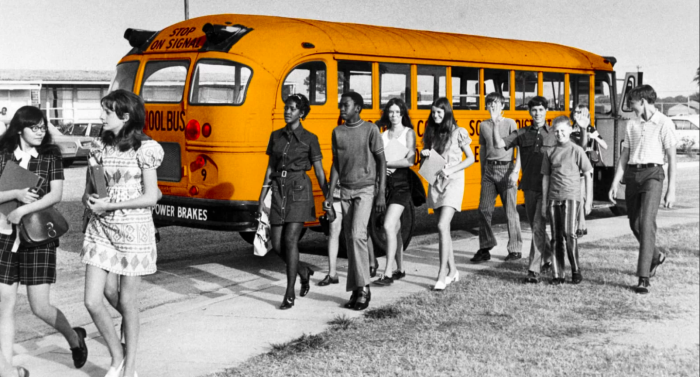
thumbnail_IMG_8249