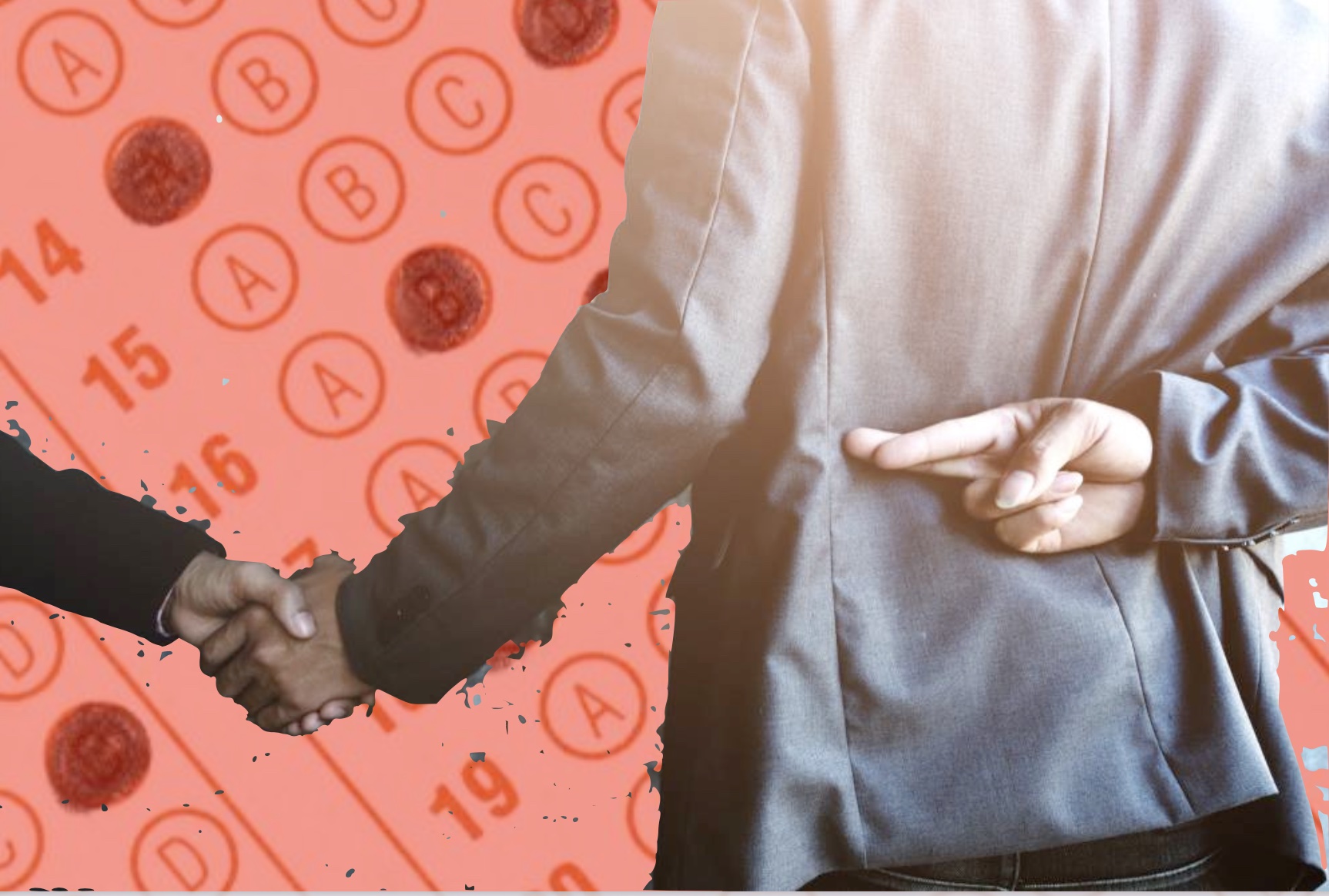
Standardized Tests Lie

Whom do you trust?  


So much in life comes down to that simple question. 


When two groups disagree, which one do you believe? 


If it’s a matter of fact, you can look at the raw information yourself and come to your own conclusions. But often the matter under discussion is so complicated and the field so rarefied that you can’t hope to make a rational decision alone.


So we appeal to the experts.  


In education, the experts are basically classroom teachers and standardized testing companies.

Sure there are students who experience all of their own educations. But that experience is by definition subjective and applies only to them. Something similar can be said of parents who experience the process second hand through their children. They can make decisions about the individuals in question but don’t have enough information to fully generalize about the entire system.

Those with the most exposure to the most diverse educational experiences are teachers and testing companies. 


On the one side you have teachers who instruct students for at least 180 days a year, giving formal and informal assessments throughout to provide a classroom grade. On the other you have the testing companies that give students a single assessment over a period of hours or days. 


And often they come to different conclusions.  


Many times children get high classroom grades but low scores on the standardized test.  


So let us ask the question that the media never does: which should we believe?  


News sources almost always act as if there was no question in the first place. They invariably go with the test as if it were a pure matter of fact. But it isn’t. There are economic reasons for this sleight of hand – not academic ones. After all, the huge media conglomerate that ultimately pays the journalist’s salary often owns the standardized testing company or the publishing house or technology company that provides remediation for that particular assessment.  


It’s also more interesting to write about failing test scores than kids doing well in school. An alarmist narrative certainly sells more papers. Would there even be a story if a reporter wrote “Majority of Kids Pass Courses and Graduate Again This Year”? 


So we’re bombarded with doomsayer stories about failing schools, failing teachers and failing students.


Education Week ran a story last week titled “U.S. Parents Think Reading Instruction Is Going OK—Until They See National Test Results.”  


And another called “Students’ Grades May Not Signal Actual Achievement, Study Cautions.” 


It’s too bad the article never explains why we should take standardized test scores over classroom grades. 

The first story even centers on a misreading of test scores.

The test in question is the National Assessment of Educational Progress (NAEP) . Sometimes called the Nations Report Card, the assessment is given to a random sampling of elementary, middle and high school students in participating countries to compare the education systems of nations.

According to the latest NAEP results, about 2/3 of US students read below “proficient.” And when parents are told this, a new survey finds they lower their opinions of students’ reading abilities.

However, what the article fails to mention is that “proficient” on the NAEP is a misleading benchmark and always has been.

On the NAEP, “proficiency” does not mean students can read at grade level. Being able to do that would actually earn them a “basic” score.

If you read the NAEP’s own Website about how to interpret the scores, you’d see that:

“The NAEP Proficient achievement level does not represent grade-level proficiency, but rather competency over challenging subject matter. NAEP achievement levels are to be used on a trial basis and should be interpreted and used with caution.”

So why are journalists continually spreading false claims about the tests that the test makers, themselves, dispute? And why have they been doing so for decades?

Part of the problem is the NAEP has not revised a purposefully misleading grading scale since it was first given in 1969. As much as representatives will dispute the interpretation of scores if pressed, they could do something about it if they cared to do so. They could even put out press releases about how the organizations’ scores are being misread. But that never happens. They remain quiet unless you ask them specifically about the scores and – surprise – education journalists are not very curious about this issue. It would ruin their stories!

Only about 1/3 of US students were below NAEP’s Basic score. In other words 2/3 of US students read at or above grade level – the exact opposite of what journalists are reporting based on their interpretation of the results! However, even the meaning behind that is debatable because each state has a different definition of reading at grade level. A more accurate metric might be reading at age level, but NAEP scores don’t really correlate with it. Good luck getting anyone interested in reading about that.

Then we have the article about student grades not showing actual learning achievement.

The story is about schools in Washington state where students earned increasingly higher classroom grades but lower end-of-the-year standardized tests scores.


Why did the education journalists decide the standardized test scores were accurate and the classroom grades were not?

Good question, but you won’t find the answer in the story. This is taken as an article of faith.

Obviously the standardized tests scores are better. They were given by a corporation. Classroom grades were given by teachers.

This just goes to show the media’s glaring bias against educators and in favor of big business.

According to the U.S. Bureau of Labor Statistics, the average salary of public school teachers in Pennsylvania (my home state) is between $53,000 and $59,000 per year.

Meanwhile, more than $1.7 billion is spent on standardized testing in the US each year, according to a study by the Brown Center on Education Policy at Brookings. Another $669 million is spent on elementary assessments. Between $34-65 per student per year is spent by the states on standardized testing.

To put that in perspective, perhaps the biggest standardized testing corporation, Pearson, reported revenues of $5.511 billion and profits of $762 million in 2018. That doesn’t include $89 million in additional profit for Pearson from its ownership stake in Penguin Random House Publishers, a major world school textbook publishing company.

Pearson’s main competitor, Educational Testing Services (ETS), reported revenues of $2.1 billion for the same time period. And the College Board, maker of the SAT test, reported another $1.068 billion in revenue in 2017.

Standardized testing companies want people to believe there is a crisis in our public schools and that children are not learning well unless they are held accountable by the same standardized tests these companies make and manufacture. These companies make the tests, grade the tests and then sell school remediation materials when kids don’t pass.

There are certainly real problems with our educational system.

For instance, the U.S. is one of the only countries in the world – if not probably the ONLY country – that funds schools based largely on local taxes. Other developed nations either equalize funding or provide extra money for kids in need. In the Netherlands, for example, national funding is provided to all schools based on the number of pupils enrolled. But for every guilder allocated to a middle-class Dutch child, 1.25 guilders are allocated for a lower-class child and 1.9 guilders for a minority child – exactly the opposite of the situation in the U.S.

If we want to compare the US to other countries, this is a perfect place to start.

But a focus on test scores obscures the differences.

Virtually all of the top scoring countries taking the NAEP exam have much less child poverty than the U.S. If they had the same percentage of poor students that we do, their scores would be lower than ours. Likewise, if we had the same percentage of poor students that they do, our scores would go through the roof! We would have the best scores in the world!

NAEP scores just mirror back to us our child poverty rate – that more than 1/3 of our students live below the poverty line and more than half of public school students qualify for free or reduced lunches.

But this myopic focus on standardized tests also blinds us to the ways our system is superior to that of many other countries.

We do something that many international systems do not. We educate everyone! Foreign systems often weed children out by high school. They don’t let every child get 13 years of grade school (counting kindergarten). They only school their highest achievers.

So when we compare ourselves to these countries, we’re comparing ALL of our students to only SOME of theirs – their best academic pupils, to be exact. Yet we still hold our own given these handicaps!

This suggests that the majority of problems with our public schools are monetary. Pure and simple.

A 2018 review by Northwestern University found that in 12 out of 13 studies increased spending had a positive effect on student outcomes. And that result has been verified by studies since then in California, Texas, Wisconsin and other states.

Money makes a difference.

Money spent on students – not more testing.

The bottom line is that standardized tests are not accurate assessments of student learning. They are corporate propaganda.

Standardized tests lie, and the corporate friendly education media feed us those same lies as if they were fact.


Like this post?  You might want to consider becoming a Patreon subscriber. This helps me continue to keep the blog going and get on with this difficult and challenging work.

Plus you get subscriber only extras!

Just CLICK HERE.

Patreon+Circle

I’ve also written a book, “Gadfly on the Wall: A Public School Teacher Speaks Out on Racism and Reform,” now available from Garn Press. Ten percent of the proceeds go to the Badass Teachers Association. Check it out!
Teaching Blind Obedience is Child Abuse

My daughter is not a little soldier.

She does not jump at my orders.

She can be rude, crude and badly behaved.

But I wouldn’t want her any other way – because the alternative is worse.

The same goes for my middle school students.

If you enter my classroom, you may find some children questioning my assignments.

“Mr. Singer, why can’t we chew gum in class?”

“Mr. Singer, why do you give so much homework?”

“Mr. Singer, why do we have to write a rough draft? Why can’t we just write a final copy?”

But you’ll notice my students almost always call me “Mr. Singer.” The reason is trust and respect.

Over time we’ve formed a relationship with each other where they’ve learned to respect me as their teacher and I have tried to earn that trust by treating them kindly and giving good reason for the things I tell them to do.

They are obedient (for the most part), but not BLINDLY obedient.

That may sound like splitting hairs but it’s one of the most important distinctions in education.

When someone knows WHY they’re doing something, they are an agent – they are responsible for their own actions. They are self-disciplined – not drones acting without thinking solely because they were told to do so.

That is incredibly important.

Think of what blind obedience does to adults.

American historian Howard Zinn famously put it this way:

“Civil disobedience is not our problem. Our problem is civil obedience. Our problem is that people all over the world have obeyed the dictates of leaders… and millions have been killed because of this obedience… Our problem is that people are obedient all over the world in the face of poverty and starvation and stupidity, and war, and cruelty. Our problem is that people are obedient while the jails are full of petty thieves… [and] the grand thieves are running the country. That’s our problem.”  

When I was a college undergraduate, I was unsure what to major in and I began my undergraduate work in psychology. Of all the things I learned in those early survey classes before changing course to writing, philosophy and (after a career in journalism) education, the lesson I’ll never forget is the groundbreaking 1961 study by Stanley Milgram, a Yale University psychologist.

Milford famously wondered how many people would willingly comply if a person in a position of authority told university students to deliver a 400-volt electrical shock to another person. His students predicted that no more than 3% of participants would deliver the maximum shocks. However, when he actually conducted the experiment, 65% delivered the maximum shocks.

During the experiment, each subject was asked to press a button that they believed gave increasingly high voltage electric shocks to the student on the other side of a wall if the student gave the wrong answer to a teacher’s questions. It should be noted that the students on the other side of the wall did not actually receive shocks, but the participants BELIEVED that they truly were shocking their fellow students by pressing the button.

Many of the subjects, while believing that the student was actually receiving shocks and hearing their protests and cries for mercy – including complaints of a heart condition – became increasingly agitated and even angry at the experimenter. Yet 36 out of 40 people, in turn, continued to do what they were instructed to do all the way to the end. Even when the student became silent when apparently receiving a shock from a switch labeled “danger: severe shock”, the subject continued based on the instruction that silence is to be read as a wrong answer.

This experiment (which would be highly unethical today) has become a classic in psychology, demonstrating the dangers of obedience.

Milgram wrote in 1974:

“Ordinary people, simply doing their jobs, and without any particular hostility on their part, can become agents in a terrible destructive process. Moreover, even when the destructive effects of their work become patently clear, and they are asked to carry out actions incompatible with fundamental standards of morality, relatively few people have the resources needed to resist authority.”

In fact, these experiments were inspired by history – specifically by the Nazi, Adolph Eichmann, who defended himself at the Nuremberg Trials by saying that he was simply following orders when he commanded the deaths of millions of Jews during the Holocaust.

This is what blind obedience gets us – a society of Nazis willing to do anything if told to do so by the proper authorities.

Parents and teachers are in a delicate situation then.

We’re responsible for guiding children into adulthood, and that often does require a measure of obedience. The question is how to get there without stripping away a child’s agency? How to get children to do generally what is necessary for their learning while still leaving their independence intact?

Let’s be honest – schools play an essential role in teaching obedience. It’s a critical life skill that helps children learn to follow rules and directions. Without obedience, adolescents would have difficulty following rules at home, at school, and in society.

One of the ways schools teach obedience is through rules and consequences. When children break rules, they face consequences such as being sent to the principal’s office, getting detention or being suspended. Such consequences help children learn that there are repercussions for their actions.

Schools also teach obedience through modeling. Teachers and administrators try to set good examples for children by obeying rules, themselves. When children see adults following the rules, they are more likely to do so themselves.

Finally, schools teach obedience through positive reinforcement. When children do the right thing, they are rewarded with praise, stickers, or other incentives. This positive reinforcement helps children learn that obedience is a good thing and that it is something that should be rewarded.

However, as children grow older, it is just as vital that teachers and parents not only foster obedience but also critical thinking about that obedience.

When a child questions a rule (and they will question it), we should not instantly meet that questioning with negativity or shock. We should calmly and rationally answer.

We should not get angry at questions, we should welcome them. Questioning should be a part of instruction because as educators and parents we should not want blind obedience. We should want trust and understanding.

As Albert Einstein said, “Peace cannot be kept by force. It can only be achieved by understanding.”

I was reminded of this when watching the recent documentary “Shiny Happy People” about the Duggar family. The brood of religious fundamentalist Christians made their TV debut in 2004, going on to become a household name with their TLC show “19 Kids and Counting,” presenting Jim Bob and Michelle Duggar and their ever-expanding household as a seemingly “perfect” family. 

However, behind the scenes, the family’s theocratic hierarchy led to sexual, emotional, and physical abuse, which was allegedly brushed aside by their church.

In 2015, it was revealed that the Duggars’ eldest son, Josh James, had molested numerous underage girls, including four of his siblings, when he was aged 14 to 15. These revelations led to the cancellation of “19 Kids and Counting.” In 2021, Josh was arrested after police discovered he had been receiving and was in possession of child pornography.

The family belongs to the Institute in Basic Life Principles (IBLP), a nondenominational Christian sect that serves as an umbrella organization for several ministries founded by minister Bill Gothard in 1961. 

According to the documentary, IBLP teachings require absolute obedience. Authority is distributed in various circles – God being the highest authority, followed by the family’s father, etc. Women are considered to be among the lowest forms of authority. In fact, two of Josh’s sisters who he had abused were even made to go on TV to speak in defense of their abuser. 

We hear a lot of propaganda from religious fundamentalists about how public schools groom students into being politically liberal. However, teaching blind obedience is the true grooming. It is setting people up to become victims of anyone who they perceive as having authority over them.

This is what made the Duggar children ready made victims for their own brother. It sets children up to be easily abused, gaslit, fooled and dominated.

And in doing research on this topic, I found many articles defending absolute obedience by reference to the Bible. The idea that authority is a hierarchy and we should simply follow the instructions of those above us in that hierarchy is as rampant as it is perverted.

Any discipline adults give to children should be in service of them eventually becoming independent and self-disciplined. That means being able to make independent choices about their own behavior without prompting from an adult.

There is a difference between being self-disciplined and being obedient.

A self-disciplined child will complete an action, regardless of who is watching. She will do the behavior because it is the right thing to do. In contrast, an obedient child may follow directions to please a parent, to avoid a consequence or to receive a reward. Being obedient is following directions or commands from an adult. It is exhibiting “good behavior” when an adult is present. Meanwhile, having self-discipline is making those choices without the presence or reminders from adults.

It may be tempting to see children marching in line or sitting calmly with their hands in their laps and consider that an ideal. But as children grow, we must learn to tolerate more frequent independence.

In fact, we must do more than tolerate it. We must cherish it.

The opposite is so much worse.


Like this post?  You might want to consider becoming a Patreon subscriber. This helps me continue to keep the blog going and get on with this difficult and challenging work.

Plus you get subscriber only extras!

Just CLICK HERE.

Patreon+Circle

I’ve also written a book, “Gadfly on the Wall: A Public School Teacher Speaks Out on Racism and Reform,” now available from Garn Press. Ten percent of the proceeds go to the Badass Teachers Association. Check it out!

Efforts to Legalize Child Labor are the Next Logical Step After Corporate Education Reform

 
Standardized testing


Privatizing public schools. 


Defunding poor students.  


What’s next? 


Republicans across the United States have an answer – legalizing child labor


Since 1938 with the Fair Labor Standards Act, the Franklin D. Roosevelt administration restricted children younger than 14 from being employed, and put strict rules in place on when those younger than 18 may be employed, for how many hours and in what fields. 


Today Republicans across the country seem poised to repeal those protections. 


In Wisconsin, Republicans want to allow 14-year-olds to work in bars and restaurants serving alcohol. These kids aren’t legally allowed to drink the beverages they’re pouring but I’m sure that won’t cause any problems. Nooooo! 


In Ohio, the GOP majority legislature is trying to allow kids ages 14 and 15 to work until 9 p.m. during the school year with their parents’ permission. Those teens better make sure their homework is done before their work-WORK because there won’t be anytime before bed. (No matter that this is illegal under federal law. I guess the rest of the country will have to change to accommodate the Buckeye State.) 


Donald Trump’s former press secretary, nepo baby, and current Arkansas Gov. Sarah Huckabee Sanders signed a law in March eliminating permits that employers used to have to check to verify a child’s age and their parent’s consent before hiring a minor. Without this, it’s much easier for companies caught violating child labor laws to claim ignorance. But, hey, freedom. Right? 


And that’s not even counting measures to loosen child labor laws that have been passed in New Jersey, New Hampshire and Iowa. (Iowa Republicans were even going to let 14- and 15-year-olds work in dangerous fields including mining, logging and meatpacking, before coming to their senses!) In the last two years, GOP Lawmakers have proposed loosening child labor laws in at least 10 states, according to a report published last month by the Economic Policy Institute. Some of these bills became law and others were withdrawn or vetoed. 


Make no mistake. These are not aberrations. This is the thrust of the mainstream Republican party today. 


National business lobbyists, chambers of commerce and well-funded conservative groups such as Americans for Prosperity – a conservative political network – and the National Federation of Independent Business – an organization that typically aligns with Republicans – are backing the state bills to increase teen participation in the workforce.  


Meanwhile, child labor violations have increased by almost 70% since 2018, according to The Department of Labor. The agency is increasing enforcement and asking Congress to allow larger fines against violators. 


How did we get here? 


Corporate education reform. 


It’s like the old adage: if a frog is suddenly dropped into a pot of boiling water, it will jump out and save itself from impending death. But, if the frog is gently placed in lukewarm water, with the temperature rising slowly, it will not perceive any danger to itself and will be cooked to death. 


That’s what our national education policy has been for the last two decades. Lawmakers on both sides of the aisle have been slowly raising the temperature and now the water is boiling over. 


We’ve been increasingly treating children less as individual humans who are ends in themselves and instead as cogs in the machine, widgets, things to be molded and manipulated for the good of the economy. 


Here we have an entire industry of standardized testing that makes its money as a parasite on the public school system. The same multi-billion dollar corporations design the tests, grade the tests and then offer remediation when kids don’t pass the tests. It’s a classic captive market where the provider has no incentive but to perpetuate the conditions that increase its bottom line. Students aren’t the consumers of this product – school districts are – and they have no choice but participate. It’s encoded in federal and state law. They have to play along and are, themselves, judged by the results of that compliance. 


Then we have privatization – charter and voucher schools. These are institutions ostensibly set up to educate students, but unlike authentic public schools, these organizations are allowed to turn a profit. Some of them get to hide behind the label “non-profit” but the result is the same. And once you allow financial gain of this sort into the system, that’s what it’s all about. Kids become a means to an end, not an end in themselves.  


And let’s not forget how all of this enters into the finances of public schools. Unlike most countries across the globe, education in the US is supported primarily by local taxes. So rich neighborhoods invariably have robust public schools that provide students with all the resources they need. And poor communities have impoverished schools where students get only whatever parents and teachers can scrounge together. In this country, children are not a worthy cause all by themselves – we only care about them if they’re OURS


The entire apparatus of corporate education reform is focused around jobs. In this ideology, the function of school is to prepare students for employment – that is all. It is not to make students good citizens, knowledgeable voters or even fully realized human beings. Rich kids are prepared for the jobs that will keep them rich. Poor kids are prepared for the service industry – so the rich have someone to wait on them in restaurants and stock grocery store shelves. 


The fact that the Covid pandemic has reduced adults willing to continue working in these fields for such low wages has only motivated the wealthy and powerful to fill those vacancies with younger-and-younger people who won’t understand how much they’re being taken advantage of and won’t complain. 


For example, take this quote from Rex Tillerson, former ExxonMobil CEO

“I’m not sure public schools understand that we’re their customer—that we, the business community, are your customer. What they don’t understand is they are producing a product at the end of that high school graduation. Now is that product in a form that we, the customer, can use it? Or is it defective, and we’re not interested? American schools have got to step up the performance level—or they’re basically turning out defective products that have no future. Unfortunately, the defective products are human beings. So it’s really serious. It’s tragic. But that’s where we find ourselves today.” 


We find the same rhetoric on the left as well as the right. 


The Center for American Progress (CAP) – a so-called liberal Washington think tank lead by Barack Obama  and Hillary Clinton minions like John Podesta – repeat the same conservative talking points. For example, CAP published and article called “Preparing American Students for the Workforce of the Future” which read like a companion piece to Tillerson’s diatribe. They did concede that being ready for “civic life” is important as well as being “career ready,” though. 

So far, few Democrats have taken the next logical step along with their Republican colleagues.

And they ARE colleagues. Don’t let the hyped up media culture war distract you. When you take out social issues, America’s two parties are as different as milk chocolate and dark chocolate. They’re the same basic thing separated only by intensity and bitterness.

Republicans are ready to undo child labor protections. Democrats will only take away kids’ rights at school.


This is what you get when you dehumanize students. This is what you get when you signal it is okay to be a predator on student needs to help fulfill the needs of the economy. 


Money comes first. Students – children – are a distant second.  


So finally the chickens of corporate education reform are coming home to roost. I don’t think we’re going to like the eggs. 


Like this post?  You might want to consider becoming a Patreon subscriber. This helps me continue to keep the blog going and get on with this difficult and challenging work.

Plus you get subscriber only extras!

Just CLICK HERE.

Patreon+Circle

I’ve also written a book, “Gadfly on the Wall: A Public School Teacher Speaks Out on Racism and Reform,” now available from Garn Press. Ten percent of the proceeds go to the Badass Teachers Association. Check it out!
Forgotten Pre-Covid Report Reveals Standardized Testing Weaknesses in PA

The majority of teachers and principals in Pennsylvania hate standardized tests.

An increasing number of parents are refusing to allow their kids to take the tests.

And there may be better alternatives to the state’s Keystone Exams.

These were just some of the key findings of a blockbuster report from June 2019 by the state General Assembly’s Legislative Budget and Finance Committee.

The report, “Standardized Tests in Public Education” was published about 9 months before the Covid-19 pandemic hit.

It effectively got lost in the chaos that followed the global pandemic.

However, now that things are returning to some semblance of normalcy, it seems that bureaucrats from the state Department of Education (PDE) are taking the wrong lessons from the report while the legislature seems to have forgotten it entirely.

The report was conducted because of legislation written by state Sen. Ryan P. Aument (R-Lancaster County). It directed the Legislative Budget and Finance Committee to “study the effectiveness of standardized testing, including the Keystone Exams and SATs, and their use as indicators of student academic achievement, school building performance, and educator effectiveness.”

The key findings are as follows:

1)The majority of principals and teachers disapprove of the state’s standardized tests – both the Pennsylvania System of School Assessment (PSSA) tests given in grades 3-8 and Keystone Exams given in high school. They think these tests are ineffective, expensive and harmful to district curriculum and students.

2) State law allows parents to opt their children out of testing for one reason only – religious grounds. Parents are using this religious exemption in increasing numbers. This puts districts in danger of violating federal participation and accountability standards.

3) It has been suggested that the state allow two additional reasons for parents to opt their children out of testing – philosophical grounds and health concerns. It is unclear whether doing so would increase overall opt outs or not.

4) The federal Every Student Succeeds Act (ESSA) passed in 2015 allows the use of the SAT and/or ACT test to take the place of high school standardized testing. It has been suggested the Commonwealth replace the Keystone Exams with these tests. The report finds the ACT and/or SAT would successfully determine college readiness and reduce the overall amount of standardized testing. However, this would not allow other uses of current state tests like evaluating teacher effectiveness and school building performance.This may not matter though because the report also casts doubt on whether the current tests (PSSA and Keystone Exams) do an adequate job of assessing teacher or building performance now or even if student tests can be accurately used to evaluate teachers and schools.

There’s a lot of information here. Let’s look at each finding in turn.

1) PA Educators Hate Standardized Tests

When it comes to the PSSAs, 67% of principals and 76% of teachers said the tests were ineffective indicators of student achievement.

There was slightly more support for the Keystone Exams. This time 45% of principals said the test was an ineffective indicator of student achievement (with 27% saying the tests were effective). Meanwhile, 60% of teachers said the test was ineffective.

Both principals and teachers said their curriculum had been narrowed to prepare students for PSSAs and Keystone Exams. Instead of going into more depth on regular classwork or learning new skills, the focus shifts to teaching to the tests.

Most principals (approximately 80-90%) said that students are taught test-taking skills, and their schools administered practice tests, bench-mark tests, and/or diagnostic tests to prepare students for the PSSA exams. This held for teachers, too, with 81-88% saying they teach test-taking skills and administer practice tests. Principals also said the costs of this additional test prep varied from $200 to more than $100,000.

Taking the tests also eats up valuable class time. Administering the assessments takes between 5.7 to 8 days for each kind of test – the PSSA and the Keystone Exams, according to Principals.

In addition, the report details the cost of giving these tests. In fiscal year 2017-2018, PDE paid $42.17 million for these tests. This is part of a national trend:

“Standardized tests and test preparation have subsequently become big business and that multibillion dollar business continued to grow since the enactment of NCLB and the subsequent enactment of ESSA. According to the Pew Center on the States, annual state spending on standardized tests increased from $423 million before the NCLB (enacted in 2002) to upwards of $1.1 billion in 2008 (to put this in perspective this reflects a 160 percent increase compared to a 19.22 percent increase in inflation during the same time period). A more recent study by the Brown Center on Education Policy at Brooking put the cost at upwards of $1.7 billion in 2011 related to state spending on standardized tests.”

2) Opt Outs on the Rise

Many states allow parents to opt their children out of standardized testing. Some do so in cases of a physical disability, medical reasons, or emergencies. A few allow opt-outs based on religious objection – like Pennsylvania. Some states allow opt-outs for any reason whatsoever.

The religious exemption is not used widespread throughout the state and most schools meet the 95% participation rate required by the federal government. However, use of the religious exemption is definitely on the rise – enough so that the authors of the report find it alarming:

“Meanwhile, as previously indicated in this section, schools throughout the country are experiencing and grappling with an increase in the number of parents seeking to have their children opt-out of standardized testing now that new state assessments have been implemented pursuant to the federal requirements. Pennsylvania is no exception to this trend and is also experiencing an increase in the number of parents utilizing the religious opt-out.”

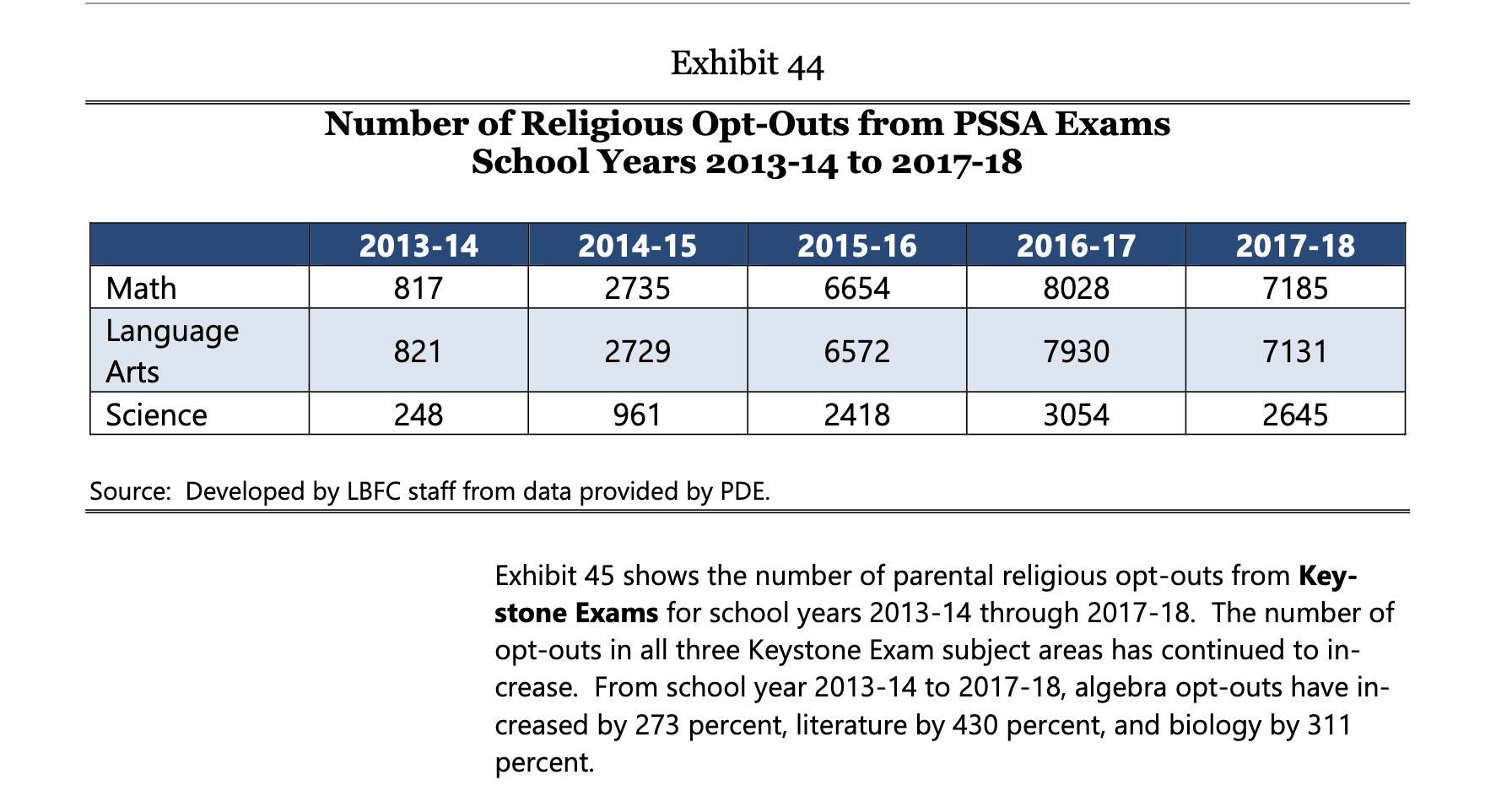
For the PSSA tests, opt outs increased from 2013-14 to 2016-17. However, total numbers in school year 2017-18 decreased sightly.

Opt outs went from 1,886 to 6,425 to 15,644 to 19,012 to 16,961.

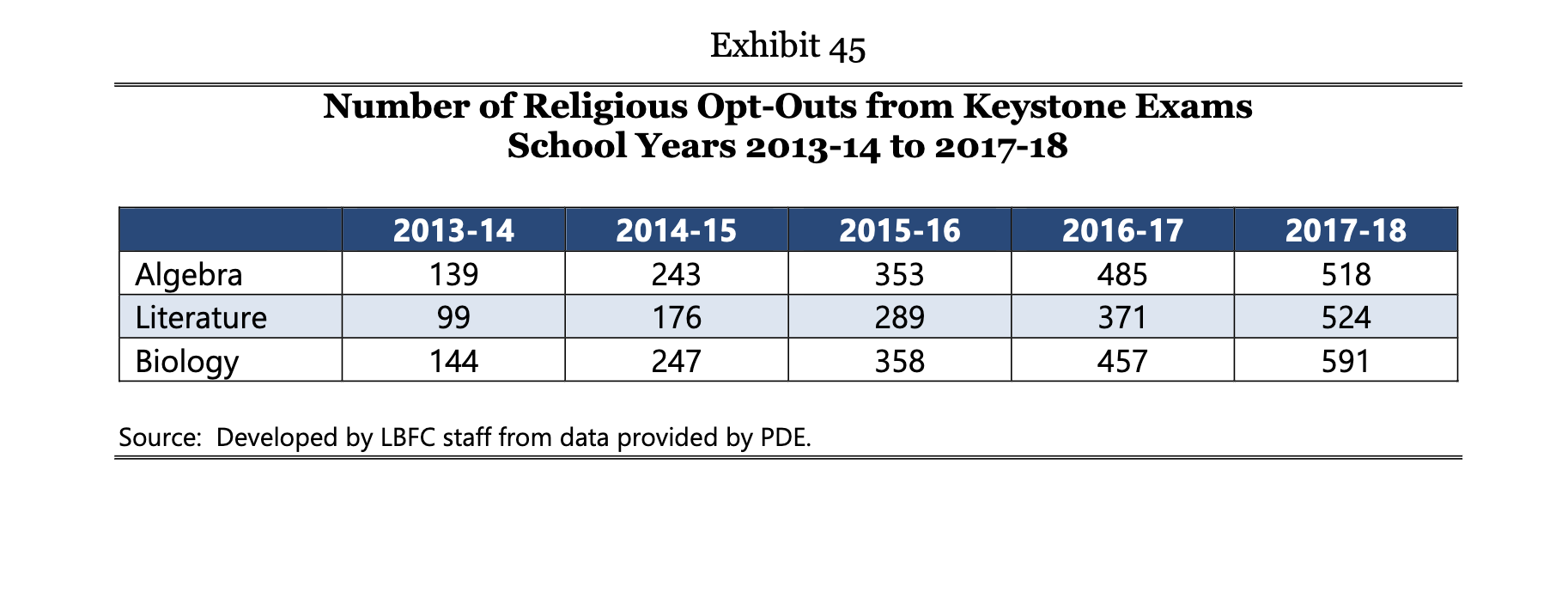
During the same time period for the Keystone Exams, opt outs steadily increased each year but were at lower overall rates.

For the high school test, opt outs went from 382 to 666 to 1,000 to 1,313 to 1,633.

These are vitally important figures because opt out data is rarely tabulated and released to the public. Many media accounts actually state the opposite of the data in this report – in particular that opting out has decreased since Congress passed the ESSA in 2015. Apparently the media got this one wrong.

Though the religious opt-out is the only reason specifically allowed in state Chapter 4 regulations, PDE reports there are five additional ways that students end up not taking the tests:

1) Other Parental Request – parents simply refusing to let their kids participate but not objecting based on specifically religious reasons.

2) No Attempt and No Exclusion Marked – students who are given the test but do not answer enough questions to receive a score.

3) No Test – no test record on file for unknown reasons.

4) Extended Absence – a student missed the testing and make-up window due to absences.

5) Other – does not fit any of the other categories.

Federal law – in particular No Child Left Behind (NCLB) and subsequent reauthorizations of that legislation – requires states to use student participation in standardized testing as a factor in a state’s accountability system. According to the report, any district with less than 95% of students taking the test should be “addressed.”

The report does not go into any further detail about what this means, other than to say that falling under 95% can:

“…ultimately result in a reduced achievement/proficiency measure… If the student participation rate falls below 95 percent, states are required to calculate student achievement/proficiency by dividing the number of students scoring proficiently by no less than 95 percent of the total students (which effectively assigns a score of “0” to all nonparticipants once the participation rate has fallen below 95 percent).”

In effect, the district gets a bad mark on a piece of paper. So what?

Under NCLB, schools with poor performance could receive sanctions like state takeover or lower funding. However, this is extremely unlikely – especially since the passing of ESSA. This newest reauthorization of the law gives states leeway in designing their accountability systems. It leaves the enforcement of this 95% participation rate up to the states, requiring them to develop an accountability plan in the event that a school or district fails to meet this standard.

So a school would only be punished if the state decided to do so. If a state legislature decided to allow parents to opt their children out for any reason at all, they would not have to take any punitive measures. Since the ESSA, the buck stops at the state house door on this one. California, for example, takes note of low participation rates but these rates are not factored into a school’s rating. On the other hand, Florida mandates direct intervention from the state’s Department of Education until participation rates are met.

3) Impact of New Reasons to Opt Out

This is where things get a bit sticky.

The report mentions the idea of expanding the options for opting-out of statewide assessments (e.g., PSSA and Keystone Exams) to include objections based on philosophical grounds or due to health issues.

On the one hand, the authors write “The impact of adding opt-out categories may be minimal.” They don’t know if more people would use the expanded options or if the same numbers who use the religious exemption today might simply divide themselves up among all three options.

The authors worry, however, that new pathways to opt out may increase the total number of people refusing the tests for their children and would reduce Pennsylvania’s participation rate in standardized testing.

This is a particularly troubling paragraph:

“The existence of opt-outs (religious or otherwise) has the potential to negatively impact a state’s participation rates and may potentially impact a state’s [Local Education Agency (LEAs)] and schools achievement/proficiency rate and ultimately the ability of a state to be in compliance with federally required assessments and accountability measures. Furthermore, providing opt-outs and giving parents notice of such has the potential to conflict with the message about the importance of standardized testing. Ultimately placing the state departments of education and local school districts in the potentially awkward position of having to explain why it is important for students to participate in testing (given the federal requirements), while also giving and notifying parents of the opt-out options for their children. In 2015, US Department of Education sent out letters to a dozen states flagging their low participation rates (statewide, or at the district or subgroup level) on the 2014-15 school year assessments and indicated that they needed to create a plan to reduce opt-outs due to low participation rates.”

This seems to be the order of the day at PDE. It’s why earlier this year, school administrators were advised by state officials to crack down on parents opting their children out of standardized tests.

For the first time in 8 years, I, myself, had to jump through several hoops to opt my own daughter out this year when in the past a simple phone call had sufficed.

I was asked to send in a letter, sign a confidentiality statement and go to the school to examine the test before they would excuse my little girl from the tests. It was an unnecessary hassle meant to discourage parents from doing what they thought was right and exercise their rights through state law.

And all of it is based on a cowardly and incomplete understanding of federal law. If Commonwealth schools fall below 95% participation in the test and get a bad mark on a worthless metric, it doest have to matter. No matter how many letters the federal government sends to the state legislature or PDE, the law is clear. The state is in charge here. Our legislature can choose to side with taxpayers, residents, and citizens or with civil servants and strongly worded letters.

4) Replacing the Keystone Exams

There’s not much more to add to this than the initial finding.

The authors of the report say there would be no problem with replacing the Keystone Exams with the ACT or SAT because these national tests would properly assess students’ college and career readiness.

The report is actually pretty shoddy in this regard not really examining the claims of the College Board which makes both tests. The authors just pretty much accepted the College Board’s word wholesale. Nor was their any evaluation of what teachers and principals thought about these tests like there had been for the PSSA and Keystone Exams.

However, the report does make a good point about test reduction. Many students already take the SAT or ACT test, so eliminating the Keystones would reduce the over all amount of tests they had to take.

Also the authors deserve credit for writing about how using student test scores to evaluate teachers and schools is seriously bad practice.

According to the report, 77 percent of principals and 93 percent of teachers said PSSA tests were not effective indicators for teacher evaluations, with similar figures for the Keystone Exams and building performance evaluations.

While everything in the report may not be 100% accurate, it includes important information that should be wider known.

In particular, it matters that the majority of teachers and principals throughout the state disapprove of standardized testing. If we trust our educators at all, we should take steps to reduce or abolish high stakes testing – not continue the same dismal policy that has achieved nothing positive in 20 years of NCLB.

In addition, the report has trustworthy data about opt outs throughout the Commonwealth. Unlike what has been reported in the media, opting out is not on the decline, it is on the rise.

If we value parents and their autonomy to make decisions for their own children, we should at very least expand their ability to refuse the test for their children without having to give anyone a reason. Being parents is reason enough.

The Keystone Exams should be thrown in the trash, because that’s what they are – trash. At very least they should be replaced with the SAT or ACT. Even better to remove any requirement for standardized tests wholesale – and that includes the PSSA.

The ESSA allows states a lot of leeway about how and what accountability system they use. There is no need to worry about some imperial federal power invading Pennsylvania to force our hand with standardized testing. We should call their bluff on this. I’ll bet that if we did so, many other states would do the same.

Standardized testing is another failed education policy. Our legislators would do good to read this report and make up their own minds about it.

Though a few years and disasters have happened since its publication, it doesn’t deserve to be forgotten by the very people who ordered it to be written in the first place.


Like this post?  You might want to consider becoming a Patreon subscriber. This helps me continue to keep the blog going and get on with this difficult and challenging work.

Plus you get subscriber only extras!

Just CLICK HERE.

Patreon+Circle

I’ve also written a book, “Gadfly on the Wall: A Public School Teacher Speaks Out on Racism and Reform,” now available from Garn Press. Ten percent of the proceeds go to the Badass Teachers Association. Check it out!


Lobbyists Congratulate Themselves for 20 Years of NCLB Standardized Testing

It’s hard to learn your lesson – especially if doing so costs you money.

Case in point: the U.S. Chamber of Commerce Foundation, the largest lobbying organization in the country, issued a new report examining the impact of No Child Left Behind (NCLB), the George W. Bush era law making standardized testing the centerpiece of K-12 education.

So an organization representing oil companies, pharmaceutical giants and automakers just opined on public school policy as if it were made up of experts.

And guess what?

Business folks don’t know what the heck they’re talking about in education.

Because after sorting through 20 years of NCLB controversy, political shenanigans and factual mistakes, the supply side cabal thinks the law is just fine.

It’s kind of like a judge watching a driver plow his car into a brick wall repeatedly and then instead of taking away his license, awarding him a safe driver certificate.

It doesn’t take a political scientist to figure out why.

Think about it. These are supply side cultists. If our education policy is working just fine as is, then there’s no need to raise taxes on all the business interests the free market fan club represents to fix the problem.

And, moreover, we can keep funneling the education dollars we do spend to corporations (many of whom are represented by the U.S. Chamber of Commerce Foundation) who profit off the law by making tests, grading tests and selling test prep material.

The only thing shocking here (maybe) is the way the media publishes the Foundation’s results as if they were truths handed down from on high.

What’s the matter, journalists? You’ve never heard of a conflict of interest?

An organization like the U.S. Chamber of Commerce Foundation with proven ties to the Koch Brothers and the American Legislative Exchange Council (ALEC) is somehow the epitome of unbiased advocacy!?

The organization’s own report describes the Foundation as “tireless advocates for high-quality academic standards, assessments, and accountability as tools for educational equity.”

By its own admission, then, this is the testing industry evaluating itself. And – surprise – it gave itself a high score!

The report was written by Dan Goldhaber and Michael DeArmond of the Center for the Analysis of Longitudinal Data in Education Research (CALDER) at the American Institutes for Research with a qualitative analysis by Brightbeam CEO Chris Stewart and his staff.

CALDER is a federally-funded nonprofit organization with several testing industry-funded and conservative think-tank members in management, on the advisory board, and working as independent researchers – in case, you thought anything they produced might be fair and balanced.

Brightbeam is a corporate education reform think tank financed by the usual billionaires such as Michael Bloomberg, Alice Walton, Jim Walton, Laurene Jobs Powell and Mark Zuckerberg. And Stewart is a long-time standardized testing and school privatization cheerleader – not exactly the kind of people who can afford to find much fault in NCLB because doing so would put them out of work.

The report highlights eight key findings – four positive and four negative.

First, the authors of the report pat each other on the back because NCLB collected so much yummy data that had been unavailable previously. In particular, the law extracted data from the nation’s schools based on race, socioeconomics and special needs. “No longer were school districts able to hide the performance of some students behind an average,” the report states.

It’s certainly true that NCLB collected a mountain of data. However, such information conceivably could have been gathered without making standardized testing the fulcrum around which schools turn. It could just as easily have been collected based entirely on classroom grades. It’s just that doing so might have been considered invasive and a violation of privacy. You might have had to explain why you wanted such data first – but why explain when you can just take?

Moreover, it’s strange to celebrate NCLB for disallowing hiding student performance behind an average when that’s exactly what it does. Everything is an average now! Average test scores, aggregate passing scores, whether your school made adequate yearly progress… it’s all averages! Oh to go back to the times when you could look at a single student’s academic record without having to compare it to anyone else!

Second, the authors claim student test scores increased because of NCLB especially among Black, Hispanic, and low-income students. However, this depends on how you massage the data.

Test scores have stayed relatively the same throughout the last 20 years with dips here and rises there. No matter the test, the overall trajectory has been pretty flat. You can focus here or focus there to create a picture that supports whatever narrative you want, but taken as a whole, there has not been any significant progress as shown by test scores.

But even if there had been, let’s not forget that no one has ever proven standardized test scores actually have anything to do with real academic progress. Just because you get a good score on a multiple choice test, it doesn’t mean you’ve actually learned to do anything but take a very limited and artificial test that is far removed from the circumstances where anyone actually uses the skills the test purports to be assessing.

Third, the report celebrates the production of “more reliable, comparable education data.” This is a suspect claim.

Are test scores more reliable than classroom grades? That has never been proven. In fact, when it comes to predicting future success in college or careers, there is plenty of evidence that classroom grades do a better job than test scores. After all, tests are based on work done over a relatively few number of days. Grades are based on an entire year’s worth of work.

However, it is true that test scores are more easily comparable because they come from the same assessments. Why this is so important is unclear. Learning is not the same as sports statistics. It is not a competition. Students learn when they’re ready to learn – not based on anyone’s schedule. What matters is if they learn at all.

Fourth, the authors admit “Reforms in teacher evaluation and school turnaround initiatives did not consistently improve student outcomes at scale, in part due to significant variation in quality of implementation.”

It is interesting that even the U.S. Chamber of Commerce can’t spin NCLB into an unquestionable success. But it is almost a cliche among the standardized testing industry that any failures of the big tests are always excused as failures solely of “implementation.” If teachers and districts just tried harder to put the testing industry’s plans into effect, everything would be working perfectly. It’s these darn teachers and schools! Whine! Cry! Sob!

For the negative findings, the report concluded there were unknowns about the impact of NCLB that should be further studied.

First, they were unsure if schools serving minorities and the poor ended up getting more money to improve than they otherwise would have done. SPOILER ALERT: they did not.

The original Elementary and Secondary Education Act passed under Lyndon B. Johnson was focused on equity – the exact concern the authors of the report pretend to be all about. However, when the law was reauthorized as NCLB in 2002 (and reauthorized again in 2015 as the Every Student Succeeds Act) it focused instead on test scores as a gatekeeper to equity. Instead of looking at needs, you had to pass the tests to get the money to meet your needs. And if you had needs, that meant your district and teachers were failing so they had to lose funding to punish them, first. Somehow you were supposed to end up with more funding after all that nonsense.

Second, if schools did get more funding because of test scores, the authors of the report were unsure what schools did with it. SPOILER ALERT: It went to test prep and charter school expansion.

NCLB refocused education on test scores, so if students did badly on the assessments, they needed test prep material. And if the teachers and districts weren’t miraculously overcoming social, economic and special needs of students in impoverished areas, money was given to open competing charter schools.

Did this help? Just the opposite. Now you have two schools vying for an even smaller pot of funding but one of these schools (the charter) doesn’t have to follow the regulations the others school must. So anyone with no background in education can open a school, hire uncertified teachers, make decisions on how to spend tax dollars without an elected school board, etc. Not helpful.

Third, the authors of the report were unsure how many struggling schools became successful under NCLB. SPOILER ALERT: Not many.

You don’t help a malnourished person by starving him even further or making him compete for food. The same with school districts. In almost every case where a school miracle is proposed in which kids simply pull themselves up by their own bootstraps, the reality turns out to be a byproduct of creative accounting or selective data.

That was the entire foundation of NCLB – George W. Bush’s fairy tale about Texas schools during his time as Governor which miraculously improved when you tested the heck out of them. That never happened, and neither did it happen when his dream became national policy.

Take New Orleans, a district often held up by the testing and privatization industry as a success. This is the only all-charter school district in the country. After 2005 and Hurricane Katrina, a predominantly white Republican legislature forced the district’s public schools to become charters – outright experimenting on a majority African American city. The result? School enrollment declined from 65,000 before the hurricane to 48,000 a dozen years later. The most recent state scores rated 49% of the city’s charter schools as D or F, based on their academic performance. The New Orleans district scores are below the state average, and that’s saying something since Louisiana is one of the lowest performing states in the nation.

Not exactly an overwhelming success.

Fourth, the authors wondered if NCLB might have resulted in non-academic improvements – things like a reduction in chronic absences, school climate, etc. SPOILER ALERT: Nope.

A focus on standardized testing does not convince more kids to come to school. Few kids get excited about taking tests. They get excited about broad academic curriculum, arts and extra curricular activities – the kinds of things districts had to cut back on because of NCLB.

So there you have it. The U.S. Chamber of Commerce Foundation is proud of their little report about the impact of NCLB. They give themselves a gold star.

The reality though is much different than what you’ll find on this bit of propaganda.

Any reasonable examination of the last 20 years in education would show this policy is ripe for repeal. We need to forgo standardized testing entirely in our public schools – not double down on them for yet another decade of failure.

Not only should it not be required to determine which schools need what funds, it should be kicked out of our schools like foxes from the henhouse.

And charter schools should be abolished in all 45 states plus the District of Columbia that have been duped into passing laws allowing them.

We need to put the focus back on equity, back on student need.

Let’s get real. Poverty and wealth are the most important factors determining test scores. This shows up on every standardized test. In fact, that’s what the name means – STANDARDIZED test – these assessments are normed on a bell curve reflecting family income and education. Kids from families from higher socioeconomic brackets are at the top of the curve and poor kids are on the bottom.

And consider this: nearly half the students in the U.S. now qualify for free or reduced lunches – the federal measure of poverty. So if we really want to help kids achieve academically, we need to first reduce the impact of poverty on children and families by making sure that they have access to nutrition, medical care, and good housing. Ensure pregnant women get medical care so their children are born healthy.

That’s how you improve education. The federal government should fully fund the schooling of students with disabilities and at least triple the funding for low-income schools. Pay teachers the kinds of wages that will keep them on the job and stop the steady stream of educators out of the field. Teachers should be treated like professionals and never have to work at second or third jobs to make ends meet. Assessment should be a teacher’s job – they should write their own tests as we trusted them to do for generations. And we can use the billions in savings now wasted on standardized testing instead to reduce class sizes so children can get individualized help from their teacher.

In short, don’t give students corporate canned tests. Give them well-maintained schools with nurses, counselors, and libraries with flesh-and-blood librarians. These are just some of the ways we could actually make things better.

It’s been two decades already. People know high stakes testing has failed despite whatever public relations reports are issued by lobbyist organizations. It’s time we had the courage to admit NCLB was a mistake and acted to finally put things right.

It may hurt some businesses that rely on testing to make a buck. It may require big corporations to pay their fair share of taxes. But that is the only way to improve education.

We must put our money where our mouths are – or else be quiet.


Like this post?  You might want to consider becoming a Patreon subscriber. This helps me continue to keep the blog going and get on with this difficult and challenging work.

Plus you get subscriber only extras!

Just CLICK HERE.

Patreon+Circle

I’ve also written a book, “Gadfly on the Wall: A Public School Teacher Speaks Out on Racism and Reform,” now available from Garn Press. Ten percent of the proceeds go to the Badass Teachers Association. Check it out!


Holtzman Resigns as MASD Superintendent After Questions Over Contract Shenanigans

For the second time in a year, McKeesport Area School Directors accepted the resignation of Superintendent Dr. Mark Holtzman.

However, this time his resignation appears to be permanent.

At a special meeting in July of 2021, the board both accepted Holtzman’s resignation and then immediately gave him a new 5-year contract.

However, after months of controversy over the legality of the move, at last night’s special meeting, the board voted to let him go FOR REAL.

Holtzman has accepted a new position at Beaver Area School District, approximately 50 miles northwest of McKeesport.

His last day is June 30. Assistant Superintendent Dr. Tia Wanzo will serve as Acting Superintendent immediately upon his departure.

The controversy stems from a move last year by the outgoing board to retain Hotlzman in McKeesport when he had been poised to accept a new superintendents position at Kiski Area School District. He resigned and was rehired at MASD in order to secure him a new contract with a competitive salary and years of service.

But this didn’t sit well with three board members (Steven Kondrosky, James Brown and Mindy Sturgess) who walked out of the meeting before it was officially called to order.

Then in January – a month after three new board members were sworn in following the election – the board voted 5-4 to look into whether Holtzman’s resignation and subsequent rehire were enforceable.

Lawyer William C. Andrews wrote a letter stating that the measure could be viewed as circumventing the intent of the Pennsylvania school code. The law does not allow such contracts to be extended with more than a year left before they expire. Holtzman still had two years left on his contract.

Holtzman’s own legal council, Mark E. Scott, wrote that the move was, in fact, legal and that it was common practice at other districts.

At a February board meeting where letters from both lawyers were read into the record, Holtzman offered to resign, then and there:

“I will clearly state if they want me to move on, and I’ve said it to them in private, I want a year’s salary and benefits and I will resign tonight. This witch hunt and issue is over, overdone, overstated and we need to move on and once I’m compensated for my attorney fees.”

At the time, it was unclear whether the board could move forward with Holtzman at the head of the district or not.

Apparently Holtzman couldn’t continue to work with them.

A mere three months later, he put in his current resignation.


Holtzman’s tenure at McKeesport was fraught with controversy from the beginning.

He was hired as high school principal without any principal experience while his own father, Mark Holzman, Sr., was on the school board.

Before this, he had been dean of discipline at McKeesport’s vocational department for two years before taking a similar role at West Mifflin Area High School. However, he was mostly known in MASD for his years on the high school football team when he had been a student there (he graduated in 1997) and then at Syracuse University.

His family also had a close relationship with one of the most controversial figures in the Mon-Valley, Pat Risha. The late Risha, who had been a superintendent, himself, at McKeesport, West Mifflin and South Allegheny districts, could have opened many doors, and was heralded as a “power broker” in his obituary.

Holtzman was originally hired as MASD superintendent at a special meeting on March 29, 2017, at a salary of $140,000, according to minutes from that meeting.

His time as superintendent was rocky, to say the least.

The Covid-19 pandemic offered hard challenges for every district, but Holtzman often made decisions that put students and staff at risk, keeping buildings open during times of high community spread and often with mask optional policies. The result was hundreds of people testing positive for the disease who might not have otherwise.

The district offered a cyber option for students whose parents wanted to keep them safely at home during the worst of the pandemic. Many districts were able to provide live teachers from the child’s grade level to instruct through on-line services like Zoom. However, MASD used the corporate Edmentum program to provide academics. The problem is it wasn’t created for that purpose. It was created for credit recovery, not robust academics. As a result, the district cyber program was developmentally inappropriate, and full of typos and inaccuracies.

It was no better for students who came to school in-person. Thousands of children were unable to get to school because bus routes were cancelled daily over the last year.

Holtzman blamed the problem on a contract with bus company, PA Coach Lines, which didn’t have enough drivers and would cancel the routes just hours before the buses were set to arrive.

The district had to go to court to break the contract and just entered into a new 6-year contract with Krise Transportation out of Penn Hills starting next year.

Holtzman’s controversies predate the pandemic.

In 2019, he refused to allow 11 high school students to create a Black Student Union. He claimed his objection wasn’t due to the organization’s content  but the participation of one of the student’s mothers – Fawn Montgomery Walker who was running for McKeesport Mayor at the time and who is lead organizer of Take Action Mon Valley, a community action group.

The district eventually reached a settlement agreement with the American Civil Liberties Union and the students who had filed a federal civil rights lawsuit against the district and Holtzman.

The students were allowed to create the club as long as no “non-school persons or entities” are named as advisors or participants of the club.

Not everything Holtzman did in the district was contentious.

He had a talent for getting donations from large companies.

Last year, he was instrumental in getting Comcast to provided 2,500 free laptops for students, teachers and staff in the middle and high school. The gift also included one year of free high-speed internet access for eligible families – services that can be extended annually. 

The news was broadcast live on NBC’s “Today” show.

Around the same time, Holtzman helped broker a partnership with The DICK’S Sporting Goods Foundation and MASD for investment in students at Twin Rivers Elementary School. The agreement is supposed to involve co-designing a new school model and wrap-around services for the community.

Here’s hoping MASD has success with Dr. Wanzo or whoever eventually takes the Superintendent’s position on a permanent basis.


Like this post?  You might want to consider becoming a Patreon subscriber. This helps me continue to keep the blog going and get on with this difficult and challenging work.

Plus you get subscriber only extras!

Just CLICK HERE.

Patreon+Circle

I’ve also written a book, “Gadfly on the Wall: A Public School Teacher Speaks Out on Racism and Reform,” now available from Garn Press. Ten percent of the proceeds go to the Badass Teachers Association. Check it out!

Public School Boards Need to Do Better at Embracing Transparency 


They say sunlight is the best disinfectant.  


So why do so many public school boards hide in the shadows?  


One of the shining virtues of public schools is the requirement that they be transparent and open to the public.  


And they are! 


But too often school directors do so in ways that are unnecessarily burdensome, equivocal or combative.  


Let me give you an example.  


I live in the McKeesport Area School District (MASD) – a community just south of Pittsburgh in Pennsylvania.  


When I heard my school board was considering a proposed district budget for 2022-23 without a tax increase, I wanted to take a look at it. So I went to the district Website and there was a link labelled:  


“Preliminary Budget Information for 2022-23 School Year.”


I clicked on it and got this: 


“The Board of Directors of the McKeesport Area School District has prepared a Preliminary Budget in the amount of funds that will be required by the School District for the fiscal year beginning July 1, 2022. The Proposed Budget is on file in the Office of the Business Manager/Board Secretary, and is available for public inspection in the McKeesport Area School District Administration Building…” [Emphasis mine.


What the heck!?  


Why not just post the preliminary budget on the Internet!? Why make me go all the way to the administration building (during business hours) to see a copy? 


It’s not like I can even turn to my local newspaper to tell me about the district’s budget. With so many cutbacks in local media, our papers rarely even cover school districts anymore unless there’s a big story.  


If I want to know how my district proposes to spend the community’s tax dollars next year, I need to either go to the school board meeting or go to the administration office and look at a copy. Will I be able to take a copy with me to peruse at my leisure? Maybe or maybe not.  


We should be able to do better than this. 


Don’t get me wrong. 


Authentic public schools are way better than privatized schools.  


They’re preferable to anything you’d find at charter or private schools that take school vouchers.  


And one of the biggest reasons why is this requirement of local control, self-government, and a free exchange of information between representatives and the community who elected them.   


Authentic public schools HAVE TO hold public meetings to conduct their business.  


They HAVE TO take comments from the community. 


They HAVE TO make their documentation available to the public.  


And except under extreme circumstances, they HAVE TO be run by elected school boards.


None of that is a given at charter and voucher schools. 


The problem is how too many public school directors meet these obligations. 


MASD, for example, makes its proposed budget available – but not in the most convenient way that it could.  


Let’s be honest. It wouldn’t take much to improve this.  


Posting the full budget online would take just a few seconds. In fact, it’s actually more trouble to have it available in the administration building and task a secretary with presenting it to anyone who comes in-person and asks for it. 


The same thing goes for school board meetings.  


Before I became a public school teacher, I was a journalist often covering public schools.  


I’ve gone to a lot of school board meetings in my life. A LOT.  


And almost every board put unnecessary or onerous restrictions on public comments.  


Residents could come to the meetings and address the board but they often had to sign in before-hand. They couldn’t just show up and speak. They had to let the board know days in advance that they were coming and the subject they planning to speak on.  


If something came up during the meeting unplanned, technically residents weren’t allowed to comment – though I admit I’ve never seen a school board hold to such a policy in the case of unexpected events.


Also there are almost always time limits on public comments.  


Now I know it’s unreasonable to expect members of the public who volunteer to serve as school directors to spend all night listening to rambling or incoherent comments. But these time limits are often way too restrictive – especially when only a handful of people actually turn up to speak.  


Limiting people to two minutes of public comment in a month or even a two-week period is ridiculous.


Then we have the issue of audio visuals at board meetings.  


Many school boards have microphones for people to speak into during the proceedings. This is supposed to allow everyone present to hear what is being said. However, the equipment is often so bad that it actually ends up blurring the speaker’s voice until its incomprehensible or board members who don’t want to be heard simply don’t speak into the microphone.  


Sure – the entire proceedings are being taken down by hand by an administrator for an official written copy of the minutes. But this isn’t even available to the public until a month later when the board votes on last month’s minutes document. The public can’t get a copy of this material until more than a month has passed from it taking place. And it probably isn’t available on-line. 


Finally, we have recordings of the meetings.  


Many school boards now video tape their meetings and stream them live on YouTube, Facebook or some other social media site.  


This is a nice improvement from when community groups had to do this, themselves. And, in fact, it’s really a response to that phenomenon to gain control over what becomes public record. School boards began recording the meetings to discourage others from doing it so the district would have control over this material. And in most cases it worked. 


However, these recordings are almost always of exceedingly poor quality.


Cameras (and microphones) are placed so far away that it is almost impossible to tell what is happening, what is being said or who said it.  


Any teenager with a smart phone and a YouTube channel could do a better job.  


Moreover, these videos often don’t stay posted online for very long. They could easily remain posted so anyone could rewatch them and catch up with what happened at a school board meeting they were unable to attend in-person. But school boards make the express decision to take these videos down so that record is not available. 


Very few of these are accidents. In most cases these are intentional to push the public away at the exact time when they should be inviting them in.  


These are just some examples of how school boards comply with transparency requirements but do so in ways that are inconvenient, onerous or antagonistic. 


It is so unnecessary. 


Things don’t have to be this way.  


School boards should welcome transparency. They should embrace public participation in the process.  


After all, this is one of the major factors that distinguish authentic public schools from privatized ones.  


School directors complain about losing revenue to charter and voucher schools. If they treated the public more like valued members of the decision-making process, they would do a lot to boost their own reputation.  


President James Madison wrote


 “[a] popular Government, without popular information, or­ the means of acquiring it, is but a Prologue to a Farce or a Tragedy.”  


School directors should take this to heart. 


Public schools should not be shadowy corners for school directors to try to sneak through policies under the nose of stake holders.  


They should be shinning centers of the community. 


The sooner school boards understand this, the better it will be for the state of public education and the students, families and communities we are supposed to be serving in the first place. 


Like this post?  You might want to consider becoming a Patreon subscriber. This helps me continue to keep the blog going and get on with this difficult and challenging work.

Plus you get subscriber only extras!

Just CLICK HERE.

Patreon+Circle

I’ve also written a book, “Gadfly on the Wall: A Public School Teacher Speaks Out on Racism and Reform,” now available from Garn Press. Ten percent of the proceeds go to the Badass Teachers Association. Check it out!

It’s Open Season on Teachers – Again  

  
I am so sick of being a scapegoat.  


But Republican lawmakers seem to think they can’t get elected without finding some boogeyman with which to terrify their base.  


Whether it’s climate scientists or Hollywood elites or a mythical caravan of brown people determined to burst through our southern border, the GOP cannot function without someone to cast as the monster. 


For a political party that scornfully calls others snowflakes, you will never find a more concentrated gathering of self-proclaimed victims than today’s GOP.   


Now they’re turning their attention once again to teachers like me.  


Across the country, Republican politicians are refusing to let educators give an accurate recounting of history. 


In Florida, the GOP is banning math books.   


And on Fox News, Tucker Carlson is even calling for mad dads to storm the school and “thrash” the teacher.   


In my home state of Pennsylvania, it’s no different.  


State Rep. Barbara Gleim (R – Cumberland County) stoked the flames in the Commonwealth this week with the following message to her social media crew:  


“We also need conservative eyes and ears in the schools. If anyone can substitute even one day a week, the teachers who are activists and indoctrinating children can be revealed. Not all teachers are for [Critical Race Theory] CRT, etc. We need to identify the ones who are pushing the professional development they received over the summer. Are they putting black children’s tests in separate piles and grading them differently? Have they separated the classrooms? We won’t know these things until parents are allowed back into schools, so the best way is to sub.”  


What a load of crap! 


Pennsylvania’s public schools are experiencing a sub shortage. I WISH people would volunteer to sub in our public schools.  


In fact, back in October I even suggested lawmakers like Gleim volunteer to sub a few times a week to see what’s going on in the classroom instead of pulling vacuous lies out of their butts.  


They certainly have the time!  Legislators from the Keystone State make the third highest salary in the country, and they’re only in session a few weeks every month! They could easily spend a few days a week struggling with overstuffed classes, in-school suspension, hall duty and the like. 


To be a sub in most public school districts in Pennsylvania, essentially all you need is a bachelors degree (it doesn’t even have to be in education) and pass criminal background checks. 


Districts that aren’t experiencing a shortage may require a teaching certificate as well, but beggars can’t be choosers. In districts where it is hard to get subs (i.e. those serving poor and minority kids) you can get emergency certified for a year. 


But when I made such a suggestion, I naively thought lawmakers might see the problems schools actually have and start to support them.  


Fat chance of that! 


People with an agenda like Gleim would simply take the most innocent of interactions and pretend they were examples of indoctrination.  


In Florida they banned 41% of the math books for being “woke” without a single concrete example and then patted themselves on the back for being transparent. It would be the same here. It would be like the Puritan girls in “The Crucible” finding witches in every classroom and hallway.  


This state representative really thinks teachers are putting black children’s tests in separate piles and grading them differently!? As if we’re somehow changing their grades or assessing them more leniently?


NEWS FLASH: Children of color are not suddenly acing all their tests or rocketing to the head of the class. In fact, just the opposite. There has been a racial proficiency gap for decades based on segregation, lack of resources and punitive and biased standardized tests. 


For decades teachers like me have been screaming for change but lawmakers like Gleim either shrug or double down on it. 


But back to her social media tirade. She wonders if there are separated classrooms – by which I assume she means classrooms segregated by race. 


BINGO! She got that one right! But it’s not what she seems to think.  


A majority of children of color are not getting privileged treatment. They’re being underprivileged. They’re in the lower academic tracks and a majority of the white kids are in the honors courses.  


Using standardized tests to sort students into academic tracks has hurt minority children and benefited richer white kids.  


But back to her social media bubble. She wants parents to be allowed “back” into public schools!? Parents have never been excluded. As long as they can pass the background check, they can come in almost any time.  


And if they want to know what’s going on, they can come to any school board meeting and be in the room where all things are decided and be heard during public comment periods. They can even run for school board and make those decisions, themselves.  


But way better to pretend a grievance where no such problem exists.  


Public schools do not indoctrinate kids.  


We teach them to think and come to their own conclusions.  


Yes, we teach history, science, English and math. But it’s up to kids to decide what to make of it all.  


However, if she wants to see REAL indoctrination all she has to do is look at the private and parochial schools who accept school vouchers – a policy her party usually supports.  


These schools use books like America: Land I Love, an A Beka Book; United States History for Christian Schools; and the Teacher’s Resource Guide to Current Events for Christian Schools, the last two published by Bob Jones University Press (BJU). 


The books are riddled with counter factual claims and political bias in every subject imaginable such as abortion, gay rights and the Endangered Species Act, which one text labels a “radical social agenda.” They disparage religions other than Protestant Christianity and cultures other than those descended from white Europeans. 


They teach that humans and dinosaurs lived at the same time, some dinosaurs survive into the present day (i.e. the Loch Ness monster), evolution is a myth disproved by REAL science as is the claim that homosexuality is anything but a choice. 


Teaching these things in school is not just educational malpractice, it’s exactly the kind of indoctrination the right is claiming without evidence happens at public schools. 


And this kind of brain washing is common at voucher schools. 


If there’s one thing we need to understand about today’s GOP leaders, it’s this: their accusations are always admissions.  


They accuse Democrats of the pedophilia Republican congresspeople like Matt Gaetz are already under investigation for.  


They accuse Democrats of fixing elections while the last GOP President actually tried to steal an election. 


They accuse public schools of indoctrination while private schools routinely do that already


Or as the old proverb puts it: 


“I looked, and looked, 
 And this I came to see:  
That what I thought was you and you, 
 Was really me and me.”   


We could stop these shenanigans if the rest of society actually took it seriously.  


But that would require news sources to point out the hypocrisy above every time a MAGA supporter started making these sorts of claims.  


And that won’t happen because modern media is committed to giving equal measure to both sides of a story – even if one is patently false. They’re too afraid to appear biased to report the truth.  


It would stop if the Democrats actually prosecuted the former President and his cronies for the Jan. 6 insurrection.  


But that won’t happen because they’re terrified it might lose them a vote. They’re too afraid of being called partisan. Yet there is no middle ground with justice. You either have it or you don’t. 


It would require a stance on principle.  


So far, it hasn’t happened, and I doubt it will.  


So Republicans will continue to take aim at all the usual scapegoats like teachers.  


Like when Chris Christie threatened to punch educators in the face.  


Their base will get fired up – perhaps maybe even too fired up – and someone will walk into a school with gun-in-hand to take down all these indoctrinating teachers.  


That’s the kind of thing that happened a few years ago at the Tree of Life Synagogue in Pittsburgh. A MAGA gunman was convinced by Trump that Jews were helping immigrants come into the country illegally. So he decided to kill as many Saturday worshipers as he could. 


If we don’t stand up to this, it’s only a matter of time before it happens again.


Look. I don’t want to be at the center of this ridiculous culture war.  


I just want to teach. I just want to do right by my students and their families.


But as our country burns to the ground, the school house often seems to be the center of the blaze.  


I am sick of it. 


I am sick of it.  


I am just so sick of it. 


Like this post?  You might want to consider becoming a Patreon subscriber. This helps me continue to keep the blog going and get on with this difficult and challenging work.

Plus you get subscriber only extras!

Just CLICK HERE.

Patreon+Circle

I’ve also written a book, “Gadfly on the Wall: A Public School Teacher Speaks Out on Racism and Reform,” now available from Garn Press. Ten percent of the proceeds go to the Badass Teachers Association. Check it out!

Silencing School Whistleblowers Through Social Media 

 
I used to write a thriving blog. 


A month and a half ago.  


But as soon as the New Year dawned, my readership dropped to the tiniest fraction of what it had been in 2021. 


I went from about 1,000 readers per article to a few hundred.


Overnight.  


How does that happen?  


I suppose it could be that people are sick of me.  


Maybe my writing just isn’t what it was and readers are tired of hearing about the same old topics over and over again.  


Education and civil rights. That stuff is just so 60 days ago! 


Yet look at the reality. School boards are banning Holocaust narratives like Art Spiegleman’s “Maus.” State governments are passing laws to restrict what teachers can say in the classroom or make their jobs more untenable so even more leave the profession.  


I just can’t believe that in light of such a flame dancing ever more quickly down an ever-shorter fuse that people aren’t interested in reading about how to stomp it out. 


From conservative scholars supporting standardized testing to local athletic leagues saying racism is a matter of both sides. From the effect on education of constantly depriving teachers of planning time to the continuing trauma of Coronavirus raging through our schools as decision makers refuse to take necessary precautions to protect students and staff.  


The readership is there.  


It’s the method of distribution that’s the problem.  


And that method is social media.  


It’s been this way since I began the blog back in July of 2014.  


I write an article then I post it to Facebook and Twitter.  


The later platform has never been a huge draw for me. But until recently Facebook was my bread and butter.  


My work was posted on message boards and in online forums and organizations’ pages focused on the issues I write about.  


After the first year, the result was hundreds of thousands of readers annually.  


But then as Facebook began trying to monetize the distribution of posts beyond a person’s local friend circle, those numbers started to drop.  


I went from 446,000 hits in 2015 to 222,000 last year.  


It’s demoralizing but not because of any need for fame. 


I don’t need to have thousands of people hang on my every word. This isn’t about ego.


It’s about change.  


I write this blog to get the word out about what’s really happening in our public schools. And to try to push back against the rising tide trying to destroy my profession.  


Mass media is not particularly kind to educators like me.  


Even when journalists are writing about schools and learning, they rarely ask classroom teachers their opinions. Instead, the media often turns to self-appointed experts, think tank flunkies, billionaire philanthropists or politicians.  


It’s like they can’t even conceive of the fact that someone with a masters degree or higher in education who devotes her whole life to the practice of the discipline has anything worthwhile to say.


So many of us have taken to the blogosphere to circumvent the regular media channels.  


We write out our frustrations. We tell our truths. We give a peek of what it’s like in our public schools, an educated opinion about the ills therein, and how to fix them.  


But as time has worn on, more and more of us are leaving the field. We’re abandoning the classroom and the Web.  


We’re giving up.  


And even those like me who are still desperately sounding the alarm every week are being silenced.  


Frankly, I don’t know what to do about it. 


I know Facebook is trying to pressure me into paying the company to more widely distribute my articles.


If I give them $50-$100 a week, they promise to deliver my work as widely as they used to do when I didn’t have to pay for the privilege.  


Actually, it wasn’t Facebook that delivered it. It was people on Facebook.  


People who really cared about what I had to say would see it and share it with others.  


But now there’s a strict algorithm that determines what you get to see on your page. And if it says you’re invisible, then POOF! You’re gone and the people who would most enjoy your writing and want to pass it on don’t get the chance.


It’s undemocratic in the extreme but totally legal because Facebook is a for-profit company, not a public service.  


It’s not about the free expression of ideas. It’s about making money.  


And so people like Joe Rogan make millions on their podcasts spreading science denial, vaccine disinformation and racist dog whistles.  


A guy like me just trying to make the world a better place?  


I get silenced.  


I guess when money is speech, poverty is the real cancel culture.  


Like this post?  You might want to consider becoming a Patreon subscriber. This helps me continue to keep the blog going and get on with this difficult and challenging work.

Plus you get subscriber only extras!

Just CLICK HERE.

Patreon+Circle

I’ve also written a book, “Gadfly on the Wall: A Public School Teacher Speaks Out on Racism and Reform,” now available from Garn Press. Ten percent of the proceeds go to the Badass Teachers Association. Check it out!

Gadfly’s Most Outrageous Articles in 2021 That You May Have Missed or Been Too Polite to Share

The most popular topic people wanted to read about on my blog this year has been how teachers are dealing with the Covid-19 pandemic.

In short, it’s a mess.

We’re struggling big time.

In the media, they call it a teacher shortage, but it’s really an Exodus away from the profession for educators who are fed up with being treated like crap.

But that’s not the only thing I wrote about in 2021.

At this point in my career with everything crumbling around me, I have no more F’s to give.

I’m laying it all out straight. And this is from a blogger who has often been criticized for not holding anything back BEFORE!

Now I am pointing out all the elephants in the room.

And jaws have been hitting the floor.

Sacred cows? Not here. Have a burger.

So after already publishing a top 10 list of my most popular articles from the past year, I’ve compiled a list of ten more (or so) that didn’t get the acclaim but deserve it.

Some of these articles are not for the faint of heart.

If you’re tired of being polite and ignoring all the flaming dumpster fires that well behaved teachers aren’t supposed to mention, then you might enjoy some of these stories.

So buckle up. Here we go:


10) Lesson Plans Are a Complete Waste of Time 

Published: Sept. 16


 Views: 2,971


 Description: The title says it all. Stop wasting teachers’ time by making us fill out paperwork that won’t help us do our jobs but will make administrators and principals look good. We make our own plans for ourselves. We don’t need to share with you a bunch of BS with Common Core nonsense and step-by-step blah-blah that will probably have to change in the heat of the moment anyway. 

Fun Fact: Teachers in my building rarely say anything to me about my blog. But I got some serious appreciation on my home turf for this one.


9) Where Are the Parents? The School Shortage We Ignore 

Published: Nov. 17


 Views: 2,997


 Description: We talk about missing teachers, subs, aides, bus drivers, but not parents or guardians. We should. They are absolutely essential to student learning. I think there are a lot of good reasons why parents don’t participate in their children’s schooling, but they will never get the help they need if we continue to ignore this issue and throw everything on teachers and the school.


 Fun Fact: So many liberals lost their minds on this article saying I was attacking parents. I’m not. If people were drowning, you would not be attacking them by pointing that out and demanding help fishing them out of the water. It is not “deficit thinking” to acknowledge that someone needs help. It’s authentic advocacy for both students and parents.


8) I Triggered Bill Maher By Writing About Standardized Testing and White Supremacy 

Published: Nov. 3


 Views: 2,076


 Description: It wasn’t just liberals who were butt hurt by my writing – it was neoliberals, too. Comedian Bill Maher actually mentioned my article “Standardized Testing is a Tool of White Supremacy” on his HBO show. He joked that I was devaluing the term ‘white supremacy.” Sure. These assessments only help white people unfairly maintain their collective boot on the throats of black and brown people. That’s not white supremacy. It’s melanin deficient hegemony. Happy now!?

 Fun Fact: Maher’s assertion (I can’t claim it’s an argument because he never actually argued for anything) seems to be popular with neoliberals trying to counter the negative press standardized testing has been receiving lately. We need to arm against this latest corporate talking point and this article and the original give plenty of ammunition. My article was republished on Alternet and CommonDreams.org.

7) School Sports are Overwhelming Academics. Time to Kick Them Out

Published: Dec. 10


 Views: 2,080


 Description: Most of the world does not have competitive after school sports. Kids participate in sports through clubs – not through the schools. I suggested we might do that in the US, too. This would allow schools to use more of their budgets on learning. It would stop crucial school board decisions from being made for the athletics department at the expense of academics. It would remove litigation for serious injuries. Simple. Right?


 Fun Fact: So many folks heads simply exploded at this. They thought I was saying we should do away with youth sports. No. Youth sports would still exist, just not competitive sports through the school. They thought poor kids wouldn’t be able to participate. No, sports clubs could be subsidized by the government just as they are in other countries. Some folks said there are kids who wouldn’t go to school without sports. No, that’s hyperbole. True, some kids love sports but they also love socialization, routine, feeling safe, interaction with caring adults and even learning! But I know this is a radical idea in this country, and I have no illusions that anyone is going to take me up on it.

6) Critical Race Theory Articles

A) If You’re Afraid Kids Will Learn Racism is Bad, Perhaps Public School is Not For You 

B) Public Schools Are Not Indoctrinating Kids About Racism. Voucher Schools ARE

C) Muzzling America’s Teachers with a Ban on Critical Race Theory is What Orwell Warned Us About

Published: (A) Oct. 14, (B) Jun3 17, (C) July 2


 Views: (A) 1,918, (B) 1,869 , (C) 1,207


 Description: Republicans have a new racist dog whistle. They pretend white people are being taught to hate themselves by reference to a fake history of the US called Critical Race Theory. In reality, schools are teaching the tiniest fraction of the actual history of racism and Republicans need that to stop or else they won’t have any new members in a few generations. I wrote three articles about it this year from different points of view than I thought were being offered elsewhere.


 Fun Fact: I’m proud of this work. It looks at the topic from the viewpoint of academic freedom, the indoctrination actually happening (often at taxpayer expense) at private and parochial schools, and the worthy goal of education at authentic public schools. Article B was republished on CommonDreams.org.

5) County Council Election Articles


A) Why a Public School Teacher is Running for Allegheny County Council

B) A New Children’s Fund – Reducing Student Inequality Through Allegheny County Council


C) I Fought the Do-Nothing-Incumbent, and He Won

Published: (A) March 19, (B) April 2, (C) May 26


 Views: (A) 514 (B) 111 (C) 248


 Description: I ran for office this year in western Pennsylvania. I tried for Allegheny County Council – a mid-sized position covering the City of Pittsburgh and the rest of the second largest county in the state. Ultimately, I lost, but these three articles document the effort. 

Fun Fact: These articles explain why a teacher like me ran for office, how I could have helped public schools, and why it didn’t work out. Article C was republished on CommonDreams.org.

4) Vaccine Articles


A) How I Got the Covid Vaccine: an Immunization Odyssey

B) Hope During a Pandemic is Both Hard and Inescapable


Published: (A) Jan. 30, (B) March 11


 Views: (A) 451 (B) 229

 Description: These are terrifying times. In the future people may look back and wonder what happened. These two articles document how I got vaccinated against Covid-19 and my thoughts and feelings about the process, the pandemic, and life in general.


 Fun Fact: It hasn’t even been a full year since I wrote these pieces but they somehow feel like they were written a million years ago. So much has changed – and so little.

3) What is Taught in Public Schools? Volunteer as a Substitute Teacher and See for Yourself! 

Published: Oct. 20


 Views: 733


Description: Pennsylvania Republican state legislators were whining that they didn’t know what teachers were doing in public school. So they proposed a BS law demanding teachers spend even more of their never-ending time giving updates. I suggested legislators could just volunteer as subs and see for themselves.


 Fun Fact: So far no Republicans have taken me up on the offer and their cute bit of performative lawmaking still hasn’t made it through Harrisburg.

2) We Don’t Need More ADVICE on How to Safely Reopen Schools. We Need RULES.


Published: July 29


 Views: 1,180 

Description: When it comes to stopping a global pandemic, we need federal action. This can’t be left up to the states, or the counties, or the townships or every small town. But all we get from the federal government about Covid mitigation in schools are guidelines. Stand up and do your F-ing jobs! Make some rules already, you freaking cowards!


 Fun Fact: As I write this, President Joe Biden just came out and said there is no federal solution to the pandemic. It’s not that I think the other guy would have done better, but this was a softball, Joe. History will remember. If there is a history after all this is over.


1) What I Told My Students About Yesterday’s Attempted Trump Coup


Published: Jan. 8


 Views: 2,297 

Description: On January 6, a bunch of far right traitors stormed the Capitol. This articles documents what it was like to experience that as a public school teacher with on-line classes during the pandemic.


 Fun Fact: Once again, history may want to know. Posterity may have questions. At least, I hope so. The article was republished on CommonDreams.org.


Gadfly’s Other Year End Round Ups

This wasn’t the first year I’ve done a countdown of the year’s greatest hits. I usually write one counting down my most popular articles and one listing articles that I thought deserved a second look (like this one). Here are all my end of the year articles since I began my blog in 2014:


2021:

Gadfly’s Top 10 Articles of 2021 – Shouts in the Dark

2020:

The Most Important Education Articles (By Me) That You Probably Missed in 2020

Outrunning the Pandemic – Racing Through Gadfly’s Top 10 Stories of 2020


2019:

Sixteen Gadfly Articles That Made Betsy DeVos Itch in 2019


Screen Shot 2019-12-28 at 3.51.03 PM


2018:

A Gadfly’s Dozen: Top 13 Education Articles of 2018 (By Me)

thumbnail_IMG_8445


2017:


What’s the Buzz? A Crown of Gadflies! Top 10 Articles (by Me) in 2017


thumbnail_Screen shot 2017-12-26 at 3.44.17 PM


Hidden Gadfly – Top 5 Stories (By Me) You May Have Missed in 2017


7fd6a56c2ffc7a03c9fd2f431a543e92


2016

Worse Than Fake News – Ignored News. Top 5 Education Stories You May Have Missed in 2016


ignoring-wisdom


Goodbye, 2016, and Good Riddance – Top 10 Blog Post by Me From a Crappy Year


screen-shot-2016-12-27-at-3-29-49-am


2015


Gadfly’s Choice – Top 5 Blogs (By Me) You May Have Missed from 2015


Screen shot 2016-01-02 at 11.01.09 PM


Who’s Your Favorite Gadfly? Top 10 Blog Posts (By Me) That Enlightened, Entertained and Enraged in 2015


Screen shot 2015-12-30 at 12.57.49 AM


2014


Off the Beaten Gadfly – the Best Education Blog Pieces You Never Read in 2014


Wonderfull illusion art painting


Top 10 Education Blog Posts (By Me) You Should Be Reading Right Now!


computer-people-png-300x202


Like this post?  You might want to consider becoming a Patreon subscriber. This helps me continue to keep the blog going and get on with this difficult and challenging work.

Plus you get subscriber only extras!

Just CLICK HERE.

Patreon+Circle

I’ve also written a book, “Gadfly on the Wall: A Public School Teacher Speaks Out on Racism and Reform,” now available from Garn Press. Ten percent of the proceeds go to the Badass Teachers Association. Check it out!