Diane Ravitch’s New Book is a Fun and Breezy Romp Through the Maze of School Policy

57062111_2099696250096151_5079705568130629632_n

Imagine you could talk with Diane Ravitch for 10 to 15 minutes everyday.

 
That’s kind of what reading her new book, “The Wisdom and the Witt of Diane Ravitch”, is like.

 
You’ve probably heard of Ravitch before.


She’s the kindly grandmother you see on the news who used to think standardized tests and school privatization were the way to go but actually had the courage to pull an about face.


She’s that rare thing in public policy – a person with the honesty to admit when she was wrong — and even lead the resistance to everything she used to believe in!


Now she champions teacher autonomy, fair and equitable school funding and authentic public schools with duly-elected school boards.


Her new book is full of shorter pieces by the education historian from all over the mass media – The Wall Street Journal, The New York Times, Huffington Post and even her own blog.

 
You’ll find an article explaining why she changed her mind about school reform nestled next to a reflection on what it’s like to grow up Jewish in Texas. Here’s a succinct take down of President Obama’s Race to the Top next to an article extolling the virtues of student activism in Providence. Ever wonder what Ravitch would say to her mentor Lamar Alexander about our current Education Secretary Betsy DeVos? It’s in there. Ever wonder what books on education she would recommend? It’s in there.

 
This new book from Garn Press is more personal than anything I’ve seen from Ravitch on the shelves before. And that’s because it’s not part of a sustained argument like “The Life and Death of the Great American School System,” or “Reign or Error.” It’s a collection of vignettes taken from the last decade of her writing. These are flashes of inspiration, snippets of thoughts, bursts of criticism and humor.

 
They’re perfect for perusing and really quite addictive.

 
I found myself jumping from an article in the first 20 pages to one at the end to another in the middle. There’s no reason any of it needs to be read chronologically though they are organized in the order of publication.

 
It’s really a lot like talking to Diane, something that I’ve had the privilege to do on a few occasions. Like any conversation, topics come up organically and you go from one to another without rhyme or reason.


At least that’s how I read the book.

 
It would be perfect in your school’s teachers lounge. Educators could pick it up at lunch or during their planning periods and use it as a springboard to talk about almost any issue that comes up during the day.

 
Well, it would be perfect if we ever actually had that kind of time.

 
I found myself repeatedly interrupted when trying to read it. But that’s actually not a problem. Given the brevity of the articles and their impressive concision, it doesn’t matter if you have to put a bookmark in the middle of a chapter here or there. It’s easy to pick up the thread and continue later.

 
There are so many highlights, but one of my favorites is “Don’t Like Betsy DeVos? Blame the Democrats” where she writes:


“I contend that it is immoral, unjust, and inequitable to advocate for policies that hurt 95% of students so that 5% can go to a private school. It is even more unjust to destabilize an entire school district by introducing a welter of confusing choices, including schools that open and close like day lilies. Why don’t the advocates of school choice also advocate for funding to replace the money removed from the public schools?”

 
Or how about “Flunking Arne Duncan”? I must admit, the title alone made my heart give a little cheer. Ravitch gives the former Education Secretary the following report card which deserves to be blown up to poster size and displayed in every classroom in the country:


“Report Card: Arne Duncan
Fidelity to the Constitution                                       F
Doing what’s right for children                               F
Doing what’s right for public education                F
Respecting the limits of federalism                        F
Doing what’s right for teachers                               F
Doing what’s right for education                            F”

 
As a public school teacher, I must admit getting an inordinate amount of pleasure from Ravitch’s criticism of the fools and frauds writing school policy. But she has a lot to say on so many subjects – standardized testing, Common Core, even the basic greed underlying the whole political mess.

 
Consider this gem from “What Powerful and Greedy Elites are Hiding When They Scapegoat the Schools”:


“I have nothing against the wealthy. I don’t care that some people have more worldly goods than others. I understand that life’s not fair. I just harbor this feeling that a person ought to be able to get by on $100 million or so and not keep piling up riches while so many others don’t know how they will feed their children tonight.”

 
I could offer a dozen more quotes from the book. My copy looks like a rainbow with all the different colored highlights I’ve made through its 451 pages.

 
So if you want my advice, go out and buy “The Wisdom and Wit of Diane Ravitch.” It’s a fun and breezy romp through the maze of school policy.

 
Just keep a good supply of highlighters and bookmarks handy.


Like this post? I’ve written a book, “Gadfly on the Wall: A Public School Teacher Speaks Out on Racism and Reform,” now available from Garn Press. Ten percent of the proceeds go to the Badass Teachers Association. Check it out!
thumbnail_IMG_8249

Standardized Testing is a Tool of White Supremacy

Screen Shot 2019-04-03 at 8.35.24 PM

Let’s say you punched me in the face.


I wouldn’t like it. I’d protest. I’d complain.


And then you might apologize and say it was just an accident.

 
Maybe I’d believe you.


Until the next time when we met and you punched me again.


That’s the problem we, as a society, have with standardized tests.


We keep using them to justify treating students of color as inferior and/or subordinate to white children. And we never stop or even bothered to say, “I’m sorry.”


Fact: black kids don’t score as high on standardized tests as white kids.


It’s called the racial achievement gap and it’s been going on for nearly a century.


Today we’re told that it means our public schools are deficient. There’s something more they need to be doing.

 
But if this phenomenon has been happening for nearly 100 years, is it really a product of today’s public schools or a product of the testing that identifies it in the first place?


After all, teachers and schools have changed. They no longer educate children today the same way they did in the 1920s when the first large scale standardized tests were given to students in the US. There are no more one-room schoolhouses. Kids can’t drop out at 14. Children with special needs aren’t kept in the basement or discouraged from attending school. Moreover, none of the educators and administrators on the job during the Jazz Age are still working.
 

Instead, we have robust buildings serving increasingly larger and more diverse populations. Students stay in school until at least 18. Children with special needs are included with their peers and given a multitude of services to meet their educational needs. And that’s to say nothing of the innovations in technology, pedagogy and restorative justice discipline policies.


But standardized testing? That hasn’t really changed all that much. It still reduces complex processes down to a predetermined set of only four possible answers – a recipe good for guessing what a test-maker wants more than expressing a complex answer about the real world. It still attempts to produce a bell curve of scores so that so many test takers fail, so many pass, so many get advanced scores, etc. It still judges correct and incorrect by reference to a predetermined standard of how a preconceived “typical” student would respond.


Considering how and why such assessments were created in the first place, the presence of a racial achievement gap should not be surprising at all. That’s the result these tests were originally created to find.


Modern testing comes out of Army IQ tests developed during World War I.

 
In 1917, a group of psychologists led by Robert M. Yerkes, president of the American Psychological Association (APA), created the Army Alpha and Beta tests. These were specifically designed to measure the intelligence of recruits and help the military distinguish those of “superior mental ability” from those who were “mentally inferior.”
 

These assessments were based on explicitly eugenicist foundations – the idea that certain races were distinctly superior to others.
 
In 1923, one of the men who developed these intelligence tests, Carl Brigham, took these ideas further in his seminal work A Study of American Intelligence. In it, he used data gathered from these IQ tests to argue the following:


“The decline of American intelligence will be more rapid than the decline of the intelligence of European national groups, owing to the presence here of the negro. These are the plain, if somewhat ugly, facts that our study shows. The deterioration of American intelligence is not inevitable, however, if public action can be aroused to prevent it.”


Thus, Yerkes and Brigham’s pseudoscientific tests were used to justify Jim Crow laws, segregation, and even lynchings. Anything for “racial purity.”
 

People took this research very seriously. States passed forced sterilization laws for people with “defective” traits, preventing between 60,000 and 70,000 people from “polluting” America’s ruling class.
 
The practice was even upheld by the US Supreme Court in the 1927 Buck v. Bell decision. Justices decided that mandatory sterilization of “feeble-minded” individuals was, in fact, Constitutional.

 
Of the ruling, which has never been explicitly overturned, Justice Oliver Wendell Holmes wrote, “It is better for all the world, if instead of waiting to execute degenerate offspring for crime, or to let them starve for their imbecility, society can prevent those who are manifestly unfit from continuing their kind…. Three generations of imbeciles are enough.”
 

Eventually Brigham took his experience with Army IQ tests to create a new assessment for the College Board – the Scholastic Aptitude Test – now known as the Scholastic Assessment Test or SAT. It was first given to high school students in 1926 as a gatekeeper. Just as the Army intelligence tests were designed to distinguish the superior from the inferior, the SAT was designed to predict which students would do well in college and which would not. It was meant to show which students should be given the chance at a higher education and which should be left behind.
 

And unsurprisingly it has always – and continues to – privilege white students over children of color.

 
The SAT remains a tool for ensuring white supremacy that is essentially partial and unfair – just as its designers always meant it to be.
 
Moreover, it is the model by which all other high stakes standardized tests are designed.

 
But Brigham was not alone in smuggling eugenicist ideals into the education field. These ideas dominated pedagogy and psychology for generations until after World War II when their similarity to the Nazi philosophy we had just defeated in Europe dimmed their exponents’ enthusiasm.
 

Another major eugenicist who made a lasting impact on education was Lewis Terman, Professor of Education at Stanford University and originator of the Stanford-Binet intelligence test. In his highly influential 1916 textbook, The Measurement of Intelligence he wrote:
psych


“Among laboring men and servant girls there are thousands like them [feebleminded individuals]. They are the world’s “hewers of wood and drawers of water.” And yet, as far as intelligence is concerned, the tests have told the truth. … No amount of school instruction will ever make them intelligent voters or capable voters in the true sense of the word.

… The fact that one meets this type with such frequency among Indians, Mexicans, and negroes suggests quite forcibly that the whole question of racial differences in mental traits will have to be taken up anew and by experimental methods.

Children of this group should be segregated in special classes and be given instruction which is concrete and practical. They cannot master, but they can often be made efficient workers, able to look out for themselves. There is no possibility at present of convincing society that they should not be allowed to reproduce, although from a eugenic point of view they constitute a grave problem because of their unusually prolific breeding” (91-92).


This was the original justification for academic tracking. Terman and other educational psychologists convinced many schools to use high-stakes and culturally-biased tests to place “slow” students into special classes or separate schools while placing more advanced students of European ancestry into the college preparatory courses.

 
The modern wave of high stakes testing has its roots in the Reagan administration – specifically the infamous propaganda hit piece A Nation at Risk: The Imperative for Education Reform.

 
In true disaster capitalism style, it concluded that our economy was at risk because of poor public schools. Therefore, it suggested circumventing the schools and subordinating them to a system of standardized tests, which would be used to determine everything from teacher quality to resource allocation.

 
It’s a bizarre argument, but it goes something like this: the best way to create and sustain a fair educational system is by rewarding “high-achieving” students.
 

So we shouldn’t provide kids with what they need to succeed. We should make school a competition where the strongest get the most and everyone else gets a lesser share.

 
And the gatekeeper in this instance (as it was in access to higher education) is high stakes testing. The greater the test score, the more funding your school receives, the lower class sizes, the wider curriculum, more tutors, more experienced and well compensated teachers, etc.
 

It’s a socially stratified education system completely supported by a pseudoscientific series of assessments.

 
After all, what is a standardized test but an assessment that refers to a specific standard? And that standard is white, upper class students.
 
In his book How the SAT Creates Built-in-Headwinds, national admissions-test expert, Jay Rosner, explains the process by-which SAT designers decide which questions to include on the test:


“Compare two 1998 SAT verbal [section] sentence-completion items with similar themes: The item correctly answered by more blacks than whites was discarded by [the Educational Testing Service] (ETS), whereas the item that has a higher disparate impact against blacks became part of the actual SAT. On one of the items, which was of medium difficulty, 62% of whites and 38% of African-Americans answered correctly, resulting in a large impact of 24%…On this second item, 8% more African-Americans than whites answered correctly…”

 
In other words, the criteria for whether a question is chosen for future tests is if it replicates the outcomes of previous exams – specifically tests where students of color score lower than white children. And this is still the criteria test makers use to determine which questions to use on future editions of nearly every assessment in wide use in the US.
 

Some might argue that this isn’t racist because race was not explicitly used to determine which questions would be included. Yet the results are exactly the same as if it were.

 
Others want to reduce the entire enterprise to one of social class. It’s not students of color that are disadvantaged – it’s students living in poverty. And there is overlap here.
 

Standardized testing doesn’t show academic success so much as the circumstances that caused that success or failure. Lack of proper nutrition, food insecurity, lack of prenatal care, early childcare, fewer books in the home, exposure to violence – all of these and more combine to result in lower academic outcomes.


But this isn’t an either/or situation. It’s both. Standardized testing has always been about BOTH race and class. They are inextricably entwined.

 
Which leads to the question of intention.

 
If these are the results, is there some villain laughing behind the curtain and twirling the ends of a handlebar mustache?
 

Answer: it doesn’t matter.
 

As in the entire edifice of white supremacy, intention is beside the point. These are the results. This is what a policy of high stakes standardized testing actually does.
 

Regardless of intention, we are responsible for the results.
 

If every time we meet, you punch me in the face, it doesn’t matter if that’s because you hate me or you’re just clumsy. You’re responsible for changing your actions.
 
And we as a society are responsible for changing our policies.

 
Nearly a century of standardized testing is enough.

 
It’s time to stop the bludgeoning.
 
It’s time to treat all our children fairly.
 

It’s time to hang up the tests.


NOTE: This article expands upon many ideas I wrote about in an article published this week in Public Source.


Like this post? I’ve written a book, “Gadfly on the Wall: A Public School Teacher Speaks Out on Racism and Reform,” now available from Garn Press. Ten percent of the proceeds go to the Badass Teachers Association. Check it out!
book-2

School Accountability Begins With the People Who Make the Rules: A Code of Conduct for Politicians and Test Makers

thumbnail_Screen Shot 2019-03-18 at 1.17.54 PM


Standardized testing is all about accountability.
 

We’ve got to keep schools accountable for teaching.
 

We’ve got to keep students accountable for learning.

 
It’s kind of a crazy idea when you stop to think about it – as if teachers wouldn’t teach and students wouldn’t learn unless someone was standing over them with a big stick. As if adults got into teaching because they didn’t want to educate kids or children went to school because they had no natural curiosity at all.
 

So we’ve got to threaten them into getting in linestudents, teachers: march!

 
But that’s not even the strangest part. It’s this idea that that is where accountability stops.

 
No one has to keep the state or federal government accountable for providing the proper resources.

 
No one has to keep the testing companies accountable for creating fair and accurate assessments.

 
It’s just teachers and students.
 

So I thought I’d fix that with a “Code of Conduct for Politicians and Test Makers.”

 
After all, that’s what we do when we want to ensure someone is being responsible – we remind them of their responsibilities.
 

You see, the state and federal government are very concerned about cheating.

 
Not the kind of cheating where the super rich pay off lawmakers to rig an accountability system against the poor and minorities. No. Just the kind of cheating where teachers or students try to untie their hands from behind their backs.

 
They’re very concerned about THAT.

 
When you threaten to take away a school’s funding and fire teachers based on test scores, you tend to create an environment that encourages rampant fraud and abuse.

 
So the government requires its public servants to take on-line courses in the ethics of giving standardized tests. We have to sit through canned demonstrations of what we’re allowed to do and what we aren’t allowed to do. And when it’s all over, we have to take a test certifying that we understand.
 

Then after we proctor an exam, we have to sign a statement swearing that we’re abiding by these rules to ensure “test security.”
 

This year, for the first time, I’m supposed to put my initials on the answer sheets of all of my students’ Pennsylvania System of School Assessment (PSSA) tests to prove….  I don’t know. That I was there and if anything went wrong, it’s my fault. Burn the witch. That sort of thing.

 
Even our students have to demonstrate that they’re abiding by the rules. Children as young as five have to mark a bubble on their test signifying that they’ve read and understood the Code of Conduct for Test Takers.
 

I still don’t understand how that’s Constitutional.

 
Forcing children to sign a legal document without representation or even without their parents or guardians present – it sure looks like a violation of their civil rights.
 

But that’s what accountability looks like when you only require certain people to be accountable.

 
So back to my crazy idea.
 

Perhaps the corporate flunkies actually designing and profiting off these tests should be held accountable, too. So should lawmakers requiring all this junk.
 

Maybe they should have to sign a “Code of Conduct for Politicians and Test Makers” modeled after the one the rest of us peons have to use to sign our lives away.
 

Here’s how it might look:


CODE OF CONDUCT FOR POLITICIANS AND TEST MAKERS:


Do…


-Listen to the complaints, concerns and criticisms of parents, teachers and students about the questions and assessments you’re creating.

 
Ask advice from education researchers and all stakeholders to ensure the questions you’re designing are backed up by psychological, neurological, sociological and all associated research on child development.

 
-Read each question you create carefully to ensure it is not simply multiple choice and instead assesses deeper understanding of concepts and skills. Also be sure that all open ended items and writing prompts allow for a multitude of answers and don’t simply ask the test taker to guess what the test maker is thinking.

-Be careful when writing your questions to make sure you have NOT left misspellings or grammatical mistakes in place that would unnecessarily increase confusion for test takers and thereby invalidate the results.

 
Check and double check to make sure you have created a fair and accurate assessment before giving it to students to evaluate their learning.

 
-Report any suspected cheating to a certified watchdog group and the media if you find any evidence or have any suspicion that anyone has created test items purely to enrich the corporation you work for or the privatization-testing-prison industrial complex.

 
-If you’re a lawmaker who’s voted for annual testing, take the assessment annually yourself to prove that it is an adequate test of basic student knowledge of which as a duly elected representative you should clearly pass. Publish your score prominently in the media to prove the test’s efficacy.
 

DO NOT…


-Have notes in your possession from special interests such as (but not limited to) the testing corporations, the publishing industry and/or the ed tech industry before, during or after voting for legislation that promotes the very same standardized testing and testing remediation on which these industries profit.
 

-Have any (approved or otherwise) electronic devises that tabulate previous test questions and prescribe reusing those that have resulted in answer curves consistent with previous tests thereby continuing the trend of selecting against students of color, the poor and other groups and/or subgroups.

 
-Share inside information about the test or previous test questions with anyone that you do not also make freely available to the public. It is not your job to create a remediation market and/or cash in on the testing apparatus you are creating.
 

-Dissuade students from talking with others about  questions after the test. They are human beings with rights. It is perfectly natural for them to talk and harmless for them to do so after a testing session is over.


-Take notes on individuals criticizing or opting out of testing with the purpose of punishing them for their dissent. This is a democratic process and you will welcome discussion, criticism and dissent.
 
-Use the bubbles in the answer booklet for anything at all. In fact, throw them away. It’s 2019. Surely we can find a better way to assess children than multiple choice questions answered by filling in bubbles on a sheet of paper with a number 2 pencil!

 
Conduct an online testing session unless you are 100% positive that the information input by the students and collected about the students is secure, will be secure and cannot be shared with advertisers, corporations or any other entity, and only with a certainty that this data will not be put in any database in a manner that could identify individual test takers or otherwise violate privacy laws.
 
-In fact, you know what? Don’t use standardized tests at all to assess student learning – especially not connected to high stakes. Instead rely on classroom grades and teacher observations for student assessment. Use indexes and audits of school resources to determine whether they are doing their best to teach students and whether lawmakers have done enough to ensure they are receiving fair and equitable resources.


What do you think? Would any of them sign off on this?


Like this post? I’ve written a book, “Gadfly on the Wall: A Public School Teacher Speaks Out on Racism and Reform,” now available from Garn Press. Ten percent of the proceeds go to the Badass Teachers Association. Check it out!

book-2

Who’s Afraid of Public Schools?

Screen Shot 2019-03-15 at 7.51.00 PM


Public schools are the bogeymen of American life.

 
We so often hear the bedtime story of “Failing Schools” that it’s no wonder some folks will do anything to ensure their kids get in elsewhere.

 
And let’s be honest. It’s the same impulse behind the latest college admissions cheating scandal.

 
A group of wealthy – though not too wealthy – parents thought their children should be able to enroll in the most prestigious schools.

 
So they bribed college admissions officers, cheated on standardized tests or paid coaches or other officials to accept their children as college athletes even if their kids had never played the sport.

 
We see the same kind of thing everyday in public schools – a confederacy of white parents terrified that their kids might have to go to class with black kids. So they dip into their stock portfolios to pay for enrollment at a private or parochial school.

 
Or they take advantage of a tax scholarship or school voucher to avoid an institution with low test scores by enrolling in one where students don’t have to take the tests at all.

 
Or they cross their fingers and enter their kid in a lottery to a charter school praying their precious progeny will escape the horrors of being treated just like everyone else’s kids.

 
And they call it a meritocracy!

 
What a joke!

 
They pretend that their children have earned special treatment.

 
WRONG.

 
No child deserves favoritism – paradoxically –  because all children do!

 
There are really two important but related points here:

 
1)  The children of the privileged don’t deserve a better education than anyone else’s.


2)  Children who come from wealthy families (and or from privileged social circumstances) don’t do anything to distinguish themselves from the underprivileged.

 
But these nouveau riche parents tried to bribe the way forward for their kids anyway even though to do so they had to launder the money through a fake “charity.” They didn’t care that doing so would earn them a tax deduction and thus result in even less money for the underprivileged. They didn’t care about the underlying inequalities in the system. No. They only wanted their children to remain in the class of America’s chosen few.

 
And the best way to do that is with cold, hard cash.

 
America doesn’t run on Dunkin. It runs on greenbacks. Dinero. Swag. Bling. The prosperity doctrine made physical, quantifiable and mean.

 
No one really denies that there are two Americas anymore. We just lie to ourselves about how you get placed in one or the other.

 
And that lie is called excellence, quality, worth – the ultimate in class war gaslighting.

 
It’s a deception that this scandal has shattered to pieces.

 
The privileged don’t earn their privilege. It’s not something they possess on the basis of intelligence or hard work shown through test scores. They don’t have it because of drive, determination or grit – once again shown through test scores. They have it based on wealth – the kind of wealth that buys time and resources to either pass the tests or bribe the gatekeepers to change the scores.

 
Think about it.

 
George W. Bush got into Yale and Harvard and graduated with a 2.35 GPA. Why? Not because he had the grades and demonstrated his worth. He was a legacy. Like at least one third of all admissions to Ivy League schools, he got in purely because he had family who graduated from there.

 
You think Donald Trump threatened the College Board not to release his grades because they were all A’s!?

 
According to one account, his scores were merely “respectable.” Yet he still dropped out of the prestigious Fordham University and transferred to the University of Pennsylvania after two years based on family connections and the reputation of his father, Fred Trump, one of the wealthiest businessmen in New York at the time.

 
Moreover, his kids, Don Jr. and Ivanka, were both enrolled at Penn around the same time as their father made hefty contributions. They began classes in 1996 and 2000, respectively, just as the university and its private Manhattan clubhouse received more than $1.4 million in pledged donations from Trump, the school newspaper reported.


This is not merit. This has nothing to do with what these people deserve. It is money – a pure transaction, you scratch my back and I’ll scratch yours.

 
The only thing that separates what the Trumps and the Bushes did with this latest scandal – the so-called Operation Varsity Blues – is the amount of wealth involved.
If you’re super rich, you can get away with it. If you’re just rich, you’d better not get caught.

 
And if you’re poor or middle class, you’d better stay in your lane.

 
But there shouldn’t be any lanes on this highway. Or at least they should only be in place to maximize fairness and student success.

 
We sneer at the idea of Affirmative Action but only because it’s directed at people of color. No one says anything about the real Affirmative Action that’s been in place since before our country even began – the system of reciprocity and privilege keeping wealthy white families in positions of power like Lords and Ladies while the rest of us serfs scramble for their leavings.

 
All children deserve the same opportunities to succeed. All children deserve the chance to get an excellent education. All children should attend a first class school filled with highly educated and experienced teachers who can draw on plenty of resources, wide curriculum, tutoring, counseling and support.

 
And the only way we’ll ever achieve that is through a robust system of public schools.

 
I’m not saying they’re perfect. In many neighborhoods, they’ve been sabotaged and surgically dismantled, but that’s a problem with an easy solution. Invest in public schools!

 
Because the stated purpose of public education, the reason it exists at all, is equity.
The alternatives – private and charter schools – are essentially unequal.  That’s their raison d’êtreto create a market that justifies their existence.

 
In order for charter and private schools to be a thing, there must be schools that don’t otherwise meet students’ needs. There must be an unreasonable demand that schools indoctrinate students into parents’ religious beliefs. There must be schools that aren’t as well funded or that have to meet ridiculous federal and state mandates.

 
The result is a two-tiered system. Schools for the haves and for the have-nots.
It’s an apparatus that perverts the public to make room for the private.

 
In the public system, students are segregated into communities based on race and class and then their community schools are funded based on what their parents can afford. The rich shower their children with the best of everything. The poor do what they can.

 
Then the federal government pretends to hold everyone “accountable” by forcing students to take standardized tests that merely recreate the economic and racial disparities already present in their districts and neighborhoods. In turn, this provides the justification for charter and voucher schools that further erode public school budgets and increases the downward spiral of disinvestment.


Meanwhile, few notice how the equity built into authentic public schools gets left behind by those enrolling in privatized alternatives. No more open meetings. No more elected school boards. No more public comment or even a voice in how the money is spent.
 

So long as there are two Americas, the fear of being in the wrong one will motivate the privileged to cheat and steal their way to the top. They will horde resources and wealth for themselves and their children while denying it to others.

 
It is a self-perpetuating system – a loop that we’re all caught in.
We must break the chain. We must recognize our common humanity and stop the zero sum game.

 
And perhaps the best way to begin is by supporting authentic public schools and not privatization.

 
We have been taught to fear public education, because it is really our only hope.


Like this post? I’ve written a book, “Gadfly on the Wall: A Public School Teacher Speaks Out on Racism and Reform,” now available from Garn Press. Ten percent of the proceeds go to the Badass Teachers Association. Check it out!

book-4

Hey, Teachers’ Unions, Let’s Get This One Right – No Early Presidential Endorsements & Lots of Membership Engagement

52448056_1332568296885727_443989310761336832_n
Let’s not mince words.


The last Presidential election was a cluster.


And we were at least partially to blame for it.


The Democratic primary process was a mess, the media gave free airtime to the most regressive candidate, and our national teachers unions – the National 
Education Association (NEA) and American Federation of Teachers (AFT) – endorsed a Democratic challenger too early and without getting membership support first.


This time we have a chance to get it right.


Edu-blogger Peter Greene spoke my feelings when he took to Twitter:


“Just so we’re clear, and so we don’t screw it up again—- NEA and AFT, please wait at least a couple more weeks before endorsing a Democratic Presidential candidate for 2020.”


52059561_10218928805835758_8289688834384330752_n

 
He’s being snarky.

 
No one would endorse two years before people actually enter a voting booth.

 
But fairness. Evenhandedness. Moderation.

 
Let’s be honest. That didn’t happen in 2015.

 
So let’s take a brief trip down memory lane and review our history for just a moment in order to prevent these same mistakes.


The NEA represents 3 million educators. It is the largest labor union in the country. However only about 180 people made the decision to back Hillary Clinton last time around.


In October of 2015, the NEA Board of Directors voted 118 to 39 in favor of the endorsement with 8 abstentions and 5 absences.


The 74 member PAC Council voted to endorse Clinton with 82% in favor, 18% against and some of the largest delegations – California and New Jersey – abstaining.


Check my math here. So 61 PAC votes plus 118 Directors plus one President Lily Eskelsen Garcia equals 180 in favor.


That’s about .00006% of the membership.


We may call it such, but that is not an endorsement.


We need more than just the leadership to support a candidate. We need that to translate to actual votes.


When you circumvent membership, you see the result – Donald Trump.


To be fair, some NEA directors may have polled state union leaders. But according to NEA by-laws, the organization need go no further to obtain input from individual members for a primary endorsement. Even these straw polls are a formality.
The 8,000 strong Representative Assembly (RA) did not get a say. This larger body representing state and local affiliates did get to vote on an endorsement in the general election when the field was narrowed down to only two major candidates.


But anything like a poll of individual members was apparently not desired by leadership – now or later.


We can’t do that again.


The process at the AFT was likewise perplexing.

The AFT endorsed Clinton in July of 2015 – a half year before the primaries and more than a year before the general election.


This much seems certain:


1) The AFT executive board invited all of the candidates to meet with them and submit to an interview. No Republican candidates responded.


2) Democrats including Bernie Sanders, Martin O’Malley and Clinton were interviewed in private.


3) The executive committee voted to endorse Clinton.


4) THEN the interviews were released to the public.


How can the AFT claim its endorsement was a result of membership opinion when the organization didn’t even release the interviews to members until AFTER the endorsement?


Ostensibly, the executive council used these interviews to help make its decision. Shouldn’t that same information have been available to rank and file members of the union before an endorsement was made?


Which brings up another question: were AFT members asked AT ALL about who to endorse before the executive council made the final decision?


According to the AFT press release, they were:


“The AFT has conducted a long, deliberative process to assess which candidate would best champion the issues of importance to our members, their families and communities. Members have been engaged online, through the “You Decide” website, through several telephone town halls, and through multiple surveys—reaching more than 1 million members.

Additionally, over the past few weeks, the AFT has conducted a scientific poll of our membership on the candidates and key issues. The top issues members raised were jobs and the economy and public education. Seventy-nine percent of our members who vote in Democratic primaries said we should endorse a candidate. And by more than a 3-to-1 margin, these members said the AFT should endorse Clinton.”


So the AFT claims union members said to endorse Clinton on-line, on telephone town halls, surveys and a scientific poll of membership.


But did they really?


I’m not a member of the AFT but I know many teachers who are. Very few of them have ever been surveyed.


The press release says AFT members preferred Clinton 3-1. Yet to my knowledge they never released the raw data of any polls or surveys of membership.
This can’t happen again.

 
AFT President Randi Weingarten said something similar during an interview Friday on C-SPAN.


She said the executive council passed a four step process just last week to ensure members were behind whoever the union eventually endorsed this time around:


“Our Executive Council just passed a process last week which has four components. Number One is what do the members want? What are their aspirations? What are their needs in terms of Presidential candidates? And so we will be doing a lot of listening and engaging with members.


Number Two – There’s a lot of candidates that want access to our membership. What we would like them to spend a day with our members. We would like them to see the challenges in classrooms. The challenges that nurses have. [The AFT also represents nurses.] Listen to the challenges of adjunct professors who have student loan debt that is well beyond what salaries they get per month.


Number Three – People are really active these days. So we don’t want them to wait until there is a nationwide endorsement to involve or get engaged with candidates. So there’s going to be an ability to be involved or engaged as delegates to do these kinds of things.


Number Four – At one point or another we’ll get to an endorsement.”


Frankly, this seems kind of vague to me. I hope this new process gets better results than the last one.

 
We need to be able to trust our unions.

 
Don’t get me wrong. I love my union. I bleed collective bargaining and labor rights.

 
I teach in Homestead, Pennsylvania, just a few miles away from the site of the famous steel strike.

 
I want a union that represents me and my colleagues.

 
We must do better this time around.

 
We need a candidate that has broad popular support of members, not just leadership. Broad popular support will lead to engaged members at the polls and that engagement will translate into actual votes for our endorsed candidate.

 
So NEA and AFT leaders, your members want to know:
What is your process for selecting our next U.S. presidential candidate?

 
What questions will you ask potential candidates?

 
How will members have a democratic voice in the process?

 
Please be transparent and publish your process to share with members through multiple sources.

 
And my union brothers and sisters, get involved. Engage in the endorsement process now! Call on our NEA and AFT leadership to invite early and widespread, as well as transparent, involvement in the endorsement process.


52308654_10218930369994861_6486342344374222848_n
Do you know your NEA Board Members?

http://www.nea.org/home/1686.htm


NEA Leadership Contact INFO here:

http://www.nea.org/home/49809.htm


AFT Leadership:

https://www.aft.org/about/leadership


AFT Contact Info:

https://www.aft.org/contact

 
Let’s get it right this time.

 
Everything is riding on it.

 
Our vote is our future.


Special Thanks to Susan DuFresne for inspiring this article.


Still can’t get enough Gadfly? I’ve written a book, “Gadfly on the Wall: A Public School Teacher Speaks Out on Racism and Reform,” now available from Garn Press. Ten percent of the proceeds go to the Badass Teachers Association. Check it out!
book-3

Rahm Emanuel’s Non-Apology Apology for Being a School Privatization Cheerleader

thumbnail_IMG_8543


Rahm Emanuel’s recent op-ed in The Atlantic may be one of the dumbest things I have ever read.


The title “I Used to Preach the Gospel of Education Reform. Then I Became the Mayor” seems to imply Emanuel has finally seen the light.


The outgoing Chicago Mayor USED TO subscribe to the radical right view that public schools should be privatized, student success should be defined almost entirely by standardized testing, teachers should be stripped of union protections and autonomy and poor black and brown people have no right to elect their own school directors.


But far from divorcing any of this Reagan-Bush-Trump-Clinton-Obama crap, he renews his vows to it.


This isn’t an apologia. It’s rebranding.


Emanuel had been White House Chief of Staff at the beginning of President Barack Obama’s first term. He’s a former U.S. Representative, and senior adviser to President Bill Clinton.


Yet he’s persona non grata.


Now that the extremely unpopular chief executive has decided not to seek re-election, he’s trying to secure his legacy – to make sure the history books don’t remember him as the Democrat In Name Only (DINO) mayor who closed an unprecedented number of schools serving mostly minority students while catering to the will of rich investors. He doesn’t want to be remembered as the lord on a hill whose own children went to private school while he cut services and increased class size for black and brown kids. He’s trying to save a series of abysmal policy failures so that he and his neoliberal pals like Cory Booker and Arne Duncan can still hold their heads high in Democratic circles. In a time when authentic progressives like Alexandria Ocasio-Cortez and Bernie Sanders have won the heart of the party, he wants to ensure there’s still room for that old time corporate education reform he is infamous for.


Like I said – dumb.


To quote the Principal in Billy Madison:


“…what you’ve just said is one of the most insanely idiotic things I have ever heard. At no point in your rambling, incoherent response were you even close to anything that could be considered a rational thought. Everyone in this room is now dumber for having listened to it. I award you no points, and may God have mercy on your soul.”

 
If only he’d respond like Madison:


Okay, a simple ‘wrong’ would’ve done just fine, but thanks.”


But like that straight man school administrator in an Adam Sandler movie, I’m going to give you the long answer. I’m going to explain why what Emanuel said was supremely stupid.


He begins the piece with a lengthy description of how he got one over on those darn teachers unions.


He wanted what was best for children, but those pesky teachers just wouldn’t do it until he twisted their arms and got them to play ball.


And keep in mind – this is the softer, gentler Emanuel who wants you to like him! This is the Emanuel who’s trying on progressive clothing to look more appealing!


Hey, Rahm, attacking working people while casting yourself as a savior is so two years ago. We’ve had a conservative Supreme Court hobble unions’ ability to stop free riders and a teacher uprising since then. Union educators from West Virginia to Oklahoma to Los Angeles, California, have gone on strike demanding Republican and Democratic chief executives like yourself make positive change for children.


No one’s buying your fairytales anymore.


But it leads into a series of important points he wants to make:


“For most of my career, I preached the old gospel of education reform. But now research and experience suggest that policy makers need to embrace a new path forward and leave the old gospel behind. Principals, not just teachers, drive educational gains. The brain-dead debate between charter and neighborhood schools should be replaced with a focus on quality over mediocrity. To get kids to finish high school, the student experience should center on preparing them for what’s next in life. Finally, classroom success hinges on the support that students get outside school. If other cities follow Chicago’s lead in embracing those ideas, they’re likely to also replicate its results.”


Oh and what results those are! But we’ll come back to that.


He reasons that principals drive educational gains. In fact, this is his a-ha moment. Don’t focus on teachers, focus on principals.


He pats himself on the back for raising principals’ salaries and recruiting only people who think and believe just like him. Then he didn’t have to watch over them so closely and they were even promoted to higher administrative positions.


Wow. What an innovation! Stack your school system with yes-people and your initiatives will get done. Great. No room for diversity of thought. No one who thinks outside of the box. Just functionaries and flunkies who do what you say.


This is sounding like a great case for progressive education reforms already! If you’re a fascist dictator.


Next comes my favorite – a further commitment to school privatization hidden behind the flimsiest rechristening in history.


Stop talking about charter schools vs. authentic public schools, he writes. Talk about quality schools vs. mediocre ones.


What bull crap!


Imagine if pirates were robbing ships on the high seas. Would you talk about good pirates and bad pirates? Imagine if vampires were attacking people in the night and draining their blood. Would you talk about good vampires and bad vampires?


I mean Dracula did suck Mina dry, but he spends the rest of his nights reading to orphan children. Long John Silver may have stolen hundreds of chests of gold from merchant ships, but he donates every tenth doubloon to fighting global warming!


Hey, Rahm, you can’t escape from the argument of whether school privatization is good or bad. Charter schools drain funding from authentic public schools and give it to private investors. They allow unscrupulous operators to cut services and pocket the profits. They increase segregation, decrease democracy and transparency, give choice mainly to business people who get to decide if your child is allowed to enroll in their school – all while getting similar or worse results than authentic public schools.


If you stopped taking corporate money for one second, maybe you could understand this simple point – no system will ever be fair that allows theft and then protects the thieves.


But on to your next point. You want to focus the student experience on what comes next in life. You want to focus on jobs and career readiness.


This is just dumbing down what it means to get an education. Going to school shouldn’t be reduced to a career training program. If we only teach kids how to manufacture widgets, what will they do when the widget factory closes?


We need to teach them how to think for themselves. We need to offer them real opportunities for self-discovery and challenge them to think deeply through an issue.


When kids graduate, we don’t want to have simply made a generation of workers. We need them to be thinking adults and citizens who can participate fully in our democratic process and help lead our country toward a better and brighter future – not just learn how to code.


Finally you talk about the support students get out of school. That’s stupid because…


Actually it’s not.


You’ve got a point there. We do need to support programs to help students succeed outside the classroom – summer reading, after school tutoring, etc. However, making kids sign a pledge to go to college in order to be eligible for a summer job? That’s kind of cruel when many have no way to pay for college in the first place. Moreover, it completely ignores the huge section of children who have no desire to go to college and would rather go to career or technical schools.


And that brings me to his dismal record of failure described by neoliberals as success.


Emanuel pushed forward a policy that in order to graduate, Chicago seniors must prove that after 12th grade they’re going to college, trade school, an internship, the military or would otherwise be gainfully employed. OR ELSE they can’t get a diploma!


Rahm’s all about adding more hoops for poor minority kids to jump through. Very rarely is he about providing any help for them to make the jump.


He’s a pull-yourself-up-by-your-own-bootstraps Democrat. Or what we used to call – a Republican.


Emanuel wants to tout his record as “proof” that his methods worked.


Let’s look at them.


He has closed 50 public schools46 of which serve mostly black students. Southside residents had to resort to a month-long hunger strike to keep their last neighborhood school open. He laid off hundreds of teachers and staff – many just before school opened. Yet he always had money for state of the art charter schools like the $27 million new charter school for the University of Chicago as part of the Obama Presidential Library. In addition, his economic policy consisted of closing public health clinics for the poor and installing red light cameras to increase fines – none of which actually boosted the economy.


And then we get to the scandal that made a third term as mayor impossible. Emanuel actually covered up the police killing of unarmed black teen, Laquan McDonald, so it wouldn’t hurt his re-election campaign.


In October of 2014, Officer Jason Van Dyke shot the 17-year-old 16 times. Most of those bullets went into the teenager after he was already flat on the ground and the officer was at least 10 feet away.


Emanuel quickly issued a $5 million settlement to McDonald’s family on the condition they keep quiet about the incident. It wasn’t until after Emanuel had won re-election, that an independent journalist put two-and-two together and asked for the officer’s dashcam video to be released. It took the full power of the media and a lawsuit to accomplish this resulting in charges against Van Dyke for first degree murder. Just last year the officer was found guilty of second degree murder and 16 counts of aggravated battery with a firearm, but was found not guilty of official misconduct. He was sentenced to 6.75 years in prison.


This is not a sterling mayoral record. It is not a proven record of success.


He says graduation rates are up as are rates of Chicago students who go on to college. He neglects to mention that they’re up nationwide. He neglects to mention that the quality of education these kids receive is often watered down to whatever will help them pass the federally mandated standardized test. He neglects to mention the loss of teacher autonomy, and the rise in class size.


Face it. Emanuel is a crappy mayor. Chicago and the nation will be better if he fades into the sunset.


His political career was backed by the same big money conservatives that back Republicans like Chris Christie, Mitt Romney and Bruce Rauner. He was a puppet of charter schools, hedge fund managers and the Koch Brothers.


In fact, his corruption was so bad that during the 2016 primary, he became an issue for Democratic Presidential contenders.


Bernie Sanders actually called him out in a tweet saying: “I want to thank Rahm Emanuel for not endorsing me. I don’t want the endorsement of a mayor shutting down schools and firing teachers.”


Emanuel had endorsed Hilary Clinton, and her education advisor Ann O’Leary wrote in a private email to senior campaign staff that this might actually hurt the candidate’s primary chances. She wanted Clinton to distance herself from the troubled mayor or at least explain how she differed from his troubled policies.


They eventually settled on saying nothing. That didn’t backfire at all!


Look. Democrats need to learn the exact opposite of the lesson Rahm is selling here.


Corporate education reform is poison. School privatization is not progressive. High stakes testing is not progressive. Hiring like-minded flunkies to run your schools is not progressive. Closing black kids’ schools is not progressive.


Emanuel has learned nothing. Have we?


Still can’t get enough Gadfly? I’ve written a book, “Gadfly on the Wall: A Public School Teacher Speaks Out on Racism and Reform,” now available from Garn Press. Ten percent of the proceeds go to the Badass Teachers Association. Check it out!

cropped-book-1.jpg

The Trouble with Test-Obsessed Principals

thumbnail_IMG_8535


When I was a child, I couldn’t spell the word “principal.”


I kept getting confused with its homonym “principle.”


I remember Mr. Vay, the friendly head of our middle school, set me straight. He said, “You want to end the word with P-A-L because I’m not just your principal, I’m your pal!”


And somehow that corny little mnemonic device did the trick.


Today’s principals have come a long way since Mr. Vay.


Many of them have little interest in becoming anyone’s pal. They’re too obsessed with standardized test scores.


I’m serious.


They’re not concerned with student culture, creativity, citizenship, empathy, health, justice – they only care about ways to maximize that little number the state wants to transform our children into.


And there’s a reason for that. It’s how the school system is designed to operate.


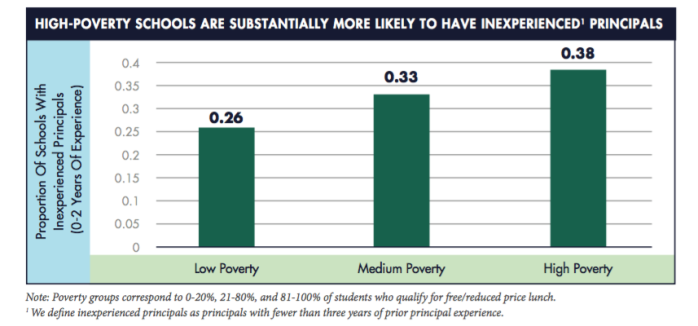
A new research brief from the Tennessee Education Research Alliance concluded that the lowest rated principals generally work at schools with the most economically disadvantaged students.


So schools serving students with the highest poverty and lowest test scores often have the least experienced and least effective principals.


thumbnail_Screen Shot 2019-02-08 at 11.27.32 AM


Now the first question I had when reading this report was “How do they measure effectiveness?” After all, if they rate principals primarily on student test scores, then obviously those working at the poorest schools will be least effective. Poor kids earn low test scores. That’s all the scores consistently show – the relative wealth of students’ parents. If you define an ineffective principal as one who works in a building with low scoring students, it would be no shock that those principals worked in the poorest schools.


However, researchers didn’t fall entirely into this trap. According to the working paper:


“We measure principal quality in two ways: years of experience in the principal position and rubric-based ratings of effective principal practice taken from the state’s evaluation system.”


In Tennessee this means evaluating principals partially on student test scores at their buildings – 35%, in fact – higher than the 20% of classroom teachers’ evaluations. However, the remaining pieces of principals’ effectiveness are determined by an observation from a more senior administrator (50%) and an agreed upon score by the principal and district (15%).


Since researchers are relying at least in part on the state’s evaluation system, they’re including student test scores in their own metric of whether principals are effective or not. However, since they add experience, they’ve actually created a more authentic and equitable measure than the one used by the state.


It just goes to show how standardized testing affects nearly every aspect of the public education system.


The testing industrial complex is like a black hole. Not only does it suck up funding that is desperately needed elsewhere without providing anything of real value in return, its enormous gravity subverts and distorts everything around it.


It’s no wonder then that so many principals at high poverty schools are motivated primarily by test scores, test prep, and test readiness. After all, it makes up a third of their own evaluations.


They’ve been dropped into difficult situations and made to feel that they were responsible for numerous factors beyond their control. They didn’t create the problem. They didn’t disadvantage these students, but they feel the need to prove to their bosses that they’re making positive change.


But how do you easily prove you’ve bettered the lives of students?


Once again, standardized test scores – a faux objective measurement of success.


Too many principals buy into the idea that if they can just make a difference on this one metric, it will demonstrate that they’re effective and thus deserve to be promoted out of the high poverty schools and into the well-resourced havens.


Yet it’s a game that few principals are able to win. Even those who do distinguish themselves in this way end up doing little more for their students than setting up a façade to hide the underlying problems of poverty and disinvestment.


Most principals at these schools wind up endlessly chasing their tails while ignoring opportunities for real positive change. Thus they end up renewing the self-fulfilling prophesy of failure.


Researchers noticed the pattern of low performing principals at high poverty schools after examining a decade’s worth of data and found it to hold true in urban, rural and suburban areas. And even though it is based on Tennessee data, the results hold true pretty consistently nationwide, researchers say.


Interestingly enough, the correlation doesn’t hold for teachers.


Jason Grissom, an associate professor at Vanderbilt University and the faculty director of the Research Alliance, says that the problem stems from issues related specifically to principals.


For instance, districts are hiring lower-rated principals for high poverty schools while saving their more effective leaders for buildings with greater wealth and resources.


thumbnail_Screen Shot 2019-02-08 at 11.28.20 AM


As a result, turnover rates for principals at these schools are much higher than those for classroom educators. Think about what that means – schools serving disadvantaged students are more likely to have new principal after new principal. These are leaders with little experience who never stick around long enough to learn from their mistakes.


And since these principals rarely have had the chance to learn on the job as assistant principals, they’re more likely to be flying by the seat of their pants when installed at the head of a school without first receiving the proper training and mentorship that principals at more privileged buildings routinely have.


As such, it’s easy for inexperienced principles to fall into the testing trap. They buy into the easy answers of the industry but haven’t been around long enough to learn that the solution they’re being sold is pure snake oil.


This has such a large effect because of how important principals are. Though they rarely teach their own classes, they have a huge impact on students. Out-of-school factors are ultimately more important, but in the school building, itself, only teachers are more vital.


This is because principals set the tone. They either create the environment where learning can flourish or smother it before the spark of curiosity can ignite. Not only that, but they create the work environment that draws and keeps the best teachers or sends them running for the hills.


The solution isn’t complicated, says Grissom. Districts need to work to place and keep effective and experienced principals in the most disadvantaged schools. This includes higher salaries and cash bonuses to entice the best leaders to those buildings. It also involves providing equitable resources for disadvantaged schools so that principals have the tools needed to make authentic positive change.


I would add that we also need to design fair evaluation systems for both principals and teachers that aren’t based on student test scores. We need to stop contracting out our assessments to corporations and trust our systems of government and schools to make equitable judgments about the people in their employ.


Ultimately, what’s required is a change in attitude.


Too many principals look at high poverty schools as a stepping stone to working at a school with endless resources and a different class of social issues. Instead, the goal of every excellent school leader should be to end their career working where they are needed most.


Such professionalism and experience would loosen the stranglehold of test-and-punish and allow our schools not to simply recreate the inequalities already present in our society. It would enable them to heal the divide.


As John Dewey wrote in 1916:


“Were all instructors to realize that the quality of mental process, not the production of correct answers, is the measure of educative growth, something hardly less than a revolution in teaching would be worked.”


And that’s what’s needed – a revolution.


Still can’t get enough Gadfly? I’ve written a book, “Gadfly on the Wall: A Public School Teacher Speaks Out on Racism and Reform,” now available from Garn Press. Ten percent of the proceeds go to the Badass Teachers Association. Check it out!

book-4

Pittsburgh Christian Academy Tries to Become a Charter School to Cash in on Taxpayer Funding

thumbnail_IMG_8528


The line between public and private school is getting awfully thin in Pittsburgh.


City public school directors received a request from Imani Christian Academy, a religious school in the East Hills, to be allowed to transform into Imani Academy Charter School for the Fall term of 2019.


Though parochial schools have metamorphosed into charter schools in Florida, Tennessee and Washington, D.C., this would be the first such transformation in Pennsylvania, according to Ana Meyers, executive director of the Pennsylvania Coalition of Public Charter Schools.


The change would require Imani to give up its religious curriculum in exchange for being fully funded by taxpayer dollars.


However, there are numerous red flags in the school’s application that make one wonder if operators are being entirely honest about giving up a faith-based curriculum.


First, there is the proposal by the school, itself.


The application does not specify that religious values will be taught in the classroom. However, its personnel budget lists a comparative religion teacher on staff. The list of proposed teachers also includes a middle/high school religious studies teacher.


That’s not exactly common practice at most public schools though teaching about religion in a secular context is allowed.


According to the Anti-defamation League’s Website:


“Public schools may not teach religion, although teaching about religion in a secular context is permitted. The Bible may be taught in a school, but only for its historical, cultural or literary value and never in a devotional, celebratory or doctrinal manner, or in such a way that encourages acceptance of the Bible as a religious document.”


Even so, it’s awfully convenient that a school whose mission statement currently includes “We share Christ with our children daily and seek to help them grow into mature Christians” would somehow magically become secular overnight.


If Imani’s charter is approved, it would be required to discontinue any religious component in its curriculum. The state school code requires even charter schools to be “nonsectarian in all operations.” The proposed academy would not be permitted to display any religious objects or symbols on the premises.


Yet one wonders who will check to make sure this actually happens.


Charter schools are not required to be nearly as transparent as fully public schools. They are not required to have open meetings of school directors, release their documents for public inspection or any of a host of other safeguards that you’ll find standard at the state’s hundreds of fully public districts.


Pennsylvania charter schools have had operators embezzle millions of dollars from taxpayers to buy private jets, apartments and jewelry. It took investigators years to uncover such graft.


Will the few auditors tasked with keeping charter schools honest even be equipped to determine whether parochial schools suddenly turned charter actually refrain from ministering to students?


According to Public Source, a nonprofit digital newspaper covering the Pittsburgh area, one of the qualities Imani is looking for in an operator for its charter school is the ability to use the school building after-school hours for religious instruction and activities.


So during the day, there will be an entirely secular K-12 school at the site of the present day parochial school that just happens to teach comparative religious studies. Then at a certain time of day, it will transform into an optional religious school offering church functions!?


This is a violation of the Separation of Church and State waiting to happen.


But it’s not only the establishment clause of the U.S. Constitution that is in danger of being trampled.


Imani’s proposal is not fiscally responsible.


The charter application proposes its CEO/head of school be paid a salary of $145,000 a year for an institution that would enroll merely 230 students.


Pittsburgh Public School Superintendent Dr. Anthony Hamlet earns a salary of $210,000 a year and he oversees a district with 24,652 students!


The proposed academy would also employ a principal at $85,000 annual salary.


That’s not exactly good reimbursement of services for the outlay of cash taxpayers are expected to pay.


Imani has struggled financially for several years.


In 2014, the school had more than $400,000 in additional expenses over its revenue, according to its form 990 filed with the IRS. The very next year, it had a budget surplus of almost the same amount. By 2016 – the most recent year on file – its expenses again were more than its revenue – this time by more than $500,000.


Imani CEO and Head of School Paulo Nzambi explained  the up and down budgeting to state officials in 2017 this way. The parochial school relied on the state’s defacto school voucher program – the Education Improvement Tax Credit. However, payments were delayed resulting in the use of a line of credit to pay bills.


It’s just such financial uncertainties that are pushing Imani to become a charter school in the first place. Even with school vouchers, parochial schools rely heavily on tuition from parents. However, you always know where the money is coming from in a charter school. Like religious and private schools, these institutions are privately managed – but like public schools they’re funded entirely by taxpayers.


Before setting up shop, any new charter school in Pennsylvania must get the approval of the school board from the district where it would be located. If the board does not approve the application, charter school administrators can appeal to the state Charter Appeals Board.


Pittsburgh school board held a public hearing on Imani’s application in December and earlier this month. Next, the district’s review team will offer its suggestions on the application. District solicitor Ira Weiss says the board is scheduled to vote on the matter at its Feb. 27 meeting.


If approved, the district would be required to pay for each student at the new charter school based on the district’s per-student spending formula.


The Pittsburgh district already pays approximately $82.8 million – about 13 percent of its total budget – for charter school tuition.


Imani Christian Academy currently operates out of the former East Hills Elementary School building, which it purchased from the city school district for $1 million in 2008.


The objections brought up here are really just the tip of the iceberg.


The proposal leaves many questions unanswered. For instance, though the new academy would be located within the geographical boundaries of the Pittsburgh Public School District, where would it get its students from? Would current students at the religious school get preferential enrollment – and what if they don’t already live in and pay taxes to Pittsburgh?


Let’s hope Pittsburgh school directors do the right thing and deny this request.


Still can’t get enough Gadfly? I’ve written a book, “Gadfly on the Wall: A Public School Teacher Speaks Out on Racism and Reform,” now available from Garn Press. Ten percent of the proceeds go to the Badass Teachers Association. Check it out!

thumbnail_IMG_8249


Ten of 15 Cyber Charter Schools in PA Are Operating Without a Charter – Close Them All

thumbnail_screen shot 2019-01-29 at 1.38.10 pm


Cyber charter schools are an experiment that failed.


It’s time to pull the plug and recoup our losses.


First, let’s get straight exactly what we’re talking about here.


Like all charter schools, these are contracted institutions. In fact, that’s what charter means – they’re independent businesses that sign a deal with the state to teach kids.


So they’re publicly financed but privately run. And in the case of cyber charters, they agree to educate children online without the benefit of a physical building.


Students access lessons via computer or other device, submit work electronically, get virtual feedback and assessment.


At best, these institutions are the grade school equivalent of the University of Phoenix – good only for independent, self-motivated learners. At worst, they’re the kiddie version of Trump University – a total scam.


In Pennsylvania, 10 of the state’s 15 cyber charter schools are operating with expired charters, according to a report by the Philadelphia Inquirer.


That’s incredibly significant – especially for an industry that enrolls about 35,000 students across the state.


These are charter schools operating without a charter. They only get the right to operate because a local school district or the state has signed a contract allowing them to do so.


If you hire a plumber to fix your toilet, you give him the right to enter your house and do what needs to be done. That doesn’t mean the plumber can walk in anytime he feels like it. There is a limited term of service. Once that term is up, the plumber needs to get out.


In the case of these cyber charters, the authorizer is the Pennsylvania Department of Education (PDE).


Charters are initially issued for three to five years. They are an essential contract between the schools and the supervisory body. The school details how it will operate, what curriculum and education strategies will be used, etc.


The state has the option to revoke the charter if the school violates its agreement or fails to meet requirements for student performance or fiscal management.


After the initial period, charters must be renewed every five years in the state.


Yet for the majority of the Keystone state’s cyber charter schools, this has not happened. The charter agreements have been left to lapse without any decision being made by state officials to renew or cancel them.


Some of the reluctance to decide may stem from the fact that the state Charter Appeal Board – the body which decides on appeals of charter applications – are all serving out expired terms, themselves.  They were all appointed by the previous governor, Republican Tom Corbett, a notable privatization ideologue.


The current Governor Tom Wolf, a Democrat now elected to his second term of office, still hasn’t gotten around to appointing new ones.


Another issue gumming up the works could be staffing issues at PDE that make it impossible to handle the reviews in a timely manner. It could be because the cyber charter schools have not provided all the data required of them by the state for the review to be completed on time. Or it could be because state officials are struggling with a fair and adequate metric with which to assess these schools.


CYBER CHARTER’S DISMAL ACADEMIC RECORD


To be frank, the latter option has to weigh heavily on state auditors. After all, it’s no secret that these schools are an educational disaster. On-line schools in Ohio, Georgia, Indiana, Nevada and New Mexico are all being closed by their respective states.


Study after study consistently shows that cyber charters are much less effective than traditional public schools – heck! They’re even less effective than brick and mortar charter schools!


A recent nationwide study by Stanford University found that cyber charters provide 180 days less of math instruction and 72 days less of reading instruction than traditional public schools.


Keep in mind that there are only 180 days in an average school year. So cyber charters provide less math instruction than not going to school at all.


The same study found that 88 percent of cyber charter schools have weaker academic growth than similar brick and mortar schools.


Student-to-teacher ratios average about 30:1 in online charters, compared to 20:1 for brick and mortar charters and 17:1 for traditional public schools.


Researchers concluded that these schools have an “overwhelming negative impact” on students.


And these results were duplicated almost exactly by subsequent studies from Penn State University in 2016 (enrolling a student in a Pennsylvania cyber charter school is equal to “roughly 90 fewer days of learning in reading and nearly 180 fewer days of learning in math”) and the National Education Policy Center in 2017 (cyber charters “performed significantly worse than feeder schools in both reading and math”).


Even the state’s own data shows lower graduation rates and standardized test scores at cyber charters than at traditional public schools.


According to a 2015-16 state PDE report, about 86 percent of public school students across the Commonwealth finished high school in four years. During the same time, only about 48 percent of cyber charter school students graduated in four-years.

CYBER CHARTER’S COST TOO MUCH


But providing such a poor service to Pennsylvania students is only one reason these schools are problematic. They’re also ruinously expensive.


They cost taxpayers more than $463 million in 2016-17 alone.


The state charter law grants these schools as much money per pupil as brick and mortar schools, yet their costs are much less having forgone a physical building and all that goes with it.


So cyber charters get whatever the local per-pupil expenditure is. It doesn’t matter if a district spends $8,000 on each student or $20,000. Whatever the amount, that goes to the cyber charter.


However, the cost of educating kids is drastically reduced online. Their programs are bare bones compared with what you get at a traditional public school. Most online charters don’t have tutors or teacher aides. They don’t offer band, chorus or extra-curricular activities. You don’t have to pay for any building costs, grounds, upkeep, large staff, etc. But the funding formula ignores this completely. Cyber charters get to keep the difference – whatever it is. In fact, they have an incentive to keep as much as possible because they can do almost whatever they want with it. That includes putting it into operators’ pockets as profit!


And when it comes to special education funding, it gets worse. In Pennsylvania, our funding formula is so out of whack that charters schools of all stripes including cyber charters often end up with more funding for students with special needs than traditional public schools get. However, because of this loophole in the Commonwealth, Pennsylvania online charters have been increasing the number of special education students they enroll and even working to label as many of their students as possible as needing special services on the flimsiest of pretexts.


According to a report by the Pennsylvania Association of School Administrators (PASA), tuition for special education students is often twice as much at cyber charter schools than at traditional public schools.


CYBER CHARTER FRAUD


Unsurprisingly, these conditions have lead to rampant fraud and malfeasance.


Just this past year (2018) the head of the largest cyber charter chain in the state was sentenced to jail for siphoning $8 million from his school into his own pockets.


PA Cyber Charter founder Nicholas Trombetta was found guilty of tax fraud in relation to the theft of public funds. He used that money to buy an airplane, a $900,000 condo, houses for his girlfriend and mother, and nearly $1 million in groceries and personal expenses, according to the grand jury. Trombetta allegedly set up numerous for-profit and nonprofit businesses to provide goods and services to the cyber charter. Federal investigators filed 11 fraud and tax conspiracy charges against him and indicted others in the case.


Another cyber charter founder, June Brown, was also indicted for theft of $6.5 million. Brown ran the Agora Cyber Charter School, which was part of the K12 Inc. empire of virtual charters. She and her executives were indicted on 62 counts of wire fraud, obstruction of justice and witness tampering. She was well known for student test scores and had a reputation for claiming large salaries and filing suits against parents who questioned her, the Philadelphia Inquirer reports.


WHAT TO DO ABOUT IT


It’s no wonder the state has been tardy renewing these schools’ charters!


Frankly, there is no good reason to continue lavishing taxpayer dollars on a system of education that provides  subpar services at an exorbitant expense and is subject to runaway fraud.


But lawmakers have always been reluctant to do the right thing.


After all, there are a slew of wealthy investors who want to make sure the money train of taxpayer dollars keeps flowing to their shady businesses. And lawmakers who enable them are assured hefty campaign contributions.


The only chance we have of saving our children from this monstrous abuse of power and saving our wallets from this shameful waste of funding is if voters make their intentions known.


The people of Pennsylvania need to stand up and demand an end to the cyber charter school experiment.


We need lawmakers with the guts to stand up to big money and rewrite the state’s charter school law.


And that’s part of the problem. The law is a joke.


It’s more than 20 years old and was only amended once in 2002 to allow cyber charters.


Subsequent attempts at requiring more accountability have resulted in horrible compromise bills that would have made the situation much worse and – ultimately – no vote.


With Ohio and California, Pennsylvania was in the “big three” cyber-charter states in 2016, accounting for half of cyber charter enrollment nationally, according to the industry’s authorizers’ association. While 35 states and the District of Columbia allow full-time cyber charter schools, eight do not, including neighboring New Jersey.


The right course is clear.


We just need a people-powered movement to force our lawmakers to do it.


Either that or replace them with those who will.


Still can’t get enough Gadfly? I’ve written a book, “Gadfly on the Wall: A Public School Teacher Speaks Out on Racism and Reform,” now available from Garn Press. Ten percent of the proceeds go to the Badass Teachers Association. Check it out!

cropped-book-1.jpg

Teaching Through Lockdown

gettyimages-88519594-640x640


“Excuse the interruption. We are under a lockdown.”


That was it.


Not an explanation of what caused it.


Not any idea of how much danger we were in.


Not any idea of how long it would last.


Just a vague warning that teachers knew meant to keep all their students in class until further notice.


As an educator, you’re expected to teach.


It doesn’t matter what’s happening around you. There can be yelling or screaming. There can be a scuffle in the next room. The lights may flicker off and on.


None of that matters.


If you have students and aren’t in immediate danger, you’re expected to teach them.


And that’s what I did. Even then.


I teach mostly poor and minority students in a western Pennsylvania school near Pittsburgh.


My 8th grade language arts class was in the middle of taking a final exam on The Outsiders by S. E. Hinton.


Most of my students were finished, but it was still quiet as two or three students struggled through their last responses.


Then the announcement came over the PA.


“…lockdown.”


The voice was the high school secretary. Since the middle and high school are connected, she rarely makes announcements in my building – only when something is important happening for both buildings.


The kids looked up at me with worried faces.


“What’s going on, Mr. Singer?” one of them asked.


I told them the truth – I really had no idea. There were no drills planned for today. In fact, it would have been a really poor time for one. We had just had ALICE training the day before where the resource officer and the principal had met with students to go over what to do in case of an active shooter. The program is named for the courses of actions it recommends – Alert, Lockdown, Inform, Counter, Evacuate.


So we were apparently in the L.


During the assembly, the resource officer had said quite bluntly that there would be no coded messages. If a school shooter entered the building, officials would tell us in plain language what was happening so we could make an informed decision what to do.


But there was no additional message over the PA. That was it.


I went over to my computer to see if there was an email. Nope. Nothing.


I pressed refresh a few times. Nothing.


I asked the students to hush and just listened.


It was extremely quiet. Even the hallway was silent and it’s never that silent except during standardized testing.


My room has no windows to the outside. It’s a brick box with one wooden door containing a sliver of window.


The door was already closed and locked. We’re told to keep it that way just in case. But there’s an additional deadbolt you can click to make it even harder to gain access to the room.


“It’s probably nothing,” I said as I walked over to the door and surreptitiously clicked the deadbolt.


I asked student to finish their tests.


It seemed the best course of action. We could either worry about an unknown that was extremely unlikely or else just take care of our business.


It was hard getting the students to calm down. They were scared, and, frankly, so was I.


But this seemed the best thing we could do – Seek normalcy but stay vigilant in case things changed.


“Mr. Singer, may I use the bathroom?” asked one child.


“I’m sorry, but no.” I said. “Not until the lockdown is over.”


Somehow I quieted them down and the remaining students finished their tests.


It seemed to take them forever.


I stood by those who were finalizing answers in the hope that my physical presence would get them to concentrate.


For the millionth time I pondered the wisdom of grouping kids into classes based on test scores. All you end up doing is sorting them by poverty, race, trauma and behavior problems.


But they were soon done.


So they handed in the tests and we went over the answers.


“May I use the bathroom?”


“No. Not yet. Sorry.”


For about five minutes things went as they would on any other day.


But as soon as there was a lull in the activity, the fear and worry returned.


Students wanted to take out their cell phones and call or text home.


I told them not to.


“Why?” asked a boy in the front.


I knew the answer. We had nothing we could tell parents other than that there was a lockdown. We didn’t know what caused it or what was happening. If there was something bad going on, having parents come to the school would only make things worse.


But I just told him to put it away. I didn’t want to debate the situation. I didn’t want them (or me) to think about what might be happening.


We hadn’t finished watching the movie version of “The Outsiders” so I quickly put that on.


We only had about 15 minutes to go. And watching Dally get shot down by police probably wasn’t the best choice under the circumstances.


Still, the kids were focused on the film and not the lockdown.


We discussed how the movie and the book differed for a few moments.


But inevitably there was a lull.


We all got quiet and just listened. Nothing.


No. Down the hall we could hear something. Maybe a scuffle. Voices. It was hard to tell.


I started thinking of options, what to do if someone tried to enter the room. But it got quiet again.


Still no email. No message. Nothing.


I could call the office on my school phone, but that just might make things worse.


“Mr. Singer, I’ve GOT to use the bathroom!”


I looked around. I wasn’t sure what to do. I couldn’t let him out there. It would literally be better if he peed his pants.


He must have seen my confusion. “Can I just pee in a bottle or something?”


“Do you have a bottle?”


“No.”


I was about to tell him to take the garbage can into the corner and pee into it but there was no empty corner in the room.


Before I could remark any further, he said, “It’s okay. I’ll just hold it.”


That’s when I noticed the time. We had already spent more than the 40 minutes in the allotted period. The bell should have rung to get students to move to another room. That meant the bells were off.


The students noticed, too.


I kept telling them that everything was probably fine and that I wouldn’t let anything happen to them.


Then we noticed something weird out of the window in the door.


One of the school custodians was standing right outside the room.


He didn’t seem alarmed. He appeared to be looking for something.


Then another custodian walked up to him and they conferred in the hall.


We heard talking. Perhaps the principal in the distance.


Whatever was happening they seemed to have it under control and didn’t appear worried.


I had nothing planned for my students to do. We were well off book here. I couldn’t just start a new unit. I had no idea how long we’d be here.


So I asked them to take out their self-selected books and read.


They groaned.


“How are we going to concentrate on that?” someone asked.


I didn’t really have an answer but it was better to try than to worry needlessly.


So after some cajoling, they dutifully took their books out. Most just stared around the room listening to every nonexistent sound. But some at least appeared to be reading.


“Mr. Singer…”


NO YOU CAN’T USE THE BATHROOM!


Then not long after, the announcement came that the lockdown was over and students could move to their next class.


There was no explanation. Kids just breathed a collective sigh and went to their classes.


I let anyone use the restroom who asked. And I tried to teach through another class.


I truly expected a printed letter from the superintendent to be hand delivered to the room so the kids could take it home. But no. Perhaps there hadn’t been enough time to write, print and disperse one.


After the students were dismissed, I expected administrators to announce a staff meeting to let the teachers know, at least, what had happened. But there was nothing.


I went into another teacher’s room and saw a group talking. THAT was when I found out about what had happened.


A group of students in the high school had been fighting.


Apparently it was pretty bad – almost a riot. One child had been knocked cold and taken out of the building on a stretcher. The others had been removed by police.


When teachers had broken it up, some of the kids had run and were hiding in the building. That’s why the lockdown.


There was more on the 11 O’clock News. Some of the kids had filmed the fight with their phones and put it up on Snapchat.


We eventually got a letter from the superintendent and an email from another administrator saying that it had just been a minor fight.


Parents were on the news saying that administration hadn’t handled it properly, but no one showed up at the next school board meeting to complain.


And so life goes on.


The threat of violence always hangs over our heads.


It probably won’t ever come down to the worst case scenario. Yet the fact that it might and that no one really seems to be doing much of anything to stop it from getting to that point – that changes what it means to be in school.


We live with this reality everyday now.


It’s not fair to students. It’s not fair to teachers or parents.


But when you live in a society so broken that it can’t even begin to address its own problems, this is what you get.


Still can’t get enough Gadfly? I’ve written a book, “Gadfly on the Wall: A Public School Teacher Speaks Out on Racism and Reform,” now available from Garn Press. Ten percent of the proceeds go to the Badass Teachers Association. Check it out!

book-3