Pennsylvania Law Meant to Forbid Arming Teachers May Have Done Just the Opposite

TNZWTTHKKNGUNMYFEENTOEFBME


Pennsylvania teachers, don’t forget to pack your Glock when returning to school this year.


A new law meant to close the door on arming teachers may have cracked it open.


Despite warnings from gun safety activists, the bill, SB 621, was approved by the legislature and signed into law by Gov. Tom Wolf this summer.


The legislation explicitly allows security guards – independent contractors who are not members of law enforcement – to carry guns in schools if they go through special training.


And that’s bad enough.


Why you’d want glorified rent-a-cops with guns strapped to their hips running around schools full of children is beyond me.


That’s not going to make anyone safer. It’s going to do just the opposite.


But that’s not even the worst of it.


Commonwealth law already allowed for armed police and school resource officers in school buildings.


The new bill just adds security guards to the accepted list – so long as they go through special training.


So some observers are asking what happens if teachers and administrators go through the same training? Wouldn’t they then qualify as “security personnel” and thus be eligible to be armed as part of their jobs?


Some say yes.


But others go even farther.


The bill only says who may be armed in schools. It doesn’t say anything about who may not be armed.


So if a district were to arm teachers – even without that special security guard training – it wouldn’t be specifically breaking the law. It would be operating in a huge loophole left open by the legislature and Gov. Wolf.


In fact, the original version of the bill would have covered just such an ambiguity. It included language saying that ONLY the people specifically mentioned in the law (police, resource officers and security guards) were allowed to be armed. However, Wolf could not get legislators to agree on it, so this language was stripped from the bill that was eventually passed.


This isn’t just theoretical.


Several school administrators have already taken advantage of it.

A handful of superintendents in rural parts of the state have already gotten permission from country law enforcement officials and are now carrying guns to school, according to a lawyer representing 50 Commonwealth districts.


Attorney Ronald Repak, of Altoona-based Beard Legal Group, gave a presentation at a school safety conference saying that his firm had secured permission from local district attorneys for administrators to carry firearms as part of their jobs. They cited ambiguity in the law that allowed for different interpretations.


Repak said that fewer than six superintendents had been approved, but he would not say which ones or which districts employed them.


Meanwhile, a district in the eastern part of the state between Hershey and Allentown has already passed a policy to arm teachers and staff.


Tamaqua Area School District in Schuylkill County, approved the policy last year but suspended it following litigation from the teachers association and a parent group.


Since Harrisburg passed this new measure, school board members and administration have been going back and forth about how it pertains to their policy and whether they can legally reinstate it even with pending litigation.

 
SB 621 was supposed to fix the ambiguity of previous statutes on the matter.


Title 18, Section 912 of the Pa. Crimes Code says that no one except recognized security personnel may bring a weapon onto school grounds, unless it is for a supervised school activity or “other lawful purpose.”


But again that leaves a huge loophole.


Secretary of Education Pedro Rivera wrote in 2016 that the Pennsylvania Department of Education considers “the scope of ‘lawful purpose’…unclear and unsettled.”


That’s what originally prompted Tamaqua school directors to pass their policy to arm teachers – the first of its kind in the state.


The Republican majority in the legislature has been trying to pass a law explicitly allowing teachers to be armed for years.


In June of 2017, the state Senate even passed just such a bill but it got nowhere in the House. Moreover, Gov. Wolf threatened to veto it.


And that has been the pattern in Harrisburg on most matters – a gerrymandered GOP-controlled legislature narrowly passing far right legislation checked by a popularly elected Democratic governor.


However, Republicans may have gotten one passed the goal with SB 621.


Wolf had hoped the bill would end the matter once and for all. When he signed it into law, he released a statement saying:


“The students, parents, and educators in this commonwealth can now be secure in the knowledge that teachers can dedicate themselves to teaching our children, and that the security of school facilities rests in the hands of trained, professional security personnel.”


Ceasefire Pennsylvania, a statewide gun safety organization, saw the danger and warned against it. The organization urged the legislature not to pass the bill and the governor not to sign it.


In a letter sent to lawmakers, the group wrote:


“…adding security personnel who do not have the same law enforcement background, training and experience of those personnel already authorized to serve as school security in the School Code is misguided.

[In addition] …although we understand that the legislation initially was intended only to address security personnel, we believe SB 621 could be manipulated by school districts intent on arming teachers as a ‘security’ measure… We hope you will Vote No on SB 621.”

 
The matter is bound to wind up in the courts where it will ultimately be decided.

 
Concerned citizens should probably go to their local school board and let directors know they don’t want school personnel – security guards or others – packing heat.


To be clear, the new bill doesn’t require security guards to be armed, but it does allow districts to arm them if they go through the necessary training.


The instruction outlined in the law required before guards can be armed costs less than $500 per person.


It includes lessons on developing relationships with diverse students, understanding special needs students, how to deal with violence, victimization, threat response and the prevention of violence in schools. It also includes Act 235 lethal weapons training on specifically how to carry and use lethal weapons.


Some legislators wanted security guards to have to go through the same training as police officers – a 900-hour municipal course. However, since this would include instruction school security officers would not need such as lessons on traffic laws and the vehicle code – not to mention its hefty cost of $9,000 per person – it was scrapped.


Don’t get me wrong. I have nothing against security guards. There are several good ones at my district.


However, putting guns in their hands doesn’t make me feel any safer.


A few years ago, a security guard at my school lost his job because he slammed one of my students into a lunch table.


The child in question was certainly difficult and could be defiant. But he was a middle school age child. He didn’t deserve to have his head slammed into a table – nor would I want someone with so little impulse control to have to police his trigger finger during tense confrontations with students.


Arming security guards is just plain dumb. Heck! So is arming teachers and administrators!


This isn’t the wild west. It’s a classroom.


In real-world shootings, police officers miss their targets about 4-in-5 shots, according to Dr. Peter Langman, a psychologist who’s studied school shootings. Do you really expect rent-a-cops and teachers to be more accurate?


Even armed police don’t do much to stop school shootings.


The four high-profile school shootings in 2018 — including the one in Parkland, Florida and Santa Fe, Texas — had armed guards. All failed to stop the gunmen.


But research consistently shows that increasing the number of guns in schools increases the likelihood that students will get hold of them.


What we need are sensible gun regulations to limit the number of people who have access to firearms. We need mandatory background checks and a ban on assault weapons – the murder instrument of choice for mass shooters. We need buy back programs to reduce the ridiculous numbers of guns available.


This new law does none of that. It was a Faustian bargain at best – and like always happens when you try to best the Devil, you end up losing.


Only this time, the losers are our teachers and school children.


Like this post? I’ve written a book, “Gadfly on the Wall: A Public School Teacher Speaks Out on Racism and Reform,” now available from Garn Press. Ten percent of the proceeds go to the Badass Teachers Association. Check it out!

book-4

The Welcome Back Letter I’d Love to Give My Students – But Can’t

high-school-teacher-gives-student-a-high-five-893988494-5a72007bba61770037b681bf

 
I’m a very lucky guy.


I get to teach language arts in an amazing urban middle school in Western Pennsylvania.


I have reasonable autonomy, opportunities to collaborate with my co-workers and strong union protections.


Even so, I know there are a lot of teachers out there who don’t have those things.


Yet even after counting all my blessings, I still can’t do whatever I want. I can’t even do everything that my years of academic training and experience tells me would be best for my students.


Every year I’m told that my worth as a professional is mainly defined by student test scores – that I should use those scores to drive my entire class, that my major goal should be increasing the scores and my every waking moment should be spent examining past scores.

 
Every year I have to watch out for this data metric and do that much more work because my district has lost even more funding to the vampire charter school in our neighborhood. Or lawmakers have compromised away another several hours of my time to do meaningless paperwork – time that I either have to take away from my students or my family.


I see all this and I just want to scream.


I want to tell everyone what’s happening so that they can help stop the madness.


And I do scream into the whirl of cyberspace on my blog.


But I can’t do the same in my district. I can’t tell those right in front of me – my school board, my administrators, the parents or students.


Doing so would put everything I do have in jeopardy.


I know this because it already has.


Every year on the first day of school, I give my students a welcome letter.

 
This is the kind of letter I’d love to give them – but don’t dare:


Dear Students,


In a matter of weeks you will be invited back to school and I wanted to let you in on a little secret.


We missed you.


That’s right. Your teachers missed the heck out of you over the summer.


Don’t get me wrong. We enjoyed our time at home with our own children, time on vacation, time spent continuing to refine our craft, and/or time spent working another job. (Hey! Those extra pencils, papers, books and supplies aren’t going to buy themselves! Right?)


Here’s another little secret – your teachers come to school every day not because we have to, but because we want to.


We literally could do anything else with our lives but we’ve devoted our time to you.


Why? Because we love you.


I know that’s mushy talk, but it’s true.


Another secret: We know you’re nervous about your first day back. But – heck – so are we!


Don’t forget you’re young. We’re old!


We know you’re wondering who your teachers will be this year, what they’ll require you to do, which friends will be in your classes, who will sit with you at lunch…


We wonder if we’re still going to be able to do all the things we need to do to help you learn? Are we going to be able to provide a safe, secure environment for you? Will we be able to keep you engaged, and excited to learn? Will we be able to actually teach everything you want and need to know?


This is going to be a challenging year for all of us.


But that’s a good thing.


We’re in this together.


That’s kind of an important point.


You see, we know you’ll probably be asked to take high stakes standardized tests. Just know that it’s not us who’s asking. It’s the state and federal government. Lawmakers seem to think that your answers on multiple choice tests are very, very important.


Another secret: they aren’t.


We don’t care how you score on these tests. Not really. We don’t even care if you take them at all – and if your parents decide not to have you sit through this garbage, we will honor their wishes, because they are the ultimate authority on you – their children.


We know that standardized tests don’t assess how much you learn. The tests your teachers make do that – the work that you do in class every day shows it better than any canned corporate exam.


We know those scores don’t define who you are. We see you every day. We see your creativity, your intelligence, your fire, your verve, your passion.


We want to stoke that fire and help you become the people you always wanted to be.


And none of that can be shown on a standardized test.


THAT’S our job – not to turn you into great test takers but into the kind of people you most want to be.


Oh. By the way, please thank your parents for us.


Thank them for ignoring the hype about the flashy charter school that hedge fund managers opened on the hill – the school sucking up our funding, cutting services for students and making its investors very rich.


Thank them for declining the shiny school voucher to Pastor Dan’s Creationism, Anti-vaxxor, Climate Denial Academy. Thank them for passing up the tax rebate to Ivy Laurel Prep – where the rich white kids go.

 
Thank them for trusting us with the most precious things in their lives – you.


You really mean a lot to all of us.


So rest up and try to have fun for the remainder of your summer. We’ll do the same.


And before you know it, we’ll be back together in class expanding minds, expressing hearts and having a great time!


Love you all!


Your Teachers


That’s the kind of welcome back letter I would love to give my students – but can’t.


It was partially inspired by a REAL welcome back letter given by a New York Superintendent.

 
Around this time last year, he gave it to 11 principals and about 600 teachers in the
Patchogue-Medford School District before someone posted it online and it went viral.


His audience was teachers, but his message was the same:


Aug. 14, 2018


Dear….


Once again… this letter is too let you know I DO NOT CARE what your state growth score is. Let me be clear… I DO NOT CARE. It does not define you. You are more than a score. I’m hoping you know by now that the children and parents you serve appreciate your talents and the ability to make a difference in their lives. Keep your head up and your eye on what is most important… your students and your teaching craft.


The Patchogue-Medford School District fully supports you as an educator, regardless of what this meaningless, invalid and inhumane score states. You have my permission to throw it out, or use it for any creative ways you may think of. I have a feeling divergent thinking will be at an all-time high at Pat-Med. Let me know if you need anything and it is my sincere hope you have an outstanding year.


With Warmest Regards,


Michael J. Hynes, Ed. D.
Superintendent of Schools


image

38014006_10156079233558860_7115622694678167552_n

 
Cheers to Superintendent Hynes!


If only every teacher, administrator and school board member could be that brave and honest!

 
Here’s another letter given to year six students at Barrowford Primary School in Lancashire, England, along with their results from a recent standardized exam:


“Please find enclosed your end of KS2 test results. We are very proud of you as you demonstrated huge amounts of commitment and tried your very best during this tricky week.


However, we are concerned that these tests do not always assess all of what it is that make each of you special and unique. The people who create these tests and score them do not know each of you- the way your teachers do, the way I hope to, and certainly not the way your families do.


They do not know that many of you speak two languages. They do not know that you can play a musical instrument or that you can dance or paint a picture. They do not know that your friends count on you to be there for them or that your laughter can brighten the dreariest day.


They do not know that you write poetry or songs, play or participate in sports, wonder about the future, or that sometimes you take care of your little brother or sister after school.


They do not know that you have traveled to a really neat place or that you know how to tell a great story or that you really love spending time with special family members and friends.


They do not know that you can be trustworthy, kind or thoughtful, and that you try, every day, to be your very best… the scores you get will tell you something, but they will not tell you everything.


So enjoy your results and be very proud of these but remember there are many ways of being smart.”


BskDhaPIYAAMdpd


Here’s another one to parents from a principal in Singapore:


“The exams of your child are to start soon. I know you are all really anxious for your child to do well.


But, please do remember, amongst the students who will be sitting for the exams there is an artist, who doesn’t need to understand Math… There is an entrepreneur, who doesn’t care about History or English literature…There is a musician, whose Chemistry marks won’t matter…There’s an athlete…whose physical fitness is more important than Physics… If your child does get top marks, that’s great! But if he or she doesn’t…please don’t take away their self-confidence and dignity from them. Tell them it’s OK, its just an exam! They are cut out for much bigger things in life. Tell them, no matter what they score…you love them and will not judge them.


Please do this, and when you do… watch your children conquer the world. One exam or low mark won’t take away…their dreams and talent. And please, do not think that doctors and engineers…are the only happy people in the world.”

PrincipalsLetterToParents

 
If teachers and principals were allowed to speak freely, I bet there’d be a lot more of these kinds of letters.


School should not be centered on testing and test scores. It should be centered on students.


Like this post? I’ve written a book, “Gadfly on the Wall: A Public School Teacher Speaks Out on Racism and Reform,” now available from Garn Press. Ten percent of the proceeds go to the Badass Teachers Association. Check it out!

book-2

America’s New School Lunch Policy: Punishing Hungry Students for Their Parents’ Poverty

170510-lunch-shaming

 
There are few things as bad as a hungry child.


Hunched over an aching stomach as the school day creeps toward its end, one in six children go hungry in America today.


It’s harder to learn when you’re malnourished and in pain – especially for children.


It should be harder for adults to let them go hungry.


Yet for many policymakers, nothing is as bad as feeding children and letting their parents avoid the bill.


About 75% of US school districts report students who end the year owing large sums for lunches, according to the School Nutrition Association. And of those districts, 40.2% said the number of students without adequate funds increased last school year.


In fact, that has become the central issue – not child hunger but lunch debt.


Policymakers at the federal, state and school district level are finding new ways to force impoverished parents to pay for their children’s meals even if doing so means penalizing the children.

 
Just yesterday the Trump administration announced a plan to tighten eligibility requirements for the Supplemental Nutrition Assistance Program (SNAP) that could result in hundreds of thousands of the poorest children losing automatic eligibility for free school lunches.


In my home state of Pennsylvania, a district made headlines by threatening to send kids to foster care if their parents didn’t pay up.


The state legislature even voted in June to reinstate lunch shaming – the practice of denying lunch or providing low-cost meals to students with unpaid lunch bills.

 
That is how America treats its children.


Progressive Approaches and Challenges


Throughout the country, students whose families meet federal income guidelines can receive free or discounted lunches. However, many families don’t know how to apply to the program or that they can do so at any point in the school year. Moreover, districts can minimize debt if they help families enroll.


Unfortunately, too many school administrators are opting on coercion and threats instead of help.


In the poorest districts, a federal program called community eligibility has been providing relief.


When 40 percent of children in a district or school qualify for free or reduced meals, the federal government steps in to provide free breakfasts and lunches to all students in the district or school regardless of parental income.


It’s an enormously successful program that avoids the pitfalls of penalizing or shaming students for their economic circumstances.


But it’s exactly what’s come under fire by the Trump administration.


The Department of Agriculture’s new proposed limits on which students should qualify for free meals could change the status of 265,000 children. This would cause a chain reaction at many districts making them unqualified for community eligibility.


It would literally take away free meals from whole neighborhoods of youngsters.


The Agriculture Department will accept public comments on the proposed rule, called revision of categorical eligibility in the SNAP, for 60 days.

 
This measure is exactly the opposite of what’s being proposed by the most progressive Democratic challenger to Trump – Vermont Senator Bernie Sanders.


Instead of reducing the numbers of children who can get free meals, Sanders wants to increase the numbers to include everyone.


As part of his Thurgood Marshall Plan, the lawmaker seeking the Democratic nomination for President promises to enact a federal program to feed all students year-round.


This means free breakfast, lunch and even snacks. The program would be open to every child, regardless of parental wealth.


No one would be shamed because they are the only ones eligible for these free meals, and we wouldn’t be stuck wondering why needy kids have difficulty learning on an empty stomach.


Providing school meals, even at cost, is a losing proposition. The price of unpaid lunches and the cost to complete mountains of paperwork involved in collecting the money is put on the backs of local taxpayers.

 
Sanders is offering a truly humane approach to the problem that would eliminate administrative threats and even bolster district budgets.


This is how good government responds to the needs of its citizens – not by terrifying and degrading parents and children due to economic hardships.


And it flies in the face of nearly every other measure offered to deal with the problem.


Regressive Policies


One of the worst offenders is Wyoming Valley West School District in Pennsylvania.


Though one of the poorest in the state as measured by per-pupil spending, administrators sent letters to dozens of families demanding they pay their children’s school lunch debt or their kids could be taken away on the basis of neglect.

 
The former coal mining community fed poor children but felt bad about it. School administrators were so incensed that these kids parents didn’t pay, they resorted to fear and intimidation to get the money owed.


Children can’t control whether their parents can pay their bills. But that didn’t stop administrators from taking out their disdain for impoverished parents on these youngsters.


In the Valley district, parents had run up approximately $22,000 in breakfast and lunch debt. This is a fraction of the school district’s $80 million annual budget and could have been reduced had administrators concentrated on helping parents navigate the system.


Instead they simply demanded parents pay – or else.


After sending mailers, robocalls, personal calls and letters to families, administrators took more drastic measures.


About 40 families whose children owed $10 or more were sent a letter signed by Joseph Muth, director of federal programs for the district, which said:


“Your child has been sent to school every day without money and without a breakfast and/or lunch. This is a failure to provide your child with proper nutrition and you can be sent to Dependency Court for neglecting your child’s right to food. If you are taken to Dependency court, the result may be your child being removed from your home and placed in foster care.”


When the story hit the national media, experts from across the country weighed in that this was a bogus claim. Parents cannot have their children taken away because they can’t pay for school lunches.


And district officials have apologized and vowed not to make these kinds of threats in the future.


Perhaps the best news is that the district’s increasing poverty has qualified it to take part in community eligibility in the Fall.


All students would get free meals regardless of their parents income – unless, of course, the Trump administration’s new SNAP eligibility goes into place.


In that case, the district could continue to twist parents arms in a futile attempt to get blood from a stone.


State Dysfunction

 
But don’t look for help from Harrisburg.

 
In June the state legislature voted on annual revisions to its school code which brought back lunch shaming.


Now districts that aren’t poor enough for community eligibility will be able to deny lunches to students who can’t pay or provide them a lower quality meal until parents settle any lunch debts.


It’s a surprising about-face from a legislature who only two years ago voted to end this policy. Now lawmakers are going back to it.


Why?


Republicans are claiming this is a solution to districts racking up thousands of dollars in lunch debt. Democrats are claiming ignorance.


Many state representatives and state senators are saying they didn’t read the full bill before voting on it.


Lawmakers are actually saying they were surprised that lunch shaming was back. Yet it was many of these same lawmakers who voted for the omnibus bill that reinstates it.

 
The only difference between the old lunch shaming bill and the new one is the threshold for inclusion. The old measure allowed schools to provide “alternative meals” to children with $25 or more in unpaid lunch bills. The new measure inserted into the school code allows alternative meals for students who owe $50 or more. Students could be fed these lower quality meals until the balance is paid or until their parents agree to a repayment plan.


The Shame of a Nation


Stories about student lunch debt have been all over the news.


Yogurt company Chobani paid off a large chunk of a Rhode Island districts $77,000 lunch debt in May after administrators threatened to feed kids sunflower seed butter and jelly sandwiches until their debt was paid.


The same month a New Hampshire lunchroom employee was fired for letting a student take food without paying. The employee said the student owed $8 and she was confident the child would eventually pay her back.


A Minnesota high school even tried to stop students with lunch debt from attending graduation.


Will America continue to prioritize late-stage capitalism over ethical treatment of children?


Or will we rise up to the level of our ideals?


That has been the challenge for this country since its founding.


And the answer is far from assured.


Like this post? I’ve written a book, “Gadfly on the Wall: A Public School Teacher Speaks Out on Racism and Reform,” now available from Garn Press. Ten percent of the proceeds go to the Badass Teachers Association. Check it out!

book-4

Student Test Scores May Play a Smaller Role in Future PA Teacher Evaluations

Group Of Elementary Age Children In Art Class With Teacher


Pennsylvania lawmakers may have finally realized that treating teachers like crap isn’t a good way to improve public schools.


Across the country it’s getting harder to fill teaching positions with qualified educators. And that’s because of the way we treat the people who volunteer to educate the next generation.


You can’t raise expectations while taking away resources, union protections, and fair ways to evaluate their work.


And to his credit, state Sen. Ryan Aument seems to have finally seen the light.


In 2012, the Republican from Lancaster County was one of the leading proponents of the Commonwealth’s new teacher evaluation system which drastically increased the amount student test scores are used to assess educators.


But now Aument and other Republicans are proposing new legislation to cut back on these same measures.


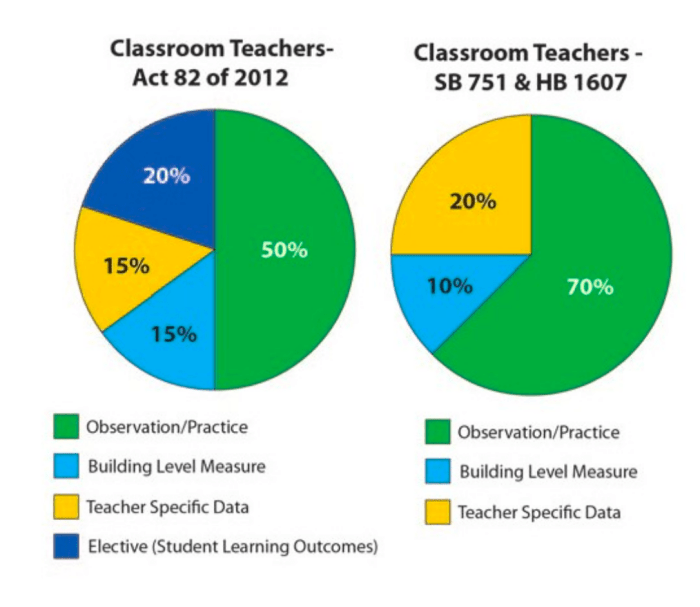
Under the current system, only 50 percent of state teachers annual evaluations come from observations of what they actually do in the classroom. The rest comes from student test scores and other factors that are out of their control.


The proposed legislation would increase teacher observations to 70 percent of their evaluations and try to account for student poverty – in addition to student test scores – in the remaining 30 percent.


If passed, the new evaluation system would begin in the 2021-22 school year.


Screen Shot 2019-07-19 at 12.17.23 AM
Source: PSEA

The proposed legislation – Senate Bill 751passed in the Senate by a vote of 38-11.


However, the identical House Bill 1607 proposed by Rep. Jesse Topper (R-Bedford County) was not considered in time before the legislative session ended. It is expected to come up for a vote in the fall.


J.J. Abbott, a spokesperson for Democratic Gov. Tom Wolf, said that the governor generally supports the proposal. It has also been endorsed by the Pennsylvania State Education Association (PSEA) and the Pennsylvania Association of School Administrators (PASA).


Each year teachers are judged either Distinguished, Proficient, Needs Improvement or Failing. The first two are passing scores. The last two are not and require teachers to be more closely monitored, more frequently evaluated, complete a performance improvement plan and if improvements are not made, they can be fired.


If approved, the new bill would shorten the window when teachers are penalized for bad evaluations.


Under the current system, teachers who get two “Needs Improvement” ratings in 10 years can be sacked. The new bill shortens that period to four years. This incentivizes improvement and doesn’t hold a bad evaluation over a teacher’s head for a decade.


Moreover, the current law only allows principals to judge a very small percentage of their staff as Distinguished – the top of the scale. The proposed law puts no cap on this allowing them to give more honest and accurate evaluations.


Finally, there’s the issue of Student Learning Outcomes or SLOs. These are cumbersome and time consuming evaluations teachers are currently required to create and submit to their administrators for approval before conducting complicated performance measures of their classes that must be reviewed a second time by administrators as part of the annual evaluation.


I can’t find anywhere in either bill that spells out that these SLOs would be discontinued, but that does appear to be the case. There is no mention of them whatsoever in the new proposals where in the current law they make up 20% of the total evaluation.


The only thing I see that’s even close to the SLO is the requirement under Section 1138.7. Overall performance rating. Part II:


“A classroom teacher shall provide documented input to an evaluator on the development of teacher-specific data measures and annual results of data. The documented input shall be included with documentation of the classroom teacher’s overall annual rating.”


However, I don’t think this is the same thing.


Despite bipartisan support, there are important groups calling for caution on the proposal.


Teachers in the Philadelphia and Pittsburgh districts – the areas of the state with the highest percentage of impoverished students – say that they weren’t consulted on the bill and have not had time to fully consider it. Both groups belong to the American Federation of Teachers (AFT).


They worry that the poverty index included in the bill may not accurately account for  economic disparities and whether the proposal really reduces the influence of standardized testing on teacher evaluations. After all, test scores are part of the teacher specific evaluation which under the proposal would go from 15-20 percent of educator’s evaluations. It may be the elimination of the SLOs which rely on student performance that ultimately reduce student outcomes from the evaluation while slightly increasing standardized test scores.


In any case, educators and advocates should scour the proposed legislation in the summer months to ensure that legislators know the full impact of what they’ll be asked to vote on as early as September.


The proposal may have been initiated in part to deal with the nationwide plague of teachers walking off the job due to unfair legislative practices and the demonization of educators. Since 1996, the number of undergraduate education majors has declined by 55 percent. And, according to the Pennsylvania Department of Education, the number of newly issued instructional teaching certificates in the Commonwealth has dropped by 71 percent since 2009. The state used to issue more than 14,000 new teachers licenses  annually. In 2016-17, the state only gave out 4,412.


Perhaps offering educators more equitable evaluations may help stem the tide – otherwise we’ll soon find our classrooms filled with students that no one is willing to teach.


Another reason behind the new proposal may be a reaction to previous bad legislation in Harrisburg.


It seems to be an attempt to numb some of the sting from a 2017 bill that ended seniority-based teacher layoffs in the Commonwealth and instead tied those decisions to these teacher evaluations.


Now teachers who receive Unsatisfactory evaluations – even if that only means they need improvement – are the first to go. It allows administrators to stack the deck against teachers they don’t like, teachers at the top of the pay scale or who advocate for policies different than those favored by the bosses.


Frankly, it’s a lawsuit waiting to happen.


That bill was passed mostly by the Republican majority and though Wolf could have vetoed it, he chose to let it become law without his signature.


As bad as it is, it set a fire under legislators to at least create a better system for teacher evaluation which they seem to have actually taken seriously.


One concern lawmakers have with the current system is that it tends to penalize the best teachers and buoy the worst ones.


The best teachers get their evaluations dragged down if they work in low performing districts just as struggling teachers get theirs pushed up if they work in high performing ones.


It’s hoped that judging teachers more on what they actually do and trying to account for the poverty level of the students they teach will avoid this trap.


In truth, it’s unfair to judge teachers on student test scores at all. Mountains of research have concluded that such so-called Value-Added Measures (VAM) are inaccurate and discriminatory.


Relying on these measures even to a lessor degree opens the state and individual districts up to legal challenges as has happened in other states.


But at least this new suggestion improves over the present system in many ways.


We’ll have to see if Philadelphia and Pittsburgh teachers end up endorsing the plan and whether the House finally passes the measure and Wolf signs it.


Stay tuned.


Like this post? I’ve written a book, “Gadfly on the Wall: A Public School Teacher Speaks Out on Racism and Reform,” now available from Garn Press. Ten percent of the proceeds go to the Badass Teachers Association. Check it out!

book-2

PA Officials Want to Replace Bad Keystone Exams with Bad College Entrance Exams

Screen Shot 2019-07-15 at 8.34.43 AM

 
Pennsylvania officials are scandalized that the Commonwealth is wasting more than $100 million on unnecessary and unfair Keystone Exams.

 
They’d rather the state spend slightly less on biased college entrance exams.

 
State Auditor General Eugene DePasquale and State Sen. Andy Dinniman held a joint press conference last week to introduce a new report compiled by DePasquale’s office on the subject which concludes with this recommendation.


Replacing bad with bad will somehow equal good?

 
Under the proposal, elementary and middle school students would still take the Pennsylvania System of School Assessment (PSSA) tests. However, instead of requiring all high school students to take the Keystone Exams in Algebra I, Literature and Science, the report proposes the same students be required to take the SAT or ACT test at state expense.


This is certainly an improvement over what the state demands now, but it’s really just replacing one faulty test with another – albeit at about a $1 million annual cost savings to taxpayers.


The report does a good job of outlining the fiscal waste, lack of accountability and dubious academic merits of the Keystone Exams, but it fails to note similar qualities in its own proposal.


From 2008 to 2019, the state already paid Minnesota-based Data Recognition Corp. more than $426 million for the PSSAs, Keystone Exams and Classroom Diagnostic Tools (an optional pretesting program). The federal government paid the company more than an additional $106 million. Officials wonder if this money couldn’t have been better spent elsewhere, like in helping students actually learn.


DePasquale, who recently launched a congressional bid, puts it like this:


“When the federal law changed in 2015, why didn’t Pennsylvania begin to phase out Keystone Exams? I could understand if they use them for a short period of time after that, but it’s been four years, and will cost taxpayers nearly $100 million by the end of the contract for tests our students do not even need to take.”


The federal government dropped its mandate four years ago and the state legislature did the same last year.


Originally, state lawmakers intended to make the Keystone Exams a graduation requirement, but in 2018 they passed legislation to make the assessments one of many avenues to qualify for graduation starting in 2021-22. Students can instead pass their core courses and get into college among other things.


“The Department of Education itself said they [the Keystone Exams] are not an accurate or adequate indicator of career or academic readiness,” Dinniman said. “So what I’m always surprised about is, they said it and then they continue to use it. These tests have faced opposition from almost every educational organization that exists. And when we got rid of the requirement and put in [more] pathways to graduation, this was passed unanimously by both the Senate and the House.”


The federal government also changed its testing mandate. It used to require all public school students to take state-specific assessments in grades 3-8 and once in high school.


When Congress reauthorized the federal law overseeing education in 2015, it offered states more flexibility in this regard. Elementary and middle school students still have to take a state-specific test. But now the high school portion can be fulfilled with college admissions tests – and, in fact, a dozen other states legislate just such a requirement.

 
Democrats DePasquale and Dinniman think the SAT and ACT test are an improvement because students who taken them are more likely to go to college. But that’s a classic case of confusing correlation and causation.


Students motivated to go to college often take these exams because they are required to get in to a lot of these schools. Taking these tests doesn’t make students MORE motivated and determined to enroll in post-secondary education. They’re ALREADY motivated and determined.


Moreover, one of the faults the report finds with the Keystone Exams is that the assessments measure student’s parental income more than children’s academics.


Kids in wealthier districts almost always do better on the Keystone Exams than those in poorer districts. In fact, the report notes that of the 100 state schools with the highest scores, only five were located in impoverished districts —where the average household income is below $50,000.


Yet the report fails to note that this same discrepancy holds for the SAT and ACT tests. Poor kids tend to get low scores and rich kids get the highest scores.


In fact, the College Board – the corporation that makes and distributes the SAT – recently started adjusting scores on its test in an attempt to counteract this effect thereby accounting for high schools and neighborhoods “level of disadvantage.”


Does this creative scoring actually work? Who knows – but it’s kind of like being forced to swallow poison and an antidote at the same time when any sensible person would simply refuse to swallow poison in the first place.


And that’s the best solution state officials have for our children.


They’re suggesting we replace discriminatory Keystone Exams with discriminatory college entrance exams.


To be fair, DePasquale and Dinniman are somewhat constrained by boneheaded federal law here.


Though the Every Student Succeeds Act (ESSA) is an improvement over No Child Left Behind, it still requires all high school students to take standardized tests.


Given what we know about the limits and biases of these assessments, policymakers should remove that hurdle altogether. But until the federal government gets its act together, one could argue that DePasquale and Dinniman’s policy suggestion may be the best available.


When you can’t do right, maybe it’s best to do less wrong.


But we must acknowledge that this isn’t the ultimate solution, it’s only a stopgap. We must continue to push for intelligent assessment policy that’s best for our children.


Standardized testing should be eliminated altogether – especially in high stakes situations. Instead we should rely on classroom grades, portfolios of student work and/or other authentic measures of what children have learned in school.


Accountability – the typical reason given behind these assessments – should be determined by the resources provided to students, not a highly dubious score given by a corporation making a profit off of its testing, test prep and ed tech enterprises.


The most we can expect from DePasquale and Dinniman’s program if it is even considered by the legislature is a band-aid on a gaping wound.


Read the full report, Where Did Your Money Go? A Special Report on Improving Standardized Testing in Pennsylvania.


Like this post? I’ve written a book, “Gadfly on the Wall: A Public School Teacher Speaks Out on Racism and Reform,” now available from Garn Press. Ten percent of the proceeds go to the Badass Teachers Association. Check it out!

book-1

Charter Schools Will Always Waste Money Because They Duplicate Services

Screen Shot 2019-06-14 at 11.37.43 PM

 
You can’t save money buying more of what you already have.


Constructing two fire departments serving the same community will never be as cheap as having one.


Empowering two police departments to patrol the same neighborhoods will never be as economical as one.


Building two roads parallel to each other that go to exactly the same places will never be as cost effective as one.


This isn’t exactly rocket science. In fact, it’s an axiom of efficiency and sound financial planning. It’s more practical and productive to create one robust service instead of two redundant ones.


However, when it comes to education, a lot of so-called fiscal conservatives will try to convince us that we should erect two separate school systems – a public one and a privatized one.


The duplicate may be a voucher system where we use public tax dollars to fund private and parochial schools. It may be charter schools where public money is used to finance systems run by private organizations. Or it may be some combination of the two.


But no matter what they’re suggesting, it’s a duplication of services.


And it’s a huge waste of money.


Consider the case of my home state of Pennsylvania.


Charter schools cost Commonwealth taxpayers more than $1.8 billion a year and take more than 25 percent of the state’s basic education funding – yet they only enroll about 6 percent of students.


Just imagine – 94% of Pennsylvania students lose out on opportunities because we’re allowing so much money to be siphoned off for a small fraction of students.


The Keystone state only has 179 charter schools enrolling 135,100 students – the sixth highest charter enrollment in the country. Of those, about a fourth are online cyber charters.


Is it fair to Ma and Pa Taxpayer that they are forced to bear the extra burden of reproducing these services for a handful of students?


And make no mistake. This is one of the leading causes of property tax increases in the state.


The ideology of some results in a direct hit to everyone’s pocketbooks.


According to a recent report by the Pennsylvania Association of School Business Officials (PASBO), “Charter school tuition is one of the largest areas of mandated cost growth for school districts.”


The report found that state charter schools are growing at a rate of 10 percent a year. The PASBO calculates at least 37 cents of every new dollar of property taxes in the fiscal year 2017-2018 went right to charters. And that percentage is only expected to grow.


Part of this is due to a blind, deaf and dumb state legislature that no longer does anything to help alleviate these costs to local school districts. Neighborhood schools can only try to compensate by cutting services for students where it can and raising property taxes where it can’t make ends meet.


More than one third of school superintendents surveyed by PASBO report a worsening financial picture in their districts—and they put the blame on charter schools.


“With the state providing no state support for mandatory charter school tuition costs,” the study says, “the increases in this single budget item have the potential to decimate school district budgets.”


Part of this is the extremely unfair way the state determines how much money to give charter schools.


The legislature has constructed a funding formula that gives every advantage to charter schools while short changing authentic public schools at every turn.


For instance, as Jeff Bryant puts it in his article “The Charter School ‘Dumpster Fire’ in Pennsylvania Provides an Important Lesson for 2020 Democratic Candidates”:


“Charter school tuition charged to Pennsylvania public schools is calculated as if charters had to provide the same services public schools have to provide, such as transportation—they don’t. Also, the tuition bill public schools pay to charters is calculated as if every student cost the same to educate—they don’t.


Instead, the state requires authentic public schools to pay charters way more than authentic public schools get to educate the children in their care – and state law even allows charter operators to pocket the savings as profit.


But this just pours lighter fluid on Bryant’s already raging “dumpster fire.”


Even if Pennsylvania was entirely equitable in how it allocated funding between these two types of school, it would still be wasting our tax dollars because it would still be engaged in duplication of services.


There is simply no good reason to do this. At least, not if providing the best education to students is our goal.


There are few places in the entire country – if any – where charter schools are able to accommodate all students. They cater to nitch markets where operators expect they can turn a profit. There are essentially no communities with a charter school and no authentic public school but many where you find just the opposite.


Moreover, the quality of education provided at charter schools does not live up to the hype of its advertising.


Except in extremely rare circumstances, charter schools have never been shown to provide better outcomes than authentic public schools. Almost every study conducted – even those funded by the school privatization industry – show that these two types of schools produce similar results or in many cases that authentic public schools are much better.


And this despite the fact that such studies are already stacked in charter schools favor because unlike authentic public schools, charter schools often have selective enrollment. A school that gets to cherrypick the best and brightest students has an incredible advantage over those that can’t – yet even with such an uneven starting point charter schools rarely show large academic gains.


For instance, a recent study of charter school students in Pennsylvania conducted by the school privatization friendly Center for Research on EDucation Outcomes (CREDO), found that charter students do about the same on reading exams but score worse in math than students in authentic public schools. The study also found major disparities between charter schools – with cyber charters performing especially poorly.


However, this study’s methodology has been called into question suggesting that even its meager praise of charter schools may be exaggerated. Yet the overall results are in-line  with previous research that also found charter schools in the state generally  produce students who aren’t as prepared as authentic public school students.


Pennsylvania passed its charter school law in 1997.


It’s way passed time for lawmakers in this state and beyond to acknowledge that was a mistake.


We cannot continue to force voters to pay for a supply-side ideology that not only has been disproven through decades of data but that many do not share.


That is why we have charter and voucher schools – a prejudice against authentic public education and desire to allow businesses to cash in on education dollars.


The duplication of services has nothing to do with helping students learn.


It’s about creating a slush fund for unscrupulous corporations and hangers on to get easy cash.


No true fiscal conservative can support charter schools.


Just as no one who values children can continue to justify this economic double vision.


Like this post? I’ve written a book, “Gadfly on the Wall: A Public School Teacher Speaks Out on Racism and Reform,” now available from Garn Press. Ten percent of the proceeds go to the Badass Teachers Association. Check it out!
cropped-book-1.jpg

Charter Schools Are Quietly Gobbling Up My Public School District


Screen Shot 2019-05-19 at 7.49.57 PM


I work in a little suburban school district just outside of Pittsburgh, Pennsylvania, that is slowly being destroyed by privatization.


Steel Valley Schools have a proud history.


We’re located (in part) in Homestead – the home of the historic steel strike of 1892.


But today it isn’t private security agents and industrial business magnates against whom we’re struggling.


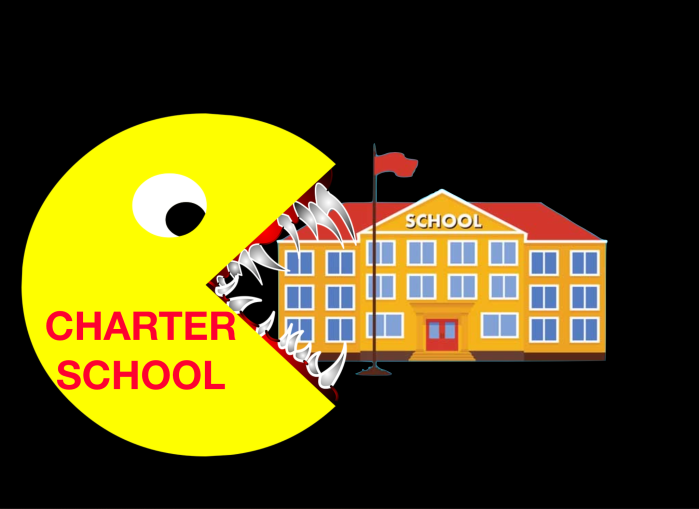
It’s charter schools, voucher schools and the pro-corporate policies that enable them to pocket tax dollars meant to educate kids and then blame us for the shortfall.


Our middle school-high school complex is located at the top of a hill. At the bottom of the hill in our most impoverished neighborhood sits one of the Propel network of charter schools.


Our district is so poor we can’t even afford to bus our kids to school. So Propel tempts kids who don’t feel like making the long walk to our door.


Institutions like Propel are publicly funded but privately operated. That means they take our tax dollars but don’t have to be as accountable, transparent or sensible in how they spend them.


And like McDonalds, KFC or Walmart, they take in a lot of money.


Just three years ago, the Propel franchise siphoned away $3.5 million from our district annually. This year, they took $5 million, and next year they’re projected to get away with $6 million. That’s about 16% of our entire $37 million yearly budget.


Do we have a mass exodus of children from Steel Valley to the neighboring charter schools?


No.


Enrollment at Propel has stayed constant at about 260-270 students a year since 2015-16. It’s only the amount of money that we have to pay them that has increased.


The state funding formula is a mess. It gives charter schools almost the same amount per regular education student that my district spends but doesn’t require that all of that money actually be used to educate these children.


If you’re a charter school operator and you want to increase your salary, you can do that. Just make sure to cut student services an equal amount.


Want to buy a piece of property and pay yourself to lease it? Fine. Just take another slice of student funding.


Want to grab a handful of cash and put it in your briefcase, stuff it down your pants, hide it in your shoes? Go right ahead! It’s not like anyone’s actually looking over your shoulder. It’s not like your documents are routinely audited or you have to explain yourself at monthly school board meetings – all of which authentic public schools like mine have to do or else.


Furthermore, for every student we lose to charters, we do not lose any of the costs of overhead. The costs of running our buildings, electricity, water, maintenance, etc. are the same. We just have less money with which to pay them.


But that’s not all. The state funding formula also requires we give exponentially more money to charters for students labeled special needs – orders of magnitude more than we spend on these kids at my district.


Here’s how the state school code mandates we determine special education funding for charter school kids:


“For special education students, the charter school shall receive for each student enrolled the same funding as for each non-special education student as provided in clause (2), plus an additional amount determined by dividing the district of residence’s total special education expenditure by the product of multiplying the combined percentage of section 2509.5(k) times the district of residence’s total average daily membership for the prior school year. This amount shall be paid by the district of residence of each student.”


So authentic public schools spend a different amount per each special education student depending on their needs. But we have to pay our charter schools an average. If they only accept students without severe disabilities, this amounts to a net profit for the charter schools – and they can spend that profit however they want.


Moreover, if they reclassify students without disabilities or with slight disabilities as special needs, that means more money for them, too. Is anyone checking up on them to make sure they aren’t gaming the system? Heck no! That’s what being a charter school is all about – little transparency, little accountability and a promise of academic results (which don’t have to pan out either).


In the 2015-16 school year, Steel Valley paid the 19th highest amount of its budget to charter schools in the state (9%) and that number is growing.


According to the state Department of Education, here’s how our charter school spending has increased:


Steel Valley Per Student Charter School Tuition:


2000-01 – 2012-13

Non-Special Ed: $9,321

Special Ed: $16,903


2013-14

Non-Special Ed: $9,731

Special Ed: $16,803


2014-15

Non-special Ed: $10,340

Special Ed $20,112


2015-16

Non-Special Ed: $12,326

Special Ed: $25,634


2016-17

Non-Special Ed: $13,879

Special Ed: $29,441


2017-18

Non-Special Ed: $13,484

Special Ed: $25,601


2018-19

Non-special ed: $14,965

Special ed: $32,809


All of this has real world consequences in the classroom. It means fewer teachers and larger class sizes. It means narrowed curriculum and fewer extracurricular activities. It means reduced options and opportunities for all children – just so a new business can duplicate the services already being offered but skim tax dollars off the top.


Our State Senator Jim Brewster understands the problem.


“Charters are strangling school districts, eventually will put them out of business. When you lose your school district, you lose your city,” he said in an article published by Public Source.


Brewster is a Democrat from McKeesport with four school districts being likewise “cannibalized” by charter schools.


Steel Valley School Board President Jim Bulger also characterized the situation as dire.


“ Charter Schools have become a twisted profit-making machine and not what they were originally intended for,” he said.


 “Originally charter schools were meant to serve a demographic that the public schools could not. For example being heavy in the performing arts or items like that. It’s unfortunate that several people have decided to twist this decent idea into a profit-making scheme that bleeds public education and its very soul.”


Much of the problem is in Harrisburg where legislators refuse to see or address the issue. And that’s often the best situation. Others actively make things worse.


For instance, the state used to reimburse each district for 30% of its costs to charter schools. Then in 2011, Republican Gov. Tom Corbett cut that while slashing the education budget by an additional $1 billion a year.


Though some of that money has been restored in subsequent budgets, the charter reimbursement has not. Putting it back in the budget would go far to alleviating the bleeding.


But legislators need to get serious about charter school reform.


We can no longer afford a system that requires authentic public schools to fund their own competition. In fact, schools should never be in competition in the first place. Every school should be excellent – and the only way to get there is to start with adequate, equitable, sustainable funding in the first place.


There are seven charter schools within 5 miles of my district: Propel Homestead, Propel Braddock Hills, Environmental Charter School at Frick PA, Propel Hazelwood, Academy Charter School (in Pittsburgh), Propel Mckeesport, and Propel East (in Monroeville).


In addition, there are 55 private schools in the same area. Though the Commonwealth doesn’t have school vouchers, per se, it does have a backdoor version supported by both Democrats and Republicans. Many of these private and parochial schools gobble up $210 million of state tax dollars through these tax credit programs – the Educational Improvement Tax Credit (EITC) and Opportunity Scholarship Tax Credit (OSTC) programs. And there’s a bill currently being considered in Harrisburg to increase that amount by $100 million this year and even more in subsequent years!


It seems our legislature has no problem spending on the school system so long as it isn’t the PUBLIC school system.


And the reason usually given for such support is the results privatized schools get. They claim to be better alternatives to the public system, but this is rarely if ever true.


Test scores are a terrible way compare schools, but charter and voucher schools rarely – if ever – outpace their authentic public school competitors. They either get similar scores or in many cases do much, MUCH worse.


For instance, take Propel Homestead.


In 2015-16, it served 573 students in grades K-12. Only 22% of students were proficient in math and 40% in Reading on state tests. Both scores are below state average.


Meanwhile, at Steel Valley High School during the same time period, we served 486 students in grades 9-12. In math, 50-54% of our students were proficient and 65-69% were proficient in Reading. That’s above state average in both cases. And we had similar results at our middle and elementary schools.


However, test scores are poor indicators of success.


Steel Valley Schools also had lower class sizes. We averaged 12 students per teacher. Propel Homestead averaged 15 students per teacher.


And then we come to segregation. Though both schools had significant minority populations, Steel Valley Schools had 42% minority enrollment, most of whom are black. Propel Homestead had 96% minority enrollment, most of whom are black.


So the authentic public school option is demonstrably of better quality, but our inability to bus students to-and-from school opens us up to predatory school charlatans who take advantage of our poverty.


And the situation is similar in surrounding communities. Poor districts serving impoverished minority students become targets for privatizers looking to make a fast buck off of our kids and families. They offer them a lower quality education and a slick sales pitch.


They increase segregation, lower academic quality, and get away with much needed funds that could help kids get a better education.


This nonsense has to stop.


The only schools that should be receiving public tax dollars are the authentically public ones.


They should have to abide by the same regulation, the same accountability standards, the same democratic governance, the same enrollment standards as authentic public schools. Otherwise, they should not qualify for public tax dollars.


We’re boring holes in the ship to make rickety life boats.


It’s time to stop the madness.


It’s time to stop letting our best chance to help all kids get eaten alive by the sharks of privatization.


Like this post? I’ve written a book, “Gadfly on the Wall: A Public School Teacher Speaks Out on Racism and Reform,” now available from Garn Press. Ten percent of the proceeds go to the Badass Teachers Association. Check it out!

 

book-4

Let Voters Fix Harrisburg School Board – Not State Takeover

thumbnail_milwaukee_school_takeover-e1452175291470

Pushing the self-destruct button is the ultimate measure of last resort.


But that’s how several Pennsylvania lawmakers are suggesting we fix the dysfunctional Harrisburg School Board.


An election that could oust most of the very school directors responsible for the district’s troubles is less than a month away. But Democratic Representative Patty Kim, Republican Senator John DiSanto and Harrisburg Mayor Eric Papenfuse all say we shouldn’t wait – The state should takeover the Harrisburg School District immediately.


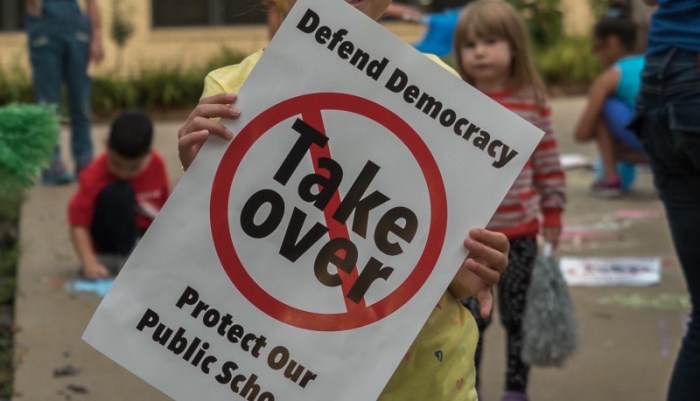
This would effectively destroy all democratic government in a district located in the state capital.


While senators and representatives from all over the Commonwealth work to enact the will of their constituents from Pittsburgh to Philadelphia, residents at city schools a few miles away would be robbed of their own voices.


Under state law, if the district were put into receivership, a court-appointed receiver would assume all the functions of a locally elected school board, except the power to raise and levy taxes. This appointee would effectively take charge of the district’s personnel and finances.


Oversight and public input essentially would be repealed. The receiver could do whatever he or she liked and there’s little anyone could do about it.


It’s a bad idea anywhere, though one can understand why state lawmakers have suggested it here.


Harrisburg Schools are a mess, and it’s largely because of the inept leadership of Superintendent Sybil Knight-Burney and five of the nine-member school board who consistently support her every move.


Declining academic performance, high teacher turnover rates, and poor fiscal management – all are hallmarks of the way Harrisburg schools have been run.


The state even suspended more than $10 million in funding to the district after the board voted not to cooperate with an audit requested because of allegations administration had mismanaged federal grant funds.


But the district’s problems begin before the school board even enters into the picture.


Like nearly every urban district in the Commonwealth, Harrisburg has a history of being neglected and underfunded. One estimate puts the Harrisburg shortfall between $35 million and $38 million a year.


That’s why the district is already under a state-mandated recovery plan. It serves a poor community whose tax base simply cannot support the needs of its own children. Like other impoverished schools, the administration and board are required to work with a recovery officer.


This recovery plan has not miraculously fixed the district’s problems. It’s magical thinking to suppose that a court-appointed receiver would do any better.


If the state wants to help, it should provide equitable and sustainable funding. However, it is completely reasonable that state lawmakers wait until responsible adults have taken back the school board first.


A citizen-led school reform group called CATCH (Concerned About the Children of Harrisburg) has been pushing to oust the incumbents who have consistently supported the administration’s disastrous decisions, most of whom are up for re-election.


There are nine board members. Five invariably vote with the administration: Danielle Robinson, Ellis Roy, Lola Lawson, Patricia Whitehead-Myers, and Lionel Gonzalez.


Three unfailingly vote against the administration: Brian Carter, Judd Pittman and Carrie Fowler. There is one wild card: Joseph Brown, who was just appointed to take a vacant seat on the board this month and has mostly abstained from voting.


Of these, Brown and all of those supporting the administration but Robinson are up for re-election.


To flip these seats on the board CATCH is pushing for Gerald Welch, Doug Thomson-Leader, Steven Williams, and Jayne Buchwach. The local teachers union, the Harrisburg Education Association (HEA), and the local chapter of The American Federation of State, County and Municipal Employees (AFSCME) endorsed all of them and an additional one – James Thompson.


If even two of the newcomers are elected, that will shift the balance of power away from those who have enabled an administration infamous for irresponsible errors and neglect purchased at the expense of personal favors to weak willed school directors.


This includes an accounting error that kept 54 former employees on its healthcare plan, an investigation into improper grading allegations at one of its high schools, rapid teacher turnover, and falling student test scores. Administrators haven’t even presented a budget for the 2019-20 school year yet!


Meanwhile, this same quintet of school directors rewarded administration by reappointed Superintendent Knight-Burney last spring, hiring controversial attorney James Ellison as solicitor despite a record of fraud, lawsuits and delinquent taxes, and three times refused to fill Melvin Wilson’s vacant board seat with a candidate who had broad public support and instead punted the decision to the courts.


Despite an almost laughable record of corruption in the district, voters have a chance to change course in less than a month.


All of the reform candidates are Democrats so the matter could be settled by the May 21 primary.


It would be beyond absurd for the state to step in and deny the public the right to correct its own ship.


However, though new candidates could be elected in a matter of weeks, they wouldn’t be sworn in until December. So even under the best of circumstances, city schools would remain under the dysfunctional board for the foreseeable future.


That’s not good. There’s a lot of damage a lame duck board could do in that time. However, the alternative of receivership is worse.


Once you take away a school district’s right to govern itself, it’s hard to get it back again. Plus there is no guarantee that appointed bureaucrats will do a better job. In fact, they rarely do.


Education Secretary Pedro Rivera has remained silent on the issue of receivership. But in a recent statement he said his department “will consider all actions allowable by law” to guide the district through a financial recovery plan.


Here’s hoping that democracy is allowed to flourish in the capital of Pennsylvania.


Like this post? I’ve written a book, “Gadfly on the Wall: A Public School Teacher Speaks Out on Racism and Reform,” now available from Garn Press. Ten percent of the proceeds go to the Badass Teachers Association. Check it out!

thumbnail_IMG_8249

Schools That Hinder Opt Outs Are Participating in Their Own Demise

thumbnail_1511359_10203413055118040_897780773_n

You can’t be a public school and still ignore the will of the people.


That’s the problem at too many districts across the country where narrow-minded administrators are waging an all out war on parents opting their children out of standardized testing.


The federal government still requires all states to give high stakes tests to public school students in grades 3-8 and once in high school. So states require their districts to give the tests – despite increasing criticism over the assessments’ validity, age appropriateness, racial and economic bias and the very manner in which the scores are used to justify narrowing the curriculum, school privatization, funding cuts, teacher firings and closing buildings serving the most underprivileged children.


In response, parents from coast to coast continue to fight the havoc being forced upon their communities by refusing the tests for their children.


Yet instead of welcoming this rush of familial interest, at some schools we find principals, superintendents and every level of functionary in between doing whatever they can to impede parental will.


Most administrators don’t actually go so far as out right refusal of a parent’s demand to opt out their children.


That’s especially true in states where the right to opt out is codified in the law.


Three states – California, Utah, and Wisconsin – have enacted legislation permitting parents to opt their children out of standardized tests. However, at least five others, including my home of Pennsylvania, have laws respecting parents’ opt-out wishes for certain reasons. In others states there may not be specific legislation permitting it, but none have laws forbidding it either. At worst, test refusal is an act of civil disobedience like tearing down a confederate monument or freedom rides.


In Pennsylvania, the school code specifies that parents can refuse the test for their children for “religious reasons.” Those reasons and the religion in question never need be named. Citing “religious reasons” is rationale enough.


Consider:


“PA School Code Chapter 4.4(d):


(4)  …If upon inspection of a State assessment parents or guardians find the assessment to be in conflict with their religious belief and wish their students to be excused from the assessment, the right of the parents or guardians will not be denied upon written request that states the objection to the applicable school district superintendent, charter school chief executive officer or AVTS director.”


So when a parent provides just such an objection, it’s there in black and white that administrators must comply with that request.


However, some administrators are trying to game the system. When the other students are taking the state standardized test, the opt out students are rounded up and forced instead to take a district created assessment that just so happens to look almost exactly like the test their parents explicitly asked they not be subjected to.


So in my state, some parents have opted their children out of the Pennsylvania System of School Assessment (PSSA) or Keystone Exams, but administrators are requiring them instead to take an assessment they cobbled together themselves that closely resembles the PSSA and/or Keystone Exam.


They take a little bit from the PSSA, a bit from the Partnership for Assessment of Reading Readiness for College and Careers (PARRC) test, a question or two from the Scholastic Assessment Test (SAT) and voila! A brand new Frankenstein’s monster of standardized assessment.


But that’s not all. Some districts go one step further. They tie the results of this bogus “district” assessment with class placement. The results of the faux test are used to determine whether students are placed in the remedial, academic or the honors class in a given subject (English Language Arts, Math or Science) in the next grade.


Does that violate the law? Parents did not want their children to be assessed with a standardized test, and that’s exactly what the school did anyway. The only difference is the name of the standardized test they used.


I am not a lawyer, but I’ve contacted several. The answer I’ve gotten is that this may not be technically illegal, but it does at least violate the spirit of the law.


Districts are given a certain latitude to determine their own curriculum and assessments. This kind of runaround is ugly, petty and possibly just on the line of legality.


But our administrators are not done. Not only are they requiring such students to take a cobbled together standardized assessment, when children are done, they are forced to do hours of test prep for the state assessment that their parents refused for them.


Imagine opting out of the PSSA and then being forced to spend that time preparing for that very test. Imagine refusing to allow your children to take the Keystone Exam but then having them forced to prepare for it instead.


Petty, small-minded, punitive and – in this case – possibly illegal.


The school code is specifically against this. From the same section (4.4):


“(d) School entities shall adopt policies to assure that parents or guardians have the following:


(3) …The right to have their children excused from specific instruction that conflicts with their religious beliefs, upon receipt by the school entity of a written request from the parent or guardians.”


Again, I am not a lawyer, but it seems pretty clear that this, at least, is a violation of the law.


They can request their children not be given specific instruction – in this case test prep. Yet that’s exactly what administrators are doing anyway.


So what are opt out parents to do? Should they lawyer up?


Possibly. Though no one likes to have to take their own school to court. Any monetary damages thus recovered come from the collective pot that should go to help all students learn. It’s unfortunate that some administrators play so freely with taxpayer dollars when it would be a simple matter to safeguard them AND respect parental rights.


A better course of action may be for opt out parents in such situations to seek redress directly from the school board.


School directors are elected officials, after all. They may not be appraised of the actions of the administrators in their employ.


And that is really where the buck stops. If school directors don’t approve of this sort of chicanery, they can easily put a stop to it.


These are public schools. They are supposed to be run by the public. Our democracy is supposed to be what defines us. We are run by the people, for the people.


We’re not some charter school where school directors are appointed to their positions, hold their meetings in private and rarely if ever have to account for their decisions.


It’s shocking that in an age when public schools are often set against privatized ones that we’d allow such foolishness.


We need to set ourselves apart. Instead of denying parental requests, we should go out of our way to accommodate them.


Parents could, after all, remove their children and try their luck elsewhere.


At charter schools, they would probably get an even worse welcome. After all, most such schools pride themselves on their test scores and test prep curriculum having kicked out any students who don’t score well.


However, parents of means could enroll their children in private or parochial schools that are not required by law to even take these high stakes tests.


I’m not recommending that course of action. These schools are expensive, restrictive, insular and extremely racially and economically segregated.


But how short sighted must public school administrators be if they play these sorts of games with parents and children in just such an environment?


Any public school leader who wars against opt outs is participating in their own schools demise.


This is doubly so at schools serving high poverty populations.


Children of the poor and minorities historically get lower test scores than those from wealthier families. These tests are used to justify budget cuts and firing school staff – including these administrators.


Opting out of testing is one way to deny this data to the state so that they can’t use it against the school.


Certainly having high numbers of students opting out can, itself, become an excuse for punitive action from the state. But nowhere in the country has it ever actually happened.


State legislatures, too, are run by majority rule. The same with the federal government.


Our lawmakers have no authority to tell voters they can’t opt their children out of testing. It is the voters who are the boss.


We’d all best remember that.


Like this post? I’ve written a book, “Gadfly on the Wall: A Public School Teacher Speaks Out on Racism and Reform,” now available from Garn Press. Ten percent of the proceeds go to the Badass Teachers Association. Check it out!
book-3

School Accountability Begins With the People Who Make the Rules: A Code of Conduct for Politicians and Test Makers

thumbnail_Screen Shot 2019-03-18 at 1.17.54 PM


Standardized testing is all about accountability.
 

We’ve got to keep schools accountable for teaching.
 

We’ve got to keep students accountable for learning.

 
It’s kind of a crazy idea when you stop to think about it – as if teachers wouldn’t teach and students wouldn’t learn unless someone was standing over them with a big stick. As if adults got into teaching because they didn’t want to educate kids or children went to school because they had no natural curiosity at all.
 

So we’ve got to threaten them into getting in linestudents, teachers: march!

 
But that’s not even the strangest part. It’s this idea that that is where accountability stops.

 
No one has to keep the state or federal government accountable for providing the proper resources.

 
No one has to keep the testing companies accountable for creating fair and accurate assessments.

 
It’s just teachers and students.
 

So I thought I’d fix that with a “Code of Conduct for Politicians and Test Makers.”

 
After all, that’s what we do when we want to ensure someone is being responsible – we remind them of their responsibilities.
 

You see, the state and federal government are very concerned about cheating.

 
Not the kind of cheating where the super rich pay off lawmakers to rig an accountability system against the poor and minorities. No. Just the kind of cheating where teachers or students try to untie their hands from behind their backs.

 
They’re very concerned about THAT.

 
When you threaten to take away a school’s funding and fire teachers based on test scores, you tend to create an environment that encourages rampant fraud and abuse.

 
So the government requires its public servants to take on-line courses in the ethics of giving standardized tests. We have to sit through canned demonstrations of what we’re allowed to do and what we aren’t allowed to do. And when it’s all over, we have to take a test certifying that we understand.
 

Then after we proctor an exam, we have to sign a statement swearing that we’re abiding by these rules to ensure “test security.”
 

This year, for the first time, I’m supposed to put my initials on the answer sheets of all of my students’ Pennsylvania System of School Assessment (PSSA) tests to prove….  I don’t know. That I was there and if anything went wrong, it’s my fault. Burn the witch. That sort of thing.

 
Even our students have to demonstrate that they’re abiding by the rules. Children as young as five have to mark a bubble on their test signifying that they’ve read and understood the Code of Conduct for Test Takers.
 

I still don’t understand how that’s Constitutional.

 
Forcing children to sign a legal document without representation or even without their parents or guardians present – it sure looks like a violation of their civil rights.
 

But that’s what accountability looks like when you only require certain people to be accountable.

 
So back to my crazy idea.
 

Perhaps the corporate flunkies actually designing and profiting off these tests should be held accountable, too. So should lawmakers requiring all this junk.
 

Maybe they should have to sign a “Code of Conduct for Politicians and Test Makers” modeled after the one the rest of us peons have to use to sign our lives away.
 

Here’s how it might look:


CODE OF CONDUCT FOR POLITICIANS AND TEST MAKERS:


Do…


-Listen to the complaints, concerns and criticisms of parents, teachers and students about the questions and assessments you’re creating.

 
Ask advice from education researchers and all stakeholders to ensure the questions you’re designing are backed up by psychological, neurological, sociological and all associated research on child development.

 
-Read each question you create carefully to ensure it is not simply multiple choice and instead assesses deeper understanding of concepts and skills. Also be sure that all open ended items and writing prompts allow for a multitude of answers and don’t simply ask the test taker to guess what the test maker is thinking.

-Be careful when writing your questions to make sure you have NOT left misspellings or grammatical mistakes in place that would unnecessarily increase confusion for test takers and thereby invalidate the results.

 
Check and double check to make sure you have created a fair and accurate assessment before giving it to students to evaluate their learning.

 
-Report any suspected cheating to a certified watchdog group and the media if you find any evidence or have any suspicion that anyone has created test items purely to enrich the corporation you work for or the privatization-testing-prison industrial complex.

 
-If you’re a lawmaker who’s voted for annual testing, take the assessment annually yourself to prove that it is an adequate test of basic student knowledge of which as a duly elected representative you should clearly pass. Publish your score prominently in the media to prove the test’s efficacy.
 

DO NOT…


-Have notes in your possession from special interests such as (but not limited to) the testing corporations, the publishing industry and/or the ed tech industry before, during or after voting for legislation that promotes the very same standardized testing and testing remediation on which these industries profit.
 

-Have any (approved or otherwise) electronic devises that tabulate previous test questions and prescribe reusing those that have resulted in answer curves consistent with previous tests thereby continuing the trend of selecting against students of color, the poor and other groups and/or subgroups.

 
-Share inside information about the test or previous test questions with anyone that you do not also make freely available to the public. It is not your job to create a remediation market and/or cash in on the testing apparatus you are creating.
 

-Dissuade students from talking with others about  questions after the test. They are human beings with rights. It is perfectly natural for them to talk and harmless for them to do so after a testing session is over.


-Take notes on individuals criticizing or opting out of testing with the purpose of punishing them for their dissent. This is a democratic process and you will welcome discussion, criticism and dissent.
 
-Use the bubbles in the answer booklet for anything at all. In fact, throw them away. It’s 2019. Surely we can find a better way to assess children than multiple choice questions answered by filling in bubbles on a sheet of paper with a number 2 pencil!

 
Conduct an online testing session unless you are 100% positive that the information input by the students and collected about the students is secure, will be secure and cannot be shared with advertisers, corporations or any other entity, and only with a certainty that this data will not be put in any database in a manner that could identify individual test takers or otherwise violate privacy laws.
 
-In fact, you know what? Don’t use standardized tests at all to assess student learning – especially not connected to high stakes. Instead rely on classroom grades and teacher observations for student assessment. Use indexes and audits of school resources to determine whether they are doing their best to teach students and whether lawmakers have done enough to ensure they are receiving fair and equitable resources.


What do you think? Would any of them sign off on this?


Like this post? I’ve written a book, “Gadfly on the Wall: A Public School Teacher Speaks Out on Racism and Reform,” now available from Garn Press. Ten percent of the proceeds go to the Badass Teachers Association. Check it out!
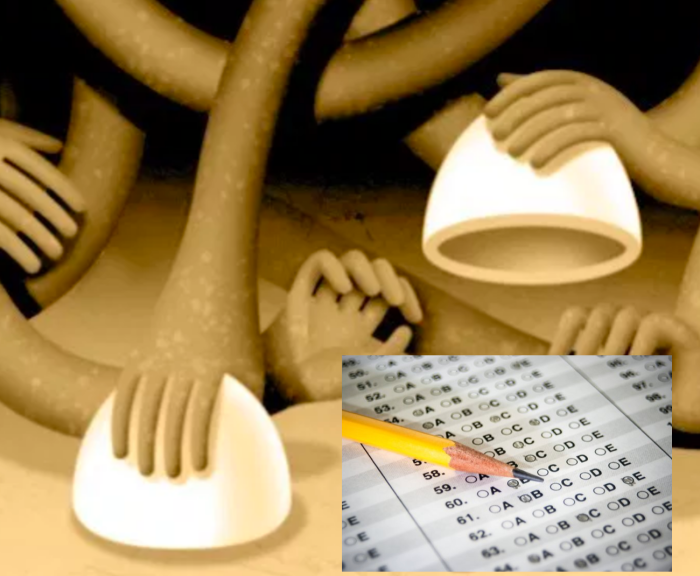
book-2