Waiting For a Teaching Assignment This Year is Like Anticipating a Death Sentence

Screen Shot 2020-07-20 at 8.38.17 AM

 
Going to the mailbox each time, my heart flutters.


I open the lid and see a stack of letters. My heart sinks.


Is today the day?


Has my teaching assignment finally arrived?


It’s not that I’m so anxious to find out what grade I’ll be teaching this year or whether I have lunch duty or have to monitor in-school suspension.


It’s whether I get to live or die.


And that’s no hyperbole.


As the summer whittles down, my district has yet to release its reopening plan. Meanwhile, no communication from administrators or school directors, no public meetings, nothing.


Meanwhile surrounding districts release plans that go against Center for Disease Control (CDC) guidelines in the name of expediency, politicians use the issue to demonize teachers and rally their base, and our unions pretend the only problem is a lack of funding.


The Sword of Damocles dangles over my head and the rope that keeps it in place looks more frayed with every pendulum swing.


For a person like me with at least two pre-existing conditions, an assignment in the school building during a global pandemic could be a death sentence.


Teaching has taken a huge toll on my body. I have heart disease and Crohn’s Disease. Not to mention that I’m certainly not getting any younger.


That’s at least twice the average risk of getting COVID-19 if my employer decides to assign me back in the building.


And it’s something my doctors made a point of mentioning.


From the middle of June to the middle of August, teachers like me try to take care of all our personal needs before the hectic classroom schedule begins.


That means renewing clearances, financial planning, medical visits, etc.


So when I went to a routine cardiologist appointment, I was somewhat taken aback as the doctor told me, “Remember, you can’t get sick.”


“I’m sorry? What?” I said.


He had just given me a clean bill of health.


“Remember, you can’t get sick. You simply cannot afford it,” he said.


Then he went on to complain about living in a country that put economics before science.


I heard much the same from my gastroenterologist.


They were both furious at how the pandemic is being handled but had no more advice on how I could protect myself.


“If they want you to go back to work, what else can you do?” one asked me.


Refuse?” I said.


I still don’t have a better answer.


It’s incredibly unfair that decision makers may force me to choose between my job and my life.


I love my job.


Teaching has been one of the most meaningful experiences I’ve ever had. Every day I get to help kids become the people they want to be. I get to introduce them to a world of reading where voices long past get to speak to each of them individually. I get to show them how to participate in a conversation that’s been raging for millennia.


It’s challenging and exhausting and difficult, but I know I’m making a difference.


I love every minute of it.


But I love breathing more.


I don’t want to be buried under a respirator as my lungs slowly fill with fluid.


I don’t want to die gasping for breath.


Not if I don’t have to.


“You might want to update your will,” a friend told me with a grin when I mentioned this to him.


But there’s really nothing to smile about here.


I feel like I’m about to be thrown to the wolves.


After 17 years in the classroom, years of helping kids learn how to read and write, years of listening to their needs and worries, years of helping them overcome their anxieties and fears, years of advice, counsel and friendship – is this all I’m worth to the community?


I chaperoned field trips with school directors and their children, I’ve taught board members kids and sat across from the adults at parent-teacher meetings regaling them with tales of mischief and academic triumphs. Will they now callously decide that I need to put my life at risk or else step down?


How many times did I joke and laugh with administrators, how many times did I try my best to do what they asked, how many times did I go above and beyond – and now have they no qualms about making my wife a widow and forcing my daughter to navigate the rest of her childhood without her daddy?


It doesn’t have to be this way.


A sane society wouldn’t reopen school buildings when Coronavirus cases are spiking. A rational country wouldn’t politicize safety precautions, undermine scientists and disparage facts. It would pay people to stay home, suspend rent payments, provide everyone with personal protective equipment (PPE) and universal healthcare.


And it’s not too late.


By the end of August, we can continue the distance learning initiatives we began in the spring.


To be honest, there were a truckload of problems in April and May. But at least we know what they are and can do better a second time around.

We can make sure all students have access to computers, devices and the Internet. We can make expectations clear and achievable and increase project based assignments. We can habituate participation, increase interactivity and offer multiple chances to do the work.


I’m not saying it would be perfect. On-line learning will never be as effective as in-person learning.


But any education attempted under the shadow of a pandemic will be less productive than under normal circumstances.


Even if we dispense with masks and social distancing in the classroom – which would be incredibly risky for all involved – children would be on edge, traumatized and frightened.


Distance learning is the safest way to go. Any academic shortfalls could be made up in subsequent years. But you have to survive first.


My life would certainly be at risk in the physical classroom. But so would every other staff member, children’s families and even the students, themselves.


The same people advocating for a full reopen of schools like to cite studies showing young people are immune or mostly asymptomatic. But kids were the first group to be quarantined.


As we have opened summer camps and daycare centers, an increasing number of children – especially those 10-19 – have gotten sick. And even the younger ones have been known to bring the virus home to their parents.


If my life has no value to you, what about your own? What about your child’s life?


Being a teacher kind of commits you to a sort of optimism.


To dedicate your life to young people, you have to believe the future can be better than the present and the past.


I let out a deep breath and went through the letters in my mailbox.


My assignment wasn’t there.


It may arrive tomorrow or the day after.


The uncertainty is hard, but it’s better than some certainties. I still have every hope that my community will not sacrifice my life.


But if it does, I will not go quietly.


I can’t be here for your kids, if I’m not here.


Like this post?  You might want to consider becoming a Patreon subscriber. This helps me continue to keep the blog going and get on with this difficult and challenging work.

Plus you get subscriber only extras!

Just CLICK HERE.

Patreon+Circle

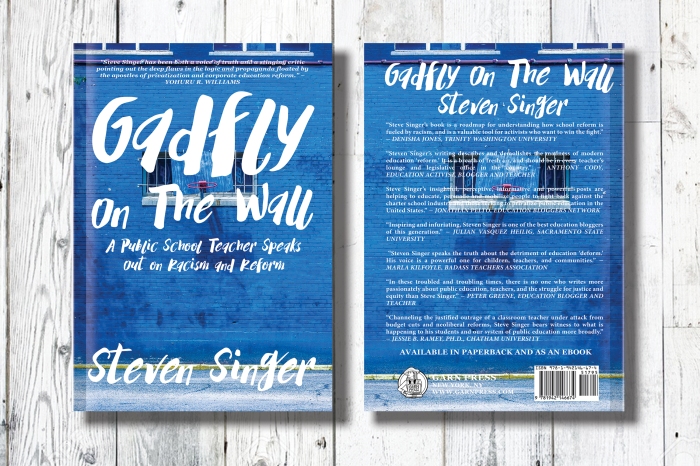
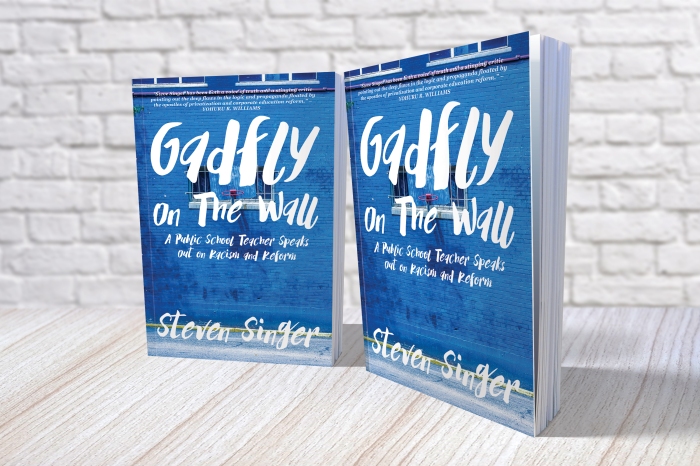
I’ve also written a book, “Gadfly on the Wall: A Public School Teacher Speaks Out on Racism and Reform,” now available from Garn Press. Ten percent of the proceeds go to the Badass Teachers Association. Check it out!

book-4

McKeesport Area School District’s Reopening Plan is Based on Dubious Facts, Bad Reasoning & Takes Unnecessary Risks: An Open Letter to the Superintendent

Screen Shot 2020-07-15 at 8.29.25 PM

 
Dr. Mark Holtzman:


I am extremely concerned about the reopening plan for the McKeesport Area School District you offered on video Tuesday.


As a parent of a child in the district and a teacher in a neighboring district, I find the plan you put forward to be absolutely terrifying. It is badly reasoned, based on unproven facts, and takes unnecessary risks with students and staff.


In short, you propose reducing social distancing by half, requiring students to wear masks only occasionally, having zero temperature screenings and keeping schools open when students, staff and/or family get sick.


This is unacceptable.


And given that you said all superintendents in Allegheny County are meeting weekly to discuss reopening, my concern about McKeesport’s plan extends to all other local districts working under similar miscalculations.


Be assured I will send my concerns to the email hotline you provided because it was impossible to have public meetings to discuss this matter. Which brings me to my first concern – how can it be unsafe to meet in-person with the public to discuss reopening schools yet still be safe to open them for our kids?


I am an alumni of McKeesport. So is my wife, my brother and most of the people in my family. I’ve lived here my whole life.


My daughter is set to enter 6th grade this year. Up to this point I have been extremely happy with the education she has received in the district.


I am thankful that you’ve decided to give parents the option of virtual learning for their kids if they do not feel it is safe for them to return to school buildings, but your reopening plan will have impacts far beyond our individual households. A spike in COVID-19 throughout the community due to a bad school reopening plan will not be in anyone’s interests.


I know you are an educator and want to do what is best for the students in your care. However, in this case you have let your drive to ensure the best academics overshadow what is in the best interests of the safety and well being of the children, families and staff in the district.


You say you’re relying on facts as provided by the the Center for Disease Control (CDC), and health departments of Allegheny, Chester and Bucks County. However, almost everything you cite on the video is from one source – Bucks County.

 
Bucks County is very different from where we live in Western Pennsylvania. It encompasses a smaller area north of Philadelphia and has a reduced population – about 628,000 people.


Allegheny County includes the City of Pittsburgh, is geographically larger and has a more numerous population – about 1.216 million people.


Looking at the numbers, Bucks County has not handled the pandemic as well as Allegheny County. Though it has fewer people, they have more cases of COVID-19 – 5,841 compared to our 5,610. What’s worse, their death rate is substantially higher than ours – 511 to our 204.


Frankly, I do not feel comfortable basing almost our entire reopening plan on data provided by one county in the Commonwealth that may or may not have done a good job handling this pandemic.


We need to base our plan on county specific data from Western Pennsylvania and guidelines for the entire state.


In short, the plans provided by Bucks County are reckless and based on sketchy facts.


For instance, in the video you said people only get COVID-19 if they have been within 6 feet of someone not wearing a mask for 15 minutes consecutively. That or there has to be an exchange of fluid – someone sneezing, spraying spittle, etc.


It is true that the CDC has cautioned against being in such close proximity to someone else for such a prolonged period of time – within 6 feet for 15 minutes. However, the organization does NOT claim that this is the only way you can get the virus. They claim that being in this situation with someone who has tested positive for the virus (with or without a mask) means you should quarantine yourself for two weeks.


I am extremely upset that you plan to reduce social distancing in district schools from 6 feet to between 3 and 4 feet.


You again cite Bucks County to justify the position.


“…SARS-CoV-2 is spread most commonly through large respiratory droplets when someone coughs or sneezes. A minimum three-foot distance is clearly associated with significant reductions in infection via respiratory droplets, as most droplets do not travel more than 3 feet due to gravity. This is the current standard used by the World Health Organization (WHO) successfully in many countries throughout the world today.”


Screen Shot 2020-07-15 at 3.52.53 PM


Once again this is not true. The WHO says people should keep at least 3 feet apart but doing so puts you at higher risk than 6 feet.


While it is nice to be assured that respiratory droplets don’t travel beyond three feet, experience tells us otherwise. It shouldn’t take much imagination or memory to recall a time when one of your own droplets traveled further in a moment of excitement. As a classroom teacher, I can tell you this happens often. When kids get excited, teachers better back up.


Be honest. This has nothing to do with 
Bucks County. You let slip the real reason here:


“Our classrooms are not very large – to put children 6 feet apart in school buses, classrooms, hallways, cafeterias, will be next to impossible with the overall square footage of those particular areas.”


I get it. You’re probably right. But that’s not a reason to skimp on safety. There are other alternatives to in-person classes.


If we cannot do it safely, we shouldn’t do it at all. Let’s not pretend it’s safe because of something Bucks County officials pulled out of their butts.


Then we get to temperature screenings – a precaution you say will not be taken when students enter our buildings at the beginning of the day.


This is highly imprudent.


It takes seconds to gauge someone’s temperature with an infrared thermometer – significantly less than getting through a metal detector – something we do routinely everyday at all district schools.


Yes, there is the problem of kids getting backed up in long lines, but that is not insurmountable. Staff can at least try to keep kids separated – perhaps having a staggered start for each grade would help.


Yes, I know the absence of a temperature does not guarantee someone is not infected. But any sense of safety is good. You know the metal detectors are not 100% accurate either.


You say it is up to the parents to make sure their kids don’t come to school with a raised temperature. Now that IS unreasonable. It is unfair to put the health concerns of an entire population on one or two parents who may not comply with the expectation.


I think the bigger concern is something you didn’t mention. What do you do with a child who has a temperature? How will you send him home? Who will see to him until a parent can come and get him? And will that person be at risk of getting sick?


These are hard questions to answer, but going in ignorance of a symptomatic student is worse.

 
Your position on masks is one of the most problematic in your entire reopening plan.


You propose to have children wear masks on buses but not in their classes. And the reason – because it’s just too hard to make kids wear them.


Screen Shot 2020-07-15 at 4.12.42 PM


Wearing masks has been a universal precaution when going out in public. It is one of the best things we can do to reduce the risk of getting the Coronavirus. Respiratory droplets here, there and everywhere, and you are just going to let them fly.


This is unfair to district children and the staff who serve them.


Look. I understand it would be incredibly difficult to get kids to wear masks. But if you cannot do it, pursue a different kind of schooling. Do not have in-person classes if you cannot do so safely.

 
Then we come to your position on what to do if someone gets sick.


First, it is telling that both you and your advisors in Bucks County are pretty sure this WILL eventually happen.


You do not think the precautions you’re taking will stop people from getting sick. You simply find it acceptable if the number of sick people is low.


“As COVID-19 will likely be with us for an extended period of time, and given that all school districts will almost certainly have cases, we want school districts to begin treating it similarly to the way we have successfully handled other communicable diseases in our schools, including pertussis (whooping cough), measles, strep throat, mumps, influenza, and meningitis. It is our strong intention to keep all classrooms, schools, and districts open, in the event of confirmed cases of COVID-19. One closure decision can lead to a potential crippling, and precedent setting domino effect of closures…”


Screen Shot 2020-07-15 at 4.21.30 PM


COVID-19 is not any of the diseases mentioned above. It can be more infectious and the consequences of getting it can be much more severe.


Moreover, we cannot prioritize keeping schools open over public health and safety concerns. But that is what you are proposing here.


You said:


“We won’t close schools if someone gets infected. It takes 6-8 days to get an accurate result from a COVID test. So that disease will have passed through and will no longer exist on any surfaces, classroom areas, people, etc. in the school by the time the COVID is confirmed. Therefore, there’s no reason to close schools. We’ll clean every inch of our classrooms on a daily basis.”


This does not mean that the danger is any less. It means that the danger may have passed by the time we know about it. How many people may be sick by then?


Mark, this is a bad plan. Let me give you a better one.


Start school this year with universal distance learning.


You already mentioned how the district will make sure all students have a one-to-one iPad initiative. You mentioned how virtual learning will be revamped to include face-to-face instruction.


Take it a step further.


Have all teachers develop their own unique distance learning initiatives.


And keep with such a plan until Allegheny County reports zero new cases for at least two weeks.


Then and only then – move forward with in-person schooling that includes as many social distancing protocols as possible.


It’s not perfect, but that would be the safest plan.


I’ll admit it would not be as academically effective as in-person learning.


But be honest. No matter what you do, in-person learning will be less effective this year due to the pandemic.


Kids will not learn to the best of their ability under the shadow of COVID-19. They will be scared and on edge – if they even show up.


We can go back and fix any academic deficits in the years to come. But no one can bring the dead back to life.


It’s much better to err on the side of safety.


I hope you’ll do that.


Our families deserve to be healthy. Your staff deserves to work without having to risk their lives. Our children deserve the chance at a future.


Yours,


Steven Singer


Dr. Holtzman’s full video:

Dr. Holtzman’s Slides on Reopening:


Like this post?  You might want to consider becoming a Patreon subscriber. This helps me continue to keep the blog going and get on with this difficult and challenging work.

Plus you get subscriber only extras!

Just CLICK HERE.

Patreon+Circle

I’ve also written a book, “Gadfly on the Wall: A Public School Teacher Speaks Out on Racism and Reform,” now available from Garn Press. Ten percent of the proceeds go to the Badass Teachers Association. Check it out!

thumbnail_IMG_8249

Pittsburgh Charter Schools Take Federal Bailout Money Meant for Small Businesses

Screen Shot 2020-07-15 at 12.39.01 AM

 
Are charter schools small businesses or public schools?


They can’t be both.


Several Pittsburgh area charter schools took a bailout meant for small businesses after already getting monetary relief meant for public schools.


Environmental Charter School at Frick Park, Hill House Passport Academy Charter School, Manchester Academic Charter School and Penn Hills Charter School of Entrepreneurship all applied for and received substantial low-interest loans from the federal government’s Paycheck Protection Program (PPP).


The $660 billion federal initiative was intended to help businesses keep employees on the payroll and off unemployment benefits during the COVID-19 pandemic. The loans will be forgiven if businesses meet certain conditions such as retaining or rehiring employees.


However, charter schools – including those in the Pittsburgh region – already should have received financial relief through the federal CARES Act.


Pennsylvania got $523 million to distribute to both authentic public schools and charters. However, of the two, only charters were eligible for additional PPP funds.


So these ‘Burgh charters are double dipping. They’re receiving aid from two different federal sources while authentic public schools only can get aid from one.


The Environmental Charter School at Frick Park got a $2 million – $5 million cash infusion from PPP.


The Environmental Charter calls itself a nonprofit organization but there are many reasons to be dubious.


First, nonprofits usually are dedicated to furthering some social cause like helping the poor and minorities.


However, The Environmental Charter actually caters to upper socioeconomic and white students.


It serves wealthier children than surrounding schools. Just one-third of Environmental Charter students are eligible for free or reduced lunches compared to 71% at Pittsburgh Public schools.


Moreover, only 30% of the charter’s students are minorities. Pittsburgh Public serves a student body of which nearly half are African American.


Next, there’s the issue of who runs the institution.


All charter schools in the Commonwealth have to be designated as nonprofits. However, many like the Environmental Charter School hire for-profit companies to actually operate their day-to-day functions and make almost all of their major administrative decisions.


The Environmental Charter is run by Virginia-based Imagine Schools, one of the nation’s largest charter-management companies with more than 71 charters nationwide.


Since Imagine writes the Environmental Charter’s operating budget, the management company ends up paying itself for a number of services.


After the school gets funding from state, federal and community taxes (this year including bailouts from PPP and the CARES act), it pays 12 percent back to Imagine. This came to $406,000 in 2009, according to an independent financial audit.


The school also pays Imagine on a $250,000 loan that the charter operating company took out to launch the program. Payments come out to about $2,500 per month over 20 years with an interest rate of 10.524 percent.


The charter also pays Imagine rent on its building which was purchased in 2006 by Schoolhouse Finance – Imagine’s real estate arm – for $3 million.


The lease costs $526,000 annually and is binding until 2032 unless the school loses its charter.


Given such facts, it’s hard to imagine why we’ve allowed our tax dollars to prop up a business venture that could certainly afford to reduce its profit margins rather than rely on public support.

 
Hill House Passport Academy Charter School got a $150,000 – $350,000 bailout from PPP.


Unlike the Environmental Charter, Hill House does actually cater to low income and minority children. In fact, it was founded to help Pittsburgh students who are failing in another district and in danger of dropping out unless they receive some kind of academic intervention.


However, the results haven’t been stellar. Where the Environmental Charter was too white, Hill House serves almost exclusively black students. It is exponentially more segregated than neighboring authentic public schools (96% minority) and its students still have extremely poor academic performance.


The question remains whether these results are better than they would be at an authentic public school. Does the charter provide any value for these students or is it just a holding area?


Like the Environmental Charter, this so-called nonprofit hires a management company. In this case, it’s the infamous K12 Incorporated – a nationwide cyber charter network with a record of academic failure and financial shenanigans.


In 2016, the company reached a $168.5 million settlement with the state of California. The state claimed K12 had reported incorrect student attendance records and otherwise lied about its academic programs. The company ended up settling with the state for $2.5 million with an additional $6 million to cover the state’s investigation and K12 voided $160 million in credits it had given to the affiliated schools to cover the cost of their contracts.


Hill House offers a blended model with in-person teachers and virtual classes somewhat different than most K12 schools.


However, why the state should bailout such a dubious endeavor is beyond me.


Manchester Academic Charter School got a $350,000 – $1 million loan from PPP.


It is one of the oldest charter schools in the city, having started as a tutoring program in 1968 and becoming a full fledged charter school in 1998.


However, like Hill House, it is infamous for racial segregation and low academic performance. Approximately 99% of students are minorities.


In 2016-17,only 12% of the school’s students were proficient in math (state average is 46%) and 37% were proficient in language arts (state average is 63%).


Where Manchester fails at academics, it excels at administrative salaries. The school’s administrators take home beaucoup bucks while being responsible for fewer students than those at authentic public schools.


For example, Vasilios Scoumis, Manchester CEO for more than two decades, is given a $146,000 salary not counting a potential $15,000 yearly bonus though he is only responsible for 340 students.


Compare that with Pittsburgh Public Schools Superintendent Dr. Anthony Hamlet. He earns a $210,000 salary for managing a district of about 24,000 students.


But such high salaries for relatively little work aren’t only a hallmark at Manchester.
Environmental Charter School CEO John McCann earned $120,000 with a school enrollment of 630 students.


Nice work if you can get it!


Speaking of which, Penn Hills Charter School of Entrepreneurship got $350,000 – $1 million from PPP.


This is another so-called non-profit school run by the Imagine Schools company. It is highly segregated with 82% minority children.


Only 32% of students are proficient in math and 57% in reading – again below state averages.


The school suffered a scandal in 2015 when the state Charter Review Board overruled Penn Hills School Directors decision to deny allowing the charter to expand into a second building.


But given that the Charter Review Board is made up of six members – charter school advocates chosen by former Republican Governor Tom Corbett – any pretense to impartiality is laughable.


Penn Hills School Board – a duly elected body, not government appointees – outlined criticisms of the charter that do not put the entrepreneurial venture in a positive light.


Penn Hills School Board said the charter had failed to produce current student rosters, failed in record management, failed to accurately maintain student tuition payments, improperly billed the school district for special education students, failed to maintain and develop Individual Education Plans (IEPs), had poor academic growth and is under a Department of Education Corrective Action Plan setting forth 31 areas of needed improvement.

 
Directors were also leery of the venture because the charter planned to use half of the new building for students and to lease the remainder as office space.


Finally, the charter school sucks away necessary funding from the authentic public school. The Penn Hills School District paid Imagine about $3 million in 2014-15. Costs increased to $12 million a year and continue to rise.


So one wonders why we’re throwing more money at these charter schools.


Nina Rees, executive director of the National Alliance for Public Charter Schools (NAPCS) has spoken out of both sides of her mouth on the issue. She has insisted that charter schools be regarded as public schools and eligible for emergency aid – all the while advising charter schools also to apply for federal rescue funds for small businesses devastated by the pandemic.


Carol Burris, Executive Director of the Network for Public Education, did not mince words.


“Once again, the charter sector, through the lobbying efforts of Nina Rees…worked behind the scenes to gain fiscal advantage for the privately operated schools they claim are public schools.”


Education historian Diane Ravitch agreed.


“Charters claim to be ‘public schools’ when that’s where the money is,” she said. “But when the money is available for small businesses, they claim to be small businesses.”


Charters go where the money is.


We get the privilege of paying the tab.


If it were up to U.S. Treasury Secretary Steve Mnuchin, we wouldn’t even know about it.


Mnuchin only released the information to the public after 11 news organizations sued the Small Business Administration .


Even now, not all of it is available.


Moreover, the deadline to apply for a PPP loan has been extended to Aug. 8.


So if you haven’t seen some of the most infamous neighborhood charter schools taking advantage of the program, it may only be a matter of time.


ProPublica has put all the information into an easy to use search engine. Just enter a zip code and it will display all the businesses located there that received PPP loans.


This includes high tuition private prep schools like Sewickley Academy and Shady Side Academy both of which got $2 – $5 million, Winchester Thurston School which got $1 million – $2 million, and the charter schools listed above.


You can check it out here: https://projects.propublica.org/coronavirus/bailouts/


Like this post?  You might want to consider becoming a Patreon subscriber. This helps me continue to keep the blog going and get on with this difficult and challenging work.

Plus you get subscriber only extras!

Just CLICK HERE.

Patreon+Circle

I’ve also written a book, “Gadfly on the Wall: A Public School Teacher Speaks Out on Racism and Reform,” now available from Garn Press. Ten percent of the proceeds go to the Badass Teachers Association. Check it out!
book-1

Mask-to-Mask Instruction May Be More Problematic Than Distance Learning

Screen Shot 2020-07-11 at 5.40.35 AM

 
People talk about the upcoming school year as if we have a choice between in-person classes or distance learning.


We don’t.


The fact is there will be NO face-to-face learning this year.


Neither in our school buildings or on-line.


No matter which path we choose, we will be teaching behind a mask or behind a computer screen.


There is no middle ground here – nor should there be.


Even if schools try to execute some hybrid model where kids only attend classes in-person two or three days a week and go on-line for the remainder of the time, when they are in the school building everyone will be wearing masks.


And that’s as it should be.


When in a public place during a global pandemic like that of COVID-19, we need to wear face masks to reduce the spread of the disease.


But let’s not pretend this has no side effects.


Social distancing, limited mobility, plexiglass barriers, cleanliness protocols – all will have an impact on academics.


So if we reopen physical school buildings, we will not be returning to the kind of face-to-face instruction students enjoyed as recently as January and February.


It will be a completely new dynamic that may present as many difficulties – if not maybe more – than learning on-line.


That’s something people would do well to understand before deciding which course is best.


Mask-to-mask learning will not be face-to-face learning.


Social distancing may rob the physical classroom of almost all of its benefits over distance learning.


Again, I’m not suggesting we do without PPE or safety measures. But let’s be honest about how these measures will alter academics.

 
First, let’s look at masks.


Admit it. It is hard to be heard in a mask.


Imagine trying to get a message across to a classroom of middle school children with a piece of fabric hiding half of your face, obscuring your expressions and garbling your words.


I’m not saying it’s insurmountable, but it’s not indistinguishable from classroom teaching at the beginning of last school year, either.


It generates distance, just as it’s supposed to do. But teaching requires connection, understanding and relationship building.


Many of my students come into my class with trust issues. They’ve been let down by adults and authority figures. They aren’t about to put in their best work for just anyone. They have to know the teacher can be trusted and cares about them as individual people.


How are you supposed to generate trust when students can only see your eyes?


Moreover, masks are a permanent symbol of the danger we’re all in just being together. Every time we look at each other we’ll be reminded of risk, threat and our own vulnerability.


These do not make for good teaching. On Abraham Maslow’s Hierarchy of 
Needs, only physiological necessities like food and water take precedence. Without a sense of safety, it is difficult to impossible for students to achieve their full potentials.


Unfortunately, facial coverings aren’t the only problem. Consider physical proximity.


As a teacher, I rarely sit when students are in the room.


During a 40 minute class, I probably lap the space as many times going from desk to desk observing students progress, answering questions, reading work, making suggestions, etc. This will be much more difficult with the threat of Coronavirus in the room.


How can I closely observe my students from a minimum of 6 feet away?


I would suspect this will be even more profound with kids with special needs. Just because they’re in the classroom with the teacher does not mean the teacher will be able to serve them as well as under normal circumstances. This is bound to lead to increased frustration and acting out.


The most common diagnosis my middle school students have is ADHD. The most common adaptation I’m told to make to help them overcome this is to repeatedly prompt them back on task. And you don’t want to do this in a way that will draw attention to the issue. I often walk up to students and ask questions privately, or point to something on their papers.


This will not be easy when trying to avoid their physical space. Any verbal queues would be loud enough to be heard by the rest of the class.

 
Nor does this allow for students to work together on group projects. They can’t push their desks together and work on assignments cooperatively in the physical classroom. In fact, in the time of COVID, these kinds of projects may actually be better served on-line.


Finally, imagine the difficulty of getting children to comply with social distancing mandates.


If we can’t get adults to wear masks, how can we expect to get their kids to do it?


Moreover, children are mischievous. Some may try to purposefully cough on their classmates just to get a reaction. Others could intentionally take off their masks to annoy classmates. As every teacher knows, some kids will do anything for attention. Even negative attention.


In-person teaching could easily degenerate into a game of trying to get kids to obey the rules with little to no actual instruction going on.


Are administrators and school boards really prepared to suspend students for endangering their classmates? Are parents willing to accept such punishments?


And let’s not forget the elephant in the room.


What do we do when safety measures fail?


When a student gets sick, do we quarantine for two weeks all the other students who came into contact with him? When a teacher gets sick, who teaches her classes while she is in isolation? And do we keep her students home, too?


Before we can reopen schools to in-person instruction, there are a host of problems we have to solve.


We have to figure out how to get kids to and from school without crowding them together on buses. We have to arrange classes and move students safely from point A to point B within the building. We have to figure out how to safely feed them – since no one can wear a mask while they eat. We have to figure out how to adequately ventilate buildings that were in need of repair for decades prior to the crisis.


One has to wonder – is it worth it?


With so many challenges involved with reopening school buildings, might it not be better to just continue distance learning initiatives?


As we’ve seen, the push for in-person schooling isn’t justified by academic concerns.


Though under normal circumstances face-to-face learning is worlds better than on-line learning, that is not what we’ll be doing if we reopen schools this year.


In truth, the pressure to reopen schools during this crisis comes more from political and economic considerations than pedagogical ones.


Lawmakers and policymakers don’t want to put forward the funding necessary to reduce the risks. Teachers fear they’ll be laid off if they speak out against unsafe working conditions. Parents fear they won’t be able to return to their own jobs if they have to stay home to take care of their children.


These issues can all be solved by good government. Our lawmakers need to follow the lead of nearly every other country that has lowered infection rates. We need federal relief checks so people can pay their bills without having to risk their lives working through a pandemic. We need personal protective equipment (PPE), protection from evictions, and universal healthcare so that we can weather the storm.


It is not the job of schools and teachers to fix these problems. We can’t. We can only further enable bad leadership.


But putting aside political and economic issues, there is an obvious best course of action.


Under these circumstances, continuing distance learning is the best choice from the standpoint of both safety AND academics.


In any other year, having a teacher physically present in the classroom with a cohort of students is worlds better than Brady Bunch style ZOOM meetings or assignments posted on-line.


But this isn’t any other year. It’s 2020 and Coronavirus cases have topped 3 million in the United States. There were nearly 60,000 new cases just yesterday.


You don’t close schools when there are only thousands of cases and then reopen them when there are millions.


One thing to recommend on-line learning at the present time is that we know it can be done. We already tried it last school year. There were certainly major problems but we have a good idea what they are and can make changes to at least attempt to solve them.


We can do a better job ensuring all students have access to computers, devices and the Internet. We can make expectations clear and achievable and increase project based assignments. We can habituate participation, increase interactivity and offer multiple chances to do the work.


Don’t get me wrong. Distance learning will never be as effective as face-to-face instruction.


But we will not have face-to-face instruction this year. It will be mask-to-mask or screen-to-screen.


That cannot be emphasized enough.


None of the possible solutions does a perfect job overcoming the problems.


There are not enough adequate virus screenings to tell who has the disease. Nor can we screen those who have it and keep them quarantined from the rest. Nor do we have adequate PPE to reduce infection. Nor does any vaccine appear to be forthcoming.


With the exception of the last point, many other developed countries have done much better with these things and so are in a better position to reopen schools.


But we have to face facts. The United States is not in the same position. In fact, we’ve made wearing a mask a political statement instead of what it is – a public health concern.


Until we solve these issues, there will be no perfect solution for schools. We just have to choose the best of several imperfect options.


In my opinion, the only way forward is distance learning.


To do otherwise is like trying to figure out how to live in a burning building instead of putting out the fire.


The only sane option is to get to a relatively safe place first.


I hope we can do that for our children, families and communities.


I hope that the death cult of capitalism doesn’t require teachers to jump on the pyre of economic growth.


We all deserve better.


Like this post?  You might want to consider becoming a Patreon subscriber. This helps me continue to keep the blog going and get on with this difficult and challenging work.

Plus you get subscriber only extras!

Just CLICK HERE.

Patreon+Circle

I’ve also written a book, “Gadfly on the Wall: A Public School Teacher Speaks Out on Racism and Reform,” now available from Garn Press. Ten percent of the proceeds go to the Badass Teachers Association. Check it out!
1500x1000-garn-book-sale-2020-2

Do NOT Play Russian Roulette with Our Lives – No In-Person Schooling During a Pandemic

Screen Shot 2020-07-06 at 11.41.55 AM

 
Are you responsible for gambling with another person’s life?


The Pennsylvania Supreme Court says “yes.”


Back in 1947, James Malone, 17, and William Long, 13, played a version of Russian Roulette during a sleepover.


Malone stole a revolver from his uncle and Long sneaked into his father’s room and got a bullet.


They put the cartridge in a chamber, spun the cylinder and then took turns pointing the gun at each other and pulling the trigger. On the third try, Malone put the gun to Long’s head, pulled the trigger and the gun fired, killing Long.


Malone was convicted of second degree murder even though he said he hadn’t intended to kill his friend.


The case, Commonwealth v. Malone, eventually went to the state Supreme Court where justices upheld the conviction.


They ruled:


“When an individual commits an act of gross recklessness without regard to the probability that death to another is likely to result, that individual exhibits the state of mind required to uphold a conviction of manslaughter even if the individual did not intend for death to ensue.”

Lawmakers and school administrators better pay heed to this and similar nationwide decisions.


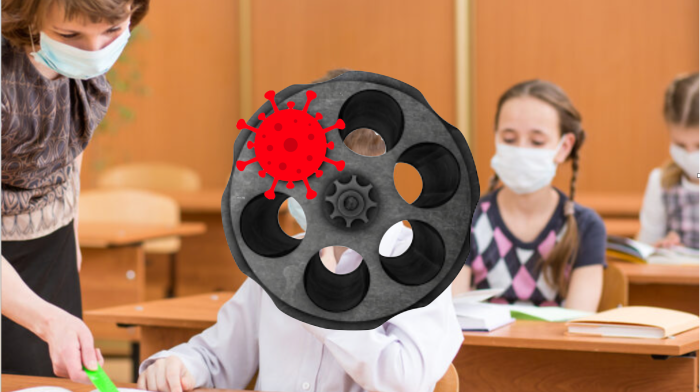
Reopening schools to in-person classes during the COVID-19 pandemic is tantamount to Russian Roulette with the lives of students, teachers and families.


Every day with this virus in the physical classroom is like spinning the cylinder and pulling the trigger.


You might survive, but every time you enter the building your chances of getting sick increase until the law of averages will come for someone… perhaps many someones.


The safest course is to continue with distance learning in the fall despite the numerous academic problems with that method of instruction.


With Coronavirus cases rising by about 50,000 a day in the United States, there is simply too much virus out there to ensure anyone’s safety in the physical classroom.


Students inevitably will get sick and spread the disease to adults – teachers and their own families.


We can’t take such chances with people’s lives.


But don’t just take my word for it.


Decisions makers are taking the possibility seriously enough to try to change the laws to reduce their liability.


They want to ensure they won’t end up in court if they reopen schools and people get sick.

 
In May,Senate Majority Leader Mitch McConnell called for schools to be legally protected from lawsuits that could arise due to resuming classes.


Along with fellow Republican Senator John Cornyn, McConnell proposed new liability laws protecting schools and businesses from Coronavirus-related lawsuits.


McConnell told reporters:


“Can you image the nightmare that could unfold this fall when K-12 kids are still at home, when colleges and universities are still not open? That is a scenario that would only be further aggravated in the absence of some kind of liability protection that reassures school administrators that they can actually open up again… Without it, frankly that’s just not going to happen as soon as it should have.”


The Kentucky Senator went on Fox News in late April saying that such legal protections would be necessary for Republicans to even consider any new Coronavirus relief bills.


And it’s not just lawmakers. In May, 14 college presidents from around the country teleconferenced with Vice President Mike Pence and U.S. Education Secretary Betsy DeVos asking for the same thing.


According to those who were either on the call or were knowledgeable about the conversation, the college presidents said they needed to know their institutions would not get sued if people got sick – which they thought was almost a certainty.


One way the federal government can help “is to have some kind of liability protection,” said University of Texas at El Paso president Heather Wilson, who was on the call. Wilson is a former Republican congresswoman from New Mexico.


Big business is also calling for liability protection. Groups like the U.S. Chamber of Commerce have been asking to be freed during the pandemic from being held liable if workers, customers or others get sick on their property. Notably, a lawyer for Texas Christian University told senators such a situation is “foreseeable, perhaps inevitable.”


All of which begs the question of what we mean by safety.


Is it our responsibility to make sure customers, workers, students and teachers are safe from the virus? Or is it our responsibility to make sure businesses and schools aren’t sued for taking chances with our lives?


There are things we can do to increase safety.


We should not reopen schools until the county where it is located reports zero new Coronavirus cases for two weeks. That would be taking safety seriously.


And it shouldn’t be too much to ask because other countries have been able to do such things.


Other nations have been able to test for the virus and identify those who have the disease. They have been able to trace these people’s contacts and isolate them from the rest of the population.


But that requires a vast expansion of our testing ability through coordinated federal action.


The problem is our lawmakers don’t care enough to do this.


Nor are they willing to provide us with federal relief checks, personal protective equipment (PPE), protection from evictions, and universal healthcare so that were can weather the storm.


It’s much easier to protect business from consumers and protect schools from the kids, teachers and families who make up the community.


Some will say the danger is overblown.


Children, in particular, are less susceptible to COVID-19 than older people.


And while it’s true that young people have shown fewer symptoms and include the lowest numbers of deaths, this virus has been around barely more than a year. We simply don’t know much about it and its long term effects.

 
A recent study from the journal the Lancet found that teenagers are just as susceptible to the disease as older people.


Researchers found few children 5-9 (the youngest included in the study) who had contracted the disease but those ages 10-19 were as likely to contract it as people ages 20-49 – and more likely than adults older than that.

 
So even if young people remain mostly asymptomatic, it is entirely possible they can spread the disease to older people who have a more difficult time fighting it off.

 
The only consensus about children and COVID-19 is that we don’t know enough about how it affects young people.


We certainly don’t want to end up like countries that have opened schools too quickly with too high infection rates.

 
In May, two weeks after Israel fully reopened schools, there was a COVID-19 outbreak. There were at least 130 cases at a single school. Students and staff were infected at dozens of schools causing a rash of renewed closings.

 
We should not be taking chances with schools.

 
Any action comes with some level of risk, but we should err on the side of caution.


Our government needs to serve us.

 
Representatives who do not serve our interests need to be sent packing.


And anyone who gambles with our lives needs to be held liable.


Anyone who demands we place our heads against the barrel of a loaded gun as a prerequisite to jump start the economy, needs to be held responsible for that decision.


The chances of dying during the first round of a game of Russian Roulette using a standard six-shot revolver is 1/6. With each pull, the chances increase – 1/5, 1/4, etc.
The average number of consecutive pulls before the gun fires is 3.5.


We know more about that than the Coronavirus.


In effect, we don’t know how many chambers are loaded, but we know there are bullets in the gun.


There are too many hidden factors to be able to say for sure what our chances are exactly. And in the presence of such ignorance, we should assume the worst.


That’s exactly what decision makers are doing by trying to protect themselves from responsibility.


We should take that as seriously as a loaded gun put to our temples.


Like this post?  You might want to consider becoming a Patreon subscriber. This helps me continue to keep the blog going and get on with this difficult and challenging work.

Plus you get subscriber only extras!

Just CLICK HERE.

Patreon+Circle

I’ve also written a book, “Gadfly on the Wall: A Public School Teacher Speaks Out on Racism and Reform,” now available from Garn Press. Ten percent of the proceeds go to the Badass Teachers Association. Check it out!

book-2

Why High Stakes Testing Was Cancelled This Year (and Probably Will Be Next Year, Too)

Screen Shot 2020-05-16 at 10.22.26 AM

 
There are at least two silver linings to the current Coronavirus catastrophe for education.


One – with nearly all public schools closed, March was the first month since 2002 without a school shooting.


Two – districts nationwide cancelled high stakes standardized tests in April and May.


Taken together, these are two victories that no one could have predicted before November.


Gun safety restrictions remain laughably lax in the US compared to the rest of the world. And our system’s reliance on high stakes testing to hold schools and teachers accountable for economic inequalities and racially biased standards has been thoroughly criticized for nearly a century.


In short, the virus succeeded where policy did not.

 
The pandemic’s other effects have been more damaging as students, parents and teachers have struggled to move education online at home.


Teachers are seeing high absences especially among poor, underprivileged and special needs children. Not to mention worries about the quality and depth of education provided virtually and the stress it places on families.


To make matters worse, the situation seems likely to continue in some form when next school year begins in the fall.


With the COVID-19 virus likely to endure spreading unchecked due to a lack of adequate health screenings, the time it takes to make a vaccine, and an unwillingness by the government to save everyday people from the economic consequences of a nearly stopped economy, not to mention an increasing unwillingness among people to continue thorough social distancing procedures, schools may be left to solve the crisis themselves.


There’s been talk that when schools start up in August and September they may simply continue with cyber curriculum. Or they may open the physical buildings with safety protocols including half day classes of smaller size to keep students a safe distance apart.


In any case, the question of standardized testing arises again with a vengeance.


While there is some wiggle room, federal law (The Every Student Succeeds Act) requires all public school students be given standardized tests in grades 3-8 and once in high school.


The U.S. Department of Education waived that mandate this year because of the virus.


That was great news – a sound decision from a government agency known more for market solutions than rationality.


The question remains: why did the department do it?


Whether staffed by Democrats or Republicans, this doesn’t sound like them.


Why was this exception made and will it be extended again given that the circumstances may be little different in 2020-21 than they were in 2019-20?


The answer seems to be rooted in the tests, themselves, and the economic circumstances which create and sustains them.


WHY TESTS WERE CANCELLED

 
In late March, Education Secretary Betsy DeVos said that her department would streamline the paperwork for states to request a waiver allowing them not to give high stakes testing this year and that the government wouldn’t use this year’s testing data in future school accountability ratings.


DeVos said in a statement:


“Students need to be focused on staying healthy and continuing to learn. Teachers need to be able to focus on remote learning and other adaptations. Neither students nor teachers need to be focused on high-stakes tests during this difficult time.”


How did we get here?


Well, imagine a world where this didn’t happen.


Before DeVos made her statement, some states like Colorado and Texas had already eliminated testing requirements without waiting for a response from DeVos.


If the federal government hadn’t answered these requests in the affirmative, it would have had to engage in an open power struggle with the states over control of public schooling.


This would be especially damaging for a Republican administration because of the party’s stance on state’s rights.


However, even if we put aside this power dynamic, the decision was inevitable.


CORPORATIONS FIRST


All of these assessments are the property of private corporations. These include Harcourt Educational Measurement, CTB McGraw-Hill, Riverside Publishing (a Houghton Mifflin company), and NCS Pearson.


States purchase the right to use these tests but assessment material is the ideological property of the parent corporation. And so they want it guarded from theft.


That’s why nearly all high stakes testing requires proctors – people whose job it is to set up, monitor and secure the testing environment. They make sure test takers don’t cheat, but they also are responsible for ensuring no information about specific test questions leaves the assessment environment.


This is true for standardized assessments at the K-12 level as well as college and certification tests.


I know because I’ve spent every year of my teaching career employed as a proctor throughout most of April as my students take the Pennsylvania System of School Assessments (PSSA) tests. But also when I got my degree I had to go to a designated testing center where I could be monitored as I took a series of assessments necessary to get my certification.


I had to sign in, empty my pockets including giving over my cell phone, and submit to being observed by the proctors and video surveillance. I even had to sign out and back in when I needed to use the restroom.


With physical classrooms closed, there was simply no way effectively to do this.


The College Board tried anyway with an abbreviated Advanced Placement test taken online from home this month to disastrous results – glitches, server issues and a failure by the organization to take responsibility.


However, the problem isn’t essentially technological. These assessments could be given online. Many districts do exactly that, but with teachers in the room acting as proctors.


The technological infrastructure may not yet be in place for widespread virtual testing, but that’s not an insurmountable hurdle.


Test security is a much stickier issue – without real, live people policing the environment, testing information would be at risk.


Rival companies could get access to trade secrets. The value of scores could come under scrutiny due to concerns of student cheating. And the tests, themselves, would for the first time be visible to parents and the general public.


TESTING SECRECY


As a classroom teacher, I get to see these infernal tests. I get to see the questions.


They are not good. They are not well-written, well considered, developmentally appropriate or even good at evaluating student understanding of the knowledge they claim to be assessing.


But up to this point, anyone who gets to see the tests is sworn to secrecy including the students.


The kids taking these exams – regardless of age – are no longer treated as children. They are clients entering into a contract.


At the start of these tests, they are warned of the legal consequences of violating the terms of this agreement.


THE PSSAS

 
In particular,the PSSAs require students to read the following warning on the first day of the assessment:


DO NOT PHOTOGRAPH, COPY OR REPRODUCE MATERIALS FROM THIS ASSESSMENT IN ANY MANNER. All material contained in this assessment is secure and copyrighted material owned by the Pennsylvania Department of Education. Copying of material in any manner, including the taking of a photograph, is a violation of the federal Copyright Act. Penalties for violations of the Copyright Act may include the cost of replacing the compromised test item(s) or a fine of no less than $750 up to $30,000 for a single violation. 17 U.S.C. $ 101 et seq


So the first act of testing is a threat of legal consequences and possible fines.


In the commonwealth, we also force kids to abide by a specific code of conduct for test takers. They must enter a quasi-legal relationship before they are even permitted to begin.


Much of this code is common sense. Get a good night’s sleep. Fill in bubbles completely using a number two pencil.


But some of it is deeply disturbing.


For example, students are told to “report any suspected cheating to your teacher or principal.”


They have to agree to be an informer or snitch to a government agency. My students aren’t old enough to vote or even drive a car, but they are directed to collaborate with the government against their classmates.


In addition, they are told NOT to:


-talk with others about questions on the test during or after the test.


-take notes about the test to share with others.


Students are compelled into a legalistic vow that they won’t break this code. On the test, itself, we make them fill in a bubble next to the following statement:


By marking this bubble I verify that I understand the “Code of Conduct for Test Takers” that my Test Administrator went over with me.


As a test administrator, I am not allowed to move on until all students have filled in that bubble.


Technically, we are not making them promise TO ABIDE by the code of test takers. Perhaps we lack that legal authority. We are, however, making them swear they understand it. Thus we remove ignorance as an excuse for noncompliance.


As a proctor, I have to sign a similar statement that I understand the “Ethical Standards of Test Administration.” Again, much of this is common sense, but it includes such statements as:


DO NOT:

 
-Discuss, disseminate or otherwise reveal contents of the test to anyone.


-Assist in, direct, aid, counsel, encourage, or fail to report any of the actions prohibited in this section.


So even teachers technically are not allowed to discuss the test and should report students or colleagues seen doing so.


And according to the “Pennsylvania System of School Assessment Directions for Administration Manuel”:


Those individuals who divulge test questions, falsify student scores, or compromise the integrity of the state assessment system in any manner will be subject to professional disciplinary action under the Professional Educator Discipline Act, 24 P.S. $ 2070. 1a et seq, including a private reprimand, a public reprimand, a suspension of their teaching certificate(s), a revocation of their teaching certificate(s), and/or a suspension or prohibition from being employed by a charter school. [emphasis added]


CORPORATE VULNERABILITY


If students were allowed to take these tests unsupervised at home, all of this legal protection would disappear.


The corporations would be much more exposed and defenseless.


THAT’S why the tests were cancelled this year.


It wasn’t because anyone rethought the value of high stakes tests – though they should have. It wasn’t because anyone had considered standardized testing’s history in the eugenics movement – which they should have. It wasn’t because anyone was worried that giving these tests would take away precious academic time – though they should have.


It was to protect the business interests that would be at risk otherwise.


THE DYSTOPIAN TESTING FUTURE


The need for proctors is a problem that the testing companies know about and are working to eliminate.


In fact, they’ve been trying to line things up in their favor for years.


Their answer is something called Competency Based Education (CBE) or Proficiency Based Education (PBE). But don’t let these names fool you. It has nothing to do with making children competent or proficient in anything except taking computer-based tests.


Paradoxically, it’s sold as a reduction in testing, but really it’s about changing the paradigm.

 
It’s a scheme that ed tech corporations privately call stealth assessments. Students take high stakes tests without even knowing they are doing it. They’re asked the same kinds of multiple-choice nonsense you’d find on state mandated standardized assessments but programmers make it look like a game.


This safeguards the tests because kids aren’t aware of being tested. Constant micro-assessments blend in with test prep curriculum until there is little to no difference between the two. Academics gets dumbed down to the level of multiple choice and critical thinking is redefined as asking “What does the questioner want me to think?”


Yet the results could still be used to label schools “failing” regardless of how under-resourced they are or how students are suffering the effects of poverty. Mountains of data will still be collected on your children and sold to commercial interests to better market their products.


But that’s just how it is used in schools today.


The potential is to make this a replacement for physical schools.


It’s a disaster capitalism reform tailor made for the Coronavirus age, but not yet ready for large scale implementation.


Imagine a world where there are no schools – just free range children plopped in front of a computer or an iPad and told to go learn something.


No schools, no teachers, just gangs of students walking the streets, stopping along the way to thumb messages to each other on social media, play a video game or take an on-line test.


That’s the world many ed tech entrepreneurs are trying to build.


One thing they need is a pet policy of DeVos and the Trump administration – Education Savings Accounts (ESAs).


Normally, the federal, state and local government collect taxes to fund an individual child’s education, which is then spent at a public or charter school.


However, ESAs would allow that money to go elsewhere. It could go to funding the tuition at a private or parochial school like a traditional school voucher.


Or it could be used for discrete education services provided by the ed tech industry.


It’s almost like homeschooling – without a parent or guardian in charge.


The idea is often called a learning ecosystem.


But it’s just a single person cyber school with little to no guiding principles, management or oversight.


Education is reduced to a series of badges students can earn by completing certain tasks.

 
Reading a book or an article gives you a badge. Answering a series of multiple-choice questions on a reading earns you more badges. And if you’ve completed a certain task satisfactorily, you can even earn a badge by teaching that same material to others.


It’s the low wage gig economy applied to education. Children would bounce from a few hours of Khan Academy videos here to a software package there and Voila! “Modern” education!


And as an added benefit, the badge structure creates a market where investors can bet and profit off of who gains badges and to what degree on the model of crypto-currencies like Bitcoin!


Make no mistake, it’s not about improving the quality of education. It’s about providing the cheapest possible alternative and selling it to the rubes as innovation.


It’s school without the school or teachers.


CONCLUSIONS


This is where the testing industry is going.


This is where we would be today if the legal framework were in place and the technology were widespread, adequate and capable of safeguarding corporate intellectual property without the need for test proctors.


In the short term, this is good news.


As long as the pandemic keeps school buildings closed or keeps them running at less than capacity, the chances of mandating high stakes testing during the crisis goes down.


On the flip side that’s detrimental to student learning in the here and now, but it does offer hope for the future. It at least opens the door to cancelling high stakes testing in 2020-21 like we did this year. And the longer we keep those tests at bay, the greater likelihood they will go away for good.


However, the people at the testing corporations are far from stupid. They know that each year we forgo the tests proves how unnecessary they are.


A coalition of six neoliberal organizations warned against cancelling the tests nationwide in March.


“As the coronavirus pandemic evolves on a daily basis, it would be premature to issue blanket national waivers from core components of the law. Thus, case-by-case consideration of each state’s needs is, at this time, most appropriate,” said a letter signed by testing industry lobbyists including John King, the former secretary of education and head of the Education Trust.

 
They have the future mapped out – a future with immense earnings for their companies and shareholders.


We must be fully aware of what is happening and why if we are to have any chance of opposing the next disaster and coming out of the current crisis with better school policy than we went in.


If we are to safeguard an authentic education for our children, we must learn these lessons, ourselves, now.


Like this post?  You might want to consider becoming a Patreon subscriber. This helps me continue to keep the blog going and get on with this difficult and challenging work.

Plus you get subscriber only extras!

Just CLICK HERE.

Patreon+Circle

I’ve also written a book, “Gadfly on the Wall: A Public School Teacher Speaks Out on Racism and Reform,” now available from Garn Press. Ten percent of the proceeds go to the Badass Teachers Association. Check it out!

book-1

The Internet is NOT the Best Place for Kids to Learn After the Coronavirus Pandemic

Screen Shot 2020-05-09 at 12.46.20 PM

 
If the Coronavirus quarantine has taught educators one thing, it’s this.


Online learning is not better than in-person schooling.


After all these years of corporations throwing apps at us and well-meaning administrators providing us with devices and philanthrocapitalists pumping billions of dollars into ed tech first academic schemes, we can all see now that the emperor has no clothes.


When schools nationwide are closed to stop the spread of a global pandemic and learning is restricted to whatever teachers can cobble together on sites like Google Classroom and ZOOM, we can all see the Imperial scepter blowing in the wind.


The problem is that this is only clear to parents, students and teachers.


The people who get to make ed policy decisions are as blind as ever – as witnessed by New York Gov. Andrew Cuomo’s tone deaf insistence that his state reimagine schools with the help of billionaire school saboteur Bill Gates.


But the rest of us – you know, those grounded in reality – can see the problems with remote learning staring us in the face.


Most importantly, the Internet is not a conducive environment for learning.


I don’t mean that learning can’t take place there.


You could learn in a fox hole while being shelled by enemy forces. But if your content extends to something more complex than “Duck” or other survival tactics, this may not be the best place to learn it. After all, environment plays a key role in knowledge acquisition.


Moreover, different people learn things better in different circumstances. And, contrary to our current education policies that view children as stakeholders or consumers, they are in fact people.


There are some children who learn better online than in a brick and mortar classroom. But these kids are few and far between.


In general, the younger the child (both physically and psychologically), the more important it is that he or she be given the opportunity to learn in an actual classroom.


Why?


It really comes down to who controls the environment.


In a classroom, the teacher decides most everything about the physical space and what possibilities there will be. She places the books, hangs the posters, sets the lighting, displays student work, etc.


In a virtual environment, the space is defined to a small degree by the teacher, but it is mostly determined by the ed tech provider and the open world of the Internet.


In short, teachers have much more control over physical classrooms and can remove distractions.


Online, educators have very little control over this.


LINE OF SIGHT

 
For instance, in my physical classroom, if I wanted to see what a student was doing, all I had to do is walk up to him and look.


I controlled what I see, and hiding things from me was difficult.


Online, if I want to see what a student is doing (let’s say on a video communications platform like ZOOM), I have little control over what I see. The student is in control of the camera. If it is pointing at the student or placed so as to hide certain behavior or even if the camera is currently on or not is not in my control. Students are empowered to hide anything they want, and there’s not much I can do about it.


When teaching online, I’ve had students texting on cell phones, playing video games on computers, having side conversations with friends in their bedrooms, playing with pets – and trying to hide this with the way they display themselves on camera.


I’ve had kids mysteriously turn off the camera or point it away from their faces until I ask them to switch it back on or swivel it back to themselves.


DO YOU HEAR WHAT I HEAR?

 
When I first started teaching online a few weeks ago, one of the most powerful tools at my disposal seemed to be the mute button.


If several kids weren’t hearing me because of side chatter, I could simply mute everyone and fill the blessed silence with instruction.


However, I soon discovered that this is deceptive.


Just because you don’t hear the students, doesn’t mean they aren’t talking. Some kids use the online chat stream to continue side chatter. Others forgo that entirely for text and Facebook messaging.


What’s worse, it’s often hard for the teacher to even know whether anything she said is actually being heard.


TOO MUCH CHOICE

 
One of the great strengths of online learning is that it gives students an incredible amount of choice. But that is also its greatest weakness.


I can give assignments through a file sharing site like Google Classroom and let students complete it at their own pace.


The problem is that kids (especially young kids) need their pace monitored.


You can’t give them too much time to get something done because many will procrastinate through the deadline.


In my physical classroom, I would often give an assignment and then provide at least some time for them to start it. The idea was that even if they don’t finish it with me, they are more likely to complete something they already began.


However, online it is completely up to them when to do an assignment. They are responsible for their own time management – and that’s a skill we, as educators, struggle to teach them.


As a result, most students don’t get these assignments done on time – if at all.


Even when they do the work, I’m bombarded by a slew of submissions around midnight or the early hours of the AM.


HOW TO ASK A QUESTION YOU DON’T KNOW YOU HAVE


Then there’s the question of… well… questions.


In my brick and mortar classroom, if a child was unsure of something, all she had to do was raise her hand and ask. Online, there are multiple ways to communicate with me – kids can send me an email, message me or verbally ask me something during a video chat.


The problem is that sometimes they don’t know they’re confused.


In my physical classroom, since all students are working on an assignment together in that same time and space, I can go from desk to desk and see how they’re progressing.


If they’re getting something wrong, I can correct it in real time. I can give suggestions and encouragement even before the work is done.


Online, I’m mostly limited to commenting on the final project. If a student didn’t understand the directions – and didn’t even understand that he didn’t understand the directions – I don’t know until the work is done.


This presents a problem. Do I explain the error and ask him to to do the work all over again? Or do I explain the error but accept the work for what it is?


I’ll admit, I usually do the later.


STUDENTS M.I.A.


Which brings me to mysterious absences.


I don’t mean kids who don’t show up to video conferences – though there are many of those.


I mean kids who for all intents and purposes appear to be there in ZOOM and then suddenly disappear never to return that day.


They could have a device or Internet issue. And if this happens every once in a while, it’s understandable. But what about kids who do this all the time?


If your iPad isn’t charged one day, I guess things happen. But if it isn’t charged everyday, that’s a problem. Your problem – one you need to solve.


I know every district is different in this regard, but my school provides every student with devices and even WiFi if necessary. Even in the physical classroom, using devices always came with a chorus of whines about them not being charged.


Once again, we’re putting this responsibility on students and families. In the days before distance learning, we could question whether that was fair. In the Coronavirus dystopia, we have little choice but to do it.


However, this brave new world even makes an issue out of bathroom breaks.


In the brick and mortar classroom, kids would ask to go to the restroom and then be sent one at a time. Online some kids just turn off their camera or leave it idling on an empty seat or the ceiling. It is next to impossible to tell whether these breaks are genuine or even to estimate their duration.


Some students are gone for the majority of the meeting. In a world where video conferences are few and far between, is it so much to ask that you use the restroom BEFORE going to ZOOM?


INVADERS

 
But let’s not forget unwanted guests.


These platforms require students to know a dedicated Web address and sometimes a password to get in.


Yet these are children. They sometimes share these security measures with people who were not invited.


Even in my physical classroom, sometimes students not on my roster would try to get in to talk with a friend or even just sit in on my amazing lessons. I could stop them at the door and send them on their way.


Online, some sites like ZOOM give me similar power, and others like Kahoot (a game based learning platform) do not. Even when every person entering has to be approved by me, all I see is the name they’ve given their device. If an enterprising stranger wanted to rename their device to that of one of my students, I probably wouldn’t catch it until they were in.


There have been several times when someone with one of my students’ names got into a ZOOM meeting, but either refused or couldn’t turn on their camera. I had no choice but to boot them out.


On some sites like Kahoot, there is no video. I had no idea who was signing in – I just saw the name they input.


So sometimes I had two students with the same name. Or I had let’s say 8 kids in the class but 9 kids were signing on to Kahoot.


It’s maddening!


ASSESSMENTS AND CHEATING

 
Now let’s talk tests.


I don’t like tests. I think they can too easily become cruel games of “guess what the testmaker was thinking.”


But they are a necessary evil to judge what information students have learned. Moreover, a creative teacher can design them to reduce the regurgitation of facts and increase critical analysis backed by facts.


In a physical classroom, teachers can monitor students during test taking. Online, they can’t. So there’s always a question of cheating.


Every scrap of information in human history is available somewhere online. If students try hard enough, they can find the answer to any question with a deft Google search.


However, to be honest I don’t think I’ve had too much trouble with this as yet. My students either don’t care enough to cheat, cannot figure out how to do so effectively or have too much self respect.


Or maybe I just haven’t caught them.


In the physical classroom, I had several students try to pass off others work – essays or poems – as their own. But I haven’t assigned anything so ambitious through distance learning yet.


CONCLUSIONS

 
Perhaps that’s why it drives me nuts when policymakers and media types make statements about what an overwhelming success this has all been.


Teachers and districts have tried their best. Students and families are giving their all. But this experiment does not demonstrate why we should all embrace distance learning once the Coronavirus pandemic is under control.


It shows why we MUST return to the brick and mortar classroom as soon as it is safe to do so.


Reimagining school will not require more ed tech.


It may require much less.


Kids need to be in the presence of physical human beings in a real environment with their peers to maximize their learning.


We need smaller classes, equitable funding, desegregation, social justice, wide curriculum, and an end to high stakes testing, school privatization, science denial and anti-intellectualism.


But more than anything, we need policymakers who are willing to listen to and include the people on the ground when making decisions that affect us all.


Like this post?  You might want to consider becoming a Patreon subscriber. This helps me continue to keep the blog going and get on with this difficult and challenging work.

Plus you get subscriber only extras!

Just CLICK HERE.

Patreon+Circle

I’ve also written a book, “Gadfly on the Wall: A Public School Teacher Speaks Out on Racism and Reform,” now available from Garn Press. Ten percent of the proceeds go to the Badass Teachers Association. Check it out!

book-4

Mike Turzai is Willing to Sacrifice Pennsylvania’s Students and Families to the Economy

Screen Shot 2020-05-05 at 1.09.00 AM

 
Mike Turzai says he’s furious with Pedro Rivera.


Why is the highest ranking Republican in Pennsylvania’s House of Representatives so angry with the state Secretary of Education?


Rivera said the Commonwealth’s public schools, which have been closed since mid March due to the Coronavirus pandemic, would not reopen until it was safe to do so.


If that means schools don’t reopen on time in the Fall, so be it.


Specifically, on Wednesday, Rivera said:


“At the end of the day, we’re going to make sure that the health and welfare of our students is first and foremost, front and center. And we’re not going to allow and ask students to return to school in an unsafe environment. We’re preparing for the best, but we’re planning for the worst.”


Turzai was so infuriated by this statement that he wrote a letter to Rivera – which the Pittsburgh area representative immediately shared with the media – he went on right wing talk radio to complain, and he posted a video on his Facebook page.


You know a Boomer is really mad when he goes on the social media.


Though his comments include his usual greatest hits against public schools and those greedy teachers, Turzai’s main point was simply science denial.


On Facebook, after a long list of activities that he said kids enjoy doing like sports and lab experiments, he said this:


“All of those can be done safely, and [kids] are not at risk unless they have an underlying medical issue. The fact of the matter is kids can develop herd immunity, and if you [Rivera] have not yet developed a plan where we can safely educate kids in schools, then you are going to have to rethink education forward…”


So there you have it, folks.


Turzai wants Pennsylvania to reopen schools on time whether scientists and health experts think it’s safe or not because – Turzai knows best.


Pennsylvania’s village idiot thinks he knows best about schools.


And as usual he’s as wrong as you can get.


The COVID-19 virus is relatively new. That’s what the 19 in its name means. It was only discovered in 2019.


It’s already killed more Americans than the Vietnam War (69,579 vs. 58,220). There’s no vaccine. And we really don’t know with much certainty how it will affect people in the long term.


And as to herd immunity, Sweden tried that – eschewing social distancing and letting people just get the virus – and the result is a death rate twice that of the US.


While it is true that children seem to be mostly asymptomatic, thousands have contracted the disease and several have died.


However, the Center for Disease Control (CDC) points out the bigger issue in the organization’s April report on its Website:


“Pediatric COVID-19 patients might not have fever or cough. Social distancing and everyday preventive behaviors remain important for all age groups because patients with less serious illness and those without symptoms likely play an important role in disease transmission.”

So if we reopen schools before it is safe to do so, we run the risk of (1) kids dying, (2) kids becoming carriers and bringing the disease to any adults they come into contact with who are much more susceptible and (3) teachers and school staff getting sick and dying.


Turzai has no problem with any of that.


He thinks the risk is worth it.


Why?


Well, that’s the party line he’s been handed by the Trump administration, and he does whatever he is told by his bosses.


Oh? The taxpayers thought THEY were his bosses?


No. You are just the chumps who kept re-electing him.


He doesn’t work for you.


He works for the Republican Party machine which is trying to turn people against Democratic governors like our own Tom Wolf.


And, man, does he want to be the next GOP challenger to Wolf. That’s really what this whole business is about – casting Turzai as even more radical than Scott Wagner, the last far right dope who tried for the governors mansion and was soundly defeated by voters.


He’s trying to show he’s just as stupid as Donald Trump. The President says we should all drink bleach to get rid of COVID-19? Well Turzai says we should let our kids get sick and die or make us sick.


Republicans truly have become the party of stupid.


The media helps covidiots like Turzai by uncritically reprinting his outrageous lies.


Turzai is like a man who calmly says it’s not raining outside while a thunderstorm beats down on the neighborhood. Instead of pointing out the truth, the media simply reports what Turzai said and at most gives equal weight to a meteorologist. But there is no OPINION about facts! And whether scientific consensus holds with his crackpot conspiracy theories about how the Coronavirus spreads or not IS a fact.


Is social distancing fun?


No.


If I could push a button and magically make the Coronavirus go away, I would.


But you have to live in the real world.


We have to get rid of the virus.


We need real tests to be able to tell if people have the virus. The Trump administration has completely botched that. This is why countries like South Korea are seeing hardly any new cases at all while our numbers are still extremely high.


Not to mention the fact that we have a bunch of morons who value their freedom to put themselves at risk without any thought to their responsibilities to the rest of society who they will also be endangering.


Until we can truly tell who has the virus, who had the virus, who is immune, and how to cure it, the prospect of reopening schools or the economy will be grim.


We should not put people at risk unnecessarily.
And we certainly shouldn’t put children at risk.


Don’t let fools like Turzai use a global pandemic to hawk their political agendas.


He goes on in his video to say that if the state’s public schools don’t open on time, we should consider things like universal cyber schooling, and (non sequitur alert!) charter and voucher schools.


It’s his everyday wish list wrapped in a Coronavirus-bow.


That’s how dumb this dummy thinks Pennsylvanians are.


I sure hope he’s wrong about that, too.


MYTHBUSTERS: A quick rebuttal to the other lies spewed in Turzai’s Facebook video


-Does Pennsylvania spend more than most other states on education?


We’re in the top 10 for over all spending, but we don’t distribute it equally. Kids in rich districts get tons of money. kids in poor districts get scraps. That’s why there’s a lawsuit demanding the state ensure all kids get an equitable education.


-Are pension payments high?


Yes, because while teachers and schools paid into the program, the state legislature deferred to pay its share for years and years. Now it’s due. We agreed to give state workers benefits when we hired them. We can’t go back on that now.


-Do administrators know if teachers are teaching online during the pandemic?


Yes. Parents, students AND administrators know because it’s all online. Administrators can monitor teachers MORE closely via the Internet – not less. That’s why there’s an overwhelmingly increased appreciation of what educators are doing now – it’s out in the open.


-Should educators call special needs students for three hours everyday?


Only if they aren’t already spending the majority of their days actually teaching students on-line. I’m on ZOOM meetings most days interacting with students on video conferences for almost as much time as I would in person if schools were open. And if you add in the amount of time it takes to come up with new lessons on learning platforms we’re unfamiliar with, program them in and troubleshoot them, most teachers are putting in MORE hours than usual.


Like this post?  You might want to consider becoming a Patreon subscriber. This helps me continue to keep the blog going and get on with this difficult and challenging work.

Plus you get subscriber only extras!

Just CLICK HERE.

Patreon+Circle

I’ve also written a book, “Gadfly on the Wall: A Public School Teacher Speaks Out on Racism and Reform,” now available from Garn Press. Ten percent of the proceeds go to the Badass Teachers Association. Check it out!

book-1

HBO’s “Bad Education” Aims at Public School Theft While Ignoring More Frequent Fraud at Charter Schools & Testing Companies

BADED_29OCT18_0125.RAF

 
“Bad Education” is a frustrating movie to watch as a public school teacher.


It does a fine job telling the true story of a wealthy New York district where administrators stole millions of dollars for themselves.


But it ignores the far more frequent waste and malfeasance caused by school privatization, high stakes testing and runaway ed tech.


Maybe I’m being too sensitive, but there is no subject more political than public schools.


During the current Coronavirus pandemic, teachers and schools are finally getting some respect from people who are trying to “home school” their own kids while the nation’s classrooms are shuttered.


But education budgets are still routinely slashed, and every policymaker from Betsy DeVos to Barack Obama still thinks there is nothing better than closing public schools and replacing them with charter and/or voucher schools.


Pundits continually decry low test scores while applauding every means to increase racial and economic segregation. They push every policy to increase the school to prison pipeline for black and brown students.


And now HBO drops this movie about Rosalyn School District Superintendent Frank Tassone (Hugh Jackman) who embezzled $11 million from taxpayers.
What happened in Rosalyn was scandalous. But it’s an outlier.


Such misappropriation and outright theft rarely happens at public schools. After all, the records are all public. It just takes someone to check up.


For REAL theft you have to go to charter and voucher schools where the law literally allows them to spend our money without most of that public oversight.


Viewers like me from Pennsylvania still remember Nick Trombetta. The founder and former CEO of the Pennsylvania Cyber Charter School stole a similar sum (at least $8 million), and got much less prison time (20 months vs. Tassone who served 3 years). Trombetta used taxpayer dollars to buy a$300,000 private jet for goodness sake! He bought a $933,000 condo in Florida! He bought $180,000 houses for his girlfriend and mother in Ohio. He did all this and more – and his lawyers got the charges down to tax evasion! Why is there no movie about THAT?


Or how about June Brown?


As the head of Agora Cyber Charter School, which was part of the K12 Inc. charter empire, she was indicted for stealing $6.5 million from taxpayers. She and her executives were indicted on 62 counts of wire fraud, obstruction of justice and witness tampering. She had a reputation for claiming large salaries and filing suits against parents who questioned her.


Where’s that movie?
The history of charter schools reads like a who’s who of hucksters and thieves!


Electronic Classroom of Tomorrow (ECOT) the largest charter school in Ohio was forced to shut down and auction off all its taxpayer funded property because administrators  grossly inflated its students body of 12,000 online students to the state.


New Jersey charter schools spent as much as $800 million of taxpayer dollars to buy property that they then charged taxpayers additional money to rent from the charter schools, according to an IRS investigation.


The Network for Public Education published a report in 2019 detailing more than $1 billion in federal dollars misappropriated by charters – including hundreds of millions spent on charters that never even opened or that closed soon after opening.


I think those would make good movies. Don’t you?


But let’s not forget the other vulture industries that prey on our public school system without providing much of value in return.


If you want REAL fraud, you have to go to the standardized testing and ed tech industry sucking away billions or taxpayer dollars while providing services that are either unnecessary or downright destructive.


Why do we give every public school child high stakes tests in grades 3 through 8 and once in high school? Because the federal government says so.


These tests don’t tell us how well students are doing in school. We have at least 180 days of classroom grades that tell us that.


These tests taken over a period of a few days tell us what the corporation making them thinks is important. And they nearly always show that richer kids are doing better than poorer kids, and that whiter kids are somehow “smarter” than blacker kids.


And for this prized data we pay billions of dollars to big businesses every year.
It’s one of the largest captive markets in existence. That’s some 50.4 million children forced to take standardized assessments. The largest such corporation, Pearson, boasts profits of $9 billion annually. It’s largest competitor, CBT/ McGraw-Hill, makes $2 billion annually. Others include Education Testing Services and Riverside Publishing better known through its parent company Houghton Mifflin Harcourt.


If many of these companies sound like book publishers, that’s because they are or their parent companies are. And that’s no coincidence. It’s another way they bolster their own market.


Not only do many of these testing corporations make, provide and score standardized assessments, they make and provide the remedial resources used to help students pass.


So if your students are having difficulty passing the state test, often the same company has a series of workbooks or a software package to help remediate them. It’s a good business model. Cash in before kids take the test. Cash in when they take it. And if kids fail, cash in again to remediate them.


Ever wonder why our test scores are so low? Because it’s profitable! The money is all on the side of failure, not success. In fact, from an economic point of view, there is a disincentive to succeed. Not for teachers and students, but for the people who make and grade the tests.

 
In fact, when I sat down to watch “Bad Education” I thought it was going to be about high stakes testing cheating scandals. I thought it was going to be about how the pressure to have students score well on the tests have in some cases resulted in teachers and/or administrators changing answers to inflate the scores.


But no. That’s not mentioned at all. There’s talk about test scores but their value is never questioned for one second.


Hugh Jackman’s superintendent dreams of leading his schools from getting the 4th highest test scores to having the 1st highest. But nowhere does anyone mention how these tests were literally developed by Nazi eugenicists or how they have been challenged countless times for violating children’s civil rights or even the sizable parent-led opt out movement in the same New York suburbs where the film takes place.


Okay.  Maybe I AM being too sensitive.


The film does seem to have a theme about how we expect everything from schools and teachers and don’t reward them well enough. But this is undercut by the obvious villainy of people who use that discrepancy to take advantage of the trust the public has placed in them.


Public schools rarely act this way.


I fear that many people will miss that point.


Instead it will be more fuel to the fire that public schools are bad and must be replaced.


There’s even a parting shot about Jackman’s character’s pension.


I’m all for drama.
But when filmmakers bend over backward to ignore the elephant in the room, I tend to lose my appetite for popcorn.


Like this post?  You might want to consider becoming a Patreon subscriber. This helps me continue to keep the blog going and get on with this difficult and challenging work.

Plus you get subscriber only extras!

Just CLICK HERE.

Patreon+Circle

I’ve also written a book, “Gadfly on the Wall: A Public School Teacher Speaks Out on Racism and Reform,” now available from Garn Press. Ten percent of the proceeds go to the Badass Teachers Association. Check it out!

book-4

Adventures in Online Teaching: Reinventing the Wheel for a Handful of Students

Screen Shot 2020-04-24 at 8.28.00 PM

 
Today in our ZOOM meeting, one of my students tried to get one over on me.


I sat at the bureau in my guest bedroom, surveying a gallery of 7th grade faces lined up in little boxes on my laptop like the opening scene of the Brady Bunch.


Lilly was lying on her bed face up, almost definitely scrolling on her cell phone.


Pha’rrel was eating a cookie as he tried to fit his overgrown curls under a gray hoodie.


And Jimmy was smiling at me with the cheesiest close up you ever saw in your life.


The smile was so wide. The eyes were so glassy. The face was so still.


“Jimmy, did you put up a picture of yourself on your camera!?” I asked.


Somewhere miles away he laughed, apologized and took it down.


If we were back in the classroom, I probably would have come down on him.


He used to sit in the back of the room, face buried in his iPad, ear buds plugged into his brain and his work done in the most careless but high-speed fashion possible.


About once a week I had to take away some device just so his Internet-rattled mind could pay attention.


What am I to do now? Those apps and devices are the only thing connecting him to even the most rudimentary schooling.


He still wants to appear to be paying attention, appear to be done with whatever useless crap I am having him do so he can play Fortnite, watch YouTube videos or text – all behind a digital mask of innocent concentration.


So I moved on.


We read a passage together and I noticed Melanie had her eyes closed.


Not just that. She was in her comfy sweats, cuddled under the covers with a kitten curled under her elbow purring away.


“Melanie?” I say.


No response.


“Melanie, did you hear what we just read?”


Nothing.


She’d do that in class sometimes, too. She’d be zonked out, her head plastered to the desk in a puddle of quickly congealing drool. Sometimes it was pretty hard to wake her.


I remember conferencing with her and her mom trying to find out if there was anything wrong – but, no, she was simply misusing the privilege of picking her own bedtime.


How was I to keep her awake online? I couldn’t shake the desk, rattle her papers or even let my voice naturally get louder as it gained proximity.


I had to let her sleep.


Oh and what’s this? Was that Teddy finally joining the ZOOM Meeting 20 minutes in?


I clicked to let him join and immediately it was clear that he was missing something important.


“Teddy? Is that you?” I said.


“Yeah, hey, Mr. Singer.”


“Ted, you forget something?”


“Wha?”


“Ted, your shirt?”


He looks down at his naked torso.


“Oh, I haven’t gotten dressed yet.”


“Uh, we can see that, Buddy. Why don’t you turn your iPad around and put on a shirt and pants? Okay?”


These are just some of the hurdles you face as an online teacher.


Ever since the Coronavirus pandemic shuttered schools across the country, teachers like me have been asked to finish up the year with students via the Internet.


It’s not been exactly a smooth transition.


Getting kids attention is not an easy task under the best of circumstances. Online it’s nearly a Herculean labor.


Strangely the episodes related above aren’t even close to the worst of it.


More than students’ attempts to message each other through the lesson or the constant screaming in the background at some kids homes or the vacant stares of the child with ADHD whose IEP calls for teacher proximity and eye contact, but how do you do that from across town? – more than all of that is the silence.


The empty, deafening silence of the majority of kids who don’t even show up.


I’ve been doing this for three weeks now and I average about 40% participation.


Some days a class might be almost full. Another day there might be two kids.


I know it’s not necessarily the children or the parents’ fault.


We’re in the middle of a global catastrophe. Family members are sick, kids are scared, and many don’t have experience with Internet, the devices or certainly the learning platforms we’re using.


Districts can give out iPads and mobile hot spots, but not familiarity with technology, not a quiet place to work, not a safe and secure learning environment.


When a parent tells me her child is having trouble with something, I excuse him. I get it.


When a student tells me she doesn’t understand how to do something, I don’t penalize her. I try to fix the problem and ask her to give it another shot.


But when you’ve been tasked with creating almost entirely new curriculum on the fly for several different classes– and you do – it’s anticlimactic that so few kids show up to see it.


I almost don’t mind it when someone’s cat swaggers in front of the screen and flaunts its butthole for all to see.


That’s just life in the age of distance learning.


But when I design all these assignments and teach all these classes, I wish more students showed up.


My district doesn’t require me to do all this.


I could have just thrown a few worksheets up on Google Classroom and called it a day.


That’s kind of what administrators want, I think. Just review previously taught skills. Make it look like we’re doing something. And we’ll close the academic gaps next year.


But when the world shut down, my 8th graders were getting ready to read “The Diary of Anne Frank” and “To Kill a Mockingbird.” You don’t really expect me to skip over that, do you?


My 7th graders were getting ready to read a gripping mystery story, “Silent to the Bone” by E.L. Konigsburg. You don’t really think I’m going to substitute that with grammar and vocabulary worksheets? Huh?


So I narrowed it all down to essentials.


I could have assigned my students to read the texts on their own and then made them write reader response journals. But I don’t think any but my most self-motivated students would have done it and even they would have lost a lot without being able to discuss it.


So I put a few assignments on Google Classroom, but most are through live ZOOM Meetings where the students and I talk through the texts together.


The 8th graders read the play version of “Anne Frank” together with me, and it’s actually going pretty well.


I’m able to display the text on the screen and move the cursor under what they’re reading.


I’ve even seen some reluctant readers improve right before my eyes.


I’ve always suggested that students put their index fingers under the words as they read, but few do it. Using ZOOM like this forces them to follow my advice.


Of course, the class is a tiny fraction of what it would be in person.


If we were still in the school building, I’m positive they’d be learning more. We’d be able to discuss more. I’d have a better read of the room. They would be less capable of hiding behind the technology.


But there is real life-long learning taking place.


It’s my most successful group.


My 7th graders are a different story.


They are the kind of class you have to explode a stick of dynamite under to get them to notice what’s right before their eyes.


And more of them actually show up. Yet much of what we’re reading seems lost on them.


They are much more dedicated to being present in body if not in spirit – and barring an exorcism, I’m unsure how to reach many of them through fiber optic cables.


Then we have my Creative Writing class – basically a journaling course taught to a different group of students every few weeks.


It’s particularly challenging because I’ve met very few of them in person before the school closed.


However the course also lends itself best to this distance learning format.


Back in the school building, I used to give students a prompt every day, explain it and then have them write. I’d go from desk-to-desk as they worked and give feedback. Once they were all done, we’d share the writings aloud.


Now online, I just give the prompts via Google Classroom, provide instruction or attach video links and leave them to it. Then I comment on what they produce.


The problem is it’s my least attended class. I have a handful of students who do all the work, but most have done nothing. And this is a traditional work-at-your-own-pace cyber class.


I’ve had much more difficulty planning the other courses. Everything had to be reinvented. You want to read along with students, you need (1) a platform where you can all talk (2) an online text, (3) a way students can catch up, (4) a way to hand in written work, (5) a way to give tests without allowing students to cheat or do the work together.


It’s been challenging especially because sometimes one online solution will simply disappear.


For example, the e-text I was using for 7th grade was taken down overnight. One day it was available. The next it was gone. So I had to scramble to find a way to make it work.


That kind of thing happens all the time.


And speaking of time, when I’m not in a ZOOM Meeting with students or programming next week’s lessons, I have to wait for assignments to come in. Back in the classroom, they used to be handed in mostly all at the same time. I could grade them and move on.


In cyber-land, they trickle in piecemeal. I’m NEVER done teaching. It could be 1 am and my phone dings that an assignment, comment or question was turned in. I could wait until later, but usually I trudge over to the computer and see what needs my attention.


Which brings me to the final challenge – managing my home and teacher-life.


I’m not just an educator. I’m a parent.


I don’t teach my daughter. I don’t assign her lessons or work. But I have to oversee what her teacher wants her to do and make sure it gets done – and done correctly.


I’ll tell her to go in the dinning room and do three BrainPop assignments, or sign on to Edmentum and finish this diagnostic test, etc.


She’s generally pretty good about things, but if I don’t watch her, she’ll play Mario Party on her Nintendo all day long.


With the wife working from home, too, I usually give her the living room, my daughter is someplace else or her room, and I’m in the office.


On the one hand, it’s nice to be busy, and the good moments where I connect with students are just as magical as in person.


But most of the time, I feel lost at sea, depressed about the news and unable to concentrate or sleep the night through.


I’ve resigned myself to this life for the next six weeks when school will end for the academic year.


Perhaps the summer will be better. Maybe we’ll be able to go out and life will get somewhat back to normal.


However, I am not blind to the possibility that I’ll have to pick up again online in August and September.


School could start up with distance learning in 2020-21. Or we could have to quickly rush back to the Internet after a second wave of COVID-19 crashes upon us.


I keep thinking of the opening of Charles Dickens’ “A Tale of Two Cities”:


“It was the best of times, it was the worst of times, it was the age of wisdom, it was the age of foolishness, it was the epoch of belief, it was the epoch of incredulity, it was the season of light, it was the season of darkness, it was the spring of hope, it was the winter of despair.”

 
The fact that life and schooling will be different after this crisis ends is both encouraging and terrifying.


There’s so much we could fix and finally get right.


But from what I see us doing as the crisis unfolds, my hope dwindles with each passing day.


Stay safe and stay optimistic.


But let’s not stay cyber.


Like this post?  You might want to consider becoming a Patreon subscriber. This helps me continue to keep the blog going and get on with this difficult and challenging work.

Plus you get subscriber only extras!

Just CLICK HERE.

Patreon+Circle

I’ve also written a book, “Gadfly on the Wall: A Public School Teacher Speaks Out on Racism and Reform,” now available from Garn Press. Ten percent of the proceeds go to the Badass Teachers Association. Check it out!

thumbnail_IMG_8249