Tying Kids’ Lunch Money to Test Scores? It’s No Crueler Than High Stakes Testing

Screen Shot 2019-02-22 at 9.06.34 PM


UPDATED


Most people agree that the best way to get kids to read isn’t by threatening to take away their lunch.

 
But an Arkansas state Representative is threatening to do just that – sort of.


Rep. Alan Clark, a West Memphis Republican, proposed a bill that would cut “Lunch Funding” for impoverished children in state schools where students struggle with standardized reading tests.


However, he’s not proposing we take away kids’ food.


If passed, the bill would reduce a district’s National School Lunch funding – a state mechanism that distributes extra resources to schools with high concentrations of students who qualify for free lunch programs – if student test scores don’t rise over a period of time. This would cut things like professional development and tutoring.


However, this has been confused with the federal program of the same name and drawn almost universal condemnation.


“I would never starve kids,” Clark said. But he would starve their schools of resources.


Either way, his proposal is obviously unfair.


Only a monster would think you can incentivize reading comprehension by threats and coercion.


It’s like saying “You’d better understand this complex puzzle OR ELSE!


Learning doesn’t work that way.


But Clark sees things from a different perspective – that of business and industry. He told KTHV, a state television network:


“In most businesses I would be laughed at for suggesting such a small goal. But sadly many educators act like I have asked them to storm the beaches at Normandy… It appears I have much more faith in our schools than many of our educators do.”


This is what happens when you elect people without empathy or intelligence to public office.


I wonder if Clark would do a better job representing the people of his state if they threatened to lower his salary based on his popularity polls.


It says a lot about us that people react so viscerally to the inaccurate idea that Clark is suggestion we withhold food from bad test takers. That’s unthinkable. But it isn’t really that much more cruel than the way we actually treat students.


Our entire federal education policy is based on just such inhuman treatment of children.


After all, we still hold kids, schools and teachers “accountable” by student test scores. The consequences though aren’t an empty belly. They’re crowded classrooms and fewer tutors.


In every state of the union, students are required to take high stakes standardized tests in reading and math. If they don’t do well, we take away their resources.


Sure, we don’t deny them food, but we deny them many other things they need to learn.


We lower funding to their schools so that they have larger class sizes, fewer teachers, narrowed curriculum, etc. We threaten to withhold their diplomas and any chance of ever earning more than minimum wage. In many cases we tie teachers salaries, reputations and even employment to these same scores. Sometimes we even take away their parents right to govern their children’s schools so that all administrative decisions are made by state flunkies. Or we force their authentic public schools to become charter institutions so that spending decisions happen behind closed doors without accountability and even whether a student can enroll or not becomes a decision of the private management company and not simply something that is the students’ by right of living in the district.


It may not be as severe as the idea of Test Scores for Food, but it’s the same in kind.


In both cases, we tell kids – “Increase test scores, OR ELSE!” It’s just a difference of consequence.


Call me crazy, but that’s nearly as cruel and wrongheaded.


Keep in mind, all of this takes for granted that standardized tests are adequate and fair assessments of student learning in the first place. This has never been proven. In fact, it has been cast in serious doubt after more than a century of academic study. Ask anyone to narrow their thinking down to four prepackaged choices and you’ll find them trying to guess what the test-maker wanted more than what the truth is. Critical thinking, analysis, innovation – these escape any multiple choice exam.


But even if we go with this empty assumption, it flies in the face of everything we know about the way human beings acquire knowledge and demonstrate skills.


When kids struggle with learning, you can’t get them to do better with threats. Or at least you can only do that if those children are doing poorly on purpose.


Kids who just aren’t trying hard enough might be incentivized by threats. But even then it transforms learning into a means to an end. Once you do that, you destroy their natural curiosity. Learning will never again be an end in itself. It will be a menial task you only do to get something else that you really want.


However, in most cases kids don’t struggle because they’re just lazy. They don’t need an incentive. They need help. They need resources.


It’s no wonder that children in rich and middle class neighborhoods have less trouble getting higher test scores. They have lower class sizes, more teachers, wider curriculum, more extra curricular activities, access to tutors, counselors, nurses and after school programs.


Poor kids don’t. THAT’S why they struggle.


And what do we do when that happens? We take away the meager resources they have!


If a teacher tried any of this crap in her classroom, she’d be fired for dereliction of duty – and she’d deserve it!


Just imagine if you told the kids who were struggling in your class that they didn’t deserve tutoring. Instead you were going to give extra help to the kids who got the best scores on the exam!


And if the struggling children continued to do poorly, you took away their desks. Now they had to sit on the floor!


THIS is the kind of thing we’re doing to our children nationwide.


It’s called TEST AND PUNISH, and it’s federal policy – often backed up by state and local law.


Moreover, it’s supported by both Republicans and Democrats alike.


We may not be  denying poor kids a meal, but we are denying them an equal opportunity at an education just the same.


It’s way past time that we wake up and see that.


We can point and jeer at what we thought this regressive Arkansas nitwit was doing, but we’re really pointing and jeering at ourselves.


NOTE: An earlier version of this story – like many in the state and national press – wrongly suggested that Clark wanted to withhold lunches from poor children based on test scores.


Still can’t get enough Gadfly? I’ve written a book, “Gadfly on the Wall: A Public School Teacher Speaks Out on Racism and Reform,” now available from Garn Press. Ten percent of the proceeds go to the Badass Teachers Association. Check it out!

book-3


Hey, Teachers’ Unions, Let’s Get This One Right – No Early Presidential Endorsements & Lots of Membership Engagement

52448056_1332568296885727_443989310761336832_n
Let’s not mince words.


The last Presidential election was a cluster.


And we were at least partially to blame for it.


The Democratic primary process was a mess, the media gave free airtime to the most regressive candidate, and our national teachers unions – the National 
Education Association (NEA) and American Federation of Teachers (AFT) – endorsed a Democratic challenger too early and without getting membership support first.


This time we have a chance to get it right.


Edu-blogger Peter Greene spoke my feelings when he took to Twitter:


“Just so we’re clear, and so we don’t screw it up again—- NEA and AFT, please wait at least a couple more weeks before endorsing a Democratic Presidential candidate for 2020.”


52059561_10218928805835758_8289688834384330752_n

 
He’s being snarky.

 
No one would endorse two years before people actually enter a voting booth.

 
But fairness. Evenhandedness. Moderation.

 
Let’s be honest. That didn’t happen in 2015.

 
So let’s take a brief trip down memory lane and review our history for just a moment in order to prevent these same mistakes.


The NEA represents 3 million educators. It is the largest labor union in the country. However only about 180 people made the decision to back Hillary Clinton last time around.


In October of 2015, the NEA Board of Directors voted 118 to 39 in favor of the endorsement with 8 abstentions and 5 absences.


The 74 member PAC Council voted to endorse Clinton with 82% in favor, 18% against and some of the largest delegations – California and New Jersey – abstaining.


Check my math here. So 61 PAC votes plus 118 Directors plus one President Lily Eskelsen Garcia equals 180 in favor.


That’s about .00006% of the membership.


We may call it such, but that is not an endorsement.


We need more than just the leadership to support a candidate. We need that to translate to actual votes.


When you circumvent membership, you see the result – Donald Trump.


To be fair, some NEA directors may have polled state union leaders. But according to NEA by-laws, the organization need go no further to obtain input from individual members for a primary endorsement. Even these straw polls are a formality.
The 8,000 strong Representative Assembly (RA) did not get a say. This larger body representing state and local affiliates did get to vote on an endorsement in the general election when the field was narrowed down to only two major candidates.


But anything like a poll of individual members was apparently not desired by leadership – now or later.


We can’t do that again.


The process at the AFT was likewise perplexing.

The AFT endorsed Clinton in July of 2015 – a half year before the primaries and more than a year before the general election.


This much seems certain:


1) The AFT executive board invited all of the candidates to meet with them and submit to an interview. No Republican candidates responded.


2) Democrats including Bernie Sanders, Martin O’Malley and Clinton were interviewed in private.


3) The executive committee voted to endorse Clinton.


4) THEN the interviews were released to the public.


How can the AFT claim its endorsement was a result of membership opinion when the organization didn’t even release the interviews to members until AFTER the endorsement?


Ostensibly, the executive council used these interviews to help make its decision. Shouldn’t that same information have been available to rank and file members of the union before an endorsement was made?


Which brings up another question: were AFT members asked AT ALL about who to endorse before the executive council made the final decision?


According to the AFT press release, they were:


“The AFT has conducted a long, deliberative process to assess which candidate would best champion the issues of importance to our members, their families and communities. Members have been engaged online, through the “You Decide” website, through several telephone town halls, and through multiple surveys—reaching more than 1 million members.

Additionally, over the past few weeks, the AFT has conducted a scientific poll of our membership on the candidates and key issues. The top issues members raised were jobs and the economy and public education. Seventy-nine percent of our members who vote in Democratic primaries said we should endorse a candidate. And by more than a 3-to-1 margin, these members said the AFT should endorse Clinton.”


So the AFT claims union members said to endorse Clinton on-line, on telephone town halls, surveys and a scientific poll of membership.


But did they really?


I’m not a member of the AFT but I know many teachers who are. Very few of them have ever been surveyed.


The press release says AFT members preferred Clinton 3-1. Yet to my knowledge they never released the raw data of any polls or surveys of membership.
This can’t happen again.

 
AFT President Randi Weingarten said something similar during an interview Friday on C-SPAN.


She said the executive council passed a four step process just last week to ensure members were behind whoever the union eventually endorsed this time around:


“Our Executive Council just passed a process last week which has four components. Number One is what do the members want? What are their aspirations? What are their needs in terms of Presidential candidates? And so we will be doing a lot of listening and engaging with members.


Number Two – There’s a lot of candidates that want access to our membership. What we would like them to spend a day with our members. We would like them to see the challenges in classrooms. The challenges that nurses have. [The AFT also represents nurses.] Listen to the challenges of adjunct professors who have student loan debt that is well beyond what salaries they get per month.


Number Three – People are really active these days. So we don’t want them to wait until there is a nationwide endorsement to involve or get engaged with candidates. So there’s going to be an ability to be involved or engaged as delegates to do these kinds of things.


Number Four – At one point or another we’ll get to an endorsement.”


Frankly, this seems kind of vague to me. I hope this new process gets better results than the last one.

 
We need to be able to trust our unions.

 
Don’t get me wrong. I love my union. I bleed collective bargaining and labor rights.

 
I teach in Homestead, Pennsylvania, just a few miles away from the site of the famous steel strike.

 
I want a union that represents me and my colleagues.

 
We must do better this time around.

 
We need a candidate that has broad popular support of members, not just leadership. Broad popular support will lead to engaged members at the polls and that engagement will translate into actual votes for our endorsed candidate.

 
So NEA and AFT leaders, your members want to know:
What is your process for selecting our next U.S. presidential candidate?

 
What questions will you ask potential candidates?

 
How will members have a democratic voice in the process?

 
Please be transparent and publish your process to share with members through multiple sources.

 
And my union brothers and sisters, get involved. Engage in the endorsement process now! Call on our NEA and AFT leadership to invite early and widespread, as well as transparent, involvement in the endorsement process.


52308654_10218930369994861_6486342344374222848_n
Do you know your NEA Board Members?

http://www.nea.org/home/1686.htm


NEA Leadership Contact INFO here:

http://www.nea.org/home/49809.htm


AFT Leadership:

https://www.aft.org/about/leadership


AFT Contact Info:

https://www.aft.org/contact

 
Let’s get it right this time.

 
Everything is riding on it.

 
Our vote is our future.


Special Thanks to Susan DuFresne for inspiring this article.


Still can’t get enough Gadfly? I’ve written a book, “Gadfly on the Wall: A Public School Teacher Speaks Out on Racism and Reform,” now available from Garn Press. Ten percent of the proceeds go to the Badass Teachers Association. Check it out!

book-3

What Will It Take to Get Equitable School Funding in Pennsylvania – a Statewide Teachers Strike!?

Screen Shot 2019-02-15 at 1.29.47 PM

What if every public school teacher in Pennsylvania refused to come to work on Monday?

What if instead they took to the streets with signs and placards, bullhorns and chanted slogans.

Maybe:

“Hey! HEY! Ho! HO! This Unfair Funding Has to Go!”
Or:

“What do we want!? FAIR FUNDING! When do we want it? YESTERDAY!”

The problem is that from Pittsburgh to Philadelphia and all places in between, the Keystone state has the most unequal school funding system in the country. And no one in Harrisburg seems able and/or willing to do a damn thing about it.

Nor is anyone going to do much again this year.

Gov. Tom Wolf didn’t mention it once last week during the Democrat’s first budget speech to the legislature after being re-elected.

Don’t get me wrong. He’s not exactly ignoring the issue. His newly proposed budget asks for a $200 million increase in education funding.

But that’s far from what’s needed to heal the billions of dollars schools lost during the massive budget cuts of Tom Corbett, the former Republican governor, nor does it address the underlying inequity of how we fund these schools in the first place.

Sadly, failing to fix education funding gaps is par for the course in Harrisburg.

Every year Democrats complain about the problem, suggest repairing it, and then are denied everything but an incremental increase by the Republican-controlled legislature.

Every year, that is, until this one.

This is the first time Democrats have seemingly given up on solving the problem and just proposed the incremental increase that they suspect Republicans will approve.

It’s a pitiful situation to accept as status quo.

One could argue that it’s the electorate’s fault. After all, if they keep voting for Republicans that make it clear they don’t support equity in education, that must represent the will of the people.

Except it doesn’t. Fair funding is popular among voters everywhere in the Commonwealth. And it’s one of the reasons they elected and re-elected Wolf. However, when it comes to state government, legislative districts are so gerrymandered, the will of the people gets ignored.

In November, Democrats got 381,000 more Pennsylvania votes than Republicans to represent them in the state House. But Republicans still kept the majority.

So what can you do when your voice is smothered by red tape?

You can turn to the Democratic governor who is the only thing stopping the opposition from gutting schools even further. You can ask him to push lawmakers on both sides of the aisle to get off their collective asses and do their jobs.

But Wolf does not seem ready to spend his political capital in this way.

According to an Associated Press article by Marc Levy:


“For his part, Wolf’s office says he remains open to a discussion with the Legislature on making school funding fairer. However, someone else may have to carry the torch.”

Just who could this “someone else” be?

As usual, it may have to be the Commonwealth’s teachers.

As in every state, when governments and communities can’t or won’t do right by their children, educators step up.

We buy classroom supplies, we feed the hungry, we dry the tears, and when all else fails we put our jobs on the line and strike until school boards, legislatures and governors do the right thing.

Some have suggested that’s what’s needed here.

There have been at least nine large-scale teachers strikes across various states in the last 12 months. This includes actions in Arizona, Georgia, Kentucky, North Carolina, Oklahoma, Virginia, West Virginia, and – most recently – Los Angeles, California, and Denver, Colorado.

They began in Republican dominated states but have spread to those governed mostly by Democrats.

The Denver strike ended Thursday morning with an agreement between the Denver Classroom Teachers Association and Denver Public Schools. After three days on the picket line, teachers may be returning to their classrooms having achieved their goals.

In today’s climate of dark money and political gridlock, collective action seems the only way to get anything done.

Perhaps we need an army of the state’s 123,000 educators to walk out of their classes in unison demanding fair funding for our most vulnerable students.

Such a move would be unprecedented. To my knowledge, teachers strikes in the Commonwealth have always involved educators and staff at one of the hundreds of districts, not a unified action of teachers throughout the state. A movement on this scale would require cooperation and buy in from the Pennsylvania State Education Association (PSEA), National Education Association (NEA) and American Federation of Teachers (AFT). And union bosses are rarely motivated to endorse such measures without being forced to it by grassroots pressure from members.

Moreover, it would put teachers unions in a dangerous position. Each district contract has a no strike/no lockout clause guaranteeing that membership won’t walkout during the life of a contract. Where we’re seeing these major nationwide strikes either the contract has expired like in Denver and Los Angeles or they’re so-called “Right-to-Work” states without these explicit worker protections.

It’s doubtful the state could actually fire and replace the more than 100,000 teachers in its employ, but the worst case scenario for a state-wide strike in Pennsylvania would be the invalidation of all existing contracts, the loss of arbitration, grievances, collective bargaining and even putting retirement at risk.

That’s a lot to ask of educators – though creative organizers could find ways to avoid or mitigate the risk – for instance with a sick out or mass demonstrations on weekends or holidays.

I – for one – am sick of watching my middle school students overstuffed into classrooms with crumbling infrastructure and meager resources while a few miles down the road the rich kids have small classes and schools that look like palaces. I’ll bet there are a lot of teachers and parents who feel the same way.

Perhaps it’s time for us to take to the streets.

Perhaps it’s long past time.

When I say the state is the most inequitable in the country, that’s not hyperbole.

It’s according to several studies done over multiple years by groups like the Associated Press and the U.S. Department of Education.

More than any other, the Keystone State gives a boost to rich kids and a boot to poor ones.

Why?

You have to understand where the money comes from to educate kids in America.

Public schools have basically three revenue streams – the federal government, the state and local neighborhoods.

The federal government pays about 10% of the cost across the board. The problem in Pennsylvania is that the state isn’t meeting its obligation thereby forcing local neighborhoods to shoulder most of the cost.

Pennsylvania state government pays a ridiculously low percentage of the bill – 38%.  That’s the 46th lowest in the country. The national average is 51%.

In rich neighborhoods, this is no problem. In middle class communities, it’s not much of one. But in poor communities, there isn’t enough money to make up the difference. Their kids have no choice but to do without.

So kids from rich communities get everything. Kids from middle class communities get most of what they need. And kids from poor communities get whatever scraps are left at the bottom of the barrel.

It’s trickle down economics – Pennsylvania style.

And it’s an intolerable situation!

According to an Associated Press analysis of 2016-17 state data on school district spending, middle class districts spend as much as $673 more per student than poor districts. Rich districts spend about $4,300 more per student.


thumbnail_Screen Shot 2019-02-13 at 3.14.15 PM
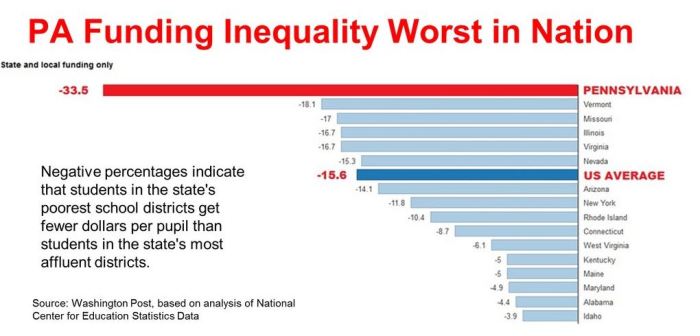
According to the U.S. Department of Education, poor schools in the Commonwealth spend 33 percent less on their students than rich ones. That’s a significantly larger difference than the next-closest state, Vermont, where the spending difference between rich and poor schools is only 18 percent. Three other states — Illinois, Missouri and Virginia — have gaps of 17 percent.


pa funding inequality

 
We can’t keep kicking minorities and the destitute to the curb. We can’t keep giving the rich and middle class every opportunity to succeed while depriving the poor of that same chance.

Wolf, the Democrats and a few Republicans have tried several times to fix the problem.

First, they attempted large increases in education funding to catch up to where funding would be if the Corbett cuts hadn’t happened coupled with the rising costs caused by inflation.

In 2015, the governor proposed a $400 million increase but funded it with a tax increase on the rich that almost all Republicans refused.

Then he tried to bring the state share of education funding up to 50% by using a more equitable tax plan. He proposed cutting property taxes in poorer districts and replacing them with higher state taxes elsewhere. However, Republicans saw it as an opportunity to completely eliminate property taxes and cut school funding even further. It ended in a stalemate and another incremental education increase.

If the legislature wouldn’t approve the necessary spending increases to heal the cuts it made under Corbett, Wolf at least wanted lawmakers to approve dividing the money up more fairly among the state’s 500 school districts.

A funding formula had been approved four years ago to reflect changes in school district attendance and wealth that had been ignored for a quarter century. This would result in more support for poorer schools and less for wealthier ones.

And there’s the sticking point. Lawmakers wouldn’t approve a plan that would provide less funding to 70% of the state’s districts – but neither would they increase school spending to make up the difference.

You’d think that such legislative gridlock might make voters lose hope. However, there is a mass movement of people at the grassroots level demanding change for our children.

Most notably, the parents of six school children, six school districts, the NAACP and a rural schools group are suing the state over education funding.

The lawsuit – now in its fourth year – is scheduled for trial before the state Supreme Court in 2020. So at best, relief is still a ways in the future. Many are hoping justices will order the legislature to dramatically increase its investment in public schools. But the outcome is certainly not a sure thing.

Could striking teachers in red and blue states be showing us in Pennsylvania the solution?

Might it be time to raise our teacher voices in the purple states, too?

And is there a path to equity through collective action that doesn’t hang teachers out to dry?


Still can’t get enough Gadfly? I’ve written a book, “Gadfly on the Wall: A Public School Teacher Speaks Out on Racism and Reform,” now available from Garn Press. Ten percent of the proceeds go to the Badass Teachers Association. Check it out!

thumbnail_IMG_8249

The Trouble with Test-Obsessed Principals

thumbnail_IMG_8535


When I was a child, I couldn’t spell the word “principal.”


I kept getting confused with its homonym “principle.”


I remember Mr. Vay, the friendly head of our middle school, set me straight. He said, “You want to end the word with P-A-L because I’m not just your principal, I’m your pal!”


And somehow that corny little mnemonic device did the trick.


Today’s principals have come a long way since Mr. Vay.


Many of them have little interest in becoming anyone’s pal. They’re too obsessed with standardized test scores.


I’m serious.


They’re not concerned with student culture, creativity, citizenship, empathy, health, justice – they only care about ways to maximize that little number the state wants to transform our children into.


And there’s a reason for that. It’s how the school system is designed to operate.


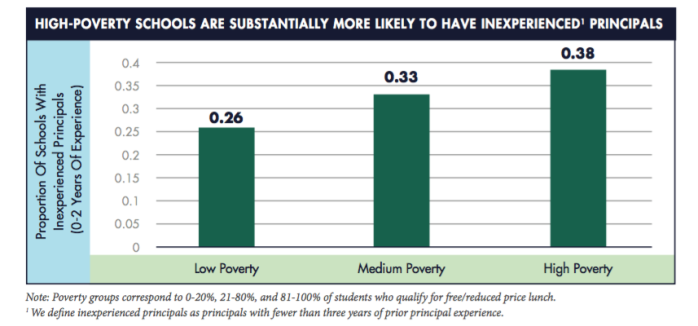
A new research brief from the Tennessee Education Research Alliance concluded that the lowest rated principals generally work at schools with the most economically disadvantaged students.


So schools serving students with the highest poverty and lowest test scores often have the least experienced and least effective principals.


thumbnail_Screen Shot 2019-02-08 at 11.27.32 AM


Now the first question I had when reading this report was “How do they measure effectiveness?” After all, if they rate principals primarily on student test scores, then obviously those working at the poorest schools will be least effective. Poor kids earn low test scores. That’s all the scores consistently show – the relative wealth of students’ parents. If you define an ineffective principal as one who works in a building with low scoring students, it would be no shock that those principals worked in the poorest schools.


However, researchers didn’t fall entirely into this trap. According to the working paper:


“We measure principal quality in two ways: years of experience in the principal position and rubric-based ratings of effective principal practice taken from the state’s evaluation system.”


In Tennessee this means evaluating principals partially on student test scores at their buildings – 35%, in fact – higher than the 20% of classroom teachers’ evaluations. However, the remaining pieces of principals’ effectiveness are determined by an observation from a more senior administrator (50%) and an agreed upon score by the principal and district (15%).


Since researchers are relying at least in part on the state’s evaluation system, they’re including student test scores in their own metric of whether principals are effective or not. However, since they add experience, they’ve actually created a more authentic and equitable measure than the one used by the state.


It just goes to show how standardized testing affects nearly every aspect of the public education system.


The testing industrial complex is like a black hole. Not only does it suck up funding that is desperately needed elsewhere without providing anything of real value in return, its enormous gravity subverts and distorts everything around it.


It’s no wonder then that so many principals at high poverty schools are motivated primarily by test scores, test prep, and test readiness. After all, it makes up a third of their own evaluations.


They’ve been dropped into difficult situations and made to feel that they were responsible for numerous factors beyond their control. They didn’t create the problem. They didn’t disadvantage these students, but they feel the need to prove to their bosses that they’re making positive change.


But how do you easily prove you’ve bettered the lives of students?


Once again, standardized test scores – a faux objective measurement of success.


Too many principals buy into the idea that if they can just make a difference on this one metric, it will demonstrate that they’re effective and thus deserve to be promoted out of the high poverty schools and into the well-resourced havens.


Yet it’s a game that few principals are able to win. Even those who do distinguish themselves in this way end up doing little more for their students than setting up a façade to hide the underlying problems of poverty and disinvestment.


Most principals at these schools wind up endlessly chasing their tails while ignoring opportunities for real positive change. Thus they end up renewing the self-fulfilling prophesy of failure.


Researchers noticed the pattern of low performing principals at high poverty schools after examining a decade’s worth of data and found it to hold true in urban, rural and suburban areas. And even though it is based on Tennessee data, the results hold true pretty consistently nationwide, researchers say.


Interestingly enough, the correlation doesn’t hold for teachers.


Jason Grissom, an associate professor at Vanderbilt University and the faculty director of the Research Alliance, says that the problem stems from issues related specifically to principals.


For instance, districts are hiring lower-rated principals for high poverty schools while saving their more effective leaders for buildings with greater wealth and resources.


thumbnail_Screen Shot 2019-02-08 at 11.28.20 AM


As a result, turnover rates for principals at these schools are much higher than those for classroom educators. Think about what that means – schools serving disadvantaged students are more likely to have new principal after new principal. These are leaders with little experience who never stick around long enough to learn from their mistakes.


And since these principals rarely have had the chance to learn on the job as assistant principals, they’re more likely to be flying by the seat of their pants when installed at the head of a school without first receiving the proper training and mentorship that principals at more privileged buildings routinely have.


As such, it’s easy for inexperienced principles to fall into the testing trap. They buy into the easy answers of the industry but haven’t been around long enough to learn that the solution they’re being sold is pure snake oil.


This has such a large effect because of how important principals are. Though they rarely teach their own classes, they have a huge impact on students. Out-of-school factors are ultimately more important, but in the school building, itself, only teachers are more vital.


This is because principals set the tone. They either create the environment where learning can flourish or smother it before the spark of curiosity can ignite. Not only that, but they create the work environment that draws and keeps the best teachers or sends them running for the hills.


The solution isn’t complicated, says Grissom. Districts need to work to place and keep effective and experienced principals in the most disadvantaged schools. This includes higher salaries and cash bonuses to entice the best leaders to those buildings. It also involves providing equitable resources for disadvantaged schools so that principals have the tools needed to make authentic positive change.


I would add that we also need to design fair evaluation systems for both principals and teachers that aren’t based on student test scores. We need to stop contracting out our assessments to corporations and trust our systems of government and schools to make equitable judgments about the people in their employ.


Ultimately, what’s required is a change in attitude.


Too many principals look at high poverty schools as a stepping stone to working at a school with endless resources and a different class of social issues. Instead, the goal of every excellent school leader should be to end their career working where they are needed most.


Such professionalism and experience would loosen the stranglehold of test-and-punish and allow our schools not to simply recreate the inequalities already present in our society. It would enable them to heal the divide.


As John Dewey wrote in 1916:


“Were all instructors to realize that the quality of mental process, not the production of correct answers, is the measure of educative growth, something hardly less than a revolution in teaching would be worked.”


And that’s what’s needed – a revolution.


Still can’t get enough Gadfly? I’ve written a book, “Gadfly on the Wall: A Public School Teacher Speaks Out on Racism and Reform,” now available from Garn Press. Ten percent of the proceeds go to the Badass Teachers Association. Check it out!

book-4

Teaching Through Lockdown

gettyimages-88519594-640x640


“Excuse the interruption. We are under a lockdown.”


That was it.


Not an explanation of what caused it.


Not any idea of how much danger we were in.


Not any idea of how long it would last.


Just a vague warning that teachers knew meant to keep all their students in class until further notice.


As an educator, you’re expected to teach.


It doesn’t matter what’s happening around you. There can be yelling or screaming. There can be a scuffle in the next room. The lights may flicker off and on.


None of that matters.


If you have students and aren’t in immediate danger, you’re expected to teach them.


And that’s what I did. Even then.


I teach mostly poor and minority students in a western Pennsylvania school near Pittsburgh.


My 8th grade language arts class was in the middle of taking a final exam on The Outsiders by S. E. Hinton.


Most of my students were finished, but it was still quiet as two or three students struggled through their last responses.


Then the announcement came over the PA.


“…lockdown.”


The voice was the high school secretary. Since the middle and high school are connected, she rarely makes announcements in my building – only when something is important happening for both buildings.


The kids looked up at me with worried faces.


“What’s going on, Mr. Singer?” one of them asked.


I told them the truth – I really had no idea. There were no drills planned for today. In fact, it would have been a really poor time for one. We had just had ALICE training the day before where the resource officer and the principal had met with students to go over what to do in case of an active shooter. The program is named for the courses of actions it recommends – Alert, Lockdown, Inform, Counter, Evacuate.


So we were apparently in the L.


During the assembly, the resource officer had said quite bluntly that there would be no coded messages. If a school shooter entered the building, officials would tell us in plain language what was happening so we could make an informed decision what to do.


But there was no additional message over the PA. That was it.


I went over to my computer to see if there was an email. Nope. Nothing.


I pressed refresh a few times. Nothing.


I asked the students to hush and just listened.


It was extremely quiet. Even the hallway was silent and it’s never that silent except during standardized testing.


My room has no windows to the outside. It’s a brick box with one wooden door containing a sliver of window.


The door was already closed and locked. We’re told to keep it that way just in case. But there’s an additional deadbolt you can click to make it even harder to gain access to the room.


“It’s probably nothing,” I said as I walked over to the door and surreptitiously clicked the deadbolt.


I asked student to finish their tests.


It seemed the best course of action. We could either worry about an unknown that was extremely unlikely or else just take care of our business.


It was hard getting the students to calm down. They were scared, and, frankly, so was I.


But this seemed the best thing we could do – Seek normalcy but stay vigilant in case things changed.


“Mr. Singer, may I use the bathroom?” asked one child.


“I’m sorry, but no.” I said. “Not until the lockdown is over.”


Somehow I quieted them down and the remaining students finished their tests.


It seemed to take them forever.


I stood by those who were finalizing answers in the hope that my physical presence would get them to concentrate.


For the millionth time I pondered the wisdom of grouping kids into classes based on test scores. All you end up doing is sorting them by poverty, race, trauma and behavior problems.


But they were soon done.


So they handed in the tests and we went over the answers.


“May I use the bathroom?”


“No. Not yet. Sorry.”


For about five minutes things went as they would on any other day.


But as soon as there was a lull in the activity, the fear and worry returned.


Students wanted to take out their cell phones and call or text home.


I told them not to.


“Why?” asked a boy in the front.


I knew the answer. We had nothing we could tell parents other than that there was a lockdown. We didn’t know what caused it or what was happening. If there was something bad going on, having parents come to the school would only make things worse.


But I just told him to put it away. I didn’t want to debate the situation. I didn’t want them (or me) to think about what might be happening.


We hadn’t finished watching the movie version of “The Outsiders” so I quickly put that on.


We only had about 15 minutes to go. And watching Dally get shot down by police probably wasn’t the best choice under the circumstances.


Still, the kids were focused on the film and not the lockdown.


We discussed how the movie and the book differed for a few moments.


But inevitably there was a lull.


We all got quiet and just listened. Nothing.


No. Down the hall we could hear something. Maybe a scuffle. Voices. It was hard to tell.


I started thinking of options, what to do if someone tried to enter the room. But it got quiet again.


Still no email. No message. Nothing.


I could call the office on my school phone, but that just might make things worse.


“Mr. Singer, I’ve GOT to use the bathroom!”


I looked around. I wasn’t sure what to do. I couldn’t let him out there. It would literally be better if he peed his pants.


He must have seen my confusion. “Can I just pee in a bottle or something?”


“Do you have a bottle?”


“No.”


I was about to tell him to take the garbage can into the corner and pee into it but there was no empty corner in the room.


Before I could remark any further, he said, “It’s okay. I’ll just hold it.”


That’s when I noticed the time. We had already spent more than the 40 minutes in the allotted period. The bell should have rung to get students to move to another room. That meant the bells were off.


The students noticed, too.


I kept telling them that everything was probably fine and that I wouldn’t let anything happen to them.


Then we noticed something weird out of the window in the door.


One of the school custodians was standing right outside the room.


He didn’t seem alarmed. He appeared to be looking for something.


Then another custodian walked up to him and they conferred in the hall.


We heard talking. Perhaps the principal in the distance.


Whatever was happening they seemed to have it under control and didn’t appear worried.


I had nothing planned for my students to do. We were well off book here. I couldn’t just start a new unit. I had no idea how long we’d be here.


So I asked them to take out their self-selected books and read.


They groaned.


“How are we going to concentrate on that?” someone asked.


I didn’t really have an answer but it was better to try than to worry needlessly.


So after some cajoling, they dutifully took their books out. Most just stared around the room listening to every nonexistent sound. But some at least appeared to be reading.


“Mr. Singer…”


NO YOU CAN’T USE THE BATHROOM!


Then not long after, the announcement came that the lockdown was over and students could move to their next class.


There was no explanation. Kids just breathed a collective sigh and went to their classes.


I let anyone use the restroom who asked. And I tried to teach through another class.


I truly expected a printed letter from the superintendent to be hand delivered to the room so the kids could take it home. But no. Perhaps there hadn’t been enough time to write, print and disperse one.


After the students were dismissed, I expected administrators to announce a staff meeting to let the teachers know, at least, what had happened. But there was nothing.


I went into another teacher’s room and saw a group talking. THAT was when I found out about what had happened.


A group of students in the high school had been fighting.


Apparently it was pretty bad – almost a riot. One child had been knocked cold and taken out of the building on a stretcher. The others had been removed by police.


When teachers had broken it up, some of the kids had run and were hiding in the building. That’s why the lockdown.


There was more on the 11 O’clock News. Some of the kids had filmed the fight with their phones and put it up on Snapchat.


We eventually got a letter from the superintendent and an email from another administrator saying that it had just been a minor fight.


Parents were on the news saying that administration hadn’t handled it properly, but no one showed up at the next school board meeting to complain.


And so life goes on.


The threat of violence always hangs over our heads.


It probably won’t ever come down to the worst case scenario. Yet the fact that it might and that no one really seems to be doing much of anything to stop it from getting to that point – that changes what it means to be in school.


We live with this reality everyday now.


It’s not fair to students. It’s not fair to teachers or parents.


But when you live in a society so broken that it can’t even begin to address its own problems, this is what you get.


Still can’t get enough Gadfly? I’ve written a book, “Gadfly on the Wall: A Public School Teacher Speaks Out on Racism and Reform,” now available from Garn Press. Ten percent of the proceeds go to the Badass Teachers Association. Check it out!

book-3

Children of the Gun: How Lax Firearm Legislation Affects My Students

20181012_lockdown-master


Tanisha was just 6-years-old the first time she was in a shooting.


She was home in the kitchen looking for a cookie when she heard a “pop pop pop” sound.


Her mother rushed into the room and told her to get down.


Tanisha didn’t know what was happening.


“Hush, Baby,” her mom said wrapping the child in her arms and pulling her to the floor. “Someone’s out there shooting up the neighborhood.”


That was a story one of my 8th grade students told me today.


And it was far from the only one.


For the first time, my urban school district in Western Pennsylvania had an ALICE training for the students.


The program helps prepare schools, businesses and churches in case of an active shooter. Its name is an acronym for its suggested courses of action – Alert, Lockdown, Inform, Counter, and Evacuate.


In a district like mine where three separate gunmen went on sprees within 5 miles of each other during the last few years, this sort of training is becoming more frequent.


We’ve had numerous seminars for the teachers – even active shooter drills. With the students, we’ve had lockdown drills were the kids were basically instructed to duck and cover under their desks or in corners or closets.


But this was the first time the danger was made explicit in an assembly by grade level.


Our school resource officer and middle school principal stood side-by-side before the 8th grade going over in detail how someone might come into the building with the express purpose to kill as many of them as possible.


And then they told these 12 and 13-year-olds that it was up to them to do something about it.


That hiding wasn’t good enough. They needed to try to escape or incapacitate the attacker.


It still shocks me that we’ve gotten to this point.


We no longer expect society to keep us safe – to keep guns out of the hands of dangerous people.


It’s up to the children to watch out for themselves.


I can tell you as a teacher with more than 15 years experience in the classroom, I have never seen kids so quiet as they were in that auditorium.


It makes me sick.


When I was their age I was playing with Luke Skywalker action figures and building space ships out of Legos. I wasn’t discussing with police how to avoid a bullet to the brain. I wasn’t advised to wear my backpack on my chest to help protect against being gut shot.


I wasn’t then going back to class and talking over with my teacher how we can best barricade the room against any would-be bad guys.


But that’s what we did today.


I tried to reassure my kids that they were safe, that we could secure the door and if worst came to worst I wouldn’t let anything happen to them.


But these children aren’t like I was at their age.


They were shocked by the directness of the assembly. But they were no strangers to violence.


Later in the day, so many of them came back to me to talk about their relationship to guns and how firearms impacted their lives.


“I know you can’t get an automatic rifle unless…”


“I have a friend whose brother…”


“You don’t know what it’s like to lose your best friend to a gun.”


One of them had been friends with Antwon Rose in East Pittsburgh friends with Antwon Rose in East Pittsburgh. They knew all the details about how he ran from police and was shot down.


Someone coming into the school with a gun? Heck! They experience that everyday with the police.


For many of my kids, law enforcement isn’t automatically a comforting thought. They don’t trust the uniform. Often with good reason.


And now they were being told that safety was just another one of their responsibilities – like doing their homework and picking up after themselves in the cafeteria.


I can’t shake the feeling that these kids are being cheated – that the world we’ve built isn’t worthy of them.


What point is a society that can’t keep its own children safe?


What point police and firefighters and lawmakers and courts and laws and even a system of justice if we can’t use them to protect our own kids?


Isn’t that our job?


Isn’t that what adults are supposed to do?


Keep the danger out there so that the little ones can grow up and inherit a better world?


But we don’t even try to do that anymore.


We’ve given up trying.


No more pushing for better laws and safer regulations.


Just look the kids straight in the eye and tell them that death may be coming and there’s nothing we can do about it.


It’s up to them.


If that’s the best we can do, then shame on us.


Still can’t get enough Gadfly? I’ve written a book, “Gadfly on the Wall: A Public School Teacher Speaks Out on Racism and Reform,” now available from Garn Press. Ten percent of the proceeds go to the Badass Teachers Association. Check it out!
book-4

LA Teachers Strike is About Charter Schools and High Stakes Testing

utla-strike


On Monday more than 30,000 teachers at 900 schools in Los Angeles, California, will be on strike.


And unlike the wave of teachers strikes last year in red states like West Virginia, this time educators are taking to the streets due to the policies of Democrats.


At issue are things like lowering class sizes and providing more nurses, librarians and counselors.


But behind these issues lies one of the most important facts about our country.


When you get right down to it, there is very little difference between many Democratic policymakers and their Republican counterparts.


You think Betsy Devos is the opposite of Arne Duncan? Wrong.


You think Barack Obama is the opposite of Donald Trump? Wrong again.


Though there are differences, those often amount to differences of degree.


Corporate Democrats like almost all Republicans support the same education policies – school privatization and high stakes testing – that are robbing the LA Unified School District of the funding it needs to meet the needs of its students.


THAT’S why class sizes have ballooned to more than 45 students in secondary schools; 35 students in upper elementary grades; and 25 students in lower elementary grades.


THAT’S why the district does not have nearly enough counselors, psychologists or librarians to give students the support they need.


THAT’S why 80% of schools don’t have full-time nurses.


The second largest district in the country has more charter schools than any other. The overwhelming majority of them are operated by corporate chains and have expanded by 287% over the last 10 years.


These are publicly funded but privately run schools. They don’t have to meet the same standards of accountability or transparency about how they spend taxpayer dollars – all while gobbling up $600 million a year!


That is money that parents and community members are forced to pay but about which they have very little say. It’s money that can – and often does – go right into the pockets of charter school operators without providing its full value to the students it was meant help educate. It’s money set aside for all children but given to educate merely a handful of students chosen by those same businesspeople who run these charters because they think these children will be cheaper and easier to educate.


That’s not Democracy. No self-respecting Democrat should support such a thing – but you’ll find luminaries from Obama to the Clintons to Cory Booker who will tell you what a great idea it is. Along with DeVos, Trump, Jeb Bush and the Koch Brothers.


LA Superintendent Austin Beutner is a Democrat, but he’s also a multimillionaire with experience in corporate downsizing and none in education.


According to an op-ed by President of United Teachers Los Angeles (UTLA) Alex Caputo-Pearl published in the LA Times:


“…Beutner has moved ahead with what we believe is his agenda to dismantle the district. Through an outside foundation, he has brought on firms that have led public school closures and charter expansion in some districts where they have worked, from New Orleans to Washington, D.C. This approach, drawn from Wall Street, is called the “portfolio” model, and it has been criticized for having a negative effect on student equity and parent inclusion.”


These are policies in direct opposition to the progressive ideals at the heart of the Democratic Party. They are, in fact, bedrock Republican ideology and demonstrate the vast divide among Democrats.


New Democrats oppose them. Grassroots Democrats oppose them. Democratic voters oppose them. And it will be telling whether the policymakers in our halls of power will follow the lead of the people or try to shepherd the power behind the party into doing what the patricians think best.


That’s why this strike is important way beyond California. Whatever happens will send echoes throughout the country, because school districts from sea to shining sea are facing similar issues.


In the meantime, the LA Unified District has a $1.8 Billion budget surplus it can use to help meet these needs. But the solutions to the district’s woes require a long-term commitment to public education.


Certainly the state of California needs to increase its per pupil spending. It’s the richest state in the country, yet ranks 43rd out of 50 in this regard.


This would help the district raise teacher salaries to match those of surrounding districts.


But the root problem is a lack of ideological support among policymakers.


Too many Democrats inside and outside the district don’t support the very idea of public schools. They’d rather boost privatization.


Too many Democrats support unnecessary and harmful high stakes standardized testing which not only unfairly paints the district as a failure for the poverty of its students but forces out things of real education value like the arts and ethnic studies.


Too many Democrats have no problem doing this in a district that serves a majority of students of color while providing only the best for middle class white kids.


That’s why today the American people stand with the UTLA as they go on strike.


It’s why we always stand with educators – You can’t put students first if you put teachers last.


Democrats need to get their priorities straight.


It’s time to decide if they’re going to continue being Trump lite or reclaim their progressive heritage and rejoin the rest of the nation.


Still can’t get enough Gadfly? I’ve written a book, “Gadfly on the Wall: A Public School Teacher Speaks Out on Racism and Reform,” now available from Garn Press. Ten percent of the proceeds go to the Badass Teachers Association. Check it out!
book-2

How Many Decisions Do Teachers Make Every Day?

94b755b2-ad1400b671f8ad28440f6a7067004614


Teaching is an exhausting job.


If you’re a parent, you know how tiring it is with just one or two kids.


Imagine having a room full of them — Twenty to thirty children, each demanding your attention, each requiring your urgent help – every minute, every day, for hours at a time.


Back in the late 1980s, before education became totally absorbed by standardized testing and school privatization, we used to wonder about the effects of such need on a single individual.


We used to wonder how much was really being asked of our teachers.


Today no one outside of the classroom really gives it much thought. We think of educators as part of a vast machine that is required to give us and our children a service.


We’re stakeholders. They’re service providers. And the students are a national resource.


None of us are people.


Perhaps it’s this dehumanizing economic framework that’s helped the edtech industry and testing corporations make so much headway trying to replace educators with apps and iPads.


We no longer give the teacher an apple. We displace her with a Mac.


But back in the days before George W. Bush’s No Child Left Behind or Barrack Obama’s copycat Race to the Top, or Donald Trump’s blatant Destroy Public Education, we wondered about teacher psychology and how to best help our human workforce meet the needs of our human children.


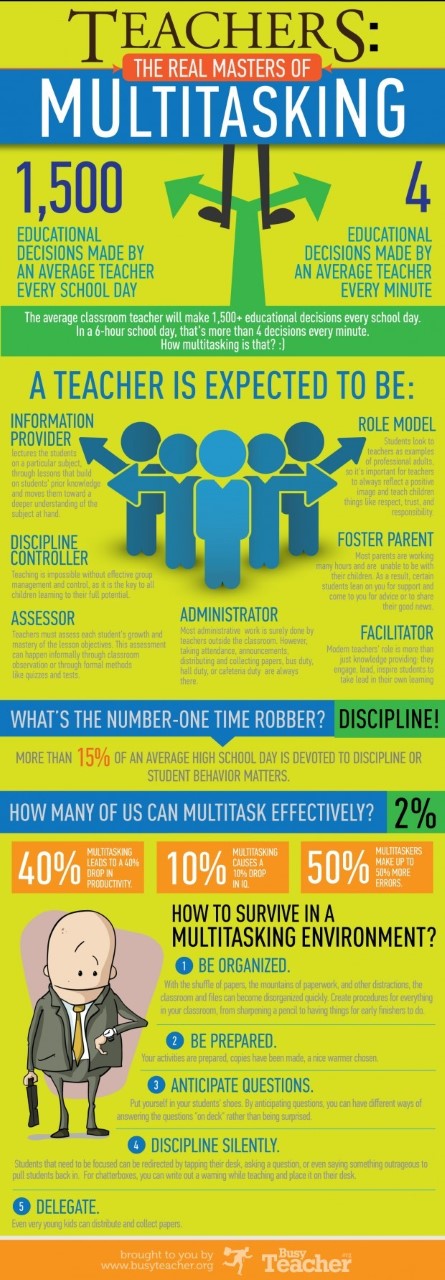
That’s when researchers observed elementary school teachers and noted that, on average, they made at least 1,500 decisions a day.


That comes out to about 4 decisions a minute given six hours of class time.


In the decades since, this figure has come to be associated with elementary and secondary teachers. In fact, it’s become so ubiquitous that I wondered where it originated.


The first reference I can find to it comes from C.M. Clark & P.L. Peterson’s article “Teachers’ Thought Processes” published in the Handbook of Research on Teaching from 1986. (3rd ed., pp. 255–296). New York: macmillan.


Though subsequent studies came up with slightly different numbers, the basic argument holds.


Researchers Hilda Borko, Carol Livingston and Richard Shavelson mark the low end of the scale. In their 1990 article “Teachers’ Thinking About Instruction,” they summarize studies that reported .7 decisions per minute during interactive teaching or 42 judgements per hour, 252 a day.


On the upper end of the scale is Philip Jackson who wrote in his 1990 book “Life in Classrooms” that elementary teachers have 200 to 300 of these determination generating exchanges with students every hour (between 1,200-1,800 a day). Most of these are unplanned and unpredictable calling for teachers to make what they term shallower decisions or deeper judgments (p. 149).


So because teaching involves waiting for the right opportunities for learning, neither student nor teacher can say with confidence what exactly will happen next. It requires “spontaneity and immediacy” (Jackson, p. 166, 152).


As a classroom teacher with more than 15 years of experience, none of this is surprising to me.


Just imagine the various tasks teachers are required to do every hour. We take attendance, review homework, help with seat-work, ask questions, etc. And that doesn’t even take into account all the times we’re unpredictably interrupted by the unexpected – upset students, administrative announcements over the PA, student questions, equipment breakdowns, etc. Each one of these requires us to make spontaneous, unplanned calls before the lesson can continue.


It just goes to show some of the various roles teachers are expected to fill in the lives of their students. They are expected to be information providers, disciplinarians, assess student learning, administrate school policies, facilitate student inquiry, act as role models and even be foster parents.


In any given lesson, we have to make decisions based on our plans AND decisions based on things that just happen to crop up unexpectedly – multiple times each day.


In fact, it seems to me that the research fails to account for innumerable situations that also require determination and deliberation as part of an educator’s everyday routine.


What about curriculum and instruction design? Grading? Written and verbal feedback to students? Reflection and revision of lesson plans?


When you think of all that, 1,500 decisions a day seems like a conservative estimate indeed.


Perhaps the most troubling thing about this is where it impacts teacher quality.


And when I say that, I don’t mean the basterdized modern meaning of that term – that teachers are responsible for maximizing student test scores on standardized assessments. I mean the quality of authentic instruction teachers are able to give their classes.


When we expect educators to turn on a dime more than a thousand times a day, doesn’t that impact the depth with which we can accomplish the job?


Busyteacher.org certainly thinks so. I’m not sure where the Website got its statistics, but they are sobering.


In a fascinating infographic, the site claims that multitasking leads to a 40% drop in productivity. It causes a 10% drop in IQ. It causes people to make 50% more mistakes than concentrating on one task at a time.


thumbnail_multitasking-teachers-infographic-620x1783


I don’t know if these statistics are accurate, but the general principle is sound. When we’re forced to “do more with less” we actually end up producing more with less quality.


Focusing on fewer things increases ones accuracy. Therefore, teachers who have to make fewer decisions in a day would probably be able to do their jobs more effectively.


And there are plenty of ways to accomplish this.


We could reduce class size. If educators can concentrate on the needs of fewer children, they would be more effectively able to meet those needs.


We could reduce the amount of time teachers have to be in the classroom in a given day. I’ve often thought teaching was analogous to being an actor up on the stage – but we’re also responsible for writing the script, operating the lighting, etc. And we have to interact with the audience many of whom would rather be elsewhere, and we have to do multiple shows each day.


In some countries, teachers spend a significant part of their days planning and grading and less in the classroom. They don’t have to do all that behind the scenes stuff on their own time without any additional pay.


In Finland, for example, teachers are paid 13% more than the Organization for Economic Cooperation and Development (OECD) average but spend 100 hours less in the classroom. And class size is between 9-14 students, the lowest in OECD countries. No wonder their children are near the top of the scale in international comparisons!


Wouldn’t it be amazing if we lived in a society that valued education and didn’t try to turn everything into economic quantities for corporations?


We could actually focus on the real phenomena of educating children and not have to fight warped education policies more concerned with turning it all into dollars and cents.


Perhaps teachers wouldn’t have to make so many thousands of decisions if our lawmakers could just make this one.


Still can’t get enough Gadfly? I’ve written a book, “Gadfly on the Wall: A Public School Teacher Speaks Out on Racism and Reform,” now available from Garn Press. Ten percent of the proceeds go to the Badass Teachers Association. Check it out!

book-3

What Happened to 2018 As The Year of the Teacher?

merlin_137374938_25a3513b-8341-4602-8710-910d3500b1d5-jumbo


This year teachers took their mission way beyond the classroom.


Starting in West Virginia, we staged half-a-dozen walkouts in red states across the country demanding a better investment in children’s educations and often getting it.


Then we took that momentum and stormed our state capitals and Washington, DC, with thousands of grassroots campaigns that translated into seats in government.


It was so effective and unprecedented that the story began circulating that 2018 would be known as “The Year of the Teacher.”


And then, just as suddenly, the story stopped.


No more headlines. No more editorials. No more exposes.


So what happened?


The gum in the works seems to have been a story in The Atlantic by Alia Wong called “The Questionable Year of the Teacher Politician.”


In it, she writes that the teacher insurgence was overblown by unions and marks little more than a moment in time and not an authentic movement.


It really comes down to a numbers game. Numerous sources cite high numbers of teachers running for office. Wong disputes them.


National Education Association (NEA) senior political director Carrie Pugh says about 1,800 educators – both Republicans and Democrats – sought seats in state legislatures this year. Likewise, the Democratic Legislative Campaign Committee (DLCC), a group that works to elect Democrats to state legislatures, puts the number at 1,456 educators.


Wong disputes these figures because she says most of these people aren’t currently K-12 classroom teachers.


She writes:


 “The NEA uses the word educator liberally, counting essentially anyone who currently works in or used to work in an education-related job, such as professors, guidance counselors, and school administrators.”


Maddy Will and others at Education Week agree with Wong’s assessment. According to their analysis, out of the thousands of education-related candidates, they could only prove that 177 were K-12 classroom teachers.


And there you have it.


A story about teachers taking over their own destinies is dead in the water.


However, this begs two important questions: (1) Is not being able to corroborate the facts the same as disproving them? And (2) Is being a K-12 classroom teacher a fair metric by which to judge education candidates?


First, there’s the issue of corroboration.


Wong, herself, notes that part of the disparity, “…may come down to the inconsistent ways in which candidate lists are compiled from state to state and organization to organization.” It’s unclear why that, by itself, throws doubt on the NEA’s and DLCC’s numbers. These are verifiable facts. Journalists could – in theory – track down their truth or falsity if their parent companies ponied up the dough for enough staff to do the hard work of researching them. The fact that this hasn’t happened is not proof of anything except low journalistic standards.


Second, there’s the question of whether Wong and Will are holding teachers up to a fair standard.


Since the Great Recession, more than 116,000 educators have been out of work. If roughly 1-2% of them decide to run for office, doesn’t that represent a rising tide of teachers striking back at the very representatives responsible for neglecting schools and students? Aren’t they seeking to right the wrongs that put them out of work in the first place?


Even if we look at just the people currently employed in an education field, why are college professors defined out of existence? Why are guidance counselors and principals not worthy of notice?


Certainly K-12 classroom teachers are at the heart of the day-to-day workings of the education system. But these others are by no means unrelated.


Carol Burris was an award-winning principal at South Side High School in the Rockville Centre School District of New York before becoming Executive Director of the Network for Public Education (NPE). Diane Ravitch, who co-founded NPE, is an education historian and research professor at New York University.


If Wong and Will are to be believed, the work of Burris and Ravitch on behalf of public education should be discounted because they are not currently working in the classroom. That’s just ridiculous.


This isn’t about logic or facts. It’s about controlling the narrative.


The Atlantic and Education Week are artificially massaging the numbers to support the narrative their owners prefer.


And let’s not forget, both publications are in bed with the forces of standardization and privatization that educators of every stripe have been taking arms against this year and beyond.


Though The Atlantic is a 162-year-old pillar of the journalistic establishment, it was purchased on July 28, 2017, by the Emerson Collective. This is Laurne Powell Jobs’ philanthrocapitalist cover organization which she’s been using in a media blitz to reinvent high schools by way of corporate education reform.


Likewise, Education Week has always had a corporatist slant on its editorial page and sometimes even in the way it reports news. Nowhere is this more blatant than the publication’s annual Quality Counts issue which promotes the standards-and-testing industrial school complex of No Child Left Behind, Race to the Top, Common Core, etc.


It’s no wonder that these organizations would want to stop the narrative of insurgent teachers taking a stand against the very things these publications and their owners hold dear.


They want to cast doubt on the record-breaking activism of parents, students, citizens and, yes, teachers.


But the facts tell a very different story.


From West Virginia, Oklahoma, and Kentucky to Colorado and Arizona, educators took to the streets last spring to rally for adequate, equitable and sustainable K–12 funding.


All over the country, we’re demanding properly equipped classrooms, better wages, and stronger public schools.


In Connecticut we sent the first black woman to the legislature from the state, Jahana Hayes, a school administrator and Teacher of the Year.


We took down Wisconsin’s anti-education Governor Scott Walker. Not only that, but we replaced him with the state superintendent of public instruction, Tony Evers, on a platform centered on schools and learning.


And he wasn’t the only educator with a gubernatorial win. Tim Walz, a former high school teacher, became governor of Minnesota.


In Oklahoma, former teachers Carri Hicks, Jacob Rosencrants, and John Waldron all won seats in the state legislature, who along with others riding the pro-school tide increased the state’s “education caucus” – a group of bipartisan lawmakers committed to improving schools – from nine members to 25.


Even where candidates weren’t explicitly educators, mobilizing around the issue of education brought electoral victories. Democratic candidates were able to break the Republican supermajority in North Carolina because of their schools advocacy.


Even in Michigan – home of our anti-education Education Secretary Betsy DeVos – Gretchen Whitmer was elected governor after campaigning against public-school funding cuts.


In Illinois, anti-education governor Bruce Rauner got the boot, while Democrat J.B. Pritzker unseated him on a schools platform.


And in Kansas, not only did school districts successfully sue the state for more funding, Laura Kelly defeated conservative incumbent governor Kris Kobach on a platform of further expanding school funding.


These victories didn’t just happen. They were the result of grassroots people power.


The NEA says even beyond educators seeking office, members and their families showed a 165% increase in activism and volunteering during the midterm election over 2016. This is especially significant because participation tends to flag, not increase, around midterms.


So let’s return to the disputed numbers of teachers who sought election this campaign season.


Of the 1,800 educators the NEA identified, 1,080 of them were elected to their state legislatures. When it comes to the smaller American Federation of Teachers (AFT), 109 of 178 educators won.


If we go by Education Week’s numbers, just 43 of 177 won.


Clearly, this is not the whole picture.


The education insurgency was more than even getting candidates elected. It was also about changes in policy.


In Massachusetts, we successfully repealed the Ban on Bilingual Education so educators will be able to teach English Language Learners in a mix of the students’ native language and English as a bridge to greater English proficiency.


In North Carolina, we successfully lobbied state lawmakers to stop for-profit charter schools from taking over four of five public schools.


And everywhere you look the stranglehold of high stakes standardized testing is losing its grip.


Because of our advocacy, the amount of time spent on these deeply biased assessments has been cut in states like Maryland, New Mexico, West Virginia, Hawaii, and Pennsylvania.


The highly suspect practice of evaluating teachers on student test scores has been dropped in Connecticut and the weight it is given has been reduced in New Mexico.


Now with new policies in Idaho and North Dakota, 10 states have explicit laws on the books allowing parents to opt their children out of some or all of these exams.


Half of New Hampshire’s school districts have replaced standardized tests in most grades with local, teacher-made performance assessments.


I don’t care what corporate journalists are being forced to report by their billionaire owners.


These accomplishments should not be minimized.


Teachers are at the heart of communities fighting the good fight everywhere.


And in most places we’re winning!


We’re teaching our lawmakers what it means to support public education – and if they refuse to learn that lesson, we’re replacing them.


If that’s not “Year of the Teacher,” I don’t know what is.


Like this post? I’ve written a book, “Gadfly on the Wall: A Public School Teacher Speaks Out on Racism and Reform,” now available from Garn Press. Ten percent of the proceeds go to the Badass Teachers Association. Check it out!
book-2

Charter School Lobby Silent as Charter Teachers Continue Strike

www.usnews.com


Charter school teachers in Chicago are in their fourth day of a strike.


Yet I wonder why the leaders of the charter movement are quiet.


Where is Peter Cunningham of the Education Post?


Where is Shaver Jeffries of Democrats for Education Reform?


Not a word from Campbell Brown or Michelle Rhee?


Nothing from Bill Gates, Cory Booker, Barack Obama or Hillary Clinton?


Not a peep from Betsy DeVos or Donald Trump?


This is a historic moment. Teachers at various charter schools have unionized before, but it has never come to an outright strikenot once since the federal charter school law was established in 1994.


You’d think the charter cheerleaders – the folks who lobby for this type of school above every other type – would have something to say.


But no.


They are conspicuously silent.


I wonder why.


Could it be that this is not what they imagined when they pushed for schools to be privately run but publicly financed?


Could it be that they never intended workers at these schools to have any rights?


Could it be that small class size – one of the main demands of teachers at the 15 Acero schools – was never something these policymakers intended?


It certainly seems so.


For decades we’ve been told that these types of schools were all about innovation. They were laboratories where teachers and administrators could be freed from the stifling regulations at traditional public schools.


Yet whenever wealthy operators stole money or cut services to maximize profits or engaged in shady real estate deals or collected money for ghost children or cherry picked the best students or fomented “no excuses” discipline policies or increased segregation or denied services to special education kids or a thousand other shady business practices – whenever any of that happened, we were told they were just unfortunate side effects. Malfeasance and fraud weren’t what charters were all about. They were about the children.


And now when charter teachers speak out and demand a better environment for themselves and their students, these ideologues have nothing to say.


Funny.


It’s not hard to figure out what’s going on here.


The latest audit of Acero shows they have $10 million a year in additional revenue that they aren’t spending on the students. Yet they’re cutting the budget by 6 percent annually. Meanwhile, Acero’s CEO Richard Rodriguez is taking home more than $260,000 for overseeing 15 schools while Chicago Public Schools CEO Janice Jackson makes slightly less money for managing more than 500 schools.


If the school privatization lobby cared about kids, it shouldn’t be hard to come out against Acero and in favor of these teachers and students.


But nothing.


Silence.


It seems to prove what charter critics have been saying all along – and how full of crap the privatization lobby has always been.


In short, the charter movement is all about the rich getting richer. It has never been about helping students and families.


Well, maybe it was once upon a time when union leader Albert Shanker backed the plan. But even he turned against it when he saw how it enriched the moneymen and corporations while doing very little for children.


The fact of the matter is that the only people at charters on the side of teachers, parents and students are the people generally associated with opposing them.


I, myself, am a huge foe of school privatization in all its forms – and that includes school vouchers and charter schools.


However, I have nothing against charter students, parents or teachers.


I know many educators who’ve worked at charters. In most cases they are dedicated, caring professionals who’d rather work at a traditional public school but had to settle for employment where they could find it even if that meant less pay, longer hours, and fewer rights.


I know many parents who sent their kids to charter schools because of funding inequalities or rampant high stakes testing at traditional public schools. In every case, they are doing the best they can for their children – navigating a system they hate looking for the best opportunities.


I’ve taught many students who’ve gone to charter schools and then returned to my traditional public school classroom disillusioned from their subpar experience in privatized education. Without exception they are great kids who try their hardest to succeed despite huge deficits from the years lost at charters.


These people are not our enemy. We are their allies.


We are pushing for a better education system for all of us. And this strike is part of that.


If the operators of Acero charter schools in Chicago (formerly UNO’s charter schools) agree to a living wage for teachers and lower class sizes, it sets a standard for the industry. It helps push other charters to do the same. It pushes charter schools to become more like traditional public schools. And that’s a good thing.


The amenities at traditional public schools should not be rarities.


Every school should have an elected school board. Every school should have public meetings, transparency and be accountable for how it spends tax dollars. Every school should have to accept the kids living in its borders and provide them the proper services and respect their rights. Every school should treat its employees like professionals and pay them a fair wage for a fair day’s work.


Ultimately, I think this means the end of the charter school concept. But that doesn’t have to mean the end of all these charter schools. Many of them that can operate effectively and efficiently should become traditional public schools. That may mean incorporation into existing districts or creations of new ones. It may mean additional funding from the state and federal government.


In the case of fly-by-night charters that do nothing but enrich their investors while cheating kids out of an education, they should be closed immediately and the persons responsible should be prosecuted to the full extent of the law (whatever that is, if at all possible).


I don’t have all the answers, and what’s right in one neighborhood may be wrong in another. However, I am confident that there is a solution.


No matter how this strike is resolved, the fact that it exists – and is probably a precursor to more such strikes – points the way to a brighter future for everyone.


It’s a victory for workers over wealth.


And that is a victory for students, too.


Like this post? I’ve written a book, “Gadfly on the Wall: A Public School Teacher Speaks Out on Racism and Reform,” now available from Garn Press. Ten percent of the proceeds go to the Badass Teachers Association. Check it out!

book-3