The reason? The state Constitution guarantees a “thorough and efficient system of public education to serve the needs of the Commonwealth” – and cake for rich kids while poor kids get crumbs just isn’t thorough or efficient or meets the needs of the Commonwealth.
The problem is that the state funds schools based heavily on local taxes – so rich neighborhoods can afford to pile on the monetary support while poor ones do the best they can but fall far short of their wealthier counterparts.
Judge Renée Cohn Jubelirer, a Republican, ruled that this was discrimination. In short:
“…the Pennsylvania Constitution imposes upon Respondents an obligation to provide a system of public education that does not discriminate against students based on the level of income and value of taxable property in their school districts…
The disparity among school districts with high property values and incomes and school districts with low property values and incomes is not justified by any compelling government interest nor is it rationally related to any legitimate government objective…
[Therefore] Petitioners and students attending low wealth districts are being deprived of equal protection of law.”
Unfortunately, no mention was made in the nearly 800-page ruling of exactly how to fix the problem.
The trial began in November 2021 and lasted more than three months. You’d think the judge had time to toss off a line or two about what to do next, maybe that it’s up to the state to take up the slack or something.
But no.
Which leaves room for right wing creeps like the Commonwealth Foundation to crawl out from under a rock and give their own nonsense solution.
Benefield wrote a response to the ruling praising it for leaving the legislature and executive branch to find a solution, rather than “mandating more money to a broken system.”
Um, Benefield? Buddy? It’s broken mostly because we haven’t paid to keep it in good repair.
But he goes on…
“The only way to ensure that ‘every student receives a meaningful opportunity’ is for education funding to follow the child. Students that are trapped in their zip-code assigned school — especially in low-income and minority communities — often have no alternatives when their academic or social needs are unmet.”
So the solution to not having enough money is more choice!?
I can’t afford to buy breakfast. Having a choice between raisin bran and pancakes won’t make a difference. I CAN’T AFFORD EITHER ONE!!!!
If every district received fair funding, it wouldn’t matter what your zip code is anymore. That’s the whole freaking point!
But look for neofacists and libertools to start spouting this kind of rhetoric at every turn now that they can’t hide behind the old excuse that it’s somehow fair to steal poor kids lunch money and give it to rich kids.
The next step is not entirely clear.
Some think it likely that the state will appeal the decision to the Pennsylvania Supreme Court.
“The record is very, very clear that local school districts are not adequately resourced,” she said. “I think it would be extremely difficult to be successful on appeal.”
Judge Jubilerer wrote in her ruling that she hoped everyone would work together now to find a solution:
“The Court is in uncharted territory with this landmark case. Therefore, it seems only reasonable to allow Respondents, comprised of the Executive and Legislative branches of government and administrative agencies with expertise in the field of education, the first opportunity, in conjunction with Petitioners, to devise a plan to address the constitutional deficiencies identified herein.”
It may sound naive, but it’s happened in other states – specifically New York and New Jersey.
A suit filed in 2014 in New York argued that the state never fully funded a 2007 Foundation Aid program. The program was supposed to consider district wealth and student need in order to create an equitable distribution of state funding.
The Empire State settled in 2021 and is now required to phase-in full funding of Foundation Aid by the 2024 budget.
New Jersey tackled the issue way back in 1981. A state court ruled officials had to provide adequate K-12 foundational funding, universal preschool and at-risk programs.
This made New Jersey the first state to mandate early education. The state also undertook the most extensive construction program in the country to improve the quality of school buildings in impoverished neighborhoods, according to the Education Law Center.
Could such sweeping reforms be coming to the Keystone state?
“For years, we have defunded our public schools at the expense of our students,” said state Sen. Lindsey Williams (D- 38th district), who is the minority chair of the PA Senate education committee. “[The ruling] is game-changing for our students across the Commonwealth.”
Sen. Vincent Hughes of Philadelphia, the ranking Democrat on the state Senate’s Appropriations Committee, said the state can afford a big boost in aid to the poorest schools right now because we have billions of surplus dollars in the bank.
This is exactly what is needed.
During the trial, plaintiffs presented evidence that schools are underfunded by $4.6 billion, an estimate that they said does not account for gaps in spending on special education, school buildings and other facilities.
Some organizations like PA Schools Work are calling on legislators to act now by adding approximately $4 billion in Basic Education Funding. They even suggest the increase be at the rate of one billion per year over the next four years to make it more feasible. Finally, they propose this money be distributed through the Fair Funding Formula and the Level Up supplement so that it is more equitably distributed to districts in need.
To make matters even more complicated, the state uses an “outdated” formula to calculate how to allocate school funding.
The legislature developed a new formula based on enrollment numbers and how much it costs to educate students who are living in poverty, English language learners, or have an Individualized Education Plan (IEP). However, a large chunk of money isn’t distributed using that new formula.
The way I see it, the Commonwealth has a lot of education funding issues to fix.
Hopefully, this ruling finally means we’ve stopped arguing over whether a problem exists and can start focusing on how to solve it.
That, itself, would be a huge victory!
Like this post? You might want to consider becoming a Patreon subscriber. This helps me continue to keep the blog going and get on with this difficult and challenging work.
The non-profit chain of 13 schools based in Pittsburgh, Pa, boasts high academics, safe campuses and certified teachers.
At least, that’s what its advertising blitz proclaims from every grocery store cart, newspaper page, radio announcement and billboard. Which just goes to show that anyone will tout your virtues if you pay them enough money – taxpayer money, that is.
Take Propel McKeesport – the franchise located in my own neighborhood.
“…ranked as ONE OF THE BEST charter schools in the nation by U.S. News World Report” (Emphasis mine).
One of the best is not THE best. But it’s still good. Let’s call it embellishing the school’s resume.
According to Propel’s Website, in 2021, the McKeesport location was #11 in the state’s charter elementary schools and #7 in the state’s charter middle schools.
I suppose that is impressive, too, though being one of the best CHARTER SCHOOLS isn’t the same as being one of the best SCHOOLS.
The percentage of students achieving proficiency in math was 7% (which is lower than the Pennsylvania state average of 38%) for the 2020-21 school year. The percentage of students achieving proficiency in reading was 34% (which is lower than the Pennsylvania state average of 55%) for the 2020-21 school year.
Moreover, test scores in both subjects were higher at the McKeesport Area School District, the local authentic public school – 17% higher in math and 3.5% higher in reading at the elementary level and 6% higher in math and 2% higher in reading at the middle school level. Propel McKeesport does not teach beyond 8th grade.
So what exactly is Propel celebrating?
Maybe it’s the fact that its McKeesport location achieved these standardized test scores while teaching an intensely racially segregated student body – 86% minority (mostly Black). By comparison, the authentic public schools range from 52-71% minority students (mostly Black).
I’m not sure that’s much of a victory. Wasn’t one of the major tenants of the civil rights movement having racially integrated schools – that doing so would help students of color achieve academically because resources couldn’t be horded away from them?
In 2015, two teenagers at Propel Braddock Hills High School were arrested after one allegedly tried to sell guns to another in a bathroom during the school day. Two guns were recovered by police and the students were taken into custody on campus. The rest of the students were placed on lockdown until police cleared the area.
In 2019, police arrested four people in connection with a scheme to steal nearly $23,000 from Propel Schools by forging checks in the charter school operator’s name. The Propel Schools Foundation filed a report with police after discovering nearly two dozen fraudulent checks in Propel’s name had been cashed at various places, a Pittsburgh Public Safety spokeswoman said. At least 28 checks drawn against the school’s bank account were counterfeit, the complaint said. The fake checks were cashed using the forged signature of the school’s co-founder, Jeremy Resnick.
So does Propel provide a safe learning environment? Maybe. But not more so than any other district.
Individual Attention and Small Class Size
The problem here is verification.
Charter schools are not nearly as transparent as authentic public schools. They are not required by law to provide as much information about their operations as neighborhood public schools. For instance, nearly every authentic public school district is run by an elected school board which has open meetings and open records.
For Propel it is unclear exactly how members are chosen for its corporate board, but it is difficult for parents and community members to be appointed.
According to an article in Public Source, individuals can only become board members if they are already members of the “Friends of Propel,” but the charter chain did not provide information on this group or how its members are selected.
When it comes to class size, most Propel schools report having student-to-teacher ratios slightly smaller or the same as at neighborhood authentic public schools. But who knows? There’s no way to tell whether classes may actually be larger.
However, individual attention is even harder to verify.
Most schools focus on more individual attention these days.
Unfortunately, the network provides very little detailed information about its curriculum.
So this claim by Propel is a way of bragging that the network doesn’t have to have certified and qualified teachers, but it does so anyway.
Unfortunately, it is definitively false.
According to those US News and World Report spotlights that the charter school network likes to highlight, several Propel schools do not have all certified teachers. For instance, Propel McKeesport only has 92% full-time certified teachers, Propel Homestead only has 94%, Propel Pitcairn only has 96%, etc.
So does Propel have 100% Certified and Qualified Teachers? Absolutely not.
Award Winning Arts Programs
Kudos to Propel for recognizing that arts are an important part of the curriculum. Or at least using it as a selling point on its advertisements. However, without details of its curriculum submitted to the state and verifiable by audit, there is nothing to back this claim up factually.
In fact, on Propel’s own Website, the only reference I see to awards for art is a brief mention in its after-school program which they label as “award-winning.”
What award did it win? The ‘Propel Presents Itself with an Award’ Award? Is there anything more substantial to this claim?
Certainly every school should have a dress code, but can’t students express themselves freely anymore? I just don’t see why emulating the worst qualities of private schools is a great thing – especially when it adds an unnecessary cost for parents.
-Tuition Free
Charter schools are funded with public tax dollars. So, yes, you don’t have to pay a tuition to attend. However, you do have to pay for extras like school uniforms.
In fact, overcoming the unpopularity of charter schools because of the increased expense for taxpayers is cited by Droz Marketing – the company that made all those glossy Propel advertisements – on its Website portfolio as an obstacle the company had to overcome to sell Propel to the masses.
Which brings us back to the beginning.
Does Propel go beyond the facts in its claims for itself?
Certainly.
Many businesses do that these days. And make no mistake – Propel IS a business. If it can cut a corner or find a loophole to put more money in operators’ pockets, it will.
Technically, this is not illegal. But it certainly doesn’t help educate children. It just goes to enrich the charter school operators.
Non-profit? Yeah, in name only.
However, let me end with what may be the most telling indicator of what it is like at Propel’s charter schools.
indeed.com is a Website workers use to decide if they should apply at a given job site. Employees anonymously review their current place of employment to let prospective job applicants know what it is like there and if they should consider seeking a job there.
The site has many entries on schools in the Propel network. Some are positive. Some are glowing. But most are incredibly negative.
Here in their own words is what it’s like inside the Propel network from the people who work (or worked) there.
Para Educator (Former Employee) – Propel East, Turtle Creek – July 19, 2020
Pandering to the cultural climate and using all the right talking points still doesn’t provide a quality education because of the many behavior problems.
Educator (Current Employee) – Pittsburgh, PA – August 4, 2022
Management verbalizes a desire, but does not actively seek to improve diversity within the ranks of educators. The lack of diversity directly impacts how the student body is educated.
First Grade Teacher (Former Employee) – McKeesport, PA – April 15, 2022 I worked at Propel McKeesport for 9 days before I realized it would negatively affect my mental health greatly if I stayed. Everything about the school was chaotic and unorganized. There is so much asked of the teachers, and they are given little to no support in the process. The people that are put in place to act as supports are spread so thin, that you aren’t able to receive the support necessary. I would have to get to work early and stay late in order to get all of my tasks done. I had no time for my personal life, and I was constantly overwhelmed. Leaving was the best decision I could’ve made for myself and my well being. Pros Higher than average starting pay for new teachers, healthcare benefits Cons Unorganized, consuming, little support/structure
Elementary School Teacher (Former Employee) – Hazelwood, PA – February 3, 2022 My time at Propel Hazelwood was the worst experience I have ever had in a professional setting. The principal, at the time, had all sorts of big ideas, and no clue how to make them actionable. Behavior was managed through a failed token economy… so I’m sure you can imagine what behavior looked like. But good news, they’ll just fire you before you qualify for benefits, and trick the next poor sap. For reference, I was the 3rd of 5 teachers to go through that position in 2 years.
In summary, I hope you line up a therapist before you sign your soul away to Propel. I know I needed one. Pros There were no pros. I can’t even make one up. Cons Pitiful everything. People, leadership, attitudes, slogans, curriculum (or lack there of). Run away… fast.
Teacher (Former Employee) – McKeesport, PA – September 3, 2021 Propel McKeesport cannot keep their staff members. They have so many open positions because their lesson plan template is 6 pages long, and the work pile-up is more than loving your scholars. The wonderful scholars don’t get a chance to love who you are because you (if you are not a favorite) are swamped with work. The job is a nightmare. Pros There is not one pro I can think of. Cons Flooded with work. Lies and says it is “Propel-Wide”
Janitor (Current Employee) – Pittsburgh, PA – January 3, 2022
Hr treats you bad Teachers treat you bad You are less then nothing to everyone even your bosses Never work for Braddock propel worst school I’ve seen Pros Nothing Cons You will be treated like you are worthless
Teacher (Former Employee) – Braddock Hills, PA – September 27, 2021 Wow. It sounds good from the outside but is terrible in the inside. High school students were out of control. Administration offered little help. The parents were just as aggressive as their children. The teachers will throw anyone under the bus as soon as possible. Pros Great pay. Amazing benefits. Stellar retirement and health insurance. Cons Terribly behaved students, aggressive parents, woke and offended staff
Educator (Current Employee) – Pittsburgh, PA – May 21, 2021 Even though I went in knowing the hours would be long and the school year would be longer, I was not prepared for the lack of work life balance. I have worked with Propel for 3 years and I will say that it is all consuming. I have been expected to not only do my job during building hours, but outside of work as well. This would be fine if it was occasional, but especially during COVID, it has become constant. Not only is the work never ending, but in my buildng we are not given adequate time to eat (25 minutes) or plan (50 minutes, but this time is often taken up by meetings almost daily). On top of limited planning time and expectations that never seem to stop coming, many of us have been forced into taking on additional, unpaid roles that we did not ask or agree to, and “no thank you” is not accepted as an answer. The district struggles to employee substitutes, so teachers are often expected to split classes when other grade level members are out. This has resulted in 30+ students in classrooms during non-COVID times, with one educator. Pros Good benefits, reasonable pay for the area, great curriculum Cons Short breaks, underqualified building administration, limited support
Teacher (Current Employee) – Pittsburgh, PA – January 13, 2021 Propel staff does care a lot about the students, but it doesn’t feel like those who are higher up care as much about them. Having a CEO/Superintendent may be the reason for this. Pros Dedicated cohorts Cons Work-life balance off
teacher (Former Employee) – Montour, PA – July 24, 2020 There was always a feeling of being watched in a critical way throughout the day. Administration was constantly evaluating teacher performance in the classroom which created a negative work environment. When a student became disruptive in the classroom administrators were difficult to locate. If an administrator did come to the classroom he/she would coddle the student with candy or a fun activity before returning him/her to the classroom. Needless to say the disruptive behavior would continue within an hour. Positive effective leadership was nonexistent.
Accounting Manager (Former Employee) – Pittsburgh, PA – March 4, 2020 Did not get the job I was hired to do. Turnover was high. Cannot speak to majority of the the issues that I had due to a clause in my severance package.
Educator (Former Employee) – Pitcairn, PA – February 3, 2020 Challenging work environment, burn out is high, little support from administration. Propel varies from building to building, but overall its sounds great in theory and in their “plans”, but they’re not able to carry out what they promise to students or staff.
Pros: Let me start by saying, the students are amazing! The parents can be challenging but they truly want what’s best for their children. Cons: If you aren’t LIKED by the superintendent and assistant superintendent your days with Propel are numbered. From the onset, I was deceived by this organization. I spent 4-months interviewing for a High School principal position. I was offered the position of high school principal only to find out I would be a K-8 principal. This was the first red flag of many. Unfortunately, I wasn’t well liked therefore I received very little of what I needed to effectively lead the school. Instead, I got the unhelpful support they thought I needed and none of which I requested. By Feb. I had lost both my APs – one by choice and the other by force. In March I was given a replacement AP that wasn’t a good fit. Work-life balance does NOT exist at Propel Charter Schools. On average, I worked 12 -14-hour days. Sadly, this is the norm for principals in this network. If you are considering Propel for a position as a school administrator, I would not recommend it.
Teacher (Former Employee) – Hazelwood, PA – September 18, 2019
The staff is wonderful and very supportive. However, the students there are very disrespectful, rude, and have major problems with authority. As a teacher walking into the classroom, they refuse to listen, talk over you, cuss you, and not a lot is done about it.
Propel is not ran like a school, it is ran like a business. They do not give the students a fighting chance for a bright future. They are more worried about the name ‘propel’ than anything. The work-life balance is awful. They expect way too much of your own time and when they don’t get it, you are looked down on for it. They create cliques and if you are not in the clique, consider yourself gone. They place you wherever they want, certified or not, and will watch you fail. There is lack of help and support from the administration. The only decent people around are your co-workers. I would never recommend this as a work environment nor for parents to send their kids there. No learning takes place. You constantly deal with behavior problems while the children who want to learn are put on the back burner. They change rules half way into the school year and fudge their data. At the rate they are going, they will never compare to peers across the state for PSSAs due to behavior issues and poor management. Not to mention, your lunch is 20 minutes so I hope you can eat fast and 9X out of 10, your planning time to taken away from you for meetings! Be prepared for meetings!!!
There was little time to be able to practice individualized teaching practices and spend time working with students. Leaders were only focused on enrollment and test scores, and did not focus on the important needs of the child. Work/Home life balance did not exist, as emails and texts were sent at 9:00 PM at night. Money is the number one focus, and for a school system, it was not what was expected.
Pros
Teaching children, benefits and compensation
Cons
Bad work/home life balance
Like this post? You might want to consider becoming a Patreon subscriber. This helps me continue to keep the blog going and get on with this difficult and challenging work.
Right-wingers would much rather make it all a business where the more you pay, the better the education your kids get. There’d be poor quality charter schools for those who can’t afford the entry fee, but the best of everything would be reserved for the kids of the rich and powerful whose parents would use school vouchers to offset some of their tuition at private institutions.
Lawmakers might have to create real policies, a platform, solutions – to actually govern!
So GOP operatives spread hysterical lies about public schools. They call them “government schools” as if that meant some imposed bureaucracy of outsiders and not what it actually does – schools governed by elected members of the community.
Which brings us to the latest one – the new red scare that public school teachers are raising the next generation to hate Adam Smith and love Karl Marx.
Robert Bluey, vice president of publishing for the Heritage Foundation, asked her a question on The Daily Signal Podcast (a Heritage Foundation mouthpiece) about the growing popularity of socialism among young people.
And it’s true, according to a 2018 Gallup poll, Americans aged 18 to 29 are almost as positive about socialism (51%) as they are about capitalism (45%).
So on behalf of the right-wing think tank behind the critical race theory brouhaha, transphobic legislation, climate change denial and a host of other regressive causes, Bluey asked DeVos why young people aren’t as firmly championing capitalism as previous generations.
“I recall visiting a classroom not too long ago where one of the teachers was wearing a shirt that said “Find Your Truth,” suggesting that, of course, truth is a very fungible and mutable thing instead of focusing on the fact that there is objective truth and part of learning is actually pursuing that truth.”
This is a rather strange answer. It may be the case that there are absolute truths in the world, but economic theories certainly don’t qualify. In matters of opinion, isn’t it better to tell students the facts and let them think for themselves about their relative virtues?
Tell them capitalism is great. Tell them socialism is terrible. Screw critical thinking.
The Heritage Foundation, at least, liked her answer, using it as a template to fund a plethora of stories about public schools – not just leaving the matter up to students to decide – but actually bullying kids into championing communism.
In the text of article, Blair admits he was only “in education” for 4 years, but it seems he was not a full-time classroom teacher for most of that time. According to his Linked-In account, he was a French teacher for 9 months in a school in Portland, Oregon. Before that he was an Extracurricular Aide, an English Language Assistant and Language Immersion Counselor at various schools in the US and France.
His evidence of indoctrination reads like “Kids Say the Darndest Things – Republican Edition.”
For example, he says he asked an elementary school girl if she liked Winston Churchill, and she frowned calling Churchill racist.
That’s right. Whether teachers need to or not, they have to spend at least 45 minutes on it every November.
“We want to make sure that every year folks in Florida, but particularly our students, will learn about the evils of communism. The dictators that have led communist regimes and the hundreds of millions of individuals who suffered and continue to suffer under the weight of this discredited ideology,” DeSantis said, adding that “a lot of young people don’t really know that much” about the political ideology.
At first blush, this may sound like a good idea. More historical knowledge is a good thing, but it’s the context that makes this troubling.
Florida Republicans already have passed a battalion of laws telling educators what they CANNOT teach.
So you can’t teach about racial issues including the history of slavery if it makes any student “feel uncomfortable.” Math books are censored from depicting “prohibited topics.” You can’t talk about a wide range of human sexuality including LGBTQ people because of the infamous “Don’t Say Gay” bill.
But you’d better teach about how bad communism is! Or else!
Third, there’s the subtext. This sounds to me like an invitation to conflate communism with socialism (which are two different ideas with different histories) and to champion one ideology over another.
In each case, I encourage my students to think about the problems from the stories, the solutions offered in the narratives and to discuss the matter with classmates. We hold Socratic Seminars and write critical essays. For “The Giver,” students work in groups to create their own utopias – you’d be surprised how many are socialist, though there are also a number of capitalist republics, dictatorships and anarchies. Kids love anarchy.
And I admit it – I encourage my students to think for themselves. I try not to give them my answers – my truths.
Like this post? You might want to consider becoming a Patreon subscriber. This helps me continue to keep the blog going and get on with this difficult and challenging work.
If you’ve stumbled across this article on social media, congratulations!
You’re one of the few people allowed to read it!
This blog, Gadfly on the Wall, used to be read by at least half a million people each year. Now it’s seen by barely 100,000.
The reason? Poor writing? Flagging interest in the subject?
I don’t think so.
Education is still as important today as it was in 2014 when I started this venture. And as to my writing ability, it’s no worse now than it was 8 years ago.
So this year, my blog had the fewest hits since I started – 124,984 in 2022. By comparison, last year I had 222,414.
I’d write an article, post it on social media and see it reposted again and again. You’d think that would mean it was popular, but no. The people who saw it liked it enough to suggest it to others, but it went little further. With each share, fewer people saw it. Like someone put up a wall in front of it.
In truth, I’m lucky as many people had the opportunity to read my work as did.
The question is where do I go from here?
Should I continue, knowing only a select few will get to hear me? Should I try paying the billionaire tech bros to let more readers in?
My work isn’t a product and no one is paying me to do it.
Oh well…
In any case, here’s a look back at my most popular articles from the year that was and one honorable mention:
Description: My school’s football team is mostly black. They played a mostly white football team and were greeted by racial slurs and an allegedly intentional injury to one of our players. However, the Western Pennsylvania Interscholastic Athletic League (WPIAL) blamed both sides for the incident.
Fun Fact: It’s one of those decidedly local stories that community newspapers used to cover before almost all went bankrupt or were sold to the media giants. Having this platform allowed me to call out an injustice when most voices were silenced. The injured player’s mother thanked me for doing so. Stories like this keep me going.
Description: At the beginning of the summer, governments were so shaken by the exodus of teachers from the classroom that they were discussing raising our salaries or giving us bonuses. Parents were so adamantly against distance learning they demanding in-person classes with real, live human teachers. What a shock to the super elite education “experts” who had been pushing ways to eliminate teachers for decades and ignoring our consistent march out of the field under these conditions.
Description: Charter schools are inequitable because they have charters. These are special agreements that they don’t have to follow all the rules other authentic public schools funded by tax dollars must follow. That’s unfair and it applies to EVERY charter school because every one has a charter. Hence, the name.
Fun Fact: Criticism of charter schools in general usually degrades to defense of individual charter schools avoiding whatever general criticism is leveled against the industry. The argument in this article has the benefit of avoiding any such evasion. All charter schools are guilty of this (and many are guilty of much more). All of them.
Description: Just a list of many things classroom teachers know about schools and education but that the general public often ignores. These are the kinds of things missing from the education debate because we rarely include teachers in the discussion about the field where they are the experts.
Fun Fact: For a few hours people were talking about this article far and wide. And then – boom – it got shut down with a bang. This one was so universal it should have been popular for weeks. But it just disappeared.
Description: Charter schools are colonial enterprises. They loot and pillage the local tax base but without having to be governed by school boards made up of community members – otherwise known as local taxpayers. They can be run by appointed boards often made up of people who do not come from the community in question. They are outsiders come merely for personal profit. These invaders are quite literally taking local, community resources and liquidating them for their own use – the maximization of personal profit. The public is removed from the decision-making process about how its own resources are utilized and/or spent.
Fun Fact: It’s an argument from consistency. If we’re against the colonial enterprise, we must be against charter schools, too. I’m particularly proud of the graphic (above) I created to go with this article.
Description: Dr. Mark Holtzman, the Superintendent from the district where I live, left under strange circumstances. He resigned and took a new contract in a matter of hours so he could get a raise from a lame duck school board without having to wait for the people the community elected to decide the matter to take office first. Then when it all came to light, he left the district for greener pastures.
Fun Fact: More than any other news source, I documented what happened in detail. Without a series of articles I wrote on this, most people would have had very little idea what happened. It would have just been rumors. This is why we need local journalism. It shouldn’t be left to bloggers like me.
Description: This was social media’s latest crackdown on edu-bloggers and other truth tellers. I used to get 1,000 readers a week. Now I’m lucky to get a few hundred. There’s a strict algorithm that determines what people get to see on their Facebook pages. And if it says you’re invisible, then POOF! You’re gone and the people who would most enjoy your writing and want to pass it on don’t get the chance. It’s undemocratic in the extreme but totally legal because Facebook is a for-profit company, not a public service. Money wins over free exchange of ideas.
Fun Fact: There used to be so many other education bloggers like me out there. Now there are just a handful. This is why.
Description: Standardized tests were supposed to improve our public schools. They were supposed to ensure all students were getting the proper resources. They were supposed to ensure all teachers were doing their best for their students. But after more than four decades, these assessments have not fulfilled a single one of these promises. In fact, all they’ve done is make things worse at public schools while creating a lucrative market for testing companies and school privatization concerns.
Fun Fact: Pundits still talk about standardized testing as if it were innovative. It’s not. It’s the status quo. Time to end this failed experiment.
Description: Let’s examine some charter school propaganda – one piece at a time – and see if there’s any truth to these marketing claims. Charter schools are actually not public schools in the same way as other taxpayer funded schools. They do not save money – they waste it. Their students do not outperform authentic public school students. They are not innovative – they are regressive. They do not protect children’s civil rights – they violate them.
Fun Fact: I designed the title and picture to trick readers into thinking this was a pro-charter school article. So many people were butt hurt when they read it! I just hope it helped clarify the matter to those who were undecided.
Description: The Measures of Academic Progress (MAP) test is an assessment made by Northwest Evaluation Association (NWEA), a so-called non-profit organization out of Portland, Oregon. Some states require the MAP as part of their standardized testing machinery. However, in my home state of Pennsylvania, the MAP is used as a pre-test or practice assessment by districts that elect to pay for it. What a waste! Why do we need a test BEFORE the test? The assessment’s job is to show how our students are doing in Reading, Math and Science compared with an average test taker. How does that help? I don’t teach average test takers. I teach human beings. Students learn at their own rates – sometimes faster, sometimes slower. We don’t quicken the timescale with needless comparisons.
Fun Fact: I think this article was as popular as it was because people could relate. So many teachers told me how relieved they were to hear someone else expressing all the frustrations they were experiencing in their own districts with the MAP and other tests like it. If administrators and school boards would just listen to teachers! If they’d even bother asking them!
Description: When it comes to dumb ideas that just won’t go away, there is a special place in the underworld for the demand that teachers post their learning objectives prominently in the classroom. It presupposes that teachers control everything their students learn in the classroom and can offer it to them on a silver platter. It’s not just a useless waste of time but a dangerous misunderstanding of what actually happens in the learning process.
Fun Fact: This isn’t exactly news, but teachers were relieved to hear their truth finally given voice. So many of us still have to abide by this nonsense when we could be doing something that actually makes a difference. It’s nice to have your sanity and frustration confirmed. If only administrators could admit they were wrong and stop demanding this crap!
Gadfly’s Other Year End Round Ups
This wasn’t the first year I’ve done a countdown of the year’s greatest hits. I usually write one counting down my most popular articles and one listing articles that I thought deserved a second look. Here are all my end of the year articles since I began my blog in 2014:
Like this post? You might want to consider becoming a Patreon subscriber. This helps me continue to keep the blog going and get on with this difficult and challenging work.
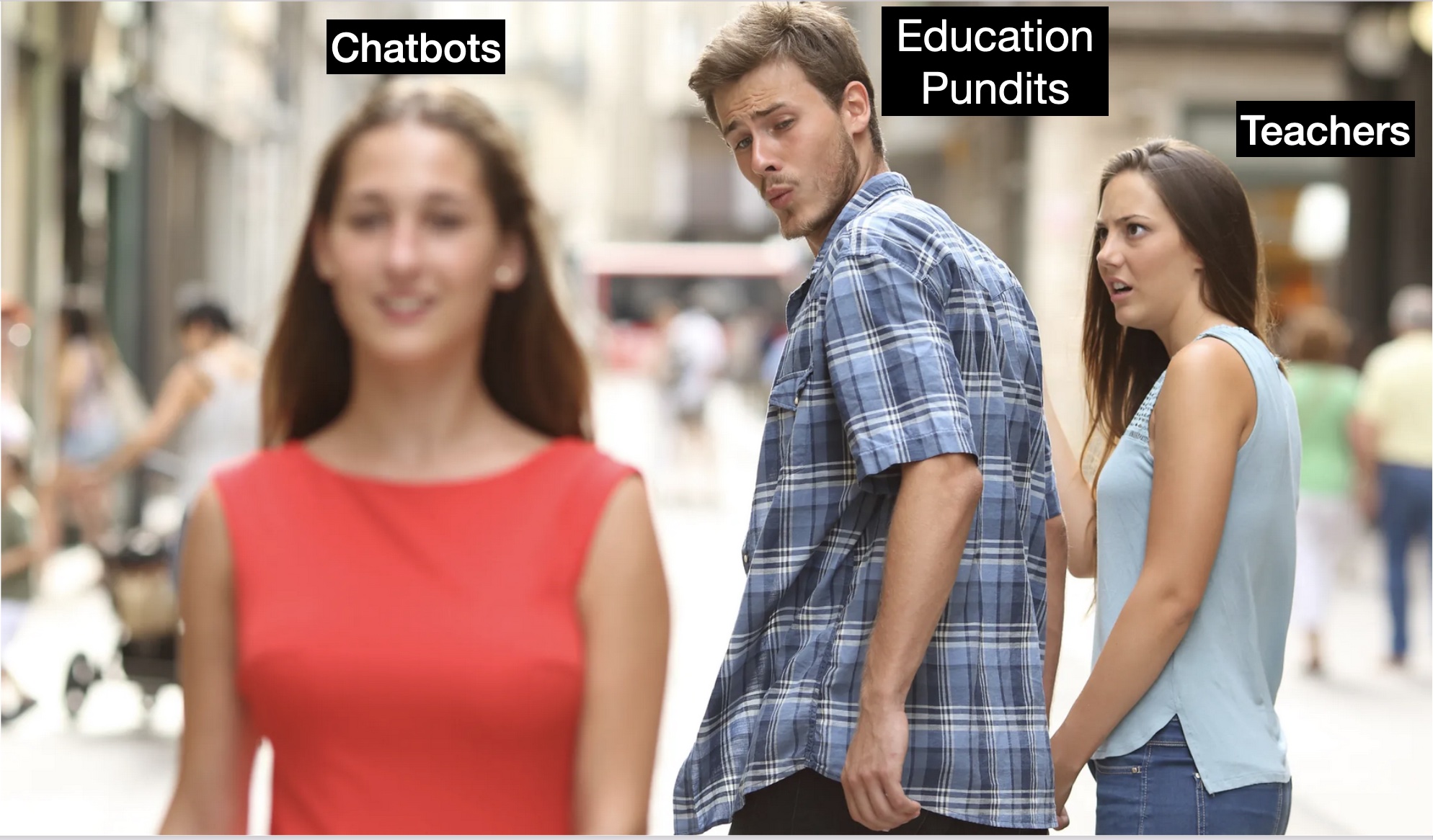
ChatGPT’s responses are entertaining because we know we’re not communicating with a human being. But that’s exactly what you need to encourage the most complex learning.
Human interaction is an essential part of good teaching. You can’t do that with something that is not, in itself, human – something that cannot form relationships but can only mimic what it thinks good communication and good relationships sound like.
Even when it comes to providing right answers, chatbots have an extremely high error rate. People extolling these AI’s virtues are overlooking how often they get things wrong.
Anyone who has used Siri or Alexa knows that – sometimes they reply to your questions with non sequiturs or a bunch of random words that don’t even make sense.
ChatGPT is no different.
As more people used it, ChatGPT’s answers became so erratic that Stack Overflow – a Q&A platform for coders and programmers – temporarily banned users from sharing information from ChatGPT, noting that it’s “substantially harmful to the site and to users who are asking or looking for correct answers.”
The answers it provides are not thought out responses. They are approximations – good approximations – of what it calculates would be a correct answer if asked of a human being.
The chatbot is operating “without a contextual understanding of the language,” said Lian Jye Su, a research director at market research firm ABI Research.
“It is very easy for the model to give plausible-sounding but incorrect or nonsensical answers,” she said. “It guessed when it was supposed to clarify and sometimes responded to harmful instructions or exhibited biased behavior. It also lacks regional and country-specific understanding.”
Eager for any headline that didn’t center on his disastrous takeover of Twitter, Musk endorsed the new AI even though he left the company in 2018 after disagreements over its direction.
However, AI and even chatbots have been used in some classrooms successfully.
Professor Ashok Goel secretly used a chatbot called Jill Watson as an assistant teacher of online courses at the Georgia Institute of Technology. The AI answered routine questions from students, while professors concentrated on more complicated issues. At the end of the course, when Goel revealed that Jill Watson was a chatbot, many students expressed surprise and said they had thought she was a real person.
This appears to be the primary use of a chatbot in education.
“Students have a lot of the same questions over and over again. They’re looking for the answers to easy administrative questions, and they have similar questions regarding their subjects each year. Chatbots help to get rid of some of the noise. Students are able to get to answers as quickly as possible and move on,” said Erik Bøylestad Nilsen from BI Norwegian Business School.
However, even in such instances, chatbots are expensive as yet to install, run and maintain, and (as with most EdTech) they almost always collect student data that is often sold to businesses.
Like this post? You might want to consider becoming a Patreon subscriber. This helps me continue to keep the blog going and get on with this difficult and challenging work.
I’m not saying teachers should go into the classroom with no idea of what they hope their students will learn everyday.
But the idea that we have so much control over our students that we can tell them with pinpoint accuracy exactly what knowledge and/or skills will be implanted in their skulls on any given day is so reductively stupid as to be laughable.
Because, Brother, you don’t understand how teaching works!
So let’s begin with the reasons why this idea is still attractive.
First, we want to let students know what they’ll be experiencing in class on a day-by-day basis.
It’s a reasonable request to a degree. How many times have students walked into the classroom and the first thing that comes out of their mouths are, “What are we doing today?”
However, experienced classroom teachers know that this isn’t the real question. Most of the time when a student asks this they aren’t interested in what we are doing. They’re interested in what we AREN’T doing.
I hear this question most often in my last period classes because the students are exhausted from a full day of academics. They want to know if I’m going to tire them further or if there might be a chance at a breather here and there.
The second reason this practice is attractive is for principals.
They think it’s to be a toady to the Superintendent or higher level administrators. They think they have to demonstrate their performance to their bosses with whatever data is available at every turn. (This is also what they expect teachers to do for them.)
When I think of how principals used to manage their buildings and create an environment conducive for learning – for teachers to best impact their students – it makes me want to cry.
I miss real principals.
In any case, we can see why this demand is attractive.
Students will be able to…WRONG! Students will have the OPPORTUNITY to, they will be ENCOURAGED to, their ENVIRONMENT will be altered to make it most conducive to…
You can’t say “Learn how to use nouns!” And WOOSH students can distinguish nouns from pronouns with pinpoint accuracy. You can’t put hands on a student’s head and say “Reading Comprehension!” And suddenly they pick up a book and start reading Shakespeare with absolute fidelity.
Yes, you can post these things on the wall. But what good does it do?
Students may see it and think to themselves, “So that’s what the teacher is trying to get me to know!” But how does that help?
When I took piano lessons, my teacher never told me the lesson was on the chromatic scale. She just gave me a few pieces to practice and helped me over the parts where I was stumbling.
Moreover, even if she had told me that, it wouldn’t have meant anything to me. Because I didn’t know what the chromatic scale was!
So much of education is skill based. We learn HOW to do something. We don’t spend much time on WHAT it is or any theories of how it all comes together. And even if we did, that would come at the end, not the beginning.
When I teach my students how to write a single paragraph essay, for example, I have them write three drafts – a prewriting, a first draft (heavily scaffolded with a planner) and a final copy.
They often complain that this is a lot of writing and want to know why I’m making them do all this when they feel they could probably skip one or two steps and still come to almost as good of a final project.
I ask them to trust me. I tell them this is the best way, and that they’ll understand later. And since I’ve spent so much time creating a relationship of give-and-take, of trust, they often just get on with the work.
What I’m really doing with all these drafts is getting the format of the single paragraph essay embedded in their minds. They’re memorizing it without even knowing it.
Moreover, writing multiple drafts is good practice when you get to more complicated and longer essays. It forces you to re-evaluate what you wrote previously and it encourages you to improve it before you are finished.
Finally, it instills a process into your mind. You start to feel like this is the right way to do something and you resist taking the easier road because the way you were taught has lead to success in the past (and it will probably serve you well in the future as things get more complex).
Do you really think I should stop and explain all that to my students before we begin? Do you think it would help?
Absolutely not! Children (like tech entrepreneurs and business tycoons) often think they know everything when they really know nothing. If you explain everything to them at the beginning, they can get contrary and refuse to do all you ask to demonstrate they know better. This often leads to dead ends and reteaching – if possible.
Maybe it might help encourage some of them to stay in the profession?
Maybe that might actually help student learning?
Huh? Maybe?
Like this post? You might want to consider becoming a Patreon subscriber. This helps me continue to keep the blog going and get on with this difficult and challenging work.
I’m a public school teacher in western Pennsylvania, and when I returned to school this week before classes started, I noticed my stapler was irreparably jammed from last year.
The secretary lead me to a closet full of brand new Swingline staplers.
I thanked her, took one back to my room and started stapling.
Three staples in, it was irreparably jammed.
When I returned home that evening and complained to my family about the woes of the day, my sweet 13-year-old daughter offered me a stapler we had around the house.
When I brought it to school, it worked like a dream.
It wasn’t some top of the line model. It was another basic Swingline stapler. It was slightly less boxy and more modern than the kind I got from the office. But it worked. That’s the important difference.
So why did the office have a closet full of faulty staplers?
Those staplers – that many staplers – probably add up to hundreds of dollars.
And they don’t even work!
Sadly, the full extent of the waste district-wide is much farther reaching than just the staplers.
Later that very day, teachers in my building were forced to sit through a virtual training on the MAP test.
This is an assessment made by Northwest Evaluation Association (NWEA), a so-called non-profit organization out of Portland, Oregon.
The company claims its assessments are used by over 9,500 schools and districts in 145 countries – but none is more popular than the MAP.
Some states even require the MAP as part of their standardized testing machinery. However, in the Commonwealth, the MAP is used as a pre-test or practice assessment by districts that elect to pay for it.
My building – the middle school – used a variety of different assessments throughout the years for this purpose – IXL, CDT, etc.
My district had used the MAP consistently for years at the elementary schools, so someone in administration thought it made sense to bring it to the middle school now and eventually institute it in the high school, as well.
Do we really need an assessment BEFORE the state mandated assessments?
Heck no!
Classroom teachers give enough assignments and tests of their own to know where their students are academically throughout the year. We grade them after all. What do you think that’s based on – guessing?
But certain administrators just love these pre-tests. They love looking at spreadsheets of student data and comparing one grading period to another. They think if the numbers go higher, it will be proof they’re good principals and functionaries.
It’s pathetic to be honest. What a waste of taxpayer dollars that could be used for actual learning! What a waste of class time that could be used for actual teaching!
And what a negative impact these assessment actually have on students and their learning!
For instance, at the MAP training, teachers were told the assessment’s job was to show how our students were doing in Reading, Math and Science compared with an average test taker.
How is constantly comparing them to a norm going to help them improve?
If I went on a diet and stepped on the scale, learning that my weight loss wasn’t as high as an average dieter would not help me stay away from sweets. If anything, it would inspire me to go on a binge in the snack drawer.
When learning a skill, it doesn’t help to know how well others are or are not learning that same skill. It matters how much you are learning in comparison to yourself. Yesterday I knew THIS. Today I know a bit MORE. Who cares what the so-called average learner can do!?
But no matter how many times I say such things to administrators or paid trainers from NWEA, they just don’t get it.
At this training, the instructor actually wanted to know what “elevator speech” teachers were going to give to parents about why the MAP was important!
It’s bad enough we’re being forced to give this crappy assessment, but now you want us to spout propaganda to the very people paying our salaries!?
Having trusted teachers sooth community worry with corporate propaganda would be a big win for the testing company.
However, I’ll give the trainer one thing – she understood that the MAP assessment scores would not be useful unless students could be encouraged to take the test seriously. Nobody tries their best at something they think is unimportant.
Her solution was two-fold. First, NWEA has produced several propaganda videos to show students why the test is important.
Teachers are supposed to monitor all this on a screen and intervene when it occurs. We’re supposed to counsel kids not to just guess and then allow them back on the test. If the algorithm still thinks students are guessing, we’re supposed to suspend their test and make them take it all over again.
Teachers throughout the state have to take on-line classes every year about what we are and are not allowed to do during the PSSA test. Stopping students who seem to be guessing, is not allowed. I’m not even allowed to point out if a student skipped a question on the test!
I certainly can’t scrap a PSSA test that I think a student didn’t give his best effort on and make him do it again!
So how exactly is this MAP test a practice for the real thing!?
Even under the best of circumstances, it’s an artificial environment where scores are massaged to give an unrealistic picture of how students will do on the PSSA.
Of course, administration at my school has one more trick up its sleeve to get students to take the MAP test seriously.
These people are making lots of money off this standardized testing baloney!
According to a 2015 brochure from NWEA about the MAP test, it costs $13.50 per student to take the test every year. And that’s just for the Reading and Math. It costs an additional $2.50 per pupil for the Science test.
So if we estimate 1000 students at the elementary and middle school level, that’s roughly $16,000 a year to take the test.
And that doesn’t include the price of trainings like the one I had to sit through this week.
According to that same brochure, the cost for a single days training is $4,000, though sometimes it can be reduced to $3,500 if you buy the right package.
Trainings can go up to $40,000 for multiple days and an in-person trainer.
I wonder how much money my district flushed down the toilet on this garbage.
We need a test of basic decency for decision makers.
Like this post? You might want to consider becoming a Patreon subscriber. This helps me continue to keep the blog going and get on with this difficult and challenging work.
Honestly, I don’t know how we’d cram all the desks in the room. I can barely fit 15 in there now.
Where would we put the books, computers and cabinets? The students, alone, would be wall-to-wall.
Just imagine that many middle school kids stuffed into the room arguing about who’s touching who and which classmate stole their pencil or book. Not to mention the children striving to get my attention to solve disputes, get help with classwork, ask permission to use the bathroom – and a thousand other issues!
For example, there’s no way we could afford a school nurse at each building like we have today. We’d be lucky to have one nurse for all four buildings in the district – elementary schools, middle schools and the high school. If a student feels sick, there’s not much I could do except send the child to the office to try to call home and get a parent or guardian to pick the kid up early. And if the parents can’t make it, just let the kid put his or her head down?
What if the issue’s more psychological? There might be a school counselor somewhere in the district so a student can talk out an issue he or she is having – perhaps conflict resolution with a former friend, discuss peer pressure to try drugs or maybe deal with suicidal thoughts. But there’s probably a long waiting list to see this mythical counselor. Hopefully, the problem is not too urgent.
I feel especially bad for the special education students. Aides would be almost non-existent so many kids with special needs would have to struggle through issues with which we’d normally help them. All the individual Education Plans (IEPs) would have to be rewritten to take this new normal into account.
Even lunch would be disrupted. After all, there would be fewer cafeteria workers so it would be harder just to cook a hot meal and make sure it gets onto a tray in time for students to eat it.
There’s no doubt about it.
My classroom would be very different if Mastriano wins the gubernatorial election in November.
At my district of Steel Valley in Munhall on the western side of the Commonwealth, the situation probably would be much like I described.
I can’t imagine how any teacher could adequately tend to double the students, but I might not have to imagine it.
I’d probably be laid off.
More than half of Steel Valley’s staff would be out of a job – 92 of our current 172 school nurses, counselors, aides, cafeteria workers and teachers would be looking for work.
And that’s just where I’m employed.
Things would be even worse for my daughter where she attends McKeesport Area School District.
According to PSEA estimates, the nearby McKeesport district would lose 281 of 521 staff – a 54% reduction. Classes would go from an average of 17 students to an average of 46. That’s an increase of 29 students per class!
How can she learn in that kind of environment!? She isn’t in college yet. She isn’t in some University of Pittsburgh survey class that meets in an auditorium. She’s in middle school!
But it would be pretty similar at public schools, charter schools, career and technical centers and intermediate units across the state.
From one side of the Commonwealth to the other, we’d go from 239,902 staff to 121,198. Class size would go from an average of 16 students per class to 33. That’s an increase of 17 students per class or 109%.
Like so many wannabe big time policymakers, he is very light on the details of how we would educate the state’s 1.7 million students. This whole proposal was just something he blurted out during a March 2022 WRTA radio interview.
It’s his plan to completely eliminate local school property taxes. Funding would be provided directly to parents via “Education Opportunity Accounts,” and families could then decide whether they want a public, private, charter or home school option.
To go from a statewide average funding level of $19,000 a student to $9,000 a student requires a cut of $17.6 billion, or 53%.
But if the remainder isn’t being paid by property taxes, that’s a roughly $15.3 billion a year expenditure by the state that used to be paid by local property taxes. Where is he getting that money from? And if the state can afford to pay that much, why not just pay the full $19,000 per student and make none of these unnecessary cuts? Or why not just pay half and reduce property taxes by that much? Mastriano is not exactly forthcoming on any of this.
PSEA admits that to come up with its own estimates of the damage the organization filled in a few details. The union assumes the state would fully fund the $9,000-per-student voucher and leave other local non-property taxes and federal revenues untouched.
That might not happen. We could be looking at an even more draconian situation.
The biggest question the PSEA is sidestepping is the impact of allowing taxpayer dollars to fund so many different types of schooling.
Even under Mastriano’s plan, nontraditional educational providers like charter schools would suffer because like traditional public schools they would be receiving less funding from the state than they do now. And parents using their vouchers to pay for private schools for their children would still have to make up a pretty big gap between the amount of the voucher and the cost of private school tuition.
However, since traditional public schools serve the overwhelming majority of the state’s students, they would take the biggest hit financially. If more parents use their voucher to pay for private, charter or home schools, that’s less funding for our public school system. That means even greater cuts to student services and more staff layoffs.
Moreover, what if parents use the voucher for a fly-by-night educational option that doesn’t meet it’s obligations?
And when it comes to charter schools that took federal funding, 12% never even opened. They just gobbled up the cash with nothing to show for it.
What will happen to students whose parents lose their vouchers in schools like these? Who will pay for these kids to be educated? Or will they have to go without?
The books are riddled with counter factual claims and political bias in every subject imaginable such as abortion, gay rights and the Endangered Species Act, which one labels a “radical social agenda.” They disparage religions other than Protestant Christianity and cultures other than those descended from White Europeans.
If someone wants to pay for such an education out of their own pocket, that’s one thing. But to ask taxpayers to fund such propaganda is something else entirely!
Thankfully, Pennsylvania voters don’t have to accept this. Not yet anyway.
There are still more than three months before the election. Voters can choose the Democratic gubernatorial candidate Josh Shapiro. He has promised to INCREASE education funding and not just blow up the whole system.
To see an interactive map of how Mastriano’s education cuts would affect your school district, click here.
For now this is only a bad dream. We still have time to wake up and vote accordingly.
Students should not have to submerge themselves in a sea of classmates and hope the teacher will have time to educate them.
We should invest in education, not sell off our future for a fast buck today.
Like this post? You might want to consider becoming a Patreon subscriber. This helps me continue to keep the blog going and get on with this difficult and challenging work.
What do QAnon conspiracy theorists and school privatization promoters have in common?
Answer: ideology.
The two groups do everything they can to disassociate with each other in public.
But examine their ideas and you’ll see a lot of family resemblances.
For example, take Great Replacement Theory and School Choice.
Great Replacement Theory is the idea that people of color are replacing white people both numerically and politically. Adherents claim Democrats are overrunning native-born white people with brown skinned immigrants in order to wrest political power. The claims have no basis in fact, but that doesn’t stop the narrative from gaining traction in the darkest corners of the Internet and right wing circles.
It is a favorite of far right pundits, immigration catastrophists and mass shooters. In fact, several white men have used it as justification for mass murder.
School choice, on the other hand, seems to be something much less extreme.
At least you don’t have to be a card carrying member of the lunatic fringe to espouse its supposed virtues.
It’s the idea that kids should be segregated into different school systems based on parental choice. This means that parallel systems will compete for students in a Darwinian marketplace where some will get better resources than others with profit being the prime motivator for school operators most of whom are private corporations. In practice, this usually means that the worst racial and economic segregation is justified and even preferable so long as consumers think doing so will get them some kind of advantage.
It’s quite a popular idea among certain market first ideologues. This includes both Democrats and Republicans, investment bankers, and even some social justice advocates.
Carlson has used his media empire to promote both ideas.
For more than a year he’s been claiming on Fox News that there’s a deliberate effort by the Democrats to undermine Republicans by replacing native-born Americans with immigrants.
“You can’t just replace the electorate because you didn’t like the last election outcomes. That would be the definition of undermining democracy, changing the voters… The great replacement. It’s not a conspiracy theory. It’s their electoral strategy.”
And when it comes to school choice, he goes even further. Not only has he promoted it on Fox News, he is co-founder and editor-in-chief of The Daily Caller, a media source that constantly promotes school privatization and other corporate education reform strategies – school vouchers, charter schools, etc.
So what do the two concepts have in common?
In short: racism and white supremacy.
Great Replacement Theory is a kind of grievance politics complaining about the steady loss of white privilege.
School choice is an attempt to recapture or maintain white privilege at the educational level and by extension into the adult economic and political world.
Great Replacement Theory has its roots in French nationalism books dating back to the early 1900s, according to the Anti-Defamation League (ADL).
Chief among these is French Author, Jean Raspail, whose 1973 novel, The Camp of the Saints, told a fictional tale of migrants banding together to take over France. However, the concept’s more contemporary use is attributed to Renaud Camus, a French writer who wrote “Le Grand Remplacement” (“The Great Replacement”) in 2011.
White supremacists blame Jewish people for nonwhite immigration to the U.S., and the concept is closely associated with antisemitism, according to the ADL.
Belk said white nationalists are worried that, “whites will no longer be a majority of the general population, but a plurality, and see that as a threat to their own well-being and the well-being of the nation.”
What makes individual extremists and white nationalist groups so dangerous, according to Belk, are the lengths they are willing to go to in order protect their position in society:
“They are willing to use any means that are available to preserve and defend their position in society … it’s almost like a sort of holy war, a conflict, where they see themselves as taking the action directly to the offending culture and people by eliminating them.”
By contrast, school choice is a quieter ideology, but based on similar foundations.
And we see the same in charter schools and private schools accepting taxpayer funded vouchers today. The prime motivation behind sending children to these schools is often “white flight”. White parents use these options to flee schools with higher percentages of non-white students. And choice options tend to lure the more motivated and compliant students away from public schools.
This isn’t to say that the authentic public school system is unequivocally integrated, either. While there has been tremendous progress in many districts, unscrupulous school boards, administrators and lawmakers have drawn district lines in such a way as to limit integration even in a substantial number of public schools. However, the degree of segregation at privatized schools dwarfs anything you’ll see in public education.
We see the same effect with school vouchers. A 2018 study of Washington, D.C.’s voucher program found that 70% of voucher students were enrolled in heavily segregated schools with 90% or more minority students, and 58% were enrolled in all-minority schools.
So both concepts – Great Replacement Theory and school choice – center around increasing white supremacy.
Both seek to shore up white political and economic power regardless of white people’s numeric majority. In fact, as white people become less of the majority – not through any importing of people of color from other nations but as a natural consequence of birth rates – they seek to disempower people of color.
“America preaches integration and practices segregation.”
The question remains whether voters will support such artifacts of the past or turn to a future where our ideals of equality and fairness triumph over our reality of inequality and injustice.
QAnon and school privatization may share a family resemblance, but it is up to us whether we reject that family or not.
Like this post? You might want to consider becoming a Patreon subscriber. This helps me continue to keep the blog going and get on with this difficult and challenging work.
One of the many ironies about the situation is how the idea has been pulled almost directly from George Orwell’s dystopian novel, “1984.”
Orwell coined the term “thoughtcrime” to describe a person’s politically unorthodox thoughts – anything that runs counter to the party line. In criminalizing thought and even tasking the Thinkpol (i.e. thought police) with monitoring things people say, write or how they act, Orwell could be describing MFL.
In the fictional country of Oceania, the party controls all speech, actions and thoughts of citizens. This is pretty much what MFL is trying to do here.
It’s a strange way to love “liberty.”
These right-wingers actively harass people on the left for their politics, but cry foul when anyone dares to call them out on theirs.
The Florida-based organization claims to be just “moms on a mission to stoke the fires of liberty.” Yet it’s infamous for encouraging a “mass exodus from the public school system” while disrupting that same system at every turn.
There have always been a few petty people in nearly every community willing to scroll through teachers feeds looking for trouble. Frankly, it’s why new educators are warned to keep their personal lives off the Internet or to keep their information private.
The only difference now is how concentrated these spying efforts may become.
We’re not talking about just the local crank looking for photos of teachers drinking or engaged in the crime of living an adult life.
We’re talking about well-funded ideologues out to destroy the public school system, one teacher at a time.
They have the money to go through your Web footprint with a fine toothed comb.
So what should teachers do about it?
As a public school teacher, myself, the way I see it, there are two things we can do:
1) Lock down or disengage from social media
2) Keep doing what you’re doing
Your response will depend on your own situation.
If you live in a so-called Right to Work state or where worker protections are few and far between, you should probably get a tight grip on your online presence.
Make sure your personal Facebook account and any groups you belong to are private and secure. Ensure that anyone invited into these groups is verified through either questions or personal invitation. Check that everyone has agreed not to screen shot any discussions happening – and even then be careful what you post because nothing is ever 100% secure.
Use a privacy audit to make sure you don’t have something embarrassing out there. This guide from Violet Blue is a good starting place to ensure your private information is not easily findable online.
On the other hand, if you live in a state with strong union protections, you have a reliable union at your school, etc., then you have less to worry about.
That doesn’t mean someone won’t try to harass you over your digital presence. But if you understand the dangers and feel relatively safe, you probably are.
In that time, there have been a lot of folks mad at me for what I write. I sometimes get hate mail (usually email) calling me everything you can think of and more you can’t. And when some of these folks find out where I work, they sometimes call up to complain and demand I be let go with haste!
Nothing has come of it.
That doesn’t mean it couldn’t happen tomorrow. But I refuse to live in fear.
I am who I am.
I shout it to the world.
And if someone wants to fire me for it, then fine.
There are lots of things I could be doing other than this.
Moms for Liberty can rage. They can spend all of Betsy DeVos’ billions trying to fire me and other educators who dare to have thoughts that may deviate from the right-wing.
Big Mother is not MY mom. And I don’t owe her anything.
Like this post? You might want to consider becoming a Patreon subscriber. This helps me continue to keep the blog going and get on with this difficult and challenging work.





















 gadflyonthewallblog