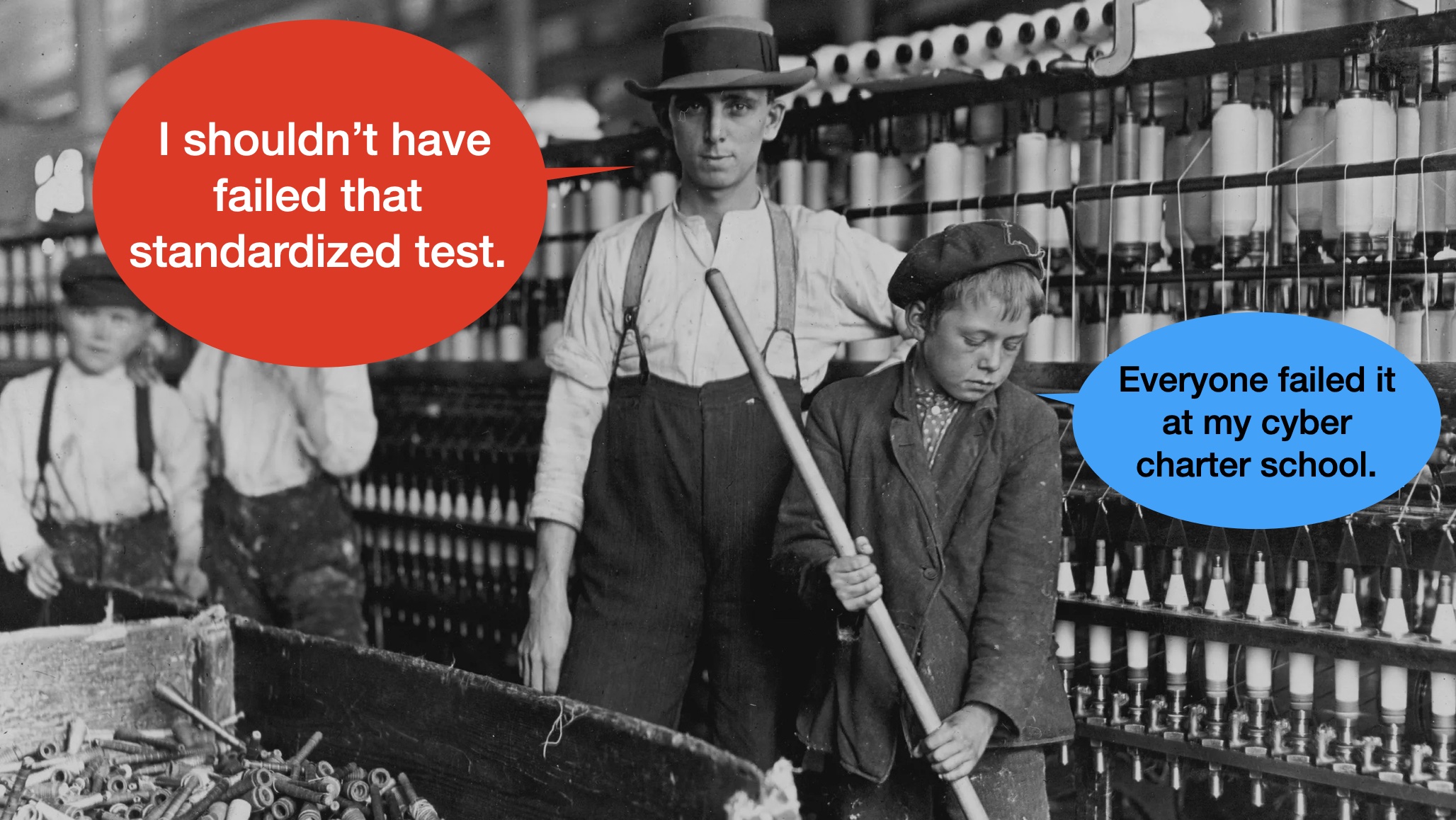
Efforts to Legalize Child Labor are the Next Logical Step After Corporate Education Reform

 
Standardized testing


Privatizing public schools. 


Defunding poor students.  


What’s next? 


Republicans across the United States have an answer – legalizing child labor


Since 1938 with the Fair Labor Standards Act, the Franklin D. Roosevelt administration restricted children younger than 14 from being employed, and put strict rules in place on when those younger than 18 may be employed, for how many hours and in what fields. 


Today Republicans across the country seem poised to repeal those protections. 


In Wisconsin, Republicans want to allow 14-year-olds to work in bars and restaurants serving alcohol. These kids aren’t legally allowed to drink the beverages they’re pouring but I’m sure that won’t cause any problems. Nooooo! 


In Ohio, the GOP majority legislature is trying to allow kids ages 14 and 15 to work until 9 p.m. during the school year with their parents’ permission. Those teens better make sure their homework is done before their work-WORK because there won’t be anytime before bed. (No matter that this is illegal under federal law. I guess the rest of the country will have to change to accommodate the Buckeye State.) 


Donald Trump’s former press secretary, nepo baby, and current Arkansas Gov. Sarah Huckabee Sanders signed a law in March eliminating permits that employers used to have to check to verify a child’s age and their parent’s consent before hiring a minor. Without this, it’s much easier for companies caught violating child labor laws to claim ignorance. But, hey, freedom. Right? 


And that’s not even counting measures to loosen child labor laws that have been passed in New Jersey, New Hampshire and Iowa. (Iowa Republicans were even going to let 14- and 15-year-olds work in dangerous fields including mining, logging and meatpacking, before coming to their senses!) In the last two years, GOP Lawmakers have proposed loosening child labor laws in at least 10 states, according to a report published last month by the Economic Policy Institute. Some of these bills became law and others were withdrawn or vetoed. 


Make no mistake. These are not aberrations. This is the thrust of the mainstream Republican party today. 


National business lobbyists, chambers of commerce and well-funded conservative groups such as Americans for Prosperity – a conservative political network – and the National Federation of Independent Business – an organization that typically aligns with Republicans – are backing the state bills to increase teen participation in the workforce.  


Meanwhile, child labor violations have increased by almost 70% since 2018, according to The Department of Labor. The agency is increasing enforcement and asking Congress to allow larger fines against violators. 


How did we get here? 


Corporate education reform. 


It’s like the old adage: if a frog is suddenly dropped into a pot of boiling water, it will jump out and save itself from impending death. But, if the frog is gently placed in lukewarm water, with the temperature rising slowly, it will not perceive any danger to itself and will be cooked to death. 


That’s what our national education policy has been for the last two decades. Lawmakers on both sides of the aisle have been slowly raising the temperature and now the water is boiling over. 


We’ve been increasingly treating children less as individual humans who are ends in themselves and instead as cogs in the machine, widgets, things to be molded and manipulated for the good of the economy. 


Here we have an entire industry of standardized testing that makes its money as a parasite on the public school system. The same multi-billion dollar corporations design the tests, grade the tests and then offer remediation when kids don’t pass the tests. It’s a classic captive market where the provider has no incentive but to perpetuate the conditions that increase its bottom line. Students aren’t the consumers of this product – school districts are – and they have no choice but participate. It’s encoded in federal and state law. They have to play along and are, themselves, judged by the results of that compliance. 


Then we have privatization – charter and voucher schools. These are institutions ostensibly set up to educate students, but unlike authentic public schools, these organizations are allowed to turn a profit. Some of them get to hide behind the label “non-profit” but the result is the same. And once you allow financial gain of this sort into the system, that’s what it’s all about. Kids become a means to an end, not an end in themselves.  


And let’s not forget how all of this enters into the finances of public schools. Unlike most countries across the globe, education in the US is supported primarily by local taxes. So rich neighborhoods invariably have robust public schools that provide students with all the resources they need. And poor communities have impoverished schools where students get only whatever parents and teachers can scrounge together. In this country, children are not a worthy cause all by themselves – we only care about them if they’re OURS


The entire apparatus of corporate education reform is focused around jobs. In this ideology, the function of school is to prepare students for employment – that is all. It is not to make students good citizens, knowledgeable voters or even fully realized human beings. Rich kids are prepared for the jobs that will keep them rich. Poor kids are prepared for the service industry – so the rich have someone to wait on them in restaurants and stock grocery store shelves. 


The fact that the Covid pandemic has reduced adults willing to continue working in these fields for such low wages has only motivated the wealthy and powerful to fill those vacancies with younger-and-younger people who won’t understand how much they’re being taken advantage of and won’t complain. 


For example, take this quote from Rex Tillerson, former ExxonMobil CEO

“I’m not sure public schools understand that we’re their customer—that we, the business community, are your customer. What they don’t understand is they are producing a product at the end of that high school graduation. Now is that product in a form that we, the customer, can use it? Or is it defective, and we’re not interested? American schools have got to step up the performance level—or they’re basically turning out defective products that have no future. Unfortunately, the defective products are human beings. So it’s really serious. It’s tragic. But that’s where we find ourselves today.” 


We find the same rhetoric on the left as well as the right. 


The Center for American Progress (CAP) – a so-called liberal Washington think tank lead by Barack Obama  and Hillary Clinton minions like John Podesta – repeat the same conservative talking points. For example, CAP published and article called “Preparing American Students for the Workforce of the Future” which read like a companion piece to Tillerson’s diatribe. They did concede that being ready for “civic life” is important as well as being “career ready,” though. 

So far, few Democrats have taken the next logical step along with their Republican colleagues.

And they ARE colleagues. Don’t let the hyped up media culture war distract you. When you take out social issues, America’s two parties are as different as milk chocolate and dark chocolate. They’re the same basic thing separated only by intensity and bitterness.

Republicans are ready to undo child labor protections. Democrats will only take away kids’ rights at school.


This is what you get when you dehumanize students. This is what you get when you signal it is okay to be a predator on student needs to help fulfill the needs of the economy. 


Money comes first. Students – children – are a distant second.  


So finally the chickens of corporate education reform are coming home to roost. I don’t think we’re going to like the eggs. 


Like this post?  You might want to consider becoming a Patreon subscriber. This helps me continue to keep the blog going and get on with this difficult and challenging work.

Plus you get subscriber only extras!

Just CLICK HERE.

Patreon+Circle

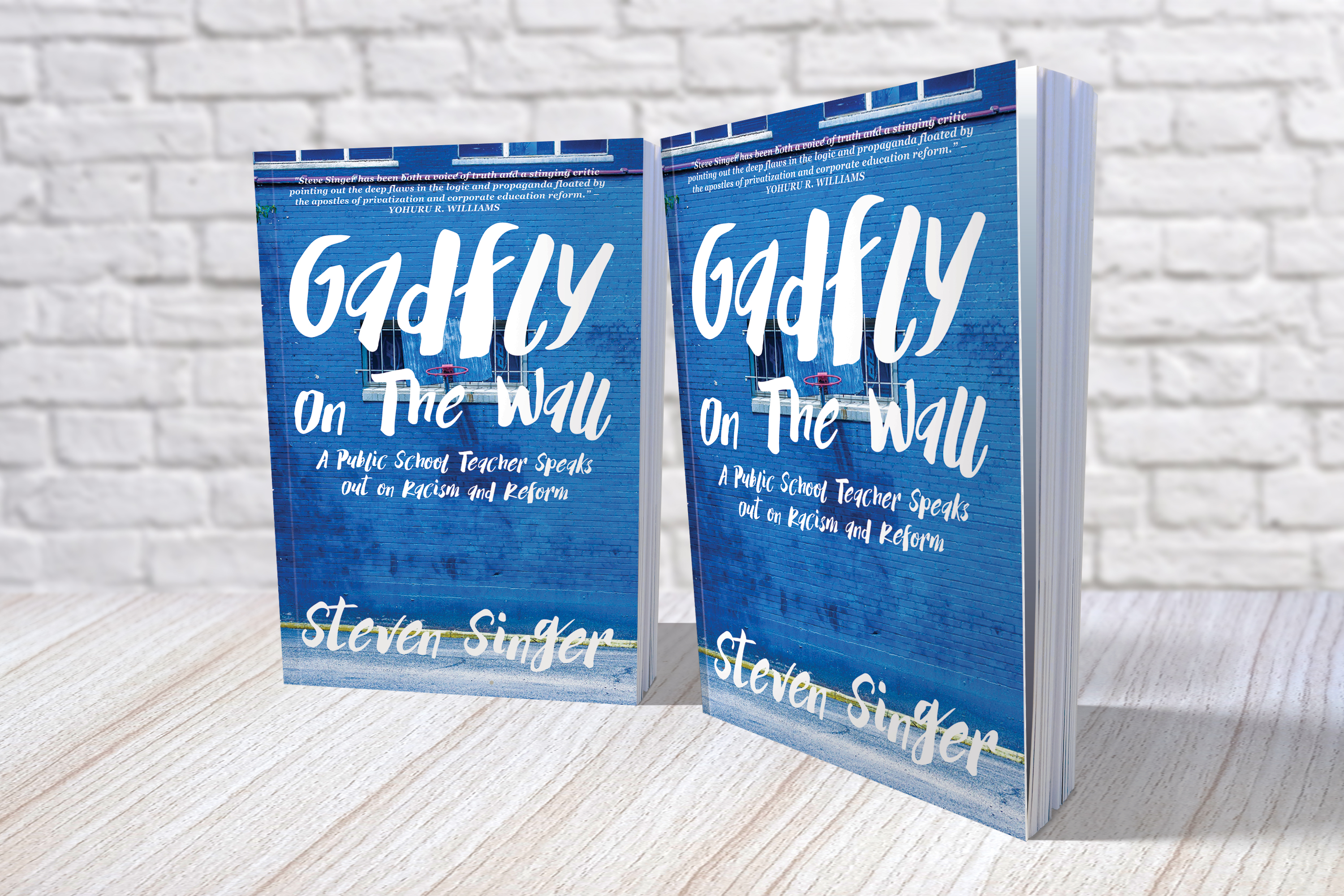
I’ve also written a book, “Gadfly on the Wall: A Public School Teacher Speaks Out on Racism and Reform,” now available from Garn Press. Ten percent of the proceeds go to the Badass Teachers Association. Check it out!

Training Teachers to be Antiracist Sparks Backlash in PA for Good Reasons and Bad

We all agree racism is bad. Right? 


So teaching people to be less racist is good.  


And teaching teachers to be less racist is even better.  


So why are three western Pennsylvania schools suing the state Department of Education (PDE) over guidelines for antiracist teacher training programs? 


The Mars Area, Penn Crest and Laurel school districts filed a lawsuit Monday trying to stop Democratic Gov. Josh Shapiro’s administration from implementing a program called Culturally Relevant and Sustaining Education (CRSE) in every school district in the Commonwealth starting next school year. 


CRSE is a set of 49 cultural competency standards kind of like the Common Core – guidelines for teacher training programs to be used for both new educators and continuing education credits for current educators.  


Plaintiffs complain that the program is vague, requires teachers to think a certain way, encroaches on districts’ autonomy to pick their own curriculum and threatens to take away owed subsidies if districts don’t comply. 


Let’s examine each in turn. 
 

Is the policy vague? No way. It has nine core competencies, each with between 4 and 7 standards. These are guidelines and certainly don’t outline every possible use, but you could argue they’re detailed to a fault. One regulation requires educators to disrupt harmful institutional practices. Another asks educators to acknowledge microaggressions –  when someone unintentionally expresses prejudice towards a person or group. 


Do they require teachers to think a certain way? Yes. They ask teachers to embrace the idea that racism is bad and to strive to work against it.  I’m not seeing how that’s a problem.


Do they encroach on district’s autonomy? That’s debatable – but should districts really resist taking steps to make themselves less racist?  


Do they threaten districts with loss of funding if schools don’t comply? I don’t see anything explicit in the program that says this, but that could be implicit in the program or have been expressed by PDE employees. In any case, I don’t see why it’s a problem to offer tools to do something you really should want to do anyway.


In short, there’s nothing wrong with the guidelines, per se, if you agree that racism is something schools and teachers should strive against. Now I can’t read people’s minds, and I don’t know explicitly what their motivations are, but the real issue seems to be that certain people don’t believe in the cause.  


They don’t believe racism is much of a problem today or that schools should be engaged in antiracist work.  


It’s a culture war issue for them. That’s all. Republicans vs Democrats. So-called conservatives vs so-called liberals. The usual cable TV political football game. 


However, for some of us, the matter isn’t so simple. 


Frankly, I’m of two minds when it comes to these new guidelines for antiracist teacher training. 


On the one hand, I am in favor of teaching people to be less racist – especially when those people are teachers, themselves, who can spread the message even further and use it to be more fair and equitable to students.  


However, taken in context, such guidelines are little more than passing the buck onto teachers while letting the most powerful get away with doing nothing. 


Consider where these guidelines come from.  


They were created by the previous Democratic Gov. Tom Wolf’s administration with help from The New America Foundation. In fact, most of these guidelines come directly from the foundation by use of a creative commons attribution


This is a left-leaning DC think tank with ties to President Barack Obama’s administration. Why does that matter? Look at who funds the organization – The Bill and Melinda Gates Foundation, Bloomberg Family Foundation, JPMorgan Chase Foundation, etc.  


These are the architects of the most dominant education policies of the last two decades – high stakes standardized testing, charter schools, etc.  


Think about that for a minute.  


Here we have the same people responsible for the most racist public school policies of the last several generations writing guidelines to teach educators how to fight racism! 


Well isn’t that something!?  


Imagine if these same billionaire philanthropists demanded an end to their own policies! Now THAT would be antiracism!


Standardized testing is based on eugenics. Children of color and the poor get lower test scores than wealthier whiter kids BY DESIGN, and we use those scores to justify doing all kinds of terrible things to them – narrowing the curriculum at their schools, cutting funding to anything but test prep, closing their schools and forcing them into unproven privatized alternatives.

Speaking of which, take a look at charter and voucher schools. These are institutions surviving on public tax dollars that aren’t held to the same accountability standards. Charter schools target black and brown kids giving them less quality educations and pocketing the tax money provided to educate them as profit. Voucher schools use tax dollars to fund religious and parochial education, teaching blatantly racist and anti-scientific ideas.  


If the people behind CRSE really wanted to make a dent in racism, they’d abolish these policies.  


If the state really wanted to be antiracist, it would stop the tyranny of high stakes testing, abolish no account charter schools and stop funneling tax dollars to private and parochial schools. It would work to reduce school segregation, equitably fund all districts – especially those serving poor and minority children, etc.


But no. They do none of these things. Instead they throw it all on teachers.  


Once again the powerful do nothing to actually fix our problems but put the burden of our crumbling societies on our crumbling public schools and traumatized teachers. 


THAT’S my problem with this program. 


It’s not that they want to teach teachers to be antiracist and to take steps to create more fair and equitable classrooms. It’s that this is all a smokescreen to allow the people who are really behind many of the racist systems in our society to keep getting away with it and perpetuating more and more inequality. 


I can just imagine how well the state would greet educators “disrupt[ing] harmful institutional practices” by refusing to give standardized tests!

Teachers have an attrition rate of nearly 50% every 5 years. We can’t keep dumping every social problem into their laps and expecting them to perform miracles all by themselves.

Public schools are a PART of the solution to our broken society. But they are not the WHOLE.  


We need real public policy to address these issues. We need to get rid of reductive and prejudicial laws.  

And the fact that we don’t have any of that is certain to poison the fervor of many teachers next year who will be required to sit through antiracist programs paid for and conducted by the same folks behind the public school apartheid that is our everyday reality.  


Like this post?  You might want to consider becoming a Patreon subscriber. This helps me continue to keep the blog going and get on with this difficult and challenging work.

Plus you get subscriber only extras!

Just CLICK HERE.

Patreon+Circle

I’ve also written a book, “Gadfly on the Wall: A Public School Teacher Speaks Out on Racism and Reform,” now available from Garn Press. Ten percent of the proceeds go to the Badass Teachers Association. Check it out!

Lobbyists Congratulate Themselves for 20 Years of NCLB Standardized Testing

It’s hard to learn your lesson – especially if doing so costs you money.

Case in point: the U.S. Chamber of Commerce Foundation, the largest lobbying organization in the country, issued a new report examining the impact of No Child Left Behind (NCLB), the George W. Bush era law making standardized testing the centerpiece of K-12 education.

So an organization representing oil companies, pharmaceutical giants and automakers just opined on public school policy as if it were made up of experts.

And guess what?

Business folks don’t know what the heck they’re talking about in education.

Because after sorting through 20 years of NCLB controversy, political shenanigans and factual mistakes, the supply side cabal thinks the law is just fine.

It’s kind of like a judge watching a driver plow his car into a brick wall repeatedly and then instead of taking away his license, awarding him a safe driver certificate.

It doesn’t take a political scientist to figure out why.

Think about it. These are supply side cultists. If our education policy is working just fine as is, then there’s no need to raise taxes on all the business interests the free market fan club represents to fix the problem.

And, moreover, we can keep funneling the education dollars we do spend to corporations (many of whom are represented by the U.S. Chamber of Commerce Foundation) who profit off the law by making tests, grading tests and selling test prep material.

The only thing shocking here (maybe) is the way the media publishes the Foundation’s results as if they were truths handed down from on high.

What’s the matter, journalists? You’ve never heard of a conflict of interest?

An organization like the U.S. Chamber of Commerce Foundation with proven ties to the Koch Brothers and the American Legislative Exchange Council (ALEC) is somehow the epitome of unbiased advocacy!?

The organization’s own report describes the Foundation as “tireless advocates for high-quality academic standards, assessments, and accountability as tools for educational equity.”

By its own admission, then, this is the testing industry evaluating itself. And – surprise – it gave itself a high score!

The report was written by Dan Goldhaber and Michael DeArmond of the Center for the Analysis of Longitudinal Data in Education Research (CALDER) at the American Institutes for Research with a qualitative analysis by Brightbeam CEO Chris Stewart and his staff.

CALDER is a federally-funded nonprofit organization with several testing industry-funded and conservative think-tank members in management, on the advisory board, and working as independent researchers – in case, you thought anything they produced might be fair and balanced.

Brightbeam is a corporate education reform think tank financed by the usual billionaires such as Michael Bloomberg, Alice Walton, Jim Walton, Laurene Jobs Powell and Mark Zuckerberg. And Stewart is a long-time standardized testing and school privatization cheerleader – not exactly the kind of people who can afford to find much fault in NCLB because doing so would put them out of work.

The report highlights eight key findings – four positive and four negative.

First, the authors of the report pat each other on the back because NCLB collected so much yummy data that had been unavailable previously. In particular, the law extracted data from the nation’s schools based on race, socioeconomics and special needs. “No longer were school districts able to hide the performance of some students behind an average,” the report states.

It’s certainly true that NCLB collected a mountain of data. However, such information conceivably could have been gathered without making standardized testing the fulcrum around which schools turn. It could just as easily have been collected based entirely on classroom grades. It’s just that doing so might have been considered invasive and a violation of privacy. You might have had to explain why you wanted such data first – but why explain when you can just take?

Moreover, it’s strange to celebrate NCLB for disallowing hiding student performance behind an average when that’s exactly what it does. Everything is an average now! Average test scores, aggregate passing scores, whether your school made adequate yearly progress… it’s all averages! Oh to go back to the times when you could look at a single student’s academic record without having to compare it to anyone else!

Second, the authors claim student test scores increased because of NCLB especially among Black, Hispanic, and low-income students. However, this depends on how you massage the data.

Test scores have stayed relatively the same throughout the last 20 years with dips here and rises there. No matter the test, the overall trajectory has been pretty flat. You can focus here or focus there to create a picture that supports whatever narrative you want, but taken as a whole, there has not been any significant progress as shown by test scores.

But even if there had been, let’s not forget that no one has ever proven standardized test scores actually have anything to do with real academic progress. Just because you get a good score on a multiple choice test, it doesn’t mean you’ve actually learned to do anything but take a very limited and artificial test that is far removed from the circumstances where anyone actually uses the skills the test purports to be assessing.

Third, the report celebrates the production of “more reliable, comparable education data.” This is a suspect claim.

Are test scores more reliable than classroom grades? That has never been proven. In fact, when it comes to predicting future success in college or careers, there is plenty of evidence that classroom grades do a better job than test scores. After all, tests are based on work done over a relatively few number of days. Grades are based on an entire year’s worth of work.

However, it is true that test scores are more easily comparable because they come from the same assessments. Why this is so important is unclear. Learning is not the same as sports statistics. It is not a competition. Students learn when they’re ready to learn – not based on anyone’s schedule. What matters is if they learn at all.

Fourth, the authors admit “Reforms in teacher evaluation and school turnaround initiatives did not consistently improve student outcomes at scale, in part due to significant variation in quality of implementation.”

It is interesting that even the U.S. Chamber of Commerce can’t spin NCLB into an unquestionable success. But it is almost a cliche among the standardized testing industry that any failures of the big tests are always excused as failures solely of “implementation.” If teachers and districts just tried harder to put the testing industry’s plans into effect, everything would be working perfectly. It’s these darn teachers and schools! Whine! Cry! Sob!

For the negative findings, the report concluded there were unknowns about the impact of NCLB that should be further studied.

First, they were unsure if schools serving minorities and the poor ended up getting more money to improve than they otherwise would have done. SPOILER ALERT: they did not.

The original Elementary and Secondary Education Act passed under Lyndon B. Johnson was focused on equity – the exact concern the authors of the report pretend to be all about. However, when the law was reauthorized as NCLB in 2002 (and reauthorized again in 2015 as the Every Student Succeeds Act) it focused instead on test scores as a gatekeeper to equity. Instead of looking at needs, you had to pass the tests to get the money to meet your needs. And if you had needs, that meant your district and teachers were failing so they had to lose funding to punish them, first. Somehow you were supposed to end up with more funding after all that nonsense.

Second, if schools did get more funding because of test scores, the authors of the report were unsure what schools did with it. SPOILER ALERT: It went to test prep and charter school expansion.

NCLB refocused education on test scores, so if students did badly on the assessments, they needed test prep material. And if the teachers and districts weren’t miraculously overcoming social, economic and special needs of students in impoverished areas, money was given to open competing charter schools.

Did this help? Just the opposite. Now you have two schools vying for an even smaller pot of funding but one of these schools (the charter) doesn’t have to follow the regulations the others school must. So anyone with no background in education can open a school, hire uncertified teachers, make decisions on how to spend tax dollars without an elected school board, etc. Not helpful.

Third, the authors of the report were unsure how many struggling schools became successful under NCLB. SPOILER ALERT: Not many.

You don’t help a malnourished person by starving him even further or making him compete for food. The same with school districts. In almost every case where a school miracle is proposed in which kids simply pull themselves up by their own bootstraps, the reality turns out to be a byproduct of creative accounting or selective data.

That was the entire foundation of NCLB – George W. Bush’s fairy tale about Texas schools during his time as Governor which miraculously improved when you tested the heck out of them. That never happened, and neither did it happen when his dream became national policy.

Take New Orleans, a district often held up by the testing and privatization industry as a success. This is the only all-charter school district in the country. After 2005 and Hurricane Katrina, a predominantly white Republican legislature forced the district’s public schools to become charters – outright experimenting on a majority African American city. The result? School enrollment declined from 65,000 before the hurricane to 48,000 a dozen years later. The most recent state scores rated 49% of the city’s charter schools as D or F, based on their academic performance. The New Orleans district scores are below the state average, and that’s saying something since Louisiana is one of the lowest performing states in the nation.

Not exactly an overwhelming success.

Fourth, the authors wondered if NCLB might have resulted in non-academic improvements – things like a reduction in chronic absences, school climate, etc. SPOILER ALERT: Nope.

A focus on standardized testing does not convince more kids to come to school. Few kids get excited about taking tests. They get excited about broad academic curriculum, arts and extra curricular activities – the kinds of things districts had to cut back on because of NCLB.

So there you have it. The U.S. Chamber of Commerce Foundation is proud of their little report about the impact of NCLB. They give themselves a gold star.

The reality though is much different than what you’ll find on this bit of propaganda.

Any reasonable examination of the last 20 years in education would show this policy is ripe for repeal. We need to forgo standardized testing entirely in our public schools – not double down on them for yet another decade of failure.

Not only should it not be required to determine which schools need what funds, it should be kicked out of our schools like foxes from the henhouse.

And charter schools should be abolished in all 45 states plus the District of Columbia that have been duped into passing laws allowing them.

We need to put the focus back on equity, back on student need.

Let’s get real. Poverty and wealth are the most important factors determining test scores. This shows up on every standardized test. In fact, that’s what the name means – STANDARDIZED test – these assessments are normed on a bell curve reflecting family income and education. Kids from families from higher socioeconomic brackets are at the top of the curve and poor kids are on the bottom.

And consider this: nearly half the students in the U.S. now qualify for free or reduced lunches – the federal measure of poverty. So if we really want to help kids achieve academically, we need to first reduce the impact of poverty on children and families by making sure that they have access to nutrition, medical care, and good housing. Ensure pregnant women get medical care so their children are born healthy.

That’s how you improve education. The federal government should fully fund the schooling of students with disabilities and at least triple the funding for low-income schools. Pay teachers the kinds of wages that will keep them on the job and stop the steady stream of educators out of the field. Teachers should be treated like professionals and never have to work at second or third jobs to make ends meet. Assessment should be a teacher’s job – they should write their own tests as we trusted them to do for generations. And we can use the billions in savings now wasted on standardized testing instead to reduce class sizes so children can get individualized help from their teacher.

In short, don’t give students corporate canned tests. Give them well-maintained schools with nurses, counselors, and libraries with flesh-and-blood librarians. These are just some of the ways we could actually make things better.

It’s been two decades already. People know high stakes testing has failed despite whatever public relations reports are issued by lobbyist organizations. It’s time we had the courage to admit NCLB was a mistake and acted to finally put things right.

It may hurt some businesses that rely on testing to make a buck. It may require big corporations to pay their fair share of taxes. But that is the only way to improve education.

We must put our money where our mouths are – or else be quiet.


Like this post?  You might want to consider becoming a Patreon subscriber. This helps me continue to keep the blog going and get on with this difficult and challenging work.

Plus you get subscriber only extras!

Just CLICK HERE.

Patreon+Circle

I’ve also written a book, “Gadfly on the Wall: A Public School Teacher Speaks Out on Racism and Reform,” now available from Garn Press. Ten percent of the proceeds go to the Badass Teachers Association. Check it out!


What Democratic Midterm Victories Mean for Pennsylvania’s Schools

We can breathe a sigh of relief.

Fascism was defeated at the polls.

Christian nationalism, snake oil salesmen and angertainment all fell to the power of the ballot at this week’s midterm election in Pennsylvania.

Democrat Josh Shapiro beat far right Republican Doug Mastriano for Governor.

John Fetterman beat reality TV star Dr. Mehmet Oz for Senator.

And a host of local grassroots progressives triumphed from Summer Lee becoming the first black woman ever elected from our state to the House to Lindsay Williams retaining her seat in the state legislature. Even Austin Davis (my state representative) will become the first black Lt. Governor in the Commonwealth.

And most surprising, the state house may have even flipped to Democratic control after decades in Republican hands. (There are still a few races that are too close to call.)

All-in-all, it was a good night. Especially in an election cycle where Republicans had every advantage. The President’s party usually loses seats during the midterms, and just last week it seemed that Joe Biden would be no exception. However, now that the dust has cleared, the losses seem to be minimal to nonexistent.

So what does it all mean for our state’s schools and the future of our kids’ educations?

First, we can expect far fewer insane policy proposals and those that are put forward will have next to zero chance of passing.

No more worries about our already meager education funding being cut in half.

No more fears of Florida’s regressive “Don’t Say Gay” law restricting free speech coming to the Keystone state.

The Critical Race Theory panic (A.K.A. – teaching actual history) will fade to just another wing nut conspiracy theory thrown to the Republican base to generate support instead of an actual policy proposal to restrict academic freedom.

I suspect a lot of the baseless hysteria Republicans had been shouting from the rafters will decrease as pollsters show them how ineffective it was in getting votes that weren’t already staunchly GOP.

For the first time in years, Republicans may have to push toward the center instead of constantly to the lunatic fringe. Otherwise, they’ll continue to lose.

Second, we may actually see some positive education policies make their way through the state legislature.

Shapiro has promised to increase education funding. That and the still pending court decision on a lawsuit against the state demanding adequate funding may be enough to turn the funding faucet on a few cranks. With Democrats holding an increasing share of seats, all it takes is a few moderate Republicans (are they out there?) to join them to get things done.

However, it isn’t all wine and roses.

During the general election, Shapiro came out in favor of some school voucher programs. This puts him to the right of our current Governor Tom Wolf. So we can look forward to our new Governor supporting an increase for tax credit scholarships and other de facto voucher plans that will drain public education coffers just as we’re working to increase them.

It is also anyone’s guess whether a pro-voucher Governor would support charter school reform – something we desperately need and that Wolf championed during his tenure.

And though both Wolf and Shapiro criticized standardized testing, it would take a mightily informed and courageous state politician to go up against the economic powerhouse of the testing industry.

In short, the election mostly means we don’t have to worry about as many flaming meteorites crashing down on our schools.

Things might even get better here and there – especially with additional funding.

However, we will have to monitor our representatives as if they were little kids sulking by the cookie jar. They will almost definitely try to sneak in some garbage legislation to hurt our students and enrich their corporate buddies.

When we look at the national situation, it appears much the same. Even with Fetterman going to the Senate, it’s unclear whether Democrats will have control of either legislative body. Even if they do, the majority will be razor thin.

A robust Democratic Party determined to enact progressive legislation could make much of such a situation, but as we’ve seen in the past, that is not the case with the current leadership.

The most we can realistically hope for is that they put a stop to insane GOP legislation.

The question is whether we can build on such Democratic gains at both the state and national level. Usually that doesn’t happen. But it will have to be the goal moving forward.

Stopping the worst is a worthy aim but it cannot be everything. We must continue to push our representatives to make actual progress and fix the slow and steady drip of fascism, corporatism and Christian nationalism that has dominated our politics for far too long.

So let us celebrate a worthy election cycle while we prepare for all the political battles still to come.

A sigh of relief, a renewed fighting stance and back into the fray.


Like this post?  You might want to consider becoming a Patreon subscriber. This helps me continue to keep the blog going and get on with this difficult and challenging work.

Plus you get subscriber only extras!

Just CLICK HERE.

Patreon+Circle

I’ve also written a book, “Gadfly on the Wall: A Public School Teacher Speaks Out on Racism and Reform,” now available from Garn Press. Ten percent of the proceeds go to the Badass Teachers Association. Check it out!


A New Children’s Fund – Reducing Student Inequality Through Allegheny County Council

Public schools are not funded fairly.

Every child does not receive equitable resources or even close to what they need.

The state and federal government provide some funding, but they leave it up to each neighborhood to take the brunt of the burden.

So the majority of funding comes from local tax revenues – rich communities give their kids more than enough and poor ones struggle to give them enough to even get by.

This means things like class size, access to tutoring and remediation, extracurricular activities, advanced placement courses, field trips, counseling, even access to a school nurse often depends on how rich of a community kids live in.

It’s a backward and barbaric way of supporting children – a kind of economic Darwinism that gives the richest kids the most advantages from the very start while holding back everyone else.

It doesn’t have to be this way, but don’t look to the state or federal government to fix it.

No matter who has been in power in the Oval Office or held majorities in Congress, national lawmakers don’t seem to care much about public schools unless it has to do with standardized testing or school privatization – policies that only make things worse.

In Pennsylvania, Gov. Tom Wolf has been working his entire tenure to make the system more fair, but the Republican controlled legislature has blocked him at nearly every turn. And given our hopeless gerrymandered legislative districts, this isn’t about to be rectified anytime soon.

So what are we to do? Give up?

No.

In the Pittsburgh area, we have a solution ready at hand to at least reduce the inequality among rich and poor kids. All we have to do is reach into the trash.

Three years ago we had a ballot initiative called The Children’s Fund. It would have created a voluntary 5% property tax hike to pay for early learning, after-school programs and healthy meals for kids. It was defeated by voters.

And for good reason.

The proposal was an absolute mess.

As a local teacher, education activist and blogger, I advised against the plan because it raised taxes without stipulating where the money would go, it was unclear who would have been in charge of the money and other reasons.

But that doesn’t mean there was nothing of value there.

The idea of county tax revenues being used to help balance the scales of public school funding is not a bad one.

We could fix the problems with the original children’s fund and create a new one.

In fact, that’s one of the reasons I’m running for county council. I want to increase our local investment in children and the future.

Here’s how we do it.

The 2018 Children’s Fund would have raised taxes by 0.25 mills of property tax — $25 on each $100,000 of assessed value. This would have generated an estimate $18 million a year and gone to a newly created government office under the supervision of the county manager. There would have been an advisory commission but it was really left under the discretion of the County Executive to figure out how all this would work. He’d get to pick who was in charge of the money and where it went.

This was a terrible idea.

We don’t need a big pot of money that a king gets to dole out as he chooses. Nor do we need to created unnecessary bureaucracy.

All we need is a funding formula. Collect X amount of tax revenues and send it to Y schools according to these guidelines prioritizing Title I schools and other institutions serving needy children.

Moreover, the fund doesn’t even need to include a tax increase. Council should first look to cut wasteful spending already in the budget to generate the money needed.

We already have a $2 billion budget. We spend $100 million of it to keep people locked up in the county jail, and 80 percent of them are nonviolent offenders who haven’t been convicted of anything. Many simply can’t pay cash bail, failed a drug test for something like marijuana or violated our ridiculously long parole period.

Finding $18 million might not be too difficult if we took a hard look at our finances and our priorities. And even if we couldn’t find the full amount, we could propose a lower tax increase. And if we do have to increase revenues, we can look to do so by making corporations and the wealthy pay their fair share before putting more burden on residents.

We should at least explore these options before jumping on another across the board tax increase even if the cause is a good one.

Another problem with the 2018 proposal was that it was too broad. For instance, it suggested some of this money be used to offer meals to children in school. However, much of that need has been met by a program called the Community Eligibility Provision which is available nationwide as part of the Healthy, Hunger-Free Kids Act passed in 2010.

While food insecurity remains a problem for low income students and their families, I think there are better solutions such as increasing the minimum wage and creating more well-paying union jobs.

We should limit the new children’s fund to increasing pre-K access to needy children, offering funding to school districts to create or fund existent after school tutoring programs, reduce class size and increase teacher salaries at low income schools.

Another problem with the 2018 proposal was that it worked around instead of with local government.

Though almost everyone agreed with the stated goals of the proposal, many organizations and government officials complained that they were not consulted and made a part of the process.

There’s an easy fix for that.

Before enacting any new legislation, County Council should seek input from school districts and pre-K programs. That way, the legislation can be best crafted to meet need.

I care about schools, students and families, but I don’t know everything and neither does County Council or the County Executive. We should be humble enough to listen to what stakeholders tell us they need and then find a way to meet it.

Finally, there’s the question of fraud and mismanagement of funds.

One of the biggest red flags around the 2018 campaign is that it was not grass roots.

Financial documents show that the whole initiative had been funded by various nonprofit organizations that could, themselves, become beneficiaries of this same fund.

We have to make sure that the money is going to help children, not corporate raiders or profit-obsessed philanthrocapitalists.


To ensure this does not happen, we should put some restrictions on how the money can be used.

For example, the federal government is infamous for offering money to schools with strings attached. President Barack Obama’s Race to the Top, for example, was a huge corporate welfare scheme to enrich standardized testing and school privatization corporations. Schools could compete for limited funds by increasing test scores, and then if they won, they’d have to spend that money on test prep or privatization.

We don’t need any of those shenanigans in Allegheny County.

The new Children’s Fund should be barred from use in standardized testing preparation programs, it should not be available to buy new technologies or apps, and it should be used at the K-12 level ONLY at strictly public schools.

County residents cannot afford to bankroll people’s kids to private schools.

This money should not be available at any private schools even if those schools use school vouchers, Educational Improvement Tax Credit (EITC), Opportunity Scholarship Tax Credit (OSTC) programs or other tax scholarship programs that function like school vouchers.

Moreover, county residents shouldn’t be pouring our tax dollars into schools that don’t have the same high fiscal accountability requirements as our fully public schools even if these schools claim to be fully public.

Unlike public institutions, charter schools do not have to be run by elected school boards, do not have to have school board meetings open to the public or even open their budgets to annual public review.

That’s why this new funding should be available at charter schools ONLY if those schools charters are in good standing AND if the charter schools will admit to a yearly public audit of how the money has been spent. Any misappropriation or unaccounted for funding would disqualify the charter school from further funding and prompt an immediate full state audit.

I think if we enacted legislation along those lines, we could really make a difference for the children of our county.

We have to face the facts.

Pennsylvania is one of the worst states in the country when it comes to educational equity for poor and non-white students.

The commonwealth ranks 47th in the nation for the share of K-12 public education funding that comes from the state.

The state ranks 48th nationally in opportunity gaps for high school students of color compared with white students and 47th for Hispanic students, according to a 2018 report from the Philadelphia-based nonprofit Research for Action.

A separate 2016 study found that Pennsylvania has one of the widest gaps between students along racial and socioeconomic divides in the country.

And the list goes on and on.

Only the federal and state government can truly fix the problem long term. But that’s not going to happen anytime soon.

We can sit idly by as our children get left behind or we can stand up and do something about it.

If elected to county council, I will do everything in my power to right this wrong.

Our kids deserve more than governmental dysfunction, class warfare and de facto racism.

Please stand with me to enact a new children’s fund that helps support our kids.

Please help me gain a seat on Allegheny County Council.


Like this post?  You might want to consider becoming a Patreon subscriber. This helps me continue to keep the blog going and get on with this difficult and challenging work.

Plus you get subscriber only extras!

Just CLICK HERE.

Patreon+Circle

I’ve also written a book, “Gadfly on the Wall: A Public School Teacher Speaks Out on Racism and Reform,” now available from Garn Press. Ten percent of the proceeds go to the Badass Teachers Association. Check it out!


Hope During a Pandemic is Both Hard and Inescapable

I cried when I got my second Covid-19 shot.

Not a lot.

Just a few drops.

But the flood of emotions I felt that accompanied that tiny pinch in my arm was totally unexpected.

It was like I gasped for breath and hadn’t realized until then that I was suffocating.

I looked up at the volunteer who had injected me to see if she’d noticed, but it’s hard to read someone’s expression under a mask.

So I found myself shrugging the feeling off, giving her a brisk “Thank you” and heading off to file my paperwork, get another stamp on my vaccination card and plopping in a chair for 15 minutes of observation before heading on my way.

As I sat there, I started to feel this growing sense of excitement in my chest.

Two weeks, I thought.

In two weeks I will be fully vaccinated.

Moderna is 94.1% effective at preventing infection. That means I should be able to return to school and teach my students in-person. Safely.

Some of them have been back in the classroom for weeks now, but I’ve had to stay remote putting up assignments in Google Classroom for the sub to teach.

My pre-existing health conditions make me too susceptible to the virus to take chances with stuffy classrooms and interacting with tens of students for prolonged periods every day.

So instead I spend my daylight hours grading virtual papers and writing digital comments, but I only get to hear student voices on Fridays when all classes are conducted remotely.

Rarely do I get to see a face in one of those austere Zoom boxes.

It’s a lonely life being sidelined this way.

But there seems to be an end in sight.

I can actually plot it on the calendar.

THAT day I can return.

And I wonder, is this hope?

I haven’t really felt anything like it in quite a while.

The world has been such a mess for so long.

A global pandemic that’s infected nearly 29 million Americans and killed 523,000 is bad enough. But it’s the constant bungling of local, state and federal governments response to the virus that has been absolutely demoralizing.

In fact, my second shot was delayed a week because health officials accidentally gave out the dose that had been set aside for me to someone else.

Thankfully waiting an extra 7 days isn’t supposed to have any ill effects. But that’s a week more I have to be out of the classroom and burning my sick days, trying to do 40 hours worth of work in the handful of hours the district allows me.

It’s just that this isn’t an anomaly. All through this process those in charge have dropped the ball.

At every step – bungled, mismanaged, and carelessly misjudged.

The school board refused to value my health and reopened recklessly even putting the community’s own children in danger. The state refused to mandate almost anything to keep people safe, instead offering a truckload of take-it-or-leave-it suggestions.

Hope, I thought. Is it possible to believe in hope anymore?

Barack Obama made it a campaign slogan. Hope and change.

His book was “The Audacity of Hope.”

He wrote:

“Hope is not blind optimism. It’s not ignoring the enormity of the task ahead or the roadblocks that stand in our path. It’s not sitting on the sidelines or shirking from a fight. Hope is that thing inside us that insists, despite all evidence to the contrary, that something better awaits us if we have the courage to reach for it, and to work for it, and to fight for it. Hope is the belief that destiny will not be written for us, but by us, by the men and women who are not content to settle for the world as it is, who have the courage to remake the world as it should be.”

These words ring so empty today after a presidency full of promises and very little else.

True, much of his domestic agenda was blocked by Republicans. But even when they couldn’t stop him from getting things done, the results were often disappointing. His foreign policy was hawkish full of drone strikes, his immigration policy unduly cruel and his education programs were the fever dreams of Milton Friedman made real – charter schools, high stakes testing and ed tech handouts.

You think Trump was bad!? He was the logical consequence of dashed hopes and neoliberal triumphs. You can’t run, as Obama did, as a once-in-a-lifetime transformational candidate and then legislate to support a status quo that is destroying the majority of Americans.

If you do, you get Trump.

At least now the pendulum has swung back the other way. We’ve got Biden.

Cool, smooth, dependable Biden.

He’s slowly reversing the catastrophes of Trump while quietly committing a few of his own along the way. (Reopening school buildings without mandating the opportunity for teachers to be vaccinated first!? Requiring standardized testing to tell if students have been affected by the pandemic!?)

How does one continue to hope in the wake of such disappointment?

The fabric of our society and our governmental institutions are frayed to the breaking point. They could fall apart any day now.

How does one continue to hope in light of all this?

My phone buzzes. I shake my head to dispel all these gloomy thoughts.

Well! Here’s some good news. Apparently there are no ill effects from the shot. Time to go.

I stand up and look around at the busy vaccination center.

Volunteers continue to welcome patients. They’re much more organized than when I got my first shot only weeks earlier.

Everyone is friendly and there’s even a sparkle in their eyes.

What is that sparkle?

Why does everyone smile?


Why did I cry?

There’s only one possibility.

It’s hope.

Goddamit.

It’s hope.

The teardrop that escaped my eye wasn’t a response to any pain from the injection. It was pain at the possibility that all this would end.

It was the feeling – the certainty – that the pandemic was only temporary and that I would come out the other side. We all would.

Because in the part of our hearts where hope grows, the past doesn’t matter.

What’s happened is always past.

The only thing that counts is the future.

And when you have a future you have to hope.

It’s simply built in. There’s no way around it.

It would be easier not to hope. But the only way to do that is to die, and apparently I’m going to live.

So you pick yourself up, you dust off your knees and you get to the work ahead.

Because no matter how disappointing the past, how demoralizing the events you’ve lived through, there is always the possibility that things will be better tomorrow.

If only you work to make it so.


Like this post?  You might want to consider becoming a Patreon subscriber. This helps me continue to keep the blog going and get on with this difficult and challenging work.

Plus you get subscriber only extras!

Just CLICK HERE.

Patreon+Circle

I’ve also written a book, “Gadfly on the Wall: A Public School Teacher Speaks Out on Racism and Reform,” now available from Garn Press. Ten percent of the proceeds go to the Badass Teachers Association. Check it out!

Standardized Testing During the Pandemic is Corporate Welfare Not Student Equity

We’ve got to be able to tell how badly the pandemic is affecting student learning.

So let’s give standardized tests.

That’s the rationale behind the Biden administration’s mandate that schools across the country still struggling just to keep buildings open somehow manage to proctor standardized assessments.

Nearly 29 million people have contracted Covid-19 in the United States. More than 514,000 people have died from the virus.

Only about half of the nation’s schools are open for in-person learning, and many of those are operating on a hybrid basis. The rest are completely virtual.

Children have lost parents, siblings, family members, friends, teachers. Families are struggling just to survive with some members still recovering from the longterm health consequences of contracting Covid.

It is absurd to claim that only standardized tests can show whether the pandemic has impacted student learning.

It has. Nearly everywhere.

Insisting on testing is like bringing a thermometer into a burning building to tell firefighters where to spray the hose.

But pay attention to the messenger.

In this case, it’s acting education secretary Ian Rosenblum, former executive director of pro-testing organization, the Education Trust.

He sent the letter to state superintendents on behalf of the Biden administration telling them that blanket waivers of the federal testing mandate would not be considered this year as they were in 2019-20.

Let’s be honest. Rosenblum is not an educator.

He is a corporate lobbyist given a government job where he has continued to lobby for his industry.

This has nothing to do with helping students overcome the problems of a pandemic.

It is corporate welfare. Plain and simple.

Standardized testing is a multi-million dollar business.

States spend more than $1.7 billion every year on testing. In 45 states, assessments at the primary level alone cost taxpayers $669 million.

This money isn’t going to mom and pop organizations. The four major testing companies are Wall Street heavy hitters – Harcourt Educational Measurement, CTB McGraw-Hill, Riverside Publishing (a Houghton Mifflin company), and NCS Pearson.

In 2001 the first three agencies accounted for 96% of the tests administered, while Pearson was the leading scoring agency of those tests. And since then the market has exploded.

In 1955 the industry was valued at only $7 million. By 1997 it had ballooned to $263 million. This is a 3ooo% increase. Today the estimated worth of the industry is $700 million.

However, that only takes into account actual assessment.

When you consider that many of these companies (or their parent conglomerates) also provide remedial materials for students who fail the tests, the profits really start rolling in. It’s no coincidence that McGraw-Hill, for example, also publishes books and other materials many of which are used by schools to remediate the same students who fail the company’s tests.

It’s a captive market. The testing company makes and distributes the test (for a fee), scores the test so that a majority fail (for another fee), and then sells schools the materials it claims will help students pass next time (for an even further fee).

However, for the first time in two decades, the pandemic threw a monkey wrench into the machine.

Last year, the Trump administration cancelled all standardized tests as schools were closed to protect students from Covid-19.

Former Education Secretary Betsy DeVos had already signaled that she would not cancel them again this year, but when Trump lost the election, many educators and families had hoped in-coming President Joe Biden would think differently.

He had, in fact, promised that if he were elected he would not continue forcing states to give standardized testing.

I was there at the Education Forum in Pittsburgh in 2020 when my friend Dr. Denisha Jones asked him about it point blank.

You can watch his full answer here, but the crux of it was “Teaching to a standardized test makes no sense.”

Unfortunately, caving to a powerful corporate lobby does. And that’s exactly what Biden has done here.

In fact, it goes a long way to explaining his perplexing rush to reopen schools in his first 100 days regardless of the level of community infection.

Biden, who ran on being friendly to teachers and that his wife Dr. Jill Biden was an educator, has pushed some extremely absurd education policies in his short time in office.

Not only has his administration decided to ignore community infections, he has insisted that schools can be opened safely if districts follow certain safety precautions like universal masking, contact tracing and social distancing.

However, many schools are not following these protocols and even more simply cannot because doing so would be exorbitantly expensive. For example, you can’t have all students return to a cramped school building AND have them be 6 feet apart. There simply isn’t the available space. Moreover, contact tracing doesn’t effectively track Covid cases since most students who contract the virus are asymptomatic.

Then there is the absurd prescription that schools don’t even have to prioritize teachers for the Covid vaccine before reopening. In many states educators aren’t even eligible yet to receive the vaccine. Yet the Biden administration expects them to enter the classroom without necessary protections to keep them, their families and students safe.

These are all perplexing policies until one looks at it from an economic vantage.

Waiting for all teachers to have the opportunity to take a two dose vaccine would take at least a month and a half – that’s if every teacher could start the process today.

In addition, if we wait for community infections of the virus to dissipate, testing season will be far from over. In fact, it’s likely the rest of the school year would be gone.

So if the Biden administration had prioritized safety, it would have been forced to cancel standardized tests again this year.

Instead, it has prioritized the testing-industrial complex.

The economy is more important to the powers that be once again.

As a compromise measure, Biden is allowing flexibility in just about every way the tests are given. They can be shortened. They can be given remotely. They don’t have to be given now – they can be given in the fall.

However, this completely erases any measure of standardization in the processes.

Standardization means conforming to a standard. It means sameness. A test taken by a student at home is not the same as one taken by a student in school. A short version of a test is not the same as a long one. A test taken with 180 days to prepare is not the same as one taken with 250.

And if standardization is not NECESSARY in this case, why can’t we rely on non-standardized assessments teachers are already giving to their students? For example, nearly every teacher gives her students a grade based on the work the child has done. Why isn’t that a good enough measure of student learning?

It’s based on a year’s worth of work, not just a snapshot. It’s in context. And it’s actually more standardized than the hodge podge of assessments the Biden administration is allowing this year.

Why isn’t that allowed?

Because the testing companies won’t make any money.

Moreover, it could ruin their future profits.

If student grades are enough to demonstrate student learning during a pandemic, why aren’t they enough at other times?

The very project of high stakes standardized testing is thrown into question – as it should be.

Educators across the country will tell you how worthless standardized tests are. They’ve been telling people that for decades but policymakers from Republicans to Democrats refuse to listen. It’s almost as if they’re distracted by another sound – the jingle of money perhaps?

Those who claim standardized testing is necessary to determine where students are struggling have the weight of history to overcome.

Standardized assessments were created as a justification of racism and eugenics. They have never shown learning gaps that couldn’t be explained by socio-economics. Impoverished and minority students score poorly on the tests while privileged and white students score well.

If one really wanted to invest more resources where these alleged deficiencies exist, one wouldn’t need standardized assessments. You could just look at the poverty level of the community and the percentage of minority students.

But even more telling is the fact that this has never happened. Testing has never resulted in more resources being provided to needy children other than providing more remedial test prep material purchased from – you guessed it – the testing industry.

Under normal circumstances standardized testing is a scam.

During a pandemic, it’s the most perverse kind of corruption imaginable.


Like this post?  You might want to consider becoming a Patreon subscriber. This helps me continue to keep the blog going and get on with this difficult and challenging work.

Plus you get subscriber only extras!

Just CLICK HERE.

Patreon+Circle

I’ve also written a book, “Gadfly on the Wall: A Public School Teacher Speaks Out on Racism and Reform,” now available from Garn Press. Ten percent of the proceeds go to the Badass Teachers Association. Check it out!

Outrunning the Pandemic – Racing Through Gadfly’s Top 10 Stories of 2020

On most weekends back in the 1980s, you’d probably find me at TILT, the mall’s crowded video game arcade.

When I was about 12 – around ’86 or so – one of my favorite games was “Outrun” by Sega.

Ever play it?

In a cherry red Ferrari convertible with the wind blowing through my virtual hair, I’d race through various summer style environments from beach to forest, to mesa to mountains.

I even got to pick which song to play on the highway – something Latin, Caribbean, or just smooth and easy.

But the real kicker – the thing that really sold this wish fulfillment fantasy – wasn’t the cool car, clement weather or soundtrack.

It was the long haired swimsuit model sitting next to me in the passenger seat.

Not only was I a real badass racing through a summer dream, but I had someone by my side, reclining at ease, sharing the journey.

And if I crashed – which often happened cresting a hill – after the car flipped multiple times in the air – my digital 80s crush and I both ended up somehow unhurt on the road. She’d sit on the white lane marker staring at my dazed avatar with all the reproach that could be programmed into a mere 16 bits.

Sometimes I think that’s a good metaphor for blogging.

I’m still in the drivers seat, steering through the twists and turns of education, equity and politics. Yet sometimes I can’t help but hit an obstacle and go flying. Through it all there’s been one constant: you – my readers – relaxed and belted in for whatever may come.

I’ll admit, this year has been one heck of a bumpy ride.

From the global COVID-19 pandemic to the critical failure of government to deal with it at nearly every level, it’s been like some sort of science fiction fantasy more than anything else.

From the spectacular sore losership of Donald Trump to the science denial of his followers and the death cult of capitalism poisoning all in-between, it’s been a year to test the hopes of just about anyone.

So much pain, confusion and death. So much isolation, betrayal, bone deep exhaustion and depression.

I’d rather imagine myself parked on an overlook, leaning back in my red sports car watching the sun set with a good friend by my side.

Since we’re stopped for the moment waiting for the last zero on the dial to scroll up to a 1 and become that terrifying number of numbers, 2021, let’s take a look back at the year that was in blogging.

I’m not sure how to characterize it other than to say it must have been some kind of success.

About 49,000 more people read my articles this year than in 2019.

The site had around 347,700 hits this year – the most since 2017. My cumulative total in 5 and a half years even hit the 2 million mark (2,080,000 to be more precise).

Not bad for a school teacher, a laptop and a dream.

A lot of what I had to say in this year’s 72 posts focused on the pandemic and how our leaders were blowing it.

That sounds like rational criticism, but it was really just me pointing out what things looked like on the ground and begging the people in power not to put myself and the people I care about in jeopardy – with mixed results.

The other major theme was the Presidential election. The Democrats had their last chance to nominate and elect Bernie Sanders, the candidate best equipped to meet the times we live in. And they blew it again.

Neoliberalism triumphed. Only time will tell the price we’ll have to pay for that blunder. Will we destroy the neofacist architecture of the Trump years only to return to the corporatist utopia of Obama and George W Bush? And if so, will we still have any chance to tear that Hellscape down in favor of a world that actually values the people living in it more than the value they can create for the one percent?

On top of that were a smattering of articles about school issues, equity and how we might fix things.

Over all, I’d say I crashed the Ferrari more often than I navigated the hairpin turns. But every now and then I feel like I was heard, that I helped stop something even worse from coming our way.

And at the end of the day, we made it to the checkpoint.

We got an extended time bonus, and a chance to do it all over again next year.

Hopefully, it will be a more clear path.

Hopefully, we’ll still have a chance to cross the finish line.

And hopefully, you’ll still accept my invitation for another ride into the sunset.

Here are my top 10 articles of 2020 based on popularity:

10) Top 10 Reasons to Vote for Joe Biden in the 2020 General Election

Published: April 10


Views: 5,508


Description: When Bernie Sanders dropped out of the 2020 Democratic Primary, I could think of only these 10 reasons to vote for Joe Biden in the November general election: 1-10 were “He’s not Donald Trump.”


Fun Fact: Apparently, it was enough.

9) Public Schools Can Recover from the COVID-19 Quarantine by Skipping High Stakes Tests

Published: March 15


Views: 6,924


Description: When the COVID-19 pandemic first crashed down on us, I was one of many saying that high stakes testing made no sense as schools nationwide were closing. The best way to allow teachers to make up for lost time with their students was to prioritize learning over assessment.


Fun Fact: It worked. We actually cancelled the big standardized test in 2019-2020. And now here we are a year later in a similar position making similar arguments and the testing companies and their lackeys are fighting against us tooth and nail.


8) For Teachers, “Silence of Our Friends” May be Worst Part of Pandemic

Published: December 5


Views: 7,443


Description: The most depressing thing about the pandemic has been how uniform the attack has been on educators. Demanding a safe work environment for ourselves and our students has been seen as unreasonable by lawmakers, school directors, union leaders and even some public school advocates.

 
Fun Fact: If anything has the potential to unravel the ties made by pro-public school forces in the last few decades, it is this. I know people are scared that closing school buildings in favor of remote learning may give the upper hand to the ed tech industry when the pandemic is over. But if you can’t stand behind teachers’ right to life now, you cannot expect us to continue to fight for the profession, local control and your children later.

7) Covid-19 Has Eroded My Faith in Public Schools

Published: Nov. 14


Views: 7,763


Description: COVID-19 has shown a failure of leadership at every level – including our public schools. The damage has been enough to make anyone doubt everything – including the coherency of the public school project altogether.


Fun Fact: The biggest difference between this and the previous article is that this one is more a mark of despair. The other is more a mark of anger.

6) INCONVENIENT TRUTH: Remote Teaching is Better Than In-Person Instruction During a Pandemic

Published: Nov. 21


Views: 8,678


Description: When more than 19 million people have caught COVID-19 and 330,000 have died, it does not make sense to keep public schools open. This is an airborne virus that can cause life-long debilitating conditions even in those who survive or are asymptomatic. Yet you need a school teacher to explain to you why distance learning is better under these circumstances.


Fun Fact: Simple truths told simply. Ammunition to save lives. The fact that it’s necessary tells us more about human intelligence than any standardized test ever could.

5) There Are No Bernie Bros, Just Diverse Supporters Being Made Into What They’re Not

Published: February 8


Views: 11,775


Description: One of the major media criticisms of the Bernie movement was that it was racist, sexist and homophobic. Yet a substantial portion of supporters were female, racially diverse and/or LGBTQ. For example, women under 45 made up a larger share of Sanders’ base than men of the same age. Two women of color, Ohio state Sen. Nina Turner and San Juan, Puerto Rico Mayor Carmen Yulín Cruz, were co-chairs of the campaign, along with Indian-American Rep. Ro Khanna (D-CA) and Ben & Jerry’s co-founder Ben Cohen. Sanders’ campaign manager was longtime progressive activist Faiz Shakir.

 
Fun Fact: File this in the history books under Gas Lighting.

4) Bernie Sanders Supporters Have Every Right to Be Furious

Published: April 12


Views: 21,984


Description: Don’t tell me this primary was fair. When Bernie was winning state after state, the media acted like it was a literal invasion of brownshirts. Yet when Biden was winning, it was the best news since sliced bread. Bernie was running away with the primary until nearly all the other candidates mysteriously dropped out all at once right before Super Tuesday. And now we find out Barack Obama gave them each a call before hand – putting his finger on the scale. The Democratic National Committee literally pushed to continue primaries in Illinois, Florida and Arizona during the pandemic in case waiting might bolster Bernie – the candidate with policies tailor made to fight COVID-19. And the result was a flood of sick people and a nearly insurmountable delegate lead.


Fun Fact: Was this the moment my heart died? No, I think it was already on life support from 2016. And the subsequent response to the pandemic only took out another ventricle.

3) Trapped On a Runaway Train to a Public School Disaster

Published: June 30


Views: 24,185


Description: When the pandemic began, many of us didn’t expect it to last that long. Certainly we wouldn’t still be in the same situation as summer rapidly came to a close and school was about the begin again! Right? What would we do? What should we even hope for?

 
Fun Fact: Despite heavy doses of despair, I think I saw clearly what needed to be done even this far back. Many policymakers still don’t see it as a New Year is about to dawn.

2) You Can’t Have My Students’ Lives to Restart Your Economy

Published: April 18


Views: 25,003


Description: When the pandemic began, far right ideologues threatened to reopen schools to keep the economy going. Almost everyone jumped on them for being uncaring idiots willing to sacrifice children on the altar of commerce.

 
Fun Fact: What was an unpopular opinion in April became mainstream by the end of August as the media bombarded readers with unsubstantiated (and subsequently disproven) reports about how children couldn’t be hurt by the Coronavirus. Subtext: And who gives a crap about the teachers who would have to put their lives on the line to educate these children?

1) Mask-to-Mask Instruction May Be More Problematic Than Distance Learning

Published: July 11


Views: 33,446


Description: Everyone knows distance learning cannot equal in-person instruction. However, we often ignore the fact that in-person instruction is not the same during the pandemic as it was before COVID-19. Social distancing, limited mobility, plexiglass barriers, cleanliness protocols – all have an impact on academics. Reopening physical school buildings is not returning to the kind of face-to-face instruction students enjoyed as recently as January and February. It is a completely new dynamic that presents as many difficulties – if not maybe more – than learning on-line.

 
Fun Fact: More ammunition to explain the simple truths of this brave new world where we find ourselves these days. Sadly, it has been ignored as often as it has been heeded. Perhaps more.


Like this post?  You might want to consider becoming a Patreon subscriber. This helps me continue to keep the blog going and get on with this difficult and challenging work.

Plus you get subscriber only extras!

Just CLICK HERE.

Patreon+Circle

I’ve also written a book, “Gadfly on the Wall: A Public School Teacher Speaks Out on Racism and Reform,” now available from Garn Press. Ten percent of the proceeds go to the Badass Teachers Association. Check it out!
Five Reasons to be Cautiously Optimistic About the Biden Presidency

President-elect Joe Biden.

Go ahead and say that aloud once.

“President-elect Joe Biden.”

How does it feel?

If you’re like me, it feels pretty good.

And to be honest I never expected that it would.

Sure, I voted for Joe. I gave money to the campaign. I volunteered.

But Biden was far from my first choice. In fact, looking over the field of Democrats seeking the party’s nomination, he might have been my last pick.

I was a Bernie Sanders guy and probably will be until the day I die.

But damn if it doesn’t feel good to say “President-elect Joe Biden!”

Before today, I would have said the best thing about Joe was that he isn’t Trump. And, frankly, I think that is mainly the fact that won him the election.

It was a repudiation of Trump more than a celebration of Biden.

However, now that the dust has cleared and all the states but Georgia, Alaska and North Carolina have been called, I’m starting to have some thoughts about what a Biden administration might actually look like.

And it might not be too bad.

So here are what I see as the five main hurdles coming up for the Biden administration and why we might be cautiously optimistic about their outcomes:

1) Trump Will Fail to Successfully Challenge the Election Results

As of this writing, Biden has 290 electoral votes to Trump’s 214.

Alaska will probably go to Trump and North Carolina is a bit of a toss up. Georgia will almost certainly go to Biden.

It actually doesn’t really matter.


The world and the media have already accepted the results.

Biden has been elected the 46th President of the United States.

In the absence of solid evidence of massive voter fraud in multiple states – many of which are controlled by Republican governments – it is unlikely that these results can be successfully changed.

Many Republican leaders like Pat Toomey, Rick Santorum and Mitt Romney have already accepted this fact. Far right leaders of other countries like Boris Johnson and Benjamin Netanyahu have already congratulated Biden.

It’s over.

And if there were any doubt about it, the Trump administration accidentally booking a press conference at Four Seasons Total Landscaping in Philadelphia instead of the Four Seasons hotel – and then pretending that’s what they intended all along – should put the final nail in the coffin.

You don’t know Four Seasons Total Landscaping? It’s a landscape gardeners located between a crematorium and a dildo shop.

That is not the work of people capable of running an effective challenge to a national election.

Yes, there are enough far right justices on the Supreme Court to pull off this Coup d’état. But I don’t think even they would have the guts to do it in light of the world’s acceptance of Biden, the acceptance of many in the GOP and the blatant incompetence of the Trump administration.

I admit that I could be wrong. And I certainly don’t think we should underestimate these neofacists.

Trump is a cornered rat, and that is when rats are at their most dangerous.

However, I think there is good reason to think he will not be able to steal this election no matter how many tantrums he throws on the floor of the Oval Office or Mar-a-Lago.

2) Control of the Senate Rests on Georgia

It appears that the election will not, by itself, change the balance of power in Congress.

The Democrats have lost seats in the House but not enough to lose a majority. They do not appear to have picked up enough seats in the Senate to rest control away from the GOP.

However, on January 5th there will be runoff elections for both U.S. Senate seats in Georgia.

Yes, you read that right – Georgia!

If Democrats Raphael Warnock and Jon Osoff both win, Joe Biden will have a congressional majority to actually get his policies passed.

No more Mitch McConnell as Senate Majority Leader.

No more obstruction.

It would be HUGE.

And it is incredibly positive that this is taking place in Georgia where Stacey Abrams has done an amazing job organizing grassroots efforts to turn the state blue.

We have a real chance here.

No doubt Republicans will try to throw whatever they have left to stopping the Dems in these races. But how much do they really have after being beaten nationwide?

Will momentum and an existent grassroots network be enough to flip the script for Dems?

Chances are good. It all depends on what we do in the next few months.

3) Progressives Will Not Let Neoliberals Ignore Them

A huge hurdle for the Biden Administration and the Democratic Party will be how we try to move forward together.

Biden won a huge national majority of votes – 75 million – the most any candidate ever has received.

However, a similar record was true of Hillary Clinton in 2016 and she still lost because of the electoral college.

Thankfully things are not playing out that way in 2020. But they could have very easily.

Frankly, the fact that Biden didn’t beat Trump by an even greater margin is extremely troubling.

Almost half of the voting public – 71 million – support this racist, neofacist, incompetent fool. And only a slight majority oppose him.

I believe firmly that this is because of the Democrats’ strategy in this campaign.

Both this year and in 2016, there was very little positive policy being offered – very little popular positive policy positions that would have directly impacted the majority of Americans.

Many folks voted for Trump out of despair. They wanted a change – any change – burn it all down if necessary.

Had Medicare For All or the Green New Deal been on the ballot, things might have gone differently – or more emphatically – our way.

But, instead, it was all about getting rid of Trump.

Thankfully, that was enough. But had the party actually offered voters something more – things that are overwhelmingly popular with everyday people but unpopular with party elites and their wealthy backers – the results could have been a landslide in Biden’s favor.

Representative Alexandria Ocasio-Cortez spoke for many progressives in a New York Times interview.

She said that every candidate that co-sponsored Medicare for All in a swing district was reelected. Even Mike Levin, who many thought had committed political suicide by co-sponsoring the Green New Deal, kept his seat.

Supporting progressive policies did not sink anyone’s campaigns. In fact, that’s how insurgent Democrats have been unseating centrists across the nation.

“I’ve been unseating Democrats for two years,” Ocasio-Cortez said. “I have been defeating D.C.C.C.-run campaigns for two years. That’s how I got to Congress. That’s how we elected Ayanna Pressley. That’s how Jamaal Bowman won. That’s how Cori Bush won. And so we know about extreme vulnerabilities in how Democrats run campaigns.”

This is a fight for the heart and soul of the Democratic party.

We cannot continue to move to the right and expect the base – which are much further left – to continue to vote for increasingly conservative candidates.

There is already a party for that – it’s the Republicans.

“I need my colleagues to understand that we are not the enemy,” she said. “And that their base is not the enemy. That the Movement for Black Lives is not the enemy, that Medicare For All is not the enemy. This isn’t even just about winning an argument. It’s that if they keep going after the wrong thing, I mean, they’re just setting up their own obsolescence.”

We will see if the Biden administration learns these lessons or not.

I think there is good reason to be cautiously optimistic here. It is in the party’s own self interest.

But only the future will tell.

4) Biden will Take Steps to Control the Coronavirus

Unlike his predecessor, Biden has been a consistent voice of sanity on the COVID-19 pandemic.

Yesterday, he tweeted:

“We cannot repair the economy, restore our vitality, or relish life’s most precious moments — hugging a grandchild, birthdays, weddings, graduations, all the moments that matter most to us — until we get this virus under control.”

And true to his word, this appears to be the first thing on his agenda.

Tomorrow he is expected to name a group of leading scientists and experts as transition advisers so his administration can get started combating the virus on inauguration day, Jan. 20, 2021.

The Coronavirus Task Force is expected to be led by former Surgeon General Dr. Vivek Murthy and Dr. David Kessler, who led the Food and Drug Administration during the 1990s.

Specifically, Biden’s plan calls for empowering scientists at the Centers for Disease Control and Prevention (CDC) to help set national guidance based on evidence to stop outbreaks, work on a vaccine, testing, contact tracing and other services.

His administration would use the CDC to provide specific guidance — based on the degree of viral spread in a community — for how to open schools and businesses, when to impose restrictions on gathering sizes or when stay-at-home orders may be necessary.

He would create a national “pandemic dashboard” to share this information with the public.

He would work with every governor to make mask-wearing in public mandatory in their state – a measure that, alone, could save more than 100,000 lives.

He would make sure that everyone has access to regular, reliable, free testing.

He would hire 100,000 additional public health workers to coordinate with local organizations around the country to perform contact tracing and other health services. These people would help with everything from food insecurity and affordable housing to training school officials about when and how to make it safe to reopen buildings.

He proposes the federal government cover 100% of the cost of Consolidated Omnibus Budget Reconciliation Act (COBRA) coverage for the duration of the crisis for people who get sick from the virus. If someone loses employer-based health insurance, they would still have health insurance through this plan.

He also will push to strengthen the Affordable Care Act, expanding coverage by making more people eligible.

He’d use the Defense Production Act to increase production of masks, face shields and other personal protective equipment so that supply exceeds demand.

I don’t know about you, but to me this seems a breath of fresh air. It is what the federal government should do and what it hasn’t been doing under Trump.

And I see no reason why the Biden administration can’t get it done.

5) Biden Can’t Afford to Re-up Betsy DeVos’ Education Policies

When it comes to public education, neither party has really been an ally to teachers and students.

Betsy DeVos was worse than President Obama’s Education Secretaries – Arne Duncan and John King. But let’s not fool ourselves that these Democratic functionaries were any good, either.

They all supported charter schools, high stakes testing, increased segregation, the school-to-prison pipeline, evaluating teachers on student test scores, targeted disinvestment to schools in poor neighborhoods serving mostly students of color, and more.

Duncan and King were competent at destroying public education while hiding behind neoliberal rhetoric. DeVos was incompetent in every conceivable way and could barely hide her glee at the prospect of destroying public education.

Since Biden’s wife, Jill, was an actual teacher, he has more to lose than previous chief executives if he gets this wrong. He can’t take schools for granted and he can’t appear to be doubling down on the same policies of Trump and DeVos – which to be honest were mostly the same as those of Obama and Bush but on steroids.

Biden promised a public school teacher would be his next education secretary and Politico is already making predictions. The media outlet suggests ex-National Education Association (NEA) President Lily Eskelsen Garcia, American Federation of Teachers (AFT) President Randi Weingarten or Stanford Education Professor Linda Darling-Hammond.

Frankly, we could do much worse than any of these people. Hammond, in particular, was Obama’s education policy advisor UNTIL he was elected and changed courses to the neoliberal set.

Of all the hurdles coming his way, I have the least hope Biden will overcome this one.

Pressure will be huge for him to pick another supply side hack with little actual education experience.

But who knows? The stakes are high. Jill has his ear.

We can make our voices heard, cross our fingers and hope for the best.

At a time when teachers are struggling just to have a safe environment in which to work, actual education policy is almost a distant luxury.

For the meantime, I’ll give Joe a chance and remain cautiously optimistic.

The ball is in Biden’s hands. He deserves the right to make a shot.

And if he misses, at least we can celebrate the end of the Muslim ban, reinstating the DREAM Act, rejoining the Paris Climate Accords, rejoining the World Health Organization and the restoration of a functioning federal government to the USA.


Like this post?  You might want to consider becoming a Patreon subscriber. This helps me continue to keep the blog going and get on with this difficult and challenging work.

Plus you get subscriber only extras!

Just CLICK HERE.

Patreon+Circle

I’ve also written a book, “Gadfly on the Wall: A Public School Teacher Speaks Out on Racism and Reform,” now available from Garn Press. Ten percent of the proceeds go to the Badass Teachers Association. Check it out!

R.I.P., R.B.G. – The Lesson She Lived

“I ask no favour for my sex. All I ask of our brethren is that they take their feet off our necks.”

US Supreme Court Justice Ruth Bader Ginsburg

There are few people known for their whole name – first, middle and last.

Even fewer known just for their initials.

And maybe no other white, Jewish, woman in history to be christened with an honorific reminiscent of martyred rap royalty.

But Ruth Bader Ginsburg was all that and more.

R.B.G.

The Notorious R.B.G.

Let it never be said that she was given that title out of public relations or pique.

No matter where you stood, she earned the designation “notorious.” Because she WAS. In nearly everything she did.

Whether it was issuing the dissenting opinion on Bush v. Gore or lifting weights in a blue sweatshirt emblazoned with the words, “SUPER DIVA,” she was in your face and indomitable.

She was an icon, a pioneer, a living piece of “that strength which in old days moved earth and heaven,” as Tennyson might say.

And though she made her most indelible mark as a Supreme Court Justice, in a 2018 documentary about her life, RBG, she said she felt like a teacher:

“I did see myself as kind of a kindergarten teacher in those days, because the judges didn’t think sex-discrimination existed. One of the things I tried to plant in their minds was, ‘Think about how you would like the world to be for your daughters and granddaughters.’”

She did eventually teach law at Columbia University where she enumerated the changes in sexual discrimination litigation throughout her career. While in private practice, she won five cases involving women’s rights before donning the Supreme Court robes. At the time, she was quoted in Time magazine as saying her strategy was to “attack the most pervasive stereotype in the law – that men are independent and women are men’s dependents.”

To live at the same time as such a figure is not that uncommon.

We’re often surprised to read obituaries of great historical heroes we hadn’t known were still alive until their passing.

But that such a model was still WORKING, still doing that for which she had built her reputation, still holding together the fragments of our system as it threatened to crumble! That was truly amazing.

She was there. STILL there. For all of us.

Working well into her 80s through colon cancer, pancreatic cancer and lung cancer.

And now she’s gone.

It’s hard to fathom.

This is the horror story we’d been warned about every election season for as long as I can remember. This is the nightmare scenario used to shepherd the Democratic flock together, to keep us all under one big tent while lightning flashed and thunder raged.

And it is here. Now. Today.

I never met Justice Ginsburg. Never talked with her. Never had the honor.

But I don’t think she accepted being used in this way. After all, if her biggest concern was the Chief Executive or even Congressional politics, she could have stepped down near the end of President Barack Obama’s first term and been replaced.

Or could she?

Perhaps she had to rethink her own retirement plans after the whole Merrick Garland affair when Senate Republicans refused to even discuss Obama’s Supreme Court nominee in the wake of Justice Antonin Scalia’s sudden death a full nine months before the election.

There’s no way to know for sure.

But given Ginsburg’s record of tenacious dissent in the face of injustice, I can’t imagine her counseling moderation as solidarity.

She stood for justice when no one else would.

That’s what she did!

In 2007, her dissent in a case involving Lilly Ledbetter – a supervisor for Goodyear Tires – was so compelling it sparked the passage of the Lilly Ledbetter Fair Pay Act. She literally explained why the court was wrong and that this was a case of discriminating against women in employment, and that led to a change in the law two years later!

In 2013, when the court all but struck down the 1965 Voting Rights Act, her dissent was equal parts logic, prophecy and prescription. The majority of the justices made the bizarre argument that the Voting Right Act – and one of its features, known as “preclearance” – had already solved voter suppression.

Ginsburg responded:

“Throwing out preclearance when it has worked and is continuing to work to stop discriminatory changes is like throwing away your umbrella in a rainstorm because you are not getting wet.”

When she read the dissent aloud in court, she went beyond her written remarks quoting Dr. Martin Luther King, Jr.: “The arc of the moral universe is long, but it bends toward justice.” Then she added that it only bends that way, “if there is a steadfast commitment to see the task through to completion.”

Her remarks about what would happen in the wake of this decision have largely proven true with waves of voter suppression sweeping the country – especially in areas where this would have been impossible had the court ruled differently.

There’s a lesson here for all of us.

Dissent should not be dismissed as divisive.

In the presence of injustice, it is the only proper response.

When refugee children are being locked away in cages at the border, there is no other viable response than dissent.

When police are being militarized and used as thugs to violently put down largely nonviolent protests, there is no appropriate response other than dissent.

When the President is lying to us, flouting our laws, and Congress refuses to hold him accountable, there is no other response than dissent.

We must all have the courage of the Notorious R.B.G. to stand up against injustice and call it by its true name – even to its face.

This doesn’t necessarily mean that doing so will somehow be enough to dismantle that injustice.

But we have to try.

And even if we don’t succeed today, we will have saved ourselves from becoming a part of the injustice around us.

Just days before her death, Ginsberg told her granddaughter, Clara Spera:

“My most fervent wish is, that I will not be replaced until a new president is installed.”

If Republicans retreat from their own precedent and push through a new justice 47 days or less before the election, there are still things we can do.

We can fight like Hell to get rid of the worst President in American history, Donald J. Trump, and elect Joe Biden. We can vote like our lives depend on it to get a progressive majority in Congress.

And when we win, we increase the number of justices in the Supreme Court and pack them full of progressives.

We undo all the chicanery Republicans have done for decades – end the filibuster, make Puerto Rico and DC states, end gerrymandering and pass a new Voting Rights Act that actually protects the most important principle of our system of government – the one without which our system is nominal at best.

This and more is the dissent we must wage.

They give us injustice, we respond with its opposite.

We must look this fetid, decaying nation in the eye and say with all the ferociousness of our fallen Supreme Court Justice:

I dissent!

I dissent!

I dissent!


Like this post?  You might want to consider becoming a Patreon subscriber. This helps me continue to keep the blog going and get on with this difficult and challenging work.

Plus you get subscriber only extras!

Just CLICK HERE.

Patreon+Circle

I’ve also written a book, “Gadfly on the Wall: A Public School Teacher Speaks Out on Racism and Reform,” now available from Garn Press. Ten percent of the proceeds go to the Badass Teachers Association. Check it out!