“Mr. Singer, take a look at this,” he said and handed me a scrap of paper with a few hastily scribbled lines of poetry on it.
“What do you think?” he said and smiled up at me hopefully.
I squinted at the page and said slowly, “I think it’s wonderful. The use of assonance in these lines is perfect…”
And his smile matured into a grin, until…
“…if only Edgar Allan Poe hadn’t already written them.”
Cheating is a part of school.
It’s probably always been.
Students copy off of other students, they take quotes from books without giving the author credit, they make crib sheets to consult during the test.
But since technology has pervaded nearly every aspect of our classrooms, cheating has skyrocketed.
Just ask the students.
According to a survey of 70,000 high school students conducted between 2002 and 2015 across the United States, 95 percent admitted to cheating in one way or another, and 58 percent admitted to plagiarizing papers outright.
I can’t tell you how many times I’ve seen children sit in front of shelves stuffed to bursting with dictionaries as they clandestinely whisper into their phones asking how to spell certain words.
Current generations practically were raised on social media and thus have a warped sense of intellectual property. Watching TikTok parody videos, reposting images on Instagram, and repurposing memes on Facebook or Twitter have eroded their sense of what constitutes intellectual property and what counts as original work.
Going back to Paolo, I don’t think he consciously tried to pass off Poe’s poetry as his own. He was trying to complete an assignment using assonance (repetition of vowel sounds in nearby words) in a poem.
He probably asked his district-issued iPad for examples and was directed to a snippet from Poe’s “The Bells.” So he copied it down, changing a word here and there and thought he had created something new.
It wasn’t word-for-word. It was just very close. He didn’t realize that such an exact approximation of an iconic verse would be so obvious.
And it was my understanding – knowing the student, judging his reaction to being caught, and being able to piece together how this act of plagiarism took place – that informed my reaction.
I explained to him that he needed to go further a field – to create his own lines that might be inspired but more distinct from Poe’s. And he did.
This wasn’t the end product; it was a bump in the road.
However, not all cheating is so forgivable.
There are many cases where students know exactly what they’re doing and simply don’t care or feel the risk is worth the reward.
Students who feel sad, distressed or other negative emotions tend to be more open to plagiarism than those who feel more positive. In fact, one can use student’s negative emotions to predict the chances that they’ll cheat on assignments, according to this research.
Students have admitted that drill-and-kill assignments, testing look-a-likes, etc. are seen as worthless and thus they are more prone to cheating on them.
Students will perpetrate fraud even on assignments that they see as valuable, but they are much more likely to do so on standardized curriculum – the kind policymakers and many administrators are increasingly pressuring districts and teachers to include in the classroom.
The way I look at it, teachers should take steps to stop cheating in the classroom, but without administrative support, they can only go so far. If there aren’t academic consequences for cheating, administrators have tacitly accepted the behavior regardless of what teachers do in the classroom. If there are no consequence – no adequate disincentive – cheating is normalized regardless of the words written in the student handbook.
I’m not saying there shouldn’t be grace and understanding, but there need to be consequences, too. Students feel more free to be authentic and original when they are immersed in a school culture where authenticity is valued over fraud.
After all, even in circumstances where teachers have full support, they can’t catch everything. And I think that’s okay.
You’re a student in school ostensibly here to learn. If you cheat on an assignment (a valuable assignment) you’re just stopping yourself from achieving the intended learning.
You’re limiting your own knowledge, your own skills and abilities. Instead of grasping how to write and read critically, for instance, you get the grade without the learning.
It would be like going to the doctor and presenting fake bloodwork. That’s not going to harm the physician – it’s going to hurt the patient.
It’s the same for accidental and purposeful cheating.
So what can we do about it?
1) Perhaps the most important thing to discourage the unintentional variety is to teach kids what it is – especially with relation to technology.
2) The best way to discourage purposeful cheating is to present students with meaningful work.
If kids actually want to learn what you’re teaching, they’ll be less inclined to fake their way through it.
Of course, this can only be truly effective when educators are allowed a voice in their own curriculum, their expertise is valued, and they are free to determine how best to go about their jobs. But let’s be honest – that’s not going to happen anytime soon.
For example, when my students write an essay, I never give them the prompt and then wait to see the results. We do prewriting together that needs to be approved before they can even begin their first drafts. We discuss it every step of the way until they submit it for a grade – and if it still has issues, I simply don’t accept it. I hand it back with suggestions for changes again and again until it meets the agreed upon standard.
That makes cheating much harder to do. It also puts learning – the journey from point A to B – at the forefront rather than coming up with something arbitrary.
4) Finally, relationships are the bedrock of responsibility.
Nothing in my class is high stakes.
If a student messes up today, there’s always tomorrow. All assignments are accepted late up to a point. All tests can be retaken. Everyone gets another chance to succeed.
It’s a huge burden on me, the teacher, but I think it’s worth it to extend a little grace to students. It’s worth it demonstrating that I value them over their work.
I’m not saying this is perfect or that I have all the answers. But in an age where everyone seems worried about academic integrity without any concern for academic freedom, it’s important to put your priorities front and center.
Cheating may never go away entirely, but at least we can be honest about why it happens and who it hurts.
Like this post? You might want to consider becoming a Patreon subscriber. This helps me continue to keep the blog going and get on with this difficult and challenging work.
There’s plenty of fun to be had if you go to the Waterfront in Homestead, Pennsylvania.
There’s a Dave and Busters, Primate Bros, and even an AMC Loews’s multiplex movie theater.
But right across from the Barnes and Noble is a building with a neon green sign advertising its tenant – Commonwealth Charter Academy (CCA).
This is the newest satellite office of the biggest cyber charter school network in the entire state! One of 51 locations statewide.
These are not your typical brick-and-mortar charter schools. They’re remote schools where students are taught at a distance via computer.
Like other charters, they’re still publicly financed, often privately run, and free from most safety precautions that ensure kids get a quality education at authentic public schools – things like being run by elected school boards, requiring entirely certified teachers, etc. But cyber charters don’t have to house children during the school day. They just need computers and Internet access.
Unfortunately, since Minnesota passed the first charter school law in 1991, they have spread through at least 45 states. However, only 27 states also allow CYBER charters like this – schools that teach mostly (or entirely) distance learning through the Internet.
Oh, sure! There’s an authentic public school in this neighborhood, too, right up the hill. It’s not located in nearly as trendy a spot though. Moreover, its four buildings were constructed around the 1970s and are crumbling down in places. But the new cyber charter school building looks like a palace!
“administrative offices, conference rooms, seminar areas, production labs and live session rooms. Some features include state of the art exterior lighting and signage, high-quality audio/visual and security equipment and 52 new perimeter windows to allow for ample natural lighting. The interior is complete with custom wall graphics, acoustical panels, wood plank ceilings, a fireplace and a Techworks room that provides users with a full digital experience.”
It’s hard to imagine why a glorified office building where students don’t attend school needs to be so fancy. Or why it needs to be located on such prime real estate. With such high rents. On the public dime.
I teach at Steel Valley Middle School nestled among residential homes on top of the hill. There’s no Panera nearby, but there is Munhall MiniMart just up the street.
We have no wood plank ceilings or Techworks rooms, but my classroom has fluorescent lights, a wipe board that doesn’t fully erase, wobbly tables and chairs, and no windows.
CCA doesn’t sound like a school. It sounds like a tech company. And I guess it kind of is.
The K-12 cyber network’s Homestead building isn’t designed for students – it’s designed for executives. The people who make the big bucks work here – though maybe there are a few teachers holed up here and there behind computers typing away to their students through screens across the state.
Much of the responsibility for these students doesn’t seem to rest with teachers. It belongs to their “learning coaches,” adults responsible for assisting kids at home – usually parents or guardians.
According to CCA’s Website, learning coaches are expected to spend five hours each school day helping elementary students with coursework and monitoring lessons, and between two and three hours a day with students in middle school.
Why are we paying CCA again?
And how much are we paying them?
It turns out the so-called non-profit business, which in 2020 posted almost $39 million in net income, gets at least $10,000 per student. So given its enrollment figures, that’s at least $210 million a year – not counting additional money some districts have to provide. For each child from a district that enrolls in a cyber charter, the sending district pays the cyber a rate based on what the district spends on average per pupil – one rate for students in regular education and another for students with disabilities. This means that tuition rates paid to a particular cyber school can be vastly different.
CCA spends millions of dollars each school year on advertising. For example, in its 2018-19 IRS Form 990, a required disclosure for all nonprofits, CCA reported that it paid $8.5 million to Bravo Group, an advertising, marketing, and lobbying firm.
But, of course, these trips aren’t always of much educational value. They’ve gone to petting zoos, laser tag, bowling and kayaking. A parent of a CCA student even bragged on Facebook about using these funds for Dave and Busters Arcade, a Motley Crue concert, Eagles tickets, and family vacations to Universal Studios and Disney, according to Education Voters of Pa.
Can you imagine taking your kids to an expensive theme park, or going to see an NFL game, or seeing Motley Crue play “Shout at the Devil” on the public dime?
Does that sound nice? Absolutely.
But is it fair to all the other schools in the state starving for enough money just to keep the lights on? Is it fair to kids in extra large classes, without new textbooks, and dealing with mold in the bathrooms?
Moreover, is it a good learning strategy to get kids to sit in front of a computer for 30 days with the promise of a field trip at the end of the month?
Only 28.8% of CCA students achieved proficiency on English Language Arts and Math PSSA exams on a two-year, combined basis, according to state Department of Education data. The school’s growth score was negative – so they actually regressed academically. They would have done better not to have even gone to school!
Moreover, the school’s graduation rate falls well below statewide averages and state goals. Its four-year cohort graduation rate is 53%; its five-year rate is 67%; and its six-year rate is 70%. For the 2018-19 school year, more than 10% of CCA students dropped out. That’s about twice as many as the average rate for charter schools and seven times as many as the average rate for authentic public school districts.
In short, the school’s performance ranks among the bottom 5% of schools statewide.
I don’t know about you, but as a teacher, parent and taxpayer in the Commonwealth, none of this makes me happy.
The best I can do is come down to the Waterfront and see the result of all this tax money – mine and yours – in a beautiful new building that isn’t doing anything to help students learn.
If you want an even closer look inside CCA, indeed.com has you covered. The site allowed employees or former employees of companies to review their places of work.
While there were a few reviews that were entirely positive of CCA schools across the state, the overwhelming majority were incredibly negative.
Teacher (Current Employee) – Pittsburgh, PA – September 24, 2022
CCA has changed for staff. They are no longer flexible and change requirements and hours with no notice. Staff need to read the administration’s mind to determine the new rules and regulations that changed continually. Work life balance is a struggle with this school.
High School Special Education Teacher (Former Employee) – Harrisburg, PA – December 2, 2022
CCA started out as a great place to work. Unfortunately, it quickly went down hill. Management had little spies that taught among us and reported back. I felt like I was in grade school all over again. The number of students on any given caseload is 60+ students. It was almost impossible to progress monitor, make phone calls, and complete all necessary paperwork on time. The expectation was to work 12 hour days as well as nights and weekends. No life for you. As time went on management became very top heavy. If you had a target on your back you might as well hang it up. They don’t really help you to improve even though they say they do. Burn out comes quickly and upper management could careless. Professionalism does not exist in this place especially from upper management. CCA does not support you as a teacher. You can easily be replaced and they will. Pros Flexible Schedule Cons
Everything else….Management, Caseload numbers, Professionalism, etc.
Teacher (Current Employee) – Pennsylvania – October 12, 2022
What is the best part of working at the company? Teaching students and coworkers. What is the most stressful part about working at the company? Middle and upper management lack of communication, lack of flexibility, low pay. What is the work environment and culture like at the company? Not healthy. Upper management claims to listen but they don’t implement any suggestions. What is a typical day like for you at the company? 8-4 pm teaching, phone calls, grades, etc.
Administrative Assistant (Former Employee) – Harrisburg, PA – August 9, 2022
Upper management at CCA is unprofessional, some downright rude, and has extremely poor communication. No training or onboarding process, upper management doesn’t seem to know or care what most employees do on a day to day basis, and the environment is unhealthy both physically and mentally. Disappointing that when concerns were even expressed to the CEO, no response was even given at all. There seems to me a mindset that if given bonus money; $1,00 to $5,000 taxed money, periodically, that everything is great, which is not the case and it doesn’t reflect anything other than a means to disperse unused profits, especially since it’s been given to employees regardless of their length of employment or job performance. CCA is lacking integrity and are not what they claim to be in media advertising or to parents.
Administrative Assistant (Current Employee) – Allentown, PA – July 5, 2022
“Equality” is not something that is known for the staff at this company. If you are not in the main office or a teacher you are treated like the “red headed step child”. They care more about money than making sure their staff is financially or mentally taken care of. Cons Pay, Flexibility
Family Mentor (Former Employee) – Harrisburg, PA – March 5, 2022
This position can be fun but also compromising . You can be promised one area then it be changed to an impossible location. Taking too much time to be worth the pay. When location is favorable then the job is great.
Teacher (Current Employee) – Harrisburg, PA – February 13, 2022
Great benefits, but at the cost of your sanity and peace. No work life balance. A constant push for in office/ in person during a Pandemic. If you’re single with no kids and no life this is a great fit. Pros Benefits and shiny buildings Cons
Success coach (Former Employee) – Harrisburg, PA – December 16, 2021
The new managers don’t know anything but are supposed to be your supervisor. You don’t get paid when the kids aren’t there so the job is like part time pay. Pros Benefits are amazing! Cons No advancement, very little direction.
Teacher (Former Employee) – Homestead, PA – August 20, 2021
Management says one thing and does another thing. Too many managers that don’t communicate with employees very well. Not understanding when personal issues arise Pros Great technology Cons Too many chiefs not enough Indians
Accounting Clerk (Former Employee) – Harrisburg, PA – March 4, 2021
Never felt comfortable with coworkers from day one. Also management was very unpleasant and spent way more time than necessary watching employees at their desks. They had seriously ridiculous expectations on performance after only a few weeks on the job. It was expected that I would just know how to do something I had just been trained on and do that task perfectly. Not worth the stress and anxiety it caused. Pros Great benefits Cons Toxic work environment
Teacher (Former Employee) – Pennsylvania – December 19, 2020
Sounds and looks much better to work there than to actually work there. Stressful, lack of communication, no consistency, lack of professionalism, focus on avoiding legal issues is driving force, facade of supportive atmosphere and family like environment. Work life balance is zero. Pros Remote Cons Totally inconsistent and poor leadership
Career Facilitation Coordinator (Former Employee) – Harrisburg, PA – June 29, 2020
CCA cannot be great under current leadership. During my time there, it became evident that students are not at the center of this organization, but instead, the selfish interests of senior leadership prevails (note: I use the term leadership loosely). Among many things, the culture of micromanagement is toxic, resulting in unbelievably high turnover in certain positions. In a functional organization, senior leadership would work to mitigate this issue. Here, matters such as this are swept under the rug. For whatever reason, certain “Directors” are protected and there is no accountability. Professionals are not treated as such and their expertise is grossly undervalued. HR is not objective and gossipy…especially at the senior level, which is extremely unprofessional to say the least. If you’re searching for an innovative and inclusive organization which promotes growth and cohesion, KEEP LOOKING. If you decide to interview, do your best to find out the history of your position. If offered a position, run far and fast. Pros Nice building Cons Zero accountability, culture of nepotism, inauthentic leaders
Unlisted (Former Employee) – Harrisburg, PA – April 19, 2020
Horrible place to work, bad management, inadequate pay. There is no flexibility and employees are not valued at all. Every day of my time there was miserable. Pros None Cons Everything
Teacher (Current Employee) – Pennsylvania – February 22, 2020
The school’s administration is very top-heavy. Teachers’ salaries are low compared to peers in brick and mortar schools. Workload among teachers is not fairly distributed. Teachers are required to award grades to students that do not reflect their learning. Students are awarded up to 35% of their grades for ‘participation’ that does not assure that actual learning took place. The hardest part of the job is not being able to engage the many students who use the cyber-school setting to avoid going to school. The administration does not put adequate resources to removing these students from the school.
Teacher (Former Employee) – Harrisburg, PA – February 17, 2020
Teachers aren’t valued much. Young and inexperienced administrators hand picked if they are yes-men to upper administrators push teachers to the limit. Upper administration has alternative agendas, and the ‘school’ is a company to them. Office cubes are loud and not conducive to work.
Teacher (Current Employee) – Pittsburgh, PA – September 24, 2022
CCA has changed for staff. They are no longer flexible and change requirements and hours with no notice. Staff need to read the administration’s mind to determine the new rules and regulations that changed continually. Work life balance is a struggle with this school.
Instructional Assistant (Former Employee) – Ligonier, PA – July 7, 2019
I worked as an in-home IA with a special needs student. There was almost no guidance from the school as far as coursework, deadlines, etc. All of my student’s goals came from the BCBA, and the school had very little to offer in terms of direction. The first paycheck came two months late, and there were no benefits involved , as it was an independent contractor position. On the plus side, though, with the relaxed approaches to education, it was quite easy to allow the student to work on subjects that interested him, and it was nice to have that kind of independence when it came to planning the school days. Pros Flexibility, relaxed environment, student home-based options, pay. Cons Little guidance, hard to contact the school, communication in general.
Teacher (Former Employee) – Harrisburg, PA – June 8, 2019
When I started at CCA back in 2009, the CEO was Dennis Tulli. He was a wonderful leader who truly cared not only about the students & their families but also every employee who worked for him. He made sure his staff was compensated fairly and provided free health care benefits (no monthly premium) for teachers & their families. Providing CCA met their yearly goals, generous monetary bonuses were given to all employees in September. When Dr. Tulli left and Dr. Flurrie took over, the culture slowly began to change. More and more responsibilities were added to all employees but especially teachers w/o any duties being removed. Night & weekend hours became mandatory but again, there was no compensation. Many veteran teachers, who were making a decent yearly salary, were forced out so they could be replaced by younger less experienced teachers at half the salary. Raises became smaller, w/the exception of this CEO & his senior leadership team, and bonuses all but disappeared. Dr. Flurrie made it known that all employees were replaceable so the theme became “be grateful you’ve got a job here”. Over a 2 year time frame, the culture slowly changed from a democracy, where you could voice your concerns or ideas and know you would be heard, to a micromanaged dictatorship, run from the top down. If you are an older woman, do not expect any advancement opportunities. This CEO primarily gives advancement opportunities to men and young, attractive women. Under Dr. Tulli and for the first year under Dr. Flurrie, there was very little turnover. Once Dr. Flurrie’s “honeymoon” period was over as a CEO, true colors began to show. From his second year to now, the turnover rate has continued to consistently increase. Keeping special education teachers has become a real challenge. We used to be able to work from home but the majority of those positions have been removed so plan to report to an office everyday. Bottom line, if you think CCA is better a option than the traditional brick/mortar schools, you are mistaken. This CEO has eliminated any incentives to choose this company over the traditional public school. – Pros New state-of-the-art building, travel expenses reimbursed, coworkers are generally very friendly/helpful people Cons CEO’s ever increasing ego, smothered by micromanaging administrators, no more work from home/bonuses, low salaries/negligible raises
Success Coach Coordinator (Former Employee) – Philadelphia, PA – December 27, 2018
This was a stressful and uninviting environment. No room for advancement. Would not recommend others to a position with this community. Management upgrades are needed.
Teacher (Current Employee) – Harrisburg, PA – October 24, 2018
As the company continues to grow, so does the ego of the CEO and management. Little thought is considered for the professional teaching staff and all teachers are “replaceable.” Don’t even ask for a work from home day. I miss the old management style of Connections Academy.
Teacher (Former Employee) – Harrisburg, PA – March 13, 2018
CCA is a growing school but be very careful as they grow what do they forget? The special education and general ed caseloads are so high but the school will not increase staff as they leave. Pros Health insurance, team atmosphere with team Cons Micro managed every step, no voice, top down management, non elected school board
Coworkers were wonderful, but the company is not run well and is frustrating and takes advantage of their workers. The highest levels of management are unaware of what the underlings are doing and don’t send a message that employees are valued.
Pros
Collaborrating with coworkers, supporting one another.
Cons
The worst most incompetent employees are the ones who get promoted.
Like this post? You might want to consider becoming a Patreon subscriber. This helps me continue to keep the blog going and get on with this difficult and challenging work.
One of the many ironies about the situation is how the idea has been pulled almost directly from George Orwell’s dystopian novel, “1984.”
Orwell coined the term “thoughtcrime” to describe a person’s politically unorthodox thoughts – anything that runs counter to the party line. In criminalizing thought and even tasking the Thinkpol (i.e. thought police) with monitoring things people say, write or how they act, Orwell could be describing MFL.
In the fictional country of Oceania, the party controls all speech, actions and thoughts of citizens. This is pretty much what MFL is trying to do here.
It’s a strange way to love “liberty.”
These right-wingers actively harass people on the left for their politics, but cry foul when anyone dares to call them out on theirs.
The Florida-based organization claims to be just “moms on a mission to stoke the fires of liberty.” Yet it’s infamous for encouraging a “mass exodus from the public school system” while disrupting that same system at every turn.
There have always been a few petty people in nearly every community willing to scroll through teachers feeds looking for trouble. Frankly, it’s why new educators are warned to keep their personal lives off the Internet or to keep their information private.
The only difference now is how concentrated these spying efforts may become.
We’re not talking about just the local crank looking for photos of teachers drinking or engaged in the crime of living an adult life.
We’re talking about well-funded ideologues out to destroy the public school system, one teacher at a time.
They have the money to go through your Web footprint with a fine toothed comb.
So what should teachers do about it?
As a public school teacher, myself, the way I see it, there are two things we can do:
1) Lock down or disengage from social media
2) Keep doing what you’re doing
Your response will depend on your own situation.
If you live in a so-called Right to Work state or where worker protections are few and far between, you should probably get a tight grip on your online presence.
Make sure your personal Facebook account and any groups you belong to are private and secure. Ensure that anyone invited into these groups is verified through either questions or personal invitation. Check that everyone has agreed not to screen shot any discussions happening – and even then be careful what you post because nothing is ever 100% secure.
Use a privacy audit to make sure you don’t have something embarrassing out there. This guide from Violet Blue is a good starting place to ensure your private information is not easily findable online.
On the other hand, if you live in a state with strong union protections, you have a reliable union at your school, etc., then you have less to worry about.
That doesn’t mean someone won’t try to harass you over your digital presence. But if you understand the dangers and feel relatively safe, you probably are.
In that time, there have been a lot of folks mad at me for what I write. I sometimes get hate mail (usually email) calling me everything you can think of and more you can’t. And when some of these folks find out where I work, they sometimes call up to complain and demand I be let go with haste!
Nothing has come of it.
That doesn’t mean it couldn’t happen tomorrow. But I refuse to live in fear.
I am who I am.
I shout it to the world.
And if someone wants to fire me for it, then fine.
There are lots of things I could be doing other than this.
Moms for Liberty can rage. They can spend all of Betsy DeVos’ billions trying to fire me and other educators who dare to have thoughts that may deviate from the right-wing.
Big Mother is not MY mom. And I don’t owe her anything.
Like this post? You might want to consider becoming a Patreon subscriber. This helps me continue to keep the blog going and get on with this difficult and challenging work.
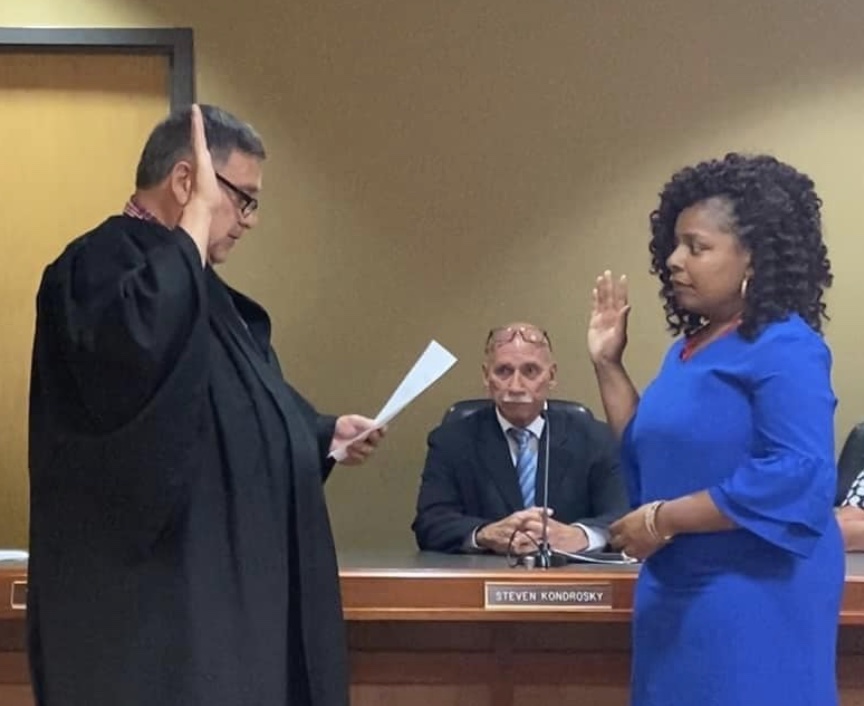
“It’s an honor to sit on the board at this time as history was made,” Board Member LaToya Wright Brown wrote on a Facebook post.
“Dr. Wanzo is the first African American to be appointed in the role of superintendent at MASD. I look forward to working in collaboration with our central administration teams, MASD staff and communities to give our students what they deserve.”
During the previous administration, Dr. Wanzo was often put in difficult positions.
In 2019 when the ACLU of Pennsylvania filed a federal civil rights lawsuit against the district on behalf of 11 district students, she had the difficult job of defending her boss, Dr. Holtzman, while still advocating for the students.
Dr. Holtzman, who was named in the suit, refused to let the students create a Black Student Union. He claimed his objection wasn’t due to the organization’s content but the participation of one of the student’s mothers – Fawn Montgomery Walker who was running for McKeesport Mayor at the time and who is lead organizer of Take Action Mon Valley, a community action group.
“The frustrating part is the students clearly did not understand that they’re in the middle of this. And also, it’s frustrating that they feel that we are telling them they cannot do that, you’re not allowed to have this club, because that was never ever stated by any of us.”
The district eventually reached a settlement agreement with the American Civil Liberties Union and the students.
Dr. Wanzo was also put in a difficult position more recently when the previous school board voted to extend Dr. Holtzman’s contract two years before it expired – a potential violation of state law.
Unlike her predecessor, Dr. Wanzo spent her entire career at MASD. She was a fifth grade teacher at Francis McClure Middle School, a second grade teacher at White Oak Elementary School, a fourth grade teacher at Cornell Intermediate School, Assistant Principal at Founders’ Hall Middle School, and ninth grade principal at the high school.
She graduated from the district and still lives in its borders. As a student, she attended Centennial Elementary, Cornell Middle School, and graduated from McKeesport High School in 1997.
She has a BA in Elementary Education from Clarion University, a degree in Educational Leadership from Carlow University, and a Doctorate in Educational Leadership from Duquesne University.
Hopefully she will be able to lead the district to a brighter future.
Like this post? You might want to consider becoming a Patreon subscriber. This helps me continue to keep the blog going and get on with this difficult and challenging work.
When I heard my school board was considering a proposed district budget for 2022-23 without a tax increase, I wanted to take a look at it. So I went to the district Website and there was a link labelled:
“The Board of Directors of the McKeesport Area School District has prepared a Preliminary Budget in the amount of funds that will be required by the School District for the fiscal year beginning July 1, 2022. The Proposed Budget is on file in the Office of the Business Manager/Board Secretary, and is available for public inspection in the McKeesport Area School District Administration Building…” [Emphasis mine.]
What the heck!?
Why not just post the preliminary budget on the Internet!? Why make me go all the way to the administration building (during business hours) to see a copy?
If I want to know how my district proposes to spend the community’s tax dollars next year, I need to either go to the school board meeting or go to the administration office and look at a copy. Will I be able to take a copy with me to peruse at my leisure? Maybe or maybe not.
And one of the biggest reasons why is this requirement of local control, self-government, and a free exchange of information between representatives and the community who elected them.
Authentic public schools HAVE TO hold public meetings to conduct their business.
They HAVE TO take comments from the community.
They HAVE TO make their documentation available to the public.
The problem is how too many public school directors meet these obligations.
MASD, for example, makes its proposed budget available – but not in the most convenient way that it could.
Let’s be honest. It wouldn’t take much to improve this.
Posting the full budget online would take just a few seconds. In fact, it’s actually more trouble to have it available in the administration building and task a secretary with presenting it to anyone who comes in-person and asks for it.
I’ve gone to a lot of school board meetings in my life. A LOT.
And almost every board put unnecessary or onerous restrictions on public comments.
Residents could come to the meetings and address the board but they often had to sign in before-hand. They couldn’t just show up and speak. They had to let the board know days in advance that they were coming and the subject they planning to speak on.
If something came up during the meeting unplanned, technically residents weren’t allowed to comment – though I admit I’ve never seen a school board hold to such a policy in the case of unexpected events.
Also there are almost always time limits on public comments.
Limiting people to two minutes of public comment in a month or even a two-week period is ridiculous.
Then we have the issue of audio visuals at board meetings.
Many school boards have microphones for people to speak into during the proceedings. This is supposed to allow everyone present to hear what is being said. However, the equipment is often so bad that it actually ends up blurring the speaker’s voice until its incomprehensible or board members who don’t want to be heard simply don’t speak into the microphone.
Sure – the entire proceedings are being taken down by hand by an administrator for an official written copy of the minutes. But this isn’t even available to the public until a month later when the board votes on last month’s minutes document. The public can’t get a copy of this material until more than a month has passed from it taking place. And it probably isn’t available on-line.
Finally, we have recordings of the meetings.
Many school boards now video tape their meetings and stream them live on YouTube, Facebook or some other social media site.
This is a nice improvement from when community groups had to do this, themselves. And, in fact, it’s really a response to that phenomenon to gain control over what becomes public record. School boards began recording the meetings to discourage others from doing it so the district would have control over this material. And in most cases it worked.
However, these recordings are almost always of exceedingly poor quality.
Cameras (and microphones) are placed so far away that it is almost impossible to tell what is happening, what is being said or who said it.
Any teenager with a smart phone and a YouTube channel could do a better job.
Moreover, these videos often don’t stay posted online for very long. They could easily remain posted so anyone could rewatch them and catch up with what happened at a school board meeting they were unable to attend in-person. But school boards make the express decision to take these videos down so that record is not available.
Very few of these are accidents. In most cases these are intentional to push the public away at the exact time when they should be inviting them in.
These are just some examples of how school boards comply with transparency requirements but do so in ways that are inconvenient, onerous or antagonistic.
It is so unnecessary.
Things don’t have to be this way.
School boards should welcome transparency. They should embrace public participation in the process.
School directors complain about losing revenue to charter and voucher schools. If they treated the public more like valued members of the decision-making process, they would do a lot to boost their own reputation.
The sooner school boards understand this, the better it will be for the state of public education and the students, families and communities we are supposed to be serving in the first place.
Like this post? You might want to consider becoming a Patreon subscriber. This helps me continue to keep the blog going and get on with this difficult and challenging work.
I just can’t believe that in light of such a flame dancing ever more quickly down an ever-shorter fuse that people aren’t interested in reading about how to stomp it out.
Mass media is not particularly kind to educators like me.
Even when journalists are writing about schools and learning, they rarely ask classroom teachers their opinions. Instead, the media often turns to self-appointed experts, think tank flunkies, billionaire philanthropists or politicians.
It’s like they can’t even conceive of the fact that someone with a masters degree or higher in education who devotes her whole life to the practice of the discipline has anything worthwhile to say.
So many of us have taken to the blogosphere to circumvent the regular media channels.
And so people like Joe Rogan make millions on their podcasts spreading science denial, vaccine disinformation and racist dog whistles.
A guy like me just trying to make the world a better place?
I get silenced.
I guess when money is speech, poverty is the real cancel culture.
Like this post? You might want to consider becoming a Patreon subscriber. This helps me continue to keep the blog going and get on with this difficult and challenging work.
It’s not exactly easy to fit in so many articles – 53 so far this year – between teaching full time.
And I’ve been doing it for 8 years – since July 2014.
In that time, this site has earned 2.3 million hits – 218,603 just this year.
I’m proud of the work I’ve done here.
I haven’t changed the world, but I’ve been heard. Occasionally.
As a classroom teacher, that’s really what I’m trying to do. In my everyday work, few people whose grade I’m not calculating actually listen to me. And even then it’s not always a given.
I want to believe my words have an impact – that policymakers read what I write and consider it before offering new measures and revising old ones.
But as time goes on, I wonder if any of that actually happens. These days my writing feels more like a shout in the dark than anything else.
At best, from the comments I often get on my articles (and the fact that 14,887 people have signed up to follow my work), it seems at least that I am not shouting alone.
We are all yearning to be heard.
These are the cries that most of us seemed to have in common this year:
Description: This is a postmortem on the 2020-21 school year. Here are the six policies that really weren’t working from social distancing, to cyber school, hybrid models, and more.
Fun Fact: I had hoped that laying out last year’s failures might stop them from being tried again this year or at least we might revise them into policies that worked. In some instances – like cyber school – there seems to have been an attempt to accomplish this. In others – like standardized testing – we just can’t seem to stop ourselves from repeating the same old mistakes.
Description: It seemed like a pretty easy concept when I first learned it back in civics class. Your right to freedom ends when it comes into conflict with mine. But in 2021, that’s all out the window. Certain people’s rights to comfort (i.e. being unmasked) are more important than other people’s right to life (i.e. being free from your potential Covid).
Description: Demands on teachers are out of control – everything from new scattershot initiatives to more paperwork to having to forgo our planning periods and sub for missing staff nearly every day. And the worse part is that each time it’s done, it becomes the new normal. Teaching should not be death by a million cuts.
Fun Fact: This was another in what seemed to be a series of articles about how teaching has gotten more intolerable this year. If anyone ever wonders what happened to all the teachers once we all leave, refer to this series.
Description: Teachers are leaving the profession at an unprecedented rate this year. So what do we do about it? Here are five simple things any district can do that don’t require a lot of money or political will. They just require wanting to fix the problem. These are things like eliminating unnecessary tasks and forgoing formal lesson plans while increasing planning time.
Fun Fact: Few districts seems to be doing any of this. It shows that they really don’t care.
Description: This is almost a poem. It’s just a description of many of the things I love about teaching and many of the things I don’t. It’s an attempt to show how the negatives are overwhelming the positives.
Fun Fact: This started as a Facebook post: “I love teaching. I don’t love the exhaustion, the lack of planning & grading time, the impossibly high expectations & low pay, the lack of autonomy, the gaslighting, the disrespect, being used as a political football and the death threats.”
Description: Policymakers and pundits keep saying students are suffering learning loss from last year and the interrupted and online classes required during the pandemic. It’s total nonsense. Students are suffering from a lack of social skills. They don’t know how to interact with each other and how to emotionally process what’s been going on.
Fun Fact: This idea is so obvious to anyone who’s actually in school buildings that it has gotten through somewhat to the mass media. However, the drum of bogus learning loss is still being beaten by powerful companies determined to make money off of this catastrophe.
Description: Imagine a world without teachers. You don’t have to. I’ve done it for you. This is a fictional story of two kids, DeShaun and Marco, and what their educational experience may well be like once we’ve chased away all the education professionals.
Description: How many times have teachers had to go to their administrators and school directors asking for policies that will keep them and their students safe? How many times have we been turned down? How many times can we keep repeating this cycle? It’s like something out of Kafka or Gogol.
Description: This was my first attempt to discuss how much worse 2021-2022 is starting than the previous school year. Teachers are struggling with doing their jobs and staying healthy. And no one seems to care.
Fun Fact: My own health was extremely poor when I wrote this. I was in and out of the hospital. Though I feel somewhat better now, not much has changed. This article was republished in the Washington Post, on CommonDreams.org, and discussed on Diane Ravitch’s blog.
Description: Being there for students who are traumatized by the pandemic makes teachers subject to vicarious trauma, ourselves. We are subject to verbal and physical abuse in the classroom. It is one of the major factors wearing us down, and there appears to be no help in site – nor does anyone even seem to acknowledge what is happening.
Fun Fact: This one really seemed to strike a nerve with my fellow teachers. I heard so many similar stories from educators across the country who are going through these same things.
Like this post? You might want to consider becoming a Patreon subscriber. This helps me continue to keep the blog going and get on with this difficult and challenging work.
This would include a course syllabus or written summary of every class, the state academic standards for each course, and a link or title for every textbook used.
Moreover, the whole thing is really just a political sham to stoke the radical Republican base. The measure has little chance of actually being implemented.
The bill (HB 1332) passed the House largely along party lines last week with a few Republicans joining Democrats against it.
Now it is set for a full vote by the Senate where it will probably sail through with GOP support after which Democratic Governor Tom Wolf has already promised to veto it.
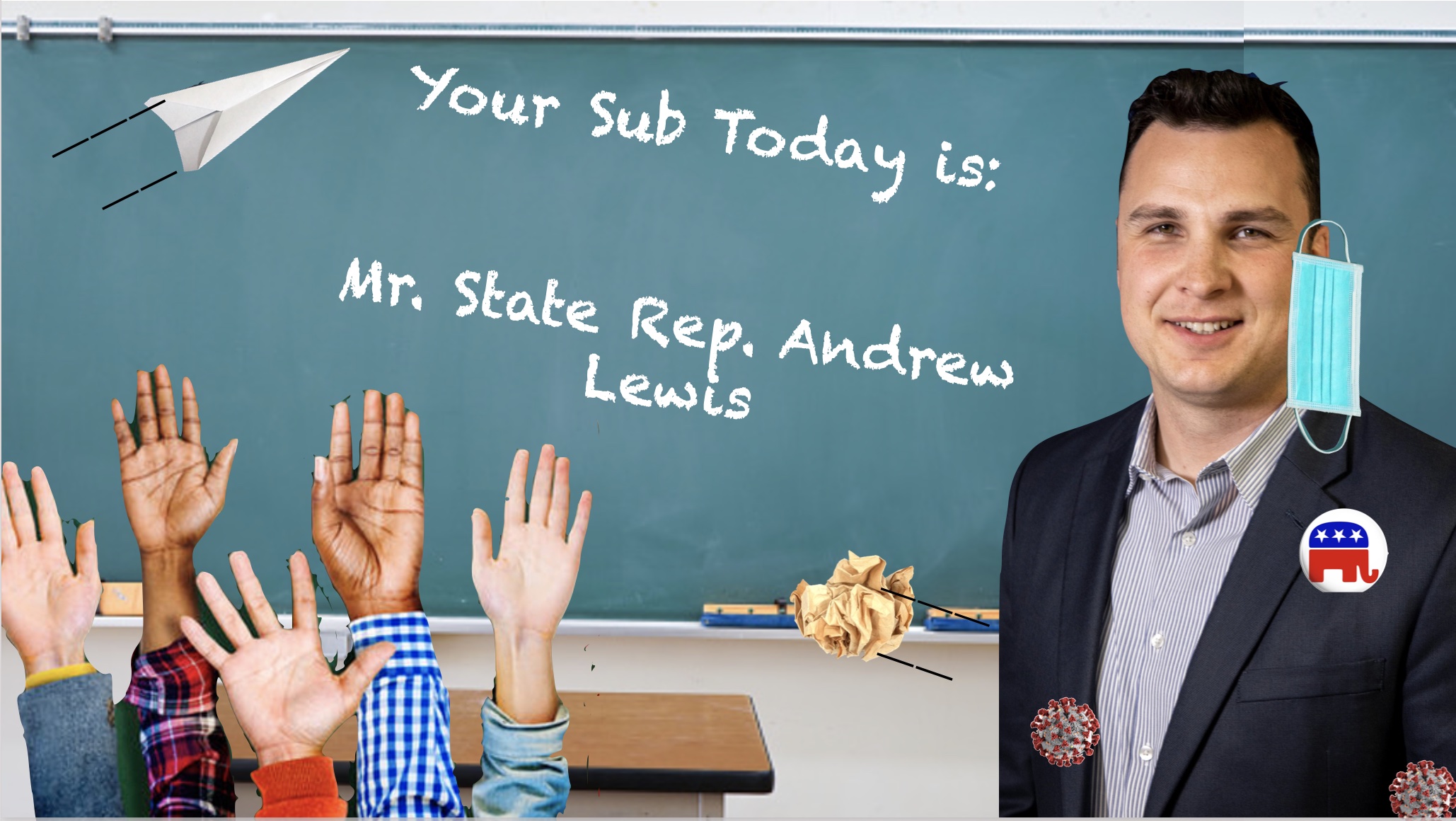
So why is Lewis putting on this dog and pony show?
“Parents need to be in the driver’s seat when it comes to education, not some out-of-state textbook publisher teaching heaven knows what (hint: anti-American socialism) to our students.”
Moreover, I guess no one told him that state law already requires that public schools give parents and guardians access to information about instructional materials.
Even schools in the Keystone state are scrambling to find enough subs.
If you want to know what happens in public schools, you can do better than clicking on some Website. You can actually volunteer to come in and cover an absent teacher’s class!
About eight years ago, 40,000 teachers were graduating from Pennsylvania colleges a year. This past year, it was only 14,000.
That means not only fewer classroom teachers to replace those who retire, but fewer substitute teachers to take over for professional absences.
The situation has gotten so bad that the legislature (on which Lewis serves) had to pass a new measure allowing college students who are studying education to fill in as substitutes.
Many districts such as Erie, Greater Latrobe and State College have increased substitute pay to entice more people to apply for the job.
And, frankly, almost anyone can do it.
Even folks like Lewis and his Republican buddies! Heck! The legislature is only in session a few weeks every month! They have plenty of time to moonlight as substitute teachers and get the low down about what’s really happening in our public schools!
Districts that aren’t experiencing a shortage may require a teaching certificate as well, but beggars can’t be choosers. In districts where it is hard to get subs (i.e. those serving poor and minority kids) you can get emergency certified for a year.
And many states are lowering the bar even further!
Not only would lawmakers have a chance to look over teacher’s lesson plans, but they’d get detailed instructions from the absent teacher about how to actually teach the lesson!
They’d get to interact with principals as they’re told which additional classes they have to cover in their planning periods and which extra duties they’d be responsible for performing.
They’d get to do things like monitor the halls, breakfast and lunch duty, watch over in-school suspension, and – if they’re lucky – they might even get to attend a staff meeting and be front row center for all the educational initiatives being conducted in the school!
If our representatives took this opportunity, they would learn so much!
I mean, sure, we encourage kids to stand for the pledge to the flag and things like that but when it comes to telling them how to think – that’s not a public school thing. That’s a private and parochial school thing.
They’d see that public school lessons give students information on a subject but then ask them to come to their own conclusions about it.
In fact, this would be such an educational experience, I think legislators on both sides of the aisle should take advantage of this unique opportunity.
And not even just those in Harrisburg. What better way for school directors to understand the institutions they’re overseeing than to volunteer as subs? What better way for the mayor and city council to understand the needs of children than putting themselves in the classroom when the teacher can’t be there?
It could make them better public servants who craft legislation that would actually do some good in this world and not – like Lewis – just showboat to enrage partisans and stoke them to vote for people willing to feed their fears and prejudices.
Any takers?
Like this post? You might want to consider becoming a Patreon subscriber. This helps me continue to keep the blog going and get on with this difficult and challenging work.
I don’t mean that learning can’t take place there.
You could learn in a fox hole while being shelled by enemy forces. But if your content extends to something more complex than “Duck” or other survival tactics, this may not be the best place to learn it. After all, environment plays a key role in knowledge acquisition.
Moreover, different people learn things better in different circumstances. And, contrary to our current education policies that view children as stakeholders or consumers, they are in fact people.
There are some children who learn better online than in a brick and mortar classroom. But these kids are few and far between.
It really comes down to who controls the environment.
In a classroom, the teacher decides most everything about the physical space and what possibilities there will be. She places the books, hangs the posters, sets the lighting, displays student work, etc.
For instance, in my physical classroom, if I wanted to see what a student was doing, all I had to do is walk up to him and look.
I controlled what I see, and hiding things from me was difficult.
Online, if I want to see what a student is doing (let’s say on a video communications platform like ZOOM), I have little control over what I see. The student is in control of the camera. If it is pointing at the student or placed so as to hide certain behavior or even if the camera is currently on or not is not in my control. Students are empowered to hide anything they want, and there’s not much I can do about it.
I’ve had kids mysteriously turn off the camera or point it away from their faces until I ask them to switch it back on or swivel it back to themselves.
DO YOU HEAR WHAT I HEAR?
When I first started teaching online a few weeks ago, one of the most powerful tools at my disposal seemed to be the mute button.
If several kids weren’t hearing me because of side chatter, I could simply mute everyone and fill the blessed silence with instruction.
However, I soon discovered that this is deceptive.
Just because you don’t hear the students, doesn’t mean they aren’t talking. Some kids use the online chat stream to continue side chatter. Others forgo that entirely for text and Facebook messaging.
What’s worse, it’s often hard for the teacher to even know whether anything she said is actually being heard.
TOO MUCH CHOICE
One of the great strengths of online learning is that it gives students an incredible amount of choice. But that is also its greatest weakness.
I can give assignments through a file sharing site like Google Classroom and let students complete it at their own pace.
You can’t give them too much time to get something done because many will procrastinate through the deadline.
In my physical classroom, I would often give an assignment and then provide at least some time for them to start it. The idea was that even if they don’t finish it with me, they are more likely to complete something they already began.
As a result, most students don’t get these assignments done on time – if at all.
Even when they do the work, I’m bombarded by a slew of submissions around midnight or the early hours of the AM.
HOW TO ASK A QUESTION YOU DON’T KNOW YOU HAVE
Then there’s the question of… well… questions.
In my brick and mortar classroom, if a child was unsure of something, all she had to do was raise her hand and ask. Online, there are multiple ways to communicate with me – kids can send me an email, message me or verbally ask me something during a video chat.
The problem is that sometimes they don’t know they’re confused.
Online, I’m mostly limited to commenting on the final project. If a student didn’t understand the directions – and didn’t even understand that he didn’t understand the directions – I don’t know until the work is done.
I mean kids who for all intents and purposes appear to be there in ZOOM and then suddenly disappear never to return that day.
They could have a device or Internet issue. And if this happens every once in a while, it’s understandable. But what about kids who do this all the time?
I know every district is different in this regard, but my school provides every student with devices and even WiFi if necessary. Even in the physical classroom, using devices always came with a chorus of whines about them not being charged.
However, this brave new world even makes an issue out of bathroom breaks.
In the brick and mortar classroom, kids would ask to go to the restroom and then be sent one at a time. Online some kids just turn off their camera or leave it idling on an empty seat or the ceiling. It is next to impossible to tell whether these breaks are genuine or even to estimate their duration.
These platforms require students to know a dedicated Web address and sometimes a password to get in.
Yet these are children. They sometimes share these security measures with people who were not invited.
Even in my physical classroom, sometimes students not on my roster would try to get in to talk with a friend or even just sit in on my amazing lessons. I could stop them at the door and send them on their way.
Online, some sites like ZOOM give me similar power, and others like Kahoot (a game based learning platform) do not. Even when every person entering has to be approved by me, all I see is the name they’ve given their device. If an enterprising stranger wanted to rename their device to that of one of my students, I probably wouldn’t catch it until they were in.
There have been several times when someone with one of my students’ names got into a ZOOM meeting, but either refused or couldn’t turn on their camera. I had no choice but to boot them out.
On some sites like Kahoot, there is no video. I had no idea who was signing in – I just saw the name they input.
So sometimes I had two students with the same name. Or I had let’s say 8 kids in the class but 9 kids were signing on to Kahoot.
In a physical classroom, teachers can monitor students during test taking. Online, they can’t. So there’s always a question of cheating.
Every scrap of information in human history is available somewhere online. If students try hard enough, they can find the answer to any question with a deft Google search.
However, to be honest I don’t think I’ve had too much trouble with this as yet. My students either don’t care enough to cheat, cannot figure out how to do so effectively or have too much self respect.
Or maybe I just haven’t caught them.
In the physical classroom, I had several students try to pass off others work – essays or poems – as their own. But I haven’t assigned anything so ambitious through distance learning yet.
CONCLUSIONS
Perhaps that’s why it drives me nuts when policymakers and media types make statements about what an overwhelming success this has all been.
We need smaller classes, equitable funding, desegregation, social justice, wide curriculum, and an end to high stakes testing, school privatization, science denial and anti-intellectualism.
But more than anything, we need policymakers who are willing to listen to and include the people on the ground when making decisions that affect us all.
Like this post? You might want to consider becoming a Patreon subscriber. This helps me continue to keep the blog going and get on with this difficult and challenging work.
“At the end of the day, we’re going to make sure that the health and welfare of our students is first and foremost, front and center. And we’re not going to allow and ask students to return to school in an unsafe environment. We’re preparing for the best, but we’re planning for the worst.”
Turzai was so infuriated by this statement that he wrote a letter to Rivera – which the Pittsburgh area representative immediately shared with the media – he went on right wing talk radio to complain, and he posted a video on his Facebook page.
You know a Boomer is really mad when he goes on the social media.
Though his comments include his usual greatest hits against public schools and those greedy teachers, Turzai’s main point was simply science denial.
On Facebook, after a long list of activities that he said kids enjoy doing like sports and lab experiments, he said this:
“All of those can be done safely, and [kids] are not at risk unless they have an underlying medical issue. The fact of the matter is kids can develop herd immunity, and if you [Rivera] have not yet developed a plan where we can safely educate kids in schools, then you are going to have to rethink education forward…”
So there you have it, folks.
Turzai wants Pennsylvania to reopen schools on time whether scientists and health experts think it’s safe or not because – Turzai knows best.
Pennsylvania’s village idiot thinks he knows best about schools.
It’s already killed more Americans than the Vietnam War (69,579 vs. 58,220). There’s no vaccine. And we really don’t know with much certainty how it will affect people in the long term.
“Pediatric COVID-19 patients might not have fever or cough. Social distancing and everyday preventive behaviors remain important for all age groups because patients with less serious illness and those without symptoms likely play an important role in disease transmission.”
So if we reopen schools before it is safe to do so, we run the risk of (1) kids dying, (2) kids becoming carriers and bringing the disease to any adults they come into contact with who are much more susceptible and (3) teachers and school staff getting sick and dying.
He’s trying to show he’s just as stupid as Donald Trump. The President says we should all drink bleach to get rid of COVID-19? Well Turzai says we should let our kids get sick and die or make us sick.
Republicans truly have become the party of stupid.
The media helps covidiots like Turzai by uncritically reprinting his outrageous lies.
Turzai is like a man who calmly says it’s not raining outside while a thunderstorm beats down on the neighborhood. Instead of pointing out the truth, the media simply reports what Turzai said and at most gives equal weight to a meteorologist. But there is no OPINION about facts! And whether scientific consensus holds with his crackpot conspiracy theories about how the Coronavirus spreads or not IS a fact.
Until we can truly tell who has the virus, who had the virus, who is immune, and how to cure it, the prospect of reopening schools or the economy will be grim.
We should not put people at risk unnecessarily.
And we certainly shouldn’t put children at risk.
Don’t let fools like Turzai use a global pandemic to hawk their political agendas.
He goes on in his video to say that if the state’s public schools don’t open on time, we should consider things like universal cyber schooling, and (non sequitur alert!) charter and voucher schools.
Like this post? You might want to consider becoming a Patreon subscriber. This helps me continue to keep the blog going and get on with this difficult and challenging work.















 gadflyonthewallblog