eBackpack Bankruptcy May Put Student & Teacher Data in Peril

kelly-sikkema-266805-660x400@2x

 
Teachers put their assignments into an on-line data base.


Students access them on their computers, iPads or other devices and then submit their work via the Internet.


What could go wrong?


Plenty. Especially when the company that provides this service goes bankrupt.


And that’s exactly what’s happened with Texas-based educational technology company eBackpack.


All those teacher assignments and student works are still there in computer servers somewhere. And now that eBackpack has filed Chapter 7 bankruptcy, all of it has become assets the company could decide to sell off to pay its debts.

 
The company explicitly reserves the right to do so according to its own Privacy Statement:


“The information we collect is used to improve the content of our Web pages and the quality of our service, and is not shared with or sold to other organizations for commercial purposes, except to provide products or services you’ve requested, when we have your permission, or under the following circumstances:


-We transfer information about you if eBackpack or part of it is acquired by or merged with another company. In this event, eBackpack will notify you before information about you is transferred and becomes subject to a different privacy policy.” [Emphasis mine]


Well that’s comforting. I wonder how a company that will no longer exist will have staff to notify former customers about what’s happening to the mountains of data we put in its hands.


Even under the best of circumstances, who will it notify? Teachers? Students? Parents? Or just the administrators or school boards who managed the over all accounts for individual districts?


eBackpack’s Terms of Service Agreement contains several red flags that someone should have noticed before students’ privacy was jeopardized:

 
“-eBackpack may assign its rights and obligations under these Terms to a third party without your consent.


“-You agree to use the Service at your own risk, without any liability whatsoever to eBackpack.


-1.1. Your use of the Service is at your sole risk. The Service is provided on an “as is,” “as available” and “with all faults” basis. The Service is owned and copyrighted by eBackpack and offered through a subscription, not sold, to you.


-10.1. eBackpack reserves the right at any time and from time to time to modify or discontinue, temporarily or permanently, the Service (or any part thereof) with or without notice.


-By submitting Content to eBackpack, you grant eBackpack a perpetual, worldwide, non-exclusive, royalty-free right to copy, display, modify, transmit, make derivative works of, and distribute your Content for the purpose of providing or developing the Service.


-14.2. You consent to eBackpack’s use and/or references to your name, directly or indirectly, in eBackpack’s marketing and training materials. You consent to eBackpack’s use of your communication with eBackpack for marketing and training materials. You may not use eBackpack’s name or trademark without eBackpack’s prior written consent.”

 
It’s not like schools weren’t warned.

 
Less than a year ago, the Federal Bureau of Investigations (FBI) issued a strong statement cautioning consumers that edtech companies put student data at risk.


The bureau advised parents, teachers and administrators to take several steps to safeguard children’s privacy. The organization also pushed for the federal government to revise privacy laws to better protect kids from this industry.


In addition, commonsense.org – a nonprofit studying education issues – conducted a three-year review of 100 edtech companies. It concluded that 74% of these businesses hold the right to transfer any personal information they collect if the company is acquired, merged, or files for bankruptcy.


The authors wrote that there is “a widespread lack of transparency, as well as inconsistent privacy and security practices” in how student information is collected, used, and disclosed.


Why would any company want such student data?


It helps market products and, itself, can be a very marketable product.


For instance, imagine how much more effective the hiring process would be if businesses had access to applicants school attendance records. Imagine if businesses had an applicant’s entire academic record.


Employers could buy vast amounts of data and use algorithms to sort through it looking for red flags without fully comprehending what was being compiled. Imagine an applicant being turned down for a job because of low middle school attendance but not being able to explain that this was due to a legitimate illness.


There are reasons we protect people’s privacy. You shouldn’t have to explain your score on a 3rd grade spelling test the rest of your life or have the need for special education services become a liability on your credit record.


Yet all of these things are possible when student data is up for grabs as it may be in this instance.

 
This is personal to me.


My district uses eBackpack.


Yet it was for these exact reasons that I never jumped on the bandwagon with my own students in my classroom.


I experimented somewhat with the platform, myself, to see what it offered and to weigh whether the advantages canceled out the disadvantages.


If I had decided to move forward, I would have asked parent permission first, but in the end, I decided it wasn’t worth the risk – and boy am I glad!


Yet having interacted with the platform at all, I received the following email from the company yesterday:


“Dear User,


We regret to inform you that this 2018-2019 school year is the last year eBackpack will be operating.  We will not be accepting any renewals going forward and we will not be providing any services past July 31, 2019. All services will be terminated on that date. Please download and save to your own devices any data prior to July 31, 2019. Once the services for eBackpack are turned off, your files and data will no longer be accessible, and we will not have staff available to respond to any customer inquiries. We appreciate your support over the past years and we will truly miss working with you all!

 
If you have any questions or concerns, please feel free to send an email to edison@ebackpack.com or billing@ebackpck.com.
Again, we appreciate your time with us and all of your support.

 
Thank you,
 eBackpack Team”


I haven’t tried to contact the company, but I’m seeing on Reddit that others have been unable to do so.


One customer wrote:


“We use eBackpack and we are unable to pay our bill as no one answers their number or responds to emails. A quick Google search shows recent bankruptcy procedure. Anyone know anything? Am I the only one still using them?”


EBACKPACK, LLC did in fact file a chapter 7 bankruptcy case on Feb 8, according to docket information on-line.

 
Chapter 7 is sometimes called straight bankruptcy or liquidation bankruptcy. In general, the court appoints a trustee to oversee the case, take the company’s assets, sell them and distribute the money to the creditors who file claims. However, the trustee doesn’t take every last bit of company property. Owners are allowed to keep enough  “exempt” property to get a “fresh start.”


This is big business. Venture capitalists have invested more than $1.8 billion in the edtech industry in 2015, alone.

 
At this time, it is still unclear exactly how many students and teachers have been put at risk.


I can’t find information anywhere about how many student or teacher accounts are in jeopardy or how many districts used the platform.

 
Hopefully this will be a wakeup call that the edtech industry needs to be more closely monitored and regulated.

 
We cannot continue to put convenience and profit ahead of student and teacher safety.


Like this post? I’ve written a book, “Gadfly on the Wall: A Public School Teacher Speaks Out on Racism and Reform,” now available from Garn Press. Ten percent of the proceeds go to the Badass Teachers Association. Check it out!


thumbnail_IMG_8249

PA Officials Want to Replace Bad Keystone Exams with Bad College Entrance Exams

Screen Shot 2019-07-15 at 8.34.43 AM

 
Pennsylvania officials are scandalized that the Commonwealth is wasting more than $100 million on unnecessary and unfair Keystone Exams.

 
They’d rather the state spend slightly less on biased college entrance exams.

 
State Auditor General Eugene DePasquale and State Sen. Andy Dinniman held a joint press conference last week to introduce a new report compiled by DePasquale’s office on the subject which concludes with this recommendation.


Replacing bad with bad will somehow equal good?

 
Under the proposal, elementary and middle school students would still take the Pennsylvania System of School Assessment (PSSA) tests. However, instead of requiring all high school students to take the Keystone Exams in Algebra I, Literature and Science, the report proposes the same students be required to take the SAT or ACT test at state expense.


This is certainly an improvement over what the state demands now, but it’s really just replacing one faulty test with another – albeit at about a $1 million annual cost savings to taxpayers.


The report does a good job of outlining the fiscal waste, lack of accountability and dubious academic merits of the Keystone Exams, but it fails to note similar qualities in its own proposal.


From 2008 to 2019, the state already paid Minnesota-based Data Recognition Corp. more than $426 million for the PSSAs, Keystone Exams and Classroom Diagnostic Tools (an optional pretesting program). The federal government paid the company more than an additional $106 million. Officials wonder if this money couldn’t have been better spent elsewhere, like in helping students actually learn.


DePasquale, who recently launched a congressional bid, puts it like this:


“When the federal law changed in 2015, why didn’t Pennsylvania begin to phase out Keystone Exams? I could understand if they use them for a short period of time after that, but it’s been four years, and will cost taxpayers nearly $100 million by the end of the contract for tests our students do not even need to take.”


The federal government dropped its mandate four years ago and the state legislature did the same last year.


Originally, state lawmakers intended to make the Keystone Exams a graduation requirement, but in 2018 they passed legislation to make the assessments one of many avenues to qualify for graduation starting in 2021-22. Students can instead pass their core courses and get into college among other things.


“The Department of Education itself said they [the Keystone Exams] are not an accurate or adequate indicator of career or academic readiness,” Dinniman said. “So what I’m always surprised about is, they said it and then they continue to use it. These tests have faced opposition from almost every educational organization that exists. And when we got rid of the requirement and put in [more] pathways to graduation, this was passed unanimously by both the Senate and the House.”


The federal government also changed its testing mandate. It used to require all public school students to take state-specific assessments in grades 3-8 and once in high school.


When Congress reauthorized the federal law overseeing education in 2015, it offered states more flexibility in this regard. Elementary and middle school students still have to take a state-specific test. But now the high school portion can be fulfilled with college admissions tests – and, in fact, a dozen other states legislate just such a requirement.

 
Democrats DePasquale and Dinniman think the SAT and ACT test are an improvement because students who taken them are more likely to go to college. But that’s a classic case of confusing correlation and causation.


Students motivated to go to college often take these exams because they are required to get in to a lot of these schools. Taking these tests doesn’t make students MORE motivated and determined to enroll in post-secondary education. They’re ALREADY motivated and determined.


Moreover, one of the faults the report finds with the Keystone Exams is that the assessments measure student’s parental income more than children’s academics.


Kids in wealthier districts almost always do better on the Keystone Exams than those in poorer districts. In fact, the report notes that of the 100 state schools with the highest scores, only five were located in impoverished districts —where the average household income is below $50,000.


Yet the report fails to note that this same discrepancy holds for the SAT and ACT tests. Poor kids tend to get low scores and rich kids get the highest scores.


In fact, the College Board – the corporation that makes and distributes the SAT – recently started adjusting scores on its test in an attempt to counteract this effect thereby accounting for high schools and neighborhoods “level of disadvantage.”


Does this creative scoring actually work? Who knows – but it’s kind of like being forced to swallow poison and an antidote at the same time when any sensible person would simply refuse to swallow poison in the first place.


And that’s the best solution state officials have for our children.


They’re suggesting we replace discriminatory Keystone Exams with discriminatory college entrance exams.


To be fair, DePasquale and Dinniman are somewhat constrained by boneheaded federal law here.


Though the Every Student Succeeds Act (ESSA) is an improvement over No Child Left Behind, it still requires all high school students to take standardized tests.


Given what we know about the limits and biases of these assessments, policymakers should remove that hurdle altogether. But until the federal government gets its act together, one could argue that DePasquale and Dinniman’s policy suggestion may be the best available.


When you can’t do right, maybe it’s best to do less wrong.


But we must acknowledge that this isn’t the ultimate solution, it’s only a stopgap. We must continue to push for intelligent assessment policy that’s best for our children.


Standardized testing should be eliminated altogether – especially in high stakes situations. Instead we should rely on classroom grades, portfolios of student work and/or other authentic measures of what children have learned in school.


Accountability – the typical reason given behind these assessments – should be determined by the resources provided to students, not a highly dubious score given by a corporation making a profit off of its testing, test prep and ed tech enterprises.


The most we can expect from DePasquale and Dinniman’s program if it is even considered by the legislature is a band-aid on a gaping wound.


Read the full report, Where Did Your Money Go? A Special Report on Improving Standardized Testing in Pennsylvania.


Like this post? I’ve written a book, “Gadfly on the Wall: A Public School Teacher Speaks Out on Racism and Reform,” now available from Garn Press. Ten percent of the proceeds go to the Badass Teachers Association. Check it out!
book-1

Busing and School Segregation Used for Politics not Policy

Screen Shot 2019-07-08 at 1.15.57 AM

 
If children of all races went to the same schools with each other, it would be harder to treat them unequally.


Moreover, it would be harder for them to grow up prejudiced because they would have learned what it’s like to have classmates who are different from them.


And though most people agree with these premises in principle, our laws still refuse to make them a reality in fact.


Perhaps that’s why it was so astounding when Kamala Harris brought up the issue of school segregation and busing at the first Democratic debates.

 
If you’re anything like me, for the first time these debates made Harris look like a viable contender for the party’s Presidential nomination to face Republican incumbent Donald Trump in 2020.


But then she immediately contradicted herself when people actually started to take her seriously.


During the debates, Harris called out front runner and former vice president Joe Biden for opposing court-ordered busing in the 1970s as a way of combating school segregation.


The California Democrat and former federal prosecutor rightly said that 40 years ago there was a “failure of states to integrate public schools in America,” so “that’s where the federal government must step in.”


But her star-making moment was when she made the whole matter extremely personal.


“There was a little girl in California who was part of the second class to integrate her public schools and she was bused to school every day,” Harris said. “That little girl was me.”

 
The tactic was so successful that Biden has been fumbling to apologize and explain away a history of obstructing desegregation ever since.


A Reuters/Ipsos poll conducted after the debate showed Biden had lost half of his support among black voters since earlier in June.


Meanwhile, the Harris campaign was quick to cash in on the political capital she earned by selling t-shirts with a picture of herself when she was in school with the emblem “That Little Girl Was Me.”


It could almost be a masterclass in how to make a political point to both boost your own campaign and change the narrative to improve national policy.


That is if Harris actually backed up her rhetoric with action.

 
Unfortunately, she has been tripping all over herself to keep this a criticism of Biden and not let it become a policy prescription for today.

 
While perfectly happy to support busing as a measure to stop segregation in the past, she seems much less comfortable using it to stop our current school segregation problems.


Because even though the landmark Supreme 
Court decision that found racial segregation to be unconstitutional – Brown v. Board of Education – is more than 60 years old, our nation’s schools are in many places even more segregated now than they were when this ruling was handed down.


So the question remains: in some areas should we bus kids from black neighborhoods to schools located in white ones and vice versa to ensure that our classrooms are integrated?


Since the debates, Harris has waffled saying busing should be “considered” by school districts but she would not support mandating it.


In subsequent comments, she said she’d support a federal mandate for busing in certain situations where other integration efforts have not been effective or when the courts have stepped in to provide the federal government that power. However, she does not believe that either of these conditions have been met.


Frankly, it sounds a whole lot more like someone desperately making things up as she goes along than someone with a true plan to fix a deep problem in our public education system.


She rightly attacked Biden on his record but then came up short trying to prove that she would be much different, herself, if elected.


However, that doesn’t mean all Democratic candidates are so unprepared. A handful have detailed integration policy proposals.


The most obvious is Bernie Sanders.


In fact, it is a cornerstone of his “Thurgood Marshall Plan for Education.” Not only would he repeal the existing ban on using federal transportation funding to promote school integration, he would put aside $1 billion to support magnet schools to entice more diverse students. However, the most ambitious part of his desegregation effort goes beyond legislation. Sanders promises to “execute and enforce desegregation orders and appoint federal judges who will enforce the 1964 Civil Rights Act in school systems.”


Sanders understands that the courts have largely sabotaged most desegregation efforts in the last 40 years.


At least two Supreme Court rulings have taken away the federal government’s power to enforce Brown v. Board. The first was 1974’s Milliken v. Bradley ruling which established that federal courts could not order desegregation busing across school district lines. They could only do so inside districts. So in big cities like Detroit – where the case originated – you have largely black city schools surrounded by mostly white suburban ones. The ruling forbids busing from city to suburban districts and vice-versa thereby destroying any kind of authentic desegregation efforts.


More recently, in 2007, the Supreme Court’s Parent’s Involved decision put even more constraints on voluntary busing programs.


Sanders is acknowledging these problems and promising to select judges to the bench who would work to overturn these wrongheaded decisions.


To my knowledge, no one has yet offered a more comprehensive plan.


However, former Housing and Urban Development Secretary and San Antonio Mayor Julián Castro comes in at a close second.


As you might expect, his school integration plan focuses on real estate and housing issues. According to his Website, Castro’s plan includes:


“Fulfill the promise of Brown v Board of Education through a progressive housing policy that includes affirmatively furthering fair housing, implementing zoning reform, and expanding affordable housing in high opportunity areas. These efforts will reduce racial segregation in classrooms.”


In other words, Castro hopes to work around the courts by incentivizing integration in neighborhoods which would also increase it in our schools.


It’s a good plan – though perhaps not enough in itself.


Unfortunately, there are reasons to doubt Castro’s sincerity here. Unlike Sanders’ plan, Castro’s education policy statement is littered with jargon right out of the school privatization, edtech and high stakes testing playbook. These are, after all, the same people who have worked to increase segregation with the promotion of charter and voucher schools.


For instance, the second point of his plan is called “Reimagining High School” – a monicker stolen from the XQ Superschools program, a philanthrocapitalist scheme to rebrand school privatization funded by Laurene Powell Jobs, the widow of Steve Jobs.


This shouldn’t be surprising coming from 
Castro. In 2013, the mayor went on a tour of cities sponsored by Education Reform Now – an arm of Democrats for Education Reform, a school privatization lobbying network. In the same year, he was also a featured guest at a ribbon cutting ceremony for IDEA charter schools. In 2010, he admitted he had no problem taking money with strings attached – a reference to the Obama administration’s chief education initiative of offering education grants if states increased reliance on high stakes testing and charter schools. In particular, Castro said: “I would have taken the Race to the Top money if I was mayor, dogcatcher, or whatever.”


And speaking of standardized testing and edtech, there are other telling hints that he’s on the neoliberal bandwagon in his current education plan:


“Provide educators and public schools flexibility in defining success, including competency-based assessments and support for transitions away from seat-time requirements. Provide maximum flexibility for school leaders, teachers, and students to work together to develop rigorous, competency-based pathways to a diploma and industry recognized credentials,” [Emphasis mine].


These terms “competency-based” and “rigorous” have strong associations with the privatization industry. “Competency-based” education programs usually mean making kids do daily mini-standardized tests on iPads or other devices and other untested cyber education programs. “Rigorous” has been associated with topdown academic standards like the Common Core that provide students with few resources or even taking them away and then blaming kids for not being able to meet arbitrary and developmentally inappropriate benchmarks.


Castro has some good ideas, but his troubling associations and language give any person familiar with these issues reason to pause.


Of course, Castro has not yet made a real mark among those Democrats seeking their party’s nomination.


Perhaps more important is the relative silence of a more popular candidate, Sen. Elizabeth Warren.


She hasn’t spoken much about integration efforts on the campaign trail. Along with Sanders, she is a co-sponsor of the Strength in Diversity Act, the leading congressional vehicle for school integration. However, that legislation is deeply flawed because it not only increases grant money for desegregation but also gives a big chunk of change away to charter schools.


In the past, Warren has supported a kind of school voucher program to separate where a student is enrolled in school from where they live entirely, but you can add it to the list of education issues she has not seen the need to clarify as yet.


It’s no surprise that so few Democratic hopefuls want to address the issue of desegregation – especially doing so through busing.


White middle class and wealthy people generally don’t support it.


They simply don’t want their kids going to schools with large numbers of black and brown students.


And this is a real moral weakness in white culture.


I went to an integrated school from Kindergarten to high school. My daughter goes to the same district. I teach at another integrated school.


The benefits of attending such a school far outweigh any negatives.


If students have to spend more time getting to and from school via buses to reach this goal, it wouldn’t matter if we valued the outcome.


In fact, many white parents don’t mind putting their kids on buses or driving them to get away from minority children.


Certainly we should try to minimize the time it takes to get to and from school but that shouldn’t be the only consideration.


They say we get the leaders we deserve.


If white people really want to defeat Trump, they may have to start by defeating the bigot inside themselves first.


Like this post? I’ve written a book, “Gadfly on the Wall: A Public School Teacher Speaks Out on Racism and Reform,” now available from Garn Press. Ten percent of the proceeds go to the Badass Teachers Association. Check it out!
thumbnail_IMG_8249

Classroom Teachers are the Real Scholastic Experts – Not Education Journalists

Screen Shot 2019-05-06 at 4.29.19 PM


When you want an expert on health, you go to a doctor.


When you want an expert on law, you go to a lawyer.


So why is it that when the news media wants an expert on education they go to… themselves!?


That’s right. Education journalists are talking up a storm about schools and learning.


You’ll find them writing policy briefs, editorials and news articles. You’ll find them being interviewed about topics like class size, funding and standardized tests.


But they aren’t primary sources. They are distinctly secondary.


So why don’t we go right to the source and ask those most in the know – classroom teachers!?


According to a Media Matters analysis of education coverage on weeknight cable news programs in 2014, only 9 percent of guests on MSNBC, CNN and Fox News were educators.


This data is a bit out of date, but I couldn’t find a more recent analysis. Moreover, it seems pretty much consistent with what I, myself, have seen in the media.


Take Wyatt Cenac’s “Problem Areas,” a comedy journalism program on HBO. The second season focuses entirely on education issues. Though Cynac interviews numerous people in the first episode (the only one I saw), he put together a panel of experts to talk about the issues that he would presumably return to throughout the season. Unfortunately, only two of these experts were classroom teachers.


There were more students (3), policy writers (3) and education journalists (3). There were just as many college professors (2), civil rights leaders (2), and politicians (2). Plus there was one historian (Diane Ravitch).


I’m not saying Cynac shouldn’t have talked to these other people. From what I’ve seen, his show is a pretty good faith attempt to talk about the issues, but in under representing classroom teachers, we’re left with a false consensus. It’s like having one climate denier debate one scientist. They aren’t equal and should not be equally represented.


And that’s as good as it gets!


Turn to most discussions of education or scholastic policy in the news and the discourse is bound to be dominated by people who are not now and have never been responsible for a class full of K-12 students.


Allowing journalists who cover education to rebrand themselves as “experts” is just not good enough.


Take it from me. Before I became a classroom teacher, I was a newspaperman, myself. Yet it’s only now that I know all that I didn’t know then.


If anyone values good, fact-based reporting, it’s me. But let’s not confuse an investigator with a practitioner. They both have important jobs. We just need to be clear about which job is being practiced when.


Reporters are not experts on the issues they cover. Certainly they know more than the average person or some political flunkey simply towing the party line. But someone who merely observes the work is not as knowledgeable as someone who does it and has done it for decades, someone with an advanced degree, dedication and a vocation in it.


Moreover, there is a chasm between education reporting and the schools, themselves, that is not present between journalists and most fields of endeavor. In the halls of academia, even the most fair-minded outsiders often are barred from direct observation of the very thing they’re trying to describe. We rarely let reporters in to our nation’s classrooms to see what’s happening for themselves. All they can do most of the time is uncritically report back what they’ve been told.


It’s almost as if sportswriters never got to see athletes play or political reporters never got to attended campaign rallies. How could their ideas about these subjects be of the same value as the practitioners in these fields!?


It couldn’t.


Think about it. Journalists are rarely permitted inside our schools to see the day-to-day classroom experience. Legal issues about which students may be photographed, filmed or interviewed, the difficulty of getting parental permissions and the possibility of embarrassment to principals and administrators usually keeps the school doors closed to them.


In many districts, teachers aren’t even allowed to speak on the record to the media or doing so can make them a political target. So reporters often have great difficulty just disclosing the opinions of those most knowledgeable about what is going on.


At best, our nation’s education reporters are like aliens from another galaxy trying to write about human behavior without actually having seen it. It’s like a bad science fiction movie where some alien with plastic ears asks, “What is this thing you call love?”


Sorry. These are not experts. And if we pretend that they are, we are being incredibly dishonest.


Some of this obfuscation is by design.


Education reporting is incredibly biased in favor of market-based solutions to academic problems.


Why? The corporations that own the shrinking number of newspapers, news stations and media outlets are increasingly the same huge conglomerates making money off of these same policies. The line between news and advertising has faded into invisibility in too many places.


Huge corporations make hundreds of millions of dollars off of the failing schools narrative. They sell new standardized tests, new test prep materials, new Common Core books, trainings for teachers, materials, etc. If they can’t demonstrate that our schools are failing, their market shrinks.


Even when they don’t put editorial pressure on journalists to write what the company wants, they hire like-minded people from the get go.


Too many education journalists aren’t out for the truth. They’re out to promote the corporate line.


This is why it’s so important to center any education discussion on classroom teachers. They are the only people with the knowledge and experience to tell us what’s really going on.


And – surprise! – it’s not the same narrative you’re getting from corporate news.


Schools are being defunded and dismantled by the testing and privatization industry. Corporate special interests are allowed to feed off our schools like vultures off road kill. And all the while, it is our children who suffer the results.


High stakes standardized testing must end. Charter and voucher schools must end. Parasitic education technologies must be controlled, made accountable and in many cases barred from our schools altogether.


But that’s a truth you can only find by talking to the real experts – classroom teachers.


Until we prize their voices above all others, we will never know the whole truth.


Like this post? I’ve written a book, “Gadfly on the Wall: A Public School Teacher Speaks Out on Racism and Reform,” now available from Garn Press. Ten percent of the proceeds go to the Badass Teachers Association. Check it out!

book-1

The Best School Innovation Would Be More People

thumbnail_o-TEACHER-COLLABORATION-facebook


Public schools thrive on innovation.


In nearly every classroom around the country you’ll find teachers discovering new ways to reach students and foster skills, understanding and creativity.


But if you pan out to the macro level, the overwhelming majority of innovations aren’t organic. They’re imposed on us by bureaucrats and functionaries from outside the classroom:


Education Technologies.


School privatization.


Standardized tests and Common Core.


For the last two decades, these are the kinds of innovations that have been forced on public schools at gun point.


And each and every one of them is pure bullshit.


They are corporate schemes written by the wealthy to cash in on education dollars for themselves. Big business hands them out to their paid political lapdogs to push through our state and federal legislatures to become laws and policies the rest of us have to obey.


They have nothing to do with helping students learn. Their purpose is to boost profits.


Just look at the difference between the ways the word innovation is defined.


Merriam Webster says the word signifies “the introduction of something new” or  “a new idea, method, or device: Novelty.”


But BusinessDictionary.com finds a tellingly distinct meaning:


“The process of translating an idea or invention into a good or service that creates value or for which customers will pay.”


It is that second business-friendly definition that has dominated our schools and narrowed our view until the only concept of advancement and revolution has been centered exclusively on the profit principle.


It is time to put a stop to all of it.


No more useless iPads, apps, software and so-called “personalized” educational technologies that do little more than allow marketers to steal student data and profit off of a new form of school where everything can be provided by technology at a cost while the quality of services takes a nosedive. No more technology for technology’s sake instead of using it as a tool to promote authentic learning.


No more laughable charter and voucher schools where education budgets become slush funds for corporations who don’t have to provide the same standard of services to students or the community. No more operating without  transparency or accountability.


No more outmoded and disproven standardized tests. No more canned academic standards that strip classroom educators of autonomy while reducing effective teaching behind a smoke screen of test scores that merely conflate the economic situation students live in with their academic abilities. No more corporations creating bogus multiple choice assessments whose only utility is to demonstrate how many more test prep materials we need to buy from the same company or industry.


It’s too bad we’re not interested in that FIRST definition of innovation, or at least innovation tied with the motive of providing quality education for children.


If we were interested in that kind of real, authentic school reform, we would focus on things that really matter. And chief among those would be one main thing, one major innovation that would be easy to accomplish but could change the fabric of our schools from top to bottom – people.


After all, that is what our public schools need the most – more people.


Have you walked into a public school lately? Peak your head into the faculty room. It’s like snatching a glance of the flying Dutchman. There are plenty of students, but at the front of the overcrowded classrooms, you’ll find a skeleton crew.


Today’s public schools employ 250,000 fewer people than they did before the recession of 2008–09. Meanwhile enrollment has increased by 800,000 students. So if we want today’s children to have not better but just the same quality of services kids received in this country only a decade ago, we’d need to hire almost 400,000 more teachers!


Instead, our children are packed into classes of 25, 30 even 40 students!


And the solution is really pretty simple – people not apps. Human beings willing and able to get the job done.


If we were fighting a war, we’d find ways to increase the number of soldiers in our military. Well, this is a war on ignorance – so we need real folks to get in the trenches and win the battle.


We need teachers, counselors, aides and administrators promoted from within and not functionaries from some think tank’s management program.


We need more people with masters or even more advanced teaching degrees – not business students with a three-week crash course in education under their belts who are willing to teach for a few years before becoming a self-professed expert and then writing education policy in the halls of government.


We need people from the community taking a leadership role deciding how our schools should be run, not simply appointing corporate lackeys to these positions at charter or voucher schools and narrowing down the only choices parents have to “Take It” or “Leave It.”


We need people. Real live people who can come into our schools and do the actual work with students.


And that means money. It means cutting the crap boondoggles to corporations and spending on flesh and blood reform.


It means fixing the funding inequality at the heart of nearly every public school in the country. No more spending tens or hundreds of thousands on wealthy students and merely hundreds on poor ones. No more dilapidated school buildings for the poor and palaces for the rich. No more socialistic pulling together for the wealthy and rugged individualism for the poor.


THIS is how you solve our education crisis – a crisis not caused by falling test scores or failing schools. A crisis caused by vulture capitalists preying on our educational institutions and our students as if they were some bloated carcass on the side of the road and not our best hope for the future.


It’s really that simple.


It’s a matter of ideology based on empiricism not “common sense” Laissezfaire maxims of “This is how we’ve always done it.”


We’ve been trying so-called corporate education reform for decades now – through Bush and Obama and now Trump. It doesn’t work.


It’s time we stopped making excuses for failing policies and got back to the best thing that works.


People.


Like this post? I’ve written a book, “Gadfly on the Wall: A Public School Teacher Speaks Out on Racism and Reform,” now available from Garn Press. Ten percent of the proceeds go to the Badass Teachers Association. Check it out!

book-2

School Accountability Begins With the People Who Make the Rules: A Code of Conduct for Politicians and Test Makers

thumbnail_Screen Shot 2019-03-18 at 1.17.54 PM


Standardized testing is all about accountability.
 

We’ve got to keep schools accountable for teaching.
 

We’ve got to keep students accountable for learning.

 
It’s kind of a crazy idea when you stop to think about it – as if teachers wouldn’t teach and students wouldn’t learn unless someone was standing over them with a big stick. As if adults got into teaching because they didn’t want to educate kids or children went to school because they had no natural curiosity at all.
 

So we’ve got to threaten them into getting in linestudents, teachers: march!

 
But that’s not even the strangest part. It’s this idea that that is where accountability stops.

 
No one has to keep the state or federal government accountable for providing the proper resources.

 
No one has to keep the testing companies accountable for creating fair and accurate assessments.

 
It’s just teachers and students.
 

So I thought I’d fix that with a “Code of Conduct for Politicians and Test Makers.”

 
After all, that’s what we do when we want to ensure someone is being responsible – we remind them of their responsibilities.
 

You see, the state and federal government are very concerned about cheating.

 
Not the kind of cheating where the super rich pay off lawmakers to rig an accountability system against the poor and minorities. No. Just the kind of cheating where teachers or students try to untie their hands from behind their backs.

 
They’re very concerned about THAT.

 
When you threaten to take away a school’s funding and fire teachers based on test scores, you tend to create an environment that encourages rampant fraud and abuse.

 
So the government requires its public servants to take on-line courses in the ethics of giving standardized tests. We have to sit through canned demonstrations of what we’re allowed to do and what we aren’t allowed to do. And when it’s all over, we have to take a test certifying that we understand.
 

Then after we proctor an exam, we have to sign a statement swearing that we’re abiding by these rules to ensure “test security.”
 

This year, for the first time, I’m supposed to put my initials on the answer sheets of all of my students’ Pennsylvania System of School Assessment (PSSA) tests to prove….  I don’t know. That I was there and if anything went wrong, it’s my fault. Burn the witch. That sort of thing.

 
Even our students have to demonstrate that they’re abiding by the rules. Children as young as five have to mark a bubble on their test signifying that they’ve read and understood the Code of Conduct for Test Takers.
 

I still don’t understand how that’s Constitutional.

 
Forcing children to sign a legal document without representation or even without their parents or guardians present – it sure looks like a violation of their civil rights.
 

But that’s what accountability looks like when you only require certain people to be accountable.

 
So back to my crazy idea.
 

Perhaps the corporate flunkies actually designing and profiting off these tests should be held accountable, too. So should lawmakers requiring all this junk.
 

Maybe they should have to sign a “Code of Conduct for Politicians and Test Makers” modeled after the one the rest of us peons have to use to sign our lives away.
 

Here’s how it might look:


CODE OF CONDUCT FOR POLITICIANS AND TEST MAKERS:


Do…


-Listen to the complaints, concerns and criticisms of parents, teachers and students about the questions and assessments you’re creating.

 
Ask advice from education researchers and all stakeholders to ensure the questions you’re designing are backed up by psychological, neurological, sociological and all associated research on child development.

 
-Read each question you create carefully to ensure it is not simply multiple choice and instead assesses deeper understanding of concepts and skills. Also be sure that all open ended items and writing prompts allow for a multitude of answers and don’t simply ask the test taker to guess what the test maker is thinking.

-Be careful when writing your questions to make sure you have NOT left misspellings or grammatical mistakes in place that would unnecessarily increase confusion for test takers and thereby invalidate the results.

 
Check and double check to make sure you have created a fair and accurate assessment before giving it to students to evaluate their learning.

 
-Report any suspected cheating to a certified watchdog group and the media if you find any evidence or have any suspicion that anyone has created test items purely to enrich the corporation you work for or the privatization-testing-prison industrial complex.

 
-If you’re a lawmaker who’s voted for annual testing, take the assessment annually yourself to prove that it is an adequate test of basic student knowledge of which as a duly elected representative you should clearly pass. Publish your score prominently in the media to prove the test’s efficacy.
 

DO NOT…


-Have notes in your possession from special interests such as (but not limited to) the testing corporations, the publishing industry and/or the ed tech industry before, during or after voting for legislation that promotes the very same standardized testing and testing remediation on which these industries profit.
 

-Have any (approved or otherwise) electronic devises that tabulate previous test questions and prescribe reusing those that have resulted in answer curves consistent with previous tests thereby continuing the trend of selecting against students of color, the poor and other groups and/or subgroups.

 
-Share inside information about the test or previous test questions with anyone that you do not also make freely available to the public. It is not your job to create a remediation market and/or cash in on the testing apparatus you are creating.
 

-Dissuade students from talking with others about  questions after the test. They are human beings with rights. It is perfectly natural for them to talk and harmless for them to do so after a testing session is over.


-Take notes on individuals criticizing or opting out of testing with the purpose of punishing them for their dissent. This is a democratic process and you will welcome discussion, criticism and dissent.
 
-Use the bubbles in the answer booklet for anything at all. In fact, throw them away. It’s 2019. Surely we can find a better way to assess children than multiple choice questions answered by filling in bubbles on a sheet of paper with a number 2 pencil!

 
Conduct an online testing session unless you are 100% positive that the information input by the students and collected about the students is secure, will be secure and cannot be shared with advertisers, corporations or any other entity, and only with a certainty that this data will not be put in any database in a manner that could identify individual test takers or otherwise violate privacy laws.
 
-In fact, you know what? Don’t use standardized tests at all to assess student learning – especially not connected to high stakes. Instead rely on classroom grades and teacher observations for student assessment. Use indexes and audits of school resources to determine whether they are doing their best to teach students and whether lawmakers have done enough to ensure they are receiving fair and equitable resources.


What do you think? Would any of them sign off on this?


Like this post? I’ve written a book, “Gadfly on the Wall: A Public School Teacher Speaks Out on Racism and Reform,” now available from Garn Press. Ten percent of the proceeds go to the Badass Teachers Association. Check it out!

book-2

I Assign my Students Homework Despite Scant Research It Does Any Good

thumbnail_Homework_debate-e1445976586714

In academic circles the debate over homework rages on.

Does it actually help students learn or does it just cause undue stress and frustration for children and parents?

As a teacher and a parent, I see both sides of the issue.

In class, I assign my students homework every week – Monday through Thursday. Never on the weekends.

My daughter’s teacher does the same. So at home, I’m on the receiving end, spending hours with my little munchkin helping her get through mountains of assignments for her classes the next day.

Perhaps this is what they mean by the proverb – you reap what you sow. Except my daughter isn’t doing the homework I assigned. She isn’t in my class and we don’t even live in the district where I teach.

But it sometimes does feel like payback plodding through seemingly endless elementary worksheets, spelling words and vocabulary.

After a while, even I begin to question whether any of this junk does any good.

As a teacher, I know the research on the subject provides slim support at best.

In fact, the closest we have ever come to an answer is a reformulation of the question.

It really comes down to a matter of causality – a chicken and the egg conundrum with a side of sharpened pencil and crumpled paper.

If we look really hard, we can find a correlation between students who do their homework and those who get good grades.

The problem is we can’t PROVE it’s the homework that’s causing the grades.

It could just be that kids who excel academically also happen to do their homework. If we removed the homework, these kids might still get good grades.

So which comes first – the homework or the grades?

There has been surprisingly little research that goes this deep. And almost all of it is anecdotal.

Even the investigations that found a correlation did so in tight parameters – only in secondary grades and usually just for math.

Some wealthy districts have even reduced the amount of homework without seeing a subsequent drop in learning.

But nothing has been tested across socioeconomic divides or with any consistency and very little has been proven definitively.

This doesn’t mean that there’s no consensus on the matter.

Both the National Education Association (NEA) and the National Parent Teacher Association (NPTA) suggest educators assign no more than a standard of “10 minutes of homework per grade level” per night.

In other words, a first grader should have no more than 10 minutes of homework on a given evening, a second grader no more than 20 minutes, etc.

However, it appears that students – especially in the primary grades – are getting more work than these recommended maximums.

A 2015 study published in The American Journal of Family Therapy surveyed more than 1,100 Rhode Island parents with school age children.

Researchers found that first and second graders received 28 and 29 minutes of homework per night – almost double the recommended maximums. Even more shocking, Kindergarteners – who according to the guideline should receive no homework at all – actually were assigned an average of 25 minutes per night.

That’s a lot of extra time sitting and slogging through practice problems instead of spending time with friends or family.

Though I live in western Pennsylvania, this study is certainly consistent with what I see in my own home. My daughter is in 4th grade but has been assigned between 30 minutes and two hours of homework almost every weekday since she was in Kindergarten.

It’s one of the reasons I try to abide by the guidelines religiously in my own classroom. I give about an hours worth of homework every week – 15 minutes per day for four days. If you add in cumulative assignments like book reports, that number may go up slightly but not beyond the recommended maximums.

I teach 8th graders, so they should not be receiving more than 80 minutes of homework a night. If the teachers in the other three core classes give the same amount of homework as I do, we’d still be below the maximum.

I’m well aware that the consequences of giving too much homework can be severe.

A 2014 Stanford study published in the Journal of Experimental Education found that giving too much homework can have extremely damaging effects on children.

Still this isn’t exactly hard science.

The researchers used survey data to examine perceptions about homework, student well-being and behavioral engagement in a sample of 4,317 students from 10 high-performing high schools in upper-middle-class California neighborhoods. They also used open-ended answers to gauge the students’ views on homework.

They concluded that too much homework was associated with greater stress, reductions in health, and less quality time with friends and family.

So where does that leave us?

We have anecdotal evidence that excessive homework is harmful. And limited evidence that homework may increase academic outcomes in the higher grades in math.

Frankly, if that was all I had to go on, I would never assign another piece of homework ever again.

But I’m a classroom teacher. I don’t have to rely solely on psychological and sociological studies. Everyday in school is an opportunity for action research.

My classroom is a laboratory. I am a scientist. Nearly every decision I make is based on empiricism, hypothesis and testing the results.

Maybe X will help students understand Y – that sort of thing.

This applies to homework, too.

I’ve had more than 15 years to test what works with my students. I’m not saying my results would necessarily be reproducible everywhere, but they’re at least as scientific as the body of research we have on homework. In fact, within these parameters they’re even more rigorous.

So why do I give homework?

For several reasons:

1)  It prepares students for the higher grades.

Most of my career has been spent in the middle school teaching 7th and 8th grade. In my district, high school teachers give a lot of homework. I need my students to get used to that rhythm – homework being assigned and handed in – so that they’ll have a chance at being successful in the upper secondary grades. Too many students go no further academically than 9th grade. Giving homework is my way to help provide the skills necessary to avoid that pitfall.

However, this isn’t a sufficient reason to give homework all by itself. If high school teachers stopped assigning it – and maybe they should if we have no further reason to do so – then I’d have no reason to assign it either.

2)  It makes kids responsible.

There’s something to be said for getting kids used to deadlines. You need to know what work you’re responsible for turning in, getting it done on your own and then handing it in on time. This is an important skill that I won’t apologize for reinforcing. I’m well aware that some students have extended support systems at home that can help them get their assignments done and done correctly, but I design the work so that even if they aren’t so privileged, it should be easily accessible on an individual level. Plus I’m available, myself, as a resource if necessary.

3)  It’s good practice.

In school, we learn. At home, we practice. That pattern is necessary to reinforce almost any skill acquisition. I know it’s trendy to flip the classroom a la Khan Academy with learning done through videos watched on-line at home and practice done in school. But when Internet access in not guaranteed, and home environments often are the least stable places in my students’ lives, it makes little sense to try to move the most essential part of the lesson outside of the classroom. After all, it’s easier to find a place to do some low tech practice than it is to find space, silence and infrastructure for high tech learning.

Don’t get me wrong. We practice in school, too. But there’s only so many hours in the school day. I use homework in my language arts classes for a few select things: increased vocabulary, word manipulation, grammar, self-selected reading and the ability to do work on your own. I think it’s important for my students to increase their vocabularies. Having kids read a self-selected book (both inside and outside of class) helps do that. It’s also a benefit to be able to play with words and language, find words in a puzzle, recognize synonyms and antonyms, etc. Grammar may not be essential, but a rough knowledge of it is certainly useful to increase recognition of context clues and better writing skills. Finally, some students benefit from the simple opportunity to do an assignment by themselves without an adult or even a peer looking over their shoulder.

That being said, I think it is important that the homework I give be seen as something students can achieve.

I’ve had numerous co-workers tell me they don’t assign homework for the simple reason that their students won’t do it.

This isn’t a big problem in my class. Almost all of my students do the homework. Why? Because we go over it and they know it’s something they can do without too much difficulty.

I scaffold assignments building the difficulty progressively as we proceed through the year (or years). I make myself available for extra help. I accept late work (with a penalty).

And most of all – I stress that I’m not expecting anyone to be a genius. I’m looking for hard work.

I tell my students explicitly that anyone who puts in their best effort will pass my class – probably with a B or an A. And that’s exactly what happens.

Homework is a part of that equation. It demonstrates effort. And effort is the first step (the key, in fact) to accomplishment.

Do students complain about the homework?

Sure! They’re children!

I’d probably complain, too, if I were them. No one really wants to be given extra work to do. But it’s all part of the pattern of my classroom.

Students know what to expect and how to meet those expectations.

None of this makes me a super teacher. It certainly doesn’t put me on anyone’s cutting edge.

I’m just doing what educators have done for decades. I’m attempting to use best practices in my classroom with a full knowledge of the academic research and the pitfalls ahead.

I may assign homework, but I made sure to do my own before coming to that decision.


Still can’t get enough Gadfly? I’ve written a book, “Gadfly on the Wall: A Public School Teacher Speaks Out on Racism and Reform,” now available from Garn Press. Ten percent of the proceeds go to the Badass Teachers Association. Check it out!

book-3

There Are Few Things As Reprehensible as a Scab

scabrat


There is a special place in Hell for strikebreakers.


Some people kill. Some steal.


But only a filthy, disgusting scab can do all of that in one.


When you take someone else’s job, you’re stealing their bargaining power and killing the community’s chances for their kids.


This week as 30,000 teachers at Los Angeles Unified School District walked out demanding support for their students and their professions, a few slimy worms have crossed the picket line to keep some of the district’s 900 schools open.


Most parents have kept their children home, but some don’t have that choice. And the district is trying to use that opportunity to justify larger class sizes and fewer resources. While sitting on $2 billion in the bank, they pull out their pockets and play dumb. In the richest state in the country, they want you to believe there isn’t enough money to waste on children.


At least not on these black and brown children!


And whether they mean to or not, the craven, no account, flatulent scabs back them up 100%.


According to the LA Times, the district has students cloistered in holding areas while administrators tell them to fill in workbooks or go on their cell phones or iPads to learn via app.


Among these yes-men, you’ll find a handful of substitute teachers who put their own yellow bellies over solidarity with their fellows.


Not only is this sniveling, groveling behavior suitable only to strip the self-respect from the most base criminal, they aren’t even getting thirty pieces of silver for it.


According to the Times, at one school scabs are only being paid $160 a day – less than subs normally make. Yet for each of these fill-ins, the district is paying the Charter Substitute Teacher Network – an outside agency providing these miserable miscreants – $250 a day, which is in fact more than the usual sub rate!


How transparent! The district doesn’t even value its scabs! It would rather pay the corporation that provides these amoral dupes than the dupes, themselves!


How low a weasel do you have to be to take such a job? What kind of dung beetle? What piece of excrement could stoop so low?


No. Wait. That’s an insult to weasels, dung beetles and excrement!


Working people have one thing of value in this economy – their labor.


When you rob a person of the right to withhold that labor, you take away her power. You turn her into little more than a slave whose only choice is take it or leave it.


But when people are given the dignity to join together as one, to unify as one solid whole, they can equal the power of the wealthy and privileged.


They can stand together on their own two feet and demand a fair share.


And in these terrible times, when the powerful look at even public schooling as little more than an opportunity to further enrich themselves through no account charter schools and high stakes testing and endless ed tech bells and whistles – who is left to stand up for our children?


I’ll tell you who! The teachers!


The parents!


The students!


The community!


We are all here united as one. We have drawn a line in the sand – and woe to the pustulent, putrid, pissant who dares cross it!


You want to make America great?


You want to make this country into something we, the people can be proud of?


Don’t cross any picket lines.


Show some backbone, even if it hurts to stand up straight for once.


The only way forward, the only way to create a society worthy of our children, is to join hands and walk toward the promised land – together.


“After God finished the rattlesnake, the toad, the vampire, He had some awful substance left with which He made a scab … When a scab comes down the street, men turn their backs and angels weep in heaven, and the Devil shuts the gates of Hell to keep him out. No man has a right to scab so long as there is a pool of water to drown his carcass in, or a rope long enough to hang his body with.”

Jack London


Still can’t get enough Gadfly? I’ve written a book, “Gadfly on the Wall: A Public School Teacher Speaks Out on Racism and Reform,” now available from Garn Press. Ten percent of the proceeds go to the Badass Teachers Association. Check it out!

book-4

Public School Students are Being Erased From TV, Movies and Other Media

thumbnail_img_8471


Ninety percent of America’s students go to public schools.


But you wouldn’t know that if you opened a book, turned on the TV or went to a movie.


The media is engaged in a disinformation campaign erasing public schools and public school students from our entertainments.


It’s another way marketing and advertising is forced down our throats and into our leisure hours.


Not only do the multi-billion dollar corporations who fund these entertainments want to convince us we need this pill, that appliance, those technological doo-hickeys — they need to cajole and inveigle us that we need school privatization, too.


And what better way to do that than to give us heroes that  – what-do-you-know – just happen to go to charter, voucher and private schools?


No one takes Betsy DeVos, the billionaire heiress who bought her position as education secretary to tear down public schools, seriously. But we certainly do when it comes to Hollywood, the Boob Tube and Young Adult literature.


Take Miles Morales, an Afro-Latino Spiderman, who just made his big screen debut in Marvel’s “Spiderman: Into the Spiderverse.”


It’s refreshing to see the iconic Spideysuite worn by a character of color, but why change his alma mater, too?


The original webslinger, Peter Parker, was an everyperson teen who went to a public school. But Morales goes to a private school in the movie and a charter school in the comic books on which the film is loosely based.


Then we have “The Kid Who Would Be King” a modern day retelling of the King Arthur legend. In the film, Alex finds Excalibur and becomes king – while attending a British academy, the U.K.’s version of an American charter school.


And let’s not forget “The Hate U Give.” In both the book and the movie, the protagonist, 16-year-old African American Starr Carter, deals with a white police officer murdering her black friend. And her struggle is worsened by the incomprehension she meets at her mostly white, privileged private school.


Why are all these stories taking place where a tiny sliver of kids are educated?


What happened to all the public school students?


It’s not like privatized education has ever been starving for representation in the mass media.


If anything, private schools have historically been overrepresented – Lord of the Flies, A Separate Peace, Dead Poets Society, Catcher in the Rye, etc.


At least in the past you could count on the default setting for kids to be public school. Unless it was an integral part of the plot, it was just assumed that everyday kids went to everyday public schools.


John Travolta and Olivia Newton John dreamed of those summer nights, but they went to Rydell High.


Molly Ringwald and the rest of the Breakfast Club attended Saturday detention, but during the week they were in class at Shermer High.


Sarah Michelle Gellar’s Buffy and co. fought off vampires, but they had homework at Sunnydale High.


Even Bella Swann navigated her vampire-werewolf love triangle at Forks High!


But today’s fictional teens wouldn’t be caught dead in one of those traditional institutions.


And nothing could be more unrealistic!


We’re whitewashing the reality to make America’s children and parents feel deficient for the schools they actually attend and – for the most part – are quite satisfied with.


It’s not about representation for the 10 percent enrolled in privatized schools. It’s about expanding the market to get more children and families to abandon public schools and pony up the dough (or siphon off the taxes) to enroll in these institutions, too.


Or at least TRY to enroll.


MILES MORALES


Back in 2011, when writer Brian Bendis and artist Sara Pichelli created Morales for Marvel comics, he was a reaction to the election of Barack Obama. As such, even his schooling had to reflect that.


In Ultimate Comics Spider-Man, he is shown winning the last spot in a charter school lottery to enroll in Brooklyn Visions Academy.


The comic book panels mirror almost frame-for-frame the school privatization propaganda film “Waiting for Superman.” Pro-charter school Obama becomes pro-privatization Spider-man.


1otro

miles-gets-in

miles-morales-gets-in

It’s almost like the big corporations who own the super heroes can’t tell who the good guys and the bad guys are anymore.


Here we have an American icon hawking a solution to child education that increases segregation, does away with duly-elected school boards, does away with the kinds of regulations that protect kids’ rights and instead allows unscrupulous charter operators to reduce services for children and pocket the difference.


It’s like watching Mickey Mouse explain how your folks should invest all their money with Bernie Madoff.


For some reason, in the movie version Morales’ charter school is rewritten as a private school for smart kids. I wonder why they made the change. It’s almost like there’s no appreciable difference between private schools and charter schools. And there isn’t!


THE KID WHO WOULD BE KING


Speaking of which, let’s examine the strange case of “The Kid Who Would be King.” The movie is technically not out yet, so it’s hard to see if it will make much use of its apparent Academy setting.


However, the trailer includes lots of shots of kids in traditional prep school dress with a stylized formal crest on blazers and pants. It almost seems like the setting is little more than an excuse to embrace a certain aesthetic in the costumes more than a plot point.


Or perhaps the marketing department just wants moviegoers to associate the film with the Harry Potter movies.


After all, Hogwarts is the ultimate in quasi-privatization. Special kids go to a special school where they are taught special classes. It’s never quite clear how it’s all paid for, though the kids do have to buy their own supplies.


Would “The Kid Who Would Be King” be any better if the kids in it went to public schools? They certainly would be more relatable to the average child.


First conceived in the early 2000s, British academies are not bound by national rules for staffing and curriculum, and receive more money from the government for administration while reducing funding to the traditional schools nearby.  However, according to a new peer-reviewed study by the London School of Economics, primary academies have not been able to meet the promise of increasing test scores.


The authors conclude:


“The English government has radically restructured its school system under an assumption that academisation delivers benefits to schools and students. There is neither any sign of a positive effect nor any suggestion that benefits might be increasing with years of exposure. If anything, the opposite is the case.”


Oh whatever! The blazers look nice!


THE HATE U GIVE


And that brings me to “The Hate U Give.”


Starr’s private school does at least seem to be important to the plot. After her best friend is gunned down by a gangbanger, a 10-year-old Starr is sent to Williamson Prep, a private school in the white suburbs. The family remains in the neighborhood and even takes great pride in living among other black people. But for some reason the idea of public school and the trauma of this event are entwined in their minds. They want more for Starr than just a public school experience.


Consider this bit of narration:


“The high school is where you go to get jumped, high or pregnant. We don’t go there. Williamson is another world. So when I’m here, I’m Starr version 2. Basically Williamson Starr doesn’t give anyone a reason to call her ghetto. And I hate myself for doing it.”


Years later, she’s one of very few African American students at the private school. When another black friend is subsequently murdered by the police before her eyes during a traffic stop, her white privileged classmates don’t understand what she’s going through.


I wonder if things would have been different at a public school. I wonder if by enrolling her in private school her parents hadn’t taken away the kind of support system she could have used to help deal with the tragedy.


Starr overcomes it all, and symbolically pulls a “Rest in Peace Khalil” T-shirt over her school uniform signaling her refusal to be a divided person any longer. It might have been even stronger had she re-enrolled in her public school, too.


Let me be clear: I’m not saying these are bad movies, books or comics. I actually quite like most of them. But I wonder if most people realize that when they consume this stuff they’re getting something a little extra with their entertainment – corporate propaganda.


It doesn’t seem to be an accident that so few schools are being so overrepresented in the mass media.


The global conglomerates are always looking for a way to make a buck, and product placement has always been a surefire way to do it.


Unfortunately, such underhand tricks can have a large impact on the cultural landscape.


If we continue to be bombarded by unsubstantiated images of public schools not being good enough and privatized education as the savior for our children, we will lose our system of public education.


Schools will no longer be funded by tax dollars. Parents will have to pay for them out of their own pockets.


At very least this will result in an even more stratified education system where wealth not only buys comfort and resources but knowledge, as well.


Still can’t get enough Gadfly? I’ve written a book, “Gadfly on the Wall: A Public School Teacher Speaks Out on Racism and Reform,” now available from Garn Press. Ten percent of the proceeds go to the Badass Teachers Association. Check it out!

book-1

How Many Decisions Do Teachers Make Every Day?

94b755b2-ad1400b671f8ad28440f6a7067004614


Teaching is an exhausting job.


If you’re a parent, you know how tiring it is with just one or two kids.


Imagine having a room full of them — Twenty to thirty children, each demanding your attention, each requiring your urgent help – every minute, every day, for hours at a time.


Back in the late 1980s, before education became totally absorbed by standardized testing and school privatization, we used to wonder about the effects of such need on a single individual.


We used to wonder how much was really being asked of our teachers.


Today no one outside of the classroom really gives it much thought. We think of educators as part of a vast machine that is required to give us and our children a service.


We’re stakeholders. They’re service providers. And the students are a national resource.


None of us are people.


Perhaps it’s this dehumanizing economic framework that’s helped the edtech industry and testing corporations make so much headway trying to replace educators with apps and iPads.


We no longer give the teacher an apple. We displace her with a Mac.


But back in the days before George W. Bush’s No Child Left Behind or Barrack Obama’s copycat Race to the Top, or Donald Trump’s blatant Destroy Public Education, we wondered about teacher psychology and how to best help our human workforce meet the needs of our human children.


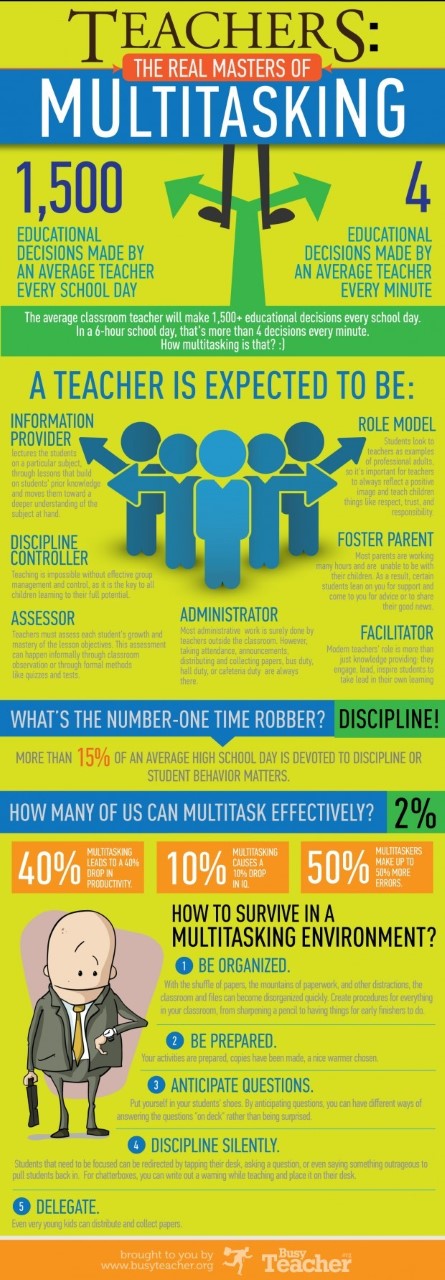
That’s when researchers observed elementary school teachers and noted that, on average, they made at least 1,500 decisions a day.


That comes out to about 4 decisions a minute given six hours of class time.


In the decades since, this figure has come to be associated with elementary and secondary teachers. In fact, it’s become so ubiquitous that I wondered where it originated.


The first reference I can find to it comes from C.M. Clark & P.L. Peterson’s article “Teachers’ Thought Processes” published in the Handbook of Research on Teaching from 1986. (3rd ed., pp. 255–296). New York: macmillan.


Though subsequent studies came up with slightly different numbers, the basic argument holds.


Researchers Hilda Borko, Carol Livingston and Richard Shavelson mark the low end of the scale. In their 1990 article “Teachers’ Thinking About Instruction,” they summarize studies that reported .7 decisions per minute during interactive teaching or 42 judgements per hour, 252 a day.


On the upper end of the scale is Philip Jackson who wrote in his 1990 book “Life in Classrooms” that elementary teachers have 200 to 300 of these determination generating exchanges with students every hour (between 1,200-1,800 a day). Most of these are unplanned and unpredictable calling for teachers to make what they term shallower decisions or deeper judgments (p. 149).


So because teaching involves waiting for the right opportunities for learning, neither student nor teacher can say with confidence what exactly will happen next. It requires “spontaneity and immediacy” (Jackson, p. 166, 152).


As a classroom teacher with more than 15 years of experience, none of this is surprising to me.


Just imagine the various tasks teachers are required to do every hour. We take attendance, review homework, help with seat-work, ask questions, etc. And that doesn’t even take into account all the times we’re unpredictably interrupted by the unexpected – upset students, administrative announcements over the PA, student questions, equipment breakdowns, etc. Each one of these requires us to make spontaneous, unplanned calls before the lesson can continue.


It just goes to show some of the various roles teachers are expected to fill in the lives of their students. They are expected to be information providers, disciplinarians, assess student learning, administrate school policies, facilitate student inquiry, act as role models and even be foster parents.


In any given lesson, we have to make decisions based on our plans AND decisions based on things that just happen to crop up unexpectedly – multiple times each day.


In fact, it seems to me that the research fails to account for innumerable situations that also require determination and deliberation as part of an educator’s everyday routine.


What about curriculum and instruction design? Grading? Written and verbal feedback to students? Reflection and revision of lesson plans?


When you think of all that, 1,500 decisions a day seems like a conservative estimate indeed.


Perhaps the most troubling thing about this is where it impacts teacher quality.


And when I say that, I don’t mean the basterdized modern meaning of that term – that teachers are responsible for maximizing student test scores on standardized assessments. I mean the quality of authentic instruction teachers are able to give their classes.


When we expect educators to turn on a dime more than a thousand times a day, doesn’t that impact the depth with which we can accomplish the job?


Busyteacher.org certainly thinks so. I’m not sure where the Website got its statistics, but they are sobering.


In a fascinating infographic, the site claims that multitasking leads to a 40% drop in productivity. It causes a 10% drop in IQ. It causes people to make 50% more mistakes than concentrating on one task at a time.


thumbnail_multitasking-teachers-infographic-620x1783


I don’t know if these statistics are accurate, but the general principle is sound. When we’re forced to “do more with less” we actually end up producing more with less quality.


Focusing on fewer things increases ones accuracy. Therefore, teachers who have to make fewer decisions in a day would probably be able to do their jobs more effectively.


And there are plenty of ways to accomplish this.


We could reduce class size. If educators can concentrate on the needs of fewer children, they would be more effectively able to meet those needs.


We could reduce the amount of time teachers have to be in the classroom in a given day. I’ve often thought teaching was analogous to being an actor up on the stage – but we’re also responsible for writing the script, operating the lighting, etc. And we have to interact with the audience many of whom would rather be elsewhere, and we have to do multiple shows each day.


In some countries, teachers spend a significant part of their days planning and grading and less in the classroom. They don’t have to do all that behind the scenes stuff on their own time without any additional pay.


In Finland, for example, teachers are paid 13% more than the Organization for Economic Cooperation and Development (OECD) average but spend 100 hours less in the classroom. And class size is between 9-14 students, the lowest in OECD countries. No wonder their children are near the top of the scale in international comparisons!


Wouldn’t it be amazing if we lived in a society that valued education and didn’t try to turn everything into economic quantities for corporations?


We could actually focus on the real phenomena of educating children and not have to fight warped education policies more concerned with turning it all into dollars and cents.


Perhaps teachers wouldn’t have to make so many thousands of decisions if our lawmakers could just make this one.


Still can’t get enough Gadfly? I’ve written a book, “Gadfly on the Wall: A Public School Teacher Speaks Out on Racism and Reform,” now available from Garn Press. Ten percent of the proceeds go to the Badass Teachers Association. Check it out!

book-3