You Can’t Have My Students’ Lives to Restart Your Economy


Screen Shot 2020-04-18 at 6.36.25 PM


It’s okay if a few children die to start up the economy.


That is literally the opinion being offered by media influencers and policymakers as Coronavirus social distancing efforts continue passed the 30-day mark.


In the midst of a global pandemic, we’ve closed down all nonessential businesses while people self quarantine at home waiting for the curve of infection to plateau and then drop off. Medical experts tell us this is the only way to ensure there are enough ventilators and hospital beds for those who get sick.


As it is, more than 700,000 Americans have tested positive for COVID-19 and 38,000 have died – more than the wars in Iraq and Afghanistan, the September 11 terrorist attacks, Hurricane Katrina and the Oklahoma City bombing – combined. In fact, the United States has the highest number of Coronavirus deaths in the world.


Screen Shot 2020-04-18 at 4.11.10 PM


Yet there is a concerted effort by the Trump Administration and plutocrats everywhere to get business back up and running. And to do that, they need the schools to reopen so parents can return to work.


They literally want to reopen schools as soon as possible – even if it isn’t 100% safe.


And if that means students, teachers and parents die, at least their sacrifices will have been worth it.


“Schools are a very appetizing opportunity,” said Dr. Mehmet Oz as a guest on Fox News’ Sean Hannity show.

 
“I just saw a nice piece in [British medical journal] The Lancet arguing the opening of schools may only cost us 2 to 3%, in terms of total mortality. Any, you know, any life is a life lost, but … that might be a tradeoff some folks would consider.”

 
Dr. Oz walked back the comment after popular backlash, but I believed him the first time. Many people would find that acceptable.


Dr. Phil McGraw (who unlike Dr. Oz is not a licensed doctor) said the following on Fox News’ The Ingraham Angle:


“The fact of the matter is, the longer this lockdown goes on, the more vulnerable people get. And it’s like there’s a tipping point. There’s a point at which people start having enough problems in lockdown that it will actually create more destruction and actually more deaths across time than the actual virus will itself.”


He then compared coronavirus deaths to deaths from smoking, swimming pools and car crashes – which critics pointed out result from mostly voluntary behavior.


Once again, Dr. Phil walked back his comments after public outrage. And once again, I saw where he was coming from – because it’s clear where these celebrity talking heads are getting their information.


You find the same opinion tucked into many otherwise informative articles about the virus and education.


Education Next published a piece by Walton Family Foundation advisor and American Enterprise Institute fellow John Bailey with this precious little nugget tucked in its middle:


“Currently, the public health benefits of school closures and home quarantining outweigh the costs. But at what point does that equation flip? When do the economic, societal, and educational costs outweigh the public health benefits of these aggressive social distancing actions?”


The rich need the poor to get back to work. And they’re willing to put our lives on the line to do it.


What’s worse, they’re willing to put our children’s lives on the line.


I don’t know about you, but I’m not willing to risk my daughter’s life so that the stock market can open back up.


As a public school teacher, I’m not willing to bet my students lives so that the airlines and cruise industry can get back in the green.


Nor am I willing to gamble with my own life even if it means the NBA, NFL and MLB can start playing games and Hollywood can start premiering first run movies again.


There’s still so much we don’t know about COVID-19.


Initial reports concluded that older people were more susceptible to it, but as infections have played out worldwide, we’ve seen that 40% of patients are between 20-50 years of age. Children seem mostly asymptomatic. However, many immunologists suspect they are acting as carriers spreading the virus to the older people with whom they come into contact.

 
Children have a more difficult time with the constant hand washing and separating themselves at least 6 feet apart recommended by health experts. This is one of the justifications for closing schools in the first place. If we reopen schools too quickly, it could jumpstart another wave of infections.


In fact, that’s exactly what the Imperial College of London found in its own modeling study on likely U.S. and U.K. outcomes.


School closures can be effective to help suppress the transmission rates and flatten the curve, the report concluded, IF CONTINUED OVER FIVE MONTHS.


That’s a long time. But it gets worse.


In the absences of mass vaccinations – which may be as much as two years away – the study found the virus is likely to rebound for a second and third wave.


Screen Shot 2020-04-17 at 11.56.34 PM


So when would it be safe to reopen schools?


Honestly, no one really knows.

 
Former US Food and Drug Administration Commissioner Scott Gottlieb released a more optimistic answer in the “National Coronavirus Response: Roadmap to Reopening.”


The report maintains the need to continue social distancing including school closures until cases peak and we see sustained declines in new cases for 14 days.


That seems to be a fair minimum standard.


However, we are not there yet. The death toll continues to rise in the US and may continue to do so for some time yet.


Despite the science, every state has a different date in mind for when schools will reopen.


Since the beginning of April,a total of 21 state departments of education (including Pennsylvania’s) have decided to keep schools closed for the remainder of the academic year until at least August or September. Six states plus Washington, D.C., still have plans to reopen their schools before the end of the month.


Screen Shot 2020-04-17 at 11.53.43 PM


Beyond the question of WHEN to reopen schools is the even more complicated one of HOW or IF.


President and chief executive of the National Association of State Boards of Education Robert Hull said administrators across the country are asking not how – but if – schools will reopen in the fall.


“Everybody says we hope we return to normal,” Hull said. “It’s not going to return to normal anytime soon because the new normal is going to be different.”


Multiple possibilities are being considered.


A major factor will be how well districts can test incoming students for infection.


The best solution would be quick and cheap Coronavirus screenings. If we could mass produce such tests and distribute them to schools or have the results be a precondition to coming to school, things might be able to run pretty much as normal.


If US schools all had digital thermometers (as they do in Singapore), students temperatures could be taken before letting them in to the building. Anyone running a fever could be sent home.


Some policymakers are even considering spot checking students throughout the day with thermometers and using video cameras to trace the path of any students running a temperature to tell who they may have come into contact with before being identified. However, this seems pretty disruptive to me and – especially in the younger grades – might terrify students and make them conversely feel less safe in school because of the very efforts done to ensure their safety.


In all likelihood, policymakers see to think schools will probably have to run while engaging in some sort of social distancing. And that’s not easy. Nearly everything from the way the academic day is organized to the maturity level of most students goes against this need.


One thought provoking proposal is reducing class size to no more than 10 students.


This would also have educational benefits allowing teachers the ability to give more one-on-one instruction. However, most classes are double or triple this size now. Few school buildings are large enough to double or triple the number of classrooms needed at the same time.


One solution to this is that children could attend on alternate days or on a half day basis – one group in the morning, another in the afternoon. The drawback is that this would reduce the hours students are in class. Lessons would either have to be cut down to essentials or some part of assignments may have to go online.


This might also narrow the curriculum so that the arts, music, and other subjects would be eliminated. Gym classes would probably have to be cancelled and lunches might have to be in the classroom, itself, instead of allowing large groups of students to congregate in the cafeteria.


Just ensuring that students aren’t all in the hallway at the same time would be a challenge. Class dismissals might be staggered or perhaps the teachers would move from room-to-room while the students stay put.


Moreover, the simple act of busing students to-and-from school is likewise complicated. If students sit further apart on the bus, that means each district needs either more buses at the same time or double the time to transport students at arrival and dismissal.


None of this would be cheap. It could necessitate more money on transportation, support staff and teachers. In a country where education budgets haven’t yet recovered from the Great Recession of George W. Bush, reopening schools safely would require an influx of cash.


But without it, the economy cannot get back under way.


When schools closed in March, many districts switched to some kind of distance learning. Teachers put assignments on-line and even teach through Internet meeting sites like ZOOM. Continuing this in some form – for part or all of the day – is also being considered. However, it causes as many problems as it solves.


Parents need to be able to get back to work. Many can’t stay at home taking care of their children indefinitely. And they can’t leave their kids to their own devices while trying to learn via computer, device or app.


Moreover, these cyber schooling efforts come with educational drawbacks. Just about every educational expert acknowledges that learning in-person is preferable. Students with special needs are particularly at risk because many of their individual education plans (IEPs) cannot be met remotely. And even though efforts have been made to help impoverished students gain access to the necessary technology and Internet access, the problem has by no means been universally solved. Not to mention privacy concerns with student data being pirated by unscrupulous ed tech companies.


Another issue is high stakes standardized testing.


With the Coronavirus crisis, the tests were cancelled this year – and no one has really missed them.


If lessons have to be cut to essentials, standardized testing and the need for endless test prep should be the first things to go. In fact, students, educators, parents and college professors will tell you how useless these assessments are. They reflect basic economic inequalities and enforce them by tying education funding to the test scores.


Poor kids score badly and rich kids score well, so the funding becomes a reward for the privileged and a punishment for the underprivileged.


That’s why it’s laughable when Hull laments “issues of equity” including how to measure what students are learning and how to help those who have fallen behind.


Equity is a matter of funding and opportunities – not test scores. Regardless of the problems with reopening schools, we could solve a long standing issue by erasing high stakes testing from the academic map.


But that’s been the elephant in the classroom for a long time.


Economic interests have trumped academic ones for decades.


Will we continue to value money over children? Will we pave the post-Coronavirus future over the bodies of sick children and adults?


Like any crisis, COVID-19 is another opportunity to get things right.


Here’s hoping we have our priorities straight this time.


Here’s hoping schools stay closed until we’re certain reopening them won’t endanger students, teachers and the community.


Like this post?  You might want to consider becoming a Patreon subscriber. This helps me continue to keep the blog going and get on with this difficult and challenging work.

Plus you get subscriber only extras!

Just CLICK HERE.

Patreon+Circle

I’ve also written a book, “Gadfly on the Wall: A Public School Teacher Speaks Out on Racism and Reform,” now available from Garn Press. Ten percent of the proceeds go to the Badass Teachers Association. Check it out!

book-4

The First Taste is Free: Ed Tech Follows Drug Dealer Sales Techniques with Schools During Coronavirus Crisis

Screen Shot 2020-04-03 at 8.27.28 PM


“Pst! Hey, Kid! Come here!”


Educational technologies are a multi-billion dollar industry.


“Who? Me?”


The coronavirus pandemic has closed schools across the globe, and districts have tried to solve this problem by putting their classes online.


“Yeah, you. I’ve got some… candy I want to give you.”


Nearly every ed tech company has offered help with this processes.

 
“Oh boy! I sure love candy… Wait a minute! How much does it cost?”


Teachers, parents, students and education activists are wary of educational technologies in the classroom, and research backs them up. Ed tech has been shown to widen socioeconomic divides, it hasn’t lived up to its promise of increasing academic gains, and – perhaps most tellingly – Silicon Valley executives restrict their own children’s use of technology and send them to tech-free schools.

 
“Nothing. It’s free.”


These for-profit corporations are offering limited time promotions – they’re providing additional services for free that would normally be behind a paywall.


“Oh goodie!”


Districts are jumping at the chance. They’re encouraging teachers to use apps, services and software that have never been tried before locally in an attempt to abide by continuity of education guidelines written by departments of education.


“That’s right. Absolutely free. But if you want some more, next time I’ll have to charge you a little something…”


So when the pandemic is over and classes eventually are reopened, a great deal of the technology that schools used to get through the crisis will no longer be on the house.


Continuing to use them will require an additional fee, and if districts end up budgeting for them, the money has to come from somewhere. So that means fewer books, field trips, tutors, classroom aides, and – yes – teachers.


In short, well-meaning governors, law-makers, administrators, school directors and even educators are participating in a program that in the long run may enrich private corporations but not be in the best interests of the students we’re supposed to serve.


I bring this up not to stop schools from using online learning during the crisis. Unfortunately that ship has sailed. Nor do I voice my objections to criticize teachers, parents or students. We all have to do what needs to be done to get through all this.


However, it is vital that we are aware of the compromises being made today so as to better avoid the pitfalls ahead.


When teachers use Zoom, Google Classroom, or any of dozens of other ed tech products during this season of social distancing, we must be aware that these should only be temporary measures. Do not resign yourself to any of this becoming the new status quo.


When classes resume, we can’t simply go back to normal. Nothing can ever be normal again. Normal is what got us into this mess – a society ill equipped to meet this pandemic – ill equipped to take care of its citizens, provide basic resources, equity and put people before profits.


The post coronavirus world must be one of universal healthcare, a social safety net for all and a robust, fully funded system of public education. We cannot allow it to be a dystopian world of edu-tech vulture capitalism where the economics of street corner drug pushers is used to dictate how public money is spent.

 
There are many clear reasons why.

 
First, education technologies are almost completely unregulated. Cybersecurity and student privacy laws are woefully out of date if not entirely nonexistent.


These applications collect a torrent of data on students. So do teachers, in fact, to calculate grades. However, if an educator were to share this information with outsiders, she could be sued. But if a corporation did the same thing, it falls into a legal no man’s land.


Each state has different laws denoting the limits of privacy.


The main federal law safeguarding student data privacy, the Family Educational Rights and Privacy Act (FERPA), was written in 1974 before much of these technologies even existed. It hasn’t been significantly amended since 2001.


So it’s left to individual districts, administrators, school boards and teachers to navigate these murky waters.

 
They end up trying to decipher the individual terms of service agreements and privacy statements with these companies that are often full of legal loopholes. In many cases, decision makers don’t even bother or give the job to school lawyers unversed in cybersecurity concerns or law.


While Congress has neglected its duty to regulate the industry, the matter is important enough that the Federal Bureau of Investigations (FBI) put out a strong warning. Two years ago, the Bureau cautioned consumers about the risks of classroom management tools like Class Dojo as well as student testing and remediation applications like Classroom Diagnostic Tools and Study Island.


The FBI warned schools and parents that widespread collection of student data involved in these applications could cause safety concerns if the information is compromised or exploited.


The Bureau was concerned about ed tech services because many are “adaptive, personalized learning experiences” or “administrative platforms for tracking academics, disciplinary issues, student information systems, and classroom management programs.”


And these are many of the same applications being used today for distance learning initiatives.


Education advocates have been sounding the alarm for years.


Commonsense.org – a nonprofit studying education issues – conducted a three-year review of 100 ed tech companies. It concluded that 74% of these businesses hold the right to transfer any personal information they collect if the company is acquired, merged, or files for bankruptcy. And since many are start-ups, this often happens.


The authors wrote that there is “a widespread lack of transparency, as well as inconsistent privacy and security practices” in how student information is collected, used, and disclosed.


Leaking student data is often not a security failure. It’s part of a company’s business model.


This is valuable information about one of the most lucrative demographics in the marketplace. Companies use it to help sell products targeted directly to consumers. And they can even sell student data as a commodity, itself.


For instance, imagine how much more effective the hiring process would be if businesses had access to applicants school attendance records. Imagine if businesses had an applicant’s entire academic record.


Employers could buy vast amounts of data and use algorithms to sort through it looking for red flags without fully comprehending what was being compiled. Imagine an applicant being turned down for a job because of low middle school attendance but not being able to explain that this was due to a legitimate illness.


There are reasons we protect people’s privacy. You shouldn’t have to explain your score on a 1st grade spelling test the rest of your life or have the need for special education services damage your credit rating.


Yet all of these things are possible when student data is up for grabs.


No one is protecting our children from this kind of mercantile future – one which will only be exacerbated if we allow educational technologies to become common place after the current crisis.


And tightening our student privacy laws, will not solve everything.


Hardly any attention is being paid to how these technologies can be used for harms unrelated to business and industry.


Tablets, laptops or monitoring devices such as cameras or microphones could be exploitable by tech savvy criminals – especially since many ed tech programs allow remote-access capabilities without the user even being aware of what is happening.


Pedophiles could use this data to find and abduct children. Criminals could use it to blackmail them. Other children could use it to bully and harass classmates.

 
It’s hard to imagine how children could be protected on such devices without increasing surveillance and thereby running similar risks. Using them will always involve a chance of endangerment so they should be kept away from the youngest and most vulnerable potential users.


How did we let ed tech get so out of control? Like so many problems of the pre-coronavirus world, money was allowed to dictate policy.


Screen Shot 2020-04-03 at 11.50.33 AM


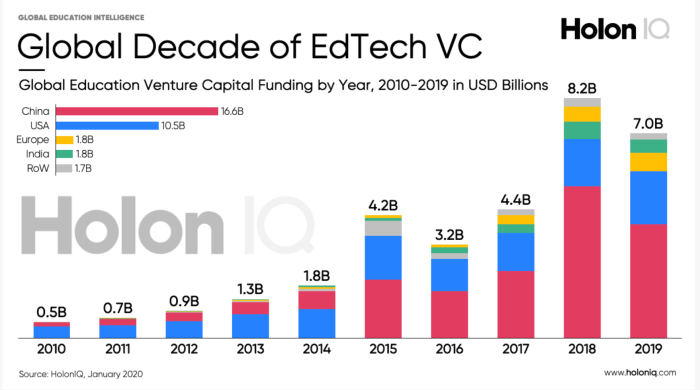
Global venture capital investments in ed tech finished 14 times higher by the end of the decade than they started. Investments went from $500 million in 2010 to $7 billion in 2019. And insiders expect that to triple in the next decade to more than $87 billion.


The two biggest spenders by far are China and the US.


Yet enthusiasm for such technologies are not nearly as prevalent among educators.


A 2019 study of educator confidence in ed tech conducted by Houghton Mifflin Harcourt found that 60% of teachers were concerned that implementing technology tools could damage the student-teacher relationship.


Moreover, education research in the United States concluded these technologies only widen the gap between different socioeconomic groups. Global initiatives like the One Laptop per Child program, which distributed 25 million low-cost computers with learning software to children in the developing world, failed to improve language or math results.


Meanwhile, students seem to be telling us they prefer more old school methods of instruction. Studies have shown preference for everything from physical books over eBooks to having “ordinary, real-life lessons” and “a smart person at the front of the room.”


Parent Blogger Alison McDowell has studied these issues in more depth than nearly anyone else. She warns that adaptive applications become the gatekeeper of children’s educations. They only allow students to move on once they’ve demonstrated mastery on a previous academic standard – or at least once they’ve been able to guess which one answer a programmer thought correct:


“The “personalized learning” model conditions students to view themselves as independent operators, free agents attempting to navigate a precarious gig economy alone. Screen-based isolation and an emphasis on data-driven metrics steadily erode children’s innate tendencies to creative cooperation. Which is ultimately better for society, an algorithm that learns each student in a classroom and delivers a pre-determined reading selection that they review and are quizzed on online, or a human teacher who selects an all class reading in which there is lively debate? The first scenario forecloses creative thought in service of data generation and reinforces there is but one correct answer. The second opens up chances for students to gain new insights while limiting opportunities for digital surveillance.”

 
Ed tech may allow us to stumble forward during the coronavirus quarantine, but it is not a central part of a healthy education system.


It may play a limited role in remediation and augmentation, but it cannot be the fulcrum around which everything else revolves.

 
I’d like to see a new education system built from the ashes of the old where every child has the chance to learn, a system that forgoes standardized testing and corporate-written academic standards for individualization and human interaction. I’d like to see a world where charter and voucher schools are things of the past, where schools are integrated and differences valued, where teachers and learning are respected and esteemed.


That is not an ed tech centered world. It is a student centered one.


It is a world where our priorities are such that even the promise of the new and the free won’t encourage us to indulge in practices that put our children in greater danger.


It is a place where the pusher has no power because his product is seen for what it is – treacherous and unnecessary.


Like this post?  You might want to consider becoming a Patreon subscriber. This helps me continue to keep the blog going and get on with this difficult and challenging work.

Plus you get subscriber only extras!

Just CLICK HERE.

Patreon+Circle

I’ve also written a book, “Gadfly on the Wall: A Public School Teacher Speaks Out on Racism and Reform,” now available from Garn Press. Ten percent of the proceeds go to the Badass Teachers Association. Check it out!
book-3

How Did America’s Schools Cope with Spanish Flu vs. Coronavirus?

Screen Shot 2020-03-30 at 10.23.47 AM


They say history repeats itself.


And if you’ve read any accounts of the bygone days of yesteryear, the current crisis certainly appears like a rerun.


Look at all the closed businesses, frightened people venturing out wearing face masks or self quarantined in their homes. It sure looks a lot like 1918.


The Spanish Flu epidemic that swept the nation a little more than a century ago bares more than a passing resemblance to COVID-19, the coronavirus. And the ways we are trying to cope with the situation are in many cases modeled on what worked a hundred years ago.


For instance, when our ancestors enacted social distancing policies to flatten the curve of infection, their infrastructures were better able to save lives. When they didn’t enact such policies, death tolls were greater.


That’s one of the major reasons many of us today are shut in our homes waiting this whole thing out. We want to give the hospitals a chance to deal with the cases that come in without people all getting sick at once and making a run on ventilators.


However, history has less to say about how we handle things like education.


After all, our forebears didn’t have as unified a response.


In general, closing schools was better to stop the spread of disease than keeping them open.


But what about actual academics? How did our progenitors make up missed work?


There-in lies a tale.


America’s school system seems to have met the crisis in three separate ways.


They either closed entirely, remained open or forced teachers to educate at a distance.


Wait. Educate at a distance? In 1918?


Yep.


But I’m getting ahead of myself.


PITTSBURGH

 
Let’s begin in my hometown of Pittsburgh, Pennsylvania.

 
City officials didn’t take the matter seriously enough and as a result, Pittsburgh ended up with the highest death rate of any major city in the country. The Spanish Flu killed at least 4,500 people – a smaller total than cities like Philadelphia, but it represented more than 1 in every 100 residents. Nearly 24,000 people sought treatment at local hospitals.


According to reports made to the city health department, things got so bad that at the epidemic’s worst, someone in Pittsburgh got the flu every 70 seconds and someone died from it every 10 minutes.


This resulted in a casket shortage across Western Pennsylvania as far away as Greensburg. Even in distant Ligonier, signs were posted along Lincoln Highway warning motorists, “You stop at your own peril.”


City officials were at least partly to blame.


Though local colleges and universities such as the University of Pittsburgh, Duquesne, and Carnegie Tech all closed their doors near the start of the outbreak, city public schools initially were kept open.


In early October, State Health Commissioner B. Franklin Royer made the decision not to close public schools, though Pittsburgh school administrators decided that anyone who was coughing or sneezing should be sent home.


However, as Kenneth White put it in his 1985 article “Pittsburgh in the Great Epidemic of 1918”:


“Enterprising students quickly discovered that a pinch of snuff or pepper, inhaled in school, provided a sure passport to freedom.”

 
By October 22, city council reviewed a report that 27,357 children – about one-third of the student body – were absent from school. Of this number, council knew of 6,070 students who had the flu and 53 who had died. In addition, many parents kept their children home for fear they’d get sick.


Only then were city schools closed – about three weeks after the epidemic took hold in the area.


Some surrounding districts like Ben Avon had closed schools as early as October 5. But many had followed the city’s example and suffered similar consequences.


Pittsburgh schools reopened on November 18. Though the Spanish Flu was not completely gone, it came back in two more waves through the area – however, neither was as devastating as the first crash.


I can find nothing specific about how surviving students made up missed academic work. Only that they missed 19 school days of class during the closure.


NEW YORK CITY


New York City reacted in a similar fashion as Pittsburgh but with different results.


While Pittsburgh’s mortality rate was nearly 1 in 100, New York’s was 4.7 per 1,000. City officials recorded approximately 30,000 deaths out of a population of roughly 5.6 million resulting from influenza or pneumonia.


However, just like Pittsburgh, New York kept its schools open.


In an October 5th New York Times article, Health Commissioner Royal S. Copeland explained his logic behind the controversial decision to keep students in class:


“New York is a great cosmopolitan city and in some homes there is careless disregard for modern sanitation… In schools the children are under the constant guardianship of the medical inspectors. This work is part of our system of disease control. If the schools were closed at least 1,000,000 would be sent to their homes and become 1,000,000 possibilities for the disease. Furthermore, there would be nobody to take special notice of their condition.”


In short, Copeland figured the schools could do a better job of ensuring children’s safety than their parents.


In class, teachers were expected to give each student a daily medical inspection and report the results to the school nurse and/or medical professionals.


According to Francesco Aimone in “The 1918 Influenza Epidemic in New York City: A Review of the Public Health Response”:


“School nurses and medical inspectors were instructed to follow up on teacher inspections and conduct home visits on absentee students to determine whether “… they or members of their family are sick, that physical examinations be carefully made, and that dry sweeping [in their home] be discontinued and ventilation sufficient.”

 
Many disagreed with Copeland’s decision including the Red Cross of Long Island.


Former Health Commissioner Dr. S.S. Goldwater put the blame squarely on the teachers who inspected students with “almost criminal laxity” and found the follow-up inspections “lamentably weak.”


CHICAGO


However, a similar strategy in Chicago didn’t repeat New York’s success.


Keeping schools open in the Windy City more closely emulated the situation in Pittsburgh.


According to a timeline of preventive measures published in the American Journal of Public Health by Chicago’s Health Commissioner Dr. John Dill Robertson, city schools weren’t closed because officials didn’t think children were getting sick more than adults. They thought it would be better to keep students indoors where they could be watched for symptoms.


However, children ended up dying from the flu in Chicago at a higher rate than their parents.


Like in Pittsburgh, any student who coughed or sneezed was immediately sent home – though eventually this also came with a mandatory home quarantine.


SMALLER TOWNS

 
Officials were more sensible in smaller towns like Adrian and Tecumseh, Michigan.


In both municipalities all schools were closed by the end of October when the epidemic began there.


By Dec. 12 there was a plan to reopen, however that was revised as the death toll continued to rise. Schools ultimately remained closed until January 1919.


Schools made up the missing days of class by extending the remaining year.
They stayed open for 30 minutes beyond their usual dismissal time and held half-day sessions on Saturdays.


Another small town that wasn’t taking chances was Pontiac, Illinois.


Not only did officials close the schools, they ended up using them as field hospitals for the sick.


Moreover, when classes were cancelled, school age children were forbidden from leaving their homes unless they had to run an errand. Anyone with the flu was immediately quarantined in his or her home.


Schools were closed on October 15 for what was originally supposed to be just five weeks. However, when the second wave of the flu hit, the closure was extended.


Things got so bad that from December 3rd through January 1st, school buildings were used as a hospital to treat those with the flu.


By early January, the worst had passed and schools were reopened. Beginning on January 10, 1919, the high school held an extra session on Saturday to help make up some of the missed class work.


This seems to be the general pattern. Larger cities tried to push on and keep things as normal as possible – with usually disastrous results. Smaller towns took more serious precautions and limited the death toll.


LAKELAND, FLORIDA


And then there’s Lakeland, Florida.

 
Leave it to this district in Polk County to be the oddball.


On Oct. 10, the schools were officially closed. But not really.


Superintendent of Lakeland Schools Charles Jones and Polk County Board of Public Instruction Superintendent John Moore ordered teachers to continue to report to work so they could help any students who needed remediation.
Jones wrote in the local Ledger newspaper:


“While the teachers will meet at the school building each day for the purpose of assisting any child who is deficient in certain subjects or all subjects, yet I want it understood that the pupils may see the teachers at their homes any time for instruction.”


Such instruction could be given over the telephone, if necessary, he added.


Moore took the matter a step further saying in a resolution published in the paper that teachers who failed to report to school or help students could have their pay docked.


Much of this proto-distance learning involved communication in the local paper.


Its pages included assignments from teachers to students and even teachers home phone numbers if students needed help.
 Examples of these assignments included reading passages from Shakespeare to drawing a map of North America.


IMPLICATIONS


The strangest thing about this incomplete survey of school responses is how much our current system is acting like Lakeland, Florida.


Almost all present day schools are closed with students supposedly self quarantined at home. This helps flatten the curve and minimize the chances of infection.


However, instead of waiting for the crisis to pass before addressing any academic deficiencies, many districts are requiring distance learning.


Teachers are being made to go in to school buildings or work from home creating online courses from scratch with little to no training.


True, this doesn’t expose educators to an added risk of catching the virus, themselves, but it does seem a bit mercenary.


We’re in a public health crisis where thousands of people are getting sick and dying. And the thing ourschool administrators are most concerned about is continued academic performance. They’d rather keep going with whatever quality of instruction can be provided in slapdash fashion than wait until it can be provided in the best possible circumstances.


They’d rather risk leaving behind those students without Internet access or whose special needs can’t be met online. Anything rather than extending the school year?


It’s interesting to compare today’s solutions to those of yesteryear.


Why didn’t more districts in 1918 try to make teachers instruct students through the newspaper and over the phone? Why didn’t more districts make teachers go to school buildings and even students homes during an epidemic?


Are we really doing the right thing by emulating those solutions?


Like this post?  You might want to consider becoming a Patreon subscriber. This helps me continue to keep the blog going and get on with this difficult and challenging work.

Plus you get subscriber only extras!

Just CLICK HERE.

Patreon+Circle

I’ve also written a book, “Gadfly on the Wall: A Public School Teacher Speaks Out on Racism and Reform,” now available from Garn Press. Ten percent of the proceeds go to the Badass Teachers Association. Check it out!
book-4

Virtual Learning Through Quarantine Will Leave Poor and Disabled Students Behind

Screen Shot 2020-03-25 at 9.49.54 AM


In the wake of the coronavirus crisis with most people self quarantined at home, schools across the country are shut down.


Some offer (or are considering offering) distance learning over the Internet.


However, this poses problems.


Not all student services can be provided via computer.


And not all students even have a computer, online compatible device or Internet access.


Should our nation’s public schools soldier on anyway and provide some kind of learning experience for those not thus encumbered at the expense of those who will be left behind?

 
The U.S. Senate’s proposed coronavirus aid package includes a provision to waive existing federal law that requires all schools to provide services to special education students. Removing this specification would allow districts to move forward with virtual learning without having to worry about meeting the needs of their special education students.


Advocates worry that even a temporary suspension of the Individuals with Disabilities Education Act (IDEA) could have devastating long term effects on students with disabilities and ultimately remove the requirement upheld for the last 45 years that they receive a free public education.

 
Education Secretary Betsy DeVos offered a gleeful statement in favor of dispensing with protections for students with autism, cerebral palsy, learning disorders and other special needs:


“It was extremely disappointing to hear that some school districts were using information from the Department of Education as an excuse not to educate kids. This is a time for creativity and an opportunity to pursue as much flexibility as possible so that learning continues. It is a time for all of us to pull together to do what’s right for our nation’s students.


“Nothing issued by this Department should in any way prevent any school from offering educational programs through distance instruction. We need schools to educate all students out of principle, rather than educate no students out of fear. These are challenging times, but we expect schools to rise to the occasion, and the Department stands ready to assist you in your efforts.”


The Department of Education issued a Fact Sheet that went even further:


“To be clear: ensuring compliance with the Individuals with Disabilities Education Act (IDEA), Section 504 of the Rehabilitation Act (Section 504), and Title II of the Americans with Disabilities Act should not prevent any school from offering educational programs through distance instruction.”


This is tantamount to prioritizing the education of some students over others. In short, if we follow DeVos’ guidelines, we will be saying that regular education students are more important than students with special needs.


It is a dangerous precedent.


However, perhaps even more dangerous is the abdication of any responsibility for, even complete erasure of any mention of poor students without Internet access.


This just underlines the importance of legislation. Special education students have IDEA. Poor students have nothing. There is no right to education for them at all.


If there had been some legislation specifically enshrining the rights of the underprivileged, however, it is clear this administration would be likewise proposing measures to dispense with it.


I understand that we are in a crisis. I understand that some think it is better to take half measures so that something gets done rather than nothing.


However, the coronavirus outbreak is expected to be a temporary situation. It may last weeks or months, but it will not last forever.


We want to do things in the best interests of children now, but we also must be aware of later. And trying to meet some kids needs now while writing off a large chunk of the rest would have a huge negative impact later.


If we educate just the privileged kids, we will be worsening the socioeconomic gap between students – a gap that is already too wide.


According to the most recent federal data, nearly 7 million students in the United States do not have Internet access at home. That is about 14 percent of all U.S. students. And of those with online access at home, 18 percent do not have home access to broadband Internet so they would also have difficulty retrieving lessons or participating in Zoom meetings online.

 
Moving to distance learning on the Internet would leave tens of millions of children behind.

 
Is this really what we want to do?


In addition, there is the question of quality.


Few teachers are trained or have experience with distance learning. They will probably be able to provide some kind of learning – but it will almost certainly not be the best they could be providing.


Moreover, there are real questions about the quality of learning that CAN be provided in a virtual environment even under the best of circumstances.


Cyber schools are a perfect fit for some students. Older and more mature students would probably have an easier time adjusting to it.


However, many students – especially younger ones – need the face-to-face interactions of school to get the most out of the experience. Forcing them into a mold that may at best be unsuited to them individually and at worst developmentally inappropriate will only cause them undo trauma.


I understand that everyone wants to appear like they’re doing something to meet the challenges provided by this crisis. However, sometimes the best thing to do is nothing.


One day the quarantine will be lifted. At that point, we can reopen the schools.


This may mean a few months of summer school. Or we could extend the 2020-21 school year to make up the difference.

 
Neither are perfect solutions. But they’re both better than virtual learning.


Neither require us to write off our poor and special education students.


And THAT is the most important thing.


Public schools don’t have to settle for whatever fad is offered from disaster capitalists.


We can still do what’s right for our kids.


All of our kids.


Like this post?  You might want to consider becoming a Patreon subscriber. This helps me continue to keep the blog going and get on with this difficult and challenging work.

Plus you get subscriber only extras!

Just CLICK HERE.

Patreon+Circle

I’ve also written a book, “Gadfly on the Wall: A Public School Teacher Speaks Out on Racism and Reform,” now available from Garn Press. Ten percent of the proceeds go to the Badass Teachers Association. Check it out!

book-4

Public Schools Can Recover from the COVID-19 Quarantine by Skipping High Stakes Tests

Screen Shot 2020-03-14 at 7.40.21 PM

 
There is one plus from being sick during a global pandemic.


You get perspective.


While all the schools in Pennsylvania are closed for at least the next two weeks to help stop the spread of COVID-19 (colloquially known as the Coronavirus), I self-quarantined a day early.


No, I don’t think I have the virus, but I’m not taking any chances.


Still, sitting here at my laptop with a steaming mug of tea, I’m filled with optimism.


My symptoms don’t match those of the virus – no fever, no dry cough, no difficulty breathing, no runny nose or sore throat. I just sneeze occasionally, have an intermittent wet cough and feel a bone deep fatigue.


Probably not the culprit sending the world into shutdown mode. But best to rest up anyway.


I’m also filled with a deep sense of gratitude that I’m a public school teacher.


My last class was a rough one – 7th graders running around the room with half written poetry demanding instruction, guidance, reassurance. My morning 8th graders were likewise rushing to complete a poetry assignment – frantically asking for help interpreting Auden, Calvert, Henley, Poe, Thomas.


What a privilege it has been to be there for them! How much I will miss that over the few next weeks!


Who would ever have thought we’d go into self quarantine to stop people from getting infected?


It says something about us that what seemed impossible just a few days ago has become a reality. We actually saw a problem and took logical steps to avoid it!


I know – we could have done a better job. We could have acted more quickly and in many areas we haven’t done nearly enough (New York, I’m looking at you).


But what we have done already shows that human beings aren’t finished. We have massive problems waiting to be solved – global climate change, social and racial inequality, the corrupting influence of money in politics, etc. However, we CAN do the logical thing and solve these problems!


No matter how crazy it seems now, tomorrow could be filled with rational solutions. If only we allow ourselves that chance.


So my spirits are high here in my little hollow nestled in with my family.


But being a teacher I can’t help thinking about what’s to come next.


Eventually this whole ordeal will be over.


Schools will reopen. Things will get back to normal. Or try to, anyway.


The challenge will be attempting to overcome the month or more of lost schooling.


Some will be thankful they relied on virtual schooling to fill in the gaps. When this whole crisis began, officials chided us to make preparations for “teleschool” in case of just this eventuality.


I’m glad we didn’t.


Frankly, (1) it would have been a huge cost that schools don’t have the money to meet and (2) it would have been money down the drain.


There is nothing innovative about sending kids on-line to do their assignments. The majority of work that can be done that way is of the lowest quality.


That’s workbook nonsense that the laziest and most checked out educators of generations past gave to their students to keep them quiet.


We see students in China who are being educated that way finding ways around it – giving their education apps low star reviews in the app store so that they’ll be removed, etc.


Here in the USA, all children don’t even have access to the Internet. They rely on the local libraries to get online – not a good idea in a pandemic.


So most schools have had to do without.


School is cancelled for about a month or so, and then – hopefully – it will return.


The question remains – what do we do when we get back to class?


We could extend the school year, but families have vacations planned and other obligations. This wouldn’t solve much and frankly I don’t think it will happen unless we’re out for longer than expected.


I anticipate being back in school by mid April or so. That would leave about a month and a half left in the year.


This really leaves us with only two options: (1) hold our end of the year standardized tests and then fit in whatever else we can, or (2) forgo the tests and teach the curriculum.


If we have the tests, we could hold them shortly after school is back in session. That at least would give us more time to teach, but it would reduce the quality of the test scores. Kids wouldn’t be as prepared and the results would be used to further dismantle the public school network.


Much better I think is option two: skip the tests altogether.


Frankly, we don’t need them. Teachers observe students every day. We give formal and informal assessments every time we see our kids. We’re like scientists engaged in a long-term study taking daily measurements and meticulously recording them before coming to our year end conclusions called classroom grades.


In my classes, I think I could teach just about the same material in the remaining time if I didn’t have to worry about the high stakes tests.


In 7th grade, this would mean finishing up our almost completed poetry unit – having kids put together their poetry portfolios and sharing them. Then we’d begin our final novel of the year, “Silent to the Bone” by E.L. Konigsburg, talk about mystery stories, reader perspectives and how truth impacts fiction.


In 8th grade, we could likewise finish up poetry with some presentations on students’ favorites from the assigned group. Then we could read the play version of “The Diary of Anne Frank,” and selections from Harper Lee’s “To Kill a Mockingbird.”We could discuss propaganda, prejudice and compare the historical perspective of Europe and the United States.


In both cases, we might have to forgo a year-end project, but at least we’d cover the majority of what we proposed at the beginning of the year.


Students would leave their respective grades with just about everything we set out to give them. They’d be prepared and ready to meet the challenges of the coming grade.


That seems a worthy goal to me.


But I hear someone ask – what about the standardized testing? Won’t students be less prepared having skipped over those assessments?


The answer is no. They would not be less prepared.


They would be better educated without a sword of Damocles hanging over their heads.


The shame is that this alteration in schedule would probably only last one year.


In 2020-21, we’d probably reinstate these standardized assessments.


This is at least a month of wasted schooling. If we got rid of all the pretests and administrator required teaching-to-the-test, we could clear up a good 9-weeks of extra class time.


Imagine what teachers could do with those surplus days!


My 8th graders could read the whole of “Mockingbird,” for one. instead of just selections. My 7th graders could read another entire novel – probably Paul Zindel’s “The Pigman.” Not to mention the addition of more women and writers of color, the extra time for creative writing, an emphasis on finding your own point of view.


And for me that’s the benefit of this COVID-19 crisis. It shows us what could be – what we could do if we were only brave enough to try.


Happy self-quarantine, everyone!


Like this post?  You might want to consider becoming a Patreon subscriber. This helps me continue to keep the blog going and get on with this difficult and challenging work.

Plus you get subscriber only extras!

Just CLICK HERE.

Patreon+Circle

I’ve also written a book, “Gadfly on the Wall: A Public School Teacher Speaks Out on Racism and Reform,” now available from Garn Press. Ten percent of the proceeds go to the Badass Teachers Association. Check it out!

book-2

The Coronavirus Could Be A Big Moneymaker for EdTech Companies

Screen Shot 2020-02-26 at 10.11.50 PM

 
There is a special place in Hell for people who cash in on tragedy.


But that place is reserved for the super rich – and that’s all that matters in Donald Trump’s America.


Federal officials are urging schools to prepare for possible disruptions due to the coronavirus – a disease that originated in China last month and has affected more than 77,000 people worldwide (of which more than 2,600 have died).


Only 14 people have been infected in the U.S., and the Center for Disease Control (CDC) writes on its Website that the “immediate health risk from COVID-19 is considered low” for the average American – especially those who have not traveled recently to Wuhan, the surrounding Hubei Province or elsewhere in mainland China.


However, this is certainly scary news for anyone – especially parents, teachers and students.


In fact, federal officials singled out schools at a press conference on Tuesday about possible responses to the disease if it gets worse on these shores.


Nancy Messonnier, a director at the CDC, said:


“You should ask your children’s schools about their plans for school dismissals or school closures. Ask about plans for teleschool.”


To which every teacher in America responded, “Teleschool!?”


So we’re worried about this disease which is somewhat more deadly than the fluNOT primarily because of the risk to students’ health or lives; NOT because of the risk of it going undiagnosed due to the disincentive of rising healthcare costs; NOT because we’re woefully unprepared due to Trump firing the entire U.S. pandemic response team two years ago and then not replacing them!


No! We’re concerned mostly because KIDS MIGHT MISS SCHOOL!!!!

 
But, hey, no worries because the Trump administration figures this new and unpredictable disease which typically causes symptoms like fever, cough and shortness of breath can be circumvented with… cyber school?

 
Limit kids exposure by letting them stay at home and do their lessons on the computer.


And if they have an online management system where teachers give virtual assignments and kids turn them in through the cloud, even better!


Thank you, education technology firms! You have saved American education. Again.


What a pile of crap!


Let’s get one thing clear. This suggestion has nothing to do with student well being. It is a blatant attempt to turn a potential pandemic into a cash cow.


EdTech already is a multi-billion dollar industry. If we successfully tie navigation of disasters with this sector, profits could potentially climb through the roof!


As it stands now, technology companies are lined up outside our schools pretending to provide the best the 21st Century has to offer to solve every school issue from excessive tardiness to lack of motivation to academic decline.


And now they’re offering the cure to the coronavirus – or at least the cure to any pedagogical delay that might result from school closures – either precautionary or due to an outbreak.


First of all, if schools close because of this disease, students will be scared. They aren’t going to be able to focus on academics.


Kids would need love and understanding – not more homework.


Second, not all kids have Internet access at home. Many of our most underprivileged children need to go to a public place like a library to get online. So if we require students to submit assignments this way during a closure, we’re forcing them to increase their chances of infection at a public place or get behind in their work. Not exactly fair.


Third, the kind of lessons you can provide through “teleschool” are subpar at best.


This is the automated checkout counter of school. It is the robocall customer service of education.


Most children need real live human beings to achieve their best. That’s why you just can’t give a kid a math book and – Voilà – they know how to reduce fractions!


Sure, they can try to muddle through a computer program or do virtual work and submit it online. But how is that really different from the bad old days when the most checked out educators would disseminate a worksheet to the class and then hide behind a newspaper at their desks?


This is the kind of curriculum we used to criticize teachers for and that very few modern day educators could get away with in our modern public school system – UNLESS they do it behind a computer and/or software package.


This is not being “future ready” or “innovative.” It is the worst practices of the past repackaged so a bunch of suits at the corporate offices can cash in.


Finally, it opens students up to severe privacy concerns. In 2018 the Federal Bureau of Investigations (FBI) warned that EdTech solutions like these often put student security at risk.


Much of this software asks for and saves student inputs which can be compromised or actively sold to third parties.

 
These are “adaptive, personalized learning experiences” or “administrative platforms for tracking academics, disciplinary issues, student information systems, and classroom management programs.”

 
Pedophiles could use this data to find and abduct children. Criminals could use it to blackmail them. It could even be sold to unscrupulous corporations or exploited by other children to bully and harass classmates.


And, in fact, such things have happened.

 
While it may be frustrating to makeup missed schools days, doing so doesn’t have the same risks and – eventually – provides kids with the same quality of education that they miss.

 
It just doesn’t offer opportunities for corporations to make big bucks.


Advocates claim online tools like Class Dojo and Apple Classroom provide unique opportunities that have never been available before for such teleschooling.


However, we’ve always been able to do this stuff – just not so easily on a computer.


Schools have always been able to send workbooks home with students full of drill and kill assignments. They just rarely did so because we all knew the quality of such workbooks was mediocre at best.


Compared with a flesh-and-blood teacher and the interpersonal interactions of school, this was poor return on the community’s investment in their children.


Teleschooling is pretty much the same thing just with flashier bells and whistles.


It’s no wonder that this is the kind of solution we get from an administration that thinks Betsy Devos should head the Department of Education.


Why would we trust the same people who can’t figure out how to contain the coronavirus to solve its impact on education?


Sadly in an age when the human genome has been successfully mapped and bio-weapons are a real tool at the disposal of unscrupulous governments, one can only be skeptical of a mysterious new virus that suddenly shows up in a country like China experiencing massive pro-democracy protests. That’s one way to get disaffected citizens off the streets.


And now the same disease has come to our shores on the eve of the 2020 Presidential election. You’ll forgive me for admiring what could be the most effective means of  voter suppression in modern politics!


This may be an unlikely scenario – especially given the degree of secrecy and competence it would require – but if history has taught us anything, it’s that the powerful will stop at nothing to keep their power.


Beyond mere financial gain, some may hope that teleschooling in the wake of predictable disasters could dumb down our children’s education just enough to deprive them of that lesson, themselves.


The best way to stop skepticism is to undercut the education of the next generation.


Like this post?  You might want to consider becoming a Patreon subscriber. This helps me continue to keep the blog going and get on with this difficult and challenging work.

Plus you get subscriber only extras!

Just CLICK HERE.

Patreon+Circle

I’ve also written a book, “Gadfly on the Wall: A Public School Teacher Speaks Out on Racism and Reform,” now available from Garn Press. Ten percent of the proceeds go to the Badass Teachers Association. Check it out!

book-1

Gov. Wolf Tries to Stop Charter Schools Gorging on Public School Funding

Screen Shot 2019-08-21 at 8.10.09 PM


Sooey! Here Pig Pig Pig!


No one minds that healthy call at the hog farm when it’s time to feed the sows.


But taxpayers do take issue with it when it’s the call of the state legislature gathering a different kind of swine around public tax dollars.


Pennsylvania’s 180 charter schools gobbled up $1.8 billion last year from the Commonwealth’s public schools.


And Gov. Tom Wolf is refusing to let them continue to gorge on public funding meant to nourish everyone.

 
Last week, he took executive action to hold these schools accountable and force them to be more transparent – even if the legislature won’t.

 
Charter schools are publicly financed but privately run. Unlike authentic public schools, charters are often administered by appointed boards. They don’t have to provide the same level of services for children, don’t have to accept all students, can make a profit and don’t even have to be transparent about how they spend their money.


Yet that money comes from taxpayers.


For years fiscal watchdogs have complained that the state’s 22-year-old charter school law needs revising. However, after lining lawmakers pockets with charter school cash, the legislature continually refuses to do anything about it.


A few Democrats have offered plans that would increase accountability, but they’ve gotten no traction. And Republican plans have almost exclusively offered to make matters worse by dumping more money in the trough and putting up a thicker curtain so we don’t see the school privatizers eat.


So finally Gov. Wolf, a Democrat, took action on his own.


He has directed his Department of Education to circumvent the legislature to develop regulations that he says,  “will level the playing field for all taxpayer-funded public schools, strengthen the accountability and transparency of charter and cyber charter schools and better serve all students.”


His plan would:

 
•Allow districts to limit student enrollment in charter schools where students aren’t making academic gains.


•Require charter schools to stop turning away students based on race, ethnicity, gender, disability, intellectual deficits, lack of athletics or other student characteristics.

 
•Make charter schools as transparent as authentic public schools.


•Stop conflicts of interests for charter school board members and operating companies so that they can’t make decisions on behalf of the school that would enrich themselves, their families and/or friends.

 
•Make charters submit to financial audits to state regulators, make them publicly bid contracts for supplies and services and use fair contracting practices.

 
•Provide greater oversight of charter school management companies so they can’t profit off of the students enrolled in the schools they’re managing.

 
•Seek more information about how prospective charters will be run in a new model state application to be used when charters seek to open up shop or renew existing charters.


•Require charters to accurately document their costs.

 
•Prevent charters from overcharging for services they provide to students.


•Make charters pay to cover the state’s costs for implementing the charter school law.


•Recoup money from charter schools for the time and services the state provides when it reviews applications, distributes payments and provides legal and administrative support to them.

 
It’s a bold step for a governor, but apparently Wolf is tired of waiting on a dysfunctional legislature to actually legislate.


The problem is Wolf has to be more than a governor. He has to be a goalie.


The state House and state Senate are deeply gerrymandered and controlled by Republicans.

 
Every year, lawmakers pass mostly crap bills written by Koch Brothers proxies only to be vetoed by Wolf.


Occasionally, the GOP convinces enough right-leaning Democrats to go with them and Wolf can’t or won’t veto the bills.

 
And that’s pretty much how things work in Harrisburg.


However, this time Wolf wasn’t content to just guard the net. He actually took the puck down the ice, himself, and made a slap shot on the opposing team.


Can he do this? Is he still operating within the law?


Time will tell – though I’d argue that in the absence of legislative action, he is within his job description.


Moreover, this is only a first step.


Wolf, himself, has said that more needs to be done by the legislature. Even after his executive actions, much needs to be done to make charter schools function properly in the Commonwealth.


Specifically, Wolf asked the legislature to pass a moratorium on new cyber charter schools, cap enrollment in low-performing charter schools until they improve, subject charter management companies to the same transparency rules that districts must follow, and create a fair, predictable and equitable charter school funding formula.


I’d like them to go even further.


Frankly, I’d like to see charter schools ended as educational institutions.
Why should the public pay for schools that aren’t locally controlled? Why pay for privatized schools at all?


I suppose if there are some that are functioning well for students, they can be grandfathered in, but they should be funded separately. When two districts have to compete for the same funding, the students lose.


At least, we should not be opening up new charters. The public should not be in the business of funding privatized schools.


I am grateful to Gov. Wolf for finally having the guts to stand up to this powerful industry.


The state exists to further the public good – not enrich private corporations like those running many charter schools.


It’s time we admitted that charter schools are a failed experiment and shut them down.


It’s time to block these pigs from chowing down on public funding without public oversight.


See how much each charter school gets of Commonwealth tax dollars.


Like this post? I’ve written a book, “Gadfly on the Wall: A Public School Teacher Speaks Out on Racism and Reform,” now available from Garn Press. Ten percent of the proceeds go to the Badass Teachers Association. Check it out!
book-3

Ten of 15 Cyber Charter Schools in PA Are Operating Without a Charter – Close Them All

thumbnail_screen shot 2019-01-29 at 1.38.10 pm


Cyber charter schools are an experiment that failed.


It’s time to pull the plug and recoup our losses.


First, let’s get straight exactly what we’re talking about here.


Like all charter schools, these are contracted institutions. In fact, that’s what charter means – they’re independent businesses that sign a deal with the state to teach kids.


So they’re publicly financed but privately run. And in the case of cyber charters, they agree to educate children online without the benefit of a physical building.


Students access lessons via computer or other device, submit work electronically, get virtual feedback and assessment.


At best, these institutions are the grade school equivalent of the University of Phoenix – good only for independent, self-motivated learners. At worst, they’re the kiddie version of Trump University – a total scam.


In Pennsylvania, 10 of the state’s 15 cyber charter schools are operating with expired charters, according to a report by the Philadelphia Inquirer.


That’s incredibly significant – especially for an industry that enrolls about 35,000 students across the state.


These are charter schools operating without a charter. They only get the right to operate because a local school district or the state has signed a contract allowing them to do so.


If you hire a plumber to fix your toilet, you give him the right to enter your house and do what needs to be done. That doesn’t mean the plumber can walk in anytime he feels like it. There is a limited term of service. Once that term is up, the plumber needs to get out.


In the case of these cyber charters, the authorizer is the Pennsylvania Department of Education (PDE).


Charters are initially issued for three to five years. They are an essential contract between the schools and the supervisory body. The school details how it will operate, what curriculum and education strategies will be used, etc.


The state has the option to revoke the charter if the school violates its agreement or fails to meet requirements for student performance or fiscal management.


After the initial period, charters must be renewed every five years in the state.


Yet for the majority of the Keystone state’s cyber charter schools, this has not happened. The charter agreements have been left to lapse without any decision being made by state officials to renew or cancel them.


Some of the reluctance to decide may stem from the fact that the state Charter Appeal Board – the body which decides on appeals of charter applications – are all serving out expired terms, themselves.  They were all appointed by the previous governor, Republican Tom Corbett, a notable privatization ideologue.


The current Governor Tom Wolf, a Democrat now elected to his second term of office, still hasn’t gotten around to appointing new ones.


Another issue gumming up the works could be staffing issues at PDE that make it impossible to handle the reviews in a timely manner. It could be because the cyber charter schools have not provided all the data required of them by the state for the review to be completed on time. Or it could be because state officials are struggling with a fair and adequate metric with which to assess these schools.


CYBER CHARTER’S DISMAL ACADEMIC RECORD


To be frank, the latter option has to weigh heavily on state auditors. After all, it’s no secret that these schools are an educational disaster. On-line schools in Ohio, Georgia, Indiana, Nevada and New Mexico are all being closed by their respective states.


Study after study consistently shows that cyber charters are much less effective than traditional public schools – heck! They’re even less effective than brick and mortar charter schools!


A recent nationwide study by Stanford University found that cyber charters provide 180 days less of math instruction and 72 days less of reading instruction than traditional public schools.


Keep in mind that there are only 180 days in an average school year. So cyber charters provide less math instruction than not going to school at all.


The same study found that 88 percent of cyber charter schools have weaker academic growth than similar brick and mortar schools.


Student-to-teacher ratios average about 30:1 in online charters, compared to 20:1 for brick and mortar charters and 17:1 for traditional public schools.


Researchers concluded that these schools have an “overwhelming negative impact” on students.


And these results were duplicated almost exactly by subsequent studies from Penn State University in 2016 (enrolling a student in a Pennsylvania cyber charter school is equal to “roughly 90 fewer days of learning in reading and nearly 180 fewer days of learning in math”) and the National Education Policy Center in 2017 (cyber charters “performed significantly worse than feeder schools in both reading and math”).


Even the state’s own data shows lower graduation rates and standardized test scores at cyber charters than at traditional public schools.


According to a 2015-16 state PDE report, about 86 percent of public school students across the Commonwealth finished high school in four years. During the same time, only about 48 percent of cyber charter school students graduated in four-years.

CYBER CHARTER’S COST TOO MUCH


But providing such a poor service to Pennsylvania students is only one reason these schools are problematic. They’re also ruinously expensive.


They cost taxpayers more than $463 million in 2016-17 alone.


The state charter law grants these schools as much money per pupil as brick and mortar schools, yet their costs are much less having forgone a physical building and all that goes with it.


So cyber charters get whatever the local per-pupil expenditure is. It doesn’t matter if a district spends $8,000 on each student or $20,000. Whatever the amount, that goes to the cyber charter.


However, the cost of educating kids is drastically reduced online. Their programs are bare bones compared with what you get at a traditional public school. Most online charters don’t have tutors or teacher aides. They don’t offer band, chorus or extra-curricular activities. You don’t have to pay for any building costs, grounds, upkeep, large staff, etc. But the funding formula ignores this completely. Cyber charters get to keep the difference – whatever it is. In fact, they have an incentive to keep as much as possible because they can do almost whatever they want with it. That includes putting it into operators’ pockets as profit!


And when it comes to special education funding, it gets worse. In Pennsylvania, our funding formula is so out of whack that charters schools of all stripes including cyber charters often end up with more funding for students with special needs than traditional public schools get. However, because of this loophole in the Commonwealth, Pennsylvania online charters have been increasing the number of special education students they enroll and even working to label as many of their students as possible as needing special services on the flimsiest of pretexts.


According to a report by the Pennsylvania Association of School Administrators (PASA), tuition for special education students is often twice as much at cyber charter schools than at traditional public schools.


CYBER CHARTER FRAUD


Unsurprisingly, these conditions have lead to rampant fraud and malfeasance.


Just this past year (2018) the head of the largest cyber charter chain in the state was sentenced to jail for siphoning $8 million from his school into his own pockets.


PA Cyber Charter founder Nicholas Trombetta was found guilty of tax fraud in relation to the theft of public funds. He used that money to buy an airplane, a $900,000 condo, houses for his girlfriend and mother, and nearly $1 million in groceries and personal expenses, according to the grand jury. Trombetta allegedly set up numerous for-profit and nonprofit businesses to provide goods and services to the cyber charter. Federal investigators filed 11 fraud and tax conspiracy charges against him and indicted others in the case.


Another cyber charter founder, June Brown, was also indicted for theft of $6.5 million. Brown ran the Agora Cyber Charter School, which was part of the K12 Inc. empire of virtual charters. She and her executives were indicted on 62 counts of wire fraud, obstruction of justice and witness tampering. She was well known for student test scores and had a reputation for claiming large salaries and filing suits against parents who questioned her, the Philadelphia Inquirer reports.


WHAT TO DO ABOUT IT


It’s no wonder the state has been tardy renewing these schools’ charters!


Frankly, there is no good reason to continue lavishing taxpayer dollars on a system of education that provides  subpar services at an exorbitant expense and is subject to runaway fraud.


But lawmakers have always been reluctant to do the right thing.


After all, there are a slew of wealthy investors who want to make sure the money train of taxpayer dollars keeps flowing to their shady businesses. And lawmakers who enable them are assured hefty campaign contributions.


The only chance we have of saving our children from this monstrous abuse of power and saving our wallets from this shameful waste of funding is if voters make their intentions known.


The people of Pennsylvania need to stand up and demand an end to the cyber charter school experiment.


We need lawmakers with the guts to stand up to big money and rewrite the state’s charter school law.


And that’s part of the problem. The law is a joke.


It’s more than 20 years old and was only amended once in 2002 to allow cyber charters.


Subsequent attempts at requiring more accountability have resulted in horrible compromise bills that would have made the situation much worse and – ultimately – no vote.


With Ohio and California, Pennsylvania was in the “big three” cyber-charter states in 2016, accounting for half of cyber charter enrollment nationally, according to the industry’s authorizers’ association. While 35 states and the District of Columbia allow full-time cyber charter schools, eight do not, including neighboring New Jersey.


The right course is clear.


We just need a people-powered movement to force our lawmakers to do it.


Either that or replace them with those who will.


Still can’t get enough Gadfly? I’ve written a book, “Gadfly on the Wall: A Public School Teacher Speaks Out on Racism and Reform,” now available from Garn Press. Ten percent of the proceeds go to the Badass Teachers Association. Check it out!

cropped-book-1.jpg

Linda Darling-Hammond vs. Linda-Darling Hammond – How a Once Great Educator Got Lost Among the Corporate Stooges

Screen Shot 2018-11-12 at 7.31.40 AM


Linda Darling-Hammond is one of my education heroes.


Perhaps that’s why her recent article in the Washington Post hurts so much.


In it, she and her think tank buddies slam education advocates Diane Ravitch and Carrol Burris for worrying about who governs schools – as if governance had nothing to do with quality education for children.


I’d expect something like that from Bill Gates.


Or Campbell Brown.


Or Peter Cunningham.


But not Hammond!


She’s not a know-nothing privatization flunky. She’s not a billionaire who thinks hording a bunch of money makes him an authority on every kind of human endeavor.


She’s a bona fide expert on teacher preparation and equity.


She founded the Center for Opportunity Policy in Education at Stanford University, where she is professor emeritus.


And she was the head of Barrack Obama’s education policy working group in 2008 when he was running for President.


In fact, she was the reasons many educators thought Obama was going to be a breath of fresh air for our schools and students. Everyone thought she was a lock for Education Secretary should Hope and Change win the day. But when he won, he threw her aside for people like Arne Duncan and John King who favored school privatization and high stakes standardized testing.


These days she spends most of her time as founder and president of the California-based Learning Policy Institute.


It’s a “nonprofit” think tank whose self-described mission is “to conduct independent, high-quality research to improve education policy and practice.”


The Learning Policy Institute published a report called “The Tapestry of American Public Education: How Can We Create a System of Schools Worth Choosing for All?


The report basically conflates all types of choice within the public school system.


On the one hand, it’s refreshing to have policy analysts admit that there ARE alternatives within the public school system above and beyond charter and voucher schools.


On the other, it’s frustrating that they can’t see any fundamental differences between those that are publicly managed and those outsourced to private equity boards and appointed corporate officers.


Hammond and her colleagues Peter Cookson, Bob Rothman and Patrick Shields talk about magnet and theme schools.


They talk about open enrollment schools – where districts in 25 states allow students who live outside their borders to apply.


They talk about math and science academies, schools focusing on careers in health sciences and the arts, schools centered on community service and social justice, international schools focused on global issues and world languages, and schools designed for new English language learners.


They talk about schools organized around pedagogical models like Montessori, Waldorf and International Baccalaureate programs.


And these are all options within the public school system, itself.


In fact, the report notes that the overwhelming majority of parents – three quarters – select their neighborhood public school as their first choice.


However, Hammond and co. refuse to draw any distinction between these fully public schools and charter schools.


Unlike the other educational institutions mentioned above, charter schools are publicly funded but privately run.


They take our tax dollars and give them to private equity managers and corporate appointees to make all the decisions.


Though Hammond admits this model often runs into problems, she refuses to dismiss it based on the few instances where it seems to be working.


Despite concerns from education advocates, fiscal watchdogs and civil rights warrior across the country, Hammond and co. just can’t get up the nerve to take a stand.


The NAACP and Black Lives Matter have called for a moratorium on all new charter schools in the country. Journey for Justice has requested a focus on community schools over privatization. But Hammond – a once great advocate for equity – can’t get up the moral courage to stand with these real agents of school reform.


She stands with the corporate school reformers – the agents of privatization and profit.


“School choice is a means that can lead to different ends depending on how it is designed and managed…” write Hammond and her colleagues.


In other words, if charters result in greater quality and access for all students, they are preferable to traditional public schools.


However, she admits that charters usually fail, that many provide worse academic outcomes than traditional public schools serving similar students.


She notes that 33% of all charters opened in 2000 were closed 10 years later. Moreover, by year 13, that number jumped to 40%. When it comes to stability, charter schools are often much worse than traditional public schools.


And virtual charter schools – most of which are for-profit – are even worse. They “…have strong negative effects on achievement almost everywhere and graduate fewer than half as many of their students as public schools generally.”


However, after noting these negatives, Hammond and co. go on to provide wiggle room for privatization. They discuss how state governments can do better making sure charter schools don’t go off the rails. They can provide more transparency and accountability. They can outlaw for-profit charters and put caps on the number of charters allowed in given districts and states, set rules on staffing and curriculum – all the kinds of measures already required at traditional public schools.


But the crux of their objection is here:


“In a recent commentary in this column, authors Diane Ravitch and Carol Burris erroneously asserted that our report aims to promote unbridled alternatives to publicly funded and publicly operated school districts. Quite the opposite is true.”


In other words, they continue to lump privatized schools like charters in with fully public schools.


They refuse to make the essential distinction between how a school is governed and what it does. So long as it is funded with public tax dollars, it is a public school.


That’s like refusing to admit there is any difference in the manner in which states are governed. Both democracies and tyrannies are funded by the people living in those societies. It does not then follow that both types of government are essentially the same.


But they go on:


“The report aims to help states and districts consider how to manage the broad tapestry of choices available in public schools in ways that create quality schools with equitable access and integrative outcomes.”


Most tellingly, the authors admonish us to, “Focus on educational opportunities for children, not governance structures for adults” (Emphasis mine).


The way a school is governed is not FOR ADULTS. It is FOR CHILDREN. That is how we do all the other things Hammond and co. suggest.


“Work to ensure equity and access for all.”


That doesn’t just happen. You have to MAKE it happen through laws and regulations. That’s called governance.


“Create transparency at every stage about outcomes, opportunities and resources.”


That’s governance. That’s bureaucracy. It’s hierarchy. It’s one system overlooking another system with a series of checks and balances.


“Build a system of schools that meets all students’ needs.”


Again, that doesn’t just happen. We have to write rules and systems to make it happen.


Allowing private individuals to make decisions on behalf of private organizations for their own benefit is not going to achieve any of these goals.


And even in the few cases where charter schools don’t give all the decisions to unelected boards or voluntarily agree to transparency, the charter laws still allow them to do this. They could change at any time.


It’s like building a school on a cliff. It may be fine today, but one day it will inevitably fall.


I wrote about this in detail in my article “The Best Charter School Cannot Hold a Candle to the Worst Public School.”


It’s sad that Hammond refuses to understand this.


I say “refuse” because there’s no way she doesn’t get it. This is a conscious – perhaps political – decision on her part.


Consider how it stacks up against some of the most salient points she written previously.


For instance:


“A democratic education means that we educate people in a way that ensures they can think independently, that they can use information, knowledge, and technology, among other things, to draw their own conclusions.”


Now that’s a Linda Darling-Hammond who knows the manner in which something (a state) is governed matters. It’s not just funding. It’s democratic principles – principles that are absent at privatized schools.


“Bureaucratic solutions to problems of practice will always fail because effective teaching is not routine, students are not passive, and questions of practice are not simple, predictable, or standardized. Consequently, instructional decisions cannot be formulated on high then packaged and handed down to teachers.”


This Linda Darling-Hammond is a fighter for teacher autonomy – a practice you’ll find increasingly constrained at privatized schools. In fact, charter schools are infamous for scripted education, endless test prep and everything Hammond used to rail against.


“In 1970 the top three skills required by the Fortune 500 were the three Rs: reading, writing, and arithmetic. In 1999 the top three skills in demand were teamwork, problem-solving, and interpersonal skills. We need schools that are developing these skills.”


I wonder what this Linda Darling-Hammond would say to the present variety. Privatized schools are most often test prep factories. They do none of what Hammond used to advocate for. But today she’s emphatically arguing for exactly the kind of school she used to criticize.


“If we taught babies to talk as most skills are taught in school, they would memorize lists of sounds in a predetermined order and practice them alone in a closet.”


Isn’t this how they routinely teach at charter schools? Memorize this. Practice it only in relation to how it will appear on the standardized test. And somehow real life, authentic learning will follow.


“Students learn as much for a teacher as from a teacher.”


Too true, Linda Darling-Hammond. How much learning do you think there is at privatized schools with much higher turnover rates, schools that transform teachers into glorified Walmart greeters? How many interpersonal relationships at privatized institutions replacing teachers with iPads?


“Life doesn’t come with four choices.”


Yes, but the schools today’s Linda Darling-Hammond are advocating for will boil learning down to just that – A,B,C or D.


“We can’t fire our way to Finland.”


Yet today’s Linda Darling-Hammond is fighting for schools that work teachers to the bone for less pay and benefits and then fire them at the slightest pretense.


In short, I’m sick of this new Linda Darling-Hammond. And I miss the old Linda Darling-Hammond.


Perhaps she’s learned a political lesson from the Obama administration.


If she wants a place at the neoliberal table, it’s not enough to actually know stuff and have the respect of the people in her profession.


She needs to support the corporate policies of the day. She needs to give the moneymen what they want – and that’s school privatization.


This new approach allows her to have her cake and eat it, too.


She can criticize all the evils of actual charter schools while pretending that there is some middle ground that allows both the monied interests and the students to BOTH get what they want.


It’s shrewd political gamesmanship perhaps.


But it’s bad for children, parents and teachers.


Like this post? I’ve written a book, “Gadfly on the Wall: A Public School Teacher Speaks Out on Racism and Reform,” now available from Garn Press. Ten percent of the proceeds go to the Badass Teachers Association. Check it out!
cropped-book-1.jpg

FBI Warns EdTech Puts Student Safety at Risk

students-99506_960_720


Pandora’s box may not be a heavy wooden chest.


It might just be a laptop or an iPad.


The Federal Bureau of Investigations (FBI) issued a warning late last week about the proliferation of educational technologies (EdTech) in schools and the dangers they pose to student safety and privacy.


The devices and applications singled out by US domestic intelligence services all involve software that asks for and saves student input.


This includes classroom management tools like Class Dojo and eBackpack as well as student testing and remediation applications like Classroom Diagnostic Tools and StudyIsland.


The alert cautions schools and parents that the widespread collection of student data involved in these applications could cause safety concerns if the information is compromised or exploited.


It’s just such technologies that have proliferated at a breakneck pace in districts throughout the country while legislation, cybersecurity and even awareness of the danger has lagged behind.


The Bureau is concerned about EdTech services because many are “adaptive, personalized learning experiences” or “administrative platforms for tracking academics, disciplinary issues, student information systems, and classroom management programs.”


The Bureau clarified that use of EdTech applications was not, in itself, the problem. They are a tool, and like any tool, they can be used for good or ill.


Advocates say when used correctly, these systems offer the potential for student collaboration, and for teachers to collect and compare information about students to help design better lessons. On the other hand, critics warn that the problems with most EdTech is essential to the way it operates and that it is designed more for the purposes of student data mining and profitization by corporations than with academic success for children in mind.


In either case, the dangers posed by such devices are indisputable.


The amount and kinds of data being collected about students has not been well publicized or understood. Many school boards, administrators, teachers, parents and students may be using EdTech without a full appreciation of how it often surreptitiously collects data on children.


Analysts listed several types of student particulars being stockpiled:


  • “personally identifiable information (PII);


  • biometric data;


  • academic progress;


  • behavioral, disciplinary, and medical information;


  • Web browsing history;


  • students’ geolocation;


  • IP addresses used by students; and


  • classroom activities.”


This is highly sensitive information that could be extremely harmful to students if it fell into the wrong hands.


Pedophiles could use this data to find and abduct children. Criminals could use it to blackmail them. It could even be sold to unscrupulous corporations or exploited by other children to bully and harass classmates.


These concerns are not merely academic. Data breaches have already occurred.


According to the FBI:


“…in late 2017, cyber actors exploited school information technology (IT) systems by hacking into multiple school district servers across the United States. They accessed student contact information, education plans, homework assignments, medical records, and counselor reports, and then used that information to contact, extort, and threaten students with physical violence and release of their personal information. The actors sent text messages to parents and local law enforcement, publicized students’ private information, posted student PII on social media, and stated how the release of such information could help child predators identify new targets.”


Though the Bureau did not mention them by name, it cited two specific cybersecurity failures in 2017 at two large EdTech companies where millions of student’s private information became publicly available.


The FBI seems to be referring to Edmodo and Schoolzilla. Hackers stole 77 million user accounts from Edmodo last year and sold that data to a “dark web” marketplace. Likewise, Schoolzilla stored student information on a publicly accessible server, according to a security researcher, thereby exposing the private information of approximately 1.3 million children.


It was these data breaches that prompted the Department of Education to issue a Cyber Advisory alert in October of 2017 warning that cyber criminals were targeting schools that had inadequate data security. Criminals were trying to gain access to this sensitive material about students to “shame, bully, and threaten children.”


In February, another cybercrime was reported by the Internal Revenue Service. The agency released an “urgent alert” about scammers targeting school districts with W-2 phishing schemes.


Of particular concern to the FBI are school devices connected directly to the Internet. They offer hackers an immediate link to private student information. This is true even if a school device is in the student’s home.


Tablets, laptops or monitoring devices such as cameras or microphones could be exploitable by tech savvy criminals – especially since many EdTech programs allow remote-access capabilities without the user even being aware of what is happening.


Indeed, some EdTech companies collect information on students’ feelings; become student data brokers and use voice-activated speakers in the classroom.


The FBI listed several recommendations for parents and families:


  • “Research existing student and child privacy protections of the Family Educational Rights and Privacy Act (FERPA), the Protection of Pupil Rights Amendment (PPRA), the Children’s Online Privacy Protection Act (COPPA), and state laws as they apply to EdTech services.

  • Discuss with their local districts about what and how EdTech technologies and programs are used in their schools.


  • Conduct research on parent coalition and information-sharing organizations which are available online for those looking for support and additional resources.


  • Research school-related cyber breaches which can further inform families of student data vulnerabilities.


  • Consider credit or identity theft monitoring to check for any fraudulent use of their children’s identity.


  • Conduct regular Internet searches of children’s information to help identify the exposure and spread of their information on the Internet.”


The warning concluded by asking those who have information about cybercrimes or who have been victimized by data breaches to file a complaint with the Internet Crime Complaint Center at www.ic3.gov.


For some, the FBI’s warning highlights the need for greater education funding for cybersecurity.


“While other industries are investing in greater IT security to protect against cyber threats, many schools are facing budget constraints that result in declining resources for IT security programs,” staff members from the Future of Privacy Forum wrote on their blog. “Schools across the country lack funding to provide and maintain adequate security,” they wrote.


Others see the problem as one of antiquated legislation not keeping up with changing technologies.


The FBI memo highlights a need for Congress to update federal student privacy laws, said Rachael Stickland, co-founder and co-chair of the Parent Coalition for Student Privacy.


At present, these issues are covered haphazardly from state to state, a situation Strickland finds intolerably inadequate.


The main federal law safeguarding student data privacy, The Family Educational Rights and Privacy Act, should be updated, she said. It must address exactly which ways districts should be allowed to share data with EdTech companies.


“What we need is a comprehensive approach at the federal level to address these outdated federal laws,” she said. “We really need these modernized to address not only the cybersecurity threats but also the potential misuse of this data.”


However, some critics are skeptical of the very use of EdTech in the classroom, at all.


They see the potential dangers being so massive and difficult to guard against that any remedies to fix the problem would be counterproductive.


Instead of spending millions or billions more on cybersecurity measures, we should use any additional funding for more essential budget items like teachers, tutors, nurses and counselors.


The goal is to provide a quality education – not to provide a quality education with increasingly complex technologies. If the former can be done with the latter, that’s fine. But if we have to choose between the two, we should go with proven methods instead of the latest fads.


EdTech corporations are making staggering profits off public schools while almost every other area goes lacking. In the nexus of business and industry, we may be losing sight of what’s best for students.


The question is have we already opened Pandora’s box, and if we haven’t, can we stop ourselves from doing so?


Like this post? I’ve written a book, “Gadfly on the Wall: A Public School Teacher Speaks Out on Racism and Reform,” now available from Garn Press. Ten percent of the proceeds go to the Badass Teachers Association. Check it out!
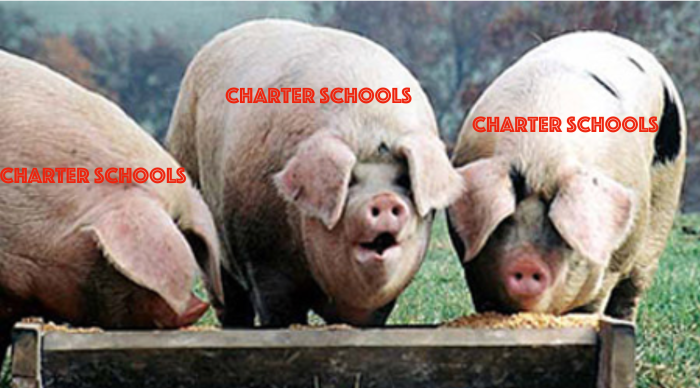
WANT A SIGNED COPY?

Click here to order one directly from me to your door!

book-3