Greater Test Scores Often Mean Less Authentic Learning

Screen Shot 2019-10-04 at 4.25.32 PM

 
The main goal of schooling is no longer learning.


It is test scores.


Raising them. Measuring growth. Determining what each score means in terms of future instruction, opportunities, class placement, special education services, funding incentives and punishments, and judging the effectiveness of individual teachers, administrators, buildings and districts.


We’ve become so obsessed with these scores – a set of discrete numbers – that we’ve lost sight of what they always were supposed to be about in the first place – learning.


In fact, properly understood, that’s the mission of the public school system – to promote the acquisition of knowledge and skills. Test scores are just supposed to be tools to help us quantify that learning in meaningful ways.

 
Somewhere along the line we’ve misconstrued the tool for the goal. And when you do that, it should come as no surprise that you achieve the goal less successfully.


There are two kinds of standardized assessment – aptitude and achievement tests. Both are supposed to measure scholarship and skill – though in different ways.


Aptitude tests are designed to predict how well a student will do in the future. Achievement tests are designed to determine how much a student knows now.


There is, of course, intense overlap between these two types because aptitude tests base their predictions on assessment of achievements. So they’re basically achievements tests that go one step further. They ask questions designed to give more information than just the present state but also about whether a student has progressed to a state which is most likely to then give way to another state in the future.


Either way, standardized assessments are supposed to be based on what students have learned. But the problem is that not all learning is equal.


For example, a beginning chef needs to know how to use the stove, have good knife skills and how to chop an onion. But if you give her a standardized test, it instead might focus on how long to stir the risotto.


That’s not as important in your everyday life, but the tests make it important by focusing on it.


The fact of the matter is that standardized tests do NOT necessarily focus on the most important aspects of a given task. They focus on obscurities – things that most students don’t know.


This is implicit in the design of these exams and is very different from the kinds of tests designed by classroom teachers.


When a teacher makes a test for her students, she’s focused on the individuals in her classes. She asks primarily about the most essential aspects of the subject and in such a way that her students will best understand. There may be a few obscure questions, but the focus is on whether the test takers have learned the material or not.


When psychometricians design a standardized test, on the other hand, they aren’t centered on the student. They aren’t trying to find out if the test taker knows the most important facts or has the most essential skills in each field. Instead, there is a tendency to eliminate the most important test questions so that the test – not the student – will be better equipped to make comparisons between students based on a small set of questions. After all, a standardize test isn’t designed for a few classes – it is one size fits all.


New questions are field tested. They are placed randomly on an active test but don’t count toward the final score. Test takers aren’t told which questions they’ll be graded on and which are just practice questions being tried out on students for the first time. So students presumably give their best effort to both types. Then when the test is scored, the results of the field test questions determine if they’ll be used again as graded questions on a subsequent test.


According to W. James Popham, professor emeritus at the University of California and a former president of the American Educational Research Association, standardized test makers take pains to spread out the scores. Questions answered correctly by too many students – regardless of their importance or quality – are often left off the test.


If 40 to 60 percent of test takers answer the question correctly, it might make it onto the test. But questions that are answered correctly by 80 percent or more of test takers are usually jettisoned.


He writes:


“As a consequence of the quest for score variance in a standardized achievement test, items on which students perform well are often excluded. However, items on which students perform well often cover the content that, because of its importance, teachers stress. Thus, the better the job that teachers do in teaching important knowledge and/or skills, the less likely it is that there will be items on a standardized achievement test measuring such knowledge and/or skills.”


Think about what this means.


We are engaged in a system of assessment that isn’t concerned with learning so much as weeding people out. It’s not about who knows what, but about which questions to ask that will achieve the predetermined bell curve.


We talk about leaving no child left behind, and making sure all students do better on standardized tests, but these tests are norm-referenced. By definition, all students cannot score well no matter how great their knowledge or skills. If you gave a standardized test to a class of genius-level intellects, there would still be the same percentage of failures and outstanding scores with the majority clustered in the middle. That’s how the tests are designed.


And if this highly suspect method of question selection, alone, doesn’t achieve that end, the test companies have a way to correct the scores at the end of the process through the way they grade them.


These tests are graded with cut scores. In other words, the state or the testing company or the graders, themselves, decide anew each year which scores are passing and which failing.


One year a 1200 might be proficient. Another year it’s basic. It all depends on what the decision makers come up with on a given year.


What do they base this on? No one has ever given a definitive answer. In fact, I doubt there is one. In each case, the deciding body just makes it up.


We’ve seen countless times when state scores are criticized for being too low one year, and then they miraculously bounce up the next. It’s not that students score differently, it’s that the cut score was raised. Why? Perhaps to stifle questions about the test’s validity. After all, people are less angry when more students pass.


The goal is always getting the bell curve. That is what validates the tests. But it’s a human construction, not a function of assessment. It says less about the test takers than the test makers and their enablers.


This has huge implications for the quality of education being provided at our schools. Since most administrators have drunk deep of the testing Kool-Aid, they now force teachers to use test scores to drive instruction. So since the tests don’t focus on the most essential parts of Reading, Writing, Math, and Science, neither does much of our instruction.


We end up chasing the psychometricians. We try to guess which aspects of a subject they think most students don’t know and then we teach our students that to the exclusion of more important information. And since what students don’t know changes, we end up having to change our instructional focus every few years based on the few bread crumbs surreptitiously left for us by the state and the testing corporations.


That is not a good way to teach someone anything. It’s like teaching your child how to ride a bike based on what the neighbor kid doesn’t know.


It’s an endless game of catch up that only benefits the testing industry because they cash in at every level. They get paid to give the tests, to grade the tests and when students fail, they get paid to sell us this year’s remediation material before kids take the test again, and – you guessed it – the testing companies get another check!


It’s a dangerous feedback loop, a cycle that promotes artificially prized snippets of knowledge over constructive wholes. But this degradation of education isn’t even the worst part.


The same method of question selection also builds economic and racial bias into the very fabric of the enterprise.


According to Prof. Martin Shapiro of Emory University, when test makers select questions with the greatest gaps between high and low scorers, they are selecting against minorities. Think about it – if they pick questions based on the majority getting it right, which minority got it wrong? In many cases, it’s a racial minority. In fact, this may explain why white students historically do better on standardized tests than black and Hispanic students.


This process may factor non-school learning and social background into the questions. They are based on the experiences of white middle-to-upper class children.


So when we continually push for higher test scores, not only are we ultimately dumbing down the quality of education in our schools, but we’re also explicitly lobbying for greater economic and racial bias in our curriculum trickling down from our assessments.


As Ibram X. Kendi, author of “How to be an Antiracist” puts it:


“Standardized tests have become the most effective racist weapon ever devised to objectively degrade Black minds and legally exclude their bodies.”


71087927_10157069943303860_6347601423106048000_n

Popham is less critical of high stakes testing. He sees more of a problem in using student test scores to assess teacher performance. But even he thinks the tests and the scores are being over valued and misunderstood in a wider context.


He writes:


“Merely because these test scores are reported in numbers (sometimes even with decimals!) should not incline anyone to attribute unwarranted precision to them. Standardized achievement test scores should be regarded as rough approximations of a student’s status with respect to the content domain represented by the test.”


I’d go even further.


Standardized test scores are tools used by big business to make money. That is as far as their validity goes.


And the fact that we make so many vital educational decisions on them is nothing less than criminal.


The tests are bogus nonsense at best and a conspiracy against the poor and minorities at worst.


When well-meaning people let themselves get wrapped up in knots over low scores and what that means for student learning, they are actually hurting the very thing that they value.


Student learning is not bettered by higher test scores. It is often made worse by them.


High test scores don’t mean greater learning. They often mean learning the knowledge du jour to the detriment of what’s really important. They mean biased education against the poor and minorities.


And they make those with real concerns complicit in a sham being perpetrated on our children and our society.


Like this post? I’ve written a book, “Gadfly on the Wall: A Public School Teacher Speaks Out on Racism and Reform,” now available from Garn Press. Ten percent of the proceeds go to the Badass Teachers Association. Check it out!


book-4


Teachers Are More Stressed Out Than You Probably Think

18636260 - young woman in classroom.

 
When I was just a new teacher, I remember my doctor asking me if I had a high stress job.


I said that I taught middle school, as if that answered his question. But he took it to mean that I had it easy. After all – as he put it – I just played with children all day.


Now after 16 years in the classroom and a series of chronic medical conditions including heart disease, Crohn’s Disease and a recent battle with shingles though I’m only in my 40s, he knows better.


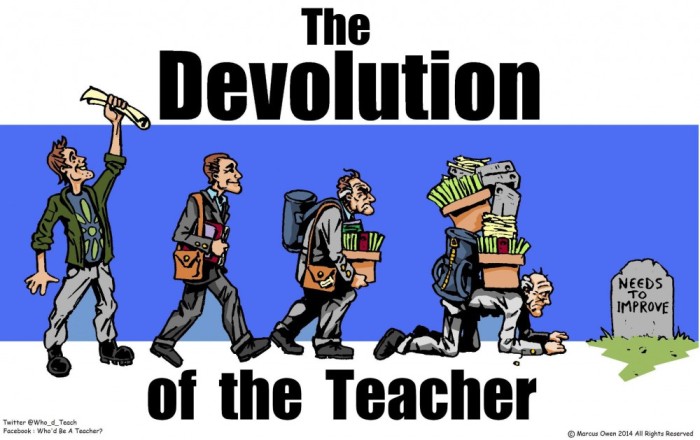
Teaching is one of the most stressful jobs you can have.


You don’t put your life on the line in the same way the police or a soldier does. You don’t risk having a finger chopped off like someone working in a machine shop. You don’t even have to worry like a truck driver about falling asleep and drifting off the road.


But you do work a ridiculous amount of hours per day. You lose time with family, children and friends. And no matter how hard you work, you’re given next to no resources to get it done with, your autonomy is stripped away, you’re given mountains of unnecessary bureaucratic paperwork, you’re told how to do your job by people who know nothing about education, and you’re scapegoated for all of society’s ills.


Not to mention that you’re expected to buy supplies for your students out of your own pocket, somehow magically raise student test scores but still authentically teach, convince parents not to send their children to the local fly-by-night charter or voucher school and prepare for an unlikely but possible school shooter!


Oh! And the pay isn’t competitive given the years of schooling you need just to qualify to do the work!!


That causes a mighty amount of stress.


One in five teachers (20%) feels tense about their job most or all of the time, according to an analysis by the National Foundation for Educational Research (NFER) in England. In similar professions, only one in eight feel this way (13%).


But those are conservative estimates.


A representative survey of more than 4,000 educators conducted in 2017 by the American Federation of Teachers (AFT) and the Badass Teachers Association (BATs) found even more stark results.


Educators and school staff find their work “always” or “often” stressful 61 percent of the time. Workers in similar professions say that their job is “always” or “often” stressful only 30 percent of the time.


That kind of tension among teachers has consequences. More than half of educators reported that they have less enthusiasm now than at the beginning of their careers.


One respondent commented:


“This job is stressful, overwhelming and hard. I am overworked, underpaid, underappreciated, questioned and blamed for things that are out of my control.”

WORK LOAD


The most obvious cause of teacher stress is the workload.


Though the details vary slightly from study to study, the vast majority highlight this as the number one factor.


The NFER study concluded that teachers work longer hours than people in other professions though a less number of official days. This is because of the school year – classes meet for about 9-10 months but require far more than 40 hours a week to get everything done. In fact, teachers are putting in a full years work or more in those limited days.


For instance, an average American puts in about 260 days at work a year. Teachers average 70 less days but do the same (or more) hours that other employees put in during the full 260 days. But teachers are only paid for 190 days. So they do roughly the same amount of work in a shorter time span and are paid less for it. The result is a poor work-life balance and higher stress levels.


But exactly how many hours do teachers routinely work? It depends on who you ask.


The University College London Institute of Education estimates that one in four teachers works 60 hours a week or more – a figure that has remained consistent for the past 25 years.


According to NFER, teachers work an average of 47 hours a week, with a quarter working 60 hours a week or more and one in 10 working more than 65 hours a week.


Four in 10 teachers said they usually worked in the evenings, and one in 10 work on weekends.


Both of these studies refer to British teachers but estimates are similar for teachers in the United States.


The Organization for Economic Co-operation and Development (OECD) reports that teachers in both countries are among those who work the most hours annually. The average secondary teacher in England teaches 1,225 hours a year. The average secondary teacher in the United States teaches 1,080 hours a year. Across the OECD, the average for most countries is 709 hours.


Finally, a study focusing just on US teachers by Scholastic, found that educators usually work 53 hours a week. That comes out to 7.5 hours a day in the classroom teaching. In addition, teachers spend 90 minutes before and/or after school mentoring, tutoring, attending staff meetings and collaborating with peers. Plus 95 additional minutes at home grading papers, preparing classroom activities and other job-related tasks.


And teachers who oversee extracurricular clubs put in an additional 11-20 hours a week.


No matter how you slice it, that’s a lot of extra hours.


According to the NFER study, two out of five teachers (41%) are dissatisfied with their amount of leisure time, compared to 32% of people in similar professionals.


This is a prime factor in the exodus of trained professionals leaving the field in droves, sometimes miscalled a teacher “shortage.”


It’s why one in six new teachers leave the profession after just a year in the classroom.


SALARY


Another contributing factor is salary.


Teacher pay in the United States (and many other countries) is not competitive for the amount of training required and responsibilities put on employees.


According to the Economic Policy Institute, teachers in the United States make 14 percent less than people from professions that require similar levels of education.


Sadly, it only gets worse as time goes on.


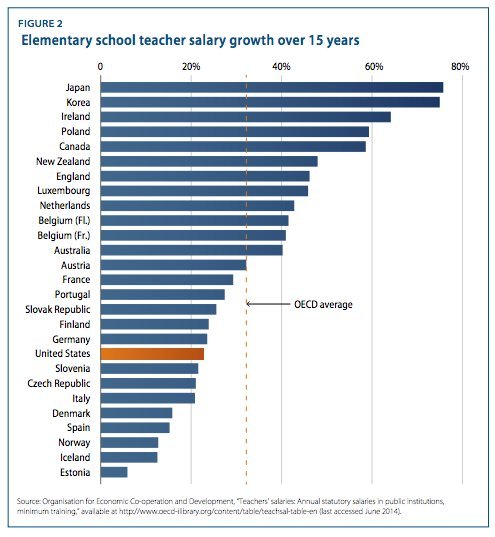
Teacher salary starts low, and grows even more slowly.


original


According to a report by the Center for American Progress, on average teachers with 10 years experience only get a roughly $800 raise per year. No wonder more than 16 percent of teachers have a second or third job outside of the school system. They simply can’t survive on the salary.


They can’t buy a home or even rent an apartment in most metropolitan areas. They can’t afford to marry, raise children, or eke out a middle class existence.


BACK TO WORKLOAD


This mixture of refusing to pay teachers what they’re worth and expecting them to do more-and-more with less-and-less is unsustainable.


Today’s public schools employ at least 250,000 fewer people than they did before the recession of 2008–09. Meanwhile enrollment has increased by at least 800,000 students.


So if we wanted our kids to have the same quality of service children received in this country only a decade ago, we’d need to hire almost 400,000 more teachers!


That’s how you cut class size down from the 20, 30, even 40 students packed into a room that you can routinely find in some districts today.


The fact that we refuse to invest in our schools only increases the workload of the teachers who are still there. They look around and see students in desperate need and have to choose between what’s good for them, personally, and what’s good for their students.


THAT’S why teachers are working so many unpaid hours. They’re giving all they have to help their students despite a society that refuses to provide the necessary time and resources.


And make no mistake, one of those resources is having enough teachers to get the job done.


RESPECT


For a lot of teachers, the issue boils down to respect – lack of it.


Teachers are expected to do everything and then denigrated when they can’t accomplish miracles every single day.


The fact is teachers are extremely important – the most important in-school factor for student success.


However, that doesn’t make them the most important factor in the entire learning process.


Roughly 60% of academic achievement can be explained by family background – things like income and poverty level. School factors only account for 20% – and of that, teachers account for 15%. (see Hanushek et al. 1998; Rockoff 2003; Goldhaber et al. 1999; Rowan et al. 2002; Nye et al. 2004).


Estimates vary somewhat from study to study, but the basic structure holds. The vast majority of impact on learning comes from the home and out-of-school factors. Teachers are a small part of the picture. They are the largest single factor in the school building, but the school, itself, is only one of many components.


The people who know teachers the best—parents, co-workers and students—show much more respect for teachers than elected officials and media pundits, many of whom rarely set foot in a classroom, according to the 2017 BATs and AFT Quality of Work Life Survey.


While educators feel most respected by their colleagues, they also indicated that their direct supervisors showed them much more respect than their school boards, the media, elected officials and U.S. Secretary of Education Betsy DeVos. A total of 86 percent of respondents did not feel respected by DeVos.


Most educators said they felt like they had moderate to high control over basic decisions within their own classrooms, but their level of influence and control dropped significantly on policy decisions that directly impact their classroom – such as setting discipline policy, performance standards and deciding how resources are spent.


“This lack of voice over important instructional decisions is a tangible example of the limited respect policymakers have for educators,” the report concluded.


Sometimes this lack of respect leads to outright bullying.


A total of 43 percent of respondents in the public survey group reported having been bullied, harassed or threatened at work in the last year. Of these reports, 35% included claims of having been bullied by administrators, principals or supervisors, 23% by co-workers, 50% by students, 31% by students’ parents. Many claimed to have been bullied by multiple sources.


This is a much higher rate of bullying, harassment and threats than workers in the general population.


I, myself, have experienced this even to the point of being physically injured by students multiple times – nothing so serious that it put me in the hospital, but enough to require a doctor’s visit.


And to make matters worse, one-third of respondents said that teachers and faculty at their schools did not felt safe bringing up problems and addressing issues.


CONCLUSIONS


Teacher stress is a real problem in our schools.


If we want to provide our children with a world class education, we need to look out for the educators who do the actual work.


We need to drastically reduce the workload expected of them. We need to hire more teachers so the burden can be more adequately sustained. We need to increase teacher salary to retain those already on the job and to attract the most qualified applicants in the future. We need to stop blaming teachers for every problem in society and give them the respect and autonomy they deserve for having volunteered to do one of the most important jobs in any society. And we have to stop bullying and harassing them.


As a nation, our children are our most valuable resource. If we want to do what’s best for the generations to come, we need to stop stressing out those brave people who step up to guide our kids into a brighter tomorrow.


devolution-of-the-teacher-e1415308983284


Like this post? I’ve written a book, “Gadfly on the Wall: A Public School Teacher Speaks Out on Racism and Reform,” now available from Garn Press. Ten percent of the proceeds go to the Badass Teachers Association. Check it out!
thumbnail_IMG_8249

The Absurdity of Standardized Testing: Caught Between Prediction and Assessment

thumbnail_Screen Shot 2019-09-19 at 2.07.03 PM

 
Standardized testing is truly absurd.

 
It’s both a prediction and an assessment.


You take a test to determine what you’ve learned and that will in turn predict what you will be able to learn in the future.


We hardly ever do this anywhere else in life.


We don’t measure babies’ leg muscles to predict whether they’re ready to walk. We let them do what they do, possibly with some encouragement and positive models of locomotion, and they do it.


There are cognitive and developmental benchmarks we look for, and if children don’t hit them, we provide help. But no further prediction is necessary – certainly not based on artificial markers put together by corporate interests.


In most situations, predictions are superfluous. We just assume that everyone can learn if they so desire – unless something happens to make us think otherwise. And whether someone actually learns something is demonstrated by doing the thing, itself.


The only time we link prediction and assessment so closely is when the consequences of failure are irreversible – like when you’re going solo skydiving for the first time. If you jump out of an airplane and don’t know how to pull the ripcord to get your parachute to work, you probably won’t get a second chance to try again.


But most things in life aren’t so dire.


The world of standardized testing is very different. The high stakes nature of the assessments are what ramp out the consequences and thus the severity.


Testing looks at learning like two points on a map and sets up a gate between points A and B.


In order to cross, you have to determine if you’ve passed through the previous gate. And only then can you be allowed to progress on to point C.


But this is wrong on so many levels.


First, you don’t need a test to determine which point you’re at. If Point B is the ability to add, you can simply add. If it’s the ability to write a complete sentence, you can simply write a sentence.


There is no need to fill out a formal multiple-choice assessment that – depending on the complexity of the task being considered – is completely inadequate to capture the subtleties involved. The task, itself, is enough.


Imagine if you were testing whether someone had learned how to drink a glass of water. You could just give them a cup filled with H2O and see if they can gulp it down. Or you could have them sharpen their number 2 pencil and answer questions about how their throat works, their digestive and excretory systems and the chemical composition of agua – all answers predetermined to A, B, C or D.


Observation of a skill, we are told, is not enough to determine success because it relies on the judgment of an observer. A standardized test replaces the observer with an impersonal, distant testing corporation which then assesses only predetermined markers and makes decisions devoid of any situational context.


This is done to remove observational bias but it doesn’t avoid bias altogether. In setting up the markers and deciding which elements of the task are to be assessed (or in fact can be assessed in such a distant manner), the testing corporation is inserting its own biases into the process. In fact, in any assessment conducted by human beings, this would be inevitable. So going through this maze of perceived objectivity is really just a matter of subterfuge meant to disguise the biases of the corporation.


Second, assessing people in this way is extremely unnatural because very few fields of knowledge can be divided and subdivided into two or more discrete points.


When writing a complex sentence, for example, you need to know not just spelling and grammar but logic, handwriting, subject matter, colloquialisms, literary devices, and a plethora of other cultural and linguistic artifacts.


Moreover, there is not always a natural progression from Point A to B to C. Sometimes A jumps directly to C. Sometimes B leads directly to A. Sometimes A leads to Z.


Knowledge, skills and human cognition are far too complex a web to ever hope to be captured by such a reductive enterprise. But by insisting that we make this complexity fit into such a small box, we end up depriving people of the right to move on. We say predictive models show they aren’t ready to move forward and so we bury them in remediation. Or we deny them access to important opportunities like advanced classes, electives, field trips, extracurricular clubs or even post-secondary education.


Third, this emphasis on knowledge as discrete bits of information or skills (often called standards) leads to bad teaching.


Assessment expert W. James Popham provides a helpful distinction: “curriculum teaching” vs. “item teaching.” Curriculum teachers focus on the full body of knowledge and skills represented by test questions. For instance, if the test is expected to include questions about decimals, the teacher will cover the full range of knowledge and skills related to decimals so students understand what they are, know how to manipulate them, understand how to use them to solve more complex problems, and are able to communicate about them.


By contrast, item teaching involves narrowing instruction, organizing lessons around look-a-like questions that are taken directly from the test or represent the kinds of questions most likely to be found on the test. In this way, the teacher only provides the chunks of knowledge students are most likely to encounter on exams. For instance, item teachers might drill students on a certain set of vocabulary words that are expected to be assessed rather than employing instructional strategies that help students build a rich vocabulary that best contributes to strong reading comprehension.


A focus on standardized testing or even trying to educate in a system where these tests are attached to high stakes, results in an increase in item teaching. We often call it teaching to the test.


I’m not saying that item teaching is always bad. But curriculum teaching is to be much preferred. It is a best practice. The problem is when we resort to endless drills and give students innumerable questions of the exact type we expect to be on the test.


So when we find students who have made dramatic improvements on standardized tests, we often don’t find equal improvements in their over all knowledge or ability.


Test scores are often a false positive. They show students have mastered the art of taking the test but not necessarily the knowledge or skills it was meant to assess.


They are more like trained circus animals who can jump through flaming hoops but would be lost in the wild.


That’s why certain computer modeled artificial intelligences are able to pass standardized tests but would fail preschool.


These reflections have troubling implications for our system of standardized testing.


The false curtain of objectivity we’ve set up in our assessments may also be hiding from us what authentic learning is taking place and it may even hinder such learning from taking place at all.


Any sane society would halt such a system with these drawbacks. It would stop, regroup and devise a better alternative.


To continue with such a pedagogical framework truly would be the most absurd thing of all!


Like this post? I’ve written a book, “Gadfly on the Wall: A Public School Teacher Speaks Out on Racism and Reform,” now available from Garn Press. Ten percent of the proceeds go to the Badass Teachers Association. Check it out!
book-2

Charter Schools Were Never a Good Idea. They Were a Corporate Plot All Along

Screen Shot 2019-09-14 at 6.02.02 PM


America has been fooled by the charter school industry for too long.


The popular myth that charter schools were invented by unions to empower teachers and communities so that students would have better options is as phony as a three dollar bill.


The concept always was about privatizing schools to make money.


It has always been about stealing control of public education, enacting corporate welfare, engaging in union busting, and an abiding belief that the free hand of the market can do no wrong.


Charter schools are, after all, institutions run privately but paid for with tax dollars. So operators can make all decisions behind closed doors without public input or accountability. They can cut student services and pocket the difference. And they can enroll whoever the heck they want without providing the same level of education or programs you routinely get at your neighborhood public school.


In essence, charter schools are a scheme to eliminate the public from public education paid for at public expense.


But whenever anyone brings up these facts, they are confronted by the bedtime story of Albert Shanker and his alleged advocacy of the industry.

 
So grab your teddy bear and put on your jammies, because here’s how it goes:

 
Once upon a time, hero president of the American Federation of Teachers (AFT) Al Shanker had an idea. He wanted to make laboratory schools where educators would be freed of regulations so they could experiment and find new pedagogies that worked. Then these innovations could spread to the rest of the school system.


One day in 1988, he gave a speech at the National Press Club and subsequently published a column in the New York Times advancing this idea.


And he called it – Dum, Dum, DUM! – charter schools!
The second act of the story opens in the mid-1990s when Shanker had largely turned against the idea after it had been co-opted by business interests.


He dreamed of places where unionized teachers would work with union representatives on charter authorizing boards, and all charter proposals would include plans for “faculty decision-making.” But instead he got for-profit monstrosities that didn’t empower workers but busted their unions.


If only we’d stuck with Shanker’s bold dream!


Or at least, that’s how the story goes.


Unfortunately it’s just a story.


It’s not true. Hardly a word of it.


Shanker did not come up with the idea of charter schools. He wasn’t part of the plan to popularize them. He didn’t even come up with the term “charter school.”


If anything, he was a useful patsy in this stratagem who worked tirelessly to give teachers unions a seat at the table where he then discovered they were also on the menu.


The real origin of charter schools goes back decades to at least the 1950s and the far right push for deregulation.


When the afterglow of the atomic bomb and the allied victory in Europe had faded, there was political backlash at home to roll back the amazing economic successes of the New Deal. Social security, strong banking regulations, deposit insurance, a minimum wage, job programs that put millions of people to work – all of that had to go in favor of right wing ideology.


A cabal of mostly wealthy, privileged elites wanted to do away with these policies in the name of the prosperity it would bring to themselves and their kind. They claimed it would be for the good of everyone but it was really just about enriching the already rich who felt entitled to all economic goods and that everyone else should have to fight over the crumbs.


Never mind that it was just such thinking that burst economic bubbles causing calamities like the Great Depression in the first place and made the conditions ripe for two world wars.


Show me the money!


However, this really didn’t go anywhere until it was combined with that most American of institutions – racism.


Even before the Supreme Court’s 1954 Brown vs. Board decision struck down school segregation, many white people said they’d never allow their children to go to school with black children.


In the South, several districts tried “freedom of choice” plans to allow white kids to transfer out of desegregated schools.


In 1952 and ’57, governments in two states – Georgia and Virginia – tried out what became known as the “private school plan.” Georgia Gov. Herman Talmadge and community leaders in Prince Edward County, Virginia, tried to privatize public schools to avoid any federal desegregation requirements. Each student would be given a voucher to go to whatever school would enroll them – segregated by race.
The plan was never implemented in Georgia and struck down by the federal government in Virginia after only one year as a misuse of taxpayer funds.


But these failed plans got the attention of one of the leading deregulation champions, economist Milton Friedman.


He sided with the segregationists citing their prejudice and racism as merely “market forces.”


In his seminal 1955 tract, “The Role of Government in Education,” he wrote:


“So long as the schools are publicly operated, the only choice is between forced nonsegregation and forced segregation; and if I must choose between these evils, I would choose the former as the lesser. Privately conducted schools can resolve the dilemma … Under such a system, there can develop exclusively white schools, exclusively colored schools, and mixed schools.”


Throughout the 1970s, school voucher proposals were widely understood as a means to preserve school segregation, according to education historian Diane Ravitch. But they couldn’t gain any traction until privatizers came up with a new wrinkle in the formula – the charter school.


Charter schools are really just school vouchers with more money and regulations.


In the case of vouchers, we use tax dollars to pay for a portion of student enrollment at private and parochial schools. In the case of charters, we use tax dollars to pay for all of a student’s enrollment at a school that is privately managed. The only difference is how much taxpayer money we give to these privatized schools and how much leeway we give them in terms of pedagogy.


Charter schools can do almost whatever they want but they can’t blatantly teach religion. Voucher schools can.


Other than that, they’re almost the same thing.


In order to get the public to support school privatization, Friedman thought we’d need to convince them that they didn’t need the burden of self-government. This was especially true of minorities.


In his 1981 book Free to Choose, Friedman and his wife Rose suggested the necessity of convincing black voters that they didn’t need Democracy. School privatization could be pitched as a system that would “free the black man from dominion by his own political leaders.”


The opportune moment came in 1983 with the publication of the Reagan administration’s propaganda piece A Nation at Risk. Using bogus statistics and outright lies, the report painted our public school system as a failure and set up the false urgency that school deregulationists needed.


From this point forward, a series of supply side lawmakers, policy wonks, economists, billionaires and CEOs came out of the woodwork to push for school privatization which culminated in the first charter school law in 1991 in Minnesota.


In the middle of all this tumult came Shanker’s National Press Club speech in 1988.


Ronald Reagan was still in office and it’s hard to overstate the threat he posed to unions having infamously fired more than 11,000 striking air traffic controllers.


Shanker was trying to ride the tide of public opinion in favor of deregulation and privatization. He accepted the bogus criticisms of schools in A Nation At Risk and offered to restructure schools to fix the problem. Like so many union leaders after him, Shanker gave away much of the power of his people-driven movement so as not to come across as obstructionist. He didn’t think teachers unions could oppose the rising tide of privatization without offering innovations of their own.


It’s true that he called these reforms “charter schools” but he didn’t invent the term. He borrowed it from a little-known Massachusetts educator, Ray Budde, who meant by it something very different from what it has become. Budde thought school boards could offer “charters” directly to teachers allowing them to create new programs or departments.


Shanker’s proposal wasn’t nearly the first time a public figure had suggested restructuring public schools.


In the late 1960s after helping provide justification for school desegregation, sociologist Kenneth Clark advocated for alternative school systems that could be run by groups as diverse as universities to the Department of Defense.


Shanker’s contribution was not nearly as powerful as subsequent apologists have claimed. He was one voice among many. Though his comments were useful to the deregulators, they ignored everything of substance he had said beyond the myth that he supported their efforts at school privatization.


According to journalist Rachel Cohen, the true architect of the charter school concept as it appears today wasn’t Shanker, Budde or Clark. It was Minnesota “policy entrepreneur” Ted Kolderie.


He was at the heart of the issue pushing for school privatization from the 1970s through the 1990s.


Throughout the 1970s, Kolderie lobbied for a plethora of ways for private industry to provide government services – including education – through an initiative known as Public Service Options (PSO). By 1981, the focus narrowed almost exclusively to education.


In several reports, he blamed the bogus failure of public schools on the democracy of the school boards. Though he didn’t use the term “charter school,” his conception was essentially the same as the modern charter school: independent schools accountable only through market forces and a set of contractual obligations. He thought they could be run by almost anyone – universities, corporations, nonprofits— even public school districts – if state law could be amended to allow it.


That’s pretty much a charter school – a privately run learning institution that’s publicly financed.


Why doesn’t Kolderie get the credit? Why the emphasis on Shanker who had very little to do with what ultimately became law?


Because Kolderie and others wanted to hide behind the union. They wanted their policy to have a friendlier public image than that of a shadowy puppet master.


Shanker walked right into their trap.


He even agreed to give another speech in favor of charter schools in October 1988 at the Minneapolis Foundation’s annual Itasca Seminar for political and business leaders.


With continued lobbying from the corporate sector and right wing ideologues, three years later the state was the first to pass a charter school law.


And the die was cast.


Sure charter school cheerleaders like to give Shanker the credit today, but the legislation that was eventually passed and funneled to other states through the American Legislative Exchange Council (ALEC) had little resemblance to anything Shanker said.


It was the deregulation and privatization model first conceived in the 1950s, funneled through Friedman and now Kolderie.


And make no mistake – the overall plot wasn’t simply to enact charter schools. That was merely the foothold that enabled subsequent school voucher bills and tax scholarship plans (vouchers lite). The end game was made clear by Friedman time and again – the complete destruction of public schools.


While speaking to rightwing lawmakers at a 2006 ALEC meeting, Friedman explained that school privatization was always about “abolishing the public school system.”


Here is an excerpt from Friedman’s ALEC speech:


“How do we get from where we are to where we want to be—to a system in which parents control the education of their children? Of course, the ideal way would be to abolish the public school system and eliminate all the taxes that pay for it. Then parents would have enough money to pay for private schools, but you’re not gonna do that. So you have to ask, what are politically feasible ways of solving the problem. The answer, in my opinion, is choice…”

When Minnesota proposed the first charter school law, the state teachers union fought against it. But tellingly Shanker refused to speak out during legislative debates.


And this was due in part to the rise of the neoliberals.


School privatization was the brainchild of the far right. But as the ‘80s gave way to the ‘90s, so dawned a new type of political figure – the social progressive with distinctly right wing economic views.


In 1989 when the Democratic Leadership Council (DLC) named Bill Clinton as chairman, it also founded its own think tank—the Progressive Policy Institute. Kolderie worked closely with the DLC and even wrote its first policy paper on school privatization.


Clinton was an immediate convert, embracing Kolderie’s proposals as he traveled around the country making speeches even though he knew it was unpopular with teachers unions. Clinton ruffled so many feathers that Shanker, himself, commented, “It is almost impossible for us to get President Clinton to stop endorsing [charters] in all his speeches.”


Though the first charter school law came a year later, in 1990 Wisconsin passed the first school voucher program. Since it was pushed through with mostly Republican support, this provided cover for neoliberal charter supporters. Though there was little difference between the two policies, neoliberals could distinguish themselves by criticizing school vouchers while endorsing their ideological cousins the charter schools.


So we had the two major political parties both supporting different flavors of the same school privatization.


It allowed Democrats to stop supporting more funding for social programs and schools while weakening the main driver of such policies – labor unions. This allowed the neoliberals to be economically as conservative as their “adversaries” across the aisle while publicly pretending to support progressivism.


Today, there are charter schools in 43 states and the District of Columbia educating nearly three million students.


This does not now – and never did – represent any ideal offered by Shanker or unions.


His dream of teacher-run schools as laboratories of innovation may or may not have merit, but not at the expense of making different rules for different schools. Where regulation is important, it is important for all schools. Where it is too restrictive, all schools should be freed from its requirements. All teachers should be allowed to innovate and take a leadership role in their schools.


When Shanker spoke about “charter schools,” he was not a visionary. He was leading us down a dead end. He was foolishly offering an olive branch to an inferno. That doesn’t mean he started the blaze or even that it was his idea.


Yet even now you can read propaganda that says otherwise on the AFT’s own Website – “Restoring Shanker’s Vision for Charter Schools” by Richard D. Kahlenberg and Halley Potter. It’s funny how Potter, a former charter school teacher, and Kahlenberg, a senior fellow at the Century Foundation – which loves charter schools – both want to keep the happy face on an ugly idea. And sad that one of the largest teachers unions can’t face up to one of its heroes biggest mistakes.


If charter schools have a face, it should be Kolderie’s or Friedman’s – or perhaps it should be the industry’s most famous modern champion Betsy Devos.
Charter schools are no progressive dream.


They are the corporate paradise of spending tax dollars with zero accountability, zero transparency and as much deregulation as possible. They are the continued destabilization of public education in the knowledge that the edifice cannot stand without support indefinitely.


Public education will crumble and fall just as the architects of school privatization always knew it would.


Unless we take a stand and take back our power.


To do that we need to understand where charter and voucher schools came from and who is responsible.


Charter schools do NOT represent a good idea that was perverted by the corporate world. It is an essentially bad policy that should be abolished immediately.


NOTE: This article owes a debt to the reporting of Rachel Cohen.


Like this post? I’ve written a book, “Gadfly on the Wall: A Public School Teacher Speaks Out on Racism and Reform,” now available from Garn Press. Ten percent of the proceeds go to the Badass Teachers Association. Check it out!

thumbnail_IMG_8249

Inside Bill Gates’ Hubris: Propaganda to Make America Neoliberal Again

Screen Shot 2019-08-31 at 11.16.53 PM

 
Once upon a time, the world was run by rich men.


And all was good.


But then the world was conquered by other rich men.


And that is something the first group of rich men could not allow.


That is the reason behind Netflix’s new film “Inside Bill’s Brain: Decoding Bill Gates.”


The three-part documentary goes live on Sept. 20. But the film’s aims are clear from the trailer.


It’s a vanity project about Bill Gates, the second richest man in the world.
By examining his mind and motivations, director and executive producer Davis Guggenheim will show us how Gates deserves his billionaire status and that we should allow him to use his philanthrocapitalist ventures to rule the world.


After all, shouldn’t the best and richest among us make all the decisions?


It’s a cry for oligarchy in an age of idiocracy, a love letter to neoliberalism in a time of neofascism.


The pity is that Donald Trump and the “Make America Great Again” crowd have goose stepped all over their new world order.


But instead of showing the world why we need to return to democratic principles, strengthen the common good and empower the people to govern themselves, some would rather continue the same plutocracy just with a different set of plutocrats at the wheel.


In the days of Obama, the Bushes and Clinton, it wasn’t membership in the same political party that defined the ruling class. It was holding the same ideology.


It’s not that neoliberals were so much wiser, ethical or empathetic than Trump. They just kept their greed a secret or tried to make it seem a virtue. They told better lies and didn’t incite as much violence on our shores, and they were better at manipulating markets to make themselves richer while keeping the rest of us relatively poorer.


The MAGA insurgents are also rich men, but their greed is transparent. They lie and no one expects them to tell the truth. They can freely dismantle the social safety net because they stoke our prejudices and keep us fighting over race, gender and abortion so much we forget they’re robbing us blind. And when the market crashes, they don’t have to care because they’ve stolen everything of value and can weather the economic depression that will destroy the nation.


Neofacism is certainly worse – but it’s only a difference of degree, not of kind.


It’s no wonder then that the neoliberals want to make us nostalgic for their brand of simmering destruction instead of Trump’s rapid boil disasters.


And Gates is the perfect poster child for old style neoliberalism.


He’s the former CEO of Microsoft and – together with his wife – the founder of the Bill and Melinda Gates Foundation.
In the trailer, Gates confides that his deepest fear is that one day his brain will “stop working.”


Gates is a “multiprocessor” says his wife Melinda. “He will be reading something else but then processing at the same time. It’s chaos!”


Gates “thrives on complexity,” Melinda says. “He makes a framework in his mind, then he starts slotting in the information. If something doesn’t line up, he gets really frustrated.”


“It’s scary,” says Melinda. “But when Bill stills himself, he can pull ideas together that other people can’t see.”


Thus we gain a picture of a brilliant man striding over a world populated by intellectual inferiors. How foolish we would be to question his authority!


And since his intelligence has enabled him to hoard more money than almost anyone else in the world, why shouldn’t we let him use this economic power to change it for our benefit?


It’s truly one of the most patronizing, paternal and insulting pieces of propaganda I’ve ever seen in my life. And that includes Guggenheim’s previous movies.


Guggenheim is, after all, the man behind the most notorious propaganda film of modern times, “Waiting for Superman.” Back in 2010, he popularized the school privatization of Bill Clinton, George W. Bush and Barack Obama. He made charter schools cool until Betsy DeVos came along and made them uncool again.

 
Though I can’t imagine what could possibly be cool about for-profit schools run by appointed bureaucrats that can discriminate against students in enrollment, skimp on special education services and cut academic programs for students while pocketing the savings! All while gobbling up funding for the public schools that try to educate everyone!

 
More recently, he tried to pull the same sleight of hand for education technology firms in 2013 with the film “Teach,” but by then no one was really paying attention to him.


And for all that time his ventures have been backed by the richest neoliberals out there – Netflix CEO Reed Hasgtings, Amazon founder and CEO Jeff Bezos, eBay founder Jeff Skoll, and Salman Khan of Khan Academy.


Sure these folks are usually identified as Democrats, but their philosophy is completely in line with The Walton Family Foundation, Charles Koch, Walden Media (run by creationist Philip Anschutz), and lobbying groups such as the Lumina Foundation, the New American Foundation, and others.


Oh! And let’s not forget Bill Gates, himself, who has bankrolled a number of Guggenheim’s projects including “Waiting for Superman.”


It’s no wonder Guggenheim is making a fawning tribute to Gates. He owes the man!


It’s time to pay back his sugar daddy with what he does best – agitprop public relations.


Yes, Gates is a very intelligent person.


But he is also a very stupid one.


When it comes to computers, few people can beat him. But like so many overprivileged people, he takes excellence in one area to mean excellence in all areas.


And that’s just not how things work.


The ancient Greek philosopher Socrates famously bragged that he was the wisest person in Athens – not because he knew so much more than everyone else but because he was the only person who knew that he didn’t know anything.


Gates could have learned something from that humility, because it’s the trait he is most lacking.


Take public education.


No one has had a greater negative impact on public schools than Gates. With his so-called philanthropic contributions, he has steered the course of education policy away from research-based pedagogy to a business-minded approach favored by corporate raiders.

 
He didn’t come up with Common Core State Standards, but he did bankroll them. He bribed the state and federal government to force their schools to adopt the same or similar academic standards for all students. Not good standards. Not standards developed by classroom teachers, psychologists or experts. But standards created by the standardized testing industry.


The result has been more high stakes standardized tests, narrowing the curriculum, shrinking education budgets for the poor and minorities, and an increase in developmentally inappropriate approaches to education. Nearly every parent with a school age child will tell you horror stories of attempting to do homework with their children and having to relearn basic math and English skills just to untwist the needlessly complex knot that children are expected to unsnarl in order to grasp the bare basics of academia.


Gates poured billions of dollars into that failed initiative, spent hundreds of millions of dollars for development and promotion and influenced trillions of taxpayer dollars to be flushed down the drain on it. All to no avail.


But it’s not his only education policy failure.


Gates now admits that the approximate $2 billion he spent pushing us to break up large high schools into smaller schools was a bust.

 
Then he spent $100 million on inBloom, a corporation he financed that would quietly steal student data and sell it to the corporate world. However, that blew up when parents found out and demanded their children be protected.


He also quietly admits that the $80 million he spent pushing for teachers to be evaluated on student test scores was a mistake. However, state, federal and local governments often still insist on enacting it despite all the evidence against it. Teachers have literally committed suicide over these unfair evaluations, but it hasn’t stopped Gates from continuing to experiment on the rest of humanity with his money.


And he’s still at it.


His new plan has been to spend $1.7 billion over five years to develop new curriculums and networks of schools, use data to drive continuous improvement, and give out grants to high needs schools to do whatever he says.


There’s nothing wrong with someone wanting to help improve public schools. But the best way to do that is to listen to the people most knowledgeable and invested and then give them the tools they need to succeed.


But Gates doesn’t play that way. He reads up on a subject and then comes up with his own harebrained schemes.


“It would be great if our education stuff worked, but that we won’t know for probably a decade,” he said during a speech at Harvard in 2014.


Lots of people know, Bill. Teachers, students, parents, psychologists, professors. You just won’t listen to us.


You just insist the rest of us listen to you despite the fact that you have no idea what you’re talking about.


You’re rich and you think that makes you better than us.


And Guggenheim’s documentary purports to support this position by reference to Gates’ incredible brain.

He is a smart guy. No one would really contradict it.


He was a National Merit Scholar who scored a 1590 out of 1600 on his SATs. But he also comes from a very privileged upbringing.


He didn’t grow up on the mean streets of urban America while attending a neighborhood public school. He went to an elite preparatory school since he was 13.


At Harvard he wasn’t a polymath. He excelled in subjects he cared about, but neglected others that weren’t immediately interesting. According to a college friend:


“Gates was a typical freshman in many ways, thrown off pace by the new requirements and a higher level of competition. He skipped classes, spent days on end in the computer lab working on his own projects, played poker all night, and slept in a bed without sheets when he did go
 to bed. Other students recall that he often went without sleep for 18 to 36 hours.”


Gates was no genius. He earned good grades in the subjects he liked and significantly less so in classes he didn’t. Nor was his heart in his studies. Gates joined few college activities unless someone dragged him off to a party.


School was of little interest to him. He dropped out of Harvard before getting a degree to start his computer software company.


Imagine how privileged you have to be to feel empowered to do that!


Nothing much was at stake for him at school so he could do whatever he liked with little to no real life consequences.


You want to decode Bill’s brain? Look at his family’s wealth. Look at his upbringing. Look at his medical records.


But the moral of the story of Bill Gates is not that rich elites should rule the world.


It is that everyone – EVERYONE – should practice humility and not deign to think they have all the answers.


It is a paean to the need for collaboration to solve problems, the need to listen to all voices and decide the best course together.


And more than anything it is a desperate cry for democracy and social goods – not to defeat Trump through Gates’ example – but to lead to real human flourishing by smashing through the fallacies supporting Trump and Gates together.


Like this post? I’ve written a book, “Gadfly on the Wall: A Public School Teacher Speaks Out on Racism and Reform,” now available from Garn Press. Ten percent of the proceeds go to the Badass Teachers Association. Check it out!

book-2

What Kind of A—hole Ransoms School Data?

Screen Shot 2019-08-28 at 10.47.05 PM

 
You’ve got to be a grade A sleaze bag to steal from kids’ public schools.


But that’s exactly what a growing number of slime balls are doing when they hack into schools’ computer networks and hold their data for ransom.


Even worse – districts are paying it!


Just this week the Rockville Center School District in New York state paid an $88,000 ransom to get back files that had been encrypted by Ryuk ransomware.


The district negotiated the payment down from $176,000. School directors only decided to pay after realizing it would cost more to hire another firm to fix the problem.


Plus the school had insurance that covered ransomware so it only ended up losing its $10,000 deductible.


But this district isn’t the only one being extorted by these basement dweller bandits.


In July, alone, schools in New Mexico, Nevada, Louisiana, Oklahoma, Alabama, Connecticut and another in New York suffered similar cyber attacks.


Nor do they show any signs of slowing down.


A report by cybersecurity firm Recorded Future concluded that attacks on state and local governments have reached an all time high. There were 170 cyber attacks since 2013, of which 22 occurred just this year.


After years of budget cuts and downsizing, hackers see local governments like wolves see the oldest and weakest animals in the herd – easy pickings.


And schools are particularly vulnerable.


They often have small IT departments, antiquated equipment and the cheapest cybersecurity.


That’s why in recent months schools in Lake City, Fla.; La Porte County, Indiana; and Riviera Beach, Fla. have all paid ransoms to regain access to their data.


If you think about it, data is one of the most financially valuable things schools have.


Districts are responsible for students’ privacy in so many ways – records of special services, grades, accommodations, discipline, etc. In addition, schools are large employers with privileged information on their staffs including healthcare, finances, insurance, social security numbers, etc.


School directors and administrators have a responsibility to safeguard this information. It’s no wonder, then, that many are giving in to these demands, especially when nefarious nonentities ensure payment is cheaper than any other alternative.


Even so, what a monster you have to be to squeeze schools in order to make a buck!


Every dollar you blackmail away from district coffers is a dollar not spent on children’s educations.


That’s less money for teachers, supplies, classes, tutors, nurses, counselors, etc.


You aren’t stealing candy from a baby. You are literally snatching away opportunities for a better future.


Given the stakes involved, it shouldn’t be all up to individual districts to stop cyber thieves. The state and federal government should be flexing their muscles to help.


One thing they can do is toughen laws against using ransomware.


Maryland legislators proposed a law to consider ransomware attacks that resulted in a loss of more than $1,000 as a felony, which would then be subject to a fine of up to $100,000 and 10 years in jail.


Current Maryland laws define such attacks that extort less than $10,000 as misdemeanors, while only a breach that results in a loss of greater than $10,000 is a felony.


But some argue that there are already federal laws on the books criminalizing ransomware such as The Computer Fraud and Abuse Act and the Electronic Communications Privacy Act. Unfortunately, these laws don’t mention ransomware specifically and may be too broad.


Federal and state governments could at least offer grants to update school cybersecurity to make such attacks more difficult. Otherwise, the burden becomes an exponential increase in the cost of doing business for schools which can only be made up by increasing local taxes and/or cutting student services.


Another option would be setting up a federal program to step in whenever schools are victims of ransomware. After all, these are public schools! If they were under attack by armed terrorists, the federal government wouldn’t think twice before jumping in.


With federal resources, perhaps we could stop all schools from ever paying these ransoms again. Because that’s the only way to truly end these cyber attacks.


As long as schools and governments are willing to pay, there will be trolls unscrupulous enough to take advantage.


Public services set up to meet the public good should never have to shortchange society so they can meet some fool’s ransom demand.


Ransomware has been around since at least 2012. The largest incident so far came last year with the WannaCry attack which infected more than 200,000 computers in about 150 countries, including the United Kingdom’s National Health Service, at a cost of about $4 billion.


It’s past time we got serious in dealing with these cowards.


As technology increases, data crimes have become more common. In fact, there are far too many legal ways to pilfer private data.


Schools, in particular, do a bad job of safeguarding student data by entering into unregulated and nefarious contracts with ed tech companies. Contracts with these companies commonly contain loopholes allowing them to take student data at will and sell it.


The situation is worsened by the supply-side economic policies governing public schools. There are already numerous roads to privatize public schools and turn tax dollars into corporate profits. Moreover, the standardized testing industry monetizes learning when their services are mandated by the state and federal government. They conveniently offer to remediate the large numbers of students who don’t score well on these same tests and cash in on both ends.


With so many fully legal ways to steal education dollars from practices and policies that actually help kids learn, it’s no surprise where these shadow dwellers get their ideas.


As repulsive and selfish as these hackers are, they’re only taking the greed of the testing, privatization and ed tech industry to its logical conclusion.


What kind of a—hole ransoms school data?


The a—holes we allow to get away with it.


Like this post? I’ve written a book, “Gadfly on the Wall: A Public School Teacher Speaks Out on Racism and Reform,” now available from Garn Press. Ten percent of the proceeds go to the Badass Teachers Association. Check it out!

book-1

Blaming Schools for Student Absences is Like Denouncing Doctors for Disease

12-22-18-Attendance-1-tle-1100x682

 
If something is wrong with children, it must be the school’s fault.


Right?


If kids can’t read, write and do ‘rithmetic, the teachers must not have taught ’em right.


It couldn’t have anything to do with home life, generational poverty, economic inequality and systemic racism.


Except that it almost always does.


Inextricably.

 
The fact is children who don’t live in safe, loving homes have much greater difficulty concentrating and caring about academics. Kids with impoverished parents are much more likely to go to underfunded schools and sit in classrooms that are racially segregated.


None of that is under the control of teachers or schools, but a focus on high stakes standardized testing, school privatization and dangerously unregulated ed tech hides the problem.

 
It’s not that teachers don’t teach. Inequality, prejudice and privatization – these are the root causes and the reason we do nothing about them generation after generation is that we have an easy scapegoat in the public schools in general and public school teachers in particular.

 
Take student absences.


It’s a huge problem.


When kids don’t show up to school, they learn less. It’s a simple concept.


Yet just four years ago when we had a chance to rewrite the federal law governing public education to actually DO SOMETHING about the problems we’re facing, we dropped the ball. Again!


The Every Student Succeeds Act (ESSA) requires states to include five indicators measuring school performance: four based on academic achievement, and a fifth, “non-academic” measure of student success.


Most states have adopted chronic student absenteeism as this “fifth indicator.”


So we take those five indicators, weight them and combine them together to get overall school scores that are used to sort and rank educational institutions. That way we can prioritize funding to the highest performers and withhold it from the lowest.


It’s the same supply side nonsense we’ve been doing for years with a few numbers moved around and given a different name.


Schools overflowing with resources serving rich white kids get a sticker. Schools starving for resources serving poor brown kids get a kick.


And somehow that’s supposed to help things get better.


Don’t get me wrong. Absenteeism is important.


Nearly 8 million students missed 15 or more days of school in 2015-16 — an increase from the 6.8 million who missed the same amount in 2013-14, when the federal Department of Education began tracking the data. And there’s a mountain of research that links chronic absenteeism with poor academic performance, delayed graduation, and increased dropout rates.


But putting it all on neighborhood schools and local districts is a huge abrogation of responsibility.


By and large, public schools do not cause students to be absent. Nor do they have the resources to ensure these students start attending.


But we’ve found someone to blame and that’s really all this whole exercise was about in the first place.


It’s like denouncing your doctor for your disease. It won’t cure you, but it might make you feel justified as you die.


The reasons students are chronically absent have little to do with individual schools.


According to Attendance Works, a non-profit focusing on ways to improve student attendance, the main causes of chronic absences are:


•Chronic disease or lack of health care and/or dental care.


•The need to care for siblings or other family members.


•Unmet basic needs: transportation, housing, food, clothing, etc.


•Trauma.


•Feeling unsafe getting to school.


•Academic or social struggles.


•Being teased or bullied.


•Poor school climate or unsafe schools.


•Parents had negative school experience.


•Lack of engaging and relevant instruction.


•Peer pressure to be with peers out of school vs. in school.


•No meaningful relationships with adults in school.


•High suspension rates and disproportionate school discipline.


Certainly some of these things are under the control of school directors, administrators, and teachers.


Schools can and should provide safe ways for students to get to and from school. They should work to reduce bullying and make school a welcoming place for all children. They should provide engaging instruction, fair discipline policies and reach out to parents and the community.


But most schools are already doing that – or certainly trying to do that within the confines of their budgets.


My own Western Pennsylvania district has been flagged by the Commonwealth for increasing chronic absences. In the state, this is defined as students with 10 or more unexcused absences. We’ve been put on an improvement plan – which basically means an employee at the state Department of Education wagging his finger and telling us to get better or else.


However, the overarching problem and solution are easy to see. We are a district without busing.


The high school and middle school sit on top of a hill. Students who live in the poorer sections of town at the bottom of the hill have to walk or take public transportation daily to get to school.


It’s no wonder that some of them don’t do that every day and stay home instead.


However, we serve a mostly impoverished population. Decades ago, school directors decided it would be more cost effective to save money on busing so they could provide greater services for students. Yet as the economy has continued to stagnate and funding has become even more hard to come by, attendance has worsened.


So what are we to do? Cut services and add buses?


Doing so would mean we’d have to bus students to local charter schools as well, increasing the burden on taxpayers and the amount of muscle and bone we’d have to cut from our own academic programs.


It’s all very well and good to have the federal government tell us that attendance is important – but where is the help to improve it?


As with everything else in education, we get threats and the promise of economic sanctions but nothing in the way of assistance, aide or intervention.


We could be working together to try to solve this and other social issues. We could pool resources and construct social programs to help parents get jobs, set up stable homes, fund robust systems of public transportation, and a host of social services for students and their families such as tutoring, counseling, child care, and continuing education classes. We could end discriminatory policies such as school segregation, school privatization and high stakes standardized testing.


But doing so would mean abandoning the blame game and nothing has worked better to shield the rich from paying their fair share than pointing fingers at the less privileged and those who dedicate their lives to help them.


In truth, the problems with public schools are rarely the teachers.


It’s that society has written them off and refuses to take responsibility for its own role in supporting the next generation.


Like this post? I’ve written a book, “Gadfly on the Wall: A Public School Teacher Speaks Out on Racism and Reform,” now available from Garn Press. Ten percent of the proceeds go to the Badass Teachers Association. Check it out!
book-4

Gov. Wolf Tries to Stop Charter Schools Gorging on Public School Funding

Screen Shot 2019-08-21 at 8.10.09 PM


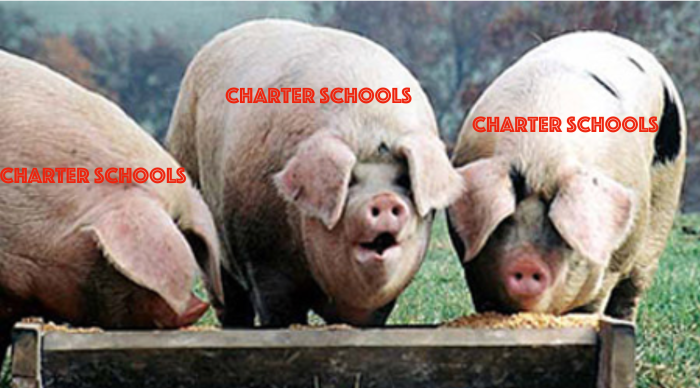
Sooey! Here Pig Pig Pig!


No one minds that healthy call at the hog farm when it’s time to feed the sows.


But taxpayers do take issue with it when it’s the call of the state legislature gathering a different kind of swine around public tax dollars.


Pennsylvania’s 180 charter schools gobbled up $1.8 billion last year from the Commonwealth’s public schools.


And Gov. Tom Wolf is refusing to let them continue to gorge on public funding meant to nourish everyone.

 
Last week, he took executive action to hold these schools accountable and force them to be more transparent – even if the legislature won’t.

 
Charter schools are publicly financed but privately run. Unlike authentic public schools, charters are often administered by appointed boards. They don’t have to provide the same level of services for children, don’t have to accept all students, can make a profit and don’t even have to be transparent about how they spend their money.


Yet that money comes from taxpayers.


For years fiscal watchdogs have complained that the state’s 22-year-old charter school law needs revising. However, after lining lawmakers pockets with charter school cash, the legislature continually refuses to do anything about it.


A few Democrats have offered plans that would increase accountability, but they’ve gotten no traction. And Republican plans have almost exclusively offered to make matters worse by dumping more money in the trough and putting up a thicker curtain so we don’t see the school privatizers eat.


So finally Gov. Wolf, a Democrat, took action on his own.


He has directed his Department of Education to circumvent the legislature to develop regulations that he says,  “will level the playing field for all taxpayer-funded public schools, strengthen the accountability and transparency of charter and cyber charter schools and better serve all students.”


His plan would:

 
•Allow districts to limit student enrollment in charter schools where students aren’t making academic gains.


•Require charter schools to stop turning away students based on race, ethnicity, gender, disability, intellectual deficits, lack of athletics or other student characteristics.

 
•Make charter schools as transparent as authentic public schools.


•Stop conflicts of interests for charter school board members and operating companies so that they can’t make decisions on behalf of the school that would enrich themselves, their families and/or friends.

 
•Make charters submit to financial audits to state regulators, make them publicly bid contracts for supplies and services and use fair contracting practices.

 
•Provide greater oversight of charter school management companies so they can’t profit off of the students enrolled in the schools they’re managing.

 
•Seek more information about how prospective charters will be run in a new model state application to be used when charters seek to open up shop or renew existing charters.


•Require charters to accurately document their costs.

 
•Prevent charters from overcharging for services they provide to students.


•Make charters pay to cover the state’s costs for implementing the charter school law.


•Recoup money from charter schools for the time and services the state provides when it reviews applications, distributes payments and provides legal and administrative support to them.

 
It’s a bold step for a governor, but apparently Wolf is tired of waiting on a dysfunctional legislature to actually legislate.


The problem is Wolf has to be more than a governor. He has to be a goalie.


The state House and state Senate are deeply gerrymandered and controlled by Republicans.

 
Every year, lawmakers pass mostly crap bills written by Koch Brothers proxies only to be vetoed by Wolf.


Occasionally, the GOP convinces enough right-leaning Democrats to go with them and Wolf can’t or won’t veto the bills.

 
And that’s pretty much how things work in Harrisburg.


However, this time Wolf wasn’t content to just guard the net. He actually took the puck down the ice, himself, and made a slap shot on the opposing team.


Can he do this? Is he still operating within the law?


Time will tell – though I’d argue that in the absence of legislative action, he is within his job description.


Moreover, this is only a first step.


Wolf, himself, has said that more needs to be done by the legislature. Even after his executive actions, much needs to be done to make charter schools function properly in the Commonwealth.


Specifically, Wolf asked the legislature to pass a moratorium on new cyber charter schools, cap enrollment in low-performing charter schools until they improve, subject charter management companies to the same transparency rules that districts must follow, and create a fair, predictable and equitable charter school funding formula.


I’d like them to go even further.


Frankly, I’d like to see charter schools ended as educational institutions.
Why should the public pay for schools that aren’t locally controlled? Why pay for privatized schools at all?


I suppose if there are some that are functioning well for students, they can be grandfathered in, but they should be funded separately. When two districts have to compete for the same funding, the students lose.


At least, we should not be opening up new charters. The public should not be in the business of funding privatized schools.


I am grateful to Gov. Wolf for finally having the guts to stand up to this powerful industry.


The state exists to further the public good – not enrich private corporations like those running many charter schools.


It’s time we admitted that charter schools are a failed experiment and shut them down.


It’s time to block these pigs from chowing down on public funding without public oversight.


See how much each charter school gets of Commonwealth tax dollars.


Like this post? I’ve written a book, “Gadfly on the Wall: A Public School Teacher Speaks Out on Racism and Reform,” now available from Garn Press. Ten percent of the proceeds go to the Badass Teachers Association. Check it out!

book-3

Who’s Trading Public School Funding for a Tax Credit?

Screen Shot 2019-08-18 at 1.52.43 PM


Ever wonder why our roads and public school buildings are crumbling?


Ever wonder why schools can’t afford books, buses and nurses?


Ever wonder why classroom teachers are forced to buy paper, pencils and supplies for their students out of pocket?


Because businesses like Giant Eagle, American Eagle Outfitters, and Eat’n Park aren’t paying their fair share.


It’s a simple concept – you belong to a society, you should help pay for the roads, bridges, schools, etc. that everyone needs to keep that society healthy.


After all, as a stockholder, CEO or business owner, you directly benefit from that society. If it didn’t exist, you wouldn’t have nearly as many customers – if any.


Many of us learned this kind of stuff in kindergarten or grade school.

 
But ironically programs that allow businesses to avoid paying their fair share are being used to short change many of those same kindergarten and grade schools.


In Pennsylvania, one such program is called the Educational Improvement Tax Credit (EITC), and everyone from local banks to Duquesne Light to UPMC healthcare providers are using it to lower their taxes while stealing from the public school cookie jar.

 
Here’s how it works.

 
If you expect a tax bill of $X at the end of the year, you can donate that same amount to the state for the purpose of helping parents pay off enrollment at a private or religious school for their children. Then you get between 75-90% of that donation back.


So if your tax bill is $100 and you donate $100, you can get back $90 – reducing your total tax bill to a mere 10 bucks.


Heck! Since this money is classified as a “donation” you can even claim it on your taxes and get an additional refund – even to the point where you end up making money on the deal! Pennsylvania even allows a “triple dip” – so you get the EITC tax credit, a reduction in your taxable income, and a reduction in your federal taxable income. We actually pay you to shortchange us on your taxes!


Now I’m oversimplifying a bit since you can only use the EITC for up to $750,000 a year, but it’s still a sweet deal for businesses. It just really hurts nearly everyone else because it reduces the state’s general fund – by $124 million last year, alone.


When we give away hundreds of millions of dollars every year to religious and parochial schools, we have less money to spend on public schools, roads and all other services that benefit the majority of our citizens – especially the poor who rely more heavily on these services.

 
So why doesn’t the state just budget this amount of money directly to religious and private schools instead of ransacking the general fund after businesses donate it to the tax incentive program?


Because it’s illegal to give taxpayer dollars to religious and private schools. The establishment clause of the First Amendment forbids it.


The founders of our country didn’t want a state religion with schools teaching theological propaganda like we had in Great Britain. Moreover, they demanded tax dollars be spent with accountability to the whole public – something you cannot do in a private or religious school which isn’t set up for everyone but only those who choose and can afford to go there.


However, some smart ass thought of an alleged loophole. He said that if tax money is turned into a tax credit, it’s no longer tax money and it doesn’t violate the rules to spend it on religious and private schools.


So this is a fiscal sleight of hand meant to give businesses a tax break while boosting private schools.

 
Who’s guilty of hiding behind this loophole to bolster their bottom line while short changing ours?


Probably a lot of businesses you know.


Thankfully, their donations to the EITC Program are a matter of public record as is how much money returned to them as savings.


You can find a handy database of state businesses right HERE searchable by county compiled by Pennsylvania Capital-Star.


I happen to live in Allegheny County in the Pittsburgh region – the second highest area of the Commonwealth for these tax dodge…. I mean credits.


Across the county in 2017-18 (the most recent year for which data is available), Allegheny County businesses donated $15,741,544. They got back $14,180,261 in tax credits.

 
A quick search came up with these noteworthy businesses:

 
Fatheads – the Southside sports bar along Carson Street in Pittsburgh
Contribution: $ 10,000
Tax Credit: $ 9,000

 
AEO Management, Co. 
(American Eagle Outfitters Corporate Office in the South Side, Pittsburgh)
Contribution: $ 350,000
Tax Credit: $ 315,000

 
Apex Diamonds, Inc. (A Pittsburgh jeweler)
Contribution: $ 149,000
Tax Credit: $ 134,100

 
Cochran Motors, Inc. (car dealership in Monroeville)
Donation: $ 100,000
Tax Credit: $ 90,000

 
Deer Leasing Co. (freight and cargo business) THREE ENTRIES:
Donation: $ 444,444
Tax Credit: $ 400,000


Deer Leasing Co.
Donation: $ 221,111
Tax Credit: $ 200,000


Deer Leasing Co.
Donation: $ 388,888
Tax Credit: $ 349,999

 
-Dollar BankTWO ENTRIES
Donation: $ 225,000
Tax Credit: $ 202,500


Dollar Bank
Donation: $ 400,000
Tax Credit: $ 360,000

 
Duquesne Light CompanyTHREE ENTRIES
Donation: $ 10,000
Tax Credit $ 10,000
(So 100% return on investment!?)


Duquesne Light Company
Donation: $ 50,000
Tax Credit: $ 45,000


Duquesne Light Company
Donation: $ 240,000
Tax Credit: $ 216,000


-Eat’n Park Hospitality Group, Inc. (Corporate headquarters in Homestead)
Donation: $ 25,000
Tax Credit: $ 23,500


-Federated Advisory Services Company (Asset management company) – THREE ENTRIES
Donation: $ 111,111
Tax Credit: $ 100,000


Federated Investment Counseling
Donation: $ 111,111
Tax Credit: $ 100,000


Federated Investment Counseling
Donation: $ 222,222
Tax Credit: $ 200,000

 
Giant Eagle, Inc.TWO ENTRIES
Donation: $ 833,333
Tax Credit: $ 750,000


Giant Eagle, Inc.
Donation: $ 221,111
Tax Credit: $ 200,000

 
Glimcher Brokerage, Inc. (Real estate company) – TWO ENTRIES
Donation: $ 380,000
Tax Credit: $ 342,000


Glimcher Group, Inc.
Donation: $ 300,000
Tax Credit: $ 270,000

 
HM Health Insurance Company (Camp Hill, Pa) – THREE ENTRIES
Donation: $ 50,000
Tax Credit: $ 45,000


HM Health Insurance Company
Donation: $ 243,333
Tax Credit: $ 219,000


HM Health Insurance Company
Donation: $ 165,556
Tax Credit: $ 150,000

 
PNC Bank, N.A. – TWO ENTRIES
Donation: $ 685,000
Tax Credit: $ 616,500


PNC Bank, N.A.
Donation: $ 148,303
Tax Credit: $ 133,500

 
Rohrich Imports, Inc. (Luxury Pittsburgh Car Dealership)
Donation: $ 60,000
Tax Credit: $ 54,000

 
The Buncher Company (property management company) – THREE ENTRIES
Donation: $ 416,667
Tax Credit: $ 375,000


The Buncher Company
Donation: $ 416,667
Tax Credit: $ 375,000


The Buncher Company
Donation: $ 221,111
Tax Credit: $ 200,000


The Huntington National BankTWO ENTRIES
Donation: $ 549,556
Tax Credit: $ 494,600


The Huntington National Bank
Donation: $ 111,111
Tax Credit: $ 100,000

 
UnitedHealthcare of Pennsylvania, Inc.
Donation: $ 200,000
Tax Credit: $ 180,000


-UPMC Diversified Services, Inc. (Healthcare provider) – SIX ENTRIES
Donation: $ 200,000
Tax Credit: $ 180,000

 
UPMC Diversified Services, Inc.
Donation: $ 200,000
Tax Credit: $ 181,000


UPMC Diversified Services, Inc.
Donation: $ 190,000
Tax Credit: $ 171,000


UPMC Health Benefits, Inc.
Donation: $ 200,000
Tax Credit: $ 180,000


UPMC Health Benefits, Inc.
Donation: $ 200,000
Tax Credit: $ 181,000


UPMC Health Benefits, Inc.
Donation: $ 200,000
Tax Credit: $ 180,000


But this leaves out the largest and shadiest group donating to the EITC Program – Limited Liability Corporations (LLCs).


These “special purpose entities” are set up to represent individual donors so they can more easily divert tax dollars to private and parochial schools.


LLCs represent hundreds of individuals who allow the LLC to donate on their behalf and then they get the tax credits passed back to them. It’s a way to encourage the wealthy to get the tax cut and support school privatization without all the hassle of doing the paperwork themselves.


And most (if not all) of these LLCs are set up by religious organizations to boost their own parochial schools.


For instance, Business Leadership Organized for Catholic Schools is perhaps the largest LLC receiving EITC funds.


Across the state, these organization made $15.6 million in donations and claimed $14 million in tax credits.


In Allegheny County, the largest are CASTA-SOS LLC and Pittsburgh Jewish Scholarship LLC.


CASTA was set up by the Catholic Diocese of Pittsburgh. Pittsburgh Jewish Scholarship benefits Jewish schools in the city.


Here’s how much they took from the state general fund last year:


CASTA-SOS I LLC
Donation: $ 509,500
Tax Credit: $ 458,550


CASTA-SOS II LLC
Donation: $ 460,890
Tax Credit: $ 414,801

 
Pittsburgh Jewish Scholarship I LLC
Donation: $ 675,250
Tax Credit: $ 607,725


Pittsburgh Jewish Scholarship II LLC
Donation: $ 750,000
Tax Credit: $ 675,000


EITC money went to almost 1,170 different organizations across the state. A fraction were YMCA’s, the Salvation Army and preschools. But the vast majority were private and religious schools.


Defenders of the project claim this money goes to fund “scholarships” for poor children to help defray the costs of enrollment at these schools.


However, a family making as much as $100,608 per year can qualify for an EITC scholarship for their child. A family with two children could make up to $116,216 and still qualify.


Consider this: one of the largest single recipients of this money in Allegheny County was the exclusive Shady Side Academy in Pittsburgh. The private secular school took in almost $1 million last year so that its wealthy students didn’t have to spend as much on enrollment.


Why are we subsidizing the rich?


Why are we robbing the poor to do so?


Why are we using public money to fund the teaching of climate denial, creationism, indoctrination in religious and political ideologies?


The short answer – our politicians are spineless and indebted to the people this benefits.


Just this summer, the Pennsylvania legislature AGAIN increased the limit for the program by an additional $25 million.


That’s the pattern. Every year, the Republican-controlled (and heavily gerrymandered) legislature can’t get their regressive policies passed Democratic Gov. Tom Wolf. They need some Democrats to support their spending priorities. So they entice right-leaning Democrats with increases to these tax incentive programs in order to reach compromises.


The result – every year we allow more tax dollars to fly away to private and religious schools while further undermining funding for public schools.


But it could have been worse. Earlier in the year, the legislature passed a measure to increase the EITC Program by $100 million. Thankfully it was vetoed by Gov. Wolf. Unfortunately, he let the $25 million increase get through.


This is a problem that is not going away.


We need to let our lawmakers know in no uncertain terms that we do NOT support these programs. And this isn’t just Republican lawmakers. We especially need to pressure Democrats and even run challengers to those who are not progressive enough in the primaries.


And we need to let businesses who partake of the smorgasbord of tax credits that doing so will lose them our business.


If we want to stop theft disguised as “tax credits,” we have to start hitting these businesses where it hurts – in the pocketbook.


Because they certainly don’t feel it in their hearts.


Like this post? I’ve written a book, “Gadfly on the Wall: A Public School Teacher Speaks Out on Racism and Reform,” now available from Garn Press. Ten percent of the proceeds go to the Badass Teachers Association. Check it out!

thumbnail_IMG_8249

Six Problems with a Growth Mindset in Education

Screen Shot 2019-08-12 at 1.34.29 AM


Sometimes the truth is not enough.


Especially if you misunderstand its meaning.


That seems to be the main problem with a growth mindset.


It’s one of the trendiest concepts in education today, and – though it’s based on an authentic insight into how kids learn – it’s been shackled and monetized into an excuse to support a sterile status quo.


The basic idea goes like this: academic ability isn’t something students have or do not have. It’s a skill that gets better depending on how hard they work at it.


And up to that point, it’s correct and valuable.


But when we try to take that insight and weave it into current education policies, it becomes a shadow of itself.


As a middle school language arts teacher, I’m confronted with this most often in the context of standardized test scores.

 
I am constantly being told not to pay attention to the scores. Instead, I’m told to pay attention to growth – how much this year’s scores have improved from last year’s scores. And the best way to do this, I’m told, is by paradoxically examining the scores in the most minute detail and using them to drive all instruction in the classroom.


To me that seems to misunderstand the essential psychological truth behind a growth mindset.


Instead of focusing on the individuality of real human students, we’re zeroing in on the relics of a fixed mindset – test scores – and relegating the growth mindset to happy talk and platitudes.


1*PQBc8JCD5yu4x2wxCCGU1g

 
B leads to A, and if we really want A, we just need to emphasize B.


To be clear, I don’t think there’s anything wrong with the idea that learning is a skill that can be strengthened with hard work. I do, however, take issue with how that observation has been used to support the status quo of test-and-punish and strategic disinvestment in public schools. I take issue with the idea that growth is the ONLY factor in student learning and how we are ignoring the multitudinous ways the human mind works and what that means for education.


In short, I think making the growth mindset a magic bullet has ended up shooting us in the foot.


Here are six problems I have with the growth mindset model:


1) It Has Not Been Proven to Make an Appreciable Difference in Student Academic Achievement.


How exactly do you use growth to drive achievement?


You make the concept of growth explicit by teaching it. You actively teach kids this idea that anyone can learn with hard work, and the theory goes that they’ll achieve more.


Does it actually work?


The results have been pretty inconclusive.


It’s been tested numerous times in various ways – some showing success, some showing nothing or even that it hurts learning.


The best success has come from Carol Dweck, a Stanford education professor who’s made a name for herself promoting the growth mindset model in books and TED talks.


Just this month, she co-authored the largest nationwide study concluding that a growth mindset can improve student results.


About 12,500 ninth grade students from 65 public and private schools were given an online training in the concept during the 2015-16 school year.


The study published in the journal Nature concluded that on average lower-achieving students who took the training earned statistically significant higher grades than those who did not.


However, results were “muted” when students were less encouraged to seek challenges – such as when they had fewer resources and support.


Despite this success, Dweck’s peers haven’t been able to reproduce her results.


A large-scale study of 36 schools in the United Kingdom published in July by the Education Endowment Foundation concluded that the impact on students directly receiving this kind of training did not have statistical significance. And when teachers were given the training, there were no gains at all.


In a 2017 study, researchers gave the training to university applicants in the Czech Republic and then compared their results on a scholastic aptitude test. They found that applicants who got the training did slightly worse than those who hadn’t received it at all.


In 2018, two meta-analyses conducted in the US found that claims for the growth mindset may have been overstated, and that there was “little to no effect of mindset interventions on academic achievement for typical students.”


A 2012 review looking at students attitudes toward education in the UK found “no clear evidence of association or sequence between pupils’ attitudes in general and educational outcomes, although there were several studies attempting to provide explanations for the link (if it exists)”.


In short, there is little evidence that any current approaches to turning the growth mindset into a series of practices that increase learning at scale has succeeded.


2) It Doesn’t Fit with Current Education Policies

 
We live in a fixed mindset world.


That’s how we define academic achievement – test scores, grades, projects, etc.


We tabulate data, compile numbers and information and pretend that draws an accurate picture of students.


It doesn’t.


But the concept that student achievement isn’t one of these things – is, in fact, something changeable with enough effort – runs counter to everything else in this world view.


If data points don’t tell us something essential about students but only their effort, connecting them with high stakes is incredibly unfair.


Moreover, it’s incoherent.


How can you convince a student that test scores, for example, don’t tell us something essential about her when we put so much emphasis on them?


It’s almost impossible for students in today’s schools to keep a belief in a growth mindset when test scores and our attitude toward them confirm their belief in a fixed mindset.


In a world of constant summative testing, analysis and ranking of students, it is nearly impossible to believe in a growth mindset. It’s merely a platitude between the fixed academic targets we demand students hit.


This doesn’t exactly take anything away from the concept, but it shows that it cannot be implemented within our current educational framework.


If we really believed in it, we’d throw away the testing and data-centricity and focus on the students, themselves.


3) It Ignores Student Needs and Resources


When we try to force the growth mindset onto our test-obsessed world, we end up with something very much like grit.


After all, if the only factor students need to succeed is effort, then those who don’t succeed must be responsible for their own failures because they didn’t try hard enough.


And while this is true in some instances, it is not true in all of them.


Effort may be a necessary component of academic success but it is not in itself sufficient. There are other factors that need to be present, too, such as the presence of proper resources and support.


And most – if not all – of these factors are outside of students’ control. They have no say whether they are well fed, live in safe homes, have their emotional needs met. Nor have they any say whether they go to a well-resourced school with a wide curriculum, extracurricular activities, school nurses, tutors, mentors, psychologists and a host of other services.


Putting everything on growth is extremely cruel to students – much like the phenomenon of grit.


Education policy should help raise up struggling students, not continue to support their marginalization through poverty, racism and/or socioeconomic disadvantages.


4) It Can Make Kids Feel Disrespected and Disparaged

 
No child wants to be remediated.


It makes them feel small, inadequate and broken. And if they’re already feeling that way, it reinforces that helplessness instead of helping.


Context is everything. Well-meaning educators may gather all the students with low test scores in one place to tell them the good news about how they can finally achieve if they put in enough effort. But students may recognize this for what it is and instinctively turn away.


The best way to teach someone is often not to lecture, not to even let on that you’re teaching at all.


David Yeager and Gregory Walton at Stanford claimed in 2011:


“…if adolescents perceive a teacher’s reinforcement of a psychological idea as conveying that they are seen as in need of help, teacher training or an extended workshop could undo the effects of the intervention, not increase its benefits.”


Teachers cannot set themselves up as saviors because that reinforces the idea that students are broken and thus need saved.


I don’t think this is an insurmountable goal, but many growth mindset interventions are planned and conceived by non-teachers. As such, they often walk right into this trap.


5) It is Not Suitable For All Kids

 
Everyone’s minds don’t work alike.


When you tell some kids that anyone can achieve with enough hard work, it makes them discouraged because they thought that their academic successes marked them as special.


According to a 2017 study published by the American Psychological Association, growth mindset training can backfire especially with high achieving students for exactly this reason.


Hard work just isn’t enough for some students. Their self-esteem relies on the idea that they are good at school because of fixed qualities about themselves.


When we take that belief away, we can damage their self esteem and thus their motivation to do well in school.


The point isn’t that a growth mindset is wrong, but that as an intervention it is not appropriate for all students. In fact, perhaps we shouldn’t be using it as an intervention at all.


6) It Should Not be a Student Intervention. It Should Be a Pedagogical Underpinning for Educators


We’ve got this growth mindset thing all wrong.


It’s not a tool to help students learn. It’s a tool for teachers to better understand their students and thus better help them learn. It’s a tool for administrators, parents and policymakers to better understand what grades and test scores mean.


If you want to teach a student any skill, let’s call it X, you shouldn’t begin by telling them that anyone can learn it with enough effort.


Just teach X. And when you succeed, that will become all the motivation students need to learn the next thing.


Education is an incremental process. Success breeds success just as failure breeds failure.


As every teacher knows, you start small, scaffold your lessons from point A to B to C and make whatever changes you need along the way.


If we really want to help students in this process, we can start by ridding ourselves of the fixed mindset that current education policy is rooted in.


Growth mindset is a psychological observation about how human minds work. It’s not pedagogy. It’s empiricism.


We can use it to help design policy, lessons and assessment. But it has limited value – if any – being taught directly to students.

 
The growth mindset model has value, but not in the way it has typically been used in our school system.


Instead of providing justification for equitable resources and tearing down the testocracy, it’s been used to gaslight educators into obeying the party line.


It is not a magic cure all, but one factor among many that provides insight into learning.


If we can disentangle it from the profit-driven mire of corporate education, perhaps it can help us achieve an authentic pedagogy that treats every student as an individual and not an economic incentive for billionaires to pocket more tax money.


Like this post? I’ve written a book, “Gadfly on the Wall: A Public School Teacher Speaks Out on Racism and Reform,” now available from Garn Press. Ten percent of the proceeds go to the Badass Teachers Association. Check it out!
book-1