The majority of teachers and principals in Pennsylvania hate standardized tests.
An increasing number of parents are refusing to allow their kids to take the tests.
And there may be better alternatives to the state’s Keystone Exams.
These were just some of the key findings of a blockbuster report from June 2019 by the state General Assembly’s Legislative Budget and Finance Committee.
However, now that things are returning to some semblance of normalcy, it seems that bureaucrats from the state Department of Education (PDE) are taking the wrong lessons from the report while the legislature seems to have forgotten it entirely.
The report was conducted because of legislation written by state Sen. Ryan P. Aument (R-Lancaster County). It directed the Legislative Budget and Finance Committee to “study the effectiveness of standardized testing, including the Keystone Exams and SATs, and their use as indicators of student academic achievement, school building performance, and educator effectiveness.”
The key findings are as follows:
1)The majority of principals and teachers disapprove of the state’s standardized tests – both the Pennsylvania System of School Assessment (PSSA) tests given in grades 3-8 and Keystone Exams given in high school. They think these tests are ineffective, expensive and harmful to district curriculum and students.
2) State law allows parents to opt their children out of testing for one reason only – religious grounds. Parents are using this religious exemption in increasing numbers. This puts districts in danger of violating federal participation and accountability standards.
3) It has been suggested that the state allow two additional reasons for parents to opt their children out of testing – philosophical grounds and health concerns. It is unclear whether doing so would increase overall opt outs or not.
4) The federal Every Student Succeeds Act (ESSA) passed in 2015 allows the use of the SAT and/or ACT test to take the place of high school standardized testing. It has been suggested the Commonwealth replace the Keystone Exams with these tests. The report finds the ACT and/or SAT would successfully determine college readiness and reduce the overall amount of standardized testing. However, this would not allow other uses of current state tests like evaluating teacher effectiveness and school building performance.This may not matter though because the report also casts doubt on whether the current tests (PSSA and Keystone Exams) do an adequate job of assessing teacher or building performance now or even if student tests can be accurately used to evaluate teachers and schools.
There’s a lot of information here. Let’s look at each finding in turn.
1) PA Educators Hate Standardized Tests
When it comes to the PSSAs, 67% of principals and 76% of teachers said the tests were ineffective indicators of student achievement.
There was slightly more support for the Keystone Exams. This time 45% of principals said the test was an ineffective indicator of student achievement (with 27% saying the tests were effective). Meanwhile, 60% of teachers said the test was ineffective.
Both principals and teachers said their curriculum had been narrowed to prepare students for PSSAs and Keystone Exams. Instead of going into more depth on regular classwork or learning new skills, the focus shifts to teaching to the tests.
Most principals (approximately 80-90%) said that students are taught test-taking skills, and their schools administered practice tests, bench-mark tests, and/or diagnostic tests to prepare students for the PSSA exams. This held for teachers, too, with 81-88% saying they teach test-taking skills and administer practice tests. Principals also said the costs of this additional test prep varied from $200 to more than $100,000.
Taking the tests also eats up valuable class time. Administering the assessments takes between 5.7 to 8 days for each kind of test – the PSSA and the Keystone Exams, according to Principals.
In addition, the report details the cost of giving these tests. In fiscal year 2017-2018, PDE paid $42.17 million for these tests. This is part of a national trend:
“Standardized tests and test preparation have subsequently become big business and that multibillion dollar business continued to grow since the enactment of NCLB and the subsequent enactment of ESSA. According to the Pew Center on the States, annual state spending on standardized tests increased from $423 million before the NCLB (enacted in 2002) to upwards of $1.1 billion in 2008 (to put this in perspective this reflects a 160 percent increase compared to a 19.22 percent increase in inflation during the same time period). A more recent study by the Brown Center on Education Policy at Brooking put the cost at upwards of $1.7 billion in 2011 related to state spending on standardized tests.”
2) Opt Outs on the Rise
Many states allow parents to opt their children out of standardized testing. Some do so in cases of a physical disability, medical reasons, or emergencies. A few allow opt-outs based on religious objection – like Pennsylvania. Some states allow opt-outs for any reason whatsoever.
The religious exemption is not used widespread throughout the state and most schools meet the 95% participation rate required by the federal government. However, use of the religious exemption is definitely on the rise – enough so that the authors of the report find it alarming:
“Meanwhile, as previously indicated in this section, schools throughout the country are experiencing and grappling with an increase in the number of parents seeking to have their children opt-out of standardized testing now that new state assessments have been implemented pursuant to the federal requirements. Pennsylvania is no exception to this trend and is also experiencing an increase in the number of parents utilizing the religious opt-out.”
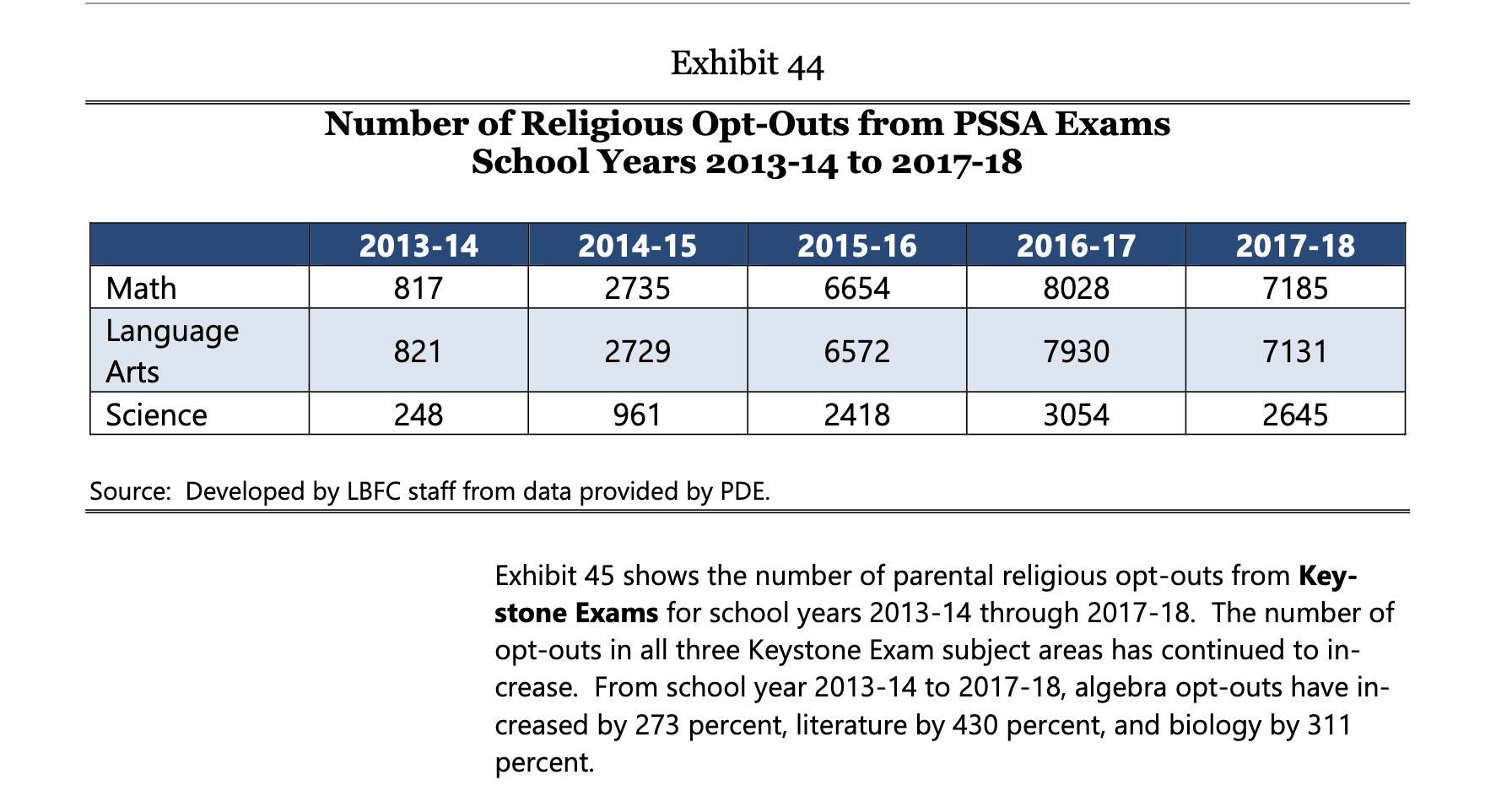
For the PSSA tests, opt outs increased from 2013-14 to 2016-17. However, total numbers in school year 2017-18 decreased sightly.
Opt outs went from 1,886 to 6,425 to 15,644 to 19,012 to 16,961.
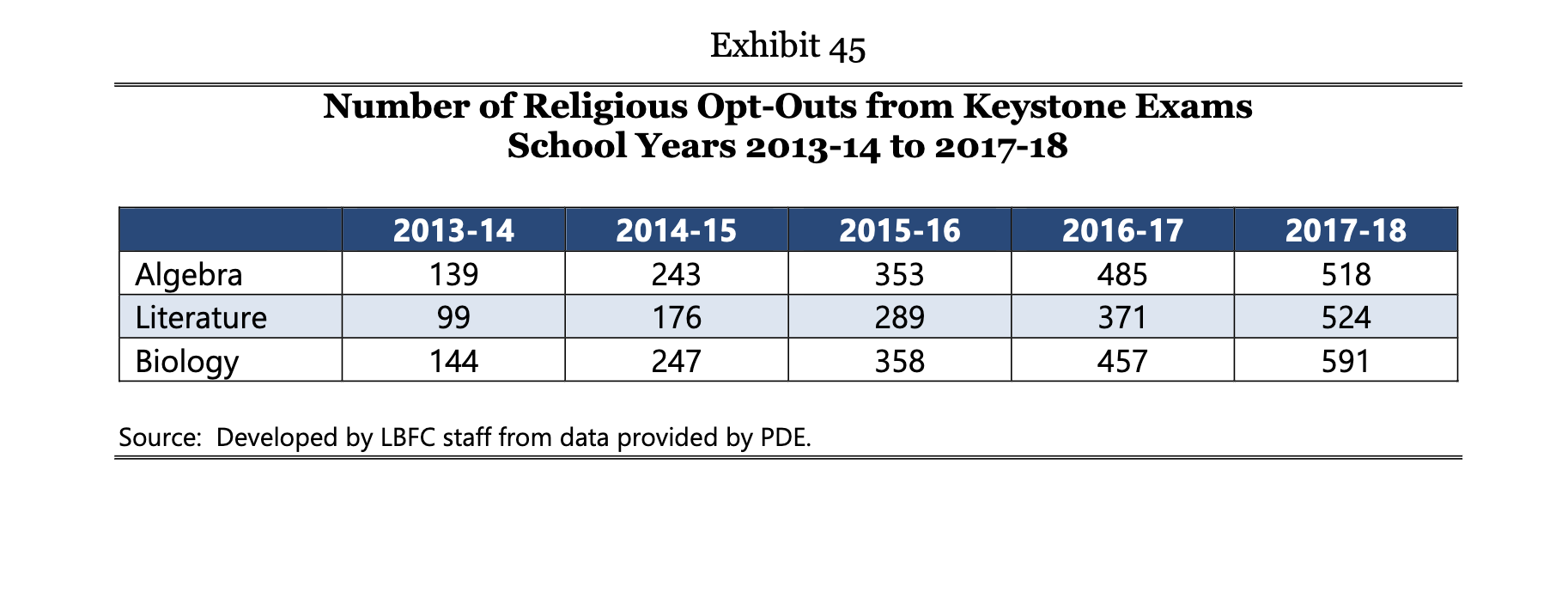
During the same time period for the Keystone Exams, opt outs steadily increased each year but were at lower overall rates.
For the high school test, opt outs went from 382 to 666 to 1,000 to 1,313 to 1,633.
These are vitally important figures because opt out data is rarely tabulated and released to the public. Many media accounts actually state the opposite of the data in this report – in particular that opting out has decreased since Congress passed the ESSA in 2015. Apparently the media got this one wrong.
Though the religious opt-out is the only reason specifically allowed in state Chapter 4 regulations, PDE reports there are five additional ways that students end up not taking the tests:
1) Other Parental Request – parents simply refusing to let their kids participate but not objecting based on specifically religious reasons.
2) No Attempt and No Exclusion Marked – students who are given the test but do not answer enough questions to receive a score.
3) No Test – no test record on file for unknown reasons.
4) Extended Absence – a student missed the testing and make-up window due to absences.
5) Other – does not fit any of the other categories.
Federal law – in particular No Child Left Behind (NCLB) and subsequent reauthorizations of that legislation – requires states to use student participation in standardized testing as a factor in a state’s accountability system. According to the report, any district with less than 95% of students taking the test should be “addressed.”
The report does not go into any further detail about what this means, other than to say that falling under 95% can:
“…ultimately result in a reduced achievement/proficiency measure… If the student participation rate falls below 95 percent, states are required to calculate student achievement/proficiency by dividing the number of students scoring proficiently by no less than 95 percent of the total students (which effectively assigns a score of “0” to all nonparticipants once the participation rate has fallen below 95 percent).”
In effect, the district gets a bad mark on a piece of paper. So what?
Under NCLB, schools with poor performance could receive sanctions like state takeover or lower funding. However, this is extremely unlikely – especially since the passing of ESSA. This newest reauthorization of the law gives states leeway in designing their accountability systems. It leaves the enforcement of this 95% participation rate up to the states, requiring them to develop an accountability plan in the event that a school or district fails to meet this standard.
So a school would only be punished if the state decided to do so. If a state legislature decided to allow parents to opt their children out for any reason at all, they would not have to take any punitive measures. Since the ESSA, the buck stops at the state house door on this one. California, for example, takes note of low participation rates but these rates are not factored into a school’s rating. On the other hand, Florida mandates direct intervention from the state’s Department of Education until participation rates are met.
3) Impact of New Reasons to Opt Out
This is where things get a bit sticky.
The report mentions the idea of expanding the options for opting-out of statewide assessments (e.g., PSSA and Keystone Exams) to include objections based on philosophical grounds or due to health issues.
On the one hand, the authors write “The impact of adding opt-out categories may be minimal.” They don’t know if more people would use the expanded options or if the same numbers who use the religious exemption today might simply divide themselves up among all three options.
The authors worry, however, that new pathways to opt out may increase the total number of people refusing the tests for their children and would reduce Pennsylvania’s participation rate in standardized testing.
This is a particularly troubling paragraph:
“The existence of opt-outs (religious or otherwise) has the potential to negatively impact a state’s participation rates and may potentially impact a state’s [Local Education Agency (LEAs)] and schools achievement/proficiency rate and ultimately the ability of a state to be in compliance with federally required assessments and accountability measures. Furthermore, providing opt-outs and giving parents notice of such has the potential to conflict with the message about the importance of standardized testing. Ultimately placing the state departments of education and local school districts in the potentially awkward position of having to explain why it is important for students to participate in testing (given the federal requirements), while also giving and notifying parents of the opt-out options for their children. In 2015, US Department of Education sent out letters to a dozen states flagging their low participation rates (statewide, or at the district or subgroup level) on the 2014-15 school year assessments and indicated that they needed to create a plan to reduce opt-outs due to low participation rates.”
This seems to be the order of the day at PDE. It’s why earlier this year, school administrators were advised by state officials to crack down on parents opting their children out of standardized tests.
And all of it is based on a cowardly and incomplete understanding of federal law. If Commonwealth schools fall below 95% participation in the test and get a bad mark on a worthless metric, it doest have to matter. No matter how many letters the federal government sends to the state legislature or PDE, the law is clear. The state is in charge here. Our legislature can choose to side with taxpayers, residents, and citizens or with civil servants and strongly worded letters.
4) Replacing the Keystone Exams
There’s not much more to add to this than the initial finding.
The authors of the report say there would be no problem with replacing the Keystone Exams with the ACT or SAT because these national tests would properly assess students’ college and career readiness.
The report is actually pretty shoddy in this regard not really examining the claims of the College Board which makes both tests. The authors just pretty much accepted the College Board’s word wholesale. Nor was their any evaluation of what teachers and principals thought about these tests like there had been for the PSSA and Keystone Exams.
However, the report does make a good point about test reduction. Many students already take the SAT or ACT test, so eliminating the Keystones would reduce the over all amount of tests they had to take.
Also the authors deserve credit for writing about how using student test scores to evaluate teachers and schools is seriously bad practice.
According to the report, 77 percent of principals and 93 percent of teachers said PSSA tests were not effective indicators for teacher evaluations, with similar figures for the Keystone Exams and building performance evaluations.
While everything in the report may not be 100% accurate, it includes important information that should be wider known.
In addition, the report has trustworthy data about opt outs throughout the Commonwealth. Unlike what has been reported in the media, opting out is not on the decline, it is on the rise.
The Keystone Exams should be thrown in the trash, because that’s what they are – trash. At very least they should be replaced with the SAT or ACT. Even better to remove any requirement for standardized tests wholesale – and that includes the PSSA.
The ESSA allows states a lot of leeway about how and what accountability system they use. There is no need to worry about some imperial federal power invading Pennsylvania to force our hand with standardized testing. We should call their bluff on this. I’ll bet that if we did so, many other states would do the same.
Standardized testing is another failed education policy. Our legislators would do good to read this report and make up their own minds about it.
Though a few years and disasters have happened since its publication, it doesn’t deserve to be forgotten by the very people who ordered it to be written in the first place.
Like this post? You might want to consider becoming a Patreon subscriber. This helps me continue to keep the blog going and get on with this difficult and challenging work.
Pennsylvania officials are scandalized that the Commonwealth is wasting more than $100 million on unnecessary and unfair Keystone Exams.
They’d rather the state spend slightly less on biased college entrance exams.
State Auditor General Eugene DePasquale and State Sen. Andy Dinniman held a joint press conference last week to introduce a new report compiled by DePasquale’s office on the subject which concludes with this recommendation.
Replacing bad with bad will somehow equal good?
Under the proposal, elementary and middle school students would still take the Pennsylvania System of School Assessment (PSSA) tests. However, instead of requiring all high school students to take the Keystone Exams in Algebra I, Literature and Science, the report proposes the same students be required to take the SAT or ACT test at state expense.
This is certainly an improvement over what the state demands now, but it’s really just replacing one faulty test with another – albeit at about a $1 million annual cost savings to taxpayers.
From 2008 to 2019, the state already paid Minnesota-based Data Recognition Corp. more than $426 million for the PSSAs, Keystone Exams and Classroom Diagnostic Tools (an optional pretesting program). The federal government paid the company more than an additional $106 million. Officials wonder if this money couldn’t have been better spent elsewhere, like in helping students actually learn.
“When the federal law changed in 2015, why didn’t Pennsylvania begin to phase out Keystone Exams? I could understand if they use them for a short period of time after that, but it’s been four years, and will cost taxpayers nearly $100 million by the end of the contract for tests our students do not even need to take.”
The federal government dropped its mandate four years ago and the state legislature did the same last year.
“The Department of Education itself said they [the Keystone Exams] are not an accurate or adequate indicator of career or academic readiness,” Dinniman said. “So what I’m always surprised about is, they said it and then they continue to use it. These tests have faced opposition from almost every educational organization that exists. And when we got rid of the requirement and put in [more] pathways to graduation, this was passed unanimously by both the Senate and the House.”
The federal government also changed its testing mandate. It used to require all public school students to take state-specific assessments in grades 3-8 and once in high school.
When Congress reauthorized the federal law overseeing education in 2015, it offered states more flexibility in this regard. Elementary and middle school students still have to take a state-specific test. But now the high school portion can be fulfilled with college admissions tests – and, in fact, a dozen other states legislate just such a requirement.
Given what we know about the limits and biases of these assessments, policymakers should remove that hurdle altogether. But until the federal government gets its act together, one could argue that DePasquale and Dinniman’s policy suggestion may be the best available.
When you can’t do right, maybe it’s best to do less wrong.
Accountability – the typical reason given behind these assessments – should be determined by the resources provided to students, not a highly dubious score given by a corporation making a profit off of its testing, test prep and ed tech enterprises.
The most we can expect from DePasquale and Dinniman’s program if it is even considered by the legislature is a band-aid on a gaping wound.
Fewer states require high stakes tests as graduation exams and/or use them to evaluate their teachers. Across the nation, states are cutting the size of standardized tests or eliminating them altogether. And more state legislatures passed laws explicitly allowing parents to opt their children out of the tests.
I think we have different definitions of “Slows” and “Crawl.”
That may not be surprising since we also seem to have different definitions of “Anti-Test.”
The Opt Out Movement is not “Anti-Test.” It is anti-high stakes standardized test.
It is against the federal government forcing states to use corporate written, corporate graded and corporate remediated standardized assessments.
It is against the federal government requiring each state to participate in a corporate boondoggle that not only wastes billions of tax dollars that could be better spent to educate children but also unfairly assesses their academic progress and feeds the push to privatize public schools.
Calling these folks “Anti-Test” is like labeling those pushing for stricter gun regulations “Anti-Gun” or smearing those protesting government corruption as “Anti-Government.”
And that’s just the title!
The author Alyson Klein further misdirects readers by conflating opt out rates and test resistance.
She implied that the only measure of opposition was the percentage of students who opt out. However, as noted above, there are multiple measures of resistance.
Moreover, few states advertise their opt out rates. Especially after the movement began, states made that information harder to come by to dissuade more people from joining it.
Of those states where information is available, Klein puts the most negative possible spin on the facts in order to make her point – a point that it seems to me is not at all justified.
“At least some of the steam has gone out of the opt-out movement in states such as New Jersey and New York, considered hotbeds of anti-testing fervor.”
And New York is one of our most densely populated states. That percentage represents more than 225,000 parents across the Empire State who refused to let their children take the tests despite threats from many administrators and district officials for doing so.
In New Jersey, opt out rates were marginally lower this year than last year. They went from 7% to 5%. But once again New Jersey is a populous state. That percentage represents about 68,500 students.
In addition, this is after massive opt outs three years ago that forced the state to change its federally mandated assessment. Testing boycotts pushed the state education association to get rid of four PARCC assessments and allow students who fail the remaining two tests to take an alternative assessment. And this is in a state where there is no law explicitly allowing parents to opt out of the tests.
I don’t know if I’d call that running out of steam.
And it nearly doubled in Utah over the past two years to about 6%. In some schools in the Beehive State, rates are much higher. According to the Salt Lake Tribune, 1 in 5 students in the Park City school district refused to take the tests.
Though my own state of Pennsylvania has been mum on last year’s opt outs, from my own personal experience as a teacher in suburban Pittsburgh, I never had more students boycott our federally mandated standardized test than I did last year.
There were so many they had to be quarantined in a special room.
Moreover, an increasing number of parents ask me about the issue, express concern and wonder about their rights.
So even when examining just the rate of opt out, I don’t see any reason to assume the movement is slowing down.
As recently as 2012, half of all U.S. states required high school exit exams in order for students to graduate. Today that number has dropped to 12. The reason? Exit exams don’t raise student achievement – they raise the dropout rate. At least that’s what The National Research Council of the National Academy of Sciences tells us.
And when it comes to opt out, two more states – Idaho and North Dakota – now have explicit laws on the books allowing parents to refuse the test for their children – in whole or in part. That brings the total number of states up to 10. It would have been 11, but Georgia Governor Nathan Deal, a Republican, vetoed an opt-out bill. The federal government still wants us to penalize these districts for non-participation in flagrant violation of its authority. But as more states respect parents’ rights on this matter, it will be increasingly difficult for the U.S. Department of Education to continue trampling them.
There is already some proposed legislation to make positive changes. Sen. Jon Tester (D-Mont.) and Rep. Krysten Sinema (D-Ariz.) introduced legislation last year to replace annual assessments with grade-span tests. The United States is, after all, one of the only countries in the world – if not the only one – to require students be tested every year. These proposed changes are not nearly enough, but they’re a step in the right direction.
One of the biggest obstacles to abolishing federally mandated testing last time was that some of the oldest and most well funded civil rights organizations opposed it. Many of them get their money and support from the same billionaires who profit off of the standardized testing and privatization industries.
The proposal released today applies only to the Pennsylvania System of School Assessment (PSSA) tests – those taken by students in grades 3-8. Keystone Exams taken by high school students are unaffected.
It would cut one of three reading sections and one of three math sections – two total. Wolf also wants to cut some questions from one of the science sections.
Such a move is estimated to eliminate 48 minutes from the math test, 45 minutes from the reading test and 22 minutes from the science test. However, judging from my own students, these times vary considerably depending on the individual taking the tests. I’ve had 8th grade students finish a PSSA section in as little as 5 minutes or as much as two hours.
Most schools give either a section a day or two in one day. Therefore, this proposal probably translates to 1 to 2 fewer days testing in most districts.
Um. Thanks?
Look I don’t want to seem ungrateful here, but these suggested modifications are little more than fiddling around the edges of a massive problem.
At best, this proposal will allow students to spend two more days a year learning. Assuming most districts don’t use that extra time for test prep, that IS a good thing.
The problem with standardized testing isn’t just the number of raw days it takes students to complete the tests. It is how the tests deform the entire year-long curriculum. Students don’t just learn anymore. They learn what’s on the test – and anything else is purely optional.
Regardless of the size of the assessments, they are still being used to sort and judge students, teachers and schools. Shortening their length does nothing to address the fundamental unfairness of the evaluations. Rich white kids still tend to have high scores and poor minority kids still tend to have low ones.
At best, they reveal structural funding disparities between poor and wealthy districts. At worst, the cultural bias inherent in the questions favor those from dominant, privileged ethnicities while punishing those who don’t fit the standard.
That’s what “standardized test” means after all – defining normal and punishing those who don’t fit the definition. Most questions don’t assess universals like the value of 2 and 2. They evaluate cultural and social norms required to understand the questions and easily find an answer that another “normal” student would choose. (Don’t believe me? Watch “Black Jeopardy” on Saturday Night Live.)
This is true whether the test takes one day or 100 days.
The federal Every Student Succeeds Act (ESSA) contains provisions to circumvent them. States are supposed to be given leeway about testing. They may even be able to replace them with projects or other non-standardized assessments. THAT’S what Wolf and the Pennsylvania Department of Education should be exploring – not half measures.
To be fair, the state Department of Education is attempting reform based on the ESSA. This year, the department introduced Future Ready PA, a new way of using test scores and other measures to assess school success. To its credit, The Index does place additional emphasis on academic growth, evaluation of school climate, attendance, graduation rates, etc. However, for my money it still gives far too much importance to standardized testing and test prep.
Like reducing the size of the PSSAs, it’s a positive step but won’t do much to get us to our destination.
Neither measure will have much impact on the day-to-day operations of our public schools. Districts will still be pressured to emphasize test prep, test taking strategies, approaches to answering multiple choice questions, etc. Meanwhile, critical thinking, problem solving, and creativity will still be pushed to the side.
Moreover, since schools and teachers will be assessed as successful or not based largely on these test scores, districts will be under tremendous pressure to give countless practice tests throughout the year to gauge how well students are prepared for the PSSAs. The state will still be providing and encouraging the optional Classroom Diagnostics Tools (CDT) tests be taken several times in reading and math throughout the year. Trimming off two days from the PSSA will affect that not at all.
In addition, today’s proposal only applies to the PSSA. While that assessment is important, the Keystone Exams given to high school students are even more so. According to existing state law, passing the Keystones in Algebra I, Literature and Biology are required in order to qualify for a diploma. However, that condition has yet to go live. So far the legislature has continuously pushed back the date when passing scores become graduation requirements. The Governor and Department of Education should be proposing the elimination of this prerequisite before anything else. Other than education funding and perhaps charter school accountability, it is the most important education issue before Commonwealth lawmakers today.
If you want to talk about accountability, that’s where the majority of the issue belongs.
And primarily it’s out of Wolf’s hands. One can understand why he is proposing changes where he can and trying to do whatever good is possible given the political climate.
Shortening the PSSA tests would benefit our students. It is a step in a positive direction.
However, it is far from solving our many education problems.
These organizations are worried that such measures, if approved, would allow Florida to ignore the needs of minority students.
In fact, lumping minority students’ test scores in with the majority white population would obscure whether they were struggling at all. So would explicitly ignoring any achievement gaps between the majority and minority populations.
The first question is at the heart of a disagreement between many on the political left and right. Democrats generally favor more federal intervention, while Republicans favor more state control.
Which side will end up victorious is hard to say. In situations like this, it’s even hard to say who SHOULD be victorious.
Like the No Child Left Behind legislation before it, the ESSA specifically uses standardized test scores for this purpose.
However, test scores are terrible at determining accountability. They’re economically and culturally biased. Rich kids tend to pass and poor kids tend to fail. At best, they show which students have been the most economically privileged and which have not.
But we don’t need test scores to see that. We can simply look at students’ socio-economic status. We can look at whether they’re living below the poverty line or not. We can look at their nutrition and health. We can look at whether they belong to a group that has historically been selected against in this country or not.
And once we find that out, we shouldn’t punish the school for having the audacity to teach poor and minority children. We should give them extra funding and resources to meet those students’ needs. But the current test-based accountability system doesn’t do that. Instead it cuts off funding to schools that need it most while pushing public schools to be closed and replaced with charter and voucher institutions that have a worse record of success.
In short, accountability is vital in our public schools, but the way we determine who needs help and what we consider help are drastically out of step with student needs.
Likewise, some on the right might try to characterize Florida’s attempted waiver as an act of defiance against test-based accountability.
It’s not. Officials in the Sunshine State aren’t concerned with undoing the testocracy. They’re perfectly fine with high stakes testing – so long as they don’t have to do anything special to help black and brown kids.
It’s a situation where blatant self-interest can easily be hidden under a fake concern for children.
If you’re going to use standardized tests to hold schools accountable for providing a quality education – and that’s a Big IF – it’s unfair to obscure data about minority students and possible achievement gaps. Moreover, it’s reprehensible that you wouldn’t even bother to test them fairly by letting them take these assessments in their native languages.
However, it would be even better to dispense with test-based accountability in the first place. It would be better to see student needs directly and not as a reflection of test scores. That would more easily allow help to reach the students and not the vulture industries circling above our public schools waiting to pick them apart in the name of accountability.
First, the ESSA still mandates annual testing. Even without the Obama guidelines, students will still be tested in grades 3-8 and once in high school.
Second, Alexander says the law still requires each state to hold its public schools accountable. Each state must submit a plan detailing how it intends to do that by September of 2017. There is plenty of latitude on exactly how states will do this, but whatever they decide, this new accountability system must be implemented by next school year (2017-2018).
Moreover, he says, states have to identify and provide support to at least the lowest performing 5% of their schools. This must be done by the beginning of the 2018-2019 school year.
They also must use academic and English language proficiency indicators in their accountability systems. Which indicators? Standardized testing? Maybe – maybe not.
Many accountability provisions, such as the requirement that educators measure reading scores, math scores, and graduation rates, are specifically mentioned in the ESSA.
Still, many questions remain.
For instance: if the Department of Education isn’t allowed to tell states what to do, how is it supposed to help them comply with the law?
Alexander cites “Non-regulatory guidance; Dear Colleague letters; Frequently-Asked-Questions documents; Webinars, phone calls, and in-person conferences.”
Alexander stresses that repealing the Obama regulations does not open to door for the Department of Education to mandate a nationwide school voucher plan – unfortunately.
He writes, “A school choice program cannot be unilaterally created by the Department of Education. Only Congress could create a voucher program, and, unfortunately, Congress has rejected doing that.”
This change was less controversial. Eight Democrats joined Republicans in voting to repeal the teacher preparation regulations. By comparison, no Democrats voted to dismantle the accountability rules and one Republican joined them in opposition.
The main point of contention was the requirement that states develop a rating system aimed at evaluating the success of their teacher preparation programs. This would have included how programs’ teachers perform based on a measure of student academic achievement. Though the final version gained some flexibility with how to determine student academic success beyond just test scores, it remained a hot mess.
Any programs that didn’t perform well on the state’s rating system would have lost access to federal grants aimed at supporting teachers who work in high-need certification areas and in low-income schools (or TEACH grants). In effect, it would have pushed for a new generation of teachers dedicated to test prep and Common Core.
And these repeals of Obama regulations – these seeming improvements just waiting for Donald Trump’s signature – are brought to us by the same people who support removing protections for trans students. These are the same legislators who gave us an unexperienced mega-donor as Education Secretary.
Frankly, I’m having trouble believing it.
I hope I’m wrong, but I’m waiting for the other shoe to drop.
Perhaps the standardized testing industry has consolidated so much support at the various Republican controlled state legislatures that it no longer needs support in Washington. Perhaps our ridiculously gerrymandered state legislative districts will make any resistance even more difficult. Perhaps a completely toothless Department of Education will embolden the most racist state legislators to dramatically increase segregation and civil rights abuses for the poor and minorities.
I’m only a classroom teacher. The powers that be don’t trust someone like me with that kind of responsibility. It’s okay to give me a roomful of impressionable children everyday, but there’s no confidence I can make sound policy decisions. For that we need someone with experience in management – not schools, pedagogy, children or psychology.
The presiding incumbent in this prestigious position, John King, somehow overcame that handicap. He had taught for three whole years at a charter school, but the bulk of his experience is in administration – administrating a Boston charter school with high suspension and attrition rates. He also was New York State Education Commissioner, where he single-handedly dismantled the state system of education and sparked one of the largest parental revolts in the nation in the state’s opt out movement.
The previous Secretary of Education, Arne Duncan, was much more qualified, having never taught a day in his life. Before getting Congressional approval, he was appointed to run a charter school and later was entrusted as CEO of Chicago City Schools where he likewise blundered his way to the top with policy decisions that devastated a great system of public education.
I’ve never sunk a major metropolitan school. I’ve never been run out of a populous state chased by citizens armed with torches and pitchforks.
But let’s close our eyes and imagine that somehow through the magic of education bloggery I was whisked into office at the U.S. Department of Education.
What would a person like me do as Secretary?
1) Respect the Limits of the Job
Though George W. Bush and Barack Obama come from opposite ends of the political spectrum, these two Presidents did more to increase the powers of the Department of Education than any chief executives before them. They turned it into – as former Education Secretary Lamar Alexander puts it – a national school board with the Secretary was the national superintendent.
The department forced test and punishment policies on the states, cudgeled and bribed state officials to enact lousy Common Core Standards, and held federal grants hostage unless states accepted every corporate education reform scheme big business could think up.
Don’t get me wrong. I’m a New Deal Franklin D. Roosevelt Democrat, but even I think these two administrations blatantly abused their power and overstepped their Constitutional authority.
So the first thing I would do is take a step back and follow the law. The recently enacted Every Student Succeeds Act (ESSA) sets explicit limits on federal power over education policy returning much of it to the states. As Education Secretary, I would respect the power of the states to control public education. It is the state’s job to set policy. It is the federal government’s job to provide support, encouragement and oversight.
Therefore, the role of the Department of Education is to ensure public schools are being properly funded, civil rights are not being violated and to be a repository for national data and research. I’d dedicate myself to that – not some corporate fueled power trip that both parties condemn except when they’re practicing it.
2) Push for More Federal Funding for Public Schools
Therefore, the first thing I would do is use the full power of the office to ensure the federal government is giving its utmost to help state public schools. I would use whatever grants were available to increase federal funding to the most impoverished schools. I would fully fund Title I. I would increase the federal share of Special Education – (Under Part B of the Individuals with Disabilities Education Act (IDEA) the federal government is supposed to fund 40% of the per pupil cost of all special education students but has never met this obligation. I would seek to rectify that if possible.) I would enact a national after school tutoring initiative. I would provide funding to hire additional teachers to reduce class size. And as far as is possible, I would forgive college students loan debt so they can begin their lives with a clean slate.
This is something that those who seek to disband the U.S. Department of Education never seem to understand. The federal government has an important role to play in our school systems. It’s not the unfounded power grab of the last few decades, but we need another robust player on the field to help the states achieve their goals and also to keep the states honest.
If we disbanded the Department of Education, as some conservatives from Reagan to Paul to Cruz to Trump suggest, what would happen to Pell Grants, for instance? What would happen to the bundles of federal money that boost our public schools? Who would make sure states are doing their jobs? Where could we go to find accurate data about how our schools are doing nationally and not just state-by-state?
If we got rid of the department, at best these jobs would fall back on other government agencies that haven’t the funding, staff or ability to accomplish them. More likely, it would result in the elimination of billions of education dollars that the states simply couldn’t (or wouldn’t) replace. Abuses against students on the grounds of civil rights, gender, special education, etc. would skyrocket with little to no recourse. And we would be in the dark about how well we were educating our nation’s children.
3) Encourage States to Enact Accountability Measures that Don’t Include Standardized Testing
Accountability has become a dirty word in many education circles because of the way the Bush and Obama administrations have perverted it to mean test and punish. It has become a boondoggle for the standardized testing industry, an excuse to close poorly funded and often urban public schools to be replaced by unaccountable charter schools. While this is a terrible misuse of federal power, states must be responsible for the education they provide their children. And contrary to popular belief, this can be accomplished without resorting to the usual corporate reform measures.
As Secretary, I would put an immediate stop to the era of test and punish at the federal level. As it stands, the ESSA allows states to determine what they will use to demonstrate their educational progress for students. This is a state decision, but I would encourage states not to use standardized testing. I would offer to help any state interested to find new ways to show accountability. For instance, districts could submit to a simple audit showing student-teacher ratios, per pupil funding, discipline data broken out by race, degree of segregation, richness of the curriculum, etc.
Let me be clear: it is up to states to make these decisions. As Secretary, I would have no power to force legislatures or departments of education to do any of this. However, I’m willing to bet that many states would be excited by these possibilities and jump at the opportunity. Helping them achieve this would be my job.
4) Stop Federal Funding to Charter Schools, Teach for America and Common Core
Speaking of encouragement, I would stop all federal help for corporate education reform policies. That means turning off the money faucet for programs that enrich corporations and big business at the expense of school children.
If states that had enacted the Core wanted to keep it, fine. If not, fine. But they would be on their own.
(In a sad aside, opposition to Common Core is most virulent from conservatives, yet there are an awful lot of state legislatures completely in GOP control that could get rid of Common Core tomorrow but which have done – and continue to do – nothing about it. No matter who the next Education Secretary is, the fate of Common Core is in the hands of state legislatures across the country – not the President, not Congress and not the Education Secretary. There’s far too much rhetoric and not nearly enough action.)
5) Do Everything I Can to Increase Teacher Autonomy, Respect, Pay and Training
There are a whole host of things needing done. However, most of these things go beyond the powers of the Department of Education and its cabinet level Secretary. They can only be addressed by the President, Congress, state legislatures and/or the court system. The Education Department can help steer that agenda, it can be an ally to real positive change, but it can’t go it alone.
Unfortunately, no matter who wins the Presidency in November – Clinton or Trump – neither seems likely to nominate an Education Secretary who would do any of the things I’ve outlined.
It’s a crazy time full of crazy candidates and crazy solutions, but of this we can be sure – no one is crazy enough to let a teacher make decisions about public education policy.
But Congress voted to keep mandating that 95% of students take the tests.
It all happened with the much celebrated bipartisan passage of the Every Student Succeeds Act (ESSA), the federal law that governs K-12 schools.
While lawmakers made changes here and there to let the states decide various education issues, they kept the mandate that students participate in annual testing.
They didn’t leave that to the states. Whether they were Republican or Democrat, almost all lawmakers thought it was just fine for the federal government to force our children to take standardized tests at least every year in 3-8th grades and once in high school.
If any school district, has more than 5% of students that don’t take the tests – for whatever reason – the federal government can deny that district funding.
Think about that for a moment.
Our lawmakers are supposedly acting in our interests. They’re our representatives. We’re their constituents. They get their power to pass laws because of our consent as the governed. Yet in this instance they chose to put their own judgement ahead of ours.
They could have made an exception for parents refusing the tests on behalf of their children. They just didn’t see the need to do so.
Let’s say for a moment that this were true. In that case, we can expect no parent of color would ever refuse standardized testing for his/her child.
First, this is demonstrably untrue. Black and brown parents may not be the most numerous in the opt out movement, but they do take part in it.
Second, in the majority of cases where white parents refuse testing, that would have no bearing on whether testing helps or hurts students of color. If the point is the data testing gives us on black kids, what white kids do on the test is irrelevant.
Third, even if opting out hurt students of color, one would assume that it is the parents prerogative whether they want to take part. If a black parent doesn’t want her black son to take a multiple choice exam, she should have the right to waive that exam and the responsibility would be on her head.
So there is absolutely no reason why lawmakers should have overstepped their bounds in this way and blocked all parents rights about what the schools do to their children.
It is a clear case of governmental overreach. And there are plenty of parents just waiting to bring it to the U.S. Supreme Court for the ultimate Constitutional test.
However, that probably won’t happen for the same reason it never happened through the 15 years of No Child Left Behind (NCLB) which also contained the annual testing rule.
The bottom line is this: they know how Unconstitutional this mandate is, and they aren’t itching to have it tested in the highest court in the land.
It would open a whole can of worms about standardized testing. What is the federal government allowed to do and not allowed to do about education policy?
But let’s return to the reasoning behind it – so-called civil rights fears.
Various groups including the NAACP asked for it to be included to protect minority students. Annual testing is the only way, they claimed, to make sure schools are teaching students of color.
Even after Brown v. Board, we have schools that cater to black kids and schools that cater to white kids. We have schools for poor kids and rich kids.
It is obvious which schools get the most resources. Why isn’t that part of this “accountability” scheme? We can audit districts to see how much is spent per pupil on poor black kids vs rich white kids. We can determine which groups go to schools with larger class sizes, which groups have more access to tutoring and social services, which groups have expanded or narrowed curriculums, which groups have access to robust extra-curricular activities, which groups have the most highly trained and experienced teachers, etc.
So why were civil rights groups asking the testing mandate be kept in the bill? Because the testing industry is comprised of big donors.
Only a few months before passage of the ESSA, many of these same civil rights groups had signed declarations against standardized testing. Then suddenly they saw the light as their biggest donors threatened to drop out.
Make no mistake. Standardized testing doesn’t help poor minority children. It does them real harm. But the testing industry wrapped themselves up in this convenient excuse to give lawmakers a reason to stomp all over parental rights.
The conflict wasn’t between civil rights and parental rights. It was between parental rights and corporate rights. And our lawmakers sided with the corporations.
Let me be clear: legislators cannot be against opt out and in favor of individual rights.
We, parents and citizens, control our schools – not you, our representatives. The principal can’t say you haven’t a right to opt out your kid. He’s just your representative. So is the teacher.
We have common cause. We need to stand with our teachers and principals, our school boards and education professors. We need to stand together against lawmakers who think they know better.
In short, we don’t need lawmakers consent to opt out. They need our consent to stop us.
They get their power from us. They work for us.
And it’s time they get to work and rescind the annual testing mandate.
However, Dinniman sent out an email to supporters this week claiming PDE is “blatantly ignoring the law and issuing directives to local school districts to use the exam if they want to for graduation.”
This goes against the delay, says Dinniman. The legislature is unsure requiring the Keystone Exam is a good idea, yet the state Senator contends the current administration is advising districts to move forward anyway.
Under the old law that was put on hold by the delay, if parents decided to opt their children out of standardized testing, students had to complete a Project Based Assessment. However, even though there is no test-based graduation requirement for current seniors, Dinniman says PDE still is forcing these children to complete Project Based Assessments.
“It appears that PDE is forcing the children of parents who opted out to take the Project Based Assessment, whose use is currently suspended by the legislature,” he says.
“There seems to be no respect by PDE for the rights of parents concerning their own children.”
Now that PDE seems committed to the project despite concerns by legislators, he is asking for parents and other concerned citizens to contact him about suing the organization.
“If you know parents or organizations who might want to take PDE to court or file amicus briefs, let me know… This is a matter of great importance. A number of us have been working for years against excessive testing and have serious concerns about Common Core.”
He will hold an open meeting for those concerned about the issue on Monday, Sept. 12, at 7:30 pm in his district office along One North Church Street in West Chester.
One of the issues at stake is the exorbitant costs of the Keystone and Pennsylvania System of School Assessment (PSSA) tests. With education budgets shrinking at the federal, state and local level, this money diverted to huge testing corporations could be better spent elsewhere.
Since 2008, the Commonwealth has spent $1 billion to proctor, grade and create new versions of the PSSA and the new Common Core-aligned Keystone Exams. Of that figure, $741 million went to Data Recognition Corporation.
In 2013, the state Conference of NAACP Branches issued a statement condemning the Keystone graduation requirement in extremely strong terms.
The organization called it a “present day form of Eugenics”, “a human rights violation”, “a clandestine social movement that strips children of their dignity and self worth” and that it would deprive impoverished and minority students “of decent income, decent food, decent homes, and hopeful prospects as well as the security of justice.”
“I have been fighting against the use of these standardized tests as the sole determinants of high school graduation since they were first proposed by the previous [Corbett] administration in 2012.”
“Strong standards and effective assessments are needed in our schools, but they must come with the necessary resources and support to be implemented in a way that does not negatively impact both students and taxpayers,” he says.
Chester County, where Dinniman is from, has been a hotbed of testing criticism. Located in the southeastern most part of the state, parents, teachers and students publicly spoke out against the exams. Almost all school boards in the county passed resolutions opposing the Keystones and 58 superintendents and Intermediate Unit Directors up through the Philadelphia suburbs also expressed opposition.
If the delay had not been approved, this year’s seniors would have been required to pass all three Keystone Exams in order to graduate. Now the exams won’t be a graduation requirement until the 2018-19 school year.
The federal government still requires the exams be given for evaluative purposes, but it was the Republican dominated Tom Corbett administration that went the extra step of making the exams necessary to receive a diploma.
Alternative methods for students to demonstrate proficiency for graduation in addition to the Keystone Exams and project-based assessments.
Improving and expediting the evaluation of the project-based assessments.
Ensuring that students are not prohibited from participating in vocational-technical education or elective courses or programs as a requirement of supplemental instruction.
Moreover, the newly passed federal K-12 education legislation, the Every Student Succeeds Act (ESSA), allows the Commonwealth even more leeway to implement fairer and more affective means of assessment, Dinniman says.
“Until now, education policy has been largely dominated by regulations implemented by the State Board of Education in accordance with the federal government. Some of these regulations seemed to be enacted with little to no consideration of fiscal impacts or educational value,” Dinniman said.
“However, the state legislature has a Constitutional duty and responsibility to oversee and provide for ‘a thorough and efficient system of public education.’ Going forward, I believe the legislature will be more aggressive in reasserting its role in the process.”
Dinniman can be reached by phone at 610-692-2112 (District Office) and 717-787-5709 (Harrisburg Office).
To Supporters of Ending Common Core Exams in Pennsylvania:
Despite Act 1 of 2016, which suspended any use of the Keystone exams or the Project Based Assessments for graduation purposes during the two year period of 2016-18, the Pennsylvania Department of Education (PDE) is blatantly ignoring the law and issuing directives to local school districts to use the exam if they want to for graduation.
It certainly appears that PDE has shown their solid commitment to the Common Core testing process and the continued collection of data. They don’t seem to care about or respect the law. This is not government by the elected legislature but government by the bureaucracy.
You will be interested to learn the taxpayers of Pennsylvania, since 2008, spent $1.1 billion on these Common Core tests, with $741 million of that going to one testing company, Data Recognition Corporation (DRC).
Additionally, it appears that PDE is forcing the children of parents who opted out to take the Project Based Assessment, whose use is currently suspended by the legislature. There seems to be no respect by PDE for the rights of parents concerning their own children.
So the question now is “what will we do about this situation?” If you know parents or organizations who might want to take PDE to court or file amicus briefs, let me know.
In the meantime, I am having a meeting for those concerned about PDE’s actions in my district office, One North Church Street, West Chester, on Monday, September 12th, 2016 at 7:30 p.m.
This is a matter of great importance. A number of us have been working for years against excessive testing and have serious concerns about Common Core. Please invite your friends to join in the September 12th meeting.
The new legislation reauthorizes federal law governing K-12 public education.
In 1965 we called it the Elementary and Secondary Education Act (ESEA). Until today we called it No Child Left Behind (NCLB). And now after a much-hyped signing ceremony, the most definitive thing we can say about it is this: federal education policy has a new name.
The problem is this – it’s an over 1,000 page document that’s been open to public review for only two weeks. Though it was publicly debated and passed in the House and Senate, it was finalized behind closed doors and altered according to secure hurried Congressional votes. As such, the final version is full of legal jargon, hidden compromise, new definitions and verbiage that is open to multiple meanings.
How one reader interprets the law may be exactly the opposite of how another construes it.
Take the much-touted contention that the ESSA reduces the federal role in public schools. Even under the most positive reading, there are limits to this freedom.
The document continues to mandate testing children each year in grades 3-8 and once in high school. It also mandates academic standards and accountability systems. However, what these look like is apparently open to the states.
For instance:
The Secretary [of Education] shall not have the authority to mandate, direct, control, coerce, or exercise any direction or supervision over any of the challenging State academic standards adopted or implemented by a State.
That seems pretty clear. The federal government will not be able to tell states what academic standards to adopt or how student test scores should be used in teacher evaluations.
But it also says that states will have to submit accountability plans to the Department of Education for approval. It says these accountability plans will have to weigh test scores more than any other factor. It says states will have to use “evidence-based interventions” in the schools where students get the lowest test scores.
That sounds an awful lot like the test-and-punish system we have now.
What if your state decides to take a different road and reject the high stakes bludgeon approach to accountability? In that case, some readers argue schools could lose Title I funds – money set aside to help educational institutions serving impoverished populations.
Will that actually happen? No one knows.
It may depend on who will be President in 2017 and whom that person picks as Secretary of Education. And even if the Feds try to take advantage of these potential loopholes, the matter could end up being decided by the U.S. Supreme Court.
Some readers interpret the new law as destroying forever the possibility of national academic standards. If states are allowed to pick their own standards, it is highly unlikely they’ll all pick the ones found in the deeply unpopular Common Core. However, the law does force each state to have academic standards of some kind, and it defines what those standards must look like. One interpretation of this is that they must look a lot like the Common Core.
They must be “state-developed college- and career-ready standards.” You read that right – “College and career ready.” That’s the Common Core catchphrase. If someone says they want to eat lunch at “the golden arches,” they haven’t said McDonalds, but you know they’re craving a Big Mac.
Will the Fed allow states to choose standards radically different than the Core? Again only time and – possibly – the courts can tell.
This same problem occurs throughout the document. As the public painstakingly combs through it, new legal wiggle room may be found. And I am not so naive as to suppose we’ve found all of the loopholes yet. Some of these may be the result of poorly chosen wording. Others may be purposefully hidden time bombs waiting for opportunists to exploit.
This uncertainty about exactly what the ESSA will eventually mean for our public schools may help explain the range of reactions to the formative law – from ecstasy to despair to shrugs and snores.
I’m not sure what to think of the thing, myself. I started the whole process disgusted but came around to accepting it if the final result was any kind of improvement over previous legislation. And now that it’s the law of the land, I look at this Frankenstein’s monster of a bill – stitched together pieces of mystery meat – and I don’t know whether to laugh or cry.
I still hope it will live up to the limited promise it holds to bring us some relief from NCLB. But I admit this thing could go sour. Anyone’s guess is as good as mine.
Which brings me to perhaps the biggest problem with this law that no one seems to be talking about.
But more than any of that, we need to reform our government.
We need to find a better way to make our laws. The process that shat out this ESSA must go.
Think about it. No Child Left Behind was an abject failure by any metric you want to use. It didn’t close achievement gaps – it increased them. And the major policy of this law – annual standardized testing – remains intact in the reauthorization!
This can’t continue if we are to keep pretending we have a representative Democracy. The voice of lobbyists must not be louder than voters. Money must be barred from the legislative process. Demagoguery must not overshadow the public good. We need transparency and accountability for those making our laws.
Until that happens, we will never have a sound and just education policy, because we don’t have a sound and just government.
Unfortunately, that is the biggest lesson of the ESSA.









 gadflyonthewallblog