The Trouble with Test-Obsessed Principals

thumbnail_IMG_8535


When I was a child, I couldn’t spell the word “principal.”


I kept getting confused with its homonym “principle.”


I remember Mr. Vay, the friendly head of our middle school, set me straight. He said, “You want to end the word with P-A-L because I’m not just your principal, I’m your pal!”


And somehow that corny little mnemonic device did the trick.


Today’s principals have come a long way since Mr. Vay.


Many of them have little interest in becoming anyone’s pal. They’re too obsessed with standardized test scores.


I’m serious.


They’re not concerned with student culture, creativity, citizenship, empathy, health, justice – they only care about ways to maximize that little number the state wants to transform our children into.


And there’s a reason for that. It’s how the school system is designed to operate.


A new research brief from the Tennessee Education Research Alliance concluded that the lowest rated principals generally work at schools with the most economically disadvantaged students.
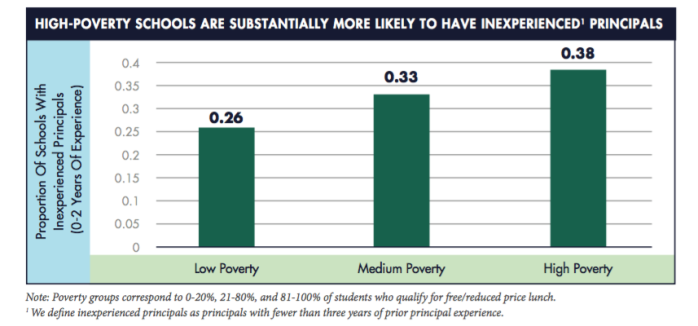
 

So schools serving students with the highest poverty and lowest test scores often have the least experienced and least effective principals.


thumbnail_Screen Shot 2019-02-08 at 11.27.32 AM


Now the first question I had when reading this report was “How do they measure effectiveness?” After all, if they rate principals primarily on student test scores, then obviously those working at the poorest schools will be least effective. Poor kids earn low test scores. That’s all the scores consistently show – the relative wealth of students’ parents. If you define an ineffective principal as one who works in a building with low scoring students, it would be no shock that those principals worked in the poorest schools.


However, researchers didn’t fall entirely into this trap. According to the working paper:


“We measure principal quality in two ways: years of experience in the principal position and rubric-based ratings of effective principal practice taken from the state’s evaluation system.”


In Tennessee this means evaluating principals partially on student test scores at their buildings – 35%, in fact – higher than the 20% of classroom teachers’ evaluations. However, the remaining pieces of principals’ effectiveness are determined by an observation from a more senior administrator (50%) and an agreed upon score by the principal and district (15%).


Since researchers are relying at least in part on the state’s evaluation system, they’re including student test scores in their own metric of whether principals are effective or not. However, since they add experience, they’ve actually created a more authentic and equitable measure than the one used by the state.


It just goes to show how standardized testing affects nearly every aspect of the public education system.


The testing industrial complex is like a black hole. Not only does it suck up funding that is desperately needed elsewhere without providing anything of real value in return, its enormous gravity subverts and distorts everything around it.


It’s no wonder then that so many principals at high poverty schools are motivated primarily by test scores, test prep, and test readiness. After all, it makes up a third of their own evaluations.


They’ve been dropped into difficult situations and made to feel that they were responsible for numerous factors beyond their control. They didn’t create the problem. They didn’t disadvantage these students, but they feel the need to prove to their bosses that they’re making positive change.


But how do you easily prove you’ve bettered the lives of students?


Once again, standardized test scores – a faux objective measurement of success.


Too many principals buy into the idea that if they can just make a difference on this one metric, it will demonstrate that they’re effective and thus deserve to be promoted out of the high poverty schools and into the well-resourced havens.


Yet it’s a game that few principals are able to win. Even those who do distinguish themselves in this way end up doing little more for their students than setting up a façade to hide the underlying problems of poverty and disinvestment.


Most principals at these schools wind up endlessly chasing their tails while ignoring opportunities for real positive change. Thus they end up renewing the self-fulfilling prophesy of failure.


Researchers noticed the pattern of low performing principals at high poverty schools after examining a decade’s worth of data and found it to hold true in urban, rural and suburban areas. And even though it is based on Tennessee data, the results hold true pretty consistently nationwide, researchers say.


Interestingly enough, the correlation doesn’t hold for teachers.


Jason Grissom, an associate professor at Vanderbilt University and the faculty director of the Research Alliance, says that the problem stems from issues related specifically to principals.


For instance, districts are hiring lower-rated principals for high poverty schools while saving their more effective leaders for buildings with greater wealth and resources.


thumbnail_Screen Shot 2019-02-08 at 11.28.20 AM


As a result, turnover rates for principals at these schools are much higher than those for classroom educators. Think about what that means – schools serving disadvantaged students are more likely to have new principal after new principal. These are leaders with little experience who never stick around long enough to learn from their mistakes.


And since these principals rarely have had the chance to learn on the job as assistant principals, they’re more likely to be flying by the seat of their pants when installed at the head of a school without first receiving the proper training and mentorship that principals at more privileged buildings routinely have.


As such, it’s easy for inexperienced principles to fall into the testing trap. They buy into the easy answers of the industry but haven’t been around long enough to learn that the solution they’re being sold is pure snake oil.


This has such a large effect because of how important principals are. Though they rarely teach their own classes, they have a huge impact on students. Out-of-school factors are ultimately more important, but in the school building, itself, only teachers are more vital.


This is because principals set the tone. They either create the environment where learning can flourish or smother it before the spark of curiosity can ignite. Not only that, but they create the work environment that draws and keeps the best teachers or sends them running for the hills.


The solution isn’t complicated, says Grissom. Districts need to work to place and keep effective and experienced principals in the most disadvantaged schools. This includes higher salaries and cash bonuses to entice the best leaders to those buildings. It also involves providing equitable resources for disadvantaged schools so that principals have the tools needed to make authentic positive change.


I would add that we also need to design fair evaluation systems for both principals and teachers that aren’t based on student test scores. We need to stop contracting out our assessments to corporations and trust our systems of government and schools to make equitable judgments about the people in their employ.


Ultimately, what’s required is a change in attitude.


Too many principals look at high poverty schools as a stepping stone to working at a school with endless resources and a different class of social issues. Instead, the goal of every excellent school leader should be to end their career working where they are needed most.


Such professionalism and experience would loosen the stranglehold of test-and-punish and allow our schools not to simply recreate the inequalities already present in our society. It would enable them to heal the divide.


As John Dewey wrote in 1916:


“Were all instructors to realize that the quality of mental process, not the production of correct answers, is the measure of educative growth, something hardly less than a revolution in teaching would be worked.”


And that’s what’s needed – a revolution.


Still can’t get enough Gadfly? I’ve written a book, “Gadfly on the Wall: A Public School Teacher Speaks Out on Racism and Reform,” now available from Garn Press. Ten percent of the proceeds go to the Badass Teachers Association. Check it out!

book-4

Ten of 15 Cyber Charter Schools in PA Are Operating Without a Charter – Close Them All

thumbnail_screen shot 2019-01-29 at 1.38.10 pm


Cyber charter schools are an experiment that failed.


It’s time to pull the plug and recoup our losses.


First, let’s get straight exactly what we’re talking about here.


Like all charter schools, these are contracted institutions. In fact, that’s what charter means – they’re independent businesses that sign a deal with the state to teach kids.


So they’re publicly financed but privately run. And in the case of cyber charters, they agree to educate children online without the benefit of a physical building.


Students access lessons via computer or other device, submit work electronically, get virtual feedback and assessment.


At best, these institutions are the grade school equivalent of the University of Phoenix – good only for independent, self-motivated learners. At worst, they’re the kiddie version of Trump University – a total scam.


In Pennsylvania, 10 of the state’s 15 cyber charter schools are operating with expired charters, according to a report by the Philadelphia Inquirer.


That’s incredibly significant – especially for an industry that enrolls about 35,000 students across the state.


These are charter schools operating without a charter. They only get the right to operate because a local school district or the state has signed a contract allowing them to do so.


If you hire a plumber to fix your toilet, you give him the right to enter your house and do what needs to be done. That doesn’t mean the plumber can walk in anytime he feels like it. There is a limited term of service. Once that term is up, the plumber needs to get out.


In the case of these cyber charters, the authorizer is the Pennsylvania Department of Education (PDE).


Charters are initially issued for three to five years. They are an essential contract between the schools and the supervisory body. The school details how it will operate, what curriculum and education strategies will be used, etc.


The state has the option to revoke the charter if the school violates its agreement or fails to meet requirements for student performance or fiscal management.


After the initial period, charters must be renewed every five years in the state.


Yet for the majority of the Keystone state’s cyber charter schools, this has not happened. The charter agreements have been left to lapse without any decision being made by state officials to renew or cancel them.


Some of the reluctance to decide may stem from the fact that the state Charter Appeal Board – the body which decides on appeals of charter applications – are all serving out expired terms, themselves.  They were all appointed by the previous governor, Republican Tom Corbett, a notable privatization ideologue.


The current Governor Tom Wolf, a Democrat now elected to his second term of office, still hasn’t gotten around to appointing new ones.


Another issue gumming up the works could be staffing issues at PDE that make it impossible to handle the reviews in a timely manner. It could be because the cyber charter schools have not provided all the data required of them by the state for the review to be completed on time. Or it could be because state officials are struggling with a fair and adequate metric with which to assess these schools.


CYBER CHARTER’S DISMAL ACADEMIC RECORD


To be frank, the latter option has to weigh heavily on state auditors. After all, it’s no secret that these schools are an educational disaster. On-line schools in Ohio, Georgia, Indiana, Nevada and New Mexico are all being closed by their respective states.


Study after study consistently shows that cyber charters are much less effective than traditional public schools – heck! They’re even less effective than brick and mortar charter schools!


A recent nationwide study by Stanford University found that cyber charters provide 180 days less of math instruction and 72 days less of reading instruction than traditional public schools.


Keep in mind that there are only 180 days in an average school year. So cyber charters provide less math instruction than not going to school at all.


The same study found that 88 percent of cyber charter schools have weaker academic growth than similar brick and mortar schools.


Student-to-teacher ratios average about 30:1 in online charters, compared to 20:1 for brick and mortar charters and 17:1 for traditional public schools.


Researchers concluded that these schools have an “overwhelming negative impact” on students.


And these results were duplicated almost exactly by subsequent studies from Penn State University in 2016 (enrolling a student in a Pennsylvania cyber charter school is equal to “roughly 90 fewer days of learning in reading and nearly 180 fewer days of learning in math”) and the National Education Policy Center in 2017 (cyber charters “performed significantly worse than feeder schools in both reading and math”).


Even the state’s own data shows lower graduation rates and standardized test scores at cyber charters than at traditional public schools.


According to a 2015-16 state PDE report, about 86 percent of public school students across the Commonwealth finished high school in four years. During the same time, only about 48 percent of cyber charter school students graduated in four-years.

CYBER CHARTER’S COST TOO MUCH


But providing such a poor service to Pennsylvania students is only one reason these schools are problematic. They’re also ruinously expensive.


They cost taxpayers more than $463 million in 2016-17 alone.


The state charter law grants these schools as much money per pupil as brick and mortar schools, yet their costs are much less having forgone a physical building and all that goes with it.


So cyber charters get whatever the local per-pupil expenditure is. It doesn’t matter if a district spends $8,000 on each student or $20,000. Whatever the amount, that goes to the cyber charter.


However, the cost of educating kids is drastically reduced online. Their programs are bare bones compared with what you get at a traditional public school. Most online charters don’t have tutors or teacher aides. They don’t offer band, chorus or extra-curricular activities. You don’t have to pay for any building costs, grounds, upkeep, large staff, etc. But the funding formula ignores this completely. Cyber charters get to keep the difference – whatever it is. In fact, they have an incentive to keep as much as possible because they can do almost whatever they want with it. That includes putting it into operators’ pockets as profit!


And when it comes to special education funding, it gets worse. In Pennsylvania, our funding formula is so out of whack that charters schools of all stripes including cyber charters often end up with more funding for students with special needs than traditional public schools get. However, because of this loophole in the Commonwealth, Pennsylvania online charters have been increasing the number of special education students they enroll and even working to label as many of their students as possible as needing special services on the flimsiest of pretexts.


According to a report by the Pennsylvania Association of School Administrators (PASA), tuition for special education students is often twice as much at cyber charter schools than at traditional public schools.


CYBER CHARTER FRAUD


Unsurprisingly, these conditions have lead to rampant fraud and malfeasance.


Just this past year (2018) the head of the largest cyber charter chain in the state was sentenced to jail for siphoning $8 million from his school into his own pockets.


PA Cyber Charter founder Nicholas Trombetta was found guilty of tax fraud in relation to the theft of public funds. He used that money to buy an airplane, a $900,000 condo, houses for his girlfriend and mother, and nearly $1 million in groceries and personal expenses, according to the grand jury. Trombetta allegedly set up numerous for-profit and nonprofit businesses to provide goods and services to the cyber charter. Federal investigators filed 11 fraud and tax conspiracy charges against him and indicted others in the case.


Another cyber charter founder, June Brown, was also indicted for theft of $6.5 million. Brown ran the Agora Cyber Charter School, which was part of the K12 Inc. empire of virtual charters. She and her executives were indicted on 62 counts of wire fraud, obstruction of justice and witness tampering. She was well known for student test scores and had a reputation for claiming large salaries and filing suits against parents who questioned her, the Philadelphia Inquirer reports.


WHAT TO DO ABOUT IT


It’s no wonder the state has been tardy renewing these schools’ charters!


Frankly, there is no good reason to continue lavishing taxpayer dollars on a system of education that provides  subpar services at an exorbitant expense and is subject to runaway fraud.


But lawmakers have always been reluctant to do the right thing.


After all, there are a slew of wealthy investors who want to make sure the money train of taxpayer dollars keeps flowing to their shady businesses. And lawmakers who enable them are assured hefty campaign contributions.


The only chance we have of saving our children from this monstrous abuse of power and saving our wallets from this shameful waste of funding is if voters make their intentions known.


The people of Pennsylvania need to stand up and demand an end to the cyber charter school experiment.


We need lawmakers with the guts to stand up to big money and rewrite the state’s charter school law.


And that’s part of the problem. The law is a joke.


It’s more than 20 years old and was only amended once in 2002 to allow cyber charters.


Subsequent attempts at requiring more accountability have resulted in horrible compromise bills that would have made the situation much worse and – ultimately – no vote.


With Ohio and California, Pennsylvania was in the “big three” cyber-charter states in 2016, accounting for half of cyber charter enrollment nationally, according to the industry’s authorizers’ association. While 35 states and the District of Columbia allow full-time cyber charter schools, eight do not, including neighboring New Jersey.


The right course is clear.


We just need a people-powered movement to force our lawmakers to do it.


Either that or replace them with those who will.


Still can’t get enough Gadfly? I’ve written a book, “Gadfly on the Wall: A Public School Teacher Speaks Out on Racism and Reform,” now available from Garn Press. Ten percent of the proceeds go to the Badass Teachers Association. Check it out!

cropped-book-1.jpg

Teaching Through Lockdown

gettyimages-88519594-640x640


“Excuse the interruption. We are under a lockdown.”


That was it.


Not an explanation of what caused it.


Not any idea of how much danger we were in.


Not any idea of how long it would last.


Just a vague warning that teachers knew meant to keep all their students in class until further notice.


As an educator, you’re expected to teach.


It doesn’t matter what’s happening around you. There can be yelling or screaming. There can be a scuffle in the next room. The lights may flicker off and on.


None of that matters.


If you have students and aren’t in immediate danger, you’re expected to teach them.


And that’s what I did. Even then.


I teach mostly poor and minority students in a western Pennsylvania school near Pittsburgh.


My 8th grade language arts class was in the middle of taking a final exam on The Outsiders by S. E. Hinton.


Most of my students were finished, but it was still quiet as two or three students struggled through their last responses.


Then the announcement came over the PA.


“…lockdown.”


The voice was the high school secretary. Since the middle and high school are connected, she rarely makes announcements in my building – only when something is important happening for both buildings.


The kids looked up at me with worried faces.


“What’s going on, Mr. Singer?” one of them asked.


I told them the truth – I really had no idea. There were no drills planned for today. In fact, it would have been a really poor time for one. We had just had ALICE training the day before where the resource officer and the principal had met with students to go over what to do in case of an active shooter. The program is named for the courses of actions it recommends – Alert, Lockdown, Inform, Counter, Evacuate.


So we were apparently in the L.


During the assembly, the resource officer had said quite bluntly that there would be no coded messages. If a school shooter entered the building, officials would tell us in plain language what was happening so we could make an informed decision what to do.


But there was no additional message over the PA. That was it.


I went over to my computer to see if there was an email. Nope. Nothing.


I pressed refresh a few times. Nothing.


I asked the students to hush and just listened.


It was extremely quiet. Even the hallway was silent and it’s never that silent except during standardized testing.


My room has no windows to the outside. It’s a brick box with one wooden door containing a sliver of window.


The door was already closed and locked. We’re told to keep it that way just in case. But there’s an additional deadbolt you can click to make it even harder to gain access to the room.


“It’s probably nothing,” I said as I walked over to the door and surreptitiously clicked the deadbolt.


I asked student to finish their tests.


It seemed the best course of action. We could either worry about an unknown that was extremely unlikely or else just take care of our business.


It was hard getting the students to calm down. They were scared, and, frankly, so was I.


But this seemed the best thing we could do – Seek normalcy but stay vigilant in case things changed.


“Mr. Singer, may I use the bathroom?” asked one child.


“I’m sorry, but no.” I said. “Not until the lockdown is over.”


Somehow I quieted them down and the remaining students finished their tests.


It seemed to take them forever.


I stood by those who were finalizing answers in the hope that my physical presence would get them to concentrate.


For the millionth time I pondered the wisdom of grouping kids into classes based on test scores. All you end up doing is sorting them by poverty, race, trauma and behavior problems.


But they were soon done.


So they handed in the tests and we went over the answers.


“May I use the bathroom?”


“No. Not yet. Sorry.”


For about five minutes things went as they would on any other day.


But as soon as there was a lull in the activity, the fear and worry returned.


Students wanted to take out their cell phones and call or text home.


I told them not to.


“Why?” asked a boy in the front.


I knew the answer. We had nothing we could tell parents other than that there was a lockdown. We didn’t know what caused it or what was happening. If there was something bad going on, having parents come to the school would only make things worse.


But I just told him to put it away. I didn’t want to debate the situation. I didn’t want them (or me) to think about what might be happening.


We hadn’t finished watching the movie version of “The Outsiders” so I quickly put that on.


We only had about 15 minutes to go. And watching Dally get shot down by police probably wasn’t the best choice under the circumstances.


Still, the kids were focused on the film and not the lockdown.


We discussed how the movie and the book differed for a few moments.


But inevitably there was a lull.


We all got quiet and just listened. Nothing.


No. Down the hall we could hear something. Maybe a scuffle. Voices. It was hard to tell.


I started thinking of options, what to do if someone tried to enter the room. But it got quiet again.


Still no email. No message. Nothing.


I could call the office on my school phone, but that just might make things worse.


“Mr. Singer, I’ve GOT to use the bathroom!”


I looked around. I wasn’t sure what to do. I couldn’t let him out there. It would literally be better if he peed his pants.


He must have seen my confusion. “Can I just pee in a bottle or something?”


“Do you have a bottle?”


“No.”


I was about to tell him to take the garbage can into the corner and pee into it but there was no empty corner in the room.


Before I could remark any further, he said, “It’s okay. I’ll just hold it.”


That’s when I noticed the time. We had already spent more than the 40 minutes in the allotted period. The bell should have rung to get students to move to another room. That meant the bells were off.


The students noticed, too.


I kept telling them that everything was probably fine and that I wouldn’t let anything happen to them.


Then we noticed something weird out of the window in the door.


One of the school custodians was standing right outside the room.


He didn’t seem alarmed. He appeared to be looking for something.


Then another custodian walked up to him and they conferred in the hall.


We heard talking. Perhaps the principal in the distance.


Whatever was happening they seemed to have it under control and didn’t appear worried.


I had nothing planned for my students to do. We were well off book here. I couldn’t just start a new unit. I had no idea how long we’d be here.


So I asked them to take out their self-selected books and read.


They groaned.


“How are we going to concentrate on that?” someone asked.


I didn’t really have an answer but it was better to try than to worry needlessly.


So after some cajoling, they dutifully took their books out. Most just stared around the room listening to every nonexistent sound. But some at least appeared to be reading.


“Mr. Singer…”


NO YOU CAN’T USE THE BATHROOM!


Then not long after, the announcement came that the lockdown was over and students could move to their next class.


There was no explanation. Kids just breathed a collective sigh and went to their classes.


I let anyone use the restroom who asked. And I tried to teach through another class.


I truly expected a printed letter from the superintendent to be hand delivered to the room so the kids could take it home. But no. Perhaps there hadn’t been enough time to write, print and disperse one.


After the students were dismissed, I expected administrators to announce a staff meeting to let the teachers know, at least, what had happened. But there was nothing.


I went into another teacher’s room and saw a group talking. THAT was when I found out about what had happened.


A group of students in the high school had been fighting.


Apparently it was pretty bad – almost a riot. One child had been knocked cold and taken out of the building on a stretcher. The others had been removed by police.


When teachers had broken it up, some of the kids had run and were hiding in the building. That’s why the lockdown.


There was more on the 11 O’clock News. Some of the kids had filmed the fight with their phones and put it up on Snapchat.


We eventually got a letter from the superintendent and an email from another administrator saying that it had just been a minor fight.


Parents were on the news saying that administration hadn’t handled it properly, but no one showed up at the next school board meeting to complain.


And so life goes on.


The threat of violence always hangs over our heads.


It probably won’t ever come down to the worst case scenario. Yet the fact that it might and that no one really seems to be doing much of anything to stop it from getting to that point – that changes what it means to be in school.


We live with this reality everyday now.


It’s not fair to students. It’s not fair to teachers or parents.


But when you live in a society so broken that it can’t even begin to address its own problems, this is what you get.


Still can’t get enough Gadfly? I’ve written a book, “Gadfly on the Wall: A Public School Teacher Speaks Out on Racism and Reform,” now available from Garn Press. Ten percent of the proceeds go to the Badass Teachers Association. Check it out!
book-3

As LA Teachers Strike Over Charter Schools, Democrat Cory Booker Speaks at Pro-Charter Rally

thumbnail_corydonaldtrump


What a slap in the face!


In California, 30,000 Los Angeles teachers are on strike because charter schools are gobbling up their funding without providing the same level of quality services or accountability.


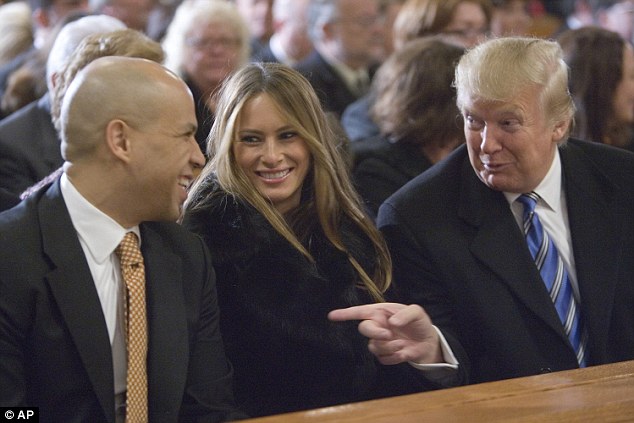
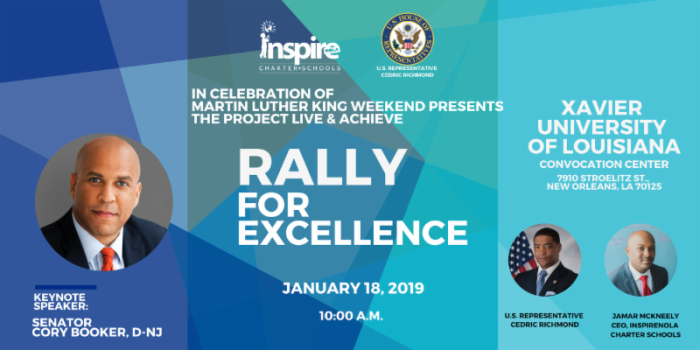
Meanwhile in New Orleans, Sen. Cory Booker is giving the keynote address at a charter school rally.


That wouldn’t be surprising if Booker was a Republican.


Donald Trump’s Education Secretary Betsy DeVos is a big time champion of school privatization over public schools.


But like LA Superintendent Austin Beutner, Booker – a New Jersey lawmaker – is supposed to be a Democrat.


The party is supposed to stand for social goods, doing what’s best for everyone not just the few.


However, when Booker gave the keynote address at the “Project LIVE & Achieve” Rally for Excellence today, he made it clear whose side he’s on. And it’s not parents, children or communities.


booker_mlk


Organizers estimate 5,000 students from more than 20 city charter schools attended the rally instead of attending their classes.


Traditional public schools aren’t allowed to spend tax dollars or waste class time by forcing students to attend political rallies. But since charter schools like all of New Orleans schools after Hurricane Katrina don’t have to follow the same rules, this is your tax dollars at work.


The rally was hosted by InspireNOLA Charter Schools and U.S. Representative Cedric Richmond, a Louisiana Democrat.


The charter network’s Website describes the rally as part of InspireNOLA’s celebration of Martin Luther King weekend.


What a disgrace!

thumbnail_b16c81fc7a8b7c203e0f6a706700260d

Dr. Yohuru Williams, a professor of history at Fairfield University in Connecticut and an MLK scholar, has written extensively about how school privatization and high stakes testing are in direct contradiction with Dr. King’s writings and speeches.


“While it seeks to claim the mantle of the [civil rights] movement and Dr. King’s legacy, corporate education reform is rooted in fear, fired by competition and driven by division,” says Williams. “It seeks to undermine community rather than build it and, for this reason, it is the ultimate betrayal of the goals and values of the movement.”


Dr. King certainly wouldn’t have approved of today’s rally. After all, King said:


“To save man from the morass of propaganda is one of the chief aims of education. Education must enable one to sift and weigh evidence, to discern the true from the false, the real from the unreal, and the facts from the fiction.”


Forcing children to go to a political rally and then pretending their mandatory presence is somehow a show of support is exactly the kind of propaganda King was railing against.


“The function of education,” King explained in 1947, “is to teach one to think intensively and to think critically.”


Booker, who clearly has ambitions of a Presidential run, has violated those principles time and again.


Before he became a U.S. Senator, he was Newark mayor. In that position he accepted a $100 million donation from Facebook founder Mark Zuckerberg to implement a series of drastic reforms in city schools.


The people of Newark only found out about it on Oprah Winfrey’s TV show when Booker was a guest and announce the grant. Almost all of that money went to charter schools, according to the New Republic.


thumbnail_maxresdefault


Such publicity stunts and mugging for the cameras may be why The Gaurdian even described Booker as a “neoliberal egomaniac.”


While numerous corporate Democrats like Booker share his love of charter schools, his positions go even further to the right. Like DeVos, with whom he sat on the board of pro-privatization Alliance for School Choice, he also is a proponent of school vouchers. This despite any credible evidence that voucher programs actually create better educational outcomes for students.


And Devos isn’t the only radical right privatization-monger in Booker’s circle. Michelle Rhee, the former DC schools chancellor known for union busting and a series of reforms that resulted in a citywide cheating scandal, is someone Booker calls “a friend of mine”


Though as a Senator, Booker held the party line and voted against his long-time friend DeVos’ nomination as Education Secretary, he told CNN that he hadn’t changed his position on school privatization:


“When it comes to my record of supporting what I believe that any child born in any zip code in America should have a high quality school and I don’t care if that’s a charter school or a traditional district school. If it’s a bad school I’m going to fight against it just like I supported charter school closures in Newark that weren’t serving the genius of my kids. So I haven’t changed one iota.”


Yet his record flies in the face of his rhetoric.


As Newark Mayor he privileged charter schools and helped them spread throughout the city while underfunding traditional public schools. And though he continually brings up the “amazing” academic record of Newark’s charter schools, he strangely omits the a cheating scandal they experienced similar to Rhee’s.


636588408131916332-mark019


According to a report by the state Department of Education’s Office of Fiscal Accountability and Compliance, testing documents were not secured at these schools. State investigators flagged at least 15 charter schools for further inquiry because some tests had unusually high rates of wrong-to-right erasure marks. One school had rates more than three times greater than the state average.


Charter schools are often run by appointed officials and not elected school boards. They meet behind closed doors and never have to explain how and why they’re spending taxpayer dollars. Though much hand wringing has been done over charters that are explicitly run for a profit, even those designated “not for profit” can cut students services and pocket the difference. There are a multitude of ways these schools can cheat students out of the resources and educations they deserve while protecting the administrators and business people making a buck off them.


In LA, administrators like Buetner – who has no experience with education but is a millionaire investor in school privatization – actually sabotage the public schools in order to feed the profit-making machine of charters.


And now the opposition to these shenanigans is spilling into the streets in both red and blue states. There have been seven major teacher protests in the last year in states like Arizona, Oklahoma, West Virginia, and now California.


It’s past time for Democrats to take a stand along with them and oppose school privatization in all of its forms.


thumbnail_o-cory-booker-chris-christie-facebook


Yet when The Intercept asked all 47 members of the Senate Democratic Caucus to weigh in on the LA Teacher strike and charter school proliferation, only 7 responded.


Rep. Alexandria Ocasio-Cortez, D-N.Y., and Rep. Ro Khanna, D-Calif. have made no bones about the connection. Sen. Bernie Sanders, I-Vt., also expressed support for striking teachers, even tweeting a link to a Jacobin article about school privatization. Though didn’t mention charter’s directly, he has  spoken out about school privatization before, including last year when Puerto Rico announced its plans to open charter schools in the wake of Hurricane Maria.


The problem is that many Democrats won’t go that far. They’ll say they support LA Teachers but won’t admit that school privatization is the cause of their woes. They refuse to take a stand against the billionaire backers of the industry and side with the grassroots parents and children fighting for fully public schools.


However, few go as far as Booker to openly champion the industry.


At least, few Democrats.


Still can’t get enough Gadfly? I’ve written a book, “Gadfly on the Wall: A Public School Teacher Speaks Out on Racism and Reform,” now available from Garn Press. Ten percent of the proceeds go to the Badass Teachers Association. Check it out!
book-1

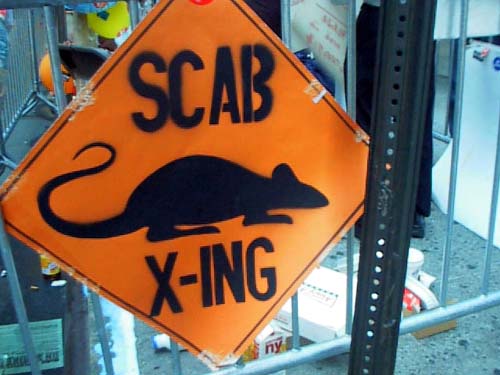
There Are Few Things As Reprehensible as a Scab

scabrat


There is a special place in Hell for strikebreakers.


Some people kill. Some steal.


But only a filthy, disgusting scab can do all of that in one.


When you take someone else’s job, you’re stealing their bargaining power and killing the community’s chances for their kids.


This week as 30,000 teachers at Los Angeles Unified School District walked out demanding support for their students and their professions, a few slimy worms have crossed the picket line to keep some of the district’s 900 schools open.


Most parents have kept their children home, but some don’t have that choice. And the district is trying to use that opportunity to justify larger class sizes and fewer resources. While sitting on $2 billion in the bank, they pull out their pockets and play dumb. In the richest state in the country, they want you to believe there isn’t enough money to waste on children.


At least not on these black and brown children!


And whether they mean to or not, the craven, no account, flatulent scabs back them up 100%.


According to the LA Times, the district has students cloistered in holding areas while administrators tell them to fill in workbooks or go on their cell phones or iPads to learn via app.


Among these yes-men, you’ll find a handful of substitute teachers who put their own yellow bellies over solidarity with their fellows.


Not only is this sniveling, groveling behavior suitable only to strip the self-respect from the most base criminal, they aren’t even getting thirty pieces of silver for it.


According to the Times, at one school scabs are only being paid $160 a day – less than subs normally make. Yet for each of these fill-ins, the district is paying the Charter Substitute Teacher Network – an outside agency providing these miserable miscreants – $250 a day, which is in fact more than the usual sub rate!


How transparent! The district doesn’t even value its scabs! It would rather pay the corporation that provides these amoral dupes than the dupes, themselves!


How low a weasel do you have to be to take such a job? What kind of dung beetle? What piece of excrement could stoop so low?


No. Wait. That’s an insult to weasels, dung beetles and excrement!


Working people have one thing of value in this economy – their labor.


When you rob a person of the right to withhold that labor, you take away her power. You turn her into little more than a slave whose only choice is take it or leave it.


But when people are given the dignity to join together as one, to unify as one solid whole, they can equal the power of the wealthy and privileged.


They can stand together on their own two feet and demand a fair share.


And in these terrible times, when the powerful look at even public schooling as little more than an opportunity to further enrich themselves through no account charter schools and high stakes testing and endless ed tech bells and whistles – who is left to stand up for our children?


I’ll tell you who! The teachers!


The parents!


The students!


The community!


We are all here united as one. We have drawn a line in the sand – and woe to the pustulent, putrid, pissant who dares cross it!


You want to make America great?


You want to make this country into something we, the people can be proud of?


Don’t cross any picket lines.


Show some backbone, even if it hurts to stand up straight for once.


The only way forward, the only way to create a society worthy of our children, is to join hands and walk toward the promised land – together.


“After God finished the rattlesnake, the toad, the vampire, He had some awful substance left with which He made a scab … When a scab comes down the street, men turn their backs and angels weep in heaven, and the Devil shuts the gates of Hell to keep him out. No man has a right to scab so long as there is a pool of water to drown his carcass in, or a rope long enough to hang his body with.”

Jack London


Still can’t get enough Gadfly? I’ve written a book, “Gadfly on the Wall: A Public School Teacher Speaks Out on Racism and Reform,” now available from Garn Press. Ten percent of the proceeds go to the Badass Teachers Association. Check it out!
book-4

LA Teachers Strike is About Charter Schools and High Stakes Testing

utla-strike


On Monday more than 30,000 teachers at 900 schools in Los Angeles, California, will be on strike.


And unlike the wave of teachers strikes last year in red states like West Virginia, this time educators are taking to the streets due to the policies of Democrats.


At issue are things like lowering class sizes and providing more nurses, librarians and counselors.


But behind these issues lies one of the most important facts about our country.


When you get right down to it, there is very little difference between many Democratic policymakers and their Republican counterparts.


You think Betsy Devos is the opposite of Arne Duncan? Wrong.


You think Barack Obama is the opposite of Donald Trump? Wrong again.


Though there are differences, those often amount to differences of degree.


Corporate Democrats like almost all Republicans support the same education policies – school privatization and high stakes testing – that are robbing the LA Unified School District of the funding it needs to meet the needs of its students.


THAT’S why class sizes have ballooned to more than 45 students in secondary schools; 35 students in upper elementary grades; and 25 students in lower elementary grades.


THAT’S why the district does not have nearly enough counselors, psychologists or librarians to give students the support they need.


THAT’S why 80% of schools don’t have full-time nurses.


The second largest district in the country has more charter schools than any other. The overwhelming majority of them are operated by corporate chains and have expanded by 287% over the last 10 years.


These are publicly funded but privately run schools. They don’t have to meet the same standards of accountability or transparency about how they spend taxpayer dollars – all while gobbling up $600 million a year!


That is money that parents and community members are forced to pay but about which they have very little say. It’s money that can – and often does – go right into the pockets of charter school operators without providing its full value to the students it was meant help educate. It’s money set aside for all children but given to educate merely a handful of students chosen by those same businesspeople who run these charters because they think these children will be cheaper and easier to educate.


That’s not Democracy. No self-respecting Democrat should support such a thing – but you’ll find luminaries from Obama to the Clintons to Cory Booker who will tell you what a great idea it is. Along with DeVos, Trump, Jeb Bush and the Koch Brothers.


LA Superintendent Austin Beutner is a Democrat, but he’s also a multimillionaire with experience in corporate downsizing and none in education.


According to an op-ed by President of United Teachers Los Angeles (UTLA) Alex Caputo-Pearl published in the LA Times:


“…Beutner has moved ahead with what we believe is his agenda to dismantle the district. Through an outside foundation, he has brought on firms that have led public school closures and charter expansion in some districts where they have worked, from New Orleans to Washington, D.C. This approach, drawn from Wall Street, is called the “portfolio” model, and it has been criticized for having a negative effect on student equity and parent inclusion.”


These are policies in direct opposition to the progressive ideals at the heart of the Democratic Party. They are, in fact, bedrock Republican ideology and demonstrate the vast divide among Democrats.


New Democrats oppose them. Grassroots Democrats oppose them. Democratic voters oppose them. And it will be telling whether the policymakers in our halls of power will follow the lead of the people or try to shepherd the power behind the party into doing what the patricians think best.


That’s why this strike is important way beyond California. Whatever happens will send echoes throughout the country, because school districts from sea to shining sea are facing similar issues.


In the meantime, the LA Unified District has a $1.8 Billion budget surplus it can use to help meet these needs. But the solutions to the district’s woes require a long-term commitment to public education.


Certainly the state of California needs to increase its per pupil spending. It’s the richest state in the country, yet ranks 43rd out of 50 in this regard.


This would help the district raise teacher salaries to match those of surrounding districts.


But the root problem is a lack of ideological support among policymakers.


Too many Democrats inside and outside the district don’t support the very idea of public schools. They’d rather boost privatization.


Too many Democrats support unnecessary and harmful high stakes standardized testing which not only unfairly paints the district as a failure for the poverty of its students but forces out things of real education value like the arts and ethnic studies.


Too many Democrats have no problem doing this in a district that serves a majority of students of color while providing only the best for middle class white kids.


That’s why today the American people stand with the UTLA as they go on strike.


It’s why we always stand with educators – You can’t put students first if you put teachers last.


Democrats need to get their priorities straight.


It’s time to decide if they’re going to continue being Trump lite or reclaim their progressive heritage and rejoin the rest of the nation.


Still can’t get enough Gadfly? I’ve written a book, “Gadfly on the Wall: A Public School Teacher Speaks Out on Racism and Reform,” now available from Garn Press. Ten percent of the proceeds go to the Badass Teachers Association. Check it out!
book-2

How Many Decisions Do Teachers Make Every Day?

94b755b2-ad1400b671f8ad28440f6a7067004614


Teaching is an exhausting job.


If you’re a parent, you know how tiring it is with just one or two kids.


Imagine having a room full of them — Twenty to thirty children, each demanding your attention, each requiring your urgent help – every minute, every day, for hours at a time.


Back in the late 1980s, before education became totally absorbed by standardized testing and school privatization, we used to wonder about the effects of such need on a single individual.


We used to wonder how much was really being asked of our teachers.


Today no one outside of the classroom really gives it much thought. We think of educators as part of a vast machine that is required to give us and our children a service.


We’re stakeholders. They’re service providers. And the students are a national resource.


None of us are people.


Perhaps it’s this dehumanizing economic framework that’s helped the edtech industry and testing corporations make so much headway trying to replace educators with apps and iPads.


We no longer give the teacher an apple. We displace her with a Mac.


But back in the days before George W. Bush’s No Child Left Behind or Barrack Obama’s copycat Race to the Top, or Donald Trump’s blatant Destroy Public Education, we wondered about teacher psychology and how to best help our human workforce meet the needs of our human children.


That’s when researchers observed elementary school teachers and noted that, on average, they made at least 1,500 decisions a day.


That comes out to about 4 decisions a minute given six hours of class time.


In the decades since, this figure has come to be associated with elementary and secondary teachers. In fact, it’s become so ubiquitous that I wondered where it originated.


The first reference I can find to it comes from C.M. Clark & P.L. Peterson’s article “Teachers’ Thought Processes” published in the Handbook of Research on Teaching from 1986. (3rd ed., pp. 255–296). New York: macmillan.


Though subsequent studies came up with slightly different numbers, the basic argument holds.


Researchers Hilda Borko, Carol Livingston and Richard Shavelson mark the low end of the scale. In their 1990 article “Teachers’ Thinking About Instruction,” they summarize studies that reported .7 decisions per minute during interactive teaching or 42 judgements per hour, 252 a day.


On the upper end of the scale is Philip Jackson who wrote in his 1990 book “Life in Classrooms” that elementary teachers have 200 to 300 of these determination generating exchanges with students every hour (between 1,200-1,800 a day). Most of these are unplanned and unpredictable calling for teachers to make what they term shallower decisions or deeper judgments (p. 149).


So because teaching involves waiting for the right opportunities for learning, neither student nor teacher can say with confidence what exactly will happen next. It requires “spontaneity and immediacy” (Jackson, p. 166, 152).


As a classroom teacher with more than 15 years of experience, none of this is surprising to me.


Just imagine the various tasks teachers are required to do every hour. We take attendance, review homework, help with seat-work, ask questions, etc. And that doesn’t even take into account all the times we’re unpredictably interrupted by the unexpected – upset students, administrative announcements over the PA, student questions, equipment breakdowns, etc. Each one of these requires us to make spontaneous, unplanned calls before the lesson can continue.


It just goes to show some of the various roles teachers are expected to fill in the lives of their students. They are expected to be information providers, disciplinarians, assess student learning, administrate school policies, facilitate student inquiry, act as role models and even be foster parents.


In any given lesson, we have to make decisions based on our plans AND decisions based on things that just happen to crop up unexpectedly – multiple times each day.


In fact, it seems to me that the research fails to account for innumerable situations that also require determination and deliberation as part of an educator’s everyday routine.


What about curriculum and instruction design? Grading? Written and verbal feedback to students? Reflection and revision of lesson plans?


When you think of all that, 1,500 decisions a day seems like a conservative estimate indeed.


Perhaps the most troubling thing about this is where it impacts teacher quality.


And when I say that, I don’t mean the basterdized modern meaning of that term – that teachers are responsible for maximizing student test scores on standardized assessments. I mean the quality of authentic instruction teachers are able to give their classes.


When we expect educators to turn on a dime more than a thousand times a day, doesn’t that impact the depth with which we can accomplish the job?


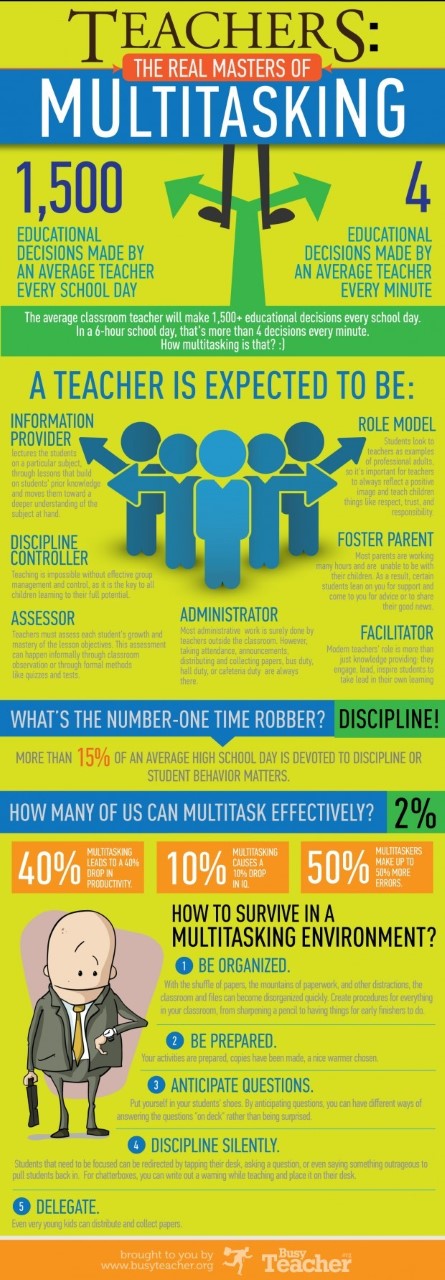
Busyteacher.org certainly thinks so. I’m not sure where the Website got its statistics, but they are sobering.


In a fascinating infographic, the site claims that multitasking leads to a 40% drop in productivity. It causes a 10% drop in IQ. It causes people to make 50% more mistakes than concentrating on one task at a time.


thumbnail_multitasking-teachers-infographic-620x1783


I don’t know if these statistics are accurate, but the general principle is sound. When we’re forced to “do more with less” we actually end up producing more with less quality.


Focusing on fewer things increases ones accuracy. Therefore, teachers who have to make fewer decisions in a day would probably be able to do their jobs more effectively.


And there are plenty of ways to accomplish this.


We could reduce class size. If educators can concentrate on the needs of fewer children, they would be more effectively able to meet those needs.


We could reduce the amount of time teachers have to be in the classroom in a given day. I’ve often thought teaching was analogous to being an actor up on the stage – but we’re also responsible for writing the script, operating the lighting, etc. And we have to interact with the audience many of whom would rather be elsewhere, and we have to do multiple shows each day.


In some countries, teachers spend a significant part of their days planning and grading and less in the classroom. They don’t have to do all that behind the scenes stuff on their own time without any additional pay.


In Finland, for example, teachers are paid 13% more than the Organization for Economic Cooperation and Development (OECD) average but spend 100 hours less in the classroom. And class size is between 9-14 students, the lowest in OECD countries. No wonder their children are near the top of the scale in international comparisons!


Wouldn’t it be amazing if we lived in a society that valued education and didn’t try to turn everything into economic quantities for corporations?


We could actually focus on the real phenomena of educating children and not have to fight warped education policies more concerned with turning it all into dollars and cents.


Perhaps teachers wouldn’t have to make so many thousands of decisions if our lawmakers could just make this one.


Still can’t get enough Gadfly? I’ve written a book, “Gadfly on the Wall: A Public School Teacher Speaks Out on Racism and Reform,” now available from Garn Press. Ten percent of the proceeds go to the Badass Teachers Association. Check it out!
book-3

A Gadfly’s Dozen: Top 13 Education Articles of 2018 (By Me)

thumbnail_IMG_8445


I’m not going to mince words.


This year, 2018, has been a monster.


We’ve been fighting the dumbest and most corrupt President of our lives – Donald Trump. And we’ve been making progress.


Thanks to the midterm election blue wave in the U.S. House, Trump will finally have a check on his power.


We have more black and brown representatives, more women, more nationalities, ethnicities and faiths in the halls of power than ever before.


Charter schools and vouchers are more unpopular today than at any other point in history. High stakes testing is on the decline. And everywhere you look educators and education activists are being heard and making a difference.


But it’s taken an incredible toll on the activist community.


We have had to be out there fighting this ridiculous crap day-in-day-out 365 days a year.


And even then, we’ve suffered devastating losses – family separations at the border, children dying in detention, an increase in hate crimes and gun deaths, all while climate change runs rapidly out of control.


I wish I felt more hopeful. But as I cast my eyes back on the year that was, I’m struck with a sense of bone-deep despair.


I am confident Trump will go down and he will take so many with him.


But the forces of regression, prejudice and stupidity that forced him upon us don’t appear to be going anywhere.


Behind Donald is another Trump waiting to take his place. And behind him another one – like an infinite set of Russian Matryoshka dolls.


Oh, many of them look more appealing than Donald. They dress better, are more articulate and can remember all the words to the National Anthem. But they are just as committed to serving themselves at our expense.


So with that in mind, I invite you to join me on a brief look back at the year that was.


First, let me thank everyone who bought my book, “Gadfly on the Wall: A Public School Teacher Speaks Out on Racism and Reform” from Garn Press. It was amazing to have finally achieved the dream of being published (in paper with a binding and everything)! I never made anyone’s best seller list, but it was gratifying to have hundreds of copies make it into readers’ hands. I hope people found it helpful (and still do because it’s still out there where better books are sold).


Also, I got to check another item off my bucket list with the invitation to film a TED Talk at Central Connecticut State University. My topic was “The Plot to Destroy Public Education.” It’s been viewed almost 1,000 times. I invite you to watch it here.


As to the blog, itself, I’ve been writing now for four and a half years. This year, I’ve had more than 211,000 hits. To be honest, that’s quite a drop. In 2017, I had 366,000 hits. But I’m hearing about similar dips all over the blogosphere. Facebook changed its algorithm this year making it much harder for people to see the work of amateurs like me. Zuckerberg’s multi-billion dollar corporation doesn’t refuse to spread the written word – it just charges a fee that I can’t afford. Moreover, the Federal Communications Commission (FCC) repealed Net Neutrality at about this time last year making things even more dodgy.


However, on the plus side, the blog is up to more than 1,429,000 hits total! That’s pretty good for a publication that’s only been around since July 2014. And it doesn’t count all the readers I get from articles reposted on the Badass Teachers Association Blog, Huffington Post, Commondreams.org, the LA Progressive, Alternet, BillMoyers.com or other sites.


In addition, about 500 more people followed me this year for a total of 13,361.


That should do it for an overview.


One final item before I get to the look back. I’m making a slight change this year to how I do things. Instead of publishing two separate articles – a Top 10 list and a List of Honorable Mentions – I’m combing the two into this one.


I’ll begin with three pieces that didn’t necessarily get the number of hits I thought they were worth. Then I’ll count down my 10 most popular pieces of 2018.


So without further ado, here’s what’s kept Gadfly buzzing this year:


Honorable Mentions


 13) The Necessity and Importance of Teachers


Published: June 29 teacher-elementary-Getty-blog


Views: 520


Description: There’s an increasing (unspoken) insistence that schools do away with teachers and replace them with technology, apps, algorithms and other edtech marvels with more strings attached than your standard marionette. This is my attempt to prove how and why real, live teachers are important.


Fun Fact: How sad this article was and remains necessary.


12) There is Virtually No Difference Between Nonprofit and For-Profit Charter Schools


Published: Sept. 7 Screen Shot 2018-09-06 at 3.18.04 PM


Views: 1,464


Description: You often hear privatization cheerleaders defend charter schools by making a distinction between the good ones and the bad ones. This usually just means those that are for-profit and those that are not-for-profit. But in this article, I show that this distinction is bogus.


Fun Fact: This may be one of the most important facts you can share with someone who’s had a big gulp of the charter school Kool-aide.


11) Top 10 Reasons You Can’t Fairly Evaluate Teachers on Student Test Scores


Published: Aug. 6 Screen Shot 2018-08-02 at 12.49.24 AM


Views: 1,552


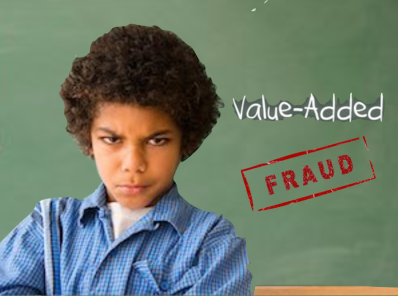
Description: Policy makers don’t talk about it as much these days, but there are still plenty of laws on the books requiring states to evaluate teachers on student test scores. It’s called VAM or Value Added Measures. Here’s why it’s totally unfair.


Fun Fact: I’m not sure if anyone else has ever put together all these arguments against VAM. Hopefully, it can serve as a good go-to article when a corporate shill starts rhapsodizing on the benefits of this farce.


Top 10 by Popularity


10) Grit is Sh!t – It’s Just an Excuse to do Nothing for Struggling Students


Published: Nov. 8 Screen Shot 2018-11-08 at 3.29.01 PM


Views: 3,102


Description: Ask a Common Core propagandizer why their canned academic standards haven’t resulted in an increase in test scores and you’ll get this whooper: ‘It’s the students’ fault. They need more grit.’ Here’s why that’s a steaming pile of something that rhymes with grit.


Fun Fact: Some folks hated this article simply because of my potty mouth. But a whole lot of people were as fed up with this particular suit of the Emperor’s new clothes as I am.


9) Twenty-One Reasons People Hate, Hate, HATE Betsy DeVos


Published: March 12 n7kdmgvgx13jmo6cvmpu


Views: 3,824


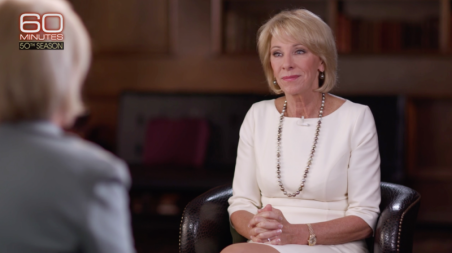
Description: During Betsy Devos’ 60 Minutes interview, the billionaire heiress turned Education Secretary just couldn’t figure out why people hated her so much. It thought I’d send her a clue – or 21.


Fun Fact: The biggest criticism I got on this article was that I stopped at only 21 reasons. I should have gone on – but then I might still be writing…


8) The Best Charter School Cannot Hold a Candle to the Worst Public School


Published: May 26 Screen Shot 2018-05-24 at 7.43.41 AM


Views: 3,929


Description: A question I often get is this: Why do you think Charter Schools are always a bad thing? Here is my answer.


Fun Fact: This article shocked a lot of progressives who backed Obama and Clinton. But it had to be said. Democracy is always better than tyranny just as public schools are always better than charter schools.


7) Few Kids in the World Can Pass America’s Common Core Tests, According to New Study


Published: Jan 23 chinese-children-crush-americans-in-math-thanks-to-a-mindset-americans-only-display-in-one-place-sports


Views: 5,061


Description: If all students the world over had to pass America’s Common Core tests, they wouldn’t be able to do it. You’d think that would have implications for how we assess learning in the USA. But nope. Standardized tests are big business. Wouldn’t want to kill that cash cow just because we’re hurting our children, now would we?


Fun Fact: This should have been a bigger story, but we already rewrote our federal education law, the Every Student Succeeds Act, which enshrines standardized testing in most states. So nothing can be done until it comes up for another revision in a few years where lawmakers will again drag their feet and somehow rediscover their love of standardized testing all over again!


6) When You Mistreat Teachers, Beware the Unintended Lessons for Students


Published: Jan 10 5a552b35785e6.image


Views: 7.048


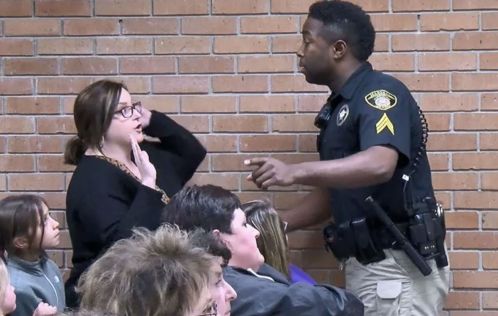
Description: A Louisiana school resource officer threw a school teacher to the ground and arrested her for asking a question at a school board meeting. This was my analysis of what such actions were teaching students.


Fun Fact: A Lafayette judge ruled 10 months later that the school board violated Louisiana’s open meetings law and had to negate the pay raise for the superintendent that the teacher was asking about.


5) The Six Biggest Problems with Data-Driven Instruction


Published: Sept 25 0


Views: 7,525


Description: A lot of folks in education think that everything in our schools should be data driven. Here’s why they’re wrong. It should be data-informed but student driven.


Fun Fact: A lot of educators, parents and students were as sick of hearing about “date-driven” instruction as I was. Feel free to use this article on the next fool who brings out this stale chestnut.


4) Teacher Autonomy – An Often Ignored Victim of High Stakes Testing


Published: Oct 12 Screen Shot 2018-10-12 at 12.12.38 PM


Views: 11.405


Description: Standardized testing is terrible in so many ways. It hurts students. It hurts schools. But we often forget how it stops teachers from effectively doing their jobs.


Fun Fact: This one brought a lot of memories to educators – memories of how things are supposed to be and how they’ve changed for the worst. We need to continue asking questions about the purpose of education and how our school policies are betraying that purpose.


3) Billionaire Heiress Lashes Out at Unions Because Her Fortune Didn’t Buy Election


Published: Nov 30

U.S. Education Secretary Betsy DeVos Speaks To Media After Visiting Students At Marjory Stoneman Douglas High School


Views: 11,723


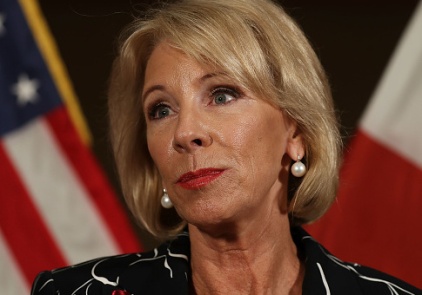
Description: Poor Betsy. She and her family spent a lot of money on this election on regressive candidates who had no intention of working in your best interest. And many of them lost!


Fun Fact: Wouldn’t it be great if everyone got one vote? Wouldn’t it be great if money couldn’t buy elections?


2) Five Reasons to Vote NO on the Allegheny County Children’s Fund


Published: Oct 18 Screen Shot 2018-10-17 at 12.14.03 PM


Views: 18,593


Description: In the Pittsburgh area, we were asked to vote on a referendum to increase spending on children. It sounded like a great idea until you looked at the details. It was just a power grab by the forces of privatization.


Fun Fact: The referendum lost by about as many votes as this article received. I can’t prove my writing changed anyone’s mind, but it was hugely popular here in the ‘Burgh. I’d see people passing around printed copies at council meetings. It was reposted everywhere. I feel like this one made a real difference and helped us stop a bad law. Too bad it couldn’t help us enact a good one.


  1. African Immigrants Excel Academically. Why Don’t African Americans?


Published: June 6 static.politico.com


Views: 20,022


Description: I start with a basic fact about native born African Americans vs. foreign born African Immigrants. Then I try to account for the difference.


Fun Fact: This seems like an important question to me. But it was a controversial one. Some folks were furious I even asked the question. But more people were interested in this piece than anything else I wrote all year.


Gadfly’s Other Year End Round Ups

This wasn’t the first year I’ve done a countdown of the year’s greatest hits. I usually write one counting down my most popular articles (like the one you just read from 2018) and one listing articles that I thought deserved a second look. Here are all my end of the year articles since I began this crazy journey in 2014:


2017:


What’s the Buzz? A Crown of Gadflies! Top 10 Articles (by Me) in 2017


thumbnail_Screen shot 2017-12-26 at 3.44.17 PM


Hidden Gadfly – Top 5 Stories (By Me) You May Have Missed in 2017


7fd6a56c2ffc7a03c9fd2f431a543e92


2016

Worse Than Fake News – Ignored News. Top 5 Education Stories You May Have Missed in 2016


ignoring-wisdom


Goodbye, 2016, and Good Riddance – Top 10 Blog Post by Me From a Crappy Year


screen-shot-2016-12-27-at-3-29-49-am

2015


Gadfly’s Choice – Top 5 Blogs (By Me) You May Have Missed from 2015

Screen shot 2016-01-02 at 11.01.09 PM


Who’s Your Favorite Gadfly? Top 10 Blog Posts (By Me) That Enlightened, Entertained and Enraged in 2015

Screen shot 2015-12-30 at 12.57.49 AM


2014


Off the Beaten Gadfly – the Best Education Blog Pieces You Never Read in 2014

Wonderfull illusion art painting


Top 10 Education Blog Posts (By Me) You Should Be Reading Right Now!


computer-people-png-300x202


Still can’t get enough Gadfly? I’ve written a book, “Gadfly on the Wall: A Public School Teacher Speaks Out on Racism and Reform,” now available from Garn Press. Ten percent of the proceeds go to the Badass Teachers Association. Check it out!
thumbnail_IMG_8249

Yellow Vest Protests Include Resistance to School Corporatization

thumbnail_Paris-closes-tourist-sites-ahead-of-new-yellow-vest-protests-this-weekend


If you want to know what the French Yellow Vest Protests are all about, just refer to the arrest of 153 teenage students this month near Paris.


The kids at a high school in Mantes-La-Jolie were forced to kneel down, hands on their heads or secured behind their backs with zip ties as riot police circled them with assault weapons.


Why did law enforcement take such extreme measures? The students had been protesting their government’s education policies.


“What a well-behaved class!” French police commented ironically on a video documenting the arrest on social media by Violences Policières, a watchdog group.


Yes, how well behaved!


Of course! Children should be seen and not heard. Speaking out for yourself is a definite faux pas.


So is detaining minors without a lawyer, which the officers did and which is illegal in France.


But C’est la vie!


Unfortunately such scenes have been repeated throughout the country since November. Despite police opposition, high school students from a number of French schools have joined the Yellow Vests to protest French President Emmanuel Macron’s education policies – inaccurately dubbed “reforms” – among other austerity measures resulting in stagnant wages and a high cost of living.


Macron was elected in 2017 on a neoliberal platform much like that of Barack Obama. And though he was praised for his demeanor, especially in comparison to the boorish Donald Trump, his policies at first met with criticism and then outright protests in the streets.


Citizens took issue with new labor laws, the rail system and taxes. You can’t save the environment by cutting taxes for the wealthy and raising them for the poor to discourage them from driving. You can’t stomp on workers rights in order to create more low-paying jobs.


Protestors repurposed the yellow vests they are required to keep in their cars in case of an emergency into an iconic image of resistance to the gas tax. Hundreds of thousands demanded not just a repeal of Macron’s policies but a new platform to bolster social services and the economy.


The Macron administration has met these demands by at first violently stifling them and then agreeing to individual points before returning to suppression.


Perhaps it is the administration’s insistence that it is beset by violent “hooligans” while most protestors do no more than block traffic that has resulted in a continued rejection of Macron. Protestors even spray-painted a demand that Macron resign on the Arc de Triomphe, the arch on the Champs-Elysées.


Though the American media has mostly ignored the situation, critics blame widespread police brutality including the use of tear gas and clubs for at least four deaths and 700 people wounded in weeks of political challenges that some have compared to the French Revolution.


In particular, students take issue with at least three components of Macron’s plan: (1) changes to the high school graduation exam, (2) changes to college admissions and (3) a new requirement that all students participate in a lengthy volunteer national service project.


First, protestors oppose changes to the end-of-school exams known as baccalaureate or ‘bac.’ Though the proposal includes positive reforms such as reducing the number of exams and providing a longer time frame to take them, it also changes focus from academics to careers.


Much like Common Core did in the United States, the exams would be revised and rewritten. Instead of being tested on broad subjects such as science, literature or social sciences, students would be assessed on much narrower content.


Macron seems to be taking his queue from US philanthrocapitalists like Bill Gates in order to make French students more “college and career ready.”


The new assessments would push students toward specific degrees sooner. Before their final undergraduate year, high school students would have to choose two specific majors and two specific minors alongside the standard curriculum – similar to American colleges.


Students are against this because of what they call “hyper-specialization.” They say these changes would deprive them of exposure to a wide range of disciplines and force them to make life-long choices too early. This would be especially harmful for poor students because, as Liberation editorialist Laurent Joffrin put it, “Those who have more, know more.” In other words, wealthier students would probably be better prepared to navigate the choices open to them than those in poorer areas.


Next, students also want the repeal of stricter selection criteria to universities – a law passed just last year – which they say increases economic inequality between rich and poor schools.


The government provides free college to any student who passes the high school exit exams. However, just like in the US, corporate interests complain that college students struggle with the increased workload and pressures at universities. The new measure solves this by ensuring that fewer students are admitted.


Students say Macron has it backwards. The government shouldn’t be undermining free access to higher education. It should be investing more in the country’s universities and helping students succeed.


Finally, students want to get rid of a mandate that all 16-year-olds will have to participate in a national civic service program scheduled to begin in 2026.


French youths would have to volunteer in fields like defense, environment, tutoring or culture. During the long school breaks, they would have to undergo a one-month placement, consisting of two weeks in collective housing to promote a “social mix,” and then another two weeks in smaller, more “personalized” groups.


The measure doesn’t go as far as Macron wanted. He originally proposed mandatory military service.


Students object to the plan because they say it’s unnecessary and extremely expensive. The program is estimated to cost $1.8 billion ($1.6 billion Euros) with a $1.98 billion ($1.75 Euro) investment up front.


In addition to these demands, some have included limits on class size. Protestors have demanded no more than 25 students per class from nursery school through high school. Low class size ensures each student gets more personal attention from the teacher and a better chance to ask questions and learn.


What we’re seeing in France is extremely important for those living in the US.


It shows that as terrible as the Trump administration is, there are many flavors of bad government. When your representatives are more interested in seeing to corporate whims than the will of the people, chaos can ensue.


Perhaps the US media has been so adverse to reporting on the Yellow Vests because of corporate fear that protests will jump the pond and land on our shores, as well. We have many similar neoliberal and neofascist policies in the US of A, some passed by Republicans and others passed by Democrats.


Here’s hoping that we all can establish legitimate governments that seek to further the ends of liberty, equality and fraternity.


Like this post? I’ve written a book, “Gadfly on the Wall: A Public School Teacher Speaks Out on Racism and Reform,” now available from Garn Press. Ten percent of the proceeds go to the Badass Teachers Association. Check it out!
book-1

What Happened to 2018 As The Year of the Teacher?

merlin_137374938_25a3513b-8341-4602-8710-910d3500b1d5-jumbo


This year teachers took their mission way beyond the classroom.


Starting in West Virginia, we staged half-a-dozen walkouts in red states across the country demanding a better investment in children’s educations and often getting it.


Then we took that momentum and stormed our state capitals and Washington, DC, with thousands of grassroots campaigns that translated into seats in government.


It was so effective and unprecedented that the story began circulating that 2018 would be known as “The Year of the Teacher.”


And then, just as suddenly, the story stopped.


No more headlines. No more editorials. No more exposes.


So what happened?


The gum in the works seems to have been a story in The Atlantic by Alia Wong called “The Questionable Year of the Teacher Politician.”


In it, she writes that the teacher insurgence was overblown by unions and marks little more than a moment in time and not an authentic movement.


It really comes down to a numbers game. Numerous sources cite high numbers of teachers running for office. Wong disputes them.


National Education Association (NEA) senior political director Carrie Pugh says about 1,800 educators – both Republicans and Democrats – sought seats in state legislatures this year. Likewise, the Democratic Legislative Campaign Committee (DLCC), a group that works to elect Democrats to state legislatures, puts the number at 1,456 educators.


Wong disputes these figures because she says most of these people aren’t currently K-12 classroom teachers.


She writes:


 “The NEA uses the word educator liberally, counting essentially anyone who currently works in or used to work in an education-related job, such as professors, guidance counselors, and school administrators.”


Maddy Will and others at Education Week agree with Wong’s assessment. According to their analysis, out of the thousands of education-related candidates, they could only prove that 177 were K-12 classroom teachers.


And there you have it.


A story about teachers taking over their own destinies is dead in the water.


However, this begs two important questions: (1) Is not being able to corroborate the facts the same as disproving them? And (2) Is being a K-12 classroom teacher a fair metric by which to judge education candidates?


First, there’s the issue of corroboration.


Wong, herself, notes that part of the disparity, “…may come down to the inconsistent ways in which candidate lists are compiled from state to state and organization to organization.” It’s unclear why that, by itself, throws doubt on the NEA’s and DLCC’s numbers. These are verifiable facts. Journalists could – in theory – track down their truth or falsity if their parent companies ponied up the dough for enough staff to do the hard work of researching them. The fact that this hasn’t happened is not proof of anything except low journalistic standards.


Second, there’s the question of whether Wong and Will are holding teachers up to a fair standard.


Since the Great Recession, more than 116,000 educators have been out of work. If roughly 1-2% of them decide to run for office, doesn’t that represent a rising tide of teachers striking back at the very representatives responsible for neglecting schools and students? Aren’t they seeking to right the wrongs that put them out of work in the first place?


Even if we look at just the people currently employed in an education field, why are college professors defined out of existence? Why are guidance counselors and principals not worthy of notice?


Certainly K-12 classroom teachers are at the heart of the day-to-day workings of the education system. But these others are by no means unrelated.


Carol Burris was an award-winning principal at South Side High School in the Rockville Centre School District of New York before becoming Executive Director of the Network for Public Education (NPE). Diane Ravitch, who co-founded NPE, is an education historian and research professor at New York University.


If Wong and Will are to be believed, the work of Burris and Ravitch on behalf of public education should be discounted because they are not currently working in the classroom. That’s just ridiculous.


This isn’t about logic or facts. It’s about controlling the narrative.


The Atlantic and Education Week are artificially massaging the numbers to support the narrative their owners prefer.


And let’s not forget, both publications are in bed with the forces of standardization and privatization that educators of every stripe have been taking arms against this year and beyond.


Though The Atlantic is a 162-year-old pillar of the journalistic establishment, it was purchased on July 28, 2017, by the Emerson Collective. This is Laurne Powell Jobs’ philanthrocapitalist cover organization which she’s been using in a media blitz to reinvent high schools by way of corporate education reform.


Likewise, Education Week has always had a corporatist slant on its editorial page and sometimes even in the way it reports news. Nowhere is this more blatant than the publication’s annual Quality Counts issue which promotes the standards-and-testing industrial school complex of No Child Left Behind, Race to the Top, Common Core, etc.


It’s no wonder that these organizations would want to stop the narrative of insurgent teachers taking a stand against the very things these publications and their owners hold dear.


They want to cast doubt on the record-breaking activism of parents, students, citizens and, yes, teachers.


But the facts tell a very different story.


From West Virginia, Oklahoma, and Kentucky to Colorado and Arizona, educators took to the streets last spring to rally for adequate, equitable and sustainable K–12 funding.


All over the country, we’re demanding properly equipped classrooms, better wages, and stronger public schools.


In Connecticut we sent the first black woman to the legislature from the state, Jahana Hayes, a school administrator and Teacher of the Year.


We took down Wisconsin’s anti-education Governor Scott Walker. Not only that, but we replaced him with the state superintendent of public instruction, Tony Evers, on a platform centered on schools and learning.


And he wasn’t the only educator with a gubernatorial win. Tim Walz, a former high school teacher, became governor of Minnesota.


In Oklahoma, former teachers Carri Hicks, Jacob Rosencrants, and John Waldron all won seats in the state legislature, who along with others riding the pro-school tide increased the state’s “education caucus” – a group of bipartisan lawmakers committed to improving schools – from nine members to 25.


Even where candidates weren’t explicitly educators, mobilizing around the issue of education brought electoral victories. Democratic candidates were able to break the Republican supermajority in North Carolina because of their schools advocacy.


Even in Michigan – home of our anti-education Education Secretary Betsy DeVos – Gretchen Whitmer was elected governor after campaigning against public-school funding cuts.


In Illinois, anti-education governor Bruce Rauner got the boot, while Democrat J.B. Pritzker unseated him on a schools platform.


And in Kansas, not only did school districts successfully sue the state for more funding, Laura Kelly defeated conservative incumbent governor Kris Kobach on a platform of further expanding school funding.


These victories didn’t just happen. They were the result of grassroots people power.


The NEA says even beyond educators seeking office, members and their families showed a 165% increase in activism and volunteering during the midterm election over 2016. This is especially significant because participation tends to flag, not increase, around midterms.


So let’s return to the disputed numbers of teachers who sought election this campaign season.


Of the 1,800 educators the NEA identified, 1,080 of them were elected to their state legislatures. When it comes to the smaller American Federation of Teachers (AFT), 109 of 178 educators won.


If we go by Education Week’s numbers, just 43 of 177 won.


Clearly, this is not the whole picture.


The education insurgency was more than even getting candidates elected. It was also about changes in policy.


In Massachusetts, we successfully repealed the Ban on Bilingual Education so educators will be able to teach English Language Learners in a mix of the students’ native language and English as a bridge to greater English proficiency.


In North Carolina, we successfully lobbied state lawmakers to stop for-profit charter schools from taking over four of five public schools.


And everywhere you look the stranglehold of high stakes standardized testing is losing its grip.


Because of our advocacy, the amount of time spent on these deeply biased assessments has been cut in states like Maryland, New Mexico, West Virginia, Hawaii, and Pennsylvania.


The highly suspect practice of evaluating teachers on student test scores has been dropped in Connecticut and the weight it is given has been reduced in New Mexico.


Now with new policies in Idaho and North Dakota, 10 states have explicit laws on the books allowing parents to opt their children out of some or all of these exams.


Half of New Hampshire’s school districts have replaced standardized tests in most grades with local, teacher-made performance assessments.


I don’t care what corporate journalists are being forced to report by their billionaire owners.


These accomplishments should not be minimized.


Teachers are at the heart of communities fighting the good fight everywhere.


And in most places we’re winning!


We’re teaching our lawmakers what it means to support public education – and if they refuse to learn that lesson, we’re replacing them.


If that’s not “Year of the Teacher,” I don’t know what is.


Like this post? I’ve written a book, “Gadfly on the Wall: A Public School Teacher Speaks Out on Racism and Reform,” now available from Garn Press. Ten percent of the proceeds go to the Badass Teachers Association. Check it out!
book-2