Save Our Schools From Coronavirus Budget Cuts


Screen Shot 2020-05-02 at 4.36.09 PM


America is one dumbass country.


We don’t do the metric system.


We don’t do universal healthcare.


And during a global pandemic, we don’t demand the government pay us to stay home and stop the spread of the disease.


Instead, we demand the government let us go out and get sick.


It should come as no surprise, then, that we deeply under-fund our public schools.


There’s always money for a new war or to subsidize fossil fuels or give billionaires another tax cut, but when it comes to teaching kids how to think critically about their world – time to take out the scissors and slash some budgets.


And now with the inevitable loss of taxes after shutting down the economy to save lives during the global Coronavirus outbreak, experts are expecting the deepest budget cuts to schools – well, ever.


Sixty two district superintendents from urban districts wrote to Congress in April warning of a 15-25% loss in revenues next fiscal year.


The school leaders from cities like New York City, Los Angeles, Chicago and Miami, say that a 20% loss in both state and local taxes, alone, would result in laying off about 275,000 teachers.


And this would come after students had already suffered significant academic losses during the current (2019-20) school year because of school closings and distance learning initiatives that could not possibly meet the needs of students as well as in-person learning.


Screen Shot 2020-05-02 at 10.14.42 AM


They ask legislators to enact a plan devised by the Albert Shanker Institute – a policy organization aligned with the American Federation for Teachers (AFT) – in which the federal government would give billions of dollars to districts in several phases to keep schools open. Then states would increase funding to levels before the Great Recession (2009-13), build up budget reserves and more equitably distribute capital.


How much money would be necessary?


It’s hard to say at this point.


Most districts get about 90% of their funding from state and local taxes and these haven’t been tallied yet for March, when social distancing began.


Some experts expect to have a better picture of the damage by the end of the first or second week of May.


There has been no mass evictions (though that may eventually happen), so property taxes are probably stable at this point. But it’s unclear how much shuttered storefronts and skyrocketing unemployment will affect the picture.


Screen Shot 2020-05-02 at 10.14.14 AM


The National Governors Association and non-partisan Center on Budget and Policy Priorities, though, are expecting the worst.


They estimate a possible $500 billion state shortfall mostly concentrated in the 2020-21 fiscal year.


Screen Shot 2020-05-02 at 10.12.29 AM


That’s less than three months away.


Even if you subtract fiscal aide already provided by Congress and state rainy day funds (if present), legislatures would still be at least $360 billion short.


The National Association of Teachers (NEA) is calling for an additional $175 billion just to stabilize the country’s schools.


“The seniors graduating this spring started kindergarten in the fall of 2007,” says Bruce Baker, professor at the Graduate School of Education at Rutgers University and co-author of the Shanker Institute report.


“Most of these students have spent almost their entire K-12 careers in schools with less funding than there was when they started. If this happens again, it will be because we let it happen.”


And that’s just it.


This Coronavirus crisis is a wake-up call for all of us about the elements of our society that had to fail for us to get to this point.


Everything from how we deal with climate change, to infrastructure, to healthcare, to economic inequality needs to be reconsidered if we are to survive.


Education is an essential piece of that puzzle.


We cannot continue to consume resources like there is no tomorrow – or there will be none.


We cannot continue to treat billionaires like the most vital part of our society when they are really nothing but parasites on it.


And we cannot continue to undercut our public education system and expect our next generation to be in a better position than we are today. In fact, doing so ensures that it won’t be.


Not only do we have to pay for our kids to be educated, we have to pay for ALL kids – black, white, brown, girls, boys, Christians, Jews, Muslims, immigrants, native born — all of them.


We have to integrate, educate and eliminate the school-to-prison pipeline.


And we have to stop wasting the money we do allocate on pointless profit-making endeavors for corporations that give little to nothing back to the children they are meant to be serving. That means no more privatized schools, no more high stakes standardized testing, no more shady ed tech, corporate written academic standards and union busting initiatives.


We have to ask ourselves – will we continue to support a culture of death where war and inequality are prioritized over nurturing and care? Or will we finally engage in a culture of life, where education and equity are the driving forces of society?


We can continue to be the laughing stocks of the world with our guns and superstitions, or we can get off our asses and start working toward a better world for all.


The old ways will not work in this new millennium.


It is entirely unclear whether we will heed the call from this crisis or hide our heads in the sand.


But the future of our nation and the well-being of our children are being decided right here, right now, this very minute.


Time to invest.


Email your members of Congress and tell them to keep students learning and educators working.


Like this post?  You might want to consider becoming a Patreon subscriber. This helps me continue to keep the blog going and get on with this difficult and challenging work.

Plus you get subscriber only extras!

Just CLICK HERE.

Patreon+Circle

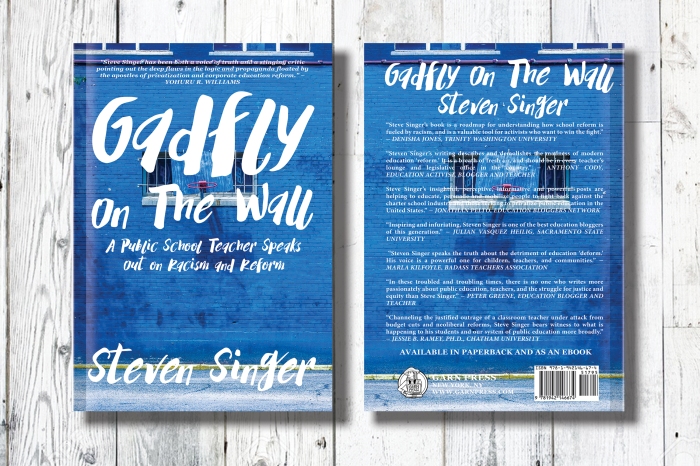
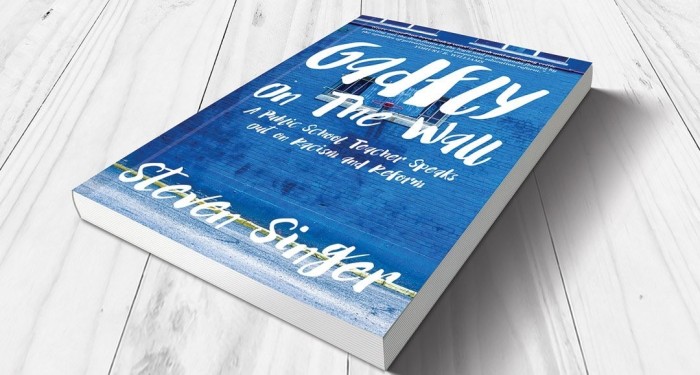
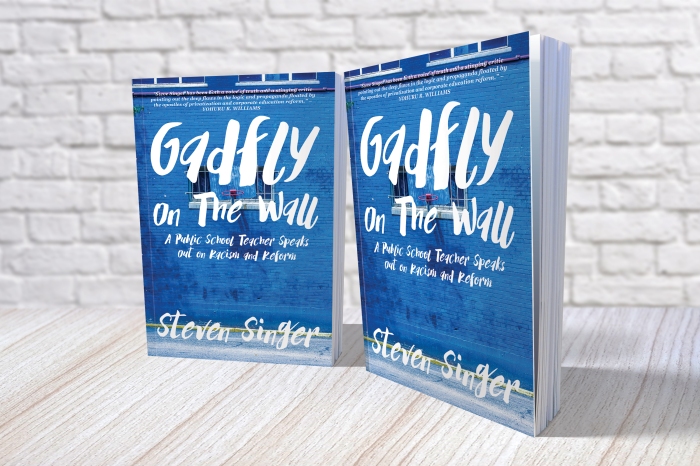
I’ve also written a book, “Gadfly on the Wall: A Public School Teacher Speaks Out on Racism and Reform,” now available from Garn Press. Ten percent of the proceeds go to the Badass Teachers Association. Check it out!
book-2

Adventures in Online Teaching: Reinventing the Wheel for a Handful of Students

Screen Shot 2020-04-24 at 8.28.00 PM

 
Today in our ZOOM meeting, one of my students tried to get one over on me.


I sat at the bureau in my guest bedroom, surveying a gallery of 7th grade faces lined up in little boxes on my laptop like the opening scene of the Brady Bunch.


Lilly was lying on her bed face up, almost definitely scrolling on her cell phone.


Pha’rrel was eating a cookie as he tried to fit his overgrown curls under a gray hoodie.


And Jimmy was smiling at me with the cheesiest close up you ever saw in your life.


The smile was so wide. The eyes were so glassy. The face was so still.


“Jimmy, did you put up a picture of yourself on your camera!?” I asked.


Somewhere miles away he laughed, apologized and took it down.


If we were back in the classroom, I probably would have come down on him.


He used to sit in the back of the room, face buried in his iPad, ear buds plugged into his brain and his work done in the most careless but high-speed fashion possible.


About once a week I had to take away some device just so his Internet-rattled mind could pay attention.


What am I to do now? Those apps and devices are the only thing connecting him to even the most rudimentary schooling.


He still wants to appear to be paying attention, appear to be done with whatever useless crap I am having him do so he can play Fortnite, watch YouTube videos or text – all behind a digital mask of innocent concentration.


So I moved on.


We read a passage together and I noticed Melanie had her eyes closed.


Not just that. She was in her comfy sweats, cuddled under the covers with a kitten curled under her elbow purring away.


“Melanie?” I say.


No response.


“Melanie, did you hear what we just read?”


Nothing.


She’d do that in class sometimes, too. She’d be zonked out, her head plastered to the desk in a puddle of quickly congealing drool. Sometimes it was pretty hard to wake her.


I remember conferencing with her and her mom trying to find out if there was anything wrong – but, no, she was simply misusing the privilege of picking her own bedtime.


How was I to keep her awake online? I couldn’t shake the desk, rattle her papers or even let my voice naturally get louder as it gained proximity.


I had to let her sleep.


Oh and what’s this? Was that Teddy finally joining the ZOOM Meeting 20 minutes in?


I clicked to let him join and immediately it was clear that he was missing something important.


“Teddy? Is that you?” I said.


“Yeah, hey, Mr. Singer.”


“Ted, you forget something?”


“Wha?”


“Ted, your shirt?”


He looks down at his naked torso.


“Oh, I haven’t gotten dressed yet.”


“Uh, we can see that, Buddy. Why don’t you turn your iPad around and put on a shirt and pants? Okay?”


These are just some of the hurdles you face as an online teacher.


Ever since the Coronavirus pandemic shuttered schools across the country, teachers like me have been asked to finish up the year with students via the Internet.


It’s not been exactly a smooth transition.


Getting kids attention is not an easy task under the best of circumstances. Online it’s nearly a Herculean labor.


Strangely the episodes related above aren’t even close to the worst of it.


More than students’ attempts to message each other through the lesson or the constant screaming in the background at some kids homes or the vacant stares of the child with ADHD whose IEP calls for teacher proximity and eye contact, but how do you do that from across town? – more than all of that is the silence.


The empty, deafening silence of the majority of kids who don’t even show up.


I’ve been doing this for three weeks now and I average about 40% participation.


Some days a class might be almost full. Another day there might be two kids.


I know it’s not necessarily the children or the parents’ fault.


We’re in the middle of a global catastrophe. Family members are sick, kids are scared, and many don’t have experience with Internet, the devices or certainly the learning platforms we’re using.


Districts can give out iPads and mobile hot spots, but not familiarity with technology, not a quiet place to work, not a safe and secure learning environment.


When a parent tells me her child is having trouble with something, I excuse him. I get it.


When a student tells me she doesn’t understand how to do something, I don’t penalize her. I try to fix the problem and ask her to give it another shot.


But when you’ve been tasked with creating almost entirely new curriculum on the fly for several different classes– and you do – it’s anticlimactic that so few kids show up to see it.


I almost don’t mind it when someone’s cat swaggers in front of the screen and flaunts its butthole for all to see.


That’s just life in the age of distance learning.


But when I design all these assignments and teach all these classes, I wish more students showed up.


My district doesn’t require me to do all this.


I could have just thrown a few worksheets up on Google Classroom and called it a day.


That’s kind of what administrators want, I think. Just review previously taught skills. Make it look like we’re doing something. And we’ll close the academic gaps next year.


But when the world shut down, my 8th graders were getting ready to read “The Diary of Anne Frank” and “To Kill a Mockingbird.” You don’t really expect me to skip over that, do you?


My 7th graders were getting ready to read a gripping mystery story, “Silent to the Bone” by E.L. Konigsburg. You don’t really think I’m going to substitute that with grammar and vocabulary worksheets? Huh?


So I narrowed it all down to essentials.


I could have assigned my students to read the texts on their own and then made them write reader response journals. But I don’t think any but my most self-motivated students would have done it and even they would have lost a lot without being able to discuss it.


So I put a few assignments on Google Classroom, but most are through live ZOOM Meetings where the students and I talk through the texts together.


The 8th graders read the play version of “Anne Frank” together with me, and it’s actually going pretty well.


I’m able to display the text on the screen and move the cursor under what they’re reading.


I’ve even seen some reluctant readers improve right before my eyes.


I’ve always suggested that students put their index fingers under the words as they read, but few do it. Using ZOOM like this forces them to follow my advice.


Of course, the class is a tiny fraction of what it would be in person.


If we were still in the school building, I’m positive they’d be learning more. We’d be able to discuss more. I’d have a better read of the room. They would be less capable of hiding behind the technology.


But there is real life-long learning taking place.


It’s my most successful group.


My 7th graders are a different story.


They are the kind of class you have to explode a stick of dynamite under to get them to notice what’s right before their eyes.


And more of them actually show up. Yet much of what we’re reading seems lost on them.


They are much more dedicated to being present in body if not in spirit – and barring an exorcism, I’m unsure how to reach many of them through fiber optic cables.


Then we have my Creative Writing class – basically a journaling course taught to a different group of students every few weeks.


It’s particularly challenging because I’ve met very few of them in person before the school closed.


However the course also lends itself best to this distance learning format.


Back in the school building, I used to give students a prompt every day, explain it and then have them write. I’d go from desk-to-desk as they worked and give feedback. Once they were all done, we’d share the writings aloud.


Now online, I just give the prompts via Google Classroom, provide instruction or attach video links and leave them to it. Then I comment on what they produce.


The problem is it’s my least attended class. I have a handful of students who do all the work, but most have done nothing. And this is a traditional work-at-your-own-pace cyber class.


I’ve had much more difficulty planning the other courses. Everything had to be reinvented. You want to read along with students, you need (1) a platform where you can all talk (2) an online text, (3) a way students can catch up, (4) a way to hand in written work, (5) a way to give tests without allowing students to cheat or do the work together.


It’s been challenging especially because sometimes one online solution will simply disappear.


For example, the e-text I was using for 7th grade was taken down overnight. One day it was available. The next it was gone. So I had to scramble to find a way to make it work.


That kind of thing happens all the time.


And speaking of time, when I’m not in a ZOOM Meeting with students or programming next week’s lessons, I have to wait for assignments to come in. Back in the classroom, they used to be handed in mostly all at the same time. I could grade them and move on.


In cyber-land, they trickle in piecemeal. I’m NEVER done teaching. It could be 1 am and my phone dings that an assignment, comment or question was turned in. I could wait until later, but usually I trudge over to the computer and see what needs my attention.


Which brings me to the final challenge – managing my home and teacher-life.


I’m not just an educator. I’m a parent.


I don’t teach my daughter. I don’t assign her lessons or work. But I have to oversee what her teacher wants her to do and make sure it gets done – and done correctly.


I’ll tell her to go in the dinning room and do three BrainPop assignments, or sign on to Edmentum and finish this diagnostic test, etc.


She’s generally pretty good about things, but if I don’t watch her, she’ll play Mario Party on her Nintendo all day long.


With the wife working from home, too, I usually give her the living room, my daughter is someplace else or her room, and I’m in the office.


On the one hand, it’s nice to be busy, and the good moments where I connect with students are just as magical as in person.


But most of the time, I feel lost at sea, depressed about the news and unable to concentrate or sleep the night through.


I’ve resigned myself to this life for the next six weeks when school will end for the academic year.


Perhaps the summer will be better. Maybe we’ll be able to go out and life will get somewhat back to normal.


However, I am not blind to the possibility that I’ll have to pick up again online in August and September.


School could start up with distance learning in 2020-21. Or we could have to quickly rush back to the Internet after a second wave of COVID-19 crashes upon us.


I keep thinking of the opening of Charles Dickens’ “A Tale of Two Cities”:


“It was the best of times, it was the worst of times, it was the age of wisdom, it was the age of foolishness, it was the epoch of belief, it was the epoch of incredulity, it was the season of light, it was the season of darkness, it was the spring of hope, it was the winter of despair.”

 
The fact that life and schooling will be different after this crisis ends is both encouraging and terrifying.


There’s so much we could fix and finally get right.


But from what I see us doing as the crisis unfolds, my hope dwindles with each passing day.


Stay safe and stay optimistic.


But let’s not stay cyber.


Like this post?  You might want to consider becoming a Patreon subscriber. This helps me continue to keep the blog going and get on with this difficult and challenging work.

Plus you get subscriber only extras!

Just CLICK HERE.

Patreon+Circle

I’ve also written a book, “Gadfly on the Wall: A Public School Teacher Speaks Out on Racism and Reform,” now available from Garn Press. Ten percent of the proceeds go to the Badass Teachers Association. Check it out!
thumbnail_IMG_8249

You Can’t Have My Students’ Lives to Restart Your Economy


Screen Shot 2020-04-18 at 6.36.25 PM


It’s okay if a few children die to start up the economy.


That is literally the opinion being offered by media influencers and policymakers as Coronavirus social distancing efforts continue passed the 30-day mark.


In the midst of a global pandemic, we’ve closed down all nonessential businesses while people self quarantine at home waiting for the curve of infection to plateau and then drop off. Medical experts tell us this is the only way to ensure there are enough ventilators and hospital beds for those who get sick.


As it is, more than 700,000 Americans have tested positive for COVID-19 and 38,000 have died – more than the wars in Iraq and Afghanistan, the September 11 terrorist attacks, Hurricane Katrina and the Oklahoma City bombing – combined. In fact, the United States has the highest number of Coronavirus deaths in the world.


Screen Shot 2020-04-18 at 4.11.10 PM


Yet there is a concerted effort by the Trump Administration and plutocrats everywhere to get business back up and running. And to do that, they need the schools to reopen so parents can return to work.


They literally want to reopen schools as soon as possible – even if it isn’t 100% safe.


And if that means students, teachers and parents die, at least their sacrifices will have been worth it.


“Schools are a very appetizing opportunity,” said Dr. Mehmet Oz as a guest on Fox News’ Sean Hannity show.

 
“I just saw a nice piece in [British medical journal] The Lancet arguing the opening of schools may only cost us 2 to 3%, in terms of total mortality. Any, you know, any life is a life lost, but … that might be a tradeoff some folks would consider.”

 
Dr. Oz walked back the comment after popular backlash, but I believed him the first time. Many people would find that acceptable.


Dr. Phil McGraw (who unlike Dr. Oz is not a licensed doctor) said the following on Fox News’ The Ingraham Angle:


“The fact of the matter is, the longer this lockdown goes on, the more vulnerable people get. And it’s like there’s a tipping point. There’s a point at which people start having enough problems in lockdown that it will actually create more destruction and actually more deaths across time than the actual virus will itself.”


He then compared coronavirus deaths to deaths from smoking, swimming pools and car crashes – which critics pointed out result from mostly voluntary behavior.


Once again, Dr. Phil walked back his comments after public outrage. And once again, I saw where he was coming from – because it’s clear where these celebrity talking heads are getting their information.


You find the same opinion tucked into many otherwise informative articles about the virus and education.


Education Next published a piece by Walton Family Foundation advisor and American Enterprise Institute fellow John Bailey with this precious little nugget tucked in its middle:


“Currently, the public health benefits of school closures and home quarantining outweigh the costs. But at what point does that equation flip? When do the economic, societal, and educational costs outweigh the public health benefits of these aggressive social distancing actions?”


The rich need the poor to get back to work. And they’re willing to put our lives on the line to do it.


What’s worse, they’re willing to put our children’s lives on the line.


I don’t know about you, but I’m not willing to risk my daughter’s life so that the stock market can open back up.


As a public school teacher, I’m not willing to bet my students lives so that the airlines and cruise industry can get back in the green.


Nor am I willing to gamble with my own life even if it means the NBA, NFL and MLB can start playing games and Hollywood can start premiering first run movies again.


There’s still so much we don’t know about COVID-19.


Initial reports concluded that older people were more susceptible to it, but as infections have played out worldwide, we’ve seen that 40% of patients are between 20-50 years of age. Children seem mostly asymptomatic. However, many immunologists suspect they are acting as carriers spreading the virus to the older people with whom they come into contact.

 
Children have a more difficult time with the constant hand washing and separating themselves at least 6 feet apart recommended by health experts. This is one of the justifications for closing schools in the first place. If we reopen schools too quickly, it could jumpstart another wave of infections.


In fact, that’s exactly what the Imperial College of London found in its own modeling study on likely U.S. and U.K. outcomes.


School closures can be effective to help suppress the transmission rates and flatten the curve, the report concluded, IF CONTINUED OVER FIVE MONTHS.


That’s a long time. But it gets worse.


In the absences of mass vaccinations – which may be as much as two years away – the study found the virus is likely to rebound for a second and third wave.


Screen Shot 2020-04-17 at 11.56.34 PM


So when would it be safe to reopen schools?


Honestly, no one really knows.

 
Former US Food and Drug Administration Commissioner Scott Gottlieb released a more optimistic answer in the “National Coronavirus Response: Roadmap to Reopening.”


The report maintains the need to continue social distancing including school closures until cases peak and we see sustained declines in new cases for 14 days.


That seems to be a fair minimum standard.


However, we are not there yet. The death toll continues to rise in the US and may continue to do so for some time yet.


Despite the science, every state has a different date in mind for when schools will reopen.


Since the beginning of April,a total of 21 state departments of education (including Pennsylvania’s) have decided to keep schools closed for the remainder of the academic year until at least August or September. Six states plus Washington, D.C., still have plans to reopen their schools before the end of the month.


Screen Shot 2020-04-17 at 11.53.43 PM


Beyond the question of WHEN to reopen schools is the even more complicated one of HOW or IF.


President and chief executive of the National Association of State Boards of Education Robert Hull said administrators across the country are asking not how – but if – schools will reopen in the fall.


“Everybody says we hope we return to normal,” Hull said. “It’s not going to return to normal anytime soon because the new normal is going to be different.”


Multiple possibilities are being considered.


A major factor will be how well districts can test incoming students for infection.


The best solution would be quick and cheap Coronavirus screenings. If we could mass produce such tests and distribute them to schools or have the results be a precondition to coming to school, things might be able to run pretty much as normal.


If US schools all had digital thermometers (as they do in Singapore), students temperatures could be taken before letting them in to the building. Anyone running a fever could be sent home.


Some policymakers are even considering spot checking students throughout the day with thermometers and using video cameras to trace the path of any students running a temperature to tell who they may have come into contact with before being identified. However, this seems pretty disruptive to me and – especially in the younger grades – might terrify students and make them conversely feel less safe in school because of the very efforts done to ensure their safety.


In all likelihood, policymakers see to think schools will probably have to run while engaging in some sort of social distancing. And that’s not easy. Nearly everything from the way the academic day is organized to the maturity level of most students goes against this need.


One thought provoking proposal is reducing class size to no more than 10 students.


This would also have educational benefits allowing teachers the ability to give more one-on-one instruction. However, most classes are double or triple this size now. Few school buildings are large enough to double or triple the number of classrooms needed at the same time.


One solution to this is that children could attend on alternate days or on a half day basis – one group in the morning, another in the afternoon. The drawback is that this would reduce the hours students are in class. Lessons would either have to be cut down to essentials or some part of assignments may have to go online.


This might also narrow the curriculum so that the arts, music, and other subjects would be eliminated. Gym classes would probably have to be cancelled and lunches might have to be in the classroom, itself, instead of allowing large groups of students to congregate in the cafeteria.


Just ensuring that students aren’t all in the hallway at the same time would be a challenge. Class dismissals might be staggered or perhaps the teachers would move from room-to-room while the students stay put.


Moreover, the simple act of busing students to-and-from school is likewise complicated. If students sit further apart on the bus, that means each district needs either more buses at the same time or double the time to transport students at arrival and dismissal.


None of this would be cheap. It could necessitate more money on transportation, support staff and teachers. In a country where education budgets haven’t yet recovered from the Great Recession of George W. Bush, reopening schools safely would require an influx of cash.


But without it, the economy cannot get back under way.


When schools closed in March, many districts switched to some kind of distance learning. Teachers put assignments on-line and even teach through Internet meeting sites like ZOOM. Continuing this in some form – for part or all of the day – is also being considered. However, it causes as many problems as it solves.


Parents need to be able to get back to work. Many can’t stay at home taking care of their children indefinitely. And they can’t leave their kids to their own devices while trying to learn via computer, device or app.


Moreover, these cyber schooling efforts come with educational drawbacks. Just about every educational expert acknowledges that learning in-person is preferable. Students with special needs are particularly at risk because many of their individual education plans (IEPs) cannot be met remotely. And even though efforts have been made to help impoverished students gain access to the necessary technology and Internet access, the problem has by no means been universally solved. Not to mention privacy concerns with student data being pirated by unscrupulous ed tech companies.


Another issue is high stakes standardized testing.


With the Coronavirus crisis, the tests were cancelled this year – and no one has really missed them.


If lessons have to be cut to essentials, standardized testing and the need for endless test prep should be the first things to go. In fact, students, educators, parents and college professors will tell you how useless these assessments are. They reflect basic economic inequalities and enforce them by tying education funding to the test scores.


Poor kids score badly and rich kids score well, so the funding becomes a reward for the privileged and a punishment for the underprivileged.


That’s why it’s laughable when Hull laments “issues of equity” including how to measure what students are learning and how to help those who have fallen behind.


Equity is a matter of funding and opportunities – not test scores. Regardless of the problems with reopening schools, we could solve a long standing issue by erasing high stakes testing from the academic map.


But that’s been the elephant in the classroom for a long time.


Economic interests have trumped academic ones for decades.


Will we continue to value money over children? Will we pave the post-Coronavirus future over the bodies of sick children and adults?


Like any crisis, COVID-19 is another opportunity to get things right.


Here’s hoping we have our priorities straight this time.


Here’s hoping schools stay closed until we’re certain reopening them won’t endanger students, teachers and the community.


Like this post?  You might want to consider becoming a Patreon subscriber. This helps me continue to keep the blog going and get on with this difficult and challenging work.

Plus you get subscriber only extras!

Just CLICK HERE.

Patreon+Circle

I’ve also written a book, “Gadfly on the Wall: A Public School Teacher Speaks Out on Racism and Reform,” now available from Garn Press. Ten percent of the proceeds go to the Badass Teachers Association. Check it out!

book-4

Top 10 Reasons to Vote for Joe Biden in the 2020 General Election

Screen Shot 2020-04-10 at 2.39.40 PM

 
With Bernie Sanders dropping out of the 2020 Democratic Primary, I can think of only these 10 reasons to vote for Joe Biden in the November general election:


10) He’s not Donald Trump.

9) He’s not Donald Trump.

8) He’s not Donald Trump.

7) He’s not Donald Trump.

6) He’s not Donald Trump.

5) He’s not Donald Trump.

4) He’s not Donald Trump.

3) He’s not Donald Trump.

2) He’s not Donald Trump.

1) He’s not Donald Trump.


Like this post?  You might want to consider becoming a Patreon subscriber. This helps me continue to keep the blog going and get on with this difficult and challenging work.

Plus you get subscriber only extras!

Just CLICK HERE.

Patreon+Circle

I’ve also written a book, “Gadfly on the Wall: A Public School Teacher Speaks Out on Racism and Reform,” now available from Garn Press. Ten percent of the proceeds go to the Badass Teachers Association. Check it out!

Screen shot 2018-01-07 at 1.14.14 AM

How Did America’s Schools Cope with Spanish Flu vs. Coronavirus?

Screen Shot 2020-03-30 at 10.23.47 AM


They say history repeats itself.


And if you’ve read any accounts of the bygone days of yesteryear, the current crisis certainly appears like a rerun.


Look at all the closed businesses, frightened people venturing out wearing face masks or self quarantined in their homes. It sure looks a lot like 1918.


The Spanish Flu epidemic that swept the nation a little more than a century ago bares more than a passing resemblance to COVID-19, the coronavirus. And the ways we are trying to cope with the situation are in many cases modeled on what worked a hundred years ago.


For instance, when our ancestors enacted social distancing policies to flatten the curve of infection, their infrastructures were better able to save lives. When they didn’t enact such policies, death tolls were greater.


That’s one of the major reasons many of us today are shut in our homes waiting this whole thing out. We want to give the hospitals a chance to deal with the cases that come in without people all getting sick at once and making a run on ventilators.


However, history has less to say about how we handle things like education.


After all, our forebears didn’t have as unified a response.


In general, closing schools was better to stop the spread of disease than keeping them open.


But what about actual academics? How did our progenitors make up missed work?


There-in lies a tale.


America’s school system seems to have met the crisis in three separate ways.


They either closed entirely, remained open or forced teachers to educate at a distance.


Wait. Educate at a distance? In 1918?


Yep.


But I’m getting ahead of myself.


PITTSBURGH

 
Let’s begin in my hometown of Pittsburgh, Pennsylvania.

 
City officials didn’t take the matter seriously enough and as a result, Pittsburgh ended up with the highest death rate of any major city in the country. The Spanish Flu killed at least 4,500 people – a smaller total than cities like Philadelphia, but it represented more than 1 in every 100 residents. Nearly 24,000 people sought treatment at local hospitals.


According to reports made to the city health department, things got so bad that at the epidemic’s worst, someone in Pittsburgh got the flu every 70 seconds and someone died from it every 10 minutes.


This resulted in a casket shortage across Western Pennsylvania as far away as Greensburg. Even in distant Ligonier, signs were posted along Lincoln Highway warning motorists, “You stop at your own peril.”


City officials were at least partly to blame.


Though local colleges and universities such as the University of Pittsburgh, Duquesne, and Carnegie Tech all closed their doors near the start of the outbreak, city public schools initially were kept open.


In early October, State Health Commissioner B. Franklin Royer made the decision not to close public schools, though Pittsburgh school administrators decided that anyone who was coughing or sneezing should be sent home.


However, as Kenneth White put it in his 1985 article “Pittsburgh in the Great Epidemic of 1918”:


“Enterprising students quickly discovered that a pinch of snuff or pepper, inhaled in school, provided a sure passport to freedom.”

 
By October 22, city council reviewed a report that 27,357 children – about one-third of the student body – were absent from school. Of this number, council knew of 6,070 students who had the flu and 53 who had died. In addition, many parents kept their children home for fear they’d get sick.


Only then were city schools closed – about three weeks after the epidemic took hold in the area.


Some surrounding districts like Ben Avon had closed schools as early as October 5. But many had followed the city’s example and suffered similar consequences.


Pittsburgh schools reopened on November 18. Though the Spanish Flu was not completely gone, it came back in two more waves through the area – however, neither was as devastating as the first crash.


I can find nothing specific about how surviving students made up missed academic work. Only that they missed 19 school days of class during the closure.


NEW YORK CITY


New York City reacted in a similar fashion as Pittsburgh but with different results.


While Pittsburgh’s mortality rate was nearly 1 in 100, New York’s was 4.7 per 1,000. City officials recorded approximately 30,000 deaths out of a population of roughly 5.6 million resulting from influenza or pneumonia.


However, just like Pittsburgh, New York kept its schools open.


In an October 5th New York Times article, Health Commissioner Royal S. Copeland explained his logic behind the controversial decision to keep students in class:


“New York is a great cosmopolitan city and in some homes there is careless disregard for modern sanitation… In schools the children are under the constant guardianship of the medical inspectors. This work is part of our system of disease control. If the schools were closed at least 1,000,000 would be sent to their homes and become 1,000,000 possibilities for the disease. Furthermore, there would be nobody to take special notice of their condition.”


In short, Copeland figured the schools could do a better job of ensuring children’s safety than their parents.


In class, teachers were expected to give each student a daily medical inspection and report the results to the school nurse and/or medical professionals.


According to Francesco Aimone in “The 1918 Influenza Epidemic in New York City: A Review of the Public Health Response”:


“School nurses and medical inspectors were instructed to follow up on teacher inspections and conduct home visits on absentee students to determine whether “… they or members of their family are sick, that physical examinations be carefully made, and that dry sweeping [in their home] be discontinued and ventilation sufficient.”

 
Many disagreed with Copeland’s decision including the Red Cross of Long Island.


Former Health Commissioner Dr. S.S. Goldwater put the blame squarely on the teachers who inspected students with “almost criminal laxity” and found the follow-up inspections “lamentably weak.”


CHICAGO


However, a similar strategy in Chicago didn’t repeat New York’s success.


Keeping schools open in the Windy City more closely emulated the situation in Pittsburgh.


According to a timeline of preventive measures published in the American Journal of Public Health by Chicago’s Health Commissioner Dr. John Dill Robertson, city schools weren’t closed because officials didn’t think children were getting sick more than adults. They thought it would be better to keep students indoors where they could be watched for symptoms.


However, children ended up dying from the flu in Chicago at a higher rate than their parents.


Like in Pittsburgh, any student who coughed or sneezed was immediately sent home – though eventually this also came with a mandatory home quarantine.


SMALLER TOWNS

 
Officials were more sensible in smaller towns like Adrian and Tecumseh, Michigan.


In both municipalities all schools were closed by the end of October when the epidemic began there.


By Dec. 12 there was a plan to reopen, however that was revised as the death toll continued to rise. Schools ultimately remained closed until January 1919.


Schools made up the missing days of class by extending the remaining year.
They stayed open for 30 minutes beyond their usual dismissal time and held half-day sessions on Saturdays.


Another small town that wasn’t taking chances was Pontiac, Illinois.


Not only did officials close the schools, they ended up using them as field hospitals for the sick.


Moreover, when classes were cancelled, school age children were forbidden from leaving their homes unless they had to run an errand. Anyone with the flu was immediately quarantined in his or her home.


Schools were closed on October 15 for what was originally supposed to be just five weeks. However, when the second wave of the flu hit, the closure was extended.


Things got so bad that from December 3rd through January 1st, school buildings were used as a hospital to treat those with the flu.


By early January, the worst had passed and schools were reopened. Beginning on January 10, 1919, the high school held an extra session on Saturday to help make up some of the missed class work.


This seems to be the general pattern. Larger cities tried to push on and keep things as normal as possible – with usually disastrous results. Smaller towns took more serious precautions and limited the death toll.


LAKELAND, FLORIDA


And then there’s Lakeland, Florida.

 
Leave it to this district in Polk County to be the oddball.


On Oct. 10, the schools were officially closed. But not really.


Superintendent of Lakeland Schools Charles Jones and Polk County Board of Public Instruction Superintendent John Moore ordered teachers to continue to report to work so they could help any students who needed remediation.
Jones wrote in the local Ledger newspaper:


“While the teachers will meet at the school building each day for the purpose of assisting any child who is deficient in certain subjects or all subjects, yet I want it understood that the pupils may see the teachers at their homes any time for instruction.”


Such instruction could be given over the telephone, if necessary, he added.


Moore took the matter a step further saying in a resolution published in the paper that teachers who failed to report to school or help students could have their pay docked.


Much of this proto-distance learning involved communication in the local paper.


Its pages included assignments from teachers to students and even teachers home phone numbers if students needed help.
 Examples of these assignments included reading passages from Shakespeare to drawing a map of North America.


IMPLICATIONS


The strangest thing about this incomplete survey of school responses is how much our current system is acting like Lakeland, Florida.


Almost all present day schools are closed with students supposedly self quarantined at home. This helps flatten the curve and minimize the chances of infection.


However, instead of waiting for the crisis to pass before addressing any academic deficiencies, many districts are requiring distance learning.


Teachers are being made to go in to school buildings or work from home creating online courses from scratch with little to no training.


True, this doesn’t expose educators to an added risk of catching the virus, themselves, but it does seem a bit mercenary.


We’re in a public health crisis where thousands of people are getting sick and dying. And the thing ourschool administrators are most concerned about is continued academic performance. They’d rather keep going with whatever quality of instruction can be provided in slapdash fashion than wait until it can be provided in the best possible circumstances.


They’d rather risk leaving behind those students without Internet access or whose special needs can’t be met online. Anything rather than extending the school year?


It’s interesting to compare today’s solutions to those of yesteryear.


Why didn’t more districts in 1918 try to make teachers instruct students through the newspaper and over the phone? Why didn’t more districts make teachers go to school buildings and even students homes during an epidemic?


Are we really doing the right thing by emulating those solutions?


Like this post?  You might want to consider becoming a Patreon subscriber. This helps me continue to keep the blog going and get on with this difficult and challenging work.

Plus you get subscriber only extras!

Just CLICK HERE.

Patreon+Circle

I’ve also written a book, “Gadfly on the Wall: A Public School Teacher Speaks Out on Racism and Reform,” now available from Garn Press. Ten percent of the proceeds go to the Badass Teachers Association. Check it out!

book-4

Virtual Learning Through Quarantine Will Leave Poor and Disabled Students Behind

Screen Shot 2020-03-25 at 9.49.54 AM


In the wake of the coronavirus crisis with most people self quarantined at home, schools across the country are shut down.


Some offer (or are considering offering) distance learning over the Internet.


However, this poses problems.


Not all student services can be provided via computer.


And not all students even have a computer, online compatible device or Internet access.


Should our nation’s public schools soldier on anyway and provide some kind of learning experience for those not thus encumbered at the expense of those who will be left behind?

 
The U.S. Senate’s proposed coronavirus aid package includes a provision to waive existing federal law that requires all schools to provide services to special education students. Removing this specification would allow districts to move forward with virtual learning without having to worry about meeting the needs of their special education students.


Advocates worry that even a temporary suspension of the Individuals with Disabilities Education Act (IDEA) could have devastating long term effects on students with disabilities and ultimately remove the requirement upheld for the last 45 years that they receive a free public education.

 
Education Secretary Betsy DeVos offered a gleeful statement in favor of dispensing with protections for students with autism, cerebral palsy, learning disorders and other special needs:


“It was extremely disappointing to hear that some school districts were using information from the Department of Education as an excuse not to educate kids. This is a time for creativity and an opportunity to pursue as much flexibility as possible so that learning continues. It is a time for all of us to pull together to do what’s right for our nation’s students.


“Nothing issued by this Department should in any way prevent any school from offering educational programs through distance instruction. We need schools to educate all students out of principle, rather than educate no students out of fear. These are challenging times, but we expect schools to rise to the occasion, and the Department stands ready to assist you in your efforts.”


The Department of Education issued a Fact Sheet that went even further:


“To be clear: ensuring compliance with the Individuals with Disabilities Education Act (IDEA), Section 504 of the Rehabilitation Act (Section 504), and Title II of the Americans with Disabilities Act should not prevent any school from offering educational programs through distance instruction.”


This is tantamount to prioritizing the education of some students over others. In short, if we follow DeVos’ guidelines, we will be saying that regular education students are more important than students with special needs.


It is a dangerous precedent.


However, perhaps even more dangerous is the abdication of any responsibility for, even complete erasure of any mention of poor students without Internet access.


This just underlines the importance of legislation. Special education students have IDEA. Poor students have nothing. There is no right to education for them at all.


If there had been some legislation specifically enshrining the rights of the underprivileged, however, it is clear this administration would be likewise proposing measures to dispense with it.


I understand that we are in a crisis. I understand that some think it is better to take half measures so that something gets done rather than nothing.


However, the coronavirus outbreak is expected to be a temporary situation. It may last weeks or months, but it will not last forever.


We want to do things in the best interests of children now, but we also must be aware of later. And trying to meet some kids needs now while writing off a large chunk of the rest would have a huge negative impact later.


If we educate just the privileged kids, we will be worsening the socioeconomic gap between students – a gap that is already too wide.


According to the most recent federal data, nearly 7 million students in the United States do not have Internet access at home. That is about 14 percent of all U.S. students. And of those with online access at home, 18 percent do not have home access to broadband Internet so they would also have difficulty retrieving lessons or participating in Zoom meetings online.

 
Moving to distance learning on the Internet would leave tens of millions of children behind.

 
Is this really what we want to do?


In addition, there is the question of quality.


Few teachers are trained or have experience with distance learning. They will probably be able to provide some kind of learning – but it will almost certainly not be the best they could be providing.


Moreover, there are real questions about the quality of learning that CAN be provided in a virtual environment even under the best of circumstances.


Cyber schools are a perfect fit for some students. Older and more mature students would probably have an easier time adjusting to it.


However, many students – especially younger ones – need the face-to-face interactions of school to get the most out of the experience. Forcing them into a mold that may at best be unsuited to them individually and at worst developmentally inappropriate will only cause them undo trauma.


I understand that everyone wants to appear like they’re doing something to meet the challenges provided by this crisis. However, sometimes the best thing to do is nothing.


One day the quarantine will be lifted. At that point, we can reopen the schools.


This may mean a few months of summer school. Or we could extend the 2020-21 school year to make up the difference.

 
Neither are perfect solutions. But they’re both better than virtual learning.


Neither require us to write off our poor and special education students.


And THAT is the most important thing.


Public schools don’t have to settle for whatever fad is offered from disaster capitalists.


We can still do what’s right for our kids.


All of our kids.


Like this post?  You might want to consider becoming a Patreon subscriber. This helps me continue to keep the blog going and get on with this difficult and challenging work.

Plus you get subscriber only extras!

Just CLICK HERE.

Patreon+Circle

I’ve also written a book, “Gadfly on the Wall: A Public School Teacher Speaks Out on Racism and Reform,” now available from Garn Press. Ten percent of the proceeds go to the Badass Teachers Association. Check it out!

book-4

Top 10 Things I Want My Students to do During the Coronavirus Quarantine

Screen Shot 2020-03-20 at 7.03.55 PM


Dear Students,


A schoolteacher without a classroom is kind of like a firefighter without a fire.


Or a police officer without crime.


But here we are – self-quarantined at home.


Our classroom sits empty, and everyday this week we sit here at home wondering what to do.


I want you to know that I’ve been thinking about all of you.


I hope you’re doing alright during this unprecedented moment in history. It probably seemed like a lot of fun when it first happened.


No school for the foreseeable future!


The whole thing came together so quickly that our district didn’t even have time to get together work to send home with you. And like most schools throughout the country, many of you don’t have home internet access so we can’t fairly give you on-line lessons, either.


So you’ve been at home with little guidance from us. Sure we have free breakfast and lunches available for pick up at the school, but you’re probably growing a bit stir crazy.


I know I am. (And I’m sure your folks are, too!)


I’m at home with my daughter trying to keep her busy.


We’ve been creating Mario Maker boards for each other on our Nintendo 3DS and Switch.


We keep trying to stump each other, and me, being a teacher, I keep trying to get her to think outside of the box.


“Why don’t you try making a board where you have to get a mushroom through a maze?”


Or


“Why don’t you try making a board where the walls close in?”
Or


“I wonder if you could beat a Thwomp in a race down a pit?”


We were having a really good time until I tried to get her to watch a science video. I put on the original Carl Sagan’s “Cosmos” from the early 1980s.


My daughter loves looking up at the stars and asking me questions about the constellations. I thought this would be a perfect fit – after all, Sagan was an astronomer and can answer her questions way better than I can.


However, the old school effects were simply no match for today’s aesthetic. She revolted after about 20 minutes.


Today I won her over though with the new Cosmos series featuring Neil deGrasse Tyson. She turned to me after about five minutes and said, “Much better.”


We’ve been drawing and reading and playing video games and having a good ol’ time.


I hope you have people at home who can help you get through all this, too.


I’ve been getting a lot of emails recently from your folks.


They want to know what they should be doing to help you academically.


Whenever this whole thing is over – and it will be over someday soon I hope – they want to make sure you won’t fall too far behind.


Let me start with a word of caution.


We don’t know how long this self-quarantine will last.


We’re trying to stay home to stop the spread of this virus – COVID-19. It can be deadly to some people – even some young people like you.


It’s in everybody’s best interest that we wait this thing out so that the hospitals can deal with the people who get sick.


Then when the disease has passed, we can continue our normal lives.


But no one knows how long that will take. It could be a few more weeks – but more likely months.


It is very possible that we will not go back to school again until after the summer.


So it’s hard to say exactly what you should do to keep yourself in the best academic shape because we don’t know what you’ll be coming back to.


We DO know that we won’t have to make up some or all of the days we missed.


And we know we won’t (here in Pennsylvania) have to take the PSSA or Keystone tests this year.


But when this is over, what grade will you be in? Will you just move on to the next grade or will there be a bit of mopping up to do first? And if you don’t finish the curriculum, will you be ready for the challenges ahead?


We don’t know any of that yet.


But here are a few guidelines and some things you might want to do while you’re at home.


You don’t have to do all of them, but they’re some things to think about.


So here’s my top 10 things for my students to do during quarantine:


1) Finish Whatever School Work You Can


You may have some outstanding school work with you in your book bag. I know I sent my seventh graders home with their poetry projects. My eighth graders should either be done or have taken their projects home to finish.


So if you have work that’s not done, finish it to the best of your ability. You certainly have enough time.


2) Read a Book


I ask all of may students to have a self-selected book handy for sustained silent reading in class. Hopefully you brought it home. If not, take a look around the house. Maybe you’ve got a dusty tome hanging out in some corner. Or – hey – if you have Internet access, you probably have the ability to get an ebook.


Read something – anything you want.


It will while away the hours, relax you and maybe get your mind to thinking about things above and beyond how much mac and cheese you’ve got stored in the cupboard.


3) Keep a Journal


Do you realize you’re living through a moment of history? People will look back on this and wonder how people got through it. You could fill in the blanks for some future researcher. Just a description of your everyday activities, what you’re thinking and feeling, your hopes and dreams – all of it has historical value. Plus, you’ll get some practice expressing yourself in writing. And just think – a simple story about how you survived the great toilet paper shortage of 2020 could end up being taught in the classrooms of the future!


Make it a good one!

4) Take a Break from Video Games


I know some of you have built a fort out of sofa cushions, covered it in blankets and are nestled in this hideaway doing nothing but playing Fortnite or Roblox or Minecraft with friends on-line. And you know what? There’s nothing wrong with that. You go ahead and do that.


Just remember to take breaks for more than just food and the bathroom. Getting lost in a fantasy world is great so long as you leave yourself a trail of breadcrumbs to get back out again.


Don’t forget the trail. Don’t forget there’s a world out there that needs you. Set definite limits for how long you spend in there and try really hard to adhere to them.


5) Watch Something Educational on TV or the Internet


Education isn’t limited to something a teacher told you to do. Find a video or TV show that explains something you never knew before. Youtube is great for this if you know what to look for.


I don’t mean to find some rant by your favorite Youtuber. I mean find something about science, history, art, literature, math, etc. Make it something you care about but might not watch just for fun.


You’ll be surprised at what you can find out there. The channel CrashCourse with author John Greene (“The Fault in Our Stars”) and his brother Hank is particularly informative, entertaining and far reaching. I also love John Michael Godier for all things astronomy and Composer David Bruce for discussions of music.


6) Watch/Read the News


There are extraordinary things happening every day. Knowing about them can help you prepare for what’s next and think about what we can and should be doing to make things better.


7) Listen to Music/ Draw/ Do Something Creative


I know you. You’re a bundle of creative energy bound together waiting to explode. Go do that. Whatever you enjoy doing, create something. Write a song, make a comic book, paste together a collage. Express yourself, and if you’re not in the mood for that – enjoy the expressions of others. Listen to music, read a poem, watch a movie.


8) Help Out Your Folks


We, adults, can seem like we’ve got it all under control. We don’t. We’re just as anxious, fearful and uncertain as you about this whole self-quarantine thing. None of us were around the last time something like this happened (the 1918 Spanish Flu epidemic). Anything you can do – helping take out the trash, cleaning up messes, even just trying extra hard not to argue with your siblings – can be a big help.


9) Talk to Friends and Family about How You’re Feeling


No one expects you to be a robot. These are trying times. It’s okay to feel a certain way about that. Share those feelings with someone you trust. And be a sympathetic ear for them to do the same. The best way we can get through all this is with each other’s help.


10) Know That You Are Loved


My dear precious little students! There are people out there who love you so much. There are people who would move Heaven and Earth to keep you safe. I know you’re scared and bored and anxious. But remember we’re in this together. And no matter where you are or what you’re doing there’s at least your crazy English teacher who loves you very much and can’t wait to see you all again.


Stay safe!


89984455_10157624686428860_90771698554503168_n


Like this post?  You might want to consider becoming a Patreon subscriber. This helps me continue to keep the blog going and get on with this difficult and challenging work.

Plus you get subscriber only extras!

Just CLICK HERE.

Patreon+Circle

I’ve also written a book, “Gadfly on the Wall: A Public School Teacher Speaks Out on Racism and Reform,” now available from Garn Press. Ten percent of the proceeds go to the Badass Teachers Association. Check it out!
thumbnail_IMG_8249

The Coronavirus Could Be A Big Moneymaker for EdTech Companies

Screen Shot 2020-02-26 at 10.11.50 PM

 
There is a special place in Hell for people who cash in on tragedy.


But that place is reserved for the super rich – and that’s all that matters in Donald Trump’s America.


Federal officials are urging schools to prepare for possible disruptions due to the coronavirus – a disease that originated in China last month and has affected more than 77,000 people worldwide (of which more than 2,600 have died).


Only 14 people have been infected in the U.S., and the Center for Disease Control (CDC) writes on its Website that the “immediate health risk from COVID-19 is considered low” for the average American – especially those who have not traveled recently to Wuhan, the surrounding Hubei Province or elsewhere in mainland China.


However, this is certainly scary news for anyone – especially parents, teachers and students.


In fact, federal officials singled out schools at a press conference on Tuesday about possible responses to the disease if it gets worse on these shores.


Nancy Messonnier, a director at the CDC, said:


“You should ask your children’s schools about their plans for school dismissals or school closures. Ask about plans for teleschool.”


To which every teacher in America responded, “Teleschool!?”


So we’re worried about this disease which is somewhat more deadly than the fluNOT primarily because of the risk to students’ health or lives; NOT because of the risk of it going undiagnosed due to the disincentive of rising healthcare costs; NOT because we’re woefully unprepared due to Trump firing the entire U.S. pandemic response team two years ago and then not replacing them!


No! We’re concerned mostly because KIDS MIGHT MISS SCHOOL!!!!

 
But, hey, no worries because the Trump administration figures this new and unpredictable disease which typically causes symptoms like fever, cough and shortness of breath can be circumvented with… cyber school?

 
Limit kids exposure by letting them stay at home and do their lessons on the computer.


And if they have an online management system where teachers give virtual assignments and kids turn them in through the cloud, even better!


Thank you, education technology firms! You have saved American education. Again.


What a pile of crap!


Let’s get one thing clear. This suggestion has nothing to do with student well being. It is a blatant attempt to turn a potential pandemic into a cash cow.


EdTech already is a multi-billion dollar industry. If we successfully tie navigation of disasters with this sector, profits could potentially climb through the roof!


As it stands now, technology companies are lined up outside our schools pretending to provide the best the 21st Century has to offer to solve every school issue from excessive tardiness to lack of motivation to academic decline.


And now they’re offering the cure to the coronavirus – or at least the cure to any pedagogical delay that might result from school closures – either precautionary or due to an outbreak.


First of all, if schools close because of this disease, students will be scared. They aren’t going to be able to focus on academics.


Kids would need love and understanding – not more homework.


Second, not all kids have Internet access at home. Many of our most underprivileged children need to go to a public place like a library to get online. So if we require students to submit assignments this way during a closure, we’re forcing them to increase their chances of infection at a public place or get behind in their work. Not exactly fair.


Third, the kind of lessons you can provide through “teleschool” are subpar at best.


This is the automated checkout counter of school. It is the robocall customer service of education.


Most children need real live human beings to achieve their best. That’s why you just can’t give a kid a math book and – Voilà – they know how to reduce fractions!


Sure, they can try to muddle through a computer program or do virtual work and submit it online. But how is that really different from the bad old days when the most checked out educators would disseminate a worksheet to the class and then hide behind a newspaper at their desks?


This is the kind of curriculum we used to criticize teachers for and that very few modern day educators could get away with in our modern public school system – UNLESS they do it behind a computer and/or software package.


This is not being “future ready” or “innovative.” It is the worst practices of the past repackaged so a bunch of suits at the corporate offices can cash in.


Finally, it opens students up to severe privacy concerns. In 2018 the Federal Bureau of Investigations (FBI) warned that EdTech solutions like these often put student security at risk.


Much of this software asks for and saves student inputs which can be compromised or actively sold to third parties.

 
These are “adaptive, personalized learning experiences” or “administrative platforms for tracking academics, disciplinary issues, student information systems, and classroom management programs.”

 
Pedophiles could use this data to find and abduct children. Criminals could use it to blackmail them. It could even be sold to unscrupulous corporations or exploited by other children to bully and harass classmates.


And, in fact, such things have happened.

 
While it may be frustrating to makeup missed schools days, doing so doesn’t have the same risks and – eventually – provides kids with the same quality of education that they miss.

 
It just doesn’t offer opportunities for corporations to make big bucks.


Advocates claim online tools like Class Dojo and Apple Classroom provide unique opportunities that have never been available before for such teleschooling.


However, we’ve always been able to do this stuff – just not so easily on a computer.


Schools have always been able to send workbooks home with students full of drill and kill assignments. They just rarely did so because we all knew the quality of such workbooks was mediocre at best.


Compared with a flesh-and-blood teacher and the interpersonal interactions of school, this was poor return on the community’s investment in their children.


Teleschooling is pretty much the same thing just with flashier bells and whistles.


It’s no wonder that this is the kind of solution we get from an administration that thinks Betsy Devos should head the Department of Education.


Why would we trust the same people who can’t figure out how to contain the coronavirus to solve its impact on education?


Sadly in an age when the human genome has been successfully mapped and bio-weapons are a real tool at the disposal of unscrupulous governments, one can only be skeptical of a mysterious new virus that suddenly shows up in a country like China experiencing massive pro-democracy protests. That’s one way to get disaffected citizens off the streets.


And now the same disease has come to our shores on the eve of the 2020 Presidential election. You’ll forgive me for admiring what could be the most effective means of  voter suppression in modern politics!


This may be an unlikely scenario – especially given the degree of secrecy and competence it would require – but if history has taught us anything, it’s that the powerful will stop at nothing to keep their power.


Beyond mere financial gain, some may hope that teleschooling in the wake of predictable disasters could dumb down our children’s education just enough to deprive them of that lesson, themselves.


The best way to stop skepticism is to undercut the education of the next generation.


Like this post?  You might want to consider becoming a Patreon subscriber. This helps me continue to keep the blog going and get on with this difficult and challenging work.

Plus you get subscriber only extras!

Just CLICK HERE.

Patreon+Circle

I’ve also written a book, “Gadfly on the Wall: A Public School Teacher Speaks Out on Racism and Reform,” now available from Garn Press. Ten percent of the proceeds go to the Badass Teachers Association. Check it out!

book-1

Don’t Extend Kids’ School Day; Shorten Parents’ Work Week

86696511_623051901813150_4570864634906542080_n

 
It’s rough being the parent of an American school student.

 
You often leave for work before your kids have even made it to school yet – and you get home long after they’ve returned.

 
When exactly are you supposed to parent?


Your kids have to get themselves to school. They have to get themselves home. And helping with homework, talking about their days, even setting a good example are all luxuries you have to pay dearly for with an ever-shrinking amount of time.


So what’s the solution?


For those of the think tank persuasion, the answer is more school.

 
Parents and kids schedules aren’t aligned? Well, align them then. Have kids in class from 9 to 5 just like their parents.

 
Not only will that make it easier for adults to take them to-and-from school, but it will prepare kids for the rigors of the adult world.


The neoliberal Center for American Progress, for instance, suggests that synching the school and workday would better allow parents to meet their obligations to their children.


This is especially true, they say, for kids in low-income communities where competitive grant programs could fund the initiative while also holding the money hostage unless their schools engage in more test prep as part of their curriculums.


It’s a terrible idea proposed by terrible individuals working for billionaire philanthrocapitalists.


The think tank is run by John Podesta who was chief of staff for President Bill Clinton and manager of President Barack Obama’s transition team – which tells you a lot about Democratic politics of the last several decades.


However, it does hold a kernel of truth.


The school and workday ARE out of step with each other.


This DOES cause problems.


Something SHOULD be done.


But the solution isn’t to lengthen the time kids are required to spend in the classroom. It is solved by reducing the amount of time their parents have to stay at work.


Think about it.


A LONGER SCHOOL DAY WOULD BE HARMFUL TO STUDENTS


Currently, most children attend school for six to seven hours a day.


If school started earlier or was in session later, we’d be forcing many kids to put in as much as 12-hour days – especially when you factor in transportation and after-school activities.


Students in rural areas or those who live the farthest from school would be the most impacted. Many kids get to school early for breakfast. So if classes began at 9 am, many kids would need to get to school by 8:30 am at the latest – that could mean leaving home by 7:30 am. If the school day ended at 5 pm, these same kids wouldn’t get home until 6 to 7 pm or later.


This would not lead to better academic performance or well adjusted kids. It would result in exhausted and burned out students. Some – perhaps many – would probably cut out after-school activities which would hurt their social, emotional and physical development.


Moreover, kids need time – free time – to discover who they are. They need time to spend with friends, build relationships and enjoy themselves.


They shouldn’t be forced to be adults before they are developmentally ready to do so.


And it’s not just me who says so. Youth advocate Vicki Abeles is sounding the alarm against the idea of a longer school day, too. Abeles, who authored Beyond Measure: Rescuing an Overscheduled, Overtested, and Underestimated Generation, wrote in The New York Times:


“Many of our children are already stretched to unhealthy breaking points, loaded down with excessive homework, extracurricular activities and outside tutoring because they’re led to believe high test scores, a slew of Advanced Placement classes and a packed résumé are their ticket to college and success. This has led to an epidemic of anxious, unhealthy, sleep-deprived, burned-out, disengaged, unprepared children — and overwhelmed and discouraged teachers. The key is creating a healthier, more balanced, more engaging and effective school day, not a longer one.”


Moreover, this is not what other high achieving nations do to succeed. Countries like Finland, Singapore, and China have SHORTER school days – not longer ones. They just try to make the most of the class time they have.


In fact, U.S. teachers already spend more time in the classroom with students than their peers in practically every other developed nation, according to the Organization for Economic Cooperation and Development.


Maybe instead of listening to think tank fools like Podesta, we should pay attention to educators around the world.


And this is to say nothing of cost.


Nine years ago, it took $10 million to lengthen the day at 50 Chicago schools. Each school got $150,000 just to pay for additional salary to compensate teachers for the extra time. The district projected that it would have cost $84 million to increase the program to all its schools.


But that doesn’t include the cost for additional electricity, maintenance and other utilities which is more difficult to estimate.


Who’s going to pay this extra money? We don’t even adequately fund the time kids spend in class NOW! We’re going to stretch tax revenue even further to increase those hours!?


This is the definition of doing more with less. More time, less quality.


SHORTENING THE ADULT WORK WEEK


It would make far more sense to cut parents’ time at work than to increase children’s time at school.


Adults already work too many hours as it is.


In fact, doing so actually makes adults better at their jobs.


That’s not just conjecture or wish fulfillment. It’s been tried and proven correct.


In 2019, Microsoft conducted an experiment at its offices in Japan where employees had to take every Friday off as a paid vacation day. The result was a boost in productivity of 40 percent.


In 2018, Perpetual Guardian, a New Zealand trustee services firm, did almost the same thing on a trial basis. It had employees work four eight-hour days a week but paid them for five. Once again this resulted in an increase in productivity, but also lower stress levels and higher job satisfaction.


The idea of a 32-hour workweek (instead of the traditional 40) is gaining support. After all, much of our time on the job is wasted.


The average number of truly productive hours in an eight-hour day is two hours and 53 minutes, according to a survey of U.K. office workers. Human beings aren’t robots. We can’t just sit at our desks and work. We have all these pointless meetings, frivolous emails and phone calls, co-worker discussions, disruptions and distractions. Imagine if we didn’t have to waste so much time and could focus on other endeavors after putting in a few effective hours at the office. We could get things done and still have time to live our lives.


The five-day, 40-hour workweek is a relatively new invention. A century ago, it was not uncommon for people to work six ten-hour days with only Sundays off for religious worship. Then Henry Ford started giving his autoworkers more time off to create leisure time – so they might have reason to actually buy the cars they were making. It became common practice throughout the country in 1938 when Congress passed the Fair Labor Standards Act. The law was meant to improve conditions and pay for manufacturing workers – and it did that. However, that doesn’t mean it was the be all, end all. We should continue the trend to shorten the workweek even further.


In fact, this is what people expected would happen – that work hours would continue to shrink over time.


In 1930, the economist John Maynard Keynes predicted that the working week eventually would be cut to 15 hours. He figured that by 2030, people would have far more leisure time as their material needs were met.


However, the trend changed in the 1970s as Americans started spending more – not less – time at their jobs. This also coincided with the weakening of labor unions, corporate downsizing and demanding more from employees for decreasing wages and benefits.


Now the US and Korea lead the developed world in long workdays. Americans average 1,786 work hours a year, which is 423 more hours than workers in Germany and over 100 hours more than workers in Japan, according to the Organization for Economic Cooperation and Development (OECD).


CONCLUSION

 
These long hours take a toll on our health and well-being.


It’s telling that instead of realizing that adults need fewer hours on the job, policy wonks try to convince us to make our children shoulder the same burden.


It reminds me of Max Weber’s thesis in his seminal “The Protestant Ethic and the Spirit of Capitalism.” In the book, the sociologist and economist argues that underneath our economic values lies an abiding belief in a Puritan work ethic. The value of work is given a religious and ethical fervor far beyond what it gains us monetarily.


Perhaps we need to take a step back from these unconscious and toxic values to see what is really in the best interests of individuals and families.


It is far past time to shorten the workweek for adults.


That would give us the time we need to be better parents to our children, allow us to be more present and available for them.


It would be far better for families to spend more time together learning and growing than to throw that time down an endless bin of empty industry.


Like this post? I’ve written a book, “Gadfly on the Wall: A Public School Teacher Speaks Out on Racism and Reform,” now available from Garn Press. Ten percent of the proceeds go to the Badass Teachers Association. Check it out!
book-4

Gov. Wolf Proposes Saving $280 Million a Year in PA With Charter School Reform

24489812593_b28b14c382_h-696x464


Charter schools waste taxpayer money.


Pennsylvania Gov. Tom Wolf proposes we stop wasting that money by holding charter schools as accountable as the state’s authentic public schools.


The Democratic governor made his most recent proposal yesterday as part of his 2020-21 budget address.


It’s a common sense proposal that only seems revolutionary because officials have been so blinded with school privatization fantasies.


Charter schools are funded with tax dollars but can be run by business interests thereby forgoing elected school boards and a host of regulations meant to safeguard children and the community’s investment.


The Commonwealth is infamous for allowing some of the most permissive charter school policies in the nation, which destabilize authentic public schools and force local tax increases and reductions in student services while charter operators get rich.


During his budget proposal, Wolf suggested three main improvements.


First, he wants charter schools to use a new tiered funding formula to determine how much money they get for special education students enrolled in their schools. He estimates this would save $147 million annually.


Right now, charters get tuition based on the average amount the local public school spends on special education.


This incentivizes charters to enroll (and identify) children with minimal special needs. That way, the school gets more money than needed to help students learn and operators can pocket the difference.


Charter-image-3-1024x538


It also incentivizes charters not to enroll students with greater special needs because operators won’t receive the money necessary to meet them.


This helps explain why charter schools in the Commonwealth typically enroll fewer and less needy special education students than authentic public schools do. Charters typically end up collecting $10,000 or more per student than they spend providing services, according to Education Voters of Pennsylvania, a public school advocacy group.


Charter-Image-4-1024x538


Wolf’s new proposal would more closely match the level of special education students need with the funding charter schools get for enrolling them, thus removing any financial incentives for selective enrollment of these students.


Second, Wolf wants to stop cyber charter schools from collecting the same amount of money for each student as brick and mortar schools get.


Cyber charters schools do not have school buildings to keep up. They do not have physical classrooms, cafeterias, hallways, gymnasiums, athletic fields, etc. In most cases, they have administrative offices and laptop computers given to students to use at their own homes.


At present, the statewide tuition rate for cyber charter schools ranges from $7,700 to $21,400 per student per year.


Wolf figures that number should be a flat $9,500. That should save an estimated $133 million annually.


However, Wolf’s proposal is double the cost of providing a full-time education at home via computer. It reduces the waste, but his figure could still use a trim.


Finally, the governor proposes fixing the way we mediate financial disputes between charter schools and authentic public schools.


Right now, if a school district does not pay the tuition for its resident students who attend a charter school or there is some dispute between the two on tuition payments, the charter school turns to the state Department of Education (PDE) to reconcile the dispute. Wolf proposes several changes to increase fairness, accountability, and transparency in this process. For instance, he wants to require charter schools to report their expenditures and deductions so they could be included in deciding what the tuition should be at a given charter school.


If enacted such reforms would save $280 million a year and go a long way to fixing many of the problems with charter school finances.


The Democratic governor has suggested similar improvements before – even going so far as to threaten enacting some of them with executive orders if the Republican-controlled legislature continues to shirk its duty. However, yesterday’s budget proposal was the closest it has come to fruition.


Typically, Ana Meyers, executive director of the Pennsylvania Coalition of Public Charter Schools, saw Wolf’s proposal as an attack on her industry.


Wolf wants to cut funding to charters to increase it at public schools, she said, but charter schools are, also, public schools.


“The level of hypocrisy from our governor knows no bounds,” she said in a written statement. “Charter school students and their families are not second-class citizens. These parents pay their taxes and their children attend a PA-designated public school. There is no reason why charter school students deserve less financial support than their district peers.”


However, wolf’s proposal does not leave charter school students with less. It reduces waste and helps authentic public schools keep the same level of services without having to resort to local tax increases.


Charter schools should not be allowed to squander taxpayer money, and students at authentic public schools and their communities should not be forced to pay for that fiscal irresponsibility.


“Our charter school system is in desperate need of reform,” Wolf said. “It’s time to close the loopholes, it’s time to establish real standards, and it’s time to level the playing field.”


Wolf’s proposal doesn’t stop with his budget outline.


Democratic legislators are set to introduce a 120-page proposal in Harrisburg that builds on it even further.

 
The legislation – House Bill 2261 to be introduced by Rep. Joseph Ciresi (D-Montgomery), and Senate Bill 1024, to be introduced by Senators Lindsey Williams (D-Allegheny) and James Brewster (D-Allegheny), would do the following:


  • Require charter school trustees and administrators to comply with the same financial and ethical reporting standards as school board members and district officials;
  • Require charter school meetings to comply with the Sunshine Act;
  • Require any company running a charter school to open up their records;
  • Establish a statewide, data-driven cyber charter school tuition rate;
  • Apply the state special education funding formula used by public schools to charter schools;
  • Require charter schools to use actual accounting and enrollment in calculating tuition – backed up by PA Department of Education – to make sure payments are fair, consistent, and promises are kept;
  • Require charter schools to carry enough insurance to take care of kids and families if the charter closes or the parent company goes out of business;
  • Create a standard state framework for charter school applications;
  • Standardize the method to change charter schools’ missions and goals to reward innovation and best practices, and ensure school districts have the tools needed to evaluate changes to charters;
  • Create a state grading system for charters to allow high-performing schools even more self-determination while focusing attention on low-performing schools;
  • Stop the creation of new cyber charter schools until the existing schools improve performance and require PDE to create enrollment and performance standards.

Here’s hoping that such common sense initiatives can find bipartisan support.


Like this post? I’ve written a book, “Gadfly on the Wall: A Public School Teacher Speaks Out on Racism and Reform,” now available from Garn Press. Ten percent of the proceeds go to the Badass Teachers Association. Check it out!

thumbnail_IMG_8249