Imagine a marine biologist being told she had to determine if the water in the dolphin tank is wet.
That’s kind of what the demand to test is like.
Determine if the water is wet and THEN you can feed the dolphin.
Imagine a person on fire being told to measure the temperature of the flames before you could put them out.
Imagine a person staving in the desert being required to take a blood test to determine previous caloric intake before anyone would offer food or water.
You need to know A, B and C when you’re in 3rd Grade. You need to learn D, E, F in 4th grade. And so on.
And if you miss one of the letters somewhere in there, you’re learning will be disrupted forever.
The Biden administration seems to be worried that kids are not intellectually where they SHOULD be because of the pandemic and that if we don’t do something about it now, they will be irreparably harmed.
Most questions on these tests are multiple choice. They limit the possible answers to 4 or 5 choices.
If you’re asking something extremely simple and clear, this is achievable. However, the more complex you get – and by necessity the more subjective the question gets – the more the test taker has to think like the person who wrote the question.
This doesn’t matter so much when you’re asking them to calculate 2+2. But when you’re asking them to determine the meaning behind a literary passage or the importance of a historical event or the cultural significance of a scientific invention – it matters.
Moreover, the idea that the amount of learning children have done in school is a mystery is, itself, a farce.
Of course, most kids have learned less during the pandemic than under normal years.
Schools have been disrupted. Classes have been given remotely, in-person and/or in some hybrid mix of the two. Parents, families, friends have gotten sick, jobs have been lost or put in jeopardy, social interactions have been limited.
You really need a standardized test to tell you that affected learning?
You might as well ask if water’s wet. Or fire’s hot? Or if a starving person is hungry?
Okay. How about looking at the classroom grades students have earned? Look at the amount of learning the teacher has calculated for each student.
After all, most of these kids have been in school to some degree. They have attended some kind of classes. Teachers have done their best to assess what has been learned and to what degree.
Look at teachers’ grades. They will give you 180-some days worth of data.
Look at student attendance. See how often children have been in class. I’m not saying that there aren’t justifiable reasons for missing instruction – there are. But attendance will tell you as lot about how much students have learned.
Ask the parents about their kids. Ask how they think their children are doing. Ask what kind of struggles they’ve gone through this year and how resilient or not their children have been. Ask about the traumas the children have experienced and what solutions they have tried and what kind of help they think they need.
And while you’re at it, make sure to ask the students, themselves. I’m sure they have stories to tell about this year. In fact, many teachers have suggested students keep Covid diaries of what they’ve been going through.
Finally, take a look at the resources each school has. How much do they spend per pupil and how does that compare with surrounding districts? Look at how segregated the school is both in comparison to other districts, other schools in the district and class-by-class within the school. Look at class size, how wide or narrow the curriculum is, how robust the extra curricular activities offered, what kind of counseling and tutoring each school offers. That will tell you a lot about how much learning students have achieved – not just during Covid times but ANYTIME!
If that’s not enough data, I don’t know what to tell you.
There are plenty of measures of student learning this year. Standardized testing is completely unnecessary.
But unfortunately that doesn’t end the stupid.
Now we come to the rationale behind assessing learning in the first place.
There is no additional funding coming to help kids overcome the hurdles of Covid. Just as there were no additional resources to help children of color after many failed standardized assessments.
Because, after all, one of the most precious resources this year is time. And that’s exactly what these tests will gobble up.
Wasting time on testing is bad in any year, but in a year when school buildings have been closed and learning has been conducted remotely, when we’ve struggled with new technologies and safety precautions, when we’ve seen our friends and neighbors get sick, quarantine and hospitalize… Every second learning is that much more valuable.
Yes, Biden is allowing all kinds of leniency in HOW we take the tests. They can be shortened, taken in school, taken remotely, even taken at a later date – but they must be taken.
So goodbye, time that could have been spent on authentic learning. Hello, hours, days and weeks of test-taking drudgery.
That’s not a trade off many teachers, parents or students think is fair.
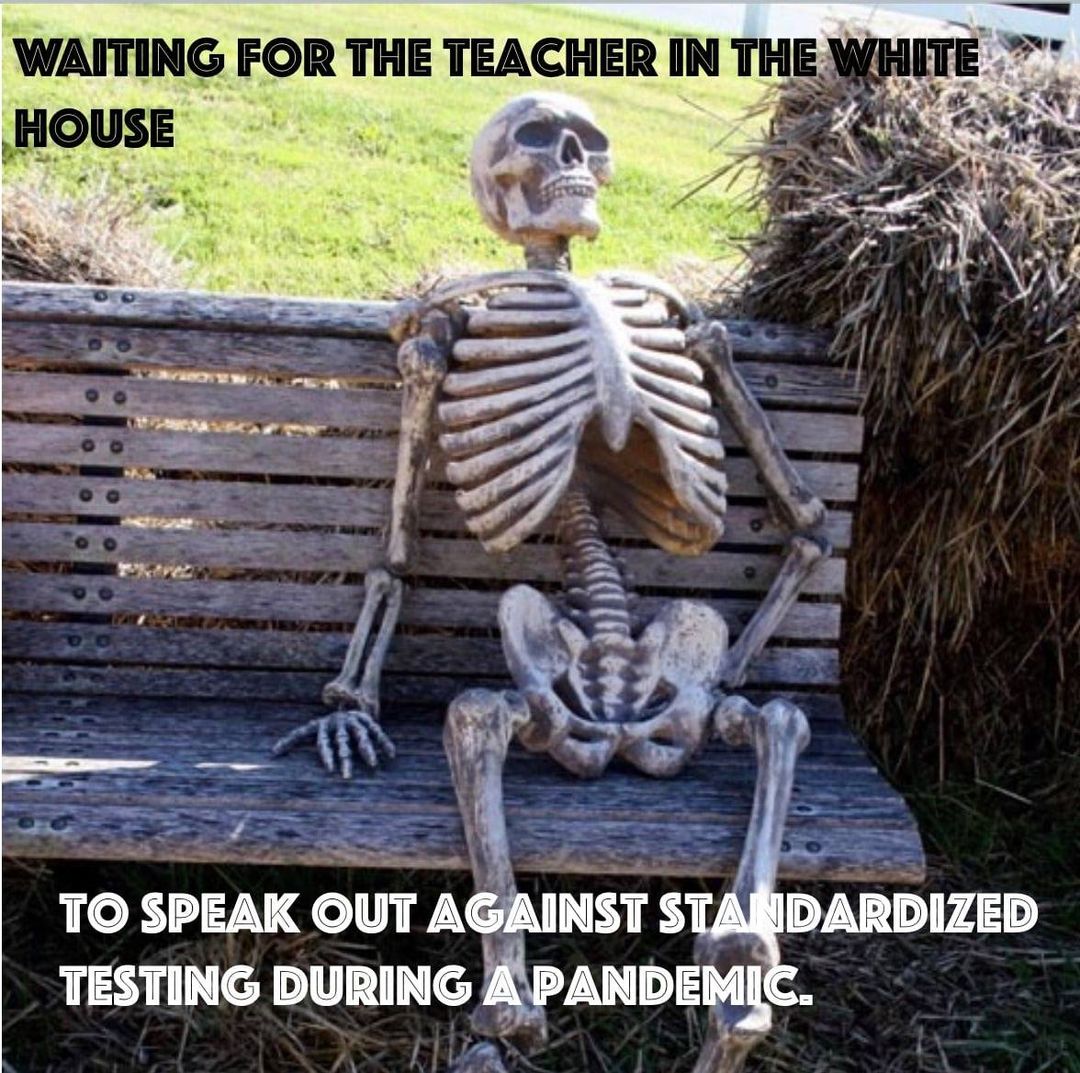
So President Biden can stop the charade.
America’s teachers aren’t buying it.
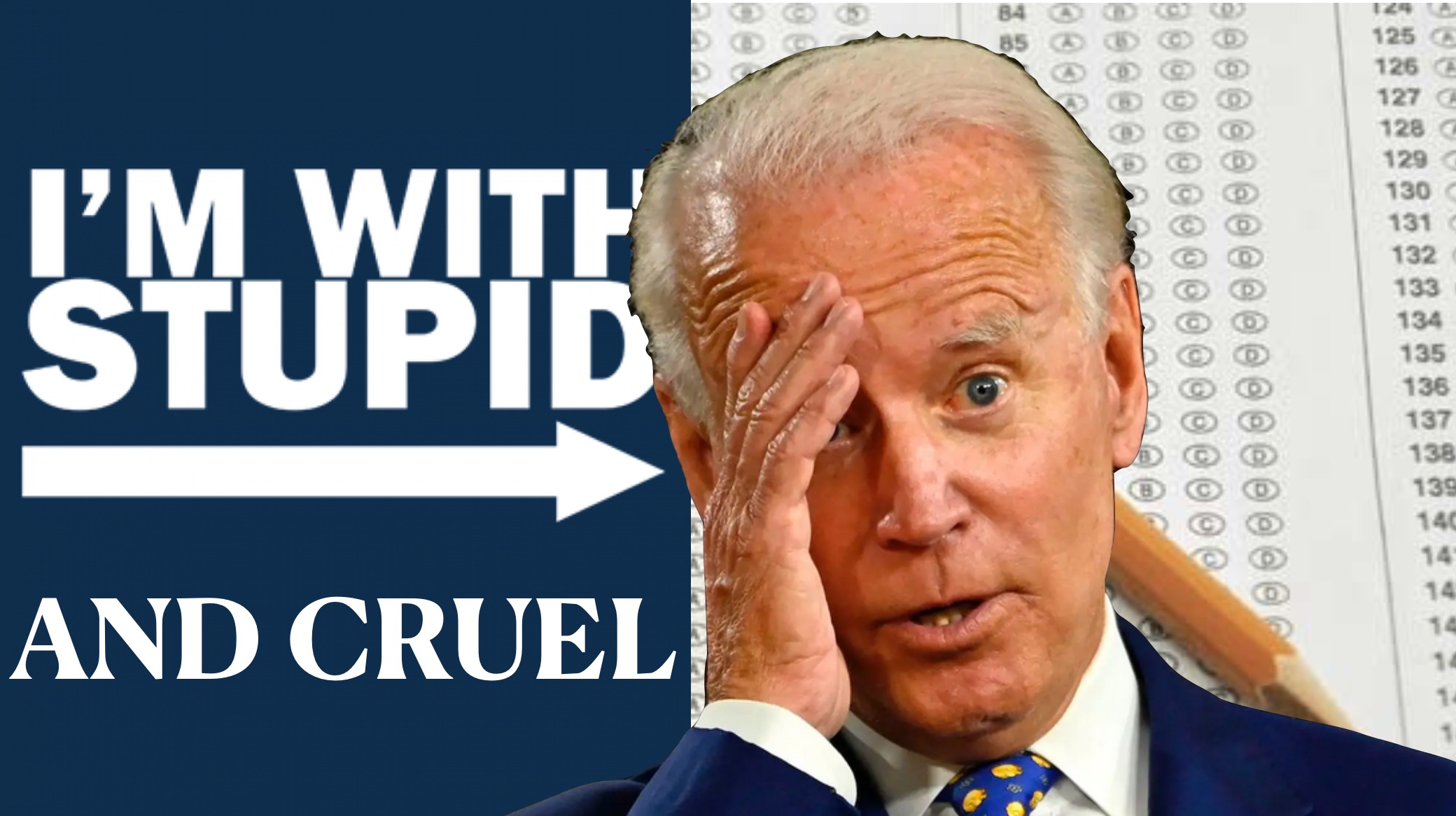
We know how deeply stupid this testing mandate is.
Stupid and cruel.
Paging, Dr. Jill Biden. Paging, Dr. Jill Biden. Where you at?
Like this post? You might want to consider becoming a Patreon subscriber. This helps me continue to keep the blog going and get on with this difficult and challenging work.
Actually, that last email said the outbreak was limited to the Kindergarten class and teachers – that no close contacts were identified beyond its doors, in the building or the wider district as a whole.
However, considering that at least five more elementary teachers and another student tested positive later, I’m not sure I believe it.
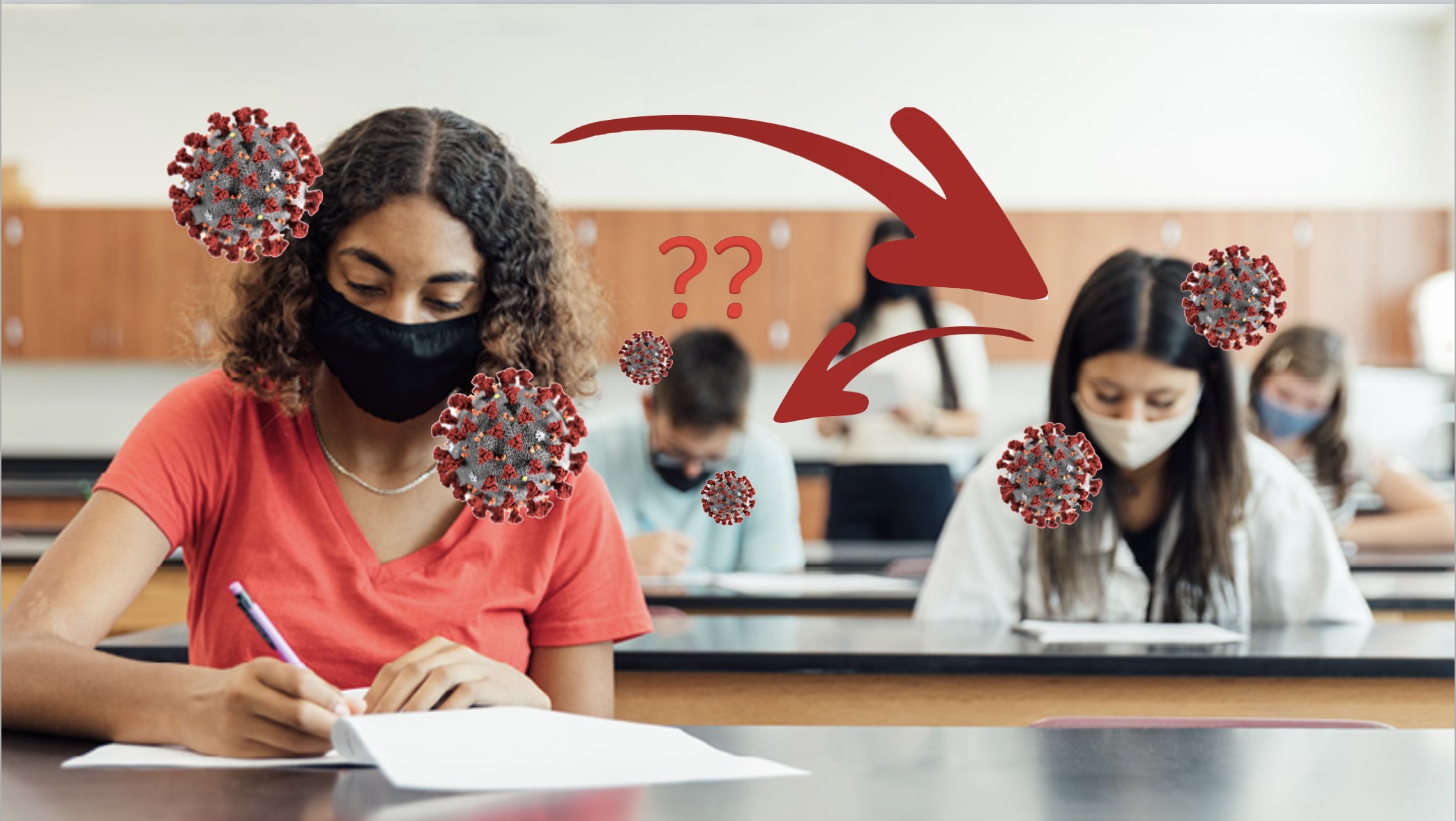
All of which prompts the question – how accurate is contact tracing?
How Contact Tracing Works
Let’s say a little girl, Ava, gets COVID-19.
Where did she get it from?
Let’s do some contact tracing to find out.
We ask Ava to think back two days before she showed symptoms up until now. Who was she in close contact with (within six feet for at least 15 minutes)? She doesn’t remember much, but she gives us a list of two or three people who may fit the bill.
We call them, find that none of them are sick, none have been out of the state or country, ask them to quarantine and that’s it.
So where did Ava get the virus? Who did she get it from?
We don’t know.
And contact tracing rarely produces an answer to that question.
We already know Ava has the virus (or is suspected of having it). We’re trying to find out who she may have spread it to – as much as, if not more than – who she got it from.
In the process of doing that we may be able to trace the spread of the virus back to its source before Ava. But probably not.
Why Does Contract Tracing Often Fail to Lead Us Back to the Source of an Outbreak?
If we had rapid and ubiquitous COVID tests, perhaps we could achieve that goal. But we don’t.
At best, people are scared and not as specific as they might be. At worst, they refuse to participate at all.
Michael Huff, Pennsylvania’s director of testing and contact tracing efforts, said that more than 34,000 new cases were reported over the past week, but case investigators were only successful in reaching about 8,332.
And of those they did reach, ninety-six people refused to quarantine.
“Why? Because people don’t want to answer the phone. Because people do not realize how important it is to give the information we need to make certain we can control disease.”
So it is entirely disingenuous to claim contact tracing proves much of anything about how the virus is spread. It’s usefulness is in stopping COVID-19 from going any further.
How Contact Tracing is Used to Make Wild Claims
Students, teachers and other school staff have come down with the virus in significant numbers.
No such estimate exists for school staff, but about 1 in 4 teachers – nearly 1.5 million – have conditions that raise their risk of getting seriously ill from Coronavirus, according to the Kaiser Family Foundation.
And though many thousands of school staff have contracted the disease, more than 300 district employees have died nationwide from the virus according to the Associated Press.
Where did all these people get COVID-19?
Contact tracing provides no definitive answer, however, policymakers are pretending that means something.
Since contact tracing has rarely been able to identify the source of an outbreak to a particular person in school, they assume that means the virus isn’t spreading much in our schools.
Nonsense!
First of all, there have been significant contact tracing studies that have found these direct links.
However, many policymakers overlook this evidence as contrary or inconclusive.
They insist that contact tracing’s inability to consistently find the causal link is enough to disregard the existence of that link.
Balderdash!
That’s like sniffing the air and claiming with absolute certainty that there is no leak of carbon monoxide. The gas is odorless and colorless. A sniff test will never tell you if it’s present. You need special equipment.
The fact is Ava has only been to two places in the last two weeks – home and at school.
At home there’s just Ava, her three brothers and her parents.
At school, there are hundreds of students and 8-9 staff she comes into contact with every day.
She is probably in closer contact with the people at home than at school. But the sheer number of people she is in contact with at school multiplied by the number of hours and then days – is tremendous!
The likelihood that Ava caught the virus at school is quite high – no matter how good the precautions being taken.
Taking Advantage of Our Ignorance
It is ludicrous to assume that the lack of a direct causal link after only a few months of schools being open to reduced capacity means much of anything.
States don’t compile COVID cases at schools. The federal government doesn’t either. In fact, no one really does.
A few self-proclaimed experts have tried to put together what data they can – and used that data to make extreme claims.
Economist Emily Oster has used a mere two weeks worth of data in September to argue that the virus isn’t spreading much in schools.
And policymakers have jumped on that bandwagon all across the country including director of the CDC Dr. Robert Redfield.
Oster is now trying to have it both ways – defending her argument but chiding anyone for taking it too seriously.
Her Website incorporates data that school districts publish voluntarily, along with some data reported directly to the site. However, Oster says it’s far from complete, and she was surprised Dr. Redfield was citing it as fact.
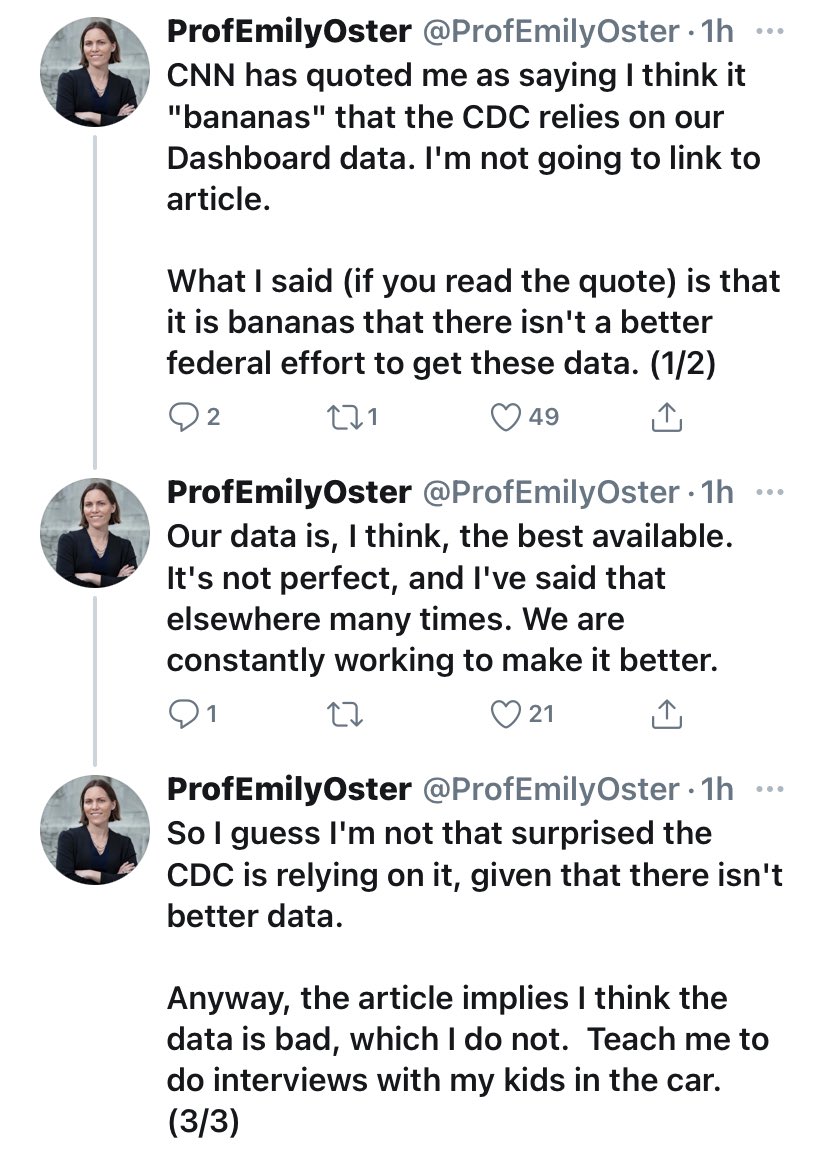
“It is totally bananas. I think we are doing as good a job as we can. This is not my field. It’s crazy.”
She later clarified in a series of Tweets, “…it is bananas that there isn’t a better federal effort to get these data….”
“Our data is, I think, the best available. It’s not perfect, and I’ve said that elsewhere many times…”
Besides the case of COVID-19 in schools, Oster is best known for making outrageous and often disproven claims such as that drinking alcoholic beverages during pregnancy is safe.
What About When Outbreaks Happen?
But it’s not just Oster who wants to have it both ways.
Policymakers say kids aren’t getting COVID at school and then walk back such claims when outbreaks happen in communities with high levels of infection.
Salt Lake City, Utah, had one of the biggest outbreaks in schools in the nation. However, that happened as infection rates reached more than double the level at which the state recommended distance learning.
“You can only open your school safely if you have COVID under control in your community,” said Benjamin Linas, an associate professor of medicine and epidemiology at Boston University School of Medicine who has advocated for opening schools under strict safety measures.
Which kind of disproves his position.
If COVID doesn’t spread much in schools, the infection rate in the community shouldn’t matter. If it does, then the virus can and does spread significantly in schools.
The situation in Utah has been partly attributed to community resistance to safety precautions like mask wearing and social distancing. When parents won’t take precautions, neither will children.
Keeping Schools Open During a Pandemic Increases Reckless Behavior
Even if viral spread was low in schools, keeping buildings open minimizes the danger of the pandemic.
If Ava can see her friends in school, why shouldn’t she get together with them after school, too?
In-person learning enables more in-person extra-curricular activities, sporting events, parties and other social gatherings outside of school.
Under normal circumstances, this would be great. When there’s a raging pandemic – not so much.
With kids, it’s not always what you say. It’s what you do. And if it’s safe enough to have in-person schooling, kids aren’t as likely to social distance outside of school.
Conclusions
The point isn’t that school cannot exist during a pandemic.
In communities where infection rates are low, even in-person classes can be conducted in relative safety with proper precautions and adequate funding.
However, if the community infection rate is moderate to high, classes should be conducted remotely.
Helen Bristow, MPH, program manager of Duke’s ABC Science Collaborative, which guides schools on COVID-19 safety, cautions:
“We’re nine to 10 months into a brand-new disease. We’re regularly learning something we didn’t know before.”
We have to stop pretending that the partial data we have is enough to make broad and reckless decisions about keeping students and staff safe during this crisis.
Decisions should be made with an abundance of caution.
For all its faults, remote learning is far preferable while the virus runs free.
Like this post? You might want to consider becoming a Patreon subscriber. This helps me continue to keep the blog going and get on with this difficult and challenging work.
State Governors must have a different definition of safety than the rest of us.
The message was signed by New Jersey Governor Phil Murphy, New York Governor Andrew Cuomo, Pennsylvania Governor Tom Wolf, Delaware Governor John Carney, Connecticut Governor Ned Lamont, Rhode Island Governor Gina Raimondo, and Massachusetts Governor Charlie Baker.
Only Baker is a Republican. The rest are all Democrats.
More than 11 million Americans have been diagnosed with the disease at an ever increasing rate. One million of those cases came about over just six days last week.
“Medical research as well as the data from Northeastern states, from across the country, and from around the world make clear that in-person learning is safe when the appropriate protections are in place, even in communities with high transmission rates.”
This is just not true.
It is based not on research by epidemiologists, not on studies conducted by doctors, scientists or pharmacologists.
It comes from the work of an economist – Emily Oster.
The Brown University professor analyzed data from all 50 states over a two week period in September and came to the conclusion that when students or teachers get Covid, they rarely catch it at school.
She wrote her dissertation explaining that there were less women in China not because of the one child policy and traditional attitudes toward girl children, but instead because Hepatitis B skewed sex ratios.
Oster is not a serious academic. She is someone who constantly says something controversial to court the media and public opinion.
She is a contrarian, an attention seeker, a celebutante – the economist version of someone who shouts “fire” in a crowded movie theater and then sells fire extinguishers to those rushing for the exits.
Since providing this cover story, various county departments of health have claimed that contact tracing rarely indicates students or teachers catch the virus at school. However, these conclusions are based on voluntary anecdotes, not hard data. At the local level, there is often a lot of pressure to find the cause of an outbreak somewhere else when childcare is at stake or administrative coercion involved.
A study of more than a half-million people who were exposed to Coronavirus suggests that the virus’ continued spread is driven by only a small percentage of those who become infected.
“In-person learning is the best possible scenario for children, especially those with special needs and from low-income families. There is also growing evidence that the more time children spend outside of school increases the risk of mental health harm and affects their ability to truly learn.”
Talk about overstating the issue!
So kids can’t learn if their instruction is interrupted? It’s a good thing we never take any time off school, say during the summer months.
But it’s the callousness with which these governors paper over health concerns that really sounds like Oster, herself.
“There are people who would say if even one teacher acquires COVID at a school and dies, then it would not have been worth it to open schools,” Oster said. “I think that argument is complicated because people are going to suffer tremendously from schools being closed, but that is a tricky calculus.”
What kind of mental health issues do children experience whose teachers die suddenly and preventably? How do kids suffer with the loss of a loved one knowing full well that they may have inadvertently been the cause of that person’s death?
What is the longterm cost to children or adults who have their lungs, digestive system or brains suffer irreparable damage as a result of Covid complications?
This disease was only discovered two years ago.
We cannot make bold statements of certainly about its effects without being deeply dishonest. There’s a lot we don’t know about it and how it affects people. And in light of that uncertainty it makes more sense to be extra cautious than reckless.
Administrators and academic coaches can be of more use helping struggling students stay on track than endlessly spinning their wheels about how best to reopen schools.
Bottom line: No one should have to go to school in an unsafe classroom.
Students shouldn’t feel like the only way to get a quality education is to risk their health and put their families in jeopardy.
It’s high time our government passed a new round of Covid relief. We need to pay people to stay home so they don’t spread the virus. We need mortgage protection, universal healthcare and a host of services to help people weather the storm.
It sad that so many Governors lack the courage to issue real Stay-at-Home orders, close schools, bars and restaurants, and issue stiff penalties for those who disobey them.
Until the danger has passed, we need quality remote learning conducted, planned and supported by educators.
And we need Governors with the guts to listen to science, not B.S. economists.
Like this post? You might want to consider becoming a Patreon subscriber. This helps me continue to keep the blog going and get on with this difficult and challenging work.
Superintendent Dr. Mark Holtzman says the district ignored these guidelines on the recommendation of the Allegheny County Health Department.
“The County Health Department is the local governmental agency responsible for the school districts in [the] County,” Holtzman said at last night’s school board open agenda meeting.
“So their determination of what next steps to take is their primary responsibility. So at this particular time, they have recommended to us that we not follow the CDC guidelines because those guidelines have been created before the start of school and are outdated. So they’re currently working on new guidelines to direct schools.”
The response was in answer to citizens comments.
‘
Greg Kristen and I went to the board meeting hoping to get answers – and we did.
“Those decisions that are being made by the McKeesport Area School District are recommendations by the County Health Department,” Holtzman said.
“They’re not our recommendations. They’re not anyone’s recommendations in this room. Now our school board does have the determination if they so choose to not follow those recommendations and close the McKeesport Area School District. Up until today at this particular time we’re not aware of any school district in Allegheny County being recommended to close no matter how many cases that are involved.”
“I am in a large public school system… I am hearing and seeing two different approaches. I am very appreciative of what the board’s efforts in Pittsburgh have been to keep us safe and keep our students safe. I just want to be an advocate that we are doing everything we can even if it’s erring on the side of caution.”
District Solicitor Gary Matta was concerned about the issue as well.
“We’re getting some mixed signals between the state and the county,” he said.
“The state is directing us to deal with the county health department if we have one.”
He suggested the district get recommendations in writing from the county health department before following any of its advice.
In addition to questions about whether it was safe to keep district buildings open during a COVID-19 outbreak, Holtzman addressed district transparency.
I asked him to compile a dashboard on the district Website with the following information:
“1) How many people have tested positive in total since the school year began?
2) How many are students? How many staff?
3) How many are located at each school building?
4) And please give us a timeline of when each positive test result was returned.”
He could not give me all I asked for at the meeting.
Holtzman said that 10 people have tested positive in the district since school opened – 9 of them recently. He said there have been cases at all four buildings – the high school, Founders Hall, Twin Rivers and Francis McClure elementary schools.
He was able to break down 8 of the 10 cases.
He said:
“In the last 7 days…. We’ve had 5 adults and 3 students. From Wednesday to Wednesday. Two employees (teachers) from Francis McClure, one teacher at Twin Rivers, 1 support staff at Founders Hall, 3 high school students, and one maintenance/support employee.”
Holtzman admitted that having a dashboard on the district Website was a good idea but fell short of committing to providing that ongoing data.
“A dashboard is a pretty good suggestion,” he said.
“It might help people have a better understanding this isn’t a secret – it’s a challenging situation… A lot of districts are considering it, but there are some drawbacks, too. But that’s something we’re going to take into consideration.”
Kristen brought up the issues of contact tracing and increasing class sizes at Twin Rivers that may make it difficult for students to engage in social distancing.
“Two days ago, my daughter told me she was getting six more kids in her class starting Nov. 2,” he said.
“They would be sharing desks. How is that possible during a pandemic? We’re just getting a spike in cases here and now we’re going to add more students to the schools in the classrooms? How is that safe? According to the guidelines, kids have to be AT LEAST 6 feet apart. That will not happen with more students.”
Holtzman said some students whose parents had chosen remote learning had decided to return them to the physical classroom at the start of the new grading period. However, others had decided to remove their children from the physical buildings and put them on remote.
“We will have students return to the classroom after the first 9-weeks. That’s inevitable. The numbers that we anticipate returning, we’re able to accommodate based on the space in those rooms. We do have some relatively low numbers – like less than 10 – in those classrooms.”
About a third of district students have been doing remote lessons since the year began.
Kristen said his daughter told him the new students added to her class would put the kids closer than 6 feet. Her teacher said they would be within 3 feet.
Holtzman disputed this:
“That’s a little difficult to determine. From the center of the child to the center of the child, there must be 6 feet. Six feet is a recommendation. Right? Just like the masking order and the gathering order is a mandate. So recommendations to space kids 6 feet apart is truly what it is – a recommendation. So we’re doing our very best.”
Kristen asked about contact tracing at Twin Rivers where teachers had tested positive.
He wanted to know if students had been tested, and Holtzman responded that they had not.
“Right now the McKeesport Area’s percentage is a little over 5% but it’s trending up as far as the rate of positivity. So people are concerned with watching that number.” He said.
“At this particular time, the Allegheny County Health Department is very satisfied with the contract tracing efforts they’ve made around our current cases. There is no longer any backlog, and there are none waiting to be addressed…
“When we do interviewing – when Allegheny County Health Department does interviewing – we ask them, ‘Where you in somebody’s personal space 6 feet apart for more than 15 minutes during your school day?’ If the answer is yes, Johnny, Susie, Mrs. So-and-So, then that information is provided to the health department and they’re asked to quarantine. If in fact that teacher says ‘I wear a mask every single day, all day, and I’ve never been in anybody’s personal space within 6 feet for 15 minutes consecutively, then the contact tracing ends at that point.”
He admitted that the effectiveness of this process depends on how honest and detailed those testing positive are when listing the people they have come into contact with while contagious.
Below is a transcript of our public comments and Dr. Holtzman’s responses:
Kristen:
“Dear school board members. Thank you for letting me speak here tonight. As a resident of this district for 15 years, as well as having a daughter a Twin Rivers Elementary School, I am deeply, deeply concerned with the lack of transparency about the Coronavirus infections. As of today, MASD has 9 positive cases… We have a right to know [who they are] not their names but their positions. According to CDC guidelines if there are two cases within a school, it is to be shut down for 5-7 days. For 5 or more cases, the building should be shut down for up to 14 days. Why is that not happening? Is the health and safety of the students, teachers, administrators, staff and maintenance not important to you? When positive cases happen in the building, who was in charge for contract tracing and notifying the Allegheny County Health Department? If they did not notify the health department, are they being held accountable? And I mean terminated. Were the parents of the students notified of the teachers and staff who were affected in the schools? Were the students tested? Is there any contract tracing with them? Also why is there not a healthcare professional a part of the Coronavirus task force?
Two days ago, my daughter told me she was getting six more kids in her class starting Nov.2. They would be sharing desks. How is that possible during a pandemic? We’re just getting a spike in cases here and now we’re going to add more students to the schools in the classrooms? How is that safe? According to the guidelines, kids have to be AT LEAST 6 feet apart. That will not happen with more students.
This Coronavirus is not a hoax. People are dying every day. As of today, 222,000 people have died, and people like myself who have an underlying health condition are concerned about people transferring the virus to me or to someone close to me. In this county alone there 14,396 cases and 416 deaths. On Oct 14 which was just a week ago Rachel Levine, the state health secretary announced a second wave of Coronavirus has arrived here. Now that the flu season has arrived, what is MASD doing? Does a student, teacher, administrator, staff or maintenance person have to die for someone to take this serious? Thank you very much.”
Dr. Mark Holtzman:
“Mr. Kristen, I’m happy to address a couple of your concerns. A few things.
We’ve had 8 positive tests in the last 7 days. So that is correct. The CDC guidelines are recommendations by the CDC and Pennsylvania Department of Education and state health department. (muffled) The Alleghney County Health Department is the local governmental agency responsible for the school districts in Allegheny County. So their determination of what next steps to take is their primary responsibility. So at this particular time, they have recommended to us that we not follow the CDC guidelines because those guidelines have been created before the start of school and are outdated. So they’re currently working on new guidelines to direct schools. I will ensure to tell you positively I have spoke to the Alleghney County Health Department probably just this week once a day. The head epidemeologisr Dr. Luann Brink and the director of the health department Dr. [Debra] Bogen and I have conference calls with her every Tuesday at 2 o’clock. Those decisions that are being made by the McKeesport Area School District are recommendations by the Allegheny County Health Department. They’re not our recommendations. They’re not anyone’s recommendations in this room. Now our school board does have the determination if they so choose to not follow those recommendations and close the McKeesport Area School District. Up until today at this particular time we’re not aware of any school district in Allegheny County being recommended to close no matter how many cases that are involved.
The concerns are the issues with Allegheny County Health Department are the rate of positivity here in the city of McKeesport and the surrounding communities. That’s number 1. Transmission is a huge piece of it. Is it being transmitted in the schools? Is it being brought into the schools from the outside? Contract tracing does occur on each and every case. All that information is submitted to the Allegheny County Health Department with details, time stamped, dates, everything we could possibly provide to those individuals. Fortunately or unfortunately we have to rely on that individual. For example, if you’re an employee that tests positive for COVID, we have to interview you. The information that you share with us, we have to then share with the Allegheny County Health Department. Whether you’re honest, dishonest , whether you’re detailed, whether you forgot someone, you didn’t include anyone as part of your contact tracing, that becomes your prerogative. We as a district just have to report that information to the health department and they make a final determination.
So at this particular time unfortunately we’re at the bottom of the document that’s been referenced many, many times, it states that when an entire school is recommended to be closed, closure time will vary depending on level of community transmission, and number of cases. Right now the McKeesport Area’s percentage is a little over 5% but it’s trending up as far as the rate of positivity. So people are concerned with watching that number. ‘This allows public health staff the necessary time to complete case investigation and contact tracing and to provide schools with other appropriate public health advice like cleaning and disinfecting.’ At this particular time, the Allegheny County Health Department is very satisfied with the contract tracing efforts they’ve made around our current cases. There is no longer any backlog, and there are none waiting to be addressed.
So at this particular time, I know there is frustration, I know there’s contradictory information out there, but we are working closely with the health department and they have done an outstanding job guiding us and every school district has a tough decision to make. So I appreciate you expressing your concerns this afternoon, this evening, later than it should be we appreciate it and if there’s anything we can do moving forward, we’d be happy to help.”
[Holtzamn said three teachers tested positive at Twin rivers Elementary. All students in those classes were not tested. Each student Is placed 6 feet apart. A close contact has to be within 6 feet for 15 consecutive minutes.]
Holtzman: “When we do interviewing, when Allegheny County Health Department does interviewing, we ask them ‘[Where you in somebody’s person space 6 feet apart for more than 15 minutes during your school day?’ If the answer is yes, Johnny, Susie, Mrs. so-and-so then that information is provided to the health department and they’re asked to quarantine. If in fact that teacher says ‘I wear a mask every single day, all day, and I’ve never been in anybody’s personal space within 6 feet for 15 minutes consecutively, then the contact tracing ends at that point.
Now we could absorb those things. As Superintendent I’m in the schools daily, and I’m able to see some of the teachers and [their actions]. The students are already placed 6 feet apart, so therefore they are already socially distanced. We will have students return to the classroom after the first 9-weeks. That’s inevitable. The numbers that we anticipate returning, we’re able to accommodate based on the space in those rooms. We do have some relatively low numbers – like less than 10 – in those classrooms.
[Kristen says his daughter told him the new students added to her class would put the kids closer than 6 feet. Her teacher said they would be 3 feet.]
Holtzman: “That’s a little difficult to determine. From the center of the child to the center of the child, there must be 6 feet. Six feet is a recommendation. Right? Just like the masking order and the gathering order is a mandate. So recommendations to space kids 6 feet apart is truly what it is – a recommendation. So we’re doing our very best and will hold all those expectations considering the fact that we have to educate the children that are interested in returning to school. We can’t just turn them away…. As many kids that are coming in, many are leaving for online learning for many reasons.”
MY COMMENTS:
“Thank you for letting me address the board this evening.
As a lifelong resident and the father of a child who attends the district, I am alarmed by news about an outbreak of COVID-19 at our school buildings, a lack of transparency about that information and a lack of proper safety response to the outbreak.
First, when I am finished with my comments, I ask that you clarify for me some facts about the outbreak.
1) How many people have tested positive in total since the school year began?
2) How many are students? How many staff?
3) How many are located at each school building?
4) And please give us a timeline of when each positive test result was returned.
That information should be constantly available on the district Website throughout the pandemic. It should not just be on alerts that come and go, robocalls or emails.
Every taxpayer has the right to that information – which is easy to compile – and necessary so parents and community members can make smart decisions about how to keep ourselves and our families safe in the McKeesport Area.
Next, I am concerned about the district’s blasé response to these life threatening conditions.
According to the state Department of Education Website, in a county like Allegheny where infection rates are designated as moderate, if 2-4 students or staff in the same building test positive, the school should be closed for 5-7 days.
Haven’t we met this threshold?
According to your recent alerts, at least 9 people have tested positive in the district in the last week – 3 students and 6 teachers. And this is spread throughout all district buildings.
There is no way to divide that up without at least one of our four buildings in the danger zone.
Doesn’t that mean that at least at some buildings – probably Twin Rivers, Francis McClure and/or the the High School – we have met this benchmark? Don’t each of those schools have two or more cases?
Why haven’t these buildings been closed?
Moreover, according to the PDE Website, if there are multiple cases at multiple schools where the infected are not household contacts, the schools are supposed to be closed not just for 5-7 days but a full two weeks.
Have we met that threshold? And if so, why are the buildings not closed?
I do not understand what precautions you are taking to keep students and staff safe.
I understand that PDE defines “Close Contact” as being within 6 feet for at least 15 consecutive minutes of a person who has tested positive. However, the Website cautions that this should not be taken as the ONLY definition of such contact: “In some school situations, it might be difficult to determine whether individuals are contacts or whether an entire cohort, classroom, or other group (extracurricular activity members) might need to be considered exposed, particularly if people have spent time together indoors.”
You say these cases have all been contained. But you have done very little to assure the public of this and could be taking much greater precautions on our behalf.
We’re talking about children here. We’re talking about our staff – people who have served generations of families and who often have families of their own.
Can’t you do better for the people in this district?
I would suggest that you at least follow PDE recommendations in the effected buildings.
Furthermore, I think you should cancel all in-person classes and go to a fully remote education plan until the infection rate in the county and the community is designated as low.
Have the classroom teachers make the online curriculum and let students and families choose whether they wish to go through that curriculum synchronously or asynchronously. And do not outsource the virtual program to ed tech companies looking to cash in on their credit recovery programs – as you are currently doing with Edmentum.
Going to a fully virtual plan would be in the best interests of students, families and the community.
Please do your duty.”
Holtzman:
“Mr. Singer, Thank you. I appreciate you spending some time with us again today. I don’t know, Dr. (muffled) do you have the numbers he’s requesting off hand? I only have the last seven days in front of me. If not, I’ll make sure you get them.
Voice: I don’t have them with me.
Holtzman: Prior to this situation we’ve had very few so… the difference between staff and students, we currently have in the last 7 days… we’ve had 5 adults and 3 students. From Wednesday to Wednesday. Two employees (teachers) from Francis McClure, one teacher at Twin Rivers, 1 support staff at Founders Hall, 3 high school students, and one mainatance/support employee. Furthermore, I feel that we’ll agree to disagree that instruction in person is the priority for engaging children. Our students have received progress reports. You as an educator I’m sure are quite aware that the online learning platform is not engaging all children. Many children are struggling and failing courses, here ate McKeesport and all over the Commonwealth. I think it’s a big issue for all school leadership trying to find new creative ways to engage children whether it’s synchronous or asynchronous. So for us here at McKeesport we’re very fortunate to have had this huge donation of devices. We are going to consider doing some flexible instruction in the very near future to kind of make sure we have all of the pieces in place to provide synchronous instruction affectively. But sadly a lot of our students have chosen either to not log in or not be consistent in the work they’re trying to perform online. So we’ll continue to encourage our children to be in schools, we’ll continue to do our very best
ME: Would you commit to putting the information I asked for before onto the district Website?
Holtzman: You bring a good point because you know there are some districts using… a ticker to keep track. To be honest I didn’t know it would be necessary so that’s something we need to consider. A dashboard is a better description. It might help people have a better understanding this isn’t a secret it’s a challenging situation… Also to answer your question, we’ve had a total of 10 cases since the start of the school year. We’re still waiting for confirmation on two of those but we’re pretty confident. A dashboard is a pretty good suggestion. A lot of districts are considering it, but there are some drawbacks, too. But that’something we’re going to take into consideration.
[Holtzman admitted there was at least one case at every building but not elementary students.]
Like this post? You might want to consider becoming a Patreon subscriber. This helps me continue to keep the blog going and get on with this difficult and challenging work.
And while there is a certain poetic justice in this buffoon getting a taste of his own medicine, its ramifications for our country will be dire indeed.
With only four weeks before the election, no one can predict what the outcome will be politically.
Will he live? Will he die? Will this mean a boost for his opponent Joe Biden? Or will people wrap themselves in the flag and come to his side?
No one knows.
But one thing is undeniable – we cannot continue to live this way.
The reality tv rollercoaster must stop, its constant flood of outrages, disasters and season finale moments!
Long before Trump went from being a clown to a contender, policymakers tried reforming our schools with only wishful thinking and a marketing plan.
High stakes testing, charter schools, voucher plans, value added measures, Teach for America – whether proposed by Democrats or Republicans, it is all nothing but science denial wrapped in a stock portfolio.
Now that her spray tanned master has – through inaction and ineptitude – unleashed a plague upon the nation, our students are suffering worse than ever.
Instead, leaders deify choice – letting us decide between these different models – without a basic understanding of citizenship, governance or economics.
That, I think, is what must change.
After all, if the virus can reach the most powerful person in the world if he doesn’t take adequate precautions, it can get your kids, too.
Your choice not to wear a mask in public increases the infection rate in my community. Your decision to eat in a restaurant, go to a bar or spend a weekend at an amusement park puts not just you and your family at risk, but me and mine as well.
Economics is about how to best divide resources for the survival of communities. In times of scarcity, there are certain best ways and in times of abundance there are others.
However, we live in a time of abundance but continue to use the rules for scarcity. In fact, we create scarcity just to ensure an antiquated and ineffective distribution of resources.
A new world is possible. In fact, it is inevitable.
We will either all die on a scorched wreck of a planet that we have systematically destroyed so that a few will live longer and in more luxury than the rest.
Or we will all move forward into a new, better world together.
But this is what I see in the light shinning through the crack in the maelstrom of nonsense we have been living in lately.
We can all come together and create schools that serve everyone regardless of race, religion, creed, sexuality, gender or difference. We can teach facts, thought, history, science, arts and humanities.
And armed with such tools, we can recreate society in that image.
That is the lesson of Trump’s diagnosis.
You can lie and cheat and steal.
You can fool people into believing that you’re not a liar and a cheat and a thief.
However, reality exists independent of our ability to recognize it.
If we stumble forward blindly for long enough, we will fall into the pit before us – irrespective of whether we recognize it is there or not.
How much better to open our eyes!
Like this post? You might want to consider becoming a Patreon subscriber. This helps me continue to keep the blog going and get on with this difficult and challenging work.
After all, there is more than one way to do remote learning.
We could ask the district’s classroom teachers to design instruction tailor made to their students but merely delivered online.
Or we could use a prepackaged platform to deliver that instruction.
To me, it’s obvious which is better.
One maximizes academic outcomes by making the virtual experience as much like the in-person experience as possible with multiple daily interactions between teachers and students. The other delegates the responsibility of educating to a corporation with minimal social interaction between students and educators.
The teacher led option is the way to go, but it only works at most districts if they give up the myth that they can make in-person instruction feasible during a pandemic that has already infected more than 7 million people in this country and killed 200,000 and counting.
So they’re committed to giving people a choice – just not THAT choice.
If they can only choose between canned cyber curriculum or fresh but dangerous in-person models, they’re betting parents will choose the latter.
And in many cases they are. But a significant number are not.
In the McKeesport Area School District (MASD), where I’ve lived most of my life, nearly a third of the parents have chosen distance learning for their children instead of a half day hybrid model. One would think that would free up enough classroom teachers to offer synchronous, authentic instruction. Students could have lessons from a certified district employee with years of experience instructing children of that age, grade and subject matter. Kids and teachers could develop trusting and caring relationships and work together to create the best possible learning environment.
The platform is Calvert Learning, a product of the ed tech giant Edmentum.
This multi-million dollar global company (it was sold for $143 million in 2010) is best known for creating Study Island and other standardized test prep based learning platforms.
The problem is it was never meant to be used as the sole provider of coursework for thousands of students in a single district.
It was created for K-8th grade, but when added to Edmentum’s Coursework platform, the company claims to be able to offer credit recovery – I mean academic classes – for K-12 and beyond.
As a parent who has spent countless hours helping his daughter navigate it, let me tell you – it’s a mess.
The instruction and assignments it provides are developmentally inappropriate, assesses things it hasn’t taught, and are filled with grammatical and spelling errors. Moreover, the pace it prescribes violates the guidelines Edmentum gives to parents about how much time students should spend on-line.
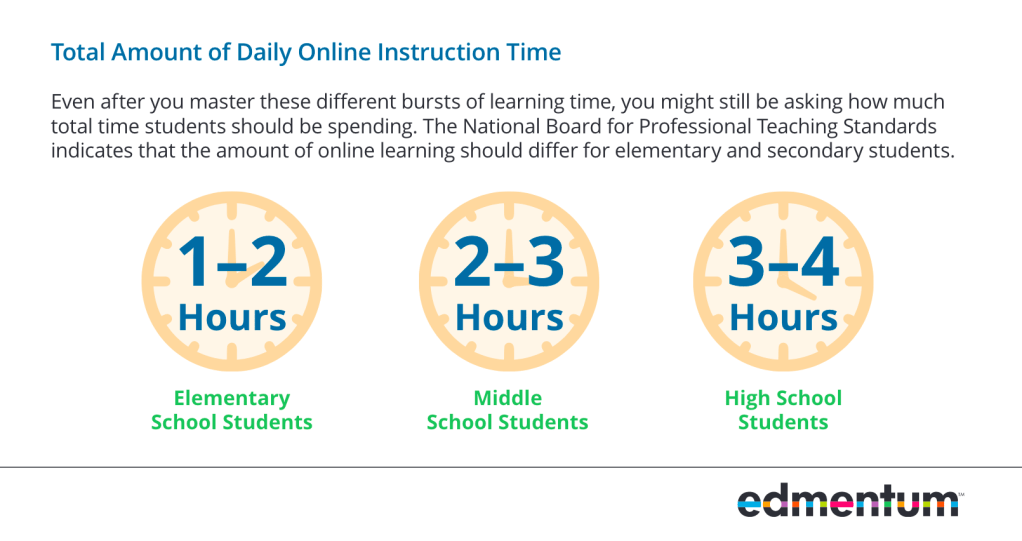
According to “A Parent Guide: Supporting Your Child During Virtual Learning,” provided by Edmentum, cyber students should limit their time online. Elementary students should spend not more than 1-2 hours a day, middle school students 2-3 hours, and high school students 3-4 hours.
My 6th grade daughter typically spends 7-8 hours a day just to barely get things done – and that’s not counting 2-3 hours on the weekends.
I’ve seen her struggle through passages that are written far above her reading level.
For example, she completed a unit on characterization where she was required to read O. Henry’s “The Ransom of Red Chief.”
I know the story well, because as a middle school teacher, I’ve taught it to my 7th grade students from time-to-time. However, the version I’ve used is not the original that O. Henry wrote. It is brought down to the level of a middle schooler and unnecessary attitudes of the time are downplayed.
In the original, one of the characters, Sam, uses big words to show how smart he is. The version I use still has him do that but reduces its frequency so that middle schoolers can understand him. After all, 6th graders shouldn’t have to wrestle with “philoprogenitiveness,” “chawbacon” and “whiskerando” just to grasp a pretty basic plot.
Moreover, the story was published in 1907. The original text throws out numerous instances of casual racism against Native Americans that serve no point in the story. Does my daughter really need to be subjected to dehumanizing native peoples as mere “red skins” just to get a lesson on characterization?
Clearly this unit was not developed with child psychologists, practicing middle school Language Arts teachers or even people of color in the room.
If that weren’t bad enough, the questions are full of grammatical errors and typos.
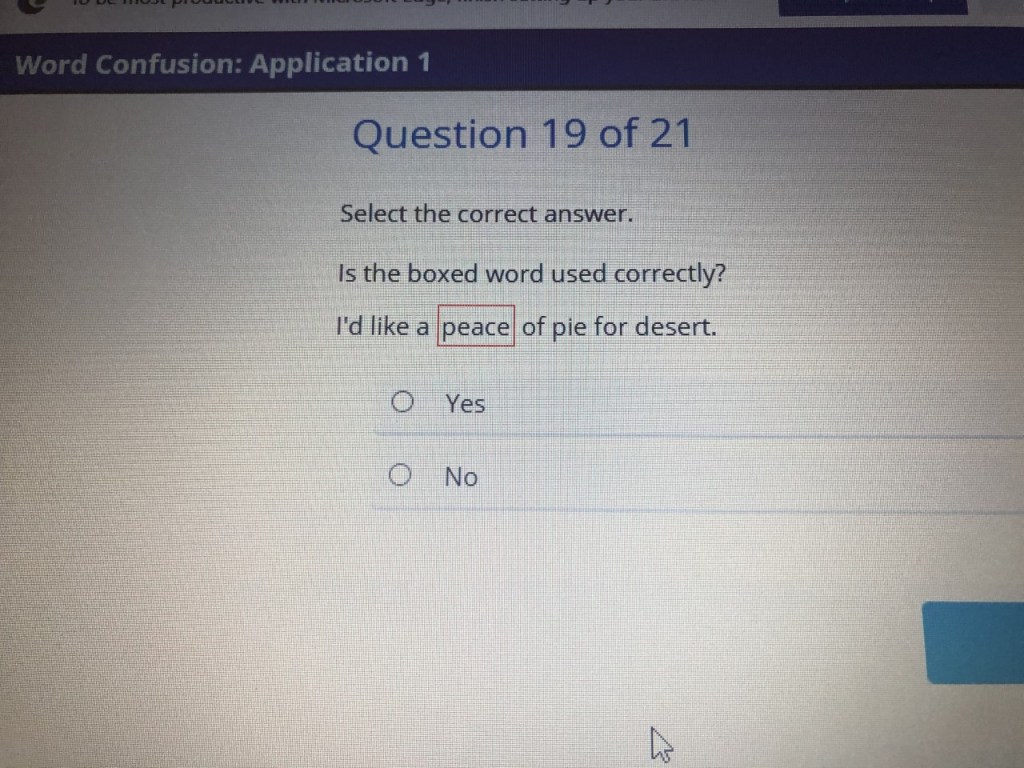
One question about homophones asks students to consider this sentence:
“Select the correct answer.
Is the boxed word used correctly?
I’d like a PEACE of pie for desert?”
Students were asked if “PEACE” is correct – Yes or No. They should know that PIECE is actually the right word.
However, the question made no mention of the misuse of “desert” when the authors clearly meant “dessert.”
That’s the kind of thing that really confuses a student trying to make her way through a program all by herself.
On many assessments, she is asked things that were never taught in the section that was meant to be assessed. I know this is status quo on standardized tests, but is it fair to ask this of a child navigating an online program without even a living teacher to offer support and guidance?
In a social studies assessment on Neolithic peoples, many of the questions had nothing to do with the subject matter. They asked students to infer something based on a passage and none of the multiple choices were entirely correct. You had to pick the option that was least incorrect.
This is some crappy academics being pawned off on parents and students.
And it’s not cheap.
MASD paid $146,302.25 for 40 licenses to Calvert, Exact Path K-5, Courseware for 6-12 and other online services. When hundreds of additional parents asked for their students to be put on the cyber program, the district purchased 500 more licenses from Calvert for a bundled rate of $112,500. That’s $225 per license. Normally they are $450 per license.
Imagine if we put our tax dollars and our teachers to educating these students instead of seeding our responsibility to a corporation for hire.
And we could do it, too.
I work at Steel Valley School District.
Unlike MASD, we began the year with a 100% virtual program for all students. We conduct fully synchronous classes online designed entirely by the classroom teachers. And we post materials on Google Classroom so that students who miss the live Zoom meetings can watch videos of the lesson and do the work.
I’m not saying it hasn’t been difficult or that it’s without problems. Nor is such an endeavor better than in-person learning in a safe environment.
But the teacher-led remote model is the best that can be provided under the circumstances.
They should face the realities of the world we live in.
If Coronavirus infections are significant in your county, you should not be offering in-person schooling. You should be offering the best remote option available – and that’s the teacher-led cyber option.
If only my home district knew it.
Meanwhile, my daughter has to struggle through with the cold comfort that at least she won’t get sick jumping through the hoops her school board is too partisan to eliminate for her.
I’m right next to her at the dining room table feeling guilty for putting her through this.
But what else could I do?
Like this post? You might want to consider becoming a Patreon subscriber. This helps me continue to keep the blog going and get on with this difficult and challenging work.
“At the end of the day, we’re going to make sure that the health and welfare of our students is first and foremost, front and center. And we’re not going to allow and ask students to return to school in an unsafe environment. We’re preparing for the best, but we’re planning for the worst.”
Turzai was so infuriated by this statement that he wrote a letter to Rivera – which the Pittsburgh area representative immediately shared with the media – he went on right wing talk radio to complain, and he posted a video on his Facebook page.
You know a Boomer is really mad when he goes on the social media.
Though his comments include his usual greatest hits against public schools and those greedy teachers, Turzai’s main point was simply science denial.
On Facebook, after a long list of activities that he said kids enjoy doing like sports and lab experiments, he said this:
“All of those can be done safely, and [kids] are not at risk unless they have an underlying medical issue. The fact of the matter is kids can develop herd immunity, and if you [Rivera] have not yet developed a plan where we can safely educate kids in schools, then you are going to have to rethink education forward…”
So there you have it, folks.
Turzai wants Pennsylvania to reopen schools on time whether scientists and health experts think it’s safe or not because – Turzai knows best.
Pennsylvania’s village idiot thinks he knows best about schools.
It’s already killed more Americans than the Vietnam War (69,579 vs. 58,220). There’s no vaccine. And we really don’t know with much certainty how it will affect people in the long term.
“Pediatric COVID-19 patients might not have fever or cough. Social distancing and everyday preventive behaviors remain important for all age groups because patients with less serious illness and those without symptoms likely play an important role in disease transmission.”
So if we reopen schools before it is safe to do so, we run the risk of (1) kids dying, (2) kids becoming carriers and bringing the disease to any adults they come into contact with who are much more susceptible and (3) teachers and school staff getting sick and dying.
He’s trying to show he’s just as stupid as Donald Trump. The President says we should all drink bleach to get rid of COVID-19? Well Turzai says we should let our kids get sick and die or make us sick.
Republicans truly have become the party of stupid.
The media helps covidiots like Turzai by uncritically reprinting his outrageous lies.
Turzai is like a man who calmly says it’s not raining outside while a thunderstorm beats down on the neighborhood. Instead of pointing out the truth, the media simply reports what Turzai said and at most gives equal weight to a meteorologist. But there is no OPINION about facts! And whether scientific consensus holds with his crackpot conspiracy theories about how the Coronavirus spreads or not IS a fact.
Until we can truly tell who has the virus, who had the virus, who is immune, and how to cure it, the prospect of reopening schools or the economy will be grim.
We should not put people at risk unnecessarily.
And we certainly shouldn’t put children at risk.
Don’t let fools like Turzai use a global pandemic to hawk their political agendas.
He goes on in his video to say that if the state’s public schools don’t open on time, we should consider things like universal cyber schooling, and (non sequitur alert!) charter and voucher schools.
Like this post? You might want to consider becoming a Patreon subscriber. This helps me continue to keep the blog going and get on with this difficult and challenging work.
And my favorite character is the computer HAL 9000.
In the future (now past) of the movie, HAL is paradoxically the most human personality. Tasked with running the day-to-day operations of a spaceship, HAL becomes strained to the breaking point when he’s given a command to lie about the mission’s true objectives. He ends up having a psychotic break and killing most of the people he was supposed to protect.
It’s heartbreaking finally when Dave Bowman slowly turns off the higher functions of HAL’s brain and the supercomputer regresses in intelligence while singing “A Bicycle Built for Two” – one of the first things he was programmed to do.
I’m gonna’ be honest here – I cry like a baby at that point.
But once I clean up my face and blow my nose, I realize this is science fiction – emphasis on the fiction.
I am well aware that today’s calendar reads 2020, yet our efforts at artificial intelligence are not nearly as advanced as HAL and may never be.
That hasn’t stopped supposedly serious publications like Education Week – “The American Education News Site of Record” – from continuously pretending HAL is right around the corner and ready to take over my classroom.
What’s worse, this isn’t fear mongering – beware the coming robo-apocalypse. It’s an invitation!
It was truly one of the dumbest things I’ve read in a long time.
Bushweller, an assistant managing editor at Education Week and Executive Editor at both the Ed Tech Leader and Ed Week’s Market Brief, seems to think it is inevitable that robots will replace classroom teachers.
These are kids without all the advantages of wealth and class, kids with fewer books in the home and fewer native English speakers as role models, kids suffering from food, housing and healthcare insecurity, kids navigating the immigration system and fearing they or someone they love could be deported, kids faced with institutional racism, kids who’ve lost parents, friends and family to the for-profit prison industry and the inequitable justice system.
So “chronically low-performing” teachers would be those who can’t overcome all these obstacles for their students by just teaching more good.
I can’t imagine why such educators can’t get the same results as their colleagues who teach richer, whiter kids without all these issues. It’s almost like teachers can’t do it all, themselves, — and the solution? Robots.
But I’m getting ahead of myself.
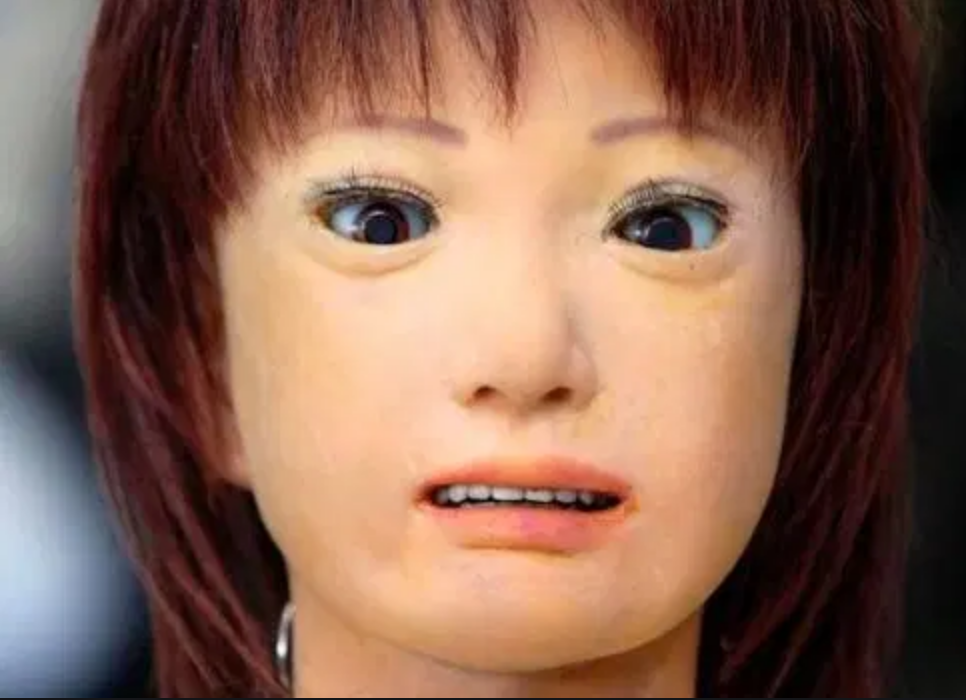
Bushweller suggests we fire all the human beings who work in the most impoverished and segregated schools and replace them… with an army of robots.
But the future envisioned by technophiles like Bushweller has NO such people in’t – only robots ensuring the school-to-prison pipeline remains intact for generations to come.
“It makes sense that teachers might think that machines would be even worse than bad human educators. And just the idea of a human teacher being replaced by a robot is likely too much for many of us, and especially educators, to believe at this point.”
The solution, he says, isn’t to resist being replaced but to actually help train our mechanistic successors:
“…educators should not be putting their heads in the sand and hoping they never get replaced by an AI-powered robot. They need to play a big role in the development of these technologies so that whatever is produced is ethical and unbiased, improves student learning, and helps teachers spend more time inspiring students, building strong relationships with them, and focusing on the priorities that matter most. If designed with educator input, these technologies could free up teachers to do what they do best: inspire students to learn and coach them along the way.”
Forgive me if I am not sufficiently grateful for that privilege.
Maybe I should be relieved that he at least admits robots may not be able to replace EVERYTHING teachers do. At least, not yet. In the meantime, he expects robots could become co-teachers or effective tools in the classroom to improve student learning by taking over administrative tasks, grading, and classroom management.
And this is the kind of nonsense teachers often get from administrators who’ve fallen under the spell of the Next Big Thing – iPads, software packages, data management systems, etc.
Bushweller cites a plethora of examples of how robots are used in other parts of the world to improve learning that are of just this type – gimmicky and shallow.
It reminds me of IBM’s Watson computing system that in 2011 famously beat Ken Jennings and Brad Rutter, some of the best players, at the game show Jeopardy.
What is overhyped bullcrap, Alex?
Now that Watson has been applied to the medical field diagnosing cancer patients, doctors are seeing that the emperor has no clothes. Its diagnoses have been dangerous and incorrect – for instance recommending medication that can cause increased bleeding to a hypothetical patient who already suffered from intense bleeding.
Do we really want to apply the same kind of artificial intelligence to children’s learning?
AI will never be able to replace human beings. They can only displace us.
What I mean by that is this: We can put an AI system in the same position as a human being but it will never be of the same high quality.
Watson (no relation to IBM’s supercomputer) of the Oxford Internet Institute and the Alan Touring Institute, writes that AI do not think in the same way humans do – if what they do can even accurately be described as thinking at all.
These are algorithms, not minds. They are sets of rules not contemplations.
An algorithm of a smile would specify which muscles to move and when. But it wouldn’t be anything a live human being would mistake for an authentic expression of a person’s emotion. At best it would be a parabola, at worst a rictus.
1) DNN’s are easily fooled. While both humans and AIs can recognize things like a picture of an apple, computers are much more easily led astray. Computers are more likely to misconstrue part of the background and foreground, for instance, while human beings naturally comprehend this difference. As a result, humans are less distracted by background noise.
2) DNN’s need much more information to learn than human beings. People need relatively fewer examples of a concept like “apple” to be able to recognize one. DNN’s need thousands of examples to be able to do the same thing. Human toddlers demonstrate a much easier capacity for learning than the most advanced AI.
“It would be a mistake to say that these algorithms recreate human intelligence,” Watson says. “Instead, they introduce some new mode of inference that outperforms us in some ways and falls short in others.”
Obviously the technology may improve and change, but it seems more likely that AI’s will always be different. In fact, that’s kind of what we want from them – to outperform human minds in some ways.
However, the gap between humanity and AI should never be glossed over.
I think that’s what technophiles like Bushweller are doing when they suggest robots could adequately replace teachers. Robots will never do that. They can only be tools.
For instance, only the most lonely people frequently have long conversations with SIRI or Alexa. After all, we know there is no one else really there. These wireless Internet voice services are just a trick – an illusion of another person. We turn to them for information but not friendship.
The same with teachers. Most of the time, we WANT to be taught by a real human person. If we fear judgment, we may want to look up discrete facts on a device. But if we want guidance, encouragement, direction or feedback, we need a person. AI’s can imitate such things but never as well as the real thing.
So we can displace teachers with these subpar imitations. But once the novelty wears off – and it does – we’re left with a lower quality instructor and a subpar education.
As a society, we must commit ourselves to a renewed ethic of humanity. We must value people more than things.
And that includes a commitment to never even attempting to forgo human teachers as guides for the most precious things in our lives – our children.
“Algorithms are not ‘just like us’… by anthropomorphizing a statistical model, we implicitly grant it a degree of agency that not only overstates its true abilities, but robs us of our own autonomy… It is always humans who choose whether or not to abdicate this authority, to empower some piece of technology to intervene on our behalf. It would be a mistake to presume that this transfer of authority involves a simultaneous absolution of responsibility. It does not.”
And the media typically set its collective hair on fire trying to interpret the data.
Sometimes called the Nations Report Card, the National Assessment of Educational Progress (NAEP) test is given to a random sampling of elementary, middle and high school students in member countries to compare the education systems of nations.
And this year there was one particular area where US kids did worse than usual!
Our scores went down in 8th grade reading!
To be honest, scores usually go up or down by about one or two points every year averaging out to about the same range.
You might as well compare the relative body temperatures of randomly selected students and wonder why we aren’t bridging the body warmth gap with the somber hummingbird! I mean it has an average temperature of 114 F! And the best we can do is a measly 98.6 F! Why won’t enough kids get a fever for America!?
I know that sounds dumb, but before you judge her, realize she also proposed cutting federal funding for afterschool programs, teacher professional development, student support and enrichment programs.
She says that the NAEP results mean that 2/3 of American students read below grade level. However, Greene points out that she is conflating two different things – grade level proficiency and NAEP proficiency.
“The NAEP Proficient achievement level does not represent grade-level proficiency, but rather competency over challenging subject matter. NAEP Achievement levels are to be used on a trial basis and should be interpreted and used with caution.”
Which kind of begs the question of why we need these scores in the first place.
And the federal government has done little to help. Since 2011, spending on major K-12 programs – including Title I grants for underprivileged students and special education – has been basically flat.
If we looked at realities like these instead of test scores – which at best provide us data at several removes – we might actually be motivated to reach solutions.
For instance, the U.S. is one of the only countries in the world – if not probably the ONLY country – that funds schools based largely on local taxes. Other developed nations either equalize funding or provide extra money for kids in need. In the Netherlands, for example, national funding is provided to all schools based on the number of pupils enrolled. But for every guilder allocated to a middle-class Dutch child, 1.25 guilders are allocated for a lower-class child and 1.9 guilders for a minority child – exactly the opposite of the situation in the U.S.
If we want to compare the US to other countries, this is a perfect place to start.
But a focus on test scores obscures the differences.
Virtually all of the top scoring countries taking these exams have much less child poverty than the U.S. If they had the same percentage of poor students that we do, their scores would be lower than ours. Likewise, if we had the same percentage of poor students that they do, our scores would go through the roof! We would have the best scores in the world!
We do something that many international systems do not. We educate everyone! Foreign systems often weed children out by high school. They don’t let every child get 13 years of grade school (counting kindergarten). They only school their highest achievers.
So when we compare ourselves to these countries, we’re comparing ALL of our students to only SOME of theirs – their best academic pupils, to be exact. Yet we still hold our own given these handicaps!
This suggests that the majority of problems with our public schools are monetary. Pure and simple.
At least House Democrats passed a Labor-HHS-Education funding bill to increase public school funding by $3.5 billion. Even if it were somehow passed by the Republican controlled Senate, that’s a drop in the bucket after decades of neglect – but it’s something!
And until we, as a society, finally realize that and focus on things that actually matter, we will continue to fail the only test that matters – how well we provide for our children.
There are cognitive and developmental benchmarks we look for, and if children don’t hit them, we provide help. But no further prediction is necessary – certainly not based on artificial markers put together by corporate interests.
In most situations, predictions are superfluous. We just assume that everyone can learn if they so desire – unless something happens to make us think otherwise. And whether someone actually learns something is demonstrated by doing the thing, itself.
The only time we link prediction and assessment so closely is when the consequences of failure are irreversible – like when you’re going solo skydiving for the first time. If you jump out of an airplane and don’t know how to pull the ripcord to get your parachute to work, you probably won’t get a second chance to try again.
Testing looks at learning like two points on a map and sets up a gate between points A and B.
In order to cross, you have to determine if you’ve passed through the previous gate. And only then can you be allowed to progress on to point C.
But this is wrong on so many levels.
First, you don’t need a test to determine which point you’re at. If Point B is the ability to add, you can simply add. If it’s the ability to write a complete sentence, you can simply write a sentence.
There is no need to fill out a formal multiple-choice assessment that – depending on the complexity of the task being considered – is completely inadequate to capture the subtleties involved. The task, itself, is enough.
Imagine if you were testing whether someone had learned how to drink a glass of water. You could just give them a cup filled with H2O and see if they can gulp it down. Or you could have them sharpen their number 2 pencil and answer questions about how their throat works, their digestive and excretory systems and the chemical composition of agua – all answers predetermined to A, B, C or D.
Observation of a skill, we are told, is not enough to determine success because it relies on the judgment of an observer. A standardized test replaces the observer with an impersonal, distant testing corporation which then assesses only predetermined markers and makes decisions devoid of any situational context.
This is done to remove observational bias but it doesn’t avoid bias altogether. In setting up the markers and deciding which elements of the task are to be assessed (or in fact can be assessed in such a distant manner), the testing corporation is inserting its own biases into the process. In fact, in any assessment conducted by human beings, this would be inevitable. So going through this maze of perceived objectivity is really just a matter of subterfuge meant to disguise the biases of the corporation.
When writing a complex sentence, for example, you need to know not just spelling and grammar but logic, handwriting, subject matter, colloquialisms, literary devices, and a plethora of other cultural and linguistic artifacts.
Knowledge, skills and human cognition are far too complex a web to ever hope to be captured by such a reductive enterprise. But by insisting that we make this complexity fit into such a small box, we end up depriving people of the right to move on. We say predictive models show they aren’t ready to move forward and so we bury them in remediation. Or we deny them access to important opportunities like advanced classes, electives, field trips, extracurricular clubs or even post-secondary education.
Assessment expert W. James Popham provides a helpful distinction: “curriculum teaching” vs. “item teaching.” Curriculum teachers focus on the full body of knowledge and skills represented by test questions. For instance, if the test is expected to include questions about decimals, the teacher will cover the full range of knowledge and skills related to decimals so students understand what they are, know how to manipulate them, understand how to use them to solve more complex problems, and are able to communicate about them.
By contrast, item teaching involves narrowing instruction, organizing lessons around look-a-like questions that are taken directly from the test or represent the kinds of questions most likely to be found on the test. In this way, the teacher only provides the chunks of knowledge students are most likely to encounter on exams. For instance, item teachers might drill students on a certain set of vocabulary words that are expected to be assessed rather than employing instructional strategies that help students build a rich vocabulary that best contributes to strong reading comprehension.
A focus on standardized testing or even trying to educate in a system where these tests are attached to high stakes, results in an increase in item teaching. We often call it teaching to the test.
I’m not saying that item teaching is always bad. But curriculum teaching is to be much preferred. It is a best practice. The problem is when we resort to endless drills and give students innumerable questions of the exact type we expect to be on the test.
Test scores are often a false positive. They show students have mastered the art of taking the test but not necessarily the knowledge or skills it was meant to assess.
They are more like trained circus animals who can jump through flaming hoops but would be lost in the wild.
These reflections have troubling implications for our system of standardized testing.
The false curtain of objectivity we’ve set up in our assessments may also be hiding from us what authentic learning is taking place and it may even hinder such learning from taking place at all.
Any sane society would halt such a system with these drawbacks. It would stop, regroup and devise a better alternative.
To continue with such a pedagogical framework truly would be the most absurd thing of all!










 gadflyonthewallblog