These questions are at the heart of a well-financed war against a simple term – woke-ness.
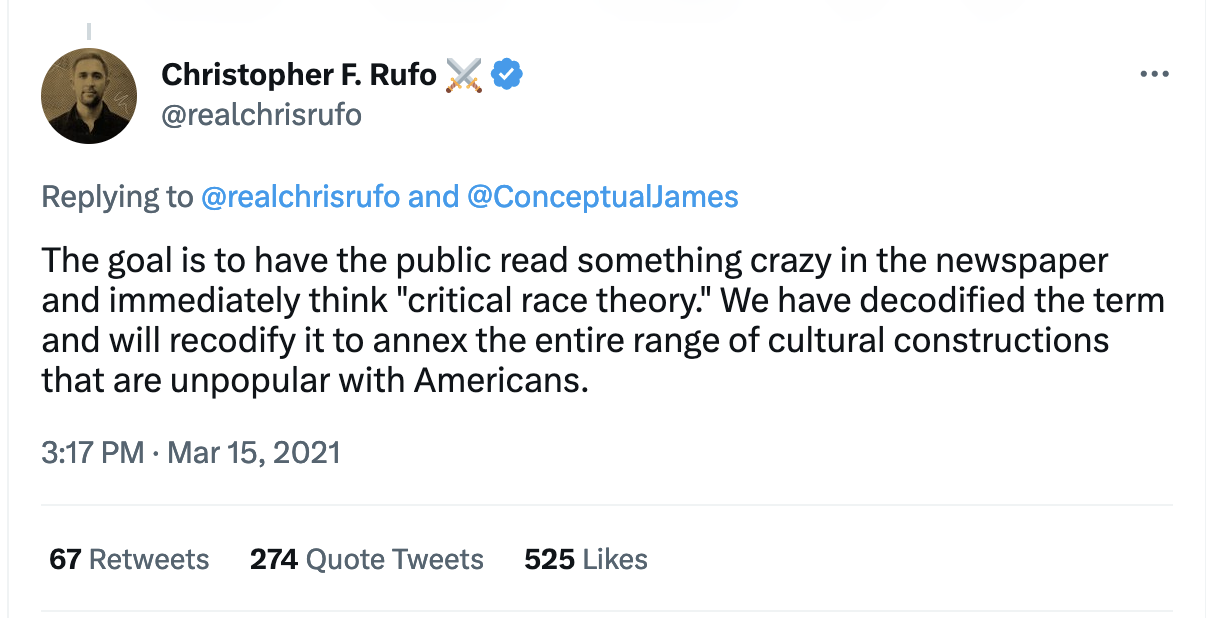
Since the summer of 2020, oligarchs and their tools in the United States have been waging a disinformation campaign against that term – especially as it pertains to our schools.
Chiding, nagging, insinuating – you hear it constantly, usually with a sneer and wagging finger, but what does it really mean?
To hear certain governors, state legislators and TV pundits talk, you’d think it was the worst thing in the world. But it’s not that at all.
That’s all – just knowing that these things exist and trying to recognize them when present.
I’m not sure what’s so controversial about that. If we all agree racism is bad, why is it undesirable to acknowledge it exists when it’s demonstrably there?
More specifically, being woke means focusing on intersectionality – how issues of race, class and gender overlap and interrelate with each other. It means practicing critical race theory – not the made up dog whistle conservatives use to describe anything they don’t like being taught in school, but the study of how racial bias is inherent in many Western social and legal systems. It means using the lens of Black feminism, queer theory and others to address structural inequality.
Again, why is that a bad thing? If we agree that prejudice is bad, we should want to avoid it in every way possible, and these are the primary tools that enable us to do so.
Shouldn’t we protect hard-fought advances in human rights? Shouldn’t we continue to strive for social justice and the ability of every citizen to freely participate in our democracy – especially in our public schools?
Of course we should!
But leaders of the backlash will disagree.
Like in so many other areas of our culture, they have stolen the term “woke-ness” and tried to co-opt it into another invented grievance. For people who deride their political opponents as being too fragile and unable to handle reality, they certainly find a million things to cry about on their 24-hour news networks to keep their base angry and engaged all the time.
They have targeted and demonized antiracist work. They have tried to discredit the concepts that Black women and LGBTQ people have created to explain and improve the inequitable conditions of their lives.
And the reason is crystal clear – they oppose that work.
They oppose anti-racism. They oppose the rights of Black women and LGBTQ people to better treatment.
They are against everyone but a perceived white, male, heteronormative majority that doesn’t even really exist.
For we are the keepers of history, science and culture.
Who will teach the true history that for more than 400 years in excess of 15 million men, women and children were the victims of the transatlantic slave trade? Who will teach the true history of the fight against human bondage and the struggle for equal rights? Who will teach about women’s fight for suffrage, equal pay, and reproductive freedom? Who will teach about the struggle of the individual to affirm their own gender identity and sexual expression?
It won’t be the College Board, a billion-dollar American business calling itself a non-profit, that after years of stalling finally released its Advanced Placement African American Studies curriculum – a college-level course available for high school students nationwide. In the wake of political backlash, the new course material is as watered-down as weak tea in comparison to previous drafts of the course.
This just goes to show that the free market will never stand up to political power if it is perceived as adversely affecting the bottom line. True education comes not from corporate academic standards or standardized test gatekeepers. It comes from teachers.
Intersectional frames such as those under attack by billionaires posing as populists have been incredibly important in supporting overlooked social problems and addressing today’s human rights failures.
Those of us who know history understand that suppression of knowledge and intellectuals (especially those from marginalized peoples) are a tool used to increase racism and oppression – to overturn the progress of the last century.
Refusing students access to books, criminalizing “divisive concepts,” and discrediting those with whom they disagree have all been tools of domination. Just as denying the persistence of any inequality has been a tool to discredit its victims.
If we give in to these partisan “anti-woke” imperatives, we enable the return of racist and cultural inequalities that had been at least partially rectified years ago. We clear the way for these extremists to bring back a mythical past in which women are meant to be merely subservient to men and where race, gender and sexuality are rigidly defined and limited according to the ruling class.
Teachers, we cannot allow this to happen.
We stand at the gates, the first (and perhaps last) line of defense, because we stand at the schoolhouse doors.
If we are truly educators, we must teach the truth.
We must put the facts in their proper context.
We must encourage our students to think about what came before and what’s happening now.
We must stay woke.
Or the whole world sleeps.
Like this post? You might want to consider becoming a Patreon subscriber. This helps me continue to keep the blog going and get on with this difficult and challenging work.
“Mr. Singer, take a look at this,” he said and handed me a scrap of paper with a few hastily scribbled lines of poetry on it.
“What do you think?” he said and smiled up at me hopefully.
I squinted at the page and said slowly, “I think it’s wonderful. The use of assonance in these lines is perfect…”
And his smile matured into a grin, until…
“…if only Edgar Allan Poe hadn’t already written them.”
Cheating is a part of school.
It’s probably always been.
Students copy off of other students, they take quotes from books without giving the author credit, they make crib sheets to consult during the test.
But since technology has pervaded nearly every aspect of our classrooms, cheating has skyrocketed.
Just ask the students.
According to a survey of 70,000 high school students conducted between 2002 and 2015 across the United States, 95 percent admitted to cheating in one way or another, and 58 percent admitted to plagiarizing papers outright.
I can’t tell you how many times I’ve seen children sit in front of shelves stuffed to bursting with dictionaries as they clandestinely whisper into their phones asking how to spell certain words.
Current generations practically were raised on social media and thus have a warped sense of intellectual property. Watching TikTok parody videos, reposting images on Instagram, and repurposing memes on Facebook or Twitter have eroded their sense of what constitutes intellectual property and what counts as original work.
Going back to Paolo, I don’t think he consciously tried to pass off Poe’s poetry as his own. He was trying to complete an assignment using assonance (repetition of vowel sounds in nearby words) in a poem.
He probably asked his district-issued iPad for examples and was directed to a snippet from Poe’s “The Bells.” So he copied it down, changing a word here and there and thought he had created something new.
It wasn’t word-for-word. It was just very close. He didn’t realize that such an exact approximation of an iconic verse would be so obvious.
And it was my understanding – knowing the student, judging his reaction to being caught, and being able to piece together how this act of plagiarism took place – that informed my reaction.
I explained to him that he needed to go further a field – to create his own lines that might be inspired but more distinct from Poe’s. And he did.
This wasn’t the end product; it was a bump in the road.
However, not all cheating is so forgivable.
There are many cases where students know exactly what they’re doing and simply don’t care or feel the risk is worth the reward.
Students who feel sad, distressed or other negative emotions tend to be more open to plagiarism than those who feel more positive. In fact, one can use student’s negative emotions to predict the chances that they’ll cheat on assignments, according to this research.
Students have admitted that drill-and-kill assignments, testing look-a-likes, etc. are seen as worthless and thus they are more prone to cheating on them.
Students will perpetrate fraud even on assignments that they see as valuable, but they are much more likely to do so on standardized curriculum – the kind policymakers and many administrators are increasingly pressuring districts and teachers to include in the classroom.
The way I look at it, teachers should take steps to stop cheating in the classroom, but without administrative support, they can only go so far. If there aren’t academic consequences for cheating, administrators have tacitly accepted the behavior regardless of what teachers do in the classroom. If there are no consequence – no adequate disincentive – cheating is normalized regardless of the words written in the student handbook.
I’m not saying there shouldn’t be grace and understanding, but there need to be consequences, too. Students feel more free to be authentic and original when they are immersed in a school culture where authenticity is valued over fraud.
After all, even in circumstances where teachers have full support, they can’t catch everything. And I think that’s okay.
You’re a student in school ostensibly here to learn. If you cheat on an assignment (a valuable assignment) you’re just stopping yourself from achieving the intended learning.
You’re limiting your own knowledge, your own skills and abilities. Instead of grasping how to write and read critically, for instance, you get the grade without the learning.
It would be like going to the doctor and presenting fake bloodwork. That’s not going to harm the physician – it’s going to hurt the patient.
It’s the same for accidental and purposeful cheating.
So what can we do about it?
1) Perhaps the most important thing to discourage the unintentional variety is to teach kids what it is – especially with relation to technology.
2) The best way to discourage purposeful cheating is to present students with meaningful work.
If kids actually want to learn what you’re teaching, they’ll be less inclined to fake their way through it.
Of course, this can only be truly effective when educators are allowed a voice in their own curriculum, their expertise is valued, and they are free to determine how best to go about their jobs. But let’s be honest – that’s not going to happen anytime soon.
For example, when my students write an essay, I never give them the prompt and then wait to see the results. We do prewriting together that needs to be approved before they can even begin their first drafts. We discuss it every step of the way until they submit it for a grade – and if it still has issues, I simply don’t accept it. I hand it back with suggestions for changes again and again until it meets the agreed upon standard.
That makes cheating much harder to do. It also puts learning – the journey from point A to B – at the forefront rather than coming up with something arbitrary.
4) Finally, relationships are the bedrock of responsibility.
Nothing in my class is high stakes.
If a student messes up today, there’s always tomorrow. All assignments are accepted late up to a point. All tests can be retaken. Everyone gets another chance to succeed.
It’s a huge burden on me, the teacher, but I think it’s worth it to extend a little grace to students. It’s worth it demonstrating that I value them over their work.
I’m not saying this is perfect or that I have all the answers. But in an age where everyone seems worried about academic integrity without any concern for academic freedom, it’s important to put your priorities front and center.
Cheating may never go away entirely, but at least we can be honest about why it happens and who it hurts.
Like this post? You might want to consider becoming a Patreon subscriber. This helps me continue to keep the blog going and get on with this difficult and challenging work.
This year I teach two different poetry classes – a 7th grade course focusing on writing it, and an 8th grade course focusing on reading it.
It’s not entirely exclusive. We do some writing in 8th grade and some reading in 7th grade, too. But each course is centered more on creation or explication.
My 8th graders seemed hooked when I introduced poetry by reading them a Shakespeare sonnet in a stuffy British voice.
Don’t get me wrong. I love the Bard. After all, my wife and I named our daughter Desdemona. But you might as well lean in to the expectation that Shakespeare is elitist with a question like, “Shall I compare thee to a summer’s day?”
Then follow it up with some video clips from Def Poetry Jam.
My students loved the idea that these street verses by Lamont Carey, J. Ivy and others were both instantly relatable and yet qualify as poetry.
When I told them that rap also met our literature book’s definition, they were floored.
I recited the Whitman poem aloud, and as my voice shook and my eyes watered, a student in the front row said I should have been an actor. But it wasn’t acting. Many of us felt that same emotion. It was right there on the page.
Today they were wrestling with Poe and Dylan Thomas with a kind of seriousness of purpose you rarely see in 13- and 14-year-olds.
In years past, I often had to point to this or that, guide them to consider one thing or another. But this morning, I could have gone to get a cup of coffee, and I don’t think they would have even noticed my absence.
My 7th graders took a bit more convincing.
When I announced we were starting a unit on poetry, they almost all lamented about how much they hated it so much. So I made them write a journal about why they felt that way. No public performances. Just put it down on paper.
It was funny how verbal complaints melted away in the face of stanzas and verse. Many admitted on the page that they liked poetry – some poetry – but they felt scared of getting the wrong answer.
The very first poem brought out such emotion and turmoil. One girl wrote about the recent death of a family member. A boy wrote about how he felt he was never good enough no matter how high his grades.
Some showed off real talent with figurative language – personifying colors, using vivid imagery, perfect similes, a gift for rapid fire rhymes.
Today I had them sing the rhythm of the limerick with me. I lead a chorus of:
Da DUM da da DUM da da DUM, Da DUM da da DUM da da DUM, Da DUM da da DUM, Da DUM da da DUM, Da DUM da da DUM da da DUM.
They laughed. (I did too.) They looked at me like I was crazy. (Perhaps you have to be to teach middle school.)
But they did it.
And they tried to write their limericks.
I’m not saying the results were all perfect. Few of them were. But the kids tried and some will continue trying.
There’s a word for that.
You try to climb to the top of the monkey bars…. You fall down. You get right back up and try again.
It’s play. Pure and simple.
That’s what’s been missing from so much of my kids school days recently.
After how many years of disruptions from the Covid pandemic and then number crunchers demanding this pretest and that standardized benchmark, the kids just want to get out there and play.
They want to be creative.
They’re yearning for it like a drowning swimmer yearns for air.
That’s what we need to prioritize and provide for them as much as possible – now more than ever.
Meanwhile, we’re still being warned against learning loss – a bogeyman designed by testing companies, book publishers and tech bros. Who out there is decrying creativity loss – vanished childhood – missing chances to be a kid?
These are what we should be worried about.
There will be plenty of time to catch up with academics. You can always learn, but you’re only a child once.
Your mind is only that malleable, your personality that open and willing to try new things – once.
Moreover, play and creativity are not antithetical to learning. They are the very heart of it. They are when we pick up, master, review the best!
So let my kids swim, paddle and glide in verse. Let them dive, bathe and wade up to their shoulders and beyond.
Because when they do, they transcend school and learning.
They become poetry, itself.
Like this post? You might want to consider becoming a Patreon subscriber. This helps me continue to keep the blog going and get on with this difficult and challenging work.
The non-profit chain of 13 schools based in Pittsburgh, Pa, boasts high academics, safe campuses and certified teachers.
At least, that’s what its advertising blitz proclaims from every grocery store cart, newspaper page, radio announcement and billboard. Which just goes to show that anyone will tout your virtues if you pay them enough money – taxpayer money, that is.
Take Propel McKeesport – the franchise located in my own neighborhood.
“…ranked as ONE OF THE BEST charter schools in the nation by U.S. News World Report” (Emphasis mine).
One of the best is not THE best. But it’s still good. Let’s call it embellishing the school’s resume.
According to Propel’s Website, in 2021, the McKeesport location was #11 in the state’s charter elementary schools and #7 in the state’s charter middle schools.
I suppose that is impressive, too, though being one of the best CHARTER SCHOOLS isn’t the same as being one of the best SCHOOLS.
The percentage of students achieving proficiency in math was 7% (which is lower than the Pennsylvania state average of 38%) for the 2020-21 school year. The percentage of students achieving proficiency in reading was 34% (which is lower than the Pennsylvania state average of 55%) for the 2020-21 school year.
Moreover, test scores in both subjects were higher at the McKeesport Area School District, the local authentic public school – 17% higher in math and 3.5% higher in reading at the elementary level and 6% higher in math and 2% higher in reading at the middle school level. Propel McKeesport does not teach beyond 8th grade.
So what exactly is Propel celebrating?
Maybe it’s the fact that its McKeesport location achieved these standardized test scores while teaching an intensely racially segregated student body – 86% minority (mostly Black). By comparison, the authentic public schools range from 52-71% minority students (mostly Black).
I’m not sure that’s much of a victory. Wasn’t one of the major tenants of the civil rights movement having racially integrated schools – that doing so would help students of color achieve academically because resources couldn’t be horded away from them?
In 2015, two teenagers at Propel Braddock Hills High School were arrested after one allegedly tried to sell guns to another in a bathroom during the school day. Two guns were recovered by police and the students were taken into custody on campus. The rest of the students were placed on lockdown until police cleared the area.
In 2019, police arrested four people in connection with a scheme to steal nearly $23,000 from Propel Schools by forging checks in the charter school operator’s name. The Propel Schools Foundation filed a report with police after discovering nearly two dozen fraudulent checks in Propel’s name had been cashed at various places, a Pittsburgh Public Safety spokeswoman said. At least 28 checks drawn against the school’s bank account were counterfeit, the complaint said. The fake checks were cashed using the forged signature of the school’s co-founder, Jeremy Resnick.
So does Propel provide a safe learning environment? Maybe. But not more so than any other district.
Individual Attention and Small Class Size
The problem here is verification.
Charter schools are not nearly as transparent as authentic public schools. They are not required by law to provide as much information about their operations as neighborhood public schools. For instance, nearly every authentic public school district is run by an elected school board which has open meetings and open records.
For Propel it is unclear exactly how members are chosen for its corporate board, but it is difficult for parents and community members to be appointed.
According to an article in Public Source, individuals can only become board members if they are already members of the “Friends of Propel,” but the charter chain did not provide information on this group or how its members are selected.
When it comes to class size, most Propel schools report having student-to-teacher ratios slightly smaller or the same as at neighborhood authentic public schools. But who knows? There’s no way to tell whether classes may actually be larger.
However, individual attention is even harder to verify.
Most schools focus on more individual attention these days.
Unfortunately, the network provides very little detailed information about its curriculum.
So this claim by Propel is a way of bragging that the network doesn’t have to have certified and qualified teachers, but it does so anyway.
Unfortunately, it is definitively false.
According to those US News and World Report spotlights that the charter school network likes to highlight, several Propel schools do not have all certified teachers. For instance, Propel McKeesport only has 92% full-time certified teachers, Propel Homestead only has 94%, Propel Pitcairn only has 96%, etc.
So does Propel have 100% Certified and Qualified Teachers? Absolutely not.
Award Winning Arts Programs
Kudos to Propel for recognizing that arts are an important part of the curriculum. Or at least using it as a selling point on its advertisements. However, without details of its curriculum submitted to the state and verifiable by audit, there is nothing to back this claim up factually.
In fact, on Propel’s own Website, the only reference I see to awards for art is a brief mention in its after-school program which they label as “award-winning.”
What award did it win? The ‘Propel Presents Itself with an Award’ Award? Is there anything more substantial to this claim?
Certainly every school should have a dress code, but can’t students express themselves freely anymore? I just don’t see why emulating the worst qualities of private schools is a great thing – especially when it adds an unnecessary cost for parents.
-Tuition Free
Charter schools are funded with public tax dollars. So, yes, you don’t have to pay a tuition to attend. However, you do have to pay for extras like school uniforms.
In fact, overcoming the unpopularity of charter schools because of the increased expense for taxpayers is cited by Droz Marketing – the company that made all those glossy Propel advertisements – on its Website portfolio as an obstacle the company had to overcome to sell Propel to the masses.
Which brings us back to the beginning.
Does Propel go beyond the facts in its claims for itself?
Certainly.
Many businesses do that these days. And make no mistake – Propel IS a business. If it can cut a corner or find a loophole to put more money in operators’ pockets, it will.
Technically, this is not illegal. But it certainly doesn’t help educate children. It just goes to enrich the charter school operators.
Non-profit? Yeah, in name only.
However, let me end with what may be the most telling indicator of what it is like at Propel’s charter schools.
indeed.com is a Website workers use to decide if they should apply at a given job site. Employees anonymously review their current place of employment to let prospective job applicants know what it is like there and if they should consider seeking a job there.
The site has many entries on schools in the Propel network. Some are positive. Some are glowing. But most are incredibly negative.
Here in their own words is what it’s like inside the Propel network from the people who work (or worked) there.
Para Educator (Former Employee) – Propel East, Turtle Creek – July 19, 2020
Pandering to the cultural climate and using all the right talking points still doesn’t provide a quality education because of the many behavior problems.
Educator (Current Employee) – Pittsburgh, PA – August 4, 2022
Management verbalizes a desire, but does not actively seek to improve diversity within the ranks of educators. The lack of diversity directly impacts how the student body is educated.
First Grade Teacher (Former Employee) – McKeesport, PA – April 15, 2022 I worked at Propel McKeesport for 9 days before I realized it would negatively affect my mental health greatly if I stayed. Everything about the school was chaotic and unorganized. There is so much asked of the teachers, and they are given little to no support in the process. The people that are put in place to act as supports are spread so thin, that you aren’t able to receive the support necessary. I would have to get to work early and stay late in order to get all of my tasks done. I had no time for my personal life, and I was constantly overwhelmed. Leaving was the best decision I could’ve made for myself and my well being. Pros Higher than average starting pay for new teachers, healthcare benefits Cons Unorganized, consuming, little support/structure
Elementary School Teacher (Former Employee) – Hazelwood, PA – February 3, 2022 My time at Propel Hazelwood was the worst experience I have ever had in a professional setting. The principal, at the time, had all sorts of big ideas, and no clue how to make them actionable. Behavior was managed through a failed token economy… so I’m sure you can imagine what behavior looked like. But good news, they’ll just fire you before you qualify for benefits, and trick the next poor sap. For reference, I was the 3rd of 5 teachers to go through that position in 2 years.
In summary, I hope you line up a therapist before you sign your soul away to Propel. I know I needed one. Pros There were no pros. I can’t even make one up. Cons Pitiful everything. People, leadership, attitudes, slogans, curriculum (or lack there of). Run away… fast.
Teacher (Former Employee) – McKeesport, PA – September 3, 2021 Propel McKeesport cannot keep their staff members. They have so many open positions because their lesson plan template is 6 pages long, and the work pile-up is more than loving your scholars. The wonderful scholars don’t get a chance to love who you are because you (if you are not a favorite) are swamped with work. The job is a nightmare. Pros There is not one pro I can think of. Cons Flooded with work. Lies and says it is “Propel-Wide”
Janitor (Current Employee) – Pittsburgh, PA – January 3, 2022
Hr treats you bad Teachers treat you bad You are less then nothing to everyone even your bosses Never work for Braddock propel worst school I’ve seen Pros Nothing Cons You will be treated like you are worthless
Teacher (Former Employee) – Braddock Hills, PA – September 27, 2021 Wow. It sounds good from the outside but is terrible in the inside. High school students were out of control. Administration offered little help. The parents were just as aggressive as their children. The teachers will throw anyone under the bus as soon as possible. Pros Great pay. Amazing benefits. Stellar retirement and health insurance. Cons Terribly behaved students, aggressive parents, woke and offended staff
Educator (Current Employee) – Pittsburgh, PA – May 21, 2021 Even though I went in knowing the hours would be long and the school year would be longer, I was not prepared for the lack of work life balance. I have worked with Propel for 3 years and I will say that it is all consuming. I have been expected to not only do my job during building hours, but outside of work as well. This would be fine if it was occasional, but especially during COVID, it has become constant. Not only is the work never ending, but in my buildng we are not given adequate time to eat (25 minutes) or plan (50 minutes, but this time is often taken up by meetings almost daily). On top of limited planning time and expectations that never seem to stop coming, many of us have been forced into taking on additional, unpaid roles that we did not ask or agree to, and “no thank you” is not accepted as an answer. The district struggles to employee substitutes, so teachers are often expected to split classes when other grade level members are out. This has resulted in 30+ students in classrooms during non-COVID times, with one educator. Pros Good benefits, reasonable pay for the area, great curriculum Cons Short breaks, underqualified building administration, limited support
Teacher (Current Employee) – Pittsburgh, PA – January 13, 2021 Propel staff does care a lot about the students, but it doesn’t feel like those who are higher up care as much about them. Having a CEO/Superintendent may be the reason for this. Pros Dedicated cohorts Cons Work-life balance off
teacher (Former Employee) – Montour, PA – July 24, 2020 There was always a feeling of being watched in a critical way throughout the day. Administration was constantly evaluating teacher performance in the classroom which created a negative work environment. When a student became disruptive in the classroom administrators were difficult to locate. If an administrator did come to the classroom he/she would coddle the student with candy or a fun activity before returning him/her to the classroom. Needless to say the disruptive behavior would continue within an hour. Positive effective leadership was nonexistent.
Accounting Manager (Former Employee) – Pittsburgh, PA – March 4, 2020 Did not get the job I was hired to do. Turnover was high. Cannot speak to majority of the the issues that I had due to a clause in my severance package.
Educator (Former Employee) – Pitcairn, PA – February 3, 2020 Challenging work environment, burn out is high, little support from administration. Propel varies from building to building, but overall its sounds great in theory and in their “plans”, but they’re not able to carry out what they promise to students or staff.
Pros: Let me start by saying, the students are amazing! The parents can be challenging but they truly want what’s best for their children. Cons: If you aren’t LIKED by the superintendent and assistant superintendent your days with Propel are numbered. From the onset, I was deceived by this organization. I spent 4-months interviewing for a High School principal position. I was offered the position of high school principal only to find out I would be a K-8 principal. This was the first red flag of many. Unfortunately, I wasn’t well liked therefore I received very little of what I needed to effectively lead the school. Instead, I got the unhelpful support they thought I needed and none of which I requested. By Feb. I had lost both my APs – one by choice and the other by force. In March I was given a replacement AP that wasn’t a good fit. Work-life balance does NOT exist at Propel Charter Schools. On average, I worked 12 -14-hour days. Sadly, this is the norm for principals in this network. If you are considering Propel for a position as a school administrator, I would not recommend it.
Teacher (Former Employee) – Hazelwood, PA – September 18, 2019
The staff is wonderful and very supportive. However, the students there are very disrespectful, rude, and have major problems with authority. As a teacher walking into the classroom, they refuse to listen, talk over you, cuss you, and not a lot is done about it.
Propel is not ran like a school, it is ran like a business. They do not give the students a fighting chance for a bright future. They are more worried about the name ‘propel’ than anything. The work-life balance is awful. They expect way too much of your own time and when they don’t get it, you are looked down on for it. They create cliques and if you are not in the clique, consider yourself gone. They place you wherever they want, certified or not, and will watch you fail. There is lack of help and support from the administration. The only decent people around are your co-workers. I would never recommend this as a work environment nor for parents to send their kids there. No learning takes place. You constantly deal with behavior problems while the children who want to learn are put on the back burner. They change rules half way into the school year and fudge their data. At the rate they are going, they will never compare to peers across the state for PSSAs due to behavior issues and poor management. Not to mention, your lunch is 20 minutes so I hope you can eat fast and 9X out of 10, your planning time to taken away from you for meetings! Be prepared for meetings!!!
There was little time to be able to practice individualized teaching practices and spend time working with students. Leaders were only focused on enrollment and test scores, and did not focus on the important needs of the child. Work/Home life balance did not exist, as emails and texts were sent at 9:00 PM at night. Money is the number one focus, and for a school system, it was not what was expected.
Pros
Teaching children, benefits and compensation
Cons
Bad work/home life balance
Like this post? You might want to consider becoming a Patreon subscriber. This helps me continue to keep the blog going and get on with this difficult and challenging work.
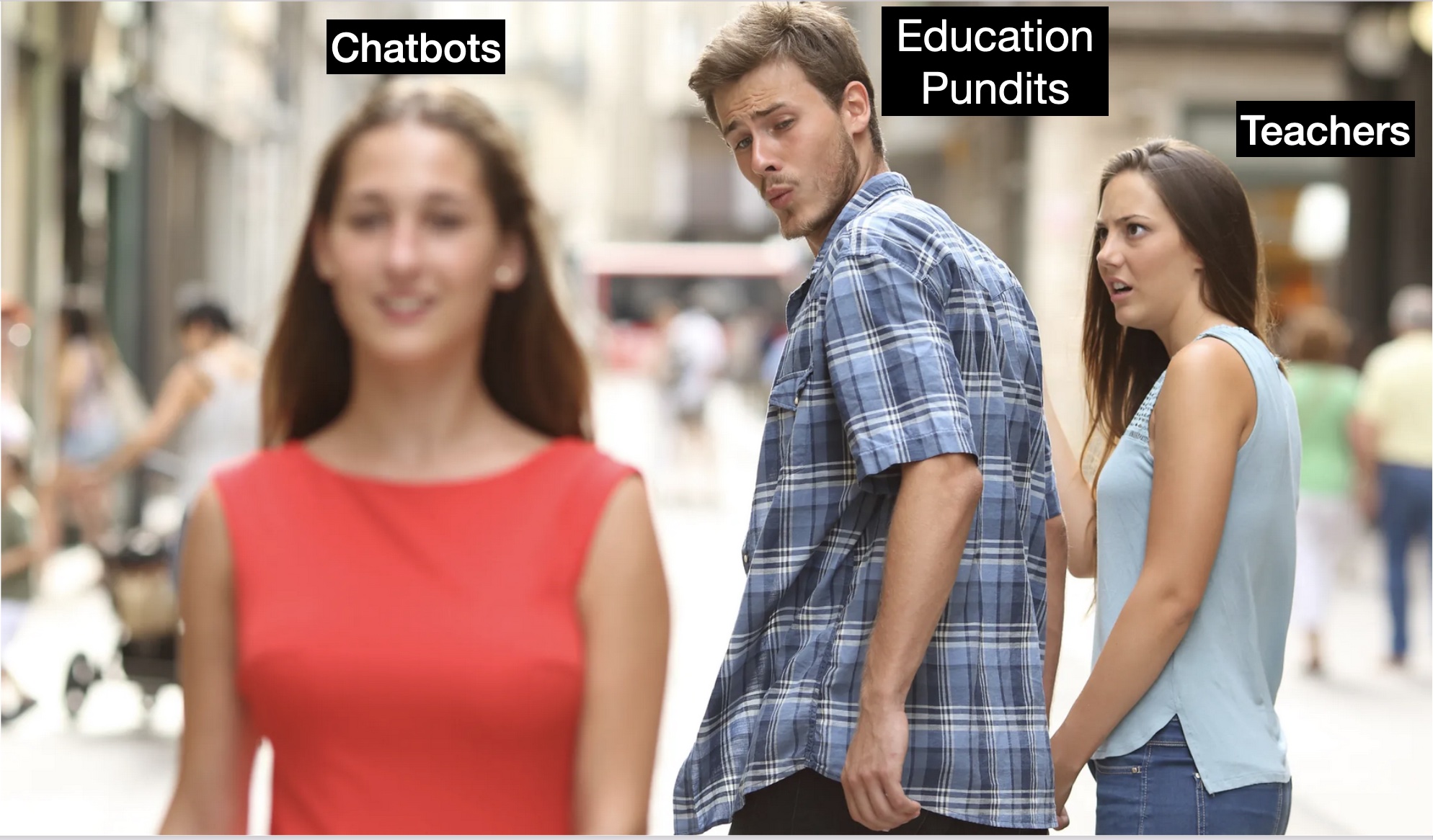
ChatGPT’s responses are entertaining because we know we’re not communicating with a human being. But that’s exactly what you need to encourage the most complex learning.
Human interaction is an essential part of good teaching. You can’t do that with something that is not, in itself, human – something that cannot form relationships but can only mimic what it thinks good communication and good relationships sound like.
Even when it comes to providing right answers, chatbots have an extremely high error rate. People extolling these AI’s virtues are overlooking how often they get things wrong.
Anyone who has used Siri or Alexa knows that – sometimes they reply to your questions with non sequiturs or a bunch of random words that don’t even make sense.
ChatGPT is no different.
As more people used it, ChatGPT’s answers became so erratic that Stack Overflow – a Q&A platform for coders and programmers – temporarily banned users from sharing information from ChatGPT, noting that it’s “substantially harmful to the site and to users who are asking or looking for correct answers.”
The answers it provides are not thought out responses. They are approximations – good approximations – of what it calculates would be a correct answer if asked of a human being.
The chatbot is operating “without a contextual understanding of the language,” said Lian Jye Su, a research director at market research firm ABI Research.
“It is very easy for the model to give plausible-sounding but incorrect or nonsensical answers,” she said. “It guessed when it was supposed to clarify and sometimes responded to harmful instructions or exhibited biased behavior. It also lacks regional and country-specific understanding.”
Eager for any headline that didn’t center on his disastrous takeover of Twitter, Musk endorsed the new AI even though he left the company in 2018 after disagreements over its direction.
However, AI and even chatbots have been used in some classrooms successfully.
Professor Ashok Goel secretly used a chatbot called Jill Watson as an assistant teacher of online courses at the Georgia Institute of Technology. The AI answered routine questions from students, while professors concentrated on more complicated issues. At the end of the course, when Goel revealed that Jill Watson was a chatbot, many students expressed surprise and said they had thought she was a real person.
This appears to be the primary use of a chatbot in education.
“Students have a lot of the same questions over and over again. They’re looking for the answers to easy administrative questions, and they have similar questions regarding their subjects each year. Chatbots help to get rid of some of the noise. Students are able to get to answers as quickly as possible and move on,” said Erik Bøylestad Nilsen from BI Norwegian Business School.
However, even in such instances, chatbots are expensive as yet to install, run and maintain, and (as with most EdTech) they almost always collect student data that is often sold to businesses.
Like this post? You might want to consider becoming a Patreon subscriber. This helps me continue to keep the blog going and get on with this difficult and challenging work.
Nurses don’t want to strike. But going to the hospital and being cared for by an overworked, underpaid, unsupported nurse is not going to improve your health.
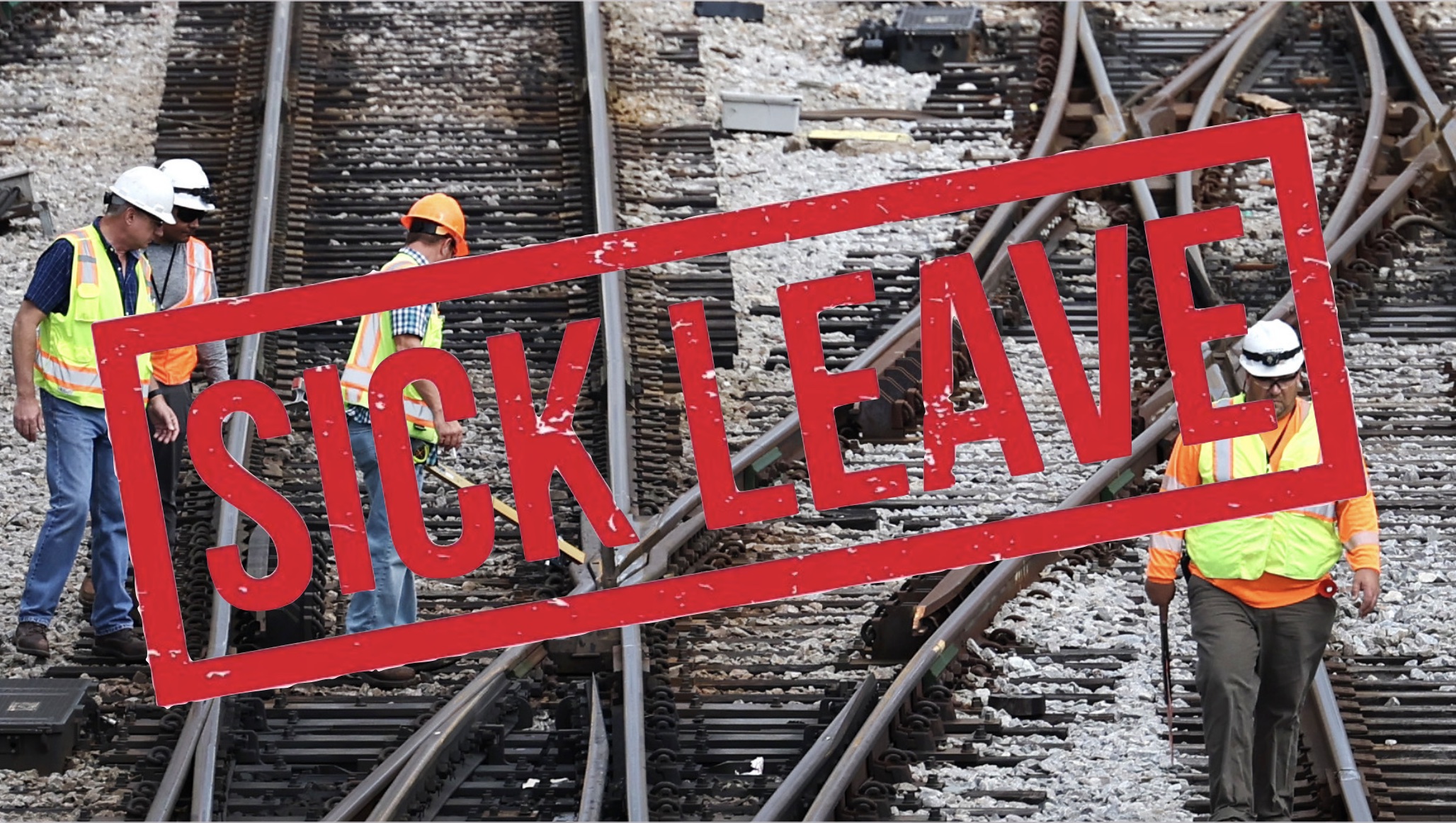
Railway workers would certainly rather get on with their jobs than contend with the bosses or Congress. But having no paid sick leave and a lack of adequate pay will not help move goods across the country any better, either.
Instead, we are at the mercy of employers to step up and do so. And when it comes to the poorest but most important workers – the ones without which our country would grind to a stop – employers are often extremely reluctant to do so.
Roughly a quarter of the private workforce — more than 33 million people — have no paid sick days so they can take care of themselves if they get ill. Even worse, more than 80 percent of private sector workers have no access to paid leave so they can care for a family member.
And it’s indisputably a racial and class phenomenon.
Higher-paid, professional workers almost universally have paid sick and family leave. But, of course, most of these workers don’t just lack pigment on their collars, they lack it on their faces, too. Among the lowest-paid quarter of the workforce, the majority of whom are Black and Latinx workers, only half of them have any paid sick days, and just 7 percent have paid family leave.
So workers of color, the poor, and disproportionately women are much more likely to lack sick and family leave than those who are paid more, have white skin and are male.
And before you explode with indignation, let it be known that this could be rectified any day our government sees fit.
Our representatives could stop holding water for groups like the railway companies that pulled in $20 billion in profits last year alone. Our government could represent us, the people, instead of businesses that could afford to do better but don’t because we aren’t holding them accountable and our Congress and the President refuse to stop them or even let us force them to do right by subjecting them to a strike.
It is past time for our government to begin respecting the rights of workers to organize and collectively bargain for better treatment.
We just suffered through a pandemic where these so-called essential workers had to put themselves in the most danger just to keep society running while the rest of us stayed home and were unequally protected.
If these workers are truly essential, they at least deserve sick and family leave. Otherwise, it is all too obvious how bogus the term is.
The U.S. can no longer run on the unrespected work of an underclass of the poor and people of color.
Like this post? You might want to consider becoming a Patreon subscriber. This helps me continue to keep the blog going and get on with this difficult and challenging work.
In fact, the very idea seems ludicrous now – and this was being discussed like it was a foregone conclusion just a few months ago at the beginning of the summer.
It doesn’t matter – as long as we can keep them coming.
The young and dumb.
Or the old and out of options.
Entice retired teachers to come back and sub. Remove hurdles for anyone from a non-teaching field to step in and become a teacher – even military veterans because there’s so much overlap between battlefield experience and second grade reading.
If you have a hole in your pocket and you keep losing your keys, wallet and other vital things from out of your pants, the first thing you do is sew up the hole! You don’t keep putting more things in your pocket!
But that’s only true if you’re actually interested in solving the problem.
And make no mistake – experienced teachers are incredibly valuable. That’s not to say new teachers don’t have their own positive aspects, but the profession’s expert practitioners are its heart and soul.
Think about it.
Like any other profession, the longer you practice it, the better you usually get. For example, no one going under heart surgery would willingly choose a surgeon who had never operated before over a seasoned veteran who has done this successfully multiple times.
Republicans are literally running a political platform on weakening teachers, schools and education because they need the poorly educated to make up their voting base.
It is a political and economic plot against increasing the average intelligence and knowledge of voters, stealing government funding for personal gain and refusing to increase the quality of a government sponsored service.
In August, the national Education Association (NEA) sounded the alarm that an additional 300,000 educators had left since the report was issued. And it’s only getting worse. An NEA union poll found that 55% of educators were considering leaving education earlier than they had originally planned.
In my own district, there are several teachers who have taken leaves of absence or are sick and had to be temporarily replaced with long term subs. We’re located in western Pennsylvania south of Pittsburgh, just across the river from a plethora of colleges and universities with teacher prep programs. Yet it was pretty difficult to find anyone to fill these positions or serve as day-to-day subs.
There is so much we could be doing to encourage seasoned teachers to stay in the classroom beyond increased pay.
What we have here is a crisis that cuts to the very heart of America’s identity as a nation.
What do we want to be? A capitalist experiment in school privatization whose only regulation is the free hand of the market? Or a nation supported by a secure system of education that took us to the moon and made us the greatest global superpower the world has ever known?
There is a cost to becoming a great nation and not just emblazoning the idea on a hat.
That cost is education. It is paying, supporting and respecting veteran teachers.
Are we still willing to pay it?
Like this post? You might want to consider becoming a Patreon subscriber. This helps me continue to keep the blog going and get on with this difficult and challenging work.
“Teachers, we are operating on a lockdown. Please keep your doors locked until we tell you it has been lifted.”
Before me a sea of wide eyes and scared faces.
I slowly walked toward the door continuing the lesson I had been giving before the announcement. The door was already shut and secured but I nonchalantly turned the extra deadbolt.
“Click!” it sounded like a gunshot across the suddenly silent room.
I continued talking while making my way back to the blackboard pretending that nothing out of the ordinary was happening.
That’s just life in the classroom these days.
According to Eduction Week, there have been 38 school shootings in the US this year resulting in injuries or deaths. That’s up from 34 last year and the highest it’s been since the media source began tracking such things in 2018.
During the height of the Covid-19 pandemic, there were only 10 such shootings in 2020, and 24 each in 2019 and 2018.
That comes to a total of 130 school shootings in the last five years.
“Mr. Singer, can I go to the bathroom?” DeVon asked.
“I’m sorry,” I said. “We’re still under lockdown. I’ll write you a pass as soon as it’s lifted.”
It seems like nowhere is safe.
Three of this year’s shootings were in my home state of Pennsylvania.
A 14-year-old student was killed and four others wounded (ages 17, 15, 14, and 14) in a shooting near the high school athletic field after a football scrimmage.
“Mr. Singer, what’s happening?” Olivia asked.
I turned to her confused at first then I realized what she meant.
“The lockdown? Let me check my laptop. No…. Nothing. I really don’t know, Honey. But I’m sure whatever it is, it will be over soon. Why don’t you get back to the assignment?”
Every few years we do this. Teachers huddle in classrooms and try to react to a shooting scenario. We either barricade ourselves in our classrooms or try to find an escape route. We help train police and local medical personnel.
At this years training, teachers were given a talk by a law enforcement “expert” who regaled us with his time working as a Blackwater mercenary in Afghanistan. He told us how difficult it was to make decisions under fire but that sometimes you had to make the hard decisions.
“Some of you teachers have kids in wheelchairs in your classrooms. You think you’re going to get your whole class out of the building and to safety!? You have to ask yourself, how are you going to get that kid in the wheelchair out? What are you going to do if a child flips out or is too scared to move? I know it’s not nice to think about, but sometimes you have to make decisions that will save the most people – not necessarily everyone.”
It made me want to vomit. But he wasn’t telling me anything I didn’t already know.
I like to believe I’d pick the child up out of his wheelchair, throw him over my shoulder and carry him to safety. I hope I could calm down a child having a panic attack and whisk her out of the building.
“Mr. Singer, I really have to go to the bathroom.”
“You can’t hold it just a little longer, DeVon?”
“No,” he said hoping from foot to foot.
“Number 1 or number 2?”
He giggled and held up one finger.
I reluctantly pointed to the trash can.
“Take it over there to the corner. I’ll stand in front of you so…”
“Attention teachers! The lockdown has now been lifted. You may continue as normal.”
I sighed, unlocked the door and wrote DeVon a bathroom pass.
We never did find out what triggered the lockdown. One time it was a gunshot in the surrounding neighborhood. Another time it was an unauthorized adult seeking access to the building.
Not just on the days when one of these tragedies strike – but every day.
It is not safe for students and teachers – it will NEVER be completely safe, but it can be safer.
That’s the point – how safe can we make it?
And why aren’t we doing anything to reach that goal other than preparing for the worst?
Like this post? You might want to consider becoming a Patreon subscriber. This helps me continue to keep the blog going and get on with this difficult and challenging work.
“Democrats are pushing woke ideology, racism, and sexuality on children in the classroom. As your governor, I will ban this on day one…”
Yikes. This is like promising to ban sorcery in school – another thing we don’t teach.
This isn’t the Republican Party I remember when I was growing up.
Instead of personal autonomy and free trade, today’s GOP solemnly swears to eliminate a series of racially and sexually motivated phantasms that are like shadows under a child’s bed. I suppose it’s easier to get rid of something that’s never existed than to fix the real problems we actually have.
But let’s be honest – for some folks this kind of unhinged messaging works.
Many Republicans claim anti-male discrimination is wide spread. Men are blamed for so many things in our society they’re forced to turn to porn and video games because they have no other options, Green claimed.
And women have become “… too weak and pathetic to take care of themselves. They want a great big giant government to take care of them. It’s such a hypocrisy. They claim they want the future to be female, but they aren’t capable of taking care of themself.”
How did we get here? Public schools that teach sexual politics.
Male students are not responsible for a world created by past generations but they ARE responsible for picking a side and doing something about it as they become adult members of society.
Republicans literally think public school teachers are turning kids gay.
That’s the impetus behind Florida Gov. Ron DeSantis’s controversial “Don’t Say Gay” bill and several copycat bits of legislation the American Legislative Exchange Council (ALEC) is pumping out across the country.
They insist that even mentioning LGBTQ people exist is grooming children into a sexuality they wouldn’t otherwise have.
First, believing this shows massive ignorance.
No one can really be coerced into a sexuality they didn’t already possess. As you grow and mature, you have sexual preferences. It’s not really a matter of nurture – it’s nature. People are born this way.
Second, stubbornly refusing to acknowledge that there are other ways to express your sexuality is not going to make people ignore their innate inclinations. The idea seems to be that if kids never find out there are other options, they’ll simply be satisfied with heterosexuality – how they’re told to think and feel.
And finally, it is extremely unfair to LGBTQ people. We already live in a culture that celebrates cis hetero-normativity. Trying to erase everyone else causes real harm and trauma to both people who are different and to those who are not but never get to fully understand the entire spectrum of humanity.
Teachers are not making kids gay, but they are telling kids that gay people are real. We are trying to stop bullying and homophobia. And let’s be honest – that’s really what Republicans are objecting to here.
They want it to be okay to hate gay people.
Sorry. Not in public school.
3) Teaching kids to be trans
This is where the backlash against using appropriate pronouns and recognizing trans people is coming from.
As much as Republicans hate gay people, they absolutely despise and fear the trans community.
Once again they conflate acknowledging the existence of the other with coercing students to become the other. Just knowing that trans is an authentic way human beings can live is seen as a threat. But if this kind of knowledge makes you trans, you almost certainly were trans already.
It hurts no one to see the world as bigger than just one way of living. This is reality, after all. And that’s what Republicans are rebelling against.
Far from teachers coercing students to become trans, the GOP wants us to bully children not to be. They want to constrain difference, punish and hide it.
It’s not Critical Race Theory (which is a legal framework) nor do we teach anyone to hate white people. But we do teach what whiteness has done and continues to do.
-Median household income for Black people, at $43,862, is 37 precent less than that of white people, at $69,823.
-Census data shows Black couples are more than twice as likely as whites to be denied a mortgage or a home improvement loan, which leads to just 59 percent of the median home equity white households have, and just 13 percent of Black wealth.
-A Black child born today can expect to live four years less than a white one.
They shouldn’t make children hate white people, but they may encourage them to hate white supremacy.
And that’s what Republicans are really against.
5) Teaching kids to be sexually active
This may be the strangest fantasy the GOP is trying to spread about public school.
They say we’re making kids engage in sexual activity. Which is strange because according to the Centers for Disease Control, fewer US children are choosing to engage in sexual activity.
An estimated 55% of male and female teens have had sexual intercourse by age 18, according to the CDC’s National Center for Health Statistics (NCHS).
However, these percentages have declined since 1988 when 51% of female and 60% of male teens had engaged in sexual activity.
If public schools are teaching kids to bump uglies, we’re doing a bad job.
Are kids more sexualized today than in the past? Probably. But that’s a result of the culture. When you sell teenagers shorts with the word “juicy” on the butt, don’t complain about public schools.
Some schools offer sex education classes, but they are focused on health and wellness. There is no encouragement to have sex. In fact, many such classes are still teaching abstinence only instead of safe contraception.
The idea that public schools are teaching sex is just dog whistle politics. It is Republicans trying to scare parents that public schools are instilling values they don’t share. It is blaming public schools for social ills that the schools didn’t cause and don’t control.
Looked at calmly and rationally, all of these fantasies are just scare tactics to get the gullible to react emotionally on election day.
They want to terrify responsive voters into giving GOP candidates the power to stop a host of things that never really existed. They want an excuse for doing nothing to solve the actual problems of the day.
There’s a reason they spend so much time railing against woke education – they want to ensure America remains asleep.
A fitful sleep – tossing and turning in various Republican nightmares.
Like this post? You might want to consider becoming a Patreon subscriber. This helps me continue to keep the blog going and get on with this difficult and challenging work.
The choice for Pennsylvania Governor could not be more clear in November.
On the one hand, we have Josh Shapiro – an Attorney General who fought for Commonwealth citizens’ rights for six years.
On the other, we have Doug Mastriano, a former US Army Colonel and 3-year state representative who supported a literal coup against the United States government.
In any sane world, that would be all you’d need to know.
If Mastriano somehow wins the governors race, he will be in a position to basically call off Democratic rule in the state. As governor, he would choose the secretary of state — the official in charge of administering the 2024 presidential election. This would effectively allow him to pick the winner, himself.
This is not just conjecture. Mastriano has gone on record that as governor he would decertify voting machines in some precincts – making it hard to count votes there. He has even alluded to the independent state legislature doctrine, which holds that state legislatures can name whoever they want as the recipient of a state’s electoral votes, regardless of who voters select.
This is not conservatism. It is not protecting American values or law and order. It is the opposite.
By contrast, Shapiro, the Democrat in the race, is a model of exactly those qualities usually associated with sobriety and efficiency.
The way I see it, this is a simple – if terrifying – election.
Shapiro is not perfect, but if elected, he would function similarly to current Governor Tom Wolf. He would be a guardian against the overreach and bad decisions of the gerrymandered Republican legislature.
One can hope voters throughout the Commonwealth would take back their individual voting districts from the extremists, but given the still uncompetitive lines of these districts, this seems unlikely.
So we need a Wolf, we need a Shapiro, standing on the battlements stopping the goons like Mastriano from taking advantage of the majority of us.
Shapiro would certainly do that. He might even go farther and fight to find ways to get real change through the legislature. But even if he can’t do that, voting for him is essential.
That would make a huge difference both nationally and throughout the state.
It would set us up with a firm foundation and at least keep people safe from the worst.
I know it is depressing to be put in this situation constantly. Every election cycle seems to be the most important because the country is falling apart. Maybe we can find a way to turn things back and reach some level of sanity. But we can’t do anything unless we elect Shapiro, Davis and Fetterman.
We need the guardians against the goons.
Like this post? You might want to consider becoming a Patreon subscriber. This helps me continue to keep the blog going and get on with this difficult and challenging work.









 gadflyonthewallblog