State Governors must have a different definition of safety than the rest of us.
The message was signed by New Jersey Governor Phil Murphy, New York Governor Andrew Cuomo, Pennsylvania Governor Tom Wolf, Delaware Governor John Carney, Connecticut Governor Ned Lamont, Rhode Island Governor Gina Raimondo, and Massachusetts Governor Charlie Baker.
Only Baker is a Republican. The rest are all Democrats.
More than 11 million Americans have been diagnosed with the disease at an ever increasing rate. One million of those cases came about over just six days last week.
“Medical research as well as the data from Northeastern states, from across the country, and from around the world make clear that in-person learning is safe when the appropriate protections are in place, even in communities with high transmission rates.”
This is just not true.
It is based not on research by epidemiologists, not on studies conducted by doctors, scientists or pharmacologists.
It comes from the work of an economist – Emily Oster.
The Brown University professor analyzed data from all 50 states over a two week period in September and came to the conclusion that when students or teachers get Covid, they rarely catch it at school.
She wrote her dissertation explaining that there were less women in China not because of the one child policy and traditional attitudes toward girl children, but instead because Hepatitis B skewed sex ratios.
Oster is not a serious academic. She is someone who constantly says something controversial to court the media and public opinion.
She is a contrarian, an attention seeker, a celebutante – the economist version of someone who shouts “fire” in a crowded movie theater and then sells fire extinguishers to those rushing for the exits.
Since providing this cover story, various county departments of health have claimed that contact tracing rarely indicates students or teachers catch the virus at school. However, these conclusions are based on voluntary anecdotes, not hard data. At the local level, there is often a lot of pressure to find the cause of an outbreak somewhere else when childcare is at stake or administrative coercion involved.
A study of more than a half-million people who were exposed to Coronavirus suggests that the virus’ continued spread is driven by only a small percentage of those who become infected.
“In-person learning is the best possible scenario for children, especially those with special needs and from low-income families. There is also growing evidence that the more time children spend outside of school increases the risk of mental health harm and affects their ability to truly learn.”
Talk about overstating the issue!
So kids can’t learn if their instruction is interrupted? It’s a good thing we never take any time off school, say during the summer months.
But it’s the callousness with which these governors paper over health concerns that really sounds like Oster, herself.
“There are people who would say if even one teacher acquires COVID at a school and dies, then it would not have been worth it to open schools,” Oster said. “I think that argument is complicated because people are going to suffer tremendously from schools being closed, but that is a tricky calculus.”
What kind of mental health issues do children experience whose teachers die suddenly and preventably? How do kids suffer with the loss of a loved one knowing full well that they may have inadvertently been the cause of that person’s death?
What is the longterm cost to children or adults who have their lungs, digestive system or brains suffer irreparable damage as a result of Covid complications?
This disease was only discovered two years ago.
We cannot make bold statements of certainly about its effects without being deeply dishonest. There’s a lot we don’t know about it and how it affects people. And in light of that uncertainty it makes more sense to be extra cautious than reckless.
Administrators and academic coaches can be of more use helping struggling students stay on track than endlessly spinning their wheels about how best to reopen schools.
Bottom line: No one should have to go to school in an unsafe classroom.
Students shouldn’t feel like the only way to get a quality education is to risk their health and put their families in jeopardy.
It’s high time our government passed a new round of Covid relief. We need to pay people to stay home so they don’t spread the virus. We need mortgage protection, universal healthcare and a host of services to help people weather the storm.
It sad that so many Governors lack the courage to issue real Stay-at-Home orders, close schools, bars and restaurants, and issue stiff penalties for those who disobey them.
Until the danger has passed, we need quality remote learning conducted, planned and supported by educators.
And we need Governors with the guts to listen to science, not B.S. economists.
Like this post? You might want to consider becoming a Patreon subscriber. This helps me continue to keep the blog going and get on with this difficult and challenging work.
But the idea that public schools are fundamentally better – that idea has suffered tremendously.
I used to believe that local control was something to cherish, that a board made up of neighbors duly elected by the community would more often than not have the best interests of that neighborhood at heart when making decisions.
Yes, the board decided to make students and teachers guinea pigs in an experiment to see if they could somehow avoid getting sick while cases surged throughout the country and state.
Will Western Pennsylvania schools do the right thing and go to remote learning? Will Steel Valley finally give up this in-person experiment? Will McKeesport?
They keep blaming everything on academics, saying they have provide what is best to help students learn – never mind the dangers to child, parent and teachers’ bodies. But even more hypocritically they ignore the well being of huge swaths of their students who refuse to take part in their in-person experiment.
In both districts, about 60% of parents favor in-person schooling and 40% prefer remote.
So the boards are doing what the majority wants, but it’s a slim majority.
There is a significant portion of parents who feel these in-person plans are unsafe and very little is being done to educate their children.
They are actually betting that the poor quality of the cyber program will increase the number of parents sending their kids to in-person instruction.
And I’ve heard similar comments among administration at Steel Valley.
There at least we don’t force kids into our (likewise crappy) cyber program. We just have classroom teachers post assignments on-line.
Remote students in K-5 get live teachers instructing on-line. But remote students in 6-12 only get one half day of synchronous instruction on-line a week. The rest is asynchronous worksheets, etc. And somehow that’s supposed to be enough.
We have enough teachers that we could provide more, but why encourage remote learning? Might as well let them eat asynchronous and hope their parents will lose hope and just make them come to school during a global pandemic.
I have zero respect for administrators who think this way. I have zero respect for school board members who vote for it.
So how do I keep my respect for local control and the school board system?
But my district has refused to allow me a safe work environment.
I am not allowed to teach remotely.
I have to burn my sick days so I can stay safe at home. But at the same time, I’m encouraged to take overtime hours to put up remote lessons, grade papers and contact parents.
I’m ready to do that as part of my job, but they won’t let me. They’d rather pay me and a sub who babysits my students in-person while I do what I’m allowed to do remotely at the same time.
So how do you look an administrator in the eye who refuses to lookout for his own employee’s safety?
Because the leadership is perfectly fine with agreeing for the staff to work in unsafe conditions and no special protections for those like me who are more likely to contract the disease.
Leaders throw up their hands and say “We’re an association not a union,” and “If the boss says you come back to work, you have to come back to work.”
And what is PSEA threatening if districts don’t comply?
Nothing…. So far.
But I guess saying something about it is better than what they were doing before.
The national unions – the National Education Association (NEA) and American Federation of Teachers (AFT) – certainly haven’t taken any hardline stances.
The technology should be merely a tool to connect students and teachers not as a provider of that learning.
The backlash against ed tech has been far greater than any embrace.
Yet some education activists decry how public schools going remote makes privatized schools who don’t look good.
That’s nonsense, too.
Teaching recklessly is bad – no matter who does it. If parents want to endanger their own kids, that’s their prerogative, but in the long run no one will earn brownie points for enabling such negligence.
However, where privatized schools will earn points with parents is for providing high quality remote learning when public schools refuse to do so.
I know all of them aren’t doing that. But some of them are.
And, frankly, they deserve any praise they get for it.
Look, I love public schools, too. But when public schools abandon their duties to their students as so many have done during this crisis, they deserve to have their students stolen. Even if these privatized schools often have more money to work with in the first place.
CONCLUSIONS
Bottom line: This is a crisis the school board system should have been able to overcome.
It’s a crisis the unions should have been able to battle.
It’s a crisis the activist community should have been able to see clearly.
That’s why the schools are open. School boards are afraid keeping them closed will hurt business in the community.
That’s why administrators make such reckless reopening plans. They’re afraid that if we stay on remote it will become obvious how irrelevant they are to the running of a virtual school.
That’s why union leaders put up next to no resistance. They’re more afraid of furloughs than death or lifelong health consequences.
That’s why some parents support reopening schools – so they have someone to watch their kids while they’re at work. They never spare a moment for how the government is cheating them out of stimulus checks, mortgage relief, rent forgiveness, free testing, hazard pay and healthcare so they don’t have to put their own lives on the line working during a pandemic.
In all honesty, we were a sick country long before COVID-19 hit our shores.
When you look across the ocean at the more socialist countries, you see much better plans to deal with the pandemic. Not perfect, but better.
When everything isn’t dependent on money changing hands, you can more easily prioritize human life.
So, yes, my faith has been shaken in our public schools.
I still think the idea of a public school is one to be cherished and fought to protect.
But the leaders we have – nearly all of them – should be rejected.
We need an army of citizen activists, parents and teachers to come forward at the first opportunity to replace them.
Anyone in a leadership role this year should have to explain themselves – what did you do to protect students and staff during the pandemic?
If they can’t prove they took real steps to keep people safe and not sacrifice the people they were charged to protect on the altar of capitalism – if they can’t do that they should step down.
They should step down with tears in their eyes and forever have their names sullied by their cowardice and stupidity.
They have failed us all.
Like this post? You might want to consider becoming a Patreon subscriber. This helps me continue to keep the blog going and get on with this difficult and challenging work.
It was a repudiation of Trump more than a celebration of Biden.
However, now that the dust has cleared and all the states but Georgia, Alaska and North Carolina have been called, I’m starting to have some thoughts about what a Biden administration might actually look like.
And it might not be too bad.
So here are what I see as the five main hurdles coming up for the Biden administration and why we might be cautiously optimistic about their outcomes:
1) Trump Will Fail to Successfully Challenge the Election Results
Alaska will probably go to Trump and North Carolina is a bit of a toss up. Georgia will almost certainly go to Biden.
It actually doesn’t really matter.
The world and the media have already accepted the results.
Biden has been elected the 46th President of the United States.
In the absence of solid evidence of massive voter fraud in multiple states – many of which are controlled by Republican governments – it is unlikely that these results can be successfully changed.
You don’t know Four Seasons Total Landscaping? It’s a landscape gardeners located between a crematorium and a dildo shop.
That is not the work of people capable of running an effective challenge to a national election.
Yes, there are enough far right justices on the Supreme Court to pull off this Coup d’état. But I don’t think even they would have the guts to do it in light of the world’s acceptance of Biden, the acceptance of many in the GOP and the blatant incompetence of the Trump administration.
I admit that I could be wrong. And I certainly don’t think we should underestimate these neofacists.
Trump is a cornered rat, and that is when rats are at their most dangerous.
It appears that the election will not, by itself, change the balance of power in Congress.
The Democrats have lost seats in the House but not enough to lose a majority. They do not appear to have picked up enough seats in the Senate to rest control away from the GOP.
No doubt Republicans will try to throw whatever they have left to stopping the Dems in these races. But how much do they really have after being beaten nationwide?
Will momentum and an existent grassroots network be enough to flip the script for Dems?
Chances are good. It all depends on what we do in the next few months.
3) Progressives Will Not Let Neoliberals Ignore Them
Both this year and in 2016, there was very little positive policy being offered – very little popular positive policy positions that would have directly impacted the majority of Americans.
Had Medicare For All or the Green New Deal been on the ballot, things might have gone differently – or more emphatically – our way.
But, instead, it was all about getting rid of Trump.
Thankfully, that was enough. But had the party actually offered voters something more – things that are overwhelmingly popular with everyday people but unpopular with party elites and their wealthy backers – the results could have been a landslide in Biden’s favor.
She said that every candidate that co-sponsored Medicare for All in a swing district was reelected. Even Mike Levin, who many thought had committed political suicide by co-sponsoring the Green New Deal, kept his seat.
Supporting progressive policies did not sink anyone’s campaigns. In fact, that’s how insurgent Democrats have been unseating centrists across the nation.
“I’ve been unseating Democrats for two years,” Ocasio-Cortez said. “I have been defeating D.C.C.C.-run campaigns for two years. That’s how I got to Congress. That’s how we elected Ayanna Pressley. That’s how Jamaal Bowman won. That’s how Cori Bush won. And so we know about extreme vulnerabilities in how Democrats run campaigns.”
This is a fight for the heart and soul of the Democratic party.
We cannot continue to move to the right and expect the base – which are much further left – to continue to vote for increasingly conservative candidates.
There is already a party for that – it’s the Republicans.
“I need my colleagues to understand that we are not the enemy,” she said. “And that their base is not the enemy. That the Movement for Black Lives is not the enemy, that Medicare For All is not the enemy. This isn’t even just about winning an argument. It’s that if they keep going after the wrong thing, I mean, they’re just setting up their own obsolescence.”
We will see if the Biden administration learns these lessons or not.
I think there is good reason to be cautiously optimistic here. It is in the party’s own self interest.
But only the future will tell.
4) Biden will Take Steps to Control the Coronavirus
Unlike his predecessor, Biden has been a consistent voice of sanity on the COVID-19 pandemic.
“We cannot repair the economy, restore our vitality, or relish life’s most precious moments — hugging a grandchild, birthdays, weddings, graduations, all the moments that matter most to us — until we get this virus under control.”
And true to his word, this appears to be the first thing on his agenda.
Specifically, Biden’s plan calls for empowering scientists at the Centers for Disease Control and Prevention (CDC) to help set national guidance based on evidence to stop outbreaks, work on a vaccine, testing, contact tracing and other services.
His administration would use the CDC to provide specific guidance — based on the degree of viral spread in a community — for how to open schools and businesses, when to impose restrictions on gathering sizes or when stay-at-home orders may be necessary.
He would create a national “pandemic dashboard” to share this information with the public.
He would make sure that everyone has access to regular, reliable, free testing.
He would hire 100,000 additional public health workers to coordinate with local organizations around the country to perform contact tracing and other health services. These people would help with everything from food insecurity and affordable housing to training school officials about when and how to make it safe to reopen buildings.
He proposes the federal government cover 100% of the cost of Consolidated Omnibus Budget Reconciliation Act (COBRA) coverage for the duration of the crisis for people who get sick from the virus. If someone loses employer-based health insurance, they would still have health insurance through this plan.
He also will push to strengthen the Affordable Care Act, expanding coverage by making more people eligible.
He’d use the Defense Production Act to increase production of masks, face shields and other personal protective equipment so that supply exceeds demand.
I don’t know about you, but to me this seems a breath of fresh air. It is what the federal government should do and what it hasn’t been doing under Trump.
And I see no reason why the Biden administration can’t get it done.
5) Biden Can’t Afford to Re-up Betsy DeVos’ Education Policies
They all supported charter schools, high stakes testing, increased segregation, the school-to-prison pipeline, evaluating teachers on student test scores, targeted disinvestment to schools in poor neighborhoods serving mostly students of color, and more.
Duncan and King were competent at destroying public education while hiding behind neoliberal rhetoric. DeVos was incompetent in every conceivable way and could barely hide her glee at the prospect of destroying public education.
Since Biden’s wife, Jill, was an actual teacher, he has more to lose than previous chief executives if he gets this wrong. He can’t take schools for granted and he can’t appear to be doubling down on the same policies of Trump and DeVos – which to be honest were mostly the same as those of Obama and Bush but on steroids.
Biden promised a public school teacher would be his next education secretary and Politico is already making predictions. The media outlet suggests ex-National Education Association (NEA) President Lily Eskelsen Garcia, American Federation of Teachers (AFT) President Randi Weingarten or Stanford Education Professor Linda Darling-Hammond.
Frankly, we could do much worse than any of these people. Hammond, in particular, was Obama’s education policy advisor UNTIL he was elected and changed courses to the neoliberal set.
Of all the hurdles coming his way, I have the least hope Biden will overcome this one.
Like this post? You might want to consider becoming a Patreon subscriber. This helps me continue to keep the blog going and get on with this difficult and challenging work.
My doctors tell me that I am more susceptible to contracting the virus because my medications suppress my immune system. And that also means that if I do contract the disease, I will be more likely to have severe, life-threatening complications from it.
However, starting Wednesday, about 60% of parents in my district have chosen to send their kids back to the buildings.
Of these, half the students will come in during the morning and half in the afternoon. Each will go through all their classes in 20 minute periods. On Fridays, the buildings will be closed and teachers will instruct virtually for half the day and plan during the other half.
The new reopening plan cuts instruction time by half and doesn’t meet parents need for childcare or certainly student safety. But it is better than being open 5-days a week and it provides the possibility of social distancing.
So I went to my principal asking if I could continue to teach online.
I documented my conditions, gave him doctors’ notes, and had my doctors fill out pages and pages of questions from the district’s lawyers.
In the end, my principal told me the district could not meet my request.
Administrators could provide some protections like a plexiglass barrier and take me off hall duty, but they couldn’t let me continue to teach remotely.
Certain teachers in grades K-5 have been given this option, but not secondary teachers like me. Elementary students whose parents don’t want them to return to the building will get full synchronous virtual instruction with a teacher through a video conferencing site like Zoom. Secondary students who do not return to the buildings will only get asynchronous assignments most of the week posted by their classroom teachers.
He suggested I look into taking a leave of absence.
And I guess I can see where he’s coming from.
If administrators let me teach remotely, it’s possible enough students would return to the classroom that the teachers willing to return wouldn’t be enough to meet the load. My absence from the building might necessitate a substitute teacher to be in the physical classroom with students.
Why pay for two teachers when you only need one?
Except…
…I’LL STILL BE PAID WHEN I’M ON LEAVE.
It’s just that then I’d have to sit at home instead of teach my students.
So benching me doesn’t save the district any money.
In fact, it will cost the district MORE money for me to stay home, because I could still do everything they expect of me and more for the sizable number of students whose parents say they aren’t returning.
So I brought this up to my principal figuring he must have overlooked it.
But no. He said he knew all about it.
He said this is what the district’s lawyers were telling him to do so that’s what he was going to do.
I couldn’t believe it.
I went to school board directors I had developed a relationship with teaching their children, going on field trips with them, working with their spouses.
I got the same answer.
So here I am – being asked to choose between my life and my livelihood.
Go to work and risk everything – or sit at home burning my sick days and still collecting a paycheck.
This is not what I want.
It’s not good for anyone.
I teach 8th grade Language Arts. Last year I also taught 7th grade.
So many of my students this year were in my class in the spring. We already know each other.
But more than that, I know what they like and dislike. I know their hopes and fears. I know what motivates them and what supports their individual learning.
I’ve seen tremendous growth the first 9-weeks of school and could really help them overcome the gargantuan hurdles that will be inevitable the rest of the year.
And that’s what I’d really like to do.
I don’t want to sit home collecting the taxpayer’s money when I could be making a difference in these young people’s lives. I don’t want to have to wait for an outbreak to allow me to continue my work.
Being benched like this makes me feel so worthless, and I’m not.
Wouldn’t everyone be better served with me instructing my students rather than being thrown to the side?
That can’t happen without help.
I’m just a human being like anyone else.
I have people who care about me and whom I care about.
I have a wife and daughter.
I can’t roll the dice with my life or chance taking an infection home to my loved ones.
Is a safe work environment really too much to ask?
I don’t want to sit at home.
I want to teach.
Like this post? You might want to consider becoming a Patreon subscriber. This helps me continue to keep the blog going and get on with this difficult and challenging work.
Superintendent Dr. Mark Holtzman says the district ignored these guidelines on the recommendation of the Allegheny County Health Department.
“The County Health Department is the local governmental agency responsible for the school districts in [the] County,” Holtzman said at last night’s school board open agenda meeting.
“So their determination of what next steps to take is their primary responsibility. So at this particular time, they have recommended to us that we not follow the CDC guidelines because those guidelines have been created before the start of school and are outdated. So they’re currently working on new guidelines to direct schools.”
The response was in answer to citizens comments.
‘
Greg Kristen and I went to the board meeting hoping to get answers – and we did.
“Those decisions that are being made by the McKeesport Area School District are recommendations by the County Health Department,” Holtzman said.
“They’re not our recommendations. They’re not anyone’s recommendations in this room. Now our school board does have the determination if they so choose to not follow those recommendations and close the McKeesport Area School District. Up until today at this particular time we’re not aware of any school district in Allegheny County being recommended to close no matter how many cases that are involved.”
“I am in a large public school system… I am hearing and seeing two different approaches. I am very appreciative of what the board’s efforts in Pittsburgh have been to keep us safe and keep our students safe. I just want to be an advocate that we are doing everything we can even if it’s erring on the side of caution.”
District Solicitor Gary Matta was concerned about the issue as well.
“We’re getting some mixed signals between the state and the county,” he said.
“The state is directing us to deal with the county health department if we have one.”
He suggested the district get recommendations in writing from the county health department before following any of its advice.
In addition to questions about whether it was safe to keep district buildings open during a COVID-19 outbreak, Holtzman addressed district transparency.
I asked him to compile a dashboard on the district Website with the following information:
“1) How many people have tested positive in total since the school year began?
2) How many are students? How many staff?
3) How many are located at each school building?
4) And please give us a timeline of when each positive test result was returned.”
He could not give me all I asked for at the meeting.
Holtzman said that 10 people have tested positive in the district since school opened – 9 of them recently. He said there have been cases at all four buildings – the high school, Founders Hall, Twin Rivers and Francis McClure elementary schools.
He was able to break down 8 of the 10 cases.
He said:
“In the last 7 days…. We’ve had 5 adults and 3 students. From Wednesday to Wednesday. Two employees (teachers) from Francis McClure, one teacher at Twin Rivers, 1 support staff at Founders Hall, 3 high school students, and one maintenance/support employee.”
Holtzman admitted that having a dashboard on the district Website was a good idea but fell short of committing to providing that ongoing data.
“A dashboard is a pretty good suggestion,” he said.
“It might help people have a better understanding this isn’t a secret – it’s a challenging situation… A lot of districts are considering it, but there are some drawbacks, too. But that’s something we’re going to take into consideration.”
Kristen brought up the issues of contact tracing and increasing class sizes at Twin Rivers that may make it difficult for students to engage in social distancing.
“Two days ago, my daughter told me she was getting six more kids in her class starting Nov. 2,” he said.
“They would be sharing desks. How is that possible during a pandemic? We’re just getting a spike in cases here and now we’re going to add more students to the schools in the classrooms? How is that safe? According to the guidelines, kids have to be AT LEAST 6 feet apart. That will not happen with more students.”
Holtzman said some students whose parents had chosen remote learning had decided to return them to the physical classroom at the start of the new grading period. However, others had decided to remove their children from the physical buildings and put them on remote.
“We will have students return to the classroom after the first 9-weeks. That’s inevitable. The numbers that we anticipate returning, we’re able to accommodate based on the space in those rooms. We do have some relatively low numbers – like less than 10 – in those classrooms.”
About a third of district students have been doing remote lessons since the year began.
Kristen said his daughter told him the new students added to her class would put the kids closer than 6 feet. Her teacher said they would be within 3 feet.
Holtzman disputed this:
“That’s a little difficult to determine. From the center of the child to the center of the child, there must be 6 feet. Six feet is a recommendation. Right? Just like the masking order and the gathering order is a mandate. So recommendations to space kids 6 feet apart is truly what it is – a recommendation. So we’re doing our very best.”
Kristen asked about contact tracing at Twin Rivers where teachers had tested positive.
He wanted to know if students had been tested, and Holtzman responded that they had not.
“Right now the McKeesport Area’s percentage is a little over 5% but it’s trending up as far as the rate of positivity. So people are concerned with watching that number.” He said.
“At this particular time, the Allegheny County Health Department is very satisfied with the contract tracing efforts they’ve made around our current cases. There is no longer any backlog, and there are none waiting to be addressed…
“When we do interviewing – when Allegheny County Health Department does interviewing – we ask them, ‘Where you in somebody’s personal space 6 feet apart for more than 15 minutes during your school day?’ If the answer is yes, Johnny, Susie, Mrs. So-and-So, then that information is provided to the health department and they’re asked to quarantine. If in fact that teacher says ‘I wear a mask every single day, all day, and I’ve never been in anybody’s personal space within 6 feet for 15 minutes consecutively, then the contact tracing ends at that point.”
He admitted that the effectiveness of this process depends on how honest and detailed those testing positive are when listing the people they have come into contact with while contagious.
Below is a transcript of our public comments and Dr. Holtzman’s responses:
Kristen:
“Dear school board members. Thank you for letting me speak here tonight. As a resident of this district for 15 years, as well as having a daughter a Twin Rivers Elementary School, I am deeply, deeply concerned with the lack of transparency about the Coronavirus infections. As of today, MASD has 9 positive cases… We have a right to know [who they are] not their names but their positions. According to CDC guidelines if there are two cases within a school, it is to be shut down for 5-7 days. For 5 or more cases, the building should be shut down for up to 14 days. Why is that not happening? Is the health and safety of the students, teachers, administrators, staff and maintenance not important to you? When positive cases happen in the building, who was in charge for contract tracing and notifying the Allegheny County Health Department? If they did not notify the health department, are they being held accountable? And I mean terminated. Were the parents of the students notified of the teachers and staff who were affected in the schools? Were the students tested? Is there any contract tracing with them? Also why is there not a healthcare professional a part of the Coronavirus task force?
Two days ago, my daughter told me she was getting six more kids in her class starting Nov.2. They would be sharing desks. How is that possible during a pandemic? We’re just getting a spike in cases here and now we’re going to add more students to the schools in the classrooms? How is that safe? According to the guidelines, kids have to be AT LEAST 6 feet apart. That will not happen with more students.
This Coronavirus is not a hoax. People are dying every day. As of today, 222,000 people have died, and people like myself who have an underlying health condition are concerned about people transferring the virus to me or to someone close to me. In this county alone there 14,396 cases and 416 deaths. On Oct 14 which was just a week ago Rachel Levine, the state health secretary announced a second wave of Coronavirus has arrived here. Now that the flu season has arrived, what is MASD doing? Does a student, teacher, administrator, staff or maintenance person have to die for someone to take this serious? Thank you very much.”
Dr. Mark Holtzman:
“Mr. Kristen, I’m happy to address a couple of your concerns. A few things.
We’ve had 8 positive tests in the last 7 days. So that is correct. The CDC guidelines are recommendations by the CDC and Pennsylvania Department of Education and state health department. (muffled) The Alleghney County Health Department is the local governmental agency responsible for the school districts in Allegheny County. So their determination of what next steps to take is their primary responsibility. So at this particular time, they have recommended to us that we not follow the CDC guidelines because those guidelines have been created before the start of school and are outdated. So they’re currently working on new guidelines to direct schools. I will ensure to tell you positively I have spoke to the Alleghney County Health Department probably just this week once a day. The head epidemeologisr Dr. Luann Brink and the director of the health department Dr. [Debra] Bogen and I have conference calls with her every Tuesday at 2 o’clock. Those decisions that are being made by the McKeesport Area School District are recommendations by the Allegheny County Health Department. They’re not our recommendations. They’re not anyone’s recommendations in this room. Now our school board does have the determination if they so choose to not follow those recommendations and close the McKeesport Area School District. Up until today at this particular time we’re not aware of any school district in Allegheny County being recommended to close no matter how many cases that are involved.
The concerns are the issues with Allegheny County Health Department are the rate of positivity here in the city of McKeesport and the surrounding communities. That’s number 1. Transmission is a huge piece of it. Is it being transmitted in the schools? Is it being brought into the schools from the outside? Contract tracing does occur on each and every case. All that information is submitted to the Allegheny County Health Department with details, time stamped, dates, everything we could possibly provide to those individuals. Fortunately or unfortunately we have to rely on that individual. For example, if you’re an employee that tests positive for COVID, we have to interview you. The information that you share with us, we have to then share with the Allegheny County Health Department. Whether you’re honest, dishonest , whether you’re detailed, whether you forgot someone, you didn’t include anyone as part of your contact tracing, that becomes your prerogative. We as a district just have to report that information to the health department and they make a final determination.
So at this particular time unfortunately we’re at the bottom of the document that’s been referenced many, many times, it states that when an entire school is recommended to be closed, closure time will vary depending on level of community transmission, and number of cases. Right now the McKeesport Area’s percentage is a little over 5% but it’s trending up as far as the rate of positivity. So people are concerned with watching that number. ‘This allows public health staff the necessary time to complete case investigation and contact tracing and to provide schools with other appropriate public health advice like cleaning and disinfecting.’ At this particular time, the Allegheny County Health Department is very satisfied with the contract tracing efforts they’ve made around our current cases. There is no longer any backlog, and there are none waiting to be addressed.
So at this particular time, I know there is frustration, I know there’s contradictory information out there, but we are working closely with the health department and they have done an outstanding job guiding us and every school district has a tough decision to make. So I appreciate you expressing your concerns this afternoon, this evening, later than it should be we appreciate it and if there’s anything we can do moving forward, we’d be happy to help.”
[Holtzamn said three teachers tested positive at Twin rivers Elementary. All students in those classes were not tested. Each student Is placed 6 feet apart. A close contact has to be within 6 feet for 15 consecutive minutes.]
Holtzman: “When we do interviewing, when Allegheny County Health Department does interviewing, we ask them ‘[Where you in somebody’s person space 6 feet apart for more than 15 minutes during your school day?’ If the answer is yes, Johnny, Susie, Mrs. so-and-so then that information is provided to the health department and they’re asked to quarantine. If in fact that teacher says ‘I wear a mask every single day, all day, and I’ve never been in anybody’s personal space within 6 feet for 15 minutes consecutively, then the contact tracing ends at that point.
Now we could absorb those things. As Superintendent I’m in the schools daily, and I’m able to see some of the teachers and [their actions]. The students are already placed 6 feet apart, so therefore they are already socially distanced. We will have students return to the classroom after the first 9-weeks. That’s inevitable. The numbers that we anticipate returning, we’re able to accommodate based on the space in those rooms. We do have some relatively low numbers – like less than 10 – in those classrooms.
[Kristen says his daughter told him the new students added to her class would put the kids closer than 6 feet. Her teacher said they would be 3 feet.]
Holtzman: “That’s a little difficult to determine. From the center of the child to the center of the child, there must be 6 feet. Six feet is a recommendation. Right? Just like the masking order and the gathering order is a mandate. So recommendations to space kids 6 feet apart is truly what it is – a recommendation. So we’re doing our very best and will hold all those expectations considering the fact that we have to educate the children that are interested in returning to school. We can’t just turn them away…. As many kids that are coming in, many are leaving for online learning for many reasons.”
MY COMMENTS:
“Thank you for letting me address the board this evening.
As a lifelong resident and the father of a child who attends the district, I am alarmed by news about an outbreak of COVID-19 at our school buildings, a lack of transparency about that information and a lack of proper safety response to the outbreak.
First, when I am finished with my comments, I ask that you clarify for me some facts about the outbreak.
1) How many people have tested positive in total since the school year began?
2) How many are students? How many staff?
3) How many are located at each school building?
4) And please give us a timeline of when each positive test result was returned.
That information should be constantly available on the district Website throughout the pandemic. It should not just be on alerts that come and go, robocalls or emails.
Every taxpayer has the right to that information – which is easy to compile – and necessary so parents and community members can make smart decisions about how to keep ourselves and our families safe in the McKeesport Area.
Next, I am concerned about the district’s blasé response to these life threatening conditions.
According to the state Department of Education Website, in a county like Allegheny where infection rates are designated as moderate, if 2-4 students or staff in the same building test positive, the school should be closed for 5-7 days.
Haven’t we met this threshold?
According to your recent alerts, at least 9 people have tested positive in the district in the last week – 3 students and 6 teachers. And this is spread throughout all district buildings.
There is no way to divide that up without at least one of our four buildings in the danger zone.
Doesn’t that mean that at least at some buildings – probably Twin Rivers, Francis McClure and/or the the High School – we have met this benchmark? Don’t each of those schools have two or more cases?
Why haven’t these buildings been closed?
Moreover, according to the PDE Website, if there are multiple cases at multiple schools where the infected are not household contacts, the schools are supposed to be closed not just for 5-7 days but a full two weeks.
Have we met that threshold? And if so, why are the buildings not closed?
I do not understand what precautions you are taking to keep students and staff safe.
I understand that PDE defines “Close Contact” as being within 6 feet for at least 15 consecutive minutes of a person who has tested positive. However, the Website cautions that this should not be taken as the ONLY definition of such contact: “In some school situations, it might be difficult to determine whether individuals are contacts or whether an entire cohort, classroom, or other group (extracurricular activity members) might need to be considered exposed, particularly if people have spent time together indoors.”
You say these cases have all been contained. But you have done very little to assure the public of this and could be taking much greater precautions on our behalf.
We’re talking about children here. We’re talking about our staff – people who have served generations of families and who often have families of their own.
Can’t you do better for the people in this district?
I would suggest that you at least follow PDE recommendations in the effected buildings.
Furthermore, I think you should cancel all in-person classes and go to a fully remote education plan until the infection rate in the county and the community is designated as low.
Have the classroom teachers make the online curriculum and let students and families choose whether they wish to go through that curriculum synchronously or asynchronously. And do not outsource the virtual program to ed tech companies looking to cash in on their credit recovery programs – as you are currently doing with Edmentum.
Going to a fully virtual plan would be in the best interests of students, families and the community.
Please do your duty.”
Holtzman:
“Mr. Singer, Thank you. I appreciate you spending some time with us again today. I don’t know, Dr. (muffled) do you have the numbers he’s requesting off hand? I only have the last seven days in front of me. If not, I’ll make sure you get them.
Voice: I don’t have them with me.
Holtzman: Prior to this situation we’ve had very few so… the difference between staff and students, we currently have in the last 7 days… we’ve had 5 adults and 3 students. From Wednesday to Wednesday. Two employees (teachers) from Francis McClure, one teacher at Twin Rivers, 1 support staff at Founders Hall, 3 high school students, and one mainatance/support employee. Furthermore, I feel that we’ll agree to disagree that instruction in person is the priority for engaging children. Our students have received progress reports. You as an educator I’m sure are quite aware that the online learning platform is not engaging all children. Many children are struggling and failing courses, here ate McKeesport and all over the Commonwealth. I think it’s a big issue for all school leadership trying to find new creative ways to engage children whether it’s synchronous or asynchronous. So for us here at McKeesport we’re very fortunate to have had this huge donation of devices. We are going to consider doing some flexible instruction in the very near future to kind of make sure we have all of the pieces in place to provide synchronous instruction affectively. But sadly a lot of our students have chosen either to not log in or not be consistent in the work they’re trying to perform online. So we’ll continue to encourage our children to be in schools, we’ll continue to do our very best
ME: Would you commit to putting the information I asked for before onto the district Website?
Holtzman: You bring a good point because you know there are some districts using… a ticker to keep track. To be honest I didn’t know it would be necessary so that’s something we need to consider. A dashboard is a better description. It might help people have a better understanding this isn’t a secret it’s a challenging situation… Also to answer your question, we’ve had a total of 10 cases since the start of the school year. We’re still waiting for confirmation on two of those but we’re pretty confident. A dashboard is a pretty good suggestion. A lot of districts are considering it, but there are some drawbacks, too. But that’something we’re going to take into consideration.
[Holtzman admitted there was at least one case at every building but not elementary students.]
Like this post? You might want to consider becoming a Patreon subscriber. This helps me continue to keep the blog going and get on with this difficult and challenging work.
“Oh yes it is, Sir. You ordered the meat sandwich. Enjoy your fresh hay and oats.”
In everyday life, you wouldn’t put up with that kind of nonsense.
But for some reason, far right ideologues think it’s exactly the right way to interpret the U.S. Constitution.
The meanings of words change over time.
But ignoring that fact allows disingenuous crackpots to sweep over centuries of judicial precedent in favor of what they pretend to THINK the words meant at the time the law was written.
It’s not even about what the writers of the law SAID it meant. It’s about what today’s justices decide some hypothetical average Joe of the distant past would take certain words to mean.
Before this ruling, the Second Amendment was interpreted to be referring only to service in the militia. The Militia Act of 1792 required each able-bodied male citizen to obtain a firearm (“a good musket or firelock”) so he can participate in the “well regulated militia” the Amendment describes.
It was about the obligation to serve your country, not the right to own a gun. However, Supreme Court Justice Antonin Scalia – the most infamous proponent of judicial originalism – orchestrated the majority opinion in this case changing all that. By doing a thought experiment about what words might have meant in the 1700s, he papered over two centuries of established law. He was so proud of it that he even described it as “my masterpiece.”
Academics didn’t become something schools were responsible for until the mid-1800s. And even then, how they went about achieving it differed greatly from region to region of the country.
In fact, it wasn’t until the Civil War ended and the Reconstruction era began when public schooling really became a thing in the South.
And even when it did, it didn’t look much like our schools of today. These were often one-room schoolhouses where a single teacher tried to educate children of various ages, grades and abilities.
Moreover, these schools weren’t solely supported by taxes – if at all. These Common Schools were more like private or parochial schools of today. Parents paid tuition, provided housing for the teacher, or contributed other commodities in exchange for their children’s education.
Only 31 states passed laws requiring children to go to school by 1900, and kids only went from age 8-14. It wasn’t until 1918 that every state even required elementary school.
But let’s not forget segregation.
It was the law of the land until Brown vs. Board in 1954, and even then it took until the late 1970s to become even moderately enforced.
Just imagine if Barrett gets together with the wingnut Republican majority on the court to reevaluate that ruling!
Imagine how many centuries of slow progress she could overturn by appealing to the common man – of 1776.
Imagine if she and the regressive right examined free speech cases! After all, many of these laws were written during the time of the Adams Administration’s Alien and Sedition Acts which radically cracked down on free expression.
We could expect a rush to return to the mire and muck that many of our enlightenment heroes were trying to escape in the first place.
But originalists like Barrett claim only they can interpret what the language in these laws originally meant. Yet their training is in law, not literacy or antiquity. They’re not linguists or historians. They don’t have some shortcut to what people used to mean by these words. They’re just playing with the language to make it mean what they want it to mean so they can rule however they so choose.
Even if they could figure out the original meaning of the words in these laws, that doesn’t guarantee it would make sense in today’s world. How, for example, do the founding fathers views on medicine have anything to do with today’s healthcare system that didn’t exist in the 1700s and that the founders couldn’t even comprehend? How do the founders views on gun rights relate to today’s firearms when they knew only of muskets and not automatic weapons?
Finally, why should we give preference to antiquated ideas over modern concepts? The laws of yesteryear may have been suited to the days in which they were written. However, if a law cannot grow to encompass the world as it exists, it has no right to continue to exist.
Judges are not supposed to overturn precedent based on lingual folderol. They’re supposed to uphold the law based on logic, reason and sound judgement.
Any judge that disagrees has no place in our courts.
It’s ironic that such degeneration would come from the Republican Party.
If anything were to revert back to its original meaning, I wish it were the Grand Old Party, which is now neither grand, barely a party and merely old.
Like this post? You might want to consider becoming a Patreon subscriber. This helps me continue to keep the blog going and get on with this difficult and challenging work.
And while there is a certain poetic justice in this buffoon getting a taste of his own medicine, its ramifications for our country will be dire indeed.
With only four weeks before the election, no one can predict what the outcome will be politically.
Will he live? Will he die? Will this mean a boost for his opponent Joe Biden? Or will people wrap themselves in the flag and come to his side?
No one knows.
But one thing is undeniable – we cannot continue to live this way.
The reality tv rollercoaster must stop, its constant flood of outrages, disasters and season finale moments!
Long before Trump went from being a clown to a contender, policymakers tried reforming our schools with only wishful thinking and a marketing plan.
High stakes testing, charter schools, voucher plans, value added measures, Teach for America – whether proposed by Democrats or Republicans, it is all nothing but science denial wrapped in a stock portfolio.
Now that her spray tanned master has – through inaction and ineptitude – unleashed a plague upon the nation, our students are suffering worse than ever.
Instead, leaders deify choice – letting us decide between these different models – without a basic understanding of citizenship, governance or economics.
That, I think, is what must change.
After all, if the virus can reach the most powerful person in the world if he doesn’t take adequate precautions, it can get your kids, too.
Your choice not to wear a mask in public increases the infection rate in my community. Your decision to eat in a restaurant, go to a bar or spend a weekend at an amusement park puts not just you and your family at risk, but me and mine as well.
Economics is about how to best divide resources for the survival of communities. In times of scarcity, there are certain best ways and in times of abundance there are others.
However, we live in a time of abundance but continue to use the rules for scarcity. In fact, we create scarcity just to ensure an antiquated and ineffective distribution of resources.
A new world is possible. In fact, it is inevitable.
We will either all die on a scorched wreck of a planet that we have systematically destroyed so that a few will live longer and in more luxury than the rest.
Or we will all move forward into a new, better world together.
But this is what I see in the light shinning through the crack in the maelstrom of nonsense we have been living in lately.
We can all come together and create schools that serve everyone regardless of race, religion, creed, sexuality, gender or difference. We can teach facts, thought, history, science, arts and humanities.
And armed with such tools, we can recreate society in that image.
That is the lesson of Trump’s diagnosis.
You can lie and cheat and steal.
You can fool people into believing that you’re not a liar and a cheat and a thief.
However, reality exists independent of our ability to recognize it.
If we stumble forward blindly for long enough, we will fall into the pit before us – irrespective of whether we recognize it is there or not.
How much better to open our eyes!
Like this post? You might want to consider becoming a Patreon subscriber. This helps me continue to keep the blog going and get on with this difficult and challenging work.
After all, there is more than one way to do remote learning.
We could ask the district’s classroom teachers to design instruction tailor made to their students but merely delivered online.
Or we could use a prepackaged platform to deliver that instruction.
To me, it’s obvious which is better.
One maximizes academic outcomes by making the virtual experience as much like the in-person experience as possible with multiple daily interactions between teachers and students. The other delegates the responsibility of educating to a corporation with minimal social interaction between students and educators.
The teacher led option is the way to go, but it only works at most districts if they give up the myth that they can make in-person instruction feasible during a pandemic that has already infected more than 7 million people in this country and killed 200,000 and counting.
So they’re committed to giving people a choice – just not THAT choice.
If they can only choose between canned cyber curriculum or fresh but dangerous in-person models, they’re betting parents will choose the latter.
And in many cases they are. But a significant number are not.
In the McKeesport Area School District (MASD), where I’ve lived most of my life, nearly a third of the parents have chosen distance learning for their children instead of a half day hybrid model. One would think that would free up enough classroom teachers to offer synchronous, authentic instruction. Students could have lessons from a certified district employee with years of experience instructing children of that age, grade and subject matter. Kids and teachers could develop trusting and caring relationships and work together to create the best possible learning environment.
The platform is Calvert Learning, a product of the ed tech giant Edmentum.
This multi-million dollar global company (it was sold for $143 million in 2010) is best known for creating Study Island and other standardized test prep based learning platforms.
The problem is it was never meant to be used as the sole provider of coursework for thousands of students in a single district.
It was created for K-8th grade, but when added to Edmentum’s Coursework platform, the company claims to be able to offer credit recovery – I mean academic classes – for K-12 and beyond.
As a parent who has spent countless hours helping his daughter navigate it, let me tell you – it’s a mess.
The instruction and assignments it provides are developmentally inappropriate, assesses things it hasn’t taught, and are filled with grammatical and spelling errors. Moreover, the pace it prescribes violates the guidelines Edmentum gives to parents about how much time students should spend on-line.
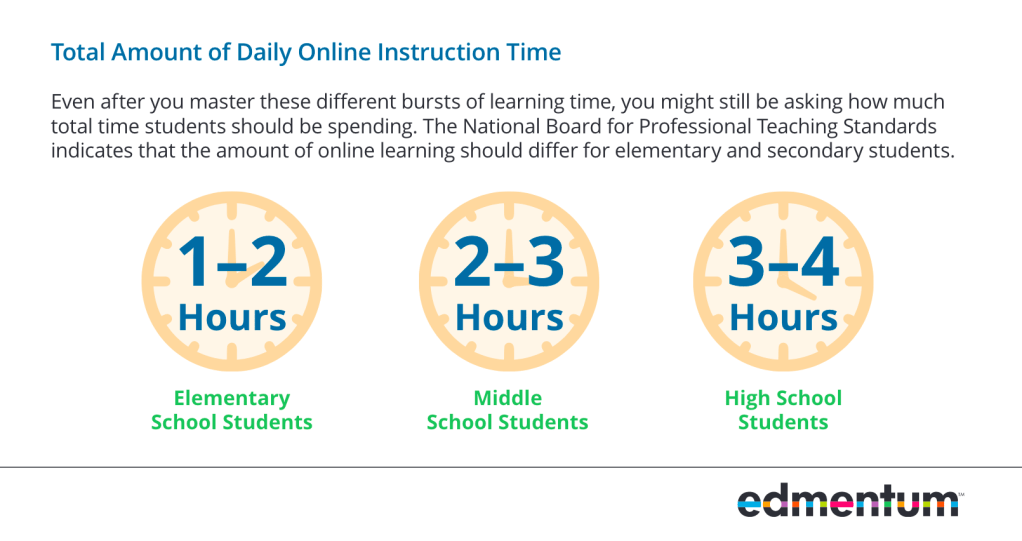
According to “A Parent Guide: Supporting Your Child During Virtual Learning,” provided by Edmentum, cyber students should limit their time online. Elementary students should spend not more than 1-2 hours a day, middle school students 2-3 hours, and high school students 3-4 hours.
My 6th grade daughter typically spends 7-8 hours a day just to barely get things done – and that’s not counting 2-3 hours on the weekends.
I’ve seen her struggle through passages that are written far above her reading level.
For example, she completed a unit on characterization where she was required to read O. Henry’s “The Ransom of Red Chief.”
I know the story well, because as a middle school teacher, I’ve taught it to my 7th grade students from time-to-time. However, the version I’ve used is not the original that O. Henry wrote. It is brought down to the level of a middle schooler and unnecessary attitudes of the time are downplayed.
In the original, one of the characters, Sam, uses big words to show how smart he is. The version I use still has him do that but reduces its frequency so that middle schoolers can understand him. After all, 6th graders shouldn’t have to wrestle with “philoprogenitiveness,” “chawbacon” and “whiskerando” just to grasp a pretty basic plot.
Moreover, the story was published in 1907. The original text throws out numerous instances of casual racism against Native Americans that serve no point in the story. Does my daughter really need to be subjected to dehumanizing native peoples as mere “red skins” just to get a lesson on characterization?
Clearly this unit was not developed with child psychologists, practicing middle school Language Arts teachers or even people of color in the room.
If that weren’t bad enough, the questions are full of grammatical errors and typos.
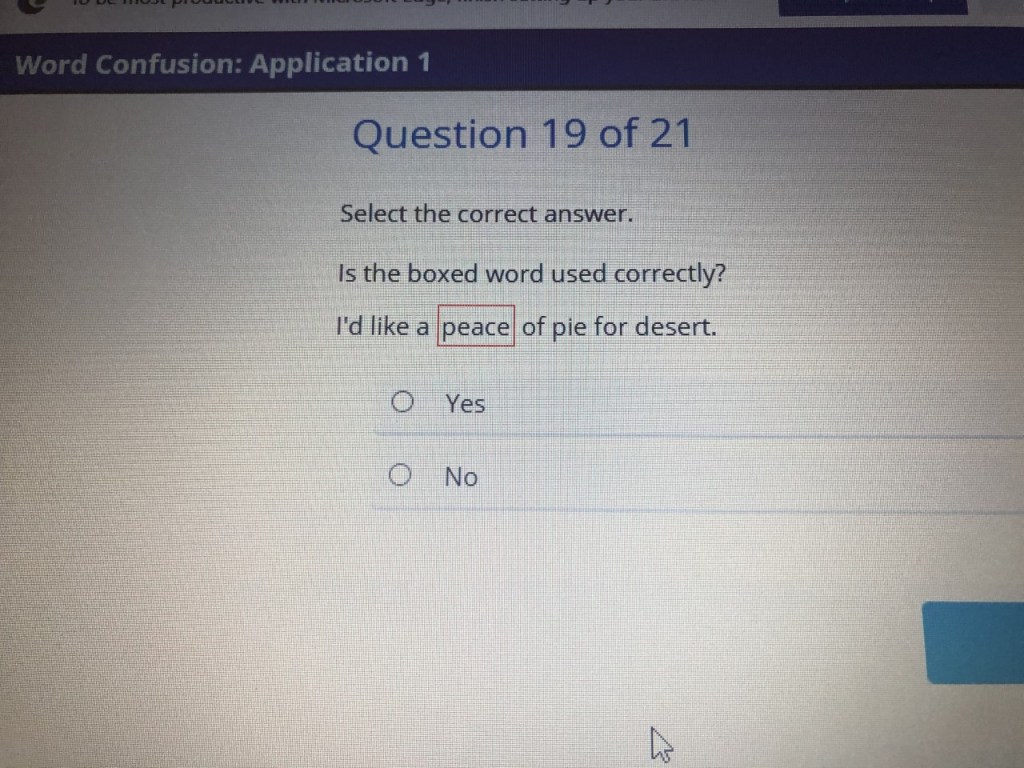
One question about homophones asks students to consider this sentence:
“Select the correct answer.
Is the boxed word used correctly?
I’d like a PEACE of pie for desert?”
Students were asked if “PEACE” is correct – Yes or No. They should know that PIECE is actually the right word.
However, the question made no mention of the misuse of “desert” when the authors clearly meant “dessert.”
That’s the kind of thing that really confuses a student trying to make her way through a program all by herself.
On many assessments, she is asked things that were never taught in the section that was meant to be assessed. I know this is status quo on standardized tests, but is it fair to ask this of a child navigating an online program without even a living teacher to offer support and guidance?
In a social studies assessment on Neolithic peoples, many of the questions had nothing to do with the subject matter. They asked students to infer something based on a passage and none of the multiple choices were entirely correct. You had to pick the option that was least incorrect.
This is some crappy academics being pawned off on parents and students.
And it’s not cheap.
MASD paid $146,302.25 for 40 licenses to Calvert, Exact Path K-5, Courseware for 6-12 and other online services. When hundreds of additional parents asked for their students to be put on the cyber program, the district purchased 500 more licenses from Calvert for a bundled rate of $112,500. That’s $225 per license. Normally they are $450 per license.
Imagine if we put our tax dollars and our teachers to educating these students instead of seeding our responsibility to a corporation for hire.
And we could do it, too.
I work at Steel Valley School District.
Unlike MASD, we began the year with a 100% virtual program for all students. We conduct fully synchronous classes online designed entirely by the classroom teachers. And we post materials on Google Classroom so that students who miss the live Zoom meetings can watch videos of the lesson and do the work.
I’m not saying it hasn’t been difficult or that it’s without problems. Nor is such an endeavor better than in-person learning in a safe environment.
But the teacher-led remote model is the best that can be provided under the circumstances.
They should face the realities of the world we live in.
If Coronavirus infections are significant in your county, you should not be offering in-person schooling. You should be offering the best remote option available – and that’s the teacher-led cyber option.
If only my home district knew it.
Meanwhile, my daughter has to struggle through with the cold comfort that at least she won’t get sick jumping through the hoops her school board is too partisan to eliminate for her.
I’m right next to her at the dining room table feeling guilty for putting her through this.
But what else could I do?
Like this post? You might want to consider becoming a Patreon subscriber. This helps me continue to keep the blog going and get on with this difficult and challenging work.
The west is on fire. Storms are threatening our southern coasts. Police brutality is out of control and bands of neofascist thugs are given free rein to beat and murder protesters. We’ve separated immigrant families and put their kids in cages. The President has lied to us, disparaged our troops, bragged about breaking countless laws and the government is powerless to stop him. Our political system and social fabric is coming apart at the seams. And everyone from the average Joe to the lawmakers who represent him can’t get up the gumption to take precautions against the killer virus that has already put more Americans in their graves than every war since WWII.
You look at the raging dumpster fire around you and wonder – how do we invest in the future when we aren’t sure there will be one?
I’ve had students in my on-line class for only two days so far.
And it’s been great.
They show up in record numbers smiling and ready to learn.
I’m not saying it was all me that did it, but I fought and worried and cajoled and wrote and begged and did everything I could think to do. And it very nearly didn’t happen.
But 2020-21 has already promised to be much more challenging.
After all, when you have to fight just for the safety of your children and yourself as a prerequisite to everything that happens in your class, how much strength is there left for actual teaching?
Where are the local newspapers that would have reported on each school district as people test positive for the virus and others are contact traced? We closed most of them and downsized the newsrooms of others to make up lost advertising revenue.
If you’re not a supersized district serving millions, they only report on bed bugs, poorly trained security guards or whatever public relations statement the superintendent released today.
So we trudge on in silence just hoping to get through the day.
You’ve got to plan for just about everything. You put the assignments on Google Classroom and set up the Zoom meetings and make your handouts into PDFs and try to digitize your books and figure out how classroom policies designed around a physical space can be revised for cyber space. You answer countless questions and concerns, videotaping your lessons for those who can’t be there in person. You try to make things interesting with new apps, new software, new grading systems, new approaches to the same material you’ve been teaching for over a decade.
And it never ends.
By the time the day is supposed to be over, the emails are still rolling in, the assignments are still being submitted, administrators are making pronouncements, and you haven’t even finished all the things you have to do to get ready for tomorrow yet.
When is there time for my family? When do I have time to make dinner or check on my own child’s progress in her own online experience?
What’s worse is that when things go wrong, I’m afraid to bring them up for fear that some decision maker long removed from the classroom will simply shoot from the hip and end on-line instruction.
Now – as usual – it’s all in the hands of everyday classroom teachers. We’re left to just figure it out.
And we do!
Part of me really enjoys it!
I love finding new ways of doing things and seeing if they’ll work out better. I’m excited about seeing how my students will react to a Bitmoji classroom or a new Kahoot or this video or not being hassled if they keep their cameras off in Zoom.
Biden is not great on education. Trump is worse. So we have to support Biden while we prepare to fight him in January. And that’s IF we can both defeat Trump at the polls and somehow avoid a constitutional crisis if he refuses to leave the Oval Office willingly.
Everything is one fight after another. We have to win this battle before we can wage the next one.
No wonder we’re so exhausted.
Everyone is worn out, but no one more so than classroom teachers.
I sit here on a Sunday afternoon and my bones feel like boulders under my skin.
I sleep like a beaten boxer – all bruises under the sheets.
But I’ll wake up on Monday, make myself a cup of tea and trudge back to my computer screen ready to begin again.
Because despite it all, there is a core part of me that still believes.
I still believe in the future.
I still believe in teaching.
I still believe my students are worth it.
Like this post? You might want to consider becoming a Patreon subscriber. This helps me continue to keep the blog going and get on with this difficult and challenging work.
In his infamous Fox News interview with Chris Wallace, he seemed to be saying that the U.S. had just as many new cases now as it did in May. However, since there were fewer tests done in May and more are being done now, it only appears that the infection is spreading when it actually is not.
It’s pure bullshit.
How would he know how many cases existed in May other than through testing?
He is simply trying to gas light the nation into believing that his abysmal job as Commander-in-Chief has nothing to do with the pandemic raging out of control on our shores.
“If we fail to assess students, it will have a lasting effect for years to come. Not only will vulnerable students fall behind, but we will be abandoning the important, bipartisan reforms of the past two decades at a critical moment.”
However, this is a rather strange thing to say if you think about it.
But since students are tested all year long by their teachers, they earn end of the year marks, pass on to the next grade or are held back, graduate or not – there are a multitude of measures of student learning – measures that take in an entire year of academic progress in context.
Waiving standardized testing would not make it impossible to tell who learned what. In fact, waiving the tests in the spring did not leave teachers clueless about the students in their classes today.
We still know which students are falling behind because we interact with them, give them assignments, teacher created assessments, etc. And when it comes to vulnerability, standardized tests show us nothing unless we read between the lines.
Students from poorer households tend to score lower on standardized tests. Kids who attend schools with fewer resources and larger class sizes tend to score lower. Minority children tend to score lower.
We don’t need any tests to tell us who these kids are. It’s obvious! Just look at who qualifies for free or reduced meals. Look at school budgets. Look at student ethnographic data. Look at seating charts. Look at classroom grades.
Standardized testing does nothing to achieve this goal nor is there much help from the “bipartisan reforms of the past two decades.”
After all, which reforms exactly do you think DeVos is referring to?
It’s not hard to imagine since her letter was endorsed by far right and neoliberal organizations such as the Center for American Progress, the National Urban League, the Education Trust and the U.S. Chamber of Commerce.
It’s not about academia or helping vulnerable children.
It’s pure politics. The shock doctrine. Disaster capitalism.
This is another way the Trump administration is trying to rob the American public blind and get away with it.
When it comes to Coronavirus, there are a limited number of tests for infection. Trump is against all of them. He just wants to hide his head in the sand and pretend it will all go away.
But if we put the spotlight squarely on standardized test scores, we can spin the narrative that it is the public school system, itself, that is at fault and thus we can better sell the need for privatization in all its profit-driven forms.
That’s the whole reason DeVos took this job in the first place.
Scott, who serves as chair of the House Education and Labor Committee, said in a statement:
“There is no question that the COVID-19 pandemic is having severe consequences for students’ growth and achievement, particularly for our most vulnerable students. We cannot begin to address these consequences, unless we fully understand them.”’
Murray, the highest ranking Democrat on the Senate education committee, said:
“Especially when it comes to the disparities that harm so many students of color, students with disabilities and students whose families have low incomes, we’ve got to have data that shows us where we’re falling short so we can better support those students.”
How does a single test score from a corporation like Pearson show you more than a year’s worth of academic assessments from a school?
In short, Trump and DeVos are two peas in a pod committed to avoiding accountability for themselves but determined to destroy public services like public schools based on bogus accountability measures like standardized testing.
Hopefully the American public will boot them both out on their asses in November so that rational leadership in the Department of Education and elsewhere will do what should have been done years ago – waive standardized testing for this year and every year that follows – Coronavirus or not.
Like this post? You might want to consider becoming a Patreon subscriber. This helps me continue to keep the blog going and get on with this difficult and challenging work.










 gadflyonthewallblog