What my PA Public School Classroom Would Look Like under Gov. Doug Mastriano

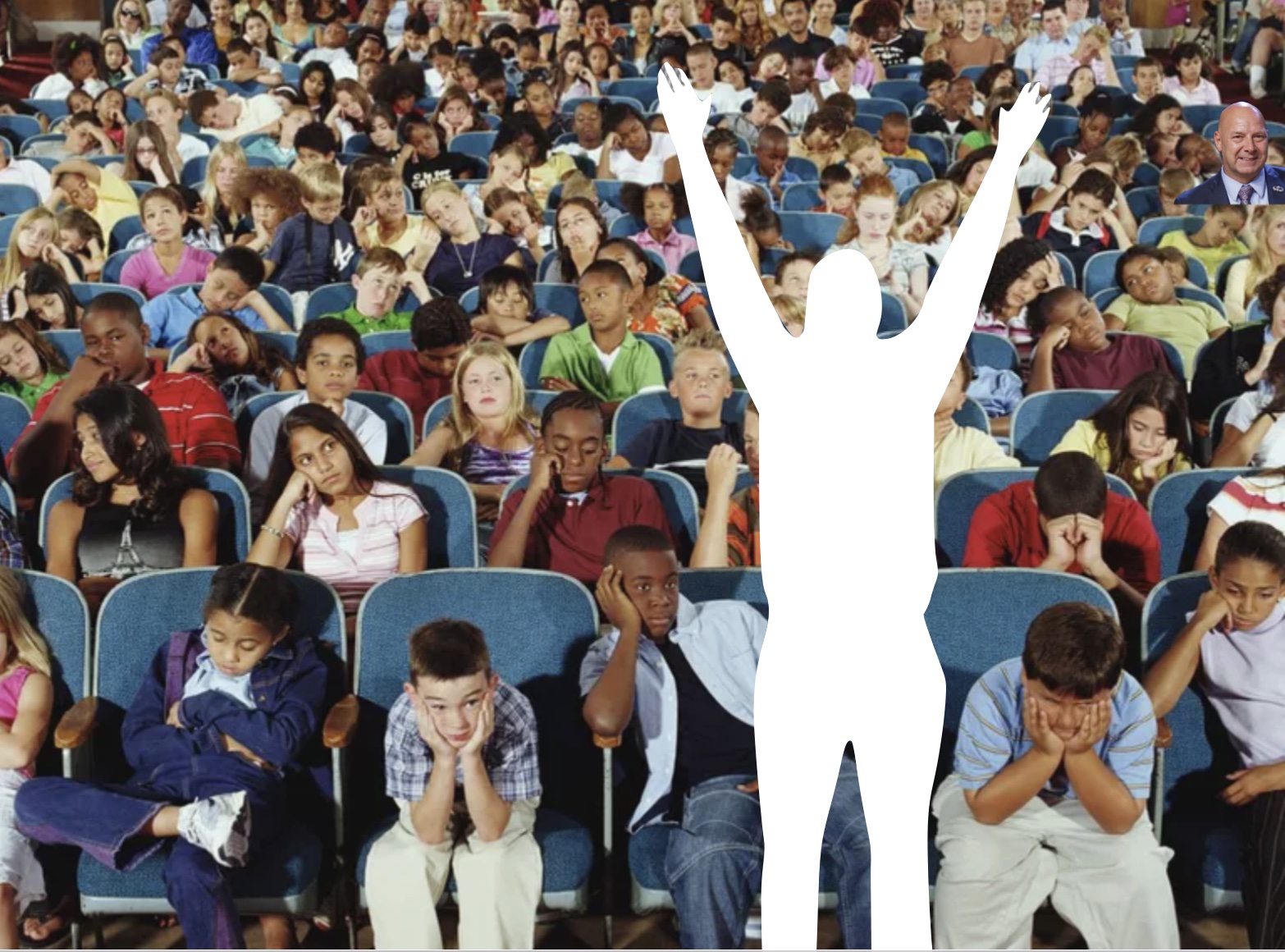
Just one teacher. And 33 kids.

That’s what my classroom would look like if Pennsylvanians vote for Doug Mastriano as our next governor.

The Republican state representative wants to slash education budgets in half – yes, IN HALF!

And that means doubling class size – at least.

Honestly, I don’t know how we’d cram all the desks in the room. I can barely fit 15 in there now.

Where would we put the books, computers and cabinets? The students, alone, would be wall-to-wall.

Just imagine that many middle school kids stuffed into the room arguing about who’s touching who and which classmate stole their pencil or book. Not to mention the children striving to get my attention to solve disputes, get help with classwork, ask permission to use the bathroom – and a thousand other issues!

I’d try my best to meet their needs but under Mastriano we just wouldn’t have the resources we used to have.

For example, there’s no way we could afford a school nurse at each building like we have today. We’d be lucky to have one nurse for all four buildings in the district – elementary schools, middle schools and the high school. If a student feels sick, there’s not much I could do except send the child to the office to try to call home and get a parent or guardian to pick the kid up early. And if the parents can’t make it, just let the kid put his or her head down?

What if the issue’s more psychological? There might be a school counselor somewhere in the district so a student can talk out an issue he or she is having – perhaps conflict resolution with a former friend, discuss peer pressure to try drugs or maybe deal with suicidal thoughts. But there’s probably a long waiting list to see this mythical counselor. Hopefully, the problem is not too urgent.

I feel especially bad for the special education students. Aides would be almost non-existent so many kids with special needs would have to struggle through issues with which we’d normally help them. All the individual Education Plans (IEPs) would have to be rewritten to take this new normal into account.

Even lunch would be disrupted. After all, there would be fewer cafeteria workers so it would be harder just to cook a hot meal and make sure it gets onto a tray in time for students to eat it.

There’s no doubt about it.

My classroom would be very different if Mastriano wins the gubernatorial election in November.

The former US Army Colonel who participated in the January 6 insurrection proposes slashing education funding from $19,000 on average, per student, to $9,000.

According to an analysis by the Pennsylvania State Education Association (PSEA), the plan would mean a 33 percent overall cut in public school revenue, or a $12.75 billion loss. It would require approximately 118,704 layoffs – 49 percent of all employees in schools around the state.

At my district of Steel Valley in Munhall on the western side of the Commonwealth, the situation probably would be much like I described.

I can’t imagine how any teacher could adequately tend to double the students, but I might not have to imagine it.

I’d probably be laid off.

More than half of Steel Valley’s staff would be out of a job – 92 of our current 172 school nurses, counselors, aides, cafeteria workers and teachers would be looking for work.

And that’s just where I’m employed.

Things would be even worse for my daughter where she attends McKeesport Area School District.

According to PSEA estimates, the nearby McKeesport district would lose 281 of 521 staff – a 54% reduction. Classes would go from an average of 17 students to an average of 46. That’s an increase of 29 students per class!

How can she learn in that kind of environment!? She isn’t in college yet. She isn’t in some University of Pittsburgh survey class that meets in an auditorium. She’s in middle school!

But it would be pretty similar at public schools, charter schools, career and technical centers and intermediate units across the state.

From one side of the Commonwealth to the other, we’d go from 239,902 staff to 121,198. Class size would go from an average of 16 students per class to 33. That’s an increase of 17 students per class or 109%.

However, the PSEA estimate is actually a best case scenario for Mastriano’s proposal.

Like so many wannabe big time policymakers, he is very light on the details of how we would educate the state’s 1.7 million students. This whole proposal was just something he blurted out during a March 2022 WRTA radio interview.

It’s his plan to completely eliminate local school property taxes. Funding would be provided directly to parents via “Education Opportunity Accounts,” and families could then decide whether they want a public, private, charter or home school option.

To go from a statewide average funding level of $19,000 a student to $9,000 a student requires a cut of $17.6 billion, or 53%.

But if the remainder isn’t being paid by property taxes, that’s a roughly $15.3 billion a year expenditure by the state that used to be paid by local property taxes. Where is he getting that money from? And if the state can afford to pay that much, why not just pay the full $19,000 per student and make none of these unnecessary cuts? Or why not just pay half and reduce property taxes by that much? Mastriano is not exactly forthcoming on any of this.

PSEA admits that to come up with its own estimates of the damage the organization filled in a few details. The union assumes the state would fully fund the $9,000-per-student voucher and leave other local non-property taxes and federal revenues untouched.

That might not happen. We could be looking at an even more draconian situation.

The biggest question the PSEA is sidestepping is the impact of allowing taxpayer dollars to fund so many different types of schooling.

Even under Mastriano’s plan, nontraditional educational providers like charter schools would suffer because like traditional public schools they would be receiving less funding from the state than they do now. And parents using their vouchers to pay for private schools for their children would still have to make up a pretty big gap between the amount of the voucher and the cost of private school tuition.

However, since traditional public schools serve the overwhelming majority of the state’s students, they would take the biggest hit financially. If more parents use their voucher to pay for private, charter or home schools, that’s less funding for our public school system. That means even greater cuts to student services and more staff layoffs.

Moreover, what if parents use the voucher for a fly-by-night educational option that doesn’t meet it’s obligations?

For example, according to reports by the Network for Public Education, about half of all charter schools close in 15 years. And 27% close in five years.

And when it comes to charter schools that took federal funding, 12% never even opened. They just gobbled up the cash with nothing to show for it.

What will happen to students whose parents lose their vouchers in schools like these? Who will pay for these kids to be educated? Or will they have to go without?

And when it comes to private schools, does Mastriano mean only secular private schools or does he include parochial schools? Will your tax dollars be used to pay for students religious education?

And what about the curriculum at these private schools or some home school programs? Many use texts published by Bob Jones University Press, Accelerated Christian Education, or A Beka.

The books are riddled with counter factual claims and political bias in every subject imaginable such as abortion, gay rights and the Endangered Species Act, which one labels a “radical social agenda.” They disparage religions other than Protestant Christianity and cultures other than those descended from White Europeans.

They teach that humans and dinosaurs lived at the same time, some dinosaurs survive into the present day (i.e. the Loch Ness monster), evolution is a myth disproved by REAL science and homosexuality is a choice.

Teaching these things in school is not just educational malpractice, it’s exactly the kind of indoctrination the right is claiming without evidence happens at public schools.

If someone wants to pay for such an education out of their own pocket, that’s one thing. But to ask taxpayers to fund such propaganda is something else entirely!

Thankfully, Pennsylvania voters don’t have to accept this. Not yet anyway.

There are still more than three months before the election. Voters can choose the Democratic gubernatorial candidate Josh Shapiro. He has promised to INCREASE education funding and not just blow up the whole system.

To see an interactive map of how Mastriano’s education cuts would affect your school district, click here.

For now this is only a bad dream. We still have time to wake up and vote accordingly.

Students should not have to submerge themselves in a sea of classmates and hope the teacher will have time to educate them.

We should cut class size, not increase it.

We should hire more teachers, not rely on a skeleton crew.

We should invest in education, not sell off our future for a fast buck today.


Like this post?  You might want to consider becoming a Patreon subscriber. This helps me continue to keep the blog going and get on with this difficult and challenging work.

Plus you get subscriber only extras!

Just CLICK HERE.

Patreon+Circle

I’ve also written a book, “Gadfly on the Wall: A Public School Teacher Speaks Out on Racism and Reform,” now available from Garn Press. Ten percent of the proceeds go to the Badass Teachers Association. Check it out!

Great Replacement Theory and School Choice

What do QAnon conspiracy theorists and school privatization promoters have in common?

Answer: ideology.

The two groups do everything they can to disassociate with each other in public.

But examine their ideas and you’ll see a lot of family resemblances.

For example, take Great Replacement Theory and School Choice.

Great Replacement Theory is the idea that people of color are replacing white people both numerically and politically. Adherents claim Democrats are overrunning native-born white people with brown skinned immigrants in order to wrest political power. The claims have no basis in fact, but that doesn’t stop the narrative from gaining traction in the darkest corners of the Internet and right wing circles.

It is a favorite of far right pundits, immigration catastrophists and mass shooters. In fact, several white men have used it as justification for mass murder.

In May a white teenager cited it as his motivation for killing 10 black people and wounding several others at a supermarket in Buffalo, New York.

In 2018, another white man claimed he was trying to stop Jewish people facilitating immigration by killing 11 Jewish people at the Tree of Life synagogue in Pittsburgh.

School choice, on the other hand, seems to be something much less extreme.

At least you don’t have to be a card carrying member of the lunatic fringe to espouse its supposed virtues.

It’s the idea that kids should be segregated into different school systems based on parental choice. This means that parallel systems will compete for students in a Darwinian marketplace where some will get better resources than others with profit being the prime motivator for school operators most of whom are private corporations. In practice, this usually means that the worst racial and economic segregation is justified and even preferable so long as consumers think doing so will get them some kind of advantage.

It’s quite a popular idea among certain market first ideologues. This includes both Democrats and Republicans, investment bankers, and even some social justice advocates.

These are not always the same people who publicly champion Great Replacement Theory. However, as Tucker Carlson proves on his Fox News platform, sometimes they are.

Carlson has used his media empire to promote both ideas.

For more than a year he’s been claiming on Fox News that there’s a deliberate effort by the Democrats to undermine Republicans by replacing native-born Americans with immigrants.

In July, he said:

“You can’t just replace the electorate because you didn’t like the last election outcomes. That would be the definition of undermining democracy, changing the voters… The great replacement. It’s not a conspiracy theory. It’s their electoral strategy.”

And when it comes to school choice, he goes even further. Not only has he promoted it on Fox News, he is co-founder and editor-in-chief of The Daily Caller, a media source that constantly promotes school privatization and other corporate education reform strategies – school vouchers, charter schools, etc.

So what do the two concepts have in common?

In short: racism and white supremacy.

Great Replacement Theory is a kind of grievance politics complaining about the steady loss of white privilege.

School choice is an attempt to recapture or maintain white privilege at the educational level and by extension into the adult economic and political world.

Great Replacement Theory has its roots in French nationalism books dating back to the early 1900s, according to the Anti-Defamation League (ADL).

Chief among these is French Author, Jean Raspail, whose 1973 novel, The Camp of the Saints, told a fictional tale of migrants banding together to take over France. However, the concept’s more contemporary use is attributed to Renaud Camus, a French writer who wrote “Le Grand Remplacement” (“The Great Replacement”) in 2011.

White supremacists blame Jewish people for nonwhite immigration to the U.S., and the concept is closely associated with antisemitism, according to the ADL.

Adolphus Belk Jr., professor of political science and African American studies at Winthrop University, said white nationalist movements arise when people of color are seen as a threat politically and economically.

Belk said white nationalists are worried that, “whites will no longer be a majority of the general population, but a plurality, and see that as a threat to their own well-being and the well-being of the nation.”

What makes individual extremists and white nationalist groups so dangerous, according to Belk, are the lengths they are willing to go to in order protect their position in society:

“They are willing to use any means that are available to preserve and defend their position in society … it’s almost like a sort of holy war, a conflict, where they see themselves as taking the action directly to the offending culture and people by eliminating them.”

By contrast, school choice is a quieter ideology, but based on similar foundations.

School choice originated in America’s racially segregated past. Around the time when the Supreme Court’s Brown v. Board ruling outlawed direct segregation in public schools, white lawmakers created programs for redirecting public money to private institutions so that white families didn’t have to send their children to schools with their Black peers.

And we see the same in charter schools and private schools accepting taxpayer funded vouchers today. The prime motivation behind sending children to these schools is often “white flight”. White parents use these options to flee schools with higher percentages of non-white students. And choice options tend to lure the more motivated and compliant students away from public schools.

This isn’t to say that the authentic public school system is unequivocally integrated, either. While there has been tremendous progress in many districts, unscrupulous school boards, administrators and lawmakers have drawn district lines in such a way as to limit integration even in a substantial number of public schools. However, the degree of segregation at privatized schools dwarfs anything you’ll see in public education.

School choice programs create the ideal situation for Black-white segregation. An analysis of high schools in more than 100 of the largest U.S. public school districts found a positive correlation between districts that offer school choice programs and the degree to which their high schools were racially imbalanced for Black and white students.

A national study of the trends in the racial makeup of nearly every school district in the U.S. found that charter expansions made segregation worse within school districts. An analysis of national enrollment data of charter schools, conducted by the Associated Press in the 2014-2015 school year, found more than 1,000 of the nation’s 6,747 charter schools had minority enrollments of at least 99%, and the number has been rising ever since.

We see the same effect with school vouchers. A 2018 study of Washington, D.C.’s voucher program found that 70% of voucher students were enrolled in heavily segregated schools with 90% or more minority students, and 58% were enrolled in all-minority schools.

So both concepts – Great Replacement Theory and school choice – center around increasing white supremacy.

Both seek to shore up white political and economic power regardless of white people’s numeric majority. In fact, as white people become less of the majority – not through any importing of people of color from other nations but as a natural consequence of birth rates – they seek to disempower people of color.

In education, this means keeping Black and white students separate and unequal. It’s a way to divert more resources to the white students and ensure the Black students do not receive the same opportunities.

Sadly, these ideas are not really new in this country. Both share the spirit of George Wallace who in 1963 proudly proclaimed:

“Segregation now, segregation tomorrow and segregation forever!”

As Malcolm X observed:

“America preaches integration and practices segregation.”

The question remains whether voters will support such artifacts of the past or turn to a future where our ideals of equality and fairness triumph over our reality of inequality and injustice.

QAnon and school privatization may share a family resemblance, but it is up to us whether we reject that family or not.


Like this post?  You might want to consider becoming a Patreon subscriber. This helps me continue to keep the blog going and get on with this difficult and challenging work.

Plus you get subscriber only extras!

Just CLICK HERE.

Patreon+Circle

I’ve also written a book, “Gadfly on the Wall: A Public School Teacher Speaks Out on Racism and Reform,” now available from Garn Press. Ten percent of the proceeds go to the Badass Teachers Association. Check it out!

The Guardian vs. the Goon: PA’s Most Important Governor’s Race

The choice for Pennsylvania Governor could not be more clear in November.

On the one hand, we have Josh Shapiro – an Attorney General who fought for Commonwealth citizens’ rights for six years.

On the other, we have Doug Mastriano, a former US Army Colonel and 3-year state representative who supported a literal coup against the United States government.

In any sane world, that would be all you’d need to know.

Shapiro, the state’s chief law enforcement officer, vs. Mastriano, a traitor who actively worked to overturn the votes of the very citizens who elected him to office.

This should not be an election – it should be a rout.

However, Commonwealth voters will need to come to the polls and make it clear that they reject Mastriano’s fascism and that they instead support their own right to determine who governs in Pennsylvania and beyond.

That sounds extreme. I wish it weren’t also true.

Following the last Presidential election when it became clear Donald Trump had lost the vote, Republican Mastriano helped organize large rallies pushing false claims of election fraud. He chartered buses to take protesters to the Capitol on January 6. He personally crossed police barricades at the Capitol during the riot, and attempted to submit “alternate” (i.e. fake) pro-Trump electors to the official count. And he even coordinated all this with Trump when he was invited to the White House to discuss the “stop the steal” strategy.

If Mastriano somehow wins the governors race, he will be in a position to basically call off Democratic rule in the state. As governor, he would choose the secretary of state — the official in charge of administering the 2024 presidential election. This would effectively allow him to pick the winner, himself.

This is not just conjecture. Mastriano has gone on record that as governor he would decertify voting machines in some precincts – making it hard to count votes there. He has even alluded to the independent state legislature doctrine, which holds that state legislatures can name whoever they want as the recipient of a state’s electoral votes, regardless of who voters select.

This is not conservatism. It is not protecting American values or law and order. It is the opposite.

By contrast, Shapiro, the Democrat in the race, is a model of exactly those qualities usually associated with sobriety and efficiency.

As Attorney General, he fought federal government overreach including Trump’s travel ban. He filed a lawsuit to stop religious organizations denying health coverage including contraceptives to employees. He joined a lawsuit against for profit colleges resulting in a $168 million settlement. He reached an agreement with federal officials to prevent the distribution of blueprints for 3D printed firearms. He launched an investigation of allegations of sexual abuse by members of the Catholic Church including a Grand Jury report alleging the sexual abuse of more than a thousand children at the hands of more than 300 priests.

In short, he worked hard to protect the people of this Commonwealth.

And the difference is stark on so many other issues when compared head-to-head.

Shapiro supports increasing public school funding. Mastriano wants to cut it in half.

Shapiro wants to increase security and gun regulations to prevent school shootings. Mastriano wants to give teachers guns and let them do the shooting.

Shapiro has fought to protect women’s reproductive rights against the state. Mastriano supports the state telling people what to do with their own bodies.

And on top of all that – Mastriano has ties to White Supremacists!

Until recently, his campaign paid consulting fees to Gab, a white nationalist social media site owned by anti-Semite Andrew Torba. Gab was the site that helped inspire the Pittsburgh Tree of Life Synagogue mass murder in 2018. Torba and others on the site that Mastriano was explicitly looking to for support commonly champion Great Replacement theory and support Vladimir Putin.

No skeletons of this type have been found in Shapiro’s closet.

The worst anyone has found so far is a $100,000 donation from Students First PA, a charter school advocacy group, which he took money from when he was running for Attorney General in 2016. However, Shapiro made no effort to hide the donation and his voting record when he was a state representative was not pro-charter. In 2011, for example, he voted against a measure to provide tuition vouchers of charter schools, and he has been a vocal critic of the industry for years. Moreover, neither Students First PA nor any other pro-education privatization organization that I can find has made any significant donations to him this election cycle so far.

The way I see it, this is a simple – if terrifying – election.

Shapiro is not perfect, but if elected, he would function similarly to current Governor Tom Wolf. He would be a guardian against the overreach and bad decisions of the gerrymandered Republican legislature.

One can hope voters throughout the Commonwealth would take back their individual voting districts from the extremists, but given the still uncompetitive lines of these districts, this seems unlikely.

So we need a Wolf, we need a Shapiro, standing on the battlements stopping the goons like Mastriano from taking advantage of the majority of us.

Shapiro would certainly do that. He might even go farther and fight to find ways to get real change through the legislature. But even if he can’t do that, voting for him is essential.

Mastriano may simply be the worst candidate for governor in the Commonwealth’s history – and that’s saying something!

We need Shapiro. We need Austin Davis as Lt. Governor. And we need John Fetterman as Senator.

That would make a huge difference both nationally and throughout the state.

It would set us up with a firm foundation and at least keep people safe from the worst.

I know it is depressing to be put in this situation constantly. Every election cycle seems to be the most important because the country is falling apart. Maybe we can find a way to turn things back and reach some level of sanity. But we can’t do anything unless we elect Shapiro, Davis and Fetterman.

We need the guardians against the goons.


Like this post?  You might want to consider becoming a Patreon subscriber. This helps me continue to keep the blog going and get on with this difficult and challenging work.

Plus you get subscriber only extras!

Just CLICK HERE.

Patreon+Circle

I’ve also written a book, “Gadfly on the Wall: A Public School Teacher Speaks Out on Racism and Reform,” now available from Garn Press. Ten percent of the proceeds go to the Badass Teachers Association. Check it out!


Teachers are Being Spied on for Thoughtcrimes

Teachers, be careful.

Big Mother is watching you.

When you post a rainbow flag on your Facebook profile…

When you tweet support for Black Lives Matter…

When you like a YouTube video of someone punching a Nazi…

Big Mother is watching.

Or more specifically, Moms for Liberty is watching.


And, no, the group’s members probably don’t get the irony of their name.

Moms for Liberty (MFL) is a billionaire-funded front group dedicated to spreading disinformation and chaos at public schools across the country.

They’ve offered cash prizes for turning in teachers who dare to educate on topics that go against far right doctrine. They’ve demanded books on similar topics be removed from school libraries and curriculum. And they’ve even stormed school board meetings where they don’t necessary live to complain about every petty grievance Fox News is broadcasting this week.

Now they’re coming after teachers social media.

They’re creating workshops to encourage people to find public educators’ online accounts and report anything they don’t like at school board meetings or in the media, ultimately demanding the offenders be fired.

After all, if Miss Roosevelt has a rainbow flag on her personal Facebook account, what’s to stop her from making her students gay!?

If Mr. Kennedy tweeted in favor of Black Lives Matter, what’s to stop him from making our White children hate themselves because of the color of their skin!?

And if Mrs. Gore liked a YouTube video where a Nazi got punched in the face, how do we know she won’t condone such violence in the classroom!?

MFL is based in Florida, but operates on a county-by-county basis, claiming 200 chapters in 37 states including Pennsylvania (Allegheny, Eerie, Bucks, Lancaster counties, etc).

This is an image advertising one such workshop in Nueces, Texas, but they are popping up everywhere.

One of the many ironies about the situation is how the idea has been pulled almost directly from George Orwell’s dystopian novel, “1984.”

Orwell coined the term “thoughtcrime” to describe a person’s politically unorthodox thoughts – anything that runs counter to the party line. In criminalizing thought and even tasking the Thinkpol (i.e. thought police) with monitoring things people say, write or how they act, Orwell could be describing MFL.

In the fictional country of Oceania, the party controls all speech, actions and thoughts of citizens. This is pretty much what MFL is trying to do here.

It’s a strange way to love “liberty.”

These right-wingers actively harass people on the left for their politics, but cry foul when anyone dares to call them out on theirs.

The Florida-based organization claims to be just “moms on a mission to stoke the fires of liberty.” Yet it’s infamous for encouraging a “mass exodus from the public school system” while disrupting that same system at every turn.

Its members are using culture war shenanigans to intimidate and harass people into silence.

They’re weaponizing fear to coerce people into curtailing political speech of which they don’t approve.

As infuriating as this is, it’s not new.

There have always been a few petty people in nearly every community willing to scroll through teachers feeds looking for trouble. Frankly, it’s why new educators are warned to keep their personal lives off the Internet or to keep their information private.

The only difference now is how concentrated these spying efforts may become.

We’re not talking about just the local crank looking for photos of teachers drinking or engaged in the crime of living an adult life.

We’re talking about well-funded ideologues out to destroy the public school system, one teacher at a time.

Incorporated in 2021, MFL is a 501(c)4 corporation, so it doesn’t have to disclose its donors. However, one of the group’s founders is Bridget Ziegler, wife of the Florida vice chairman of the Republican Party. The organization is affiliated with at least three separate PACs, and has the funds to pay for keynote speakers like Megyn Kelly and Ben Carson at its fundraisers. Some of its biggest supporters are the Koch family, the DeVos family, former Trump officials and The Federalist Society. 

They have the money to go through your Web footprint with a fine toothed comb.

So what should teachers do about it?

As a public school teacher, myself, the way I see it, there are two things we can do:

1) Lock down or disengage from social media


2) Keep doing what you’re doing

Your response will depend on your own situation.

If you live in a so-called Right to Work state or where worker protections are few and far between, you should probably get a tight grip on your online presence.

Make sure your personal Facebook account and any groups you belong to are private and secure. Ensure that anyone invited into these groups is verified through either questions or personal invitation. Check that everyone has agreed not to screen shot any discussions happening – and even then be careful what you post because nothing is ever 100% secure.

Use a privacy audit to make sure you don’t have something embarrassing out there. This guide from Violet Blue is a good starting place to ensure your private information is not easily findable online.

On the other hand, if you live in a state with strong union protections, you have a reliable union at your school, etc., then you have less to worry about.

You can’t be fired for expressing your freedom of speech on your own time on your own social media accounts. As long as you’re not on school devices, using or sharing such accounts in school or with students, you should be fine.

That doesn’t mean someone won’t try to harass you over your digital presence. But if you understand the dangers and feel relatively safe, you probably are.

I’ve been writing on education and civil rights issues for 8 years. I actively TRY to get people to read this stuff.

In that time, there have been a lot of folks mad at me for what I write. I sometimes get hate mail (usually email) calling me everything you can think of and more you can’t. And when some of these folks find out where I work, they sometimes call up to complain and demand I be let go with haste!

Nothing has come of it.

That doesn’t mean it couldn’t happen tomorrow. But I refuse to live in fear.

I am who I am.

I shout it to the world.

And if someone wants to fire me for it, then fine.

There are lots of things I could be doing other than this.

We’re in a national crisis with teachers leaving the profession in droves at least in part because of fascist shenanigans like this.

Bottom line: I love teaching, but I’m not going to change who I am to do it.

Moms for Liberty can rage. They can spend all of Betsy DeVos’ billions trying to fire me and other educators who dare to have thoughts that may deviate from the right-wing.

Big Mother is not MY mom. And I don’t owe her anything.


Like this post?  You might want to consider becoming a Patreon subscriber. This helps me continue to keep the blog going and get on with this difficult and challenging work.

Plus you get subscriber only extras!

Just CLICK HERE.

Patreon+Circle

I’ve also written a book, “Gadfly on the Wall: A Public School Teacher Speaks Out on Racism and Reform,” now available from Garn Press. Ten percent of the proceeds go to the Badass Teachers Association. Check it out!


Doug Mastriano’s Rootin’ Tootin’ School Shootin’ Prevention Plan in PA

A teenage boy in a black trench coat walks down a school hallway.

A young girl abruptly turns a corner and is about to walk past when she stops and notices an oblong shape in his coat.

He pulls out an AR-15 and points it at her head.

She gasps. He smiles.

“Hold it right there, Patrick.” Says a voice behind him.

“Mr. Callahan?” The boy says starting to bring the barrel around.

‘Uh-uh. Stop right there,” says the voice shoving something in the boy’s back.

“I know what you’re thinking,” the teacher continues. “My homeroom teacher, Mr. Callahan, has a gun in his desk. Did he remember to bring it with him to hall duty? Well to tell you the truth in all this excitement I kinda lost track myself. But being it’s a 500 S&W Magnum, the most powerful handgun in the world and would blow your head clean off, you’ve gotta ask yourself one question: “Do I feel lucky?” Well, do ya, punk?”

Apparently this is how Doug Mastriano thinks school shootings can best be prevented.

The Pennsylvania State Senator and Republican candidate for governor plans to introduce a bill allowing school employees to arm themselves while on school property if they have a concealed carry permit and pass a firearms course.

Not gun control. Not stopping teens from buying assault weapons. Not keeping guns out of the hands of the mentally ill.

Instead, arm the teachers. Arm the principals. Put a piece in the hands of Lunch Lady Doris. Maybe even the custodians will be packing heat with a bucket and mop.

This is not the kind of serious proposal Commonwealth residents deserve from a representative of the legislature or executive branch. It’s not the kind of serious proposal you’d expect from a grown adult. Heck. It’s not what you’d expect from a small child still unable to tie his own shoes.

School shootings are not action movie scenarios. They’re not run-and-gun video games. They’re not cops and robbers. They’re real life.

They’re the cause of elementary kids being decapitated by assault weapons fire.

They’re the cause of fifth grade bodies so unrecognizable they have to be identified by their green Converse sneakers.

They’re the cause of child sized coffins adorned with cartoon doggies and kitties – brightly colored friends to accompany little kids to their final resting places.

Mastriano’s suggestion would be pathetic if it weren’t so dangerous.

He thinks school shooters are attracted to places where they know people aren’t armed.

However, history proves him wrong.

The overwhelming majority of school shootings either involved armed police stationed at the school or police responding quickly thereafter.

Lest we forget, there were police officers on both the campuses of Robb Elementary School in Texas and Stoneman Douglas High School in Parkland, Florida, where shootings cumulatively took the lives of more than 30 students.

According to a 2021 JAMA Network study that looked at 133 school shootings from 1980 to 2019, armed guards did not significantly reduce injuries or deaths during school mass shootings.

In fact, when researchers controlled for location and school characteristic factors, “the rate of deaths was 2.83 times greater in schools with an armed guard present.”

Put simply, school shootings are not rational activities subject to cost benefit analysis from the people contemplating doing them. Would-be shooters do not expect to come out alive. They don’t care if there is armed resistance or not. In fact, the presence of armed resistance only encourages them to bring deadlier weaponry – especially semi-automatic guns.

That’s why police in Uvalde, Texas, were too scared to go into Robb Elementary School and stop the perpetrator armed with an AR-15 – perhaps the most common weapon used in school shootings.

And when trained police are afraid, Mastriano expects better from school staff – teachers, secretaries, aides, and nurses!!!?

A similar proposal permitting the arming of school employees passed the state Senate in June 2017 but it died in a House committee. In the district where I work as a middle school teacher, we talked about the issue at a staff meeting.

The few people who thought it was a good idea and said they would gladly bring a gun with them to school are nice people – but they’re the last ones you’d want armed.

Moreover, we have a school resource officer who said he was not in favor of the measure because it would make things tougher for law enforcement responding to a shooting. It would make it that much more unclear who the shooter was and increase the chances of friendly fire.

It’s hardly surprising Mastriano is making such boneheaded proposals.

If elected governor, he also promises to cut public school funding IN HALF and make it harder for educators to collectively bargain for better salaries, benefits, and working conditions.

He is an extremist who wants to destroy public education in favor or charter and voucher schools, take away people’s freedom to choose what to do with their own bodies, discriminate against anyone with a different sexuality or religious belief and give away as much tax money as possible to private businesses.

Mastriano is either a fool who does not understand the issues or a patsy of the lunatic fringe of his party or both.

He wouldn’t arm teachers with books, funding or resources to teach – just guns.

He is an embarrassment to the people of Franklin County who elected him to the legislature and the Republican base who chose him to represent them in the governor’s race.

I know it’s trendy for the GOP to pick the candidate most likely to piss off the people across the aisle, but this isn’t a game.

Fools like Mastriano are going to get innocent people and their children killed – not to mention the suffering thousands will have to endure if his policies ever see the light of day.

He thinks the answer to school shootings is to turn the school librarian into Yosemite Sam.

If you vote for him in the general election, you will reap what you sow – misery and death.


Like this post?  You might want to consider becoming a Patreon subscriber. This helps me continue to keep the blog going and get on with this difficult and challenging work.

Plus you get subscriber only extras!

Just CLICK HERE.

Patreon+Circle

I’ve also written a book, “Gadfly on the Wall: A Public School Teacher Speaks Out on Racism and Reform,” now available from Garn Press. Ten percent of the proceeds go to the Badass Teachers Association. Check it out!

How Teachers Like Me Can Renew Ourselves This Summer

This school year was perhaps the most difficult one I’ve experienced in two decades in the classroom.

From constantly having to cover for sick or otherwise absent staff, to absorbing student traumas suffered in years of a pandemic, to increased student fights, social awkwardness and administrators demanding more paperwork and untried initiatives that get dropped for another fad next week…

It’s been rough!

Now that most K-12 schools have begun or are about to begin summer break, it can be hard to rest and renew yourself for the coming year.

To be honest, many teachers have already decided to leave.

At my district, more teachers have retired this year than at any time since I was hired – about 10% of the staff.

And some even quit in the middle of the year – something that hardly ever happens.

If things don’t change this year, it will be worse next year.

But for those like me planning on returning in the Fall, congratulations. You made it through.

Now what?

I don’t know about you, but I often find myself nibbled by stress and anxiety.

I try to sleep, I try to rest, but worry and hopelessness settle down on me like a shroud.

If you’re like me, you may need some help getting through it all.

So here’s a list of five things we can do – not just you, but me, too – that hopefully will help us rejuvenate ourselves somewhat in the next few months and set us up for a successful year with our students.

1) Be Present with Friends and Family

Teachers often live in their heads.

We’re always planning a new lesson or thinking about how to help a student or improve something from the year before.

But this is summer break.

It’s time to tune out and turn off.

You’re home and hopefully you can find some time to spend with friends and family.

Just remember to try to be there. Actually be there.

Don’t live in your head. Live in the moment.

Let the present open up in front of you and actually enjoy the things you’re doing.

Our professional lives often demand we sacrifice so much time with our significant others, our kids, and the people we care about. Now is the time to balance the scales and enjoy their company. And nothing else.

This can be easier said than done, but it’s worth a try.

2) Don’t Focus on Things You Can’t Change

There is so much going on in the world, and we’re teachers. We’re problem solvers.

We want to fix broken things, and there is so much broken out there. The news is often not our friend.

I’m not saying to ignore what’s going on. We do so at our peril. But we have to try to put it all in context.

We’re just people – individuals caught in nets of complexity. We can’t solve all these problems ourselves.

A horrible regressive monster is running for Governor in the Fall who would destroy your profession and endanger your child’s future. Got it.

The government still hasn’t passed any meaningful measures to keep guns out of the hands of school shooters. Got it.

Politicians are still attacking your profession, history, science, math and enlightenment values. Argh!

And they’ll still be doing it at the end of August.

Take a break from it all.

Worrying will not change anything. And it will all be there for you later.

Just try to focus your mind elsewhere – for a little while.

3) Let Go of Resentments

This can be really hard but important.

There are a lot of people who have probably said or done things that made your life difficult this year.

It could be that parent who screamed at you on the phone over an assignment their child didn’t turn in.

It could be an administrator who made another stupid initiative that makes him/her look good while increasing your work load but does nothing to help the students.

It could be a sincerely stupid politician accused with pedophilia and insurrection who thinks taking pot shots at teachers will win him votes from the lowest common denominator.

It could be… so many people.

Take a deep breath and let it go.

You don’t need that baggage weighing you down.

As Nelson Mandela is supposed to have said:

“Having resentment against someone is like drinking poison and thinking it will kill your enemy.”

Leave that behind.

There will be plenty more next year.

4) Don’t Expect Too Much of Yourself

Often our harshest critic is ourselves.

We try so hard to be kind to everyone all year. This summer, be kind to yourself.

It’s break time. You don’t have to clean the whole house top to bottom. You don’t have to finally rearrange the utility drawer or any of a million other things that have been waiting around for you to get to them.

By all means, make those doctor’s appointments you’ve been waiting on. Buy a new pair of shoes. Cut the grass.

But if something doesn’t get done, don’t feel like it’s a failure.

You are allowed to simply do nothing.

Sometimes that’s the best thing we can do.

Be as productive as you want. Sometimes that helps alleviate stress, too – the satisfaction of getting things accomplished.

However, this break is not all about crossing things off your TO DO list.

It’s about rest and renewal.

Cut yourself some slack.

No one else will.

5) Remember Why You Got into Teaching

When you feel ready to turn your mind back to the job, try not to think of all the negative things waiting for you.

Don’t even let your mind rest on the uncertainties and anxieties ahead.

Focus on why you’re still a teacher.

You’re not chained to this profession. You probably had the chance to leave if you’d wanted.

Why did you get into education in the first place?

What are the things about it that you still love and enjoy?

For me, it’s nearly everything in the classroom, itself.

It’s interacting with students.

It’s helping them succeed and then seeing the look of joy on their faces when they do.

I love everything about my job – the subject I teach, the students, being there when there’s no one else.

It’s just all the stuff outside the classroom that I can’t stand.

I make a file during the year full of Christmas cards, goodbye messages from parents and students, positive emails, etc. During the summer is a perfect time to read through them and remember the good things.

At least, that’s what I try to do anyway.

So there’s my list. I hope you found it helpful.

Health, relaxation, calm. Be warned – I’m certainly no expert on the subject.

Remember the words of author Nakeia Homer:

“You are not lazy, unmotivated, or stuck. After years of living your life in survival mode, you are exhausted.”

Finding ways to recharge and renew is something I know I desperately need – maybe as you do, too.

Here’s hoping we can find the peace we need this summer.

The new academic year will be here before we know it.


Like this post?  You might want to consider becoming a Patreon subscriber. This helps me continue to keep the blog going and get on with this difficult and challenging work.

Plus you get subscriber only extras!

Just CLICK HERE.

Patreon+Circle

I’ve also written a book, “Gadfly on the Wall: A Public School Teacher Speaks Out on Racism and Reform,” now available from Garn Press. Ten percent of the proceeds go to the Badass Teachers Association. Check it out!

Federal or State Legislatures May Raise Teacher Salaries so Schools Have Enough Staff to Reopen

What will we do when schools reopen and there aren’t enough teachers to instruct our kids?

People complain when there aren’t enough servers at restaurants or baggers at the grocery store.

What will they say in August if school buildings in many districts remain closed or the only viable option is online remote schooling?

Lawmakers at the state and federal level are taking the matter seriously with measures to increase teacher salary or provide one-time bonuses.

Alabama, New Mexico, and Mississippi have already boosted teacher pay, with Florida, Iowa and Kentucky potentially set to do the same. Meanwhile, even US Congress could pass a nationwide measure to heighten teacher salary and encourage educators to stay in the classroom.

After decades of neglect only made worse by Covid-19, we’re missing almost a million teachers.

And we only have about 3.2 million teachers nationwide!

According to the Bureau of Labor Statistics, there are 567,000 fewer educators in our public schools today than there were before the pandemic. And that’s on top of already losing 250,000 school employees during the recession of 2008-09 most of whom were never replaced. All while enrollment increased by 800,000 students.

Meanwhile, finding replacements has been difficult. Across the country, an average of one educator is hired for every two jobs available.

So what are we doing about it?

Surprisingly, something!

Congress has at least one bill under consideration that would raise teacher salaries nationwide.

The Respect, Advancement, and Increasing Support for Educators (RAISE) Act would provide teachers with a minimum of $1,000 in refundable tax credits and as much as $15,000.

The more impoverished the school where teachers work, the higher the tax credit available to increase their salaries. The bill would also double the educator tax deduction to offset the cost of school supplies, and expand eligibility to early childhood educators.

The bill was introduced by Senator Cory Booker (D-NJ) and U.S. Representatives Adam Schiff (D-CA), Jahana Hayes (D-CT), John Larson (D-CT), and Mark Takano (D-CA). It is supported by a broad coalition of organizations including the American Federation of Teachers (AFT) and the National Education Association (NEA).

Such a measure is long overdue.

Teachers are paid 20% less than other college-educated workers with similar experience. A 2020 survey found that 67% of teachers have or had a second job to make ends meet.

Why would you go into debt earning a four year degree in education and serve an (often unpaid) internship in the classroom just to earn little more than a fry chef or Walmart greeter?

Why enter a field where you can’t buy a home or even rent an apartment in most metropolitan areas? Why volunteer for a job where you won’t be able to afford to marry, raise children, or eke out a middle class existence?

Thankfully, Congressional proposals aren’t the only attempt to make teaching more attractive.

Some states have already taken action.

The Alabama Senate passed a budget that would raise minimum salaries for teachers with nine or more years experience. The raises would range from 5% to nearly 21%, depending on years of experience.

A teacher with a bachelor’s degree and 20 years of experience would see their salary rise from $51,810 to $57,214. A teacher with a master’s degree and 25 years experience would see their pay rise from $61,987 to $69,151.

In New Mexico, Gov. Michelle Lujan Grisham signed a bill that would increase base salary levels by an average of 20 percent. This advances minimum salary tiers for educators by $10,000 to $50,000, $60,000 and $70,000. 

In Mississippi, Gov. Tate Reeves signed off on an average increase of $5,100 that will raise educator salaries by more than 10 percent.

According to Politico, both Republican and Democratic Governors are proposing teacher salary increases or one-time bonuses as part of budget proposals and legislative priorities.

Even Governors like Iowa’s Kim Reynolds and Florida’s Ron DeSantis are promoting teacher bonuses while also stoking classroom culture wars. On the other side of the aisle, Kentucky’s Democratic governor Andy Beshear is trying to push through a teacher pay plan through opposition by the state’s GOP-controlled legislature.

Such measures are even being proposed in Pennsylvania. Sen. Judith Schwank (D-Berks) recently introduced Senate Bill 1211 to boost starting pay for teachers from the current minimum of $18,500 listed in state law. She proposes increasing it to $45,000 a year. However, the bill sent to the Senate Education Committee has several Democratic co-sponsors but no Republicans, making it doubtful it will progress anytime soon.

The main factor behind these plans seems to be the $350 billion in state and local recovery funds under the American Rescue Plan. These federal dollars have few strings attached and only about half of the money has been spent so far.

After decades of neglect, these plans may not be enough and they may not even come to fruition. However, at least lawmakers seem to understand the problem exists.

It’s gratifying that politicians finally seem to feel a sense of urgency here.

Because this problem didn’t spring up overnight and it won’t go away in a flash.

If we don’t do something to make teaching more attractive, the problem will only be compounded in coming years.

Not only are we having a hard time keeping the teachers we have, few college students want to enter the field.

Over the past decade, there’s been a major decline in enrollment in bachelor’s degree programs in education.

Beginning in 2011, enrollment in such programs and new education certifications in Pennsylvania — my home state— started to decline. Today, only about a third as many students are enrolled in teacher prep programs in the Commonwealth as there were 10 years ago. And state records show new certifications are down by two-thirds over that period.

And it’s not just classroom teachers – substitutes are even harder to find.

The shortage of substitute teachers has gotten so bad in 2021-22, it forced some schools across the country to temporarily move to remote learning. Even Pittsburgh Public Schools was forced to go to cyber learning on Nov. 29 because of a staffing shortage and a lack of substitute teachers.

And it doesn’t look to get better next year.

Last June almost a third of working educators expressed a desire to leave the profession.

According to a survey in June of 2,690 members of the National Education Association, 32% said the pandemic was likely to make them leave the profession earlier than expected. So we don’t have enough teachers now and one in three educators we do have are ready to walk out the door.

What could we do about it?

In the long term, we need structural solutions to the problem:  

 Money

 Autonomy

 Respect.  

And in the short term we need: 

 Less Paperwork

 Reduced case load

 Dedicated planning periods

But don’t take my word for it.

A survey by the RAND Corp. reported that the pandemic has increased teacher attrition, burnout and stress. In fact, educators were almost twice as likely as other adult workers to have frequent job-related stress and almost three times more likely to experience depression.

The CDC Foundation in May released similar results – 27% of teachers reporting depression and 37% reporting anxiety.

However, the RAND survey went even deeper pinpointing several causes of stressful working conditions. These were (1) a mismatch between actual and preferred mode of instruction, (2) lack of administrator and technical support, (3) technical issues with remote teaching, and (4) lack of implementation of COVID-19 safety measures. 

It’s a problem of exploitation and normalization. 

 Exploitation is when you treat someone unfairly for your own benefit. 

 Our schools have been doing that to teachers for decades – underpaying them for the high responsibilities they have, expecting each individual to do the work of multiple people and when anything goes wrong, blaming them for it. 

 We piled on so many extra duties – online teaching, hybrid learning, ever changing safety precautions – these became the proverbial straw that broke educators’ backs.  

There are things we can do to alleviate this situation – reducing nonessential tasks, eliminating unnecessary paperwork, refraining from excess staff meetings, forgoing new initiatives, letting teachers work from home on professional development days – anything to give them a break and an opportunity to heal from the years of overburdening.

But we also have to start paying teachers more.

Thankfully our lawmakers are taking this matter to heart and actually getting some results.

Hopefully this trend will continue until every teacher in the nation is adequately, equitably and sustainably compensated for the work done in the classroom.


Like this post?  You might want to consider becoming a Patreon subscriber. This helps me continue to keep the blog going and get on with this difficult and challenging work.

Plus you get subscriber only extras!

Just CLICK HERE.

Patreon+Circle

I’ve also written a book, “Gadfly on the Wall: A Public School Teacher Speaks Out on Racism and Reform,” now available from Garn Press. Ten percent of the proceeds go to the Badass Teachers Association. Check it out!
‘To Kill a Mockingbird’ is Still Relevant Because it Forces Us to Confront Ourselves 


Parris is peering into a crumpled paperback with a huge smile on his face. 


“Mr. Singer, I love this book…” he says.  


He stops, pauses and adds, “I hate what’s happening, but I love the book.” 


In my middle school classroom, that’s a pretty routine reaction to Harper Lee’s classic, “To Kill a Mockingbird.” 


My 8th grade students approach the climax and resolution with equal parts dread and delight.  


But it doesn’t always start that way. 


No book I teach has gone through a greater change in cultural opinion than “Mockingbird.” 


It used to be considered a bastion of anti-racism. Now some folks actually consider it to be racist. 


The story is about Scout and her brother Jem as they grow up in Alabama during the Great Depression. Most of the drama centers on their father, Atticus, who defends a black man, Tom Robinson, in court against trumped up charges of raping a white woman.  


Ever since its publication in 1960, people have tried to ban the book from school libraries and from school curriculum.  


And that’s still true today. However, this used to be the work of the far right. Today there are almost as many objections from the far left – though for very different reasons. 


For 50 years, the biggest complaints came from conservatives about the book’s strong language, discussion of sexuality, rape, and use of the n-word. Though today you’ll find almost as many on the left proclaiming that the book actually perpetuates the racial intolerance it purports to be against. 


Republicans have become more extreme than ever. They see any discussion of race as “Critical Race Theory” – a conflation of a legal framework not actually taught in K-12 schools with any substantive discussion of racial inequality. It’s really just a simple dog whistle to try and shut down any discussion of the racial status quo. 


Teachers have become accustomed to conservatives hyperventilating that discussing racism and prejudice might mean having to admit these things still exist and therefore requiring us to do something about them. They’re terrified their kids might come to different conclusions about the world than their parents, and instead of confronting their own views with the facts, they prefer to sweep reality under the rug to preserve the fictions underlying their ideologies. 


These sort of complaints are typified by the Biloxi Public School Board in Mississippi which in 2017 removed Lee’s Pulitzer Prize-winning novel from its curriculum because, “It makes people uncomfortable.” 


What they don’t seem to realize is that the discomfort is part of the point. 


On the other side of the coin are people on the other pole of the political spectrum. Writers like Kristian Wilson Colyard don’t object to a discussion of racism and prejudice. They think “Mockingbird” doesn’t go far enough – or at least that the discussion it has is framed incorrectly. 


Colyard doesn’t think the book should be banned or removed from libraries, but instead insists it isn’t a good teaching tool.  


She writes


“Lee’s is not the best book to teach white kids about racism, because it grounds its narrative in the experiences of a white narrator and presents her father as the white savior.” 


While I think Colyard has a fair point of literary analysis, I don’t agree with her conclusion.  


At first glance, there is something strange about approaching racism through the lens of white people, but that doesn’t make it invalid. In fact, racism is a product of whiteness. In this country, white people are the ones doing it. Therefore, it makes sense to speak directly to and from the experience of white people. 


 Oppression, after all, is relational. It takes both the experience of the oppressed and the oppressor to fully understand it. And if we want to help end the cycle, it makes sense to show the oppressor how to bring that about. 


Moreover, the book sneaks up on its themes. There’s very little about outright intolerance on the first page or even the first few chapters. The idea creeps up on you as the narrator slowly becomes aware of the prejudices around her and the trial comes deeper into focus. 


As to the question of white saviorism, I think this is more often a buzzword than a legitimate criticism. White people are not heroes for attempting to put right something they put wrong. It is their responsibility, and seeing someone do that in fiction is a really powerful thing.  


Atticus doesn’t think he’s saving his client Tom Robinson. He doesn’t think he’s special for doing so. He’s doing what he thinks is right. Now Scout certainly views this through rose-colored glasses and lionizes him for it, but that’s a character’s point of view. It’s up to the reader to look at all this critically and come to your own judgement about it.  


Frankly, I think that’s one of the real values of the book. It provides a deep narrative, well told, for readers to examine and discuss very complex issues.  


If you think Atticus is given too much credit for what he does, that’s something you can discuss with other readers. I don’t see how doing so cheapens or hurts the cause of antiracism.  


In addition, the problem of centering the story on the white people is rectified by reading more widely in the literature. “Mockingbird” shouldn’t be the only book on the topic you read. To be well-rounded, you should read more from the point of view of people of color subjected to white people’s intolerance. And there are so many wonderful books to choose from – Toni Morrison’s “Beloved,” Ralph Ellison’s “The Invisible Man,” Alice Walker’s “The Color Purple,” etc.  


However, teachers shouldn’t be made to feel like they’ve wasted an opportunity by using “Mockingbird” in the classroom – even if it’s the only book that year they read on this topic. There must be more opportunities in years to come. Racism and prejudice should not be a one-and-done topic in US schools. It is too important for that. 


In my classroom, this book is far from our first discussion of the issue.  


We talk about Fred Hampton and the Black Panther Party. We talk about the 1968 Olympics Black power fist. We talk about Black cowboys like Bass Reeves. We talk about Bessie Coleman, Angela Davis, James Baldwin, and so many others.  


When we read S.E. Hinton’s “The Outsiders,” – a book that almost entirely eschews the topic – I make sure to point out that the narrative takes place in and around Tulsa, Oklahoma, and we discuss Black Wall Street and the massacre of Black people perpetrated by their White neighbors.  


And so when we get to “Mockingbird,” the discussions we have of the text is rich and deep. Students of color feel seen because of the book’s portrayal of the kind of racial injustice they experience in their own lives. Likewise, white students feel empowered to join in the struggle against it. 


When the verdict of the trial comes down, there are real tears and stares of disbelief.  


One of my students this year, Mya said, “I shouldn’t be surprised, but I thought it was going to turn out differently.” 


Me, too. Every time I read it. 


The book confronts students with the world as it is and challenges them to do something about it.  


White or Black, it holds up the reality of injustice and demands we take a side.  


And that’s why this book remains relevant and just as important today as it ever was. 


Like this post?  You might want to consider becoming a Patreon subscriber. This helps me continue to keep the blog going and get on with this difficult and challenging work.

Plus you get subscriber only extras!

Just CLICK HERE.

Patreon+Circle

I’ve also written a book, “Gadfly on the Wall: A Public School Teacher Speaks Out on Racism and Reform,” now available from Garn Press. Ten percent of the proceeds go to the Badass Teachers Association. Check it out!

Holtzman Resigns as MASD Superintendent After Questions Over Contract Shenanigans

For the second time in a year, McKeesport Area School Directors accepted the resignation of Superintendent Dr. Mark Holtzman.

However, this time his resignation appears to be permanent.

At a special meeting in July of 2021, the board both accepted Holtzman’s resignation and then immediately gave him a new 5-year contract.

However, after months of controversy over the legality of the move, at last night’s special meeting, the board voted to let him go FOR REAL.

Holtzman has accepted a new position at Beaver Area School District, approximately 50 miles northwest of McKeesport.

His last day is June 30. Assistant Superintendent Dr. Tia Wanzo will serve as Acting Superintendent immediately upon his departure.

The controversy stems from a move last year by the outgoing board to retain Hotlzman in McKeesport when he had been poised to accept a new superintendents position at Kiski Area School District. He resigned and was rehired at MASD in order to secure him a new contract with a competitive salary and years of service.

But this didn’t sit well with three board members (Steven Kondrosky, James Brown and Mindy Sturgess) who walked out of the meeting before it was officially called to order.

Then in January – a month after three new board members were sworn in following the election – the board voted 5-4 to look into whether Holtzman’s resignation and subsequent rehire were enforceable.

Lawyer William C. Andrews wrote a letter stating that the measure could be viewed as circumventing the intent of the Pennsylvania school code. The law does not allow such contracts to be extended with more than a year left before they expire. Holtzman still had two years left on his contract.

Holtzman’s own legal council, Mark E. Scott, wrote that the move was, in fact, legal and that it was common practice at other districts.

At a February board meeting where letters from both lawyers were read into the record, Holtzman offered to resign, then and there:

“I will clearly state if they want me to move on, and I’ve said it to them in private, I want a year’s salary and benefits and I will resign tonight. This witch hunt and issue is over, overdone, overstated and we need to move on and once I’m compensated for my attorney fees.”

At the time, it was unclear whether the board could move forward with Holtzman at the head of the district or not.

Apparently Holtzman couldn’t continue to work with them.

A mere three months later, he put in his current resignation.


Holtzman’s tenure at McKeesport was fraught with controversy from the beginning.

He was hired as high school principal without any principal experience while his own father, Mark Holzman, Sr., was on the school board.

Before this, he had been dean of discipline at McKeesport’s vocational department for two years before taking a similar role at West Mifflin Area High School. However, he was mostly known in MASD for his years on the high school football team when he had been a student there (he graduated in 1997) and then at Syracuse University.

His family also had a close relationship with one of the most controversial figures in the Mon-Valley, Pat Risha. The late Risha, who had been a superintendent, himself, at McKeesport, West Mifflin and South Allegheny districts, could have opened many doors, and was heralded as a “power broker” in his obituary.

Holtzman was originally hired as MASD superintendent at a special meeting on March 29, 2017, at a salary of $140,000, according to minutes from that meeting.

His time as superintendent was rocky, to say the least.

The Covid-19 pandemic offered hard challenges for every district, but Holtzman often made decisions that put students and staff at risk, keeping buildings open during times of high community spread and often with mask optional policies. The result was hundreds of people testing positive for the disease who might not have otherwise.

The district offered a cyber option for students whose parents wanted to keep them safely at home during the worst of the pandemic. Many districts were able to provide live teachers from the child’s grade level to instruct through on-line services like Zoom. However, MASD used the corporate Edmentum program to provide academics. The problem is it wasn’t created for that purpose. It was created for credit recovery, not robust academics. As a result, the district cyber program was developmentally inappropriate, and full of typos and inaccuracies.

It was no better for students who came to school in-person. Thousands of children were unable to get to school because bus routes were cancelled daily over the last year.

Holtzman blamed the problem on a contract with bus company, PA Coach Lines, which didn’t have enough drivers and would cancel the routes just hours before the buses were set to arrive.

The district had to go to court to break the contract and just entered into a new 6-year contract with Krise Transportation out of Penn Hills starting next year.

Holtzman’s controversies predate the pandemic.

In 2019, he refused to allow 11 high school students to create a Black Student Union. He claimed his objection wasn’t due to the organization’s content  but the participation of one of the student’s mothers – Fawn Montgomery Walker who was running for McKeesport Mayor at the time and who is lead organizer of Take Action Mon Valley, a community action group.

The district eventually reached a settlement agreement with the American Civil Liberties Union and the students who had filed a federal civil rights lawsuit against the district and Holtzman.

The students were allowed to create the club as long as no “non-school persons or entities” are named as advisors or participants of the club.

Not everything Holtzman did in the district was contentious.

He had a talent for getting donations from large companies.

Last year, he was instrumental in getting Comcast to provided 2,500 free laptops for students, teachers and staff in the middle and high school. The gift also included one year of free high-speed internet access for eligible families – services that can be extended annually. 

The news was broadcast live on NBC’s “Today” show.

Around the same time, Holtzman helped broker a partnership with The DICK’S Sporting Goods Foundation and MASD for investment in students at Twin Rivers Elementary School. The agreement is supposed to involve co-designing a new school model and wrap-around services for the community.

Here’s hoping MASD has success with Dr. Wanzo or whoever eventually takes the Superintendent’s position on a permanent basis.


Like this post?  You might want to consider becoming a Patreon subscriber. This helps me continue to keep the blog going and get on with this difficult and challenging work.

Plus you get subscriber only extras!

Just CLICK HERE.

Patreon+Circle

I’ve also written a book, “Gadfly on the Wall: A Public School Teacher Speaks Out on Racism and Reform,” now available from Garn Press. Ten percent of the proceeds go to the Badass Teachers Association. Check it out!

Social-Emotional Learning vs. Classroom Culture 


A student accidentally drops her books in the hall.  


Another student stops and helps her pick them up.  


Then a teacher homes in on the two and gives the helper a little yellow card which can be redeemed for candy.  


This is what social-emotional learning (SEL) looks like in my school. 


Teachers instruct on proper behaviors and then reward students they see going above and beyond to achieve them.  


Here’s another example. 


A student at his lunch table is yelling and throwing food. Nearby another student is sitting quietly and reading a book.  


Then a teacher walks over and gives the quiet child a yellow card which can be used to enter a raffle for a special prize. He might win an Oculus VR game system or tickets to a baseball game.  


That’s social-emotion learning, too.  


Instead of just cracking down on the negative behaviors, we try to reward the positive ones.  


To be fair, it works to a degree.  


But most of the time, it doesn’t. 


The same kids end up with huge stacks of yellow cards and the rest get just one or two. Few students actually change their behavior. They just become virtue signalers whenever an adult is present.  


Moreover, there’s an incredible amount of pressure on teachers to not just instruct but to closely observe every student’s behavior and constantly give positive reinforcement to those doing what should be the norm.  


And that’s not even mentioning the frequent disruptions necessary to reward those children who can best navigate the system. 


But that’s only one way of addressing the problem of bad behavior.  


Especially now (most student’s first full year of in-person classes after the worst of the Covid-19 pandemic), students don’t seem to know how to interact.  


Snubs, insults and instigation seem to be their defaults ways of relating to each other. Some definitely need explicit boundaries and reinforcement.  


But it only goes so far in the halls, the cafeteria and during unstructured times.  


Inside the classroom is another beast altogether – as it always has been. 


Ever since I first started teaching more than two decades ago, it’s been necessary to work to achieve a classroom culture. 


The teacher has to expend significant time and energy with the students as a whole and each student individually to set up a mini-society where each member gets respect by giving respect. 


We try to set up the environment so everyone feels safe and involved, everyone is accepted for who they are, comfortable to be themselves and feels empowered to take the chances necessary to learn. 


It’s not easy, but it’s more about relationships than behaviorism. The reward isn’t something extrinsic – it’s participation in the classroom culture, itself.  


Both approaches attempt to do the same thing – create an environment in which learning is possible.


It reminds me of the famous quote by conductor Leopold Stokowski


“A painter paints pictures on canvas. But musicians paint their pictures on silence.” 


In the same way, you might say that learning in a group requires a canvass of positive behaviors or beneficial social interaction.  


This has always been the case, though today the concept has become elevated to buzzword status – SEL. 


It’s not so much a single program but a loose conglomeration of ideas that have been around forever. 


However, like so much about school these days, the work of teachers and students has become both monetized and demonized. 


For those on the far right, SEL is code for teaching kids how to think and feel.  


They fear leftwing teachers will instill the values of accepting LGBTQ people, different races and cultures.  Why that’s something to be avoided, I don’t know. Perhaps if you want your child to share your own bigotries, public school isn’t for you, no matter what you call the offending programs.  


However, for me the worst part is monetization.  


An army of corporate education consultants are looking for ways to give shallow professional development to teachers (at a cost to the district) and then run complicated programs from afar.  


This means: (1) testing students’ abilities in SEL, (2) holding teachers accountable for student behaviors, and (3) pretending educators are developmental psychologists.  


The problem with testing is multifaceted. First, it almost always comes down to more standardized assessments. Nothing is easier to measure but less accurate than multiple choice assessment created by psychometricians far removed from the reality of the classroom. Kids hate it, this wastes class time and makes the entire educational experience sterile and bland. 


Holding teachers responsible for the way 20 or more kids act at one time is ridiculous. Even parents with one or two children can’t control how they act – nor should that be the ultimate goal. School isn’t the military. It shouldn’t be about obedience. It should be about critical thinking and cognitive growth.


Finally, there is something incredibly unfair about expecting teachers who are already overloaded with jobs and responsibilities to suddenly become psychologists, too. Sure, we have some training in childhood psychology as part of our coursework to get our degrees, but we aren’t experts. We’re practitioners. We’re like auto-mechanics at your local garage. We can fix your car if something’s busted, but we can’t rewire the whole thing for greater efficiency. 


So when it comes to SEL, educators role should be focused and limited.  


We should be fully engaged in the creation of classroom culture.  


That is where we can have the greatest impact in the construction of our own interpersonal relationships with classes and students.  


When it comes to the way students interact outside of the class, teachers should be part of the planning process but the main responsibility of conducting it should be with administrators.  


And, finally, we mustn’t ignore the responsibility of parents and guardians.  


Roughly 60% of academic achievement can be explained by family background – things like income and poverty level. School factors only account for 20% – and of that, teachers account for 15%.  


We must free parents from overwork and professional pressures so they can do more to teach their children how to interact with others.  


It takes a village to raise a child – a village that knows how to communicate with each other and respect each member’s role. 


Like this post?  You might want to consider becoming a Patreon subscriber. This helps me continue to keep the blog going and get on with this difficult and challenging work.

Plus you get subscriber only extras!

Just CLICK HERE.

Patreon+Circle

I’ve also written a book, “Gadfly on the Wall: A Public School Teacher Speaks Out on Racism and Reform,” now available from Garn Press. Ten percent of the proceeds go to the Badass Teachers Association. Check it out!