Report: US Shortchanged Public Schools by Hundreds of Billions of Dollars Over Decades

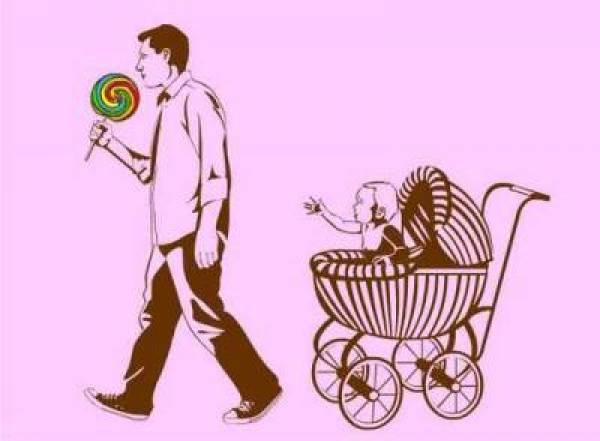
taking-candy-from-a-baby


Fun Fact: Between 2005 and 2017, the federal government withheld $580 billion it had promised to spend on students from poor families and students with disabilities.


Fun Fact: Over that same period, the personal net worth of the nation’s 400 wealthiest people ballooned by $1.57 trillion.


So, rich people, consider this the bill.


A new report called “Confronting the Education Debt” commissioned by the Alliance to Reclaim Our Schools (AROS) details the shortfall in minute detail.


For instance:


  • $347 billion owed to educate low-income students most of whom are children of color.


  • $233 billion owed to provide services for students with disabilities.


And this is just the shortfall of the last dozen years! That’s just money due to children who recently graduated or are currently in the school system!


We’ve been cheating our children out of the money we owe them for more than half a century!


Federal education funding levels were first established in 1965 as part of Pres. Lyndon Johnson’s War on Poverty in the landmark education law, the Elementary and Secondary Education Act (ESEA).


That law, which has become little more than a boondoggle for the standardized testing and school privatization industries, originally was passed to address inequality in America’s education funding.


Now this report from a coalition of groups including the Education Justice Research and Organizing Center, the National Education Association, the American Federation of Teachers, Center for Popular Democracy and the Action Center on Race and the Economy points out the multifarious ways we have failed to live up to the standards we set in that original legislation and beyond.


One of the most glaring examples of neglect is Title I funding.


The Johnson administration admitted that schools with a high concentration of students living below the poverty line needed extra support to succeed at the same levels as students from middle class or more affluent backgrounds. So the law promised to provide an additional 40 percent for each poor child above what the state already spent per pupil.


And then it promptly failed to fund it. In 1965 and every year since!


These are not just numbers. With this money, high poverty schools could provide:


  • “health and mental health services for every student, including dental and vision services; and

  • a full-time nurse in every Title I school; and

  • a full-time librarian for every Title I school; and

  • a full-time additional counselor in every Title I school, or

  • a full-time teaching assistant in every Title I classroom.”


A decade later, in 1975, the same thing happened with The Individuals with Disabilities Education Act (IDEA).


Congress told local districts they’d have to do more to help disabled students succeed academically. However, doing so costs money. Lawmakers admitted that disabled students cost more to educate and that local districts often struggle to find the funding to help them succeed.


Once again, Congress pledged to pay up to 40 percent of that additional cost, with local and state funds covering the remainder.


Once again, Congress failed to fund it.


STATE AND LOCAL FAILURE


But it’s not just the federal government that has shirked its duties to school children.


State and local governments also stiffed generations of students out of the resources they deserved – especially if those students have black or brown skin.


Beside the federal government, public schools are funded by their local municipalities and the state. Local governments pay for about 45 percent of school budgets.


However, since most of this allotment is determined by property tax revenues, it ensures the poor get fewer resources than the rich. Kids from rich neighborhoods get lots of resources. Kids from poor areas get the scraps. Inequality is built into the funding formula to ensure that students don’t start out on an even playing field and that economic handicaps are passed on from one generation to the next.


State governments are no better. They provide about 47 percent of school budgets.


As such, they are in the position to right the wrongs of the local community by offsetting the inequality of local governments – but only 11 states do so. Twenty states close their eyes and provide the same funding to each school – rich and poor alike – regardless of need or what each community can afford to provide for its own children. But 17 states are even worse. They actually play Robin Hood in reverse – they funnel more money to wealthier districts than to poor ones.


As a result, schools nationwide serving mostly students of color and/or poor children spend less on each child than districts serving mostly white and/or affluent children.


TAX CUTS


And while our federal, state and local governments have failed to meet their responsibilities to students, they have required fewer taxes from business and industry.


In the late 1940s and 1950s, the top marginal tax rate was more than 90 percent. Today it is 37 percent.


Congress just passed a series of whooping tax cuts that go into effect in 2019. More than half of the benefit of these cuts will go to the richest five percent of taxpayers. The law is expected to cost the federal treasury as much as $1.5 trillion in lost revenues over the next decade.


Nearly every state levies a much greater share of taxes from low- and middle-income families than from the wealthy.


And that’s before we even start talking about corporations!


While the US federal corporate tax is 35 percent, the effective tax rate that corporations pay after loopholes and deductions is only about 14 percent. This costs the federal government at least $181 billion in annual revenue, based on 2013 estimates by the Government Accountability Office. Local and state corporate tax and abatement programs make it even worse.


This is a choice. We are not requiring the rich to pay their fair share.


SCHOOL-TO-PRISON


Instead of investing in ways to help educate children, one of the only areas we’ve increased funding is incarceration.


The private prison industry is booming, fueled in part by a lack of opportunities in schools.


According to the report:


“In 2017, the National Association of School Resource Officers claimed that school policing was the fastest-growing area of law enforcement. The school safety and security industry was reported to be a $2.7 billion market as of 2015. Most of that $2.7 billion is public money now enriching the private security industry instead of providing real supports to students.”


According to the US Department of Education, 1.6 million students go to a school that employs a law enforcement officer but not a guidance counselor.


That is not an unalterable economic reality. It is a failure of priorities. It is the mark of a society that is not willing to help children but will swoop in to punish them if they get out of line.


SCHOOL PRIVATIZATION


Finally, the report identifies school privatization as a contributing factor to this systemic neglect.


Charter schools are legal in 44 states plus Washington, D.C. and Puerto Rico. They have “systematically stripped public school budgets through the creation of parallel structures of privately-operated, publicly-funded schools.”


Cost studies in San Diego, Los Angeles, Nashville, Michigan, Pennsylvania, Durham and other localities have come to the same conclusion: “the privatization of schools has contributed to austerity conditions in traditional public schools.”


Yet Congress continues to appropriate millions of dollars to the Department of Education’s Charter Schools Program (CSP), which funds new charter start-ups and expansions. The program has a budget of $500 million this year, alone. It is the largest single backer of charter schools in the nation.


According to the report, “In other words, the U.S. Department of Education is operating a program that directly undermines public schools.”


SOLUTIONS


But the report isn’t just about what’s wrong. It outlines how we can make it right.


It outlines three policy initiatives:


1)      “Full funding of Title I and IDEA to target federal support to low-income children and students with disabilities.

2)      The creation of 25,000 Sustainable Community Schools by 2025.

3)      A new focus for the U.S. Department of Education, on ensuring and incentivizing equity in public schools across the country.”


And we can pay for it by:


A. “Make the wealthy pay their fair share of taxes.

  • Rescind the 2017 tax code changes, which overwhelmingly favor the top 1 percent of income earners.
  • Close the federal carried interest loophole, a step that could increase federal revenues by between $1.8 and $2 billion annually or, according to some researchers, by as much as $18 billion annually.
  • If the carried interest loophole is not closed at the federal level, states can impose a surcharge on carried interest income at the state level, raising millions for state budgets.
  • Enact so-called “millionaire’s taxes” that increase the tax rate on a state’s highest earners. New York and California have already passed such law.


B. Require wealthy corporations to pay their fair share.

  • End or reduce corporate tax breaks that cost the federal government at least $181 billion annually.

  • Reduce state and local subsidies to businesses for economic development projects and hold school funding immune from tax abatements.

  • Enforce and strengthen programs like Payment in Lieu of Taxes (PILOT) to ensure that wealthy institutions pay their fair share towards local budgets.


C. Divest from the school-to-prison pipeline.

  • School safety and security is now a $2.7 billion industry. Much of that money is public money, going to profitable corporations instead of schools.
  • Divest from expensive security systems, metal detectors and legions of school-based police officers and instead invest in counselors, health and mental-health providers and other supports that make schools safer.


D. Place a moratorium on new charter schools and voucher programs.

  • A moratorium on the federal Charter Schools Program would free up $500 million annually, which could be used to support the creation of Sustainable Community schools.”


The executive summary concludes with the following statistic.


Even a 10 percent increase in funding for each high poverty student maintained through 12 years of public school can dramatically change the likelihood of academic success. It can boost the chances that students will graduate high school, achieve 10 percent higher earnings as adults and a 6 percentage point reduction in the annual incidence of adult poverty, according to a 2015 report.

“Ten percent is pocket-change for a nation that has orchestrated the rise of an unmatched billionaire class. In the richest nation in the world, it is possible to fully fund all our public schools, and to provide Black, Brown and low-income children with the educational resources and additional supports and services they need to achieve at the highest levels.”


The facts are in, folks.


We can no longer gripe and complain about a public education system we fail to support without recognizing the cause. We have failed to meet our responsibilities to our children – especially our children of color.


The solution is simple – equity.


We need to demand the rich do the right thing.


We cannot achieve greatness as a nation when wealth and privilege continue to shirk their duties and our lawmakers do little more than enable greed and corruption.


The bill is here.


Time to settle up.


READ THE WHOLE REPORT.


Like this post? I’ve written a book, “Gadfly on the Wall: A Public School Teacher Speaks Out on Racism and Reform,” now available from Garn Press. Ten percent of the proceeds go to the Badass Teachers Association. Check it out!

WANT A SIGNED COPY?

Click here to order one directly from me to your door!
book-2

Nationwide Poll Shows Overwhelming Support for Public Schools in All Areas Except One

5e6d4156-a078-4458-bdec-72746eca6e98


Waylon Jennings classic country hit advises Mama’s not to let their babies grow up to be cowboys.


Now, I guess we can add teachers to that list.


According to the 50th annual PDK Poll of attitudes about public schools, Americans trust and support teachers, but don’t want their own children to join a profession they see as underpaid and undervalued.


In almost every other way, they support public schools and the educators who work there.


When it comes to increasing school funding, increasing teacher salary, allowing teachers to strike, and an abundance of other issues, the poll found a majority of people unequivocally in favor of endeavors meant to bolster learning.


In fact, support for education and educators has never been so high in half a century.


“Two-thirds of Americans say teachers are underpaid, and an overwhelming 78% of public school parents say they would support teachers in their community if they went on strike for more pay,” according to PDK’s Website.


If true, this result illuminates an incredible tone deafness among politicians like Scott Wagner in Pennsylvania who is running for governor on the platform that teachers make too much money. According to the poll, only 6% of Americans agree with him.


Moreover, those who support teachers strikes include 6 in 10 Republicans.


“Those who would be most affected by a teacher walk-out — say they would support teachers in their community if they went on strike for more pay. Among the general public, 73% say they would support a job action for higher wages.”


These are record high results that are also reflected in respondents unwillingness to encourage their own children to become teachers in the current political landscape.


For the first time since the question was asked in 1969, a majority of 54% say they would not want their child to become a teacher.


The reason? Poor pay and benefits.


Moreover, a lack of adequate funding is cited as the most common problem facing public schools – a finding that’s held true since the early 2000s. In fact, for the 17th consecutive year, Americans have named the lack of funding as the biggest problem facing their local schools.


It seems that either or both major political parties could easily pick up broad popular support by doing an about face on education. Instead of backing standardization and privatization, they should get behind public education.


The topic has typically served as a wedge issue between progressives and corporate Democrats while Republicans have almost exclusively backed a strategy to “starve the beast” and promote privatization.


However, Democrats and/or Republicans who ran on respecting and remunerating teachers as well as increasing support for the public schools that employ them would find major support among voters.


The PDK poll is based on responses from 1,042 adults including 515 parents of school-age children. They were randomly and representatively sampled in May 2018 through on-line surveys.


The 2018 results include particular support for the public school system as opposed to charter and voucher schools.


Nearly 8 in 10 people said they prefer reforming the existing public school system rather than finding an alternative approach.


That’s a higher response than any year since the question was first asked 20 years ago. Moreover, it’s not just an opinion about nationwide schooling: 78% say they’d rather reform than replace the local school system, as well.


In addition, there is support among Americans to not only increase funding, but also spend it more equitably.


A majority (60%) support spending more on students who need extra help than spending the same amount on every child (39%).


Responds were more divided on where the influx of funding should come from.


Half of respondents favor raising taxes and half say the schools should spend less on students who require fewer resources.


This is related to public perception of exactly which students are receiving unfair funding. The poll revealed that most people recognize some resource inequality based on race and geographic region but they think most is based on parental wealth: 75% of respondent say public school students serving mostly poor students have fewer resources than those serving rich students.


One of the most interesting findings is always the public’s overall perception of schools.


And this poll – as in previous editions – found a sharp difference in respondents appraisal of schools nationwide vs. the schools in their own neighborhoods.


Fifty-five percent say that on a national scale students today get a worse education than those in previous generations.


However:


The public schools continue to suffer from an image deficit. Among those who know them best, parents of current students, 70% give their oldest child’s school an A or B grade. Among the public more broadly, by contrast, only four in 10 give their local schools an A or B. In results that are typical across the years, far fewer give top grades to the public schools nationally, just 19%.”


In other words, people seem to think that nationally our schools stink. But the schools in our own neighborhoods are pretty good.


The reason is simple. National perception is formed by the media. Local perception is formed by actual empirical evidence.


The forces of school privatization and their propaganda network has pushed the lie of “failing schools” for so long, that people believe it – except in their own neighborhoods where they see it to be false.


But the questions weren’t all about how schools should be run. They also asked about security – a hot topic when school shootings happen at least once a month.


“Parents lack strong confidence that schools can protect their children against a school shooting but favor armed police, mental health screenings, and metal detectors more than arming teachers to protect their children.”


This bodes badly for the Trump administrations plans to push guns on public school teachers instead of enacting common sense gun regulations.


As usual, policymakers are trying to herd Americans to their point of view instead of listening to their constituencies.


And that seems to be the big take away from this year’s poll.


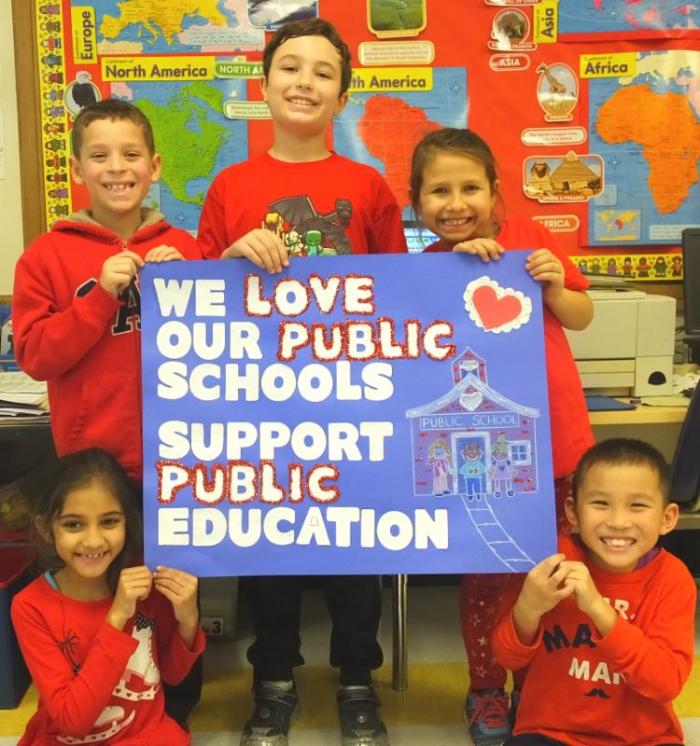
Americans want and support public education.


It’s time our so-called leaders got with the program.


Like this post? I’ve written a book, “Gadfly on the Wall: A Public School Teacher Speaks Out on Racism and Reform,” now available from Garn Press. Ten percent of the proceeds go to the Badass Teachers Association. Check it out!

WANT A SIGNED COPY?

Click here to order one directly from me to your door!
book-2

Public School is Not For Profit. It is For Children.

Screen Shot 2018-08-28 at 4.14.57 PM


Betsy DeVos doesn’t get it.


But neither did Arne Duncan.


Whether right or left or somewhere in between, the person sitting at cabinet level tasked with advising the President on education matters invariably knows nothing about the purpose of public schools.


Duncan thought it had something to do with canned academic standards and standardized tests.


DeVos thinks it involves vouchers to religious or private schools.


But they’re both as wrong as two left shoes.


Public schools exist for one reason and one reason only – to meet the needs of children.


They aren’t there to enrich the private sector or even provide the job market with future employees.


They exist to teach, to counsel, to inspire, to heal.


And all these other schemes favored by Dunce Duncan and Batty Betsy that purport to meet kids needs while somehow enjoying the totally unintended side effect of enriching wealthy investors completely misses the point.


Public schools serve one purpose – to help the kids enrolled in them.


That’s all.


If someone is getting rich off that, there’s a huge problem somewhere.


Unfortunately, the Secretaries of Education of Donald Trump and Barack Obama aren’t the only ones to get it wrong. Policymakers on both sides of the aisle have lost sight of this fact.


So have pundits and media personalities on Fox News, CNN and MSNBC. So have CEOs and tech entrepreneurs and economists and anyone – really – whom our society seems to take seriously.


Don’t believe me?


Take the latest pronouncement from DeVos, our Secretary of Education.


She announced recently that she was looking into using federal funds to buy guns for teachers to better protect their students from school shooters.


It doesn’t take a genius to see that this is not in the best interests of children.


Teachers with guns mean a MORE dangerous environment for children, not less.


It means escalating the chance of friendly fire much more than boosting the possibility of a kindergarten teacher turning into an action hero.


It means heightening the chance of children getting their hands on these firearms and doing themselves or others harm.


And given the disproportionate murders of people of color even at the hands of trained professionals in the police force, it means children of color being legitimately terrified of their mostly white educators – or worse.


The reason given by DeVos may be to make children safer. But the measure she’s proposing really has nothing to do with them at all.


It’s a boondoggle for private industry – one private industry in particular – gun manufacturers.


Instead of sensible regulations on a product that’s at least as dangerous as items that are much more heavily controlled – such as cold medicine and automobiles – DeVos is doing the only thing she can to protect what she really cares about – corporate profits.


She is using money earmarked “safety” to increase danger.


Or as she sees it – she’s using a government apparatus that could harm the gun industry to instead pad its pockets.


You’ll hear some progressives and moderates decry this move with passion and fervor – and for good reason – but what many fail to realize is that it’s not new.


It’s really just a continuation of a sickness that has crept into our society about how we conceptualize the very idea of school.


We have moved away from the proposition that everything must be done in the student’s best interest and have replaced it with an imperative to benefit business and industry.


After all, what is the push for academic accountability through standardized tests and Common Core but corporate welfare for the testing and publishing industry?


What is the push for charter and voucher schools but government subsidies for school privatization?


High stakes standardized testing isn’t about helping students learn. Neither is Common Core, value-added measures or a host of top-down corporate policies championed by lions of the left and supply-side patriots.


They are about creating a problem where one doesn’t exist: accountability.


“How do we make sure students receive a quality education?” As if this has ever been hard to determine.


In general, the schools with greater needs than funding are where students struggle. The schools where everyone has more than they need is where they excel.


But they try to sweep the issue of inequitable funding and resources under the rug by framing the question entirely about teachers and schools.


In short, instead of asking about an obvious inequality, they hide a preconceived answer in the question: “How do we make sure teachers and schools are actually educating kids?”


Wrong question. But here’s the answer, anyway: Administrators observe teachers and determine if they’re doing their jobs. And school boards evaluate administrators.


In general, the staff isn’t the problem. It’s the lack of resources we give them to work with – everything from crumbling buildings, large classes, narrowed curriculum to a lack of wraparound social services.


It doesn’t take much to see we’re shortchanging our neediest students.


You don’t need standardized tests to tell you that. You don’t need new academic standards. You don’t need to evaluate educators on things beyond their control.


But doing so creates a new market, a need that can be filled by corporate interests unrestrained by the conviction that public schools are not supposed to be a profit-making venture.


People providing services for schools are supposed to make a living – not a killing – off the public’s dime.


The same can be said for school privatization.


Public schools are in no way inferior to institutions that are privately managed. Tax dollars administered by duly-elected representatives in the light of day are in no way less effective or more corrupt than the alternative – letting bureaucrats behind closed doors dole out the money however they choose even into their own pockets.


In fact, just the opposite!


Nor have charter or voucher schools ever been shown to increase student learning without also selecting only the best academic students and shunning those most difficult to teach, providing fewer resources for students and/or operating with greater funding.


But pretending that privatization is a better alternative to democratic rule creates a market, it opens the door so the system can be gamed for profit at the expense of student learning and wellbeing.


That’s why we look in awe at LeBron James, an athlete who uses his fortune to open a school providing all the things society refuses for students of color. A basketball player who refuses to usurp the public’s leadership role in administering that fully public school.


He’s a shinning example of actual philanthropy in an age of bogus philanthrocapitalism. But he’s also proof that his solution is not reproducible large scale.


The rich – even if they are well intentioned – cannot save us. Only the public can support all public schools.


And to do that, we must understand the purpose behind these institutions.


Otherwise, we’ll continue to be trapped on a runaway train where the conductor seems to possess no sense of urgency about slowing down.


We would never have been in this situation – and in fact could right the course even now – if we just took the time to clarify what we were doing and why we were doing it.


We could save generations of children if we stopped cashing in on public schools and realized the reason for their existence.


We could ensure both our present and our posterity.


If only we remembered that one thing.


Public schools are not for profit.


They are for children.


Like this post? I’ve written a book, “Gadfly on the Wall: A Public School Teacher Speaks Out on Racism and Reform,” now available from Garn Press. Ten percent of the proceeds go to the Badass Teachers Association. Check it out!

WANT A SIGNED COPY?

Click here to order one directly from me to your door!
book-4

Scott Wagner Wants to be Pa.’s Anti-Education Governor. Will We Let Him?

39408873_306034386897393_1481697570328674304_n
Art by Sue Goncarovs


If there’s one thing Scott Wagner hates, it’s education.


He hates science. He hates schools. He hates teachers. And if students get in the way, he’ll hate them, too.


These are the qualities he thinks Pennsylvanians are looking for in their next governor.


The York Township Republican will challenge incumbent Democrat Tom Wolf on Nov. 6, 2018.


So who is this guy?


Wagner’s a college dropout who made a fortune starting a garbage hauling firm. He became a state senator four years ago after winning a write in campaign during a special election where only 17% of the electorate could be bothered to vote.


And ever since, he’s been consistent about one thing: he really, Really, REALLY hates teachers.


“We have 180,000 teachers in the state of Pennsylvania,” Wagner said in 2015. “If we laid off 10 percent of the teachers in the state of Pennsylvania, we’d never miss them.”


Let’s be clear.


Scott wouldn’t miss them. But the 1.75 million Commonwealth school children would.


Ever since the last Republican Governor, Tom Corbett, slashed funding by almost $1 billion a year to the poorest schools with the full help of a state legislature that is even now still under GOP control, our institutions of learning have been reeling.


We lost 27,000 education jobs, most of which were teaching positions.


That’s a deficit we still haven’t recovered from. Even today, state schools are staffed at a 10-year low. Class sizes are at an all time high.


Yet Wagner wants to fire even more teachers!?


That’s not the policy of a man who wants to help improve life throughout the state for all. That’s not the policy of a man who wants to help kids learn.


It’s the policy of a man who has a personal grudge against educators.


And his other legislative objectives?


Wagner wants to further slash education funding. He wants to spend whatever is left inequitably. And he really wants to help his heroes Donald Trump and Betsy DeVos enact school vouchers so business people like him can continue to cash in on children from Pittsburgh to Philadelphia and all places between.


By contrast, in his four years in office, Gov. Wolf has pushed to increase education funding, pushed to spend it more fairly, and even cut the time it takes for students to take high stakes standardized tests.


The good news: voters throughout the Commonwealth have never had a clearer choice for governor.


The bad news: when has that ever stopped them from getting it wrong?


Here’s a couple of Wagner’s other big ideas cribbed from the American Legislative Exchange Council (ALEC) and his buddies the Koch Brothers.


He Thinks Teachers Make Too Much Money


“We have created a special class in this state and the special class is the public sector union employee,” Wagner told Keystone Crossroads in a 2015 interview.


“Teachers are doing very well in this state,” he said. “People would be appalled if they knew what their teachers made, in certain areas.”


Unfortunately, Wagner has no idea, himself.


He keeps quoting a bogus salary figure that I’m not going to repeat. It’s not true statewide, it’s not an average, nor is it true in his home district.


In truth, the low end for teachers entering the field nationwide is around $30,000, according to the National Association of Colleges and Employers (NACE). So go to college, get a four – sometimes five – year degree including a rigorous internship of student teaching and you make a mere $10,000 above the most generous minimum wage!?


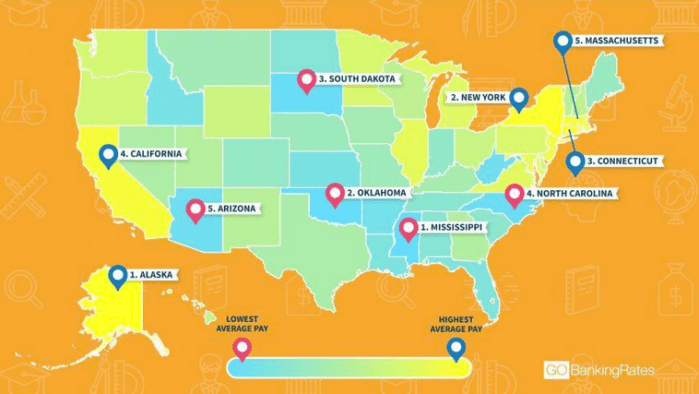
However, Pennsylvania pays its teachers better than average. We have the 12th highest pay in the country, according to financial services outlet GOBankingRates which compiled average teacher salaries by state using 2015 federal data.


According to that data, Pennsylvania teachers make on average $63,063 per year. Of neighboring states, teachers in Maryland ($65,247) and New Jersey ($71,687) make more. Teachers in Ohio (59,063) and Delaware ($59,853) make less.


Screen Shot 2018-08-16 at 2.11.40 PM
Highest and Lowest Teacher Salaries – Source: GoBankingRates


But those numbers are deceiving. They’re averages. Districts serving the wealthy pay their teachers much better than those serving the poor. Actual pay ranges from $99,253 in the affluent Philadelphia district of Lower Merion to $27,592 at Wonderland Charter School in Centre Country.


As everywhere else, many teachers struggle to make ends meet working multiple jobs while others are well compensated.


No matter how you slice it, nationwide teachers’ salaries are 14% less than those from professions that require similar levels of education, according to the Economic Policy Institute.


In other words, if prospective teachers want to make more money, all they have to do is switch majors.


That may be part of the reason for our national teachers shortage. Not only have states like ours laid off tens of thousands of educators, many don’t stay in the field if given the chance. Across the country , 46 percent of educators quit before reaching the five year mark. And it’s worse in urban districts, where 20 percent quit every single year!


We could take steps to ensure all teachers earned a living wage and even encouraged our best and brightest to enter the field. But, nah, Wagner thinks Pennsylvania already spends “enough” money on public schools.


As Governor, he would do whatever he could to win his personal crusade against teachers even if Pennsylvania’s school children were collateral damage.


He Wants to Eliminate Teachers Sick Days


Wagner has been vocal about eliminating benefits that educators earn, including sick days. He introduced a bill that’s still floating around in the state senate to strip sick days from the school code and make teachers bargain for them with their districts.


So forcing sick teachers to come to school and spread the germs to children is fine with Wagner as long as it hurts his nemesis – those evil teachers.


He Wants to Cut Teachers Pensions


He also plans to end pensions for working educators, and even wants retired educators to give back 10% of the retirement they earned.


He’s right to want reform to the state pension system but disingenuous or misinformed about the cause.


Pennsylvania pension costs have increased primarily because our legislature made bad plans and bad investments that were upended by the crash of 2008. You don’t fix that by stiffing your employees. If you do that, no one will believe any promises the state makes and no one of any substance will want to work for the state.


He Wants To Pay Teachers Based on Student Test Scores


No kidding:


“There are teachers that will exceed expectations while teaching a classroom of 100 of the toughest-to-teach students. There are also teachers that would struggle to teach just one student at a time. I want the first teacher to make a small fortune, and I want the second teacher to find a new career that is better suited for him or her.”


So if you teach the best students, you should make the most money? And if you teach struggling students, you should be fired?


But It’s Not Just Teachers. He Hates Other Working People, Too


If there is a corner to cut, he wants to take it – especially if it screws a working person. As a state senator, Wagner even introduced a bill that would exempt school districts from paying laborers the “prevailing wage” on construction projects.


Cheaper labor, shoddier work. That’s surely a recipe for success in buildings housing school children!


He Wants to Disband Unions


Oh, but he’s not done.


The man who once compared the tactics of public employee unions – including those representing teachers – to those of Adolf Hitler and Vladimir Putin also wants to end tenure end tenure, seniority, and disband unions.


I’m sure reducing teaching to a career without benefits, workers rights or protections will do wonders for the educational quality students receive.


Teachers working conditions are students learning conditions. Putting children in a building that has fewer safety precautions because there’s no union to collectively bargain for them is a great way to cut costs. But parents aren’t thrilled about having their kids try to learn in a sweat shop filled with Trump brand Russian asbestos.


He Loves School Vouchers and Charter Schools


Call them education saving accounts, education tax credits, personalized learning accounts or opportunity scholarships. It doesn’t matter. Wagner loves them all.


“I support all school choice,” he said in an interview.


Charter schools, funding private and parochial schools with public tax dollars. He’s in for all of it.


So long as it hurts public schools and enriches private businesses without helping students learn at all.


Go ahead! Take scarce funding from public schools and divert it to programs with little to no accountability. Let private school operators fraudulently misrepresent enrollment data. Let them fail to provide safe and academically appropriate learning environments. Let them game the system in any and every way.


That’s what Wagner calls fiscal accountability.


It doesn’t matter that these schools don’t improve student achievement. Evaluations of voucher programs in Milwaukee, Cleveland, and Washington, D.C., have all found no statistically significant differences in the academic achievement of voucher students compared to public school students. And recent evaluations of programs in Ohio, Indiana, and Louisiana revealed that voucher students scored lower than their peers attending public school.


But who cares about facts? This is all ideology for Wagner.


Vouchers have a record of undermining student’s civil rights – especially students with disabilities. Private school students give up due process and other rights guaranteed in public schools. Private schools are allowed to discriminate by denying admission based on religion, sexual orientation, citizenship status, English language proficiency and disability. Private schools that enroll students with disabilities may decide not to provide the services or accommodations guaranteed to such students in public schools. Or they may charge parents extra for them. Moreover, there is nothing to stop them from segregating these kids from other children. And, finally, private schools often suspend or expel students without due process.


This may be Trump and Wagner’s ideal. But it is certainly not what Commonwealth voters want for their children.


He Wants to Get Rid of Many State Colleges


Wagner caused an uproar when he said the state’s 14 state colleges will not be around in four years. “So, for those of you who think your school’s going to be around four years from now, it isn’t going to be around,” Wagner said.


Fewer institutions of higher learning. Fewer opportunities to get a college degree. That sounds like the policy of a college dropout.


He Wants to Slash School Funding


Wagner has made no bones about this from day one.


This is a guy who took a television reporter on a helicopter tour of schools in his district in 2015 to highlight the fact that “we spend a lot of money on schools.”


“They think the solution is more money,” he said of Wolf and the Democrats. “Every time you do that the money disappears and the problem is still there.”


It’s like taking a bath, Scott. You can’t just do it once and be clean for the rest of your life. You need to bathe every day. One-time funding windfalls don’t work. You need equitable and sustainable funding revenues.


But that’s either too complicated for Wagner or he just doesn’t care.


He supported Gov. Corbett’s plan to decimate Pennsylvania’s schools. And he doesn’t think the culling should be over.


When asked point blank about Corbett’s cuts in 2011, he said, “Yes, I believe that Governor Corbett needs to stick to his plan.”


He’s said repeatedly that we spend “enough money” on public schools, while stressing the need for frugality and fewer regulations.


He Wants to Play with How Schools Are Funded


He’s an advocate for legislation that would eliminate school property taxes and replace them with increased state sales and income taxes.


True we need a better funding mechanism than local property taxes. But you can bet Wagner’s plan is worse than the current system.


It would lock funding inequities among Pennsylvania’s 500 school districts into place.


He Thinks Global Warming is Caused by the Earth Getting Closer to the Sun


Wagner is an incredibly stupid man who thinks he’s rather intelligent.


But of all the dumb or evil things that come spewing out of his mouth, this one has to be my favorite.


When asked about global climate change, he didn’t simply deny that it was happening. He had an alternative theory to why it was taking place.


It’s not business and industry or fossil fuels that is causing global temperatures to rise. He actually said that it’s because the earth is getting closer to the sun every year. Another cause? Human bodies on the planet are giving off enough heat to raise the global temperature.


Perhaps it shouldn’t be surprising that a person who hates schools and teachers so much knows very little, himself.


These comments made him a national laughing stock.


His words were repeated on every late night comedy show across the country for giggles and guffaws.


The question is “Will the joke be on us come Election Day?”


It’s not “How dumb is Scott Wagner?”


It’s “Is Pennsylvania dumb enough to vote for him?”


NOTE: Special Thank you to Sue Goncarovs for the Wagner cartoon with which I began this piece. I love your work!


Like this post? I’ve written a book, “Gadfly on the Wall: A Public School Teacher Speaks Out on Racism and Reform,” now available from Garn Press. Ten percent of the proceeds go to the Badass Teachers Association. Check it out!

WANT A SIGNED COPY?

Click here to order one directly from me to your door!
book-1

Democrats for Education Reform Think Being Progressive Means Mirroring Betsy DeVos


 Screen Shot 2018-08-08 at 12.24.47 PM


Democrats for Education Reform (DFER) put out a new video about what they think it means to be an education progressive.


And by the political action committee’s definition, Betsy DeVos may be the most “progressive” education secretary ever.


She champions “public charter schools.” Just like them!


She is in favor of evaluating teachers on student test scores. Just like them!


She is a booster for “holding schools accountable” through the use of standardized tests. Just like them!


And she loves putting public tax dollars into private hands to run schools “more efficiently” by disbanding school boards, closing public debate and choosing exactly which students get to attend privatized schools. Just like… you get the idea.


But perhaps the most striking similarity between DeVos and DFER is their methodologies.


DFER announced it again was going to flood Democratic races with tons of campaign cash to bolster candidates who agreed with them. That’s exactly how DeVos gets things done, too!


She gives politicians bribes to do her bidding! The only difference is she pays her money mostly to Republicans while DFER pays off Democrats. But if both DeVos and DFER are paying to get would-be lawmakers to enact the same policies, what is the difference!?


Seriously, what is the difference between Betsy DeVos and Democrats for Education Reform?


Progressives in Colorado and California say it is only the word “Democrat.”


Democratic party conferences in both states passed resolutions asking DFER to stop using the name “Democrat” because the privatization lobbying firm does not represent party ideals or goals.


It is degrading what the party stands for and hurting the brand.


Why do some progressives vote third party? Because of groups like DFER.


Voters think something like – if this charter school advocacy group represents what Democrats are all about, I can’t vote Democrat. I need a new party. Hence the surge of Green and other third party votes that is blamed for hurting Democratic candidates.


The Democrats have always been a big tent party, but the canvas can’t shelter the most regressive far right bigotry without destroying the organization’s identity as an opposition party.


It is entirely incoherent to oppose Republicans by pushing for almost the same agenda.


The reason for the confusion is that DFER is not a grassroots organization. It is funded by Wall Street hedge fund managers.


It is not an authentic expression of the public’s wants and desires. It is another avenue for the mega-rich to use their power and influence to tell the rest of us what they want us to believe.


Yet DFER tries to hide this fact with various forms of propaganda. In effect, they’re trying to convince us that their ideas are what we actually believe.


For instance, the group is now offering a nationwide poll from Benson Strategy Group as proof that Democratic voters agree with DFER’s goals.


However, the questions asked to about 2,000 people on the phone are laughably biased:


“Do you believe we have a responsibility to do everything we can to give every child a great education, and does that mean we need faster change in our schools to prepare students for the future?”


Of course people are going to agree with that! It doesn’t mean people want to privatize public schools. We SHOULD do everything – including closing failing charter schools and boosting funding at struggling public schools!


“Do you agree that we can’t go back to the way things used to be in schools? Do you think we need to keep bringing in new ideas and finding new ways to improve schools?”


Of course we need new ideas, but charter schools and standardized tests aren’t new ideas! We’ve been doing that nonsense for decades and they haven’t helped a bit. In fact, they’ve made things worse!


“Do you think funding alone is enough to give our children the education they deserve? Do you also want to see new ideas and real changes to the way public schools operate?”


Of course schools need more than just additional funding. But let’s not minimize funding equity. Students of color will never get an equitable education until we pay for the resources they need to succeed. The poor will never catch up to the rich without money to provide the services they need to learn.


Moreover, blanket statements disparaging public schools before asking about school privatization invites bias against public schools and bias in favor of privatization.


When you couch privatization as “more options” and “choice,” who doesn’t want that? But it’s not what you’re offering.


Giving administrators the ability to accept or deny my child into their school is not “more options” for me. It is greater choice for them.


Slashing funding at the public school because its finances got gobbled up by the neighborhood charter is not “choice” for me. It is providing alternative revenue for the corporations that run the charter school while my only option is to accept fewer resources for my child.


None of this is progressive. None of this is truly supported by grassroots people or organizations.


Civil rights groups like Journey for Justice and even the National Association for the Advancement of Colored People (NAACP) oppose school privatization and high stakes testing.


This is the meat and potatoes of DFER.


The only difference between these alleged Democrats and DeVos is that the Trump administration also champions school vouchers.


But both charters and vouchers involve sending public tax dollars to schools that are privately run. Both involve stripping taxpayers of control over how that money is spent until all we have are parents moving their children from school-to-school in a desperate attempt to find one that does a good job and will also accept their child.


That is not the progressive ideal.


Progressives want to make every public school excellent. They want all children to have the resources they need to succeed. They want to assess students, teachers and the system fairly to clearly understand what children are learning, what educators are doing to help them learn and how administrators and school directors are enabling that success. They want innovation – not the same old corporate-minded top-down policy failures of the past decades. They want technology as a tool to bridge understanding and not as an end in itself to drive the curriculum. They want an end to the school-to-prison pipeline. They want truly integrated schools, not the current segregated system where Cadillac funding goes to rich white districts and the scraps are thrown to the poor brown ones.


Yet DFER, these so-called Democrats, support none of this.


And they’re spending millions of dollars to convince our lawmakers not to support it either.


Politicians can’t keep accepting their dirty money and expecting grassroots voters to continue to support them.


To paraphrase Matthew, no one can serve two masters. If lawmakers are taking sacks of cash from billionaire hedge fund mangers, they aren’t going to listen to you or me.


They can serve their constituents or mammon. Not both.


So if Democrats want strong support in the coming elections, they need to do the progressive thing.


Stop accepting bribes from dark money influence peddlers like DFER.


Like this post? I’ve written a book, “Gadfly on the Wall: A Public School Teacher Speaks Out on Racism and Reform,” now available from Garn Press. Ten percent of the proceeds go to the Badass Teachers Association. Check it out!

WANT A SIGNED COPY?

Click here to order one directly from me to your door!

book-2

Since School Vouchers Don’t Increase Test Scores, Racism is an Acceptable Reason for Privatization, Says Advocate

Screen Shot 2018-07-24 at 10.20.41 AM

For decades, school voucher advocates claimed that sending poor kids to private schools with public tax dollars was acceptable because doing so would raise students’ test scores.


However, in the few cases where voucher students are even required to take the same standardized tests as public school students, the results have been dismal.


In short, poor kids at private schools don’t get better test scores.


So why are we spending billions of public tax dollars to send kids to privately run schools?


A 2018 Department of Education evaluation of the Washington, D.C., voucher program found that public school students permitted to attend a private or parochial school at public expense ended up getting worse scores than they had at public school.


Their scores went down 10 points in math and stayed about the same in reading.


These are not the pie in the sky results we were promised when we poured our tax money into private hands.


However, corporate education propaganda site, The 74, published a defense of these results that – frankly – makes some pretty jaw dropping claims.


The article is “More Regulation of D.C. School Vouchers Won’t Help Students. It Will Just Give Families Fewer Choices for Their Kids” by far right Cato Institute think tanker Corey DeAngelis.


In his piece, not only does he call for less accountability for voucher schools, he downplays the importance of standardized test scores.


And he has a point. Test scores aren’t a valid reflection of student learning – but that’s something public school advocates have been saying for decades in response to charter and voucher school cheerleaders like DeAngelis.


Supply side lobbyists have been claiming we need school privatization BECAUSE it will increase test scores. Now that we find this claim is completely bogus, the privatizers are changing their tune.


But that’s not the most shocking irony in DeAngelis article.


Parents don’t really care about the scores, he says. Instead they send their children to voucher schools because… You know what? I’ll let him tell it.


“Families choose schools for their children based on several important factors, including culture, individual attention, and, of course, safety. Research tells us that parents — unsurprisingly — often value these things more than standardized test scores.”


Certainly parents prefer their children have more individual attention. But many private schools have larger class sizes than public schools.


Moreover, reducing class size at all schools would be a more equitable reform than letting some kids enjoy smaller classes if they can just get into the right school.


However, it is his other two claims that sent my racist dog whistle senses tingling.


So parents don’t like the CULTURE of public schools. And they’re afraid public schools aren’t as SAFE.


Hmm. I wonder what culture these parents are objecting to. I wonder why they would think public schools wouldn’t be as safe.


Could it perhaps be fear of black students!?


I don’t want my little Billy to be exposed to all that rap music and kids with sagging pants. I don’t want my little Susie to cower in a class full of thugs and gangstas.


This is racist, stereotypical and just plain wrong about what you’ll actually find in public schools.


But it’s also typical white flight – the impulse behind the charter and voucher school movement in the first place.


Where did the boom for privatized schools come from historically?


It was a reaction to Brown vs. Board. When the US Supreme Court ruled in 1954 that segregated schools were unconstitutional, many white parents rebelled. They didn’t want their kids to go to school with THOSE kids. Hence, Georgia Gov. Herman Talmadge’s aborted plan to close all state schools and issue vouchers to private schools instead.


Hence, the plan that actually did take place in Price Edward County, Virginia, in 1959 where the public schools were closed and all taxpayer money for education was funneled to segregated white academies that would not admit black students. Though the term had yet to be invented, these were proto-“charter schools.” They were publicly funded but privately run. They were housed in privately owned facilities such as churches and the local Moose Lodge.


Hence, various segregationist “freedom of choice” plans in several states that allowed white students to transfer out of desegregated schools. Black students could apply but because of various administrative hurdles were never admitted.


This is the history of so-called school choice. And it is a history that DeAngelis, the 74 and the Cato Institute are willing to bring full circle.


School privatization advocates pretend they’re defending choice, but what choice are they championing?


The choice to segregate?


Pardon me, but I don’t think we should be spending public tax dollars to enable bigots.


If you want to shield your children from the horrors of kids with darker skin, do so on your own dime.


Public money should only be spent on policies that are in the public good – and that’s not segregation. It’s the exact opposite – integration.


Learning how to get along with people who are different than you is an essential skill for good citizens. Understanding that people of different races, ethnicities, religions and cultures are also human is vital if our nation is to survive.


Being exposed to another culture isn’t a bad thing. It’s the definition of the American melting pot.


Our public schools are not perfect. They suffer from targeted disinvestment – especially those situated in urban neighborhoods and those serving larger populations of children of color.


But that is because of the same segregation school privatization lobbyists are empowering. If all students went to the same schools, parents wouldn’t allow this kind of inequity.


In protecting their own kids, parents with power and resources would be protecting all kids.


But this isn’t the goal of privatization promoters. They don’t care about what’s best for children. They’re looking out for what’s best for the businesses running the privatized schools.


So what have we learned?


School vouchers do not increase test scores.


And when that excuse behind the entire school privatization movement is exposed as nonsense, opportunists have no problem using racism and prejudice to defend their industry.


Like this post? I’ve written a book, “Gadfly on the Wall: A Public School Teacher Speaks Out on Racism and Reform,” now available from Garn Press. Ten percent of the proceeds go to the Badass Teachers Association. Check it out!

WANT A SIGNED COPY?

Click here to order one directly from me to your door!
book-4

Wealth – Not Enrollment in Private School – Increases Student Achievement, According to New Study

pq2iPfteRemNHu7D5w9c_richkid


Students enrolled in private schools often get good grades and high test scores.


And there’s a reason for that – they’re from wealthier families.


A new peer-reviewed study from Professors Richard C. Pianta and Arya Ansari of the University of Virginia found that once you take family income out of the equation, there are absolutely zero benefits of going to a private school. The majority of the advantage comes from simply having money and all that comes with it – physical, emotional, and mental well-being, living in a stable and secure environment, knowing where your next meal will come from, etc.


The study published in July 2018 attempts to correct for selection bias – the factors that contribute to a student choosing private school rather than the benefits of the school, itself.


The study’s abstract puts it this way:


“Results from this investigation revealed that in unadjusted models, children with a history of enrollment in private schools performed better on nearly all outcomes assessed in adolescence. However, by simply controlling for the sociodemographic characteristics that selected children and families into these schools, all of the advantages of private school education were eliminated. There was also no evidence to suggest that low-income children or children enrolled in urban schools benefited more from private school enrollment.”


This has major policy implications.


Corporate school reformers from Barack Obama to Donald Trump, from Arne Duncan to Betsy DeVos, from Cory Booker to Charles and David Koch, have proposed increasing privatized school options to help students struggling in public schools.


Whether it be increasing charter schools or vouchers to attend private and parochial schools, the implication is the same – such measures will not help students achieve.


We need programs aimed at poverty, itself, not at replacing public schools with private alternatives.


According to the abstract:


“By and large, the evidence on the impact of school voucher programs casts doubt on any clear conclusion that private schools are superior in producing student performance…


“In sum, we find no evidence for policies that would support widespread enrollment in private schools, as a group, as a solution for achievement gaps associated with income or race. In most discussions of such gaps and educational opportunities, it is assumed that poor children attend poor quality schools and that their families, given resources and flexibility, could choose among the existing supply of private schools to select and then enroll their children in a school that is more effective and a better match for their student’s needs. It is not at all clear that this logic holds in the real world of a limited supply of effective schools (both private and public) and the indication that once one accounts for family background, the existing supply of heterogeneous private schools (from which parents select) does not result in a superior education (even for higher income students).”


Researchers repeatedly noted that this study was not simply a snapshot of student performance. It is unique because of how long and how in depth students were observed.


The study looks at student outcomes at multiple intervals giving it a much longer time frame and much greater detail than other similar investigations. Researchers examined wide ranging family backgrounds and contextual processes to reduce selection bias.


Participants were recruited in 1991 from ten different cities: Little Rock, Arkansas; Irvine, California; Lawrence, Kansas; Boston, Massachusetts; Philadelphia and Pittsburgh, Pennsylvania; Charlottesville, Virginia; Seattle, Washington; Hickory and Morganton, North Carolina; and Madison, Wisconsin. They were followed for 15 years and had to complete a month long home visit. In addition, they submitted to both annual interviews and home, school, and neighborhood observations.


The final analytic sample consisted of 1,097 children – 24% of whom were children of color, 15% had single mothers, and 10% had mothers without a high school diploma.


Moreover, student academic achievement wasn’t the only factor examined.


Researchers also assessed students social adjustment, attitudes, motivation, and risky behavior. This is significant because they noted that no other study of private schools to date has examined factors beyond academics. Also, there is a general assumption that private school has a positive effect on these nonacademic factors – an assumption for which the study could find no evidence.


From the abstract:


“In short, despite the frequent and pronounced arguments in favor of the use of vouchers or other mechanisms to support enrollment in private schools as a solution for vulnerable children and families attending local or neighborhood schools, the present study found no evidence that private schools, net of family background (particularly income), are more effective for promoting student success.”


One reason behind these results may be the startling variation in “the nature and quality of private school classrooms.” There is no consistency between what you’ll get from one private school to the next.


The x-factor appears to be family income and all that comes with it.


We see this again and again in education. For instance, standardized test scores, themselves, are highly correlated with parental wealth. Kids from wealthier families get better test scores than those from poorer families regardless of whether they attend public, charter or private schools.


It’s time our policymakers stop ignoring the effect of income inequality on our nations students.


If we really want to help our children, the solution is not increased privatization. It is increased funding and support for anti-poverty programs, teachers and a robust public school system.


Like this post? I’ve written a book, “Gadfly on the Wall: A Public School Teacher Speaks Out on Racism and Reform,” now available from Garn Press. Ten percent of the proceeds go to the Badass Teachers Association. Check it out!

WANT A SIGNED COPY?

Click here to order one directly from me to your door!
 

book-3

Why We Need a Department of Education

what-happens-to-your-body-when-you-fast


Let’s say you have a starving child.


You take out a knife, a fork and a spoon. You hand her a cup.


This isn’t what she needs.


She needs food. She needs water.


But the utensils seem a precursor to meeting those needs.


That’s what the Department of Education has always been – a tool and a promise.


But now the Trump administration wants to do away with even that polite fiction.


Two weeks ago, Secretary of Education Betsy DeVos announced the plan to merge the Education and Labor departments.


The reason you may not have heard much about it – beside the fact that bigger stories have overshadowed it like the forced separation of undocumented children and parents at the border, coercing kids into immigration court without parents or even legal counsel and then locking them up in cages in detention centers – is that the plan has about zero chance of coming to fruition.


Democrats oppose it and there don’t even seem to be enough Republicans in favor to get it through Congress. It may not even have enough support to get a vote.


Unless it’s a huge tax cut for the rich, no one seems able to get any actual laws through this GOP controlled legislature.


Moreover, the proposal is a definite step backward. The Department of Education was created in 1980 by splitting the Department of Health, Education, and Welfare into the Department of Education and the Department of Health and Human Services.


At that time, its purpose was clear. It was a tool to increase funding equity and transparency while protecting students.


After all, the department was an extension of the Elementary and Secondary Education Act (ESEA) of 1965, which tried to bring equity to America’s public schools.


As President Jimmy Carter said upon signing the bill into law:


“First, [the Department of Education] will increase the Nation’s attention to education. Instead of being buried in a $200 billion-a-year bureaucracy, educational issues will receive the top-level priority they deserve. For the first time, there will be a Cabinet-level leader in education, someone with the status and the resources to stir national discussion of critical education concerns.”


Unfortunately, those principles were never fully realized.


The Department did increase funding to public schools, but it didn’t end up dramatically increasing opportunities for the underprivileged.


Sure, it provided targeted grants like Pell Grants that did offer opportunities to select groups of students. But it didn’t radically alter our outdated (even then) funding system.


Our schools are segregated by race and class – worse now than they were then. Since they’re funded primarily by local property taxes, that means the poor and minorities get less funding than richer whiter kids.


And unless you’re willing to let your kids go to a school that receives less funding than others, don’t tell me it doesn’t matter. Rich white people have long complained about the money we spend on other people’s children while doing everything in their power to protect funding for their own.


In the late 1970’s, it was hoped the creation of the Department would be the first step to increasing federal funding of schools to one third of the total cost, thereby leveling the playing field somewhat.


But that never happened.


Now as then, the federal government only funds less than 10 percent of the cost.


To return to the metaphor with which this piece began, the creation of the department was like handing a starving child utensils without much actual food.


As the years have passed, we’ve used those tools for everything except nourishing students.


We’ve fed the child by guiding an empty fork into her cheek. We’ve poked and prodded her mouth with a knife.


The result hasn’t been for her benefit. Instead we’ve let special interests feed off of HERcharter schools, voucher schools, high stakes standardized testing corporations, the ed tech industry and even book and software publishers through the boondoggle of Common Core.


Many have insisted this misuse of the Department means we should do away with it entirely.


I disagree.


The child is still starving. It is still our responsibility to feed her.


You don’t do that by taking away her utensils.


Oh, you can feed her without them, but not very effectively. She can drink from the sink, but not as well as from a cup. She can eat with her hands, but not as easily as with utensils.


This latest proposed merger wouldn’t really satisfy anyone.


It wouldn’t do away with the department – it would hide it behind closed doors.


It would simply make it harder to see what was happening to it.


Moreover, it betrays an ideological bias against education for its own sake. Making the Department of Education part of the Department of Labor implies that the only reason one goes to school to learn job skills.


One can imagine a newly reorganized federal effort to cut anything from our schools that couldn’t be immediately connected with becoming a worker drone. And I don’t mean to imply this would be a new effort, because it’s already what President’s George W. Bush and Barack Obama were using the Department to achieve. But now it would be in the shadows and who knows what monstrosity could grow without the cleansing light of day?


This would help no one. It would be a continuation of the status quo (or possibly a doubling down on it) under a different name.


No one needs that.


What we need is to roll up our sleeves and meet students’ needs.


The child is hungry.


She has been sitting before us starving for decades and all we’ve done is give her the means to eat without the food.


Isn’t it time someone open the cupboard and get this kid something to eat!?


Like this post? I’ve written a book, “Gadfly on the Wall: A Public School Teacher Speaks Out on Racism and Reform,” now available from Garn Press. Ten percent of the proceeds go to the Badass Teachers Association. Check it out!

WANT A SIGNED COPY?

Click here to order one directly from me to your door!
 

book-4

Thank You, Wealthy Robber Barons, for the Freedom to be a Free Rider!


wealhty-myths-business-man_large


Wow! I now have a real choice when it comes to my union!


At least, that’s what the email I got from the Mackinac Center says!


Now that the Supreme Court ruled 5-4 in the Janus vs. AFSCME case, I don’t have to pay any of my hard earned cash to my union!


I can be a free rider! I can get all the advantages of belonging to a union – higher salary, better benefits, better safety precautions – and I can leave it to the rest of the membership to pay for me!


That’s amazing!


And what’s even more amazing is who is sending this email to me!


I mean the Mackinac Center is funded by Betsy DeVos and her family, the Koch Brothers, Eli Broad, the Scaifes, and the Walton family!


Who would have ever thought some of the richest people in the world would take an interest in my union membership!?


How nice of them!


I’m merely a public school teacher! In my more than a decade in the classroom, they’ve spent billions of dollars to weaken my profession!


They lobbied for education funding nationwide to be gutted so they could get another tax cut!


They invested in charter and voucher schools and then demanded we build more of these privatized institutions with little to no accountability so they could rake in record profits!


They’ve weakened education at schools serving the highest populations of students of color and then benefited when those same kids turned to crime and were incarcerated in their private prisons!


Instead of holding politicians accountable for inequitable funding and instead of supporting teacher autonomy, they forced high stakes standardized testing and Common Core on me and my students!


They demanded my administrators undervalue what I actually do in the classroom but instead evaluate me based on my student test scores – so being given struggling students means I’m somehow a worse teacher than the person across the hall with the honors class!


They did all that but suddenly they’re concerned about my freedom to withhold union dues!?


Well Golly!


Jeepers!


Gee Willikers!


Goodness gracious and bless my soul!


I must have been wrong about these fellers and these ladies all along!


They really DO care about little people like me!


Did you know that a 2011 study by researchers at Harvard and the University of Washington concluded that higher union membership encourages higher pay across the economy!?


It’s true!


They said the decline of unions accounts for as much as one-third of the increase in wage inequality since the 1970s!


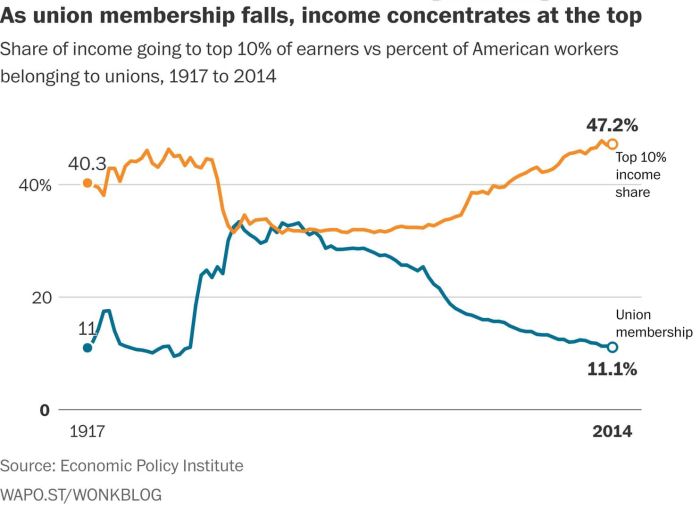
According to the Economic Policy Institute, when union membership goes down, the wealthy make more money! Conversely, the more union membership goes up, the less money goes to the wealthy!


6BILJESJ744BVLL2QVZYGJRNCM


And despite all that, the rich are concerned that I have the right to stop paying union dues!


I mean if I stop paying my dues and my fellow working stiffs stop paying their dues, then my union might just have to close up shop!


And that would mean my wages would go down!


But these same rich people who just sent me an email would see their investments go up!


They’d take home sacks of cash! So much money that they’d probably drop some and maybe I might be able to pick up a few pennies they leave on the curb!


Isn’t that great!?


You know public sector employees including firefighters and police, and teachers like me are the largest sector left of the workforce still represented by unions!


According to BLS statistics, 38 percent of public sector employees are represented by unions!


It’s true!


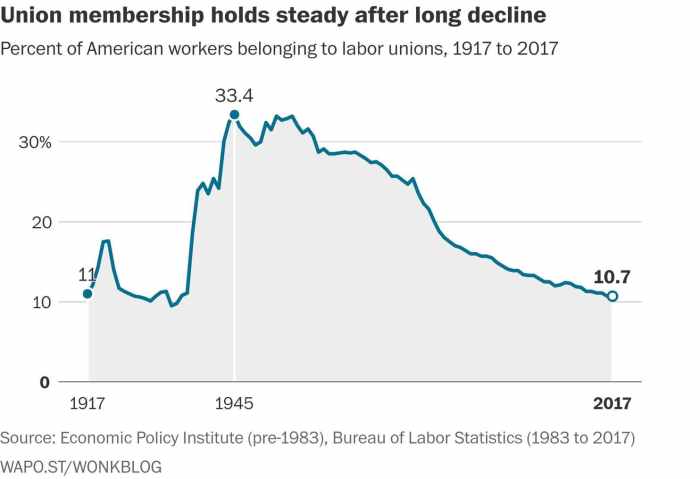
Back in 1945, union membership nationwide was at its highest rate of 33.4%! That means back then about a third of all American workers belonged to a union!


Last year it was down to 10.7 percent!


YC4GHPZ5MI5DHNQVM2TN4E4JZI


In the intervening years, manufacturing jobs have declined, blue collar jobs have been outsourced and both political parties have passed laws making it harder to unionize and collectively bargain!


But thank goodness I now have the right to get something for nothing from my union!


That’s going to perk things right up!


Sure, numerous studies have shown that declining union membership is one of the major causes why middle class wages have remained basically flat! But I get to keep a hundred bucks in my pocket so everything’s square!


One thing worries me, though!


I’m not sure many union workers are going to take advantage of this new freedom!


Don’t get me wrong – I don’t agree with everything my union does! No one could say that!


I don’t agree with everything my government does, either, but I still pay taxes!


And I wouldn’t stop paying taxes even if I could! I like being an American citizen, and I like much of what my government provides by way of our military, infrastructure and social programs!


It’s the same with my union!


I mean I LIKE earning higher wages! I LIKE getting better benefits! I LIKE knowing I work in a safe environment!


And when I have a better working environment, my students have a better learning environment!


I doubt many of my co-workers are going to stop paying their dues just because they can!


UWLMMCVEKY3ZFDE5K6LGDY42PE


We’re not stupid! We know that if you want union benefits, you have to pay union dues! The Supreme Court can say whatever it likes! It can’t legislate passed reality!


Moreover, who would want to associate with a co-worker who refuses to pull his or her own weight!?


If I found out one of my colleagues was leaving it to me to pay for both of us, I’d throw a fit! I wouldn’t associate with that person!


If he or she came to my room asking for advice, I’d tell them to get lost! I wouldn’t eat with them at lunch, I wouldn’t chat about their day, I’d give them their walking papers, myself!


Frankly, the social cost would be higher than just paying your union dues!


So thanks anyway, Mackinac Center! Thanks anyway, Charles and David Koch! Thanks anyway, Betsy DeVos!


I’m sticking with my union.


36468177_10156001729458860_2645036208874323968_n


Like this post? I’ve written a book, “Gadfly on the Wall: A Public School Teacher Speaks Out on Racism and Reform,” now available from Garn Press. Ten percent of the proceeds go to the Badass Teachers Association. Check it out!

WANT A SIGNED COPY?

Click here to order one directly from me to your door!


book-2


I Voted for Jill Stein. Was I Wrong?

jill-stein-green-placard


On November 8, 2016, I had a heart attack.


That’s not a metaphor.


I went to vote. I went to the doctor. I was sent to the hospital.


How much of that was a result of the Presidential election? I will never know.


But whenever I think back on that day, I am filled with a sense of bone-deep sadness.


After only a little more than a year in office, Donald Trump is already the worst President of my lifetime – and that’s saying something after the disaster that was George W. Bush.


Yet today our country is separating parents and children seeking asylum on the border and locking them away in detention centers. Nearly every cabinet secretary is an incompetent plutocrat put in office to dismantle the department in which they’re in charge. Meanwhile, Trump insults traditional allies and consorts with dictators all over the globe. And nationwide white supremacists of all stripes are emboldened, on the rise, and openly running for office.


I wish there is something I could do to go back in time and change the results of that day. I wish there was something I could do to stop Donald Trump from being elected President. And though I did not vote for her, I would do anything to have Hillary Clinton defeat him.


On that day, though, I voted for Jill Stein.


There’s nothing I can do about that now.


I imagine going back in time and telling myself not to do it. “Go vote for Hillary,” I imagine Future Me telling an ailing younger version.


Yet even now, I’m not sure if I’d say that to myself.


Go vote for Hillary? Would it have made a difference?


Factually, no. One more vote wouldn’t have put her over the top in my home state of Pennsylvania.


But I wrote articles advising readers to do like me and vote Jill Stein. Does that mean I’m responsible for every Stein vote cast in the Keystone state?


No, not really. I may have influenced some people. But I certainly didn’t influence them all.


I suppose the bigger question is this: did Stein spoil the 2016 election for Clinton?


Let’s look at some numbers.


In Pennsylvania, the results went like this:


Screen Shot 2018-06-20 at 10.21.41 AM
Source: New York Times.


Trump got 2,970,733 votes.


Clinton got 2,926,441 votes.


So he won the state by 44,292 votes.


Stein got 49,941 votes – 5,649 more than Trump’s margin of victory.


So if every Stein voter had cast a ballot for Clinton, she would have won the state – though she’d still lose the Presidency by 10 electoral votes.


But if the same process were repeated even in a few other swing states Clinton lost, the result would change. Clinton would have won and be sitting in the Oval Office right now.


Those are just facts. Or at least they’re facts manipulated in a game with counterfactuals.


If this had happened, then this other thing would have happened, too.


However, it is rarely so clear even with numbers.


For instance, Stein ran in 2012, too. She ran against Obama and Romney. She got 20,710 votes in Pennsylvania.


Screen Shot 2018-06-20 at 10.22.27 AM
Source: New York Times


That’s tens of thousands of Green voters who didn’t cast a ballot for centrist Obama. I don’t think it’s fair to assume they would have voted for centrist Clinton, either.


So if we subtract that 20,000 from Stein’s 2016 totals, (49,941 – 20,710) you get 29,231 new people who voted Green who didn’t do so in 2012.


That’s less than Trump’s margin of victory (44,292).


So even if every NEW Stein voter cast a ballot for Clinton, Trump still would have won the state.


The point?


I don’t think it’s factual or fair to assume Stein or Stein voters gave Trump the election.


If I had voted for Clinton, even if I had advised my readers to vote for her, the end result probably would have been the same.


These are the things I think about in the middle of the night when sleep won’t come.


Is there anything I could have done to change things? In trying to make things better, did I make things worse?


I don’t assume I have that much power – either way.


I’m just a school teacher with a blog.


And that’s why I voted for Stein.


Hillary Clinton made her name politically going against teachers unions. She and her husband have done quite a lot to weaken my profession and the school my daughter attends.


The national teachers unions may have supported her run for President, but they did so without fairly polling members. Her entire nomination process was marred by unfair and undemocratic practices by the Democratic Party that left many progressive voters who favored Bernie Sanders feeling left out and silenced.


I still think THAT more than any scribbling on my blog contributed to her loss.


Compared to Trump, Barack Obama was one of the best Presidents we’ve ever had. But compared to Trump, so was George W. Bush. So would be an inanimate carbon rod!


However, Obama was not particularly good for education. He and the corporate Democrats favored every anti-union, pro-privatization scheme they could. What a missed opportunity!


You’d think our first African American President might do something about school segregation – which has been on the rise in the last few decades. Instead, he helped make it worse by promoting charter schools. You’d think he might do something to stop the school-to-prison pipeline. Instead he helped lubricate it by championing high stakes standardized tests.


I think that’s another reason Clinton lost. Many of us were fed up with Obama’s neoliberal policies and wanted a candidate who might change course. Clinton promised only more of the same.


Don’t get me wrong. In retrospect, more of the same sounds lovely. Give me that old time Obama neoliberalism over Trump’s neo-fascism, any day!


But back in 2016 I thought we had a chance for something more – real hope and change. Was I wrong to vote for a candidate who promised to end high stakes testing and school privatization? Was I wrong to vote for a candidate who promised to fairly fund public schools, provide free college for all and end all student debt?


Maybe.


I suppose I should have been more frightened of Trump back then. But my anger at the Democrats who continually stabbed me and other progressives in the back outweighed my fear of this buffoon.


Perhaps I was wrong in that.


I don’t think it’s too much of an assumption to say we all underestimated Trump. We all underestimated how many people in this country would vote for him.


So was I wrong to vote for Jill Stein?


I still don’t know.


I’m sure many people will criticize me for this article. They’ll blame me for every horrible thing Trump does. If I have any point here, it’s that there’s plenty of blame to go around.


Perhaps we’d do better fighting against Trump than fighting amongst ourselves.


I still believe there is a silent majority of Americans for whom the status quo is unacceptable. Most of us don’t want a wall on our border – we want healthcare for all. Most of us don’t want families separated and undocumented immigrants scapegoated and rounded up – we want a path toward citizenship. Most of us don’t want our democracy subverted and the wealthy to have a greater say in our policies – we want freedom and justice for all.


We just need a way to find each other again. We need to find a way to look past any political, social, racial, gender or cultural differences and find a common humanity.


What better way to do that than in a common cause?


I hope you’ll join me by stopping the recriminations and take on the fight.


We may never fully solve the riddle that was the 2016 election.


There are political and social lessons to be had. But the most important thing is to remember the value of unity and to hold on to each other tight.


We’re all we’ve got.


Like this post? I’ve written a book, “Gadfly on the Wall: A Public School Teacher Speaks Out on Racism and Reform,” now available from Garn Press. Ten percent of the proceeds go to the Badass Teachers Association. Check it out!

WANT A SIGNED COPY?

Click here to order one directly from me to your door!

book-4