Charter Schools Will Always Waste Money Because They Duplicate Services

Screen Shot 2019-06-14 at 11.37.43 PM

 
You can’t save money buying more of what you already have.


Constructing two fire departments serving the same community will never be as cheap as having one.


Empowering two police departments to patrol the same neighborhoods will never be as economical as one.


Building two roads parallel to each other that go to exactly the same places will never be as cost effective as one.


This isn’t exactly rocket science. In fact, it’s an axiom of efficiency and sound financial planning. It’s more practical and productive to create one robust service instead of two redundant ones.


However, when it comes to education, a lot of so-called fiscal conservatives will try to convince us that we should erect two separate school systems – a public one and a privatized one.


The duplicate may be a voucher system where we use public tax dollars to fund private and parochial schools. It may be charter schools where public money is used to finance systems run by private organizations. Or it may be some combination of the two.


But no matter what they’re suggesting, it’s a duplication of services.


And it’s a huge waste of money.


Consider the case of my home state of Pennsylvania.


Charter schools cost Commonwealth taxpayers more than $1.8 billion a year and take more than 25 percent of the state’s basic education funding – yet they only enroll about 6 percent of students.


Just imagine – 94% of Pennsylvania students lose out on opportunities because we’re allowing so much money to be siphoned off for a small fraction of students.


The Keystone state only has 179 charter schools enrolling 135,100 students – the sixth highest charter enrollment in the country. Of those, about a fourth are online cyber charters.


Is it fair to Ma and Pa Taxpayer that they are forced to bear the extra burden of reproducing these services for a handful of students?


And make no mistake. This is one of the leading causes of property tax increases in the state.


The ideology of some results in a direct hit to everyone’s pocketbooks.


According to a recent report by the Pennsylvania Association of School Business Officials (PASBO), “Charter school tuition is one of the largest areas of mandated cost growth for school districts.”


The report found that state charter schools are growing at a rate of 10 percent a year. The PASBO calculates at least 37 cents of every new dollar of property taxes in the fiscal year 2017-2018 went right to charters. And that percentage is only expected to grow.


Part of this is due to a blind, deaf and dumb state legislature that no longer does anything to help alleviate these costs to local school districts. Neighborhood schools can only try to compensate by cutting services for students where it can and raising property taxes where it can’t make ends meet.


More than one third of school superintendents surveyed by PASBO report a worsening financial picture in their districts—and they put the blame on charter schools.


“With the state providing no state support for mandatory charter school tuition costs,” the study says, “the increases in this single budget item have the potential to decimate school district budgets.”


Part of this is the extremely unfair way the state determines how much money to give charter schools.


The legislature has constructed a funding formula that gives every advantage to charter schools while short changing authentic public schools at every turn.


For instance, as Jeff Bryant puts it in his article “The Charter School ‘Dumpster Fire’ in Pennsylvania Provides an Important Lesson for 2020 Democratic Candidates”:


“Charter school tuition charged to Pennsylvania public schools is calculated as if charters had to provide the same services public schools have to provide, such as transportation—they don’t. Also, the tuition bill public schools pay to charters is calculated as if every student cost the same to educate—they don’t.


Instead, the state requires authentic public schools to pay charters way more than authentic public schools get to educate the children in their care – and state law even allows charter operators to pocket the savings as profit.


But this just pours lighter fluid on Bryant’s already raging “dumpster fire.”


Even if Pennsylvania was entirely equitable in how it allocated funding between these two types of school, it would still be wasting our tax dollars because it would still be engaged in duplication of services.


There is simply no good reason to do this. At least, not if providing the best education to students is our goal.


There are few places in the entire country – if any – where charter schools are able to accommodate all students. They cater to nitch markets where operators expect they can turn a profit. There are essentially no communities with a charter school and no authentic public school but many where you find just the opposite.


Moreover, the quality of education provided at charter schools does not live up to the hype of its advertising.


Except in extremely rare circumstances, charter schools have never been shown to provide better outcomes than authentic public schools. Almost every study conducted – even those funded by the school privatization industry – show that these two types of schools produce similar results or in many cases that authentic public schools are much better.


And this despite the fact that such studies are already stacked in charter schools favor because unlike authentic public schools, charter schools often have selective enrollment. A school that gets to cherrypick the best and brightest students has an incredible advantage over those that can’t – yet even with such an uneven starting point charter schools rarely show large academic gains.


For instance, a recent study of charter school students in Pennsylvania conducted by the school privatization friendly Center for Research on EDucation Outcomes (CREDO), found that charter students do about the same on reading exams but score worse in math than students in authentic public schools. The study also found major disparities between charter schools – with cyber charters performing especially poorly.


However, this study’s methodology has been called into question suggesting that even its meager praise of charter schools may be exaggerated. Yet the overall results are in-line  with previous research that also found charter schools in the state generally  produce students who aren’t as prepared as authentic public school students.


Pennsylvania passed its charter school law in 1997.


It’s way passed time for lawmakers in this state and beyond to acknowledge that was a mistake.


We cannot continue to force voters to pay for a supply-side ideology that not only has been disproven through decades of data but that many do not share.


That is why we have charter and voucher schools – a prejudice against authentic public education and desire to allow businesses to cash in on education dollars.


The duplication of services has nothing to do with helping students learn.


It’s about creating a slush fund for unscrupulous corporations and hangers on to get easy cash.


No true fiscal conservative can support charter schools.


Just as no one who values children can continue to justify this economic double vision.


Like this post? I’ve written a book, “Gadfly on the Wall: A Public School Teacher Speaks Out on Racism and Reform,” now available from Garn Press. Ten percent of the proceeds go to the Badass Teachers Association. Check it out!

cropped-book-1.jpg

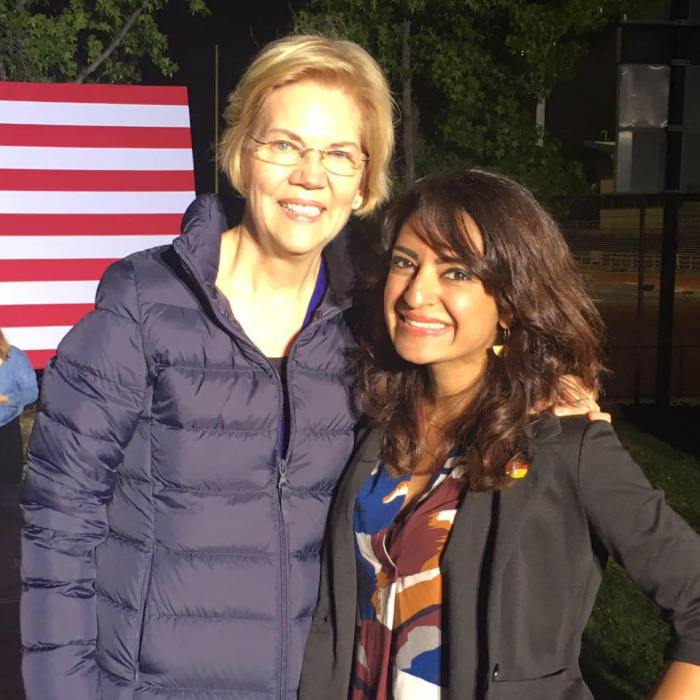
Charter School Teacher Introduces Elizabeth Warren at Rally

61665090_10109374029691176_8067465538567143424_n


CORRECTION:

In the first draft of this article, I called Sonya Mehta a “Charter School Lobbyist” in the title. On further examination of the facts, I realize this is unfair. She was a charter school TEACHER. I apologize to Ms. Mehta and truly regret any harm I have done her. I have changed the title to better reflect the facts. However, be advised that the text of the article, itself, has remained almost completely unchanged. Everything in the article is true to the best of my knowledge and backed up with sources that the reader can see by following the links in the text. My concern remains centered on Warren and what exactly her intentions are via education policy.


The biggest news from Elizabeth Warren’s rally in Oakland, California, on Friday wasn’t what she said.

 
It was who introduced her and what that says about Warren and her 2020 Presidential campaign.

 
According to the San Francisco Chronicle, “Warren was introduced by Sonya Mehta, a former Oakland schoolteacher.”

 
However, this characterization is inaccurate.

 
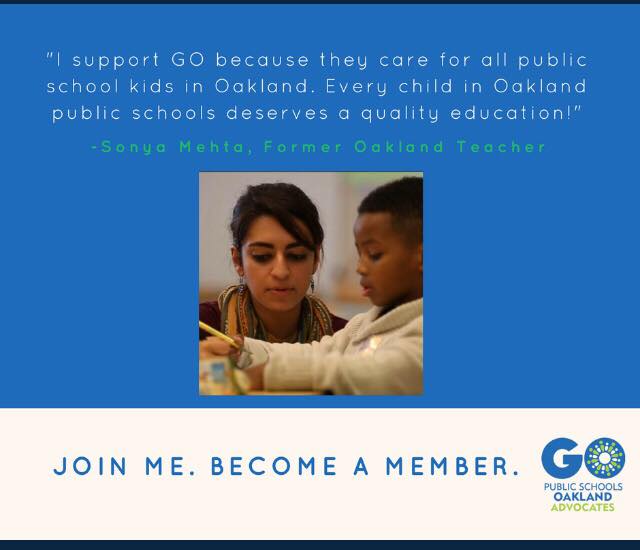
Mehta was not an authentic public school teacher. She taught in a non-union charter school called “Learning Without Limits.” She also was a policy fellow at GO Public Schools Oakland, which is a toxic charter promoter focused around that city.


62239250_2491072120944114_6527485798902661120_n

62044390_2491072744277385_2756662503386644480_n

 
In her introduction, Mehta didn’t explicitly advocate for school privatization. She promoted Warren’s early education and free college policies (Her speech can be seen here beginning at 57:30). But why would Warren, one of the smartest and most knowledgeable candidates in the race for the White House, let herself be associated with such a divisive and toxic legacy?


Only 6% of all U.S. students attend charter schools, yet with little accountability, selective enrollment, and the ability to pocket taxpayer money as profit, they cannibalize the funding necessary for the 90% that attend authentic public schools.

 
Warren should know better than this. Along with Bernie Sanders, Warren sits on the Senate Education Committee (HELP – Health, Education, Labor, Pensions).


So the question is this: was this a mistake made by her campaign staff or is this indicative of where Warren is on education policy?


She has said some very positive things in this campaign, not the least of which is that if elected, she would nominate someone with teaching experience as Secretary of Education.

 
But if Mehta is what she thinks an authentic teacher looks like, we are in big trouble.

 
We don’t need another Betsy Devos or Arne Duncan clone who just so happens to have taught at a regressive charter school. In fact, we already had that, too, in John King.

 
Sadly, that’s not even where the story ends.


Warren’s senior education policy advisor is Josh Delaney, a Teach for America temp who turned a 5-week crash course in education into two years in the classroom and then a career as an “expert” on our schools.

 
This is simply not acceptable for anyone courting education voters.

 
You can’t go to Oakland, a city which just experienced a massive teacher strike caused by school privatization, and then let yourself be introduced by someone with ties to school privatization!

 
Go Public Schools Oakland, the organization Mehta is associated with, is the major charter organization in city battling the union.

 
Who knows if Warren was intending to take sides on this issue, but she certainly seems to be signaling that if she did, it might not be with parents, teachers and students. It could be with the hedge fund billionaires backing school privatization.

 
How can she be so strong against these same people when it comes to Wall Street and economic inequality but appear completely ignorant (at best) or disingenuous (at worst) when it comes to school policy?

 
A look at Warren’s stated education policies over her history in public life doesn’t exactly calm the waters, either.


According to the Network for Public Education, Warren holds some regressive views when it comes to our schools.


The non-profit gives her a C on charter schools.


She has spoken out against some of the worst excesses of the industry, but supports the concept of schools that are publicly financed but privately operated.


In 2016 Warren strongly opposed lifting the cap on charter schools in Massachusetts. In 2017, Senator Warren expressed deep concern regarding the “waste, fraud, and abuse of federal money” at the hands of for-profit charter schools and charter school management organizations.


Unfortunately, she also praised the charter industry:


“Many charter schools in Massachusetts are producing extraordinary results for our students, and we should celebrate the hard work of those teachers and spread what’s working to other schools.”

 
Warren earned a B for her stance on school vouchers.

 
She had the courage to criticize DeVos, but her history with the concept of using public money to finance private education is complicated.

 
In a 2017 letter to DeVos, prior to her confirmation as Secretary of education, Senator Warren said the evidence on private school vouchers is “mixed at best” and called them “expensive and dangerous failures that cost taxpayers billions of dollars while destroying public education systems.”


However, back in 2003, she seems to have thought differently. She wrote a book with her daughter called “The Two-Income Trap: Why Middle-Class Mothers and Fathers are Going Broke.” In it, she makes a case for a universal school voucher program. She strongly supported giving parents taxpayer-funded vouchers they could use at any school – public, private or parochial. This would “relieve parents from the terrible choice of leaving their kids in lousy schools or bankrupting themselves to escape those schools.”


Later she said she never meant those vouchers to be used at private schools, but that is  unclear from the text.


However, as spotty as Warren’s history is on school privatization, it is much worse when it comes to high stakes testing.


The Network for Public Education gives her a F on this issue.


In 2015, as Congress debated rolling back high stakes testing requirements that have unfairly assessed students for decades and used test scores as an excuse to deny poor and minority students the resources they need to succeed, Warren demanded testing stay in place. Along with three Democratic senators endorsed by Democrats for Education Reform (DFER), a lobbyist organization for the testing and school privatization industry, she insisted on stronger accountability measures based on testing to gain their support for the Every Student Succeeds Act (ESSA).


Let me be clear: none of this is intended to be a purity test.


If the only candidate we can support is a perfect one, we will never find any politician to support.


But Warren has to make a decision whose side she is on.


At very least, she needs to come out and make a public statement clarifying her views here. She needs to say that she does not support charter schools or vouchers. Shouldn’t every Democratic candidate who wants the votes of educators do that?


Watch the whole rally here. Mehta’s introduction begins at 57:30.


Like this post? I’ve written a book, “Gadfly on the Wall: A Public School Teacher Speaks Out on Racism and Reform,” now available from Garn Press. Ten percent of the proceeds go to the Badass Teachers Association. Check it out!
thumbnail_IMG_8249

The Best School Innovation Would Be More People

thumbnail_o-TEACHER-COLLABORATION-facebook


Public schools thrive on innovation.


In nearly every classroom around the country you’ll find teachers discovering new ways to reach students and foster skills, understanding and creativity.


But if you pan out to the macro level, the overwhelming majority of innovations aren’t organic. They’re imposed on us by bureaucrats and functionaries from outside the classroom:


Education Technologies.


School privatization.


Standardized tests and Common Core.


For the last two decades, these are the kinds of innovations that have been forced on public schools at gun point.


And each and every one of them is pure bullshit.


They are corporate schemes written by the wealthy to cash in on education dollars for themselves. Big business hands them out to their paid political lapdogs to push through our state and federal legislatures to become laws and policies the rest of us have to obey.


They have nothing to do with helping students learn. Their purpose is to boost profits.


Just look at the difference between the ways the word innovation is defined.


Merriam Webster says the word signifies “the introduction of something new” or  “a new idea, method, or device: Novelty.”


But BusinessDictionary.com finds a tellingly distinct meaning:


“The process of translating an idea or invention into a good or service that creates value or for which customers will pay.”


It is that second business-friendly definition that has dominated our schools and narrowed our view until the only concept of advancement and revolution has been centered exclusively on the profit principle.


It is time to put a stop to all of it.


No more useless iPads, apps, software and so-called “personalized” educational technologies that do little more than allow marketers to steal student data and profit off of a new form of school where everything can be provided by technology at a cost while the quality of services takes a nosedive. No more technology for technology’s sake instead of using it as a tool to promote authentic learning.


No more laughable charter and voucher schools where education budgets become slush funds for corporations who don’t have to provide the same standard of services to students or the community. No more operating without  transparency or accountability.


No more outmoded and disproven standardized tests. No more canned academic standards that strip classroom educators of autonomy while reducing effective teaching behind a smoke screen of test scores that merely conflate the economic situation students live in with their academic abilities. No more corporations creating bogus multiple choice assessments whose only utility is to demonstrate how many more test prep materials we need to buy from the same company or industry.


It’s too bad we’re not interested in that FIRST definition of innovation, or at least innovation tied with the motive of providing quality education for children.


If we were interested in that kind of real, authentic school reform, we would focus on things that really matter. And chief among those would be one main thing, one major innovation that would be easy to accomplish but could change the fabric of our schools from top to bottom – people.


After all, that is what our public schools need the most – more people.


Have you walked into a public school lately? Peak your head into the faculty room. It’s like snatching a glance of the flying Dutchman. There are plenty of students, but at the front of the overcrowded classrooms, you’ll find a skeleton crew.


Today’s public schools employ 250,000 fewer people than they did before the recession of 2008–09. Meanwhile enrollment has increased by 800,000 students. So if we want today’s children to have not better but just the same quality of services kids received in this country only a decade ago, we’d need to hire almost 400,000 more teachers!


Instead, our children are packed into classes of 25, 30 even 40 students!


And the solution is really pretty simple – people not apps. Human beings willing and able to get the job done.


If we were fighting a war, we’d find ways to increase the number of soldiers in our military. Well, this is a war on ignorance – so we need real folks to get in the trenches and win the battle.


We need teachers, counselors, aides and administrators promoted from within and not functionaries from some think tank’s management program.


We need more people with masters or even more advanced teaching degrees – not business students with a three-week crash course in education under their belts who are willing to teach for a few years before becoming a self-professed expert and then writing education policy in the halls of government.


We need people from the community taking a leadership role deciding how our schools should be run, not simply appointing corporate lackeys to these positions at charter or voucher schools and narrowing down the only choices parents have to “Take It” or “Leave It.”


We need people. Real live people who can come into our schools and do the actual work with students.


And that means money. It means cutting the crap boondoggles to corporations and spending on flesh and blood reform.


It means fixing the funding inequality at the heart of nearly every public school in the country. No more spending tens or hundreds of thousands on wealthy students and merely hundreds on poor ones. No more dilapidated school buildings for the poor and palaces for the rich. No more socialistic pulling together for the wealthy and rugged individualism for the poor.


THIS is how you solve our education crisis – a crisis not caused by falling test scores or failing schools. A crisis caused by vulture capitalists preying on our educational institutions and our students as if they were some bloated carcass on the side of the road and not our best hope for the future.


It’s really that simple.


It’s a matter of ideology based on empiricism not “common sense” Laissezfaire maxims of “This is how we’ve always done it.”


We’ve been trying so-called corporate education reform for decades now – through Bush and Obama and now Trump. It doesn’t work.


It’s time we stopped making excuses for failing policies and got back to the best thing that works.


People.


Like this post? I’ve written a book, “Gadfly on the Wall: A Public School Teacher Speaks Out on Racism and Reform,” now available from Garn Press. Ten percent of the proceeds go to the Badass Teachers Association. Check it out!

book-2

Let Voters Fix Harrisburg School Board – Not State Takeover

thumbnail_milwaukee_school_takeover-e1452175291470

Pushing the self-destruct button is the ultimate measure of last resort.


But that’s how several Pennsylvania lawmakers are suggesting we fix the dysfunctional Harrisburg School Board.


An election that could oust most of the very school directors responsible for the district’s troubles is less than a month away. But Democratic Representative Patty Kim, Republican Senator John DiSanto and Harrisburg Mayor Eric Papenfuse all say we shouldn’t wait – The state should takeover the Harrisburg School District immediately.


This would effectively destroy all democratic government in a district located in the state capital.


While senators and representatives from all over the Commonwealth work to enact the will of their constituents from Pittsburgh to Philadelphia, residents at city schools a few miles away would be robbed of their own voices.


Under state law, if the district were put into receivership, a court-appointed receiver would assume all the functions of a locally elected school board, except the power to raise and levy taxes. This appointee would effectively take charge of the district’s personnel and finances.


Oversight and public input essentially would be repealed. The receiver could do whatever he or she liked and there’s little anyone could do about it.


It’s a bad idea anywhere, though one can understand why state lawmakers have suggested it here.


Harrisburg Schools are a mess, and it’s largely because of the inept leadership of Superintendent Sybil Knight-Burney and five of the nine-member school board who consistently support her every move.


Declining academic performance, high teacher turnover rates, and poor fiscal management – all are hallmarks of the way Harrisburg schools have been run.


The state even suspended more than $10 million in funding to the district after the board voted not to cooperate with an audit requested because of allegations administration had mismanaged federal grant funds.


But the district’s problems begin before the school board even enters into the picture.


Like nearly every urban district in the Commonwealth, Harrisburg has a history of being neglected and underfunded. One estimate puts the Harrisburg shortfall between $35 million and $38 million a year.


That’s why the district is already under a state-mandated recovery plan. It serves a poor community whose tax base simply cannot support the needs of its own children. Like other impoverished schools, the administration and board are required to work with a recovery officer.


This recovery plan has not miraculously fixed the district’s problems. It’s magical thinking to suppose that a court-appointed receiver would do any better.


If the state wants to help, it should provide equitable and sustainable funding. However, it is completely reasonable that state lawmakers wait until responsible adults have taken back the school board first.


A citizen-led school reform group called CATCH (Concerned About the Children of Harrisburg) has been pushing to oust the incumbents who have consistently supported the administration’s disastrous decisions, most of whom are up for re-election.


There are nine board members. Five invariably vote with the administration: Danielle Robinson, Ellis Roy, Lola Lawson, Patricia Whitehead-Myers, and Lionel Gonzalez.


Three unfailingly vote against the administration: Brian Carter, Judd Pittman and Carrie Fowler. There is one wild card: Joseph Brown, who was just appointed to take a vacant seat on the board this month and has mostly abstained from voting.


Of these, Brown and all of those supporting the administration but Robinson are up for re-election.


To flip these seats on the board CATCH is pushing for Gerald Welch, Doug Thomson-Leader, Steven Williams, and Jayne Buchwach. The local teachers union, the Harrisburg Education Association (HEA), and the local chapter of The American Federation of State, County and Municipal Employees (AFSCME) endorsed all of them and an additional one – James Thompson.


If even two of the newcomers are elected, that will shift the balance of power away from those who have enabled an administration infamous for irresponsible errors and neglect purchased at the expense of personal favors to weak willed school directors.


This includes an accounting error that kept 54 former employees on its healthcare plan, an investigation into improper grading allegations at one of its high schools, rapid teacher turnover, and falling student test scores. Administrators haven’t even presented a budget for the 2019-20 school year yet!


Meanwhile, this same quintet of school directors rewarded administration by reappointed Superintendent Knight-Burney last spring, hiring controversial attorney James Ellison as solicitor despite a record of fraud, lawsuits and delinquent taxes, and three times refused to fill Melvin Wilson’s vacant board seat with a candidate who had broad public support and instead punted the decision to the courts.


Despite an almost laughable record of corruption in the district, voters have a chance to change course in less than a month.


All of the reform candidates are Democrats so the matter could be settled by the May 21 primary.


It would be beyond absurd for the state to step in and deny the public the right to correct its own ship.


However, though new candidates could be elected in a matter of weeks, they wouldn’t be sworn in until December. So even under the best of circumstances, city schools would remain under the dysfunctional board for the foreseeable future.


That’s not good. There’s a lot of damage a lame duck board could do in that time. However, the alternative of receivership is worse.


Once you take away a school district’s right to govern itself, it’s hard to get it back again. Plus there is no guarantee that appointed bureaucrats will do a better job. In fact, they rarely do.


Education Secretary Pedro Rivera has remained silent on the issue of receivership. But in a recent statement he said his department “will consider all actions allowable by law” to guide the district through a financial recovery plan.


Here’s hoping that democracy is allowed to flourish in the capital of Pennsylvania.


Like this post? I’ve written a book, “Gadfly on the Wall: A Public School Teacher Speaks Out on Racism and Reform,” now available from Garn Press. Ten percent of the proceeds go to the Badass Teachers Association. Check it out!
thumbnail_IMG_8249

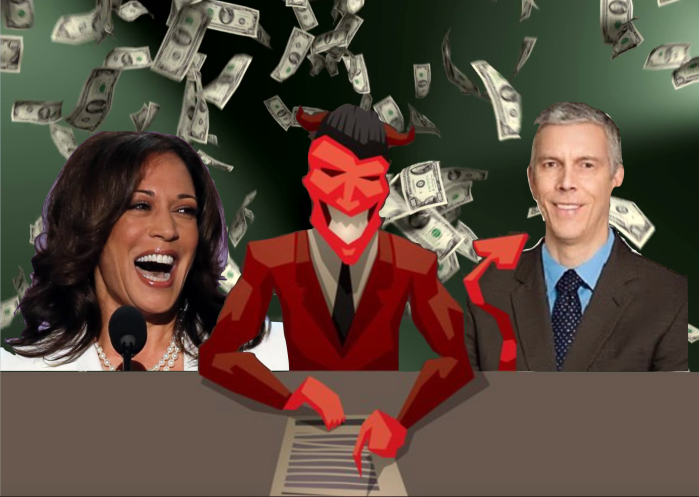
Sell Your Soul to the Testocracy: Kamala Harris’s Faustian Teacher Raises

Screen Shot 2019-03-27 at 7.03.07 PM

 
I love the idea of Kamala Harris’ plan to give teachers a pay raise.
 

But once we get past ideas, it’s way more troubling.


The California Senator and Democratic Presidential hopeful is proposing a $13,500 pay increase for the average teacher, with the exact number based on the size of each state’s pay gap.
 

That’s $315 billion more over a decade through federal matching funds, which amounts to a 23 percent salary increase for most educators.


Yes, please!

 
I could certainly use a raise.
 

But as Joe Moore said, “You can’t trust a promise someone makes while they’re drunk, in love, hungry, or running for office.”

 
And Harris IS running for office.


With this policy she’s wooing the national teachers unions and filling the neoliberal seat left by Hillary Clinton in 2016.

 
I love my union, but its leadership is like a college kid during spring break – ready to jump into bed with anyone who says the right words.
 

The fact of the matter is this plan also is favored by the people out to destroy my profession from the inside out.
 

Arne Duncan likes it.
 

Yes, THAT Arne Duncan!

 
Obama’s first Education Secretary. The guy who thought Hurricane Katrina was the best thing to happen to New Orleans because it allowed the government to close the public schools and replace them with charter schools.

The man who held federal grant money hostage unless schools enacted his unproven and disastrous corporate driven education reforms.


The man who encouraged pushing out teachers of color who had four year education degrees in favor of mostly white Teach for America temps with a few weeks crash course training.


The man who encouraged a rapid increase in high stakes standardized testing, narrowed curriculum, let class sizes balloon and decreased authentic lessons.

 
THAT Arne Duncan wrote this about Harris’ plan on Twitter:


“Radical idea: pay the professionals we entrust to teach, nurture and mentor our children a better salary!”


Screen Shot 2019-03-27 at 7.53.10 PM

 
How to reconcile the two?


I draw your attention to what he said on a recent book tour:


“If we were willing to invest in high-quality early childhood education, if we’re willing to pay great teachers and great principals significantly more, the benefits to our society, the benefits to our economy, the benefits to our democracy I think would be extraordinary…

[But] Money is never enough. So you’ll never hear me say, it’s only about money. For me it’s always about your high expectations as well as high support. And we have to hold ourselves accountable for great results. When schools aren’t working, we have to be willing to challenge the status quo. So investment is part of it, but high expectations have to go with that, and we have to hold ourselves accountable as educators for results, absolutely.”


So for Duncan this plan is entirely consistent with corporate education reform.


In fact, it makes sense as a continuation of those policies.


When privatization cheerleaders like Duncan talk about “high quality teachers” and “accountability” what they really mean are strings attached.


In this case, they probably mean merit pay – giving bonuses to teachers whose students get high test scores.


It’s a terrible idea because it encourages bad behavior from teachers, administrators and districts, which in turn hurts kids.


Having all your teachers fight over the rich white kids who get the highest test scores doesn’t help the struggling students. It just means fewer educators will want to teach the underprivileged because they can’t take the financial hit that comes with it.


The result is test prep all day, every day.


I want a raise, but not if it means I have to bastardize my own profession down to that!


And it’s not just Duncan who loves this idea.


Catherine Brown, a senior fellow at the Center for American Progress (CAP), actually helped Harris write this proposal.


“It could be transformative in terms of how we think about elevating and modernizing the teaching profession and the federal role in doing so,” Brown said.


CAP is a neoliberal think tank that worked closely with the Obama and Clinton administrations. And Brown is also the co-author of “The Progressive Case for Charter Schools”.


Any plan to raise teacher salary that is consistent with increased privatization is inherently suspect.


You can’t champion authentic public schools and public school teachers while also pushing for more institutions run without the same transparency, democratic government, and enrollment standards. If you think schools should be able to cherrypick which students to accept, they should be run by appointed bureaucrats, and it’s fine to cut student services while pocketing the profits, you aren’t a friend of public education.


In an article she co-wrote published by CAP called “Fact Sheet: Yes, Increase the Salaries of All Teachers,” she made it clear that merit pay is a good idea.


She wrote:


“…there is still debate surrounding whether all teachers need a raise, or if it is enough to make changes for a select group of teachers through differentiated or merit-based pay. While differentiated and merit-based pay can help alleviate some specific teacher shortages, such as those in subjects or schools that are high-needs, they are not a substitute for higher base pay.”


Ultimately, Brown comes out in favor of an across the board salary increase for teachers, but in her view merit pay is part of that solution.


This is a backdoor for the same snake oil the privatizaters have been selling for years.


As education blogger Peter Greene points out, the language used in Harris’ proposal is right from the neoliberal playbook. It is full of the same euphemisms and code words that have signaled school privatization, high stakes testing and merit pay.


Consider this gem:


“Every child deserves a world-class education, regardless of their ZIP code. Of all in-school factors that impact their success, there’s nothing more important than our teachers.”


“World class education” and  “regardless of ZIP code” mean charter schools galore. And the only “success” these folks are interested in is high test scores.


Or this:


“Our plan will include a multi-billion dollar investment in programs that help elevate the teaching profession and support principals and other school leaders. This includes high-quality teacher and principal residencies early-career induction programs that pair new teachers with mentors and master teachers, career ladder models that allow for advancement opportunities for teacher leaders, and “Grow Your Own” programs that help increase teacher diversity.”


Greene says that the term “Career ladders” is a red flag because it usually denotes career stagnation. It’s code for adding more duties and responsibilities on teachers without actually furthering their careers.


If I’m honest, these are all red flags.


As much as I want a raise, I’m doubtful Harris’ plan would actually accomplish much other than selling my soul to the testocracy.


Ultimately that’s what this is – a Faustian bargain.


We need to invest in greater per pupil spending and let that translate into higher teacher salaries.


We need equitable and sustainable funding formulas that aren’t tied to testing or that don’t open the door for privatization.


And most of all, we need an understanding of the real challenges in education and not a piece of parchment where teachers are supposed to sign in blood.


Like this post? I’ve written a book, “Gadfly on the Wall: A Public School Teacher Speaks Out on Racism and Reform,” now available from Garn Press. Ten percent of the proceeds go to the Badass Teachers Association. Check it out!

book-1

Betsy DeVos’s Right Wing School Indoctrination Program

Betsy DeVos

 
What do you do when thinking people reject your political ideology?

 
You get rid of thinking people.

 
That’s Betsy DeVos’ plan to rejuvenate and renew the Republican Party.

 
The billionaire heiress who bought her position as Donald Trump’s Education Secretary plans to spend $5 billion of your tax dollars on private, religious and parochial schools.

 
This would be federal tax credits to fund scholarships to private and religious institutions – school vouchers in all but name.


It’s a federal child indoctrination program to ensure that the next generation has an increasing number of voters who think science is a lie, white supremacy is heritage and the Bible is history – you know, people just gullible enough to believe a reality show TV star who regularly cheats on his many wives with porn stars is God’s chosen representative on Earth. A measure to make child kidnapping, imprisonment and wrongful death seem like a measured response to backward immigration policy. A measure to make collusion and fraternization with the world’s worst dictators and strongmen seem like global pragmatism.

 
To make matters even more galling, consider the timing of DeVos’ proposal.


In the beginning of February, Donald Trump Jr. criticized “loser teachers” who he said were indoctrinating school children into – gasp – socialism.

 
At the end of that same month, DeVos proposed funding Christian madrasas from sea-to-shinning-sea.

 
Apparently indoctrination is just fine for conservatives so long as it’s the right kind of indoctrination.

 
But even beyond the blatant hypocrisy, this betrays a fundamental misunderstanding of the differences between public and private schools.

 
Florida’s GOP Governor Ron DeSantis tweeted that if a school receives public funding – whether it be a charter or voucher institution – it is a public school.

 
To which DeVos tweeted her glowing approval.

 
This makes a few things strikingly clear: either (1) these folks have no idea what happens at authentic public schools or (2) they’re pretending not to know so as to further their political and financial ambitions.

 
Authentic public schools do not indoctrinate children into socialism or any other ideology.

 
They’ll teach what socialism is and how it has functioned historically without commenting on its merits or deficiencies. It’s up to individual students to decide whether it’s a good thing or not.

 
Public schools are supposed to be ideologically neutral.

 
At most, they teach children how to think. They teach media literacy, skepticism and critical thinking skills.


If that leads kids away from Republican orthodoxy, it’s not the fault of the teacher or the child. It’s a problem with your orthodoxy.

 
You can’t proclaim the benefits of a marketplace of ideas and then decry that too many ideas are on display.

 
Nor can you conflate the way a school is funded with what that school actually does and how it teaches.

 
There is a world of difference between authentic public schools and their market based alternatives – especially the parochial and religious variety.

 
It’s the difference between telling students the answer and getting them to think about the answer. It’s the difference between total certainty and doubt, between trite truths and useful skills that can help you arrive at deeper truths.

 
When you ask children to think, you never know what conclusions they’ll draw. When you tell children what to think, you know exactly what conclusions you want them to hold.


Authentic public schools do not indoctrinate. Conservatives graduate from these hallowed halls the same as liberals, moderates and the politically checked out. The difference is that in a world where facts are prized and logic is exercised, conservatism becomes less appealing.


I’m not saying liberalism or progressivism is guaranteed, but they are certainly more fact-based world views than their opposites.

 
The same cannot be said of the kinds of institutions DeVos wants to bankroll.

 
They educate kids behind closed doors with little to no transparency for the public about how their money is being spent. But word seeps out of the cracks in the system.

 
We’ve seen the textbooks they use to teach. Their graduates have returned to the public square to tell us about the instruction they received.

 
The American Christian Education (ACE) group provides fundamentalist school curriculum to thousands of religious schools throughout the country. Included in this curriculum is the A Beka Book and Bob Jones University Press textbooks. A Beka publishers, in particular, reported that about 9,000 schools nationwide purchase their textbooks.


In their pages you’ll find glowing descriptions of the Ku Klux Klan, how the massacre of Native Americans saved many souls, African slaves had really good lives, homosexuals are no better than rapists and child molesters, and progressive attempts at equal rights such as Brown vs. Board of Education were illegal and misguided. You know – all the greatest Trump campaign hits!

 
We should not be funding the spread of such ignorance.


Frankly, DeVos’ ambitions have little chance of coming to fruition.

 
Two years ago, when Republicans controlled both houses of Congress, she wanted to spend $20 billion on the same nonsense. Her party refused to back her.

 
Now with Democrats in control of the House, it seems even more unlikely that her plan will pass.

 
But sadly smaller scale versions of it have been allowed by state legislatures throughout the country – often with full support from Democrats.

 
My own state of Pennsylvania spends $125 million in taxpayer dollars on the Educational Improvement Tax Credit (EITC) and Opportunity Scholarship Tax Credit (OSTC) programs to send children to private/religious schools. And every year legislators ask for more.


Why any Democrat would support conservative indoctrination programs is beyond me.

 
And this is true even though indoctrination is sometimes unavoidable.

 
To a limited degree, it may even be desirable. You might even say it’s a normal part of growing up.


Even the most fair-minded parents often want their children to hold at least some of the same values as they do. They want to be able to relate to their kids and view them as a continuation of the kinds of lives they lived.

 
But what’s okay for parents is not okay for governments.

 
If Mom and Dad want their kids to have a Biblical education, they should pay for it. The burden should not be shouldered by society since it’s not in society’s interest.

 
Governments have no right taking public money and using it to prop up private interests. And that’s exactly what this is.

 
It is political and religious interest. It is a way to circumvent skepticism and free thought.

 
It’s a way to ensure that in a time where information flows freely and dogmas crumble, people like Donald Trump continue to be elected.


Still can’t get enough Gadfly? I’ve written a book, “Gadfly on the Wall: A Public School Teacher Speaks Out on Racism and Reform,” now available from Garn Press. Ten percent of the proceeds go to the Badass Teachers Association. Check it out!
book-2

Tying Kids’ Lunch Money to Test Scores? It’s No Crueler Than High Stakes Testing

Screen Shot 2019-02-22 at 9.06.34 PM


UPDATED


Most people agree that the best way to get kids to read isn’t by threatening to take away their lunch.

 
But an Arkansas state Representative is threatening to do just that – sort of.


Rep. Alan Clark, a West Memphis Republican, proposed a bill that would cut “Lunch Funding” for impoverished children in state schools where students struggle with standardized reading tests.


However, he’s not proposing we take away kids’ food.


If passed, the bill would reduce a district’s National School Lunch funding – a state mechanism that distributes extra resources to schools with high concentrations of students who qualify for free lunch programs – if student test scores don’t rise over a period of time. This would cut things like professional development and tutoring.


However, this has been confused with the federal program of the same name and drawn almost universal condemnation.


“I would never starve kids,” Clark said. But he would starve their schools of resources.


Either way, his proposal is obviously unfair.


Only a monster would think you can incentivize reading comprehension by threats and coercion.


It’s like saying “You’d better understand this complex puzzle OR ELSE!


Learning doesn’t work that way.


But Clark sees things from a different perspective – that of business and industry. He told KTHV, a state television network:


“In most businesses I would be laughed at for suggesting such a small goal. But sadly many educators act like I have asked them to storm the beaches at Normandy… It appears I have much more faith in our schools than many of our educators do.”


This is what happens when you elect people without empathy or intelligence to public office.


I wonder if Clark would do a better job representing the people of his state if they threatened to lower his salary based on his popularity polls.


It says a lot about us that people react so viscerally to the inaccurate idea that Clark is suggestion we withhold food from bad test takers. That’s unthinkable. But it isn’t really that much more cruel than the way we actually treat students.


Our entire federal education policy is based on just such inhuman treatment of children.


After all, we still hold kids, schools and teachers “accountable” by student test scores. The consequences though aren’t an empty belly. They’re crowded classrooms and fewer tutors.


In every state of the union, students are required to take high stakes standardized tests in reading and math. If they don’t do well, we take away their resources.


Sure, we don’t deny them food, but we deny them many other things they need to learn.


We lower funding to their schools so that they have larger class sizes, fewer teachers, narrowed curriculum, etc. We threaten to withhold their diplomas and any chance of ever earning more than minimum wage. In many cases we tie teachers salaries, reputations and even employment to these same scores. Sometimes we even take away their parents right to govern their children’s schools so that all administrative decisions are made by state flunkies. Or we force their authentic public schools to become charter institutions so that spending decisions happen behind closed doors without accountability and even whether a student can enroll or not becomes a decision of the private management company and not simply something that is the students’ by right of living in the district.


It may not be as severe as the idea of Test Scores for Food, but it’s the same in kind.


In both cases, we tell kids – “Increase test scores, OR ELSE!” It’s just a difference of consequence.


Call me crazy, but that’s nearly as cruel and wrongheaded.


Keep in mind, all of this takes for granted that standardized tests are adequate and fair assessments of student learning in the first place. This has never been proven. In fact, it has been cast in serious doubt after more than a century of academic study. Ask anyone to narrow their thinking down to four prepackaged choices and you’ll find them trying to guess what the test-maker wanted more than what the truth is. Critical thinking, analysis, innovation – these escape any multiple choice exam.


But even if we go with this empty assumption, it flies in the face of everything we know about the way human beings acquire knowledge and demonstrate skills.


When kids struggle with learning, you can’t get them to do better with threats. Or at least you can only do that if those children are doing poorly on purpose.


Kids who just aren’t trying hard enough might be incentivized by threats. But even then it transforms learning into a means to an end. Once you do that, you destroy their natural curiosity. Learning will never again be an end in itself. It will be a menial task you only do to get something else that you really want.


However, in most cases kids don’t struggle because they’re just lazy. They don’t need an incentive. They need help. They need resources.


It’s no wonder that children in rich and middle class neighborhoods have less trouble getting higher test scores. They have lower class sizes, more teachers, wider curriculum, more extra curricular activities, access to tutors, counselors, nurses and after school programs.


Poor kids don’t. THAT’S why they struggle.


And what do we do when that happens? We take away the meager resources they have!


If a teacher tried any of this crap in her classroom, she’d be fired for dereliction of duty – and she’d deserve it!


Just imagine if you told the kids who were struggling in your class that they didn’t deserve tutoring. Instead you were going to give extra help to the kids who got the best scores on the exam!


And if the struggling children continued to do poorly, you took away their desks. Now they had to sit on the floor!


THIS is the kind of thing we’re doing to our children nationwide.


It’s called TEST AND PUNISH, and it’s federal policy – often backed up by state and local law.


Moreover, it’s supported by both Republicans and Democrats alike.


We may not be  denying poor kids a meal, but we are denying them an equal opportunity at an education just the same.


It’s way past time that we wake up and see that.


We can point and jeer at what we thought this regressive Arkansas nitwit was doing, but we’re really pointing and jeering at ourselves.


NOTE: An earlier version of this story – like many in the state and national press – wrongly suggested that Clark wanted to withhold lunches from poor children based on test scores.


Still can’t get enough Gadfly? I’ve written a book, “Gadfly on the Wall: A Public School Teacher Speaks Out on Racism and Reform,” now available from Garn Press. Ten percent of the proceeds go to the Badass Teachers Association. Check it out!
book-3


Bernie Sanders is Running for President, and the Establishment Just Sh!t Its Pants!

Screen Shot 2019-02-20 at 3.27.07 PM
You’ve heard of the shot heard round the world?


Well yesterday we had its fecal equivalent!


When Bernie Sanders said he was running for President for a second time, establishment hacks on the left and right had to make a run for the bathroom.


And after a single day of the Sanders campaign in which it raised almost $6 million of small donations from everyday folks, neoliberals and neofascists of every stripe are a little bit lighter this morning – a little less…. full.


Take our bullshitter in chief.


Donald Trump loves to squeeze out twitter storms in the early morning hours – presumably while sitting on his White House thrown.


This morning, he was moved to thumb out the following:


“Crazy Bernie has just entered the race. I wish him well!”


Like Hell you do, you arrogant xenophobic windbag!


Bernie is running for President – the best candidate situated to take you down.


He’s anti-establishment. A populist. And stands for the opposite of everything you’ve built your rocky neoconfederate administration on.


You wish him well! HA!


Trump is the most transparently fake candidate in history. You know exactly what he’s thinking because you know he always lies.


When ex-Starbucks CEO Howard Schultz threatened to run as an independent and thereby split the Democratic vote, Trump was overjoyed! So much so that he tried – emphasis on the TRY – to use reverse psychology on Schultz.


He tweeted:


“Howard Schultz doesn’t have the ‘guts’ to run for President! Watched him on @60Minutes last night and I agree with him that he is not the ‘smartest person.’


And then he told a televised audience exactly what he was doing – that he was trying to goad Schultz into running!


That’s not how reverse psychology works, Donald.


And now with his “Crazy Bernie” tweet this “very stable genius” wants us to believe he’s happy about that electoral matchup.


The dude better put on a metaphorical diaper.


He is done.
More than all the investigations and media condemnations, Sanders entering the race puts a hard line on when this national nightmare will be over – Tuesday, Nov. 3, 2020 – Election Day.


Barring some sort of extended Constitutional crisis where Republicans suspend voting or the Democrats try some clumsy coup that they’re much less equipped to accomplish this time around, Bernie is set up to win the Democratic primary and then the White House.


The biggest opponent Bernie has is himself. If he suddenly changes his policy positions or admits to being a secret knight of the KKK, he’d be in trouble. Otherwise, he has the best chance – still – to take down the reality show clown sitting in the Oval Office.


Sadly, it wasn’t just neocons who soiled their drawers yesterday.


The corporate Dems were cursed with the political squirts as well.


Many folks who were angry about Hillary Clinton’s loss in 2016 still blame Bernie. How dare he be more popular than the billionaire insider we thought would beat their billionaire insider!


For others, it was the bile of identity politics getting stuck in their throats. People who think a persons gender or skin color or sexual orientation is the main thing to look for in a political candidate – not their actual policy positions.


Frankly, I feel more sympathy for them than the others. They honestly want policy that will benefit everyone – but especially the most at risk. They’re just wrong to think that character traits are the essential mark of authenticity.


Barack Obama was our first black President. Yet he didn’t do so much to make the lives of black people better.


Sure he made them feel better. He made us all feel better about the endless possibilities in store. But when it was time to pass laws, enact policy, he sided with Wall Street over everyday Americans of every type.


But okay. I understand why you don’t want yet another old white male in the White House.


However, Bernie isn’t your typical white male. He’s Jewish. He may be too white for you, but he’s not white enough for the tiki torch crowd who chanted in Charlottesville “Jew will not replace us!” He’s not white enough for the pale neo-Nazi terrorist who shot up a Pittsburgh synagogue.


If you’re ready to ignore that, check your own intersectional privilege.


And speaking of that, can we retire the propaganda nonsense label of the Bernie Bros? Attempts to erase women and minority Bernie supporters are not progressive. They’re the exact opposite of what we’re fighting for.


Heck! Sanders has more support among blacks, Latinos and women than he does among white men!


The time has come for a change.


It’s well past that time.


Bernie Sanders campaign is part of that.


It marks the end of capitalism run amok. It marks the end of colorblind national policy. It marks the end of ignoring the environmental crisis.


What it marks the beginning of … that depends on all of us.


Still can’t get enough Gadfly? I’ve written a book, “Gadfly on the Wall: A Public School Teacher Speaks Out on Racism and Reform,” now available from Garn Press. Ten percent of the proceeds go to the Badass Teachers Association. Check it out!
Screen shot 2018-01-07 at 1.14.14 AM

Hey, Teachers’ Unions, Let’s Get This One Right – No Early Presidential Endorsements & Lots of Membership Engagement

52448056_1332568296885727_443989310761336832_n
Let’s not mince words.


The last Presidential election was a cluster.


And we were at least partially to blame for it.


The Democratic primary process was a mess, the media gave free airtime to the most regressive candidate, and our national teachers unions – the National 
Education Association (NEA) and American Federation of Teachers (AFT) – endorsed a Democratic challenger too early and without getting membership support first.


This time we have a chance to get it right.


Edu-blogger Peter Greene spoke my feelings when he took to Twitter:


“Just so we’re clear, and so we don’t screw it up again—- NEA and AFT, please wait at least a couple more weeks before endorsing a Democratic Presidential candidate for 2020.”


52059561_10218928805835758_8289688834384330752_n

 
He’s being snarky.

 
No one would endorse two years before people actually enter a voting booth.

 
But fairness. Evenhandedness. Moderation.

 
Let’s be honest. That didn’t happen in 2015.

 
So let’s take a brief trip down memory lane and review our history for just a moment in order to prevent these same mistakes.


The NEA represents 3 million educators. It is the largest labor union in the country. However only about 180 people made the decision to back Hillary Clinton last time around.


In October of 2015, the NEA Board of Directors voted 118 to 39 in favor of the endorsement with 8 abstentions and 5 absences.


The 74 member PAC Council voted to endorse Clinton with 82% in favor, 18% against and some of the largest delegations – California and New Jersey – abstaining.


Check my math here. So 61 PAC votes plus 118 Directors plus one President Lily Eskelsen Garcia equals 180 in favor.


That’s about .00006% of the membership.


We may call it such, but that is not an endorsement.


We need more than just the leadership to support a candidate. We need that to translate to actual votes.


When you circumvent membership, you see the result – Donald Trump.


To be fair, some NEA directors may have polled state union leaders. But according to NEA by-laws, the organization need go no further to obtain input from individual members for a primary endorsement. Even these straw polls are a formality.
The 8,000 strong Representative Assembly (RA) did not get a say. This larger body representing state and local affiliates did get to vote on an endorsement in the general election when the field was narrowed down to only two major candidates.


But anything like a poll of individual members was apparently not desired by leadership – now or later.


We can’t do that again.


The process at the AFT was likewise perplexing.

The AFT endorsed Clinton in July of 2015 – a half year before the primaries and more than a year before the general election.


This much seems certain:


1) The AFT executive board invited all of the candidates to meet with them and submit to an interview. No Republican candidates responded.


2) Democrats including Bernie Sanders, Martin O’Malley and Clinton were interviewed in private.


3) The executive committee voted to endorse Clinton.


4) THEN the interviews were released to the public.


How can the AFT claim its endorsement was a result of membership opinion when the organization didn’t even release the interviews to members until AFTER the endorsement?


Ostensibly, the executive council used these interviews to help make its decision. Shouldn’t that same information have been available to rank and file members of the union before an endorsement was made?


Which brings up another question: were AFT members asked AT ALL about who to endorse before the executive council made the final decision?


According to the AFT press release, they were:


“The AFT has conducted a long, deliberative process to assess which candidate would best champion the issues of importance to our members, their families and communities. Members have been engaged online, through the “You Decide” website, through several telephone town halls, and through multiple surveys—reaching more than 1 million members.

Additionally, over the past few weeks, the AFT has conducted a scientific poll of our membership on the candidates and key issues. The top issues members raised were jobs and the economy and public education. Seventy-nine percent of our members who vote in Democratic primaries said we should endorse a candidate. And by more than a 3-to-1 margin, these members said the AFT should endorse Clinton.”


So the AFT claims union members said to endorse Clinton on-line, on telephone town halls, surveys and a scientific poll of membership.


But did they really?


I’m not a member of the AFT but I know many teachers who are. Very few of them have ever been surveyed.


The press release says AFT members preferred Clinton 3-1. Yet to my knowledge they never released the raw data of any polls or surveys of membership.
This can’t happen again.

 
AFT President Randi Weingarten said something similar during an interview Friday on C-SPAN.


She said the executive council passed a four step process just last week to ensure members were behind whoever the union eventually endorsed this time around:


“Our Executive Council just passed a process last week which has four components. Number One is what do the members want? What are their aspirations? What are their needs in terms of Presidential candidates? And so we will be doing a lot of listening and engaging with members.


Number Two – There’s a lot of candidates that want access to our membership. What we would like them to spend a day with our members. We would like them to see the challenges in classrooms. The challenges that nurses have. [The AFT also represents nurses.] Listen to the challenges of adjunct professors who have student loan debt that is well beyond what salaries they get per month.


Number Three – People are really active these days. So we don’t want them to wait until there is a nationwide endorsement to involve or get engaged with candidates. So there’s going to be an ability to be involved or engaged as delegates to do these kinds of things.


Number Four – At one point or another we’ll get to an endorsement.”


Frankly, this seems kind of vague to me. I hope this new process gets better results than the last one.

 
We need to be able to trust our unions.

 
Don’t get me wrong. I love my union. I bleed collective bargaining and labor rights.

 
I teach in Homestead, Pennsylvania, just a few miles away from the site of the famous steel strike.

 
I want a union that represents me and my colleagues.

 
We must do better this time around.

 
We need a candidate that has broad popular support of members, not just leadership. Broad popular support will lead to engaged members at the polls and that engagement will translate into actual votes for our endorsed candidate.

 
So NEA and AFT leaders, your members want to know:
What is your process for selecting our next U.S. presidential candidate?

 
What questions will you ask potential candidates?

 
How will members have a democratic voice in the process?

 
Please be transparent and publish your process to share with members through multiple sources.

 
And my union brothers and sisters, get involved. Engage in the endorsement process now! Call on our NEA and AFT leadership to invite early and widespread, as well as transparent, involvement in the endorsement process.


52308654_10218930369994861_6486342344374222848_n
Do you know your NEA Board Members?

http://www.nea.org/home/1686.htm


NEA Leadership Contact INFO here:

http://www.nea.org/home/49809.htm


AFT Leadership:

https://www.aft.org/about/leadership


AFT Contact Info:

https://www.aft.org/contact

 
Let’s get it right this time.

 
Everything is riding on it.

 
Our vote is our future.


Special Thanks to Susan DuFresne for inspiring this article.


Still can’t get enough Gadfly? I’ve written a book, “Gadfly on the Wall: A Public School Teacher Speaks Out on Racism and Reform,” now available from Garn Press. Ten percent of the proceeds go to the Badass Teachers Association. Check it out!

book-3

What Will It Take to Get Equitable School Funding in Pennsylvania – a Statewide Teachers Strike!?

Screen Shot 2019-02-15 at 1.29.47 PM

What if every public school teacher in Pennsylvania refused to come to work on Monday?

What if instead they took to the streets with signs and placards, bullhorns and chanted slogans.

Maybe:

“Hey! HEY! Ho! HO! This Unfair Funding Has to Go!”
Or:

“What do we want!? FAIR FUNDING! When do we want it? YESTERDAY!”

The problem is that from Pittsburgh to Philadelphia and all places in between, the Keystone state has the most unequal school funding system in the country. And no one in Harrisburg seems able and/or willing to do a damn thing about it.

Nor is anyone going to do much again this year.

Gov. Tom Wolf didn’t mention it once last week during the Democrat’s first budget speech to the legislature after being re-elected.

Don’t get me wrong. He’s not exactly ignoring the issue. His newly proposed budget asks for a $200 million increase in education funding.

But that’s far from what’s needed to heal the billions of dollars schools lost during the massive budget cuts of Tom Corbett, the former Republican governor, nor does it address the underlying inequity of how we fund these schools in the first place.

Sadly, failing to fix education funding gaps is par for the course in Harrisburg.

Every year Democrats complain about the problem, suggest repairing it, and then are denied everything but an incremental increase by the Republican-controlled legislature.

Every year, that is, until this one.

This is the first time Democrats have seemingly given up on solving the problem and just proposed the incremental increase that they suspect Republicans will approve.

It’s a pitiful situation to accept as status quo.

One could argue that it’s the electorate’s fault. After all, if they keep voting for Republicans that make it clear they don’t support equity in education, that must represent the will of the people.

Except it doesn’t. Fair funding is popular among voters everywhere in the Commonwealth. And it’s one of the reasons they elected and re-elected Wolf. However, when it comes to state government, legislative districts are so gerrymandered, the will of the people gets ignored.

In November, Democrats got 381,000 more Pennsylvania votes than Republicans to represent them in the state House. But Republicans still kept the majority.

So what can you do when your voice is smothered by red tape?

You can turn to the Democratic governor who is the only thing stopping the opposition from gutting schools even further. You can ask him to push lawmakers on both sides of the aisle to get off their collective asses and do their jobs.

But Wolf does not seem ready to spend his political capital in this way.

According to an Associated Press article by Marc Levy:


“For his part, Wolf’s office says he remains open to a discussion with the Legislature on making school funding fairer. However, someone else may have to carry the torch.”

Just who could this “someone else” be?

As usual, it may have to be the Commonwealth’s teachers.

As in every state, when governments and communities can’t or won’t do right by their children, educators step up.

We buy classroom supplies, we feed the hungry, we dry the tears, and when all else fails we put our jobs on the line and strike until school boards, legislatures and governors do the right thing.

Some have suggested that’s what’s needed here.

There have been at least nine large-scale teachers strikes across various states in the last 12 months. This includes actions in Arizona, Georgia, Kentucky, North Carolina, Oklahoma, Virginia, West Virginia, and – most recently – Los Angeles, California, and Denver, Colorado.

They began in Republican dominated states but have spread to those governed mostly by Democrats.

The Denver strike ended Thursday morning with an agreement between the Denver Classroom Teachers Association and Denver Public Schools. After three days on the picket line, teachers may be returning to their classrooms having achieved their goals.

In today’s climate of dark money and political gridlock, collective action seems the only way to get anything done.

Perhaps we need an army of the state’s 123,000 educators to walk out of their classes in unison demanding fair funding for our most vulnerable students.

Such a move would be unprecedented. To my knowledge, teachers strikes in the Commonwealth have always involved educators and staff at one of the hundreds of districts, not a unified action of teachers throughout the state. A movement on this scale would require cooperation and buy in from the Pennsylvania State Education Association (PSEA), National Education Association (NEA) and American Federation of Teachers (AFT). And union bosses are rarely motivated to endorse such measures without being forced to it by grassroots pressure from members.

Moreover, it would put teachers unions in a dangerous position. Each district contract has a no strike/no lockout clause guaranteeing that membership won’t walkout during the life of a contract. Where we’re seeing these major nationwide strikes either the contract has expired like in Denver and Los Angeles or they’re so-called “Right-to-Work” states without these explicit worker protections.

It’s doubtful the state could actually fire and replace the more than 100,000 teachers in its employ, but the worst case scenario for a state-wide strike in Pennsylvania would be the invalidation of all existing contracts, the loss of arbitration, grievances, collective bargaining and even putting retirement at risk.

That’s a lot to ask of educators – though creative organizers could find ways to avoid or mitigate the risk – for instance with a sick out or mass demonstrations on weekends or holidays.

I – for one – am sick of watching my middle school students overstuffed into classrooms with crumbling infrastructure and meager resources while a few miles down the road the rich kids have small classes and schools that look like palaces. I’ll bet there are a lot of teachers and parents who feel the same way.

Perhaps it’s time for us to take to the streets.

Perhaps it’s long past time.

When I say the state is the most inequitable in the country, that’s not hyperbole.

It’s according to several studies done over multiple years by groups like the Associated Press and the U.S. Department of Education.

More than any other, the Keystone State gives a boost to rich kids and a boot to poor ones.

Why?

You have to understand where the money comes from to educate kids in America.

Public schools have basically three revenue streams – the federal government, the state and local neighborhoods.

The federal government pays about 10% of the cost across the board. The problem in Pennsylvania is that the state isn’t meeting its obligation thereby forcing local neighborhoods to shoulder most of the cost.

Pennsylvania state government pays a ridiculously low percentage of the bill – 38%.  That’s the 46th lowest in the country. The national average is 51%.

In rich neighborhoods, this is no problem. In middle class communities, it’s not much of one. But in poor communities, there isn’t enough money to make up the difference. Their kids have no choice but to do without.

So kids from rich communities get everything. Kids from middle class communities get most of what they need. And kids from poor communities get whatever scraps are left at the bottom of the barrel.

It’s trickle down economics – Pennsylvania style.

And it’s an intolerable situation!

According to an Associated Press analysis of 2016-17 state data on school district spending, middle class districts spend as much as $673 more per student than poor districts. Rich districts spend about $4,300 more per student.


thumbnail_Screen Shot 2019-02-13 at 3.14.15 PM
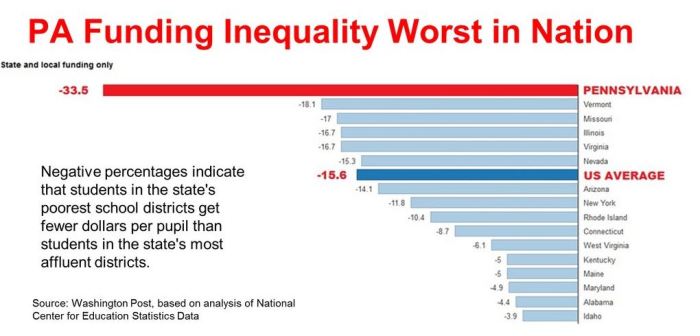
According to the U.S. Department of Education, poor schools in the Commonwealth spend 33 percent less on their students than rich ones. That’s a significantly larger difference than the next-closest state, Vermont, where the spending difference between rich and poor schools is only 18 percent. Three other states — Illinois, Missouri and Virginia — have gaps of 17 percent.


pa funding inequality

 
We can’t keep kicking minorities and the destitute to the curb. We can’t keep giving the rich and middle class every opportunity to succeed while depriving the poor of that same chance.

Wolf, the Democrats and a few Republicans have tried several times to fix the problem.

First, they attempted large increases in education funding to catch up to where funding would be if the Corbett cuts hadn’t happened coupled with the rising costs caused by inflation.

In 2015, the governor proposed a $400 million increase but funded it with a tax increase on the rich that almost all Republicans refused.

Then he tried to bring the state share of education funding up to 50% by using a more equitable tax plan. He proposed cutting property taxes in poorer districts and replacing them with higher state taxes elsewhere. However, Republicans saw it as an opportunity to completely eliminate property taxes and cut school funding even further. It ended in a stalemate and another incremental education increase.

If the legislature wouldn’t approve the necessary spending increases to heal the cuts it made under Corbett, Wolf at least wanted lawmakers to approve dividing the money up more fairly among the state’s 500 school districts.

A funding formula had been approved four years ago to reflect changes in school district attendance and wealth that had been ignored for a quarter century. This would result in more support for poorer schools and less for wealthier ones.

And there’s the sticking point. Lawmakers wouldn’t approve a plan that would provide less funding to 70% of the state’s districts – but neither would they increase school spending to make up the difference.

You’d think that such legislative gridlock might make voters lose hope. However, there is a mass movement of people at the grassroots level demanding change for our children.

Most notably, the parents of six school children, six school districts, the NAACP and a rural schools group are suing the state over education funding.

The lawsuit – now in its fourth year – is scheduled for trial before the state Supreme Court in 2020. So at best, relief is still a ways in the future. Many are hoping justices will order the legislature to dramatically increase its investment in public schools. But the outcome is certainly not a sure thing.

Could striking teachers in red and blue states be showing us in Pennsylvania the solution?

Might it be time to raise our teacher voices in the purple states, too?

And is there a path to equity through collective action that doesn’t hang teachers out to dry?


Still can’t get enough Gadfly? I’ve written a book, “Gadfly on the Wall: A Public School Teacher Speaks Out on Racism and Reform,” now available from Garn Press. Ten percent of the proceeds go to the Badass Teachers Association. Check it out!
thumbnail_IMG_8249