Let Voters Fix Harrisburg School Board – Not State Takeover

thumbnail_milwaukee_school_takeover-e1452175291470

Pushing the self-destruct button is the ultimate measure of last resort.


But that’s how several Pennsylvania lawmakers are suggesting we fix the dysfunctional Harrisburg School Board.


An election that could oust most of the very school directors responsible for the district’s troubles is less than a month away. But Democratic Representative Patty Kim, Republican Senator John DiSanto and Harrisburg Mayor Eric Papenfuse all say we shouldn’t wait – The state should takeover the Harrisburg School District immediately.


This would effectively destroy all democratic government in a district located in the state capital.


While senators and representatives from all over the Commonwealth work to enact the will of their constituents from Pittsburgh to Philadelphia, residents at city schools a few miles away would be robbed of their own voices.


Under state law, if the district were put into receivership, a court-appointed receiver would assume all the functions of a locally elected school board, except the power to raise and levy taxes. This appointee would effectively take charge of the district’s personnel and finances.


Oversight and public input essentially would be repealed. The receiver could do whatever he or she liked and there’s little anyone could do about it.


It’s a bad idea anywhere, though one can understand why state lawmakers have suggested it here.


Harrisburg Schools are a mess, and it’s largely because of the inept leadership of Superintendent Sybil Knight-Burney and five of the nine-member school board who consistently support her every move.


Declining academic performance, high teacher turnover rates, and poor fiscal management – all are hallmarks of the way Harrisburg schools have been run.


The state even suspended more than $10 million in funding to the district after the board voted not to cooperate with an audit requested because of allegations administration had mismanaged federal grant funds.


But the district’s problems begin before the school board even enters into the picture.


Like nearly every urban district in the Commonwealth, Harrisburg has a history of being neglected and underfunded. One estimate puts the Harrisburg shortfall between $35 million and $38 million a year.


That’s why the district is already under a state-mandated recovery plan. It serves a poor community whose tax base simply cannot support the needs of its own children. Like other impoverished schools, the administration and board are required to work with a recovery officer.


This recovery plan has not miraculously fixed the district’s problems. It’s magical thinking to suppose that a court-appointed receiver would do any better.


If the state wants to help, it should provide equitable and sustainable funding. However, it is completely reasonable that state lawmakers wait until responsible adults have taken back the school board first.


A citizen-led school reform group called CATCH (Concerned About the Children of Harrisburg) has been pushing to oust the incumbents who have consistently supported the administration’s disastrous decisions, most of whom are up for re-election.


There are nine board members. Five invariably vote with the administration: Danielle Robinson, Ellis Roy, Lola Lawson, Patricia Whitehead-Myers, and Lionel Gonzalez.


Three unfailingly vote against the administration: Brian Carter, Judd Pittman and Carrie Fowler. There is one wild card: Joseph Brown, who was just appointed to take a vacant seat on the board this month and has mostly abstained from voting.


Of these, Brown and all of those supporting the administration but Robinson are up for re-election.


To flip these seats on the board CATCH is pushing for Gerald Welch, Doug Thomson-Leader, Steven Williams, and Jayne Buchwach. The local teachers union, the Harrisburg Education Association (HEA), and the local chapter of The American Federation of State, County and Municipal Employees (AFSCME) endorsed all of them and an additional one – James Thompson.


If even two of the newcomers are elected, that will shift the balance of power away from those who have enabled an administration infamous for irresponsible errors and neglect purchased at the expense of personal favors to weak willed school directors.


This includes an accounting error that kept 54 former employees on its healthcare plan, an investigation into improper grading allegations at one of its high schools, rapid teacher turnover, and falling student test scores. Administrators haven’t even presented a budget for the 2019-20 school year yet!


Meanwhile, this same quintet of school directors rewarded administration by reappointed Superintendent Knight-Burney last spring, hiring controversial attorney James Ellison as solicitor despite a record of fraud, lawsuits and delinquent taxes, and three times refused to fill Melvin Wilson’s vacant board seat with a candidate who had broad public support and instead punted the decision to the courts.


Despite an almost laughable record of corruption in the district, voters have a chance to change course in less than a month.


All of the reform candidates are Democrats so the matter could be settled by the May 21 primary.


It would be beyond absurd for the state to step in and deny the public the right to correct its own ship.


However, though new candidates could be elected in a matter of weeks, they wouldn’t be sworn in until December. So even under the best of circumstances, city schools would remain under the dysfunctional board for the foreseeable future.


That’s not good. There’s a lot of damage a lame duck board could do in that time. However, the alternative of receivership is worse.


Once you take away a school district’s right to govern itself, it’s hard to get it back again. Plus there is no guarantee that appointed bureaucrats will do a better job. In fact, they rarely do.


Education Secretary Pedro Rivera has remained silent on the issue of receivership. But in a recent statement he said his department “will consider all actions allowable by law” to guide the district through a financial recovery plan.


Here’s hoping that democracy is allowed to flourish in the capital of Pennsylvania.


Like this post? I’ve written a book, “Gadfly on the Wall: A Public School Teacher Speaks Out on Racism and Reform,” now available from Garn Press. Ten percent of the proceeds go to the Badass Teachers Association. Check it out!

thumbnail_IMG_8249

The Forgotten Disaster of America’s First Standardized Test

Screen Shot 2019-04-22 at 10.35.05 PM

“Those who cannot remember the past are condemned to repeat it.”

George Santayana (1905)


The merry-go-round of history continues to spin because the riders forget they are free to get off at any time.


But we rarely do it. We keep to our seats and commit the same stupid mistakes over and over again.


Take high stakes standardized testing.


It was a disaster the very first time it was attempted in America – in Boston, Massachusetts, in 1845.


Yet we continue to prescribe the same error to students in schools today.


Judging learners, schools and teachers based on standardized assessments has the same problems now as it did 174 years ago. Yet we act as if it’s the only accurate way to assess knowledge, the only fair and equitable way to assign resources and judge the professionalism of our schools and teachers.


IT IS NONE OF THOSE THINGS.


If we simply remembered our history, we’d know that. But our collective amnesia allows this bad policy to reappear every generation despite any criticisms or protests.


So let me take you back to Boston in the middle of the 19th Century and show you exactly where things first went wrong and how they still go wrong in nearly the same way.

BOSTON SCHOOLS


Even back then Boston had a history of excellent schools.


One of the country’s most prestigious institutions – the city Latin School – was founded in 1635 and had a list of alumni that reads like a who’s who of American history up through modern times. This includes Cotton Mather, Sam Adams, John Hancock, Ralph Waldo Emerson, Leonard Bernstein and even Santayana, himself!


But Boston wasn’t known just for educating the elite. The city’s school committee had opened the nation’s first public high school in 1821. This wasn’t a charity. The community funded its public schools relatively well and took pride in its students’ accomplishments.


Testing was a much different affair in the early 1800s than it is today.


At the local English Grammar Schools, most examinations were strictly oral. Students were questioned in person about the various subjects in which they had received instruction. Teachers tested students’ memory in a recitation to find out whether or not they were proficient in the subject at hand.


The purpose behind such an assessment wasn’t to assign a grade like children were eggs or melons. It was to give the teacher information about how much his students had learned and where the students’ teacher should begin instruction next year.


However, critics complained that such assessments weren’t impartial and that a written exam might be better. Unfortunately, having every student complete one was impractical before the pencil and steel pen came into common usage in the late 1800s. Besides, teachers – then called School Masters – were trusted to use their judgment measuring student achievement and ability based on empirical observation of students’ day-to-day work.


It should also be noted that many more teachers were men at this time. This changed by the 1920s, when the majority of educators were women while most men had fled to the administrative offices. As this transformation took place, it accompanied greater trust in administrators and decreasing confidence in classroom teachers. And if you don’t see the sexism in that, you aren’t paying attention.


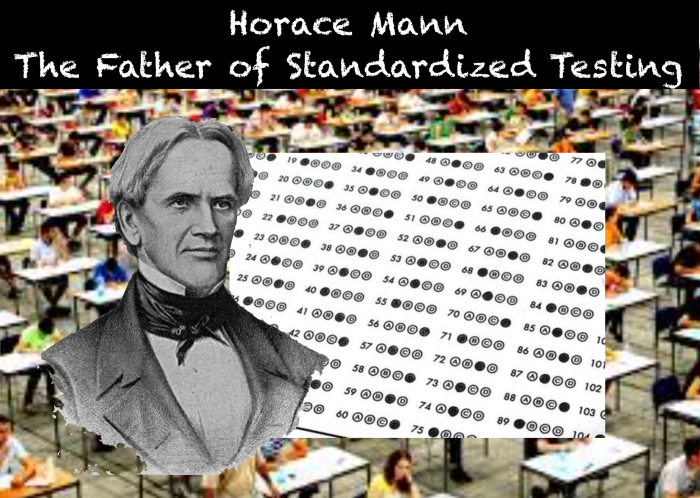
This shift began with standardized testing – an innovation first introduced by a Massachusetts lawyer and legislator named Horace Mann.

HORACE MANN’S TEST


To this day Mann remains a somewhat controversial figure. To some he was a reformer seeking to modernize education. To others he was a self-serving politician looking to increase his own power and that of his party no matter what the cost.


In 1837, Mann was appointed secretary of the newly created State Board of Education. As a member of the Whig Party, he wanted to centralize authority. To do that, he needed to discredit the history of excellence in Boston.


Mann had traveled abroad to see the innovations of European schools and concluded that Prussia’s schools, in particular, were far superior to America’s. His remarks were included in a highly publicized 1844 report that demanded action lest our country’s children be left behind. (Sound familiar?)


When other prominent Whigs including his friend Samuel Gridley Howe were elected to the School Committee and later the examining committee, Mann had everything he needed to make a change.


Howe dispensed with the oral exams in favor of written tests, what today we’d call short-answer exams. Without any warning to teachers or students, this new committee came to Boston’s grammar schools with preprinted questions. Teachers and administrators were furious. Students were terrified.


The examiners picked 530 out of the city’s approximately 7,000 students — allegedly the best below high school age – and made them take the new exams. This was about 20 or 30 children from each school. Students had an hour to write their responses on each subject to questions taken from assigned textbooks -geography, grammar, history, rhetoric, and philosophy.


Most failed.


A contemporary report on the exams concluded that the results “show beyond all doubt, that a large proportion of the scholars in our first classes, boys and girls of 14 or 15 years of age, when called upon to write simple sentences, to express their thoughts on common subjects, without the aid of a dictionary or a master, cannot write, without such errors in grammar, in spelling, and in punctuation.”


Examiners explained in a subsequent report that they had been looking for “positive information, in black and white,” exactly what students had learned. Teachers took no offense at that goal, but complained that the test questions had not pertained to what students had been taught.


Howe and his examiners countered that they had ensured their new assessment was valid with field testing – a practice that modern day corporations like Pearson and Data Recognition Corp. still do today.


Howe’s committee gave the same test in towns outside of Boston, including Roxbury, then a prosperous suburb. In all, the committee tested 31,159 students the previous summer. The result – an average score of 30 percent correct.


However, the wealthy Roxbury students outscored all the other schools. Therefore, they were made the standard of excellence that all other schools were expected to reach.


So when Boston students – all of whom did not have the privileges of Roxbury students – didn’t achieve the same scores, they were deemed failing, inadequate, losers.


Thus Mann could justify criticizing the district, firing teachers and administrators and consolidating control over the city’s schools.

BACKLASH


The result was pandemonium. Howe issued a scathing report lambasting the schools and even naming individual teachers who should be fired. Mann published the results in his influential Common School Journal and these kinds of tests started to appear at urban schools across the country.


However, Bostonians were not all convinced. Editorials were published both for and against the tests.


Every aspect of the exam was disputed – and in similar ways to the testing controversies we still see today.


To start, raising the stakes of the exams invited cheating. One teacher was caught leaking questions to his students before the testing session began.


The assessments also showed a racial achievement gap that far from helping diagnose structural inequalities was instead weaponized against the very people working hardest to help minority students learn. Examiners criticized the head teacher of the segregated Smith School because his African American students had scored particularly low. He was accused of not seeing the potential in black children. Never mind that these students were the most different from the Roxbury standard in terms of culture and privilege.


The tests also began the endless failing schools narrative that has been used by ambitious policymakers and disaster capitalists to get support for risky and unproven policies. Rivalries began between city and suburban schools with Bostonians wondering why their schools had been allowed to get so much worse.


Much of the criticism came back on Mann and Howe who reacted by throwing it back on the teachers for doing such a bad job.


In the end, a few educators were let go, but the voters had had enough of Mann.


Parents accused him of deliberately embarrassing students and in 1848 he was not re-elected to office.


The tests were given again in 1846, but by 1850, Boston had abandoned its strategy and reverted to non-standarized exams that were mostly based on oral presentations.


The experiment deeply disturbed many people. No one could explain why there was a discrepancy between scores of rich vs. poor students. The original justification of these exams was that they would eliminate partiality and treat students fairly and equally. Yet the results showed a racial and economic bias that didn’t escape contemporaries. In 1850 as the tests were being discontinued, the chairman of the examination committee wrote:

“Comparison of schools cannot be just while the subjects of instruction are so differently situated as to fire-side influence, and subjected to the draw-backs inseparable from place of birth, of age, of residence, and many other adverse circumstances.”


And that’s how standardized testing began.


It was a political power play justified by so-called universal testing.


Numbers, charts and graphs were used to mesmerize people into going along with policies that were never meant to help children learn, but instead to gain power for certain policymakers while taking it away from others.

HISTORY OF STANDARDIZED TESTING


In the years that followed, standardized testing became much more efficient. In 1915, the first test was given with multiple-choice questions – Frederick J. Kelly’s Kansas Silent Reading Test. It was roundly criticized and eventually disowned by Kelly for focusing almost exclusively on lower order thinking skills.


Then in the 1920s eugenicists like Robert Yerkes and Carl Brigham went a step further with similar IQ tests to justify privileging upper class whites from lower class immigrants, blacks and Hispanics. Their work was even used to justify the forced sterilization of 60,000 to 70,000 people from groups with low test scores, thus preventing them from “polluting” the gene pool. Ultimately this lead Brigham to create the Scholastic Assessment Test (SAT) to keep such undesirables out of higher education. It is still in wide use today.


It wasn’t until 1938 that Kaplan Inc. was founded to tutor students in these same tests. Stanley Kaplan, son of Jewish immigrants, showed that far from assessing learning, these tests merely assessed students’ ability to take the tests. Thus he was able to provide a gateway to higher education for many Jews and other minorities who had been unfairly excluded because of testing.


In the 1960s black plaintiffs began winning innumerable lawsuits against the testing industry. Perhaps the most famous case is Hobson v. Hansen in 1967, which was filed on behalf of a group of Black students in Washington, DC. The court ruled that the policy of using tests to assign students to tracks was racially biased because the tests were standardized to a White, middle class group.


And then in 2001, President George W. Bush’s No Child Left Behind legislation revved the whole thing up into overdrive. With bipartisan support, he tied federal funding of schools to standardized test performance and annual academic progress – a policy that was only intensified under President Barack Obama who added competitive grants for additional funding based on test performance under Race to the Top.


Since then, standardized testing has grown from a $423 million industry before 2001 to a multi-billion dollar one decades later. If we add in test prep, new text books, software, and consultancy, that figure easily tops the trillion dollar mark.


Despite hundreds of principal, teacher, parent and student protests, tens of thousands of opt outs and a slew of lawsuits, high stakes testing continues to be the law of the land.


Yet the problems today are almost the same as those in Boston nearly two centuries ago.

LEGACY


These tests are political smokescreens used to stop policymakers from having to enact real reforms like equitable funding, wraparound services and addressing the trauma our most impoverished students deal with everyday. Instead, we push a school privatization and testing industry that makes trillions of dollars for corporations at the expense of our children.


“Those who cannot remember the past are condemned to repeat it.”


Here’s hoping that one day we remember and get the heck off this runaway merry-go-round.


Like this post? I’ve written a book, “Gadfly on the Wall: A Public School Teacher Speaks Out on Racism and Reform,” now available from Garn Press. Ten percent of the proceeds go to the Badass Teachers Association. Check it out!
book-1

Schools That Hinder Opt Outs Are Participating in Their Own Demise

thumbnail_1511359_10203413055118040_897780773_n

You can’t be a public school and still ignore the will of the people.


That’s the problem at too many districts across the country where narrow-minded administrators are waging an all out war on parents opting their children out of standardized testing.


The federal government still requires all states to give high stakes tests to public school students in grades 3-8 and once in high school. So states require their districts to give the tests – despite increasing criticism over the assessments’ validity, age appropriateness, racial and economic bias and the very manner in which the scores are used to justify narrowing the curriculum, school privatization, funding cuts, teacher firings and closing buildings serving the most underprivileged children.


In response, parents from coast to coast continue to fight the havoc being forced upon their communities by refusing the tests for their children.


Yet instead of welcoming this rush of familial interest, at some schools we find principals, superintendents and every level of functionary in between doing whatever they can to impede parental will.


Most administrators don’t actually go so far as out right refusal of a parent’s demand to opt out their children.


That’s especially true in states where the right to opt out is codified in the law.


Three states – California, Utah, and Wisconsin – have enacted legislation permitting parents to opt their children out of standardized tests. However, at least five others, including my home of Pennsylvania, have laws respecting parents’ opt-out wishes for certain reasons. In others states there may not be specific legislation permitting it, but none have laws forbidding it either. At worst, test refusal is an act of civil disobedience like tearing down a confederate monument or freedom rides.


In Pennsylvania, the school code specifies that parents can refuse the test for their children for “religious reasons.” Those reasons and the religion in question never need be named. Citing “religious reasons” is rationale enough.


Consider:


“PA School Code Chapter 4.4(d):


(4)  …If upon inspection of a State assessment parents or guardians find the assessment to be in conflict with their religious belief and wish their students to be excused from the assessment, the right of the parents or guardians will not be denied upon written request that states the objection to the applicable school district superintendent, charter school chief executive officer or AVTS director.”


So when a parent provides just such an objection, it’s there in black and white that administrators must comply with that request.


However, some administrators are trying to game the system. When the other students are taking the state standardized test, the opt out students are rounded up and forced instead to take a district created assessment that just so happens to look almost exactly like the test their parents explicitly asked they not be subjected to.


So in my state, some parents have opted their children out of the Pennsylvania System of School Assessment (PSSA) or Keystone Exams, but administrators are requiring them instead to take an assessment they cobbled together themselves that closely resembles the PSSA and/or Keystone Exam.


They take a little bit from the PSSA, a bit from the Partnership for Assessment of Reading Readiness for College and Careers (PARRC) test, a question or two from the Scholastic Assessment Test (SAT) and voila! A brand new Frankenstein’s monster of standardized assessment.


But that’s not all. Some districts go one step further. They tie the results of this bogus “district” assessment with class placement. The results of the faux test are used to determine whether students are placed in the remedial, academic or the honors class in a given subject (English Language Arts, Math or Science) in the next grade.


Does that violate the law? Parents did not want their children to be assessed with a standardized test, and that’s exactly what the school did anyway. The only difference is the name of the standardized test they used.


I am not a lawyer, but I’ve contacted several. The answer I’ve gotten is that this may not be technically illegal, but it does at least violate the spirit of the law.


Districts are given a certain latitude to determine their own curriculum and assessments. This kind of runaround is ugly, petty and possibly just on the line of legality.


But our administrators are not done. Not only are they requiring such students to take a cobbled together standardized assessment, when children are done, they are forced to do hours of test prep for the state assessment that their parents refused for them.


Imagine opting out of the PSSA and then being forced to spend that time preparing for that very test. Imagine refusing to allow your children to take the Keystone Exam but then having them forced to prepare for it instead.


Petty, small-minded, punitive and – in this case – possibly illegal.


The school code is specifically against this. From the same section (4.4):


“(d) School entities shall adopt policies to assure that parents or guardians have the following:


(3) …The right to have their children excused from specific instruction that conflicts with their religious beliefs, upon receipt by the school entity of a written request from the parent or guardians.”


Again, I am not a lawyer, but it seems pretty clear that this, at least, is a violation of the law.


They can request their children not be given specific instruction – in this case test prep. Yet that’s exactly what administrators are doing anyway.


So what are opt out parents to do? Should they lawyer up?


Possibly. Though no one likes to have to take their own school to court. Any monetary damages thus recovered come from the collective pot that should go to help all students learn. It’s unfortunate that some administrators play so freely with taxpayer dollars when it would be a simple matter to safeguard them AND respect parental rights.


A better course of action may be for opt out parents in such situations to seek redress directly from the school board.


School directors are elected officials, after all. They may not be appraised of the actions of the administrators in their employ.


And that is really where the buck stops. If school directors don’t approve of this sort of chicanery, they can easily put a stop to it.


These are public schools. They are supposed to be run by the public. Our democracy is supposed to be what defines us. We are run by the people, for the people.


We’re not some charter school where school directors are appointed to their positions, hold their meetings in private and rarely if ever have to account for their decisions.


It’s shocking that in an age when public schools are often set against privatized ones that we’d allow such foolishness.


We need to set ourselves apart. Instead of denying parental requests, we should go out of our way to accommodate them.


Parents could, after all, remove their children and try their luck elsewhere.


At charter schools, they would probably get an even worse welcome. After all, most such schools pride themselves on their test scores and test prep curriculum having kicked out any students who don’t score well.


However, parents of means could enroll their children in private or parochial schools that are not required by law to even take these high stakes tests.


I’m not recommending that course of action. These schools are expensive, restrictive, insular and extremely racially and economically segregated.


But how short sighted must public school administrators be if they play these sorts of games with parents and children in just such an environment?


Any public school leader who wars against opt outs is participating in their own schools demise.


This is doubly so at schools serving high poverty populations.


Children of the poor and minorities historically get lower test scores than those from wealthier families. These tests are used to justify budget cuts and firing school staff – including these administrators.


Opting out of testing is one way to deny this data to the state so that they can’t use it against the school.


Certainly having high numbers of students opting out can, itself, become an excuse for punitive action from the state. But nowhere in the country has it ever actually happened.


State legislatures, too, are run by majority rule. The same with the federal government.


Our lawmakers have no authority to tell voters they can’t opt their children out of testing. It is the voters who are the boss.


We’d all best remember that.


Like this post? I’ve written a book, “Gadfly on the Wall: A Public School Teacher Speaks Out on Racism and Reform,” now available from Garn Press. Ten percent of the proceeds go to the Badass Teachers Association. Check it out!

book-3

Diane Ravitch’s New Book is a Fun and Breezy Romp Through the Maze of School Policy

57062111_2099696250096151_5079705568130629632_n

Imagine you could talk with Diane Ravitch for 10 to 15 minutes everyday.

 
That’s kind of what reading her new book, “The Wisdom and the Witt of Diane Ravitch”, is like.

 
You’ve probably heard of Ravitch before.


She’s the kindly grandmother you see on the news who used to think standardized tests and school privatization were the way to go but actually had the courage to pull an about face.


She’s that rare thing in public policy – a person with the honesty to admit when she was wrong — and even lead the resistance to everything she used to believe in!


Now she champions teacher autonomy, fair and equitable school funding and authentic public schools with duly-elected school boards.


Her new book is full of shorter pieces by the education historian from all over the mass media – The Wall Street Journal, The New York Times, Huffington Post and even her own blog.

 
You’ll find an article explaining why she changed her mind about school reform nestled next to a reflection on what it’s like to grow up Jewish in Texas. Here’s a succinct take down of President Obama’s Race to the Top next to an article extolling the virtues of student activism in Providence. Ever wonder what Ravitch would say to her mentor Lamar Alexander about our current Education Secretary Betsy DeVos? It’s in there. Ever wonder what books on education she would recommend? It’s in there.

 
This new book from Garn Press is more personal than anything I’ve seen from Ravitch on the shelves before. And that’s because it’s not part of a sustained argument like “The Life and Death of the Great American School System,” or “Reign or Error.” It’s a collection of vignettes taken from the last decade of her writing. These are flashes of inspiration, snippets of thoughts, bursts of criticism and humor.

 
They’re perfect for perusing and really quite addictive.

 
I found myself jumping from an article in the first 20 pages to one at the end to another in the middle. There’s no reason any of it needs to be read chronologically though they are organized in the order of publication.

 
It’s really a lot like talking to Diane, something that I’ve had the privilege to do on a few occasions. Like any conversation, topics come up organically and you go from one to another without rhyme or reason.


At least that’s how I read the book.

 
It would be perfect in your school’s teachers lounge. Educators could pick it up at lunch or during their planning periods and use it as a springboard to talk about almost any issue that comes up during the day.

 
Well, it would be perfect if we ever actually had that kind of time.

 
I found myself repeatedly interrupted when trying to read it. But that’s actually not a problem. Given the brevity of the articles and their impressive concision, it doesn’t matter if you have to put a bookmark in the middle of a chapter here or there. It’s easy to pick up the thread and continue later.

 
There are so many highlights, but one of my favorites is “Don’t Like Betsy DeVos? Blame the Democrats” where she writes:


“I contend that it is immoral, unjust, and inequitable to advocate for policies that hurt 95% of students so that 5% can go to a private school. It is even more unjust to destabilize an entire school district by introducing a welter of confusing choices, including schools that open and close like day lilies. Why don’t the advocates of school choice also advocate for funding to replace the money removed from the public schools?”

 
Or how about “Flunking Arne Duncan”? I must admit, the title alone made my heart give a little cheer. Ravitch gives the former Education Secretary the following report card which deserves to be blown up to poster size and displayed in every classroom in the country:


“Report Card: Arne Duncan
Fidelity to the Constitution                                       F
Doing what’s right for children                               F
Doing what’s right for public education                F
Respecting the limits of federalism                        F
Doing what’s right for teachers                               F
Doing what’s right for education                            F”

 
As a public school teacher, I must admit getting an inordinate amount of pleasure from Ravitch’s criticism of the fools and frauds writing school policy. But she has a lot to say on so many subjects – standardized testing, Common Core, even the basic greed underlying the whole political mess.

 
Consider this gem from “What Powerful and Greedy Elites are Hiding When They Scapegoat the Schools”:


“I have nothing against the wealthy. I don’t care that some people have more worldly goods than others. I understand that life’s not fair. I just harbor this feeling that a person ought to be able to get by on $100 million or so and not keep piling up riches while so many others don’t know how they will feed their children tonight.”

 
I could offer a dozen more quotes from the book. My copy looks like a rainbow with all the different colored highlights I’ve made through its 451 pages.

 
So if you want my advice, go out and buy “The Wisdom and Wit of Diane Ravitch.” It’s a fun and breezy romp through the maze of school policy.

 
Just keep a good supply of highlighters and bookmarks handy.


Like this post? I’ve written a book, “Gadfly on the Wall: A Public School Teacher Speaks Out on Racism and Reform,” now available from Garn Press. Ten percent of the proceeds go to the Badass Teachers Association. Check it out!

thumbnail_IMG_8249

Standardized Testing is a Tool of White Supremacy

Screen Shot 2019-04-03 at 8.35.24 PM

Let’s say you punched me in the face.


I wouldn’t like it. I’d protest. I’d complain.


And then you might apologize and say it was just an accident.

 
Maybe I’d believe you.


Until the next time when we met and you punched me again.


That’s the problem we, as a society, have with standardized tests.


We keep using them to justify treating students of color as inferior and/or subordinate to white children. And we never stop or even bothered to say, “I’m sorry.”


Fact: black kids don’t score as high on standardized tests as white kids.


It’s called the racial achievement gap and it’s been going on for nearly a century.


Today we’re told that it means our public schools are deficient. There’s something more they need to be doing.

 
But if this phenomenon has been happening for nearly 100 years, is it really a product of today’s public schools or a product of the testing that identifies it in the first place?


After all, teachers and schools have changed. They no longer educate children today the same way they did in the 1920s when the first large scale standardized tests were given to students in the US. There are no more one-room schoolhouses. Kids can’t drop out at 14. Children with special needs aren’t kept in the basement or discouraged from attending school. Moreover, none of the educators and administrators on the job during the Jazz Age are still working.
 

Instead, we have robust buildings serving increasingly larger and more diverse populations. Students stay in school until at least 18. Children with special needs are included with their peers and given a multitude of services to meet their educational needs. And that’s to say nothing of the innovations in technology, pedagogy and restorative justice discipline policies.


But standardized testing? That hasn’t really changed all that much. It still reduces complex processes down to a predetermined set of only four possible answers – a recipe good for guessing what a test-maker wants more than expressing a complex answer about the real world. It still attempts to produce a bell curve of scores so that so many test takers fail, so many pass, so many get advanced scores, etc. It still judges correct and incorrect by reference to a predetermined standard of how a preconceived “typical” student would respond.


Considering how and why such assessments were created in the first place, the presence of a racial achievement gap should not be surprising at all. That’s the result these tests were originally created to find.


Modern testing comes out of Army IQ tests developed during World War I.

 
In 1917, a group of psychologists led by Robert M. Yerkes, president of the American Psychological Association (APA), created the Army Alpha and Beta tests. These were specifically designed to measure the intelligence of recruits and help the military distinguish those of “superior mental ability” from those who were “mentally inferior.”
 

These assessments were based on explicitly eugenicist foundations – the idea that certain races were distinctly superior to others.
 
In 1923, one of the men who developed these intelligence tests, Carl Brigham, took these ideas further in his seminal work A Study of American Intelligence. In it, he used data gathered from these IQ tests to argue the following:


“The decline of American intelligence will be more rapid than the decline of the intelligence of European national groups, owing to the presence here of the negro. These are the plain, if somewhat ugly, facts that our study shows. The deterioration of American intelligence is not inevitable, however, if public action can be aroused to prevent it.”


Thus, Yerkes and Brigham’s pseudoscientific tests were used to justify Jim Crow laws, segregation, and even lynchings. Anything for “racial purity.”
 

People took this research very seriously. States passed forced sterilization laws for people with “defective” traits, preventing between 60,000 and 70,000 people from “polluting” America’s ruling class.
 
The practice was even upheld by the US Supreme Court in the 1927 Buck v. Bell decision. Justices decided that mandatory sterilization of “feeble-minded” individuals was, in fact, Constitutional.

 
Of the ruling, which has never been explicitly overturned, Justice Oliver Wendell Holmes wrote, “It is better for all the world, if instead of waiting to execute degenerate offspring for crime, or to let them starve for their imbecility, society can prevent those who are manifestly unfit from continuing their kind…. Three generations of imbeciles are enough.”
 

Eventually Brigham took his experience with Army IQ tests to create a new assessment for the College Board – the Scholastic Aptitude Test – now known as the Scholastic Assessment Test or SAT. It was first given to high school students in 1926 as a gatekeeper. Just as the Army intelligence tests were designed to distinguish the superior from the inferior, the SAT was designed to predict which students would do well in college and which would not. It was meant to show which students should be given the chance at a higher education and which should be left behind.
 

And unsurprisingly it has always – and continues to – privilege white students over children of color.

 
The SAT remains a tool for ensuring white supremacy that is essentially partial and unfair – just as its designers always meant it to be.
 
Moreover, it is the model by which all other high stakes standardized tests are designed.

 
But Brigham was not alone in smuggling eugenicist ideals into the education field. These ideas dominated pedagogy and psychology for generations until after World War II when their similarity to the Nazi philosophy we had just defeated in Europe dimmed their exponents’ enthusiasm.
 

Another major eugenicist who made a lasting impact on education was Lewis Terman, Professor of Education at Stanford University and originator of the Stanford-Binet intelligence test. In his highly influential 1916 textbook, The Measurement of Intelligence he wrote:
psych


“Among laboring men and servant girls there are thousands like them [feebleminded individuals]. They are the world’s “hewers of wood and drawers of water.” And yet, as far as intelligence is concerned, the tests have told the truth. … No amount of school instruction will ever make them intelligent voters or capable voters in the true sense of the word.

… The fact that one meets this type with such frequency among Indians, Mexicans, and negroes suggests quite forcibly that the whole question of racial differences in mental traits will have to be taken up anew and by experimental methods.

Children of this group should be segregated in special classes and be given instruction which is concrete and practical. They cannot master, but they can often be made efficient workers, able to look out for themselves. There is no possibility at present of convincing society that they should not be allowed to reproduce, although from a eugenic point of view they constitute a grave problem because of their unusually prolific breeding” (91-92).


This was the original justification for academic tracking. Terman and other educational psychologists convinced many schools to use high-stakes and culturally-biased tests to place “slow” students into special classes or separate schools while placing more advanced students of European ancestry into the college preparatory courses.

 
The modern wave of high stakes testing has its roots in the Reagan administration – specifically the infamous propaganda hit piece A Nation at Risk: The Imperative for Education Reform.

 
In true disaster capitalism style, it concluded that our economy was at risk because of poor public schools. Therefore, it suggested circumventing the schools and subordinating them to a system of standardized tests, which would be used to determine everything from teacher quality to resource allocation.

 
It’s a bizarre argument, but it goes something like this: the best way to create and sustain a fair educational system is by rewarding “high-achieving” students.
 

So we shouldn’t provide kids with what they need to succeed. We should make school a competition where the strongest get the most and everyone else gets a lesser share.

 
And the gatekeeper in this instance (as it was in access to higher education) is high stakes testing. The greater the test score, the more funding your school receives, the lower class sizes, the wider curriculum, more tutors, more experienced and well compensated teachers, etc.
 

It’s a socially stratified education system completely supported by a pseudoscientific series of assessments.

 
After all, what is a standardized test but an assessment that refers to a specific standard? And that standard is white, upper class students.
 
In his book How the SAT Creates Built-in-Headwinds, national admissions-test expert, Jay Rosner, explains the process by-which SAT designers decide which questions to include on the test:


“Compare two 1998 SAT verbal [section] sentence-completion items with similar themes: The item correctly answered by more blacks than whites was discarded by [the Educational Testing Service] (ETS), whereas the item that has a higher disparate impact against blacks became part of the actual SAT. On one of the items, which was of medium difficulty, 62% of whites and 38% of African-Americans answered correctly, resulting in a large impact of 24%…On this second item, 8% more African-Americans than whites answered correctly…”

 
In other words, the criteria for whether a question is chosen for future tests is if it replicates the outcomes of previous exams – specifically tests where students of color score lower than white children. And this is still the criteria test makers use to determine which questions to use on future editions of nearly every assessment in wide use in the US.
 

Some might argue that this isn’t racist because race was not explicitly used to determine which questions would be included. Yet the results are exactly the same as if it were.

 
Others want to reduce the entire enterprise to one of social class. It’s not students of color that are disadvantaged – it’s students living in poverty. And there is overlap here.
 

Standardized testing doesn’t show academic success so much as the circumstances that caused that success or failure. Lack of proper nutrition, food insecurity, lack of prenatal care, early childcare, fewer books in the home, exposure to violence – all of these and more combine to result in lower academic outcomes.


But this isn’t an either/or situation. It’s both. Standardized testing has always been about BOTH race and class. They are inextricably entwined.

 
Which leads to the question of intention.

 
If these are the results, is there some villain laughing behind the curtain and twirling the ends of a handlebar mustache?
 

Answer: it doesn’t matter.
 

As in the entire edifice of white supremacy, intention is beside the point. These are the results. This is what a policy of high stakes standardized testing actually does.
 

Regardless of intention, we are responsible for the results.
 

If every time we meet, you punch me in the face, it doesn’t matter if that’s because you hate me or you’re just clumsy. You’re responsible for changing your actions.
 
And we as a society are responsible for changing our policies.

 
Nearly a century of standardized testing is enough.

 
It’s time to stop the bludgeoning.
 
It’s time to treat all our children fairly.
 

It’s time to hang up the tests.


NOTE: This article expands upon many ideas I wrote about in an article published this week in Public Source.


Like this post? I’ve written a book, “Gadfly on the Wall: A Public School Teacher Speaks Out on Racism and Reform,” now available from Garn Press. Ten percent of the proceeds go to the Badass Teachers Association. Check it out!

book-2

Who’s Afraid of Public Schools?

Screen Shot 2019-03-15 at 7.51.00 PM


Public schools are the bogeymen of American life.

 
We so often hear the bedtime story of “Failing Schools” that it’s no wonder some folks will do anything to ensure their kids get in elsewhere.

 
And let’s be honest. It’s the same impulse behind the latest college admissions cheating scandal.

 
A group of wealthy – though not too wealthy – parents thought their children should be able to enroll in the most prestigious schools.

 
So they bribed college admissions officers, cheated on standardized tests or paid coaches or other officials to accept their children as college athletes even if their kids had never played the sport.

 
We see the same kind of thing everyday in public schools – a confederacy of white parents terrified that their kids might have to go to class with black kids. So they dip into their stock portfolios to pay for enrollment at a private or parochial school.

 
Or they take advantage of a tax scholarship or school voucher to avoid an institution with low test scores by enrolling in one where students don’t have to take the tests at all.

 
Or they cross their fingers and enter their kid in a lottery to a charter school praying their precious progeny will escape the horrors of being treated just like everyone else’s kids.

 
And they call it a meritocracy!

 
What a joke!

 
They pretend that their children have earned special treatment.

 
WRONG.

 
No child deserves favoritism – paradoxically –  because all children do!

 
There are really two important but related points here:

 
1)  The children of the privileged don’t deserve a better education than anyone else’s.


2)  Children who come from wealthy families (and or from privileged social circumstances) don’t do anything to distinguish themselves from the underprivileged.

 
But these nouveau riche parents tried to bribe the way forward for their kids anyway even though to do so they had to launder the money through a fake “charity.” They didn’t care that doing so would earn them a tax deduction and thus result in even less money for the underprivileged. They didn’t care about the underlying inequalities in the system. No. They only wanted their children to remain in the class of America’s chosen few.

 
And the best way to do that is with cold, hard cash.

 
America doesn’t run on Dunkin. It runs on greenbacks. Dinero. Swag. Bling. The prosperity doctrine made physical, quantifiable and mean.

 
No one really denies that there are two Americas anymore. We just lie to ourselves about how you get placed in one or the other.

 
And that lie is called excellence, quality, worth – the ultimate in class war gaslighting.

 
It’s a deception that this scandal has shattered to pieces.

 
The privileged don’t earn their privilege. It’s not something they possess on the basis of intelligence or hard work shown through test scores. They don’t have it because of drive, determination or grit – once again shown through test scores. They have it based on wealth – the kind of wealth that buys time and resources to either pass the tests or bribe the gatekeepers to change the scores.

 
Think about it.

 
George W. Bush got into Yale and Harvard and graduated with a 2.35 GPA. Why? Not because he had the grades and demonstrated his worth. He was a legacy. Like at least one third of all admissions to Ivy League schools, he got in purely because he had family who graduated from there.

 
You think Donald Trump threatened the College Board not to release his grades because they were all A’s!?

 
According to one account, his scores were merely “respectable.” Yet he still dropped out of the prestigious Fordham University and transferred to the University of Pennsylvania after two years based on family connections and the reputation of his father, Fred Trump, one of the wealthiest businessmen in New York at the time.

 
Moreover, his kids, Don Jr. and Ivanka, were both enrolled at Penn around the same time as their father made hefty contributions. They began classes in 1996 and 2000, respectively, just as the university and its private Manhattan clubhouse received more than $1.4 million in pledged donations from Trump, the school newspaper reported.


This is not merit. This has nothing to do with what these people deserve. It is money – a pure transaction, you scratch my back and I’ll scratch yours.

 
The only thing that separates what the Trumps and the Bushes did with this latest scandal – the so-called Operation Varsity Blues – is the amount of wealth involved.
If you’re super rich, you can get away with it. If you’re just rich, you’d better not get caught.

 
And if you’re poor or middle class, you’d better stay in your lane.

 
But there shouldn’t be any lanes on this highway. Or at least they should only be in place to maximize fairness and student success.

 
We sneer at the idea of Affirmative Action but only because it’s directed at people of color. No one says anything about the real Affirmative Action that’s been in place since before our country even began – the system of reciprocity and privilege keeping wealthy white families in positions of power like Lords and Ladies while the rest of us serfs scramble for their leavings.

 
All children deserve the same opportunities to succeed. All children deserve the chance to get an excellent education. All children should attend a first class school filled with highly educated and experienced teachers who can draw on plenty of resources, wide curriculum, tutoring, counseling and support.

 
And the only way we’ll ever achieve that is through a robust system of public schools.

 
I’m not saying they’re perfect. In many neighborhoods, they’ve been sabotaged and surgically dismantled, but that’s a problem with an easy solution. Invest in public schools!

 
Because the stated purpose of public education, the reason it exists at all, is equity.
The alternatives – private and charter schools – are essentially unequal.  That’s their raison d’êtreto create a market that justifies their existence.

 
In order for charter and private schools to be a thing, there must be schools that don’t otherwise meet students’ needs. There must be an unreasonable demand that schools indoctrinate students into parents’ religious beliefs. There must be schools that aren’t as well funded or that have to meet ridiculous federal and state mandates.

 
The result is a two-tiered system. Schools for the haves and for the have-nots.
It’s an apparatus that perverts the public to make room for the private.

 
In the public system, students are segregated into communities based on race and class and then their community schools are funded based on what their parents can afford. The rich shower their children with the best of everything. The poor do what they can.

 
Then the federal government pretends to hold everyone “accountable” by forcing students to take standardized tests that merely recreate the economic and racial disparities already present in their districts and neighborhoods. In turn, this provides the justification for charter and voucher schools that further erode public school budgets and increases the downward spiral of disinvestment.


Meanwhile, few notice how the equity built into authentic public schools gets left behind by those enrolling in privatized alternatives. No more open meetings. No more elected school boards. No more public comment or even a voice in how the money is spent.
 

So long as there are two Americas, the fear of being in the wrong one will motivate the privileged to cheat and steal their way to the top. They will horde resources and wealth for themselves and their children while denying it to others.

 
It is a self-perpetuating system – a loop that we’re all caught in.
We must break the chain. We must recognize our common humanity and stop the zero sum game.

 
And perhaps the best way to begin is by supporting authentic public schools and not privatization.

 
We have been taught to fear public education, because it is really our only hope.


Like this post? I’ve written a book, “Gadfly on the Wall: A Public School Teacher Speaks Out on Racism and Reform,” now available from Garn Press. Ten percent of the proceeds go to the Badass Teachers Association. Check it out!

book-4

Tying Kids’ Lunch Money to Test Scores? It’s No Crueler Than High Stakes Testing

Screen Shot 2019-02-22 at 9.06.34 PM


UPDATED


Most people agree that the best way to get kids to read isn’t by threatening to take away their lunch.

 
But an Arkansas state Representative is threatening to do just that – sort of.


Rep. Alan Clark, a West Memphis Republican, proposed a bill that would cut “Lunch Funding” for impoverished children in state schools where students struggle with standardized reading tests.


However, he’s not proposing we take away kids’ food.


If passed, the bill would reduce a district’s National School Lunch funding – a state mechanism that distributes extra resources to schools with high concentrations of students who qualify for free lunch programs – if student test scores don’t rise over a period of time. This would cut things like professional development and tutoring.


However, this has been confused with the federal program of the same name and drawn almost universal condemnation.


“I would never starve kids,” Clark said. But he would starve their schools of resources.


Either way, his proposal is obviously unfair.


Only a monster would think you can incentivize reading comprehension by threats and coercion.


It’s like saying “You’d better understand this complex puzzle OR ELSE!


Learning doesn’t work that way.


But Clark sees things from a different perspective – that of business and industry. He told KTHV, a state television network:


“In most businesses I would be laughed at for suggesting such a small goal. But sadly many educators act like I have asked them to storm the beaches at Normandy… It appears I have much more faith in our schools than many of our educators do.”


This is what happens when you elect people without empathy or intelligence to public office.


I wonder if Clark would do a better job representing the people of his state if they threatened to lower his salary based on his popularity polls.


It says a lot about us that people react so viscerally to the inaccurate idea that Clark is suggestion we withhold food from bad test takers. That’s unthinkable. But it isn’t really that much more cruel than the way we actually treat students.


Our entire federal education policy is based on just such inhuman treatment of children.


After all, we still hold kids, schools and teachers “accountable” by student test scores. The consequences though aren’t an empty belly. They’re crowded classrooms and fewer tutors.


In every state of the union, students are required to take high stakes standardized tests in reading and math. If they don’t do well, we take away their resources.


Sure, we don’t deny them food, but we deny them many other things they need to learn.


We lower funding to their schools so that they have larger class sizes, fewer teachers, narrowed curriculum, etc. We threaten to withhold their diplomas and any chance of ever earning more than minimum wage. In many cases we tie teachers salaries, reputations and even employment to these same scores. Sometimes we even take away their parents right to govern their children’s schools so that all administrative decisions are made by state flunkies. Or we force their authentic public schools to become charter institutions so that spending decisions happen behind closed doors without accountability and even whether a student can enroll or not becomes a decision of the private management company and not simply something that is the students’ by right of living in the district.


It may not be as severe as the idea of Test Scores for Food, but it’s the same in kind.


In both cases, we tell kids – “Increase test scores, OR ELSE!” It’s just a difference of consequence.


Call me crazy, but that’s nearly as cruel and wrongheaded.


Keep in mind, all of this takes for granted that standardized tests are adequate and fair assessments of student learning in the first place. This has never been proven. In fact, it has been cast in serious doubt after more than a century of academic study. Ask anyone to narrow their thinking down to four prepackaged choices and you’ll find them trying to guess what the test-maker wanted more than what the truth is. Critical thinking, analysis, innovation – these escape any multiple choice exam.


But even if we go with this empty assumption, it flies in the face of everything we know about the way human beings acquire knowledge and demonstrate skills.


When kids struggle with learning, you can’t get them to do better with threats. Or at least you can only do that if those children are doing poorly on purpose.


Kids who just aren’t trying hard enough might be incentivized by threats. But even then it transforms learning into a means to an end. Once you do that, you destroy their natural curiosity. Learning will never again be an end in itself. It will be a menial task you only do to get something else that you really want.


However, in most cases kids don’t struggle because they’re just lazy. They don’t need an incentive. They need help. They need resources.


It’s no wonder that children in rich and middle class neighborhoods have less trouble getting higher test scores. They have lower class sizes, more teachers, wider curriculum, more extra curricular activities, access to tutors, counselors, nurses and after school programs.


Poor kids don’t. THAT’S why they struggle.


And what do we do when that happens? We take away the meager resources they have!


If a teacher tried any of this crap in her classroom, she’d be fired for dereliction of duty – and she’d deserve it!


Just imagine if you told the kids who were struggling in your class that they didn’t deserve tutoring. Instead you were going to give extra help to the kids who got the best scores on the exam!


And if the struggling children continued to do poorly, you took away their desks. Now they had to sit on the floor!


THIS is the kind of thing we’re doing to our children nationwide.


It’s called TEST AND PUNISH, and it’s federal policy – often backed up by state and local law.


Moreover, it’s supported by both Republicans and Democrats alike.


We may not be  denying poor kids a meal, but we are denying them an equal opportunity at an education just the same.


It’s way past time that we wake up and see that.


We can point and jeer at what we thought this regressive Arkansas nitwit was doing, but we’re really pointing and jeering at ourselves.


NOTE: An earlier version of this story – like many in the state and national press – wrongly suggested that Clark wanted to withhold lunches from poor children based on test scores.


Still can’t get enough Gadfly? I’ve written a book, “Gadfly on the Wall: A Public School Teacher Speaks Out on Racism and Reform,” now available from Garn Press. Ten percent of the proceeds go to the Badass Teachers Association. Check it out!

book-3


What Will It Take to Get Equitable School Funding in Pennsylvania – a Statewide Teachers Strike!?

Screen Shot 2019-02-15 at 1.29.47 PM

What if every public school teacher in Pennsylvania refused to come to work on Monday?

What if instead they took to the streets with signs and placards, bullhorns and chanted slogans.

Maybe:

“Hey! HEY! Ho! HO! This Unfair Funding Has to Go!”
Or:

“What do we want!? FAIR FUNDING! When do we want it? YESTERDAY!”

The problem is that from Pittsburgh to Philadelphia and all places in between, the Keystone state has the most unequal school funding system in the country. And no one in Harrisburg seems able and/or willing to do a damn thing about it.

Nor is anyone going to do much again this year.

Gov. Tom Wolf didn’t mention it once last week during the Democrat’s first budget speech to the legislature after being re-elected.

Don’t get me wrong. He’s not exactly ignoring the issue. His newly proposed budget asks for a $200 million increase in education funding.

But that’s far from what’s needed to heal the billions of dollars schools lost during the massive budget cuts of Tom Corbett, the former Republican governor, nor does it address the underlying inequity of how we fund these schools in the first place.

Sadly, failing to fix education funding gaps is par for the course in Harrisburg.

Every year Democrats complain about the problem, suggest repairing it, and then are denied everything but an incremental increase by the Republican-controlled legislature.

Every year, that is, until this one.

This is the first time Democrats have seemingly given up on solving the problem and just proposed the incremental increase that they suspect Republicans will approve.

It’s a pitiful situation to accept as status quo.

One could argue that it’s the electorate’s fault. After all, if they keep voting for Republicans that make it clear they don’t support equity in education, that must represent the will of the people.

Except it doesn’t. Fair funding is popular among voters everywhere in the Commonwealth. And it’s one of the reasons they elected and re-elected Wolf. However, when it comes to state government, legislative districts are so gerrymandered, the will of the people gets ignored.

In November, Democrats got 381,000 more Pennsylvania votes than Republicans to represent them in the state House. But Republicans still kept the majority.

So what can you do when your voice is smothered by red tape?

You can turn to the Democratic governor who is the only thing stopping the opposition from gutting schools even further. You can ask him to push lawmakers on both sides of the aisle to get off their collective asses and do their jobs.

But Wolf does not seem ready to spend his political capital in this way.

According to an Associated Press article by Marc Levy:


“For his part, Wolf’s office says he remains open to a discussion with the Legislature on making school funding fairer. However, someone else may have to carry the torch.”

Just who could this “someone else” be?

As usual, it may have to be the Commonwealth’s teachers.

As in every state, when governments and communities can’t or won’t do right by their children, educators step up.

We buy classroom supplies, we feed the hungry, we dry the tears, and when all else fails we put our jobs on the line and strike until school boards, legislatures and governors do the right thing.

Some have suggested that’s what’s needed here.

There have been at least nine large-scale teachers strikes across various states in the last 12 months. This includes actions in Arizona, Georgia, Kentucky, North Carolina, Oklahoma, Virginia, West Virginia, and – most recently – Los Angeles, California, and Denver, Colorado.

They began in Republican dominated states but have spread to those governed mostly by Democrats.

The Denver strike ended Thursday morning with an agreement between the Denver Classroom Teachers Association and Denver Public Schools. After three days on the picket line, teachers may be returning to their classrooms having achieved their goals.

In today’s climate of dark money and political gridlock, collective action seems the only way to get anything done.

Perhaps we need an army of the state’s 123,000 educators to walk out of their classes in unison demanding fair funding for our most vulnerable students.

Such a move would be unprecedented. To my knowledge, teachers strikes in the Commonwealth have always involved educators and staff at one of the hundreds of districts, not a unified action of teachers throughout the state. A movement on this scale would require cooperation and buy in from the Pennsylvania State Education Association (PSEA), National Education Association (NEA) and American Federation of Teachers (AFT). And union bosses are rarely motivated to endorse such measures without being forced to it by grassroots pressure from members.

Moreover, it would put teachers unions in a dangerous position. Each district contract has a no strike/no lockout clause guaranteeing that membership won’t walkout during the life of a contract. Where we’re seeing these major nationwide strikes either the contract has expired like in Denver and Los Angeles or they’re so-called “Right-to-Work” states without these explicit worker protections.

It’s doubtful the state could actually fire and replace the more than 100,000 teachers in its employ, but the worst case scenario for a state-wide strike in Pennsylvania would be the invalidation of all existing contracts, the loss of arbitration, grievances, collective bargaining and even putting retirement at risk.

That’s a lot to ask of educators – though creative organizers could find ways to avoid or mitigate the risk – for instance with a sick out or mass demonstrations on weekends or holidays.

I – for one – am sick of watching my middle school students overstuffed into classrooms with crumbling infrastructure and meager resources while a few miles down the road the rich kids have small classes and schools that look like palaces. I’ll bet there are a lot of teachers and parents who feel the same way.

Perhaps it’s time for us to take to the streets.

Perhaps it’s long past time.

When I say the state is the most inequitable in the country, that’s not hyperbole.

It’s according to several studies done over multiple years by groups like the Associated Press and the U.S. Department of Education.

More than any other, the Keystone State gives a boost to rich kids and a boot to poor ones.

Why?

You have to understand where the money comes from to educate kids in America.

Public schools have basically three revenue streams – the federal government, the state and local neighborhoods.

The federal government pays about 10% of the cost across the board. The problem in Pennsylvania is that the state isn’t meeting its obligation thereby forcing local neighborhoods to shoulder most of the cost.

Pennsylvania state government pays a ridiculously low percentage of the bill – 38%.  That’s the 46th lowest in the country. The national average is 51%.

In rich neighborhoods, this is no problem. In middle class communities, it’s not much of one. But in poor communities, there isn’t enough money to make up the difference. Their kids have no choice but to do without.

So kids from rich communities get everything. Kids from middle class communities get most of what they need. And kids from poor communities get whatever scraps are left at the bottom of the barrel.

It’s trickle down economics – Pennsylvania style.

And it’s an intolerable situation!

According to an Associated Press analysis of 2016-17 state data on school district spending, middle class districts spend as much as $673 more per student than poor districts. Rich districts spend about $4,300 more per student.


thumbnail_Screen Shot 2019-02-13 at 3.14.15 PM
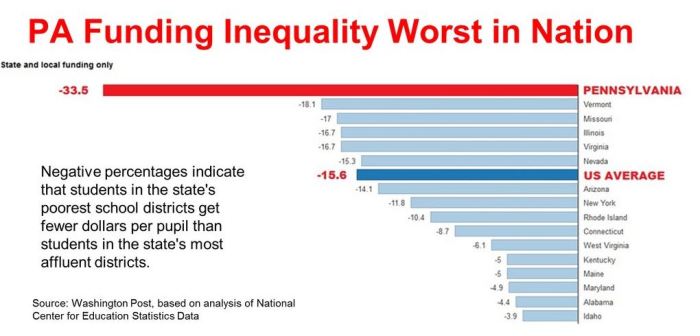
According to the U.S. Department of Education, poor schools in the Commonwealth spend 33 percent less on their students than rich ones. That’s a significantly larger difference than the next-closest state, Vermont, where the spending difference between rich and poor schools is only 18 percent. Three other states — Illinois, Missouri and Virginia — have gaps of 17 percent.


pa funding inequality

 
We can’t keep kicking minorities and the destitute to the curb. We can’t keep giving the rich and middle class every opportunity to succeed while depriving the poor of that same chance.

Wolf, the Democrats and a few Republicans have tried several times to fix the problem.

First, they attempted large increases in education funding to catch up to where funding would be if the Corbett cuts hadn’t happened coupled with the rising costs caused by inflation.

In 2015, the governor proposed a $400 million increase but funded it with a tax increase on the rich that almost all Republicans refused.

Then he tried to bring the state share of education funding up to 50% by using a more equitable tax plan. He proposed cutting property taxes in poorer districts and replacing them with higher state taxes elsewhere. However, Republicans saw it as an opportunity to completely eliminate property taxes and cut school funding even further. It ended in a stalemate and another incremental education increase.

If the legislature wouldn’t approve the necessary spending increases to heal the cuts it made under Corbett, Wolf at least wanted lawmakers to approve dividing the money up more fairly among the state’s 500 school districts.

A funding formula had been approved four years ago to reflect changes in school district attendance and wealth that had been ignored for a quarter century. This would result in more support for poorer schools and less for wealthier ones.

And there’s the sticking point. Lawmakers wouldn’t approve a plan that would provide less funding to 70% of the state’s districts – but neither would they increase school spending to make up the difference.

You’d think that such legislative gridlock might make voters lose hope. However, there is a mass movement of people at the grassroots level demanding change for our children.

Most notably, the parents of six school children, six school districts, the NAACP and a rural schools group are suing the state over education funding.

The lawsuit – now in its fourth year – is scheduled for trial before the state Supreme Court in 2020. So at best, relief is still a ways in the future. Many are hoping justices will order the legislature to dramatically increase its investment in public schools. But the outcome is certainly not a sure thing.

Could striking teachers in red and blue states be showing us in Pennsylvania the solution?

Might it be time to raise our teacher voices in the purple states, too?

And is there a path to equity through collective action that doesn’t hang teachers out to dry?


Still can’t get enough Gadfly? I’ve written a book, “Gadfly on the Wall: A Public School Teacher Speaks Out on Racism and Reform,” now available from Garn Press. Ten percent of the proceeds go to the Badass Teachers Association. Check it out!

thumbnail_IMG_8249

Rahm Emanuel’s Non-Apology Apology for Being a School Privatization Cheerleader

thumbnail_IMG_8543


Rahm Emanuel’s recent op-ed in The Atlantic may be one of the dumbest things I have ever read.


The title “I Used to Preach the Gospel of Education Reform. Then I Became the Mayor” seems to imply Emanuel has finally seen the light.


The outgoing Chicago Mayor USED TO subscribe to the radical right view that public schools should be privatized, student success should be defined almost entirely by standardized testing, teachers should be stripped of union protections and autonomy and poor black and brown people have no right to elect their own school directors.


But far from divorcing any of this Reagan-Bush-Trump-Clinton-Obama crap, he renews his vows to it.


This isn’t an apologia. It’s rebranding.


Emanuel had been White House Chief of Staff at the beginning of President Barack Obama’s first term. He’s a former U.S. Representative, and senior adviser to President Bill Clinton.


Yet he’s persona non grata.


Now that the extremely unpopular chief executive has decided not to seek re-election, he’s trying to secure his legacy – to make sure the history books don’t remember him as the Democrat In Name Only (DINO) mayor who closed an unprecedented number of schools serving mostly minority students while catering to the will of rich investors. He doesn’t want to be remembered as the lord on a hill whose own children went to private school while he cut services and increased class size for black and brown kids. He’s trying to save a series of abysmal policy failures so that he and his neoliberal pals like Cory Booker and Arne Duncan can still hold their heads high in Democratic circles. In a time when authentic progressives like Alexandria Ocasio-Cortez and Bernie Sanders have won the heart of the party, he wants to ensure there’s still room for that old time corporate education reform he is infamous for.


Like I said – dumb.


To quote the Principal in Billy Madison:


“…what you’ve just said is one of the most insanely idiotic things I have ever heard. At no point in your rambling, incoherent response were you even close to anything that could be considered a rational thought. Everyone in this room is now dumber for having listened to it. I award you no points, and may God have mercy on your soul.”

 
If only he’d respond like Madison:


Okay, a simple ‘wrong’ would’ve done just fine, but thanks.”


But like that straight man school administrator in an Adam Sandler movie, I’m going to give you the long answer. I’m going to explain why what Emanuel said was supremely stupid.


He begins the piece with a lengthy description of how he got one over on those darn teachers unions.


He wanted what was best for children, but those pesky teachers just wouldn’t do it until he twisted their arms and got them to play ball.


And keep in mind – this is the softer, gentler Emanuel who wants you to like him! This is the Emanuel who’s trying on progressive clothing to look more appealing!


Hey, Rahm, attacking working people while casting yourself as a savior is so two years ago. We’ve had a conservative Supreme Court hobble unions’ ability to stop free riders and a teacher uprising since then. Union educators from West Virginia to Oklahoma to Los Angeles, California, have gone on strike demanding Republican and Democratic chief executives like yourself make positive change for children.


No one’s buying your fairytales anymore.


But it leads into a series of important points he wants to make:


“For most of my career, I preached the old gospel of education reform. But now research and experience suggest that policy makers need to embrace a new path forward and leave the old gospel behind. Principals, not just teachers, drive educational gains. The brain-dead debate between charter and neighborhood schools should be replaced with a focus on quality over mediocrity. To get kids to finish high school, the student experience should center on preparing them for what’s next in life. Finally, classroom success hinges on the support that students get outside school. If other cities follow Chicago’s lead in embracing those ideas, they’re likely to also replicate its results.”


Oh and what results those are! But we’ll come back to that.


He reasons that principals drive educational gains. In fact, this is his a-ha moment. Don’t focus on teachers, focus on principals.


He pats himself on the back for raising principals’ salaries and recruiting only people who think and believe just like him. Then he didn’t have to watch over them so closely and they were even promoted to higher administrative positions.


Wow. What an innovation! Stack your school system with yes-people and your initiatives will get done. Great. No room for diversity of thought. No one who thinks outside of the box. Just functionaries and flunkies who do what you say.


This is sounding like a great case for progressive education reforms already! If you’re a fascist dictator.


Next comes my favorite – a further commitment to school privatization hidden behind the flimsiest rechristening in history.


Stop talking about charter schools vs. authentic public schools, he writes. Talk about quality schools vs. mediocre ones.


What bull crap!


Imagine if pirates were robbing ships on the high seas. Would you talk about good pirates and bad pirates? Imagine if vampires were attacking people in the night and draining their blood. Would you talk about good vampires and bad vampires?


I mean Dracula did suck Mina dry, but he spends the rest of his nights reading to orphan children. Long John Silver may have stolen hundreds of chests of gold from merchant ships, but he donates every tenth doubloon to fighting global warming!


Hey, Rahm, you can’t escape from the argument of whether school privatization is good or bad. Charter schools drain funding from authentic public schools and give it to private investors. They allow unscrupulous operators to cut services and pocket the profits. They increase segregation, decrease democracy and transparency, give choice mainly to business people who get to decide if your child is allowed to enroll in their school – all while getting similar or worse results than authentic public schools.


If you stopped taking corporate money for one second, maybe you could understand this simple point – no system will ever be fair that allows theft and then protects the thieves.


But on to your next point. You want to focus the student experience on what comes next in life. You want to focus on jobs and career readiness.


This is just dumbing down what it means to get an education. Going to school shouldn’t be reduced to a career training program. If we only teach kids how to manufacture widgets, what will they do when the widget factory closes?


We need to teach them how to think for themselves. We need to offer them real opportunities for self-discovery and challenge them to think deeply through an issue.


When kids graduate, we don’t want to have simply made a generation of workers. We need them to be thinking adults and citizens who can participate fully in our democratic process and help lead our country toward a better and brighter future – not just learn how to code.


Finally you talk about the support students get out of school. That’s stupid because…


Actually it’s not.


You’ve got a point there. We do need to support programs to help students succeed outside the classroom – summer reading, after school tutoring, etc. However, making kids sign a pledge to go to college in order to be eligible for a summer job? That’s kind of cruel when many have no way to pay for college in the first place. Moreover, it completely ignores the huge section of children who have no desire to go to college and would rather go to career or technical schools.


And that brings me to his dismal record of failure described by neoliberals as success.


Emanuel pushed forward a policy that in order to graduate, Chicago seniors must prove that after 12th grade they’re going to college, trade school, an internship, the military or would otherwise be gainfully employed. OR ELSE they can’t get a diploma!


Rahm’s all about adding more hoops for poor minority kids to jump through. Very rarely is he about providing any help for them to make the jump.


He’s a pull-yourself-up-by-your-own-bootstraps Democrat. Or what we used to call – a Republican.


Emanuel wants to tout his record as “proof” that his methods worked.


Let’s look at them.


He has closed 50 public schools46 of which serve mostly black students. Southside residents had to resort to a month-long hunger strike to keep their last neighborhood school open. He laid off hundreds of teachers and staff – many just before school opened. Yet he always had money for state of the art charter schools like the $27 million new charter school for the University of Chicago as part of the Obama Presidential Library. In addition, his economic policy consisted of closing public health clinics for the poor and installing red light cameras to increase fines – none of which actually boosted the economy.


And then we get to the scandal that made a third term as mayor impossible. Emanuel actually covered up the police killing of unarmed black teen, Laquan McDonald, so it wouldn’t hurt his re-election campaign.


In October of 2014, Officer Jason Van Dyke shot the 17-year-old 16 times. Most of those bullets went into the teenager after he was already flat on the ground and the officer was at least 10 feet away.


Emanuel quickly issued a $5 million settlement to McDonald’s family on the condition they keep quiet about the incident. It wasn’t until after Emanuel had won re-election, that an independent journalist put two-and-two together and asked for the officer’s dashcam video to be released. It took the full power of the media and a lawsuit to accomplish this resulting in charges against Van Dyke for first degree murder. Just last year the officer was found guilty of second degree murder and 16 counts of aggravated battery with a firearm, but was found not guilty of official misconduct. He was sentenced to 6.75 years in prison.


This is not a sterling mayoral record. It is not a proven record of success.


He says graduation rates are up as are rates of Chicago students who go on to college. He neglects to mention that they’re up nationwide. He neglects to mention that the quality of education these kids receive is often watered down to whatever will help them pass the federally mandated standardized test. He neglects to mention the loss of teacher autonomy, and the rise in class size.


Face it. Emanuel is a crappy mayor. Chicago and the nation will be better if he fades into the sunset.


His political career was backed by the same big money conservatives that back Republicans like Chris Christie, Mitt Romney and Bruce Rauner. He was a puppet of charter schools, hedge fund managers and the Koch Brothers.


In fact, his corruption was so bad that during the 2016 primary, he became an issue for Democratic Presidential contenders.


Bernie Sanders actually called him out in a tweet saying: “I want to thank Rahm Emanuel for not endorsing me. I don’t want the endorsement of a mayor shutting down schools and firing teachers.”


Emanuel had endorsed Hilary Clinton, and her education advisor Ann O’Leary wrote in a private email to senior campaign staff that this might actually hurt the candidate’s primary chances. She wanted Clinton to distance herself from the troubled mayor or at least explain how she differed from his troubled policies.


They eventually settled on saying nothing. That didn’t backfire at all!


Look. Democrats need to learn the exact opposite of the lesson Rahm is selling here.


Corporate education reform is poison. School privatization is not progressive. High stakes testing is not progressive. Hiring like-minded flunkies to run your schools is not progressive. Closing black kids’ schools is not progressive.


Emanuel has learned nothing. Have we?


Still can’t get enough Gadfly? I’ve written a book, “Gadfly on the Wall: A Public School Teacher Speaks Out on Racism and Reform,” now available from Garn Press. Ten percent of the proceeds go to the Badass Teachers Association. Check it out!

cropped-book-1.jpg

The Trouble with Test-Obsessed Principals

thumbnail_IMG_8535


When I was a child, I couldn’t spell the word “principal.”


I kept getting confused with its homonym “principle.”


I remember Mr. Vay, the friendly head of our middle school, set me straight. He said, “You want to end the word with P-A-L because I’m not just your principal, I’m your pal!”


And somehow that corny little mnemonic device did the trick.


Today’s principals have come a long way since Mr. Vay.


Many of them have little interest in becoming anyone’s pal. They’re too obsessed with standardized test scores.


I’m serious.


They’re not concerned with student culture, creativity, citizenship, empathy, health, justice – they only care about ways to maximize that little number the state wants to transform our children into.


And there’s a reason for that. It’s how the school system is designed to operate.


A new research brief from the Tennessee Education Research Alliance concluded that the lowest rated principals generally work at schools with the most economically disadvantaged students.


So schools serving students with the highest poverty and lowest test scores often have the least experienced and least effective principals.


thumbnail_Screen Shot 2019-02-08 at 11.27.32 AM


Now the first question I had when reading this report was “How do they measure effectiveness?” After all, if they rate principals primarily on student test scores, then obviously those working at the poorest schools will be least effective. Poor kids earn low test scores. That’s all the scores consistently show – the relative wealth of students’ parents. If you define an ineffective principal as one who works in a building with low scoring students, it would be no shock that those principals worked in the poorest schools.


However, researchers didn’t fall entirely into this trap. According to the working paper:


“We measure principal quality in two ways: years of experience in the principal position and rubric-based ratings of effective principal practice taken from the state’s evaluation system.”


In Tennessee this means evaluating principals partially on student test scores at their buildings – 35%, in fact – higher than the 20% of classroom teachers’ evaluations. However, the remaining pieces of principals’ effectiveness are determined by an observation from a more senior administrator (50%) and an agreed upon score by the principal and district (15%).


Since researchers are relying at least in part on the state’s evaluation system, they’re including student test scores in their own metric of whether principals are effective or not. However, since they add experience, they’ve actually created a more authentic and equitable measure than the one used by the state.


It just goes to show how standardized testing affects nearly every aspect of the public education system.


The testing industrial complex is like a black hole. Not only does it suck up funding that is desperately needed elsewhere without providing anything of real value in return, its enormous gravity subverts and distorts everything around it.


It’s no wonder then that so many principals at high poverty schools are motivated primarily by test scores, test prep, and test readiness. After all, it makes up a third of their own evaluations.


They’ve been dropped into difficult situations and made to feel that they were responsible for numerous factors beyond their control. They didn’t create the problem. They didn’t disadvantage these students, but they feel the need to prove to their bosses that they’re making positive change.


But how do you easily prove you’ve bettered the lives of students?


Once again, standardized test scores – a faux objective measurement of success.


Too many principals buy into the idea that if they can just make a difference on this one metric, it will demonstrate that they’re effective and thus deserve to be promoted out of the high poverty schools and into the well-resourced havens.


Yet it’s a game that few principals are able to win. Even those who do distinguish themselves in this way end up doing little more for their students than setting up a façade to hide the underlying problems of poverty and disinvestment.


Most principals at these schools wind up endlessly chasing their tails while ignoring opportunities for real positive change. Thus they end up renewing the self-fulfilling prophesy of failure.


Researchers noticed the pattern of low performing principals at high poverty schools after examining a decade’s worth of data and found it to hold true in urban, rural and suburban areas. And even though it is based on Tennessee data, the results hold true pretty consistently nationwide, researchers say.


Interestingly enough, the correlation doesn’t hold for teachers.


Jason Grissom, an associate professor at Vanderbilt University and the faculty director of the Research Alliance, says that the problem stems from issues related specifically to principals.


For instance, districts are hiring lower-rated principals for high poverty schools while saving their more effective leaders for buildings with greater wealth and resources.


thumbnail_Screen Shot 2019-02-08 at 11.28.20 AM


As a result, turnover rates for principals at these schools are much higher than those for classroom educators. Think about what that means – schools serving disadvantaged students are more likely to have new principal after new principal. These are leaders with little experience who never stick around long enough to learn from their mistakes.


And since these principals rarely have had the chance to learn on the job as assistant principals, they’re more likely to be flying by the seat of their pants when installed at the head of a school without first receiving the proper training and mentorship that principals at more privileged buildings routinely have.


As such, it’s easy for inexperienced principles to fall into the testing trap. They buy into the easy answers of the industry but haven’t been around long enough to learn that the solution they’re being sold is pure snake oil.


This has such a large effect because of how important principals are. Though they rarely teach their own classes, they have a huge impact on students. Out-of-school factors are ultimately more important, but in the school building, itself, only teachers are more vital.


This is because principals set the tone. They either create the environment where learning can flourish or smother it before the spark of curiosity can ignite. Not only that, but they create the work environment that draws and keeps the best teachers or sends them running for the hills.


The solution isn’t complicated, says Grissom. Districts need to work to place and keep effective and experienced principals in the most disadvantaged schools. This includes higher salaries and cash bonuses to entice the best leaders to those buildings. It also involves providing equitable resources for disadvantaged schools so that principals have the tools needed to make authentic positive change.


I would add that we also need to design fair evaluation systems for both principals and teachers that aren’t based on student test scores. We need to stop contracting out our assessments to corporations and trust our systems of government and schools to make equitable judgments about the people in their employ.


Ultimately, what’s required is a change in attitude.


Too many principals look at high poverty schools as a stepping stone to working at a school with endless resources and a different class of social issues. Instead, the goal of every excellent school leader should be to end their career working where they are needed most.


Such professionalism and experience would loosen the stranglehold of test-and-punish and allow our schools not to simply recreate the inequalities already present in our society. It would enable them to heal the divide.


As John Dewey wrote in 1916:


“Were all instructors to realize that the quality of mental process, not the production of correct answers, is the measure of educative growth, something hardly less than a revolution in teaching would be worked.”


And that’s what’s needed – a revolution.


Still can’t get enough Gadfly? I’ve written a book, “Gadfly on the Wall: A Public School Teacher Speaks Out on Racism and Reform,” now available from Garn Press. Ten percent of the proceeds go to the Badass Teachers Association. Check it out!

book-4