The organization is piloting a program at 150 colleges and universities to adjust SAT scores to account for high schools and neighborhoods “level of disadvantage.”
The program is called the “Environmental Context Dashboard” and has been in the works since 2015 at the request of colleges. It provides admissions officers with information about students’ neighborhoods and high schools, such as the poverty level and the availability of challenging coursework. This is supposed to allow them to put raw scores into context before making admissions decisions.
The organization’s annual revenue is more than $750 million, according to its most recent publicly available 990 form. The organization’s CEO David Coleman makes $750,000 a year, its President Gaston Caperton makes more than $1.5 million a year, and 22 other employees earn at least $200,000.
The SAT’s new adversity score is a marketing tool – nothing more.
It’s the act of rats trapped in a corner. They’re admitting everything critics always said about them and offering a white flag.
We have no need to take it. In fact, we would be incredibly stupid to do so.
What the world needs is not an adversity score to counteract all the bad things the SAT does. It needs the absence of the SAT and all such standardized gatekeeper assessments.
It’s absolutely hilarious to hear him admitting the biases of standardized testing since he’s been one of its leading proponents since the 1990s. It’s like hearing Colonel Sanders admit he doesn’t really like fried chicken all that much.
In the case of the SAT, he said colleges need to recognize student qualities that the test can’t capture, such as resourcefulness. Essays, letters of recommendation, and the “profiles” most high schools post sometimes capture the challenges and circumstances students face, he said, but in many cases colleges don’t find this information because they’re blinded by students’ tests scores.
Without a tool like the dashboard, he said, “the SAT could be misleading.”
YOU DON’T SAY!
“To warrant that the playing field is now level isn’t right or just,” Coleman added. “In the America we live in … the vast majority of students are working with a lot less than the top third. To then say that the SAT is enough to reflect what you can do, no, it isn’t.”
All of which begs the question of why we need the SAT test at all.
Classroom grades represent 180 days worth of data compiled by multiple educators over at least 12-13 years.
Admittedly, they aren’t completely objective but neither are standardized test scores. We do not have the power to crack open children’s skulls and see what’s going on in their brains. But classroom grades offer exponentially more data and of a much more equitable kind.
They were eugenicists who believed that white Europeans were superior to all others and used their pseudoscientific assessments to “prove” their biases. If there’s any doubt of that, I refer you to this passage from Brigham’s seminal work A Study of American Intelligence:
“The decline of American intelligence will be more rapid than the decline of the intelligence of European national groups, owing to the presence here of the negro. These are the plain, if somewhat ugly, facts that our study shows. The deterioration of American intelligence is not inevitable, however, if public action can be aroused to prevent it.”
“We should not work primarily for the exclusion of intellectual defectives but rather for the classification of men in order that they may be properly placed.”
These sorts of conversions of scores have been tried before and routinely criticized as inaccurate.
The College Board tried something similar in the late 90s called the “striver’s tool.” It identified students who scored higher than expected based on racial, socioeconomic, and other data.
But it was shut down after it became a political football comparable to that of affirmative action – the same that has happened among certain conservatives with the new adversity score.
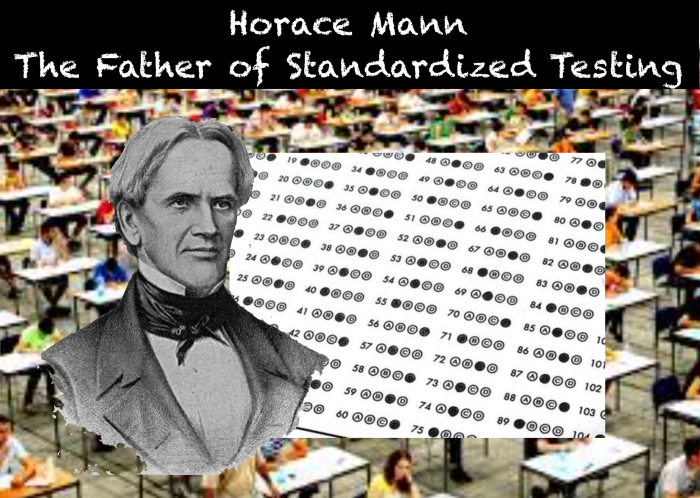
It was a disaster the very first time it was attempted in America – in Boston, Massachusetts, in 1845.
Yet we continue to prescribe the same error to students in schools today.
Judging learners, schools and teachers based on standardized assessments has the same problems now as it did 174 years ago. Yet we act as if it’s the only accurate way to assess knowledge, the only fair and equitable way to assign resources and judge the professionalism of our schools and teachers.
If we simply remembered our history, we’d know that. But our collective amnesia allows this bad policy to reappear every generation despite any criticisms or protests.
But Boston wasn’t known just for educating the elite. The city’s school committee had opened the nation’s first public high school in 1821. This wasn’t a charity. The community funded its public schools relatively well and took pride in its students’ accomplishments.
At the local English Grammar Schools, most examinations were strictly oral. Students were questioned in person about the various subjects in which they had received instruction. Teachers tested students’ memory in a recitation to find out whether or not they were proficient in the subject at hand.
The purpose behind such an assessment wasn’t to assign a grade like children were eggs or melons. It was to give the teacher information about how much his students had learned and where the students’ teacher should begin instruction next year.
However, critics complained that such assessments weren’t impartial and that a written exam might be better. Unfortunately, having every student complete one was impractical before the pencil and steel pen came into common usage in the late 1800s. Besides, teachers – then called School Masters – were trusted to use their judgment measuring student achievement and ability based on empirical observation of students’ day-to-day work.
It should also be noted that many more teachers were men at this time. This changed by the 1920s, when the majority of educators were women while most men had fled to the administrative offices. As this transformation took place, it accompanied greater trust in administrators and decreasing confidence in classroom teachers. And if you don’t see the sexism in that, you aren’t paying attention.
To this day Mann remains a somewhat controversial figure. To some he was a reformer seeking to modernize education. To others he was a self-serving politician looking to increase his own power and that of his party no matter what the cost.
Mann had traveled abroad to see the innovations of European schools and concluded that Prussia’s schools, in particular, were far superior to America’s. His remarks were included in a highly publicized 1844 report that demanded action lest our country’s children be left behind. (Sound familiar?)
The examiners picked 530 out of the city’s approximately 7,000 students — allegedly the best below high school age – and made them take the new exams. This was about 20 or 30 children from each school. Students had an hour to write their responses on each subject to questions taken from assigned textbooks -geography, grammar, history, rhetoric, and philosophy.
Most failed.
A contemporary report on the exams concluded that the results “show beyond all doubt, that a large proportion of the scholars in our first classes, boys and girls of 14 or 15 years of age, when called upon to write simple sentences, to express their thoughts on common subjects, without the aid of a dictionary or a master, cannot write, without such errors in grammar, in spelling, and in punctuation.”
Examiners explained in a subsequent report that they had been looking for “positive information, in black and white,” exactly what students had learned. Teachers took no offense at that goal, but complained that the test questions had not pertained to what students had been taught.
Howe and his examiners countered that they had ensured their new assessment was valid with field testing – a practice that modern day corporations like Pearson and Data Recognition Corp. still do today.
However, the wealthy Roxbury students outscored all the other schools. Therefore, they were made the standard of excellence that all other schools were expected to reach.
So when Boston students – all of whom did not have the privileges of Roxbury students – didn’t achieve the same scores, they were deemed failing, inadequate, losers.
Thus Mann could justify criticizing the district, firing teachers and administrators and consolidating control over the city’s schools.
However, Bostonians were not all convinced. Editorials were published both for and against the tests.
Every aspect of the exam was disputed – and in similar ways to the testing controversies we still see today.
To start, raising the stakes of the exams invited cheating. One teacher was caught leaking questions to his students before the testing session began.
The assessments also showed a racial achievement gap that far from helping diagnose structural inequalities was instead weaponized against the very people working hardest to help minority students learn. Examiners criticized the head teacher of the segregated Smith School because his African American students had scored particularly low. He was accused of not seeing the potential in black children. Never mind that these students were the most different from the Roxbury standard in terms of culture and privilege.
The tests also began the endless failing schools narrative that has been used by ambitious policymakers and disaster capitalists to get support for risky and unproven policies. Rivalries began between city and suburban schools with Bostonians wondering why their schools had been allowed to get so much worse.
Much of the criticism came back on Mann and Howe who reacted by throwing it back on the teachers for doing such a bad job.
In the end, a few educators were let go, but the voters had had enough of Mann.
Parents accused him of deliberately embarrassing students and in 1848 he was not re-elected to office.
The experiment deeply disturbed many people. No one could explain why there was a discrepancy between scores of rich vs. poor students. The original justification of these exams was that they would eliminate partiality and treat students fairly and equally. Yet the results showed a racial and economic bias that didn’t escape contemporaries. In 1850 as the tests were being discontinued, the chairman of the examination committee wrote:
“Comparison of schools cannot be just while the subjects of instruction are so differently situated as to fire-side influence, and subjected to the draw-backs inseparable from place of birth, of age, of residence, and many other adverse circumstances.”
And that’s how standardized testing began.
It was a political power play justified by so-called universal testing.
In the years that followed, standardized testing became much more efficient. In 1915, the first test was given with multiple-choice questions – Frederick J. Kelly’s Kansas Silent Reading Test. It was roundly criticized and eventually disowned by Kelly for focusing almost exclusively on lower order thinking skills.
In the 1960s black plaintiffs began winning innumerable lawsuits against the testing industry. Perhaps the most famous case is Hobson v. Hansen in 1967, which was filed on behalf of a group of Black students in Washington, DC. The court ruled that the policy of using tests to assign students to tracks was racially biased because the tests were standardized to a White, middle class group.
And then in 2001, President George W. Bush’s No Child Left Behind legislation revved the whole thing up into overdrive. With bipartisan support, he tied federal funding of schools to standardized test performance and annual academic progress – a policy that was only intensified under President Barack Obama who added competitive grants for additional funding based on test performance under Race to the Top.
Since then, standardized testing has grown from a $423 million industry before 2001 to a multi-billion dollar one decades later. If we add in test prep, new text books, software, and consultancy, that figure easily tops the trillion dollar mark.
But it’s taken an incredible toll on the activist community.
We have had to be out there fighting this ridiculous crap day-in-day-out 365 days a year.
And even then, we’ve suffered devastating losses – family separations at the border, children dying in detention, an increase in hate crimes and gun deaths, all while climate change runs rapidly out of control.
I wish I felt more hopeful. But as I cast my eyes back on the year that was, I’m struck with a sense of bone-deep despair.
I am confident Trump will go down and he will take so many with him.
But the forces of regression, prejudice and stupidity that forced him upon us don’t appear to be going anywhere.
Behind Donald is another Trump waiting to take his place. And behind him another one – like an infinite set of Russian Matryoshka dolls.
Oh, many of them look more appealing than Donald. They dress better, are more articulate and can remember all the words to the National Anthem. But they are just as committed to serving themselves at our expense.
So with that in mind, I invite you to join me on a brief look back at the year that was.
Also, I got to check another item off my bucket list with the invitation to film a TED Talk at Central Connecticut State University. My topic was “The Plot to Destroy Public Education.” It’s been viewed almost 1,000 times. I invite you to watch it here.
As to the blog, itself, I’ve been writing now for four and a half years. This year, I’ve had more than 211,000 hits. To be honest, that’s quite a drop. In 2017, I had 366,000 hits. But I’m hearing about similar dips all over the blogosphere. Facebook changed its algorithm this year making it much harder for people to see the work of amateurs like me. Zuckerberg’s multi-billion dollar corporation doesn’t refuse to spread the written word – it just charges a fee that I can’t afford. Moreover, the Federal Communications Commission (FCC) repealed Net Neutrality at about this time last year making things even more dodgy.
In addition, about 500 more people followed me this year for a total of 13,361.
That should do it for an overview.
One final item before I get to the look back. I’m making a slight change this year to how I do things. Instead of publishing two separate articles – a Top 10 list and a List of Honorable Mentions – I’m combing the two into this one.
I’ll begin with three pieces that didn’t necessarily get the number of hits I thought they were worth. Then I’ll count down my 10 most popular pieces of 2018.
So without further ado, here’s what’s kept Gadfly buzzing this year:
Description: There’s an increasing (unspoken) insistence that schools do away with teachers and replace them with technology, apps, algorithms and other edtech marvels with more strings attached than your standard marionette. This is my attempt to prove how and why real, live teachers are important.
Fun Fact: How sad this article was and remains necessary.
Description: You often hear privatization cheerleaders defend charter schools by making a distinction between the good ones and the bad ones. This usually just means those that are for-profit and those that are not-for-profit. But in this article, I show that this distinction is bogus.
Fun Fact: This may be one of the most important facts you can share with someone who’s had a big gulp of the charter school Kool-aide.
Description: Policy makers don’t talk about it as much these days, but there are still plenty of laws on the books requiring states to evaluate teachers on student test scores. It’s called VAM or Value Added Measures. Here’s why it’s totally unfair.
Fun Fact: I’m not sure if anyone else has ever put together all these arguments against VAM. Hopefully, it can serve as a good go-to article when a corporate shill starts rhapsodizing on the benefits of this farce.
Description: Ask a Common Core propagandizer why their canned academic standards haven’t resulted in an increase in test scores and you’ll get this whooper: ‘It’s the students’ fault. They need more grit.’ Here’s why that’s a steaming pile of something that rhymes with grit.
Fun Fact: Some folks hated this article simply because of my potty mouth. But a whole lot of people were as fed up with this particular suit of the Emperor’s new clothes as I am.
Description: During Betsy Devos’ 60 Minutes interview, the billionaire heiress turned Education Secretary just couldn’t figure out why people hated her so much. It thought I’d send her a clue – or 21.
Fun Fact: The biggest criticism I got on this article was that I stopped at only 21 reasons. I should have gone on – but then I might still be writing…
Description: A question I often get is this: Why do you think Charter Schools are always a bad thing? Here is my answer.
Fun Fact: This article shocked a lot of progressives who backed Obama and Clinton. But it had to be said. Democracy is always better than tyranny just as public schools are always better than charter schools.
Description: If all students the world over had to pass America’s Common Core tests, they wouldn’t be able to do it. You’d think that would have implications for how we assess learning in the USA. But nope. Standardized tests are big business. Wouldn’t want to kill that cash cow just because we’re hurting our children, now would we?
Fun Fact: This should have been a bigger story, but we already rewrote our federal education law, the Every Student Succeeds Act, which enshrines standardized testing in most states. So nothing can be done until it comes up for another revision in a few years where lawmakers will again drag their feet and somehow rediscover their love of standardized testing all over again!
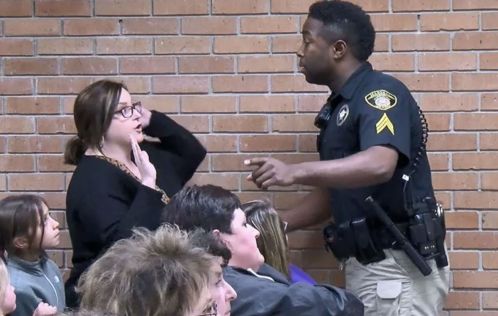
Description: A Louisiana school resource officer threw a school teacher to the ground and arrested her for asking a question at a school board meeting. This was my analysis of what such actions were teaching students.
Description: A lot of folks in education think that everything in our schools should be data driven. Here’s why they’re wrong. It should be data-informed but student driven.
Fun Fact: A lot of educators, parents and students were as sick of hearing about “date-driven” instruction as I was. Feel free to use this article on the next fool who brings out this stale chestnut.
Description: Standardized testing is terrible in so many ways. It hurts students. It hurts schools. But we often forget how it stops teachers from effectively doing their jobs.
Fun Fact: This one brought a lot of memories to educators – memories of how things are supposed to be and how they’ve changed for the worst. We need to continue asking questions about the purpose of education and how our school policies are betraying that purpose.
Description: Poor Betsy. She and her family spent a lot of money on this election on regressive candidates who had no intention of working in your best interest. And many of them lost!
Fun Fact: Wouldn’t it be great if everyone got one vote? Wouldn’t it be great if money couldn’t buy elections?
Description: In the Pittsburgh area, we were asked to vote on a referendum to increase spending on children. It sounded like a great idea until you looked at the details. It was just a power grab by the forces of privatization.
Fun Fact: The referendum lost by about as many votes as this article received. I can’t prove my writing changed anyone’s mind, but it was hugely popular here in the ‘Burgh. I’d see people passing around printed copies at council meetings. It was reposted everywhere. I feel like this one made a real difference and helped us stop a bad law. Too bad it couldn’t help us enact a good one.
Description: I start with a basic fact about native born African Americans vs. foreign born African Immigrants. Then I try to account for the difference.
Fun Fact: This seems like an important question to me. But it was a controversial one. Some folks were furious I even asked the question. But more people were interested in this piece than anything else I wrote all year.
Gadfly’s Other Year End Round Ups
This wasn’t the first year I’ve done a countdown of the year’s greatest hits. I usually write one counting down my most popular articles (like the one you just read from 2018) and one listing articles that I thought deserved a second look. Here are all my end of the year articles since I began this crazy journey in 2014:
“On the dangers of being data-driven: Imagine driving from A to B ignoring the road, the weather, the traffic around you… only staring at the gauges on the dashboard.”
To be sure, you should be data-informed – you should know what their test scores are and that should factor into your lessons in one way or another – but test scores should not be the driving force behind your instruction, especially since standardized test scores are incredibly poor indicators of student knowledge.
We find ourselves in the same sticky situation as those trying to measure intelligence. What is this thing we’re trying to quantify and how exactly do we go about quantifying it?
The result is intensely subjective. Sure we throw numbers up there to represent our assumptions, but – make no mistake – these are not the same numbers that measure distances on the globe or the density of an atomic nucleus.
It looks like statistics. It looks like math. But it is neither of these things.
We just get tricked by the numbers. We see them and mistake what we’re seeing for the hard sciences. We fall victim to the cult of numerology. That’s what data-driven instruction really is – the deepest type of mysticism passed off as science.
The idea that high stakes test scores are the best way to assess learning and that instruction should center around them is essentially a faith based initiative.
Before we can go any further, we must understand that.
It Has Never Been Proven Effective
Administrators and principals want teachers to base their instruction around test scores.
Has that ever been proven an effective strategy for teachers planning lessons or the allocation of resources? Can we prove a direct line from data to better instruction to better test scores?
In a 2007 study from Gina Schuyler Ikemoto and Julie A. Marsh published in the Yearbook for the National Society for the Study of Education, data driven instruction actually was found to have harmful effects on educator planning and, ultimately, student learning.
Researchers looked at 36 instances of data use in two districts, where 15 teachers used annual tests to target weaknesses in professional development or to schedule double periods of language arts for English language learners. The result was fewer instances of collective, sustained, and deeper inquiry by groups of teachers and administrators using multiple data sources – test scores, district surveys, and interviews – to reallocate funds for reading specialists or start an overhaul of district high schools.
Teachers found the data less useful if it was not timely – standardized test scores are usually a year old by the time they get to educators. Moreover, the data was of less value if it did not come with district support and if instructors did not already buy into its essential worth.
In short, researchers admitted they could not connect student achievement to the 36 instances of basic to complex data-driven decisions in these two districts.
But that’s just one study.
In 2009, the federal government published a report (IES Expert Panel) examining 490 studies where schools used data to make instructional decisions.
Of these studies, the report could only find 64 that used experimental or quasi-experimental designs. Of these it could find only six – yes, six – that met the Institute of Education Sciences standard for making causal claims about data-driven decisions to improve student achievement.
And when examining these six studies, the panel found “low evidence” to support data-driven instruction. They concluded that the theory that data-driven instructional decisions improve student test scores has not been proven in any way, shape or form.
It’s Harmful – The Stereotype Threat and Motivation
Data-driven instruction essentially involves grouping students based on their performance on standardized tests.
However, there is a mountain of psychological research showing that this practice is harmful to student learning. Even if you don’t put students with different test scores in different classes, simply informing them that they belong to one group or another has intense cognitive effects.
Simply being told that you are in a group with lower test scores depresses your academic outcomes. This is known as the stereotype threat.
When you focus on test scores and inform students of where they fall on the continuum down to the percentile – of how far below average they are – you can trigger this threat. Simply tracking students in this way can actually make their scores worse.
But it’s not just the low scorers who are harmed. Even the so-called “advanced” students can come to depend on their privileged status. They define themselves by their achievement, collecting prizes, virtual badges and stickers. These extrinsic rewards then transform their motivation from being driven by the learning and the satisfaction of their curiosity to depending on what high achievement gets them, researchers have found.
In short, organizing all academics around tests scores is a sure way to lower them.
The Data Doesn’t Capture Important Factors
Data-driven instruction is only as good as the data being used. But no data system can be all inclusive.
For instance, two students do the same long-term project and receive the same grade. However, one student overcame her natural tendency to procrastinate and learned more than in past projects. The other did not put forth his best effort and achieved lower than his usual.
Almost every year I have a few students who are chronically tardy to class. A good teacher finds out why – if this is because they aren’t making the best use of the class interval or if they have a greater distance to travel than other students. However, if we judge solely on the data, we’re supposed to penalize students without considering mitigating factors. That’s being data-driven – a poor way to be a fair teacher.
It has been demonstrated repeatedly that student test scores are highly correlated with parental income. Students from wealthier parents score well and those from more impoverished families score badly. That does not mean one group is smarter or even more motivated than the other. Living in poverty comes with its own challenges. Students who have to take care of their siblings at home, for instance, have less time for homework than those who have nothing but free time.
When one of my students does an amazing job on an assignment or project, my first impulse is not to reduce what they’ve done to a letter grade or a number. I speak my approbation aloud. I write extensive comments on their papers or conference with them about what they’ve done.
Certainly, I have to assign them a grade, but that is merely one thing educators do. To reduce the relationship to that – and only that – is extremely reductive. If all you do is grade the learner, you jeopardize the learning.
At this point, someone inevitably says that life isn’t fair. Our students will have to deal with standardized tests and data-driven initiatives when they get older. We have to prepare them for it.
What baloney!
If the real world is unfair, I don’t want my students to adjust to that. I want to make it better for them.
Imagine telling a rape victim that that’s just the way the world is. Imagine telling a person brutalized by the police that the world is unfair and you just have to get used to it.
Does the athletic program exist because it increases student test scores? Does each student lunch correlate with optimum grades? Do you have computers and iPads because they have a measureable impact on achievement?
Some administrators and principals DO try to justify these sorts of things by reference to test scores. But it’s a retroactive process.
They don’t suddenly believe in football because they think it will make the team get advanced scores. They don’t abruptly support technology in the classroom because they think it will make the school achieve adequate yearly progress.
They already have good reasons to think athletics helps students learn. They’ve seen participation in sports help students remain focused and motivated – sometimes by reference to their own lives. Likewise, they’ve seen the value of technology in the classroom. They’ve seen how some students turn on like someone flipped a switch when a lesson has a technological component.
We come to education with certain beliefs already in place about what a school should do and others are formed based on the empiricism of being there, day-in, day-out. “Data” rarely comes into the decision making process as anything but a justification after the fact.
And so we can firmly put the insistence on data-driven instruction in the trash bin of bad ideas.
It is unscientific, unproven, harmful, reductive, dehumanizing and contradictory.
The next time you hear an administrator or principal pull out this chestnut, take out one of these counterarguments and roast it on an open fire.
No more data-driven instruction.
Focus instead on student-driven learning.
Don’t let them co-opt you into the cult of numerology. Remain a difference-maker. Remain a teacher.
The assessment, which cannot be taken with pencil and paper but must instead be taken on a computer or personal device, has always been glitchy.
You type in a response and what you typed only appears after a delay.
When moving from one screen to another, you have to wait through a seemingly endless interval until the next screen loads.
And during this year’s first sessions, multiple teachers told me of students whose tests cycled through all the questions without input from the students and then gave them an unalterable grade.
This is not the best way to diagnose students’ abilities in reading, math and science.
There are still a battery of suggested pretests on the state’s wish list – tests that are supposed to predict success on the PSSA or Keystone Exams – tests used to show whether kids are getting the skills they need.
Do you understand it now?
No.
Do you understand it Now?
No.
Do you understand it NOW!!!!!!!?
Of these, the most common is the CDT.
If schools follow the state’s instructions and give students this exam in reading, math and science 3 to 5 times a year, that’s an additional 50-90 minutes per test. That comes to 22.5 hours of additional testing!
So 22.5 hours minus 2 hours equals… NOT A REDUCATION IN TESTING!
Moreover, the CDT test is cumbersome to proctor.
I’ve given my students this test for about seven years now and it never fails to be anywhere from tricky to an outright disaster.
This week, I had a class of students on their iPads unable to log on to their accounts at DRC headquarters. In another group, five students were dropped from the server without warning and couldn’t finish.
Defective software and having to repeatedly log back in to the system are hallmarks of even the most successful CDT session.
Even if you like standardized tests and think they are the best way to assess students, the product and service provided by DRC is extremely low quality.
This is bad assessment supporting bad pedagogy forced on us by bad policy.
But that’s not even the worst part.
Why are we doing this in the first place?
Have standardized tests ever been proven accurate assessments of student learning? Moreover, has it ever been proven useful to give pre-test after pre-test before we even give the ultimate high-stakes test?
So all this testing does nothing to help students learn. It simply reinforces the inequality already in place. And then it’s used as a justification for that same inequality.
We are putting our children’s futures in the hands of a for-profit company with little to no assurance that it is safe. There is little oversight, accountability or even awareness of the issue.
Therefore, any knowledgeable parent would be entirely within his or her rights by refusing to let their child take any of these tests.
(d) School entities shall adopt policies to assure that parents or guardians have the following:
(1) Access to information about the curriculum, including academic standards to be achieved, instructional materials and assessment techniques.
(2) A process for the review of instructional materials.
(3) The right to have their children excused from specific instruction that conflicts with their religious beliefs, upon receipt by the school entity of a written request from the parent or guardians.”
Pursuant to Pennsylvania Code Title 22 Chapter 4, section 4.4 (d)(1)(2)(3) I am hereby exercising my right as a parent to have my child, [NAME], excused from PSSA test prep, including (but not limited to) CDT’s and Study Island because of religious beliefs.
Sincerely,”
So while Pennsylvania’s lawmakers dither back and forth about the political realities of standardized testing as an accountability measure and as they blithely ignore the threat posed to student privacy by on-line testing, parents can take matters into their own hands.
Your child’s teacher would like nothing better!
Imagine being able to actually teach and not have to spend days of instruction time troubleshooting a Website while corporate lackies cash our check!
Imagine students in school to actually learn something – instead of testing them into oblivion.
Imagine a student raising her hand to ask a question about the curriculum and not the software!
He hates science. He hates schools. He hates teachers. And if students get in the way, he’ll hate them, too.
These are the qualities he thinks Pennsylvanians are looking for in their next governor.
The York Township Republican will challenge incumbent Democrat Tom Wolf on Nov. 6, 2018.
So who is this guy?
Wagner’s a college dropout who made a fortune starting a garbage hauling firm. He became a state senator four years ago after winning a write in campaign during a special election where only 17% of the electorate could be bothered to vote.
And ever since, he’s been consistent about one thing: he really, Really, REALLY hates teachers.
“We have 180,000 teachers in the state of Pennsylvania,” Wagner said in 2015. “If we laid off 10 percent of the teachers in the state of Pennsylvania, we’d never miss them.”
That’s a deficit we still haven’t recovered from. Even today, state schools are staffed at a 10-year low. Class sizes are at an all time high.
Yet Wagner wants to fire even more teachers!?
That’s not the policy of a man who wants to help improve life throughout the state for all. That’s not the policy of a man who wants to help kids learn.
It’s the policy of a man who has a personal grudge against educators.
And his other legislative objectives?
Wagner wants to further slash education funding. He wants to spend whatever is left inequitably. And he really wants to help his heroes Donald Trump and Betsy DeVos enact school vouchers so business people like him can continue to cash in on children from Pittsburgh to Philadelphia and all places between.
By contrast, in his four years in office, Gov. Wolf has pushed to increase education funding, pushed to spend it more fairly, and even cut the time it takes for students to take high stakes standardized tests.
The good news: voters throughout the Commonwealth have never had a clearer choice for governor.
The bad news: when has that ever stopped them from getting it wrong?
“We have created a special class in this state and the special class is the public sector union employee,” Wagner told Keystone Crossroads in a 2015 interview.
“Teachers are doing very well in this state,” he said. “People would be appalled if they knew what their teachers made, in certain areas.”
Unfortunately, Wagner has no idea, himself.
He keeps quoting a bogus salary figure that I’m not going to repeat. It’s not true statewide, it’s not an average, nor is it true in his home district.
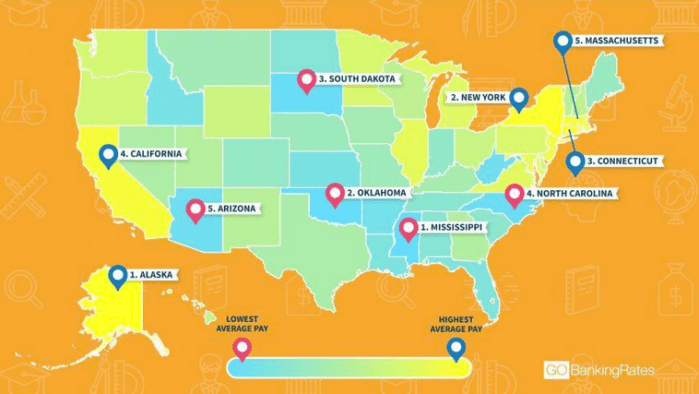
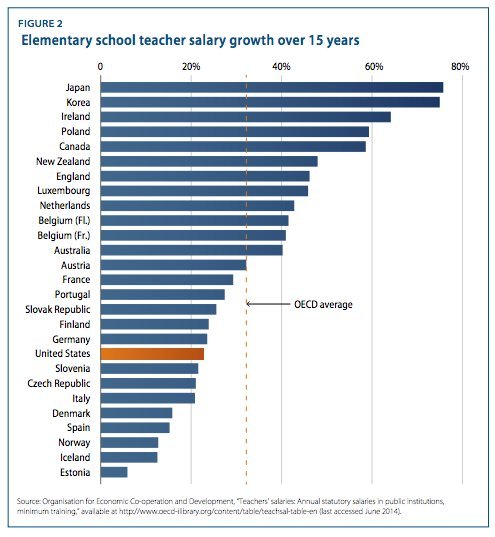
In truth, the low end for teachers entering the field nationwide is around $30,000, according to the National Association of Colleges and Employers (NACE). So go to college, get a four – sometimes five – year degree including a rigorous internship of student teaching and you make a mere $10,000 above the most generous minimum wage!?
According to that data, Pennsylvania teachers make on average $63,063 per year. Of neighboring states, teachers in Maryland ($65,247) and New Jersey ($71,687) make more. Teachers in Ohio (59,063) and Delaware ($59,853) make less.
Highest and Lowest Teacher Salaries – Source: GoBankingRates
As everywhere else, many teachers struggle to make ends meet working multiple jobs while others are well compensated.
No matter how you slice it, nationwide teachers’ salaries are 14% less than those from professions that require similar levels of education, according to the Economic Policy Institute.
In other words, if prospective teachers want to make more money, all they have to do is switch majors.
That may be part of the reason for our national teachers shortage. Not only have states like ours laid off tens of thousands of educators, many don’t stay in the field if given the chance. Across the country , 46 percent of educators quit before reaching the five year mark. And it’s worse in urban districts, where 20 percent quit every single year!
So forcing sick teachers to come to school and spread the germs to children is fine with Wagner as long as it hurts his nemesis – those evil teachers.
He Wants to Cut Teachers Pensions
He also plans to end pensions for working educators, and even wants retired educators to give back 10% of the retirement they earned.
He’s right to want reform to the state pension system but disingenuous or misinformed about the cause.
Pennsylvania pension costs have increased primarily because our legislature made bad plans and bad investments that were upended by the crash of 2008. You don’t fix that by stiffing your employees. If you do that, no one will believe any promises the state makes and no one of any substance will want to work for the state.
He Wants To Pay Teachers Based on Student Test Scores
“There are teachers that will exceed expectations while teaching a classroom of 100 of the toughest-to-teach students. There are also teachers that would struggle to teach just one student at a time. I want the first teacher to make a small fortune, and I want the second teacher to find a new career that is better suited for him or her.”
So if you teach the best students, you should make the most money? And if you teach struggling students, you should be fired?
But It’s Not Just Teachers. He Hates Other Working People, Too
If there is a corner to cut, he wants to take it – especially if it screws a working person. As a state senator, Wagner even introduced a bill that would exempt school districts from paying laborers the “prevailing wage” on construction projects.
Cheaper labor, shoddier work. That’s surely a recipe for success in buildings housing school children!
He Wants to Disband Unions
Oh, but he’s not done.
The man who once compared the tactics of public employee unions – including those representing teachers – to those of Adolf Hitler and Vladimir Putin also wants to end tenure end tenure, seniority, and disband unions.
I’m sure reducing teaching to a career without benefits, workers rights or protections will do wonders for the educational quality students receive.
Teachers working conditions are students learning conditions. Putting children in a building that has fewer safety precautions because there’s no union to collectively bargain for them is a great way to cut costs. But parents aren’t thrilled about having their kids try to learn in a sweat shop filled with Trump brand Russian asbestos.
Charter schools, funding private and parochial schools with public tax dollars. He’s in for all of it.
So long as it hurts public schools and enriches private businesses without helping students learn at all.
Go ahead! Take scarce funding from public schools and divert it to programs with little to no accountability. Let private school operators fraudulently misrepresent enrollment data. Let them fail to provide safe and academically appropriate learning environments. Let them game the system in any and every way.
That’s what Wagner calls fiscal accountability.
It doesn’t matter that these schools don’t improve student achievement. Evaluations of voucher programs in Milwaukee, Cleveland, and Washington, D.C., have all found no statistically significant differences in the academic achievement of voucher students compared to public school students. And recent evaluations of programs in Ohio, Indiana, and Louisiana revealed that voucher students scored lower than their peers attending public school.
But who cares about facts? This is all ideology for Wagner.
Vouchers have a record of undermining student’s civil rights – especially students with disabilities. Private school students give up due process and other rights guaranteed in public schools. Private schools are allowed to discriminate by denying admission based on religion, sexual orientation, citizenship status, English language proficiency and disability. Private schools that enroll students with disabilities may decide not to provide the services or accommodations guaranteed to such students in public schools. Or they may charge parents extra for them. Moreover, there is nothing to stop them from segregating these kids from other children. And, finally, private schools often suspend or expel students without due process.
This may be Trump and Wagner’s ideal. But it is certainly not what Commonwealth voters want for their children.
He Wants to Get Rid of Many State Colleges
Wagner caused an uproar when he said the state’s 14 state colleges will not be around in four years. “So, for those of you who think your school’s going to be around four years from now, it isn’t going to be around,” Wagner said.
Fewer institutions of higher learning. Fewer opportunities to get a college degree. That sounds like the policy of a college dropout.
“They think the solution is more money,” he said of Wolf and the Democrats. “Every time you do that the money disappears and the problem is still there.”
It’s like taking a bath, Scott. You can’t just do it once and be clean for the rest of your life. You need to bathe every day. One-time funding windfalls don’t work. You need equitable and sustainable funding revenues.
But that’s either too complicated for Wagner or he just doesn’t care.
He supported Gov. Corbett’s plan to decimate Pennsylvania’s schools. And he doesn’t think the culling should be over.
When asked point blank about Corbett’s cuts in 2011, he said, “Yes, I believe that Governor Corbett needs to stick to his plan.”
He’s said repeatedly that we spend “enough money” on public schools, while stressing the need for frugality and fewer regulations.
He Wants to Play with How Schools Are Funded
He’s an advocate for legislation that would eliminate school property taxes and replace them with increased state sales and income taxes.
True we need a better funding mechanism than local property taxes. But you can bet Wagner’s plan is worse than the current system.
It would lock funding inequities among Pennsylvania’s 500 school districts into place.
He Thinks Global Warming is Caused by the Earth Getting Closer to the Sun
Wagner is an incredibly stupid man who thinks he’s rather intelligent.
But of all the dumb or evil things that come spewing out of his mouth, this one has to be my favorite.
When asked about global climate change, he didn’t simply deny that it was happening. He had an alternative theory to why it was taking place.
It’s not business and industry or fossil fuels that is causing global temperatures to rise. He actually said that it’s because the earth is getting closer to the sun every year. Another cause? Human bodies on the planet are giving off enough heat to raise the global temperature.
Perhaps it shouldn’t be surprising that a person who hates schools and teachers so much knows very little, himself.
These comments made him a national laughing stock.
His words were repeated on every late night comedy show across the country for giggles and guffaws.
The question is “Will the joke be on us come Election Day?”
It’s not “How dumb is Scott Wagner?”
It’s “Is Pennsylvania dumb enough to vote for him?”
NOTE: Special Thank you to Sue Goncarovs for the Wagner cartoon with which I began this piece. I love your work!
There are many ways to find out. You could look at how hard I work, how many hours I put in. You could look at the kinds of things I do in my classroom and examine if I’m adhering to best practices. You could look at how well I know my students and their families, how well I’m attempting to meet their needs.
Or you could just look at my students’ test scores and give me a passing or failing grade based on whether they pass or fail their assessments.
Now that the government isn’t offering cash incentives, seven states have stopped using VAM and many more have reduced the weight given to these assessments. The new federal K-12 education law – the Every Student Succeeds Act (ESSA) – does not require states to have educator evaluation systems at all. And if a state chooses to enact one, it does not have to use VAM.
2) You can’t assess teachers on tests that were made to assess students.
This violates fundamental principles of both statistics and assessment. If you make a test to assess A, you can’t use it to assess B. That’s why many researchers have labeled the process “junk science” – most notably the American Statistical Association in 2014. Put simply, the standardized tests on which VAM estimates are based have always been, and continue to be, developed to assess student achievement and not growth in student achievement nor growth in teacher effectiveness. The tests on which VAM estimates are based were never designed to estimate teachers’ effects. Doing otherwise is like assuming all healthy people go to the best doctors and all sick people go to the bad ones. If I fail a dental screening because I have cavities, that doesn’t mean my dentist is bad at his job. It means I need to brush more and lay off the sugary snacks.
Sometimes A causes B. Sometimes A and B simply occur at the same time. For example, most people in wheelchairs have been in an accident. That doesn’t mean being in a wheelchair causes accidents. The same goes for education. Students who fail a test didn’t learn the material. But that doesn’t mean their teacher didn’t try to teach them. VAM does not measure teacher effectiveness. At best it measures student learning. Effects – positive or negative – attributed to a teacher may actually be caused by other factors that are not captured in the model. For instance, the student may have a learning disability, the student may have been chronically absent or the test, itself, may be an invalid measure of the learning that has taken place.
6) Vam Scores are Based on Flawed Standardized Tests.
When you base teacher evaluations on student tests, at very least the student tests have to be valid. Otherwise, you’ll have unfairly assessed BOTH students AND teachers. Unfortunately standardized tests are narrow, limited indicators of student learning. They leave out a wide range of important knowledge and skills leaving only the easiest-to-measure parts of math and English curriculum. Test scores are not universal, abstract measures of student learning. They greatly depend on a student’s class, race, disability status and knowledge of English. Researchers have been decrying this for decades – standardized tests often measure the life circumstances of the students not how well those students learn – and therefore by extension they cannot assess how well teachers teach.
8) VAM Has Never been Proven to Increase Student Learning or Produce Better Teachers.
That’s the whole purpose behind using VAM. It’s supposed to do these two things but there is zero research to suggest it can do them. You’d think we wouldn’t waste billions of dollars and generations of students on a policy that has never been proven effective. But there you have it. This is a faith-based initiative. It is the pet project of philanthrocapitalists, tech gurus and politicians. There is no research yet which suggests that VAM has ever improved teachers’ instruction or student learning and achievement. This means VAM estimates are typically of no informative, formative, or instructional value.
NOTE: Special thanks to the amazingly detailed research of Audrey Amrein-Beardsley whose Vamboozled Website is THE on-line resource for scholarship about VAM.
Fewer states require high stakes tests as graduation exams and/or use them to evaluate their teachers. Across the nation, states are cutting the size of standardized tests or eliminating them altogether. And more state legislatures passed laws explicitly allowing parents to opt their children out of the tests.
I think we have different definitions of “Slows” and “Crawl.”
That may not be surprising since we also seem to have different definitions of “Anti-Test.”
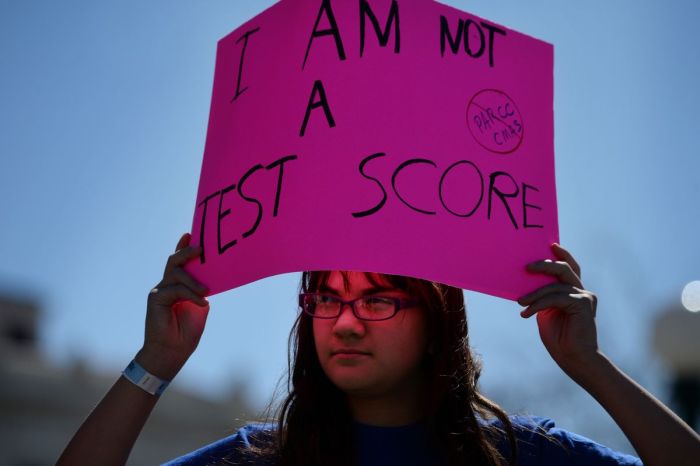
The Opt Out Movement is not “Anti-Test.” It is anti-high stakes standardized test.
It is against the federal government forcing states to use corporate written, corporate graded and corporate remediated standardized assessments.
It is against the federal government requiring each state to participate in a corporate boondoggle that not only wastes billions of tax dollars that could be better spent to educate children but also unfairly assesses their academic progress and feeds the push to privatize public schools.
Calling these folks “Anti-Test” is like labeling those pushing for stricter gun regulations “Anti-Gun” or smearing those protesting government corruption as “Anti-Government.”
And that’s just the title!
The author Alyson Klein further misdirects readers by conflating opt out rates and test resistance.
She implied that the only measure of opposition was the percentage of students who opt out. However, as noted above, there are multiple measures of resistance.
Moreover, few states advertise their opt out rates. Especially after the movement began, states made that information harder to come by to dissuade more people from joining it.
Of those states where information is available, Klein puts the most negative possible spin on the facts in order to make her point – a point that it seems to me is not at all justified.
“At least some of the steam has gone out of the opt-out movement in states such as New Jersey and New York, considered hotbeds of anti-testing fervor.”
And New York is one of our most densely populated states. That percentage represents more than 225,000 parents across the Empire State who refused to let their children take the tests despite threats from many administrators and district officials for doing so.
In New Jersey, opt out rates were marginally lower this year than last year. They went from 7% to 5%. But once again New Jersey is a populous state. That percentage represents about 68,500 students.
In addition, this is after massive opt outs three years ago that forced the state to change its federally mandated assessment. Testing boycotts pushed the state education association to get rid of four PARCC assessments and allow students who fail the remaining two tests to take an alternative assessment. And this is in a state where there is no law explicitly allowing parents to opt out of the tests.
I don’t know if I’d call that running out of steam.
And it nearly doubled in Utah over the past two years to about 6%. In some schools in the Beehive State, rates are much higher. According to the Salt Lake Tribune, 1 in 5 students in the Park City school district refused to take the tests.
Though my own state of Pennsylvania has been mum on last year’s opt outs, from my own personal experience as a teacher in suburban Pittsburgh, I never had more students boycott our federally mandated standardized test than I did last year.
There were so many they had to be quarantined in a special room.
Moreover, an increasing number of parents ask me about the issue, express concern and wonder about their rights.
So even when examining just the rate of opt out, I don’t see any reason to assume the movement is slowing down.
As recently as 2012, half of all U.S. states required high school exit exams in order for students to graduate. Today that number has dropped to 12. The reason? Exit exams don’t raise student achievement – they raise the dropout rate. At least that’s what The National Research Council of the National Academy of Sciences tells us.
And when it comes to opt out, two more states – Idaho and North Dakota – now have explicit laws on the books allowing parents to refuse the test for their children – in whole or in part. That brings the total number of states up to 10. It would have been 11, but Georgia Governor Nathan Deal, a Republican, vetoed an opt-out bill. The federal government still wants us to penalize these districts for non-participation in flagrant violation of its authority. But as more states respect parents’ rights on this matter, it will be increasingly difficult for the U.S. Department of Education to continue trampling them.
There is already some proposed legislation to make positive changes. Sen. Jon Tester (D-Mont.) and Rep. Krysten Sinema (D-Ariz.) introduced legislation last year to replace annual assessments with grade-span tests. The United States is, after all, one of the only countries in the world – if not the only one – to require students be tested every year. These proposed changes are not nearly enough, but they’re a step in the right direction.
One of the biggest obstacles to abolishing federally mandated testing last time was that some of the oldest and most well funded civil rights organizations opposed it. Many of them get their money and support from the same billionaires who profit off of the standardized testing and privatization industries.
They’re mapping out a world where kids don’t even have to go to school to grasp the basics, where learning can be accomplished anywhere but instigated, tracked, and assessed on-line through various computer platforms.
Children would bounce from a few hours of Khan Academy videos here to a software package there and Voila! “Modern” education!
It’s a brave new world where investors hope to make a bundle by reducing the cost and pocketing the savings.
Since teachers are the biggest cost, they’re the first things to go.
Since their rights as workers and human beings are a roadblock on this learning superhighway, they’re the first to go.
And since they’re in a prime position to see exactly what’s going on and to object when this ed tech paradise exploits the students it ostensibly is being built for, they MUST go – now, as soon as possible.
The Supreme Court’s recent decision in Janus v AFSCME is part of that process. It’s another way to weaken labor and clear the path for business – the collusion of politics and corporations to steamroll the rest of us and swipe more of our money regardless of the children in the steamrollers way.
So when I ask “Are teachers necessary?” it’s not a purely philosophical question.
The answer will have a major impact on both the education of today and where we go in the future.
If teachers are not necessary, that removes one of the biggest obstacles to this frightening and uncertain future.
Unfortunately, no matter how much I want to answer in the affirmative that teachers are necessary, I can’t do so.
Even after thousands of years of recorded history, learning remains a mysterious process. Yet it doesn’t take much reflection to realize that it can take place without the presence of a teacher.
Estimates vary somewhat from study to study, but the basic structure holds. The vast majority of impact on learning comes from the home and out-of-school factors. Teachers are a small part of the picture. They are the largest single factor in the school building, but the school, itself, is only one of many components.
In short, teachers are not necessary to student learning.
But neither are doctors necessary to healing or lawyers necessary to acquittals.
Necessity is a very high bar.
To survive, you need food, shelter and clothing. However, having all three does not mean you have a good life. Slaves had all three – no free person would choose to trade places with someone in generational servitude simply because they had everything they needed to survive.
The same with medicine. If shot in the arm, you could provide me with all the medical equipment necessary to remove the bullet, but I would still have a difficult time doing it by myself. I COULD. A doctor is not NECESSARY for that operation. But without a doctor present, my chances of getting the best medical care drop dramatically.
Moreover, you could pop me in a courtroom without the benefit of legal counsel and it’s not impossible that I could argue my way to the dismissal of all charges against me. But the likelihood of doing so is infinitesimal – as undocumented youngsters are discovering when forced into the courtroom to defend against deportation without an attorney or even their parents present.
The same is true of education.
Though teachers are not necessary to learning, they are vital to it.
Having a teacher dramatically boosts a student’s chances, and the more disadvantaged that student is, the more he or she benefits from an educator.
The academic schemes of the corporate class amount to changing the field into the equivalent of an automated teller or a business robocall.
You can purchase your groceries through the self-checkout line. You can get your customer service from an automated list. But neither of these are the highest quality service.
They are cheap alternatives.
They are ways for the business to cut costs and boost profits. Neither have anything to do with making things better for the customer.
And when it comes to education, eliminating (or even drastically reducing access to) the teacher will decrease the quality of the service beyond recognition.
A 2009 report, Poverty and Potential: Out-of-School Factors and School Success, released by the Great Lakes Center for Education Research and Practice outlined several real world solutions to increase academic outcomes. None of them involve the elimination of teachers.
That’s how you cut class size down from the 20, 30, even 40 students packed into a room that you can routinely find in some districts today.
And if you want to improve the quality of the teachers in those classrooms, here’s an easy fix – pay them.
According to the Economic Policy Institute, teachers in the United States make 14 percent less than people from professions that require similar levels of education.
They can’t buy a home or even rent an apartment in most metropolitan areas. They can’t afford to marry, raise children, or eke out a middle class existence.
And finally, stop micromanaging everything teachers do and stomping on their rights. To do their job effectively teachers need autonomy. They need the ability to make decisions on the ground based on the empirical evidence gathered in the classroom.
To do that, they need their union protections. They need collective bargaining rights to give them the power to counterbalance the forces of greed and corruption that have always been at the schoolhouse door.
As a country we have taken our attention away from what’s really important. We’ve stopped focusing on how to make education better and instead equated it with how to make it more profitable for those who are already wealthy.
Teachers are vital to education. They are lifelines to struggling students. We should find ways to support them and not constantly undercutting their social standing, autonomy and rights.
The importance of teachers is beyond doubt. As is the importance of society in supporting them.
Teachers provide inputs. Students give outputs. And those outputs demonstrate the intended learning.
Yet this framework was developed in the early 1900s. Using it today is to ignore a century of subsequent psychological advancements. It glosses over the impact of the unconscious, the social nature of understanding, physical differences, even the mediating thought processes between stimulus and response such as memory and problem solving.
Instead, we force students into inauthentic laboratory conditions (i.e. the classroom) upon which they are passive actors to be molded and shaped by expert educators.
Every time we post our learning objectives on the board or when we write our lesson plans beginning with the old chestnut – Students Will Be Able To (SWBAT) – we are hearkening back to early 20th Century thinking a hundred years out of date.
-Most problems with learning are attributable to inputs provided by the teacher.
None of these assumptions have been proven.
In fact, there is considerable evidence against each and every one of these premises, yet our entire system of corporate education is based on them like a house built on a foundation.
If we are truly to create a 21st Century school system, the only place to begin is here. Recognize our bedrock beliefs are mere speculation and question whether we should really support everything else that’s been built on such shaky ground.
WHAT IS LEARNING?
It is an empirical fact that human beings are capable of learning. It’s something we do every day. But what exactly does it consist of? What happens when a person learns?
Perhaps it’s best to start with a definition. We generally characterize learning as the acquisition of knowledge; the possession of facts, information or skills.
But how does one gain knowledge? How does one possess the intangible?
It seems that learning always involves thoughts – usually conscious impressions but sometimes unconscious ones, as well. However, not all thoughts qualify, only thoughts of a certain kind.
The notion must be true of the world. And often it is an idea that has surfaced before but that now can be recalled at will and used to create new concepts.
Perhaps I’m wrong, but it seems that no matter how you flesh it out, we’re talking about internal mind states.
Learning takes place in and of the brain. And this has consequences for our education system – an apparatus designed to make these brain states more frequent along certain prescribed lines.
IS LEARNING OBSERVABLE?
That depends. Can we lop off the top of students’ heads and peer at the gelatinous mass inside?
Not really. And even if we could, we wouldn’t understand what we were seeing.
Even if learning may be reducible to a complex set of on-and-off switches among synapses, that does not make it generally observable – certainly not without greater knowledge of how the brain works and advanced neural imaging equipment.
As such, the idea that learning is directly perceptible is not necessarily true. It may be evident in some second hand manner, but this is not the same as first hand experience. At best, what we see is a pale shadow of what’s actually going on in students’ gray matter.
That alone should send shock waves through the edifice of modern corporate education. We’ve built an entire apparatus to label and sort kids based on observing students. If those observations are inadequate to give us the full picture of these internal learning states, our system is likewise inadequate.
WHAT IS THE ROLE OF TEACHER INPUT?
To answer this question we must start further back – when and why does learning takes place.
A student experiences a new neural state that constitutes the acquisition of knowledge. Why?
Does it happen because of the input made by a teacher? Is it the result of experience? Is it the result of some other input – reading, interacting, writing, doing something? Or is it the result of something even the student him- or herself cannot easily identify or explain?
All of these are possible. All of these (and more) are the catalyst to learning at various times.
Certainly teachers are important. They can have a tremendous impact on their students. But they are not strictly necessary. They are not even the prime cause of learning. They facilitate learning in the way a doctor facilitates healing. The surgeon may set the broken bone, but it is the body that actually does the healing. And in the case of learning, the action is not entirely involuntary. It is much more active and intentional.
Learning may be a response to stimulus of some kind. But when does that response take place? Is it immediate?
There is no evidence that it must be so. Certainly there are times when one has learned something immediately. When a child first puts her finger in the flame, she quickly learns to remove it. However, there are some lessons that we don’t learn until many years after that stimulus. For instance, that our parents’ advice was often more sage than we initially gave it credit.
Which brings up another question – once you learn something, does it remain yours forever or is it susceptible to degradation?
If learning is an internal state – if it is the result of neural connections like any thought or memory – it is susceptible to fading. It can be lost or degraded.
Therefore, when students enter a class without prerequisite knowledge, it is not necessarily the fault of their previous teachers. Like any skill, memory or thought – recall is enhanced through repetition. Using the knowledge often results in greater retention.
If we want a more intellectual society, we should habitualize critical thinking and reward intelligence in our public interactions. Not the exact opposite.
CAN LEARNING BE MEASURED?
And finally, we are brought to perhaps the most vital question in the field of education – measurement.
What did students grasp and to what degree was it mastered?
As such, there is a tremendous amount of economic pressure to keep this premise that learning can be accurately measured. However, when looked at logically, it cannot be supported.
When we measure learning, what are we measuring? And how are we quantifying it?
If learning is an internal state, how do we calculate that? Possibly at some point in the future, we’ll be able to look at real time pictures of the brain and be able to tell which information has been learned and to what degree. But we are not at that point now. Perhaps we will never be.
Even if we were, what exactly would we be measuring? What units would we be using? Volts? Amps? Some new element susceptible to subdivision?
The fact that we can’t give a definitive answer to that simple question illustrates how vast our ignorance is of learning. We do not understand what goes on in our own heads that constitutes understanding expect in the broadest possible terms.
Yet how much importance we put on these crude attempts to measure the ineffable!
Grades and test scores are but the rudest approximations of the real phenomena hidden inside our skulls. Yet we sort and rank students on the pedagogical equivalent of cave paintings.
“It is easier to measure the number of semicolons used correctly in an essay than the wonderful ideas contained within it,” said Alfie Kohn. “The more focused you are on measurable outcomes, the more trivial your teaching tends to become.”
Or as Linda McNeil of Rice University famously observed, “Measurable outcomes may be the least significant results of learning.”
Kohn has repeatedly suggested that McNeil’s statement ought to be printed out in “36-point Helvetica, framed, and tacked to the wall of every school administrator’s office in the country” for these same reasons.
When we talk about knowledge and learning, we don’t know what we’re talking about.
CONSEQUENCES
That should make us reluctant to say anything definitive about learning beyond our own ignorance of it.
Yet, as in so much of human affairs, when has ignorance ever stopped us?
Imagine if, instead, we approached learning like explorers or scientists, mapping the shores of our ignorance and determining what helps us comprehend more and better.
I wish we were invested in that activity instead of a capitalist sham of education. We talk much about the skills gap between white and black kids without doing anything constructive about it – a chasm predicated on the fact that one category is predominantly poor and the other privileged.
Perhaps we would do better to talk about the ignorance gap of our own understanding of what it means to understand.
Perhaps then we wouldn’t be so bold as to monetize that which is fallacious and foolhardy.
































 gadflyonthewallblog