I think I will always associate Brett Kavanaugh with the taste of vomit in the back of my throat.
I couldn’t watch his sham of a confirmation hearing without my gag reflex going into overdrive.
Here was one of the most privileged of people on the planet alternatively weeping and raging that he was being denied his due.
Here was a man bemoaning that no matter what happened, his reputation forever would be ruined, but who likewise refused to call for an investigation to exonerate himself.
At least three separate women have accused him of sexual assault, yet Congressional Republicans are still planning to ram through his nomination to the Supreme Court – a lifetime appointment where he will almost certainly be the tie breaking vote to overturn Roe vs. Wade.
How fitting.
What perfect symmetry.
You couldn’t have planned it any more poetically.
A man accused of multiple attempted rapes who is doing everything in his power to make abortion illegal.
An overgrown frat boy crying into his beer that we can’t take away his God given right to take away women’s rights.
A confederacy of almost exclusively male lawmakers ready to discount women’s reports of violence so that they can limit women’s freedom to make decisions about their own bodies.
If there is one good thing to come from this farce, it is the spotlight it has shown on the relationship between rape and the movement to recriminalize abortion.
These two things are essentially intertwined.
On the one hand, we have sexual intercourse carried out under threat of violence, sex without consent or in direct violation of consent – a crime invariably perpetrated by men on women.
On the other hand, we have the removal of female consent from the birthing process.
They are almost the same thing, or at least two sides of the same coin.
In both cases, we’re removing or ignoring female permission, agreement, approval, agency. We’re saying it doesn’t matter what the woman wants. It only matters what men or a patriarchal society wants.
And the justification is an ancient text – the New Testament – that doesn’t mention abortion once. And the Old Testament actually gives instructions on how to conduct an abortion (Numbers 5:11-31).
Not that it really should matter. The United States is not a theocracy.
But it IS a patriarchy.
That’s what this is – an attempt by the most insecure, power hungry men to control women.
It is about keeping and strengthening a caste system where men are allowed to be fully realized people and women are allowed only secondary status.
It is about dehumanization clothed in piety and false morality.
All those people crying for the lost lives of a cluster of cells in female uteruses care not a wit about the thousands of women who will die from unsafe abortions once safe procedures become unlawful.
We’ve been here before. Abortion was illegal in the US from the early 1800s until 1973, and we know what will happen. There is actual history on this – back alley procedures conducted by quacks using sharp implements to pierce the womb – and there is no reason to think it won’t repeat itself.
Changing the law won’t stop abortions. It will just make them unsafe for everyone except rich women who can afford doctors willing to take a chance on going to jail for a big payday.
If these people really wanted to stop abortions, they’d support handing out free contraception. They’d turn every orphanage into a palace. They’d each adopt as many children as they could. They’d make neonatal care free, expand services to help women raise children, increase maternity leave, pay for free childcare, expand education funding.
But they don’t do any of that because despite their crocodile tears, their objection has nothing to do with unborn children.
It has to do with mature women making decisions for themselves. It has to do with conceptualizing them as people equal to men and with minds capable of consent.
It’s about allowing women the right to choose – choose whom to have sex with and what exactly the consequences of that sex will or will not be.
I am so thankful that Dr. Christine Blasey Ford came forward with her testimony. What bravery! What grace under pressure!
To be able to share with an entire nation her personal trauma at the hands of Kavanaugh. Such courage boggles the mind almost as much as those who refuse to accept her story as genuine.
They say that this is political. That it’s a hit job. Yet they pound their fists onto their ears to drown out Kavanaugh’s words in self-defense where he makes it entirely clear how partisan he is and will be once he takes the bench:
“This whole two-week effort has been a calculated and orchestrated political hit, fueled with apparent pent-up anger about President Trump and the 2016 election. Fear that has been unfairly stoked about my judicial record. Revenge on behalf of the Clintons. And millions of dollars in money from outside left-wing opposition groups.”
These are not the words of a fair arbitrator. They are the ravings of someone with an axe to grind.
But they do well to point out the elephant in the room – Donald Trump.
The man who nominated Kavanaugh has had at least 19 women accuse him of sexual assault. He even admitted to it on video in the infamous Access Hollywood tape.
Yet a minority of Americans elected him President through a legislative loophole kept open by centuries of neglect, apathy and moneyed interest.
I don’t know how this all will end. The FBI will conduct a limited investigation this week – probably stymied as much as possible by the Trump administration.
But the road that lead us here is achingly clear.
This is a tantrum of the patriarchy.
It is the weakest, most twisted men and their Stockholm syndrome suffering accomplices.
It is not about defining when life begins.
It’s about defining who gets to count as fully human – who gets the freedom to choose.
The lesson we were supposed to take away from the activity was that hiding was a losing strategy.
“Do something,” one of the police officers conducting the drill said.
They wanted us to swarm the shooter, throw things at him (Nerf balls in our scenario) or make a run for it. Anything but simply staying put and being sitting ducks.
It made me wonder why our lawmakers don’t heed the same advice.
But it’s impossible. You can’t keep out human nature.
The same things that cause shooters to enter the school and go on a killing spree are already in our classrooms.
O’Grady may have imagined he was a member of Al-Qaeda as he pretended to blow his co-workers away, but if a shooter ever enters our building, he’s more likely to be a co-worker, parent or student.
Turning the school into a prison will not help. Turning teachers into guards (armed or otherwise) will not solve anything.
Back in 1999 in the wake of the Columbine school shooting, the Secret Service and U.S. Department of Education warned against all the things we’re doing now – police officers in the schools, metal detectors, cameras, etc.
Instead, they advised us as follows:
“Specifically, Initiative findings suggest that [school] officials may wish to consider focusing their efforts to formulate strategies for preventing these attacks in two principal areas:
developing the capacity to pick up on and evaluate available or knowable information that might indicate that there is a risk of a targeted school attack; and,
employing the results of these risk evaluations or “threat assessments” in developing strategies to prevent potential school attacks from occurring.”
That means prevention over disaster prepping. Homeland Security and education officials wanted us to pay close attention to our students, their needs and their struggles.
We keep our schools safe by looking to the humans in them and not new ways to barricade the building or watch the whole disaster unfold on closed circuit TV.
The fact is that our schools are actually much safer than the communities that support them. Numerous studies have concluded that students are more secure in school than on the streets or even in their own homes.
If we want to make the schools safer, we need to make the communities safer.
And, no, I’m not just talking about high poverty neighborhoods populated mostly by people of color. I mean everywhere – in our society, itself.
According to the Graduate Institute of International and Development Studies in Geneva, Americans now own 40 per cent of all guns in the world – more than the next 25 countries combined. And with every mass shooting and the hysteria trumped up by gun manufacturers with each surge in profits, that number continues to climb.
You can do whatever you want to the schools, but you’ll never increase safety until you deal with THAT problem.
“There is no clear research evidence that the use of metal detectors, security cameras, or guards in schools is effective in preventing school violence (Addington, 2009; Borum, Cornell, Modzeleski, & Jimerson, 2010; Casella, 2006; Garcia, 2003). In fact, research has shown that their presence negatively impacts students’ perceptions of safety and even increases fear among some students (Bachman, Randolph, & Brown, 2011; Schreck & Miller, 2003). In addition, studies suggest that restrictive school security measures have the potential to harm school learning environments (Beger, 2003; Phaneuf, 2009).”
At this week’s active shooter drill in my school, one of the student aides asked the principal when he thought the state would be arming teachers.
For him, it wasn’t a matter of if. It was a matter of when.
Security cameras were present at Sandy Hook and Virginia Tech. They didn’t stop anything from happening.
Armed resource officers were present at Columbine and Parkland. That didn’t stop anything from happening.
All these measures do is criminalize our students. It turns them from prospective learners into would-be prison inmates – and as we know, our prisons are not exactly the safest places to be.
“How’d I do?” asked Mr. O’Grady, my co-worker who had posed as the shooter during the last scenario.
“You shot me in the dick,” I said.
He laughed. And I laughed.
But it was the kind of laugh that dies in your throat and leaves a taste of ashes.
School safety is a joke in 2018. Not because of what teachers and districts are doing.
Fun Fact: Between 2005 and 2017, the federal government withheld $580 billion it had promised to spend on students from poor families and students with disabilities.
Fun Fact: Over that same period, the personal net worth of the nation’s 400 wealthiest people ballooned by $1.57 trillion.
$347 billion owed to educate low-income students most of whom are children of color.
$233 billion owed to provide services for students with disabilities.
And this is just the shortfall of the last dozen years! That’s just money due to children who recently graduated or are currently in the school system!
We’ve been cheating our children out of the money we owe them for more than half a century!
Federal education funding levels were first established in 1965 as part of Pres. Lyndon Johnson’s War on Poverty in the landmark education law, the Elementary and Secondary Education Act (ESEA).
One of the most glaring examples of neglect is Title I funding.
The Johnson administration admitted that schools with a high concentration of students living below the poverty line needed extra support to succeed at the same levels as students from middle class or more affluent backgrounds. So the law promised to provide an additional 40 percent for each poor child above what the state already spent per pupil.
And then it promptly failed to fund it. In 1965 and every year since!
These are not just numbers. With this money, high poverty schools could provide:
“health and mental health services for every student, including dental and vision services; and
a full-time nurse in every Title I school; and
a full-time librarian for every Title I school; and
a full-time additional counselor in every Title I school, or
a full-time teaching assistant in every Title I classroom.”
A decade later, in 1975, the same thing happened with The Individuals with Disabilities Education Act (IDEA).
Congress told local districts they’d have to do more to help disabled students succeed academically. However, doing so costs money. Lawmakers admitted that disabled students cost more to educate and that local districts often struggle to find the funding to help them succeed.
Once again, Congress pledged to pay up to 40 percent of that additional cost, with local and state funds covering the remainder.
Once again, Congress failed to fund it.
STATE AND LOCAL FAILURE
But it’s not just the federal government that has shirked its duties to school children.
Beside the federal government, public schools are funded by their local municipalities and the state. Local governments pay for about 45 percent of school budgets.
However, since most of this allotment is determined by property tax revenues, it ensures the poor get fewer resources than the rich. Kids from rich neighborhoods get lots of resources. Kids from poor areas get the scraps. Inequality is built into the funding formula to ensure that students don’t start out on an even playing field and that economic handicaps are passed on from one generation to the next.
As such, they are in the position to right the wrongs of the local community by offsetting the inequality of local governments – but only 11 states do so. Twenty states close their eyes and provide the same funding to each school – rich and poor alike – regardless of need or what each community can afford to provide for its own children. But 17 states are even worse. They actually play Robin Hood in reverse – they funnel more money to wealthier districts than to poor ones.
As a result, schools nationwide serving mostly students of color and/or poor children spend less on each child than districts serving mostly white and/or affluent children.
Nearly every state levies a much greater share of taxes from low- and middle-income families than from the wealthy.
And that’s before we even start talking about corporations!
While the US federal corporate tax is 35 percent, the effective tax rate that corporations pay after loopholes and deductions is only about 14 percent. This costs the federal government at least $181 billion in annual revenue, based on 2013 estimates by the Government Accountability Office. Local and state corporate tax and abatement programs make it even worse.
This is a choice. We are not requiring the rich to pay their fair share.
“In 2017, the National Association of School Resource Officers claimed that school policing was the fastest-growing area of law enforcement. The school safety and security industry was reported to be a $2.7 billion market as of 2015. Most of that $2.7 billion is public money now enriching the private security industry instead of providing real supports to students.”
According to the US Department of Education, 1.6 million students go to a school that employs a law enforcement officer but not a guidance counselor.
That is not an unalterable economic reality. It is a failure of priorities. It is the mark of a society that is not willing to help children but will swoop in to punish them if they get out of line.
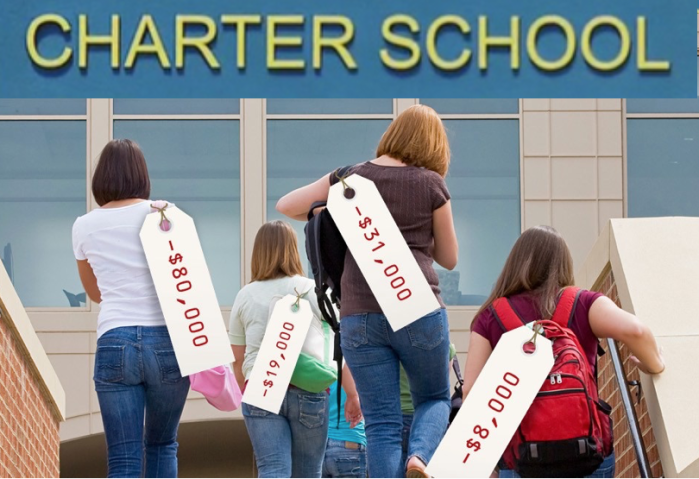
Cost studies in San Diego, Los Angeles, Nashville, Michigan, Pennsylvania, Durham and other localities have come to the same conclusion: “the privatization of schools has contributed to austerity conditions in traditional public schools.”
Yet Congress continues to appropriate millions of dollars to the Department of Education’s Charter Schools Program (CSP), which funds new charter start-ups and expansions. The program has a budget of $500 million this year, alone. It is the largest single backer of charter schools in the nation.
According to the report, “In other words, the U.S. Department of Education is operating a program that directly undermines public schools.”
SOLUTIONS
But the report isn’t just about what’s wrong. It outlines how we can make it right.
A. “Make the wealthy pay their fair share of taxes.
Rescind the 2017 tax code changes, which overwhelmingly favor the top 1 percent of income earners.
Close the federal carried interest loophole, a step that could increase federal revenues by between $1.8 and $2 billion annually or, according to some researchers, by as much as $18 billion annually.
If the carried interest loophole is not closed at the federal level, states can impose a surcharge on carried interest income at the state level, raising millions for state budgets.
Enact so-called “millionaire’s taxes” that increase the tax rate on a state’s highest earners. New York and California have already passed such law.
B. Require wealthy corporations to pay their fair share.
End or reduce corporate tax breaks that cost the federal government at least $181 billion annually.
Reduce state and local subsidies to businesses for economic development projects and hold school funding immune from tax abatements.
Enforce and strengthen programs like Payment in Lieu of Taxes (PILOT) to ensure that wealthy institutions pay their fair share towards local budgets.
C. Divest from the school-to-prison pipeline.
School safety and security is now a $2.7 billion industry. Much of that money is public money, going to profitable corporations instead of schools.
Divest from expensive security systems, metal detectors and legions of school-based police officers and instead invest in counselors, health and mental-health providers and other supports that make schools safer.
D. Place a moratorium on new charter schools and voucher programs.
A moratorium on the federal Charter Schools Program would free up $500 million annually, which could be used to support the creation of Sustainable Community schools.”
The executive summary concludes with the following statistic.
Even a 10 percent increase in funding for each high poverty student maintained through 12 years of public school can dramatically change the likelihood of academic success. It can boost the chances that students will graduate high school, achieve 10 percent higher earnings as adults and a 6 percentage point reduction in the annual incidence of adult poverty, according to a 2015 report.
“Ten percent is pocket-change for a nation that has orchestrated the rise of an unmatched billionaire class. In the richest nation in the world, it is possible to fully fund all our public schools, and to provide Black, Brown and low-income children with the educational resources and additional supports and services they need to achieve at the highest levels.”
The facts are in, folks.
We can no longer gripe and complain about a public education system we fail to support without recognizing the cause. We have failed to meet our responsibilities to our children – especially our children of color.
The solution is simple – equity.
We need to demand the rich do the right thing.
We cannot achieve greatness as a nation when wealth and privilege continue to shirk their duties and our lawmakers do little more than enable greed and corruption.
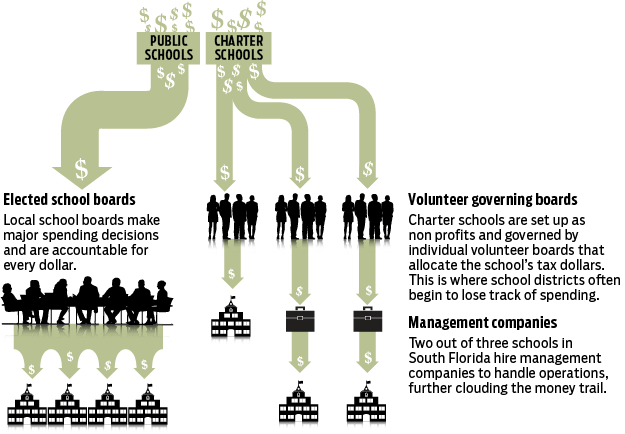
Compare that to a traditional public school – an institution invariably operated by duly elected members of the community with full transparency and accountability in an open forum where taxpayers have access to internal documents, can have their voices heard and even seek an administrative position.
THAT’S a responsible way to handle public money!
Not forking over our checkbook to virtual strangers!
Sure, they might not steal our every red cent. But an interloper who finds a blank check on the street might not cash it, either.
The particulars don’t really matter. This is a situation rife with the possibility of fraud. It is a situation where the deck is stacked against the public in every way and in favor of charter school operators.
But most people don’t want to take such a strong stance. They’d rather find good and bad people on both sides and pretend that’s the same thing as impartiality.
It’s really that simple! I turn over nearly all of my public tax dollars to the management company that then uses it to operate the school – and keeps whatever it doesn’t spend.
Heck! It doesn’t even matter who owns the company! It could even be me!
The law actually allows me to wear one hat saying I’m nonprofit and then put on a different hat and rake in the cash! The only difference is what hat I’m wearing at the time!
SO I get to claim to be a nonprofit while enjoying all the advantages of being for-profit.
I may even be able to buy things with public tax dollars through my for-profit management company and then if my “nonprofit” school goes belly up, I get to keep everything I bought! Or my management company does.
So the public takes all the risk and I reap all the reward. And I’m still graced with the label “nonprofit.”
Both types of privatized institution allow for huge windfalls in real estate. If I own property X, I can sell it to my charter school (or management company) and then pay myself with tax dollars. Who determines how much I pay for my own property? ME! That’s who!
And I can still be a nonprofit.
Think that’s bad? It’s just the tip of the iceberg.
But that’s the complicated stuff. There’s an even easier way to get rich off the public with my “nonprofit” charter school, and operators do it all the time: write myself a fat check!
After all, I’ve gotta’ pay, myself, right? And who’s in charge of determining how much I’m worth? ME!
I can even pay myself way more than my counterparts at traditional public schools who oversee exponentially more staff and students.
I could do like the almost exclusively “nonprofit” Gulen charter schools and exist solely as a means to raise money for an out-of-favor political movement in Turkey.
I could use charter funds to finance other businesses. I could decide to discontinue programs that students receive in traditional public schools such as providing free or reduced lunches but keep the cash. I could fake enrollment and have classes full of “ghost students” that the local, state and federal government will pay me to educate.
So all this talk about nonprofit and for-profit charter schools is either a mark of supreme ignorance or a ploy for weak willed politicians to weasel their way out of taking a stand on an issue whose merits are obvious to anyone who knows what really happens in our education system.
It’s time to stop wasting taxpayer money on this expensive fraud.
When it comes to increasing school funding, increasing teacher salary, allowing teachers to strike, and an abundance of other issues, the poll found a majority of people unequivocally in favor of endeavors meant to bolster learning.
In fact, support for education and educators has never been so high in half a century.
“Two-thirds of Americans say teachers are underpaid, and an overwhelming 78% of public school parents say they would support teachers in their community if they went on strike for more pay,” according to PDK’s Website.
If true, this result illuminates an incredible tone deafness among politicians like Scott Wagner in Pennsylvania who is running for governor on the platform that teachers make too much money. According to the poll, only 6% of Americans agree with him.
“Those who would be most affected by a teacher walk-out — say they would support teachers in their community if they went on strike for more pay. Among the general public, 73% say they would support a job action for higher wages.”
These are record high results that are also reflected in respondents unwillingness to encourage their own children to become teachers in the current political landscape.
Moreover, a lack of adequate funding is cited as the most common problem facing public schools – a finding that’s held true since the early 2000s. In fact, for the 17th consecutive year, Americans have named the lack of funding as the biggest problem facing their local schools.
However, Democrats and/or Republicans who ran on respecting and remunerating teachers as well as increasing support for the public schools that employ them would find major support among voters.
The PDK poll is based on responses from 1,042 adults including 515 parents of school-age children. They were randomly and representatively sampled in May 2018 through on-line surveys.
The 2018 results include particular support for the public school system as opposed to charter and voucher schools.
That’s a higher response than any year since the question was first asked 20 years ago. Moreover, it’s not just an opinion about nationwide schooling: 78% say they’d rather reform than replace the local school system, as well.
In addition, there is support among Americans to not only increase funding, but also spend it more equitably.
Responds were more divided on where the influx of funding should come from.
Half of respondents favor raising taxes and half say the schools should spend less on students who require fewer resources.
This is related to public perception of exactly which students are receiving unfair funding. The poll revealed that most people recognize some resource inequality based on race and geographic region but they think most is based on parental wealth: 75% of respondent say public school students serving mostly poor students have fewer resources than those serving rich students.
One of the most interesting findings is always the public’s overall perception of schools.
And this poll – as in previous editions – found a sharp difference in respondents appraisal of schools nationwide vs. the schools in their own neighborhoods.
“The public schools continue to suffer from an image deficit. Among those who know them best, parents of current students, 70% give their oldest child’s school an A or B grade. Among the public more broadly, by contrast, only four in 10 give their local schools an A or B. In results that are typical across the years, far fewer give top grades to the public schools nationally, just 19%.”
In other words, people seem to think that nationally our schools stink. But the schools in our own neighborhoods are pretty good.
But the questions weren’t all about how schools should be run. They also asked about security – a hot topic when school shootings happen at least once a month.
“Parents lack strong confidence that schools can protect their children against a school shooting but favor armed police, mental health screenings, and metal detectors more than arming teachers to protect their children.”
They exist to teach, to counsel, to inspire, to heal.
And all these other schemes favored by Dunce Duncan and Batty Betsy that purport to meet kids needs while somehow enjoying the totally unintended side effect of enriching wealthy investors completely misses the point.
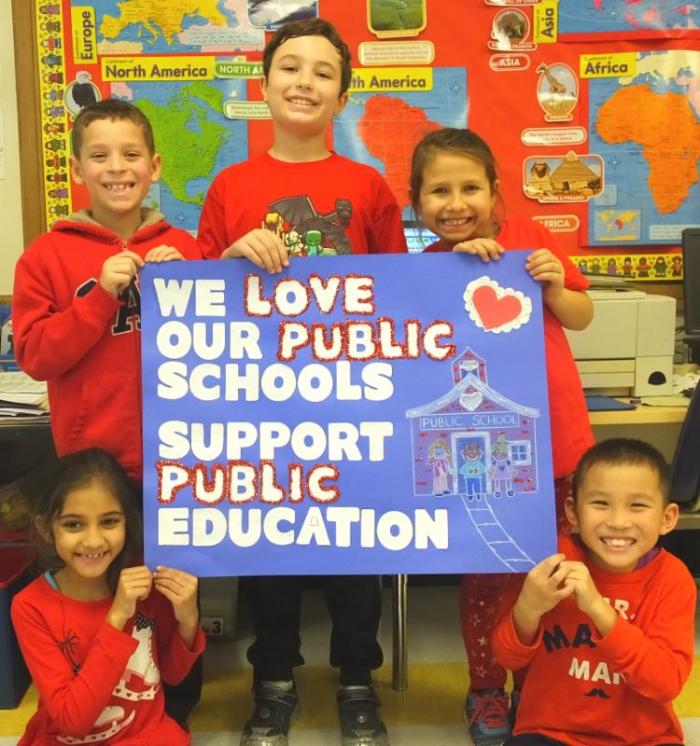
Public schools serve one purpose – to help the kids enrolled in them.
Unfortunately, the Secretaries of Education of Donald Trump and Barack Obama aren’t the only ones to get it wrong. Policymakers on both sides of the aisle have lost sight of this fact.
The reason given by DeVos may be to make children safer. But the measure she’s proposing really has nothing to do with them at all.
It’s a boondoggle for private industry – one private industry in particular – gun manufacturers.
Instead of sensible regulations on a product that’s at least as dangerous as items that are much more heavily controlled – such as cold medicine and automobiles – DeVos is doing the only thing she can to protect what she really cares about – corporate profits.
She is using money earmarked “safety” to increase danger.
Or as she sees it – she’s using a government apparatus that could harm the gun industry to instead pad its pockets.
You’ll hear some progressives and moderates decry this move with passion and fervor – and for good reason – but what many fail to realize is that it’s not new.
It’s really just a continuation of a sickness that has crept into our society about how we conceptualize the very idea of school.
After all, what is the push for academic accountability through standardized tests and Common Core but corporate welfare for the testing and publishing industry?
What is the push for charter and voucher schools but government subsidies for school privatization?
In short, instead of asking about an obvious inequality, they hide a preconceived answer in the question: “How do we make sure teachers and schools are actually educating kids?”
Wrong question. But here’s the answer, anyway: Administrators observe teachers and determine if they’re doing their jobs. And school boards evaluate administrators.
In general, the staff isn’t the problem. It’s the lack of resources we give them to work with – everything from crumbling buildings, large classes, narrowed curriculum to a lack of wraparound social services.
It doesn’t take much to see we’re shortchanging our neediest students.
Public schools are in no way inferior to institutions that are privately managed. Tax dollars administered by duly-elected representatives in the light of day are in no way less effective or more corrupt than the alternative – letting bureaucrats behind closed doors dole out the money however they choose even into their own pockets.
That’s why we look in awe at LeBron James, an athlete who uses his fortune to open a school providing all the things society refuses for students of color. A basketball player who refuses to usurp the public’s leadership role in administering that fully public school.
Otherwise, we’ll continue to be trapped on a runaway train where the conductor seems to possess no sense of urgency about slowing down.
We would never have been in this situation – and in fact could right the course even now – if we just took the time to clarify what we were doing and why we were doing it.
We could save generations of children if we stopped cashing in on public schools and realized the reason for their existence.
We could ensure both our present and our posterity.
He hates science. He hates schools. He hates teachers. And if students get in the way, he’ll hate them, too.
These are the qualities he thinks Pennsylvanians are looking for in their next governor.
The York Township Republican will challenge incumbent Democrat Tom Wolf on Nov. 6, 2018.
So who is this guy?
Wagner’s a college dropout who made a fortune starting a garbage hauling firm. He became a state senator four years ago after winning a write in campaign during a special election where only 17% of the electorate could be bothered to vote.
And ever since, he’s been consistent about one thing: he really, Really, REALLY hates teachers.
“We have 180,000 teachers in the state of Pennsylvania,” Wagner said in 2015. “If we laid off 10 percent of the teachers in the state of Pennsylvania, we’d never miss them.”
That’s a deficit we still haven’t recovered from. Even today, state schools are staffed at a 10-year low. Class sizes are at an all time high.
Yet Wagner wants to fire even more teachers!?
That’s not the policy of a man who wants to help improve life throughout the state for all. That’s not the policy of a man who wants to help kids learn.
It’s the policy of a man who has a personal grudge against educators.
And his other legislative objectives?
Wagner wants to further slash education funding. He wants to spend whatever is left inequitably. And he really wants to help his heroes Donald Trump and Betsy DeVos enact school vouchers so business people like him can continue to cash in on children from Pittsburgh to Philadelphia and all places between.
By contrast, in his four years in office, Gov. Wolf has pushed to increase education funding, pushed to spend it more fairly, and even cut the time it takes for students to take high stakes standardized tests.
The good news: voters throughout the Commonwealth have never had a clearer choice for governor.
The bad news: when has that ever stopped them from getting it wrong?
“We have created a special class in this state and the special class is the public sector union employee,” Wagner told Keystone Crossroads in a 2015 interview.
“Teachers are doing very well in this state,” he said. “People would be appalled if they knew what their teachers made, in certain areas.”
Unfortunately, Wagner has no idea, himself.
He keeps quoting a bogus salary figure that I’m not going to repeat. It’s not true statewide, it’s not an average, nor is it true in his home district.
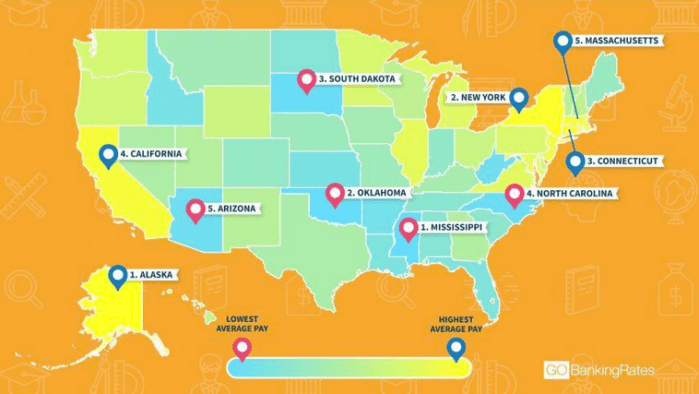
In truth, the low end for teachers entering the field nationwide is around $30,000, according to the National Association of Colleges and Employers (NACE). So go to college, get a four – sometimes five – year degree including a rigorous internship of student teaching and you make a mere $10,000 above the most generous minimum wage!?
According to that data, Pennsylvania teachers make on average $63,063 per year. Of neighboring states, teachers in Maryland ($65,247) and New Jersey ($71,687) make more. Teachers in Ohio (59,063) and Delaware ($59,853) make less.
Highest and Lowest Teacher Salaries – Source: GoBankingRates
As everywhere else, many teachers struggle to make ends meet working multiple jobs while others are well compensated.
No matter how you slice it, nationwide teachers’ salaries are 14% less than those from professions that require similar levels of education, according to the Economic Policy Institute.
In other words, if prospective teachers want to make more money, all they have to do is switch majors.
That may be part of the reason for our national teachers shortage. Not only have states like ours laid off tens of thousands of educators, many don’t stay in the field if given the chance. Across the country , 46 percent of educators quit before reaching the five year mark. And it’s worse in urban districts, where 20 percent quit every single year!
So forcing sick teachers to come to school and spread the germs to children is fine with Wagner as long as it hurts his nemesis – those evil teachers.
He Wants to Cut Teachers Pensions
He also plans to end pensions for working educators, and even wants retired educators to give back 10% of the retirement they earned.
He’s right to want reform to the state pension system but disingenuous or misinformed about the cause.
Pennsylvania pension costs have increased primarily because our legislature made bad plans and bad investments that were upended by the crash of 2008. You don’t fix that by stiffing your employees. If you do that, no one will believe any promises the state makes and no one of any substance will want to work for the state.
He Wants To Pay Teachers Based on Student Test Scores
“There are teachers that will exceed expectations while teaching a classroom of 100 of the toughest-to-teach students. There are also teachers that would struggle to teach just one student at a time. I want the first teacher to make a small fortune, and I want the second teacher to find a new career that is better suited for him or her.”
So if you teach the best students, you should make the most money? And if you teach struggling students, you should be fired?
But It’s Not Just Teachers. He Hates Other Working People, Too
If there is a corner to cut, he wants to take it – especially if it screws a working person. As a state senator, Wagner even introduced a bill that would exempt school districts from paying laborers the “prevailing wage” on construction projects.
Cheaper labor, shoddier work. That’s surely a recipe for success in buildings housing school children!
He Wants to Disband Unions
Oh, but he’s not done.
The man who once compared the tactics of public employee unions – including those representing teachers – to those of Adolf Hitler and Vladimir Putin also wants to end tenure end tenure, seniority, and disband unions.
I’m sure reducing teaching to a career without benefits, workers rights or protections will do wonders for the educational quality students receive.
Teachers working conditions are students learning conditions. Putting children in a building that has fewer safety precautions because there’s no union to collectively bargain for them is a great way to cut costs. But parents aren’t thrilled about having their kids try to learn in a sweat shop filled with Trump brand Russian asbestos.
Charter schools, funding private and parochial schools with public tax dollars. He’s in for all of it.
So long as it hurts public schools and enriches private businesses without helping students learn at all.
Go ahead! Take scarce funding from public schools and divert it to programs with little to no accountability. Let private school operators fraudulently misrepresent enrollment data. Let them fail to provide safe and academically appropriate learning environments. Let them game the system in any and every way.
That’s what Wagner calls fiscal accountability.
It doesn’t matter that these schools don’t improve student achievement. Evaluations of voucher programs in Milwaukee, Cleveland, and Washington, D.C., have all found no statistically significant differences in the academic achievement of voucher students compared to public school students. And recent evaluations of programs in Ohio, Indiana, and Louisiana revealed that voucher students scored lower than their peers attending public school.
But who cares about facts? This is all ideology for Wagner.
Vouchers have a record of undermining student’s civil rights – especially students with disabilities. Private school students give up due process and other rights guaranteed in public schools. Private schools are allowed to discriminate by denying admission based on religion, sexual orientation, citizenship status, English language proficiency and disability. Private schools that enroll students with disabilities may decide not to provide the services or accommodations guaranteed to such students in public schools. Or they may charge parents extra for them. Moreover, there is nothing to stop them from segregating these kids from other children. And, finally, private schools often suspend or expel students without due process.
This may be Trump and Wagner’s ideal. But it is certainly not what Commonwealth voters want for their children.
He Wants to Get Rid of Many State Colleges
Wagner caused an uproar when he said the state’s 14 state colleges will not be around in four years. “So, for those of you who think your school’s going to be around four years from now, it isn’t going to be around,” Wagner said.
Fewer institutions of higher learning. Fewer opportunities to get a college degree. That sounds like the policy of a college dropout.
“They think the solution is more money,” he said of Wolf and the Democrats. “Every time you do that the money disappears and the problem is still there.”
It’s like taking a bath, Scott. You can’t just do it once and be clean for the rest of your life. You need to bathe every day. One-time funding windfalls don’t work. You need equitable and sustainable funding revenues.
But that’s either too complicated for Wagner or he just doesn’t care.
He supported Gov. Corbett’s plan to decimate Pennsylvania’s schools. And he doesn’t think the culling should be over.
When asked point blank about Corbett’s cuts in 2011, he said, “Yes, I believe that Governor Corbett needs to stick to his plan.”
He’s said repeatedly that we spend “enough money” on public schools, while stressing the need for frugality and fewer regulations.
He Wants to Play with How Schools Are Funded
He’s an advocate for legislation that would eliminate school property taxes and replace them with increased state sales and income taxes.
True we need a better funding mechanism than local property taxes. But you can bet Wagner’s plan is worse than the current system.
It would lock funding inequities among Pennsylvania’s 500 school districts into place.
He Thinks Global Warming is Caused by the Earth Getting Closer to the Sun
Wagner is an incredibly stupid man who thinks he’s rather intelligent.
But of all the dumb or evil things that come spewing out of his mouth, this one has to be my favorite.
When asked about global climate change, he didn’t simply deny that it was happening. He had an alternative theory to why it was taking place.
It’s not business and industry or fossil fuels that is causing global temperatures to rise. He actually said that it’s because the earth is getting closer to the sun every year. Another cause? Human bodies on the planet are giving off enough heat to raise the global temperature.
Perhaps it shouldn’t be surprising that a person who hates schools and teachers so much knows very little, himself.
These comments made him a national laughing stock.
His words were repeated on every late night comedy show across the country for giggles and guffaws.
The question is “Will the joke be on us come Election Day?”
It’s not “How dumb is Scott Wagner?”
It’s “Is Pennsylvania dumb enough to vote for him?”
NOTE: Special Thank you to Sue Goncarovs for the Wagner cartoon with which I began this piece. I love your work!
Not his political victories. Not the failures of his opposition.
But the very fact that this piece of shit is President of the United States – that fact sits on my brain like an insect I can’t swat.
On those days my belief in this country wavers and disappears.
Oh, I’ve always recognized its faults, how our reality hardly ever lived up to our ideals. But I also thought that the United States was populated by mostly good people who knew right from wrong.
To run this country we wouldn’t choose an obvious conman, a racist and sexist, a person of low IQ, a man with little to no experience, a reality TV star. We wouldn’t let him pick the next Supreme Court justices. We wouldn’t give him the power to pardon whomever he likes. We wouldn’t give him the ability to write almost whatever he wants into law through signing statements. And we certainly wouldn’t give him the nuclear codes.
But we did.
We did all of that.
Or we allowed it to happen by ignoring a broken electoral system that overturns the popular vote with frightening regularity.
So there he sits in the Oval Office – when he isn’t on vacation at Mar-a-Lago – like a smear of feces on the American flag.
The D.C. Counseling and Psychotherapy Center has identified it as a “collective politically induced anxiety among patients.”
Apparently, Trump’s name comes up frequently in sessions with mental health professionals. Patients say they feel on edge because of the President’s ill-chosen, childish and undiplomatic words, fear of his bad decision making, and anxiety over his xenophobic and prejudicial policies.
Trump Anxiety Disorder is not yet an official diagnosis, but symptoms seem to include lack of sleep, a feeling of losing control and helplessness in an unpredictable political scene, along with endless negative headlines and excessive time spent on social media.
Elisabeth LaMotte, a therapist at the Washington, DC, center, said, “There is a fear of the world ending. It’s very disorienting and constantly unsettling.”
I’m not sure I fear that Armageddon is close at hand, but I certainly feel like the world I thought I knew is unraveling.
Fox News was quick to frame this story as a joke – those silly “libtards” are losing their minds over Trump. But it’s not just people on the left who suffer from the disorder, says LaMotte.
Many Trump supporters feel isolated from friends and family who don’t blindly follow their diminutive Furor. I guess it’s hard to pal around with someone who thinks it’s completely justified to separate children from their parents and lock them up in cages – unless you think the same thing.
Even the American Psychological Association (APA) has recorded a rise in anxiety since the 2016 election that increases depending on how political a person is regardless of affiliation.
The APA also noted that electronic news consumption increases that risk.
In my own case, my symptoms manifested physically on Election Day, itself.
In the months since, I’ve run that decision over in my mind a million times.
Was I right? Was I wrong? Could I have given Trump the margin of victory with my one stupid vote?
When I examine all the information I had at the time, it still makes sense.
The media was telling us that there was no way Trump could win. Clinton was going to come storming into the White House and continue or worsen the neoliberal policies of Barack Obama.
As a school teacher, I was concerned that she would continue to wage war on public education – she would continue to boost charter schools and standardized testing while shrugging at funding inequity, increased segregation and the school-to-prison pipeline.
It’s not that I didn’t realize Trump would be worse. It’s that I didn’t think Clinton would be that much better.
But had she won, I don’t think I would be suffering the same anxiety.
We would have a sane and sensible leader who wouldn’t do anything much to make things better, but certainly wouldn’t be plunging us into an abyss. She wouldn’t betray every single American value while blatantly using her office for personal gain and gaslighting anyone who had the temerity to point out what was happening in plain sight.
Even if my position as a blogger who criticized Clinton (and Trump) convinced thousands of voters to cast ballots like I did, I could not have significantly affected the outcome.
But on those days of doubt and depression, I still feel guilty.
This is not the world I want to live in.
Things would be different if I thought there were any real hope of change.
Sure Trump may be defeated. If there’s a blue wave in the midterms, the orange one may be impeached. Or he may find it increasingly difficult to continue his corruption and be ousted in 2020.
Don’t give me this false equivalency crap. I’m not saying they’re the same. The Democrats are unequivocally better. But with the exception of social issues, their policies are almost the same as Republicans. The only difference is timeframe.
Republicans will destroy the world tomorrow. Democrats will destroy it next week.
I desperately want to believe that insurgent progressives like Alexandria Ocasio-Cortez and Zephyr Teachout will somehow wrest control of the Democrats and steer the party back to real populist goals, but on most days it’s hard to keep that hope alive.
On those days it seems like the rich and powerful own our government and will never allow us to take it back no matter how many of us try to vote, no matter how often we take to the streets, no matter what we do.
She is in favor of evaluating teachers on student test scores. Just like them!
She is a booster for “holding schools accountable” through the use of standardized tests. Just like them!
And she loves putting public tax dollars into private hands to run schools “more efficiently” by disbanding school boards, closing public debate and choosing exactly which students get to attend privatized schools. Just like… you get the idea.
But perhaps the most striking similarity between DeVos and DFER is their methodologies.
Voters think something like – if this charter school advocacy group represents what Democrats are all about, I can’t vote Democrat. I need a new party. Hence the surge of Green and other third party votes that is blamed for hurting Democratic candidates.
Yet DFER tries to hide this fact with various forms of propaganda. In effect, they’re trying to convince us that their ideas are what we actually believe.
For instance, the group is now offering a nationwide poll from Benson Strategy Group as proof that Democratic voters agree with DFER’s goals.
However, the questions asked to about 2,000 people on the phone are laughably biased:
“Do you believe we have a responsibility to do everything we can to give every child a great education, and does that mean we need faster change in our schools to prepare students for the future?”
“Do you agree that we can’t go back to the way things used to be in schools? Do you think we need to keep bringing in new ideas and finding new ways to improve schools?”
“Do you think funding alone is enough to give our children the education they deserve? Do you also want to see new ideas and real changes to the way public schools operate?”
Of course schools need more than just additional funding. But let’s not minimize funding equity. Students of color will never get an equitable education until we pay for the resources they need to succeed. The poor will never catch up to the rich without money to provide the services they need to learn.
Moreover, blanket statements disparaging public schools before asking about school privatization invites bias against public schools and bias in favor of privatization.
When you couch privatization as “more options” and “choice,” who doesn’t want that? But it’s not what you’re offering.
Slashing funding at the public school because its finances got gobbled up by the neighborhood charter is not “choice” for me. It is providing alternative revenue for the corporations that run the charter school while my only option is to accept fewer resources for my child.
None of this is progressive. None of this is truly supported by grassroots people or organizations.
Yet DFER, these so-called Democrats, support none of this.
And they’re spending millions of dollars to convince our lawmakers not to support it either.
Politicians can’t keep accepting their dirty money and expecting grassroots voters to continue to support them.
To paraphrase Matthew, no one can serve two masters. If lawmakers are taking sacks of cash from billionaire hedge fund mangers, they aren’t going to listen to you or me.
They can serve their constituents or mammon. Not both.
So if Democrats want strong support in the coming elections, they need to do the progressive thing.
Stop accepting bribes from dark money influence peddlers like DFER.
He was stopped by a U.S. District judge in Seattle who temporarily banned the plans from publication on the Internet this week following a last-minute lawsuit filed by seven state attorneys general.
The issue will go back to court on August 10, when the sides will discuss whether a preliminary injunction is needed.
The whole matter was almost settled in 2013 when the Obama administration originally stopped Wilson from putting his plans online with a lawsuit. After years of back and forth, the federal case against the virtual arms merchant seemed like a slam dunk. Then Donald Trump came into office and not only stopped the suit but paid Wilson $40,000 in damages.
So the question remains – why would any sane human being want to post a do-it-yourself gun kit on the Internet where any criminal, psychotic or violent fanatic could easily access it?
Wilson says he’s not in it for financial gain. He wants to make a political point – to flood the world with so many cheap, untraceable guns that the idea of passing any kind of regulations on them would be impossible.
“All this Parkland stuff, the students, all these dreams of ‘common sense gun reforms’? No. The Internet will serve guns, the gun is downloadable. No amount of petitions or die-ins or anything else can change that.”
Not only that, but the owner and founder of Defense Distributed, an Austin, Texas, based start up that pretends to be a nonprofit organization, says he is prepared to kill police and federal agents if the courts don’t continue seeing things his way.
In the same Wired interview, he says he wasn’t expecting support from the Trump administration. He expected Hillary Clinton would win the White House in 2016 and that she would continue to oppose his 3D printed firearms.
“If that happened, as Wilson tells it, he was ready to launch his [3D printed gun] repository, regardless of the outcome of his lawsuit, and then defend it in an armed standoff. “I’d call a militia out to defend the server, Bundy-style,” Wilson says calmly, in the first overt mention of planned armed violence I’ve ever heard him make. “Our only option was to build an infrastructure where we had one final suicidal mission, where we dumped everything into the Internet,” Wilson says.”
So let’s be clear about one thing – the guy pushing for 3D printed firearms is literally a terrorist imitator.
He is an American extremist. He is to us as Osama bin Laden is to mainstream Muslims.
Or at least he wants to be that.
While we’re rounding up brown people and separating them from their children without any workable plan to reunite them on this or that side of the border, we have a US citizen making terroristic threats with the means to carry them out and he’s walking around free.
It’s hard to make a 3D-printed gun. You need an expensive, top-of-the-line 3D printer and some knowledge of how to work it. And even then the result is a shoddy firearm at best. It may only fire a few bullets before falling apart.
A shooter would have to work extra hard to accomplish his goal with Wilson’s design. It would be much easier to use one of the billions of firearms already available – and much more deadly.
But it wouldn’t take much to make a 3D-printed gun more dangerous.
Moreover, technology is always advancing – 3D printers will probably be able to create stronger and more deadly firearms in time. With these sorts of designs readily available, it is easy to imagine a school shooter accessing a device in a tech or computer lab and creating a weapon of mass destruction. He wouldn’t set off any alarms because he wouldn’t have the gun when he entered the building. He’d make it in school.
Some shrug at these dangers saying that they’re inevitable.
Even if we stop Wilson, these sorts of designs will eventually be available in some form on-line. That’s the double-edged sword of mass media – all information is available including easy ways to kill a large number of people.
However, I think this is a cop-out.
For instance, the Internet and computer technology make it fairly easy to mass produce currency as well as firearms. In fact, it’s theoretically much easier.
Yet we don’t see a major influx of counterfeit bills. The reason? Business and industry have collaborated with government to make sure this doesn’t happen.
Programs like Adobe Photoshop include software that restrict the printing of your own money. We could do the same with future 3D printers. We could recall those already in service and retrofit them with such code.
Oh, sure not everyone will comply. There will always be someone who breaks through the safety net. But if all we can do is greatly reduce the spread of 3D-printed firearms, that doesn’t make it futile.






 gadflyonthewallblog