
Posting Learning Objectives in the Classroom is Still a Dumb Idea

One of the worst problems in education is that we never let bad ideas die.

There’s always some know-nothing hack from another field who pokes his nose into the profession and makes pronouncements like he’s an expert.

And since he’s so successful at X (usually something in technology or business) we take these pronouncements like they’re holy writ.

This is why we never get rid of standardized testing, charter schools, evaluating teachers on student test scores, and a hundred other practices that have demonstrably failed over-and-over again.

However, perhaps the most annoying of these zombie practices is the demand for teachers to post their learning objectives prominently in the classroom.

This is beyond stupid and a waste of time.

Now don’t get me wrong.

I’m not saying teachers should go into the classroom with no idea of what they hope their students will learn everyday.

But the idea that we have so much control over our students that we can tell them with pinpoint accuracy exactly what knowledge and/or skills will be implanted in their skulls on any given day is so reductively stupid as to be laughable.

Anyone who still thinks teachers can post A on the wall and A is what will be accomplished has no business in the teaching profession.

Because, Brother, you don’t understand how teaching works!

So let’s begin with the reasons why this idea is still attractive.

First, we want to let students know what they’ll be experiencing in class on a day-by-day basis.

It’s a reasonable request to a degree. How many times have students walked into the classroom and the first thing that comes out of their mouths are, “What are we doing today?”

However, experienced classroom teachers know that this isn’t the real question. Most of the time when a student asks this they aren’t interested in what we are doing. They’re interested in what we AREN’T doing.

They want to know if we’re writing an essay, or if we’re reading a text or something that they specifically don’t feel like doing that day.

I hear this question most often in my last period classes because the students are exhausted from a full day of academics. They want to know if I’m going to tire them further or if there might be a chance at a breather here and there.

The second reason this practice is attractive is for principals.

Today’s principal is a frightening thing. After decades of educational malpractice at colleges and universities in creating new school administrators, principals no longer understand what their job truly is.

They think it’s to be a toady to the Superintendent or higher level administrators. They think they have to demonstrate their performance to their bosses with whatever data is available at every turn. (This is also what they expect teachers to do for them.)

This is why they tend to turn everything into something less important but quantifiable.

So demanding teachers to post learning objectives in their classrooms every day is something concrete and tangible that can be checked on and checked off on a clipboard. They can say to their bosses, “Look at what a good principal I am! My teachers post their learning objectives everyday!”

When I think of how principals used to manage their buildings and create an environment conducive for learning – for teachers to best impact their students – it makes me want to cry.

I miss real principals.

In any case, we can see why this demand is attractive.

However, it’s also really, really dumb.


Here’s why.

First, you have to understand how teaching works.

It’s not behavioralism. It’s not the 1920s anymore.

Students will be able to… WRONG! Students will have the OPPORTUNITY to, they will be ENCOURAGED to, their ENVIRONMENT will be altered to make it most conducive to…

You can’t rob them of agency. And if you think you can, you’re a fool.

No teacher – no matter how skilled or experienced – acts on her students like Gandalf or Dumbledore. Teaching is not magic and students are not passive objects.

You can’t say “Learn how to use nouns!” And WOOSH students can distinguish nouns from pronouns with pinpoint accuracy. You can’t put hands on a student’s head and say “Reading Comprehension!” And suddenly they pick up a book and start reading Shakespeare with absolute fidelity.

Yes, you can post these things on the wall. But what good does it do?

Students may see it and think to themselves, “So that’s what the teacher is trying to get me to know!” But how does that help?

When I took piano lessons, my teacher never told me the lesson was on the chromatic scale. She just gave me a few pieces to practice and helped me over the parts where I was stumbling.

Moreover, even if she had told me that, it wouldn’t have meant anything to me. Because I didn’t know what the chromatic scale was!

So much of education is skill based. We learn HOW to do something. We don’t spend much time on WHAT it is or any theories of how it all comes together. And even if we did, that would come at the end, not the beginning.

This is one of the major reasons why I resent the very notion of posting my learning objectives in the classroom. It ruins the surprise!

Teaching is an art at least as much as it is a science. We aren’t programing our kids like you would a computer.

When I teach my students how to write a single paragraph essay, for example, I have them write three drafts – a prewriting, a first draft (heavily scaffolded with a planner) and a final copy.

They often complain that this is a lot of writing and want to know why I’m making them do all this when they feel they could probably skip one or two steps and still come to almost as good of a final project.

I ask them to trust me. I tell them this is the best way, and that they’ll understand later. And since I’ve spent so much time creating a relationship of give-and-take, of trust, they often just get on with the work.

What I’m really doing with all these drafts is getting the format of the single paragraph essay embedded in their minds. They’re memorizing it without even knowing it.

Moreover, writing multiple drafts is good practice when you get to more complicated and longer essays. It forces you to re-evaluate what you wrote previously and it encourages you to improve it before you are finished.

Finally, it instills a process into your mind. You start to feel like this is the right way to do something and you resist taking the easier road because the way you were taught has lead to success in the past (and it will probably serve you well in the future as things get more complex).

Do you really think I should stop and explain all that to my students before we begin? Do you think it would help?

Absolutely not! Children (like tech entrepreneurs and business tycoons) often think they know everything when they really know nothing. If you explain everything to them at the beginning, they can get contrary and refuse to do all you ask to demonstrate they know better. This often leads to dead ends and reteaching – if possible.

These are things teachers like me have learned after decades in the classroom. So when a new administrator starts spouting the shallow dictums they were taught in a corporate dominated college course, it’s beyond frustrating.

Education is the one field where experience is considered a detriment. Classroom teachers are all fools. We must control educators top down with administrators full of ideology and little to no actual practical knowledge.

Teachers have far too much to do already without kowtowing to a worthless mandate to post their learning objectives in the classroom.

That, along with writing formal lesson plans, endless faculty meetings and thrown together professional development, compound to make a teacher’s workload unmanageable.

With so many experienced teachers running for the door these days, wouldn’t it be better to stop and listen to them once in a while?

Maybe it might help encourage some of them to stay in the profession?

Maybe that might actually help student learning?

Huh? Maybe?


Like this post?  You might want to consider becoming a Patreon subscriber. This helps me continue to keep the blog going and get on with this difficult and challenging work.

Plus you get subscriber only extras!

Just CLICK HERE.

Patreon+Circle

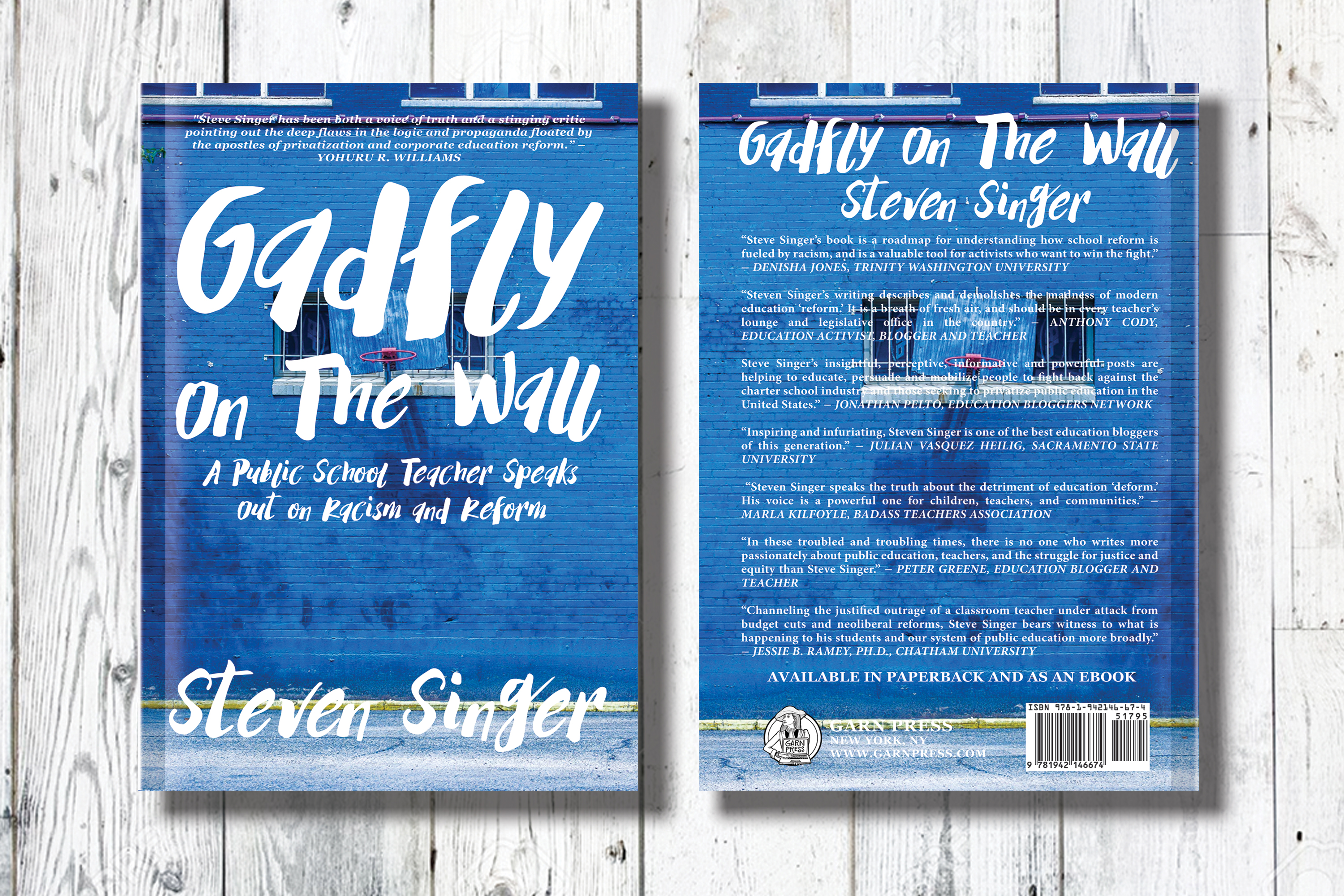
I’ve also written a book, “Gadfly on the Wall: A Public School Teacher Speaks Out on Racism and Reform,” now available from Garn Press. Ten percent of the proceeds go to the Badass Teachers Association. Check it out!
 

School Vouchers Don’t Increase Academics; They Increase Bigotry   


Let’s be honest.  


At best, school vouchers are a failed education policy experiment.  


At worst, they’re an attempt to normalize bigotry. 


Using taxpayer money to send your child to a private or parochial school has got nothing to do with getting a quality education.  


If we look at the facts, using a school voucher to go from a public school to a private one actually hurts kids academically.  


Large-scale independent studies in Indiana, Louisiana, Ohio and Washington, D.C., show that students who used vouchers were as negatively impacted as if they had experienced a natural disaster. Their standardized test scores went down as much or more than students during the Covid-19 pandemic or Hurricane Katrina in 2005.  


This should come as no surprise. When we give children school vouchers, we’re removing their support systems already in place.


They lose the friends, teachers, and communities where they grew up. It’s like yanking a sapling from out of the ground and transplanting it to another climate with another type of soil which may not be suited to it at all.  


Vouchers have nothing to do with helping kids escape struggling public schools.  


School vouchers overwhelmingly go to kids who already attend private or parochial schools.  


In the states that have released their data, more than three quarters of families who apply for vouchers for their children already send their kids to private schools. That’s 75% of voucher students in Wisconsin, 80% in Arizona, and 89% in New Hampshire. So these kids didn’t need our tax dollars in the first place.  We’re just paying for services they’re already receiving.


Moreover, the very idea is absurd. If the school where the student is enrolled is struggling, why wouldn’t you simply invest in that school to make it better and fix the underlying problem? Why disrupt children’s educations by moving them to another school in another system that is entirely unproven, itself? 


Vouchers have nothing to do with more efficient schools.  


Let’s get one thing straight – voucher schools are businesses, often new businesses just opening up. And like any other start-up, the failure rate is extremely high. According to Forbes, 90% of start-ups fail – often within the first few years.  


The same is true here. Like charter schools (another privatized education scheme), most voucher schools close in the first few years after they open. In Wisconsin, for example, 41% of voucher-receiving schools have opened and subsequently closed since public funding began in the early 1990s.  


Yet when they close, they take our tax dollars with them leaving less funding available to educate all kids in the community.  


Public schools, by contrast, are community institutions that usually last (and have been around) for generations. Their goal isn’t profit – it’s providing a quality education. 


Lastly, vouchers have nothing to do with freedom or choice.  


Unless it’s the choice to be a bigot and indoctrinate your child into your own bigotry. 


Vouchers are about exclusion – who gets to attend these PRIVATE schools –  and indoctrination – what nonsense they can teach that public schools cannot.  


Private schools can and do discriminate against children based on religion, race, gender, sexuality, special needs – you name it – even if those schools take public money.  


For example, in Florida, Grace Christian School, a private institution that refuses to enroll LGBTQ kids has received $1.6 million so far in taxpayer funding. In Indiana, more than $16 million has gone to schools banning LGBTQ kids—or even kids with LGBTQ parents! That’s roughly 1 out of every 10 private schools in the state with just this one discriminatory enrollment.  


Meanwhile thousands of parochial schools that receive public funding use textbooks provided by The American Christian Education (ACE) group. This includes the A Beka Book and Bob Jones University Press textbooks. A Beka publishers, in particular, reported that about 9,000 schools nationwide purchase their textbooks.  


In their pages you’ll find glowing descriptions of the Ku Klux Klan, how the massacre of Native Americans saved many souls, African slaves had really good lives, homosexuals are no better than rapists and child molesters, and progressive attempts at equal rights such as Brown vs. Board of Education were illegal and misguided. You know – all the greatest Trump/MAGA hits!  


Call me crazy, but I don’t think that’s a curriculum worthy of taxpayer dollars. I think if you’re going to take public money, you should have to accept all of the public, and you shouldn’t be allowed to teach counterfactual claims and prejudice as if they were fact.  


You want freedom? Fine.  


You are free to be as intolerant as you want to be, but do it on your own dime.  


If racism, homophobia, classism or xenophobia is your thing, you can jolly well pay for it, yourself.  


But biased, partisan and sectarian education isn’t in the interest of the public good.   

  
We should reserve our tax dollars to pay for things in the common interest. Not Klan camp.   


 Don’t get me wrong. 


Every private or parochial school isn’t like that.  


But a heck of a lot of them are! 


We shouldn’t be wasting our time trying to sort through other people’s businesses when we have our own educational enterprise – public schools – which cumulatively do a much better job. 


And our public system would do an even better job than that if instead of trying to “save kids” from underfunded public schools, we simply funded them enough to meet student need and beyond.  


It should come as no surprise that removing students from public school and sending them to a private or parochial school doesn’t work to help them academically.  


It would be much more effective to provide support where students are than make them undergo the trauma of uprooting.  


Finally let me say something about the issue of standardized testing.  

 
I still believe that standardized test scores are a terrible way to try to assess student learning. And the fact that voucher students tank their tests – by itself – does not prove to me that private and parochial schools provide a substandard education compared to public schools.  


It is the surrounding factors – like that most voucher schools don’t have to use certified teachers with the same quality degrees as public schools, that they don’t have to use the same kind of high-quality curriculum or pass the same kinds of public scrutiny.  


However, test scores do matter to policymakers. They are using the same test scores to disparage public schools and then in the same breath ignore the scores when they delegate more taxpayer funding for school vouchers.  


This is hypocritical. We need to demand more from our lawmakers in this regard.  


The same far right ideologues that support Trump and the MAGA fascists are the driving force behind the push for more school vouchers.  


Undoubtedly, they are helped by unscrupulous Democrats, but at least the Dems CLAIM to still believe in facts and representative government. 


It’s time they paid heed to the facts and represented us by ending their support for school vouchers and the MAGA factories most of these vouchers go to support. 


Bigotry is a losing proposition in a democracy where you need as many votes as possible to get elected to office.  


And dressing up indoctrination as if it were just freedom and economics only works if we’re foolish enough to let it. 


NOTE: In this article, I am indebted to the work of Josh Cowen, a professor at Michigan State University who has been studying school vouchers for more than two decades.


Like this post?  You might want to consider becoming a Patreon subscriber. This helps me continue to keep the blog going and get on with this difficult and challenging work.

Plus you get subscriber only extras!

Just CLICK HERE.

Patreon+Circle

I’ve also written a book, “Gadfly on the Wall: A Public School Teacher Speaks Out on Racism and Reform,” now available from Garn Press. Ten percent of the proceeds go to the Badass Teachers Association. Check it out!

Standardized Test Scores are Incompatible with Your School’s Equity Plan  


The primary goal of public education is to teach all children fairly.  


But since its inception, the system has never been set up to actually accomplish this.  


So these days you hear a lot of talk about fixing the problem – of how we can ensure students of color and other historically underserved children get the same high-quality education racially and economically privileged kids always have received.


This almost always concludes with two types of plan.  


First, there is the serious venture made up of things like increasing spending to meet student need, wraparound services, early intervention, reducing class size, redistributive justice and cultural competence – a plan that looks the reality in the face and makes bold attempts to come to terms with it. 


Then there is the cheap knockoff proposition – a buzzword-laden scheme where someone is trying to convince you their half hearted proposal is actually a solution to the very real problem of educational inequality. 


And the number one thing you can use to tell the difference between the two is this – standardized test scores


The first plan that is centered around actually fixing disparities makes no mention of test scores – or at least relegates them to obstacles. The second is built all around them – as an essential component of the overall scheme. 


This is because the second feel-good-accomplish-nothing plan is essentially performative.  


Therefore, it is constructed around standardized test scores as a metric of success.  


Planners think: We’re going to do A, B and C to make our schools more equitable. And how will we know we’re doing it right? We’ll use our standardized test scores! 


That’s not accuracy. It’s ostentation. These scores don’t demonstrate anything at all about equity. True, they purport to show readily apparent increases or decreases in academics.  


However, even this is an illusion.  


A rise or fall in test scores is not, in fact, based on authentic academic success but merely success at taking standardized tests designed for very different purposes.  


And anyone who understands the history of these types of assessments and how they still work will know that this mirage is built at the cost of genuine equity.  


In fact, the inequalities plaguing our public school system are due in large part to our national insistence that standardized test scores be the ultimate measure of success.  


So constructing your plan to fix this problem around one of its root causes is like claiming you can fix a sinking ship by drilling more holes in its hull.  


At best, it’s naive. At worst, it’s self-defeating and disingenuous.  


The problem centers around the difference between standardized tests and assessments created by classroom teachers. 


Both types of assessment are supposed to measure what students have learned. But not all learning is equal


For example, a beginning chef needs to know how to use the stove, have good knife skills and how to chop an onion. But if you give her a standardized test, it instead might focus on how to make foie gras – something that would only come in handy at a high end French restaurant.


That’s not as important in your everyday life, but the tests make it important by focusing on it.  


The fact of the matter is that standardized tests do NOT necessarily focus on the most important aspects of a given task. They focus on obscurities – things that most students don’t know.  


This is implicit in the design of these exams and is very different from the kinds of tests designed by classroom teachers.  


When a teacher makes a test for her students, she’s focused on the individuals in her classes. She asks primarily about the most essential aspects of the subject and in such a way that her students will best understand. There may be a few obscure questions, but the focus is on whether the test takers have learned the material or not.  


When psychometricians design a standardized test, on the other hand, they aren’t centered on the student. They aren’t trying to find out if the test taker knows the most important facts or has the most essential skills in each field. Instead, there is a tendency to eliminate the most important test questions so that the test – not the student – will be better equipped to make comparisons between students based on a small set of questions. After all, a standardize test isn’t designed for a few classes – it is one size fits all.  


New questions are field tested. They are placed randomly on an active test but don’t count toward the final score. Test takers aren’t told which questions they’ll be graded on and which are just practice questions being tried out on students for the first time. So students presumably give their best effort to both types. Then when the test is scored, the results of the field test questions determine if they’ll be used again as graded questions on a subsequent test.  


According to W. James Popham, professor emeritus at the University of California and a former president of the American Educational Research Association, standardized test makers take pains to spread out the scores. Questions answered correctly by too many students – regardless of their importance or quality – are often left off the test.  


If 40 to 60 percent of test takers answer the question correctly, it might make it onto the test. But questions that are answered correctly by 80 percent or more of test takers are usually jettisoned.  


He writes:  

   “As a consequence of the quest for score variance in a standardized achievement test, items on which students perform well are often excluded. However, items on which students perform well often cover the content that, because of its importance, teachers stress. Thus, the better the job that teachers do in teaching important knowledge and/or skills, the less likely it is that there will be items on a standardized achievement test measuring such knowledge and/or skills.”  


Think about what this means.  


We are engaged in a system of assessment that isn’t concerned with learning so much as weeding people out. It’s not about who knows what, but about which questions to ask that will achieve the predetermined bell curve.  


This is important when it comes to equity.  


If we are guided in large part by standardized test scores, we aren’t guided by authentic learning. We’re guided by a false picture of learning. Therefore, the most effective way – perhaps the only practical way – of raising test scores is to teach directly to a specific test. And not only the test, but the specific version of the test being given that year.

So if we do somehow manage to raise test scores, we haven’t improved academics at all but a mere semblance of it. And thus the equity we might celebrate in such a situation would be just as false. 


You got a good score on the MAP test. Hurrah! But that doesn’t mean you know anything of real value except how to take this particular MAP test which, itself, will change after the next round of questions are field tested.


This has huge implications for the quality of education being provided at our schools. Since most administrators have drunk deep of the testing Kool-Aid, they now force teachers to educate in just this manner – to use test scores to drive instruction. So since the tests doesn’t focus on the most essential parts of Reading, Writing, Math, and Science, neither does much of our instruction. 

And if we insist on evaluating the equity of our schools on these test scores, we will only make things that much worse. 


We end up chasing the psychometricians. We try to guess which aspects of a subject they think most students don’t know and then we teach our students that to the exclusion of more important information. And since what students don’t know changes, we end up having to change our instructional focus every few years based on the few bread crumbs surreptitiously left for us by the state and the testing corporations.  


That is not a good way to teach someone anything. It’s like teaching your child how to ride a bike based on what the neighbor kid doesn’t know.  


It’s an endless game of catch up that only benefits the testing industry because they cash in at every level. They get paid to give the tests, to grade the tests and when students fail, they get paid to sell us this year’s remediation material before kids take the test again, and – you guessed it – the testing companies get another check!  


It’s a dangerous feedback loop, a cycle that promotes artificially prized snippets of knowledge over constructive wholes. 


And let’s not forget where these tests come from


They were created in the 1910s and 20s by eugenicists to prove the supremacy of white Europeans over other racial and ethnic groups.  


While these original tests are no longer in circulation, the assumptions behind them are an essential part of our modern day standardized tests. 


The very method of question selection in today’s tests builds economic and racial bias into the very fabric of the enterprise.  


According to Prof. Martin Shapiro of Emory University, when test makers select questions with the greatest gaps between high and low scorers, they are selecting against minorities. Think about it – if they pick questions based on the majority getting it right, which minority got it wrong? In many cases, it’s a racial or ethnic minority. In fact, this may explain why white students historically do better on standardized tests than black and Hispanic students.  


This process may factor non-school learning and social background into the questions. They are based on the experiences of white middle-to-upper class children.  


So when we continually push for higher test scores, not only are we ultimately dumbing down the quality of education in our schools, but we’re also explicitly lobbying for greater economic and racial bias in our curriculum trickling down from our assessments.  


As Ibram X. Kendi, author of “How to be an Antiracist” puts it:  


“Standardized tests have become the most effective racist weapon ever devised to objectively degrade Black minds and legally exclude their bodies.”  


This is incompatible with any enterprise aimed at increasing equity.  


You are engaged in a never-ending cycle of teaching to the test at the expense of authentic learning. You’re engaged in making minorities think like their privileged peers – of overcoming who they are just to be accepted into a game.


This is not education. It is assimilation, and it will always put the assimilated at a disadvantage to the majority – those they are being forced to imitate.  


Equity and standardized testing do not go together.  


They CANNOT go together. They are anathema.  


Those who suggest otherwise are either well-meaning fools or duplicitous malefactors.  


There is a multi-billion dollar standardized testing industry dependent on keeping us testing our kids.  


But we can no longer continue feeding that beast and pretending that we can somehow provide equity to our underserved children, too.  


We have to choose – equity or testing.  Fairness or unrestrained capitalism.


Do not believe anyone who tells you to support a plan built on both. 

It does not exist.


Like this post?  You might want to consider becoming a Patreon subscriber. This helps me continue to keep the blog going and get on with this difficult and challenging work.

Plus you get subscriber only extras!

Just CLICK HERE.

Patreon+Circle

I’ve also written a book, “Gadfly on the Wall: A Public School Teacher Speaks Out on Racism and Reform,” now available from Garn Press. Ten percent of the proceeds go to the Badass Teachers Association. Check it out!


Will We Even Try to Keep Students and Teachers Safe from Gun Violence? Or Just Keep Preparing for the Worst?

“Teachers, we are operating on a lockdown. Please keep your doors locked until we tell you it has been lifted.”

Before me a sea of wide eyes and scared faces.

I slowly walked toward the door continuing the lesson I had been giving before the announcement. The door was already shut and secured but I nonchalantly turned the extra deadbolt.

“Click!” it sounded like a gunshot across the suddenly silent room.

I continued talking while making my way back to the blackboard pretending that nothing out of the ordinary was happening.

That’s just life in the classroom these days.

According to Eduction Week, there have been 38 school shootings in the US this year resulting in injuries or deaths. That’s up from 34 last year and the highest it’s been since the media source began tracking such things in 2018.

During the height of the Covid-19 pandemic, there were only 10 such shootings in 2020, and 24 each in 2019 and 2018.

That comes to a total of 130 school shootings in the last five years.

“Mr. Singer, can I go to the bathroom?” DeVon asked.

“I’m sorry,” I said. “We’re still under lockdown. I’ll write you a pass as soon as it’s lifted.”

It seems like nowhere is safe.

Three of this year’s shootings were in my home state of Pennsylvania.

The first was on January 19 at Pittsburgh’s Oliver Citywide Academy, a special education school.

A 15-year-old boy waiting in a van to go home was shot and killed after at least one person opened fire outside the school.


The second was on April 5 at Erie High School. A 16-year-old student was shot and injured at the school.

The third was on Sept 27 at Roxborough High School in Philadelphia.

A 14-year-old student was killed and four others wounded (ages 17, 15, 14, and 14) in a shooting near the high school athletic field after a football scrimmage.

“Mr. Singer, what’s happening?” Olivia asked.

I turned to her confused at first then I realized what she meant.

“The lockdown? Let me check my laptop. No…. Nothing. I really don’t know, Honey. But I’m sure whatever it is, it will be over soon. Why don’t you get back to the assignment?”

“Okay.”

Such violence isn’t limited to schools.

On Sept 24 three people were shot in Kennywood Park, a popular amusement park in West Mifflin.


Two years ago in September a 15-year-old boy was killed and another was wounded in a shooting at the Haunted Hills Hayride in North Versailles.

In 2020 a man was shot and killed at Monroeville Mall. In 2015, a 17-year-old entered the men’s department on the lower level of Macy’s department store in the evening and shot his intended target and two bystanders, leaving two with critical injuries.

Is there anywhere safe anymore?

You can’t go to the mall. You can’t go on a haunted hayride. You can’t go to an amusement park.

I had students who were hiding in the mall during the 2015 shooting. My daughter wasn’t involved in any shootings but she went to Kennywood this summer.

Where does it stop?

Why are we doing so little?

A few weeks ago my school had another active shooter training for teachers while the students, thankfully, had a day off.

Every few years we do this. Teachers huddle in classrooms and try to react to a shooting scenario. We either barricade ourselves in our classrooms or try to find an escape route. We help train police and local medical personnel.

At this years training, teachers were given a talk by a law enforcement “expert” who regaled us with his time working as a Blackwater mercenary in Afghanistan. He told us how difficult it was to make decisions under fire but that sometimes you had to make the hard decisions.

“Some of you teachers have kids in wheelchairs in your classrooms. You think you’re going to get your whole class out of the building and to safety!? You have to ask yourself, how are you going to get that kid in the wheelchair out? What are you going to do if a child flips out or is too scared to move? I know it’s not nice to think about, but sometimes you have to make decisions that will save the most people – not necessarily everyone.”

It made me want to vomit. But he wasn’t telling me anything I didn’t already know.

I like to believe I’d pick the child up out of his wheelchair, throw him over my shoulder and carry him to safety. I hope I could calm down a child having a panic attack and whisk her out of the building.

But could I really? Alone?

We do everything we can to prepare ourselves in case something like this happens – but as a society we do nothing – NOTHING – to prevent shootings from happening in the first place.

Where’s increased gun regulations to make sure these weapons aren’t getting into the hands of criminals or the mentally unstable?

Where are bans on assault weapons and other weapons of mass destruction and war?

Where is increased liability for those recklessly selling firearms?

Where is anything we could be doing to make our schools, malls and places of entertainment safer?

“Mr. Singer, I really have to go to the bathroom.”

“You can’t hold it just a little longer, DeVon?”

“No,” he said hoping from foot to foot.

“Number 1 or number 2?”

He giggled and held up one finger.

I reluctantly pointed to the trash can.

“Take it over there to the corner. I’ll stand in front of you so…”

“Attention teachers! The lockdown has now been lifted. You may continue as normal.”

I sighed, unlocked the door and wrote DeVon a bathroom pass.

We never did find out what triggered the lockdown. One time it was a gunshot in the surrounding neighborhood. Another time it was an unauthorized adult seeking access to the building.

It could be much worse. And it will happen again.

The chances of it being a school shooter are low.

The chances of myself or my students being hurt or killed is even lower.

But it’s still too high.

Living under the constant shadow of this threat is creating a trauma that we’ve given up trying to solve and just call normal.

It is unacceptable.

We need to do more.

Not just on the days when one of these tragedies strike – but every day.

It is not safe for students and teachers – it will NEVER be completely safe, but it can be safer.

That’s the point – how safe can we make it?

And why aren’t we doing anything to reach that goal other than preparing for the worst?


Like this post?  You might want to consider becoming a Patreon subscriber. This helps me continue to keep the blog going and get on with this difficult and challenging work.

Plus you get subscriber only extras!

Just CLICK HERE.

Patreon+Circle

I’ve also written a book, “Gadfly on the Wall: A Public School Teacher Speaks Out on Racism and Reform,” now available from Garn Press. Ten percent of the proceeds go to the Badass Teachers Association. Check it out!

Top Five Republican Nightmare Fantasies About Public Schools

Republicans are fighting against a version of public education that does not exist.

Critical race theory, pornographic school books, and other bogeymen haunt their platforms without any evidence that this stuff is a reality.

Doug Mastriano, the GOP nominee for Governor of Pennsylvania, actually promises to ban pole dancing in public schools.

Pole dancing!

“On day one, the sexualization of our kids, pole dancing, and all this other crap that’s going on will be forbidden in our schools,” he says.

Mr. Mastriano, I hate to tell you this, but the only school in the commonwealth where there was anything like what you describe was one of those charter schools you love so much. The Harambee Institute of Science and Technology Charter School in Philadelphia used to run an illegal nightclub in the cafeteria after dark.

But at authentic public schools with things like regulations and school boards – no. That just doesn’t happen here.

Maybe if your plan to waste taxpayer dollars on universal school vouchers goes through you’ll get your wish.

But reality has never stopped the state Senator from complaining about a list of fictional public education woes.

On Twitter he routinely makes statements like this from August:

“Democrats are pushing woke ideology, racism, and sexuality on children in the classroom. As your governor, I will ban this on day one…”

Yikes. This is like promising to ban sorcery in school – another thing we don’t teach.

This isn’t the Republican Party I remember when I was growing up.

Instead of personal autonomy and free trade, today’s GOP solemnly swears to eliminate a series of racially and sexually motivated phantasms that are like shadows under a child’s bed. I suppose it’s easier to get rid of something that’s never existed than to fix the real problems we actually have.

But let’s be honest – for some folks this kind of unhinged messaging works.

Perhaps if we examine the most common claims against public schools, maybe we can see through the mist and electioneering to the very real fears the GOP is using in a desperate attempt to manipulate voters to their side.

So here are the top 5 Republican nightmare fantasies about public schools:

1) Teaching boys to hate themselves

“I believe that white men are the most persecuted identity in America.”

Georgia Congressperson Marjorie Taylor Greene actually said this – out loud – in an interview.

And the GOP attention-seeker is not alone.

Many Republicans claim anti-male discrimination is wide spread. Men are blamed for so many things in our society they’re forced to turn to porn and video games because they have no other options, Green claimed.

And women have become “… too weak and pathetic to take care of themselves. They want a great big giant government to take care of them. It’s such a hypocrisy. They claim they want the future to be female, but they aren’t capable of taking care of themself.”

How did we get here? Public schools that teach sexual politics.

But, Marjorie, the following ARE facts:

-The US is one of only eight countries in the world that does not provide any form of paid maternity leave by federal law.  

-Women earn 83 cents for every dollar a man makes.

-Despite being almost 60% of the population, women hold only 26% of the seats in Congress.

Should we teach such facts in school?

Contrary to Republican opinion, teaching about the many ways women are unfairly treated in the US does not turn men into victims or make women helpless.

Male students are not responsible for a world created by past generations but they ARE responsible for picking a side and doing something about it as they become adult members of society.

In a country where a GOP-controlled Supreme Court has usurped women’s bodily autonomy by overturning Roe v. Wade and men still have untold economic advantages, redefining men as victims and education as infantalizing is, itself, a fantasy.

2) Teaching kids to be gay

Republicans literally think public school teachers are turning kids gay.

That’s the impetus behind Florida Gov. Ron DeSantis’s controversial “Don’t Say Gay” bill and several copycat bits of legislation the American Legislative Exchange Council (ALEC) is pumping out across the country.

They insist that even mentioning LGBTQ people exist is grooming children into a sexuality they wouldn’t otherwise have.

First, believing this shows massive ignorance.

No one can really be coerced into a sexuality they didn’t already possess. As you grow and mature, you have sexual preferences. It’s not really a matter of nurture – it’s nature. People are born this way.

Second, stubbornly refusing to acknowledge that there are other ways to express your sexuality is not going to make people ignore their innate inclinations. The idea seems to be that if kids never find out there are other options, they’ll simply be satisfied with heterosexuality – how they’re told to think and feel.

And finally, it is extremely unfair to LGBTQ people. We already live in a culture that celebrates cis hetero-normativity. Trying to erase everyone else causes real harm and trauma to both people who are different and to those who are not but never get to fully understand the entire spectrum of humanity.

Teachers are not making kids gay, but they are telling kids that gay people are real. We are trying to stop bullying and homophobia. And let’s be honest – that’s really what Republicans are objecting to here.

They want it to be okay to hate gay people.

Sorry. Not in public school.

3) Teaching kids to be trans

This is where the backlash against using appropriate pronouns and recognizing trans people is coming from.

As much as Republicans hate gay people, they absolutely despise and fear the trans community.

Once again they conflate acknowledging the existence of the other with coercing students to become the other. Just knowing that trans is an authentic way human beings can live is seen as a threat. But if this kind of knowledge makes you trans, you almost certainly were trans already.

It hurts no one to call another person by the pronouns they would prefer you use. That’s just respect – treating others like you would want to be treated.

It hurts no one to see the world as bigger than just one way of living. This is reality, after all. And that’s what Republicans are rebelling against.

Far from teachers coercing students to become trans, the GOP wants us to bully children not to be. They want to constrain difference, punish and hide it.

This cannot be the mission of public schools. At its best, it is for everyone and must respect each child on their own terms.

It’s not easy. Recognizing such differences can be messy and challenging, but that’s life. Deal with it.

4) Teaching kids to hate white people

This is one of the most common complaints of Republicans everywhere.

Thy say public schools are woke. Public school teachers talk about racism and prejudice. They teach what was, what is and encourage kids to act to dismantle systems of injustice against people of color that persist.

Yeah. We do that.

I make no apologies.

It’s not Critical Race Theory (which is a legal framework) nor do we teach anyone to hate white people. But we do teach what whiteness has done and continues to do.

It’s called history and current events.

White kids today are not responsible for slavery, Jim Crow or a host of evils perpetrated throughout our collective past. But that doesn’t remove their responsibility to do something about it today.

Republicans, though, try to flip the script and call this teaching, itself, racism. That’s absurd! It is not racist to show kids injustice.

For example:

-Median household income for Black people, at $43,862, is 37 precent less than that of white people, at $69,823.

-Census data shows Black couples are more than twice as likely as whites to be denied a mortgage or a home improvement loan, which leads to just 59 percent of the median home equity white households have, and just 13 percent of Black wealth.

-A Black child born today can expect to live four years less than a white one.

-Black people have been more than twice as likely as white people to experience threats or uses of force during police encounters, and three times more likely to be jailed if arrested.

These facts matter.

They shouldn’t make children hate white people, but they may encourage them to hate white supremacy.

And that’s what Republicans are really against.

5) Teaching kids to be sexually active

This may be the strangest fantasy the GOP is trying to spread about public school.

They say we’re making kids engage in sexual activity. Which is strange because according to the Centers for Disease Control, fewer US children are choosing to engage in sexual activity.

An estimated 55% of male and female teens have had sexual intercourse by age 18, according to the CDC’s National Center for Health Statistics (NCHS).

However, these percentages have declined since 1988 when 51% of female and 60% of male teens had engaged in sexual activity.

If public schools are teaching kids to bump uglies, we’re doing a bad job.

Are kids more sexualized today than in the past? Probably. But that’s a result of the culture. When you sell teenagers shorts with the word “juicy” on the butt, don’t complain about public schools.

Some schools offer sex education classes, but they are focused on health and wellness. There is no encouragement to have sex. In fact, many such classes are still teaching abstinence only instead of safe contraception.

The idea that public schools are teaching sex is just dog whistle politics. It is Republicans trying to scare parents that public schools are instilling values they don’t share. It is blaming public schools for social ills that the schools didn’t cause and don’t control.

Looked at calmly and rationally, all of these fantasies are just scare tactics to get the gullible to react emotionally on election day.

They want to terrify responsive voters into giving GOP candidates the power to stop a host of things that never really existed. They want an excuse for doing nothing to solve the actual problems of the day.

There’s a reason they spend so much time railing against woke education – they want to ensure America remains asleep.

A fitful sleep – tossing and turning in various Republican nightmares.


Like this post?  You might want to consider becoming a Patreon subscriber. This helps me continue to keep the blog going and get on with this difficult and challenging work.

Plus you get subscriber only extras!

Just CLICK HERE.

Patreon+Circle

I’ve also written a book, “Gadfly on the Wall: A Public School Teacher Speaks Out on Racism and Reform,” now available from Garn Press. Ten percent of the proceeds go to the Badass Teachers Association. Check it out!

When Good Students Get Bad Standardized Test Scores 


Ameer is a good student.  


He takes notes in class, does all his homework and participates in discussions.  


He writes insightful essays and demonstrates a mastery of spelling and grammar.  


He reads aloud with fluency and inflection. He asks deep questions about the literature and aces nearly all of his classroom reading comprehension tests. 


However, when it is standardized test time, things are very different.  


He still arrives early, takes his time with the questions and reviews his work when he’s done – but the results are not the same.  


His grades are A’s. His test scores are Below Basic. 


How is that?  


How can a student demonstrate mastery of a subject in class but fail to do the same on a standardized test?  


And which assessment should I, his teacher, take seriously?  


After all, they can’t BOTH be correct. 


This is a problem with which most classroom teachers are forced to contend.  


Bureaucrats at the administrative or state level demand teachers assess students with standardized tests but the results often contradict a year or more of observation. 


Take the Measures of Academic Progress (MAP) test.  


This year at my Western Pennsylvania district, administration decided to use this computer-based standardized assessment as a pre-test or practice assessment before the state mandated Pennsylvania System of School Assessment (PSSA). 


I’ve already written about what a waste of time and money this is. A test before the test!? 


But after reluctantly subjecting my classes to the MAP and being instructed to analyze the results with my colleagues, we noticed this contradiction. 


In many cases, scores did not match up with teacher expectations for our students.  


In about 60-80% of cases, students who had demonstrated high skills in the subject were given scores below the 50th percentile – many below the 25th percentile.  


These were kids with average to high grades who the MAP scored as if they were in the bottom half of their peers across the state. 


 Heck! A third of my students are in the advanced class this year – but the MAP test would tell me most of them need remediation! 


If we look at that data dispassionately, there are possible explanations. For one, students may not have taken the test seriously. 


And to some degree this is certainly the case. The MAP times student responses and when they are input fast and furious, it stops the test taker until the teacher can unlock the test after warning them against rapid guessing. 


However, the sheer number of mislabeled students is far too great to be accounted for in this way. Maybe five of my students got the slow down sloth graphic. Yet so many more were mislabeled as failures despite strong classroom academics. 


The other possibility – and one that media doom-mongers love to repeat – is that districts like mine routinely inflate mediocre achievement so that bad students look like good ones.  


In other words, they resolve the contradiction by throwing away the work of classroom teachers and prioritizing what standardized tests say


Nice for them. However, I am not some rube reading this in the paper. I am not examining some spreadsheet for which I have no other data. I am IN the classroom every day observing these very same kids. I’ve been right there for almost an entire grading period of lessons and assessments – formative and summative. I have many strong indications of what these kids can do, what they know and what they don’t know.  


Valuing the MAP scores over weeks of empirical classroom data is absurd.  


I am a Nationally Board Certified Teacher with more than two decades experience. But Northwest Evaluation Association (NWEA), a testing company out of Portland, Oregon, wants me to believe that after 90 minutes it knows my students better than I do after six weeks! 


Time to admit the MAP is a faulty product. 


But it’s not just that one standardized test. We find the same disparity with the PSSA and other like assessments.  


Nationally, classroom grades are better than these test scores.  


In the media, pundits tell us this means our public school system is faulty. Yet that conclusion is merely an advertisement for these testing companies and a host of school privatization enterprises offering profit-making alternatives predicated on that exact premise.  


So how to resolve the contradiction? 


The only logical conclusion one can draw is that standardized assessments are bad at determining student learning.  


In fact, that is not their primary function. First and foremost, they are designed to compare students with each other. How they make that comparison – based on what data – is secondary.  


The MAP, PSSA and other standardized tests are primarily concerned with sorting and ranking students – determining which are best, second best and so on. 


By contrast, teacher-created tests are just the opposite. They are designed almost exclusively to assess whether learning has taken place and to what degree. Comparability isn’t really something we do. That’s the province of administrators and other support staff.  


The primary job of teaching is just that – the transfer of knowledge, offering opportunities and a conducive environment for students to learn.  


That is why standardized tests fail so miserably most of the time. They are not designed for the same function. They are about competition, not acquisition of knowledge or skill. 


That’s why so many teachers have been calling for the elimination of standardized testing for decades. It isn’t just inaccurate and a waste of time and money. It gets in the way of real learning.  


You can’t give a person a blood transfusion if you can’t accurately measure how much blood you’re giving her. And comparing how much blood was given to a national average of transfusions is not helpful. 


You need to know how much THIS PERSON needs. You need to know what would help her particular needs.  


When good students get bad test scores, it invariably means you have a bad test.  


An entire year of daily data points is not invalidated by one mark to the contrary.  


Until society accepts this obvious truth, we will never be able to provide our students with the education they deserve.  

Good students will continue to be mislabeled for the sake of a standardized testing industry that is too big to fail.


Like this post?  You might want to consider becoming a Patreon subscriber. This helps me continue to keep the blog going and get on with this difficult and challenging work.

Plus you get subscriber only extras!

Just CLICK HERE.

Patreon+Circle

I’ve also written a book, “Gadfly on the Wall: A Public School Teacher Speaks Out on Racism and Reform,” now available from Garn Press. Ten percent of the proceeds go to the Badass Teachers Association. Check it out!

 

Classroom Grades Show Learning Better than Standardized Test Scores

“Not everything that counts can be counted, and not everything that can be counted counts.”

William Bruce Cameron

This summer my family suffered a tremendous blow.

My grandmother, Ce Ce, died.

She was in her 90s and had been unwell since before COVID. But she was also our matriarch, the point around which so much of our interrelations orbited and met.

After the funeral, I found myself at my uncle’s house somehow tasked with watching over several young cousins who had had just about enough of sitting around quietly in itchy suits and dresses.

To get a moment to myself, I set them a task: go downstairs among the assorted relatives and ask them to tell you a story about Ce Ce. Best story wins.

They went off like an explosion. And when they came back, they each had a touching tale about Ce Ce.

One was about how she defended a niece who wanted to marry someone of another faith. Another story was a fond recollection of the sweet and sour spaghetti sauce she used to make, the recipe of which is lost forever.

I was even surprised to hear some stories I had never known like that after my grandfather died, a semi-famous painter had asked Ce Ce on a date!

When my little cousins’ recitations were done, they were united in one thing – wanting to know who won.

I stumbled. I stammered.

I really had no way of judging such a thing.

They had all brought back such wonderful stories. Who won? We were ALL enriched by hearing them.

And that’s kind of how I feel about learning.

It is a fool’s errand to try and compare one person’s acquisition of knowledge with another. But that’s exactly what our current education system is built on.

Unless opted out by a parent or guardian, every public school child in America is required to take standardized tests in grades 3-8 and once in high school.

And the results of these tests are used to make high stakes decisions about which classes the students can enroll in, which enrichments, field trips or remediation they require, and even how much funding will be given or withheld from the schools and districts where they attend.

As a result, the social effects of poverty and racial discrimination end up being transformed into numbers. Thus, instead of being seen as indictments of the economic and racist status quo, they are viewed as the problem of schools and the individual students, themselves.

Standardized tests purport to show that poor children and/or children of color aren’t learning at the same rate as other children. So by the end of 12th grade they have learned less. When they are discriminated against in the job market then, that discrimination is justified – because it is not based on economics or race; it is based on numbers.

However, to perform this alchemy, we have to ignore the fact that standardized assessments are not the only way to determine whether students have learned anything. In fact, for the majority of students’ school experience that learning is assessed by something else entirely – classroom grades.

What if we took classroom grades as seriously as we take standardized test scores?

What if we valued them MORE?

The world would be a very different place.

The entire narrative of failing students and failing schools would turn on its head. After all, graduation rates have steadily increased over the last decade.

Students are completing more courses and more difficult courses. And students are even getting higher grades in these classes!

Yet at the same time, standardized test scores on national exams have remained at about the same level or gone down.

How is that possible?

The new analysis comes from the U.S. Department of Education, and tracks transcripts of a representative sample of high school graduates in 1990, 2000, 2009, and 2019.

It does not include scores from 2020 and 2022 when both classroom grades and national test scores fell. But that’s clearly because of the pandemic and the fact that most students educations and testing schedules were disrupted.

Before COVID, students increasingly were taking higher-level courses, and their Grade Point Averages (GPAs) were steadily rising — from an average of 2.68 in 1990 to 2.94 in 2000, 3.0 in 2009, and 3.11 in 2019. 

This is true of students from all backgrounds, but disparities still existed. On average, white and Asian students had higher GPAs than Black and Hispanic students. Though girls, overall, had higher GPAs than boys.

However, on the National Assessment of Educational Progress (NAEP), given to a sample of students across the country, test scores during the same period did not show a similar increase. Math and reading scores in 2019 were slightly lower than in 2009 and unchanged from 2005. Science scores haven’t budged since 2009. 

Why the disparity?

It seems that either teachers are making it too easy to get good classroom grades or standardized testing does not assess student learning accurately.

Scholars, teachers, parents and students have been complaining about the validity of standardized testing for more than a century. But business interests make billions of dollars off the industry it creates. Guess which group policymakers continue to heed over the other.

It doesn’t take much to show why classroom grades are better at assessing student learning. Compare them with standardized test scores.

Students earn grades based on a wide range of assessments, activities, and behaviors – quizzes, class participation, oral and written reports, group assignments, homework, and in-class work.

Standardized tests, on the other hand, are not assigned on such a multifaceted range of factors. Instead, they are designed to obtain a measure of student proficiency on a specified set of knowledge and skills within limited academic areas, such as mathematics or reading.

Classroom grades are tapestries sown from many patches showing a year’s worth of progress. Standardized tests are at best snapshots of a moment in time.

In class, students can speak with teachers about grades to get a better sense of how and why they earned the marks they did. They can then use this explanation to guide them in the future thus tailoring the classroom experience to individuals.

The value seen in standardized test is its apparent comparability. Scores are supposed to reflect student performance under roughly the same conditions, so the results can be equated and analyzed.

So the biggest difference isn’t a matter of validity, it is pragmatism. Test scores can be used to rate students from all over the country or the world. They can be used to sort kids into a hierarchy of best to worst. Though why anyone would want to do that is beyond me. The purpose of education is not like the National Football League (NFL). It’s to encourage learning, not competition based on a simulation of learning.

And there is evidence that classroom grades are more valid than standardized test scores.

After all, high stakes assessments like the Scholastic Aptitude Test (SAT) do NOT accurately predict future academic success as classroom grades, in fact, do.


Kids with perfect scores on the SAT or American College Testing (ACT) tests don’t achieve more than kids who received lower scores or never took the tests in the first place.


Numerous studies have shown this to be true. The most recent one I’ve seen was from 2014.


Researchers followed more than 123,000 students who attended universities that don’t require applicants to take these tests as a prerequisite for admission. They concluded that SAT and ACT test scores do not correlate with how well a student does in college.


However, classroom grades do have predictive value – especially when compared to standardized tests. Students with high grades in high school but middling test scores do better in college than students with higher test scores and lower grades.

Why? Because grades are based on something other than the ability to take one test. They demonstrate a daily commitment to work hard. They are based on 180 days (in Pennsylvania) of classroom endeavors, whereas standardized tests are based on the labor of an afternoon or a few days.

Classroom grades would not have such consistent predictive value if they were nothing but the result of grade inflation or lenient teachers.

In fact, of the two assessments – classroom grades and standardized tests – one is far more essential to the daily learning of students than the other.

We could abolish all standardized testing without any damage to student learning. In fact, the vacuum created by the loss of these high stakes tests would probably result in much less teaching to the test. Days, weeks, months of additional class time would suddenly appear and much more learning would probably take place.

Academic decisions about which classes students can enroll in or what remediation is necessary could just as easily be made based on classroom grades and teacher observations. And funding decisions for schools and districts could be made based on need and equity – not the political football of standardized testing.

However, getting rid of classroom grades would be much more disruptive. Parents and students would have few measures by which to determine if students had learned the material. Teachers would have fewer tools to encourage children to complete assignments. And if only test scores remained, the curriculum would narrow to a degree unheard of – constant, daily test prep with no engagement to ones life, critical thinking or creativity.

To be fair, there are mastery-based learning programs that try to do without grades, but they are much more experimental and require a complete shift in how we view learning. This is a more holistic system that requires students to demonstrate learning at one level before moving ahead to the next. However, it is incredibly labor intensive for teachers and often relies heavily on edtech solutions to make it viable.

I’m not saying this is an impossible system or even taking a stance on its value. But a large scale shift away from classroom grades would be chaotic, confusing and probably a failure without serious support, scaffolding and parental, teacher and student buy-in.

At the end of the day, classroom grades are the best tool we have to determine whether learning has taken place and to what degree. We should do everything we can to change the way policymakers prefer the standardized approach to the personalized one.

To return to a fuller quote by sociology professor Cameron with which I began this article:

‘It would be nice if all of the data which sociologists require could be enumerated because then we could run them through IBM machines and draw charts as the economists do. However, not everything that can be counted counts, and not everything that counts can be counted.”

Thus, the urge to quantify student learning seems predicated on the popular maxim: If you can’t measure it, you can’t manage it.

Standardized testing is about managing students – sorting them into valuable and disposable for the workforce.

Classroom grades are actually concerned with the project at hand – assessment of learning.

Which brings me back to my little cousins.

When I told them I couldn’t possibly pick a winner between them based on their stories, there were lots of groans of annoyance.

They viewed the whole project as a competition and they wanted to win.

I hope on reflection they’ll see that we all won.

Everything isn’t a contest. We are not all opponents.

If they can grasp that, it would be the greatest lesson I could teach.


Like this post?  You might want to consider becoming a Patreon subscriber. This helps me continue to keep the blog going and get on with this difficult and challenging work.

Plus you get subscriber only extras!

Just CLICK HERE.

Patreon+Circle

I’ve also written a book, “Gadfly on the Wall: A Public School Teacher Speaks Out on Racism and Reform,” now available from Garn Press. Ten percent of the proceeds go to the Badass Teachers Association. Check it out!

The MAP Test – Selling Schools Unnecessary Junk at Student Expense

School districts are easy targets for grifters.

Corporations everywhere are trying to sell them unnecessary junk and pocket wads of taxpayer cash.

The Measures of Academic Progress (MAP) test is a particularly egregious example of this, but let me begin with a more everyday example.

I’m a public school teacher in western Pennsylvania, and when I returned to school this week before classes started, I noticed my stapler was irreparably jammed from last year.

Normally, I’d just go out and buy another one. But I was running out of time to get things done, so I went to the office and asked if they had any staplers.

As luck would have it, they did.

The secretary lead me to a closet full of brand new Swingline staplers.

I thanked her, took one back to my room and started stapling.

Three staples in, it was irreparably jammed.

When I returned home that evening and complained to my family about the woes of the day, my sweet 13-year-old daughter offered me a stapler we had around the house.

When I brought it to school, it worked like a dream.

It wasn’t some top of the line model. It was another basic Swingline stapler. It was slightly less boxy and more modern than the kind I got from the office. But it worked. That’s the important difference.

So why did the office have a closet full of faulty staplers?

Because most teachers – unlike me – know the staplers the district buys are crap. You have to purchase your own supplies.

But think of the money wasted here!

The basic model sells for almost $14 on amazon.com.

Those staplers – that many staplers – probably add up to hundreds of dollars.

And they don’t even work!

Sadly, the full extent of the waste district-wide is much farther reaching than just the staplers.

Later that very day, teachers in my building were forced to sit through a virtual training on the MAP test.

This is an assessment made by Northwest Evaluation Association (NWEA), a so-called non-profit organization out of Portland, Oregon.

The company claims its assessments are used by over 9,500 schools and districts in 145 countries – but none is more popular than the MAP.

Some states even require the MAP as part of their standardized testing machinery. However, in the Commonwealth, the MAP is used as a pre-test or practice assessment by districts that elect to pay for it.

My building – the middle school – used a variety of different assessments throughout the years for this purpose – IXL, CDT, etc.

However, things are changing this year. No, we’re not getting rid of these pretests altogether – why enact sane policy now after a decade of wrongheadedness!?

My district had used the MAP consistently for years at the elementary schools, so someone in administration thought it made sense to bring it to the middle school now and eventually institute it in the high school, as well.

Do we really need an assessment BEFORE the state mandated assessments?

Heck no!

Classroom teachers give enough assignments and tests of their own to know where their students are academically throughout the year. We grade them after all. What do you think that’s based on – guessing?

But certain administrators just love these pre-tests. They love looking at spreadsheets of student data and comparing one grading period to another. They think if the numbers go higher, it will be proof they’re good principals and functionaries.

It’s pathetic to be honest. What a waste of taxpayer dollars that could be used for actual learning! What a waste of class time that could be used for actual teaching!

And what a negative impact these assessment actually have on students and their learning!

For instance, at the MAP training, teachers were told the assessment’s job was to show how our students were doing in Reading, Math and Science compared with an average test taker.

How is that useful?

I don’t teach average test takers. I don’t even teach average students.

How is constantly comparing them to a norm going to help them improve?

If I went on a diet and stepped on the scale, learning that my weight loss wasn’t as high as an average dieter would not help me stay away from sweets. If anything, it would inspire me to go on a binge in the snack drawer.

It’s the same with my students. Constantly pounding into them how below average their scores are does not inspire them to do better. It teaches them that they cannot do what is being asked of them so they stop trying.

When learning a skill, it doesn’t help to know how well others are or are not learning that same skill. It matters how much you are learning in comparison to yourself. Yesterday I knew THIS. Today I know a bit MORE. Who cares what the so-called average learner can do!?

Students learn at their own rates – sometimes faster, sometimes slower. We don’t quicken the timescale with needless comparisons.

But no matter how many times I say such things to administrators or paid trainers from NWEA, they just don’t get it.

At this training, the instructor actually wanted to know what “elevator speech” teachers were going to give to parents about why the MAP was important!

It’s bad enough we’re being forced to give this crappy assessment, but now you want us to spout propaganda to the very people paying our salaries!?

Why not invite us to the school board meeting and ask us what we really think of this initiative? Why not have us submit comments anonymously and have them read publicly to the school board?

But of course not! That would be actually valuing the opinion of the people you’ve hired to teach!

It’s no wonder the trainer was anticipating blow back. Many parent and teacher groups across the country have opposed the MAP test. Most famously in 2013, teachers at several Seattle schools lead by Garfield High School actually refused to give the MAP test.

Having trusted teachers sooth community worry with corporate propaganda would be a big win for the testing company.

However, I’ll give the trainer one thing – she understood that the MAP assessment scores would not be useful unless students could be encouraged to take the test seriously. Nobody tries their best at something they think is unimportant.

Her solution was two-fold. First, NWEA has produced several propaganda videos to show students why the test is important.

I can imagine how much they’ll love that!

Second, the MAP is an adaptive test taken on a computer or iPad. And it actively monitors the students taking the test.

If its algorithm determines that students are answering questions too quickly or “rapid guessing,” the program pauses the student test.

Teachers are supposed to monitor all this on a screen and intervene when it occurs. We’re supposed to counsel kids not to just guess and then allow them back on the test. If the algorithm still thinks students are guessing, we’re supposed to suspend their test and make them take it all over again.

You know, I did not get a masters in education to become a policeman for a standardized testing organization.

Moreover, this is exactly the kind of test proctoring that would get me fired if I tried it during the state mandated Pennsylvania System of School Assessment (PSSA). I would be guilty of violating test security.

Teachers throughout the state have to take on-line classes every year about what we are and are not allowed to do during the PSSA test. Stopping students who seem to be guessing, is not allowed. I’m not even allowed to point out if a student skipped a question on the test!

I certainly can’t scrap a PSSA test that I think a student didn’t give his best effort on and make him do it again!

So how exactly is this MAP test a practice for the real thing!?

Even under the best of circumstances, it’s an artificial environment where scores are massaged to give an unrealistic picture of how students will do on the PSSA.

Of course, administration at my school has one more trick up its sleeve to get students to take the MAP test seriously.

Like the CDT, IXL and other assessments before it, administrators plan to use MAP scores to make decisions about which classes students can take in the next grade. Students in the advanced classes must test well on the MAP or be denied access to this class in subsequent years. Students who score badly on the MAP may have to take the remedial class.

And unlike the PSSA or Keystone Exams – assessments required by the state – administrators are trying to forbid parents from opting their children out of the MAP test.

State test – you can opt out.

Local assessment – you have to take it. Or else!

I wonder if enough parents will complain to the school board about such behavior or just give up and enroll their kids in the local charter school or the private parochial school located RIGHT NEXT DOOR!

As if this all wasn’t counterproductive enough, it’s also a huge waste of money.

Though NWEA claims to be a non-profit, the company posted $166,775,470 in revenue in 2020 – the most recent year available. Its CEO Chris Minnich made $397,582.

These people are making lots of money off this standardized testing baloney!

According to a 2015 brochure from NWEA about the MAP test, it costs $13.50 per student to take the test every year. And that’s just for the Reading and Math. It costs an additional $2.50 per pupil for the Science test.

So if we estimate 1000 students at the elementary and middle school level, that’s roughly $16,000 a year to take the test.

And that doesn’t include the price of trainings like the one I had to sit through this week.

According to that same brochure, the cost for a single days training is $4,000, though sometimes it can be reduced to $3,500 if you buy the right package.

Trainings can go up to $40,000 for multiple days and an in-person trainer.

I wonder how much money my district flushed down the toilet on this garbage.

I look in my classroom closet at the crumbling books, and wonder.

I look at my steadily increasing class sizes and wonder.

My district doesn’t need the MAP test.

We need a test of basic decency for decision makers.


Like this post?  You might want to consider becoming a Patreon subscriber. This helps me continue to keep the blog going and get on with this difficult and challenging work.

Plus you get subscriber only extras!

Just CLICK HERE.

Patreon+Circle

I’ve also written a book, “Gadfly on the Wall: A Public School Teacher Speaks Out on Racism and Reform,” now available from Garn Press. Ten percent of the proceeds go to the Badass Teachers Association. Check it out!

Great Replacement Theory and School Choice

What do QAnon conspiracy theorists and school privatization promoters have in common?

Answer: ideology.

The two groups do everything they can to disassociate with each other in public.

But examine their ideas and you’ll see a lot of family resemblances.

For example, take Great Replacement Theory and School Choice.

Great Replacement Theory is the idea that people of color are replacing white people both numerically and politically. Adherents claim Democrats are overrunning native-born white people with brown skinned immigrants in order to wrest political power. The claims have no basis in fact, but that doesn’t stop the narrative from gaining traction in the darkest corners of the Internet and right wing circles.

It is a favorite of far right pundits, immigration catastrophists and mass shooters. In fact, several white men have used it as justification for mass murder.

In May a white teenager cited it as his motivation for killing 10 black people and wounding several others at a supermarket in Buffalo, New York.

In 2018, another white man claimed he was trying to stop Jewish people facilitating immigration by killing 11 Jewish people at the Tree of Life synagogue in Pittsburgh.

School choice, on the other hand, seems to be something much less extreme.

At least you don’t have to be a card carrying member of the lunatic fringe to espouse its supposed virtues.

It’s the idea that kids should be segregated into different school systems based on parental choice. This means that parallel systems will compete for students in a Darwinian marketplace where some will get better resources than others with profit being the prime motivator for school operators most of whom are private corporations. In practice, this usually means that the worst racial and economic segregation is justified and even preferable so long as consumers think doing so will get them some kind of advantage.

It’s quite a popular idea among certain market first ideologues. This includes both Democrats and Republicans, investment bankers, and even some social justice advocates.

These are not always the same people who publicly champion Great Replacement Theory. However, as Tucker Carlson proves on his Fox News platform, sometimes they are.

Carlson has used his media empire to promote both ideas.

For more than a year he’s been claiming on Fox News that there’s a deliberate effort by the Democrats to undermine Republicans by replacing native-born Americans with immigrants.

In July, he said:

“You can’t just replace the electorate because you didn’t like the last election outcomes. That would be the definition of undermining democracy, changing the voters… The great replacement. It’s not a conspiracy theory. It’s their electoral strategy.”

And when it comes to school choice, he goes even further. Not only has he promoted it on Fox News, he is co-founder and editor-in-chief of The Daily Caller, a media source that constantly promotes school privatization and other corporate education reform strategies – school vouchers, charter schools, etc.

So what do the two concepts have in common?

In short: racism and white supremacy.

Great Replacement Theory is a kind of grievance politics complaining about the steady loss of white privilege.

School choice is an attempt to recapture or maintain white privilege at the educational level and by extension into the adult economic and political world.

Great Replacement Theory has its roots in French nationalism books dating back to the early 1900s, according to the Anti-Defamation League (ADL).

Chief among these is French Author, Jean Raspail, whose 1973 novel, The Camp of the Saints, told a fictional tale of migrants banding together to take over France. However, the concept’s more contemporary use is attributed to Renaud Camus, a French writer who wrote “Le Grand Remplacement” (“The Great Replacement”) in 2011.

White supremacists blame Jewish people for nonwhite immigration to the U.S., and the concept is closely associated with antisemitism, according to the ADL.

Adolphus Belk Jr., professor of political science and African American studies at Winthrop University, said white nationalist movements arise when people of color are seen as a threat politically and economically.

Belk said white nationalists are worried that, “whites will no longer be a majority of the general population, but a plurality, and see that as a threat to their own well-being and the well-being of the nation.”

What makes individual extremists and white nationalist groups so dangerous, according to Belk, are the lengths they are willing to go to in order protect their position in society:

“They are willing to use any means that are available to preserve and defend their position in society … it’s almost like a sort of holy war, a conflict, where they see themselves as taking the action directly to the offending culture and people by eliminating them.”

By contrast, school choice is a quieter ideology, but based on similar foundations.

School choice originated in America’s racially segregated past. Around the time when the Supreme Court’s Brown v. Board ruling outlawed direct segregation in public schools, white lawmakers created programs for redirecting public money to private institutions so that white families didn’t have to send their children to schools with their Black peers.

And we see the same in charter schools and private schools accepting taxpayer funded vouchers today. The prime motivation behind sending children to these schools is often “white flight”. White parents use these options to flee schools with higher percentages of non-white students. And choice options tend to lure the more motivated and compliant students away from public schools.

This isn’t to say that the authentic public school system is unequivocally integrated, either. While there has been tremendous progress in many districts, unscrupulous school boards, administrators and lawmakers have drawn district lines in such a way as to limit integration even in a substantial number of public schools. However, the degree of segregation at privatized schools dwarfs anything you’ll see in public education.

School choice programs create the ideal situation for Black-white segregation. An analysis of high schools in more than 100 of the largest U.S. public school districts found a positive correlation between districts that offer school choice programs and the degree to which their high schools were racially imbalanced for Black and white students.

A national study of the trends in the racial makeup of nearly every school district in the U.S. found that charter expansions made segregation worse within school districts. An analysis of national enrollment data of charter schools, conducted by the Associated Press in the 2014-2015 school year, found more than 1,000 of the nation’s 6,747 charter schools had minority enrollments of at least 99%, and the number has been rising ever since.

We see the same effect with school vouchers. A 2018 study of Washington, D.C.’s voucher program found that 70% of voucher students were enrolled in heavily segregated schools with 90% or more minority students, and 58% were enrolled in all-minority schools.

So both concepts – Great Replacement Theory and school choice – center around increasing white supremacy.

Both seek to shore up white political and economic power regardless of white people’s numeric majority. In fact, as white people become less of the majority – not through any importing of people of color from other nations but as a natural consequence of birth rates – they seek to disempower people of color.

In education, this means keeping Black and white students separate and unequal. It’s a way to divert more resources to the white students and ensure the Black students do not receive the same opportunities.

Sadly, these ideas are not really new in this country. Both share the spirit of George Wallace who in 1963 proudly proclaimed:

“Segregation now, segregation tomorrow and segregation forever!”

As Malcolm X observed:

“America preaches integration and practices segregation.”

The question remains whether voters will support such artifacts of the past or turn to a future where our ideals of equality and fairness triumph over our reality of inequality and injustice.

QAnon and school privatization may share a family resemblance, but it is up to us whether we reject that family or not.


Like this post?  You might want to consider becoming a Patreon subscriber. This helps me continue to keep the blog going and get on with this difficult and challenging work.

Plus you get subscriber only extras!

Just CLICK HERE.

Patreon+Circle

I’ve also written a book, “Gadfly on the Wall: A Public School Teacher Speaks Out on Racism and Reform,” now available from Garn Press. Ten percent of the proceeds go to the Badass Teachers Association. Check it out!

The Guardian vs. the Goon: PA’s Most Important Governor’s Race

The choice for Pennsylvania Governor could not be more clear in November.

On the one hand, we have Josh Shapiro – an Attorney General who fought for Commonwealth citizens’ rights for six years.

On the other, we have Doug Mastriano, a former US Army Colonel and 3-year state representative who supported a literal coup against the United States government.

In any sane world, that would be all you’d need to know.

Shapiro, the state’s chief law enforcement officer, vs. Mastriano, a traitor who actively worked to overturn the votes of the very citizens who elected him to office.

This should not be an election – it should be a rout.

However, Commonwealth voters will need to come to the polls and make it clear that they reject Mastriano’s fascism and that they instead support their own right to determine who governs in Pennsylvania and beyond.

That sounds extreme. I wish it weren’t also true.

Following the last Presidential election when it became clear Donald Trump had lost the vote, Republican Mastriano helped organize large rallies pushing false claims of election fraud. He chartered buses to take protesters to the Capitol on January 6. He personally crossed police barricades at the Capitol during the riot, and attempted to submit “alternate” (i.e. fake) pro-Trump electors to the official count. And he even coordinated all this with Trump when he was invited to the White House to discuss the “stop the steal” strategy.

If Mastriano somehow wins the governors race, he will be in a position to basically call off Democratic rule in the state. As governor, he would choose the secretary of state — the official in charge of administering the 2024 presidential election. This would effectively allow him to pick the winner, himself.

This is not just conjecture. Mastriano has gone on record that as governor he would decertify voting machines in some precincts – making it hard to count votes there. He has even alluded to the independent state legislature doctrine, which holds that state legislatures can name whoever they want as the recipient of a state’s electoral votes, regardless of who voters select.

This is not conservatism. It is not protecting American values or law and order. It is the opposite.

By contrast, Shapiro, the Democrat in the race, is a model of exactly those qualities usually associated with sobriety and efficiency.

As Attorney General, he fought federal government overreach including Trump’s travel ban. He filed a lawsuit to stop religious organizations denying health coverage including contraceptives to employees. He joined a lawsuit against for profit colleges resulting in a $168 million settlement. He reached an agreement with federal officials to prevent the distribution of blueprints for 3D printed firearms. He launched an investigation of allegations of sexual abuse by members of the Catholic Church including a Grand Jury report alleging the sexual abuse of more than a thousand children at the hands of more than 300 priests.

In short, he worked hard to protect the people of this Commonwealth.

And the difference is stark on so many other issues when compared head-to-head.

Shapiro supports increasing public school funding. Mastriano wants to cut it in half.

Shapiro wants to increase security and gun regulations to prevent school shootings. Mastriano wants to give teachers guns and let them do the shooting.

Shapiro has fought to protect women’s reproductive rights against the state. Mastriano supports the state telling people what to do with their own bodies.

And on top of all that – Mastriano has ties to White Supremacists!

Until recently, his campaign paid consulting fees to Gab, a white nationalist social media site owned by anti-Semite Andrew Torba. Gab was the site that helped inspire the Pittsburgh Tree of Life Synagogue mass murder in 2018. Torba and others on the site that Mastriano was explicitly looking to for support commonly champion Great Replacement theory and support Vladimir Putin.

No skeletons of this type have been found in Shapiro’s closet.

The worst anyone has found so far is a $100,000 donation from Students First PA, a charter school advocacy group, which he took money from when he was running for Attorney General in 2016. However, Shapiro made no effort to hide the donation and his voting record when he was a state representative was not pro-charter. In 2011, for example, he voted against a measure to provide tuition vouchers of charter schools, and he has been a vocal critic of the industry for years. Moreover, neither Students First PA nor any other pro-education privatization organization that I can find has made any significant donations to him this election cycle so far.

The way I see it, this is a simple – if terrifying – election.

Shapiro is not perfect, but if elected, he would function similarly to current Governor Tom Wolf. He would be a guardian against the overreach and bad decisions of the gerrymandered Republican legislature.

One can hope voters throughout the Commonwealth would take back their individual voting districts from the extremists, but given the still uncompetitive lines of these districts, this seems unlikely.

So we need a Wolf, we need a Shapiro, standing on the battlements stopping the goons like Mastriano from taking advantage of the majority of us.

Shapiro would certainly do that. He might even go farther and fight to find ways to get real change through the legislature. But even if he can’t do that, voting for him is essential.

Mastriano may simply be the worst candidate for governor in the Commonwealth’s history – and that’s saying something!

We need Shapiro. We need Austin Davis as Lt. Governor. And we need John Fetterman as Senator.

That would make a huge difference both nationally and throughout the state.

It would set us up with a firm foundation and at least keep people safe from the worst.

I know it is depressing to be put in this situation constantly. Every election cycle seems to be the most important because the country is falling apart. Maybe we can find a way to turn things back and reach some level of sanity. But we can’t do anything unless we elect Shapiro, Davis and Fetterman.

We need the guardians against the goons.


Like this post?  You might want to consider becoming a Patreon subscriber. This helps me continue to keep the blog going and get on with this difficult and challenging work.

Plus you get subscriber only extras!

Just CLICK HERE.

Patreon+Circle

I’ve also written a book, “Gadfly on the Wall: A Public School Teacher Speaks Out on Racism and Reform,” now available from Garn Press. Ten percent of the proceeds go to the Badass Teachers Association. Check it out!