Charter Schools Cherry Pick Students & Call it Choice – PART 1: The “I Didn’t Do It!” Excuse

Screen Shot 2019-10-18 at 2.22.17 PM


It takes a certain kind of hypocrite to be a charter school champion.


You have to deny any wrongdoing one minute. And then admit you’re guilty but explain it away with the excuse “Everyone’s doing it!” the next.

 
Take cherry picking – one of the most common admonishments leveled against the school privatization industry.

 
Detractors claim that charter schools keep enrollment low and then out of those who apply, they pick and choose which students to accept.

 
Charters are run by private enterprise but funded with public tax dollars. So they are supposed to accept all comers just like the authentic public schools in the same neighborhoods.


But charter schools don’t have to follow the same rules as authentic public schools. They pretty much just have to abide by whatever was agreed upon in their charter contracts. Even then states rarely check up on them to make sure they’re in compliance.


So critics say many of these institutions are circumventing enrollment procedures. They’re welcoming the easiest kids to teach and dissuading others from enrolling – even to the extent of kicking out hard to teach children or pretending that an “unbiased” selection process just so happened to pick only the most motivated students.


Charter school supporters usually respond to this critique in one of two ways.


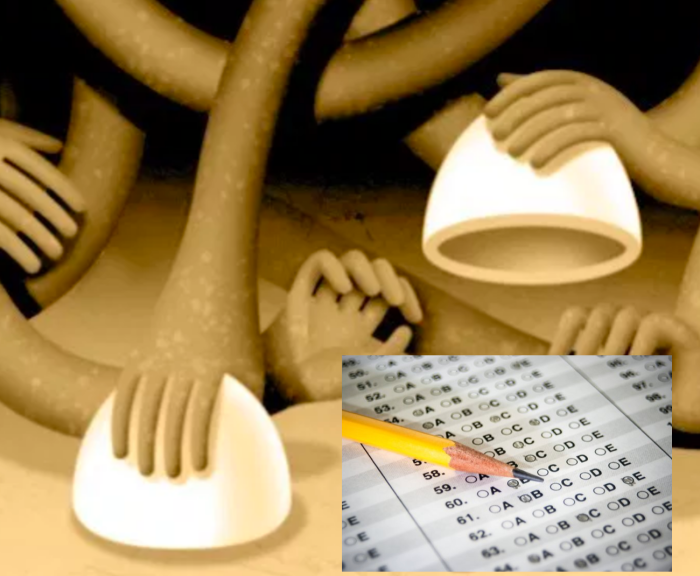
(1) Cherry picking!? How dare you!? We don’t cherry pick students! The demand to get in to our schools is so great that we put all the names in a hat and let chance decide!


Or


(2) Cherry picking!? Why of course we cherry pick students! But so do the public schools with their discipline policies and magnet schools!

 
You’d think these folks would suffer from some cognitive dissonance. Imagine if the Oscar Mayer company claimed that their hot dogs don’t contain any rat feces only to backtrack a minute later saying that their wieners have no more rat feces than the leading competitor’s franks.

 
And make no mistake – the charter school response is very much like a hot dog company’s damage control – a corporate press release written by various billionaire-funded think tanks to protect the industry’s market share.


It’s like a spoiled child saying, “I didn’t do it! And even if I did do it, there’s nothing wrong with it!”


Thankfully, there are these pesky things called facts that show both responses to be… well.. baloney!


Let’s take a look at each and examine why they’re wrong.


In Part 1, we’ll focus on the first excuse that charters don’t cherry pick students. In Part 2, we’ll look at the excuse that it’s okay for charters to cherry pick students because the authentic public schools do the same.


THE “I DIDN’T DO IT!” EXCUSE


Short answer: There is plenty of evidence that shows you did.


Long Answer:


Selecting the students you want to teach instead of families selecting the school they want their kids to attend is sometimes called cherry picking or creaming, and it comes in at least three varieties.


(1) Charter schools do things to encourage only the most motivated families to apply and discourage anyone else. This can involve long applications that may deter uneducated, non English-speaking and/or immigrant parents.


(2) Charter schools literally handpick students with higher test scores and sterling academic records.


(3) Charter schools “counsel out” or expel difficult students during the school year.


TYPE 1: APPLICATION SCHENANIGANS


The international news organization Reuters found evidence of the first type to be widespread at U.S. charter schools.


Reuters documented the following:


  • “Applications that are made available just a few hours a year.


  • Lengthy application forms, often printed only in English, that require student and parent essays, report cards, test scores, disciplinary records, teacher recommendations and medical records.


  • Demands that students present Social Security cards and birth certificates for their applications to be considered, even though such documents cannot be required under federal law.


  • Mandatory family interviews.


  • Assessment exams.


  • Academic prerequisites.


  • Requirements that applicants document any disabilities or special needs. The U.S. Department of Education considers this practice illegal on the college level but has not addressed the issue for K-12 schools.”


For a specific example, take a look at the online application form for 2016-17 at Roseland Accelerated Middle School, a charter school in Santa Rosa, California.


Applicants must fill out several dozen pages before a student is accepted, according to the website.


Students must write five essays that are each two pages in length using complete sentences covering a variety of topics including family background. One essay even asks applicants to write an essay beginning with “The qualities and strengths that I will bring to school are… .”


But that’s not all. Parents have to write seven small essays of their own and fill out their child’s medical history including medications the child takes (which some critics say violates federal privacy law).


Finally, students must write a minimum three-page autobiography, typed, double spaced and “well constructed with varied structure.”


This is all required BEFORE applicants are accepted to the school – a taxpayer funded school, by the way, that is supposed to accept everyone who applies unless too many enroll. Then the school is supposed to use a lottery to determine who gets in.
Funny how the lottery winners always seem to be those with the best essays and the lowest academic, psychological or medical needs.


Of course, that’s just one school.


The Southern California chapter of the American Civil Liberties Union (ACLU) along with Public Advocates looked at the application policies of 1,000 of the state’s 1,200 charter schools.


A quarter of them (including Roseland) had policies in violation of state law that could exclude some types of students. In particular, these charters are selecting against children from families with lower incomes or poorer English skills by requiring parents to volunteer, demanding students’ academic histories and/or failing to provide services for special-education students.


It should be obvious why this is unfair.


No family should have to do more to apply for a K-12 school than would be expected at a private college or university. We should not allow schools that are funded with public tax dollars to select against low-income students and families or foster children. No family should be forced to disclose their child’s medical histories as a prerequisite for enrollment so that school administrators could decide if asthma or a leukemia diagnosis makes the child a bad academic bet. No family should have to divulge members’ immigration status, religion or culture to apply to a school. Frankly, this is not the school’s business. No parent should have to volunteer on campus. Low income parents work two or more jobs, have younger children at home or just don’t have the time. And when you require parents to write essays, too, you’re really just trying to gauge family literacy and the ease of educating the student applicant.


TYPE 2 AND 3: HANDPICKING STUDENTS AND COUNSELING OUT


The good thing about the first type of selective enrollment is that you can see it on school applications which are free and open to the public.


The problem with proving the other two types of cherry picking is the lack of transparency at most charter schools.


Charter schools are notoriously tight lipped about what happens behind their closed doors. Unlike authentic public schools that have several monthly open meetings, open documents, and frequent state audits, charter schools don’t have to share hardly any of this with the public – even though we pay for their school.


The public is not allowed into the room where charter operators pick and choose students because of test scores or academics. Nor are many people allowed into private meetings with students and parents where children are highly encouraged to seek their education elsewhere or even given the boot.


However, there have been numerous studies that show this happens.


To be fair, there are competing studies that show it doesn’t happen. However, those studies are often paid for by the very industry under investigation. Their funding is predicated on finding a certain result and – GASP! – that’s what they usually end up finding.


It’s like the National Apple Institute funding a study that concludes “Pears suck.” It’s not a real study. It’s an advertisement.


The studies that DO show evidence of the second and third type of cherry picking, though, are independent and peer reviewed.


Here are a few results:


-Vasquez Heilig, J., Williams, A., McNeil, L & Lee, C. (2011). Is choice a panacea? An analysis of black secondary student attrition from KIPP, other private charters and urban districts. Berkeley Review of Education, 2(2), 153-178.

 
This paper concludes that charter school dropout rates – especially for black children – are much higher than at authentic public schools in Texas. In particular, KIPP charter schools claim that 88-90% of their students go on to college. The evidence does not support this claim. In fact, even though KIPP does spend 30-60% more per student, it still has a higher dropout rate and a higher rate for students transferring to other schools. Moreover, Texas charter schools were found to serve fewer black children than authentic public schools.


-Vasquez Heilig, J., LeClair, A. V., Redd, L., & Ward, D. (in press). Separate and Unequal?: The Problematic Segregation of Special Populations in Charter Schools Relative to Traditional Public Schools. Stanford Law & Policy Review, XX(X), XXX-XXX.

 
An analysis of charter schools in large metropolitan areas finds that authentic public schools have much greater rates of high needs students than charter schools in the same areas.


-Frankenberg, E., Siegel-Hawley, G., & Wang, J. (2011, January). Choice without equity: Charter school segregation. Education Policy Analysis Archives, 19(1). Retrieved from http://epaa.asu.edu/ojs/article/view/779/878

 
An examination of charter schools in 40 states and the District of Columbia found widespread evidence that charter schools are much more segregated by race and class than authentic public schools.


In particular:


“This analysis of recent data [2007-08] finds that charter schools are more racially isolated than traditional public schools in virtually every state and large metropolitan area in the nation.  In some regions, white students are over-represented in charter schools while in other charter schools, minority students have little exposure to white students.  Data about the extent to which charter schools serve low-income and English learner students is incomplete, but suggest that a substantial share of charter schools may not enroll such students.”


-Garcia, D. R. (2008). Academic and racial segregation in charter schools: Do parents sort students into specialized charter schools? Education and Urban Society, 40(5), 590- 612. doi: 10.1177/0013124508316044


This study found little evidence that charter schools were more segregated because of parental choice. “…parents enroll their students into charter schools with at least the same degree of academic integration as the district schools that students exited.” The segregation found at charter schools is due to some other source.


-Lacireno-Paquet, N., Holyoke, T. T., Moser, M., & Henig, J. R. (2002). Creaming versus cropping: Charter school enrollment practices in response to market incentives. Educational Evaluation and Policy Analysis, 24(2), 145-158. doi: 10.3102/01623737024002145

 
School choice makes disparities of race and class worse – not better – by selecting the easiest to teach in enrollment.


In particular:


“…competition for students will pressure individual schools into targeting students with the highest performance and the least encumbered with personal and social disadvantages. We suggest that some charter schools, by background and affiliation, are likely to be more market-oriented in their behavior than others, and test the proposition that market-oriented charter schools engage in cream-skimming…”


Market-based charter schools are not serving high needs students. They are “…skimming the cream off the top of the potential student population, [and] market-oriented charter schools may be “cropping off” service to students whose language or special education needs make them more costly to educate.”


Positioning Charter Schools in Los Angeles: Diversity of Form and Homogeneity of Effects. Douglas Lee Lauen, Bruce Fuller and Luke Dauter American Journal of Education Vol. 121, No. 2 (February 2015), pp. 213-239


This study finds:


“Charter school students were less likely to be Black, Latino, LEP, special education, and low income and were more likely to be White, academically gifted, high achieving, and have more highly educated parents. For example, about 12 percent of the parents of traditional public school students attained a college degree or higher, compared with 35 percent of the parents of charter school students.”


Researchers also concluded that despite serving more advantaged students, Los Angeles charter schools did not have much effect on student test scores.


In fact:


“We report no statistically significant positive effects of attending a charter school on achievement growth. For the first three cohorts studied, charter school effects on test score growth were negative and significant. For the last cohort studied, the effect was negative, but not statistically significant.”


-Government Accountability Office. (2012). Charter schools: Additional federal attention needed to help protect access for students with disabilities. Washington, DC: Author. http://www.gao.gov/products/GAO-12-543


This study found that charter schools enrolled a lower percentage of students with disabilities than traditional public schools.


In particular:


“In school year 2009-2010, which was the most recent data available at the time of our review, approximately 11 percent of students enrolled in traditional public schools were students with disabilities compared to about 8 percent of students enrolled in charter schools.


“GAO also found that, relative to traditional public schools, the proportion of charter schools that enrolled high percentages of students with disabilities was lower overall. Specifically, students with disabilities represented 8 to 12 percent of all students at 23 percent of charter schools compared to 34 percent of traditional public schools.”


Researchers could not prove a reason for this discrepancy but they did consider that “…some charter schools may be discouraging students with disabilities from enrolling.”


-Jabbar,  H. (2015). Every Kid is Money: Market-like competition and school leader strategies in New Orleans. Educational Evaluation and Policy Analysis. http://epa.sagepub.com/content/early/2015/04/27/0162373715577447.abstract


“This study examines how choice creates school-level actions using qualitative data from 30 schools in New Orleans. Findings suggest that school leaders did experience market pressures… [and some] …engaged in marketing or cream skimming.”


-Hirji, R. (2014). Are Charter Schools Upholding Student Rights? American Bar Association. Available online at http://apps.americanbar.org/litigation/committees/childrights/content/articles/winter2014-0114-charter-schools-upholding-student-rights.htm


The study concluded:


“The structures that allow charter schools to exist are marked by the absence of protections that are traditionally guaranteed by public education, protections that only become apparent and necessary when families and students begin to face a denial of what they were initially promised to be their right. [Charter operators] may encourage charter schools to push certain students out and make it easier to deny them the benefits of a publicly supported education.  The perception that charter schools are open to all students is being called into question by increasing evidence that children who are disadvantaged by a disability, poverty, or being a member of a minority group, or who have been accused of an offense, may not have the same access to charter schools as those [who] are not.”


-Taylor, J., Cregor, M., & Lane, P. (2014). Not Measuring Up: Massachusetts’ Students of Color and Students with Disabilities Receive Disproportionate Discipline, Especially in Charter Schools. Lawyers Committee For Civil Rights and Economic Justice. Available at: http://lawyerscom.org/wp-content/uploads/2014/11/Not-Measuring-up_-The-State-of-School-Discipline-in-Massachusetts.pdf


“…A significant number of charter schools, particularly those in the Boston area, had high discipline rates. Roxbury Preparatory Charter suspended 6 out of every 10 students out-of-school at least once… all for non-violent, non-criminal, non-drug offenses– for each suspended student.”


Civil Rights complaints and documents from the Katrina Truth (Education) page may be accessed here: http://www.katrinatruth.org/pages/education.html


“Accountability for what’s happening in New Orleans schools has been sorely lacking. While 92% of students are now enrolled in charters, many charter schools have failed to accommodate students with disabilities or limited English proficiency, violating federal law and prompting civil rights complaints to federal agencies. Making matters worse, students enrolled in New Orleans charters are subject to harsher charter-specific discipline policies aimed at pushing out even more students. Suspension rates at New Orleans charters, especially for out-of-school suspensions, are among some of the worst in the nation, with several schools above Louisiana’s already high statewide average and a select group at “rates of 40, 50, 60% and more each year.”


There is much more in comprehensive reports like Pushed Out: Harsh Discipline in Louisiana Schools Denies The Right to Education.


-Henig, J. R., & MacDonald, J. A. (2002). Locational decisions of charter schools: Probing the market metaphor. Social Science Quarterly, 83(4), 962–980. doi:10.1111/1540-6237.00126

 
The study examined why charters chose to locate in the District of Columbia (D.C.).


Researchers concluded:


“Charters are more likely to locate in areas with high proportions of African–American and Hispanic residents than in the predominantly white neighborhoods, and more likely to locate in neighborhoods with middle incomes and high home ownership than in either poor or wealthy areas of the city. This is especially true of those operated by for–profits…”


-Jennings, J. (2010). School choice or schools’ choice?: Managing in an era of accountability. Sociology of Education, 83(3), 227–247.


Looking at New York City charter high schools, researchers concluded:


“Although district policy did not allow principals to select students based on their performance, two of the three schools in this study circumvented these rules to recruit and retain a population that would meet local accountability targets.”


-Corcoran, S. & Jennings, 2015. The Gender Gap in Charter School Enrollment. 2015. NCSPE. http://www.ncspe.org/readrel.php?set=pub&cat=287


“Though many studies have investigated the extent to which the racial, socioeconomic, and academic composition of charter schools differs from traditional schools, no studies have examined whether charters enroll and/or retain a higher fraction of girls.


“…Analyzing enrollment data for all charter and public schools from 1999-00 through 2006-07, we find that charters enroll a significantly higher fraction of girls, an imbalance that is largest in the secondary grades, and has grown steadily each year.”


“…While attrition from charter schools is higher in all grades than from traditional schools, we find that boys are only slightly more likely to exit charter schools once enrolled. This suggests that much of the gender enrollment gap occurs at intake.”


VERDICT ON CHERRY PICKING


This really just scratches the surface. There are hundreds of more peer-reviewed studies and reputable news articles documenting that the second and third type of cherry picking takes place at many charter schools.


This is a problem even for charters that don’t engage in this practice because the laws governing the industry allow for selective enrollment.


Even charters that don’t cherry pick today could do so tomorrow and there’s nothing we could do about it.


Allowing schools that are publicly financed the freedom to pick whichever students they want to educate is like giving a match to an unsupervised child. It’s only a matter of time before something catches on fire.


In Part 2, we’ll examine the second excuse charter school advocates proclaim when confronted with the evidence above. Namely, that cherry picking students is okay since the authentic public schools do it, too.


NOTE: This article owes a debt to the research of Julian Vasquez Heilig whose Cloaking Inequality Website is an essential resource in the fight for equity in our schools.


Like this post? I’ve written a book, “Gadfly on the Wall: A Public School Teacher Speaks Out on Racism and Reform,” now available from Garn Press. Ten percent of the proceeds go to the Badass Teachers Association. Check it out!

thumbnail_IMG_8249

Racial Disparity in Student Discipline Isn’t All About Race

black-male-student_sm


Black students are suspended from school at substantially higher rates than white ones.


That’s indisputable.


When teachers send kids to the office, when principals issue detentions and suspensions, the faces of those students are disproportionately black or brown.


So what does that mean?


Are minority children more badly behaved than white ones?


Or is it an indication that our public schools are overrun with racist teachers and principals?


Those appear to be the only choices in Trump’s America.


There’s either something desperately wrong with children of color or the majority of white staff at public schools can’t handle them.


But the reality is far more complex, and no matter who you are, it will probably make you uncomfortable.


The problem is that there are variables the binary choice above doesn’t even begin to explain, and chief among them is child poverty.


In short, there are an awful lot of poor kids in America. And children living in poverty act out more than those living in middle or upper income brackets.


It’s not that these kids are inherently bad. They’re just coping with the stress of an impoverished life style by claiming whatever attention they can – even negative attention.


And since children of color are disproportionately more impoverished than white kids, it just makes sense that more of them would act up.


It should come as no surprise that living with economic deprivations translates into behavioral problems.


I’m not saying poverty is the only factor. I’m not saying that white teachers and administrators don’t engage in bias and racism. But it isn’t all one or the other.


Both are factors in this equation. And others variables as well.


To truly understand the problem, we have to give up the easy answers and the blame game and come together to find real, workable solutions.


SUSPENSIONS


About 15.5 percent of American school children are black, yet they make up 39 percent of students who are suspended from school, according to the Government Accountability Office’s (GAO) first study on the issue.


The study used data from 95,000 schools compiled from the federal Civil Rights Collection.


Particularly alarming is the fact that almost the same disparity exists in our prison system, where nearly 38 percent of inmates are black.


Researchers concluded that this disparity persists in both rich and poor schools, so the primary cause is racial bias.


However, the study was also used by the GAO as a means to put pressure on Education Secretary Betsy DeVos as she considered whether to rescind 2014 civil rights guidelines from the Obama Administration. The report was part of a political move to force DeVos to keep using guidelines meant to ensure that students are not discriminated against when punishments are handed out or schools would risk being found in violation of civil rights laws.


The problem is that the study is undeniably partisan and politically motivated.


Don’t get me wrong. I sympathize with its motivation. It’s just that we can’t let a single well-intentioned political action falsely impugn the nation’s teachers and public schools.


It IS important to keep the Obama era guidelines on civil rights violations. We DO need to be aware of possible incidents of discrimination against minorities in our schools and work to rectify these issues.


However, we can’t let this change the facts. The issue is whether poverty or race has a greater impact on racial discrepancies in student discipline. Are a greater percentage of black kids suspended mainly because of prejudice or is it more a symptom of their poverty?


And the answer can’t depend on whether it makes an odious person like DeVos squirm or smile.


POVERTY


The problem with answering this question comes from the various definitions of poverty we employ.


If we define poverty for students as those eligible for free or reduced lunch programs (a determination based on household income), then more than half – 51% – of public school children are poor.


But if we take the more conservative formula developed in the 1960s based on food expenses as a part of a family budget, poverty estimates shrink.


According to the Center for Children in Poverty (NCCP) which uses the more conservative definition, childhood poverty in the U.S. breaks down as follows: 10% of white kids (4.2 million), 27% of Latino children (4 million), 33% of Black students (3.6 million), 12% of Asian children (400,000) and 40% of Native American children (200,000).


And those figures are rising. There are 1.2 million more poor children in the U.S. today than there were in 2000.


However, there is real reason to assume these figures don’t capture the whole picture. After all, in just the last 30 years, food expenses (up 100%) have not risen as dramatically as other costs such as health care (up 500%), housing (up 250%) and college tuition (up 1,000%). So any real-world definition of poverty would include substantially more children than just those who qualify under these out-of-date federal guidelines.


A report by the Congressional Research Service (CRS) concludes, “If the same basic methodology developed in the early 1960s was applied today, the poverty thresholds would be over three times higher than the current thresholds.”


And the GAO study used the conservative 1960s threshold.


It underestimated how poor our nation, families and children have become.


Consider: in the past 20 years as wages have stagnated, median household expenses increased by 25 to 30 percent. As a result, 3 out of 5 Americans today spend more than they earn – not on useless frivolities – but on essential needs.


It’s estimated that over three-quarters of Americans are living paycheck to paycheck.


People are working more hours for decreasing wages and benefits. A Princeton study concluded that 94 percent of the nine million new jobs created in the past decade were temporary or contract-based instead of traditional full-time positions.


In 2016, the poorest 50% of American adults had an average net worth (home and financial assets minus debt) of just $7,500. To make matters worse, only a year previously it was $9,000. The difference all went to the top 1% who gained an average of $1.5 million during that same year.


These facts have real world consequences for every level of society – especially how our children behave in school.


CONSEQUENCES


It seems clear then that the scope and effects of poverty have been underestimated by the GAO report and others who wish to emphasize the effect of racism and bias.


Again this is not to say that racism and bias are misrepresented or unimportant. It’s a question of how much – not an either/or situation.


The fact of the matter is that poverty has a more pervasive impact on student discipline because students of color experience it at greater rates than white kids.


This is mainly because of the way poverty affects students’ home lives – an area that has a much greater influence on education than what goes on in the school, itself.


For instance, children who don’t know how to “play school” – to navigate the expectations, routines, social situations and academic demands – don’t learn as much as those who do. In fact, this may be a partial reason why children of color don’t do as well academically as kids from other groups. Certainly biased standardized assessments and the high stakes decisions made based on these tests play an even larger role. But at least some of the gap may be caused by lost opportunities due to behavioral issues.


Sadly, children who act out in class usually do the same at home. We must ask then: are parents present when this happens? Do they have similar standards of misbehavior? Do they know how to correct misbehavior when it happens?


Unfortunately, there is significant evidence that many parents aren’t able to be present for their kids.


They are working two or three jobs just to make ends meet and don’t have the time to do the groundwork necessary to eliminate behavior problems before their children go to class. They don’t have the time to set up routines, expectations, rewards and punishments, etc. And even when they do attempt to do these things, they have less ability to get it right because their attention is focused on putting food on the table, providing clothing and shelter, etc.


This is not because these people are bad parents. In fact, they are good parents who are doing the best they can. But this is a symptom of a deformed society that requires a disproportionate investment of time from the poor for the essentials that is not required of those in higher income brackets.


This is not something unique to black and brown families, either. It is a feature of millions of white households as well – but the demographics of poverty cluster these impacts disproportionately on children of color.


HOME LIFE


There is also a change in the sociological makeup and values of poor and minority families.


Some would put blame squarely on the increasing prevalence of one-parent households. I think this is deceptive, though, because many one-parent households are stronger and more stable than two parent ones. It really depends. But it makes sense that households with two parents – where one adult can lean on the other for support – are often more stable than those without this feature.


This may be an area where black children have a disadvantage since according to census data the percentage of white children under 18 who live with both parents almost doubles that of black children. While 74.3 percent of all white children below the age of 18 live with both parents, only 38.7 percent of African-American minors do the same.


There is also the issue of parents who aren’t just absent during the workday but absent altogether. People of color also are incarcerated at disproportionate rates to white people – even when convicted for the same crimes. This is not to say that black people commit more crimes, but that they are more harshly punished for them than whites – they have higher conviction rates and serve longer sentences.


This has consequences for children of color. It adds to the prevalence of grandparents and/or other siblings or foster caregivers filling that parental role. Again, these households can be exceptionally strong and stable. But there is less support, more struggles and the increased possibility that children’s behavioral home foundations may be less robust.


RACIAL TRAUMA


People of color also experience racial trauma compounded from our national history of slavery, racism and prejudice. Black and brown people today are still dealing with the effects of generational slavery. This is one of the reasons they are disproportionately poor – they did not have the chance to gather wealth over successive generations as white families did.


Moreover, the culture of black people was disrupted by the slave trade. Genealogies, legacies, traditions, faiths, etc. were stolen from them by the slave industry. Parenthood, as we know it today, was forbidden to black people. Is it any wonder that they have struggled to regain what was taken from them by white society?


Finally, there are the effects of Jim Crow and racial discrimination after the end of slavery. Black people have continually been told they had the same rights and opportunities as white people but when they went to claim these alleged boons, they were beaten back. This has had the effect of turning some of them against the very idea of many of the behaviors they see exemplified by white people.


Some students of color don’t want to behave like the white kids because they want to assert their blackness. There is among some of them an internalization of negative behaviors as black and positive ones as white. This misdirected self-determination results in racial pride for acting up regardless of the academic consequences.


RACISM AT SCHOOL


Of course by the same token there is certainly bias, prejudice and racism among white teachers, administrators, faculty and staff.


The fact that our public schools are mostly staffed with non-black and non-brown people, itself, ensures that bias will be prevalent in our schools. It is vital that we increase the percentage of black staff – especially teachers – in our classrooms. Though this will require the elevation of the profession of educator to attract teachers of all backgrounds.


The problem is that white people often don’t understand black culture or even recognize how much white people have been enculturated to accept stereotypes and bias as the norm.


This has a direct impact on school discipline. Many discipline policies are written to unduly target students of color. I’m not saying this is necessarily intentional – though it may be in some cases – but that these policies result in discipline discrepancies.


Many of these are dress code policies. How many schools criminalize the wearing of black hair in certain ways or the simple hooded sweatshirt? Hoodies, for example, are a preferred manner of dress for many students of color and really cause no harm to academics or social interactions. But administrators and/or school boards ban them – why? It’s just another way to police black bodies and minds.


These sorts of practices are everywhere in our schools and take reflection to undo. For instance, I found myself guilty of this same thing for years in my classroom when some of my black students started compulsively brushing their hair at their desks. These were mainly boys with short hair who were trying to get a wave effect their peers considered stylish.


At first, I found this incredibly annoying – the sound of constant brushing as students were doing their work. But then I realized that these students WERE doing their work. The brushing in no way interfered with academics. It didn’t bother anyone except for me and perhaps some of the white students.


Simply allowing cultures to express themselves should not result in disciplinary action. And since I’ve permitted the behavior, I’ve had less reason to discipline my students and no negative impact on academics.


SOLUTIONS


Most analyses of this problem stop with blame.


Who’s responsible for this? And once we have an answer – and it’s usually one very simple answer – then we’ve done all we set out to do.


In the case of the GAO report, once again the blame was put on everyone’s favorite scapegoat, public schools and teachers. But this is not earned given how much poverty was overlooked. The reality is that the responsibility for the problem is multifaceted with much of it stemming from cruel economics.


The solutions to the issue, if we are ever to really try to do more than just point fingers, must address a variety of ills.


First, we need to monitor and help public school staff to be less biased.


We need more teachers of color without a doubt, but this will never happen until all teachers are better paid, have stronger labor protections, autonomy and prestige. On top of that, there should be additional incentives to attract teachers of color. It’s hard for white teachers to notice their own biases unless there is someone in the building who can see them more clearly and offer advice. Just making the staff more multicultural will make white teachers more reflective of their own practices.


Of course actively pointing out prejudice is extremely difficult for co-workers to do by themselves. In addition, white teachers need cultural sensitivity training. And not just them. Since no educator comes from all cultures, everyone could use frequent reminders of how to be more inclusive, impartial and fair to students from various backgrounds.


Next, we need to broaden our idea of what discipline is. Every infraction doesn’t need a detention or suspension. We can enact interventions like restorative justice practices, conflict resolution and other positive procedures that actively teach kids how to deal with their emotions and better behave.


In short, we’re teaching kids what they should have learned at home, but like so many things in our society, it’s left to the schools to get it done. I bring this up not to shame anyone but to remind society that any expectation that schools can fix this problem by themselves is laughably naïve – but someone has to try.


At the macro level, we need to take steps to reduce and eliminate poverty.


This is one of the richest countries in the history of the world. Surely we can find ways to better share that wealth to the benefit of all. If parents don’t have to work multiple jobs to survive, they are more able to teach, model and discipline their own kids. And when parents are present in children’s lives, those kids don’t have as great a need for attention. It would certainly cut down on negative attention seeking behaviors.


In addition, with schools at the center of neighborhoods, we can have more adult education classes for parents. This would be not just courses on how to effectively raise children but on job skills and lifelong learning. After all, parents who value learning raise kids who do, too.


Finally, we need to enact antiracist policies at the local, state and federal level to reduce (and hopefully eliminate) prejudice of all kinds. We need integrated schools and neighborhoods. We need more antidiscrimination policies. We need to end mass incarceration and selective enforcement of the law. And we need some form of reparations to black people for the generations of racism they have had to endure.


I know these are big goals. But they are the only way to make a just society for everyone.


We cannot continue to blame our school system for reproducing the society that created it. Education is aspirational and strives to better itself. But it cannot reach that goal alone.


Like this post? I’ve written a book, “Gadfly on the Wall: A Public School Teacher Speaks Out on Racism and Reform,” now available from Garn Press. Ten percent of the proceeds go to the Badass Teachers Association. Check it out!

thumbnail_IMG_8249

Teachers Are More Stressed Out Than You Probably Think

18636260 - young woman in classroom.

 
When I was just a new teacher, I remember my doctor asking me if I had a high stress job.


I said that I taught middle school, as if that answered his question. But he took it to mean that I had it easy. After all – as he put it – I just played with children all day.


Now after 16 years in the classroom and a series of chronic medical conditions including heart disease, Crohn’s Disease and a recent battle with shingles though I’m only in my 40s, he knows better.


Teaching is one of the most stressful jobs you can have.


You don’t put your life on the line in the same way the police or a soldier does. You don’t risk having a finger chopped off like someone working in a machine shop. You don’t even have to worry like a truck driver about falling asleep and drifting off the road.


But you do work a ridiculous amount of hours per day. You lose time with family, children and friends. And no matter how hard you work, you’re given next to no resources to get it done with, your autonomy is stripped away, you’re given mountains of unnecessary bureaucratic paperwork, you’re told how to do your job by people who know nothing about education, and you’re scapegoated for all of society’s ills.


Not to mention that you’re expected to buy supplies for your students out of your own pocket, somehow magically raise student test scores but still authentically teach, convince parents not to send their children to the local fly-by-night charter or voucher school and prepare for an unlikely but possible school shooter!


Oh! And the pay isn’t competitive given the years of schooling you need just to qualify to do the work!!


That causes a mighty amount of stress.


One in five teachers (20%) feels tense about their job most or all of the time, according to an analysis by the National Foundation for Educational Research (NFER) in England. In similar professions, only one in eight feel this way (13%).


But those are conservative estimates.


A representative survey of more than 4,000 educators conducted in 2017 by the American Federation of Teachers (AFT) and the Badass Teachers Association (BATs) found even more stark results.


Educators and school staff find their work “always” or “often” stressful 61 percent of the time. Workers in similar professions say that their job is “always” or “often” stressful only 30 percent of the time.


That kind of tension among teachers has consequences. More than half of educators reported that they have less enthusiasm now than at the beginning of their careers.


One respondent commented:


“This job is stressful, overwhelming and hard. I am overworked, underpaid, underappreciated, questioned and blamed for things that are out of my control.”

WORK LOAD


The most obvious cause of teacher stress is the workload.


Though the details vary slightly from study to study, the vast majority highlight this as the number one factor.


The NFER study concluded that teachers work longer hours than people in other professions though a less number of official days. This is because of the school year – classes meet for about 9-10 months but require far more than 40 hours a week to get everything done. In fact, teachers are putting in a full years work or more in those limited days.


For instance, an average American puts in about 260 days at work a year. Teachers average 70 less days but do the same (or more) hours that other employees put in during the full 260 days. But teachers are only paid for 190 days. So they do roughly the same amount of work in a shorter time span and are paid less for it. The result is a poor work-life balance and higher stress levels.


But exactly how many hours do teachers routinely work? It depends on who you ask.


The University College London Institute of Education estimates that one in four teachers works 60 hours a week or more – a figure that has remained consistent for the past 25 years.


According to NFER, teachers work an average of 47 hours a week, with a quarter working 60 hours a week or more and one in 10 working more than 65 hours a week.


Four in 10 teachers said they usually worked in the evenings, and one in 10 work on weekends.


Both of these studies refer to British teachers but estimates are similar for teachers in the United States.


The Organization for Economic Co-operation and Development (OECD) reports that teachers in both countries are among those who work the most hours annually. The average secondary teacher in England teaches 1,225 hours a year. The average secondary teacher in the United States teaches 1,080 hours a year. Across the OECD, the average for most countries is 709 hours.


Finally, a study focusing just on US teachers by Scholastic, found that educators usually work 53 hours a week. That comes out to 7.5 hours a day in the classroom teaching. In addition, teachers spend 90 minutes before and/or after school mentoring, tutoring, attending staff meetings and collaborating with peers. Plus 95 additional minutes at home grading papers, preparing classroom activities and other job-related tasks.


And teachers who oversee extracurricular clubs put in an additional 11-20 hours a week.


No matter how you slice it, that’s a lot of extra hours.


According to the NFER study, two out of five teachers (41%) are dissatisfied with their amount of leisure time, compared to 32% of people in similar professionals.


This is a prime factor in the exodus of trained professionals leaving the field in droves, sometimes miscalled a teacher “shortage.”


It’s why one in six new teachers leave the profession after just a year in the classroom.


SALARY


Another contributing factor is salary.


Teacher pay in the United States (and many other countries) is not competitive for the amount of training required and responsibilities put on employees.


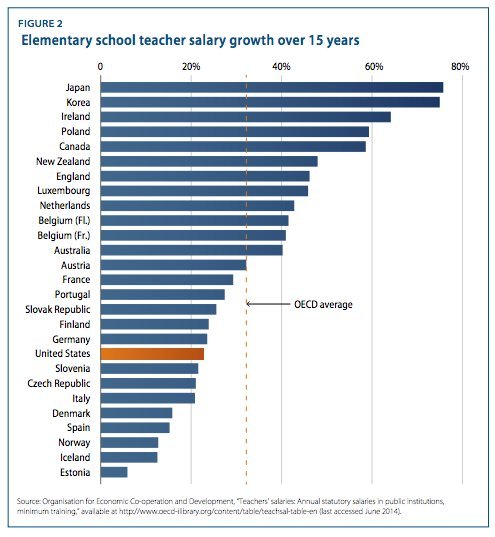
According to the Economic Policy Institute, teachers in the United States make 14 percent less than people from professions that require similar levels of education.


Sadly, it only gets worse as time goes on.


Teacher salary starts low, and grows even more slowly.


original


According to a report by the Center for American Progress, on average teachers with 10 years experience only get a roughly $800 raise per year. No wonder more than 16 percent of teachers have a second or third job outside of the school system. They simply can’t survive on the salary.


They can’t buy a home or even rent an apartment in most metropolitan areas. They can’t afford to marry, raise children, or eke out a middle class existence.


BACK TO WORKLOAD


This mixture of refusing to pay teachers what they’re worth and expecting them to do more-and-more with less-and-less is unsustainable.


Today’s public schools employ at least 250,000 fewer people than they did before the recession of 2008–09. Meanwhile enrollment has increased by at least 800,000 students.


So if we wanted our kids to have the same quality of service children received in this country only a decade ago, we’d need to hire almost 400,000 more teachers!


That’s how you cut class size down from the 20, 30, even 40 students packed into a room that you can routinely find in some districts today.


The fact that we refuse to invest in our schools only increases the workload of the teachers who are still there. They look around and see students in desperate need and have to choose between what’s good for them, personally, and what’s good for their students.


THAT’S why teachers are working so many unpaid hours. They’re giving all they have to help their students despite a society that refuses to provide the necessary time and resources.


And make no mistake, one of those resources is having enough teachers to get the job done.


RESPECT


For a lot of teachers, the issue boils down to respect – lack of it.


Teachers are expected to do everything and then denigrated when they can’t accomplish miracles every single day.


The fact is teachers are extremely important – the most important in-school factor for student success.


However, that doesn’t make them the most important factor in the entire learning process.


Roughly 60% of academic achievement can be explained by family background – things like income and poverty level. School factors only account for 20% – and of that, teachers account for 15%. (see Hanushek et al. 1998; Rockoff 2003; Goldhaber et al. 1999; Rowan et al. 2002; Nye et al. 2004).


Estimates vary somewhat from study to study, but the basic structure holds. The vast majority of impact on learning comes from the home and out-of-school factors. Teachers are a small part of the picture. They are the largest single factor in the school building, but the school, itself, is only one of many components.


The people who know teachers the best—parents, co-workers and students—show much more respect for teachers than elected officials and media pundits, many of whom rarely set foot in a classroom, according to the 2017 BATs and AFT Quality of Work Life Survey.


While educators feel most respected by their colleagues, they also indicated that their direct supervisors showed them much more respect than their school boards, the media, elected officials and U.S. Secretary of Education Betsy DeVos. A total of 86 percent of respondents did not feel respected by DeVos.


Most educators said they felt like they had moderate to high control over basic decisions within their own classrooms, but their level of influence and control dropped significantly on policy decisions that directly impact their classroom – such as setting discipline policy, performance standards and deciding how resources are spent.


“This lack of voice over important instructional decisions is a tangible example of the limited respect policymakers have for educators,” the report concluded.


Sometimes this lack of respect leads to outright bullying.


A total of 43 percent of respondents in the public survey group reported having been bullied, harassed or threatened at work in the last year. Of these reports, 35% included claims of having been bullied by administrators, principals or supervisors, 23% by co-workers, 50% by students, 31% by students’ parents. Many claimed to have been bullied by multiple sources.


This is a much higher rate of bullying, harassment and threats than workers in the general population.


I, myself, have experienced this even to the point of being physically injured by students multiple times – nothing so serious that it put me in the hospital, but enough to require a doctor’s visit.


And to make matters worse, one-third of respondents said that teachers and faculty at their schools did not felt safe bringing up problems and addressing issues.


CONCLUSIONS


Teacher stress is a real problem in our schools.


If we want to provide our children with a world class education, we need to look out for the educators who do the actual work.


We need to drastically reduce the workload expected of them. We need to hire more teachers so the burden can be more adequately sustained. We need to increase teacher salary to retain those already on the job and to attract the most qualified applicants in the future. We need to stop blaming teachers for every problem in society and give them the respect and autonomy they deserve for having volunteered to do one of the most important jobs in any society. And we have to stop bullying and harassing them.


As a nation, our children are our most valuable resource. If we want to do what’s best for the generations to come, we need to stop stressing out those brave people who step up to guide our kids into a brighter tomorrow.


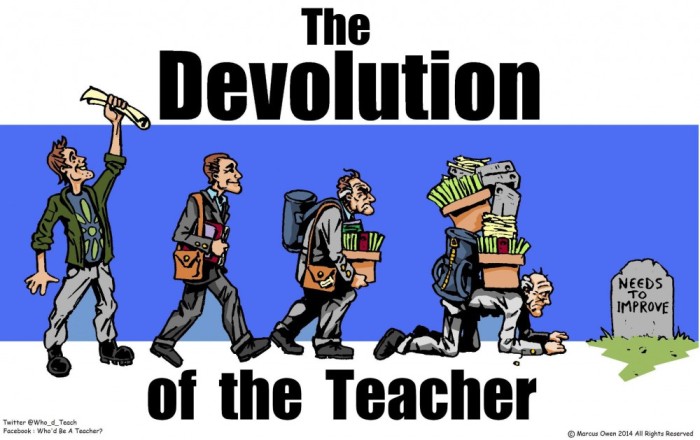
devolution-of-the-teacher-e1415308983284


Like this post? I’ve written a book, “Gadfly on the Wall: A Public School Teacher Speaks Out on Racism and Reform,” now available from Garn Press. Ten percent of the proceeds go to the Badass Teachers Association. Check it out!
thumbnail_IMG_8249

What Kind of A—hole Ransoms School Data?

Screen Shot 2019-08-28 at 10.47.05 PM

 
You’ve got to be a grade A sleaze bag to steal from kids’ public schools.


But that’s exactly what a growing number of slime balls are doing when they hack into schools’ computer networks and hold their data for ransom.


Even worse – districts are paying it!


Just this week the Rockville Center School District in New York state paid an $88,000 ransom to get back files that had been encrypted by Ryuk ransomware.


The district negotiated the payment down from $176,000. School directors only decided to pay after realizing it would cost more to hire another firm to fix the problem.


Plus the school had insurance that covered ransomware so it only ended up losing its $10,000 deductible.


But this district isn’t the only one being extorted by these basement dweller bandits.


In July, alone, schools in New Mexico, Nevada, Louisiana, Oklahoma, Alabama, Connecticut and another in New York suffered similar cyber attacks.


Nor do they show any signs of slowing down.


A report by cybersecurity firm Recorded Future concluded that attacks on state and local governments have reached an all time high. There were 170 cyber attacks since 2013, of which 22 occurred just this year.


After years of budget cuts and downsizing, hackers see local governments like wolves see the oldest and weakest animals in the herd – easy pickings.


And schools are particularly vulnerable.


They often have small IT departments, antiquated equipment and the cheapest cybersecurity.


That’s why in recent months schools in Lake City, Fla.; La Porte County, Indiana; and Riviera Beach, Fla. have all paid ransoms to regain access to their data.


If you think about it, data is one of the most financially valuable things schools have.


Districts are responsible for students’ privacy in so many ways – records of special services, grades, accommodations, discipline, etc. In addition, schools are large employers with privileged information on their staffs including healthcare, finances, insurance, social security numbers, etc.


School directors and administrators have a responsibility to safeguard this information. It’s no wonder, then, that many are giving in to these demands, especially when nefarious nonentities ensure payment is cheaper than any other alternative.


Even so, what a monster you have to be to squeeze schools in order to make a buck!


Every dollar you blackmail away from district coffers is a dollar not spent on children’s educations.


That’s less money for teachers, supplies, classes, tutors, nurses, counselors, etc.


You aren’t stealing candy from a baby. You are literally snatching away opportunities for a better future.


Given the stakes involved, it shouldn’t be all up to individual districts to stop cyber thieves. The state and federal government should be flexing their muscles to help.


One thing they can do is toughen laws against using ransomware.


Maryland legislators proposed a law to consider ransomware attacks that resulted in a loss of more than $1,000 as a felony, which would then be subject to a fine of up to $100,000 and 10 years in jail.


Current Maryland laws define such attacks that extort less than $10,000 as misdemeanors, while only a breach that results in a loss of greater than $10,000 is a felony.


But some argue that there are already federal laws on the books criminalizing ransomware such as The Computer Fraud and Abuse Act and the Electronic Communications Privacy Act. Unfortunately, these laws don’t mention ransomware specifically and may be too broad.


Federal and state governments could at least offer grants to update school cybersecurity to make such attacks more difficult. Otherwise, the burden becomes an exponential increase in the cost of doing business for schools which can only be made up by increasing local taxes and/or cutting student services.


Another option would be setting up a federal program to step in whenever schools are victims of ransomware. After all, these are public schools! If they were under attack by armed terrorists, the federal government wouldn’t think twice before jumping in.


With federal resources, perhaps we could stop all schools from ever paying these ransoms again. Because that’s the only way to truly end these cyber attacks.


As long as schools and governments are willing to pay, there will be trolls unscrupulous enough to take advantage.


Public services set up to meet the public good should never have to shortchange society so they can meet some fool’s ransom demand.


Ransomware has been around since at least 2012. The largest incident so far came last year with the WannaCry attack which infected more than 200,000 computers in about 150 countries, including the United Kingdom’s National Health Service, at a cost of about $4 billion.


It’s past time we got serious in dealing with these cowards.


As technology increases, data crimes have become more common. In fact, there are far too many legal ways to pilfer private data.


Schools, in particular, do a bad job of safeguarding student data by entering into unregulated and nefarious contracts with ed tech companies. Contracts with these companies commonly contain loopholes allowing them to take student data at will and sell it.


The situation is worsened by the supply-side economic policies governing public schools. There are already numerous roads to privatize public schools and turn tax dollars into corporate profits. Moreover, the standardized testing industry monetizes learning when their services are mandated by the state and federal government. They conveniently offer to remediate the large numbers of students who don’t score well on these same tests and cash in on both ends.


With so many fully legal ways to steal education dollars from practices and policies that actually help kids learn, it’s no surprise where these shadow dwellers get their ideas.


As repulsive and selfish as these hackers are, they’re only taking the greed of the testing, privatization and ed tech industry to its logical conclusion.


What kind of a—hole ransoms school data?


The a—holes we allow to get away with it.


Like this post? I’ve written a book, “Gadfly on the Wall: A Public School Teacher Speaks Out on Racism and Reform,” now available from Garn Press. Ten percent of the proceeds go to the Badass Teachers Association. Check it out!
book-1

Six Problems with a Growth Mindset in Education

Screen Shot 2019-08-12 at 1.34.29 AM


Sometimes the truth is not enough.


Especially if you misunderstand its meaning.


That seems to be the main problem with a growth mindset.


It’s one of the trendiest concepts in education today, and – though it’s based on an authentic insight into how kids learn – it’s been shackled and monetized into an excuse to support a sterile status quo.


The basic idea goes like this: academic ability isn’t something students have or do not have. It’s a skill that gets better depending on how hard they work at it.


And up to that point, it’s correct and valuable.


But when we try to take that insight and weave it into current education policies, it becomes a shadow of itself.


As a middle school language arts teacher, I’m confronted with this most often in the context of standardized test scores.

 
I am constantly being told not to pay attention to the scores. Instead, I’m told to pay attention to growth – how much this year’s scores have improved from last year’s scores. And the best way to do this, I’m told, is by paradoxically examining the scores in the most minute detail and using them to drive all instruction in the classroom.


To me that seems to misunderstand the essential psychological truth behind a growth mindset.


Instead of focusing on the individuality of real human students, we’re zeroing in on the relics of a fixed mindset – test scores – and relegating the growth mindset to happy talk and platitudes.


1*PQBc8JCD5yu4x2wxCCGU1g

 
B leads to A, and if we really want A, we just need to emphasize B.


To be clear, I don’t think there’s anything wrong with the idea that learning is a skill that can be strengthened with hard work. I do, however, take issue with how that observation has been used to support the status quo of test-and-punish and strategic disinvestment in public schools. I take issue with the idea that growth is the ONLY factor in student learning and how we are ignoring the multitudinous ways the human mind works and what that means for education.


In short, I think making the growth mindset a magic bullet has ended up shooting us in the foot.


Here are six problems I have with the growth mindset model:


1) It Has Not Been Proven to Make an Appreciable Difference in Student Academic Achievement.


How exactly do you use growth to drive achievement?


You make the concept of growth explicit by teaching it. You actively teach kids this idea that anyone can learn with hard work, and the theory goes that they’ll achieve more.


Does it actually work?


The results have been pretty inconclusive.


It’s been tested numerous times in various ways – some showing success, some showing nothing or even that it hurts learning.


The best success has come from Carol Dweck, a Stanford education professor who’s made a name for herself promoting the growth mindset model in books and TED talks.


Just this month, she co-authored the largest nationwide study concluding that a growth mindset can improve student results.


About 12,500 ninth grade students from 65 public and private schools were given an online training in the concept during the 2015-16 school year.


The study published in the journal Nature concluded that on average lower-achieving students who took the training earned statistically significant higher grades than those who did not.


However, results were “muted” when students were less encouraged to seek challenges – such as when they had fewer resources and support.


Despite this success, Dweck’s peers haven’t been able to reproduce her results.


A large-scale study of 36 schools in the United Kingdom published in July by the Education Endowment Foundation concluded that the impact on students directly receiving this kind of training did not have statistical significance. And when teachers were given the training, there were no gains at all.


In a 2017 study, researchers gave the training to university applicants in the Czech Republic and then compared their results on a scholastic aptitude test. They found that applicants who got the training did slightly worse than those who hadn’t received it at all.


In 2018, two meta-analyses conducted in the US found that claims for the growth mindset may have been overstated, and that there was “little to no effect of mindset interventions on academic achievement for typical students.”


A 2012 review looking at students attitudes toward education in the UK found “no clear evidence of association or sequence between pupils’ attitudes in general and educational outcomes, although there were several studies attempting to provide explanations for the link (if it exists)”.


In short, there is little evidence that any current approaches to turning the growth mindset into a series of practices that increase learning at scale has succeeded.


2) It Doesn’t Fit with Current Education Policies

 
We live in a fixed mindset world.


That’s how we define academic achievement – test scores, grades, projects, etc.


We tabulate data, compile numbers and information and pretend that draws an accurate picture of students.


It doesn’t.


But the concept that student achievement isn’t one of these things – is, in fact, something changeable with enough effort – runs counter to everything else in this world view.


If data points don’t tell us something essential about students but only their effort, connecting them with high stakes is incredibly unfair.


Moreover, it’s incoherent.


How can you convince a student that test scores, for example, don’t tell us something essential about her when we put so much emphasis on them?


It’s almost impossible for students in today’s schools to keep a belief in a growth mindset when test scores and our attitude toward them confirm their belief in a fixed mindset.


In a world of constant summative testing, analysis and ranking of students, it is nearly impossible to believe in a growth mindset. It’s merely a platitude between the fixed academic targets we demand students hit.


This doesn’t exactly take anything away from the concept, but it shows that it cannot be implemented within our current educational framework.


If we really believed in it, we’d throw away the testing and data-centricity and focus on the students, themselves.


3) It Ignores Student Needs and Resources


When we try to force the growth mindset onto our test-obsessed world, we end up with something very much like grit.


After all, if the only factor students need to succeed is effort, then those who don’t succeed must be responsible for their own failures because they didn’t try hard enough.


And while this is true in some instances, it is not true in all of them.


Effort may be a necessary component of academic success but it is not in itself sufficient. There are other factors that need to be present, too, such as the presence of proper resources and support.


And most – if not all – of these factors are outside of students’ control. They have no say whether they are well fed, live in safe homes, have their emotional needs met. Nor have they any say whether they go to a well-resourced school with a wide curriculum, extracurricular activities, school nurses, tutors, mentors, psychologists and a host of other services.


Putting everything on growth is extremely cruel to students – much like the phenomenon of grit.


Education policy should help raise up struggling students, not continue to support their marginalization through poverty, racism and/or socioeconomic disadvantages.


4) It Can Make Kids Feel Disrespected and Disparaged

 
No child wants to be remediated.


It makes them feel small, inadequate and broken. And if they’re already feeling that way, it reinforces that helplessness instead of helping.


Context is everything. Well-meaning educators may gather all the students with low test scores in one place to tell them the good news about how they can finally achieve if they put in enough effort. But students may recognize this for what it is and instinctively turn away.


The best way to teach someone is often not to lecture, not to even let on that you’re teaching at all.


David Yeager and Gregory Walton at Stanford claimed in 2011:


“…if adolescents perceive a teacher’s reinforcement of a psychological idea as conveying that they are seen as in need of help, teacher training or an extended workshop could undo the effects of the intervention, not increase its benefits.”


Teachers cannot set themselves up as saviors because that reinforces the idea that students are broken and thus need saved.


I don’t think this is an insurmountable goal, but many growth mindset interventions are planned and conceived by non-teachers. As such, they often walk right into this trap.


5) It is Not Suitable For All Kids

 
Everyone’s minds don’t work alike.


When you tell some kids that anyone can achieve with enough hard work, it makes them discouraged because they thought that their academic successes marked them as special.


According to a 2017 study published by the American Psychological Association, growth mindset training can backfire especially with high achieving students for exactly this reason.


Hard work just isn’t enough for some students. Their self-esteem relies on the idea that they are good at school because of fixed qualities about themselves.


When we take that belief away, we can damage their self esteem and thus their motivation to do well in school.


The point isn’t that a growth mindset is wrong, but that as an intervention it is not appropriate for all students. In fact, perhaps we shouldn’t be using it as an intervention at all.


6) It Should Not be a Student Intervention. It Should Be a Pedagogical Underpinning for Educators


We’ve got this growth mindset thing all wrong.


It’s not a tool to help students learn. It’s a tool for teachers to better understand their students and thus better help them learn. It’s a tool for administrators, parents and policymakers to better understand what grades and test scores mean.


If you want to teach a student any skill, let’s call it X, you shouldn’t begin by telling them that anyone can learn it with enough effort.


Just teach X. And when you succeed, that will become all the motivation students need to learn the next thing.


Education is an incremental process. Success breeds success just as failure breeds failure.


As every teacher knows, you start small, scaffold your lessons from point A to B to C and make whatever changes you need along the way.


If we really want to help students in this process, we can start by ridding ourselves of the fixed mindset that current education policy is rooted in.


Growth mindset is a psychological observation about how human minds work. It’s not pedagogy. It’s empiricism.


We can use it to help design policy, lessons and assessment. But it has limited value – if any – being taught directly to students.

 
The growth mindset model has value, but not in the way it has typically been used in our school system.


Instead of providing justification for equitable resources and tearing down the testocracy, it’s been used to gaslight educators into obeying the party line.


It is not a magic cure all, but one factor among many that provides insight into learning.


If we can disentangle it from the profit-driven mire of corporate education, perhaps it can help us achieve an authentic pedagogy that treats every student as an individual and not an economic incentive for billionaires to pocket more tax money.


Like this post? I’ve written a book, “Gadfly on the Wall: A Public School Teacher Speaks Out on Racism and Reform,” now available from Garn Press. Ten percent of the proceeds go to the Badass Teachers Association. Check it out!

book-1

The Welcome Back Letter I’d Love to Give My Students – But Can’t

high-school-teacher-gives-student-a-high-five-893988494-5a72007bba61770037b681bf

 
I’m a very lucky guy.


I get to teach language arts in an amazing urban middle school in Western Pennsylvania.


I have reasonable autonomy, opportunities to collaborate with my co-workers and strong union protections.


Even so, I know there are a lot of teachers out there who don’t have those things.


Yet even after counting all my blessings, I still can’t do whatever I want. I can’t even do everything that my years of academic training and experience tells me would be best for my students.


Every year I’m told that my worth as a professional is mainly defined by student test scores – that I should use those scores to drive my entire class, that my major goal should be increasing the scores and my every waking moment should be spent examining past scores.

 
Every year I have to watch out for this data metric and do that much more work because my district has lost even more funding to the vampire charter school in our neighborhood. Or lawmakers have compromised away another several hours of my time to do meaningless paperwork – time that I either have to take away from my students or my family.


I see all this and I just want to scream.


I want to tell everyone what’s happening so that they can help stop the madness.


And I do scream into the whirl of cyberspace on my blog.


But I can’t do the same in my district. I can’t tell those right in front of me – my school board, my administrators, the parents or students.


Doing so would put everything I do have in jeopardy.


I know this because it already has.


Every year on the first day of school, I give my students a welcome letter.

 
This is the kind of letter I’d love to give them – but don’t dare:


Dear Students,


In a matter of weeks you will be invited back to school and I wanted to let you in on a little secret.


We missed you.


That’s right. Your teachers missed the heck out of you over the summer.


Don’t get me wrong. We enjoyed our time at home with our own children, time on vacation, time spent continuing to refine our craft, and/or time spent working another job. (Hey! Those extra pencils, papers, books and supplies aren’t going to buy themselves! Right?)


Here’s another little secret – your teachers come to school every day not because we have to, but because we want to.


We literally could do anything else with our lives but we’ve devoted our time to you.


Why? Because we love you.


I know that’s mushy talk, but it’s true.


Another secret: We know you’re nervous about your first day back. But – heck – so are we!


Don’t forget you’re young. We’re old!


We know you’re wondering who your teachers will be this year, what they’ll require you to do, which friends will be in your classes, who will sit with you at lunch…


We wonder if we’re still going to be able to do all the things we need to do to help you learn? Are we going to be able to provide a safe, secure environment for you? Will we be able to keep you engaged, and excited to learn? Will we be able to actually teach everything you want and need to know?


This is going to be a challenging year for all of us.


But that’s a good thing.


We’re in this together.


That’s kind of an important point.


You see, we know you’ll probably be asked to take high stakes standardized tests. Just know that it’s not us who’s asking. It’s the state and federal government. Lawmakers seem to think that your answers on multiple choice tests are very, very important.


Another secret: they aren’t.


We don’t care how you score on these tests. Not really. We don’t even care if you take them at all – and if your parents decide not to have you sit through this garbage, we will honor their wishes, because they are the ultimate authority on you – their children.


We know that standardized tests don’t assess how much you learn. The tests your teachers make do that – the work that you do in class every day shows it better than any canned corporate exam.


We know those scores don’t define who you are. We see you every day. We see your creativity, your intelligence, your fire, your verve, your passion.


We want to stoke that fire and help you become the people you always wanted to be.


And none of that can be shown on a standardized test.


THAT’S our job – not to turn you into great test takers but into the kind of people you most want to be.


Oh. By the way, please thank your parents for us.


Thank them for ignoring the hype about the flashy charter school that hedge fund managers opened on the hill – the school sucking up our funding, cutting services for students and making its investors very rich.


Thank them for declining the shiny school voucher to Pastor Dan’s Creationism, Anti-vaxxor, Climate Denial Academy. Thank them for passing up the tax rebate to Ivy Laurel Prep – where the rich white kids go.

 
Thank them for trusting us with the most precious things in their lives – you.


You really mean a lot to all of us.


So rest up and try to have fun for the remainder of your summer. We’ll do the same.


And before you know it, we’ll be back together in class expanding minds, expressing hearts and having a great time!


Love you all!


Your Teachers


That’s the kind of welcome back letter I would love to give my students – but can’t.


It was partially inspired by a REAL welcome back letter given by a New York Superintendent.

 
Around this time last year, he gave it to 11 principals and about 600 teachers in the
Patchogue-Medford School District before someone posted it online and it went viral.


His audience was teachers, but his message was the same:


Aug. 14, 2018


Dear….


Once again… this letter is too let you know I DO NOT CARE what your state growth score is. Let me be clear… I DO NOT CARE. It does not define you. You are more than a score. I’m hoping you know by now that the children and parents you serve appreciate your talents and the ability to make a difference in their lives. Keep your head up and your eye on what is most important… your students and your teaching craft.


The Patchogue-Medford School District fully supports you as an educator, regardless of what this meaningless, invalid and inhumane score states. You have my permission to throw it out, or use it for any creative ways you may think of. I have a feeling divergent thinking will be at an all-time high at Pat-Med. Let me know if you need anything and it is my sincere hope you have an outstanding year.


With Warmest Regards,


Michael J. Hynes, Ed. D.
Superintendent of Schools


image

38014006_10156079233558860_7115622694678167552_n

 
Cheers to Superintendent Hynes!


If only every teacher, administrator and school board member could be that brave and honest!

 
Here’s another letter given to year six students at Barrowford Primary School in Lancashire, England, along with their results from a recent standardized exam:


“Please find enclosed your end of KS2 test results. We are very proud of you as you demonstrated huge amounts of commitment and tried your very best during this tricky week.


However, we are concerned that these tests do not always assess all of what it is that make each of you special and unique. The people who create these tests and score them do not know each of you- the way your teachers do, the way I hope to, and certainly not the way your families do.


They do not know that many of you speak two languages. They do not know that you can play a musical instrument or that you can dance or paint a picture. They do not know that your friends count on you to be there for them or that your laughter can brighten the dreariest day.


They do not know that you write poetry or songs, play or participate in sports, wonder about the future, or that sometimes you take care of your little brother or sister after school.


They do not know that you have traveled to a really neat place or that you know how to tell a great story or that you really love spending time with special family members and friends.


They do not know that you can be trustworthy, kind or thoughtful, and that you try, every day, to be your very best… the scores you get will tell you something, but they will not tell you everything.


So enjoy your results and be very proud of these but remember there are many ways of being smart.”


BskDhaPIYAAMdpd


Here’s another one to parents from a principal in Singapore:


“The exams of your child are to start soon. I know you are all really anxious for your child to do well.


But, please do remember, amongst the students who will be sitting for the exams there is an artist, who doesn’t need to understand Math… There is an entrepreneur, who doesn’t care about History or English literature…There is a musician, whose Chemistry marks won’t matter…There’s an athlete…whose physical fitness is more important than Physics… If your child does get top marks, that’s great! But if he or she doesn’t…please don’t take away their self-confidence and dignity from them. Tell them it’s OK, its just an exam! They are cut out for much bigger things in life. Tell them, no matter what they score…you love them and will not judge them.


Please do this, and when you do… watch your children conquer the world. One exam or low mark won’t take away…their dreams and talent. And please, do not think that doctors and engineers…are the only happy people in the world.”

PrincipalsLetterToParents

 
If teachers and principals were allowed to speak freely, I bet there’d be a lot more of these kinds of letters.


School should not be centered on testing and test scores. It should be centered on students.


Like this post? I’ve written a book, “Gadfly on the Wall: A Public School Teacher Speaks Out on Racism and Reform,” now available from Garn Press. Ten percent of the proceeds go to the Badass Teachers Association. Check it out!
book-2

Top 7 Ways Technology Stifles Student Learning in My Classroom

Screen Shot 2019-07-30 at 9.25.31 PM

 
As a middle school teacher, I have real concerns about the ways technology is used in the classroom and the effects it’s having on students.


That does not make me a technophobe.


The fact that you are reading this article on a blog – a regularly updated Website containing personal writings or a weBLOG – should prove that point.


I use technology in my everyday life and in many ways find it indispensable.


However, that does not mean I embrace all uses of technology just as criticizing some forms does not mean I think we should get rid of them all.


But after 17 years of teaching, I have legitimate concerns about what all this technology is doing to our students and our schools.


I have seen technologies come and go. Some – like a computerized grade book – have been extremely helpful, and I would not want to have to do my job without them.


Others have fallen by the wayside, been discontinued or proven a waste of time or even worse – they’ve become impediments rather than assistants to student learning.


In general, I think we have become too reliant on technology in schools. We’ve welcomed and incorporated it without testing it, or even reflecting upon whether it promises to offer better pathways toward student comprehension and discovery or whether it merely offers flash and novelty devoid of substance. And perhaps even more frightening, we have not investigated the ways in which using these technologies actually puts student privacy and intellectual growth at risk.
So, without further ado, here are the top 7 ways technology stifles student learning in my classroom:


1) It Stops Kids from Reading


I’m a language arts teacher. I want my students to read.


I could simply assign readings and hope students do them, but that’s not practical in today’s fast-paced world. When kids are bombarded by untold promises of instant gratification, a ream of paper bordered by cardboard doesn’t hold much of a claim on their attentions.


So like many teachers, I bring reading into the classroom, itself. I usually set aside class time every other day for students to read self-selected books for about 15 minutes. Students have access to the school library and a classroom library filled with books usually popular with kids their age or popular with my previous students. They can pick something from outside these boundaries, but if they haven’t already done so, I have them covered.


In the days before every student had an iPad, this worked fairly well. Students often had books with them they wanted to read or would quickly select one from my collection and give it a try.


Sometimes when there was down time in class, when they had finished assignments or tests early, they would even pick up their self-selected books and read a little.


What a different world it was!


Now that every student has an omnipresent technological device, this has become increasingly impossible. I still set aside 15 minutes, but students often waste the time looking for an eBook on-line and end up reading just the first chapter or two since they’re free. Others read nothing but the digital equivalent of magazine articles or look up disparate facts. And still others try to hide that they’re not reading at all but playing video games or watching YouTube videos.


Even under the best of circumstances, the act of reading on a device is different than reading a printed page.


The act of reading traditional books is slower, closer and more linear. It’s the way teachers really want kids to read and which will most increase comprehension.


Reading on a screen is a product of social media. We scroll or scan through, seeking specific information and clicking on hyperlinks.


The old style of reading was transformative, absorbing and a much deeper and richer experience. The newer style is more superficial, mechanical and extrinsic. (And, Yes, I’m aware of which style of reading you’re engaged in now!)


To be fair, some students actually prefer reading eBooks on devices and may even experience the richness of the original style. But they are few and far between. Usually students use the devices to escape from the deeper kind of reading because they’ve never really done it before and don’t understand what it really is. And when they have this choice, they may never find out.


2) It’s a Distraction


As a teacher, I want my students to be able to focus on one thing at a time. There are situations and assignments that call for multitasking, but usually we need students to be able to look at text closely, examine an argument, identify figurative language or write creatively, etc. They can’t do that if they’re constantly checking their devices.


We have to admit that iPads, laptops, social media, etc. are addictive. If given the chance, many teenagers will spend hours there. Heck, many adults will, too. It’s common for students to rush through assignments to get back to watching videos about the latest on-line gaming trend Fortnite, or listen to music with earbuds, or others such things.


Technology is usually associated in their minds with entertainment, not education. I’m not saying that technologies don’t have their place. If you want to look up information quickly, devices are great. But the most common words I tell my students on any given day are “Apples up.” In others words, turn your iPads face down and focus on the lesson at hand.


3) It’s Unhealthy


For most students, technology is not a novelty. It is something with which they already have a lot of experience. Many studies find that kids between the ages of 13-18 spend up to 18 hours a day in front of a screen.


Why are we adding to that in the classroom?


Children need face-to-face interactions. They need to learn social skills, how to communicate with people, not screen avatars. They need time outdoors, time to get up and move around and interact with the world. Heck! They need unstructured time where they actually experience boredom and have to find ways to cope.


We’re robbing them of these skills by giving in to the electronic nanny. And it’s creating children who are less able to survive without that technological crutch.


As technology has become more widespread in my classes, I’ve noticed attention spans decreasing. So has self control, mindfulness and an ability for critical thinking.


4) It Costs Too Much


Public schools are already grossly underfunded. We have to pick and choose the most effective tools to help kids learn. Technology is often very expensive and takes away valuable money and resources that could be better spent elsewhere.


And the way these technologies are marketed is often reminiscent of the drug trade. The first uses are free. But if you want to expand, it will cost.


Even those that don’t demand briefcasefulls of cash often recoup their costs by collecting and selling student data.


In the school system, we are privy to an enormous amount of information about the children in our care – information that we are tasked with keeping safe. Ed tech software and technologies also routinely collect data on students. But they are not as constrained or legally responsible for it in the way schools and teachers are.


Some of the data technologies collect is indeed necessary for whatever task they perform – tabulating which questions students get correct and incorrect, etc. However, much of it is unnecessary for those tasks – information about student preferences or marketing information.

 
We have no guarantee that this data is secure. The FBI has warned schools, parents and students of information breaches at these ed tech companies. And the contracts these companies have with schools and/or users are shady at best. They don’t guarantee your data will be secure, don’t accept liability and even when they do, they routinely warn that their policies can change at any time without warning – especially if they go bankrupt.


These are costs too expensive to pay.


5) It Has Never Been Proven to Help Kids Learn

Educational technologies’ claims about student learning outcomes are based on faith not facts. There are few (if any) long-term, large scale, peer reviewed studies showing that most technologies are effective educational tools.

 
This is partially because they’re too new to have been around long enough to be adequately tested. Moreover, the field is flooded with “studies” payed for by the same companies or organizations being studied – which is like having McDonald’s tell you the McRib is nutritious. Some small-scale peer reviewed studies have been done, but the results have been inconclusive.


We are literally unleashing these devices and software applications on children without knowing their full effects.


Ed tech is a market-based solution to an academic problem. It is the triumph of big business over pedagogy.


Our children deserve better than this.


6) It Perpetuates Bad Pedagogy and Assessment

Ed tech is almost always organized around standardized testing. It takes the multiple choice test as the ultimate form of assessment and arranges itself around that paradigm.


Software basically teaches to the test. It shows users the kinds of questions that will be asked, how to solve them and then gauges their success by giving them test-based questions.


It’s ironic because the marketing departments of these corporations usually sell this junk as “personalized learning,” “individualized learning,” or “competency” or “proficiency based education.” They want you to think that the program is tailor made to the user when it’s actually just a prepackaged mess. If you can’t answer a question of type A, you don’t get to move on to a question of type B. That’s all.


This can be an effective method for increasing test scores – if students aren’t so tuned out by the experience that they don’t engage with what they’re being presented – which is what I often find with my students when I’ve been forced to subject them to this nonsense.


However, learning how to take a multiple choice test on reading is not the same as learning how to read and understand. It is not the same as interacting with, comprehending and forming an opinion about that reading.


This is not the best way to teach just as having students fill out endless worksheets is not, nor is even having a flesh-and-blood teacher do endless test prep.


It is brainwashing – teaching kids to think like the designers of a test when we should be teaching them how to think for themselves and like themselves.


7) It Undermines Public Schools and Teachers


Ed tech companies are not philanthropies. They are in this business to turn a profit. And the best way to do that is to displace and disrupt the public education system.


There is an entire testing and school privatization industrial complex out there trying to prove that traditional public schools are bad and need replaced with business solutions.


These aren’t just charter schools or private and parochial schools cashing in on vouchers siphoning tax money away from children and into their private pockets. These are ed tech companies, too.


The ultimate goal is to get rid of the very concept of school, itself, and to replace it with on-line cyber schooling that can be accessed anywhere without the need for any living, breathing teachers in the mix. Or at best, they want to reduce the teacher to a mere facilitator. It is the device and the software that teach. It is only the human being’s job to make sure the student is engaging with the technology.


This is not in the best interest of students. It is in the best interests of companies and corporations.


When we give away our responsibilities, our autonomy, and our humanity to these businesses, we are selling out our children.


I’m not saying that all technology is bad or even that it should never be used in the classroom.


But we must approach it with caution and intelligence. We should always know why we’re using it, what end we expect it to have and fully comprehend the consequences.


Otherwise our children will be left to pay for our own shortsightedness.


Like this post? I’ve written a book, “Gadfly on the Wall: A Public School Teacher Speaks Out on Racism and Reform,” now available from Garn Press. Ten percent of the proceeds go to the Badass Teachers Association. Check it out!
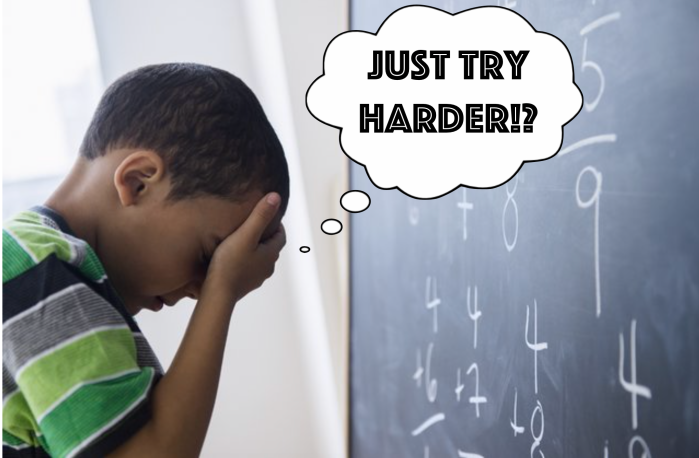
ebook-2 (1)

eBackpack Bankruptcy May Put Student & Teacher Data in Peril

kelly-sikkema-266805-660x400@2x

 
Teachers put their assignments into an on-line data base.


Students access them on their computers, iPads or other devices and then submit their work via the Internet.


What could go wrong?


Plenty. Especially when the company that provides this service goes bankrupt.


And that’s exactly what’s happened with Texas-based educational technology company eBackpack.


All those teacher assignments and student works are still there in computer servers somewhere. And now that eBackpack has filed Chapter 7 bankruptcy, all of it has become assets the company could decide to sell off to pay its debts.

 
The company explicitly reserves the right to do so according to its own Privacy Statement:


“The information we collect is used to improve the content of our Web pages and the quality of our service, and is not shared with or sold to other organizations for commercial purposes, except to provide products or services you’ve requested, when we have your permission, or under the following circumstances:


-We transfer information about you if eBackpack or part of it is acquired by or merged with another company. In this event, eBackpack will notify you before information about you is transferred and becomes subject to a different privacy policy.” [Emphasis mine]


Well that’s comforting. I wonder how a company that will no longer exist will have staff to notify former customers about what’s happening to the mountains of data we put in its hands.


Even under the best of circumstances, who will it notify? Teachers? Students? Parents? Or just the administrators or school boards who managed the over all accounts for individual districts?


eBackpack’s Terms of Service Agreement contains several red flags that someone should have noticed before students’ privacy was jeopardized:

 
“-eBackpack may assign its rights and obligations under these Terms to a third party without your consent.


“-You agree to use the Service at your own risk, without any liability whatsoever to eBackpack.


-1.1. Your use of the Service is at your sole risk. The Service is provided on an “as is,” “as available” and “with all faults” basis. The Service is owned and copyrighted by eBackpack and offered through a subscription, not sold, to you.


-10.1. eBackpack reserves the right at any time and from time to time to modify or discontinue, temporarily or permanently, the Service (or any part thereof) with or without notice.


-By submitting Content to eBackpack, you grant eBackpack a perpetual, worldwide, non-exclusive, royalty-free right to copy, display, modify, transmit, make derivative works of, and distribute your Content for the purpose of providing or developing the Service.


-14.2. You consent to eBackpack’s use and/or references to your name, directly or indirectly, in eBackpack’s marketing and training materials. You consent to eBackpack’s use of your communication with eBackpack for marketing and training materials. You may not use eBackpack’s name or trademark without eBackpack’s prior written consent.”

 
It’s not like schools weren’t warned.

 
Less than a year ago, the Federal Bureau of Investigations (FBI) issued a strong statement cautioning consumers that edtech companies put student data at risk.


The bureau advised parents, teachers and administrators to take several steps to safeguard children’s privacy. The organization also pushed for the federal government to revise privacy laws to better protect kids from this industry.


In addition, commonsense.org – a nonprofit studying education issues – conducted a three-year review of 100 edtech companies. It concluded that 74% of these businesses hold the right to transfer any personal information they collect if the company is acquired, merged, or files for bankruptcy.


The authors wrote that there is “a widespread lack of transparency, as well as inconsistent privacy and security practices” in how student information is collected, used, and disclosed.


Why would any company want such student data?


It helps market products and, itself, can be a very marketable product.


For instance, imagine how much more effective the hiring process would be if businesses had access to applicants school attendance records. Imagine if businesses had an applicant’s entire academic record.


Employers could buy vast amounts of data and use algorithms to sort through it looking for red flags without fully comprehending what was being compiled. Imagine an applicant being turned down for a job because of low middle school attendance but not being able to explain that this was due to a legitimate illness.


There are reasons we protect people’s privacy. You shouldn’t have to explain your score on a 3rd grade spelling test the rest of your life or have the need for special education services become a liability on your credit record.


Yet all of these things are possible when student data is up for grabs as it may be in this instance.

 
This is personal to me.


My district uses eBackpack.


Yet it was for these exact reasons that I never jumped on the bandwagon with my own students in my classroom.


I experimented somewhat with the platform, myself, to see what it offered and to weigh whether the advantages canceled out the disadvantages.


If I had decided to move forward, I would have asked parent permission first, but in the end, I decided it wasn’t worth the risk – and boy am I glad!


Yet having interacted with the platform at all, I received the following email from the company yesterday:


“Dear User,


We regret to inform you that this 2018-2019 school year is the last year eBackpack will be operating.  We will not be accepting any renewals going forward and we will not be providing any services past July 31, 2019. All services will be terminated on that date. Please download and save to your own devices any data prior to July 31, 2019. Once the services for eBackpack are turned off, your files and data will no longer be accessible, and we will not have staff available to respond to any customer inquiries. We appreciate your support over the past years and we will truly miss working with you all!

 
If you have any questions or concerns, please feel free to send an email to edison@ebackpack.com or billing@ebackpck.com.
Again, we appreciate your time with us and all of your support.

 
Thank you,
 eBackpack Team”


I haven’t tried to contact the company, but I’m seeing on Reddit that others have been unable to do so.


One customer wrote:


“We use eBackpack and we are unable to pay our bill as no one answers their number or responds to emails. A quick Google search shows recent bankruptcy procedure. Anyone know anything? Am I the only one still using them?”


EBACKPACK, LLC did in fact file a chapter 7 bankruptcy case on Feb 8, according to docket information on-line.

 
Chapter 7 is sometimes called straight bankruptcy or liquidation bankruptcy. In general, the court appoints a trustee to oversee the case, take the company’s assets, sell them and distribute the money to the creditors who file claims. However, the trustee doesn’t take every last bit of company property. Owners are allowed to keep enough  “exempt” property to get a “fresh start.”


This is big business. Venture capitalists have invested more than $1.8 billion in the edtech industry in 2015, alone.

 
At this time, it is still unclear exactly how many students and teachers have been put at risk.


I can’t find information anywhere about how many student or teacher accounts are in jeopardy or how many districts used the platform.

 
Hopefully this will be a wakeup call that the edtech industry needs to be more closely monitored and regulated.

 
We cannot continue to put convenience and profit ahead of student and teacher safety.


Like this post? I’ve written a book, “Gadfly on the Wall: A Public School Teacher Speaks Out on Racism and Reform,” now available from Garn Press. Ten percent of the proceeds go to the Badass Teachers Association. Check it out!
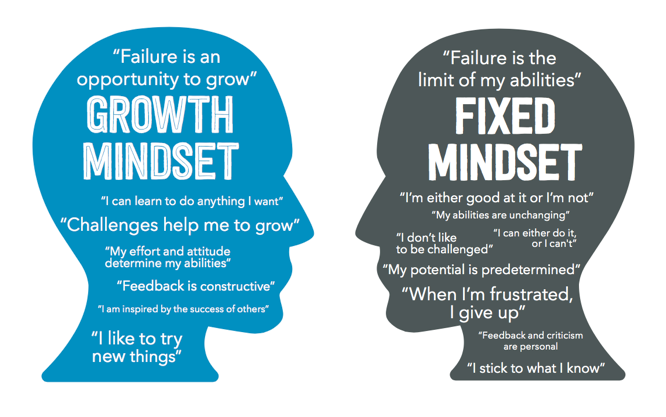
thumbnail_IMG_8249

Student Test Scores May Play a Smaller Role in Future PA Teacher Evaluations

Group Of Elementary Age Children In Art Class With Teacher


Pennsylvania lawmakers may have finally realized that treating teachers like crap isn’t a good way to improve public schools.


Across the country it’s getting harder to fill teaching positions with qualified educators. And that’s because of the way we treat the people who volunteer to educate the next generation.


You can’t raise expectations while taking away resources, union protections, and fair ways to evaluate their work.


And to his credit, state Sen. Ryan Aument seems to have finally seen the light.


In 2012, the Republican from Lancaster County was one of the leading proponents of the Commonwealth’s new teacher evaluation system which drastically increased the amount student test scores are used to assess educators.


But now Aument and other Republicans are proposing new legislation to cut back on these same measures.


Under the current system, only 50 percent of state teachers annual evaluations come from observations of what they actually do in the classroom. The rest comes from student test scores and other factors that are out of their control.


The proposed legislation would increase teacher observations to 70 percent of their evaluations and try to account for student poverty – in addition to student test scores – in the remaining 30 percent.


If passed, the new evaluation system would begin in the 2021-22 school year.


Screen Shot 2019-07-19 at 12.17.23 AM
Source: PSEA

The proposed legislation – Senate Bill 751passed in the Senate by a vote of 38-11.


However, the identical House Bill 1607 proposed by Rep. Jesse Topper (R-Bedford County) was not considered in time before the legislative session ended. It is expected to come up for a vote in the fall.


J.J. Abbott, a spokesperson for Democratic Gov. Tom Wolf, said that the governor generally supports the proposal. It has also been endorsed by the Pennsylvania State Education Association (PSEA) and the Pennsylvania Association of School Administrators (PASA).


Each year teachers are judged either Distinguished, Proficient, Needs Improvement or Failing. The first two are passing scores. The last two are not and require teachers to be more closely monitored, more frequently evaluated, complete a performance improvement plan and if improvements are not made, they can be fired.


If approved, the new bill would shorten the window when teachers are penalized for bad evaluations.


Under the current system, teachers who get two “Needs Improvement” ratings in 10 years can be sacked. The new bill shortens that period to four years. This incentivizes improvement and doesn’t hold a bad evaluation over a teacher’s head for a decade.


Moreover, the current law only allows principals to judge a very small percentage of their staff as Distinguished – the top of the scale. The proposed law puts no cap on this allowing them to give more honest and accurate evaluations.


Finally, there’s the issue of Student Learning Outcomes or SLOs. These are cumbersome and time consuming evaluations teachers are currently required to create and submit to their administrators for approval before conducting complicated performance measures of their classes that must be reviewed a second time by administrators as part of the annual evaluation.


I can’t find anywhere in either bill that spells out that these SLOs would be discontinued, but that does appear to be the case. There is no mention of them whatsoever in the new proposals where in the current law they make up 20% of the total evaluation.


The only thing I see that’s even close to the SLO is the requirement under Section 1138.7. Overall performance rating. Part II:


“A classroom teacher shall provide documented input to an evaluator on the development of teacher-specific data measures and annual results of data. The documented input shall be included with documentation of the classroom teacher’s overall annual rating.”


However, I don’t think this is the same thing.


Despite bipartisan support, there are important groups calling for caution on the proposal.


Teachers in the Philadelphia and Pittsburgh districts – the areas of the state with the highest percentage of impoverished students – say that they weren’t consulted on the bill and have not had time to fully consider it. Both groups belong to the American Federation of Teachers (AFT).


They worry that the poverty index included in the bill may not accurately account for  economic disparities and whether the proposal really reduces the influence of standardized testing on teacher evaluations. After all, test scores are part of the teacher specific evaluation which under the proposal would go from 15-20 percent of educator’s evaluations. It may be the elimination of the SLOs which rely on student performance that ultimately reduce student outcomes from the evaluation while slightly increasing standardized test scores.


In any case, educators and advocates should scour the proposed legislation in the summer months to ensure that legislators know the full impact of what they’ll be asked to vote on as early as September.


The proposal may have been initiated in part to deal with the nationwide plague of teachers walking off the job due to unfair legislative practices and the demonization of educators. Since 1996, the number of undergraduate education majors has declined by 55 percent. And, according to the Pennsylvania Department of Education, the number of newly issued instructional teaching certificates in the Commonwealth has dropped by 71 percent since 2009. The state used to issue more than 14,000 new teachers licenses  annually. In 2016-17, the state only gave out 4,412.


Perhaps offering educators more equitable evaluations may help stem the tide – otherwise we’ll soon find our classrooms filled with students that no one is willing to teach.


Another reason behind the new proposal may be a reaction to previous bad legislation in Harrisburg.


It seems to be an attempt to numb some of the sting from a 2017 bill that ended seniority-based teacher layoffs in the Commonwealth and instead tied those decisions to these teacher evaluations.


Now teachers who receive Unsatisfactory evaluations – even if that only means they need improvement – are the first to go. It allows administrators to stack the deck against teachers they don’t like, teachers at the top of the pay scale or who advocate for policies different than those favored by the bosses.


Frankly, it’s a lawsuit waiting to happen.


That bill was passed mostly by the Republican majority and though Wolf could have vetoed it, he chose to let it become law without his signature.


As bad as it is, it set a fire under legislators to at least create a better system for teacher evaluation which they seem to have actually taken seriously.


One concern lawmakers have with the current system is that it tends to penalize the best teachers and buoy the worst ones.


The best teachers get their evaluations dragged down if they work in low performing districts just as struggling teachers get theirs pushed up if they work in high performing ones.


It’s hoped that judging teachers more on what they actually do and trying to account for the poverty level of the students they teach will avoid this trap.


In truth, it’s unfair to judge teachers on student test scores at all. Mountains of research have concluded that such so-called Value-Added Measures (VAM) are inaccurate and discriminatory.


Relying on these measures even to a lessor degree opens the state and individual districts up to legal challenges as has happened in other states.


But at least this new suggestion improves over the present system in many ways.


We’ll have to see if Philadelphia and Pittsburgh teachers end up endorsing the plan and whether the House finally passes the measure and Wolf signs it.


Stay tuned.


Like this post? I’ve written a book, “Gadfly on the Wall: A Public School Teacher Speaks Out on Racism and Reform,” now available from Garn Press. Ten percent of the proceeds go to the Badass Teachers Association. Check it out!

book-2

PA Officials Want to Replace Bad Keystone Exams with Bad College Entrance Exams

Screen Shot 2019-07-15 at 8.34.43 AM

 
Pennsylvania officials are scandalized that the Commonwealth is wasting more than $100 million on unnecessary and unfair Keystone Exams.

 
They’d rather the state spend slightly less on biased college entrance exams.

 
State Auditor General Eugene DePasquale and State Sen. Andy Dinniman held a joint press conference last week to introduce a new report compiled by DePasquale’s office on the subject which concludes with this recommendation.


Replacing bad with bad will somehow equal good?

 
Under the proposal, elementary and middle school students would still take the Pennsylvania System of School Assessment (PSSA) tests. However, instead of requiring all high school students to take the Keystone Exams in Algebra I, Literature and Science, the report proposes the same students be required to take the SAT or ACT test at state expense.


This is certainly an improvement over what the state demands now, but it’s really just replacing one faulty test with another – albeit at about a $1 million annual cost savings to taxpayers.


The report does a good job of outlining the fiscal waste, lack of accountability and dubious academic merits of the Keystone Exams, but it fails to note similar qualities in its own proposal.


From 2008 to 2019, the state already paid Minnesota-based Data Recognition Corp. more than $426 million for the PSSAs, Keystone Exams and Classroom Diagnostic Tools (an optional pretesting program). The federal government paid the company more than an additional $106 million. Officials wonder if this money couldn’t have been better spent elsewhere, like in helping students actually learn.


DePasquale, who recently launched a congressional bid, puts it like this:


“When the federal law changed in 2015, why didn’t Pennsylvania begin to phase out Keystone Exams? I could understand if they use them for a short period of time after that, but it’s been four years, and will cost taxpayers nearly $100 million by the end of the contract for tests our students do not even need to take.”


The federal government dropped its mandate four years ago and the state legislature did the same last year.


Originally, state lawmakers intended to make the Keystone Exams a graduation requirement, but in 2018 they passed legislation to make the assessments one of many avenues to qualify for graduation starting in 2021-22. Students can instead pass their core courses and get into college among other things.


“The Department of Education itself said they [the Keystone Exams] are not an accurate or adequate indicator of career or academic readiness,” Dinniman said. “So what I’m always surprised about is, they said it and then they continue to use it. These tests have faced opposition from almost every educational organization that exists. And when we got rid of the requirement and put in [more] pathways to graduation, this was passed unanimously by both the Senate and the House.”


The federal government also changed its testing mandate. It used to require all public school students to take state-specific assessments in grades 3-8 and once in high school.


When Congress reauthorized the federal law overseeing education in 2015, it offered states more flexibility in this regard. Elementary and middle school students still have to take a state-specific test. But now the high school portion can be fulfilled with college admissions tests – and, in fact, a dozen other states legislate just such a requirement.

 
Democrats DePasquale and Dinniman think the SAT and ACT test are an improvement because students who taken them are more likely to go to college. But that’s a classic case of confusing correlation and causation.


Students motivated to go to college often take these exams because they are required to get in to a lot of these schools. Taking these tests doesn’t make students MORE motivated and determined to enroll in post-secondary education. They’re ALREADY motivated and determined.


Moreover, one of the faults the report finds with the Keystone Exams is that the assessments measure student’s parental income more than children’s academics.


Kids in wealthier districts almost always do better on the Keystone Exams than those in poorer districts. In fact, the report notes that of the 100 state schools with the highest scores, only five were located in impoverished districts —where the average household income is below $50,000.


Yet the report fails to note that this same discrepancy holds for the SAT and ACT tests. Poor kids tend to get low scores and rich kids get the highest scores.


In fact, the College Board – the corporation that makes and distributes the SAT – recently started adjusting scores on its test in an attempt to counteract this effect thereby accounting for high schools and neighborhoods “level of disadvantage.”


Does this creative scoring actually work? Who knows – but it’s kind of like being forced to swallow poison and an antidote at the same time when any sensible person would simply refuse to swallow poison in the first place.


And that’s the best solution state officials have for our children.


They’re suggesting we replace discriminatory Keystone Exams with discriminatory college entrance exams.


To be fair, DePasquale and Dinniman are somewhat constrained by boneheaded federal law here.


Though the Every Student Succeeds Act (ESSA) is an improvement over No Child Left Behind, it still requires all high school students to take standardized tests.


Given what we know about the limits and biases of these assessments, policymakers should remove that hurdle altogether. But until the federal government gets its act together, one could argue that DePasquale and Dinniman’s policy suggestion may be the best available.


When you can’t do right, maybe it’s best to do less wrong.


But we must acknowledge that this isn’t the ultimate solution, it’s only a stopgap. We must continue to push for intelligent assessment policy that’s best for our children.


Standardized testing should be eliminated altogether – especially in high stakes situations. Instead we should rely on classroom grades, portfolios of student work and/or other authentic measures of what children have learned in school.


Accountability – the typical reason given behind these assessments – should be determined by the resources provided to students, not a highly dubious score given by a corporation making a profit off of its testing, test prep and ed tech enterprises.


The most we can expect from DePasquale and Dinniman’s program if it is even considered by the legislature is a band-aid on a gaping wound.


Read the full report, Where Did Your Money Go? A Special Report on Improving Standardized Testing in Pennsylvania.


Like this post? I’ve written a book, “Gadfly on the Wall: A Public School Teacher Speaks Out on Racism and Reform,” now available from Garn Press. Ten percent of the proceeds go to the Badass Teachers Association. Check it out!

book-1