Save Our Schools From Coronavirus Budget Cuts


Screen Shot 2020-05-02 at 4.36.09 PM


America is one dumbass country.


We don’t do the metric system.


We don’t do universal healthcare.


And during a global pandemic, we don’t demand the government pay us to stay home and stop the spread of the disease.


Instead, we demand the government let us go out and get sick.


It should come as no surprise, then, that we deeply under-fund our public schools.


There’s always money for a new war or to subsidize fossil fuels or give billionaires another tax cut, but when it comes to teaching kids how to think critically about their world – time to take out the scissors and slash some budgets.


And now with the inevitable loss of taxes after shutting down the economy to save lives during the global Coronavirus outbreak, experts are expecting the deepest budget cuts to schools – well, ever.


Sixty two district superintendents from urban districts wrote to Congress in April warning of a 15-25% loss in revenues next fiscal year.


The school leaders from cities like New York City, Los Angeles, Chicago and Miami, say that a 20% loss in both state and local taxes, alone, would result in laying off about 275,000 teachers.


And this would come after students had already suffered significant academic losses during the current (2019-20) school year because of school closings and distance learning initiatives that could not possibly meet the needs of students as well as in-person learning.


Screen Shot 2020-05-02 at 10.14.42 AM


They ask legislators to enact a plan devised by the Albert Shanker Institute – a policy organization aligned with the American Federation for Teachers (AFT) – in which the federal government would give billions of dollars to districts in several phases to keep schools open. Then states would increase funding to levels before the Great Recession (2009-13), build up budget reserves and more equitably distribute capital.


How much money would be necessary?


It’s hard to say at this point.


Most districts get about 90% of their funding from state and local taxes and these haven’t been tallied yet for March, when social distancing began.


Some experts expect to have a better picture of the damage by the end of the first or second week of May.


There has been no mass evictions (though that may eventually happen), so property taxes are probably stable at this point. But it’s unclear how much shuttered storefronts and skyrocketing unemployment will affect the picture.


Screen Shot 2020-05-02 at 10.14.14 AM


The National Governors Association and non-partisan Center on Budget and Policy Priorities, though, are expecting the worst.


They estimate a possible $500 billion state shortfall mostly concentrated in the 2020-21 fiscal year.


Screen Shot 2020-05-02 at 10.12.29 AM


That’s less than three months away.


Even if you subtract fiscal aide already provided by Congress and state rainy day funds (if present), legislatures would still be at least $360 billion short.


The National Association of Teachers (NEA) is calling for an additional $175 billion just to stabilize the country’s schools.


“The seniors graduating this spring started kindergarten in the fall of 2007,” says Bruce Baker, professor at the Graduate School of Education at Rutgers University and co-author of the Shanker Institute report.


“Most of these students have spent almost their entire K-12 careers in schools with less funding than there was when they started. If this happens again, it will be because we let it happen.”


And that’s just it.


This Coronavirus crisis is a wake-up call for all of us about the elements of our society that had to fail for us to get to this point.


Everything from how we deal with climate change, to infrastructure, to healthcare, to economic inequality needs to be reconsidered if we are to survive.


Education is an essential piece of that puzzle.


We cannot continue to consume resources like there is no tomorrow – or there will be none.


We cannot continue to treat billionaires like the most vital part of our society when they are really nothing but parasites on it.


And we cannot continue to undercut our public education system and expect our next generation to be in a better position than we are today. In fact, doing so ensures that it won’t be.


Not only do we have to pay for our kids to be educated, we have to pay for ALL kids – black, white, brown, girls, boys, Christians, Jews, Muslims, immigrants, native born — all of them.


We have to integrate, educate and eliminate the school-to-prison pipeline.


And we have to stop wasting the money we do allocate on pointless profit-making endeavors for corporations that give little to nothing back to the children they are meant to be serving. That means no more privatized schools, no more high stakes standardized testing, no more shady ed tech, corporate written academic standards and union busting initiatives.


We have to ask ourselves – will we continue to support a culture of death where war and inequality are prioritized over nurturing and care? Or will we finally engage in a culture of life, where education and equity are the driving forces of society?


We can continue to be the laughing stocks of the world with our guns and superstitions, or we can get off our asses and start working toward a better world for all.


The old ways will not work in this new millennium.


It is entirely unclear whether we will heed the call from this crisis or hide our heads in the sand.


But the future of our nation and the well-being of our children are being decided right here, right now, this very minute.


Time to invest.


Email your members of Congress and tell them to keep students learning and educators working.


Like this post?  You might want to consider becoming a Patreon subscriber. This helps me continue to keep the blog going and get on with this difficult and challenging work.

Plus you get subscriber only extras!

Just CLICK HERE.

Patreon+Circle

I’ve also written a book, “Gadfly on the Wall: A Public School Teacher Speaks Out on Racism and Reform,” now available from Garn Press. Ten percent of the proceeds go to the Badass Teachers Association. Check it out!

book-2

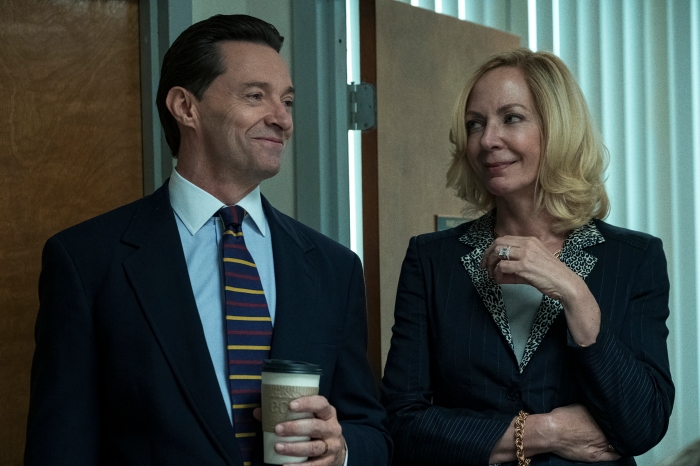
HBO’s “Bad Education” Aims at Public School Theft While Ignoring More Frequent Fraud at Charter Schools & Testing Companies

BADED_29OCT18_0125.RAF

 
“Bad Education” is a frustrating movie to watch as a public school teacher.


It does a fine job telling the true story of a wealthy New York district where administrators stole millions of dollars for themselves.


But it ignores the far more frequent waste and malfeasance caused by school privatization, high stakes testing and runaway ed tech.


Maybe I’m being too sensitive, but there is no subject more political than public schools.


During the current Coronavirus pandemic, teachers and schools are finally getting some respect from people who are trying to “home school” their own kids while the nation’s classrooms are shuttered.


But education budgets are still routinely slashed, and every policymaker from Betsy DeVos to Barack Obama still thinks there is nothing better than closing public schools and replacing them with charter and/or voucher schools.


Pundits continually decry low test scores while applauding every means to increase racial and economic segregation. They push every policy to increase the school to prison pipeline for black and brown students.


And now HBO drops this movie about Rosalyn School District Superintendent Frank Tassone (Hugh Jackman) who embezzled $11 million from taxpayers.
What happened in Rosalyn was scandalous. But it’s an outlier.


Such misappropriation and outright theft rarely happens at public schools. After all, the records are all public. It just takes someone to check up.


For REAL theft you have to go to charter and voucher schools where the law literally allows them to spend our money without most of that public oversight.


Viewers like me from Pennsylvania still remember Nick Trombetta. The founder and former CEO of the Pennsylvania Cyber Charter School stole a similar sum (at least $8 million), and got much less prison time (20 months vs. Tassone who served 3 years). Trombetta used taxpayer dollars to buy a$300,000 private jet for goodness sake! He bought a $933,000 condo in Florida! He bought $180,000 houses for his girlfriend and mother in Ohio. He did all this and more – and his lawyers got the charges down to tax evasion! Why is there no movie about THAT?


Or how about June Brown?


As the head of Agora Cyber Charter School, which was part of the K12 Inc. charter empire, she was indicted for stealing $6.5 million from taxpayers. She and her executives were indicted on 62 counts of wire fraud, obstruction of justice and witness tampering. She had a reputation for claiming large salaries and filing suits against parents who questioned her.


Where’s that movie?
The history of charter schools reads like a who’s who of hucksters and thieves!


Electronic Classroom of Tomorrow (ECOT) the largest charter school in Ohio was forced to shut down and auction off all its taxpayer funded property because administrators  grossly inflated its students body of 12,000 online students to the state.


New Jersey charter schools spent as much as $800 million of taxpayer dollars to buy property that they then charged taxpayers additional money to rent from the charter schools, according to an IRS investigation.


The Network for Public Education published a report in 2019 detailing more than $1 billion in federal dollars misappropriated by charters – including hundreds of millions spent on charters that never even opened or that closed soon after opening.


I think those would make good movies. Don’t you?


But let’s not forget the other vulture industries that prey on our public school system without providing much of value in return.


If you want REAL fraud, you have to go to the standardized testing and ed tech industry sucking away billions or taxpayer dollars while providing services that are either unnecessary or downright destructive.


Why do we give every public school child high stakes tests in grades 3 through 8 and once in high school? Because the federal government says so.


These tests don’t tell us how well students are doing in school. We have at least 180 days of classroom grades that tell us that.


These tests taken over a period of a few days tell us what the corporation making them thinks is important. And they nearly always show that richer kids are doing better than poorer kids, and that whiter kids are somehow “smarter” than blacker kids.


And for this prized data we pay billions of dollars to big businesses every year.
It’s one of the largest captive markets in existence. That’s some 50.4 million children forced to take standardized assessments. The largest such corporation, Pearson, boasts profits of $9 billion annually. It’s largest competitor, CBT/ McGraw-Hill, makes $2 billion annually. Others include Education Testing Services and Riverside Publishing better known through its parent company Houghton Mifflin Harcourt.


If many of these companies sound like book publishers, that’s because they are or their parent companies are. And that’s no coincidence. It’s another way they bolster their own market.


Not only do many of these testing corporations make, provide and score standardized assessments, they make and provide the remedial resources used to help students pass.


So if your students are having difficulty passing the state test, often the same company has a series of workbooks or a software package to help remediate them. It’s a good business model. Cash in before kids take the test. Cash in when they take it. And if kids fail, cash in again to remediate them.


Ever wonder why our test scores are so low? Because it’s profitable! The money is all on the side of failure, not success. In fact, from an economic point of view, there is a disincentive to succeed. Not for teachers and students, but for the people who make and grade the tests.

 
In fact, when I sat down to watch “Bad Education” I thought it was going to be about high stakes testing cheating scandals. I thought it was going to be about how the pressure to have students score well on the tests have in some cases resulted in teachers and/or administrators changing answers to inflate the scores.


But no. That’s not mentioned at all. There’s talk about test scores but their value is never questioned for one second.


Hugh Jackman’s superintendent dreams of leading his schools from getting the 4th highest test scores to having the 1st highest. But nowhere does anyone mention how these tests were literally developed by Nazi eugenicists or how they have been challenged countless times for violating children’s civil rights or even the sizable parent-led opt out movement in the same New York suburbs where the film takes place.


Okay.  Maybe I AM being too sensitive.


The film does seem to have a theme about how we expect everything from schools and teachers and don’t reward them well enough. But this is undercut by the obvious villainy of people who use that discrepancy to take advantage of the trust the public has placed in them.


Public schools rarely act this way.


I fear that many people will miss that point.


Instead it will be more fuel to the fire that public schools are bad and must be replaced.


There’s even a parting shot about Jackman’s character’s pension.


I’m all for drama.
But when filmmakers bend over backward to ignore the elephant in the room, I tend to lose my appetite for popcorn.


Like this post?  You might want to consider becoming a Patreon subscriber. This helps me continue to keep the blog going and get on with this difficult and challenging work.

Plus you get subscriber only extras!

Just CLICK HERE.

Patreon+Circle

I’ve also written a book, “Gadfly on the Wall: A Public School Teacher Speaks Out on Racism and Reform,” now available from Garn Press. Ten percent of the proceeds go to the Badass Teachers Association. Check it out!

book-4

You Can’t Have My Students’ Lives to Restart Your Economy


Screen Shot 2020-04-18 at 6.36.25 PM


It’s okay if a few children die to start up the economy.


That is literally the opinion being offered by media influencers and policymakers as Coronavirus social distancing efforts continue passed the 30-day mark.


In the midst of a global pandemic, we’ve closed down all nonessential businesses while people self quarantine at home waiting for the curve of infection to plateau and then drop off. Medical experts tell us this is the only way to ensure there are enough ventilators and hospital beds for those who get sick.


As it is, more than 700,000 Americans have tested positive for COVID-19 and 38,000 have died – more than the wars in Iraq and Afghanistan, the September 11 terrorist attacks, Hurricane Katrina and the Oklahoma City bombing – combined. In fact, the United States has the highest number of Coronavirus deaths in the world.


Screen Shot 2020-04-18 at 4.11.10 PM


Yet there is a concerted effort by the Trump Administration and plutocrats everywhere to get business back up and running. And to do that, they need the schools to reopen so parents can return to work.


They literally want to reopen schools as soon as possible – even if it isn’t 100% safe.


And if that means students, teachers and parents die, at least their sacrifices will have been worth it.


“Schools are a very appetizing opportunity,” said Dr. Mehmet Oz as a guest on Fox News’ Sean Hannity show.

 
“I just saw a nice piece in [British medical journal] The Lancet arguing the opening of schools may only cost us 2 to 3%, in terms of total mortality. Any, you know, any life is a life lost, but … that might be a tradeoff some folks would consider.”

 
Dr. Oz walked back the comment after popular backlash, but I believed him the first time. Many people would find that acceptable.


Dr. Phil McGraw (who unlike Dr. Oz is not a licensed doctor) said the following on Fox News’ The Ingraham Angle:


“The fact of the matter is, the longer this lockdown goes on, the more vulnerable people get. And it’s like there’s a tipping point. There’s a point at which people start having enough problems in lockdown that it will actually create more destruction and actually more deaths across time than the actual virus will itself.”


He then compared coronavirus deaths to deaths from smoking, swimming pools and car crashes – which critics pointed out result from mostly voluntary behavior.


Once again, Dr. Phil walked back his comments after public outrage. And once again, I saw where he was coming from – because it’s clear where these celebrity talking heads are getting their information.


You find the same opinion tucked into many otherwise informative articles about the virus and education.


Education Next published a piece by Walton Family Foundation advisor and American Enterprise Institute fellow John Bailey with this precious little nugget tucked in its middle:


“Currently, the public health benefits of school closures and home quarantining outweigh the costs. But at what point does that equation flip? When do the economic, societal, and educational costs outweigh the public health benefits of these aggressive social distancing actions?”


The rich need the poor to get back to work. And they’re willing to put our lives on the line to do it.


What’s worse, they’re willing to put our children’s lives on the line.


I don’t know about you, but I’m not willing to risk my daughter’s life so that the stock market can open back up.


As a public school teacher, I’m not willing to bet my students lives so that the airlines and cruise industry can get back in the green.


Nor am I willing to gamble with my own life even if it means the NBA, NFL and MLB can start playing games and Hollywood can start premiering first run movies again.


There’s still so much we don’t know about COVID-19.


Initial reports concluded that older people were more susceptible to it, but as infections have played out worldwide, we’ve seen that 40% of patients are between 20-50 years of age. Children seem mostly asymptomatic. However, many immunologists suspect they are acting as carriers spreading the virus to the older people with whom they come into contact.

 
Children have a more difficult time with the constant hand washing and separating themselves at least 6 feet apart recommended by health experts. This is one of the justifications for closing schools in the first place. If we reopen schools too quickly, it could jumpstart another wave of infections.


In fact, that’s exactly what the Imperial College of London found in its own modeling study on likely U.S. and U.K. outcomes.


School closures can be effective to help suppress the transmission rates and flatten the curve, the report concluded, IF CONTINUED OVER FIVE MONTHS.


That’s a long time. But it gets worse.


In the absences of mass vaccinations – which may be as much as two years away – the study found the virus is likely to rebound for a second and third wave.


Screen Shot 2020-04-17 at 11.56.34 PM


So when would it be safe to reopen schools?


Honestly, no one really knows.

 
Former US Food and Drug Administration Commissioner Scott Gottlieb released a more optimistic answer in the “National Coronavirus Response: Roadmap to Reopening.”


The report maintains the need to continue social distancing including school closures until cases peak and we see sustained declines in new cases for 14 days.


That seems to be a fair minimum standard.


However, we are not there yet. The death toll continues to rise in the US and may continue to do so for some time yet.


Despite the science, every state has a different date in mind for when schools will reopen.


Since the beginning of April,a total of 21 state departments of education (including Pennsylvania’s) have decided to keep schools closed for the remainder of the academic year until at least August or September. Six states plus Washington, D.C., still have plans to reopen their schools before the end of the month.


Screen Shot 2020-04-17 at 11.53.43 PM


Beyond the question of WHEN to reopen schools is the even more complicated one of HOW or IF.


President and chief executive of the National Association of State Boards of Education Robert Hull said administrators across the country are asking not how – but if – schools will reopen in the fall.


“Everybody says we hope we return to normal,” Hull said. “It’s not going to return to normal anytime soon because the new normal is going to be different.”


Multiple possibilities are being considered.


A major factor will be how well districts can test incoming students for infection.


The best solution would be quick and cheap Coronavirus screenings. If we could mass produce such tests and distribute them to schools or have the results be a precondition to coming to school, things might be able to run pretty much as normal.


If US schools all had digital thermometers (as they do in Singapore), students temperatures could be taken before letting them in to the building. Anyone running a fever could be sent home.


Some policymakers are even considering spot checking students throughout the day with thermometers and using video cameras to trace the path of any students running a temperature to tell who they may have come into contact with before being identified. However, this seems pretty disruptive to me and – especially in the younger grades – might terrify students and make them conversely feel less safe in school because of the very efforts done to ensure their safety.


In all likelihood, policymakers see to think schools will probably have to run while engaging in some sort of social distancing. And that’s not easy. Nearly everything from the way the academic day is organized to the maturity level of most students goes against this need.


One thought provoking proposal is reducing class size to no more than 10 students.


This would also have educational benefits allowing teachers the ability to give more one-on-one instruction. However, most classes are double or triple this size now. Few school buildings are large enough to double or triple the number of classrooms needed at the same time.


One solution to this is that children could attend on alternate days or on a half day basis – one group in the morning, another in the afternoon. The drawback is that this would reduce the hours students are in class. Lessons would either have to be cut down to essentials or some part of assignments may have to go online.


This might also narrow the curriculum so that the arts, music, and other subjects would be eliminated. Gym classes would probably have to be cancelled and lunches might have to be in the classroom, itself, instead of allowing large groups of students to congregate in the cafeteria.


Just ensuring that students aren’t all in the hallway at the same time would be a challenge. Class dismissals might be staggered or perhaps the teachers would move from room-to-room while the students stay put.


Moreover, the simple act of busing students to-and-from school is likewise complicated. If students sit further apart on the bus, that means each district needs either more buses at the same time or double the time to transport students at arrival and dismissal.


None of this would be cheap. It could necessitate more money on transportation, support staff and teachers. In a country where education budgets haven’t yet recovered from the Great Recession of George W. Bush, reopening schools safely would require an influx of cash.


But without it, the economy cannot get back under way.


When schools closed in March, many districts switched to some kind of distance learning. Teachers put assignments on-line and even teach through Internet meeting sites like ZOOM. Continuing this in some form – for part or all of the day – is also being considered. However, it causes as many problems as it solves.


Parents need to be able to get back to work. Many can’t stay at home taking care of their children indefinitely. And they can’t leave their kids to their own devices while trying to learn via computer, device or app.


Moreover, these cyber schooling efforts come with educational drawbacks. Just about every educational expert acknowledges that learning in-person is preferable. Students with special needs are particularly at risk because many of their individual education plans (IEPs) cannot be met remotely. And even though efforts have been made to help impoverished students gain access to the necessary technology and Internet access, the problem has by no means been universally solved. Not to mention privacy concerns with student data being pirated by unscrupulous ed tech companies.


Another issue is high stakes standardized testing.


With the Coronavirus crisis, the tests were cancelled this year – and no one has really missed them.


If lessons have to be cut to essentials, standardized testing and the need for endless test prep should be the first things to go. In fact, students, educators, parents and college professors will tell you how useless these assessments are. They reflect basic economic inequalities and enforce them by tying education funding to the test scores.


Poor kids score badly and rich kids score well, so the funding becomes a reward for the privileged and a punishment for the underprivileged.


That’s why it’s laughable when Hull laments “issues of equity” including how to measure what students are learning and how to help those who have fallen behind.


Equity is a matter of funding and opportunities – not test scores. Regardless of the problems with reopening schools, we could solve a long standing issue by erasing high stakes testing from the academic map.


But that’s been the elephant in the classroom for a long time.


Economic interests have trumped academic ones for decades.


Will we continue to value money over children? Will we pave the post-Coronavirus future over the bodies of sick children and adults?


Like any crisis, COVID-19 is another opportunity to get things right.


Here’s hoping we have our priorities straight this time.


Here’s hoping schools stay closed until we’re certain reopening them won’t endanger students, teachers and the community.


Like this post?  You might want to consider becoming a Patreon subscriber. This helps me continue to keep the blog going and get on with this difficult and challenging work.

Plus you get subscriber only extras!

Just CLICK HERE.

Patreon+Circle

I’ve also written a book, “Gadfly on the Wall: A Public School Teacher Speaks Out on Racism and Reform,” now available from Garn Press. Ten percent of the proceeds go to the Badass Teachers Association. Check it out!

book-4

The First Taste is Free: Ed Tech Follows Drug Dealer Sales Techniques with Schools During Coronavirus Crisis

Screen Shot 2020-04-03 at 8.27.28 PM


“Pst! Hey, Kid! Come here!”


Educational technologies are a multi-billion dollar industry.


“Who? Me?”


The coronavirus pandemic has closed schools across the globe, and districts have tried to solve this problem by putting their classes online.


“Yeah, you. I’ve got some… candy I want to give you.”


Nearly every ed tech company has offered help with this processes.

 
“Oh boy! I sure love candy… Wait a minute! How much does it cost?”


Teachers, parents, students and education activists are wary of educational technologies in the classroom, and research backs them up. Ed tech has been shown to widen socioeconomic divides, it hasn’t lived up to its promise of increasing academic gains, and – perhaps most tellingly – Silicon Valley executives restrict their own children’s use of technology and send them to tech-free schools.

 
“Nothing. It’s free.”


These for-profit corporations are offering limited time promotions – they’re providing additional services for free that would normally be behind a paywall.


“Oh goodie!”


Districts are jumping at the chance. They’re encouraging teachers to use apps, services and software that have never been tried before locally in an attempt to abide by continuity of education guidelines written by departments of education.


“That’s right. Absolutely free. But if you want some more, next time I’ll have to charge you a little something…”


So when the pandemic is over and classes eventually are reopened, a great deal of the technology that schools used to get through the crisis will no longer be on the house.


Continuing to use them will require an additional fee, and if districts end up budgeting for them, the money has to come from somewhere. So that means fewer books, field trips, tutors, classroom aides, and – yes – teachers.


In short, well-meaning governors, law-makers, administrators, school directors and even educators are participating in a program that in the long run may enrich private corporations but not be in the best interests of the students we’re supposed to serve.


I bring this up not to stop schools from using online learning during the crisis. Unfortunately that ship has sailed. Nor do I voice my objections to criticize teachers, parents or students. We all have to do what needs to be done to get through all this.


However, it is vital that we are aware of the compromises being made today so as to better avoid the pitfalls ahead.


When teachers use Zoom, Google Classroom, or any of dozens of other ed tech products during this season of social distancing, we must be aware that these should only be temporary measures. Do not resign yourself to any of this becoming the new status quo.


When classes resume, we can’t simply go back to normal. Nothing can ever be normal again. Normal is what got us into this mess – a society ill equipped to meet this pandemic – ill equipped to take care of its citizens, provide basic resources, equity and put people before profits.


The post coronavirus world must be one of universal healthcare, a social safety net for all and a robust, fully funded system of public education. We cannot allow it to be a dystopian world of edu-tech vulture capitalism where the economics of street corner drug pushers is used to dictate how public money is spent.

 
There are many clear reasons why.

 
First, education technologies are almost completely unregulated. Cybersecurity and student privacy laws are woefully out of date if not entirely nonexistent.


These applications collect a torrent of data on students. So do teachers, in fact, to calculate grades. However, if an educator were to share this information with outsiders, she could be sued. But if a corporation did the same thing, it falls into a legal no man’s land.


Each state has different laws denoting the limits of privacy.


The main federal law safeguarding student data privacy, the Family Educational Rights and Privacy Act (FERPA), was written in 1974 before much of these technologies even existed. It hasn’t been significantly amended since 2001.


So it’s left to individual districts, administrators, school boards and teachers to navigate these murky waters.

 
They end up trying to decipher the individual terms of service agreements and privacy statements with these companies that are often full of legal loopholes. In many cases, decision makers don’t even bother or give the job to school lawyers unversed in cybersecurity concerns or law.


While Congress has neglected its duty to regulate the industry, the matter is important enough that the Federal Bureau of Investigations (FBI) put out a strong warning. Two years ago, the Bureau cautioned consumers about the risks of classroom management tools like Class Dojo as well as student testing and remediation applications like Classroom Diagnostic Tools and Study Island.


The FBI warned schools and parents that widespread collection of student data involved in these applications could cause safety concerns if the information is compromised or exploited.


The Bureau was concerned about ed tech services because many are “adaptive, personalized learning experiences” or “administrative platforms for tracking academics, disciplinary issues, student information systems, and classroom management programs.”


And these are many of the same applications being used today for distance learning initiatives.


Education advocates have been sounding the alarm for years.


Commonsense.org – a nonprofit studying education issues – conducted a three-year review of 100 ed tech companies. It concluded that 74% of these businesses hold the right to transfer any personal information they collect if the company is acquired, merged, or files for bankruptcy. And since many are start-ups, this often happens.


The authors wrote that there is “a widespread lack of transparency, as well as inconsistent privacy and security practices” in how student information is collected, used, and disclosed.


Leaking student data is often not a security failure. It’s part of a company’s business model.


This is valuable information about one of the most lucrative demographics in the marketplace. Companies use it to help sell products targeted directly to consumers. And they can even sell student data as a commodity, itself.


For instance, imagine how much more effective the hiring process would be if businesses had access to applicants school attendance records. Imagine if businesses had an applicant’s entire academic record.


Employers could buy vast amounts of data and use algorithms to sort through it looking for red flags without fully comprehending what was being compiled. Imagine an applicant being turned down for a job because of low middle school attendance but not being able to explain that this was due to a legitimate illness.


There are reasons we protect people’s privacy. You shouldn’t have to explain your score on a 1st grade spelling test the rest of your life or have the need for special education services damage your credit rating.


Yet all of these things are possible when student data is up for grabs.


No one is protecting our children from this kind of mercantile future – one which will only be exacerbated if we allow educational technologies to become common place after the current crisis.


And tightening our student privacy laws, will not solve everything.


Hardly any attention is being paid to how these technologies can be used for harms unrelated to business and industry.


Tablets, laptops or monitoring devices such as cameras or microphones could be exploitable by tech savvy criminals – especially since many ed tech programs allow remote-access capabilities without the user even being aware of what is happening.


Pedophiles could use this data to find and abduct children. Criminals could use it to blackmail them. Other children could use it to bully and harass classmates.

 
It’s hard to imagine how children could be protected on such devices without increasing surveillance and thereby running similar risks. Using them will always involve a chance of endangerment so they should be kept away from the youngest and most vulnerable potential users.


How did we let ed tech get so out of control? Like so many problems of the pre-coronavirus world, money was allowed to dictate policy.


Screen Shot 2020-04-03 at 11.50.33 AM


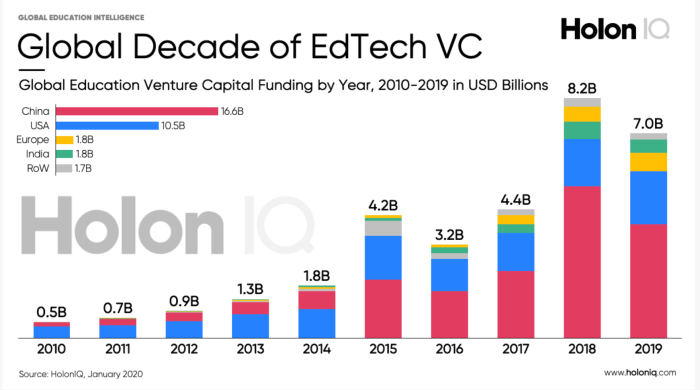
Global venture capital investments in ed tech finished 14 times higher by the end of the decade than they started. Investments went from $500 million in 2010 to $7 billion in 2019. And insiders expect that to triple in the next decade to more than $87 billion.


The two biggest spenders by far are China and the US.


Yet enthusiasm for such technologies are not nearly as prevalent among educators.


A 2019 study of educator confidence in ed tech conducted by Houghton Mifflin Harcourt found that 60% of teachers were concerned that implementing technology tools could damage the student-teacher relationship.


Moreover, education research in the United States concluded these technologies only widen the gap between different socioeconomic groups. Global initiatives like the One Laptop per Child program, which distributed 25 million low-cost computers with learning software to children in the developing world, failed to improve language or math results.


Meanwhile, students seem to be telling us they prefer more old school methods of instruction. Studies have shown preference for everything from physical books over eBooks to having “ordinary, real-life lessons” and “a smart person at the front of the room.”


Parent Blogger Alison McDowell has studied these issues in more depth than nearly anyone else. She warns that adaptive applications become the gatekeeper of children’s educations. They only allow students to move on once they’ve demonstrated mastery on a previous academic standard – or at least once they’ve been able to guess which one answer a programmer thought correct:


“The “personalized learning” model conditions students to view themselves as independent operators, free agents attempting to navigate a precarious gig economy alone. Screen-based isolation and an emphasis on data-driven metrics steadily erode children’s innate tendencies to creative cooperation. Which is ultimately better for society, an algorithm that learns each student in a classroom and delivers a pre-determined reading selection that they review and are quizzed on online, or a human teacher who selects an all class reading in which there is lively debate? The first scenario forecloses creative thought in service of data generation and reinforces there is but one correct answer. The second opens up chances for students to gain new insights while limiting opportunities for digital surveillance.”

 
Ed tech may allow us to stumble forward during the coronavirus quarantine, but it is not a central part of a healthy education system.


It may play a limited role in remediation and augmentation, but it cannot be the fulcrum around which everything else revolves.

 
I’d like to see a new education system built from the ashes of the old where every child has the chance to learn, a system that forgoes standardized testing and corporate-written academic standards for individualization and human interaction. I’d like to see a world where charter and voucher schools are things of the past, where schools are integrated and differences valued, where teachers and learning are respected and esteemed.


That is not an ed tech centered world. It is a student centered one.


It is a world where our priorities are such that even the promise of the new and the free won’t encourage us to indulge in practices that put our children in greater danger.


It is a place where the pusher has no power because his product is seen for what it is – treacherous and unnecessary.


Like this post?  You might want to consider becoming a Patreon subscriber. This helps me continue to keep the blog going and get on with this difficult and challenging work.

Plus you get subscriber only extras!

Just CLICK HERE.

Patreon+Circle

I’ve also written a book, “Gadfly on the Wall: A Public School Teacher Speaks Out on Racism and Reform,” now available from Garn Press. Ten percent of the proceeds go to the Badass Teachers Association. Check it out!

book-3

Gov. Wolf Proposes Saving $280 Million a Year in PA With Charter School Reform

24489812593_b28b14c382_h-696x464


Charter schools waste taxpayer money.


Pennsylvania Gov. Tom Wolf proposes we stop wasting that money by holding charter schools as accountable as the state’s authentic public schools.


The Democratic governor made his most recent proposal yesterday as part of his 2020-21 budget address.


It’s a common sense proposal that only seems revolutionary because officials have been so blinded with school privatization fantasies.


Charter schools are funded with tax dollars but can be run by business interests thereby forgoing elected school boards and a host of regulations meant to safeguard children and the community’s investment.


The Commonwealth is infamous for allowing some of the most permissive charter school policies in the nation, which destabilize authentic public schools and force local tax increases and reductions in student services while charter operators get rich.


During his budget proposal, Wolf suggested three main improvements.


First, he wants charter schools to use a new tiered funding formula to determine how much money they get for special education students enrolled in their schools. He estimates this would save $147 million annually.


Right now, charters get tuition based on the average amount the local public school spends on special education.


This incentivizes charters to enroll (and identify) children with minimal special needs. That way, the school gets more money than needed to help students learn and operators can pocket the difference.


Charter-image-3-1024x538


It also incentivizes charters not to enroll students with greater special needs because operators won’t receive the money necessary to meet them.


This helps explain why charter schools in the Commonwealth typically enroll fewer and less needy special education students than authentic public schools do. Charters typically end up collecting $10,000 or more per student than they spend providing services, according to Education Voters of Pennsylvania, a public school advocacy group.


Charter-Image-4-1024x538


Wolf’s new proposal would more closely match the level of special education students need with the funding charter schools get for enrolling them, thus removing any financial incentives for selective enrollment of these students.


Second, Wolf wants to stop cyber charter schools from collecting the same amount of money for each student as brick and mortar schools get.


Cyber charters schools do not have school buildings to keep up. They do not have physical classrooms, cafeterias, hallways, gymnasiums, athletic fields, etc. In most cases, they have administrative offices and laptop computers given to students to use at their own homes.


At present, the statewide tuition rate for cyber charter schools ranges from $7,700 to $21,400 per student per year.


Wolf figures that number should be a flat $9,500. That should save an estimated $133 million annually.


However, Wolf’s proposal is double the cost of providing a full-time education at home via computer. It reduces the waste, but his figure could still use a trim.


Finally, the governor proposes fixing the way we mediate financial disputes between charter schools and authentic public schools.


Right now, if a school district does not pay the tuition for its resident students who attend a charter school or there is some dispute between the two on tuition payments, the charter school turns to the state Department of Education (PDE) to reconcile the dispute. Wolf proposes several changes to increase fairness, accountability, and transparency in this process. For instance, he wants to require charter schools to report their expenditures and deductions so they could be included in deciding what the tuition should be at a given charter school.


If enacted such reforms would save $280 million a year and go a long way to fixing many of the problems with charter school finances.


The Democratic governor has suggested similar improvements before – even going so far as to threaten enacting some of them with executive orders if the Republican-controlled legislature continues to shirk its duty. However, yesterday’s budget proposal was the closest it has come to fruition.


Typically, Ana Meyers, executive director of the Pennsylvania Coalition of Public Charter Schools, saw Wolf’s proposal as an attack on her industry.


Wolf wants to cut funding to charters to increase it at public schools, she said, but charter schools are, also, public schools.


“The level of hypocrisy from our governor knows no bounds,” she said in a written statement. “Charter school students and their families are not second-class citizens. These parents pay their taxes and their children attend a PA-designated public school. There is no reason why charter school students deserve less financial support than their district peers.”


However, wolf’s proposal does not leave charter school students with less. It reduces waste and helps authentic public schools keep the same level of services without having to resort to local tax increases.


Charter schools should not be allowed to squander taxpayer money, and students at authentic public schools and their communities should not be forced to pay for that fiscal irresponsibility.


“Our charter school system is in desperate need of reform,” Wolf said. “It’s time to close the loopholes, it’s time to establish real standards, and it’s time to level the playing field.”


Wolf’s proposal doesn’t stop with his budget outline.


Democratic legislators are set to introduce a 120-page proposal in Harrisburg that builds on it even further.

 
The legislation – House Bill 2261 to be introduced by Rep. Joseph Ciresi (D-Montgomery), and Senate Bill 1024, to be introduced by Senators Lindsey Williams (D-Allegheny) and James Brewster (D-Allegheny), would do the following:


  • Require charter school trustees and administrators to comply with the same financial and ethical reporting standards as school board members and district officials;
  • Require charter school meetings to comply with the Sunshine Act;
  • Require any company running a charter school to open up their records;
  • Establish a statewide, data-driven cyber charter school tuition rate;
  • Apply the state special education funding formula used by public schools to charter schools;
  • Require charter schools to use actual accounting and enrollment in calculating tuition – backed up by PA Department of Education – to make sure payments are fair, consistent, and promises are kept;
  • Require charter schools to carry enough insurance to take care of kids and families if the charter closes or the parent company goes out of business;
  • Create a standard state framework for charter school applications;
  • Standardize the method to change charter schools’ missions and goals to reward innovation and best practices, and ensure school districts have the tools needed to evaluate changes to charters;
  • Create a state grading system for charters to allow high-performing schools even more self-determination while focusing attention on low-performing schools;
  • Stop the creation of new cyber charter schools until the existing schools improve performance and require PDE to create enrollment and performance standards.

Here’s hoping that such common sense initiatives can find bipartisan support.


Like this post? I’ve written a book, “Gadfly on the Wall: A Public School Teacher Speaks Out on Racism and Reform,” now available from Garn Press. Ten percent of the proceeds go to the Badass Teachers Association. Check it out!

thumbnail_IMG_8249

Did Rosa Parks Really Support Charter Schools?

Screen Shot 2020-01-28 at 8.36.33 PM


They say history is written by the victors.


But fortunes change, and sometimes you can even reclaim a figure from the past who the last round of winners had cast in an unlikely role.


Take Rosa Parks.


She is universally hailed as a hero of the civil rights movement because of her part in the Montgomery Bus Boycott.


Everyone knows the story. Parks, a black seamstress in Alabama, refused to give up her seat to a white man on a segregated bus and was arrested. Then working with the National Association for the Advancement of Colored People (NAACP), Dr. Martin Luther King, Jr., and many other activists, she helped encourage black people throughout the city to stop riding the buses until they were eventually desegregated.


But did you know that 40 years later after she had moved to Detroit, Parks tried to open a charter school?


It’s true – from a certain point of view.


And school privatization cheerleaders are quick to reference her advocacy.


President Bill Clinton used the anecdote to sell the charter school concept in a speech to the NAACP in Pittsburgh in 1997.


Joe Nathan, one of the authors of the first charter school law, still likes to troll readers of this blog by bringing that factoid up in the comments.


Keri Rodrigues, one of the founders of the Walton front group the National Parents Union, uses it like a trump card on Twitter to shut down privatization critics.


The facts are somewhat more complicated.


CHARTER SCHOOL CRITICISM


Charter schools are funded with tax dollars but not bound by the same regulations as authentic public schools including the need to be run by elected school boards. In fact, they are often operated by appointed business interests.


Today charter schools are roundly criticized for their limited accountability, lack of local control, tendency to profit off the children they serve, ability to cherry pick students enrolled in them, propensity for draining funding from neighborhood public schools, frequently poor academic records, and inclination to increase racial and economic segregation.


Yet lobbyists and industry insiders insist they are civil rights reforms. Being able to tout Parks as a charter pioneer helps them make their case.


But did she really do this?


I mean Parks went to segregated schools, herself, before Brown v. Board. You’re telling me she actually advocated to start a segregated school in Detroit decades later?


THE FACTS


Parks did lend her name to a charter school proposal in 1997 that would have opened an institution named for her and her late husband, the Raymond and Rosa Parks Academy for Self Development.


However, according to Anna Amato, an education consultant who worked with Parks on the proposal, the Detroit Board of Education put the item on their agenda but took no action.


Parks then moved on to other concerns – of which she had many.


She spent most of her life fighting the good fight.


In 1957 she moved with her husband and mother to Detroit, where from 1965 to 1988 she was a member of the staff of Michigan Congressman John Conyers, Jr. She remained active in the NAACP fighting against housing segregation in the city, traveling to support Selma to Montgomery marches, developed “Pathways to Freedom” bus tours of civil rights sights, served on the Board of Advocates for Planned Parenthood, and many other actions.


The proposed charter school wasn’t exactly a highlight. Nor does it seem to fit with her other endeavors.


LEGAL BATTLE


But the Rosa Parks who was involved in that proposal was a very different lady than the one who refused to give up her bus seat all those years ago.


Parks was 84 at the time of the charter school plan and somewhat isolated from close family. When she died in 2005 at the age of 92, her estate was the subject of a bitter legal dispute.


The issue wasn’t the money so much as the priceless historical artifacts associated with her life.


Her will left most of the estate to Elaine Steele, a retired Detroit judge and friend of Parks who was also involved in the charter school proposal. She was co-director of Parks’ after-school program, the Raymond and Rosa Parks Institute for Self Development.


Parks, who was later diagnosed with dementia, had abruptly stopped giving interviews in 1995 and lived a mostly secluded life from then on.


Her family disputed that the will created in July 1998 represented Parks true intentions. They sued to challenge the estate plan, accusing Steele of using undue influence on Parks. After a protracted battle, the courts eventually sided with Steele.


But the picture this paints is not a friendly one.


We have an octogenarian Parks lending her name to numerous projects all under the direction of consultants.


QUESTIONABLE ASSOCIATES, QUESTIONABLE INVOLVEMENT

 
Amato, in particular, seems to have gone on to become a champion of school privatization and education technologies.


She made her name in Detroit pushing these policies for decades.


In 1994 she founded Edtec Central, an organization that helps launch and run charter schools. At one point the company operated “two specialized strict discipline academies and one alternative high school in Michigan” as well as provided support and consulting services to other local charter schools. However, there is very little current information on the organization. It’s unclear whether it is still in operation.


But as of 2017, Amato still was. She wrote an op-ed praising Donald Trump’s Education Secretary Betsy DeVos called “DeVos Is a Hero to Detroit’s At-Risk Kids.”


This appears to be the woman who advised Parks about opening a charter school.


How much Parks was involved is hard to say.


When The New York Times wrote an article about the proposed charter school in 1997 by Halimah Abdullah, Parks either refused to be interviewed or was left out of it. But Amato, Steele and even Nathan were quoted at length.


It’s hard to believe a journalist for the Times could be such a bad writer as just not to include Parks in the article, especially in a piece titled “Rights Hero Presses Plan For School In Detroit.”


It’s much more likely that Parks declined to be included or was purposely left out of the loop by her circle of handlers possibly to hide her slow mental deterioration.


It’s understandable why Parks may have surrounded herself with consultants and caregivers.


In 1994 when she was 81, Parks was robbed and assaulted in her home in central Detroit. The assailant, Joseph Skipper, broke down her door but claimed he had chased away an intruder. He requested a reward and when Parks paid him, he demanded more. Parks refused and he attacked her.


Parks was treated for facial injuries and swelling. Though Skipper, a black man, was eventually caught and prosecuted, the incident left Parks shaken and anxious to the degree that she moved from her house to a secure high-rise apartment.


Another peak into her personal life was revealed in 2002, when Parks received an eviction notice from her apartment for not paying rent. Both the Hartford Memorial Baptist Church and Little Ceasars owner Mike Ilitch claimed to have paid the bill, but Steele says the eviction notice came in error. Parks family blames the incident on financial mismanagement from caregivers. When NBC news reported the story, the network noted she had been diagnosed with dementia.


In total, these events provide a sad look at the last years of a civil rights icon. And it’s during this late period that the charter school project was developed.


Was it one of Parks’ passions? It’s impossible to tell. It is at least as likely that an elderly and suggestible Parks was surrounded by people who may have been using her name to get across their own agenda.


PARKS ON SEGREGATION


Consider how out of character a charter school was to Parks former legacy.


In 1995 (just two years before the charter school proposal) Parks did agree to an interview where she talked about the importance of education and reminisced on the evils of school segregation:


Interviewer: Was there a teacher that influenced you?


Parks: My mother was a teacher and I went to the same school where she was teaching. My very first teacher was Miss Sally Hill, and I liked her very much. In fact, I liked school when I was very young, in spite of the fact that it was a one-room school for students all ages, from the very young to teens, as long as they went to school. It was only a short term for us, five months every year, instead of the regular nine months every year.


Interviewer: What was it like in Montgomery when you were growing up?


Parks: Back in Montgomery during my growing up there, it was completely legally enforced racial segregation, and of course, I struggled against it for a long time. I felt that it was not right to be deprived of freedom when we were living in the Home of the Brave and Land of the Free.”


These do not sound like the words of a woman who two years later would push for a segregated school to be opened in her name.


PARKS ON DESEGREGATION


Moreover, this flies in the face of her work at the Highlander Folk School in 1955. Before she participated in the bus boycott, she took a two-week workshop entitled “Racial Desegregation: Implementing the Supreme Court Decision.”The idea was to learn how she could encourage youth groups to push for desegregation.


The workshop was her first experience of an integrated learning environment. In a 1956 interview she said that she found “for the first time in my adult life that this could be a unified society, that there was such a thing as people of all races and backgrounds meeting and having workshops and living together in peace and harmony… I had heard there was such a place, but I hadn’t been there.”
Parks took copious notes during the sessions, detailing what each speaker said and her reactions to them. In one section she wrote, “Desegregation proves itself by being put in action. Not changing attitudes, attitudes will change.”


Her time there was brief but transformative. It led directly to her refusal to give up her seat and subsequent history of activism. To think that someone so committed to the cause of desegregation would willingly engage in its opposite staggers the mind.


But a lot can happen in the intervening decades.


Maybe she came to think that well resourced segregated charter schools were preferable to poorly resourced integrated public schools. However, she must have realized that when schools are integrated it is harder to withhold resources. Perhaps she gave up on integration in favor of Afrocentric charters, but that would be a fundamental change in her thinking, indeed.


IMPORTANCE FOR TODAY


If Parks did wholeheartedly support the charter school project proposed in her name during her twilight years, does it make a difference?


Not really. After all, lots of people make bad decisions – even civil rights heroes.


We remember these people not because of their biggest mistakes, but because of their biggest victories, how they struggled year-after-year in the cause of human dignity.


More important might be an analysis of whether Parks would likely support charter schools today if she were still alive and cognitively sound.


In truth, it seems unlikely that she would. After all, Parks was active in the NAACP all her life. Along with Black Lives Matter and the Journey for Justice, The NAACP voted almost unanimously just a few years ago to demand a moratorium on all new charter schools because they exploit children of color.


It’s easy to imagine Parks leading that charge.


But some folks will tell you Parks ideas of segregation were different than the dictionary definition and that she would be on the side of Betsy DeVos, not modern day civil rights activists.


MICHIGAN’S CHARTER SCHOOL FAILURES


It’s no accident I bring up DeVos.


Like Parks, DeVos’ home is in Michigan and she has had a tremendous effect on education throughout the state, in Detroit, and nationwide.


When Parks’ charter school proposal was issued, the concept was pretty new. The first charter school law in the nation had only been passed in 1991 in Minnesota. Michigan didn’t jump aboard until three years later.


No one knew then exactly what to expect of the policy or what these schools would end up becoming.


Now charter schools have been in Michigan for more than a quarter century and the results are in.


They are an absolute disaster.


A 2016 report from Education Trust-Midwest, a non-partisan research and advocacy organization, found 80 percent of charter schools in Michigan scored below the state average in math and reading proficiency tests.


Moreover, the state leads the nation in for-profit charter schools, according to research by Western Michigan University professor Gary Miron. Grand Rapids-based National Heritage Academies, alone, operates almost 50 for-profit charters throughout the state.


After an intensive investigation, in 2014 the Detroit Free Press criticized these kinds of schools for their lack of financial transparency and excessive overhead costs.


Maybe it’s my own lack of imagination, but I find it difficult to imagine Parks championing schools that get so much worse academic results than traditional public schools. I find it nearly impossible to imagine her fighting for the right to segregate black children into “separate but equal” schools.


INCONSISTENCIES


Charter school apologists will lump Parks in with Trump and DeVos. Not with the Rev. William Barber II, Jitu Brown, Ibram X. Kendi, Nikole Hannah-Jones, Yohuru Williams, Denisha Jones, and other prominent black people who oppose school privatization.


They tell us that Parks name on an application to start a charter school (her signature does not appear on the document) is enough to prove her support for the concept.


Yet never once that I can find did Parks ever speak out on what was allegedly her own proposal. Others spoke out on her behalf, but she declined to be interviewed when the media came calling and didn’t use her iconic status to get the publicity needed to bring it to completion.


Can you imagine a celebrity today opening a charter school named after themselves without even releasing a statement, not to mention a press conference and media blitz? And this wasn’t in the distant past. It was only 1997.


But the school privatization lobby tells us that this is so. And moreover that Parks – who worked her entire life battling the forces of segregation whether it be in our schools, housing or elsewhere – somehow turned against this aim in her last years to open this school.


It’s quite a story they’re telling.


However, the possibility that a declining Parks was convinced to put her name to a project she didn’t fully understand or support is at least as consistent with the facts as the privatization narrative – in fact, more so because it clarifies many inconsistencies.


SYMBOLISM VS FACTS


In any case, this is all conjecture.


Parks’ opinion – whatever it was – only has symbolic value.


The true measure of charter schools are the facts about how they operate and the results they get for students.


They have failed generations of children across the country.


They truly are a civil rights issue – but not the one the school privatization lobby thinks.


Every child has a right to be freed from charter schools and not subjected to them.


Nothing would be more in keeping with the spirit of Rosa Parks than a boycott of charter schools – just like today’s civil rights organization are demanding.


It’s time we as a nation refuse to give up our seats in the public schools and boycott the forces of privatization and profit.


The only way forward is together – not through segregation and exclusion hoping that at least some of us will make it.


Like this post? I’ve written a book, “Gadfly on the Wall: A Public School Teacher Speaks Out on Racism and Reform,” now available from Garn Press. Ten percent of the proceeds go to the Badass Teachers Association. Check it out!

book-1

Trump Administration’s “Junk Food Loophole” is Symptomatic of School Privatization

Screen Shot 2020-01-21 at 11.16.13 PM
 

Who wants children to eat more junk food?


Apparently the Trump administration does.


This seemed to be the Department of Agriculture’s concern when it announced plans last week to further reduce regulations for healthy meals at the nation’s public schools.


The Department’s new scheme would change the Healthy Hunger-Free Kids Act of 2010 to include what critics call a “junk food loophole” in meals offered at public schools – usually breakfasts and lunches.


Currently, sweets and fried foods are allowed only once in a while as part of a balanced meal. But this new proposal would permit them to be offered every day.


Students could substitute healthy choices like fruits for things like blueberry muffins and replace green vegetables with French fries.


Screen Shot 2020-01-21 at 10.53.10 PM
Source: The National Alliance for Nutrition and Activity.


The media rushed to characterize the changes as an attack on Michelle Obama who championed the original legislation during her husband, Barack’s, administration. And – heck – maybe they’re right seeing as the Trump administration made the proposal on Mrs. Obama’s birthday.


But one needn’t guess at political motivations behind the move when it so obviously fits the pattern of school privatization – a way of conceptualizing education supported by both the Obama’s and Trump.


Let me be clear. School cafeterias generally are not privatized. They’re usually run by local school districts. However, the insistence that such programs turn a profit and make decisions based on sales rather than nutrition are symptomatic of the privatization mindset.


We didn’t always require everything to bring in money. We used to see things like education and journalism as public goods and absolved them from the need to generate financial gain.


But that seems like a long time ago.


The current administration’s claim that it’s rolling back restrictions to stop food waste and help public schools increase lunch profits is a case in point.


If profit is king, that’s all that matters. Who cares whether kids are getting better nutrition or not? What matters is the bottom line.


School lunches are not an opportunity to teach kids better eating habits. They are a financial transaction to enrich district budgets at the expense of the children enrolled there.


If children as young as 5 can’t make that decision on their own – well, caveat emptor.


The same goes with things like charter schools and high stakes standardized tests. It doesn’t matter if these things are better or worse for children. It matters whether they make money.


The invisible hand of the market is our pedagogue in chief.


It turns out that these things are rarely – if ever – in the best interests of children. Charter schools increase the likelihood of fiscal mismanagement, school segregation, prejudicial discipline policies, cherry picking which students to enroll – all while reducing transparency and fiscal accountability. Meanwhile, high stakes testing produces assessments that more clearly illuminate parental wealth than student learning – all while creating captive markets for testing, publishing and software companies.


The “junk food loophole” is just more of the same.


The administration contends that fewer middle and upper class kids are buying lunches at school when the choices are healthier. Meanwhile, among the 30 million students who depend on free and low-cost school lunches that are subsidized by the federal government, they say more are simply throwing away healthy foods than eating them.


The administration maintains that more food would be sold and less thrown out if children were given the choice to buy more cheeseburgers and fries than carrots and yogurt.


There certainly is anecdotal evidence to support this. Kids do seem to like junk food. As a middle school teacher, I’ve seen far too many kids bring Flaming Hot Cheetos and energy drinks for breakfast than take a free box of cereal, juice or even a piece of breakfast pizza.


And the number of kids who throw away fresh fruit because they’re forced to put it on their tray is heartbreaking.


However, we tend to focus on the negative and miss the positive.


This idea that kids don’t choose healthy foods actually flies in the face of the Department of Agriculture’s own research on the effects of the Obama-era rules. In its 2019 “School Nutrition and Meal Cost Study,” the department found no significant changes in the amount of food waste since the healthier rules were put in place, and also found that the healthier choices led to more kids participating in school meal programs.


The study also found scores for the Healthy Eating Index (which measures the quality of the diet) shot up drastically from 49.6 in 2009-2010 to 71.3 in 2014-2015.


So there is evidence that the program is actually increasing students’ healthy eating.


If we valued what’s best for children, we would continue – and maybe even strengthen – the legislation.


However, this newest proposal to weaken the law is the second time in three years that the federal government has undercut this policy.


In 2018, the Department started allowing schools to stop offering foods lower in sodium and higher in whole-grains.

 
That decision is being challenged in court by a coalition of six states and Washington, DC, on the grounds that it endangers student health.


If this second set of rollbacks are implemented, they too may be challenged in court.

 
Unfortunately the problem isn’t limited to mealtimes.


This is indicative of the school privatization mindset.


We must stop allowing the profit principle to function as the arbiter of sound academic policy.


Reducing regulations requiring healthy foods in schools is a bad idea. But so are charter schools, high stakes testing, Common Core, runaway ed tech and a host of other market-based school policies.


We can’t continue to ignore what’s best for children in the name of rampant consumerism.


The purpose of school is to teach children – not to exploit them as a captive market for financial gain.


Like this post? I’ve written a book, “Gadfly on the Wall: A Public School Teacher Speaks Out on Racism and Reform,” now available from Garn Press. Ten percent of the proceeds go to the Badass Teachers Association. Check it out!
book-4

AstroTurf Alert: National Parents Union is Thinly Veiled Union Busting Backed by Billionaire Cash

Screen Shot 2020-01-16 at 12.58.09 PM

 
How do you do something disgusting without hurting your image?


If you’re the Walton Family, you hide behind a mask.


That’s what their latest AstroTurf front group is – the so-called National Parents Union (NPU).


It’s a way to bust teachers unions, destroy public schools and profit off of students behind the guise of a friendly parents organization.


Oh, it’s all funded with oodles of cash from the Walton family and other billionaires but they get to pretend to be nothing but supporters on the sidelines.


The people who bust unions before most of us have even had breakfast yet claim they have nothing to do with this anti-union movement. It is all the parents doing. The Walmart heirs just put up the money to let these parents live their dream of union free schools – as if schools where educators have no rights or intellectual freedom were somehow in the best interests of students.

 
The group is set to officially launch operations on Thursday, Jan. 16.


It is very different to another organization with the same name – the National Parents Union founded by Mona Davids and other New York parents. That organization which has existed since 2012 fights for the rights of students at both charter and authentic public schools and is not funded by supply side billionaires.


The NEW and unimproved National Parents Union is simply co-opting the existing organization’s name.


This shell group for corporate profiteers and union busters formally begins operating today at a meeting in New Orleans.


The site is well chosen. It’s where Hurricane Katrina allowed radical Republicans and neoliberal Democrats to demolish the public schools and replace them with a nearly all charter school district to disastrous effect. Neighborhoods were destroyed more by the redistricting than the natural disaster, many poor and minority families and teachers were forced out, and those left behind were forced to subsist on low quality schools obsessed with test prep and zero tolerance discipline policies. THIS is where NPU expects to trumpet the same policies that have devastated the Big Easy.


And it’s not just the Waltons behind the curtain.


Backers include a veritable who’s who of education disruption, school privatization, and failed programs that treat education like a floundering business that needs dismantling and fed to vulture capitalists.


We’ve got Barack Obama’s former education secretary John King who now serves as president and CEO of The Education Trust – itself an AstroTurf standardized testing lobbying firm funded by another billionaire, Bill Gates.


King has a record of union busting and corporate collaboration at the expense of children and parents. He was also New York Commissioner of Education, where he refused to fix a school system he was responsible for destroying all the while pointing his finger at teachers. He tied teacher evaluations to unproven and inferior Common Core tests, approved an obviously fraudulent charter school run by an obviously fraudulent con man, ignored and dismissed parents at various education forums, and sparked the largest opt out movement in the country.


And don’t forget Shavar Jeffries, the president of Democrats for Education Reform (DFER) – a right wing school privatization lobbying firm that pretends to represent progressives. DFER is notorious for laundering billionaire cash and trying to make its initiatives look like they come from the grass roots. The organization is bankrolled by Rupert Murdoch and other conservative billionaires. It’s so antithetical to the Democratic Party platform that the California and Colorado Democratic State Assemblies voted to demand DFER remove “Democrat” from its name.


However, DFER demurred and continues to pass itself off as part of a political movement that wants nothing to do with it.


In similar fashion, NPU is lead by Keri Rodriguez. She’s on the advisory board of DFER.


But she also spearheaded an effort to set up a referendum in Massachusetts to raise the cap on charter schools in 2016. The measure would have allowed a dozen new charters every year forever, located wherever they chose. But voters overwhelmingly defeated the proposition.


All of these individuals have deep ties to the Walton Family.


You might even say they are puppets of the oligarch family.


In just 2018 alone, the Walton Family Foundation awarded more than $595 million in grants, according to its own financial reports, much of which funded the efforts of the same folks behind NPU.


Rodrigues’ school privatization lobbyist group, Massachusetts Parents United, got more than $886,000 just in two years – 2017 and 2018.


Maurice Cunningham, a Dark Money investigator, estimates the total is up to at least $1 million by now.


If we add DFER and other NPU associated groups, Walton funding tops at least $5 million for the fiscal year 2018, alone.


But somehow NPU expects us to believe this is a parent lead movement.


The facts don’t back it up.


In 2018, the country was rocked by a wave of teacher walkouts mostly in red states beginning with West Virginia. In every state parents and students overwhelmingly supported the teachers.


The movement to fight for better working conditions for educators is also a fight to increase learning conditions for students.


Teachers aren’t just fighting for higher wages. They’re fighting for smaller class sizes, more tutors, counselors and librarians. They’re fighting for more funding and resources for students. They’re fighting for relief from school privatization and high stakes standardized testing.


In short, teachers, parents and students are fighting against exactly the same kind of nonsense the Walmart heirs are hoping they can get the gullible public to believe parents actually really, REALLY want.


It’s ridiculous when you look at it.


The same company that pays poverty wages wants you to believe parents support policies that help enable low paychecks.


The same billionaires terrified their workers will unionize want you to believe that parents barely making ends meet are also horrified that people like them might have dignity at work.


The same corporation making record profits wants you to believe that hurting the people who volunteer to help your kids learn will somehow help them learn better.


A National Parents Union that’s anti-teacher and pro-corporation is like Chickens for McNuggets.


They think you’re that stupid.


And if these rich folks continue to get their way, they’ll ensure that the next generation is as dumb as they hope we are today.


Like this post? I’ve written a book, “Gadfly on the Wall: A Public School Teacher Speaks Out on Racism and Reform,” now available from Garn Press. Ten percent of the proceeds go to the Badass Teachers Association. Check it out!
book-1

Robots Will Never Replace Teachers. They Can Only Displace Us

Screen Shot 2020-01-09 at 8.29.17 PM

 
My favorite movie of all time is “2001: A Space Odyssey.”


And my favorite character is the computer HAL 9000.


In the future (now past) of the movie, HAL is paradoxically the most human personality. Tasked with running the day-to-day operations of a spaceship, HAL becomes strained to the breaking point when he’s given a command to lie about the mission’s true objectives. He ends up having a psychotic break and killing most of the people he was supposed to protect.


It’s heartbreaking finally when Dave Bowman slowly turns off the higher functions of HAL’s brain and the supercomputer regresses in intelligence while singing “A Bicycle Built for Two” – one of the first things he was programmed to do.


I’m gonna’ be honest here – I cry like a baby at that point.


But once I clean up my face and blow my nose, I realize this is science fiction – emphasis on the fiction.


I am well aware that today’s calendar reads 2020, yet our efforts at artificial intelligence are not nearly as advanced as HAL and may never be.


That hasn’t stopped supposedly serious publications like Education Week – “The American Education News Site of Record” – from continuously pretending HAL is right around the corner and ready to take over my classroom.


What’s worse, this isn’t fear mongering – beware the coming robo-apocalypse. It’s an invitation!


A few days ago, the on-line periodical published an article called “Teachers, the Robots Are Coming. But That’s Not a Bad Thing” by Kevin Bushweller.


It was truly one of the dumbest things I’ve read in a long time.


Bushweller, an assistant managing editor at Education Week and Executive Editor at both the Ed Tech Leader and Ed Week’s Market Brief, seems to think it is inevitable that robots will replace classroom teachers.


This is especially true for educators he describes as “chronically low-performing.”


And we all know what he means by that!


These are teachers whose students get low scores on high stakes standardized tests.


Which students are these? Mostly poor and minority children.


These are kids without all the advantages of wealth and class, kids with fewer books in the home and fewer native English speakers as role models, kids suffering from food, housing and healthcare insecurity, kids navigating the immigration system and fearing they or someone they love could be deported, kids faced with institutional racism, kids who’ve lost parents, friends and family to the for-profit prison industry and the inequitable justice system.


And what does our society do to help these kids catch up with their more privileged peers? It underfunds their schools, subjects them to increased segregation, narrows their curriculum, offers them as prey to charter school charlatans – in short, it adds to their hurtles more than removes them.


So “chronically low-performing” teachers would be those who can’t overcome all these obstacles for their students by just teaching more good.


I can’t imagine why such educators can’t get the same results as their colleagues who teach richer, whiter kids without all these issues. It’s almost like teachers can’t do it all, themselves, — and the solution? Robots.


Screen Shot 2020-01-09 at 7.46.28 PM

 
But I’m getting ahead of myself.


Bushweller suggests we fire all the human beings who work in the most impoverished and segregated schools and replace them… with an army of robots.


Yeah.


Seriously.


Black and brown kids won’t get interactions with real adult human beings. Instead they can connect with the ed tech version of Siri programmed to drill and kill every aspect of the federally mandated standardized test.


Shakespeare’s Miranda famously exclaimed:


“O brave new world, That has such people in’t!”


But the future envisioned by technophiles like Bushweller has NO such people in’t – only robots ensuring the school-to-prison pipeline remains intact for generations to come.


In such a techo-utopia, there will be two tiers of education. The rich will get human teachers and the poor and minorities will get Bluetooth connected voice services like Alexa.


But when people like me complain, Bushweller gas lights us away as being narrow-minded.
 

He says:


“It makes sense that teachers might think that machines would be even worse than bad human educators. And just the idea of a human teacher being replaced by a robot is likely too much for many of us, and especially educators, to believe at this point.”

 
The solution, he says, isn’t to resist being replaced but to actually help train our mechanistic successors:


“…educators should not be putting their heads in the sand and hoping they never get replaced by an AI-powered robot. They need to play a big role in the development of these technologies so that whatever is produced is ethical and unbiased, improves student learning, and helps teachers spend more time inspiring students, building strong relationships with them, and focusing on the priorities that matter most. If designed with educator input, these technologies could free up teachers to do what they do best: inspire students to learn and coach them along the way.”


To me this sounds very similar to a corporate drone rhapsodizing on the merits of downsizing: Sure your job is being sent overseas, but you get to train your replacement!


Forgive me if I am not sufficiently grateful for that privilege.


Maybe I should be relieved that he at least admits robots may not be able to replace EVERYTHING teachers do. At least, not yet. In the meantime, he expects robots could become co-teachers or effective tools in the classroom to improve student learning by taking over administrative tasks, grading, and classroom management.


And this is the kind of nonsense teachers often get from administrators who’ve fallen under the spell of the Next Big Thing – iPads, software packages, data management systems, etc.


However, classroom teachers know the truth. This stuff is more often than not overhyped bells and whistles. It’s stuff that CAN be used to improve learning but rarely with more clarity and efficiency than the way we’re already doing it. And the use of edtech opens up so many dangers to students – loss of privacy, susceptibility to being data mined, exposure to unsafe and untried programs, unscrupulous advertising, etc.


Screen Shot 2020-01-09 at 7.47.03 PM

Bushweller cites a plethora of examples of how robots are used in other parts of the world to improve learning that are of just this type – gimmicky and shallow.


It reminds me of IBM’s Watson computing system that in 2011 famously beat Ken Jennings and Brad Rutter, some of the best players, at the game show Jeopardy.


What is overhyped bullcrap, Alex?


Now that Watson has been applied to the medical field diagnosing cancer patients, doctors are seeing that the emperor has no clothes. Its diagnoses have been dangerous and incorrect – for instance recommending medication that can cause increased bleeding to a hypothetical patient who already suffered from intense bleeding.


Do we really want to apply the same kind of artificial intelligence to children’s learning?


AI will never be able to replace human beings. They can only displace us.


What I mean by that is this: We can put an AI system in the same position as a human being but it will never be of the same high quality.


It is a displacement, a disruption, but not an authentic replacement of equal or greater value.


In his paper “The Rhetoric and Reality of Anthropomorphism in Artificial Intelligence,” David Watson explains why.


Watson (no relation to IBM’s supercomputer) of the Oxford Internet Institute and the Alan Touring Institute, writes that AI do not think in the same way humans do – if what they do can even accurately be described as thinking at all.


These are algorithms, not minds. They are sets of rules not contemplations.


An algorithm of a smile would specify which muscles to move and when. But it wouldn’t be anything a live human being would mistake for an authentic expression of a person’s emotion. At best it would be a parabola, at worst a rictus.


Screen Shot 2020-01-09 at 7.59.43 PM
Picture of an actual Japanese robot teacher in use.


In his recent paper in Minds and Machines, Watson outlines three main ways deep neural networks (DNNs) like the ones we’re considering here “think” and “learn” differently from humans.


1) DNN’s are easily fooled. While both humans and AIs can recognize things like a picture of an apple, computers are much more easily led astray. Computers are more likely to misconstrue part of the background and foreground, for instance, while human beings naturally comprehend this difference. As a result, humans are less distracted by background noise.


2) DNN’s need much more information to learn than human beings. People need relatively fewer examples of a concept like “apple” to be able to recognize one. DNN’s need thousands of examples to be able to do the same thing. Human toddlers demonstrate a much easier capacity for learning than the most advanced AI.


3) DNN’s are much more focused on details and less on the bigger picture. For example, a DNN could successfully label a picture of Diane Ravitch as a woman, a historian, and an author. However, switching the position of her mouth and one of her eyes could end up improving the confidence of the DNN’s prediction. The computer wouldn’t see anything wrong with the image though to human eyes there definitely was something glaring incorrect.


“It would be a mistake to say that these algorithms recreate human intelligence,” Watson says. “Instead, they introduce some new mode of inference that outperforms us in some ways and falls short in others.”


Obviously the technology may improve and change, but it seems more likely that AI’s will always be different. In fact, that’s kind of what we want from them – to outperform human minds in some ways.


However, the gap between humanity and AI should never be glossed over.


I think that’s what technophiles like Bushweller are doing when they suggest robots could adequately replace teachers. Robots will never do that. They can only be tools.


For instance, only the most lonely people frequently have long conversations with SIRI or Alexa. After all, we know there is no one else really there. These wireless Internet voice services are just a trick – an illusion of another person. We turn to them for information but not friendship.


The same with teachers. Most of the time, we WANT to be taught by a real human person. If we fear judgment, we may want to look up discrete facts on a device. But if we want guidance, encouragement, direction or feedback, we need a person. AI’s can imitate such things but never as well as the real thing.


So we can displace teachers with these subpar imitations. But once the novelty wears off – and it does – we’re left with a lower quality instructor and a subpar education.


The computer HAL is not real. To borrow a phrase from science fiction author Philip K. Dick, Artificial intelligence is not yet “more human than human.”
 
Maybe it never will be.


The problem is not narrow minded teachers unwilling to sacrifice their jobs for some nebulous techno-utopia. The problem is market based solutions that ignore the human cost of steam rolling over educators and students for the sake of profits.


As a society, we must commit ourselves to a renewed ethic of humanity. We must value people more than things.


And that includes a commitment to never even attempting to forgo human teachers as guides for the most precious things in our lives – our children.


“Algorithms are not ‘just like us’… by anthropomorphizing a statistical model, we implicitly grant it a degree of agency that not only overstates its true abilities, but robs us of our own autonomy… It is always humans who choose whether or not to abdicate this authority, to empower some piece of technology to intervene on our behalf. It would be a mistake to presume that this transfer of authority involves a simultaneous absolution of responsibility. It does not.”

David Watson


Like this post? I’ve written a book, “Gadfly on the Wall: A Public School Teacher Speaks Out on Racism and Reform,” now available from Garn Press. Ten percent of the proceeds go to the Badass Teachers Association. Check it out!
thumbnail_IMG_8249

Economists Ate My School – Why Defining Teaching as a Transaction is Destroying Our Society

Screen Shot 2020-01-04 at 11.02.28 AM


Teaching is one of the most misunderstood interactions in the world.


Some people see it as a mere transaction, a job: you do this, I’ll pay you that.


The input is your salary. The output is learning.


These are distinctly measurable phenomena. One is calculated in dollars and cents. The other in academic outcomes, usually standardized test scores. The higher the salary, the more valued the teacher. The higher the test scores, the better the job she has done.


But that’s not all.


If the whole is defined in terms of buying and selling, each individual interaction can be, too.


It makes society nothing but a boss and the teacher nothing but an employee. The student is a mere thing that is passively acted on – molded like clay into whatever shape the bosses deem appropriate.


In this framework, the teacher has no autonomy, no right to think for herself. Her only responsibility is to bring about the outcomes demanded by her employer. The wants and needs of her students are completely irrelevant. We determine what they will become, where they will fit into the burgeoning economy. And any sense of curiosity or creativity is merely an expedient to make children into the machinery of industry and drive the gross domestic product higher to benefit our stock portfolios and lower corporate taxes.


And since this education system is merely a business agreement, it must obey the rules of an ironclad contract. And since we’re trying to seek our own advantage here, it’s incumbent on us to contain our workforce as much as possible. This cannot be a negotiation among equals. We must keep each individual cog – each teacher – separate so that they can’t unionize together in common causeand equal our power. We must bend and subject them to our will so that we pay the absolute minimum and they’re forced to give the absolute maximum.


That’s just good business sense. It’s the best way to establish this relationship.


Moreover, since we see education in terms of pure capital – human financial units flowing through a systemic framework – the same rules that govern business will govern our schools.


We can pit one student against another, one school against another, one district against another, one race, one gender – anything quantifiable can and should be placed in competition. Because that’s how you maximize outputs.


We can initiate hostile takeovers, engage in vulture capitalism where the loser schools are stripped of resources and to the victor go the spoils.


But who is the victor?


It’s getting confusing here. Do we give the plunder to the students at the schools with the highest outcomes? That’s illogical. After all, this whole process isn’t about what’s best for the students, per se. It’s about the system of profit and loss. So any profit squeezed from the defeated should go to the winners – the investor class who put forward the capital to start this whole process.


But that’s not how public school is organized. There are rules and regulations you have to follow – outdated legislation that doesn’t define the process in terms of economics.


We have to redefine those laws, rewrite them so that our goals are aligned. So we can enshrine virtues like choice and disruption over anything as old fashioned and pedestrian as the good of the child.


Thus we invent charter schools – institutions funded with tax dollars but not necessarily subjected to any other regulations – not run by elected school boards, not accountable to the public for how they spend that money or educate the children under their authority. They are subject only to the rules of the free market. The invisible hand guides all.


Thus we invent school vouchers – take that tax money and give it directly to the customer – the parents – to spend however they wish. If they squander it or are fooled by unscrupulous school systems and education purveyors, that is their fault. And, in fact, we will ensure that there are multiple pitfalls, deathtraps, blind alleys and snake oil salesmen in their way. Because competition maximizes profits.


Caveat emptor is the only rule.


Because, you see, the hidden premise in all this nonsense is that you are not the boss.


The community is not in control of this system – the business world is. Everyday people who might be parents or taxpayers or voters or concerned citizens – at best we are just consumers. It’s not our role to do anything but choose the simple, watered down options presented to us. If we try to exercise our rights through collective action – including our right to vote – that’s unfair and will be met with the rule of capital as speech until we’re drowned in it – in fact, drowned out.


This is how many people today envision teaching.


This is what has become of our schools.


This is what is being done to our children.


It’s obvious in the ways our laws are structured, the ways the media covers our schools and the ways our students are mistreated.


And it is mistreatment.


Because teaching is none of those things.


Teaching is not a transaction. It is relational.


Teaching is not about inputs and outputs. It’s about curiosity and knowledge.


It shouldn’t be governed by market forces that dehumanize all those involved into mere widgets to be manipulated in a systemic framework. Teaching should be governed by empathy, art and science.


The driving force behind any education system must be what’s best for the child. And that “best” ultimately must be defined by parents and children.


The goal of education can never be to prepare kids for a career. It must be to eradicate ignorance, to quench curiosity, to aid self-expression and guide students toward becoming whatever it is they want to become.


Measuring learning outcomes by standardized test scores can never achieve this goal. That’s like trying to monetize a rainbow or putting the ocean in a cage.


School privatization can never achieve this goal. That’s like treating human beings like cash, like thinking the rules of football can govern architecture.


And treating teachers like worker drones can never achieve this goal. You can’t entrust a whole class of people with the most precious thing you have – your children – and then treat them like dirt.


Teaching is hard to define.


It is messy and unruly and doesn’t fit into many of our society’s preconceptions.


But it is optimism made real.


It is an investment in the future. A mark of value and love.


It is the most vital and important thing a society can do.


And we’re messing it up – big time.


Like this post? I’ve written a book, “Gadfly on the Wall: A Public School Teacher Speaks Out on Racism and Reform,” now available from Garn Press. Ten percent of the proceeds go to the Badass Teachers Association. Check it out!


book-1