School Officials Should Pass Safer Reopening Plans, Not Beg For Protection From Liability

Screen Shot 2020-08-22 at 3.47.48 PM

 
Don’t tell me what to do.

 
But don’t hold me accountable for what I do, either.

 
That seems to be the position of school officials on reopening classes during the Coronavirus pandemic.

 
On the one hand, school boards don’t want a state or federal mandate about how to reopen schools in the fall.


On the other hand, they don’t want to be sued by children, families or staff who get sick or die as a result of reckless reopening plans.

 
The National School Boards Association (NSBA) is behind a push at both the state and federal level for temporary, limited liability protections in case students or staff become infected with Covid-19.


The organization is asking state legislatures and US Congress to pass bills including such protections.


At the same time, the organization is pushing state governors and the President to pass the plan through executive orders.

 
None of which should fill residents with confidence.


After all, would you want to eat at a restaurant where the chef refuses responsibility if diners get sick?


Would you want to fly on an airline that doesn’t guarantee you’ll make it to your destination in one piece?


If school officials are worried that students and staff may catch Covid-19, they should pass reopening plans that greatly reduce the likelihood of that happening.


But many of them aren’t doing that.


When hundreds of new cases are being reported in your county every week, you shouldn’t be opening the school buildings even with a hybrid model balancing both in-person and distance learning.


You should keep students learning online.


Safety should be the first concern of every school board member making these decisions.


Even one new case of Coronavirus is too much.


The fact that so many school directors are afraid of being sued means they are afraid their plans will not stop people from contracting the disease.


And that’s a real problem.


In states where schools have resumed in-person learning, large groups of students have been forced to quarantine.


So far, children have been hospitalized at a lower rate than adults when infected. However, until recently children have been kept mostly isolated. As they have been further exposed to the virus, some have developed complications. Pennsylvania Health Secretary Rachel Levine said there are 43 confirmed cases of a serious inflammatory syndrome in young people throughout the Commonwealth. Nineteen additional cases are under investigation.


We need to take this issue seriously.


If schools were reopening safely, why would they need protection from lawsuits?


Frivolous litigation is always an issue, but there is nothing to suggest that living through a global pandemic makes it more of a problem.


If school directors can prove they took every precaution to guard against people getting sick, their districts should be fine.


But they haven’t done that. And school directors know they haven’t done it.


In Pennsylvania, this has lead to discussions of the reopening guidelines issued by Gov. Wolf.


“I keep hearing the expression, ‘We are simply giving guidance or recommendations,” state Sen. Andy Dinniman, D-Chester, said. “In the end, is it not true that what you say is a recommendation, ends up being a mandate because school districts are afraid of being sued and taxpayers losing millions of dollars?”


Dinniman – who I often agree with – seems to be saying that districts should be free to ignore safety guidelines. And they are.


But doing so should come with a price.


The guidelines – which are too lenient in my opinion – at least set up some benchmarks.


They designate a county as low, medium or high risk depending on cases per 100,000 residents and percentage of positive tests in the last seven days.


However, these guidelines miss a vital component of epidemiology. One week’s worth of data is insufficient to get an accurate picture of viral spread. Covid-19 symptoms take up to two weeks to show up.


You could have low numbers this week and decide to reopen school buildings to a hybrid model, but then next week have a surge. And those people would have been sick when you reopened – you just didn’t know because it took another week for their symptoms to develop.


Moreover, I think it is ludicrous that the state is stopping at mere guidelines.


This is a public health issue. It is not open to debate. At least, not debate by politicians and functionaries.


Follow the scientific consensus.


When disaster strikes, you don’t dither. You don’t give people options when there’s a killer shark in the water. You close the beaches.


But the very question of whether it is government’s responsibility to keep people safe has been called into question here.


It is yet another example of the social fabric of our nation coming apart at the seams.


We are continually ignoring the dangers of the moment in which we live to secure a false sense of normalcy.


We refuse to take the proposer precautions to lower the infection and instead try to live with it.


Take yesterday’s decisions by The Pennsylvania Interscholastic Athletic Association (PIAA) to beginning the fall sports season on Monday.


Fall sports like football, soccer, tennis, field hockey, girls volleyball, etc. can start up if school boards decide to do so.


However, two weeks ago Gov. Wolf recommended that sports be postponed unit January 2021.


Though the PIAA originally voted to postpone the start of the season by two weeks, yesterday’s 25-5 vote put the season back on track.


This despite student athletes from the area already catching Covid-19 after practices.


We do not live in a healthy society.


We are acting like spoiled children who want to do what they want and refuse to be held accountable for their actions.


Sadly it is our children who will most often pay the price for adult recklessness.


Like this post?  You might want to consider becoming a Patreon subscriber. This helps me continue to keep the blog going and get on with this difficult and challenging work.

Plus you get subscriber only extras!

Just CLICK HERE.

Patreon+Circle

I’ve also written a book, “Gadfly on the Wall: A Public School Teacher Speaks Out on Racism and Reform,” now available from Garn Press. Ten percent of the proceeds go to the Badass Teachers Association. Check it out!

book-3

Parental Choice Won’t Save Us From Unsafe School Reopening Plans

Screen Shot 2020-08-10 at 5.21.25 PM


I am the parent of a public school student.


And I have a choice.


I get to decide whether my daughter will go back to school in-person or online.


That’s the only thing that should matter to me.


At least, that’s what the superintendent of my home district told me when I went before school directors last week asking them to reconsider administration’s unsafe reopening plan.


At McKeesport Area School District (MASD), Dr. Mark Holtzman and administration propose unlocking the doors for half day in-person classes Mondays through Fridays.


Kids would be split into two groups – one attending in the mornings, the other in the afternoons. That way, with buildings at half capacity, there would be enough physical space for social distancing. The remainder of the time, kids would be learning online.


However, if you don’t approve, you can opt out.


Any parent who is uncomfortable with this plan could keep his or her children home and have them participate in the district’s existent cyber program.


The board hasn’t voted on the proposal yet. It won’t do so until Wednesday.


But as I stood up there at the podium last week outlining all the ways this scheme was unsafe and asking my duly-elected representatives to instead consider distance learning for all children, Holtzman told me to be happy I could choose whatever I wanted for my own child and sit back down.


Which brings up the question – is parental choice enough?


Is the fact that I can choose for my daughter the only concern I should have?


Thankfully, no one is forcing me to subject my child to in-person classes. If I don’t think they’re safe, I can keep her away and still have access to an education for her through the Internet.


What else do I want?


Plenty.


First of all, the quality of education offered by the district cyber program is not the same as the district could provide if all students were enrolled in virtual classes.


Dr. Holtzman has outlined what that would look like if school buildings were shut down by the governor or the district were overcome with sick students, teachers and/or family.


Teachers would provide synchronous classes online through video platforms like Zoom. Students would get to interact virtually with each other and their teachers.


By contrast, the existent cyber program is asychronous. Students watch videos and do assignments at their own pace, but human contact and social interaction – even via the Internet – is much harder to come by.


Let’s be honest – both options pale in comparison to face-to-face instruction. But the kind of instruction students will receive in-person during this global pandemic will not be face-to-face. Students will interact behind masks and plexiglass barriers under an ever present shadow of fear and menace. Under the proposed MASD plan, teachers would have a mere 20 minutes a period to try to get something done other than just taking role, attempting to get students to comply with safety precautions and calming their fears.


Both cyber options are preferable because they avoid these problems. But one of them – the synchronous option with a dedicated class and a teacher behind the curriculum – is superior to the one being offered.


Is it selfish to want the better plan for my daughter?


Should I just be glad I have a choice at all? Should I put the individual good of my child aside for the good of others?


No. Because administration’s plan is not in the best interests of other children, either.


If we reopen schools to in-person classes, chances are good that kids will get sick.


A new report from the American Academy of Pediatrics found more than 97,000 children tested positive for Covid-19 just in the last two weeks of July.


To put that in context, out of more than 5 million people diagnosed with the virus in the US, approximately 338,00 are children.


And nearly a third of those cases have come as we’ve reopened schools and summer camps, as we’ve increasingly exposed kids to the virus.


Children typically had low infection rates because schools were closed in March and kids were quarantined before the virus had spread through most of the country.


Since June, there have been numerous outbreaks at summer schools in Massachusetts, Arkansas, Arizona, Connecticut, New York, Wisconsin, Missouri, Michigan, and Hawaii, among others. And with some schools now starting their academic year, outbreaks have been even more numerous.

 
I live in Allegheny County – the western Pennsylvania region around Pittsburgh – where Covid cases have spiked.


Many local school districts like East Allegheny, Woodland Hills and Wilkinsburg have passed plans to start the year with classes being conducted 100% online. South Allegheny and Duquesne City Schools just passed such plans in the last few days. And the biggest district in this part of the state – Pittsburgh Public Schools – has done the same.


If the virus is present in the community – as county health department data shows – opening the schools to students also opens them to Coronavirus.


But with the schools open, the virus will no longer be confined to just a few homes. It will come with kids to class and spread among students and staff before it’s brought to their homes as well.


That’s how epidemics work. Opening the schools will spread the virus throughout the entire community.


And that will affect me, too, regardless of whether I choose a cyber option for my daughter or not.


When I go to the local grocery store, gas up my car, even go for a walk – I will be more likely to come into contact with someone infected with the virus and get sick.


I can make the safe decision for my family but still suffer the consequences of the irresponsible decisions of others – especially school directors.
In fact, it doesn’t even have to be my own local school board. The decisions of school directors in neighboring districts affects me, too.


After all, in my part of the state, school districts are pretty small geographically – not nearly as large as most counties. There are 42 public districts in Allegheny County, alone. So it should be no surprise that I routinely travel through several different districts just running day-to-day errands.


MASD school directors can decide to keep buildings closed (and I hope they will) but if a district just one township or borough over decides differently, we will suffer the consequences in McKeesport, too.


This is why issues of public safety are usually decided at the county, state or federal level. These decisions affect all of us, but these days no one wants to take the responsibility.


It doesn’t even make sense democratically.


Since I don’t live in more than one district, I don’t get a say in what school directors at neighboring districts decide. I just have a say in what happens in my tiny portion of the world. But the consequences are not nearly as respectful of our man-made borders.


For instance, I work as a teacher at a neighboring district. But since I do not live there, I am barred from speaking at the board meetings unless I am invited to speak as an employee of the district.


I can give a report as part of the safety commission if invited by administrators, but I can’t otherwise sign up to speak as an employee concerned about how district policies affects me, my students or their families.


I’m a believer in local control, but sometimes control can be too localized.


This is why you haven’t heard much from many educators. If they’re allowed to speak, they’re often afraid of how doing so will make them a target for reprisals. If they can get their union to back them, they can speak collectively that way, but otherwise, they have no pathway to being heard at all.


As a parent, I get a choice for my child in my district.


But what choice do teachers have – especially if they don’t live where they teach?


If school directors decide to reopen to in-person classes, they’re forcing educators to decide between their employment and their own families. If teachers return to the classroom with their students in a physical setting, they risk not only their own lives but that of their friends and families.


That concerns me even with my choices as a parent.


I’ve had some outstanding teachers. My daughter loves her teachers. Is it okay if I don’t want to see them get sick and their lives cut short? If I worry about my own chances of surviving the pandemic and the demands of my employer?


Finally, what about people of color? The Centers for Disease Control (CDC) says African Americans and other minorities are hospitalized from the virus four to five times more often than white people.


I think their lives matter. But as minorities and people subjected to systemic inequalities, they get less of a say in policy. Should decisions that disproportionately impact their health really be up to a committee? Doesn’t their right to life surpass the decisions making abilities of a handful of elected officials or even middle and upper class parents?


Don’t get me wrong. I’m thankful I have choices as a parent for how my daughter is educated.


But that doesn’t overcome my concerns about a bad school reopening strategy.


School directors need to make reopening decisions that are in the best interests of everyone because we’re all in this together.


That’s what so many folks seem to be forgetting.


Yes, even from a completely selfish point of view, unsafe school reopening will affect each of us.


But epidemics spread through communities. Only communities can effectively combat them.


Dividing ourselves into smaller and smaller fiefdoms only empowers the virus. If we all try to fight Covid-19 individually, we will lose.


We have to understand that what’s good for our friends and neighbors is in our individual interest, too.


We have to care about our fellow human beings.


That’s why I will continue to fight these unsafe plans and ask school directors to reopen schools virtually.


That’s the path I’ve chosen.


Like this post?  You might want to consider becoming a Patreon subscriber. This helps me continue to keep the blog going and get on with this difficult and challenging work.

Plus you get subscriber only extras!

Just CLICK HERE.

Patreon+Circle

I’ve also written a book, “Gadfly on the Wall: A Public School Teacher Speaks Out on Racism and Reform,” now available from Garn Press. Ten percent of the proceeds go to the Badass Teachers Association. Check it out!

book-2

What I Told McKeesport Area School Directors About the Unsafe Reopening Plan Proposed by Administrators

Screen Shot 2020-08-06 at 12.05.02 AM

 
This evening I went back to my high school to tell school board members what I thought of administration’s reopening plan during the global pandemic.


McKeesport Area School Directors have not voted on the proposal yet.


So I gathered my thoughts, put on my mask and went to the work session meeting.


This is what I said:


“Thank you for allowing me to address you this evening. I appreciate all the time and effort you put forward to lead the McKeesport Area School District and do what’s best for students, staff, and families.


I am a life-long resident of this community. Most of my family graduated from this school as did my brother and I. Before I got a job as a teacher at a neighboring district, I subbed here in the high school for years. My daughter has attended the district for the past 6 years and has received a first rate education so far.


However, I am very concerned with Superintendent Dr. Mark Holtzman’s proposed plan to reopen schools. He would have students attend school buildings in-person for half days and do virtual instruction for the other half.


This is not a safe plan for students, staff and families. I ask you to reconsider and move to a reopening plan that begins with all students engaged in distance learning.


The reason is simple. New cases of COVID-19 are spiking throughout Allegheny County. Along with Philadelphia – where students will be getting 100% virtual instruction – we have some of the highest numbers of new cases in the state.


The largest district in Allegheny County – Pittsburgh Public Schools – has already decided to start with all virtual classes as have nearby East Allegheny, Woodland Hills and Wilkinsburg districts. We should do the same.


Safety has to be the primary consideration in reopening plans during a global pandemic. Maslow tells us kids cannot learn effectively unless their bedrock needs such as safety are met.


I appreciate Dr. Holtzman’s concerns about academic loss from distance learning – and under normal circumstances I would agree with him. However, these are not normal circumstances. The kind of academics he is proposing will not be as effective as he seems to believe.


Kids would have roughly 20 minute classes. As a classroom teacher, I know that little more will get done than taking role and getting kids ready to start. I am glad Dr. Holtzman reconsidered his original plan. which would have allowed students to forgo masks in the classroom and congregate only 3 feet apart. He is right to increase precautions with mandatory masks and 6 feet social distancing. But let’s be honest. If you think students will abide by them, you are engaged in magical thinking. Moreover, these precautions will inevitably have a negative effect on learning. Screen-to-screen instruction is less effective than face-to-face instruction, yes. But Mask-to-mask is NOT face-to-face. We may achieve more academically keeping kids online than trying to instruct through plague conditions.

 
But even if I’m wrong about that, it’s simply not worth it.


No academics is worth the death or debilitating illness of a child, family member or teacher.


Kids don’t learn well when their teachers are in quarantine. There are few accommodations made for special needs students on a ventilator. Childcare is the least of your worries if you survive the virus but are left with a lifelong disability as a result.


If we invite kids back into the classroom, we invite COVID-19 as well. If the virus is present in the community – as county data indicates – it will get into our schools where even the best precautions will not stop it from spreading and being brought home to families.


There is significant evidence that even the youngest kids can and do get sick. And those 10 or older are just as susceptible and can spread the disease at least as easily as adults.


Moreover, the CDC reports that African Americans and other people of color are hospitalized from COVID-19 four to five times more often than white people. What are we saying to our black and brown brothers and sisters if we value their health so cheaply. Don’t their lives matter?


Spreading this disease throughout the community will not help anyone.

 
And for those who respond that only a certain percentage of children and adults will die, which members of your family are you willing to sacrifice?

Whose lives are you willing to bet and do you really have the authority to play God?

We’re talking about human life here.


Speaking of which, let’s not forget our teachers and school staff.


Parents at least get a choice whether to send their kids to school in-person or opt for a cyber option. Dr. Holzman’s plan gives no such choice to staff. It does little to protect them from exposure to the virus. If you approve it, you are demanding staff decide between their employment and the possibility that they may take the Coronavirus home to their own children and families.


I have had some amazing teachers in this district who changed my life and made me the person I am today. My daughter loves her teachers. Approving this plan would be a slap in their faces.


Look, I know this is a tough decision. You are being asked to shoulder an incredible burden, but we are relying on you to make the best decision for all of us.


Please do not approve Dr. Holtzman’s reopening plan. Instead have all remote instruction until there have been no new cases in the county for a full two weeks.


Only then will it be safe to reopen school buildings.


Thank you.”


Superintendent Dr. Mark Holtzman responded:


“I’d like to respond to a couple of those statements if you wouldn’t mind.


First of all, it’s not Mark Holtzman’s plan. It’s the McKeesport Area School District’s plan. I worked with my administration tirelessly to make those efforts happen. I’m very proud of the efforts that we made. The time and effort that our administration put in.


I think moving forward looking at the big picture there is a virtual option for families so you are welcome to utilize or exercise that opportunity.


Unfortunately we are commissioned to make a very difficult decision for what’s the betterment of all children and providing options for those families that choose to use virtual learning as a platform is available to yourself, your family and anybody else’s family that is interested.


To say that it’s not fair for one person such as yourself or myself to make a decision to totally not have school in-person, I don’t know is the right decision as well. So I think we’re in the middle of this discussion where I think the best decision is not always the easiest decision.


We’re very comfortable with the proposal that we’re making and we hope that you can find the decision that is within those couple options that is in the best interest of your family.”


https://www.youtube.com/watch?v=Azz2Ws3kR0o&fbclid=IwAR2CJbAp0MHLjkL7iW_Csh5v3HLpiMZ540gGFnphRw3LWRMEAl87-nJUVOA

 
(My comments begin at 16:27. The audio is a bit muffled because I kept my mask on while speaking.)


 (Dr. Holtzman’s response begins at 23:13)

 
The school board is set to vote on the reopening plan next week at its meeting on Wednesday, Aug. 12, at 7:30 pm at the high school.


I still hope school directors vote to begin the year with virtual classes.


Like this post?  You might want to consider becoming a Patreon subscriber. This helps me continue to keep the blog going and get on with this difficult and challenging work.

Plus you get subscriber only extras!

Just CLICK HERE.

Patreon+Circle

I’ve also written a book, “Gadfly on the Wall: A Public School Teacher Speaks Out on Racism and Reform,” now available from Garn Press. Ten percent of the proceeds go to the Badass Teachers Association. Check it out!

1500x1000-garn-book-sale-2020-2

Reopening Schools Unsafely Will Not Solve Anything

Screen Shot 2020-08-02 at 1.14.27 PM

 
Opening schools unsafely will not solve any of our problems.


In every case, it will make them worse.


Students don’t learn a lot when their teachers are in quarantine.


Children generally receive less socialization when their parents are hospitalized.


Kids with special needs will receive few accommodations on a respirator.


Childcare is the least of your worries when planning a funeral for a family member.


No matter what need schools usually meet, Coronavirus makes the situation worse.


Every. Time.

 
People propose having in-person classes or hybrid models that mix in-person classes with online instruction.


But from an epidemiological point of view, it makes more sense to keep the buildings closed and provide what we can on-line.


Unless perhaps you live in some secluded county that has had extremely low infection rates for a prolonged period of time.


Otherwise, this truth holds no matter from what angle you approach it – academic, economic, political, whatever.


After all, academics don’t mean much when you’re seriously ill. The economy doesn’t matter a lot when you’re dead. And politics won’t do you much good with lifelong health complications.


If we reopen schools, we invite COVID-19 into the classroom just as well as students.


So far as we know, the virus doesn’t care what your motivations are. It only infects as many people as it can leaving us to deal with the consequences.


Consider what the virus does to the human body.


According to the Center for Disease Control (CDC), exposure to the virus can result in mild symptoms to severe illness up to two weeks later. These include fever or chills, cough, shortness of breath or difficulty breathing, fatigue, muscle or body aches, loss of taste or smell, sore throat, nausea or vomiting and/or diarrhea.


People who are sick should stay home, monitor their symptoms and separate themselves from other members of the household.


You should seek immediate medical care if you experience trouble breathing, persistent pain or pressure in the chest, confusion, inability to stay awake and/or bluish lips or face.

 
Severe illness often requires hospitalization that attempts to relieve the most common complications. These are things like pneumonia, hypoxemic respiratory failure/ARDS, sepsis and septic shock, cardiomyopathy and arrhythmia, and acute kidney injury.


However, you also have to beware additional complications from prolonged hospitalization. These can include secondary bacterial infections, thromboembolism, gastrointestinal bleeding, and critical illness polyneuropathy/myopathy.


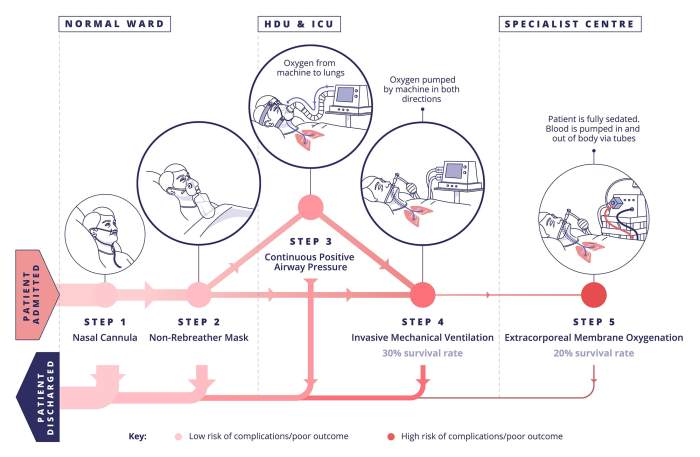
Managing blocked airways is a particular concern. This can be done in less severe cases with simple nasal cannula or oxygen rebreather masks. However, in more extreme cases, you may need continuous airway pressure provided through a machine or even invasive mechanical ventilation.


ICU_website-min
Source: UKRI


The chances of this happening to you or a loved one because your neighborhood school building was reopened and children were exposed to potentially sick classmates and staff is far from negligible.


In the US, more than 150,000 people have died from COVID-19. That’s 3.4% of cases that have lead to death.


To put that in context, The US has 5% of the global population and nearly a quarter of all Coronavirus deaths.


Over this last week, the average daily deaths in Italy were 6, France 10 and Spain 2.


In the US it was 1,204.


And make no mistake. Children can and do get sickespecially those 10 and older. They also can and do spread the virus to others.


Around the world, school closures are the rule, not the exception. While a few countries have opened schools, 143 countries have closed them nationwide.


This isn’t just because of the chance of death.


There are potential long term effects for survivors, too.


These include inflammation of the heart, cardiovascular disease and strokes; lung inflammation including persistent shortness of breath; and neurological issues such as headaches, dizziness, trouble concentrating or recalling things and even hallucinations.


This will not solve any of our current problems.


It will only make them worse.


However, I don’t wish to be dismissive.


Many kids and families are struggling with school closures.


Teachers and classrooms provide necessary services way beyond simple education.


I’m talking about food, nutrition, healthcare, childcare, counseling, tutoring, socialization, self esteem, meeting special needs, protection from abuse and a whole lot more.


If we keep school buildings closed and go to distance learning as we did in March, many of these services will continue to be disrupted or completely severed.

 
While reopening school buildings is NOT a viable solution, there are other things we can do.

 
Food, nutrition and healthcare can all be met while conducting distance learning. In fact, most schools provided these services from March through June as classrooms across the country were closed.

 
Likewise, counseling, tutoring, socialization, and self esteem can be provided on-line. In most cases they won’t be as effective as they would be in a physical setting. However, given the precautions necessary to meet in-person – face masks, social distancing, etc. – they may be more effective screen-to-screen than they would be mask-to-mask.


Which brings me to the most difficult considerations – meeting special needs, protection from abuse, and childcare.


Not all students are neurotypical. Many require accommodations that are difficult or impossible to make in a virtual environment.

 
Special arrangements could be made for these students to come into the physical classroom on a part-time or full-time basis. This isn’t as safe as complete on-line learning, but if the numbers of students are small enough, precautions such a temperature screenings and social distancing were in place and exposure mitigated, this could be a viable option.

 
The same goes for protection from abuse. Some students live in unsafe home environments. It is observation by responsible adults who are mandated reporters like teachers that reduce the likelihood these children will be mistreated and provide a solution when abuse is reported. However, noticing the telltale signs of such mistreatment or even communicating with a teacher privately outside of the hearing of an adult in the home is more difficult on-line.


Special arrangements could be made for students who have already been identified as at risk. They could meet with counselors and psychologists in the school every week or so. Safety precautions would be necessary but the risk could be reduced enough to make it worth taking.


The biggest problem is probably the most widespread – childcare.


Having children at home to do their schoolwork on-line puts additional pressure on parents.


It requires them to perform some of the disciplinary functions typically provided by educators. Parents have to ensure their kids are awake and ready to do their lessons. They have to monitor their children and help ensure the work gets done.


This is less difficult for parents with higher socioeconomic status who have jobs that allow them to work from home. But for those who do not have such employment, it becomes almost impossible.


In short, the economy requires some kind of daycare for these children.


Many European countries that have best managed the Coronavirus have paid workers to stay home. This allows them to take care of their own children and reduce their own exposure to the virus.


Frankly, it is the only sustainable solution.


However, our government has almost completely abrogated its responsibilities to working class people.


Parents with similar age children can create childcare networks where the same families take turns watching each others’ children. This reduces exposure to some degree.


Childcare centers also have been kept open in many communities to meet this need. However,there have been massive outbreaks at such centers across the country that would only be worsened if we rely on them more. Any sane country would close them just as it closed schools.


Until our lawmakers get off their butts and do their jobs, we will have no good solution to this problem.


Reopening school buildings to serve as childcare centers certainly won’t solve anything except put a premium on respirators, coffins and graveyard plots.


And for those who respond that only a certain percentage of children and adults will die, which members of your family are you willing to sacrifice?


Whose lives are you willing to bet and do you really have the authority to play God?


That point cannot be made too often.


We’re talking about human life here.


Reopening schools is seen as a silver bullet to so many of our problems during the pandemic.


It isn’t.


It is shooting ourselves in the foot.


If we really want to solve our issues, we need to listen to science, logic and reason.


We need to keep schools closed and teach students online until the virus is under control.


We need to make it possible for parents to stay home with their children.


And we need to do it now.


Like this post?  You might want to consider becoming a Patreon subscriber. This helps me continue to keep the blog going and get on with this difficult and challenging work.

Plus you get subscriber only extras!

Just CLICK HERE.

Patreon+Circle

I’ve also written a book, “Gadfly on the Wall: A Public School Teacher Speaks Out on Racism and Reform,” now available from Garn Press. Ten percent of the proceeds go to the Badass Teachers Association. Check it out!

thumbnail_IMG_8249

The Hybrid Model of School Reopening is Not Safe Either

Screen Shot 2020-07-25 at 10.44.19 AM

 
Safety is in the eye of the beholder.


No matter what you do, life involves some risk.


The question is whether certain actions or courses of action involve acceptable risk and exactly what you consider to be acceptable.


These issues are not academic. School directors across the country are juggling such questions in their reopening plans.


With federal and state officials largely leaving the decision up to local elected school boards of how to hold classes in August and September, people used to choosing between bids for text books and whether to renovate the gymnasium are forced to make life and death decisions for hundreds or thousands of students, staff and their families.


There are three main options:


  • (1) Open schools completely to in-person learning with safety precautions
  • (2) Keep classes entirely on-line as they were in April and May
  • (3) Offer some kind of hybrid of the two


Many schools are opting for this hybrid model.


This means reopening to in-person classes part of the time and on-line learning for the rest.


There are many ways to do this.


In my home district of McKeesport, this means having half of the students attend in the morning and the other half in the afternoon with the balance of their class work being done via the Internet.


In Steel Valley, the district where I work as a middle school teacher, this means half of the students attending full days on Mondays and Tuesdays, half on Thursdays and Fridays and the building is deep cleaned while students are taught completely on-line on Wednesdays.


In either case, parents can opt-in to an entirely virtual plan, but it’s expected that most adults would choose the hybrid model with its partial in-person classes for their children.


Let me be clear – the hybrid plan is preferable to the completely in-person proposal.


It reduces exposure to other people and environments compared to the entirely in-person program.


For instance, being in class half the day reduces student exposure by half. Being in class two out of five days reduces it by 60%.


However, let’s be real.


Any in-person instruction during a global pandemic incurs some risk. And that risk is far from negligible.


Moreover, the amount of risk is greater for adults than it is for children – both because adults would experience much higher exposure under such systems and because COVID-19 seems to affect adults more severely than children.


The hybrid model, then, is tantamount to putting children, teachers and families at risk for a reduced amount of time.


Why take the risk? On the premise that in-person instruction is more robust than on-line learning. Students learn more in the classroom from educators who are physically present than they do on the Internet.


There is significant evidence to back that up. However, this premise ignores the fact that invasive but necessary safety measures like wearing masks and practicing social distancing throughout the day will inevitably have negative effects on learning.


In short, mask-to-mask learning will not be as productive as face-to-face learning. We are in uncharted territory. It is entirely up in the air whether the necessary safety precautions of in-person learning – even during a hybrid model – will be better or worse than distance learning.


So the hybrid model tries to balance the unproven and questionable promise of increased academics against the threat of increased danger of disease.


How much danger? Well that depends to a large degree on where you live and the rate of infection present there.

 
I live in western Pennsylvania just south of Pittsburgh.


When schools closed in Allegheny County last academic year, a handful of people got sick each day, a hundred or more a week. For instance, 23 new COVID-19 cases were reported on March 19, and 133 for the week.


Now there are hundreds of new cases in the county every day and a thousand a week – 198 on July 24, alone, and 1,363 for the week.


Screen Shot 2020-07-25 at 11.34.44 AM
Source: PA Department of Health
Screen Shot 2020-07-25 at 11.34.56 AM
Source: PA Department of Health


That is not an insignificant risk. We have an infection rate of nearly 10%. We have some of the highest numbers in the state.


I don’t know how anyone can look at those numbers and conclude anything except that the risk of infection is GREATER today than it was when we took more precautions against it.


Moreover, the situation is little better nationwide.


Not a single state has met guidelines for reopening schools issued by the Center for Disease Control (CDC) in May.


Moving into Phase 1 would require a “Downward trajectory or near-zero incidence of documented cases over a 14-day period.” Moving to Phase 2 would require a “Downward trajectory or near-zero incidence of documented cases for at least 14 days after entering Phase 1.”


No state has experienced a “downward trajectory” for COVID-19 cases for 28 straight days. In most states, cases are increasing.


Nor does any reopening plan that I have seen – including McKeesport’s and Steel Valley’s – follow the 69-page CDC guidelines published by The New York Times earlier this month, marked “For Internal Use Only,” which was intended for federal public health response teams as they are deployed to hot spots around the country.


That document suggested several expensive and difficult safety measures such as broad testing of students and faculty and contact tracing to find people exposed to an infected student or teacher – none of which is being done locally.

 
The issue gets complicated though because this month the CDC bowed to pressure from the Trump administration and publicly softened its tone about reopening.

 
However, no matter how you look at it, reopening school buildings – even with a hybrid approach – increases risk significantly.

 
If school buildings are reopened with students and staff coming and going – even at a reduced rate through a hybrid plan – one would expect the virus already present in the community to gain access to our schools where it would be further spread to different segments of the community.


Schools are great meeting points. They are where local neighborhoods connect, learn, grow and share. Reopening them in a physical fashion allows for greater sharing of any easily communicable diseases in the area.


So exactly how communicable is COVID-19?


It’s often compared to influenza which infects millions of people every year yet these outbreaks rarely close schools.


Unfortunately, the consequences of getting COVID-19 are much more severe. So far the Coronavirus has shown itself to be 52 times as deadly as the flu.


Only about 0.1 percent of the people who got the flu in the US last year died of it, according to the CDC. Yet about 5.2 percent of those who came down with COVID-19 have died, based on the reported totals of cases and deaths.


During the 2018-19 flu season, about 34,000 people in the US died, according to the CDC. So far, 143,193 people have died of COVID-19 in the US, as of July 23.


And keep in mind there is a vaccine for the flu. There is nothing as yet that fights COVID-19.


Some say that even given such statistics, children are less susceptible than adults.


However, the virus was only discovered in 2019. So little is known about it – for instance, the low percentage of cases in children may be because schools were closed in April and May before many kids were exposed to it.


A recent South Korean study – the most in depth of its kind to examine how the virus affects children – found that it is especially active in older kids.


“For people who lived with parents between the ages of 10 and 19, 18.6% tested positive for the virus within about 10 days after the initial case was detected — the highest rate of transmission among the groups studied. Children younger than 10 spread the virus at the lowest rate, though researchers warned that could change when schools reopen,” wrote Stephen Stapczynski for Bloomberg News.


Jeffrey Shaman, an epidemiologist at Columbia University agreed.


“So long as children are not just a complete dead end – incapable of passing the virus on, which does not seem to be the case – putting them together in schools, having them mix with teachers and other students will provide additional opportunities for the virus to move from person to person,” he said.


Do such facts represent an acceptable risk for opening schools – even with a hybrid model?


Education Secretary Betsy DeVos says it does.


She said, “there’s nothing in the data that suggests that kids being in school is in any way dangerous.”


However, if even .02% of public school students were likely to die if school buildings were reopened, that’s 11,320 children!

 
Are we willing to risk the lives of tens of thousands – perhaps more – children on the unproven promise of a slight improvement in academics?

 
And keep in mind that doesn’t even take into account the cost to adults.

 
According to a new report from the Kaiser Family Foundation (KFF), 1 in 4 teachers in the U.S. – roughly 1.5 million people – are at increased risk for complications if they become infected with the Coronavirus. This includes educators over the age of 65 and those – like myself – with a pre-existing health condition that makes them more vulnerable.

 
According to the CDC, death from COVID-19 is significantly more common in older adults. Though the median age of U.S. teachers is 42.4 years, nearly 19 percent of teachers are 55 and older, reports the National Center for Education Statistics.


Health conditions such as diabetes, cardiovascular disease and kidney disease also increase one’s risk for serious illness from the virus. The CDC warns that roughly 60 percent of American adults have at least one chronic medical condition, and about 40 percent have two or more.


The situation is even more dire when we look at parents and grandparents in students’ homes. The KFF issued a report in July concluding that 3.3 million adults 65 or older live in a household with school-age children.


And let’s not forget the racial component.


Most minorities are more susceptible to COVID-19 because of the higher rates of social inequality they are forced to live under.


According to the CDC, Native Americans and Black people are hospitalized from the Coronavirus five times more often than White people. Hispanic and Latino people are hospitalized four times more often than White people.


Physically reopening school buildings in communities that serve large populations of people of color, then, invites greater risk than in predominantly white communities.


Screen Shot 2020-07-25 at 1.24.46 PM
SOURCE: the CDC


In any case, though, reopening school buildings – even under a hybrid model – significantly increases the risk for all the people living there.


So in summary, it is clear that the three basic options for reopening schools each offer different levels of risk.


A full reopening of schools even with safety precautions brings the highest risk. However, the hybrid model also brings significant danger to students, teachers and families – even if somewhat less than full reopening.


Distance learning has the lowest risk of all. It keeps most children physically separate from each other and thus limits exposure to the virus to the greatest extent. Likewise, it limits jeopardy for educators and other adults because teachers would mostly come into contact with children through the internet and parents would not be further complicated through potential viral contacts of their children.


From an academic standpoint, distance learning certainly has its drawbacks compared with face-to-face learning. But compared with mask-to-mask learning, virtual instruction may actually be preferable.


In any case, increased risk of death or debilitating disease has a chilling effect on learning for all involved.


In most communities – perhaps all – a decision on school reopening that balances safety with academics would lean toward distance learning above anything else.


Even if on-line learning turns out to be less effective than that provided in the hybrid model, any deficiencies can be targeted and ameliorated once the pandemic ends.


As yet, death admits of no such remedies.


Like this post?  You might want to consider becoming a Patreon subscriber. This helps me continue to keep the blog going and get on with this difficult and challenging work.

Plus you get subscriber only extras!

Just CLICK HERE.

Patreon+Circle

I’ve also written a book, “Gadfly on the Wall: A Public School Teacher Speaks Out on Racism and Reform,” now available from Garn Press. Ten percent of the proceeds go to the Badass Teachers Association. Check it out!

book-1


Standardized Tests Increase School Segregation

Screen Shot 2020-06-18 at 5.46.22 PM

 
Let’s say your community has two schools.


One serves mostly white students and the other serves mostly black students.


How do you eliminate such open segregation?


After all, in 1954 the U.S. Supreme Court struck down school segregation in Brown vs. Board of Education as essentially separate and unequal.


It’s been nearly 70 years. We must have a recourse to such things these days. Mustn’t we?


Well, the highest court in the land laid down a series of decisions, starting with Milliken vs. Bradley in 1974, that effectively made school integration voluntary especially within district lines. So much so, in fact, that according to a report from the U.S. Government Accountability Office, from 2000 to 2014, school segregation more than doubled nationwide.

 
But let’s say you did find some right-minded individuals who cared enough to make the effort to fix the problem.


What could they do?

 
The most obvious solution would be to build a single new school to serve both populations.


So if you could find the will and the money, you could give it a try.

 
Unfortunately, that alone wouldn’t solve the problem.


Why?


Standardized tests.


Even when students from different racial or ethnic groups aren’t physically separated by district boundaries or school buildings, the way we rate and sort these students within the same space causes segregation.


This is because our manner of placing kids into classes, itself, is discriminatory.


We have exactly this situation in my own western Pennsylvania district, Steel Valley. We have two elementary schools – Barrett and Park – one of which serves mostly black kids and the other which serves mostly white kids. However, even when the children get to our single middle and high schools, segregation persists.


They may finally be in the same building, but they aren’t in the same classes.


Most academic tracks have at least a lower and a higher level of each course. The former is invariably organized around remediation and basic skills, the latter around critical thinking and creativity.


Moreover, being in the higher level course comes with increased opportunities for mentoring, field trips, special speakers, contests, prizes, and self esteem. And the lower courses can degenerate into mindless test prep.


Which would you rather your child experience?


We don’t enroll students in one or the other at random. Nor do we place them explicitly based on their race or ethnicity.


Increasingly schools enroll students based primarily on their test scores.


Classroom grades, student interest, even teacher recommendations are largely ignored. Kids who pass their state mandated standardized assessments generally get in the higher classes and those who fail get in the lower classes.


And – Surprise! Surprise! – since test scores are highly correlated with race and class, most of the black kids are in the lower classes and most of the white kids are in the higher classes.


Let me be clear.


This isn’t because there’s something wrong with the poor kids and children of color or something right about higher socioeconomic status and white kids.


It’s because of (1) economic inequality, and (2) implicit bias in the tests.


In short, standardized assessments at best show which kids have had all the advantages. Which ones have had all the resources, books in the home, the best nutrition, live in the safest environments, get the most sleep, don’t live with the trauma of racism and prejudice everyday.


However, even more than that is something indisputable but that most policymakers and media talking heads refuse to acknowledge: standardized testing is a tool of white supremacy.


It was invented by eugenicists – people who believed that white folks were racially superior to darker skinned people. And the purpose of these tests from the very beginning was to provide a scientific (now recognized as pseudo scientific) justification for their racism.


A standardized test is an assessment where the questions are selected based on what the “standard” test taker would answer. And since this norm is defined as a white, middle-to-upper-class person, the tests enshrine white bias.


I don’t mean that 2+2=4 has a racial bias. But most questions aren’t so simple. They ask test takers to read passages and pick out certain things that are more obvious to people enculturated as white than those enculturated as black. They use the vocabulary of middle to upper class people just to ask the questions.


This is white supremacy. Using these tests as a gatekeeper for funding, tracking, and self-respect is educational apartheid.

 
Black students make up almost 17 percent of American students nationwide. If all things were equal, you’d expect them to make up a similar percentage of advanced courses. However, they account for only 10 percent of students in Gifted and Talented Education (GATE) classes.

 
In some areas it’s worse than others.


For example, according to a Department of Education Office for Civil Rights report from 2014, black students in the northern California city of Sacramento make up 16.3 percent of the population but only 5.5 percent of GATE programs. Meanwhile, in the south of the state, in San Diego, 8 percent of students are black, but make up just 3 percent of GATE classes.


Those are big disparities. In fact, the phenomenon is so common that social scientists created a term to describe it – racialized tracking.


But it has also been the subject of civil rights complaints.

 
In New Jersey the imbalance was so extreme the American Civil Liberties Union (ACLU) filed a complaint in 2014 against the South Orange–Maplewood School District. In a statement, the ACLU said racial segregation across academic tracks “has created a school within a school at Columbia High School.” More than 70 percent of students in lower classes were black while more than 70 percent of students in advanced classes were white.


Even so there wasn’t much that could be done. The matter ended with the Office for Civil Rights ordering the district to hire a consultant to fix the problem, but it still persists to this day.


This “school within a school” went from metaphor to reality in Austin, Texas. In 2007, a city school, the Lyndon Baines Johnson Early College High School, split into two different entities existing within the same building. And the main factor separating the two was race.


The second floor became the Liberal Arts and Science Academy (LASA), a public magnet high school serving mostly white and Asian students. Meanwhile, the majority black and Latino students stayed on the first floor taking regular education courses.


How can that be legal? Because too many people want it that way.


LASA is ranked the best Texas high school and the 11th-best high school in the United States. In fact, whenever you see those lists of the best schools in the country, they are often the result of a wealthy local tax base combined with how many poor and minority kids they were able to keep out.


It’s a matter of priorities.


Many people – especially white people – talk a good game about equity but what they really want for their own children is privilege.


It’s what happens when you let scarcity dominate public education, and it doesn’t have to be this way.


We can invest in our schools so that all children have what they need – so that they aren’t in competition for dwindling resources.


But this must go hand-in-hand with an emphasis on social justice. Black lives matter. We cannot continue to treat black children as disposable.


Being gifted, talented or advanced can’t be reduced to a score on a standardized test. In fact, I’d argue that such measures should be banished from our conception of excellence altogether as the tests, themselves, should be discontinued.


This doesn’t mean we can ignore the centuries of racist policies that keep our children of color down – housing segregation, inequitable funding, over policing, a lack of resources, being left out of specialized programs. Nor does it mean that we can ignore implicit bias white teachers invariably have about black students.
But we have to dismantle the systemic racism enshrined in our school policies. The most well-meaning individuals will make little headway if the system, itself, is corrupt.


The two must be accomplished hand-in-hand, at the micro and macro level.


Integration is absolutely essential. We must ensure that all of our students get to go to school together – but not just in the same buildings, in the same classes.


This requires an end to standardized testing but maybe also an end to advanced placement courses as we know them. Why focus on higher order thinking only for the privileged kids – do it for all. Individual student needs can be met with dual teachers in the room, pullout resources and the like.


It is important to meet the needs of every student, but we cannot in doing so allow unspoken bias to be the gatekeeper of opportunity.


Equity is not just a pretty word. It has to be one of our most cherished goals.


Otherwise our policies and our people will leave many children behind.


Like this post?  You might want to consider becoming a Patreon subscriber. This helps me continue to keep the blog going and get on with this difficult and challenging work.

Plus you get subscriber only extras!

Just CLICK HERE.

Patreon+Circle

I’ve also written a book, “Gadfly on the Wall: A Public School Teacher Speaks Out on Racism and Reform,” now available from Garn Press. Ten percent of the proceeds go to the Badass Teachers Association. Check it out!

1500x1000-garn-book-sale-2020-2

The Student-Teacher Relationship is One of the Most Misunderstood and Underrated Aspects of Education

thumbnail_IMG_9695


When I came back to school for the first time since the Coronavirus closed the building, there were a pile of letters waiting for me in my mailbox.


I took them to my empty classroom and read the first one:


“Hello Mr. Singer, I just thought you should know that you are the greatest teacher I’ve had since Kindergarten all the way to my freshman year of High School and probably will remain that way forever. You always helped me with my work when I was behind and gave me extra time to finish it. Your class was the class I looked forward to every day. You were always a nice and funny man. Thank you for being there for me and everyone else in your classes. I’ll be sure to visit you after school every now and then…”


I picked up another:


“You have no idea how much I miss you… I quite miss our talks after class about video games, movies and musicals. As cheesy as it sounds, I always looked forward to them; especially during the days I was having problems with other students, your wise words always helped…”


And another:


“…we had fun times in your class. There wasn’t one non-fun day that we had because if we was going to have a bad day you made it better and way more fun. You also helped us a lot even when we didn’t ask for it. When people didn’t want to do our work, you got them happy and got them to do their work. Thanks for everything and thanks for helping me be a smarter kid.”


I felt a lump forming in my throat.


My cheeks were hot.


And why was my face wet?


I hadn’t expected any of this.


After a semester of distance learning, I’d come back to school to return all the materials I had hastily marauded from my own filing cabinets and book shelves.


I had stopped in the office merely as a matter of course.


With the school year at a close, I had gathered the odds and ends in my mailbox including this bundle of correspondence.


Now as I sat at my desk smiling, laughing and crying – experiencing each letter like a warm hug on a winters day – I remembered something Ms. Williams had said in an email.


She had assigned a thank you letter to her high school business classes. Her students had to write a formal thank you to a previous teacher. But that was all that was required. Who they wrote to and what they said was entirely up to them.


She had written to me months ago to let me know these letters were coming.
It was just bad luck that the assignment was due just as the global pandemic closed everything down so I was only reading them now.


Kids usually spend about 1,000 hours with their teachers in a single year.


During that time we build strong relationships.


While just about everyone will tell you this is important, we’re often talking about different things.


Some policymakers will insist on limiting that relationship to connections that increase academic outcomes. Others advise a more holistic approach.


Both are backed by research.


A review of 46 educational studies concluded that strong student-teacher relationships are associated with positive outcomes in everything from higher student academic engagement, attendance and grades, better behavior and fewer suspensions to higher graduation rates. And this is true of both short term and long term effects and even after controlling for differences in student backgrounds.


However, many studies disregard everything but standardized test scores. That is the primary goal and arbiter of effectiveness. As such, in those cases the relationship they are looking for is much different than in those with broader aims.


A 2018 study from Arizona State University found a disparity in teacher-training programs that highlighted this difference.


Some programs prioritized an “instrumental focus” with students where teachers were encouraged to use personal information on students to get them to behave and do their work. The goal was compliance not autonomy or problem solving.


Other programs valued a more “reciprocal focus” where students and teachers exchanged information to come to a mutual understanding and shared knowledge. Here the goal was free thought, questioning, and engagement with authority figures.


Moreover, the study found that the differences in focus corresponded to where aspiring teachers were expected to get a job after the training was complete. The instrumental focused teacher prep programs invariably trained incoming educators for low-income and high-minority schools. The reciprocal approach was preferred for teachers preparing for wealthier and whiter students.


So once again the physical segregation of our children becomes “the soft bigotry of low expectations.” But while President George W. Bush used that famous phrase to demonize anyone who thought poverty and racism were barriers to achievement, it is actually a focus on test scores that is bigoted.


We expect teachers to care about their wealthy white students but merely manipulate their poor brown ones.

 
This just goes to justify my own reciprocal approach in the classroom.


Test-obsessed policy makers will tell educators to manage everything with a clipboard and a spreadsheet – for example, to increase the percentage of positive interactions vs negative ones in a given class period. But such a data-centric mindset dehumanizes both student and teacher.


The goal cannot be to maximize numbers whether they be test scores or some other metric. It has to be about the relationship, itself.


Teachers have to care about their students. All teachers. All students.


Or at least we have to try.


A little bit of empathy goes a long way. And not just to get students to jump through hoops.

You have to care about each student as a person.


The goal can never be a test score. It has to be self actualization.


Teachers have to help kids become their best selves. And the definition of what counts as your best self is largely defined by the student, his- or herself.


How telling that we implicitly understand this when it comes to high socioeconomic kids with lighter skin! How pathetic that we lower our sights when it comes to poor kids and children of color.


I teach mostly minority students in a low income school in Western Pennsylvania. Like many of my colleagues, I’ve always fought against this prescription to see student relationships as instrumental to their outcomes.


And the results are evident in what they wrote to me.


“…now that I’m no longer in your class I’ve decided it was about time that I give you a proper thank you for all you did, putting up with me and dealing with me in class… You helped me learn how to write essays. But most important of all, for two years you made school fun for me again, which was something I thought was impossible.”


***


“…Everyday I was always looking forward to having your class because I knew that having your class would be thrilling. I miss having your class because you made me laugh and in return I made you laugh a couple of times.”

***


“…Being in your class made me enjoy learning and reading more. It was almost always something I looked forward to throughout my day. We were always learning about interesting topics and I was never bored in your class… Thank you for being the greatest teacher ever and a cool dude.”


***


“…I’ll never forget you as long as I live.”


***


“You were my favorite teacher because your class was always fun and we were always doing fun things and fun projects in your class and your class was never boring. You also taught us a lot of useful things… we’ve been using them so far this year. You were also never in a bad mood and always were positive in the morning so you always brought my energy up… I never looked forward to a morning class besides your class because I knew that we were going to do something fun.”


***


“…Your class was the only class that I got excited for because we always read good stories and did fun things… I also wanted to say I’m sorry for talking and disrupting the classroom when I was carrying on. I should have been paying attention to what you had to say and what you were trying to teach me.”


***


“It was interesting to have a teacher that wrote a book because not a lot of teachers write books. It was also interesting [you had a] TED Talk…”


***


“You have had some pretty good accomplishments in your life if I may say so. Like your book “Gadfly on the Wall”, and I have to say it’s a pretty good book. I read some of it and I get what you’re saying.”


***


“…middle school was hard for me. I had difficult days with tons of IXLS piled [on from other classes] but instead of you giving them to me you actually taught me by yourself. Also we were able to joke around a lot about books and just random things in class.”


***


“…you taught me how to write and put punctuation in my sentences and in my paragraphs. Coming into your class in the beginning of 7th grade I didn’t know how to read that good or consistent… My vocabulary and speech increased in your class.”

 
***


“…You always had a way to make the class fun or easy. Also you always had a way to keep me on track and prepared… If I didn’t have you for 7th and 8th grade I don’t think I would be able to handle 9th grade… I’m glad to of had you for two years because I learned double the stuff and was double ready for 9th grade. I’m doing well [now] because of you…”

 
***


“I wanted to write to you because you’re honestly my favorite teacher and you kept my spirits up. I had your class for two years [7th and 8th grade]; the first year I wasn’t sure how I felt about you but overtime I realized you’re pretty cool. I loved Socratic Seminars . They were a way to voice your opinion and that’s always fun… You helped me find a few of my favorite books like “The Outsiders”, “To Kill a Mockingbird”, and “The Diary of Anne Frank” which my friends and I still mention to this day… I’m in the musical this year and… without you I don’t think I would have been able to build up the courage to try out… You made me the person I am today. You taught me to challenge things that are unfair and to treat people with respect.”

 
Those are just some of the highlights.


I think more than anything I could say, they prove the point.


But to put a cherry on top, I’ll add one last thing.


In my 8th grade poetry unit, we watch “Dead Poets Society.”


Last year my students threatened to reenact the ending of the film where the kids stand on their desks to honor Mr. Keating, their English teacher who taught them to think for themselves instead of being cogs in the machine.


On the last day of school, they did it, too.


I cautioned against it because I didn’t want anyone to fall and get hurt. But when the last bell rang and emotions ran high, I simply took the compliment.


A year later, they must have remembered the moment as much as I did because many, many of the letters weren’t addressed just to Mr. Singer.


They were addressed to “Oh Captain! My Captain!”


Screen Shot 2020-06-13 at 10.54.46 AM
I wrote each student a personal response and sent it to them via the US Post Office. For many this may be the first actual letter they’ve received.


Like this post?  You might want to consider becoming a Patreon subscriber. This helps me continue to keep the blog going and get on with this difficult and challenging work.

Plus you get subscriber only extras!

Just CLICK HERE.

Patreon+Circle

I’ve also written a book, “Gadfly on the Wall: A Public School Teacher Speaks Out on Racism and Reform,” now available from Garn Press. Ten percent of the proceeds go to the Badass Teachers Association. Check it out!

book-3


Pennsylvania Wants YOU to Give Standardized Tests to Your Kids at Home

Screen Shot 2020-05-23 at 1.23.46 AM


A multi-million dollar corporation wants to make sure Pennsylvania’s children keep getting standardized tests.

 
Data Recognition Corporation (DRC) and the state Department of Education are providing the optional Classroom Diagnostic Tools (CDT) assessments for use in students’ homes.


Students are not required to take the CDT in the Commonwealth unless their district decides to give it. The test is encouraged by the state as a way of telling how students will do on the required tests.

 
With this new option, parents finally can give multiple choice standardized tests to their own children on-line.

 
Which is kind of hilarious because no one really asked for that.

 
In fact, many parents, teachers and students breathed a sigh of relief when the requirement that students take high stakes assessments was waived this year nationwide.

 
With the Coronavirus pandemic closing most school buildings and students transitioning to on-line classes created from scratch by their teachers, there hasn’t been much time for anything else.

 
But the folks at DRC, a division of CTB McGraw-Hill, have been busy, too.

 
The Minnesota-based corporation sent out an email written by Matthew Stem, Deputy Secretary of Elementary and Secondary Education at the Pennsylvania Department of Education (PDE) to district contacts from Pittsburgh to Philadelphia encouraging the use of this newly available online CDT.

 
“I am pleased to announce that PDE is providing the Classroom Diagnostic Tools (CDT) as an optional additional resource for your Continuity of Education Plan,” Stem began.

 
“We anticipate that this option will be available through the reopening of schools in 2020.”

 
So if school boards and administrators choose, districts could assign the CDT at the end of this school year, during the summer or at the start of next school year even if school buildings are not yet open due to lingering pandemic problems.

 
This is the kind of academic continuity we should be rethinking not finding new ways to force on children.

 
For some state officials and testing executives perhaps it’s comforting that no matter what happens in this crazy world, at least we’ll still be able to sort and rank kids into Below Basic, Basic, Proficient or Advanced.

 
The rest of us would prefer more authentic education and assessment.


EVERYDAY USAGE


It should be noted that the CDT is not, in itself, a high stakes test.

 
It’s an optional test districts can assign to students in reading, math and science to predict how well they’ll do on the actual high stakes tests.

 
Normally, districts are encouraged (but not required) to give the CDT to students multiple times a year to determine where they’ll struggle on DRC’s other fine products like the Pennsylvania System of School Assessment (PSSA) tests given to children in grades 3-8 and the Keystone Exams given to high schoolers.

 
Of course this data is often used to determine which classes students are placed in, so it can play a huge role in deciding which resources and opportunities kids have.

 
A child who scores well can get in the advanced courses and gain access to all the field trips, guest speakers, pizza parties and other perks. Kids who score badly are often placed in remedial courses where they forgo all the glitz for extra test prep and the abiding label that they’re inferior to their classmates in the higher academic tracks.

 
However, you don’t really need the CDT to make such placements. Just put all the kids from wealthier families in the higher courses and kids living in poverty in the lower courses and you’ll have pretty much the same distribution.

 
Because standardized testing doesn’t really measure academics. It appraises socio-economics. And race. Let’s not forget race!

 
The Coronavirus pandemic actually leveled the playing field for the first time in nearly a century. Everyone – rich and poor – had their education disrupted.

 
But at least now with the reintroduction of the CDT, we can continue to discriminate against the poor black kids while privileging the richer whiter ones.

 
In some ways, that’s just the everyday injustice of American school policy.

 
However, the method DRC and PDE are using to clear the way for this particular scheme is truly spectacular.


A DISASTER WAITING TO HAPPEN


They’re enlisting parents as test proctors.

 
Normally, as a classroom teacher when my administrator demands I give the CDT to my students, I have to block out a few days and give the tests, myself.

 
I have to pass out entry tickets with each student’s username and password so they can login to the DRC app on their iPads and take the test.

 
If there’s a problem signing in, I have to try and fix it.

 
If kids are kicked out of the testing program and can’t sign back in, I have to deal with it.

 
If there’s a problem with the Internet connection…. I think you get the idea.

 
And all of these problems are extremely common.

 
In the last five years of giving the CDT, I have never had a single day go by when I didn’t experience multiple technological snafus, disruptions or downright clusters.

 
And that’s not to say anything of the times students read a question, don’t understand what it’s asking, wave me over and I’m just as dumbfounded as they are.

 
In fact, the only positive I can imagine from such a situation is that parents will finally get to see how badly written and full of errors these tests truly are. Even the guidance materials are full of misspellings and confusing verbiage.

 
When presented with this nonsense, many kids simply zone out, clicking random answers so they can be done as soon as possible and then put their heads down for the remainder of the time.

 
This is the lions den the state wants to throw parents into.


PARENTS AS CORPORATE DEFENSE

 
Admittedly, parents won’t have a full class of 20-30 students to deal with, but complications are guaranteed.

 
However, the good folks at DRC are prepared for that.

 
They have a handy “Parent/Guardian Test Administration Guide.”

 
Here’s what it has to say on ASSESSMENT SECURITY:


“Parents/Guardians should remind their student that the CDT test content must remain secure at all times. None of the materials from the online test may be copied or recorded in any manner.”

 
That’s quite a step down from what the same company warns students on the PSSA:


“…Copying of material in any manner, including the taking of a photograph, is a violation of the federal Copyright Act. Penalties for violations of the Copyright Act may include the cost of replacing the compromised test item(s) or a fine of no less than $750 up to $30,000 for a single violation. 17 U.S.C. $ 101 et seq”

 
I guess that since the CDT questions are just the ones that prepare you for the REAL test questions, it doesn’t matter as much if their security is put at risk here. Or perhaps the risk of letting kids go without testing and having people realize how unnecessary these tests are is greater than any loss in test security or accuracy.


TECHNICAL ISSUES EXPECTED

 
The guide also cautions that the test only may be taken using a Google Chrome Internet browser. If students don’t have one installed, there is a link for parents to follow so they can install it for their kids.

 
For some parents, I’m sure this would be no problem. But many of my students’ parents have little access or knowledge of technology. They would pull out their hair at the very suggestion and come running to teachers and administrators for help.

 
Which is exactly what DRC suggests they do.

 
Here’s what the guide recommends for technical support:


“If technical issues arise during testing, parents/guardians are asked to contact the student’s teacher and/or the student’s school office for technical support. DRC customer service staff cannot directly support issues related to each home’s technology configurations.[Emphasis mine.]

 
And this is true even if the test, itself, directs parents to contact the corporation:


“If a student receives an error message during the test administration that includes instructions to contact DRC for technical support, the parent or guardian who is assisting with the test administration should contact the student’s teacher or school office for additional instructions. Parents or students should not attempt to contact DRC’s customer service directly for technical assistance.

 
Teachers and/or a school’s technology staff will have the information needed to provide parents/guardians with the level of support to resolve most technology issues. If additional support is required, a school or district representative will reach out to DRC to determine a resolution.”

 
This is certain to put quite a strain on districts since these technological problems will occur not as they normally do within school buildings but potentially miles away in students’ homes.

 
Moreover, one of the most common glitches with the CDT often occurs with the entry tickets. These are typically printed by administrators and distributed to teachers who give them to students on test day. Students use the logins and passwords to gain access to the tests.

 
Stem’s plan would have these tickets distributed digitally over Google Classroom or whatever file sharing service is being utilized.

 
So this requires yet another level of distance and technological competency from parents and students just to access the tests. And once that access is gained, these logins need to be readily available in the highly likely event that students get booted from the program and have to reenter this data.


I’m sure there will be noooooooo problems at all with this. It will run very smoothly.


PARENTS AS PRISON GUARDS

 
But let’s say parents are able to help their children login to the test and no technical problems arise.

 
Can parents let their kids simply take the test alone up in their rooms?

 
No.

 
As a test proctor, you are expected to watch your children every second they’re testing to ensure they aren’t copying any information or cheating.

 
You can let your child have scratch paper, highlighters and calculators. But no preprinted graphic organizers, cell phones, dictionaries, thesauri, grammar or spell checkers, other computers or devices.

 
One concession DRC makes is that parents are encouraged to give the shorter Diagnostic Category CDT and not the full version. I’m sure distinguishing between the two on your child’s screen will be no problem at all.

 
This would reduce the test to 35-45 minutes – about half of the full CDT. However, times may vary – my own students have taken more than 180 minutes sometimes to finish the full version.

 
Still, none of this comes close to my favorite part of this catastrophe in waiting.

 
If parents still are uncertain about how to do all this, there is a link to a series of training videos on the PDE Website.

 
These are pretty much the same videos teachers are required to watch every year before giving the CDTs.


As you can imagine, they are perhaps our favorite moments of the year. We sometimes watch them over and over again. Not because they’re so riveting but because we’re required to before we give these infernal tests!

 
Oh, parents, you are in for a treat if your district decides to take advantage of this wonderful opportunity!


AN IMPOSITION ON PARENT’S TIME


Speaking of which, I wonder when Stem thinks parents will have the time to do all this.

 
Parents are working hard just to make ends meet. They’re trying to earn enough money to support the household, cook dinner, clean house, do laundry, and a host of other things.

 
Teaching is a full-time job and most parents don’t have the privilege to set aside that kind of time nor are they disposed to do this stuff in the first place.

 
When I teach my students over ZOOM, I rarely see parents guiding their kids through the lessons.

 
If a kid falls asleep, it’s up to me to somehow prod him awake over the Internet. If a child isn’t paying attention or playing on her phone, it’s up to me to direct her back on task.

 
In class, that’s fine. It’s my job and I’m right there in front of the child.

 
On-line, I cannot do it nearly as effectively. But I do my best because I can’t realistically expect all parents to step in here.

 
Yet DRC is expecting parents to do just that by becoming test proctors.


CONCLUSIONS

 
This is a terrible idea.

 
It will lead to fabulous disasters where teachers, administrators and parents fumble to make things work as DRC pockets our tax dollars.


Over the past decade, Pennsylvania and local school districts paid more than $1.3 billion for standardized testing. In particular, the state paid DRC more than $741 million for the PSSAs, Keystone Exams and CDT tests. Two of three DRC contracts were given sole source no-bid extensions.

 
Imagine what cash-strapped districts could do with that money.

 
Yet Stem, a former assistant superintendent in Berks County and former administrator in Lancaster, thinks we should give this money to corporations and then break our own backs meeting their needs.


Even if we could give the CDTs seamlessly online at home, it would hurt our most underprivileged children by taking away opportunities and unjustly labeling them failures.

 
No, if you ask me,it is not time to try to save standardized testing with a tone deaf plan to enlist parents as test proctors while kids are chained to the Internet.

 
It’s well past time to rethink the value of these tests in the first place.

 
We don’t need them.

 
Teachers can assess learning without the help of corporate America.


Our kids and their families deserve better than this.

 
Contact your local school directors and demand they NOT give the CDT – not now, not during the Coronavirus pandemic, not when the crisis is over, not ever again.

 
And if they won’t listen, opt your children out of standardized testing including diagnostics like the CDT. Then run for school board, yourself, with other likeminded parents and community members.

 
Write letters to the editor of your local paper, make some noise.


The people still hold the power. And we’re all being tested in more ways than one.


THE FULL EMAIL:

The following communication was initially broadcast by the Pennsylvania Department of Education on May 18, 2020. DRC is forwarding the same message to the district and school contacts on file in our databases.



Screen Shot 2020-05-23 at 8.51.55 AM


May 18, 2020

 
To: Superintendents, Principals, Charter School CEOs, and IU Directors
From: Matt Stem, Deputy Secretary
Subject: Availability of the Classroom Diagnostic Tools (CDT) for use by students at home


I am pleased to announce that PDE is providing the Classroom Diagnostic Tools (CDT) as an optional additional resource for your Continuity of Education Plan. The CDT is a set of online tools designed to provide diagnostic information to guide instruction and provide support to students and teachers. It is aligned with the content assessed on the PSSA and Keystone exams. We anticipate that this option will be available through the reopening of schools in 2020.


This at-home testing option will allow students to access the CDT from a “public” browser without having it installed on their computers or being configured to their District’s Central Office Services network. The test-setup tasks that teachers/school assessment coordinators routinely complete for classroom administrations of the CDT are the same for the at-home administrations. Test tickets (login credentials) will be distributed directly to the students by school staff. Teachers will have access to all CDT data/reports from the at-home administrations as usual. An overview of the at-home testing option and a guidance document for parents/guardians can be accessed from the following links (or directly from DRC’s INSIGHT Portal under General Information >> Documents >> 2019-2020 Classroom Diagnostic Tools >> Memos/Documents).


At-Home Testing Overview: https://pa.drcedirect.com/Documents/Unsecure/Doc.aspx?id=32997b8e-13cf-42f0-9c2c-af1689d89323 
Parent/Guardian Guidance: https://pa.drcedirect.com/Documents/Unsecure/Doc.aspx?id=cc242168-e06e-44d1-9fd4-ef859a519dab 


All CDTs (Full and Diagnostic Category) are available for use. However, it is highly recommended to only have students take the Diagnostic Category CDTs at this time. Students and their parents/guardians may benefit from a much shorter testing experience using the Diagnostic Category CDTs that are aligned to current instructional content. The shorter, more focused testing will still provide teachers and administrators with the same level of reporting and resources to adjust instruction and planning during distance learning.


Thank you for all your efforts to support students during this challenging time. If you have any questions, comments, or concerns, please contact the curriculum coordinator or CDT point of contact at your local Intermediate Unit. If you are interested in using CDT for the first time, contact PDE here.


Sincerely,


Matthew Stem
Deputy Secretary, Office of Elementary and Secondary Education
Pennsylvania Department of Education


Screen Shot 2020-05-23 at 8.52.08 AM


Like this post?  You might want to consider becoming a Patreon subscriber. This helps me continue to keep the blog going and get on with this difficult and challenging work.

Plus you get subscriber only extras!

Just CLICK HERE.

Patreon+Circle

I’ve also written a book, “Gadfly on the Wall: A Public School Teacher Speaks Out on Racism and Reform,” now available from Garn Press. Ten percent of the proceeds go to the Badass Teachers Association. Check it out!

thumbnail_IMG_8249

The Internet is NOT the Best Place for Kids to Learn After the Coronavirus Pandemic

Screen Shot 2020-05-09 at 12.46.20 PM

 
If the Coronavirus quarantine has taught educators one thing, it’s this.


Online learning is not better than in-person schooling.


After all these years of corporations throwing apps at us and well-meaning administrators providing us with devices and philanthrocapitalists pumping billions of dollars into ed tech first academic schemes, we can all see now that the emperor has no clothes.


When schools nationwide are closed to stop the spread of a global pandemic and learning is restricted to whatever teachers can cobble together on sites like Google Classroom and ZOOM, we can all see the Imperial scepter blowing in the wind.


The problem is that this is only clear to parents, students and teachers.


The people who get to make ed policy decisions are as blind as ever – as witnessed by New York Gov. Andrew Cuomo’s tone deaf insistence that his state reimagine schools with the help of billionaire school saboteur Bill Gates.


But the rest of us – you know, those grounded in reality – can see the problems with remote learning staring us in the face.


Most importantly, the Internet is not a conducive environment for learning.


I don’t mean that learning can’t take place there.


You could learn in a fox hole while being shelled by enemy forces. But if your content extends to something more complex than “Duck” or other survival tactics, this may not be the best place to learn it. After all, environment plays a key role in knowledge acquisition.


Moreover, different people learn things better in different circumstances. And, contrary to our current education policies that view children as stakeholders or consumers, they are in fact people.


There are some children who learn better online than in a brick and mortar classroom. But these kids are few and far between.


In general, the younger the child (both physically and psychologically), the more important it is that he or she be given the opportunity to learn in an actual classroom.


Why?


It really comes down to who controls the environment.


In a classroom, the teacher decides most everything about the physical space and what possibilities there will be. She places the books, hangs the posters, sets the lighting, displays student work, etc.


In a virtual environment, the space is defined to a small degree by the teacher, but it is mostly determined by the ed tech provider and the open world of the Internet.


In short, teachers have much more control over physical classrooms and can remove distractions.


Online, educators have very little control over this.


LINE OF SIGHT

 
For instance, in my physical classroom, if I wanted to see what a student was doing, all I had to do is walk up to him and look.


I controlled what I see, and hiding things from me was difficult.


Online, if I want to see what a student is doing (let’s say on a video communications platform like ZOOM), I have little control over what I see. The student is in control of the camera. If it is pointing at the student or placed so as to hide certain behavior or even if the camera is currently on or not is not in my control. Students are empowered to hide anything they want, and there’s not much I can do about it.


When teaching online, I’ve had students texting on cell phones, playing video games on computers, having side conversations with friends in their bedrooms, playing with pets – and trying to hide this with the way they display themselves on camera.


I’ve had kids mysteriously turn off the camera or point it away from their faces until I ask them to switch it back on or swivel it back to themselves.


DO YOU HEAR WHAT I HEAR?

 
When I first started teaching online a few weeks ago, one of the most powerful tools at my disposal seemed to be the mute button.


If several kids weren’t hearing me because of side chatter, I could simply mute everyone and fill the blessed silence with instruction.


However, I soon discovered that this is deceptive.


Just because you don’t hear the students, doesn’t mean they aren’t talking. Some kids use the online chat stream to continue side chatter. Others forgo that entirely for text and Facebook messaging.


What’s worse, it’s often hard for the teacher to even know whether anything she said is actually being heard.


TOO MUCH CHOICE

 
One of the great strengths of online learning is that it gives students an incredible amount of choice. But that is also its greatest weakness.


I can give assignments through a file sharing site like Google Classroom and let students complete it at their own pace.


The problem is that kids (especially young kids) need their pace monitored.


You can’t give them too much time to get something done because many will procrastinate through the deadline.


In my physical classroom, I would often give an assignment and then provide at least some time for them to start it. The idea was that even if they don’t finish it with me, they are more likely to complete something they already began.


However, online it is completely up to them when to do an assignment. They are responsible for their own time management – and that’s a skill we, as educators, struggle to teach them.


As a result, most students don’t get these assignments done on time – if at all.


Even when they do the work, I’m bombarded by a slew of submissions around midnight or the early hours of the AM.


HOW TO ASK A QUESTION YOU DON’T KNOW YOU HAVE


Then there’s the question of… well… questions.


In my brick and mortar classroom, if a child was unsure of something, all she had to do was raise her hand and ask. Online, there are multiple ways to communicate with me – kids can send me an email, message me or verbally ask me something during a video chat.


The problem is that sometimes they don’t know they’re confused.


In my physical classroom, since all students are working on an assignment together in that same time and space, I can go from desk to desk and see how they’re progressing.


If they’re getting something wrong, I can correct it in real time. I can give suggestions and encouragement even before the work is done.


Online, I’m mostly limited to commenting on the final project. If a student didn’t understand the directions – and didn’t even understand that he didn’t understand the directions – I don’t know until the work is done.


This presents a problem. Do I explain the error and ask him to to do the work all over again? Or do I explain the error but accept the work for what it is?


I’ll admit, I usually do the later.


STUDENTS M.I.A.


Which brings me to mysterious absences.


I don’t mean kids who don’t show up to video conferences – though there are many of those.


I mean kids who for all intents and purposes appear to be there in ZOOM and then suddenly disappear never to return that day.


They could have a device or Internet issue. And if this happens every once in a while, it’s understandable. But what about kids who do this all the time?


If your iPad isn’t charged one day, I guess things happen. But if it isn’t charged everyday, that’s a problem. Your problem – one you need to solve.


I know every district is different in this regard, but my school provides every student with devices and even WiFi if necessary. Even in the physical classroom, using devices always came with a chorus of whines about them not being charged.


Once again, we’re putting this responsibility on students and families. In the days before distance learning, we could question whether that was fair. In the Coronavirus dystopia, we have little choice but to do it.


However, this brave new world even makes an issue out of bathroom breaks.


In the brick and mortar classroom, kids would ask to go to the restroom and then be sent one at a time. Online some kids just turn off their camera or leave it idling on an empty seat or the ceiling. It is next to impossible to tell whether these breaks are genuine or even to estimate their duration.


Some students are gone for the majority of the meeting. In a world where video conferences are few and far between, is it so much to ask that you use the restroom BEFORE going to ZOOM?


INVADERS

 
But let’s not forget unwanted guests.


These platforms require students to know a dedicated Web address and sometimes a password to get in.


Yet these are children. They sometimes share these security measures with people who were not invited.


Even in my physical classroom, sometimes students not on my roster would try to get in to talk with a friend or even just sit in on my amazing lessons. I could stop them at the door and send them on their way.


Online, some sites like ZOOM give me similar power, and others like Kahoot (a game based learning platform) do not. Even when every person entering has to be approved by me, all I see is the name they’ve given their device. If an enterprising stranger wanted to rename their device to that of one of my students, I probably wouldn’t catch it until they were in.


There have been several times when someone with one of my students’ names got into a ZOOM meeting, but either refused or couldn’t turn on their camera. I had no choice but to boot them out.


On some sites like Kahoot, there is no video. I had no idea who was signing in – I just saw the name they input.


So sometimes I had two students with the same name. Or I had let’s say 8 kids in the class but 9 kids were signing on to Kahoot.


It’s maddening!


ASSESSMENTS AND CHEATING

 
Now let’s talk tests.


I don’t like tests. I think they can too easily become cruel games of “guess what the testmaker was thinking.”


But they are a necessary evil to judge what information students have learned. Moreover, a creative teacher can design them to reduce the regurgitation of facts and increase critical analysis backed by facts.


In a physical classroom, teachers can monitor students during test taking. Online, they can’t. So there’s always a question of cheating.


Every scrap of information in human history is available somewhere online. If students try hard enough, they can find the answer to any question with a deft Google search.


However, to be honest I don’t think I’ve had too much trouble with this as yet. My students either don’t care enough to cheat, cannot figure out how to do so effectively or have too much self respect.


Or maybe I just haven’t caught them.


In the physical classroom, I had several students try to pass off others work – essays or poems – as their own. But I haven’t assigned anything so ambitious through distance learning yet.


CONCLUSIONS

 
Perhaps that’s why it drives me nuts when policymakers and media types make statements about what an overwhelming success this has all been.


Teachers and districts have tried their best. Students and families are giving their all. But this experiment does not demonstrate why we should all embrace distance learning once the Coronavirus pandemic is under control.


It shows why we MUST return to the brick and mortar classroom as soon as it is safe to do so.


Reimagining school will not require more ed tech.


It may require much less.


Kids need to be in the presence of physical human beings in a real environment with their peers to maximize their learning.


We need smaller classes, equitable funding, desegregation, social justice, wide curriculum, and an end to high stakes testing, school privatization, science denial and anti-intellectualism.


But more than anything, we need policymakers who are willing to listen to and include the people on the ground when making decisions that affect us all.


Like this post?  You might want to consider becoming a Patreon subscriber. This helps me continue to keep the blog going and get on with this difficult and challenging work.

Plus you get subscriber only extras!

Just CLICK HERE.

Patreon+Circle

I’ve also written a book, “Gadfly on the Wall: A Public School Teacher Speaks Out on Racism and Reform,” now available from Garn Press. Ten percent of the proceeds go to the Badass Teachers Association. Check it out!

book-4

Mike Turzai is Willing to Sacrifice Pennsylvania’s Students and Families to the Economy

Screen Shot 2020-05-05 at 1.09.00 AM

 
Mike Turzai says he’s furious with Pedro Rivera.


Why is the highest ranking Republican in Pennsylvania’s House of Representatives so angry with the state Secretary of Education?


Rivera said the Commonwealth’s public schools, which have been closed since mid March due to the Coronavirus pandemic, would not reopen until it was safe to do so.


If that means schools don’t reopen on time in the Fall, so be it.


Specifically, on Wednesday, Rivera said:


“At the end of the day, we’re going to make sure that the health and welfare of our students is first and foremost, front and center. And we’re not going to allow and ask students to return to school in an unsafe environment. We’re preparing for the best, but we’re planning for the worst.”


Turzai was so infuriated by this statement that he wrote a letter to Rivera – which the Pittsburgh area representative immediately shared with the media – he went on right wing talk radio to complain, and he posted a video on his Facebook page.


You know a Boomer is really mad when he goes on the social media.


Though his comments include his usual greatest hits against public schools and those greedy teachers, Turzai’s main point was simply science denial.


On Facebook, after a long list of activities that he said kids enjoy doing like sports and lab experiments, he said this:


“All of those can be done safely, and [kids] are not at risk unless they have an underlying medical issue. The fact of the matter is kids can develop herd immunity, and if you [Rivera] have not yet developed a plan where we can safely educate kids in schools, then you are going to have to rethink education forward…”


So there you have it, folks.


Turzai wants Pennsylvania to reopen schools on time whether scientists and health experts think it’s safe or not because – Turzai knows best.


Pennsylvania’s village idiot thinks he knows best about schools.


And as usual he’s as wrong as you can get.


The COVID-19 virus is relatively new. That’s what the 19 in its name means. It was only discovered in 2019.


It’s already killed more Americans than the Vietnam War (69,579 vs. 58,220). There’s no vaccine. And we really don’t know with much certainty how it will affect people in the long term.


And as to herd immunity, Sweden tried that – eschewing social distancing and letting people just get the virus – and the result is a death rate twice that of the US.


While it is true that children seem to be mostly asymptomatic, thousands have contracted the disease and several have died.


However, the Center for Disease Control (CDC) points out the bigger issue in the organization’s April report on its Website:


“Pediatric COVID-19 patients might not have fever or cough. Social distancing and everyday preventive behaviors remain important for all age groups because patients with less serious illness and those without symptoms likely play an important role in disease transmission.”

So if we reopen schools before it is safe to do so, we run the risk of (1) kids dying, (2) kids becoming carriers and bringing the disease to any adults they come into contact with who are much more susceptible and (3) teachers and school staff getting sick and dying.


Turzai has no problem with any of that.


He thinks the risk is worth it.


Why?


Well, that’s the party line he’s been handed by the Trump administration, and he does whatever he is told by his bosses.


Oh? The taxpayers thought THEY were his bosses?


No. You are just the chumps who kept re-electing him.


He doesn’t work for you.


He works for the Republican Party machine which is trying to turn people against Democratic governors like our own Tom Wolf.


And, man, does he want to be the next GOP challenger to Wolf. That’s really what this whole business is about – casting Turzai as even more radical than Scott Wagner, the last far right dope who tried for the governors mansion and was soundly defeated by voters.


He’s trying to show he’s just as stupid as Donald Trump. The President says we should all drink bleach to get rid of COVID-19? Well Turzai says we should let our kids get sick and die or make us sick.


Republicans truly have become the party of stupid.


The media helps covidiots like Turzai by uncritically reprinting his outrageous lies.


Turzai is like a man who calmly says it’s not raining outside while a thunderstorm beats down on the neighborhood. Instead of pointing out the truth, the media simply reports what Turzai said and at most gives equal weight to a meteorologist. But there is no OPINION about facts! And whether scientific consensus holds with his crackpot conspiracy theories about how the Coronavirus spreads or not IS a fact.


Is social distancing fun?


No.


If I could push a button and magically make the Coronavirus go away, I would.


But you have to live in the real world.


We have to get rid of the virus.


We need real tests to be able to tell if people have the virus. The Trump administration has completely botched that. This is why countries like South Korea are seeing hardly any new cases at all while our numbers are still extremely high.


Not to mention the fact that we have a bunch of morons who value their freedom to put themselves at risk without any thought to their responsibilities to the rest of society who they will also be endangering.


Until we can truly tell who has the virus, who had the virus, who is immune, and how to cure it, the prospect of reopening schools or the economy will be grim.


We should not put people at risk unnecessarily.
And we certainly shouldn’t put children at risk.


Don’t let fools like Turzai use a global pandemic to hawk their political agendas.


He goes on in his video to say that if the state’s public schools don’t open on time, we should consider things like universal cyber schooling, and (non sequitur alert!) charter and voucher schools.


It’s his everyday wish list wrapped in a Coronavirus-bow.


That’s how dumb this dummy thinks Pennsylvanians are.


I sure hope he’s wrong about that, too.


MYTHBUSTERS: A quick rebuttal to the other lies spewed in Turzai’s Facebook video


-Does Pennsylvania spend more than most other states on education?


We’re in the top 10 for over all spending, but we don’t distribute it equally. Kids in rich districts get tons of money. kids in poor districts get scraps. That’s why there’s a lawsuit demanding the state ensure all kids get an equitable education.


-Are pension payments high?


Yes, because while teachers and schools paid into the program, the state legislature deferred to pay its share for years and years. Now it’s due. We agreed to give state workers benefits when we hired them. We can’t go back on that now.


-Do administrators know if teachers are teaching online during the pandemic?


Yes. Parents, students AND administrators know because it’s all online. Administrators can monitor teachers MORE closely via the Internet – not less. That’s why there’s an overwhelmingly increased appreciation of what educators are doing now – it’s out in the open.


-Should educators call special needs students for three hours everyday?


Only if they aren’t already spending the majority of their days actually teaching students on-line. I’m on ZOOM meetings most days interacting with students on video conferences for almost as much time as I would in person if schools were open. And if you add in the amount of time it takes to come up with new lessons on learning platforms we’re unfamiliar with, program them in and troubleshoot them, most teachers are putting in MORE hours than usual.


Like this post?  You might want to consider becoming a Patreon subscriber. This helps me continue to keep the blog going and get on with this difficult and challenging work.

Plus you get subscriber only extras!

Just CLICK HERE.

Patreon+Circle

I’ve also written a book, “Gadfly on the Wall: A Public School Teacher Speaks Out on Racism and Reform,” now available from Garn Press. Ten percent of the proceeds go to the Badass Teachers Association. Check it out!
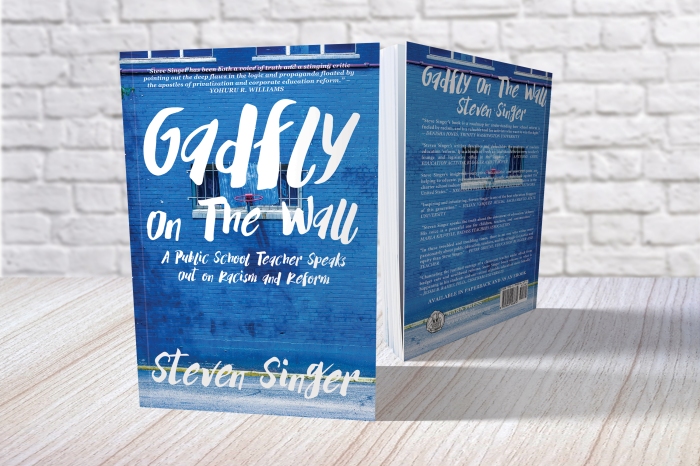
book-1