
Charter Schools Are Quietly Gobbling Up My Public School District


Screen Shot 2019-05-19 at 7.49.57 PM


I work in a little suburban school district just outside of Pittsburgh, Pennsylvania, that is slowly being destroyed by privatization.


Steel Valley Schools have a proud history.


We’re located (in part) in Homestead – the home of the historic steel strike of 1892.


But today it isn’t private security agents and industrial business magnates against whom we’re struggling.


It’s charter schools, voucher schools and the pro-corporate policies that enable them to pocket tax dollars meant to educate kids and then blame us for the shortfall.


Our middle school-high school complex is located at the top of a hill. At the bottom of the hill in our most impoverished neighborhood sits one of the Propel network of charter schools.


Our district is so poor we can’t even afford to bus our kids to school. So Propel tempts kids who don’t feel like making the long walk to our door.


Institutions like Propel are publicly funded but privately operated. That means they take our tax dollars but don’t have to be as accountable, transparent or sensible in how they spend them.


And like McDonalds, KFC or Walmart, they take in a lot of money.


Just three years ago, the Propel franchise siphoned away $3.5 million from our district annually. This year, they took $5 million, and next year they’re projected to get away with $6 million. That’s about 16% of our entire $37 million yearly budget.


Do we have a mass exodus of children from Steel Valley to the neighboring charter schools?


No.


Enrollment at Propel has stayed constant at about 260-270 students a year since 2015-16. It’s only the amount of money that we have to pay them that has increased.


The state funding formula is a mess. It gives charter schools almost the same amount per regular education student that my district spends but doesn’t require that all of that money actually be used to educate these children.


If you’re a charter school operator and you want to increase your salary, you can do that. Just make sure to cut student services an equal amount.


Want to buy a piece of property and pay yourself to lease it? Fine. Just take another slice of student funding.


Want to grab a handful of cash and put it in your briefcase, stuff it down your pants, hide it in your shoes? Go right ahead! It’s not like anyone’s actually looking over your shoulder. It’s not like your documents are routinely audited or you have to explain yourself at monthly school board meetings – all of which authentic public schools like mine have to do or else.


Furthermore, for every student we lose to charters, we do not lose any of the costs of overhead. The costs of running our buildings, electricity, water, maintenance, etc. are the same. We just have less money with which to pay them.


But that’s not all. The state funding formula also requires we give exponentially more money to charters for students labeled special needs – orders of magnitude more than we spend on these kids at my district.


Here’s how the state school code mandates we determine special education funding for charter school kids:


“For special education students, the charter school shall receive for each student enrolled the same funding as for each non-special education student as provided in clause (2), plus an additional amount determined by dividing the district of residence’s total special education expenditure by the product of multiplying the combined percentage of section 2509.5(k) times the district of residence’s total average daily membership for the prior school year. This amount shall be paid by the district of residence of each student.”


So authentic public schools spend a different amount per each special education student depending on their needs. But we have to pay our charter schools an average. If they only accept students without severe disabilities, this amounts to a net profit for the charter schools – and they can spend that profit however they want.


Moreover, if they reclassify students without disabilities or with slight disabilities as special needs, that means more money for them, too. Is anyone checking up on them to make sure they aren’t gaming the system? Heck no! That’s what being a charter school is all about – little transparency, little accountability and a promise of academic results (which don’t have to pan out either).


In the 2015-16 school year, Steel Valley paid the 19th highest amount of its budget to charter schools in the state (9%) and that number is growing.


According to the state Department of Education, here’s how our charter school spending has increased:


Steel Valley Per Student Charter School Tuition:


2000-01 – 2012-13

Non-Special Ed: $9,321

Special Ed: $16,903


2013-14

Non-Special Ed: $9,731

Special Ed: $16,803


2014-15

Non-special Ed: $10,340

Special Ed $20,112


2015-16

Non-Special Ed: $12,326

Special Ed: $25,634


2016-17

Non-Special Ed: $13,879

Special Ed: $29,441


2017-18

Non-Special Ed: $13,484

Special Ed: $25,601


2018-19

Non-special ed: $14,965

Special ed: $32,809


All of this has real world consequences in the classroom. It means fewer teachers and larger class sizes. It means narrowed curriculum and fewer extracurricular activities. It means reduced options and opportunities for all children – just so a new business can duplicate the services already being offered but skim tax dollars off the top.


Our State Senator Jim Brewster understands the problem.


“Charters are strangling school districts, eventually will put them out of business. When you lose your school district, you lose your city,” he said in an article published by Public Source.


Brewster is a Democrat from McKeesport with four school districts being likewise “cannibalized” by charter schools.


Steel Valley School Board President Jim Bulger also characterized the situation as dire.


“ Charter Schools have become a twisted profit-making machine and not what they were originally intended for,” he said.


 “Originally charter schools were meant to serve a demographic that the public schools could not. For example being heavy in the performing arts or items like that. It’s unfortunate that several people have decided to twist this decent idea into a profit-making scheme that bleeds public education and its very soul.”


Much of the problem is in Harrisburg where legislators refuse to see or address the issue. And that’s often the best situation. Others actively make things worse.


For instance, the state used to reimburse each district for 30% of its costs to charter schools. Then in 2011, Republican Gov. Tom Corbett cut that while slashing the education budget by an additional $1 billion a year.


Though some of that money has been restored in subsequent budgets, the charter reimbursement has not. Putting it back in the budget would go far to alleviating the bleeding.


But legislators need to get serious about charter school reform.


We can no longer afford a system that requires authentic public schools to fund their own competition. In fact, schools should never be in competition in the first place. Every school should be excellent – and the only way to get there is to start with adequate, equitable, sustainable funding in the first place.


There are seven charter schools within 5 miles of my district: Propel Homestead, Propel Braddock Hills, Environmental Charter School at Frick PA, Propel Hazelwood, Academy Charter School (in Pittsburgh), Propel Mckeesport, and Propel East (in Monroeville).


In addition, there are 55 private schools in the same area. Though the Commonwealth doesn’t have school vouchers, per se, it does have a backdoor version supported by both Democrats and Republicans. Many of these private and parochial schools gobble up $210 million of state tax dollars through these tax credit programs – the Educational Improvement Tax Credit (EITC) and Opportunity Scholarship Tax Credit (OSTC) programs. And there’s a bill currently being considered in Harrisburg to increase that amount by $100 million this year and even more in subsequent years!


It seems our legislature has no problem spending on the school system so long as it isn’t the PUBLIC school system.


And the reason usually given for such support is the results privatized schools get. They claim to be better alternatives to the public system, but this is rarely if ever true.


Test scores are a terrible way compare schools, but charter and voucher schools rarely – if ever – outpace their authentic public school competitors. They either get similar scores or in many cases do much, MUCH worse.


For instance, take Propel Homestead.


In 2015-16, it served 573 students in grades K-12. Only 22% of students were proficient in math and 40% in Reading on state tests. Both scores are below state average.


Meanwhile, at Steel Valley High School during the same time period, we served 486 students in grades 9-12. In math, 50-54% of our students were proficient and 65-69% were proficient in Reading. That’s above state average in both cases. And we had similar results at our middle and elementary schools.


However, test scores are poor indicators of success.


Steel Valley Schools also had lower class sizes. We averaged 12 students per teacher. Propel Homestead averaged 15 students per teacher.


And then we come to segregation. Though both schools had significant minority populations, Steel Valley Schools had 42% minority enrollment, most of whom are black. Propel Homestead had 96% minority enrollment, most of whom are black.


So the authentic public school option is demonstrably of better quality, but our inability to bus students to-and-from school opens us up to predatory school charlatans who take advantage of our poverty.


And the situation is similar in surrounding communities. Poor districts serving impoverished minority students become targets for privatizers looking to make a fast buck off of our kids and families. They offer them a lower quality education and a slick sales pitch.


They increase segregation, lower academic quality, and get away with much needed funds that could help kids get a better education.


This nonsense has to stop.


The only schools that should be receiving public tax dollars are the authentically public ones.


They should have to abide by the same regulation, the same accountability standards, the same democratic governance, the same enrollment standards as authentic public schools. Otherwise, they should not qualify for public tax dollars.


We’re boring holes in the ship to make rickety life boats.


It’s time to stop the madness.


It’s time to stop letting our best chance to help all kids get eaten alive by the sharks of privatization.


Like this post? I’ve written a book, “Gadfly on the Wall: A Public School Teacher Speaks Out on Racism and Reform,” now available from Garn Press. Ten percent of the proceeds go to the Badass Teachers Association. Check it out!

 

book-4

Pittsburgh School Board Candidate Anna Batista Takes Big Money From Special Interests

Screen Shot 2019-05-13 at 5.14.43 PM

“Few men have virtue to withstand the highest bidder.”

-George Washington


Anna Batista, a corporate consultant at Highstreet Consulting running for Pittsburgh School Board, is taking thousands of dollars in donations from big money interests.


A quick look at campaign finance reports on Allegheny County’s Website shows Batista took beaucoup bucks from school privatization lobbyists, real estate developers, lawyers, and financial advisors.


Meanwhile, her opponent Pam Harbin, a public school watchdog, is supported almost exclusively by grassroots donations.


Both candidates are running for District 4, which serves parts of Squirrel Hill, Point Breeze, Shadyside and North Oakland. Since they’ve cross filed and will appear on both the Republican and Democratic primary ballots, the seat should be decided in the May 21 primary.


Batista and Harbin have raised similar amounts for their campaigns. Harbin has $33,412.95 while Batista has $32,414.


Batista has support from at least two troubling industries – school privatizers and corporate crusaders – which are nowhere to be seen in her opponents financials.


Particularly troubling to me are the charter school and voucher advocates.


Someone shouldn’t be running for a public school board with backing from the same vultures demanding public schools be dismantled and their assets and funding siphoned away to private industry. Charter schools cost the Pittsburgh Public district more than $85 million per year in tuition payments. While the district has no plans to open new public schools, it is forced to open new charter schools every time one of these publicly financed but privately run institutions appeals to the state Charter Appeal Board, further draining resources away from remaining public schools.


In fact, Batista is using “Students First” as a title on her campaign mailers. This is the name of a well-known school privatization group founded by infamous public school saboteur Michelle Rhee. The education justice movement across the country and here in Pittsburgh has been fighting Students First for years. They are infamous for dumping money into Pennsylvania politics to back legislators friendly to school privatization. No one who is serious about education justice would use this title: either Batista does not know about Students First, she knows and doesn’t care, or she is being intentional in signaling to privatizers that she is on their side.


Students First merged with 50CAN, a national group focused on vouchers and school privatization that grew out of ConCAN, started by Connecticut hedge fund managers. Betsy DeVos, now U.S. Secretary of Education, praised the merger and has done similar work for years through her own organization with the same privatization agenda. Here in Pennsylvania, the local branch is PennCAN. Their director, who also sits on the board of a local charter school asking for approval to set up shop in Pittsburgh, is one of Batista’s donors.


The largest donations are noted below. Chief among these are:


-Rachel Amankulor, PennCAN and Catalyst Charter School board member. (Pittsburgh Public School Board denied Catalyst’s application citing problems with its plan to accommodate students with disabilities, among other issues, but the state Charter Appeal Board overturned the board’s decision and the case may now go to Pennsylvania Supreme Court.)


-Catherine Axtman, spouse of William Axtman who sits on the Propel Charter School Board


-Kirk Burkley ($500) and Robert Bernstein ($250), of Bernstein- Burkley, a Pittsburgh law firm specializing in Business Law, Creditors Rights, Oil & Gas, Bankruptcy, & Real Estate. (Burkley ran against school board member Lynda Wrenn in 2015 – a race fought in large part around privatization issues!)


-Allison McCarthy, Vice President of Teach for America; Catalyst Charter School Board Member; and Broad Academy graduate (Eli Broad is a major privatizer who started the Broad Academy of which Devos is a graduate.)


-Nathaniel Yap, spouse of Brian Smith, Catalyst Charter Founder and CEO ($1,000)


And then we come to the big business partisans.


Many of these advocate for tax deferment programs to entice businesses into the Pittsburgh area on the condition that they are allowed to escape paying taxes or pay at a reduced rate for a certain number of years. Programs such as Tax Incremental Financing (TIFs) put a heavier burden on the schools than other public resources. They cost the school district 50% as opposed to the county and city, which only lose 25% of their owed taxes each.


Local politicians like County Executive Rich Fitzgerald and Pittsburgh Mayor Bill Peduto  – though Democrats – are chief advocates of these types of neoliberal, business friendly programs. While the city and county have nothing to do with Pittsburgh Public Schools, they do often expect the School Board to rubber stamp TIFs. The School Board is an independent taxing body, but they are rarely brought to the table at the beginning of the process.


Corporate donors include:


-Friends of Rich Fitzgerald ($500)


-People for Bill Peduto ($2,000)


-Gregg Perelmann, Walnut Capital ($1,000)


-Todd Reidbord, Walnut Capital (Developers of Bakery Square and other projects that have received a number of TIFs)


-Helen Casey, CEO of Howard Hanna


-John Katz, Brandywine Agency ($1,000 plus in-kind) (His office in the Squirrel Hill business district is worth thousands)


-Paul Katz, Brandywine Agency ($250)


-Patricia Katz, Brandywine Agency ($1,000)


-Rod Werstil, McKinney Properties ($500)


-Kevin McKeegan, Meyer, Unkovic & Scott LLP (Pittsburgh Real Estate Law)


-Luke Meyers, Skadden, Arps, Slate, Meagher & Flom LLP and Affiliates (New York Real Estate Law)


-Nancy Finkelstein, Schulte Roth & Zabel (Finkelstein’s Linkedin Profile includes this quote: “I have concentrated my practice on representing private equity funds, investment banks, hedge funds, financial institutions, finance companies and high-net-worth individuals in a wide variety of transactions, including financings, debt restructurings, leveraged acquisitions, and collateralized loan facilities.”)


-Steven Massey, Federated Investors


-Richard Lerach, Gateway Financial


-William Sheridan, Reed Smith LLP (“Represented managed care defendants in obtaining dismissal of antitrust conspiracy and monopolization claims.”)


All of this is truly troubling for someone running to serve as a school board director.


Compare Batista’s financials with that of her opponent Harbin.


In at least two instances, Harbin won endorsements and donations from organizations Batista had been courting.


Pittsburgh Federation of Teachers gave Harbin $5,000 instead of Batista.


Likewise, Unite! Pittsburgh gave Harbin $1,500 over Batista. This is State Rep. Summer Lee’s PAC. The organization supports candidates running on a criminal justice slate who are committed to ending the school-to-prison, poverty-to-prison, and addiction-to-prison pipelines.


Other notable donations to Harbin’s campaign include:


-Women for the Future Pittsburgh ($500)


-Friends of Chelsea Wagner ($500) (Wagner is Allegheny County Controller and one of the founders of Women for the Future Pittsburgh)


-Michael Fine ($2,800) physician for the Veterans Administration


-Kathy Fine ($2,800)  Michael’s wife and long-time education justice activist who fought against the closing of Pittsburgh’s Schenley High School.


-Nancy Bernstein ($1,000) J Street Board Member (J Street organizes and mobilizes pro-Israel, pro-peace Americans who want Israel to be secure and democratic.)


These are exactly the kind of donations you’d expect from a grassroots candidate – labor unions, progressive political promoters and activists.


Full disclosure: Though I live just outside of the Pittsburgh area, I am not unbiased in this race. I consider Harbin a friend and fully support her run for school board.


However, the donations outlined in this article are all facts. Feel free to go to the county Website and see for yourself.


Our children deserve better than Batista – a school director in the employ of the same forces out to sabotage education and pick the remains clean for their own individual ends.


Call me crazy, but I think children should be an end in themselves.


School board candidates who put themselves up for sale like Batista don’t deserve your vote. They’ve already sold theirs to the highest bidder.


Like this post? I’ve written a book, “Gadfly on the Wall: A Public School Teacher Speaks Out on Racism and Reform,” now available from Garn Press. Ten percent of the proceeds go to the Badass Teachers Association. Check it out!
thumbnail_IMG_8249

Classroom Teachers are the Real Scholastic Experts – Not Education Journalists

Screen Shot 2019-05-06 at 4.29.19 PM


When you want an expert on health, you go to a doctor.


When you want an expert on law, you go to a lawyer.


So why is it that when the news media wants an expert on education they go to… themselves!?


That’s right. Education journalists are talking up a storm about schools and learning.


You’ll find them writing policy briefs, editorials and news articles. You’ll find them being interviewed about topics like class size, funding and standardized tests.


But they aren’t primary sources. They are distinctly secondary.


So why don’t we go right to the source and ask those most in the know – classroom teachers!?


According to a Media Matters analysis of education coverage on weeknight cable news programs in 2014, only 9 percent of guests on MSNBC, CNN and Fox News were educators.


This data is a bit out of date, but I couldn’t find a more recent analysis. Moreover, it seems pretty much consistent with what I, myself, have seen in the media.


Take Wyatt Cenac’s “Problem Areas,” a comedy journalism program on HBO. The second season focuses entirely on education issues. Though Cynac interviews numerous people in the first episode (the only one I saw), he put together a panel of experts to talk about the issues that he would presumably return to throughout the season. Unfortunately, only two of these experts were classroom teachers.


There were more students (3), policy writers (3) and education journalists (3). There were just as many college professors (2), civil rights leaders (2), and politicians (2). Plus there was one historian (Diane Ravitch).


I’m not saying Cynac shouldn’t have talked to these other people. From what I’ve seen, his show is a pretty good faith attempt to talk about the issues, but in under representing classroom teachers, we’re left with a false consensus. It’s like having one climate denier debate one scientist. They aren’t equal and should not be equally represented.


And that’s as good as it gets!


Turn to most discussions of education or scholastic policy in the news and the discourse is bound to be dominated by people who are not now and have never been responsible for a class full of K-12 students.


Allowing journalists who cover education to rebrand themselves as “experts” is just not good enough.


Take it from me. Before I became a classroom teacher, I was a newspaperman, myself. Yet it’s only now that I know all that I didn’t know then.


If anyone values good, fact-based reporting, it’s me. But let’s not confuse an investigator with a practitioner. They both have important jobs. We just need to be clear about which job is being practiced when.


Reporters are not experts on the issues they cover. Certainly they know more than the average person or some political flunkey simply towing the party line. But someone who merely observes the work is not as knowledgeable as someone who does it and has done it for decades, someone with an advanced degree, dedication and a vocation in it.


Moreover, there is a chasm between education reporting and the schools, themselves, that is not present between journalists and most fields of endeavor. In the halls of academia, even the most fair-minded outsiders often are barred from direct observation of the very thing they’re trying to describe. We rarely let reporters in to our nation’s classrooms to see what’s happening for themselves. All they can do most of the time is uncritically report back what they’ve been told.


It’s almost as if sportswriters never got to see athletes play or political reporters never got to attended campaign rallies. How could their ideas about these subjects be of the same value as the practitioners in these fields!?


It couldn’t.


Think about it. Journalists are rarely permitted inside our schools to see the day-to-day classroom experience. Legal issues about which students may be photographed, filmed or interviewed, the difficulty of getting parental permissions and the possibility of embarrassment to principals and administrators usually keeps the school doors closed to them.


In many districts, teachers aren’t even allowed to speak on the record to the media or doing so can make them a political target. So reporters often have great difficulty just disclosing the opinions of those most knowledgeable about what is going on.


At best, our nation’s education reporters are like aliens from another galaxy trying to write about human behavior without actually having seen it. It’s like a bad science fiction movie where some alien with plastic ears asks, “What is this thing you call love?”


Sorry. These are not experts. And if we pretend that they are, we are being incredibly dishonest.


Some of this obfuscation is by design.


Education reporting is incredibly biased in favor of market-based solutions to academic problems.


Why? The corporations that own the shrinking number of newspapers, news stations and media outlets are increasingly the same huge conglomerates making money off of these same policies. The line between news and advertising has faded into invisibility in too many places.


Huge corporations make hundreds of millions of dollars off of the failing schools narrative. They sell new standardized tests, new test prep materials, new Common Core books, trainings for teachers, materials, etc. If they can’t demonstrate that our schools are failing, their market shrinks.


Even when they don’t put editorial pressure on journalists to write what the company wants, they hire like-minded people from the get go.


Too many education journalists aren’t out for the truth. They’re out to promote the corporate line.


This is why it’s so important to center any education discussion on classroom teachers. They are the only people with the knowledge and experience to tell us what’s really going on.


And – surprise! – it’s not the same narrative you’re getting from corporate news.


Schools are being defunded and dismantled by the testing and privatization industry. Corporate special interests are allowed to feed off our schools like vultures off road kill. And all the while, it is our children who suffer the results.


High stakes standardized testing must end. Charter and voucher schools must end. Parasitic education technologies must be controlled, made accountable and in many cases barred from our schools altogether.


But that’s a truth you can only find by talking to the real experts – classroom teachers.


Until we prize their voices above all others, we will never know the whole truth.


Like this post? I’ve written a book, “Gadfly on the Wall: A Public School Teacher Speaks Out on Racism and Reform,” now available from Garn Press. Ten percent of the proceeds go to the Badass Teachers Association. Check it out!

book-1

The Best School Innovation Would Be More People

thumbnail_o-TEACHER-COLLABORATION-facebook


Public schools thrive on innovation.


In nearly every classroom around the country you’ll find teachers discovering new ways to reach students and foster skills, understanding and creativity.


But if you pan out to the macro level, the overwhelming majority of innovations aren’t organic. They’re imposed on us by bureaucrats and functionaries from outside the classroom:


Education Technologies.


School privatization.


Standardized tests and Common Core.


For the last two decades, these are the kinds of innovations that have been forced on public schools at gun point.


And each and every one of them is pure bullshit.


They are corporate schemes written by the wealthy to cash in on education dollars for themselves. Big business hands them out to their paid political lapdogs to push through our state and federal legislatures to become laws and policies the rest of us have to obey.


They have nothing to do with helping students learn. Their purpose is to boost profits.


Just look at the difference between the ways the word innovation is defined.


Merriam Webster says the word signifies “the introduction of something new” or  “a new idea, method, or device: Novelty.”


But BusinessDictionary.com finds a tellingly distinct meaning:


“The process of translating an idea or invention into a good or service that creates value or for which customers will pay.”


It is that second business-friendly definition that has dominated our schools and narrowed our view until the only concept of advancement and revolution has been centered exclusively on the profit principle.


It is time to put a stop to all of it.


No more useless iPads, apps, software and so-called “personalized” educational technologies that do little more than allow marketers to steal student data and profit off of a new form of school where everything can be provided by technology at a cost while the quality of services takes a nosedive. No more technology for technology’s sake instead of using it as a tool to promote authentic learning.


No more laughable charter and voucher schools where education budgets become slush funds for corporations who don’t have to provide the same standard of services to students or the community. No more operating without  transparency or accountability.


No more outmoded and disproven standardized tests. No more canned academic standards that strip classroom educators of autonomy while reducing effective teaching behind a smoke screen of test scores that merely conflate the economic situation students live in with their academic abilities. No more corporations creating bogus multiple choice assessments whose only utility is to demonstrate how many more test prep materials we need to buy from the same company or industry.


It’s too bad we’re not interested in that FIRST definition of innovation, or at least innovation tied with the motive of providing quality education for children.


If we were interested in that kind of real, authentic school reform, we would focus on things that really matter. And chief among those would be one main thing, one major innovation that would be easy to accomplish but could change the fabric of our schools from top to bottom – people.


After all, that is what our public schools need the most – more people.


Have you walked into a public school lately? Peak your head into the faculty room. It’s like snatching a glance of the flying Dutchman. There are plenty of students, but at the front of the overcrowded classrooms, you’ll find a skeleton crew.


Today’s public schools employ 250,000 fewer people than they did before the recession of 2008–09. Meanwhile enrollment has increased by 800,000 students. So if we want today’s children to have not better but just the same quality of services kids received in this country only a decade ago, we’d need to hire almost 400,000 more teachers!


Instead, our children are packed into classes of 25, 30 even 40 students!


And the solution is really pretty simple – people not apps. Human beings willing and able to get the job done.


If we were fighting a war, we’d find ways to increase the number of soldiers in our military. Well, this is a war on ignorance – so we need real folks to get in the trenches and win the battle.


We need teachers, counselors, aides and administrators promoted from within and not functionaries from some think tank’s management program.


We need more people with masters or even more advanced teaching degrees – not business students with a three-week crash course in education under their belts who are willing to teach for a few years before becoming a self-professed expert and then writing education policy in the halls of government.


We need people from the community taking a leadership role deciding how our schools should be run, not simply appointing corporate lackeys to these positions at charter or voucher schools and narrowing down the only choices parents have to “Take It” or “Leave It.”


We need people. Real live people who can come into our schools and do the actual work with students.


And that means money. It means cutting the crap boondoggles to corporations and spending on flesh and blood reform.


It means fixing the funding inequality at the heart of nearly every public school in the country. No more spending tens or hundreds of thousands on wealthy students and merely hundreds on poor ones. No more dilapidated school buildings for the poor and palaces for the rich. No more socialistic pulling together for the wealthy and rugged individualism for the poor.


THIS is how you solve our education crisis – a crisis not caused by falling test scores or failing schools. A crisis caused by vulture capitalists preying on our educational institutions and our students as if they were some bloated carcass on the side of the road and not our best hope for the future.


It’s really that simple.


It’s a matter of ideology based on empiricism not “common sense” Laissezfaire maxims of “This is how we’ve always done it.”


We’ve been trying so-called corporate education reform for decades now – through Bush and Obama and now Trump. It doesn’t work.


It’s time we stopped making excuses for failing policies and got back to the best thing that works.


People.


Like this post? I’ve written a book, “Gadfly on the Wall: A Public School Teacher Speaks Out on Racism and Reform,” now available from Garn Press. Ten percent of the proceeds go to the Badass Teachers Association. Check it out!
book-2

The Forgotten Disaster of America’s First Standardized Test

Screen Shot 2019-04-22 at 10.35.05 PM

“Those who cannot remember the past are condemned to repeat it.”

George Santayana (1905)


The merry-go-round of history continues to spin because the riders forget they are free to get off at any time.


But we rarely do it. We keep to our seats and commit the same stupid mistakes over and over again.


Take high stakes standardized testing.


It was a disaster the very first time it was attempted in America – in Boston, Massachusetts, in 1845.


Yet we continue to prescribe the same error to students in schools today.


Judging learners, schools and teachers based on standardized assessments has the same problems now as it did 174 years ago. Yet we act as if it’s the only accurate way to assess knowledge, the only fair and equitable way to assign resources and judge the professionalism of our schools and teachers.


IT IS NONE OF THOSE THINGS.


If we simply remembered our history, we’d know that. But our collective amnesia allows this bad policy to reappear every generation despite any criticisms or protests.


So let me take you back to Boston in the middle of the 19th Century and show you exactly where things first went wrong and how they still go wrong in nearly the same way.

BOSTON SCHOOLS


Even back then Boston had a history of excellent schools.


One of the country’s most prestigious institutions – the city Latin School – was founded in 1635 and had a list of alumni that reads like a who’s who of American history up through modern times. This includes Cotton Mather, Sam Adams, John Hancock, Ralph Waldo Emerson, Leonard Bernstein and even Santayana, himself!


But Boston wasn’t known just for educating the elite. The city’s school committee had opened the nation’s first public high school in 1821. This wasn’t a charity. The community funded its public schools relatively well and took pride in its students’ accomplishments.


Testing was a much different affair in the early 1800s than it is today.


At the local English Grammar Schools, most examinations were strictly oral. Students were questioned in person about the various subjects in which they had received instruction. Teachers tested students’ memory in a recitation to find out whether or not they were proficient in the subject at hand.


The purpose behind such an assessment wasn’t to assign a grade like children were eggs or melons. It was to give the teacher information about how much his students had learned and where the students’ teacher should begin instruction next year.


However, critics complained that such assessments weren’t impartial and that a written exam might be better. Unfortunately, having every student complete one was impractical before the pencil and steel pen came into common usage in the late 1800s. Besides, teachers – then called School Masters – were trusted to use their judgment measuring student achievement and ability based on empirical observation of students’ day-to-day work.


It should also be noted that many more teachers were men at this time. This changed by the 1920s, when the majority of educators were women while most men had fled to the administrative offices. As this transformation took place, it accompanied greater trust in administrators and decreasing confidence in classroom teachers. And if you don’t see the sexism in that, you aren’t paying attention.


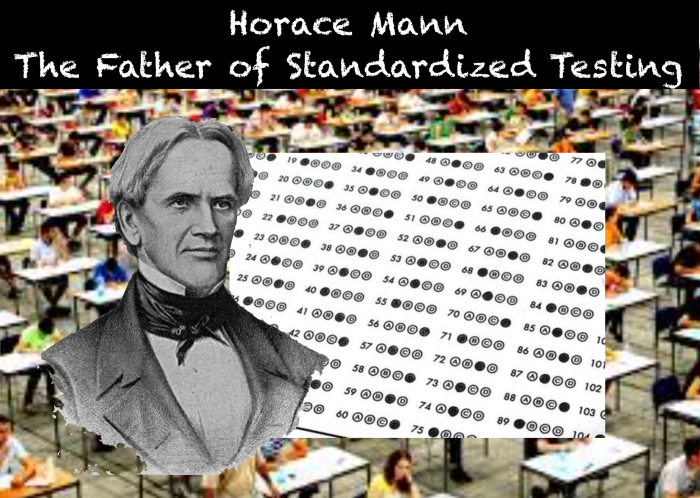
This shift began with standardized testing – an innovation first introduced by a Massachusetts lawyer and legislator named Horace Mann.

HORACE MANN’S TEST


To this day Mann remains a somewhat controversial figure. To some he was a reformer seeking to modernize education. To others he was a self-serving politician looking to increase his own power and that of his party no matter what the cost.


In 1837, Mann was appointed secretary of the newly created State Board of Education. As a member of the Whig Party, he wanted to centralize authority. To do that, he needed to discredit the history of excellence in Boston.


Mann had traveled abroad to see the innovations of European schools and concluded that Prussia’s schools, in particular, were far superior to America’s. His remarks were included in a highly publicized 1844 report that demanded action lest our country’s children be left behind. (Sound familiar?)


When other prominent Whigs including his friend Samuel Gridley Howe were elected to the School Committee and later the examining committee, Mann had everything he needed to make a change.


Howe dispensed with the oral exams in favor of written tests, what today we’d call short-answer exams. Without any warning to teachers or students, this new committee came to Boston’s grammar schools with preprinted questions. Teachers and administrators were furious. Students were terrified.


The examiners picked 530 out of the city’s approximately 7,000 students — allegedly the best below high school age – and made them take the new exams. This was about 20 or 30 children from each school. Students had an hour to write their responses on each subject to questions taken from assigned textbooks -geography, grammar, history, rhetoric, and philosophy.


Most failed.


A contemporary report on the exams concluded that the results “show beyond all doubt, that a large proportion of the scholars in our first classes, boys and girls of 14 or 15 years of age, when called upon to write simple sentences, to express their thoughts on common subjects, without the aid of a dictionary or a master, cannot write, without such errors in grammar, in spelling, and in punctuation.”


Examiners explained in a subsequent report that they had been looking for “positive information, in black and white,” exactly what students had learned. Teachers took no offense at that goal, but complained that the test questions had not pertained to what students had been taught.


Howe and his examiners countered that they had ensured their new assessment was valid with field testing – a practice that modern day corporations like Pearson and Data Recognition Corp. still do today.


Howe’s committee gave the same test in towns outside of Boston, including Roxbury, then a prosperous suburb. In all, the committee tested 31,159 students the previous summer. The result – an average score of 30 percent correct.


However, the wealthy Roxbury students outscored all the other schools. Therefore, they were made the standard of excellence that all other schools were expected to reach.


So when Boston students – all of whom did not have the privileges of Roxbury students – didn’t achieve the same scores, they were deemed failing, inadequate, losers.


Thus Mann could justify criticizing the district, firing teachers and administrators and consolidating control over the city’s schools.

BACKLASH


The result was pandemonium. Howe issued a scathing report lambasting the schools and even naming individual teachers who should be fired. Mann published the results in his influential Common School Journal and these kinds of tests started to appear at urban schools across the country.


However, Bostonians were not all convinced. Editorials were published both for and against the tests.


Every aspect of the exam was disputed – and in similar ways to the testing controversies we still see today.


To start, raising the stakes of the exams invited cheating. One teacher was caught leaking questions to his students before the testing session began.


The assessments also showed a racial achievement gap that far from helping diagnose structural inequalities was instead weaponized against the very people working hardest to help minority students learn. Examiners criticized the head teacher of the segregated Smith School because his African American students had scored particularly low. He was accused of not seeing the potential in black children. Never mind that these students were the most different from the Roxbury standard in terms of culture and privilege.


The tests also began the endless failing schools narrative that has been used by ambitious policymakers and disaster capitalists to get support for risky and unproven policies. Rivalries began between city and suburban schools with Bostonians wondering why their schools had been allowed to get so much worse.


Much of the criticism came back on Mann and Howe who reacted by throwing it back on the teachers for doing such a bad job.


In the end, a few educators were let go, but the voters had had enough of Mann.


Parents accused him of deliberately embarrassing students and in 1848 he was not re-elected to office.


The tests were given again in 1846, but by 1850, Boston had abandoned its strategy and reverted to non-standarized exams that were mostly based on oral presentations.


The experiment deeply disturbed many people. No one could explain why there was a discrepancy between scores of rich vs. poor students. The original justification of these exams was that they would eliminate partiality and treat students fairly and equally. Yet the results showed a racial and economic bias that didn’t escape contemporaries. In 1850 as the tests were being discontinued, the chairman of the examination committee wrote:

“Comparison of schools cannot be just while the subjects of instruction are so differently situated as to fire-side influence, and subjected to the draw-backs inseparable from place of birth, of age, of residence, and many other adverse circumstances.”


And that’s how standardized testing began.


It was a political power play justified by so-called universal testing.


Numbers, charts and graphs were used to mesmerize people into going along with policies that were never meant to help children learn, but instead to gain power for certain policymakers while taking it away from others.

HISTORY OF STANDARDIZED TESTING


In the years that followed, standardized testing became much more efficient. In 1915, the first test was given with multiple-choice questions – Frederick J. Kelly’s Kansas Silent Reading Test. It was roundly criticized and eventually disowned by Kelly for focusing almost exclusively on lower order thinking skills.


Then in the 1920s eugenicists like Robert Yerkes and Carl Brigham went a step further with similar IQ tests to justify privileging upper class whites from lower class immigrants, blacks and Hispanics. Their work was even used to justify the forced sterilization of 60,000 to 70,000 people from groups with low test scores, thus preventing them from “polluting” the gene pool. Ultimately this lead Brigham to create the Scholastic Assessment Test (SAT) to keep such undesirables out of higher education. It is still in wide use today.


It wasn’t until 1938 that Kaplan Inc. was founded to tutor students in these same tests. Stanley Kaplan, son of Jewish immigrants, showed that far from assessing learning, these tests merely assessed students’ ability to take the tests. Thus he was able to provide a gateway to higher education for many Jews and other minorities who had been unfairly excluded because of testing.


In the 1960s black plaintiffs began winning innumerable lawsuits against the testing industry. Perhaps the most famous case is Hobson v. Hansen in 1967, which was filed on behalf of a group of Black students in Washington, DC. The court ruled that the policy of using tests to assign students to tracks was racially biased because the tests were standardized to a White, middle class group.


And then in 2001, President George W. Bush’s No Child Left Behind legislation revved the whole thing up into overdrive. With bipartisan support, he tied federal funding of schools to standardized test performance and annual academic progress – a policy that was only intensified under President Barack Obama who added competitive grants for additional funding based on test performance under Race to the Top.


Since then, standardized testing has grown from a $423 million industry before 2001 to a multi-billion dollar one decades later. If we add in test prep, new text books, software, and consultancy, that figure easily tops the trillion dollar mark.


Despite hundreds of principal, teacher, parent and student protests, tens of thousands of opt outs and a slew of lawsuits, high stakes testing continues to be the law of the land.


Yet the problems today are almost the same as those in Boston nearly two centuries ago.

LEGACY


These tests are political smokescreens used to stop policymakers from having to enact real reforms like equitable funding, wraparound services and addressing the trauma our most impoverished students deal with everyday. Instead, we push a school privatization and testing industry that makes trillions of dollars for corporations at the expense of our children.


“Those who cannot remember the past are condemned to repeat it.”


Here’s hoping that one day we remember and get the heck off this runaway merry-go-round.


Like this post? I’ve written a book, “Gadfly on the Wall: A Public School Teacher Speaks Out on Racism and Reform,” now available from Garn Press. Ten percent of the proceeds go to the Badass Teachers Association. Check it out!
book-1

‘The Diary of Anne Frank’ Has Never Been More Important Than It is Today

thumbnail_maxresdefault


The biggest mistake people make about “The Diary of Anne Frank” is to assume it’s about a little dead girl.


It’s not.


Anne Frank is not dead.


Not in 1945. Not in 2019.


Anne was a Dutch Jew hiding from the Nazis with her family and four others in a loft above her father’s former factory in Amsterdam.


The teenager is the most famous victim of the Holocaust, but her story doesn’t end when she succumbed to typhus in the Bergen-Belsen concentration camp in the closing days of WWII.


Because it’s a story that never ends.


Her physical self may be gone, but her spirit remains.


In the 1990s, she was a Muslim Bosniak child killed by Christian Serbs in the former Yugoslavia.


In the 2000s, she was a Christian Darfuri in Western Sudan killed by Arab militias.


A decade ago, she was a Palestinian toddler torn to pieces on the West Bank – a victim of Israeli bombs.


And, yes, today she is a brown skinned Central American girl fleeing from violence to the United States only to be forcibly separated from her family and thrown in a cage.


Not only is Anne Frank not dead, she is more alive than most people who draw breath, whose hearts still pump blood, whose eyes shrink from the violence, prejudice and hatred all around them.


Perhaps that’s why it is so hard to teach her Diary in my 8th grade class.


It’s not a particularly difficult book.


Her prose is uncomplicated. Her ideas clear.


In fact, she jumps right off the page and into the classroom.


But that’s what makes her so difficult for me, the teacher.


Every year I help bring her to life for my students. And I suffer her loss all over again each time.


I think everyone sees something different in Anne.


My students see themselves in her. Or they see their friends or siblings.


Her problems are their problems. They, too, can feel closer to one parent than another.


They, too, can hate to be compared with a “perfect” sibling.


They, too, feel all the emotions and frustrations of growing up – the confusion, passion and hurt.


For me, though, it is different.


I don’t see Anne primarily as myself. I see her as my daughter. Or perhaps I see my daughter in her.


A precocious child hunched over a book scribbling away her deepest thoughts? Sounds like my precious 10-year-old drawing her comic books, or writing her stories, or acting out melodramas with her dolls and stuffed animals.


I want to take her somewhere safe, to keep her away from the Nazis, to conceal her from all the evil in the world.


After teaching the book for almost a decade and a half, it was only this year that I hit upon a new perspective. I realized that if Anne had survived, she would be almost the same age as my grandmother.


And for a moment, an image of her was almost superimposed over my Grandma Ce Ce. There she was – a physical Anne, a living person. But then it was gone.


When speaking about her to my students, I try to be extremely careful of their feelings. I make it exceedingly clear from the very beginning where her physical life ends.


She and her family are in hiding for 25 months before the Nazis find and send them to concentration camps. Only her father, Otto Frank, is left.


I don’t want any of that to be a surprise.


Yet it is.


Every time.


My classes stare back at me with shocked expressions when we reach the last page.


That can’t be the end. There has to be more.


So we read first hand accounts of Anne in the camp.


But that can’t be all, either. Can it?


So we learn about her legacy – about the Anne Frank House, the Academy Award winning film, and how her book is an international best seller.


Somehow her spirit still refuses to die.


I think it’s because she has become more than just a victim. More even than a single physical person.


We know that 6 million Jews died in the Holocaust. We know that 5 million non-Jews were also killed. But no matter how many documentaries we see, or how many pictures we look at – none of them come alive in quite the same way as Anne.


She is a face for these faceless.


She irreparably humanizes the other.


Once you read her Diary, you can’t forget that smiling little girl whose light was so suddenly snuffed out.


We can go numb at the numbers – the sheer scale of these atrocities.


But with Anne, it becomes something personal.


On Dec. 24, 1943, Anne wrote:


“I sometimes wonder if anyone will ever understand what I mean, if anyone will ever overlook my ingratitude and not worry about whether or not I’m Jewish and merely see me as a teenager badly in need of some good, plain fun.


We see you, Anne.


And because we do, we see beyond you, too.


We see you in the continuing horrors of our age.


Because your death is never in the past tense. It is always present.


Your eyes look out at us through the victims of our day, too.


And your words ring in our ears:


“What is done cannot be undone, but one can prevent it happening again.” (May 7, 1944)


We have not prevented it.


It continues.


Hatred and prejudice and murder echo through our human interactions.


All while the history fades.


According to a 2018 study, only 22 percent of millennials say they’ve even heard of the Holocaust.


I don’t think any of those young adults read your Diary, because my students remember you.


That’s why I’ll never stop teaching your story.


In the vain hope that by remembering you, they’ll see your eyes on the faces of all the future’s would-be victims.


In the vain hope that caring about you will help them care about the faceless strangers, the propagandized others.


In the vain hope that knowing your face will force their eyes to see – actually see – the faces of those who are demonized and dehumanized so someone will care when the boot comes down on their visage.


So that someone will stop the boot from ever coming down again.


In one of her last entries, on July 15, 1944, Anne wrote:


“I must uphold my ideals, for perhaps the time will come when I shall be able to carry them out.”


That time has come for us all.


Anne’s Diary remains to remind us – a clarion call to empathy and action.


Like this post? I’ve written a book, “Gadfly on the Wall: A Public School Teacher Speaks Out on Racism and Reform,” now available from Garn Press. Ten percent of the proceeds go to the Badass Teachers Association. Check it out!
book-4


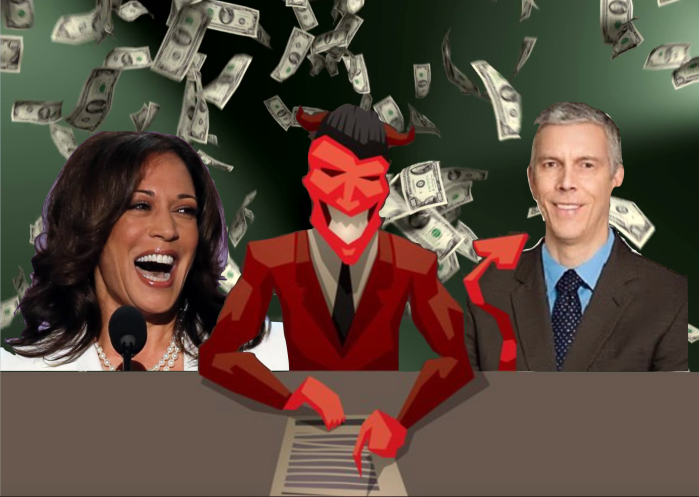
Sell Your Soul to the Testocracy: Kamala Harris’s Faustian Teacher Raises

Screen Shot 2019-03-27 at 7.03.07 PM

 
I love the idea of Kamala Harris’ plan to give teachers a pay raise.
 

But once we get past ideas, it’s way more troubling.


The California Senator and Democratic Presidential hopeful is proposing a $13,500 pay increase for the average teacher, with the exact number based on the size of each state’s pay gap.
 

That’s $315 billion more over a decade through federal matching funds, which amounts to a 23 percent salary increase for most educators.


Yes, please!

 
I could certainly use a raise.
 

But as Joe Moore said, “You can’t trust a promise someone makes while they’re drunk, in love, hungry, or running for office.”

 
And Harris IS running for office.


With this policy she’s wooing the national teachers unions and filling the neoliberal seat left by Hillary Clinton in 2016.

 
I love my union, but its leadership is like a college kid during spring break – ready to jump into bed with anyone who says the right words.
 

The fact of the matter is this plan also is favored by the people out to destroy my profession from the inside out.
 

Arne Duncan likes it.
 

Yes, THAT Arne Duncan!

 
Obama’s first Education Secretary. The guy who thought Hurricane Katrina was the best thing to happen to New Orleans because it allowed the government to close the public schools and replace them with charter schools.

The man who held federal grant money hostage unless schools enacted his unproven and disastrous corporate driven education reforms.


The man who encouraged pushing out teachers of color who had four year education degrees in favor of mostly white Teach for America temps with a few weeks crash course training.


The man who encouraged a rapid increase in high stakes standardized testing, narrowed curriculum, let class sizes balloon and decreased authentic lessons.

 
THAT Arne Duncan wrote this about Harris’ plan on Twitter:


“Radical idea: pay the professionals we entrust to teach, nurture and mentor our children a better salary!”


Screen Shot 2019-03-27 at 7.53.10 PM

 
How to reconcile the two?


I draw your attention to what he said on a recent book tour:


“If we were willing to invest in high-quality early childhood education, if we’re willing to pay great teachers and great principals significantly more, the benefits to our society, the benefits to our economy, the benefits to our democracy I think would be extraordinary…

[But] Money is never enough. So you’ll never hear me say, it’s only about money. For me it’s always about your high expectations as well as high support. And we have to hold ourselves accountable for great results. When schools aren’t working, we have to be willing to challenge the status quo. So investment is part of it, but high expectations have to go with that, and we have to hold ourselves accountable as educators for results, absolutely.”


So for Duncan this plan is entirely consistent with corporate education reform.


In fact, it makes sense as a continuation of those policies.


When privatization cheerleaders like Duncan talk about “high quality teachers” and “accountability” what they really mean are strings attached.


In this case, they probably mean merit pay – giving bonuses to teachers whose students get high test scores.


It’s a terrible idea because it encourages bad behavior from teachers, administrators and districts, which in turn hurts kids.


Having all your teachers fight over the rich white kids who get the highest test scores doesn’t help the struggling students. It just means fewer educators will want to teach the underprivileged because they can’t take the financial hit that comes with it.


The result is test prep all day, every day.


I want a raise, but not if it means I have to bastardize my own profession down to that!


And it’s not just Duncan who loves this idea.


Catherine Brown, a senior fellow at the Center for American Progress (CAP), actually helped Harris write this proposal.


“It could be transformative in terms of how we think about elevating and modernizing the teaching profession and the federal role in doing so,” Brown said.


CAP is a neoliberal think tank that worked closely with the Obama and Clinton administrations. And Brown is also the co-author of “The Progressive Case for Charter Schools”.


Any plan to raise teacher salary that is consistent with increased privatization is inherently suspect.


You can’t champion authentic public schools and public school teachers while also pushing for more institutions run without the same transparency, democratic government, and enrollment standards. If you think schools should be able to cherrypick which students to accept, they should be run by appointed bureaucrats, and it’s fine to cut student services while pocketing the profits, you aren’t a friend of public education.


In an article she co-wrote published by CAP called “Fact Sheet: Yes, Increase the Salaries of All Teachers,” she made it clear that merit pay is a good idea.


She wrote:


“…there is still debate surrounding whether all teachers need a raise, or if it is enough to make changes for a select group of teachers through differentiated or merit-based pay. While differentiated and merit-based pay can help alleviate some specific teacher shortages, such as those in subjects or schools that are high-needs, they are not a substitute for higher base pay.”


Ultimately, Brown comes out in favor of an across the board salary increase for teachers, but in her view merit pay is part of that solution.


This is a backdoor for the same snake oil the privatizaters have been selling for years.


As education blogger Peter Greene points out, the language used in Harris’ proposal is right from the neoliberal playbook. It is full of the same euphemisms and code words that have signaled school privatization, high stakes testing and merit pay.


Consider this gem:


“Every child deserves a world-class education, regardless of their ZIP code. Of all in-school factors that impact their success, there’s nothing more important than our teachers.”


“World class education” and  “regardless of ZIP code” mean charter schools galore. And the only “success” these folks are interested in is high test scores.


Or this:


“Our plan will include a multi-billion dollar investment in programs that help elevate the teaching profession and support principals and other school leaders. This includes high-quality teacher and principal residencies early-career induction programs that pair new teachers with mentors and master teachers, career ladder models that allow for advancement opportunities for teacher leaders, and “Grow Your Own” programs that help increase teacher diversity.”


Greene says that the term “Career ladders” is a red flag because it usually denotes career stagnation. It’s code for adding more duties and responsibilities on teachers without actually furthering their careers.


If I’m honest, these are all red flags.


As much as I want a raise, I’m doubtful Harris’ plan would actually accomplish much other than selling my soul to the testocracy.


Ultimately that’s what this is – a Faustian bargain.


We need to invest in greater per pupil spending and let that translate into higher teacher salaries.


We need equitable and sustainable funding formulas that aren’t tied to testing or that don’t open the door for privatization.


And most of all, we need an understanding of the real challenges in education and not a piece of parchment where teachers are supposed to sign in blood.


Like this post? I’ve written a book, “Gadfly on the Wall: A Public School Teacher Speaks Out on Racism and Reform,” now available from Garn Press. Ten percent of the proceeds go to the Badass Teachers Association. Check it out!
book-1

School Accountability Begins With the People Who Make the Rules: A Code of Conduct for Politicians and Test Makers

thumbnail_Screen Shot 2019-03-18 at 1.17.54 PM


Standardized testing is all about accountability.
 

We’ve got to keep schools accountable for teaching.
 

We’ve got to keep students accountable for learning.

 
It’s kind of a crazy idea when you stop to think about it – as if teachers wouldn’t teach and students wouldn’t learn unless someone was standing over them with a big stick. As if adults got into teaching because they didn’t want to educate kids or children went to school because they had no natural curiosity at all.
 

So we’ve got to threaten them into getting in linestudents, teachers: march!

 
But that’s not even the strangest part. It’s this idea that that is where accountability stops.

 
No one has to keep the state or federal government accountable for providing the proper resources.

 
No one has to keep the testing companies accountable for creating fair and accurate assessments.

 
It’s just teachers and students.
 

So I thought I’d fix that with a “Code of Conduct for Politicians and Test Makers.”

 
After all, that’s what we do when we want to ensure someone is being responsible – we remind them of their responsibilities.
 

You see, the state and federal government are very concerned about cheating.

 
Not the kind of cheating where the super rich pay off lawmakers to rig an accountability system against the poor and minorities. No. Just the kind of cheating where teachers or students try to untie their hands from behind their backs.

 
They’re very concerned about THAT.

 
When you threaten to take away a school’s funding and fire teachers based on test scores, you tend to create an environment that encourages rampant fraud and abuse.

 
So the government requires its public servants to take on-line courses in the ethics of giving standardized tests. We have to sit through canned demonstrations of what we’re allowed to do and what we aren’t allowed to do. And when it’s all over, we have to take a test certifying that we understand.
 

Then after we proctor an exam, we have to sign a statement swearing that we’re abiding by these rules to ensure “test security.”
 

This year, for the first time, I’m supposed to put my initials on the answer sheets of all of my students’ Pennsylvania System of School Assessment (PSSA) tests to prove….  I don’t know. That I was there and if anything went wrong, it’s my fault. Burn the witch. That sort of thing.

 
Even our students have to demonstrate that they’re abiding by the rules. Children as young as five have to mark a bubble on their test signifying that they’ve read and understood the Code of Conduct for Test Takers.
 

I still don’t understand how that’s Constitutional.

 
Forcing children to sign a legal document without representation or even without their parents or guardians present – it sure looks like a violation of their civil rights.
 

But that’s what accountability looks like when you only require certain people to be accountable.

 
So back to my crazy idea.
 

Perhaps the corporate flunkies actually designing and profiting off these tests should be held accountable, too. So should lawmakers requiring all this junk.
 

Maybe they should have to sign a “Code of Conduct for Politicians and Test Makers” modeled after the one the rest of us peons have to use to sign our lives away.
 

Here’s how it might look:


CODE OF CONDUCT FOR POLITICIANS AND TEST MAKERS:


Do…


-Listen to the complaints, concerns and criticisms of parents, teachers and students about the questions and assessments you’re creating.

 
Ask advice from education researchers and all stakeholders to ensure the questions you’re designing are backed up by psychological, neurological, sociological and all associated research on child development.

 
-Read each question you create carefully to ensure it is not simply multiple choice and instead assesses deeper understanding of concepts and skills. Also be sure that all open ended items and writing prompts allow for a multitude of answers and don’t simply ask the test taker to guess what the test maker is thinking.

-Be careful when writing your questions to make sure you have NOT left misspellings or grammatical mistakes in place that would unnecessarily increase confusion for test takers and thereby invalidate the results.

 
Check and double check to make sure you have created a fair and accurate assessment before giving it to students to evaluate their learning.

 
-Report any suspected cheating to a certified watchdog group and the media if you find any evidence or have any suspicion that anyone has created test items purely to enrich the corporation you work for or the privatization-testing-prison industrial complex.

 
-If you’re a lawmaker who’s voted for annual testing, take the assessment annually yourself to prove that it is an adequate test of basic student knowledge of which as a duly elected representative you should clearly pass. Publish your score prominently in the media to prove the test’s efficacy.
 

DO NOT…


-Have notes in your possession from special interests such as (but not limited to) the testing corporations, the publishing industry and/or the ed tech industry before, during or after voting for legislation that promotes the very same standardized testing and testing remediation on which these industries profit.
 

-Have any (approved or otherwise) electronic devises that tabulate previous test questions and prescribe reusing those that have resulted in answer curves consistent with previous tests thereby continuing the trend of selecting against students of color, the poor and other groups and/or subgroups.

 
-Share inside information about the test or previous test questions with anyone that you do not also make freely available to the public. It is not your job to create a remediation market and/or cash in on the testing apparatus you are creating.
 

-Dissuade students from talking with others about  questions after the test. They are human beings with rights. It is perfectly natural for them to talk and harmless for them to do so after a testing session is over.


-Take notes on individuals criticizing or opting out of testing with the purpose of punishing them for their dissent. This is a democratic process and you will welcome discussion, criticism and dissent.
 
-Use the bubbles in the answer booklet for anything at all. In fact, throw them away. It’s 2019. Surely we can find a better way to assess children than multiple choice questions answered by filling in bubbles on a sheet of paper with a number 2 pencil!

 
Conduct an online testing session unless you are 100% positive that the information input by the students and collected about the students is secure, will be secure and cannot be shared with advertisers, corporations or any other entity, and only with a certainty that this data will not be put in any database in a manner that could identify individual test takers or otherwise violate privacy laws.
 
-In fact, you know what? Don’t use standardized tests at all to assess student learning – especially not connected to high stakes. Instead rely on classroom grades and teacher observations for student assessment. Use indexes and audits of school resources to determine whether they are doing their best to teach students and whether lawmakers have done enough to ensure they are receiving fair and equitable resources.


What do you think? Would any of them sign off on this?


Like this post? I’ve written a book, “Gadfly on the Wall: A Public School Teacher Speaks Out on Racism and Reform,” now available from Garn Press. Ten percent of the proceeds go to the Badass Teachers Association. Check it out!

book-2

Who’s Afraid of Public Schools?

Screen Shot 2019-03-15 at 7.51.00 PM


Public schools are the bogeymen of American life.

 
We so often hear the bedtime story of “Failing Schools” that it’s no wonder some folks will do anything to ensure their kids get in elsewhere.

 
And let’s be honest. It’s the same impulse behind the latest college admissions cheating scandal.

 
A group of wealthy – though not too wealthy – parents thought their children should be able to enroll in the most prestigious schools.

 
So they bribed college admissions officers, cheated on standardized tests or paid coaches or other officials to accept their children as college athletes even if their kids had never played the sport.

 
We see the same kind of thing everyday in public schools – a confederacy of white parents terrified that their kids might have to go to class with black kids. So they dip into their stock portfolios to pay for enrollment at a private or parochial school.

 
Or they take advantage of a tax scholarship or school voucher to avoid an institution with low test scores by enrolling in one where students don’t have to take the tests at all.

 
Or they cross their fingers and enter their kid in a lottery to a charter school praying their precious progeny will escape the horrors of being treated just like everyone else’s kids.

 
And they call it a meritocracy!

 
What a joke!

 
They pretend that their children have earned special treatment.

 
WRONG.

 
No child deserves favoritism – paradoxically –  because all children do!

 
There are really two important but related points here:

 
1)  The children of the privileged don’t deserve a better education than anyone else’s.


2)  Children who come from wealthy families (and or from privileged social circumstances) don’t do anything to distinguish themselves from the underprivileged.

 
But these nouveau riche parents tried to bribe the way forward for their kids anyway even though to do so they had to launder the money through a fake “charity.” They didn’t care that doing so would earn them a tax deduction and thus result in even less money for the underprivileged. They didn’t care about the underlying inequalities in the system. No. They only wanted their children to remain in the class of America’s chosen few.

 
And the best way to do that is with cold, hard cash.

 
America doesn’t run on Dunkin. It runs on greenbacks. Dinero. Swag. Bling. The prosperity doctrine made physical, quantifiable and mean.

 
No one really denies that there are two Americas anymore. We just lie to ourselves about how you get placed in one or the other.

 
And that lie is called excellence, quality, worth – the ultimate in class war gaslighting.

 
It’s a deception that this scandal has shattered to pieces.

 
The privileged don’t earn their privilege. It’s not something they possess on the basis of intelligence or hard work shown through test scores. They don’t have it because of drive, determination or grit – once again shown through test scores. They have it based on wealth – the kind of wealth that buys time and resources to either pass the tests or bribe the gatekeepers to change the scores.

 
Think about it.

 
George W. Bush got into Yale and Harvard and graduated with a 2.35 GPA. Why? Not because he had the grades and demonstrated his worth. He was a legacy. Like at least one third of all admissions to Ivy League schools, he got in purely because he had family who graduated from there.

 
You think Donald Trump threatened the College Board not to release his grades because they were all A’s!?

 
According to one account, his scores were merely “respectable.” Yet he still dropped out of the prestigious Fordham University and transferred to the University of Pennsylvania after two years based on family connections and the reputation of his father, Fred Trump, one of the wealthiest businessmen in New York at the time.

 
Moreover, his kids, Don Jr. and Ivanka, were both enrolled at Penn around the same time as their father made hefty contributions. They began classes in 1996 and 2000, respectively, just as the university and its private Manhattan clubhouse received more than $1.4 million in pledged donations from Trump, the school newspaper reported.


This is not merit. This has nothing to do with what these people deserve. It is money – a pure transaction, you scratch my back and I’ll scratch yours.

 
The only thing that separates what the Trumps and the Bushes did with this latest scandal – the so-called Operation Varsity Blues – is the amount of wealth involved.
If you’re super rich, you can get away with it. If you’re just rich, you’d better not get caught.

 
And if you’re poor or middle class, you’d better stay in your lane.

 
But there shouldn’t be any lanes on this highway. Or at least they should only be in place to maximize fairness and student success.

 
We sneer at the idea of Affirmative Action but only because it’s directed at people of color. No one says anything about the real Affirmative Action that’s been in place since before our country even began – the system of reciprocity and privilege keeping wealthy white families in positions of power like Lords and Ladies while the rest of us serfs scramble for their leavings.

 
All children deserve the same opportunities to succeed. All children deserve the chance to get an excellent education. All children should attend a first class school filled with highly educated and experienced teachers who can draw on plenty of resources, wide curriculum, tutoring, counseling and support.

 
And the only way we’ll ever achieve that is through a robust system of public schools.

 
I’m not saying they’re perfect. In many neighborhoods, they’ve been sabotaged and surgically dismantled, but that’s a problem with an easy solution. Invest in public schools!

 
Because the stated purpose of public education, the reason it exists at all, is equity.
The alternatives – private and charter schools – are essentially unequal.  That’s their raison d’êtreto create a market that justifies their existence.

 
In order for charter and private schools to be a thing, there must be schools that don’t otherwise meet students’ needs. There must be an unreasonable demand that schools indoctrinate students into parents’ religious beliefs. There must be schools that aren’t as well funded or that have to meet ridiculous federal and state mandates.

 
The result is a two-tiered system. Schools for the haves and for the have-nots.
It’s an apparatus that perverts the public to make room for the private.

 
In the public system, students are segregated into communities based on race and class and then their community schools are funded based on what their parents can afford. The rich shower their children with the best of everything. The poor do what they can.

 
Then the federal government pretends to hold everyone “accountable” by forcing students to take standardized tests that merely recreate the economic and racial disparities already present in their districts and neighborhoods. In turn, this provides the justification for charter and voucher schools that further erode public school budgets and increases the downward spiral of disinvestment.


Meanwhile, few notice how the equity built into authentic public schools gets left behind by those enrolling in privatized alternatives. No more open meetings. No more elected school boards. No more public comment or even a voice in how the money is spent.
 

So long as there are two Americas, the fear of being in the wrong one will motivate the privileged to cheat and steal their way to the top. They will horde resources and wealth for themselves and their children while denying it to others.

 
It is a self-perpetuating system – a loop that we’re all caught in.
We must break the chain. We must recognize our common humanity and stop the zero sum game.

 
And perhaps the best way to begin is by supporting authentic public schools and not privatization.

 
We have been taught to fear public education, because it is really our only hope.


Like this post? I’ve written a book, “Gadfly on the Wall: A Public School Teacher Speaks Out on Racism and Reform,” now available from Garn Press. Ten percent of the proceeds go to the Badass Teachers Association. Check it out!
book-4

I Assign my Students Homework Despite Scant Research It Does Any Good

thumbnail_Homework_debate-e1445976586714

In academic circles the debate over homework rages on.

Does it actually help students learn or does it just cause undue stress and frustration for children and parents?

As a teacher and a parent, I see both sides of the issue.

In class, I assign my students homework every week – Monday through Thursday. Never on the weekends.

My daughter’s teacher does the same. So at home, I’m on the receiving end, spending hours with my little munchkin helping her get through mountains of assignments for her classes the next day.

Perhaps this is what they mean by the proverb – you reap what you sow. Except my daughter isn’t doing the homework I assigned. She isn’t in my class and we don’t even live in the district where I teach.

But it sometimes does feel like payback plodding through seemingly endless elementary worksheets, spelling words and vocabulary.

After a while, even I begin to question whether any of this junk does any good.

As a teacher, I know the research on the subject provides slim support at best.

In fact, the closest we have ever come to an answer is a reformulation of the question.

It really comes down to a matter of causality – a chicken and the egg conundrum with a side of sharpened pencil and crumpled paper.

If we look really hard, we can find a correlation between students who do their homework and those who get good grades.

The problem is we can’t PROVE it’s the homework that’s causing the grades.

It could just be that kids who excel academically also happen to do their homework. If we removed the homework, these kids might still get good grades.

So which comes first – the homework or the grades?

There has been surprisingly little research that goes this deep. And almost all of it is anecdotal.

Even the investigations that found a correlation did so in tight parameters – only in secondary grades and usually just for math.

Some wealthy districts have even reduced the amount of homework without seeing a subsequent drop in learning.

But nothing has been tested across socioeconomic divides or with any consistency and very little has been proven definitively.

This doesn’t mean that there’s no consensus on the matter.

Both the National Education Association (NEA) and the National Parent Teacher Association (NPTA) suggest educators assign no more than a standard of “10 minutes of homework per grade level” per night.

In other words, a first grader should have no more than 10 minutes of homework on a given evening, a second grader no more than 20 minutes, etc.

However, it appears that students – especially in the primary grades – are getting more work than these recommended maximums.

A 2015 study published in The American Journal of Family Therapy surveyed more than 1,100 Rhode Island parents with school age children.

Researchers found that first and second graders received 28 and 29 minutes of homework per night – almost double the recommended maximums. Even more shocking, Kindergarteners – who according to the guideline should receive no homework at all – actually were assigned an average of 25 minutes per night.

That’s a lot of extra time sitting and slogging through practice problems instead of spending time with friends or family.

Though I live in western Pennsylvania, this study is certainly consistent with what I see in my own home. My daughter is in 4th grade but has been assigned between 30 minutes and two hours of homework almost every weekday since she was in Kindergarten.

It’s one of the reasons I try to abide by the guidelines religiously in my own classroom. I give about an hours worth of homework every week – 15 minutes per day for four days. If you add in cumulative assignments like book reports, that number may go up slightly but not beyond the recommended maximums.

I teach 8th graders, so they should not be receiving more than 80 minutes of homework a night. If the teachers in the other three core classes give the same amount of homework as I do, we’d still be below the maximum.

I’m well aware that the consequences of giving too much homework can be severe.

A 2014 Stanford study published in the Journal of Experimental Education found that giving too much homework can have extremely damaging effects on children.

Still this isn’t exactly hard science.

The researchers used survey data to examine perceptions about homework, student well-being and behavioral engagement in a sample of 4,317 students from 10 high-performing high schools in upper-middle-class California neighborhoods. They also used open-ended answers to gauge the students’ views on homework.

They concluded that too much homework was associated with greater stress, reductions in health, and less quality time with friends and family.

So where does that leave us?

We have anecdotal evidence that excessive homework is harmful. And limited evidence that homework may increase academic outcomes in the higher grades in math.

Frankly, if that was all I had to go on, I would never assign another piece of homework ever again.

But I’m a classroom teacher. I don’t have to rely solely on psychological and sociological studies. Everyday in school is an opportunity for action research.

My classroom is a laboratory. I am a scientist. Nearly every decision I make is based on empiricism, hypothesis and testing the results.

Maybe X will help students understand Y – that sort of thing.

This applies to homework, too.

I’ve had more than 15 years to test what works with my students. I’m not saying my results would necessarily be reproducible everywhere, but they’re at least as scientific as the body of research we have on homework. In fact, within these parameters they’re even more rigorous.

So why do I give homework?

For several reasons:

1)  It prepares students for the higher grades.

Most of my career has been spent in the middle school teaching 7th and 8th grade. In my district, high school teachers give a lot of homework. I need my students to get used to that rhythm – homework being assigned and handed in – so that they’ll have a chance at being successful in the upper secondary grades. Too many students go no further academically than 9th grade. Giving homework is my way to help provide the skills necessary to avoid that pitfall.

However, this isn’t a sufficient reason to give homework all by itself. If high school teachers stopped assigning it – and maybe they should if we have no further reason to do so – then I’d have no reason to assign it either.

2)  It makes kids responsible.

There’s something to be said for getting kids used to deadlines. You need to know what work you’re responsible for turning in, getting it done on your own and then handing it in on time. This is an important skill that I won’t apologize for reinforcing. I’m well aware that some students have extended support systems at home that can help them get their assignments done and done correctly, but I design the work so that even if they aren’t so privileged, it should be easily accessible on an individual level. Plus I’m available, myself, as a resource if necessary.

3)  It’s good practice.

In school, we learn. At home, we practice. That pattern is necessary to reinforce almost any skill acquisition. I know it’s trendy to flip the classroom a la Khan Academy with learning done through videos watched on-line at home and practice done in school. But when Internet access in not guaranteed, and home environments often are the least stable places in my students’ lives, it makes little sense to try to move the most essential part of the lesson outside of the classroom. After all, it’s easier to find a place to do some low tech practice than it is to find space, silence and infrastructure for high tech learning.

Don’t get me wrong. We practice in school, too. But there’s only so many hours in the school day. I use homework in my language arts classes for a few select things: increased vocabulary, word manipulation, grammar, self-selected reading and the ability to do work on your own. I think it’s important for my students to increase their vocabularies. Having kids read a self-selected book (both inside and outside of class) helps do that. It’s also a benefit to be able to play with words and language, find words in a puzzle, recognize synonyms and antonyms, etc. Grammar may not be essential, but a rough knowledge of it is certainly useful to increase recognition of context clues and better writing skills. Finally, some students benefit from the simple opportunity to do an assignment by themselves without an adult or even a peer looking over their shoulder.

That being said, I think it is important that the homework I give be seen as something students can achieve.

I’ve had numerous co-workers tell me they don’t assign homework for the simple reason that their students won’t do it.

This isn’t a big problem in my class. Almost all of my students do the homework. Why? Because we go over it and they know it’s something they can do without too much difficulty.

I scaffold assignments building the difficulty progressively as we proceed through the year (or years). I make myself available for extra help. I accept late work (with a penalty).

And most of all – I stress that I’m not expecting anyone to be a genius. I’m looking for hard work.

I tell my students explicitly that anyone who puts in their best effort will pass my class – probably with a B or an A. And that’s exactly what happens.

Homework is a part of that equation. It demonstrates effort. And effort is the first step (the key, in fact) to accomplishment.

Do students complain about the homework?

Sure! They’re children!

I’d probably complain, too, if I were them. No one really wants to be given extra work to do. But it’s all part of the pattern of my classroom.

Students know what to expect and how to meet those expectations.

None of this makes me a super teacher. It certainly doesn’t put me on anyone’s cutting edge.

I’m just doing what educators have done for decades. I’m attempting to use best practices in my classroom with a full knowledge of the academic research and the pitfalls ahead.

I may assign homework, but I made sure to do my own before coming to that decision.


Still can’t get enough Gadfly? I’ve written a book, “Gadfly on the Wall: A Public School Teacher Speaks Out on Racism and Reform,” now available from Garn Press. Ten percent of the proceeds go to the Badass Teachers Association. Check it out!

book-3