You want to guarantee every student has access to technical and vocational courses and make sure every school building has at least one dedicated mental health counselor on staff. Outstanding!
It does not mean tax dollars going to private and parochial schools. It does not mean our money going to institutions where we get no say in how it’s spent. It does not mean circumventing duly elected school boards. It does not mean the public paying for religious indoctrination or the kind of right wing biased education routinely provided at private schools.
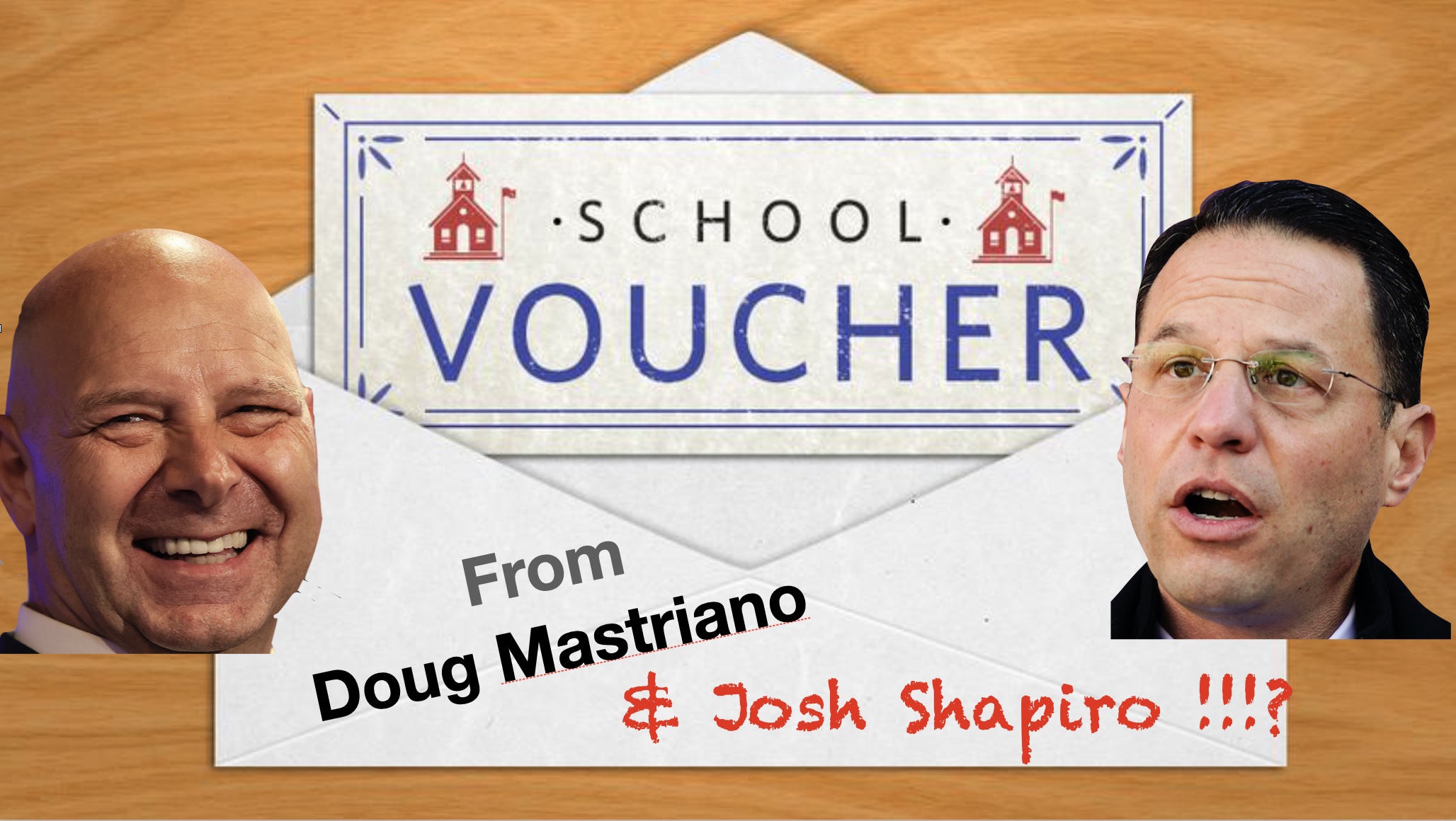
This doesn’t sound like the candidate teachers like me have been backing since before this election cycle began. Frankly, it’s almost what your gubernatorial opponent, MAGA Republican Doug Mastriano, champions.
Mastriano – a Trump insurrectionist – says he wants to use state education funding to give EVERY student a school voucher they can use at almost any school in the Commonwealth – public, private or parochial.
You seem to want vouchers ONLY for students at the most underfunded and struggling schools.
Josh favors adding choices for parents and educational opportunity for students and funding lifeline scholarships like those approved in other states and introduced in Pennsylvania.
“And I’m for making sure we add scholarships like lifeline scholarships to make sure that that’s additive to their education. That it gives them other opportunities…to be able to help them achieve success”
These so-called Lifeline Scholarships are a Republican lead measure to give direct-to-student tax-funded scholarships that parents and guardians in the state’s most neglected public schools could use for a variety of options including going toward tuition at a different school.
It would affect about 191,000 students in 382 schools, across 76 of the state’s 500 school districts. However, Two-thirds of the cost of the program (63.1%) is born by four districts – Philadelphia (43.9%), Reading (8.9%), Allentown (5.8%) and Pittsburgh (4.5%).
This would create another taxpayer funded system of education. Affected districts would lose so much funding it would ultimately force them to reduce programs, services, and staffing and/or raise property taxes to compensate.
Your opponent is perhaps the most odious person to ever run for Governor in the state. He looks to usher in an era of theocratic fascism, curtail human rights and take the Commonwealth back to the Middle Ages.
But that doesn’t mean you should run closer to his positions in the vain hope of stealing some of his base.
Pennsylvanians can’t afford losing their only chance at self rule because of demoralization and despair at a candidate too weak to support the platform he began this campaign on – championing public education.
I urge you to reconsider this flirtation with Republican values and school vouchers.
I hope you are better than this.
We deserve a governor who is better than this.
Please have the courage to stand by authentic public schools.
Like this post? You might want to consider becoming a Patreon subscriber. This helps me continue to keep the blog going and get on with this difficult and challenging work.
I talk about frequent scandals where unscrupulous charter school operators use copious loopholes in state law to enrich themselves without providing services to parents, students and the community…
Not MY charter school! Not MY charter school! Not MY…
Really!?
If the industry is subject to this much malfeasance and corruption, doesn’t that reflect badly on the entire educational model – even the examples that avoid the worst of it?
One model has daily scandals. The other – authentic public schools – is far from perfect but relatively tame by comparison. You can’t blame people for generalizing.
Yes, there were colonies where the invaders treated the conquered with more respect and dignity than others.
But not a single colony was a good thing. Not a single colonial enterprise avoided subjugating people who should have been free to determine their own destinies.
So without even examining exactly which special rules are stipulated in that charter, these schools are founded on the very concept of privilege.
They get to abide by their own rules tailor-made just for them.
Why does that matter? Because they get public funding.
And, yes, ALL charter schools are publicly funded – they get at least part of their money from taxpayers, usually all or the majority of their funding.
On the one hand, authentic public schools are publicly funded but required by law to be run by elected members of the public. You pay your taxes and you get a say in how those taxes are spent.
It’s a common feature of most charter agreements and often exploited.
You pay taxes and have no say in how that money is spent at these charter schools.
Parents of students enrolled in the school can vote with their feet and remove their kids if they don’t like the direction the school is taking. But the overwhelming majority of taxpayers don’t have kids in the charter school – they might not have kids at all. But their money is still being collected and their voice is silenced.
That is fundamentally unjust.
In fact, it’s one of the main reasons given for the American colonies fighting a war with Great Britain. No taxation without representation.
And most charter schools are guilty of it.
But not all!
There are charter schools run by elected school boards. They either choose this management system though it is not required by their charter or their charter explicitly requires it – like any other taxpayer funded school.
Does this excuse these charter schools from the same inequities as their more privileged brethren?
No.
And this is an important point.
How does a charter school open in the first place?
Most authentic public schools were started many years ago by the communities where they operate.
Community members got together, agreed they needed a school, elected board members to manage it, collected tax money, etc.
Charter schools are much newer inventions that come about differently.
Instead of starting with a community, they start with a charter operator. This could be a single individual, a group, an organization or a corporation.
The operator then goes to the state, community or usually school district where they propose to open the charter (it depends on the state charter law) and puts forward a proposal. Then the state, community or board decides to approve or deny that proposal.
However, nearly every charter school law does not give local communities an unlimited right of refusal. After all, if they did, there would be hardly any charter schools in existence.
Think about it.
When an authentic public school district decides to open a charter school inside its borders, it is agreeing to give a portion of the tax dollars it already receives to the charter school. It is agreeing to run its existing schools on less money so the charter can open up.
Why would any authentic public school do this? Only if it saw a real need for a new school and did not want to open a new school, itself. That’s a pretty rare situation.
However, nearly every charter school law gives very narrow reasons that new charter applications can be refused. So most of the time, the district has no choice but to approve these proposals. And if a district does refuse, the matter often goes to a state charter approval board which almost always reverses the decision. The community says no – state functionaries say yes.
So even when one of these so-called good charter schools managed by an elected school board opens up, it does so by overruling the decisions of the community it serves.
Charter schools create burdens for their communities. They siphon tax dollars from the existent public schools without reducing costs by much at all. So the authentic public school board is forced to make a hard decision – cut services for students and run with their reduced tax revenue or increase taxes to make up the difference.
Charter schools equal higher taxes in districts that can afford it and a reduction in educational quality in those districts that can’t.
This is a situation the community did not ask for. The community did not demand a new charter school. A handful of charter operators did to enroll a handful of students.
And if anyone does find a yellowed document for one of these schools labeled “charter,” best to tear it up. You don’t need it since your charter school has no need of special agreements.
Keep in mind, this is long before we get into the specifics of how charter schools can (and often do) exploit children and communities.
If the very existence of your school is predicated on the existence of a charter agreement, that is inequitable.
It does not need to follow all of the rules that authentic public schools must.
These are rules about being accountable for how you spend tax dollars, having minimum academic standards, hiring qualified staff, etc.
If there really are some rules that charter schools should be freed from obeying, why not just free all taxpayer funded schools from these rules? You don’t need a special agreement. You need to renegotiate the state school code.
Otherwise, this is giving special treatment to some schools rather than others.
That is the point.
Charter schools – ALL CHARTER SCHOOLS – are inequitable by definition and design.
And no amount of defensiveness will avoid this truth.
Like this post? You might want to consider becoming a Patreon subscriber. This helps me continue to keep the blog going and get on with this difficult and challenging work.
To many people, Queen Elizabeth II is more than just a 70-year figure head – she remains a symbol of the British colonial empire — an institution that enriched itself through violence, theft and oppression.
But one needn’t look solely at European nations pillaging Africa and Asia to condemn the practice.
We’ve got colonialism right here – down the street, in our own neighborhoods.
According to the Oxford English Dictionary, colonialism is:
“the policy or practice of acquiring full or partial political control over another country, occupying it with settlers, and exploiting it economically.”
That’s a pretty good description of the relationship between charter schools and the communities where they insert themselves.
Consider what a charter school does.
It is a school funded by taxpayer dollars but free from regulations protecting the people it supposedly serves.
This is fundamentally different from authentic public schools which are funded in the same way but subject to the leadership of an elected board of directors made up of members of the community. At charter schools, decisions can be made entirely by an appointed board who are not beholden to the public but to the organizers and investors who created the charter school in the first place.
To be fair, a charter school cannot exist in a community unless its operators can convince enough parents to enroll their children. However, no one needs to invite the charter school into the community in the first place.
Like with any business, these entrepreneurs can decide to set up shop pretty much anywhere, and though local public schools are tasked with approving or disapproving their request to locate within district boundaries, most state charter school laws provide very few resources to authentic public schools to turn charter schools away. Moreover, when charter applications are denied, the community that turned them away are often overruled by unelected privatization-friendly functionaries in state government.
Think about what a transformation has been thus accomplished.
Stakeholders such as students, families, teachers, and communities become merely economic resources ripe for hegemony – not free people with the right to control their own destinies.
After all, just because a small number of parents have decided to enroll their kids at a charter school, that doesn’t mean the community at large – which is far more numerous and will have to fund this endeavor – supports it. Moreover, the money taxpayers are expected to offload on the charter school come from their existent public schools – and the slight reduction in students does not equal a proportionate reduction in cost. Most expenses are fixed regardless of enrollment. You still have to heat and cool the building, staff the classes, etc. So the community has to decide whether to shortchange the majority of children who continue to be enrolled at the authentic public school or (as often is the case) pay more in taxes to make up the difference.
Make no mistake – this is theft. It is pillaging and looting a community. The citizens lose their right to self government, how their land is used and how their resources are utilized. They become enslaved to the so-called free market.
Perhaps the most pernicious effect is the change in attitude, as Ohio social studies teacher Dr. Chuck Greanoff writes:
“Our minds are targets of colonization, the goal being the replacement of any sense of a common good and shared responsibly with the neoliberal axiom that economic self-interest is the only right and natural course of action. You are to think like consumers, not citizens. You are to shop for the best schools for your student, not invest your time and effort in improving them for everyone.”
Others have gone even farther finding racism in the daily administration of charter schools, themselves. After all, many charter schools locate themselves around inner city black communities and therefore exploit the children of color they find there.
Bloggers Russ Walsh and Jonathan Pelto noted how similarly both colonialists and charter school operators often treat the people in the communities where they are located.
Colonialism is often white Europeans acting on brown indigenous people. The colonizers are going to “raise those savages up” or in the words of noted imperialist Rudyard Kipling, ease the “white man’s burden.”
Walsh notes that we see the same apparent motivation among charter school operators with regard to the often black and brown children enrolled in their schools. They use militaristic, highly autocratic systems of discipline to keep these children in-line.
“The children of the inner city are being treated by their “benefactors” as inferiors. Charter schools are colonial enterprises.”
However, the most damning testimony comes from Julian Vasquez Heilig’s Cloaking Inequality blog. He published a guest piece written by a former New Orleans charter school dean of students decrying just such colonial practices.
“…while working as the Dean of Students for a charter school in New Orleans, it took me some time to realize that I had been enforcing rules and policies that stymied creativity, culture and student voice…
My daily routine consisted of running around chasing young Black ladies to see if their nails were polished, or if they added a different color streak to their hair, or following young men to make sure that their hair wasn’t styled naturally as students were not able to wear their hair in uncombed afro styles. None of which had anything to do with teaching and learning, but administration was keen on making sure that before Black students entered the classroom that they looked “appropriate” for learning. As if students whose hair was natural or those whose parents could not afford a uniform tie could not achieve like others who possessed these items…
…everything at the school was done in a militaristic/prison fashion. Students had to walk in lines everywhere they went, including to class and the cafeteria. The behavioral norms and expectations called for all students to stand in unison with their hands to their sides, facing forward, silent until given further instruction.”
Students should not be treated like prisoners. Children should not be forced to comply with such harsh rules of conduct. And no one should be compelled to give up their cultural heritage for any reason – but especially because those in charge don’t value them as human beings.
It’s way past time we admit it.
This is colonialism.
Charter schools are colonial enterprises.
We can and should criticize the UK for its history of violence and oppression. We can and should include many US international policies in the same condemnation.
But we mustn’t stop there.
Colonialism is on our streets and in our schools.
We have been colonized by the rich and powerful and our children of color have received the worst of it.
We must end the charter school experiment.
We must end the neighborhood colonialism that too few are willing to call by its rightful name.
-Vasquez Heilig, J., Khalifa, M., & Tillman, L. (2013). Why have NCLB and high-stakes reforms failed?: Reframing the discourse with a post-colonial lens. In K. Lomotey and R. Milner (Eds.), Handbook of Urban Education. New York: Routledge.
Like this post? You might want to consider becoming a Patreon subscriber. This helps me continue to keep the blog going and get on with this difficult and challenging work.
Honestly, I don’t know how we’d cram all the desks in the room. I can barely fit 15 in there now.
Where would we put the books, computers and cabinets? The students, alone, would be wall-to-wall.
Just imagine that many middle school kids stuffed into the room arguing about who’s touching who and which classmate stole their pencil or book. Not to mention the children striving to get my attention to solve disputes, get help with classwork, ask permission to use the bathroom – and a thousand other issues!
For example, there’s no way we could afford a school nurse at each building like we have today. We’d be lucky to have one nurse for all four buildings in the district – elementary schools, middle schools and the high school. If a student feels sick, there’s not much I could do except send the child to the office to try to call home and get a parent or guardian to pick the kid up early. And if the parents can’t make it, just let the kid put his or her head down?
What if the issue’s more psychological? There might be a school counselor somewhere in the district so a student can talk out an issue he or she is having – perhaps conflict resolution with a former friend, discuss peer pressure to try drugs or maybe deal with suicidal thoughts. But there’s probably a long waiting list to see this mythical counselor. Hopefully, the problem is not too urgent.
I feel especially bad for the special education students. Aides would be almost non-existent so many kids with special needs would have to struggle through issues with which we’d normally help them. All the individual Education Plans (IEPs) would have to be rewritten to take this new normal into account.
Even lunch would be disrupted. After all, there would be fewer cafeteria workers so it would be harder just to cook a hot meal and make sure it gets onto a tray in time for students to eat it.
There’s no doubt about it.
My classroom would be very different if Mastriano wins the gubernatorial election in November.
At my district of Steel Valley in Munhall on the western side of the Commonwealth, the situation probably would be much like I described.
I can’t imagine how any teacher could adequately tend to double the students, but I might not have to imagine it.
I’d probably be laid off.
More than half of Steel Valley’s staff would be out of a job – 92 of our current 172 school nurses, counselors, aides, cafeteria workers and teachers would be looking for work.
And that’s just where I’m employed.
Things would be even worse for my daughter where she attends McKeesport Area School District.
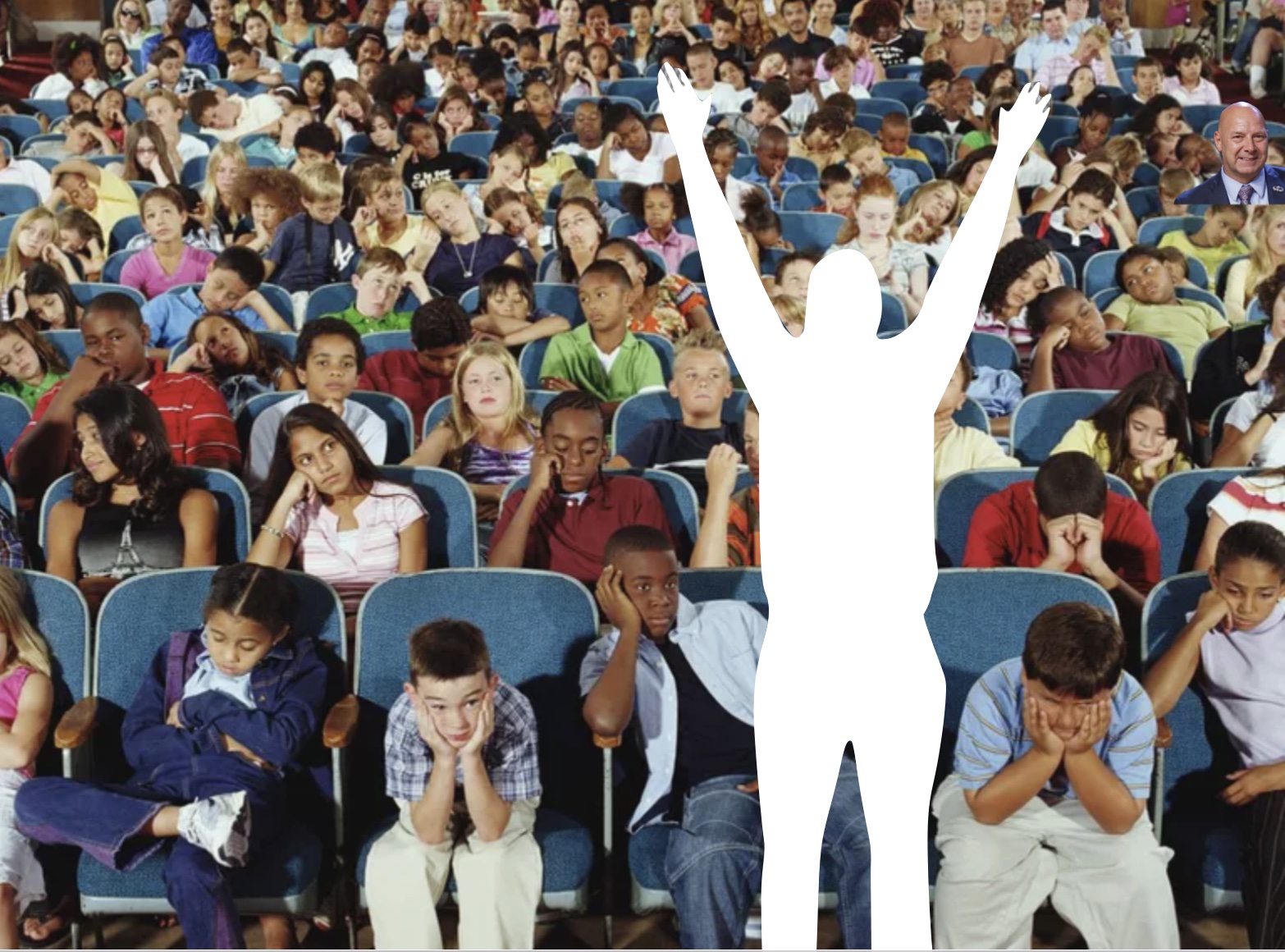
According to PSEA estimates, the nearby McKeesport district would lose 281 of 521 staff – a 54% reduction. Classes would go from an average of 17 students to an average of 46. That’s an increase of 29 students per class!
How can she learn in that kind of environment!? She isn’t in college yet. She isn’t in some University of Pittsburgh survey class that meets in an auditorium. She’s in middle school!
But it would be pretty similar at public schools, charter schools, career and technical centers and intermediate units across the state.
From one side of the Commonwealth to the other, we’d go from 239,902 staff to 121,198. Class size would go from an average of 16 students per class to 33. That’s an increase of 17 students per class or 109%.
Like so many wannabe big time policymakers, he is very light on the details of how we would educate the state’s 1.7 million students. This whole proposal was just something he blurted out during a March 2022 WRTA radio interview.
It’s his plan to completely eliminate local school property taxes. Funding would be provided directly to parents via “Education Opportunity Accounts,” and families could then decide whether they want a public, private, charter or home school option.
To go from a statewide average funding level of $19,000 a student to $9,000 a student requires a cut of $17.6 billion, or 53%.
But if the remainder isn’t being paid by property taxes, that’s a roughly $15.3 billion a year expenditure by the state that used to be paid by local property taxes. Where is he getting that money from? And if the state can afford to pay that much, why not just pay the full $19,000 per student and make none of these unnecessary cuts? Or why not just pay half and reduce property taxes by that much? Mastriano is not exactly forthcoming on any of this.
PSEA admits that to come up with its own estimates of the damage the organization filled in a few details. The union assumes the state would fully fund the $9,000-per-student voucher and leave other local non-property taxes and federal revenues untouched.
That might not happen. We could be looking at an even more draconian situation.
The biggest question the PSEA is sidestepping is the impact of allowing taxpayer dollars to fund so many different types of schooling.
Even under Mastriano’s plan, nontraditional educational providers like charter schools would suffer because like traditional public schools they would be receiving less funding from the state than they do now. And parents using their vouchers to pay for private schools for their children would still have to make up a pretty big gap between the amount of the voucher and the cost of private school tuition.
However, since traditional public schools serve the overwhelming majority of the state’s students, they would take the biggest hit financially. If more parents use their voucher to pay for private, charter or home schools, that’s less funding for our public school system. That means even greater cuts to student services and more staff layoffs.
Moreover, what if parents use the voucher for a fly-by-night educational option that doesn’t meet it’s obligations?
And when it comes to charter schools that took federal funding, 12% never even opened. They just gobbled up the cash with nothing to show for it.
What will happen to students whose parents lose their vouchers in schools like these? Who will pay for these kids to be educated? Or will they have to go without?
The books are riddled with counter factual claims and political bias in every subject imaginable such as abortion, gay rights and the Endangered Species Act, which one labels a “radical social agenda.” They disparage religions other than Protestant Christianity and cultures other than those descended from White Europeans.
If someone wants to pay for such an education out of their own pocket, that’s one thing. But to ask taxpayers to fund such propaganda is something else entirely!
Thankfully, Pennsylvania voters don’t have to accept this. Not yet anyway.
There are still more than three months before the election. Voters can choose the Democratic gubernatorial candidate Josh Shapiro. He has promised to INCREASE education funding and not just blow up the whole system.
To see an interactive map of how Mastriano’s education cuts would affect your school district, click here.
For now this is only a bad dream. We still have time to wake up and vote accordingly.
Students should not have to submerge themselves in a sea of classmates and hope the teacher will have time to educate them.
We should invest in education, not sell off our future for a fast buck today.
Like this post? You might want to consider becoming a Patreon subscriber. This helps me continue to keep the blog going and get on with this difficult and challenging work.
What do QAnon conspiracy theorists and school privatization promoters have in common?
Answer: ideology.
The two groups do everything they can to disassociate with each other in public.
But examine their ideas and you’ll see a lot of family resemblances.
For example, take Great Replacement Theory and School Choice.
Great Replacement Theory is the idea that people of color are replacing white people both numerically and politically. Adherents claim Democrats are overrunning native-born white people with brown skinned immigrants in order to wrest political power. The claims have no basis in fact, but that doesn’t stop the narrative from gaining traction in the darkest corners of the Internet and right wing circles.
It is a favorite of far right pundits, immigration catastrophists and mass shooters. In fact, several white men have used it as justification for mass murder.
School choice, on the other hand, seems to be something much less extreme.
At least you don’t have to be a card carrying member of the lunatic fringe to espouse its supposed virtues.
It’s the idea that kids should be segregated into different school systems based on parental choice. This means that parallel systems will compete for students in a Darwinian marketplace where some will get better resources than others with profit being the prime motivator for school operators most of whom are private corporations. In practice, this usually means that the worst racial and economic segregation is justified and even preferable so long as consumers think doing so will get them some kind of advantage.
It’s quite a popular idea among certain market first ideologues. This includes both Democrats and Republicans, investment bankers, and even some social justice advocates.
Carlson has used his media empire to promote both ideas.
For more than a year he’s been claiming on Fox News that there’s a deliberate effort by the Democrats to undermine Republicans by replacing native-born Americans with immigrants.
“You can’t just replace the electorate because you didn’t like the last election outcomes. That would be the definition of undermining democracy, changing the voters… The great replacement. It’s not a conspiracy theory. It’s their electoral strategy.”
And when it comes to school choice, he goes even further. Not only has he promoted it on Fox News, he is co-founder and editor-in-chief of The Daily Caller, a media source that constantly promotes school privatization and other corporate education reform strategies – school vouchers, charter schools, etc.
So what do the two concepts have in common?
In short: racism and white supremacy.
Great Replacement Theory is a kind of grievance politics complaining about the steady loss of white privilege.
School choice is an attempt to recapture or maintain white privilege at the educational level and by extension into the adult economic and political world.
Great Replacement Theory has its roots in French nationalism books dating back to the early 1900s, according to the Anti-Defamation League (ADL).
Chief among these is French Author, Jean Raspail, whose 1973 novel, The Camp of the Saints, told a fictional tale of migrants banding together to take over France. However, the concept’s more contemporary use is attributed to Renaud Camus, a French writer who wrote “Le Grand Remplacement” (“The Great Replacement”) in 2011.
White supremacists blame Jewish people for nonwhite immigration to the U.S., and the concept is closely associated with antisemitism, according to the ADL.
Belk said white nationalists are worried that, “whites will no longer be a majority of the general population, but a plurality, and see that as a threat to their own well-being and the well-being of the nation.”
What makes individual extremists and white nationalist groups so dangerous, according to Belk, are the lengths they are willing to go to in order protect their position in society:
“They are willing to use any means that are available to preserve and defend their position in society … it’s almost like a sort of holy war, a conflict, where they see themselves as taking the action directly to the offending culture and people by eliminating them.”
By contrast, school choice is a quieter ideology, but based on similar foundations.
And we see the same in charter schools and private schools accepting taxpayer funded vouchers today. The prime motivation behind sending children to these schools is often “white flight”. White parents use these options to flee schools with higher percentages of non-white students. And choice options tend to lure the more motivated and compliant students away from public schools.
This isn’t to say that the authentic public school system is unequivocally integrated, either. While there has been tremendous progress in many districts, unscrupulous school boards, administrators and lawmakers have drawn district lines in such a way as to limit integration even in a substantial number of public schools. However, the degree of segregation at privatized schools dwarfs anything you’ll see in public education.
We see the same effect with school vouchers. A 2018 study of Washington, D.C.’s voucher program found that 70% of voucher students were enrolled in heavily segregated schools with 90% or more minority students, and 58% were enrolled in all-minority schools.
So both concepts – Great Replacement Theory and school choice – center around increasing white supremacy.
Both seek to shore up white political and economic power regardless of white people’s numeric majority. In fact, as white people become less of the majority – not through any importing of people of color from other nations but as a natural consequence of birth rates – they seek to disempower people of color.
“America preaches integration and practices segregation.”
The question remains whether voters will support such artifacts of the past or turn to a future where our ideals of equality and fairness triumph over our reality of inequality and injustice.
QAnon and school privatization may share a family resemblance, but it is up to us whether we reject that family or not.
Like this post? You might want to consider becoming a Patreon subscriber. This helps me continue to keep the blog going and get on with this difficult and challenging work.
However, after months of controversy over the legality of the move, at last night’s special meeting, the board voted to let him go FOR REAL.
Holtzman has accepted a new position at Beaver Area School District, approximately 50 miles northwest of McKeesport.
His last day is June 30. Assistant Superintendent Dr. Tia Wanzo will serve as Acting Superintendent immediately upon his departure.
The controversy stems from a move last year by the outgoing board to retain Hotlzman in McKeesport when he had been poised to accept a new superintendents position at Kiski Area School District. He resigned and was rehired at MASD in order to secure him a new contract with a competitive salary and years of service.
But this didn’t sit well with three board members (Steven Kondrosky, James Brown and Mindy Sturgess) who walked out of the meeting before it was officially called to order.
Lawyer William C. Andrews wrote a letter stating that the measure could be viewed as circumventing the intent of the Pennsylvania school code. The law does not allow such contracts to be extended with more than a year left before they expire. Holtzman still had two years left on his contract.
Holtzman’s own legal council, Mark E. Scott, wrote that the move was, in fact, legal and that it was common practice at other districts.
At a February board meeting where letters from both lawyers were read into the record, Holtzman offered to resign, then and there:
“I will clearly state if they want me to move on, and I’ve said it to them in private, I want a year’s salary and benefits and I will resign tonight. This witch hunt and issue is over, overdone, overstated and we need to move on and once I’m compensated for my attorney fees.”
At the time, it was unclear whether the board could move forward with Holtzman at the head of the district or not.
Apparently Holtzman couldn’t continue to work with them.
A mere three months later, he put in his current resignation.
Holtzman’s tenure at McKeesport was fraught with controversy from the beginning.
Before this, he had been dean of discipline at McKeesport’s vocational department for two years before taking a similar role at West Mifflin Area High School. However, he was mostly known in MASD for his years on the high school football team when he had been a student there (he graduated in 1997) and then at Syracuse University.
His family also had a close relationship with one of the most controversial figures in the Mon-Valley, Pat Risha. The late Risha, who had been a superintendent, himself, at McKeesport, West Mifflin and South Allegheny districts, could have opened many doors, and was heralded as a “power broker” in his obituary.
The district offered a cyber option for students whose parents wanted to keep them safely at home during the worst of the pandemic. Many districts were able to provide live teachers from the child’s grade level to instruct through on-line services like Zoom. However, MASD used the corporate Edmentum program to provide academics. The problem is it wasn’t created for that purpose. It was created for credit recovery, not robust academics. As a result, the district cyber program was developmentally inappropriate, and full of typos and inaccuracies.
Holtzman blamed the problem on a contract with bus company, PA Coach Lines, which didn’t have enough drivers and would cancel the routes just hours before the buses were set to arrive.
The district had to go to court to break the contract and just entered into a new 6-year contract with Krise Transportation out of Penn Hills starting next year.
Holtzman’s controversies predate the pandemic.
In 2019, he refused to allow 11 high school students to create a Black Student Union. He claimed his objection wasn’t due to the organization’s content but the participation of one of the student’s mothers – Fawn Montgomery Walker who was running for McKeesport Mayor at the time and who is lead organizer of Take Action Mon Valley, a community action group.
Here’s hoping MASD has success with Dr. Wanzo or whoever eventually takes the Superintendent’s position on a permanent basis.
Like this post? You might want to consider becoming a Patreon subscriber. This helps me continue to keep the blog going and get on with this difficult and challenging work.
Teachers instruct on proper behaviors and then reward students they see going above and beyond to achieve them.
Here’s another example.
A student at his lunch table is yelling and throwing food. Nearby another student is sitting quietly and reading a book.
Then a teacher walks over and gives the quiet child a yellow card which can be used to enter a raffle for a special prize. He might win an Oculus VR game system or tickets to a baseball game.
That’s social-emotion learning, too.
Instead of just cracking down on the negative behaviors, we try to reward the positive ones.
To be fair, it works to a degree.
But most of the time, it doesn’t.
The same kids end up with huge stacks of yellow cards and the rest get just one or two. Few students actually change their behavior. They just become virtue signalers whenever an adult is present.
Moreover, there’s an incredible amount of pressure on teachers to not just instruct but to closely observe every student’s behavior and constantly give positive reinforcement to those doing what should be the norm.
And that’s not even mentioning the frequent disruptions necessary to reward those children who can best navigate the system.
But that’s only one way of addressing the problem of bad behavior.
But it only goes so far in the halls, the cafeteria and during unstructured times.
Inside the classroom is another beast altogether – as it always has been.
Ever since I first started teaching more than two decades ago, it’s been necessary to work to achieve a classroom culture.
The teacher has to expend significant time and energy with the students as a whole and each student individually to set up a mini-society where each member gets respect by giving respect.
We try to set up the environment so everyone feels safe and involved, everyone is accepted for who they are, comfortable to be themselves and feels empowered to take the chances necessary to learn.
This means: (1) testing students’ abilities in SEL, (2) holding teachers accountable for student behaviors, and (3) pretending educators are developmental psychologists.
When it comes to the way students interact outside of the class, teachers should be part of the planning process but the main responsibility of conducting it should be with administrators.
And, finally, we mustn’t ignore the responsibility of parents and guardians.
We must free parents from overwork and professional pressures so they can do more to teach their children how to interact with others.
It takes a village to raise a child – a village that knows how to communicate with each other and respect each member’s role.
Like this post? You might want to consider becoming a Patreon subscriber. This helps me continue to keep the blog going and get on with this difficult and challenging work.
The Covid-19 pandemic on top of years of corporate sabotage and propaganda have obscured what public education really means and why it is absolutely necessary to the functioning of our society and any possibility of social, racial or economic justice.
Let’s begin by looking at how the current disaster exacerbated an already difficult situation and then consider why we should care enough to fix the mess.
The Pandemic Effect
Public schools got a bloody nose from the Coronavirus crisis.
Issues of masking, contact tracing, safety of immunocompromised students and staff, and when to open or close buildings (among other issues) lead to inevitable dissatisfaction from all fronts.
However, none of these issues should have been decided at the local level in the first place.
Instead, the CDC made conflicting decisions based more on the needs of the economy than public health (many of which were roundly ignored anyway). Then federal and state governments either refused to decide safety protocols leaving it up to individuals or municipalities, or when they did decide matters, they were embroiled in partisan battles over any kind of restrictions.
In fact, it was the failure of federal, state and even local municipal governments that often made public schools the de facto legislators of last resort. And this is something they were never meant to be.
According to the Bureau of Labor Statistics, there are 567,000 fewer educators in our public schools today than there were before the pandemic. And finding replacements has been difficult. Nationwide, an average of one educator is hired for every two jobs available.
This has left us with a weakened system suffering from more problems than before the pandemic hit.
Why Are Public Schools Important?
Because of what they are and what they represent.
We hear about public education so often – usually in deprecating terms – that we forget exactly what the term signifies.
It is a school where any child can go to get an education.
You don’t have to pay tuition. You don’t have to have a special ability or qualification. You don’t have to be neurotypical, a certain race, ethnicity, belong to a certain faith or socioeconomic status. If you’re living in the US – even if you’re here illegally – you get to go there.
That may seem simple, but it is vitally important and really quite special.
Not all nations have robust systems of public education like we do in the US.
This country has a commitment to every single child regardless of what their parents can afford to pay, regardless of their access to transportation, regardless of whether they can afford uniforms, lunch or even if they have a home.
We simply define education differently. We look at it as a right, not a privilege. And for a full 13 years (counting kindergarten) it’s a right for every child, not just some.
Perhaps even more significant is our commitment to children with special needs.
We have developed a special education system to help children at the edges that many other countries just can’t touch. In some nations these students are simply excluded. In others they are institutionalized. In some countries it’s up to parents to find ways to pay for special services. The United States is one of the only countries where these children are not only included and offered full and free access, but the schools go above and beyond to teach these children well beyond their 12th academic year.
In every authentic public school in the United States these students are included. In math, reading, science and social studies, they benefit from instruction with the rest of the class. And this, in turn, benefits even our neurotypical students who gain lessons in empathy and experience the full range of human abilities.
That isn’t to say the system has ever been perfect. Far from it.
But at least at the very outset what we were trying to do was better than what most of the world takes on. You can’t achieve equity if it isn’t even on the menu.
Without public schools, equity is definitely not on offer.
Public is Better Than Private
That’s really the point.
Charter, cyber and voucher schools are not set up around this ideal.
They are about who is sent away, not about letting everyone in.
The United States is a big country – the third most populous in the world. We have 332,630,000 people and growing. That’s about 50 million students in public schools.
No private system in the world has ever been able to work at that scale. If we lose our public schools, many kids will be left wanting.
It forces students to compete to get into schools and schools to compete for their very existence. Think of how that affects instruction. Schools have to spend a considerable amount of time and money attracting students to enroll. That’s time and money that doesn’t go to education. It goes to advertising.
Moreover, any school that attracts a surplus of students can choose which ones its wants to enroll. The choice becomes the school’s – not the parents’ or students’. In fact, administrators can turn away students for any reason – race, religion, behavior, special needs, how difficult it would be to teach him or her. This is much different from authentic public schools. There, any student who lives in the district may attend regardless of factors such as how easy or difficult he or she is to educate.
It’s a Darwinian model made to benefit the predators, not the prey. It’s a boon for any unselfconscious businessman who doesn’t mind getting rich stealing an education from children.
We Must Fight
That’s why we must fight to keep our public schools.
But you may luck out. Every privatized school isn’t a scam. Just most of them. So if you have found a charter, cyber or voucher school that is working for your child and doesn’t self-destruct in the time your child is enrolled, you may wonder why you should worry about the rest of us – the kids caught up in a web of privatized predation and neglect?
You have to live in this society. Do you really want to live in a country with a large population of undereducated citizens who cannot figure out how to vote in their own interests? Do you really want to live in a society where crime is a better career choice for those who were not properly educated?
That’s why we can’t let public education disappear.
I know it may sound like an insurmountable task, but saving our public schools can be done.
It will require collective action.
We will need to actively participate in our school board elections, go to school board meetings and possibly even run to serve on the board, ourselves.
Many people are upset with what local boards did during the pandemic, but the way to solve this isn’t to flee to schools without democratic principles. It is to seize those principles and make them work for you and your community.
And to do that, we need real political change at every level of government – local, municipal, state and federal.
None of this is easy. All of it takes work.
But it is the fight we must wage if we are ever to keep our democracy.
It is the fight we must win to create the better world our children deserve.
Public schools are worth saving, but it is up to you and me to do it.
Like this post? You might want to consider becoming a Patreon subscriber. This helps me continue to keep the blog going and get on with this difficult and challenging work.
If there’s one thing people love to argue about, it’s charter schools.
Go to any school board meeting, PTA forum or editorial page, and you’re bound to see folks from all different walks of life getting red in the face over these institutions.
But what are they anyway? And why do they generate so much passionate disagreement?
To answer these questions and many more, I’m going to examine five of the most pernicious myths about charter schools, debunk the fallacies and come to the simple truths.
1. Charter Schools are Public Schools
That’s what charter school supporters say, anyway. But it’s only partially true.
Charter schools were invented in 1991 and only exist in 43 states and the District of Columbia. They enroll about 6% of the students in the country – roughly three million children.
To be fair, some charter defenders will argue that since they are free from the same regulations as public schools, they can cut costs WITHIN their institutions and provide the same services for less. However, they never return that savings to the taxpayers. They simply cut services for their students and then pocket the savings. Lowering quality may be a way to cut costs, but it’s not exactly an innovation – and certainly not something to be envied.
This may be cost effective to the bureaucrats and profiteers running charter schools, but it is not a savings to you and me – to speak nothing of how it hurts the students hoping to receive a quality education.
So do charter schools save money?
QUICK ANSWER: NO!
3. Students do Better Academically in Charter Schools
This is what it says on all those charter school advertisements you see popping up everywhere. But is it true?
The problem with answering that is one of apples and oranges. How do you fairly compare charter and public school students when each group is so different?
Meanwhile, authentic public schools can’t do that. They take all comers.
As a result, charter schools can APPEAR to do better for their students but that appearance is due to privileged rules not better teaching or academic programs.
According to a 2010 Mathematica Policy Research study funded by the federal government, middle-school students who were selected by lottery to attend charter schools performed no better than their peers who lost out in the lottery and attended nearby public schools. This was the most rigorous and most expensive study of charter school performance commissioned by the US Department of Education, and it found no overall positive benefit for charter schools.
And there have been many others. A 2016 study found that Texas charter schools had no overall positive impact on test scores and, in fact, had a negative impact on students’ earnings later in life.
So, taken as a whole, do charter schools outperform authentic public schools?
QUICK ANSWER: NO!
4. Charter Schools are About Innovation
This was, in fact, one of the selling points of the charter school concept when it was first proposed. Being freed of the regulations that authentic public schools have to abide by would allow charter schools to be laboratories for innovation.
Moreover, those few charter schools that do engage in creative practices such as organizing the curriculum around a theme like creative arts or racial justice issues aren’t doing anything that isn’t already being done at authentic public schools – specifically magnet and lab schools.
The creativity and innovation you find at most charter schools is in the accounting department – finding new ways to reduce the services students would find at the neighborhood public school and redefining the savings as profit. That and circumventing conflict of interest regulations to allow the corporation that manages the charter school to buy properties from itself at a hefty mark up.
Is any of this innovation?
QUICK ANSWER: NO!
5. Charter Schools Improve Civil Rights
This is perhaps the most often cited benefit of charter schools. In fact, the impression has been that charters are the choice of people of color and serve them better than their neighborhood public school.
However, the facts show a somewhat different reality.
Are these schools doing a better job of meeting the needs of these children? A 2016 report from UCLA casts doubt on this idea.
Charter schools are notorious for suspending their black students at much higher rates than their white students. While suspensions for students of color are high at public schools as well, they are much more extreme at charter schools.
More than 500 charter schools suspended Black students 10 percent more often than white students. Moreover, the same figure holds for students with disabilities at 1,093 charter schools. In fact, 374 charter schools suspended 25% of their entire student bodies at least once.
However, this increased segregation isn’t just something that affects Black charter school students. It affects white charter school students, as well.
In the first case, the charter schools end up with a disproportionate percentage of Black students and the white students are left in the public schools. In the later case, the Black students are left in the authentic public schools and the white kids flee to the charter schools.
Both cases are not good for civil rights. They allow students of color to be targeted for disinvestment and reductive curriculum while further privileging the white students.
The idea that it is somehow in the best interest of children of color to be provided with schools containing fewer safety precautions is kind of insulting.
Far from improving civil rights, charter schools too often violate them.
“With the expansion of charter schools and their concentration in low-income communities, concerns have been raised within the African American community about the quality, accessibility and accountability of some charters, as well as their broader effects on the funding and management of school districts that serve most students of color.”
Black Lives Matter organizers also called for a charter school moratorium. Charters, they wrote, represent a shift of public funds and control to private entities. Along with “an end to the privatization of education,” the Movement for Black Lives organizers are demanding increased investments in traditional community schools and the health and social services they provide.
Moreover, the Journey for Justice Alliance – a coalition of grassroots community, youth, and parent-led organizations in over 30 cities – has gone even further calling for an end to all school privatization.
The organization posted on it’s Website:
“The evidence is clear and aligns with the lived experience of parents, students and community residents in America’s cities: school privatization has failed in improving the education outcomes for young people. There is no such thing as “school choice” in Black and Brown communities in this country. We want the choice of a world class neighborhood school within safe walking distance of our homes. We want an end to school closings, turnarounds, phase-outs, and charter expansion.”
So do charters improve civil rights?
QUICK ANSWER: NO!
There are a lot of myths spread about charter schools – many of them being propagated by the charter school industry, itself.
Most of these are not facts; they are marketing.
While there are some charter schools that do a decent job educating children, the charter school concept is deeply flawed.
Like this post? You might want to consider becoming a Patreon subscriber. This helps me continue to keep the blog going and get on with this difficult and challenging work.
To answer that question, we have to understand how we got here in the first place – where these kinds of assessments came from in the US and how they became the guiding policy of our public schools.
From the very start, it had serious consequences for public policy. The results were used to rationalize the forced sterilization of 60,000 to 70,000 people from groups with low test scores, thus preventing them from “polluting” the gene pool.
However, Brigham’s greatest claim to fame was the creation of the Scholastic Assessment Test (SAT) to keep such undesirables out of higher education. These tests were not central to school curriculum and mainly used as gatekeepers with the SAT in particular still in wide use today.
The problem then – as now – is that standardized tests aren’t very good assessments. They work okay for really simple things like rudimentary math. However, the more complex a skill you’re assessing, the more inadequate the tests. For example, imagine just trying to have a conversation with someone where your only choices of reply were limited to four canned responses. That’s a multiple-choice assessment. The result is a testing system that selects against the poor and minorities. At best, it reproduces the economic and racial disparities of society. At worst, it ensures those disparities will continue into the next generation.
That isn’t to say the system went unchallenged. By the 1960s, the junk science and leaps of logic behind standardized testing were obvious and people began fighting back in court. Black plaintiffs began winning innumerable lawsuits against the testing industry.
Perhaps the most famous case is Hobson v. Hansen in 1967, which was filed on behalf of a group of Black students in Washington, DC. The court ruled that the policy of using tests to assign students to tracks was racially biased because the tests were standardized to a White, middleclass group.
So in the 1980s, the Reagan administration published “A Nation at Risk,” a campfire tale about how America’s public schools were failing. Thus, the authors argued we needed standardized testing to make American children competitive in a global marketplace.
For instance, it concluded that average student test scores had decreased but didn’t take into account that scores had actually increased in every demographic group. It compared two decades worth of test scores, but failed to mention that more students took the test at the end of that period than at the beginning, and many of the newer students were disadvantaged. In other words, it compared test scores between an unrepresentative group at the beginning of the comparison with a more representative group at the end and concluded that these oranges were nothing like the apples they started with. Well, duh.
Most people weren’t convinced by the disaster capitalism at work here, but the report marks a significant moment in the standardization movement. In fact, this is really where our modern era began.
It took an additional two decades, until 2001, for President George W. Bush’s No Child Left Behind (NCLB) legislation to require standardized testing in ALL public schools.
With bipartisan support, Bush tied federal funding of schools to standardized test performance and annual academic progress. And from then on, the die was cast. This policy has been upheld through both Republican and Democratic regimes.
From the 1980s to 2022 we’ve had wide scale standardized testing in our schools. That’s roughly 40 years where the entirety of what is done in public school has been organized around these assessments. They drive the curriculum and are the ultimate benchmark by which success or failure is judged. If this policy was ever going to work, it would have done so by now.
However, it has achieved NONE of its stated goals.
NCLB specifically stated that all children would be proficient in reading and math by 2014. That has not happened. Despite spending billions of dollars on remediation and completely reorganizing our schools around the assessments, test scores have remained mostly static or even decreased.
NCLB also championed the idea that competing for test scores would result in better teachers. However, that didn’t happen either. Instead, educators were forced to narrow the curriculum to cover mostly what was assessed, reduce creativity and critical thinking, and teachers who served poor and minority students were even punished for doing so.
If the purpose of standardized testing was all the things the law purported, then it was a decades long failure. It is the policy equivalent of slamming your head into a wall repeatedly and wondering why you aren’t moving forward. (And where did this headache come from?)
If, however, the purpose of standardized testing was to fulfill Friedman’s privatization dreams, then it was a resounding success. Public schools still persist, but they have been drained, weakened and in many ways subverted.
Look at the evidence.
Standardized testing has grown from a $423 million industry before 2001 to a multi-billion dollar one today. If we add in test prep, new text books, software, and consultancy, that figure easily tops the trillion dollar mark.
Huge corporations make the tests, grade the tests and then sell remediation materials when students fail. It’s a huge scam.
But that’s not the only business created by this policy. Test and punish opened entirely new markets that hadn’t existed before. The emphasis on test scores and the “failing schools” narrative stoked unwarranted distrust in the public school system and a demand for more privatized alternatives.
Chief among these was charter schools.
The first charter school law was passed in 1991 in Minnesota. It allowed for the creation of new schools that would have special agreements (or charters) with states or districts to run without having to abide by all the usual regulations. Thus, the school could go without an elected board, pocket public money as private profit, etc. The bill was quickly copied and spread to legislatures across the country by the American Legislative Exchange Council (ALEC).
However, charter schools are rife with fraud and malfeasance. For instance, more than a quarter of charter schools close within 5 years of opening. By year 15, roughly 50% of charter schools close. That’s not a stable model of public education. It’s a get rich quick scheme. And since these types of schools are free from the kinds of regulations, democratic governance and/or transparency that keeps authentic public schools in check, another charter school scandal pops up almost every day.
But let’s not forget school vouchers. Before high stakes testing, the idea of using public money to pay for private or parochial schools was widely considered unconstitutional. Now about 4% of US students go to private and parochial schools some of which are funded with school vouchers. This is an option in 32 states and the District of Columbia, and more than 600,000 students participated in a voucher, scholarship tax credit or education savings account program last school year, according to EdChoice, a pro-voucher and school choice group.
In short, they’re subsidies for wealthier kids at the expense of the middle class and disadvantaged.
Without standardized testing, it is impossible to imagine such an increase in privatization.
High stakes testing is a Trojan horse. It is a way to secretly undermine and weaken public schools so that testing corporations, charter schools and voucher schools can thrive.
Judged by its own metrics of success, standardized testing is an abject failure. Judged by the metric of business and school privatization it is a rousing success.
And that’s why it has been so hard to discontinue.
This is corporate welfare at its finest, and the people getting rich off our tax dollars won’t allow us to turn off the flow of funding without a fight.
On the right, policymakers are often boldly honest about their goals to bolster privatization over public schools. On the left, policymakers still cling to the failed measures of success testing has not been able to meet time-and-again.
However, both groups support the same system. They only give different reasons.
It is past time to wake up and smell the flowers.
If we want to ensure education dollars go to education and not profiteers, we need to end standardized testing.
If we want to help students learn to the best of their abilities, we need to stop gaslighting them with faulty measures of success or failure.
If we want to allow teachers to do the best for their students, we need to stop holding them back with antiquated eugenicist shackles.
And if we truly want to save our public school system, we have to stop propping up privatization.
In short, we need to end standardized testing.
The sooner, the better.
Like this post? You might want to consider becoming a Patreon subscriber. This helps me continue to keep the blog going and get on with this difficult and challenging work.







 gadflyonthewallblog