Wagner Spouts Trumpian Lie About Education at Gubernatorial Debate

Wolf_vs__Wagner_debate_highlights_0_57652044_ver1.0_1280_720


The defining moment of Pennsylvania’s one and only gubernatorial debate wasn’t made by incumbent Tom Wolf or his challenger Scott Wagner.


It was made by former Republican Gov. Tom Corbett.


At least it was made by him seven years ago.


Before voters overwhelmingly choose the Democratic Wolf to replace him, Corbett told a whooper about his administration and education funding – namely that he DIDN’T cut almost $1 billion from the poorest schools in the Commonwealth.


Yes,  ten thousand teachers were furloughed. Class sizes ballooned. Children literally died for lack of nurses.


But Corbett wanted us all to believe it wasn’t him or his administration that took that money away.


It was untrue then, and it’s untrue now.


Yet that didn’t stop Wagner from dusting it off before 1,700 people and moderator Alex Trebek at the annual Pennsylvania Chamber of Business and Industry dinner in Hershey:


Trebek: What you have not mentioned is education suffered immensely about seven years ago when Gov. Corbett knocked off about a billion dollars. And…


Wagner: That’s totally false.


Trebek: Oh, it’s false.


Wagner: That’s totally false. Those were federal stimulus dollars. Gov. Wolf went around and told that. It was a lie. Gov. Corbett … (Clapping)… And the stimulus money came in during Gov. Rendell’s administration. And so Gov. Corbett’s here tonight. People need to know that Gov. Corbett did as much for education as really any governor. (Clapping) And he needs to be remembered for that. He didn’t cut the billion dollars. It was a billion dollars of stimulus money that came in and they were told – the education system – I wasn’t there – Don’t hire teachers, don’t… They did all that. Guess what? Here’s the problem with the system, Alex. The billion dollars. It’s gone. We have nothing to show for it.”


Here’s the crux of the bedtime story he’s telling.


The big bad federal government gave us money, and when that money was spent, we didn’t have it anymore. So what mean ol’ Gov Wolf calls a budget cut was no one’s fault.


The problem is it’s baloney.


The federal government DID give Pennsylvania stimulus dollars for its schools for one-time infrastructure improvements. However, the state legislature reacted by reducing the amount of state money it used to fund schools at the same time forcing districts to use the stimulus for operating costs.


It’s as if someone gives you a couple hundred dollars for your birthday and then your boss stops paying you your salary. That may work this week, but next week you need your paycheck. Otherwise you don’t have money to pay the bills.


Your boss can’t say to you: I’m not cutting your wages. Look I gave you just as much money this week as last week.


That won’t fly. But it’s exactly what Corbett tried to sell voters almost four years ago and they weren’t buying it.


And now Wagner is pulling out the same moldy lie, brushing off the flies and trying to pass it off as the truth.


screen-shot-2015-07-20-at-11-08-50-pm


This is troubling for two reasons.


First, it shows Wagner is as deceitful as his heroes Corbett and Donald Trump.


Second, it shows he’s playing from the same morally bankrupt playbook.


Corbett didn’t stop at saying he never cut the money he cut. He went so far as to say he actually RAISED school funding!


That’s like urinating on someone and telling them it’s raining.


And he did it with dishonest accounting – lumping pension funds for teachers in with classroom funding and pretending they were all the same.


He took a bill that was already due (pension costs) and pretended like that money was paying to run the state’s classrooms.


It wasn’t.


So children throughout the keystone state suffered and some even died.


Apply that to Wagner’s rapidly changing position on education funding.


He has long been an advocate for slashing school budgets. In fact, he was a popular surrogate for Corbett when this whole catastrophe was going down.


But now that his campaign has seen how unpopular that position is, very recently he’s changed his tune.


Suddenly he says we should increase education funding.


And good for him.


However, if he’s using the Corbett playbook, it seems that “increase” really won’t be anything of the sort.


It will just be more creative accounting and fantasy storytelling. He’ll pay for pensions and say he’s increasing school funding. Or maybe he’ll fudge something else from column A and pretend it’s funding column B.


It’s disingenuous, dishonest and Pennsylvanians aren’t going to put up with it.


Perhaps that’s why Wolf is leading in the polls.


Wagner may have found a way to get his supporters into the debate hall – they certainly clapped loud at his points – but they are a minority among voters.


I wish Trebek had called him out on it.


I wish Gov. Wolf had challenged him.


But time was running short and Wagner still had to complain about a college swimming coach with too high a pension, and he had to whine about mean old Wolf demanding the Marcellus Shale industry pay its fair share of taxes.


There were plenty of other sparks at the debate.


Wagner raged about this and lied about that. He thinks running a state like Pennsylvania is like managing his $75 million garbage hauling company. But if given the chance, it will be our children’s future’s that are left in the trash.


Meanwhile, Gov. Wolf looked like the adult in the room, soberly explaining the improvements he’d overseen in his term in office (a balanced budget, healing some of the Corbett education cuts, etc.) and outlining where we need to go in the future.


Every time Wagner slammed him for taking support from unions, I wished he’d spoken up. But he just let it pass like Casey at Bat looking for a perfect pitch.


“You keep talking trash on unions,” he’d say. “Yeah, many of my supporters are union workers, union teachers, nurses, letter carriers, construction workers. Yes, I’m supported by working people and I support them in turn. Labor is the backbone of this nation and that’s true here in Pennsylvania as it’s true everywhere.”


But, no. He didn’t say that.


Don’t get me wrong. I think Pennsylvania voters have a clear choice here – the sane, sensible Wolf vs. the blowhard and capricious Wagner. But how I wish Wolf had shown more fight!


The only thing the media seemed moved to report, though, were the antics of Trebek.


Twitter squeaky wheels thought the Jeopardy host’s moderation was weird. I’ll admit a tangent into the Catholic church and pedophile priests may not have been necessary. But he made the entire event more watchable and he called out Wagner’s lies more often than not.


The question is: What will voters do in November?


Watch the whole debate HERE.


Here’s a video I made about Corbett’s budget cuts – a story so simple even Wagner and Corbett could understand it:


Like this post? I’ve written a book, “Gadfly on the Wall: A Public School Teacher Speaks Out on Racism and Reform,” now available from Garn Press. Ten percent of the proceeds go to the Badass Teachers Association. Check it out!
Screen shot 2018-01-07 at 1.14.14 AM

There is Virtually No Difference Between Nonprofit and For-Profit Charter Schools

Screen Shot 2018-09-06 at 3.18.04 PM


Stop kidding yourself.


Charter schools are a bad deal.


It doesn’t matter if they’re for-profit or nonprofit.


It doesn’t matter if they’re cyber or brick-and-mortar institutions.


It doesn’t matter if they have a history of scandal or success.


Every single charter school in the United States of America is either a disaster or a disaster waiting to happen.


The details get complicated, but the idea is really quite simple.


It goes like this.


Imagine you left a blank check on the street.


Anyone could pick it up, write it out for whatever amount your bank account could support and rob you blind.


Chances are you’d never know who cashed it, you’d never get that money back and you might even be ruined.


That’s what a charter school is – a blank check.


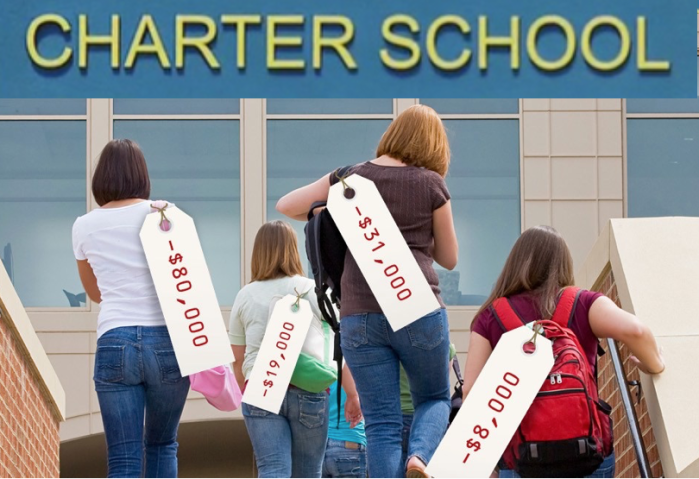
It’s literally a privately operated school funded with public tax dollars.


Operators can take almost whatever amount they want, spend it with impunity and never have to submit to any real kind of transparency or accountability.


Compare that to a traditional public school – an institution invariably operated by duly elected members of the community with full transparency and accountability in an open forum where taxpayers have access to internal documents, can have their voices heard and even seek an administrative position.


THAT’S a responsible way to handle public money!


Not forking over our checkbook to virtual strangers!


Sure, they might not steal our every red cent. But an interloper who finds a blank check on the street might not cash it, either.


The particulars don’t really matter. This is a situation rife with the possibility of fraud. It is a situation where the deck is stacked against the public in every way and in favor of charter school operators.


But most people don’t want to take such a strong stance. They’d rather find good and bad people on both sides and pretend that’s the same thing as impartiality.


It isn’t.


Sometimes one side is just wrong.


Policymakers may try to feign that there are good and bad charter schools and that the problems I’m talking about only apply to the nefarious ones.


But that’s a delusion.


There is no good way to write a blank check and leave it on the street to the whims of passers-by.


Most apologists want to draw the distinction between for-profit and nonprofit charters.


But as Jeff Bryant, an editor at Education Opportunity Network, puts it, this is a “Distinction without a difference.”


These terms only define an organization’s tax status – not whether it is engaged in gathering large sums of money for investors.


The law is full of loopholes that allow almost any organization – not just charter schools – to claim nonprofit status while enriching those at the top.


We live in an age of philanthrocapitalism, where the wealthy disguise schemes to enrich themselves as benevolence, generosity and humanitarianism.


So-called “nonprofit” charter schools are just an especially egregious example. No matter what label you pin to their name, they all offer multiple means to skim public funding off the top without adding any value for students.


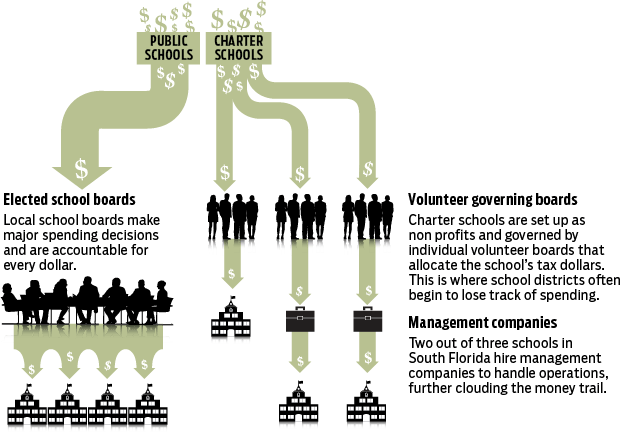
For instance, take the use of management companies.


A for-profit charter school can simply cut services to students and pocket the savings as profit.


A nonprofit charter school can do the same thing after engaging in one additional step.


All I have to do is start a “nonprofit” charter school and then hire a for-profit management company to run it. Then my management company can cut services and pocket the profits!


It’s really that simple! I turn over nearly all of my public tax dollars to the management company that then uses it to operate the school – and keeps whatever it doesn’t spend.


Heck! It doesn’t even matter who owns the company! It could even be me!


The law actually allows me to wear one hat saying I’m nonprofit and then put on a different hat and rake in the cash! The only difference is what hat I’m wearing at the time!


SO I get to claim to be a nonprofit while enjoying all the advantages of being for-profit.


flowchart960
SOURCE: Florida Sun Sentinel


I may even be able to buy things with public tax dollars through my for-profit management company and then if my “nonprofit” school goes belly up, I get to keep everything I bought! Or my management company does.


So the public takes all the risk and I reap all the reward. And I’m still graced with the label “nonprofit.”


Oh, and speaking of spending, being a “nonprofit” doesn’t stop me from the worst kind of real estate shenanigans routinely practiced by the for-profit charter schools.


Both types of privatized institution allow for huge windfalls in real estate. If I own property X, I can sell it to my charter school (or management company) and then pay myself with tax dollars. Who determines how much I pay for my own property? ME! That’s who!


And I can still be a nonprofit.


Think that’s bad? It’s just the tip of the iceberg.


Thanks to some Clinton-era tax breaks, an investor in a charter school can double the original investment in just seven years!

I can even get the public to pay for the same building twice! And even then taxpayers still won’t own it!


But that’s the complicated stuff. There’s an even easier way to get rich off the public with my “nonprofit” charter school, and operators do it all the time: write myself a fat check!


After all, I’ve gotta’ pay, myself, right? And who’s in charge of determining how much I’m worth? ME!


I can even pay myself way more than my counterparts at traditional public schools who oversee exponentially more staff and students.


For instance, as New York City Schools Chancellor, Richard Carranza is paid $345,000 to oversee 135,000 employees and 1.1 million students. Meanwhile, as CEO of Success Academy charter school chain, Eva Moskowitz handles a mere 9,000 students, for which she is paid $782,175.


And this is by no way a unique example.


There are just so many ways to cash in with a charter school even at a so-called “nonprofit” – especially if I want to dip my toe into legally dubious waters!


I could do like the almost exclusively “nonprofit” Gulen charter schools and exist solely as a means to raise money for an out-of-favor political movement in Turkey.


I could use charter funds to finance other businesses. I could decide to discontinue programs that students receive in traditional public schools such as providing free or reduced lunches but keep the cash. I could fake enrollment and have classes full of “ghost students” that the local, state and federal government will pay me to educate.


Fraud and mismanagement are rampant at charter schools because we don’t require them to be as accountable as their traditional public school counterparts.


If a traditional public school tried this chicanery, we’d almost certainly catch it at the monthly meetings or frequent audits. But charter schools don’t have to submit to any of that. They’re public money spent behind closed doors with little to no requirement to explain themselves – ever.


And all of this – nearly every bit of criticism I’ve leveled against the industry – doesn’t even begin to take into account the educational practices at these types of schools.


There is plenty of evidence that charters provide a comparable or worse education than children routinely receive at traditional public schools.


Where it is comparable, the issue is clouded by selective enrollment, inadequately servicing students with special needs and generally encouraging the hardest to teach to get an education elsewhere. Where it is worse, it is colossally worse, robbing children not just of funding but what is likely their only chance at an education.


But we don’t even need to go there.


We only need the issue of fiscal responsibility to bring down this behemoth.


Charter schools are no way to run a school. They are a blatant failure to meet our fiduciary responsibilities.


Traditional public schools are the best way to run a school. They protect the public’s investment of money and resources while providing a quality education to students.


So all this talk about nonprofit and for-profit charter schools is either a mark of supreme ignorance or a ploy for weak willed politicians to weasel their way out of taking a stand on an issue whose merits are obvious to anyone who knows what really happens in our education system.


It’s time to stop wasting taxpayer money on this expensive fraud.


It’s time for the charter school experiment to end.


And it’s way passed time to support fully public schools.


Like this post? I’ve written a book, “Gadfly on the Wall: A Public School Teacher Speaks Out on Racism and Reform,” now available from Garn Press. Ten percent of the proceeds go to the Badass Teachers Association. Check it out!
WANT A SIGNED COPY?

Click here to order one directly from me to your door!

book-1

Public School is Not For Profit. It is For Children.

Screen Shot 2018-08-28 at 4.14.57 PM


Betsy DeVos doesn’t get it.


But neither did Arne Duncan.


Whether right or left or somewhere in between, the person sitting at cabinet level tasked with advising the President on education matters invariably knows nothing about the purpose of public schools.


Duncan thought it had something to do with canned academic standards and standardized tests.


DeVos thinks it involves vouchers to religious or private schools.


But they’re both as wrong as two left shoes.


Public schools exist for one reason and one reason only – to meet the needs of children.


They aren’t there to enrich the private sector or even provide the job market with future employees.


They exist to teach, to counsel, to inspire, to heal.


And all these other schemes favored by Dunce Duncan and Batty Betsy that purport to meet kids needs while somehow enjoying the totally unintended side effect of enriching wealthy investors completely misses the point.


Public schools serve one purpose – to help the kids enrolled in them.


That’s all.


If someone is getting rich off that, there’s a huge problem somewhere.


Unfortunately, the Secretaries of Education of Donald Trump and Barack Obama aren’t the only ones to get it wrong. Policymakers on both sides of the aisle have lost sight of this fact.


So have pundits and media personalities on Fox News, CNN and MSNBC. So have CEOs and tech entrepreneurs and economists and anyone – really – whom our society seems to take seriously.


Don’t believe me?


Take the latest pronouncement from DeVos, our Secretary of Education.


She announced recently that she was looking into using federal funds to buy guns for teachers to better protect their students from school shooters.


It doesn’t take a genius to see that this is not in the best interests of children.


Teachers with guns mean a MORE dangerous environment for children, not less.


It means escalating the chance of friendly fire much more than boosting the possibility of a kindergarten teacher turning into an action hero.


It means heightening the chance of children getting their hands on these firearms and doing themselves or others harm.


And given the disproportionate murders of people of color even at the hands of trained professionals in the police force, it means children of color being legitimately terrified of their mostly white educators – or worse.


The reason given by DeVos may be to make children safer. But the measure she’s proposing really has nothing to do with them at all.


It’s a boondoggle for private industry – one private industry in particular – gun manufacturers.


Instead of sensible regulations on a product that’s at least as dangerous as items that are much more heavily controlled – such as cold medicine and automobiles – DeVos is doing the only thing she can to protect what she really cares about – corporate profits.


She is using money earmarked “safety” to increase danger.


Or as she sees it – she’s using a government apparatus that could harm the gun industry to instead pad its pockets.


You’ll hear some progressives and moderates decry this move with passion and fervor – and for good reason – but what many fail to realize is that it’s not new.


It’s really just a continuation of a sickness that has crept into our society about how we conceptualize the very idea of school.


We have moved away from the proposition that everything must be done in the student’s best interest and have replaced it with an imperative to benefit business and industry.


After all, what is the push for academic accountability through standardized tests and Common Core but corporate welfare for the testing and publishing industry?


What is the push for charter and voucher schools but government subsidies for school privatization?


High stakes standardized testing isn’t about helping students learn. Neither is Common Core, value-added measures or a host of top-down corporate policies championed by lions of the left and supply-side patriots.


They are about creating a problem where one doesn’t exist: accountability.


“How do we make sure students receive a quality education?” As if this has ever been hard to determine.


In general, the schools with greater needs than funding are where students struggle. The schools where everyone has more than they need is where they excel.


But they try to sweep the issue of inequitable funding and resources under the rug by framing the question entirely about teachers and schools.


In short, instead of asking about an obvious inequality, they hide a preconceived answer in the question: “How do we make sure teachers and schools are actually educating kids?”


Wrong question. But here’s the answer, anyway: Administrators observe teachers and determine if they’re doing their jobs. And school boards evaluate administrators.


In general, the staff isn’t the problem. It’s the lack of resources we give them to work with – everything from crumbling buildings, large classes, narrowed curriculum to a lack of wraparound social services.


It doesn’t take much to see we’re shortchanging our neediest students.


You don’t need standardized tests to tell you that. You don’t need new academic standards. You don’t need to evaluate educators on things beyond their control.


But doing so creates a new market, a need that can be filled by corporate interests unrestrained by the conviction that public schools are not supposed to be a profit-making venture.


People providing services for schools are supposed to make a living – not a killing – off the public’s dime.


The same can be said for school privatization.


Public schools are in no way inferior to institutions that are privately managed. Tax dollars administered by duly-elected representatives in the light of day are in no way less effective or more corrupt than the alternative – letting bureaucrats behind closed doors dole out the money however they choose even into their own pockets.


In fact, just the opposite!


Nor have charter or voucher schools ever been shown to increase student learning without also selecting only the best academic students and shunning those most difficult to teach, providing fewer resources for students and/or operating with greater funding.


But pretending that privatization is a better alternative to democratic rule creates a market, it opens the door so the system can be gamed for profit at the expense of student learning and wellbeing.


That’s why we look in awe at LeBron James, an athlete who uses his fortune to open a school providing all the things society refuses for students of color. A basketball player who refuses to usurp the public’s leadership role in administering that fully public school.


He’s a shinning example of actual philanthropy in an age of bogus philanthrocapitalism. But he’s also proof that his solution is not reproducible large scale.


The rich – even if they are well intentioned – cannot save us. Only the public can support all public schools.


And to do that, we must understand the purpose behind these institutions.


Otherwise, we’ll continue to be trapped on a runaway train where the conductor seems to possess no sense of urgency about slowing down.


We would never have been in this situation – and in fact could right the course even now – if we just took the time to clarify what we were doing and why we were doing it.


We could save generations of children if we stopped cashing in on public schools and realized the reason for their existence.


We could ensure both our present and our posterity.


If only we remembered that one thing.


Public schools are not for profit.


They are for children.


Like this post? I’ve written a book, “Gadfly on the Wall: A Public School Teacher Speaks Out on Racism and Reform,” now available from Garn Press. Ten percent of the proceeds go to the Badass Teachers Association. Check it out!
WANT A SIGNED COPY?

Click here to order one directly from me to your door!

book-4

STEM Education Severs the Arts from the Sciences

right-brain-left-brain


What’s the most effective way to dumb down a nation?


Focus on How without Why.


That’s really the biggest problem with the pedagogical fad of STEM education.


There’s nothing objectively wrong with teaching science, technology, engineering and math – the disciplines that make up STEM.


In many cases, doing so is essential to a well-rounded education.


But therein lies the problem – you can’t have a well-rounded education if you purposely leave out some of the most vital aspects of knowledge.


Where’s the art? Where’s the literature? Where’s the social studies, government, citizenship, drawing, painting, music – heck! Where’s the philosophical understanding of life, itself?


STEM initiatives often involve creating two tiers of school subjects. You have the serious disciplines that will earn you respect and a job. And you have the soft, mamby pamby humanities that are no good to anyone.


The problem is one of focus not content.


Corporate-minded bureaucrats who know nothing of human psychology, child development or education look solely at standardized test scores and get hysterical.


The U.S. is falling behind other nations – especially in science and math, they say. So we must do whatever we can to bring those test scores up, Up, UP!


Yet they have never bothered to see that our student test scores have never been at the top of the pack for all the decades we’ve been making international comparisons.


We started contrasting multiple choice assessment results for 13-year-olds in a dozen countries back in 1964. And ever since, America has always been right in the middle.


Yet for those five decades we’ve dominated the world in science, technology, research and innovation.


In that time we sent the first people to the moon, mapped the human genome, and invented the Internet – all while getting middling test scores.


In short, standardized assessments are a fantastically unreliable indicator of national success, just as they are poor indicators of individual learning.


We’ve never been a nation content with picking our answers from four options – A,B,C,D. We blaze new paths!


But number obsessed fools have convinced a public blinded by sports statistics that these tests mean our kids are deficient. And the only cure is to put on blinders and focus almost exclusively on those subjects most featured on the tests.


Even reading and writing are only valuable if they let us guess what a normalized reader is supposed to comprehend from a given passage and if they allow us to express ourselves in the most rudimentary and generic ways.


This is exactly what they do in countries with the highest test scores – countries that are LESS innovative than the U.S.


Asian countries from Singapore to South Korea to India are not blind to this irony. While we are trying to imitate them, they are trying to imitate the kind of broad liberal arts education in which we used to pride ourselves.


“Many painters learn by having fun,” said Jack Ma, founder of one of China’s biggest Internet companies Alibaba.


“Many works of art and literature are the products of having fun. So, our entrepreneurs need to learn how to have fun, too.”


Ma worries that his country is not as innovative as those in the West because China’s educational system focuses too much on the basics and does not foster a student’s complete intelligence, allowing him or her to experiment and enjoy the learning process.


In other words, no matter how good you are at math and science, you still need to know how to learn, think and express yourself.


To be fair, these criticisms of STEM are not new.


Even global pundits like Fareed Zakaria have made similar arguments.


The result has been a hasty addition – change STEM to STEAM by adding in the arts.


Unfortunately, this hasn’t always worked out for the best.


Most of the time, the arts component is either an after thought or merely a sweetener to get students interested in beginning the journey – a journey that is all STEM all the time.


There is still an education hierarchy with the sciences and math at the top and the humanities and social studies at the bottom.


This is extremely unfortunate and will cause long-term detrimental effects to our society.


For instance, we pride ourselves in being democratically ruled. Political power does not come from authority, it comes from the consent of the governed.


This requires a public that knows how to do more than just add and subtract. Voters need to understand the mechanisms of government so they grasp their rights. They need a knowledge of history so they don’t repeat the mistakes of the past. They need to grasp human psychology, anthropology, and sociology to understand how people work in groups and individually.


Moreover, as human beings, they need the humanities. People have thoughts and feelings. They need to know how to express those thoughts and feelings and not just by writing a five-paragraph essay. They need to be able to create works of art. They need to be able to write a story or poem. They need to be able to manipulate images. They need to understand and create music.


Without these things, it can be difficult to become fully actualized people.


That used to be the goal of education. Provide students with the tools to become the best version of themselves.


But this focus on STEM and STEAM only endeavors to make them the best cogs the workforce needs.


We have relinquished our commitment to students and replaced it with a commitment to business and industry.


The idea is that schools owe the job market workers. That could not be further from the truth. We owe our students the tools that will help them live the best lives. And employment is only one small facet of that goal.


I’m not saying we shouldn’t teach math and science. We should – we MUST. But those can’t be prioritized over and above other essential human endeavors.


We need to fund and encourage a broad liberal arts education for all students. As they get older and move on to post-secondary studies including industrial arts they will inevitably specialize in areas that they find most interesting.


But until then, it is our job to give them every opportunity to learn – not to mold them into future wage slaves or boost national pride with arbitrary and meaningless test scores.


Like this post? I’ve written a book, “Gadfly on the Wall: A Public School Teacher Speaks Out on Racism and Reform,” now available from Garn Press. Ten percent of the proceeds go to the Badass Teachers Association. Check it out!
WANT A SIGNED COPY?

Click here to order one directly from me to your door!

book-2

The Only Way to Survive Trump is Together

pam160 


There are days when I feel like a broken man.


And it is Donald Trump who has broken me.


Not his political victories. Not the failures of his opposition.


But the very fact that this piece of shit is President of the United States – that fact sits on my brain like an insect I can’t swat.


On those days my belief in this country wavers and disappears.


Oh, I’ve always recognized its faults, how our reality hardly ever lived up to our ideals. But I also thought that the United States was populated by mostly good people who knew right from wrong.


To run this country we wouldn’t choose an obvious conman, a racist and sexist, a person of low IQ, a man with little to no experience, a reality TV star. We wouldn’t let him pick the next Supreme Court justices. We wouldn’t give him the power to pardon whomever he likes. We wouldn’t give him the ability to write almost whatever he wants into law through signing statements. And we certainly wouldn’t give him the nuclear codes.


But we did.


We did all of that.


Or we allowed it to happen by ignoring a broken electoral system that overturns the popular vote with frightening regularity.


So there he sits in the Oval Office – when he isn’t on vacation at Mar-a-Lago – like a smear of feces on the American flag.


Therapists call this feeling “Trump Anxiety Disorder” and I have it. Boy! Do I have it!


The D.C. Counseling and Psychotherapy Center has identified it as a “collective politically induced anxiety among patients.”


Apparently, Trump’s name comes up frequently in sessions with mental health professionals. Patients say they feel on edge because of the President’s ill-chosen, childish and undiplomatic words, fear of his bad decision making, and anxiety over his xenophobic and prejudicial policies.


Trump Anxiety Disorder is not yet an official diagnosis, but symptoms seem to include lack of sleep, a feeling of losing control and helplessness in an unpredictable political scene, along with endless negative headlines and excessive time spent on social media.


Elisabeth LaMotte, a therapist at the Washington, DC, center, said, “There is a fear of the world ending. It’s very disorienting and constantly unsettling.”


I’m not sure I fear that Armageddon is close at hand, but I certainly feel like the world I thought I knew is unraveling.


Fox News was quick to frame this story as a joke – those silly “libtards” are losing their minds over Trump. But it’s not just people on the left who suffer from the disorder, says LaMotte.


Many Trump supporters feel isolated from friends and family who don’t blindly follow their diminutive Furor. I guess it’s hard to pal around with someone who thinks it’s completely justified to separate children from their parents and lock them up in cages – unless you think the same thing.


Even the American Psychological Association (APA) has recorded a rise in anxiety since the 2016 election that increases depending on how political a person is regardless of affiliation.


The APA also noted that electronic news consumption increases that risk.


In my own case, my symptoms manifested physically on Election Day, itself.


I literally had a heart attack in 2016 after casting my ballot. And I had another one a short while later.


The first one may have had something to do with depression over the political options.


I didn’t know Trump would win. I thought the chances of it were infinitesimal. But I didn’t want Hillary Clinton, either.


I wanted Bernie Sanders, and since I thought the Democratic National Convention stacked the deck against him (and therefore voters) in the primaries, I voted for Jill Stein.


In the months since, I’ve run that decision over in my mind a million times.


Was I right? Was I wrong? Could I have given Trump the margin of victory with my one stupid vote?


When I examine all the information I had at the time, it still makes sense.


The media was telling us that there was no way Trump could win. Clinton was going to come storming into the White House and continue or worsen the neoliberal policies of Barack Obama.


As a school teacher, I was concerned that she would continue to wage war on public education – she would continue to boost charter schools and standardized testing while shrugging at funding inequity, increased segregation and the school-to-prison pipeline.


It’s not that I didn’t realize Trump would be worse. It’s that I didn’t think Clinton would be that much better.


But had she won, I don’t think I would be suffering the same anxiety.


We would have a sane and sensible leader who wouldn’t do anything much to make things better, but certainly wouldn’t be plunging us into an abyss. She wouldn’t betray every single American value while blatantly using her office for personal gain and gaslighting anyone who had the temerity to point out what was happening in plain sight.


So maybe some of it is guilt in my case.


Maybe I caused all this chaos. But I’ve looked at the numbers and that doesn’t add up.


Even if my position as a blogger who criticized Clinton (and Trump) convinced thousands of voters to cast ballots like I did, I could not have significantly affected the outcome.


But on those days of doubt and depression, I still feel guilty.


This is not the world I want to live in.


Things would be different if I thought there were any real hope of change.


Sure Trump may be defeated. If there’s a blue wave in the midterms, the orange one may be impeached. Or he may find it increasingly difficult to continue his corruption and be ousted in 2020.


But long term I don’t see much changing.


The Democrats are almost as corrupt as the Republicans.


Don’t give me this false equivalency crap. I’m not saying they’re the same. The Democrats are unequivocally better. But with the exception of social issues, their policies are almost the same as Republicans. The only difference is timeframe.


Republicans will destroy the world tomorrow. Democrats will destroy it next week.


And the system is just not set up to offer any challenge to the duopoly.


I desperately want to believe that insurgent progressives like Alexandria Ocasio-Cortez and Zephyr Teachout will somehow wrest control of the Democrats and steer the party back to real populist goals, but on most days it’s hard to keep that hope alive.


On those days it seems like the rich and powerful own our government and will never allow us to take it back no matter how many of us try to vote, no matter how often we take to the streets, no matter what we do.


We live in a world of shit.


And none of it will ever change for the better.


I don’t want to feel this way.


I still want to believe that the moral arc of the universe is long but it bends toward justice.


But on most days that feels like an illusion.


Is that a mental disorder? Or do I finally see the world for the way it is?


I have no answers.


Perhaps this article has no point.


I only offer it as a mark of solidarity.


If you’re feeling this way, you are not alone.


There are many more out there like you.


I don’t know how we get through this or even if we can. But this much seems certain.


If we are to survive, the only way is together.


So I send out this missive of hope and fear with all my love and a big virtual hug.


Be kind to each other. We’re all we’ve got.


For a peak at my views on more positive days, see HERE and HERE.


Like this post? I’ve written a book, “Gadfly on the Wall: A Public School Teacher Speaks Out on Racism and Reform,” now available from Garn Press. Ten percent of the proceeds go to the Badass Teachers Association. Check it out!
WANT A SIGNED COPY?

Click here to order one directly from me to your door!

Screen shot 2018-01-07 at 1.14.14 AM

Top 10 Reasons You Can’t Fairly Evaluate Teachers on Student Test Scores

Screen Shot 2018-08-02 at 12.49.24 AM


I’m a public school teacher.


Am I any good at my job?


There are many ways to find out. You could look at how hard I work, how many hours I put in. You could look at the kinds of things I do in my classroom and examine if I’m adhering to best practices. You could look at how well I know my students and their families, how well I’m attempting to meet their needs.


Or you could just look at my students’ test scores and give me a passing or failing grade based on whether they pass or fail their assessments.


It’s called Value-Added Measures (VAM) and at one time it was the coming fad in education. However, after numerous studies and lawsuits, the shine is fading from this particularly narrow-minded corporate policy.


Most states that evaluate their teachers using VAM do so because under President Barack Obama they were offered Race to the Top grants and/or waivers.


Now that the government isn’t offering cash incentives, seven states have stopped using VAM and many more have reduced the weight given to these assessments. The new federal K-12 education law – the Every Student Succeeds Act (ESSA) – does not require states to have educator evaluation systems at all. And if a state chooses to enact one, it does not have to use VAM.


That’s a good thing because the evidence is mounting against this controversial policy. An evaluation released in June of 2018 found that a $575 million push by the Bill and Melinda Gates Foundation to make teachers (and thereby students) better through the use of VAM was a complete waste of money.


Meanwhile a teacher fired from the Washington, DC, district because of low VAM scores just won a 9-year legal battle with the district and could be owed hundreds of thousands of dollars in back pay as well as getting his job back.


But putting aside the waste of public tax dollars and the threat of litigation, is VAM a good way to evaluate teachers?


Is it fair to judge educators on their students’ test scores?


Here are the top 10 reasons why the answer is unequivocally negative:


1) VAM was Invented to Assess Cows.

I’m not kidding. The process was created by William L. Sanders, a statistician in the college of business at the University of Knoxville, Tennessee. He thought the same kinds of statistics used to model genetic and reproductive trends among cattle could be used to measure growth among teachers and hold them accountable. You’ve heard of the Tennessee Value-Added Assessment System (TVAAS) or TxVAAS in Texas or PVAAS in Pennsylvania or more generically named EVAAS in states like Ohio, North Carolina, and South Carolina. That’s his work. The problem is that educating children is much more complex than feeding and growing cows. Not only is it insulting to assume otherwise, it’s incredibly naïve.


2) You can’t assess teachers on tests that were made to assess students.

This violates fundamental principles of both statistics and assessment. If you make a test to assess A, you can’t use it to assess B. That’s why many researchers have labeled the process “junk science” – most notably the American Statistical Association in 2014. Put simply, the standardized tests on which VAM estimates are based have always been, and continue to be, developed to assess student achievement and not growth in student achievement nor growth in teacher effectiveness. The tests on which VAM estimates are based were never designed to estimate teachers’ effects. Doing otherwise is like assuming all healthy people go to the best doctors and all sick people go to the bad ones. If I fail a dental screening because I have cavities, that doesn’t mean my dentist is bad at his job. It means I need to brush more and lay off the sugary snacks.


3) There’s No Consistency in the Scores.

Valid assessments produce consistent results. This is why doctors often run the same medical test more than once. If the first try comes up positive for cancer, let’s say, they’re hoping the second time will come up negative. However, if multiple runs of the same test produce the same result, that diagnosis gains credence. Unfortunately, VAM scores are notoriously inconsistent. When you evaluate teachers with the same test (but different students) over multiple years, you often get divergent results. And not just by a little. Teachers who do well one year may do terribly the next. This makes VAM estimates extremely unreliable. Teachers who should be (more or less) consistently effective are being classified in sometimes highly inconsistent ways over time. A teacher classified as “adding value” has a 25 to 50% chance of being classified as “subtracting value” the next year, and vice versa. This can make the probability of a teacher being identified as effective no different than the flip of a coin.


4) Changing the test can change the VAM score.

If you know how to add, it doesn’t matter if you’re asked to solve 2 +2 or 3+ 3. Changing the test shouldn’t have a major impact on the result. If both tests are evaluating the same learning and at the same level of difficulty, changing the test shouldn’t change the result. But when you change the tests used in VAM assessments, scores and rankings can change substantially. Using a different model or a different test often produces a different VAM score. This may indicate a problem with value added measures or with the standardized tests used in conjunction with it. Either way, it makes VAM scores invalid.


5) VAM measures correlation, not causation.

Sometimes A causes B. Sometimes A and B simply occur at the same time. For example, most people in wheelchairs have been in an accident. That doesn’t mean being in a wheelchair causes accidents. The same goes for education. Students who fail a test didn’t learn the material. But that doesn’t mean their teacher didn’t try to teach them. VAM does not measure teacher effectiveness. At best it measures student learning. Effects – positive or negative – attributed to a teacher may actually be caused by other factors that are not captured in the model. For instance, the student may have a learning disability, the student may have been chronically absent or the test, itself, may be an invalid measure of the learning that has taken place.


6) Vam Scores are Based on Flawed Standardized Tests.

When you base teacher evaluations on student tests, at very least the student tests have to be valid. Otherwise, you’ll have unfairly assessed BOTH students AND teachers. Unfortunately standardized tests are narrow, limited indicators of student learning. They leave out a wide range of important knowledge and skills leaving only the easiest-to-measure parts of math and English curriculum. Test scores are not universal, abstract measures of student learning. They greatly depend on a student’s class, race, disability status and knowledge of English. Researchers have been decrying this for decades – standardized tests often measure the life circumstances of the students not how well those students learn – and therefore by extension they cannot assess how well teachers teach.


7) VAM Ignores Too Many Factors.

When a student learns or fails to learn something, there is so much more going on than just a duality between student and teacher. Teachers cannot simply touch students’ heads and magically make learning take place. It is a complex process involving multiple factors some of which are poorly understood by human psychology and neuroscience. There are inordinate amounts of inaccurate or missing data that cannot be easily replaced or disregardedvariables that cannot be statistically controlled for such as: differential summer learning gains and losses, prior teachers’ residual effects, the impact of school policies such as grouping and tracking students, the impact of race and class segregation, etc. When so many variables cannot be accounted for, any measure returned by VAMs remains essentially incomplete.


8) VAM Has Never been Proven to Increase Student Learning or Produce Better Teachers.

That’s the whole purpose behind using VAM. It’s supposed to do these two things but there is zero research to suggest it can do them. You’d think we wouldn’t waste billions of dollars and generations of students on a policy that has never been proven effective. But there you have it. This is a faith-based initiative. It is the pet project of philanthrocapitalists, tech gurus and politicians. There is no research yet which suggests that VAM has ever improved teachers’ instruction or student learning and achievement. This means VAM estimates are typically of no informative, formative, or instructional value.


9) VAM Often Makes Things Worse.

Using these measures has many unintended consequences that adversely affect the learning environment. When you use VAMs for teacher evaluations, you often end up changing the way the tests are viewed and ultimately the school culture, itself. This is actually one of the intents of using VAMs. However, the changes are rarely positive. For example, this often leads to a greater emphasis on test preparation and specific tested content to the exclusion of content that may lead to better long-term learning gains or increasing student motivation. VAM incentivizes teachers to wish for the most advanced students in their classes and to push the struggling students onto someone else so as to maximize their own personal VAM score. Instead of a collaborative environment where everyone works together to help all students learn, VAM fosters a competitive environment where innovation is horded and not shared with the rest of the staff. It increases turnover and job dissatisfaction. Principals stack classes to make sure certain teachers are more likely to get better evaluations or vice versa. Finally, being unfairly evaluated disincentives new teachers to stay in the profession and it discourages the best and the brightest from ever entering the field in the first place. You’ve heard about that “teacher shortage” everyone’s talking about. VAM is a big part of it.


10) An emphasis on VAM overshadows real reforms that actually would help students learn.

Research shows the best way to improve education is system wide reforms – not targeting individual teachers. We need to equitably fund our schools. We can no longer segregate children by class and race and give the majority of the money to the rich white kids while withholding it from the poor brown ones. Students need help dealing with the effects of generational poverty – food security, psychological counseling, academic tutoring, safety initiatives, wide curriculum and anti-poverty programs. A narrow focus on teacher effectiveness dwarfs all these other factors and hides them under the rug. Researchers calculate teacher influence on student test scores at about 14%. Out-of-school factors are the most important. That doesn’t mean teachers are unimportant – they are the most important single factor inside the school building. But we need to realize that outside the school has a greater impact. We must learn to see the whole child and all her relationships –not just the student-teacher dynamic. Until we do so, we will continue to do these children a disservice with corporate privatization scams like VAM which demoralize and destroy the people who dedicate their lives to helping them learn – their teachers.


NOTE: Special thanks to the amazingly detailed research of Audrey Amrein-Beardsley whose Vamboozled Website is THE on-line resource for scholarship about VAM.


Like this post? I’ve written a book, “Gadfly on the Wall: A Public School Teacher Speaks Out on Racism and Reform,” now available from Garn Press. Ten percent of the proceeds go to the Badass Teachers Association. Check it out!

WANT A SIGNED COPY?

Click here to order one directly from me to your door!

book-1

Wannabe Terrorist Attempts to Flood Our Schools & Public Spaces With 3D Printed Guns to Make Common Sense Restrictions Moot

GettyImages_172545206.0


In the United States, we literally have more guns than people.


Yet we’re trying really hard to make even more available with the touch of a button.


It’s not enough that our right to kill is better protected than our right to live, we need to make it EASIER to commit murder. In the land of the drive-by shooting, slaughter needs to be as convenient as ordering a pizza.


Cody Wilson, a wannabe terrorist who apparently believes John Wayne westerns are documentaries, claims to have invented the first gun that can be made almost completely on a 3D printer. And he wants to post the plans on-line so anyone with access to the device can make one.


He was stopped by a U.S. District judge in Seattle who temporarily banned the plans from publication on the Internet this week following a last-minute lawsuit filed by seven state attorneys general.


They argued that 3D-printed firearms would be invisible to metal detectors and could bypass gun restrictions recently adopted after a string of school shootings in some states.


The issue will go back to court on August 10, when the sides will discuss whether a preliminary injunction is needed.


The whole matter was almost settled in 2013 when the Obama administration originally stopped Wilson from putting his plans online with a lawsuit. After years of back and forth, the federal case against the virtual arms merchant seemed like a slam dunk. Then Donald Trump came into office and not only stopped the suit but paid Wilson $40,000 in damages.


So the question remains – why would any sane human being want to post a do-it-yourself gun kit on the Internet where any criminal, psychotic or violent fanatic could easily access it?


Wilson says he’s not in it for financial gain. He wants to make a political point – to flood the world with so many cheap, untraceable guns that the idea of passing any kind of regulations on them would be impossible.


No, really.


As he told Wired:


“All this Parkland stuff, the students, all these dreams of ‘common sense gun reforms’? No. The Internet will serve guns, the gun is downloadable. No amount of petitions or die-ins or anything else can change that.”


Not only that, but the owner and founder of Defense Distributed, an Austin, Texas, based start up that pretends to be a nonprofit organization, says he is prepared to kill police and federal agents if the courts don’t continue seeing things his way.


In the same Wired interview, he says he wasn’t expecting support from the Trump administration. He expected Hillary Clinton would win the White House in 2016 and that she would continue to oppose his 3D printed firearms.


As Wired reported:


“If that happened, as Wilson tells it, he was ready to launch his [3D printed gun] repository, regardless of the outcome of his lawsuit, and then defend it in an armed standoff. “I’d call a militia out to defend the server, Bundy-style,” Wilson says calmly, in the first overt mention of planned armed violence I’ve ever heard him make. “Our only option was to build an infrastructure where we had one final suicidal mission, where we dumped everything into the Internet,” Wilson says.”


So let’s be clear about one thing – the guy pushing for 3D printed firearms is literally a terrorist imitator.


He is an American extremist. He is to us as Osama bin Laden is to mainstream Muslims.


Or at least he wants to be that.


While we’re rounding up brown people and separating them from their children without any workable plan to reunite them on this or that side of the border, we have a US citizen making terroristic threats with the means to carry them out and he’s walking around free.


Oh, but he’s a privileged white dude, so no harm no foul.


If Wilson’s little plastic death dealers do become widely available on-line, they won’t immediately make a huge difference.


It’s hard to make a 3D-printed gun. You need an expensive, top-of-the-line 3D printer and some knowledge of how to work it. And even then the result is a shoddy firearm at best. It may only fire a few bullets before falling apart.


A shooter would have to work extra hard to accomplish his goal with Wilson’s design. It would be much easier to use one of the billions of firearms already available – and much more deadly.


But it wouldn’t take much to make a 3D-printed gun more dangerous.


To comply with federal law, Wilson’s design requires a metal firing pin, which he claims would set off a metal detector. However, it may be relatively easy to bypass that metal part to make his design truly concealable from such devices.


Moreover, technology is always advancing – 3D printers will probably be able to create stronger and more deadly firearms in time. With these sorts of designs readily available, it is easy to imagine a school shooter accessing a device in a tech or computer lab and creating a weapon of mass destruction. He wouldn’t set off any alarms because he wouldn’t have the gun when he entered the building. He’d make it in school.


Some shrug at these dangers saying that they’re inevitable.


Even if we stop Wilson, these sorts of designs will eventually be available in some form on-line. That’s the double-edged sword of mass media – all information is available including easy ways to kill a large number of people.


However, I think this is a cop-out.


For instance, the Internet and computer technology make it fairly easy to mass produce currency as well as firearms. In fact, it’s theoretically much easier.


Yet we don’t see a major influx of counterfeit bills. The reason? Business and industry have collaborated with government to make sure this doesn’t happen.


Programs like Adobe Photoshop include software that restrict the printing of your own money. We could do the same with future 3D printers. We could recall those already in service and retrofit them with such code.


Oh, sure not everyone will comply. There will always be someone who breaks through the safety net. But if all we can do is greatly reduce the spread of 3D-printed firearms, that doesn’t make it futile.


There is a mountain of research proving that the more firearms you have in a country, the greater the number of firearm deaths.


We should be working to restrict guns to responsible people.


But the Wilson’s of the world don’t want to allow us that choice.


They want to force us all to live in a world where guns are even more pernicious than they are today.


Will we let them?


Human beings have such potential, but we seem determined to kill ourselves.


If intelligent aliens came to Earth today and landed in the USA, what would they think of us?


Would they see what we might become or would they only see a pitiful animal struggling to put itself out of its own misery?


Like this post? I’ve written a book, “Gadfly on the Wall: A Public School Teacher Speaks Out on Racism and Reform,” now available from Garn Press. Ten percent of the proceeds go to the Badass Teachers Association. Check it out!
WANT A SIGNED COPY?

Click here to order one directly from me to your door!

book-4

Wealth – Not Enrollment in Private School – Increases Student Achievement, According to New Study

pq2iPfteRemNHu7D5w9c_richkid


Students enrolled in private schools often get good grades and high test scores.


And there’s a reason for that – they’re from wealthier families.


A new peer-reviewed study from Professors Richard C. Pianta and Arya Ansari of the University of Virginia found that once you take family income out of the equation, there are absolutely zero benefits of going to a private school. The majority of the advantage comes from simply having money and all that comes with it – physical, emotional, and mental well-being, living in a stable and secure environment, knowing where your next meal will come from, etc.


The study published in July 2018 attempts to correct for selection bias – the factors that contribute to a student choosing private school rather than the benefits of the school, itself.


The study’s abstract puts it this way:


“Results from this investigation revealed that in unadjusted models, children with a history of enrollment in private schools performed better on nearly all outcomes assessed in adolescence. However, by simply controlling for the sociodemographic characteristics that selected children and families into these schools, all of the advantages of private school education were eliminated. There was also no evidence to suggest that low-income children or children enrolled in urban schools benefited more from private school enrollment.”


This has major policy implications.


Corporate school reformers from Barack Obama to Donald Trump, from Arne Duncan to Betsy DeVos, from Cory Booker to Charles and David Koch, have proposed increasing privatized school options to help students struggling in public schools.


Whether it be increasing charter schools or vouchers to attend private and parochial schools, the implication is the same – such measures will not help students achieve.


We need programs aimed at poverty, itself, not at replacing public schools with private alternatives.


According to the abstract:


“By and large, the evidence on the impact of school voucher programs casts doubt on any clear conclusion that private schools are superior in producing student performance…


“In sum, we find no evidence for policies that would support widespread enrollment in private schools, as a group, as a solution for achievement gaps associated with income or race. In most discussions of such gaps and educational opportunities, it is assumed that poor children attend poor quality schools and that their families, given resources and flexibility, could choose among the existing supply of private schools to select and then enroll their children in a school that is more effective and a better match for their student’s needs. It is not at all clear that this logic holds in the real world of a limited supply of effective schools (both private and public) and the indication that once one accounts for family background, the existing supply of heterogeneous private schools (from which parents select) does not result in a superior education (even for higher income students).”


Researchers repeatedly noted that this study was not simply a snapshot of student performance. It is unique because of how long and how in depth students were observed.


The study looks at student outcomes at multiple intervals giving it a much longer time frame and much greater detail than other similar investigations. Researchers examined wide ranging family backgrounds and contextual processes to reduce selection bias.


Participants were recruited in 1991 from ten different cities: Little Rock, Arkansas; Irvine, California; Lawrence, Kansas; Boston, Massachusetts; Philadelphia and Pittsburgh, Pennsylvania; Charlottesville, Virginia; Seattle, Washington; Hickory and Morganton, North Carolina; and Madison, Wisconsin. They were followed for 15 years and had to complete a month long home visit. In addition, they submitted to both annual interviews and home, school, and neighborhood observations.


The final analytic sample consisted of 1,097 children – 24% of whom were children of color, 15% had single mothers, and 10% had mothers without a high school diploma.


Moreover, student academic achievement wasn’t the only factor examined.


Researchers also assessed students social adjustment, attitudes, motivation, and risky behavior. This is significant because they noted that no other study of private schools to date has examined factors beyond academics. Also, there is a general assumption that private school has a positive effect on these nonacademic factors – an assumption for which the study could find no evidence.


From the abstract:


“In short, despite the frequent and pronounced arguments in favor of the use of vouchers or other mechanisms to support enrollment in private schools as a solution for vulnerable children and families attending local or neighborhood schools, the present study found no evidence that private schools, net of family background (particularly income), are more effective for promoting student success.”


One reason behind these results may be the startling variation in “the nature and quality of private school classrooms.” There is no consistency between what you’ll get from one private school to the next.


The x-factor appears to be family income and all that comes with it.


We see this again and again in education. For instance, standardized test scores, themselves, are highly correlated with parental wealth. Kids from wealthier families get better test scores than those from poorer families regardless of whether they attend public, charter or private schools.


It’s time our policymakers stop ignoring the effect of income inequality on our nations students.


If we really want to help our children, the solution is not increased privatization. It is increased funding and support for anti-poverty programs, teachers and a robust public school system.


Like this post? I’ve written a book, “Gadfly on the Wall: A Public School Teacher Speaks Out on Racism and Reform,” now available from Garn Press. Ten percent of the proceeds go to the Badass Teachers Association. Check it out!

WANT A SIGNED COPY?

Click here to order one directly from me to your door!


book-3

Don’t Tread on Me, But Let Me Tread All Over You: The Credo of Personal Freedom and Limitless Greed

AR-801253793 

Every neighborhood has one.


A yellow flag showing a coiled spring of a snake above the motto, “Don’t Tread on Me.”


In my usually well-manicured suburb, you’ll find it waving bravely over the garbage house.


There’s three broken down RVs sitting on the lawn, a busted sofa in the back yard, a rotten picnic bench and several rusted out vehicles in various states of disrepair.


I’m not sure why the owners think anyone would want to tread on them. We’d much rather walk quickly on by without being seen or commented on.


Because in my experience that’s the thing about most of the people who fly this flag.


They’re indignant about anyone stepping on their rights but all too ready to step all over yours.


I remember it wasn’t really too long ago that this flag had no such connotations.


It was simply the Gadsen flag, a relic of the American Revolution. It was nothing more than a reminder of a time when we cherished our national independence from Great Britain and wanted to make sure they knew we didn’t want the King to come back and start ordering us around.


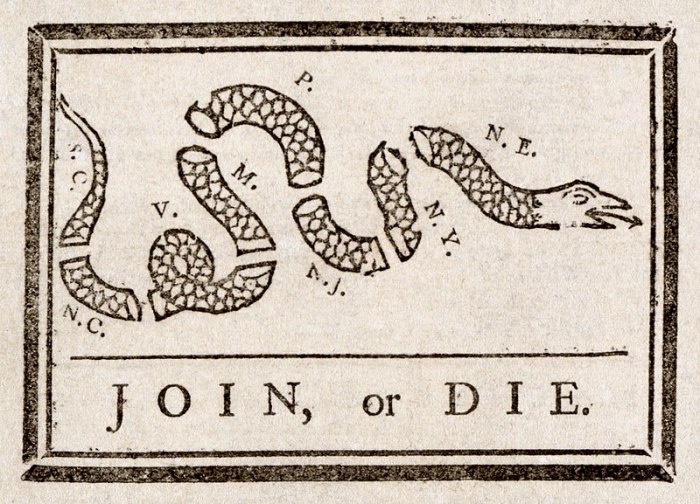
In fact, it was designed by American general and politician Christopher Gadsden in 1775. This “Sam Adams of South Carolina” modeled his patriotic statement first used by the Continental Marines on an earlier famous cartoon from Benjamin Franklin’s Pennsylvania Gazette.


800px-Benjamin_Franklin_-_Join_or_Die


You’ve probably seen it. A snake is cut into several pieces – each representing one of the colonies – with the motto, “Join or Die.”


So originally it was a call for unity, perhaps even federalism. It was a way of framing the argument that we’d be stronger as one nation than as a group of separate states.


Gadsen’s version was really a continuation of that same thought. It was as if he were saying, “Here we are, one unified nation ready to strike to protect itself from tyranny.”


It wasn’t until 2009 that Gadsen’s flag became associated with the radical right.


Like so many hitherto nonpartisan symbols, it was appropriated by the Tea Party movement, which tried to cast their libertarian extremism as somehow harkening back to the American Revolution.


Even the name Tea Party is a misnomer. The original Boston members of the Sons of Liberty who threw British tea into the harbor in 1773 were protesting taxation without representation. Modern day Tea Partiers were protesting the taxes levied by their own duly elected representatives.


They were poor people duped into thinking the rich paid too much despite the fact of gross income inequality and the wealthy not paying their fair share.


It’s this willful ignorance that typifies the contemporary right.


The truth doesn’t matter. It only matters what can be spun into a pithy sound bite that can be broadcast on Fox News or some other propaganda source and then repeated ad infinitum in place of any real debate or conversation.


To be fair, the left does it, too, but not nearly to the same degree.


When a topic makes the rounds of the 24-hour news cycle, you can hear the same canned responses from right and left on just about every channel regardless of who is speaking. The only difference is that the left usually makes at least passing reference to reality while the right closes its eyes and says whatever it believes to be true with perfect conviction.


The Gadsen flag is a perfect example of this hypocrisy.


The motto “Don’t Tread on Me” has come to mean radical individual freedom.


I can do whatever I like and there’s nothing you can do about it.


I can own as many guns as I like. I can teach my kids whatever facts I like. I can discriminate against anyone I like.


But there’s never a mention about other people except to limit what they can do in relation to the speaker.


In short, there’s nothing explicit about making this rule universal – I won’t tread on you if you won’t tread on me.


It’s just don’t tread on me and I’ll do whatever I like in relation to you.


After all, many of these personal freedoms the radical right cherishes actually do impact the rest of us.


Unregulated gun ownership means more shootings, more suicides, more deadly instances of domestic violence, more kids coming to school with semi-automatic guns in their book bags and more malls and theaters slick with bystander blood.


Moreover, if you teach your kids whatever facts you like, that means you indoctrinate them into your worldview. You don’t give them the chance to see the real world for what it is in case they may have different views on it than you do. This impacts both your children and the country, itself, which will have to somehow run with a greater portion of ignorant and close-minded citizens.


And don’t get me started on discrimination! You think you should be able to say whatever you like to whomever you like whenever you like. It’s fine to wear a t-shirt calling Hillary Clinton a “cunt” but when late night comedian Samantha Bee does the same to Ivanka Trump, you’re up in arms!


You think you can support laws that allow bakers to refuse to make wedding cakes for gay couples but are raving mad when a restaurateur refuses service to Sarah Huckabee Sanders!


This kind of sanctimonious duplicity has real world consequences.


Unarmed black people are shot and killed by police at a much higher rate than white people. Yet you won’t tolerate any protest, condemnation or protest. People can’t assemble in the streets, athletes can’t kneel during the national anthem, you won’t even allow the slogan “Black Lives Matter,” because you say, “All Lives Matter,” while in reality you mean “All Lives Except Black Ones.”


You oppose abortion but no one is forcing anyone to have abortions. In your headlong crusade for individual freedom you want to ensure that others don’t have this choice because they might choose differently than you. Or at least they might choose differently than you SAY you do, because when the light of day is cast upon you, we find an alarming number of hypocrites here, too.


There are too many far right politicians who campaign on overturning Roe v. Wade who pressure their mistresses to abort the unwanted issue of their indiscretion.


The underlying cause of such myopia is a perverse focus only on the self.


You look at what you want for you and pay no attention at all to what others should likewise be allowed.


It is the underlying selfishness of post Enlightenment Western thought come back to haunt us.


Hobbes and Locke and Smith told us that greed was good.


It’s what makes the world go round.


You look to your self-interest, and I’ll look to mine, and that’s what’s best for everyone.


However, they forgot that everyone doesn’t have the same power – physical, social, financial or political. Some people are strong and some are weak. Some are rich and some are poor. If you pull the shortest straw at the lottery of birth, you won’t be able to get the same things for yourself as those who won it as soon as the doctor slapped their newborn bums.


So we have layers and layers of class and economics. We have social structures designed to keep black people here and Hispanics there and white people at the top. We have a society that worships the rich and bedevils the poor. We have belief systems that praise one kind of sexuality only and demonizes anything that diverges from that norm. And the most defining thing of any newborn baby is what you’ll find between its legs.


“Don’t Tread on Me” has become a farce.


It’s a maxim hoisted on those with very little individual power to convince them to join together and become powerful while guarding the door for the wealthy.


They sit atop their mountains of trash as if they were dragons on piles of gold.


And they point their pitchforks at the rest of us as if we wanted a piece of it.


In this way, they make themselves the willing patsies of the ruling class.


It’s a sad thing to behold.


Because if we all just stopped for a second and recognized our common humanity, we’d agree that the status quo is unacceptable.


If we were more concerned about the rights of all than just our own rights, we’d agree that the wealth of this great nation has not been fairly distributed.


The snake is coiled and ready to strike but it is pointed in the wrong direction.


It shouldn’t be pointed at 99% of us. And it shouldn’t be so solitary.


It should be a sea of snakes, a great slithering mass of humanity, hissing and spitting with venom, our reptilian eyes focused on the elites.


Don’t tread on me?


Don’t tread on USSSSSSSSSSS!


Like this post? I’ve written a book, “Gadfly on the Wall: A Public School Teacher Speaks Out on Racism and Reform,” now available from Garn Press. Ten percent of the proceeds go to the Badass Teachers Association. Check it out!

WANT A SIGNED COPY?

Click here to order one directly from me to your door!

book-3

Why We Need a Department of Education

what-happens-to-your-body-when-you-fast


Let’s say you have a starving child.


You take out a knife, a fork and a spoon. You hand her a cup.


This isn’t what she needs.


She needs food. She needs water.


But the utensils seem a precursor to meeting those needs.


That’s what the Department of Education has always been – a tool and a promise.


But now the Trump administration wants to do away with even that polite fiction.


Two weeks ago, Secretary of Education Betsy DeVos announced the plan to merge the Education and Labor departments.


The reason you may not have heard much about it – beside the fact that bigger stories have overshadowed it like the forced separation of undocumented children and parents at the border, coercing kids into immigration court without parents or even legal counsel and then locking them up in cages in detention centers – is that the plan has about zero chance of coming to fruition.


Democrats oppose it and there don’t even seem to be enough Republicans in favor to get it through Congress. It may not even have enough support to get a vote.


Unless it’s a huge tax cut for the rich, no one seems able to get any actual laws through this GOP controlled legislature.


Moreover, the proposal is a definite step backward. The Department of Education was created in 1980 by splitting the Department of Health, Education, and Welfare into the Department of Education and the Department of Health and Human Services.


At that time, its purpose was clear. It was a tool to increase funding equity and transparency while protecting students.


After all, the department was an extension of the Elementary and Secondary Education Act (ESEA) of 1965, which tried to bring equity to America’s public schools.


As President Jimmy Carter said upon signing the bill into law:


“First, [the Department of Education] will increase the Nation’s attention to education. Instead of being buried in a $200 billion-a-year bureaucracy, educational issues will receive the top-level priority they deserve. For the first time, there will be a Cabinet-level leader in education, someone with the status and the resources to stir national discussion of critical education concerns.”


Unfortunately, those principles were never fully realized.


The Department did increase funding to public schools, but it didn’t end up dramatically increasing opportunities for the underprivileged.


Sure, it provided targeted grants like Pell Grants that did offer opportunities to select groups of students. But it didn’t radically alter our outdated (even then) funding system.


Our schools are segregated by race and class – worse now than they were then. Since they’re funded primarily by local property taxes, that means the poor and minorities get less funding than richer whiter kids.


And unless you’re willing to let your kids go to a school that receives less funding than others, don’t tell me it doesn’t matter. Rich white people have long complained about the money we spend on other people’s children while doing everything in their power to protect funding for their own.


In the late 1970’s, it was hoped the creation of the Department would be the first step to increasing federal funding of schools to one third of the total cost, thereby leveling the playing field somewhat.


But that never happened.


Now as then, the federal government only funds less than 10 percent of the cost.


To return to the metaphor with which this piece began, the creation of the department was like handing a starving child utensils without much actual food.


As the years have passed, we’ve used those tools for everything except nourishing students.


We’ve fed the child by guiding an empty fork into her cheek. We’ve poked and prodded her mouth with a knife.


The result hasn’t been for her benefit. Instead we’ve let special interests feed off of HERcharter schools, voucher schools, high stakes standardized testing corporations, the ed tech industry and even book and software publishers through the boondoggle of Common Core.


Many have insisted this misuse of the Department means we should do away with it entirely.


I disagree.


The child is still starving. It is still our responsibility to feed her.


You don’t do that by taking away her utensils.


Oh, you can feed her without them, but not very effectively. She can drink from the sink, but not as well as from a cup. She can eat with her hands, but not as easily as with utensils.


This latest proposed merger wouldn’t really satisfy anyone.


It wouldn’t do away with the department – it would hide it behind closed doors.


It would simply make it harder to see what was happening to it.


Moreover, it betrays an ideological bias against education for its own sake. Making the Department of Education part of the Department of Labor implies that the only reason one goes to school to learn job skills.


One can imagine a newly reorganized federal effort to cut anything from our schools that couldn’t be immediately connected with becoming a worker drone. And I don’t mean to imply this would be a new effort, because it’s already what President’s George W. Bush and Barack Obama were using the Department to achieve. But now it would be in the shadows and who knows what monstrosity could grow without the cleansing light of day?


This would help no one. It would be a continuation of the status quo (or possibly a doubling down on it) under a different name.


No one needs that.


What we need is to roll up our sleeves and meet students’ needs.


The child is hungry.


She has been sitting before us starving for decades and all we’ve done is give her the means to eat without the food.


Isn’t it time someone open the cupboard and get this kid something to eat!?


Like this post? I’ve written a book, “Gadfly on the Wall: A Public School Teacher Speaks Out on Racism and Reform,” now available from Garn Press. Ten percent of the proceeds go to the Badass Teachers Association. Check it out!

WANT A SIGNED COPY?

Click here to order one directly from me to your door!


book-4