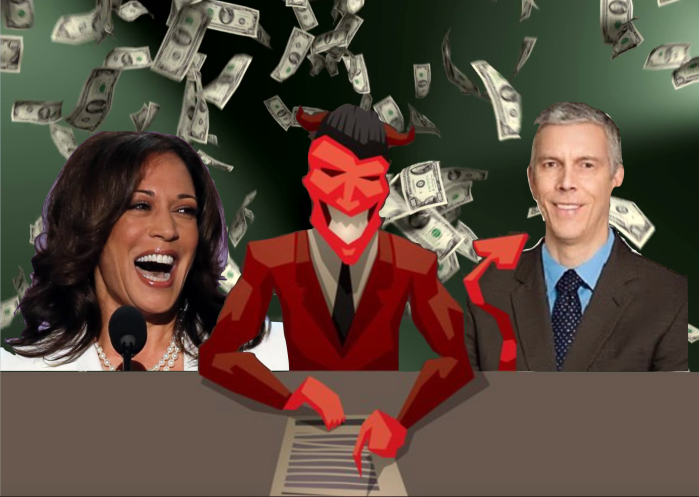
Sell Your Soul to the Testocracy: Kamala Harris’s Faustian Teacher Raises

Screen Shot 2019-03-27 at 7.03.07 PM

 
I love the idea of Kamala Harris’ plan to give teachers a pay raise.
 

But once we get past ideas, it’s way more troubling.


The California Senator and Democratic Presidential hopeful is proposing a $13,500 pay increase for the average teacher, with the exact number based on the size of each state’s pay gap.
 

That’s $315 billion more over a decade through federal matching funds, which amounts to a 23 percent salary increase for most educators.


Yes, please!

 
I could certainly use a raise.
 

But as Joe Moore said, “You can’t trust a promise someone makes while they’re drunk, in love, hungry, or running for office.”

 
And Harris IS running for office.


With this policy she’s wooing the national teachers unions and filling the neoliberal seat left by Hillary Clinton in 2016.

 
I love my union, but its leadership is like a college kid during spring break – ready to jump into bed with anyone who says the right words.
 

The fact of the matter is this plan also is favored by the people out to destroy my profession from the inside out.
 

Arne Duncan likes it.
 

Yes, THAT Arne Duncan!

 
Obama’s first Education Secretary. The guy who thought Hurricane Katrina was the best thing to happen to New Orleans because it allowed the government to close the public schools and replace them with charter schools.

The man who held federal grant money hostage unless schools enacted his unproven and disastrous corporate driven education reforms.


The man who encouraged pushing out teachers of color who had four year education degrees in favor of mostly white Teach for America temps with a few weeks crash course training.


The man who encouraged a rapid increase in high stakes standardized testing, narrowed curriculum, let class sizes balloon and decreased authentic lessons.

 
THAT Arne Duncan wrote this about Harris’ plan on Twitter:


“Radical idea: pay the professionals we entrust to teach, nurture and mentor our children a better salary!”


Screen Shot 2019-03-27 at 7.53.10 PM

 
How to reconcile the two?


I draw your attention to what he said on a recent book tour:


“If we were willing to invest in high-quality early childhood education, if we’re willing to pay great teachers and great principals significantly more, the benefits to our society, the benefits to our economy, the benefits to our democracy I think would be extraordinary…

[But] Money is never enough. So you’ll never hear me say, it’s only about money. For me it’s always about your high expectations as well as high support. And we have to hold ourselves accountable for great results. When schools aren’t working, we have to be willing to challenge the status quo. So investment is part of it, but high expectations have to go with that, and we have to hold ourselves accountable as educators for results, absolutely.”


So for Duncan this plan is entirely consistent with corporate education reform.


In fact, it makes sense as a continuation of those policies.


When privatization cheerleaders like Duncan talk about “high quality teachers” and “accountability” what they really mean are strings attached.


In this case, they probably mean merit pay – giving bonuses to teachers whose students get high test scores.


It’s a terrible idea because it encourages bad behavior from teachers, administrators and districts, which in turn hurts kids.


Having all your teachers fight over the rich white kids who get the highest test scores doesn’t help the struggling students. It just means fewer educators will want to teach the underprivileged because they can’t take the financial hit that comes with it.


The result is test prep all day, every day.


I want a raise, but not if it means I have to bastardize my own profession down to that!


And it’s not just Duncan who loves this idea.


Catherine Brown, a senior fellow at the Center for American Progress (CAP), actually helped Harris write this proposal.


“It could be transformative in terms of how we think about elevating and modernizing the teaching profession and the federal role in doing so,” Brown said.


CAP is a neoliberal think tank that worked closely with the Obama and Clinton administrations. And Brown is also the co-author of “The Progressive Case for Charter Schools”.


Any plan to raise teacher salary that is consistent with increased privatization is inherently suspect.


You can’t champion authentic public schools and public school teachers while also pushing for more institutions run without the same transparency, democratic government, and enrollment standards. If you think schools should be able to cherrypick which students to accept, they should be run by appointed bureaucrats, and it’s fine to cut student services while pocketing the profits, you aren’t a friend of public education.


In an article she co-wrote published by CAP called “Fact Sheet: Yes, Increase the Salaries of All Teachers,” she made it clear that merit pay is a good idea.


She wrote:


“…there is still debate surrounding whether all teachers need a raise, or if it is enough to make changes for a select group of teachers through differentiated or merit-based pay. While differentiated and merit-based pay can help alleviate some specific teacher shortages, such as those in subjects or schools that are high-needs, they are not a substitute for higher base pay.”


Ultimately, Brown comes out in favor of an across the board salary increase for teachers, but in her view merit pay is part of that solution.


This is a backdoor for the same snake oil the privatizaters have been selling for years.


As education blogger Peter Greene points out, the language used in Harris’ proposal is right from the neoliberal playbook. It is full of the same euphemisms and code words that have signaled school privatization, high stakes testing and merit pay.


Consider this gem:


“Every child deserves a world-class education, regardless of their ZIP code. Of all in-school factors that impact their success, there’s nothing more important than our teachers.”


“World class education” and  “regardless of ZIP code” mean charter schools galore. And the only “success” these folks are interested in is high test scores.


Or this:


“Our plan will include a multi-billion dollar investment in programs that help elevate the teaching profession and support principals and other school leaders. This includes high-quality teacher and principal residencies early-career induction programs that pair new teachers with mentors and master teachers, career ladder models that allow for advancement opportunities for teacher leaders, and “Grow Your Own” programs that help increase teacher diversity.”


Greene says that the term “Career ladders” is a red flag because it usually denotes career stagnation. It’s code for adding more duties and responsibilities on teachers without actually furthering their careers.


If I’m honest, these are all red flags.


As much as I want a raise, I’m doubtful Harris’ plan would actually accomplish much other than selling my soul to the testocracy.


Ultimately that’s what this is – a Faustian bargain.


We need to invest in greater per pupil spending and let that translate into higher teacher salaries.


We need equitable and sustainable funding formulas that aren’t tied to testing or that don’t open the door for privatization.


And most of all, we need an understanding of the real challenges in education and not a piece of parchment where teachers are supposed to sign in blood.


Like this post? I’ve written a book, “Gadfly on the Wall: A Public School Teacher Speaks Out on Racism and Reform,” now available from Garn Press. Ten percent of the proceeds go to the Badass Teachers Association. Check it out!
book-1

Pam Harbin Wants to Go From Pittsburgh School Board Watchdog to School Board Member

Screen Shot 2019-03-12 at 4.24.44 PM


My friend Pam Harbin is trying to undergo a startling metamorphosis.


She wants to transform from an education activist into a Pittsburgh School Director.


Now that Board President Lynda Wrenn is stepping down after 4 years, city voters in District 4 will have to decide whether Harbin can make the change. The election is on May 21.


Residents in parts of Squirrel Hill, Point Breeze, Shadyside and North Oakland already know Harbin as a fierce warrior for children’s civil rights, the plight of disabled kids and authentic public schools.

 
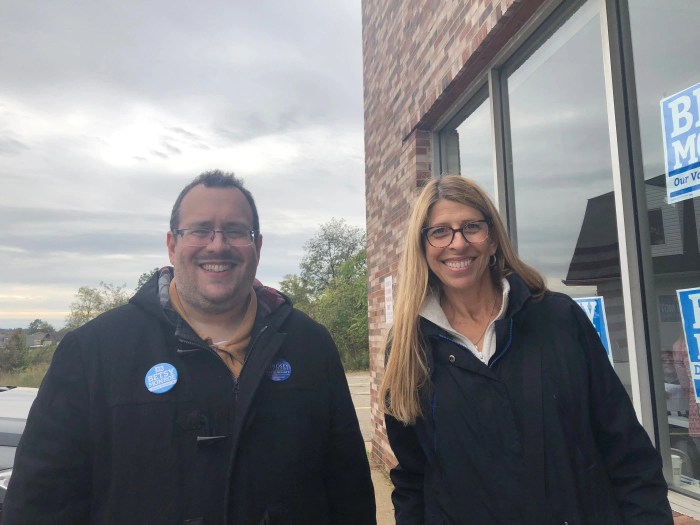
I’ve known Pam, personally, for years in my own role as an education activist. Though I don’t live in the city, I’ve participated in numerous collective actions to fight for the schools all our children deserve. And right beside me in every case – often in front of me – was Pam.


img_8279

 
I may not live in the district, but I wish I could vote for her. Harbin is an amazing leader with boundless energy, piercing intelligence, a deep knowledge of education policy, an advanced degree in finance and marketing, and an impressive track record of education justice achievements.

 
“I am deeply concerned for our system of public education,” she says. “The status quo isn’t working for all children. Thankfully, there are many people here in Pittsburgh and across the country who are fighting for investment in, and transformation of, our public schools. Unfortunately, their efforts are hindered by the well-funded organizations who fight for public school disinvestment, privatization, and for the elimination of teachers’ right to unionize.”


For the past 12 years, Harbin has been at the forefront of every major battle for the future of Pittsburgh’s public schools and the rights of its students.

 
Harbin was instrumental in pushing city school board directors to enact a suspension ban from Pk-2nd grade for minor non-violent conduct. She successfully fought to stop the district from implementing a physical restraint protocol that wasn’t trauma informed. She successfully fought against a policy that would have allowed school police officers to carry guns. She supported a successful Sanctuary Schools Policy for immigrant students. She also supported changes to the districts policies that would better welcome and include Pittsburgh’s LGBTQ students, including a change that allows students to use the bathroom that best fits their own gender identity.

 
Harbin and her coalition of local activists even made national news when they stopped the district from contracting with Teach for America, stopped the closing of 10 schools (after 23 were previously closed), pushed the board to hire a new Superintendent using an inclusive process that relied heavily on community input, and led the fight for a Community School Policy and the creation of 8 Community Schools.

 
Harbin has two challengers in the election: Anna Batista, a corporate consultant at Highstreet Consulting and Ashley Priore, a 19-year-old first year student at the University of Pittsburgh studying Business and English, who started a successful after school chess program for girls.

 
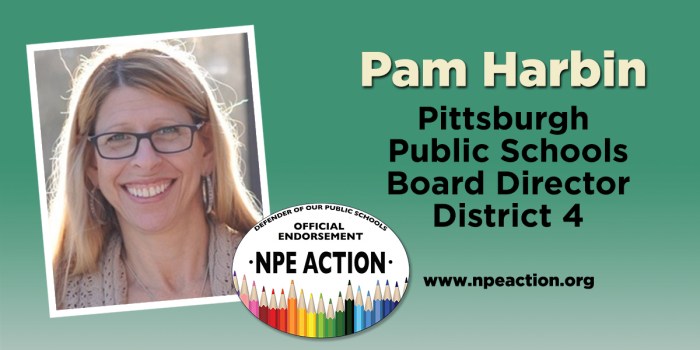
But despite facing a crowded field, Harbin has earned every organizational endorsement she has sought thus far, including the Allegheny County Democratic Committee, the Young Democrats of Allegheny County, the Stonewall Democrats and the Network for Public Education—an organization that frequently reposts my own writing as an education blogger and which is on the frontlines of education justice nationwide.


Pam-HarbinEndorsement-1


Harbin is one of the most experienced education leaders ever to run for school board in the city. She co-founded the Education Rights Network (ERN), a parent-led organization working for fully resourced, inclusive and quality education for students throughout Pennsylvania. The ERN is part of One Pennsylvania, an organization that unites low income and working class activists to tackle the fundamental economic justice and political problems of local communities.

 
“Our members are workers, students, parents, seniors, people with disabilities, and retirees who are excited to learn, collaborate, and build power,” she says. “We follow the money, confront the power, and make the change.”


ERN is a member of Great Public Schools Pittsburgh, a coalition of community, faith, and labor organizations working together to create sustainable public schools in Pittsburgh—an alliance which Harbin also helped to found in 2013. Great Public Schools is affiliated on the national level with the Journey for Justice Alliance, the Dignity in Schools Campaign, and the Alliance to Reclaim our Schools.

 
Harbin is also a member and past Co-Chair of the Pittsburgh Local Task Force on the Right to Education (LTF), a parent-majority organization that works with administrators of Pittsburgh Public Schools and community agencies to improve services for students with disabilities.

 
And she serves on the board of directors and was past President of Evolve Coaching (formerly Arts for Autism Foundation of Pittsburgh), supporting individuals with disabilities and their communities through education, employment, and the arts.

 
No one else in the race—and maybe in the whole city—has a resume like Harbin’s.

 
Harbin believes her years of leadership for and service to Pittsburgh students and families have provided her with the needed foundation for a transition from community leader to school board member. She has attended or streamed more than 2,000 hours of school board meetings. She has served on Pittsburgh Public Schools (PPS) district-wide advisory committees, including the Community Schools Steering Committee, Envisioning Educational Excellence Advisory Committee, Parental Involvement Policy Committee, Excellence for All Steering Committee, and the Special Education Delivery Model Advisory Committee. And through these many committees and organizations Harbin has helped more than 100 individual families secure an IEP or a 504 plan for their children—in part because she understands better than most the byzantine world of public school special education services.

 
No one is better suited to this position than Harbin. I literally wish we could clone her and have her fill every vacancy on the board. She is that qualified, that experienced, and that effective.

 
If this sounds a bit like a love letter, it kind of is.


Screen Shot 2019-03-12 at 4.23.29 PM

 
I have many fond memories of fighting the power alongside Pam Harbin. I remember organizing events through Yinzercation with Pam, even canvasing local candidates door-to-door with her and my (then) 9-year-old daughter. No matter what, you could always count on Pam to be there for children.

 
“When our public schools are strong, our children and community thrive,” she says. “We have many great Pittsburgh Public Schools, teachers, and programs. But, in each school, there are children who can’t excel because their individual needs have not been met. We must do better.”


“We must remove the barriers that keep all of our children from fulfilling their dreams. This requires transformational, sustainable change in policy and practice at the local, state, and national level.”


If anyone can make that change happen, it’s Harbin. As someone who has a degree in finance, who is an experienced negotiator and a proven coalition builder, she is uniquely qualified to do so from within the board as she has been successful doing so from outside of it.


She has an ambitious set of goals and priorities if elected:


-Strengthening relationships between all stake-holders with an emphasis on child wellness.


-Defining success beyond standardized test scores to include authentic education practices, addressing trauma, disengagement, hunger, the quality of school food programs, the condition of our buildings and bathrooms, and children’s need for exercise and play.


-Achieving smaller class sizes and a smaller ratio of kids to adults in each building with more teachers, counselors, social workers, paraprofessionals, nurses, librarians, and other staff that keeps the building functioning at its best.


-Restoring funding to art, music, physical education, and other programming that keep kids wanting to come to school.


-Stopping criminalization and over-policing of students, and stopping the use of ineffective punishments that keep children away from their learning and put them on the track to drop out, to jail, and to poverty.


-Intentionally recruiting, retaining, and supporting educators of color and those who identify as LGBTQ.


-Working to make teacher mentoring, new teacher induction, and professional development better to make the very best use of teachers’ time and address key gaps in preparation to teach the wide spectrum of students in the district.


-Making teacher evaluation fair and consistent, not based solely on test scores or value added models.


-Ensuring teachers (and all school staff) are well paid, treated fairly, and valued for the critical work they do for children every day.


-Protecting collective bargaining rights so teachers (and all staff) have a voice to improve their schools – because teaching conditions are students’ learning conditions.


-Investing in the proven Community Schools model and work collaboratively with community partners to bring resources to each school.


-Working at the state level to force our legislators to finally provide adequate, equitable, and sustainable funding for public education and stop efforts to dismantle public education through vouchers and other privatization schemes.


-Building coalitions to improve the flawed state Charter School Law – Charter Schools must have more accountability for the delivery of education to all students, including disabled children, English Language Learners, and kids who are homeless or who are in foster care.


angel and pam


I could literally go on about Pam for another 10,000 words. Easy.


But let me close with this.


Harbin began her journey as an education leader when she started advocating for her own children at their first elementary school—Liberty elementary in the Shadyside neighborhood of Pittsburgh. She found that she could make a difference for a few children at a time by throwing herself into volunteer work at the school.


But then she realized that if she wanted to make a difference for more than just a few children that she needed to work with others. Indeed, to do this work effectively Pam has had to work with people of different backgrounds, races, opinions and ideologies. She has had to listen to others, to compromise, to build bridges, and to prioritize common goals in each of her coalitions. In short, she gets things done.


And she’s been doing that for more than a dozen years.


Not because she has no choice. Not because anyone is paying her to do so. Not because doing so is bringing her any riches or fame.


But because it has been the right thing to do.


And that’s the best endorsement I can imagine.


NOTE: Special thanks to Professor Kathleen M. Newman who helped edit this article.


Click HERE to join Pam’s campaign!


Like this post? I’ve written a book, “Gadfly on the Wall: A Public School Teacher Speaks Out on Racism and Reform,” now available from Garn Press. Ten percent of the proceeds go to the Badass Teachers Association. Check it out!
thumbnail_IMG_8249

Tying Kids’ Lunch Money to Test Scores? It’s No Crueler Than High Stakes Testing

Screen Shot 2019-02-22 at 9.06.34 PM


UPDATED


Most people agree that the best way to get kids to read isn’t by threatening to take away their lunch.

 
But an Arkansas state Representative is threatening to do just that – sort of.


Rep. Alan Clark, a West Memphis Republican, proposed a bill that would cut “Lunch Funding” for impoverished children in state schools where students struggle with standardized reading tests.


However, he’s not proposing we take away kids’ food.


If passed, the bill would reduce a district’s National School Lunch funding – a state mechanism that distributes extra resources to schools with high concentrations of students who qualify for free lunch programs – if student test scores don’t rise over a period of time. This would cut things like professional development and tutoring.


However, this has been confused with the federal program of the same name and drawn almost universal condemnation.


“I would never starve kids,” Clark said. But he would starve their schools of resources.


Either way, his proposal is obviously unfair.


Only a monster would think you can incentivize reading comprehension by threats and coercion.


It’s like saying “You’d better understand this complex puzzle OR ELSE!


Learning doesn’t work that way.


But Clark sees things from a different perspective – that of business and industry. He told KTHV, a state television network:


“In most businesses I would be laughed at for suggesting such a small goal. But sadly many educators act like I have asked them to storm the beaches at Normandy… It appears I have much more faith in our schools than many of our educators do.”


This is what happens when you elect people without empathy or intelligence to public office.


I wonder if Clark would do a better job representing the people of his state if they threatened to lower his salary based on his popularity polls.


It says a lot about us that people react so viscerally to the inaccurate idea that Clark is suggestion we withhold food from bad test takers. That’s unthinkable. But it isn’t really that much more cruel than the way we actually treat students.


Our entire federal education policy is based on just such inhuman treatment of children.


After all, we still hold kids, schools and teachers “accountable” by student test scores. The consequences though aren’t an empty belly. They’re crowded classrooms and fewer tutors.


In every state of the union, students are required to take high stakes standardized tests in reading and math. If they don’t do well, we take away their resources.


Sure, we don’t deny them food, but we deny them many other things they need to learn.


We lower funding to their schools so that they have larger class sizes, fewer teachers, narrowed curriculum, etc. We threaten to withhold their diplomas and any chance of ever earning more than minimum wage. In many cases we tie teachers salaries, reputations and even employment to these same scores. Sometimes we even take away their parents right to govern their children’s schools so that all administrative decisions are made by state flunkies. Or we force their authentic public schools to become charter institutions so that spending decisions happen behind closed doors without accountability and even whether a student can enroll or not becomes a decision of the private management company and not simply something that is the students’ by right of living in the district.


It may not be as severe as the idea of Test Scores for Food, but it’s the same in kind.


In both cases, we tell kids – “Increase test scores, OR ELSE!” It’s just a difference of consequence.


Call me crazy, but that’s nearly as cruel and wrongheaded.


Keep in mind, all of this takes for granted that standardized tests are adequate and fair assessments of student learning in the first place. This has never been proven. In fact, it has been cast in serious doubt after more than a century of academic study. Ask anyone to narrow their thinking down to four prepackaged choices and you’ll find them trying to guess what the test-maker wanted more than what the truth is. Critical thinking, analysis, innovation – these escape any multiple choice exam.


But even if we go with this empty assumption, it flies in the face of everything we know about the way human beings acquire knowledge and demonstrate skills.


When kids struggle with learning, you can’t get them to do better with threats. Or at least you can only do that if those children are doing poorly on purpose.


Kids who just aren’t trying hard enough might be incentivized by threats. But even then it transforms learning into a means to an end. Once you do that, you destroy their natural curiosity. Learning will never again be an end in itself. It will be a menial task you only do to get something else that you really want.


However, in most cases kids don’t struggle because they’re just lazy. They don’t need an incentive. They need help. They need resources.


It’s no wonder that children in rich and middle class neighborhoods have less trouble getting higher test scores. They have lower class sizes, more teachers, wider curriculum, more extra curricular activities, access to tutors, counselors, nurses and after school programs.


Poor kids don’t. THAT’S why they struggle.


And what do we do when that happens? We take away the meager resources they have!


If a teacher tried any of this crap in her classroom, she’d be fired for dereliction of duty – and she’d deserve it!


Just imagine if you told the kids who were struggling in your class that they didn’t deserve tutoring. Instead you were going to give extra help to the kids who got the best scores on the exam!


And if the struggling children continued to do poorly, you took away their desks. Now they had to sit on the floor!


THIS is the kind of thing we’re doing to our children nationwide.


It’s called TEST AND PUNISH, and it’s federal policy – often backed up by state and local law.


Moreover, it’s supported by both Republicans and Democrats alike.


We may not be  denying poor kids a meal, but we are denying them an equal opportunity at an education just the same.


It’s way past time that we wake up and see that.


We can point and jeer at what we thought this regressive Arkansas nitwit was doing, but we’re really pointing and jeering at ourselves.


NOTE: An earlier version of this story – like many in the state and national press – wrongly suggested that Clark wanted to withhold lunches from poor children based on test scores.


Still can’t get enough Gadfly? I’ve written a book, “Gadfly on the Wall: A Public School Teacher Speaks Out on Racism and Reform,” now available from Garn Press. Ten percent of the proceeds go to the Badass Teachers Association. Check it out!
book-3


Hey, Teachers’ Unions, Let’s Get This One Right – No Early Presidential Endorsements & Lots of Membership Engagement

52448056_1332568296885727_443989310761336832_n
Let’s not mince words.


The last Presidential election was a cluster.


And we were at least partially to blame for it.


The Democratic primary process was a mess, the media gave free airtime to the most regressive candidate, and our national teachers unions – the National 
Education Association (NEA) and American Federation of Teachers (AFT) – endorsed a Democratic challenger too early and without getting membership support first.


This time we have a chance to get it right.


Edu-blogger Peter Greene spoke my feelings when he took to Twitter:


“Just so we’re clear, and so we don’t screw it up again—- NEA and AFT, please wait at least a couple more weeks before endorsing a Democratic Presidential candidate for 2020.”


52059561_10218928805835758_8289688834384330752_n

 
He’s being snarky.

 
No one would endorse two years before people actually enter a voting booth.

 
But fairness. Evenhandedness. Moderation.

 
Let’s be honest. That didn’t happen in 2015.

 
So let’s take a brief trip down memory lane and review our history for just a moment in order to prevent these same mistakes.


The NEA represents 3 million educators. It is the largest labor union in the country. However only about 180 people made the decision to back Hillary Clinton last time around.


In October of 2015, the NEA Board of Directors voted 118 to 39 in favor of the endorsement with 8 abstentions and 5 absences.


The 74 member PAC Council voted to endorse Clinton with 82% in favor, 18% against and some of the largest delegations – California and New Jersey – abstaining.


Check my math here. So 61 PAC votes plus 118 Directors plus one President Lily Eskelsen Garcia equals 180 in favor.


That’s about .00006% of the membership.


We may call it such, but that is not an endorsement.


We need more than just the leadership to support a candidate. We need that to translate to actual votes.


When you circumvent membership, you see the result – Donald Trump.


To be fair, some NEA directors may have polled state union leaders. But according to NEA by-laws, the organization need go no further to obtain input from individual members for a primary endorsement. Even these straw polls are a formality.
The 8,000 strong Representative Assembly (RA) did not get a say. This larger body representing state and local affiliates did get to vote on an endorsement in the general election when the field was narrowed down to only two major candidates.


But anything like a poll of individual members was apparently not desired by leadership – now or later.


We can’t do that again.


The process at the AFT was likewise perplexing.

The AFT endorsed Clinton in July of 2015 – a half year before the primaries and more than a year before the general election.


This much seems certain:


1) The AFT executive board invited all of the candidates to meet with them and submit to an interview. No Republican candidates responded.


2) Democrats including Bernie Sanders, Martin O’Malley and Clinton were interviewed in private.


3) The executive committee voted to endorse Clinton.


4) THEN the interviews were released to the public.


How can the AFT claim its endorsement was a result of membership opinion when the organization didn’t even release the interviews to members until AFTER the endorsement?


Ostensibly, the executive council used these interviews to help make its decision. Shouldn’t that same information have been available to rank and file members of the union before an endorsement was made?


Which brings up another question: were AFT members asked AT ALL about who to endorse before the executive council made the final decision?


According to the AFT press release, they were:


“The AFT has conducted a long, deliberative process to assess which candidate would best champion the issues of importance to our members, their families and communities. Members have been engaged online, through the “You Decide” website, through several telephone town halls, and through multiple surveys—reaching more than 1 million members.

Additionally, over the past few weeks, the AFT has conducted a scientific poll of our membership on the candidates and key issues. The top issues members raised were jobs and the economy and public education. Seventy-nine percent of our members who vote in Democratic primaries said we should endorse a candidate. And by more than a 3-to-1 margin, these members said the AFT should endorse Clinton.”


So the AFT claims union members said to endorse Clinton on-line, on telephone town halls, surveys and a scientific poll of membership.


But did they really?


I’m not a member of the AFT but I know many teachers who are. Very few of them have ever been surveyed.


The press release says AFT members preferred Clinton 3-1. Yet to my knowledge they never released the raw data of any polls or surveys of membership.
This can’t happen again.

 
AFT President Randi Weingarten said something similar during an interview Friday on C-SPAN.


She said the executive council passed a four step process just last week to ensure members were behind whoever the union eventually endorsed this time around:


“Our Executive Council just passed a process last week which has four components. Number One is what do the members want? What are their aspirations? What are their needs in terms of Presidential candidates? And so we will be doing a lot of listening and engaging with members.


Number Two – There’s a lot of candidates that want access to our membership. What we would like them to spend a day with our members. We would like them to see the challenges in classrooms. The challenges that nurses have. [The AFT also represents nurses.] Listen to the challenges of adjunct professors who have student loan debt that is well beyond what salaries they get per month.


Number Three – People are really active these days. So we don’t want them to wait until there is a nationwide endorsement to involve or get engaged with candidates. So there’s going to be an ability to be involved or engaged as delegates to do these kinds of things.


Number Four – At one point or another we’ll get to an endorsement.”


Frankly, this seems kind of vague to me. I hope this new process gets better results than the last one.

 
We need to be able to trust our unions.

 
Don’t get me wrong. I love my union. I bleed collective bargaining and labor rights.

 
I teach in Homestead, Pennsylvania, just a few miles away from the site of the famous steel strike.

 
I want a union that represents me and my colleagues.

 
We must do better this time around.

 
We need a candidate that has broad popular support of members, not just leadership. Broad popular support will lead to engaged members at the polls and that engagement will translate into actual votes for our endorsed candidate.

 
So NEA and AFT leaders, your members want to know:
What is your process for selecting our next U.S. presidential candidate?

 
What questions will you ask potential candidates?

 
How will members have a democratic voice in the process?

 
Please be transparent and publish your process to share with members through multiple sources.

 
And my union brothers and sisters, get involved. Engage in the endorsement process now! Call on our NEA and AFT leadership to invite early and widespread, as well as transparent, involvement in the endorsement process.


52308654_10218930369994861_6486342344374222848_n
Do you know your NEA Board Members?

http://www.nea.org/home/1686.htm


NEA Leadership Contact INFO here:

http://www.nea.org/home/49809.htm


AFT Leadership:

https://www.aft.org/about/leadership


AFT Contact Info:

https://www.aft.org/contact

 
Let’s get it right this time.

 
Everything is riding on it.

 
Our vote is our future.


Special Thanks to Susan DuFresne for inspiring this article.


Still can’t get enough Gadfly? I’ve written a book, “Gadfly on the Wall: A Public School Teacher Speaks Out on Racism and Reform,” now available from Garn Press. Ten percent of the proceeds go to the Badass Teachers Association. Check it out!

book-3

Rahm Emanuel’s Non-Apology Apology for Being a School Privatization Cheerleader

thumbnail_IMG_8543


Rahm Emanuel’s recent op-ed in The Atlantic may be one of the dumbest things I have ever read.


The title “I Used to Preach the Gospel of Education Reform. Then I Became the Mayor” seems to imply Emanuel has finally seen the light.


The outgoing Chicago Mayor USED TO subscribe to the radical right view that public schools should be privatized, student success should be defined almost entirely by standardized testing, teachers should be stripped of union protections and autonomy and poor black and brown people have no right to elect their own school directors.


But far from divorcing any of this Reagan-Bush-Trump-Clinton-Obama crap, he renews his vows to it.


This isn’t an apologia. It’s rebranding.


Emanuel had been White House Chief of Staff at the beginning of President Barack Obama’s first term. He’s a former U.S. Representative, and senior adviser to President Bill Clinton.


Yet he’s persona non grata.


Now that the extremely unpopular chief executive has decided not to seek re-election, he’s trying to secure his legacy – to make sure the history books don’t remember him as the Democrat In Name Only (DINO) mayor who closed an unprecedented number of schools serving mostly minority students while catering to the will of rich investors. He doesn’t want to be remembered as the lord on a hill whose own children went to private school while he cut services and increased class size for black and brown kids. He’s trying to save a series of abysmal policy failures so that he and his neoliberal pals like Cory Booker and Arne Duncan can still hold their heads high in Democratic circles. In a time when authentic progressives like Alexandria Ocasio-Cortez and Bernie Sanders have won the heart of the party, he wants to ensure there’s still room for that old time corporate education reform he is infamous for.


Like I said – dumb.


To quote the Principal in Billy Madison:


“…what you’ve just said is one of the most insanely idiotic things I have ever heard. At no point in your rambling, incoherent response were you even close to anything that could be considered a rational thought. Everyone in this room is now dumber for having listened to it. I award you no points, and may God have mercy on your soul.”

 
If only he’d respond like Madison:


Okay, a simple ‘wrong’ would’ve done just fine, but thanks.”


But like that straight man school administrator in an Adam Sandler movie, I’m going to give you the long answer. I’m going to explain why what Emanuel said was supremely stupid.


He begins the piece with a lengthy description of how he got one over on those darn teachers unions.


He wanted what was best for children, but those pesky teachers just wouldn’t do it until he twisted their arms and got them to play ball.


And keep in mind – this is the softer, gentler Emanuel who wants you to like him! This is the Emanuel who’s trying on progressive clothing to look more appealing!


Hey, Rahm, attacking working people while casting yourself as a savior is so two years ago. We’ve had a conservative Supreme Court hobble unions’ ability to stop free riders and a teacher uprising since then. Union educators from West Virginia to Oklahoma to Los Angeles, California, have gone on strike demanding Republican and Democratic chief executives like yourself make positive change for children.


No one’s buying your fairytales anymore.


But it leads into a series of important points he wants to make:


“For most of my career, I preached the old gospel of education reform. But now research and experience suggest that policy makers need to embrace a new path forward and leave the old gospel behind. Principals, not just teachers, drive educational gains. The brain-dead debate between charter and neighborhood schools should be replaced with a focus on quality over mediocrity. To get kids to finish high school, the student experience should center on preparing them for what’s next in life. Finally, classroom success hinges on the support that students get outside school. If other cities follow Chicago’s lead in embracing those ideas, they’re likely to also replicate its results.”


Oh and what results those are! But we’ll come back to that.


He reasons that principals drive educational gains. In fact, this is his a-ha moment. Don’t focus on teachers, focus on principals.


He pats himself on the back for raising principals’ salaries and recruiting only people who think and believe just like him. Then he didn’t have to watch over them so closely and they were even promoted to higher administrative positions.


Wow. What an innovation! Stack your school system with yes-people and your initiatives will get done. Great. No room for diversity of thought. No one who thinks outside of the box. Just functionaries and flunkies who do what you say.


This is sounding like a great case for progressive education reforms already! If you’re a fascist dictator.


Next comes my favorite – a further commitment to school privatization hidden behind the flimsiest rechristening in history.


Stop talking about charter schools vs. authentic public schools, he writes. Talk about quality schools vs. mediocre ones.


What bull crap!


Imagine if pirates were robbing ships on the high seas. Would you talk about good pirates and bad pirates? Imagine if vampires were attacking people in the night and draining their blood. Would you talk about good vampires and bad vampires?


I mean Dracula did suck Mina dry, but he spends the rest of his nights reading to orphan children. Long John Silver may have stolen hundreds of chests of gold from merchant ships, but he donates every tenth doubloon to fighting global warming!


Hey, Rahm, you can’t escape from the argument of whether school privatization is good or bad. Charter schools drain funding from authentic public schools and give it to private investors. They allow unscrupulous operators to cut services and pocket the profits. They increase segregation, decrease democracy and transparency, give choice mainly to business people who get to decide if your child is allowed to enroll in their school – all while getting similar or worse results than authentic public schools.


If you stopped taking corporate money for one second, maybe you could understand this simple point – no system will ever be fair that allows theft and then protects the thieves.


But on to your next point. You want to focus the student experience on what comes next in life. You want to focus on jobs and career readiness.


This is just dumbing down what it means to get an education. Going to school shouldn’t be reduced to a career training program. If we only teach kids how to manufacture widgets, what will they do when the widget factory closes?


We need to teach them how to think for themselves. We need to offer them real opportunities for self-discovery and challenge them to think deeply through an issue.


When kids graduate, we don’t want to have simply made a generation of workers. We need them to be thinking adults and citizens who can participate fully in our democratic process and help lead our country toward a better and brighter future – not just learn how to code.


Finally you talk about the support students get out of school. That’s stupid because…


Actually it’s not.


You’ve got a point there. We do need to support programs to help students succeed outside the classroom – summer reading, after school tutoring, etc. However, making kids sign a pledge to go to college in order to be eligible for a summer job? That’s kind of cruel when many have no way to pay for college in the first place. Moreover, it completely ignores the huge section of children who have no desire to go to college and would rather go to career or technical schools.


And that brings me to his dismal record of failure described by neoliberals as success.


Emanuel pushed forward a policy that in order to graduate, Chicago seniors must prove that after 12th grade they’re going to college, trade school, an internship, the military or would otherwise be gainfully employed. OR ELSE they can’t get a diploma!


Rahm’s all about adding more hoops for poor minority kids to jump through. Very rarely is he about providing any help for them to make the jump.


He’s a pull-yourself-up-by-your-own-bootstraps Democrat. Or what we used to call – a Republican.


Emanuel wants to tout his record as “proof” that his methods worked.


Let’s look at them.


He has closed 50 public schools46 of which serve mostly black students. Southside residents had to resort to a month-long hunger strike to keep their last neighborhood school open. He laid off hundreds of teachers and staff – many just before school opened. Yet he always had money for state of the art charter schools like the $27 million new charter school for the University of Chicago as part of the Obama Presidential Library. In addition, his economic policy consisted of closing public health clinics for the poor and installing red light cameras to increase fines – none of which actually boosted the economy.


And then we get to the scandal that made a third term as mayor impossible. Emanuel actually covered up the police killing of unarmed black teen, Laquan McDonald, so it wouldn’t hurt his re-election campaign.


In October of 2014, Officer Jason Van Dyke shot the 17-year-old 16 times. Most of those bullets went into the teenager after he was already flat on the ground and the officer was at least 10 feet away.


Emanuel quickly issued a $5 million settlement to McDonald’s family on the condition they keep quiet about the incident. It wasn’t until after Emanuel had won re-election, that an independent journalist put two-and-two together and asked for the officer’s dashcam video to be released. It took the full power of the media and a lawsuit to accomplish this resulting in charges against Van Dyke for first degree murder. Just last year the officer was found guilty of second degree murder and 16 counts of aggravated battery with a firearm, but was found not guilty of official misconduct. He was sentenced to 6.75 years in prison.


This is not a sterling mayoral record. It is not a proven record of success.


He says graduation rates are up as are rates of Chicago students who go on to college. He neglects to mention that they’re up nationwide. He neglects to mention that the quality of education these kids receive is often watered down to whatever will help them pass the federally mandated standardized test. He neglects to mention the loss of teacher autonomy, and the rise in class size.


Face it. Emanuel is a crappy mayor. Chicago and the nation will be better if he fades into the sunset.


His political career was backed by the same big money conservatives that back Republicans like Chris Christie, Mitt Romney and Bruce Rauner. He was a puppet of charter schools, hedge fund managers and the Koch Brothers.


In fact, his corruption was so bad that during the 2016 primary, he became an issue for Democratic Presidential contenders.


Bernie Sanders actually called him out in a tweet saying: “I want to thank Rahm Emanuel for not endorsing me. I don’t want the endorsement of a mayor shutting down schools and firing teachers.”


Emanuel had endorsed Hilary Clinton, and her education advisor Ann O’Leary wrote in a private email to senior campaign staff that this might actually hurt the candidate’s primary chances. She wanted Clinton to distance herself from the troubled mayor or at least explain how she differed from his troubled policies.


They eventually settled on saying nothing. That didn’t backfire at all!


Look. Democrats need to learn the exact opposite of the lesson Rahm is selling here.


Corporate education reform is poison. School privatization is not progressive. High stakes testing is not progressive. Hiring like-minded flunkies to run your schools is not progressive. Closing black kids’ schools is not progressive.


Emanuel has learned nothing. Have we?


Still can’t get enough Gadfly? I’ve written a book, “Gadfly on the Wall: A Public School Teacher Speaks Out on Racism and Reform,” now available from Garn Press. Ten percent of the proceeds go to the Badass Teachers Association. Check it out!

cropped-book-1.jpg

The Trouble with Test-Obsessed Principals

thumbnail_IMG_8535


When I was a child, I couldn’t spell the word “principal.”


I kept getting confused with its homonym “principle.”


I remember Mr. Vay, the friendly head of our middle school, set me straight. He said, “You want to end the word with P-A-L because I’m not just your principal, I’m your pal!”


And somehow that corny little mnemonic device did the trick.


Today’s principals have come a long way since Mr. Vay.


Many of them have little interest in becoming anyone’s pal. They’re too obsessed with standardized test scores.


I’m serious.


They’re not concerned with student culture, creativity, citizenship, empathy, health, justice – they only care about ways to maximize that little number the state wants to transform our children into.


And there’s a reason for that. It’s how the school system is designed to operate.


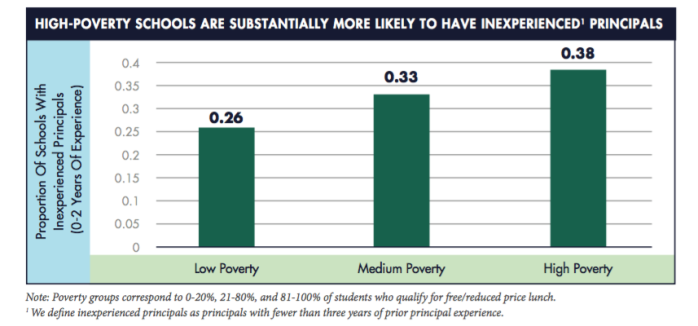
A new research brief from the Tennessee Education Research Alliance concluded that the lowest rated principals generally work at schools with the most economically disadvantaged students.


So schools serving students with the highest poverty and lowest test scores often have the least experienced and least effective principals.


thumbnail_Screen Shot 2019-02-08 at 11.27.32 AM


Now the first question I had when reading this report was “How do they measure effectiveness?” After all, if they rate principals primarily on student test scores, then obviously those working at the poorest schools will be least effective. Poor kids earn low test scores. That’s all the scores consistently show – the relative wealth of students’ parents. If you define an ineffective principal as one who works in a building with low scoring students, it would be no shock that those principals worked in the poorest schools.


However, researchers didn’t fall entirely into this trap. According to the working paper:


“We measure principal quality in two ways: years of experience in the principal position and rubric-based ratings of effective principal practice taken from the state’s evaluation system.”


In Tennessee this means evaluating principals partially on student test scores at their buildings – 35%, in fact – higher than the 20% of classroom teachers’ evaluations. However, the remaining pieces of principals’ effectiveness are determined by an observation from a more senior administrator (50%) and an agreed upon score by the principal and district (15%).


Since researchers are relying at least in part on the state’s evaluation system, they’re including student test scores in their own metric of whether principals are effective or not. However, since they add experience, they’ve actually created a more authentic and equitable measure than the one used by the state.


It just goes to show how standardized testing affects nearly every aspect of the public education system.


The testing industrial complex is like a black hole. Not only does it suck up funding that is desperately needed elsewhere without providing anything of real value in return, its enormous gravity subverts and distorts everything around it.


It’s no wonder then that so many principals at high poverty schools are motivated primarily by test scores, test prep, and test readiness. After all, it makes up a third of their own evaluations.


They’ve been dropped into difficult situations and made to feel that they were responsible for numerous factors beyond their control. They didn’t create the problem. They didn’t disadvantage these students, but they feel the need to prove to their bosses that they’re making positive change.


But how do you easily prove you’ve bettered the lives of students?


Once again, standardized test scores – a faux objective measurement of success.


Too many principals buy into the idea that if they can just make a difference on this one metric, it will demonstrate that they’re effective and thus deserve to be promoted out of the high poverty schools and into the well-resourced havens.


Yet it’s a game that few principals are able to win. Even those who do distinguish themselves in this way end up doing little more for their students than setting up a façade to hide the underlying problems of poverty and disinvestment.


Most principals at these schools wind up endlessly chasing their tails while ignoring opportunities for real positive change. Thus they end up renewing the self-fulfilling prophesy of failure.


Researchers noticed the pattern of low performing principals at high poverty schools after examining a decade’s worth of data and found it to hold true in urban, rural and suburban areas. And even though it is based on Tennessee data, the results hold true pretty consistently nationwide, researchers say.


Interestingly enough, the correlation doesn’t hold for teachers.


Jason Grissom, an associate professor at Vanderbilt University and the faculty director of the Research Alliance, says that the problem stems from issues related specifically to principals.


For instance, districts are hiring lower-rated principals for high poverty schools while saving their more effective leaders for buildings with greater wealth and resources.


thumbnail_Screen Shot 2019-02-08 at 11.28.20 AM


As a result, turnover rates for principals at these schools are much higher than those for classroom educators. Think about what that means – schools serving disadvantaged students are more likely to have new principal after new principal. These are leaders with little experience who never stick around long enough to learn from their mistakes.


And since these principals rarely have had the chance to learn on the job as assistant principals, they’re more likely to be flying by the seat of their pants when installed at the head of a school without first receiving the proper training and mentorship that principals at more privileged buildings routinely have.


As such, it’s easy for inexperienced principles to fall into the testing trap. They buy into the easy answers of the industry but haven’t been around long enough to learn that the solution they’re being sold is pure snake oil.


This has such a large effect because of how important principals are. Though they rarely teach their own classes, they have a huge impact on students. Out-of-school factors are ultimately more important, but in the school building, itself, only teachers are more vital.


This is because principals set the tone. They either create the environment where learning can flourish or smother it before the spark of curiosity can ignite. Not only that, but they create the work environment that draws and keeps the best teachers or sends them running for the hills.


The solution isn’t complicated, says Grissom. Districts need to work to place and keep effective and experienced principals in the most disadvantaged schools. This includes higher salaries and cash bonuses to entice the best leaders to those buildings. It also involves providing equitable resources for disadvantaged schools so that principals have the tools needed to make authentic positive change.


I would add that we also need to design fair evaluation systems for both principals and teachers that aren’t based on student test scores. We need to stop contracting out our assessments to corporations and trust our systems of government and schools to make equitable judgments about the people in their employ.


Ultimately, what’s required is a change in attitude.


Too many principals look at high poverty schools as a stepping stone to working at a school with endless resources and a different class of social issues. Instead, the goal of every excellent school leader should be to end their career working where they are needed most.


Such professionalism and experience would loosen the stranglehold of test-and-punish and allow our schools not to simply recreate the inequalities already present in our society. It would enable them to heal the divide.


As John Dewey wrote in 1916:


“Were all instructors to realize that the quality of mental process, not the production of correct answers, is the measure of educative growth, something hardly less than a revolution in teaching would be worked.”


And that’s what’s needed – a revolution.


Still can’t get enough Gadfly? I’ve written a book, “Gadfly on the Wall: A Public School Teacher Speaks Out on Racism and Reform,” now available from Garn Press. Ten percent of the proceeds go to the Badass Teachers Association. Check it out!
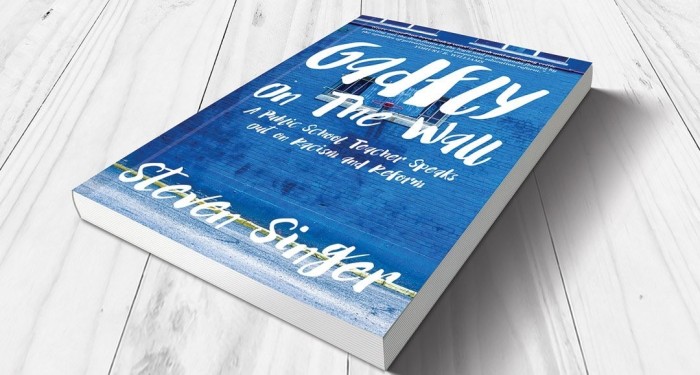
book-4

Pittsburgh Christian Academy Tries to Become a Charter School to Cash in on Taxpayer Funding

thumbnail_IMG_8528


The line between public and private school is getting awfully thin in Pittsburgh.


City public school directors received a request from Imani Christian Academy, a religious school in the East Hills, to be allowed to transform into Imani Academy Charter School for the Fall term of 2019.


Though parochial schools have metamorphosed into charter schools in Florida, Tennessee and Washington, D.C., this would be the first such transformation in Pennsylvania, according to Ana Meyers, executive director of the Pennsylvania Coalition of Public Charter Schools.


The change would require Imani to give up its religious curriculum in exchange for being fully funded by taxpayer dollars.


However, there are numerous red flags in the school’s application that make one wonder if operators are being entirely honest about giving up a faith-based curriculum.


First, there is the proposal by the school, itself.


The application does not specify that religious values will be taught in the classroom. However, its personnel budget lists a comparative religion teacher on staff. The list of proposed teachers also includes a middle/high school religious studies teacher.


That’s not exactly common practice at most public schools though teaching about religion in a secular context is allowed.


According to the Anti-defamation League’s Website:


“Public schools may not teach religion, although teaching about religion in a secular context is permitted. The Bible may be taught in a school, but only for its historical, cultural or literary value and never in a devotional, celebratory or doctrinal manner, or in such a way that encourages acceptance of the Bible as a religious document.”


Even so, it’s awfully convenient that a school whose mission statement currently includes “We share Christ with our children daily and seek to help them grow into mature Christians” would somehow magically become secular overnight.


If Imani’s charter is approved, it would be required to discontinue any religious component in its curriculum. The state school code requires even charter schools to be “nonsectarian in all operations.” The proposed academy would not be permitted to display any religious objects or symbols on the premises.


Yet one wonders who will check to make sure this actually happens.


Charter schools are not required to be nearly as transparent as fully public schools. They are not required to have open meetings of school directors, release their documents for public inspection or any of a host of other safeguards that you’ll find standard at the state’s hundreds of fully public districts.


Pennsylvania charter schools have had operators embezzle millions of dollars from taxpayers to buy private jets, apartments and jewelry. It took investigators years to uncover such graft.


Will the few auditors tasked with keeping charter schools honest even be equipped to determine whether parochial schools suddenly turned charter actually refrain from ministering to students?


According to Public Source, a nonprofit digital newspaper covering the Pittsburgh area, one of the qualities Imani is looking for in an operator for its charter school is the ability to use the school building after-school hours for religious instruction and activities.


So during the day, there will be an entirely secular K-12 school at the site of the present day parochial school that just happens to teach comparative religious studies. Then at a certain time of day, it will transform into an optional religious school offering church functions!?


This is a violation of the Separation of Church and State waiting to happen.


But it’s not only the establishment clause of the U.S. Constitution that is in danger of being trampled.


Imani’s proposal is not fiscally responsible.


The charter application proposes its CEO/head of school be paid a salary of $145,000 a year for an institution that would enroll merely 230 students.


Pittsburgh Public School Superintendent Dr. Anthony Hamlet earns a salary of $210,000 a year and he oversees a district with 24,652 students!


The proposed academy would also employ a principal at $85,000 annual salary.


That’s not exactly good reimbursement of services for the outlay of cash taxpayers are expected to pay.


Imani has struggled financially for several years.


In 2014, the school had more than $400,000 in additional expenses over its revenue, according to its form 990 filed with the IRS. The very next year, it had a budget surplus of almost the same amount. By 2016 – the most recent year on file – its expenses again were more than its revenue – this time by more than $500,000.


Imani CEO and Head of School Paulo Nzambi explained  the up and down budgeting to state officials in 2017 this way. The parochial school relied on the state’s defacto school voucher program – the Education Improvement Tax Credit. However, payments were delayed resulting in the use of a line of credit to pay bills.


It’s just such financial uncertainties that are pushing Imani to become a charter school in the first place. Even with school vouchers, parochial schools rely heavily on tuition from parents. However, you always know where the money is coming from in a charter school. Like religious and private schools, these institutions are privately managed – but like public schools they’re funded entirely by taxpayers.


Before setting up shop, any new charter school in Pennsylvania must get the approval of the school board from the district where it would be located. If the board does not approve the application, charter school administrators can appeal to the state Charter Appeals Board.


Pittsburgh school board held a public hearing on Imani’s application in December and earlier this month. Next, the district’s review team will offer its suggestions on the application. District solicitor Ira Weiss says the board is scheduled to vote on the matter at its Feb. 27 meeting.


If approved, the district would be required to pay for each student at the new charter school based on the district’s per-student spending formula.


The Pittsburgh district already pays approximately $82.8 million – about 13 percent of its total budget – for charter school tuition.


Imani Christian Academy currently operates out of the former East Hills Elementary School building, which it purchased from the city school district for $1 million in 2008.


The objections brought up here are really just the tip of the iceberg.


The proposal leaves many questions unanswered. For instance, though the new academy would be located within the geographical boundaries of the Pittsburgh Public School District, where would it get its students from? Would current students at the religious school get preferential enrollment – and what if they don’t already live in and pay taxes to Pittsburgh?


Let’s hope Pittsburgh school directors do the right thing and deny this request.


Still can’t get enough Gadfly? I’ve written a book, “Gadfly on the Wall: A Public School Teacher Speaks Out on Racism and Reform,” now available from Garn Press. Ten percent of the proceeds go to the Badass Teachers Association. Check it out!

thumbnail_IMG_8249


Ten of 15 Cyber Charter Schools in PA Are Operating Without a Charter – Close Them All

thumbnail_screen shot 2019-01-29 at 1.38.10 pm


Cyber charter schools are an experiment that failed.


It’s time to pull the plug and recoup our losses.


First, let’s get straight exactly what we’re talking about here.


Like all charter schools, these are contracted institutions. In fact, that’s what charter means – they’re independent businesses that sign a deal with the state to teach kids.


So they’re publicly financed but privately run. And in the case of cyber charters, they agree to educate children online without the benefit of a physical building.


Students access lessons via computer or other device, submit work electronically, get virtual feedback and assessment.


At best, these institutions are the grade school equivalent of the University of Phoenix – good only for independent, self-motivated learners. At worst, they’re the kiddie version of Trump University – a total scam.


In Pennsylvania, 10 of the state’s 15 cyber charter schools are operating with expired charters, according to a report by the Philadelphia Inquirer.


That’s incredibly significant – especially for an industry that enrolls about 35,000 students across the state.


These are charter schools operating without a charter. They only get the right to operate because a local school district or the state has signed a contract allowing them to do so.


If you hire a plumber to fix your toilet, you give him the right to enter your house and do what needs to be done. That doesn’t mean the plumber can walk in anytime he feels like it. There is a limited term of service. Once that term is up, the plumber needs to get out.


In the case of these cyber charters, the authorizer is the Pennsylvania Department of Education (PDE).


Charters are initially issued for three to five years. They are an essential contract between the schools and the supervisory body. The school details how it will operate, what curriculum and education strategies will be used, etc.


The state has the option to revoke the charter if the school violates its agreement or fails to meet requirements for student performance or fiscal management.


After the initial period, charters must be renewed every five years in the state.


Yet for the majority of the Keystone state’s cyber charter schools, this has not happened. The charter agreements have been left to lapse without any decision being made by state officials to renew or cancel them.


Some of the reluctance to decide may stem from the fact that the state Charter Appeal Board – the body which decides on appeals of charter applications – are all serving out expired terms, themselves.  They were all appointed by the previous governor, Republican Tom Corbett, a notable privatization ideologue.


The current Governor Tom Wolf, a Democrat now elected to his second term of office, still hasn’t gotten around to appointing new ones.


Another issue gumming up the works could be staffing issues at PDE that make it impossible to handle the reviews in a timely manner. It could be because the cyber charter schools have not provided all the data required of them by the state for the review to be completed on time. Or it could be because state officials are struggling with a fair and adequate metric with which to assess these schools.


CYBER CHARTER’S DISMAL ACADEMIC RECORD


To be frank, the latter option has to weigh heavily on state auditors. After all, it’s no secret that these schools are an educational disaster. On-line schools in Ohio, Georgia, Indiana, Nevada and New Mexico are all being closed by their respective states.


Study after study consistently shows that cyber charters are much less effective than traditional public schools – heck! They’re even less effective than brick and mortar charter schools!


A recent nationwide study by Stanford University found that cyber charters provide 180 days less of math instruction and 72 days less of reading instruction than traditional public schools.


Keep in mind that there are only 180 days in an average school year. So cyber charters provide less math instruction than not going to school at all.


The same study found that 88 percent of cyber charter schools have weaker academic growth than similar brick and mortar schools.


Student-to-teacher ratios average about 30:1 in online charters, compared to 20:1 for brick and mortar charters and 17:1 for traditional public schools.


Researchers concluded that these schools have an “overwhelming negative impact” on students.


And these results were duplicated almost exactly by subsequent studies from Penn State University in 2016 (enrolling a student in a Pennsylvania cyber charter school is equal to “roughly 90 fewer days of learning in reading and nearly 180 fewer days of learning in math”) and the National Education Policy Center in 2017 (cyber charters “performed significantly worse than feeder schools in both reading and math”).


Even the state’s own data shows lower graduation rates and standardized test scores at cyber charters than at traditional public schools.


According to a 2015-16 state PDE report, about 86 percent of public school students across the Commonwealth finished high school in four years. During the same time, only about 48 percent of cyber charter school students graduated in four-years.

CYBER CHARTER’S COST TOO MUCH


But providing such a poor service to Pennsylvania students is only one reason these schools are problematic. They’re also ruinously expensive.


They cost taxpayers more than $463 million in 2016-17 alone.


The state charter law grants these schools as much money per pupil as brick and mortar schools, yet their costs are much less having forgone a physical building and all that goes with it.


So cyber charters get whatever the local per-pupil expenditure is. It doesn’t matter if a district spends $8,000 on each student or $20,000. Whatever the amount, that goes to the cyber charter.


However, the cost of educating kids is drastically reduced online. Their programs are bare bones compared with what you get at a traditional public school. Most online charters don’t have tutors or teacher aides. They don’t offer band, chorus or extra-curricular activities. You don’t have to pay for any building costs, grounds, upkeep, large staff, etc. But the funding formula ignores this completely. Cyber charters get to keep the difference – whatever it is. In fact, they have an incentive to keep as much as possible because they can do almost whatever they want with it. That includes putting it into operators’ pockets as profit!


And when it comes to special education funding, it gets worse. In Pennsylvania, our funding formula is so out of whack that charters schools of all stripes including cyber charters often end up with more funding for students with special needs than traditional public schools get. However, because of this loophole in the Commonwealth, Pennsylvania online charters have been increasing the number of special education students they enroll and even working to label as many of their students as possible as needing special services on the flimsiest of pretexts.


According to a report by the Pennsylvania Association of School Administrators (PASA), tuition for special education students is often twice as much at cyber charter schools than at traditional public schools.


CYBER CHARTER FRAUD


Unsurprisingly, these conditions have lead to rampant fraud and malfeasance.


Just this past year (2018) the head of the largest cyber charter chain in the state was sentenced to jail for siphoning $8 million from his school into his own pockets.


PA Cyber Charter founder Nicholas Trombetta was found guilty of tax fraud in relation to the theft of public funds. He used that money to buy an airplane, a $900,000 condo, houses for his girlfriend and mother, and nearly $1 million in groceries and personal expenses, according to the grand jury. Trombetta allegedly set up numerous for-profit and nonprofit businesses to provide goods and services to the cyber charter. Federal investigators filed 11 fraud and tax conspiracy charges against him and indicted others in the case.


Another cyber charter founder, June Brown, was also indicted for theft of $6.5 million. Brown ran the Agora Cyber Charter School, which was part of the K12 Inc. empire of virtual charters. She and her executives were indicted on 62 counts of wire fraud, obstruction of justice and witness tampering. She was well known for student test scores and had a reputation for claiming large salaries and filing suits against parents who questioned her, the Philadelphia Inquirer reports.


WHAT TO DO ABOUT IT


It’s no wonder the state has been tardy renewing these schools’ charters!


Frankly, there is no good reason to continue lavishing taxpayer dollars on a system of education that provides  subpar services at an exorbitant expense and is subject to runaway fraud.


But lawmakers have always been reluctant to do the right thing.


After all, there are a slew of wealthy investors who want to make sure the money train of taxpayer dollars keeps flowing to their shady businesses. And lawmakers who enable them are assured hefty campaign contributions.


The only chance we have of saving our children from this monstrous abuse of power and saving our wallets from this shameful waste of funding is if voters make their intentions known.


The people of Pennsylvania need to stand up and demand an end to the cyber charter school experiment.


We need lawmakers with the guts to stand up to big money and rewrite the state’s charter school law.


And that’s part of the problem. The law is a joke.


It’s more than 20 years old and was only amended once in 2002 to allow cyber charters.


Subsequent attempts at requiring more accountability have resulted in horrible compromise bills that would have made the situation much worse and – ultimately – no vote.


With Ohio and California, Pennsylvania was in the “big three” cyber-charter states in 2016, accounting for half of cyber charter enrollment nationally, according to the industry’s authorizers’ association. While 35 states and the District of Columbia allow full-time cyber charter schools, eight do not, including neighboring New Jersey.


The right course is clear.


We just need a people-powered movement to force our lawmakers to do it.


Either that or replace them with those who will.


Still can’t get enough Gadfly? I’ve written a book, “Gadfly on the Wall: A Public School Teacher Speaks Out on Racism and Reform,” now available from Garn Press. Ten percent of the proceeds go to the Badass Teachers Association. Check it out!

cropped-book-1.jpg

Teaching Through Lockdown

gettyimages-88519594-640x640


“Excuse the interruption. We are under a lockdown.”


That was it.


Not an explanation of what caused it.


Not any idea of how much danger we were in.


Not any idea of how long it would last.


Just a vague warning that teachers knew meant to keep all their students in class until further notice.


As an educator, you’re expected to teach.


It doesn’t matter what’s happening around you. There can be yelling or screaming. There can be a scuffle in the next room. The lights may flicker off and on.


None of that matters.


If you have students and aren’t in immediate danger, you’re expected to teach them.


And that’s what I did. Even then.


I teach mostly poor and minority students in a western Pennsylvania school near Pittsburgh.


My 8th grade language arts class was in the middle of taking a final exam on The Outsiders by S. E. Hinton.


Most of my students were finished, but it was still quiet as two or three students struggled through their last responses.


Then the announcement came over the PA.


“…lockdown.”


The voice was the high school secretary. Since the middle and high school are connected, she rarely makes announcements in my building – only when something is important happening for both buildings.


The kids looked up at me with worried faces.


“What’s going on, Mr. Singer?” one of them asked.


I told them the truth – I really had no idea. There were no drills planned for today. In fact, it would have been a really poor time for one. We had just had ALICE training the day before where the resource officer and the principal had met with students to go over what to do in case of an active shooter. The program is named for the courses of actions it recommends – Alert, Lockdown, Inform, Counter, Evacuate.


So we were apparently in the L.


During the assembly, the resource officer had said quite bluntly that there would be no coded messages. If a school shooter entered the building, officials would tell us in plain language what was happening so we could make an informed decision what to do.


But there was no additional message over the PA. That was it.


I went over to my computer to see if there was an email. Nope. Nothing.


I pressed refresh a few times. Nothing.


I asked the students to hush and just listened.


It was extremely quiet. Even the hallway was silent and it’s never that silent except during standardized testing.


My room has no windows to the outside. It’s a brick box with one wooden door containing a sliver of window.


The door was already closed and locked. We’re told to keep it that way just in case. But there’s an additional deadbolt you can click to make it even harder to gain access to the room.


“It’s probably nothing,” I said as I walked over to the door and surreptitiously clicked the deadbolt.


I asked student to finish their tests.


It seemed the best course of action. We could either worry about an unknown that was extremely unlikely or else just take care of our business.


It was hard getting the students to calm down. They were scared, and, frankly, so was I.


But this seemed the best thing we could do – Seek normalcy but stay vigilant in case things changed.


“Mr. Singer, may I use the bathroom?” asked one child.


“I’m sorry, but no.” I said. “Not until the lockdown is over.”


Somehow I quieted them down and the remaining students finished their tests.


It seemed to take them forever.


I stood by those who were finalizing answers in the hope that my physical presence would get them to concentrate.


For the millionth time I pondered the wisdom of grouping kids into classes based on test scores. All you end up doing is sorting them by poverty, race, trauma and behavior problems.


But they were soon done.


So they handed in the tests and we went over the answers.


“May I use the bathroom?”


“No. Not yet. Sorry.”


For about five minutes things went as they would on any other day.


But as soon as there was a lull in the activity, the fear and worry returned.


Students wanted to take out their cell phones and call or text home.


I told them not to.


“Why?” asked a boy in the front.


I knew the answer. We had nothing we could tell parents other than that there was a lockdown. We didn’t know what caused it or what was happening. If there was something bad going on, having parents come to the school would only make things worse.


But I just told him to put it away. I didn’t want to debate the situation. I didn’t want them (or me) to think about what might be happening.


We hadn’t finished watching the movie version of “The Outsiders” so I quickly put that on.


We only had about 15 minutes to go. And watching Dally get shot down by police probably wasn’t the best choice under the circumstances.


Still, the kids were focused on the film and not the lockdown.


We discussed how the movie and the book differed for a few moments.


But inevitably there was a lull.


We all got quiet and just listened. Nothing.


No. Down the hall we could hear something. Maybe a scuffle. Voices. It was hard to tell.


I started thinking of options, what to do if someone tried to enter the room. But it got quiet again.


Still no email. No message. Nothing.


I could call the office on my school phone, but that just might make things worse.


“Mr. Singer, I’ve GOT to use the bathroom!”


I looked around. I wasn’t sure what to do. I couldn’t let him out there. It would literally be better if he peed his pants.


He must have seen my confusion. “Can I just pee in a bottle or something?”


“Do you have a bottle?”


“No.”


I was about to tell him to take the garbage can into the corner and pee into it but there was no empty corner in the room.


Before I could remark any further, he said, “It’s okay. I’ll just hold it.”


That’s when I noticed the time. We had already spent more than the 40 minutes in the allotted period. The bell should have rung to get students to move to another room. That meant the bells were off.


The students noticed, too.


I kept telling them that everything was probably fine and that I wouldn’t let anything happen to them.


Then we noticed something weird out of the window in the door.


One of the school custodians was standing right outside the room.


He didn’t seem alarmed. He appeared to be looking for something.


Then another custodian walked up to him and they conferred in the hall.


We heard talking. Perhaps the principal in the distance.


Whatever was happening they seemed to have it under control and didn’t appear worried.


I had nothing planned for my students to do. We were well off book here. I couldn’t just start a new unit. I had no idea how long we’d be here.


So I asked them to take out their self-selected books and read.


They groaned.


“How are we going to concentrate on that?” someone asked.


I didn’t really have an answer but it was better to try than to worry needlessly.


So after some cajoling, they dutifully took their books out. Most just stared around the room listening to every nonexistent sound. But some at least appeared to be reading.


“Mr. Singer…”


NO YOU CAN’T USE THE BATHROOM!


Then not long after, the announcement came that the lockdown was over and students could move to their next class.


There was no explanation. Kids just breathed a collective sigh and went to their classes.


I let anyone use the restroom who asked. And I tried to teach through another class.


I truly expected a printed letter from the superintendent to be hand delivered to the room so the kids could take it home. But no. Perhaps there hadn’t been enough time to write, print and disperse one.


After the students were dismissed, I expected administrators to announce a staff meeting to let the teachers know, at least, what had happened. But there was nothing.


I went into another teacher’s room and saw a group talking. THAT was when I found out about what had happened.


A group of students in the high school had been fighting.


Apparently it was pretty bad – almost a riot. One child had been knocked cold and taken out of the building on a stretcher. The others had been removed by police.


When teachers had broken it up, some of the kids had run and were hiding in the building. That’s why the lockdown.


There was more on the 11 O’clock News. Some of the kids had filmed the fight with their phones and put it up on Snapchat.


We eventually got a letter from the superintendent and an email from another administrator saying that it had just been a minor fight.


Parents were on the news saying that administration hadn’t handled it properly, but no one showed up at the next school board meeting to complain.


And so life goes on.


The threat of violence always hangs over our heads.


It probably won’t ever come down to the worst case scenario. Yet the fact that it might and that no one really seems to be doing much of anything to stop it from getting to that point – that changes what it means to be in school.


We live with this reality everyday now.


It’s not fair to students. It’s not fair to teachers or parents.


But when you live in a society so broken that it can’t even begin to address its own problems, this is what you get.


Still can’t get enough Gadfly? I’ve written a book, “Gadfly on the Wall: A Public School Teacher Speaks Out on Racism and Reform,” now available from Garn Press. Ten percent of the proceeds go to the Badass Teachers Association. Check it out!

book-3

Children of the Gun: How Lax Firearm Legislation Affects My Students

20181012_lockdown-master


Tanisha was just 6-years-old the first time she was in a shooting.


She was home in the kitchen looking for a cookie when she heard a “pop pop pop” sound.


Her mother rushed into the room and told her to get down.


Tanisha didn’t know what was happening.


“Hush, Baby,” her mom said wrapping the child in her arms and pulling her to the floor. “Someone’s out there shooting up the neighborhood.”


That was a story one of my 8th grade students told me today.


And it was far from the only one.


For the first time, my urban school district in Western Pennsylvania had an ALICE training for the students.


The program helps prepare schools, businesses and churches in case of an active shooter. Its name is an acronym for its suggested courses of action – Alert, Lockdown, Inform, Counter, and Evacuate.


In a district like mine where three separate gunmen went on sprees within 5 miles of each other during the last few years, this sort of training is becoming more frequent.


We’ve had numerous seminars for the teachers – even active shooter drills. With the students, we’ve had lockdown drills were the kids were basically instructed to duck and cover under their desks or in corners or closets.


But this was the first time the danger was made explicit in an assembly by grade level.


Our school resource officer and middle school principal stood side-by-side before the 8th grade going over in detail how someone might come into the building with the express purpose to kill as many of them as possible.


And then they told these 12 and 13-year-olds that it was up to them to do something about it.


That hiding wasn’t good enough. They needed to try to escape or incapacitate the attacker.


It still shocks me that we’ve gotten to this point.


We no longer expect society to keep us safe – to keep guns out of the hands of dangerous people.


It’s up to the children to watch out for themselves.


I can tell you as a teacher with more than 15 years experience in the classroom, I have never seen kids so quiet as they were in that auditorium.


It makes me sick.


When I was their age I was playing with Luke Skywalker action figures and building space ships out of Legos. I wasn’t discussing with police how to avoid a bullet to the brain. I wasn’t advised to wear my backpack on my chest to help protect against being gut shot.


I wasn’t then going back to class and talking over with my teacher how we can best barricade the room against any would-be bad guys.


But that’s what we did today.


I tried to reassure my kids that they were safe, that we could secure the door and if worst came to worst I wouldn’t let anything happen to them.


But these children aren’t like I was at their age.


They were shocked by the directness of the assembly. But they were no strangers to violence.


Later in the day, so many of them came back to me to talk about their relationship to guns and how firearms impacted their lives.


“I know you can’t get an automatic rifle unless…”


“I have a friend whose brother…”


“You don’t know what it’s like to lose your best friend to a gun.”


One of them had been friends with Antwon Rose in East Pittsburgh friends with Antwon Rose in East Pittsburgh. They knew all the details about how he ran from police and was shot down.


Someone coming into the school with a gun? Heck! They experience that everyday with the police.


For many of my kids, law enforcement isn’t automatically a comforting thought. They don’t trust the uniform. Often with good reason.


And now they were being told that safety was just another one of their responsibilities – like doing their homework and picking up after themselves in the cafeteria.


I can’t shake the feeling that these kids are being cheated – that the world we’ve built isn’t worthy of them.


What point is a society that can’t keep its own children safe?


What point police and firefighters and lawmakers and courts and laws and even a system of justice if we can’t use them to protect our own kids?


Isn’t that our job?


Isn’t that what adults are supposed to do?


Keep the danger out there so that the little ones can grow up and inherit a better world?


But we don’t even try to do that anymore.


We’ve given up trying.


No more pushing for better laws and safer regulations.


Just look the kids straight in the eye and tell them that death may be coming and there’s nothing we can do about it.


It’s up to them.


If that’s the best we can do, then shame on us.


Still can’t get enough Gadfly? I’ve written a book, “Gadfly on the Wall: A Public School Teacher Speaks Out on Racism and Reform,” now available from Garn Press. Ten percent of the proceeds go to the Badass Teachers Association. Check it out!

book-4