At least six more cases of COVID-19 have been identified at McKeesport Area School District, but you wouldn’t know it from administrators.
The information at the Western Pennsylvania district is being kept quiet instead of being released to the public.
So at the high school, two students tested positive, and at Twin Rivers Elementary, three staff and one student were identified as having the virus last week, according to a reliable source close to the school board.
Of those, two of the three Twin Rivers staff are awaiting confirmation of their test results from Allegheny County Health Department. The rest have all been tested and their results confirmed.
However, there are a few additional potential cases that remain to be investigated, according to the same source.
The district used to send out telephone, email and conventional mail alerts when students or staff tested positive.
Though the tracker has not yet been updated to include this information, it is being considered as the sole source of information to the community about cases, according to the school board source.
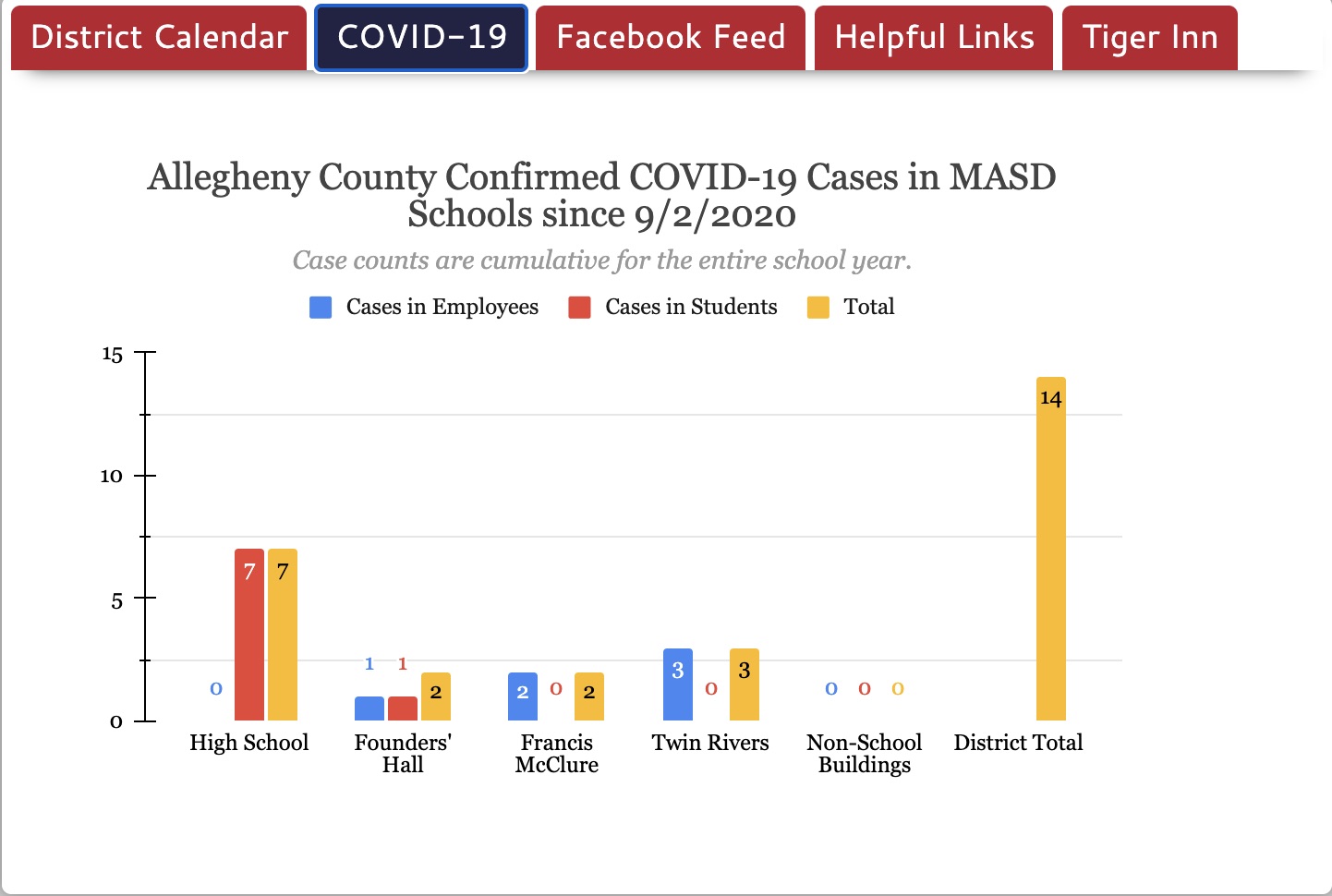
As of Monday night, the tracker only lists 14 cases in the district since buildings reopened in September – seven students at the high school, a student and a staff member at Founders Hall, two staff at Francis McClure Elementary and three staff at Twin Rivers.
The new cases would bring the district total to 20 – nine at the high school, seven at Twin Rivers with the numbers at other buildings unchanged.
That’s 11 students and 9 staff total – not counting any additional cases that may be coming.
I still think the tracker is a good idea, but it shouldn’t be the sole source of this information.
And school directors should be using this data to determine if it is safe to keep buildings open at all.
Moreover, the tracker has its own glitches.
It does not come up when accessed through certain browsers like Firefox. Unless you use the most reliable browsers like Chrome, you can get nothing but an empty white screen.
With the county in the midst of a steadily increasing surge in Coronavirus cases, now is not the time to hold back on information.
This followed a week of record-breaking reports from the Pennsylvania Department of Health, with an all-time high of 5,551 cases reported on Saturday throughout the state.
There have been 4,230 cases of COVID-19 in Allegheny County this month, alone.
Over the last week, the country has averaged more than 1,080 deaths a day – more than 30% higher than two weeks previous.
The McKeesport community deserves up-to-date information about viral spread in our schools.
Administrators need to step up the transparency.
Like this post? You might want to consider becoming a Patreon subscriber. This helps me continue to keep the blog going and get on with this difficult and challenging work.
But the idea that public schools are fundamentally better – that idea has suffered tremendously.
I used to believe that local control was something to cherish, that a board made up of neighbors duly elected by the community would more often than not have the best interests of that neighborhood at heart when making decisions.
Yes, the board decided to make students and teachers guinea pigs in an experiment to see if they could somehow avoid getting sick while cases surged throughout the country and state.
Will Western Pennsylvania schools do the right thing and go to remote learning? Will Steel Valley finally give up this in-person experiment? Will McKeesport?
They keep blaming everything on academics, saying they have provide what is best to help students learn – never mind the dangers to child, parent and teachers’ bodies. But even more hypocritically they ignore the well being of huge swaths of their students who refuse to take part in their in-person experiment.
In both districts, about 60% of parents favor in-person schooling and 40% prefer remote.
So the boards are doing what the majority wants, but it’s a slim majority.
There is a significant portion of parents who feel these in-person plans are unsafe and very little is being done to educate their children.
They are actually betting that the poor quality of the cyber program will increase the number of parents sending their kids to in-person instruction.
And I’ve heard similar comments among administration at Steel Valley.
There at least we don’t force kids into our (likewise crappy) cyber program. We just have classroom teachers post assignments on-line.
Remote students in K-5 get live teachers instructing on-line. But remote students in 6-12 only get one half day of synchronous instruction on-line a week. The rest is asynchronous worksheets, etc. And somehow that’s supposed to be enough.
We have enough teachers that we could provide more, but why encourage remote learning? Might as well let them eat asynchronous and hope their parents will lose hope and just make them come to school during a global pandemic.
I have zero respect for administrators who think this way. I have zero respect for school board members who vote for it.
So how do I keep my respect for local control and the school board system?
But my district has refused to allow me a safe work environment.
I am not allowed to teach remotely.
I have to burn my sick days so I can stay safe at home. But at the same time, I’m encouraged to take overtime hours to put up remote lessons, grade papers and contact parents.
I’m ready to do that as part of my job, but they won’t let me. They’d rather pay me and a sub who babysits my students in-person while I do what I’m allowed to do remotely at the same time.
So how do you look an administrator in the eye who refuses to lookout for his own employee’s safety?
Because the leadership is perfectly fine with agreeing for the staff to work in unsafe conditions and no special protections for those like me who are more likely to contract the disease.
Leaders throw up their hands and say “We’re an association not a union,” and “If the boss says you come back to work, you have to come back to work.”
And what is PSEA threatening if districts don’t comply?
Nothing…. So far.
But I guess saying something about it is better than what they were doing before.
The national unions – the National Education Association (NEA) and American Federation of Teachers (AFT) – certainly haven’t taken any hardline stances.
The technology should be merely a tool to connect students and teachers not as a provider of that learning.
The backlash against ed tech has been far greater than any embrace.
Yet some education activists decry how public schools going remote makes privatized schools who don’t look good.
That’s nonsense, too.
Teaching recklessly is bad – no matter who does it. If parents want to endanger their own kids, that’s their prerogative, but in the long run no one will earn brownie points for enabling such negligence.
However, where privatized schools will earn points with parents is for providing high quality remote learning when public schools refuse to do so.
I know all of them aren’t doing that. But some of them are.
And, frankly, they deserve any praise they get for it.
Look, I love public schools, too. But when public schools abandon their duties to their students as so many have done during this crisis, they deserve to have their students stolen. Even if these privatized schools often have more money to work with in the first place.
CONCLUSIONS
Bottom line: This is a crisis the school board system should have been able to overcome.
It’s a crisis the unions should have been able to battle.
It’s a crisis the activist community should have been able to see clearly.
That’s why the schools are open. School boards are afraid keeping them closed will hurt business in the community.
That’s why administrators make such reckless reopening plans. They’re afraid that if we stay on remote it will become obvious how irrelevant they are to the running of a virtual school.
That’s why union leaders put up next to no resistance. They’re more afraid of furloughs than death or lifelong health consequences.
That’s why some parents support reopening schools – so they have someone to watch their kids while they’re at work. They never spare a moment for how the government is cheating them out of stimulus checks, mortgage relief, rent forgiveness, free testing, hazard pay and healthcare so they don’t have to put their own lives on the line working during a pandemic.
In all honesty, we were a sick country long before COVID-19 hit our shores.
When you look across the ocean at the more socialist countries, you see much better plans to deal with the pandemic. Not perfect, but better.
When everything isn’t dependent on money changing hands, you can more easily prioritize human life.
So, yes, my faith has been shaken in our public schools.
I still think the idea of a public school is one to be cherished and fought to protect.
But the leaders we have – nearly all of them – should be rejected.
We need an army of citizen activists, parents and teachers to come forward at the first opportunity to replace them.
Anyone in a leadership role this year should have to explain themselves – what did you do to protect students and staff during the pandemic?
If they can’t prove they took real steps to keep people safe and not sacrifice the people they were charged to protect on the altar of capitalism – if they can’t do that they should step down.
They should step down with tears in their eyes and forever have their names sullied by their cowardice and stupidity.
They have failed us all.
Like this post? You might want to consider becoming a Patreon subscriber. This helps me continue to keep the blog going and get on with this difficult and challenging work.
My doctors tell me that I am more susceptible to contracting the virus because my medications suppress my immune system. And that also means that if I do contract the disease, I will be more likely to have severe, life-threatening complications from it.
However, starting Wednesday, about 60% of parents in my district have chosen to send their kids back to the buildings.
Of these, half the students will come in during the morning and half in the afternoon. Each will go through all their classes in 20 minute periods. On Fridays, the buildings will be closed and teachers will instruct virtually for half the day and plan during the other half.
The new reopening plan cuts instruction time by half and doesn’t meet parents need for childcare or certainly student safety. But it is better than being open 5-days a week and it provides the possibility of social distancing.
So I went to my principal asking if I could continue to teach online.
I documented my conditions, gave him doctors’ notes, and had my doctors fill out pages and pages of questions from the district’s lawyers.
In the end, my principal told me the district could not meet my request.
Administrators could provide some protections like a plexiglass barrier and take me off hall duty, but they couldn’t let me continue to teach remotely.
Certain teachers in grades K-5 have been given this option, but not secondary teachers like me. Elementary students whose parents don’t want them to return to the building will get full synchronous virtual instruction with a teacher through a video conferencing site like Zoom. Secondary students who do not return to the buildings will only get asynchronous assignments most of the week posted by their classroom teachers.
He suggested I look into taking a leave of absence.
And I guess I can see where he’s coming from.
If administrators let me teach remotely, it’s possible enough students would return to the classroom that the teachers willing to return wouldn’t be enough to meet the load. My absence from the building might necessitate a substitute teacher to be in the physical classroom with students.
Why pay for two teachers when you only need one?
Except…
…I’LL STILL BE PAID WHEN I’M ON LEAVE.
It’s just that then I’d have to sit at home instead of teach my students.
So benching me doesn’t save the district any money.
In fact, it will cost the district MORE money for me to stay home, because I could still do everything they expect of me and more for the sizable number of students whose parents say they aren’t returning.
So I brought this up to my principal figuring he must have overlooked it.
But no. He said he knew all about it.
He said this is what the district’s lawyers were telling him to do so that’s what he was going to do.
I couldn’t believe it.
I went to school board directors I had developed a relationship with teaching their children, going on field trips with them, working with their spouses.
I got the same answer.
So here I am – being asked to choose between my life and my livelihood.
Go to work and risk everything – or sit at home burning my sick days and still collecting a paycheck.
This is not what I want.
It’s not good for anyone.
I teach 8th grade Language Arts. Last year I also taught 7th grade.
So many of my students this year were in my class in the spring. We already know each other.
But more than that, I know what they like and dislike. I know their hopes and fears. I know what motivates them and what supports their individual learning.
I’ve seen tremendous growth the first 9-weeks of school and could really help them overcome the gargantuan hurdles that will be inevitable the rest of the year.
And that’s what I’d really like to do.
I don’t want to sit home collecting the taxpayer’s money when I could be making a difference in these young people’s lives. I don’t want to have to wait for an outbreak to allow me to continue my work.
Being benched like this makes me feel so worthless, and I’m not.
Wouldn’t everyone be better served with me instructing my students rather than being thrown to the side?
That can’t happen without help.
I’m just a human being like anyone else.
I have people who care about me and whom I care about.
I have a wife and daughter.
I can’t roll the dice with my life or chance taking an infection home to my loved ones.
Is a safe work environment really too much to ask?
I don’t want to sit at home.
I want to teach.
Like this post? You might want to consider becoming a Patreon subscriber. This helps me continue to keep the blog going and get on with this difficult and challenging work.
The school board will review the plan at its work session meeting on Monday in the high school auditorium at 7:30 pm. The meeting also will be live streamed on YouTube.
The board is expected to vote on the plan at its regularly scheduled meeting on Thursday, Oct. 29, at 7 pm.
I don’t want to have to contradict the school board and my administrators.
I don’t want to have to insert myself into this debate.
But I feel like I have no other choice.
Since I don’t live in the district, I can’t go to the school board meeting and speak.
And when I have expressed my concerns to those in charge, they have been repeatedly brushed aside.
So I am putting them out there in the public space.
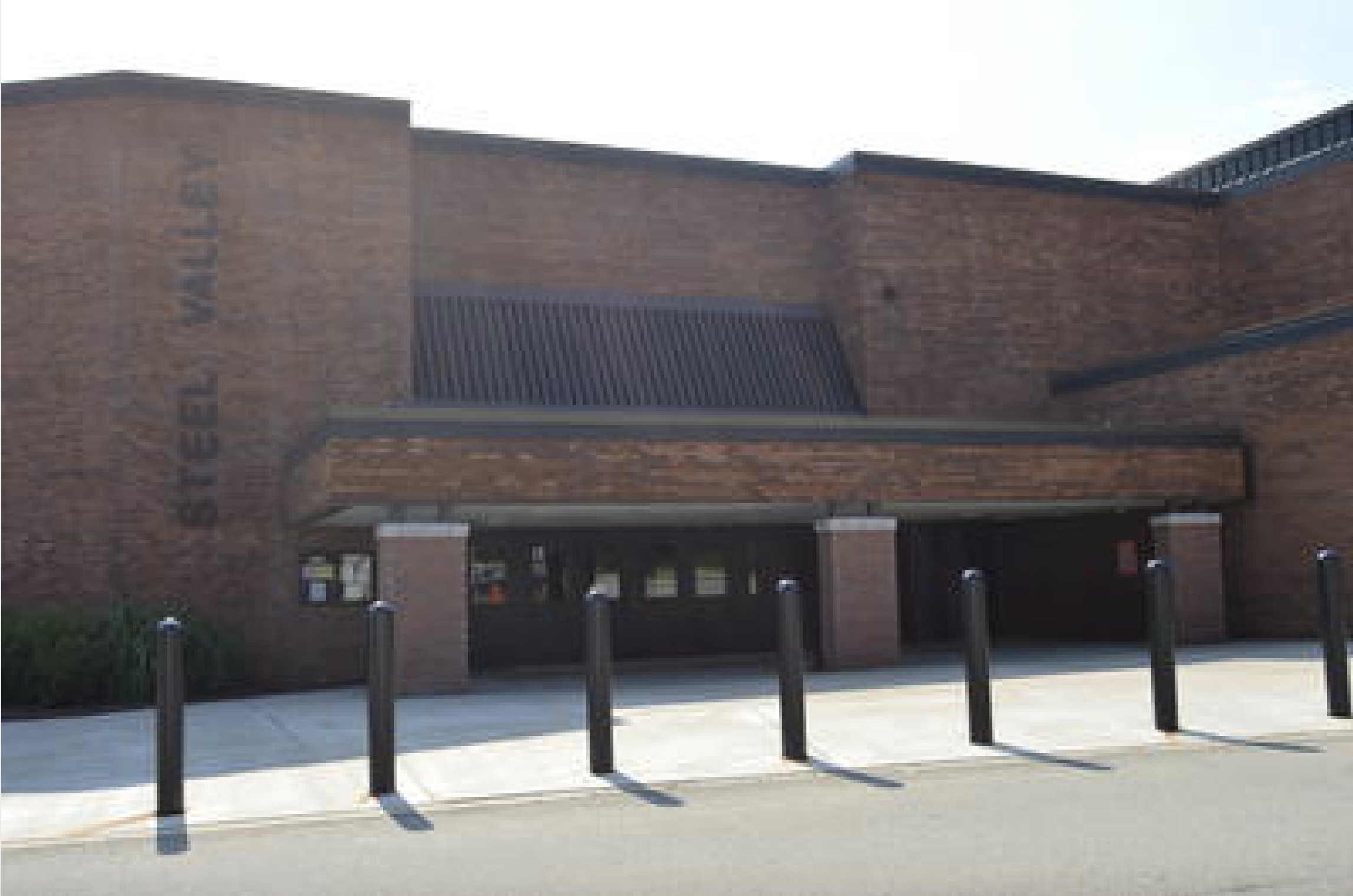
This is what a Steel Valley teacher really thinks about this proposed plan.
This is what I feel I must say even at the risk of my job and future in this district – the proposed plan should not be adopted. We should continue with virtual instruction until infection rates in the county are extremely low.
The proposed plan would have students dividing into two groups – one would attend in the mornings and the other in the afternoons.
Both groups would have all of their classes for 20 minutes each for four days a week – Monday – Thursday. Friday would be a half day virtual learning day.
Consider that students currently have their full classes on-line for four days a week. Wednesday is an asynchronous learning day.
So the new plan would cut instruction time by half.
And this is true even for double period classes. Two 20 minute in-person classes is better than one, but not as good as two 40 minute virtual classes.
Just imagine it.
If this plan is approved, students and staff would be rushing here-and-there for the tiniest fraction of possible instruction in-person, and then rush home to do the mountains of classwork that would be necessary to move forward at all.
But parents will be given a choice whether to subject their children to this schedule or not.
Parents will have to decide whether they want their children to attend in-person or receive virtual instruction.
However, the virtual instruction being offered under this new model is not in many cases the same as what children receive now.
Remote students in K-5 would still meet with a classroom teacher on video platforms.
However, remote students in 6-12 would have to enroll in the district cyber program. This is a canned ed tech initiative modeled on credit recovery. They will have minimal to no interactions with classroom teachers or lessons taught by district educators.
This would replace an exemplary district-designed curriculum with a subpar service to parents and students in the hope that they will opt for in-person instruction instead.
No matter which option you choose for your child, from an academic standpoint, this new proposal is a step backward.
Most students would receive less instruction from classroom teachers – either half of what they’re receiving now (but in-person) or next to nothing on-line in grades 6-12.
And that will continue to happen until we work together to provide a coordinated defense against the pandemic.
You can’t have half of the schools close their doors and the other half keep them open and expect the virus to just stop. You can’t have some people wear facial masks in public and others go without and expect the virus to disappear.
We need to work together or else prepare ourselves to hunker down for a very long COVID season. Or – even worse – a very short one.
If you are a resident of Munhall, Homestead or West Homestead and you feel the same way I do, I am begging you to go to the school board meetings.
Please tell the board not to proceed with this plan.
It will result in many, many people getting sick.
Some may die. Others may have life-long debilitating complications as a result of the virus.
That’s just not worth it.
That’s just not worth a little more in-person instruction and a little less out-of-pocket childcare costs.
Healthcare, hospital stays and funeral preparations are much more expensive.
Thank you for hearing me out.
Like this post? You might want to consider becoming a Patreon subscriber. This helps me continue to keep the blog going and get on with this difficult and challenging work.
“Oh yes it is, Sir. You ordered the meat sandwich. Enjoy your fresh hay and oats.”
In everyday life, you wouldn’t put up with that kind of nonsense.
But for some reason, far right ideologues think it’s exactly the right way to interpret the U.S. Constitution.
The meanings of words change over time.
But ignoring that fact allows disingenuous crackpots to sweep over centuries of judicial precedent in favor of what they pretend to THINK the words meant at the time the law was written.
It’s not even about what the writers of the law SAID it meant. It’s about what today’s justices decide some hypothetical average Joe of the distant past would take certain words to mean.
Before this ruling, the Second Amendment was interpreted to be referring only to service in the militia. The Militia Act of 1792 required each able-bodied male citizen to obtain a firearm (“a good musket or firelock”) so he can participate in the “well regulated militia” the Amendment describes.
It was about the obligation to serve your country, not the right to own a gun. However, Supreme Court Justice Antonin Scalia – the most infamous proponent of judicial originalism – orchestrated the majority opinion in this case changing all that. By doing a thought experiment about what words might have meant in the 1700s, he papered over two centuries of established law. He was so proud of it that he even described it as “my masterpiece.”
Academics didn’t become something schools were responsible for until the mid-1800s. And even then, how they went about achieving it differed greatly from region to region of the country.
In fact, it wasn’t until the Civil War ended and the Reconstruction era began when public schooling really became a thing in the South.
And even when it did, it didn’t look much like our schools of today. These were often one-room schoolhouses where a single teacher tried to educate children of various ages, grades and abilities.
Moreover, these schools weren’t solely supported by taxes – if at all. These Common Schools were more like private or parochial schools of today. Parents paid tuition, provided housing for the teacher, or contributed other commodities in exchange for their children’s education.
Only 31 states passed laws requiring children to go to school by 1900, and kids only went from age 8-14. It wasn’t until 1918 that every state even required elementary school.
But let’s not forget segregation.
It was the law of the land until Brown vs. Board in 1954, and even then it took until the late 1970s to become even moderately enforced.
Just imagine if Barrett gets together with the wingnut Republican majority on the court to reevaluate that ruling!
Imagine how many centuries of slow progress she could overturn by appealing to the common man – of 1776.
Imagine if she and the regressive right examined free speech cases! After all, many of these laws were written during the time of the Adams Administration’s Alien and Sedition Acts which radically cracked down on free expression.
We could expect a rush to return to the mire and muck that many of our enlightenment heroes were trying to escape in the first place.
But originalists like Barrett claim only they can interpret what the language in these laws originally meant. Yet their training is in law, not literacy or antiquity. They’re not linguists or historians. They don’t have some shortcut to what people used to mean by these words. They’re just playing with the language to make it mean what they want it to mean so they can rule however they so choose.
Even if they could figure out the original meaning of the words in these laws, that doesn’t guarantee it would make sense in today’s world. How, for example, do the founding fathers views on medicine have anything to do with today’s healthcare system that didn’t exist in the 1700s and that the founders couldn’t even comprehend? How do the founders views on gun rights relate to today’s firearms when they knew only of muskets and not automatic weapons?
Finally, why should we give preference to antiquated ideas over modern concepts? The laws of yesteryear may have been suited to the days in which they were written. However, if a law cannot grow to encompass the world as it exists, it has no right to continue to exist.
Judges are not supposed to overturn precedent based on lingual folderol. They’re supposed to uphold the law based on logic, reason and sound judgement.
Any judge that disagrees has no place in our courts.
It’s ironic that such degeneration would come from the Republican Party.
If anything were to revert back to its original meaning, I wish it were the Grand Old Party, which is now neither grand, barely a party and merely old.
Like this post? You might want to consider becoming a Patreon subscriber. This helps me continue to keep the blog going and get on with this difficult and challenging work.
Only in the most sparsely populated, secluded or reckless areas have schools been allowed to reopen 100% without safety precautions.
For many districts trying to juggle both in-person and virtual classes, the online component has been left to ed tech companies like Edmentum often specializing in credit recovery.
Along with students whose input and experiences should not be ignored, it is our collective educator core who have been thrust into this strange experiment. But unlike children, they have the knowledge, maturity, skills and life experience to evaluate it best. And being one of those intrepid individuals, I here offer my thoughts.
After more than four months teaching this way, I’d say these are the top 5 pros and cons of virtual instruction:
Pros
1) There is Less Pressure Day-to-Day
Right off the bat there is something to be said for virtual instruction – it feels more low stakes.
You sleep longer, can more easily access amenities, the bathroom, food and drink.
For one, you sure can’t beat the commute.
Some students admit that they roll out of bed each morning and onto the computer. This is not always optimal for learning in that the mind needs time to wake up and focus itself. However, the fact that one has more choice over how to prepare for school, what to wear, more leeway about breaks and whether to eat or drink in class – all that leads to an increased casual feeling to the day.
Though I certainly don’t roll from my bed to class, the extra sleep I get from not having to drive to the building and the reduced stress of forgoing a commute, traffic, bad weather, etc. are extremely positive.
It helps me be more relaxed and ready to meet my students needs. It makes me a better teacher.
True, a dedicated disruptor can find a way to cause a ruckus. He or she can try to use the chat or even the video camera. They may even have each others cell phone numbers and communicate back and forth that way.
However, few students are aggravated enough to take such measures. I haven’t noticed much beyond simple teasing.
Some of my students put pictures of each other as the backgrounds on their camera screens – but these have always been friends trying to get a laugh. A comment from me and it stops.
If worse comes to worse, I can still remove them from the Zoom meeting and alert the principal or dean of students for disciplinary action.
But I haven’t had to do that yet. I’ll bet disciplinary referrals have dropped to record lows. And without them, virtual learning may have all but dismantled the school-to-prison pipeline.
3) It’s Easier to Communicate with Parents and Students Individually
There are many reasons for this.
In the physical classroom, the most common form of communication is verbal. But digital spaces allow for several other methods.
You can email individual students messages, work, assignments, grades, etc. You can utilize the chat feature to send a private message. You can simply talk to them in the Zoom meeting. You can set up an individual Zoom meeting like office hours to answer questions. You can ask or answer questions about assignments in the stream function of Google Classroom.
All these options allow for students to talk with their teacher one-on-one more easily than in the physical classroom.
Consider this: let’s say a student has a question about the homework after class. In the physical classroom environment, there may be little they can do but wait until the next day. Before last March, I’d had students send me emails, but I never checked them as regularly as I need to now.
In the digital world, students can easily send a message through email or stream at any time. This certainly puts a strain on educators but most questions I receive are during school hours and easily answerable in a timely fashion.
I find that in the virtual classroom, I have the time to communicate with every parent at least once a week – or at least I try. Even in the digital world, some parents are incommunicado.
4) It’s Easier to Read a Text Together
As a language arts teacher, this is really important to me.
For more than 15 years, I’ve read texts aloud with my students and asked them to follow along. I tell them to take their index fingers, put them in the text and move along with where we are in the passage.
Few actually do it, and there’s really nothing I can do to make them. Except beg.
In the virtual classroom, I can easily put the text on all their screens, place the cursor under the words and follow with the reader or the audio recording.
Students can try to ignore it, but that’s harder than just following along. It also allows me to point to specific parts of the text.
If a student is reading and struggling with a word, I can point to prefixes, suffixes, roots, etc. to help them. And I’ve honestly seen improvements in some struggling readers fluency.
5) It’s Easier for Students to Work at Their Own Pace
This isn’t really a core value of the physical classroom.
Teachers give assignments, set due dates and students have to get things done in the time frame.
Online it isn’t such a straight line.
Teachers instruct in a Zoom meeting, but students are not required to attend. They can catch up with a video of the meeting if they need or prefer.
And since we all anticipate students may have issues throughout the day with connectivity, the technology, home responsibilities, distractions, etc. teachers haven’t been so firm on those due dates.
I freely give extensions and tell my students that assignments can still be made up for full credit well past the deadline. It’s about getting the work done, not so much about when.
I find myself explaining assignments more often than usual, but it’s somehow not as annoying as it sometimes is in the physical classroom.
We’ve created a culture of care and understanding. I think that’s a positive thing even if it doesn’t emphasize due dates and time frames as much.
Cons
1) Student Absences
No matter how you look at it, there are an alarming number of students absent throughout the day.
For my own classes, this was much worse in the spring when we first went online. Starting in September, more students have been attending regularly.
However, there are two important points to be made.
First, there are some students who do not attend the live Zoom meetings but instead watch the videos and do the assignments. Their work is not worse than those who attend – in fact, it is sometimes much better.
I suppose it’s possible students in the Zoom meetings could feed information to those not attending, but with the videos and the ability to communicate with me at will, it’s almost more work to cheat.
In my classes, about 20% are regularly absent. Of those, 10-15% are not participating much at all.
That’s about the same as I would expect to see in the physical classroom.
We need to identify these students and provide them with the resources necessary to succeed. But that’s always been true.
2) The Camera Conundrum
To turn your camera off or not? That is the question.
Zoom meetings can be an awfully lonely place for teachers when every student has their camera off.
The general consensus is that we should allow them this freedom. It encourages them to attend the Zoom meetings on their own terms and avoid the stress of seeing themselves constantly on their own screens. It allows them to avoid the fear of being judged for their surroundings.
Allowing them this latitude certainly does increase attendance and create a more positive attitude. But the teacher is in a worse position to monitor student engagement.
Most days I feel like a medium at a seance asking if so-and-so is here. Give me a sign.
I try to pose questions to get students involved – even more than I would in the physical classroom – and sometimes it works and sometimes it doesn’t.
There are times when I yearn just to be able to look at my students again and see what they’re doing. Because I know some of them are not paying attention.
Some are texting on their cell phones. Some are playing video games on another screen. Some are talking with brothers, sisters, friends or parents in their house.
There’s not much I can do except try to keep my classes as engaging as possible. Most of the time, I think it works.
But not always.
3) It’s Harder to Monitor/Push Students with Special Needs
This is nearly impossible for a student with his or her camera off. I can try verbal queues, but students don’t always answer. I can ask them to turn on their cameras if that has been added to their IEPs, but they rarely comply. And if they do, they just point the camera at the ceiling or otherwise away from their faces.
The human contact of actually being present in a physical space has many advantages – especially for students with special needs.
I try my hardest and do everything I can to help them. But I feel that some of them are falling through the cracks – at least more than they would be in a physical classroom.
4) Technological Issues
Even under the best of circumstances, there are always technological issues.
Students do their assignments and their devices don’t save the work. Their batteries run low. They haven’t downloaded the proper apps. They’re using the wrong emails to access a google form.
The list is endless.
Thankfully, my district has a help desk students can access. But teachers need to be aware and permissive about technology issues. We have to air on the side of letting them get away with something rather than being too strict.
And the technology issues aren’t limited to the students.
One Friday I found the wi/fi in my home was down. I had class in 30 minutes and had to find someway to connect online to teach.
For whatever reason my Mac laptop could not connect to the Internet. I had a barely functional PC that for reasons I cannot explain was able to connect.
So that’s what I did. I connected with the PC and taught my classes. The connection was still spotty and I got kicked out of my own Zoom meeting once.
When I got back on moments later, the students were terrified. But we got on with it and managed.
I don’t know why, but the issue seemed to fix itself about 2 hours later and I was able to get onto my laptop and experienced no further problems.
I suppose the point is that we have to realize technology issues will crop up. We need contingency plans. Lots and lots of contingency plans. For ourselves, as teachers, and for our students.
Charter and private schools are packed with students these days. This is partially because their smaller size and greater resources allows them to more easily meet in-person safety standards. Where public schools have recklessly reopened, cyber schools have swooped in to provide a safer option, too.
It’s the wild west out there and no one can really tell how this will all affect what the future of education will be.
If the pandemic ended tomorrow, I would like to return to the physical classroom. But I can’t say I’d willingly leave every innovation of virtual instruction on the cutting room floor.
I like giving tests through Google Forms.
I like giving paperless assignments on Google Classroom.
I like being free to contact parents and students easily and not being tied to duties more suited to school security officers.
I like being able to pee whenever I need.
But I don’t want to lose the best aspects of the physical classroom.
I don’t want ridiculously large class sizes justified by a digital space.
I don’t want to have to teach live on-line and in-person at the same time, curating and managing the virtual space and the physical classroom.
I don’t want to be under constant digital surveillance.
These are all dangers of the new normal.
I don’t know what the future will be, but I know it will not be what it was before all this started.
That’s equal parts scary and exciting.
But right now teachers really can’t afford to worry about it too much.
We’re too busy trying to get through the current crisis.
Like this post? You might want to consider becoming a Patreon subscriber. This helps me continue to keep the blog going and get on with this difficult and challenging work.
Let it never be said that she was given that title out of public relations or pique.
No matter where you stood, she earned the designation “notorious.” Because she WAS. In nearly everything she did.
Whether it was issuing the dissenting opinion on Bush v. Gore or lifting weights in a blue sweatshirt emblazoned with the words, “SUPER DIVA,” she was in your face and indomitable.
She was an icon, a pioneer, a living piece of “that strength which in old days moved earth and heaven,” as Tennyson might say.
And though she made her most indelible mark as a Supreme Court Justice, in a 2018 documentary about her life, RBG, she said she felt like a teacher:
“I did see myself as kind of a kindergarten teacher in those days, because the judges didn’t think sex-discrimination existed. One of the things I tried to plant in their minds was, ‘Think about how you would like the world to be for your daughters and granddaughters.’”
She did eventually teach law at Columbia University where she enumerated the changes in sexual discrimination litigation throughout her career. While in private practice, she won five cases involving women’s rights before donning the Supreme Court robes. At the time, she was quoted in Time magazine as saying her strategy was to “attack the most pervasive stereotype in the law – that men are independent and women are men’s dependents.”
To live at the same time as such a figure is not that uncommon.
We’re often surprised to read obituaries of great historical heroes we hadn’t known were still alive until their passing.
But that such a model was still WORKING, still doing that for which she had built her reputation, still holding together the fragments of our system as it threatened to crumble! That was truly amazing.
She was there. STILL there. For all of us.
Working well into her 80s through colon cancer, pancreatic cancer and lung cancer.
This is the horror story we’d been warned about every election season for as long as I can remember. This is the nightmare scenario used to shepherd the Democratic flock together, to keep us all under one big tent while lightning flashed and thunder raged.
And it is here. Now. Today.
I never met Justice Ginsburg. Never talked with her. Never had the honor.
But I don’t think she accepted being used in this way. After all, if her biggest concern was the Chief Executive or even Congressional politics, she could have stepped down near the end of President Barack Obama’s first term and been replaced.
Or could she?
Perhaps she had to rethink her own retirement plans after the whole Merrick Garland affair when Senate Republicans refused to even discuss Obama’s Supreme Court nominee in the wake of Justice Antonin Scalia’s sudden death a full nine months before the election.
There’s no way to know for sure.
But given Ginsburg’s record of tenacious dissent in the face of injustice, I can’t imagine her counseling moderation as solidarity.
She stood for justice when no one else would.
That’s what she did!
In 2007, her dissent in a case involving Lilly Ledbetter – a supervisor for Goodyear Tires – was so compelling it sparked the passage of the Lilly Ledbetter Fair Pay Act. She literally explained why the court was wrong and that this was a case of discriminating against women in employment, and that led to a change in the law two years later!
In 2013, when the court all but struck down the 1965 Voting Rights Act, her dissent was equal parts logic, prophecy and prescription. The majority of the justices made the bizarre argument that the Voting Right Act – and one of its features, known as “preclearance” – had already solved voter suppression.
“Throwing out preclearance when it has worked and is continuing to work to stop discriminatory changes is like throwing away your umbrella in a rainstorm because you are not getting wet.”
When she read the dissent aloud in court, she went beyond her written remarks quoting Dr. Martin Luther King, Jr.: “The arc of the moral universe is long, but it bends toward justice.” Then she added that it only bends that way, “if there is a steadfast commitment to see the task through to completion.”
Her remarks about what would happen in the wake of this decision have largely proven true with waves of voter suppression sweeping the country – especially in areas where this would have been impossible had the court ruled differently.
“My most fervent wish is, that I will not be replaced until a new president is installed.”
If Republicans retreat from their own precedent and push through a new justice 47 days or less before the election, there are still things we can do.
We can fight like Hell to get rid of the worst President in American history, Donald J. Trump, and elect Joe Biden. We can vote like our lives depend on it to get a progressive majority in Congress.
We undo all the chicanery Republicans have done for decades – end the filibuster, make Puerto Rico and DC states, end gerrymandering and pass a new Voting Rights Act that actually protects the most important principle of our system of government – the one without which our system is nominal at best.
This and more is the dissent we must wage.
They give us injustice, we respond with its opposite.
We must look this fetid, decaying nation in the eye and say with all the ferociousness of our fallen Supreme Court Justice:
I dissent!
I dissent!
I dissent!
Like this post? You might want to consider becoming a Patreon subscriber. This helps me continue to keep the blog going and get on with this difficult and challenging work.
The west is on fire. Storms are threatening our southern coasts. Police brutality is out of control and bands of neofascist thugs are given free rein to beat and murder protesters. We’ve separated immigrant families and put their kids in cages. The President has lied to us, disparaged our troops, bragged about breaking countless laws and the government is powerless to stop him. Our political system and social fabric is coming apart at the seams. And everyone from the average Joe to the lawmakers who represent him can’t get up the gumption to take precautions against the killer virus that has already put more Americans in their graves than every war since WWII.
You look at the raging dumpster fire around you and wonder – how do we invest in the future when we aren’t sure there will be one?
I’ve had students in my on-line class for only two days so far.
And it’s been great.
They show up in record numbers smiling and ready to learn.
I’m not saying it was all me that did it, but I fought and worried and cajoled and wrote and begged and did everything I could think to do. And it very nearly didn’t happen.
But 2020-21 has already promised to be much more challenging.
After all, when you have to fight just for the safety of your children and yourself as a prerequisite to everything that happens in your class, how much strength is there left for actual teaching?
Where are the local newspapers that would have reported on each school district as people test positive for the virus and others are contact traced? We closed most of them and downsized the newsrooms of others to make up lost advertising revenue.
If you’re not a supersized district serving millions, they only report on bed bugs, poorly trained security guards or whatever public relations statement the superintendent released today.
So we trudge on in silence just hoping to get through the day.
You’ve got to plan for just about everything. You put the assignments on Google Classroom and set up the Zoom meetings and make your handouts into PDFs and try to digitize your books and figure out how classroom policies designed around a physical space can be revised for cyber space. You answer countless questions and concerns, videotaping your lessons for those who can’t be there in person. You try to make things interesting with new apps, new software, new grading systems, new approaches to the same material you’ve been teaching for over a decade.
And it never ends.
By the time the day is supposed to be over, the emails are still rolling in, the assignments are still being submitted, administrators are making pronouncements, and you haven’t even finished all the things you have to do to get ready for tomorrow yet.
When is there time for my family? When do I have time to make dinner or check on my own child’s progress in her own online experience?
What’s worse is that when things go wrong, I’m afraid to bring them up for fear that some decision maker long removed from the classroom will simply shoot from the hip and end on-line instruction.
Now – as usual – it’s all in the hands of everyday classroom teachers. We’re left to just figure it out.
And we do!
Part of me really enjoys it!
I love finding new ways of doing things and seeing if they’ll work out better. I’m excited about seeing how my students will react to a Bitmoji classroom or a new Kahoot or this video or not being hassled if they keep their cameras off in Zoom.
Biden is not great on education. Trump is worse. So we have to support Biden while we prepare to fight him in January. And that’s IF we can both defeat Trump at the polls and somehow avoid a constitutional crisis if he refuses to leave the Oval Office willingly.
Everything is one fight after another. We have to win this battle before we can wage the next one.
No wonder we’re so exhausted.
Everyone is worn out, but no one more so than classroom teachers.
I sit here on a Sunday afternoon and my bones feel like boulders under my skin.
I sleep like a beaten boxer – all bruises under the sheets.
But I’ll wake up on Monday, make myself a cup of tea and trudge back to my computer screen ready to begin again.
Because despite it all, there is a core part of me that still believes.
I still believe in the future.
I still believe in teaching.
I still believe my students are worth it.
Like this post? You might want to consider becoming a Patreon subscriber. This helps me continue to keep the blog going and get on with this difficult and challenging work.
So it’s back to school time, and – let me tell you – am I ready to return to the classroom! Actually, I’m just bursting to pop onto campuses for the FIRSTtime this year.
When I came to these shores way back in March, some spoil sports decided to shut down the schools before I could really get in there.
You locked up your kids tight at home and did this distance learning thing online instead.
That really sucked. All I had was full grown bodies to infect.
I mean I wanted some nice young things to cuddle up to and bust my viral proteins through their ACE2 receptors. You know what I mean?
Kids are great! They’re not as fanatical about washing their hands as adults; if they get a runny nose, they wipe the mess on the back of their fingers; and they touch EVERYTHING!
Right now in most places I’m swirling around in aerosol plumes of nasal droplets in the occasional home, bar, and restaurant, but I’m kinda stuck.
There are only so many times I can infect the same people. And if they’re wearing masks properly and washing their hands, it’s just too much hassle.
If I really want to up my contagion game – and I do – I need someplace where I can mix with new hosts and then travel back to their cribs and just snuggle in.
No crowds at concerts or big sporting events – even the amusement parks and political rallies are drying up.
But now that you’re reopening schools, I can go exponential, baby!
Mark my words – September is going to be the season of the Coronavirus! We’re going to make the spring look like a mere dry run!
Second wave, third wave – and I have you to thank for it.
There are so many people out there I’m indebted to.
First of all, I’ve gotta acknowledge all the anti-science folks. If it weren’t for you guys, more playas might actually be taking precautions against me.
And the libertarian crowd! Wow! You guys are working overtime! No one can tell you to put human lives before a stunted adolescent definition of absolute freedom!
But of course, the first prize has to go to President Trump! He’s the trifecta! Science denial, me first, class warfare zealot! Not only did he disband the government’s pandemic task force, but he advised people to drink bleach – I mean BLEACH!– as a remedy to infection!
Sir, you truly deserve the title “honorary pathogen.” If we ever meet, I’m not sure if I’d infect you or you’d infect me.
Of course, it’s the everyday folks who really make the most difference.
The anti-maskers, the people holding house parties and cook outs, the families throwing care to the wind and going to amusement parks, the people who recklessly eat at crowded restaurants… and school board members opening up their buildings…
School directors, I would be no where without you.
Your steadfast determination to keep school buildings open despite any niggling facts or science or news… I just can’t tell you how much it means to me.
It doesn’t matter whether you’re opening up for full days or half days or alternate days. You’re giving me the chance to shine. I won’t forget it.
Where else in the animal kingdom would potential hosts try to shop their way out of an epidemic? I’ll tell ya, bats don’t act this way. Believe me. I know.
And, hey, that’s fine with me. If black lives don’t matter to you, I’ll take ‘em! I’ll burrow into the mucous membranes of anyone’s throat. It all kinda tastes like chicken.
Once your classrooms are splattered with respiratory droplets from ill-fitting, shared or discarded masks, once your hallways are infested with my slime and contagion, once your athletic fields and band rooms and teachers lounges are dripping with my love – just know this: I won’t ever forget you.
You have been truly great. Really.
Infectiously yours,
Coronavirus
Like this post? You might want to consider becoming a Patreon subscriber. This helps me continue to keep the blog going and get on with this difficult and challenging work.
At McKeesport Area School District (MASD), Dr. Mark Holtzman and administration propose unlocking the doors for half day in-person classes Mondays through Fridays.
Kids would be split into two groups – one attending in the mornings, the other in the afternoons. That way, with buildings at half capacity, there would be enough physical space for social distancing. The remainder of the time, kids would be learning online.
However, if you don’t approve, you can opt out.
Any parent who is uncomfortable with this plan could keep his or her children home and have them participate in the district’s existent cyber program.
The board hasn’t voted on the proposal yet. It won’t do so until Wednesday.
Which brings up the question – is parental choice enough?
Is the fact that I can choose for my daughter the only concern I should have?
Thankfully, no one is forcing me to subject my child to in-person classes. If I don’t think they’re safe, I can keep her away and still have access to an education for her through the Internet.
What else do I want?
Plenty.
First of all, the quality of education offered by the district cyber program is not the same as the district could provide if all students were enrolled in virtual classes.
Dr. Holtzman has outlined what that would look like if school buildings were shut down by the governor or the district were overcome with sick students, teachers and/or family.
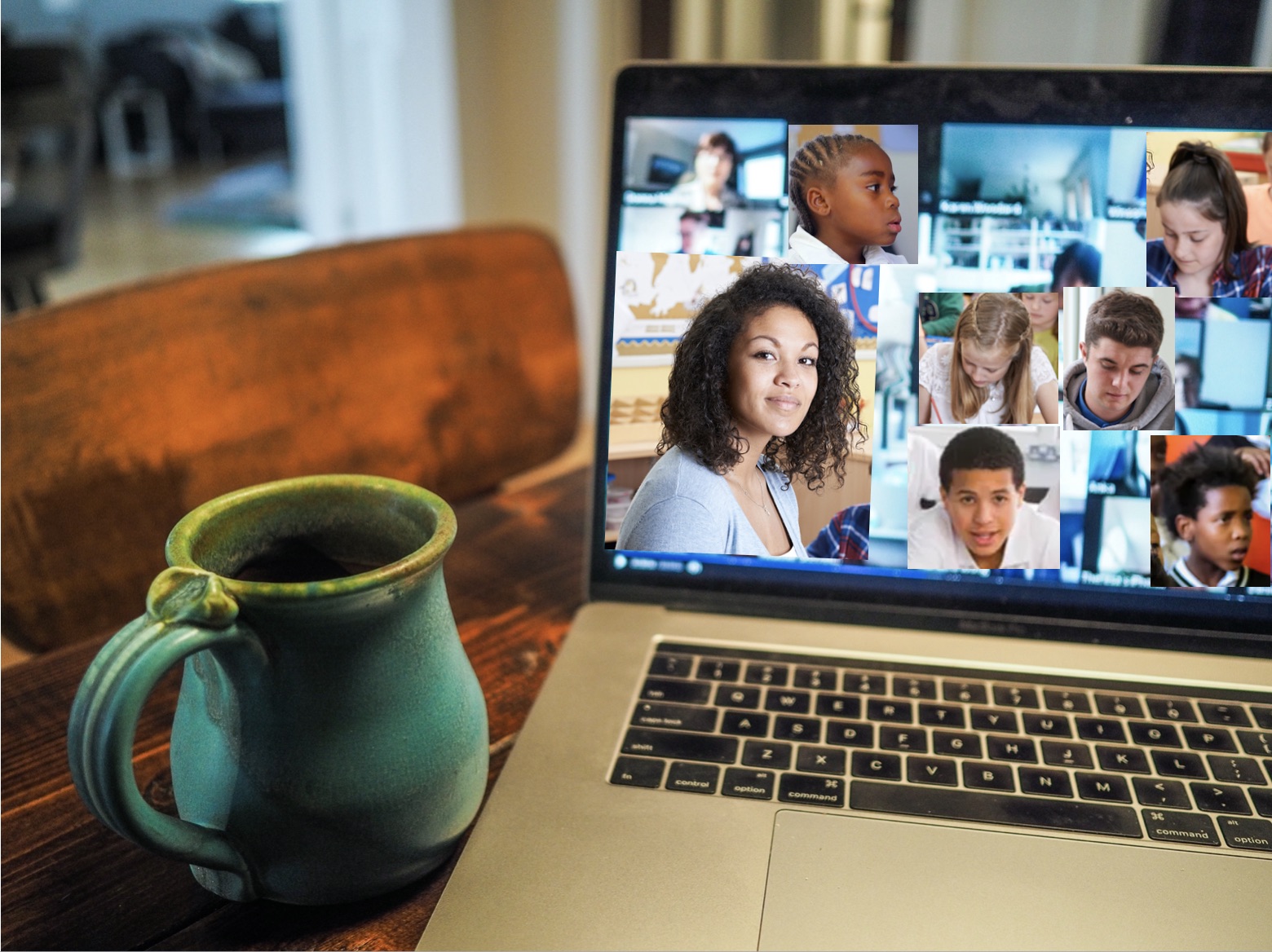
Teachers would provide synchronous classes online through video platforms like Zoom. Students would get to interact virtually with each other and their teachers.
By contrast, the existent cyber program is asychronous. Students watch videos and do assignments at their own pace, but human contact and social interaction – even via the Internet – is much harder to come by.
Both cyber options are preferable because they avoid these problems. But one of them – the synchronous option with a dedicated class and a teacher behind the curriculum – is superior to the one being offered.
Is it selfish to want the better plan for my daughter?
Should I just be glad I have a choice at all? Should I put the individual good of my child aside for the good of others?
No. Because administration’s plan is not in the best interests of other children, either.
If we reopen schools to in-person classes, chances are good that kids will get sick.
Children typically had low infection rates because schools were closed in March and kids were quarantined before the virus had spread through most of the country.
If the virus is present in the community – as county health department data shows – opening the schools to students also opens them to Coronavirus.
But with the schools open, the virus will no longer be confined to just a few homes. It will come with kids to class and spread among students and staff before it’s brought to their homes as well.
That’s how epidemics work. Opening the schools will spread the virus throughout the entire community.
And that will affect me, too, regardless of whether I choose a cyber option for my daughter or not.
When I go to the local grocery store, gas up my car, even go for a walk – I will be more likely to come into contact with someone infected with the virus and get sick.
I can make the safe decision for my family but still suffer the consequences of the irresponsible decisions of others – especially school directors.
In fact, it doesn’t even have to be my own local school board. The decisions of school directors in neighboring districts affects me, too.
After all, in my part of the state, school districts are pretty small geographically – not nearly as large as most counties. There are 42 public districts in Allegheny County, alone. So it should be no surprise that I routinely travel through several different districts just running day-to-day errands.
MASD school directors can decide to keep buildings closed (and I hope they will) but if a district just one township or borough over decides differently, we will suffer the consequences in McKeesport, too.
Since I don’t live in more than one district, I don’t get a say in what school directors at neighboring districts decide. I just have a say in what happens in my tiny portion of the world. But the consequences are not nearly as respectful of our man-made borders.
For instance, I work as a teacher at a neighboring district. But since I do not live there, I am barred from speaking at the board meetings unless I am invited to speak as an employee of the district.
I can give a report as part of the safety commission if invited by administrators, but I can’t otherwise sign up to speak as an employee concerned about how district policies affects me, my students or their families.
I’m a believer in local control, but sometimes control can be too localized.
This is why you haven’t heard much from many educators. If they’re allowed to speak, they’re often afraid of how doing so will make them a target for reprisals. If they can get their union to back them, they can speak collectively that way, but otherwise, they have no pathway to being heard at all.
As a parent, I get a choice for my child in my district.
But what choice do teachers have – especially if they don’t live where they teach?
That concerns me even with my choices as a parent.
I’ve had some outstanding teachers. My daughter loves her teachers. Is it okay if I don’t want to see them get sick and their lives cut short? If I worry about my own chances of surviving the pandemic and the demands of my employer?
I think their lives matter. But as minorities and people subjected to systemic inequalities, they get less of a say in policy. Should decisions that disproportionately impact their health really be up to a committee? Doesn’t their right to life surpass the decisions making abilities of a handful of elected officials or even middle and upper class parents?
Don’t get me wrong. I’m thankful I have choices as a parent for how my daughter is educated.
School directors need to make reopening decisions that are in the best interests of everyone because we’re all in this together.
That’s what so many folks seem to be forgetting.
Yes, even from a completely selfish point of view, unsafe school reopening will affect each of us.
But epidemics spread through communities. Only communities can effectively combat them.
Dividing ourselves into smaller and smaller fiefdoms only empowers the virus. If we all try to fight Covid-19 individually, we will lose.
We have to understand that what’s good for our friends and neighbors is in our individual interest, too.
We have to care about our fellow human beings.
That’s why I will continue to fight these unsafe plans and ask school directors to reopen schools virtually.
That’s the path I’ve chosen.
Like this post? You might want to consider becoming a Patreon subscriber. This helps me continue to keep the blog going and get on with this difficult and challenging work.












 gadflyonthewallblog