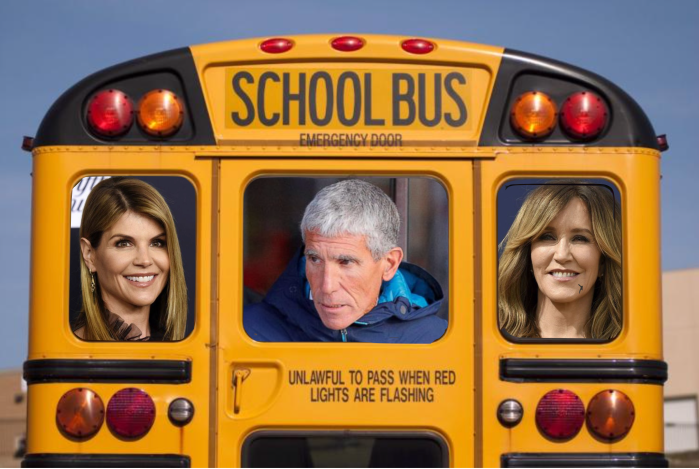
Who’s Afraid of Public Schools?

Screen Shot 2019-03-15 at 7.51.00 PM


Public schools are the bogeymen of American life.

 
We so often hear the bedtime story of “Failing Schools” that it’s no wonder some folks will do anything to ensure their kids get in elsewhere.

 
And let’s be honest. It’s the same impulse behind the latest college admissions cheating scandal.

 
A group of wealthy – though not too wealthy – parents thought their children should be able to enroll in the most prestigious schools.

 
So they bribed college admissions officers, cheated on standardized tests or paid coaches or other officials to accept their children as college athletes even if their kids had never played the sport.

 
We see the same kind of thing everyday in public schools – a confederacy of white parents terrified that their kids might have to go to class with black kids. So they dip into their stock portfolios to pay for enrollment at a private or parochial school.

 
Or they take advantage of a tax scholarship or school voucher to avoid an institution with low test scores by enrolling in one where students don’t have to take the tests at all.

 
Or they cross their fingers and enter their kid in a lottery to a charter school praying their precious progeny will escape the horrors of being treated just like everyone else’s kids.

 
And they call it a meritocracy!

 
What a joke!

 
They pretend that their children have earned special treatment.

 
WRONG.

 
No child deserves favoritism – paradoxically –  because all children do!

 
There are really two important but related points here:

 
1)  The children of the privileged don’t deserve a better education than anyone else’s.


2)  Children who come from wealthy families (and or from privileged social circumstances) don’t do anything to distinguish themselves from the underprivileged.

 
But these nouveau riche parents tried to bribe the way forward for their kids anyway even though to do so they had to launder the money through a fake “charity.” They didn’t care that doing so would earn them a tax deduction and thus result in even less money for the underprivileged. They didn’t care about the underlying inequalities in the system. No. They only wanted their children to remain in the class of America’s chosen few.

 
And the best way to do that is with cold, hard cash.

 
America doesn’t run on Dunkin. It runs on greenbacks. Dinero. Swag. Bling. The prosperity doctrine made physical, quantifiable and mean.

 
No one really denies that there are two Americas anymore. We just lie to ourselves about how you get placed in one or the other.

 
And that lie is called excellence, quality, worth – the ultimate in class war gaslighting.

 
It’s a deception that this scandal has shattered to pieces.

 
The privileged don’t earn their privilege. It’s not something they possess on the basis of intelligence or hard work shown through test scores. They don’t have it because of drive, determination or grit – once again shown through test scores. They have it based on wealth – the kind of wealth that buys time and resources to either pass the tests or bribe the gatekeepers to change the scores.

 
Think about it.

 
George W. Bush got into Yale and Harvard and graduated with a 2.35 GPA. Why? Not because he had the grades and demonstrated his worth. He was a legacy. Like at least one third of all admissions to Ivy League schools, he got in purely because he had family who graduated from there.

 
You think Donald Trump threatened the College Board not to release his grades because they were all A’s!?

 
According to one account, his scores were merely “respectable.” Yet he still dropped out of the prestigious Fordham University and transferred to the University of Pennsylvania after two years based on family connections and the reputation of his father, Fred Trump, one of the wealthiest businessmen in New York at the time.

 
Moreover, his kids, Don Jr. and Ivanka, were both enrolled at Penn around the same time as their father made hefty contributions. They began classes in 1996 and 2000, respectively, just as the university and its private Manhattan clubhouse received more than $1.4 million in pledged donations from Trump, the school newspaper reported.


This is not merit. This has nothing to do with what these people deserve. It is money – a pure transaction, you scratch my back and I’ll scratch yours.

 
The only thing that separates what the Trumps and the Bushes did with this latest scandal – the so-called Operation Varsity Blues – is the amount of wealth involved.
If you’re super rich, you can get away with it. If you’re just rich, you’d better not get caught.

 
And if you’re poor or middle class, you’d better stay in your lane.

 
But there shouldn’t be any lanes on this highway. Or at least they should only be in place to maximize fairness and student success.

 
We sneer at the idea of Affirmative Action but only because it’s directed at people of color. No one says anything about the real Affirmative Action that’s been in place since before our country even began – the system of reciprocity and privilege keeping wealthy white families in positions of power like Lords and Ladies while the rest of us serfs scramble for their leavings.

 
All children deserve the same opportunities to succeed. All children deserve the chance to get an excellent education. All children should attend a first class school filled with highly educated and experienced teachers who can draw on plenty of resources, wide curriculum, tutoring, counseling and support.

 
And the only way we’ll ever achieve that is through a robust system of public schools.

 
I’m not saying they’re perfect. In many neighborhoods, they’ve been sabotaged and surgically dismantled, but that’s a problem with an easy solution. Invest in public schools!

 
Because the stated purpose of public education, the reason it exists at all, is equity.
The alternatives – private and charter schools – are essentially unequal.  That’s their raison d’êtreto create a market that justifies their existence.

 
In order for charter and private schools to be a thing, there must be schools that don’t otherwise meet students’ needs. There must be an unreasonable demand that schools indoctrinate students into parents’ religious beliefs. There must be schools that aren’t as well funded or that have to meet ridiculous federal and state mandates.

 
The result is a two-tiered system. Schools for the haves and for the have-nots.
It’s an apparatus that perverts the public to make room for the private.

 
In the public system, students are segregated into communities based on race and class and then their community schools are funded based on what their parents can afford. The rich shower their children with the best of everything. The poor do what they can.

 
Then the federal government pretends to hold everyone “accountable” by forcing students to take standardized tests that merely recreate the economic and racial disparities already present in their districts and neighborhoods. In turn, this provides the justification for charter and voucher schools that further erode public school budgets and increases the downward spiral of disinvestment.


Meanwhile, few notice how the equity built into authentic public schools gets left behind by those enrolling in privatized alternatives. No more open meetings. No more elected school boards. No more public comment or even a voice in how the money is spent.
 

So long as there are two Americas, the fear of being in the wrong one will motivate the privileged to cheat and steal their way to the top. They will horde resources and wealth for themselves and their children while denying it to others.

 
It is a self-perpetuating system – a loop that we’re all caught in.
We must break the chain. We must recognize our common humanity and stop the zero sum game.

 
And perhaps the best way to begin is by supporting authentic public schools and not privatization.

 
We have been taught to fear public education, because it is really our only hope.


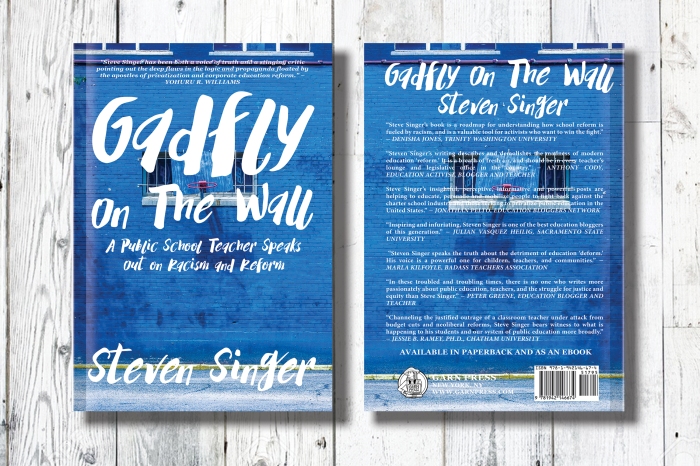
Like this post? I’ve written a book, “Gadfly on the Wall: A Public School Teacher Speaks Out on Racism and Reform,” now available from Garn Press. Ten percent of the proceeds go to the Badass Teachers Association. Check it out!

book-4

I Assign my Students Homework Despite Scant Research It Does Any Good

thumbnail_Homework_debate-e1445976586714

In academic circles the debate over homework rages on.

Does it actually help students learn or does it just cause undue stress and frustration for children and parents?

As a teacher and a parent, I see both sides of the issue.

In class, I assign my students homework every week – Monday through Thursday. Never on the weekends.

My daughter’s teacher does the same. So at home, I’m on the receiving end, spending hours with my little munchkin helping her get through mountains of assignments for her classes the next day.

Perhaps this is what they mean by the proverb – you reap what you sow. Except my daughter isn’t doing the homework I assigned. She isn’t in my class and we don’t even live in the district where I teach.

But it sometimes does feel like payback plodding through seemingly endless elementary worksheets, spelling words and vocabulary.

After a while, even I begin to question whether any of this junk does any good.

As a teacher, I know the research on the subject provides slim support at best.

In fact, the closest we have ever come to an answer is a reformulation of the question.

It really comes down to a matter of causality – a chicken and the egg conundrum with a side of sharpened pencil and crumpled paper.

If we look really hard, we can find a correlation between students who do their homework and those who get good grades.

The problem is we can’t PROVE it’s the homework that’s causing the grades.

It could just be that kids who excel academically also happen to do their homework. If we removed the homework, these kids might still get good grades.

So which comes first – the homework or the grades?

There has been surprisingly little research that goes this deep. And almost all of it is anecdotal.

Even the investigations that found a correlation did so in tight parameters – only in secondary grades and usually just for math.

Some wealthy districts have even reduced the amount of homework without seeing a subsequent drop in learning.

But nothing has been tested across socioeconomic divides or with any consistency and very little has been proven definitively.

This doesn’t mean that there’s no consensus on the matter.

Both the National Education Association (NEA) and the National Parent Teacher Association (NPTA) suggest educators assign no more than a standard of “10 minutes of homework per grade level” per night.

In other words, a first grader should have no more than 10 minutes of homework on a given evening, a second grader no more than 20 minutes, etc.

However, it appears that students – especially in the primary grades – are getting more work than these recommended maximums.

A 2015 study published in The American Journal of Family Therapy surveyed more than 1,100 Rhode Island parents with school age children.

Researchers found that first and second graders received 28 and 29 minutes of homework per night – almost double the recommended maximums. Even more shocking, Kindergarteners – who according to the guideline should receive no homework at all – actually were assigned an average of 25 minutes per night.

That’s a lot of extra time sitting and slogging through practice problems instead of spending time with friends or family.

Though I live in western Pennsylvania, this study is certainly consistent with what I see in my own home. My daughter is in 4th grade but has been assigned between 30 minutes and two hours of homework almost every weekday since she was in Kindergarten.

It’s one of the reasons I try to abide by the guidelines religiously in my own classroom. I give about an hours worth of homework every week – 15 minutes per day for four days. If you add in cumulative assignments like book reports, that number may go up slightly but not beyond the recommended maximums.

I teach 8th graders, so they should not be receiving more than 80 minutes of homework a night. If the teachers in the other three core classes give the same amount of homework as I do, we’d still be below the maximum.

I’m well aware that the consequences of giving too much homework can be severe.

A 2014 Stanford study published in the Journal of Experimental Education found that giving too much homework can have extremely damaging effects on children.

Still this isn’t exactly hard science.

The researchers used survey data to examine perceptions about homework, student well-being and behavioral engagement in a sample of 4,317 students from 10 high-performing high schools in upper-middle-class California neighborhoods. They also used open-ended answers to gauge the students’ views on homework.

They concluded that too much homework was associated with greater stress, reductions in health, and less quality time with friends and family.

So where does that leave us?

We have anecdotal evidence that excessive homework is harmful. And limited evidence that homework may increase academic outcomes in the higher grades in math.

Frankly, if that was all I had to go on, I would never assign another piece of homework ever again.

But I’m a classroom teacher. I don’t have to rely solely on psychological and sociological studies. Everyday in school is an opportunity for action research.

My classroom is a laboratory. I am a scientist. Nearly every decision I make is based on empiricism, hypothesis and testing the results.

Maybe X will help students understand Y – that sort of thing.

This applies to homework, too.

I’ve had more than 15 years to test what works with my students. I’m not saying my results would necessarily be reproducible everywhere, but they’re at least as scientific as the body of research we have on homework. In fact, within these parameters they’re even more rigorous.

So why do I give homework?

For several reasons:

1)  It prepares students for the higher grades.

Most of my career has been spent in the middle school teaching 7th and 8th grade. In my district, high school teachers give a lot of homework. I need my students to get used to that rhythm – homework being assigned and handed in – so that they’ll have a chance at being successful in the upper secondary grades. Too many students go no further academically than 9th grade. Giving homework is my way to help provide the skills necessary to avoid that pitfall.

However, this isn’t a sufficient reason to give homework all by itself. If high school teachers stopped assigning it – and maybe they should if we have no further reason to do so – then I’d have no reason to assign it either.

2)  It makes kids responsible.

There’s something to be said for getting kids used to deadlines. You need to know what work you’re responsible for turning in, getting it done on your own and then handing it in on time. This is an important skill that I won’t apologize for reinforcing. I’m well aware that some students have extended support systems at home that can help them get their assignments done and done correctly, but I design the work so that even if they aren’t so privileged, it should be easily accessible on an individual level. Plus I’m available, myself, as a resource if necessary.

3)  It’s good practice.

In school, we learn. At home, we practice. That pattern is necessary to reinforce almost any skill acquisition. I know it’s trendy to flip the classroom a la Khan Academy with learning done through videos watched on-line at home and practice done in school. But when Internet access in not guaranteed, and home environments often are the least stable places in my students’ lives, it makes little sense to try to move the most essential part of the lesson outside of the classroom. After all, it’s easier to find a place to do some low tech practice than it is to find space, silence and infrastructure for high tech learning.

Don’t get me wrong. We practice in school, too. But there’s only so many hours in the school day. I use homework in my language arts classes for a few select things: increased vocabulary, word manipulation, grammar, self-selected reading and the ability to do work on your own. I think it’s important for my students to increase their vocabularies. Having kids read a self-selected book (both inside and outside of class) helps do that. It’s also a benefit to be able to play with words and language, find words in a puzzle, recognize synonyms and antonyms, etc. Grammar may not be essential, but a rough knowledge of it is certainly useful to increase recognition of context clues and better writing skills. Finally, some students benefit from the simple opportunity to do an assignment by themselves without an adult or even a peer looking over their shoulder.

That being said, I think it is important that the homework I give be seen as something students can achieve.

I’ve had numerous co-workers tell me they don’t assign homework for the simple reason that their students won’t do it.

This isn’t a big problem in my class. Almost all of my students do the homework. Why? Because we go over it and they know it’s something they can do without too much difficulty.

I scaffold assignments building the difficulty progressively as we proceed through the year (or years). I make myself available for extra help. I accept late work (with a penalty).

And most of all – I stress that I’m not expecting anyone to be a genius. I’m looking for hard work.

I tell my students explicitly that anyone who puts in their best effort will pass my class – probably with a B or an A. And that’s exactly what happens.

Homework is a part of that equation. It demonstrates effort. And effort is the first step (the key, in fact) to accomplishment.

Do students complain about the homework?

Sure! They’re children!

I’d probably complain, too, if I were them. No one really wants to be given extra work to do. But it’s all part of the pattern of my classroom.

Students know what to expect and how to meet those expectations.

None of this makes me a super teacher. It certainly doesn’t put me on anyone’s cutting edge.

I’m just doing what educators have done for decades. I’m attempting to use best practices in my classroom with a full knowledge of the academic research and the pitfalls ahead.

I may assign homework, but I made sure to do my own before coming to that decision.


Still can’t get enough Gadfly? I’ve written a book, “Gadfly on the Wall: A Public School Teacher Speaks Out on Racism and Reform,” now available from Garn Press. Ten percent of the proceeds go to the Badass Teachers Association. Check it out!

book-3

Betsy DeVos’s Right Wing School Indoctrination Program

Betsy DeVos

 
What do you do when thinking people reject your political ideology?

 
You get rid of thinking people.

 
That’s Betsy DeVos’ plan to rejuvenate and renew the Republican Party.

 
The billionaire heiress who bought her position as Donald Trump’s Education Secretary plans to spend $5 billion of your tax dollars on private, religious and parochial schools.

 
This would be federal tax credits to fund scholarships to private and religious institutions – school vouchers in all but name.


It’s a federal child indoctrination program to ensure that the next generation has an increasing number of voters who think science is a lie, white supremacy is heritage and the Bible is history – you know, people just gullible enough to believe a reality show TV star who regularly cheats on his many wives with porn stars is God’s chosen representative on Earth. A measure to make child kidnapping, imprisonment and wrongful death seem like a measured response to backward immigration policy. A measure to make collusion and fraternization with the world’s worst dictators and strongmen seem like global pragmatism.

 
To make matters even more galling, consider the timing of DeVos’ proposal.


In the beginning of February, Donald Trump Jr. criticized “loser teachers” who he said were indoctrinating school children into – gasp – socialism.

 
At the end of that same month, DeVos proposed funding Christian madrasas from sea-to-shinning-sea.

 
Apparently indoctrination is just fine for conservatives so long as it’s the right kind of indoctrination.

 
But even beyond the blatant hypocrisy, this betrays a fundamental misunderstanding of the differences between public and private schools.

 
Florida’s GOP Governor Ron DeSantis tweeted that if a school receives public funding – whether it be a charter or voucher institution – it is a public school.

 
To which DeVos tweeted her glowing approval.

 
This makes a few things strikingly clear: either (1) these folks have no idea what happens at authentic public schools or (2) they’re pretending not to know so as to further their political and financial ambitions.

 
Authentic public schools do not indoctrinate children into socialism or any other ideology.

 
They’ll teach what socialism is and how it has functioned historically without commenting on its merits or deficiencies. It’s up to individual students to decide whether it’s a good thing or not.

 
Public schools are supposed to be ideologically neutral.

 
At most, they teach children how to think. They teach media literacy, skepticism and critical thinking skills.


If that leads kids away from Republican orthodoxy, it’s not the fault of the teacher or the child. It’s a problem with your orthodoxy.

 
You can’t proclaim the benefits of a marketplace of ideas and then decry that too many ideas are on display.

 
Nor can you conflate the way a school is funded with what that school actually does and how it teaches.

 
There is a world of difference between authentic public schools and their market based alternatives – especially the parochial and religious variety.

 
It’s the difference between telling students the answer and getting them to think about the answer. It’s the difference between total certainty and doubt, between trite truths and useful skills that can help you arrive at deeper truths.

 
When you ask children to think, you never know what conclusions they’ll draw. When you tell children what to think, you know exactly what conclusions you want them to hold.


Authentic public schools do not indoctrinate. Conservatives graduate from these hallowed halls the same as liberals, moderates and the politically checked out. The difference is that in a world where facts are prized and logic is exercised, conservatism becomes less appealing.


I’m not saying liberalism or progressivism is guaranteed, but they are certainly more fact-based world views than their opposites.

 
The same cannot be said of the kinds of institutions DeVos wants to bankroll.

 
They educate kids behind closed doors with little to no transparency for the public about how their money is being spent. But word seeps out of the cracks in the system.

 
We’ve seen the textbooks they use to teach. Their graduates have returned to the public square to tell us about the instruction they received.

 
The American Christian Education (ACE) group provides fundamentalist school curriculum to thousands of religious schools throughout the country. Included in this curriculum is the A Beka Book and Bob Jones University Press textbooks. A Beka publishers, in particular, reported that about 9,000 schools nationwide purchase their textbooks.


In their pages you’ll find glowing descriptions of the Ku Klux Klan, how the massacre of Native Americans saved many souls, African slaves had really good lives, homosexuals are no better than rapists and child molesters, and progressive attempts at equal rights such as Brown vs. Board of Education were illegal and misguided. You know – all the greatest Trump campaign hits!

 
We should not be funding the spread of such ignorance.


Frankly, DeVos’ ambitions have little chance of coming to fruition.

 
Two years ago, when Republicans controlled both houses of Congress, she wanted to spend $20 billion on the same nonsense. Her party refused to back her.

 
Now with Democrats in control of the House, it seems even more unlikely that her plan will pass.

 
But sadly smaller scale versions of it have been allowed by state legislatures throughout the country – often with full support from Democrats.

 
My own state of Pennsylvania spends $125 million in taxpayer dollars on the Educational Improvement Tax Credit (EITC) and Opportunity Scholarship Tax Credit (OSTC) programs to send children to private/religious schools. And every year legislators ask for more.


Why any Democrat would support conservative indoctrination programs is beyond me.

 
And this is true even though indoctrination is sometimes unavoidable.

 
To a limited degree, it may even be desirable. You might even say it’s a normal part of growing up.


Even the most fair-minded parents often want their children to hold at least some of the same values as they do. They want to be able to relate to their kids and view them as a continuation of the kinds of lives they lived.

 
But what’s okay for parents is not okay for governments.

 
If Mom and Dad want their kids to have a Biblical education, they should pay for it. The burden should not be shouldered by society since it’s not in society’s interest.

 
Governments have no right taking public money and using it to prop up private interests. And that’s exactly what this is.

 
It is political and religious interest. It is a way to circumvent skepticism and free thought.

 
It’s a way to ensure that in a time where information flows freely and dogmas crumble, people like Donald Trump continue to be elected.


Still can’t get enough Gadfly? I’ve written a book, “Gadfly on the Wall: A Public School Teacher Speaks Out on Racism and Reform,” now available from Garn Press. Ten percent of the proceeds go to the Badass Teachers Association. Check it out!

book-2

How Many Decisions Do Teachers Make Every Day?

94b755b2-ad1400b671f8ad28440f6a7067004614


Teaching is an exhausting job.


If you’re a parent, you know how tiring it is with just one or two kids.


Imagine having a room full of them — Twenty to thirty children, each demanding your attention, each requiring your urgent help – every minute, every day, for hours at a time.


Back in the late 1980s, before education became totally absorbed by standardized testing and school privatization, we used to wonder about the effects of such need on a single individual.


We used to wonder how much was really being asked of our teachers.


Today no one outside of the classroom really gives it much thought. We think of educators as part of a vast machine that is required to give us and our children a service.


We’re stakeholders. They’re service providers. And the students are a national resource.


None of us are people.


Perhaps it’s this dehumanizing economic framework that’s helped the edtech industry and testing corporations make so much headway trying to replace educators with apps and iPads.


We no longer give the teacher an apple. We displace her with a Mac.


But back in the days before George W. Bush’s No Child Left Behind or Barrack Obama’s copycat Race to the Top, or Donald Trump’s blatant Destroy Public Education, we wondered about teacher psychology and how to best help our human workforce meet the needs of our human children.


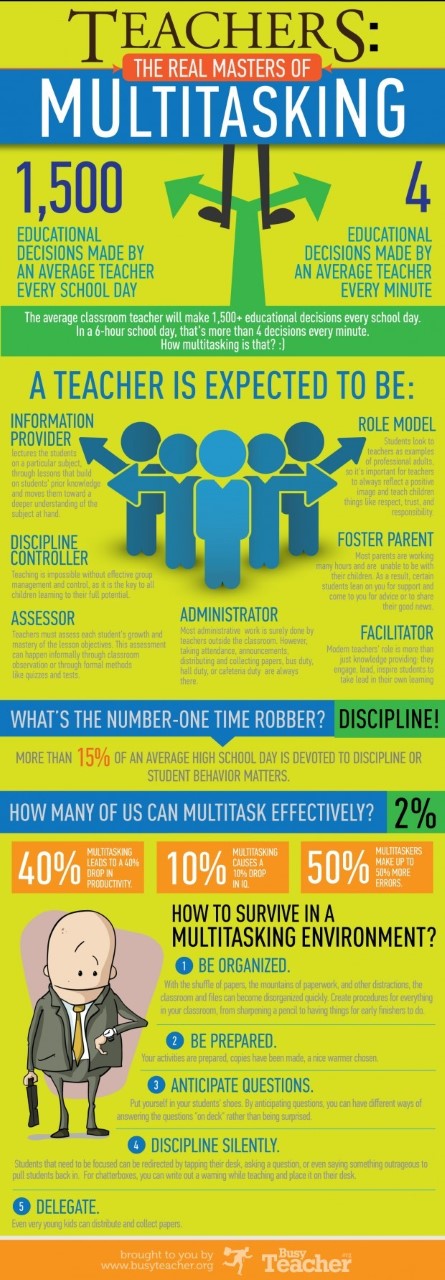
That’s when researchers observed elementary school teachers and noted that, on average, they made at least 1,500 decisions a day.


That comes out to about 4 decisions a minute given six hours of class time.


In the decades since, this figure has come to be associated with elementary and secondary teachers. In fact, it’s become so ubiquitous that I wondered where it originated.


The first reference I can find to it comes from C.M. Clark & P.L. Peterson’s article “Teachers’ Thought Processes” published in the Handbook of Research on Teaching from 1986. (3rd ed., pp. 255–296). New York: macmillan.


Though subsequent studies came up with slightly different numbers, the basic argument holds.


Researchers Hilda Borko, Carol Livingston and Richard Shavelson mark the low end of the scale. In their 1990 article “Teachers’ Thinking About Instruction,” they summarize studies that reported .7 decisions per minute during interactive teaching or 42 judgements per hour, 252 a day.


On the upper end of the scale is Philip Jackson who wrote in his 1990 book “Life in Classrooms” that elementary teachers have 200 to 300 of these determination generating exchanges with students every hour (between 1,200-1,800 a day). Most of these are unplanned and unpredictable calling for teachers to make what they term shallower decisions or deeper judgments (p. 149).


So because teaching involves waiting for the right opportunities for learning, neither student nor teacher can say with confidence what exactly will happen next. It requires “spontaneity and immediacy” (Jackson, p. 166, 152).


As a classroom teacher with more than 15 years of experience, none of this is surprising to me.


Just imagine the various tasks teachers are required to do every hour. We take attendance, review homework, help with seat-work, ask questions, etc. And that doesn’t even take into account all the times we’re unpredictably interrupted by the unexpected – upset students, administrative announcements over the PA, student questions, equipment breakdowns, etc. Each one of these requires us to make spontaneous, unplanned calls before the lesson can continue.


It just goes to show some of the various roles teachers are expected to fill in the lives of their students. They are expected to be information providers, disciplinarians, assess student learning, administrate school policies, facilitate student inquiry, act as role models and even be foster parents.


In any given lesson, we have to make decisions based on our plans AND decisions based on things that just happen to crop up unexpectedly – multiple times each day.


In fact, it seems to me that the research fails to account for innumerable situations that also require determination and deliberation as part of an educator’s everyday routine.


What about curriculum and instruction design? Grading? Written and verbal feedback to students? Reflection and revision of lesson plans?


When you think of all that, 1,500 decisions a day seems like a conservative estimate indeed.


Perhaps the most troubling thing about this is where it impacts teacher quality.


And when I say that, I don’t mean the basterdized modern meaning of that term – that teachers are responsible for maximizing student test scores on standardized assessments. I mean the quality of authentic instruction teachers are able to give their classes.


When we expect educators to turn on a dime more than a thousand times a day, doesn’t that impact the depth with which we can accomplish the job?


Busyteacher.org certainly thinks so. I’m not sure where the Website got its statistics, but they are sobering.


In a fascinating infographic, the site claims that multitasking leads to a 40% drop in productivity. It causes a 10% drop in IQ. It causes people to make 50% more mistakes than concentrating on one task at a time.


thumbnail_multitasking-teachers-infographic-620x1783


I don’t know if these statistics are accurate, but the general principle is sound. When we’re forced to “do more with less” we actually end up producing more with less quality.


Focusing on fewer things increases ones accuracy. Therefore, teachers who have to make fewer decisions in a day would probably be able to do their jobs more effectively.


And there are plenty of ways to accomplish this.


We could reduce class size. If educators can concentrate on the needs of fewer children, they would be more effectively able to meet those needs.


We could reduce the amount of time teachers have to be in the classroom in a given day. I’ve often thought teaching was analogous to being an actor up on the stage – but we’re also responsible for writing the script, operating the lighting, etc. And we have to interact with the audience many of whom would rather be elsewhere, and we have to do multiple shows each day.


In some countries, teachers spend a significant part of their days planning and grading and less in the classroom. They don’t have to do all that behind the scenes stuff on their own time without any additional pay.


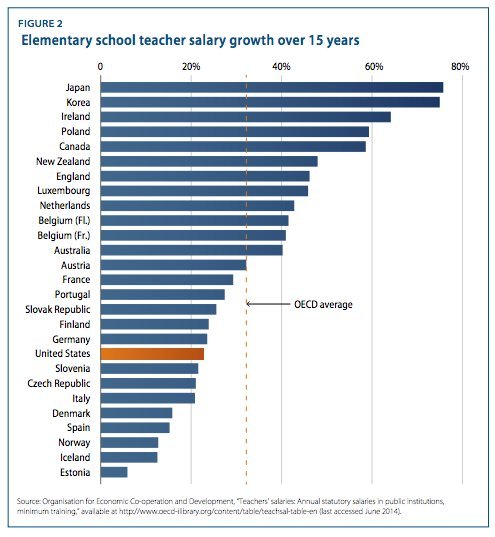
In Finland, for example, teachers are paid 13% more than the Organization for Economic Cooperation and Development (OECD) average but spend 100 hours less in the classroom. And class size is between 9-14 students, the lowest in OECD countries. No wonder their children are near the top of the scale in international comparisons!


Wouldn’t it be amazing if we lived in a society that valued education and didn’t try to turn everything into economic quantities for corporations?


We could actually focus on the real phenomena of educating children and not have to fight warped education policies more concerned with turning it all into dollars and cents.


Perhaps teachers wouldn’t have to make so many thousands of decisions if our lawmakers could just make this one.


Still can’t get enough Gadfly? I’ve written a book, “Gadfly on the Wall: A Public School Teacher Speaks Out on Racism and Reform,” now available from Garn Press. Ten percent of the proceeds go to the Badass Teachers Association. Check it out!
book-3

Yellow Vest Protests Include Resistance to School Corporatization

thumbnail_Paris-closes-tourist-sites-ahead-of-new-yellow-vest-protests-this-weekend


If you want to know what the French Yellow Vest Protests are all about, just refer to the arrest of 153 teenage students this month near Paris.


The kids at a high school in Mantes-La-Jolie were forced to kneel down, hands on their heads or secured behind their backs with zip ties as riot police circled them with assault weapons.


Why did law enforcement take such extreme measures? The students had been protesting their government’s education policies.


“What a well-behaved class!” French police commented ironically on a video documenting the arrest on social media by Violences Policières, a watchdog group.


Yes, how well behaved!


Of course! Children should be seen and not heard. Speaking out for yourself is a definite faux pas.


So is detaining minors without a lawyer, which the officers did and which is illegal in France.


But C’est la vie!


Unfortunately such scenes have been repeated throughout the country since November. Despite police opposition, high school students from a number of French schools have joined the Yellow Vests to protest French President Emmanuel Macron’s education policies – inaccurately dubbed “reforms” – among other austerity measures resulting in stagnant wages and a high cost of living.


Macron was elected in 2017 on a neoliberal platform much like that of Barack Obama. And though he was praised for his demeanor, especially in comparison to the boorish Donald Trump, his policies at first met with criticism and then outright protests in the streets.


Citizens took issue with new labor laws, the rail system and taxes. You can’t save the environment by cutting taxes for the wealthy and raising them for the poor to discourage them from driving. You can’t stomp on workers rights in order to create more low-paying jobs.


Protestors repurposed the yellow vests they are required to keep in their cars in case of an emergency into an iconic image of resistance to the gas tax. Hundreds of thousands demanded not just a repeal of Macron’s policies but a new platform to bolster social services and the economy.


The Macron administration has met these demands by at first violently stifling them and then agreeing to individual points before returning to suppression.


Perhaps it is the administration’s insistence that it is beset by violent “hooligans” while most protestors do no more than block traffic that has resulted in a continued rejection of Macron. Protestors even spray-painted a demand that Macron resign on the Arc de Triomphe, the arch on the Champs-Elysées.


Though the American media has mostly ignored the situation, critics blame widespread police brutality including the use of tear gas and clubs for at least four deaths and 700 people wounded in weeks of political challenges that some have compared to the French Revolution.


In particular, students take issue with at least three components of Macron’s plan: (1) changes to the high school graduation exam, (2) changes to college admissions and (3) a new requirement that all students participate in a lengthy volunteer national service project.


First, protestors oppose changes to the end-of-school exams known as baccalaureate or ‘bac.’ Though the proposal includes positive reforms such as reducing the number of exams and providing a longer time frame to take them, it also changes focus from academics to careers.


Much like Common Core did in the United States, the exams would be revised and rewritten. Instead of being tested on broad subjects such as science, literature or social sciences, students would be assessed on much narrower content.


Macron seems to be taking his queue from US philanthrocapitalists like Bill Gates in order to make French students more “college and career ready.”


The new assessments would push students toward specific degrees sooner. Before their final undergraduate year, high school students would have to choose two specific majors and two specific minors alongside the standard curriculum – similar to American colleges.


Students are against this because of what they call “hyper-specialization.” They say these changes would deprive them of exposure to a wide range of disciplines and force them to make life-long choices too early. This would be especially harmful for poor students because, as Liberation editorialist Laurent Joffrin put it, “Those who have more, know more.” In other words, wealthier students would probably be better prepared to navigate the choices open to them than those in poorer areas.


Next, students also want the repeal of stricter selection criteria to universities – a law passed just last year – which they say increases economic inequality between rich and poor schools.


The government provides free college to any student who passes the high school exit exams. However, just like in the US, corporate interests complain that college students struggle with the increased workload and pressures at universities. The new measure solves this by ensuring that fewer students are admitted.


Students say Macron has it backwards. The government shouldn’t be undermining free access to higher education. It should be investing more in the country’s universities and helping students succeed.


Finally, students want to get rid of a mandate that all 16-year-olds will have to participate in a national civic service program scheduled to begin in 2026.


French youths would have to volunteer in fields like defense, environment, tutoring or culture. During the long school breaks, they would have to undergo a one-month placement, consisting of two weeks in collective housing to promote a “social mix,” and then another two weeks in smaller, more “personalized” groups.


The measure doesn’t go as far as Macron wanted. He originally proposed mandatory military service.


Students object to the plan because they say it’s unnecessary and extremely expensive. The program is estimated to cost $1.8 billion ($1.6 billion Euros) with a $1.98 billion ($1.75 Euro) investment up front.


In addition to these demands, some have included limits on class size. Protestors have demanded no more than 25 students per class from nursery school through high school. Low class size ensures each student gets more personal attention from the teacher and a better chance to ask questions and learn.


What we’re seeing in France is extremely important for those living in the US.


It shows that as terrible as the Trump administration is, there are many flavors of bad government. When your representatives are more interested in seeing to corporate whims than the will of the people, chaos can ensue.


Perhaps the US media has been so adverse to reporting on the Yellow Vests because of corporate fear that protests will jump the pond and land on our shores, as well. We have many similar neoliberal and neofascist policies in the US of A, some passed by Republicans and others passed by Democrats.


Here’s hoping that we all can establish legitimate governments that seek to further the ends of liberty, equality and fraternity.


Like this post? I’ve written a book, “Gadfly on the Wall: A Public School Teacher Speaks Out on Racism and Reform,” now available from Garn Press. Ten percent of the proceeds go to the Badass Teachers Association. Check it out!

book-1

Want to Make a Difference? Canvass for Local Candidates You Believe In


door-to-door_small-500x300


Knock! Knock! Knock!


I stood there on the porch staring at my own knuckles in disbelief.


My 9-year-old daughter was looking up at me with a look like “What did you just do?”


But there was no time to say anything.


The door was opening.


An older gentleman stood in the entryway looking like he had just been stirred from sleep.


“Hello! Is this…” I began and Pam, who was standing next to me filled in the name.


“Yes,” he grumbled.


I introduced the three of us and told the man that we were canvassing his neighborhood for two local candidates running for state legislature.


And then I stopped because I wasn’t sure what to say next.


Luckily Pam jumped in and told him what our candidates stood for – education, healthcare and working families.


“Are these Democrats?” he groused. “I’m done with them. After what they did to that judge, I’m done.”


“You mean Kavanaugh?” I said.


He nodded.


My mouth opened to say something but what do you say?


Brett Kavanaugh was accused by multiple women of sexual assault but was saved from a thorough FBI investigation by his buddy, Donald Trump. He cried, whined and spouted partisan conspiracy theories yet still was confirmed to a lifetime appointment to the U.S. Supreme Court.


Really, what was this guy’s problem? Did he think we shouldn’t investigate Supreme Court Justices when credible accusers hurl accusation of abuse? Did he think Kavanaugh’s chief accuser – Dr. Christine Blasey Ford – made the whole thing up so that she could have her reputation forever tied to an attempted rape and her family displaced from their home and forced into hiding because of constant death threats? Did he think we should give privileged white guys lifetime judicial appointments based on what? Political affiliation? Skin tone?


Pam tried to bring up a few other topics – about how Republicans in our state of Pennsylvania are actively working to cut this man’s healthcare, calling this man’s generation “the greediest generation” and other topics.


But it did no good. Fox News had gotten there first.


So we handed him our campaign literature, thanked him and went on our way.


Sometimes that’s the best you can do.


And it’s not nothing.


IMG_8282


If you’re reading this blog, I’m assuming you’re a lot like me.


You see the madness of our modern age and wonder what the heck went wrong?


A reality TV show clown is President of the United States of America. And all over this country, the conservative clown car is spitting out candidates for major office.


Even here in the keystone state, we have Scott Wagner running for Governor on the leftover promises of our previous GOP Governorslashing education funding, firing teachers and lower taxes for the wealthy.


Meanwhile, the world is falling apart. The U.N. just released a major report finding that we have about a dozen years to make significant changes to our energy consumption or else global climate change will be irreversible. Yet our leaders complain there’s nothing they can do!


It’s enough to make one lose hope in the future.


As a father and a public school teacher, I can’t afford that despair.


There needs to be at least the slimmest glimmer of the possibility of a new day.


And I’m here to tell you, friends, it’s out there.


It starts with you.


If you want real progressive change, you have to go out there and make it – one day at a time.


We can turn back the tide of self-destruction. We can beat back the politics of bread and circuses. We can take back this country and build a better future.


But it will take more than one day.


It will take all of us, doing incremental good, every day we can.


So my suggestion is to make a commitment to voting this Nov. 6.


I know our electoral system is a mess. I know many people are being purged from the rolls and our districts are gerrymandered and the entire system is set up against us.


But if all of us try to vote, we can still win.


Find a candidate you can support and go out there and campaign for him or her.


I know there are a lot of phonies running for office. There are an awful lot of fake progressives who will talk nicely to your face and then sell you out to corporations and the wealthy at their first opportunity.


Just know that they’re not all like that.


Find yourself someone you can trust – probably someone new to the game coming on the scene to change things.


In the Pittsburgh area I found Lindsey Williams.


thumbnail_IMG_8273
Lindsey Williams and Me


She’s an amazing lady with real conviction running for State Senate in the 38th District – that’s most of Northern Allegheny County from Franklin Park eastward, as well as Highland Park and sections of East Liberty in Pittsburgh.


Her number one priority is the same as mine – education.


That should come as no surprise from a candidate who’s also the communications director for the Pittsburgh Federation of Teachers.


But Williams actually lives her values.


Before coming to Pittsburgh, she was fired for union organizing at the National Whistleblowers Center. Ironically, she was working there to tell the story of people who were retaliated against for reporting waste, fraud, and abuse, and found herself a target for attempting to organize a staff union. She eventually won the resulting case with the National Labor Relations Board.


When her campaign literature says she “won’t back down” fighting for working families. That’s what it means.


And her priorities – education, healthcare and labor – aren’t pie in the sky promises. She has a fiscally responsible plan to support them by creating a severance tax on natural-gas drilling and closing a loophole that allows businesses headquartered in other states to avoid state taxes. She wants to keep taxes low for homeowners while making sure the wealthy and corporations pay their fair share.


Perhaps that’s why a conservative dark money organization aligned with her Republican challenger, Jeremy Shaffer, has created knockoff campaign signs that look just like Williams with the word “Socialist” emblazoned on them.


It’s a desperation tactic.


Shaffer is down in the polls. The district – once a Republican stronghold – went to Hillary Clinton in the last election.


Even Shaffer, a Ross Township supervisor, is a throwback – he’s a far right extremist who primaried incumbent state Sen. Randy Vulakovich (R-Shaler) in May.


And his platform is nothing but tax cuts for the rich and school privatization for the rest of us. In effect, he’s a mini-Trump come to bring the circus to town.


So not only is Williams a candidate I can believe in, her race really matters to the overall state picture. If the Democrats only pick up her seat in November and don’t lose any others, we’ll crush the GOP’s veto-proof majority!


thumbnail_IMG_8275


But I didn’t come out this weekend just for Williams.


I also was there to canvass for Betsy Monroe, a Fox Chapel medical professional at Highmark running for State House in the same North Hills area.


She was inspired to get into politics after Trump’s election and the subsequent 2017 Women’s March.


She noticed that state Rep. Hal English (R-Hampton) had run unopposed in the last two elections, so she decided to run against him, herself.


Monroe was particularly angered by English’s vote to criminalize abortions after 20 weeks for all women in the Commonwealth. (The bill was vetoed by Democratic Gov. Tom Wolf back before the GOP had a veto proof majority.) She thought it was unfair for lawmakers to decide what adult women can do with their own bodies.


However, there was one other woman I was there to support – my own daughter.


For someone in elementary school, she is incredibly interested in politics. I caught her on Saturday literally writing political stump speeches for her stuffed animals. Let me tell you, Eeyore the donkey from the Hundred Acre Wood has some mighty progressive views on women’s rights!


I wanted my little one to see real women in politics, fighting to make a difference.

 
The news is always so grim. I wanted her to see that there are people out there fighting for the good.


And you know what? It helped me, too.


At this point I need to pause and give a huge “Thank You” to two people – Pamela Harbin and Jodi Hirsch.


IMG_8279
Me and Pamela Harbin


Jodi is an amazing organizer who put together the event in the first place.


I wanted to get more involved in the election and Jodi knew exactly how I could do that and which candidates I’d be most interested in.


Pam is a local activist I’ve known for years. I fought with her side-by-side against the statewide education budget cuts, charter schools, standardized testing and a host of Corporations Gone Wild shenanigans.


I was new to this whole canvassing thing, so she agreed to go with my daughter and me to show us the ropes.


I couldn’t have done it without her.


Thankfully, not every door we knocked on went like the grumpy gentlemen described above.


Frankly, most people weren’t home or didn’t answer the door.


Some people – especially young folks – proudly responded that they don’t vote or have no idea what’s going on.


Others were energized by what was happening and were looking forward to going to the polls and being heard.


“You know I’ll be there!” said one gentleman. “I’m straight Dem. Right on down the line. I’ve had enough of this Trump crap.”


But more people than I’d expected took pride in their nonpartisanship.


They wouldn’t commit to anything – just took our literature, heard us out and said they’d decide at the polls.


I always wondered what an undecided voter looked like. I saw a lot of them this weekend.


But that’s why we were there – to help nudge the uncommitted.


Hopefully on Nov. 6 they’ll think of Pam, my daughter and me.


Maybe even the Fox News fan who thought Kavanaugh got a raw deal will have his resolved softened.


Maybe he’ll think of my daughter’s chubby cheeks and innocent eyes as he considers voting for people who’d gladly steal her future for the prospect of more tax cuts for the rich.


Then again, maybe not. But who knows?


We tried.


If you live in Pennsylvania and want to get involved, click HERE.


Like this post? I’ve written a book, “Gadfly on the Wall: A Public School Teacher Speaks Out on Racism and Reform,” now available from Garn Press. Ten percent of the proceeds go to the Badass Teachers Association. Check it out!
thumbnail_IMG_8249

Teacher Autonomy – An Often Ignored Victim of High Stakes Testing


Screen Shot 2018-10-12 at 12.12.38 PM


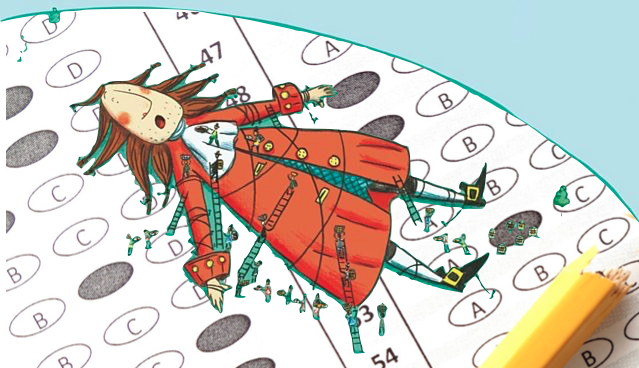
When I think of the modern day public school teacher, I think of Gulliver’s Travels.


Not because I’ve ever taught the Jonathan Swift classic to my students, but because of its most indelible image.


Gulliver is shipwrecked on the island of the Lilliputans – tiny people who have tied the full sized sailor to the ground with thousands of itty bitty strings.


If that is not the picture of a public school teacher, I don’t know what is!


We are constantly restrained – even hogtied – from doing what we know is right.


And the people putting us in bondage – test obsessed lawmakers, number crunching administrators and small-minded government flunkies.


You see, teachers are in the classroom with students day in, day out. We are in the best position to make informed decisions about student learning. The more autonomy you give us, the better we’ll be able to help our students succeed.


But in an age of high stakes testing, Common Core and school privatization run amuck, teacher autonomy has been trampled into the dirt.


Instead, we have a militia of armchair policy hacks who know nothing about pedagogy, psychology or education but who want to tell us how to do our jobs.


It’s almost like we’ve forgotten that educator self-determination ever was a value people thought worth preserving in the first place.


Whereas in generations past it was considered anywhere from merely advisable to absolutely essential that instructors could make up their own minds about how best to practice their craft, today we’d rather they just follow the script written by our allegedly more competent corporate masters.


The way I see it, the reason for this is fivefold:


  1. Testing

    School used to be about curriculum and pedagogy. It was focused on student learning – not how we assess that learning. Now that standardized tests have been mandated in all 50 states as a means of judging whether our schools are doing a good job (and assorted punishments and rewards put in place), it’s changed the entire academic landscape. In short, when you make school all about standardized tests, you force educators to teach with that as their main concern.

  2. Common Core

    Deciding what students should learn used to be the job of educators, students and the community. Teachers used their extensive training and experience, students appeal to their own curiosity, and the community tailored its expectations based on its needs. However, we’ve given up on our own judgment and delegated the job to publishing companies, technology firms and corporations. We’ve let them decide what students should learn based on which pre-packed products they can most profitably sell us. The problem is when you force all academic programs to follow canned academic standards written by functionaries, not educators, you put teachers in a straight jacket constraining them from meeting their students’ individual needs.


3. Grade Promotion Formulas

It used to be that teachers decided which students passed or failed their classes. And when it came to which academic course students took next, educators at least had a voice in the process. However, we’ve standardized grade promotion and/or graduation policies around high stakes test scores and limited or excluded classroom grades. When you’re forced to rely on a formula which cannot take into account the infinite variables present while excluding the judgment of experienced experts in the classroom, you are essentially forbidding educators from one of the most vital parts of the academic process – having a say in what their own courses mean in the scheme of students educational journeys.


4. Scripted Curriculum

Perhaps the most pernicious aspect of this whole process has been the attempted erasure of the teacher – as a thinking human being – from the classroom, itself. Instead of letting us be people who observe and adapt to the realities in front of us, many of us have been forced to read from a script. It should go without saying that when you constrain educators to abide by scripted curriculum – what we used to call “teacher proof curriculum” – or pacing guides, you remove their ability to be teachers, at all.


5. Value Added Evaluations


We used to trust local principals and administrators to decide which of their employees where doing a good job. Now even that decision has been taken away and replaced by junk science formulas that claim to evaluate a teacher’s entire impact on a student’s life with no regard to validity, fairness or efficiency. However, local principals and administrators are there in the school building every day. They know what’s happening, what challenges staff face and even the personalities, skills and deficiencies of the students, themselves. As such, they are in a better position to evaluate teachers’ performance than these blanket policies applied to all teachers in a district or state – things like valued-added measures or other faith based formulas used to estimate or quantify an educator’s positive or negative impact.


It’s no wonder then that teachers are leaving the profession in droves.


You can’t freeze someone’s salary, stifle their rights to fair treatment while choking back their autonomy and still expect them to show up to work everyday eager and willing to do the job.


The National Center for Education Statistics (NCES) conducted a representative sample of more than 37,000 American public school elementary and secondary teachers showing widespread dissatisfaction with the job in general and a lack of autonomy in particular.

In fact, they cited this lack of self-determination as a leading contributor to the nationwide teacher shortage. Having control over how you do your job is essential to being fully satisfied with your work.

Teacher-Autonomy


If you’re just following orders, your accomplishments aren’t really yours. It’s the difference between composing a melody and simply recreating the sounds of an amateur musician with perfect fidelity.

Today’s teachers rarely get to pick the textbooks they use, which content or skills to focus on, which techniques will be most effective in their classrooms, how to discipline students, how much homework to give – and they have next to zero say about how they will be evaluated.

And to make matters worse, sometimes it isn’t that educators are forbidden from exercising autonomy, but that they are given such a huge laundry list of things they’re responsible for that they don’t have the time to actually be creative or original. Once teachers meet the demands of all the things they have to cram into a single day, there is little room for reflection, revision or renewal.

School policy is created at several removes from the classroom. We rarely even ask workaday teachers for input less than allowing them to participate in the decision making process.

We imagine that policy is above their pay grade. They are menial labor. It’s up to us, important people, to make the big decisions – even though most of us have little to no knowledge of how to teach!

Finnish educator and scholar Pasi Sahlberg says that this is exactly the opposite of what we should be doing if we really cared about improving both the teaching profession and the quality of education we provide students.

In the United States, autonomy usually stops at the district or administrative level and results in decision-making that ignores the voices of educators and the community, he says.

Sahlberg continues:

“School autonomy has often led to lessening teacher professionalism and autonomy for the benefit of greater profits for those who manage or own private schools, charter schools or other independent schools. This is perhaps the most powerful lesson the US can learn from better-performing education systems: teachers need greater collective professional autonomy and more support to work with one another. In other words, more freedom from bureaucracy, but less from one another.”

Perhaps the biggest roadblock to increased autonomy is political.

Lawmakers and pundits conflate teacher professionalism and increased decision making with union membership.

And they do have a point. Having a seat at the bargaining table is vital to educators’ self-determination.

In some states, local teachers unions negotiate annual contracts with their districts. However, most states have statewide teacher contracts that are negotiated only by state teachers unions.

These contracts can directly affect exactly how much independence teachers can exercise in the classroom since they can determine things like the specific number of hours that teachers can work each week or limit the roles that teachers can play in a school or district.

There are even some tantalizing schools that are entirely led and managed by teachers. The school does not have formal administrators – teachers assume administrative roles, usually on a revolving basis. But such experiments are rare.

In most places, teacher autonomy is like the last dinosaur.

It represents a bygone age when we envisioned education completely differently.

We could try to regain that vision and go in a different direction.

But if things remain as they are, the dinosaur will go extinct.

Autonomy is a hint at what we COULD be and what we COULD provide students…

…if we only had the courage to stop standardizing and privatizing our country to death.


Like this post? I’ve written a book, “Gadfly on the Wall: A Public School Teacher Speaks Out on Racism and Reform,” now available from Garn Press. Ten percent of the proceeds go to the Badass Teachers Association. Check it out!

WANT A SIGNED COPY?

Click here to order one directly from me to your door!

book-1

Report: US Shortchanged Public Schools by Hundreds of Billions of Dollars Over Decades

taking-candy-from-a-baby


Fun Fact: Between 2005 and 2017, the federal government withheld $580 billion it had promised to spend on students from poor families and students with disabilities.


Fun Fact: Over that same period, the personal net worth of the nation’s 400 wealthiest people ballooned by $1.57 trillion.


So, rich people, consider this the bill.


A new report called “Confronting the Education Debt” commissioned by the Alliance to Reclaim Our Schools (AROS) details the shortfall in minute detail.


For instance:


  • $347 billion owed to educate low-income students most of whom are children of color.


  • $233 billion owed to provide services for students with disabilities.


And this is just the shortfall of the last dozen years! That’s just money due to children who recently graduated or are currently in the school system!


We’ve been cheating our children out of the money we owe them for more than half a century!


Federal education funding levels were first established in 1965 as part of Pres. Lyndon Johnson’s War on Poverty in the landmark education law, the Elementary and Secondary Education Act (ESEA).


That law, which has become little more than a boondoggle for the standardized testing and school privatization industries, originally was passed to address inequality in America’s education funding.


Now this report from a coalition of groups including the Education Justice Research and Organizing Center, the National Education Association, the American Federation of Teachers, Center for Popular Democracy and the Action Center on Race and the Economy points out the multifarious ways we have failed to live up to the standards we set in that original legislation and beyond.


One of the most glaring examples of neglect is Title I funding.


The Johnson administration admitted that schools with a high concentration of students living below the poverty line needed extra support to succeed at the same levels as students from middle class or more affluent backgrounds. So the law promised to provide an additional 40 percent for each poor child above what the state already spent per pupil.


And then it promptly failed to fund it. In 1965 and every year since!


These are not just numbers. With this money, high poverty schools could provide:


  • “health and mental health services for every student, including dental and vision services; and

  • a full-time nurse in every Title I school; and

  • a full-time librarian for every Title I school; and

  • a full-time additional counselor in every Title I school, or

  • a full-time teaching assistant in every Title I classroom.”


A decade later, in 1975, the same thing happened with The Individuals with Disabilities Education Act (IDEA).


Congress told local districts they’d have to do more to help disabled students succeed academically. However, doing so costs money. Lawmakers admitted that disabled students cost more to educate and that local districts often struggle to find the funding to help them succeed.


Once again, Congress pledged to pay up to 40 percent of that additional cost, with local and state funds covering the remainder.


Once again, Congress failed to fund it.


STATE AND LOCAL FAILURE


But it’s not just the federal government that has shirked its duties to school children.


State and local governments also stiffed generations of students out of the resources they deserved – especially if those students have black or brown skin.


Beside the federal government, public schools are funded by their local municipalities and the state. Local governments pay for about 45 percent of school budgets.


However, since most of this allotment is determined by property tax revenues, it ensures the poor get fewer resources than the rich. Kids from rich neighborhoods get lots of resources. Kids from poor areas get the scraps. Inequality is built into the funding formula to ensure that students don’t start out on an even playing field and that economic handicaps are passed on from one generation to the next.


State governments are no better. They provide about 47 percent of school budgets.


As such, they are in the position to right the wrongs of the local community by offsetting the inequality of local governments – but only 11 states do so. Twenty states close their eyes and provide the same funding to each school – rich and poor alike – regardless of need or what each community can afford to provide for its own children. But 17 states are even worse. They actually play Robin Hood in reverse – they funnel more money to wealthier districts than to poor ones.


As a result, schools nationwide serving mostly students of color and/or poor children spend less on each child than districts serving mostly white and/or affluent children.


TAX CUTS


And while our federal, state and local governments have failed to meet their responsibilities to students, they have required fewer taxes from business and industry.


In the late 1940s and 1950s, the top marginal tax rate was more than 90 percent. Today it is 37 percent.


Congress just passed a series of whooping tax cuts that go into effect in 2019. More than half of the benefit of these cuts will go to the richest five percent of taxpayers. The law is expected to cost the federal treasury as much as $1.5 trillion in lost revenues over the next decade.


Nearly every state levies a much greater share of taxes from low- and middle-income families than from the wealthy.


And that’s before we even start talking about corporations!


While the US federal corporate tax is 35 percent, the effective tax rate that corporations pay after loopholes and deductions is only about 14 percent. This costs the federal government at least $181 billion in annual revenue, based on 2013 estimates by the Government Accountability Office. Local and state corporate tax and abatement programs make it even worse.


This is a choice. We are not requiring the rich to pay their fair share.


SCHOOL-TO-PRISON


Instead of investing in ways to help educate children, one of the only areas we’ve increased funding is incarceration.


The private prison industry is booming, fueled in part by a lack of opportunities in schools.


According to the report:


“In 2017, the National Association of School Resource Officers claimed that school policing was the fastest-growing area of law enforcement. The school safety and security industry was reported to be a $2.7 billion market as of 2015. Most of that $2.7 billion is public money now enriching the private security industry instead of providing real supports to students.”


According to the US Department of Education, 1.6 million students go to a school that employs a law enforcement officer but not a guidance counselor.


That is not an unalterable economic reality. It is a failure of priorities. It is the mark of a society that is not willing to help children but will swoop in to punish them if they get out of line.


SCHOOL PRIVATIZATION


Finally, the report identifies school privatization as a contributing factor to this systemic neglect.


Charter schools are legal in 44 states plus Washington, D.C. and Puerto Rico. They have “systematically stripped public school budgets through the creation of parallel structures of privately-operated, publicly-funded schools.”


Cost studies in San Diego, Los Angeles, Nashville, Michigan, Pennsylvania, Durham and other localities have come to the same conclusion: “the privatization of schools has contributed to austerity conditions in traditional public schools.”


Yet Congress continues to appropriate millions of dollars to the Department of Education’s Charter Schools Program (CSP), which funds new charter start-ups and expansions. The program has a budget of $500 million this year, alone. It is the largest single backer of charter schools in the nation.


According to the report, “In other words, the U.S. Department of Education is operating a program that directly undermines public schools.”


SOLUTIONS


But the report isn’t just about what’s wrong. It outlines how we can make it right.


It outlines three policy initiatives:


1)      “Full funding of Title I and IDEA to target federal support to low-income children and students with disabilities.

2)      The creation of 25,000 Sustainable Community Schools by 2025.

3)      A new focus for the U.S. Department of Education, on ensuring and incentivizing equity in public schools across the country.”


And we can pay for it by:


A. “Make the wealthy pay their fair share of taxes.

  • Rescind the 2017 tax code changes, which overwhelmingly favor the top 1 percent of income earners.
  • Close the federal carried interest loophole, a step that could increase federal revenues by between $1.8 and $2 billion annually or, according to some researchers, by as much as $18 billion annually.
  • If the carried interest loophole is not closed at the federal level, states can impose a surcharge on carried interest income at the state level, raising millions for state budgets.
  • Enact so-called “millionaire’s taxes” that increase the tax rate on a state’s highest earners. New York and California have already passed such law.


B. Require wealthy corporations to pay their fair share.

  • End or reduce corporate tax breaks that cost the federal government at least $181 billion annually.

  • Reduce state and local subsidies to businesses for economic development projects and hold school funding immune from tax abatements.

  • Enforce and strengthen programs like Payment in Lieu of Taxes (PILOT) to ensure that wealthy institutions pay their fair share towards local budgets.


C. Divest from the school-to-prison pipeline.

  • School safety and security is now a $2.7 billion industry. Much of that money is public money, going to profitable corporations instead of schools.
  • Divest from expensive security systems, metal detectors and legions of school-based police officers and instead invest in counselors, health and mental-health providers and other supports that make schools safer.


D. Place a moratorium on new charter schools and voucher programs.

  • A moratorium on the federal Charter Schools Program would free up $500 million annually, which could be used to support the creation of Sustainable Community schools.”


The executive summary concludes with the following statistic.


Even a 10 percent increase in funding for each high poverty student maintained through 12 years of public school can dramatically change the likelihood of academic success. It can boost the chances that students will graduate high school, achieve 10 percent higher earnings as adults and a 6 percentage point reduction in the annual incidence of adult poverty, according to a 2015 report.

“Ten percent is pocket-change for a nation that has orchestrated the rise of an unmatched billionaire class. In the richest nation in the world, it is possible to fully fund all our public schools, and to provide Black, Brown and low-income children with the educational resources and additional supports and services they need to achieve at the highest levels.”


The facts are in, folks.


We can no longer gripe and complain about a public education system we fail to support without recognizing the cause. We have failed to meet our responsibilities to our children – especially our children of color.


The solution is simple – equity.


We need to demand the rich do the right thing.


We cannot achieve greatness as a nation when wealth and privilege continue to shirk their duties and our lawmakers do little more than enable greed and corruption.


The bill is here.


Time to settle up.


READ THE WHOLE REPORT.


Like this post? I’ve written a book, “Gadfly on the Wall: A Public School Teacher Speaks Out on Racism and Reform,” now available from Garn Press. Ten percent of the proceeds go to the Badass Teachers Association. Check it out!
WANT A SIGNED COPY?

Click here to order one directly from me to your door!

book-2

No One Ever Remembered a Teacher for Raising Standardized Test Scores

gradhug


It’s the day before school begins.


I’m out to eat with my family and have just taken a big bite of a juicy beef taco.


That’s when I notice someone standing right next to me at the restaurant.


So I raise my eyes upward, a meat filled tortilla overfilled with lettuce and beans hanging from my mouth, and I’m greeted with a familiar face.


“Mr. Singer!” the woman says with a nervous smile on her lips.


“Do you remember me?”


I think for a moment but realize I have more pressing concerns. I couldn’t reply with an answer to the woman’s question even if I did remember her.


So I chew and swallow and then look again.


“It’s me,” she says. “Tamarind.”


And then it hits me like a flash.


The face in front of me ages backward. The adult eyes soften. The taut cheeks become chubbier. And her whole figure shrinks three feet closer to the ground.


“Oh my God! Tamarind! Of course I remember you!” I say.


She smiles and blushes. I’m surprised by how nervous she is. I’m no one to inspire anxiety. I’m just a guy out with his wife, daughter and father-in-law shoving a taco in his face.


“When I saw you here I just had to come up to you,” she said. “I was in your 6th grade class.”


“I think it was 8th grade, wasn’t it?” I said.


“Yes! That’s right! Eighth grade!”


“How old are you now? My gosh I remember you when you only came up to here off the ground.”


“I’m 22. I’m doing really well. I just wanted you to know that you taught me how to write. If it wasn’t for you I never would have made it anywhere. I just wanted to thank you so much for everything you did for me.”


We chatted a bit more and then she left us to finish our meal.


But, of course, the whole interaction got me thinking.


As a teacher, you are something of a minor public figure.


When you’re out and about – especially if you’re somewhere in your district – you’re bound to be recognized and invariably someone will want to chat.


I remember one time at the bakery counter a former student gave me my order and told me he threw in a few donuts.


I remember laughing and telling him he didn’t need to do that.


“Nah, Mr. Singer, you never wrote me up for falling asleep in your class. You knew I was watching my brothers and sisters at home and never gave me shit for it. You keep those donuts.”


Another time at the theater I was almost late to my movie because I was listening to a former student at the concession stand catch me up on her life and what all of her friends from my class were doing these days.


So many students. So many kids that have now become adults.


You lose track of how many lives you’ve had an impact on.


The first few days of school are always filled with endless administrative meetings. The superintendent welcomes you with testing data. Then your principal breaks it down by building and subject.


You find out which diagnostic exams you have to give your students and when. You find out what your Pennsylvania Value Added Assessment Score (PVAAS) is – how good a teacher you are based on how well your students from last year did on the state standardized test.


On the one hand, I suppose I have no reason to feel like much of a good teacher.


Most of my students didn’t pass the test. They rarely do.


The same number of 7th graders (that’s what I taught last year) passed the reading test as in previous years. However, many more passed that were expected to fail.


The state uses a mystery metric based on Classroom Diagnostic Assessment (CDT) data to come up with a prediction of who they expect to pass and who they expect to fail. No one really knows how they calculate this. For all we know, the state secretary of education could examine a pile of chicken entrails before entering it all into the system.


Does all that data mean I’m a good teacher or not?


I don’t know.


But I do know what Tamarind thinks.


And I know what a host of former students have told me. I know how they react when they see me out in the wild, just living my life.


I’m sure there are probably former students who don’t like me. There must be those who hold a grudge for getting a 59% on an assignment. Or maybe they remember me yelling at them for something. Or – who knows – maybe they just didn’t respond to The Singer Charm.


But an awful lot of people come up to me who don’t have to.


Yesterday was the first day of classes for the year.


For the first time, all my classes were looped. I taught 7th grade Language Arts last year and I’m teaching the 8th grade course this year.


When those kids came into the class on Friday, it was like a homecoming.


So many smiles. So much laughter and joy. And, yes, impromptu hugs.


It felt like a family gathering, not a school function.


As I left the building feeling more exhausted than I have in months, another teacher stopped me.


“Steve! I wanted to catch you before you left!” she said.


She told me that she gave her students a survey in her class as an icebreaker. One of the questions was to name their favorite teacher from last year. My name came up a lot.


What can you say about that?


I’m actually getting choked up just typing this.


In my years in the classroom, I’ve helped a lot of kids get better test scores.


But that’s not why they come up to me. That’s not why they remember me.


I touched their lives in some meaningful way.


And they have done the same for me.


I’m just a guy who should really take smaller bites of his tacos.


But they make me feel like a hero.


I am so grateful.


Like this post? I’ve written a book, “Gadfly on the Wall: A Public School Teacher Speaks Out on Racism and Reform,” now available from Garn Press. Ten percent of the proceeds go to the Badass Teachers Association. Check it out!

WANT A SIGNED COPY?

Click here to order one directly from me to your door!

book-2

The Necessity and Importance of Teachers

teacher-elementary-Getty-blog


Are teachers necessary?


That’s the question big business is asking.


Well, “asking” isn’t really the right word. They’re implying an answer.


Hedge fund mangers and ed tech soothsayers are betting hundreds of millions of dollars that educators aren’t really all that important.


They’re planning a future where real live people play a much smaller role in student learning.


They’re mapping out a world where kids don’t even have to go to school to grasp the basics, where learning can be accomplished anywhere but instigated, tracked, and assessed on-line through various computer platforms.


It’s called a learning ecosystem, personalized learning, competency based or individualized education. With little to no guiding principles, management or oversight, kids would engage in educational tasks on various devices in order to earn digital badges.


Children would bounce from a few hours of Khan Academy videos here to a software package there and Voila! “Modern” education!


It’s a brave new world where investors hope to make a bundle by reducing the cost and pocketing the savings.


Since teachers are the biggest cost, they’re the first things to go.


Since their rights as workers and human beings are a roadblock on this learning superhighway, they’re the first to go.


And since they’re in a prime position to see exactly what’s going on and to object when this ed tech paradise exploits the students it ostensibly is being built for, they MUST go – now, as soon as possible.


The Supreme Court’s recent decision in Janus v AFSCME is part of that process. It’s another way to weaken labor and clear the path for business – the collusion of politics and corporations to steamroll the rest of us and swipe more of our money regardless of the children in the steamrollers way.


So when I ask “Are teachers necessary?” it’s not a purely philosophical question.


The answer will have a major impact on both the education of today and where we go in the future.


If teachers are not necessary, that removes one of the biggest obstacles to this frightening and uncertain future.


Unfortunately, no matter how much I want to answer in the affirmative that teachers are necessary, I can’t do so.


Even after thousands of years of recorded history, learning remains a mysterious process. Yet it doesn’t take much reflection to realize that it can take place without the presence of a teacher.


Some things can be figured out solely by the learner in the right circumstances.


In fact, many academic studies have shown that teachers are not even the most important factor in the process.


Roughly 60% of academic achievement can be explained by family background – things like income and poverty level. School factors only account for 20% – and of that, teachers account for 15%. (see Hanushek et al. 1998; Rockoff 2003; Goldhaber et al. 1999; Rowan et al. 2002; Nye et al. 2004).


Estimates vary somewhat from study to study, but the basic structure holds. The vast majority of impact on learning comes from the home and out-of-school factors. Teachers are a small part of the picture. They are the largest single factor in the school building, but the school, itself, is only one of many components.


In short, teachers are not necessary to student learning.


But neither are doctors necessary to healing or lawyers necessary to acquittals.


Necessity is a very high bar.


To survive, you need food, shelter and clothing. However, having all three does not mean you have a good life. Slaves had all three – no free person would choose to trade places with someone in generational servitude simply because they had everything they needed to survive.


The same with medicine. If shot in the arm, you could provide me with all the medical equipment necessary to remove the bullet, but I would still have a difficult time doing it by myself. I COULD. A doctor is not NECESSARY for that operation. But without a doctor present, my chances of getting the best medical care drop dramatically.


Moreover, you could pop me in a courtroom without the benefit of legal counsel and it’s not impossible that I could argue my way to the dismissal of all charges against me. But the likelihood of doing so is infinitesimal – as undocumented youngsters are discovering when forced into the courtroom to defend against deportation without an attorney or even their parents present.


The same is true of education.


Though teachers are not necessary to learning, they are vital to it.


Having a teacher dramatically boosts a student’s chances, and the more disadvantaged that student is, the more he or she benefits from an educator.


The academic schemes of the corporate class amount to changing the field into the equivalent of an automated teller or a business robocall.


You can purchase your groceries through the self-checkout line. You can get your customer service from an automated list. But neither of these are the highest quality service.


They are cheap alternatives.


They are ways for the business to cut costs and boost profits. Neither have anything to do with making things better for the customer.


And when it comes to education, eliminating (or even drastically reducing access to) the teacher will decrease the quality of the service beyond recognition.


A 2009 report, Poverty and Potential: Out-of-School Factors and School Success, released by the Great Lakes Center for Education Research and Practice outlined several real world solutions to increase academic outcomes. None of them involve the elimination of teachers.


They are:


1. Reduce the rate of low birth weight children among African Americans

2. Reduce drug and alcohol abuse

3. Reduce pollutants in U.S. cites and move people away from toxic sites

4. Provide universal and free medical care for all citizens

5. Insure that no one suffers from food insecurity

6. Reduce the rates of family violence in low-income households

7. Improve mental health services among the poor

8. More equitably distribute low-income housing throughout communities

9. Reduce both the mobility and absenteeism rates of children

10. Provide high-quality preschools for all children

11. Provide summer programs for students from low-income homes to reduce summer losses in their academic achievement.


These are ways you improve education FOR CHILDREN.


This is how you make things better FOR THE LEARNER and not necessarily for the investor class.


And when it comes to teachers, there are numerous ways you can help them provide support for students.


First of all, hire more of them!


Today’s public schools employ 250,000 fewer people than they did before the recession of 2008–09. Meanwhile enrollment has increased by 800,000 students.


So if we wanted our kids to have the same quality of service children received in this country only a decade ago, we’d need to hire almost 400,000 more teachers!


That’s how you cut class size down from the 20, 30, even 40 students packed into a room that you can routinely find in some districts today.


And if you want to improve the quality of the teachers in those classrooms, here’s an easy fix – pay them.


According to the Economic Policy Institute, teachers in the United States make 14 percent less than people from professions that require similar levels of education.


Sadly, it only gets worse as time goes on.


Teacher salary starts low, and grows even more slowly.


original


According to a report by the Center for American Progress, on average teachers with 10 years experience only get a roughly $800 raise per year. No wonder more than 16 percent of teachers have a second or third job outside of the school system. They simply can’t survive on the salary.


They can’t buy a home or even rent an apartment in most metropolitan areas. They can’t afford to marry, raise children, or eke out a middle class existence.


If you want to attract the best candidates to the profession, you need to make it more attractive. One way to do that is to increase the salary.


And finally, stop micromanaging everything teachers do and stomping on their rights. To do their job effectively teachers need autonomy. They need the ability to make decisions on the ground based on the empirical evidence gathered in the classroom.


Moreover, they need the freedom to speak out when something is going wrong in their buildings or districts. When software packages are purchased that spy on students for corporations, they need the ability to sound the alarm. When high stakes standardized testing is out of control, they need to be able to voice their objections. When shoddy, second-rate academic standards are forced onto them by politicians and business people, they need to be able to blow the whistle.


To do that, they need their union protections. They need collective bargaining rights to give them the power to counterbalance the forces of greed and corruption that have always been at the schoolhouse door.


As a country we have taken our attention away from what’s really important. We’ve stopped focusing on how to make education better and instead equated it with how to make it more profitable for those who are already wealthy.


Teachers are vital to education. They are lifelines to struggling students. We should find ways to support them and not constantly undercutting their social standing, autonomy and rights.


The importance of teachers is beyond doubt. As is the importance of society in supporting them.


Like this post? I’ve written a book, “Gadfly on the Wall: A Public School Teacher Speaks Out on Racism and Reform,” now available from Garn Press. Ten percent of the proceeds go to the Badass Teachers Association. Check it out!

WANT A SIGNED COPY?

Click here to order one directly from me to your door!


book-1