Busing and School Segregation Used for Politics not Policy

Screen Shot 2019-07-08 at 1.15.57 AM

 
If children of all races went to the same schools with each other, it would be harder to treat them unequally.


Moreover, it would be harder for them to grow up prejudiced because they would have learned what it’s like to have classmates who are different from them.


And though most people agree with these premises in principle, our laws still refuse to make them a reality in fact.


Perhaps that’s why it was so astounding when Kamala Harris brought up the issue of school segregation and busing at the first Democratic debates.

 
If you’re anything like me, for the first time these debates made Harris look like a viable contender for the party’s Presidential nomination to face Republican incumbent Donald Trump in 2020.


But then she immediately contradicted herself when people actually started to take her seriously.


During the debates, Harris called out front runner and former vice president Joe Biden for opposing court-ordered busing in the 1970s as a way of combating school segregation.


The California Democrat and former federal prosecutor rightly said that 40 years ago there was a “failure of states to integrate public schools in America,” so “that’s where the federal government must step in.”


But her star-making moment was when she made the whole matter extremely personal.


“There was a little girl in California who was part of the second class to integrate her public schools and she was bused to school every day,” Harris said. “That little girl was me.”

 
The tactic was so successful that Biden has been fumbling to apologize and explain away a history of obstructing desegregation ever since.


A Reuters/Ipsos poll conducted after the debate showed Biden had lost half of his support among black voters since earlier in June.


Meanwhile, the Harris campaign was quick to cash in on the political capital she earned by selling t-shirts with a picture of herself when she was in school with the emblem “That Little Girl Was Me.”


It could almost be a masterclass in how to make a political point to both boost your own campaign and change the narrative to improve national policy.


That is if Harris actually backed up her rhetoric with action.

 
Unfortunately, she has been tripping all over herself to keep this a criticism of Biden and not let it become a policy prescription for today.

 
While perfectly happy to support busing as a measure to stop segregation in the past, she seems much less comfortable using it to stop our current school segregation problems.


Because even though the landmark Supreme 
Court decision that found racial segregation to be unconstitutional – Brown v. Board of Education – is more than 60 years old, our nation’s schools are in many places even more segregated now than they were when this ruling was handed down.


So the question remains: in some areas should we bus kids from black neighborhoods to schools located in white ones and vice versa to ensure that our classrooms are integrated?


Since the debates, Harris has waffled saying busing should be “considered” by school districts but she would not support mandating it.


In subsequent comments, she said she’d support a federal mandate for busing in certain situations where other integration efforts have not been effective or when the courts have stepped in to provide the federal government that power. However, she does not believe that either of these conditions have been met.


Frankly, it sounds a whole lot more like someone desperately making things up as she goes along than someone with a true plan to fix a deep problem in our public education system.


She rightly attacked Biden on his record but then came up short trying to prove that she would be much different, herself, if elected.


However, that doesn’t mean all Democratic candidates are so unprepared. A handful have detailed integration policy proposals.


The most obvious is Bernie Sanders.


In fact, it is a cornerstone of his “Thurgood Marshall Plan for Education.” Not only would he repeal the existing ban on using federal transportation funding to promote school integration, he would put aside $1 billion to support magnet schools to entice more diverse students. However, the most ambitious part of his desegregation effort goes beyond legislation. Sanders promises to “execute and enforce desegregation orders and appoint federal judges who will enforce the 1964 Civil Rights Act in school systems.”


Sanders understands that the courts have largely sabotaged most desegregation efforts in the last 40 years.


At least two Supreme Court rulings have taken away the federal government’s power to enforce Brown v. Board. The first was 1974’s Milliken v. Bradley ruling which established that federal courts could not order desegregation busing across school district lines. They could only do so inside districts. So in big cities like Detroit – where the case originated – you have largely black city schools surrounded by mostly white suburban ones. The ruling forbids busing from city to suburban districts and vice-versa thereby destroying any kind of authentic desegregation efforts.


More recently, in 2007, the Supreme Court’s Parent’s Involved decision put even more constraints on voluntary busing programs.


Sanders is acknowledging these problems and promising to select judges to the bench who would work to overturn these wrongheaded decisions.


To my knowledge, no one has yet offered a more comprehensive plan.


However, former Housing and Urban Development Secretary and San Antonio Mayor Julián Castro comes in at a close second.


As you might expect, his school integration plan focuses on real estate and housing issues. According to his Website, Castro’s plan includes:


“Fulfill the promise of Brown v Board of Education through a progressive housing policy that includes affirmatively furthering fair housing, implementing zoning reform, and expanding affordable housing in high opportunity areas. These efforts will reduce racial segregation in classrooms.”


In other words, Castro hopes to work around the courts by incentivizing integration in neighborhoods which would also increase it in our schools.


It’s a good plan – though perhaps not enough in itself.


Unfortunately, there are reasons to doubt Castro’s sincerity here. Unlike Sanders’ plan, Castro’s education policy statement is littered with jargon right out of the school privatization, edtech and high stakes testing playbook. These are, after all, the same people who have worked to increase segregation with the promotion of charter and voucher schools.


For instance, the second point of his plan is called “Reimagining High School” – a monicker stolen from the XQ Superschools program, a philanthrocapitalist scheme to rebrand school privatization funded by Laurene Powell Jobs, the widow of Steve Jobs.


This shouldn’t be surprising coming from 
Castro. In 2013, the mayor went on a tour of cities sponsored by Education Reform Now – an arm of Democrats for Education Reform, a school privatization lobbying network. In the same year, he was also a featured guest at a ribbon cutting ceremony for IDEA charter schools. In 2010, he admitted he had no problem taking money with strings attached – a reference to the Obama administration’s chief education initiative of offering education grants if states increased reliance on high stakes testing and charter schools. In particular, Castro said: “I would have taken the Race to the Top money if I was mayor, dogcatcher, or whatever.”


And speaking of standardized testing and edtech, there are other telling hints that he’s on the neoliberal bandwagon in his current education plan:


“Provide educators and public schools flexibility in defining success, including competency-based assessments and support for transitions away from seat-time requirements. Provide maximum flexibility for school leaders, teachers, and students to work together to develop rigorous, competency-based pathways to a diploma and industry recognized credentials,” [Emphasis mine].


These terms “competency-based” and “rigorous” have strong associations with the privatization industry. “Competency-based” education programs usually mean making kids do daily mini-standardized tests on iPads or other devices and other untested cyber education programs. “Rigorous” has been associated with topdown academic standards like the Common Core that provide students with few resources or even taking them away and then blaming kids for not being able to meet arbitrary and developmentally inappropriate benchmarks.


Castro has some good ideas, but his troubling associations and language give any person familiar with these issues reason to pause.


Of course, Castro has not yet made a real mark among those Democrats seeking their party’s nomination.


Perhaps more important is the relative silence of a more popular candidate, Sen. Elizabeth Warren.


She hasn’t spoken much about integration efforts on the campaign trail. Along with Sanders, she is a co-sponsor of the Strength in Diversity Act, the leading congressional vehicle for school integration. However, that legislation is deeply flawed because it not only increases grant money for desegregation but also gives a big chunk of change away to charter schools.


In the past, Warren has supported a kind of school voucher program to separate where a student is enrolled in school from where they live entirely, but you can add it to the list of education issues she has not seen the need to clarify as yet.


It’s no surprise that so few Democratic hopefuls want to address the issue of desegregation – especially doing so through busing.


White middle class and wealthy people generally don’t support it.


They simply don’t want their kids going to schools with large numbers of black and brown students.


And this is a real moral weakness in white culture.


I went to an integrated school from Kindergarten to high school. My daughter goes to the same district. I teach at another integrated school.


The benefits of attending such a school far outweigh any negatives.


If students have to spend more time getting to and from school via buses to reach this goal, it wouldn’t matter if we valued the outcome.


In fact, many white parents don’t mind putting their kids on buses or driving them to get away from minority children.


Certainly we should try to minimize the time it takes to get to and from school but that shouldn’t be the only consideration.


They say we get the leaders we deserve.


If white people really want to defeat Trump, they may have to start by defeating the bigot inside themselves first.


Like this post? I’ve written a book, “Gadfly on the Wall: A Public School Teacher Speaks Out on Racism and Reform,” now available from Garn Press. Ten percent of the proceeds go to the Badass Teachers Association. Check it out!

thumbnail_IMG_8249

Standardized Tests Are Not Objective Measures of Anything

Screen Shot 2019-06-29 at 12.27.12 AM

 
When it comes to standardized tests, most people are blinded by science.


Or at least the appearance of science.


Because there is little about these assessments that is scientific, factual or unbiased.


And that has real world implications when it comes to education policy.


First of all, the federal government requires that all public school children take these assessments in 3-8th grade and once in high school. Second, many states require teachers be evaluated by their students’ test scores.


Why?


It seems to come down to three main reasons:


1) Comparability
2) Accountability
3) Objectivity


COMPARABILITY


First, there is a strong desire to compare students and student groups, one with the other.


We look at learning like athletics. Who has shown the most success, and thereby is better than everyone else?


This is true for students in a single class, students in a single grade, an entire building, a district, a state, and between nations, themselves.


If we keep questions and grading methods the same for every student, there is an assumption that we can demonstrate which group is best and worst.


ACCOUNTABILITY


Second, we want to ensure all students are receiving the best education. So if testing can show academic success through its comparability, it can also be used as a tool to hold schools and teachers accountable. We can simply look at the scores and determine where academic deficiencies exist, diagnose them based on which questions students get incorrect and then focus there to fix the problem. And if schools and teachers can’t or won’t do that, it is their fault. Thus, the high stakes in high stakes testing.


Obviously there are other more direct ways to determine these facts. Historically, before standardized testing became the centerpiece of education policy, we’d look at resource allocation to determine this. Are we providing each student with what they need to learn? Do they have sound facilities, wide curriculum, tutoring, proper nutrition, etc.? Are teachers abiding by best practices in their lessons? Many would argue this was a better way of ensuring accountability, but if standardized assessments produce valid results, they are at least one possible way to ensure our responsibilities to students are being met.


OBJECTIVITY


Third, and most importantly, there is the assumption that of all the ways to measure learning, only standardized testing produces objective results. Classroom grades, student writing, even high school graduation rates are considered subjective and thereby inferior.


Questions and grading methods are identical for every student, and a score on the test is proof that a student is either good or bad at a certain subject. Moreover, we can use that score to keep the entire education system on track and ensure it is functioning correctly.


So this third reason for standardized testing is really the bedrock rationale. If testing is not objective, it doesn’t matter if it’s comparable or useful for accountability.


After all, we could hold kids accountable for the length of their hair, but if that isn’t an objective measure of what they’ve learned, we’re merely mandating obedience not learning.


The same goes for comparability. We could compare all students academic success by their ability to come up with extemporaneous rhymes. But as impressive as it is, skill at spitting out sick rhymes and matching them to dope beats isn’t an objective measure of math or reading.


Yet in a different culture, in a different time or place, we might pretend that it was. Imagine how test scores would change and which racial and socioeconomic groups would be privileged and which would suffer. It might – in effect – upend the current trend that prizes richer, whiter students and undervalues the poor and minorities.

 
So let’s begin with objectivity.


ARE STANDARDIZED TESTS OBJECTIVE?

 
There is nothing objective about standardized test scores.


Objective means something not influenced by personal feelings or opinions. It is a fact – a provable proposition about the world.


An objective test would be drawing someone’s blood and looking for levels of nutrients like iron and B vitamins.


These nutrients are either there or not.


A standardized test is not like that at all. It tries to take a series of skills in a given subject like reading and reduce them to multiple choice questions.


Think about how artificial standardized tests are: they’re timed, you can’t talk to others, the questions you’re allowed to ask are limited as is the use of references or learning devices, you can’t even get out of your seat and move around the room.  This is nothing like the real world – unless perhaps you’re in prison.


Moreover, this is also true of the questions, themselves.


If you’re asking something simple like the addition or subtraction of two numbers or for readers to pick out the color of a character’s shirt in a passage, you’re probably okay.


However, the more advanced and complex the skill being assessed, the more it has to be dumbed down so that it will be able to be answered with A, B, C or D.


The answer does not avoid human influences or feelings. Instead it assesses how well the test taker’s influences and feelings line up with those of the test maker.


If I ask you why Hamlet was so upset by the death of his father, there is no one right answer. It could be because his father was murdered, because his uncle usurped his father’s position, because he was experiencing an Oedipus complex, etc. But the test maker will pick one answer and expect test takers to pick the same one.


If they aren’t thinking like the test maker, they are wrong. If they are, they are right.


MISUNDERSTANDINGS

 
Yet we pretend this is scientific – in fact, that it’s the ONLY scientific way to measure student learning.


And the reason we make this leap is a misunderstanding.


We misconstrue our first reason for testing with our third. What we take for objectivity is actually just consistency again.


Since we give the same tests to every student in a given state, they show the same things about all students.


Unfortunately, that isn’t learning. It’s likemindedness. It’s the ability to conform to one particular way of thinking about things.


This is one of the main reason the poor and minorities often don’t score as highly on these assessments as middle class and wealthy white students. These groups have different frames of reference.


The test makers generally come from the same socioeconomic group as the highest test takers do. So it’s no wonder that children from that group tend to think in similar ways to adults in that group.


This isn’t because of any deficiency in the poor or minorities. It’s a difference in what they’re exposed to, how they’re enculturated, what examples they’re given, etc.


And it is entirely unfair to judge these children based on these factors.


UNDERESTIMATING HUMAN PSYCHOLOGY


The theory of standardized testing is based on a series of faulty premises about human psychology that have been repeatedly discredited.


First, they were developed by eugenicists like Lewis Terman who explicitly was trying to justify a racial hierarchy. I’ve written in detail about how in the 1920s and 30s these pseudoscientists tried to rationalize the idea that white Europeans were genetically superior to other races based on test scores.


Second, even if we put blatant racism to one side, the theory is built on a flawed and outmoded conception of the human mind – Behaviorism. One of the pioneers of the practice was Edward Thorndike, who used experiments on rats going through mazes as the foundation of standardized testing.


This is all good for Mickey and Minnie Mouse, but human beings are much more complicated than that.


The idea goes like this – all learning is a combination of stimulus and response. Teaching and learning follow an input-output model where the student acquires information through practice and repetition.


This was innovative stuff when B. F. Skinner was writing in the 20th Century. But we live in the 21st.


We now know that there are various complex factors that come into play during learning – bio-psychological, developmental and neural processes. When these are aligned to undergo pattern recognition and information processing, people learn. When they aren’t, people don’t learn.


However, these factors are much too complicated to be captured in a standardized assessment.


As Noam Chomsky wrote in his classic article  “A Review of B. F. Skinner’s Verbal Behavior,” this theory fails to recognize much needed variables in development, intellectual adeptness, motivation, and skill application. It is impossible to make human behavior entirely predictable due to its inherent cognitive complexity.


IMPLICATIONS


So we’re left with the continued use of widespread standardized testing attached to high stakes for students, schools and teachers.


And none of it has a sound rational basis.


It is far from objective. It is merely consistent. Therefore it is useless for accountability purposes as well.


Since children from different socioeconomic groups have such varying experiences, it is unfair.


Demanding everyone to meet the same measure is unjust if everyone isn’t given the same resources and advantages from the start. And that’s before we even recognize that what it consistently shows isn’t learning.


The assumption that other measures of academic success are inferior has obscured these truths. While quantifications like classroom grades are not objective either, they are better assessments than standardized tests and produce more valid results.


Given the complexity of the human mind, it takes something just as complex to understand it. Far from disparaging educators’ judgement of student performance, we should be encouraging it.


It is the student-teacher relationship which is the most scientific. Educators are embedded with their subjects, observe attempts at learning and can then use empirical data to increase academic success on a student-by-student basis as they go. The fact that these methods will not be identical for all students is not a deficiency. It is the ONLY way to meet the needs of diverse and complex humanity – not standardization.


Thus we see that the continued use of standardized testing is more a religion – an article of faith – than it is a science.


Yet this fact is repeatedly ignored by the media and public policymakers because there has grown up an entire industry around it that makes large profits from the inequality it recreates.


In the USA, it is the profit principle that rules all. We adjust our “science” to fit into our economic fictions just as test makers require students to adjust their answers to the way corporate cronies think.


In a land that truly was brave and free, we’d allow our children freedom of thought and not punish them for cogitating outside the bubbles.


Like this post? I’ve written a book, “Gadfly on the Wall: A Public School Teacher Speaks Out on Racism and Reform,” now available from Garn Press. Ten percent of the proceeds go to the Badass Teachers Association. Check it out!

book-3

Top 10 Reasons Bernie Sanders’ Education Policies Are Light Years Ahead of Everyone Else’s

Screen Shot 2019-06-18 at 11.07.04 AM


For most of my life, the United States has been neglecting its public school children – especially the black and brown ones.


Since the mid 1970s, instead of integrating our schools, we’ve been slowly resegregating them on the basis of race and social class.


Since the 1980s, instead of measuring academic success by the satisfaction of an individuals curiosity and authentic learning, we’ve been slowly redefining it to mean nothing but achievement on standardized tests.


And since the 1990s, instead of making sure our schools meet the needs of all students, we’ve been slowly allowing charter schools to infect our system of authentic public education so that business interests are education’s organizing principle.


But now, for the first time in at least 60 years, a mainstream political candidate running for President has had the courage to go another way.


And that person is Bernie Sanders.


We didn’t see this with Barack Obama. We didn’t see it with Bill Clinton. We certainly didn’t see it with any Republican Presidents from Reagan to the Bushes to Trump.


Only Sanders in his 2020 campaign. Even among his Democratic rivals for the party’s nomination – Warren, Biden, Harris, Booker and a host of others – he stands apart and unique. Heck! He’s even more progressive today on this issue than he was when he ran in 2015.


It doesn’t take a deep dive into the mass media to find this out. You don’t have to parse disparate comments he made at this rally or in that interview. If you want to know what Bernie thinks about education policy, you can just go on his campaign Website and read all about it.


The other candidates barely address these issues at all. They may be open about one or even two of them, but to understand where they stand on education in total – especially K-12 schooling – you have to read the tea leaves of who they’ve selected as an education advisor or what they wrote in decades old books or what offhand comments they made in interviews.


In almost every regard, only Sanders has the guts to tell you straight out exactly what he thinks. And that’s clear right from the name of his proposal.


He calls it “A Thurgood Marshall Plan for Public Education.”


Why name his agenda after the first black Supreme Court justice? Because prior to accepting a nomination to the highest court in the land, Marshall argued several cases before that court including the landmark Brown v. Board of Education. He also founded the NAACP Legal Defense and Education Fund. Not only did Marshall successfully argue that school segregation violated the equal protection clause of the U.S. Constitution, but he spent his life fighting for civil rights.


Sanders is the only candidate out there today brave enough to connect those dots. The fight against segregation, high stakes testing and school privatization is a fight for civil rights.


That is clear in nearly every aspect of his plan.


I’m not saying it’s perfect. He doesn’t go as far as he might in some areas – especially against high stakes testing. But his plan is so far advanced of anything anyone else has even considered, it deserves recognition and strong consideration.


So without further ado, I give you the top 10 reasons Bernie Sanders’ education platform is the most progressive in modern American history:


1) He Proposes Fighting School Segregation and Racial Discrimination


Sanders understands that many of our public schools today are more segregated than they were 65 years ago when Brown v. Board was decided. Only 20 percent of our teachers are nonwhite – even in schools that serve a majority of black and brown children. Implicit racial bias puts these students at risk of higher suspensions, unfair discipline policies and an early introduction into the criminal justice system through the school-to-prison pipeline.


Bernie proposes we increase funding to integrate schools, enforce desegregation orders and appoint federal judges who will support these measures. He wants to triple Title I funding for schools serving poor and minority children and increase funding for English as a Second Language programs. He even suggests racial sensitivity training for teachers and better review of civil rights complaints and discipline policies.


This could have an amazingly positive impact on our schools. Imagine a school system where people of all different races, nationalities, sexualities and creeds could meet and get to know one another. It’s harder to be racist and prejudiced adults when as children you learned not to consider people different than you as an other. It’s also harder to withhold funding and opportunities to minority populations when you mix all children together in the same schools.


2) He Would Ban For-Profit Charter Schools


This is a case of Bernie just listening to what educators, school directors and civil rights organizations like the NAACP are already saying. Charter schools are publicly funded but privately operated. Though this differs somewhat from state to state, in general it means that charters don’t have to abide by the same rules as the authentic public schools in the same neighborhoods. They can run without an elected school board, have selective enrollment, don’t have to provide the same services for students especially those requiring special education, and they can even cut services for children and pocket the savings as profit.


Moreover, charters increase segregation – 17 percent of charter schools are 99 percent minority, compared to 4 percent of traditional public schools.
To reverse this trend, Bernie would ban for-profit charter schools and impose a moratorium on federal dollars for charter expansion until a national audit was conducted. That means no more federal funds for new charter schools.


Moving forward, charter schools would have to be more accountable for their actions. They would have to comply with the same rules as authentic public schools, open their records about what happens at these schools, have the same employment practices as at the neighborhood authentic public school, and abide by local union contracts.


I know. I know. I might have gone a bit further regulating charter schools, myself, especially since the real difference between a for-profit charter school and a non-profit one is often just its tax status. But let’s pause a moment here to consider what he’s actually proposing.


If all charter schools had to actually abide by all these rules, they would almost be the same as authentic public schools. This is almost tantamount to eliminating charter schools unless they can meet the same standards as authentic public schools.


I think we would find very few that could meet this standard – but those that did could – with financial help – be integrated into the community school system as a productive part of it and not – as too many are now – as parasites.


Could Bernie as President actually do all of this? Probably not considering that much of charter school law is controlled by the states. But holding the bully pulpit and (with the help of an ascendant Democratic legislature?) the federal purse strings, he could have a transformative impact on the industry. It would at least change the narrative and the direction these policies have been going. It would provide activists the impetus to make real change in their state legislatures supporting local politicians who likewise back the President’s agenda.


3) He’d Push for Equitable School Funding


Bernie understands that our public school funding system is a mess. Most schools rely on local property taxes to make up the majority of their funding. State legislatures and the federal government shoulder very little of the financial burden. As a result, schools in rich neighborhoods are well-funded and schools in poor neighborhoods go wanting. This means more opportunities for the already privileged and less for the needy.


Bernie proposes rethinking this ubiquitous connection between property taxes and education, establishing a nationwide minimum that must be allocated for every student, funding initiatives to decrease class size, and supporting the arts, foreign language acquisition and music education.


Once again, this isn’t something the President can do alone. He needs the support of Congress and state legislatures. But he could have tremendous influence from the Oval Office and even putting this issue on the map would be powerful. We can’t solve problems we don’t talk about – and no one else is really talking much about this. Imagine if the President was talking about it every day on the news.


4) He’d Provide More Funding for Special Education Students

Students with special needs cost more to educate than those without them. More than four decades ago, the federal government made a promise to school districts around the country to fund 40 percent of the cost of special education. It’s never happened. This chronic lack of funding translates to a shortage of special education teachers and physical and speech therapists. Moreover, the turnover rate for these specialists is incredibly high.


Bernie wants to not only fulfill the age old promise of special education funding but to go beyond it. He proposes the federal government meet half the cost for each special needs student. That, alone, would go a long way to providing financial help to districts and ensuring these children get the extra help they need.

5) He Wants to Give Teachers a Raise


Teachers are flooding out of the classroom because they often can’t survive on the salaries they’re being paid. Moreover, considering the amount of responsibilities heaped on their shoulders, such undervaluing is not only economically untenable, it is psychologically demoralizing and morally unfair. As a result, 20 percent of teachers leave the profession within five years – 40 percent more than the historical average.


Bernie suggests working with states to ensure a minimum starting salary of $60,000 tied to cost of living, years of service, etc. He also wants to protect and expand collective bargaining and tenure, allow teachers to write off at least $500 of expenses for supplies they buy for their classrooms, and end gender and racial discrepancies in teacher salaries.


It’s an ambitious project. I criticized Kamala Harris for proposing a more modest teacher pay raise because it wasn’t connected to a broad progressive education platform like Sanders. In short, we’ve heard neoliberal candidates make good suggestions in the past that quickly morphed into faustian bargains like merit pay programs – an initiative that would be entirely out of place among Sanders initiatives.


In Harris’ case, the devil is in the details. In Sanders, it’s a matter of the totality of the proposal.

6) He Wants to Expand Summer School and After School Programs


It’s no secret that while on summer break students forget some of what they’ve learned during the year and that summer programs can help reduce this learning loss. Moreover, after school programs provide a similar function throughout the year and help kids not just academically but socially. Children with a safe place to go before parents get home from work avoid risky behaviors and the temptations of the streets. Plus they tend to have better school attendance, better relationships with peers, better social and emotional skills, etc.


Under the guidance of Betsy Devos, the Trump administration has proposed cutting such programs by $2 billion. Bernie is suggesting to increase them by $5 billion. It’s as simple as that. Sanders wants to more than double our current investment in summer and after school programs. It’s emblematic of humane and rational treatment of children.


7) He Wants to Provide Free Meals for All Students Year-Round


One in six children go hungry in America today. Instead of shaming them with lunch debts and wondering why they have difficulty learning on an empty stomach, Bernie wants to feed them free breakfast, lunch and even snacks. In addition, he doesn’t want to shame them by having the needy be the only ones eligible for these free meals. This program would be open to every child, regardless of parental wealth.


It’s an initiative that already exists at many Title I schools like the one where I teach and the one where my daughter goes to school. I can say from experience that it is incredibly successful. This goes in the opposite direction of boot strapped conservatives like Paul Ryan who suggested a free meal gives kids an empty soul. Instead, it creates a community of children who know that their society cares about them and will ensure they don’t go hungry.


That may seem like a small thing to some, but to a hungry child it can make all the difference.


8) He Wants to Transform all Schools into Community Schools


This is a beautiful model of exactly what public education should be.


Schools shouldn’t be businesses run to make a profit for investors. They should be the beating heart of the communities they serve. Bernie thinks all schools should be made in this image and provide medical care, dental services, mental health resources, and substance abuse prevention. They should furnish programs for adults as well as students including job training, continuing education, art spaces, English language classes and places to get your GED.
Many schools already do this. Instead of eliminating funding for these types of schools as the Trump administration has suggested, Bernie proposes providing an additional $5 billion in annual funding for them.


9) He Would Fix Crumbling Schools


America’s schools, just like her roads and bridges, are falling into disrepair. A 2014 study found that at least 53 percent of the nation’s schools need immediate repair. At least 2.3 million students, mostly in rural communities, attend schools without high-speed internet access. Heating and cooling systems don’t work. 
Some schools have leaks in their roofs. This is just not acceptable.


Bernie wants to fix these infrastructure issues while modernizing and making our schools green and welcoming.


10) He Wants to Ensure All Students are Safe and Included


Our LGBTQ students are at increased risk of bullying, self harm and suicide. We need schools where everyone can be safe and accepted for who they are.


Bernie wants to pass legislation that would explicitly protect the rights of LGBTQ students and protect them from harassment, discrimination and violence. He is also calling for protection of immigrant students to ensure that they are not put under surveillance or harassed due to their immigration status. Finally, this project includes gun violence prevention to make school shootings increasingly unlikely.


There are a lot of issues that fall under this umbrella, but they are each essential to a 21st Century school. Solutions here are not easy, but it is telling that the Sanders campaign includes them as part of his platform.
So there you have it – a truly progressive series of policy proposals for our schools.
Not since Lyndon Johnson envisioned the Elementary and Secondary Education Act (ESEA) has there been a more far reaching and progressive set of education initiatives.


What About High Stakes Testing?


Unfortunately, that also highlights Sanders biggest weakness.


Johnson’s signature legislation which had been focused on addressing funding disparities in 1965 became under George W. Bush in the 2000s a way of punishing poor schools for low standardized test scores.


The glaring omission from Sanders plan is anything substantive to do with high stakes testing.


The Thurgood Marshall plan hardly mentions it at all. In fact, the only place you’ll find testing is in the introduction to illustrate how far American education has fallen behind other countries and in this somewhat vague condemnation:


“We must put an end to high-stakes testing and “teaching to the test” so that our students have a more fulfilling educational life and our teachers are afforded professional respect.”


However, it’s troubling that for once Bernie doesn’t tie a political position with a specific policy. If he wants to “end high-stakes testing,” what exactly is his plan to do so? Where does it fit within his education platform? And why wasn’t it a specific part of the overall plan?


Thankfully, it is addressed in more detail on FeelTheBern.org – a Website not officially affiliated with Sanders but created by volunteers to spread his policy positions.


After giving a fairly good explanation of the problems with high stakes testing, it references this quote from Sanders:


“I voted against No Child Left Behind in 2001, and continue to oppose the bill’s reliance on high-stakes standardized testing to direct draconian interventions. In my view, No Child Left Behind ignores several important factors in a student’s academic performance, specifically the impact of poverty, access to adequate health care, mental health, nutrition, and a wide variety of supports that children in poverty should have access to. By placing so much emphasis on standardized testing, No Child Left Behind ignores many of the skills and qualities that are vitally important in our 21st century economy, like problem solving, critical thinking, and teamwork, in favor of test preparation that provides no benefit to students after they leave school.”


The site suggests that Bernie supports more flexibility in how we determine academic success. It references Sanders 2015 vote for the Every Child Achieves Act which allows for states to create their own accountability systems to assess student performance.


However, the full impact of this bill has not been as far reaching as advocates claimed it would be. In retrospect, it seems to represent a missed opportunity to curtail high stakes testing more than a workaround of its faults.


In addition, the site notes the problems with Common Core and while citing Sanders reticence with certain aspects of the project admits that he voted in early 2015 against an anti-Common Core amendment thereby indicating opposition to its repeal.


I’ll admit this is disappointing. And perplexing in light of the rest of his education platform.


It’s like watching a vegan buy all of his veggies at Whole Foods and then start crunching on a slice of bacon, or like a gay rights activist who takes a lunch break at Chick-fil-a.


My guess is that Sanders hasn’t quite got up to speed on the issue of standardized testing yet. However, I can’t imagine him supporting it because, frankly, it doesn’t fit in with his platform at all.


One wonders what the purpose of high stakes testing could possibly be in a world where all of his other education goals were fulfilled.


If it were up to me, I’d scrap high stakes testing as a waste of education spending that did next to nothing to show how students or schools were doing. Real accountability would come from looking at the resources actually provided to schools and what schools did with them. It would result from observing teachers and principals to see what education they actually provided – not some second hand guessing game based on the whims of corporations making money on the tests, the grading of the tests and the subsequent remediation materials when students failed.


For me, the omission of high stakes testing from Sanders platform is acceptable only because of the degree of detail he has already provided in nearly every other aspect. There are few areas of uncertainty here. Unlike any other candidate, we know pretty well where Sanders is going.


It is way more likely that advocates could get Sanders to take a more progressive and substantial policy stand on this issue than that he would suddenly become a standardized testing champion while opposing everything else in the school privatization handbook.


Conclusion


So there it is.


Bernie Sanders has put forth the most progressive education plan in more than half a century.


It’s not perfect, but it’s orders of magnitude better than the plans of even his closest rival.


This isn’t to say that other candidates might not improve their education projects before the primary election. I hope that happens. Sanders has a knack for moving the conversation further left.


However, he is so far ahead, I seriously doubt that anyone else will be able to catch him here.


Who knows what the future will bring, but education advocates have a clear first choice in this race – Bernie Sanders.


He is the only one offering us a real future we can believe in.


Like this post? I’ve written a book, “Gadfly on the Wall: A Public School Teacher Speaks Out on Racism and Reform,” now available from Garn Press. Ten percent of the proceeds go to the Badass Teachers Association. Check it out!

book-4

Charter School Teacher Introduces Elizabeth Warren at Rally

61665090_10109374029691176_8067465538567143424_n


CORRECTION:

In the first draft of this article, I called Sonya Mehta a “Charter School Lobbyist” in the title. On further examination of the facts, I realize this is unfair. She was a charter school TEACHER. I apologize to Ms. Mehta and truly regret any harm I have done her. I have changed the title to better reflect the facts. However, be advised that the text of the article, itself, has remained almost completely unchanged. Everything in the article is true to the best of my knowledge and backed up with sources that the reader can see by following the links in the text. My concern remains centered on Warren and what exactly her intentions are via education policy.


The biggest news from Elizabeth Warren’s rally in Oakland, California, on Friday wasn’t what she said.

 
It was who introduced her and what that says about Warren and her 2020 Presidential campaign.

 
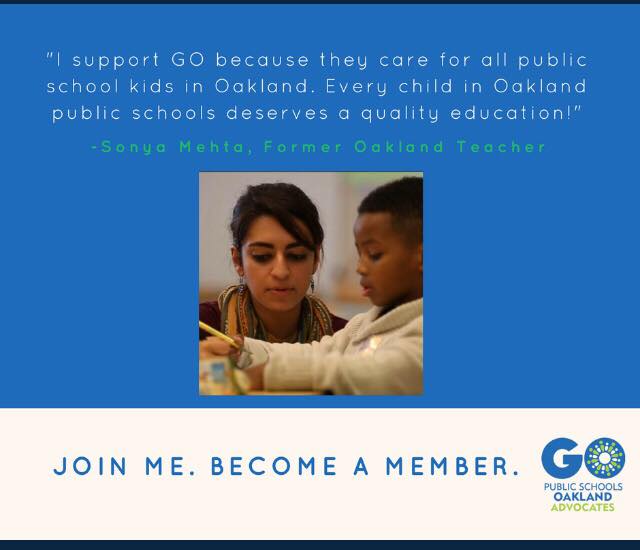
According to the San Francisco Chronicle, “Warren was introduced by Sonya Mehta, a former Oakland schoolteacher.”

 
However, this characterization is inaccurate.

 
Mehta was not an authentic public school teacher. She taught in a non-union charter school called “Learning Without Limits.” She also was a policy fellow at GO Public Schools Oakland, which is a toxic charter promoter focused around that city.


62239250_2491072120944114_6527485798902661120_n

62044390_2491072744277385_2756662503386644480_n

 
In her introduction, Mehta didn’t explicitly advocate for school privatization. She promoted Warren’s early education and free college policies (Her speech can be seen here beginning at 57:30). But why would Warren, one of the smartest and most knowledgeable candidates in the race for the White House, let herself be associated with such a divisive and toxic legacy?


Only 6% of all U.S. students attend charter schools, yet with little accountability, selective enrollment, and the ability to pocket taxpayer money as profit, they cannibalize the funding necessary for the 90% that attend authentic public schools.

 
Warren should know better than this. Along with Bernie Sanders, Warren sits on the Senate Education Committee (HELP – Health, Education, Labor, Pensions).


So the question is this: was this a mistake made by her campaign staff or is this indicative of where Warren is on education policy?


She has said some very positive things in this campaign, not the least of which is that if elected, she would nominate someone with teaching experience as Secretary of Education.

 
But if Mehta is what she thinks an authentic teacher looks like, we are in big trouble.

 
We don’t need another Betsy Devos or Arne Duncan clone who just so happens to have taught at a regressive charter school. In fact, we already had that, too, in John King.

 
Sadly, that’s not even where the story ends.


Warren’s senior education policy advisor is Josh Delaney, a Teach for America temp who turned a 5-week crash course in education into two years in the classroom and then a career as an “expert” on our schools.

 
This is simply not acceptable for anyone courting education voters.

 
You can’t go to Oakland, a city which just experienced a massive teacher strike caused by school privatization, and then let yourself be introduced by someone with ties to school privatization!

 
Go Public Schools Oakland, the organization Mehta is associated with, is the major charter organization in city battling the union.

 
Who knows if Warren was intending to take sides on this issue, but she certainly seems to be signaling that if she did, it might not be with parents, teachers and students. It could be with the hedge fund billionaires backing school privatization.

 
How can she be so strong against these same people when it comes to Wall Street and economic inequality but appear completely ignorant (at best) or disingenuous (at worst) when it comes to school policy?

 
A look at Warren’s stated education policies over her history in public life doesn’t exactly calm the waters, either.


According to the Network for Public Education, Warren holds some regressive views when it comes to our schools.


The non-profit gives her a C on charter schools.


She has spoken out against some of the worst excesses of the industry, but supports the concept of schools that are publicly financed but privately operated.


In 2016 Warren strongly opposed lifting the cap on charter schools in Massachusetts. In 2017, Senator Warren expressed deep concern regarding the “waste, fraud, and abuse of federal money” at the hands of for-profit charter schools and charter school management organizations.


Unfortunately, she also praised the charter industry:


“Many charter schools in Massachusetts are producing extraordinary results for our students, and we should celebrate the hard work of those teachers and spread what’s working to other schools.”

 
Warren earned a B for her stance on school vouchers.

 
She had the courage to criticize DeVos, but her history with the concept of using public money to finance private education is complicated.

 
In a 2017 letter to DeVos, prior to her confirmation as Secretary of education, Senator Warren said the evidence on private school vouchers is “mixed at best” and called them “expensive and dangerous failures that cost taxpayers billions of dollars while destroying public education systems.”


However, back in 2003, she seems to have thought differently. She wrote a book with her daughter called “The Two-Income Trap: Why Middle-Class Mothers and Fathers are Going Broke.” In it, she makes a case for a universal school voucher program. She strongly supported giving parents taxpayer-funded vouchers they could use at any school – public, private or parochial. This would “relieve parents from the terrible choice of leaving their kids in lousy schools or bankrupting themselves to escape those schools.”


Later she said she never meant those vouchers to be used at private schools, but that is  unclear from the text.


However, as spotty as Warren’s history is on school privatization, it is much worse when it comes to high stakes testing.


The Network for Public Education gives her a F on this issue.


In 2015, as Congress debated rolling back high stakes testing requirements that have unfairly assessed students for decades and used test scores as an excuse to deny poor and minority students the resources they need to succeed, Warren demanded testing stay in place. Along with three Democratic senators endorsed by Democrats for Education Reform (DFER), a lobbyist organization for the testing and school privatization industry, she insisted on stronger accountability measures based on testing to gain their support for the Every Student Succeeds Act (ESSA).


Let me be clear: none of this is intended to be a purity test.


If the only candidate we can support is a perfect one, we will never find any politician to support.


But Warren has to make a decision whose side she is on.


At very least, she needs to come out and make a public statement clarifying her views here. She needs to say that she does not support charter schools or vouchers. Shouldn’t every Democratic candidate who wants the votes of educators do that?


Watch the whole rally here. Mehta’s introduction begins at 57:30.


Like this post? I’ve written a book, “Gadfly on the Wall: A Public School Teacher Speaks Out on Racism and Reform,” now available from Garn Press. Ten percent of the proceeds go to the Badass Teachers Association. Check it out!

thumbnail_IMG_8249

SAT Adversity Score is an Antidote to Poison None of Us Need Take

Screen Shot 2019-05-26 at 7.40.58 PM


Let’s say someone gave you a vial of poison.


Would you drink it? Of course not.


What if he gave you the antidote, too. Would you take the poison then?


Heck no!


Why would anyone knowingly ingest poison even if they knew they could counteract its effects?


But that’s pretty much the situation high school students across the country are in today with the SAT test.


The College Board has admitted that the test unfairly assesses students – especially poor and minority students. However, if we add an “adversity score” to the raw score, then voila! Fairness!

 
The organization is piloting a program at 150 colleges and universities to adjust SAT scores to account for high schools and neighborhoods “level of disadvantage.”

The program is called the “Environmental Context Dashboard” and has been in the works since 2015 at the request of colleges. It provides admissions officers with information about students’ neighborhoods and high schools, such as the poverty level and the availability of challenging coursework. This is supposed to allow them to put raw scores into context before making admissions decisions.

 
But even if this actually remedies the inherent racial and economic biases inherent in the 93-year-old assessment, why take the bloody thing in the first place!?


The College Board is a 119-year-old organization boasting 6,000 member colleges, universities and other organizations. And despite its nonprofit status, it does make an awful lot of money.

 
The organization’s annual revenue is more than $750 million, according to its most recent publicly available 990 form. The organization’s CEO David Coleman makes $750,000 a year, its President Gaston Caperton makes more than $1.5 million a year, and 22 other employees earn at least $200,000.


Nice work if you can get it.


As such, the College Board needs to ensure millions of teenagers keep taking its moneymaking test as they apply to institutions of higher education. But more than 1,200 colleges and universities no longer require students seeking enrollment to take the SAT and among those that do the upstart ACT test is gaining popularity and market share.


The SAT’s new adversity score is a marketing tool – nothing more.


It’s the act of rats trapped in a corner. They’re admitting everything critics always said about them and offering a white flag.


We have no need to take it. In fact, we would be incredibly stupid to do so.


What the world needs is not an adversity score to counteract all the bad things the SAT does. It needs the absence of the SAT and all such standardized gatekeeper assessments.


Coleman is infamous as the father of a number of failed education reforms including the Common Core.


It’s absolutely hilarious to hear him admitting the biases of standardized testing since he’s been one of its leading proponents since the 1990s. It’s like hearing Colonel Sanders admit he doesn’t really like fried chicken all that much.


In the case of the SAT, he said colleges need to recognize student qualities that the test can’t capture, such as resourcefulness. Essays, letters of recommendation, and the “profiles” most high schools post sometimes capture the challenges and circumstances students face, he said, but in many cases colleges don’t find this information because they’re blinded by students’ tests scores.


Without a tool like the dashboard, he said, “the SAT could be misleading.”


YOU DON’T SAY!


“To warrant that the playing field is now level isn’t right or just,” Coleman added. “In the America we live in … the vast majority of students are working with a lot less than the top third. To then say that the SAT is enough to reflect what you can do, no, it isn’t.”

 
All of which begs the question of why we need the SAT test at all.


Why not just look at those essays and letters of recommendation. Look at student extra curricular activities, employment record – heck! – grades!


Classroom grades represent 180 days worth of data compiled by multiple educators over at least 12-13 years.


Admittedly, they aren’t completely objective but neither are standardized test scores. We do not have the power to crack open children’s skulls and see what’s going on in their brains. But classroom grades offer exponentially more data and of a much more equitable kind.


If all of that isn’t enough to make admissions decisions, then nothing will ever be.


But let’s be honest. This isn’t about the needs of schools or students.


It’s about the needs of big business enterprises like the College Board and the standardized testing companies; it’s about their need to turn a profit.


THAT is what this adversity score is out to save.


We’ve been criticizing the SAT and similar standardized assessments since they were first implemented in 1926. They were the creation of group of psychologists led by Robert M. Yerkes and Carl Brigham.


They were eugenicists who believed that white Europeans were superior to all others and used their pseudoscientific assessments to “prove” their biases. If there’s any doubt of that, I refer you to this passage from Brigham’s seminal work A Study of American Intelligence:

“The decline of American intelligence will be more rapid than the decline of the intelligence of European national groups, owing to the presence here of the negro. These are the plain, if somewhat ugly, facts that our study shows. The deterioration of American intelligence is not inevitable, however, if public action can be aroused to prevent it.”


Yerkes added:


“We should not work primarily for the exclusion of intellectual defectives but rather for the classification of men in order that they may be properly placed.”

 
It’s no wonder that the SAT is biased. Its creators were, and their assumptions about human nature still underlie the entire standardized testing enterprise.


No adversity score will ever undue that.


There comes a time when we need to simply stop the stupid racist crap we’ve been doing for generations – not try to prettify it so we can keep cashing in.


These sorts of conversions of scores have been tried before and routinely criticized as inaccurate.


The College Board tried something similar in the late 90s called the “striver’s tool.” It identified students who scored higher than expected based on racial, socioeconomic, and other data.


But it was shut down after it became a political football comparable to that of affirmative action – the same that has happened among certain conservatives with the new adversity score.


We’ve been engaged in unfair standardized testing for almost a century now.


Isn’t it time we admitted our mistake and moved on?


Or should we just keep drinking our poison and chasing it with a dubious antidote while our betters count their dirty money?


Like this post? I’ve written a book, “Gadfly on the Wall: A Public School Teacher Speaks Out on Racism and Reform,” now available from Garn Press. Ten percent of the proceeds go to the Badass Teachers Association. Check it out!

book-3


The Best School Innovation Would Be More People

thumbnail_o-TEACHER-COLLABORATION-facebook


Public schools thrive on innovation.


In nearly every classroom around the country you’ll find teachers discovering new ways to reach students and foster skills, understanding and creativity.


But if you pan out to the macro level, the overwhelming majority of innovations aren’t organic. They’re imposed on us by bureaucrats and functionaries from outside the classroom:


Education Technologies.


School privatization.


Standardized tests and Common Core.


For the last two decades, these are the kinds of innovations that have been forced on public schools at gun point.


And each and every one of them is pure bullshit.


They are corporate schemes written by the wealthy to cash in on education dollars for themselves. Big business hands them out to their paid political lapdogs to push through our state and federal legislatures to become laws and policies the rest of us have to obey.


They have nothing to do with helping students learn. Their purpose is to boost profits.


Just look at the difference between the ways the word innovation is defined.


Merriam Webster says the word signifies “the introduction of something new” or  “a new idea, method, or device: Novelty.”


But BusinessDictionary.com finds a tellingly distinct meaning:


“The process of translating an idea or invention into a good or service that creates value or for which customers will pay.”


It is that second business-friendly definition that has dominated our schools and narrowed our view until the only concept of advancement and revolution has been centered exclusively on the profit principle.


It is time to put a stop to all of it.


No more useless iPads, apps, software and so-called “personalized” educational technologies that do little more than allow marketers to steal student data and profit off of a new form of school where everything can be provided by technology at a cost while the quality of services takes a nosedive. No more technology for technology’s sake instead of using it as a tool to promote authentic learning.


No more laughable charter and voucher schools where education budgets become slush funds for corporations who don’t have to provide the same standard of services to students or the community. No more operating without  transparency or accountability.


No more outmoded and disproven standardized tests. No more canned academic standards that strip classroom educators of autonomy while reducing effective teaching behind a smoke screen of test scores that merely conflate the economic situation students live in with their academic abilities. No more corporations creating bogus multiple choice assessments whose only utility is to demonstrate how many more test prep materials we need to buy from the same company or industry.


It’s too bad we’re not interested in that FIRST definition of innovation, or at least innovation tied with the motive of providing quality education for children.


If we were interested in that kind of real, authentic school reform, we would focus on things that really matter. And chief among those would be one main thing, one major innovation that would be easy to accomplish but could change the fabric of our schools from top to bottom – people.


After all, that is what our public schools need the most – more people.


Have you walked into a public school lately? Peak your head into the faculty room. It’s like snatching a glance of the flying Dutchman. There are plenty of students, but at the front of the overcrowded classrooms, you’ll find a skeleton crew.


Today’s public schools employ 250,000 fewer people than they did before the recession of 2008–09. Meanwhile enrollment has increased by 800,000 students. So if we want today’s children to have not better but just the same quality of services kids received in this country only a decade ago, we’d need to hire almost 400,000 more teachers!


Instead, our children are packed into classes of 25, 30 even 40 students!


And the solution is really pretty simple – people not apps. Human beings willing and able to get the job done.


If we were fighting a war, we’d find ways to increase the number of soldiers in our military. Well, this is a war on ignorance – so we need real folks to get in the trenches and win the battle.


We need teachers, counselors, aides and administrators promoted from within and not functionaries from some think tank’s management program.


We need more people with masters or even more advanced teaching degrees – not business students with a three-week crash course in education under their belts who are willing to teach for a few years before becoming a self-professed expert and then writing education policy in the halls of government.


We need people from the community taking a leadership role deciding how our schools should be run, not simply appointing corporate lackeys to these positions at charter or voucher schools and narrowing down the only choices parents have to “Take It” or “Leave It.”


We need people. Real live people who can come into our schools and do the actual work with students.


And that means money. It means cutting the crap boondoggles to corporations and spending on flesh and blood reform.


It means fixing the funding inequality at the heart of nearly every public school in the country. No more spending tens or hundreds of thousands on wealthy students and merely hundreds on poor ones. No more dilapidated school buildings for the poor and palaces for the rich. No more socialistic pulling together for the wealthy and rugged individualism for the poor.


THIS is how you solve our education crisis – a crisis not caused by falling test scores or failing schools. A crisis caused by vulture capitalists preying on our educational institutions and our students as if they were some bloated carcass on the side of the road and not our best hope for the future.


It’s really that simple.


It’s a matter of ideology based on empiricism not “common sense” Laissezfaire maxims of “This is how we’ve always done it.”


We’ve been trying so-called corporate education reform for decades now – through Bush and Obama and now Trump. It doesn’t work.


It’s time we stopped making excuses for failing policies and got back to the best thing that works.


People.


Like this post? I’ve written a book, “Gadfly on the Wall: A Public School Teacher Speaks Out on Racism and Reform,” now available from Garn Press. Ten percent of the proceeds go to the Badass Teachers Association. Check it out!
book-2

The Forgotten Disaster of America’s First Standardized Test

Screen Shot 2019-04-22 at 10.35.05 PM

“Those who cannot remember the past are condemned to repeat it.”

George Santayana (1905)


The merry-go-round of history continues to spin because the riders forget they are free to get off at any time.


But we rarely do it. We keep to our seats and commit the same stupid mistakes over and over again.


Take high stakes standardized testing.


It was a disaster the very first time it was attempted in America – in Boston, Massachusetts, in 1845.


Yet we continue to prescribe the same error to students in schools today.


Judging learners, schools and teachers based on standardized assessments has the same problems now as it did 174 years ago. Yet we act as if it’s the only accurate way to assess knowledge, the only fair and equitable way to assign resources and judge the professionalism of our schools and teachers.


IT IS NONE OF THOSE THINGS.


If we simply remembered our history, we’d know that. But our collective amnesia allows this bad policy to reappear every generation despite any criticisms or protests.


So let me take you back to Boston in the middle of the 19th Century and show you exactly where things first went wrong and how they still go wrong in nearly the same way.

BOSTON SCHOOLS


Even back then Boston had a history of excellent schools.


One of the country’s most prestigious institutions – the city Latin School – was founded in 1635 and had a list of alumni that reads like a who’s who of American history up through modern times. This includes Cotton Mather, Sam Adams, John Hancock, Ralph Waldo Emerson, Leonard Bernstein and even Santayana, himself!


But Boston wasn’t known just for educating the elite. The city’s school committee had opened the nation’s first public high school in 1821. This wasn’t a charity. The community funded its public schools relatively well and took pride in its students’ accomplishments.


Testing was a much different affair in the early 1800s than it is today.


At the local English Grammar Schools, most examinations were strictly oral. Students were questioned in person about the various subjects in which they had received instruction. Teachers tested students’ memory in a recitation to find out whether or not they were proficient in the subject at hand.


The purpose behind such an assessment wasn’t to assign a grade like children were eggs or melons. It was to give the teacher information about how much his students had learned and where the students’ teacher should begin instruction next year.


However, critics complained that such assessments weren’t impartial and that a written exam might be better. Unfortunately, having every student complete one was impractical before the pencil and steel pen came into common usage in the late 1800s. Besides, teachers – then called School Masters – were trusted to use their judgment measuring student achievement and ability based on empirical observation of students’ day-to-day work.


It should also be noted that many more teachers were men at this time. This changed by the 1920s, when the majority of educators were women while most men had fled to the administrative offices. As this transformation took place, it accompanied greater trust in administrators and decreasing confidence in classroom teachers. And if you don’t see the sexism in that, you aren’t paying attention.


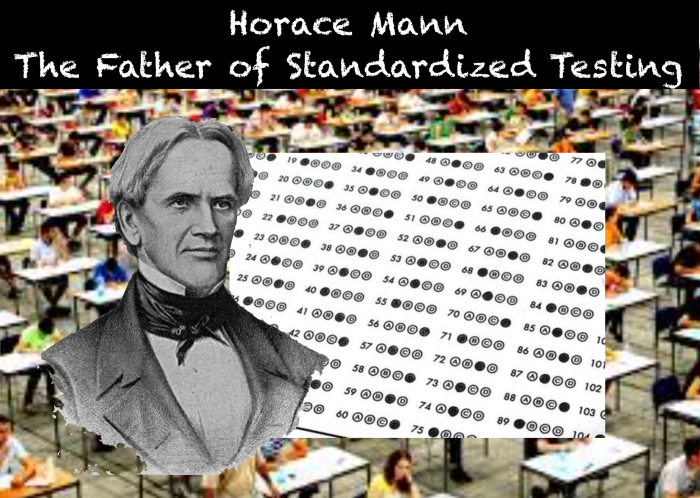
This shift began with standardized testing – an innovation first introduced by a Massachusetts lawyer and legislator named Horace Mann.

HORACE MANN’S TEST


To this day Mann remains a somewhat controversial figure. To some he was a reformer seeking to modernize education. To others he was a self-serving politician looking to increase his own power and that of his party no matter what the cost.


In 1837, Mann was appointed secretary of the newly created State Board of Education. As a member of the Whig Party, he wanted to centralize authority. To do that, he needed to discredit the history of excellence in Boston.


Mann had traveled abroad to see the innovations of European schools and concluded that Prussia’s schools, in particular, were far superior to America’s. His remarks were included in a highly publicized 1844 report that demanded action lest our country’s children be left behind. (Sound familiar?)


When other prominent Whigs including his friend Samuel Gridley Howe were elected to the School Committee and later the examining committee, Mann had everything he needed to make a change.


Howe dispensed with the oral exams in favor of written tests, what today we’d call short-answer exams. Without any warning to teachers or students, this new committee came to Boston’s grammar schools with preprinted questions. Teachers and administrators were furious. Students were terrified.


The examiners picked 530 out of the city’s approximately 7,000 students — allegedly the best below high school age – and made them take the new exams. This was about 20 or 30 children from each school. Students had an hour to write their responses on each subject to questions taken from assigned textbooks -geography, grammar, history, rhetoric, and philosophy.


Most failed.


A contemporary report on the exams concluded that the results “show beyond all doubt, that a large proportion of the scholars in our first classes, boys and girls of 14 or 15 years of age, when called upon to write simple sentences, to express their thoughts on common subjects, without the aid of a dictionary or a master, cannot write, without such errors in grammar, in spelling, and in punctuation.”


Examiners explained in a subsequent report that they had been looking for “positive information, in black and white,” exactly what students had learned. Teachers took no offense at that goal, but complained that the test questions had not pertained to what students had been taught.


Howe and his examiners countered that they had ensured their new assessment was valid with field testing – a practice that modern day corporations like Pearson and Data Recognition Corp. still do today.


Howe’s committee gave the same test in towns outside of Boston, including Roxbury, then a prosperous suburb. In all, the committee tested 31,159 students the previous summer. The result – an average score of 30 percent correct.


However, the wealthy Roxbury students outscored all the other schools. Therefore, they were made the standard of excellence that all other schools were expected to reach.


So when Boston students – all of whom did not have the privileges of Roxbury students – didn’t achieve the same scores, they were deemed failing, inadequate, losers.


Thus Mann could justify criticizing the district, firing teachers and administrators and consolidating control over the city’s schools.

BACKLASH


The result was pandemonium. Howe issued a scathing report lambasting the schools and even naming individual teachers who should be fired. Mann published the results in his influential Common School Journal and these kinds of tests started to appear at urban schools across the country.


However, Bostonians were not all convinced. Editorials were published both for and against the tests.


Every aspect of the exam was disputed – and in similar ways to the testing controversies we still see today.


To start, raising the stakes of the exams invited cheating. One teacher was caught leaking questions to his students before the testing session began.


The assessments also showed a racial achievement gap that far from helping diagnose structural inequalities was instead weaponized against the very people working hardest to help minority students learn. Examiners criticized the head teacher of the segregated Smith School because his African American students had scored particularly low. He was accused of not seeing the potential in black children. Never mind that these students were the most different from the Roxbury standard in terms of culture and privilege.


The tests also began the endless failing schools narrative that has been used by ambitious policymakers and disaster capitalists to get support for risky and unproven policies. Rivalries began between city and suburban schools with Bostonians wondering why their schools had been allowed to get so much worse.


Much of the criticism came back on Mann and Howe who reacted by throwing it back on the teachers for doing such a bad job.


In the end, a few educators were let go, but the voters had had enough of Mann.


Parents accused him of deliberately embarrassing students and in 1848 he was not re-elected to office.


The tests were given again in 1846, but by 1850, Boston had abandoned its strategy and reverted to non-standarized exams that were mostly based on oral presentations.


The experiment deeply disturbed many people. No one could explain why there was a discrepancy between scores of rich vs. poor students. The original justification of these exams was that they would eliminate partiality and treat students fairly and equally. Yet the results showed a racial and economic bias that didn’t escape contemporaries. In 1850 as the tests were being discontinued, the chairman of the examination committee wrote:

“Comparison of schools cannot be just while the subjects of instruction are so differently situated as to fire-side influence, and subjected to the draw-backs inseparable from place of birth, of age, of residence, and many other adverse circumstances.”


And that’s how standardized testing began.


It was a political power play justified by so-called universal testing.


Numbers, charts and graphs were used to mesmerize people into going along with policies that were never meant to help children learn, but instead to gain power for certain policymakers while taking it away from others.

HISTORY OF STANDARDIZED TESTING


In the years that followed, standardized testing became much more efficient. In 1915, the first test was given with multiple-choice questions – Frederick J. Kelly’s Kansas Silent Reading Test. It was roundly criticized and eventually disowned by Kelly for focusing almost exclusively on lower order thinking skills.


Then in the 1920s eugenicists like Robert Yerkes and Carl Brigham went a step further with similar IQ tests to justify privileging upper class whites from lower class immigrants, blacks and Hispanics. Their work was even used to justify the forced sterilization of 60,000 to 70,000 people from groups with low test scores, thus preventing them from “polluting” the gene pool. Ultimately this lead Brigham to create the Scholastic Assessment Test (SAT) to keep such undesirables out of higher education. It is still in wide use today.


It wasn’t until 1938 that Kaplan Inc. was founded to tutor students in these same tests. Stanley Kaplan, son of Jewish immigrants, showed that far from assessing learning, these tests merely assessed students’ ability to take the tests. Thus he was able to provide a gateway to higher education for many Jews and other minorities who had been unfairly excluded because of testing.


In the 1960s black plaintiffs began winning innumerable lawsuits against the testing industry. Perhaps the most famous case is Hobson v. Hansen in 1967, which was filed on behalf of a group of Black students in Washington, DC. The court ruled that the policy of using tests to assign students to tracks was racially biased because the tests were standardized to a White, middle class group.


And then in 2001, President George W. Bush’s No Child Left Behind legislation revved the whole thing up into overdrive. With bipartisan support, he tied federal funding of schools to standardized test performance and annual academic progress – a policy that was only intensified under President Barack Obama who added competitive grants for additional funding based on test performance under Race to the Top.


Since then, standardized testing has grown from a $423 million industry before 2001 to a multi-billion dollar one decades later. If we add in test prep, new text books, software, and consultancy, that figure easily tops the trillion dollar mark.


Despite hundreds of principal, teacher, parent and student protests, tens of thousands of opt outs and a slew of lawsuits, high stakes testing continues to be the law of the land.


Yet the problems today are almost the same as those in Boston nearly two centuries ago.

LEGACY


These tests are political smokescreens used to stop policymakers from having to enact real reforms like equitable funding, wraparound services and addressing the trauma our most impoverished students deal with everyday. Instead, we push a school privatization and testing industry that makes trillions of dollars for corporations at the expense of our children.


“Those who cannot remember the past are condemned to repeat it.”


Here’s hoping that one day we remember and get the heck off this runaway merry-go-round.


Like this post? I’ve written a book, “Gadfly on the Wall: A Public School Teacher Speaks Out on Racism and Reform,” now available from Garn Press. Ten percent of the proceeds go to the Badass Teachers Association. Check it out!
book-1

Schools That Hinder Opt Outs Are Participating in Their Own Demise

thumbnail_1511359_10203413055118040_897780773_n

You can’t be a public school and still ignore the will of the people.


That’s the problem at too many districts across the country where narrow-minded administrators are waging an all out war on parents opting their children out of standardized testing.


The federal government still requires all states to give high stakes tests to public school students in grades 3-8 and once in high school. So states require their districts to give the tests – despite increasing criticism over the assessments’ validity, age appropriateness, racial and economic bias and the very manner in which the scores are used to justify narrowing the curriculum, school privatization, funding cuts, teacher firings and closing buildings serving the most underprivileged children.


In response, parents from coast to coast continue to fight the havoc being forced upon their communities by refusing the tests for their children.


Yet instead of welcoming this rush of familial interest, at some schools we find principals, superintendents and every level of functionary in between doing whatever they can to impede parental will.


Most administrators don’t actually go so far as out right refusal of a parent’s demand to opt out their children.


That’s especially true in states where the right to opt out is codified in the law.


Three states – California, Utah, and Wisconsin – have enacted legislation permitting parents to opt their children out of standardized tests. However, at least five others, including my home of Pennsylvania, have laws respecting parents’ opt-out wishes for certain reasons. In others states there may not be specific legislation permitting it, but none have laws forbidding it either. At worst, test refusal is an act of civil disobedience like tearing down a confederate monument or freedom rides.


In Pennsylvania, the school code specifies that parents can refuse the test for their children for “religious reasons.” Those reasons and the religion in question never need be named. Citing “religious reasons” is rationale enough.


Consider:


“PA School Code Chapter 4.4(d):


(4)  …If upon inspection of a State assessment parents or guardians find the assessment to be in conflict with their religious belief and wish their students to be excused from the assessment, the right of the parents or guardians will not be denied upon written request that states the objection to the applicable school district superintendent, charter school chief executive officer or AVTS director.”


So when a parent provides just such an objection, it’s there in black and white that administrators must comply with that request.


However, some administrators are trying to game the system. When the other students are taking the state standardized test, the opt out students are rounded up and forced instead to take a district created assessment that just so happens to look almost exactly like the test their parents explicitly asked they not be subjected to.


So in my state, some parents have opted their children out of the Pennsylvania System of School Assessment (PSSA) or Keystone Exams, but administrators are requiring them instead to take an assessment they cobbled together themselves that closely resembles the PSSA and/or Keystone Exam.


They take a little bit from the PSSA, a bit from the Partnership for Assessment of Reading Readiness for College and Careers (PARRC) test, a question or two from the Scholastic Assessment Test (SAT) and voila! A brand new Frankenstein’s monster of standardized assessment.


But that’s not all. Some districts go one step further. They tie the results of this bogus “district” assessment with class placement. The results of the faux test are used to determine whether students are placed in the remedial, academic or the honors class in a given subject (English Language Arts, Math or Science) in the next grade.


Does that violate the law? Parents did not want their children to be assessed with a standardized test, and that’s exactly what the school did anyway. The only difference is the name of the standardized test they used.


I am not a lawyer, but I’ve contacted several. The answer I’ve gotten is that this may not be technically illegal, but it does at least violate the spirit of the law.


Districts are given a certain latitude to determine their own curriculum and assessments. This kind of runaround is ugly, petty and possibly just on the line of legality.


But our administrators are not done. Not only are they requiring such students to take a cobbled together standardized assessment, when children are done, they are forced to do hours of test prep for the state assessment that their parents refused for them.


Imagine opting out of the PSSA and then being forced to spend that time preparing for that very test. Imagine refusing to allow your children to take the Keystone Exam but then having them forced to prepare for it instead.


Petty, small-minded, punitive and – in this case – possibly illegal.


The school code is specifically against this. From the same section (4.4):


“(d) School entities shall adopt policies to assure that parents or guardians have the following:


(3) …The right to have their children excused from specific instruction that conflicts with their religious beliefs, upon receipt by the school entity of a written request from the parent or guardians.”


Again, I am not a lawyer, but it seems pretty clear that this, at least, is a violation of the law.


They can request their children not be given specific instruction – in this case test prep. Yet that’s exactly what administrators are doing anyway.


So what are opt out parents to do? Should they lawyer up?


Possibly. Though no one likes to have to take their own school to court. Any monetary damages thus recovered come from the collective pot that should go to help all students learn. It’s unfortunate that some administrators play so freely with taxpayer dollars when it would be a simple matter to safeguard them AND respect parental rights.


A better course of action may be for opt out parents in such situations to seek redress directly from the school board.


School directors are elected officials, after all. They may not be appraised of the actions of the administrators in their employ.


And that is really where the buck stops. If school directors don’t approve of this sort of chicanery, they can easily put a stop to it.


These are public schools. They are supposed to be run by the public. Our democracy is supposed to be what defines us. We are run by the people, for the people.


We’re not some charter school where school directors are appointed to their positions, hold their meetings in private and rarely if ever have to account for their decisions.


It’s shocking that in an age when public schools are often set against privatized ones that we’d allow such foolishness.


We need to set ourselves apart. Instead of denying parental requests, we should go out of our way to accommodate them.


Parents could, after all, remove their children and try their luck elsewhere.


At charter schools, they would probably get an even worse welcome. After all, most such schools pride themselves on their test scores and test prep curriculum having kicked out any students who don’t score well.


However, parents of means could enroll their children in private or parochial schools that are not required by law to even take these high stakes tests.


I’m not recommending that course of action. These schools are expensive, restrictive, insular and extremely racially and economically segregated.


But how short sighted must public school administrators be if they play these sorts of games with parents and children in just such an environment?


Any public school leader who wars against opt outs is participating in their own schools demise.


This is doubly so at schools serving high poverty populations.


Children of the poor and minorities historically get lower test scores than those from wealthier families. These tests are used to justify budget cuts and firing school staff – including these administrators.


Opting out of testing is one way to deny this data to the state so that they can’t use it against the school.


Certainly having high numbers of students opting out can, itself, become an excuse for punitive action from the state. But nowhere in the country has it ever actually happened.


State legislatures, too, are run by majority rule. The same with the federal government.


Our lawmakers have no authority to tell voters they can’t opt their children out of testing. It is the voters who are the boss.


We’d all best remember that.


Like this post? I’ve written a book, “Gadfly on the Wall: A Public School Teacher Speaks Out on Racism and Reform,” now available from Garn Press. Ten percent of the proceeds go to the Badass Teachers Association. Check it out!

book-3

Standardized Testing is a Tool of White Supremacy

Screen Shot 2019-04-03 at 8.35.24 PM

Let’s say you punched me in the face.


I wouldn’t like it. I’d protest. I’d complain.


And then you might apologize and say it was just an accident.

 
Maybe I’d believe you.


Until the next time when we met and you punched me again.


That’s the problem we, as a society, have with standardized tests.


We keep using them to justify treating students of color as inferior and/or subordinate to white children. And we never stop or even bothered to say, “I’m sorry.”


Fact: black kids don’t score as high on standardized tests as white kids.


It’s called the racial achievement gap and it’s been going on for nearly a century.


Today we’re told that it means our public schools are deficient. There’s something more they need to be doing.

 
But if this phenomenon has been happening for nearly 100 years, is it really a product of today’s public schools or a product of the testing that identifies it in the first place?


After all, teachers and schools have changed. They no longer educate children today the same way they did in the 1920s when the first large scale standardized tests were given to students in the US. There are no more one-room schoolhouses. Kids can’t drop out at 14. Children with special needs aren’t kept in the basement or discouraged from attending school. Moreover, none of the educators and administrators on the job during the Jazz Age are still working.
 

Instead, we have robust buildings serving increasingly larger and more diverse populations. Students stay in school until at least 18. Children with special needs are included with their peers and given a multitude of services to meet their educational needs. And that’s to say nothing of the innovations in technology, pedagogy and restorative justice discipline policies.


But standardized testing? That hasn’t really changed all that much. It still reduces complex processes down to a predetermined set of only four possible answers – a recipe good for guessing what a test-maker wants more than expressing a complex answer about the real world. It still attempts to produce a bell curve of scores so that so many test takers fail, so many pass, so many get advanced scores, etc. It still judges correct and incorrect by reference to a predetermined standard of how a preconceived “typical” student would respond.


Considering how and why such assessments were created in the first place, the presence of a racial achievement gap should not be surprising at all. That’s the result these tests were originally created to find.


Modern testing comes out of Army IQ tests developed during World War I.

 
In 1917, a group of psychologists led by Robert M. Yerkes, president of the American Psychological Association (APA), created the Army Alpha and Beta tests. These were specifically designed to measure the intelligence of recruits and help the military distinguish those of “superior mental ability” from those who were “mentally inferior.”
 

These assessments were based on explicitly eugenicist foundations – the idea that certain races were distinctly superior to others.
 
In 1923, one of the men who developed these intelligence tests, Carl Brigham, took these ideas further in his seminal work A Study of American Intelligence. In it, he used data gathered from these IQ tests to argue the following:


“The decline of American intelligence will be more rapid than the decline of the intelligence of European national groups, owing to the presence here of the negro. These are the plain, if somewhat ugly, facts that our study shows. The deterioration of American intelligence is not inevitable, however, if public action can be aroused to prevent it.”


Thus, Yerkes and Brigham’s pseudoscientific tests were used to justify Jim Crow laws, segregation, and even lynchings. Anything for “racial purity.”
 

People took this research very seriously. States passed forced sterilization laws for people with “defective” traits, preventing between 60,000 and 70,000 people from “polluting” America’s ruling class.
 
The practice was even upheld by the US Supreme Court in the 1927 Buck v. Bell decision. Justices decided that mandatory sterilization of “feeble-minded” individuals was, in fact, Constitutional.

 
Of the ruling, which has never been explicitly overturned, Justice Oliver Wendell Holmes wrote, “It is better for all the world, if instead of waiting to execute degenerate offspring for crime, or to let them starve for their imbecility, society can prevent those who are manifestly unfit from continuing their kind…. Three generations of imbeciles are enough.”
 

Eventually Brigham took his experience with Army IQ tests to create a new assessment for the College Board – the Scholastic Aptitude Test – now known as the Scholastic Assessment Test or SAT. It was first given to high school students in 1926 as a gatekeeper. Just as the Army intelligence tests were designed to distinguish the superior from the inferior, the SAT was designed to predict which students would do well in college and which would not. It was meant to show which students should be given the chance at a higher education and which should be left behind.
 

And unsurprisingly it has always – and continues to – privilege white students over children of color.

 
The SAT remains a tool for ensuring white supremacy that is essentially partial and unfair – just as its designers always meant it to be.
 
Moreover, it is the model by which all other high stakes standardized tests are designed.

 
But Brigham was not alone in smuggling eugenicist ideals into the education field. These ideas dominated pedagogy and psychology for generations until after World War II when their similarity to the Nazi philosophy we had just defeated in Europe dimmed their exponents’ enthusiasm.
 

Another major eugenicist who made a lasting impact on education was Lewis Terman, Professor of Education at Stanford University and originator of the Stanford-Binet intelligence test. In his highly influential 1916 textbook, The Measurement of Intelligence he wrote:
psych


“Among laboring men and servant girls there are thousands like them [feebleminded individuals]. They are the world’s “hewers of wood and drawers of water.” And yet, as far as intelligence is concerned, the tests have told the truth. … No amount of school instruction will ever make them intelligent voters or capable voters in the true sense of the word.

… The fact that one meets this type with such frequency among Indians, Mexicans, and negroes suggests quite forcibly that the whole question of racial differences in mental traits will have to be taken up anew and by experimental methods.

Children of this group should be segregated in special classes and be given instruction which is concrete and practical. They cannot master, but they can often be made efficient workers, able to look out for themselves. There is no possibility at present of convincing society that they should not be allowed to reproduce, although from a eugenic point of view they constitute a grave problem because of their unusually prolific breeding” (91-92).


This was the original justification for academic tracking. Terman and other educational psychologists convinced many schools to use high-stakes and culturally-biased tests to place “slow” students into special classes or separate schools while placing more advanced students of European ancestry into the college preparatory courses.

 
The modern wave of high stakes testing has its roots in the Reagan administration – specifically the infamous propaganda hit piece A Nation at Risk: The Imperative for Education Reform.

 
In true disaster capitalism style, it concluded that our economy was at risk because of poor public schools. Therefore, it suggested circumventing the schools and subordinating them to a system of standardized tests, which would be used to determine everything from teacher quality to resource allocation.

 
It’s a bizarre argument, but it goes something like this: the best way to create and sustain a fair educational system is by rewarding “high-achieving” students.
 

So we shouldn’t provide kids with what they need to succeed. We should make school a competition where the strongest get the most and everyone else gets a lesser share.

 
And the gatekeeper in this instance (as it was in access to higher education) is high stakes testing. The greater the test score, the more funding your school receives, the lower class sizes, the wider curriculum, more tutors, more experienced and well compensated teachers, etc.
 

It’s a socially stratified education system completely supported by a pseudoscientific series of assessments.

 
After all, what is a standardized test but an assessment that refers to a specific standard? And that standard is white, upper class students.
 
In his book How the SAT Creates Built-in-Headwinds, national admissions-test expert, Jay Rosner, explains the process by-which SAT designers decide which questions to include on the test:


“Compare two 1998 SAT verbal [section] sentence-completion items with similar themes: The item correctly answered by more blacks than whites was discarded by [the Educational Testing Service] (ETS), whereas the item that has a higher disparate impact against blacks became part of the actual SAT. On one of the items, which was of medium difficulty, 62% of whites and 38% of African-Americans answered correctly, resulting in a large impact of 24%…On this second item, 8% more African-Americans than whites answered correctly…”

 
In other words, the criteria for whether a question is chosen for future tests is if it replicates the outcomes of previous exams – specifically tests where students of color score lower than white children. And this is still the criteria test makers use to determine which questions to use on future editions of nearly every assessment in wide use in the US.
 

Some might argue that this isn’t racist because race was not explicitly used to determine which questions would be included. Yet the results are exactly the same as if it were.

 
Others want to reduce the entire enterprise to one of social class. It’s not students of color that are disadvantaged – it’s students living in poverty. And there is overlap here.
 

Standardized testing doesn’t show academic success so much as the circumstances that caused that success or failure. Lack of proper nutrition, food insecurity, lack of prenatal care, early childcare, fewer books in the home, exposure to violence – all of these and more combine to result in lower academic outcomes.


But this isn’t an either/or situation. It’s both. Standardized testing has always been about BOTH race and class. They are inextricably entwined.

 
Which leads to the question of intention.

 
If these are the results, is there some villain laughing behind the curtain and twirling the ends of a handlebar mustache?
 

Answer: it doesn’t matter.
 

As in the entire edifice of white supremacy, intention is beside the point. These are the results. This is what a policy of high stakes standardized testing actually does.
 

Regardless of intention, we are responsible for the results.
 

If every time we meet, you punch me in the face, it doesn’t matter if that’s because you hate me or you’re just clumsy. You’re responsible for changing your actions.
 
And we as a society are responsible for changing our policies.

 
Nearly a century of standardized testing is enough.

 
It’s time to stop the bludgeoning.
 
It’s time to treat all our children fairly.
 

It’s time to hang up the tests.


NOTE: This article expands upon many ideas I wrote about in an article published this week in Public Source.


Like this post? I’ve written a book, “Gadfly on the Wall: A Public School Teacher Speaks Out on Racism and Reform,” now available from Garn Press. Ten percent of the proceeds go to the Badass Teachers Association. Check it out!

book-2

School Accountability Begins With the People Who Make the Rules: A Code of Conduct for Politicians and Test Makers

thumbnail_Screen Shot 2019-03-18 at 1.17.54 PM


Standardized testing is all about accountability.
 

We’ve got to keep schools accountable for teaching.
 

We’ve got to keep students accountable for learning.

 
It’s kind of a crazy idea when you stop to think about it – as if teachers wouldn’t teach and students wouldn’t learn unless someone was standing over them with a big stick. As if adults got into teaching because they didn’t want to educate kids or children went to school because they had no natural curiosity at all.
 

So we’ve got to threaten them into getting in linestudents, teachers: march!

 
But that’s not even the strangest part. It’s this idea that that is where accountability stops.

 
No one has to keep the state or federal government accountable for providing the proper resources.

 
No one has to keep the testing companies accountable for creating fair and accurate assessments.

 
It’s just teachers and students.
 

So I thought I’d fix that with a “Code of Conduct for Politicians and Test Makers.”

 
After all, that’s what we do when we want to ensure someone is being responsible – we remind them of their responsibilities.
 

You see, the state and federal government are very concerned about cheating.

 
Not the kind of cheating where the super rich pay off lawmakers to rig an accountability system against the poor and minorities. No. Just the kind of cheating where teachers or students try to untie their hands from behind their backs.

 
They’re very concerned about THAT.

 
When you threaten to take away a school’s funding and fire teachers based on test scores, you tend to create an environment that encourages rampant fraud and abuse.

 
So the government requires its public servants to take on-line courses in the ethics of giving standardized tests. We have to sit through canned demonstrations of what we’re allowed to do and what we aren’t allowed to do. And when it’s all over, we have to take a test certifying that we understand.
 

Then after we proctor an exam, we have to sign a statement swearing that we’re abiding by these rules to ensure “test security.”
 

This year, for the first time, I’m supposed to put my initials on the answer sheets of all of my students’ Pennsylvania System of School Assessment (PSSA) tests to prove….  I don’t know. That I was there and if anything went wrong, it’s my fault. Burn the witch. That sort of thing.

 
Even our students have to demonstrate that they’re abiding by the rules. Children as young as five have to mark a bubble on their test signifying that they’ve read and understood the Code of Conduct for Test Takers.
 

I still don’t understand how that’s Constitutional.

 
Forcing children to sign a legal document without representation or even without their parents or guardians present – it sure looks like a violation of their civil rights.
 

But that’s what accountability looks like when you only require certain people to be accountable.

 
So back to my crazy idea.
 

Perhaps the corporate flunkies actually designing and profiting off these tests should be held accountable, too. So should lawmakers requiring all this junk.
 

Maybe they should have to sign a “Code of Conduct for Politicians and Test Makers” modeled after the one the rest of us peons have to use to sign our lives away.
 

Here’s how it might look:


CODE OF CONDUCT FOR POLITICIANS AND TEST MAKERS:


Do…


-Listen to the complaints, concerns and criticisms of parents, teachers and students about the questions and assessments you’re creating.

 
Ask advice from education researchers and all stakeholders to ensure the questions you’re designing are backed up by psychological, neurological, sociological and all associated research on child development.

 
-Read each question you create carefully to ensure it is not simply multiple choice and instead assesses deeper understanding of concepts and skills. Also be sure that all open ended items and writing prompts allow for a multitude of answers and don’t simply ask the test taker to guess what the test maker is thinking.

-Be careful when writing your questions to make sure you have NOT left misspellings or grammatical mistakes in place that would unnecessarily increase confusion for test takers and thereby invalidate the results.

 
Check and double check to make sure you have created a fair and accurate assessment before giving it to students to evaluate their learning.

 
-Report any suspected cheating to a certified watchdog group and the media if you find any evidence or have any suspicion that anyone has created test items purely to enrich the corporation you work for or the privatization-testing-prison industrial complex.

 
-If you’re a lawmaker who’s voted for annual testing, take the assessment annually yourself to prove that it is an adequate test of basic student knowledge of which as a duly elected representative you should clearly pass. Publish your score prominently in the media to prove the test’s efficacy.
 

DO NOT…


-Have notes in your possession from special interests such as (but not limited to) the testing corporations, the publishing industry and/or the ed tech industry before, during or after voting for legislation that promotes the very same standardized testing and testing remediation on which these industries profit.
 

-Have any (approved or otherwise) electronic devises that tabulate previous test questions and prescribe reusing those that have resulted in answer curves consistent with previous tests thereby continuing the trend of selecting against students of color, the poor and other groups and/or subgroups.

 
-Share inside information about the test or previous test questions with anyone that you do not also make freely available to the public. It is not your job to create a remediation market and/or cash in on the testing apparatus you are creating.
 

-Dissuade students from talking with others about  questions after the test. They are human beings with rights. It is perfectly natural for them to talk and harmless for them to do so after a testing session is over.


-Take notes on individuals criticizing or opting out of testing with the purpose of punishing them for their dissent. This is a democratic process and you will welcome discussion, criticism and dissent.
 
-Use the bubbles in the answer booklet for anything at all. In fact, throw them away. It’s 2019. Surely we can find a better way to assess children than multiple choice questions answered by filling in bubbles on a sheet of paper with a number 2 pencil!

 
Conduct an online testing session unless you are 100% positive that the information input by the students and collected about the students is secure, will be secure and cannot be shared with advertisers, corporations or any other entity, and only with a certainty that this data will not be put in any database in a manner that could identify individual test takers or otherwise violate privacy laws.
 
-In fact, you know what? Don’t use standardized tests at all to assess student learning – especially not connected to high stakes. Instead rely on classroom grades and teacher observations for student assessment. Use indexes and audits of school resources to determine whether they are doing their best to teach students and whether lawmakers have done enough to ensure they are receiving fair and equitable resources.


What do you think? Would any of them sign off on this?


Like this post? I’ve written a book, “Gadfly on the Wall: A Public School Teacher Speaks Out on Racism and Reform,” now available from Garn Press. Ten percent of the proceeds go to the Badass Teachers Association. Check it out!

book-2