If you’re like me, you don’t want these questions to come as a surprise on May 18 or before (if you’re casting a mail in ballot).
These queries can change the state for better or worse in dramatic ways, yet for some reason, they don’t write these things in the way everyday people talk.
This is lawyer speak. You have to wear a long black robe and put on a white haired wig (called a peruke) just to understand these things.
But don’t get your gavel in a tizzy.
As a public service, I’m going to translate each question and make a suggestion on how you should vote.
QUESTION 1:
“Shall the Pennsylvania Constitution be amended to change existing law and increase the power of the General Assembly to unilaterally terminate or extend a disaster emergency declaration—and the powers of Commonwealth agencies to address the disaster regardless of its severity pursuant to that declaration—through passing a concurrent resolution by simple majority, thereby removing the existing check and balance of presenting a resolution to the Governor for approval or disapproval?”
Translation:Allow the legislature to second guess the governor and terminate an emergency disaster declaration without just cause
We have three branches of government for a reason – checks and balances. Robbing the executive to boost a dysfunctional legislature would make the declaration of emergencies and natural disasters a matter or politics not facts.
Emergencies could be terminated at a moment’s notice without cause sending our first responders into chaos. Emergency managers could lose precious time and resources, communities could lose relief and recovery funding from the state and federal governments, all while our chuckleheaded legislature debates reality.
The Covid-19 pandemic may not be over yet. We’re working overtime to distribute vaccines and combat threats from emerging variants. The last thing we need is a political show prematurely eliminating masking, social distancing and other safety precautions so performative ideologues can win points on Fox News.
QUESTION 2:
“Shall the Pennsylvania Constitution be amended to change existing law so that: a disaster emergency declaration will expire automatically after 21 days, regardless of the severity of the emergency, unless the General Assembly takes action to extend the disaster emergency; the Governor may not declare a new disaster emergency to respond to the dangers facing the Commonwealth unless the General Assembly passes a concurrent resolution; the General Assembly enacts new laws for disaster management?”
Translation:Limit an emergency disaster declaration to 21 days regardless of the severity of the emergency
Suggestion: VOTE NO
Disasters do not come with time limits. But randomly limiting them all to 21 days again takes power away from the Governor and gives it to the legislature. The only way to extend emergency declarations would be passage of a resolution by the state House and Senate.
Do we really want our emergency responses tied to the endless back and forth of legislators who rarely even pass their annual budgets on time? This is unnecessary bureaucracy so politicians can grandstand while emergency personnel wait for the go ahead to save lives.
QUESTION 3:
“Shall the Pennsylvania Constitution be amended by adding a new section providing that equality of rights under the law shall not be denied or abridged because of an individual’s race or ethnicity?”
Translation: Make it illegal to deny or cut short anyone’s rights because of race or ethnicity
Suggestion: VOTE YES
This should be a no brainer. No one should be able to deny a person’s civil rights because of race or ethnicity. Or any other reason!
However, we just lived through four years of a reality TV show President who packed the federal courts with dozens of questionable and unqualified judges who made their careers discriminating against people of color, people of different creeds, religions, etc.
So it makes sense to enshrine equal protection for all at the state level and protect Commonwealth residents from federally sanctioned prejudice especially focused around workers’ rights, criminal justice reform, housing and healthcare.
Moreover, as a part of the state Constitution, this amendment would stop even our own state legislature from passing any laws inconsistent with it.
QUESTION 4:
“Do you favor expanding the use of the indebtedness authorized under the referendum for loans to volunteer fire companies, volunteer ambulance services and volunteer rescue squads under 35 PA.C.S. §7378.1 (related to referendum for additional indebtedness) to include loans to municipal fire departments or companies that provide services through paid personnel and emergency medical services companies for the purpose of establishing and modernizing facilities to house apparatus equipment, ambulances and rescue vehicles, and for purchasing apparatus equipment, ambulances and rescue vehicles, protective and communications equipment and any other accessory equipment necessary for the proper performance of the duties of the fire companies and emergency medical services companies?”
Translation: Allow municipal fire departments and EMS companies to apply for state loans to modernize critical safety equipment
Suggestion: VOTE YES
Both municipal fire departments and EMS companies with paid employees and volunteer departments and companies would be able to apply for state loans.
This vital funding could be used to modernize or purchase necessary safety equipment for first responders. It would keep fire fighters up to date and able to serve residents – especially those in rural areas. It would make sure every fire department could have up to date equipment.
Question 5 (Allegheny County Only):
“Shall the Allegheny County Code, Chapter 205. Allegheny County Jail, be amended and supplemented to include a new Article III, as set forth below, which shall set forth standards governing conditions of confinement in the Allegheny County Jail?”
Translation: Should we prohibit solitary confinement at Allegheny County Jail except in extreme emergencies?
Suggestion: VOTE YES!
Solitary confinement is cruel and unusual punishment. A lawsuit filed in September by ACJ inmates alleges that solitary confinement was being used as a punishment against inmates seeking mental health care. Recent research from Cornell University demonstrates that even a short amount of time in solitary confinement can increase recidivism rates, as well as unemployment rates.
Question 6 (Pittsburgh residents only):
“Shall the Pittsburgh Home Rule Charter be amended and supplemented by adding a new Article 10: Powers of the Pittsburgh Police, containing Section 1001, which shall bar employees of the Pittsburgh Bureau of Police from executing warrants at any residence without knocking and announcing themselves?”
Translation: Should we eliminate no-knock warrants?
Suggestion: VOTE YES!
This would require all Pittsburgh Police to physically knock and announce themselves before gaining entry to execute a warrant.
No knock warrants are dangerous and often a component of racial discrimination in law enforcement.
Briana Taylor’s death in Louisville, KY, during the execution of a “no knock” warrant clearly shows how this practice recklessly endangers human life. Many municipalities now have banned no-knock warrants including Louisville, KY. Pittsburgh City Council also introduced legislation to ban the use of no-knock warrants by Pittsburgh Police officers.
So those are my suggestions for this race’s ballot initiatives.
NO. NO.YES. YES. YES.
And if you happen to be a Democrat living in Allegheny County’s District 9, please vote for me for County Council.
Together we can build a better world.
Do you live in Allegheny County, Pennsylvania? I’m running for County Council in District 9
Like this post? You might want to consider becoming a Patreon subscriber. This helps me continue to keep the blog going and get on with this difficult and challenging work.
It’s as if they’re starving to learn something, and this play is nourishing their hearts and minds.
I laugh because my first thought was to come down on the shouting out and side commenting until a deeper part of me realized this was all okay. They were on-task, if unrestrained.
Comprehension is not a race. There is no one ahead or behind. Everyone goes at their own pace. And if you try to force someone to go more quickly than is best for them, they’ll stumble and fall.
But let’s be honest, these learning loss champions are not really worried about children. They’re representatives of the standardized testing industry.
So as the school year rapidly comes to a close, I have a suggestion to make.
I know I’m not qualified to do so.
I’m just a public school teacher with 17 years experience. I’ve never sat on any think tank boards. No testing corporation has ever paid me a dime to hawk one of their high quality remediation products.
I know that’s controversial, but I believe it to be true.
As such, they need down time.
They need time to regroup and recharge.
This pandemic has been hard on everyone.
As of April 1, nearly 3.47 million children have tested positive for COVID-19, most with mild symptoms, according to the American Academy of Pediatrics. A few hundred have died, mostly children of color. Many more kids probably contracted the virus but were asymptomatic spreaders of the disease to adults.
As a result, between 37,000 and 43,000 children in the United States have lost at least one parent to COVID-19, according to USC research.
They have suffered through changes in routine, disruptions in learning, breaks in the continuity of their healthcare, missed significant life events like birthday parties, vacations and graduations. But worst of all they have suffered the loss of safety and security.
We should not be demanding they work harder at a time like this.
We should be providing them with kindness, empathy and love.
In the classroom, I no longer have a thing called “Late Work.”
If a student hands in an assignment passed the due date, there is no penalty. I just grade it. And if it isn’t done correctly, I give them a chance to redo it.
As many chances as they need.
I remediate. I tutor. I offer advice, counseling, a sympathetic ear.
It’s not that much different than any other year, except in how often children need it now.
Kids AND their parents.
I can’t tell you how many adults I’ve counseled in the last several months.
So when the last day of school arrives, I will close my books.
There will be no assignments over the summer from me.
No homework. No requirements. No demands.
The best things kids can do is go out and play.
Have fun.
Recharge.
The corporate testing drones will tell you that’s a waste of time. Our kids are getting behind doing things like that.
Like this post? You might want to consider becoming a Patreon subscriber. This helps me continue to keep the blog going and get on with this difficult and challenging work.
This means things like class size, access to tutoring and remediation, extracurricular activities, advanced placement courses, field trips, counseling, even access to a school nurse often depends on how rich of a community kids live in.
It’s a backward and barbaric way of supporting children – a kind of economic Darwinism that gives the richest kids the most advantages from the very start while holding back everyone else.
No matter who has been in power in the Oval Office or held majorities in Congress, national lawmakers don’t seem to care much about public schools unless it has to do with standardized testing or school privatization – policies that only make things worse.
In the Pittsburgh area, we have a solution ready at hand to at least reduce the inequality among rich and poor kids. All we have to do is reach into the trash.
Three years ago we had a ballot initiative called The Children’s Fund. It would have created a voluntary 5% property tax hike to pay for early learning, after-school programs and healthy meals for kids. It was defeated by voters.
And for good reason.
The proposal was an absolute mess.
As a local teacher, education activist and blogger, I advised against the plan because it raised taxes without stipulating where the money would go, it was unclear who would have been in charge of the money and other reasons.
But that doesn’t mean there was nothing of value there.
The idea of county tax revenues being used to help balance the scales of public school funding is not a bad one.
We could fix the problems with the original children’s fund and create a new one.
The 2018 Children’s Fund would have raised taxes by 0.25 mills of property tax — $25 on each $100,000 of assessed value. This would have generated an estimate $18 million a year and gone to a newly created government office under the supervision of the county manager. There would have been an advisory commission but it was really left under the discretion of the County Executive to figure out how all this would work. He’d get to pick who was in charge of the money and where it went.
This was a terrible idea.
We don’t need a big pot of money that a king gets to dole out as he chooses. Nor do we need to created unnecessary bureaucracy.
All we need is a funding formula. Collect X amount of tax revenues and send it to Y schools according to these guidelines prioritizing Title I schools and other institutions serving needy children.
Moreover, the fund doesn’t even need to include a tax increase. Council should first look to cut wasteful spending already in the budget to generate the money needed.
We already have a $2 billion budget. We spend $100 million of it to keep people locked up in the county jail, and 80 percent of them are nonviolent offenders who haven’t been convicted of anything. Many simply can’t pay cash bail, failed a drug test for something like marijuana or violated our ridiculously long parole period.
Finding $18 million might not be too difficult if we took a hard look at our finances and our priorities. And even if we couldn’t find the full amount, we could propose a lower tax increase. And if we do have to increase revenues, we can look to do so by making corporations and the wealthy pay their fair share before putting more burden on residents.
We should at least explore these options before jumping on another across the board tax increase even if the cause is a good one.
Another problem with the 2018 proposal was that it was too broad. For instance, it suggested some of this money be used to offer meals to children in school. However, much of that need has been met by a program called the Community Eligibility Provision which is available nationwide as part of the Healthy, Hunger-Free Kids Act passed in 2010.
We should limit the new children’s fund to increasing pre-K access to needy children, offering funding to school districts to create or fund existent after school tutoring programs, reduce class size and increase teacher salaries at low income schools.
Another problem with the 2018 proposal was that it worked around instead of with local government.
Before enacting any new legislation, County Council should seek input from school districts and pre-K programs. That way, the legislation can be best crafted to meet need.
I care about schools, students and families, but I don’t know everything and neither does County Council or the County Executive. We should be humble enough to listen to what stakeholders tell us they need and then find a way to meet it.
Finally, there’s the question of fraud and mismanagement of funds.
One of the biggest red flags around the 2018 campaign is that it was not grass roots.
Financial documents show that the whole initiative had been funded by various nonprofit organizations that could, themselves, become beneficiaries of this same fund.
We have to make sure that the money is going to help children, not corporate raiders or profit-obsessed philanthrocapitalists.
To ensure this does not happen, we should put some restrictions on how the money can be used.
For example, the federal government is infamous for offering money to schools with strings attached. President Barack Obama’s Race to the Top, for example, was a huge corporate welfare scheme to enrich standardized testing and school privatization corporations. Schools could compete for limited funds by increasing test scores, and then if they won, they’d have to spend that money on test prep or privatization.
We don’t need any of those shenanigans in Allegheny County.
That’s why this new funding should be available at charter schools ONLYif those schools charters are in good standingAND if the charter schools will admit to a yearly public audit of how the money has been spent. Any misappropriation or unaccounted for funding would disqualify the charter school from further funding and prompt an immediate full state audit.
I think if we enacted legislation along those lines, we could really make a difference for the children of our county.
The commonwealth ranks 47th in the nation for the share of K-12 public education funding that comes from the state.
The state ranks 48th nationally in opportunity gaps for high school students of color compared with white students and 47th for Hispanic students, according to a 2018 report from the Philadelphia-based nonprofit Research for Action.
A separate 2016 study found that Pennsylvania has one of the widest gaps between students along racial and socioeconomic divides in the country.
Like this post? You might want to consider becoming a Patreon subscriber. This helps me continue to keep the blog going and get on with this difficult and challenging work.
Federally mandated assessments like the Pennsylvania System of School Assessments (PSSA) and Keystone Exams – which are made by DRC – were cancelled.
And local districts weren’t even making students take assessments like the Classroom Diagnostic Tools (CDT) – an optional test to determine if kids were ready to take the mandatory tests.
So someone had to figure out a way to keep children testing even though they were currently at home sheltering in place.
But that’s it!
Tests like the CDTs are taken online anyway. Theoretically, kids could access them in their own homes, they just need someone to help them sign in, navigate the Web portal and make sure they aren’t cheating.
During the pandemic with most schools shuttered, teachers only communicate with students remotely – through applications like video conferencing sites such as Zoom. If teachers proctored the tests, too, that would require students to take the tests on one Web accessible device and have the teachers communicate with them on another.
Can you imagine a child taking a test on her iPad while participating in a Zoom meeting on her cell phone? If she even had both devices? And the bandwidth to run both simultaneously?
That’s where parents come in.
Students can test on their computers or devices with their parents, in-person, troubleshooting and monitoring their behavior.
Thus, a truly stupid idea was born.
To my knowledge, not a single district in the Keystone state has yet taken advantage of this scheme.
And why would they?
Even the most data driven local administrator or test obsessed school director knows that a sure way to infuriate parents is to ask them to do something that is essentially the school’s job.
Moreover, in these difficult times, parents have their hands full just keeping food on the table. If they can somehow get their kids to log in to their online classes every day, that’s a plus. If they can get their kids to actually turn in the assignments, it’s a miracle.
But to add proctoring a test on top of everything else!? Districts would have to be nuts to even try!
As an increasing number of schools go on-line, the state extended the program through the 2020-21 school year, and some districts are actively considering it.
Here’s how it’s supposed to work.
Classroom teachers would provide parents with testing materials including a log-in ticket for each child in the home taking the test. Students would have to access the test online through the Chrome Internet browser. Then they’d have to copy and past the URL into the browser (which would be provided in the testing materials), and input their usernames and passwords.
Normally, the test is given in writing, science and math, has 50-60 questions and can last between 50 and 90 minutes. However, DRC is recommending districts give a new shorter version of the assessment that has 15-18 questions and can last between 20-30 minutes (10-20 minutes longer for the reading test).
And if you have any technical issues, DRC wants you to know the company has your back. Meaning that they can’t and won’t help – call your local school district.
“If technical issues arise during testing, parents/guardians are asked to contact the student’s teacher and/or the student’s school office for technical support. DRC customer service staff cannot directly support issues related to each home’s technology configurations.” [Emphasis mine.]
And this is true even if the test, itself, directs parents to contact the corporation:
“If a student receives an error message during the test administration that includes instructions to contact DRC for technical support, the parent or guardian who is assisting with the test administration should contact the student’s teacher or school office for additional instructions. Parents or students should not attempt to contact DRC’s customer service directly for technical assistance.
Teachers and/or a school’s technology staff will have the information needed to provide parents/guardians with the level of support to resolve most technology issues. If additional support is required, a school or district representative will reach out to DRC to determine a resolution.”
However, technical problems are never much of an issue with the CDT – and by “never” I mean ALWAYS.
Taking this test remotely is certain to put quite a strain on districts since these technological problems will occur not as they normally do within school buildings but potentially miles away in students’ homes.
Let’s be honest – this plan will not work well.
Few students will be able to take the tests and finish.
Of those that do somehow manage to finish and score well, there will be no certainty that they didn’t cheat.
Many of my students have secondary electronic devices like cell phones that they use in addition to their iPads. In fact, that’s a part of my remote classes.
A significant percentage of students will inevitably use these secondary devices to define unknown vocabulary, Google facts and anything else to get the right answers – if they care enough about the results.
In my own remote classes, tests are designed to either assess student skills or access information they already compiled in-class on several study guides which they are encouraged to use during the test. In short, cheating is more work than paying attention in class.
These CDTs will not be like that at all. The scores will be completely worthless – more so than usual.
And few parental proctors will be able to fully comprehend, control or participate in the process.
So why not just skip parents and have classroom teachers proctor the tests through Zoom?
Why take these tests at all? Especially during a global pandemic?
We already know students are struggling.
Many are checked out and don’t participate in the remote instruction being offered. And many of those who do participate are having a hard time learning without as much social interaction and hands on activities.
We should be focusing on ways to improve remote instruction. We don’t need a standardized test to tell us that. We certainly don’t need a test before the test.
In fact, not only should the CDTs not be given this year – they should not be given at all – any year. They’re a total waste of time that dampen kids curiosity and drive to learn.
This is another reason why corporate education reformers have been so adamant that schools remain open during the pandemic. Remote learning means increased difficulty in giving standardized assessments. It’s not that pro-testing fanatics value schooling so much – they don’t want to have to go another year without testing companies making huge profits giving these assessments.
Like this post? You might want to consider becoming a Patreon subscriber. This helps me continue to keep the blog going and get on with this difficult and challenging work.
“In the End, we will remember not the words of our enemies, but the silence of our friends.” -Martin Luther King Jr
Teachers want a safe place to work.
But in 2020 that is too much to ask.
As the global COVID-19 pandemic rages out of control throughout most parts of the United States, teachers all across the country want to be able to do their jobs in a way that won’t put themselves or their loved ones in danger.
However, numerous leaders and organizations that historically are supportive of teachers have refused to support them here.
The rush to keep classrooms open and thus keep the economy running has overtaken any respect for science, any concern for safety, and any appeal to compassion.
Affected teachers often wonder where their union is, where their progressive representative, where the grassroots activists who were willing to organize against charter schools and high stakes testing.
About 1 in 4 teachers – nearly 1.5 million – have conditions that raise their risk of getting seriously ill from the Coronavirus, according to the Kaiser Family Foundation.
Michael Mulgrew, president of the United Federation of Teachers (UFT) agreed.
He said:
“We are supportive of a phased reopening of schools in other neighborhoods as long as stringent testing is in place. This strategy – properly implemented – will allow us to offer safe in-person instruction to the maximum number of students until we beat the pandemic.”
The plan is predicated on a bogus statistic that kids aren’t getting sick at school or spreading the virus from there, that only 0.2% can be traced back to school buildings.
Why aren’t the unions standing up more for their employees here? Why is the request for a safe work environment too much?
Answer: politics.
With President-elect Joe Biden about to announce his pick for Secretary of Education, few union leaders have the courage to go against the party line and disqualify themselves from consideration.
But she was unafraid to contradict President Donald Trump before the election.
She appeared on CNN and challenged Trump to “sit in a class of 39 sixth graders and breathe that air without any preparation for how we’re going to bring our kids back safely.”
In late April, she took to Twitter saying the NEA is “listening to the health experts and educators on how and when to reopen schools — not the whims of Donald Trump, who boasts about trusting his gut to guide him. Bringing thousands of children together in school buildings without proper testing, tracing, and social isolation is dangerous and could cost lives.”
“The stakes of doing it wrong is that someone dies. It’s not just that someone doesn’t graduate or someone doesn’t learn their times tables — someone could die.”
I wonder what she would say today – and why she hasn’t spoken out as vocally.
“The health and safety of students, staff, and our families must be our top priority,” Askey said. “We call on all school district leaders to follow the state’s guidelines to protect the health and safety of everyone in our school communities.”
However, state guidelines are pretty weak. They suggest mask wearing and that districts close when community infection rates are high. But districts can choose to keep buildings open if they promise to follow safety guidelines to the best of their ability.
Gov. Tom Wolf originally issued an order for all schools to close and go to remote learning last March. However, state Republicans challenged his authority to do so and their position was upheld in court.
I assume Wolf would say he hasn’t done more because his hands are tied.
I assume Askey would say the same.
But such platitudes taste like ashes in your mouth when faced with the everyday reality that almost everyday the state is breaking its previous record for Coronavirus cases. Today we had nearly 13,000 new cases and 149 deaths! Yes, that’s just today!
Will their hands still be tied when daily cases reach 20,000? 50,000? 100,000?
They’re used to deciding whether to remodel the library, buy books from this or that vendor or declare Friday a holiday because the football team won the state championship.
I don’t mean to diminish what they do.
Some have been going above and beyond every day to ensure the health and safety of students, staff and the community.
And these are people from the community. How many times have teachers called them to let them know how their kids were doing in class? How many times have teachers gone with them and their kids on school field trips? How many times have teachers accepted invitations to graduation parties and school board meetings?
However, as much as the silence and disregard of lawmakers, union leaders and school directors hurts – it is the reaction from many education activists that stings the most.
However, instead of standing together and fighting these new challenges as they come (as we’ve always done) many of our activist allies have abandoned us.
One day – I hope it’s soon – it will be safe to return to the classroom and begin again.
But the wreckage of the virus will pale in comparison to the damage we have done to each other and our relationships.
Coalitions may crumble and fall.
Trust may disappear.
And the way forward – if any will be left – may be much different than it was only a year ago.
No one who refuses to defend your right to life is your true ally.
We won’t forget who spoke up and who remained silent.
Like this post? You might want to consider becoming a Patreon subscriber. This helps me continue to keep the blog going and get on with this difficult and challenging work.
State Governors must have a different definition of safety than the rest of us.
The message was signed by New Jersey Governor Phil Murphy, New York Governor Andrew Cuomo, Pennsylvania Governor Tom Wolf, Delaware Governor John Carney, Connecticut Governor Ned Lamont, Rhode Island Governor Gina Raimondo, and Massachusetts Governor Charlie Baker.
Only Baker is a Republican. The rest are all Democrats.
More than 11 million Americans have been diagnosed with the disease at an ever increasing rate. One million of those cases came about over just six days last week.
“Medical research as well as the data from Northeastern states, from across the country, and from around the world make clear that in-person learning is safe when the appropriate protections are in place, even in communities with high transmission rates.”
This is just not true.
It is based not on research by epidemiologists, not on studies conducted by doctors, scientists or pharmacologists.
It comes from the work of an economist – Emily Oster.
The Brown University professor analyzed data from all 50 states over a two week period in September and came to the conclusion that when students or teachers get Covid, they rarely catch it at school.
She wrote her dissertation explaining that there were less women in China not because of the one child policy and traditional attitudes toward girl children, but instead because Hepatitis B skewed sex ratios.
Oster is not a serious academic. She is someone who constantly says something controversial to court the media and public opinion.
She is a contrarian, an attention seeker, a celebutante – the economist version of someone who shouts “fire” in a crowded movie theater and then sells fire extinguishers to those rushing for the exits.
Since providing this cover story, various county departments of health have claimed that contact tracing rarely indicates students or teachers catch the virus at school. However, these conclusions are based on voluntary anecdotes, not hard data. At the local level, there is often a lot of pressure to find the cause of an outbreak somewhere else when childcare is at stake or administrative coercion involved.
A study of more than a half-million people who were exposed to Coronavirus suggests that the virus’ continued spread is driven by only a small percentage of those who become infected.
“In-person learning is the best possible scenario for children, especially those with special needs and from low-income families. There is also growing evidence that the more time children spend outside of school increases the risk of mental health harm and affects their ability to truly learn.”
Talk about overstating the issue!
So kids can’t learn if their instruction is interrupted? It’s a good thing we never take any time off school, say during the summer months.
But it’s the callousness with which these governors paper over health concerns that really sounds like Oster, herself.
“There are people who would say if even one teacher acquires COVID at a school and dies, then it would not have been worth it to open schools,” Oster said. “I think that argument is complicated because people are going to suffer tremendously from schools being closed, but that is a tricky calculus.”
What kind of mental health issues do children experience whose teachers die suddenly and preventably? How do kids suffer with the loss of a loved one knowing full well that they may have inadvertently been the cause of that person’s death?
What is the longterm cost to children or adults who have their lungs, digestive system or brains suffer irreparable damage as a result of Covid complications?
This disease was only discovered two years ago.
We cannot make bold statements of certainly about its effects without being deeply dishonest. There’s a lot we don’t know about it and how it affects people. And in light of that uncertainty it makes more sense to be extra cautious than reckless.
Administrators and academic coaches can be of more use helping struggling students stay on track than endlessly spinning their wheels about how best to reopen schools.
Bottom line: No one should have to go to school in an unsafe classroom.
Students shouldn’t feel like the only way to get a quality education is to risk their health and put their families in jeopardy.
It’s high time our government passed a new round of Covid relief. We need to pay people to stay home so they don’t spread the virus. We need mortgage protection, universal healthcare and a host of services to help people weather the storm.
It sad that so many Governors lack the courage to issue real Stay-at-Home orders, close schools, bars and restaurants, and issue stiff penalties for those who disobey them.
Until the danger has passed, we need quality remote learning conducted, planned and supported by educators.
And we need Governors with the guts to listen to science, not B.S. economists.
Like this post? You might want to consider becoming a Patreon subscriber. This helps me continue to keep the blog going and get on with this difficult and challenging work.
At least six more cases of COVID-19 have been identified at McKeesport Area School District, but you wouldn’t know it from administrators.
The information at the Western Pennsylvania district is being kept quiet instead of being released to the public.
So at the high school, two students tested positive, and at Twin Rivers Elementary, three staff and one student were identified as having the virus last week, according to a reliable source close to the school board.
Of those, two of the three Twin Rivers staff are awaiting confirmation of their test results from Allegheny County Health Department. The rest have all been tested and their results confirmed.
However, there are a few additional potential cases that remain to be investigated, according to the same source.
The district used to send out telephone, email and conventional mail alerts when students or staff tested positive.
Though the tracker has not yet been updated to include this information, it is being considered as the sole source of information to the community about cases, according to the school board source.
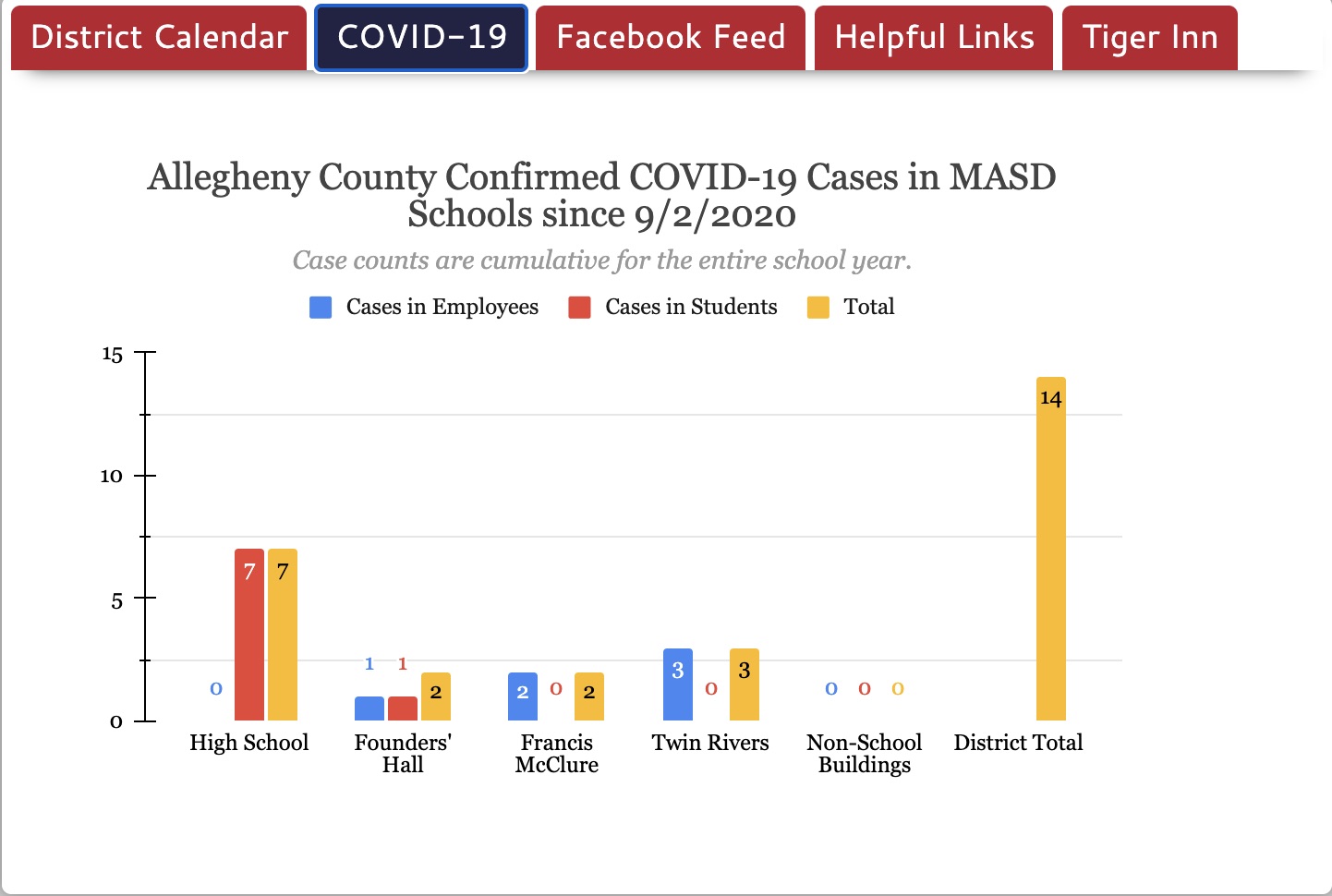
As of Monday night, the tracker only lists 14 cases in the district since buildings reopened in September – seven students at the high school, a student and a staff member at Founders Hall, two staff at Francis McClure Elementary and three staff at Twin Rivers.
The new cases would bring the district total to 20 – nine at the high school, seven at Twin Rivers with the numbers at other buildings unchanged.
That’s 11 students and 9 staff total – not counting any additional cases that may be coming.
I still think the tracker is a good idea, but it shouldn’t be the sole source of this information.
And school directors should be using this data to determine if it is safe to keep buildings open at all.
Moreover, the tracker has its own glitches.
It does not come up when accessed through certain browsers like Firefox. Unless you use the most reliable browsers like Chrome, you can get nothing but an empty white screen.
With the county in the midst of a steadily increasing surge in Coronavirus cases, now is not the time to hold back on information.
This followed a week of record-breaking reports from the Pennsylvania Department of Health, with an all-time high of 5,551 cases reported on Saturday throughout the state.
There have been 4,230 cases of COVID-19 in Allegheny County this month, alone.
Over the last week, the country has averaged more than 1,080 deaths a day – more than 30% higher than two weeks previous.
The McKeesport community deserves up-to-date information about viral spread in our schools.
Administrators need to step up the transparency.
Like this post? You might want to consider becoming a Patreon subscriber. This helps me continue to keep the blog going and get on with this difficult and challenging work.
My doctors tell me that I am more susceptible to contracting the virus because my medications suppress my immune system. And that also means that if I do contract the disease, I will be more likely to have severe, life-threatening complications from it.
However, starting Wednesday, about 60% of parents in my district have chosen to send their kids back to the buildings.
Of these, half the students will come in during the morning and half in the afternoon. Each will go through all their classes in 20 minute periods. On Fridays, the buildings will be closed and teachers will instruct virtually for half the day and plan during the other half.
The new reopening plan cuts instruction time by half and doesn’t meet parents need for childcare or certainly student safety. But it is better than being open 5-days a week and it provides the possibility of social distancing.
So I went to my principal asking if I could continue to teach online.
I documented my conditions, gave him doctors’ notes, and had my doctors fill out pages and pages of questions from the district’s lawyers.
In the end, my principal told me the district could not meet my request.
Administrators could provide some protections like a plexiglass barrier and take me off hall duty, but they couldn’t let me continue to teach remotely.
Certain teachers in grades K-5 have been given this option, but not secondary teachers like me. Elementary students whose parents don’t want them to return to the building will get full synchronous virtual instruction with a teacher through a video conferencing site like Zoom. Secondary students who do not return to the buildings will only get asynchronous assignments most of the week posted by their classroom teachers.
He suggested I look into taking a leave of absence.
And I guess I can see where he’s coming from.
If administrators let me teach remotely, it’s possible enough students would return to the classroom that the teachers willing to return wouldn’t be enough to meet the load. My absence from the building might necessitate a substitute teacher to be in the physical classroom with students.
Why pay for two teachers when you only need one?
Except…
…I’LL STILL BE PAID WHEN I’M ON LEAVE.
It’s just that then I’d have to sit at home instead of teach my students.
So benching me doesn’t save the district any money.
In fact, it will cost the district MORE money for me to stay home, because I could still do everything they expect of me and more for the sizable number of students whose parents say they aren’t returning.
So I brought this up to my principal figuring he must have overlooked it.
But no. He said he knew all about it.
He said this is what the district’s lawyers were telling him to do so that’s what he was going to do.
I couldn’t believe it.
I went to school board directors I had developed a relationship with teaching their children, going on field trips with them, working with their spouses.
I got the same answer.
So here I am – being asked to choose between my life and my livelihood.
Go to work and risk everything – or sit at home burning my sick days and still collecting a paycheck.
This is not what I want.
It’s not good for anyone.
I teach 8th grade Language Arts. Last year I also taught 7th grade.
So many of my students this year were in my class in the spring. We already know each other.
But more than that, I know what they like and dislike. I know their hopes and fears. I know what motivates them and what supports their individual learning.
I’ve seen tremendous growth the first 9-weeks of school and could really help them overcome the gargantuan hurdles that will be inevitable the rest of the year.
And that’s what I’d really like to do.
I don’t want to sit home collecting the taxpayer’s money when I could be making a difference in these young people’s lives. I don’t want to have to wait for an outbreak to allow me to continue my work.
Being benched like this makes me feel so worthless, and I’m not.
Wouldn’t everyone be better served with me instructing my students rather than being thrown to the side?
That can’t happen without help.
I’m just a human being like anyone else.
I have people who care about me and whom I care about.
I have a wife and daughter.
I can’t roll the dice with my life or chance taking an infection home to my loved ones.
Is a safe work environment really too much to ask?
I don’t want to sit at home.
I want to teach.
Like this post? You might want to consider becoming a Patreon subscriber. This helps me continue to keep the blog going and get on with this difficult and challenging work.
The school board will review the plan at its work session meeting on Monday in the high school auditorium at 7:30 pm. The meeting also will be live streamed on YouTube.
The board is expected to vote on the plan at its regularly scheduled meeting on Thursday, Oct. 29, at 7 pm.
I don’t want to have to contradict the school board and my administrators.
I don’t want to have to insert myself into this debate.
But I feel like I have no other choice.
Since I don’t live in the district, I can’t go to the school board meeting and speak.
And when I have expressed my concerns to those in charge, they have been repeatedly brushed aside.
So I am putting them out there in the public space.
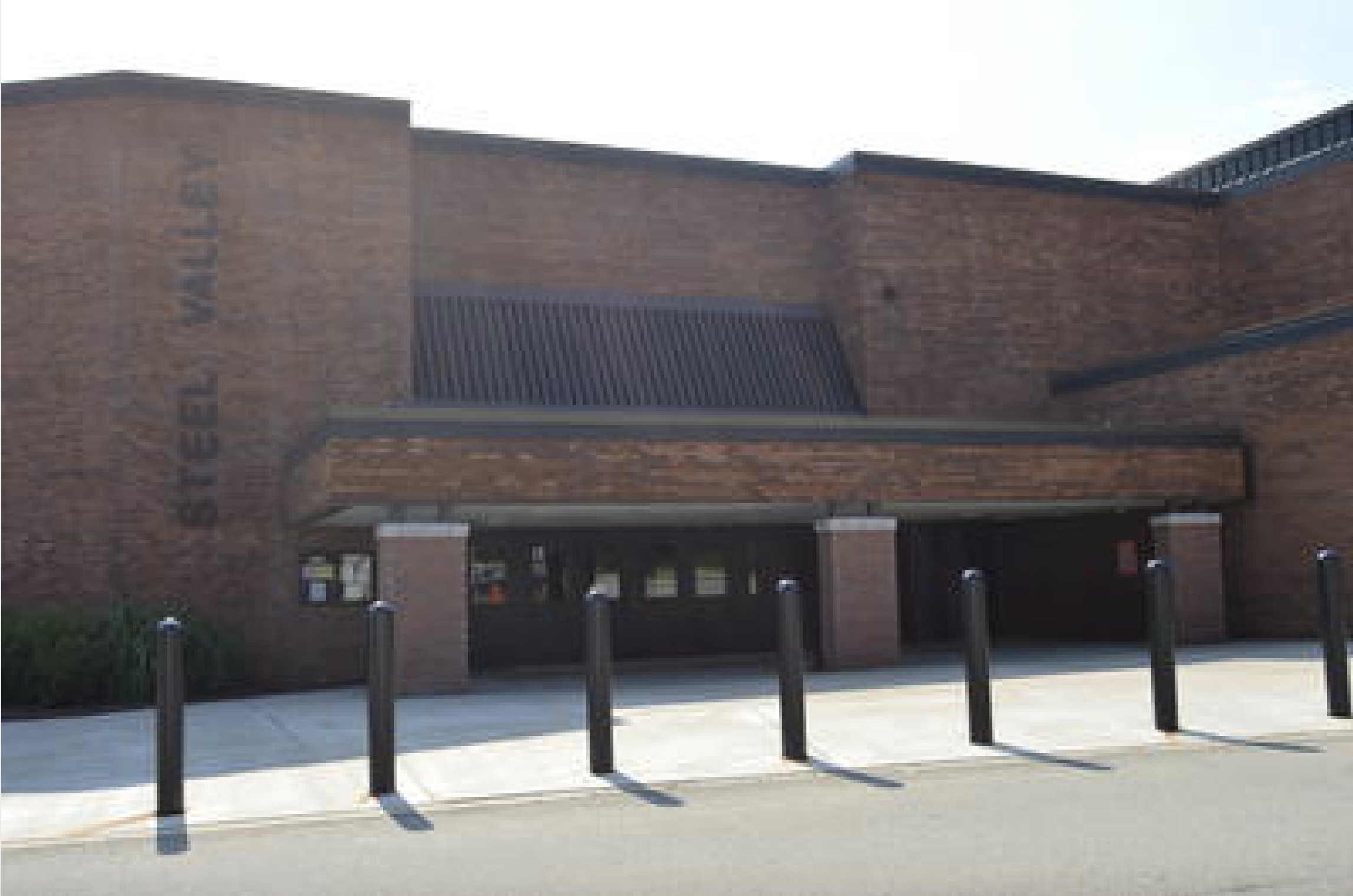
This is what a Steel Valley teacher really thinks about this proposed plan.
This is what I feel I must say even at the risk of my job and future in this district – the proposed plan should not be adopted. We should continue with virtual instruction until infection rates in the county are extremely low.
The proposed plan would have students dividing into two groups – one would attend in the mornings and the other in the afternoons.
Both groups would have all of their classes for 20 minutes each for four days a week – Monday – Thursday. Friday would be a half day virtual learning day.
Consider that students currently have their full classes on-line for four days a week. Wednesday is an asynchronous learning day.
So the new plan would cut instruction time by half.
And this is true even for double period classes. Two 20 minute in-person classes is better than one, but not as good as two 40 minute virtual classes.
Just imagine it.
If this plan is approved, students and staff would be rushing here-and-there for the tiniest fraction of possible instruction in-person, and then rush home to do the mountains of classwork that would be necessary to move forward at all.
But parents will be given a choice whether to subject their children to this schedule or not.
Parents will have to decide whether they want their children to attend in-person or receive virtual instruction.
However, the virtual instruction being offered under this new model is not in many cases the same as what children receive now.
Remote students in K-5 would still meet with a classroom teacher on video platforms.
However, remote students in 6-12 would have to enroll in the district cyber program. This is a canned ed tech initiative modeled on credit recovery. They will have minimal to no interactions with classroom teachers or lessons taught by district educators.
This would replace an exemplary district-designed curriculum with a subpar service to parents and students in the hope that they will opt for in-person instruction instead.
No matter which option you choose for your child, from an academic standpoint, this new proposal is a step backward.
Most students would receive less instruction from classroom teachers – either half of what they’re receiving now (but in-person) or next to nothing on-line in grades 6-12.
And that will continue to happen until we work together to provide a coordinated defense against the pandemic.
You can’t have half of the schools close their doors and the other half keep them open and expect the virus to just stop. You can’t have some people wear facial masks in public and others go without and expect the virus to disappear.
We need to work together or else prepare ourselves to hunker down for a very long COVID season. Or – even worse – a very short one.
If you are a resident of Munhall, Homestead or West Homestead and you feel the same way I do, I am begging you to go to the school board meetings.
Please tell the board not to proceed with this plan.
It will result in many, many people getting sick.
Some may die. Others may have life-long debilitating complications as a result of the virus.
That’s just not worth it.
That’s just not worth a little more in-person instruction and a little less out-of-pocket childcare costs.
Healthcare, hospital stays and funeral preparations are much more expensive.
Thank you for hearing me out.
Like this post? You might want to consider becoming a Patreon subscriber. This helps me continue to keep the blog going and get on with this difficult and challenging work.
Superintendent Dr. Mark Holtzman says the district ignored these guidelines on the recommendation of the Allegheny County Health Department.
“The County Health Department is the local governmental agency responsible for the school districts in [the] County,” Holtzman said at last night’s school board open agenda meeting.
“So their determination of what next steps to take is their primary responsibility. So at this particular time, they have recommended to us that we not follow the CDC guidelines because those guidelines have been created before the start of school and are outdated. So they’re currently working on new guidelines to direct schools.”
The response was in answer to citizens comments.
‘
Greg Kristen and I went to the board meeting hoping to get answers – and we did.
“Those decisions that are being made by the McKeesport Area School District are recommendations by the County Health Department,” Holtzman said.
“They’re not our recommendations. They’re not anyone’s recommendations in this room. Now our school board does have the determination if they so choose to not follow those recommendations and close the McKeesport Area School District. Up until today at this particular time we’re not aware of any school district in Allegheny County being recommended to close no matter how many cases that are involved.”
“I am in a large public school system… I am hearing and seeing two different approaches. I am very appreciative of what the board’s efforts in Pittsburgh have been to keep us safe and keep our students safe. I just want to be an advocate that we are doing everything we can even if it’s erring on the side of caution.”
District Solicitor Gary Matta was concerned about the issue as well.
“We’re getting some mixed signals between the state and the county,” he said.
“The state is directing us to deal with the county health department if we have one.”
He suggested the district get recommendations in writing from the county health department before following any of its advice.
In addition to questions about whether it was safe to keep district buildings open during a COVID-19 outbreak, Holtzman addressed district transparency.
I asked him to compile a dashboard on the district Website with the following information:
“1) How many people have tested positive in total since the school year began?
2) How many are students? How many staff?
3) How many are located at each school building?
4) And please give us a timeline of when each positive test result was returned.”
He could not give me all I asked for at the meeting.
Holtzman said that 10 people have tested positive in the district since school opened – 9 of them recently. He said there have been cases at all four buildings – the high school, Founders Hall, Twin Rivers and Francis McClure elementary schools.
He was able to break down 8 of the 10 cases.
He said:
“In the last 7 days…. We’ve had 5 adults and 3 students. From Wednesday to Wednesday. Two employees (teachers) from Francis McClure, one teacher at Twin Rivers, 1 support staff at Founders Hall, 3 high school students, and one maintenance/support employee.”
Holtzman admitted that having a dashboard on the district Website was a good idea but fell short of committing to providing that ongoing data.
“A dashboard is a pretty good suggestion,” he said.
“It might help people have a better understanding this isn’t a secret – it’s a challenging situation… A lot of districts are considering it, but there are some drawbacks, too. But that’s something we’re going to take into consideration.”
Kristen brought up the issues of contact tracing and increasing class sizes at Twin Rivers that may make it difficult for students to engage in social distancing.
“Two days ago, my daughter told me she was getting six more kids in her class starting Nov. 2,” he said.
“They would be sharing desks. How is that possible during a pandemic? We’re just getting a spike in cases here and now we’re going to add more students to the schools in the classrooms? How is that safe? According to the guidelines, kids have to be AT LEAST 6 feet apart. That will not happen with more students.”
Holtzman said some students whose parents had chosen remote learning had decided to return them to the physical classroom at the start of the new grading period. However, others had decided to remove their children from the physical buildings and put them on remote.
“We will have students return to the classroom after the first 9-weeks. That’s inevitable. The numbers that we anticipate returning, we’re able to accommodate based on the space in those rooms. We do have some relatively low numbers – like less than 10 – in those classrooms.”
About a third of district students have been doing remote lessons since the year began.
Kristen said his daughter told him the new students added to her class would put the kids closer than 6 feet. Her teacher said they would be within 3 feet.
Holtzman disputed this:
“That’s a little difficult to determine. From the center of the child to the center of the child, there must be 6 feet. Six feet is a recommendation. Right? Just like the masking order and the gathering order is a mandate. So recommendations to space kids 6 feet apart is truly what it is – a recommendation. So we’re doing our very best.”
Kristen asked about contact tracing at Twin Rivers where teachers had tested positive.
He wanted to know if students had been tested, and Holtzman responded that they had not.
“Right now the McKeesport Area’s percentage is a little over 5% but it’s trending up as far as the rate of positivity. So people are concerned with watching that number.” He said.
“At this particular time, the Allegheny County Health Department is very satisfied with the contract tracing efforts they’ve made around our current cases. There is no longer any backlog, and there are none waiting to be addressed…
“When we do interviewing – when Allegheny County Health Department does interviewing – we ask them, ‘Where you in somebody’s personal space 6 feet apart for more than 15 minutes during your school day?’ If the answer is yes, Johnny, Susie, Mrs. So-and-So, then that information is provided to the health department and they’re asked to quarantine. If in fact that teacher says ‘I wear a mask every single day, all day, and I’ve never been in anybody’s personal space within 6 feet for 15 minutes consecutively, then the contact tracing ends at that point.”
He admitted that the effectiveness of this process depends on how honest and detailed those testing positive are when listing the people they have come into contact with while contagious.
Below is a transcript of our public comments and Dr. Holtzman’s responses:
Kristen:
“Dear school board members. Thank you for letting me speak here tonight. As a resident of this district for 15 years, as well as having a daughter a Twin Rivers Elementary School, I am deeply, deeply concerned with the lack of transparency about the Coronavirus infections. As of today, MASD has 9 positive cases… We have a right to know [who they are] not their names but their positions. According to CDC guidelines if there are two cases within a school, it is to be shut down for 5-7 days. For 5 or more cases, the building should be shut down for up to 14 days. Why is that not happening? Is the health and safety of the students, teachers, administrators, staff and maintenance not important to you? When positive cases happen in the building, who was in charge for contract tracing and notifying the Allegheny County Health Department? If they did not notify the health department, are they being held accountable? And I mean terminated. Were the parents of the students notified of the teachers and staff who were affected in the schools? Were the students tested? Is there any contract tracing with them? Also why is there not a healthcare professional a part of the Coronavirus task force?
Two days ago, my daughter told me she was getting six more kids in her class starting Nov.2. They would be sharing desks. How is that possible during a pandemic? We’re just getting a spike in cases here and now we’re going to add more students to the schools in the classrooms? How is that safe? According to the guidelines, kids have to be AT LEAST 6 feet apart. That will not happen with more students.
This Coronavirus is not a hoax. People are dying every day. As of today, 222,000 people have died, and people like myself who have an underlying health condition are concerned about people transferring the virus to me or to someone close to me. In this county alone there 14,396 cases and 416 deaths. On Oct 14 which was just a week ago Rachel Levine, the state health secretary announced a second wave of Coronavirus has arrived here. Now that the flu season has arrived, what is MASD doing? Does a student, teacher, administrator, staff or maintenance person have to die for someone to take this serious? Thank you very much.”
Dr. Mark Holtzman:
“Mr. Kristen, I’m happy to address a couple of your concerns. A few things.
We’ve had 8 positive tests in the last 7 days. So that is correct. The CDC guidelines are recommendations by the CDC and Pennsylvania Department of Education and state health department. (muffled) The Alleghney County Health Department is the local governmental agency responsible for the school districts in Allegheny County. So their determination of what next steps to take is their primary responsibility. So at this particular time, they have recommended to us that we not follow the CDC guidelines because those guidelines have been created before the start of school and are outdated. So they’re currently working on new guidelines to direct schools. I will ensure to tell you positively I have spoke to the Alleghney County Health Department probably just this week once a day. The head epidemeologisr Dr. Luann Brink and the director of the health department Dr. [Debra] Bogen and I have conference calls with her every Tuesday at 2 o’clock. Those decisions that are being made by the McKeesport Area School District are recommendations by the Allegheny County Health Department. They’re not our recommendations. They’re not anyone’s recommendations in this room. Now our school board does have the determination if they so choose to not follow those recommendations and close the McKeesport Area School District. Up until today at this particular time we’re not aware of any school district in Allegheny County being recommended to close no matter how many cases that are involved.
The concerns are the issues with Allegheny County Health Department are the rate of positivity here in the city of McKeesport and the surrounding communities. That’s number 1. Transmission is a huge piece of it. Is it being transmitted in the schools? Is it being brought into the schools from the outside? Contract tracing does occur on each and every case. All that information is submitted to the Allegheny County Health Department with details, time stamped, dates, everything we could possibly provide to those individuals. Fortunately or unfortunately we have to rely on that individual. For example, if you’re an employee that tests positive for COVID, we have to interview you. The information that you share with us, we have to then share with the Allegheny County Health Department. Whether you’re honest, dishonest , whether you’re detailed, whether you forgot someone, you didn’t include anyone as part of your contact tracing, that becomes your prerogative. We as a district just have to report that information to the health department and they make a final determination.
So at this particular time unfortunately we’re at the bottom of the document that’s been referenced many, many times, it states that when an entire school is recommended to be closed, closure time will vary depending on level of community transmission, and number of cases. Right now the McKeesport Area’s percentage is a little over 5% but it’s trending up as far as the rate of positivity. So people are concerned with watching that number. ‘This allows public health staff the necessary time to complete case investigation and contact tracing and to provide schools with other appropriate public health advice like cleaning and disinfecting.’ At this particular time, the Allegheny County Health Department is very satisfied with the contract tracing efforts they’ve made around our current cases. There is no longer any backlog, and there are none waiting to be addressed.
So at this particular time, I know there is frustration, I know there’s contradictory information out there, but we are working closely with the health department and they have done an outstanding job guiding us and every school district has a tough decision to make. So I appreciate you expressing your concerns this afternoon, this evening, later than it should be we appreciate it and if there’s anything we can do moving forward, we’d be happy to help.”
[Holtzamn said three teachers tested positive at Twin rivers Elementary. All students in those classes were not tested. Each student Is placed 6 feet apart. A close contact has to be within 6 feet for 15 consecutive minutes.]
Holtzman: “When we do interviewing, when Allegheny County Health Department does interviewing, we ask them ‘[Where you in somebody’s person space 6 feet apart for more than 15 minutes during your school day?’ If the answer is yes, Johnny, Susie, Mrs. so-and-so then that information is provided to the health department and they’re asked to quarantine. If in fact that teacher says ‘I wear a mask every single day, all day, and I’ve never been in anybody’s personal space within 6 feet for 15 minutes consecutively, then the contact tracing ends at that point.
Now we could absorb those things. As Superintendent I’m in the schools daily, and I’m able to see some of the teachers and [their actions]. The students are already placed 6 feet apart, so therefore they are already socially distanced. We will have students return to the classroom after the first 9-weeks. That’s inevitable. The numbers that we anticipate returning, we’re able to accommodate based on the space in those rooms. We do have some relatively low numbers – like less than 10 – in those classrooms.
[Kristen says his daughter told him the new students added to her class would put the kids closer than 6 feet. Her teacher said they would be 3 feet.]
Holtzman: “That’s a little difficult to determine. From the center of the child to the center of the child, there must be 6 feet. Six feet is a recommendation. Right? Just like the masking order and the gathering order is a mandate. So recommendations to space kids 6 feet apart is truly what it is – a recommendation. So we’re doing our very best and will hold all those expectations considering the fact that we have to educate the children that are interested in returning to school. We can’t just turn them away…. As many kids that are coming in, many are leaving for online learning for many reasons.”
MY COMMENTS:
“Thank you for letting me address the board this evening.
As a lifelong resident and the father of a child who attends the district, I am alarmed by news about an outbreak of COVID-19 at our school buildings, a lack of transparency about that information and a lack of proper safety response to the outbreak.
First, when I am finished with my comments, I ask that you clarify for me some facts about the outbreak.
1) How many people have tested positive in total since the school year began?
2) How many are students? How many staff?
3) How many are located at each school building?
4) And please give us a timeline of when each positive test result was returned.
That information should be constantly available on the district Website throughout the pandemic. It should not just be on alerts that come and go, robocalls or emails.
Every taxpayer has the right to that information – which is easy to compile – and necessary so parents and community members can make smart decisions about how to keep ourselves and our families safe in the McKeesport Area.
Next, I am concerned about the district’s blasé response to these life threatening conditions.
According to the state Department of Education Website, in a county like Allegheny where infection rates are designated as moderate, if 2-4 students or staff in the same building test positive, the school should be closed for 5-7 days.
Haven’t we met this threshold?
According to your recent alerts, at least 9 people have tested positive in the district in the last week – 3 students and 6 teachers. And this is spread throughout all district buildings.
There is no way to divide that up without at least one of our four buildings in the danger zone.
Doesn’t that mean that at least at some buildings – probably Twin Rivers, Francis McClure and/or the the High School – we have met this benchmark? Don’t each of those schools have two or more cases?
Why haven’t these buildings been closed?
Moreover, according to the PDE Website, if there are multiple cases at multiple schools where the infected are not household contacts, the schools are supposed to be closed not just for 5-7 days but a full two weeks.
Have we met that threshold? And if so, why are the buildings not closed?
I do not understand what precautions you are taking to keep students and staff safe.
I understand that PDE defines “Close Contact” as being within 6 feet for at least 15 consecutive minutes of a person who has tested positive. However, the Website cautions that this should not be taken as the ONLY definition of such contact: “In some school situations, it might be difficult to determine whether individuals are contacts or whether an entire cohort, classroom, or other group (extracurricular activity members) might need to be considered exposed, particularly if people have spent time together indoors.”
You say these cases have all been contained. But you have done very little to assure the public of this and could be taking much greater precautions on our behalf.
We’re talking about children here. We’re talking about our staff – people who have served generations of families and who often have families of their own.
Can’t you do better for the people in this district?
I would suggest that you at least follow PDE recommendations in the effected buildings.
Furthermore, I think you should cancel all in-person classes and go to a fully remote education plan until the infection rate in the county and the community is designated as low.
Have the classroom teachers make the online curriculum and let students and families choose whether they wish to go through that curriculum synchronously or asynchronously. And do not outsource the virtual program to ed tech companies looking to cash in on their credit recovery programs – as you are currently doing with Edmentum.
Going to a fully virtual plan would be in the best interests of students, families and the community.
Please do your duty.”
Holtzman:
“Mr. Singer, Thank you. I appreciate you spending some time with us again today. I don’t know, Dr. (muffled) do you have the numbers he’s requesting off hand? I only have the last seven days in front of me. If not, I’ll make sure you get them.
Voice: I don’t have them with me.
Holtzman: Prior to this situation we’ve had very few so… the difference between staff and students, we currently have in the last 7 days… we’ve had 5 adults and 3 students. From Wednesday to Wednesday. Two employees (teachers) from Francis McClure, one teacher at Twin Rivers, 1 support staff at Founders Hall, 3 high school students, and one mainatance/support employee. Furthermore, I feel that we’ll agree to disagree that instruction in person is the priority for engaging children. Our students have received progress reports. You as an educator I’m sure are quite aware that the online learning platform is not engaging all children. Many children are struggling and failing courses, here ate McKeesport and all over the Commonwealth. I think it’s a big issue for all school leadership trying to find new creative ways to engage children whether it’s synchronous or asynchronous. So for us here at McKeesport we’re very fortunate to have had this huge donation of devices. We are going to consider doing some flexible instruction in the very near future to kind of make sure we have all of the pieces in place to provide synchronous instruction affectively. But sadly a lot of our students have chosen either to not log in or not be consistent in the work they’re trying to perform online. So we’ll continue to encourage our children to be in schools, we’ll continue to do our very best
ME: Would you commit to putting the information I asked for before onto the district Website?
Holtzman: You bring a good point because you know there are some districts using… a ticker to keep track. To be honest I didn’t know it would be necessary so that’s something we need to consider. A dashboard is a better description. It might help people have a better understanding this isn’t a secret it’s a challenging situation… Also to answer your question, we’ve had a total of 10 cases since the start of the school year. We’re still waiting for confirmation on two of those but we’re pretty confident. A dashboard is a pretty good suggestion. A lot of districts are considering it, but there are some drawbacks, too. But that’something we’re going to take into consideration.
[Holtzman admitted there was at least one case at every building but not elementary students.]
Like this post? You might want to consider becoming a Patreon subscriber. This helps me continue to keep the blog going and get on with this difficult and challenging work.












 gadflyonthewallblog