Will PA Schools Ask Parents to Oversee CDT Testing at Home?

Should parents be asked to administer on-line tests to their own children at home?

Back in May someone at Data Recognition Corporation (DRC) had an idea.

Since a global pandemic had shuttered classrooms, no children were being forced to take the multi-billion dollar testing company’s products.

Federally mandated assessments like the Pennsylvania System of School Assessments (PSSA) and Keystone Exams – which are made by DRC – were cancelled.

And local districts weren’t even making students take assessments like the Classroom Diagnostic Tools (CDT) – an optional test to determine if kids were ready to take the mandatory tests.

If someone at DRC didn’t act quickly, the Commonwealth might ask for a refund on the $1.3 billion it spent on standardized testing in the last eight years.


 The Minnesota-based DRC, a division of CTB McGraw-Hill, wasn’t about to issue any refunds.

So someone had to figure out a way to keep children testing even though they were currently at home sheltering in place.

But that’s it!

Tests like the CDTs are taken online anyway. Theoretically, kids could access them in their own homes, they just need someone to help them sign in, navigate the Web portal and make sure they aren’t cheating.

Normally, that would be the job of classroom teachers, but educators can’t do that AND have students test at the same time.

During the pandemic with most schools shuttered, teachers only communicate with students remotely – through applications like video conferencing sites such as Zoom. If teachers proctored the tests, too, that would require students to take the tests on one Web accessible device and have the teachers communicate with them on another.

Can you imagine a child taking a test on her iPad while participating in a Zoom meeting on her cell phone? If she even had both devices? And the bandwidth to run both simultaneously?

That’s where parents come in.

Students can test on their computers or devices with their parents, in-person, troubleshooting and monitoring their behavior.

Thus, a truly stupid idea was born.

To my knowledge, not a single district in the Keystone state has yet taken advantage of this scheme.

And why would they?

Even the most data driven local administrator or test obsessed school director knows that a sure way to infuriate parents is to ask them to do something that is essentially the school’s job.

Moreover, in these difficult times, parents have their hands full just keeping food on the table. If they can somehow get their kids to log in to their online classes every day, that’s a plus. If they can get their kids to actually turn in the assignments, it’s a miracle.

But to add proctoring a test on top of everything else!? Districts would have to be nuts to even try!

However, DRC and the state Department of Education aren’t giving up.

As an increasing number of schools go on-line, the state extended the program through the 2020-21 school year, and some districts are actively considering it.

Here’s how it’s supposed to work.

Classroom teachers would provide parents with testing materials including a log-in ticket for each child in the home taking the test. Students would have to access the test online through the Chrome Internet browser. Then they’d have to copy and past the URL into the browser (which would be provided in the testing materials), and input their usernames and passwords.

Normally, the test is given in writing, science and math, has 50-60 questions and can last between 50 and 90 minutes. However, DRC is recommending districts give a new shorter version of the assessment that has 15-18 questions and can last between 20-30 minutes (10-20 minutes longer for the reading test).

During this time, you should watch your children as they take the tests. It is up to you to make sure they aren’t copying down any information from the test or cheating.


 You can let your child have scratch paper, highlighters and calculators. But no preprinted graphic organizers, cell phones, dictionaries, thesauri, grammar or spell checkers, other computers or devices.

And if you have any technical issues, DRC wants you to know the company has your back. Meaning that they can’t and won’t help – call your local school district.

Here’s what DRC’s Parent/Guardian Test Administration Guide recommends for technical support:

“If technical issues arise during testing, parents/guardians are asked to contact the student’s teacher and/or the student’s school office for technical support. DRC customer service staff cannot directly support issues related to each home’s technology configurations.[Emphasis mine.]


 And this is true even if the test, itself, directs parents to contact the corporation:

“If a student receives an error message during the test administration that includes instructions to contact DRC for technical support, the parent or guardian who is assisting with the test administration should contact the student’s teacher or school office for additional instructions. Parents or students should not attempt to contact DRC’s customer service directly for technical assistance.

Teachers and/or a school’s technology staff will have the information needed to provide parents/guardians with the level of support to resolve most technology issues. If additional support is required, a school or district representative will reach out to DRC to determine a resolution.”


 However, technical problems are never much of an issue with the CDT – and by “never” I mean ALWAYS.

In the past five years that I’ve given the test to my students in the classroom, they are routinely kicked off the program, have trouble accessing it, and their answers are not always counted, requiring them to re-enter inputs numerous times.

Taking this test remotely is certain to put quite a strain on districts since these technological problems will occur not as they normally do within school buildings but potentially miles away in students’ homes.

Let’s be honest – this plan will not work well.

Few students will be able to take the tests and finish.

Of those that do, even fewer will give it their best effort outside of a classroom setting. In fact, there is no quicker way to turn off a student’s curiosity and motivation to learn than sitting them down in front of a standardized test.

Of those that do somehow manage to finish and score well, there will be no certainty that they didn’t cheat.

Many of my students have secondary electronic devices like cell phones that they use in addition to their iPads. In fact, that’s a part of my remote classes.

I often have them play review games like Kahoot where the questions are displayed through their Zoom screens and they input the answers on their cell phones.

A significant percentage of students will inevitably use these secondary devices to define unknown vocabulary, Google facts and anything else to get the right answers – if they care enough about the results.

In my own remote classes, tests are designed to either assess student skills or access information they already compiled in-class on several study guides which they are encouraged to use during the test. In short, cheating is more work than paying attention in class.

These CDTs will not be like that at all. The scores will be completely worthless – more so than usual.

And few parental proctors will be able to fully comprehend, control or participate in the process.

So why not just skip parents and have classroom teachers proctor the tests through Zoom?

Because of the physical distance involved.

On video conferencing sites, teachers can only see what their students are doing if the kids turn their cameras on. They rarely do.

And even if kids DO turn their cameras on, they have complete control over what those cameras are pointed at, how long they stay on, etc.

It would not take a very enterprising student to cheat while a teacher tried to monitor 20 students online at the same time.

So why not wait until in-person classes resume?

Because it is entirely uncertain when it will be safe to do so given rising infection rates across the country.

However, even if it were safe, most schools are running way below capacity and with hybrid schedules. Students have shortened periods or attend on alternate days. Giving a standardized test under these conditions would be piecemeal, disjointed, discourage kids from even attending school and eat up a tremendous amount of very limited class time.

It would be like taking a dehydrated person’s blood instead of giving him a drink of water.

No matter how you look at it, this is a project designed to fail.

Because it is not about academics. It is about economics.

This is about DRC saving its bottom line. That’s all.

And any administrator or school director who can’t see that is incredibly naive.

Why take these tests at all? Especially during a global pandemic?

We already know students are struggling.

Many are checked out and don’t participate in the remote instruction being offered. And many of those who do participate are having a hard time learning without as much social interaction and hands on activities.

We should be focusing on ways to improve remote instruction. We don’t need a standardized test to tell us that. We certainly don’t need a test before the test.

Most districts use CDT data to place kids in their classes the following year. Kids with high test scores are put in advanced classes, kids with low scores in remedial classes, etc.

We already have daily assessments of how kids are doing. They’re called classroom grades. We don’t have to halt all instruction to allow some corporation to take over for days at a time.

Parents should call their local administrators and school directors and demand the CDTs not be given this year.

In fact, not only should the CDTs not be given this year – they should not be given at all – any year. They’re a total waste of time that dampen kids curiosity and drive to learn.

Moreover, the federally mandated tests (in the Commonwealth, the PSSAs and Keystone Exams) should be cancelled again this year for the same reasons. In fact, they should be abolished altogether.

This is another reason why corporate education reformers have been so adamant that schools remain open during the pandemic. Remote learning means increased difficulty in giving standardized assessments. It’s not that pro-testing fanatics value schooling so much – they don’t want to have to go another year without testing companies making huge profits giving these assessments.

The worst school policies are driven by economics, not academics.

And that’s what we have here, too.

So will any district be stupid enough to attempt to save DRC by sacrificing students and parents?

Only time will tell.


Click here to see DRC’s Parent/Guardian Test Administration Guide

Click here to see DRC’s CDT Public Browser Option – Test and Technology Setup Guidance


Like this post?  You might want to consider becoming a Patreon subscriber. This helps me continue to keep the blog going and get on with this difficult and challenging work.

Plus you get subscriber only extras!

Just CLICK HERE.

Patreon+Circle

I’ve also written a book, “Gadfly on the Wall: A Public School Teacher Speaks Out on Racism and Reform,” now available from Garn Press. Ten percent of the proceeds go to the Badass Teachers Association. Check it out!
For Teachers, “Silence of Our Friends” May be Worst Part of Pandemic

“In the End, we will remember not the words of our enemies, but the silence of our friends.”
-Martin Luther King Jr

Teachers want a safe place to work.

But in 2020 that is too much to ask.

As the global COVID-19 pandemic rages out of control throughout most parts of the United States, teachers all across the country want to be able to do their jobs in a way that won’t put themselves or their loved ones in danger.

In most cases that means remote instruction – teaching students via the Internet through video conferencing software like Zoom.

However, numerous leaders and organizations that historically are supportive of teachers have refused to support them here.

The rush to keep classrooms open and thus keep the economy running has overtaken any respect for science, any concern for safety, and any appeal to compassion.

Many Democratic lawmakers, school directors, union leaders and even public school advocates have repeatedly turned away, remained silent or promoted policies that would continue to put educators in danger.

Thankfully, some districts have been accommodating, worrying about the safety of children as well as adults.

But many others have refused to go this route even demanding educators with compromised immune systems and other increased risk factors either get in the classroom and teach or seek some sort of financially burdensome leave.

Affected teachers often wonder where their union is, where their progressive representative, where the grassroots activists who were willing to organize against charter schools and high stakes testing.

Answer: crickets.

As a result, more than 300 U.S. teachers and other school employees have died from the virus, according to the Associated Press.

In New York City, alone, 72 school employees died of the virus, according to the city Department of Education.

And since Education Secretary Betsy DeVos has refused to collect data on how the pandemic is affecting schools and school employees, this count is probably woefully under-representative of the full tragedy.

About 1 in 4 teachers – nearly 1.5 million – have conditions that raise their risk of getting seriously ill from the Coronavirus, according to the Kaiser Family Foundation.

In my own Western Pennsylvania community in the last few weeks, we buried high school employee Terri Sherwin, 60, of Greater Latrobe School District and elementary school employee Dana Hall, 56, of Jeannette City School District.

The assertion that children cannot get the disease, which was popularized by the Trump administration, has been proven false.

More than 1 million kids nationwide have been diagnosed with COVID-19 according to a report by the American Academy of Pediatrics .

The Centers for Disease Control (CDC) says most children who get the disease (especially those younger than 10) are asymptomatic or have only mild symptoms but are still capable of transmitting the virus to others. This – along with the lack of a national database – makes it incredibly difficult to accurately trace the source of an outbreak through the schools.

However, in November the CDC quietly removed controversial guidelines from its website promoting in-person learning, and instead lists it as “high risk.”

“As new scientific information has emerged the site has been updated to reflect current knowledge about COVID-19 and schools,” a spokesperson said.

Yet there has been no subsequent change in the policy positions of most lawmakers, school directors, union leaders or education activists.

A prime example of this is New York City’s plan to reopen most schools to in-person learning at the beginning of this month despite rising infection rates and an average of more than 2,000 new cases a day.

The plan has the full support of most teachers unions.

Randi Weingarten, president of the American Federation of Teachers (AFT) said the plan “combines the best of what we have learned nationwide during COVID about how to keep staff and students safe and how to instruct young kids.”

Michael Mulgrew, president of the United Federation of Teachers (UFT) agreed.

He said:

“We are supportive of a phased reopening of schools in other neighborhoods as long as stringent testing is in place. This strategy – properly implemented – will allow us to offer safe in-person instruction to the maximum number of students until we beat the pandemic.”

The plan is predicated on a bogus statistic that kids aren’t getting sick at school or spreading the virus from there, that only 0.2% can be traced back to school buildings.

But we know that contract tracing is inadequate. We know people are getting sick. Hospitals are filling up. People are dying.

Why aren’t the unions standing up more for their employees here? Why is the request for a safe work environment too much?

Answer: politics.

With President-elect Joe Biden about to announce his pick for Secretary of Education, few union leaders have the courage to go against the party line and disqualify themselves from consideration.

Biden’s plan right now seems to be keeping the schools open with an influx of cash.

Former President of the National Education Association (NEA) Lily Eskelsen García hasn’t said much recently on the issue to my knowledge.

But she was unafraid to contradict President Donald Trump before the election.

She appeared on CNN and challenged Trump to “sit in a class of 39 sixth graders and breathe that air without any preparation for how we’re going to bring our kids back safely.”

In late April, she took to Twitter saying the NEA is “listening to the health experts and educators on how and when to reopen schools — not the whims of Donald Trump, who boasts about trusting his gut to guide him. Bringing thousands of children together in school buildings without proper testing, tracing, and social isolation is dangerous and could cost lives.”

In an interview in May she said:

“The stakes of doing it wrong is that someone dies. It’s not just that someone doesn’t graduate or someone doesn’t learn their times tables — someone could die.”

I wonder what she would say today – and why she hasn’t spoken out as vocally.

In my neighborhood, Pennsylvania State Education Association (PSEA) President Rich Askey has continually asked districts to follow state safety guidelines.

“The health and safety of students, staff, and our families must be our top priority,” Askey said. “We call on all school district leaders to follow the state’s guidelines to protect the health and safety of everyone in our school communities.”

However, state guidelines are pretty weak. They suggest mask wearing and that districts close when community infection rates are high. But districts can choose to keep buildings open if they promise to follow safety guidelines to the best of their ability.

Gov. Tom Wolf originally issued an order for all schools to close and go to remote learning last March. However, state Republicans challenged his authority to do so and their position was upheld in court.

Since then, Wolf has issued tons of guidance but not much else.

I assume Wolf would say he hasn’t done more because his hands are tied.

I assume Askey would say the same.

But such platitudes taste like ashes in your mouth when faced with the everyday reality that almost everyday the state is breaking its previous record for Coronavirus cases. Today we had nearly 13,000 new cases and 149 deaths! Yes, that’s just today!

Will their hands still be tied when daily cases reach 20,000? 50,000? 100,000?

The decision about whether to keep buildings open to in-person classes or go with remote instruction has mostly been left with school directors.

And their decisions have been all over the place.

These are not public health officials.

These are not people used to making life and death decisions.

They’re used to deciding whether to remodel the library, buy books from this or that vendor or declare Friday a holiday because the football team won the state championship.

I don’t mean to diminish what they do.

Some have been going above and beyond every day to ensure the health and safety of students, staff and the community.

But far too many pay lip service to that idea while making sure their local business gets to keep operating with employees who don’t have to sit home with their children.

And these are people from the community. How many times have teachers called them to let them know how their kids were doing in class? How many times have teachers gone with them and their kids on school field trips? How many times have teachers accepted invitations to graduation parties and school board meetings?

We should be on the same team, but too many school directors are far too willing to sacrifice our lives and safety to safeguard their own bank accounts.

When will school directors admit the cost is too high? How many staff have to get sick? 20? 50? 100? How many have to die?

However, as much as the silence and disregard of lawmakers, union leaders and school directors hurts – it is the reaction from many education activists that stings the most.

When our schools are attacked by charter schools and voucher schools, we organize and fight it together.

When high stakes testing unfairly labels our children and is used to defund and loot our budgets, we organize and fight together.

No matter what the issue – the school-to-prison pipeline, Common Core, racist discipline policies, value added teacher evaluations, runaway ed tech – we’ve come together to fight as one.

But suddenly when it’s an issue of teachers vs. the economy, our allies go silent.

They’re afraid remote learning will lead to more ed tech solutions, that it will embolden parents to enroll in charter or voucher schools, that it will hurt student learning. And to be fair there is reason to fear.

However, instead of standing together and fighting these new challenges as they come (as we’ve always done) many of our activist allies have abandoned us.

They champion articles about a non-existent consensus that it’s safe to reopen schools. They champion the work of a discredited economist over epidemiologists and virologists. They side with the same neoliberals and corporate education reformers we used to battle together.

Or they simply remain silent.

That’s the one that really hurts the most.

One day this pandemic will end.

One day – I hope it’s soon – it will be safe to return to the classroom and begin again.

But the wreckage of the virus will pale in comparison to the damage we have done to each other and our relationships.

Coalitions may crumble and fall.

Trust may disappear.

And the way forward – if any will be left – may be much different than it was only a year ago.

No one who refuses to defend your right to life is your true ally.

We won’t forget who spoke up and who remained silent.


Like this post?  You might want to consider becoming a Patreon subscriber. This helps me continue to keep the blog going and get on with this difficult and challenging work.

Plus you get subscriber only extras!

Just CLICK HERE.

Patreon+Circle

I’ve also written a book, “Gadfly on the Wall: A Public School Teacher Speaks Out on Racism and Reform,” now available from Garn Press. Ten percent of the proceeds go to the Badass Teachers Association. Check it out!

INCONVENIENT TRUTH: Remote Teaching is Better Than In-Person Instruction During a Pandemic

Hundreds of teachers have died from Covid-19.

More than 1 million children have been diagnosed with the disease.

Yet a bipartisan group of seven state Governors said in a joint statement Thursday that in-person schools are safe even when community transmission rates are high.

Safe – despite hundreds of preventable deaths of school employees.

Safe – despite mass outbreaks among students.

Safe – despite quarantines, staffing shortages, longterm illnesses and mounting uncertainty about the longterm effects of the disease on children and adults.

State Governors must have a different definition of safety than the rest of us.

The message was signed by New Jersey Governor Phil Murphy, New York Governor Andrew Cuomo, Pennsylvania Governor Tom Wolf, Delaware Governor John Carney, Connecticut Governor Ned Lamont, Rhode Island Governor Gina Raimondo, and Massachusetts Governor Charlie Baker.

Only Baker is a Republican. The rest are all Democrats.

We expect such blatant untruth from the Trump administration, and Vice-President Mike Pence was quick to add his voice to the septet.

But the facts remain.

More than 300 teachers and other school employees have died across the country from the virus, according to the Associated Press.

In fact, 72 school employees died of the virus in New York City, alone, according to the city Department of Education.

More than 1 million children have been diagnosed with Covid-19 according to a report by the American Academy of Pediatrics released Monday.

More than 250,000 people have died nationwide.

More than 11 million Americans have been diagnosed with the disease at an ever increasing rate. One million of those cases came about over just six days last week.

In many states like Pennsylvania, hospitalizations have passed their peak in April.

That is not safety.

And it is beyond reckless that these Governors would make such a counterfactual statement.

FACT: It is NOT safe to have in-person schooling in any community where infections are high.

FACT: It is BETTER to have remote education unless the virus has been contained.

But these are inconvenient truths that business leaders, politicians and policymakers are doing everything in their power to ignore.

The Governors’ statement begins:

“Medical research as well as the data from Northeastern states, from across the country, and from around the world make clear that in-person learning is safe when the appropriate protections are in place, even in communities with high transmission rates.”

This is just not true.

It is based not on research by epidemiologists, not on studies conducted by doctors, scientists or pharmacologists.

It comes from the work of an economist – Emily Oster.

The Brown University professor analyzed data from all 50 states over a two week period in September and came to the conclusion that when students or teachers get Covid, they rarely catch it at school.

And her analysis has become the Gospel truth for supply-side marketeers all over the country.

However, Oster has been wrong before.

Notoriously wrong.

Oster is infamous for publishing a paper advising women that drinking alcohol during pregnancy is safe. WRONG, says the National Organization on Fetal Alcohol Syndrome. WRONG, says a slew of recent studies from the University of Bristol, Oxford, the British Department of Health and the Centers for Disease Control (CDC).

She wrote her dissertation explaining that there were less women in China not because of the one child policy and traditional attitudes toward girl children, but instead because Hepatitis B skewed sex ratios.

And then after that paper made her famous, she published another one proving herself wrong.

Oster is not a serious academic. She is someone who constantly says something controversial to court the media and public opinion.

She is a contrarian, an attention seeker, a celebutante – the economist version of someone who shouts “fire” in a crowded movie theater and then sells fire extinguishers to those rushing for the exits.

It is because of people like her that Mark Twain is reported to have remarked, ”There are three kinds of lies: lies, damned lies, and statistics.”

She was shopping her thesis around about people not catching Covid at school back in May before there was any data one way or another.

Moreover, she homeschools her own children. She has nothing to lose getting us to believe her latest economic whopper.

Since providing this cover story, various county departments of health have claimed that contact tracing rarely indicates students or teachers catch the virus at school. However, these conclusions are based on voluntary anecdotes, not hard data. At the local level, there is often a lot of pressure to find the cause of an outbreak somewhere else when childcare is at stake or administrative coercion involved.

There has, however, been actual science done on the matter that sheds increasing doubt on Oster’s findings and those like her.

A study of more than a half-million people who were exposed to Coronavirus suggests that the virus’ continued spread is driven by only a small percentage of those who become infected.

Moreover, children and young adults were found to be potentially much more important to transmitting the virus than previous studies had identified, according to the study by researchers at Princeton, John Hopkins and the University of California at Berkeley.

This was the largest contact tracing study for any disease ever conducted.

It suggests the role of schools in the spread of the virus is also much greater than previously believed.

The evidence is so convincing that the CDC took down controversial guidance pushing for schools to remain open during periods of increased infections.

This is a lot more important than what some dipshit economist said.

However, the Governors’ statement continues:

“In-person learning is the best possible scenario for children, especially those with special needs and from low-income families. There is also growing evidence that the more time children spend outside of school increases the risk of mental health harm and affects their ability to truly learn.”

Talk about overstating the issue!

So kids can’t learn if their instruction is interrupted? It’s a good thing we never take any time off school, say during the summer months.

And way to use poor and special needs kids as props to drum up support. Funny how you never seem to care so much about them when issuing budget priorities or school funding formulas.

But it’s the callousness with which these governors paper over health concerns that really sounds like Oster, herself.

“There are people who would say if even one teacher acquires COVID at a school and dies, then it would not have been worth it to open schools,” Oster said. “I think that argument is complicated because people are going to suffer tremendously from schools being closed, but that is a tricky calculus.”

One would have hoped only an economist would weigh people’s lives vs the cost of health care and boosting standardized test scores. But apparently Democratic Governors feel the same way.

In-person schooling IS preferable to remote instruction if everything else is equal. But everything else is not equal right now.

What kind of mental health issues do children experience whose teachers die suddenly and preventably? How do kids suffer with the loss of a loved one knowing full well that they may have inadvertently been the cause of that person’s death?

What is the longterm cost to children or adults who have their lungs, digestive system or brains suffer irreparable damage as a result of Covid complications?

This disease was only discovered two years ago.

We cannot make bold statements of certainly about its effects without being deeply dishonest. There’s a lot we don’t know about it and how it affects people. And in light of that uncertainty it makes more sense to be extra cautious than reckless.

The fact is remote learning can be done effectively.

We can focus on ensuring that all students have the technology, infrastructure and training to access instruction on-line.

We can prioritize virtual curriculum created by classroom teachers and taught synchronously over video platforms like zoom instead of canned ed tech credit recovery programs like Edmentum.

Administrators and academic coaches can be of more use helping struggling students stay on track than endlessly spinning their wheels about how best to reopen schools.

Bottom line: No one should have to go to school in an unsafe classroom.

Students shouldn’t feel like the only way to get a quality education is to risk their health and put their families in jeopardy.

Teachers shouldn’t be bullied into working in unsafe environments where they or their loved ones may get sick – especially since educators are more susceptible to the virus and often suffer worse consequences of getting ill.

But despite all these arguments, it is the daily reality of schooling during a pandemic that is winning the argument.

Schools simply can’t operate in-person when large segments of the staff are sick and/or quarantined.

No one is buying the argument that in-person schooling is safe when whole kindergarten classes are quarantined as happened at my district this week.

The problem of childcare and other economic hardships are very real. But we will not solve them by closing our eyes to reality and putting our kids and teachers into unsafe classrooms.

It’s high time our government passed a new round of Covid relief. We need to pay people to stay home so they don’t spread the virus. We need mortgage protection, universal healthcare and a host of services to help people weather the storm.

It is embarrassing that so many Governors don’t have the courage to do that and instead indulge in the deranged fantasies of an economic death cult.

It sad that so many Governors lack the courage to issue real Stay-at-Home orders, close schools, bars and restaurants, and issue stiff penalties for those who disobey them.

We do not need in-person learning while Covid runs wild.

Until the danger has passed, we need quality remote learning conducted, planned and supported by educators.

And we need Governors with the guts to listen to science, not B.S. economists.


Like this post?  You might want to consider becoming a Patreon subscriber. This helps me continue to keep the blog going and get on with this difficult and challenging work.

Plus you get subscriber only extras!

Just CLICK HERE.

Patreon+Circle

I’ve also written a book, “Gadfly on the Wall: A Public School Teacher Speaks Out on Racism and Reform,” now available from Garn Press. Ten percent of the proceeds go to the Badass Teachers Association. Check it out!
Five Reasons to be Cautiously Optimistic About the Biden Presidency

President-elect Joe Biden.

Go ahead and say that aloud once.

“President-elect Joe Biden.”

How does it feel?

If you’re like me, it feels pretty good.

And to be honest I never expected that it would.

Sure, I voted for Joe. I gave money to the campaign. I volunteered.

But Biden was far from my first choice. In fact, looking over the field of Democrats seeking the party’s nomination, he might have been my last pick.

I was a Bernie Sanders guy and probably will be until the day I die.

But damn if it doesn’t feel good to say “President-elect Joe Biden!”

Before today, I would have said the best thing about Joe was that he isn’t Trump. And, frankly, I think that is mainly the fact that won him the election.

It was a repudiation of Trump more than a celebration of Biden.

However, now that the dust has cleared and all the states but Georgia, Alaska and North Carolina have been called, I’m starting to have some thoughts about what a Biden administration might actually look like.

And it might not be too bad.

So here are what I see as the five main hurdles coming up for the Biden administration and why we might be cautiously optimistic about their outcomes:

1) Trump Will Fail to Successfully Challenge the Election Results

As of this writing, Biden has 290 electoral votes to Trump’s 214.

Alaska will probably go to Trump and North Carolina is a bit of a toss up. Georgia will almost certainly go to Biden.

It actually doesn’t really matter.


The world and the media have already accepted the results.

Biden has been elected the 46th President of the United States.

In the absence of solid evidence of massive voter fraud in multiple states – many of which are controlled by Republican governments – it is unlikely that these results can be successfully changed.

Many Republican leaders like Pat Toomey, Rick Santorum and Mitt Romney have already accepted this fact. Far right leaders of other countries like Boris Johnson and Benjamin Netanyahu have already congratulated Biden.

It’s over.

And if there were any doubt about it, the Trump administration accidentally booking a press conference at Four Seasons Total Landscaping in Philadelphia instead of the Four Seasons hotel – and then pretending that’s what they intended all along – should put the final nail in the coffin.

You don’t know Four Seasons Total Landscaping? It’s a landscape gardeners located between a crematorium and a dildo shop.

That is not the work of people capable of running an effective challenge to a national election.

Yes, there are enough far right justices on the Supreme Court to pull off this Coup d’état. But I don’t think even they would have the guts to do it in light of the world’s acceptance of Biden, the acceptance of many in the GOP and the blatant incompetence of the Trump administration.

I admit that I could be wrong. And I certainly don’t think we should underestimate these neofacists.

Trump is a cornered rat, and that is when rats are at their most dangerous.

However, I think there is good reason to think he will not be able to steal this election no matter how many tantrums he throws on the floor of the Oval Office or Mar-a-Lago.

2) Control of the Senate Rests on Georgia

It appears that the election will not, by itself, change the balance of power in Congress.

The Democrats have lost seats in the House but not enough to lose a majority. They do not appear to have picked up enough seats in the Senate to rest control away from the GOP.

However, on January 5th there will be runoff elections for both U.S. Senate seats in Georgia.

Yes, you read that right – Georgia!

If Democrats Raphael Warnock and Jon Osoff both win, Joe Biden will have a congressional majority to actually get his policies passed.

No more Mitch McConnell as Senate Majority Leader.

No more obstruction.

It would be HUGE.

And it is incredibly positive that this is taking place in Georgia where Stacey Abrams has done an amazing job organizing grassroots efforts to turn the state blue.

We have a real chance here.

No doubt Republicans will try to throw whatever they have left to stopping the Dems in these races. But how much do they really have after being beaten nationwide?

Will momentum and an existent grassroots network be enough to flip the script for Dems?

Chances are good. It all depends on what we do in the next few months.

3) Progressives Will Not Let Neoliberals Ignore Them

A huge hurdle for the Biden Administration and the Democratic Party will be how we try to move forward together.

Biden won a huge national majority of votes – 75 million – the most any candidate ever has received.

However, a similar record was true of Hillary Clinton in 2016 and she still lost because of the electoral college.

Thankfully things are not playing out that way in 2020. But they could have very easily.

Frankly, the fact that Biden didn’t beat Trump by an even greater margin is extremely troubling.

Almost half of the voting public – 71 million – support this racist, neofacist, incompetent fool. And only a slight majority oppose him.

I believe firmly that this is because of the Democrats’ strategy in this campaign.

Both this year and in 2016, there was very little positive policy being offered – very little popular positive policy positions that would have directly impacted the majority of Americans.

Many folks voted for Trump out of despair. They wanted a change – any change – burn it all down if necessary.

Had Medicare For All or the Green New Deal been on the ballot, things might have gone differently – or more emphatically – our way.

But, instead, it was all about getting rid of Trump.

Thankfully, that was enough. But had the party actually offered voters something more – things that are overwhelmingly popular with everyday people but unpopular with party elites and their wealthy backers – the results could have been a landslide in Biden’s favor.

Representative Alexandria Ocasio-Cortez spoke for many progressives in a New York Times interview.

She said that every candidate that co-sponsored Medicare for All in a swing district was reelected. Even Mike Levin, who many thought had committed political suicide by co-sponsoring the Green New Deal, kept his seat.

Supporting progressive policies did not sink anyone’s campaigns. In fact, that’s how insurgent Democrats have been unseating centrists across the nation.

“I’ve been unseating Democrats for two years,” Ocasio-Cortez said. “I have been defeating D.C.C.C.-run campaigns for two years. That’s how I got to Congress. That’s how we elected Ayanna Pressley. That’s how Jamaal Bowman won. That’s how Cori Bush won. And so we know about extreme vulnerabilities in how Democrats run campaigns.”

This is a fight for the heart and soul of the Democratic party.

We cannot continue to move to the right and expect the base – which are much further left – to continue to vote for increasingly conservative candidates.

There is already a party for that – it’s the Republicans.

“I need my colleagues to understand that we are not the enemy,” she said. “And that their base is not the enemy. That the Movement for Black Lives is not the enemy, that Medicare For All is not the enemy. This isn’t even just about winning an argument. It’s that if they keep going after the wrong thing, I mean, they’re just setting up their own obsolescence.”

We will see if the Biden administration learns these lessons or not.

I think there is good reason to be cautiously optimistic here. It is in the party’s own self interest.

But only the future will tell.

4) Biden will Take Steps to Control the Coronavirus

Unlike his predecessor, Biden has been a consistent voice of sanity on the COVID-19 pandemic.

Yesterday, he tweeted:

“We cannot repair the economy, restore our vitality, or relish life’s most precious moments — hugging a grandchild, birthdays, weddings, graduations, all the moments that matter most to us — until we get this virus under control.”

And true to his word, this appears to be the first thing on his agenda.

Tomorrow he is expected to name a group of leading scientists and experts as transition advisers so his administration can get started combating the virus on inauguration day, Jan. 20, 2021.

The Coronavirus Task Force is expected to be led by former Surgeon General Dr. Vivek Murthy and Dr. David Kessler, who led the Food and Drug Administration during the 1990s.

Specifically, Biden’s plan calls for empowering scientists at the Centers for Disease Control and Prevention (CDC) to help set national guidance based on evidence to stop outbreaks, work on a vaccine, testing, contact tracing and other services.

His administration would use the CDC to provide specific guidance — based on the degree of viral spread in a community — for how to open schools and businesses, when to impose restrictions on gathering sizes or when stay-at-home orders may be necessary.

He would create a national “pandemic dashboard” to share this information with the public.

He would work with every governor to make mask-wearing in public mandatory in their state – a measure that, alone, could save more than 100,000 lives.

He would make sure that everyone has access to regular, reliable, free testing.

He would hire 100,000 additional public health workers to coordinate with local organizations around the country to perform contact tracing and other health services. These people would help with everything from food insecurity and affordable housing to training school officials about when and how to make it safe to reopen buildings.

He proposes the federal government cover 100% of the cost of Consolidated Omnibus Budget Reconciliation Act (COBRA) coverage for the duration of the crisis for people who get sick from the virus. If someone loses employer-based health insurance, they would still have health insurance through this plan.

He also will push to strengthen the Affordable Care Act, expanding coverage by making more people eligible.

He’d use the Defense Production Act to increase production of masks, face shields and other personal protective equipment so that supply exceeds demand.

I don’t know about you, but to me this seems a breath of fresh air. It is what the federal government should do and what it hasn’t been doing under Trump.

And I see no reason why the Biden administration can’t get it done.

5) Biden Can’t Afford to Re-up Betsy DeVos’ Education Policies

When it comes to public education, neither party has really been an ally to teachers and students.

Betsy DeVos was worse than President Obama’s Education Secretaries – Arne Duncan and John King. But let’s not fool ourselves that these Democratic functionaries were any good, either.

They all supported charter schools, high stakes testing, increased segregation, the school-to-prison pipeline, evaluating teachers on student test scores, targeted disinvestment to schools in poor neighborhoods serving mostly students of color, and more.

Duncan and King were competent at destroying public education while hiding behind neoliberal rhetoric. DeVos was incompetent in every conceivable way and could barely hide her glee at the prospect of destroying public education.

Since Biden’s wife, Jill, was an actual teacher, he has more to lose than previous chief executives if he gets this wrong. He can’t take schools for granted and he can’t appear to be doubling down on the same policies of Trump and DeVos – which to be honest were mostly the same as those of Obama and Bush but on steroids.

Biden promised a public school teacher would be his next education secretary and Politico is already making predictions. The media outlet suggests ex-National Education Association (NEA) President Lily Eskelsen Garcia, American Federation of Teachers (AFT) President Randi Weingarten or Stanford Education Professor Linda Darling-Hammond.

Frankly, we could do much worse than any of these people. Hammond, in particular, was Obama’s education policy advisor UNTIL he was elected and changed courses to the neoliberal set.

Of all the hurdles coming his way, I have the least hope Biden will overcome this one.

Pressure will be huge for him to pick another supply side hack with little actual education experience.

But who knows? The stakes are high. Jill has his ear.

We can make our voices heard, cross our fingers and hope for the best.

At a time when teachers are struggling just to have a safe environment in which to work, actual education policy is almost a distant luxury.

For the meantime, I’ll give Joe a chance and remain cautiously optimistic.

The ball is in Biden’s hands. He deserves the right to make a shot.

And if he misses, at least we can celebrate the end of the Muslim ban, reinstating the DREAM Act, rejoining the Paris Climate Accords, rejoining the World Health Organization and the restoration of a functioning federal government to the USA.


Like this post?  You might want to consider becoming a Patreon subscriber. This helps me continue to keep the blog going and get on with this difficult and challenging work.

Plus you get subscriber only extras!

Just CLICK HERE.

Patreon+Circle

I’ve also written a book, “Gadfly on the Wall: A Public School Teacher Speaks Out on Racism and Reform,” now available from Garn Press. Ten percent of the proceeds go to the Badass Teachers Association. Check it out!
Trump Has COVID. What That Means For Public Schools

It had to happen eventually.

Donald Trump, the ultimate science denier, got bit in the butt by science.

He’s got Coronavirus, and is in Walter Reed National Medical Center fighting for his life.

Apparently the virus isn’t a hoax.

You don’t catch it by testing for it.

You don’t treat it with hydroxychloroquine.

It’s a global pandemic, and the only way to fight something like that is with rationality and logic.

You have to wear a face mask, dumb-ass.

You have to practice social distancing.

You can’t just reopen the economy and pretend that this won’t cost hundreds of thousands of lives.

You can’t steamroll over more than 200,000 Americans lost simply because most are elderly, poor and/or brown skinned. And they don’t matter to you.

Eventually your ethos of pretending to be what a weak man thinks a strong man is evaporates into thin air.

Your entire persona is as fake as your elaborate combover.

The lady’s man who has to pay for sex.

The billionaire who’s broke.

The stable genius who refuses to believe the facts.

And while there is a certain poetic justice in this buffoon getting a taste of his own medicine, its ramifications for our country will be dire indeed.

With only four weeks before the election, no one can predict what the outcome will be politically.

Will he live? Will he die? Will this mean a boost for his opponent Joe Biden? Or will people wrap themselves in the flag and come to his side?

No one knows.

But one thing is undeniable – we cannot continue to live this way.

The reality tv rollercoaster must stop, its constant flood of outrages, disasters and season finale moments!

Being a public school teacher, I see its impact on education most clearly.

Long before Trump went from being a clown to a contender, policymakers tried reforming our schools with only wishful thinking and a marketing plan.

High stakes testing, charter schools, voucher plans, value added measures, Teach for America – whether proposed by Democrats or Republicans, it is all nothing but science denial wrapped in a stock portfolio.

These are the ways Wall Street has cashed in on schools pretending to be saviors while hiding the reality of their vulture capitalism.

And Trump has been no different.

Except that his instrument – billionaire heiress Betsy DeVos – made it harder to deny.

She barely even tried to pretend to be anything other than what she is – an unimaginative opportunist dead set on destroying the public in public schools.

Now that her spray tanned master has – through inaction and ineptitude – unleashed a plague upon the nation, our students are suffering worse than ever.

Many schools are shuttered from sea to shinning sea, their students forced to learn via the Internet.

Others are open part time while trying desperately to make shrinking tax revenues pay for the quantum leap in costs to even pretend to keep people safe in their buildings.

In some places, the adults don’t even do that much and just try to run a full day schedule, rolling the dice as outbreaks appear at every turn.

In a few places, the virus is under control and schools function almost as normal – though the fear that one infected child could change all that sits in class with every student and teacher.

Nowhere is there uniformity.

Nowhere is there consensus.

Nowhere do we all admit the simple truth – in areas of moderate to high infection, online learning is the best that can be done to balance safety with academics.

Instead, leaders deify choice – letting us decide between these different models – without a basic understanding of citizenship, governance or economics.

That, I think, is what must change.

After all, if the virus can reach the most powerful person in the world if he doesn’t take adequate precautions, it can get your kids, too.

So now that Trump is receiving an experimental antibody cocktail that would not be available to you or me to fight the disease, we can no longer pretend that personal choice is the answer to every problem.

Freedom is a wonderful thing and should be preserved as much as possible.

But your freedom ends where mine begins.

Your choice not to wear a mask in public increases the infection rate in my community. Your decision to eat in a restaurant, go to a bar or spend a weekend at an amusement park puts not just you and your family at risk, but me and mine as well.

And if you send your child to a school building in an area of moderate to high infection rates, you are increasing the likelihood that someone I care about will get sick and perhaps die.

We have both rights and responsibilities.

If you live out in the woods all by yourself, you don’t need to constrain your personal freedom. You can do whatever you can get away with.

But if you live in a community – as nearly all of us do – you have to give up some of that freedom to the rest of us.

This is simple civics – something you would have known had our schools not stopped teaching it because it wasn’t on the big annual standardized tests.

Just as many of us would have known about how pandemics work if we hadn’t narrowed the curriculum because science doesn’t count on the test, either.

When all knowledge is only instrumentally important because it will get you a certain score, none of it has value.

Science, logic, critical thinking, empathy – all lost because someone thought they could make more money by removing them.

We can’t do that anymore, either.

We have to respect knowledge. We have to respect each other.

And we have to understand economics instead of being slaves to one stunted view of how they operate.

Economics is about how to best divide resources for the survival of communities. In times of scarcity, there are certain best ways and in times of abundance there are others.

However, we live in a time of abundance but continue to use the rules for scarcity. In fact, we create scarcity just to ensure an antiquated and ineffective distribution of resources.

Those with the most have refused changes that would be best for everyone including themselves. And many of us can’t even think outside of the conceptions of economics we’re propagandized to believe.

This has to stop, too.

A new world is possible. In fact, it is inevitable.

We will either all die on a scorched wreck of a planet that we have systematically destroyed so that a few will live longer and in more luxury than the rest.

Or we will all move forward into a new, better world together.

I know times are hard – harder than they’ve ever been in my lifetime.

But this is what I see in the light shinning through the crack in the maelstrom of nonsense we have been living in lately.

We can all come together and create schools that serve everyone regardless of race, religion, creed, sexuality, gender or difference. We can teach facts, thought, history, science, arts and humanities.

And armed with such tools, we can recreate society in that image.

That is the lesson of Trump’s diagnosis.

You can lie and cheat and steal.

You can fool people into believing that you’re not a liar and a cheat and a thief.

But eventually, the truth will catch up to you.

Politics puts blinders on us. Propaganda inculcates us. And stunted education makes it harder to see what’s really there.

However, reality exists independent of our ability to recognize it.

If we stumble forward blindly for long enough, we will fall into the pit before us – irrespective of whether we recognize it is there or not.

How much better to open our eyes!


Like this post?  You might want to consider becoming a Patreon subscriber. This helps me continue to keep the blog going and get on with this difficult and challenging work.

Plus you get subscriber only extras!

Just CLICK HERE.

Patreon+Circle

I’ve also written a book, “Gadfly on the Wall: A Public School Teacher Speaks Out on Racism and Reform,” now available from Garn Press. Ten percent of the proceeds go to the Badass Teachers Association. Check it out!

I Can’t Shield My Daughter From Both Coronavirus AND Edmentum – Our District’s Crappy On-line Learning Platform

Being a parent during a global pandemic means having to make difficult decisions.

The most pressing of which seems to be: from which Coronavirus spawned horror should I shield my child?

As schools slowly reopened in my neck of the woods, it was basically a choice between in-person instruction or remote learning.

Do I allow my child the benefits of a living, breathing teacher but risk the COVID-19 incubator of a physical classroom environment – or do I keep her safe at home but parked in front of a computer all day?

It’s not an easy call.

On the one hand, in-person learning is nearly always more effective than distance learning.

On the other hand, I don’t want her to get sick or become a Typhoid Mary bringing the disease into our house and infecting the rest of the family.

In any sane country, I wouldn’t have to make such a choice. Where infection rates are moderate to high, schools should be closed and all instruction virtual.

But American governance in 2020 is not nearly so rational.

In the absence of strong, sane leadership, each school district is its own fiefdom marching to the beat of its own discordant drum.

Even in Western Pennsylvania, my neighborhood school is leaving it up to parents whether to potentially endanger their children or not.

It doesn’t have to be this way.

We could refuse to take chances. We could keep all students online and that would increase our academic options.

After all, there is more than one way to do remote learning.

We could ask the district’s classroom teachers to design instruction tailor made to their students but merely delivered online.

Or we could use a prepackaged platform to deliver that instruction.

To me, it’s obvious which is better.

One maximizes academic outcomes by making the virtual experience as much like the in-person experience as possible with multiple daily interactions between teachers and students. The other delegates the responsibility of educating to a corporation with minimal social interaction between students and educators.

The teacher led option is the way to go, but it only works at most districts if they give up the myth that they can make in-person instruction feasible during a pandemic that has already infected more than 7 million people in this country and killed 200,000 and counting.

In districts like mine where community leaders and even some school directors are committed to keeping the buildings open so that they can justify keeping open restaurants, bars and other establishments, there is a disincentive to even allow this third option. If the public chooses it, the local economy might suffer.

So they’re committed to giving people a choice – just not THAT choice.

If they can only choose between canned cyber curriculum or fresh but dangerous in-person models, they’re betting parents will choose the latter.

And in many cases they are. But a significant number are not.

In the McKeesport Area School District (MASD), where I’ve lived most of my life, nearly a third of the parents have chosen distance learning for their children instead of a half day hybrid model. One would think that would free up enough classroom teachers to offer synchronous, authentic instruction. Students could have lessons from a certified district employee with years of experience instructing children of that age, grade and subject matter. Kids and teachers could develop trusting and caring relationships and work together to create the best possible learning environment.

Some local districts are actually doing that.

But not McKeesport.

Instead the district is using its existent on-line credit recovery program for all virtual students.

The platform is Calvert Learning, a product of the ed tech giant Edmentum.

This multi-million dollar global company (it was sold for $143 million in 2010) is best known for creating Study Island and other standardized test prep based learning platforms.

The problem is it was never meant to be used as the sole provider of coursework for thousands of students in a single district.

In fact, the specific Edmentum product being used by MASD – Calvert Learning – was originally intended for home school students.

It was created for K-8th grade, but when added to Edmentum’s Coursework platform, the company claims to be able to offer credit recovery – I mean academic classes – for K-12 and beyond.

As a parent who has spent countless hours helping his daughter navigate it, let me tell you – it’s a mess.

The instruction and assignments it provides are developmentally inappropriate, assesses things it hasn’t taught, and are filled with grammatical and spelling errors. Moreover, the pace it prescribes violates the guidelines Edmentum gives to parents about how much time students should spend on-line.

According to “A Parent Guide: Supporting Your Child During Virtual Learning,” provided by Edmentum, cyber students should limit their time online. Elementary students should spend not more than 1-2 hours a day, middle school students 2-3 hours, and high school students 3-4 hours.

My 6th grade daughter typically spends 7-8 hours a day just to barely get things done – and that’s not counting 2-3 hours on the weekends.

I’ve seen her struggle through passages that are written far above her reading level.

For example, she completed a unit on characterization where she was required to read O. Henry’s “The Ransom of Red Chief.”

I know the story well, because as a middle school teacher, I’ve taught it to my 7th grade students from time-to-time. However, the version I’ve used is not the original that O. Henry wrote. It is brought down to the level of a middle schooler and unnecessary attitudes of the time are downplayed.

In the original, one of the characters, Sam, uses big words to show how smart he is. The version I use still has him do that but reduces its frequency so that middle schoolers can understand him. After all, 6th graders shouldn’t have to wrestle with “philoprogenitiveness,” “chawbacon” and “whiskerando” just to grasp a pretty basic plot.

Moreover, the story was published in 1907. The original text throws out numerous instances of casual racism against Native Americans that serve no point in the story. Does my daughter really need to be subjected to dehumanizing native peoples as mere “red skins” just to get a lesson on characterization?

Clearly this unit was not developed with child psychologists, practicing middle school Language Arts teachers or even people of color in the room.

If that weren’t bad enough, the questions are full of grammatical errors and typos.

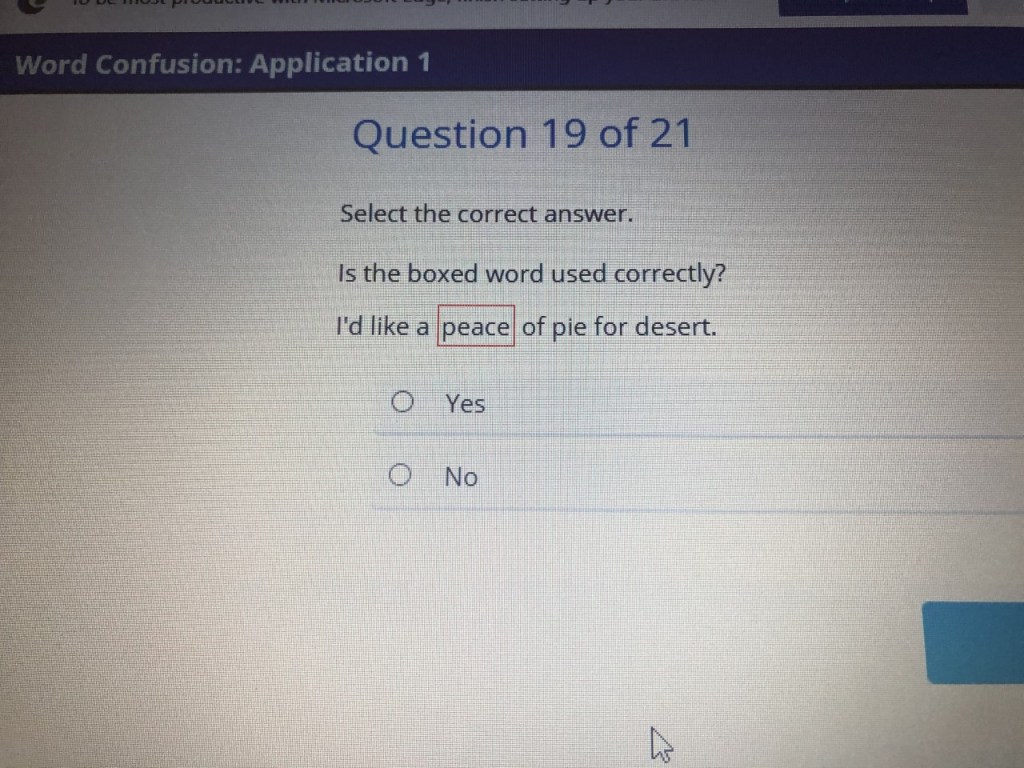
One question about homophones asks students to consider this sentence:

“Select the correct answer.

Is the boxed word used correctly?

I’d like a PEACE of pie for desert?”

Students were asked if “PEACE” is correct – Yes or No. They should know that PIECE is actually the right word.

However, the question made no mention of the misuse of “desert” when the authors clearly meant “dessert.”

That’s the kind of thing that really confuses a student trying to make her way through a program all by herself.

On many assessments, she is asked things that were never taught in the section that was meant to be assessed. I know this is status quo on standardized tests, but is it fair to ask this of a child navigating an online program without even a living teacher to offer support and guidance?

In a social studies assessment on Neolithic peoples, many of the questions had nothing to do with the subject matter. They asked students to infer something based on a passage and none of the multiple choices were entirely correct. You had to pick the option that was least incorrect.

This is some crappy academics being pawned off on parents and students.

And it’s not cheap.

MASD paid $146,302.25 for 40 licenses to Calvert, Exact Path K-5, Courseware for 6-12 and other online services. When hundreds of additional parents asked for their students to be put on the cyber program, the district purchased 500 more licenses from Calvert for a bundled rate of $112,500. That’s $225 per license. Normally they are $450 per license.

Imagine if we put our tax dollars and our teachers to educating these students instead of seeding our responsibility to a corporation for hire.

And we could do it, too.

I work at Steel Valley School District.

Unlike MASD, we began the year with a 100% virtual program for all students. We conduct fully synchronous classes online designed entirely by the classroom teachers. And we post materials on Google Classroom so that students who miss the live Zoom meetings can watch videos of the lesson and do the work.

I’m not saying it hasn’t been difficult or that it’s without problems. Nor is such an endeavor better than in-person learning in a safe environment.

But the teacher-led remote model is the best that can be provided under the circumstances.

Districts that throw students to the whims of corporate educators for hire are shirking their duties.

They should face the realities of the world we live in.

If Coronavirus infections are significant in your county, you should not be offering in-person schooling. You should be offering the best remote option available – and that’s the teacher-led cyber option.

If only my home district knew it.

Meanwhile, my daughter has to struggle through with the cold comfort that at least she won’t get sick jumping through the hoops her school board is too partisan to eliminate for her.

I’m right next to her at the dining room table feeling guilty for putting her through this.

But what else could I do?


Like this post?  You might want to consider becoming a Patreon subscriber. This helps me continue to keep the blog going and get on with this difficult and challenging work.

Plus you get subscriber only extras!

Just CLICK HERE.

Patreon+Circle

I’ve also written a book, “Gadfly on the Wall: A Public School Teacher Speaks Out on Racism and Reform,” now available from Garn Press. Ten percent of the proceeds go to the Badass Teachers Association. Check it out!

Why Does Trump Hate COVID Testing But Love Standardized Testing?

When it comes to COVID-19, Donald Trump sure hates testing.

But when it comes to public schools, his administration simply adores standardized testing.

Why the discrepancy?

Why is testing for a virus during a global pandemic bad, but giving students a multiple choice test during the chaos caused by that pandemic somehow good?

When it comes to the Coronavirus, Trump has made his position clear.

In a June 15 tweet, Trump wrote that testing “makes us look bad.”

Five days later at his infamous campaign rally in Tulsa, he said he had asked his “people” to “slow the testing down, please.”

At one of his White House press briefings, he said, “When you test, you create cases.”

In his infamous Fox News interview with Chris Wallace, he seemed to be saying that the U.S. had just as many new cases now as it did in May. However, since there were fewer tests done in May and more are being done now, it only appears that the infection is spreading when it actually is not.

It’s pure bullshit.

How would he know how many cases existed in May other than through testing?

He is simply trying to gas light the nation into believing that his abysmal job as Commander-in-Chief has nothing to do with the pandemic raging out of control on our shores.

He is trying to distract us from the fact that the US has only 4 percent of the world population but more than 25% of all COVID-19 cases. He wants us to forget that more Americans have died of COVID-19 than in any war other than WWII – 200,000 and counting.

So that, at least, is clear.

Trump hates COVID testing because – as he puts it – it makes him look bad.

So why is his administration pushing for more standardized testing in public schools as those same institutions struggle to reopen during the pandemic?

Education Secretary Betsy DeVos – everyone’s favorite billionaire heiress turned public servant – sent a letter to state education leaders on Thursday saying high stakes testing probably would be required this school year.

They should not expect the Education Department to again waive federal testing requirements as it did last spring while schools were suddenly closing due to the outbreak.

The reason?

DeVos wrote:

“If we fail to assess students, it will have a lasting effect for years to come. Not only will vulnerable students fall behind, but we will be abandoning the important, bipartisan reforms of the past two decades at a critical moment.”

However, this is a rather strange thing to say if you think about it.

Standardized tests are just one of many kinds of assessments students take every year. At best they represent a snapshot of how kids are doing on a given day or week.

But since students are tested all year long by their teachers, they earn end of the year marks, pass on to the next grade or are held back, graduate or not – there are a multitude of measures of student learning – measures that take in an entire year of academic progress in context.

Waiving standardized testing would not make it impossible to tell who learned what. In fact, waiving the tests in the spring did not leave teachers clueless about the students in their classes today.

We still know which students are falling behind because we interact with them, give them assignments, teacher created assessments, etc. And when it comes to vulnerability, standardized tests show us nothing unless we read between the lines.

Students from poorer households tend to score lower on standardized tests. Kids who attend schools with fewer resources and larger class sizes tend to score lower. Minority children tend to score lower.

We don’t need any tests to tell us who these kids are. It’s obvious! Just look at who qualifies for free or reduced meals. Look at school budgets. Look at student ethnographic data. Look at seating charts. Look at classroom grades.

We don’t need standardized tests! We need resources to help these kids overcome the obstacles set before them or to remove those obstacles altogether.

Standardized testing does nothing to achieve this goal nor is there much help from the “bipartisan reforms of the past two decades.”

After all, which reforms exactly do you think DeVos is referring to?

It’s not hard to imagine since her letter was endorsed by far right and neoliberal organizations such as the Center for American Progress, the National Urban League, the Education Trust and the U.S. Chamber of Commerce.

DeVos is talking about charter and voucher schools – the same pet projects she spent her entire adult life either funding or trying to wrest funding away from public schools to fund.

In fact, she just had her ass handed to her for a third time by the federal court system for trying to siphon money to private schools that Congress explicitly earmarked for poor kids.

Congress set aside money in the CARES Act to be distributed among public and private schools based on the number of students from low-income families. However, DeVos said the funds should go to private schools BASED ON TOTAL ENROLLMENT.

Uh-uh, Betsy.

In her ruling this week, Dabney Friedrich, the U.S. District Judge for the District of Columbia (and a Trump appointee) wrote:

“In enacting the education funding provisions of the CARES Act, Congress spoke with a clear voice… that cannot mean the opposite of what it says.”

So why does the Trump Administration support standardized testing?

For a similar reason to why it doesn’t support COVID testing.

Testing for the Coronavirus makes Trump legitimately look bad.

Testing kids with standardized assessments makes the public schools (during a pandemic or otherwise) illegitimately look bad. And that can be used as a justification to close those schools and replace them with private and charter schools.

It’s not about academia or helping vulnerable children.

It’s pure politics. The shock doctrine. Disaster capitalism.

This is another way the Trump administration is trying to rob the American public blind and get away with it.

When it comes to Coronavirus, there are a limited number of tests for infection. Trump is against all of them. He just wants to hide his head in the sand and pretend it will all go away.

When it comes to education, there are multiple measures of student learning. The Trump administration only champions one of them – the standardized variety.

Why? Because that is the assessment most inadequate to measure learning but it’s the easiest to spin into an anti-education narrative.

After all, you can’t use classroom grades or teacher-created tests to support the narrative of failing schools. Those assessments are in context and too clearly show the link between poor achievement and things like lack of resources and inequality. If kids are failing their classes, it’s too obvious when schools are trying to help but stymied by a lack of resources and countless social issues. Shining a light on that will only lead to solving these very real problems.

But if we put the spotlight squarely on standardized test scores, we can spin the narrative that it is the public school system, itself, that is at fault and thus we can better sell the need for privatization in all its profit-driven forms.

That’s the whole reason DeVos took this job in the first place.

And shame on Democrats like Rep. Bobby Scott (D-Va.) and Sen. Patty Murray (D-Wash.) who praised DeVos’s testing pronouncement.

Scott, who serves as chair of the House Education and Labor Committee, said in a statement:

“There is no question that the COVID-19 pandemic is having severe consequences for students’ growth and achievement, particularly for our most vulnerable students. We cannot begin to address these consequences, unless we fully understand them.”’

Um, we do understand them, Congressman. You don’t need a multiple choice assessment to see who is failing or why. It’s due to targeted disinvestment of the poor and children of color.

Murray, the highest ranking Democrat on the Senate education committee, said:

“Especially when it comes to the disparities that harm so many students of color, students with disabilities and students whose families have low incomes, we’ve got to have data that shows us where we’re falling short so we can better support those students.”

How does a single test score from a corporation like Pearson show you more than a year’s worth of academic assessments from a school?

Standardized tests convey ZERO to us about students falling behind or vulnerable students that we don’t already know. And Murray is engaged in pure theater by framing her concern as an issue of racial justice while actual racial justice groups like the National Association for the Advancement of Colored People (NAACP) and the Black Lives Matter movement have explicitly condemned standardized testing.

An assessment system literally designed by eugenicists and pushed by segregationists is NOT a remedy to racial inequality – unless you’re proposing getting rid of it.

In short, Trump and DeVos are two peas in a pod committed to avoiding accountability for themselves but determined to destroy public services like public schools based on bogus accountability measures like standardized testing.

Hopefully the American public will boot them both out on their asses in November so that rational leadership in the Department of Education and elsewhere will do what should have been done years ago – waive standardized testing for this year and every year that follows – Coronavirus or not.


Like this post?  You might want to consider becoming a Patreon subscriber. This helps me continue to keep the blog going and get on with this difficult and challenging work.

Plus you get subscriber only extras!

Just CLICK HERE.

Patreon+Circle

I’ve also written a book, “Gadfly on the Wall: A Public School Teacher Speaks Out on Racism and Reform,” now available from Garn Press. Ten percent of the proceeds go to the Badass Teachers Association. Check it out!


Pittsburgh Charter Schools Take Federal Bailout Money Meant for Small Businesses

Screen Shot 2020-07-15 at 12.39.01 AM

 
Are charter schools small businesses or public schools?


They can’t be both.


Several Pittsburgh area charter schools took a bailout meant for small businesses after already getting monetary relief meant for public schools.


Environmental Charter School at Frick Park, Hill House Passport Academy Charter School, Manchester Academic Charter School and Penn Hills Charter School of Entrepreneurship all applied for and received substantial low-interest loans from the federal government’s Paycheck Protection Program (PPP).


The $660 billion federal initiative was intended to help businesses keep employees on the payroll and off unemployment benefits during the COVID-19 pandemic. The loans will be forgiven if businesses meet certain conditions such as retaining or rehiring employees.


However, charter schools – including those in the Pittsburgh region – already should have received financial relief through the federal CARES Act.


Pennsylvania got $523 million to distribute to both authentic public schools and charters. However, of the two, only charters were eligible for additional PPP funds.


So these ‘Burgh charters are double dipping. They’re receiving aid from two different federal sources while authentic public schools only can get aid from one.


The Environmental Charter School at Frick Park got a $2 million – $5 million cash infusion from PPP.


The Environmental Charter calls itself a nonprofit organization but there are many reasons to be dubious.


First, nonprofits usually are dedicated to furthering some social cause like helping the poor and minorities.


However, The Environmental Charter actually caters to upper socioeconomic and white students.


It serves wealthier children than surrounding schools. Just one-third of Environmental Charter students are eligible for free or reduced lunches compared to 71% at Pittsburgh Public schools.


Moreover, only 30% of the charter’s students are minorities. Pittsburgh Public serves a student body of which nearly half are African American.


Next, there’s the issue of who runs the institution.


All charter schools in the Commonwealth have to be designated as nonprofits. However, many like the Environmental Charter School hire for-profit companies to actually operate their day-to-day functions and make almost all of their major administrative decisions.


The Environmental Charter is run by Virginia-based Imagine Schools, one of the nation’s largest charter-management companies with more than 71 charters nationwide.


Since Imagine writes the Environmental Charter’s operating budget, the management company ends up paying itself for a number of services.


After the school gets funding from state, federal and community taxes (this year including bailouts from PPP and the CARES act), it pays 12 percent back to Imagine. This came to $406,000 in 2009, according to an independent financial audit.


The school also pays Imagine on a $250,000 loan that the charter operating company took out to launch the program. Payments come out to about $2,500 per month over 20 years with an interest rate of 10.524 percent.


The charter also pays Imagine rent on its building which was purchased in 2006 by Schoolhouse Finance – Imagine’s real estate arm – for $3 million.


The lease costs $526,000 annually and is binding until 2032 unless the school loses its charter.


Given such facts, it’s hard to imagine why we’ve allowed our tax dollars to prop up a business venture that could certainly afford to reduce its profit margins rather than rely on public support.

 
Hill House Passport Academy Charter School got a $150,000 – $350,000 bailout from PPP.


Unlike the Environmental Charter, Hill House does actually cater to low income and minority children. In fact, it was founded to help Pittsburgh students who are failing in another district and in danger of dropping out unless they receive some kind of academic intervention.


However, the results haven’t been stellar. Where the Environmental Charter was too white, Hill House serves almost exclusively black students. It is exponentially more segregated than neighboring authentic public schools (96% minority) and its students still have extremely poor academic performance.


The question remains whether these results are better than they would be at an authentic public school. Does the charter provide any value for these students or is it just a holding area?


Like the Environmental Charter, this so-called nonprofit hires a management company. In this case, it’s the infamous K12 Incorporated – a nationwide cyber charter network with a record of academic failure and financial shenanigans.


In 2016, the company reached a $168.5 million settlement with the state of California. The state claimed K12 had reported incorrect student attendance records and otherwise lied about its academic programs. The company ended up settling with the state for $2.5 million with an additional $6 million to cover the state’s investigation and K12 voided $160 million in credits it had given to the affiliated schools to cover the cost of their contracts.


Hill House offers a blended model with in-person teachers and virtual classes somewhat different than most K12 schools.


However, why the state should bailout such a dubious endeavor is beyond me.


Manchester Academic Charter School got a $350,000 – $1 million loan from PPP.


It is one of the oldest charter schools in the city, having started as a tutoring program in 1968 and becoming a full fledged charter school in 1998.


However, like Hill House, it is infamous for racial segregation and low academic performance. Approximately 99% of students are minorities.


In 2016-17,only 12% of the school’s students were proficient in math (state average is 46%) and 37% were proficient in language arts (state average is 63%).


Where Manchester fails at academics, it excels at administrative salaries. The school’s administrators take home beaucoup bucks while being responsible for fewer students than those at authentic public schools.


For example, Vasilios Scoumis, Manchester CEO for more than two decades, is given a $146,000 salary not counting a potential $15,000 yearly bonus though he is only responsible for 340 students.


Compare that with Pittsburgh Public Schools Superintendent Dr. Anthony Hamlet. He earns a $210,000 salary for managing a district of about 24,000 students.


But such high salaries for relatively little work aren’t only a hallmark at Manchester.
Environmental Charter School CEO John McCann earned $120,000 with a school enrollment of 630 students.


Nice work if you can get it!


Speaking of which, Penn Hills Charter School of Entrepreneurship got $350,000 – $1 million from PPP.


This is another so-called non-profit school run by the Imagine Schools company. It is highly segregated with 82% minority children.


Only 32% of students are proficient in math and 57% in reading – again below state averages.


The school suffered a scandal in 2015 when the state Charter Review Board overruled Penn Hills School Directors decision to deny allowing the charter to expand into a second building.


But given that the Charter Review Board is made up of six members – charter school advocates chosen by former Republican Governor Tom Corbett – any pretense to impartiality is laughable.


Penn Hills School Board – a duly elected body, not government appointees – outlined criticisms of the charter that do not put the entrepreneurial venture in a positive light.


Penn Hills School Board said the charter had failed to produce current student rosters, failed in record management, failed to accurately maintain student tuition payments, improperly billed the school district for special education students, failed to maintain and develop Individual Education Plans (IEPs), had poor academic growth and is under a Department of Education Corrective Action Plan setting forth 31 areas of needed improvement.

 
Directors were also leery of the venture because the charter planned to use half of the new building for students and to lease the remainder as office space.


Finally, the charter school sucks away necessary funding from the authentic public school. The Penn Hills School District paid Imagine about $3 million in 2014-15. Costs increased to $12 million a year and continue to rise.


So one wonders why we’re throwing more money at these charter schools.


Nina Rees, executive director of the National Alliance for Public Charter Schools (NAPCS) has spoken out of both sides of her mouth on the issue. She has insisted that charter schools be regarded as public schools and eligible for emergency aid – all the while advising charter schools also to apply for federal rescue funds for small businesses devastated by the pandemic.


Carol Burris, Executive Director of the Network for Public Education, did not mince words.


“Once again, the charter sector, through the lobbying efforts of Nina Rees…worked behind the scenes to gain fiscal advantage for the privately operated schools they claim are public schools.”


Education historian Diane Ravitch agreed.


“Charters claim to be ‘public schools’ when that’s where the money is,” she said. “But when the money is available for small businesses, they claim to be small businesses.”


Charters go where the money is.


We get the privilege of paying the tab.


If it were up to U.S. Treasury Secretary Steve Mnuchin, we wouldn’t even know about it.


Mnuchin only released the information to the public after 11 news organizations sued the Small Business Administration .


Even now, not all of it is available.


Moreover, the deadline to apply for a PPP loan has been extended to Aug. 8.


So if you haven’t seen some of the most infamous neighborhood charter schools taking advantage of the program, it may only be a matter of time.


ProPublica has put all the information into an easy to use search engine. Just enter a zip code and it will display all the businesses located there that received PPP loans.


This includes high tuition private prep schools like Sewickley Academy and Shady Side Academy both of which got $2 – $5 million, Winchester Thurston School which got $1 million – $2 million, and the charter schools listed above.


You can check it out here: https://projects.propublica.org/coronavirus/bailouts/


Like this post?  You might want to consider becoming a Patreon subscriber. This helps me continue to keep the blog going and get on with this difficult and challenging work.

Plus you get subscriber only extras!

Just CLICK HERE.

Patreon+Circle

I’ve also written a book, “Gadfly on the Wall: A Public School Teacher Speaks Out on Racism and Reform,” now available from Garn Press. Ten percent of the proceeds go to the Badass Teachers Association. Check it out!

book-1

Standardized Tests Increase School Segregation

Screen Shot 2020-06-18 at 5.46.22 PM

 
Let’s say your community has two schools.


One serves mostly white students and the other serves mostly black students.


How do you eliminate such open segregation?


After all, in 1954 the U.S. Supreme Court struck down school segregation in Brown vs. Board of Education as essentially separate and unequal.


It’s been nearly 70 years. We must have a recourse to such things these days. Mustn’t we?


Well, the highest court in the land laid down a series of decisions, starting with Milliken vs. Bradley in 1974, that effectively made school integration voluntary especially within district lines. So much so, in fact, that according to a report from the U.S. Government Accountability Office, from 2000 to 2014, school segregation more than doubled nationwide.

 
But let’s say you did find some right-minded individuals who cared enough to make the effort to fix the problem.


What could they do?

 
The most obvious solution would be to build a single new school to serve both populations.


So if you could find the will and the money, you could give it a try.

 
Unfortunately, that alone wouldn’t solve the problem.


Why?


Standardized tests.


Even when students from different racial or ethnic groups aren’t physically separated by district boundaries or school buildings, the way we rate and sort these students within the same space causes segregation.


This is because our manner of placing kids into classes, itself, is discriminatory.


We have exactly this situation in my own western Pennsylvania district, Steel Valley. We have two elementary schools – Barrett and Park – one of which serves mostly black kids and the other which serves mostly white kids. However, even when the children get to our single middle and high schools, segregation persists.


They may finally be in the same building, but they aren’t in the same classes.


Most academic tracks have at least a lower and a higher level of each course. The former is invariably organized around remediation and basic skills, the latter around critical thinking and creativity.


Moreover, being in the higher level course comes with increased opportunities for mentoring, field trips, special speakers, contests, prizes, and self esteem. And the lower courses can degenerate into mindless test prep.


Which would you rather your child experience?


We don’t enroll students in one or the other at random. Nor do we place them explicitly based on their race or ethnicity.


Increasingly schools enroll students based primarily on their test scores.


Classroom grades, student interest, even teacher recommendations are largely ignored. Kids who pass their state mandated standardized assessments generally get in the higher classes and those who fail get in the lower classes.


And – Surprise! Surprise! – since test scores are highly correlated with race and class, most of the black kids are in the lower classes and most of the white kids are in the higher classes.


Let me be clear.


This isn’t because there’s something wrong with the poor kids and children of color or something right about higher socioeconomic status and white kids.


It’s because of (1) economic inequality, and (2) implicit bias in the tests.


In short, standardized assessments at best show which kids have had all the advantages. Which ones have had all the resources, books in the home, the best nutrition, live in the safest environments, get the most sleep, don’t live with the trauma of racism and prejudice everyday.


However, even more than that is something indisputable but that most policymakers and media talking heads refuse to acknowledge: standardized testing is a tool of white supremacy.


It was invented by eugenicists – people who believed that white folks were racially superior to darker skinned people. And the purpose of these tests from the very beginning was to provide a scientific (now recognized as pseudo scientific) justification for their racism.


A standardized test is an assessment where the questions are selected based on what the “standard” test taker would answer. And since this norm is defined as a white, middle-to-upper-class person, the tests enshrine white bias.


I don’t mean that 2+2=4 has a racial bias. But most questions aren’t so simple. They ask test takers to read passages and pick out certain things that are more obvious to people enculturated as white than those enculturated as black. They use the vocabulary of middle to upper class people just to ask the questions.


This is white supremacy. Using these tests as a gatekeeper for funding, tracking, and self-respect is educational apartheid.

 
Black students make up almost 17 percent of American students nationwide. If all things were equal, you’d expect them to make up a similar percentage of advanced courses. However, they account for only 10 percent of students in Gifted and Talented Education (GATE) classes.

 
In some areas it’s worse than others.


For example, according to a Department of Education Office for Civil Rights report from 2014, black students in the northern California city of Sacramento make up 16.3 percent of the population but only 5.5 percent of GATE programs. Meanwhile, in the south of the state, in San Diego, 8 percent of students are black, but make up just 3 percent of GATE classes.


Those are big disparities. In fact, the phenomenon is so common that social scientists created a term to describe it – racialized tracking.


But it has also been the subject of civil rights complaints.

 
In New Jersey the imbalance was so extreme the American Civil Liberties Union (ACLU) filed a complaint in 2014 against the South Orange–Maplewood School District. In a statement, the ACLU said racial segregation across academic tracks “has created a school within a school at Columbia High School.” More than 70 percent of students in lower classes were black while more than 70 percent of students in advanced classes were white.


Even so there wasn’t much that could be done. The matter ended with the Office for Civil Rights ordering the district to hire a consultant to fix the problem, but it still persists to this day.


This “school within a school” went from metaphor to reality in Austin, Texas. In 2007, a city school, the Lyndon Baines Johnson Early College High School, split into two different entities existing within the same building. And the main factor separating the two was race.


The second floor became the Liberal Arts and Science Academy (LASA), a public magnet high school serving mostly white and Asian students. Meanwhile, the majority black and Latino students stayed on the first floor taking regular education courses.


How can that be legal? Because too many people want it that way.


LASA is ranked the best Texas high school and the 11th-best high school in the United States. In fact, whenever you see those lists of the best schools in the country, they are often the result of a wealthy local tax base combined with how many poor and minority kids they were able to keep out.


It’s a matter of priorities.


Many people – especially white people – talk a good game about equity but what they really want for their own children is privilege.


It’s what happens when you let scarcity dominate public education, and it doesn’t have to be this way.


We can invest in our schools so that all children have what they need – so that they aren’t in competition for dwindling resources.


But this must go hand-in-hand with an emphasis on social justice. Black lives matter. We cannot continue to treat black children as disposable.


Being gifted, talented or advanced can’t be reduced to a score on a standardized test. In fact, I’d argue that such measures should be banished from our conception of excellence altogether as the tests, themselves, should be discontinued.


This doesn’t mean we can ignore the centuries of racist policies that keep our children of color down – housing segregation, inequitable funding, over policing, a lack of resources, being left out of specialized programs. Nor does it mean that we can ignore implicit bias white teachers invariably have about black students.
But we have to dismantle the systemic racism enshrined in our school policies. The most well-meaning individuals will make little headway if the system, itself, is corrupt.


The two must be accomplished hand-in-hand, at the micro and macro level.


Integration is absolutely essential. We must ensure that all of our students get to go to school together – but not just in the same buildings, in the same classes.


This requires an end to standardized testing but maybe also an end to advanced placement courses as we know them. Why focus on higher order thinking only for the privileged kids – do it for all. Individual student needs can be met with dual teachers in the room, pullout resources and the like.


It is important to meet the needs of every student, but we cannot in doing so allow unspoken bias to be the gatekeeper of opportunity.


Equity is not just a pretty word. It has to be one of our most cherished goals.


Otherwise our policies and our people will leave many children behind.


Like this post?  You might want to consider becoming a Patreon subscriber. This helps me continue to keep the blog going and get on with this difficult and challenging work.

Plus you get subscriber only extras!

Just CLICK HERE.

Patreon+Circle

I’ve also written a book, “Gadfly on the Wall: A Public School Teacher Speaks Out on Racism and Reform,” now available from Garn Press. Ten percent of the proceeds go to the Badass Teachers Association. Check it out!

1500x1000-garn-book-sale-2020-2

The Student-Teacher Relationship is One of the Most Misunderstood and Underrated Aspects of Education

thumbnail_IMG_9695


When I came back to school for the first time since the Coronavirus closed the building, there were a pile of letters waiting for me in my mailbox.


I took them to my empty classroom and read the first one:


“Hello Mr. Singer, I just thought you should know that you are the greatest teacher I’ve had since Kindergarten all the way to my freshman year of High School and probably will remain that way forever. You always helped me with my work when I was behind and gave me extra time to finish it. Your class was the class I looked forward to every day. You were always a nice and funny man. Thank you for being there for me and everyone else in your classes. I’ll be sure to visit you after school every now and then…”


I picked up another:


“You have no idea how much I miss you… I quite miss our talks after class about video games, movies and musicals. As cheesy as it sounds, I always looked forward to them; especially during the days I was having problems with other students, your wise words always helped…”


And another:


“…we had fun times in your class. There wasn’t one non-fun day that we had because if we was going to have a bad day you made it better and way more fun. You also helped us a lot even when we didn’t ask for it. When people didn’t want to do our work, you got them happy and got them to do their work. Thanks for everything and thanks for helping me be a smarter kid.”


I felt a lump forming in my throat.


My cheeks were hot.


And why was my face wet?


I hadn’t expected any of this.


After a semester of distance learning, I’d come back to school to return all the materials I had hastily marauded from my own filing cabinets and book shelves.


I had stopped in the office merely as a matter of course.


With the school year at a close, I had gathered the odds and ends in my mailbox including this bundle of correspondence.


Now as I sat at my desk smiling, laughing and crying – experiencing each letter like a warm hug on a winters day – I remembered something Ms. Williams had said in an email.


She had assigned a thank you letter to her high school business classes. Her students had to write a formal thank you to a previous teacher. But that was all that was required. Who they wrote to and what they said was entirely up to them.


She had written to me months ago to let me know these letters were coming.
It was just bad luck that the assignment was due just as the global pandemic closed everything down so I was only reading them now.


Kids usually spend about 1,000 hours with their teachers in a single year.


During that time we build strong relationships.


While just about everyone will tell you this is important, we’re often talking about different things.


Some policymakers will insist on limiting that relationship to connections that increase academic outcomes. Others advise a more holistic approach.


Both are backed by research.


A review of 46 educational studies concluded that strong student-teacher relationships are associated with positive outcomes in everything from higher student academic engagement, attendance and grades, better behavior and fewer suspensions to higher graduation rates. And this is true of both short term and long term effects and even after controlling for differences in student backgrounds.


However, many studies disregard everything but standardized test scores. That is the primary goal and arbiter of effectiveness. As such, in those cases the relationship they are looking for is much different than in those with broader aims.


A 2018 study from Arizona State University found a disparity in teacher-training programs that highlighted this difference.


Some programs prioritized an “instrumental focus” with students where teachers were encouraged to use personal information on students to get them to behave and do their work. The goal was compliance not autonomy or problem solving.


Other programs valued a more “reciprocal focus” where students and teachers exchanged information to come to a mutual understanding and shared knowledge. Here the goal was free thought, questioning, and engagement with authority figures.


Moreover, the study found that the differences in focus corresponded to where aspiring teachers were expected to get a job after the training was complete. The instrumental focused teacher prep programs invariably trained incoming educators for low-income and high-minority schools. The reciprocal approach was preferred for teachers preparing for wealthier and whiter students.


So once again the physical segregation of our children becomes “the soft bigotry of low expectations.” But while President George W. Bush used that famous phrase to demonize anyone who thought poverty and racism were barriers to achievement, it is actually a focus on test scores that is bigoted.


We expect teachers to care about their wealthy white students but merely manipulate their poor brown ones.

 
This just goes to justify my own reciprocal approach in the classroom.


Test-obsessed policy makers will tell educators to manage everything with a clipboard and a spreadsheet – for example, to increase the percentage of positive interactions vs negative ones in a given class period. But such a data-centric mindset dehumanizes both student and teacher.


The goal cannot be to maximize numbers whether they be test scores or some other metric. It has to be about the relationship, itself.


Teachers have to care about their students. All teachers. All students.


Or at least we have to try.


A little bit of empathy goes a long way. And not just to get students to jump through hoops.

You have to care about each student as a person.


The goal can never be a test score. It has to be self actualization.


Teachers have to help kids become their best selves. And the definition of what counts as your best self is largely defined by the student, his- or herself.


How telling that we implicitly understand this when it comes to high socioeconomic kids with lighter skin! How pathetic that we lower our sights when it comes to poor kids and children of color.


I teach mostly minority students in a low income school in Western Pennsylvania. Like many of my colleagues, I’ve always fought against this prescription to see student relationships as instrumental to their outcomes.


And the results are evident in what they wrote to me.


“…now that I’m no longer in your class I’ve decided it was about time that I give you a proper thank you for all you did, putting up with me and dealing with me in class… You helped me learn how to write essays. But most important of all, for two years you made school fun for me again, which was something I thought was impossible.”


***


“…Everyday I was always looking forward to having your class because I knew that having your class would be thrilling. I miss having your class because you made me laugh and in return I made you laugh a couple of times.”

***


“…Being in your class made me enjoy learning and reading more. It was almost always something I looked forward to throughout my day. We were always learning about interesting topics and I was never bored in your class… Thank you for being the greatest teacher ever and a cool dude.”


***


“…I’ll never forget you as long as I live.”


***


“You were my favorite teacher because your class was always fun and we were always doing fun things and fun projects in your class and your class was never boring. You also taught us a lot of useful things… we’ve been using them so far this year. You were also never in a bad mood and always were positive in the morning so you always brought my energy up… I never looked forward to a morning class besides your class because I knew that we were going to do something fun.”


***


“…Your class was the only class that I got excited for because we always read good stories and did fun things… I also wanted to say I’m sorry for talking and disrupting the classroom when I was carrying on. I should have been paying attention to what you had to say and what you were trying to teach me.”


***


“It was interesting to have a teacher that wrote a book because not a lot of teachers write books. It was also interesting [you had a] TED Talk…”


***


“You have had some pretty good accomplishments in your life if I may say so. Like your book “Gadfly on the Wall”, and I have to say it’s a pretty good book. I read some of it and I get what you’re saying.”


***


“…middle school was hard for me. I had difficult days with tons of IXLS piled [on from other classes] but instead of you giving them to me you actually taught me by yourself. Also we were able to joke around a lot about books and just random things in class.”


***


“…you taught me how to write and put punctuation in my sentences and in my paragraphs. Coming into your class in the beginning of 7th grade I didn’t know how to read that good or consistent… My vocabulary and speech increased in your class.”

 
***


“…You always had a way to make the class fun or easy. Also you always had a way to keep me on track and prepared… If I didn’t have you for 7th and 8th grade I don’t think I would be able to handle 9th grade… I’m glad to of had you for two years because I learned double the stuff and was double ready for 9th grade. I’m doing well [now] because of you…”

 
***


“I wanted to write to you because you’re honestly my favorite teacher and you kept my spirits up. I had your class for two years [7th and 8th grade]; the first year I wasn’t sure how I felt about you but overtime I realized you’re pretty cool. I loved Socratic Seminars . They were a way to voice your opinion and that’s always fun… You helped me find a few of my favorite books like “The Outsiders”, “To Kill a Mockingbird”, and “The Diary of Anne Frank” which my friends and I still mention to this day… I’m in the musical this year and… without you I don’t think I would have been able to build up the courage to try out… You made me the person I am today. You taught me to challenge things that are unfair and to treat people with respect.”

 
Those are just some of the highlights.


I think more than anything I could say, they prove the point.


But to put a cherry on top, I’ll add one last thing.


In my 8th grade poetry unit, we watch “Dead Poets Society.”


Last year my students threatened to reenact the ending of the film where the kids stand on their desks to honor Mr. Keating, their English teacher who taught them to think for themselves instead of being cogs in the machine.


On the last day of school, they did it, too.


I cautioned against it because I didn’t want anyone to fall and get hurt. But when the last bell rang and emotions ran high, I simply took the compliment.


A year later, they must have remembered the moment as much as I did because many, many of the letters weren’t addressed just to Mr. Singer.


They were addressed to “Oh Captain! My Captain!”


Screen Shot 2020-06-13 at 10.54.46 AM
I wrote each student a personal response and sent it to them via the US Post Office. For many this may be the first actual letter they’ve received.


Like this post?  You might want to consider becoming a Patreon subscriber. This helps me continue to keep the blog going and get on with this difficult and challenging work.

Plus you get subscriber only extras!

Just CLICK HERE.

Patreon+Circle

I’ve also written a book, “Gadfly on the Wall: A Public School Teacher Speaks Out on Racism and Reform,” now available from Garn Press. Ten percent of the proceeds go to the Badass Teachers Association. Check it out!
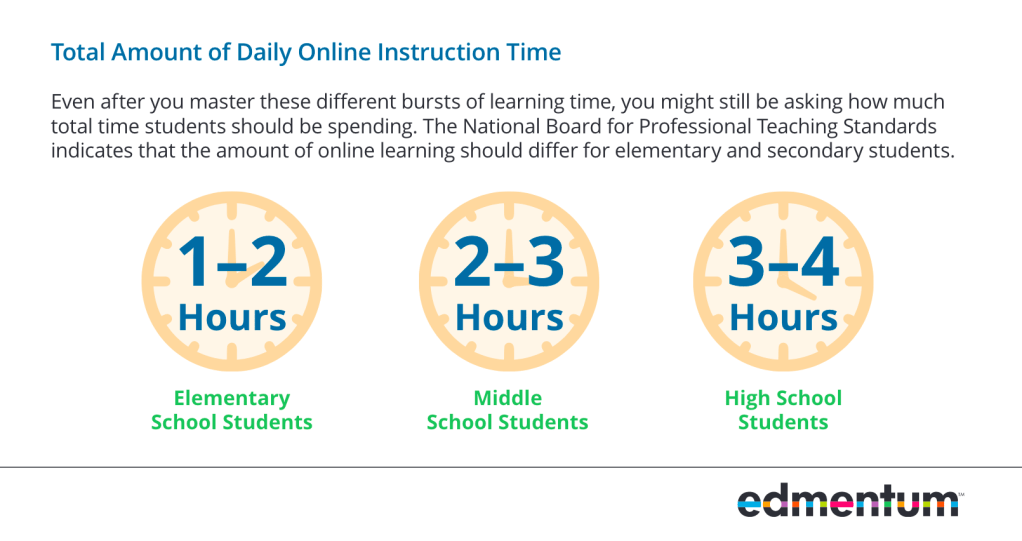
book-3