Every Charter School Must Be Closed Down – Every. Single. One.

Screen Shot 2019-09-07 at 11.17.21 PM

 
The problem with charter schools isn’t that they have been implemented badly.


Nor is it that some are for-profit and others are not.


The problem is the concept, itself.


Put simply: charter schools are a bad idea. They always were a bad idea. And it is high time we put an end to them.


I am overjoyed that lawmakers on both sides of the aisle are starting to hear the criticisms leveled against the charter school industry in the face of the naked greed and bias of the Trump administration and its high priestess of privatization, Betsy DeVos. However, I am also disappointed in the lack of courage displayed by many of these same lawmakers when proposing solutions.


Charter schools enroll only 6 percent of students nationwide yet they gobble up billions of dollars in funding. In my home state of Pennsylvania, they cost Commonwealth taxpayers more than $1.8 billion a year and take more than 25 percent of the state’s basic education funding. That’s for merely 180 schools with 135,000 students!


Charter schools are privately run but publicly financed. They are what happens when the public abrogates its responsibility to run a school and signs that right away (in a charter agreement) with another entity, usually a business or corporation.
As such, these schools are not held to the same standards as authentic public schools. Unlike your neighborhood school, charters are not required to be run by elected boards, to have public meetings, to have open records, or to spend all their money in the service of their students. Nor do they have to provide the same standard of services for students – even children with special needs. Nor do they have to accept all students within their coverage area who enroll. And that’s to say nothing of how they increase racial segregation, are susceptible to fraud and malfeasance, often produce much worse academic results, close without notice, hire many uncertified teachers, trample workers rights and destabilize the authentic neighborhood public schools.


These are not problems that can be solved by fiddling around the edges.


We cannot simply constrain them from stealing AS MUCH from authentic public schools and consider it a victory.


We need to address the issue head on – and that issue is the very concept of charter schools.


Why would the public give up its schools to a private entity? Why allow someone else to take our money and do whatever they want with it behind closed doors? Why allow anyone to give our children less of an education than we’re already providing at our own schools?


We must end this failed experiment. Nothing less will do. It will only provide more breathing room so  that this unjust situation can drag on for another generation.


In Pennsylvania, Gov. Tom Wolf has proposed sweeping reforms via executive order that would make real progress toward holding charter schools accountable. He has asked that the state senate and house take the next step with legislation to finish the job.


Just this past week, Wolf visited Twin Rivers Elementary School in McKeesport along with state Senator Jim Brewster and state Reps Austin Davis and Jake Wheatley to listen to resident and teachers’ concerns and propose solutions.


Such a move is unprecedented and represents a seismic shift in the political landscape. However, I am concerned that lawmakers are too timid to fix the real problem here.


No one has the bravery to come out and say what I’ve said here.


Consider this statement from Brewster, my state Senator:


I have legislation to address some of these issues, but it’s not an indictment on charter school teachers. It’s not an indictment on the charter school concept. It’s an indictment on the process that was put in place 20 some years ago that has put in a playing field that’s not level. Together I believe if we get the charter school folks to the table we can iron this out, we can fix several things that need to be fixed – the funding formula, the capacity, the cap and those sort of things – and when we do that, then the mission statements of the charter schools and the public schools are the same – educate our children, bring their skill sets out, help them achieve their dreams.”


I am deeply grateful for Brewster’s support and willingness to take on the charter industry. And he is right about many things. But not all of them.


He is right, for example, about the financial impact of charter schools on authentic neighborhood public schools.


At the same meeting, McKeesport superintendent Mark Holtzman said, “Charter schools are depleting our resources with no accountability or without being financially responsible. Taxpayer money is being used to flood the media with commercials and billboards right before the start of school so that they can take our students.”


There are roughly 500 students living in the McKeesport district enrolled in brick-and-mortar charter schools and 100 students enrolled in cyber charters. The district spends about $7 million — or 10% of its budget — on charter school payments, according to Holtzman.


It’s roughly the same at other districts in the Mon-Valley. Steel Valley Schools, where I work as a middle school teacher, has budgeted a $6 million payment to charter schools this year – 16% of our spending plan.


Again, I am extremely grateful that Wolf and other state Democrats recognize this fact and are willing to take measures to make matters more fair. I hope many Republicans will join them in this.


However, fixing the way charters are funded alone will not correct the problem.


Charter schools are a parallel service to authentic public schools. If you’re suggesting we fund them both, you’re asking taxpayers to pay for two complete and separate school systems.


Why should we do that? Why should we waste our money on it? I don’t think the people of Pennsylvania – or any state of the union – have money to spare on a pointless duplication of services.


It is a politically impossible position that has zero justification – especially when you consider all the inequitable practices charter schools are allowed to get away with.


In his executive orders, Wolf proposes putting a stop to some of this.


For example, he wants to require charter schools to stop turning away students based on race, ethnicity, gender, disability, intellectual deficits, or other factors. He wants to make charter schools as transparent as authentic public schools. He wants to stop conflicts of interests for charter school board members and operating companies so that they can’t make decisions on behalf of the school that would enrich themselves, their families and/or friends.


These are excellent suggestions and I hope he is able to make them a reality.


However, these “fixes” are all things that authentic public schools already do. They don’t discriminate in enrollment. They are financially accountable and transparent. They aren’t allowed to engage in conflicts of interest.


Why bother making charter schools act like authentic public schools when we already have authentic public schools? That’s like genetically engineering your cat to have a longer snout and say “woof.” Why bother when you already have a dog?


The same could be said about for-profit and non-profit charter schools.


Apologists want to pretend that the former is the “bad” type of charter and the latter is the “good” type.


Wrong.


As Jeff Bryant, an editor at Education Opportunity Network, puts it, this is a “Distinction without a difference.”


These terms only define an organization’s tax status – not whether it is engaged in gathering large sums of money for investors.


With a knowledgeable accountant or hedge fund manager, almost anyone can claim nonprofit status while still enriching yourself. It happens all the time.


For instance, take the use of management companies.


A for-profit charter school can simply cut services to students and pocket the savings as profit.

A nonprofit charter school can do the same thing after engaging in one additional step.

All they have to do is start a “nonprofit” charter school and then hire a for-profit management company to run it. Then the management company can cut services and pocket the profits!


Yet we call such a school “nonprofit.” It’s meaningless.


It doesn’t even matter who owns the for-profit management company. It could even be the same people who own the nonprofit charter school.


The law actually allows you to wear one hat saying you’re nonprofit and then put on a different hat and rake in the cash! The only difference is what hat you’re wearing at the time! You get to claim to be a nonprofit while enjoying all the advantages of being for-profit.


You can even buy things with public tax dollars through your for-profit management company and then if your “nonprofit” school goes bankrupt, you get to keep everything you bought! Or your management company does.


So the public takes all the risk and you reap all the reward. And you’re still called a “nonprofit.”


But let’s not forget real estate shenanigans.


If I own property X, I can sell it to my own charter school and pay myself whatever I want. And I can do the same thing with a nonprofit charter school, I just need to sell it to my for-profit management company which will still buy my property for whatever I decide to pay myself.


Face it – charter schools are a scam.


They are a failed policy initiative.


It’s time they were ended.


But don’t get me wrong. I’m not suggesting we simply throw away the people who work there or the students who are enrolled there.


We need to look at each charter on a case-by-case basis and decide how best to transition them to an authentic public school system.


In some cases, it may make sense to rehabilitate charters into fully public schools with all the transparency and regulations that means. However, in most cases it will mean eventually closing them.


If there are any charters that actually provide valuable services for students and their families wish to keep children enrolled there, we should allow these students to finish their academic careers there. But let the present classes be the last.


In schools that do not offer better outcomes than the neighborhood public school (i.e. the overwhelming majority) students should be transitioned back to the neighborhood schools.


If there are any charters that do not wish to abide by such changes, they should have the opportunity to become what they already are except in name – private schools. The only difference is that taxpayers will no longer take up the tab.


And when it comes to charter school teachers, they should not be punished for having worked in the industry. In fact, we should find ways to bring them into the authentic public schools.


Our public schools need more teachers. Charter teachers who are fully certified should be given first chance to fill some of those vacancies. And charter teachers who are not certified should be given the opportunity to go back to school and complete their education degrees.


Any sane solution to the charter school mess would include these measures with the ultimate goal of ending school privatization in all its forms financed at public expense.


We don’t want privatized prisons. We don’t want privatized mercenary armies like Blackwater. We don’t want privatized schools.


Tax dollars should go to our authentic neighborhood public schools so that we can make them even better than they already are.


Our students deserve the best we can give them – and we can’t give them the best when we’re needlessly paying for two separate school systems and passing legislation with more of an eye on private investors than the welfare of the next generation.


It is my sincere hope that this push for real charter school reform becomes an effort to solve this problem once and for all.


Are we brave enough to do it?


Do we have the courage and conviction to take that on?


Like this post? I’ve written a book, “Gadfly on the Wall: A Public School Teacher Speaks Out on Racism and Reform,” now available from Garn Press. Ten percent of the proceeds go to the Badass Teachers Association. Check it out!

cropped-book-1.jpg

The Welcome Back Letter I’d Love to Give My Students – But Can’t

high-school-teacher-gives-student-a-high-five-893988494-5a72007bba61770037b681bf

 
I’m a very lucky guy.


I get to teach language arts in an amazing urban middle school in Western Pennsylvania.


I have reasonable autonomy, opportunities to collaborate with my co-workers and strong union protections.


Even so, I know there are a lot of teachers out there who don’t have those things.


Yet even after counting all my blessings, I still can’t do whatever I want. I can’t even do everything that my years of academic training and experience tells me would be best for my students.


Every year I’m told that my worth as a professional is mainly defined by student test scores – that I should use those scores to drive my entire class, that my major goal should be increasing the scores and my every waking moment should be spent examining past scores.

 
Every year I have to watch out for this data metric and do that much more work because my district has lost even more funding to the vampire charter school in our neighborhood. Or lawmakers have compromised away another several hours of my time to do meaningless paperwork – time that I either have to take away from my students or my family.


I see all this and I just want to scream.


I want to tell everyone what’s happening so that they can help stop the madness.


And I do scream into the whirl of cyberspace on my blog.


But I can’t do the same in my district. I can’t tell those right in front of me – my school board, my administrators, the parents or students.


Doing so would put everything I do have in jeopardy.


I know this because it already has.


Every year on the first day of school, I give my students a welcome letter.

 
This is the kind of letter I’d love to give them – but don’t dare:


Dear Students,


In a matter of weeks you will be invited back to school and I wanted to let you in on a little secret.


We missed you.


That’s right. Your teachers missed the heck out of you over the summer.


Don’t get me wrong. We enjoyed our time at home with our own children, time on vacation, time spent continuing to refine our craft, and/or time spent working another job. (Hey! Those extra pencils, papers, books and supplies aren’t going to buy themselves! Right?)


Here’s another little secret – your teachers come to school every day not because we have to, but because we want to.


We literally could do anything else with our lives but we’ve devoted our time to you.


Why? Because we love you.


I know that’s mushy talk, but it’s true.


Another secret: We know you’re nervous about your first day back. But – heck – so are we!


Don’t forget you’re young. We’re old!


We know you’re wondering who your teachers will be this year, what they’ll require you to do, which friends will be in your classes, who will sit with you at lunch…


We wonder if we’re still going to be able to do all the things we need to do to help you learn? Are we going to be able to provide a safe, secure environment for you? Will we be able to keep you engaged, and excited to learn? Will we be able to actually teach everything you want and need to know?


This is going to be a challenging year for all of us.


But that’s a good thing.


We’re in this together.


That’s kind of an important point.


You see, we know you’ll probably be asked to take high stakes standardized tests. Just know that it’s not us who’s asking. It’s the state and federal government. Lawmakers seem to think that your answers on multiple choice tests are very, very important.


Another secret: they aren’t.


We don’t care how you score on these tests. Not really. We don’t even care if you take them at all – and if your parents decide not to have you sit through this garbage, we will honor their wishes, because they are the ultimate authority on you – their children.


We know that standardized tests don’t assess how much you learn. The tests your teachers make do that – the work that you do in class every day shows it better than any canned corporate exam.


We know those scores don’t define who you are. We see you every day. We see your creativity, your intelligence, your fire, your verve, your passion.


We want to stoke that fire and help you become the people you always wanted to be.


And none of that can be shown on a standardized test.


THAT’S our job – not to turn you into great test takers but into the kind of people you most want to be.


Oh. By the way, please thank your parents for us.


Thank them for ignoring the hype about the flashy charter school that hedge fund managers opened on the hill – the school sucking up our funding, cutting services for students and making its investors very rich.


Thank them for declining the shiny school voucher to Pastor Dan’s Creationism, Anti-vaxxor, Climate Denial Academy. Thank them for passing up the tax rebate to Ivy Laurel Prep – where the rich white kids go.

 
Thank them for trusting us with the most precious things in their lives – you.


You really mean a lot to all of us.


So rest up and try to have fun for the remainder of your summer. We’ll do the same.


And before you know it, we’ll be back together in class expanding minds, expressing hearts and having a great time!


Love you all!


Your Teachers


That’s the kind of welcome back letter I would love to give my students – but can’t.


It was partially inspired by a REAL welcome back letter given by a New York Superintendent.

 
Around this time last year, he gave it to 11 principals and about 600 teachers in the
Patchogue-Medford School District before someone posted it online and it went viral.


His audience was teachers, but his message was the same:


Aug. 14, 2018


Dear….


Once again… this letter is too let you know I DO NOT CARE what your state growth score is. Let me be clear… I DO NOT CARE. It does not define you. You are more than a score. I’m hoping you know by now that the children and parents you serve appreciate your talents and the ability to make a difference in their lives. Keep your head up and your eye on what is most important… your students and your teaching craft.


The Patchogue-Medford School District fully supports you as an educator, regardless of what this meaningless, invalid and inhumane score states. You have my permission to throw it out, or use it for any creative ways you may think of. I have a feeling divergent thinking will be at an all-time high at Pat-Med. Let me know if you need anything and it is my sincere hope you have an outstanding year.


With Warmest Regards,


Michael J. Hynes, Ed. D.
Superintendent of Schools


image

38014006_10156079233558860_7115622694678167552_n

 
Cheers to Superintendent Hynes!


If only every teacher, administrator and school board member could be that brave and honest!

 
Here’s another letter given to year six students at Barrowford Primary School in Lancashire, England, along with their results from a recent standardized exam:


“Please find enclosed your end of KS2 test results. We are very proud of you as you demonstrated huge amounts of commitment and tried your very best during this tricky week.


However, we are concerned that these tests do not always assess all of what it is that make each of you special and unique. The people who create these tests and score them do not know each of you- the way your teachers do, the way I hope to, and certainly not the way your families do.


They do not know that many of you speak two languages. They do not know that you can play a musical instrument or that you can dance or paint a picture. They do not know that your friends count on you to be there for them or that your laughter can brighten the dreariest day.


They do not know that you write poetry or songs, play or participate in sports, wonder about the future, or that sometimes you take care of your little brother or sister after school.


They do not know that you have traveled to a really neat place or that you know how to tell a great story or that you really love spending time with special family members and friends.


They do not know that you can be trustworthy, kind or thoughtful, and that you try, every day, to be your very best… the scores you get will tell you something, but they will not tell you everything.


So enjoy your results and be very proud of these but remember there are many ways of being smart.”


BskDhaPIYAAMdpd


Here’s another one to parents from a principal in Singapore:


“The exams of your child are to start soon. I know you are all really anxious for your child to do well.


But, please do remember, amongst the students who will be sitting for the exams there is an artist, who doesn’t need to understand Math… There is an entrepreneur, who doesn’t care about History or English literature…There is a musician, whose Chemistry marks won’t matter…There’s an athlete…whose physical fitness is more important than Physics… If your child does get top marks, that’s great! But if he or she doesn’t…please don’t take away their self-confidence and dignity from them. Tell them it’s OK, its just an exam! They are cut out for much bigger things in life. Tell them, no matter what they score…you love them and will not judge them.


Please do this, and when you do… watch your children conquer the world. One exam or low mark won’t take away…their dreams and talent. And please, do not think that doctors and engineers…are the only happy people in the world.”

PrincipalsLetterToParents

 
If teachers and principals were allowed to speak freely, I bet there’d be a lot more of these kinds of letters.


School should not be centered on testing and test scores. It should be centered on students.


Like this post? I’ve written a book, “Gadfly on the Wall: A Public School Teacher Speaks Out on Racism and Reform,” now available from Garn Press. Ten percent of the proceeds go to the Badass Teachers Association. Check it out!

book-2

America’s New School Lunch Policy: Punishing Hungry Students for Their Parents’ Poverty

170510-lunch-shaming

 
There are few things as bad as a hungry child.


Hunched over an aching stomach as the school day creeps toward its end, one in six children go hungry in America today.


It’s harder to learn when you’re malnourished and in pain – especially for children.


It should be harder for adults to let them go hungry.


Yet for many policymakers, nothing is as bad as feeding children and letting their parents avoid the bill.


About 75% of US school districts report students who end the year owing large sums for lunches, according to the School Nutrition Association. And of those districts, 40.2% said the number of students without adequate funds increased last school year.


In fact, that has become the central issue – not child hunger but lunch debt.


Policymakers at the federal, state and school district level are finding new ways to force impoverished parents to pay for their children’s meals even if doing so means penalizing the children.

 
Just yesterday the Trump administration announced a plan to tighten eligibility requirements for the Supplemental Nutrition Assistance Program (SNAP) that could result in hundreds of thousands of the poorest children losing automatic eligibility for free school lunches.


In my home state of Pennsylvania, a district made headlines by threatening to send kids to foster care if their parents didn’t pay up.


The state legislature even voted in June to reinstate lunch shaming – the practice of denying lunch or providing low-cost meals to students with unpaid lunch bills.

 
That is how America treats its children.


Progressive Approaches and Challenges


Throughout the country, students whose families meet federal income guidelines can receive free or discounted lunches. However, many families don’t know how to apply to the program or that they can do so at any point in the school year. Moreover, districts can minimize debt if they help families enroll.


Unfortunately, too many school administrators are opting on coercion and threats instead of help.


In the poorest districts, a federal program called community eligibility has been providing relief.


When 40 percent of children in a district or school qualify for free or reduced meals, the federal government steps in to provide free breakfasts and lunches to all students in the district or school regardless of parental income.


It’s an enormously successful program that avoids the pitfalls of penalizing or shaming students for their economic circumstances.


But it’s exactly what’s come under fire by the Trump administration.


The Department of Agriculture’s new proposed limits on which students should qualify for free meals could change the status of 265,000 children. This would cause a chain reaction at many districts making them unqualified for community eligibility.


It would literally take away free meals from whole neighborhoods of youngsters.


The Agriculture Department will accept public comments on the proposed rule, called revision of categorical eligibility in the SNAP, for 60 days.

 
This measure is exactly the opposite of what’s being proposed by the most progressive Democratic challenger to Trump – Vermont Senator Bernie Sanders.


Instead of reducing the numbers of children who can get free meals, Sanders wants to increase the numbers to include everyone.


As part of his Thurgood Marshall Plan, the lawmaker seeking the Democratic nomination for President promises to enact a federal program to feed all students year-round.


This means free breakfast, lunch and even snacks. The program would be open to every child, regardless of parental wealth.


No one would be shamed because they are the only ones eligible for these free meals, and we wouldn’t be stuck wondering why needy kids have difficulty learning on an empty stomach.


Providing school meals, even at cost, is a losing proposition. The price of unpaid lunches and the cost to complete mountains of paperwork involved in collecting the money is put on the backs of local taxpayers.

 
Sanders is offering a truly humane approach to the problem that would eliminate administrative threats and even bolster district budgets.


This is how good government responds to the needs of its citizens – not by terrifying and degrading parents and children due to economic hardships.


And it flies in the face of nearly every other measure offered to deal with the problem.


Regressive Policies


One of the worst offenders is Wyoming Valley West School District in Pennsylvania.


Though one of the poorest in the state as measured by per-pupil spending, administrators sent letters to dozens of families demanding they pay their children’s school lunch debt or their kids could be taken away on the basis of neglect.

 
The former coal mining community fed poor children but felt bad about it. School administrators were so incensed that these kids parents didn’t pay, they resorted to fear and intimidation to get the money owed.


Children can’t control whether their parents can pay their bills. But that didn’t stop administrators from taking out their disdain for impoverished parents on these youngsters.


In the Valley district, parents had run up approximately $22,000 in breakfast and lunch debt. This is a fraction of the school district’s $80 million annual budget and could have been reduced had administrators concentrated on helping parents navigate the system.


Instead they simply demanded parents pay – or else.


After sending mailers, robocalls, personal calls and letters to families, administrators took more drastic measures.


About 40 families whose children owed $10 or more were sent a letter signed by Joseph Muth, director of federal programs for the district, which said:


“Your child has been sent to school every day without money and without a breakfast and/or lunch. This is a failure to provide your child with proper nutrition and you can be sent to Dependency Court for neglecting your child’s right to food. If you are taken to Dependency court, the result may be your child being removed from your home and placed in foster care.”


When the story hit the national media, experts from across the country weighed in that this was a bogus claim. Parents cannot have their children taken away because they can’t pay for school lunches.


And district officials have apologized and vowed not to make these kinds of threats in the future.


Perhaps the best news is that the district’s increasing poverty has qualified it to take part in community eligibility in the Fall.


All students would get free meals regardless of their parents income – unless, of course, the Trump administration’s new SNAP eligibility goes into place.


In that case, the district could continue to twist parents arms in a futile attempt to get blood from a stone.


State Dysfunction

 
But don’t look for help from Harrisburg.

 
In June the state legislature voted on annual revisions to its school code which brought back lunch shaming.


Now districts that aren’t poor enough for community eligibility will be able to deny lunches to students who can’t pay or provide them a lower quality meal until parents settle any lunch debts.


It’s a surprising about-face from a legislature who only two years ago voted to end this policy. Now lawmakers are going back to it.


Why?


Republicans are claiming this is a solution to districts racking up thousands of dollars in lunch debt. Democrats are claiming ignorance.


Many state representatives and state senators are saying they didn’t read the full bill before voting on it.


Lawmakers are actually saying they were surprised that lunch shaming was back. Yet it was many of these same lawmakers who voted for the omnibus bill that reinstates it.

 
The only difference between the old lunch shaming bill and the new one is the threshold for inclusion. The old measure allowed schools to provide “alternative meals” to children with $25 or more in unpaid lunch bills. The new measure inserted into the school code allows alternative meals for students who owe $50 or more. Students could be fed these lower quality meals until the balance is paid or until their parents agree to a repayment plan.


The Shame of a Nation


Stories about student lunch debt have been all over the news.


Yogurt company Chobani paid off a large chunk of a Rhode Island districts $77,000 lunch debt in May after administrators threatened to feed kids sunflower seed butter and jelly sandwiches until their debt was paid.


The same month a New Hampshire lunchroom employee was fired for letting a student take food without paying. The employee said the student owed $8 and she was confident the child would eventually pay her back.


A Minnesota high school even tried to stop students with lunch debt from attending graduation.


Will America continue to prioritize late-stage capitalism over ethical treatment of children?


Or will we rise up to the level of our ideals?


That has been the challenge for this country since its founding.


And the answer is far from assured.


Like this post? I’ve written a book, “Gadfly on the Wall: A Public School Teacher Speaks Out on Racism and Reform,” now available from Garn Press. Ten percent of the proceeds go to the Badass Teachers Association. Check it out!

book-4

Busing and School Segregation Used for Politics not Policy

Screen Shot 2019-07-08 at 1.15.57 AM

 
If children of all races went to the same schools with each other, it would be harder to treat them unequally.


Moreover, it would be harder for them to grow up prejudiced because they would have learned what it’s like to have classmates who are different from them.


And though most people agree with these premises in principle, our laws still refuse to make them a reality in fact.


Perhaps that’s why it was so astounding when Kamala Harris brought up the issue of school segregation and busing at the first Democratic debates.

 
If you’re anything like me, for the first time these debates made Harris look like a viable contender for the party’s Presidential nomination to face Republican incumbent Donald Trump in 2020.


But then she immediately contradicted herself when people actually started to take her seriously.


During the debates, Harris called out front runner and former vice president Joe Biden for opposing court-ordered busing in the 1970s as a way of combating school segregation.


The California Democrat and former federal prosecutor rightly said that 40 years ago there was a “failure of states to integrate public schools in America,” so “that’s where the federal government must step in.”


But her star-making moment was when she made the whole matter extremely personal.


“There was a little girl in California who was part of the second class to integrate her public schools and she was bused to school every day,” Harris said. “That little girl was me.”

 
The tactic was so successful that Biden has been fumbling to apologize and explain away a history of obstructing desegregation ever since.


A Reuters/Ipsos poll conducted after the debate showed Biden had lost half of his support among black voters since earlier in June.


Meanwhile, the Harris campaign was quick to cash in on the political capital she earned by selling t-shirts with a picture of herself when she was in school with the emblem “That Little Girl Was Me.”


It could almost be a masterclass in how to make a political point to both boost your own campaign and change the narrative to improve national policy.


That is if Harris actually backed up her rhetoric with action.

 
Unfortunately, she has been tripping all over herself to keep this a criticism of Biden and not let it become a policy prescription for today.

 
While perfectly happy to support busing as a measure to stop segregation in the past, she seems much less comfortable using it to stop our current school segregation problems.


Because even though the landmark Supreme 
Court decision that found racial segregation to be unconstitutional – Brown v. Board of Education – is more than 60 years old, our nation’s schools are in many places even more segregated now than they were when this ruling was handed down.


So the question remains: in some areas should we bus kids from black neighborhoods to schools located in white ones and vice versa to ensure that our classrooms are integrated?


Since the debates, Harris has waffled saying busing should be “considered” by school districts but she would not support mandating it.


In subsequent comments, she said she’d support a federal mandate for busing in certain situations where other integration efforts have not been effective or when the courts have stepped in to provide the federal government that power. However, she does not believe that either of these conditions have been met.


Frankly, it sounds a whole lot more like someone desperately making things up as she goes along than someone with a true plan to fix a deep problem in our public education system.


She rightly attacked Biden on his record but then came up short trying to prove that she would be much different, herself, if elected.


However, that doesn’t mean all Democratic candidates are so unprepared. A handful have detailed integration policy proposals.


The most obvious is Bernie Sanders.


In fact, it is a cornerstone of his “Thurgood Marshall Plan for Education.” Not only would he repeal the existing ban on using federal transportation funding to promote school integration, he would put aside $1 billion to support magnet schools to entice more diverse students. However, the most ambitious part of his desegregation effort goes beyond legislation. Sanders promises to “execute and enforce desegregation orders and appoint federal judges who will enforce the 1964 Civil Rights Act in school systems.”


Sanders understands that the courts have largely sabotaged most desegregation efforts in the last 40 years.


At least two Supreme Court rulings have taken away the federal government’s power to enforce Brown v. Board. The first was 1974’s Milliken v. Bradley ruling which established that federal courts could not order desegregation busing across school district lines. They could only do so inside districts. So in big cities like Detroit – where the case originated – you have largely black city schools surrounded by mostly white suburban ones. The ruling forbids busing from city to suburban districts and vice-versa thereby destroying any kind of authentic desegregation efforts.


More recently, in 2007, the Supreme Court’s Parent’s Involved decision put even more constraints on voluntary busing programs.


Sanders is acknowledging these problems and promising to select judges to the bench who would work to overturn these wrongheaded decisions.


To my knowledge, no one has yet offered a more comprehensive plan.


However, former Housing and Urban Development Secretary and San Antonio Mayor Julián Castro comes in at a close second.


As you might expect, his school integration plan focuses on real estate and housing issues. According to his Website, Castro’s plan includes:


“Fulfill the promise of Brown v Board of Education through a progressive housing policy that includes affirmatively furthering fair housing, implementing zoning reform, and expanding affordable housing in high opportunity areas. These efforts will reduce racial segregation in classrooms.”


In other words, Castro hopes to work around the courts by incentivizing integration in neighborhoods which would also increase it in our schools.


It’s a good plan – though perhaps not enough in itself.


Unfortunately, there are reasons to doubt Castro’s sincerity here. Unlike Sanders’ plan, Castro’s education policy statement is littered with jargon right out of the school privatization, edtech and high stakes testing playbook. These are, after all, the same people who have worked to increase segregation with the promotion of charter and voucher schools.


For instance, the second point of his plan is called “Reimagining High School” – a monicker stolen from the XQ Superschools program, a philanthrocapitalist scheme to rebrand school privatization funded by Laurene Powell Jobs, the widow of Steve Jobs.


This shouldn’t be surprising coming from 
Castro. In 2013, the mayor went on a tour of cities sponsored by Education Reform Now – an arm of Democrats for Education Reform, a school privatization lobbying network. In the same year, he was also a featured guest at a ribbon cutting ceremony for IDEA charter schools. In 2010, he admitted he had no problem taking money with strings attached – a reference to the Obama administration’s chief education initiative of offering education grants if states increased reliance on high stakes testing and charter schools. In particular, Castro said: “I would have taken the Race to the Top money if I was mayor, dogcatcher, or whatever.”


And speaking of standardized testing and edtech, there are other telling hints that he’s on the neoliberal bandwagon in his current education plan:


“Provide educators and public schools flexibility in defining success, including competency-based assessments and support for transitions away from seat-time requirements. Provide maximum flexibility for school leaders, teachers, and students to work together to develop rigorous, competency-based pathways to a diploma and industry recognized credentials,” [Emphasis mine].


These terms “competency-based” and “rigorous” have strong associations with the privatization industry. “Competency-based” education programs usually mean making kids do daily mini-standardized tests on iPads or other devices and other untested cyber education programs. “Rigorous” has been associated with topdown academic standards like the Common Core that provide students with few resources or even taking them away and then blaming kids for not being able to meet arbitrary and developmentally inappropriate benchmarks.


Castro has some good ideas, but his troubling associations and language give any person familiar with these issues reason to pause.


Of course, Castro has not yet made a real mark among those Democrats seeking their party’s nomination.


Perhaps more important is the relative silence of a more popular candidate, Sen. Elizabeth Warren.


She hasn’t spoken much about integration efforts on the campaign trail. Along with Sanders, she is a co-sponsor of the Strength in Diversity Act, the leading congressional vehicle for school integration. However, that legislation is deeply flawed because it not only increases grant money for desegregation but also gives a big chunk of change away to charter schools.


In the past, Warren has supported a kind of school voucher program to separate where a student is enrolled in school from where they live entirely, but you can add it to the list of education issues she has not seen the need to clarify as yet.


It’s no surprise that so few Democratic hopefuls want to address the issue of desegregation – especially doing so through busing.


White middle class and wealthy people generally don’t support it.


They simply don’t want their kids going to schools with large numbers of black and brown students.


And this is a real moral weakness in white culture.


I went to an integrated school from Kindergarten to high school. My daughter goes to the same district. I teach at another integrated school.


The benefits of attending such a school far outweigh any negatives.


If students have to spend more time getting to and from school via buses to reach this goal, it wouldn’t matter if we valued the outcome.


In fact, many white parents don’t mind putting their kids on buses or driving them to get away from minority children.


Certainly we should try to minimize the time it takes to get to and from school but that shouldn’t be the only consideration.


They say we get the leaders we deserve.


If white people really want to defeat Trump, they may have to start by defeating the bigot inside themselves first.


Like this post? I’ve written a book, “Gadfly on the Wall: A Public School Teacher Speaks Out on Racism and Reform,” now available from Garn Press. Ten percent of the proceeds go to the Badass Teachers Association. Check it out!

thumbnail_IMG_8249

Standardized Tests Are Not Objective Measures of Anything

Screen Shot 2019-06-29 at 12.27.12 AM

 
When it comes to standardized tests, most people are blinded by science.


Or at least the appearance of science.


Because there is little about these assessments that is scientific, factual or unbiased.


And that has real world implications when it comes to education policy.


First of all, the federal government requires that all public school children take these assessments in 3-8th grade and once in high school. Second, many states require teachers be evaluated by their students’ test scores.


Why?


It seems to come down to three main reasons:


1) Comparability
2) Accountability
3) Objectivity


COMPARABILITY


First, there is a strong desire to compare students and student groups, one with the other.


We look at learning like athletics. Who has shown the most success, and thereby is better than everyone else?


This is true for students in a single class, students in a single grade, an entire building, a district, a state, and between nations, themselves.


If we keep questions and grading methods the same for every student, there is an assumption that we can demonstrate which group is best and worst.


ACCOUNTABILITY


Second, we want to ensure all students are receiving the best education. So if testing can show academic success through its comparability, it can also be used as a tool to hold schools and teachers accountable. We can simply look at the scores and determine where academic deficiencies exist, diagnose them based on which questions students get incorrect and then focus there to fix the problem. And if schools and teachers can’t or won’t do that, it is their fault. Thus, the high stakes in high stakes testing.


Obviously there are other more direct ways to determine these facts. Historically, before standardized testing became the centerpiece of education policy, we’d look at resource allocation to determine this. Are we providing each student with what they need to learn? Do they have sound facilities, wide curriculum, tutoring, proper nutrition, etc.? Are teachers abiding by best practices in their lessons? Many would argue this was a better way of ensuring accountability, but if standardized assessments produce valid results, they are at least one possible way to ensure our responsibilities to students are being met.


OBJECTIVITY


Third, and most importantly, there is the assumption that of all the ways to measure learning, only standardized testing produces objective results. Classroom grades, student writing, even high school graduation rates are considered subjective and thereby inferior.


Questions and grading methods are identical for every student, and a score on the test is proof that a student is either good or bad at a certain subject. Moreover, we can use that score to keep the entire education system on track and ensure it is functioning correctly.


So this third reason for standardized testing is really the bedrock rationale. If testing is not objective, it doesn’t matter if it’s comparable or useful for accountability.


After all, we could hold kids accountable for the length of their hair, but if that isn’t an objective measure of what they’ve learned, we’re merely mandating obedience not learning.


The same goes for comparability. We could compare all students academic success by their ability to come up with extemporaneous rhymes. But as impressive as it is, skill at spitting out sick rhymes and matching them to dope beats isn’t an objective measure of math or reading.


Yet in a different culture, in a different time or place, we might pretend that it was. Imagine how test scores would change and which racial and socioeconomic groups would be privileged and which would suffer. It might – in effect – upend the current trend that prizes richer, whiter students and undervalues the poor and minorities.

 
So let’s begin with objectivity.


ARE STANDARDIZED TESTS OBJECTIVE?

 
There is nothing objective about standardized test scores.


Objective means something not influenced by personal feelings or opinions. It is a fact – a provable proposition about the world.


An objective test would be drawing someone’s blood and looking for levels of nutrients like iron and B vitamins.


These nutrients are either there or not.


A standardized test is not like that at all. It tries to take a series of skills in a given subject like reading and reduce them to multiple choice questions.


Think about how artificial standardized tests are: they’re timed, you can’t talk to others, the questions you’re allowed to ask are limited as is the use of references or learning devices, you can’t even get out of your seat and move around the room.  This is nothing like the real world – unless perhaps you’re in prison.


Moreover, this is also true of the questions, themselves.


If you’re asking something simple like the addition or subtraction of two numbers or for readers to pick out the color of a character’s shirt in a passage, you’re probably okay.


However, the more advanced and complex the skill being assessed, the more it has to be dumbed down so that it will be able to be answered with A, B, C or D.


The answer does not avoid human influences or feelings. Instead it assesses how well the test taker’s influences and feelings line up with those of the test maker.


If I ask you why Hamlet was so upset by the death of his father, there is no one right answer. It could be because his father was murdered, because his uncle usurped his father’s position, because he was experiencing an Oedipus complex, etc. But the test maker will pick one answer and expect test takers to pick the same one.


If they aren’t thinking like the test maker, they are wrong. If they are, they are right.


MISUNDERSTANDINGS

 
Yet we pretend this is scientific – in fact, that it’s the ONLY scientific way to measure student learning.


And the reason we make this leap is a misunderstanding.


We misconstrue our first reason for testing with our third. What we take for objectivity is actually just consistency again.


Since we give the same tests to every student in a given state, they show the same things about all students.


Unfortunately, that isn’t learning. It’s likemindedness. It’s the ability to conform to one particular way of thinking about things.


This is one of the main reason the poor and minorities often don’t score as highly on these assessments as middle class and wealthy white students. These groups have different frames of reference.


The test makers generally come from the same socioeconomic group as the highest test takers do. So it’s no wonder that children from that group tend to think in similar ways to adults in that group.


This isn’t because of any deficiency in the poor or minorities. It’s a difference in what they’re exposed to, how they’re enculturated, what examples they’re given, etc.


And it is entirely unfair to judge these children based on these factors.


UNDERESTIMATING HUMAN PSYCHOLOGY


The theory of standardized testing is based on a series of faulty premises about human psychology that have been repeatedly discredited.


First, they were developed by eugenicists like Lewis Terman who explicitly was trying to justify a racial hierarchy. I’ve written in detail about how in the 1920s and 30s these pseudoscientists tried to rationalize the idea that white Europeans were genetically superior to other races based on test scores.


Second, even if we put blatant racism to one side, the theory is built on a flawed and outmoded conception of the human mind – Behaviorism. One of the pioneers of the practice was Edward Thorndike, who used experiments on rats going through mazes as the foundation of standardized testing.


This is all good for Mickey and Minnie Mouse, but human beings are much more complicated than that.


The idea goes like this – all learning is a combination of stimulus and response. Teaching and learning follow an input-output model where the student acquires information through practice and repetition.


This was innovative stuff when B. F. Skinner was writing in the 20th Century. But we live in the 21st.


We now know that there are various complex factors that come into play during learning – bio-psychological, developmental and neural processes. When these are aligned to undergo pattern recognition and information processing, people learn. When they aren’t, people don’t learn.


However, these factors are much too complicated to be captured in a standardized assessment.


As Noam Chomsky wrote in his classic article  “A Review of B. F. Skinner’s Verbal Behavior,” this theory fails to recognize much needed variables in development, intellectual adeptness, motivation, and skill application. It is impossible to make human behavior entirely predictable due to its inherent cognitive complexity.


IMPLICATIONS


So we’re left with the continued use of widespread standardized testing attached to high stakes for students, schools and teachers.


And none of it has a sound rational basis.


It is far from objective. It is merely consistent. Therefore it is useless for accountability purposes as well.


Since children from different socioeconomic groups have such varying experiences, it is unfair.


Demanding everyone to meet the same measure is unjust if everyone isn’t given the same resources and advantages from the start. And that’s before we even recognize that what it consistently shows isn’t learning.


The assumption that other measures of academic success are inferior has obscured these truths. While quantifications like classroom grades are not objective either, they are better assessments than standardized tests and produce more valid results.


Given the complexity of the human mind, it takes something just as complex to understand it. Far from disparaging educators’ judgement of student performance, we should be encouraging it.


It is the student-teacher relationship which is the most scientific. Educators are embedded with their subjects, observe attempts at learning and can then use empirical data to increase academic success on a student-by-student basis as they go. The fact that these methods will not be identical for all students is not a deficiency. It is the ONLY way to meet the needs of diverse and complex humanity – not standardization.


Thus we see that the continued use of standardized testing is more a religion – an article of faith – than it is a science.


Yet this fact is repeatedly ignored by the media and public policymakers because there has grown up an entire industry around it that makes large profits from the inequality it recreates.


In the USA, it is the profit principle that rules all. We adjust our “science” to fit into our economic fictions just as test makers require students to adjust their answers to the way corporate cronies think.


In a land that truly was brave and free, we’d allow our children freedom of thought and not punish them for cogitating outside the bubbles.


Like this post? I’ve written a book, “Gadfly on the Wall: A Public School Teacher Speaks Out on Racism and Reform,” now available from Garn Press. Ten percent of the proceeds go to the Badass Teachers Association. Check it out!

book-3

The Last Day of School

thumbnail_IMG_8831

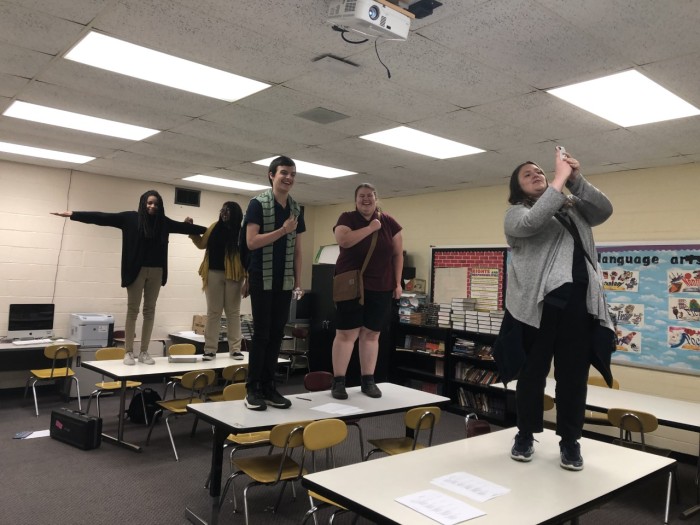
On the last day of school this year, my 8th grade students gave me one of the greatest salutes a teacher can get.


They reenacted the closing scene of “The Dead Poets Society.”


You know. The one where Robin Williams’ Mr. Keating has been fired from a boarding school for teaching his students to embrace life, and as he collects his things and leaves, the students get up on their desks as a testament to his impact and as a protest to the current administration’s reductive standardization.


That’s what my students did for me. And I almost didn’t even notice it at first.


The whole thing went down like this.

 
The bell rang and an announcement was made telling us that the day was done.

 
I was immediately rushed by a crowd of children turning in final projects, shaking my hand, saying goodbye.

 
In fact, I was so occupied with the students right in front of me that I didn’t notice what was happening with the ones just behind them.

 
I heard someone say in a ringing voice, “Oh Captain, my Captain!”

 
I looked up and there they were.

 
About a dozen students were standing on their desks, looking down at me with big goofy grins.


Some had their hands on their hearts. One had raised his fist in the air. I think someone in the back was even making jazz hands. But they were each standing up there with the same look on their faces – a mixture of independence, humor and gratitude.


It shouldn’t have come as a surprise that this happened. Some of them had threatened months ago to make just such a demonstration.

 
We had watched the movie together back in April at the introduction of our poetry unit. I guess it was my way of trying to show them that poetry could make a deep impact on people. But I certainly hadn’t wanted them to put themselves at risk by standing on the furniture.


In fact, I had specifically cautioned them NOT to do this exact thing because someone might fall off their desk and hurt themselves.


But on the last day of school after the last bell has rung and my tenure as their teacher has expired – well, things are different then.


“Thank you,” I said. “That is really one of the nicest things students have ever done for me.”


Then I took out my phone and asked if I could snap a few pictures, because who’d ever believe me if I didn’t? They didn’t mind.


thumbnail_IMG_8835thumbnail_IMG_8830thumbnail_IMG_8832


When I was done, they hopped down one at a time, many of them rushing forward to give me a hug.


This class will always be a special one in my heart.


We’ve come a long way together.


For most of them, I was their language arts teacher for two years. When they first came in the classroom they were just babies. Now they are going off to high school.


Unless you’re a parent, you wouldn’t believe how much kids can grow and change in just a few short years. And the middle school years are some of the most extreme. The line between child and adult fades into nothingness.


I’ve had a handful of children who were enrolled in my classes for multiple years before, but I’d never had so many. In some ways, we were more like a family than a classroom.


I had been there when parents got sick, left, died. I knew them all so well – who would ask questions just to stall, who never got enough sleep and why (often Fortnite), which ones had athletic aspirations, which were incredible artists, etc. Some had come out of the closet to me and their classmates but not at home.


Many of us went on a school field trip to Washington, DC, together. We’d toured the Holocaust Museum and Arlington National Cemetery. When I was invited to do a TED talk, they tracked it down on YouTube. They even found my Twitter account and made merciless fun of my profile picture. And when I actually had my book published on education issues last year, a bunch of my kids even came out to hear me talk about it at local book stores.


It’s hard to explain the depth of the relationship.


At the end of the year, I always give my students a survey to gauge how they think I did as their teacher. It’s not graded, and they can even turn it in anonymously.


The results are almost always positive, but this year, I got responses like never before:


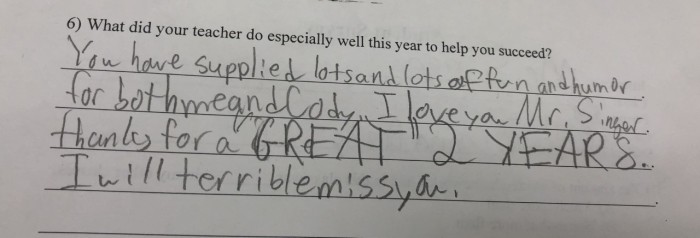
“I love you, Mr. Singer. Thanks for a great 2 years. I will terribly miss you.”


thumbnail_IMG_8849

“I’ve never been bored here. You are the first teacher that made me want to go to their class and has been one of my favorites.”


thumbnail_IMG_8847

“He stayed cool as a cucumber and was never angry… Basically the greatest teacher I’ve had all year.”


thumbnail_IMG_8846

 He was “fair to all students.”


thumbnail_IMG_8845

“He was more inclusive to many different groups.”


thumbnail_IMG_8844

“He made sure I didn’t fool around. He let me hand in my work late. He was always very kind and he cares about us. He shows us that he cares about how we feel. He made sure everything was fair.”


thumbnail_IMG_8843

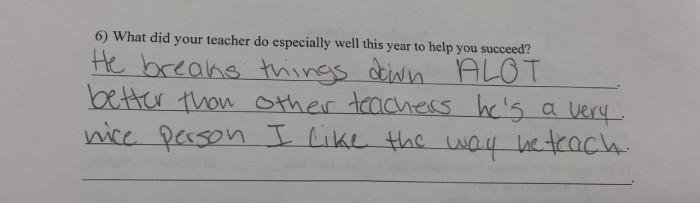
“He breaks things down A LOT better than other teachers. He’s a very nice person. I like the way he teaches.”


thumbnail_IMG_8842


“Mr. Singer did well to motivate us and help us to succeed and get a better grade.”


thumbnail_IMG_8841


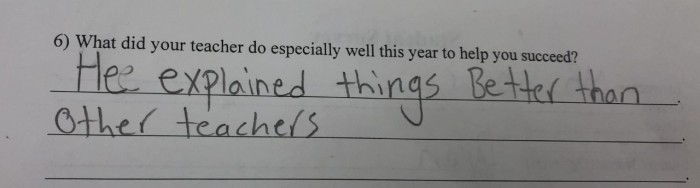
“He explained things better than other teachers.”


thumbnail_IMG_8840

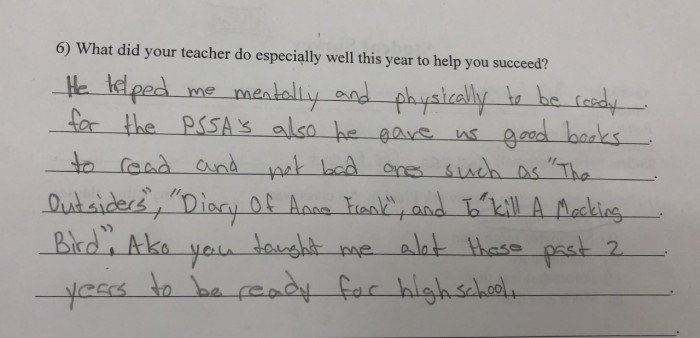
“He helped me mentally and physically to be ready for the PSSAs. Also he gave us good books to read and not bad ones such as “The Outsiders,” “The Diary of Anne Frank,” and “To Kill a Mockingbird.” Also you taught me a lot these past 2 years to be ready for high school.”


thumbnail_IMG_8839


“To be absolutely honest, I don’t think my teacher needs to improve. He actually has done more than the rest of my teachers.”


thumbnail_IMG_8838


“Well he encouraged me to succeed more in his class and in life as well. He also taught me that the meaning of life is not how you take it but where you go with it. I’m thankful that he taught me more than the history my actual history teacher taught me. He also told me the truth of our history. He talked about the parts no one else would talk about.”


thumbnail_IMG_8837


I’m not sure there’s much to say beyond that.


As these now former students reluctantly walked away in ones or twos, a few stayed behind.


I did a lot of reassuring that 9th grade would be great and that I’d probably be right here if they needed me.


I overheard one girl say to another that a certain teacher was good but not “Mr. Singer good.” I thanked her and she blushed because I wasn’t supposed to hear that.


There were tears. Some of them shed by me.


But when the last student left, I remained at my desk surrounded by a hum of fluorescent lights and ear numbing silence.


There is no emptiness like that of a space that has just been filled – a space that cries out for more.


My classroom is like that. And so is my heart.


Don’t get me wrong. I need this summer break to recover.


But I also need the end of August, when a new group of students will come rushing through those doors.


Here’s looking forward to the first day of school.


Like this post? I’ve written a book, “Gadfly on the Wall: A Public School Teacher Speaks Out on Racism and Reform,” now available from Garn Press. Ten percent of the proceeds go to the Badass Teachers Association. Check it out!

book-1

Top 10 Reasons Bernie Sanders’ Education Policies Are Light Years Ahead of Everyone Else’s

Screen Shot 2019-06-18 at 11.07.04 AM


For most of my life, the United States has been neglecting its public school children – especially the black and brown ones.


Since the mid 1970s, instead of integrating our schools, we’ve been slowly resegregating them on the basis of race and social class.


Since the 1980s, instead of measuring academic success by the satisfaction of an individuals curiosity and authentic learning, we’ve been slowly redefining it to mean nothing but achievement on standardized tests.


And since the 1990s, instead of making sure our schools meet the needs of all students, we’ve been slowly allowing charter schools to infect our system of authentic public education so that business interests are education’s organizing principle.


But now, for the first time in at least 60 years, a mainstream political candidate running for President has had the courage to go another way.


And that person is Bernie Sanders.


We didn’t see this with Barack Obama. We didn’t see it with Bill Clinton. We certainly didn’t see it with any Republican Presidents from Reagan to the Bushes to Trump.


Only Sanders in his 2020 campaign. Even among his Democratic rivals for the party’s nomination – Warren, Biden, Harris, Booker and a host of others – he stands apart and unique. Heck! He’s even more progressive today on this issue than he was when he ran in 2015.


It doesn’t take a deep dive into the mass media to find this out. You don’t have to parse disparate comments he made at this rally or in that interview. If you want to know what Bernie thinks about education policy, you can just go on his campaign Website and read all about it.


The other candidates barely address these issues at all. They may be open about one or even two of them, but to understand where they stand on education in total – especially K-12 schooling – you have to read the tea leaves of who they’ve selected as an education advisor or what they wrote in decades old books or what offhand comments they made in interviews.


In almost every regard, only Sanders has the guts to tell you straight out exactly what he thinks. And that’s clear right from the name of his proposal.


He calls it “A Thurgood Marshall Plan for Public Education.”


Why name his agenda after the first black Supreme Court justice? Because prior to accepting a nomination to the highest court in the land, Marshall argued several cases before that court including the landmark Brown v. Board of Education. He also founded the NAACP Legal Defense and Education Fund. Not only did Marshall successfully argue that school segregation violated the equal protection clause of the U.S. Constitution, but he spent his life fighting for civil rights.


Sanders is the only candidate out there today brave enough to connect those dots. The fight against segregation, high stakes testing and school privatization is a fight for civil rights.


That is clear in nearly every aspect of his plan.


I’m not saying it’s perfect. He doesn’t go as far as he might in some areas – especially against high stakes testing. But his plan is so far advanced of anything anyone else has even considered, it deserves recognition and strong consideration.


So without further ado, I give you the top 10 reasons Bernie Sanders’ education platform is the most progressive in modern American history:


1) He Proposes Fighting School Segregation and Racial Discrimination


Sanders understands that many of our public schools today are more segregated than they were 65 years ago when Brown v. Board was decided. Only 20 percent of our teachers are nonwhite – even in schools that serve a majority of black and brown children. Implicit racial bias puts these students at risk of higher suspensions, unfair discipline policies and an early introduction into the criminal justice system through the school-to-prison pipeline.


Bernie proposes we increase funding to integrate schools, enforce desegregation orders and appoint federal judges who will support these measures. He wants to triple Title I funding for schools serving poor and minority children and increase funding for English as a Second Language programs. He even suggests racial sensitivity training for teachers and better review of civil rights complaints and discipline policies.


This could have an amazingly positive impact on our schools. Imagine a school system where people of all different races, nationalities, sexualities and creeds could meet and get to know one another. It’s harder to be racist and prejudiced adults when as children you learned not to consider people different than you as an other. It’s also harder to withhold funding and opportunities to minority populations when you mix all children together in the same schools.


2) He Would Ban For-Profit Charter Schools


This is a case of Bernie just listening to what educators, school directors and civil rights organizations like the NAACP are already saying. Charter schools are publicly funded but privately operated. Though this differs somewhat from state to state, in general it means that charters don’t have to abide by the same rules as the authentic public schools in the same neighborhoods. They can run without an elected school board, have selective enrollment, don’t have to provide the same services for students especially those requiring special education, and they can even cut services for children and pocket the savings as profit.


Moreover, charters increase segregation – 17 percent of charter schools are 99 percent minority, compared to 4 percent of traditional public schools.
To reverse this trend, Bernie would ban for-profit charter schools and impose a moratorium on federal dollars for charter expansion until a national audit was conducted. That means no more federal funds for new charter schools.


Moving forward, charter schools would have to be more accountable for their actions. They would have to comply with the same rules as authentic public schools, open their records about what happens at these schools, have the same employment practices as at the neighborhood authentic public school, and abide by local union contracts.


I know. I know. I might have gone a bit further regulating charter schools, myself, especially since the real difference between a for-profit charter school and a non-profit one is often just its tax status. But let’s pause a moment here to consider what he’s actually proposing.


If all charter schools had to actually abide by all these rules, they would almost be the same as authentic public schools. This is almost tantamount to eliminating charter schools unless they can meet the same standards as authentic public schools.


I think we would find very few that could meet this standard – but those that did could – with financial help – be integrated into the community school system as a productive part of it and not – as too many are now – as parasites.


Could Bernie as President actually do all of this? Probably not considering that much of charter school law is controlled by the states. But holding the bully pulpit and (with the help of an ascendant Democratic legislature?) the federal purse strings, he could have a transformative impact on the industry. It would at least change the narrative and the direction these policies have been going. It would provide activists the impetus to make real change in their state legislatures supporting local politicians who likewise back the President’s agenda.


3) He’d Push for Equitable School Funding


Bernie understands that our public school funding system is a mess. Most schools rely on local property taxes to make up the majority of their funding. State legislatures and the federal government shoulder very little of the financial burden. As a result, schools in rich neighborhoods are well-funded and schools in poor neighborhoods go wanting. This means more opportunities for the already privileged and less for the needy.


Bernie proposes rethinking this ubiquitous connection between property taxes and education, establishing a nationwide minimum that must be allocated for every student, funding initiatives to decrease class size, and supporting the arts, foreign language acquisition and music education.


Once again, this isn’t something the President can do alone. He needs the support of Congress and state legislatures. But he could have tremendous influence from the Oval Office and even putting this issue on the map would be powerful. We can’t solve problems we don’t talk about – and no one else is really talking much about this. Imagine if the President was talking about it every day on the news.


4) He’d Provide More Funding for Special Education Students

Students with special needs cost more to educate than those without them. More than four decades ago, the federal government made a promise to school districts around the country to fund 40 percent of the cost of special education. It’s never happened. This chronic lack of funding translates to a shortage of special education teachers and physical and speech therapists. Moreover, the turnover rate for these specialists is incredibly high.


Bernie wants to not only fulfill the age old promise of special education funding but to go beyond it. He proposes the federal government meet half the cost for each special needs student. That, alone, would go a long way to providing financial help to districts and ensuring these children get the extra help they need.

5) He Wants to Give Teachers a Raise


Teachers are flooding out of the classroom because they often can’t survive on the salaries they’re being paid. Moreover, considering the amount of responsibilities heaped on their shoulders, such undervaluing is not only economically untenable, it is psychologically demoralizing and morally unfair. As a result, 20 percent of teachers leave the profession within five years – 40 percent more than the historical average.


Bernie suggests working with states to ensure a minimum starting salary of $60,000 tied to cost of living, years of service, etc. He also wants to protect and expand collective bargaining and tenure, allow teachers to write off at least $500 of expenses for supplies they buy for their classrooms, and end gender and racial discrepancies in teacher salaries.


It’s an ambitious project. I criticized Kamala Harris for proposing a more modest teacher pay raise because it wasn’t connected to a broad progressive education platform like Sanders. In short, we’ve heard neoliberal candidates make good suggestions in the past that quickly morphed into faustian bargains like merit pay programs – an initiative that would be entirely out of place among Sanders initiatives.


In Harris’ case, the devil is in the details. In Sanders, it’s a matter of the totality of the proposal.

6) He Wants to Expand Summer School and After School Programs


It’s no secret that while on summer break students forget some of what they’ve learned during the year and that summer programs can help reduce this learning loss. Moreover, after school programs provide a similar function throughout the year and help kids not just academically but socially. Children with a safe place to go before parents get home from work avoid risky behaviors and the temptations of the streets. Plus they tend to have better school attendance, better relationships with peers, better social and emotional skills, etc.


Under the guidance of Betsy Devos, the Trump administration has proposed cutting such programs by $2 billion. Bernie is suggesting to increase them by $5 billion. It’s as simple as that. Sanders wants to more than double our current investment in summer and after school programs. It’s emblematic of humane and rational treatment of children.


7) He Wants to Provide Free Meals for All Students Year-Round


One in six children go hungry in America today. Instead of shaming them with lunch debts and wondering why they have difficulty learning on an empty stomach, Bernie wants to feed them free breakfast, lunch and even snacks. In addition, he doesn’t want to shame them by having the needy be the only ones eligible for these free meals. This program would be open to every child, regardless of parental wealth.


It’s an initiative that already exists at many Title I schools like the one where I teach and the one where my daughter goes to school. I can say from experience that it is incredibly successful. This goes in the opposite direction of boot strapped conservatives like Paul Ryan who suggested a free meal gives kids an empty soul. Instead, it creates a community of children who know that their society cares about them and will ensure they don’t go hungry.


That may seem like a small thing to some, but to a hungry child it can make all the difference.


8) He Wants to Transform all Schools into Community Schools


This is a beautiful model of exactly what public education should be.


Schools shouldn’t be businesses run to make a profit for investors. They should be the beating heart of the communities they serve. Bernie thinks all schools should be made in this image and provide medical care, dental services, mental health resources, and substance abuse prevention. They should furnish programs for adults as well as students including job training, continuing education, art spaces, English language classes and places to get your GED.
Many schools already do this. Instead of eliminating funding for these types of schools as the Trump administration has suggested, Bernie proposes providing an additional $5 billion in annual funding for them.


9) He Would Fix Crumbling Schools


America’s schools, just like her roads and bridges, are falling into disrepair. A 2014 study found that at least 53 percent of the nation’s schools need immediate repair. At least 2.3 million students, mostly in rural communities, attend schools without high-speed internet access. Heating and cooling systems don’t work. 
Some schools have leaks in their roofs. This is just not acceptable.


Bernie wants to fix these infrastructure issues while modernizing and making our schools green and welcoming.


10) He Wants to Ensure All Students are Safe and Included


Our LGBTQ students are at increased risk of bullying, self harm and suicide. We need schools where everyone can be safe and accepted for who they are.


Bernie wants to pass legislation that would explicitly protect the rights of LGBTQ students and protect them from harassment, discrimination and violence. He is also calling for protection of immigrant students to ensure that they are not put under surveillance or harassed due to their immigration status. Finally, this project includes gun violence prevention to make school shootings increasingly unlikely.


There are a lot of issues that fall under this umbrella, but they are each essential to a 21st Century school. Solutions here are not easy, but it is telling that the Sanders campaign includes them as part of his platform.
So there you have it – a truly progressive series of policy proposals for our schools.
Not since Lyndon Johnson envisioned the Elementary and Secondary Education Act (ESEA) has there been a more far reaching and progressive set of education initiatives.


What About High Stakes Testing?


Unfortunately, that also highlights Sanders biggest weakness.


Johnson’s signature legislation which had been focused on addressing funding disparities in 1965 became under George W. Bush in the 2000s a way of punishing poor schools for low standardized test scores.


The glaring omission from Sanders plan is anything substantive to do with high stakes testing.


The Thurgood Marshall plan hardly mentions it at all. In fact, the only place you’ll find testing is in the introduction to illustrate how far American education has fallen behind other countries and in this somewhat vague condemnation:


“We must put an end to high-stakes testing and “teaching to the test” so that our students have a more fulfilling educational life and our teachers are afforded professional respect.”


However, it’s troubling that for once Bernie doesn’t tie a political position with a specific policy. If he wants to “end high-stakes testing,” what exactly is his plan to do so? Where does it fit within his education platform? And why wasn’t it a specific part of the overall plan?


Thankfully, it is addressed in more detail on FeelTheBern.org – a Website not officially affiliated with Sanders but created by volunteers to spread his policy positions.


After giving a fairly good explanation of the problems with high stakes testing, it references this quote from Sanders:


“I voted against No Child Left Behind in 2001, and continue to oppose the bill’s reliance on high-stakes standardized testing to direct draconian interventions. In my view, No Child Left Behind ignores several important factors in a student’s academic performance, specifically the impact of poverty, access to adequate health care, mental health, nutrition, and a wide variety of supports that children in poverty should have access to. By placing so much emphasis on standardized testing, No Child Left Behind ignores many of the skills and qualities that are vitally important in our 21st century economy, like problem solving, critical thinking, and teamwork, in favor of test preparation that provides no benefit to students after they leave school.”


The site suggests that Bernie supports more flexibility in how we determine academic success. It references Sanders 2015 vote for the Every Child Achieves Act which allows for states to create their own accountability systems to assess student performance.


However, the full impact of this bill has not been as far reaching as advocates claimed it would be. In retrospect, it seems to represent a missed opportunity to curtail high stakes testing more than a workaround of its faults.


In addition, the site notes the problems with Common Core and while citing Sanders reticence with certain aspects of the project admits that he voted in early 2015 against an anti-Common Core amendment thereby indicating opposition to its repeal.


I’ll admit this is disappointing. And perplexing in light of the rest of his education platform.


It’s like watching a vegan buy all of his veggies at Whole Foods and then start crunching on a slice of bacon, or like a gay rights activist who takes a lunch break at Chick-fil-a.


My guess is that Sanders hasn’t quite got up to speed on the issue of standardized testing yet. However, I can’t imagine him supporting it because, frankly, it doesn’t fit in with his platform at all.


One wonders what the purpose of high stakes testing could possibly be in a world where all of his other education goals were fulfilled.


If it were up to me, I’d scrap high stakes testing as a waste of education spending that did next to nothing to show how students or schools were doing. Real accountability would come from looking at the resources actually provided to schools and what schools did with them. It would result from observing teachers and principals to see what education they actually provided – not some second hand guessing game based on the whims of corporations making money on the tests, the grading of the tests and the subsequent remediation materials when students failed.


For me, the omission of high stakes testing from Sanders platform is acceptable only because of the degree of detail he has already provided in nearly every other aspect. There are few areas of uncertainty here. Unlike any other candidate, we know pretty well where Sanders is going.


It is way more likely that advocates could get Sanders to take a more progressive and substantial policy stand on this issue than that he would suddenly become a standardized testing champion while opposing everything else in the school privatization handbook.


Conclusion


So there it is.


Bernie Sanders has put forth the most progressive education plan in more than half a century.


It’s not perfect, but it’s orders of magnitude better than the plans of even his closest rival.


This isn’t to say that other candidates might not improve their education projects before the primary election. I hope that happens. Sanders has a knack for moving the conversation further left.


However, he is so far ahead, I seriously doubt that anyone else will be able to catch him here.


Who knows what the future will bring, but education advocates have a clear first choice in this race – Bernie Sanders.


He is the only one offering us a real future we can believe in.


Like this post? I’ve written a book, “Gadfly on the Wall: A Public School Teacher Speaks Out on Racism and Reform,” now available from Garn Press. Ten percent of the proceeds go to the Badass Teachers Association. Check it out!

book-4

School Field Trip Turns Into a Tour of Our Nation’s Unhealed Scars

OLYMPUS DIGITAL CAMERA

 
You’ve got to be a little crazy to take a bunch of teenagers on a field trip – especially overnight and out of town.


But that’s what I did, and – yeah – guilty as charged.


For the second time in my more than 15-year career as a public school teacher, I volunteered along with a group of parents and other teachers to escort my classes of 8th graders to Washington, DC, and surrounding sights.
 
And I never regretted it. Not for a moment.


Not when Jason bombed the bathroom in the back of the bus after eating a burrito for lunch.


Not when Isaac gulped down dairy creamers for dessert and threw up all over himself.


Not when a trio of teenage girls accidentally locked themselves in their hotel room and we needed a crowbar to get them out.


But as I stood in Manassas, Virginia, looking at a statue of Stonewall Jackson, the edge of regret began to creep into my mind.


There he was perched on the horizon, ripped and bulging like an advertisement for weight gain powder.


“We call him the superman statue,” the park ranger said.


And as I stood amongst the confused looks of my western Pennsylvania teens, I felt a wave of cognitive dissonance wash over me like a slap in the face.

 
Stonewall Jackson, a lanky Confederate General whose horse was too small for him, here mythologized, enshrined and worshiped like a hero. Yet he was a traitor to our country.


They call him Stonewall because the union army couldn’t get through his battle lines. He was like a wall the North could not break through.

 
So what?


He was fighting to preserve human slavery. Who cares how well he fought or how great his tactics? He was on the losing side of history.


We shouldn’t be praising him. He should be forgotten, at best a footnote in a record that celebrates those fighting to overturn human bondage, not those battling to uphold it.


But the confusion didn’t start at the statue. It began before our tour bus even arrived at the national park.


I teach Language Arts, not history, but I had never heard of the battle of Manassas. I knew it was close to Bull Run, a nearby creek where the two Civil War battles of that name were fought.
 
It was only when the park ranger was showing us the sights (of which there weren’t many) that the truth became clear.

 
Even today more than 150 years since Lee surrendered to Grant at the Appomattox Court House, the two sides can’t agree on the names of the battles.


In the South, they name them after the nearest city or town. In the North, we name them after the nearest geologic landmark.


So even though this battle took place on a farm in northern Virginia, we still can’t agree even on what to call the confrontation – much less its import to our shared history.


Before we stepped out onto the battlefield, the park service treated us to a short documentary film about the site and its history – “Manassas: End of Innocence.”


The film was narrated by Richard Dreyfus. I marveled at hearing Mr. Holland nonchalantly inform us that this first battle of the Civil War marked the titular “end of innocence.”

 
I’m still not sure who suffered such an end. Was it the nation, as a whole, which had never before experienced such a bloody war among its own citizenry, pitting brother against brother? Was it the North who had not until this point realized the South would resist with shot and shell?  Was it the South who had not yet tasted the bitterness of Northern aggression?


The latter seemed to be the narrator’s implication.

 
Dreyfus painted a scene of peaceful life on the farm shattered by the sneak attack of union soldiers.
 
THAT is what marked this “end of innocence.”

 
“Innocence!?” I thought.


These people were not innocent. They owned slaves. Mrs. Judith Carter Henry, the 85-year-old who refused to evacuate her farm and was killed in the fighting, owned another human being.


In my book, that disqualifies you from any kind of innocence.


And that’s what this whole war was essentially about. Should people be allowed to own other people?

 
The answer is an unequivocal – NO.


The fact that an entire segment of our population still drags its feet on that question has implications that reverberate through our history and up through our last Presidential election.

 
A few days before venturing to Manassas, my students and I toured Washington, DC. We stopped in front of the White House.

 
I’d been there before. It’s a popular place for protests of every kind. But never had I seen it so crowded with discontent.


Political critics had set up booths and tents. They even brought speakers to blast out music to accompany their protests. My favorite was the song “Master of the House” from Les Miserables booming from a booth with multicolored “F- Trump!” signs.


But as we took our picture in front of that iconic Presidential manor, itself, partially built by slaves, I couldn’t help noticing another kiosk across the way – one selling MAGA hats.
 
In fact, they were everywhere.

 
A few students even bought them – cheap red knockoff baseball caps with a slogan of dog whistle hatred emblazoned on the front.


Make America Great Again? Like when union troops couldn’t get passed Stonewall Jackson?
 
We hit many more famous sites.


We went to the Jefferson memorial and all I could think about was Sally Hemings. We went to the FDR memorial and all I could think about were the Japanese internment camps. We went to the Martin Luther King memorial and all I could think about was how the struggle continues.


We didn’t talk much about what we were seeing. We just raced through the experience of it – going from one to another – gotta’ get back on the bus in time to hit the next one.

 
We had a really good time together on that field trip. Me, included.


But we took a lot more home with us than souvenirs.

 
It wasn’t just sight seeing or a vacation from the normal school day.


We toured the historic scars of our nation.


Scars still red and ripe and bleeding.


Will they ever heal, I wondered.


Will our nation ever become whole, healthy and clean?


I suppose that depends on us.


Because the first step to healing them is recognizing that they’re still there.


Like this post? I’ve written a book, “Gadfly on the Wall: A Public School Teacher Speaks Out on Racism and Reform,” now available from Garn Press. Ten percent of the proceeds go to the Badass Teachers Association. Check it out!

book-3

SAT Adversity Score is an Antidote to Poison None of Us Need Take

Screen Shot 2019-05-26 at 7.40.58 PM


Let’s say someone gave you a vial of poison.


Would you drink it? Of course not.


What if he gave you the antidote, too. Would you take the poison then?


Heck no!


Why would anyone knowingly ingest poison even if they knew they could counteract its effects?


But that’s pretty much the situation high school students across the country are in today with the SAT test.


The College Board has admitted that the test unfairly assesses students – especially poor and minority students. However, if we add an “adversity score” to the raw score, then voila! Fairness!

 
The organization is piloting a program at 150 colleges and universities to adjust SAT scores to account for high schools and neighborhoods “level of disadvantage.”

The program is called the “Environmental Context Dashboard” and has been in the works since 2015 at the request of colleges. It provides admissions officers with information about students’ neighborhoods and high schools, such as the poverty level and the availability of challenging coursework. This is supposed to allow them to put raw scores into context before making admissions decisions.

 
But even if this actually remedies the inherent racial and economic biases inherent in the 93-year-old assessment, why take the bloody thing in the first place!?


The College Board is a 119-year-old organization boasting 6,000 member colleges, universities and other organizations. And despite its nonprofit status, it does make an awful lot of money.

 
The organization’s annual revenue is more than $750 million, according to its most recent publicly available 990 form. The organization’s CEO David Coleman makes $750,000 a year, its President Gaston Caperton makes more than $1.5 million a year, and 22 other employees earn at least $200,000.


Nice work if you can get it.


As such, the College Board needs to ensure millions of teenagers keep taking its moneymaking test as they apply to institutions of higher education. But more than 1,200 colleges and universities no longer require students seeking enrollment to take the SAT and among those that do the upstart ACT test is gaining popularity and market share.


The SAT’s new adversity score is a marketing tool – nothing more.


It’s the act of rats trapped in a corner. They’re admitting everything critics always said about them and offering a white flag.


We have no need to take it. In fact, we would be incredibly stupid to do so.


What the world needs is not an adversity score to counteract all the bad things the SAT does. It needs the absence of the SAT and all such standardized gatekeeper assessments.


Coleman is infamous as the father of a number of failed education reforms including the Common Core.


It’s absolutely hilarious to hear him admitting the biases of standardized testing since he’s been one of its leading proponents since the 1990s. It’s like hearing Colonel Sanders admit he doesn’t really like fried chicken all that much.


In the case of the SAT, he said colleges need to recognize student qualities that the test can’t capture, such as resourcefulness. Essays, letters of recommendation, and the “profiles” most high schools post sometimes capture the challenges and circumstances students face, he said, but in many cases colleges don’t find this information because they’re blinded by students’ tests scores.


Without a tool like the dashboard, he said, “the SAT could be misleading.”


YOU DON’T SAY!


“To warrant that the playing field is now level isn’t right or just,” Coleman added. “In the America we live in … the vast majority of students are working with a lot less than the top third. To then say that the SAT is enough to reflect what you can do, no, it isn’t.”

 
All of which begs the question of why we need the SAT test at all.


Why not just look at those essays and letters of recommendation. Look at student extra curricular activities, employment record – heck! – grades!


Classroom grades represent 180 days worth of data compiled by multiple educators over at least 12-13 years.


Admittedly, they aren’t completely objective but neither are standardized test scores. We do not have the power to crack open children’s skulls and see what’s going on in their brains. But classroom grades offer exponentially more data and of a much more equitable kind.


If all of that isn’t enough to make admissions decisions, then nothing will ever be.


But let’s be honest. This isn’t about the needs of schools or students.


It’s about the needs of big business enterprises like the College Board and the standardized testing companies; it’s about their need to turn a profit.


THAT is what this adversity score is out to save.


We’ve been criticizing the SAT and similar standardized assessments since they were first implemented in 1926. They were the creation of group of psychologists led by Robert M. Yerkes and Carl Brigham.


They were eugenicists who believed that white Europeans were superior to all others and used their pseudoscientific assessments to “prove” their biases. If there’s any doubt of that, I refer you to this passage from Brigham’s seminal work A Study of American Intelligence:

“The decline of American intelligence will be more rapid than the decline of the intelligence of European national groups, owing to the presence here of the negro. These are the plain, if somewhat ugly, facts that our study shows. The deterioration of American intelligence is not inevitable, however, if public action can be aroused to prevent it.”


Yerkes added:


“We should not work primarily for the exclusion of intellectual defectives but rather for the classification of men in order that they may be properly placed.”

 
It’s no wonder that the SAT is biased. Its creators were, and their assumptions about human nature still underlie the entire standardized testing enterprise.


No adversity score will ever undue that.


There comes a time when we need to simply stop the stupid racist crap we’ve been doing for generations – not try to prettify it so we can keep cashing in.


These sorts of conversions of scores have been tried before and routinely criticized as inaccurate.


The College Board tried something similar in the late 90s called the “striver’s tool.” It identified students who scored higher than expected based on racial, socioeconomic, and other data.


But it was shut down after it became a political football comparable to that of affirmative action – the same that has happened among certain conservatives with the new adversity score.


We’ve been engaged in unfair standardized testing for almost a century now.


Isn’t it time we admitted our mistake and moved on?


Or should we just keep drinking our poison and chasing it with a dubious antidote while our betters count their dirty money?


Like this post? I’ve written a book, “Gadfly on the Wall: A Public School Teacher Speaks Out on Racism and Reform,” now available from Garn Press. Ten percent of the proceeds go to the Badass Teachers Association. Check it out!
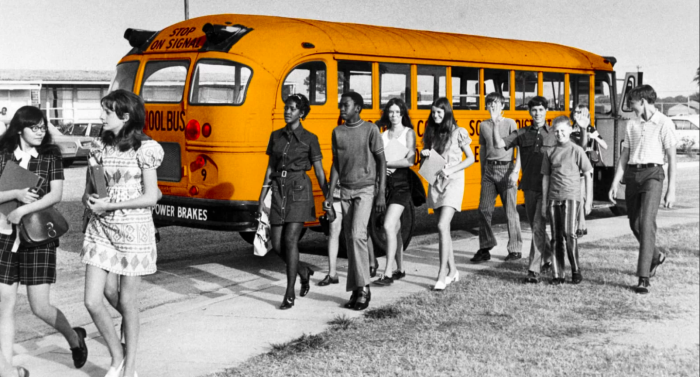
book-3


Charter Schools Are Quietly Gobbling Up My Public School District


Screen Shot 2019-05-19 at 7.49.57 PM


I work in a little suburban school district just outside of Pittsburgh, Pennsylvania, that is slowly being destroyed by privatization.


Steel Valley Schools have a proud history.


We’re located (in part) in Homestead – the home of the historic steel strike of 1892.


But today it isn’t private security agents and industrial business magnates against whom we’re struggling.


It’s charter schools, voucher schools and the pro-corporate policies that enable them to pocket tax dollars meant to educate kids and then blame us for the shortfall.


Our middle school-high school complex is located at the top of a hill. At the bottom of the hill in our most impoverished neighborhood sits one of the Propel network of charter schools.


Our district is so poor we can’t even afford to bus our kids to school. So Propel tempts kids who don’t feel like making the long walk to our door.


Institutions like Propel are publicly funded but privately operated. That means they take our tax dollars but don’t have to be as accountable, transparent or sensible in how they spend them.


And like McDonalds, KFC or Walmart, they take in a lot of money.


Just three years ago, the Propel franchise siphoned away $3.5 million from our district annually. This year, they took $5 million, and next year they’re projected to get away with $6 million. That’s about 16% of our entire $37 million yearly budget.


Do we have a mass exodus of children from Steel Valley to the neighboring charter schools?


No.


Enrollment at Propel has stayed constant at about 260-270 students a year since 2015-16. It’s only the amount of money that we have to pay them that has increased.


The state funding formula is a mess. It gives charter schools almost the same amount per regular education student that my district spends but doesn’t require that all of that money actually be used to educate these children.


If you’re a charter school operator and you want to increase your salary, you can do that. Just make sure to cut student services an equal amount.


Want to buy a piece of property and pay yourself to lease it? Fine. Just take another slice of student funding.


Want to grab a handful of cash and put it in your briefcase, stuff it down your pants, hide it in your shoes? Go right ahead! It’s not like anyone’s actually looking over your shoulder. It’s not like your documents are routinely audited or you have to explain yourself at monthly school board meetings – all of which authentic public schools like mine have to do or else.


Furthermore, for every student we lose to charters, we do not lose any of the costs of overhead. The costs of running our buildings, electricity, water, maintenance, etc. are the same. We just have less money with which to pay them.


But that’s not all. The state funding formula also requires we give exponentially more money to charters for students labeled special needs – orders of magnitude more than we spend on these kids at my district.


Here’s how the state school code mandates we determine special education funding for charter school kids:


“For special education students, the charter school shall receive for each student enrolled the same funding as for each non-special education student as provided in clause (2), plus an additional amount determined by dividing the district of residence’s total special education expenditure by the product of multiplying the combined percentage of section 2509.5(k) times the district of residence’s total average daily membership for the prior school year. This amount shall be paid by the district of residence of each student.”


So authentic public schools spend a different amount per each special education student depending on their needs. But we have to pay our charter schools an average. If they only accept students without severe disabilities, this amounts to a net profit for the charter schools – and they can spend that profit however they want.


Moreover, if they reclassify students without disabilities or with slight disabilities as special needs, that means more money for them, too. Is anyone checking up on them to make sure they aren’t gaming the system? Heck no! That’s what being a charter school is all about – little transparency, little accountability and a promise of academic results (which don’t have to pan out either).


In the 2015-16 school year, Steel Valley paid the 19th highest amount of its budget to charter schools in the state (9%) and that number is growing.


According to the state Department of Education, here’s how our charter school spending has increased:


Steel Valley Per Student Charter School Tuition:


2000-01 – 2012-13

Non-Special Ed: $9,321

Special Ed: $16,903


2013-14

Non-Special Ed: $9,731

Special Ed: $16,803


2014-15

Non-special Ed: $10,340

Special Ed $20,112


2015-16

Non-Special Ed: $12,326

Special Ed: $25,634


2016-17

Non-Special Ed: $13,879

Special Ed: $29,441


2017-18

Non-Special Ed: $13,484

Special Ed: $25,601


2018-19

Non-special ed: $14,965

Special ed: $32,809


All of this has real world consequences in the classroom. It means fewer teachers and larger class sizes. It means narrowed curriculum and fewer extracurricular activities. It means reduced options and opportunities for all children – just so a new business can duplicate the services already being offered but skim tax dollars off the top.


Our State Senator Jim Brewster understands the problem.


“Charters are strangling school districts, eventually will put them out of business. When you lose your school district, you lose your city,” he said in an article published by Public Source.


Brewster is a Democrat from McKeesport with four school districts being likewise “cannibalized” by charter schools.


Steel Valley School Board President Jim Bulger also characterized the situation as dire.


“ Charter Schools have become a twisted profit-making machine and not what they were originally intended for,” he said.


 “Originally charter schools were meant to serve a demographic that the public schools could not. For example being heavy in the performing arts or items like that. It’s unfortunate that several people have decided to twist this decent idea into a profit-making scheme that bleeds public education and its very soul.”


Much of the problem is in Harrisburg where legislators refuse to see or address the issue. And that’s often the best situation. Others actively make things worse.


For instance, the state used to reimburse each district for 30% of its costs to charter schools. Then in 2011, Republican Gov. Tom Corbett cut that while slashing the education budget by an additional $1 billion a year.


Though some of that money has been restored in subsequent budgets, the charter reimbursement has not. Putting it back in the budget would go far to alleviating the bleeding.


But legislators need to get serious about charter school reform.


We can no longer afford a system that requires authentic public schools to fund their own competition. In fact, schools should never be in competition in the first place. Every school should be excellent – and the only way to get there is to start with adequate, equitable, sustainable funding in the first place.


There are seven charter schools within 5 miles of my district: Propel Homestead, Propel Braddock Hills, Environmental Charter School at Frick PA, Propel Hazelwood, Academy Charter School (in Pittsburgh), Propel Mckeesport, and Propel East (in Monroeville).


In addition, there are 55 private schools in the same area. Though the Commonwealth doesn’t have school vouchers, per se, it does have a backdoor version supported by both Democrats and Republicans. Many of these private and parochial schools gobble up $210 million of state tax dollars through these tax credit programs – the Educational Improvement Tax Credit (EITC) and Opportunity Scholarship Tax Credit (OSTC) programs. And there’s a bill currently being considered in Harrisburg to increase that amount by $100 million this year and even more in subsequent years!


It seems our legislature has no problem spending on the school system so long as it isn’t the PUBLIC school system.


And the reason usually given for such support is the results privatized schools get. They claim to be better alternatives to the public system, but this is rarely if ever true.


Test scores are a terrible way compare schools, but charter and voucher schools rarely – if ever – outpace their authentic public school competitors. They either get similar scores or in many cases do much, MUCH worse.


For instance, take Propel Homestead.


In 2015-16, it served 573 students in grades K-12. Only 22% of students were proficient in math and 40% in Reading on state tests. Both scores are below state average.


Meanwhile, at Steel Valley High School during the same time period, we served 486 students in grades 9-12. In math, 50-54% of our students were proficient and 65-69% were proficient in Reading. That’s above state average in both cases. And we had similar results at our middle and elementary schools.


However, test scores are poor indicators of success.


Steel Valley Schools also had lower class sizes. We averaged 12 students per teacher. Propel Homestead averaged 15 students per teacher.


And then we come to segregation. Though both schools had significant minority populations, Steel Valley Schools had 42% minority enrollment, most of whom are black. Propel Homestead had 96% minority enrollment, most of whom are black.


So the authentic public school option is demonstrably of better quality, but our inability to bus students to-and-from school opens us up to predatory school charlatans who take advantage of our poverty.


And the situation is similar in surrounding communities. Poor districts serving impoverished minority students become targets for privatizers looking to make a fast buck off of our kids and families. They offer them a lower quality education and a slick sales pitch.


They increase segregation, lower academic quality, and get away with much needed funds that could help kids get a better education.


This nonsense has to stop.


The only schools that should be receiving public tax dollars are the authentically public ones.


They should have to abide by the same regulation, the same accountability standards, the same democratic governance, the same enrollment standards as authentic public schools. Otherwise, they should not qualify for public tax dollars.


We’re boring holes in the ship to make rickety life boats.


It’s time to stop the madness.


It’s time to stop letting our best chance to help all kids get eaten alive by the sharks of privatization.


Like this post? I’ve written a book, “Gadfly on the Wall: A Public School Teacher Speaks Out on Racism and Reform,” now available from Garn Press. Ten percent of the proceeds go to the Badass Teachers Association. Check it out!
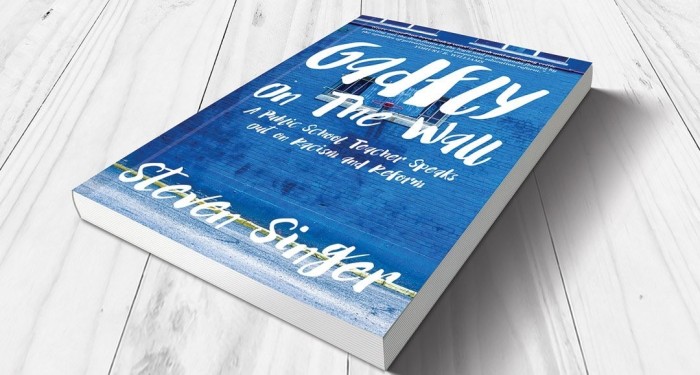
 

book-4