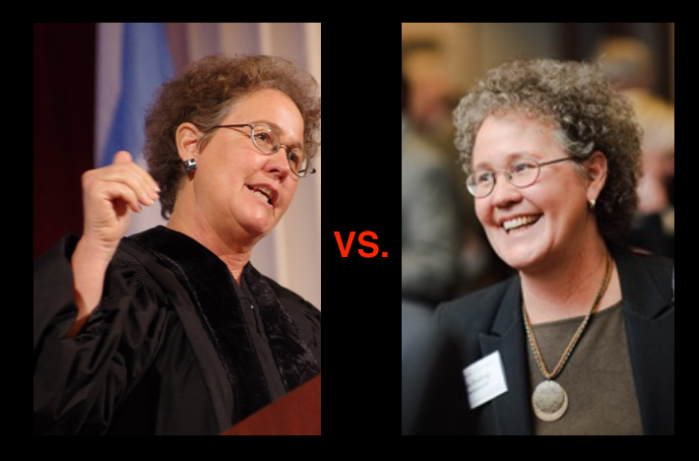
Linda Darling-Hammond vs. Linda-Darling Hammond – How a Once Great Educator Got Lost Among the Corporate Stooges

Screen Shot 2018-11-12 at 7.31.40 AM


Linda Darling-Hammond is one of my education heroes.


Perhaps that’s why her recent article in the Washington Post hurts so much.


In it, she and her think tank buddies slam education advocates Diane Ravitch and Carrol Burris for worrying about who governs schools – as if governance had nothing to do with quality education for children.


I’d expect something like that from Bill Gates.


Or Campbell Brown.


Or Peter Cunningham.


But not Hammond!


She’s not a know-nothing privatization flunky. She’s not a billionaire who thinks hording a bunch of money makes him an authority on every kind of human endeavor.


She’s a bona fide expert on teacher preparation and equity.


She founded the Center for Opportunity Policy in Education at Stanford University, where she is professor emeritus.


And she was the head of Barrack Obama’s education policy working group in 2008 when he was running for President.


In fact, she was the reasons many educators thought Obama was going to be a breath of fresh air for our schools and students. Everyone thought she was a lock for Education Secretary should Hope and Change win the day. But when he won, he threw her aside for people like Arne Duncan and John King who favored school privatization and high stakes standardized testing.


These days she spends most of her time as founder and president of the California-based Learning Policy Institute.


It’s a “nonprofit” think tank whose self-described mission is “to conduct independent, high-quality research to improve education policy and practice.”


The Learning Policy Institute published a report called “The Tapestry of American Public Education: How Can We Create a System of Schools Worth Choosing for All?


The report basically conflates all types of choice within the public school system.


On the one hand, it’s refreshing to have policy analysts admit that there ARE alternatives within the public school system above and beyond charter and voucher schools.


On the other, it’s frustrating that they can’t see any fundamental differences between those that are publicly managed and those outsourced to private equity boards and appointed corporate officers.


Hammond and her colleagues Peter Cookson, Bob Rothman and Patrick Shields talk about magnet and theme schools.


They talk about open enrollment schools – where districts in 25 states allow students who live outside their borders to apply.


They talk about math and science academies, schools focusing on careers in health sciences and the arts, schools centered on community service and social justice, international schools focused on global issues and world languages, and schools designed for new English language learners.


They talk about schools organized around pedagogical models like Montessori, Waldorf and International Baccalaureate programs.


And these are all options within the public school system, itself.


In fact, the report notes that the overwhelming majority of parents – three quarters – select their neighborhood public school as their first choice.


However, Hammond and co. refuse to draw any distinction between these fully public schools and charter schools.


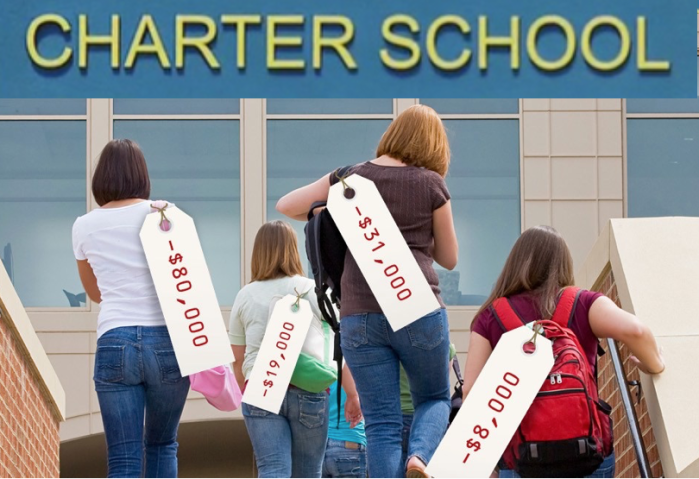
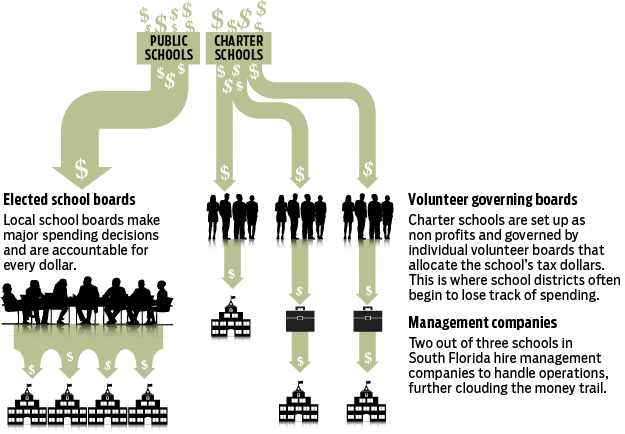
Unlike the other educational institutions mentioned above, charter schools are publicly funded but privately run.


They take our tax dollars and give them to private equity managers and corporate appointees to make all the decisions.


Though Hammond admits this model often runs into problems, she refuses to dismiss it based on the few instances where it seems to be working.


Despite concerns from education advocates, fiscal watchdogs and civil rights warrior across the country, Hammond and co. just can’t get up the nerve to take a stand.


The NAACP and Black Lives Matter have called for a moratorium on all new charter schools in the country. Journey for Justice has requested a focus on community schools over privatization. But Hammond – a once great advocate for equity – can’t get up the moral courage to stand with these real agents of school reform.


She stands with the corporate school reformers – the agents of privatization and profit.


“School choice is a means that can lead to different ends depending on how it is designed and managed…” write Hammond and her colleagues.


In other words, if charters result in greater quality and access for all students, they are preferable to traditional public schools.


However, she admits that charters usually fail, that many provide worse academic outcomes than traditional public schools serving similar students.


She notes that 33% of all charters opened in 2000 were closed 10 years later. Moreover, by year 13, that number jumped to 40%. When it comes to stability, charter schools are often much worse than traditional public schools.


And virtual charter schools – most of which are for-profit – are even worse. They “…have strong negative effects on achievement almost everywhere and graduate fewer than half as many of their students as public schools generally.”


However, after noting these negatives, Hammond and co. go on to provide wiggle room for privatization. They discuss how state governments can do better making sure charter schools don’t go off the rails. They can provide more transparency and accountability. They can outlaw for-profit charters and put caps on the number of charters allowed in given districts and states, set rules on staffing and curriculum – all the kinds of measures already required at traditional public schools.


But the crux of their objection is here:


“In a recent commentary in this column, authors Diane Ravitch and Carol Burris erroneously asserted that our report aims to promote unbridled alternatives to publicly funded and publicly operated school districts. Quite the opposite is true.”


In other words, they continue to lump privatized schools like charters in with fully public schools.


They refuse to make the essential distinction between how a school is governed and what it does. So long as it is funded with public tax dollars, it is a public school.


That’s like refusing to admit there is any difference in the manner in which states are governed. Both democracies and tyrannies are funded by the people living in those societies. It does not then follow that both types of government are essentially the same.


But they go on:


“The report aims to help states and districts consider how to manage the broad tapestry of choices available in public schools in ways that create quality schools with equitable access and integrative outcomes.”


Most tellingly, the authors admonish us to, “Focus on educational opportunities for children, not governance structures for adults” (Emphasis mine).


The way a school is governed is not FOR ADULTS. It is FOR CHILDREN. That is how we do all the other things Hammond and co. suggest.


“Work to ensure equity and access for all.”


That doesn’t just happen. You have to MAKE it happen through laws and regulations. That’s called governance.


“Create transparency at every stage about outcomes, opportunities and resources.”


That’s governance. That’s bureaucracy. It’s hierarchy. It’s one system overlooking another system with a series of checks and balances.


“Build a system of schools that meets all students’ needs.”


Again, that doesn’t just happen. We have to write rules and systems to make it happen.


Allowing private individuals to make decisions on behalf of private organizations for their own benefit is not going to achieve any of these goals.


And even in the few cases where charter schools don’t give all the decisions to unelected boards or voluntarily agree to transparency, the charter laws still allow them to do this. They could change at any time.


It’s like building a school on a cliff. It may be fine today, but one day it will inevitably fall.


I wrote about this in detail in my article “The Best Charter School Cannot Hold a Candle to the Worst Public School.”


It’s sad that Hammond refuses to understand this.


I say “refuse” because there’s no way she doesn’t get it. This is a conscious – perhaps political – decision on her part.


Consider how it stacks up against some of the most salient points she written previously.


For instance:


“A democratic education means that we educate people in a way that ensures they can think independently, that they can use information, knowledge, and technology, among other things, to draw their own conclusions.”


Now that’s a Linda Darling-Hammond who knows the manner in which something (a state) is governed matters. It’s not just funding. It’s democratic principles – principles that are absent at privatized schools.


“Bureaucratic solutions to problems of practice will always fail because effective teaching is not routine, students are not passive, and questions of practice are not simple, predictable, or standardized. Consequently, instructional decisions cannot be formulated on high then packaged and handed down to teachers.”


This Linda Darling-Hammond is a fighter for teacher autonomy – a practice you’ll find increasingly constrained at privatized schools. In fact, charter schools are infamous for scripted education, endless test prep and everything Hammond used to rail against.


“In 1970 the top three skills required by the Fortune 500 were the three Rs: reading, writing, and arithmetic. In 1999 the top three skills in demand were teamwork, problem-solving, and interpersonal skills. We need schools that are developing these skills.”


I wonder what this Linda Darling-Hammond would say to the present variety. Privatized schools are most often test prep factories. They do none of what Hammond used to advocate for. But today she’s emphatically arguing for exactly the kind of school she used to criticize.


“If we taught babies to talk as most skills are taught in school, they would memorize lists of sounds in a predetermined order and practice them alone in a closet.”


Isn’t this how they routinely teach at charter schools? Memorize this. Practice it only in relation to how it will appear on the standardized test. And somehow real life, authentic learning will follow.


“Students learn as much for a teacher as from a teacher.”


Too true, Linda Darling-Hammond. How much learning do you think there is at privatized schools with much higher turnover rates, schools that transform teachers into glorified Walmart greeters? How many interpersonal relationships at privatized institutions replacing teachers with iPads?


“Life doesn’t come with four choices.”


Yes, but the schools today’s Linda Darling-Hammond are advocating for will boil learning down to just that – A,B,C or D.


“We can’t fire our way to Finland.”


Yet today’s Linda Darling-Hammond is fighting for schools that work teachers to the bone for less pay and benefits and then fire them at the slightest pretense.


In short, I’m sick of this new Linda Darling-Hammond. And I miss the old Linda Darling-Hammond.


Perhaps she’s learned a political lesson from the Obama administration.


If she wants a place at the neoliberal table, it’s not enough to actually know stuff and have the respect of the people in her profession.


She needs to support the corporate policies of the day. She needs to give the moneymen what they want – and that’s school privatization.


This new approach allows her to have her cake and eat it, too.


She can criticize all the evils of actual charter schools while pretending that there is some middle ground that allows both the monied interests and the students to BOTH get what they want.


It’s shrewd political gamesmanship perhaps.


But it’s bad for children, parents and teachers.


Like this post? I’ve written a book, “Gadfly on the Wall: A Public School Teacher Speaks Out on Racism and Reform,” now available from Garn Press. Ten percent of the proceeds go to the Badass Teachers Association. Check it out!


cropped-book-1.jpg

Grit is Sh!t – It’s Just an Excuse to do Nothing for Struggling Students

 Screen Shot 2018-11-08 at 3.29.01 PM


Let’s say you’re out in public and you see a crying child alone in the street.


What would you do?


Would you run up to her and help? Or would you just shrug, mutter some derisive comment about the brat and walk on?


Our public school policymakers want us to do the later. In fact, they have a whole pedagogical justification for ignoring the needs of children.


It’s called “academic tenacity,” a “growth mindset” or “grit.”


And it goes something like this:


That child isn’t learning? If she just worked harder, she would.


It’s the political equivalent of “pull yourself up by your own bootstraps” applied to the classroom.


And it’s super helpful for politicians reluctant to allocate tax dollars to actually help kids succeed.


The idea and the euphemisms used to describe it were coined by Carol Dweck as early as 1999. It was subsequently popularized by seventh-grade math teacher and psychologist Angela Duckworth.


In the early 2000s, Duckworth realized that IQ wasn’t the only thing separating successful students from those who struggled. There was also the tendency to overcome adversity or not.


Hey, Angela. Darwin called. He wants his Theory of Natural Selection back.


You know Survival of the Fittest was never meant to be prescriptive. As human beings, we’re supposed to be better than mere animals that typically leave the pack’s sick and injured behind to get eaten by predators.


But whatever.


The term “grit,” is defined as a “passion and perseverance for long-term goals,” according to Frontiers in Psychology. And it’s become one of the buzziest of buzzwords in academia.


So much so, that as you’re reading this, standardized test manufacturers are working to develop an assessment to find it in students.


The agencies that administer the National Assessment of Education Progress (NAEP) and the Program for International Student Assessment (PISA) are close to including character assessments as a measure of student performance.


Oh goody!


They foresee a brave new world where multiple-choice tests will determine not just the entire scope of human knowledge but character as well!


But what no one wants to admit is that grit is… well… shit.


It’s just an excuse for a society that refuses to help those most in need.


In our world, there are haves and have-nots. But if we stop there, we ignore how and why this situation came to be.


Who places kids into segregated schools? WE DO.


Who allocates funding based largely on parental income? US.


We set kids up to succeed or fail before they even enter the school system with an economy that rewards the already rich and punishes generational poverty.


Yet when anyone suggests offering help to even the playing field – to make things more fair – a plethora of policy wonks wag their fingers and say, “No way! They did it to themselves.”


It’s typical “blame the victim” pathology to say that some kids get all the love, time and resources they need while others can do without — they just need more “grit” and a “growth mindset.”


Life’s tough. Get over it.


That’s easy for YOU to say! Because it’s the have’s who make the rules, it’s the people at the top who are telling the people at the bottom they’re to blame for their own suffering.


So you forget all the ways society has helped you and yours. YOU deserve all the credit for your successes.


But for those people over there, let’s forget all the ways society has refused to help and instead blame THEM for not overcoming the obstacles (we put) in their path.


Don’t get me wrong. I’m not saying effort counts for nothing. But it’s part of a complicated matrix of nature and nurture.


Our environments shape us, but we have some control over what we do with what we’re given.


Yet as a society, we can’t simply ignore our responsibilities toward others and throw it all on the individual.


Good teachers know how to get the best out of their students. We know that most kids – if given a safe, encouraging environment – can succeed.


The key often is to scaffold that success. Give them something to do that they can actually master. Then give them something slightly more challenging.


You teach them that they have the ability to succeed and success becomes a self-fulfilling prophecy – and not the opposite.


However, the teacher – and even the school, itself – can only do so much.


As a society, we need to change the environment in which these kids grow up.


We need to fully fund our public schools to meet the needs of all students. That means more funding, services and opportunities for the underserved than for those who already have the best of everything and don’t need to rely as heavily on the school system for support.


We need wraparound services, counseling, tutoring, after school programs, community schools, jobs programs, continuing education for adults and other services to help heal the trauma of growing up poor in America.


But leaving it all to this magical thing called “grit” is just ignoring our responsibilities to our fellow human beings.


When you see someone suffering, you need to help them – not comfort yourself with excuses for ignoring them.


Like this post? I’ve written a book, “Gadfly on the Wall: A Public School Teacher Speaks Out on Racism and Reform,” now available from Garn Press. Ten percent of the proceeds go to the Badass Teachers Association. Check it out!
book-2

Pennsylvania’s Keystone Exam – the Monster We Refuse to Let Die


Screen Shot 2018-10-22 at 12.16.27 PM


Let’s say there was a monster loose in Pennsylvania and you caught it.


Its days of wandering loose causing chaos and destruction were over.


But what would you do with such a beast now?


Would you kill it outright? Stop it from ever hurting anyone ever again?


Or would you simply neutralize it – place it perhaps in the center of a labyrinth, continue feeding it, and in fact create a whole religion based on worshipping it?


In the keystone state, we have just such a creature, and we’re going with the second option – the maze, nourishment and a cult.


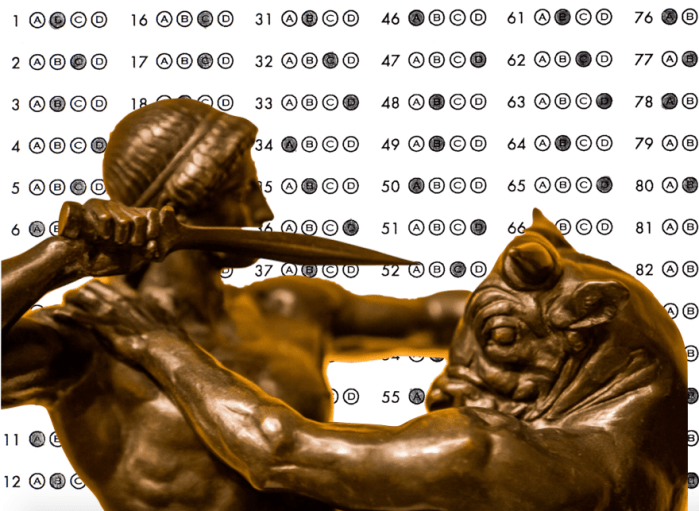
The monster is, of course, the Keystone Exams. And like the Minotaur of ancient myth, we’re building a bureaucratic prison in which to house it.


Sure, we’ve spent billions of dollars on these unnecessary, badly written and biased graduation assessments.


And, heck, it would just make more sense to stop doing something that isn’t working, wastes money and causes legitimate problems for students.


But this is Pennsylvania! We’re not going to admit we made a mistake. Better to bury it under red tape and pretend like this is what we meant all along. Nothing to see here, folks. Nothing to see…


When lawmakers originally came up with this plan… correction: when testing companies bribed federal lawmakers to force state lawmakers to enact this cockamamey plan – it was supposed to function as a graduation requirement.


Pass these tests or no diploma for you.


However, somehow Harrisburg politicians couldn’t get up the nerve to actually bar tens of thousands of worthy students from graduating when they had already proven they deserved it by passing 12 years of grade school.


So after kicking the can down the road for more than 6 years, they came up with this solution. Make it a graduation requirement, but include a whole truckload of other options that could count instead.


In short, we’re creating endless corridors of paperwork, placing the tests in the center and going on with our day.


The good news: if students can make it through the labyrinth, they never need to take or pass the Keystone Exams!


The bad news: we’re still paying millions of dollars to support these tests and we’re still forcing our teachers to make all instruction about them.


And that’s what we in the Commonwealth call a “victory.”


Yippee!


The bill to circumvent the Keystone Exams by providing multiple means of getting a diploma was passed by the state house and senate. Gov. Tom Wolf is expected to sign it into law this week.


If he does, students will still be given the Keystone Exams (unless opted out) and could demonstrate they’re worthy of a diploma by passing them. But students will have many additional ways to prove they’re worthy of a cap and gown, such as:


  • Show proficiency on the SAT, PSAT or ACT;
  • Pass an Advanced Placement or International Baccalaureate exam;
  • Complete a dual-enrollment program;
  • Complete an apprenticeship program;
  • Get accepted to an accredited four-year nonprofit institution of higher education;
  • Complete a service-learning project;
  • Secure a letter of full-time employment;
  • Achieve an acceptable score on a WorkKeys assessment, an exam administered by the ACT which assesses workplace skills including math, reading comprehension and applied technology.


To sweeten the pot even further, this won’t even go into effect until the 2021-22 school year.


So in four years, high school seniors will be racing to submit their letters of college admission, or letters of employment or SAT scores or whatever to prove they actually deserve that diploma.


But that will not be the end of it.


Just because victims thrown into the labyrinth have an easy path to avoiding the monster doesn’t mean the monster won’t affect them.


Teaching evaluations are still based on test scores. Schools evaluations are still based on test scores.


This continues the tremendous state pressure for local districts to make instruction all about testing.


Kids don’t have to pass the test, but their everyday classroom experiences will still be largely determined by these test.


Heck, many districts will probably “voluntarily” decide to make passing the test a graduation requirement just to force their students to take them seriously.


So anyone who’s out celebrating that the Keystone Exams are dead is premature.


State Sen. Andy Dinniman, at least, understands this.


“Remember, the Keystones have been delayed and the graduation requirement associated with them has been stopped, but they will still be required in Pennsylvania schools for federal accountability,” he said in statement.


“Meanwhile, we know they are expensive, redundant and unnecessary and I will continue to work to end them once and for all.”


Dinniman, a Democrat, is minority chair of the Senate Education Committee.


It’s a problem all too typical in the state.


Most lawmakers are too timid to take any type of real stand. They’d rather support some half-measure so they can claim to be in favor of either or both sides of an argument.


For instance, consider the time it takes to finish the tests.


Parents, teachers and students have complained about how these assessments waste academic time that could be better used to teach the necessary skills needed to pass.


So Gov. Wolf cut the Keystone Exams and Pennsylvania System of School Assessment (PSSA) test by a total of almost 2 hours a year.


However, at the same time, his administration suggests students take a series of additional pretests that are supposed to predict success on the PSSA or Keystone Exams – tests such as the Classroom Diagnostic Tools (CDT) assessment.


If schools follow the state’s instructions and give students this exam in reading, math and science 3 to 5 times a year, that’s an additional 50-90 minutes per test. That comes to 22.5 hours of additional testing!


So 22.5 hours minus 2 hours equals… NOT A REDUCATION IN TESTING!


But it gives lawmakers plausible deniability.


They can claim to be cutting testing while actually suggesting we increase it.


And we see the same sort of thing here.


Lawmakers can claim to be reducing the power of the Keystone Exams while still enshrining it as the driving force behind all instruction in the state.


What we need are leaders and not politicians.


We need people willing to take a stand and do what’s right even if that puts them at odds with the moneyed special interests.


That takes more than polls and market analysis.


It takes moral courage.


But there’s no test for that.


Like this post? I’ve written a book, “Gadfly on the Wall: A Public School Teacher Speaks Out on Racism and Reform,” now available from Garn Press. Ten percent of the proceeds go to the Badass Teachers Association. Check it out!
book-3

Five Reasons to Vote NO on the Allegheny County Children’s Fund

Screen Shot 2018-10-17 at 12.14.03 PM


You can’t raise taxes without a plan of how to spend the money.


But that’s exactly what voters in and around Pittsburgh, Pennsylvania, are being asked to approve this Nov. 6.


Come election day, all voters in Allegheny County will be confronted with what’s been called the Children’s Fund, a referendum asking for a voluntary 5% property tax hike that allegedly would go to pay for early learning, after-school programs and healthy meals for kids.


But there are no details about who will provide these services, who will be responsible for the money, exactly what else the money might be used for or almost anything substantive about it.


It’s just a check with “For Kids” scrawled in the Memo and everything else left blank.


The plan is highly controversial drawing criticism from across the Mon Valley including school directors, education advocates and even progressive groups like the Pennsylvania Interfaith Impact Network (PIIN).


Here are the top five reasons you should vote NO on the referendum:


1) It Raises Taxes Without Stipulating Where the Money Goes


Here’s what we do know.


The Children’s Fund would be financed by 0.25 mills of property tax — $25 on each $100,000 of assessed value, beginning Jan. 1.


That’s expected to generate roughly $18 million a year that would begin to be distributed in 2020.


If approved, it would change the county Home Rule Charter to establish the fund as part of county government. It would create a new office under the supervision of the county manager.

A Citizens’ Advisory Commission would “review and advise” the work of the new office, according to the proposed charter amendment.


However, County Council and County Executive Rich Fitzgerald would have to do the work of actually creating all this stuff. They’d have to pass an ordinance establishing how this all works, what powers the advisory commission has, etc. They would have to determine whether the money goes to existing programs or new ones. They’d have to set up audits of the money every five years, conduct a study to recommend goals and a focus for how the funding is spent.


That’s an awful lot left undecided.


It makes no sense for voters to hand over the money BEFORE we figure all this other stuff out.


It’s not at all how good government works.


You’re supposed to define a problem or need and then come up with a plan to meet that need. You prepare a budget that justifies raising taxes and then you vote on it.


This is exactly the opposite. We’re getting the money before the plan of how to spend it.


That’s a recipe for fraud and financial mismanagement.


2) It’s Unclear Who Would Be In Charge of the Money


Who would be accountable for this money?


We know who gets to decide this – County Council and the Chief Executive. But we don’t know who they will pick or what powers they’ll delegate to these people. Nor do we know what kind of oversight there will be or what kind of regulations will exist for how it can be spent.


This is a blind statement of trust.


It’s like saying – “Here’s $18 million. Go buy us something nice.”


What if they mismanage the money? And what would that even mean for money with so few strings attached? And how would we know? How transparent would this process be?


It’s kind of hard to approve such a plan with so many variables up in the air.


3) The Campaign was Not Grass Roots


To hear supporters talk, you’d think this was a bottom up crusade created by, organized by and conducted by everyday citizens from our communities.


It wasn’t.


Sure, volunteers for the Children’s Fund went door-to-door to collect more than 40,000 signatures from voters last summer.


But they weren’t all volunteers.


Financial documents show that the whole initiative has been funded by various nonprofit organizations that could, themselves, become beneficiaries of this same fund.


According to the Children’s Fund’s own campaign finance report, as of June there were three nonprofit corporations who donated $427,000 to the campaign: the Human Services Center of Turtle Creek gave $160,000, Pressley Ridge Foundation gave $150,000, and Allies for Children gave a donation of $45,000 and another for $72,000.


That’s like McDonalds spending a hundred thousand dollars to fix up the school cafeterias so it could land a multi-million dollar annual contract!


It’s a huge conflict of interest.


At very least, it’s purposefully misleading.


Many of those “volunteers” gathering signatures weren’t working for free. They were part of the $100,000 spent by the campaign to hire Vote Goal Organizing for paid signature collectors.


That doesn’t look like charity. It looks like philanthrocapitalism – when corporations try to disguise grabs for power and profit as philanthropy.


Corporations – even so-called nonprofit corporations – rarely do things out of sheer goodness. They’re acting in the best interest of the company.


I see no reason to think this “Children’s Fund” is any different.


4) It Works Around Instead of With Local Government


Though almost everyone agrees with the stated goals of the Children’s Fund, many organizations and government officials complained that they were not consulted and made a part of the process.


Two Pittsburgh Public School directors went on record in the Pittsburgh Post Gazette about a lack of communication.


“First and foremost, we have not had any conversations with the organizers of the referendum,” board president Regina Holley said. “There are lots of ifs and whats that have not been answered.”


Kevin Carter, another city school director added, “In my role as a school board member, they didn’t talk to us about this at all.”


“When you leave your largest school district in the region out of this conversation, are you doing this around children?” he asked, citing that the district serves 25,000 students daily.


This has been a common thread among officials. No one wants to say they’re against collecting money that’s ostensibly for the benefit of children, but it’s hard to manage the money if you’re not part of the process.


And it’s not just protocol. Many are worried that this lack of communication may be emblematic of how the fund will be run. If organizers aren’t willing to work with local governments to get the job done, how will they know what each community needs? How will they meet those needs? Is that even what the fund will really be about?


Richard Livingston, Clairton school board president, noted concern that the money collected might not be spent evenly throughout the county. For all he knows, it could just be spent in the city or in select areas.


Indeed, this is not the best way to start any endeavor funded by all, for the benefit of all children.


5) It’s Redundant


While it’s true that the county could use more funding to meet the needs of students, numerous organizations already exist that attempt to provide these services.


There are a plethora of Pre-K, after school tutoring and meal services in the Mon Valley. In fact, much of this is done at the county’s various neighborhood schools.


If organizers were only concerned with meeting these needs, why form an office within county government that would have an appointed advisory commission? Why not just increase the funding at the local schools and/or organizations already doing this work?


In fact, this is exactly the reason the Pennsylvania Interfaith Impact Network is against the initiative.


According to the organization’s statement:


“At PIIN, we believe that the faith community is a sacred partner with our public schools, and we have long been supportive of both the community schools model and increasing state funding to provide an excellent, high-quality education to every child in our region. We believe in funding for early childhood learning, after school programs, and nutritious meals. However, we cannot support a ballot initiative that creates an unnecessary entity, with an unknown advisory board, and an unclear process for directing our tax dollars.


This is why we are urging our membership to reject the Allegheny County Children’s Fund Initiative at the polls this November.”


Another related organization, Great Public Schools-Pittsburgh, also released a statement with “several specific concerns” about the potential fund. These include how the money would be distributed, which organizations would benefit from it, and questions about its redundancy.


Several pre-K programs already exist but are not fully funded, the organization noted. Why don’t we just fund them?


The group is a coalition of the Education Rights Network, One Pennsylvania, the Pittsburgh Federation of Teachers, PIIN, and the Service Employees International Union.


The group’s statement noted concerns but fell short of urging an outright NO vote.


The bottom line is that many people are concerned about inadequate funding for children’s programs.


But this “Children’s Fund” is not a solution to that problem.


This is the creation of another bureaucracy that can take our tax dollars and do almost whatever it wants with them.


There is no guarantee it will help kids.


In fact, it looks a lot more like a power and money grab by corporate interests, many of whom would prefer to privatize our school system.


This November, when you go to the polls, do the right thing for our kids.


Vote NO on the Allegheny County Children’s Fund.


IMG_8288


Like this post? I’ve written a book, “Gadfly on the Wall: A Public School Teacher Speaks Out on Racism and Reform,” now available from Garn Press. Ten percent of the proceeds go to the Badass Teachers Association. Check it out!
book-4

Want to Make a Difference? Canvass for Local Candidates You Believe In


door-to-door_small-500x300


Knock! Knock! Knock!


I stood there on the porch staring at my own knuckles in disbelief.


My 9-year-old daughter was looking up at me with a look like “What did you just do?”


But there was no time to say anything.


The door was opening.


An older gentleman stood in the entryway looking like he had just been stirred from sleep.


“Hello! Is this…” I began and Pam, who was standing next to me filled in the name.


“Yes,” he grumbled.


I introduced the three of us and told the man that we were canvassing his neighborhood for two local candidates running for state legislature.


And then I stopped because I wasn’t sure what to say next.


Luckily Pam jumped in and told him what our candidates stood for – education, healthcare and working families.


“Are these Democrats?” he groused. “I’m done with them. After what they did to that judge, I’m done.”


“You mean Kavanaugh?” I said.


He nodded.


My mouth opened to say something but what do you say?


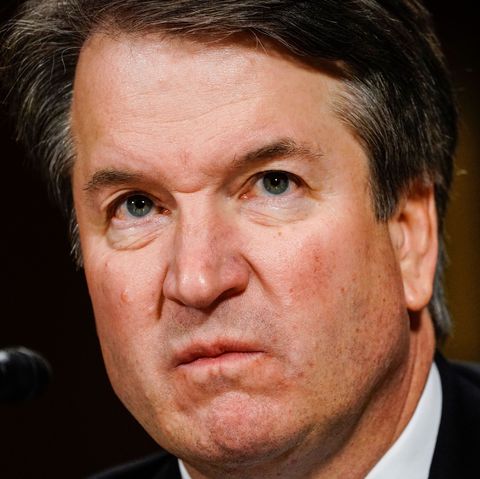
Brett Kavanaugh was accused by multiple women of sexual assault but was saved from a thorough FBI investigation by his buddy, Donald Trump. He cried, whined and spouted partisan conspiracy theories yet still was confirmed to a lifetime appointment to the U.S. Supreme Court.


Really, what was this guy’s problem? Did he think we shouldn’t investigate Supreme Court Justices when credible accusers hurl accusation of abuse? Did he think Kavanaugh’s chief accuser – Dr. Christine Blasey Ford – made the whole thing up so that she could have her reputation forever tied to an attempted rape and her family displaced from their home and forced into hiding because of constant death threats? Did he think we should give privileged white guys lifetime judicial appointments based on what? Political affiliation? Skin tone?


Pam tried to bring up a few other topics – about how Republicans in our state of Pennsylvania are actively working to cut this man’s healthcare, calling this man’s generation “the greediest generation” and other topics.


But it did no good. Fox News had gotten there first.


So we handed him our campaign literature, thanked him and went on our way.


Sometimes that’s the best you can do.


And it’s not nothing.


IMG_8282


If you’re reading this blog, I’m assuming you’re a lot like me.


You see the madness of our modern age and wonder what the heck went wrong?


A reality TV show clown is President of the United States of America. And all over this country, the conservative clown car is spitting out candidates for major office.


Even here in the keystone state, we have Scott Wagner running for Governor on the leftover promises of our previous GOP Governorslashing education funding, firing teachers and lower taxes for the wealthy.


Meanwhile, the world is falling apart. The U.N. just released a major report finding that we have about a dozen years to make significant changes to our energy consumption or else global climate change will be irreversible. Yet our leaders complain there’s nothing they can do!


It’s enough to make one lose hope in the future.


As a father and a public school teacher, I can’t afford that despair.


There needs to be at least the slimmest glimmer of the possibility of a new day.


And I’m here to tell you, friends, it’s out there.


It starts with you.


If you want real progressive change, you have to go out there and make it – one day at a time.


We can turn back the tide of self-destruction. We can beat back the politics of bread and circuses. We can take back this country and build a better future.


But it will take more than one day.


It will take all of us, doing incremental good, every day we can.


So my suggestion is to make a commitment to voting this Nov. 6.


I know our electoral system is a mess. I know many people are being purged from the rolls and our districts are gerrymandered and the entire system is set up against us.


But if all of us try to vote, we can still win.


Find a candidate you can support and go out there and campaign for him or her.


I know there are a lot of phonies running for office. There are an awful lot of fake progressives who will talk nicely to your face and then sell you out to corporations and the wealthy at their first opportunity.


Just know that they’re not all like that.


Find yourself someone you can trust – probably someone new to the game coming on the scene to change things.


In the Pittsburgh area I found Lindsey Williams.


thumbnail_IMG_8273
Lindsey Williams and Me


She’s an amazing lady with real conviction running for State Senate in the 38th District – that’s most of Northern Allegheny County from Franklin Park eastward, as well as Highland Park and sections of East Liberty in Pittsburgh.


Her number one priority is the same as mine – education.


That should come as no surprise from a candidate who’s also the communications director for the Pittsburgh Federation of Teachers.


But Williams actually lives her values.


Before coming to Pittsburgh, she was fired for union organizing at the National Whistleblowers Center. Ironically, she was working there to tell the story of people who were retaliated against for reporting waste, fraud, and abuse, and found herself a target for attempting to organize a staff union. She eventually won the resulting case with the National Labor Relations Board.


When her campaign literature says she “won’t back down” fighting for working families. That’s what it means.


And her priorities – education, healthcare and labor – aren’t pie in the sky promises. She has a fiscally responsible plan to support them by creating a severance tax on natural-gas drilling and closing a loophole that allows businesses headquartered in other states to avoid state taxes. She wants to keep taxes low for homeowners while making sure the wealthy and corporations pay their fair share.


Perhaps that’s why a conservative dark money organization aligned with her Republican challenger, Jeremy Shaffer, has created knockoff campaign signs that look just like Williams with the word “Socialist” emblazoned on them.


It’s a desperation tactic.


Shaffer is down in the polls. The district – once a Republican stronghold – went to Hillary Clinton in the last election.


Even Shaffer, a Ross Township supervisor, is a throwback – he’s a far right extremist who primaried incumbent state Sen. Randy Vulakovich (R-Shaler) in May.


And his platform is nothing but tax cuts for the rich and school privatization for the rest of us. In effect, he’s a mini-Trump come to bring the circus to town.


So not only is Williams a candidate I can believe in, her race really matters to the overall state picture. If the Democrats only pick up her seat in November and don’t lose any others, we’ll crush the GOP’s veto-proof majority!


thumbnail_IMG_8275


But I didn’t come out this weekend just for Williams.


I also was there to canvass for Betsy Monroe, a Fox Chapel medical professional at Highmark running for State House in the same North Hills area.


She was inspired to get into politics after Trump’s election and the subsequent 2017 Women’s March.


She noticed that state Rep. Hal English (R-Hampton) had run unopposed in the last two elections, so she decided to run against him, herself.


Monroe was particularly angered by English’s vote to criminalize abortions after 20 weeks for all women in the Commonwealth. (The bill was vetoed by Democratic Gov. Tom Wolf back before the GOP had a veto proof majority.) She thought it was unfair for lawmakers to decide what adult women can do with their own bodies.


However, there was one other woman I was there to support – my own daughter.


For someone in elementary school, she is incredibly interested in politics. I caught her on Saturday literally writing political stump speeches for her stuffed animals. Let me tell you, Eeyore the donkey from the Hundred Acre Wood has some mighty progressive views on women’s rights!


I wanted my little one to see real women in politics, fighting to make a difference.

 
The news is always so grim. I wanted her to see that there are people out there fighting for the good.


And you know what? It helped me, too.


At this point I need to pause and give a huge “Thank You” to two people – Pamela Harbin and Jodi Hirsch.


IMG_8279
Me and Pamela Harbin


Jodi is an amazing organizer who put together the event in the first place.


I wanted to get more involved in the election and Jodi knew exactly how I could do that and which candidates I’d be most interested in.


Pam is a local activist I’ve known for years. I fought with her side-by-side against the statewide education budget cuts, charter schools, standardized testing and a host of Corporations Gone Wild shenanigans.


I was new to this whole canvassing thing, so she agreed to go with my daughter and me to show us the ropes.


I couldn’t have done it without her.


Thankfully, not every door we knocked on went like the grumpy gentlemen described above.


Frankly, most people weren’t home or didn’t answer the door.


Some people – especially young folks – proudly responded that they don’t vote or have no idea what’s going on.


Others were energized by what was happening and were looking forward to going to the polls and being heard.


“You know I’ll be there!” said one gentleman. “I’m straight Dem. Right on down the line. I’ve had enough of this Trump crap.”


But more people than I’d expected took pride in their nonpartisanship.


They wouldn’t commit to anything – just took our literature, heard us out and said they’d decide at the polls.


I always wondered what an undecided voter looked like. I saw a lot of them this weekend.


But that’s why we were there – to help nudge the uncommitted.


Hopefully on Nov. 6 they’ll think of Pam, my daughter and me.


Maybe even the Fox News fan who thought Kavanaugh got a raw deal will have his resolved softened.


Maybe he’ll think of my daughter’s chubby cheeks and innocent eyes as he considers voting for people who’d gladly steal her future for the prospect of more tax cuts for the rich.


Then again, maybe not. But who knows?


We tried.


If you live in Pennsylvania and want to get involved, click HERE.


Like this post? I’ve written a book, “Gadfly on the Wall: A Public School Teacher Speaks Out on Racism and Reform,” now available from Garn Press. Ten percent of the proceeds go to the Badass Teachers Association. Check it out!

thumbnail_IMG_8249

Kavanaugh Confirmation Begs the Question – Does Truth Matter?

bs-ed-0711-brett-kavanaugh-confirmation-20180710


“The very concept of objective truth is fading out of the world. Lies will pass into history.”

-George Orwell


Does the truth matter?


It seems to be one of the central questions of our age.


We just held a Senate confirmation hearing for Brett Kavanaugh’s lifetime appointment to the Supreme Court.


And despite multiple women making credible allegations of sexual misconduct against him…


Despite an FBI investigation so grossly limited in scope that investigators couldn’t even interview either the accusers or the accused…


Despite the withdrawal of support from some of the most conservative organizations including the National Council of Churches representing more than 100,000 congregations, the magazine of the Jesuit religious order, and even former Supreme Court Justice John Paul Stevens…


Despite all that, the Republican majority gave their wholehearted approval.


Only Alaska Senator Lisa Murkowski bucked her party and voted against him – while Senator Joe Manchin of West Virginia was the only Democrat to vote for him.


The result was a forgone conclusion – a Republican majority who blatantly ignored any evidence and made a decision based purely on party politics.


Dr. Christine Blasey Ford testified in front of these people only a week earlier about a drunk Kavanaugh’s attempted rape when they were both in school.


She put her life, her security and her family’s happiness on the line to come forward. She still can’t return to her home after multiple death threats.


Yet those in power chose to ignore her.


They looked at the facts presented to them and chose to interpret them in a way that allowed them to do what they wanted to do in the first place.


Many said that they believed Ford was accosted but not by Kavanaugh.


Yet they refused to allow the kind of investigation that might have gotten at the truth.


These are not the actions of lawmakers interested in what happened all those years ago between Kavanaugh and Ford – or between Kavanaugh and multiple other women who they didn’t even give a hearing.


These are not the actions of lawmakers concerned about picking the best person for the job.


Instead, they are the actions of partisans who put power over objective reality.


They’d rather craft a story that fits their desires than the other way around.


It is craven, cowardly and disrespectful to their office and their charge.


This article began with a quote from George Orwell, author of 1984. Let me offer another:


“Totalitarianism, however, does not so much promise an age of faith as an age of schizophrenia. A society becomes totalitarian when its structure becomes flagrantly artificial: that is, when its ruling class has lost its function but succeeds in clinging to power by force or fraud. Such a society, no matter how long it persists, can never afford to become tolerant or intellectually stable.”


That is what happened here. A ruling class resorting to force and fraud to broaden its power.


Republicans already have control of two branches of government. Now they have stolen a third – a power grab that will echo down the halls of history for decades to come.


This is a senate majority representing fewer people than the so-called minority, lead by a President who lost the popular vote.


It is not democracy or a just republic. It is a coup.


As Orwell warns, when we ignore an inconvenient reality, we are on the road to totalitarianism.


It didn’t matter to those senators whether Kavanaugh was a blackout drunk, whether he still drinks to excess, whether he engaged in sexual harassment or attempted rape.


Heck. He could have attacked Ford on the floor of the Senate, itself, on live TV.


None of it would have mattered.


He was simply a means to an end – the increased power of the Republican Party and the donor class it represents.


GOP senators (and even Kavanaugh, himself) complained about dark money influencing the nomination process, yet the overwhelming majority of that money came from conservative backers!


They raved and foamed at Democrats for stalling the nomination yet refused to take responsibility for sabotaging Barack Obama’s nomination of Merrick Garland.


Instead they offered bad faith distinctions between what you can do during an election year vs. a presidential election year – as if it made any difference.


It is not just the spirit of the Constitution that lay in tatters on the Senate floor – but the fabric of reality, itself.


Thankfully, voters have an opportunity to have their voices heard in a few weeks.


We can take to the polls and let these people know how we feel about it.


Honestly, this may be our last chance.


I am absolutely devastated by these events.


I find myself at the ripe old age of 44 chiding myself for being naïve.


I watched the hearing as if it were a TV show or a Frank Capra movie. At the last minute, goodness will prevail.


That didn’t happen.


I, too, was blind to reality.


Well, the blinders are off.


Like so many of you, I am in mourning for a country that never really existed.


But the wake is in November.


Let’s hope it will be the start of a rebirth.


Click here to find ways to get involved in the November 6 midterm election.


Like this post? I’ve written a book, “Gadfly on the Wall: A Public School Teacher Speaks Out on Racism and Reform,” now available from Garn Press. Ten percent of the proceeds go to the Badass Teachers Association. Check it out!

WANT A SIGNED COPY?

Click here to order one directly from me to your door!

book-4

Wagner Spouts Trumpian Lie About Education at Gubernatorial Debate

Wolf_vs__Wagner_debate_highlights_0_57652044_ver1.0_1280_720


The defining moment of Pennsylvania’s one and only gubernatorial debate wasn’t made by incumbent Tom Wolf or his challenger Scott Wagner.


It was made by former Republican Gov. Tom Corbett.


At least it was made by him seven years ago.


Before voters overwhelmingly choose the Democratic Wolf to replace him, Corbett told a whooper about his administration and education funding – namely that he DIDN’T cut almost $1 billion from the poorest schools in the Commonwealth.


Yes,  ten thousand teachers were furloughed. Class sizes ballooned. Children literally died for lack of nurses.


But Corbett wanted us all to believe it wasn’t him or his administration that took that money away.


It was untrue then, and it’s untrue now.


Yet that didn’t stop Wagner from dusting it off before 1,700 people and moderator Alex Trebek at the annual Pennsylvania Chamber of Business and Industry dinner in Hershey:


Trebek: What you have not mentioned is education suffered immensely about seven years ago when Gov. Corbett knocked off about a billion dollars. And…


Wagner: That’s totally false.


Trebek: Oh, it’s false.


Wagner: That’s totally false. Those were federal stimulus dollars. Gov. Wolf went around and told that. It was a lie. Gov. Corbett … (Clapping)… And the stimulus money came in during Gov. Rendell’s administration. And so Gov. Corbett’s here tonight. People need to know that Gov. Corbett did as much for education as really any governor. (Clapping) And he needs to be remembered for that. He didn’t cut the billion dollars. It was a billion dollars of stimulus money that came in and they were told – the education system – I wasn’t there – Don’t hire teachers, don’t… They did all that. Guess what? Here’s the problem with the system, Alex. The billion dollars. It’s gone. We have nothing to show for it.”


Here’s the crux of the bedtime story he’s telling.


The big bad federal government gave us money, and when that money was spent, we didn’t have it anymore. So what mean ol’ Gov Wolf calls a budget cut was no one’s fault.


The problem is it’s baloney.


The federal government DID give Pennsylvania stimulus dollars for its schools for one-time infrastructure improvements. However, the state legislature reacted by reducing the amount of state money it used to fund schools at the same time forcing districts to use the stimulus for operating costs.


It’s as if someone gives you a couple hundred dollars for your birthday and then your boss stops paying you your salary. That may work this week, but next week you need your paycheck. Otherwise you don’t have money to pay the bills.


Your boss can’t say to you: I’m not cutting your wages. Look I gave you just as much money this week as last week.


That won’t fly. But it’s exactly what Corbett tried to sell voters almost four years ago and they weren’t buying it.


And now Wagner is pulling out the same moldy lie, brushing off the flies and trying to pass it off as the truth.


screen-shot-2015-07-20-at-11-08-50-pm


This is troubling for two reasons.


First, it shows Wagner is as deceitful as his heroes Corbett and Donald Trump.


Second, it shows he’s playing from the same morally bankrupt playbook.


Corbett didn’t stop at saying he never cut the money he cut. He went so far as to say he actually RAISED school funding!


That’s like urinating on someone and telling them it’s raining.


And he did it with dishonest accounting – lumping pension funds for teachers in with classroom funding and pretending they were all the same.


He took a bill that was already due (pension costs) and pretended like that money was paying to run the state’s classrooms.


It wasn’t.


So children throughout the keystone state suffered and some even died.


Apply that to Wagner’s rapidly changing position on education funding.


He has long been an advocate for slashing school budgets. In fact, he was a popular surrogate for Corbett when this whole catastrophe was going down.


But now that his campaign has seen how unpopular that position is, very recently he’s changed his tune.


Suddenly he says we should increase education funding.


And good for him.


However, if he’s using the Corbett playbook, it seems that “increase” really won’t be anything of the sort.


It will just be more creative accounting and fantasy storytelling. He’ll pay for pensions and say he’s increasing school funding. Or maybe he’ll fudge something else from column A and pretend it’s funding column B.


It’s disingenuous, dishonest and Pennsylvanians aren’t going to put up with it.


Perhaps that’s why Wolf is leading in the polls.


Wagner may have found a way to get his supporters into the debate hall – they certainly clapped loud at his points – but they are a minority among voters.


I wish Trebek had called him out on it.


I wish Gov. Wolf had challenged him.


But time was running short and Wagner still had to complain about a college swimming coach with too high a pension, and he had to whine about mean old Wolf demanding the Marcellus Shale industry pay its fair share of taxes.


There were plenty of other sparks at the debate.


Wagner raged about this and lied about that. He thinks running a state like Pennsylvania is like managing his $75 million garbage hauling company. But if given the chance, it will be our children’s future’s that are left in the trash.


Meanwhile, Gov. Wolf looked like the adult in the room, soberly explaining the improvements he’d overseen in his term in office (a balanced budget, healing some of the Corbett education cuts, etc.) and outlining where we need to go in the future.


Every time Wagner slammed him for taking support from unions, I wished he’d spoken up. But he just let it pass like Casey at Bat looking for a perfect pitch.


“You keep talking trash on unions,” he’d say. “Yeah, many of my supporters are union workers, union teachers, nurses, letter carriers, construction workers. Yes, I’m supported by working people and I support them in turn. Labor is the backbone of this nation and that’s true here in Pennsylvania as it’s true everywhere.”


But, no. He didn’t say that.


Don’t get me wrong. I think Pennsylvania voters have a clear choice here – the sane, sensible Wolf vs. the blowhard and capricious Wagner. But how I wish Wolf had shown more fight!


The only thing the media seemed moved to report, though, were the antics of Trebek.


Twitter squeaky wheels thought the Jeopardy host’s moderation was weird. I’ll admit a tangent into the Catholic church and pedophile priests may not have been necessary. But he made the entire event more watchable and he called out Wagner’s lies more often than not.


The question is: What will voters do in November?


Watch the whole debate HERE.


Here’s a video I made about Corbett’s budget cuts – a story so simple even Wagner and Corbett could understand it:


Like this post? I’ve written a book, “Gadfly on the Wall: A Public School Teacher Speaks Out on Racism and Reform,” now available from Garn Press. Ten percent of the proceeds go to the Badass Teachers Association. Check it out!
Screen shot 2018-01-07 at 1.14.14 AM

Brett Kavanaugh is the Link Between Rape and Abortion

brett-kavanaugh-blasey-ford-1538096510


I think I will always associate Brett Kavanaugh with the taste of vomit in the back of my throat.


I couldn’t watch his sham of a confirmation hearing without my gag reflex going into overdrive.


Here was one of the most privileged of people on the planet alternatively weeping and raging that he was being denied his due.


Here was a man bemoaning that no matter what happened, his reputation forever would be ruined, but who likewise refused to call for an investigation to exonerate himself.


At least three separate women have accused him of sexual assault, yet Congressional Republicans are still planning to ram through his nomination to the Supreme Court – a lifetime appointment where he will almost certainly be the tie breaking vote to overturn Roe vs. Wade.


How fitting.


What perfect symmetry.


You couldn’t have planned it any more poetically.


A man accused of multiple attempted rapes who is doing everything in his power to make abortion illegal.


An overgrown frat boy crying into his beer that we can’t take away his God given right to take away women’s rights.


A confederacy of almost exclusively male lawmakers ready to discount women’s reports of violence so that they can limit women’s freedom to make decisions about their own bodies.


If there is one good thing to come from this farce, it is the spotlight it has shown on the relationship between rape and the movement to recriminalize abortion.


These two things are essentially intertwined.


On the one hand, we have sexual intercourse carried out under threat of violence, sex without consent or in direct violation of consent – a crime invariably perpetrated by men on women.


On the other hand, we have the removal of female consent from the birthing process.


They are almost the same thing, or at least two sides of the same coin.


In both cases, we’re removing or ignoring female permission, agreement, approval, agency. We’re saying it doesn’t matter what the woman wants. It only matters what men or a patriarchal society wants.


And the justification is an ancient text – the New Testament – that doesn’t mention abortion once. And the Old Testament actually gives instructions on how to conduct an abortion (Numbers 5:11-31).


Not that it really should matter. The United States is not a theocracy.


But it IS a patriarchy.


That’s what this is – an attempt by the most insecure, power hungry men to control women.


It is about keeping and strengthening a caste system where men are allowed to be fully realized people and women are allowed only secondary status.


It is about dehumanization clothed in piety and false morality.


All those people crying for the lost lives of a cluster of cells in female uteruses care not a wit about the thousands of women who will die from unsafe abortions once safe procedures become unlawful.


We’ve been here before. Abortion was illegal in the US from the early 1800s until 1973, and we know what will happen. There is actual history on this – back alley procedures conducted by quacks using sharp implements to pierce the womb – and there is no reason to think it won’t repeat itself.


Changing the law won’t stop abortions. It will just make them unsafe for everyone except rich women who can afford doctors willing to take a chance on going to jail for a big payday.


If these people really wanted to stop abortions, they’d support handing out free contraception. They’d turn every orphanage into a palace. They’d each adopt as many children as they could. They’d make neonatal care free, expand services to help women raise children, increase maternity leave, pay for free childcare, expand education funding.


But they don’t do any of that because despite their crocodile tears, their objection has nothing to do with unborn children.


It has to do with mature women making decisions for themselves. It has to do with conceptualizing them as people equal to men and with minds capable of consent.


It’s about allowing women the right to choose – choose whom to have sex with and what exactly the consequences of that sex will or will not be.


I am so thankful that Dr. Christine Blasey Ford came forward with her testimony. What bravery! What grace under pressure!


To be able to share with an entire nation her personal trauma at the hands of Kavanaugh. Such courage boggles the mind almost as much as those who refuse to accept her story as genuine.


They say that this is political. That it’s a hit job. Yet they pound their fists onto their ears to drown out Kavanaugh’s words in self-defense where he makes it entirely clear how partisan he is and will be once he takes the bench:


“This whole two-week effort has been a calculated and orchestrated political hit, fueled with apparent pent-up anger about President Trump and the 2016 election. Fear that has been unfairly stoked about my judicial record. Revenge on behalf of the Clintons. And millions of dollars in money from outside left-wing opposition groups.”


These are not the words of a fair arbitrator. They are the ravings of someone with an axe to grind.


But they do well to point out the elephant in the room – Donald Trump.


The man who nominated Kavanaugh has had at least 19 women accuse him of sexual assault. He even admitted to it on video in the infamous Access Hollywood tape.


Yet a minority of Americans elected him President through a legislative loophole kept open by centuries of neglect, apathy and moneyed interest.


I don’t know how this all will end. The FBI will conduct a limited investigation this week – probably stymied as much as possible by the Trump administration.


But the road that lead us here is achingly clear.


This is a tantrum of the patriarchy.


It is the weakest, most twisted men and their Stockholm syndrome suffering accomplices.


It is not about defining when life begins.


It’s about defining who gets to count as fully human – who gets the freedom to choose.


Like this post? I’ve written a book, “Gadfly on the Wall: A Public School Teacher Speaks Out on Racism and Reform,” now available from Garn Press. Ten percent of the proceeds go to the Badass Teachers Association. Check it out!

WANT A SIGNED COPY?

Click here to order one directly from me to your door!

book-4

The Six Biggest Problems with Data-Driven Instruction

0


“On the dangers of being data-driven: Imagine driving from A to B ignoring the road, the weather, the traffic around you… only staring at the gauges on the dashboard.”

 – Educator Dan McConnell


“Make your instruction data-driven.”


If you’re a public school teacher, you’ve probably heard this a hundred times.


In the last week.


Principals and administrators use that word – “data-driven” – as if it were inscribed over the front doors of the schoolhouse in stone.


The idea goes like this: All lessons should be based on test scores.


Students take the federally mandated standardized test. Your job is to make sure they get the best possible score. Your class is nothing but a way station between standardized tests.


Pretest your students and then instruct them in such a way that when they take the test again, they’ll get the best possible score.


It’s total nonsense. And it doesn’t take much to see why.


No teacher should ever be data-driven. Every teacher should be student-driven.


You should base your instruction around what’s best for your students – what motivates them, inspires them, gets them ready and interested in learning.


To be sure, you should be data-informed – you should know what their test scores are and that should factor into your lessons in one way or another – but test scores should not be the driving force behind your instruction, especially since standardized test scores are incredibly poor indicators of student knowledge.


No one really believes that the Be All and End All of student knowledge is children’s ability to choose the “correct” answer on a multiple-choice test. No one sits back in awe at Albert Einstein’s test scores – it’s what he was able to do with the knowledge he had. Indeed, his understanding of the universe could not be adequately captured in a simple choice between four possible answers.


As I see it, there are at least six major problems with this dependence on student data at the heart of the data-driven movement.


So without further ado, here is a sextet of major flaws in the theory of data-driven instruction:


  1. The Data is Unscientific

    When we talk about student data, we’re talking about statistics. We’re talking about a quantity computed from a sample or a random variable.

    As such, it needs to be a measure of something specific, something clearly defined and agreed upon.

    For instance, you could measure the brightness of a star or its position in space.

    However, when dealing with student knowledge, we leave the hard sciences and enter the realm of psychology. The focus of study is not and cannot be as clearly defined. What, after all, are we measuring when we give a standardized test? What are the units we’re using to measure it?

    We find ourselves in the same sticky situation as those trying to measure intelligence. What is this thing we’re trying to quantify and how exactly do we go about quantifying it?

    The result is intensely subjective. Sure we throw numbers up there to represent our assumptions, but – make no mistake – these are not the same numbers that measure distances on the globe or the density of an atomic nucleus.

    These are approximations made up by human beings to justify deeply subjective assumptions about human nature.

    It looks like statistics. It looks like math. But it is neither of these things.

    We just get tricked by the numbers. We see them and mistake what we’re seeing for the hard sciences. We fall victim to the cult of numerology. That’s what data-driven instruction really is – the deepest type of mysticism passed off as science.

    The idea that high stakes test scores are the best way to assess learning and that instruction should center around them is essentially a faith based initiative.

    Before we can go any further, we must understand that.

  2. It Has Never Been Proven Effective

    Administrators and principals want teachers to base their instruction around test scores.

    Has that ever been proven an effective strategy for teachers planning lessons or the allocation of resources? Can we prove a direct line from data to better instruction to better test scores?

    The answer is an unequivocal NO.

    In a 2007 study from Gina Schuyler Ikemoto and Julie A. Marsh published in the Yearbook for the National Society for the Study of Education, data driven instruction actually was found to have harmful effects on educator planning and, ultimately, student learning.

    Researchers looked at 36 instances of data use in two districts, where 15 teachers used annual tests to target weaknesses in professional development or to schedule double periods of language arts for English language learners. The result was fewer instances of collective, sustained, and deeper inquiry by groups of teachers and administrators using multiple data sources – test scores, district surveys, and interviews – to reallocate funds for reading specialists or start an overhaul of district high schools.

    Teachers found the data less useful if it was not timely – standardized test scores are usually a year old by the time they get to educators. Moreover, the data was of less value if it did not come with district support and if instructors did not already buy into its essential worth.

    In short, researchers admitted they could not connect student achievement to the 36 instances of basic to complex data-driven decisions in these two districts.

    But that’s just one study.

    In 2009, the federal government published a report (IES Expert Panel) examining 490 studies where schools used data to make instructional decisions.

    Of these studies, the report could only find 64 that used experimental or quasi-experimental designs. Of these it could find only six – yes, six – that met the Institute of Education Sciences standard for making causal claims about data-driven decisions to improve student achievement.

    And when examining these six studies, the panel found “low evidence” to support data-driven instruction. They concluded that the theory that data-driven instructional decisions improve student test scores has not been proven in any way, shape or form.

  3. It’s Harmful – The Stereotype Threat and Motivation

    Data-driven instruction essentially involves grouping students based on their performance on standardized tests.

    You put the low scorers HERE, the students on the bubble who almost reached the next level HERE, and the advanced students HERE. That way you can easily differentiate instruction and help meet their needs.

    However, there is a mountain of psychological research showing that this practice is harmful to student learning. Even if you don’t put students with different test scores in different classes, simply informing them that they belong to one group or another has intense cognitive effects.

    Simply being told that you are in a group with lower test scores depresses your academic outcomes. This is known as the stereotype threat.

    When you focus on test scores and inform students of where they fall on the continuum down to the percentile – of how far below average they are – you can trigger this threat. Simply tracking students in this way can actually make their scores worse.

    It can create negative feelings about school, threatening students’ sense of belonging, which is key to academic motivation.

    But it’s not just the low scorers who are harmed. Even the so-called “advanced” students can come to depend on their privileged status. They define themselves by their achievement, collecting prizes, virtual badges and stickers. These extrinsic rewards then transform their motivation from being driven by the learning and the satisfaction of their curiosity to depending on what high achievement gets them, researchers have found.

    In short, organizing all academics around tests scores is a sure way to lower them.

  4. The Data Doesn’t Capture Important Factors

    Data-driven instruction is only as good as the data being used. But no data system can be all inclusive.

    When we put blinders on and say only these sorts of factors count, we exclude important information.

    For instance, two students do the same long-term project and receive the same grade. However, one student overcame her natural tendency to procrastinate and learned more than in past projects. The other did not put forth his best effort and achieved lower than his usual.

    If we only look at the data, both appear the same. However, good teachers can see the difference.

    Almost every year I have a few students who are chronically tardy to class. A good teacher finds out why – if this is because they aren’t making the best use of the class interval or if they have a greater distance to travel than other students. However, if we judge solely on the data, we’re supposed to penalize students without considering mitigating factors. That’s being data-driven – a poor way to be a fair teacher.

    It has been demonstrated repeatedly that student test scores are highly correlated with parental income. Students from wealthier parents score well and those from more impoverished families score badly. That does not mean one group is smarter or even more motivated than the other. Living in poverty comes with its own challenges. Students who have to take care of their siblings at home, for instance, have less time for homework than those who have nothing but free time.

    A focus solely on the data ignores these factors. When we’re admonished to focus on the data, we’re actually being told to ignore the totality of our students.

  5. It’s Dehumanizing

    No one wants to be reduced to a number or a series of statistics.

    It is extremely insulting to insist that the best way for teachers to behave is to treat their students as anything other than human beings.

    They are people with unique needs, characteristics, and qualities, and should be treated accordingly.

    When one of my students does an amazing job on an assignment or project, my first impulse is not to reduce what they’ve done to a letter grade or a number. I speak my approbation aloud. I write extensive comments on their papers or conference with them about what they’ve done.

    Certainly, I have to assign them a grade, but that is merely one thing educators do. To reduce the relationship to that – and only that – is extremely reductive. If all you do is grade the learner, you jeopardize the learning.

    Every good teacher knows the importance of relationships. Data-driven instruction asks us to ignore these lessons in favor of a mechanistic approach.

    I’m sorry. My students are not widgets and I refuse to treat them as such.

    I am so sick of going to conferences or faculty meetings where we focus exclusively on how to get better grades or test scores from our students. We should, instead, focus on how to see the genius that is already there! We should find ways to help students self-actualize, not turn them into what we think they should be.

    At this point, someone inevitably says that life isn’t fair. Our students will have to deal with standardized tests and data-driven initiatives when they get older. We have to prepare them for it.

    What baloney!

    If the real world is unfair, I don’t want my students to adjust to that. I want to make it better for them.

    Imagine telling a rape victim that that’s just the way the world is. Imagine telling a person brutalized by the police that the world is unfair and you just have to get used to it.

    This is a complete abdication not just of our job as teachers but our position as ethical human beings.

    Schools are nothing without students. We should do everything we can to meet their needs. Period.

  6. It’s Contradictory – It’s Not How We Determine Value in Other Areas

    Finally, there is an inherent contradiction that all instruction must be justified by data.

    We don’t require this same standard for so many aspects of schooling.

    Look around any school and ask yourself if everything you see is necessarily based on statistics.

    Does the athletic program exist because it increases student test scores? Does each student lunch correlate with optimum grades? Do you have computers and iPads because they have a measureable impact on achievement?

    Some administrators and principals DO try to justify these sorts of things by reference to test scores. But it’s a retroactive process.

    They are trying to connect data with things they already do. And it’s completely bogus.

    They don’t suddenly believe in football because they think it will make the team get advanced scores. They don’t abruptly support technology in the classroom because they think it will make the school achieve adequate yearly progress.

    They already have good reasons to think athletics helps students learn. They’ve seen participation in sports help students remain focused and motivated – sometimes by reference to their own lives. Likewise, they’ve seen the value of technology in the classroom. They’ve seen how some students turn on like someone flipped a switch when a lesson has a technological component.

    These aren’t necessarily quantifiable. They don’t count as data but they are based on evidence.

    We come to education with certain beliefs already in place about what a school should do and others are formed based on the empiricism of being there, day-in, day-out. “Data” rarely comes into the decision making process as anything but a justification after the fact.


    And so we can firmly put the insistence on data-driven instruction in the trash bin of bad ideas.

    It is unscientific, unproven, harmful, reductive, dehumanizing and contradictory.

    The next time you hear an administrator or principal pull out this chestnut, take out one of these counterarguments and roast it on an open fire.

    No more data-driven instruction.

    Focus instead on student-driven learning.


Don’t let them co-opt you into the cult of numerology. Remain a difference-maker. Remain a teacher.


Like this post? I’ve written a book, “Gadfly on the Wall: A Public School Teacher Speaks Out on Racism and Reform,” now available from Garn Press. Ten percent of the proceeds go to the Badass Teachers Association. Check it out!

WANT A SIGNED COPY?

Click here to order one directly from me to your door!

book-3

There is Virtually No Difference Between Nonprofit and For-Profit Charter Schools

Screen Shot 2018-09-06 at 3.18.04 PM


Stop kidding yourself.


Charter schools are a bad deal.


It doesn’t matter if they’re for-profit or nonprofit.


It doesn’t matter if they’re cyber or brick-and-mortar institutions.


It doesn’t matter if they have a history of scandal or success.


Every single charter school in the United States of America is either a disaster or a disaster waiting to happen.


The details get complicated, but the idea is really quite simple.


It goes like this.


Imagine you left a blank check on the street.


Anyone could pick it up, write it out for whatever amount your bank account could support and rob you blind.


Chances are you’d never know who cashed it, you’d never get that money back and you might even be ruined.


That’s what a charter school is – a blank check.


It’s literally a privately operated school funded with public tax dollars.


Operators can take almost whatever amount they want, spend it with impunity and never have to submit to any real kind of transparency or accountability.


Compare that to a traditional public school – an institution invariably operated by duly elected members of the community with full transparency and accountability in an open forum where taxpayers have access to internal documents, can have their voices heard and even seek an administrative position.


THAT’S a responsible way to handle public money!


Not forking over our checkbook to virtual strangers!


Sure, they might not steal our every red cent. But an interloper who finds a blank check on the street might not cash it, either.


The particulars don’t really matter. This is a situation rife with the possibility of fraud. It is a situation where the deck is stacked against the public in every way and in favor of charter school operators.


But most people don’t want to take such a strong stance. They’d rather find good and bad people on both sides and pretend that’s the same thing as impartiality.


It isn’t.


Sometimes one side is just wrong.


Policymakers may try to feign that there are good and bad charter schools and that the problems I’m talking about only apply to the nefarious ones.


But that’s a delusion.


There is no good way to write a blank check and leave it on the street to the whims of passers-by.


Most apologists want to draw the distinction between for-profit and nonprofit charters.


But as Jeff Bryant, an editor at Education Opportunity Network, puts it, this is a “Distinction without a difference.”


These terms only define an organization’s tax status – not whether it is engaged in gathering large sums of money for investors.


The law is full of loopholes that allow almost any organization – not just charter schools – to claim nonprofit status while enriching those at the top.


We live in an age of philanthrocapitalism, where the wealthy disguise schemes to enrich themselves as benevolence, generosity and humanitarianism.


So-called “nonprofit” charter schools are just an especially egregious example. No matter what label you pin to their name, they all offer multiple means to skim public funding off the top without adding any value for students.


For instance, take the use of management companies.


A for-profit charter school can simply cut services to students and pocket the savings as profit.


A nonprofit charter school can do the same thing after engaging in one additional step.


All I have to do is start a “nonprofit” charter school and then hire a for-profit management company to run it. Then my management company can cut services and pocket the profits!


It’s really that simple! I turn over nearly all of my public tax dollars to the management company that then uses it to operate the school – and keeps whatever it doesn’t spend.


Heck! It doesn’t even matter who owns the company! It could even be me!


The law actually allows me to wear one hat saying I’m nonprofit and then put on a different hat and rake in the cash! The only difference is what hat I’m wearing at the time!


SO I get to claim to be a nonprofit while enjoying all the advantages of being for-profit.


flowchart960
SOURCE: Florida Sun Sentinel


I may even be able to buy things with public tax dollars through my for-profit management company and then if my “nonprofit” school goes belly up, I get to keep everything I bought! Or my management company does.


So the public takes all the risk and I reap all the reward. And I’m still graced with the label “nonprofit.”


Oh, and speaking of spending, being a “nonprofit” doesn’t stop me from the worst kind of real estate shenanigans routinely practiced by the for-profit charter schools.


Both types of privatized institution allow for huge windfalls in real estate. If I own property X, I can sell it to my charter school (or management company) and then pay myself with tax dollars. Who determines how much I pay for my own property? ME! That’s who!


And I can still be a nonprofit.


Think that’s bad? It’s just the tip of the iceberg.


Thanks to some Clinton-era tax breaks, an investor in a charter school can double the original investment in just seven years!

I can even get the public to pay for the same building twice! And even then taxpayers still won’t own it!


But that’s the complicated stuff. There’s an even easier way to get rich off the public with my “nonprofit” charter school, and operators do it all the time: write myself a fat check!


After all, I’ve gotta’ pay, myself, right? And who’s in charge of determining how much I’m worth? ME!


I can even pay myself way more than my counterparts at traditional public schools who oversee exponentially more staff and students.


For instance, as New York City Schools Chancellor, Richard Carranza is paid $345,000 to oversee 135,000 employees and 1.1 million students. Meanwhile, as CEO of Success Academy charter school chain, Eva Moskowitz handles a mere 9,000 students, for which she is paid $782,175.


And this is by no way a unique example.


There are just so many ways to cash in with a charter school even at a so-called “nonprofit” – especially if I want to dip my toe into legally dubious waters!


I could do like the almost exclusively “nonprofit” Gulen charter schools and exist solely as a means to raise money for an out-of-favor political movement in Turkey.


I could use charter funds to finance other businesses. I could decide to discontinue programs that students receive in traditional public schools such as providing free or reduced lunches but keep the cash. I could fake enrollment and have classes full of “ghost students” that the local, state and federal government will pay me to educate.


Fraud and mismanagement are rampant at charter schools because we don’t require them to be as accountable as their traditional public school counterparts.


If a traditional public school tried this chicanery, we’d almost certainly catch it at the monthly meetings or frequent audits. But charter schools don’t have to submit to any of that. They’re public money spent behind closed doors with little to no requirement to explain themselves – ever.


And all of this – nearly every bit of criticism I’ve leveled against the industry – doesn’t even begin to take into account the educational practices at these types of schools.


There is plenty of evidence that charters provide a comparable or worse education than children routinely receive at traditional public schools.


Where it is comparable, the issue is clouded by selective enrollment, inadequately servicing students with special needs and generally encouraging the hardest to teach to get an education elsewhere. Where it is worse, it is colossally worse, robbing children not just of funding but what is likely their only chance at an education.


But we don’t even need to go there.


We only need the issue of fiscal responsibility to bring down this behemoth.


Charter schools are no way to run a school. They are a blatant failure to meet our fiduciary responsibilities.


Traditional public schools are the best way to run a school. They protect the public’s investment of money and resources while providing a quality education to students.


So all this talk about nonprofit and for-profit charter schools is either a mark of supreme ignorance or a ploy for weak willed politicians to weasel their way out of taking a stand on an issue whose merits are obvious to anyone who knows what really happens in our education system.


It’s time to stop wasting taxpayer money on this expensive fraud.


It’s time for the charter school experiment to end.


And it’s way passed time to support fully public schools.


Like this post? I’ve written a book, “Gadfly on the Wall: A Public School Teacher Speaks Out on Racism and Reform,” now available from Garn Press. Ten percent of the proceeds go to the Badass Teachers Association. Check it out!

WANT A SIGNED COPY?

Click here to order one directly from me to your door!

book-1