The Best Way to Prepare for School Shootings is to Reduce the Chances They’ll Happen at All

Screen Shot 2018-09-27 at 9.18.21 AM


I participated in yet another active shooter drill at my school this week.


“Death to the infidels!” shouted Mr. O’Grady, one of my fellow teachers, as he stormed the classroom with a Nerf blaster rifle.


I had stuffed myself under a table in another teacher’s reading nook.


But it did no good.


One of the soft yellow balls came sproinging out of the gun and bounced off the carpet into my groin.


Then someone blew a whistle and the scenario was over.


The classroom full of teachers collected ourselves from behind overturned tables and under desks before uncertainly getting to our feet.


“Who got hit?” asked the principal as he poked his head into the room.


A flurry of hands went up including mine.


The students had been dismissed about an hour earlier. The body count was made up entirely of faculty and staff – teachers, administrators, security guards, substitutes, lunch ladies, etc.


The lesson we were supposed to take away from the activity was that hiding was a losing strategy.


“Do something,” one of the police officers conducting the drill said.


They wanted us to swarm the shooter, throw things at him (Nerf balls in our scenario) or make a run for it. Anything but simply staying put and being sitting ducks.


It made me wonder why our lawmakers don’t heed the same advice.


Do something?


Yeah. Why doesn’t Harrisburg do something? Why doesn’t Washington?


That’s where you can make a real difference to keep our schools safe.


Instead of making the world safer for our kids, we’re trying to lock them up in a castle and keep the violence out.


But it’s impossible. You can’t keep out human nature.


The same things that cause shooters to enter the school and go on a killing spree are already in our classrooms.


O’Grady may have imagined he was a member of Al-Qaeda as he pretended to blow his co-workers away, but if a shooter ever enters our building, he’s more likely to be a co-worker, parent or student.


We don’t need more ways to keep them out. We CAN’T keep them out and still do our jobs!


All we can do is try to alleviate the pressure, to counsel mental distress, heal physical trauma, guard against societal hurts.


And if that doesn’t work, we can lower the stakes and limit the amount of damage done.


Turning the school into a prison will not help. Turning teachers into guards (armed or otherwise) will not solve anything.


Back in 1999 in the wake of the Columbine school shooting, the Secret Service and U.S. Department of Education warned against all the things we’re doing now – police officers in the schools, metal detectors, cameras, etc.


Instead, they advised us as follows:


“Specifically, Initiative findings suggest that [school] officials may wish to consider focusing their efforts to formulate strategies for preventing these attacks in two principal areas:


  • developing the capacity to pick up on and evaluate available or knowable information that might indicate that there is a risk of a targeted school attack; and,


  • employing the results of these risk evaluations or “threat assessments” in developing strategies to prevent potential school attacks from occurring.”


That means prevention over disaster prepping. Homeland Security and education officials wanted us to pay close attention to our students, their needs and their struggles.


We keep our schools safe by looking to the humans in them and not new ways to barricade the building or watch the whole disaster unfold on closed circuit TV.


The fact is that our schools are actually much safer than the communities that support them. Numerous studies have concluded that students are more secure in school than on the streets or even in their own homes.


If we want to make the schools safer, we need to make the communities safer.


And, no, I’m not just talking about high poverty neighborhoods populated mostly by people of color. I mean everywhere – in our society, itself.


There are too many guns out there. We have more firearms than people!


According to the Graduate Institute of International and Development Studies in Geneva, Americans now own 40 per cent of all guns in the world – more than the next 25 countries combined. And with every mass shooting and the hysteria trumped up by gun manufacturers with each surge in profits, that number continues to climb.


You can do whatever you want to the schools, but you’ll never increase safety until you deal with THAT problem.


The fact is countries with more guns have more gun deaths. States and Countries with more rigorous gun control have fewer gun deaths.


(If you doubt it, see Florida’s “The Geography of Gun Deaths,” and a 2016 review of 130 studies in 10 countries, published in Epidemiologic Reviews.)


We need sane, sensible gun regulations. We need government buyback programs. And we need to smash the NRA’s stranglehold on our political process.


These ridiculous safety drills are simply whistling in the dark.


They’re not harmless. They’re HARMFUL.


They actually make our schools less safe.


Metal detectors, surveillance cameras, and resource officers do not create safer schools. According to a study released by the National Association of School Psychologists :


“There is no clear research evidence that the use of metal detectors, security cameras, or guards in schools is effective in preventing school violence (Addington, 2009; Borum, Cornell, Modzeleski, & Jimerson, 2010; Casella, 2006; Garcia, 2003). In fact, research has shown that their presence negatively impacts students’ perceptions of safety and even increases fear among some students (Bachman, Randolph, & Brown, 2011; Schreck & Miller, 2003). In addition, studies suggest that restrictive school security measures have the potential to harm school learning environments (Beger, 2003; Phaneuf, 2009).”


At this week’s active shooter drill in my school, one of the student aides asked the principal when he thought the state would be arming teachers.


For him, it wasn’t a matter of if. It was a matter of when.


And if you listen to the cowardly garbage spewing out of our lawmakers mouths, you can certainly understand why he believes that.


However, arming teachers or even adding more armed police to the school will not make our classrooms more secure.


There is overwhelming evidence that it will do just the opposite.


As Melinda Wenner Moyer reports in Scientific American, “guns are associated with an increased risk for violence and homicide”—but not with greater safety.


Just look at the facts.


Security cameras were present at Sandy Hook and Virginia Tech. They didn’t stop anything from happening.


Armed resource officers were present at Columbine and Parkland. That didn’t stop anything from happening.


All these measures do is criminalize our students. It turns them from prospective learners into would-be prison inmates – and as we know, our prisons are not exactly the safest places to be.


“How’d I do?” asked Mr. O’Grady, my co-worker who had posed as the shooter during the last scenario.


“You shot me in the dick,” I said.


He laughed. And I laughed.


But it was the kind of laugh that dies in your throat and leaves a taste of ashes.


School safety is a joke in 2018. Not because of what teachers and districts are doing.


When society fails to meet its obligations – as it does time-and-again – it’s our schools that continually step up to take the slack.


The problem is that we can’t even pretend to do this one on our own.


We can’t keep the schools safe if you won’t do anything about the community – if you won’t reduce poverty, violence and trauma.


We can’t keep the schools safe, if you won’t do something about the river of guns that flow through our nation like a high caliber Mississippi.


Do something?


Take your own advice, America.


Like this post? I’ve written a book, “Gadfly on the Wall: A Public School Teacher Speaks Out on Racism and Reform,” now available from Garn Press. Ten percent of the proceeds go to the Badass Teachers Association. Check it out!

WANT A SIGNED COPY?

Click here to order one directly from me to your door!
book-1

The Six Biggest Problems with Data-Driven Instruction

0


“On the dangers of being data-driven: Imagine driving from A to B ignoring the road, the weather, the traffic around you… only staring at the gauges on the dashboard.”

 – Educator Dan McConnell


“Make your instruction data-driven.”


If you’re a public school teacher, you’ve probably heard this a hundred times.


In the last week.


Principals and administrators use that word – “data-driven” – as if it were inscribed over the front doors of the schoolhouse in stone.


The idea goes like this: All lessons should be based on test scores.


Students take the federally mandated standardized test. Your job is to make sure they get the best possible score. Your class is nothing but a way station between standardized tests.


Pretest your students and then instruct them in such a way that when they take the test again, they’ll get the best possible score.


It’s total nonsense. And it doesn’t take much to see why.


No teacher should ever be data-driven. Every teacher should be student-driven.


You should base your instruction around what’s best for your students – what motivates them, inspires them, gets them ready and interested in learning.


To be sure, you should be data-informed – you should know what their test scores are and that should factor into your lessons in one way or another – but test scores should not be the driving force behind your instruction, especially since standardized test scores are incredibly poor indicators of student knowledge.


No one really believes that the Be All and End All of student knowledge is children’s ability to choose the “correct” answer on a multiple-choice test. No one sits back in awe at Albert Einstein’s test scores – it’s what he was able to do with the knowledge he had. Indeed, his understanding of the universe could not be adequately captured in a simple choice between four possible answers.


As I see it, there are at least six major problems with this dependence on student data at the heart of the data-driven movement.


So without further ado, here is a sextet of major flaws in the theory of data-driven instruction:


  1. The Data is Unscientific

    When we talk about student data, we’re talking about statistics. We’re talking about a quantity computed from a sample or a random variable.

    As such, it needs to be a measure of something specific, something clearly defined and agreed upon.

    For instance, you could measure the brightness of a star or its position in space.

    However, when dealing with student knowledge, we leave the hard sciences and enter the realm of psychology. The focus of study is not and cannot be as clearly defined. What, after all, are we measuring when we give a standardized test? What are the units we’re using to measure it?

    We find ourselves in the same sticky situation as those trying to measure intelligence. What is this thing we’re trying to quantify and how exactly do we go about quantifying it?

    The result is intensely subjective. Sure we throw numbers up there to represent our assumptions, but – make no mistake – these are not the same numbers that measure distances on the globe or the density of an atomic nucleus.

    These are approximations made up by human beings to justify deeply subjective assumptions about human nature.

    It looks like statistics. It looks like math. But it is neither of these things.

    We just get tricked by the numbers. We see them and mistake what we’re seeing for the hard sciences. We fall victim to the cult of numerology. That’s what data-driven instruction really is – the deepest type of mysticism passed off as science.

    The idea that high stakes test scores are the best way to assess learning and that instruction should center around them is essentially a faith based initiative.

    Before we can go any further, we must understand that.

  2. It Has Never Been Proven Effective

    Administrators and principals want teachers to base their instruction around test scores.

    Has that ever been proven an effective strategy for teachers planning lessons or the allocation of resources? Can we prove a direct line from data to better instruction to better test scores?

    The answer is an unequivocal NO.

    In a 2007 study from Gina Schuyler Ikemoto and Julie A. Marsh published in the Yearbook for the National Society for the Study of Education, data driven instruction actually was found to have harmful effects on educator planning and, ultimately, student learning.

    Researchers looked at 36 instances of data use in two districts, where 15 teachers used annual tests to target weaknesses in professional development or to schedule double periods of language arts for English language learners. The result was fewer instances of collective, sustained, and deeper inquiry by groups of teachers and administrators using multiple data sources – test scores, district surveys, and interviews – to reallocate funds for reading specialists or start an overhaul of district high schools.

    Teachers found the data less useful if it was not timely – standardized test scores are usually a year old by the time they get to educators. Moreover, the data was of less value if it did not come with district support and if instructors did not already buy into its essential worth.

    In short, researchers admitted they could not connect student achievement to the 36 instances of basic to complex data-driven decisions in these two districts.

    But that’s just one study.

    In 2009, the federal government published a report (IES Expert Panel) examining 490 studies where schools used data to make instructional decisions.

    Of these studies, the report could only find 64 that used experimental or quasi-experimental designs. Of these it could find only six – yes, six – that met the Institute of Education Sciences standard for making causal claims about data-driven decisions to improve student achievement.

    And when examining these six studies, the panel found “low evidence” to support data-driven instruction. They concluded that the theory that data-driven instructional decisions improve student test scores has not been proven in any way, shape or form.

  3. It’s Harmful – The Stereotype Threat and Motivation

    Data-driven instruction essentially involves grouping students based on their performance on standardized tests.

    You put the low scorers HERE, the students on the bubble who almost reached the next level HERE, and the advanced students HERE. That way you can easily differentiate instruction and help meet their needs.

    However, there is a mountain of psychological research showing that this practice is harmful to student learning. Even if you don’t put students with different test scores in different classes, simply informing them that they belong to one group or another has intense cognitive effects.

    Simply being told that you are in a group with lower test scores depresses your academic outcomes. This is known as the stereotype threat.

    When you focus on test scores and inform students of where they fall on the continuum down to the percentile – of how far below average they are – you can trigger this threat. Simply tracking students in this way can actually make their scores worse.

    It can create negative feelings about school, threatening students’ sense of belonging, which is key to academic motivation.

    But it’s not just the low scorers who are harmed. Even the so-called “advanced” students can come to depend on their privileged status. They define themselves by their achievement, collecting prizes, virtual badges and stickers. These extrinsic rewards then transform their motivation from being driven by the learning and the satisfaction of their curiosity to depending on what high achievement gets them, researchers have found.

    In short, organizing all academics around tests scores is a sure way to lower them.

  4. The Data Doesn’t Capture Important Factors

    Data-driven instruction is only as good as the data being used. But no data system can be all inclusive.

    When we put blinders on and say only these sorts of factors count, we exclude important information.

    For instance, two students do the same long-term project and receive the same grade. However, one student overcame her natural tendency to procrastinate and learned more than in past projects. The other did not put forth his best effort and achieved lower than his usual.

    If we only look at the data, both appear the same. However, good teachers can see the difference.

    Almost every year I have a few students who are chronically tardy to class. A good teacher finds out why – if this is because they aren’t making the best use of the class interval or if they have a greater distance to travel than other students. However, if we judge solely on the data, we’re supposed to penalize students without considering mitigating factors. That’s being data-driven – a poor way to be a fair teacher.

    It has been demonstrated repeatedly that student test scores are highly correlated with parental income. Students from wealthier parents score well and those from more impoverished families score badly. That does not mean one group is smarter or even more motivated than the other. Living in poverty comes with its own challenges. Students who have to take care of their siblings at home, for instance, have less time for homework than those who have nothing but free time.

    A focus solely on the data ignores these factors. When we’re admonished to focus on the data, we’re actually being told to ignore the totality of our students.

  5. It’s Dehumanizing

    No one wants to be reduced to a number or a series of statistics.

    It is extremely insulting to insist that the best way for teachers to behave is to treat their students as anything other than human beings.

    They are people with unique needs, characteristics, and qualities, and should be treated accordingly.

    When one of my students does an amazing job on an assignment or project, my first impulse is not to reduce what they’ve done to a letter grade or a number. I speak my approbation aloud. I write extensive comments on their papers or conference with them about what they’ve done.

    Certainly, I have to assign them a grade, but that is merely one thing educators do. To reduce the relationship to that – and only that – is extremely reductive. If all you do is grade the learner, you jeopardize the learning.

    Every good teacher knows the importance of relationships. Data-driven instruction asks us to ignore these lessons in favor of a mechanistic approach.

    I’m sorry. My students are not widgets and I refuse to treat them as such.

    I am so sick of going to conferences or faculty meetings where we focus exclusively on how to get better grades or test scores from our students. We should, instead, focus on how to see the genius that is already there! We should find ways to help students self-actualize, not turn them into what we think they should be.

    At this point, someone inevitably says that life isn’t fair. Our students will have to deal with standardized tests and data-driven initiatives when they get older. We have to prepare them for it.

    What baloney!

    If the real world is unfair, I don’t want my students to adjust to that. I want to make it better for them.

    Imagine telling a rape victim that that’s just the way the world is. Imagine telling a person brutalized by the police that the world is unfair and you just have to get used to it.

    This is a complete abdication not just of our job as teachers but our position as ethical human beings.

    Schools are nothing without students. We should do everything we can to meet their needs. Period.

  6. It’s Contradictory – It’s Not How We Determine Value in Other Areas

    Finally, there is an inherent contradiction that all instruction must be justified by data.

    We don’t require this same standard for so many aspects of schooling.

    Look around any school and ask yourself if everything you see is necessarily based on statistics.

    Does the athletic program exist because it increases student test scores? Does each student lunch correlate with optimum grades? Do you have computers and iPads because they have a measureable impact on achievement?

    Some administrators and principals DO try to justify these sorts of things by reference to test scores. But it’s a retroactive process.

    They are trying to connect data with things they already do. And it’s completely bogus.

    They don’t suddenly believe in football because they think it will make the team get advanced scores. They don’t abruptly support technology in the classroom because they think it will make the school achieve adequate yearly progress.

    They already have good reasons to think athletics helps students learn. They’ve seen participation in sports help students remain focused and motivated – sometimes by reference to their own lives. Likewise, they’ve seen the value of technology in the classroom. They’ve seen how some students turn on like someone flipped a switch when a lesson has a technological component.

    These aren’t necessarily quantifiable. They don’t count as data but they are based on evidence.

    We come to education with certain beliefs already in place about what a school should do and others are formed based on the empiricism of being there, day-in, day-out. “Data” rarely comes into the decision making process as anything but a justification after the fact.


    And so we can firmly put the insistence on data-driven instruction in the trash bin of bad ideas.

    It is unscientific, unproven, harmful, reductive, dehumanizing and contradictory.

    The next time you hear an administrator or principal pull out this chestnut, take out one of these counterarguments and roast it on an open fire.

    No more data-driven instruction.

    Focus instead on student-driven learning.


Don’t let them co-opt you into the cult of numerology. Remain a difference-maker. Remain a teacher.


Like this post? I’ve written a book, “Gadfly on the Wall: A Public School Teacher Speaks Out on Racism and Reform,” now available from Garn Press. Ten percent of the proceeds go to the Badass Teachers Association. Check it out!

WANT A SIGNED COPY?

Click here to order one directly from me to your door!
book-3

FBI Warns EdTech Puts Student Safety at Risk

students-99506_960_720


Pandora’s box may not be a heavy wooden chest.


It might just be a laptop or an iPad.


The Federal Bureau of Investigations (FBI) issued a warning late last week about the proliferation of educational technologies (EdTech) in schools and the dangers they pose to student safety and privacy.


The devices and applications singled out by US domestic intelligence services all involve software that asks for and saves student input.


This includes classroom management tools like Class Dojo and eBackpack as well as student testing and remediation applications like Classroom Diagnostic Tools and StudyIsland.


The alert cautions schools and parents that the widespread collection of student data involved in these applications could cause safety concerns if the information is compromised or exploited.


It’s just such technologies that have proliferated at a breakneck pace in districts throughout the country while legislation, cybersecurity and even awareness of the danger has lagged behind.


The Bureau is concerned about EdTech services because many are “adaptive, personalized learning experiences” or “administrative platforms for tracking academics, disciplinary issues, student information systems, and classroom management programs.”


The Bureau clarified that use of EdTech applications was not, in itself, the problem. They are a tool, and like any tool, they can be used for good or ill.


Advocates say when used correctly, these systems offer the potential for student collaboration, and for teachers to collect and compare information about students to help design better lessons. On the other hand, critics warn that the problems with most EdTech is essential to the way it operates and that it is designed more for the purposes of student data mining and profitization by corporations than with academic success for children in mind.


In either case, the dangers posed by such devices are indisputable.


The amount and kinds of data being collected about students has not been well publicized or understood. Many school boards, administrators, teachers, parents and students may be using EdTech without a full appreciation of how it often surreptitiously collects data on children.


Analysts listed several types of student particulars being stockpiled:


  • “personally identifiable information (PII);


  • biometric data;


  • academic progress;


  • behavioral, disciplinary, and medical information;


  • Web browsing history;


  • students’ geolocation;


  • IP addresses used by students; and


  • classroom activities.”


This is highly sensitive information that could be extremely harmful to students if it fell into the wrong hands.


Pedophiles could use this data to find and abduct children. Criminals could use it to blackmail them. It could even be sold to unscrupulous corporations or exploited by other children to bully and harass classmates.


These concerns are not merely academic. Data breaches have already occurred.


According to the FBI:


“…in late 2017, cyber actors exploited school information technology (IT) systems by hacking into multiple school district servers across the United States. They accessed student contact information, education plans, homework assignments, medical records, and counselor reports, and then used that information to contact, extort, and threaten students with physical violence and release of their personal information. The actors sent text messages to parents and local law enforcement, publicized students’ private information, posted student PII on social media, and stated how the release of such information could help child predators identify new targets.”


Though the Bureau did not mention them by name, it cited two specific cybersecurity failures in 2017 at two large EdTech companies where millions of student’s private information became publicly available.


The FBI seems to be referring to Edmodo and Schoolzilla. Hackers stole 77 million user accounts from Edmodo last year and sold that data to a “dark web” marketplace. Likewise, Schoolzilla stored student information on a publicly accessible server, according to a security researcher, thereby exposing the private information of approximately 1.3 million children.


It was these data breaches that prompted the Department of Education to issue a Cyber Advisory alert in October of 2017 warning that cyber criminals were targeting schools that had inadequate data security. Criminals were trying to gain access to this sensitive material about students to “shame, bully, and threaten children.”


In February, another cybercrime was reported by the Internal Revenue Service. The agency released an “urgent alert” about scammers targeting school districts with W-2 phishing schemes.


Of particular concern to the FBI are school devices connected directly to the Internet. They offer hackers an immediate link to private student information. This is true even if a school device is in the student’s home.


Tablets, laptops or monitoring devices such as cameras or microphones could be exploitable by tech savvy criminals – especially since many EdTech programs allow remote-access capabilities without the user even being aware of what is happening.


Indeed, some EdTech companies collect information on students’ feelings; become student data brokers and use voice-activated speakers in the classroom.


The FBI listed several recommendations for parents and families:


  • “Research existing student and child privacy protections of the Family Educational Rights and Privacy Act (FERPA), the Protection of Pupil Rights Amendment (PPRA), the Children’s Online Privacy Protection Act (COPPA), and state laws as they apply to EdTech services.

  • Discuss with their local districts about what and how EdTech technologies and programs are used in their schools.


  • Conduct research on parent coalition and information-sharing organizations which are available online for those looking for support and additional resources.


  • Research school-related cyber breaches which can further inform families of student data vulnerabilities.


  • Consider credit or identity theft monitoring to check for any fraudulent use of their children’s identity.


  • Conduct regular Internet searches of children’s information to help identify the exposure and spread of their information on the Internet.”


The warning concluded by asking those who have information about cybercrimes or who have been victimized by data breaches to file a complaint with the Internet Crime Complaint Center at www.ic3.gov.


For some, the FBI’s warning highlights the need for greater education funding for cybersecurity.


“While other industries are investing in greater IT security to protect against cyber threats, many schools are facing budget constraints that result in declining resources for IT security programs,” staff members from the Future of Privacy Forum wrote on their blog. “Schools across the country lack funding to provide and maintain adequate security,” they wrote.


Others see the problem as one of antiquated legislation not keeping up with changing technologies.


The FBI memo highlights a need for Congress to update federal student privacy laws, said Rachael Stickland, co-founder and co-chair of the Parent Coalition for Student Privacy.


At present, these issues are covered haphazardly from state to state, a situation Strickland finds intolerably inadequate.


The main federal law safeguarding student data privacy, The Family Educational Rights and Privacy Act, should be updated, she said. It must address exactly which ways districts should be allowed to share data with EdTech companies.


“What we need is a comprehensive approach at the federal level to address these outdated federal laws,” she said. “We really need these modernized to address not only the cybersecurity threats but also the potential misuse of this data.”


However, some critics are skeptical of the very use of EdTech in the classroom, at all.


They see the potential dangers being so massive and difficult to guard against that any remedies to fix the problem would be counterproductive.


Instead of spending millions or billions more on cybersecurity measures, we should use any additional funding for more essential budget items like teachers, tutors, nurses and counselors.


The goal is to provide a quality education – not to provide a quality education with increasingly complex technologies. If the former can be done with the latter, that’s fine. But if we have to choose between the two, we should go with proven methods instead of the latest fads.


EdTech corporations are making staggering profits off public schools while almost every other area goes lacking. In the nexus of business and industry, we may be losing sight of what’s best for students.


The question is have we already opened Pandora’s box, and if we haven’t, can we stop ourselves from doing so?


Like this post? I’ve written a book, “Gadfly on the Wall: A Public School Teacher Speaks Out on Racism and Reform,” now available from Garn Press. Ten percent of the proceeds go to the Badass Teachers Association. Check it out!

WANT A SIGNED COPY?

Click here to order one directly from me to your door!

book-3

There is Virtually No Difference Between Nonprofit and For-Profit Charter Schools

Screen Shot 2018-09-06 at 3.18.04 PM


Stop kidding yourself.


Charter schools are a bad deal.


It doesn’t matter if they’re for-profit or nonprofit.


It doesn’t matter if they’re cyber or brick-and-mortar institutions.


It doesn’t matter if they have a history of scandal or success.


Every single charter school in the United States of America is either a disaster or a disaster waiting to happen.


The details get complicated, but the idea is really quite simple.


It goes like this.


Imagine you left a blank check on the street.


Anyone could pick it up, write it out for whatever amount your bank account could support and rob you blind.


Chances are you’d never know who cashed it, you’d never get that money back and you might even be ruined.


That’s what a charter school is – a blank check.


It’s literally a privately operated school funded with public tax dollars.


Operators can take almost whatever amount they want, spend it with impunity and never have to submit to any real kind of transparency or accountability.


Compare that to a traditional public school – an institution invariably operated by duly elected members of the community with full transparency and accountability in an open forum where taxpayers have access to internal documents, can have their voices heard and even seek an administrative position.


THAT’S a responsible way to handle public money!


Not forking over our checkbook to virtual strangers!


Sure, they might not steal our every red cent. But an interloper who finds a blank check on the street might not cash it, either.


The particulars don’t really matter. This is a situation rife with the possibility of fraud. It is a situation where the deck is stacked against the public in every way and in favor of charter school operators.


But most people don’t want to take such a strong stance. They’d rather find good and bad people on both sides and pretend that’s the same thing as impartiality.


It isn’t.


Sometimes one side is just wrong.


Policymakers may try to feign that there are good and bad charter schools and that the problems I’m talking about only apply to the nefarious ones.


But that’s a delusion.


There is no good way to write a blank check and leave it on the street to the whims of passers-by.


Most apologists want to draw the distinction between for-profit and nonprofit charters.


But as Jeff Bryant, an editor at Education Opportunity Network, puts it, this is a “Distinction without a difference.”


These terms only define an organization’s tax status – not whether it is engaged in gathering large sums of money for investors.


The law is full of loopholes that allow almost any organization – not just charter schools – to claim nonprofit status while enriching those at the top.


We live in an age of philanthrocapitalism, where the wealthy disguise schemes to enrich themselves as benevolence, generosity and humanitarianism.


So-called “nonprofit” charter schools are just an especially egregious example. No matter what label you pin to their name, they all offer multiple means to skim public funding off the top without adding any value for students.


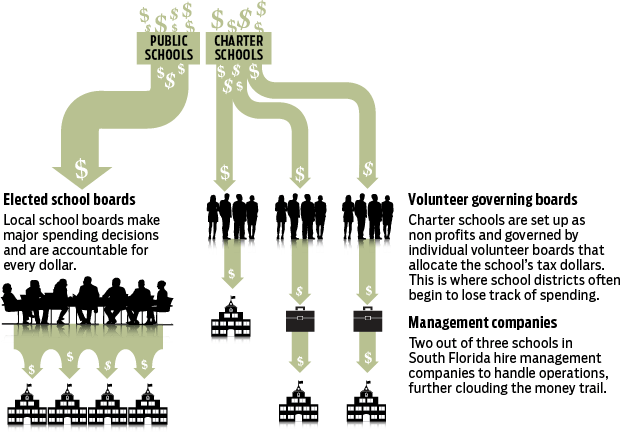
For instance, take the use of management companies.


A for-profit charter school can simply cut services to students and pocket the savings as profit.


A nonprofit charter school can do the same thing after engaging in one additional step.


All I have to do is start a “nonprofit” charter school and then hire a for-profit management company to run it. Then my management company can cut services and pocket the profits!


It’s really that simple! I turn over nearly all of my public tax dollars to the management company that then uses it to operate the school – and keeps whatever it doesn’t spend.


Heck! It doesn’t even matter who owns the company! It could even be me!


The law actually allows me to wear one hat saying I’m nonprofit and then put on a different hat and rake in the cash! The only difference is what hat I’m wearing at the time!


SO I get to claim to be a nonprofit while enjoying all the advantages of being for-profit.


flowchart960
SOURCE: Florida Sun Sentinel


I may even be able to buy things with public tax dollars through my for-profit management company and then if my “nonprofit” school goes belly up, I get to keep everything I bought! Or my management company does.


So the public takes all the risk and I reap all the reward. And I’m still graced with the label “nonprofit.”


Oh, and speaking of spending, being a “nonprofit” doesn’t stop me from the worst kind of real estate shenanigans routinely practiced by the for-profit charter schools.


Both types of privatized institution allow for huge windfalls in real estate. If I own property X, I can sell it to my charter school (or management company) and then pay myself with tax dollars. Who determines how much I pay for my own property? ME! That’s who!


And I can still be a nonprofit.


Think that’s bad? It’s just the tip of the iceberg.


Thanks to some Clinton-era tax breaks, an investor in a charter school can double the original investment in just seven years!

I can even get the public to pay for the same building twice! And even then taxpayers still won’t own it!


But that’s the complicated stuff. There’s an even easier way to get rich off the public with my “nonprofit” charter school, and operators do it all the time: write myself a fat check!


After all, I’ve gotta’ pay, myself, right? And who’s in charge of determining how much I’m worth? ME!


I can even pay myself way more than my counterparts at traditional public schools who oversee exponentially more staff and students.


For instance, as New York City Schools Chancellor, Richard Carranza is paid $345,000 to oversee 135,000 employees and 1.1 million students. Meanwhile, as CEO of Success Academy charter school chain, Eva Moskowitz handles a mere 9,000 students, for which she is paid $782,175.


And this is by no way a unique example.


There are just so many ways to cash in with a charter school even at a so-called “nonprofit” – especially if I want to dip my toe into legally dubious waters!


I could do like the almost exclusively “nonprofit” Gulen charter schools and exist solely as a means to raise money for an out-of-favor political movement in Turkey.


I could use charter funds to finance other businesses. I could decide to discontinue programs that students receive in traditional public schools such as providing free or reduced lunches but keep the cash. I could fake enrollment and have classes full of “ghost students” that the local, state and federal government will pay me to educate.


Fraud and mismanagement are rampant at charter schools because we don’t require them to be as accountable as their traditional public school counterparts.


If a traditional public school tried this chicanery, we’d almost certainly catch it at the monthly meetings or frequent audits. But charter schools don’t have to submit to any of that. They’re public money spent behind closed doors with little to no requirement to explain themselves – ever.


And all of this – nearly every bit of criticism I’ve leveled against the industry – doesn’t even begin to take into account the educational practices at these types of schools.


There is plenty of evidence that charters provide a comparable or worse education than children routinely receive at traditional public schools.


Where it is comparable, the issue is clouded by selective enrollment, inadequately servicing students with special needs and generally encouraging the hardest to teach to get an education elsewhere. Where it is worse, it is colossally worse, robbing children not just of funding but what is likely their only chance at an education.


But we don’t even need to go there.


We only need the issue of fiscal responsibility to bring down this behemoth.


Charter schools are no way to run a school. They are a blatant failure to meet our fiduciary responsibilities.


Traditional public schools are the best way to run a school. They protect the public’s investment of money and resources while providing a quality education to students.


So all this talk about nonprofit and for-profit charter schools is either a mark of supreme ignorance or a ploy for weak willed politicians to weasel their way out of taking a stand on an issue whose merits are obvious to anyone who knows what really happens in our education system.


It’s time to stop wasting taxpayer money on this expensive fraud.


It’s time for the charter school experiment to end.


And it’s way passed time to support fully public schools.


Like this post? I’ve written a book, “Gadfly on the Wall: A Public School Teacher Speaks Out on Racism and Reform,” now available from Garn Press. Ten percent of the proceeds go to the Badass Teachers Association. Check it out!

WANT A SIGNED COPY?

Click here to order one directly from me to your door!

book-1

Nationwide Poll Shows Overwhelming Support for Public Schools in All Areas Except One

5e6d4156-a078-4458-bdec-72746eca6e98


Waylon Jennings classic country hit advises Mama’s not to let their babies grow up to be cowboys.


Now, I guess we can add teachers to that list.


According to the 50th annual PDK Poll of attitudes about public schools, Americans trust and support teachers, but don’t want their own children to join a profession they see as underpaid and undervalued.


In almost every other way, they support public schools and the educators who work there.


When it comes to increasing school funding, increasing teacher salary, allowing teachers to strike, and an abundance of other issues, the poll found a majority of people unequivocally in favor of endeavors meant to bolster learning.


In fact, support for education and educators has never been so high in half a century.


“Two-thirds of Americans say teachers are underpaid, and an overwhelming 78% of public school parents say they would support teachers in their community if they went on strike for more pay,” according to PDK’s Website.


If true, this result illuminates an incredible tone deafness among politicians like Scott Wagner in Pennsylvania who is running for governor on the platform that teachers make too much money. According to the poll, only 6% of Americans agree with him.


Moreover, those who support teachers strikes include 6 in 10 Republicans.


“Those who would be most affected by a teacher walk-out — say they would support teachers in their community if they went on strike for more pay. Among the general public, 73% say they would support a job action for higher wages.”


These are record high results that are also reflected in respondents unwillingness to encourage their own children to become teachers in the current political landscape.


For the first time since the question was asked in 1969, a majority of 54% say they would not want their child to become a teacher.


The reason? Poor pay and benefits.


Moreover, a lack of adequate funding is cited as the most common problem facing public schools – a finding that’s held true since the early 2000s. In fact, for the 17th consecutive year, Americans have named the lack of funding as the biggest problem facing their local schools.


It seems that either or both major political parties could easily pick up broad popular support by doing an about face on education. Instead of backing standardization and privatization, they should get behind public education.


The topic has typically served as a wedge issue between progressives and corporate Democrats while Republicans have almost exclusively backed a strategy to “starve the beast” and promote privatization.


However, Democrats and/or Republicans who ran on respecting and remunerating teachers as well as increasing support for the public schools that employ them would find major support among voters.


The PDK poll is based on responses from 1,042 adults including 515 parents of school-age children. They were randomly and representatively sampled in May 2018 through on-line surveys.


The 2018 results include particular support for the public school system as opposed to charter and voucher schools.


Nearly 8 in 10 people said they prefer reforming the existing public school system rather than finding an alternative approach.


That’s a higher response than any year since the question was first asked 20 years ago. Moreover, it’s not just an opinion about nationwide schooling: 78% say they’d rather reform than replace the local school system, as well.


In addition, there is support among Americans to not only increase funding, but also spend it more equitably.


A majority (60%) support spending more on students who need extra help than spending the same amount on every child (39%).


Responds were more divided on where the influx of funding should come from.


Half of respondents favor raising taxes and half say the schools should spend less on students who require fewer resources.


This is related to public perception of exactly which students are receiving unfair funding. The poll revealed that most people recognize some resource inequality based on race and geographic region but they think most is based on parental wealth: 75% of respondent say public school students serving mostly poor students have fewer resources than those serving rich students.


One of the most interesting findings is always the public’s overall perception of schools.


And this poll – as in previous editions – found a sharp difference in respondents appraisal of schools nationwide vs. the schools in their own neighborhoods.


Fifty-five percent say that on a national scale students today get a worse education than those in previous generations.


However:


The public schools continue to suffer from an image deficit. Among those who know them best, parents of current students, 70% give their oldest child’s school an A or B grade. Among the public more broadly, by contrast, only four in 10 give their local schools an A or B. In results that are typical across the years, far fewer give top grades to the public schools nationally, just 19%.”


In other words, people seem to think that nationally our schools stink. But the schools in our own neighborhoods are pretty good.


The reason is simple. National perception is formed by the media. Local perception is formed by actual empirical evidence.


The forces of school privatization and their propaganda network has pushed the lie of “failing schools” for so long, that people believe it – except in their own neighborhoods where they see it to be false.


But the questions weren’t all about how schools should be run. They also asked about security – a hot topic when school shootings happen at least once a month.


“Parents lack strong confidence that schools can protect their children against a school shooting but favor armed police, mental health screenings, and metal detectors more than arming teachers to protect their children.”


This bodes badly for the Trump administrations plans to push guns on public school teachers instead of enacting common sense gun regulations.


As usual, policymakers are trying to herd Americans to their point of view instead of listening to their constituencies.


And that seems to be the big take away from this year’s poll.


Americans want and support public education.


It’s time our so-called leaders got with the program.


Like this post? I’ve written a book, “Gadfly on the Wall: A Public School Teacher Speaks Out on Racism and Reform,” now available from Garn Press. Ten percent of the proceeds go to the Badass Teachers Association. Check it out!

WANT A SIGNED COPY?

Click here to order one directly from me to your door!
book-2

Public School is Not For Profit. It is For Children.

Screen Shot 2018-08-28 at 4.14.57 PM


Betsy DeVos doesn’t get it.


But neither did Arne Duncan.


Whether right or left or somewhere in between, the person sitting at cabinet level tasked with advising the President on education matters invariably knows nothing about the purpose of public schools.


Duncan thought it had something to do with canned academic standards and standardized tests.


DeVos thinks it involves vouchers to religious or private schools.


But they’re both as wrong as two left shoes.


Public schools exist for one reason and one reason only – to meet the needs of children.


They aren’t there to enrich the private sector or even provide the job market with future employees.


They exist to teach, to counsel, to inspire, to heal.


And all these other schemes favored by Dunce Duncan and Batty Betsy that purport to meet kids needs while somehow enjoying the totally unintended side effect of enriching wealthy investors completely misses the point.


Public schools serve one purpose – to help the kids enrolled in them.


That’s all.


If someone is getting rich off that, there’s a huge problem somewhere.


Unfortunately, the Secretaries of Education of Donald Trump and Barack Obama aren’t the only ones to get it wrong. Policymakers on both sides of the aisle have lost sight of this fact.


So have pundits and media personalities on Fox News, CNN and MSNBC. So have CEOs and tech entrepreneurs and economists and anyone – really – whom our society seems to take seriously.


Don’t believe me?


Take the latest pronouncement from DeVos, our Secretary of Education.


She announced recently that she was looking into using federal funds to buy guns for teachers to better protect their students from school shooters.


It doesn’t take a genius to see that this is not in the best interests of children.


Teachers with guns mean a MORE dangerous environment for children, not less.


It means escalating the chance of friendly fire much more than boosting the possibility of a kindergarten teacher turning into an action hero.


It means heightening the chance of children getting their hands on these firearms and doing themselves or others harm.


And given the disproportionate murders of people of color even at the hands of trained professionals in the police force, it means children of color being legitimately terrified of their mostly white educators – or worse.


The reason given by DeVos may be to make children safer. But the measure she’s proposing really has nothing to do with them at all.


It’s a boondoggle for private industry – one private industry in particular – gun manufacturers.


Instead of sensible regulations on a product that’s at least as dangerous as items that are much more heavily controlled – such as cold medicine and automobiles – DeVos is doing the only thing she can to protect what she really cares about – corporate profits.


She is using money earmarked “safety” to increase danger.


Or as she sees it – she’s using a government apparatus that could harm the gun industry to instead pad its pockets.


You’ll hear some progressives and moderates decry this move with passion and fervor – and for good reason – but what many fail to realize is that it’s not new.


It’s really just a continuation of a sickness that has crept into our society about how we conceptualize the very idea of school.


We have moved away from the proposition that everything must be done in the student’s best interest and have replaced it with an imperative to benefit business and industry.


After all, what is the push for academic accountability through standardized tests and Common Core but corporate welfare for the testing and publishing industry?


What is the push for charter and voucher schools but government subsidies for school privatization?


High stakes standardized testing isn’t about helping students learn. Neither is Common Core, value-added measures or a host of top-down corporate policies championed by lions of the left and supply-side patriots.


They are about creating a problem where one doesn’t exist: accountability.


“How do we make sure students receive a quality education?” As if this has ever been hard to determine.


In general, the schools with greater needs than funding are where students struggle. The schools where everyone has more than they need is where they excel.


But they try to sweep the issue of inequitable funding and resources under the rug by framing the question entirely about teachers and schools.


In short, instead of asking about an obvious inequality, they hide a preconceived answer in the question: “How do we make sure teachers and schools are actually educating kids?”


Wrong question. But here’s the answer, anyway: Administrators observe teachers and determine if they’re doing their jobs. And school boards evaluate administrators.


In general, the staff isn’t the problem. It’s the lack of resources we give them to work with – everything from crumbling buildings, large classes, narrowed curriculum to a lack of wraparound social services.


It doesn’t take much to see we’re shortchanging our neediest students.


You don’t need standardized tests to tell you that. You don’t need new academic standards. You don’t need to evaluate educators on things beyond their control.


But doing so creates a new market, a need that can be filled by corporate interests unrestrained by the conviction that public schools are not supposed to be a profit-making venture.


People providing services for schools are supposed to make a living – not a killing – off the public’s dime.


The same can be said for school privatization.


Public schools are in no way inferior to institutions that are privately managed. Tax dollars administered by duly-elected representatives in the light of day are in no way less effective or more corrupt than the alternative – letting bureaucrats behind closed doors dole out the money however they choose even into their own pockets.


In fact, just the opposite!


Nor have charter or voucher schools ever been shown to increase student learning without also selecting only the best academic students and shunning those most difficult to teach, providing fewer resources for students and/or operating with greater funding.


But pretending that privatization is a better alternative to democratic rule creates a market, it opens the door so the system can be gamed for profit at the expense of student learning and wellbeing.


That’s why we look in awe at LeBron James, an athlete who uses his fortune to open a school providing all the things society refuses for students of color. A basketball player who refuses to usurp the public’s leadership role in administering that fully public school.


He’s a shinning example of actual philanthropy in an age of bogus philanthrocapitalism. But he’s also proof that his solution is not reproducible large scale.


The rich – even if they are well intentioned – cannot save us. Only the public can support all public schools.


And to do that, we must understand the purpose behind these institutions.


Otherwise, we’ll continue to be trapped on a runaway train where the conductor seems to possess no sense of urgency about slowing down.


We would never have been in this situation – and in fact could right the course even now – if we just took the time to clarify what we were doing and why we were doing it.


We could save generations of children if we stopped cashing in on public schools and realized the reason for their existence.


We could ensure both our present and our posterity.


If only we remembered that one thing.


Public schools are not for profit.


They are for children.


Like this post? I’ve written a book, “Gadfly on the Wall: A Public School Teacher Speaks Out on Racism and Reform,” now available from Garn Press. Ten percent of the proceeds go to the Badass Teachers Association. Check it out!

WANT A SIGNED COPY?

Click here to order one directly from me to your door!
book-4

No One Ever Remembered a Teacher for Raising Standardized Test Scores

gradhug


It’s the day before school begins.


I’m out to eat with my family and have just taken a big bite of a juicy beef taco.


That’s when I notice someone standing right next to me at the restaurant.


So I raise my eyes upward, a meat filled tortilla overfilled with lettuce and beans hanging from my mouth, and I’m greeted with a familiar face.


“Mr. Singer!” the woman says with a nervous smile on her lips.


“Do you remember me?”


I think for a moment but realize I have more pressing concerns. I couldn’t reply with an answer to the woman’s question even if I did remember her.


So I chew and swallow and then look again.


“It’s me,” she says. “Tamarind.”


And then it hits me like a flash.


The face in front of me ages backward. The adult eyes soften. The taut cheeks become chubbier. And her whole figure shrinks three feet closer to the ground.


“Oh my God! Tamarind! Of course I remember you!” I say.


She smiles and blushes. I’m surprised by how nervous she is. I’m no one to inspire anxiety. I’m just a guy out with his wife, daughter and father-in-law shoving a taco in his face.


“When I saw you here I just had to come up to you,” she said. “I was in your 6th grade class.”


“I think it was 8th grade, wasn’t it?” I said.


“Yes! That’s right! Eighth grade!”


“How old are you now? My gosh I remember you when you only came up to here off the ground.”


“I’m 22. I’m doing really well. I just wanted you to know that you taught me how to write. If it wasn’t for you I never would have made it anywhere. I just wanted to thank you so much for everything you did for me.”


We chatted a bit more and then she left us to finish our meal.


But, of course, the whole interaction got me thinking.


As a teacher, you are something of a minor public figure.


When you’re out and about – especially if you’re somewhere in your district – you’re bound to be recognized and invariably someone will want to chat.


I remember one time at the bakery counter a former student gave me my order and told me he threw in a few donuts.


I remember laughing and telling him he didn’t need to do that.


“Nah, Mr. Singer, you never wrote me up for falling asleep in your class. You knew I was watching my brothers and sisters at home and never gave me shit for it. You keep those donuts.”


Another time at the theater I was almost late to my movie because I was listening to a former student at the concession stand catch me up on her life and what all of her friends from my class were doing these days.


So many students. So many kids that have now become adults.


You lose track of how many lives you’ve had an impact on.


The first few days of school are always filled with endless administrative meetings. The superintendent welcomes you with testing data. Then your principal breaks it down by building and subject.


You find out which diagnostic exams you have to give your students and when. You find out what your Pennsylvania Value Added Assessment Score (PVAAS) is – how good a teacher you are based on how well your students from last year did on the state standardized test.


On the one hand, I suppose I have no reason to feel like much of a good teacher.


Most of my students didn’t pass the test. They rarely do.


The same number of 7th graders (that’s what I taught last year) passed the reading test as in previous years. However, many more passed that were expected to fail.


The state uses a mystery metric based on Classroom Diagnostic Assessment (CDT) data to come up with a prediction of who they expect to pass and who they expect to fail. No one really knows how they calculate this. For all we know, the state secretary of education could examine a pile of chicken entrails before entering it all into the system.


Does all that data mean I’m a good teacher or not?


I don’t know.


But I do know what Tamarind thinks.


And I know what a host of former students have told me. I know how they react when they see me out in the wild, just living my life.


I’m sure there are probably former students who don’t like me. There must be those who hold a grudge for getting a 59% on an assignment. Or maybe they remember me yelling at them for something. Or – who knows – maybe they just didn’t respond to The Singer Charm.


But an awful lot of people come up to me who don’t have to.


Yesterday was the first day of classes for the year.


For the first time, all my classes were looped. I taught 7th grade Language Arts last year and I’m teaching the 8th grade course this year.


When those kids came into the class on Friday, it was like a homecoming.


So many smiles. So much laughter and joy. And, yes, impromptu hugs.


It felt like a family gathering, not a school function.


As I left the building feeling more exhausted than I have in months, another teacher stopped me.


“Steve! I wanted to catch you before you left!” she said.


She told me that she gave her students a survey in her class as an icebreaker. One of the questions was to name their favorite teacher from last year. My name came up a lot.


What can you say about that?


I’m actually getting choked up just typing this.


In my years in the classroom, I’ve helped a lot of kids get better test scores.


But that’s not why they come up to me. That’s not why they remember me.


I touched their lives in some meaningful way.


And they have done the same for me.


I’m just a guy who should really take smaller bites of his tacos.


But they make me feel like a hero.


I am so grateful.


Like this post? I’ve written a book, “Gadfly on the Wall: A Public School Teacher Speaks Out on Racism and Reform,” now available from Garn Press. Ten percent of the proceeds go to the Badass Teachers Association. Check it out!

WANT A SIGNED COPY?

Click here to order one directly from me to your door!
book-2

STEM Education Severs the Arts from the Sciences

right-brain-left-brain


What’s the most effective way to dumb down a nation?


Focus on How without Why.


That’s really the biggest problem with the pedagogical fad of STEM education.


There’s nothing objectively wrong with teaching science, technology, engineering and math – the disciplines that make up STEM.


In many cases, doing so is essential to a well-rounded education.


But therein lies the problem – you can’t have a well-rounded education if you purposely leave out some of the most vital aspects of knowledge.


Where’s the art? Where’s the literature? Where’s the social studies, government, citizenship, drawing, painting, music – heck! Where’s the philosophical understanding of life, itself?


STEM initiatives often involve creating two tiers of school subjects. You have the serious disciplines that will earn you respect and a job. And you have the soft, mamby pamby humanities that are no good to anyone.


The problem is one of focus not content.


Corporate-minded bureaucrats who know nothing of human psychology, child development or education look solely at standardized test scores and get hysterical.


The U.S. is falling behind other nations – especially in science and math, they say. So we must do whatever we can to bring those test scores up, Up, UP!


Yet they have never bothered to see that our student test scores have never been at the top of the pack for all the decades we’ve been making international comparisons.


We started contrasting multiple choice assessment results for 13-year-olds in a dozen countries back in 1964. And ever since, America has always been right in the middle.


Yet for those five decades we’ve dominated the world in science, technology, research and innovation.


In that time we sent the first people to the moon, mapped the human genome, and invented the Internet – all while getting middling test scores.


In short, standardized assessments are a fantastically unreliable indicator of national success, just as they are poor indicators of individual learning.


We’ve never been a nation content with picking our answers from four options – A,B,C,D. We blaze new paths!


But number obsessed fools have convinced a public blinded by sports statistics that these tests mean our kids are deficient. And the only cure is to put on blinders and focus almost exclusively on those subjects most featured on the tests.


Even reading and writing are only valuable if they let us guess what a normalized reader is supposed to comprehend from a given passage and if they allow us to express ourselves in the most rudimentary and generic ways.


This is exactly what they do in countries with the highest test scores – countries that are LESS innovative than the U.S.


Asian countries from Singapore to South Korea to India are not blind to this irony. While we are trying to imitate them, they are trying to imitate the kind of broad liberal arts education in which we used to pride ourselves.


“Many painters learn by having fun,” said Jack Ma, founder of one of China’s biggest Internet companies Alibaba.


“Many works of art and literature are the products of having fun. So, our entrepreneurs need to learn how to have fun, too.”


Ma worries that his country is not as innovative as those in the West because China’s educational system focuses too much on the basics and does not foster a student’s complete intelligence, allowing him or her to experiment and enjoy the learning process.


In other words, no matter how good you are at math and science, you still need to know how to learn, think and express yourself.


To be fair, these criticisms of STEM are not new.


Even global pundits like Fareed Zakaria have made similar arguments.


The result has been a hasty addition – change STEM to STEAM by adding in the arts.


Unfortunately, this hasn’t always worked out for the best.


Most of the time, the arts component is either an after thought or merely a sweetener to get students interested in beginning the journey – a journey that is all STEM all the time.


There is still an education hierarchy with the sciences and math at the top and the humanities and social studies at the bottom.


This is extremely unfortunate and will cause long-term detrimental effects to our society.


For instance, we pride ourselves in being democratically ruled. Political power does not come from authority, it comes from the consent of the governed.


This requires a public that knows how to do more than just add and subtract. Voters need to understand the mechanisms of government so they grasp their rights. They need a knowledge of history so they don’t repeat the mistakes of the past. They need to grasp human psychology, anthropology, and sociology to understand how people work in groups and individually.


Moreover, as human beings, they need the humanities. People have thoughts and feelings. They need to know how to express those thoughts and feelings and not just by writing a five-paragraph essay. They need to be able to create works of art. They need to be able to write a story or poem. They need to be able to manipulate images. They need to understand and create music.


Without these things, it can be difficult to become fully actualized people.


That used to be the goal of education. Provide students with the tools to become the best version of themselves.


But this focus on STEM and STEAM only endeavors to make them the best cogs the workforce needs.


We have relinquished our commitment to students and replaced it with a commitment to business and industry.


The idea is that schools owe the job market workers. That could not be further from the truth. We owe our students the tools that will help them live the best lives. And employment is only one small facet of that goal.


I’m not saying we shouldn’t teach math and science. We should – we MUST. But those can’t be prioritized over and above other essential human endeavors.


We need to fund and encourage a broad liberal arts education for all students. As they get older and move on to post-secondary studies including industrial arts they will inevitably specialize in areas that they find most interesting.


But until then, it is our job to give them every opportunity to learn – not to mold them into future wage slaves or boost national pride with arbitrary and meaningless test scores.


Like this post? I’ve written a book, “Gadfly on the Wall: A Public School Teacher Speaks Out on Racism and Reform,” now available from Garn Press. Ten percent of the proceeds go to the Badass Teachers Association. Check it out!

WANT A SIGNED COPY?

Click here to order one directly from me to your door!

book-2

Wealth – Not Enrollment in Private School – Increases Student Achievement, According to New Study

pq2iPfteRemNHu7D5w9c_richkid


Students enrolled in private schools often get good grades and high test scores.


And there’s a reason for that – they’re from wealthier families.


A new peer-reviewed study from Professors Richard C. Pianta and Arya Ansari of the University of Virginia found that once you take family income out of the equation, there are absolutely zero benefits of going to a private school. The majority of the advantage comes from simply having money and all that comes with it – physical, emotional, and mental well-being, living in a stable and secure environment, knowing where your next meal will come from, etc.


The study published in July 2018 attempts to correct for selection bias – the factors that contribute to a student choosing private school rather than the benefits of the school, itself.


The study’s abstract puts it this way:


“Results from this investigation revealed that in unadjusted models, children with a history of enrollment in private schools performed better on nearly all outcomes assessed in adolescence. However, by simply controlling for the sociodemographic characteristics that selected children and families into these schools, all of the advantages of private school education were eliminated. There was also no evidence to suggest that low-income children or children enrolled in urban schools benefited more from private school enrollment.”


This has major policy implications.


Corporate school reformers from Barack Obama to Donald Trump, from Arne Duncan to Betsy DeVos, from Cory Booker to Charles and David Koch, have proposed increasing privatized school options to help students struggling in public schools.


Whether it be increasing charter schools or vouchers to attend private and parochial schools, the implication is the same – such measures will not help students achieve.


We need programs aimed at poverty, itself, not at replacing public schools with private alternatives.


According to the abstract:


“By and large, the evidence on the impact of school voucher programs casts doubt on any clear conclusion that private schools are superior in producing student performance…


“In sum, we find no evidence for policies that would support widespread enrollment in private schools, as a group, as a solution for achievement gaps associated with income or race. In most discussions of such gaps and educational opportunities, it is assumed that poor children attend poor quality schools and that their families, given resources and flexibility, could choose among the existing supply of private schools to select and then enroll their children in a school that is more effective and a better match for their student’s needs. It is not at all clear that this logic holds in the real world of a limited supply of effective schools (both private and public) and the indication that once one accounts for family background, the existing supply of heterogeneous private schools (from which parents select) does not result in a superior education (even for higher income students).”


Researchers repeatedly noted that this study was not simply a snapshot of student performance. It is unique because of how long and how in depth students were observed.


The study looks at student outcomes at multiple intervals giving it a much longer time frame and much greater detail than other similar investigations. Researchers examined wide ranging family backgrounds and contextual processes to reduce selection bias.


Participants were recruited in 1991 from ten different cities: Little Rock, Arkansas; Irvine, California; Lawrence, Kansas; Boston, Massachusetts; Philadelphia and Pittsburgh, Pennsylvania; Charlottesville, Virginia; Seattle, Washington; Hickory and Morganton, North Carolina; and Madison, Wisconsin. They were followed for 15 years and had to complete a month long home visit. In addition, they submitted to both annual interviews and home, school, and neighborhood observations.


The final analytic sample consisted of 1,097 children – 24% of whom were children of color, 15% had single mothers, and 10% had mothers without a high school diploma.


Moreover, student academic achievement wasn’t the only factor examined.


Researchers also assessed students social adjustment, attitudes, motivation, and risky behavior. This is significant because they noted that no other study of private schools to date has examined factors beyond academics. Also, there is a general assumption that private school has a positive effect on these nonacademic factors – an assumption for which the study could find no evidence.


From the abstract:


“In short, despite the frequent and pronounced arguments in favor of the use of vouchers or other mechanisms to support enrollment in private schools as a solution for vulnerable children and families attending local or neighborhood schools, the present study found no evidence that private schools, net of family background (particularly income), are more effective for promoting student success.”


One reason behind these results may be the startling variation in “the nature and quality of private school classrooms.” There is no consistency between what you’ll get from one private school to the next.


The x-factor appears to be family income and all that comes with it.


We see this again and again in education. For instance, standardized test scores, themselves, are highly correlated with parental wealth. Kids from wealthier families get better test scores than those from poorer families regardless of whether they attend public, charter or private schools.


It’s time our policymakers stop ignoring the effect of income inequality on our nations students.


If we really want to help our children, the solution is not increased privatization. It is increased funding and support for anti-poverty programs, teachers and a robust public school system.


Like this post? I’ve written a book, “Gadfly on the Wall: A Public School Teacher Speaks Out on Racism and Reform,” now available from Garn Press. Ten percent of the proceeds go to the Badass Teachers Association. Check it out!

WANT A SIGNED COPY?

Click here to order one directly from me to your door!
 

book-3

Thank You, Wealthy Robber Barons, for the Freedom to be a Free Rider!


wealhty-myths-business-man_large


Wow! I now have a real choice when it comes to my union!


At least, that’s what the email I got from the Mackinac Center says!


Now that the Supreme Court ruled 5-4 in the Janus vs. AFSCME case, I don’t have to pay any of my hard earned cash to my union!


I can be a free rider! I can get all the advantages of belonging to a union – higher salary, better benefits, better safety precautions – and I can leave it to the rest of the membership to pay for me!


That’s amazing!


And what’s even more amazing is who is sending this email to me!


I mean the Mackinac Center is funded by Betsy DeVos and her family, the Koch Brothers, Eli Broad, the Scaifes, and the Walton family!


Who would have ever thought some of the richest people in the world would take an interest in my union membership!?


How nice of them!


I’m merely a public school teacher! In my more than a decade in the classroom, they’ve spent billions of dollars to weaken my profession!


They lobbied for education funding nationwide to be gutted so they could get another tax cut!


They invested in charter and voucher schools and then demanded we build more of these privatized institutions with little to no accountability so they could rake in record profits!


They’ve weakened education at schools serving the highest populations of students of color and then benefited when those same kids turned to crime and were incarcerated in their private prisons!


Instead of holding politicians accountable for inequitable funding and instead of supporting teacher autonomy, they forced high stakes standardized testing and Common Core on me and my students!


They demanded my administrators undervalue what I actually do in the classroom but instead evaluate me based on my student test scores – so being given struggling students means I’m somehow a worse teacher than the person across the hall with the honors class!


They did all that but suddenly they’re concerned about my freedom to withhold union dues!?


Well Golly!


Jeepers!


Gee Willikers!


Goodness gracious and bless my soul!


I must have been wrong about these fellers and these ladies all along!


They really DO care about little people like me!


Did you know that a 2011 study by researchers at Harvard and the University of Washington concluded that higher union membership encourages higher pay across the economy!?


It’s true!


They said the decline of unions accounts for as much as one-third of the increase in wage inequality since the 1970s!


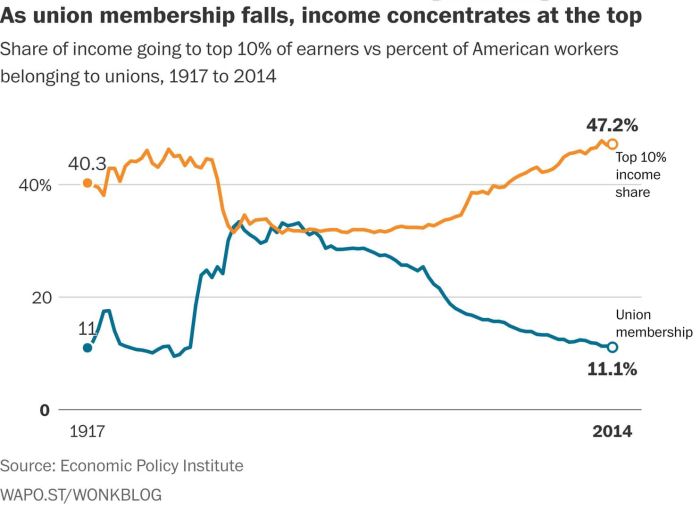
According to the Economic Policy Institute, when union membership goes down, the wealthy make more money! Conversely, the more union membership goes up, the less money goes to the wealthy!


6BILJESJ744BVLL2QVZYGJRNCM


And despite all that, the rich are concerned that I have the right to stop paying union dues!


I mean if I stop paying my dues and my fellow working stiffs stop paying their dues, then my union might just have to close up shop!


And that would mean my wages would go down!


But these same rich people who just sent me an email would see their investments go up!


They’d take home sacks of cash! So much money that they’d probably drop some and maybe I might be able to pick up a few pennies they leave on the curb!


Isn’t that great!?


You know public sector employees including firefighters and police, and teachers like me are the largest sector left of the workforce still represented by unions!


According to BLS statistics, 38 percent of public sector employees are represented by unions!


It’s true!


Back in 1945, union membership nationwide was at its highest rate of 33.4%! That means back then about a third of all American workers belonged to a union!


Last year it was down to 10.7 percent!


YC4GHPZ5MI5DHNQVM2TN4E4JZI


In the intervening years, manufacturing jobs have declined, blue collar jobs have been outsourced and both political parties have passed laws making it harder to unionize and collectively bargain!


But thank goodness I now have the right to get something for nothing from my union!


That’s going to perk things right up!


Sure, numerous studies have shown that declining union membership is one of the major causes why middle class wages have remained basically flat! But I get to keep a hundred bucks in my pocket so everything’s square!


One thing worries me, though!


I’m not sure many union workers are going to take advantage of this new freedom!


Don’t get me wrong – I don’t agree with everything my union does! No one could say that!


I don’t agree with everything my government does, either, but I still pay taxes!


And I wouldn’t stop paying taxes even if I could! I like being an American citizen, and I like much of what my government provides by way of our military, infrastructure and social programs!


It’s the same with my union!


I mean I LIKE earning higher wages! I LIKE getting better benefits! I LIKE knowing I work in a safe environment!


And when I have a better working environment, my students have a better learning environment!


I doubt many of my co-workers are going to stop paying their dues just because they can!


UWLMMCVEKY3ZFDE5K6LGDY42PE


We’re not stupid! We know that if you want union benefits, you have to pay union dues! The Supreme Court can say whatever it likes! It can’t legislate passed reality!


Moreover, who would want to associate with a co-worker who refuses to pull his or her own weight!?


If I found out one of my colleagues was leaving it to me to pay for both of us, I’d throw a fit! I wouldn’t associate with that person!


If he or she came to my room asking for advice, I’d tell them to get lost! I wouldn’t eat with them at lunch, I wouldn’t chat about their day, I’d give them their walking papers, myself!


Frankly, the social cost would be higher than just paying your union dues!


So thanks anyway, Mackinac Center! Thanks anyway, Charles and David Koch! Thanks anyway, Betsy DeVos!


I’m sticking with my union.


36468177_10156001729458860_2645036208874323968_n


Like this post? I’ve written a book, “Gadfly on the Wall: A Public School Teacher Speaks Out on Racism and Reform,” now available from Garn Press. Ten percent of the proceeds go to the Badass Teachers Association. Check it out!

WANT A SIGNED COPY?

Click here to order one directly from me to your door!

 

book-2