Top Five Actions to Stop the Teacher Exodus During COVID and Beyond


As the COVID-19 pandemic drags on, schools across the United States are on the brink of collapse
 
There is a classroom teacher shortage. 
 
There is a substitute teacher shortage.  
 
There is a bus driver shortage
 
There is a special education aide shortage.  
 
The people we depend on to staff our public schools are running away in droves.  
 
It’s a clear supply and demand issue that calls for deep structural changes.  
 
However, it’s not really new. We’ve needed better compensation and treatment of school employees for decades, but our policymakers have been extremely resistant to do anything about it.   
 
Instead, they’ve given away our tax dollars to corporations through charter and voucher school initiatives. They’ve siphoned funding to pay for more standardized testing, teaching to the test, and ed tech software.  
 
But the people who actually do the work of educating our youth. We’ve left them out in the cold.  
 
Now with the smoldering pandemic and increased impacts on the health, safety and well-being of teachers and other staff, the exodus has merely intensified.  
 
Frankly, I’m not holding my breath for lawmakers to finally get off their collective asses.  
 
We need a popular, national movement demanding action from our state and federal governments. However, in the meantime, there are several things our local school districts can do to stem the tide of educators fleeing the profession.
 
These are simple, cheap and common sense methods to encourage teachers to stay in the classroom and weather the storm.  
 
However, let me be clear. None of these can solve the problem, alone. And even ALL of these will not stop the long-term flight of educators from our schools without better salaries and treatment.  


1)    Eliminate Unnecessary Tasks 


The list of tasks an average teacher is expected to accomplish every day is completely unrealistic.  
 
Think about it. Just to get through a normal day teachers need to provide instruction, discipline students, grade papers, facilitate classwork, troubleshoot technology, provide written and verbal feedback, counsel disputes, role model correct behavior, monitor the halls, lunches, breakfasts and unstructured time, meet with co-workers, follow Individual Education Plans, scaffold lessons for different learners and learning styles…  
 
The list is truly staggering. 
 
And it never stops. 
 
Researchers have estimated that on average teachers make at least 1,500 decisions a day. That’s about 4 decisions a minute. 
 
No one can keep up that pace, day-in, day-out, without strain. No one can do it without their work suffering.  
 
If we truly want to help teachers feel empowered to stay in the profession, we need to reduce the burden. And the best way to do that is to eliminate everything unnecessary from their plates. 

That means no staff meeting just to have a staff meeting. No shotgun scattered initiatives that teachers are expected to execute and we’ll see what will stick. No reams of paperwork. No professional development that wasn’t specifically requested by teachers or is demonstrably useful.

Nothing that isn’t absolutely necessary.

 
2) No Formal Lesson Plans

The number one offender is formal lesson plans.  
 
I’m not saying we should tell teachers they don’t have to plan what they’re doing in their classes. I’m not sure how an educator could realistically enter a classroom of students and just wing it.  
 
However, the process of writing and handing in formal lesson plans is absolutely unnecessary. 
 
Teachers gain nothing from writing detailed plans about what they expect to do in their classes complete with reference to Common Core Academic Standards. They gain nothing from acting as subordinates to an all knowing administrator who probably has not been trained in their curriculum nor has their classroom experience teaching it.  
 
For educators with at least 3-5 years under their belts, formal lesson plans are nothing but an invitation to micromanagement.  
 
Should administrators monitor what their teachers are doing? Absolutely. But the best way to do that is to actually observe the teacher in the classroom doing the work. And to conference with the teacher before and after the observation with the goal of understanding what they’re doing and how to best help them improve.  
 
Forcing teachers to set aside time from their already overburdened schedules to fill out lesson plans that administrators don’t have time to read and (frankly) probably don’t have the training or experience to fully comprehend is top down managerial madness.  


3)    More Planning Time 

Teachers need time to plan.  

It’s pathetic that I actually have to explain this.  

Education doesn’t just happen.

Parents need called. Papers need graded. Lessons need strategized. IEP’s need to be read, understood and put into practice.

All this can only happen within a temporal framework. If you don’t give teachers that framework – those minutes and hours – you’re just expecting they’ll do it at home, after school or some other time that will have to be stolen from their own families, robbed from their own needs and down time.

Every administrator on the planet preaches the need for self-care, but few actually offer the time to make it a reality.

Even if we could discover exactly how much time was necessary for every teacher to get everything done in a given day – that wouldn’t be enough time. Because teachers are human beings. We need time to process, to evaluate, to think and, yes, to rest.

I know sometimes I have to stop wrestling with a problem I’m having in class because I’m getting nowhere. After two decades in the classroom I’ve learned that sometimes you have to give your brain a rest and approach a problem again later from a different vantage point.

I need to read a scholarly article or even for pleasure. I need to watch YouTube videos that may be helpful to my students. I need to get up and go for a walk, perhaps even just socialize for a moment with my coworkers.

None of that is time wasted because my brain is still working. My unconscious is still trying untie the Gordian knot of my workday and when I finally sit down to revisit the issue, I often find it looser and more easily handled.

Administrators must prioritize teacher planning time.

There is no simpler way to put it.

Do not ask your teacher to sub. Do not ask them to attend meetings. Do not ask them to help you plan building wide initiatives – UNLESS you can guarantee it won’t interfere with their plans.


I know this is difficult right now with so many staff falling ill or being so plowed under that they simply can’t make it to work.

However, the more you push them to give up their plans, the more you diminish returns.

Not only will their work suffer but so will their health and willingness to continue on the job.

Some districts are finding creative ways to increase planning time such as releasing students early one day a week. We did that at my district last year and it was extremely helpful to meet all the additional duties required just to keep our building open. However, as the new school year dawned and decision makers decided to simply ignore continuing pandemic issues, this time went away.

Most teachers are in the profession because it’s a calling. They care about doing the best job they can for their students.

If you take away their ability to do that, why would they stay?


4) Better Communication/ Better COVID Safety  

Communication is a two way street.

You can’t have one person telling everyone else what to do and expect to have a good working relationship.

Administrators may get to make the final decision, but they need to listen to what their teachers tell them and take that into account before doing so.

This means setting aside the proper time to hear what your staff has to say.

Many administrators don’t want to do that because things can devolve into a series of complaints. But you know what? TOUGH.

It is your job to listen to those complaints and take them seriously.

Sometimes just allowing your staff to voice their concerns is helpful all in itself. Sometimes offering them space to speak sparks solutions to problems – and a whole room full of experienced, dedicated educators can solve any problem better than one or two managers locked away in the office.

However, not only do administrators need to listen, they need to speak.

When issues crop up, they need to make sure the staff is aware of what is happening.

This is especially true during the pandemic.

We are so sick of half truths about who has Covid, who is quarantined, what is being done to keep us safe, etc.

No child should return to the classroom after a negative COVID test without the teacher already being appraised.

No child should be placed in quarantine without the teachers knowledge.

No teacher with a prior medical condition should have to serve lunch duty while students eat unmasked.

Safety protocols should be the product of the entire staff’s input. If everyone doesn’t feel safe, no one feels safe.


5) Respect 


 This is really the bottom line.

Teachers need to feel respected.

We need to know that administrators and school board members understand our struggles and are on our side.

I don’t mean taking a day or even one week out of the year to celebrate Teacher Appreciation. I don’t mean free donuts or coupons to Sam’s Club. I don’t even mean a mug with an inspirational message.

I’m talking about every day – day-in, day-out – respect for teachers.

No union bashing.

No snide comments at school board meetings.

No gossipy whispering in the community.

Being a teacher should mean something to district leaders. And they should prove it in every thing they do.

The items I mentioned here go some ways to showing that respect.

Eliminating unnecessary tasks, not requiring formal lesson plans, respecting our planning time, better communicating and safety measures are all necessary to keeping your teachers in the classroom.

But they are not sufficient.

As a nation we need to change our attitude and treatment of teachers.

No profession exists without them. They create every other job that exists.

We need to start paying them accordingly. We need to start treating them as important as they are. We need to ensure that they have the time, tools and satisfaction necessary to be the best they can be.

No district can do that alone. No school director or administrator can do that.

But these are some ways you can start.


Like this post?  You might want to consider becoming a Patreon subscriber. This helps me continue to keep the blog going and get on with this difficult and challenging work.

Plus you get subscriber only extras!

Just CLICK HERE.

Patreon+Circle

I’ve also written a book, “Gadfly on the Wall: A Public School Teacher Speaks Out on Racism and Reform,” now available from Garn Press. Ten percent of the proceeds go to the Badass Teachers Association. Check it out!
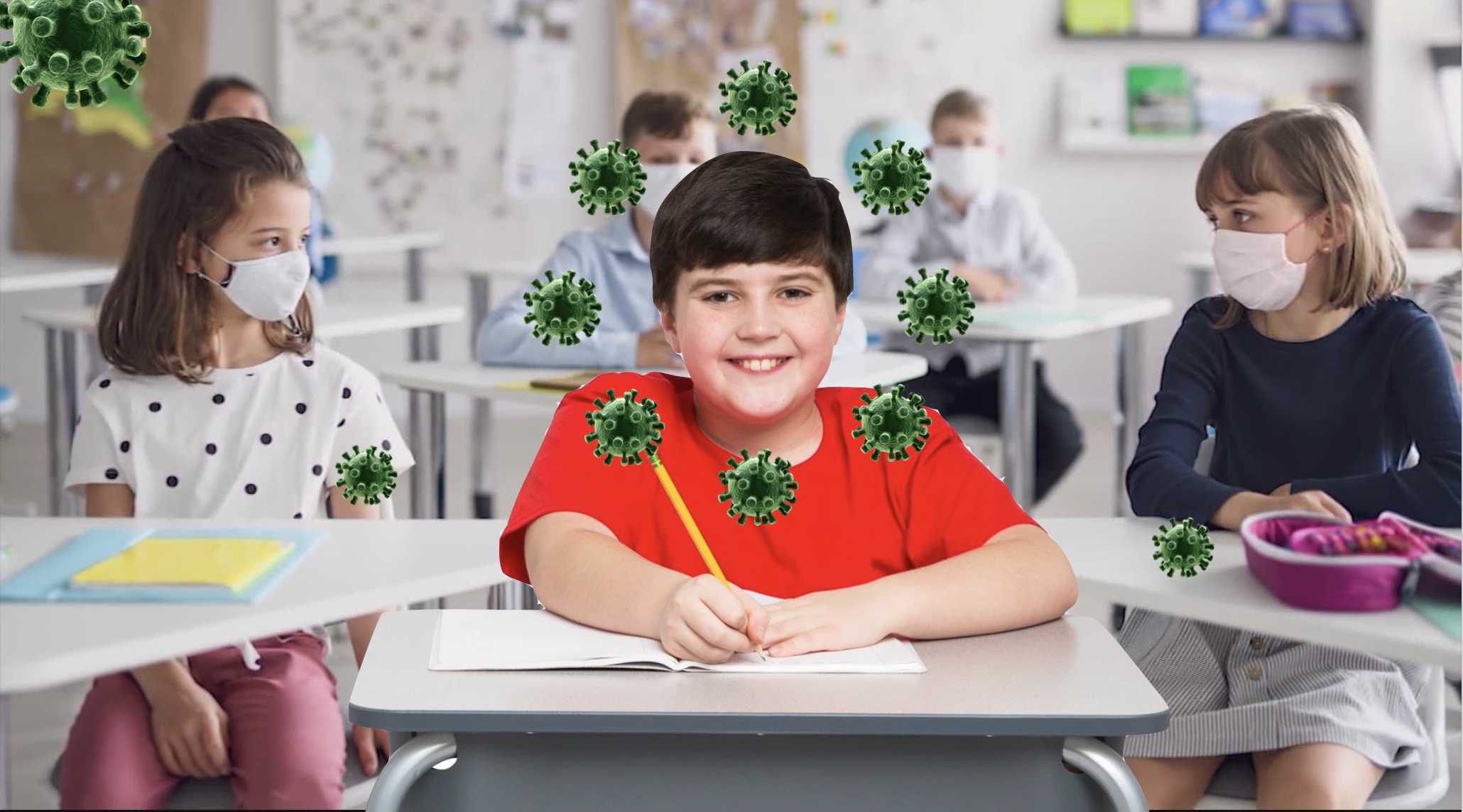
Why Does Your Right to Unmask Usurp My Child’s Right to a Safe School?

“Daddy, I’m afraid.”

My 12-year-old daughter just had a nightmare, and I was sitting on her bed trying to calm her down.

“What’s wrong, Sweetie?”

“I’m worried about school.”

That’s something with which I can certainly relate.

Even after teaching for 18 years, I always get anxious before the first day of school, and I told her as much.

“Really?” She said.


“Yeah. But I can understand why you might be even more nervous than usual. I’ll be teaching the same thing I’ve taught for years. I’ll be in the same classroom working with the same adults. Only the students will be different. But you will be in a new building with new teachers…. And you haven’t even been in a classroom in over a year.”

“That’s just it, Daddy. What if the other kids make fun of me for wearing a mask? What if I get sick?”

Our local district is reopening in a week with a mask optional policy and no vaccine requirements.

Her question was expected, but I had been dreading it.

I knew my answers and they sounded inadequate – even to me.

I explained how she would be wearing a mask and is fully vaccinated so it will be extremely unlikely for her to get sick. And even if she does, it will be extremely unlikely she’ll get VERY sick.

“And if the other kids make fun of you, just ignore it. You are going to be safe. If they take chances, they’ll just have to suffer the consequences.”

It seemed to satisfy her, but I left her room feeling like a bad parent.

Covid-19 cases are on the rise again.

Nationwide, nearly 94,000 new child Covid cases were reported last week- a substantial increase, according to the American Academy of Pediatrics (AAP) and the Children’s Hospital Association (CHA).

Even in the Pittsburgh region where we live, the number of kids hospitalized with Covid at UPMC Children’s Hospital has nearly doubled in the last week, according to KDKA. That’s 50 hospitalizations in the past month including 20 in the last week.

My daughter is scared? So is her daddy.

I went to the local school directors meeting and asked the board to follow recommendations of the Centers for Disease Control (CDC) and Allegheny County Health Department by requiring masking and vaccinations for eligible students and staff. They refused.

Now I’m stuck in the position of keeping my little girl at home for another year by enrolling her in the district’s terrible on-line program, Edmentum, or rolling the dice with in-person schooling.

I’m told there will be more synchronous teaching this year in the remote program, but I don’t trust it.

Last year, she only made it through because my father-in-law – a former math teacher – and myself basically taught her everything the on-line program struggled to get across.

We just couldn’t do it again this year. It was a full time job – several full-time jobs – too hard on him and me both.

I hope we won’t regret it.

And then there’s my own work situation.

I teach at a neighboring district that looks like it will reopen the same way with masks and vaccines mere options.

I’m fully vaccinated but immunosuppressed. Might I be putting my own health at risk teaching under these conditions?

Last year, even with masks a requirement, students and staff at both districts came down with the virus nearly every week.

With the more infectious and deadly delta variant on the rise, might it be even worse this year – especially if we are lowering precautions?

Last year I burned my sick days waiting to be vaccinated before returning to the physical classroom. This year I could take a leave of absence, but once again my district is making no accommodations for people like me. I have to work or else try to survive on a reduced salary.

When you’re already living paycheck-to-paycheck, that’s not much of an option.

I just don’t understand it.

Don’t my daughter and I have rights?

We hear a lot about the anti-maskers and the anti-vaxxers. A lot about their rights. What about our right to safe schools?

Why is it that the right NOT to wear a mask supersedes the right to go to a school where everyone is required to wear one?

Because it isn’t – as I told my daughter – a matter of everyone having to deal with just the consequences of their own actions. My daughter and I have to deal with the consequences of everyone else’s actions, too.

Or to put it another way – if one person pees in the pool, we’re all swimming in their urine.

If someone else doesn’t wear a mask, hasn’t been vaccinated and hasn’t taken the proper precautions, they can spread the Covid-19 virus through the air and infect whole classrooms of people.

Everyone else could be wearing a mask. It just takes one person who isn’t.

Is it fair that everyone else has to pay the price for one person’s carelessness?

We talk about rights so much we seem to have lost entirely the idea of responsibilities. They go hand-in-hand.

Yes, you have the freedom to do whatever you like so long as it doesn’t hurt another person.

When your actions do hurt others, you have a responsibility to stop. And if you won’t do that, the government has a responsibility to stop you.

But in this anti-intellectual age, we’ve almost completely given up on that idea.

If people take precautions by masking up and getting vaccinated, the worst that will happen is they’ll be unduly inconvenienced. If my daughter and I are forced to exist in the same spaces with people not taking the proper precautions, we could get sick and die.

It’s not like we’re talking about two equal sides here. This is people who believe the overwhelming scientific majority vs. those who get their answers from YouTube videos and political figures. It’s doctors, researchers and immunologists vs. conspiracy theorists, internet trolls and the MyPillow guy.

I’m not even judging – believe what you like so long as it affects only you. But when it affects me, too, then we have a problem.

The lowest common denominator is allowed to run wild. They can do whatever they like and the rest of us just have to put up with it.

That’s why we’re beginning year two and a half of a global pandemic! Not enough of us got the vaccine by the end of the summer.

Now infections are rising and few policy makers have the courage to take a stand and protect those of us who took precautions from those of us who did not.

And don’t tell me our lawmakers don’t have the power. There is a mountain of precedent showing they have.

On the highway, you can’t just go wherever you want, whenever you want. There are lanes, speed limits, traffic lights.

Even vaccines! To enroll in Kindergarten, parents already have to prove their kids have been vaccinated against measles, mumps, rubella and a host of other diseases. Why is Covid-19 any different?

Public safety is a PUBLIC issue not a private one.

It just makes me feel so helpless.

I can’t do anything to protect my students.

I can’t do anything to protect myself.

I can’t do anything to protect my baby girl.

And I can’t wait for the school year to start!


Like this post?  You might want to consider becoming a Patreon subscriber. This helps me continue to keep the blog going and get on with this difficult and challenging work.

Plus you get subscriber only extras!

Just CLICK HERE.

Patreon+Circle

I’ve also written a book, “Gadfly on the Wall: A Public School Teacher Speaks Out on Racism and Reform,” now available from Garn Press. Ten percent of the proceeds go to the Badass Teachers Association. Check it out!

Can Unions Defang Charter School Vampires?

What if a vampire suddenly lost its fangs?

Would it still be a vampire?

That’s the question at the heart of a major change in the largest charter school network in western Pennsylvania.

This week, staff at the Propel network of charter schools voted overwhelmingly to unionize.

So the money men behind the Allegheny County system of charter schools are probably wondering if they’re still investing in charter schools at all.

After all, when encumbered by the need to collectively bargain with employees, can a charter still do all its usual profitizing tricks?

Thursday, Propel teachers and other staff voted 236-82 to join the Pennsylvania State Education Association (PSEA).

The drive took 9 months to achieve. Propel enrolls about 4,000 students at 13 schools in Braddock Hills, Hazelwood, Homestead, McKeesport, Pitcairn, Turtle Creek, Munhall, McKees Rocks and the North Side.

Though PSEA represents staff at about a dozen charters throughout the state, unionization is a rarity at charter schools.

And the reason is pretty obvious.

Charter schools are all about escaping the rules that authentic public schools have to abide by.

Though publicly financed, they are often privately operated.

They don’t have to be run by elected school boards. They don’t have to manage their business at public meetings. They don’t have to open their budgets to public review. Heck! They don’t even have to spend all the money they get from taxes on their students.

They can legally cut services and pocket the savings.

Nor do they have to accept every student in their coverage area. They can cherry pick whichever students they figure are cheapest to educate and those who they predict will have the highest test scores. And they can hide this discrimination behind a lottery or whatever other smoke screen they want because – Hey! The rules don’t apply to them!

I’m not saying every charter school does all this, but they all can. It’s perfectly legal to do so, and we rarely even see it happening until the school goes belly up and taxpayers are left paying the tab.

So how do unions change this system?

Most obviously, they put a check on the nearly limitless power of the charter operators.

Now you have to pay a living wage. You can’t demand people work evenings and weekends without paying them overtime. You have to provide safe working conditions for students and staff. And if you want to cut student services and pocket the difference, the staff is going to have something to say about that – AND YOU HAVE TO LISTEN!

How much will union power beat back charter bosses?

It’s hard to say. But there is no doubt that it will play a moderating influence.

And how much it does so may depend to a large degree on the individuals working at the school and the degree of solidarity they can exercise against their bosses.

One thing is for sure, with a union the gravy train is over.

Wall Street speculators often fawn over the charter industry because it’s possible to double or triple your investment in seven years.

This will probably not be the case in a unionized charter. And the impact of such a reality has yet to be felt.

Will the worst financial gamblers abandon school privatization because unions make it too difficult to make handfuls of cash? One can hope.

If it happened, the only charters left standing would be those created without profit as their guiding principle. The goal would really have to be doing the best thing for children, not making shadowy figures in the background a truckload of money.

Do such charter schools even exist? Maybe. With staff continuing to unionize, maybe there will be even more of them.

However, even if all of them become altruistic, there still remains a problem.

There still remains an authentic public school with which the charter must compete for limited funding.

Even a positive charter school that only does the best for its students still needs money to operate. And most districts barely have enough funding for one education system – certainly not two parallel ones.

This is a problem I don’t think unions can solve.

The state and federal government will have to find a better way to fund education. Relying on local property taxes to make up the largest share as we do in most parts of the country must come to an end.

But even if we figure out how to adequately, equitably and sustainably fund one education system, the presence of a charter school requires we do it twice.

Fiscal watchdogs may object to this as irresponsible, and one can certainly see their point.

However, in a country where we spend more on the military than the next ten nations combined, perhaps it isn’t so much to ask that we more than double spending on education.

Maybe there is something to be gained by having two parallel school systems. But there are certainly dangers.

Obviously the situation would be rife for de facto segregation. Charter schools already increase racial and economic segregation wherever these schools exist. However, if we regulated them to eliminate this risk, it is at least conceivable that these two systems could coexist.

It could certainly solve the problem of large class sizes by decreasing student to teacher ratios.

But will it?

Most of the people who work at charter schools are dedicated to their students and want them to succeed. They deserve every opportunity to thrive in a profession centered around children, not profit.

But can a system created to enrich the few ever be fully rehabilitated into one that puts children first?

When you defang a charter school, are you left with something harmless?

Or have you simply forced the beast to find other ways to feed?


Like this post?  You might want to consider becoming a Patreon subscriber. This helps me continue to keep the blog going and get on with this difficult and challenging work.

Plus you get subscriber only extras!

Just CLICK HERE.

Patreon+Circle

I’ve also written a book, “Gadfly on the Wall: A Public School Teacher Speaks Out on Racism and Reform,” now available from Garn Press. Ten percent of the proceeds go to the Badass Teachers Association. Check it out!

A New Children’s Fund – Reducing Student Inequality Through Allegheny County Council

Public schools are not funded fairly.

Every child does not receive equitable resources or even close to what they need.

The state and federal government provide some funding, but they leave it up to each neighborhood to take the brunt of the burden.

So the majority of funding comes from local tax revenues – rich communities give their kids more than enough and poor ones struggle to give them enough to even get by.

This means things like class size, access to tutoring and remediation, extracurricular activities, advanced placement courses, field trips, counseling, even access to a school nurse often depends on how rich of a community kids live in.

It’s a backward and barbaric way of supporting children – a kind of economic Darwinism that gives the richest kids the most advantages from the very start while holding back everyone else.

It doesn’t have to be this way, but don’t look to the state or federal government to fix it.

No matter who has been in power in the Oval Office or held majorities in Congress, national lawmakers don’t seem to care much about public schools unless it has to do with standardized testing or school privatization – policies that only make things worse.

In Pennsylvania, Gov. Tom Wolf has been working his entire tenure to make the system more fair, but the Republican controlled legislature has blocked him at nearly every turn. And given our hopeless gerrymandered legislative districts, this isn’t about to be rectified anytime soon.

So what are we to do? Give up?

No.

In the Pittsburgh area, we have a solution ready at hand to at least reduce the inequality among rich and poor kids. All we have to do is reach into the trash.

Three years ago we had a ballot initiative called The Children’s Fund. It would have created a voluntary 5% property tax hike to pay for early learning, after-school programs and healthy meals for kids. It was defeated by voters.

And for good reason.

The proposal was an absolute mess.

As a local teacher, education activist and blogger, I advised against the plan because it raised taxes without stipulating where the money would go, it was unclear who would have been in charge of the money and other reasons.

But that doesn’t mean there was nothing of value there.

The idea of county tax revenues being used to help balance the scales of public school funding is not a bad one.

We could fix the problems with the original children’s fund and create a new one.

In fact, that’s one of the reasons I’m running for county council. I want to increase our local investment in children and the future.

Here’s how we do it.

The 2018 Children’s Fund would have raised taxes by 0.25 mills of property tax — $25 on each $100,000 of assessed value. This would have generated an estimate $18 million a year and gone to a newly created government office under the supervision of the county manager. There would have been an advisory commission but it was really left under the discretion of the County Executive to figure out how all this would work. He’d get to pick who was in charge of the money and where it went.

This was a terrible idea.

We don’t need a big pot of money that a king gets to dole out as he chooses. Nor do we need to created unnecessary bureaucracy.

All we need is a funding formula. Collect X amount of tax revenues and send it to Y schools according to these guidelines prioritizing Title I schools and other institutions serving needy children.

Moreover, the fund doesn’t even need to include a tax increase. Council should first look to cut wasteful spending already in the budget to generate the money needed.

We already have a $2 billion budget. We spend $100 million of it to keep people locked up in the county jail, and 80 percent of them are nonviolent offenders who haven’t been convicted of anything. Many simply can’t pay cash bail, failed a drug test for something like marijuana or violated our ridiculously long parole period.

Finding $18 million might not be too difficult if we took a hard look at our finances and our priorities. And even if we couldn’t find the full amount, we could propose a lower tax increase. And if we do have to increase revenues, we can look to do so by making corporations and the wealthy pay their fair share before putting more burden on residents.

We should at least explore these options before jumping on another across the board tax increase even if the cause is a good one.

Another problem with the 2018 proposal was that it was too broad. For instance, it suggested some of this money be used to offer meals to children in school. However, much of that need has been met by a program called the Community Eligibility Provision which is available nationwide as part of the Healthy, Hunger-Free Kids Act passed in 2010.

While food insecurity remains a problem for low income students and their families, I think there are better solutions such as increasing the minimum wage and creating more well-paying union jobs.

We should limit the new children’s fund to increasing pre-K access to needy children, offering funding to school districts to create or fund existent after school tutoring programs, reduce class size and increase teacher salaries at low income schools.

Another problem with the 2018 proposal was that it worked around instead of with local government.

Though almost everyone agreed with the stated goals of the proposal, many organizations and government officials complained that they were not consulted and made a part of the process.

There’s an easy fix for that.

Before enacting any new legislation, County Council should seek input from school districts and pre-K programs. That way, the legislation can be best crafted to meet need.

I care about schools, students and families, but I don’t know everything and neither does County Council or the County Executive. We should be humble enough to listen to what stakeholders tell us they need and then find a way to meet it.

Finally, there’s the question of fraud and mismanagement of funds.

One of the biggest red flags around the 2018 campaign is that it was not grass roots.

Financial documents show that the whole initiative had been funded by various nonprofit organizations that could, themselves, become beneficiaries of this same fund.

We have to make sure that the money is going to help children, not corporate raiders or profit-obsessed philanthrocapitalists.


To ensure this does not happen, we should put some restrictions on how the money can be used.

For example, the federal government is infamous for offering money to schools with strings attached. President Barack Obama’s Race to the Top, for example, was a huge corporate welfare scheme to enrich standardized testing and school privatization corporations. Schools could compete for limited funds by increasing test scores, and then if they won, they’d have to spend that money on test prep or privatization.

We don’t need any of those shenanigans in Allegheny County.

The new Children’s Fund should be barred from use in standardized testing preparation programs, it should not be available to buy new technologies or apps, and it should be used at the K-12 level ONLY at strictly public schools.

County residents cannot afford to bankroll people’s kids to private schools.

This money should not be available at any private schools even if those schools use school vouchers, Educational Improvement Tax Credit (EITC), Opportunity Scholarship Tax Credit (OSTC) programs or other tax scholarship programs that function like school vouchers.

Moreover, county residents shouldn’t be pouring our tax dollars into schools that don’t have the same high fiscal accountability requirements as our fully public schools even if these schools claim to be fully public.

Unlike public institutions, charter schools do not have to be run by elected school boards, do not have to have school board meetings open to the public or even open their budgets to annual public review.

That’s why this new funding should be available at charter schools ONLY if those schools charters are in good standing AND if the charter schools will admit to a yearly public audit of how the money has been spent. Any misappropriation or unaccounted for funding would disqualify the charter school from further funding and prompt an immediate full state audit.

I think if we enacted legislation along those lines, we could really make a difference for the children of our county.

We have to face the facts.

Pennsylvania is one of the worst states in the country when it comes to educational equity for poor and non-white students.

The commonwealth ranks 47th in the nation for the share of K-12 public education funding that comes from the state.

The state ranks 48th nationally in opportunity gaps for high school students of color compared with white students and 47th for Hispanic students, according to a 2018 report from the Philadelphia-based nonprofit Research for Action.

A separate 2016 study found that Pennsylvania has one of the widest gaps between students along racial and socioeconomic divides in the country.

And the list goes on and on.

Only the federal and state government can truly fix the problem long term. But that’s not going to happen anytime soon.

We can sit idly by as our children get left behind or we can stand up and do something about it.

If elected to county council, I will do everything in my power to right this wrong.

Our kids deserve more than governmental dysfunction, class warfare and de facto racism.

Please stand with me to enact a new children’s fund that helps support our kids.

Please help me gain a seat on Allegheny County Council.


Like this post?  You might want to consider becoming a Patreon subscriber. This helps me continue to keep the blog going and get on with this difficult and challenging work.

Plus you get subscriber only extras!

Just CLICK HERE.

Patreon+Circle

I’ve also written a book, “Gadfly on the Wall: A Public School Teacher Speaks Out on Racism and Reform,” now available from Garn Press. Ten percent of the proceeds go to the Badass Teachers Association. Check it out!


Lawmakers Backing Standardized Tests Should Practice What They Preach

When it comes to the whip, one side is definitely better than the other.

Everyone wants to hold it by the stock. No one wants to get hit by the lash. 

That’s why politicians as diverse as Donald Trump and Joe Biden have struggled so desperately to defend standardized testing.

They want to keep control of the torture device they’ve inherited from their predecessors without feeling its sting, themselves.

Take the current Covid crisis in our public schools.


Educators are scrambling to teach safely and most lawmakers stand aside unsure how to help.

We can’t figure out which students to assist, they say, without first giving them all a batch of standardized tests.


It’s absurd, like paramedics arriving at a car crash, finding one person in a pool of blood and another completely unscathed – but before they know which person needs first aid, they have to take everyone’s blood pressure. 


I mean come on! We’re living through a global pandemic.  


Nearly every single class has been majorly disrupted by it. 


So just about every single student needs helpBUT SOMEHOW WE NEED DATA TO NARROW THAT DOWN!?  


Our duly-elected decision-makers seem to be saying they can only make decisions based on a bunch of numbers


The fact that they have so little imagination that they can’t visualize the problem without a bar graph is truly disturbing. 


But this isn’t rocket science. They don’t HAVE TO be creative thinkers.  


Just use class attendance to see which students have received consistent instruction and which have been absent all year.


Look at classroom grades, which outline students’ academic performance from day to day.  


Those are numbers. And they clearly show which kids have been impacted the most by Covid-19. 


But for some reason actually using the data we already have is just crazy talk! 


Scores on a standardized test are the ONLY data that counts


Okay.

Then I have a suggestion for these legislators. 


Why don’t you practice what you preach? 


If the only logical way to make decisions is based on test scores, you should provide those scores to the greatest decision-making body in the country: voters.  


Every lawmaker who CHAMPIONS standardized tests should have to TAKE standardized tests.  


I don’t mean the same tests as the students.  


That would be silly.  


After all, student tests are designed to favor answers from privileged white people. Most of these lawmakers are the target demographic already. They passed a standardized test (or paid someone to pass the test for them) as a smokescreen getting into whichever prep school or ivy league college where they were legacy enrollments, anyway.  


I’m talking about a new series of standardized tests designed to show how much these lawmakers adhere to the principles of their respective political parties. 


So there’d be two versions – one for Republicans and one for Democrats.  


A high score means the test taker is a bona fide example of their party’s ideals. A low score means they should probably be booted out on their butts. 


For example, a question for Democrats might be: 


Which policy is progressive? 


A) School privatization 
B) Fracking on native lands 
C) Drone strikes 
D) Universal healthcare 


And an example for Republicans: 


Which policy is fiscally responsible? 


A) School privatization 
B) Tax cuts for billionaires 
C) More unnecessary wars  
D) Investing in infrastructure  


The answers are both D and that’s because this test would be in high De-mand! Get it? 


Think of what we could do with these scores! 


Lawmakers could tout their assessment achievements as they campaign. 


They could say, “Vote for Sam Smith. He got an Advanced Score on the Democratic System of Statesperson Assessments (DSSA).”  


Or “Don’t vote for Megan Mission. She only scored a Satisfactory on the Partnership for Assessment of Republicanism for Congress or Klan (PARCK).” 


What an improvement that would be! 


Finally, we wouldn’t have to rely on a politician’s voting record or campaign contributions or platform….  We could just look at the score and vote accordingly. 


But who would we get to make and grade the tests? 


It couldn’t be the politicians, themselves, or even their respective political parties. That wouldn’t be standardized somehow.  


If we can’t let teachers create tests for their own students, we certainly can’t trust politicians to do the same for their fellow campaigners. 


I guess we could task the testing corporations with making these assessments, but that’s a conflict of interests. We should instead rely on the educational experts, people with the credentials and the most experience actually giving standardized tests. 


And that would be…. Classroom teachers


So these tests should be written by the National Education Association (NEA) and American Federation of Teachers (AFT).  


But, of course, this isn’t free. We’ll have to pay these test-creators, and pay them handsomely.  


That’s billions more dollars spent on assessment. What an expense! What a waste of tax dollars! 


Still, can we really afford not to?  


I’m sure would-be lawmakers would like a leg up on the competition, so the teachers’ unions could make workbooks and software packages and apps and teach remedial courses to help folks pass the tests. That would probably bring in more money than the tests, themselves.  


And since the teachers would get to grade the assessments, they could make sure the scores are curved so only a very limited number pass each year. We can’t have grade inflation, after all.  


What would the teachers do with this money, I wonder?  


Well, they could reinvest it in our schools.  


See? We’ve just solved two problems at once.  


No more under-resourced schools. No more educational inequality. Every school in the country could be like the Taj Mahal!  


And all of this just because of standardized testing! 


Maybe the lawmakers have the right idea in prioritizing high stakes testing! 


Or maybe they understand the value of benefiting from the testing industrial complex and not being subjected to it. 


Like this post?  You might want to consider becoming a Patreon subscriber. This helps me continue to keep the blog going and get on with this difficult and challenging work.

Plus you get subscriber only extras!

Just CLICK HERE.

Patreon+Circle

I’ve also written a book, “Gadfly on the Wall: A Public School Teacher Speaks Out on Racism and Reform,” now available from Garn Press. Ten percent of the proceeds go to the Badass Teachers Association. Check it out!




Why a Public School Teacher is Running for Allegheny County Council

People seem surprised when I knock on their doors.

Perhaps it’s the fact that they weren’t expecting anyone to drop by.

Perhaps it’s because we’re still in a global pandemic.

But when they peek through their screens or poke their heads out with a quizzical look, the one thing that seems to put them at ease is when I tell them I’m a public school teacher.

It’s certainly not that I’m running for Allegheny County Council near Pittsburgh, Pa.

A teacher, they know and understand. Their kids had teachers. They had teachers when they were young.

But County Council?

Many of them seem to struggle with what that governmental body even is.

Municipal council, they know. School board, magistrate, even their local dog catcher.

But County Council is the kind of thing that falls through the cracks between state and local.

So why is a public school teacher like me trying to get their support on May 18 and get elected?

In truth, it’s been a long time coming.

I teach at Steel Valley Middle School in Munhall, just outside of District 9 where I’m running for office.

Being an educator is the greatest job I’ve ever had.

It’s challenging, time consuming, exhausting, but at the end of every day I go home with the feeling that I really did something worthwhile.

I help kids learn to read and write. I open them up to new possibilities and give them opportunities to express themselves.

Sure, I teach grammar and vocabulary, but we also read “The Diary of Anne Frank.” We read “The Outsiders” and “To Kill a Mockingbird.” We read authors from Edgar Allan Poe to Charles Dickens to Langston Hughes, Toni Cade Bambera and Gwendolyn Brooks.

We have heated discussions about race, class, gender, punishment, justice.

For 17 years I’ve watched my students learn and grow as the resources available to them withered and died. Privatization expanded like a new frontier as constraints upon what counts as learning became more rigid and reductive.

Class sizes got larger every year. Electives, extra curricular activities, tutoring all disappeared.

They were replaced with standardized testing, test prep for the standardized testing, testing before the testing, and workbooks about how to do the testing right.

Every year it got a little harder.

Then came Covid-19 and the response to it.

In one year the system nearly collapsed.

The only thing that kept us going was the tenacity of teachers.

They closed our classrooms and we figured out how to do the job from home with our laptops and home computers. We became experts overnight in Zoom, Google Meets, Google Classroom and every other file sharing, digital conference software there is.

And that would have been okay I guess – if the rest of society had held up its side of the bargain.

Immunologists told us we had to shelter in place but our governments didn’t provide the means to do so.

The economy needed a kickstart. People just got a kick.

And schools were caught in the maelstrom.

Many schools reopened unsafely. Not only did people get sick, but the quality of education was subordinate to babysitting services so parents could get back to nonessential jobs that kept their bosses showered in profit.

Too many school directors became like the mayor in Jaws, proudly announcing the beaches were open, then trying desperately to find any excuse for the mangled bodies washing up on shore other than a hungry shark.

I will never forget the calm certainty with which policymakers announced schools were reopening without even mentioning the impact on the teachers who still had to staff these schools and put themselves and their families at increase risk of infection. Nor will I forget the CDC advising that vaccinating teachers first was nice but not necessary.

However, as bad as all of that was, it was the insurrection at the Capitol that pushed me over the edge.

Here we had a group of white terrorists dressed up for comic-con proudly rushing our highest legislative body to kill lawmakers who wouldn’t perform a coup.

I had had enough.

Somewhere inside myself – as I tried to calm my students and explain the significance of what was happening – I promised that I would try to make a change.

If so few people tasked with making the important decisions couldn’t do it, I would offer to do it, myself.

If so many easily corrupted fools could cheer the destruction of democracy, I would do what I could to defend it.

So when the opportunity arose to run for County Council, I took it.

Like I said, it’s a strange position.

Allegheny County is one of the biggest counties in Pennsylvania second only to Philadelphia. Being on council would allow me to have a say in everything from transportation to law enforcement to business to – yes – education.

First, the area where I live – the Mon Valley – is made up of former steel towns left behind by the rest of the county. In most parts of the city, if you need to get somewhere, you can just take a bus. Not in the Mon Valley.

So many Port Authority routes have been cut that getting in to the city on public transportation is nearly an all day affair – if possible at all. I should know. My wife used to ride to work on the bus, but after the latest round of cuts, that become too hard to fathom.

On County Council, I could do something about that.

Then there’s our air quality – some of the worst in the state.

When the steel mills closed, we lost most of the smog and haze, but it didn’t last. With the fracking boom and well-meaning efforts to keep as many mills open as possible, the air became a thick, rusty tasting mess.

On County Council, I could do something about that.

Well-paying union jobs are harder to come by these days, and those that do exist shouldn’t require us to poison the environment. We have all these rivers, all these corridors free from trees or phone lines. We could build wind turbines on the shores and generate more power than we’d know what to do with. We could checker the rooftops with solar panels and not have to worry about the latest thunderstorm knocking out our power.

And doing so would require hiring people to build, maintain and improve this green infrastructure. No more sewage overflowing into the river during flood times. No more pollution from industries not required to monitor and regulate their output. No more lead from flaking paint getting into our food and water.

On County Council, I could do something about that.

Let’s not forget law enforcement.

The County Jail is located right in the middle of Pittsburgh, and the way it’s run is a disgrace.

About 80% of the people incarcerated there have not been convicted of any crime. They simply can’t afford cash bail, failed a drug test (often for something like marijuana) or violated our county’s inordinately long parole period. It’s ridiculously expensive not to mention inhumane. It costs $100 a day to keep someone in lockup. That’s $100 million a year or 27 cents from every dollar of county taxes collected.

We need to stop this madness, get civilian oversight of police and cut out the military style policing.

On County Council, I could do something about that.

And of course there’s education.

According to state law, community colleges are supposed to be bankrolled completely by the state, the county and student tuition. However, the state and the county have always shortchanged the college, only paying about 20% instead of the 33% they owe. The result has been an increased burden on students and families with rising tuition and fewer services. That’s appalling, especially in a county where one third of all residents have taken at least one class through Community College of Allegheny County (CCAC). I, myself, took a math course there when I was preparing to become a teacher. And my father-in-law was a teacher there until they cut his job.

Moreover, County Council plays a role in appointing people to boards and authorities including those that administer CCAC. Yet council has rarely appointed any educators or people who understand the profession.

On County Council, I could do something about that.

Which brings me to my final point.

What about public schools?

Does the county have any role to play in what happens to them?

At present, the answer is mostly no. But it doesn’t have to be.

In Pennsylvania, as in most states, public schools are primarily funded by local property taxes. So rich communities spend a boatload per student and poor communities scrape together whatever they can afford.

It’s a problem only the state and federal government can truly solve, but that doesn’t mean we’re helpless at the county level.

We have a $2 billion budget. We have an awful lot of big corporations that hide behind a non-profit status but act a lot more like for-profit companies.

We wouldn’t have to scrape together much to make a real difference in the lives of underserved students.

We could help them get pre-kindergarten services, decrease class size, increase arts and humanities, get more after-school tutoring

On County Council, I could do something about that, too.

So that’s why I’m running for office.

That’s why I’m willing to trade in a few nights from the classroom to the council chambers.

I’d still be a teacher. I wouldn’t be giving up my day job.

But if people see fit to support my candidacy, I could get a seat at the table, a chance to form coalitions to bring real change for the people of my district and the county as a whole.

That’s why I’m going door-to-door, introducing myself and asking for support.

I want to make a difference.

I want to be able to look my students in the eye with the full knowledge that I’m doing everything I can to ensure they have a future.

But I can’t do it alone.

We can only do it together.


Like this post?  You might want to consider becoming a Patreon subscriber. This helps me continue to keep the blog going and get on with this difficult and challenging work.

Plus you get subscriber only extras!

Just CLICK HERE.

Patreon+Circle

I’ve also written a book, “Gadfly on the Wall: A Public School Teacher Speaks Out on Racism and Reform,” now available from Garn Press. Ten percent of the proceeds go to the Badass Teachers Association. Check it out!

You’re Going to Miss Us When We’re Gone – What School May Look Like Once All the Teachers Quit

The alarm buzzed at 4:30 am. Time to get up.

DeShaun and his little brother Marco got out of bed and threw on their clothes.

Mom was in the other room hastily getting her work bag together.

“Are you two ready yet? We’ve got to go in 20 minutes.”

Marco just yawned, but Deshaun dared to complain about the hour.

“We didn’t used to have to get up so early,” he said.

“That was when you still had school. Now I’ve got to get you all to the daycare by 5 or they’ll be full up.”

DeShaun frowned but got ready anyway. He didn’t want to have to sit outside all day again. There were older kids in the park who got kids like him to run drugs during the day. He could make some money that way, but the only kids he knew who did that got hooked on their own supply. That or arrested.

Heck! He’d been arrested for loitering twice this year already.

“Hurry! Let’s go!” Mom shouted as she handed each child a yogurt and a bag of chips.

The bus was full even at this hour.


DeShaun recognized a bunch of kids who usually went to the daycare.

His best friend, Paul, used to ride the bus, but then his mom got him into the private school in the city. She and his dad had to cash in his entire school voucher AND pay an additional $10,000 a year, but they said it was worth it. Still, DeShaun missed his friend.

Octavia was standing a bit further down the aisle though. She was usually good for a trade. He guessed she’d take his yogurt for some Hot Cheetos.

When they got to the right stop, Mom gave his shoulder a squeeze and told him to watch out for his brother. She’d see him at the end of the day.

He and Marco made it just in time.


He saw Octavia get turned away at the door.

“Dang!” He said. He really wanted those Hot Cheetos.

He and Marco took their seats in the back of the room and got out their iPads.

He wanted to play with the toys in the Reward Room, but no one got in there before lunch.

Marco was crying.

“What’s wrong?” He said.

“I can’t find my iPad.”

“Didn’t you pack it?”

“I think I left it on the charger.”

“You dummy!” DeShaun said and handed Marco his own iPad.

“Take this,” he said. “I can use my phone.”

It had a huge crack on the screen but he could probably read through the jagged edges if he tried hard enough. That probably meant no Reward Room though.

First, he clicked on Edu-Mental. It wanted him to read through some stuff about math and do some problems. He couldn’t really see them but he could hear about them through his earbuds.

Then he did Lang-izzy. There was a fun game where you had to shoot all the verbs in these sentences that scrolled across the screen faster and faster. But DeShaun’s timing was off and even though he knew the answers, he couldn’t get a high enough score to get a badge.

He skipped to Sky-ba-Bomb. It had a lot of videos but it was his least favorite. He couldn’t tell which ones were about history and which were advertisements. Plus he got so many pop ups after just a few minutes, he often had to disconnect from the wi-fi or restart his phone.

Oh, what now?

“Miss Lady,” Marco was saying.

The blonde haired new girl came over to him.

“What is it, Sweetie?”

“Can I go to the bathroom?”

She checked her iPad.

“Oh, I’m sorry, Honey. You’ve only been logged on for half an hour. Answer a few more questions and then you can go.”

DeShaun grabbed his shoulder and shook him.

“Why didn’t you go before we left home?”

“I didn’t have-ta go then. I have-ta go NOW!”

He could leave the daycare and go outside. There was even a filthy bathroom at the gas station a few blocks away. But if he left now someone outside was bound to take his spot. And Mom wouldn’t get a refund or nothing.

The blonde was about to walk away when DeShaun stopped her.

“He can take my pass. I’ve been on long enough.”

“That means you won’t get to go until after lunch,” she reminded him.

“I won’t drink anything,” he said.

She shrugged. That seemed to be her main way of communicating with people. She looked barely old enough to be out of daycare, herself.

DeShaun gave Marco his phone and sat there waiting for him to come back.

He remembered what it used to be like.

Back before the pandemic, they used to go to school.

Now that had been SOMETHING!

They had real teachers, not just minimum wage babysitters.

He remembered back in Mrs. Lemon’s class he could go to the bathroom anytime he wanted. In fact, he’d often wait until her period everyday to go to the bathroom. That way he’d have time to walk halfway around the building and look in all the open doorways and see what everyone was doing.

There were groups of kids huddled around desks working on projects together. Other times kids would be sitting in their rows of desks with their hands raised asking questions – and actually getting ANSWERS!


Teachers would stand at the front of the room and talk to them – actually talk and wait to hear their answers!

And if you finished your work, you could draw or read…. Reading…. Yeah they had real books made of paper and everything!

He remembered sitting in a circle in Mr. Sicely’s class and discussing the book they’d read. “The Diary of Anne Frank.” And people got really into it and excited.

We used to complain about the homework, he thought stifling a laugh. What he wouldn’t give for one more day of that homework!

He wondered why they no longer did stuff like that. Why DID the schools close after Covid?

He picked up his iPad that his brother had abandoned on the seat beside him and asked Siri.

He got a bunch of articles about teachers being asked to work in unsafe conditions, getting sick and some even died. He read about the CDC saying that schools could reopen “at any level of community transmission” and that vaccinating teachers wasn’t even necessary.

The government – under both Republicans and Democrats – wouldn’t pay people to stay home so they had to keep working even at nonessential jobs, and doing so just spread the disease. And instead of blaming lawmakers, lots of folks blamed teachers for refusing to risk their lives to teach kids in-person.

Wasn’t that like today, DeShaun thought. But, no, he answered himself. They still taught kids on-line back then. Now there are hardly ever any real people on-line. Kids like him just went from app to app earning various badges in different subjects until they had enough to take the test. Those horrible multiple choice standardized tests!

He could email a question to someone but rarely got an answer back.

When he first started going to daycare, he asked one of the workers a question. There used to be this nice lady, Miss Weathers. She would at least try to answer the kids questions but he thought she got in trouble for doing it and he hadn’t seen her here since.

Now there was rarely the same adult here for more than a week or two. And they kept getting younger. Maybe HE could get a job here if he was good.

Marco came back, snatched the iPad and said “Thanks.”

DeShaun just sat there looking at his cracked phone.

Was this really all he had to look forward to, he thought.

He missed school.

He missed teachers.

He missed everything that used to be.


Like this post?  You might want to consider becoming a Patreon subscriber. This helps me continue to keep the blog going and get on with this difficult and challenging work.

Plus you get subscriber only extras!

Just CLICK HERE.

Patreon+Circle

I’ve also written a book, “Gadfly on the Wall: A Public School Teacher Speaks Out on Racism and Reform,” now available from Garn Press. Ten percent of the proceeds go to the Badass Teachers Association. Check it out!

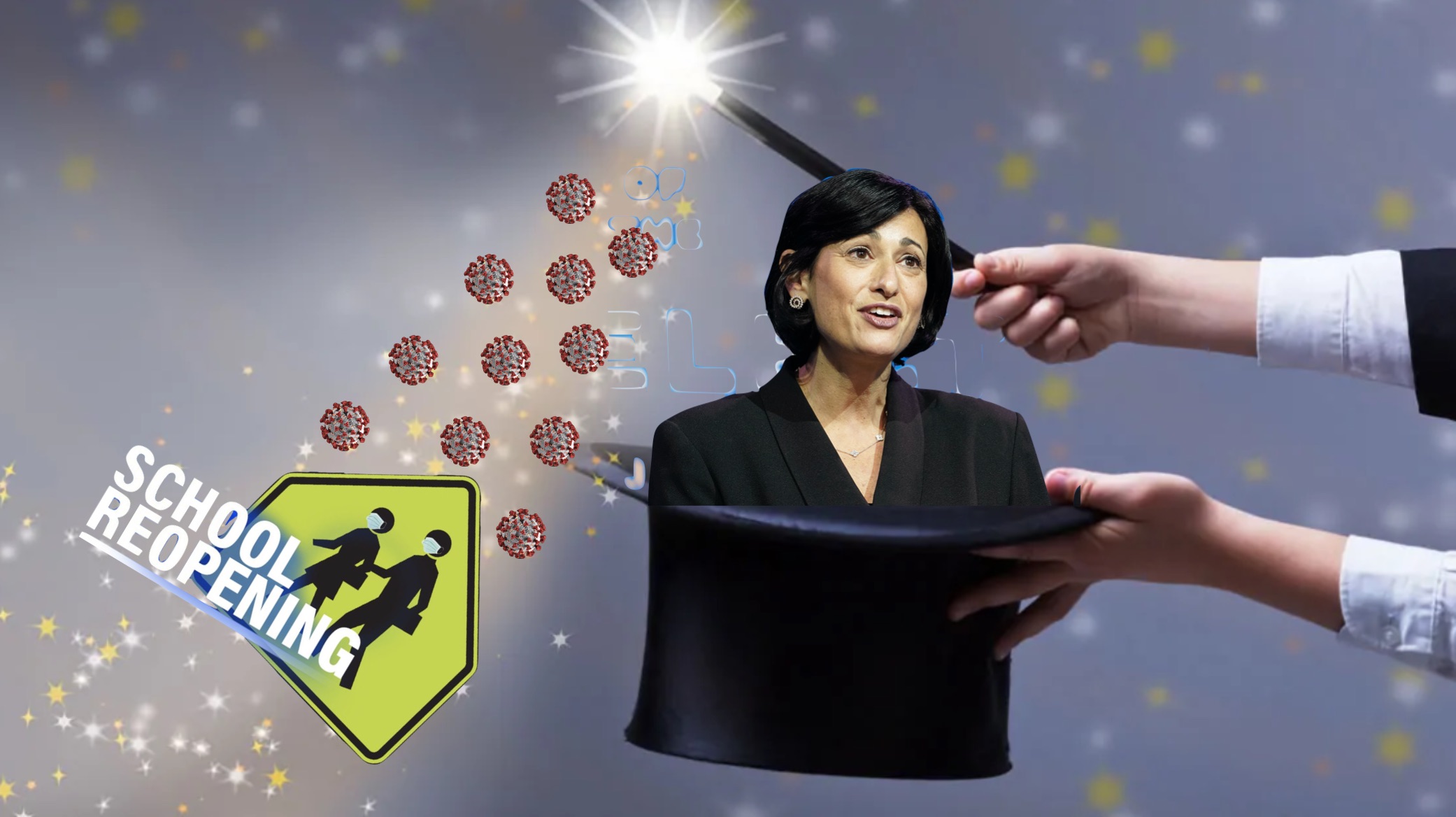
CDC Director Employing Magical Thinking About School Reopenings

Dr. Rochelle Walensky wants you to know it is not safe to go to any Super Bowl parties this weekend.

“We must take prevention and intervention seriously,” the Center for Disease Control (CDC) Director said at a White House briefing on the Covid-19 pandemic Wednesday.

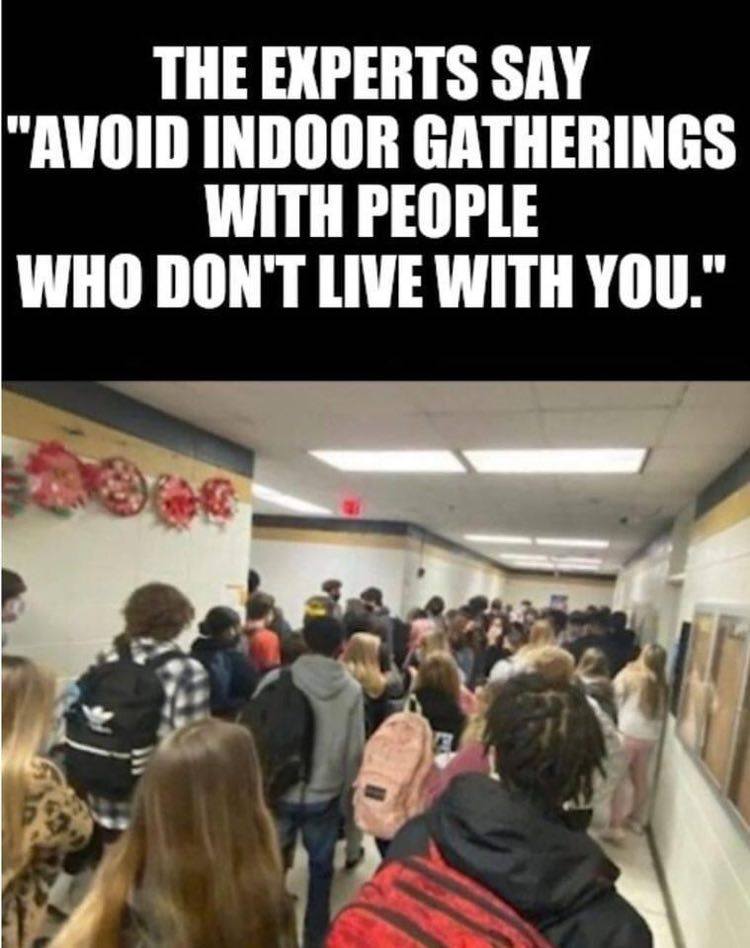
“Whichever team you’re rooting for and whichever commercial is your favorite, please watch the Super Bowl safely, gathering only virtually or with the people you live with.”

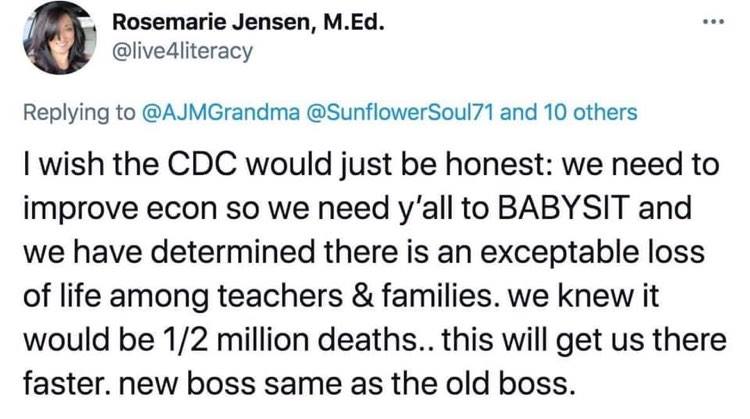
However, on the same day at another Washington briefing she said we can reopen schools safely as infections soar without even waiting to vaccinate teachers first.

“There is increasing data to suggest that schools can safely reopen,” she said, and “safe reopening does not suggest that teachers need to be vaccinated in order to reopen safely.”

WHAT!?

One doesn’t need to be an epidemiologist to know that these two statements are contradictory.

On the one hand, gathering in-person in a large group of people with whom you don’t live is a danger.

…If you’re watching a football game.

On the other, gathering in-person with an even larger group of people not in your personal pod and staying with them for an even longer period of time somehow IS safe. And in fact you don’t even need to be vaccinated against the virus before doing so.

…If you’re learning reading, writing and arithmetic.

What the heck is going on here!?

I thought the anti-science Trump CDC was a thing of the past.

Less than a month ago, health memos from the organization were being edited by Kellyanne Conway and Ivanka Trump. In September the White House blocked the agency from issuing a nationwide requirement that masks be worn on all public transportation.

Now with the Democrats in control of both houses of Congress and the Presidency, you’d expect something different.

In fact, Walensky claims her mandate is to remove politics from science.

“Political people cannot influence science,” she says. “If they do, I won’t be there.”

Then why are you promoting incoherent policies at the CDC? Why are you cherry picking data?

Why are you going on all the major news networks in transparent support of Biden’s proposal to reopen schools by April?

Why are you using your platform as head of the CDC to promote magical thinking?

Because that’s exactly what this is – magical thinking.

It’s not science.

Science doesn’t offer policy. It looks at very narrow questions and determines what may have caused what.

It works hand-in-hand with logic and reason. Otherwise, it’s invalid.

And the fact that your statements don’t add up disproves at least one of them.

Either large groups are a danger or they’re not.

If they’re not, then we can reopen schools AND go to Super Bowl parties.

If they are a danger (as a preponderance of evidence shows), then what is it about schools that makes them safer than Super Bowl parties?

Answer: Absolutely nothing!

In fact, schools are MORE dangerous for several reasons.

First, the average Super Bowl party only lasts a few hours. When not in remote or hybrid mode, schools typically are open 7-8 hours a day for five days a week, over 9 months.

You receive much more exposure to Covid-19 at school than at any Super Bowl party.

At both venues, people will be eating and drinking – the most dangerous time for infection. At parties, people may be snacking throughout the event. At school, students at least will eat lunch and probably breakfast not to mention possible snacks between meals. That’s approximately 180 breakfasts and lunches at which you are exposed to Covid compared with a few hours of nachos and pizza.

Moreover, the people attending these parties are mostly adults. Even with the likelihood that people will be drinking at these events, if you have responsible friends, these adults are much more likely to take precautions against infection than children. Kids are constantly fidgeting with their masks. Younger kids and some special needs students at many schools are even given mask breaks or excused from wearing them altogether. And that’s if the school in question has a mask mandate at all!

The idea that Covid doesn’t spread at school or is unlikely to spread is magical thinking.

Even if masks are worn more routinely at school because teachers enforce the rules, that doesn’t remove the danger. Few schools are large enough to socially distance children 6 feet apart. Many administrators don’t even try anymore – they simply promise to do the best they can. Add to that poor ventilation and inadequate cleaning of buildings and you have a recipe for disaster.

Pushback against the CDC has been huge, especially from teachers.

Things got so bad this week, that White House press secretary Jen Psaki distanced the Biden administration from Walensky’s remarks. Psaki said that Walensky had been speaking “in her personal capacity” and there would be “official guidance” and “final guidance” on the issue coming next week.

Walensky, herself, went on MSNBC’s Rachel Maddow show where she repeated her controversial statement but added that other steps need to be taken to lower risks for teachers and students, as well, including masking, social distancing and more viral testing.

“Schools should be the last places closed and the first places opened,” Walensky said.

Again, that is not a scientific statement. It’s a political one.

For someone who claims to be separating science and politics, she sounds much more like a Biden surrogate than a science advisor.

But it’s not just Walensky. The organization she oversees has made some huge missteps on this same issue since Biden’s inauguration – emphasizing some studies and completely ignoring others that don’t support the party line.

CDC scientists published an article last week in the journal of the American Medical Association (JAMA) that claimed some schools were able to reopen safely by following safety precautions. In fact, this one article is the cornerstone of Walensky’s assertion that “There is increasing data to suggest that schools can safely reopen.”

However, it was roundly criticized by the scientific community because the study was based on only 17 rural Wisconsin schools. Moreover, the data was based primarily on contact tracing. And considering that most children are asymptomatic even when infected with Covid-19, contact tracing is a poor method of determining how many people are infected in schools.

Heck! At the same time the CDC published another contact tracing study during the same week as the JAMA study which came to the opposite conclusion – that thousands of Covid cases were, in fact, linked to schools. I wonder why Walensky didn’t talk about that one at her White House briefing!

It’s not that the data is contradictory as much as the method the CDC is relying on is a poor indicator of infection.

Large-scale prevalence studies or antibody testing of students and teachers would much more accurately determine the relationship between educational settings and community transmission. But to date the CDC has not conducted any such studies.

In fact, despite such a full throated media blitz on the matter based on the JAMA article, the piece includes a rather telling disclaimer that its conclusions “do not necessarily represent the official position” of the CDC.

Walensky is right about one thing at least.

World scientific consensus is increasingly coming together around whether schools should be reopened in communities with high infections.

And it’s going in the exact opposite direction of Walensky and the CDC.

The European Centres for Disease Control and Prevention (ECDC) have acknowledged that children of all ages are susceptible to and can transmit Covid-19. Moreover, the organization admitted that school closures can contribute to a reduction in infections though by themselves such closures are not enough. It takes all of society working together to halt the spread of the virus.

In Europe, evidence obtained through antibody surveys conducted in various nations showed that the coronavirus equally infects school children, said Antoine Flahault, director of the University of Geneva’s Institute of Global Health. The results were repeated in Switzerland, Austria, and England.


Even England’s prime minister Boris Johnson conceded, “The problem is schools may nonetheless act as vectors for transmission, causing the virus to spread between households.”

But that’s not all. Take this study from southern India, published in the journal Science on November 6, which found children were spreading the virus among themselves and adults. Using both contact tracing and viral testing the study indicated that super-spreading events predominated, with approximately 5 percent of infected individuals accounting for 80 percent of secondary cases.

Dr. Ramanan Laxminarayan, member of the Center for Disease Dynamics, Economics and Policy in New Delhi, India, told NPR, “What we found in our study is that children were actually quite important. They were likely to get infected, particularly by young adults of the ages 20 to 40. They were likely to transmit the disease amongst themselves … and they also go out and infect people of all age groups, including the elderly. Many kids are silent spreaders in the sense that they don’t manifest the disease with symptoms. They happen to get infected as much as anyone else, and then they happen to spread it to other people.”

Why is none of this being considered by the CDC?

If the goal is to remove politics from science, shouldn’t the organization follow the evidence even if it goes against Biden’s school reopening policy?

Are these other studies invalidated because they were conducted in other parts of the world?

Okay. Here are a few others from the US:

● A JAMA study published July 29 concluded that statewide school closures in the first wave of the pandemic led to a 62 percent decline in the incidence of COVID-19 per week. Similarly, the death rate saw a 58 percent decrease. States that closed earlier saw the most significant weekly reductions.


● According to a study published in Science, the combination of the closure of schools and universities, limiting gatherings to 10 people or less, and closing most nonessential businesses reduced the reproductive number (R0) to below one. These efforts reduced the number of infections in the community. Among the interventions listed, school closures and limiting gatherings to 10 people had the highest impact on slowing the infections.


● A Nature study published in November ranked the effectiveness of worldwide COVID-19 interventions. It concluded that the cancellation of small gatherings, closure of educational institutions, border restrictions, increased availability of PPE and individual restrictions were statistically significant in reducing the reproductive number (R0).

Where are these studies in the CDC’s analysis?

Answer: nowhere.

Because this is not about science. It is still about politics.

After the criminal negligence of the Trump administration spreading lies and disinformation through government channels, what the Biden CDC is doing is beyond reckless.

We need to have facts. We need to be able to trust our scientific organizations again.

This kind of willful negligence won’t just result in more Covid deaths, it will enable the next Trump to do much worse behind a banner of fake news and science denial.

And how will science defenders fight back when both sides play with the data to make it say whatever they want?

Sadly, this new CDC is far too similar to the old CDC.

I had hopes Biden would be better than this.

He still has time to turn back from these games.

Next week’s new CDC guidelines will likely signal whether he is changing course or doubling down.

In the meantime, teachers, students and communities desperately in need of valid science and facts have to turn to the rest of the world for guidance.

Our lives are not expendable to ensure a robust economy.

That lesson will be a lot less expensive now than after the next neo-fascist coup.

We can’t afford magical thinking at the CDC.


Like this post?  You might want to consider becoming a Patreon subscriber. This helps me continue to keep the blog going and get on with this difficult and challenging work.

Plus you get subscriber only extras!

Just CLICK HERE.

Patreon+Circle

I’ve also written a book, “Gadfly on the Wall: A Public School Teacher Speaks Out on Racism and Reform,” now available from Garn Press. Ten percent of the proceeds go to the Badass Teachers Association. Check it out!

How I Got the Covid Vaccine: an Immunization Odyssey

So there I was standing out in the cold – miserable but happy.

My jacket was buttoned up to my nose on top of my mask.

My hood was up and my glasses were becoming a white screen of fog where my hot breath escaped into the chill.

In my pocket, my left hand wiggled into a glove, then sneaked out to hold my glasses away from my face.

It was the only way I could see whether the line was moving.

And deep inside me, as I stood shivering through the gusts of bitter wind, somewhere I was happy.

Because I was in line to be vaccinated against Covid-19.

Despite it all, I knew I was one of the lucky ones.

It had been a long journey to this place, the Brentwood Volunteer Fire Department. And not just in miles.

I had spent the better part of a week trying to find a place here in Western Pennsylvania where I could even get the vaccine.

On Sunday, a teacher I’ve worked with for 15 years left me a message that she was going to Bloomfield with her husband. She had heard Wilson’s Pharmacy was giving out the vaccine. Like me, her husband has a heart condition and so qualified for the shot.

In the Keystone state, only medical personnel, people 65 and older or those with certain health conditions have been prioritized to get the vaccine so far.

Of course, UPMC, the healthcare agency distributing the injections in the Pittsburgh area, has taken this to mean all their employees – even those who don’t interact with patients.

They can cruise up to nearly any hospital and get a dose.

The rest of us have to make an appointment somewhere else – if we can find one.

I sat up in bed trying to decide if I wanted to drive all the way to Bloomfield on the off chance that they’d have a shot with my name on it. Considering that it was about an hour away if I left right then and the message from my co-worker was about a half hour old, I doubted my chances.

But as I showered and the sleep left me, I started to think I might roll the dice.

However, when I called the pharmacy on my way out the door, I was told they had run out of the medication.

And for most of that week, this was the closest I got.

I went on-line every day trying to find somewhere to get the vaccine. I tried Giant Eagle, Rite Aide, Allegheny County, various pharmacies, etc. All nada.

Sometimes I had to keep a browser window on my computer open for hours just to be turned down. Sometimes a hopeful page would pop up asking for information, and I’d fill it all in only to get the same negative message.

It was so discouraging.

So was my job.

The school district where I teach has been on remote learning since November when an outbreak in multiple schools (but most notably in an entire kindergarten class) closed us down.

Now – for no discernible reason – school directors wanted to open back up.

Infections are still high throughout the county and the state. There is no justifiable reason to reopen except that decision makers are bored. That and they are tired of hearing people complain that we are taking too many precautions to protect kids. And those darn teachers and their all-powerful unions!

I knew I couldn’t go back to the classroom.

I hadn’t been back since March when we closed down the first time.

I have both a heart condition and Crohns disease. Both my cardiologist and gastroenterologist told me that if I got Covid it could be a death sentence.

My only choice was to stay home using sick days or get fully vaccinated before returning to the classroom.

I wanted to do the later. I wanted to be there for my students. But that was looking like an impossibility.

Frankly, I don’t think it’s safe for the kids even if I am vaccinated. But after almost a year of fighting with school directors, administrators and some angry parents, I was willing to concede the point. These are their kids, after all. If parents think it’s safe, that’s their choice.

Mine is much different.

Even though my home district is open, my daughter has been learning at the dinning room table throughout the crisis. Her pap pap and I (but mostly her pap) help her make sense of a terrible cyber curriculum day-in-day-out. Most of the time, he takes math and science. I take English and social studies.

We don’t do this because we think it’s the best way to learn. We do it because we love her and don’t want to put her life in jeopardy.

I had about given up on ever getting back to the classroom, myself, when my cousin, Lora, texted me.

Her family and mine used to be fairly close when we were kids, but I hadn’t really talked to her much in recent years.

“Hi Steve. I wanted to see if you were able to get a vaccine appointment for yourself. My sister-in-law has been helping people in [group] 1A get appointments, and I know she wouldn’t mind looking for you… I’m worried about you with your heart condition…”

I was struck dumb.

I remembered Lora as this skinny little girl who tagged along after my brother and me. We used to put on little plays in my grandmother’s basement. I gave her some of my stuffed animals when I grew out of them.

When she was a teenager we didn’t get along very well. It was my fault. I was jealous of the time she took from my mom.

Frankly, I was a jerk to her. I know that now, and I’d felt terrible about it long before I got this text.

But here she was now – a researcher at the University of Pittsburgh. She was no longer that little girl. She was no longer that annoying teen. She’s a grown woman with command of her field and the respect of her colleagues.

I’d already known that. What I didn’t know was that she had such a big heart. Big enough to encompass an asshole like me.

We texted back and forth and she gave me so many more avenues to explore to find a site to be vaccinated.

I think it was only a day later, maybe that very night that I got the email from Spartan Pharmacy that I had an appointment for the following afternoon.

I had signed up for Spartan’s waiting list before Lora contacted me. But she and her sister-in-law, Caity, knew I had an appointment almost before I did.

Lora says Caity is her “vaccine Angel.” I don’t think I’ve ever met her, but the two of them helped me through every step of the way.

I had to fill out a form before going to my appointment and the Website simply wouldn’t load. Too many people were probably trying to access it at the same time. Someone told me the next day that 15,000 people had signed up.

Lora and Caity sent me a copy by email an hour later.

I don’t see how I could have done any of this without them.

So the next day when I got to the Brentwood VFD, found one of the few available parking spaces and got into the long line in the bitter cold, I couldn’t really be upset by the discomfort of the situation.

Even when it started to snow, and my glove felt like it was almost nonexistent, I couldn’t get too down.

In about an hour or so, I knew I’d have the vaccine.

I had hope again – something that had been missing for far too long.

It wasn’t trouble free for those in line. Most of the people there were elderly. Many were in wheelchairs or had walkers.

One gentlemen fell on the cracked pavement and people from the crowd helped him back up. I remember his daughter kept asking him if he’d cracked his head.

But I was at the front of the line and entered the building then.

It was warm at least.

And the people there were very friendly.

Once inside, it didn’t take long at all before I was taking off my coat and rolling up my sleeve.

There was a slight pinch and that was it.


I gave them my paperwork, they gave me an appointment a month hence for my second dose and I was told to sit and wait for 15 minutes before leaving.

I had no side effects.

The next morning the injection site was a little sore but I’ve had worse bug bites.

And so here I am.

Some people worry about the vaccine because of how quickly it was developed, but not me.

I’ve seen the pictures and videos of our lawmakers and celebrities getting the shot. Even the disingenuous Covid deniers who claim the pandemic is all a hoax don’t let their “conviction” stop them from getting a dose.

That more than anything proves the vaccine’s veracity for me.

I know that once I get the second dose, I can still bring Covid home to those I love. But from what I’ve read, even if that happened it would be a weakened form of it.

There’s a lot of uncertainty – new strains of the disease that the vaccine may or may not protect against.

In a perfect world, we’d wait until the majority of people were as safeguarded as I am before getting on with everything. But we don’t live in a perfect world.

If anything, the virus has shown us how imperfect it is.

But it has also shown us the exact opposite – the power of kindness and love.

I get down about all that’s messed up in this world. I get depressed about all the missteps people have made dealing with this crisis.

And when that happens now, I try to think about my cousin – my sweet cousin, Lora.

There are people like her all over this country looking out for others.

There are people who are caring and don’t condition that feeling on what someone has done for them lately.

They just do what they can because it’s the right thing to do. Because they see the good and want to increase it.

I am so grateful for having this second chance – and it does feel like a second chance.

I am thankful, thoughtful and hopeful.

If there are people like Lora in this world, maybe there’s hope for all of us.


Like this post?  You might want to consider becoming a Patreon subscriber. This helps me continue to keep the blog going and get on with this difficult and challenging work.

Plus you get subscriber only extras!

Just CLICK HERE.

Patreon+Circle

I’ve also written a book, “Gadfly on the Wall: A Public School Teacher Speaks Out on Racism and Reform,” now available from Garn Press. Ten percent of the proceeds go to the Badass Teachers Association. Check it out!

Outrunning the Pandemic – Racing Through Gadfly’s Top 10 Stories of 2020

On most weekends back in the 1980s, you’d probably find me at TILT, the mall’s crowded video game arcade.

When I was about 12 – around ’86 or so – one of my favorite games was “Outrun” by Sega.

Ever play it?

In a cherry red Ferrari convertible with the wind blowing through my virtual hair, I’d race through various summer style environments from beach to forest, to mesa to mountains.

I even got to pick which song to play on the highway – something Latin, Caribbean, or just smooth and easy.

But the real kicker – the thing that really sold this wish fulfillment fantasy – wasn’t the cool car, clement weather or soundtrack.

It was the long haired swimsuit model sitting next to me in the passenger seat.

Not only was I a real badass racing through a summer dream, but I had someone by my side, reclining at ease, sharing the journey.

And if I crashed – which often happened cresting a hill – after the car flipped multiple times in the air – my digital 80s crush and I both ended up somehow unhurt on the road. She’d sit on the white lane marker staring at my dazed avatar with all the reproach that could be programmed into a mere 16 bits.

Sometimes I think that’s a good metaphor for blogging.

I’m still in the drivers seat, steering through the twists and turns of education, equity and politics. Yet sometimes I can’t help but hit an obstacle and go flying. Through it all there’s been one constant: you – my readers – relaxed and belted in for whatever may come.

I’ll admit, this year has been one heck of a bumpy ride.

From the global COVID-19 pandemic to the critical failure of government to deal with it at nearly every level, it’s been like some sort of science fiction fantasy more than anything else.

From the spectacular sore losership of Donald Trump to the science denial of his followers and the death cult of capitalism poisoning all in-between, it’s been a year to test the hopes of just about anyone.

So much pain, confusion and death. So much isolation, betrayal, bone deep exhaustion and depression.

I’d rather imagine myself parked on an overlook, leaning back in my red sports car watching the sun set with a good friend by my side.

Since we’re stopped for the moment waiting for the last zero on the dial to scroll up to a 1 and become that terrifying number of numbers, 2021, let’s take a look back at the year that was in blogging.

I’m not sure how to characterize it other than to say it must have been some kind of success.

About 49,000 more people read my articles this year than in 2019.

The site had around 347,700 hits this year – the most since 2017. My cumulative total in 5 and a half years even hit the 2 million mark (2,080,000 to be more precise).

Not bad for a school teacher, a laptop and a dream.

A lot of what I had to say in this year’s 72 posts focused on the pandemic and how our leaders were blowing it.

That sounds like rational criticism, but it was really just me pointing out what things looked like on the ground and begging the people in power not to put myself and the people I care about in jeopardy – with mixed results.

The other major theme was the Presidential election. The Democrats had their last chance to nominate and elect Bernie Sanders, the candidate best equipped to meet the times we live in. And they blew it again.

Neoliberalism triumphed. Only time will tell the price we’ll have to pay for that blunder. Will we destroy the neofacist architecture of the Trump years only to return to the corporatist utopia of Obama and George W Bush? And if so, will we still have any chance to tear that Hellscape down in favor of a world that actually values the people living in it more than the value they can create for the one percent?

On top of that were a smattering of articles about school issues, equity and how we might fix things.

Over all, I’d say I crashed the Ferrari more often than I navigated the hairpin turns. But every now and then I feel like I was heard, that I helped stop something even worse from coming our way.

And at the end of the day, we made it to the checkpoint.

We got an extended time bonus, and a chance to do it all over again next year.

Hopefully, it will be a more clear path.

Hopefully, we’ll still have a chance to cross the finish line.

And hopefully, you’ll still accept my invitation for another ride into the sunset.

Here are my top 10 articles of 2020 based on popularity:

10) Top 10 Reasons to Vote for Joe Biden in the 2020 General Election

Published: April 10


Views: 5,508


Description: When Bernie Sanders dropped out of the 2020 Democratic Primary, I could think of only these 10 reasons to vote for Joe Biden in the November general election: 1-10 were “He’s not Donald Trump.”


Fun Fact: Apparently, it was enough.

9) Public Schools Can Recover from the COVID-19 Quarantine by Skipping High Stakes Tests

Published: March 15


Views: 6,924


Description: When the COVID-19 pandemic first crashed down on us, I was one of many saying that high stakes testing made no sense as schools nationwide were closing. The best way to allow teachers to make up for lost time with their students was to prioritize learning over assessment.


Fun Fact: It worked. We actually cancelled the big standardized test in 2019-2020. And now here we are a year later in a similar position making similar arguments and the testing companies and their lackeys are fighting against us tooth and nail.


8) For Teachers, “Silence of Our Friends” May be Worst Part of Pandemic

Published: December 5


Views: 7,443


Description: The most depressing thing about the pandemic has been how uniform the attack has been on educators. Demanding a safe work environment for ourselves and our students has been seen as unreasonable by lawmakers, school directors, union leaders and even some public school advocates.

 
Fun Fact: If anything has the potential to unravel the ties made by pro-public school forces in the last few decades, it is this. I know people are scared that closing school buildings in favor of remote learning may give the upper hand to the ed tech industry when the pandemic is over. But if you can’t stand behind teachers’ right to life now, you cannot expect us to continue to fight for the profession, local control and your children later.

7) Covid-19 Has Eroded My Faith in Public Schools

Published: Nov. 14


Views: 7,763


Description: COVID-19 has shown a failure of leadership at every level – including our public schools. The damage has been enough to make anyone doubt everything – including the coherency of the public school project altogether.


Fun Fact: The biggest difference between this and the previous article is that this one is more a mark of despair. The other is more a mark of anger.

6) INCONVENIENT TRUTH: Remote Teaching is Better Than In-Person Instruction During a Pandemic

Published: Nov. 21


Views: 8,678


Description: When more than 19 million people have caught COVID-19 and 330,000 have died, it does not make sense to keep public schools open. This is an airborne virus that can cause life-long debilitating conditions even in those who survive or are asymptomatic. Yet you need a school teacher to explain to you why distance learning is better under these circumstances.


Fun Fact: Simple truths told simply. Ammunition to save lives. The fact that it’s necessary tells us more about human intelligence than any standardized test ever could.

5) There Are No Bernie Bros, Just Diverse Supporters Being Made Into What They’re Not

Published: February 8


Views: 11,775


Description: One of the major media criticisms of the Bernie movement was that it was racist, sexist and homophobic. Yet a substantial portion of supporters were female, racially diverse and/or LGBTQ. For example, women under 45 made up a larger share of Sanders’ base than men of the same age. Two women of color, Ohio state Sen. Nina Turner and San Juan, Puerto Rico Mayor Carmen Yulín Cruz, were co-chairs of the campaign, along with Indian-American Rep. Ro Khanna (D-CA) and Ben & Jerry’s co-founder Ben Cohen. Sanders’ campaign manager was longtime progressive activist Faiz Shakir.

 
Fun Fact: File this in the history books under Gas Lighting.

4) Bernie Sanders Supporters Have Every Right to Be Furious

Published: April 12


Views: 21,984


Description: Don’t tell me this primary was fair. When Bernie was winning state after state, the media acted like it was a literal invasion of brownshirts. Yet when Biden was winning, it was the best news since sliced bread. Bernie was running away with the primary until nearly all the other candidates mysteriously dropped out all at once right before Super Tuesday. And now we find out Barack Obama gave them each a call before hand – putting his finger on the scale. The Democratic National Committee literally pushed to continue primaries in Illinois, Florida and Arizona during the pandemic in case waiting might bolster Bernie – the candidate with policies tailor made to fight COVID-19. And the result was a flood of sick people and a nearly insurmountable delegate lead.


Fun Fact: Was this the moment my heart died? No, I think it was already on life support from 2016. And the subsequent response to the pandemic only took out another ventricle.

3) Trapped On a Runaway Train to a Public School Disaster

Published: June 30


Views: 24,185


Description: When the pandemic began, many of us didn’t expect it to last that long. Certainly we wouldn’t still be in the same situation as summer rapidly came to a close and school was about the begin again! Right? What would we do? What should we even hope for?

 
Fun Fact: Despite heavy doses of despair, I think I saw clearly what needed to be done even this far back. Many policymakers still don’t see it as a New Year is about to dawn.

2) You Can’t Have My Students’ Lives to Restart Your Economy

Published: April 18


Views: 25,003


Description: When the pandemic began, far right ideologues threatened to reopen schools to keep the economy going. Almost everyone jumped on them for being uncaring idiots willing to sacrifice children on the altar of commerce.

 
Fun Fact: What was an unpopular opinion in April became mainstream by the end of August as the media bombarded readers with unsubstantiated (and subsequently disproven) reports about how children couldn’t be hurt by the Coronavirus. Subtext: And who gives a crap about the teachers who would have to put their lives on the line to educate these children?

1) Mask-to-Mask Instruction May Be More Problematic Than Distance Learning

Published: July 11


Views: 33,446


Description: Everyone knows distance learning cannot equal in-person instruction. However, we often ignore the fact that in-person instruction is not the same during the pandemic as it was before COVID-19. Social distancing, limited mobility, plexiglass barriers, cleanliness protocols – all have an impact on academics. Reopening physical school buildings is not returning to the kind of face-to-face instruction students enjoyed as recently as January and February. It is a completely new dynamic that presents as many difficulties – if not maybe more – than learning on-line.

 
Fun Fact: More ammunition to explain the simple truths of this brave new world where we find ourselves these days. Sadly, it has been ignored as often as it has been heeded. Perhaps more.


Like this post?  You might want to consider becoming a Patreon subscriber. This helps me continue to keep the blog going and get on with this difficult and challenging work.

Plus you get subscriber only extras!

Just CLICK HERE.

Patreon+Circle

I’ve also written a book, “Gadfly on the Wall: A Public School Teacher Speaks Out on Racism and Reform,” now available from Garn Press. Ten percent of the proceeds go to the Badass Teachers Association. Check it out!