The Covid-19 pandemic closed school rooms across the nation for various lengths of time. Some are still closed. Some are beginning to close again.
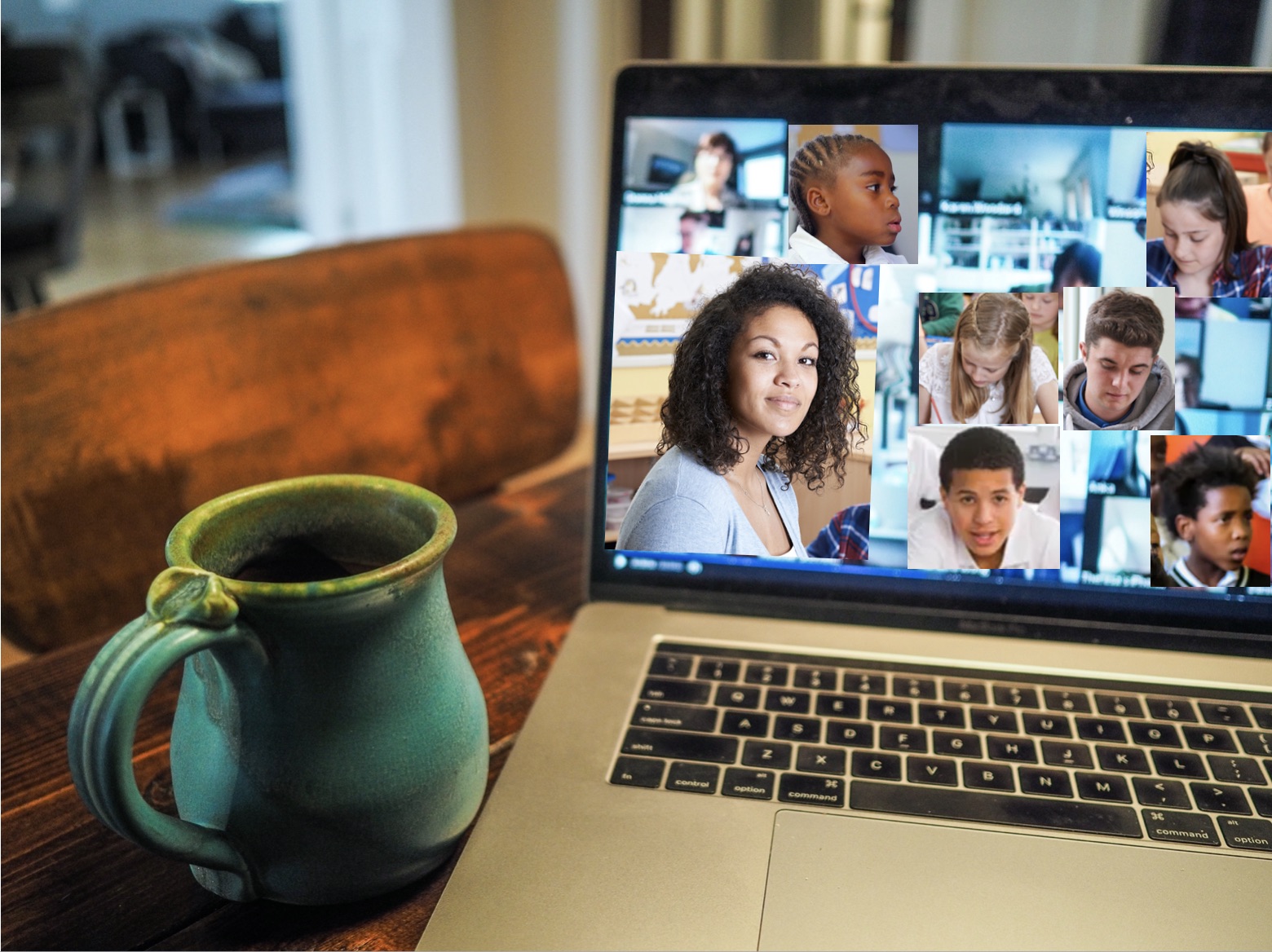
Many classes were conducted remotely through conferencing software like Zoom and file sharing programs like Google Classroom. Others were conducted through a hybrid model combining in-person instruction and cyber instruction. While still others met in-person with numerous mitigation efforts like masks, social distancing and air purifiers.
Many students were absent, struggled to learn and experienced countless traumas due to the isolation, sickness and deaths.
That’s more than Americans who died in the attack on Pear Harbor (2,403), the 9/11 terrorists attacks (3,000), WWI (116,000) or WWII (405,000).
Only the Civil War (600,000 – 850,000) has a larger death toll. For now.
As of April 1, nearly 3.47 million children have tested positive for COVID-19, most with mild symptoms, according to the American Academy of Pediatrics. A few hundred have died, mostly children of color. Many more kids probably contracted the virus but were asymptomatic spreaders of the disease to adults.
As a result, between 37,000 and 43,000 children in the United States have lost at least one parent to COVID-19, according to USC research.
How do you sort through all these tragedies and traumas and say THIS was caused by a lack of standardized testing?
But in 2001 we created an industry. Huge corporations write the tests, grade the tests and provide the remediation for the tests. Billions of dollars in taxes are funneled into this captive market which creates monetary incentives for our lawmakers to keep the system going.
Yes, some civil rights organizations have waffled back and forth over this as big donors who value the tests make or withhold contributions. Meanwhile, many other more grassroots civil rights organizations such as Journey for Justice Alliance (JJA), a group made up of 38 organizations of Black and Brown parents and students in 23 states, have continuously called for the abolition of high stakes testing.
A scientific mind would be empirical about this. It would examine the results as much as possible and determine whether moving forward made any sense.
This is especially true as the pandemic health crisis continues to make the act of giving the tests difficult at best and dangerous at worst.
There is no way a logical mind can look at the situation and not come to the conclusion that the status quo on testing is a triumph of capitalism over science and reason.
In a month or so, the year without testing will be just that – a single year.
We shall go on to the end. We shall test during Covid, we shall test in the classes and on-line, we shall test with growing confidence and growing strength wearing masks, we shall defend our industry, whatever the cost may be. We shall test in the homes, we shall fill in bubbles on sanitized desks, we shall test in the fields and in the streets, we shall test in the hospitals; we shall never surrender!
Do you live in Allegheny County, Pennsylvania? I’m running for County Council in District 9
Like this post? You might want to consider becoming a Patreon subscriber. This helps me continue to keep the blog going and get on with this difficult and challenging work.
It’s absurd, like paramedics arriving at a car crash, finding one person in a pool of blood and another completely unscathed – but before they know which person needs first aid, they have to take everyone’s blood pressure.
If the only logical way to make decisions is based on test scores, you should provide those scores to the greatest decision-making body in the country: voters.
After all, student tests are designed to favor answers from privileged white people. Most of these lawmakers are the target demographic already. They passed a standardized test (or paid someone to pass the test for them) as a smokescreen getting into whichever prep school or ivy league college where they were legacy enrollments, anyway.
I’m talking about a new series of standardized tests designed to show how much these lawmakers adhere to the principles of their respective political parties.
So there’d be two versions – one for Republicans and one for Democrats.
A high score means the test taker is a bona fide example of their party’s ideals. A low score means they should probably be booted out on their butts.
For example, a question for Democrats might be:
Which policy is progressive?
A) School privatization B) Fracking on native lands C) Drone strikes D) Universal healthcare
And an example for Republicans:
Which policy is fiscally responsible?
A) School privatization B) Tax cuts for billionaires C) More unnecessary wars D) Investing in infrastructure
The answers are both D and that’s because this test would be in high De-mand! Get it?
They could say, “Vote for Sam Smith. He got an Advanced Score on the Democratic System of Statesperson Assessments (DSSA).”
Or “Don’t vote for Megan Mission. She only scored a Satisfactory on the Partnership for Assessment of Republicanism for Congress or Klan (PARCK).”
What an improvement that would be!
Finally, we wouldn’t have to rely on a politician’s voting record or campaign contributions or platform…. We could just look at the score and vote accordingly.
But who would we get to make and grade the tests?
It couldn’t be the politicians, themselves, or even their respective political parties. That wouldn’t be standardized somehow.
If we can’t let teachers create tests for their own students, we certainly can’t trust politicians to do the same for their fellow campaigners.
I guess we could task the testing corporations with making these assessments, but that’s a conflict of interests. We should instead rely on the educational experts, people with the credentials and the most experience actually giving standardized tests.
And since the teachers would get to grade the assessments, they could make sure the scores are curved so only a very limited number pass each year. We can’t have grade inflation, after all.
What would the teachers do with this money, I wonder?
And all of this just because of standardized testing!
Maybe the lawmakers have the right idea in prioritizing high stakes testing!
Or maybe they understand the value of benefiting from the testing industrial complex and not being subjected to it.
Like this post? You might want to consider becoming a Patreon subscriber. This helps me continue to keep the blog going and get on with this difficult and challenging work.
Imagine a marine biologist being told she had to determine if the water in the dolphin tank is wet.
That’s kind of what the demand to test is like.
Determine if the water is wet and THEN you can feed the dolphin.
Imagine a person on fire being told to measure the temperature of the flames before you could put them out.
Imagine a person staving in the desert being required to take a blood test to determine previous caloric intake before anyone would offer food or water.
You need to know A, B and C when you’re in 3rd Grade. You need to learn D, E, F in 4th grade. And so on.
And if you miss one of the letters somewhere in there, you’re learning will be disrupted forever.
The Biden administration seems to be worried that kids are not intellectually where they SHOULD be because of the pandemic and that if we don’t do something about it now, they will be irreparably harmed.
Most questions on these tests are multiple choice. They limit the possible answers to 4 or 5 choices.
If you’re asking something extremely simple and clear, this is achievable. However, the more complex you get – and by necessity the more subjective the question gets – the more the test taker has to think like the person who wrote the question.
This doesn’t matter so much when you’re asking them to calculate 2+2. But when you’re asking them to determine the meaning behind a literary passage or the importance of a historical event or the cultural significance of a scientific invention – it matters.
Moreover, the idea that the amount of learning children have done in school is a mystery is, itself, a farce.
Of course, most kids have learned less during the pandemic than under normal years.
Schools have been disrupted. Classes have been given remotely, in-person and/or in some hybrid mix of the two. Parents, families, friends have gotten sick, jobs have been lost or put in jeopardy, social interactions have been limited.
You really need a standardized test to tell you that affected learning?
You might as well ask if water’s wet. Or fire’s hot? Or if a starving person is hungry?
Okay. How about looking at the classroom grades students have earned? Look at the amount of learning the teacher has calculated for each student.
After all, most of these kids have been in school to some degree. They have attended some kind of classes. Teachers have done their best to assess what has been learned and to what degree.
Look at teachers’ grades. They will give you 180-some days worth of data.
Look at student attendance. See how often children have been in class. I’m not saying that there aren’t justifiable reasons for missing instruction – there are. But attendance will tell you as lot about how much students have learned.
Ask the parents about their kids. Ask how they think their children are doing. Ask what kind of struggles they’ve gone through this year and how resilient or not their children have been. Ask about the traumas the children have experienced and what solutions they have tried and what kind of help they think they need.
And while you’re at it, make sure to ask the students, themselves. I’m sure they have stories to tell about this year. In fact, many teachers have suggested students keep Covid diaries of what they’ve been going through.
Finally, take a look at the resources each school has. How much do they spend per pupil and how does that compare with surrounding districts? Look at how segregated the school is both in comparison to other districts, other schools in the district and class-by-class within the school. Look at class size, how wide or narrow the curriculum is, how robust the extra curricular activities offered, what kind of counseling and tutoring each school offers. That will tell you a lot about how much learning students have achieved – not just during Covid times but ANYTIME!
If that’s not enough data, I don’t know what to tell you.
There are plenty of measures of student learning this year. Standardized testing is completely unnecessary.
But unfortunately that doesn’t end the stupid.
Now we come to the rationale behind assessing learning in the first place.
There is no additional funding coming to help kids overcome the hurdles of Covid. Just as there were no additional resources to help children of color after many failed standardized assessments.
Because, after all, one of the most precious resources this year is time. And that’s exactly what these tests will gobble up.
Wasting time on testing is bad in any year, but in a year when school buildings have been closed and learning has been conducted remotely, when we’ve struggled with new technologies and safety precautions, when we’ve seen our friends and neighbors get sick, quarantine and hospitalize… Every second learning is that much more valuable.
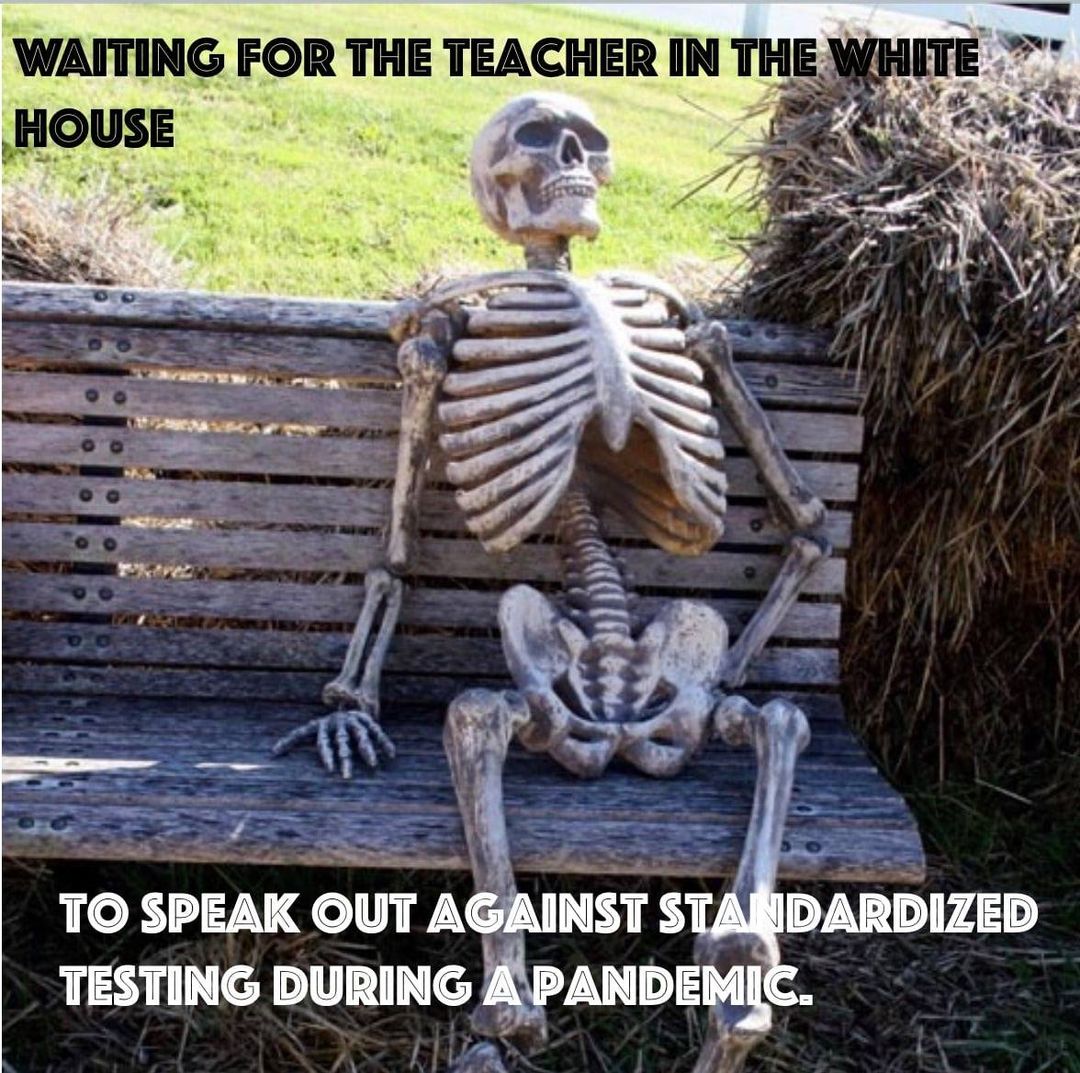
Yes, Biden is allowing all kinds of leniency in HOW we take the tests. They can be shortened, taken in school, taken remotely, even taken at a later date – but they must be taken.
So goodbye, time that could have been spent on authentic learning. Hello, hours, days and weeks of test-taking drudgery.
That’s not a trade off many teachers, parents or students think is fair.
So President Biden can stop the charade.
America’s teachers aren’t buying it.
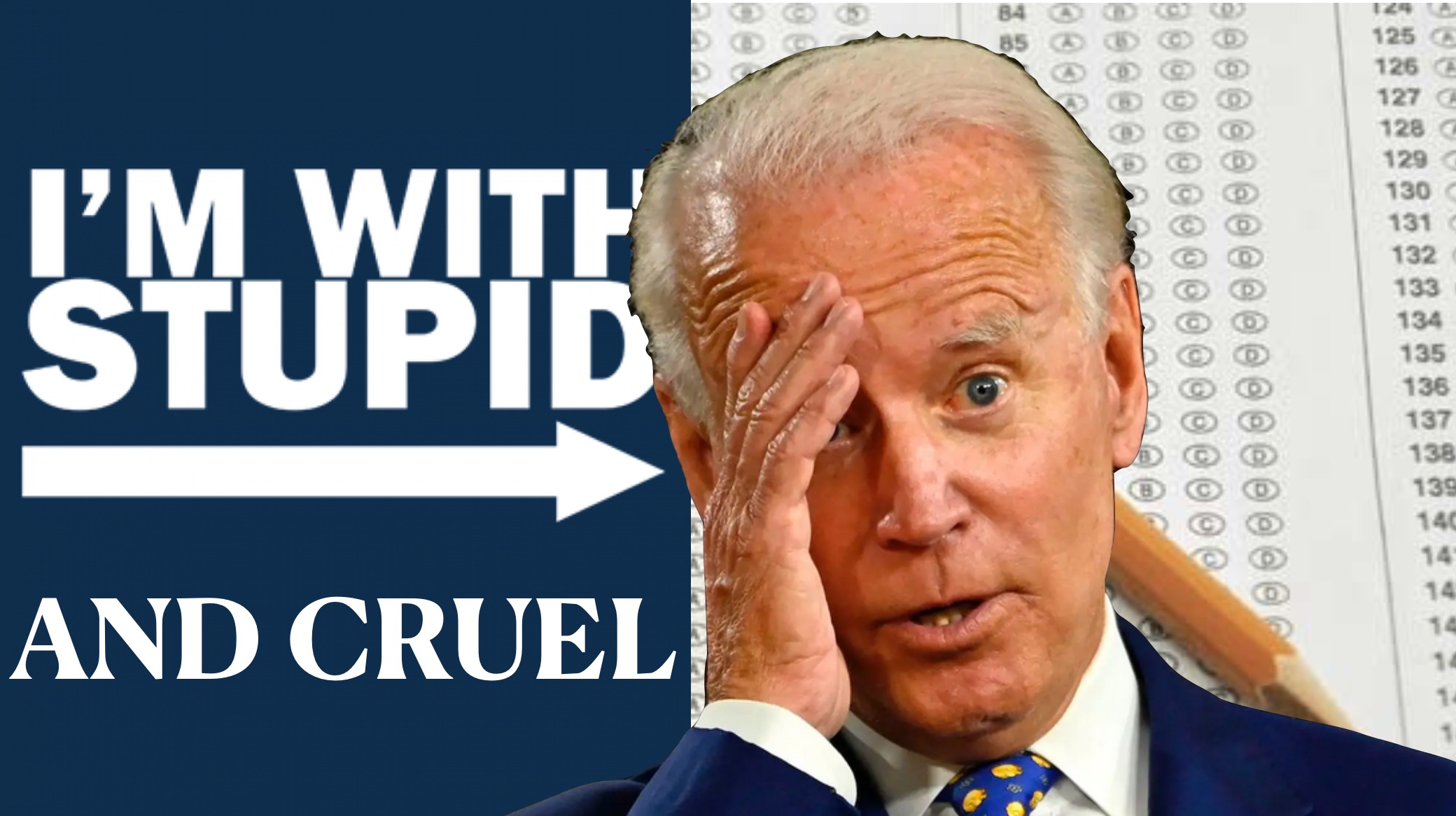
We know how deeply stupid this testing mandate is.
Stupid and cruel.
Paging, Dr. Jill Biden. Paging, Dr. Jill Biden. Where you at?
Like this post? You might want to consider becoming a Patreon subscriber. This helps me continue to keep the blog going and get on with this difficult and challenging work.
That’s the rationale behind the Biden administration’s mandate that schools across the country still struggling just to keep buildings open somehow manage to proctor standardized assessments.
Children have lost parents, siblings, family members, friends, teachers. Families are struggling just to survive with some members still recovering from the longterm health consequences of contracting Covid.
He sent the letter to state superintendents on behalf of the Biden administration telling them that blanket waivers of the federal testing mandate would not be considered this year as they were in 2019-20.
States spend more than $1.7 billion every year on testing. In 45 states, assessments at the primary level alone cost taxpayers $669 million.
This money isn’t going to mom and pop organizations. The four major testing companies are Wall Street heavy hitters – Harcourt Educational Measurement, CTB McGraw-Hill, Riverside Publishing (a Houghton Mifflin company), and NCS Pearson.
In 2001 the first three agencies accounted for 96% of the tests administered, while Pearson was the leading scoring agency of those tests. And since then the market has exploded.
In 1955 the industry was valued at only $7 million. By 1997 it had ballooned to $263 million. This is a 3ooo% increase. Today the estimated worth of the industry is $700 million.
However, that only takes into account actual assessment.
When you consider that many of these companies (or their parent conglomerates) also provide remedial materials for students who fail the tests, the profits really start rolling in. It’s no coincidence that McGraw-Hill, for example, also publishes books and other materials many of which are used by schools to remediate the same students who fail the company’s tests.
It’s a captive market. The testing company makes and distributes the test (for a fee), scores the test so that a majority fail (for another fee), and then sells schools the materials it claims will help students pass next time (for an even further fee).
However, for the first time in two decades, the pandemic threw a monkey wrench into the machine.
Biden, who ran on being friendly to teachers and that his wife Dr. Jill Biden was an educator, has pushed some extremely absurd education policies in his short time in office.
Not only has his administration decided to ignore community infections, he has insisted that schools can be opened safely if districts follow certain safety precautions like universal masking, contact tracing and social distancing.
However, many schools are not following these protocols and even more simply cannot because doing so would be exorbitantly expensive. For example, you can’t have all students return to a cramped school building AND have them be 6 feet apart. There simply isn’t the available space. Moreover, contact tracing doesn’t effectively track Covid cases since most students who contract the virus are asymptomatic.
Then there is the absurd prescription that schools don’t even have to prioritize teachers for the Covid vaccine before reopening. In many states educators aren’t even eligible yet to receive the vaccine. Yet the Biden administration expects them to enter the classroom without necessary protections to keep them, their families and students safe.
These are all perplexing policies until one looks at it from an economic vantage.
Waiting for all teachers to have the opportunity to take a two dose vaccine would take at least a month and a half – that’s if every teacher could start the process today.
In addition, if we wait for community infections of the virus to dissipate, testing season will be far from over. In fact, it’s likely the rest of the school year would be gone.
So if the Biden administration had prioritized safety, it would have been forced to cancel standardized tests again this year.
As a compromise measure, Biden is allowing flexibility in just about every way the tests are given. They can be shortened. They can be given remotely. They don’t have to be given now – they can be given in the fall.
Standardization means conforming to a standard. It means sameness. A test taken by a student at home is not the same as one taken by a student in school. A short version of a test is not the same as a long one. A test taken with 180 days to prepare is not the same as one taken with 250.
And if standardization is not NECESSARY in this case, why can’t we rely on non-standardized assessments teachers are already giving to their students? For example, nearly every teacher gives her students a grade based on the work the child has done. Why isn’t that a good enough measure of student learning?
It’s based on a year’s worth of work, not just a snapshot. It’s in context. And it’s actually more standardized than the hodge podge of assessments the Biden administration is allowing this year.
If one really wanted to invest more resources where these alleged deficiencies exist, one wouldn’t need standardized assessments. You could just look at the poverty level of the community and the percentage of minority students.
But even more telling is the fact that this has never happened. Testing has never resulted in more resources being provided to needy children other than providing more remedial test prep material purchased from – you guessed it – the testing industry.
Under normal circumstances standardized testing is a scam.
During a pandemic, it’s the most perverse kind of corruption imaginable.
Like this post? You might want to consider becoming a Patreon subscriber. This helps me continue to keep the blog going and get on with this difficult and challenging work.
It didn’t have to be this way. We could have put humanity first. We could have taken every step possible to protect our children from a deadly virus whose full effects on the human body are unknown. We could have protected their teachers and teachers families who by all accounts are even more susceptible.
But that would mean socialism – giving everyday people survival checks so they can stay home and not go into unsafe work environments. That would mean providing money to parents so they could stay home with their own kids and ensure they were doing their best academically in remote learning.
At so many levels, rushed, unsafe reopenings have already caused long-term academic deficits that will haunt our school system for decades if not longer.
In the short term, most academic programs being practiced during the pandemic are not as effective as alternative plans that would also safeguard student health and safety.
Instead, about 47% of students attend schools providing some kind of in-person instruction, according to a poll by Education Next. That’s about 19% of the districts in the country providing some kind of substandard hybrid program and 28% trying to run blindly as if the pandemic wasn’t happening. Moreover, those open to in-person instruction are most often located in communities with the highest Covid infection rates!
Let’s start with hybrid models. Most involve some kind of in-person instruction combined with remote learning. Partial groups of students come to the buildings certain days and stay remote on others. Meanwhile, a significant percentage of the student body refuses to participate and remains remote entirely.
The result is inconsistent programs. Students switch from one method to another – either because of changes at home or schools rapidly going from one model to another. Kids get used to learning one way and then have to change to another. They have to keep track of elaborate schedules and often fall through the cracks.
No wonder grades are tanking. We’re asking students to do things that are simply too complicated for their ages. And parents who are struggling with their own Covid-inspired juggling acts are often just as confused.
As a parent, it’s hard to make sure your child attends in-person or remote learning sessions when you aren’t even sure when these sessions are. The result is a spike in student absences which can come as a surprise to both parents and students.
Critics of remote instruction complain that it exacerbates existent inequalities. However, the hybrid model does so to an even greater degree – all with the sanction of the school board. And once inequalities are no longer the result of federal or state legislators or lack of resources but come directly from decision makers in your hometown refusing to care about all students, you have a deep systemic problem that no amount of moving students around from place-to-place can fix.
Even when everyone is on the same page and in the school building for instruction, the normal benefits of having students in-person are outweighed by necessary mitigation factors in schools.
Teachers help students by observing their work and stepping in if students are making mistakes or need help. However, teachers who are attempting to stay outside of 6 feet of their students cannot help because they cannot adequately see what their students are doing.
Moreover, kids benefit by working with each other in small groups. But this cannot be easily accomplished when they have to stay 6 feet apart.
In fact, both situations are best remedied by some kind of remote instruction. Students can share work through devices with both teachers and other students. They can collaborate virtually and get help. Being in-person gives no benefit. In fact, it just obscures the real solution.
Either teachers burn themselves out trying to address the needs of two different groups with two different styles of instruction simultaneously, or they teach the entire group as if it were meeting remotely.
This results in one of two possibilities. One, teachers pay more attention to those in-person and mostly ignore those on-line. Two, they have to spend so much time dealing with technological issues that crop up or that they didn’t have time or training to anticipate that they end up ignoring in-person students.
This is a method that looks good on paper. It makes school boards seem like they are trying to meet the needs of all learners. But what they’re really doing is meeting the needs of none.
In the time of high infections, it’s best to keep all students remote. Not only is this the safest option for the health of everyone involved, it provides the best available education.
Academics can be consistent and schedules predictable. Problems can be anticipated, planned for and best solved. And the needs of the most students can be met. Districts can ensure everyone has the necessary technology and wi-fi. They can make sure teachers are trained and have help.
But too many decision makers see this as a defeat. We’re giving in to the virus instead of molding it to our will.
The sad fact is, if we want to defeat Covid, we need to defeat THE VIRUS. Pretending it doesn’t exist will not help anyone.
LONG-TERM EFFECTS
The short-sightedness of current academic plans that try to circumvent remote learning when infections are high will have lasting consequences on American education for years to come.
The same goes for larger government institutions like the President, Congress, the CDC and state legislatures. The Trump administration was a never ending dumpster fire. The hope was that a new administration would be better – and the Biden administration has been more efficient in many ways.
First, it’s not a shortage. It’s an exodus. Highly trained professionals refuse to submit to ill treatment, loss of autonomy and lack of adequate wages and benefits.
This is not a new problem. Educators have been leaving the profession in droves long before Trump or Biden.
Few people are going to want to be teachers when they’re treated like this. Their health and safety is taken completely for granted. It isn’t even considered part of the equation or a certain amount of educator deaths are considered acceptable.
And finally, there’s the lingering health issues caused by ignoring safety protocols for students and staff.
The problem with Covid isn’t just the possibility that you’ll die. Even if you survive, the most common long term effects are fatigue, shortness of breath, cough, joint pain, and chest pain.
However, other reported long-term symptoms include difficulty with thinking and concentration, depression, muscle pain, headache, intermittent fever and heart palpitations.
We don’t know how serious or widespread these issues will be. However, we could be dooming a generation of children to increased depression, anxiety, changes in mood, smell and taste problems, sleep issues, difficulty with concentration, or memory problems.
There could be thousands of Covid’s Kids who have to pay the rest of their lives for the recklessness of adults today.
Not to mention adults suffering from these conditions and having to leave the workforce immediately.
So rushing to reopen schools is a bad idea.
It robs kids of the best possible education given pandemic conditions. It increases racial and economic inequality. It erodes faith in government at all levels. And it gambles with the health and safety of everyone – adults and children – caught in the middle.
The best way to promote student learning isn’t to attack the very system providing it. Nor is it to endanger the lives of those who do the work and provide instruction.
The current crisis can be a temporary situation to survive with a minimum of risk and a maximum of support and caution.
Or we can recklessly pretend it isn’t happening and put the future of our children and the nation at large in unnecessary jeopardy.
Like this post? You might want to consider becoming a Patreon subscriber. This helps me continue to keep the blog going and get on with this difficult and challenging work.
We can’t offer you equitable resources. We can’t stop judging you with biased standardized tests. We can’t desegregate your schools. We can’t protect you from gun violence. We can’t even give you in-person classes because of a global pandemic the government has given up even trying to control!
And now I’m supposed to say that even the semblance of our democracy is up for grabs?
I started clicking on their names.
I only had a few moments before I had to speak.
I cleared my throat and began welcoming them, one-by-one as always.
And then it was time.
I stared at all these empty black boxes, and began.
“We’ve got to talk about yesterday,” I said.
“Not yesterday in class. That was fine. Everyone did an outstanding job on yesterday’s assignment.
“We have to talk about what happened yesterday in Washington, DC. Does anyone know what that was?”
And I waited.
Eventually I saw a few messages that individuals had their hands raised.
A few kids said that people had charged the Capitol. But that they didn’t know why.
So I explained it to them.
I told them how Trump was refusing to accept the results of the election. That he had lost, but continued to challenge it in the courts. Both Republican and Democratic judges had turned him down saying that he had no proof. So Trump spoke outside of the White House yesterday telling his followers to march on the Capitol, which they did.
At this point I noticed something strange on my screen.
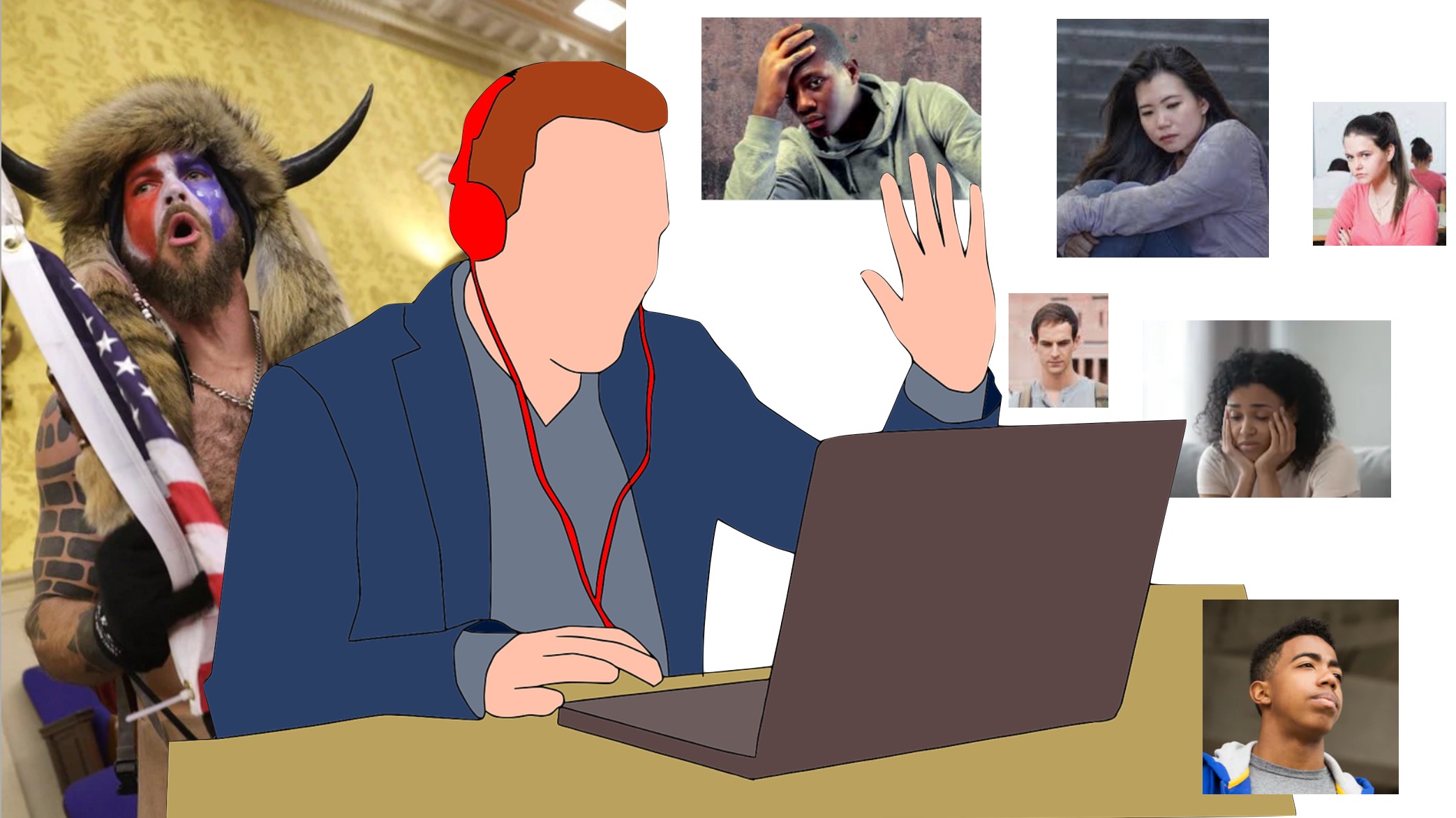
The rows of empty boxes had turned into windows. No more memes or messages or generic names. Most of my kids had turned on their cameras and were meeting my eyes – in some cases – for the first time.
So that’s what Kelsey looks like, I thought. Wow! Marquis is really built. Is that little kid in the grey hoodie really Caulin?
I got flustered and stopped talking, but the students took up the narrative for me.
Some of them mentioned watching videos on-line of the riot. They saw a guy with horns in the President’s chair?
“No, I said. “That was the Vice-President’s chair in the Senate.”
“Wasn’t there someone at someone’s desk?”
“Yes, that was Nancy Pelosi’s desk,” I said. “A rioter broke into her office and put his feet up. She’s the Speaker of the House.”
And so it went on for a few minutes. They brought up things they had seen and I either clarified or supported them.
As a whole, they were wealthy in details but poor in meaning.
Most of the white kids seemed to be taking it ironically. The black and brown kids were more quiet and subdued.
A white boy wrote in the chat that it was “Civil War 2: electric bugaloo.”
I said, “Yes, you’ve hit on an important point. Some of these folks may have been trying to start a new Civil War.”
I tried to put the event in historical context.
I told them how nothing like this had ever happened in my lifetime. That the last time people broke into the Capitol Building like this was during the War of 1812 when the British tried to force the US to become a colony again. However, that was a foreign power invading our country. Wednesday was our own citizens seeking to overturn the results of an election, trying to overwrite the will of the people.
That’s when the first black student spoke up.
“Mr. Singer, why were they waving Confederate flags?”
“Yes! That’s true, Jamal. Many of them DID have Confederate flags and that’s really important.”
Before I could say more I got a series of rapid-fire questions from the same group who had been silent up to this point.
“Why didn’t the police stop them?”
“Why’d they steal stuff? I saw some guy walking away with a podium.”
“Why they so mad?”
I smiled and said that these were all excellent questions.
I asked if any of them knew who George Floyd was.
No one responded.
I told them he was a black guy who was murdered by police when an officer knelt on his neck.
After that happened, there were protests by Black Lives Matter activists and others in several cities including Pittsburgh. The police showed up in riot gear. As these protestors demonstrated almost entirely peacefully – certainly more peacefully than what we saw in DC yesterday – more than 14,000 people were arrested.
“How many people do you think were arrested yesterday?” I asked.
“Didn’t someone die?”
“Yes, a woman was shot in the Capitol and three others died of medical emergencies. How many people were arrested?”
“None,” said a student of color who hadn’t participated before.
“Why none?” I asked.
“Because they was white.”
I told him that he right and wrong. Out of thousands of rioters who broke into the Capitol, thirteen people were arrested. And the reason there were only 13 was because they were white.
I told them that this whole affair needed to be investigated. That we needed to know how and why the police responded the way they did. That we needed to hold the rioters accountable. That we needed to make sure those who instigated this violence were made to pay for it, too.
“Is Trump still President?” Someone asked.
“Yes,” I said. “For about two more weeks. But there are a lot of people who think he should have to step down sooner.”
So we talked about how he could be removed from office. We talked about impeachment and the 25th Amendment. We even talked about how Trump was banned from Twitter and Facebook – how he couldn’t post or tweet but still could send a nuclear missile anywhere he wanted.
And then it quieted down.
I asked them if there was anything more they wanted to know or if there was anything else they wanted to say.
They were still.
A few cameras clicked off.
I told them that I was there if anyone needed anything, that their teachers were here if they were feeling anything and wanted someone to talk to.
And then that was it.
I made one of the most abrupt and inelegant transitions in my career and we returned to our normally scheduled lesson.
Did it help any?
I don’t know, but I told them what I could. I told them the truth as I saw it.
There was a time when I would have been more reticent about it.
But the day after domestic terrorists try to steal our system of government isn’t the time to hold back.
As a teacher, sometimes I feel so helpless.
There’s so much I’d like to do for my students.
I want them to get the resources they need. I want to stop the unfair testing, integrate their schools, keep them safe from gun violence and control Covid-19 so we can return to the classroom.
I want to live in a country where majority rule is cherished and protected, where no one thinks the collective will should be trumped by white privilege.
But when all those things are out of reach, I still have one thing left to give.
The truth.
Like this post? You might want to consider becoming a Patreon subscriber. This helps me continue to keep the blog going and get on with this difficult and challenging work.
From the never ending antics of our clown President to the Coronavirus to the continuing rise of White Supremacy, it seemed you couldn’t go more than a few days without some ridiculous headline assaulting your senses.
As a result, there were a lot of worthy, important articles that fell between the cracks – more so this year than any other.
Before we charge into the New Year, it might be a good idea to spare a look over our shoulders at these vital nuggets many of us may have missed.
On my blog, alone, I’ve found at least five posts that I thought were particularly important but that didn’t get the attention they deserved.
So come with me please through this survey of the top 5 education articles (by me) that you probably missed in 2020:
Description: Kids usually spend about 1,000 hours with their teachers in a single year. During that time we build strong relationships. And though just about everyone will tell you this is important, we’re often talking about different things. Some policymakers insist we prioritize an “instrumental focus” with students using their personal information to get them to behave and do their work. The goal is compliance not autonomy or problem solving. However, increasing evidence is showing the value of a more “reciprocal focus” where students and teachers exchanged information to come to a mutual understanding and shared knowledge. Here the goal is free thought, questioning, and engagement with authority figures. I provide my own personal experience to support the latter approach.
Fun Fact: This post is full of letters my former students wrote to me during the pandemic. They highlight better than any study the value of authentic relationships to both students and their teachers.
Description: The link between standardized testing and segregation is obvious but hardly ever discussed. In short, it goes like this. Even when students from different racial or ethnic groups aren’t physically separated by district boundaries or school buildings, the way we rate and sort these students within the same space causes segregation. This is because our manner of placing kids into classes, itself, is discriminatory, unfairly resulting in more children of color in lower academic tracks and more white kids in advanced placement. If segregation is an evil, so is the standardized testing often used to place kids in remedial, academic or advanced classes.
Fun Fact: It seems to me this has immediate and important policy implications. There are so many reasons to end the failed regime of high stakes testing. This is just another one.
Description: Virtual instruction has been a hot button issue this year in the wake of school closings caused by the COVID-19 pandemic. The fact that in-person instruction is more effective has been used as an excuse to keep many schools open when logic, reason and facts would dictate otherwise. However, the kind of in-person instruction being offered in a pandemic is, itself, not as effective as the kind of in-person instruction offered under normal circumstances. Moreover, distance learning is not all bad. It does have some advantages such as it being generally low pressure, more difficult to disrupt class and easier to contact parents. At the same time, it presents unique challenges such as increased student absences, the problem of when and if to keep the camera on and difficulties with special needs students.
Fun Fact: We desperately need an honest accounting of what is going on with real virtual classrooms around the country and how students and teachers are meeting these challenges. If there was more discussion about how to make distance learning better, the education being provided during the pandemic would be so much more effective than spending all our time and effort trying to reopen school buildings regardless of the risks of infection to all involved.
Description: When should teachers praise students and when should they use reprimands? The research is all over the place. Some studies say praise is good but only so much and only in certain circumstances. Others say reprimands are more effective and still others caution against when and how to use them. My own experience has shown that honest praise and thoughtful reprimands are more effective than not.
Fun Fact: This may seem like a simple issue but it highlights the complexities of teaching. Educators are not working with widgets. We’re working with real, live human beings. There is no simple solution that will work every time with every student. Effective teaching takes good judgement and experience. If we ever want to improve our school system, it is vital that we understand that moving forward.
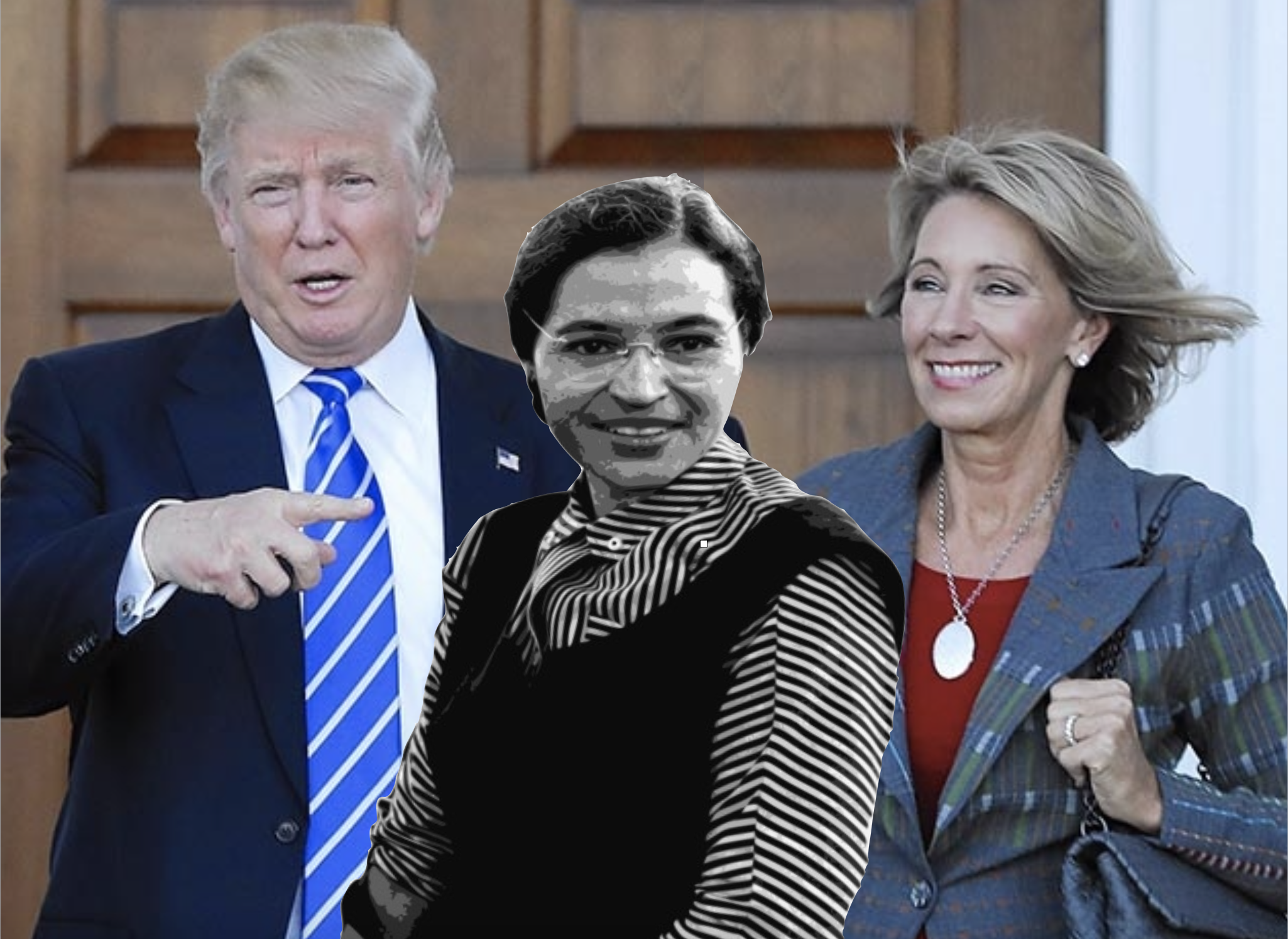
Description: Forty years after the Montgomery bus boycott that was sparked by Rosa Park’s refusal to give up her seat to a white man, the civil rights icon lent her name to a charter school proposal in 1997. However, the Detroit school that would have been named for her and her late husband, the Raymond and Rosa Parks Academy for Self Development, was never approved. In any case, Charter school advocates like to pretend this mere proposal means Parks was an early champion of charter schools and thus that school privatization is an extension of the civil rights movement. Yet a closer look at the facts shows a sadder story. At the time of the proposal, Parks was suffering from dementia and under the sway of countless corporate consultants who used her name and clout to enact several projects. It ended in a protracted legal battle after her death between her family and the consultants to whom she willed a treasure trove of civil rights artifacts.
Fun Fact: I think this is one of the most important articles I wrote in 2020. It’s not a pretty story, but it’s the truth. The school privatization movement likes to co-opt the language of the civil rights movement while violating the civil rights of students and families with substandard education and pocketing tax dollars as profit that were meant to educate children. The exploitation of Parks in this way is symptomatic of what you’ll see in any inner city charter school where entrepreneurs are getting rich off of the children of color whom they pretend to be serving.
Gadfly’s Other Year End Round Ups
This wasn’t the first year I’ve done a countdown of the year’s greatest hits. I usually write one counting down of my most popular articles and one listing articles that I thought deserved a second look (like this one). Here are all my end of the year articles since I began my blog in 2014:
Like this post? You might want to consider becoming a Patreon subscriber. This helps me continue to keep the blog going and get on with this difficult and challenging work.
“In the End, we will remember not the words of our enemies, but the silence of our friends.” -Martin Luther King Jr
Teachers want a safe place to work.
But in 2020 that is too much to ask.
As the global COVID-19 pandemic rages out of control throughout most parts of the United States, teachers all across the country want to be able to do their jobs in a way that won’t put themselves or their loved ones in danger.
However, numerous leaders and organizations that historically are supportive of teachers have refused to support them here.
The rush to keep classrooms open and thus keep the economy running has overtaken any respect for science, any concern for safety, and any appeal to compassion.
Affected teachers often wonder where their union is, where their progressive representative, where the grassroots activists who were willing to organize against charter schools and high stakes testing.
About 1 in 4 teachers – nearly 1.5 million – have conditions that raise their risk of getting seriously ill from the Coronavirus, according to the Kaiser Family Foundation.
Michael Mulgrew, president of the United Federation of Teachers (UFT) agreed.
He said:
“We are supportive of a phased reopening of schools in other neighborhoods as long as stringent testing is in place. This strategy – properly implemented – will allow us to offer safe in-person instruction to the maximum number of students until we beat the pandemic.”
The plan is predicated on a bogus statistic that kids aren’t getting sick at school or spreading the virus from there, that only 0.2% can be traced back to school buildings.
Why aren’t the unions standing up more for their employees here? Why is the request for a safe work environment too much?
Answer: politics.
With President-elect Joe Biden about to announce his pick for Secretary of Education, few union leaders have the courage to go against the party line and disqualify themselves from consideration.
But she was unafraid to contradict President Donald Trump before the election.
She appeared on CNN and challenged Trump to “sit in a class of 39 sixth graders and breathe that air without any preparation for how we’re going to bring our kids back safely.”
In late April, she took to Twitter saying the NEA is “listening to the health experts and educators on how and when to reopen schools — not the whims of Donald Trump, who boasts about trusting his gut to guide him. Bringing thousands of children together in school buildings without proper testing, tracing, and social isolation is dangerous and could cost lives.”
“The stakes of doing it wrong is that someone dies. It’s not just that someone doesn’t graduate or someone doesn’t learn their times tables — someone could die.”
I wonder what she would say today – and why she hasn’t spoken out as vocally.
“The health and safety of students, staff, and our families must be our top priority,” Askey said. “We call on all school district leaders to follow the state’s guidelines to protect the health and safety of everyone in our school communities.”
However, state guidelines are pretty weak. They suggest mask wearing and that districts close when community infection rates are high. But districts can choose to keep buildings open if they promise to follow safety guidelines to the best of their ability.
Gov. Tom Wolf originally issued an order for all schools to close and go to remote learning last March. However, state Republicans challenged his authority to do so and their position was upheld in court.
I assume Wolf would say he hasn’t done more because his hands are tied.
I assume Askey would say the same.
But such platitudes taste like ashes in your mouth when faced with the everyday reality that almost everyday the state is breaking its previous record for Coronavirus cases. Today we had nearly 13,000 new cases and 149 deaths! Yes, that’s just today!
Will their hands still be tied when daily cases reach 20,000? 50,000? 100,000?
They’re used to deciding whether to remodel the library, buy books from this or that vendor or declare Friday a holiday because the football team won the state championship.
I don’t mean to diminish what they do.
Some have been going above and beyond every day to ensure the health and safety of students, staff and the community.
And these are people from the community. How many times have teachers called them to let them know how their kids were doing in class? How many times have teachers gone with them and their kids on school field trips? How many times have teachers accepted invitations to graduation parties and school board meetings?
However, as much as the silence and disregard of lawmakers, union leaders and school directors hurts – it is the reaction from many education activists that stings the most.
However, instead of standing together and fighting these new challenges as they come (as we’ve always done) many of our activist allies have abandoned us.
One day – I hope it’s soon – it will be safe to return to the classroom and begin again.
But the wreckage of the virus will pale in comparison to the damage we have done to each other and our relationships.
Coalitions may crumble and fall.
Trust may disappear.
And the way forward – if any will be left – may be much different than it was only a year ago.
No one who refuses to defend your right to life is your true ally.
We won’t forget who spoke up and who remained silent.
Like this post? You might want to consider becoming a Patreon subscriber. This helps me continue to keep the blog going and get on with this difficult and challenging work.
It was a repudiation of Trump more than a celebration of Biden.
However, now that the dust has cleared and all the states but Georgia, Alaska and North Carolina have been called, I’m starting to have some thoughts about what a Biden administration might actually look like.
And it might not be too bad.
So here are what I see as the five main hurdles coming up for the Biden administration and why we might be cautiously optimistic about their outcomes:
1) Trump Will Fail to Successfully Challenge the Election Results
Alaska will probably go to Trump and North Carolina is a bit of a toss up. Georgia will almost certainly go to Biden.
It actually doesn’t really matter.
The world and the media have already accepted the results.
Biden has been elected the 46th President of the United States.
In the absence of solid evidence of massive voter fraud in multiple states – many of which are controlled by Republican governments – it is unlikely that these results can be successfully changed.
You don’t know Four Seasons Total Landscaping? It’s a landscape gardeners located between a crematorium and a dildo shop.
That is not the work of people capable of running an effective challenge to a national election.
Yes, there are enough far right justices on the Supreme Court to pull off this Coup d’état. But I don’t think even they would have the guts to do it in light of the world’s acceptance of Biden, the acceptance of many in the GOP and the blatant incompetence of the Trump administration.
I admit that I could be wrong. And I certainly don’t think we should underestimate these neofacists.
Trump is a cornered rat, and that is when rats are at their most dangerous.
It appears that the election will not, by itself, change the balance of power in Congress.
The Democrats have lost seats in the House but not enough to lose a majority. They do not appear to have picked up enough seats in the Senate to rest control away from the GOP.
No doubt Republicans will try to throw whatever they have left to stopping the Dems in these races. But how much do they really have after being beaten nationwide?
Will momentum and an existent grassroots network be enough to flip the script for Dems?
Chances are good. It all depends on what we do in the next few months.
3) Progressives Will Not Let Neoliberals Ignore Them
Both this year and in 2016, there was very little positive policy being offered – very little popular positive policy positions that would have directly impacted the majority of Americans.
Had Medicare For All or the Green New Deal been on the ballot, things might have gone differently – or more emphatically – our way.
But, instead, it was all about getting rid of Trump.
Thankfully, that was enough. But had the party actually offered voters something more – things that are overwhelmingly popular with everyday people but unpopular with party elites and their wealthy backers – the results could have been a landslide in Biden’s favor.
She said that every candidate that co-sponsored Medicare for All in a swing district was reelected. Even Mike Levin, who many thought had committed political suicide by co-sponsoring the Green New Deal, kept his seat.
Supporting progressive policies did not sink anyone’s campaigns. In fact, that’s how insurgent Democrats have been unseating centrists across the nation.
“I’ve been unseating Democrats for two years,” Ocasio-Cortez said. “I have been defeating D.C.C.C.-run campaigns for two years. That’s how I got to Congress. That’s how we elected Ayanna Pressley. That’s how Jamaal Bowman won. That’s how Cori Bush won. And so we know about extreme vulnerabilities in how Democrats run campaigns.”
This is a fight for the heart and soul of the Democratic party.
We cannot continue to move to the right and expect the base – which are much further left – to continue to vote for increasingly conservative candidates.
There is already a party for that – it’s the Republicans.
“I need my colleagues to understand that we are not the enemy,” she said. “And that their base is not the enemy. That the Movement for Black Lives is not the enemy, that Medicare For All is not the enemy. This isn’t even just about winning an argument. It’s that if they keep going after the wrong thing, I mean, they’re just setting up their own obsolescence.”
We will see if the Biden administration learns these lessons or not.
I think there is good reason to be cautiously optimistic here. It is in the party’s own self interest.
But only the future will tell.
4) Biden will Take Steps to Control the Coronavirus
Unlike his predecessor, Biden has been a consistent voice of sanity on the COVID-19 pandemic.
“We cannot repair the economy, restore our vitality, or relish life’s most precious moments — hugging a grandchild, birthdays, weddings, graduations, all the moments that matter most to us — until we get this virus under control.”
And true to his word, this appears to be the first thing on his agenda.
Specifically, Biden’s plan calls for empowering scientists at the Centers for Disease Control and Prevention (CDC) to help set national guidance based on evidence to stop outbreaks, work on a vaccine, testing, contact tracing and other services.
His administration would use the CDC to provide specific guidance — based on the degree of viral spread in a community — for how to open schools and businesses, when to impose restrictions on gathering sizes or when stay-at-home orders may be necessary.
He would create a national “pandemic dashboard” to share this information with the public.
He would make sure that everyone has access to regular, reliable, free testing.
He would hire 100,000 additional public health workers to coordinate with local organizations around the country to perform contact tracing and other health services. These people would help with everything from food insecurity and affordable housing to training school officials about when and how to make it safe to reopen buildings.
He proposes the federal government cover 100% of the cost of Consolidated Omnibus Budget Reconciliation Act (COBRA) coverage for the duration of the crisis for people who get sick from the virus. If someone loses employer-based health insurance, they would still have health insurance through this plan.
He also will push to strengthen the Affordable Care Act, expanding coverage by making more people eligible.
He’d use the Defense Production Act to increase production of masks, face shields and other personal protective equipment so that supply exceeds demand.
I don’t know about you, but to me this seems a breath of fresh air. It is what the federal government should do and what it hasn’t been doing under Trump.
And I see no reason why the Biden administration can’t get it done.
5) Biden Can’t Afford to Re-up Betsy DeVos’ Education Policies
They all supported charter schools, high stakes testing, increased segregation, the school-to-prison pipeline, evaluating teachers on student test scores, targeted disinvestment to schools in poor neighborhoods serving mostly students of color, and more.
Duncan and King were competent at destroying public education while hiding behind neoliberal rhetoric. DeVos was incompetent in every conceivable way and could barely hide her glee at the prospect of destroying public education.
Since Biden’s wife, Jill, was an actual teacher, he has more to lose than previous chief executives if he gets this wrong. He can’t take schools for granted and he can’t appear to be doubling down on the same policies of Trump and DeVos – which to be honest were mostly the same as those of Obama and Bush but on steroids.
Biden promised a public school teacher would be his next education secretary and Politico is already making predictions. The media outlet suggests ex-National Education Association (NEA) President Lily Eskelsen Garcia, American Federation of Teachers (AFT) President Randi Weingarten or Stanford Education Professor Linda Darling-Hammond.
Frankly, we could do much worse than any of these people. Hammond, in particular, was Obama’s education policy advisor UNTIL he was elected and changed courses to the neoliberal set.
Of all the hurdles coming his way, I have the least hope Biden will overcome this one.
Like this post? You might want to consider becoming a Patreon subscriber. This helps me continue to keep the blog going and get on with this difficult and challenging work.
“Oh yes it is, Sir. You ordered the meat sandwich. Enjoy your fresh hay and oats.”
In everyday life, you wouldn’t put up with that kind of nonsense.
But for some reason, far right ideologues think it’s exactly the right way to interpret the U.S. Constitution.
The meanings of words change over time.
But ignoring that fact allows disingenuous crackpots to sweep over centuries of judicial precedent in favor of what they pretend to THINK the words meant at the time the law was written.
It’s not even about what the writers of the law SAID it meant. It’s about what today’s justices decide some hypothetical average Joe of the distant past would take certain words to mean.
Before this ruling, the Second Amendment was interpreted to be referring only to service in the militia. The Militia Act of 1792 required each able-bodied male citizen to obtain a firearm (“a good musket or firelock”) so he can participate in the “well regulated militia” the Amendment describes.
It was about the obligation to serve your country, not the right to own a gun. However, Supreme Court Justice Antonin Scalia – the most infamous proponent of judicial originalism – orchestrated the majority opinion in this case changing all that. By doing a thought experiment about what words might have meant in the 1700s, he papered over two centuries of established law. He was so proud of it that he even described it as “my masterpiece.”
Academics didn’t become something schools were responsible for until the mid-1800s. And even then, how they went about achieving it differed greatly from region to region of the country.
In fact, it wasn’t until the Civil War ended and the Reconstruction era began when public schooling really became a thing in the South.
And even when it did, it didn’t look much like our schools of today. These were often one-room schoolhouses where a single teacher tried to educate children of various ages, grades and abilities.
Moreover, these schools weren’t solely supported by taxes – if at all. These Common Schools were more like private or parochial schools of today. Parents paid tuition, provided housing for the teacher, or contributed other commodities in exchange for their children’s education.
Only 31 states passed laws requiring children to go to school by 1900, and kids only went from age 8-14. It wasn’t until 1918 that every state even required elementary school.
But let’s not forget segregation.
It was the law of the land until Brown vs. Board in 1954, and even then it took until the late 1970s to become even moderately enforced.
Just imagine if Barrett gets together with the wingnut Republican majority on the court to reevaluate that ruling!
Imagine how many centuries of slow progress she could overturn by appealing to the common man – of 1776.
Imagine if she and the regressive right examined free speech cases! After all, many of these laws were written during the time of the Adams Administration’s Alien and Sedition Acts which radically cracked down on free expression.
We could expect a rush to return to the mire and muck that many of our enlightenment heroes were trying to escape in the first place.
But originalists like Barrett claim only they can interpret what the language in these laws originally meant. Yet their training is in law, not literacy or antiquity. They’re not linguists or historians. They don’t have some shortcut to what people used to mean by these words. They’re just playing with the language to make it mean what they want it to mean so they can rule however they so choose.
Even if they could figure out the original meaning of the words in these laws, that doesn’t guarantee it would make sense in today’s world. How, for example, do the founding fathers views on medicine have anything to do with today’s healthcare system that didn’t exist in the 1700s and that the founders couldn’t even comprehend? How do the founders views on gun rights relate to today’s firearms when they knew only of muskets and not automatic weapons?
Finally, why should we give preference to antiquated ideas over modern concepts? The laws of yesteryear may have been suited to the days in which they were written. However, if a law cannot grow to encompass the world as it exists, it has no right to continue to exist.
Judges are not supposed to overturn precedent based on lingual folderol. They’re supposed to uphold the law based on logic, reason and sound judgement.
Any judge that disagrees has no place in our courts.
It’s ironic that such degeneration would come from the Republican Party.
If anything were to revert back to its original meaning, I wish it were the Grand Old Party, which is now neither grand, barely a party and merely old.
Like this post? You might want to consider becoming a Patreon subscriber. This helps me continue to keep the blog going and get on with this difficult and challenging work.


















 gadflyonthewallblog