Top 4 Things McKeesport Area School Directors Need to do to Extinguish the District Dumpster Fire

It gives me no joy to write this, but McKeesport Area School District (MASD) is a raging dumpster fire.

School directors reneged on a teachers contract. Their business manager ran for the hills. And at the last board meeting two school directors had their dirty laundry aired during public comments prompting one to call a White Oak Councilperson a homophobic slur.

Our finances have been given over to an accounting firm paid for by Dick’s Sporting Goods. An $86 million district budget (2023-24) at the mercy of the place where you go to buy new sneakers and fishing tackle.

This is pretty low – even for schools as historically dysfunctional as McKeesport.

As a local reporter in Pennsylvania’s Mon-valley area in the late 1990s and early 2000s, I saw a lot of crazy things happen at local government meetings throughout the western corner of the state.

But McKeesport School Board meetings were legendary. The nepotism, incompetence, ignorance, glad-handing and focus on anything but education was something my colleagues and I would marvel at when we had time to compare notes.

Now the running of district schools threatens to grind to a halt by a prospective teachers strike! If we want to get things back into some semblance of order, I think we need to do a few things.

As a lifelong resident of the district, an alumni and father of a child who currently goes to school there – not to mention a public school teacher at a neighboring district with more than two decades in the classroom – I think school directors need to focus on these four things first.

They are:

4) Pass a Code of Conduct for Board Members and Administrators

I am sympathetic to School Board members Jim Brown and LaToya Wright. At the last board meeting several people trolled the pair with questions about their marriage. Since school board members have to live in the district, these folks wanted Wright removed if she were separated from her husband and had relocated outside of the district.

While it’s fair to require school directors to provide proof of residency, this kind of Jerry Springer style questioning is not appropriate for a public meeting. If I had to constantly answer questions like this while volunteering to help guide the community’s schools, I might also find it hard to keep my composure.

However, that does not excuse using slurs of any kind at a public meeting – not racial, religious, sexual or otherwise.

Brown has apologized on-line for his indiscretion and should do so again at the next school board meeting. But his actions highlight a glaring problem within our district.

We need a code of conduct for our school board members and administrators.

The previous Superintendent Dr. Mark Holtzman was frequently sarcastic, flippant and rude to members of the public who asked questions he did not like at board meetings – myself included. It has been pretty standard procedure for board members to ridicule each other, make threats and/or stifle public comments.

These are the people who run our schools. They make the decisions that impact all of us as taxpayers and citizens – decisions that impact those of us with family enrolled in the school even more.

They should have to abide by a certain minimum level of civility – especially that hate speech of any kind not be tolerated.

Given the circumstances, I do not think Brown should be removed from the board. However, he should be given the chance to publicly apologize at the next board meeting. If he does not, he should be censured by his fellow board members.

It should be entirely clear what kind of behavior would bring censure, removal and/or impeachment.

School directors often act like being on the board gives them the right to hand out jobs to unqualified relatives and acquaintances, to seek revenge for supposed wrongs done to family or friends, and an excuse to enrich themselves on the public dime.

This needs to stop.

We need to draw a line in the sand to show what behavior is appropriate not just as a model for our children who we are supposed to be serving here, but also so that despite our differences we can finally work together in the best interests of everyone in the community. That’s why these people are supposed to be there in the first place.

3) Start Streaming Council Meetings Again

During the Covid pandemic, MASD would routinely video and stream its school board meetings on-line. About a year ago, the school board voted to stop.

Why?

These are public meetings. We are a working class district. Most people don’t have the time to physically attend every meeting.

This isn’t 1973. It’s not even 2003. We have the technology to cheaply and easily tape and share the meetings. We should absolutely do so. There is no possible excuse not to comply.

My middle school students have the know how to do this – and could do it in better quality than the district used to provide.

In the past, the board was indifferently microphoned so it was incredibly difficult to make out what they were saying – especially if they didn’t want to be heard. The camera was so far away, you couldn’t see anything except a few blurs behind a table.

That showed indifference to the public. Not streaming the meetings at all shows downright hostility.

Board members are afraid of spectacles like that which happened at the last board meeting becoming a video part of the public record. With the relative lack of almost any reliable newspaper to cover the area, it is often the case that board meetings aren’t even reported in the local paper and if they are, it may be in the most rudimentary terms possible or behind a paywall.

The school board should absolutely reverse itself on this point and renew taping the meetings and release them on-line. They could even invite a high school video club to do the work and probably greatly increase the quality of the product. The board should be proud of what it’s doing – not cower in the shadows. If the results are embarrassing, the public has a right to see it. What better inducement for board members and administrators NOT to behave badly?

And if the board won’t do this, some enterprising members of the public should. The teachers union or others could easily do this. These are public meetings. We have every right to tape them and put them on-line.

And any district who wants any kind of control over that should provide it as a free service, itself.

2) Hire a New Reputable Business Manager

Business Manager Scott Domowicz left the district over controversy about the board’s rejection of the teachers contract (more on that below).

The board accepted Domowicz’s resignation at its September meeting, but it won’t go into effect until the beginning of November. The board passed a motion to advertise the open position.

Meanwhile, accounting firm Klynveld Peat Marwick Goerdeler (KPMG) is ensuring the district’s finances are in order.

The board voted 5-4 to allow Dicks Sporting Goods to pay for 50 hours of accounting services by the firm, one of the big four in the industry.

Personally, I don’t like our schools being beholden to the largest sporting goods retailer in the country even if they are based in nearby Coraopolis. Our district already is too focused on its athletics program to the detriment of academics. I may just be cynical, but I don’t believe in corporate philanthropy – only philanthrocapitalism. I wonder what Dicks is going to ask MASD to do to repay this debt or what backroom deals may have already been made along these lines.

The district needs to hire a new business manager ASAP – and this time it needs to be someone with experience and a good reputation.

Domowicz originally had been hired in late February 2022 at an annual salary of $100,000. He had been the business manager at Spectrum Charter School in Monroeville for about a year. Before that he was Senior Management Consultant for two decades at Great Lakes Management Consulting, a firm offering accounting and tax preparation services to customers and small business owners in Grosse Pointe, Michigan.

Spectrum Charter School is much smaller than MASD. The privatized school employs 11-20 people and has $1 million to $5 million in annual revenue. MASD has roughly 3,000 students and 300 teachers with a proposed budget of $86 million next year.

The previous Business Manager Joan Wehner had more experience in the education field. She was assistant to the business manager at Penn-Trafford School District for 10 years before coming to McKeesport. She left the district to become business manager at Greensburg Salem School District.

It would be beneficial to get a replacement with a demonstrated track record in education – but it may be difficult to entice someone like that to come to a place as toxic as McKeesport. However, we need to do whatever we can to make it so.

1 ) Pass a Teachers Contract with No Tax Increase

School directors and the teachers had agreed to a tentative new contract in June, but the board tabled it after concerns that the district didn’t have the money to pay for moderate raises.

Then the board skipped the entire month of July without a meeting. But had no answers when they came back in August or September.

They just heaped blame on Domowicz, so he resigned.

Meanwhile, the teachers current contract expired at the end of August and the 266 teachers and professional education staff become so fed up, they voted unanimously to authorize a strike. This does not mean an immediately work stoppage, but it is the first step toward one.

The union has agreed to one more 30-day extension to contract negotiations. However, union President Gerald McGrew said that this is the final extension the union will grant. So the board needs to make this right by the end of October.

I think the teachers are being fair. The proposed raises in the contract rejected by the school board are moderate and well below what some educators in neighboring districts make.

Over five years, the proposed pay increases are: 6.11% in 2023-24, 6.59% in 2024-25, 6.03% in 2025-26, 4.38% in 2026-27, and 3.26% in 2027-28.

If they can afford relatively similar pay scales at West Mifflin, Steel Valley and other neighboring districts, MASD should be able to do so, too. The school board needs to make this work.

The district should be open about its finances. How much exactly would this cost? What cost saving measures can be conducted to reach this goal? And no ridiculous speculation about how much this might cost from board members with no financial background. These numbers should come from the experts. Facts not politics.

Obviously this should be done without a tax increase. I think it is entirely realistic to expect such an outcome without further information to the contrary. However, let’s be real. Ensuring fair pay for our teachers needs to be done even if that means raising taxes.

The heart of a school is its teachers. You can’t have a great school without great educators and you won’t have them without fair pay.

We are already being eaten alive by charter schools. Every child living in the district who goes to a charter school takes away money that would have gone to fund MASD. The district paid $14 million toward charter school tuition in 2022-23, according to Domowicz. He budgeted $16 million next year. That’s 17 percent of the new budget going toward charter schools.

If MASD doesn’t have quality teachers and a quality academic program, we’ll lose even more to these privatized schools. The only way to reverse the trend is to provide the best education and get the word out.

If we leave schooling to the competing piranha charter schools, they will gobble up our taxes while we have no say whether they are raised or not since most charter schools have no elected school boards.

McKeesport School Directors may be dysfunctional, but at least they’re elected representatives. At least they are members of the community who are required to listen to the public and conduct business in an open forum.

They could do their jobs better, but at least they’re ours. And we can replace them.

The only way we get MASD back on course is to pass a fair teachers contract. And to do that we need a reputable, reliable business manager. We need to video and stream school board meetings so everyone can see them easily. And we need to cut the crap and start conducting those meetings civilly and respectfully in the spirit of cooperation and the good of the community at large.

The way I see it, these are the first steps to get there.


Like this post?  You might want to consider becoming a Patreon subscriber. This helps me continue to keep the blog going and get on with this difficult and challenging work.

Plus you get subscriber only extras!

Just CLICK HERE.

Patreon+Circle

I’ve also written a book, “Gadfly on the Wall: A Public School Teacher Speaks Out on Racism and Reform,” now available from Garn Press. Ten percent of the proceeds go to the Badass Teachers Association. Check it out!

If You Don’t Want Teachers to be Saviors, Don’t Put Them on a Cross 


At the end of the school year, I like to show my 8th grade students the movie “Freedom Writers.” 


It’s a good culminating film for the class because many of the subjects and texts we read are mentioned by the characters – “The Diary of Anne Frank,” “To Kill a Mockingbird,” the civil rights movement, journal writing, etc.  


It reinforces the relationship between historical narratives and the fight for human rights as well as underlines the importance of raising your own voice


However, it is also a movie that has come under fire for perpetuating the white savior trope.  


The film is based on the true story of Erin Gruwell, a white middle class woman, who taught inner city children to find their own voices by writing about their lives in Freedom Writer journals. 


The biggest problem seems to be that in the film the teacher takes on more jobs to afford supplies, spends time putting together field trips, and even ends up losing her marriage so her students’ needs will be met in the classroom. 


Is she a white savior transforming, saving and redeeming the lives of her students through her own personal sacrifices?  


Is this essentially a feel good story about a white person saving otherwise irredeemable brown skinned children?  


Honestly, I don’t think so. I suppose the answer depends on how much the students’ success should be attributed to the sacrifices of their teacher, and how uncomfortable we should be by the fact that she’s white while her students are predominately children of color. 


Is there something wrong with these kids? Absolutely not. Stereotypes aside, their problems arise from the circumstances in which they live more than anything else. 


But if I’m being truthful, I have to admit these are tough questions, even more so when we’re asking them about real teachers and students. After all, I show the movie to my students because we’re in a somewhat similar relationship. They have many analogous experiences and I try to teach them using some corresponding texts and methods.  


And am I not also a white teacher with a class of mostly black and brown children? 


How often are people in my own position labelled white saviors? And what part of that label is denigration and what part valid criticism? 


On the one hand, there are legitimate challenges born out of this situation. 


About eight-in-ten U.S. public school teachers (79%) identified as White (non-Hispanic) during the 2017-18 school year, according to the National Center for Education Statistics (NCES). Fewer than one-in-ten teachers were Black (7%), Hispanic (9%) or Asian American (2%). So this situation is pretty much the norm – most students of color have white teachers. 


This is challenging because study after study shows white teachers bring their biases with them to the classroom. They often have lower expectations for students of color, which greatly affects their students’ motivation and achievement. This may even impact expulsion and discipline rates as well as other facets of students’ academic experiences. 


With the constant emphasis on standardized test scores and the testing gap, it is easy to fall into the trap of seeing students of color as less than. After all, children of color in general do not score as well as richer whiter kids. So teachers are encouraged to look at the situation as one in which they can act on their students and MAKE them have higher scores simply by giving the right test prep and forcing their students to do these boring and extrinsic assignments by using increasingly punitive inducements.  


However, I do not think it is correct to characterize this as being a white savior. I think it is being a colonizer, and I have seen the same kinds of attitudes and actions from people of various races and ethnicities.  


In my own admittedly limited experience, the most test obsessed teachers and administrators I have ever know have been people of color – almost as if they were trying to make a point about their own racial identity by raising test scores of the children in their charge.  


The problem is that the testing gap has nothing to do with any deficiency in black and brown students. It comes from biased and unfair questions which are based more on privilege and culture than authentic academic ability.  


The problem with being a colonizer is that it enforces a prejudicial status quo. So raising test scores (even if you’re successful) does little to help people of color. It simply justifies making them jump through biased and unfair hoops in the first place with the excuse, “See? They did it. Why can’t you?” 


In this way, I agree with, Dr. Christopher Emdin, an associate professor at Columbia University’s Teachers College, who advised educators in his book “For White Folks Who Teach in the Hood…and the Rest of Y’all Too”: 


“You are there not as a savior, but as a revolutionary.” 


Teachers should be openly antiracist – especially white teachers. As difficult as it can be sometimes, we must not allow racism to become a taboo topic – something to be whispered about but never spoken of by name. We need to have the uncomfortable conversations. We need to read texts by people of color and honor every student’s race and culture. We need to prize difference and examine our own reactions to it. 


However, as I said I do not think the issue here is saviorism.  


That is something completely different though just as harmful. 


Regardless of race or ethnicity, teachers are forced to be martyrs .  


You can criticize Gruwell’s story because of all she gives up for her students, but that is kind of what teachers are obliged to do if they want to accomplish even a smidgen of their responsibilities.  


In fact, it is almost impossible to be a teacher – especially a teacher of predominantly black and brown students – and not be viciously coerced to sacrifice yourself.  


For example, more than 90 percent of educators use their own money to buy school supplies for their students, according to a survey from the National Education Association (NEA).
 
An analysis from My eLearning World showed teachers for the 2022-2023 school year spent an average of $820.14 on classroom supplies.  


However, educators cannot deduct even half of that cost from their taxes.  


Why do teachers do this? Because schools don’t purchase what kids need. So – especially in impoverished areas – educators are left with the choice of watching students do without or simply meeting that need, themselves.  


Almost every aspect of teaching involves some kind of sacrificial trade off like this.  

You can have a classroom with bare walls or you can buy and put up your own decorations to make it a welcoming environment for students. You can try to get kids up to your school’s meager library (assuming one even exists with a full-time librarian to keep books in stock) or you can just purchase your own classroom library.


Heck! There are only about 40 minutes or so in most teachers’ day to plan their lessons and grade student work. That’s not nearly enough time. Just to get the bare minimum done, educators have to spend hours and hours extra daily without pay.  


Moreover, teachers salaries are not commensurate with other professionals. They are paid 20% less than other college-educated workers with similar experience, and a 2020 survey found that 67% of teachers have or had a second job to make ends meet

You want more teachers of color to enter the profession? Then stop making privilege a prerequisite to apply!


This is why so many teachers are leaving the profession. They don’t want to be sacrificial offerings anymore.


The entire country is in the midst of a national educator walk out. Teachers are refusing to stay in the classroom due to poor salary, poor working conditions, heavy expectations and lack of tools or respect. 
After decades of neglect only made worse by the Covid-19 pandemic, we’re missing almost a million teachers. 


Nationwide, we only have about 3.2 million teachers left


Finding replacements has been difficult. Across the country, an average of one educator is hired for every two jobs available. 


And you want to complain that teachers are acting like saviors!?  


Fine! Stop giving us two pieces of wood and some nails!  


While there is a legitimate caution behind the white savior teacher trope, it is mischaracterized and misused in order to gaslight educators to simply take the abuse and be quiet.  


Yes, educators need to stop defending the status quo. We need to examine our biases and embrace racial and cultural differences. We need to actively work to tear down systems of oppression even in our educational system. 


But we also need to reform those systems so they don’t require us to self immolate. We need an education system that actually provides enough resources to students so that their teachers don’t need to jump on the pyre to keep them warm. 


These are two sides of the same coin. The same system that oppresses children of color by withholding enough compels teachers to become saviors. The one is built upon the other.  


Civil rights activists need to do a better job recognizing this and speaking out against it.


As activist Lilla Watson famously said: 


“If you have come here to help me, you are wasting your time. But if you have come because your liberation is bound up with mine, then let us work together.” 


Like this post?  You might want to consider becoming a Patreon subscriber. This helps me continue to keep the blog going and get on with this difficult and challenging work.

Plus you get subscriber only extras!

Just CLICK HERE.

Patreon+Circle

I’ve also written a book, “Gadfly on the Wall: A Public School Teacher Speaks Out on Racism and Reform,” now available from Garn Press. Ten percent of the proceeds go to the Badass Teachers Association. Check it out!

McKeesport Teachers Without a Contract Because of Bad Business Manager or Bad Faith School Board?

Which is it?

Does McKeesport Area School District (MASD) have a terrible business manager or a regressive school board?

School directors and the teachers had agreed to a new contract, but the board tabled it in June after concerns that the western Pennsylvania district didn’t have the money to pay for moderate raises.

Then the board skipped the entire month of July without a meeting. Which is fine if you don’t have any pressing business left unfinished, but I guess the livelihoods of hundreds of employees don’t count.

Now classes are set to begin on Aug. 21, yet the board is no closer to solving the problem.

At a school directors’ meeting last week, the board mostly blamed Business Manager Scott Domowicz.

“A contract was negotiated with ineptitude, and we cannot afford it,” said board member Matthew Holtzman. “Our business manager did not negotiate well. We don’t have the money to cover this.”

No board members sat on the negotiating committee? You just left it all up to the business manager?

“This board wants to give the teachers the raises, we can’t afford it,” board member Joseph Lopretto said. “Taxpayers will be looking at a 30% raise in their property taxes over five years.”

Where did you get that percentage from exactly? What are the exact figures, the exact cost?

All of which really comes down to the question – how is this possible!?

The pay raises in the proposed contract are not extravagant and the district does not pay as much as nearby districts.

Over five years, the proposed pay increases are: 6.11% in 2023-24, 6.59% in 2024-25, 6.03% in 2025-26, 4.38% in 2026-27, and 3.26% in 2027-28.

“This contract was offered to us. We accepted this contract. It was not the numbers we wanted, but it’s the numbers that were given to us, and that’s what we went with,” said Gerald McGrew president of the McKeesport Area Education Association (MAEA).

“At the end of five years, our highest salary is still not at some of the local district highest salary now. The parents and the kids are the ones being affected mostly by this.”

So how can this happen?

Can a business manager – a person responsible for a district’s finances – negotiate a contract without a full understanding of what the district can and cannot afford!?

Domowicz was hired in late February 2022 at an annual salary of $100,000. He had been the business manager at Spectrum Charter School in Monroeville for about a year. Before that he was Senior Management Consultant for two decades at Great Lakes Management Consulting, a firm offering accounting and tax preparation services to customers and small business owners in Grosse Pointe, Michigan.

Spectrum Charter School is much smaller than MASD. The privatized school employs 11-20 people and has $1 million to $5 million in annual revenue. MASD has roughly 3,000 students and 300 teachers with a proposed budget of $86 million next year.

The previous Business Manager Joan Wehner had more experience in the education field. She was assistant to the business manager at Penn-Trafford School District for 10 years before coming to McKeesport. She left the district to become business manager at Greensburg Salem School District.

However, could Domowicz really be so clueless about MASD finances to negotiate a contract with the teachers that the district could not pay?

He certainly seemed on top of district finances at the board’s May meeting where he discussed the 2023-24 budget.

Domowicz said next year’s total proposed budget is for $86 million with an approximate fund balance of $10.6 million. This is an increase from the $79.8 million budget approved by the board for 2022-23.

Even though this years budget has a fund balance for the future, expenses are rising.

“Contractual labor agreements and additional staffing represents an increase in payroll expenses of 8 percent,” Domowicz said.

“There (have) been a lot of labor market pressures making recruitment and retention difficult without making some market adjustments to what we are offering in starting salaries. And there (has) been a decline in the median income of the families that we support with the district.”

This does not sound like someone ignorant of the issues.

He even noted that charter school costs were one of the leading causes of financial increases. Every child living in the district who goes to a charter school takes away funding that would have gone to fund MASD. The district paid $2 million toward charter school tuition in 2006-07, which has risen to $14 million in 2022-23.

If this continues, Domowicz said he expects the district will need to pay $16 million next year. That’s 17 percent of the new budget going toward charter schools.

If Domowicz’s figures were accurate all along, why is the school board suddenly refusing to approve the contract with the teachers it had originally offered?

In today’s increasingly anti-intellectual and anti-teacher environment, it is no stretch of the imagination to see why.

The entire country is in the midst of a national educator walk out. Teachers are refusing to stay in the classroom due to poor salary, poor working conditions, heavy expectations and lack of tools or respect.

After decades of neglect only made worse by the Covid-19 pandemic, we’re missing almost a million teachers.

Nationwide, we only have about 3.2 million teachers left!

Finding replacements has been difficult. Across the country, an average of one educator is hired for every two jobs available.

Not only are teachers paid 20% less than other college-educated workers with similar experience, but a 2020 survey found that 67% of teachers have or had a second job to make ends meet.


And now MASD school board is refusing to approve very reasonable raises for educators who have given everything to the district and its children.

This is my school district where my family was educated, where I graduated and where my daughter still attends. I’ve seen so many fine educators give up the ghost and leave the classroom for better opportunities elsewhere.

If MASD school directors don’t do something to solve this problem, we will only lose more talented and experienced teachers. The quality of education will fall further while charter schools gobble up even more of our tax dollars. This means devaluing our properties and paying even higher taxes.

No one wants a tax increase.


The median income in the district is about $34,379, according to Domowicz. The community cannot afford to waste its declining tax revenue.

School directors need to either prove that the business manager they hired is incompetent and replace him – or prioritize educators when writing their budgets. You can’t have an excellent school without excellent teachers. And you can’t have excellent teachers – especially in a time of shortage – without paying them a fair wage.

Even though many school boards don’t have a meeting in July, perhaps MASD directors shouldn’t have done the same without a solution ready in August. That kind of disrespect is just asking for educators to strike – though the MAEA has not threatened to do so.

It is a shame that we are even in this position.

US schools should not have to rely on local tax revenues to fund neighborhood schools. Rich communities can afford to give their children the best of everything and poorer ones like McKeesport have to make do with whatever they can scrape together.

This is not how other modern countries do it. Internationally, schools are more often funded by state or federal governments so that all children get equitable resources. And charter schools do not even exist in many modern nations. However, until our own regressive governments catch up with the rest of the world, it is up to our duly elected representatives at home to get down to work and make sure all our children have the best we can provide.

School directors, no more excuses. Get to work.


Like this post?  You might want to consider becoming a Patreon subscriber. This helps me continue to keep the blog going and get on with this difficult and challenging work.

Plus you get subscriber only extras!

Just CLICK HERE.

Patreon+Circle

I’ve also written a book, “Gadfly on the Wall: A Public School Teacher Speaks Out on Racism and Reform,” now available from Garn Press. Ten percent of the proceeds go to the Badass Teachers Association. Check it out!


Teach for America Promised to Fix the Teacher Exodus Before Anyone Even Noticed There Was One. Now It’s Choking on Its Own Failure

Teach for America (TFA) was a solution to a problem it helped create.

Educators have been leaving the profession for decades due to poor salary, poor working conditions, heavy expectations and lack of tools or respect.

So Wendy Kopp, when in Princeton, created a program to fast track non-education majors into the classroom where they would teach for a few years and then enter the private sector as “experts” to drive public policy.

These college graduates would take a five week crash course in education and commit to at least two years in the classroom thereby filling any vacant teaching positions.

Surprise! It didn’t work.

In fact, it made things worse. Apparently deprofessionalizing education isn’t an incentive to dive into the field.

That isn’t to say everyone who went through the program became a bad teacher. But the few good and committed educators that did come through the program could have done so even more successfully by graduating with a degree in education.

Now the organization created in 1990 is expecting its lowest enrollment in 15 years. TFA anticipates placing slightly less than 2,000 teachers in schools across the country this fall. That’s two-thirds of the number of first-year teachers TFA placed in schools in fall 2019, and just one-third of the number it sent into the field at its height in 2013.

Apparently fewer people than ever don’t want to train for four to five years to become lifelong teachers – and neither do they want to be lightly trained for a few years as TFA recruits, either – even if that means they can pass themselves off as education experts afterwards and get high paying policy positions at think tanks and government.

On the one hand, this is good news.

Watering down what it means to be a teacher is even less popular than actually being an educator.

On the other hand, we have a major crisis that few people are prepared to handle.

The US is losing teachers at an alarming rate.

After decades of neglect only made worse by the Covid-19 pandemic, we’re missing almost a million teachers.

Nationwide, we only have about 3.2 million teachers left!

According to the Bureau of Labor Statistics, there are 567,000 fewer educators in our public schools today than there were before the pandemic. And that’s on top of already losing 250,000 school employees during the recession of 2008-09 most of whom were never replaced. All while enrollment increased by 800,000 students.

Meanwhile, finding replacements has been difficult. Across the country, an average of one educator is hired for every two jobs available.

Not only are teachers paid 20% less than other college-educated workers with similar experience, but a 2020 survey found that 67% of teachers have or had a second job to make ends meet.

It’s no wonder then that few college students want to enter the profession.

Over the past decade, there’s been a major decline in enrollment in bachelor’s degree programs in education.

Beginning in 2011, enrollment in such programs and new education certifications in Pennsylvania — my home state— started to decline. Today, only about a third as many students are enrolled in teacher prep programs in the Commonwealth as there were 10 years ago. And state records show new certifications are down by two-thirds over that period.

To put that more concretely, a decade ago roughly 20,000 new teachers entered the workforce each year in the Commonwealth, while last year only 6,000 did so, according to the state Department of Education (PDE).

But don’t look to most of the so-called experts to solve the problem. A great deal of them are former TFA recruits!

Through programs like TFA’s Capitol Hill Fellows Program, alumni are placed in full-time, paid staff positions with legislators so they can “gain insights into the legislative process by working in a Congressional office” and work “on projects that impact education and opportunities for youth.”


Why do so many lawmakers hire them? Because they don’t cost anything.
 

Their salaries are paid in full by TFA through a fund established by Arthur Rock, a California tech billionaire who hands the organization bags of cash to pay these educational aides’ salaries. From 2006 to 2008, alone, Rock – who also sits on TFA’s board – contributed $16.5 million for this purpose.


This isn’t about helping lawmakers understand the issues. It’s about framing the issues to meet the policy initiatives of the elite and wealthy donors.


It’s about selling school privatization, high stakes testing and ed-tech solutions.


As US Rep. Alexandria Ocasio-Cortez (D-New York) said on a call with Justice Democrats:

“I don’t think people who are taking money from pharmaceutical companies should be drafting health care legislation. I don’t think people who are taking money from oil and gas companies should be drafting our climate legislation.”


I’d like to add the following: people taking money from the testing and school privatization industry shouldn’t be drafting education policy. People who worked as temps in order to give themselves a veneer of credibility should not be treated the same as bona fide experts who dedicate their lives to kids in the classroom.

 The whole point of this scam is to serve the needs of the privatization movement.

Investors want to change public education into a cash cow. They want to alter the rules so that corporations running districts as charter or voucher schools can cut services for children and use the extra cash for profits.

And that starts with teachers.

If we allow privatizers to replace well-prepared and trained teachers with lightly trained temps, we can reduce the salaries we pay instructors. We delegitimize the profession. We redefine the job “teacher.” It’s no longer a highly-trained professional. It’s something anyone can do from off the street – thus we can pay poverty wages.

And the savings from cutting salaries can all go into our corporate pockets!

This kind of flim-flam would never be allowed with our present crop of highly trained professionals because many of them belong to labor unions. We have to give them the boot so we can exterminate their unions and thus provide easy pickings for the profiteers.

This helps explain why so many plans to address the teacher exodus are focused almost exclusively on recruiting new hires while completely ignoring the much larger numbers of experienced teachers looking for the exits.

According to the National Education Association (NEA), it is teachers who are quitting that is driving a significant part of the current educator shortage. More teachers quit the job than those who retire, are laid off, are transferred to other locations, go on disability or die. And this has remained true almost every year for the last decade with few exceptions.

To put it another way, you can’t stop a ship from sinking if you don’t plug up the leak first!

But experienced teachers always have been the biggest obstacle to privatizing public schools and expanding standardized testing.

That’s why replacing them with new educators has been one of the highest priorities of corporate education reform.

After all, it’s much harder to try to indoctrinate seasoned educators with propaganda that goes against everything they learned to be true about their students and profession in a lifetime of classroom practice than to encourage those with no practical experience to just drink the Kool-Aid.

So it should come as no surprise that supply side policymakers are using the current teacher exodus as an excuse to remake the profession in their own image.

As Rahm Emanuel, Chief of Staff to President Barack Obama (Later Chicago Mayor) said:

“You never let a serious crisis go to waste. And what I mean by that [is] it’s an opportunity to do things you think you could not do before.”

If our policymakers really want to solve the problem, we’d spend at least as much time keeping the experienced teachers we have as trying to get new ones to join their ranks.

Research shows that teacher experience matters.

“The common refrain that teaching experience does not matter after the first few years in the classroom is no longer supported by the preponderance of the research,” Tara Kini and Anne Podolsky write in Does Teaching Experience Increase Teacher Effectiveness?

“We find that teaching experience is, on average, positively associated with student achievement gains throughout a teacher’s career.”

Their analysis is based on 30 studies published over the past 15 years and concludes:

1) Experienced teachers on average are more effective in raising student achievement (both test scores and classroom grades) than less experienced ones.

2) Teachers do better as they gain experience. Researchers have long documented that teachers improve dramatically during their first few years on the job. However, teachers make even further gains in subsequent years.

3) Experienced teachers also reduce student absences, encourage students to read for recreational purposes outside of the classroom, serve as mentors for young teachers and help to create and maintain a strong school community. 

The road to keeping experienced teachers isn’t exactly mysterious.

First, there must be an increase in salary. Teacher pay must at least be adequate including the expectation that as educators gain experience, their salaries will rise in line with what college graduates earn in comparable professions. This is not happening now.

In addition, something must be done to improve teachers working conditions. Lack of proper support and supportive administrators is one of the main reasons experienced teachers leave a building or the profession.

And perhaps most obviously, politicians have to stop scapegoating educators for all of society’s problems and even for all of the problems of the school system. Teachers don’t get to make policy. They are rarely even allowed a voice, but they are blamed for everything that happens in and around education.

If we want teachers to work with socially disadvantaged students, they must be provided with the institutional supports needed to be effective and steadily advance their skills. 

But this requires making education a priority and not a political football.

To do that, you would need to stop bankrolling organizations like TFA.

However, the billionaires funding school privatization and the standardized testing industry would never allow it.

So unlike our public schools, as fewer and fewer applicants come to TFA, there will always be money to keep it afloat.

Those who are causing the teacher exodus will never be the ones to fix it.


Like this post?  You might want to consider becoming a Patreon subscriber. This helps me continue to keep the blog going and get on with this difficult and challenging work.

Plus you get subscriber only extras!

Just CLICK HERE.

Patreon+Circle

I’ve also written a book, “Gadfly on the Wall: A Public School Teacher Speaks Out on Racism and Reform,” now available from Garn Press. Ten percent of the proceeds go to the Badass Teachers Association. Check it out!

Efforts to Legalize Child Labor are the Next Logical Step After Corporate Education Reform

 
Standardized testing


Privatizing public schools. 


Defunding poor students.  


What’s next? 


Republicans across the United States have an answer – legalizing child labor


Since 1938 with the Fair Labor Standards Act, the Franklin D. Roosevelt administration restricted children younger than 14 from being employed, and put strict rules in place on when those younger than 18 may be employed, for how many hours and in what fields. 


Today Republicans across the country seem poised to repeal those protections. 


In Wisconsin, Republicans want to allow 14-year-olds to work in bars and restaurants serving alcohol. These kids aren’t legally allowed to drink the beverages they’re pouring but I’m sure that won’t cause any problems. Nooooo! 


In Ohio, the GOP majority legislature is trying to allow kids ages 14 and 15 to work until 9 p.m. during the school year with their parents’ permission. Those teens better make sure their homework is done before their work-WORK because there won’t be anytime before bed. (No matter that this is illegal under federal law. I guess the rest of the country will have to change to accommodate the Buckeye State.) 


Donald Trump’s former press secretary, nepo baby, and current Arkansas Gov. Sarah Huckabee Sanders signed a law in March eliminating permits that employers used to have to check to verify a child’s age and their parent’s consent before hiring a minor. Without this, it’s much easier for companies caught violating child labor laws to claim ignorance. But, hey, freedom. Right? 


And that’s not even counting measures to loosen child labor laws that have been passed in New Jersey, New Hampshire and Iowa. (Iowa Republicans were even going to let 14- and 15-year-olds work in dangerous fields including mining, logging and meatpacking, before coming to their senses!) In the last two years, GOP Lawmakers have proposed loosening child labor laws in at least 10 states, according to a report published last month by the Economic Policy Institute. Some of these bills became law and others were withdrawn or vetoed. 


Make no mistake. These are not aberrations. This is the thrust of the mainstream Republican party today. 


National business lobbyists, chambers of commerce and well-funded conservative groups such as Americans for Prosperity – a conservative political network – and the National Federation of Independent Business – an organization that typically aligns with Republicans – are backing the state bills to increase teen participation in the workforce.  


Meanwhile, child labor violations have increased by almost 70% since 2018, according to The Department of Labor. The agency is increasing enforcement and asking Congress to allow larger fines against violators. 


How did we get here? 


Corporate education reform. 


It’s like the old adage: if a frog is suddenly dropped into a pot of boiling water, it will jump out and save itself from impending death. But, if the frog is gently placed in lukewarm water, with the temperature rising slowly, it will not perceive any danger to itself and will be cooked to death. 


That’s what our national education policy has been for the last two decades. Lawmakers on both sides of the aisle have been slowly raising the temperature and now the water is boiling over. 


We’ve been increasingly treating children less as individual humans who are ends in themselves and instead as cogs in the machine, widgets, things to be molded and manipulated for the good of the economy. 


Here we have an entire industry of standardized testing that makes its money as a parasite on the public school system. The same multi-billion dollar corporations design the tests, grade the tests and then offer remediation when kids don’t pass the tests. It’s a classic captive market where the provider has no incentive but to perpetuate the conditions that increase its bottom line. Students aren’t the consumers of this product – school districts are – and they have no choice but participate. It’s encoded in federal and state law. They have to play along and are, themselves, judged by the results of that compliance. 


Then we have privatization – charter and voucher schools. These are institutions ostensibly set up to educate students, but unlike authentic public schools, these organizations are allowed to turn a profit. Some of them get to hide behind the label “non-profit” but the result is the same. And once you allow financial gain of this sort into the system, that’s what it’s all about. Kids become a means to an end, not an end in themselves.  


And let’s not forget how all of this enters into the finances of public schools. Unlike most countries across the globe, education in the US is supported primarily by local taxes. So rich neighborhoods invariably have robust public schools that provide students with all the resources they need. And poor communities have impoverished schools where students get only whatever parents and teachers can scrounge together. In this country, children are not a worthy cause all by themselves – we only care about them if they’re OURS


The entire apparatus of corporate education reform is focused around jobs. In this ideology, the function of school is to prepare students for employment – that is all. It is not to make students good citizens, knowledgeable voters or even fully realized human beings. Rich kids are prepared for the jobs that will keep them rich. Poor kids are prepared for the service industry – so the rich have someone to wait on them in restaurants and stock grocery store shelves. 


The fact that the Covid pandemic has reduced adults willing to continue working in these fields for such low wages has only motivated the wealthy and powerful to fill those vacancies with younger-and-younger people who won’t understand how much they’re being taken advantage of and won’t complain. 


For example, take this quote from Rex Tillerson, former ExxonMobil CEO

“I’m not sure public schools understand that we’re their customer—that we, the business community, are your customer. What they don’t understand is they are producing a product at the end of that high school graduation. Now is that product in a form that we, the customer, can use it? Or is it defective, and we’re not interested? American schools have got to step up the performance level—or they’re basically turning out defective products that have no future. Unfortunately, the defective products are human beings. So it’s really serious. It’s tragic. But that’s where we find ourselves today.” 


We find the same rhetoric on the left as well as the right. 


The Center for American Progress (CAP) – a so-called liberal Washington think tank lead by Barack Obama  and Hillary Clinton minions like John Podesta – repeat the same conservative talking points. For example, CAP published and article called “Preparing American Students for the Workforce of the Future” which read like a companion piece to Tillerson’s diatribe. They did concede that being ready for “civic life” is important as well as being “career ready,” though. 

So far, few Democrats have taken the next logical step along with their Republican colleagues.

And they ARE colleagues. Don’t let the hyped up media culture war distract you. When you take out social issues, America’s two parties are as different as milk chocolate and dark chocolate. They’re the same basic thing separated only by intensity and bitterness.

Republicans are ready to undo child labor protections. Democrats will only take away kids’ rights at school.


This is what you get when you dehumanize students. This is what you get when you signal it is okay to be a predator on student needs to help fulfill the needs of the economy. 


Money comes first. Students – children – are a distant second.  


So finally the chickens of corporate education reform are coming home to roost. I don’t think we’re going to like the eggs. 


Like this post?  You might want to consider becoming a Patreon subscriber. This helps me continue to keep the blog going and get on with this difficult and challenging work.

Plus you get subscriber only extras!

Just CLICK HERE.

Patreon+Circle

I’ve also written a book, “Gadfly on the Wall: A Public School Teacher Speaks Out on Racism and Reform,” now available from Garn Press. Ten percent of the proceeds go to the Badass Teachers Association. Check it out!

Disaster Capitalists Try Ending the Teacher Exodus by Erasing Experienced Educators

“You never let a serious crisis go to waste. And what I mean by that [is] it’s an opportunity to do things you think you could not do before.”

Rahm Emanuel, Chief of Staff to President Barack Obama (Later Chicago Mayor); Nov. 19, 2008

Experienced teachers always have been the biggest obstacle to privatizing public schools and expanding standardized testing.

That’s why replacing them with new educators has been one of the highest priorities of corporate education reform.

After all, it’s much harder to try to indoctrinate seasoned educators with propaganda that goes against everything they learned to be true about their students and profession in a lifetime of classroom practice than to encourage those with no practical experience to just drink the Kool-Aid.

So it should come as no surprise that supply side policymakers are using the current teacher exodus as an excuse to remake the profession in their own image.

Schools are facing a shortage of 300,000 teachers and staff, according to the National Education Association (NEA), the country’s largest teachers union.

The Bureau of Labor Statistics puts the number closer to 567,000 fewer educators in America’s public schools today than there were before the pandemic. That’s 0.57 new hires for every open position – completely unsustainable.

This was exacerbated by the Covid pandemic, but the slow march of teachers out of the classroom has been going on for at least a decade. The federal government and most states have been either unwilling or unable to act – until now.

But it’s instructive to see exactly what it is they’re doing.

They haven’t even attempted to turn the tide. Nor have they simply tried to stop losing more educators. Instead they’ve taken steps to recruit new teachers while doing nothing to stop the loss of experienced professionals running for the exits.

In my home state of Pennsylvania, the state Department of Education (PDE) put forward a plan with the help of Teach Plus, a national 501(c)(3) nonprofit organization that works to select and train teachers to push its political agenda.

That agenda includes:

1) Embracing the practice of widespread staff firings as a strategy for school improvement.

2) Mandating that test scores be a significant part of teacher evaluation.

3) Advocating against seniority and pushing the false narrative that unions stifle innovation.

Unsurprisingly, Teach Plus has received more than $27 million from the Gates Foundation and substantial donations from the Walton Family Foundation.

And so we see nothing but policies to bring in new blood to the Commonwealth’s teaching force with no help to the veterans already in the field.

The minimum teacher salary in the Commonwealth stands at $18,500 — and has since 1989.

Newly elected Democratic Gov. Josh Shapiro proposed a tax credit in his budget of $24.7 million in its first year for police, nurses and teachers.

If approved by the legislature, newly certified members of those three professions would be eligible to receive up to $2,500 off their state income taxes.

However, the credit would be nonrefundable — recipients would save only the amount of tax they would have paid rather than also receiving the unused portion of the credit as a refund.

According to an Associated Press analysis in March, to receive the full $2,500 annual benefit with the state’s 3.07 flat income tax rate, a teacher (nurse or police officer) would have to make almost $82,000 — far above the normal starting wage for those professions.

The proposal, which seems unpopular on both sides of the aisle, doesn’t even do much to increase recruitment.  It should have been used to raise the base salary of teachers instead of focusing on just newbies.

But its intent was clear – get more teachers in the door.

We see the same concerns in the state’s new guidelines for antiracist teacher training programs.

PDE is putting forward a new program starting in July called Culturally Relevant and Sustaining Education (CRSE) which includes 49 cultural competence standards to encourage teachers to be more aware of racial issues in our schools.

They were created by the previous Democratic Gov. Tom Wolf’s administration with help from The New America Foundation. In fact, most of these guidelines come directly from the foundation by use of a creative commons attribution.  

This is a left-leaning DC think tank with ties to President Barack Obama’s administration. Why does that matter? Look at who funds the organization – The Bill and Melinda Gates Foundation, Bloomberg Family Foundation, JPMorgan Chase Foundation, etc.  

 These are the architects of the most dominant education policies of the last two decades – high stakes standardized testing, charter schools, etc.  

The impetus behind enacting these standards is to help recruit more new teachers of color. It’s a worthy goal considering how few teachers are non-white in the Commonwealth. However, increased salary, prestige and autonomy would go a lot farther than this kind of whitewashing.

After all, if the state, the New America Foundation or the billionaire philanthropists backing them actually wanted to decrease racism, they’d be much more successful attacking racist structures than random interactions – reversing the neoliberal policies (charter schools, high stakes testing, etc.) that they, themselves, promote.

However, new teachers won’t know any of this context.  They’ll be perfectly happy trying to change the world, themselves, while many of those responsible for it cheer them on safely hidden behind their performative group of standards.

The excuse constantly given for such an emphasis on recruiting new teachers is that so few graduates are entering the profession.
A decade ago, roughly 20,000 new teachers entered the workforce each year in the Commonwealth, while last year only 6,000 did so, according to the state Department of Education (PDE).

However, recruitment is only part of the picture.

Nationally, our teaching workforce is already more inexperienced than in the past. In 2008, more than one in four of America’s teachers – 28 percent – had less than five years of experience. This is especially true in underprivileged areas where schools often have much higher proportions of novices in the classroom.


According to the NEA, educators quitting is driving a significant part of the current educator shortage. More teachers quit the job than those who retire, are laid off, are transferred to other locations, go on disability or die. And this has remained true almost every year for the last decade with few exceptions.

If our government really wanted to solve the problem, it would spend at least as much time keeping the experienced teachers we have as trying to get new ones to join their ranks.

Research shows that teacher experience matters.

“The common refrain that teaching experience does not matter after the first few years in the classroom is no longer supported by the preponderance of the research,” Tara Kini and Anne Podolsky write in Does Teaching Experience Increase Teacher Effectiveness?

“We find that teaching experience is, on average, positively associated with student achievement gains throughout a teacher’s career.”

Their analysis is based on 30 studies published over the past 15 years and concludes:


1) Experienced teachers on average are more effective in raising student achievement (both test scores and classroom grades) than less experienced ones.

2) Teachers do better as they gain experience. Researchers have long documented that teachers improve dramatically during their first few years on the job. However, teachers make even further gains in subsequent years.

3) Experienced teachers also reduce student absences, encourage students to read for recreational purposes outside of the classroom, serve as mentors for young teachers and help to create and maintain a strong school community. 

The road to keeping experienced teachers isn’t exactly mysterious.

First, there must be an increase in salary. Teacher pay  must at least be adequate including the expectation that as educators gain experience, their salaries will rise in line with what college graduates earn in comparable professions. This is not happening now.


In addition, something must be done to improve teachers working conditions. Lack of proper support and supportive administrators is one of the main reasons experienced teachers leave a building or the profession.


And perhaps most obviously, politicians have to stop scapegoating educators for all of society’s problems and even for all of the problems of the school system. Teachers don’t get to make policy. They are rarely even allowed a voice, but they are blamed for everything that happens in and around education.

If we want teachers to work with socially disadvantaged students, they must be provided with the institutional supports needed to be effective and steadily advance their skills. 

But this requires making education a priority and not a political football.

As it is now, the same disaster capitalist shenanigans echo over-and-over again in the halls of our country’s education history with disastrous consequences for students.

Perhaps the most obvious example is in New Orleans.

In 2005, the state and federal government didn’t rebuild the city’s public schools following Hurricane Katrina. Instead, they ushered out as many of the local teachers of color as possible so they could create an entirely new system of charter schools without opposition from the grassroots educators who would oppose such a grand experiment on poor and minority children.

The disaster took place under George W. Bush, but Obama’s Education Secretary Arne Duncan certainly approved, even going so far as to say, ”I think the best thing that happened to the education system in New Orleans was Hurricane Katrina.”

Republicans, Democrats – it doesn’t matter. They both champion nearly the same education policies of standardized testing and school privatization.

Thus it should come as no surprise that our contemporary policy makers are using the current crisis – an ongoing teacher exodus – as an excuse to remodel the education workforce into a more ignorant and malleable one.

When will they ever learn?

When will we ever learn not to trust them?


Like this post?  You might want to consider becoming a Patreon subscriber. This helps me continue to keep the blog going and get on with this difficult and challenging work.

Plus you get subscriber only extras!

Just CLICK HERE.

Patreon+Circle

I’ve also written a book, “Gadfly on the Wall: A Public School Teacher Speaks Out on Racism and Reform,” now available from Garn Press. Ten percent of the proceeds go to the Badass Teachers Association. Check it out!
 

Forgotten Pre-Covid Report Reveals Standardized Testing Weaknesses in PA

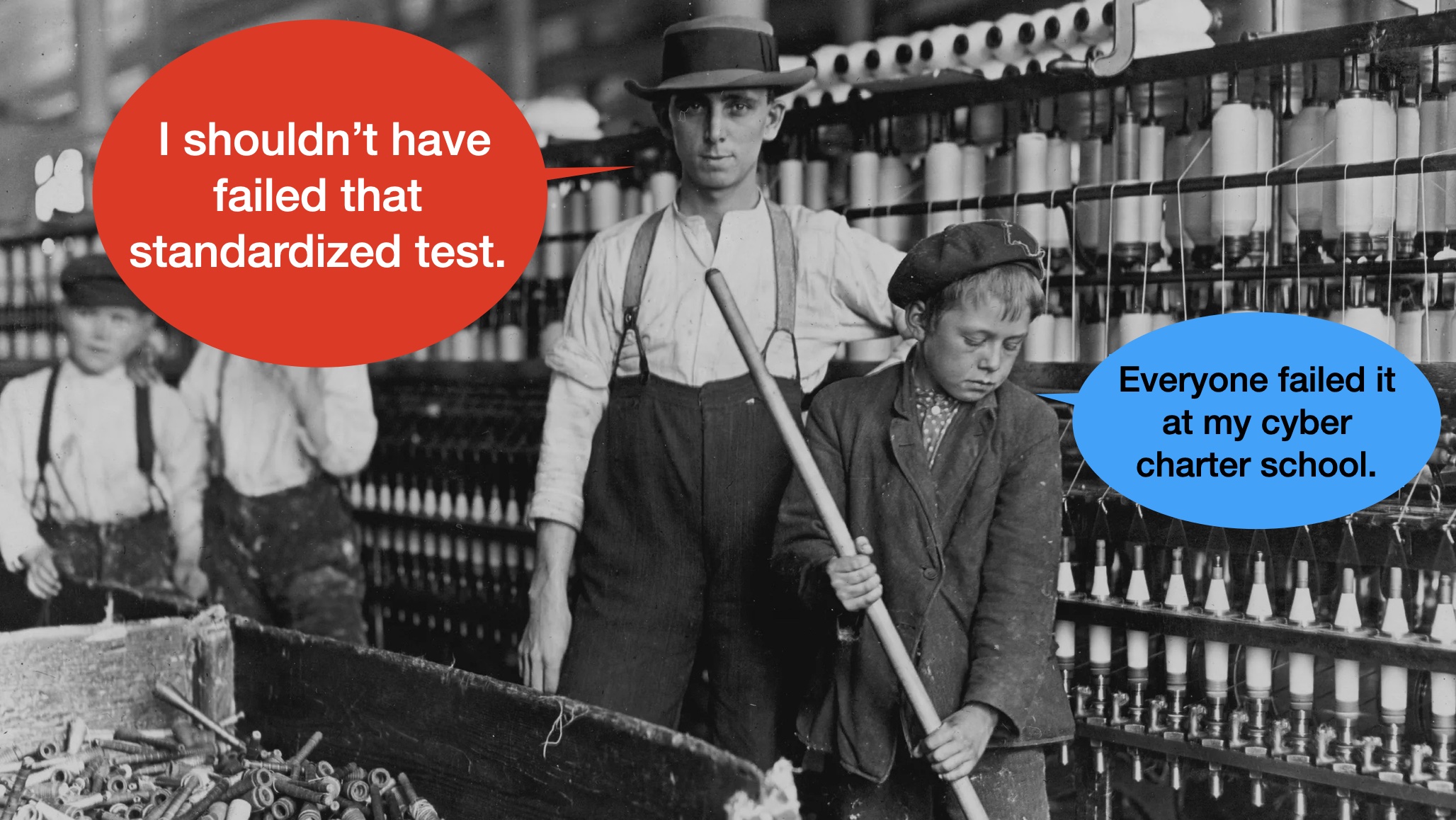
The majority of teachers and principals in Pennsylvania hate standardized tests.

An increasing number of parents are refusing to allow their kids to take the tests.

And there may be better alternatives to the state’s Keystone Exams.

These were just some of the key findings of a blockbuster report from June 2019 by the state General Assembly’s Legislative Budget and Finance Committee.

The report, “Standardized Tests in Public Education” was published about 9 months before the Covid-19 pandemic hit.

It effectively got lost in the chaos that followed the global pandemic.

However, now that things are returning to some semblance of normalcy, it seems that bureaucrats from the state Department of Education (PDE) are taking the wrong lessons from the report while the legislature seems to have forgotten it entirely.

The report was conducted because of legislation written by state Sen. Ryan P. Aument (R-Lancaster County). It directed the Legislative Budget and Finance Committee to “study the effectiveness of standardized testing, including the Keystone Exams and SATs, and their use as indicators of student academic achievement, school building performance, and educator effectiveness.”

The key findings are as follows:

1)The majority of principals and teachers disapprove of the state’s standardized tests – both the Pennsylvania System of School Assessment (PSSA) tests given in grades 3-8 and Keystone Exams given in high school. They think these tests are ineffective, expensive and harmful to district curriculum and students.

2) State law allows parents to opt their children out of testing for one reason only – religious grounds. Parents are using this religious exemption in increasing numbers. This puts districts in danger of violating federal participation and accountability standards.

3) It has been suggested that the state allow two additional reasons for parents to opt their children out of testing – philosophical grounds and health concerns. It is unclear whether doing so would increase overall opt outs or not.

4) The federal Every Student Succeeds Act (ESSA) passed in 2015 allows the use of the SAT and/or ACT test to take the place of high school standardized testing. It has been suggested the Commonwealth replace the Keystone Exams with these tests. The report finds the ACT and/or SAT would successfully determine college readiness and reduce the overall amount of standardized testing. However, this would not allow other uses of current state tests like evaluating teacher effectiveness and school building performance.This may not matter though because the report also casts doubt on whether the current tests (PSSA and Keystone Exams) do an adequate job of assessing teacher or building performance now or even if student tests can be accurately used to evaluate teachers and schools.

There’s a lot of information here. Let’s look at each finding in turn.

1) PA Educators Hate Standardized Tests

When it comes to the PSSAs, 67% of principals and 76% of teachers said the tests were ineffective indicators of student achievement.

There was slightly more support for the Keystone Exams. This time 45% of principals said the test was an ineffective indicator of student achievement (with 27% saying the tests were effective). Meanwhile, 60% of teachers said the test was ineffective.

Both principals and teachers said their curriculum had been narrowed to prepare students for PSSAs and Keystone Exams. Instead of going into more depth on regular classwork or learning new skills, the focus shifts to teaching to the tests.

Most principals (approximately 80-90%) said that students are taught test-taking skills, and their schools administered practice tests, bench-mark tests, and/or diagnostic tests to prepare students for the PSSA exams. This held for teachers, too, with 81-88% saying they teach test-taking skills and administer practice tests. Principals also said the costs of this additional test prep varied from $200 to more than $100,000.

Taking the tests also eats up valuable class time. Administering the assessments takes between 5.7 to 8 days for each kind of test – the PSSA and the Keystone Exams, according to Principals.

In addition, the report details the cost of giving these tests. In fiscal year 2017-2018, PDE paid $42.17 million for these tests. This is part of a national trend:

“Standardized tests and test preparation have subsequently become big business and that multibillion dollar business continued to grow since the enactment of NCLB and the subsequent enactment of ESSA. According to the Pew Center on the States, annual state spending on standardized tests increased from $423 million before the NCLB (enacted in 2002) to upwards of $1.1 billion in 2008 (to put this in perspective this reflects a 160 percent increase compared to a 19.22 percent increase in inflation during the same time period). A more recent study by the Brown Center on Education Policy at Brooking put the cost at upwards of $1.7 billion in 2011 related to state spending on standardized tests.”

2) Opt Outs on the Rise

Many states allow parents to opt their children out of standardized testing. Some do so in cases of a physical disability, medical reasons, or emergencies. A few allow opt-outs based on religious objection – like Pennsylvania. Some states allow opt-outs for any reason whatsoever.

The religious exemption is not used widespread throughout the state and most schools meet the 95% participation rate required by the federal government. However, use of the religious exemption is definitely on the rise – enough so that the authors of the report find it alarming:

“Meanwhile, as previously indicated in this section, schools throughout the country are experiencing and grappling with an increase in the number of parents seeking to have their children opt-out of standardized testing now that new state assessments have been implemented pursuant to the federal requirements. Pennsylvania is no exception to this trend and is also experiencing an increase in the number of parents utilizing the religious opt-out.”

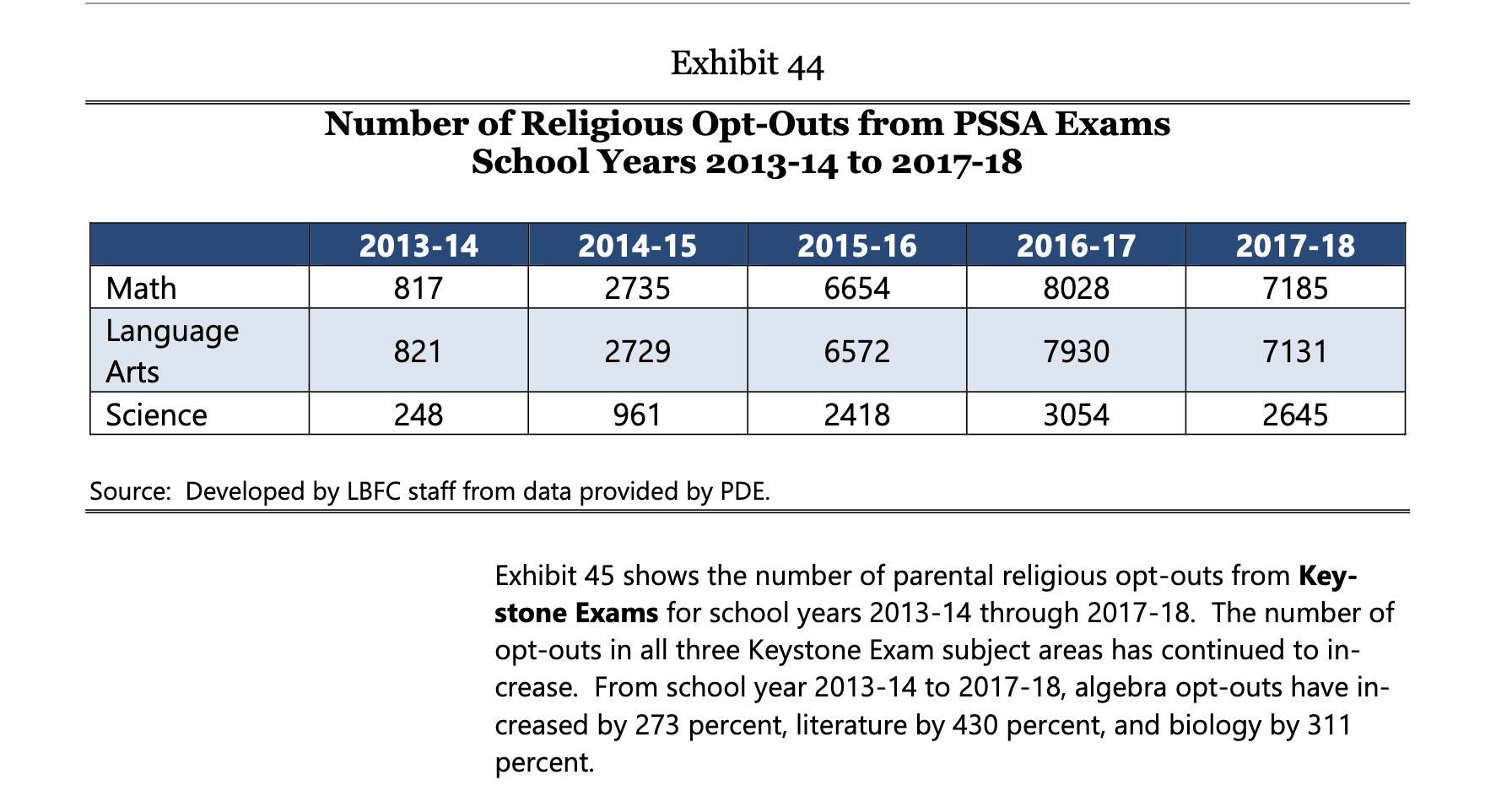
For the PSSA tests, opt outs increased from 2013-14 to 2016-17. However, total numbers in school year 2017-18 decreased sightly.

Opt outs went from 1,886 to 6,425 to 15,644 to 19,012 to 16,961.

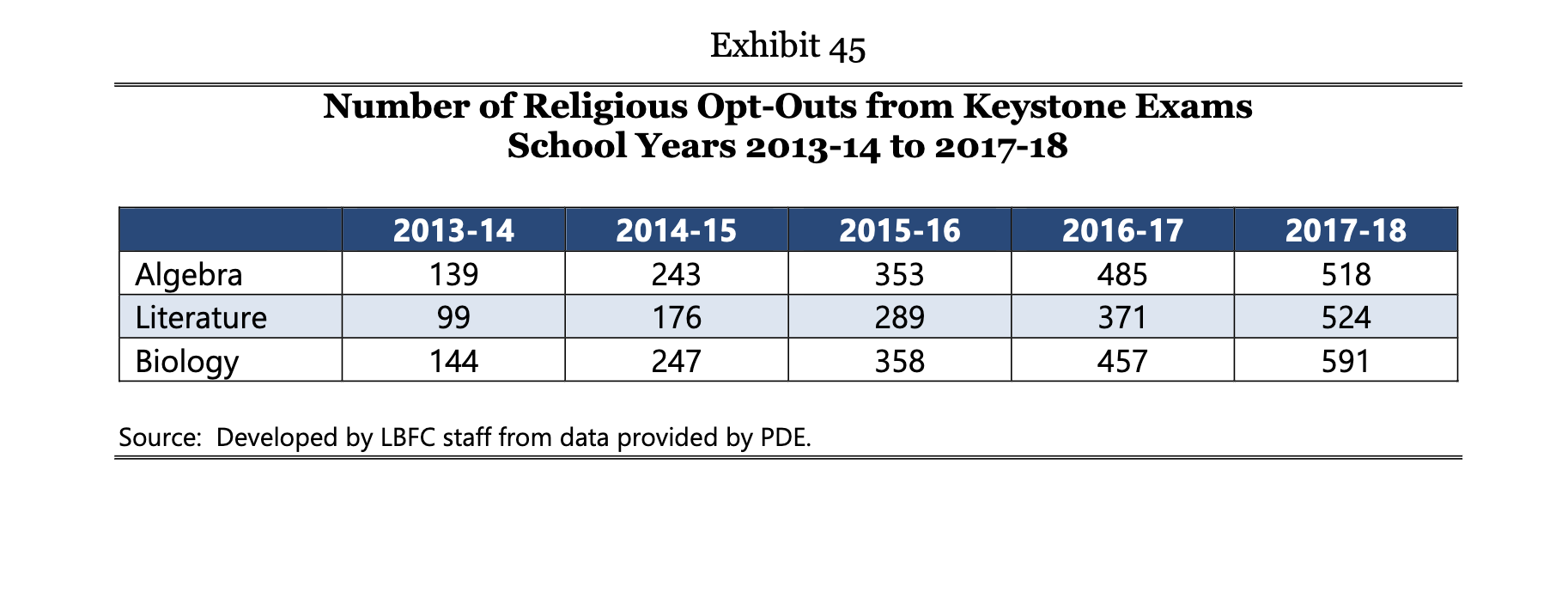
During the same time period for the Keystone Exams, opt outs steadily increased each year but were at lower overall rates.

For the high school test, opt outs went from 382 to 666 to 1,000 to 1,313 to 1,633.

These are vitally important figures because opt out data is rarely tabulated and released to the public. Many media accounts actually state the opposite of the data in this report – in particular that opting out has decreased since Congress passed the ESSA in 2015. Apparently the media got this one wrong.

Though the religious opt-out is the only reason specifically allowed in state Chapter 4 regulations, PDE reports there are five additional ways that students end up not taking the tests:

1) Other Parental Request – parents simply refusing to let their kids participate but not objecting based on specifically religious reasons.

2) No Attempt and No Exclusion Marked – students who are given the test but do not answer enough questions to receive a score.

3) No Test – no test record on file for unknown reasons.

4) Extended Absence – a student missed the testing and make-up window due to absences.

5) Other – does not fit any of the other categories.

Federal law – in particular No Child Left Behind (NCLB) and subsequent reauthorizations of that legislation – requires states to use student participation in standardized testing as a factor in a state’s accountability system. According to the report, any district with less than 95% of students taking the test should be “addressed.”

The report does not go into any further detail about what this means, other than to say that falling under 95% can:

“…ultimately result in a reduced achievement/proficiency measure… If the student participation rate falls below 95 percent, states are required to calculate student achievement/proficiency by dividing the number of students scoring proficiently by no less than 95 percent of the total students (which effectively assigns a score of “0” to all nonparticipants once the participation rate has fallen below 95 percent).”

In effect, the district gets a bad mark on a piece of paper. So what?

Under NCLB, schools with poor performance could receive sanctions like state takeover or lower funding. However, this is extremely unlikely – especially since the passing of ESSA. This newest reauthorization of the law gives states leeway in designing their accountability systems. It leaves the enforcement of this 95% participation rate up to the states, requiring them to develop an accountability plan in the event that a school or district fails to meet this standard.

So a school would only be punished if the state decided to do so. If a state legislature decided to allow parents to opt their children out for any reason at all, they would not have to take any punitive measures. Since the ESSA, the buck stops at the state house door on this one. California, for example, takes note of low participation rates but these rates are not factored into a school’s rating. On the other hand, Florida mandates direct intervention from the state’s Department of Education until participation rates are met.

3) Impact of New Reasons to Opt Out

This is where things get a bit sticky.

The report mentions the idea of expanding the options for opting-out of statewide assessments (e.g., PSSA and Keystone Exams) to include objections based on philosophical grounds or due to health issues.

On the one hand, the authors write “The impact of adding opt-out categories may be minimal.” They don’t know if more people would use the expanded options or if the same numbers who use the religious exemption today might simply divide themselves up among all three options.

The authors worry, however, that new pathways to opt out may increase the total number of people refusing the tests for their children and would reduce Pennsylvania’s participation rate in standardized testing.

This is a particularly troubling paragraph:

“The existence of opt-outs (religious or otherwise) has the potential to negatively impact a state’s participation rates and may potentially impact a state’s [Local Education Agency (LEAs)] and schools achievement/proficiency rate and ultimately the ability of a state to be in compliance with federally required assessments and accountability measures. Furthermore, providing opt-outs and giving parents notice of such has the potential to conflict with the message about the importance of standardized testing. Ultimately placing the state departments of education and local school districts in the potentially awkward position of having to explain why it is important for students to participate in testing (given the federal requirements), while also giving and notifying parents of the opt-out options for their children. In 2015, US Department of Education sent out letters to a dozen states flagging their low participation rates (statewide, or at the district or subgroup level) on the 2014-15 school year assessments and indicated that they needed to create a plan to reduce opt-outs due to low participation rates.”

This seems to be the order of the day at PDE. It’s why earlier this year, school administrators were advised by state officials to crack down on parents opting their children out of standardized tests.

For the first time in 8 years, I, myself, had to jump through several hoops to opt my own daughter out this year when in the past a simple phone call had sufficed.

I was asked to send in a letter, sign a confidentiality statement and go to the school to examine the test before they would excuse my little girl from the tests. It was an unnecessary hassle meant to discourage parents from doing what they thought was right and exercise their rights through state law.

And all of it is based on a cowardly and incomplete understanding of federal law. If Commonwealth schools fall below 95% participation in the test and get a bad mark on a worthless metric, it doest have to matter. No matter how many letters the federal government sends to the state legislature or PDE, the law is clear. The state is in charge here. Our legislature can choose to side with taxpayers, residents, and citizens or with civil servants and strongly worded letters.

4) Replacing the Keystone Exams

There’s not much more to add to this than the initial finding.

The authors of the report say there would be no problem with replacing the Keystone Exams with the ACT or SAT because these national tests would properly assess students’ college and career readiness.

The report is actually pretty shoddy in this regard not really examining the claims of the College Board which makes both tests. The authors just pretty much accepted the College Board’s word wholesale. Nor was their any evaluation of what teachers and principals thought about these tests like there had been for the PSSA and Keystone Exams.

However, the report does make a good point about test reduction. Many students already take the SAT or ACT test, so eliminating the Keystones would reduce the over all amount of tests they had to take.

Also the authors deserve credit for writing about how using student test scores to evaluate teachers and schools is seriously bad practice.

According to the report, 77 percent of principals and 93 percent of teachers said PSSA tests were not effective indicators for teacher evaluations, with similar figures for the Keystone Exams and building performance evaluations.

While everything in the report may not be 100% accurate, it includes important information that should be wider known.

In particular, it matters that the majority of teachers and principals throughout the state disapprove of standardized testing. If we trust our educators at all, we should take steps to reduce or abolish high stakes testing – not continue the same dismal policy that has achieved nothing positive in 20 years of NCLB.

In addition, the report has trustworthy data about opt outs throughout the Commonwealth. Unlike what has been reported in the media, opting out is not on the decline, it is on the rise.

If we value parents and their autonomy to make decisions for their own children, we should at very least expand their ability to refuse the test for their children without having to give anyone a reason. Being parents is reason enough.

The Keystone Exams should be thrown in the trash, because that’s what they are – trash. At very least they should be replaced with the SAT or ACT. Even better to remove any requirement for standardized tests wholesale – and that includes the PSSA.

The ESSA allows states a lot of leeway about how and what accountability system they use. There is no need to worry about some imperial federal power invading Pennsylvania to force our hand with standardized testing. We should call their bluff on this. I’ll bet that if we did so, many other states would do the same.

Standardized testing is another failed education policy. Our legislators would do good to read this report and make up their own minds about it.

Though a few years and disasters have happened since its publication, it doesn’t deserve to be forgotten by the very people who ordered it to be written in the first place.


Like this post?  You might want to consider becoming a Patreon subscriber. This helps me continue to keep the blog going and get on with this difficult and challenging work.

Plus you get subscriber only extras!

Just CLICK HERE.

Patreon+Circle

I’ve also written a book, “Gadfly on the Wall: A Public School Teacher Speaks Out on Racism and Reform,” now available from Garn Press. Ten percent of the proceeds go to the Badass Teachers Association. Check it out!
 

Students Crave Opportunities to be Creative

“Is that the bell?” A student asks in shock.

“Yes, it is,” I reply, picking up papers and pencils.

“This happens to me everyday,” he continues as he hastily gathers his belongings. “I barely finish my poem and the bell rings.”

“You know what they say – time flies when you’re having… fun?” I ask.

He pauses and gives me a stern look.

“Mr. Singer, you know I hate this stuff.”

Then he blushes and stomps out of the room.

The next class comes trickling in and the first student there throws her bag and thermos on her desk and cries out, “Are we doing poetry again!?”

“Yes,” I reply.

She collapses to her seat and sinks her head into her arms. Then she looks up and says hopefully, “What kind?”

After numerous interactions like this, I’ve come to a shocking revelation.

My middle school students like poetry.

Not only like it; they love it.

Oh, they’ll protest from homeroom until the afternoon announcements, but between all this whining and fussing, you’ll find classrooms of kids playing with words and language like toddlers with clay or blocks.

And I think that’s really the reason for our classroom renaissance.

Somehow we’ve made poetry something other than a lesson. It’s play.

And that’s when the deepest learning takes place!

This year I teach two different poetry classes – a 7th grade course focusing on writing it, and an 8th grade course focusing on reading it.

It’s not entirely exclusive. We do some writing in 8th grade and some reading in 7th grade, too. But each course is centered more on creation or explication.

My 8th graders seemed hooked when I introduced poetry by reading them a Shakespeare sonnet in a stuffy British voice.

Don’t get me wrong. I love the Bard. After all, my wife and I named our daughter Desdemona. But you might as well lean in to the expectation that Shakespeare is elitist with a question like, “Shall I compare thee to a summer’s day?”

Then follow it up with some video clips from Def Poetry Jam.

My students loved the idea that these street verses by Lamont Carey, J. Ivy and others were both instantly relatable and yet qualify as poetry.

When I told them that rap also met our literature book’s definition, they were floored.

We read Langston Hughes, Gwendolyn Brooks and even Tupac Shakur before looking at Tennyson and Whitman.

I’ll never forget the excitement on their faces as we read about the Light Brigade’s charge against the Russian gunners. Nor their looks of remorse as we read about Our Captain! Our Captain! Lying cold and dead!

I recited the Whitman poem aloud, and as my voice shook and my eyes watered, a student in the front row said I should have been an actor. But it wasn’t acting. Many of us felt that same emotion. It was right there on the page.

Today they were wrestling with Poe and Dylan Thomas with a kind of seriousness of purpose you rarely see in 13- and 14-year-olds.

In years past, I often had to point to this or that, guide them to consider one thing or another. But this morning, I could have gone to get a cup of coffee, and I don’t think they would have even noticed my absence.

My 7th graders took a bit more convincing.

When I announced we were starting a unit on poetry, they almost all lamented about how much they hated it so much. So I made them write a journal about why they felt that way. No public performances. Just put it down on paper.

Then as an extra twist, I had them take their prose and turn it into a poem.

It was funny how verbal complaints melted away in the face of stanzas and verse. Many admitted on the page that they liked poetry – some poetry – but they felt scared of getting the wrong answer.

So we began writing a series of about 18 poems – each in a different style. So far we’ve written cinquains, clerihews, list poems, haikus, alphabet poems, and today even a limerick.

The things they write about!

The very first poem brought out such emotion and turmoil. One girl wrote about the recent death of a family member. A boy wrote about how he felt he was never good enough no matter how high his grades.

Some showed off real talent with figurative language – personifying colors, using vivid imagery, perfect similes, a gift for rapid fire rhymes.

They still complain. Every day.

But you can tell its more route than real.

We’ve settled into a groove, and as long as I reassure them that their best effort is always good enough, they are willing to try almost anything.

Today I had them sing the rhythm of the limerick with me. I lead a chorus of:

Da DUM da da DUM da da DUM,
Da DUM da da DUM,
Da DUM da da DUM,
Da DUM da da DUM da da DUM.

They laughed. (I did too.) They looked at me like I was crazy. (Perhaps you have to be to teach middle school.)

But they did it.

And they tried to write their limericks.

I’m not saying the results were all perfect. Few of them were. But the kids tried and some will continue trying.

There’s a word for that.

You try to climb to the top of the monkey bars…. You fall down. You get right back up and try again.

It’s play. Pure and simple.

That’s what’s been missing from so much of my kids school days recently.

After how many years of disruptions from the Covid pandemic and then number crunchers demanding this pretest and that standardized benchmark, the kids just want to get out there and play.

They want to be creative.

They’re yearning for it like a drowning swimmer yearns for air.

The opposite of standardized testing isn’t routine lessons. It is creativity.

I’m not saying I’ve somehow cracked the code – that this is the only way to do it. I’m as surprised as anybody that what I’m trying seems to be having these effects – or at least to this degree. It’s a matter of rapport meeting childhood need.

These kids want to be creative.

That’s what we need to prioritize and provide for them as much as possible – now more than ever.

Meanwhile, we’re still being warned against learning loss – a bogeyman designed by testing companies, book publishers and tech bros. Who out there is decrying creativity loss – vanished childhood – missing chances to be a kid?

These are what we should be worried about.


There will be plenty of time to catch up with academics. You can always learn, but you’re only a child once.

Your mind is only that malleable, your personality that open and willing to try new things – once.

Moreover, play and creativity are not antithetical to learning. They are the very heart of it. They are when we pick up, master, review the best!

So let my kids swim, paddle and glide in verse. Let them dive, bathe and wade up to their shoulders and beyond.

Because when they do, they transcend school and learning.

They become poetry, itself.


Like this post?  You might want to consider becoming a Patreon subscriber. This helps me continue to keep the blog going and get on with this difficult and challenging work.

Plus you get subscriber only extras!

Just CLICK HERE.

Patreon+Circle

I’ve also written a book, “Gadfly on the Wall: A Public School Teacher Speaks Out on Racism and Reform,” now available from Garn Press. Ten percent of the proceeds go to the Badass Teachers Association. Check it out!

Reading for Pleasure – One of The Most Important Lessons in School

“Children should learn that reading is pleasure, not just something that teachers make you do in school.”

― Beverly Cleary

If you ask most middle school children whether they like to read, the answer is usually no.

However, for the last few weeks, my 7th graders have been coming into my class and remarking about the 8th grade books they find left on their desks.

“Oh! The Outsiders! I hear that’s a really good book!”

“When are we going to read this, Mr. Singer?”

“Can I take this home?”

That’s what you get when you pique a student’s interest – even a reluctant reader.

The problem is one of speed and instant gratification.

Today’s children have a multitude competing for their attention.

Video games, social media, TikTok videos – they haven’t the time to sit down with a book.

Doing so seems like something an old person would do or at least something too hard for them to enjoy.

I remember when I was growing up, my father always read Stephen King paperbacks. I still remember the covers of some of those books. The snarling Saint Bernard of “Cujo.” The empty boy’s face of “The Shining.” And “Night Shift” with its creepy bandaged hand slowly coming unraveled to reveal eyes growing under a knuckle…

I wanted nothing more than to read these books and understand what it was that lurked inside the covers.

But today a lot of novels are eBooks. If they have covers, they aren’t visible in the hands of those reading them. They aren’t left on display on a shelf. They’re nearly invisible.

The very idea of books seems like something beyond the reach of many adolescents.

That’s where teachers come in.

We need to dispel these myths, to help our students overcome them.

That means (1) reading books together in class, and (2) allowing kids self-selected reading.

First, we have to actively show kids that reading can be fun.

This means picking the right books to read as a class and trying to make the experience pleasurable.

Luckily there are some classics of young adult literature that rarely disappoint – S. E. Hinton’s “The Outsiders”, Lois Lowery’s “The Giver”, Ellen Raskin’s “The Westing Game”, Louis Sachar’s “Holes”, etc.

If you can catch a child’s imagination and place it in a community of learners, the result is both an individual and a social phenomenon.

Each child has his or her own experience, but it is enhanced by the thoughts and comments of others. Trying to solve the secrets of the society in “The Giver” isn’t just something you do alone – it’s a shared endeavor with your peers. Trying to decide what you’d do in the place of Ponyboy from “The Outsiders” isn’t just an academic thought experiment – it’s a way of expressing your thoughts and values and seeing them reflected, absorbed or enhanced by those around you.

However, this can’t always be done in a group setting. And the teacher can’t be the only person guiding the experience.

You have to give students the respect to make their own choices about what they read, too.

Let them choose books from the library and read them silently in class. There can be a culminating assignment like a book report or a book circle at the end of the month, but it has to be driven by individual curiosity.

This is all easier said than done.

Some years the books I pick for my students are a hit. Some years they aren’t.

Things are especially difficult now as we’re just healing from the Covid-19 pandemic. Students are just starting to get back on track and relearn all the social and academic skills they lost in years of quarantine and uncertainty.

I’m finding “The Giver” to be a harder sell this year than in most previous years. Many students want a more immediate and personal story. But some are entranced by the mystery and way the society deals with budding adolescence.

“The Outsiders”, though, is a raging success. My students don’t want to put it down or stop discussing the story. In fact, their enthusiasm is turning into rumors that have spread from grade-to-grade. However, they also aren’t as interested in racing through it toward the end as students from others years have been.

The biggest challenge is always silent reading.

The very idea of sitting down with a book and quietly reading it is entirely alien to some kids. They look around the room or try to sneak their cell phones out of their pockets – anything but turn their eyes to the pages in front of them.

It comes down to (1) finding a book that will interest the individual, and (2) one that they can easily read.

Unless you’re a librarian, it can be really hard to match students and books. As a classroom teacher I know some books that other students have enjoyed in the past and even have a few handy. For example, “Tears of a Tiger” by Sharon Draper is a story a lot of my more mature readers have gotten into – especially children of color. It tells the story of a boy who is dealing with the death of a friend who was riding in the boy’s car while he was driving drunk.

However, I don’t know the entire spectrum of children’s literature as well as a dedicated middle school librarian would. My school used to have one of those and she was brilliant at accomplishing the goal of suggesting books to students. These days, though, we have one librarian for the middle school and high school. That’s just too much ground to cover for any individual. Moreover, when you don’t dedicate your library to reading or research, you lose an incredible resource. There is far too much time when the library is closed for standardized testing or the librarian is asked to teach a class or proctor a study hall.

When it comes to matching a student to a book with a proper reading level, there are tools like Accelerated Reader which gives each book a level and tests students to find out their ability. However, the last thing we need is more standardized testing and computer software. An actual living, breathing librarian who has the time to know students and the literature is better than any technology in the world.

The point, though, is that no matter the challenges, we, as teachers, have to try.

It isn’t our job to simply teach children HOW to read. We have to encourage them TO read. We have to SHOW them that reading can be one of the most enjoyable pastimes in the world.

It may be out of touch with our modern society, but that is why it is so valuable.

Through books we can access any place – even places that never existed. Through books, we can talk with anyone in the entire history of time – even people who were never born.

And in doing so we gain access to that secret part of our own mind – our imagination – and build it into something strong and vibrant.

Few things are more important.

Creating lifelong readers – not a bad way to spend a teaching career.

“One child, one teacher, one pen, and one book can change the world.”

-Malala Yousafzai


Like this post?  You might want to consider becoming a Patreon subscriber. This helps me continue to keep the blog going and get on with this difficult and challenging work.

Plus you get subscriber only extras!

Just CLICK HERE.

Patreon+Circle

I’ve also written a book, “Gadfly on the Wall: A Public School Teacher Speaks Out on Racism and Reform,” now available from Garn Press. Ten percent of the proceeds go to the Badass Teachers Association. Check it out!

Congress May Raise Educators’ Minimum Salaries to Combat the Teacher Exodus

When it comes to teachers, America doesn’t mind getting away cheap.

The minimum salary for a teacher in Pennsylvania is $18,500 a year.

That’s not a lot of money – roughly $9.63 an hour.

It’s barely more than the federal minimum wage of $7.25 an hour ($15,080 annually).

But in many states there is no minimum teacher salary – so the minimum wage IS a teacher’s minimum salary!

You could probably make more as a dishwasher, cashier or parking lot attendant. So why take on a four-year education degree, mountains of student loan debt, and the added challenge of a (likely unpaid) internship?

Just pick up a broom and start sweeping.

Perhaps that’s why a group of Congressional Democrats have proposed a national minimum salary for teachers.

Rep. Frederica Wilson and Rep. Jamaal Bowman, (both former teachers) and six other members of the House have introduced The American Teacher Act establishing a minimum salary of $60,000 for all public school teachers working in the U.S. – the first legislation of its kind.

Though state minimums are less (assuming your state has one at all), the average starting salary of teachers nationwide was $41,770 in the 2020-21 school year, according to the National Education Association (which supports the bill).

However, even that number shows how poorly we reimburse teachers for their labor.

It means on average teachers make about 77 cents on the dollar compared to their peers in similar professions, according to the Economic Policy Institute, a nonprofit think tank.

So a potentially $20,000 base increase would help.

If passed, the bill wouldn’t simply force all states to comply. It would offer funding through federal grants encouraging states and school districts to raise their minimum starting salary to $60,000 by the 2024-25 academic year.

In the short term, the funding would pay to implement the new salary minimum but states would be responsible for sustaining the cost in the long run.

No cost projection for the program has yet been conducted.

The new minimum salary would be adjusted for inflation each year, beginning with the 2025-26 school year, and any grant funding would have to be used toward salaries and not to supplant any existing funding that goes toward schools.

Sponsors hope the bill would affect more than just minimum salaries.

The idea is that states would adjust their entire teacher salary schedules with $60,000 as the floor and all other salary steps increasing incrementally based on education levels and years of experience. So even veteran teachers should see their wages increase.

However, the bill doesn’t stop there. The authors of the legislation know that respect for the teaching profession is important to ensure salaries remain adequate.

In addition to wages, 4 percent of the grant funding would be used to launch a national campaign about the teaching profession, highlighting its importance and value as well as encouraging high school and college students to pursue a career in education.

It’s high time something were done because the US is losing teachers at an alarming rate.


After decades of neglect only made worse by the Covid-19 pandemic, we’re missing almost a million teachers.

Nationwide, we only have about 3.2 million teachers left!

According to the Bureau of Labor Statistics, there are 567,000 fewer educators in our public schools today than there were before the pandemic. And that’s on top of already losing 250,000 school employees during the recession of 2008-09 most of whom were never replaced. All while enrollment increased by 800,000 students.

Meanwhile, finding replacements has been difficult. Across the country, an average of one educator is hired for every two jobs available.

Not only are teachers paid 20% less than other college-educated workers with similar experience, but a 2020 survey found that 67% of teachers have or had a second job to make ends meet.

It’s no wonder then that few college students want to enter the profession.

Over the past decade, there’s been a major decline in enrollment in bachelor’s degree programs in education.

Beginning in 2011, enrollment in such programs and new education certifications in Pennsylvania — my home state— started to decline. Today, only about a third as many students are enrolled in teacher prep programs in the Commonwealth as there were 10 years ago. And state records show new certifications are down by two-thirds over that period.

Legislation like The American Teachers Act is absolutely necessary to stop the teacher exodus and ensure our children receive a quality education.

However, at present not a single Republican lawmaker has expressed support for legislation of this type, only support in individual states when it becomes obvious the whole system will collapse without help.

Moreover, even neoliberal Democrats want to use such measures to sneak in unnecessary and destructive policies like more standardized testing, evaluating teachers on student test scores and increased funding for charter schools and school voucher programs.

At present it seems unlikely that this legislation would pass in any manner that would be helpful if at all.

It may take further crumbling of the public school system and/or a change in political leadership and power for anything to be done.

On the bright side, it is encouraging that for the first time (ever?) lawmakers actually seem to recognize there is a real problem here.

It has finally come down to a simple matter of dollars and cents.


Like this post?  You might want to consider becoming a Patreon subscriber. This helps me continue to keep the blog going and get on with this difficult and challenging work.

Plus you get subscriber only extras!

Just CLICK HERE.

Patreon+Circle

I’ve also written a book, “Gadfly on the Wall: A Public School Teacher Speaks Out on Racism and Reform,” now available from Garn Press. Ten percent of the proceeds go to the Badass Teachers Association. Check it out!