Though state minimums are less (assuming your state has one at all), the average starting salary of teachers nationwide was $41,770 in the 2020-21 school year, according to the National Education Association (which supports the bill).
However, even that number shows how poorly we reimburse teachers for their labor.
So a potentially $20,000 base increase would help.
If passed, the bill wouldn’t simply force all states to comply. It would offer funding through federal grants encouraging states and school districts to raise their minimum starting salary to $60,000 by the 2024-25 academic year.
In the short term, the funding would pay to implement the new salary minimum but states would be responsible for sustaining the cost in the long run.
The new minimum salary would be adjusted for inflation each year, beginning with the 2025-26 school year, and any grant funding would have to be used toward salaries and not to supplant any existing funding that goes toward schools.
Sponsors hope the bill would affect more than just minimum salaries.
The idea is that states would adjust their entire teacher salary schedules with $60,000 as the floor and all other salary steps increasing incrementally based on education levels and years of experience. So even veteran teachers should see their wages increase.
However, the bill doesn’t stop there. The authors of the legislation know that respect for the teaching profession is important to ensure salaries remain adequate.
In addition to wages, 4 percent of the grant funding would be used to launch a national campaign about the teaching profession, highlighting its importance and value as well as encouraging high school and college students to pursue a career in education.
According to the Bureau of Labor Statistics, there are 567,000 fewer educators in our public schools today than there were before the pandemic. And that’s on top of already losing 250,000 school employees during the recession of 2008-09 most of whom were never replaced. All while enrollment increased by 800,000 students.
Beginning in 2011, enrollment in such programs and new education certifications in Pennsylvania — my home state— started to decline. Today, only about a third as many students are enrolled in teacher prep programs in the Commonwealth as there were 10 years ago. And state records show new certifications are down by two-thirds over that period.
Legislation like The American Teachers Act is absolutely necessary to stop the teacher exodus and ensure our children receive a quality education.
On the bright side, it is encouraging that for the first time (ever?) lawmakers actually seem to recognize there is a real problem here.
It has finally come down to a simple matter of dollars and cents.
Like this post? You might want to consider becoming a Patreon subscriber. This helps me continue to keep the blog going and get on with this difficult and challenging work.
If you’ve stumbled across this article on social media, congratulations!
You’re one of the few people allowed to read it!
This blog, Gadfly on the Wall, used to be read by at least half a million people each year. Now it’s seen by barely 100,000.
The reason? Poor writing? Flagging interest in the subject?
I don’t think so.
Education is still as important today as it was in 2014 when I started this venture. And as to my writing ability, it’s no worse now than it was 8 years ago.
So this year, my blog had the fewest hits since I started – 124,984 in 2022. By comparison, last year I had 222,414.
I’d write an article, post it on social media and see it reposted again and again. You’d think that would mean it was popular, but no. The people who saw it liked it enough to suggest it to others, but it went little further. With each share, fewer people saw it. Like someone put up a wall in front of it.
In truth, I’m lucky as many people had the opportunity to read my work as did.
The question is where do I go from here?
Should I continue, knowing only a select few will get to hear me? Should I try paying the billionaire tech bros to let more readers in?
My work isn’t a product and no one is paying me to do it.
Oh well…
In any case, here’s a look back at my most popular articles from the year that was and one honorable mention:
Description: My school’s football team is mostly black. They played a mostly white football team and were greeted by racial slurs and an allegedly intentional injury to one of our players. However, the Western Pennsylvania Interscholastic Athletic League (WPIAL) blamed both sides for the incident.
Fun Fact: It’s one of those decidedly local stories that community newspapers used to cover before almost all went bankrupt or were sold to the media giants. Having this platform allowed me to call out an injustice when most voices were silenced. The injured player’s mother thanked me for doing so. Stories like this keep me going.
Description: At the beginning of the summer, governments were so shaken by the exodus of teachers from the classroom that they were discussing raising our salaries or giving us bonuses. Parents were so adamantly against distance learning they demanding in-person classes with real, live human teachers. What a shock to the super elite education “experts” who had been pushing ways to eliminate teachers for decades and ignoring our consistent march out of the field under these conditions.
Description: Charter schools are inequitable because they have charters. These are special agreements that they don’t have to follow all the rules other authentic public schools funded by tax dollars must follow. That’s unfair and it applies to EVERY charter school because every one has a charter. Hence, the name.
Fun Fact: Criticism of charter schools in general usually degrades to defense of individual charter schools avoiding whatever general criticism is leveled against the industry. The argument in this article has the benefit of avoiding any such evasion. All charter schools are guilty of this (and many are guilty of much more). All of them.
Description: Just a list of many things classroom teachers know about schools and education but that the general public often ignores. These are the kinds of things missing from the education debate because we rarely include teachers in the discussion about the field where they are the experts.
Fun Fact: For a few hours people were talking about this article far and wide. And then – boom – it got shut down with a bang. This one was so universal it should have been popular for weeks. But it just disappeared.
Description: Charter schools are colonial enterprises. They loot and pillage the local tax base but without having to be governed by school boards made up of community members – otherwise known as local taxpayers. They can be run by appointed boards often made up of people who do not come from the community in question. They are outsiders come merely for personal profit. These invaders are quite literally taking local, community resources and liquidating them for their own use – the maximization of personal profit. The public is removed from the decision-making process about how its own resources are utilized and/or spent.
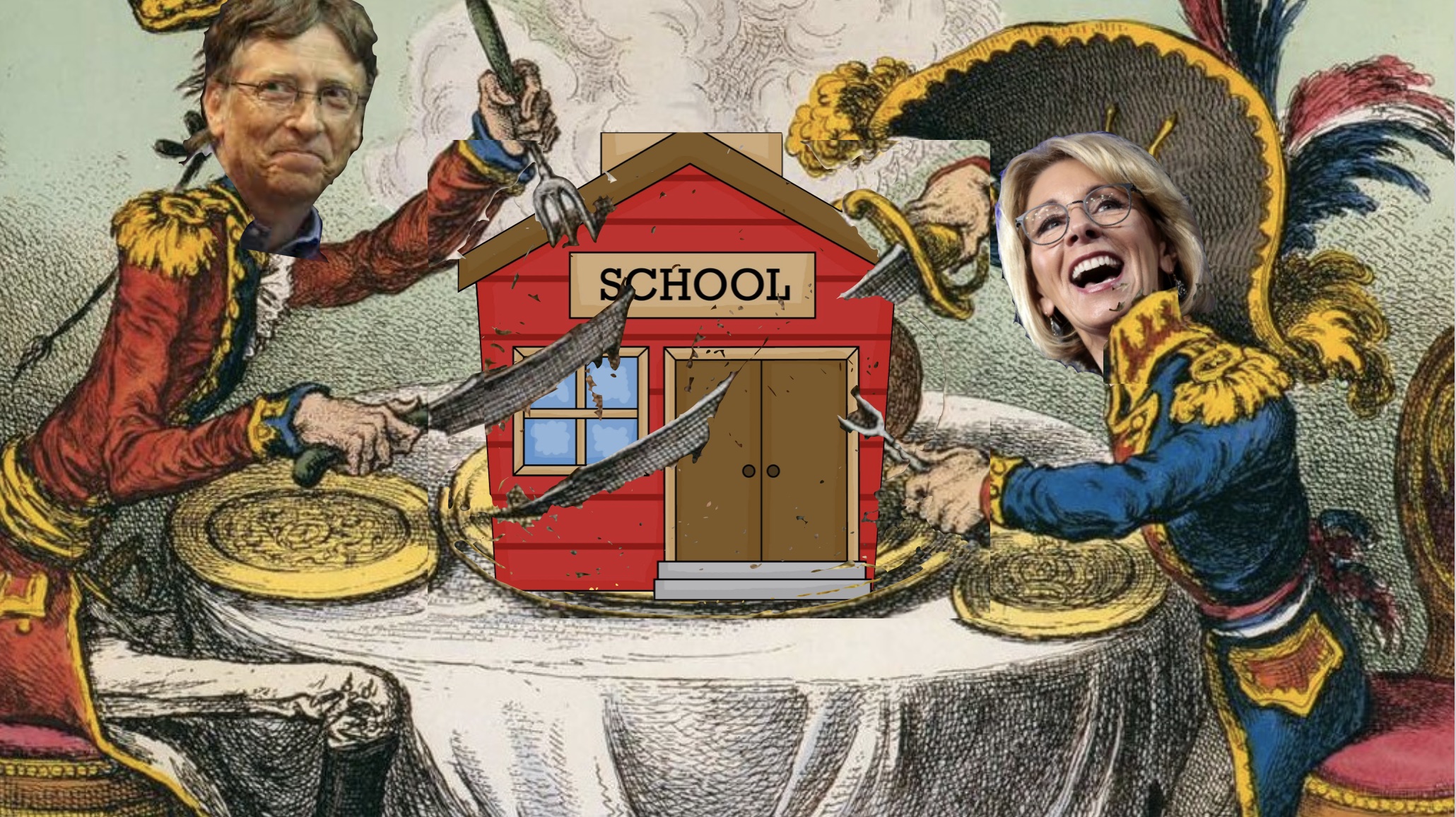
Fun Fact: It’s an argument from consistency. If we’re against the colonial enterprise, we must be against charter schools, too. I’m particularly proud of the graphic (above) I created to go with this article.
Description: Dr. Mark Holtzman, the Superintendent from the district where I live, left under strange circumstances. He resigned and took a new contract in a matter of hours so he could get a raise from a lame duck school board without having to wait for the people the community elected to decide the matter to take office first. Then when it all came to light, he left the district for greener pastures.
Fun Fact: More than any other news source, I documented what happened in detail. Without a series of articles I wrote on this, most people would have had very little idea what happened. It would have just been rumors. This is why we need local journalism. It shouldn’t be left to bloggers like me.
Description: This was social media’s latest crackdown on edu-bloggers and other truth tellers. I used to get 1,000 readers a week. Now I’m lucky to get a few hundred. There’s a strict algorithm that determines what people get to see on their Facebook pages. And if it says you’re invisible, then POOF! You’re gone and the people who would most enjoy your writing and want to pass it on don’t get the chance. It’s undemocratic in the extreme but totally legal because Facebook is a for-profit company, not a public service. Money wins over free exchange of ideas.
Fun Fact: There used to be so many other education bloggers like me out there. Now there are just a handful. This is why.
Description: Standardized tests were supposed to improve our public schools. They were supposed to ensure all students were getting the proper resources. They were supposed to ensure all teachers were doing their best for their students. But after more than four decades, these assessments have not fulfilled a single one of these promises. In fact, all they’ve done is make things worse at public schools while creating a lucrative market for testing companies and school privatization concerns.
Fun Fact: Pundits still talk about standardized testing as if it were innovative. It’s not. It’s the status quo. Time to end this failed experiment.
Description: Let’s examine some charter school propaganda – one piece at a time – and see if there’s any truth to these marketing claims. Charter schools are actually not public schools in the same way as other taxpayer funded schools. They do not save money – they waste it. Their students do not outperform authentic public school students. They are not innovative – they are regressive. They do not protect children’s civil rights – they violate them.
Fun Fact: I designed the title and picture to trick readers into thinking this was a pro-charter school article. So many people were butt hurt when they read it! I just hope it helped clarify the matter to those who were undecided.
Description: The Measures of Academic Progress (MAP) test is an assessment made by Northwest Evaluation Association (NWEA), a so-called non-profit organization out of Portland, Oregon. Some states require the MAP as part of their standardized testing machinery. However, in my home state of Pennsylvania, the MAP is used as a pre-test or practice assessment by districts that elect to pay for it. What a waste! Why do we need a test BEFORE the test? The assessment’s job is to show how our students are doing in Reading, Math and Science compared with an average test taker. How does that help? I don’t teach average test takers. I teach human beings. Students learn at their own rates – sometimes faster, sometimes slower. We don’t quicken the timescale with needless comparisons.
Fun Fact: I think this article was as popular as it was because people could relate. So many teachers told me how relieved they were to hear someone else expressing all the frustrations they were experiencing in their own districts with the MAP and other tests like it. If administrators and school boards would just listen to teachers! If they’d even bother asking them!
Description: When it comes to dumb ideas that just won’t go away, there is a special place in the underworld for the demand that teachers post their learning objectives prominently in the classroom. It presupposes that teachers control everything their students learn in the classroom and can offer it to them on a silver platter. It’s not just a useless waste of time but a dangerous misunderstanding of what actually happens in the learning process.
Fun Fact: This isn’t exactly news, but teachers were relieved to hear their truth finally given voice. So many of us still have to abide by this nonsense when we could be doing something that actually makes a difference. It’s nice to have your sanity and frustration confirmed. If only administrators could admit they were wrong and stop demanding this crap!
Gadfly’s Other Year End Round Ups
This wasn’t the first year I’ve done a countdown of the year’s greatest hits. I usually write one counting down my most popular articles and one listing articles that I thought deserved a second look. Here are all my end of the year articles since I began my blog in 2014:
Like this post? You might want to consider becoming a Patreon subscriber. This helps me continue to keep the blog going and get on with this difficult and challenging work.
Nurses don’t want to strike. But going to the hospital and being cared for by an overworked, underpaid, unsupported nurse is not going to improve your health.
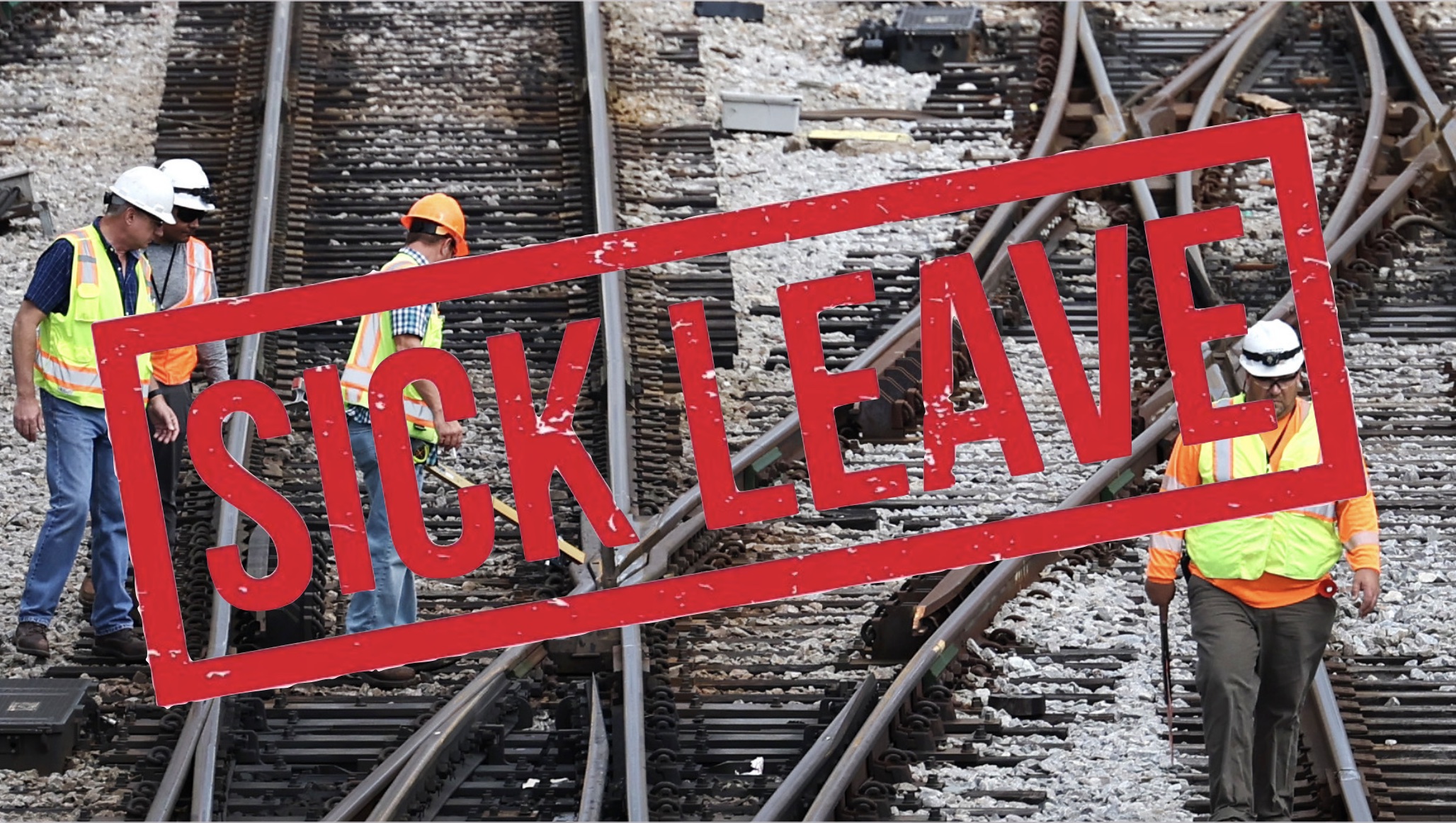
Railway workers would certainly rather get on with their jobs than contend with the bosses or Congress. But having no paid sick leave and a lack of adequate pay will not help move goods across the country any better, either.
Instead, we are at the mercy of employers to step up and do so. And when it comes to the poorest but most important workers – the ones without which our country would grind to a stop – employers are often extremely reluctant to do so.
Roughly a quarter of the private workforce — more than 33 million people — have no paid sick days so they can take care of themselves if they get ill. Even worse, more than 80 percent of private sector workers have no access to paid leave so they can care for a family member.
And it’s indisputably a racial and class phenomenon.
Higher-paid, professional workers almost universally have paid sick and family leave. But, of course, most of these workers don’t just lack pigment on their collars, they lack it on their faces, too. Among the lowest-paid quarter of the workforce, the majority of whom are Black and Latinx workers, only half of them have any paid sick days, and just 7 percent have paid family leave.
So workers of color, the poor, and disproportionately women are much more likely to lack sick and family leave than those who are paid more, have white skin and are male.
And before you explode with indignation, let it be known that this could be rectified any day our government sees fit.
Our representatives could stop holding water for groups like the railway companies that pulled in $20 billion in profits last year alone. Our government could represent us, the people, instead of businesses that could afford to do better but don’t because we aren’t holding them accountable and our Congress and the President refuse to stop them or even let us force them to do right by subjecting them to a strike.
It is past time for our government to begin respecting the rights of workers to organize and collectively bargain for better treatment.
We just suffered through a pandemic where these so-called essential workers had to put themselves in the most danger just to keep society running while the rest of us stayed home and were unequally protected.
If these workers are truly essential, they at least deserve sick and family leave. Otherwise, it is all too obvious how bogus the term is.
The U.S. can no longer run on the unrespected work of an underclass of the poor and people of color.
Like this post? You might want to consider becoming a Patreon subscriber. This helps me continue to keep the blog going and get on with this difficult and challenging work.
All-in-all, it was a good night. Especially in an election cycle where Republicans had every advantage. The President’s party usually loses seats during the midterms, and just last week it seemed that Joe Biden would be no exception. However, now that the dust has cleared, the losses seem to be minimal to nonexistent.
The Critical Race Theory panic (A.K.A. – teaching actual history) will fade to just another wing nut conspiracy theory thrown to the Republican base to generate support instead of an actual policy proposal to restrict academic freedom.
For the first time in years, Republicans may have to push toward the center instead of constantly to the lunatic fringe. Otherwise, they’ll continue to lose.
Second, we may actually see some positive education policies make their way through the state legislature.
Shapiro has promised to increase education funding. That and the still pending court decision on a lawsuit against the state demanding adequate funding may be enough to turn the funding faucet on a few cranks. With Democrats holding an increasing share of seats, all it takes is a few moderate Republicans (are they out there?) to join them to get things done.
However, it isn’t all wine and roses.
During the general election, Shapiro came out in favor of some school voucher programs. This puts him to the right of our current Governor Tom Wolf. So we can look forward to our new Governor supporting an increase for tax credit scholarships and other de facto voucher plans that will drain public education coffers just as we’re working to increase them.
It is also anyone’s guess whether a pro-voucher Governor would support charter school reform – something we desperately need and that Wolf championed during his tenure.
And though both Wolf and Shapiro criticized standardized testing, it would take a mightily informed and courageous state politician to go up against the economic powerhouse of the testing industry.
Things might even get better here and there – especially with additional funding.
However, we will have to monitor our representatives as if they were little kids sulking by the cookie jar. They will almost definitely try to sneak in some garbage legislation to hurt our students and enrich their corporate buddies.
A robust Democratic Party determined to enact progressive legislation could make much of such a situation, but as we’ve seen in the past, that is not the case with the current leadership.
The most we can realistically hope for is that they put a stop to insane GOP legislation.
The question is whether we can build on such Democratic gains at both the state and national level. Usually that doesn’t happen. But it will have to be the goal moving forward.
So let us celebrate a worthy election cycle while we prepare for all the political battles still to come.
A sigh of relief, a renewed fighting stance and back into the fray.
Like this post? You might want to consider becoming a Patreon subscriber. This helps me continue to keep the blog going and get on with this difficult and challenging work.
This almost always concludes with two types of plan.
First, there is the serious venture made up of things like increasing spending to meet student need, wraparound services, early intervention, reducing class size, redistributive justice and cultural competence – a plan that looks the reality in the face and makes bold attempts to come to terms with it.
Then there is the cheap knockoff proposition – a buzzword-laden scheme where someone is trying to convince you their half hearted proposal is actually a solution to the very real problem of educational inequality.
And the number one thing you can use to tell the difference between the two is this – standardized test scores.
The first plan that is centered around actually fixing disparities makes no mention of test scores – or at least relegates them to obstacles. The second is built all around them – as an essential component of the overall scheme.
This is because the second feel-good-accomplish-nothing plan is essentially performative.
Therefore, it is constructed around standardized test scores as a metric of success.
Planners think: We’re going to do A, B and C to make our schools more equitable. And how will we know we’re doing it right? We’ll use our standardized test scores!
And anyone who understands the history of these types of assessments and how they still work will know that this mirage is built at the cost of genuine equity.
So constructing your plan to fix this problem around one of its root causes is like claiming you can fix a sinking ship by drilling more holes in its hull.
At best, it’s naive. At worst, it’s self-defeating and disingenuous.
Both types of assessment are supposed to measure what students have learned. But not all learning is equal.
For example, a beginning chef needs to know how to use the stove, have good knife skills and how to chop an onion. But if you give her a standardized test, it instead might focus on how to make foie gras – something that would only come in handy at a high end French restaurant.
The fact of the matter is that standardized tests do NOT necessarily focus on the most important aspects of a given task. They focus on obscurities – things that most students don’t know.
This is implicit in the design of these exams and is very different from the kinds of tests designed by classroom teachers.
When a teacher makes a test for her students, she’s focused on the individuals in her classes. She asks primarily about the most essential aspects of the subject and in such a way that her students will best understand. There may be a few obscure questions, but the focus is on whether the test takers have learned the material or not.
When psychometricians design a standardized test, on the other hand, they aren’t centered on the student. They aren’t trying to find out if the test taker knows the most important facts or has the most essential skills in each field. Instead, there is a tendency to eliminate the most important test questions so that the test – not the student – will be better equipped to make comparisons between students based on a small set of questions. After all, a standardize test isn’t designed for a few classes – it is one size fits all.
New questions are field tested. They are placed randomly on an active test but don’t count toward the final score. Test takers aren’t told which questions they’ll be graded on and which are just practice questions being tried out on students for the first time. So students presumably give their best effort to both types. Then when the test is scored, the results of the field test questions determine if they’ll be used again as graded questions on a subsequent test.
If 40 to 60 percent of test takers answer the question correctly, it might make it onto the test. But questions that are answered correctly by 80 percent or more of test takers are usually jettisoned.
“As a consequence of the quest for score variance in a standardized achievement test, items on which students perform well are often excluded. However, items on which students perform well often cover the content that, because of its importance, teachers stress. Thus, the better the job that teachers do in teaching important knowledge and/or skills, the less likely it is that there will be items on a standardized achievement test measuring such knowledge and/or skills.”
If we are guided in large part by standardized test scores, we aren’t guided by authentic learning. We’re guided by a false picture of learning. Therefore, the most effective way – perhaps the only practical way – of raising test scores is to teach directly to a specific test. And not only the test, but the specific version of the test being given that year.
So if we do somehow manage to raise test scores, we haven’t improved academics at all but a mere semblance of it. And thus the equity we might celebrate in such a situation would be just as false.
You got a good score on the MAP test. Hurrah! But that doesn’t mean you know anything of real value except how to take this particular MAP test which, itself, will change after the next round of questions are field tested.
And if we insist on evaluating the equity of our schools on these test scores, we will only make things that much worse.
We end up chasing the psychometricians. We try to guess which aspects of a subject they think most students don’t know and then we teach our students that to the exclusion of more important information. And since what students don’t know changes, we end up having to change our instructional focus every few years based on the few bread crumbs surreptitiously left for us by the state and the testing corporations.
That is not a good way to teach someone anything. It’s like teaching your child how to ride a bike based on what the neighbor kid doesn’t know.
It’s an endless game of catch up that only benefits the testing industry because they cash in at every level. They get paid to give the tests, to grade the tests and when students fail, they get paid to sell us this year’s remediation material before kids take the test again, and – you guessed it – the testing companies get another check!
It’s a dangerous feedback loop, a cycle that promotes artificially prized snippets of knowledge over constructive wholes.
But we can no longer continue feeding that beast and pretending that we can somehow provide equity to our underserved children, too.
We have to choose – equity or testing. Fairness or unrestrained capitalism.
Do not believe anyone who tells you to support a plan built on both.
It does not exist.
Like this post? You might want to consider becoming a Patreon subscriber. This helps me continue to keep the blog going and get on with this difficult and challenging work.
In fact, the very idea seems ludicrous now – and this was being discussed like it was a foregone conclusion just a few months ago at the beginning of the summer.
It doesn’t matter – as long as we can keep them coming.
The young and dumb.
Or the old and out of options.
Entice retired teachers to come back and sub. Remove hurdles for anyone from a non-teaching field to step in and become a teacher – even military veterans because there’s so much overlap between battlefield experience and second grade reading.
If you have a hole in your pocket and you keep losing your keys, wallet and other vital things from out of your pants, the first thing you do is sew up the hole! You don’t keep putting more things in your pocket!
But that’s only true if you’re actually interested in solving the problem.
And make no mistake – experienced teachers are incredibly valuable. That’s not to say new teachers don’t have their own positive aspects, but the profession’s expert practitioners are its heart and soul.
Think about it.
Like any other profession, the longer you practice it, the better you usually get. For example, no one going under heart surgery would willingly choose a surgeon who had never operated before over a seasoned veteran who has done this successfully multiple times.
Republicans are literally running a political platform on weakening teachers, schools and education because they need the poorly educated to make up their voting base.
It is a political and economic plot against increasing the average intelligence and knowledge of voters, stealing government funding for personal gain and refusing to increase the quality of a government sponsored service.
In August, the national Education Association (NEA) sounded the alarm that an additional 300,000 educators had left since the report was issued. And it’s only getting worse. An NEA union poll found that 55% of educators were considering leaving education earlier than they had originally planned.
In my own district, there are several teachers who have taken leaves of absence or are sick and had to be temporarily replaced with long term subs. We’re located in western Pennsylvania south of Pittsburgh, just across the river from a plethora of colleges and universities with teacher prep programs. Yet it was pretty difficult to find anyone to fill these positions or serve as day-to-day subs.
There is so much we could be doing to encourage seasoned teachers to stay in the classroom beyond increased pay.
What we have here is a crisis that cuts to the very heart of America’s identity as a nation.
What do we want to be? A capitalist experiment in school privatization whose only regulation is the free hand of the market? Or a nation supported by a secure system of education that took us to the moon and made us the greatest global superpower the world has ever known?
There is a cost to becoming a great nation and not just emblazoning the idea on a hat.
That cost is education. It is paying, supporting and respecting veteran teachers.
Are we still willing to pay it?
Like this post? You might want to consider becoming a Patreon subscriber. This helps me continue to keep the blog going and get on with this difficult and challenging work.
You want to guarantee every student has access to technical and vocational courses and make sure every school building has at least one dedicated mental health counselor on staff. Outstanding!
It does not mean tax dollars going to private and parochial schools. It does not mean our money going to institutions where we get no say in how it’s spent. It does not mean circumventing duly elected school boards. It does not mean the public paying for religious indoctrination or the kind of right wing biased education routinely provided at private schools.
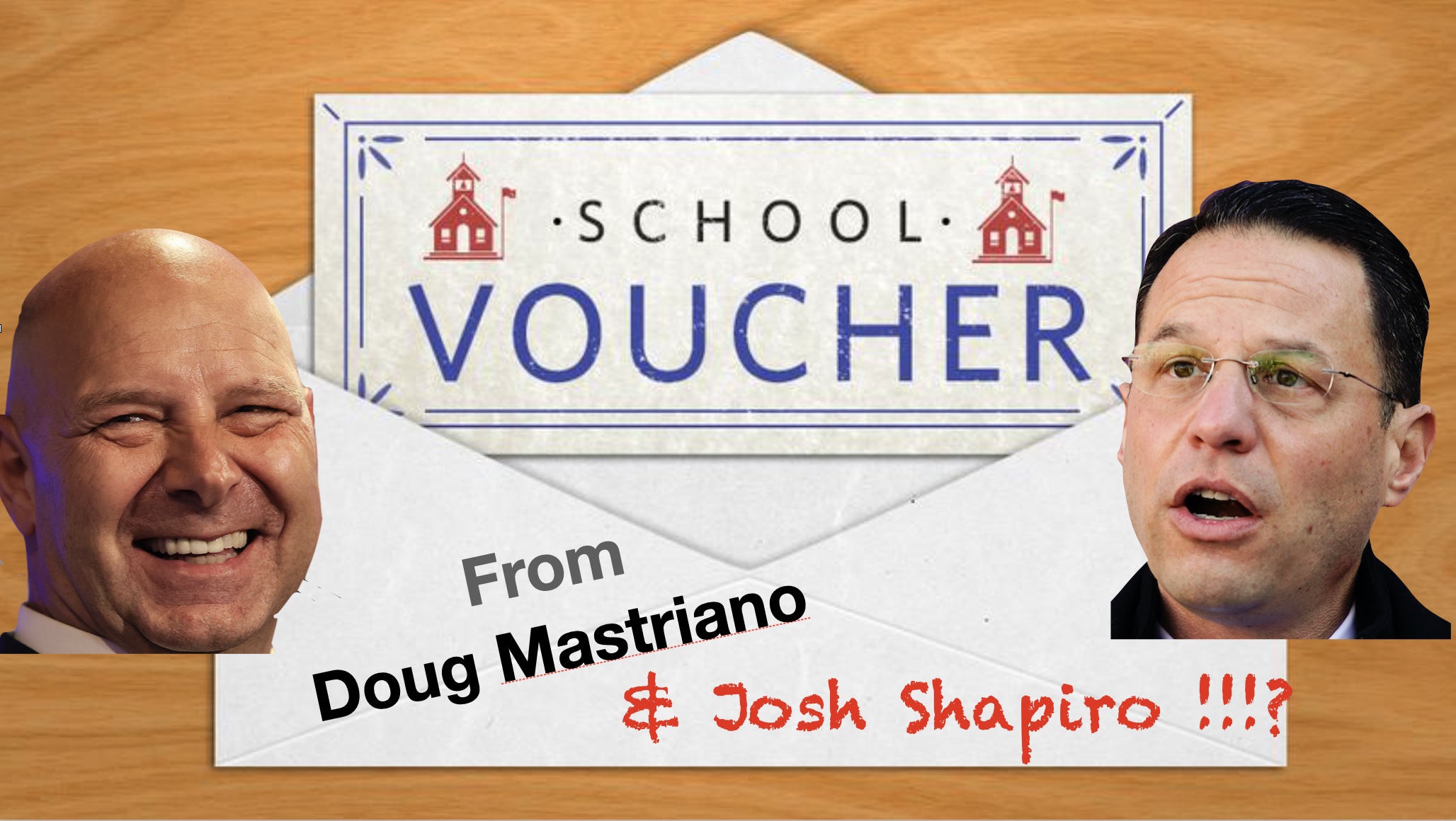
This doesn’t sound like the candidate teachers like me have been backing since before this election cycle began. Frankly, it’s almost what your gubernatorial opponent, MAGA Republican Doug Mastriano, champions.
Mastriano – a Trump insurrectionist – says he wants to use state education funding to give EVERY student a school voucher they can use at almost any school in the Commonwealth – public, private or parochial.
You seem to want vouchers ONLY for students at the most underfunded and struggling schools.
Josh favors adding choices for parents and educational opportunity for students and funding lifeline scholarships like those approved in other states and introduced in Pennsylvania.
“And I’m for making sure we add scholarships like lifeline scholarships to make sure that that’s additive to their education. That it gives them other opportunities…to be able to help them achieve success”
These so-called Lifeline Scholarships are a Republican lead measure to give direct-to-student tax-funded scholarships that parents and guardians in the state’s most neglected public schools could use for a variety of options including going toward tuition at a different school.
It would affect about 191,000 students in 382 schools, across 76 of the state’s 500 school districts. However, Two-thirds of the cost of the program (63.1%) is born by four districts – Philadelphia (43.9%), Reading (8.9%), Allentown (5.8%) and Pittsburgh (4.5%).
This would create another taxpayer funded system of education. Affected districts would lose so much funding it would ultimately force them to reduce programs, services, and staffing and/or raise property taxes to compensate.
Your opponent is perhaps the most odious person to ever run for Governor in the state. He looks to usher in an era of theocratic fascism, curtail human rights and take the Commonwealth back to the Middle Ages.
But that doesn’t mean you should run closer to his positions in the vain hope of stealing some of his base.
Pennsylvanians can’t afford losing their only chance at self rule because of demoralization and despair at a candidate too weak to support the platform he began this campaign on – championing public education.
I urge you to reconsider this flirtation with Republican values and school vouchers.
I hope you are better than this.
We deserve a governor who is better than this.
Please have the courage to stand by authentic public schools.
Like this post? You might want to consider becoming a Patreon subscriber. This helps me continue to keep the blog going and get on with this difficult and challenging work.
I talk about frequent scandals where unscrupulous charter school operators use copious loopholes in state law to enrich themselves without providing services to parents, students and the community…
Not MY charter school! Not MY charter school! Not MY…
Really!?
If the industry is subject to this much malfeasance and corruption, doesn’t that reflect badly on the entire educational model – even the examples that avoid the worst of it?
One model has daily scandals. The other – authentic public schools – is far from perfect but relatively tame by comparison. You can’t blame people for generalizing.
Yes, there were colonies where the invaders treated the conquered with more respect and dignity than others.
But not a single colony was a good thing. Not a single colonial enterprise avoided subjugating people who should have been free to determine their own destinies.
So without even examining exactly which special rules are stipulated in that charter, these schools are founded on the very concept of privilege.
They get to abide by their own rules tailor-made just for them.
Why does that matter? Because they get public funding.
And, yes, ALL charter schools are publicly funded – they get at least part of their money from taxpayers, usually all or the majority of their funding.
On the one hand, authentic public schools are publicly funded but required by law to be run by elected members of the public. You pay your taxes and you get a say in how those taxes are spent.
It’s a common feature of most charter agreements and often exploited.
You pay taxes and have no say in how that money is spent at these charter schools.
Parents of students enrolled in the school can vote with their feet and remove their kids if they don’t like the direction the school is taking. But the overwhelming majority of taxpayers don’t have kids in the charter school – they might not have kids at all. But their money is still being collected and their voice is silenced.
That is fundamentally unjust.
In fact, it’s one of the main reasons given for the American colonies fighting a war with Great Britain. No taxation without representation.
And most charter schools are guilty of it.
But not all!
There are charter schools run by elected school boards. They either choose this management system though it is not required by their charter or their charter explicitly requires it – like any other taxpayer funded school.
Does this excuse these charter schools from the same inequities as their more privileged brethren?
No.
And this is an important point.
How does a charter school open in the first place?
Most authentic public schools were started many years ago by the communities where they operate.
Community members got together, agreed they needed a school, elected board members to manage it, collected tax money, etc.
Charter schools are much newer inventions that come about differently.
Instead of starting with a community, they start with a charter operator. This could be a single individual, a group, an organization or a corporation.
The operator then goes to the state, community or usually school district where they propose to open the charter (it depends on the state charter law) and puts forward a proposal. Then the state, community or board decides to approve or deny that proposal.
However, nearly every charter school law does not give local communities an unlimited right of refusal. After all, if they did, there would be hardly any charter schools in existence.
Think about it.
When an authentic public school district decides to open a charter school inside its borders, it is agreeing to give a portion of the tax dollars it already receives to the charter school. It is agreeing to run its existing schools on less money so the charter can open up.
Why would any authentic public school do this? Only if it saw a real need for a new school and did not want to open a new school, itself. That’s a pretty rare situation.
However, nearly every charter school law gives very narrow reasons that new charter applications can be refused. So most of the time, the district has no choice but to approve these proposals. And if a district does refuse, the matter often goes to a state charter approval board which almost always reverses the decision. The community says no – state functionaries say yes.
So even when one of these so-called good charter schools managed by an elected school board opens up, it does so by overruling the decisions of the community it serves.
Charter schools create burdens for their communities. They siphon tax dollars from the existent public schools without reducing costs by much at all. So the authentic public school board is forced to make a hard decision – cut services for students and run with their reduced tax revenue or increase taxes to make up the difference.
Charter schools equal higher taxes in districts that can afford it and a reduction in educational quality in those districts that can’t.
This is a situation the community did not ask for. The community did not demand a new charter school. A handful of charter operators did to enroll a handful of students.
And if anyone does find a yellowed document for one of these schools labeled “charter,” best to tear it up. You don’t need it since your charter school has no need of special agreements.
Keep in mind, this is long before we get into the specifics of how charter schools can (and often do) exploit children and communities.
If the very existence of your school is predicated on the existence of a charter agreement, that is inequitable.
It does not need to follow all of the rules that authentic public schools must.
These are rules about being accountable for how you spend tax dollars, having minimum academic standards, hiring qualified staff, etc.
If there really are some rules that charter schools should be freed from obeying, why not just free all taxpayer funded schools from these rules? You don’t need a special agreement. You need to renegotiate the state school code.
Otherwise, this is giving special treatment to some schools rather than others.
That is the point.
Charter schools – ALL CHARTER SCHOOLS – are inequitable by definition and design.
And no amount of defensiveness will avoid this truth.
Like this post? You might want to consider becoming a Patreon subscriber. This helps me continue to keep the blog going and get on with this difficult and challenging work.
To many people, Queen Elizabeth II is more than just a 70-year figure head – she remains a symbol of the British colonial empire — an institution that enriched itself through violence, theft and oppression.
But one needn’t look solely at European nations pillaging Africa and Asia to condemn the practice.
We’ve got colonialism right here – down the street, in our own neighborhoods.
According to the Oxford English Dictionary, colonialism is:
“the policy or practice of acquiring full or partial political control over another country, occupying it with settlers, and exploiting it economically.”
That’s a pretty good description of the relationship between charter schools and the communities where they insert themselves.
Consider what a charter school does.
It is a school funded by taxpayer dollars but free from regulations protecting the people it supposedly serves.
This is fundamentally different from authentic public schools which are funded in the same way but subject to the leadership of an elected board of directors made up of members of the community. At charter schools, decisions can be made entirely by an appointed board who are not beholden to the public but to the organizers and investors who created the charter school in the first place.
To be fair, a charter school cannot exist in a community unless its operators can convince enough parents to enroll their children. However, no one needs to invite the charter school into the community in the first place.
Like with any business, these entrepreneurs can decide to set up shop pretty much anywhere, and though local public schools are tasked with approving or disapproving their request to locate within district boundaries, most state charter school laws provide very few resources to authentic public schools to turn charter schools away. Moreover, when charter applications are denied, the community that turned them away are often overruled by unelected privatization-friendly functionaries in state government.
Think about what a transformation has been thus accomplished.
Stakeholders such as students, families, teachers, and communities become merely economic resources ripe for hegemony – not free people with the right to control their own destinies.
After all, just because a small number of parents have decided to enroll their kids at a charter school, that doesn’t mean the community at large – which is far more numerous and will have to fund this endeavor – supports it. Moreover, the money taxpayers are expected to offload on the charter school come from their existent public schools – and the slight reduction in students does not equal a proportionate reduction in cost. Most expenses are fixed regardless of enrollment. You still have to heat and cool the building, staff the classes, etc. So the community has to decide whether to shortchange the majority of children who continue to be enrolled at the authentic public school or (as often is the case) pay more in taxes to make up the difference.
Make no mistake – this is theft. It is pillaging and looting a community. The citizens lose their right to self government, how their land is used and how their resources are utilized. They become enslaved to the so-called free market.
Perhaps the most pernicious effect is the change in attitude, as Ohio social studies teacher Dr. Chuck Greanoff writes:
“Our minds are targets of colonization, the goal being the replacement of any sense of a common good and shared responsibly with the neoliberal axiom that economic self-interest is the only right and natural course of action. You are to think like consumers, not citizens. You are to shop for the best schools for your student, not invest your time and effort in improving them for everyone.”
Others have gone even farther finding racism in the daily administration of charter schools, themselves. After all, many charter schools locate themselves around inner city black communities and therefore exploit the children of color they find there.
Bloggers Russ Walsh and Jonathan Pelto noted how similarly both colonialists and charter school operators often treat the people in the communities where they are located.
Colonialism is often white Europeans acting on brown indigenous people. The colonizers are going to “raise those savages up” or in the words of noted imperialist Rudyard Kipling, ease the “white man’s burden.”
Walsh notes that we see the same apparent motivation among charter school operators with regard to the often black and brown children enrolled in their schools. They use militaristic, highly autocratic systems of discipline to keep these children in-line.
“The children of the inner city are being treated by their “benefactors” as inferiors. Charter schools are colonial enterprises.”
However, the most damning testimony comes from Julian Vasquez Heilig’s Cloaking Inequality blog. He published a guest piece written by a former New Orleans charter school dean of students decrying just such colonial practices.
“…while working as the Dean of Students for a charter school in New Orleans, it took me some time to realize that I had been enforcing rules and policies that stymied creativity, culture and student voice…
My daily routine consisted of running around chasing young Black ladies to see if their nails were polished, or if they added a different color streak to their hair, or following young men to make sure that their hair wasn’t styled naturally as students were not able to wear their hair in uncombed afro styles. None of which had anything to do with teaching and learning, but administration was keen on making sure that before Black students entered the classroom that they looked “appropriate” for learning. As if students whose hair was natural or those whose parents could not afford a uniform tie could not achieve like others who possessed these items…
…everything at the school was done in a militaristic/prison fashion. Students had to walk in lines everywhere they went, including to class and the cafeteria. The behavioral norms and expectations called for all students to stand in unison with their hands to their sides, facing forward, silent until given further instruction.”
Students should not be treated like prisoners. Children should not be forced to comply with such harsh rules of conduct. And no one should be compelled to give up their cultural heritage for any reason – but especially because those in charge don’t value them as human beings.
It’s way past time we admit it.
This is colonialism.
Charter schools are colonial enterprises.
We can and should criticize the UK for its history of violence and oppression. We can and should include many US international policies in the same condemnation.
But we mustn’t stop there.
Colonialism is on our streets and in our schools.
We have been colonized by the rich and powerful and our children of color have received the worst of it.
We must end the charter school experiment.
We must end the neighborhood colonialism that too few are willing to call by its rightful name.
-Vasquez Heilig, J., Khalifa, M., & Tillman, L. (2013). Why have NCLB and high-stakes reforms failed?: Reframing the discourse with a post-colonial lens. In K. Lomotey and R. Milner (Eds.), Handbook of Urban Education. New York: Routledge.
Like this post? You might want to consider becoming a Patreon subscriber. This helps me continue to keep the blog going and get on with this difficult and challenging work.
She was in her 90s and had been unwell since before COVID. But she was also our matriarch, the point around which so much of our interrelations orbited and met.
After the funeral, I found myself at my uncle’s house somehow tasked with watching over several young cousins who had had just about enough of sitting around quietly in itchy suits and dresses.
To get a moment to myself, I set them a task: go downstairs among the assorted relatives and ask them to tell you a story about Ce Ce. Best story wins.
They went off like an explosion. And when they came back, they each had a touching tale about Ce Ce.
One was about how she defended a niece who wanted to marry someone of another faith. Another story was a fond recollection of the sweet and sour spaghetti sauce she used to make, the recipe of which is lost forever.
I was even surprised to hear some stories I had never known like that after my grandfather died, a semi-famous painter had asked Ce Ce on a date!
When my little cousins’ recitations were done, they were united in one thing – wanting to know who won.
I stumbled. I stammered.
I really had no way of judging such a thing.
They had all brought back such wonderful stories. Who won? We were ALL enriched by hearing them.
And the results of these tests are used to make high stakes decisions about which classes the students can enroll in, which enrichments, field trips or remediation they require, and even how much funding will be given or withheld from the schools and districts where they attend.
What if we took classroom grades as seriously as we take standardized test scores?
What if we valued them MORE?
The world would be a very different place.
The entire narrative of failing students and failing schools would turn on its head. After all, graduation rates have steadily increased over the last decade.
Students are completing more courses and more difficult courses. And students are even getting higher grades in these classes!
The new analysis comes from the U.S. Department of Education, and tracks transcripts of a representative sample of high school graduates in 1990, 2000, 2009, and 2019.
It does not include scores from 2020 and 2022 when both classroom grades and national test scores fell. But that’s clearly because of the pandemic and the fact that most students educations and testing schedules were disrupted.
Before COVID, students increasingly were taking higher-level courses, and their Grade Point Averages (GPAs) were steadily rising — from an average of 2.68 in 1990 to 2.94 in 2000, 3.0 in 2009, and 3.11 in 2019.
This is true of students from all backgrounds, but disparities still existed. On average, white and Asian students had higher GPAs than Black and Hispanic students. Though girls, overall, had higher GPAs than boys.
However, on the National Assessment of Educational Progress (NAEP), given to a sample of students across the country, test scores during the same period did not show a similar increase. Math and reading scores in 2019 were slightly lower than in 2009 and unchanged from 2005. Science scores haven’t budged since 2009.
It doesn’t take much to show why classroom grades are better at assessing student learning. Compare them with standardized test scores.
Students earn grades based on a wide range of assessments, activities, and behaviors – quizzes, class participation, oral and written reports, group assignments, homework, and in-class work.
Standardized tests, on the other hand, are not assigned on such a multifaceted range of factors. Instead, they are designed to obtain a measure of student proficiency on a specified set of knowledge and skills within limited academic areas, such as mathematics or reading.
Classroom grades are tapestries sown from many patches showing a year’s worth of progress. Standardized tests are at best snapshots of a moment in time.
So the biggest difference isn’t a matter of validity, it is pragmatism. Test scores can be used to rate students from all over the country or the world. They can be used to sort kids into a hierarchy of best to worst. Though why anyone would want to do that is beyond me. The purpose of education is not like the National Football League (NFL). It’s to encourage learning, not competition based on a simulation of learning.
And there is evidence that classroom grades are more valid than standardized test scores.
Kids with perfect scores on the SAT or American College Testing (ACT) tests don’t achieve more than kids who received lower scores or never took the tests in the first place.
Researchers followed more than 123,000 students who attended universities that don’t require applicants to take these tests as a prerequisite for admission. They concluded that SAT and ACT test scores do not correlate with how well a student does in college.
However, classroom grades do have predictive value – especially when compared to standardized tests. Students with high grades in high school but middling test scores do better in college than students with higher test scores and lower grades.
Why? Because grades are based on something other than the ability to take one test. They demonstrate a daily commitment to work hard. They are based on 180 days (in Pennsylvania) of classroom endeavors, whereas standardized tests are based on the labor of an afternoon or a few days.
Classroom grades would not have such consistent predictive value if they were nothing but the result of grade inflation or lenient teachers.
In fact, of the two assessments – classroom grades and standardized tests – one is far more essential to the daily learning of students than the other.
We could abolish all standardized testing without any damage to student learning. In fact, the vacuum created by the loss of these high stakes tests would probably result in much less teaching to the test. Days, weeks, months of additional class time would suddenly appear and much more learning would probably take place.
Academic decisions about which classes students can enroll in or what remediation is necessary could just as easily be made based on classroom grades and teacher observations. And funding decisions for schools and districts could be made based on need and equity – not the political football of standardized testing.
However, getting rid of classroom grades would be much more disruptive. Parents and students would have few measures by which to determine if students had learned the material. Teachers would have fewer tools to encourage children to complete assignments. And if only test scores remained, the curriculum would narrow to a degree unheard of – constant, daily test prep with no engagement to ones life, critical thinking or creativity.
To be fair, there are mastery-based learning programs that try to do without grades, but they are much more experimental and require a complete shift in how we view learning. This is a more holistic system that requires students to demonstrate learning at one level before moving ahead to the next. However, it is incredibly labor intensive for teachers and often relies heavily on edtech solutions to make it viable.
I’m not saying this is an impossible system or even taking a stance on its value. But a large scale shift away from classroom grades would be chaotic, confusing and probably a failure without serious support, scaffolding and parental, teacher and student buy-in.
At the end of the day, classroom grades are the best tool we have to determine whether learning has taken place and to what degree. We should do everything we can to change the way policymakers prefer the standardized approach to the personalized one.
‘It would be nice if all of the data which sociologists require could be enumerated because then we could run them through IBM machines and draw charts as the economists do. However, not everything that can be counted counts, and not everything that counts can be counted.”
Thus, the urge to quantify student learning seems predicated on the popular maxim: If you can’t measure it, you can’t manage it.
Classroom grades are actually concerned with the project at hand – assessment of learning.
Which brings me back to my little cousins.
When I told them I couldn’t possibly pick a winner between them based on their stories, there were lots of groans of annoyance.
They viewed the whole project as a competition and they wanted to win.
I hope on reflection they’ll see that we all won.
Everything isn’t a contest. We are not all opponents.
If they can grasp that, it would be the greatest lesson I could teach.
Like this post? You might want to consider becoming a Patreon subscriber. This helps me continue to keep the blog going and get on with this difficult and challenging work.





















 gadflyonthewallblog