This year I teach two different poetry classes – a 7th grade course focusing on writing it, and an 8th grade course focusing on reading it.
It’s not entirely exclusive. We do some writing in 8th grade and some reading in 7th grade, too. But each course is centered more on creation or explication.
My 8th graders seemed hooked when I introduced poetry by reading them a Shakespeare sonnet in a stuffy British voice.
Don’t get me wrong. I love the Bard. After all, my wife and I named our daughter Desdemona. But you might as well lean in to the expectation that Shakespeare is elitist with a question like, “Shall I compare thee to a summer’s day?”
Then follow it up with some video clips from Def Poetry Jam.
My students loved the idea that these street verses by Lamont Carey, J. Ivy and others were both instantly relatable and yet qualify as poetry.
When I told them that rap also met our literature book’s definition, they were floored.
I recited the Whitman poem aloud, and as my voice shook and my eyes watered, a student in the front row said I should have been an actor. But it wasn’t acting. Many of us felt that same emotion. It was right there on the page.
Today they were wrestling with Poe and Dylan Thomas with a kind of seriousness of purpose you rarely see in 13- and 14-year-olds.
In years past, I often had to point to this or that, guide them to consider one thing or another. But this morning, I could have gone to get a cup of coffee, and I don’t think they would have even noticed my absence.
My 7th graders took a bit more convincing.
When I announced we were starting a unit on poetry, they almost all lamented about how much they hated it so much. So I made them write a journal about why they felt that way. No public performances. Just put it down on paper.
It was funny how verbal complaints melted away in the face of stanzas and verse. Many admitted on the page that they liked poetry – some poetry – but they felt scared of getting the wrong answer.
The very first poem brought out such emotion and turmoil. One girl wrote about the recent death of a family member. A boy wrote about how he felt he was never good enough no matter how high his grades.
Some showed off real talent with figurative language – personifying colors, using vivid imagery, perfect similes, a gift for rapid fire rhymes.
Today I had them sing the rhythm of the limerick with me. I lead a chorus of:
Da DUM da da DUM da da DUM, Da DUM da da DUM da da DUM, Da DUM da da DUM, Da DUM da da DUM, Da DUM da da DUM da da DUM.
They laughed. (I did too.) They looked at me like I was crazy. (Perhaps you have to be to teach middle school.)
But they did it.
And they tried to write their limericks.
I’m not saying the results were all perfect. Few of them were. But the kids tried and some will continue trying.
There’s a word for that.
You try to climb to the top of the monkey bars…. You fall down. You get right back up and try again.
It’s play. Pure and simple.
That’s what’s been missing from so much of my kids school days recently.
After how many years of disruptions from the Covid pandemic and then number crunchers demanding this pretest and that standardized benchmark, the kids just want to get out there and play.
They want to be creative.
They’re yearning for it like a drowning swimmer yearns for air.
That’s what we need to prioritize and provide for them as much as possible – now more than ever.
Meanwhile, we’re still being warned against learning loss – a bogeyman designed by testing companies, book publishers and tech bros. Who out there is decrying creativity loss – vanished childhood – missing chances to be a kid?
These are what we should be worried about.
There will be plenty of time to catch up with academics. You can always learn, but you’re only a child once.
Your mind is only that malleable, your personality that open and willing to try new things – once.
Moreover, play and creativity are not antithetical to learning. They are the very heart of it. They are when we pick up, master, review the best!
So let my kids swim, paddle and glide in verse. Let them dive, bathe and wade up to their shoulders and beyond.
Because when they do, they transcend school and learning.
They become poetry, itself.
Like this post? You might want to consider becoming a Patreon subscriber. This helps me continue to keep the blog going and get on with this difficult and challenging work.
The reason? The state Constitution guarantees a “thorough and efficient system of public education to serve the needs of the Commonwealth” – and cake for rich kids while poor kids get crumbs just isn’t thorough or efficient or meets the needs of the Commonwealth.
The problem is that the state funds schools based heavily on local taxes – so rich neighborhoods can afford to pile on the monetary support while poor ones do the best they can but fall far short of their wealthier counterparts.
Judge Renée Cohn Jubelirer, a Republican, ruled that this was discrimination. In short:
“…the Pennsylvania Constitution imposes upon Respondents an obligation to provide a system of public education that does not discriminate against students based on the level of income and value of taxable property in their school districts…
The disparity among school districts with high property values and incomes and school districts with low property values and incomes is not justified by any compelling government interest nor is it rationally related to any legitimate government objective…
[Therefore] Petitioners and students attending low wealth districts are being deprived of equal protection of law.”
Unfortunately, no mention was made in the nearly 800-page ruling of exactly how to fix the problem.
The trial began in November 2021 and lasted more than three months. You’d think the judge had time to toss off a line or two about what to do next, maybe that it’s up to the state to take up the slack or something.
But no.
Which leaves room for right wing creeps like the Commonwealth Foundation to crawl out from under a rock and give their own nonsense solution.
Benefield wrote a response to the ruling praising it for leaving the legislature and executive branch to find a solution, rather than “mandating more money to a broken system.”
Um, Benefield? Buddy? It’s broken mostly because we haven’t paid to keep it in good repair.
But he goes on…
“The only way to ensure that ‘every student receives a meaningful opportunity’ is for education funding to follow the child. Students that are trapped in their zip-code assigned school — especially in low-income and minority communities — often have no alternatives when their academic or social needs are unmet.”
So the solution to not having enough money is more choice!?
I can’t afford to buy breakfast. Having a choice between raisin bran and pancakes won’t make a difference. I CAN’T AFFORD EITHER ONE!!!!
If every district received fair funding, it wouldn’t matter what your zip code is anymore. That’s the whole freaking point!
But look for neofacists and libertools to start spouting this kind of rhetoric at every turn now that they can’t hide behind the old excuse that it’s somehow fair to steal poor kids lunch money and give it to rich kids.
The next step is not entirely clear.
Some think it likely that the state will appeal the decision to the Pennsylvania Supreme Court.
“The record is very, very clear that local school districts are not adequately resourced,” she said. “I think it would be extremely difficult to be successful on appeal.”
Judge Jubilerer wrote in her ruling that she hoped everyone would work together now to find a solution:
“The Court is in uncharted territory with this landmark case. Therefore, it seems only reasonable to allow Respondents, comprised of the Executive and Legislative branches of government and administrative agencies with expertise in the field of education, the first opportunity, in conjunction with Petitioners, to devise a plan to address the constitutional deficiencies identified herein.”
It may sound naive, but it’s happened in other states – specifically New York and New Jersey.
A suit filed in 2014 in New York argued that the state never fully funded a 2007 Foundation Aid program. The program was supposed to consider district wealth and student need in order to create an equitable distribution of state funding.
The Empire State settled in 2021 and is now required to phase-in full funding of Foundation Aid by the 2024 budget.
New Jersey tackled the issue way back in 1981. A state court ruled officials had to provide adequate K-12 foundational funding, universal preschool and at-risk programs.
This made New Jersey the first state to mandate early education. The state also undertook the most extensive construction program in the country to improve the quality of school buildings in impoverished neighborhoods, according to the Education Law Center.
Could such sweeping reforms be coming to the Keystone state?
“For years, we have defunded our public schools at the expense of our students,” said state Sen. Lindsey Williams (D- 38th district), who is the minority chair of the PA Senate education committee. “[The ruling] is game-changing for our students across the Commonwealth.”
Sen. Vincent Hughes of Philadelphia, the ranking Democrat on the state Senate’s Appropriations Committee, said the state can afford a big boost in aid to the poorest schools right now because we have billions of surplus dollars in the bank.
This is exactly what is needed.
During the trial, plaintiffs presented evidence that schools are underfunded by $4.6 billion, an estimate that they said does not account for gaps in spending on special education, school buildings and other facilities.
Some organizations like PA Schools Work are calling on legislators to act now by adding approximately $4 billion in Basic Education Funding. They even suggest the increase be at the rate of one billion per year over the next four years to make it more feasible. Finally, they propose this money be distributed through the Fair Funding Formula and the Level Up supplement so that it is more equitably distributed to districts in need.
To make matters even more complicated, the state uses an “outdated” formula to calculate how to allocate school funding.
The legislature developed a new formula based on enrollment numbers and how much it costs to educate students who are living in poverty, English language learners, or have an Individualized Education Plan (IEP). However, a large chunk of money isn’t distributed using that new formula.
The way I see it, the Commonwealth has a lot of education funding issues to fix.
Hopefully, this ruling finally means we’ve stopped arguing over whether a problem exists and can start focusing on how to solve it.
That, itself, would be a huge victory!
Like this post? You might want to consider becoming a Patreon subscriber. This helps me continue to keep the blog going and get on with this difficult and challenging work.
There’s plenty of fun to be had if you go to the Waterfront in Homestead, Pennsylvania.
There’s a Dave and Busters, Primate Bros, and even an AMC Loews’s multiplex movie theater.
But right across from the Barnes and Noble is a building with a neon green sign advertising its tenant – Commonwealth Charter Academy (CCA).
This is the newest satellite office of the biggest cyber charter school network in the entire state! One of 51 locations statewide.
These are not your typical brick-and-mortar charter schools. They’re remote schools where students are taught at a distance via computer.
Like other charters, they’re still publicly financed, often privately run, and free from most safety precautions that ensure kids get a quality education at authentic public schools – things like being run by elected school boards, requiring entirely certified teachers, etc. But cyber charters don’t have to house children during the school day. They just need computers and Internet access.
Unfortunately, since Minnesota passed the first charter school law in 1991, they have spread through at least 45 states. However, only 27 states also allow CYBER charters like this – schools that teach mostly (or entirely) distance learning through the Internet.
Oh, sure! There’s an authentic public school in this neighborhood, too, right up the hill. It’s not located in nearly as trendy a spot though. Moreover, its four buildings were constructed around the 1970s and are crumbling down in places. But the new cyber charter school building looks like a palace!
“administrative offices, conference rooms, seminar areas, production labs and live session rooms. Some features include state of the art exterior lighting and signage, high-quality audio/visual and security equipment and 52 new perimeter windows to allow for ample natural lighting. The interior is complete with custom wall graphics, acoustical panels, wood plank ceilings, a fireplace and a Techworks room that provides users with a full digital experience.”
It’s hard to imagine why a glorified office building where students don’t attend school needs to be so fancy. Or why it needs to be located on such prime real estate. With such high rents. On the public dime.
I teach at Steel Valley Middle School nestled among residential homes on top of the hill. There’s no Panera nearby, but there is Munhall MiniMart just up the street.
We have no wood plank ceilings or Techworks rooms, but my classroom has fluorescent lights, a wipe board that doesn’t fully erase, wobbly tables and chairs, and no windows.
CCA doesn’t sound like a school. It sounds like a tech company. And I guess it kind of is.
The K-12 cyber network’s Homestead building isn’t designed for students – it’s designed for executives. The people who make the big bucks work here – though maybe there are a few teachers holed up here and there behind computers typing away to their students through screens across the state.
Much of the responsibility for these students doesn’t seem to rest with teachers. It belongs to their “learning coaches,” adults responsible for assisting kids at home – usually parents or guardians.
According to CCA’s Website, learning coaches are expected to spend five hours each school day helping elementary students with coursework and monitoring lessons, and between two and three hours a day with students in middle school.
Why are we paying CCA again?
And how much are we paying them?
It turns out the so-called non-profit business, which in 2020 posted almost $39 million in net income, gets at least $10,000 per student. So given its enrollment figures, that’s at least $210 million a year – not counting additional money some districts have to provide. For each child from a district that enrolls in a cyber charter, the sending district pays the cyber a rate based on what the district spends on average per pupil – one rate for students in regular education and another for students with disabilities. This means that tuition rates paid to a particular cyber school can be vastly different.
CCA spends millions of dollars each school year on advertising. For example, in its 2018-19 IRS Form 990, a required disclosure for all nonprofits, CCA reported that it paid $8.5 million to Bravo Group, an advertising, marketing, and lobbying firm.
But, of course, these trips aren’t always of much educational value. They’ve gone to petting zoos, laser tag, bowling and kayaking. A parent of a CCA student even bragged on Facebook about using these funds for Dave and Busters Arcade, a Motley Crue concert, Eagles tickets, and family vacations to Universal Studios and Disney, according to Education Voters of Pa.
Can you imagine taking your kids to an expensive theme park, or going to see an NFL game, or seeing Motley Crue play “Shout at the Devil” on the public dime?
Does that sound nice? Absolutely.
But is it fair to all the other schools in the state starving for enough money just to keep the lights on? Is it fair to kids in extra large classes, without new textbooks, and dealing with mold in the bathrooms?
Moreover, is it a good learning strategy to get kids to sit in front of a computer for 30 days with the promise of a field trip at the end of the month?
Only 28.8% of CCA students achieved proficiency on English Language Arts and Math PSSA exams on a two-year, combined basis, according to state Department of Education data. The school’s growth score was negative – so they actually regressed academically. They would have done better not to have even gone to school!
Moreover, the school’s graduation rate falls well below statewide averages and state goals. Its four-year cohort graduation rate is 53%; its five-year rate is 67%; and its six-year rate is 70%. For the 2018-19 school year, more than 10% of CCA students dropped out. That’s about twice as many as the average rate for charter schools and seven times as many as the average rate for authentic public school districts.
In short, the school’s performance ranks among the bottom 5% of schools statewide.
I don’t know about you, but as a teacher, parent and taxpayer in the Commonwealth, none of this makes me happy.
The best I can do is come down to the Waterfront and see the result of all this tax money – mine and yours – in a beautiful new building that isn’t doing anything to help students learn.
If you want an even closer look inside CCA, indeed.com has you covered. The site allowed employees or former employees of companies to review their places of work.
While there were a few reviews that were entirely positive of CCA schools across the state, the overwhelming majority were incredibly negative.
Teacher (Current Employee) – Pittsburgh, PA – September 24, 2022
CCA has changed for staff. They are no longer flexible and change requirements and hours with no notice. Staff need to read the administration’s mind to determine the new rules and regulations that changed continually. Work life balance is a struggle with this school.
High School Special Education Teacher (Former Employee) – Harrisburg, PA – December 2, 2022
CCA started out as a great place to work. Unfortunately, it quickly went down hill. Management had little spies that taught among us and reported back. I felt like I was in grade school all over again. The number of students on any given caseload is 60+ students. It was almost impossible to progress monitor, make phone calls, and complete all necessary paperwork on time. The expectation was to work 12 hour days as well as nights and weekends. No life for you. As time went on management became very top heavy. If you had a target on your back you might as well hang it up. They don’t really help you to improve even though they say they do. Burn out comes quickly and upper management could careless. Professionalism does not exist in this place especially from upper management. CCA does not support you as a teacher. You can easily be replaced and they will. Pros Flexible Schedule Cons
Everything else….Management, Caseload numbers, Professionalism, etc.
Teacher (Current Employee) – Pennsylvania – October 12, 2022
What is the best part of working at the company? Teaching students and coworkers. What is the most stressful part about working at the company? Middle and upper management lack of communication, lack of flexibility, low pay. What is the work environment and culture like at the company? Not healthy. Upper management claims to listen but they don’t implement any suggestions. What is a typical day like for you at the company? 8-4 pm teaching, phone calls, grades, etc.
Administrative Assistant (Former Employee) – Harrisburg, PA – August 9, 2022
Upper management at CCA is unprofessional, some downright rude, and has extremely poor communication. No training or onboarding process, upper management doesn’t seem to know or care what most employees do on a day to day basis, and the environment is unhealthy both physically and mentally. Disappointing that when concerns were even expressed to the CEO, no response was even given at all. There seems to me a mindset that if given bonus money; $1,00 to $5,000 taxed money, periodically, that everything is great, which is not the case and it doesn’t reflect anything other than a means to disperse unused profits, especially since it’s been given to employees regardless of their length of employment or job performance. CCA is lacking integrity and are not what they claim to be in media advertising or to parents.
Administrative Assistant (Current Employee) – Allentown, PA – July 5, 2022
“Equality” is not something that is known for the staff at this company. If you are not in the main office or a teacher you are treated like the “red headed step child”. They care more about money than making sure their staff is financially or mentally taken care of. Cons Pay, Flexibility
Family Mentor (Former Employee) – Harrisburg, PA – March 5, 2022
This position can be fun but also compromising . You can be promised one area then it be changed to an impossible location. Taking too much time to be worth the pay. When location is favorable then the job is great.
Teacher (Current Employee) – Harrisburg, PA – February 13, 2022
Great benefits, but at the cost of your sanity and peace. No work life balance. A constant push for in office/ in person during a Pandemic. If you’re single with no kids and no life this is a great fit. Pros Benefits and shiny buildings Cons
Success coach (Former Employee) – Harrisburg, PA – December 16, 2021
The new managers don’t know anything but are supposed to be your supervisor. You don’t get paid when the kids aren’t there so the job is like part time pay. Pros Benefits are amazing! Cons No advancement, very little direction.
Teacher (Former Employee) – Homestead, PA – August 20, 2021
Management says one thing and does another thing. Too many managers that don’t communicate with employees very well. Not understanding when personal issues arise Pros Great technology Cons Too many chiefs not enough Indians
Accounting Clerk (Former Employee) – Harrisburg, PA – March 4, 2021
Never felt comfortable with coworkers from day one. Also management was very unpleasant and spent way more time than necessary watching employees at their desks. They had seriously ridiculous expectations on performance after only a few weeks on the job. It was expected that I would just know how to do something I had just been trained on and do that task perfectly. Not worth the stress and anxiety it caused. Pros Great benefits Cons Toxic work environment
Teacher (Former Employee) – Pennsylvania – December 19, 2020
Sounds and looks much better to work there than to actually work there. Stressful, lack of communication, no consistency, lack of professionalism, focus on avoiding legal issues is driving force, facade of supportive atmosphere and family like environment. Work life balance is zero. Pros Remote Cons Totally inconsistent and poor leadership
Career Facilitation Coordinator (Former Employee) – Harrisburg, PA – June 29, 2020
CCA cannot be great under current leadership. During my time there, it became evident that students are not at the center of this organization, but instead, the selfish interests of senior leadership prevails (note: I use the term leadership loosely). Among many things, the culture of micromanagement is toxic, resulting in unbelievably high turnover in certain positions. In a functional organization, senior leadership would work to mitigate this issue. Here, matters such as this are swept under the rug. For whatever reason, certain “Directors” are protected and there is no accountability. Professionals are not treated as such and their expertise is grossly undervalued. HR is not objective and gossipy…especially at the senior level, which is extremely unprofessional to say the least. If you’re searching for an innovative and inclusive organization which promotes growth and cohesion, KEEP LOOKING. If you decide to interview, do your best to find out the history of your position. If offered a position, run far and fast. Pros Nice building Cons Zero accountability, culture of nepotism, inauthentic leaders
Unlisted (Former Employee) – Harrisburg, PA – April 19, 2020
Horrible place to work, bad management, inadequate pay. There is no flexibility and employees are not valued at all. Every day of my time there was miserable. Pros None Cons Everything
Teacher (Current Employee) – Pennsylvania – February 22, 2020
The school’s administration is very top-heavy. Teachers’ salaries are low compared to peers in brick and mortar schools. Workload among teachers is not fairly distributed. Teachers are required to award grades to students that do not reflect their learning. Students are awarded up to 35% of their grades for ‘participation’ that does not assure that actual learning took place. The hardest part of the job is not being able to engage the many students who use the cyber-school setting to avoid going to school. The administration does not put adequate resources to removing these students from the school.
Teacher (Former Employee) – Harrisburg, PA – February 17, 2020
Teachers aren’t valued much. Young and inexperienced administrators hand picked if they are yes-men to upper administrators push teachers to the limit. Upper administration has alternative agendas, and the ‘school’ is a company to them. Office cubes are loud and not conducive to work.
Teacher (Current Employee) – Pittsburgh, PA – September 24, 2022
CCA has changed for staff. They are no longer flexible and change requirements and hours with no notice. Staff need to read the administration’s mind to determine the new rules and regulations that changed continually. Work life balance is a struggle with this school.
Instructional Assistant (Former Employee) – Ligonier, PA – July 7, 2019
I worked as an in-home IA with a special needs student. There was almost no guidance from the school as far as coursework, deadlines, etc. All of my student’s goals came from the BCBA, and the school had very little to offer in terms of direction. The first paycheck came two months late, and there were no benefits involved , as it was an independent contractor position. On the plus side, though, with the relaxed approaches to education, it was quite easy to allow the student to work on subjects that interested him, and it was nice to have that kind of independence when it came to planning the school days. Pros Flexibility, relaxed environment, student home-based options, pay. Cons Little guidance, hard to contact the school, communication in general.
Teacher (Former Employee) – Harrisburg, PA – June 8, 2019
When I started at CCA back in 2009, the CEO was Dennis Tulli. He was a wonderful leader who truly cared not only about the students & their families but also every employee who worked for him. He made sure his staff was compensated fairly and provided free health care benefits (no monthly premium) for teachers & their families. Providing CCA met their yearly goals, generous monetary bonuses were given to all employees in September. When Dr. Tulli left and Dr. Flurrie took over, the culture slowly began to change. More and more responsibilities were added to all employees but especially teachers w/o any duties being removed. Night & weekend hours became mandatory but again, there was no compensation. Many veteran teachers, who were making a decent yearly salary, were forced out so they could be replaced by younger less experienced teachers at half the salary. Raises became smaller, w/the exception of this CEO & his senior leadership team, and bonuses all but disappeared. Dr. Flurrie made it known that all employees were replaceable so the theme became “be grateful you’ve got a job here”. Over a 2 year time frame, the culture slowly changed from a democracy, where you could voice your concerns or ideas and know you would be heard, to a micromanaged dictatorship, run from the top down. If you are an older woman, do not expect any advancement opportunities. This CEO primarily gives advancement opportunities to men and young, attractive women. Under Dr. Tulli and for the first year under Dr. Flurrie, there was very little turnover. Once Dr. Flurrie’s “honeymoon” period was over as a CEO, true colors began to show. From his second year to now, the turnover rate has continued to consistently increase. Keeping special education teachers has become a real challenge. We used to be able to work from home but the majority of those positions have been removed so plan to report to an office everyday. Bottom line, if you think CCA is better a option than the traditional brick/mortar schools, you are mistaken. This CEO has eliminated any incentives to choose this company over the traditional public school. – Pros New state-of-the-art building, travel expenses reimbursed, coworkers are generally very friendly/helpful people Cons CEO’s ever increasing ego, smothered by micromanaging administrators, no more work from home/bonuses, low salaries/negligible raises
Success Coach Coordinator (Former Employee) – Philadelphia, PA – December 27, 2018
This was a stressful and uninviting environment. No room for advancement. Would not recommend others to a position with this community. Management upgrades are needed.
Teacher (Current Employee) – Harrisburg, PA – October 24, 2018
As the company continues to grow, so does the ego of the CEO and management. Little thought is considered for the professional teaching staff and all teachers are “replaceable.” Don’t even ask for a work from home day. I miss the old management style of Connections Academy.
Teacher (Former Employee) – Harrisburg, PA – March 13, 2018
CCA is a growing school but be very careful as they grow what do they forget? The special education and general ed caseloads are so high but the school will not increase staff as they leave. Pros Health insurance, team atmosphere with team Cons Micro managed every step, no voice, top down management, non elected school board
Coworkers were wonderful, but the company is not run well and is frustrating and takes advantage of their workers. The highest levels of management are unaware of what the underlings are doing and don’t send a message that employees are valued.
Pros
Collaborrating with coworkers, supporting one another.
Cons
The worst most incompetent employees are the ones who get promoted.
Like this post? You might want to consider becoming a Patreon subscriber. This helps me continue to keep the blog going and get on with this difficult and challenging work.
Let me put that in perspective – a scandal-ridden investment firm that made billions in the wars in Iraq and Afghanistan bought one of standardized testing’s big four and then added the Measures of Academic Progress (MAP) test to its arsenal.
This almost certainly means the cost of state testing is going to increase since the providers of the tests are shrinking.
“It used to be if you put out a [Request for Proposal] RFP for state assessment, you get five, six, 10 bidders,” said Scott Marion, executive director of the Center for Assessment. “Now you’re lucky to get three. When you’re doing that, there’s maybe not as much expertise and certainly the cost will go up” (emphasis mine).
You can just imagine how this will affect the marketplace.
NWEA serves about 10,000 school districts and HMH estimates it works with more than 50 million students and 4 million educators in 150 countries, according to a press release about the proposed acquisition.
So we can expect districts and even entire states which rely heavily on the MAP test to be encouraged to buy as much HMH curriculum as possible. That way they can teach directly what is on their standardized tests.
That is assuming, of course, the acquisition agreement is approved after a 90-day regulatory review period.
To be honest, I would be surprised if there are any objections.
Such cozy relationships already exist with other education companies. For example, Curriculum Associates provides the aforementioned curriculum for its own i-Ready assessment.
After all, if these sorts of assessments can be gamed by increased access to materials created by the same corporate entities that create and grade the tests, are we really assessing knowledge? Aren’t we just giving students a score based on how many books and software packages their districts bought from the parent company? Is that really education?
Then in February of 2022, New York-based private-equity firm Veritas Capital acquired HMH at a price of $21 per share, or about $2.8 Billion. And under Veritas, HMH acquired NWEA and the two companies will work together to do many of the things that HMH used to do by itself – like a golden dragon perched atop the standardized testing treasure trove.
All for the benefit of Veritas Capital.
Make no mistake, the investment firm wouldn’t have become involved if it couldn’t make a profit off the situation. That’s what it does – through scandal after scandal.
Founded in 1992 by the late investment banker Robert McKeon (who died by suicide after mounting improprieties came to light), Veritas Capital began its life buying up government contractors and forming close ties with former senior government officials. Of the company’s many defense-related investments, the most infamous was its 2005 purchase of DynCorp International, a shady company involved in the US’s Iraq and Afghanistan wars.
In 2006, the firm acquired MZM Inc., an intelligence contractor, which was investigated for providing bribes to Rep. Duke Cunningham, R-Calif., in exchange for help obtaining Pentagon contracts.
Throughout its history, Veritas has fostered close ties to government officials. Campaign finance records show executives at the investment firm have given over $100,000 to various politicians, mostly Republicans. In 2014, Veritas paid Bill Clinton $250,000 for a speech.
The New York Times reported in 2001 that numerous retired generals were on Veritas’ payroll and the company used such ties to the Pentagon and frequent appearances in the media to boost Veritas-owned military contractors, including DynCorp.
Musallam focuses on technology companies like HMH that operate in sectors dominated by the US federal government such as standardized testing. After all, the only reason public schools throughout the country have to give these assessments is federal law. It’s a captive market paid for by tax dollars.
America spends $6.8 trillion a year on defense, health care and education – markets dominated by the government.
“These are government-influenced markets, no doubt about it, and being close to how the government thinks about those markets enables us to understand how we can best invest,” Musallam said.
Like this post? You might want to consider becoming a Patreon subscriber. This helps me continue to keep the blog going and get on with this difficult and challenging work.
The non-profit chain of 13 schools based in Pittsburgh, Pa, boasts high academics, safe campuses and certified teachers.
At least, that’s what its advertising blitz proclaims from every grocery store cart, newspaper page, radio announcement and billboard. Which just goes to show that anyone will tout your virtues if you pay them enough money – taxpayer money, that is.
Take Propel McKeesport – the franchise located in my own neighborhood.
“…ranked as ONE OF THE BEST charter schools in the nation by U.S. News World Report” (Emphasis mine).
One of the best is not THE best. But it’s still good. Let’s call it embellishing the school’s resume.
According to Propel’s Website, in 2021, the McKeesport location was #11 in the state’s charter elementary schools and #7 in the state’s charter middle schools.
I suppose that is impressive, too, though being one of the best CHARTER SCHOOLS isn’t the same as being one of the best SCHOOLS.
The percentage of students achieving proficiency in math was 7% (which is lower than the Pennsylvania state average of 38%) for the 2020-21 school year. The percentage of students achieving proficiency in reading was 34% (which is lower than the Pennsylvania state average of 55%) for the 2020-21 school year.
Moreover, test scores in both subjects were higher at the McKeesport Area School District, the local authentic public school – 17% higher in math and 3.5% higher in reading at the elementary level and 6% higher in math and 2% higher in reading at the middle school level. Propel McKeesport does not teach beyond 8th grade.
So what exactly is Propel celebrating?
Maybe it’s the fact that its McKeesport location achieved these standardized test scores while teaching an intensely racially segregated student body – 86% minority (mostly Black). By comparison, the authentic public schools range from 52-71% minority students (mostly Black).
I’m not sure that’s much of a victory. Wasn’t one of the major tenants of the civil rights movement having racially integrated schools – that doing so would help students of color achieve academically because resources couldn’t be horded away from them?
In 2015, two teenagers at Propel Braddock Hills High School were arrested after one allegedly tried to sell guns to another in a bathroom during the school day. Two guns were recovered by police and the students were taken into custody on campus. The rest of the students were placed on lockdown until police cleared the area.
In 2019, police arrested four people in connection with a scheme to steal nearly $23,000 from Propel Schools by forging checks in the charter school operator’s name. The Propel Schools Foundation filed a report with police after discovering nearly two dozen fraudulent checks in Propel’s name had been cashed at various places, a Pittsburgh Public Safety spokeswoman said. At least 28 checks drawn against the school’s bank account were counterfeit, the complaint said. The fake checks were cashed using the forged signature of the school’s co-founder, Jeremy Resnick.
So does Propel provide a safe learning environment? Maybe. But not more so than any other district.
Individual Attention and Small Class Size
The problem here is verification.
Charter schools are not nearly as transparent as authentic public schools. They are not required by law to provide as much information about their operations as neighborhood public schools. For instance, nearly every authentic public school district is run by an elected school board which has open meetings and open records.
For Propel it is unclear exactly how members are chosen for its corporate board, but it is difficult for parents and community members to be appointed.
According to an article in Public Source, individuals can only become board members if they are already members of the “Friends of Propel,” but the charter chain did not provide information on this group or how its members are selected.
When it comes to class size, most Propel schools report having student-to-teacher ratios slightly smaller or the same as at neighborhood authentic public schools. But who knows? There’s no way to tell whether classes may actually be larger.
However, individual attention is even harder to verify.
Most schools focus on more individual attention these days.
Unfortunately, the network provides very little detailed information about its curriculum.
So this claim by Propel is a way of bragging that the network doesn’t have to have certified and qualified teachers, but it does so anyway.
Unfortunately, it is definitively false.
According to those US News and World Report spotlights that the charter school network likes to highlight, several Propel schools do not have all certified teachers. For instance, Propel McKeesport only has 92% full-time certified teachers, Propel Homestead only has 94%, Propel Pitcairn only has 96%, etc.
So does Propel have 100% Certified and Qualified Teachers? Absolutely not.
Award Winning Arts Programs
Kudos to Propel for recognizing that arts are an important part of the curriculum. Or at least using it as a selling point on its advertisements. However, without details of its curriculum submitted to the state and verifiable by audit, there is nothing to back this claim up factually.
In fact, on Propel’s own Website, the only reference I see to awards for art is a brief mention in its after-school program which they label as “award-winning.”
What award did it win? The ‘Propel Presents Itself with an Award’ Award? Is there anything more substantial to this claim?
Certainly every school should have a dress code, but can’t students express themselves freely anymore? I just don’t see why emulating the worst qualities of private schools is a great thing – especially when it adds an unnecessary cost for parents.
-Tuition Free
Charter schools are funded with public tax dollars. So, yes, you don’t have to pay a tuition to attend. However, you do have to pay for extras like school uniforms.
In fact, overcoming the unpopularity of charter schools because of the increased expense for taxpayers is cited by Droz Marketing – the company that made all those glossy Propel advertisements – on its Website portfolio as an obstacle the company had to overcome to sell Propel to the masses.
Which brings us back to the beginning.
Does Propel go beyond the facts in its claims for itself?
Certainly.
Many businesses do that these days. And make no mistake – Propel IS a business. If it can cut a corner or find a loophole to put more money in operators’ pockets, it will.
Technically, this is not illegal. But it certainly doesn’t help educate children. It just goes to enrich the charter school operators.
Non-profit? Yeah, in name only.
However, let me end with what may be the most telling indicator of what it is like at Propel’s charter schools.
indeed.com is a Website workers use to decide if they should apply at a given job site. Employees anonymously review their current place of employment to let prospective job applicants know what it is like there and if they should consider seeking a job there.
The site has many entries on schools in the Propel network. Some are positive. Some are glowing. But most are incredibly negative.
Here in their own words is what it’s like inside the Propel network from the people who work (or worked) there.
Para Educator (Former Employee) – Propel East, Turtle Creek – July 19, 2020
Pandering to the cultural climate and using all the right talking points still doesn’t provide a quality education because of the many behavior problems.
Educator (Current Employee) – Pittsburgh, PA – August 4, 2022
Management verbalizes a desire, but does not actively seek to improve diversity within the ranks of educators. The lack of diversity directly impacts how the student body is educated.
First Grade Teacher (Former Employee) – McKeesport, PA – April 15, 2022 I worked at Propel McKeesport for 9 days before I realized it would negatively affect my mental health greatly if I stayed. Everything about the school was chaotic and unorganized. There is so much asked of the teachers, and they are given little to no support in the process. The people that are put in place to act as supports are spread so thin, that you aren’t able to receive the support necessary. I would have to get to work early and stay late in order to get all of my tasks done. I had no time for my personal life, and I was constantly overwhelmed. Leaving was the best decision I could’ve made for myself and my well being. Pros Higher than average starting pay for new teachers, healthcare benefits Cons Unorganized, consuming, little support/structure
Elementary School Teacher (Former Employee) – Hazelwood, PA – February 3, 2022 My time at Propel Hazelwood was the worst experience I have ever had in a professional setting. The principal, at the time, had all sorts of big ideas, and no clue how to make them actionable. Behavior was managed through a failed token economy… so I’m sure you can imagine what behavior looked like. But good news, they’ll just fire you before you qualify for benefits, and trick the next poor sap. For reference, I was the 3rd of 5 teachers to go through that position in 2 years.
In summary, I hope you line up a therapist before you sign your soul away to Propel. I know I needed one. Pros There were no pros. I can’t even make one up. Cons Pitiful everything. People, leadership, attitudes, slogans, curriculum (or lack there of). Run away… fast.
Teacher (Former Employee) – McKeesport, PA – September 3, 2021 Propel McKeesport cannot keep their staff members. They have so many open positions because their lesson plan template is 6 pages long, and the work pile-up is more than loving your scholars. The wonderful scholars don’t get a chance to love who you are because you (if you are not a favorite) are swamped with work. The job is a nightmare. Pros There is not one pro I can think of. Cons Flooded with work. Lies and says it is “Propel-Wide”
Janitor (Current Employee) – Pittsburgh, PA – January 3, 2022
Hr treats you bad Teachers treat you bad You are less then nothing to everyone even your bosses Never work for Braddock propel worst school I’ve seen Pros Nothing Cons You will be treated like you are worthless
Teacher (Former Employee) – Braddock Hills, PA – September 27, 2021 Wow. It sounds good from the outside but is terrible in the inside. High school students were out of control. Administration offered little help. The parents were just as aggressive as their children. The teachers will throw anyone under the bus as soon as possible. Pros Great pay. Amazing benefits. Stellar retirement and health insurance. Cons Terribly behaved students, aggressive parents, woke and offended staff
Educator (Current Employee) – Pittsburgh, PA – May 21, 2021 Even though I went in knowing the hours would be long and the school year would be longer, I was not prepared for the lack of work life balance. I have worked with Propel for 3 years and I will say that it is all consuming. I have been expected to not only do my job during building hours, but outside of work as well. This would be fine if it was occasional, but especially during COVID, it has become constant. Not only is the work never ending, but in my buildng we are not given adequate time to eat (25 minutes) or plan (50 minutes, but this time is often taken up by meetings almost daily). On top of limited planning time and expectations that never seem to stop coming, many of us have been forced into taking on additional, unpaid roles that we did not ask or agree to, and “no thank you” is not accepted as an answer. The district struggles to employee substitutes, so teachers are often expected to split classes when other grade level members are out. This has resulted in 30+ students in classrooms during non-COVID times, with one educator. Pros Good benefits, reasonable pay for the area, great curriculum Cons Short breaks, underqualified building administration, limited support
Teacher (Current Employee) – Pittsburgh, PA – January 13, 2021 Propel staff does care a lot about the students, but it doesn’t feel like those who are higher up care as much about them. Having a CEO/Superintendent may be the reason for this. Pros Dedicated cohorts Cons Work-life balance off
teacher (Former Employee) – Montour, PA – July 24, 2020 There was always a feeling of being watched in a critical way throughout the day. Administration was constantly evaluating teacher performance in the classroom which created a negative work environment. When a student became disruptive in the classroom administrators were difficult to locate. If an administrator did come to the classroom he/she would coddle the student with candy or a fun activity before returning him/her to the classroom. Needless to say the disruptive behavior would continue within an hour. Positive effective leadership was nonexistent.
Accounting Manager (Former Employee) – Pittsburgh, PA – March 4, 2020 Did not get the job I was hired to do. Turnover was high. Cannot speak to majority of the the issues that I had due to a clause in my severance package.
Educator (Former Employee) – Pitcairn, PA – February 3, 2020 Challenging work environment, burn out is high, little support from administration. Propel varies from building to building, but overall its sounds great in theory and in their “plans”, but they’re not able to carry out what they promise to students or staff.
Pros: Let me start by saying, the students are amazing! The parents can be challenging but they truly want what’s best for their children. Cons: If you aren’t LIKED by the superintendent and assistant superintendent your days with Propel are numbered. From the onset, I was deceived by this organization. I spent 4-months interviewing for a High School principal position. I was offered the position of high school principal only to find out I would be a K-8 principal. This was the first red flag of many. Unfortunately, I wasn’t well liked therefore I received very little of what I needed to effectively lead the school. Instead, I got the unhelpful support they thought I needed and none of which I requested. By Feb. I had lost both my APs – one by choice and the other by force. In March I was given a replacement AP that wasn’t a good fit. Work-life balance does NOT exist at Propel Charter Schools. On average, I worked 12 -14-hour days. Sadly, this is the norm for principals in this network. If you are considering Propel for a position as a school administrator, I would not recommend it.
Teacher (Former Employee) – Hazelwood, PA – September 18, 2019
The staff is wonderful and very supportive. However, the students there are very disrespectful, rude, and have major problems with authority. As a teacher walking into the classroom, they refuse to listen, talk over you, cuss you, and not a lot is done about it.
Propel is not ran like a school, it is ran like a business. They do not give the students a fighting chance for a bright future. They are more worried about the name ‘propel’ than anything. The work-life balance is awful. They expect way too much of your own time and when they don’t get it, you are looked down on for it. They create cliques and if you are not in the clique, consider yourself gone. They place you wherever they want, certified or not, and will watch you fail. There is lack of help and support from the administration. The only decent people around are your co-workers. I would never recommend this as a work environment nor for parents to send their kids there. No learning takes place. You constantly deal with behavior problems while the children who want to learn are put on the back burner. They change rules half way into the school year and fudge their data. At the rate they are going, they will never compare to peers across the state for PSSAs due to behavior issues and poor management. Not to mention, your lunch is 20 minutes so I hope you can eat fast and 9X out of 10, your planning time to taken away from you for meetings! Be prepared for meetings!!!
There was little time to be able to practice individualized teaching practices and spend time working with students. Leaders were only focused on enrollment and test scores, and did not focus on the important needs of the child. Work/Home life balance did not exist, as emails and texts were sent at 9:00 PM at night. Money is the number one focus, and for a school system, it was not what was expected.
Pros
Teaching children, benefits and compensation
Cons
Bad work/home life balance
Like this post? You might want to consider becoming a Patreon subscriber. This helps me continue to keep the blog going and get on with this difficult and challenging work.
The problem is one of speed and instant gratification.
Today’s children have a multitude competing for their attention.
Video games, social media, TikTok videos – they haven’t the time to sit down with a book.
Doing so seems like something an old person would do or at least something too hard for them to enjoy.
I remember when I was growing up, my father always read Stephen King paperbacks. I still remember the covers of some of those books. The snarling Saint Bernard of “Cujo.” The empty boy’s face of “The Shining.” And “Night Shift” with its creepy bandaged hand slowly coming unraveled to reveal eyes growing under a knuckle…
I wanted nothing more than to read these books and understand what it was that lurked inside the covers.
But today a lot of novels are eBooks. If they have covers, they aren’t visible in the hands of those reading them. They aren’t left on display on a shelf. They’re nearly invisible.
The very idea of books seems like something beyond the reach of many adolescents.
Luckily there are some classics of young adult literature that rarely disappoint – S. E. Hinton’s “The Outsiders”, Lois Lowery’s “The Giver”, Ellen Raskin’s “The Westing Game”, Louis Sachar’s “Holes”, etc.
Each child has his or her own experience, but it is enhanced by the thoughts and comments of others. Trying to solve the secrets of the society in “The Giver” isn’t just something you do alone – it’s a shared endeavor with your peers. Trying to decide what you’d do in the place of Ponyboy from “The Outsiders” isn’t just an academic thought experiment – it’s a way of expressing your thoughts and values and seeing them reflected, absorbed or enhanced by those around you.
However, this can’t always be done in a group setting. And the teacher can’t be the only person guiding the experience.
Let them choose books from the library and read them silently in class. There can be a culminating assignment like a book report or a book circle at the end of the month, but it has to be driven by individual curiosity.
This is all easier said than done.
Some years the books I pick for my students are a hit. Some years they aren’t.
Things are especially difficult now as we’re just healing from the Covid-19 pandemic. Students are just starting to get back on track and relearn all the social and academic skills they lost in years of quarantine and uncertainty.
I’m finding “The Giver” to be a harder sell this year than in most previous years. Many students want a more immediate and personal story. But some are entranced by the mystery and way the society deals with budding adolescence.
“The Outsiders”, though, is a raging success. My students don’t want to put it down or stop discussing the story. In fact, their enthusiasm is turning into rumors that have spread from grade-to-grade. However, they also aren’t as interested in racing through it toward the end as students from others years have been.
The very idea of sitting down with a book and quietly reading it is entirely alien to some kids. They look around the room or try to sneak their cell phones out of their pockets – anything but turn their eyes to the pages in front of them.
It comes down to (1) finding a book that will interest the individual, and (2) one that they can easily read.
Unless you’re a librarian, it can be really hard to match students and books. As a classroom teacher I know some books that other students have enjoyed in the past and even have a few handy. For example, “Tears of a Tiger” by Sharon Draper is a story a lot of my more mature readers have gotten into – especially children of color. It tells the story of a boy who is dealing with the death of a friend who was riding in the boy’s car while he was driving drunk.
However, I don’t know the entire spectrum of children’s literature as well as a dedicated middle school librarian would. My school used to have one of those and she was brilliant at accomplishing the goal of suggesting books to students. These days, though, we have one librarian for the middle school and high school. That’s just too much ground to cover for any individual. Moreover, when you don’t dedicate your library to reading or research, you lose an incredible resource. There is far too much time when the library is closed for standardized testing or the librarian is asked to teach a class or proctor a study hall.
The point, though, is that no matter the challenges, we, as teachers, have to try.
It isn’t our job to simply teach children HOW to read. We have to encourage them TO read. We have to SHOW them that reading can be one of the most enjoyable pastimes in the world.
It may be out of touch with our modern society, but that is why it is so valuable.
Through books we can access any place – even places that never existed. Through books, we can talk with anyone in the entire history of time – even people who were never born.
And in doing so we gain access to that secret part of our own mind – our imagination – and build it into something strong and vibrant.
“One child, one teacher, one pen, and one book can change the world.”
-Malala Yousafzai
Like this post? You might want to consider becoming a Patreon subscriber. This helps me continue to keep the blog going and get on with this difficult and challenging work.
Right-wingers would much rather make it all a business where the more you pay, the better the education your kids get. There’d be poor quality charter schools for those who can’t afford the entry fee, but the best of everything would be reserved for the kids of the rich and powerful whose parents would use school vouchers to offset some of their tuition at private institutions.
Lawmakers might have to create real policies, a platform, solutions – to actually govern!
So GOP operatives spread hysterical lies about public schools. They call them “government schools” as if that meant some imposed bureaucracy of outsiders and not what it actually does – schools governed by elected members of the community.
Which brings us to the latest one – the new red scare that public school teachers are raising the next generation to hate Adam Smith and love Karl Marx.
Robert Bluey, vice president of publishing for the Heritage Foundation, asked her a question on The Daily Signal Podcast (a Heritage Foundation mouthpiece) about the growing popularity of socialism among young people.
And it’s true, according to a 2018 Gallup poll, Americans aged 18 to 29 are almost as positive about socialism (51%) as they are about capitalism (45%).
So on behalf of the right-wing think tank behind the critical race theory brouhaha, transphobic legislation, climate change denial and a host of other regressive causes, Bluey asked DeVos why young people aren’t as firmly championing capitalism as previous generations.
“I recall visiting a classroom not too long ago where one of the teachers was wearing a shirt that said “Find Your Truth,” suggesting that, of course, truth is a very fungible and mutable thing instead of focusing on the fact that there is objective truth and part of learning is actually pursuing that truth.”
This is a rather strange answer. It may be the case that there are absolute truths in the world, but economic theories certainly don’t qualify. In matters of opinion, isn’t it better to tell students the facts and let them think for themselves about their relative virtues?
Tell them capitalism is great. Tell them socialism is terrible. Screw critical thinking.
The Heritage Foundation, at least, liked her answer, using it as a template to fund a plethora of stories about public schools – not just leaving the matter up to students to decide – but actually bullying kids into championing communism.
In the text of article, Blair admits he was only “in education” for 4 years, but it seems he was not a full-time classroom teacher for most of that time. According to his Linked-In account, he was a French teacher for 9 months in a school in Portland, Oregon. Before that he was an Extracurricular Aide, an English Language Assistant and Language Immersion Counselor at various schools in the US and France.
His evidence of indoctrination reads like “Kids Say the Darndest Things – Republican Edition.”
For example, he says he asked an elementary school girl if she liked Winston Churchill, and she frowned calling Churchill racist.
That’s right. Whether teachers need to or not, they have to spend at least 45 minutes on it every November.
“We want to make sure that every year folks in Florida, but particularly our students, will learn about the evils of communism. The dictators that have led communist regimes and the hundreds of millions of individuals who suffered and continue to suffer under the weight of this discredited ideology,” DeSantis said, adding that “a lot of young people don’t really know that much” about the political ideology.
At first blush, this may sound like a good idea. More historical knowledge is a good thing, but it’s the context that makes this troubling.
Florida Republicans already have passed a battalion of laws telling educators what they CANNOT teach.
So you can’t teach about racial issues including the history of slavery if it makes any student “feel uncomfortable.” Math books are censored from depicting “prohibited topics.” You can’t talk about a wide range of human sexuality including LGBTQ people because of the infamous “Don’t Say Gay” bill.
But you’d better teach about how bad communism is! Or else!
Third, there’s the subtext. This sounds to me like an invitation to conflate communism with socialism (which are two different ideas with different histories) and to champion one ideology over another.
In each case, I encourage my students to think about the problems from the stories, the solutions offered in the narratives and to discuss the matter with classmates. We hold Socratic Seminars and write critical essays. For “The Giver,” students work in groups to create their own utopias – you’d be surprised how many are socialist, though there are also a number of capitalist republics, dictatorships and anarchies. Kids love anarchy.
And I admit it – I encourage my students to think for themselves. I try not to give them my answers – my truths.
Like this post? You might want to consider becoming a Patreon subscriber. This helps me continue to keep the blog going and get on with this difficult and challenging work.
Though state minimums are less (assuming your state has one at all), the average starting salary of teachers nationwide was $41,770 in the 2020-21 school year, according to the National Education Association (which supports the bill).
However, even that number shows how poorly we reimburse teachers for their labor.
So a potentially $20,000 base increase would help.
If passed, the bill wouldn’t simply force all states to comply. It would offer funding through federal grants encouraging states and school districts to raise their minimum starting salary to $60,000 by the 2024-25 academic year.
In the short term, the funding would pay to implement the new salary minimum but states would be responsible for sustaining the cost in the long run.
The new minimum salary would be adjusted for inflation each year, beginning with the 2025-26 school year, and any grant funding would have to be used toward salaries and not to supplant any existing funding that goes toward schools.
Sponsors hope the bill would affect more than just minimum salaries.
The idea is that states would adjust their entire teacher salary schedules with $60,000 as the floor and all other salary steps increasing incrementally based on education levels and years of experience. So even veteran teachers should see their wages increase.
However, the bill doesn’t stop there. The authors of the legislation know that respect for the teaching profession is important to ensure salaries remain adequate.
In addition to wages, 4 percent of the grant funding would be used to launch a national campaign about the teaching profession, highlighting its importance and value as well as encouraging high school and college students to pursue a career in education.
According to the Bureau of Labor Statistics, there are 567,000 fewer educators in our public schools today than there were before the pandemic. And that’s on top of already losing 250,000 school employees during the recession of 2008-09 most of whom were never replaced. All while enrollment increased by 800,000 students.
Beginning in 2011, enrollment in such programs and new education certifications in Pennsylvania — my home state— started to decline. Today, only about a third as many students are enrolled in teacher prep programs in the Commonwealth as there were 10 years ago. And state records show new certifications are down by two-thirds over that period.
Legislation like The American Teachers Act is absolutely necessary to stop the teacher exodus and ensure our children receive a quality education.
On the bright side, it is encouraging that for the first time (ever?) lawmakers actually seem to recognize there is a real problem here.
It has finally come down to a simple matter of dollars and cents.
Like this post? You might want to consider becoming a Patreon subscriber. This helps me continue to keep the blog going and get on with this difficult and challenging work.
In whose interest are we sending our kids to school?
Is it for businesses so that they’ll have the kinds of workers they need?
Is it so that our students’ educations will align with the demands of industry?
Or is it for the children? So they’ll become mature, intelligent adults capable of independent thought and making rational decisions?
Who, after all, is this education for?
I mean our society has jobs that need doing and people need to do those jobs or we won’t survive – but is that really the overriding, predominant impetus behind school? Survival?
Are we primarily helping the economy by subjecting our kids to the classroom? Or are we doing something to benefit THEM?
Is there a value in being educated? A value to the person who has become educated?
Does it provide any advantage to a person to know things? To be able to think about things? To be able to express oneself in writing? To be able to make calculations? To use logic and reason? To know history? To be able to read and comprehend what one’s read? To form an educated opinion on what one’s read? To know and practice the scientific method? To express one’s creativity? To do any of a hundred other things kids learn in school?
Or are we just filling the factories with button pushers to keep smoke spilling out of the chimneys?
It’s more than two decades past the millennium, and I can’t believe I still have to ask such questions.
But I do. Because nearly every day some policymaker, pundit, billionaire or other over-privileged talking head feels free to answer these questions wrong.
Five minutes alone in the dark and the answers are inescapable. But these guys (and it’s usually men) don’t have that kind of time or integrity.
In what they say, what they do, what they promise, what they ponder in earshot of the press, they show a persistent ignorance of what education is and who it is for.
I’m tired of telling them the truth. I’m tired of correcting them. Because they don’t care to be corrected. They have a fixed conception of the world, and understanding the truth about education might make that all come tumbling down.
“The unexamined life is not worth living.”
Socrates is purported to have said that 2,400 years ago.
It’s not exactly news.
What’s the purpose of life if you don’t think about things?
But no matter how much money they have, the plutocrats can’t afford to think about things. And they certainly can’t afford for YOU or your children to think about things.
What would happen if we all went around examining our lives? Would we still submit to being cogs in an economy designed to benefit them and not us?
Would we still show up everyday to jobs we hate for salaries incapable of paying the bills?
Would we still shop constantly to fill the aching void in our hearts, not thinking but just re-enacting the American mantra of consume, Consume, CONSUME!?
Would we still worship the rich like gods regardless of the reality – their immature actions, their crude posturing, their obvious amoral banality?
Would we still pretend that skin color determines character, that nationality determines morality, that sex determines temperament, that biology determines gender, that rationality determines politics?
Would we still vote for one of two prepackaged, preconceived, preprocessed options neither of which will actually do what we know needs done but one of which will hurt us and the other of which will hurt others more or not hurt us worse than we already are?
The answers are obvious. We all know. You don’t need me to tell you.
Just like the purpose of education.
It is the most dangerous thing in the world to the status quo.
Education, learning, thought is a cocoon. And no one knows what will come crawling out after the metamorphosis.
So how can we let anyone truly be educated? They might end up different – different from their parents, different from their congregations, their friends, neighbors, society.
Who is education for?
For whom would we risk all this?
Who is worth such danger, such terror, such uncertainty?
You know who.
Like this post? You might want to consider becoming a Patreon subscriber. This helps me continue to keep the blog going and get on with this difficult and challenging work.
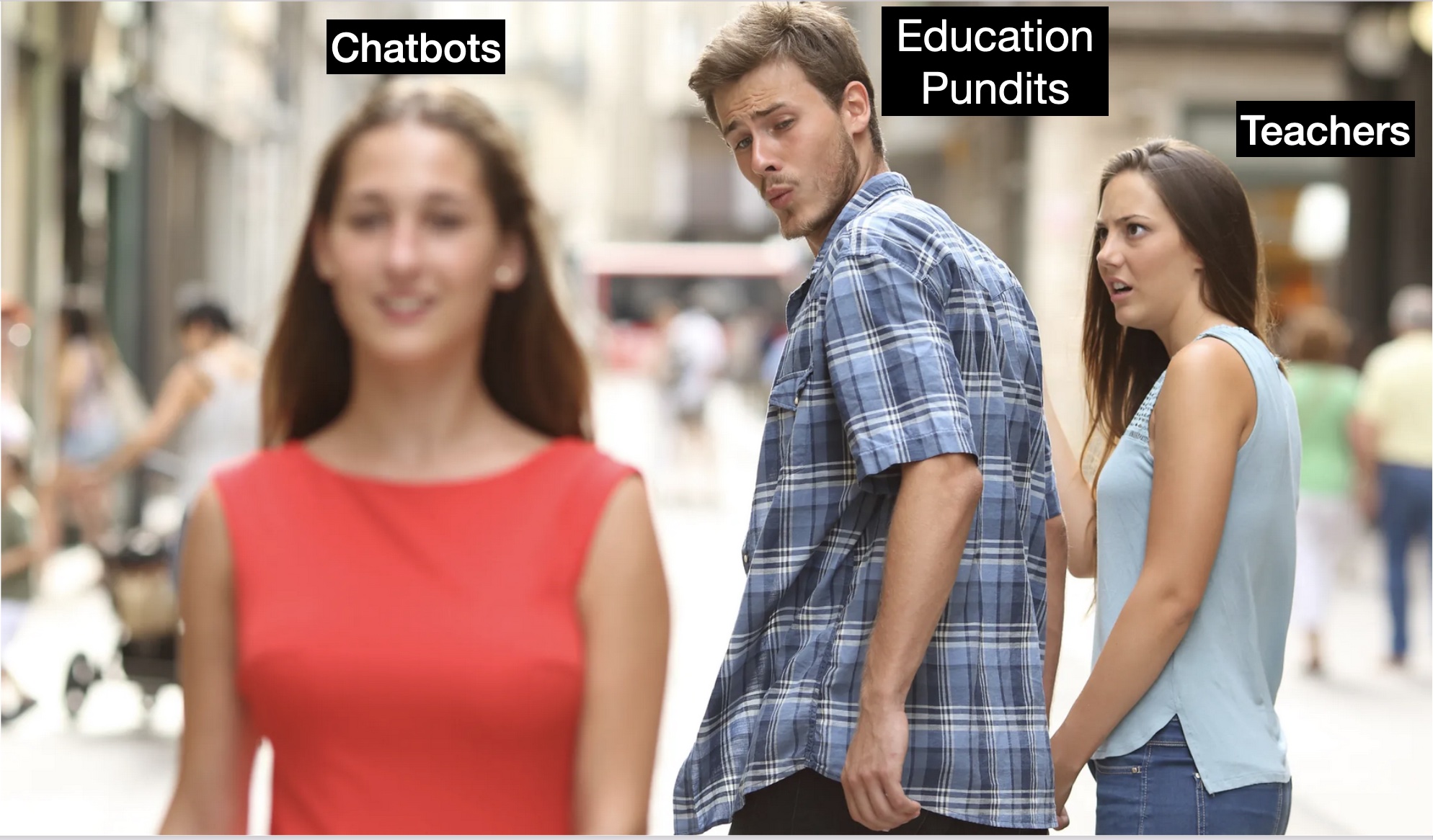
ChatGPT’s responses are entertaining because we know we’re not communicating with a human being. But that’s exactly what you need to encourage the most complex learning.
Human interaction is an essential part of good teaching. You can’t do that with something that is not, in itself, human – something that cannot form relationships but can only mimic what it thinks good communication and good relationships sound like.
Even when it comes to providing right answers, chatbots have an extremely high error rate. People extolling these AI’s virtues are overlooking how often they get things wrong.
Anyone who has used Siri or Alexa knows that – sometimes they reply to your questions with non sequiturs or a bunch of random words that don’t even make sense.
ChatGPT is no different.
As more people used it, ChatGPT’s answers became so erratic that Stack Overflow – a Q&A platform for coders and programmers – temporarily banned users from sharing information from ChatGPT, noting that it’s “substantially harmful to the site and to users who are asking or looking for correct answers.”
The answers it provides are not thought out responses. They are approximations – good approximations – of what it calculates would be a correct answer if asked of a human being.
The chatbot is operating “without a contextual understanding of the language,” said Lian Jye Su, a research director at market research firm ABI Research.
“It is very easy for the model to give plausible-sounding but incorrect or nonsensical answers,” she said. “It guessed when it was supposed to clarify and sometimes responded to harmful instructions or exhibited biased behavior. It also lacks regional and country-specific understanding.”
Eager for any headline that didn’t center on his disastrous takeover of Twitter, Musk endorsed the new AI even though he left the company in 2018 after disagreements over its direction.
However, AI and even chatbots have been used in some classrooms successfully.
Professor Ashok Goel secretly used a chatbot called Jill Watson as an assistant teacher of online courses at the Georgia Institute of Technology. The AI answered routine questions from students, while professors concentrated on more complicated issues. At the end of the course, when Goel revealed that Jill Watson was a chatbot, many students expressed surprise and said they had thought she was a real person.
This appears to be the primary use of a chatbot in education.
“Students have a lot of the same questions over and over again. They’re looking for the answers to easy administrative questions, and they have similar questions regarding their subjects each year. Chatbots help to get rid of some of the noise. Students are able to get to answers as quickly as possible and move on,” said Erik Bøylestad Nilsen from BI Norwegian Business School.
However, even in such instances, chatbots are expensive as yet to install, run and maintain, and (as with most EdTech) they almost always collect student data that is often sold to businesses.
Like this post? You might want to consider becoming a Patreon subscriber. This helps me continue to keep the blog going and get on with this difficult and challenging work.












 gadflyonthewallblog