
Don’t Tread on Me, But Let Me Tread All Over You: The Credo of Personal Freedom and Limitless Greed

AR-801253793 

Every neighborhood has one.


A yellow flag showing a coiled spring of a snake above the motto, “Don’t Tread on Me.”


In my usually well-manicured suburb, you’ll find it waving bravely over the garbage house.


There’s three broken down RVs sitting on the lawn, a busted sofa in the back yard, a rotten picnic bench and several rusted out vehicles in various states of disrepair.


I’m not sure why the owners think anyone would want to tread on them. We’d much rather walk quickly on by without being seen or commented on.


Because in my experience that’s the thing about most of the people who fly this flag.


They’re indignant about anyone stepping on their rights but all too ready to step all over yours.


I remember it wasn’t really too long ago that this flag had no such connotations.


It was simply the Gadsen flag, a relic of the American Revolution. It was nothing more than a reminder of a time when we cherished our national independence from Great Britain and wanted to make sure they knew we didn’t want the King to come back and start ordering us around.


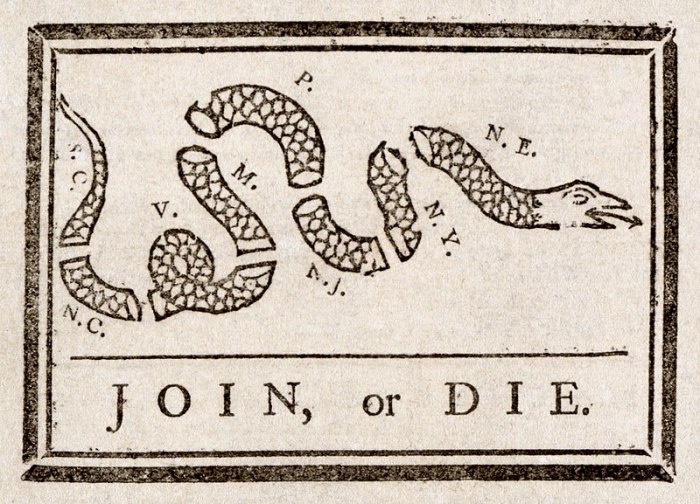
In fact, it was designed by American general and politician Christopher Gadsden in 1775. This “Sam Adams of South Carolina” modeled his patriotic statement first used by the Continental Marines on an earlier famous cartoon from Benjamin Franklin’s Pennsylvania Gazette.
 

800px-Benjamin_Franklin_-_Join_or_Die


You’ve probably seen it. A snake is cut into several pieces – each representing one of the colonies – with the motto, “Join or Die.”


So originally it was a call for unity, perhaps even federalism. It was a way of framing the argument that we’d be stronger as one nation than as a group of separate states.


Gadsen’s version was really a continuation of that same thought. It was as if he were saying, “Here we are, one unified nation ready to strike to protect itself from tyranny.”


It wasn’t until 2009 that Gadsen’s flag became associated with the radical right.


Like so many hitherto nonpartisan symbols, it was appropriated by the Tea Party movement, which tried to cast their libertarian extremism as somehow harkening back to the American Revolution.


Even the name Tea Party is a misnomer. The original Boston members of the Sons of Liberty who threw British tea into the harbor in 1773 were protesting taxation without representation. Modern day Tea Partiers were protesting the taxes levied by their own duly elected representatives.


They were poor people duped into thinking the rich paid too much despite the fact of gross income inequality and the wealthy not paying their fair share.


It’s this willful ignorance that typifies the contemporary right.


The truth doesn’t matter. It only matters what can be spun into a pithy sound bite that can be broadcast on Fox News or some other propaganda source and then repeated ad infinitum in place of any real debate or conversation.


To be fair, the left does it, too, but not nearly to the same degree.


When a topic makes the rounds of the 24-hour news cycle, you can hear the same canned responses from right and left on just about every channel regardless of who is speaking. The only difference is that the left usually makes at least passing reference to reality while the right closes its eyes and says whatever it believes to be true with perfect conviction.


The Gadsen flag is a perfect example of this hypocrisy.


The motto “Don’t Tread on Me” has come to mean radical individual freedom.


I can do whatever I like and there’s nothing you can do about it.


I can own as many guns as I like. I can teach my kids whatever facts I like. I can discriminate against anyone I like.


But there’s never a mention about other people except to limit what they can do in relation to the speaker.


In short, there’s nothing explicit about making this rule universal – I won’t tread on you if you won’t tread on me.


It’s just don’t tread on me and I’ll do whatever I like in relation to you.


After all, many of these personal freedoms the radical right cherishes actually do impact the rest of us.


Unregulated gun ownership means more shootings, more suicides, more deadly instances of domestic violence, more kids coming to school with semi-automatic guns in their book bags and more malls and theaters slick with bystander blood.


Moreover, if you teach your kids whatever facts you like, that means you indoctrinate them into your worldview. You don’t give them the chance to see the real world for what it is in case they may have different views on it than you do. This impacts both your children and the country, itself, which will have to somehow run with a greater portion of ignorant and close-minded citizens.


And don’t get me started on discrimination! You think you should be able to say whatever you like to whomever you like whenever you like. It’s fine to wear a t-shirt calling Hillary Clinton a “cunt” but when late night comedian Samantha Bee does the same to Ivanka Trump, you’re up in arms!


You think you can support laws that allow bakers to refuse to make wedding cakes for gay couples but are raving mad when a restaurateur refuses service to Sarah Huckabee Sanders!


This kind of sanctimonious duplicity has real world consequences.


Unarmed black people are shot and killed by police at a much higher rate than white people. Yet you won’t tolerate any protest, condemnation or protest. People can’t assemble in the streets, athletes can’t kneel during the national anthem, you won’t even allow the slogan “Black Lives Matter,” because you say, “All Lives Matter,” while in reality you mean “All Lives Except Black Ones.”


You oppose abortion but no one is forcing anyone to have abortions. In your headlong crusade for individual freedom you want to ensure that others don’t have this choice because they might choose differently than you. Or at least they might choose differently than you SAY you do, because when the light of day is cast upon you, we find an alarming number of hypocrites here, too.


There are too many far right politicians who campaign on overturning Roe v. Wade who pressure their mistresses to abort the unwanted issue of their indiscretion.


The underlying cause of such myopia is a perverse focus only on the self.


You look at what you want for you and pay no attention at all to what others should likewise be allowed.


It is the underlying selfishness of post Enlightenment Western thought come back to haunt us.


Hobbes and Locke and Smith told us that greed was good.


It’s what makes the world go round.


You look to your self-interest, and I’ll look to mine, and that’s what’s best for everyone.


However, they forgot that everyone doesn’t have the same power – physical, social, financial or political. Some people are strong and some are weak. Some are rich and some are poor. If you pull the shortest straw at the lottery of birth, you won’t be able to get the same things for yourself as those who won it as soon as the doctor slapped their newborn bums.


So we have layers and layers of class and economics. We have social structures designed to keep black people here and Hispanics there and white people at the top. We have a society that worships the rich and bedevils the poor. We have belief systems that praise one kind of sexuality only and demonizes anything that diverges from that norm. And the most defining thing of any newborn baby is what you’ll find between its legs.


“Don’t Tread on Me” has become a farce.


It’s a maxim hoisted on those with very little individual power to convince them to join together and become powerful while guarding the door for the wealthy.


They sit atop their mountains of trash as if they were dragons on piles of gold.


And they point their pitchforks at the rest of us as if we wanted a piece of it.


In this way, they make themselves the willing patsies of the ruling class.


It’s a sad thing to behold.


Because if we all just stopped for a second and recognized our common humanity, we’d agree that the status quo is unacceptable.


If we were more concerned about the rights of all than just our own rights, we’d agree that the wealth of this great nation has not been fairly distributed.


The snake is coiled and ready to strike but it is pointed in the wrong direction.


It shouldn’t be pointed at 99% of us. And it shouldn’t be so solitary.


It should be a sea of snakes, a great slithering mass of humanity, hissing and spitting with venom, our reptilian eyes focused on the elites.


Don’t tread on me?


Don’t tread on USSSSSSSSSSS!


Like this post? I’ve written a book, “Gadfly on the Wall: A Public School Teacher Speaks Out on Racism and Reform,” now available from Garn Press. Ten percent of the proceeds go to the Badass Teachers Association. Check it out!

WANT A SIGNED COPY?

Click here to order one directly from me to your door!

book-3

The Necessity and Importance of Teachers

teacher-elementary-Getty-blog


Are teachers necessary?


That’s the question big business is asking.


Well, “asking” isn’t really the right word. They’re implying an answer.


Hedge fund mangers and ed tech soothsayers are betting hundreds of millions of dollars that educators aren’t really all that important.


They’re planning a future where real live people play a much smaller role in student learning.


They’re mapping out a world where kids don’t even have to go to school to grasp the basics, where learning can be accomplished anywhere but instigated, tracked, and assessed on-line through various computer platforms.


It’s called a learning ecosystem, personalized learning, competency based or individualized education. With little to no guiding principles, management or oversight, kids would engage in educational tasks on various devices in order to earn digital badges.


Children would bounce from a few hours of Khan Academy videos here to a software package there and Voila! “Modern” education!


It’s a brave new world where investors hope to make a bundle by reducing the cost and pocketing the savings.


Since teachers are the biggest cost, they’re the first things to go.


Since their rights as workers and human beings are a roadblock on this learning superhighway, they’re the first to go.


And since they’re in a prime position to see exactly what’s going on and to object when this ed tech paradise exploits the students it ostensibly is being built for, they MUST go – now, as soon as possible.


The Supreme Court’s recent decision in Janus v AFSCME is part of that process. It’s another way to weaken labor and clear the path for business – the collusion of politics and corporations to steamroll the rest of us and swipe more of our money regardless of the children in the steamrollers way.


So when I ask “Are teachers necessary?” it’s not a purely philosophical question.


The answer will have a major impact on both the education of today and where we go in the future.


If teachers are not necessary, that removes one of the biggest obstacles to this frightening and uncertain future.


Unfortunately, no matter how much I want to answer in the affirmative that teachers are necessary, I can’t do so.


Even after thousands of years of recorded history, learning remains a mysterious process. Yet it doesn’t take much reflection to realize that it can take place without the presence of a teacher.


Some things can be figured out solely by the learner in the right circumstances.


In fact, many academic studies have shown that teachers are not even the most important factor in the process.


Roughly 60% of academic achievement can be explained by family background – things like income and poverty level. School factors only account for 20% – and of that, teachers account for 15%. (see Hanushek et al. 1998; Rockoff 2003; Goldhaber et al. 1999; Rowan et al. 2002; Nye et al. 2004).


Estimates vary somewhat from study to study, but the basic structure holds. The vast majority of impact on learning comes from the home and out-of-school factors. Teachers are a small part of the picture. They are the largest single factor in the school building, but the school, itself, is only one of many components.


In short, teachers are not necessary to student learning.


But neither are doctors necessary to healing or lawyers necessary to acquittals.


Necessity is a very high bar.


To survive, you need food, shelter and clothing. However, having all three does not mean you have a good life. Slaves had all three – no free person would choose to trade places with someone in generational servitude simply because they had everything they needed to survive.


The same with medicine. If shot in the arm, you could provide me with all the medical equipment necessary to remove the bullet, but I would still have a difficult time doing it by myself. I COULD. A doctor is not NECESSARY for that operation. But without a doctor present, my chances of getting the best medical care drop dramatically.


Moreover, you could pop me in a courtroom without the benefit of legal counsel and it’s not impossible that I could argue my way to the dismissal of all charges against me. But the likelihood of doing so is infinitesimal – as undocumented youngsters are discovering when forced into the courtroom to defend against deportation without an attorney or even their parents present.


The same is true of education.


Though teachers are not necessary to learning, they are vital to it.


Having a teacher dramatically boosts a student’s chances, and the more disadvantaged that student is, the more he or she benefits from an educator.


The academic schemes of the corporate class amount to changing the field into the equivalent of an automated teller or a business robocall.


You can purchase your groceries through the self-checkout line. You can get your customer service from an automated list. But neither of these are the highest quality service.


They are cheap alternatives.


They are ways for the business to cut costs and boost profits. Neither have anything to do with making things better for the customer.


And when it comes to education, eliminating (or even drastically reducing access to) the teacher will decrease the quality of the service beyond recognition.


A 2009 report, Poverty and Potential: Out-of-School Factors and School Success, released by the Great Lakes Center for Education Research and Practice outlined several real world solutions to increase academic outcomes. None of them involve the elimination of teachers.


They are:


1. Reduce the rate of low birth weight children among African Americans

2. Reduce drug and alcohol abuse

3. Reduce pollutants in U.S. cites and move people away from toxic sites

4. Provide universal and free medical care for all citizens

5. Insure that no one suffers from food insecurity

6. Reduce the rates of family violence in low-income households

7. Improve mental health services among the poor

8. More equitably distribute low-income housing throughout communities

9. Reduce both the mobility and absenteeism rates of children

10. Provide high-quality preschools for all children

11. Provide summer programs for students from low-income homes to reduce summer losses in their academic achievement.


These are ways you improve education FOR CHILDREN.


This is how you make things better FOR THE LEARNER and not necessarily for the investor class.


And when it comes to teachers, there are numerous ways you can help them provide support for students.


First of all, hire more of them!


Today’s public schools employ 250,000 fewer people than they did before the recession of 2008–09. Meanwhile enrollment has increased by 800,000 students.


So if we wanted our kids to have the same quality of service children received in this country only a decade ago, we’d need to hire almost 400,000 more teachers!


That’s how you cut class size down from the 20, 30, even 40 students packed into a room that you can routinely find in some districts today.


And if you want to improve the quality of the teachers in those classrooms, here’s an easy fix – pay them.


According to the Economic Policy Institute, teachers in the United States make 14 percent less than people from professions that require similar levels of education.


Sadly, it only gets worse as time goes on.


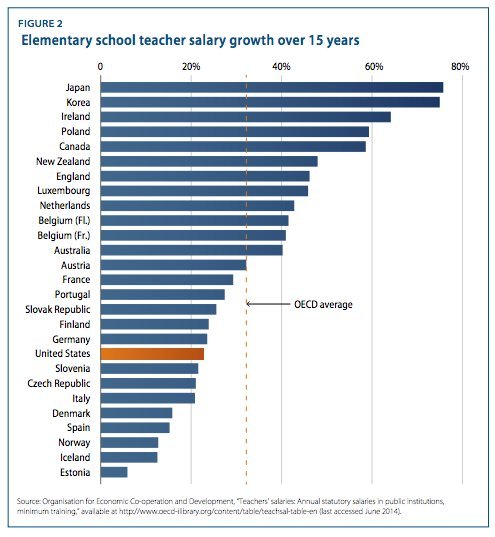
Teacher salary starts low, and grows even more slowly.


original


According to a report by the Center for American Progress, on average teachers with 10 years experience only get a roughly $800 raise per year. No wonder more than 16 percent of teachers have a second or third job outside of the school system. They simply can’t survive on the salary.


They can’t buy a home or even rent an apartment in most metropolitan areas. They can’t afford to marry, raise children, or eke out a middle class existence.


If you want to attract the best candidates to the profession, you need to make it more attractive. One way to do that is to increase the salary.


And finally, stop micromanaging everything teachers do and stomping on their rights. To do their job effectively teachers need autonomy. They need the ability to make decisions on the ground based on the empirical evidence gathered in the classroom.


Moreover, they need the freedom to speak out when something is going wrong in their buildings or districts. When software packages are purchased that spy on students for corporations, they need the ability to sound the alarm. When high stakes standardized testing is out of control, they need to be able to voice their objections. When shoddy, second-rate academic standards are forced onto them by politicians and business people, they need to be able to blow the whistle.


To do that, they need their union protections. They need collective bargaining rights to give them the power to counterbalance the forces of greed and corruption that have always been at the schoolhouse door.


As a country we have taken our attention away from what’s really important. We’ve stopped focusing on how to make education better and instead equated it with how to make it more profitable for those who are already wealthy.


Teachers are vital to education. They are lifelines to struggling students. We should find ways to support them and not constantly undercutting their social standing, autonomy and rights.


The importance of teachers is beyond doubt. As is the importance of society in supporting them.


Like this post? I’ve written a book, “Gadfly on the Wall: A Public School Teacher Speaks Out on Racism and Reform,” now available from Garn Press. Ten percent of the proceeds go to the Badass Teachers Association. Check it out!

WANT A SIGNED COPY?

Click here to order one directly from me to your door!

 

book-1

This Fathers Day Let’s Be Worthy of Our Children

Fathers-Day-Gifts-for-Kids-to-Make


My daughter wrote me a card for Father’s Day.


It had a heart on the front and the following message on the back:


“Happy Fathers Day! Dad, you are my superstar. You help me when I’m sad. And I love everything you do for me. That is why I wish you a Happy Fathers Day.”


It was a sweet token of affection from a 9-year-old to her sleepy daddy sitting at the kitchen table.


But it got me thinking.


All over this country fathers are probably receiving something similar from their children.


Hawaiian shirts, blotchy neckties and more finger paintings than you could fit in the Louvre.


But the sentiment is probably the same.


Thank you for being there for me.


But are we there for America’s children?


We may be there for our own kids, but where genetics end, are we there for others?


Our government has separated approximately 2,000 children from their parents at the border, according to the Department of Homeland Security.


Two thousand children forcibly separated from their parents in our name and we dare to celebrate Father’s Day?


From April through May, the policy has separated 1,995 minors from 1,940 adults traveling with them who said they were the children’s guardians.


A country that doesn’t respect the rights of parents – even if those parents aren’t documented US citizens – has no right to pretend it values fatherhood or motherhood.


At best, we value WHITE parenthood, and that, my friends, is not good enough.


Look at what we subject our own children to in the public school system.


We segregate our schools by race and class so we can horde resources for wealthy and middle class white kids while providing the bare minimum to the poor and children of color.


In the name of accountability we bestow upon them high stakes standardized tests to “prove” even those meager funds are wasted – yet we ignore the financial disparity, the social problems, the health issues and a host of other obstacles the underprivileged face.


The only help we’re willing to offer is privatized schools that can pocket a portion of their funding and reduce resources for these kids. We demand local control and democratically elected school boards for rich white kids, but expect the poor brown ones at charter and voucher schools to get along with appointed boards where their parents have no choice except to take it or leave it.


Does a society that routinely treats its children this way deserve a thank you card? I think not.


Last month, the CDC released a report indicating that the U.S. birth rate ― the number of babies born nationwide ― is the lowest it’s been in 30 years and is below the “replacement” rate needed to sustain the population.


Various media sources were quick to blame women nationwide. Women put off having kids because they want to focus on careers. They aren’t sexy or submissive enough.


Yet few look at the responsibilities of men in this equation.


Who is it behind the salary gap between men and women? Who conflates women’s healthcare with abortion and communism? Who makes it easier to get a gun in this country than proper maternity leave, childcare or any adequate resources to make having a family sustainable?


Answer: men.


We’re grossly over-represented in government, business and management.


We don’t even support men who want to have families. Men make more money than women, but salaries are down for them as well. If there’s little support for pregnant women, there’s little support for the fathers who impregnated them.


We pretend family values are the bedrock of our society but we don’t do much to support families.


And when we look to the future, it doesn’t appear to be getting any better.


Big business and huge corporations are salivating all over the prospect of further monetizing our children.


They’re piloting scores of so-called personalized learning programs, apps and devices to spy on children and monitor every aspect of their learning.


Not only are they asking kids whether they feel excited or bored by canned test prep lessons provided on-line, they’re focusing cameras on children’s faces, monitoring their breathing and heart rate. They’re collecting mountains of data with little accountability, privacy or even the promise of these things.


Investment bankers and hedge fund managers are funding these programs and more to create a priceless database on each individual child that can be used for lifelong marketing, job placement, even profiling by law enforcement.


These are not practices that are done in the best interest of children. They are in the best interest of investors and free market privateers.


No wonder fewer people are having children! They don’t want their kids to become helpless victims to a society that cares less and less about our humanity and more and more about our marketability.


It is us vs. them – where the us is significantly limited by race, economics and class.


So this Fathers Day, we need to do more than accept a congratulatory pat on the back.


We need to accept our responsibility for the status quo.


If we don’t like the way things are, we need to commit ourselves to doing something about it.


Call and/or write your Senators and Representatives about the policy of separating undocumented parents and children. Visit your lawmakers’ offices and demand fair funding and an end to school segregation, high stakes testing and school privatization. Get active in your local school district going to meetings and making your voice heard. Do everything you can to educate the powers that be on the coming Ed Tech scandal and remove or block it from your district.


We’re not just fathers on Fathers Day.


We’re fathers all year long.


Let’s do something more to deserve it.


Like this post? I’ve written a book, “Gadfly on the Wall: A Public School Teacher Speaks Out on Racism and Reform,” now available from Garn Press. Ten percent of the proceeds go to the Badass Teachers Association. Check it out!

WANT A SIGNED COPY?

Click here to order one directly from me to your door!
book-3

Don’t Worry About Grade Inflation. Worry About Grading Fairly.

your-childs-grades-go-down-1494627682


Hard work should be rewarded.


If you earn an A in a given class, you should get an A on your report card.


And this is true no matter how many of your classmates work just as hard as you do.


If everyone in class gives it their best shot, they should all get A’s. It is not the teacher’s job to split hairs and sort kids into arbitrary categories in order to preserve a monetary myth about grades’ value based on a model of scarcity.


Those who demand otherwise are under the spell of one of the oldest myths in academia – grade inflation.


It goes like this: You can’t give all your students excellent marks! That would devalue what it means to get an A!


To which I reply: Bullshit.


Almost every plane that leaves an airport lands safely. Does that devalue what it means to travel? When you arrive at your destination, are you upset that everyone else has arrived safely or would you feel better if some of the planes crashed?


According to the American Journal of Public Health, 93% of New York City restaurants earn an “A” from the health department. Does that shake your faith in the food service industry? Would you feel better if more restaurants were unsanitary? Would your food digest more efficiently if there were more people going home with stomach pain and food poisoning?


Of course not! In fact, these stats actually reassure us about both industries. We’re glad air travel and eating out is so safe. Why would we feel any different about academia?


The idea of grade inflation is a simple imposition of the concept of economic value onto learning. It has no meaning in the field of academics, psychology or ethics. It is just some fools who worship money imaging that the whole world works the same way – and if it doesn’t, it should.


It’s nothing new.


Conservatives have been whining about grade inflation for at least a century. It’s not that the quality of teachers has declined and they’re letting all their students pass without doing the work. It’s that certain types of curmudgeons want to justify their own intelligence by denying others the same privilege.


It’s the “I’ve Got Mine” philosophy.


We see the same thing with Baby Boomers who grew up in the counter culture and pushed for progressive values in their youth. Once they got everything they wanted for themselves, they became conservatives in their old age and worked to deny the same things for subsequent generations.


It’s the very definition of Age scoffing at Youth – a pathology that goes back at least to Hesiod if not further. (Golden age of man, my foot!)


Moreover, there is no authentic way to prove grade inflation is actually happening. Grades are a subjective measure of student learning. They are human beings’ attempt to gauge an invisible mental process. At best they are frail approximations of a complex neural process that is not even bounded temporally or causally. If a student doesn’t know something now, they may come to know it later even without further academic stimulus. Moreover, isolating the stimulus that produced the learning is also nearly impossible.


The important thing is not grade inflation. It is ensuring that grades are given fairly.


If students work hard, they should be rewarded.


I am very upfront with my students about this. And doing so seems to have a positive and motivating effect on them.


This year, I had students who told me they had never read a book from cover-to-cover before my class. I’ve had students look at their report cards in shock saying they’ve never received such high marks in Language Arts before. And doing so makes them want to try all the harder next year to repeat the results.


They leave me excited about learning. They feel empowered and ready to give academics their all. Because the greatest lesson a teacher can instill is that the student is capable of learning.


Don’t get me wrong. I don’t just hand out these grades. Students have to earn them. They have to demonstrate that they have actually learned something.


Everyone rarely measures up to the challenge. But that’s not the point. Everyone COULD. There is nothing in my design that prohibits that outcome. I don’t start with the assumption that I’ll only have 3 A’s, 4 B’s, 10 C’s, etc.


In fact, it is THAT scarcity model that dumbs down academics. If I grade on a curve like that, I have to give out a certain number of high marks regardless of achievement. I’m committed to giving out those 3 A’s regardless of whether that trio of students deserve it or not. However, in my abundance model, I give exactly the number of A’s that are deserved. If that’s zero, no one gets an A. If that’s everyone, then everyone gets an A. It all depends on what students actually deserve, not some preconceived notion about how the world works.


To do this, I give very few tests. I just don’t find them to be very helpful assessments.


A test is a snapshot of student learning. It has its place, but the information it gives you is very limited.


Most of my grades are based on projects, homework, essays, class discussion, creative writing, journaling, poetry, etc. Give me a string of data points from which I can extrapolate a fair grade – not just one high stakes data point.


This may work to some degree because of the subject I teach. Language arts is an exceptionally subjective subject, after all. It may be more challenging to do this in math or science. However, it is certainly attainable because it is not really that hard to determine whether students have given you their best work.


Good teaching practices lend themselves to good assessment.


You get to know your students. You watch them work. You help them when they struggle. By the time they hand in their final product, you barely need to read it. You know exactly what it says because you were there for its construction.


For me, this doesn’t mean I have no students who fail. Almost every year I have a few who don’t achieve. This is usually because of attendance issues, lack of sleep, lack of nutrition, home issues or simple laziness.


I only have control over what happens in the classroom, after all. I can call home and try to work with parents, but if those parents are – themselves – absent, unavailable or unwilling to work with me, there’s little I can do.


And before you start on about standardized testing and the utopia of “objectivity” it can bring, let me tell you about one such student I had who was not even trying in my class.


He never turned in homework, never tried his best on assignments, rarely attended and sleepwalked through the year. However, he knew his only chance was the state mandated reading test – so for three days he was present and awake. The resulting test score was the only reason he moved on to the next grade.


Was he smart? Yes. Did he deserve to go on to the next grade not having learned the important lessons of his classmates? No. But your so-called “objective” measure valued three days of effort over 180.


The problem is that we are in love with certain academic myths.


MYTH 1: Grading must be objective.


WRONG! Grading will never be objective because it is done by subjective humans. These standardized tests you’re so in love with are deeply biased on economic and racial lines. Whether you pass or fail is determined by a cut score and a grading curve that changes from year-to-year making them essentially useless for comparisons and as valid assessments. They’re just a tool for big business to make money off the academic process.


MYTH 2: Learning is Economics.


WRONG! Grades are not money. They don’t function in any way like currency or capital. They aren’t something to be bought and sold. They are an approximate indication of academic success. Treating them as a commodity only degrades their value and the value of students and learning, itself.


Treating grades economically actually represses the desire to learn, dispels curiosity and eliminates the intrinsic value of education.


So go ahead – inflate the “value” of your grades.


Give A’s to every student who deserves it.


That’s how you promote learning and fairly assess it.


Like this post? I’ve written a book, “Gadfly on the Wall: A Public School Teacher Speaks Out on Racism and Reform,” now available from Garn Press. Ten percent of the proceeds go to the Badass Teachers Association. Check it out!

WANT A SIGNED COPY?

Click here to order one directly from me to your door!
book-1

School Vouchers and Runaway EdTech Pave the Way for the Destruction of the Very Concept of School

andres


School is where you learn to learn.


A teacher with an advanced degree and decades of experience devotes her time to figuring out what helps you comprehend the world around you.


And, if she’s good, she imparts that lesson to you as well.


Imagine if we took that away.


Imagine a world where there are no schools – just free range children plopped in front of a computer or an iPad and told to go learn something.


No schools, no teachers, just gangs of students walking the streets, stopping along the way to thumb messages to each other on social media, play a video game or take an on-line test.


That’s the world many EdTech entrepreneurs are trying to build.


And school vouchers are helping them do it.


Take Education Savings Accounts (ESAs) and other market based privatization schemes.


Normally, the federal, state and local government collect taxes to fund an individual child’s education, which is then spent at a public or charter school.


At a public school all that money must be spent on the student. At a charter school some of that money can be pocketed as profit by the private company who runs the school.


Public schools provide a better alternative because the funding must be dedicated to the student, living within a district’s coverage area guarantees enrollment, the school must be managed by an elected school board with open meetings and a plethora of other amenities you won’t find at a privatized institution. But at least the charter school is a school!


However, an ESA or other voucher would allow that money to go elsewhere. It could go to funding the tuition at a private or parochial school where organizers can use it however they like – pocketing some and using the rest to help the child as you’ll find in most charter schools.


But as bad as that is, vulture capitalists want to add another destination for that money – let it pile up in the bank where it can be used for discrete education services provided by the EdTech industry.


It’s almost like homeschooling – without the loving parent being in charge.


It goes by many names – a learning ecosystem, personalized learning, competency based or individualized education.


But it’s really a single person cyber school with little to no guiding principles, management or oversight.


Education is reduced to a series of badges students can earn by completing certain tasks.


Reading a book or an article gives you a badge. Answering a series of multiple-choice questions on a reading earns you more badges. And if you’ve completed a certain task satisfactorily, you can even earn a badge by teaching that same material to others.


It’s the low wage gig economy applied to education. We just transform a crappy job market where workers bounce from a few hours of minimum wage labor here to a few hours of minimum wage toil there – all without benefits or union protections – into learning. Children bouncing from a few hours of Khan Academy videos here to a software package there and Voila! “Modern” education!


In short, it’s school without the school or teachers.


And make no mistake, it’s not about improving the quality of education. It’s about providing the cheapest possible alternative and selling it to rubes as innovation.


The wealthy will still get institutions of learning. They will still be educated by the most qualified teachers in the world. They will still learn how to learn.


The best path to becoming a truly educated person involves human interaction and mentorship. You need experienced professional educators who use the empirical evidence they see in the classroom about your child to tailor lessons to their needs. The wealthy would never dream of making their children learn from the academic equivalent of an automated check out aisle or telemarketer robocall.


It is only the poor and middle class who will be released like chickens into the pasture of a learning ecosystem.


And as an added benefit, the badge structure creates a market where investors can bet and profit off of who gains badges and to what degree on the model of crypto-currencies like Bitcoin! So all the stability of the pre-crash housing market! What could possibly go wrong!?


Let me be clear – this is the ultimate goal of the school privatization movement.


Charter and voucher schools are only the tip of the iceberg. They still require real human beings to act as teachers (though they need not be as well educated or have as much experience as public school teachers). They still require buildings and grounds.


But this depersonalized learning approach allows them to do away with all of that. They can just provide students with an Internet accessible device and some dubious on-line tracking and management system.


Then they can pocket all the rest of the money taxpayers put aside to educate children and call it profit.


And they can use the programs students access to “learn” as a way to gather valuable marketing data about our kids. Everything students do on the device is free market research – every word they input, every keystroke, every site visited down to the slightest eye movement.


This is the logical conclusion of the monetization of education and an economy that only sees value in others as human capital that can be bought, sold and exploited.


This is where the privatization movement is going. And they’re laying the groundwork in legislation being proposed in our state capitals today.


In Pennsylvania, for instance, Senate Bill 2 proposes the creation of just such ESAs. If approved, the immediate result would be to boost private and parochial schools.


However, given a few years to strengthen the technologies and systems needed for a full learning ecosystem, the same law would allow taxpayer money to be used in this way.


And it’s something hardly anyone is talking about.


We’re fighting the privatization systems of today as the plutocrats set up the privatization systems of tomorrow.


Even if school vouchers never take off to the degree necessary to scaffold the most robust learning ecosystems, EdTech lobbyists are trying to install as much of this garbage as they can into our existing schools.


They are using one-to-one iPad initiatives and grants to fund up-to-date computers, Wi-Fi networks and software packages to pave the way for this brave new world of digital exploitation. They are selling our test score obsessed bureaucrats software like iStation and IXL that bridge the gap between test prep and learning ecosystems lite.


You can walk into many schools today where students spend hours on-line earning digital badges for watching videos and taking stealth assessments.


Few people are sounding the alarm because few people understand what’s going on.


This is not conjecture. This is not a conspiracy theory. This is the goal the edtech entrepreneurs will gladly tell you all about hoping you’ll invest.


There are hours of videos, pages of documents, mountains of graphs, charts and graphics about how this scheme will pay off for investment bankers and venture capitalists. (See below)


The only true way to win this battle is a cultural shift away from dehumanizing runaway capitalism.


We need to stop thinking that the private sector is always better than the public good. We need to stop allowing big business and corporations to get away without paying their fair share. We need to increase the voice of citizens and decrease the megaphone of money and privilege.


Otherwise, the science fiction dystopias of books like “Ready Player One” will no longer be fiction.


They will become the reality for every school child in this country.


A reality where school, itself, is a thing of the past.


And education is reduced to the mercenary collection of discrete skills that add up to nothing of value for the students except their own enslavement.


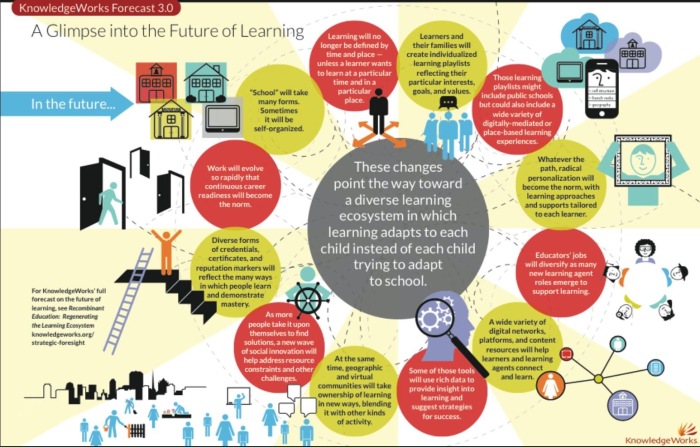
But don’t take my word for it. Here is the learning ecosystems model from the EdTech industry, itself, in corporate officers own words and graphics:

LEARNING IS EARNING – the scariest 6:58 video you’ll ever see.


KNOWLEDGEWORKS Vision for the Future of Education:

IMG_9654

Graphic as a PDF

More on KnowledgeWorks

Listing for PARENTS AS CONSUMERS Symposium

Read all about it here.


FIGHT BACK AGAINST SCHOOL PRIVATIZATION AND RUNAWAY EDTECH:

Like this post? I’ve written a book, “Gadfly on the Wall: A Public School Teacher Speaks Out on Racism and Reform,” now available from Garn Press. Ten percent of the proceeds go to the Badass Teachers Association. Check it out!

WANT A SIGNED COPY?

Click here to order one directly from me to your door!

book-2


The Best Charter School Cannot Hold a Candle to the Worst Public School

Screen Shot 2018-05-24 at 7.43.41 AM.png


There are good charter schools.


I admit that.


There are bad public schools.


I admit that, too.


But if one had to choose between the worst public school and the best charter school, you’d still be better off with the public school.


Does that sound crazy? Does it sound ideological, partisan, or close-minded.


I don’t think so.


Imagine if we said the same thing about tyrannies and democracies.


There are good tyrannies.


There are bad democracies.


Still, I’d prefer the worst democracy to the best tyranny.


Why?


Because even a badly run democracy is based on the principle of self rule. The government gets its right to make and enforce laws from the consent of the will of the governed.


Even if our representatives are corrupt and stupid, even if our federal, state and local agencies are mismanaged and disorganized – there is the potential for positive change.


In fact, the catalyst to that change is embedded in democracy, itself.  Egalitarian systems founded on the principle of one person, one vote tend toward fairness, equity and liberty much more than others.


Bad leaders will be replaced. Bad functionaries will be retrained or superseded. Bad agencies will be renovated, renewed, and made to serve the will of the people.


However, in a tyranny, none of this is true.


Even if you have a benevolent tyrant who does nothing all day but try to do whatever is best for his or her subjects, that is a worse state of affairs.


Eventually the tyrant will change. Absolute power will corrupt him or her absolutely. Or even if this bastion of human goodness is incorruptible, he or she will eventually be deposed, replaced or die.


And there is nothing – absolutely nothing – to ensure the next tyrant is likewise benevolent. In fact, the system is set up to increase the likelihood that the next ruler will be as selfish, greedy and malevolent as possible.


This is because it is the system of tyranny, itself, that is corrupt – even if those that fill its offices are not.


The same goes for good charter schools.


These are schools that are publicly funded but privately run.


As such, the overwhelming majority have no elected school board, their meetings are held in private, their documents are kept secret, they discriminate in enrollment and they take advantage of a plethora of legal loopholes and bad policy to embezzle funds, overcharge for nonexistent utilities and cut services for students while pocketing the “savings” as profit.


If you can find a charter school that does none of these things – congratulations! You have found a diamond in the rough! But it is a diamond that is more likely to turn to coal the second you turn away.


Let’s say you find the rare charter school run by an elected school board. THEY AREN’T REQUIRED TO DO THAT. Organizers could at any time revert to an appointed board. Community members could be making all the decisions when you send your child to school, but by dismissal time they could have all been replaced with flunkies appointed by the private business people who took out the charter from the state in the first place!


Let’s say your charter school has open meetings and public documents. They invite the public to their deliberations. They take public comment and share all their internal communications with taxpayers and the media.  THEY AREN’T REQUIRED TO DO THAT. They could close the doors any day they wanted. And there’s nothing you could do about it.


Why? Because that’s what a charter school is. Despite all the propaganda to the contrary, it is not fundamentally a public school. It is a private school at public expense.


All these things that are optional at a charter school are required at public schools. Not just some public schools – ALL OF THEM!


Public schools are required to have elected school boards (unless taken over by the state). They are required to have open meetings and public documents. They are essentially democratic, whereas even the best charter schools are only democracies because of someone’s goodwill. When the wind changes, so will their system of government.


But that’ not all.


Let’s say you find a charter school that has open enrollment. It accepts every student who applies from its coverage area. Or at least it does so until it runs out of room. If demand exceeds supply, it conducts a lottery to determine which students to let in and which it has to unfortunately turn away.


First of all, if the school doesn’t have open meetings and public documentation, you have no way of knowing whether these lotteries are fair and unbiased. Operators are often charged with cherry picking the best and brightest and denying students with disabilities or behavioral problems – they’ve even been known to discriminate based on race and class.


Second of all, even if your charter school is one of the magical few that just does the right thing with no oversight, THEY AREN’T REQUIRED TO DO THAT. Once they figure out how much money they can save by only accepting the cheapest students to educate, inclusive enrollment policies will be a thing of the past. And you’ll probably never even know the difference.


Public schools aren’t allowed to do that. They have to accept every student from their coverage area regardless of academic deficits, emotional needs, race, religion, class or creed. And if there isn’t enough space, they still can’t turn students away. They have to expand!


And what about the most salient feature of charter schools?


Unlike public schools where all the funding has to be spent on student services, most charter schools are run for profit. They are allowed to cut services for students and swipe the savings for their investors.


Some charter schools don’t do this. BUT THEY CAN! Any day now they could cut little Timmy’s gym class down to twice a week so a shady group of business people in a smoke filled room could stuff a bunch of bills in their own wallets.


Offering French AND Spanish? Adios muchachos. And bonjour to a fistful of dollars going directly into their bank accounts.


All of that is perfectly legal even though it’s your money they’re collecting – money you put aside to help your child learn – there’s not a thing you can do about it.


Sure, you can take your child out of the charter school. But the money funding the school isn’t just your child’s. You’re paying for every student enrolled there. Even if you don’t have kids, you’re footing the bill. And unlike the public school system where you get a voice in how that money is spent, here you don’t get to say a thing.


You just get to pay.


Call me crazy, but I think there’s something wrong with that.


I think that’s worse than even the most decrepit public school.


If a public school has a terrible school board, they can be replaced. In fact, they most certainly will be given time. With each bad policy and unpopular decision, bad school directors motivate taxpayers to vote them out.


This is the exact opposite of charter schools. There is more reason for a charter to replace an elected board with an appointed one so as to increase their autonomy and ability to make money.


Most of the problems with public schools aren’t located in the schools, themselves.


They are the result of strategic disinvestment – archaic funding formulas that allocate less to districts without a large tax base than those in richer neighborhoods. They are the result of segregation schemes that keep the poor and minorities in neighborhoods where they can be ignored and then blamed for their own underprivileged status. They are the result of national and state policies allowed to play the parasite on their budgets – high stakes testing, Common Core and – yes – charter schools.


So, no, I don’t think it’s unreasonable to be so positive about public schools and so negative about charter schools.


The problem with privatized education isn’t just specific to individual schools. It is a feature of the very kind of school we’re talking about in the first place.


Charter schools are at heart a less democratic system than public schools.


Therefore, public schools are always preferable.


I wouldn’t give up my country just because we have an idiot in the oval office. Nor would I give up my public school just because of inadequacies in my local district.


Democracy isn’t for wimps. You have to fight for it.


Those people who are telling you to switch teams are trying to pull the wool over your eyes.


Don’t fall for it.


Public school proud.


Today.


Tomorrow.


Always.


Like this post? I’ve written a book, “Gadfly on the Wall: A Public School Teacher Speaks Out on Racism and Reform,” now available from Garn Press. Ten percent of the proceeds go to the Badass Teachers Association. Check it out!

WANT A SIGNED COPY?

Click here to order one directly from me to your door!

book-4

Modernizing Education Starts With Questioning Our Assumptions

iStock_000040220958_Small-685x485


When it comes to education, we take an awful lot for granted.


For example, we look at learning almost entirely from a behavioral standpoint.


Teachers provide inputs. Students give outputs. And those outputs demonstrate the intended learning.


Yet this framework was developed in the early 1900s. Using it today is to ignore a century of subsequent psychological advancements. It glosses over the impact of the unconscious, the social nature of understanding, physical differences, even the mediating thought processes between stimulus and response such as memory and problem solving.


Instead, we force students into inauthentic laboratory conditions (i.e. the classroom) upon which they are passive actors to be molded and shaped by expert educators.


Every time we post our learning objectives on the board or when we write our lesson plans beginning with the old chestnut – Students Will Be Able To (SWBAT) – we are hearkening back to early 20th Century thinking a hundred years out of date.


We are enshrining a host of assumptions long past their fresh by date:

-Learning is observable.


-It happens immediately.


-It is measurable.


-Once you learn something it never goes away.


-Most problems with learning are attributable to inputs provided by the teacher.


None of these assumptions have been proven.


In fact, there is considerable evidence against each and every one of these premises, yet our entire system of corporate education is based on them like a house built on a foundation.


If we are truly to create a 21st Century school system, the only place to begin is here. Recognize our bedrock beliefs are mere speculation and question whether we should really support everything else that’s been built on such shaky ground.


WHAT IS LEARNING?


It is an empirical fact that human beings are capable of learning. It’s something we do every day. But what exactly does it consist of? What happens when a person learns?


Perhaps it’s best to start with a definition. We generally characterize learning as the acquisition of knowledge; the possession of facts, information or skills.


But how does one gain knowledge? How does one possess the intangible?


It seems that learning always involves thoughts – usually conscious impressions but sometimes unconscious ones, as well. However, not all thoughts qualify, only thoughts of a certain kind.


The notion must be true of the world. And often it is an idea that has surfaced before but that now can be recalled at will and used to create new concepts.


Perhaps I’m wrong, but it seems that no matter how you flesh it out, we’re talking about internal mind states.


Learning takes place in and of the brain. And this has consequences for our education system – an apparatus designed to make these brain states more frequent along certain prescribed lines.


IS LEARNING OBSERVABLE?


That depends. Can we lop off the top of students’ heads and peer at the gelatinous mass inside?


Not really. And even if we could, we wouldn’t understand what we were seeing.


Even if learning may be reducible to a complex set of on-and-off switches among synapses, that does not make it generally observable – certainly not without greater knowledge of how the brain works and advanced neural imaging equipment.


As such, the idea that learning is directly perceptible is not necessarily true. It may be evident in some second hand manner, but this is not the same as first hand experience. At best, what we see is a pale shadow of what’s actually going on in students’ gray matter.


That alone should send shock waves through the edifice of modern corporate education. We’ve built an entire apparatus to label and sort kids based on observing students. If those observations are inadequate to give us the full picture of these internal learning states, our system is likewise inadequate.

WHAT IS THE ROLE OF TEACHER INPUT?


To answer this question we must start further back – when and why does learning takes place.


A student experiences a new neural state that constitutes the acquisition of knowledge. Why?


Does it happen because of the input made by a teacher? Is it the result of experience? Is it the result of some other input – reading, interacting, writing, doing something? Or is it the result of something even the student him- or herself cannot easily identify or explain?


All of these are possible. All of these (and more) are the catalyst to learning at various times.


Thus we lose another premise – that teacher input is the essential cause of inadequate learning. If we cannot place a primacy on the teacher, we cannot wholly place blame there either.


Certainly teachers are important. They can have a tremendous impact on their students. But they are not strictly necessary. They are not even the prime cause of learning. They facilitate learning in the way a doctor facilitates healing. The surgeon may set the broken bone, but it is the body that actually does the healing. And in the case of learning, the action is not entirely involuntary. It is much more active and intentional.


In short, teachers can call students attention to something that sparks learning. They can bring about optimal conditions for learning to take place. But they are not by themselves sufficient for that learning. They cannot make it happen. Insofar as it is voluntary at all, it is up to the student. To give teachers sole reward or blame for student learning is absurd.


IS LEARNING IMMEDIATE?


Learning may be a response to stimulus of some kind. But when does that response take place? Is it immediate?


There is no evidence that it must be so. Certainly there are times when one has learned something immediately. When a child first puts her finger in the flame, she quickly learns to remove it. However, there are some lessons that we don’t learn until many years after that stimulus. For instance, that our parents’ advice was often more sage than we initially gave it credit.


Thus, again it is inadequate to place reward or blame on teachers for their students’ learning. You can judge a teacher for what he or she did to help, but not what you take to be the result. Just because the teacher’s input may not have sparked learning in the student now, that doesn’t mean that the same input might not engender learning at a later date, given time.


IS LEARNING PERMANENT?


Which brings up another question – once you learn something, does it remain yours forever or is it susceptible to degradation?


If learning is an internal state – if it is the result of neural connections like any thought or memory – it is susceptible to fading. It can be lost or degraded.


Therefore, when students enter a class without prerequisite knowledge, it is not necessarily the fault of their previous teachers. Like any skill, memory or thought – recall is enhanced through repetition. Using the knowledge often results in greater retention.


If we want a more intellectual society, we should habitualize critical thinking and reward intelligence in our public interactions. Not the exact opposite.


CAN LEARNING BE MEASURED?


And finally, we are brought to perhaps the most vital question in the field of education – measurement.


What did students grasp and to what degree was it mastered?


There is an entire industry based on providing accurate accounting of learning.


There are corporations making billions of dollars based on providing this service. Moreover, the school privatization industry is almost completely predicated on the “failure” of public schools as shown by the measurements of these testing corporations.


As such, there is a tremendous amount of economic pressure to keep this premise that learning can be accurately measured. However, when looked at logically, it cannot be supported.


When we measure learning, what are we measuring? And how are we quantifying it?


If learning is an internal state, how do we calculate that? Possibly at some point in the future, we’ll be able to look at real time pictures of the brain and be able to tell which information has been learned and to what degree. But we are not at that point now. Perhaps we will never be.


Even if we were, what exactly would we be measuring? What units would we be using? Volts? Amps? Some new element susceptible to subdivision?


The fact that we can’t give a definitive answer to that simple question illustrates how vast our ignorance is of learning. We do not understand what goes on in our own heads that constitutes understanding expect in the broadest possible terms.


Yet how much importance we put on these crude attempts to measure the ineffable!


Grades and test scores are but the rudest approximations of the real phenomena hidden inside our skulls. Yet we sort and rank students on the pedagogical equivalent of cave paintings.


“It is easier to measure the number of semicolons used correctly in an essay than the wonderful ideas contained within it,” said Alfie Kohn. “The more focused you are on measurable outcomes, the more trivial your teaching tends to become.”


Or as Linda McNeil of Rice University famously observed, “Measurable outcomes may be the least significant results of learning.”


Kohn has repeatedly suggested that McNeil’s statement ought to be printed out in “36-point Helvetica, framed, and tacked to the wall of every school administrator’s office in the country” for these same reasons.


When we talk about knowledge and learning, we don’t know what we’re talking about.


CONSEQUENCES


That should make us reluctant to say anything definitive about learning beyond our own ignorance of it.


Yet, as in so much of human affairs, when has ignorance ever stopped us?


We have to go about the business of educating. We have a society to run, markets to establish and consumers to exploit.


Imagine if, instead, we approached learning like explorers or scientists, mapping the shores of our ignorance and determining what helps us comprehend more and better.


There are so many tantalizing clues about what helps students learn, ways to foster the spark of inspiration, creativity and critical thinking.


I wish we were invested in that activity instead of a capitalist sham of education. We talk much about the skills gap between white and black kids without doing anything constructive about it – a chasm predicated on the fact that one category is predominantly poor and the other privileged.


Perhaps we would do better to talk about the ignorance gap of our own understanding of what it means to understand.


Perhaps then we wouldn’t be so bold as to monetize that which is fallacious and foolhardy.


Perhaps then we would be more curious, thoughtful and kind.


Perhaps then we could build a truly modern system of education that values students and not just how they can be transformed into profit.


Like this post? I’ve written a book, “Gadfly on the Wall: A Public School Teacher Speaks Out on Racism and Reform,” now available from Garn Press. Ten percent of the proceeds go to the Badass Teachers Association. Check it out!

WANT A SIGNED COPY?

Click here to order one directly from me to your door!

book-2

The State Penalized My School Because We Tried to Integrate

Screen Shot 2018-05-11 at 3.05.22 PM


The original sin of American education is segregation.


Yet in Pennsylvania, taking steps to integrate can result in a penalty from the state legislature.


That’s what happened to my school this year.


After years of innovation and academic growth, my school added a new program to bring in struggling students from another institution – and the state rewarded us by putting us on a list of “failing” schools and forcing us into a voucher program.


I teach in a racially diverse, high poverty district in the western part of the state, just outside of Pittsburgh.


Charter schools have been leeching off us for years.


But today was the first day school vouchers sunk their teeth into us, too.


It’s called the Opportunity Scholarship Tax Credit Program (OSTCP) – a ridiculous bit of legislation that allows children in struggling public schools to use public tax dollars to pay for tuition at a private or parochial school.


I’d say they could use that money at a participating public school, too, but in Pennsylvania the public schools taking part in the program can be counted on one hand with fingers to spare.


And why does my school now qualify for this dubious distinction? Because of our standardized test scores.


Not our test scores from this year. They won’t be released until at least June – more likely August or September.


This is based on test scores from last year – 2016-17.


Moreover, it’s not district wide. It’s just the middle school and one elementary school.


In previous years, the middle school was the district powerhouse. We had the highest test scores and the most innovation. So what happened?


In short, we integrated.


From a state-wide standpoint, my district is hugely segregated.


About 60% of our students are poor and/or minorities. Yet if you go a few miles north, south, east or west, you’ll find schools serving every flavor of white privilege. Beautiful big buildings with the best of everything and a tax base to pay for it. My district, on the other hand, is made to do the best it can with what we’ve got, which isn’t much.


To make matters worse, the structure within our district, inherited from decades of unenlightened social planning, doubles down on that segregation.


Though we only have one middle school and one high school where all our students rub shoulders, we have two elementary schools – one for the middle class white kids and one for the poorer black ones.


This has dramatic academic consequences. Kids at the better-resourced white school flourish scholastically more than kids from the crumbling black school. So the racial and economic skills gap becomes entrenched by the time kids move to the middle school in 6th grade.


If only we could integrate the elementaries.


However, we can’t bus kids from one neighborhood to the other because we can’t afford it. We have a walking district. Moreover, parents would revolt at the idea of elementary kids having to trudge long distances or take a city bus to school.


The only long-term solution is to create a new, centrally located elementary center serving both populations. However, that takes money we don’t have.


So last year we tried a partial solution – move the 5th grade up to the middle school. That way, we can at least integrate our students a year earlier.


Of course, this means taking kids from the black school with terrible test scores up to the middle school. This means adding more struggling students from the school that already is on the state’s bottom 15% list and making them the middle school’s responsibility. It means a new program, new trials and challenges.


You’d think we’d get praise or at least understanding for tackling such a problem. But no.


Taking on the 5th grade tipped the middle school’s test scores over the edge.


Now we’re in the bottom 15%, too. Now we have to let our students go to a private or parochial school with public tax dollars.


Why? Because we tried to right a wrong. We tried to correct a social and academic injustice. And the result was a kick in the gut.


Thanks, Harrisburg legislators! Way to support students of color!


This is just another way that school vouchers support white supremacy. They make it harder to battle segregation.


Why would anyone integrate if doing so could mean losing funding and looking like a failure in the press?


Moreover, forget all the junk you hear from the state about growth.


This penalty is based on whether we hit testing benchmarks – what percentage of students we have earning proficient or advanced on the tests. It doesn’t matter how much they’ve improved. It doesn’t matter if they’ve gone from the lowest of the low to scratching at the ceiling of proficient.


My 8th graders last year (the year we’re being penalized for) experienced tremendous growth just like my students this year are doing. From where they came in to where they’re leaving, the difference is phenomenal!


But apparently that doesn’t count in Pennsylvania.


A poor school serving mostly underprivileged minorities needs to meet the same benchmarks as schools with Cadillac resources serving kids who have everything money can buy. There’s certainly no need for the state or federal government to do anything about equitable resources (At least, not until the result of a lawsuit is handed down where local districts are suing the state over just such strategic disinvestment).


Instead, we’ve got to offer our student the “opportunity” to go to a private school on the public dime.


And what an opportunity it is!


The chance to send your child to a cooperating private or parochial school at public expense.


The opportunity to lose your duly-elected school board. The opportunity for decisions about how your money is spent being made behind closed doors with little to no input from you. The opportunity to send your child to a school with fewer resources and fewer certified teachers. The opportunity to send your child to (an often) religious school on the public dime.


Wow! I can’t imagine why so few parents take advantage of that opportunity! My district has had a few schools on the OSTCP list before, and families overwhelmingly opt to stay put.


Let’s not forget the justification for this “opportunity” is low test scores.


Wait a minute. These cooperating private and parochial schools don’t even take the same standardized tests, if they take any at all.


In our community, there is only one cooperating private school – a catholic school located right next door.


Students enrolled there don’t take the PSSA or Keystone Exams. I believe they take the Terra Nova test. And the school must do a great job because its Website is three years out of date about the results of those tests.


What a great way to improve test scores for our students – comparing apples-to-pears or, to be honest, actually making no comparison at all.


This OSTCP law is based on an unjustified assumption that private schools are always better than public ones. The reality is that if the resources both schools receive are similar, the public school usually greatly outperforms the private or parochial one.


I’ve seen this first hand. I’ve toured our next door Catholic institution. A few years ago, we relocated our students there temporarily during an emergency drill.


It’s a quaint school. Cobblestones and a shaded green campus.


But the buildings are crumbling – especially on the inside. Watermarks on the walls and dirt collecting in the corners.


It’s also much smaller than my school. They only have less than 300 students from K-8. We have about 1,500 from K-12.


I can see why parents who graduated from that school and have a history with it might want to send their kids there to continue that legacy. But anyone else would be giving up much better facilities, a much wider curriculum, much better trained and experienced teachers and even smaller classes!


The OSTCP bill has nothing to do with providing better opportunities for children and families.


It’s a public tax giveaway to private businesses.


The private/religious schools benefit and so do the businesses who “donate” their taxes to these programs.


In 17 states you can get substantial tax credits for contributing to this scam.


Louisiana, Oklahoma, Pennsylvania, Rhode Island, and Virginia, for example, all provide tax credits worth between $65 and $95 on every $100 donated. Alabama, Arizona, Georgia, Montana, and South Carolina go even further by reimbursing 100% of the donation. You read that right. Donate $100, get $100 back.


Oh, but it gets much worse. Since these are considered donations, you can also claim them as charitable deductions and get an additional 35% off your taxes. So you donate $100 and get back $135! Yes. You actually make money off this deal!


In Pennsylvania, investors can even “triple dip” receiving a state tax credit, a reduction in their state taxable income, and a reduction in their federal taxable income. And, yes, that means they sometimes get back more in tax breaks than they provide in contributions.


Meanwhile all of these “savings” come from money stolen from local public schools like mine. Businesses and individual investors are profiting off the industrial testing complex.


In the Keystone state, we have the OSTCP and the Educational Improvement Tax Credit (EITC).


This blatant swindle is championed on both sides of the political aisle.


We already waste $200 million in business taxes to these programs in the Commonwealth, yet both Democrats and Republicans keep trying to pass another bill to increase that sum by another $50 million.


In Allegheny County, where I teach, that includes Democratic State Reps. Dom Costa, Daniel J. Deasy, William C. Kortz II (who represents part of my school district) and Harry Readshaw.


Because of this bogus philanthropy, there will always be a bottom 15% of state schools – approximately 400 “failing schools” – that are ripe for the picking from private and parochial school vultures.


I’m sorry, but this just isn’t right.


That money should be going to public schools not private or religious institutions many of which espouse fundamentalist or racist teachings.


There is a reason our founders legislated a separation of church and state. We’d do best to remember it.


We could be using our resources to help solve our problems, alleviate segregation and increase equity.


Instead our lawmakers are too interested in giveaways to business and corporations even if that means stealing the money from our children.

Facebook is Censoring Your Favorite Bloggers

finally-thumbs-down-things-you-dislike-facebook.1280x600-970x546

Have you seen me?


Probably not.


In fact, you’re probably not even seeing this right now.


Though you may have read and enjoyed my articles in the past, though you may still want to have the opportunity to see and enjoy my posts in the future, you probably aren’t seeing them anymore.


The reason? Facebook has employed a new algorithm to determine exactly what you’re allowed to see on your news feed.


Like a parent or a government censor, they are scanning your content for certain words, judging your posts based on interactions, and otherwise making choices on your behalf without your consent.


Unless someone pays them to do otherwise. Then they’ll spam you with nonsense – fake news, lies, propaganda: it doesn’t matter so long as money is changing hands.


So homegrown blogs like this one are left in the dust while corporations and lobbyists get a megaphone to shout their ideas across social media.


Look, I don’t mean to minimize what Facebook does. There’s a ton of information that comes through the network that COULD be displayed on your screen. The company uses an algorithm – a complex set of steps – to determine exactly what to show you and when. But instead of basing that solely on who you’ve friended and what you’re interested in, they’ve prioritized businesses and shut down the little guy.


Since Facebook made the change in January, my blog only gets about 40% of the hits it did in years passed. And I’m not alone. Other edu-bloggers and organizations dedicated to fighting school privatization and standardization are reporting the same problems – our voices are being silenced.


And all this is happening after a series of Facebook scandals.


After the whole Cambridge Analytica outrage where Facebook gave the data of 87 million users – without their consent – to a political analysis firm that used it to help elect Trump…


After Facebook sold more than $100,000 in advertisements to Russian bots in 2016 who used them to spread propaganda to help elect Trump…


After enabling the spread of hate speech in Myanmar which allowed the military to engage in “ethnic cleansing” of the Rohingya Muslim minority – which has forced 700,000 people from their homes and across the border into neighboring Bangladesh…


After all that, Facebook still pretends that changing its algorithm is simply a way to crack down on “fake news.”


It’s not.


They are controlling information.


They are policing free expression.


They are NOT cracking down on falsehoods and deception.


In fact, much of what they’re doing is completely devoid of ideology. It’s business – pure and simple.


They’re monetizing the platform. They’re finding new and creative ways to squeeze content providers to gain access to users’ news feeds.


This won’t stop propaganda and fabrications. It just charges a fee to propagate them.


It’s the same thing that allowed those Russian bots to spread Trump-friendly lies in 2016.


It’s pay-to-play. That’s all.


Founder and CEO Mark Zuckerberg characterized the change in January of 2018 as prioritizing content from “friends, family and groups.”


Zuckerberg admitted this means it will be harder for brands and publishers to reach an audience on the social media platform – unless they pay for the privilege. That’s significant because even though organic reach had been diminishing for some time, this is the first time the company admitted it.


Zuckerberg wrote:


“As we roll this out, you’ll see less public content like posts from businesses, brands, and media. And the public content you see more will be held to the same standard—it should encourage meaningful interactions between people.”


What are “meaningful interactions”?


Apparently, what the company calls active interactions are more important than passive ones. So commenting and sharing is more important than just liking something.


In practice that means if you comment on someone’s post, you’re more likely to see things by that person in the future. And if they respond to your comment, their post gets seen by even more people.


Reactions matter, too, as does the intensity of those reactions. If people take the time to hit “Love” for a post, it will be seen by more people than if they hit “Like.” But whatever you do, don’t give a negative reaction like “Sad” or “Angry.” That hurts a post’s chances of being seen again.


I know it’s weird. If someone shares a sad story about their mother with cancer, the appropriate response is a negative reaction. But doing so will increase the chances the post will be hidden from other viewers. Facebook wants only happy little lab rats.


Sharing a post helps it be seen, but sharing it over messenger is even better. And just sharing it is not enough. It also needs to be engaged in by others once you share it.


Video is also prioritized over text – especially live video. So pop out those cell phone cameras, Fellini, because no one wants to read your reasoned argument against school privatization. Or they may want to, but won’t be given a chance. Better to clutter up your news feed with auto-playing videos about your trip to Disneyworld. I suppose us, social justice activists, need to become more comfortable with reading our stuff on camera.


And if you do happen to write something, be careful of the words you use to describe it. The algorithm is looking for negative words and click bait. For example, if you ask readers to like your posts or comment, that increases the chances of Facebook hiding it from others. And God forbid you say something negative even about injustice or civil rights violations. The algorithm will hide that faster than you can say “Eric Garner.” So I guess try to be positive when writing about inequality?


Do you happen to know someone famous or someone who has a lot of Facebook followers? If they engage in your posts, your writing gets seen by even more folks. It’s just like high school! Being seen with the cool kids counts.


One of the best things readers can do to make sure they see your content is having them follow you or your page. But even better is to click the “Following” tab and then select “See First.” That will guarantee they see your posts and they aren’t hidden by the algorithm.


Facebook-News-Feed-update-620x570


I know. I know.


This is all kind of silly, but Facebook is a private corporation. It should be allowed to control speech however it likes. Right?


Wrong.


The social media giant collects a ton of data about its users and sells that to advertisers. As a user, you have to make that Faustian bargain in order to gain free access to the platform. However, as we’ve seen, that data can be used by political organizations for nefarious ends. Private business cannot be trusted with it.


Moreover, there is the echo chamber effect. Facebook controls what users see. As such, the company has tremendous power to shape public opinion and even our conception of reality. This used to be the province of a free and independent press, but after media conglomeratization and shrinking advertising revenues, our press has become a shadow of its former self.


In order to maintain a democratic system that is not under the sway of any one party, faction or special interest group, it is essential that social media providers like Facebook become public utilities.


It must be regulated and free from manipulation by those who would use it for their own ends.


The way things are going, this seems more unlikely than ever.


Our democracy is a fading dream. Fascism is on the rise.


But if we want even a chance of representative government, we need to reclaim social media for ourselves. We need control over what we get to see on Facebook – whether that be a school teacher’s blog or your cousin’s muffin recipe.


In the meantime, do what you can to take back your own news feed.


If you want to keep seeing this blog, follow me on Facebook and click “See First.” Hit “Love” on my content. Comment and share.


The only thing standing in our way right now is a brainless computer algorithm. We can outsmart it, if we work together.


Hope to be seeing you again real soon.

Rampant Ignorance of What a School Should Be

635880071969781625796021747_Ignorance


From politicians confusing a living wage with a handout—


To a white supremacist teacher podcast.


From a tone deaf government flunky using tragedy to do anything to stop gun violence except regulate firearms—


To a Bronx principal barring a black history lesson during Black History Month.


All-in-all, it’s been a crazy news cycle.


If one thing was made clear during the last seven plus days, it’s this:


Many people have no idea what a school should be.


Take West Virginia, the site of a recently resolved statewide teacher strike.


After years of watching the cost of living rise while wages remained stagnant, educators took to the streets to demand enough money that they wouldn’t have to quit their teaching jobs and look for work elsewhere.


It’s a reasonable request.


Imagine if we didn’t pay doctors enough to afford to practice medicine. Imagine if we didn’t pay lawyers enough to afford to practice law.


Teachers just wanted enough money so they could focus on educating the next generation and still get perks like food and shelter.


However, West Virginia is a self-confessed conservative state where self-identifying conservatives unashamedly explain that a full-throated expression of their conservative values includes the idea that you shouldn’t have to pay people a living wage for a hard day’s work.


Or as state Senator Lynne Arvone (R-Raleigh) put it:


“The teachers have to understand that West Virginia is a red state, and the free handouts are over.”


What, Sen. Arvone? Are you high?


A salary is not a “free handout.”


That’s redundant – there is no such thing as a free handout. Handouts are by definition free. That’s something you would have known had you paid more attention to your third grade language arts teacher. But, whatever.


Moreover, a salary is neither free nor a handout.


It is a fixed regular payment – often weekly or biweekly – made by an employer to an employee in exchange for doing a job.


West Virginia teachers are doing their job. State representatives like Arvone aren’t doing theirs.


They aren’t making teaching an attractive career and thus encouraging the best and brightest to become teachers. When you’ve already got a shortage of people willing to become educators, you have to invest. That’s economics 101! Basic supply and demand.


Admittedly, after 8 days of a state-wide strike, the legislature caved and gave teachers a 5% raise, but only moments before introducing a bill to reduce the requirements to become a West Virginia teacher in the future.


Boom.


It’s like lawmakers are saying: Oh. So you want your raise? Here you go. But the next generation of teachers hired in the state will be more ignorant, less experienced, more unskilled and less professional. In short, they won’t expect to be paid a living wage because we’ve made teaching right up there with being a WalMart greeter!


So there!


If passed, the academic quality of education provided by West Virginia will drop.


But so will the cost. And that seems to be the only thing lawmakers like Arvone and her “conservative” colleagues seem to care about.


You know, I don’t think they know what conservative means, either.


It’s certainly not what a public school should be.


Want another example?


Take Dayanna Volitich, a 25-year-old Florida teacher who allegedly ran a white supremacist podcast until non-Aryans heard it, put two-and-two together and removed her from class.


On a recent episode she bragged about spreading racist and prejudiced ideas to her students.


According to an article in the Huffington Post describing her latest podcast:


Volitich also agreed with her guest’s assertion that more white supremacists need to infiltrate public schools and become teachers. “They don’t have to be vocal about their views, but get in there!” her guest said. “Be more covert and just start taking over those places.”


“Right,” Volitich said. “I’m absolutely one of them.”


Great. Just what we need. An army of undercover white supremacists being encouraged to enter the teaching profession – taking those newly minted minimum wage jobs vacated by more expensive but less biased educators.


As a more than 15-year veteran of the public school classroom, I have some advice for white supremacists thinking about becoming teachers: Don’t.


We don’t want you here.


No one has the time for your warmed over master race lullabies.


We don’t need another generation of privileged white people who think the world owes them something just because of the color of their skin.


We need an America made up of people of all colors and creeds who believe in a meritocracy. You get what you work for, what you earn.


And we need lawmakers to actually create a system that supports this ideal.


We need political parties and grassroots movements to push for such an America.


Nazi propaganda belongs in one place only – the history books. It is not part of our future.


And on a personal note, let me just say that becoming a teacher often makes you more progressive than you were when you started.


I know it did me.


Especially if you work at a high poverty, high minority district like I do.


Your job is to serve students’ needs. You push them to think, you don’t tell them what to think.


If that’s not what you’re up for, you’re not up for being an educator.


Indoctrination is not what school should be.


And that brings me to Betsy DeVos, our billionaire Education Secretary who bought her government position with campaign contributions and political connections.


She went to Parkland, Florida, this week to visit with students, teachers and administrators who survived a school shooting a couple weeks ago.


Or at least that’s what it probably said on the press release.


It was really just a publicity stunt to push for arming teachers instead of sensible gun control.


Parkland students have been rocking it holding demonstrations and speaking truth to power demanding that we keep them safe from future violence by banning assault rifles, mandatory background checks on all gun sales and other common sense measures favored by almost 70% of the nation.


DeVos took about five questions before walking out of her own press conference.


She didn’t meet with students – didn’t even try.


She was just there for a photo op.


Well, time’s up, Betsy.


The next generation isn’t putting up with your tone deaf water carrying. With your own family ties to mercenary soldiers for hire, it’s no surprise you’d be against gun control and in favor of firearms to chase away all the Grizzlies attacking our public schools.


It won’t stop the bloodshed but an increase in gun sales will boost your portfolio.


Arming teachers is one of the dumbest things on an agenda full of real whoppers from this absurd Presidential administration.


Teachers touting guns, shooting it out with armed terrorists – no. That’s not what a school should be, either.


So finally we get to the Bronx, where some dimwit who somehow became a principal told an English teacher not to teach a unit on the Harlem Renaissance.


You know, the Harlem Renaissance – Langston Hughes, W.E.B. Du Bois, Louis Armstrong, Zora Neale Hurston, Duke Ellington… Nobodies like them.


And if that’s not bad enough, she did it in February during Black History Month.


This number crunching pedant thought it was inappropriate because the teacher wasn’t in the social studies department.


This is what happens when you try to put education in a box with things like Common Core. Don’t teach background information, just look at every text divorced from everything else around it – the author’s personal history, what was happening in the world at the time or even how the reader responds to it.


Administrators like this need to take a seat and get out of teachers ways.


This kind of subtly racist micromanaging isn’t a part of what schools should be either.


Schools should be places where dedicated professionals are prized and valued. They’re given the autonomy to teach what they know is important and they make these decisions informed by the empiricism of what their students need.


Schools should be places without prejudice or racism. They should be cultural melting pots free from segregation and preconceived notions. They should be about academic freedom and the joy of learning.


I wish more people understood it.


Maybe then we could work to make our schools and our country more like the ideals of the overwhelming majority of the people living here.


Instead of continually letting the rich and privileged set the agenda.