

Public School is Not For Profit. It is For Children.

Screen Shot 2018-08-28 at 4.14.57 PM


Betsy DeVos doesn’t get it.


But neither did Arne Duncan.


Whether right or left or somewhere in between, the person sitting at cabinet level tasked with advising the President on education matters invariably knows nothing about the purpose of public schools.


Duncan thought it had something to do with canned academic standards and standardized tests.


DeVos thinks it involves vouchers to religious or private schools.


But they’re both as wrong as two left shoes.


Public schools exist for one reason and one reason only – to meet the needs of children.


They aren’t there to enrich the private sector or even provide the job market with future employees.


They exist to teach, to counsel, to inspire, to heal.


And all these other schemes favored by Dunce Duncan and Batty Betsy that purport to meet kids needs while somehow enjoying the totally unintended side effect of enriching wealthy investors completely misses the point.


Public schools serve one purpose – to help the kids enrolled in them.


That’s all.


If someone is getting rich off that, there’s a huge problem somewhere.


Unfortunately, the Secretaries of Education of Donald Trump and Barack Obama aren’t the only ones to get it wrong. Policymakers on both sides of the aisle have lost sight of this fact.


So have pundits and media personalities on Fox News, CNN and MSNBC. So have CEOs and tech entrepreneurs and economists and anyone – really – whom our society seems to take seriously.


Don’t believe me?


Take the latest pronouncement from DeVos, our Secretary of Education.


She announced recently that she was looking into using federal funds to buy guns for teachers to better protect their students from school shooters.


It doesn’t take a genius to see that this is not in the best interests of children.


Teachers with guns mean a MORE dangerous environment for children, not less.


It means escalating the chance of friendly fire much more than boosting the possibility of a kindergarten teacher turning into an action hero.


It means heightening the chance of children getting their hands on these firearms and doing themselves or others harm.


And given the disproportionate murders of people of color even at the hands of trained professionals in the police force, it means children of color being legitimately terrified of their mostly white educators – or worse.


The reason given by DeVos may be to make children safer. But the measure she’s proposing really has nothing to do with them at all.


It’s a boondoggle for private industry – one private industry in particular – gun manufacturers.


Instead of sensible regulations on a product that’s at least as dangerous as items that are much more heavily controlled – such as cold medicine and automobiles – DeVos is doing the only thing she can to protect what she really cares about – corporate profits.


She is using money earmarked “safety” to increase danger.


Or as she sees it – she’s using a government apparatus that could harm the gun industry to instead pad its pockets.


You’ll hear some progressives and moderates decry this move with passion and fervor – and for good reason – but what many fail to realize is that it’s not new.


It’s really just a continuation of a sickness that has crept into our society about how we conceptualize the very idea of school.


We have moved away from the proposition that everything must be done in the student’s best interest and have replaced it with an imperative to benefit business and industry.


After all, what is the push for academic accountability through standardized tests and Common Core but corporate welfare for the testing and publishing industry?


What is the push for charter and voucher schools but government subsidies for school privatization?


High stakes standardized testing isn’t about helping students learn. Neither is Common Core, value-added measures or a host of top-down corporate policies championed by lions of the left and supply-side patriots.


They are about creating a problem where one doesn’t exist: accountability.


“How do we make sure students receive a quality education?” As if this has ever been hard to determine.


In general, the schools with greater needs than funding are where students struggle. The schools where everyone has more than they need is where they excel.


But they try to sweep the issue of inequitable funding and resources under the rug by framing the question entirely about teachers and schools.


In short, instead of asking about an obvious inequality, they hide a preconceived answer in the question: “How do we make sure teachers and schools are actually educating kids?”


Wrong question. But here’s the answer, anyway: Administrators observe teachers and determine if they’re doing their jobs. And school boards evaluate administrators.


In general, the staff isn’t the problem. It’s the lack of resources we give them to work with – everything from crumbling buildings, large classes, narrowed curriculum to a lack of wraparound social services.


It doesn’t take much to see we’re shortchanging our neediest students.


You don’t need standardized tests to tell you that. You don’t need new academic standards. You don’t need to evaluate educators on things beyond their control.


But doing so creates a new market, a need that can be filled by corporate interests unrestrained by the conviction that public schools are not supposed to be a profit-making venture.


People providing services for schools are supposed to make a living – not a killing – off the public’s dime.


The same can be said for school privatization.


Public schools are in no way inferior to institutions that are privately managed. Tax dollars administered by duly-elected representatives in the light of day are in no way less effective or more corrupt than the alternative – letting bureaucrats behind closed doors dole out the money however they choose even into their own pockets.


In fact, just the opposite!


Nor have charter or voucher schools ever been shown to increase student learning without also selecting only the best academic students and shunning those most difficult to teach, providing fewer resources for students and/or operating with greater funding.


But pretending that privatization is a better alternative to democratic rule creates a market, it opens the door so the system can be gamed for profit at the expense of student learning and wellbeing.


That’s why we look in awe at LeBron James, an athlete who uses his fortune to open a school providing all the things society refuses for students of color. A basketball player who refuses to usurp the public’s leadership role in administering that fully public school.


He’s a shinning example of actual philanthropy in an age of bogus philanthrocapitalism. But he’s also proof that his solution is not reproducible large scale.


The rich – even if they are well intentioned – cannot save us. Only the public can support all public schools.


And to do that, we must understand the purpose behind these institutions.


Otherwise, we’ll continue to be trapped on a runaway train where the conductor seems to possess no sense of urgency about slowing down.


We would never have been in this situation – and in fact could right the course even now – if we just took the time to clarify what we were doing and why we were doing it.


We could save generations of children if we stopped cashing in on public schools and realized the reason for their existence.


We could ensure both our present and our posterity.


If only we remembered that one thing.


Public schools are not for profit.


They are for children.


Like this post? I’ve written a book, “Gadfly on the Wall: A Public School Teacher Speaks Out on Racism and Reform,” now available from Garn Press. Ten percent of the proceeds go to the Badass Teachers Association. Check it out!

WANT A SIGNED COPY?

Click here to order one directly from me to your door!
book-4

You Don’t Have to Be Perfect to Fight Racism. But You Have to Try

Screen Shot 2018-08-16 at 1.50.03 PM


I am a white guy who talks about racism.


I teach mostly students of color in a western Pennsylvania public school. I write a blog about education and issues of prejudice. And I participate in social justice campaigns to try and redress the inequality all around me.


But in my quest to be an anti-racist, one of the most common criticisms people hurl my way is to call me smug:


You think you’re so perfect!


You’re just suffering from white guilt.


You love black people more than your own people.


Things like that.


Well, I’ll let you in on a little secret.


I make mistakes.


All. The. Time.


I am just like every other white person out there. But I have recognized certain facts about my world and I’m trying to do something about them.


America is built on the genocide of over 110 million indigenous Americans and the enslavement of 30 million Africans. The idea of concentration camps didn’t originate with the Nazis. Hitler got the idea from U.S. treatment of Native Americans. Racism didn’t end with the Civil Rights Movement. It just changed shape and was hidden in the way we practiced health care, education, and policing all the way to mass incarceration.


And it’s getting worse. Hate crimes have jumped from about 70 incidents a year in the 1990s to more than 300 a year since 2001. And after Trump was elected, 900 bias-related incidents were reported against minorities within the first 10 days.


It does not make me special that I am trying to do what little I can about that. It just makes me human.


That’s it.


I am not perfect.


I am no better than anyone else.


But I am trying to do the right thing.


When I first became a teacher, I had the chance to go to the rich white schools and work with the wealthy white kids. I hated it.


I found that I had a real affinity for the struggling students, the poor and minorities.


Why? Probably because I have more in common with them than the kids who drove to school in better cars than me, wore more expensive clothes and partied with designer drugs.


Does that make me better than a teacher who stayed in the suburbs? No. But hopefully it gives me the chance to make a greater difference against white supremacy.


When I saw how unjust our school system is, I could have gotten out. Law school was definitely an option. So was becoming a technical writer or a job as a pharmaceutical ad rep.


But I dug in and spoke out.


I could have left, but who would be there to speak for my students? Who would speak truth to power about high stakes standardized tests, unaccountable charter and voucher schools, inequitable funding and the boondoggle of Common Core Standards?


So I got active in my union, spoke at rallies, lead marches on incorrigible law-makers and started a blog.


Does that make me better than teachers who kept plugging away at their jobs but didn’t rock the boat? No way. But hopefully I have a better chance at helping change things for the better.


When I saw that politicians in my state wanted to stop the parents of my students from voting by trampling their civil rights with a voter ID law, I started a campaign asking the officials that were tasked with enacting the law to ignore it.


It was a hard battle that made me do things I was not at all comfortable doing. You try asking a public servant on camera to break the law and go to jail for what he knew was right.


Strangely enough, it worked. Along with several other campaigns throughout the state, we got the voter ID law declared unconstitutional by the state Supreme Court.


Some people look at that and other accomplishments and think I’m conceited.


They say I’m a white savior hogging the spotlight for myself and keeping the very people I’m trying to help in my shadow.


That’s not my intention at all.


I wouldn’t be anywhere without the help and support of people of color.


Everything I’ve done in this fight has been with their help and encouragement.


Does that mean I’m impervious to making a racist comment? Does it mean I’ve never participated in a microaggression? Does it mean I see every racist impact of my society and my place in it?


Absolutely not.


I screw up every day.


Multiple times.


But that’s the point. You don’t have to be perfect. You just have to try.


One of the books that has helped guide me on this journey is Dismantling Racism: A Workbook for Social Change Groups, by Kenneth Jones and Tema Okun.


The chapter on “White Supremacy Culture” should be required reading for every activist organization or budding civil rights warrior.


The authors offer a list of characteristics that stem from white supremacy that can affect even the best intentioned of groups and individuals. These norms are difficult to name or identify but can lead to major dysfunction:


“They are damaging to both people of color and to white people. Organizations that are people of color led or a majority people of color can also demonstrate many damaging characteristics of white supremacy culture.”


And the number one characteristic is Perfectionism.


This involves the following bullet points:


  • “little appreciation expressed among people for the work that others are doing; appreciation that is expressed usually directed to those who get most of the credit anyway


  • more common is to point out either how the person or work is inadequate


  • or even more common, to talk to others about the inadequacies of a person or their work without ever talking directly to them


  • mistakes are seen as personal, i.e. they reflect badly on the person making them as opposed to being seen for what they are – mistakes


  • making a mistake is confused with being a mistake, doing wrong with being wrong


  • little time, energy, or money put into reflection or identifying lessons learned that can improve practice, in other words little or no learning from mistakes


  • tendency to identify what is wrong; little ability to identify, name, and appreciate what is right”


Solutions offered to this problem are:


“Develop a culture of appreciation, where the organization takes time to make sure that people’s work and efforts are appreciated;


develop a learning organization, where it is expected that everyone will make mistakes and those mistakes offer opportunities for learning;


create an environment where people can recognize that mistakes sometimes lead to positive results;


separate the person from the mistake;


when offering feedback, always speak to the things that went well before offering criticism;


ask people to offer specific suggestions for how to do things differently when offering criticism.”


These are things we should keep in mind as we try to move forward in this fight.


Certainly white people can be resistant to criticism and see any and every comment or appraisal as personal or demeaning – especially if that remark is made by a person of color.


Frankly, white people need to get a thicker skin about it. We need to realize that this impulse to personalize analysis is often a psychological attempt to avoid looking at oneself and what unconscious aspects of the social order one has internalized.


However, those offering criticism must realize that context is everything. We must create an environment where such remarks are constructive. Otherwise, they’ll do more harm than good.


None of this is easy.


But if we want to be anti-racists, that’s not the job we signed up to do.


Like this post? I’ve written a book, “Gadfly on the Wall: A Public School Teacher Speaks Out on Racism and Reform,” now available from Garn Press. Ten percent of the proceeds go to the Badass Teachers Association. Check it out!

WANT A SIGNED COPY?

Click here to order one directly from me to your door!

book-4

The Only Way to Survive Trump is Together

pam160 


There are days when I feel like a broken man.


And it is Donald Trump who has broken me.


Not his political victories. Not the failures of his opposition.


But the very fact that this piece of shit is President of the United States – that fact sits on my brain like an insect I can’t swat.


On those days my belief in this country wavers and disappears.


Oh, I’ve always recognized its faults, how our reality hardly ever lived up to our ideals. But I also thought that the United States was populated by mostly good people who knew right from wrong.


To run this country we wouldn’t choose an obvious conman, a racist and sexist, a person of low IQ, a man with little to no experience, a reality TV star. We wouldn’t let him pick the next Supreme Court justices. We wouldn’t give him the power to pardon whomever he likes. We wouldn’t give him the ability to write almost whatever he wants into law through signing statements. And we certainly wouldn’t give him the nuclear codes.


But we did.


We did all of that.


Or we allowed it to happen by ignoring a broken electoral system that overturns the popular vote with frightening regularity.


So there he sits in the Oval Office – when he isn’t on vacation at Mar-a-Lago – like a smear of feces on the American flag.


Therapists call this feeling “Trump Anxiety Disorder” and I have it. Boy! Do I have it!


The D.C. Counseling and Psychotherapy Center has identified it as a “collective politically induced anxiety among patients.”


Apparently, Trump’s name comes up frequently in sessions with mental health professionals. Patients say they feel on edge because of the President’s ill-chosen, childish and undiplomatic words, fear of his bad decision making, and anxiety over his xenophobic and prejudicial policies.


Trump Anxiety Disorder is not yet an official diagnosis, but symptoms seem to include lack of sleep, a feeling of losing control and helplessness in an unpredictable political scene, along with endless negative headlines and excessive time spent on social media.


Elisabeth LaMotte, a therapist at the Washington, DC, center, said, “There is a fear of the world ending. It’s very disorienting and constantly unsettling.”


I’m not sure I fear that Armageddon is close at hand, but I certainly feel like the world I thought I knew is unraveling.


Fox News was quick to frame this story as a joke – those silly “libtards” are losing their minds over Trump. But it’s not just people on the left who suffer from the disorder, says LaMotte.


Many Trump supporters feel isolated from friends and family who don’t blindly follow their diminutive Furor. I guess it’s hard to pal around with someone who thinks it’s completely justified to separate children from their parents and lock them up in cages – unless you think the same thing.


Even the American Psychological Association (APA) has recorded a rise in anxiety since the 2016 election that increases depending on how political a person is regardless of affiliation.


The APA also noted that electronic news consumption increases that risk.


In my own case, my symptoms manifested physically on Election Day, itself.


I literally had a heart attack in 2016 after casting my ballot. And I had another one a short while later.


The first one may have had something to do with depression over the political options.


I didn’t know Trump would win. I thought the chances of it were infinitesimal. But I didn’t want Hillary Clinton, either.


I wanted Bernie Sanders, and since I thought the Democratic National Convention stacked the deck against him (and therefore voters) in the primaries, I voted for Jill Stein.


In the months since, I’ve run that decision over in my mind a million times.


Was I right? Was I wrong? Could I have given Trump the margin of victory with my one stupid vote?


When I examine all the information I had at the time, it still makes sense.


The media was telling us that there was no way Trump could win. Clinton was going to come storming into the White House and continue or worsen the neoliberal policies of Barack Obama.


As a school teacher, I was concerned that she would continue to wage war on public education – she would continue to boost charter schools and standardized testing while shrugging at funding inequity, increased segregation and the school-to-prison pipeline.


It’s not that I didn’t realize Trump would be worse. It’s that I didn’t think Clinton would be that much better.


But had she won, I don’t think I would be suffering the same anxiety.


We would have a sane and sensible leader who wouldn’t do anything much to make things better, but certainly wouldn’t be plunging us into an abyss. She wouldn’t betray every single American value while blatantly using her office for personal gain and gaslighting anyone who had the temerity to point out what was happening in plain sight.


So maybe some of it is guilt in my case.


Maybe I caused all this chaos. But I’ve looked at the numbers and that doesn’t add up.


Even if my position as a blogger who criticized Clinton (and Trump) convinced thousands of voters to cast ballots like I did, I could not have significantly affected the outcome.


But on those days of doubt and depression, I still feel guilty.


This is not the world I want to live in.


Things would be different if I thought there were any real hope of change.


Sure Trump may be defeated. If there’s a blue wave in the midterms, the orange one may be impeached. Or he may find it increasingly difficult to continue his corruption and be ousted in 2020.


But long term I don’t see much changing.


The Democrats are almost as corrupt as the Republicans.


Don’t give me this false equivalency crap. I’m not saying they’re the same. The Democrats are unequivocally better. But with the exception of social issues, their policies are almost the same as Republicans. The only difference is timeframe.


Republicans will destroy the world tomorrow. Democrats will destroy it next week.


And the system is just not set up to offer any challenge to the duopoly.


I desperately want to believe that insurgent progressives like Alexandria Ocasio-Cortez and Zephyr Teachout will somehow wrest control of the Democrats and steer the party back to real populist goals, but on most days it’s hard to keep that hope alive.


On those days it seems like the rich and powerful own our government and will never allow us to take it back no matter how many of us try to vote, no matter how often we take to the streets, no matter what we do.


We live in a world of shit.


And none of it will ever change for the better.


I don’t want to feel this way.


I still want to believe that the moral arc of the universe is long but it bends toward justice.


But on most days that feels like an illusion.


Is that a mental disorder? Or do I finally see the world for the way it is?


I have no answers.


Perhaps this article has no point.


I only offer it as a mark of solidarity.


If you’re feeling this way, you are not alone.


There are many more out there like you.


I don’t know how we get through this or even if we can. But this much seems certain.


If we are to survive, the only way is together.


So I send out this missive of hope and fear with all my love and a big virtual hug.


Be kind to each other. We’re all we’ve got.


For a peak at my views on more positive days, see HERE and HERE.


Like this post? I’ve written a book, “Gadfly on the Wall: A Public School Teacher Speaks Out on Racism and Reform,” now available from Garn Press. Ten percent of the proceeds go to the Badass Teachers Association. Check it out!

WANT A SIGNED COPY?

Click here to order one directly from me to your door!

Screen shot 2018-01-07 at 1.14.14 AM

Democrats for Education Reform Think Being Progressive Means Mirroring Betsy DeVos


 Screen Shot 2018-08-08 at 12.24.47 PM


Democrats for Education Reform (DFER) put out a new video about what they think it means to be an education progressive.


And by the political action committee’s definition, Betsy DeVos may be the most “progressive” education secretary ever.


She champions “public charter schools.” Just like them!


She is in favor of evaluating teachers on student test scores. Just like them!


She is a booster for “holding schools accountable” through the use of standardized tests. Just like them!


And she loves putting public tax dollars into private hands to run schools “more efficiently” by disbanding school boards, closing public debate and choosing exactly which students get to attend privatized schools. Just like… you get the idea.


But perhaps the most striking similarity between DeVos and DFER is their methodologies.


DFER announced it again was going to flood Democratic races with tons of campaign cash to bolster candidates who agreed with them. That’s exactly how DeVos gets things done, too!


She gives politicians bribes to do her bidding! The only difference is she pays her money mostly to Republicans while DFER pays off Democrats. But if both DeVos and DFER are paying to get would-be lawmakers to enact the same policies, what is the difference!?


Seriously, what is the difference between Betsy DeVos and Democrats for Education Reform?


Progressives in Colorado and California say it is only the word “Democrat.”


Democratic party conferences in both states passed resolutions asking DFER to stop using the name “Democrat” because the privatization lobbying firm does not represent party ideals or goals.


It is degrading what the party stands for and hurting the brand.


Why do some progressives vote third party? Because of groups like DFER.


Voters think something like – if this charter school advocacy group represents what Democrats are all about, I can’t vote Democrat. I need a new party. Hence the surge of Green and other third party votes that is blamed for hurting Democratic candidates.


The Democrats have always been a big tent party, but the canvas can’t shelter the most regressive far right bigotry without destroying the organization’s identity as an opposition party.


It is entirely incoherent to oppose Republicans by pushing for almost the same agenda.


The reason for the confusion is that DFER is not a grassroots organization. It is funded by Wall Street hedge fund managers.


It is not an authentic expression of the public’s wants and desires. It is another avenue for the mega-rich to use their power and influence to tell the rest of us what they want us to believe.


Yet DFER tries to hide this fact with various forms of propaganda. In effect, they’re trying to convince us that their ideas are what we actually believe.


For instance, the group is now offering a nationwide poll from Benson Strategy Group as proof that Democratic voters agree with DFER’s goals.


However, the questions asked to about 2,000 people on the phone are laughably biased:


“Do you believe we have a responsibility to do everything we can to give every child a great education, and does that mean we need faster change in our schools to prepare students for the future?”


Of course people are going to agree with that! It doesn’t mean people want to privatize public schools. We SHOULD do everything – including closing failing charter schools and boosting funding at struggling public schools!


“Do you agree that we can’t go back to the way things used to be in schools? Do you think we need to keep bringing in new ideas and finding new ways to improve schools?”


Of course we need new ideas, but charter schools and standardized tests aren’t new ideas! We’ve been doing that nonsense for decades and they haven’t helped a bit. In fact, they’ve made things worse!


“Do you think funding alone is enough to give our children the education they deserve? Do you also want to see new ideas and real changes to the way public schools operate?”


Of course schools need more than just additional funding. But let’s not minimize funding equity. Students of color will never get an equitable education until we pay for the resources they need to succeed. The poor will never catch up to the rich without money to provide the services they need to learn.


Moreover, blanket statements disparaging public schools before asking about school privatization invites bias against public schools and bias in favor of privatization.


When you couch privatization as “more options” and “choice,” who doesn’t want that? But it’s not what you’re offering.


Giving administrators the ability to accept or deny my child into their school is not “more options” for me. It is greater choice for them.


Slashing funding at the public school because its finances got gobbled up by the neighborhood charter is not “choice” for me. It is providing alternative revenue for the corporations that run the charter school while my only option is to accept fewer resources for my child.


None of this is progressive. None of this is truly supported by grassroots people or organizations.


Civil rights groups like Journey for Justice and even the National Association for the Advancement of Colored People (NAACP) oppose school privatization and high stakes testing.


This is the meat and potatoes of DFER.


The only difference between these alleged Democrats and DeVos is that the Trump administration also champions school vouchers.


But both charters and vouchers involve sending public tax dollars to schools that are privately run. Both involve stripping taxpayers of control over how that money is spent until all we have are parents moving their children from school-to-school in a desperate attempt to find one that does a good job and will also accept their child.


That is not the progressive ideal.


Progressives want to make every public school excellent. They want all children to have the resources they need to succeed. They want to assess students, teachers and the system fairly to clearly understand what children are learning, what educators are doing to help them learn and how administrators and school directors are enabling that success. They want innovation – not the same old corporate-minded top-down policy failures of the past decades. They want technology as a tool to bridge understanding and not as an end in itself to drive the curriculum. They want an end to the school-to-prison pipeline. They want truly integrated schools, not the current segregated system where Cadillac funding goes to rich white districts and the scraps are thrown to the poor brown ones.


Yet DFER, these so-called Democrats, support none of this.


And they’re spending millions of dollars to convince our lawmakers not to support it either.


Politicians can’t keep accepting their dirty money and expecting grassroots voters to continue to support them.


To paraphrase Matthew, no one can serve two masters. If lawmakers are taking sacks of cash from billionaire hedge fund mangers, they aren’t going to listen to you or me.


They can serve their constituents or mammon. Not both.


So if Democrats want strong support in the coming elections, they need to do the progressive thing.


Stop accepting bribes from dark money influence peddlers like DFER.


Like this post? I’ve written a book, “Gadfly on the Wall: A Public School Teacher Speaks Out on Racism and Reform,” now available from Garn Press. Ten percent of the proceeds go to the Badass Teachers Association. Check it out!

WANT A SIGNED COPY?

Click here to order one directly from me to your door!
book-2

Resistance to High Stakes Testing Persists as Media Celebrates Its End

GettyImages-465529004.0.0


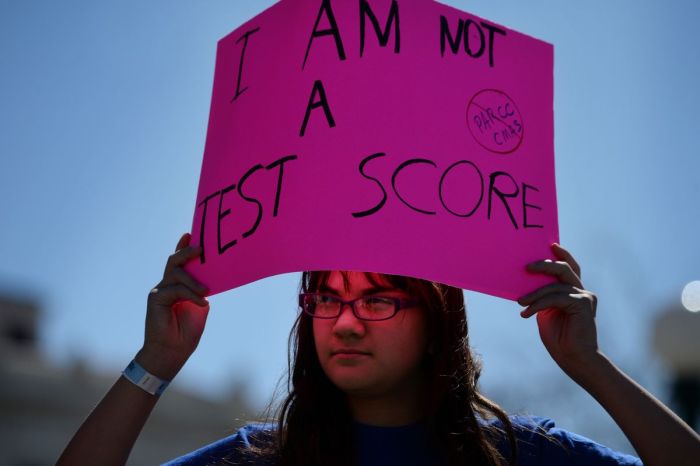
There has never been more opposition to high stakes standardized testing.


Yet the corporate controlled media is pretending that the resistance is over.


Parents are refusing to let their kids take these tests at the same or even greater numbers than ever.


Fewer states require high stakes tests as graduation exams and/or use them to evaluate their teachers. Across the nation, states are cutting the size of standardized tests or eliminating them altogether. And more state legislatures passed laws explicitly allowing parents to opt their children out of the tests.


Yet Education Week published an article a few days ago called “Anti-Test Movement Slows to a Crawl.”


I think we have different definitions of “Slows” and “Crawl.”


That may not be surprising since we also seem to have different definitions of “Anti-Test.”


The Opt Out Movement is not “Anti-Test.” It is anti-high stakes standardized test.


It is against the federal government forcing states to use corporate written, corporate graded and corporate remediated standardized assessments.


It is against the federal government requiring each state to participate in a corporate boondoggle that not only wastes billions of tax dollars that could be better spent to educate children but also unfairly assesses their academic progress and feeds the push to privatize public schools.


Most people against high stakes standardized testing, however, have no problem with authentic teacher-created assessments.


Calling these folks “Anti-Test” is like labeling those pushing for stricter gun regulations “Anti-Gun” or smearing those protesting government corruption as “Anti-Government.”


And that’s just the title!


The author Alyson Klein further misdirects readers by conflating opt out rates and test resistance.


She implied that the only measure of opposition was the percentage of students who opt out. However, as noted above, there are multiple measures of resistance.


Moreover, few states advertise their opt out rates. Especially after the movement began, states made that information harder to come by to dissuade more people from joining it.


Of those states where information is available, Klein puts the most negative possible spin on the facts in order to make her point – a point that it seems to me is not at all justified.


For instance, Klein writes:


“At least some of the steam has gone out of the opt-out movement in states such as New Jersey and New York, considered hotbeds of anti-testing fervor.”


Really?


In New York, Opt out numbers remained at approximately 20% – the same as they have for the past three years.


And New York is one of our most densely populated states. That percentage represents more than 225,000 parents across the Empire State who refused to let their children take the tests despite threats from many administrators and district officials for doing so.


In New Jersey, opt out rates were marginally lower this year than last year. They went from 7% to 5%. But once again New Jersey is a populous state. That percentage represents about 68,500 students.


In addition, this is after massive opt outs three years ago that forced the state to change its federally mandated assessment. Testing boycotts pushed the state education association to get rid of four PARCC assessments and allow students who fail the remaining two tests to take an alternative assessment. And this is in a state where there is no law explicitly allowing parents to opt out of the tests.


I don’t know if I’d call that running out of steam.


Moreover, opt out rates have increased in other states for which we have data. For instance, test refusal is on the rise in heartland states like Minnesota.


And it nearly doubled in Utah over the past two years to about 6%. In some schools in the Beehive State, rates are much higher. According to the Salt Lake Tribune, 1 in 5 students in the Park City school district refused to take the tests.


Though my own state of Pennsylvania has been mum on last year’s opt outs, from my own personal experience as a teacher in suburban Pittsburgh, I never had more students boycott our federally mandated standardized test than I did last year.


There were so many they had to be quarantined in a special room.


Moreover, an increasing number of parents ask me about the issue, express concern and wonder about their rights.


So even when examining just the rate of opt out, I don’t see any reason to assume the movement is slowing down.


On the contrary, it is picking up steam with multiple victories.


As recently as 2012, half of all U.S. states required high school exit exams in order for students to graduate. Today that number has dropped to 12. The reason? Exit exams don’t raise student achievement – they raise the dropout rate. At least that’s what The National Research Council of the National Academy of Sciences tells us.


Another positive sign – seven states have stopped using value added measures (VAM) to judge teachers. This is the highly controversial practice of assessing educators based on their students test scores – a practice that has never been proven fair to teachers or effective in helping students learn. Six states have dropped this requirement altogether: Alaska, Arkansas, Kansas, Kentucky, North Carolina and Oklahoma. Connecticut still gathers the information but cannot use it in the teacher’s “summative rating.” And other states like New Mexico still use value added measures but have reduced the weight given to student test scores.


Moreover, let’s not forget how many states have slashed the size of the high stakes tests they’re giving to students. After the recent wave of opt outs and public outcry, state education departments have ensured that testing at least takes up less time. This includes New York, Maryland, New Mexico, California, Minnesota, Kentucky, Tennessee, Florida, Washington, Illinois, West Virginia, Hawaii, Oklahoma, Ohio, South Carolina, Pennsylvania and Texas. Some of this is because the PARCC test used in 21 states was slashed by 90 minutes.


And when it comes to opt out, two more states – Idaho and North Dakota – now have explicit laws on the books allowing parents to refuse the test for their children – in whole or in part. That brings the total number of states up to 10. It would have been 11, but Georgia Governor Nathan Deal, a Republican, vetoed an opt-out bill. The federal government still wants us to penalize these districts for non-participation in flagrant violation of its authority. But as more states respect parents’ rights on this matter, it will be increasingly difficult for the U.S. Department of Education to continue trampling them.


And speaking of the federal government, some states are taking advantage of the wiggle room in the federal law that governs K-12 education – the newly passed Every Student Succeeds Act (ESSA) – to allow students to avoid standardized testing entirely. Some states are implementation performance assessments instead. Kids can use a portfolio of classwork to demonstrate learning instead of getting a grade on a corporate-written standardized test. New Hampshire, for instance, has pioneered this approach with a program that now involves half the state’s districts.


These are not the signs of a movement that is slowing to a crawl.


It just makes sense that some of the rhetoric of the movement may have become less forceful with the enactment of the federal ESSA.


Many had hoped for a better law – one that did away with federally mandated testing altogether.


And that could still happen sooner than many think. Next year it will be time to reauthorize the law again.


It took Congress six years to reauthorize the federal education law last time. Perhaps our duly elected representatives can be coaxed into doing their jobs a bit quicker this time.


There is already some proposed legislation to make positive changes. Sen. Jon Tester (D-Mont.) and Rep. Krysten Sinema (D-Ariz.) introduced legislation last year to replace annual assessments with grade-span tests. The United States is, after all, one of the only countries in the world – if not the only one – to require students be tested every year. These proposed changes are not nearly enough, but they’re a step in the right direction.


One of the biggest obstacles to abolishing federally mandated testing last time was that some of the oldest and most well funded civil rights organizations opposed it. Many of them get their money and support from the same billionaires who profit off of the standardized testing and privatization industries.


However, that support for testing was short lived. Already the National Association for the Advancement of Colored People (NAACP) has revoked it returning to a call for opposition to testing.


If our nation survives the many crises of the Donald Trump administration, there is no reason our future cannot be bright.


We have the support, we have the tools, we just need the chance to do right by our children.


And the pendulum is swinging back our way.


Like this post? I’ve written a book, “Gadfly on the Wall: A Public School Teacher Speaks Out on Racism and Reform,” now available from Garn Press. Ten percent of the proceeds go to the Badass Teachers Association. Check it out!

WANT A SIGNED COPY?

Click here to order one directly from me to your door!

book-3

Republicans, Democrats – Let’s Scrap Them Both!

abolish-political-parties-49312-560x315


Political parties are a huge mistake.


Our founding fathers knew this.


Though it was their constant squabbling and political power struggles that gave way to the party system in the first place, they also were incredibly vocal about the errors they, themselves, were committing.


Thomas Jefferson and James Madison preferred state power that would protect southern interests including slave-holding. George Washington, John Adams and Alexander Hamilton favored federal authority that would benefit the north and manufacturing.


But in taking sides to protect their own power, they split into the very factions they knew would poison the newborn Republic.


At his farewell address in 1796, Washington put it this way:


“However [political parties] may now and then answer popular ends, they are likely in the course of time and things, to become potent engines, by which cunning, ambitious, and unprincipled men will be enabled to subvert the power of the people and to usurp for themselves the reins of government, destroying afterwards the very engines which have lifted them to unjust dominion.”


His successor, Adams wrote:


“There is nothing which I dread so much as a division of the republic into two great parties, each arranged under its leader, and concerting measures in opposition to each other. This, in my humble apprehension, is to be dreaded as the greatest political evil under our Constitution.”


In 1789, Jefferson put it more succinctly:


“If I could not go to heaven but with a party, I would not go there at all.”


So why do we today enshrine political parties in our system of government?


In short, it keeps the wealthy in power.


Nothing robs democracy of its populism so much as the party system.


Backward legislation and regressive court decisions equating money with speech only make this worse. But they are simply exacerbating a sickness that’s already there.


Political parties condense the world of advertising and commerce to that of government.


Political ideas are sorted and processed until they can become tasty sound bites – one accorded to one group and the corresponding response to another.


Federalism vs. States.


Taxation vs. Business


Guns vs. Regulations


It’s all bullshit.


No one really cares whether rules are made by an aggregation of the entire nation or merely an aggregation from each individual state. We only care that laws are fair and just.


No one really wants businesses to be taxed to death, nor do they want individuals to be unfairly burdened. They want a just system of taxation where everyone pays their fair share and supports an equitable distribution of the wealth.


No one really wants to unilaterally prohibit individual freedoms – including the freedom to own a gun. They want sane regulations so that killers and maniacs can’t as easily destroy innocent lives.


But political parties obscure these simple truths and sort us all into one of two teams. Yet both sides support the same unchangeable status quo.


As writer Gore Vidal put it:


“Officially we have two parties which are in fact wings of a common party of property with two right wings. Corporate wealth finances each. Since the property party controls every aspect of media they have had decades to create a false reality for a citizenry largely uneducated by public schools that teach conformity with an occasional advanced degree in consumerism.”


Part of this is due to our insistence that the party system be limited to two groups – Republicans and Democrats. We make it incredibly difficult – nearly impossible – for any third party candidate to appear on the ballot less than win a major election.


But increasing the party system would only minimize the damage. It wouldn’t stop it.


When issues are divided into political camps, they obscure basic similarities about voters.


Fairness and justice are not political. They are human.


By making them political, we obscure basic truths to convince subsections of the populace onto our side.


And these are rarely legitimate differences of opinion. They are often a matter of truth or falsity.


For instance, take trickle down economics. Either it is a fair and just distribution of wealth or it is not. Either it provides both rich and poor with a means of equitable economic advancement or it does not.


We have tried this policy for decades. There is a plethora of evidence that this system does not work. It unjustly favors the rich and starves the poor.


To understand this, one need not have an advanced degree in political science. A simple understanding of mathematics will suffice.


If there were no political parties, this would be self-evident. But the rich have used both parties to obscure this fact and make it a game of policy football. You support whichever team you’ve signed up for regardless of how doing so impacts you, personally.


It is the victory of tribalism over common sense.


The same goes for almost every issue facing the nation.


Should schools be public or private?


Should LGBT people be allowed the same rights as cis citizens?


Should we spend the majority of our federal budget on the military?


Should there be a path to citizenship for those wishing to immigrate?


Each and every one of these questions could be decided on facts. Instead evidence is hardly mentioned at all. We use the issues to elect the legislators who then can’t do anything about them for fear that action one way or another would upset the political power struggle against them.


Some economists suggest that the principle behind Democrats and Republicans, the principle behind liberals and conservatives, really comes down to economics.


It is an innate psychological reaction to scarcity and abundance.


In times of little food or resources, conservative tendencies are ascendant because they help us survive the lean times. However, in an era where there is enough for all, liberal tendencies flourish because they help the growing population thrive.


Even if this were true, it is a factual question of whether we live in times of abundance or scarcity.


In the 21st Century United States, we have more wealth than we have ever had. There is enough food for everyone. We grow more than we can eat and end up throwing much of it away. Yet a tremendous amount of us live in abject poverty. More than half of public school students live below the poverty line.


This is not because we live in a time of scarcity. We live in a time of abundance where we keep much of that surplus away from the majority in order to create a false sense of scarcity so that the richest among us can horde as much as they possibly can.


That is the ugly truth hidden behind the party system.


It is a truth that could not be maintained without the easy marketing and tribalism of political parties – Republicans, Democrats, Whigs, the Judean Peoples Front or the People’s Front of Judea.


Until we remove the stranglehold of political parties, until we set up a government that makes factionalism difficult, until we establish a government that welcomes candidates regardless of party – our politics will be forever immobilized by wealth, sectarianism and voter apathy.


This could mean holding nonpartisan primaries where all candidates irrespective of party who meet a certain signature threshold are welcome, followed by a general election of the two highest vote-getters. Or it could mean something radically different like not voting at all but filling government with ordinary citizens randomly drafted into public service.


The point is that we can do better than party politics.


If we’re to survive as a nation, we’ll need to find a more just way.


Or as Hamilton put it:


“Nothing could be more ill-judged than that intolerant spirit which has, at all times, characterized political parties.”


Like this post? I’ve written a book, “Gadfly on the Wall: A Public School Teacher Speaks Out on Racism and Reform,” now available from Garn Press. Ten percent of the proceeds go to the Badass Teachers Association. Check it out!

WANT A SIGNED COPY?

Click here to order one directly from me to your door!
ebook-2 (1)

Cyber School Kingpin Gets Slap on Wrist For Embezzling Millions from PA Students

nick-trombetta


Nick Trombetta stole millions of dollars from Pennsylvania’s children.


And he cheated the federal government out of hundreds of thousands in taxes.


Yet at Tuesday’s sentencing, he got little more than a slap on the wrist – a handful of years in jail and a few fines.


He’ll serve 20 months in prison, be on supervised release for three years, and payback the tax money he concealed.


As CEO and founder of PA Cyber, the biggest virtual charter school network in the state, he funneled $8 million into his own pocket.


Instead of that money going to educate kids, he used it to buy a Florida condominium, sprawling real estate and even a private jet.


He already took home between $127,000 and $141,000 a year in salary.


But it wasn’t enough.


He needed to support his extravagant lifestyle, buy a $933,000 condo in the Sunshine State, score a $300,000 twin jet plane, purchase $180,000 houses for his mother and girlfriend in Ohio, and horde a pile of cash.


What does a man like that deserve for stealing from the most vulnerable among us – kids just asking for an education?


At very least, you’d think the judge would throw the book at him.


But no.


Because he took a plea deal, he got a mere 20 months in federal prison.


That’s less than two years in jail for defrauding tens of thousands of students and multiple districts across the Commonwealth.


In addition, once he serves his time he’ll be on probation for 3 years.


And even though there is no mystery about the amount of money he defrauded from the Internal Revenue Service by shifting his income to the tax returns of others – $437,632, to be exact – the amount he’ll have to pay back in restitution is yet to be determined.


One would think that’s easy math. You stole $437,632, you need to pay back at least that amount – with interest!


And what of the $8 million? Though I can’t find a single explicit reference to what happened to it in the media, it is implied that the money was recovered and returned to Pa Cyber.


Yet there seems to be no discussion of a financial penalty for embezzling all that money. If my checking account dips below a certain balance, I’m penalized. If I don’t pay the minimum on my credit cards, I’m charged an additional fee. Yet this chucklehead pilfers $8 million and won’t be docked a dime!? Just paying it back is good enough!?


But what makes this sentence even more infuriating to me is the paltry jail time Trombetta will serve.


The judge actually gave him 17 months LESS than the minimum federal guidelines for this kind of case! He should at least be serving 37 to 46 months – 3 to 4 years!


Nonviolent drug charges often lead to sentences much longer than that!


For instance, in 2010, Kevin Smith was arrested for drug possession. He was locked up in a New Orleans jail for almost 8 years (2,832 days) without ever going to trial!


But then again, most of these nonviolent drug charges are against people of color. And Trombetta is white.


So is Neal Prence, a former certified accountant who pleaded guilty to helping Trombetta hide his ill-gotten gains.


Prence will serve a year and a day in prison and pay back $50,000 in restitution.


It’s a good thing he didn’t have any drugs on him.


And that he didn’t have a tan.


This is what we talk about when we talk about white privilege.


And speaking of that, compare this crime with the sentences given to the Atlanta teachers who were convicted of cheating on standardized tests a few years back.


These were mostly women and people of color.


Tamara Cotman, Sharon Davis-Williams and Michael Pitts received the harshest sentences.

They each got three years in prison, seven years probation, $10,000 in fines and 2,000 hours of community service.


So in America, cheating on standardized tests gets you a harder sentence than embezzling a fortune from school kids.


I’m not saying what the Atlanta teachers and administrators did was right, but their crime pales in comparison to Trombetta’s.


Think about it.


Atlanta city schools have suffered under decades of financial neglect. The kids – many of whom are students of color – receive fewer resources, have more narrowed curriculum and are forced to live under the yoke of generational poverty.


Yet their teachers were told to increase test scores with little to no help, and if they didn’t, they’d be fired.


I can’t imagine why they tried to cheat a system as fair as that.


It’s like being mugged at gunpoint and then the judge convicts you of giving your robber a wooden nickel.


The worst part of all of this is that we haven’t learned anything from either case.


High stakes standardized testing has become entrenched in our public schools by the newly passed federal law – the Every Student Succeeds Act (ESSA).


And though Trombetta resigned from his post as CEO of PA Cyber in September 2013, cyber charters are as popular as ever.


These are publicly funded but privately run schools that provide all or most instruction on-line. Think Trump University for tweens and teenagers.


You can’t turn on the TV without a commercial for a cyber charter school showing up. You can’t drive through a poor neighborhood without a billboard advertising a virtual charter. They even have ads on the buggies at the grocery store!


Yet these schools have a demonstrated track record of failure even when compared to  brick-and-mortar charter schools. And when you compare them to traditional public schools, it’s like comparing a piece of chewed up gum on the bottom of your shoe to a prime cut of filet mignon.


A 2016 study found that cyber charters provide 180 days less of math instruction than traditional public schools.


Keep in mind there are only 180 days of school in Pennsylvania!


That means cyber charters provide less math instruction than not going to school at all.


When it comes to reading, the same study found cyber charters provide 72 days less instruction than traditional public schools.


That’s like skipping 40% of the school year!


And this isn’t just at one or two cyber charters. Researchers noted that 88 percent of cyber charter schools produce weaker academic growth than similar brick and mortar schools.


They concluded that these schools have an “overwhelming negative impact” on students.


AND THAT’S ALL LEGAL!


In Pennsylvania, nearly 35,100 of the 1.7 million children attending public schools are enrolled in cyber-charter schools. With more than 11,000 students, PA Cyber is by far the largest of the state’s 16 such schools.


If Trombetta had just stiffed Pennsylvania’s students that much, he wouldn’t have been in any trouble with the law.


However, he got even greedier than that!


He needed more, More, MORE!


Justice – such as it is in this case – was a long time coming.


Trombetta was first indicted back in 2013 – five years ago.


He was facing 11 counts of mail fraud, theft or bribery, conspiracy and tax offenses related to his involvement in entities that did business with Pa. Cyber. He pleaded guilty to tax conspiracy almost two years ago, acknowledging that he siphoned off $8 million from The Pennsylvania Cyber Charter School.


He has been free on bond all this time.


His sister, Elaine Trombetta, agreed to cooperate with prosecution, according to federal court filings. She pleaded guilty in October 2013 to filing a false individual income tax return on her brother’s behalf and has yet to be sentenced.


It was only yesterday that her brother – the kingpin of this conspiracy – was ultimately sentenced.


Finally, he’ll have to face up to what he did.


Finally, he’ll have to pay for what he’s done.


Just don’t blink or you’ll miss it.


Like this post? I’ve written a book, “Gadfly on the Wall: A Public School Teacher Speaks Out on Racism and Reform,” now available from Garn Press. Ten percent of the proceeds go to the Badass Teachers Association. Check it out!

WANT A SIGNED COPY?

Click here to order one directly from me to your door!
book-2

Since School Vouchers Don’t Increase Test Scores, Racism is an Acceptable Reason for Privatization, Says Advocate

Screen Shot 2018-07-24 at 10.20.41 AM

For decades, school voucher advocates claimed that sending poor kids to private schools with public tax dollars was acceptable because doing so would raise students’ test scores.


However, in the few cases where voucher students are even required to take the same standardized tests as public school students, the results have been dismal.


In short, poor kids at private schools don’t get better test scores.


So why are we spending billions of public tax dollars to send kids to privately run schools?


A 2018 Department of Education evaluation of the Washington, D.C., voucher program found that public school students permitted to attend a private or parochial school at public expense ended up getting worse scores than they had at public school.


Their scores went down 10 points in math and stayed about the same in reading.


These are not the pie in the sky results we were promised when we poured our tax money into private hands.


However, corporate education propaganda site, The 74, published a defense of these results that – frankly – makes some pretty jaw dropping claims.


The article is “More Regulation of D.C. School Vouchers Won’t Help Students. It Will Just Give Families Fewer Choices for Their Kids” by far right Cato Institute think tanker Corey DeAngelis.


In his piece, not only does he call for less accountability for voucher schools, he downplays the importance of standardized test scores.


And he has a point. Test scores aren’t a valid reflection of student learning – but that’s something public school advocates have been saying for decades in response to charter and voucher school cheerleaders like DeAngelis.


Supply side lobbyists have been claiming we need school privatization BECAUSE it will increase test scores. Now that we find this claim is completely bogus, the privatizers are changing their tune.


But that’s not the most shocking irony in DeAngelis article.


Parents don’t really care about the scores, he says. Instead they send their children to voucher schools because… You know what? I’ll let him tell it.


“Families choose schools for their children based on several important factors, including culture, individual attention, and, of course, safety. Research tells us that parents — unsurprisingly — often value these things more than standardized test scores.”


Certainly parents prefer their children have more individual attention. But many private schools have larger class sizes than public schools.


Moreover, reducing class size at all schools would be a more equitable reform than letting some kids enjoy smaller classes if they can just get into the right school.


However, it is his other two claims that sent my racist dog whistle senses tingling.


So parents don’t like the CULTURE of public schools. And they’re afraid public schools aren’t as SAFE.


Hmm. I wonder what culture these parents are objecting to. I wonder why they would think public schools wouldn’t be as safe.


Could it perhaps be fear of black students!?


I don’t want my little Billy to be exposed to all that rap music and kids with sagging pants. I don’t want my little Susie to cower in a class full of thugs and gangstas.


This is racist, stereotypical and just plain wrong about what you’ll actually find in public schools.


But it’s also typical white flight – the impulse behind the charter and voucher school movement in the first place.


Where did the boom for privatized schools come from historically?


It was a reaction to Brown vs. Board. When the US Supreme Court ruled in 1954 that segregated schools were unconstitutional, many white parents rebelled. They didn’t want their kids to go to school with THOSE kids. Hence, Georgia Gov. Herman Talmadge’s aborted plan to close all state schools and issue vouchers to private schools instead.


Hence, the plan that actually did take place in Price Edward County, Virginia, in 1959 where the public schools were closed and all taxpayer money for education was funneled to segregated white academies that would not admit black students. Though the term had yet to be invented, these were proto-“charter schools.” They were publicly funded but privately run. They were housed in privately owned facilities such as churches and the local Moose Lodge.


Hence, various segregationist “freedom of choice” plans in several states that allowed white students to transfer out of desegregated schools. Black students could apply but because of various administrative hurdles were never admitted.


This is the history of so-called school choice. And it is a history that DeAngelis, the 74 and the Cato Institute are willing to bring full circle.


School privatization advocates pretend they’re defending choice, but what choice are they championing?


The choice to segregate?


Pardon me, but I don’t think we should be spending public tax dollars to enable bigots.


If you want to shield your children from the horrors of kids with darker skin, do so on your own dime.


Public money should only be spent on policies that are in the public good – and that’s not segregation. It’s the exact opposite – integration.


Learning how to get along with people who are different than you is an essential skill for good citizens. Understanding that people of different races, ethnicities, religions and cultures are also human is vital if our nation is to survive.


Being exposed to another culture isn’t a bad thing. It’s the definition of the American melting pot.


Our public schools are not perfect. They suffer from targeted disinvestment – especially those situated in urban neighborhoods and those serving larger populations of children of color.


But that is because of the same segregation school privatization lobbyists are empowering. If all students went to the same schools, parents wouldn’t allow this kind of inequity.


In protecting their own kids, parents with power and resources would be protecting all kids.


But this isn’t the goal of privatization promoters. They don’t care about what’s best for children. They’re looking out for what’s best for the businesses running the privatized schools.


So what have we learned?


School vouchers do not increase test scores.


And when that excuse behind the entire school privatization movement is exposed as nonsense, opportunists have no problem using racism and prejudice to defend their industry.


Like this post? I’ve written a book, “Gadfly on the Wall: A Public School Teacher Speaks Out on Racism and Reform,” now available from Garn Press. Ten percent of the proceeds go to the Badass Teachers Association. Check it out!

WANT A SIGNED COPY?

Click here to order one directly from me to your door!
book-4

Wealth – Not Enrollment in Private School – Increases Student Achievement, According to New Study

pq2iPfteRemNHu7D5w9c_richkid


Students enrolled in private schools often get good grades and high test scores.


And there’s a reason for that – they’re from wealthier families.


A new peer-reviewed study from Professors Richard C. Pianta and Arya Ansari of the University of Virginia found that once you take family income out of the equation, there are absolutely zero benefits of going to a private school. The majority of the advantage comes from simply having money and all that comes with it – physical, emotional, and mental well-being, living in a stable and secure environment, knowing where your next meal will come from, etc.


The study published in July 2018 attempts to correct for selection bias – the factors that contribute to a student choosing private school rather than the benefits of the school, itself.


The study’s abstract puts it this way:


“Results from this investigation revealed that in unadjusted models, children with a history of enrollment in private schools performed better on nearly all outcomes assessed in adolescence. However, by simply controlling for the sociodemographic characteristics that selected children and families into these schools, all of the advantages of private school education were eliminated. There was also no evidence to suggest that low-income children or children enrolled in urban schools benefited more from private school enrollment.”


This has major policy implications.


Corporate school reformers from Barack Obama to Donald Trump, from Arne Duncan to Betsy DeVos, from Cory Booker to Charles and David Koch, have proposed increasing privatized school options to help students struggling in public schools.


Whether it be increasing charter schools or vouchers to attend private and parochial schools, the implication is the same – such measures will not help students achieve.


We need programs aimed at poverty, itself, not at replacing public schools with private alternatives.


According to the abstract:


“By and large, the evidence on the impact of school voucher programs casts doubt on any clear conclusion that private schools are superior in producing student performance…


“In sum, we find no evidence for policies that would support widespread enrollment in private schools, as a group, as a solution for achievement gaps associated with income or race. In most discussions of such gaps and educational opportunities, it is assumed that poor children attend poor quality schools and that their families, given resources and flexibility, could choose among the existing supply of private schools to select and then enroll their children in a school that is more effective and a better match for their student’s needs. It is not at all clear that this logic holds in the real world of a limited supply of effective schools (both private and public) and the indication that once one accounts for family background, the existing supply of heterogeneous private schools (from which parents select) does not result in a superior education (even for higher income students).”


Researchers repeatedly noted that this study was not simply a snapshot of student performance. It is unique because of how long and how in depth students were observed.


The study looks at student outcomes at multiple intervals giving it a much longer time frame and much greater detail than other similar investigations. Researchers examined wide ranging family backgrounds and contextual processes to reduce selection bias.


Participants were recruited in 1991 from ten different cities: Little Rock, Arkansas; Irvine, California; Lawrence, Kansas; Boston, Massachusetts; Philadelphia and Pittsburgh, Pennsylvania; Charlottesville, Virginia; Seattle, Washington; Hickory and Morganton, North Carolina; and Madison, Wisconsin. They were followed for 15 years and had to complete a month long home visit. In addition, they submitted to both annual interviews and home, school, and neighborhood observations.


The final analytic sample consisted of 1,097 children – 24% of whom were children of color, 15% had single mothers, and 10% had mothers without a high school diploma.


Moreover, student academic achievement wasn’t the only factor examined.


Researchers also assessed students social adjustment, attitudes, motivation, and risky behavior. This is significant because they noted that no other study of private schools to date has examined factors beyond academics. Also, there is a general assumption that private school has a positive effect on these nonacademic factors – an assumption for which the study could find no evidence.


From the abstract:


“In short, despite the frequent and pronounced arguments in favor of the use of vouchers or other mechanisms to support enrollment in private schools as a solution for vulnerable children and families attending local or neighborhood schools, the present study found no evidence that private schools, net of family background (particularly income), are more effective for promoting student success.”


One reason behind these results may be the startling variation in “the nature and quality of private school classrooms.” There is no consistency between what you’ll get from one private school to the next.


The x-factor appears to be family income and all that comes with it.


We see this again and again in education. For instance, standardized test scores, themselves, are highly correlated with parental wealth. Kids from wealthier families get better test scores than those from poorer families regardless of whether they attend public, charter or private schools.


It’s time our policymakers stop ignoring the effect of income inequality on our nations students.


If we really want to help our children, the solution is not increased privatization. It is increased funding and support for anti-poverty programs, teachers and a robust public school system.


Like this post? I’ve written a book, “Gadfly on the Wall: A Public School Teacher Speaks Out on Racism and Reform,” now available from Garn Press. Ten percent of the proceeds go to the Badass Teachers Association. Check it out!

WANT A SIGNED COPY?

Click here to order one directly from me to your door!

 

book-3

The NAACP Once Again Opposes High Stakes Standardized Testing!

cps_teaching_not_over_testing_sarah_ji


The nation’s oldest and largest civil rights organization has come out against high stakes standardized testing.


The National Association for the Advancement of Colored People (NAACP) distributed an issue brief yesterday at its national convention in San Antonio, Texas, titled “NAACP OPPOSES HIGH-STAKES EDUCATIONAL TESTING.”


The brief stated that the organization has concerns about using a single standardized test as a graduation requirement, as a prerequisite for advancement to the next grade or otherwise blocking students from receiving various educational opportunities. In its place, the organization favors the use of multiple measures, which may include standardized testing but should also include other assessments such as student grades and teacher evaluations.


In short, the brief concluded:


“Using a single standardized test as the sole determinant for promotion, tracking, ability grouping and graduation is not fair and does not foster equality or opportunity for students regardless of race, income, or gender.”


This is a huge policy shift from where the organization was just three years ago.


In 2015, the NAACP along with several other larger and older civil rights groups changed its position against testing to one in favor of it.


At the time, Congress was getting ready to pass a new education law, the Every Student Succeeds Act (ESSA). The civil rights organizations – many of whom had just asked Congress a year earlier to reduce standardized testing – suddenly demanded it be kept a federal accountability standard and that taking these tests was, itself, a civil right.


At the time, many education activists were shocked by the turnaround obviously coerced by the standardized testing and school privatization industry. For instance, see this email from Teach for America alum Liz King giving organizations an ultimatum to sign.


The new issue brief is more in-line with the NAACP’s history of opposition and activism against corporate education reform.


Once again we have the NAACP that advocated against standardized testing in the Debra P v. Turlington case (1981), where the Florida legislature made passing a single standardized test a graduation requirement. The NAACP supported black students who had a disproportionate failing rate on the test and claimed the Florida legislature was violating the Fourteenth Amendment. The courts eventually ruled against the plaintiffs but the issue has remained contentious to this day.


The new issue brief isn’t just a return to form. It builds on concerns that are still plaguing our schools.


Of particular note in the new issue brief is the caution that, “…when standardized tests are used by schools and school districts, that the tests be valid and reliable, measure what the student was taught and provide appropriate accommodations for disabled children.”


Many would argue that the new batch of Common Core aligned tests being used by states do not meet this requirement. They do not test what students have been taught – they test students’ ability to spit back the same kind of thinking of the person who wrote the test. Moreover, special needs students are rarely afforded the same accommodations on federally mandated standardized test day that they are allowed during every other assessment they take during the school year.


The brief continues:


“Furthermore, the NAACP is opposed to individual students being unfairly denied critical educational opportunities because of their performance on a single, standardized test.


This, itself, is a nationwide problem. Administrators are pressured to make district policies “data-driven” and thus deny students the chance to take advanced classes or go on special field trips because of performance on one multiple choice test.


The NAACP certainly could go farther in its criticism of high stakes testing.


Organizations like the Journey for Justice Alliance (JJA), a group made up of 38 organizations of Black and Brown parents and students in 23 states, have never wavered in their opposition to high stakes standardized testing. In 2015 while the NAACP and other well established groups defended testing, JJA was joined by 175 other national and local grassroots community, youth and civil rights organizations asking Congress to stop requiring standardized tests at all.


Standardized testing violates students civil rights – especially the poor and students of color.


It is nice to see the NAACP returning to the activism on which it built its justly deserved reputation.


What follows is the full text of the new NAACP issue brief:


“ISSUE BRIEF


Date: Summer, 2018


To: Concerned Parties


From: Hilary O. Shelton, Director, Washington Bureau


NAACP OPPOSES HIGH-STAKES EDUCATIONAL TESTING


THE ISSUE


Many states are relying on a single examination to determine decisions (such as graduating from high school or promoting students to the next grade), despite the fact that leading education experts nationwide recommend multiple measures of student performance for such decisions. While these “high-stakes” tests serve an important role in education settings, they are not perfect and when used improperly can create real barriers to educational opportunity and progress. Furthermore, one-time, standardized tests may have a disparate impact on students of color, many of whom have not had the benefit of high quality teaching staff (urban school districts have the greatest challenge in attracting and keeping high qualified teachers), adequate classroom resources, or instruction on the content and skills being tested by the standardized tests. Considering additional measures of student achievement, such as grades and teacher evaluations, adds not only to the fairness of a decision with major consequences for students but also increases the validity of such high stakes decisions.


Due to our concerns about the fairness of such testing, as well as the potential impact these tests have on the lives of our children, the NAACP has supported legislation in the past that would require that States follow the recommendation of the National Academy of Sciences and the National Research Council of the National Academy of Sciences. Specifically, the bills require that High Stakes decisions be based upon multiple measures of student performance and, when standardized tests are used by schools and school districts, that the tests be valid and reliable, measure what the student was taught and provide appropriate accommodations for disabled children. Furthermore, the NAACP is opposed to individual students being unfairly denied critical educational opportunities because of their performance on a single, standardized test.


The NAACP will continue to promote the initiatives that ensure equal opportunity, fairness, and accuracy in education by coupling standardized tests with other measures of academic achievement. Using a single standardized test as the sole determinant for promotion, tracking, ability grouping and graduation is not fair and does not foster equality or opportunity for students regardless of race, income, or gender.”


img_3315


Special thanks to Dr. Julian Vasquez Heilig who first released the issue brief on his education blog.


Like this post? I’ve written a book, “Gadfly on the Wall: A Public School Teacher Speaks Out on Racism and Reform,” now available from Garn Press. Ten percent of the proceeds go to the Badass Teachers Association. Check it out!

WANT A SIGNED COPY?

Click here to order one directly from me to your door!
 

book-2